
Grade 6 Worksheets
8,582 grade resources
Aerodynamic Performance Design Refinement Worksheets for Grade 6 Science
 Created bySunny Desk Resources
Learning Objectives
- Describe how incremental changes to shape, mass distribution, and control surfaces can improve aerodynamic performance and safety.
- Identify trade-offs among speed, stability, and payload when refining a flying design.
- Use evidence from flight path observations and simple measurements to evaluate design modifications.
Also included in: Air and Aerodynamics Grade 6 Alberta Science Worksheets Bundle +1 more
Instant download

Food Chains Worksheet | Science Assessment for Grade 6 | BC Standards
JCreated byJ.S SheetsLearning Objectives
- Understand the concept of a food chain and its components.
- Identify producers, consumers, and decomposers in an ecosystem.
- Explain the flow of energy through different levels of a food chain.
Instant download

Grade 6 ELA – Evidence Quality & Informational Texts | Daily Reading Worksheet
 Created byQuiet Forest Education
Learning Objectives
- Identify relevant evidence that supports an argument.
- Evaluate the credibility and relevance of details in a passage.
- Compare conflicting statements based on evidence quality.
Also included in: Grade 6 Reading & Viewing ELA Lesson Bundle for Daily Reading | Alberta +1 more
Instant download
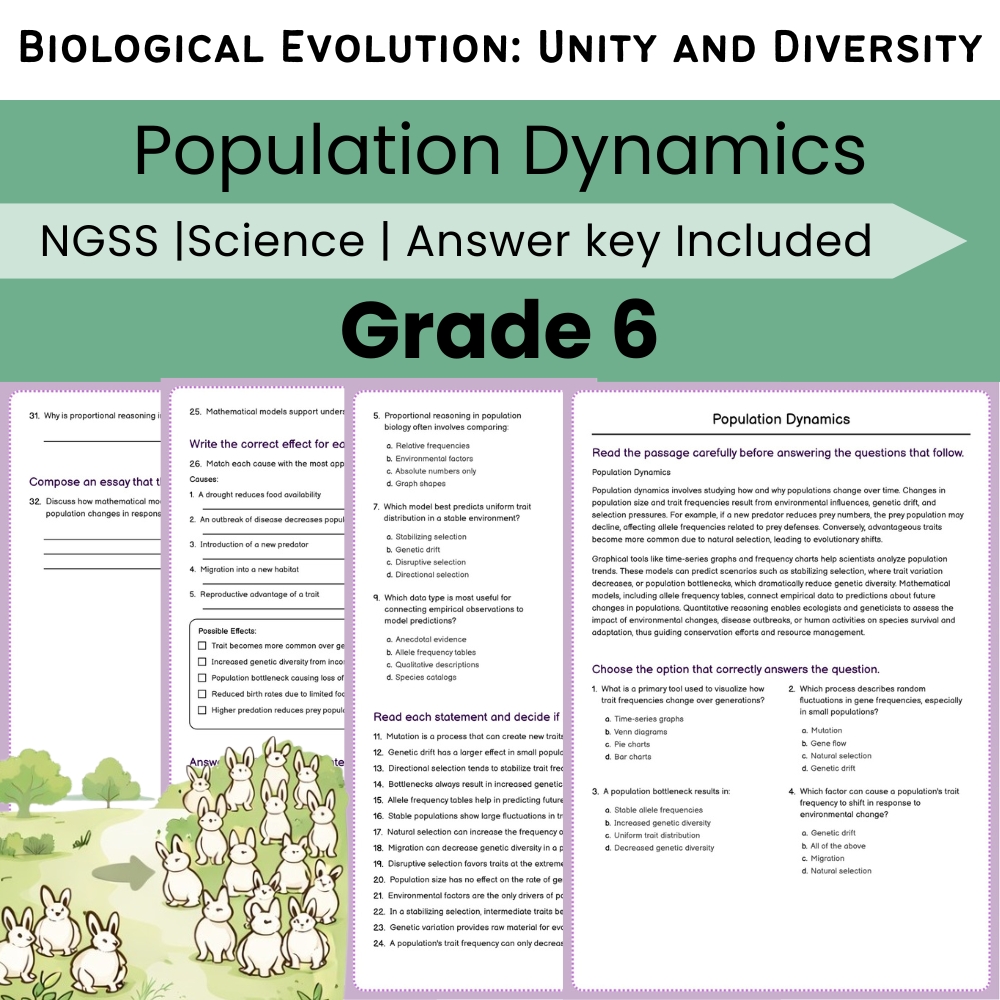
Grade 6 Science | Population Dynamics Worksheet & Assessment - Printable PDF
Learning Objectives
- Understand how trait frequencies change over generations due to environmental factors.
- Interpret proportional reasoning, frequency charts, and graphs in population studies.
- Analyze models predicting population change and the impact of demographic factors.
Also included in: Grade 6 Science | Biological Evolution: Unity and Diversity Unit Bundle (NGSS-aligned Worksheets) +1 more
Instant download

Grade 6 Physiological Traits Worksheet | Practice & NGSS PDF
 Created byClear Sky Classroom
Learning Objectives
- Define physiological adaptations and explain how they help organisms survive in specific environments.
- Identify examples of internal adaptations related to water balance, salt regulation, and metabolism.
- Use evidence from scenarios to infer how physiological traits affect survival under stress.
Instant download

Inquiry Foundations Test Prep Printable | Grade 6 Science Review
 Created byPrism Point Learning
Learning Objectives
- Define independent and dependent variables and distinguish them from controlled variables in a fair test.
- Use operational definitions to describe how to measure variables during an investigation.
- Explain how hypotheses, controlled comparisons, and reproducibility support evidence-based scientific reasoning.
Instant download

Streamlining and Smooth Airflow Worksheets | Grade 6 Science
Created bySunny Desk ResourcesLearning Objectives
- Explain how streamlining shapes an object to reduce aerodynamic resistance.
- Identify features of streamlined designs that help delay airflow separation.
- Use evidence from a text to describe how shape changes affect pressure and energy needs.
Also included in: Air and Aerodynamics Grade 6 Alberta Science Worksheets Bundle +1 more
Instant download

Grade 6 Key Construction Worksheet | Ontario Science Practice PDF
Created byClear Sky ClassroomLearning Objectives
- Use dichotomous and multi-access key ideas to select traits that separate organisms into clear categories
- Construct binary branches by choosing contrasting, observable characteristics
- Test and refine a key by checking for common errors such as life stage and sexual dimorphism mismatches
Instant download

Motives and Choices Worksheet | General ELA Grade 6 Standards-PDF
JCreated byJ.S SheetsLearning Objectives
- Identify a character’s motive (goal, fear, loyalty, or misunderstanding) by analyzing what the character says or does.
- Explain how a character’s choice leads to consequences later in a story.
- Use evidence from key moments to support inferences about credibility and complexity in character development.
Instant download

6th Grade Holiday Education | Galaxy Origins Star Wars Stories Worksheet
 Created bySilver Birch Teaching
Learning Objectives
- Explain how Star Wars reflects themes of hope, bravery, and diversity.
- Identify key terms related to space, mythology, and storytelling from a reading passage.
- Connect cultural impact to how stories can unite people across backgrounds.
Also included in: Grade 6 Holiday Science Lesson Bundle: May Worksheet Set +1 more
Instant download

Building Interactive Projects Worksheet | Grade 6 Computer Science
Created byPrism Point LearningLearning Objectives
- Explain how interactive projects use inputs, outputs, events, loops, and conditionals.
- Use planning features to organize a program before writing code.
- Use key vocabulary words (interactive, project, feature, program) correctly in context.
Also included in: Interactive Coding Foundations Lesson Bundle | Grade 6 Computer Science | General +1 more
Instant download

Ecosystem Components Test Prep Printable | Grade 6 Science
Created byPrism Point LearningLearning Objectives
- Distinguish biotic and abiotic components in an ecosystem.
- Explain how abiotic factors such as sunlight, water, soil, temperature, and minerals affect living things.
- Describe how organisms interact and how these interactions influence habitat conditions and population sizes.
Also included in: Ecosystems & Interdependence Lesson Bundle | Grade 6 Science | BC +1 more
Instant download

Pure Mixtures and Separation Strategies Worksheets Grade 6 Science
 Created byBRIGHT PATH RESOURCES
Learning Objectives
- Define a pure mixture as a combination of two or more substances that can be physically combined.
- Identify whether a mixture is uniform or nonuniform based on how evenly components are spread.
- Explain how observable differences in components help determine an appropriate separation technique.
Also included in: Grade 6 Physical Science Worksheets Bundle | Heat, Matter & Forces +2 more
Instant download

Grade 6 Math Simplifying Expressions Worksheet (Ontario) – Practice Set (PDF)
Created byClear Sky ClassroomLearning Objectives
- Understand how to represent algebraic expressions using properties of operations.
- Apply combining like terms and factoring techniques to simplify expressions.
- Evaluate the equivalence of different algebraic forms through calculations and reasoning.
Also included in: Grade 6 Algebra and Mathematical Modelling Lessons | Ontario Standards +1 more
Instant download

Dynastic Authority Worksheet | Standards-Aligned Social Studies Grade 6
JCreated byJ.S SheetsLearning Objectives
- Explain how pharaohs provided centralized leadership that helped Egyptian dynasties maintain continuity.
- Describe how divine kingship and religious beliefs supported Egypt’s political order.
- Connect religious and political authority to major state projects, such as pyramid building.
Instant download

Adaptation and Speciation Worksheet | NGSS Grade 6 Science Assessment
 Created bySkylark Worksheets
Learning Objectives
- Explain how heritable variation and natural selection can cause adaptation in populations
- Describe how geographic separation and reproductive isolation can lead to speciation
- Identify evidence for speciation using morphology, reproductive compatibility, and biogeographic patterns
Also included in: Grade 6 Evolution Evidence and Natural Selection Science Lesson Bundle NGSS +1 more
Instant download

Grade 6 Science – Pollution Effects & Heavy Metals | Daily Reading Worksheet
 Created byBright Mind Resources
Learning Objectives
- Understand how heavy metals contribute to pollution
- Identify different pollutants that affect ecosystems
- Analyze the impact of pollutants on organisms and habitats
Also included in: Grade 6 Ecosystem Relationships Science Daily Reading Lesson Bundle | BC +1 more
Instant download

Grade 6 ELA | Author Purpose Worksheet Elena | Alberta Assessment
 Created byLumora Learning
Learning Objectives
- Identify an author’s purpose (to inform, persuade, entertain, or explain) in a text.
- Analyze how purpose influences structure, evidence selection, and word choice.
- Distinguish main claims from supporting details in persuasive writing.
Instant download
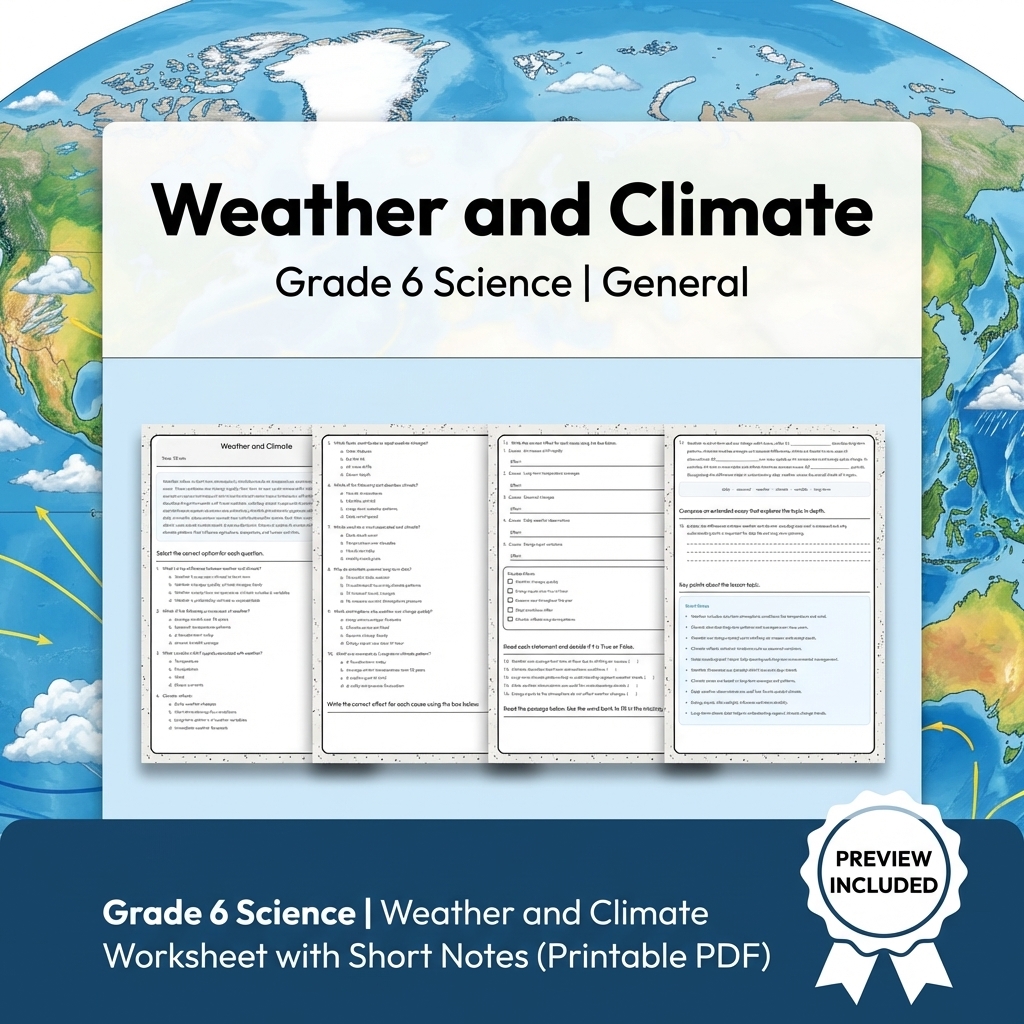
Grade 6 Science | Weather and Climate Worksheet with Short Notes (Printable PDF)
 Created byMeadowlark Worksheets
Learning Objectives
- Differentiate between weather and climate based on their characteristics.
- Identify factors that influence short-term weather changes.
- Understand long-term climate patterns and their indicators.
Also included in: Grade 6 Science Lesson Group Weather, Water, Space, Erosion & Climate +1 more
Instant download

Communicating Evidence Worksheet | Ontario Grade 6 Science Assessment
 Created byCedar Grove Learning
Learning Objectives
- Explain how claims, evidence, and reasoning work together in scientific communication.
- Choose relevant data and describe how graphs and diagrams support scientific conclusions.
- Communicate evidence clearly for an audience using accurate language, organization, and citations.
Also included in: Grade 6 Scientific Inquiry & Data Practices Science Lesson Bundle | Ontario +1 more
Instant download

Conservation of Mass Test Prep Printable | Grade 6 Science
Created byPrism Point LearningLearning Objectives
- Use particle models to explain why total mass and atom counts stay the same in a closed system during physical and chemical changes.
- Connect mass measurements before and after reactions to conservation of mass by tracking matter through diagrams and bookkeeping.
Instant download
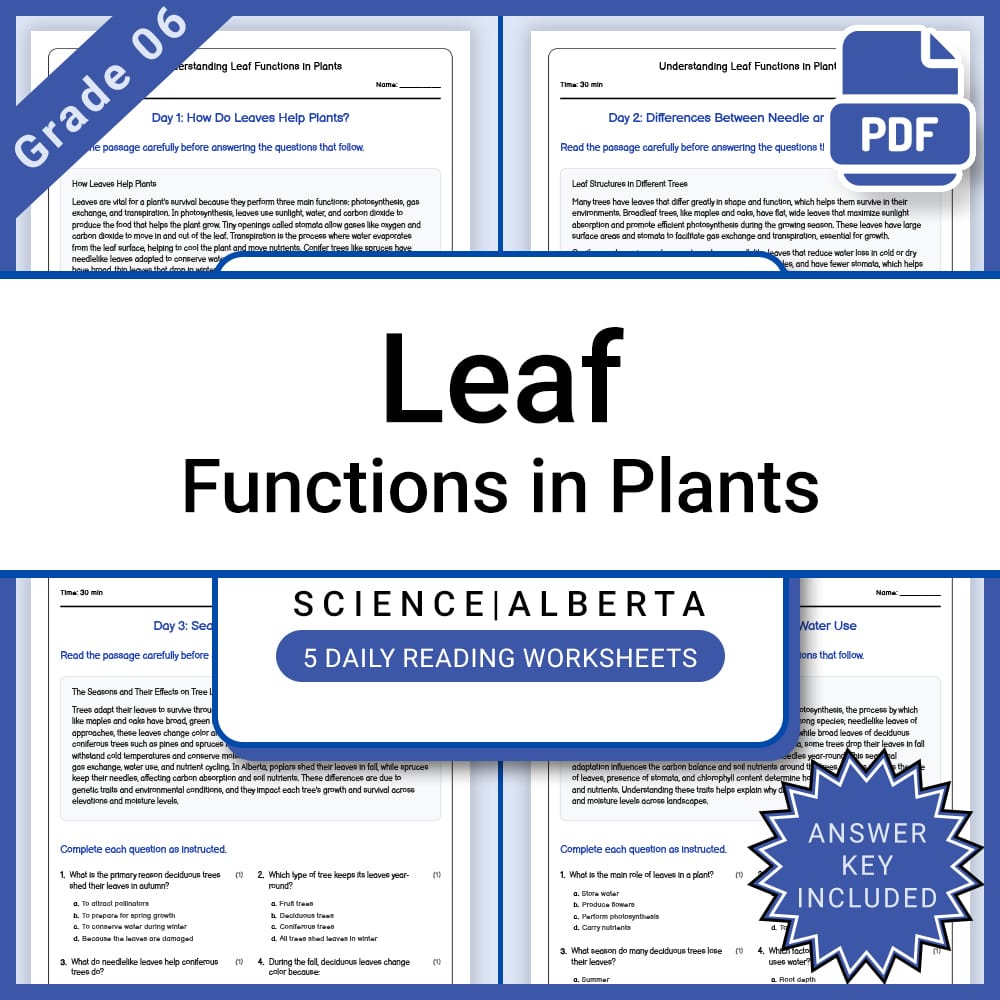
Grade 6 Science – Leaf Functions Daily Reading Worksheet + Answer Key
JCreated byJ.S SheetsLearning Objectives
- Identify the main parts of a leaf and their functions.
- Explain how leaves contribute to photosynthesis and gas exchange.
- Describe differences between needlelike conifers and broadleaf deciduous species.
Also included in: Grade 6 Science Lesson Bundle – Ecosystems, Trees, and Land Management +1 more
Instant download

Figurative Language Meaning Worksheet Grade 6 ELA TEKS Activity
 Created byGolden Apple Studio
Learning Objectives
- Identify metaphors and similes in a poem or passage and explain what the comparison suggests.
- Determine how figurative language reinforces a theme by connecting images to events or ideas in the text.
- Explain the effect of repeated figurative expressions on a reader’s understanding or inference.
Also included in: Grade 6 ELA Text Analysis & Author Craft Lesson Bundle | TEKS +1 more
Instant download

Grade 6 ELA – Understanding Transition Words & Phrases | Daily Reading Worksheet
Created byQuiet Forest EducationLearning Objectives
- Understand key concepts related to ELA
- Apply knowledge through practice questions
- Demonstrate comprehension of the material
Also included in: Grade 6 Writing ELA Lesson Bundle Daily Reading Worksheets | Alberta +1 more
Instant download

Grade 6 Science – Transfer Mechanisms in Heat | Daily Reading Worksheet
Created byBright Mind ResourcesLearning Objectives
- Understand the three main mechanisms of heat transfer: conduction, convection, and radiation.
- Identify examples of heat transfer by conduction.
- Explain how heat moves through matter by touching objects.
Also included in: Matter, Heat & Forces Lesson Bundle | Grade 6 Science | General +1 more
Instant download

Grade 6 Science – Precipitation & Infiltration | Daily Reading Worksheet
Created byBright Mind ResourcesLearning Objectives
- Identify different types of precipitation: rain, snow, sleet, hail.
- Explain how water infiltrates into the ground and what influences this process.
- Describe the pathways water takes from atmosphere to ground and surface runoff.
Also included in: Water Cycle Grade 6 Science Lesson Bundle Daily Reading | California Standards +1 more
Instant download

Physical Properties Test Prep Printables | Grade 6 Science
Created byPrism Point LearningLearning Objectives
- Identify physical properties as observable or measurable characteristics of matter.
- Differentiate physical changes from chemical changes based on whether new substances form.
- Use examples to describe how properties like density, melting point, and conductivity help classify materials.
Also included in: Matter, Properties & Change Lesson Bundle — Grade 6 Science BC Framework +1 more
Instant download

Particle Models Worksheet Grade 6 Science Matter & Reactions
Created byPrism Point LearningLearning Objectives
- Explain how particle models represent matter using atoms and molecules that occupy space.
- Use particle models to predict how properties and composition change during reactions.
- Interpret particle diagrams to identify elements, compounds, and differences in bonding patterns.
Instant download

Grade 6 Science | Transfer Mechanisms in Science - Daily Reading Comprehension
 Created byCoral Reef Learning
Learning Objectives
- Identify examples of heat transfer by conduction
- Understand how heat moves through matter via different mechanisms
- Differentiate between conduction, convection, and radiation
Instant download

Analyzing Literature Worksheet for Grade 6 ELA | CCSS Assessment Practice
JCreated byJ.S SheetsLearning Objectives
- Identify how literary elements (theme, character, narrative voice, and literary devices) work together to create meaning.
- Use evidence from a text to explain authorial choices and their effects on the reader.
- Analyze interactions among characters and how narrative perspective shapes interpretation.
Instant download

Grade 6 Design Problem Worksheet | Practice & Assessment PDF
Created byClear Sky ClassroomLearning Objectives
- Explain how a design problem starts with a clear need and measurable requirements.
- Identify common design inputs such as sketches, dimensions, performance goals, and constraints.
- Use criteria to choose and justify an effective solution in a design context.
Instant download

Grade 6 Earth System Links Worksheet | Practice & Standard PDF
Created byClear Sky ClassroomLearning Objectives
- Identify Earth’s major systems (lithosphere, hydrosphere, atmosphere, biosphere) and describe how they interact
- Explain how energy from the Sun drives cycles that move water, gases, and heat
- Use cause-and-effect reasoning to predict how changes in one Earth system affect others over different timescales
Instant download

Grade 6 ELA Worksheet | Evidence Selection & Text Analysis (PDF)
Created byGolden Apple StudioLearning Objectives
- Select details from a text that directly support a stated interpretation or claim.
- Explain how a specific quote or precise paraphrase proves an interpretation.
- Distinguish between evidence that is relevant versus evidence that is interesting but not necessary.
Also included in: Grade 6 Reading Comprehension Skills in ELA Lesson Bundle: Alberta Framework +1 more
Instant download

Grade 6 World Earth Day Worksheet | Urban Green Spaces | PDF + Answer Key
 Created byShaNova Worksheets
Learning Objectives
- Understand the importance of parks, gardens, and urban forests in supporting healthy cities.
- Identify how green spaces improve air quality and provide habitats.
- Recognize efforts cities make to incorporate nature into urban design.
Also included in: Grade 6 Holiday Earth Day Worksheets | Environmental Science Bundle
Instant download

Grade 6 Science – Voltage, Current & Resistance | Daily Reading Worksheet
Created byBright Mind ResourcesLearning Objectives
- Recognize how voltage, current, and resistance are related in simple circuits.
- Use basic calculations to determine circuit characteristics.
- Understand how changing one factor affects the others in a circuit.
Also included in: Grade 6 Electricity Science Daily Reading Lesson Bundle | Ontario +1 more
Instant download

Cohesive Devices Worksheet | Grade 6 ELA | Ontario Standards
JCreated byJ.S SheetsLearning Objectives
- Identify and use cohesive devices such as transitional words, pronoun references, and repeated key terms to improve clarity.
- Explain how punctuation and sentence organization (sequence, cause-effect, and compare-contrast) strengthen cohesion.
- Revise sentences to reduce confusion caused by weak connections or run-ons.
Instant download

Key Construction Assessment | Grade 6 Science Worksheet Ontario
Created byPrism Point LearningLearning Objectives
- Explain how dichotomous and multi-access keys use observable traits to identify organisms.
- Construct a simple key with clear, contrasting, binary choices and correct branching.
- Test key accuracy by comparing results with local taxa and revising unclear decision points.
Also included in: Grade 6 Biodiversity & Adaptation Science Lesson Bundle Ontario
Instant download

States Overview Worksheet Pack | Grade 6 Science Activities
Created byPrism Point LearningLearning Objectives
- Compare the particle arrangement and particle motion in solids, liquids, and gases using everyday examples.
- Relate macroscopic properties such as shape retention and compressibility to the state of matter.
- Explain density and molecular spacing differences using ice, liquid water, and water vapor.
Also included in: Grade 6 Matter, Energy, and Change Science Lesson Bundle TEKS Worksheets +1 more
Instant download

Food Webs Worksheet Grade 6 Science NGSSS Florida Ecosystems
Created byPrism Point LearningLearning Objectives
- Explain how a food web connects many food chains in an ecosystem.
- Describe how energy moves between organisms and how matter is recycled by decomposers.
- Predict how changes to one organism can affect multiple feeding relationships.
Instant download

Grade 6 ELA – Clarifying Questions & Comprehension | Daily Reading Worksheet
Created byQuiet Forest EducationLearning Objectives
- Understand key concepts related to ELA
- Apply knowledge through practice questions
- Demonstrate comprehension of the material
Also included in: Grade 6 ELA Daily Reading Comprehension Worksheets Lesson Bundle | BC +1 more
Instant download

Organ Systems Interactions Worksheets: Grade 6 Science
 Created byTeachers Club
Learning Objectives
- Explain how heart and blood vessels, lungs, and the digestive system work together to deliver oxygen and nutrients
- Describe how the nervous system coordinates body responses using signals that connect organs
- Connect cell functions (like breaking down nutrients or taking in oxygen) to system-level outcomes
Also included in: From Molecules to Organisms Grade 6 Science NGSS Bundle +2 more
Instant download

Component Functions Worksheet | Ontario Grade 6 Science Assessment
Created byCedar Grove LearningLearning Objectives
- Identify the function of major circuit components: power sources, resistive loads, switches, and connectors.
- Match physical circuit components to their roles in circuit behavior and to common schematic ideas.
- Describe qualitative effects of component changes on current and voltage in everyday circuits.
Also included in: Grade 6 Electricity and Circuits Science lesson bundle: Ontario framework +1 more
Instant download

Text Inferences Worksheet | Alberta Grade 6 ELA Standard Practice PDF
JCreated byJ.S SheetsLearning Objectives
- Use evidence from events, dialogue, word choice, and tone to make inferences
- Infer character motivation and likely outcomes when information is implied rather than stated
- Choose the most reasonable conclusion when multiple possibilities could fit the text
Instant download
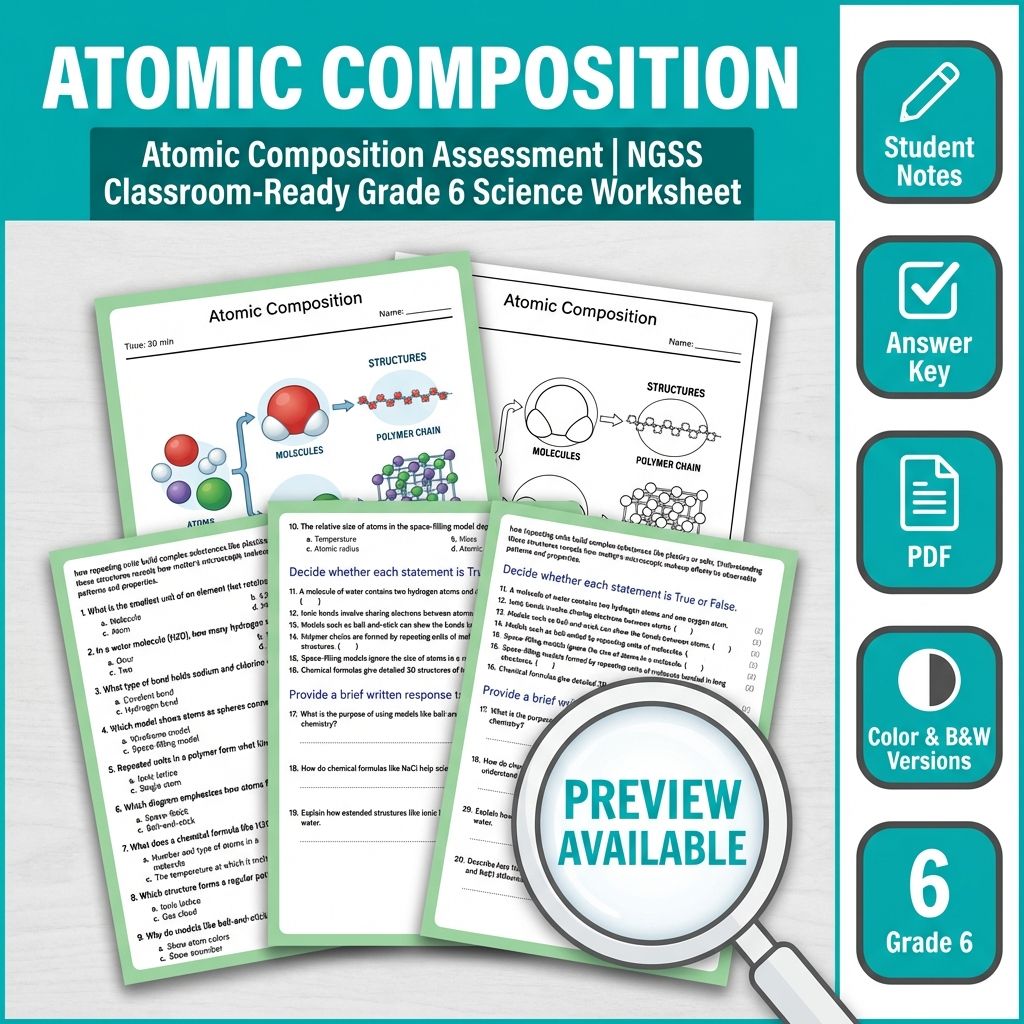
Atomic Composition Assessment | NGSS Classroom-Ready Grade 6 Science Worksheet
Created byPrism Point LearningLearning Objectives
- Describe how atoms combine to form simple molecules like H2O and NaCl.
- Understand models such as ball-and-stick and space-filling representations used in chemistry.
- Explain how molecules and extended structures are represented with chemical formulas and diagrams.
Also included in: Grade 6 Science Mini Bundle | Matter and Its Interactions NGSS Not Specified +1 more
Instant download

Grade 6 Science – Measuring Circuits & Electrical Measurements | Worksheet
Created byBright Mind ResourcesLearning Objectives
- Understand the purpose of measurement instruments in electrical circuits.
- Identify correct instrument placement for measuring current and voltage.
- Interpret typical readings to analyze circuit performance.
Also included in: Grade 6 Electricity Science Daily Reading Lesson Bundle | Ontario +1 more
Instant download

Materials For Performance Assessment | General Grade 6 Science
Created byPrism Point LearningLearning Objectives
- Understand how material properties influence their suitability for different applications.
- Compare the factors like strength, water resistance, and conductivity in material selection.
- Analyze how practical limitations such as cost and availability affect material choices.
Instant download

6th Grade ELA Worksheet | Information Flow Comprehension & Practice (PDF)
Created byGolden Apple StudioLearning Objectives
- Identify how explanatory texts use structure to present ideas in a logical sequence
- Explain how topic sentences connect to a paragraph’s main idea and supporting details
- Use transitions and consistent terminology to understand relationships between ideas
Also included in: Grade 6 Explanatory Writing Skills ELA Lesson Bundle: General ELA +1 more
Instant download

Grade 6 Science | Physical Properties Daily Reading Comprehension
Created byCoral Reef LearningLearning Objectives
- Understand what physical properties are and how they can be observed or measured.
- Identify different physical properties such as mass, volume, density, conductivity, melting point, and hardness.
- Distinguish between physical changes and chemical changes based on physical properties.
Instant download
Browse more categories
About Grade 6 Worksheets
Browse 8,582 printable Grade 6 worksheets across math, ELA, science, and social studies — each a ready-to-print PDF with optional answer keys.
MyTeachingSheets worksheets are made by real teacher-authors and checked before they go live. Download any as a print-ready PDF for lessons, homework, or independent practice — most include answer keys, and previews are always free.