
Grade 6 Worksheets
8,582 grade resources
Grade 6 Science | Mass & Density - Daily Reading Comprehension
 Created byCoral Reef Learning
Learning Objectives
- Understand the definitions of mass and volume.
- Learn how to measure mass and volume using simple tools.
- Understand the concept of density as mass per unit volume.
Instant download

Hydrologic Cycle Worksheet | Grade 6 Science Practice | TEKS
 Created byPrism Point Learning
Learning Objectives
- Describe the main processes of the hydrologic (water) cycle, including evaporation, condensation, precipitation, runoff, infiltration, and groundwater discharge.
- Explain how watersheds and aquifers influence where water flows and how water availability varies by region.
- Use basic measurements such as streamflow and recharge estimates to discuss water sustainability and water-quality concerns.
Also included in: Grade 6 Earth and Space Science Lesson Bundle TEKS (8 worksheets) +1 more
Instant download
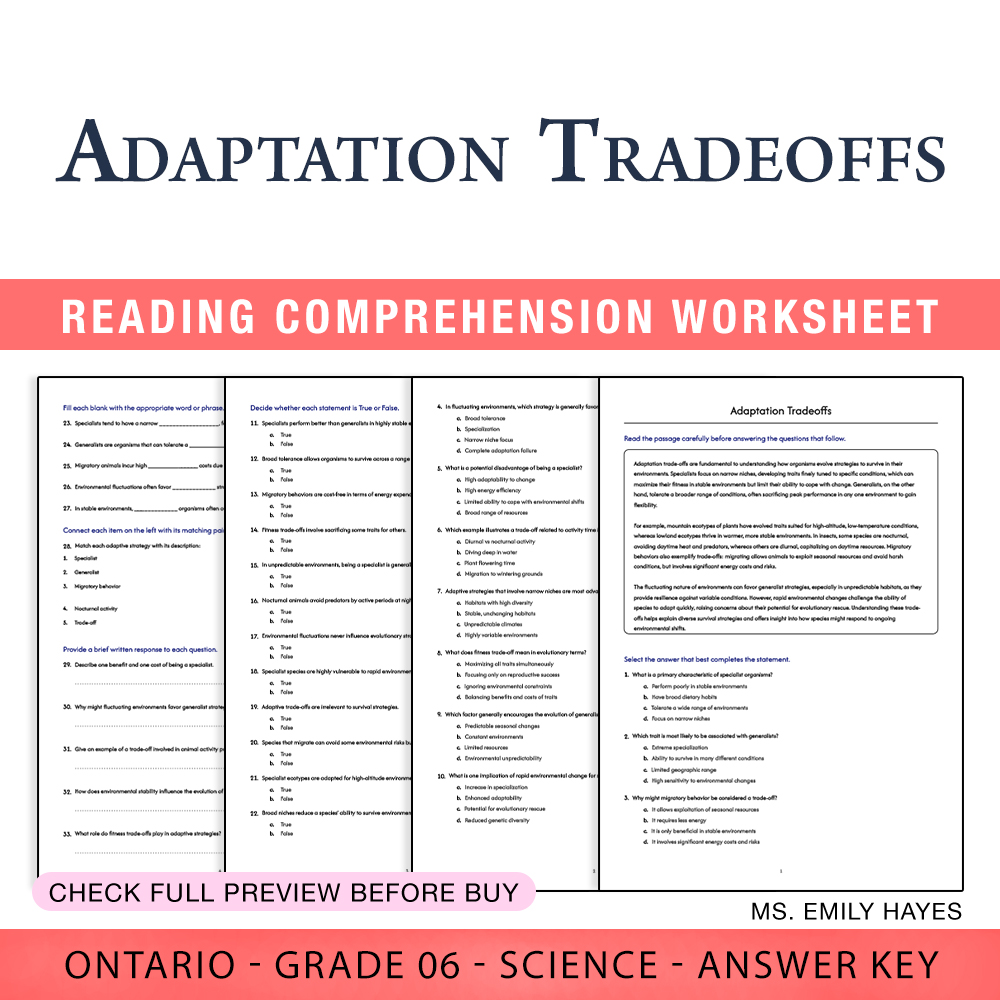
6th Grade Science | Adaptation Tradeoffs Worksheet (PDF+ Answer Key)
 Created byCopper Leaf Classroom
Learning Objectives
- Explain the concept of adaptation trade-offs and how they influence species strategies.
- Compare the benefits and costs of specialization versus generalization in organisms.
- Analyze examples such as mountain versus lowland ecotypes, nocturnal versus diurnal activity, and migratory behaviors.
Instant download

Grade 6 Forces and Motion Worksheet | NGSS Practice PDF
 Created byClear Sky Classroom
Learning Objectives
- Understand the relationship between net force, mass, and acceleration.
- Identify scenarios where forces act on objects and analyze their effects.
- Apply the formula net force equals mass times acceleration to solve problems.
Also included in: Grade 6 Motion and Stability: Forces and Interactions Science Lesson Bundle NGSS +1 more
Instant download

Grade 6 TEKS Earth Structure Daily Science Reading Worksheet with Notes
 Created byBRIGHT PATH RESOURCES
Learning Objectives
- Identify Earth’s main internal layers and their general properties.
- Explain how heat and solid materials in Earth can move over long periods.
- Use key vocabulary (crust, mantle, core) to describe Earth’s structure.
Also included in: Earth & Space Grade 6 Science Daily Reading Worksheets Lesson Bundle | TEKS +1 more
Instant download

Science Worksheet Cycles of Matter Model Grade 6 | Assessment & Practice
JCreated byJ.S SheetsLearning Objectives
- Explain how matter cycles through living and non-living parts of an ecosystem
- Identify reservoirs and flows in a cycles of matter model
- Describe how carbon and water move between air, soil, water, and organisms
Also included in: Grade 6 Life Processes & Ecosystems Science lesson bundle: General Framework +1 more
Instant download

Forest Succession and Disturbance Regimes Worksheets Grade 6
 Created bySunny Desk Resources
Learning Objectives
- Explain how different disturbances (fire, insects, wind, flooding, and human activity) can shape forest structure over time
- Describe how disturbance frequency, intensity, and spatial extent influence regeneration and habitat mosaics
- Interpret how disturbance regimes affect long-term ecosystem trajectories in boreal and mountain forests
Also included in: Trees and Forests Grade 6 Alberta Science Worksheets Bundle +1 more
Instant download

Inference Skills Worksheet for Grade 6 ELA Practice and Assessment
Created bySunny Desk ResourcesLearning Objectives
- Use textual clues to make logical inferences about characters, motives, and events.
- Distinguish between explicit information and conclusions drawn from evidence.
- Support predictions and conclusions with details from story events and dialogue.
Also included in: Reading: Literature Lesson Bundle | Grade 6 ELA | Common Core (CCSS) +1 more
Instant download

Grade 6 Science | Wave Interactions - Daily Reading Comprehension
Created byCoral Reef LearningLearning Objectives
- Understand the basic concepts of wave interactions such as interference, superposition, and resonance.
- Identify the differences between constructive and destructive interference.
- Explain how standing waves and resonance occur in musical instruments and other devices.
Instant download

Grade 6 Science | Decomposer Matter Return Worksheet | California Standards
 Created byLumora Learning
Learning Objectives
- Explain how decomposers break down dead organisms and waste to recycle matter in ecosystems.
- Describe how atoms and nutrients return to the environment in forms producers can use again.
- Connect decomposition to nutrient availability in soil and water and to ecosystem stability.
Instant download

Grade 6 Physiological Adaptations Worksheet | Practice & Assessment PDF
Created byClear Sky ClassroomLearning Objectives
- Explain how internal physiological processes help organisms survive environmental extremes
- Describe examples of physiological adaptations involving heat exchange, kidney function, and metabolic rate changes
- Identify how hormones support temperature, hydration, and energy balance
Instant download

Evidence Based Answers Worksheet Grade 6 ELA Text Evidence Practice
Created bySunny Desk ResourcesLearning Objectives
- Use evidence from a text to answer questions with accurate synthesis
- Distinguish between what a text states directly and what can only be inferred
- Use vocabulary in context and structural cues to improve the quality of responses
Also included in: Reading Informational Grade 6 ELA Lesson Bundle | General ELA +1 more
Instant download

Reading Graphs and Charts Worksheet Grade 6 Computer Science Activity
Created byPrism Point LearningLearning Objectives
- Identify key parts of bar graphs, line graphs, and pictographs, including axes and categories
- Use graph information to compare values and describe patterns
- Choose the correct graph type for a data question
Also included in: Grade 6 Using Data to Support Conclusions Lesson Bundle | Computer Science (General) +1 more
Instant download

Grade 6 Credibility and Bias Worksheet | Ontario ELA Media Literacy
Created bySunny Desk ResourcesLearning Objectives
- Evaluate media credibility by checking evidence, source transparency, and quotation accuracy.
- Identify bias by recognizing loaded language, selective images, emotional appeals, and missing counter-evidence.
- Compare two items about the same topic to distinguish facts from opinions and intentions.
Instant download

Grade 6 Science – Filtration & Sieving | Daily Reading Worksheet
 Created byBright Mind Resources
Learning Objectives
- Understand the process of filtration and how it separates mixtures
- Identify differences between filtration and sieving
- Recognize common uses of filtration in daily life and industry
Also included in: Matter & Change Grade 6 Science Daily Reading Worksheets Lesson Bundle | BC +1 more
Instant download

Grade 6 Holiday | Senior Citizens Day for Respect & Community | PDF + Answer Key
 Created byShaNova Worksheets
Learning Objectives
- Identify respectful behaviors that support older adults in a community setting
- Use key vocabulary related to respect, inclusion, and communication
- Apply comprehension strategies to a holiday-focused reading passage
Instant download

Grade 6 Holiday End Of Summar Reflection Day | PDF + Answer Key
Created byShaNova WorksheetsLearning Objectives
- Explain how SMART goals make plans clearer and easier to follow.
- Identify which parts of a goal are specific, measurable, achievable, relevant, and time-bound.
- Use reflection to set one new, school-ready goal and choose weekly actions to reach it.
Instant download

Grade 6 Tree Anatomy Roots Trunk & Water Transport Worksheet | Alberta
Created byBRIGHT PATH RESOURCESLearning Objectives
- Identify the main ideas about roots and trunks in a tree
- Describe how tree structures support the plant and move water
- Use vocabulary related to tree anatomy to explain form–function relationships
Also included in: Forest Ecosystem Adaptations Grade 6 Science Worksheets Lesson Bundle | Alberta +1 more
Instant download

System Thinking In Solutions Worksheet | Grade 6 Science Practice
Created byPrism Point LearningLearning Objectives
- Explain how system thinking connects solution parts through inputs, outputs, and pathways.
- Use cause-and-effect reasoning to predict how changes in one component affect overall results.
- Describe how system failures can happen even when one part seems to work well.
Instant download

Grade 6 Social Studies — Life and Infrastructure Worksheet MCQ Paper
 Created byThe Resource Hub
Learning Objectives
- Explain how technological and scientific advances can change everyday life through improvements in infrastructure.
- Describe how sanitation, electricity, and medical innovations influenced social routines and community organization.
- Analyze how institutions (governments and hospitals) adapt to new technology to support public well-being.
Also included in: Innovations & Infrastructure Lesson Bundle: Grade 6 Social Studies TEKS +1 more
Instant download

Grade 6 Atomic Composition Worksheet | NGSS Practice PDF
Created byClear Sky ClassroomLearning Objectives
- Describe how atoms combine to form simple molecules like H2O and NaCl.
- Identify different models used to represent atomic structures and molecules.
- Understand how repeating units form polymers and ionic lattices.
Also included in: Grade 6 Matter & Chemical Reactions Science Lesson Bundle—NGSS Worksheets +1 more
Instant download

Grade 6 Math Resource Allocation Worksheet | Ontario Standards (PDF)
Created byClear Sky ClassroomLearning Objectives
- Apply basic mathematical calculations to real-world resource distribution scenarios.
- Interpret data and make logical decisions based on quantitative information.
- Develop problem-solving skills related to budgeting, measurement, and percentages.
Also included in: Grade 6 Math Financial Literacy Bundle | Ontario Standards Practice +1 more
Instant download

Science Tree Evidence Worksheet | NGSS Grade 6 Science
 Created bySkylark Worksheets
Learning Objectives
- Explain how homologous structures and vestigial organs can provide evidence for common ancestry.
- Use conserved DNA sequences to support evolutionary relationships shown on phylogenetic trees.
- Interpret how branching patterns in phylogenetic trees relate to trait inheritance, divergence, and ancestral form.
Also included in: Grade 6 Evolution Evidence and Natural Selection Science Lesson Bundle NGSS +1 more
Instant download

Grade 6 Measuring Circuits Worksheet | Electricity Assessment & PDF
Created byClear Sky ClassroomLearning Objectives
- Explain how measuring current and voltage helps characterize how well an electrical circuit operates
- Identify conceptually where common measuring instruments are placed in a circuit to obtain meaningful readings
- Interpret measurement patterns to relate voltages, currents, and component characteristics
Instant download
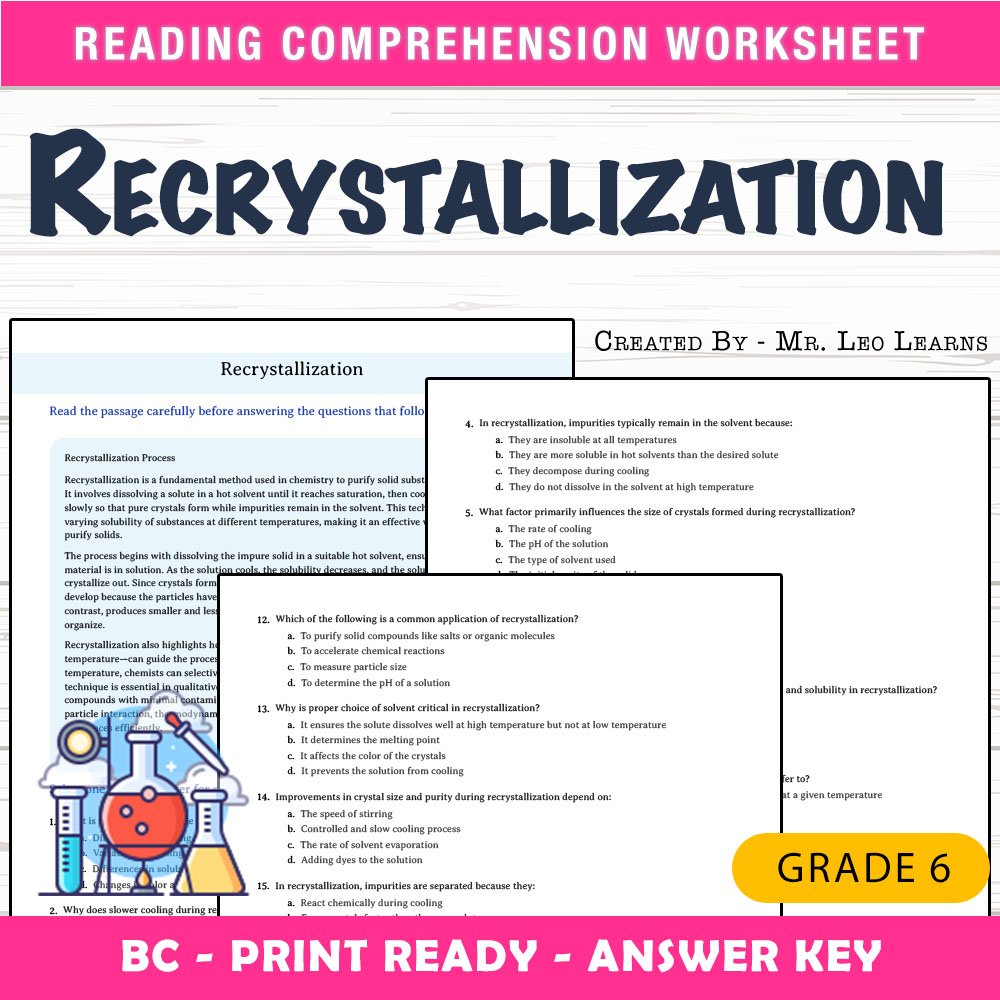
Grade 6 Science — Recrystallization Worksheet MCQ Paper for Mastery
Created byThe Resource HubLearning Objectives
- Understand the process of recrystallization and its role in purifying solids.
- Identify factors that influence crystal size and purity during recrystallization.
- Explain how solubility curves and temperature control facilitate selective recovery of substances.
Also included in: Grade 6 Science | Matter, Properties & Change Worksheet Bundle (BC Framework) +1 more
Instant download

Testable Predictions Assessment | Florida NGSSS Grade 6 Science
Created byPrism Point LearningLearning Objectives
- Explain how a scientific model can lead to a testable prediction.
- Describe how observations either support a prediction or show where a model needs revision.
- Use criteria and uncertainty to evaluate results and communicate confidence in findings.
Also included in: Grade 6 Scientific Assessment Science Lesson Bundle – Florida NGSSS
Instant download

6th Grade Holiday | Family Diversity Worksheet (PDF)
 Created bySilver Birch Teaching
Learning Objectives
- Explain how different family structures and cultural traditions shape people’s identities.
- Use respectful language to describe variations in family life with empathy and inclusion.
- Identify key civic values, such as fairness and belonging, that support diverse communities.
Also included in: Grade 6 Holiday Family Values & Diversity Lesson Bundle - May +1 more
Instant download

Trade and Cultural Exchange Worksheet | Standards-Aligned Grade 6 Social Studies
JCreated byJ.S SheetsLearning Objectives
- Explain how trade routes like the Silk Road connected South and East Asia
- Identify examples of cultural diffusion caused by the movement of goods and ideas
- Describe how trade networks supported economic growth and technological change
Instant download

Grade 6 Apparent Motion of the Sun Moon and Stars Worksheet | Ontario Science
 Created byTeacher's Corner
Learning Objectives
- Explain how Earth’s rotation and orbit cause the apparent daily and annual motions of sky objects
- Describe diurnal rising and setting and relate them to the apparent path across the sky
- Use the concepts of the celestial sphere and horizon to predict where objects appear
Instant download

Grade 6 Science | Counting Atoms - Daily Reading Comprehension
Created byCoral Reef LearningLearning Objectives
- Understand what atoms and elements are
- Learn how to identify atoms in particle models
- Recognize that atoms are conserved in chemical reactions
Instant download

Author's Purpose Worksheet | CCSS Grade 6 ELA Practice Assessment PDF
JCreated byJ.S SheetsLearning Objectives
- Determine an author’s purpose (to inform, to persuade, or to entertain) using textual clues and tone.
- Identify words, phrases, and sentence patterns that signal whether a text is meant to share information, convince the reader, or provide enjoyment.
- Explain how recognizing purpose helps readers evaluate reliability and possible bias in informational texts.
Instant download

Scarcity and Choices Worksheet | TEKS Aligned Grade 6 Social Studies
JCreated byJ.S SheetsLearning Objectives
- Explain how scarcity of resources forces individuals and societies to make choices.
- Describe how trade helps societies obtain goods they cannot produce locally.
- Define specialization and explain how it can increase efficiency and productivity.
Instant download

Grade 6 Sound Properties Worksheet | BC Practice & PDF
Created byClear Sky ClassroomLearning Objectives
- Explain how sound travels as a mechanical wave through particles in different media.
- Relate frequency to pitch and amplitude to loudness using evidence and examples.
- Describe how sound speed depends on medium and temperature and how it affects wavelength.
Instant download

Feedback Control Worksheet Printables | Grade 6 Science Review & Practice
Created byPrism Point LearningLearning Objectives
- Explain how negative feedback helps maintain internal stability by linking sensors, control centers, and effectors.
- Describe positive feedback and how it can amplify changes in the body.
- Use examples (thermoregulation, blood glucose control, and kidney osmotic balance) to trace cause-and-effect pathways.
Also included in: Grade 6 Cellular Systems Science Lesson Bundle NGSS Worksheets
Instant download

6th Grade ELA Worksheet | Counterclaim Rebuttal Practice (PDF)
 Created byGolden Apple Studio
Learning Objectives
- Explain how a counterclaim and rebuttal strengthen an argument by addressing an opposing view fairly.
- Identify what makes a rebuttal specific, supported by reasons and evidence rather than general disagreement.
- Revise writing to clearly separate the alternative perspective from the writer’s position and respond directly to it.
Also included in: Grade 6 Explanatory Writing Skills ELA Lesson Bundle: General ELA +1 more
Instant download

Grade 6 ELA | Coherence Across Structures Worksheet | BC Assessments
Created byLumora LearningLearning Objectives
- Analyze how shifts in structure (story episodes, explanations, sidebars, definitions) help maintain coherence
- Identify signals of alignment, overlap, and purpose across different parts of a text
- Explain how structural features guide readers in tracking a central idea
Instant download

Grade 6 ELA – Cause & Effect Relationships in Text | Daily Reading Worksheet
 Created byQuiet Forest Education
Learning Objectives
- Understand key concepts related to ELA
- Apply knowledge through practice questions
- Demonstrate comprehension of the material
Also included in: Grade 6 Reading & Viewing ELA Lesson Bundle for Daily Reading | Alberta +1 more
Instant download

Societal Impacts Science Worksheet | TEKS Grade 6 Assessment and Practice
JCreated byJ.S SheetsLearning Objectives
- Explain how scientific evidence can lead to public health, environmental, and resource-management decisions.
- Identify indicators used to evaluate whether a scientific policy is working.
- Describe trade-offs among economic costs, environmental protection, and public well-being.
Instant download

Coherence Across Structures Worksheet | BC Grade 6 ELA Assessment
JCreated byJ.S SheetsLearning Objectives
- Identify how different text structures (narrative episodes, explanations, sidebars) connect to maintain coherence.
- Use clues such as transitions and repeated key terms to track a central idea across shifts in purpose.
- Explain how the placement and function of supporting features affects reader understanding.
Instant download

Perspective and Framing Worksheet | Alberta Grade 6 ELA Assessment
JCreated byJ.S SheetsLearning Objectives
- Explain how framing choices (word choice, what is shown/cropped, and highlighted details) shape an audience’s interpretation.
- Identify what context may be omitted in a message and how that omission affects meaning.
- Use evidence from different media examples to compare perspectives and support claims.
Instant download

Key Civilizations Worksheet | Social Studies Grade 6 TEKS Assessed
JCreated byJ.S SheetsLearning Objectives
- Compare major ancient civilizations in Asia and the Middle East by identifying key characteristics and achievements.
- Explain how writing systems and technology helped these civilizations govern and communicate.
- Describe ways the legacies of Mesopotamia, the Indus Valley, and Chinese dynasties influenced later societies.
Instant download

Grade 6 ELA – Synthesis & Conclusion Skills | Daily Reading Worksheet
Created byQuiet Forest EducationLearning Objectives
- Understand the concept of synthesizing ideas from different perspectives.
- Identify key themes, similarities, and differences in discussions.
- Distinguish evidence from opinions in texts.
Also included in: Speaking & Listening Grade 6 ELA Daily Worksheets Lesson Bundle | Alberta +1 more
Instant download

Measuring Circuits Worksheet Grade 6 Science | Voltage & Current
 Created byChalk and Compass
Learning Objectives
- Explain how measuring current and voltage helps characterize how a circuit performs
- Describe conceptually where instruments should be placed to measure current and voltage
- Interpret typical measurement patterns to reason about relative resistance in a circuit
Also included in: Grade 6 Science Circuits & Electricity Lesson Bundle | Ontario +1 more
Instant download

Alberta Seasons Worksheet | Grade 6 Science Practice
Created byPrism Point LearningLearning Objectives
- Explain how Earth–Sun geometry and latitude help determine Alberta’s seasonal changes in daylight and solar energy.
- Describe how Alberta’s continental climate affects the timing and intensity of spring, summer, fall, and winter conditions.
- Connect seasonal changes to real environmental effects such as river ice breakup, ecosystem responses, and agricultural timing.
Also included in: Celestial Patterns & Seasons Lesson Bundle | Grade 6 Science | Alberta
Instant download

Grade 6 | April Fools Day for Mastering Humor and Reflection | PDF + Answer Key
Created byShaNova WorksheetsLearning Objectives
- Reflect on the role of humor and pranks in social interactions.
- Understand the importance of empathy and respect when joking.
- Analyze how jokes can impact feelings and relationships.
Instant download

Grade 6 Science | Science and Technology - Daily Reading Comprehension
Created byCoral Reef LearningLearning Objectives
- Understand how scientific instruments extend observation and measurement.
- Identify different tools used in scientific investigations.
- Recognize the relationship between technological advancements and scientific inquiry.
Instant download
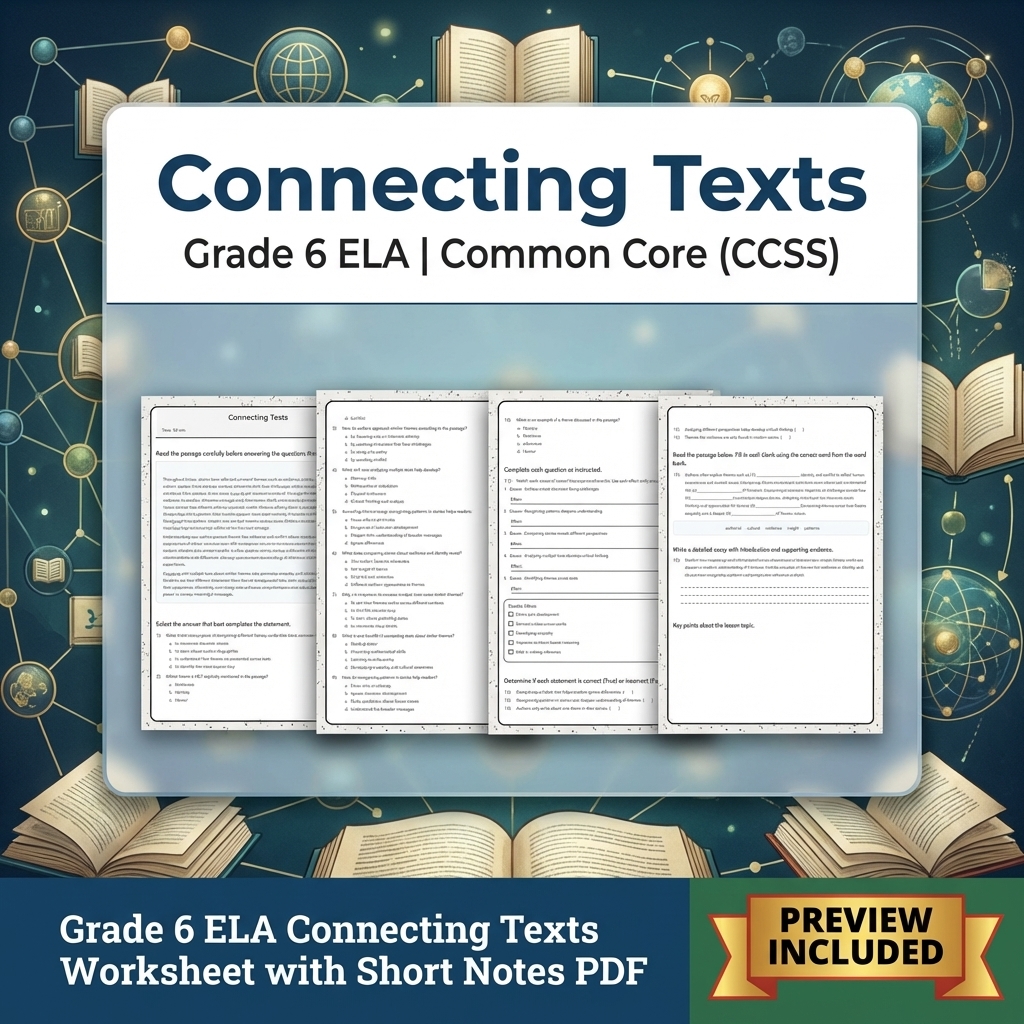
Grade 6 ELA Connecting Texts Worksheet with Short Notes PDF
 Created byMeadowlark Worksheets
Learning Objectives
- Compare and analyze themes, characters, and ideas across multiple literary works.
- Recognize patterns and contrasting perspectives to deepen understanding of common themes.
- Integrate ideas from different texts to develop a broader interpretation of literary messages.
Also included in: Grade 6 Theme & Textual Evidence ELA Lesson Bundle – CCSS +1 more
Instant download

Advanced Savings Worksheet | Grade 6 Financial Literacy Ontario Math
Created byBRIGHT PATH RESOURCESLearning Objectives
- Explain how compound interest depends on both the interest rate and the length of time
- Use percentage models to find interest (a percent of a balance) and the new balance
- Solve simple linear equations that arise when working backward to find a missing savings amount
Instant download
Browse more categories
About Grade 6 Worksheets
Browse 8,582 printable Grade 6 worksheets across math, ELA, science, and social studies — each a ready-to-print PDF with optional answer keys.
MyTeachingSheets worksheets are made by real teacher-authors and checked before they go live. Download any as a print-ready PDF for lessons, homework, or independent practice — most include answer keys, and previews are always free.