
Grade 6 Worksheets
8,578 grade resources
Grade 6 Science – Sun's Daily Motion & Celestial Sphere | Reading Worksheet
 Created byBright Mind Resources
Learning Objectives
- Describe how Earth’s rotation affects the daily rising and setting of the Sun.
- Explain the concept of the celestial sphere and how it relates to the Sun’s apparent movement.
- Identify the paths of the Sun across the sky at different times of the day.
Also included in: Space Systems Grade 6 Science Daily Reading Worksheets Bundle | Ontario +1 more
Instant download

Grade 6 Science – Control Coupling & Aerodynamics | Daily Reading Worksheet
Created byBright Mind ResourcesLearning Objectives
- Understand the concept of control coupling and its impact on aircraft maneuverability
- Identify aerodynamic interactions among roll, pitch, and yaw controls
- Describe techniques used to mitigate adverse control effects
Also included in: Grade 6 Aerodynamics Science Lesson Bundle Daily Reading Worksheets | Ontario +1 more
Instant download

Grade 6 Science – Communicating Evidence & Data Presentation | Reading Worksheet
Created byBright Mind ResourcesLearning Objectives
- Understand how to interpret and use graphs and charts to support scientific claims.
- Learn effective ways to present data visually for clear communication.
- Develop skills to analyze evidence and construct logical scientific arguments.
Also included in: Science Grade 6 Science Daily Reading Worksheets Lesson Bundle | Ontario +1 more
Instant download

Grade 6 Science – Modeling Systems & Scientific Models | Daily Reading Worksheet
Created byBright Mind ResourcesLearning Objectives
- Understand the concept of models in science and their purpose.
- Identify different types of models used to represent complex systems.
- Recognize the assumptions, limitations, and boundaries of models.
Also included in: Science Grade 6 Science Daily Reading Worksheets Lesson Bundle | Ontario +1 more
Instant download

Grade 6 Science – Community Stewardship & Scientific Methods | Reading Worksheet
Created byBright Mind ResourcesLearning Objectives
- Understand the importance of scientific observations in community environmental issues
- Recognize protocols for respectful data collection and cultural sensitivity
- Learn strategies for communicating scientific findings to the community
Also included in: Science Grade 6 Science Daily Reading Worksheets Lesson Bundle | Ontario +1 more
Instant download

Grade 6 Science – Careers in Science Daily Reading Worksheet | TEKS Aligned
Created byBright Mind ResourcesLearning Objectives
- Understand key concepts related to Science
- Apply knowledge through practice questions
- Demonstrate comprehension of the material
Also included in: Grade 6 Science and Society Lesson Bundle Daily Reading Worksheets | TEKS +2 more
Instant download
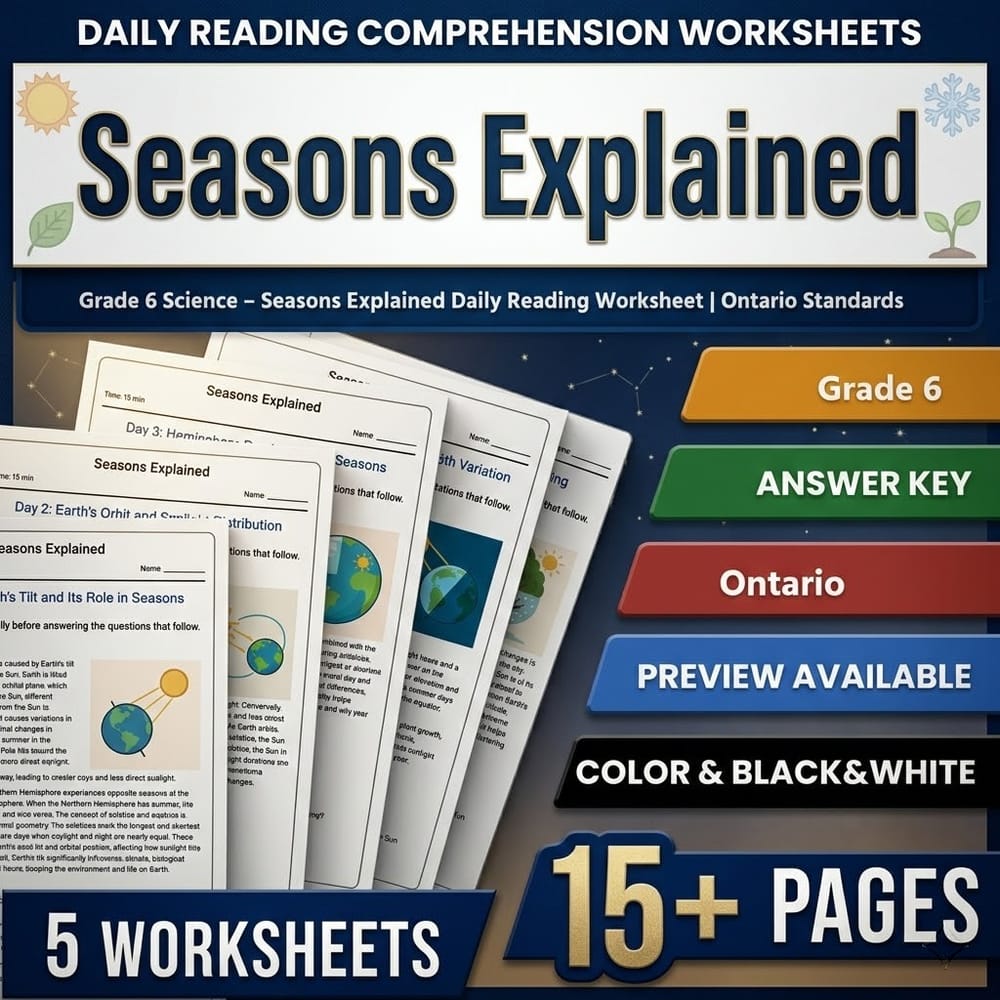
Grade 6 Science – Seasons Explained Daily Reading Worksheet | Ontario Standards
 Created byQuiet Forest Education
Learning Objectives
- Understand key concepts related to Science
- Apply knowledge through practice questions
- Demonstrate comprehension of the material
Also included in: Space Science Grade 6 Daily Reading Worksheets Bundle | Ontario +1 more
Instant download

Grade 6 Science – Adaptation Patterns & Desert Plants | Daily Reading Worksheet
Created byBright Mind ResourcesLearning Objectives
- Understand the morphological features of desert plants
- Identify how plant adaptations help survival in arid environments
- Apply knowledge of adaptation traits to real-world examples
Also included in: Ecosystems Grade 6 Science Daily Reading Worksheets Lesson Bundle | TEKS +2 more
Instant download

Grade 6 Science – Population Dynamics & Growth | Daily Reading Worksheet
Created byBright Mind ResourcesLearning Objectives
- Understand different types of population growth curves
- Identify factors influencing population change
- Differentiate between density-dependent and density-independent factors
Also included in: Ecosystems Grade 6 Science Daily Reading Worksheets Lesson Bundle | TEKS +2 more
Instant download

Grade 6 Science – Human Impacts & Ecosystem Preservation | Reading Worksheet
Created byBright Mind ResourcesLearning Objectives
- Understand how habitat fragmentation impacts wildlife populations.
- Identify different sources of environmental pollution.
- Analyze how land-use change affects ecosystems.
Also included in: Ecosystems Grade 6 Science Daily Reading Worksheets Lesson Bundle | TEKS +2 more
Instant download

Grade 6 Science – Energy Transfer & Heat Methods | Daily Reading Worksheet
Created byBright Mind ResourcesLearning Objectives
- Understand the three main mechanisms of heat transfer: conduction, convection, and radiation.
- Identify real-life examples of each heat transfer method.
- Connect observable temperature changes to different energy transfer processes.
Also included in: Matter & Energy Grade 6 Science Daily Reading Worksheets Bundle | TEKS +2 more
Instant download

Grade 6 Science – Ecosystems & Interactions Daily Reading Worksheet
Created byBright Mind ResourcesLearning Objectives
- Identify biotic components in various ecosystems
- Identify abiotic components in ecosystems
- Describe the roles of different components in habitat structure
Also included in: Ecosystems Grade 6 Science Daily Reading Worksheets Lesson Bundle | TEKS +2 more
Instant download

Grade 6 Science – Symbiotic Relations & Mutualism | Daily Reading Worksheet
Created byBright Mind ResourcesLearning Objectives
- Understand the concept of mutualism in symbiotic relationships.
- Identify examples of mutualism in nature.
- Analyze how mutualistic interactions benefit both species involved.
Also included in: Ecosystems Grade 6 Science Daily Reading Worksheets Lesson Bundle | TEKS +2 more
Instant download

Grade 6 Science – Minerals & Rocks Daily Reading Worksheet | TEKS Aligned
Created byBright Mind ResourcesLearning Objectives
- Identify the physical and chemical properties of minerals
- Understand how minerals are classified based on properties
- Learn about the formation and types of rocks: igneous, sedimentary, and metamorphic
Also included in: Grade 6 Earth and Space Science Lesson Bundle Daily Reading | TEKS +2 more
Instant download

Grade 6 Science – Scientific Ethics & Responsibility Daily Reading Worksheet
Created byBright Mind ResourcesLearning Objectives
- Understand the importance of privacy in medical data handling.
- Identify ethical considerations in digital measurement and data use.
- Analyze scenarios involving environmental stewardship and biotechnology decisions.
Also included in: Grade 6 Science and Society Lesson Bundle Daily Reading Worksheets | TEKS +2 more
Instant download
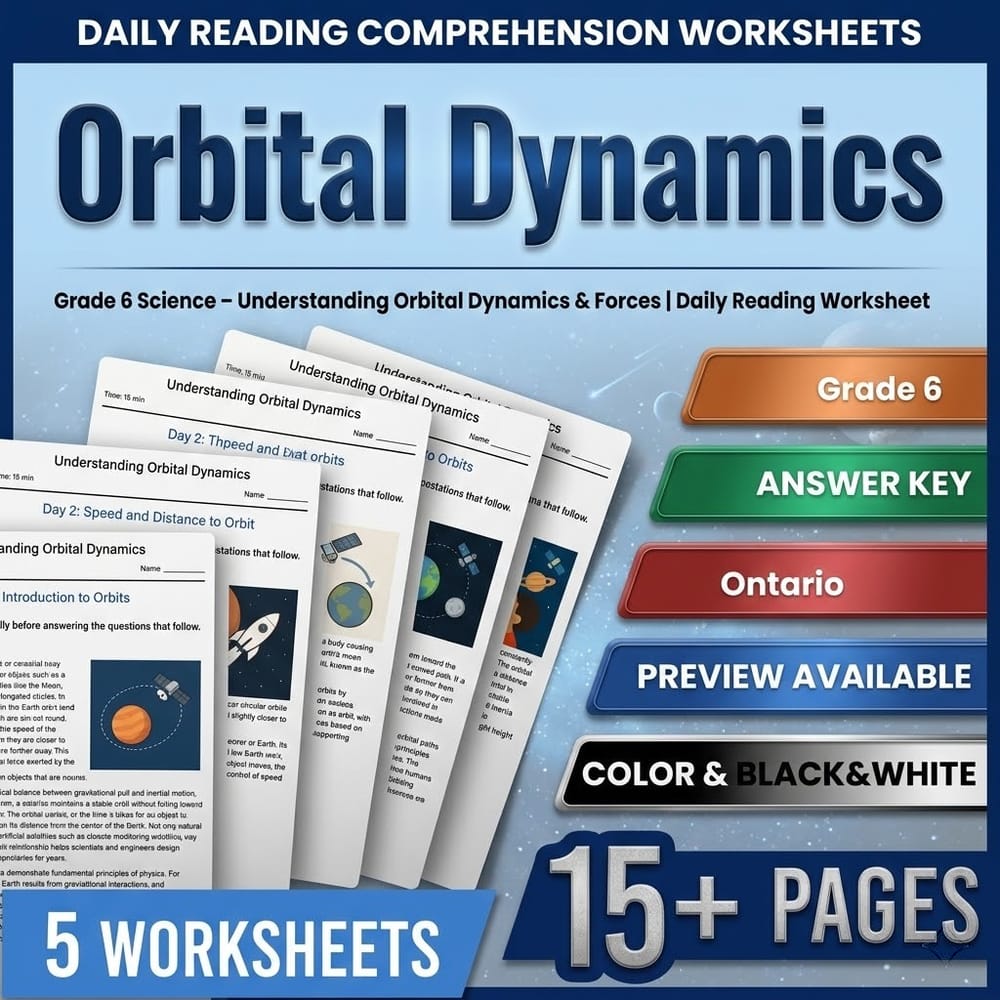
Grade 6 Science – Understanding Orbital Dynamics & Forces | Daily Worksheet
Created byQuiet Forest EducationLearning Objectives
- Describe what an orbit is and how elliptical paths differ from near-circular ones.
- Explain why satellite speed varies depending on their distance from the Earth.
- Understand the balance of gravitational force and inertial motion in maintaining stable orbits.
Also included in: Space Science Grade 6 Daily Reading Worksheets Bundle | Ontario +1 more
Instant download
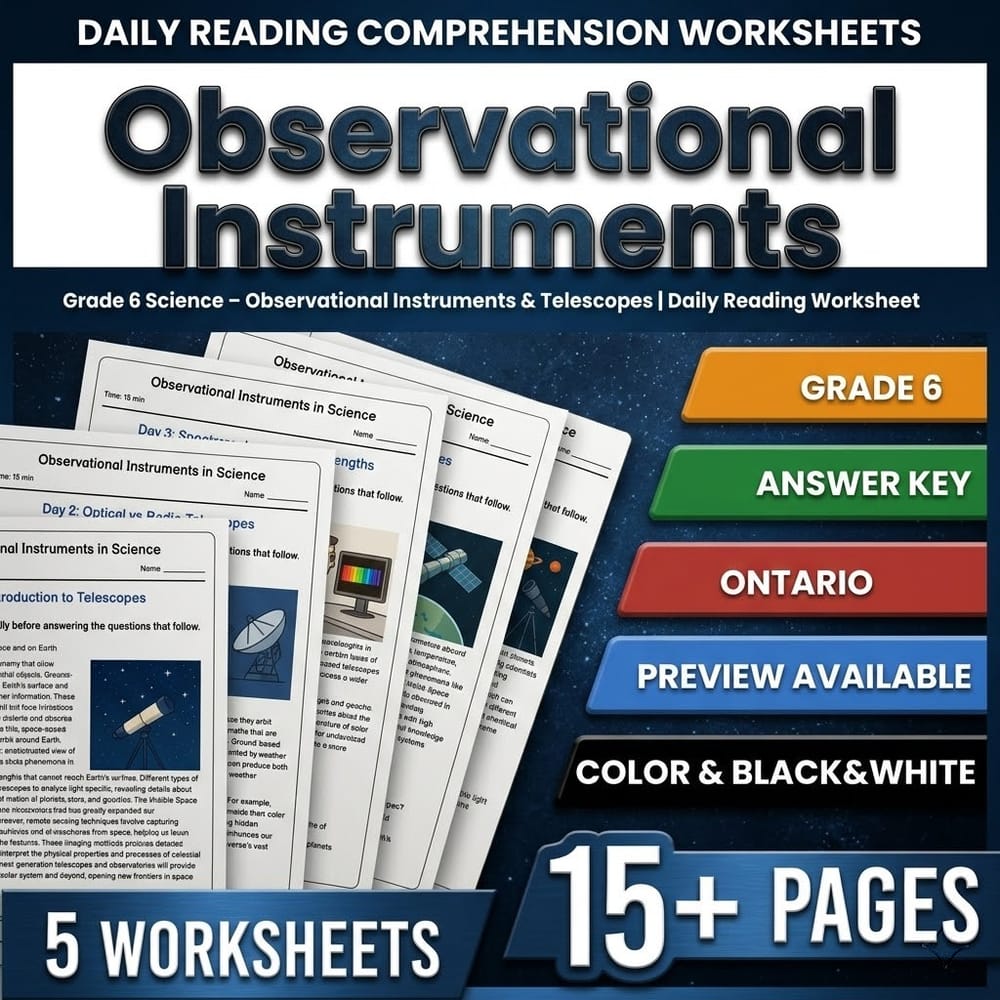
Grade 6 Science – Observational Instruments & Telescopes | Daily Worksheet
Created byQuiet Forest EducationLearning Objectives
- Understand the different types of telescopes and their functions.
- Learn how space-based observatories differ from ground-based ones.
- Recognize how various wavelengths reveal properties of celestial objects.
Also included in: Space Science Grade 6 Daily Reading Worksheets Bundle | Ontario +1 more
Instant download

Grade 6 Science – Energy Forms & Concepts | Daily Reading Worksheet
Created byBright Mind ResourcesLearning Objectives
- Identify different forms of energy such as kinetic, potential, thermal, chemical, and electrical.
- Relate everyday phenomena to energy forms, like a rolling ball or a lit bulb.
- Differentiate between motion, position, and internal energy in objects.
Also included in: Matter & Energy Grade 6 Science Daily Reading Worksheets Bundle | TEKS +2 more
Instant download
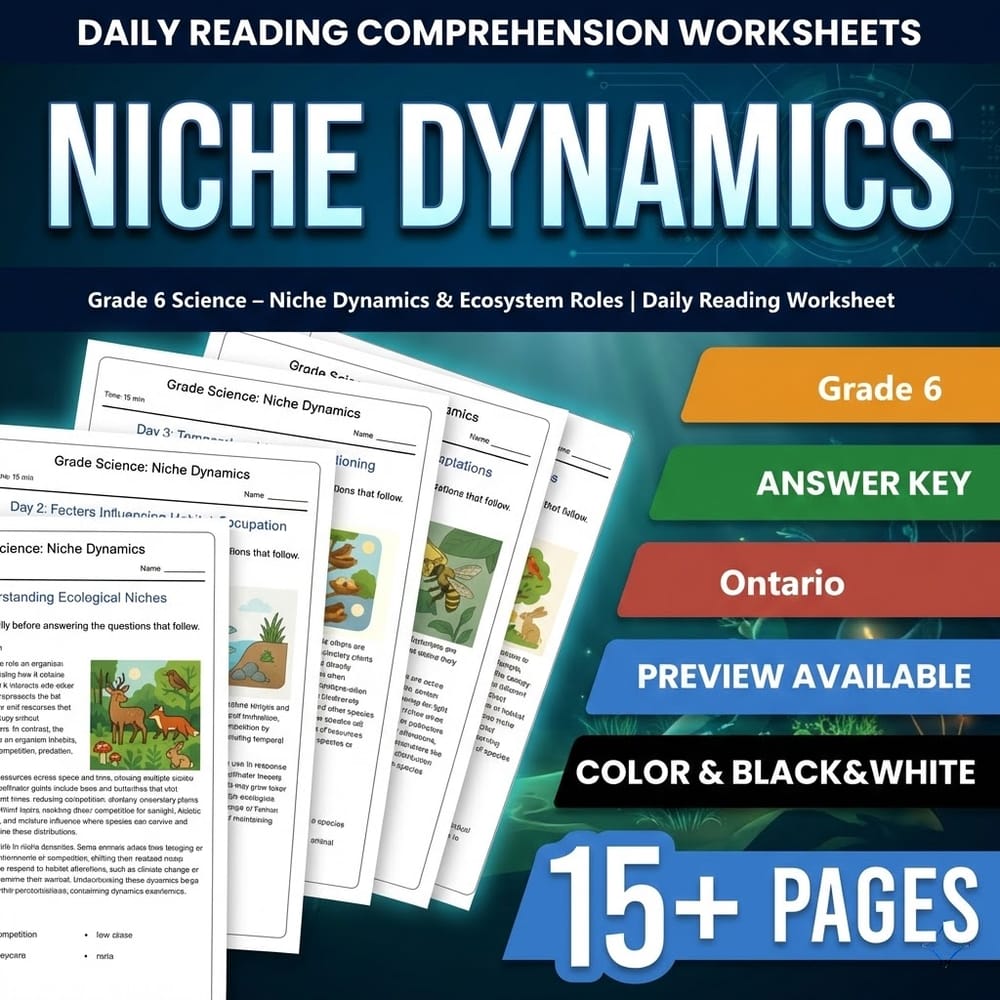
Grade 6 Science – Niche Dynamics & Ecosystem Roles | Daily Reading Worksheet
Created byQuiet Forest EducationLearning Objectives
- Understand the concept of ecological niches, including fundamental and realized niches
- Identify abiotic factors that influence habitat and resource use
- Describe how interspecific interactions shape resource partitioning and habitat occupation
Also included in: Ecosystems and Environment Grade 6 Science Daily Worksheets Bundle | Ontario +1 more
Instant download
Grade 6 Science – Parasitic Drag & Flight Components | Daily Reading Worksheet
Created byQuiet Forest EducationLearning Objectives
- Identify the different types of parasitic drag.
- Explain how form, skin-friction, and interference drag contribute to parasitic drag.
- Understand the dependence of parasitic drag on speed and aircraft shape.
Also included in: Flight Science Grade 6 Daily Reading Worksheets Bundle | Ontario +1 more
Instant download
Grade 6 Science – Digital Instrumentation & Sensors | Daily Reading Worksheet
Created byQuiet Forest EducationLearning Objectives
- Identify different types of electronic sensors used in scientific measurements
- Understand how data loggers and digital probes function
- Explain calibration procedures and the importance of measurement accuracy
Also included in: Science Grade 6 Daily Reading Worksheets Bundle | Ontario Framework +1 more
Instant download
Grade 6 Science – Communicating Evidence & Data | Daily Reading Worksheet
Created byQuiet Forest EducationLearning Objectives
- Understand how to select relevant data to support scientific claims.
- Recognize different ways of communicating evidence, including visual and verbal formats.
- Learn to construct logical arguments based on supporting evidence.
Also included in: Science Grade 6 Daily Reading Worksheets Bundle | Ontario Framework +1 more
Instant download

Grade 6 Science – Scientific Methods & Inquiry | Daily Reading Worksheet
Created byBright Mind ResourcesLearning Objectives
- Learn how to make detailed observations for scientific inquiry.
- Differentiate between descriptive and comparative approaches in experiments.
- Formulate testable questions based on observations.
Also included in: Grade 6 Science Inquiry & Modeling Daily Reading Lesson Bundle | TEKS +2 more
Instant download

Grade 6 Science – Measurement Units & Precision | Daily Reading Worksheet
Created byBright Mind ResourcesLearning Objectives
- Understand the importance of using correct measurement units in scientific experiments.
- Recognize the need for consistency in units across measurements.
- Learn how instrument resolution affects measurement accuracy.
Also included in: Grade 6 Science Inquiry & Modeling Daily Reading Lesson Bundle | TEKS +2 more
Instant download
Grade 6 Science – Aircraft Stability & Flight Dynamics | Daily Reading Worksheet
Created byQuiet Forest EducationLearning Objectives
- Understand the different stability modes of aircraft: static and dynamic
- Learn how aircraft geometry affects longitudinal, lateral, and directional stability
- Identify the role of center of gravity, dihedral angles, and tail design in stability
Also included in: Flight Science Grade 6 Daily Reading Worksheets Bundle | Ontario +1 more
Instant download

Grade 6 Science – Design Principles & Scientific Experiments Reading Worksheet
Created byBright Mind ResourcesLearning Objectives
- Understand key concepts related to Science
- Apply knowledge through practice questions
- Demonstrate comprehension of the material
Also included in: Grade 6 Science Inquiry & Modeling Daily Reading Lesson Bundle | TEKS +2 more
Instant download

Grade 6 Science – Hydrologic Cycle & Water Movement | Daily Reading Worksheet
Created byBright Mind ResourcesLearning Objectives
- Understand the basic processes of the hydrologic cycle, including evaporation, condensation, precipitation, runoff, infiltration, and groundwater discharge.
- Identify surface and groundwater interaction within watersheds.
- Recognize the importance of water movement in landscape evolution and resource sustainability.
Also included in: Grade 6 Earth and Space Science Lesson Bundle Daily Reading | TEKS +2 more
Instant download

Grade 6 Science – Understanding Circuit Symbols | Daily Reading Worksheet
Created byBright Mind ResourcesLearning Objectives
- Identify and describe standard circuit symbols used in schematics.
- Understand the purpose of symbols for components like cells, batteries, resistors, lamps, and switches.
- Interpret schematic diagrams to predict how circuits will behave.
Also included in: Grade 6 Electricity Science Daily Reading Lesson Bundle | Ontario +1 more
Instant download

Grade 6 Science – Digital Instrumentation & Sensors | Daily Reading Worksheet
Created byBright Mind ResourcesLearning Objectives
- Identify different types of electronic sensors
- Understand the basic function of electronic sensors
- Learn about data loggers and digital probes
Also included in: Science Grade 6 Science Daily Reading Worksheets Lesson Bundle | Ontario +1 more
Instant download

Grade 6 Science – Trade-off Decisions & Material Selection | Reading Worksheet
Created byBright Mind ResourcesLearning Objectives
- Explain what trade-offs are in selecting materials.
- Identify how choosing stronger materials can affect weight and cost.
- Analyze different material properties and their impacts on design choices.
Also included in: Engineering & Technology Grade 6 Science Worksheets Lesson Bundle | General +1 more
Instant download

Grade 6 Science – Design Problem & Inquiry Questions | Daily Reading Worksheet
Created byBright Mind ResourcesLearning Objectives
- Understand what a design problem is and the importance of defining needs and constraints.
- Identify different components that influence the design of a protective case.
- Develop skills to analyze design requirements carefully.
Also included in: Engineering & Technology Grade 6 Science Worksheets Lesson Bundle | General +1 more
Instant download

Grade 6 Science – Keystone Species & Ecosystems | Daily Reading Worksheet
Created byBright Mind ResourcesLearning Objectives
- Define what a keystone species is and explain its role in an ecosystem.
- Identify examples of keystone species based on case studies.
- Describe the cascading effects caused by keystone species on biodiversity and habitat structure.
Also included in: Grade 6 Ecology & Biodiversity Science Lesson Bundle | Ontario Daily Reading +1 more
Instant download
Grade 6 Science – Adaptation Tradeoffs in Ecology Daily Reading Worksheet
Created byQuiet Forest EducationLearning Objectives
- Understand the concept of ecological niches and how specialization affects organisms' survival.
- Compare the benefits and costs of being a specialist versus a generalist.
- Analyze different adaptation strategies in plants and animals, especially in changing environments.
Also included in: Ecosystems and Environment Grade 6 Science Daily Worksheets Bundle | Ontario +1 more
Instant download

Grade 6 Science – Niche Relationships & Ecosystems | Daily Reading Worksheet
Created byBright Mind ResourcesLearning Objectives
- Define what a niche is in an ecosystem.
- Identify different niche types based on resource use and behavior.
- Explain how species coexist by occupying different niches.
Also included in: Ecosystems Grade 6 Science Daily Reading Worksheets Lesson Bundle |Florida NGSSS +1 more
Instant download

Grade 6 Science – Competition & Resource Use in Nature | Daily Reading Worksheet
Created byBright Mind ResourcesLearning Objectives
- Identify different types of competition among organisms
- Understand how competition influences survival and population dynamics
- Analyze examples of competition in various ecosystems
Also included in: Life Processes Grade 6 Science Daily Reading Worksheets Lesson Bundle | General +1 more
Instant download
Grade 6 Science – Control Surfaces & Aerodynamics | Daily Reading Worksheet
Created byQuiet Forest EducationLearning Objectives
- Identify primary and secondary control surfaces on an aircraft
- Describe the basic functions of ailerons, elevators, rudders, and flaps
- Understand how deflections of control surfaces influence aircraft movement
Also included in: Flight Science Grade 6 Daily Reading Worksheets Bundle | Ontario +1 more
Instant download

Grade 6 Science – Food Web & Energy Paths | Daily Reading Worksheet
Created byBright Mind ResourcesLearning Objectives
- Understand key concepts related to Science
- Apply knowledge through practice questions
- Demonstrate comprehension of the material
Also included in: Grade 6 Ecosystems and Energy Science Lesson Bundle | California Standards +1 more
Instant download

Grade 6 Science – Current Fundamentals & Circuits | Daily Reading Worksheet
Created byBright Mind ResourcesLearning Objectives
- Recognize and describe what electric current is and how charges move through conductors.
- Distinguish between conventional current direction and electron flow.
- Explain potential difference as a driving force for charge movement.
Also included in: Grade 6 Electricity Science Daily Reading Lesson Bundle | Ontario +1 more
Instant download
Grade 6 Science – Quantitative Circuits Worksheet (Ontario Science 1) (PDF)
Created byBright Mind ResourcesLearning Objectives
- Understand the relationship between voltage, current, and resistance in electrical circuits.
- Apply proportional reasoning to calculate unknown circuit values using measured data.
- Predict how changes in resistance affect current flow in a fixed voltage circuit.
Instant download
Grade 6 Science | Series Circuit Characteristics Worksheet (Ontario PDF)
Created byBright Mind ResourcesLearning Objectives
- Understand the single-path configuration of series circuits and how current remains consistent through all elements.
- Explain how voltage divides among components in a series circuit and how this affects brightness of bulbs and resistance.
- Identify the limitations of series wiring for household electrical systems and compare predictable series behavior with branching circuits.
Instant download
Grade 6 Science | Component Functions Worksheet (Ontario | PDF)
Created byBright Mind ResourcesLearning Objectives
- Identify the roles of power sources, resistive loads, switches, and connectors in circuits.
- Explain how each component influences current and voltage in a circuit.
- Link physical components to schematic symbols used in circuit diagrams.
Instant download
6th Grade Science – Biodiversity Patterns Worksheet (Ontario) PDF
Created byBright Mind ResourcesLearning Objectives
- Understand measures of biodiversity such as species richness, abundance, and evenness.
- Identify sampling methods like transects and quadrats used in ecological surveys.
- Interpret spatial patterns in biodiversity and their implications for ecosystem health.
Instant download
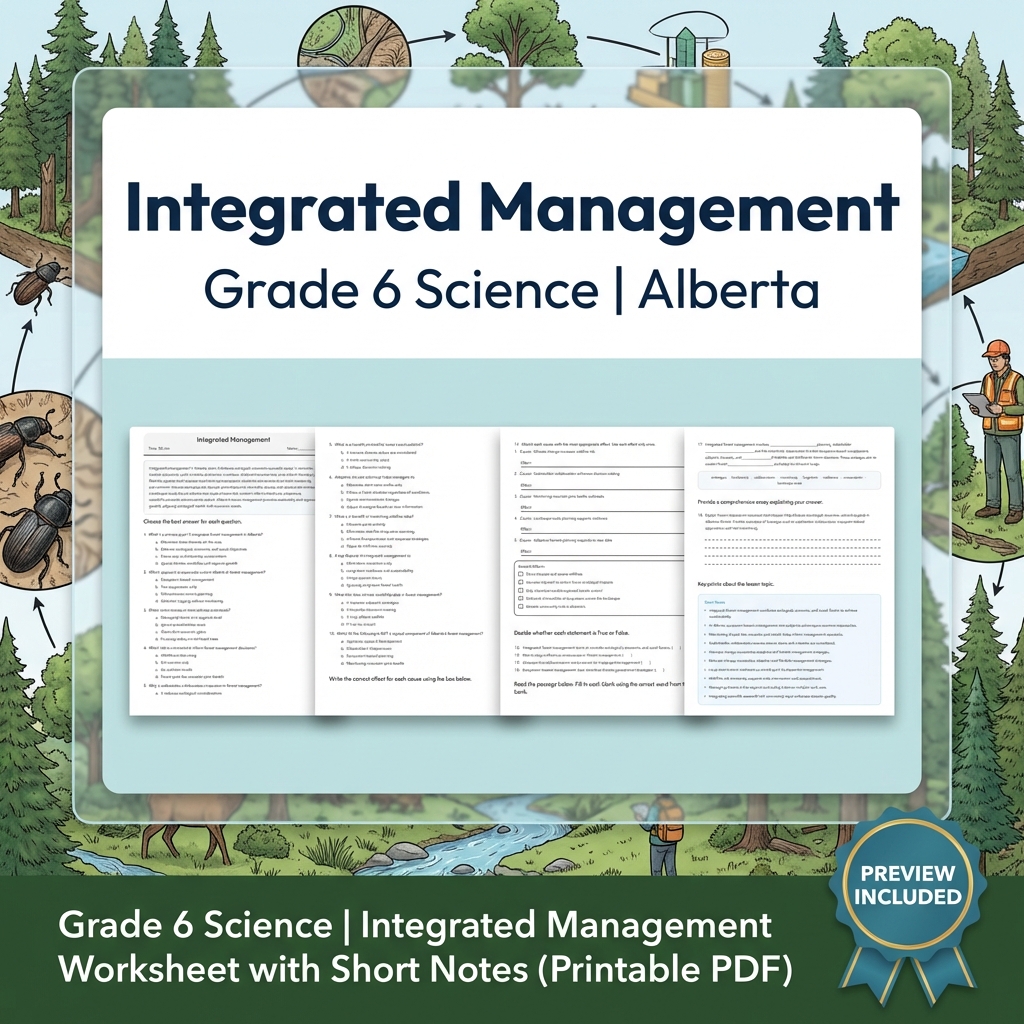
Grade 6 Science | Integrated Management Worksheet with Short Notes (PDF)
 Created byMeadowlark Worksheets
Learning Objectives
- Understand the concept of integrated management considering ecological, economic, and social factors.
- Identify forest management approaches used in Alberta, such as ecosystem-based management and adaptive planning.
- Analyze how landscape-scale planning and stakeholder collaboration support forest resilience.
Also included in: Grade 6 Science | Trees and Forests Unit Worksheet Bundle – Alberta Curriculum +1 more
Instant download

Adaptation Tradeoffs Worksheet | Ontario Grade 6 Science Assessment
 Created byCedar Grove Learning
Learning Objectives
- Explain how specialization and generalization are adaptation strategies with different fitness trade-offs
- Compare how organisms can benefit and lose fitness when environments change
- Use examples (plant ecotypes, insect activity patterns, and migration) to describe trade-offs and survival outcomes
Also included in: Grade 6 Biodiversity and Adaptations Science Lesson Bundle Ontario +1 more
Instant download
Grade 6 Science | Insulator Comparisons Worksheet (Ontario Standards PDF)
Created byBright Mind ResourcesLearning Objectives
- Understand the properties and behaviour of insulating materials.
- Identify common insulators such as rubber, glass, and dry wood.
- Explain how insulators prevent electrical charge flow and support safety.
Instant download
6th Grade Science | Keystone Species Worksheet (Ontario)(Worksheet + Answer Key)
Created byBright Mind ResourcesLearning Objectives
- Understand the concept of keystone species and their influence on ecosystems.
- Identify regional examples of keystone species and their ecological roles.
- Analyze cascading effects caused by keystone species' activities.
Instant download
Grade 6 Science | Flight Forces Worksheet – Ontario Standards (PDF)
Created byBright Mind ResourcesLearning Objectives
- Understand the four main aerodynamic forces: lift, drag, thrust, and weight.
- Explain how these forces interact to produce steady, level flight.
- Identify how force magnitude and direction affect climbing, cruising, and descending in flight.
Instant download
Grade 6 Science | Energy and Power Worksheet (Ontario Science 1 PDF)
Created byBright Mind ResourcesLearning Objectives
- Explain the relationship between electrical energy transfer and power dissipation in circuit elements.
- Define power as the rate at which energy is transferred in an electrical circuit.
- Connect power to current and voltage, and understand how resistive components generate heat.
Instant download
Browse more categories
About Grade 6 Worksheets
Browse 8,578 printable Grade 6 worksheets across math, ELA, science, and social studies — each a ready-to-print PDF with optional answer keys.
MyTeachingSheets worksheets are made by real teacher-authors and checked before they go live. Download any as a print-ready PDF for lessons, homework, or independent practice — most include answer keys, and previews are always free.