
Grade 6 Worksheets
8,578 grade resources
Atomic Composition Practice Worksheet | Grade 6 Science NGSS
 Created byPrism Point Learning
Learning Objectives
- Describe how chemical formulas and models show the relative number and types of atoms in simple molecules and extended structures.
- Use representations (ball-and-stick and space-filling) to explain how atoms combine to form compounds like H2O and NaCl.
- Explain how repeating units build polymer chains and how ionic lattices form from ions.
Instant download

Light Properties Practice Worksheet | Grade 6 Science BC Review
Created byPrism Point LearningLearning Objectives
- Explain how light can be described using wavelength, frequency, and energy.
- Relate shorter and longer wavelengths to photon energy and typical effects.
- Describe how different materials transmit, absorb, and reflect different colors of light.
Also included in: Energy, Waves & Circuits Lesson Bundle | Grade 6 Science | BC Framework +1 more
Instant download

Circuit Diagnosis Test Prep Printables | Grade 6 Science
Created byPrism Point LearningLearning Objectives
- Explain how observed symptoms can indicate different faults in series and parallel circuits.
- Use expected measurement patterns to compare predictions with observations during troubleshooting.
- Describe how component behavior changes diagnostic conclusions in circuit topology (series vs. parallel).
Also included in: Grade 6 Circuits & Electricity Science lesson bundle: Ontario
Instant download

Population Dynamics Test Prep Printable | Grade 6 Science
Created byPrism Point LearningLearning Objectives
- Interpret allele frequency tables and describe how trait frequencies can change over generations.
- Analyze time-series and frequency information to explain population growth, decline, and stabilizing patterns.
- Use proportional reasoning to compare scenarios such as directional change and population bottlenecks.
Also included in: Grade 6 Evolution and Biodiversity Science lesson bundle | NGSS
Instant download

Chemical Energy Release Worksheet Grade 6 Science Activities Pack
Created byPrism Point LearningLearning Objectives
- Explain how chemical energy stored in food is released to power life processes.
- Describe how energy changes form in organisms (including heat loss).
- Use the idea that matter/energy is not created or destroyed to interpret food-energy changes.
Also included in: Animals Matter Lesson Bundle | Grade 6 Science | California Standards
Instant download

Organ Definition Test Prep Printables | Grade 6 Science
Created byPrism Point LearningLearning Objectives
- Define an organ as a structure made of multiple tissue types working together to do specific jobs.
- Explain how different tissues inside an organ coordinate to carry out functions needed for survival.
- Describe how organ structure relates to its function in body systems.
Also included in: Multicellular Systems & Functions Lesson Bundle | Grade 6 Science | BC +1 more
Instant download

Respiratory System Practice Worksheet | Grade 6 Science Review
Created byPrism Point LearningLearning Objectives
- Explain how the respiratory system supports gas exchange between the environment and body tissues
- Describe how diffusion and moist exchange surfaces help move oxygen into the blood and remove carbon dioxide
- Connect how breathing increases oxygen delivery to cells and supports cellular respiration
Also included in: Multicellular Systems & Functions Lesson Bundle | Grade 6 Science | BC +1 more
Instant download

Pressure Patterns Worksheet | Grade 6 Science Activities
Created byPrism Point LearningLearning Objectives
- Explain how uneven heating and Earth’s surface shape create pressure differences that affect wind
- Describe how low and high pressure zones influence local weather and regional wind patterns in Alberta
- Connect pressure gradients to everyday observations such as wind changes near valleys and lee sides of mountains
Also included in: Aerodynamics and Flight Design Lesson Bundle – Grade 6 Science Alberta
Instant download

Pattern Analysis Worksheet Pack | Grade 6 Science Activities
Created byPrism Point LearningLearning Objectives
- Identify patterns in time-based and space-based data using visual inspection and descriptive statistics.
- Use moving averages and basic seasonal ideas to smooth noise and reveal long-term changes.
- Explain how anomalies can be detected and why environmental drivers may provide plausible explanations.
Instant download

Comparative Flight Worksheet | Grade 6 Science Activities
Created byPrism Point LearningLearning Objectives
- Compare how kites, gliders, and round canopies differ in performance using lift, drag, and glide-related ideas
- Explain how design trade-offs affect endurance versus maneuverability
- Use Alberta context (prairie crosswinds and valley thermals) to predict likely flight outcomes
Also included in: Aerodynamics and Flight Design Lesson Bundle – Grade 6 Science Alberta
Instant download

Reflection And Refraction Test Prep Printables | Grade 6 Science
Created byPrism Point LearningLearning Objectives
- Explain how reflection and refraction change the direction of light when it meets a surface or boundary.
- Identify real-life examples of reflection and refraction and relate them to angles and material properties.
- Describe how lenses use refraction to focus or disperse light and form images.
Also included in: Energy, Waves & Circuits Lesson Bundle | Grade 6 Science | BC Framework +1 more
Instant download

Fossil Patterns Test Prep Worksheet | Grade 6 Science NGSS Review
Created byPrism Point LearningLearning Objectives
- Explain how fossil occurrences in different rock layers (strata) show patterns of change over geologic time.
- Use relative dating ideas to describe how fossils can be ordered, and compare this with radiometric dating.
- Describe how fossil assemblages can change when environments shift, leading to persistence or disappearance of taxa.
Also included in: Grade 6 Evolution and Biodiversity Science lesson bundle | NGSS
Instant download

Biodiversity Patterns Test Prep Printable | Grade 6 Science
Created byPrism Point LearningLearning Objectives
- Describe how species richness and occurrence patterns can reveal biodiversity trends across space and time
- Explain how comparisons such as island faunas and latitudinal gradients help identify endemism and turnover
- Use ecological and historical factors (like habitat fragmentation and colonization) to interpret why communities differ
Also included in: Grade 6 Evolution and Biodiversity Science lesson bundle | NGSS
Instant download

Physiological Adaptations Worksheet Practice Test | Grade 6 Science BC
Created byPrism Point LearningLearning Objectives
- Explain how physiological adaptations help the body respond to environmental challenges.
- Describe examples of internal adjustments, including temperature regulation, water conservation, and energy balance.
- Connect hormonal control to survival by linking internal changes to improved tolerance of extremes.
Also included in: Multicellular Systems & Functions Lesson Bundle | Grade 6 Science | BC +1 more
Instant download

Erosion Pathways Worksheet | Grade 6 Science Activities
Created byPrism Point LearningLearning Objectives
- Explain how erosion and deposition reshape Earth’s surface over time.
- Identify the main agents of erosion (moving water, wind, ice, and gravity) and describe how they move sediment.
- Describe factors that affect erosion and deposition, including slope, rock resistance, vegetation, and water-flow strength.
Instant download

Decomposer Matter Return Worksheet Grade 6 Science Ecosystems Pack
Created byPrism Point LearningLearning Objectives
- Explain how decomposers break down dead organisms and waste to recycle matter in ecosystems.
- Describe how atoms and molecules are returned to soil and water in forms that producers can use again.
- Connect decomposition to nutrient availability and continued ecosystem functioning.
Also included in: Animals Matter Lesson Bundle | Grade 6 Science | California Standards
Instant download

Seasons Explained Worksheet | Grade 6 Science Practice & Review
Created byPrism Point LearningLearning Objectives
- Explain how Earth’s axial tilt causes different hemispheres to receive different amounts of sunlight during the year
- Describe how Earth’s orbit affects the timing of equinoxes and solstices through changes in solar elevation
- Connect sunlight angle and day length to seasonal differences in climate and biological cycles
Also included in: Grade 6 Space Systems Science Lesson Bundle for Ontario (10 Worksheets)
Instant download

Community Stewardship Practice Worksheet | Grade 6 Science Assessment
Created byPrism Point LearningLearning Objectives
- Apply scientific methods to a local community stewardship issue while showing respectful engagement.
- Use protocols for consent and cultural sensitivity when collecting and discussing local observations.
- Communicate findings clearly to non-specialist audiences and support collaborative decision-making.
Instant download

Sky Observations Worksheet Grade 6 Science | Alberta Standards Practice
Created byPrism Point LearningLearning Objectives
- Describe how systematic sky observations help identify repeating patterns over time.
- Explain how Earth’s rotation and the Moon’s movement affect what we see in the sky.
- Use simple records (sunrise/sunset times, Moon phases, and star positions) to make observational conclusions.
Also included in: Celestial Patterns & Seasons Lesson Bundle | Grade 6 Science | Alberta
Instant download

Competition and Resource Use Worksheet | Grade 6 Science Activities
Created byPrism Point LearningLearning Objectives
- Explain how competition for limited resources can affect organisms’ survival and population sizes
- Identify traits that influence access to resources, feeding timing, and tolerance to conditions
- Use evidence from examples to distinguish direct competition from indirect effects on community members
Instant download

Conductor Properties Test Prep Printable | Grade 6 Science
Created byPrism Point LearningLearning Objectives
- Explain how free charge carriers in conductors allow electrical current to flow.
- Describe how metallic structure and material type affect conductivity.
- Identify how temperature and cross-sectional area influence the ease of charge flow.
Also included in: Grade 6 Circuits & Electricity Science lesson bundle: Ontario
Instant download

Leaf Functions Worksheet | Grade 6 Science Assessments
Created byPrism Point LearningLearning Objectives
- Explain how leaf structure supports gas exchange, photosynthesis, and transpiration
- Compare broadleaf deciduous and needlelike conifer leaves in terms of water use and seasonal effects
- Describe how stomatal regulation, leaf area, and chlorophyll influence growth and carbon balance
Also included in: Trees and Forests Lesson Bundle | Grade 6 Science | Alberta Framework
Instant download

Earth System Links Worksheet | Grade 6 Science Practice
Created byPrism Point LearningLearning Objectives
- Explain how the lithosphere, hydrosphere, atmosphere, and biosphere interact as connected Earth systems
- Describe how energy from the Sun drives cycles that move water, gases, and heat
- Use cause-and-effect reasoning to predict how changes in one system can affect other systems
Instant download

Operational Definitions Worksheet | Grade 6 Science Practice
Created byPrism Point LearningLearning Objectives
- Explain what an operational definition is and why it improves clarity in science measurements.
- Identify key components of an operational definition, including units, measurement location, and timing.
- Convert qualitative observations into quantitative measurements using a clear measurement protocol.
Instant download

Measuring Electricity Worksheet | Grade 6 Science Review & Practice
Created byPrism Point LearningLearning Objectives
- Explain how current, voltage, and power are measured and what each quantity describes in a circuit.
- Use units (amperes, volts, watts, joules, and kilowatt-hours) to interpret electricity data accurately.
- Describe how energy transfer over time relates to device energy use in practical situations.
Also included in: Energy, Waves & Circuits Lesson Bundle | Grade 6 Science | BC Framework +1 more
Instant download

Modeling Systems Test Prep Worksheets | Grade 6 Science Ontario
Created byPrism Point LearningLearning Objectives
- Construct simple physical, diagrammatic, and mathematical models to represent real-world systems.
- Identify model assumptions and define model boundaries to make predictions more reasonable.
- Compare model predictions with observable outcomes to explain limitations and refine the model.
Instant download

Quantitative Circuits Practice Assessment | Grade 6 Science
Created byPrism Point LearningLearning Objectives
- Explain how voltage, current, and resistance are related using proportional reasoning.
- Predict how changing resistance affects current when voltage stays the same.
- Compare current and resistance behaviors in series and parallel circuits using numeric relationships.
Also included in: Grade 6 Circuits & Electricity Science lesson bundle: Ontario
Instant download

Nervous System Practice Worksheet | Grade 6 Science Review & Assessment
Created byPrism Point LearningLearning Objectives
- Describe how the nervous system collects sensory information and produces responses through neural signaling.
- Explain how neurons transmit impulses along axons and communicate at synapses using chemical messengers.
- Identify the role of brain and spinal cord integration in coordinating muscle and gland activity.
Also included in: Multicellular Systems & Functions Lesson Bundle | Grade 6 Science | BC +1 more
Instant download

Error Analysis Worksheet Grade 6 Science | Alberta Standards Practice
Created byPrism Point LearningLearning Objectives
- Distinguish between systematic error and random error using examples from science measurements
- Identify how replication, calibration records, and environmental conditions affect the reliability of data
- Explain how errors can change either the average result or the scatter of results
Instant download

Invasive Species Practice Assessment | Grade 6 Science Ontario
Created byPrism Point LearningLearning Objectives
- Explain how invasive species enter new ecosystems and why they can become established.
- Describe how invasive species can change food webs, nutrient cycling, and habitats.
- Identify factors that increase establishment and describe simple monitoring indicators.
Also included in: Grade 6 Biodiversity & Adaptation Science Lesson Bundle Ontario
Instant download

Sustainability Strategies Practice Worksheet | Grade 6 Science NGSS Review
Created byPrism Point LearningLearning Objectives
- Explain how population trends and per-capita resource use can increase or decrease impacts on Earth systems.
- Compare sustainability strategies such as renewable energy, conservation, circular resource use, and land-management approaches.
- Evaluate trade-offs among economic, social, and environmental priorities and suggest measurable indicators of progress.
Instant download

Food Chains Practice Worksheet | Grade 6 Science BC Standards
Created byPrism Point LearningLearning Objectives
- Explain how energy and nutrients move through a food chain from producers to consumers.
- Identify trophic levels and the roles of herbivores, carnivores, and decomposers/scavengers.
- Predict how changes in one population can affect other populations in a simple food chain.
Also included in: Ecosystems & Interdependence Lesson Bundle | Grade 6 Science | BC +1 more
Instant download

Gas Pressure Practice Worksheet | Grade 6 Science Assessment
Created byPrism Point LearningLearning Objectives
- Explain gas pressure using the particle model and collisions with container walls.
- Predict how changes in particle speed, collision frequency, and volume affect gas pressure.
- Describe how temperature changes relate to pressure and gas behavior in sealed containers and everyday examples.
Also included in: Matter, Properties & Change Lesson Bundle — Grade 6 Science BC Framework +1 more
Instant download

Habitat Fragmentation Review Worksheet | Grade 6 Science Test Prep BC
Created byPrism Point LearningLearning Objectives
- Explain how habitat fragmentation happens and why it makes habitats less connected.
- Describe how fragmentation can increase edge effects and reduce species movement and gene flow.
- Evaluate mitigation ideas such as corridors and protecting large habitat blocks.
Also included in: Ecosystems & Interdependence Lesson Bundle | Grade 6 Science | BC +1 more
Instant download

Reasoning Claims Worksheet | Grade 6 Science Activities
Created byPrism Point LearningLearning Objectives
- Explain the difference between raw observations and explanatory scientific claims.
- Connect evidence to a claim by describing how data supports reasoning.
- Evaluate whether evidence is strong enough to justify an inference.
Also included in: Grade 6 Scientific Investigation Practices Science Lesson Bundle TEKS +1 more
Instant download

Human Impacts Practice Test | Grade 6 Science Worksheet & Review
Created byPrism Point LearningLearning Objectives
- Explain how human activities can disrupt ecosystem balance by changing habitats, nutrient cycles, and energy pathways.
- Describe how deforestation can increase erosion and harm food webs and biodiversity.
- Investigate how pollution can accumulate in organisms and affect health and reproduction.
Also included in: Ecosystems & Interdependence Lesson Bundle | Grade 6 Science | BC +1 more
Instant download

Invasive Species Practice & Assessment Worksheet | Grade 6 Science BC
Created byPrism Point LearningLearning Objectives
- Explain how invasive species are introduced by human transport and why they spread quickly.
- Describe how invasive species can disrupt food webs, habitats, and nutrient cycles.
- Identify real-world examples of invasive species and predict likely ecosystem impacts.
Also included in: Ecosystems & Interdependence Lesson Bundle | Grade 6 Science | BC +1 more
Instant download

Change Examples Practice Worksheet | Grade 6 Science Review
Created byPrism Point LearningLearning Objectives
- Distinguish physical changes from chemical changes using observable evidence and product identity
- Explain how phase changes and dissolving differ from reactions that form new substances
- Identify signs of chemical change such as gas production, precipitate formation, and energy changes
Also included in: Matter, Properties & Change Lesson Bundle — Grade 6 Science BC Framework +1 more
Instant download

Phase Energy Test Prep Printable | Grade 6 Science Worksheet BC
Created byPrism Point LearningLearning Objectives
- Explain how energy changes particle motion during phase changes (melting, boiling, freezing, and condensation).
- Describe why temperature can stay nearly constant during a phase change even while energy is still being added or released.
- Connect latent heat to the energy needed to overcome attractive forces or form stronger particle bonds.
Also included in: Matter, Properties & Change Lesson Bundle — Grade 6 Science BC Framework +1 more
Instant download

Error Analysis Worksheet | Grade 6 Science Activities
Created byPrism Point LearningLearning Objectives
- Identify sources of error in experimental data and describe how they affect results.
- Distinguish random error from systematic error and explain how each changes measurements.
- Use uncertainty and examples to judge the reliability of a scientific conclusion.
Also included in: Grade 6 Scientific Investigation Practices Science Lesson Bundle TEKS +1 more
Instant download

Reaction Rates Practice Worksheet | Grade 6 Science Review and Assessment
Created byPrism Point LearningLearning Objectives
- Explain how particle collisions influence the rate of chemical reactions.
- Describe how concentration, temperature, surface area, and catalysts affect reaction rates.
- Use observable evidence (gas release, color change, heat) to infer changes in reaction rate.
Also included in: Matter, Properties & Change Lesson Bundle — Grade 6 Science BC Framework +1 more
Instant download

Decomposers And Nutrients Test Prep Printables | Grade 6 Science
Created byPrism Point LearningLearning Objectives
- Explain how decomposers break down dead organic matter and return nutrients to the environment.
- Describe how temperature, moisture, and oxygen affect decomposition rates.
- Connect nutrient cycling to plant growth and ecosystem balance.
Also included in: Ecosystems & Interdependence Lesson Bundle | Grade 6 Science | BC +1 more
Instant download

Design Process Test Prep Printables | Grade 6 Science
Created byPrism Point LearningLearning Objectives
- Describe the iterative design process using specifications, prototyping, measurement, and refinement.
- Explain how lift, drag, weight, and stability trade-offs affect aircraft or glider concepts.
- Interpret measurements such as lift and drag coefficients to improve aerodynamic performance.
Also included in: Grade 6 Aerodynamics Flight Design Science lesson bundle - Ontario
Instant download

Science and Technology Worksheet | Grade 6 Science Activities
Created byPrism Point LearningLearning Objectives
- Explain how scientific investigation and technological development influence each other.
- Describe how instruments and tools improve observation, measurement, and the testing of hypotheses.
- Use cause-and-effect reasoning to show how new tools change the questions scientists can ask.
Also included in: Grade 6 Science Ethics and Societal Impacts Lesson Bundle for TEKS +1 more
Instant download

Biodiversity Patterns Assessment Practice Worksheet | Grade 6 Science
Created byPrism Point LearningLearning Objectives
- Explain how species richness, abundance, and evenness describe biodiversity in different ecosystems.
- Use sampling tools like transects and quadrats to measure biodiversity patterns.
- Interpret spatial patterns and relate biodiversity metrics to ecosystem stability and conservation.
Also included in: Grade 6 Biodiversity & Adaptation Science Lesson Bundle Ontario
Instant download
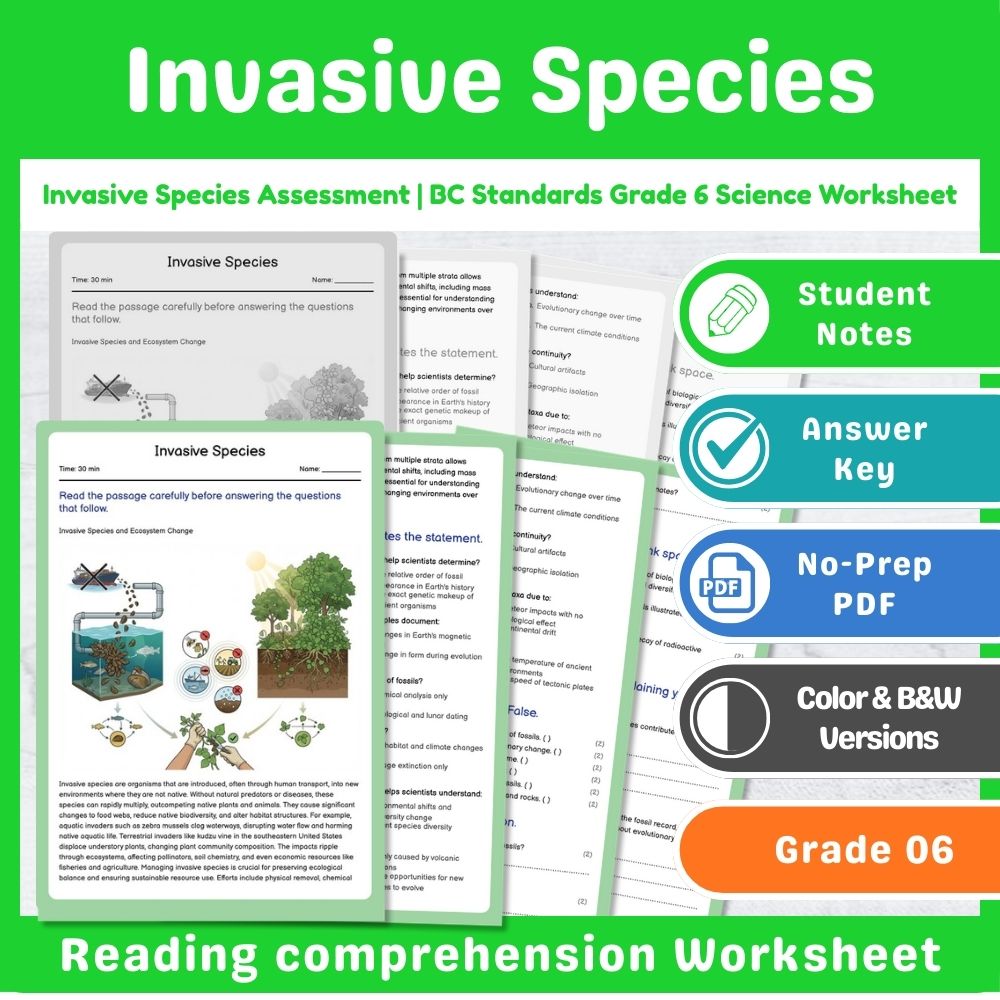
Invasive Species Assessment | BC Standards Grade 6 Science Worksheet
Created byPrism Point LearningLearning Objectives
- Understand the definition and characteristics of invasive species.
- Identify examples and impacts of invasive species on ecosystems.
- Analyze how invasive species outcompete native organisms and alter habitats.
Instant download

Habitats and Niches Assessment | BC Standard Grade 6 Science Worksheet
Created byPrism Point LearningLearning Objectives
- Understand the difference between habitats and niches in ecosystems.
- Identify how species interact within shared habitats and niches.
- Explain how resource partitioning reduces competition among species.
Instant download

Waves and Technology Assessment for Grade 6 Science | BC Standards
Created byPrism Point LearningLearning Objectives
- Explain how sound and light waves transfer energy in technological devices.
- Describe the conversion processes in speakers and microphones.
- Understand how cameras utilize wave properties to produce images.
Instant download
Browse more categories
About Grade 6 Worksheets
Browse 8,578 printable Grade 6 worksheets across math, ELA, science, and social studies — each a ready-to-print PDF with optional answer keys.
MyTeachingSheets worksheets are made by real teacher-authors and checked before they go live. Download any as a print-ready PDF for lessons, homework, or independent practice — most include answer keys, and previews are always free.