
Grade 6 Worksheets
8,578 grade resources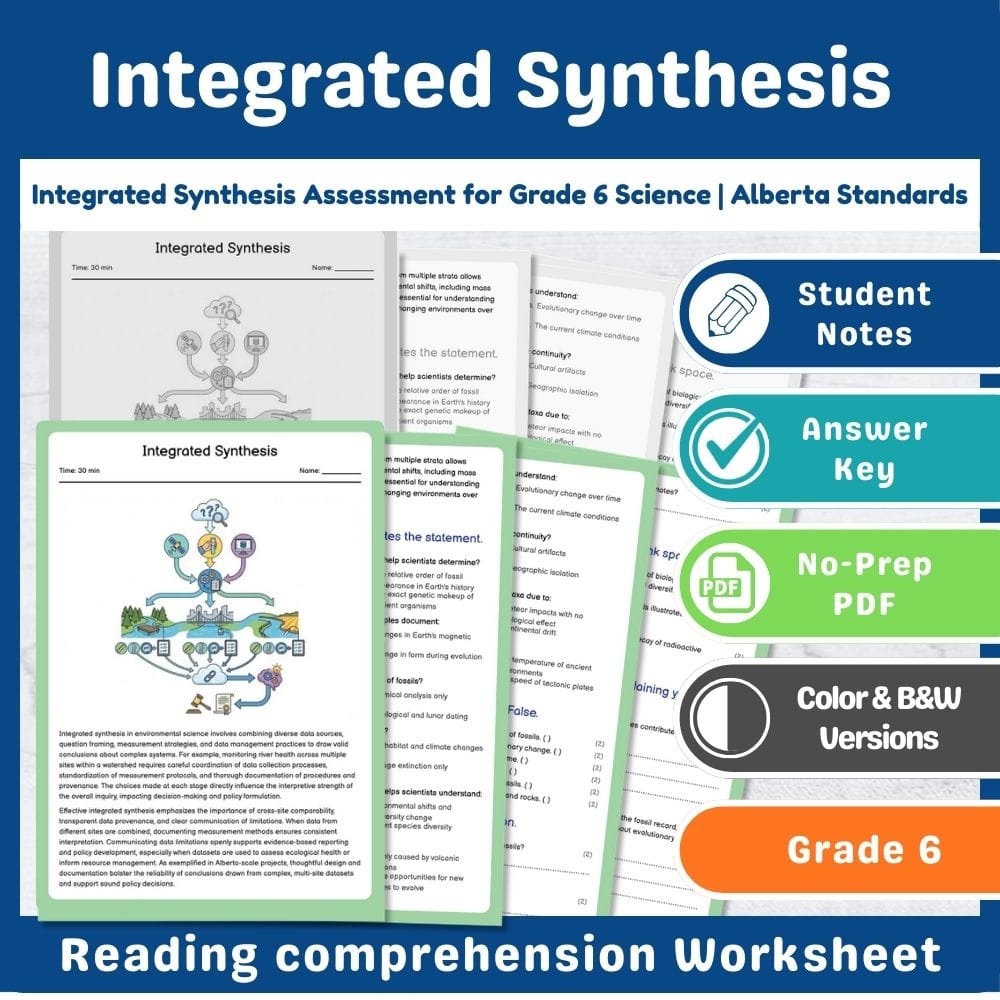
Integrated Synthesis Assessment for Grade 6 Science | Alberta Standards
 Created byPrism Point Learning
Learning Objectives
- Understand the key components involved in integrated synthesis within environmental monitoring.
- Evaluate the importance of documentation and data provenance in scientific inquiry.
- Analyze how measurement strategies influence the interpretation of multi-site environmental data.
Also included in: Lesson Grade 6 Science Mini Bundle | Evidence and Investigation
Instant download

Decomposers and Nutrient Return Assessment | General Grade 6 Science
Created byPrism Point LearningLearning Objectives
- Understand the role of decomposers in nutrient cycling within ecosystems.
- Identify different types of decomposers such as fungi and bacteria.
- Explain how decomposers contribute to soil and water health.
Instant download

Transport and Sediment Assessment | General Standards Grade 6 Science
Created byPrism Point LearningLearning Objectives
- Understand how streams and wind transfer particles of different sizes based on energy and strength.
- Explain the process of sorting of sediments during transportation and deposition.
- Identify natural structures formed by sediment sorting, such as sandbars and deltas.
Also included in: Grade 6 Life Science Science Lesson Bundle – General Framework Unit
Instant download

Design Problem Assessment for Grade 6 Science | Standards-Based Worksheet
Created byPrism Point LearningLearning Objectives
- Understand the key components involved in solving a design problem.
- Identify constraints and requirements in designing protective cases.
- Apply problem-solving strategies to real-world engineering challenges.
Instant download

System Thinking In Solutions Assessment | General Grade 6 Science
Created byPrism Point LearningLearning Objectives
- Understand the concept of systems thinking and how components interact within a system.
- Identify cause-and-effect relationships in system design and performance.
- Analyze how changes to one part of a system can influence overall behavior.
Instant download

Trade-off Decisions Assessment for Grade 6 Science | Standards-Aligned
Created byPrism Point LearningLearning Objectives
- Understand how design choices involve trade-offs affecting properties like strength, flexibility, and insulation.
- Identify the impact of material choices on weight, cost, and usability in shelter design.
- Analyze how trade-offs relate to user needs and environmental constraints.
Instant download

Safety and Reporting Assessment for Grade 6 Science | Standards-Aligned
Created byPrism Point LearningLearning Objectives
- Understand the importance of safety practices in scientific experiments.
- Identify proper reporting methods for data and safety concerns.
- Recognize ethical standards in scientific communication.
Also included in: Grade 6 Data & Evidence Science Lesson Bundle | General Framework
Instant download

Testable Questions Assessment | General Grade 6 Science Standards-Aligned
Created byPrism Point LearningLearning Objectives
- Understand how to formulate scientific questions that can be tested with evidence.
- Identify measurable outcomes and observations that remain consistent in experiments.
- Differentiate between testable and non-testable questions in scientific inquiry.
Also included in: Grade 6 Data & Evidence Science Lesson Bundle | General Framework
Instant download

Density Evidence Assessment | General Grade 6 Science Standards
Created byPrism Point LearningLearning Objectives
- Understand how density relates mass to volume and its role in classifying substances.
- Identify how objects with different densities behave in water, such as floating or sinking.
- Explain that density depends on how tightly matter is packed and does not change the substance's identity.
Also included in: Grade 6 Physical Science Science Lesson Bundle: General Framework
Instant download

Forces and Motion Assessment Grade 6 | Science Standards-Aligned Test
Created byPrism Point LearningLearning Objectives
- Understand how forces influence the motion of objects.
- Identify examples of balanced and unbalanced forces in everyday situations.
- Explain how different types of forces affect speed and direction.
Also included in: Grade 6 Physical Science Science Lesson Bundle: General Framework
Instant download

Magnetic Separation Assessment for Grade 6 Science – Standards Aligned
Created byPrism Point LearningLearning Objectives
- Understand the principle of magnetic separation and its applications.
- Identify materials that respond to magnetic forces versus those that do not.
- Describe how magnetic separation can be used in everyday technology and recycling.
Also included in: Grade 6 Physical Science Science Lesson Bundle: General Framework
Instant download

Precipitation and Infiltration Assessment | California Standards Grade 6 Science
Created byPrism Point LearningLearning Objectives
- Explain how precipitation returns water to Earth and describe examples of precipitation types.
- Describe infiltration and runoff and how they affect soil moisture and groundwater recharge.
- Use gravity and landscape features to predict how water moves across or into the ground.
Also included in: Grade 6 Water in Earth Systems Science Lesson Bundle: California Standards +1 more
Instant download

Evaporation and Transpiration Assessment | California Standards Grade 6 Science
Created byPrism Point LearningLearning Objectives
- Explain how evaporation and transpiration add water vapor to the atmosphere
- Describe how temperature and available liquid water affect the amount of water vapor
- Connect phase changes to the water cycle, including condensation and precipitation
Also included in: Grade 6 Water in Earth Systems Science Lesson Bundle: California Standards +1 more
Instant download

Condensation and Clouds Assessment | California Standards Grade 6 Science
Created byPrism Point LearningLearning Objectives
- Explain how cooling and vapor pressure changes lead to condensation or ice crystal formation in the atmosphere
- Describe how clouds form from condensed droplets or ice crystals and how this relates to the water cycle
- Compare how clouds affect Earth’s energy balance by reflecting sunlight and trapping infrared radiation
Also included in: Grade 6 Water in Earth Systems Science Lesson Bundle: California Standards +1 more
Instant download

Mixtures and Compounds Assessment | California Standards Grade 6 Science
Created byPrism Point LearningLearning Objectives
- Differentiate mixtures and compounds using particle models
- Explain how composition affects properties of matter
- Use physical vs chemical ideas to predict whether a sample can be separated
Also included in: Grade 6 Atoms and Chemical Change Science lesson bundle | California Standards +1 more
Instant download

Atoms and Particles Assessment | California Standards Grade 6 Science
Created byPrism Point LearningLearning Objectives
- Explain how particle models describe matter using atoms and particles too small to see
- Relate the composition of atoms in substances to observable physical and chemical properties
- Use particle-level reasoning to predict how changes in matter affect properties
Also included in: Grade 6 Atoms and Chemical Change Science lesson bundle | California Standards +1 more
Instant download

Growth and Stored Energy Assessment Grade 6 Science California Standards
Created byPrism Point LearningLearning Objectives
- Explain how photosynthesis provides energy and matter for plant growth.
- Describe why plants store chemical energy and how they use it when light is limited.
- Identify how plant structures change over time through ongoing energy transformations and matter use.
Also included in: Grade 6 Energy and Matter Cycles Science Lesson Bundle | California Standards +1 more
Instant download

Decomposer Matter Return Assessment Grade 6 Science | California Standards
Created byPrism Point LearningLearning Objectives
- Explain how decomposers recycle matter in ecosystems by breaking down dead organisms and waste
- Describe how atoms and nutrients move from living things to nonliving parts of an ecosystem (soil and water) and back to producers
- Compare the roles of decomposers and producers in maintaining ecosystem functioning
Also included in: Grade 6 Energy and Matter Cycles Science Lesson Bundle | California Standards +1 more
Instant download

Science Assessment: Atmospheric Circulation Grade 6 | Assessment NGSSS
Created byPrism Point LearningLearning Objectives
- Explain how uneven heating causes air to rise and sink, forming atmospheric circulation patterns
- Describe how warm air and cool air differ in density and how that affects pressure and wind
- Connect atmospheric circulation to moisture transport and the development of storms
Instant download

Science Assessment: Energy From Sun (Grade 6) – Florida NGSSS Assessment
Created byPrism Point LearningLearning Objectives
- Explain how the angle of incoming solar energy affects heating on Earth
- Describe how unequal heating drives air movement and influences weather
- Connect energy transfers in the atmosphere and oceans to seasonal climate patterns
Instant download

Science Assessment: Water Cycle Pathways (Grade 6) – Florida NGSSS
Created byPrism Point LearningLearning Objectives
- Describe the major pathways of the water cycle, including evaporation, condensation, precipitation, runoff, and infiltration
- Explain how energy transfer affects water’s state changes and movement between land and the atmosphere
- Use evidence from the water cycle to predict how changes can lead to droughts or flooding
Instant download

Friction Effects Assessment for Grade 6 Science | NGSSS Standards
Created byPrism Point LearningLearning Objectives
- Explain how friction affects the motion of objects on different surfaces
- Describe how friction can convert kinetic energy into thermal energy
- Compare friction on solid surfaces with air resistance (drag) in fluids
Also included in: Grade 6 Energy and Matter Science Lesson Bundle Unit: Florida NGSSS
Instant download

Heat and Temperature Assessment | NGSSS Standards Grade 6 Science
Created byPrism Point LearningLearning Objectives
- Explain the difference between heat and temperature using particle motion and energy transfer.
- Use everyday examples (hot water, warm air, cooling objects) to predict how energy moves.
- Interpret warming and cooling patterns by reasoning about temperature differences.
Also included in: Grade 6 Energy and Matter Science Lesson Bundle Unit: Florida NGSSS
Instant download

Behavioral Strategies Assessment | Florida NGSSS Standards Grade 6 Science
Created byPrism Point LearningLearning Objectives
- Explain how behavioral adaptations help organisms survive in changing environments
- Identify examples of behavioral adaptations such as migration, hibernation, and daily timing
- Describe how behavior works together with structural and physiological traits
Also included in: Grade 6 Ecosystems Science Lesson Bundle | Florida NGSSS Assessment
Instant download

Decomposition Recycling Assessment | Florida NGSSS Grade 6 Science
Created byPrism Point LearningLearning Objectives
- Explain how decomposers break down dead organisms and waste into simpler materials.
- Describe how decomposition returns nutrients to the environment for producers to use again.
- Connect decomposition to matter cycling and ecosystem stability over time.
Also included in: Grade 6 Ecosystems Science Lesson Bundle | Florida NGSSS Assessment
Instant download

Ecosystem Components Assessment | Florida NGSSS Standards Grade 6 Science
Created byPrism Point LearningLearning Objectives
- Identify abiotic factors and explain how they affect where organisms can live.
- Distinguish biotic factors (producers, consumers, decomposers) by their roles in an ecosystem.
- Use ecosystem component vocabulary to describe how ecosystem structure can vary by location.
Also included in: Grade 6 Ecosystems Science Lesson Bundle | Florida NGSSS Assessment
Instant download

Food Chains Assessment for Grade 6 Science | Florida NGSSS Standards
Created byPrism Point LearningLearning Objectives
- Identify the roles of producers and consumers in a food chain
- Explain how energy transfers between trophic levels
- Describe why real ecosystems often form food webs instead of single pathways
Also included in: Grade 6 Ecosystems Science Lesson Bundle | Florida NGSSS Assessment
Instant download

Food Webs Assessment | Florida NGSSS Grade 6 Science
Created byPrism Point LearningLearning Objectives
- Explain what a food web is and how it shows feeding relationships in an ecosystem
- Use food web ideas to describe how energy moves between trophic levels
- Predict effects of changes to one organism on other organisms in a community
Also included in: Grade 6 Ecosystems Science Lesson Bundle | Florida NGSSS Assessment
Instant download

Interdependence Roles Assessment | Florida NGSSS Grade 6 Science
Created byPrism Point LearningLearning Objectives
- Explain how predators and prey are interdependent in an ecosystem
- Describe how competition and mutualism affect population changes
- Predict how changes in one population can ripple through a community
Also included in: Grade 6 Ecosystems Science Lesson Bundle | Florida NGSSS Assessment
Instant download

Niche Relationships Assessment for Grade 6 Science | Florida NGSSS
Created byPrism Point LearningLearning Objectives
- Explain what a niche is and how it describes an organism’s role in an ecosystem.
- Identify how different niches can allow two species to coexist in the same habitat.
- Analyze how niche overlap can increase competition when resources become limited.
Also included in: Grade 6 Ecosystems Science Lesson Bundle | Florida NGSSS Assessment
Instant download

Physiological Traits Assessment | Standards-Aligned Assessment Grade 6 Science
Created byPrism Point LearningLearning Objectives
- Explain how physiological adaptations help organisms survive in specific environments
- Identify examples of internal traits related to water balance, metabolism, and ion regulation
- Interpret statements about physiological adaptations as true or false
Also included in: Grade 6 Ecosystems Science Lesson Bundle | Florida NGSSS Assessment
Instant download

Survival Changes Assessment | NGSSS Grade 6 Science Standards
Created byPrism Point LearningLearning Objectives
- Explain how environmental conditions affect which traits help organisms survive and reproduce.
- Describe how changes in survival and reproduction can shift traits in a population over generations.
- Connect adaptation to ecosystem change and resilience when resources or conditions shift.
Also included in: Grade 6 Ecosystems Science Lesson Bundle | Florida NGSSS Assessment
Instant download

Trophic Levels Assessment for Grade 6 Science | Florida NGSSS Standard
Created byPrism Point LearningLearning Objectives
- Explain how producers, consumers, and decomposers relate to trophic levels and energy flow
- Identify the correct trophic level for different organisms based on what they eat
- Describe how energy transfer between trophic levels affects ecosystem structure and populations
Also included in: Grade 6 Ecosystems Science Lesson Bundle | Florida NGSSS Assessment
Instant download

Grade 6 Science | Decomposition Recycling Worksheet | NGSSS Aligned
 Created byLumora Learning
Learning Objectives
- Explain how decomposers (fungi and bacteria) break down dead organisms and waste
- Describe how decomposition returns nutrients to the environment for producers to use again
- Identify factors that affect the rate of decomposition (oxygen, moisture, temperature, and surface area)
Instant download

Grade 6 Science – Adaptation & Survival | Daily Reading Worksheet
 Created byClear Sky Classroom
Learning Objectives
- Understand key concepts related to Science
- Apply knowledge through practice questions
- Demonstrate comprehension of the material
Instant download

Grade 6 Science | Gas Pressure - Daily Reading Comprehension
 Created byCoral Reef Learning
Learning Objectives
- Understand what gas pressure is and how it results from particle collisions
- Explain how particle speed and collision frequency affect gas pressure
- Describe how volume and temperature influence gas pressure and behavior
Instant download

Grade 6 Science | Waves & Technology - Daily Reading Comprehension
Created byCoral Reef LearningLearning Objectives
- Understand the basic properties of sound and light waves.
- Identify how devices like speakers, microphones, and cameras utilize waves.
- Explain energy transfer through waves in technological devices.
Instant download

Grade 6 Science | Levels Of Life - Daily Reading Comprehension
Created byCoral Reef LearningLearning Objectives
- Understand the hierarchy of biological structures from cells to organisms.
- Identify and describe the function of various cell types and tissues.
- Recognize how tissues form organs and how organ systems work together.
Instant download

Grade 6 Science | Musculoskeletal System - Daily Reading Comprehension
Created byCoral Reef LearningLearning Objectives
- Identify the main components of the musculoskeletal system
- Understand the functions of bones, muscles, and joints
- Recognize how these components work together to support movement and protection
Instant download

Grade 6 Science | Organ Systems Overview - Daily Reading Comprehension
Created byCoral Reef LearningLearning Objectives
- Understand the structure and function of the circulatory system
- Recognize how blood transports nutrients and oxygen throughout the body
- Learn how the heart works as a pump to circulate blood
Instant download

Grade 6 Science | Respiratory System - Daily Reading Comprehension
Created byCoral Reef LearningLearning Objectives
- Understand the basic structure and function of the respiratory system.
- Identify how oxygen is exchanged in the lungs and water or air movement aids respiration.
- Explain the importance of surface area in respiratory efficiency.
Instant download

Grade 6 Science | Advanced Circuit Analysis - Daily Reading Comprehension
Created byCoral Reef LearningLearning Objectives
- Understand how electrical components function within circuits
- Explain current flow and energy transfer in resistive elements
- Recognize the concept of power dissipation and heat generation in circuits
Instant download

Grade 6 Science | Circuit Diagrams - Daily Reading Comprehension
Created byCoral Reef LearningLearning Objectives
- Understand key concepts related to Science
- Apply knowledge through practice questions
- Demonstrate comprehension of the material
Instant download

Grade 6 Science | Energy Efficiency - Daily Reading Comprehension
Created byCoral Reef LearningLearning Objectives
- Understand what energy efficiency means in everyday tools and appliances.
- Identify examples of energy-efficient devices and systems.
- Recognize factors that cause energy losses in machines and appliances.
Instant download

Grade 6 Science | Energy Transfer in Science - Daily Reading Comprehension
Created byCoral Reef LearningLearning Objectives
- Understand the concept of energy transfer
- Identify the three main types of energy transfer: conduction, convection, and radiation
- Recognize everyday examples of each energy transfer process
Instant download

Grade 6 Science | Reflection & Refraction - Daily Reading Comprehension
Created byCoral Reef LearningLearning Objectives
- Understand the concepts of reflection and refraction of light.
- Identify how light interacts with surfaces and boundaries.
- Describe how lenses focus and disperse light.
Instant download

Grade 6 Science | Renewable Transformations - Daily Reading Comprehension
Created byCoral Reef LearningLearning Objectives
- Understand how sunlight is converted into electrical energy using photovoltaic cells
- Identify the process of solar energy transformation
- Recognize the importance of solar power in sustainable energy systems
Instant download

Grade 6 Science | Sound Properties - Daily Reading Comprehension
Created byCoral Reef LearningLearning Objectives
- Understand the basic nature of sound as a mechanical wave.
- Learn how frequency affects pitch and amplitude affects loudness.
- Identify how medium and temperature influence the speed of sound.
Instant download
Browse more categories
About Grade 6 Worksheets
Browse 8,578 printable Grade 6 worksheets across math, ELA, science, and social studies — each a ready-to-print PDF with optional answer keys.
MyTeachingSheets worksheets are made by real teacher-authors and checked before they go live. Download any as a print-ready PDF for lessons, homework, or independent practice — most include answer keys, and previews are always free.