
Grade 7 Worksheets
8,498 grade resources
Synthesis Connections Worksheet | Grade 7 ELA Activities
 Created byMeadowlark Worksheets
Learning Objectives
- Identify relationships among ideas (cause and effect, problem and solution, comparison of viewpoints) when synthesizing information.
- Combine key details from one text or multiple texts to form a clearer, guiding response.
- Use evidence to explain a purpose without simply repeating sections.
Also included in: Grade 7 Author Craft ELA Lesson Bundle: Tone, Theme, Evidence (Alberta) +1 more
Instant download

Summer Solstice: Cultural Celebrations Reading Comprehension | Grades 6–8
Learning Objectives
- Explain how summer solstice and yoga festival traditions honor the sun and strengthen community ties.
- Compare similarities and differences in cultural celebrations using evidence from texts and prior knowledge.
- Identify values (such as gratitude, mindfulness, and belonging) reflected in holiday rituals and activities.
Also included in: Summer Solstice Reading Comprehension Bundle | Grades 6–8 +2 more
Instant download

Air Masses and Fronts Worksheet | Grade 7 Weather Science Activity
 Created byPrism Point Learning
Learning Objectives
- Explain what air masses are and how their temperature and moisture affect weather.
- Describe what fronts are and how they form when air masses meet.
- Compare the typical weather changes caused by cold fronts and warm fronts.
Also included in: Grade 7 Weather & Climate Science Lesson Bundle | Florida NGSSS
Instant download

Grade 7 Science – Evaporation & Crystallization | Daily Reading Worksheet
 Created byBright Mind Resources
Learning Objectives
- Understand the process of evaporation and how it leads to crystallization.
- Identify the factors that influence crystal growth and purity.
- Describe real-world examples of evaporation crystallization, such as salt and sugar production.
Also included in: Grade 7 Matter Science Daily Reading Worksheets Lesson Bundle | Ontario +1 more
Instant download

Evidence Links Worksheet for Grade 7 ELA | Alberta Standards Practice
JCreated byJ.S SheetsLearning Objectives
- Distinguish evidence from opinion by using specific textual details.
- Select the most relevant sentence, phrase, or fact that supports an inference.
- Explain how evidence connects to an implied conclusion using clear reasoning.
Instant download

Phishing and Social Engineering Worksheets | Grade 7 Computer Science
Created byBright Mind ResourcesLearning Objectives
- Define phishing and social engineering and explain how deception is used in these attacks.
- Identify common warning signs in realistic messages and describe safer next steps.
- Match social engineering terms to their correct meanings.
Instant download

Evidence Links Worksheet for Grade 7 ELA | Standards-Aligned Practice
JCreated byJ.S SheetsLearning Objectives
- Identify evidence in a text that directly supports a claim.
- Explain how specific details connect to an interpretation or conclusion.
- Avoid using unrelated information as support.
Instant download

Grade 7 Understanding Quantitative Models in Genetics Worksheet | NGSS
 Created byBRIGHT PATH RESOURCES
Learning Objectives
- Understand key concepts related to Science
- Apply knowledge through practice questions
- Demonstrate comprehension of the material
Also included in: Evolution & Genetics Grade 7 Science Worksheets Lesson Bundle | NGSS +2 more
Instant download

Grade 7 Science | States Of Matter Worksheet | BC Standard
 Created byLumora Learning
Learning Objectives
- Describe the different states of matter in terms of particle arrangement, spacing, and movement.
- Explain how temperature and pressure influence phase changes between solids, liquids, and gases.
- Identify observable characteristics used to classify substances by their physical properties.
Also included in: Grade 7 Science | Matter & Chemical Change Unit Bundle | BC Aligned
Instant download

Patriot Day 9/11 Remembrance Worksheets Grade 7 | Community Unity
 Created byShaNova Worksheets
Learning Objectives
- Explain how communities show remembrance and compassion through memorials, stories, and traditions
- Identify how shared remembrance can support empathy, resilience, and civic responsibility
- Analyze how different perspectives within a community contribute to a stronger sense of solidarity
Instant download

Grade 7 Density Particle View Worksheet | Practice & Standards PDF
 Created byClear Sky Classroom
Learning Objectives
- Explain density using the particle view, including how particle spacing affects mass per unit volume.
- Describe how heating can change density by increasing volume while mass stays the same.
- Use density differences to interpret sinking and floating behavior in different materials.
Instant download

Grade 7 Science – Integrated Design & Mechanical Systems | Reading Worksheet
Created byBright Mind ResourcesLearning Objectives
- Understand the concept of mechanical advantage in integrated systems.
- Analyze various design criteria including material choice, safety, and efficiency.
- Evaluate how regional environmental factors influence design decisions.
Also included in: Grade 7 Structures & Forces Science Lesson Bundle Daily Reading | Alberta +2 more
Instant download

Grade 7 Science | Thermal Basics Worksheet (Alberta Standards) (PDF)
 Created bySilver Birch Teaching
Learning Objectives
- Explain how particle motion relates to temperature and thermal energy.
- Distinguish heat from temperature and describe heat transfer by conduction, convection, and radiation.
- Apply thermal transfer concepts to real-world Alberta climate examples.
Also included in: Grade 7 Thermal Systems Models and Heat Transfer Science Lesson Bundle – Alberta +1 more
Instant download

Science Worksheet Population Variation Grade 7 | NGSSS Standards Practice
JCreated byJ.S SheetsLearning Objectives
- Explain how variation in traits exists within populations
- Describe how reproduction and inheritance contribute to trait differences
- Analyze how trait frequencies can change across generations due to environmental pressures
Also included in: Grade 7 Evolution and Population Dynamics Science Lesson Bundle – Florida NGSSS +1 more
Instant download

Nutrient Transport Worksheet | Standard-Aligned Grade 7 Science Practice
JCreated byJ.S SheetsLearning Objectives
- Understand how molecules derived from food are transported within organisms.
- Identify systems involved in internal transport and waste removal.
- Explain the importance of continuous movement of matter for organism health.
Also included in: Grade 7 Ecosystem Energy & Matter Cycles Science Lesson Bundle +1 more
Instant download

Grade 7 Air Masses Fronts Worksheet | California Standards Practice PDF
Created byClear Sky ClassroomLearning Objectives
- Explain how air masses form and how their temperature and moisture influence weather
- Describe how fronts create zones where air rises, cools, and can form clouds and precipitation
- Predict how temperature and wind often change near a front
Instant download

Internet Infrastructure and Data Transfer Worksheets | Grade 7 Computer Science
Created byBright Mind ResourcesLearning Objectives
- Identify the roles of servers, routers, and packets in data transfer
- Explain how transmissions move from a sender to a destination using interconnected networks
- Describe how websites and messages are delivered using routing and packet switching
Instant download

Internet Infrastructure and Data Transfer Worksheet Grade 7 Computer Science
Created byPrism Point LearningLearning Objectives
- Explain how servers, routers, and networks work together to transfer data.
- Describe how packets are transmitted and why transmission happens in many steps.
- Use correct vocabulary to compare wired and wireless data transfer methods.
Instant download

Grade 7 Science Worksheet: Adaptation Function – Standards-Aligned Practice
JCreated byJ.S SheetsLearning Objectives
- Explain how structural adaptations connect to specific life functions (exchange, protection, and water regulation).
- Identify how behavioral and morphological adaptations support feeding and reproduction.
- Describe how trade-offs can limit an adaptation’s performance in another situation.
Also included in: Grade 7 Ecosystem Dynamics Science Lesson Bundle Worksheets – General +1 more
Instant download

Grade 7 Science – Rock Types & Identification | Daily Reading Worksheet
Created byBright Mind ResourcesLearning Objectives
- Understand the three main types of rocks: igneous, sedimentary, and metamorphic.
- Identify key features: mineral content, texture, and structure that distinguish igneous rocks.
- Learn how rocks are formed and their significance in Earth's history.
Also included in: Grade 7 Earth Processes Science Daily Reading Worksheets Lesson Bundle | BC +1 more
Instant download

Grade 7 Speed Calculations Science Daily Reading Worksheet | TEKS
Created byBRIGHT PATH RESOURCESLearning Objectives
- Define speed and explain what it measures in everyday motion.
- Distinguish average speed from instantaneous rate using a motion description.
- Use unit ideas (m/s and km/h) to support correct thinking about speed.
Also included in: Forces & Energy Grade 7 Science Daily Reading Worksheets Lesson Bundle | TEKS +1 more
Instant download

Grade 7 Social Studies | Maps And Data Worksheet (Ontario Standards)
 Created bySunny Desk Resources
Learning Objectives
- Explain how thematic maps and GIS outputs reveal spatial patterns and trends in geographic data.
- Use geographic terminology (scale, classification, and data sources) to interpret maps more accurately.
- Describe causes and consequences shown in mapped data and connect local observations to broader regional and global processes.
Also included in: Grade 7 Food Systems and Trade Social Studies Lesson Bundle Ontario +1 more
Instant download

Grade 7 Science – Seasonal Sun Patterns & Earth's Tilt | Daily Reading Worksheet
Created byBright Mind ResourcesLearning Objectives
- Understand Earth's tilting axis and how it affects the Sun's apparent position in the sky.
- Explain how seasonal changes occur in different hemispheres due to Earth's tilt.
- Describe the relationship between Earth's tilt, daylight hours, and seasons throughout the year.
Also included in: Water Cycle & Weather Grade 7 Science Daily Reading Lesson Bundle | CA Standards +1 more
Instant download

Grade 7 Science Worksheet | Statistical Reasoning & Data Analysis (PDF)
 Created byEvergreen Desk Education
Learning Objectives
- Interpret descriptive statistics (mean, median, mode, and interquartile range) in context
- Explain how outliers and variability affect comparisons across groups or measurements
- Use basic ideas from inference (confidence and limitations of small samples) to avoid overgeneralizing
Also included in: Grade 7 Science Inquiry & Data Lesson Bundle: Ontario Worksheet Set +1 more
Instant download

Artificial Intelligence in Everyday Life Worksheet Grade 7 Computer Science
Created byPrism Point LearningLearning Objectives
- Explain key cybersecurity vocabulary: cybersecurity, vulnerability, prevention, and threat.
- Identify safe online habits that reduce risks for devices and accounts.
- Recognize common warning signs of cyber threats and choose appropriate prevention steps.
Also included in: Grade 7 AI & Cybersecurity Computer Science Lesson Bundle | General
Instant download

Grade 7 | Memorical Day Worksheet for Cultural Perspectives | PDF + Answer Key
Created byShaNova WorksheetsLearning Objectives
- Compare how different cultures and nations honor people who died in service
- Identify common values (respect, remembrance, gratitude) found in memorial practices
- Use evidence from a reading passage to answer questions about cultural traditions
Also included in: Grade 7 Memorial Day Holiday Custom Bundle: C3 Framework Worksheets
Instant download

Science Design Optimization Worksheet | NGSS Grade 7 Science Assessment
 Created bySkylark Worksheets
Learning Objectives
- Use test data to identify which design parameters limit performance.
- Apply iterative refinement to improve a design while staying within constraints.
- Justify design changes using quantitative comparisons and evidence.
Also included in: Grade 7 Engineering Design Science Lesson Bundle: NGSS +1 more
Instant download

Grade 7 Levels of Organization Science Daily Reading Worksheet | TEKS
Created byBRIGHT PATH RESOURCESLearning Objectives
- Identify main ideas about hierarchical organization in living systems.
- Use key vocabulary: organism, population, community, ecosystem, biosphere.
- Explain how structure at one level can support how life functions at the next level.
Also included in: Grade 7 Ecosystems Science Daily Reading Worksheets Bundle | TEKS +1 more
Instant download

Grade 7 Math – Advanced Equation Techniques Worksheet (Ontario Standards) (PDF)
Created byClear Sky ClassroomLearning Objectives
- Learn strategies for solving multi-step and literal equations.
- Apply grouping like terms and isolating variables in real-world problems.
- Evaluate the reasonableness of solutions in practical contexts.
Also included in: Grade 7 Algebra Bundle: Coding, Modelling, and Linear Equations for Ontario +1 more
Instant download

Cloud Computing and Online Storage Worksheets | Grade 7 Computer Science
Created byBright Mind ResourcesLearning Objectives
- Define cloud computing, server, storage, and synchronization in everyday terms.
- Explain how cloud services enable access to files and applications from different devices.
- Identify benefits of cloud systems for collaboration and flexibility.
Instant download

Cloud Computing Basics Worksheet Grade 7 Computer Science
Created byPrism Point LearningLearning Objectives
- Define cloud computing and explain how it uses remote servers instead of local devices.
- Describe the roles of storage and synchronization in keeping files up to date.
- Identify examples of cloud services and explain how they support collaboration and flexibility.
Instant download
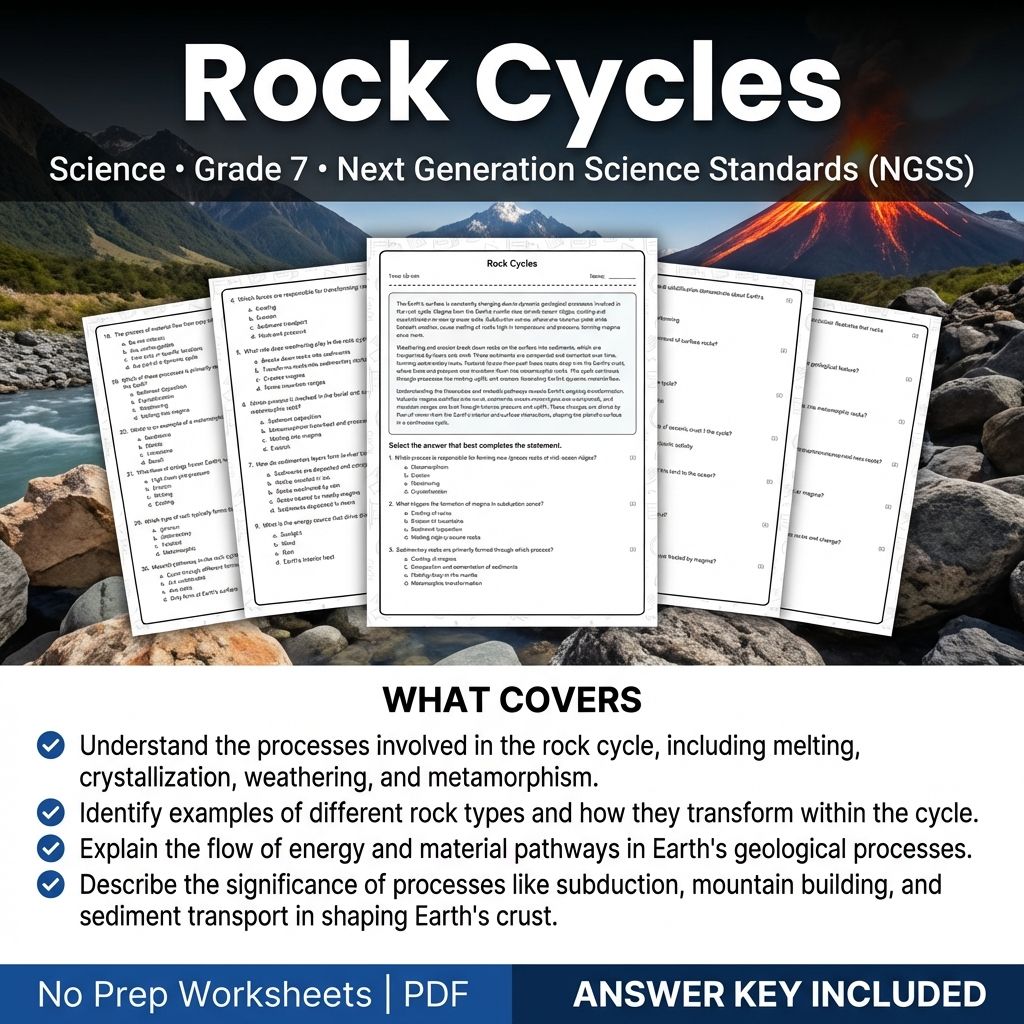
Grade 7 Science Worksheet | Rock Cycles - NGSS Aligned Printable Practice
 Created byCoral Reef Learning
Learning Objectives
- Understand the processes involved in the rock cycle, including melting, crystallization, weathering, and metamorphism.
- Identify examples of different rock types and how they transform within the cycle.
- Explain the flow of energy and material pathways in Earth's geological processes.
Instant download

Grade 7 Science Seasonal Sun Patterns Worksheet | CA Standards PDF
Created byEvergreen Desk EducationLearning Objectives
- Explain how Earth’s tilt and yearly orbit change the Sun’s apparent height and day length.
- Compare seasonal patterns in the Northern and Southern Hemispheres.
- Describe how latitude (distance from the equator) affects the strength of seasonal daylight changes.
Instant download

Grade 7 Temperature & Particle Motion Science Worksheet Alberta
Created byBRIGHT PATH RESOURCESLearning Objectives
- Explain temperature as related to average random kinetic energy of particles.
- Use evidence from a text to describe how particle motion connects to thermal energy and pressure.
- Distinguish how different factors (particle number and phase) can change thermal energy even when particles move randomly.
Also included in: Grade 7 Alberta Science Energy Heat and Thermal Processes Worksheet Bundle +1 more
Instant download

Grade 7 Science – Migration Patterns & Animal Behavior | Daily Reading Worksheet
Created byBright Mind ResourcesLearning Objectives
- Understand the reasons why animals migrate seasonally and annually.
- Identify different migration drivers such as food availability and breeding needs.
- Analyze how migration patterns influence ecosystems and biodiversity.
Also included in: Grade 7 Ecosystems Science Lesson Bundle for Daily Reading Worksheets | Alberta +2 more
Instant download

Explanatory Models Assessment | Florida NGSSS Standards Grade 7 Science
Created byPrism Point LearningLearning Objectives
- Explain how a scientific model represents a real system using simplified relationships.
- Use model relationships to make and evaluate predictions about natural phenomena.
- Identify assumptions and limitations of models when evidence conflicts with predictions.
Instant download

Mixtures And Purity Practice Worksheet | Grade 7 Science BC
Created byPrism Point LearningLearning Objectives
- Distinguish between mixtures and pure substances based on composition and observable properties.
- Classify mixtures as heterogeneous or homogeneous using visible evidence.
- Explain how particle size, solubility, density, and boiling point can guide separation choices.
Also included in: Matter & Chemical Change Lesson Bundle — Grade 7 Science British Columbia +1 more
Instant download

Grade 7 Argumentation Models Science Daily Reading Worksheet | TEKS
Created byBRIGHT PATH RESOURCESLearning Objectives
- Identify a claim, evidence, and reasoning in a scientific text.
- Recognize how data and models help justify or challenge scientific ideas.
Also included in: Scientific Inquiry Grade 7 Science Daily Reading Worksheets Lesson Bundle | Teks +1 more
Instant download

European Renaissance Worksheet | Standards-Aligned Practice for Grade 7
JCreated byJ.S SheetsLearning Objectives
- Explain how the Renaissance revived interest in classical ideas and influenced art, science, and literature.
- Describe key causes of Renaissance change, including rediscovery of ancient texts and exchange of ideas through trade.
- Identify how Renaissance thinkers and artists challenged medieval views and contributed to new approaches to learning and governance.
Instant download

Structural Failure Modes Worksheets: Limit States Grade 7 Science
Created byPrism Point LearningLearning Objectives
- Identify buckling, fatigue cracking, shear fracture, and bending fracture
- Explain how geometry, materials, and loading influence structural failure
- Describe how limit states design accounts for structural uncertainty
Also included in: Grade 7 Structural Performance Lesson Bundle | Ontario Science +1 more
Instant download
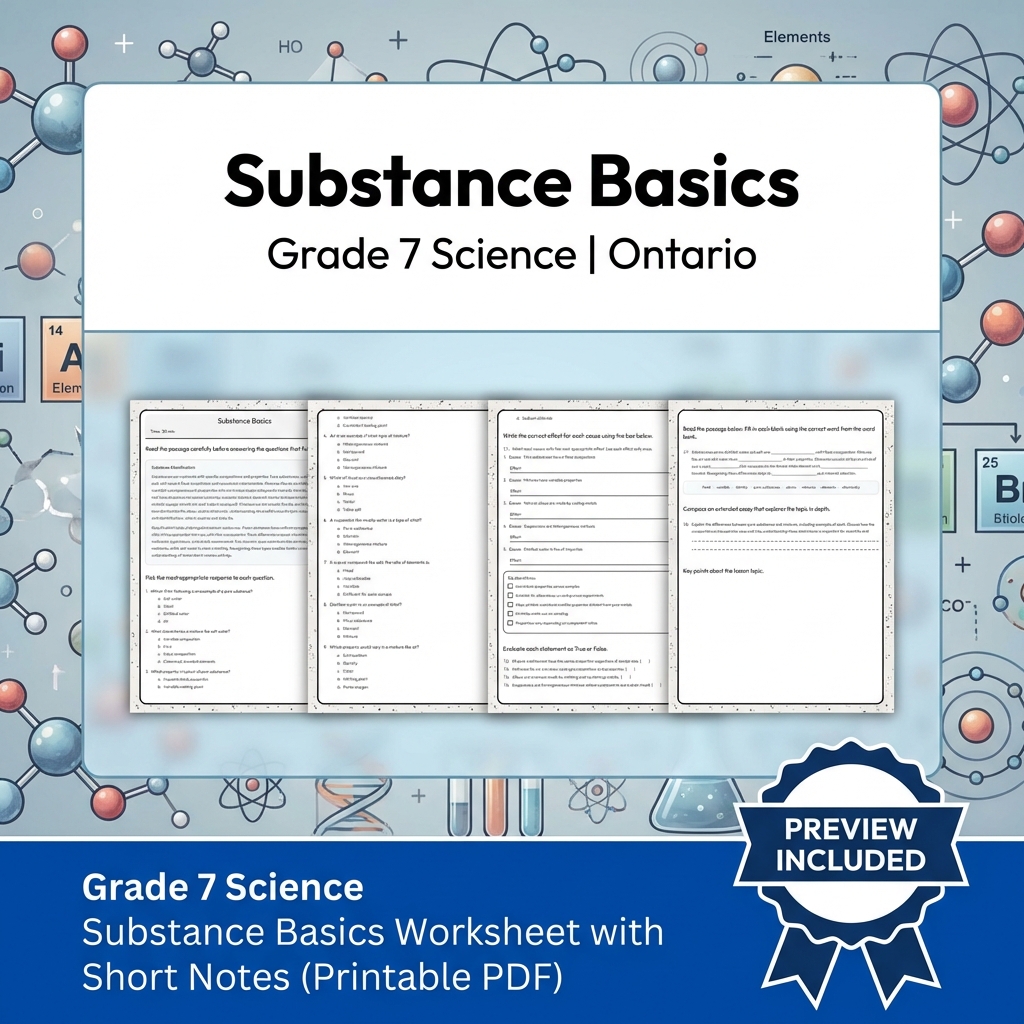
Grade 7 Science Substance Basics Worksheet with Short Notes (Printable PDF)
Created byMeadowlark WorksheetsLearning Objectives
- Understand the classification of pure substances and mixtures based on composition and uniformity.
- Identify examples of elements, compounds, and mixtures in everyday contexts.
- Differentiate between pure substances and mixtures using properties and characteristics.
Also included in: Grade 7 Science Lesson Group Bundle – Ontario Curriculum Worksheets +1 more
Instant download
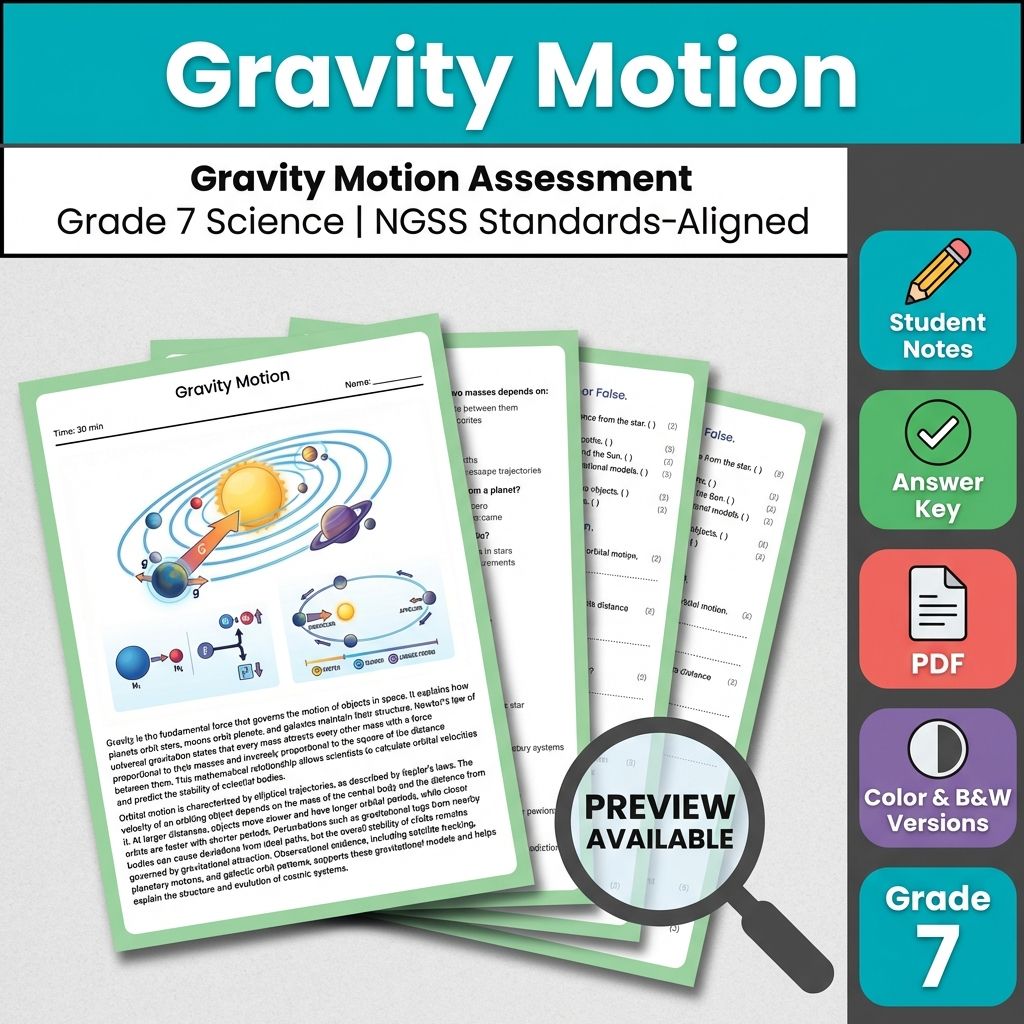
Gravity Motion Assessment Grade 7 Science | NGSS Standards-Aligned
Created byPrism Point LearningLearning Objectives
- Understand the role of gravity in governing orbital motion within the solar system and galaxies.
- Explain the mathematical relationships that quantify orbital velocity and centripetal effects.
- Identify observational evidence such as orbital trajectories, Keplerian patterns, and perturbations supporting gravitational motion theories.
Also included in: Grade 7 Science Mini Bundle – Earth's Place in the Universe | NGSS Standards +1 more
Instant download

Grade 7 Metric Reasoning Science Daily Reading Worksheet | TEKS Activity
Created byBRIGHT PATH RESOURCESLearning Objectives
- Choose the most reasonable metric prefix and unit for a measurement.
- Explain why measurement precision and proper units matter in science.
Also included in: Scientific Inquiry Grade 7 Science Daily Reading Worksheets Lesson Bundle | Teks +1 more
Instant download

Classroom Norms for Respectful Communities: Grade 7 Worksheets
Created byShaNova WorksheetsLearning Objectives
- Explain why classroom norms and routines matter for safety, respect, and learning
- Identify examples of positive norms that support cooperation and inclusion
- Apply class norm ideas to everyday classroom situations
Instant download

Grade 7 Science Solar Patterns Worksheet | NGSS Sun Earth Moon Activity
 Created byNorthstar Worksheets
Learning Objectives
- Explain how the relative positions of the Sun, Earth, and Moon produce predictable lunar phases and eclipses.
- Use the concepts of Earth’s rotation and axial tilt to describe day-night cycles and seasonal changes.
- Interpret observational records and phase sequences to connect position in space with changes over time.
Also included in: Grade 7 Space Science Lesson Bundle | NGSS Solar System & Gravity +1 more
Instant download

Optimization Strategies Test Prep Worksheet | Grade 7 Science
Created byPrism Point LearningLearning Objectives
- Explain how iterative refinement and quantitative comparison improve structural designs.
- Describe the roles of performance-based criteria, life-cycle assessment, and constructability constraints in optimization.
- Identify how codes, safety margins, and durability requirements affect feasible solutions.
Instant download

Grade 7 Social Studies | Patterns of Continuity Worksheet (PDF)
Created bySunny Desk ResourcesLearning Objectives
- Explain how cultural practices can remain the same over time through traditions, language, and social customs.
- Identify examples of continuity in Indigenous and multicultural communities in Canada and describe their significance.
- Analyze how long-standing cultural patterns can strengthen community cohesion and identity.
Also included in: Grade 7 Patterns of Continuity Social Studies Lesson Bundle – BC Framework +1 more
Instant download

Grade 7 Holiday |Cesar Chavez Day for Mastering Understanding | PDF + Answer Key
Created byShaNova WorksheetsLearning Objectives
- Understand the significance of Transgender Day of Visibility and its role in promoting awareness.
- Develop empathy and respectful understanding of gender identities different from one's own.
- Expand vocabulary related to gender, identity, and diversity.
Also included in: Grade 7 Holiday Worksheets for Caesar Chavez Day Civic Action & Justice
Instant download
Browse more categories
About Grade 7 Worksheets
Find Grade 7 worksheets covering math, ELA, science, and social studies. All 8,498 resources download instantly as PDFs for classwork, homework, or review.
MyTeachingSheets worksheets are made by real teacher-authors and checked before they go live. Download any as a print-ready PDF for lessons, homework, or independent practice — most include answer keys, and previews are always free.