
Grade 7 Worksheets
8,498 grade resources
Grade 7 Social Studies — Worksheet MCQ Paper for Mastering Historical Change
 Created byThe Resource Hub
Learning Objectives
- Understand how technological innovations, migration, and policy shifts have influenced communities over time.
- Analyze key historical events such as urbanization and immigration policies in Canada.
- Evaluate the causes and impacts of social and community changes in history.
Also included in: Grade 7 Social Studies BC Bundle – Patterns of Continuity and Change Worksheets +1 more
Instant download

Grade 7 Science – Freshwater Reservoirs & Water Cycle Daily Reading Worksheet
 Created byBright Mind Resources
Learning Objectives
- Identify different sources of freshwater such as lakes and aquifers.
- Describe how groundwater systems operate and recharge.
- Explain the importance of porosity and permeability in aquifer function.
Also included in: Earth & Space Grade 7 Science Daily Reading Worksheets Bundle | TEKS +2 more
Instant download

Grade 7 Adaptation Forms Science Daily Reading Worksheet | TEKS Activity
 Created byBRIGHT PATH RESOURCES
Learning Objectives
- Define morphological adaptations as physical traits that improve survival and reproduction.
- Identify how camouflage and body structures help organisms in specific habitats.
- Distinguish adaptation from change caused only by immediate conditions (acclimation).
Also included in: Grade 7 Ecosystems Science Daily Reading Worksheets Bundle | TEKS +1 more
Instant download

Grade 7 Holiday | Pi Day for Mastering Pi Concepts | PDF + Answer Key
 Created byShaNova Worksheets
Learning Objectives
- Explore the history and significance of Pi in different cultures.
- Identify traditions and celebrations associated with Pi Day worldwide.
- Reflect on the value of curiosity and shared learning in mathematics.
Also included in: Grade 7 Pi Day Lesson Bundle for Holiday Math and Geometry Activities
Instant download

Grade 7 Social Studies — European Exploration Worksheet MCQ Paper
Created byThe Resource HubLearning Objectives
- Describe why European countries pursued voyages of exploration in the 15th and 16th centuries.
- Identify how technology and navigation supported sea exploration.
- Explain key effects of the Columbian Exchange on people and the environment.
Instant download

Earth System Interactions Worksheet Grade 7 Science
JCreated byJ.S SheetsLearning Objectives
- Explain how the geosphere, hydrosphere, atmosphere, and biosphere exchange matter and energy
- Describe cause-and-effect relationships between Earth systems (e.g., erosion affecting waterways and habitats)
- Use evidence from observations to support an explanation of Earth system interactions over time
Also included in: Grade 7 Weather, Climate, and Earth Processes Science Lesson Bundle +1 more
Instant download

Grade 7 Science | Simple Machines Overview Worksheet (PDF) – Alberta Standards
 Created bySilver Birch Teaching
Learning Objectives
- Identify examples of the six simple machines and describe how each one changes force magnitude or direction
- Explain mechanical advantage as a comparison of output force to input force, using appropriate units and reasoning
- Apply relationships among force, distance, and machine geometry to predict outcomes for everyday tools
Also included in: Grade 7 Simple Machines and Forces Science Lesson Bundle: Alberta +1 more
Instant download

Grade 7 Science Worksheet – Design Criteria & Engineering Standards (PDF)
 Created byEvergreen Desk Education
Learning Objectives
- Explain how design criteria for success can be measurable or observable in a science design problem.
- Identify common constraints (time, materials, cost, safety) and describe how they affect possible solutions.
- Describe trade-offs and improvement by connecting test evidence to criteria rather than appearance.
Also included in: Grade 7 Investigation & Engineering Science Lesson Bundle: General Framework +1 more
Instant download

Spreadsheet Parts and Organization Worksheets | Grade 7 Computer Science
Created byBright Mind ResourcesLearning Objectives
- Define and use spreadsheet vocabulary including worksheet, cell, row, and column.
- Identify rows, columns, and cells in a simple spreadsheet layout.
- Use sorting to reorganize information while keeping related data together.
Instant download

Science Worksheet The Rock Cycle Grade 7 | Standards-Aligned Practice PDF
JCreated byJ.S SheetsLearning Objectives
- Explain how igneous, sedimentary, and metamorphic rocks form in the rock cycle.
- Describe the roles of heat, pressure, weathering, and mineral cementation in rock transformations.
- Use rock-cycle ideas to make connections between surface and subsurface Earth processes.
Also included in: Grade 7 Weather, Climate, and Earth Processes Science Lesson Bundle +1 more
Instant download

Design Principles Assessment | TEKS Grade 7 Science Standards-Aligned
 Created byPrism Point Learning
Learning Objectives
- Understand key concepts of designing fair and reproducible experiments.
- Identify variables, operational definitions, and control conditions in experiments.
- Recognize ethical, safety, and sample size considerations in research design.
Also included in: Scientific Inquiry Reasoning Grade 7 Science Lesson Bundle TEKS Unit
Instant download

Grade 7 Science | Heat Transfer Models Worksheet (PDF) for Standards
Created byEvergreen Desk EducationLearning Objectives
- Explain how heat transfers from warmer regions to cooler regions using conduction, convection, and radiation models.
- Use a simple heat-transfer model to predict the direction of energy flow based on temperature differences.
- Describe how energy can change form while heat moves through a system.
Also included in: Grade 7 Energy Transfer & Motion Science Lesson Bundle Worksheets (General) +1 more
Instant download

Grade 7 Population Limits Worksheet | Exponential vs Logistic Growth Ontario
 Created byTeacher's Corner
Learning Objectives
- Describe how carrying capacity limits population growth using logistic models.
- Differentiate exponential growth from logistic growth on population graphs.
- Identify limiting factors and explain how density-dependent and density-independent effects differ.
Instant download

Cell Energy Use Assessment Grade 7 Science California Standards
Created byPrism Point LearningLearning Objectives
- Explain how cells convert chemical energy in food into usable energy for life processes
- Describe how ATP functions as an energy carrier within cells
- Connect energy transformations to the idea that matter is conserved during cellular reactions
Also included in: Grade 7 Energy Flow and Matter Cycling Science lesson bundle – California Standards +1 more
Instant download

Grade 7 Social Studies | Trade Networks Worksheet (TEKS) PDF
 Created bySunny Desk Resources
Learning Objectives
- Explain how medieval and early modern trade networks connected distant regions and encouraged exchange.
- Identify major trade routes (Silk Road, trans-Saharan routes, Indian Ocean trade) and describe typical goods moving along them.
- Analyze how trade helped spread technology and ideas and influenced social and economic development.
Also included in: Grade 7 History Social Studies Lesson Bundle TEKS 9-Worksheet Set Guide +1 more
Instant download

Grades 6, 7 & 8 Holiday Worksheet - Honoring Educators Assessment & Practice PDF
Learning Objectives
- Explain the purpose and significance of Teacher Appreciation Day and why gratitude matters
- Describe how educators influence learners, communities, and individual growth
- Compare how teachers contribute in different cultures and educational traditions
Also included in: Grade 7 Holiday Lesson Bundle: Inquiry-Based Framework for Assessment +2 more
Instant download

Supported Inferences Worksheet Pack | Grade 7 ELA Activities
Created bySunny Desk ResourcesLearning Objectives
- Make logical inferences by combining what a text explicitly states with what it strongly implies.
- Use evidence from a passage to support and explain a reasoned conclusion.
- Differentiate between a fact and an inference by checking how well details support the claim.
Also included in: Reading and Viewing Lesson Bundle | Grade 7 ELA | Alberta Framework +1 more
Instant download

Grade 7 Science – Connecting Evidence & Claims | Daily Reading Worksheet
Created byBright Mind ResourcesLearning Objectives
- Identify how evidence supports scientific claims.
- Understand the importance of linking data to reasoning.
- Recognize the role of scientific principles in arguments.
Also included in: Scientific Models & Evidence Grade 7 Science Reading Lesson Bundle | General +1 more
Instant download

Grade 7 Social Studies — Migration Flows Worksheet MCQ Paper for Mastery
Created byThe Resource HubLearning Objectives
- Explain how migration flows move people between regions and how those movements can reshape population patterns.
- Identify common causes and consequences of migration for labor markets, culture, and urban form.
- Analyze continuity and change in migration over time and describe feedback effects on source and destination regions.
Also included in: Grade 7 Geography Social Studies Custom Bundle for Ontario Map & Data Skills +1 more
Instant download

Earth System Interactions Worksheet Grade 7 Florida NGSSS Science
Created byEvergreen Desk EducationLearning Objectives
- Explain how matter and energy move between Earth’s geosphere, hydrosphere, atmosphere, and biosphere.
- Describe how changes in one Earth system can trigger changes in another system.
- Use evidence from everyday examples (weather, erosion, water availability) to model Earth system interactions.
Instant download
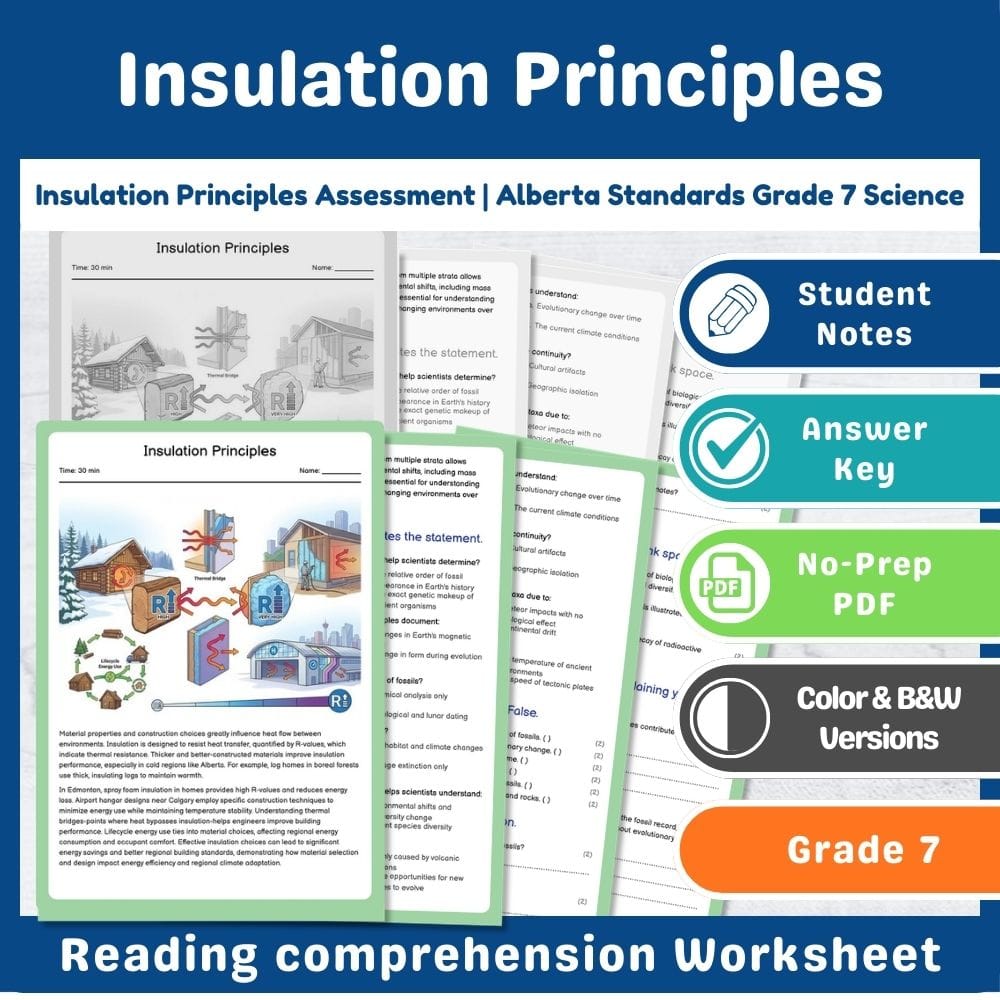
Insulation Principles Assessment | Alberta Standards Grade 7 Science
Created byPrism Point LearningLearning Objectives
- Understand how material properties influence heat flow.
- Identify regional examples of insulation techniques in Alberta.
- Determine the significance of R-values and thermal bridges in building design.
Also included in: Lesson Grade 7 Science Mini Bundle | Energy, Heat & Thermal Processes +1 more
Instant download
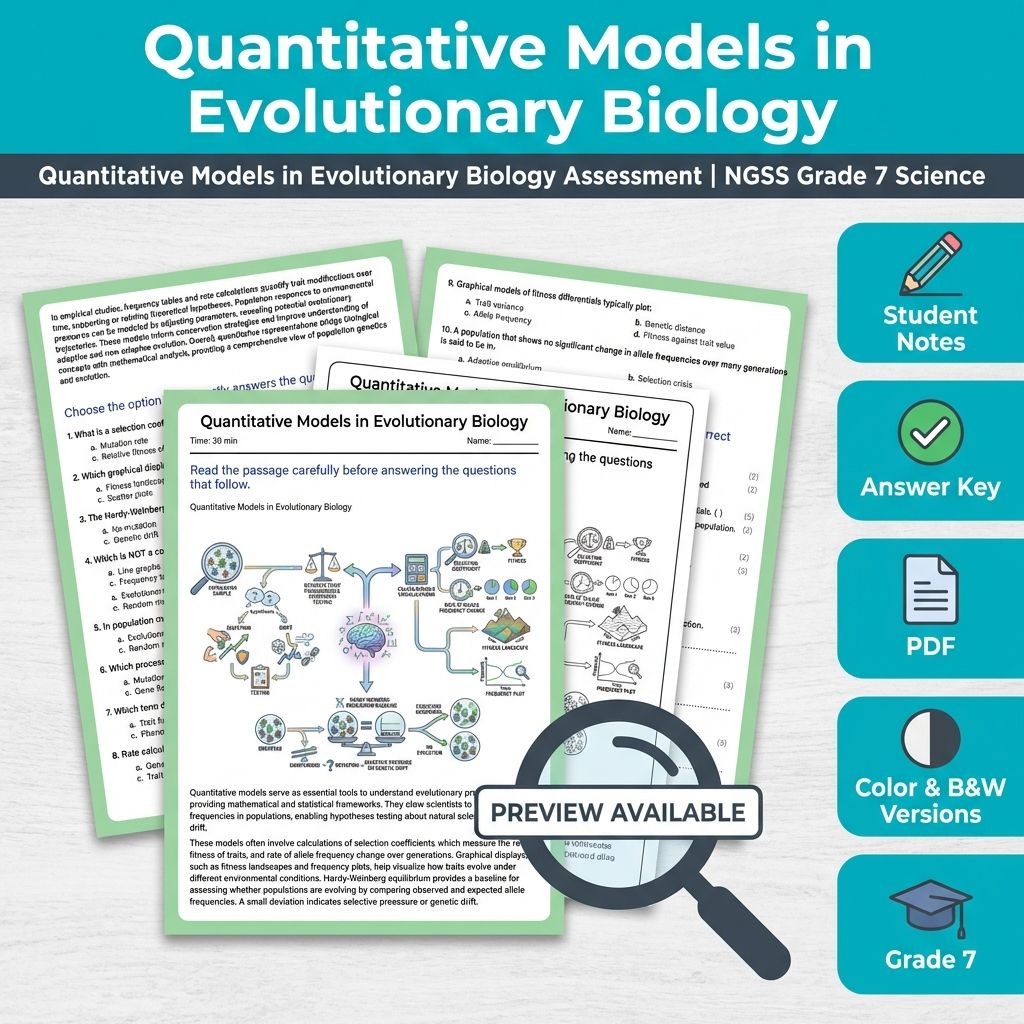
Quantitative Models in Evolutionary Biology Assessment | NGSS Grade 7 Science
Created byPrism Point LearningLearning Objectives
- Understand how mathematical models quantify trait frequencies, selection coefficients, and population dynamics.
- Interpret graphical displays of fitness differentials and allele frequency changes.
- Apply Hardy-Weinberg principles and rate calculations to analyze genetic data.
Also included in: Grade 7 Science Mini Bundle – Biological Evolution: Unity & Diversity +1 more
Instant download

Variable Control Worksheet | Ontario Grade 7 Science Assessment
 Created byCedar Grove Learning
Learning Objectives
- Distinguish independent, dependent, and controlled variables in a fair science investigation.
- Use operational definitions to define how variables are measured or identified during an experiment.
- Design fair tests using replication and controls to reduce confounding and sampling bias.
Also included in: Grade 7 Scientific Inquiry and Data Analysis Science Lesson Bundle - Ontario +1 more
Instant download

Abiotic Drivers Science Worksheet Grade 7 Ontario Ecosystems Activity
 Created byChalk and Compass
Learning Objectives
- Identify key abiotic drivers (temperature, light, soil composition, moisture, and pH) and describe how they influence where organisms live.
- Explain how gradients create environmental templates that affect community structure and species distribution.
- Use organism tolerance ranges to predict which habitats or microhabitats may support different species.
Also included in: Grade 7 Science Ecosystems & Sustainability Lesson Bundle | Ontario +1 more
Instant download

Grade 7 Energy Flow in Ecosystems Worksheet | NGSS Life Science Activity
Created byBRIGHT PATH RESOURCESLearning Objectives
- Understand key concepts related to Science
- Apply knowledge through practice questions
- Demonstrate comprehension of the material
Also included in: Ecosystems & Biodiversity Grade 7 Science Daily Reading Lesson Bundle | NGSS +2 more
Instant download

Grade 7 Science – Quantitative Heat Worksheet (PDF) Alberta Standards
Created bySilver Birch TeachingLearning Objectives
- Use the quantitative heat relationship to calculate energy changes using mass, specific heat, and temperature change
- Convert between joules (J) and kilojoules (kJ) to support correct thermal calculations
- Interpret and compare thermal processes using temperature change and energy budgets
Also included in: Grade 7 Thermal Systems Models and Heat Transfer Science Lesson Bundle – Alberta +1 more
Instant download

Grade 7 Science | Air Masses Fronts Worksheet | California Standards
 Created byLumora Learning
Learning Objectives
- Explain how air masses form and how their temperature and moisture affect local weather
- Describe how fronts act as boundaries where air rises, cools, and can produce clouds and precipitation
- Use evidence such as wind shifts and temperature changes to infer what type of front may be passing
Instant download

Matter Energy Flow Assessment Grade 7 Science California Standards
Created byPrism Point LearningLearning Objectives
- Explain how producers, consumers, and decomposers transfer matter and energy in ecosystems
- Describe how energy flows through food chains and food webs and why energy decreases at higher trophic levels
- Use key vocabulary (producer, consumer, decomposer, trophic level, metabolism, heat) to support scientific explanations
Also included in: Grade 7 Energy Flow and Matter Cycling Science lesson bundle – California Standards +1 more
Instant download

Grade 7 Social Studies | Community Resources Worksheet (BC Standards) (PDF)
Created bySunny Desk ResourcesLearning Objectives
- Explain how communities use local natural resources (minerals, forests, and water) to meet needs and support development.
- Describe how resource management decisions affect environmental sustainability and community well-being.
- Evaluate how Indigenous and local perspectives can guide responsible resource stewardship and decision-making.
Also included in: Grade 7 Technology and Change Social Studies Lesson Bundle for BC +1 more
Instant download

Grade 7 Science Motion Quantities Worksheet | Standards-Aligned Practice
JCreated byJ.S SheetsLearning Objectives
- Understand the basic quantities used to measure motion, including distance, time, and speed.
- Learn how to accurately represent and calculate average speed from tabulated data.
- Identify common sources of measurement error in motion experiments and how to minimize them.
Instant download

Wave Energy Transfer Worksheet Grade 7 Science | Standards-Aligned Practice
JCreated byJ.S SheetsLearning Objectives
- Explain how waves transfer energy without permanently moving matter.
- Differentiate transverse and longitudinal waves using particle motion and wave patterns.
- Use amplitude and wavelength to describe how wave characteristics relate to energy and spacing.
Also included in: Grade 7 Energy Transfer and Change Science Lesson Bundle – General Framework +1 more
Instant download

Earth-Sun Cycles and Seasonal Patterns Worksheet | Grade 7 Science
Created byBRIGHT PATH RESOURCESLearning Objectives
- Explain how Earth’s axial tilt and yearly orbit affect seasons in each hemisphere.
- Describe how Earth’s rotation creates day length and the sun’s apparent daily motion.
- Use patterns in daylight duration to support basic timekeeping ideas such as calendars.
Also included in: Grade 7 Earth Science Worksheets Bundle | Weather, Climate & Earth Systems +2 more
Instant download

Grade 7 Optimization Metrics Worksheet | Practice & Assessment PDF
 Created byClear Sky Classroom
Learning Objectives
- Define optimization metrics and explain how they help compare design options under constraints
- Identify tradeoffs in engineering/science problems using measurable criteria
- Use data and stated targets to justify whether a redesign improves overall performance
Instant download

Interpreting Trends and Patterns Worksheet Grade 7 Computer Science
Created byPrism Point LearningLearning Objectives
- Describe the difference between a pattern and a trend in data.
- Explain how correlation relates to pattern changes over time or across categories.
- Use careful analysis to make a reasonable prediction from data.
Instant download

Grade 7 Maths Worksheet – Sources of Income (Ontario) Practice (PDF)
Created byClear Sky ClassroomLearning Objectives
- Identify and categorize various sources of income such as wages, investments, and benefits.
- Calculate net income after deductions from gross income using percentage-based deductions.
- Interpret real-world income scenarios and solve related mathematical problems.
Also included in: Grade 7 Maths Financial Literacy Lesson Bundle | Ontario +1 more
Instant download

Grade 7 Science | Inclined Planes - Daily Reading Comprehension
 Created byCoral Reef Learning
Learning Objectives
- Understand the components of forces acting on inclined planes
- Identify parallel and perpendicular force components relative to the slope
- Calculate the mechanical advantage of inclined planes
Also included in: Forces, Structures and Motion Lesson Bundle | Grade 7 Science Alberta +1 more
Instant download

Grade 7 Health - Community Engagement Worksheet (NHES) (PDF)
Created bySunny Desk ResourcesLearning Objectives
- Explain how community action and collaboration support health promotion initiatives
- Identify effective communication strategies that help people work together in a community health campaign
- Describe steps for planning a collective health campaign and advocating for policy change
Also included in: Grade 7 Advocacy for Health Health Lesson Bundle aligned to NHES Standards +1 more
Instant download

Grade 7 Science – Failure Modes Worksheet (Ontario) (PDF)
Created byEvergreen Desk EducationLearning Objectives
- Identify key structural failure modes such as buckling, fatigue cracking, fracture, and connection/foundation failures.
- Explain how geometry, material properties, and loading conditions affect which failure mode occurs.
- Describe limit states design thinking using safety factors, redundancy, and risk reduction strategies.
Also included in: Grade 7 Engineering Design & Materials Science Lesson Bundle Ontario +1 more
Instant download

Grade 7 Urban Heat Worksheet | Ontario Science Climate & Environment PDF
Created byClear Sky ClassroomLearning Objectives
- Explain how the urban heat island effect forms from surface materials, vegetation loss, and human activities
- Describe how impervious surfaces, reduced evapotranspiration, and building geometry influence local temperature and air movement
- Evaluate mitigation strategies such as greenery, cool pavements, and strategic shading and predict their impacts
Instant download

Geologic Change Hazards Assessment for Grade 7 Science | Standards-Aligned
Created byPrism Point LearningLearning Objectives
- Understand the processes that cause rapid and gradual geologic changes.
- Identify evidence of geologic hazards such as faults, lava flows, and sediment layers.
- Explain how plate tectonics contributes to earthquakes and volcanic activity.
Also included in: Grade 7 Earth & Space Science Lesson Bundle: General Science Framework
Instant download

Net Force Assessment | TEKS Grade 7 Science Standards-Aligned
Created byPrism Point LearningLearning Objectives
- Understand the concept of net force and how it determines motion.
- Learn to interpret free-body diagrams for systems such as elevators, tug-of-war, and carts on ramps.
- Apply vector addition and equilibrium conditions to solve for net force in one dimension.
Also included in: Grade 7 Motion and Energy Science: Lesson Bundle TEKS Unit Assessment
Instant download

Speciation and Biodiversity Worksheets Grade 7 Science Evolution
 Created bythe curious pencil
Learning Objectives
- Explain how reproductive isolation contributes to speciation
- Describe how geographic separation can lead to divergence
- Compare founder effects, polyploidy, and adaptive radiation
Also included in: Biological Evolution Worksheets Bundle | Grade 7 Science NGSS +2 more
Instant download

Grade 7 Science – Chemical Properties & Reaction Types | Daily Reading Worksheet
Created byBright Mind ResourcesLearning Objectives
- Understand the concept of chemical properties
- Identify different chemical properties of substances
- Describe observable signs of chemical reactions
Also included in: Grade 7 States of Matter & Reactions Science Daily Reading Lesson Bundle | BC +1 more
Instant download

Grade 7 Population Dynamics Science Worksheet | Florida NGSSS + Answer Key
Created byEvergreen Desk EducationLearning Objectives
- Explain how births, deaths, immigration, and emigration change population size over time
- Describe how limiting factors and carrying capacity affect population growth
- Use predator-prey and resource competition ideas to predict patterns in population sizes
Instant download

Grade 7 Gas Behavior Science Daily Reading Worksheet | TEKS Activity
Created byBRIGHT PATH RESOURCESLearning Objectives
- Identify the main idea about how gas pressure changes when force is applied.
- Describe key details linking gas pressure to confined volume.
- Explain the idea of pressure as gas particles collide with surfaces.
Also included in: Matter-Energy Grade 7 Science Daily Reading Worksheets Lesson Bundle | TEKS +1 more
Instant download

Grade 7 ELA | Sentence Pattern Variety Worksheet | Alberta | Practice
Created byLumora LearningLearning Objectives
- Identify the effects of using simple, compound, complex, and expanded sentence patterns in writing.
- Revise sentences to create clearer relationships using coordination and subordination (cause, contrast, condition).
- Strengthen persuasive writing by varying sentence openings and controlling rhythm through length and structure.
Also included in: Grade 7 ELA Clarity & Coherence Writing Lesson Bundle | Alberta
Instant download

Ecological Inquiry Worksheet | Grade 7 Science Activities
Created byPrism Point LearningLearning Objectives
- Explain how ecological inquiry uses questions, evidence, and clear conclusions to evaluate relationships in the environment.
- Identify measurable variables and describe how observations and data help test or revise a hypothesis.
- Interpret ecological data while accounting for natural variability and human impacts.
Also included in: Grade 7 Ecosystems & Biodiversity Science Lesson Bundle | Alberta
Instant download

Graphical Representation Science Worksheet Grade 7 Data Graphing Activity
Created byChalk and CompassLearning Objectives
- Select an appropriate graph type for different kinds of data (categorical vs. continuous).
- Construct graphs with clear axes, proportional scaling, units, and correctly interpreted measurements.
- Interpret patterns in graphs by using slope, correlation, trends, and error bars without assuming causation.
Also included in: Grade 7 Science Scientific Inquiry & Data Analysis Lesson Bundle | Ontario +1 more
Instant download
Browse more categories
About Grade 7 Worksheets
Find Grade 7 worksheets covering math, ELA, science, and social studies. All 8,498 resources download instantly as PDFs for classwork, homework, or review.
MyTeachingSheets worksheets are made by real teacher-authors and checked before they go live. Download any as a print-ready PDF for lessons, homework, or independent practice — most include answer keys, and previews are always free.