
Grade 7 Worksheets
8,459 grade resources
Material Testing Worksheet Printables | Grade 7 Science Review Assessment
 Created byPrism Point Learning
Learning Objectives
- Explain how tensile, compression, and bending tests reveal key material properties used in structural design.
- Compare non-destructive testing (NDT) methods such as ultrasonic and hardness measurements with destructive tests.
- Describe how anisotropy and strain localization can affect the performance of timber and composite materials.
Instant download

Grade 7 Science – Energy Relationships Worksheet (Alberta Standards PDF)
 Created bySilver Birch Teaching
Learning Objectives
- Explain how gravitational potential energy changes into kinetic energy during motion in a mechanical system
- Use mass, height (elevation), and speed to reason about relative mechanical energy and forces
- Describe how energy conservation applies when friction is small and how real systems differ
Also included in: Grade 7 Simple Machines and Forces Science Lesson Bundle: Alberta +1 more
Instant download

Grade 7 Math Formulating Equations Worksheet | Ontario Standards (PDF)
 Created byClear Sky Classroom
Learning Objectives
- Understand how to translate real-world scenarios into algebraic equations.
- Apply variables to represent unknown quantities in problem-solving.
- Develop skills to construct and interpret linear equations from contextual data.
Also included in: Grade 7 Algebra Bundle: Coding, Modelling, and Linear Equations for Ontario +1 more
Instant download

Grade 7 Math – Solving One-Step Equations Worksheet (PDF) - Ontario Standards
Created byClear Sky ClassroomLearning Objectives
- Understand and apply inverse operations to solve single-variable linear equations.
- Evaluate the reasonableness of solutions within real-world contexts.
- Develop confidence in algebraic problem-solving and reasoning skills.
Also included in: Grade 7 Algebra Bundle: Coding, Modelling, and Linear Equations for Ontario +1 more
Instant download
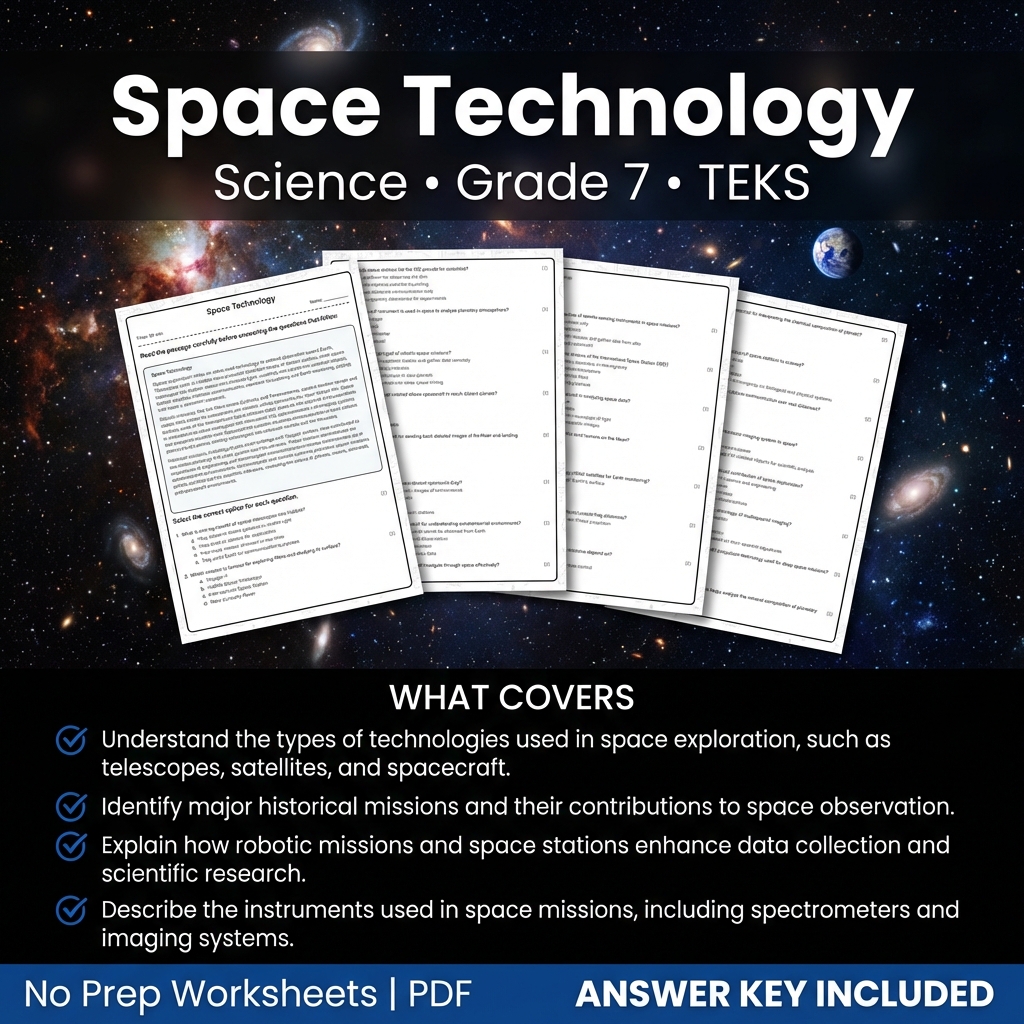
Grade 7 Science Worksheet on Space Technology | TEKS aligned
 Created byCoral Reef Learning
Learning Objectives
- Understand the types of technologies used in space exploration, such as telescopes, satellites, and spacecraft.
- Identify major historical missions and their contributions to space observation.
- Explain how robotic missions and space stations enhance data collection and scientific research.
Instant download

Science Grade 7 Defining a Problem Worksheet | NGSS Standards Assessment
 Created bySkylark Worksheets
Learning Objectives
- Define a science/engineering design problem using clear criteria and measurable success targets
- Identify constraints as limits related to materials, safety, time, and cost
- Translate real-world needs into quantitative performance metrics and acceptable boundaries
Also included in: Grade 7 Engineering Design Science Lesson Bundle: NGSS +1 more
Instant download

Ethical Challenges of Artificial Intelligence Worksheet Grade 7 Computer Science
Created byPrism Point LearningLearning Objectives
- Explain how ethics, accountability, transparency, and responsibility relate to AI decisions.
- Identify ethical risks in everyday AI examples, including privacy and biased outcomes.
- Describe practical steps to improve trust in AI systems.
Instant download

Grade 7 Plate Tectonics Worksheet | NGSS Earth Science Activity with Answer Key
 Created byNorthstar Worksheets
Learning Objectives
- Explain how evidence such as seafloor structures, earthquakes, and volcanoes supports the idea of moving tectonic plates.
- Use fossil distributions and continental margin features to infer past continental positions.
- Describe how magnetic striping and mountain building relate to plate motion and paleogeographic reconstructions.
Also included in: Grade 7 Earth Systems Processes Lesson Bundle | NGSS Earth Science +1 more
Instant download

Grade 7 Science | Air Masses & Fronts - Daily Reading Comprehension
Created byCoral Reef LearningLearning Objectives
- Understand what air masses are and how they are classified.
- Identify the characteristics of different air masses.
- Explain what fronts are and how they form.
Instant download

Grade 7 Science – Earth System Interactions & Water Cycle | Reading Worksheet
 Created byBright Mind Resources
Learning Objectives
- Understand the water cycle and how water moves among Earth's systems.
- Identify the interactions between the geosphere, hydrosphere, atmosphere, and biosphere.
- Explain how changes in one earth system can affect others.
Also included in: Grade 7 Earth Science Daily Reading Worksheets Lesson Bundle | Florida NGSSS +1 more
Instant download

Grade 7 Matter Energy Flow Worksheet | Practice & Assessment PDF
Created byClear Sky ClassroomLearning Objectives
- Explain how matter and energy move through ecosystems using producers, consumers, and decomposers
- Describe how energy transfers through food chains and food webs and why less energy reaches higher trophic levels
- Connect the roles of metabolism and heat loss to patterns of energy flow in ecosystems
Instant download

Nutrient Transport Assessment | California Standards Grade 7 Science
Created byPrism Point LearningLearning Objectives
- Explain how nutrients move from digestion to body tissues through internal transport
- Describe how cells use transported nutrients for growth, repair, and energy
- Identify how the body removes wastes to maintain internal balance
Also included in: Grade 7 Energy Flow and Matter Cycling Science lesson bundle – California Standards +1 more
Instant download

Grade 7 Science – Evolution & Natural Selection | Daily Reading Worksheet
Created byBright Mind ResourcesLearning Objectives
- Understand the basic concept of evolution and how it involves populations, not individuals.
- Recognize genetic variation as the foundation for evolutionary change.
- Identify examples of changes in populations over generations.
Also included in: Populations & Traits Grade 7 Science Daily Reading Lesson Bundle | Florida NGSSS +1 more
Instant download

Grade 7 Holiday History Worksheet | Understanding Memorial Day (PDF)
Created bySilver Birch TeachingLearning Objectives
- Explain how Memorial Day evolved from local practices to a national observance.
- Analyze primary-source ideas (speeches and writings) to infer community motivations.
- Use historical evidence to distinguish claims, reasons, and impacts on collective memory.
Also included in: Grade 7 Holiday Studies Lesson Bundle | May Framework +1 more
Instant download

Grade 7 Science | Understanding Thermal Expansion - Daily Reading Comprehension
Created byCoral Reef LearningLearning Objectives
- Define thermal expansion and explain how particles behave when heated.
- Describe how solids, liquids, and gases respond differently to heat.
- Identify real-world examples of thermal expansion and contraction.
Instant download

Flowcharts and Process Modeling Worksheet Grade 7 Computer Science
Created byPrism Point LearningLearning Objectives
- Interpret flowcharts by following arrows and decisions to predict an outcome.
- Use correct flowchart vocabulary to describe a process and its branches.
- Create a simple process model using decision points and branches.
Instant download

City-State Conditions Worksheet | Standards-Based Practice for Grade 7
JCreated byJ.S SheetsLearning Objectives
- Explain how geographic position helped Renaissance Italian city-states grow and stay secure.
- Describe how commerce and banking supported cultural and intellectual development.
- Analyze how independent governance and patronage encouraged Renaissance artists and scholars.
Instant download

Grade 7 Social Studies Worksheet | Evidence and Interpretation (PDF)
 Created bySunny Desk Resources
Learning Objectives
- Explain how perspective can change the interpretation of historical evidence.
- Evaluate the reliability and context of different types of sources.
- Use evidence to construct and critique historical narratives about rights and sovereignty.
Also included in: Grade 7 Historical Perspectives in Media Social Studies lesson bundle BC +1 more
Instant download

Figurative Vocabulary Worksheet Grade 7 ELA TEKS Language Activity
 Created byGolden Apple Studio
Learning Objectives
- Interpret metaphors, similes, and other figurative expressions by using surrounding context rather than taking words literally.
- Determine how figurative wording can signal evaluation, emphasis, or a central claim in a text.
- Explain the meaning of domain-specific and academic vocabulary by considering how it functions in explanations or arguments.
Also included in: Grade 7 ELA Reading Skills & Evidence Lesson Bundle | TEKS +1 more
Instant download

Grade 7 Science – Predator-Prey Dynamics | Daily Reading Worksheet
Created byBright Mind ResourcesLearning Objectives
- Understand the cause-and-effect relationships between predator and prey populations.
- Identify how changes in predator numbers affect prey populations and vice versa.
- Analyze feedback mechanisms in ecological communities.
Also included in: Trophic Energy Grade 7 Science Daily Reading Worksheets Lesson Bundle | General +1 more
Instant download
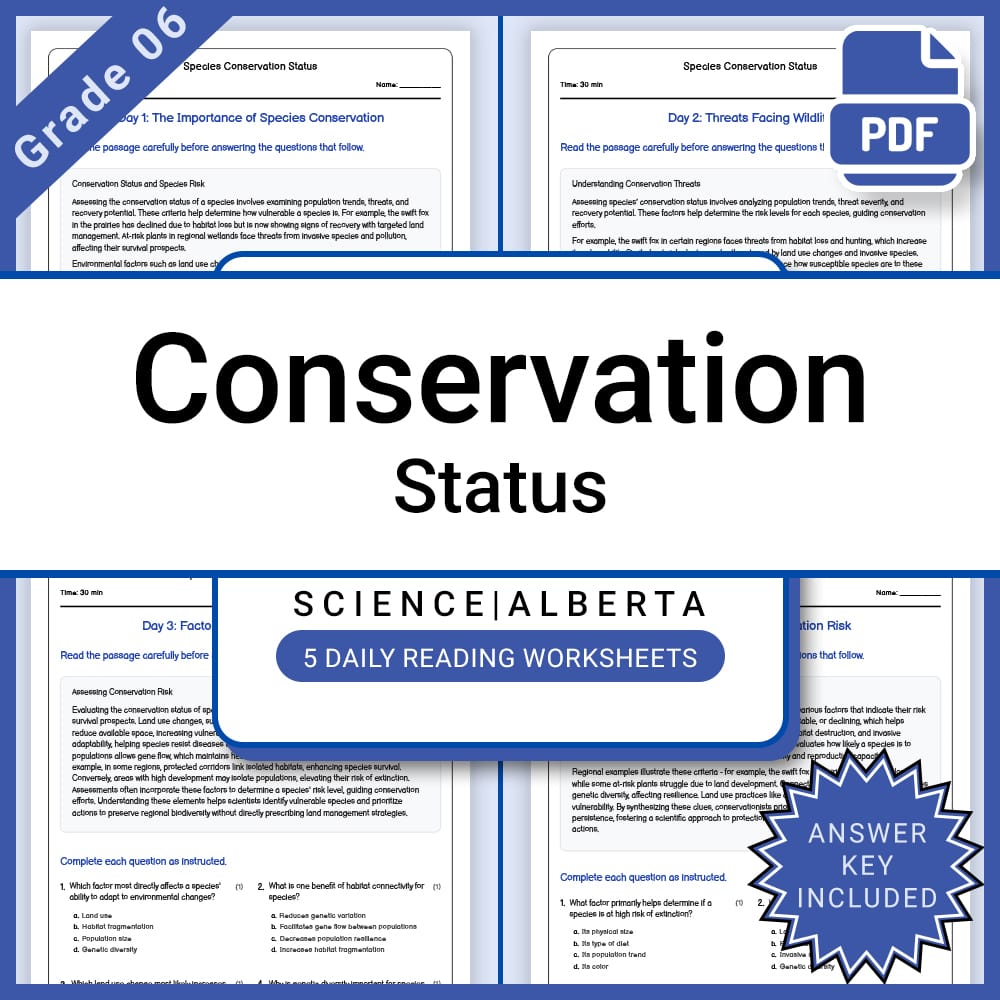
Grade 7 Science – Static Equilibrium | Daily Reading Worksheet + Answer Key
JCreated byJ.S SheetsLearning Objectives
- Define static equilibrium and identify its characteristics.
- Analyze real-world structures to recognize balanced forces.
- Explain the importance of equilibrium in safety and design of structures.
Also included in: Grade 7 Science Lesson Group | Structural Engineering & Motion Worksheets +1 more
Instant download

Grade 7 Science – Earth System Spheres Daily Reading Worksheet | 5 Days
Created byBright Mind ResourcesLearning Objectives
- Understand the components of Earth's atmosphere and their functions.
- Learn how the atmosphere interacts with other Earth system spheres.
- Recognize the importance of the atmosphere to living things and the environment.
Also included in: Weather, Earth Systems & Human Feedbacks Grade 7 Science Lesson Bundle | General +1 more
Instant download

Grade 7 Science | Ecological Inquiry Worksheet (Alberta Standards) (PDF)
Created bySilver Birch TeachingLearning Objectives
- Explain how ecological inquiry uses hypotheses, measurable variables, and evidence to support conclusions.
- Identify examples of variables and explain why limits and natural variability matter when interpreting ecological data.
- Use data and reasoning to evaluate how human activities can affect ecological relationships.
Also included in: Grade 7 Ecosystems & Biodiversity Science Lesson Bundle for Alberta Framework +1 more
Instant download

Grade 7 Social Studies — Settlement Patterns Worksheet MCQ Paper
 Created byThe Resource Hub
Learning Objectives
- Explain how empire policies, land grants, and migration streams shaped settlement patterns from 1713 to 1850
- Analyze how land distribution influenced social organization and agricultural development
- Describe causes and consequences of settlement, including Indigenous displacement and changing relationships among groups
Also included in: Grade 7 Canadian History Social Studies Lesson Bundle: Ontario MCQ +1 more
Instant download
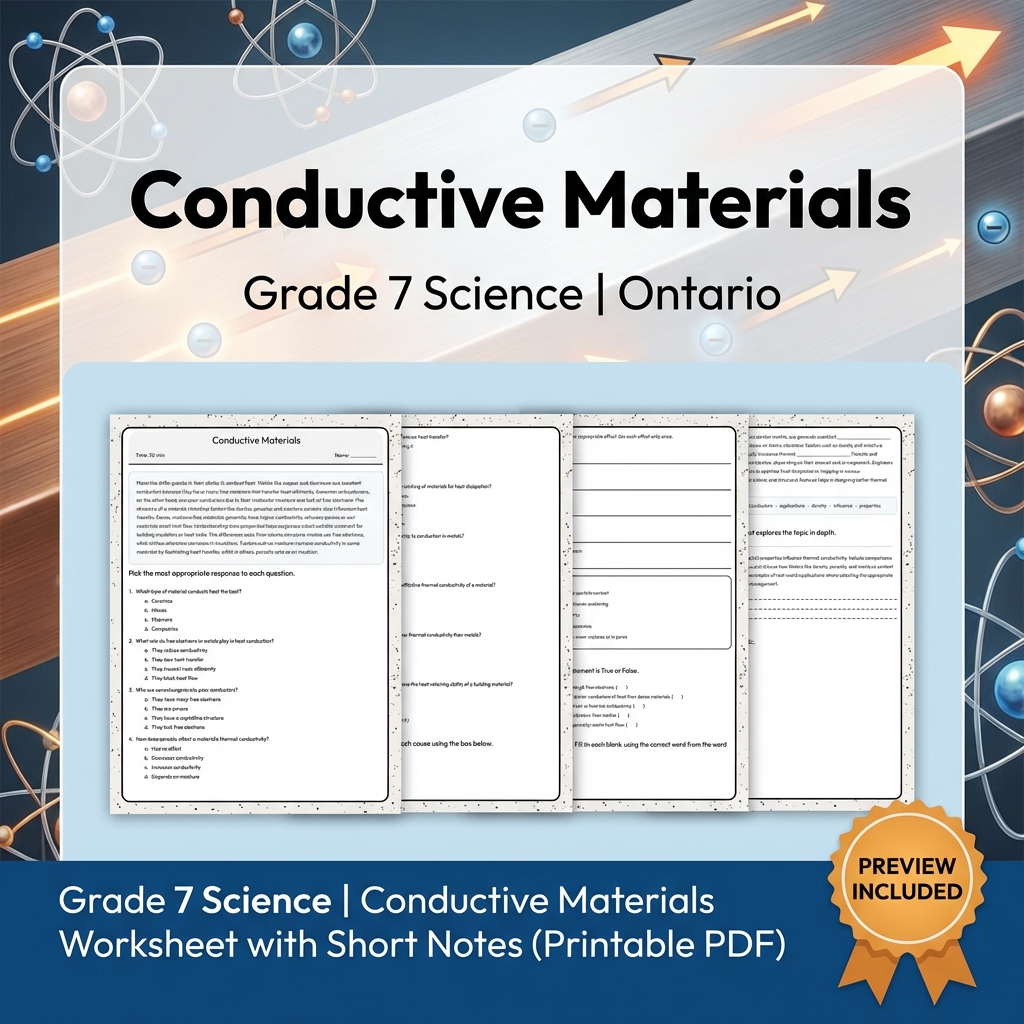
Grade 7 Science | Conductive Materials Worksheet with Short Notes (PDF)
 Created byMeadowlark Worksheets
Learning Objectives
- Understand the differences in thermal conductivity among metals, ceramics, polymers, and composites.
- Analyze how factors such as free electrons, lattice vibrations, density, porosity, and moisture affect heat transfer.
- Compare qualitative measures used to rank materials for heat dissipation and retention.
Also included in: Grade 7 Science Lesson Group | Thermal Effects and Heat Transfer Worksheets +1 more
Instant download

Grade 7 Science – Plate Mechanisms & Mantle Convection | Daily Reading Worksheet
Created byBright Mind ResourcesLearning Objectives
- Understand the concept of mantle convection and its role in plate movement.
- Identify different force mechanisms driving plate tectonics.
- Explain how convection cells influence Earth's surface features.
Also included in: Grade 7 Earth Processes Science Daily Reading Worksheets Lesson Bundle | BC +1 more
Instant download

Grade 7 Science – Mechanical Energy & Pendulums Daily Reading Worksheet
Created byBright Mind ResourcesLearning Objectives
- Understand the concept of mechanical energy in systems like pendulums
- Identify how energy transfers between potential and kinetic forms
- Recognize observable effects of energy conservation and loss in simple systems
Also included in: Grade 7 Motion & Energy Science Daily Reading Worksheets Lesson Bundle | TEKS +2 more
Instant download

Friction and Drag Worksheet | Grade 7 Science Activities
Created byPrism Point LearningLearning Objectives
- Explain how static and kinetic friction oppose relative motion and affect acceleration and stopping distance.
- Describe aerodynamic drag as a force that opposes motion through air and influences speed of moving objects.
- Connect surface texture and normal force to changes in the frictional coefficient and real-world movement outcomes.
Instant download

Grade 7 Holiday Bastille Day Worksheet for Mastery | PDF + Answer Key
 Created byShaNova Worksheets
Learning Objectives
- Explain major causes of the French Revolution, including social inequality and political conflict.
- Describe the events surrounding the storming of the Bastille and why it mattered.
- Analyze consequences of revolutionary change for rights, power, and everyday life.
Instant download

Grade 7 Science – Radiant Transfer & Energy | Daily Reading Worksheet
Created byBright Mind ResourcesLearning Objectives
- Understand the concept of radiant energy transfer through electromagnetic waves
- Identify factors affecting radiative heating and cooling
- Recognize how solar angles and surface properties influence local microclimates
Also included in: Grade 7 Heat Transfer Science Daily Reading Worksheets Lesson Bundle | Alberta +2 more
Instant download
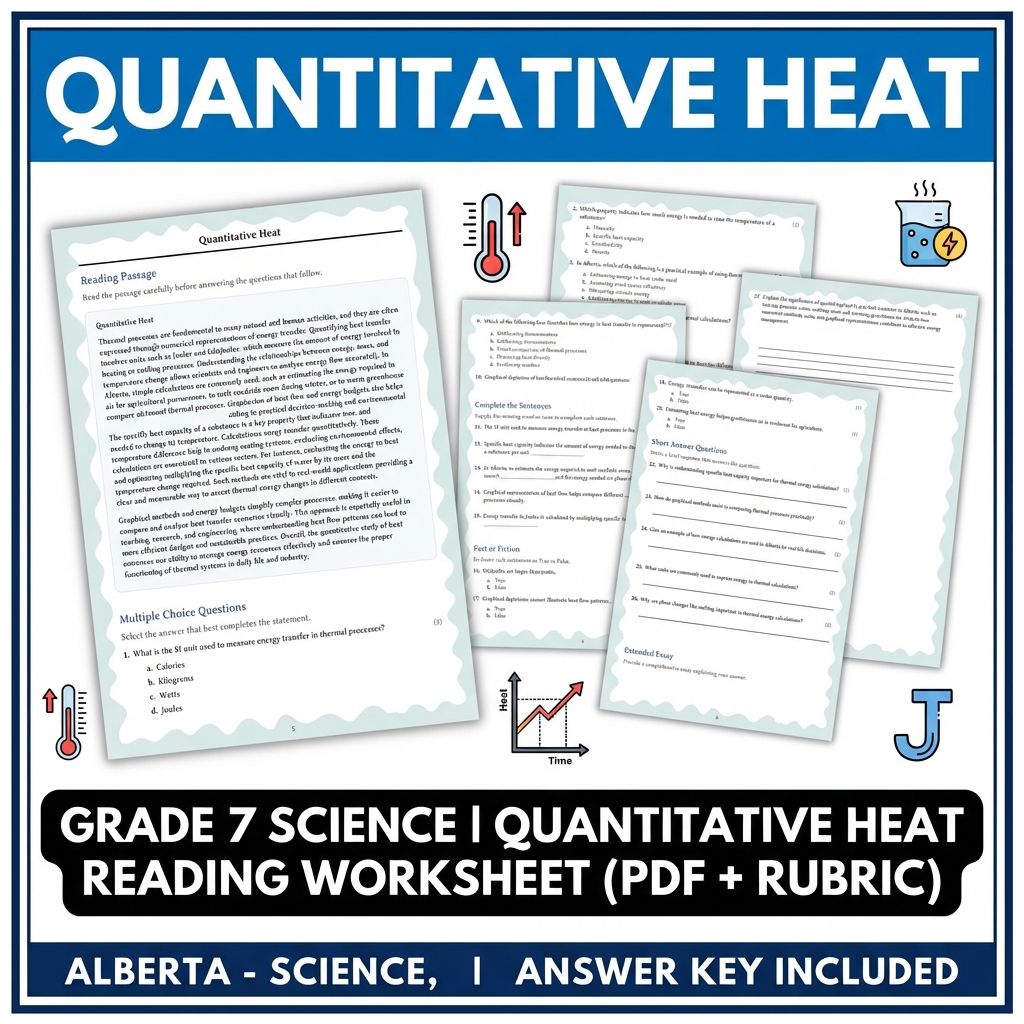
Grade 7 Science | Quantitative Heat Reading Worksheet (PDF + Rubric)
JCreated byJ.S SheetsLearning Objectives
- Understand how numerical representations measure heat transfer in different thermal processes.
- Learn about units of energy and temperature scales used in thermal calculations.
- Apply specific heat, mass, and temperature change to calculate energy transfer in Joules and kilojoules.
Also included in: Grade 7 Science UNIT Bundle | Heat Transfer, Convection & Energy Worksheets +1 more
Instant download
Grade 7 Science – Signs of Chemical Change Daily Reading Worksheet + Answer Key
JCreated byJ.S SheetsLearning Objectives
- Understand key concepts related to Science
- Apply knowledge through practice questions
- Demonstrate comprehension of the material
Also included in: Grade 7 Science Lesson Bundle | Alberta Framework for Classroom Use +1 more
Instant download

Balancing Change & Continuity in Communities | Grade 7 Social Studies Worksheet
 Created byQuiet Forest Education
Learning Objectives
- Understand the importance of cultural revitalization initiatives within communities.
- Analyze how communities maintain core identities amidst social change.
- Evaluate examples of Indigenous cultural efforts and multicultural integration in Canada.
Also included in: Grade 7 Social Studies Full-Year Bundle | BC Daily Reading
Instant download
Balancing Change and Continuity Grade 7 Social Studies Worksheet | BC Standards
JCreated byJ.S SheetsLearning Objectives
- Understand the concept of social resilience and how communities maintain cultural identity amidst change.
- Identify examples of cultural revitalization and multicultural integration in Canada.
- Evaluate the balance between social continuity and adaptation in community development.
Instant download

Grade 7 Social Studies Worksheet | Balancing Change and Continuity (PDF)
Created bySunny Desk ResourcesLearning Objectives
- Explain how social resilience helps communities maintain cultural identities during social, economic, and environmental change.
- Analyze examples from Indigenous cultural revitalization and multicultural integration efforts in Canada.
- Evaluate evidence to determine how communities balance continuity (tradition) with adaptation (change).
Also included in: Grade 7 Patterns of Continuity Social Studies Lesson Bundle – BC Framework +1 more
Instant download

Grade 7 Social Studies — Worksheet MCQ Paper for Mastering Historical Change
Created byThe Resource HubLearning Objectives
- Understand how technological innovations, migration, and policy shifts have influenced communities over time.
- Analyze key historical events such as urbanization and immigration policies in Canada.
- Evaluate the causes and impacts of social and community changes in history.
Also included in: Grade 7 Social Studies BC Bundle – Patterns of Continuity and Change Worksheets +1 more
Instant download

Grade 7 Science – Freshwater Reservoirs & Water Cycle Daily Reading Worksheet
Created byBright Mind ResourcesLearning Objectives
- Identify different sources of freshwater such as lakes and aquifers.
- Describe how groundwater systems operate and recharge.
- Explain the importance of porosity and permeability in aquifer function.
Also included in: Earth & Space Grade 7 Science Daily Reading Worksheets Bundle | TEKS +2 more
Instant download

Grade 7 Adaptation Forms Science Daily Reading Worksheet | TEKS Activity
 Created byBRIGHT PATH RESOURCES
Learning Objectives
- Define morphological adaptations as physical traits that improve survival and reproduction.
- Identify how camouflage and body structures help organisms in specific habitats.
- Distinguish adaptation from change caused only by immediate conditions (acclimation).
Also included in: Grade 7 Ecosystems Science Daily Reading Worksheets Bundle | TEKS +1 more
Instant download

Grade 7 Holiday | Pi Day for Mastering Pi Concepts | PDF + Answer Key
Created byShaNova WorksheetsLearning Objectives
- Explore the history and significance of Pi in different cultures.
- Identify traditions and celebrations associated with Pi Day worldwide.
- Reflect on the value of curiosity and shared learning in mathematics.
Also included in: Grade 7 Pi Day Lesson Bundle for Holiday Math and Geometry Activities
Instant download

Grade 7 Social Studies — European Exploration Worksheet MCQ Paper
Created byThe Resource HubLearning Objectives
- Describe why European countries pursued voyages of exploration in the 15th and 16th centuries.
- Identify how technology and navigation supported sea exploration.
- Explain key effects of the Columbian Exchange on people and the environment.
Instant download

Earth System Interactions Worksheet Grade 7 Science
JCreated byJ.S SheetsLearning Objectives
- Explain how the geosphere, hydrosphere, atmosphere, and biosphere exchange matter and energy
- Describe cause-and-effect relationships between Earth systems (e.g., erosion affecting waterways and habitats)
- Use evidence from observations to support an explanation of Earth system interactions over time
Also included in: Grade 7 Weather, Climate, and Earth Processes Science Lesson Bundle +1 more
Instant download

Grade 7 Science | Simple Machines Overview Worksheet (PDF) – Alberta Standards
Created bySilver Birch TeachingLearning Objectives
- Identify examples of the six simple machines and describe how each one changes force magnitude or direction
- Explain mechanical advantage as a comparison of output force to input force, using appropriate units and reasoning
- Apply relationships among force, distance, and machine geometry to predict outcomes for everyday tools
Also included in: Grade 7 Simple Machines and Forces Science Lesson Bundle: Alberta +1 more
Instant download

Grade 7 Science Worksheet – Design Criteria & Engineering Standards (PDF)
 Created byEvergreen Desk Education
Learning Objectives
- Explain how design criteria for success can be measurable or observable in a science design problem.
- Identify common constraints (time, materials, cost, safety) and describe how they affect possible solutions.
- Describe trade-offs and improvement by connecting test evidence to criteria rather than appearance.
Also included in: Grade 7 Investigation & Engineering Science Lesson Bundle: General Framework +1 more
Instant download

Spreadsheet Parts and Organization Worksheets | Grade 7 Computer Science
Created byBright Mind ResourcesLearning Objectives
- Define and use spreadsheet vocabulary including worksheet, cell, row, and column.
- Identify rows, columns, and cells in a simple spreadsheet layout.
- Use sorting to reorganize information while keeping related data together.
Instant download

Science Worksheet The Rock Cycle Grade 7 | Standards-Aligned Practice PDF
JCreated byJ.S SheetsLearning Objectives
- Explain how igneous, sedimentary, and metamorphic rocks form in the rock cycle.
- Describe the roles of heat, pressure, weathering, and mineral cementation in rock transformations.
- Use rock-cycle ideas to make connections between surface and subsurface Earth processes.
Also included in: Grade 7 Weather, Climate, and Earth Processes Science Lesson Bundle +1 more
Instant download

Design Principles Assessment | TEKS Grade 7 Science Standards-Aligned
Created byPrism Point LearningLearning Objectives
- Understand key concepts of designing fair and reproducible experiments.
- Identify variables, operational definitions, and control conditions in experiments.
- Recognize ethical, safety, and sample size considerations in research design.
Also included in: Scientific Inquiry Reasoning Grade 7 Science Lesson Bundle TEKS Unit
Instant download

Grade 7 Science | Heat Transfer Models Worksheet (PDF) for Standards
Created byEvergreen Desk EducationLearning Objectives
- Explain how heat transfers from warmer regions to cooler regions using conduction, convection, and radiation models.
- Use a simple heat-transfer model to predict the direction of energy flow based on temperature differences.
- Describe how energy can change form while heat moves through a system.
Also included in: Grade 7 Energy Transfer & Motion Science Lesson Bundle Worksheets (General) +1 more
Instant download

Grade 7 Population Limits Worksheet | Exponential vs Logistic Growth Ontario
 Created byTeacher's Corner
Learning Objectives
- Describe how carrying capacity limits population growth using logistic models.
- Differentiate exponential growth from logistic growth on population graphs.
- Identify limiting factors and explain how density-dependent and density-independent effects differ.
Instant download
Browse more categories
About Grade 7 Worksheets
Find Grade 7 worksheets covering math, ELA, science, and social studies. All 8,459 resources download instantly as PDFs for classwork, homework, or review.
MyTeachingSheets worksheets are made by real teacher-authors and checked before they go live. Download any as a print-ready PDF for lessons, homework, or independent practice — most include answer keys, and previews are always free.