
Grade 7 Worksheets
8,459 grade resources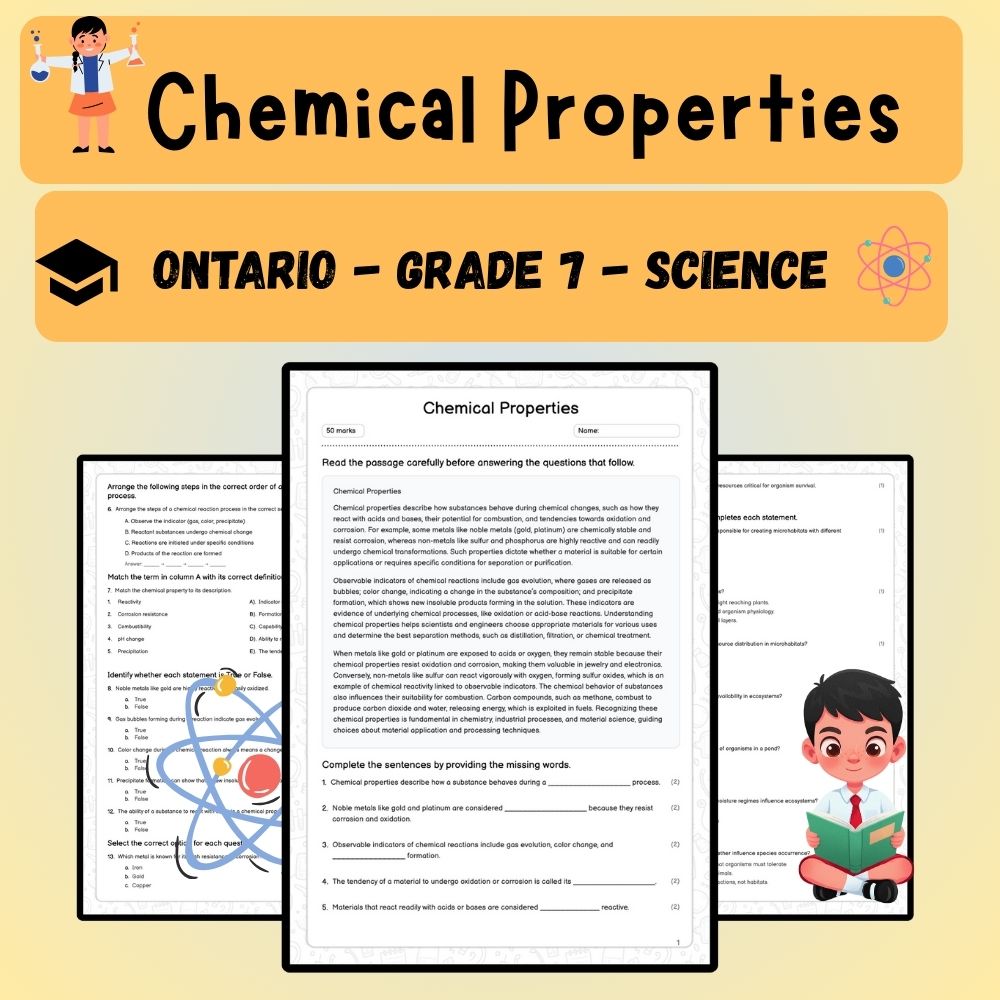
Grade 7 Science | Chemical Properties Worksheet (PDF ) – Ontario Standards
 Created byPrism Point Learning
Learning Objectives
- Explain what chemical properties are and how they influence material behavior.
- Identify observable indicators of chemical reactions, such as gas evolution, color change, and precipitate formation.
- Compare the chemical stability of noble metals with reactive non-metals.
Also included in: Grade 7 Science Unit Bundle | Substances, Mixtures & Properties Worksheets +1 more
Instant download

Grade 7 Science | Sound Production Worksheet (PDF) – General Standards
 Created byEvergreen Desk Education
Learning Objectives
- Explain how vibrating objects create pressure waves in a medium and how those waves move sound.
- Relate frequency to pitch and amplitude to loudness.
- Describe how sound transmission depends on the presence and properties of a medium.
Also included in: Grade 7 Energy Transfer & Motion Science Lesson Bundle Worksheets (General) +1 more
Instant download

Science Fair Testing Measurements Worksheet | Grade 7 Standards Alignment
JCreated byJ.S SheetsLearning Objectives
- Explain what it means to run a fair test by changing only one design variable while keeping all other conditions the same.
- Select appropriate measurement tools, units, and scales for collecting data during an investigation.
- Describe how consistent measurement and repeated trials help ensure differences come from the design rather than the testing setup.
Also included in: Grade 7 Science Fair Testing, Design, and Data Reliability Science Lesson Bundle +1 more
Instant download

Grade 7 Science | Fair Testing Measurement Worksheet (Practice Set)
Created byEvergreen Desk EducationLearning Objectives
- Explain how fair testing keeps all conditions the same except for the intended design variable.
- Select appropriate measurement tools and explain why units and scales matter.
- Record and interpret measurement data so results reflect the design change, not the testing setup.
Also included in: Grade 7 Investigation & Engineering Science Lesson Bundle: General Framework +1 more
Instant download

Data Visualization Techniques Charts and Graphs Worksheet Grade 7 CS
Created byPrism Point LearningLearning Objectives
- Identify common uses of different data visualization types such as charts and graphs.
- Explain how visualizations reveal patterns and trends that may be hard to see in raw data.
- Use key visualization vocabulary correctly, including visualization, chart, graph, and trend.
Instant download
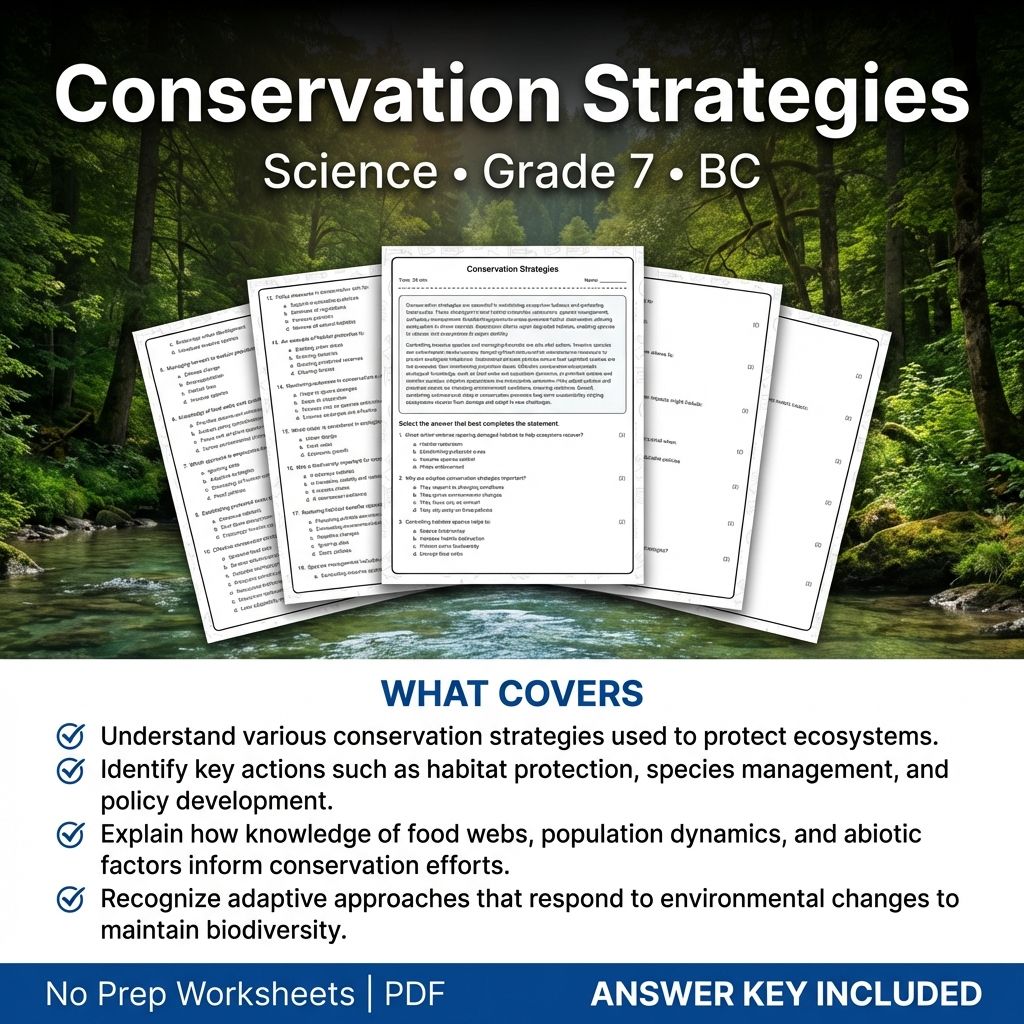
Grade 7 Science | Conservation Strategies Worksheet & Answer Key (Printable PDF)
 Created byCoral Reef Learning
Learning Objectives
- Understand various conservation strategies used to protect ecosystems.
- Identify key actions such as habitat protection, species management, and policy development.
- Explain how knowledge of food webs, population dynamics, and abiotic factors inform conservation efforts.
Instant download
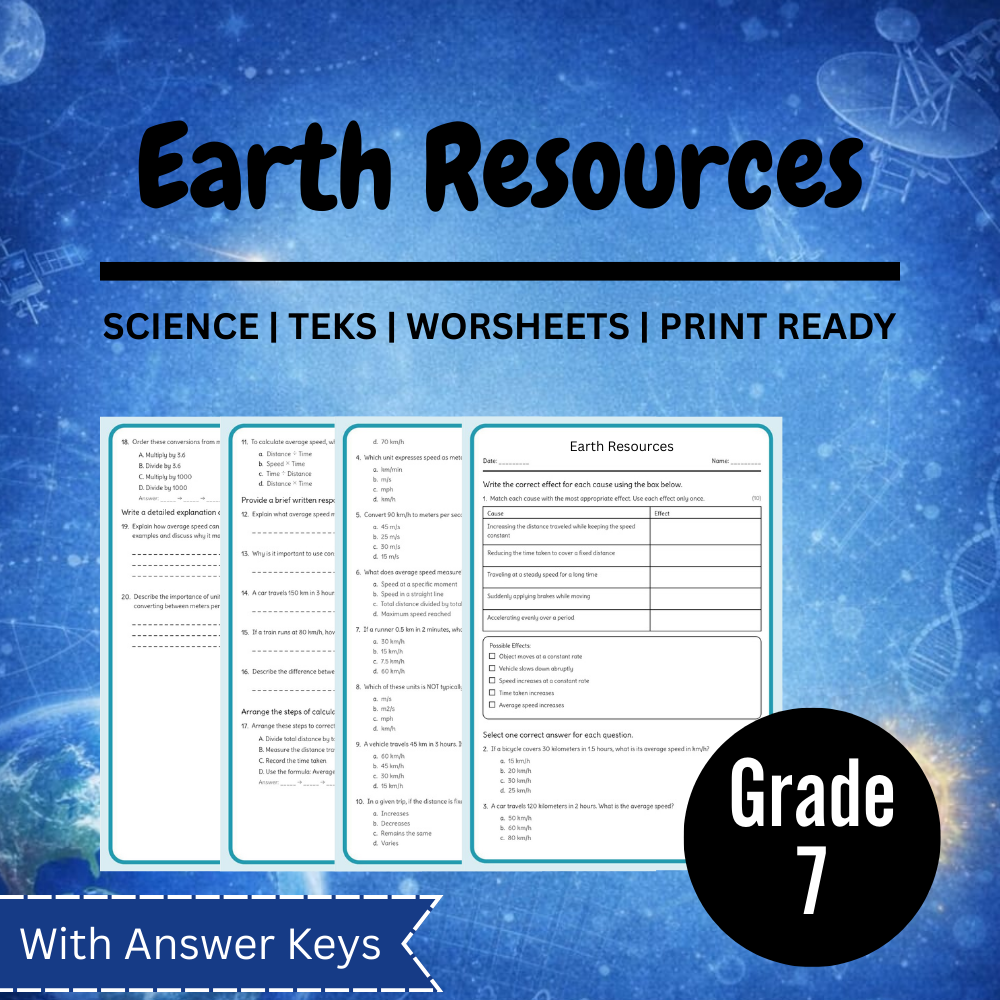
Grade 7 Science | Earth Resources TEKS-Aligned Worksheet (PDF) with Answer Key
 Created byBright Mind Resources
Learning Objectives
- Describe the distribution and types of natural resources such as freshwater, minerals, and soil.
- Explain processes of groundwater flow, aquifer recharge, and soil formation.
- Differentiate between renewable and nonrenewable resources and their geologic settings.
Also included in: Grade 7 Science Unit Bundle | Earth's Processes, Space & Resources TEKS Aligned +2 more
Instant download

Energy Flow Food Chains & Food Webs Worksheet | Grade 7 NGSS
 Created byAmber Owl Education
Learning Objectives
- Explain how energy moves through trophic levels in a food chain, including the roles of producers, consumers, and decomposers
- Describe photosynthesis and cellular respiration as mechanisms for capturing and releasing energy
- Model an energy budget using energy-pyramid ideas and typical transfer efficiencies
Also included in: Grade 7 Science Ecosystems and Food Webs Lesson Bundle | NGSS +1 more
Instant download

Science Fossil Evidence Worksheet | Standards-Aligned Grade 7 Assessment
JCreated byJ.S SheetsLearning Objectives
- Explain how fossils form and describe what kinds of evidence fossils can preserve.
- Use fossil assemblages to infer past environments and conditions.
- Describe how fossils help scientists compare and match layers in Earth’s history.
Also included in: Grade 7 Weather, Climate, and Earth Processes Science Lesson Bundle +1 more
Instant download

Testing and Refining Solutions Worksheet Grade 7 Computer Science
Created byPrism Point LearningLearning Objectives
- Explain how testing helps validate an algorithm under different conditions.
- Identify ways to revise an algorithm based on observed test results.
- Use vocabulary such as testing, validation, refinement, and revision to describe improvement steps.
Instant download

Natural Hazards Grade 7 Science Worksheet | NGSS-Aligned Classroom Practice
JCreated byJ.S SheetsLearning Objectives
- Analyze historical and instrumental data to identify patterns of natural hazards such as earthquakes, volcanic eruptions, hurricanes, floods, and tsunamis.
- Interpret hazard maps, recurrence intervals, and probabilistic forecasts to assess risks and inform mitigation strategies.
- Understand the cascading impacts of natural hazards on infrastructure, ecosystems, and settlements, and differentiate between short-term event dynamics and long-term trends.
Also included in: Grade 7 Human Impacts on Earth Systems Science Lesson Bundle – NGSS +1 more
Instant download

Grade 7 Science – Sound Perception & Travel | Daily Reading Worksheet
Created byBright Mind ResourcesLearning Objectives
- Understand how sound waves travel through different environments
- Identify factors that affect the perception of loudness and pitch
- Explain how surfaces reflect and absorb sound
Also included in: Energy Transfer, Sound & Motion Lesson Bundle | Grade 7 Science | General +1 more
Instant download
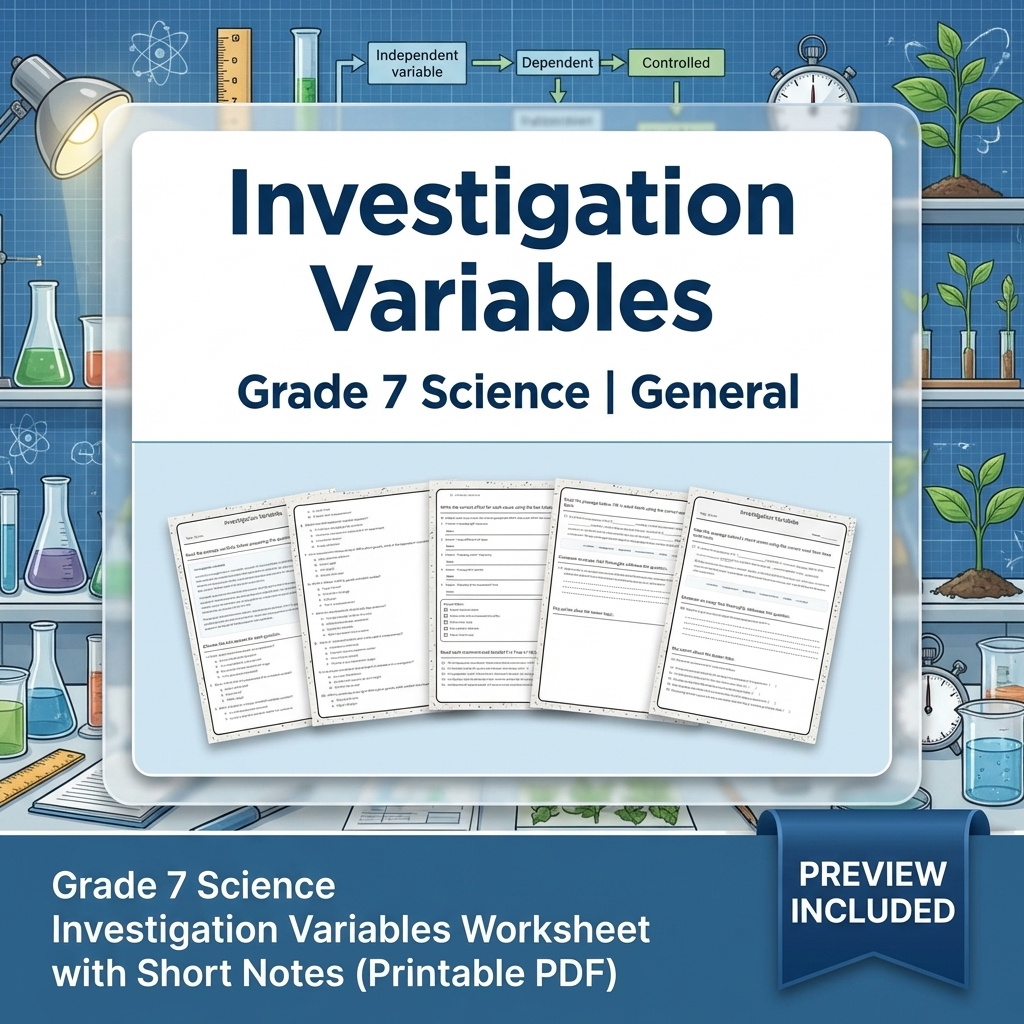
Grade 7 Science Investigation Variables Worksheet with Short Notes
 Created byMeadowlark Worksheets
Learning Objectives
- Understand the different types of variables in scientific investigations.
- Identify independent, dependent, and controlled variables in experiment design.
- Learn how to clarify key evidence in investigation plans.
Also included in: Grade 7 Science Scientific Modeling & Evidence Lesson Bundle: General Framework +1 more
Instant download

Grade 7 | Cinco de mayo day for Geographical Significance | PDF + Answer Key
 Created byShaNova Worksheets
Learning Objectives
- Identify key Mexican geographic regions relevant to the Cinco de Mayo story, including Veracruz and Puebla
- Explain how physical geography (mountains, plateaus, rivers, elevation) can influence travel and historical events
- Use basic map/location thinking to connect geography with cultural identity and historical narratives
Instant download

Grade 7 Science | Pollution Effects - Daily Reading Comprehension
Created byCoral Reef LearningLearning Objectives
- Identify sources of nutrient pollution from agriculture
- Understand how nutrient runoff affects water quality
- Analyze the ecological impacts of nutrient pollution
Also included in: Interactions and Ecosystems Lesson Bundle Grade 7 Science – Alberta +1 more
Instant download

Grade 7 Science – Forest Fires & Ecosystem Changes | Daily Reading Worksheet
Created byBright Mind ResourcesLearning Objectives
- Understand key concepts related to Science
- Apply knowledge through practice questions
- Demonstrate comprehension of the material
Also included in: Grade 7 Ecosystems & Population Ecology Science Lesson Bundle | BC +1 more
Instant download

Grade 7 | First day of spring Worksheet for Earth's Seasons | PDF + Answer Key
Created byShaNova WorksheetsLearning Objectives
- Understand the significance of the spring equinox as a marker of seasonal change.
- Explain how daylight and darkness are balanced during the spring equinox.
- Identify the impact of spring on ecosystems and agriculture worldwide.
Instant download

Choosing and Reading Graphs for Data Patterns Worksheets Grade 7
Created byPrism Point LearningLearning Objectives
- Select graph types for categorical and continuous data
- Construct graphs using accurate scales and proportional representation
- Interpret slope, correlation, and patterns in graphs
Also included in: Scientific Inquiry & Data Practices Lesson Bundle | Grade 7 Science | Ontario +1 more
Instant download

Grade 7 Math – Variables and Expressions Worksheet (Ontario Standards) (PDF)
 Created byClear Sky Classroom
Learning Objectives
- Understand the concept of variables in algebraic expressions.
- Formulate and interpret algebraic expressions based on problem situations.
- Simplify algebraic expressions and evaluate them with given values.
Also included in: Grade 7 Algebra Bundle: Coding, Modelling, and Linear Equations for Ontario +1 more
Instant download

Juneteenth: Celebrating Culture Reading Comprehension | Grades 6–8
Learning Objectives
- Explain key details about Juneteenth and how it is commemorated in communities.
- Identify how music, food, and community events help preserve African American cultural identity.
- Use historical and cultural examples to describe why respect for traditions matters.
Also included in: Juneteenth: Freedom & Equality Bundle | Reading Comprehension | Grades 6–8 +2 more
Instant download

Grade 7 Social Studies — Indigenous Knowledge Systems Worksheet MCQ
 Created byThe Resource Hub
Learning Objectives
- Understand the role of Indigenous oral histories and cultural practices in shaping land and sovereignty perspectives.
- Analyze how Indigenous epistemologies differ from Western historical narratives.
- Recognize the importance of respecting Indigenous ways of knowing and knowledge systems.
Also included in: Grade 7 Social Studies BC Custom Bundle – Media, Land, and Perspectives +1 more
Instant download

Grade 7 Science | Structural Basics Worksheet (PDF) Alberta Standards
 Created bySilver Birch Teaching
Learning Objectives
- Explain how supports, foundations, and load paths help structures stay stable under common forces.
- Identify compression, tension, and shear and describe how each affects parts of beams, columns, and foundations.
- Use material properties (stiffness, strength, durability) to evaluate structural safety for typical Alberta wind and snow loads.
Also included in: Grade 7 Simple Machines and Forces Science Lesson Bundle: Alberta +1 more
Instant download

Grade 7 Holiday Symbols of Identity Worksheet | May Standards (PDF)
Created bySilver Birch TeachingLearning Objectives
- Identify how symbols such as clothing, language, and cultural artifacts express identity in Asian American and Pacific Islander communities.
- Explain how symbols can build community pride and preserve historical continuity.
- Practice empathy by describing how respectful curiosity can improve understanding of cultural differences.
Also included in: Grade 7 Holiday Identity Social Studies Lesson Bundle: May Framework +1 more
Instant download

Grade 7 Science – Understanding Trophic Energy Transfer | Reading Worksheet
Created byBright Mind ResourcesLearning Objectives
- Explain the concept of a food chain and how energy flows through it.
- Identify the different trophic levels in an ecosystem.
- Describe how energy is lost at each step of the food chain.
Also included in: Grade 7 Energy Transfer Science Daily Reading: Lesson Bundle | California Std. +1 more
Instant download
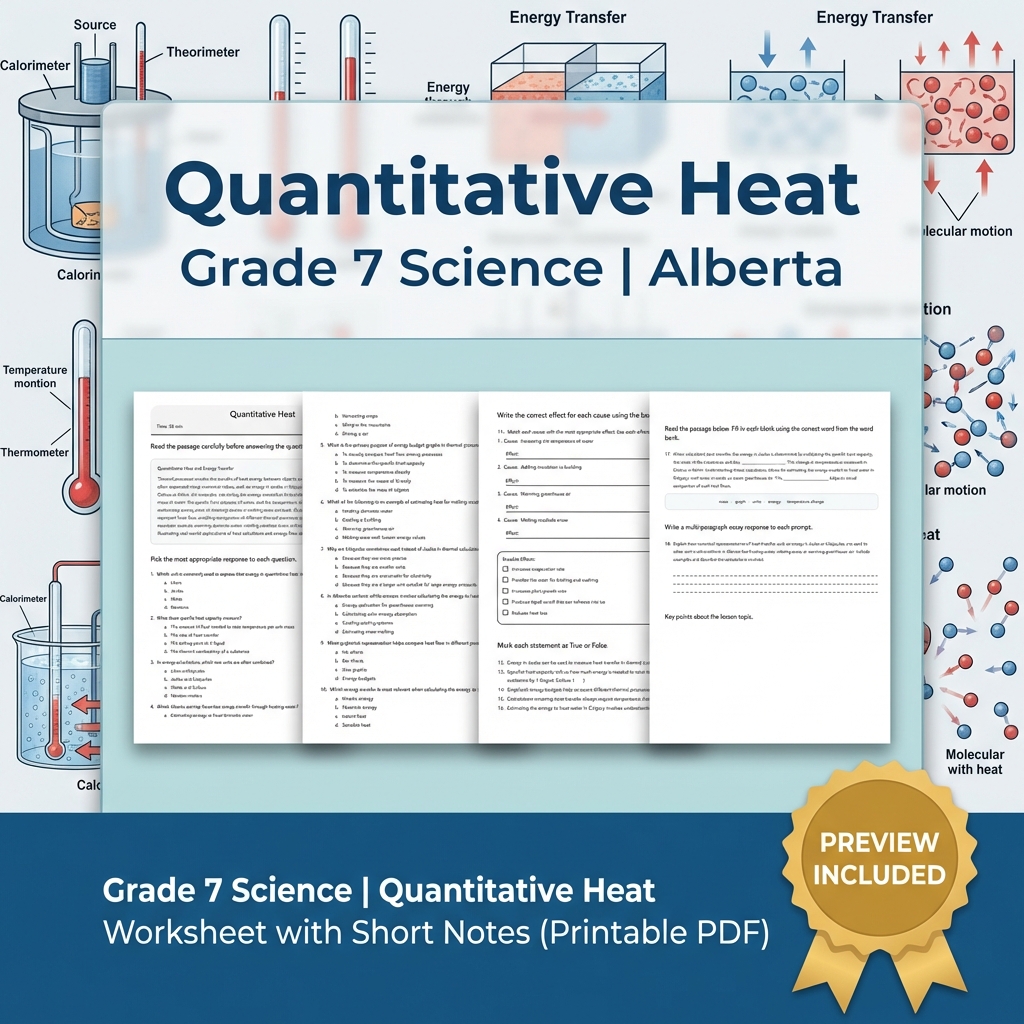
Grade 7 Science | Quantitative Heat Worksheet with Short Notes (Printable PDF)
Created byMeadowlark WorksheetsLearning Objectives
- Understand how numerical representations describe thermal processes.
- Calculate energy transfer using specific heat, mass, and temperature change.
- Apply units such as Joules and kilojoules in energy calculations.
Instant download

Grade 7 Math | Problem-Solving Strategies Worksheet (Ontario Standards)
Created byClear Sky ClassroomLearning Objectives
- Identify and evaluate different problem-solving strategies used in mathematics.
- Apply logical reasoning and visual methods to solve complex problems.
- Select appropriate strategies for various mathematical challenges.
Also included in: Grade 7 Maths Social-Emotional Learning Skills and Mathematical Processes Bundle +1 more
Instant download

Survival Structures Assessment | General Grade 7 Science Standards
Created byPrism Point LearningLearning Objectives
- Understand how internal structures support organism survival, growth, and reproduction.
- Identify external features that aid protection, feeding, and movement in organisms.
- Explain the functional relationships between traits and resource acquisition, balance, and reproduction.
Instant download

Grade 7 Science – Air Masses & Fronts Daily Reading Worksheet | Florida NGSSS
Created byBright Mind ResourcesLearning Objectives
- Understand what air masses are and how they form.
- Identify different types of fronts and their features.
- Explain how air masses and fronts affect weather conditions.
Also included in: Grade 7 Earth Science Daily Reading Worksheets Lesson Bundle | Florida NGSSS +1 more
Instant download
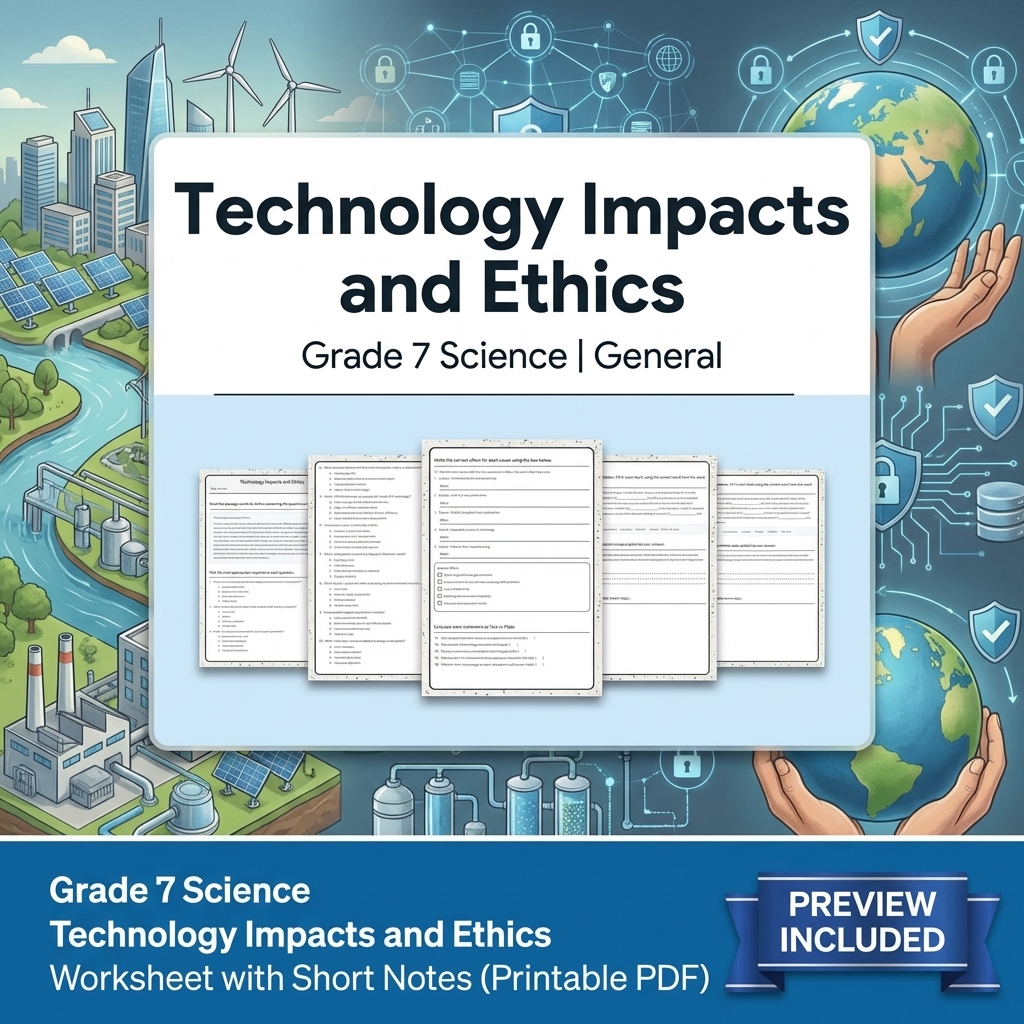
Grade 7 Science Technology Impacts and Ethics Worksheet with Short Notes
Created byMeadowlark WorksheetsLearning Objectives
- Understand how technology affects society and the environment through benefits and costs.
- Identify ethical considerations such as fairness, privacy, and responsibility in technological development.
- Analyze trade-offs involved in engineering choices and their consequences for people and ecosystems.
Also included in: Grade 7 Technology Impacts and Ethics Science Lesson Bundle: General Framework +1 more
Instant download

Ecosystem Components Practice Worksheet | Grade 7 Science Review
Created byPrism Point LearningLearning Objectives
- Identify biotic and abiotic components of ecosystems and explain how they interact.
- Describe how energy enters an ecosystem through primary producers and moves through feeding relationships.
- Explain why both living organisms and nonliving factors are needed for ecosystem structure and function.
Also included in: Ecosystems & Interactions Lesson Bundle – Grade 7 Science BC Framework +1 more
Instant download

Model Limits Worksheet Grade 7 Science Activities | NGSSS Resource
Created byPrism Point LearningLearning Objectives
- Explain how models use assumptions and simplifications that can limit what they predict accurately
- Identify how discrepancies between observations and predictions can guide revisions to a model
- Distinguish reliable model predictions from approximate representations of complex systems
Instant download

Grade 7 Maths | Percent Problems Worksheet (PDF) Math Ontario
Created byClear Sky ClassroomLearning Objectives
- Apply percentage calculations to real-world problems involving discounts, taxes, and interest.
- Interpret the meaning of percent ratios and analyze how changing bases or rates affects outcomes.
- Develop problem-solving strategies for verifying the reasonableness of percentage calculations.
Also included in: Grade 7 Number Math Lesson Bundle | Ontario Standards +1 more
Instant download
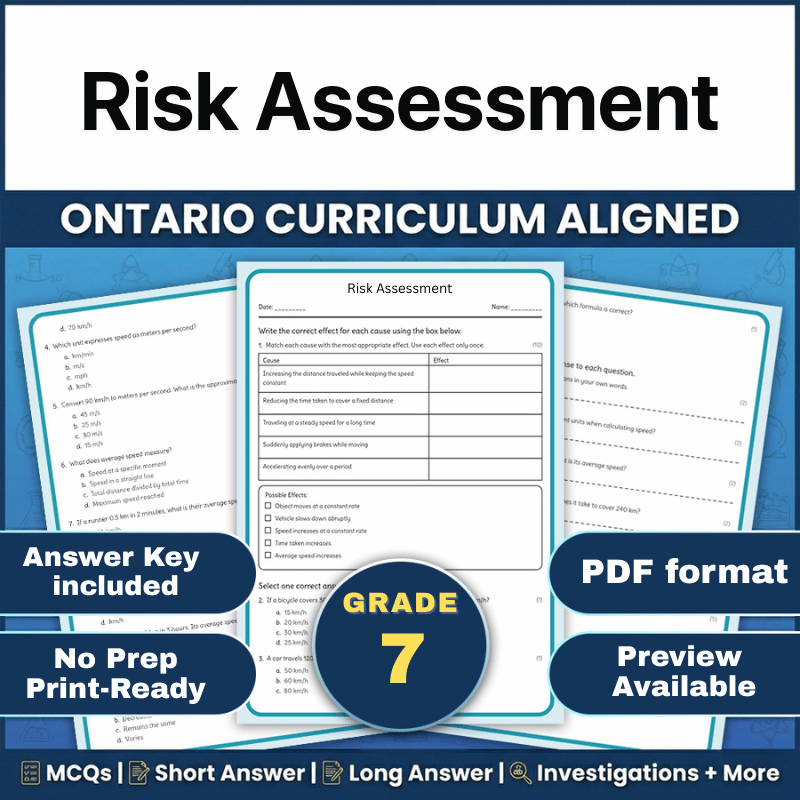
Grade 7 Science – Risk Assessment Worksheet (Ontario) (PDF)
Created byBright Mind ResourcesLearning Objectives
- Understand hazard identification, risk analysis, and mitigation strategies in laboratory and field contexts.
- Interpret safety data sheets and classify chemical and biological hazards.
- Recognize electrical and mechanical risks and appropriate control measures.
Instant download

Scientific Inquiry Basics Worksheet | Ontario Grade 7 Science Assessment
 Created byCedar Grove Learning
Learning Objectives
- Identify the parts of scientific inquiry, including testable questions and hypotheses involving variables.
- Use operational definitions, proper units, and measurement precision to improve reproducibility.
- Apply basic laboratory safety and ethical data-reporting practices during experiments.
Also included in: Grade 7 Scientific Inquiry and Data Analysis Science Lesson Bundle - Ontario +1 more
Instant download

Reaction Evidence Worksheet for Grade 7 Science | NGSS-Aligned Practice
JCreated byJ.S SheetsLearning Objectives
- Identify observable signs indicating a chemical reaction has occurred.
- Describe examples of chemical reactions involving gas production, precipitate formation, color change, temperature change, and irreversibility.
- Explain how mass measurements in sealed systems demonstrate conservation of mass during reactions.
Also included in: Grade 7 Structure and Properties of Matter Science Lesson Bundle: NGSS +1 more
Instant download

Grade 7 Science Particle Motion Worksheet – Alberta Standards (PDF)
Created bySilver Birch TeachingLearning Objectives
- Explain how temperature relates to the average random kinetic energy of particles.
- Describe how thermal energy depends on both particle motion and the number of particles.
- Use the idea of a molecular speed distribution to interpret temperature differences and heat transfer.
Also included in: Grade 7 Thermal Systems Models and Heat Transfer Science Lesson Bundle – Alberta +1 more
Instant download

Grade 7 Conservation of Matter Worksheet | Mass Conservation & Reactions
Created byPrism Point LearningLearning Objectives
- Explain conservation of matter in a closed system using the idea that atoms are rearranged, not created or destroyed.
- Use evidence from comparing the mass of reactants and products to support the law of conservation of mass.
- Distinguish between physical changes (mixing/dissolving) and chemical changes (new substances) while tracking total matter.
Instant download

Grade 7 Science Worksheet – Prototyping Methods (Ontario) Practice (PDF)
Created byEvergreen Desk EducationLearning Objectives
- Compare scaled physical models, digital finite-element models (FEM), and laboratory load rigs for evaluating strength, stiffness, and failure modes.
- Explain how instrumentation such as strain gauges and displacement transducers are used to quantify structural response.
- Identify limitations of scaling and describe how prototype test results can guide design revisions and risk assessment.
Also included in: Grade 7 Engineering Design & Materials Science Lesson Bundle Ontario +1 more
Instant download

Biodiversity Stability Worksheet | Grade 7 Science Activities
Created byPrism Point LearningLearning Objectives
- Explain how biodiversity helps ecosystems remain stable after disturbances.
- Describe how overlapping ecological roles can buffer the loss of a species.
- Identify examples of disturbances that reduce biodiversity and increase ecosystem vulnerability.
Also included in: Grade 7 Evolution, Genetics & Ecosystems Lesson Bundle | Florida NGSSS
Instant download
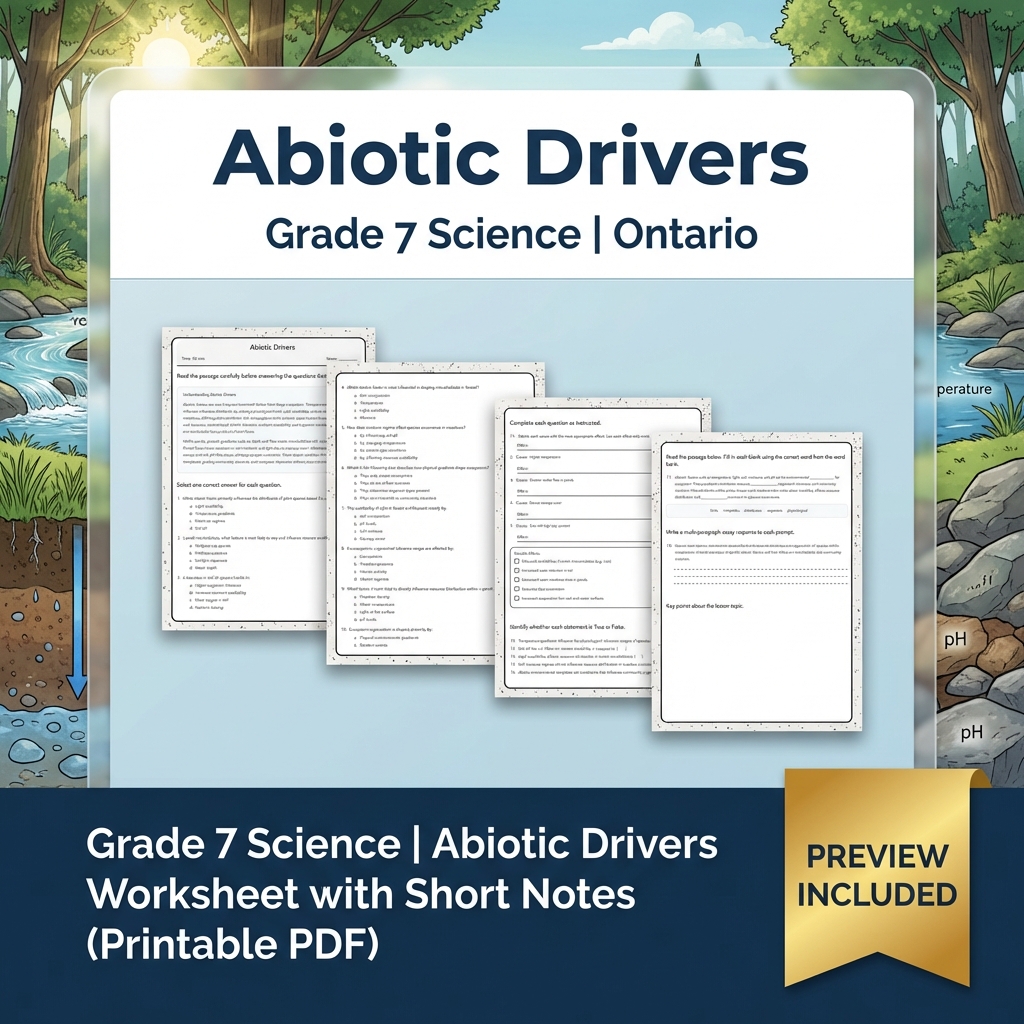
Grade 7 Science | Abiotic Drivers Worksheet with Short Notes (Printable PDF)
Created byMeadowlark WorksheetsLearning Objectives
- Describe abiotic drivers such as temperature, light, soil, moisture, and pH and their roles in ecosystems.
- Explain how abiotic factors influence resource distribution and organismal tolerance.
- Identify microhabitats and their abiotic characteristics in pond, forest, and meadow environments.
Also included in: Grade 7 Science Lesson Bundle with Ontario Framework | Ecosystems & Biodiversity +1 more
Instant download

Cited Scientific Reasoning Assessment | General Grade 7 Science Standards-Aligned
Created byPrism Point LearningLearning Objectives
- Understand how scientific reasoning uses specific data references to support claims.
- Identify evidence such as graph changes, value comparisons, and observations that support scientific claims.
- Explain how evidence supports claims by using appropriate relationships, units, and explanations.
Also included in: Grade 7 Scientific Inquiry Practices Science Lesson Bundle: General
Instant download

Bastille Day Reading Comprehension | The French Revolution | Grades 6–8
Learning Objectives
- Identify key causes of the French Revolution, including social inequality and political problems.
- Explain the significance of the storming of the Bastille in the early stages of the revolution.
- Describe important figures and summarize major consequences for France.
Also included in: Bastille Day Reading Comprehension Bundle | Grades 6–8 Holiday ELA Worksheets +2 more
Instant download

Grade 7 Science – Quantitative Heat Concepts Worksheet | Ontario Standards
Created byBright Mind ResourcesLearning Objectives
- Understand the difference between heat and temperature.
- Learn about specific heat capacity and heat transfer.
- Practice basic heat calculations using Q=mcΔT.
Also included in: Heat Transfer Grade 7 Science Daily Reading Worksheets Lesson Bundle | Ontario +1 more
Instant download

Grade 7 Science - Solar Patterns Daily Reading Worksheet(PDF + Answer Key)
 Created byCopper Leaf Classroom
Learning Objectives
- Understand how Earth's rotation causes day and night.
- Identify the relationship between the Sun's position and Earth's daily cycle.
- Recognize the effect of axial tilt and orbit on solar patterns.
Instant download

Grade 7 Science | Quantitative Models in Evolutionary Biology - Comprehension
Created byCoral Reef LearningLearning Objectives
- Understand how allele frequencies are calculated from population data.
- Learn the importance of quantitative models in explaining evolutionary processes.
- Analyze trait distributions and their changes over generations.
Instant download

Grade 7 Data Organization Science Worksheet | Tables & Data Analysis
 Created byChalk and Compass
Learning Objectives
- Organize scientific observations using clear tables with consistent headings and correct units for numerical data.
- Use appropriate metadata and timestamp conventions to preserve provenance and support later validation.
- Distinguish between categorical and numerical data and record replication information in an observational log.
Also included in: Grade 7 Science Scientific Inquiry & Data Analysis Lesson Bundle | Ontario +1 more
Instant download

Quantitative Models Worksheet for Grade 7 Science | NGSS Standards
JCreated byJ.S SheetsLearning Objectives
- Understand how mathematical representations support explanations of evolutionary processes.
- Interpret statistical analyses related to trait frequencies, selection coefficients, and population dynamics.
- Apply Hardy-Weinberg principles and rate calculations to real-world genetic data.
Also included in: Grade 7 Evolution Evidence and Speciation Processes Science Lesson Bundle – NGSS +1 more
Instant download

Gas Behavior Assessment for Grade 7 Science | TEKS Standards-Aligned
Created byPrism Point LearningLearning Objectives
- Describe how pressure, volume, and temperature interdependently affect gases.
- Explain phenomena such as diffusion and compressibility in gases.
- Relate macroscopic observations to the qualitative relationships among gas variables.
Also included in: Grade 7 Matter and Energy Science Lesson Bundle: TEKS assessments
Instant download
Browse more categories
About Grade 7 Worksheets
Find Grade 7 worksheets covering math, ELA, science, and social studies. All 8,459 resources download instantly as PDFs for classwork, homework, or review.
MyTeachingSheets worksheets are made by real teacher-authors and checked before they go live. Download any as a print-ready PDF for lessons, homework, or independent practice — most include answer keys, and previews are always free.