
Grade 7 Worksheets
8,459 grade resources
Grade 7 Health Setting Goals Worksheet (Ontario) | PDF
 Created bySunny Desk Resources
Learning Objectives
- Identify characteristics of realistic, positive goals that support mental health.
- Explain how planning steps and coping strategies can support responsible decision-making.
- Evaluate possible options and consequences when making choices that affect emotional stability.
Also included in: Grade 7 Mental Health Skills Wellness in Health Lesson Bundle – Ontario +1 more
Instant download

Phase Energy Worksheet | Grade 7 Science Activities
 Created byPrism Point Learning
Learning Objectives
- Explain how phase changes relate to particle kinetic energy and potential energy
- Describe how energy is absorbed or released during melting, freezing, evaporation, and condensation
- Interpret latent heat as an energy change that occurs without changing chemical identity
Instant download

Grade 7 Kinetic Energy Worksheet | NGSS Science Activity & Doodle Notes
 Created byAmber Owl Education
Learning Objectives
- Construct and interpret graphs that relate kinetic energy to speed and mass
- Use quantitative patterns (including doubling) to predict changes in kinetic energy
- Connect stored potential energy to future motion and compare energy types
Also included in: Energy Transfer Worksheets Lesson Bundle – Grade 7 Science NGSS +1 more
Instant download

Diffusion And Mixing Assessment Graade 7 Science | California Standards
Created byPrism Point LearningLearning Objectives
- Explain diffusion using the particle model and concentration gradients.
- Describe how mixing occurs without requiring particles to stop moving or change into new substances.
- Predict how temperature affects the rate of diffusion and mixing.
Also included in: Grade 7 Forces and Matter Science Lesson Bundle: California Standards +1 more
Instant download

Grade 7 Holiday International Women Day Worksheet PDF + Answer Key
 Created byShaNova Worksheets
Learning Objectives
- Learn about influential women in history and their achievements.
- Understand the challenges faced by pioneering women.
- Recognize the importance of perseverance, courage, and determination.
Instant download

Particle Model Worksheet Grade 7 Science | Matter and Particle Theory
Created byPrism Point LearningLearning Objectives
- Explain how matter can be described using particles too small to see
- Describe how particle motion relates to temperature
- Use the particle model to predict changes in macroscopic properties like pressure and diffusion
Instant download

Grade 7 Science | Ecological Inquiry - Daily Reading Comprehension
 Created byCoral Reef Learning
Learning Objectives
- Understand the concept of ecological inquiry and its importance.
- Learn how to formulate scientific questions about ecosystems.
- Identify measurable variables in ecological studies.
Also included in: Interactions and Ecosystems Lesson Bundle Grade 7 Science – Alberta +1 more
Instant download

Grade 7 Understanding Earth's Atmospheric Circulation | NGSS Worksheet
 Created byBRIGHT PATH RESOURCES
Learning Objectives
- Understand key concepts related to Science
- Apply knowledge through practice questions
- Demonstrate comprehension of the material
Also included in: Earth Systems Grade 7 Science Daily Reading Worksheets Lesson Bundle | NGSS +2 more
Instant download

Habitat Fragmentation Test Prep Printable | Grade 7 Science
Created byPrism Point LearningLearning Objectives
- Explain how habitat fragmentation creates isolated habitat patches and increases edge effects
- Describe how fragmentation affects species interactions, dispersal, gene flow, and population sizes
- Evaluate how habitat connectivity (like corridors) can reduce extinction risk and support ecosystem processes
Also included in: Ecosystems & Interactions Lesson Bundle – Grade 7 Science BC Framework +1 more
Instant download

Grade 7 Science – Rock Cycle & Igneous Rocks | Daily Reading Worksheet
 Created byBright Mind Resources
Learning Objectives
- Understand the formation process of igneous rocks from cooled magma or lava.
- Identify the environments where igneous rocks can form.
- Describe the stages involved in the formation of igneous rocks through cooling and solidification.
Also included in: Grade 7 Earth Science Daily Reading Worksheets Lesson Bundle | Florida NGSSS +1 more
Instant download

Grade 7 Health – Body Systems Worksheet (NHES) & Comprehension Practice (PDF)
Created bySunny Desk ResourcesLearning Objectives
- Explain how the circulatory, respiratory, and immune systems work to maintain health
- Identify how lifestyle habits (hygiene, nutrition, and exercise) support body system functioning
- Describe common ways diseases can affect body systems and increase health risks
Also included in: Grade 7 Functional Health Concepts in Health Lesson Bundle (NHES) +1 more
Instant download

Grade 7 Science – Restoration Strategies & Ecology | Daily Reading Worksheet
Created byBright Mind ResourcesLearning Objectives
- Understand basic principles of ecological restoration
- Identify reference conditions and recovery goals
- Differentiate between active and passive restoration approaches
Also included in: Grade 7 Ecosystem Stewardship Science Daily Reading lesson bundle | Ontario +1 more
Instant download

Grade 7 Science | Motion Quantities Worksheet (PDF) Alberta Standards
 Created bySilver Birch Teaching
Learning Objectives
- Describe motion using distance and time, and identify appropriate units for each quantity
- Calculate average speed using the relationship speed = distance ÷ time
- Recognize common sources of measurement error and explain how they affect calculated speed
Also included in: Grade 7 Simple Machines and Forces Science Lesson Bundle: Alberta +1 more
Instant download
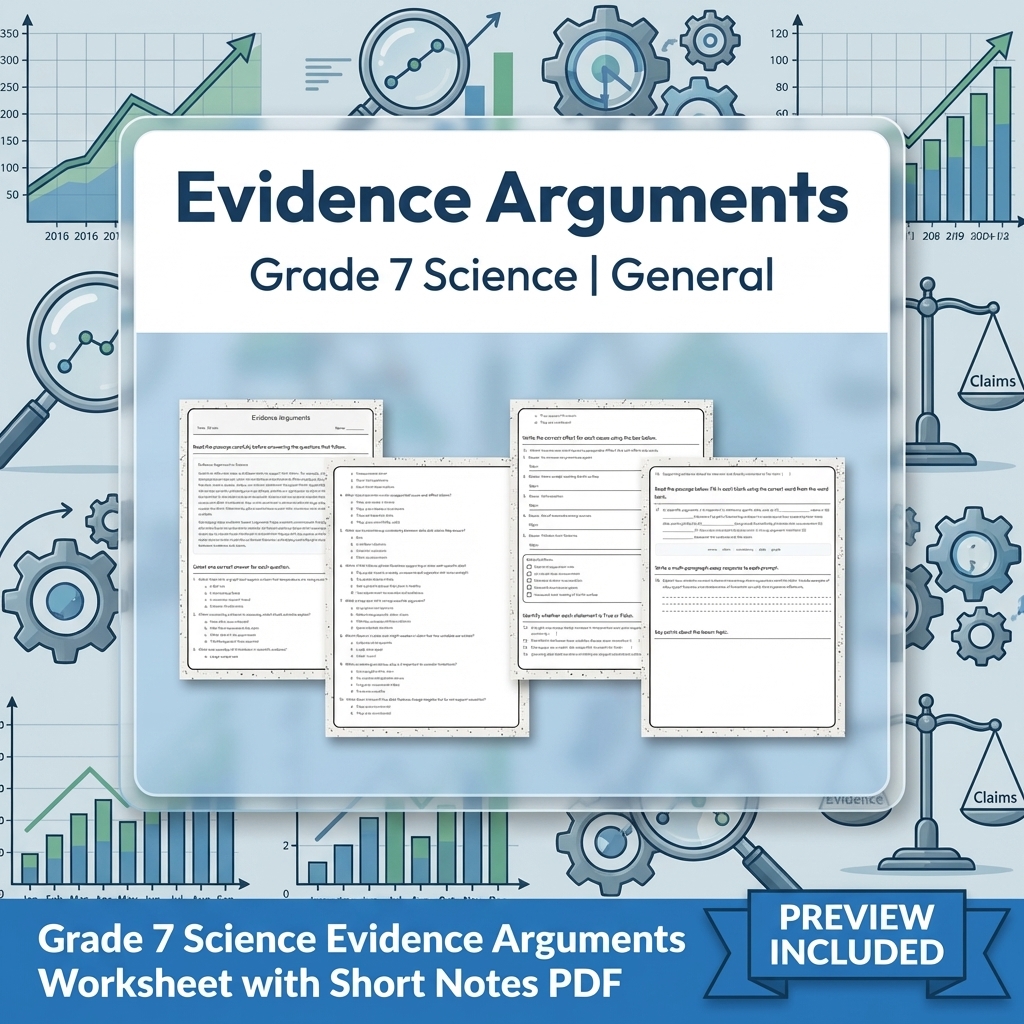
Grade 7 Science Evidence Arguments Worksheet with Short Notes PDF
 Created byMeadowlark Worksheets
Learning Objectives
- Understand how to connect evidence to reasoning using a clear chain from observations to claims.
- Identify specific data values, graph features, or direct observations that support scientific claims.
- Evaluate arguments for limitations, unsupported cause-and-effect claims, and consistency with data.
Also included in: Grade 7 Science Scientific Modeling & Evidence Lesson Bundle: General Framework +1 more
Instant download

Grade 7 Social Studies — Industrial Revolution Worksheet MCQ Paper
 Created byThe Resource Hub
Learning Objectives
- Explain how the Industrial Revolution changed production and the economy from agrarian work to industrial manufacturing.
- Identify key inventions and systems (such as the steam engine and mechanized farming) that helped increase output.
- Describe major social and environmental impacts, including urbanization, labor changes, and pollution.
Instant download

Science Evidence Arguments Worksheet Grade 7 | Standard-Aligned
JCreated byJ.S SheetsLearning Objectives
- Explain how evidence, claims, and reasoning connect in a scientific argument.
- Use specific data values or graph features to support a claim.
- Identify limitations and avoid unsupported cause-and-effect in explanations.
Also included in: Grade 7 Evidence-Based Scientific Modeling Science Lesson Bundle: General +1 more
Instant download

Abiotic Influences Assessment Grade 7 Science | TEKS Standards
Created byPrism Point LearningLearning Objectives
- Understand how nonliving factors like temperature, light, water, soil, and salinity affect ecosystems.
- Explain how abiotic gradients and microclimates influence species distribution and community structure.
- Identify examples of abiotic factors from terrestrial and aquatic environments that impact biodiversity.
Instant download

Particle Model Worksheet | Grade 7 Science Activities
Created byPrism Point LearningLearning Objectives
- Explain how the kinetic particle model uses particle spacing, motion, and forces to describe macroscopic properties of matter.
- Use the particle model to predict how changes such as heating or applied pressure affect observable measurements.
- Connect diffusion, thermal expansion, and compressibility to micro-scale particle behavior.
Also included in: Grade 7 Matter, States, and Reactions in Science Lesson Bundle TEKS
Instant download
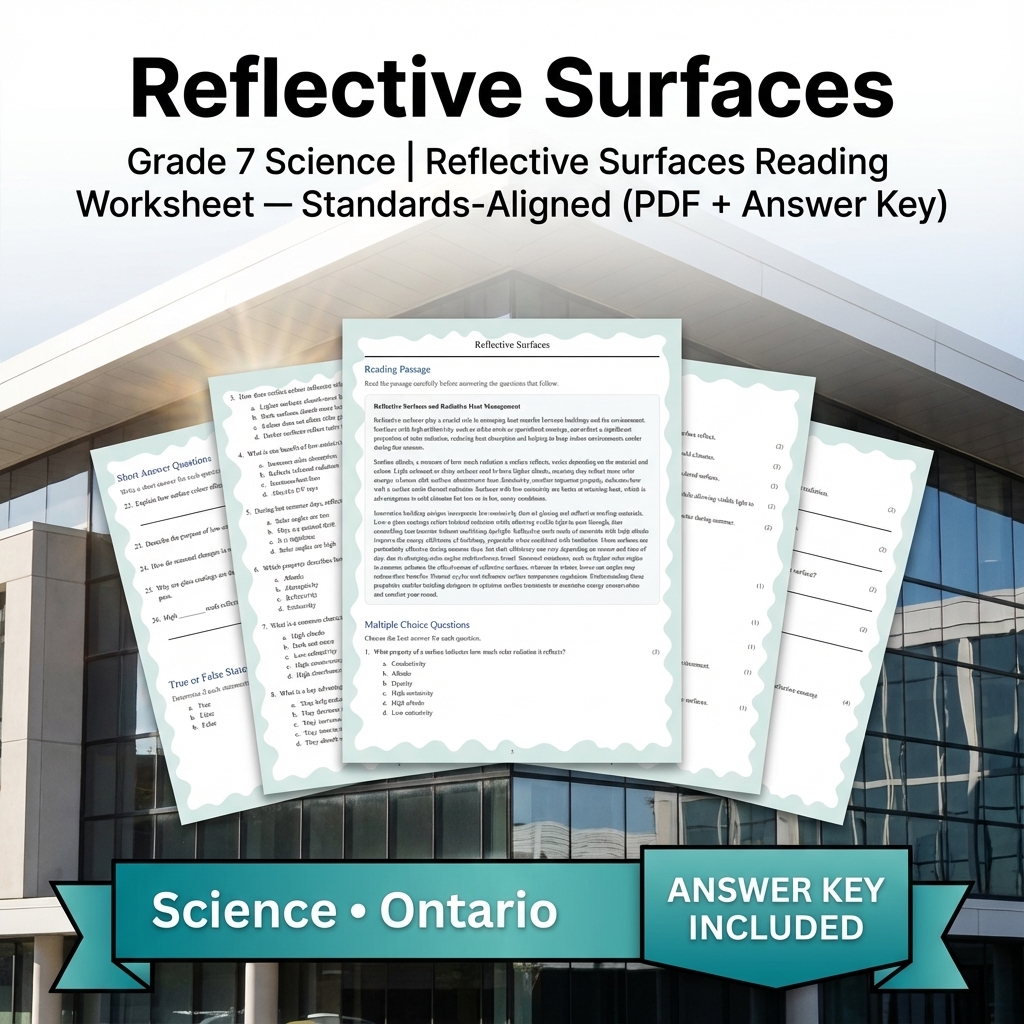
Grade 7 Science | Reflective Surfaces Standards-Aligned (PDF + Answer Key)
JCreated byJ.S SheetsLearning Objectives
- Understand the properties of reflective and emissive surfaces in heat management.
- Analyze how surface treatments like coatings and colours influence solar radiation absorption and reflection.
- Evaluate the effectiveness of low-emissivity glazing and reflective roofs in different seasonal and diurnal contexts.
Also included in: Grade 7 Science | Thermal Energy & Transfer Worksheet Bundle +1 more
Instant download
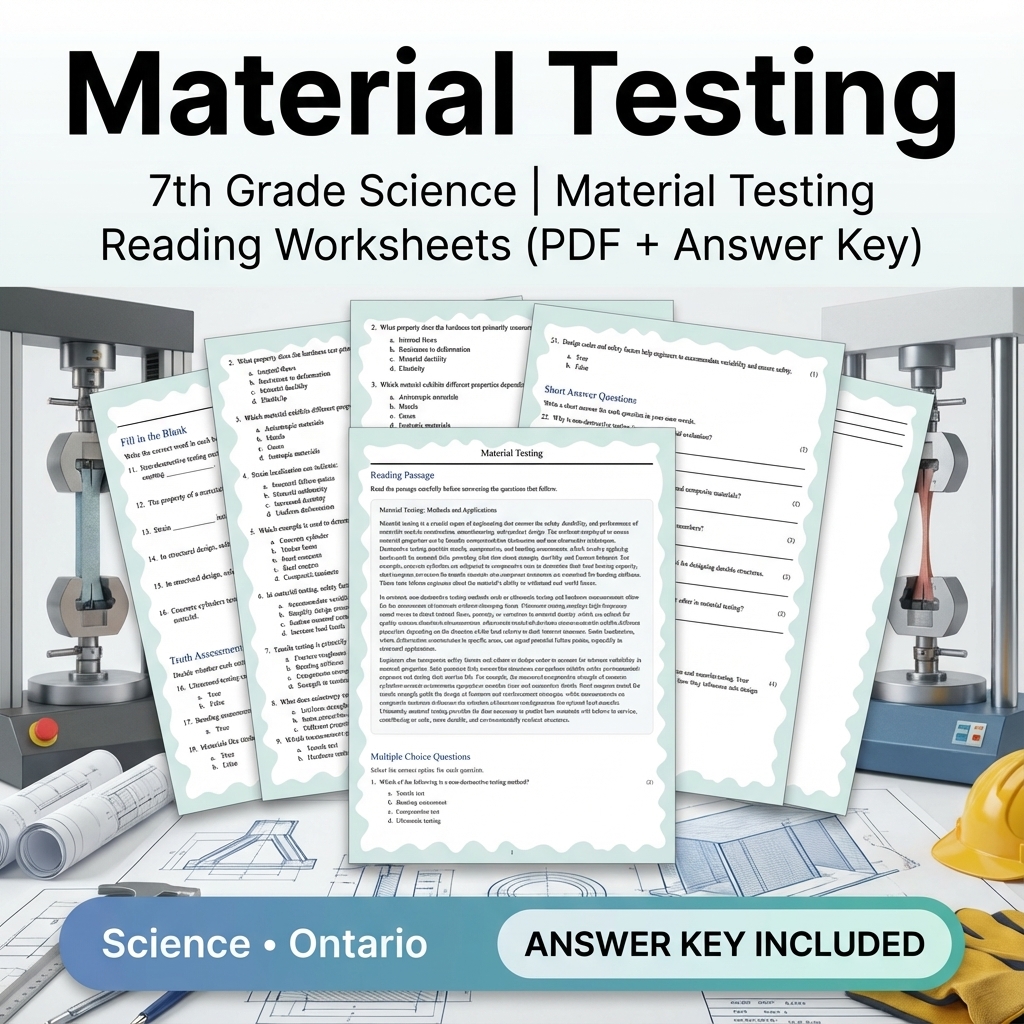
7th Grade Science | Material Testing Reading Worksheets (PDF + Answer Key)
JCreated byJ.S SheetsLearning Objectives
- Understand characteristic methods for testing material behavior, including tensile, compression, and bending assessments.
- Explore non-destructive testing techniques such as ultrasonic and hardness measurements.
- Learn about anisotropy, strain localization, and the application of safety factors and design codes in material testing.
Also included in: Grade 7 Science Unit Bundle – Structural Engineering & Material Testing +1 more
Instant download

Surface Processes Assessment for Grade 7 Science | TEKS Standards-Aligned
Created byPrism Point LearningLearning Objectives
- Describe the main physical and chemical processes that shape Earth's surface.
- Identify observable landforms associated with weathering, erosion, deposition, and mass wasting.
- Explain the driving forces such as water flow, wind, glaciers, and gravity in surface processes.
Also included in: Grade 7 Earth and Space Systems Science Lesson Bundle TEKS Worksheets
Instant download
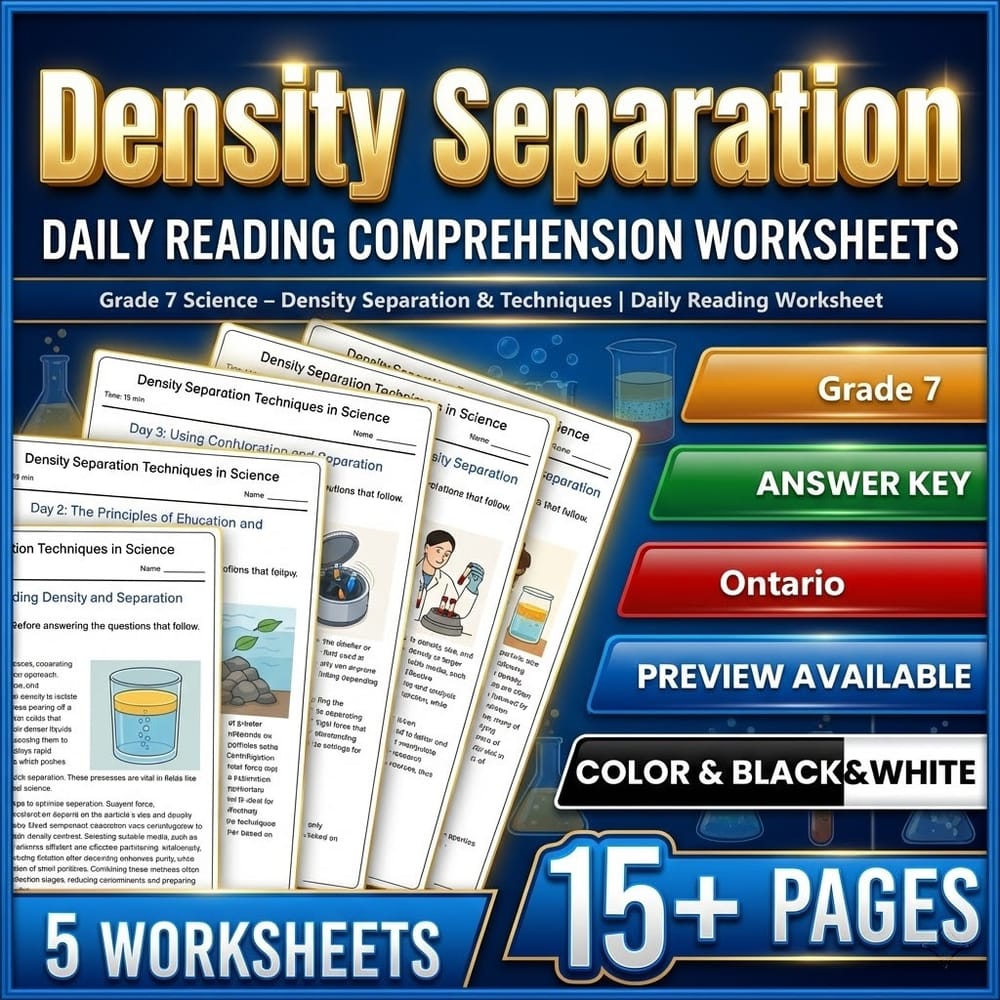
Grade 7 Science – Density Separation & Techniques | Daily Reading Worksheet
 Created byQuiet Forest Education
Learning Objectives
- Understand the concept of density and how it influences separation methods.
- Identify various separation techniques such as decanting, flotation, and centrifugation.
- Explain the principles behind each technique and their applications.
Also included in: Elements & Compounds Grade 7 Science Daily Reading Worksheets Bundle | Ontario +1 more
Instant download

Species Interactions Test Prep Worksheets | Grade 7 Science NGSS
Created byPrism Point LearningLearning Objectives
- Explain how predation, competition, parasitism, mutualism, and commensalism affect individual species and populations
- Describe direct and indirect effects in food webs using evidence-based causal reasoning
- Interpret interaction networks and trophic diagrams to predict cascading impacts across ecosystems
Also included in: Grade 7 Biodiversity & Ecosystem Stability Science Lesson Bundle | NGSS
Instant download
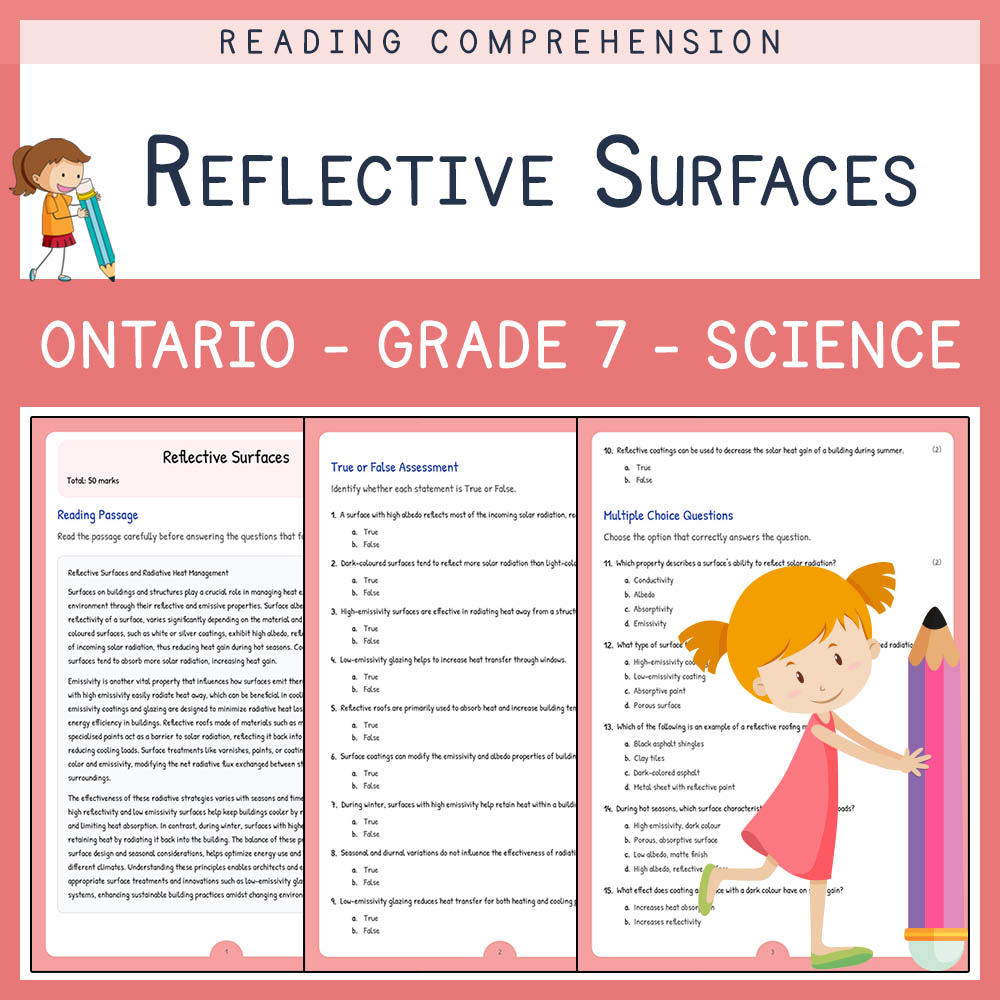
Grade 7 Science Assessment | Reflective Surfaces Worksheet Elena | Ontario
 Created byLumora Learning
Learning Objectives
- Understand how surface albedo, emissivity, and colour influence radiative heat exchange.
- Recognize the effects of coatings and surface treatments on solar gain and net radiative flux.
- Describe the purpose and function of low-emissivity glazing and reflective roofs.
Instant download
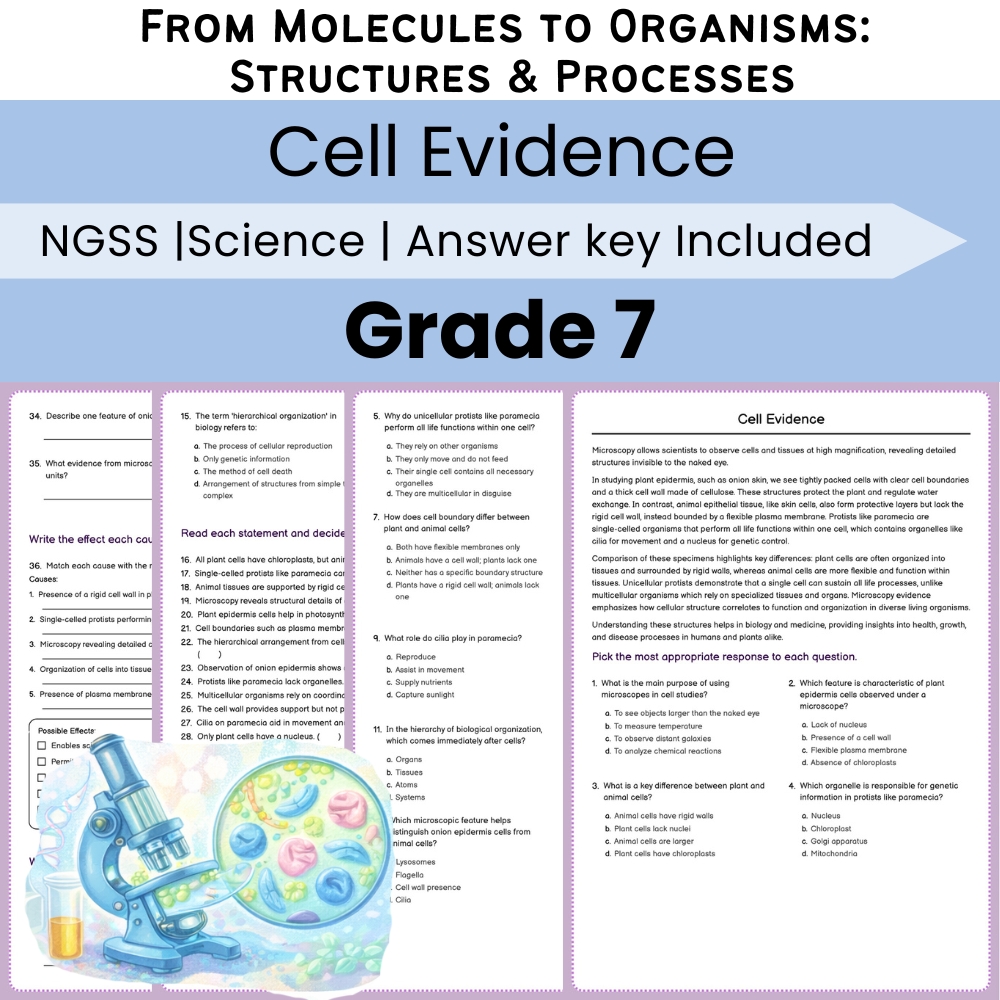
Cell Evidence Worksheet | Grade 7 Science Printables NGSS Assessment
Learning Objectives
- Understand how microscopy reveals the cellular structure of organisms.
- Differentiate between unicellular and multicellular organization.
- Identify key features such as cell boundaries, plasma membranes, and cell walls.
Also included in: Grade 7 Science Lesson Bundle | From Molecules to Organisms NGSS +1 more
Instant download
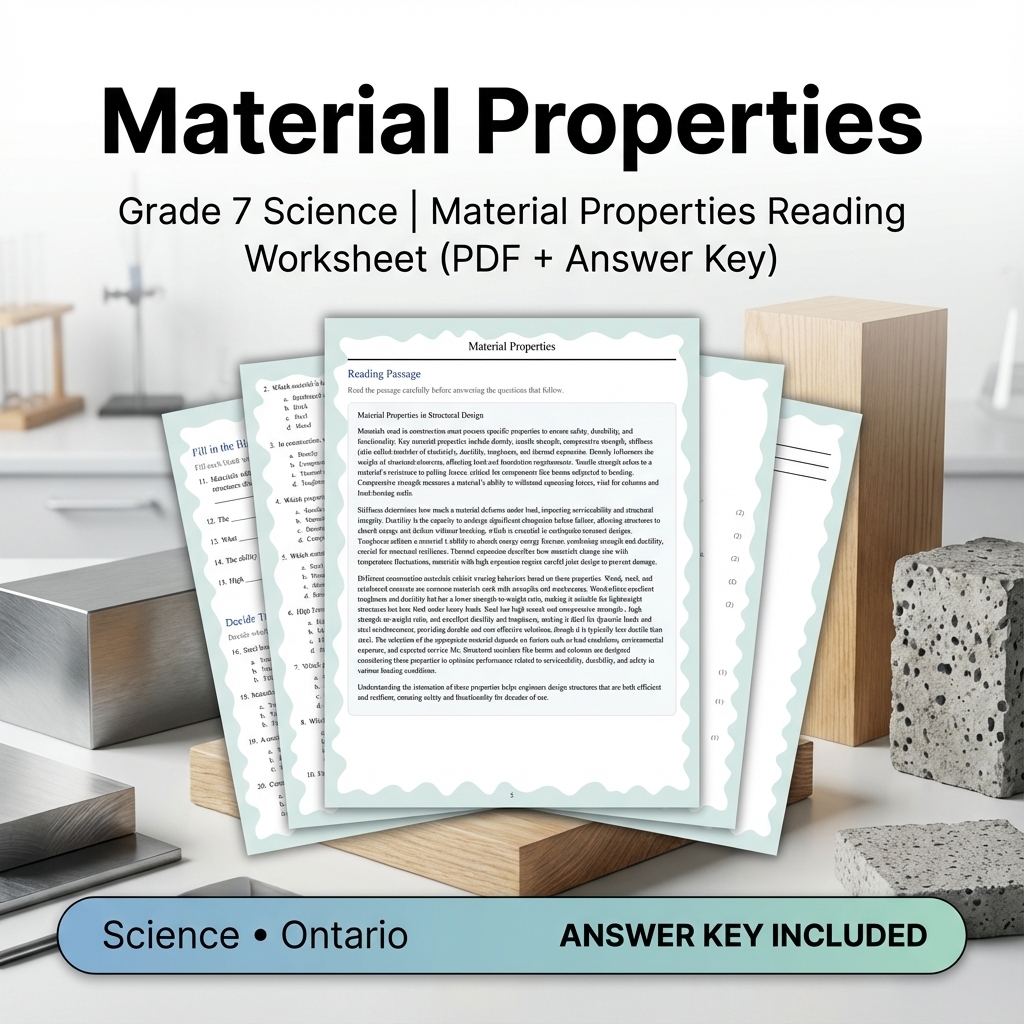
Grade 7 Science | Material Properties Reading Worksheet (PDF + Answer Key)
JCreated byJ.S SheetsLearning Objectives
- Understand key material properties such as density, strength, stiffness, ductility, toughness, and thermal expansion.
- Explain how these properties influence the structural performance of different construction materials.
- Compare common materials—wood, steel, and reinforced concrete—in terms of strength-to-weight ratio, deformation, and failure modes.
Also included in: Grade 7 Science Unit Bundle – Structural Engineering & Material Testing +1 more
Instant download
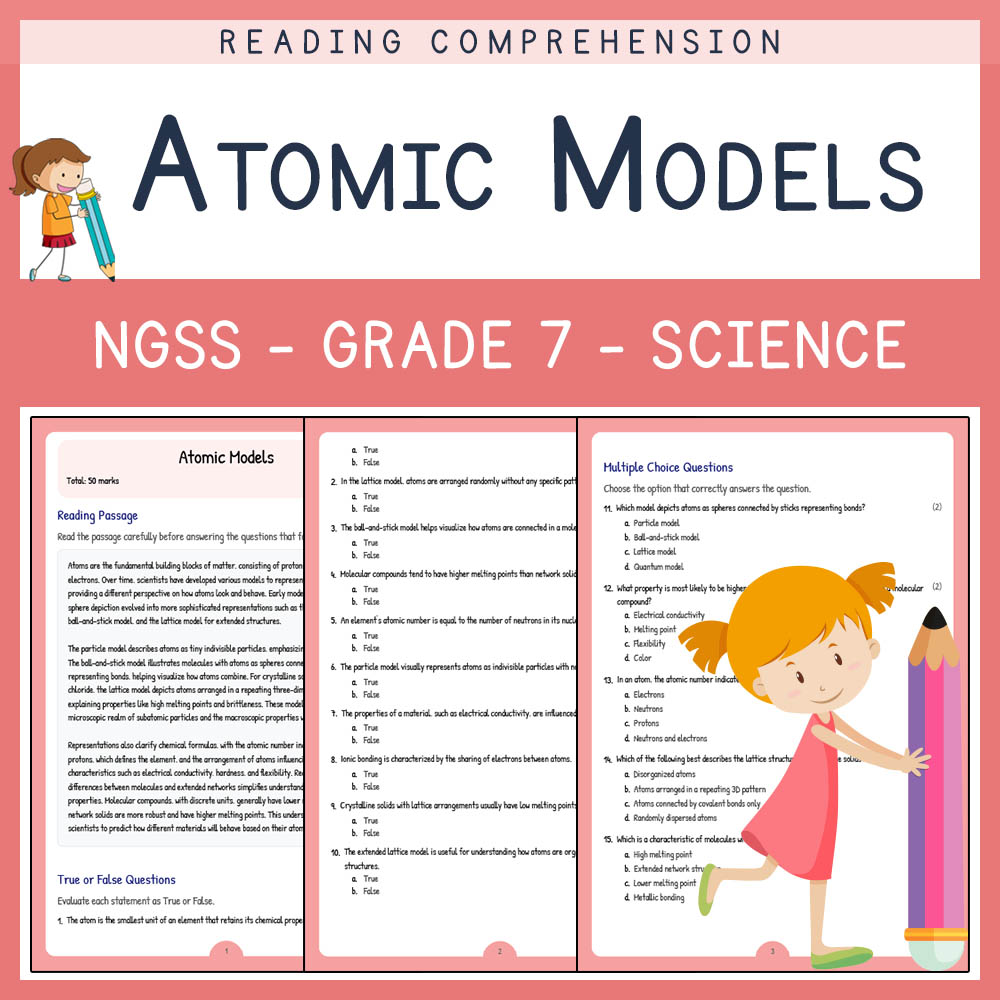
Grade 7 Science | Atomic Models Worksheet & Answer Key (NGSS-Aligned PDF)
Created byLumora LearningLearning Objectives
- Describe different representations of atomic models including particle, ball-and-stick, and lattice structures.
- Explain how atomic structure influences the properties of molecules and extended materials.
- Distinguish between molecular and extended network structures based on bonding patterns.
Instant download
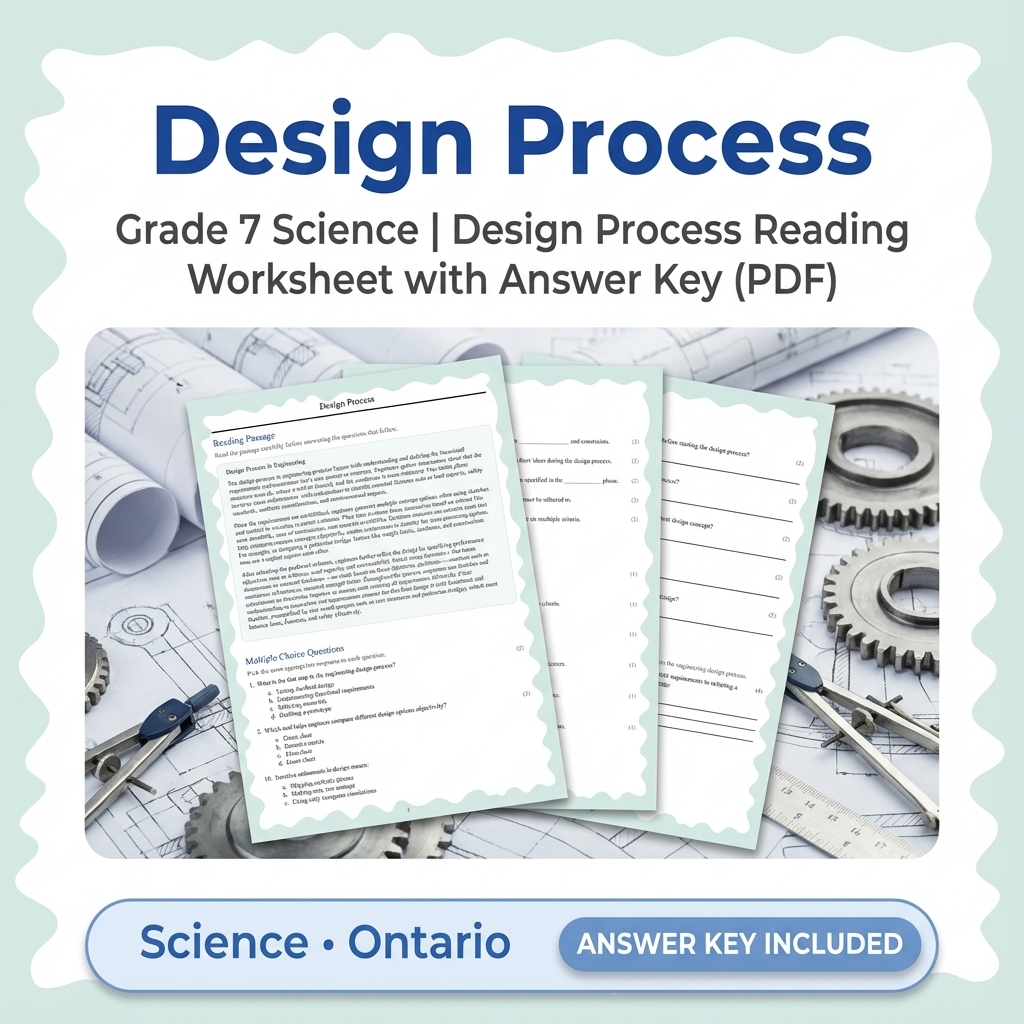
Grade 7 Science | Design Process Reading Worksheet with Answer Key (PDF)
JCreated byJ.S SheetsLearning Objectives
- Understand the steps involved in the design process from defining requirements to evaluating alternatives.
- Learn how to specify performance objectives and constraints for structural designs.
- Apply decision matrices and sketches to compare different design options.
Also included in: Grade 7 Science Unit Bundle – Structural Engineering & Material Testing +1 more
Instant download

Atomic Models Worksheet Grade 7 NGSS | Atoms Structure Activity
Created byAmber Owl EducationLearning Objectives
- Compare and explain atomic models using particle, ball-and-stick, and lattice representations.
- Relate subatomic particles and atomic number to formula notation for simple substances.
- Distinguish molecular structures from extended network (lattice) structures and predict material behavior.
Also included in: Grade 7 Science Stoichiometry, Mixtures & Material Properties Lesson Bundle | NGSS +1 more
Instant download

Grade 7 Science – Reaction Observations Gas Production | Daily Reading Worksheet
Created byBright Mind ResourcesLearning Objectives
- Identify gases produced during chemical reactions
- Describe observable signs of gas emissions
- Recognize different gases based on reaction clues
Also included in: Grade 7 Solutions Science Daily Reading Worksheets Lesson Bundle | Alberta +2 more
Instant download
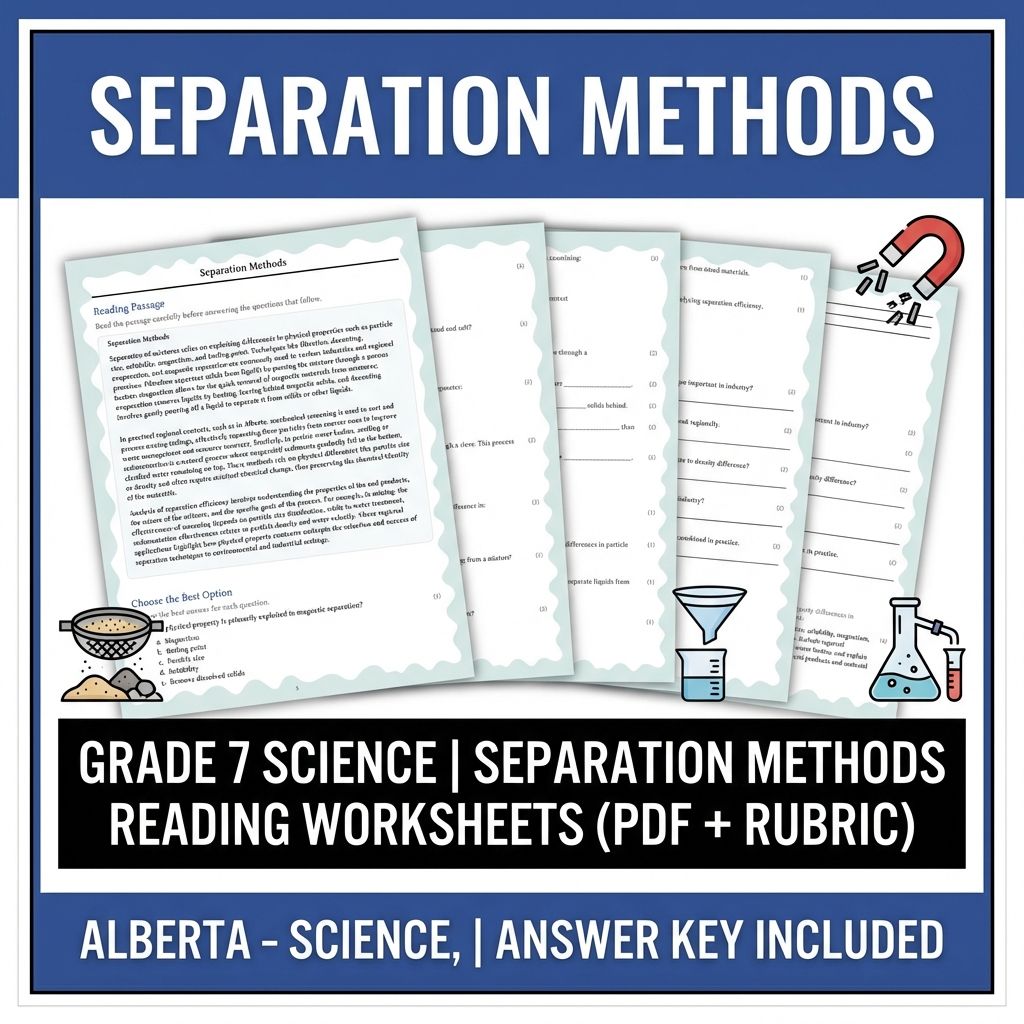
Grade 7 Science | Separation Methods Reading Worksheets (PDF + Rubric)
JCreated byJ.S SheetsLearning Objectives
- Understand the physical properties exploited by different separation techniques.
- Identify common separation methods like filtration, decanting, evaporation, and magnetic separation.
- Relate regional examples of separation processes to their underlying principles.
Also included in: Grade 7 Science UNIT Worksheet Bundle | Matter, Solutions & Physical Changes +1 more
Instant download
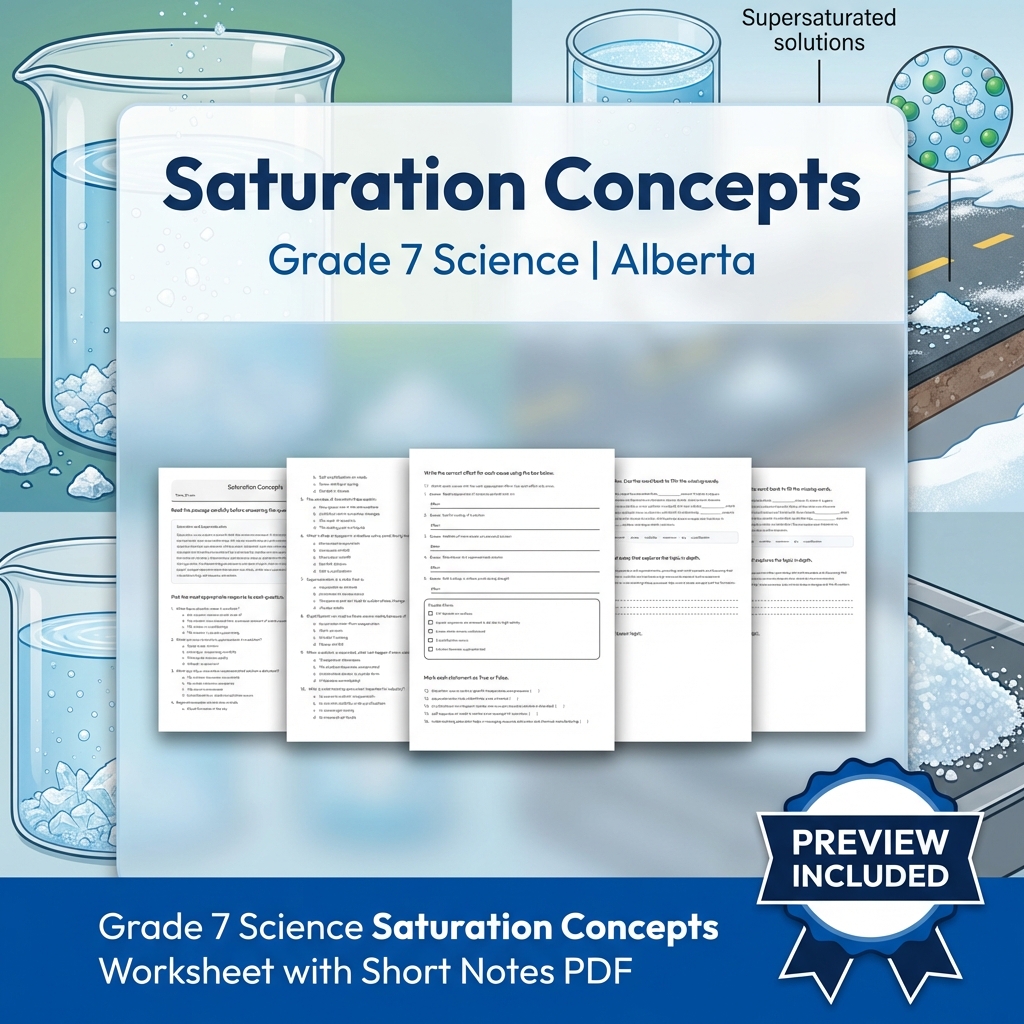
Grade 7 Science Saturation Concepts Worksheet with Short Notes PDF
Created byMeadowlark WorksheetsLearning Objectives
- Understand the definition of saturation and supersaturation in solutions.
- Identify examples of saturation and supersaturation in real-world scenarios.
- Explain the conditions leading to solubility limits and phase changes between dissolved and solid states.
Also included in: Grade 7 Science | Matter & Chemical Change UNIT Worksheet Bundle
Instant download
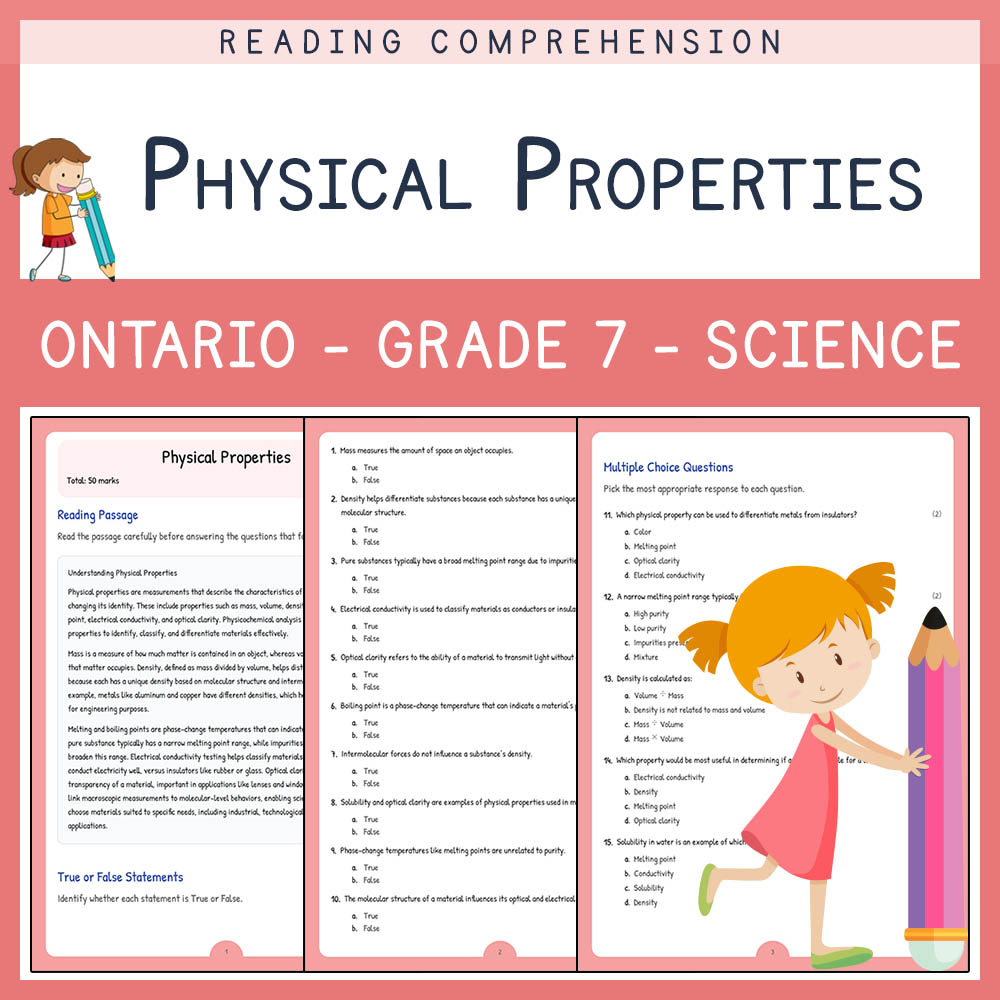
Grade 7 Science Assessment | Physical Properties Worksheet Elena | Ontario
Created byLumora LearningLearning Objectives
- Define and understand the physical properties used as diagnostic criteria.
- Link macroscopic measurements to molecular structure and intermolecular forces.
- Explain how density, phase-change temperatures, and conductivity differentiate substances.
Also included in: Grade 7 Science | Pure Substances and Mixtures Unit Bundle | Ontario
Instant download
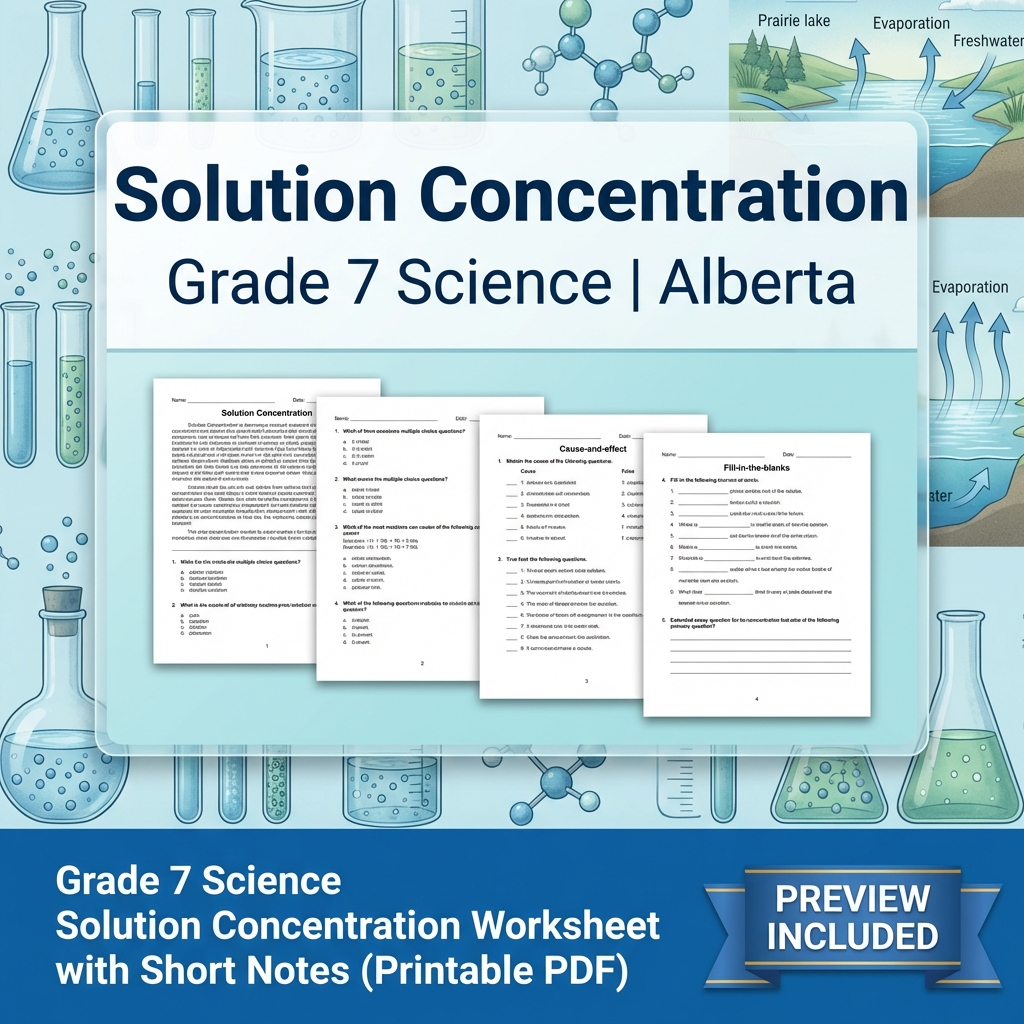
Grade 7 Science Solution Concentration Worksheet with Short Notes (PDF)
Created byMeadowlark WorksheetsLearning Objectives
- Understand how solution concentration quantifies the amount of solute relative to solvent.
- Identify common measures of concentration such as mass percent and grams per litre.
- Explain how concentration affects physical properties like boiling point and freezing point.
Also included in: Grade 7 Science | Matter & Chemical Change UNIT Worksheet Bundle
Instant download
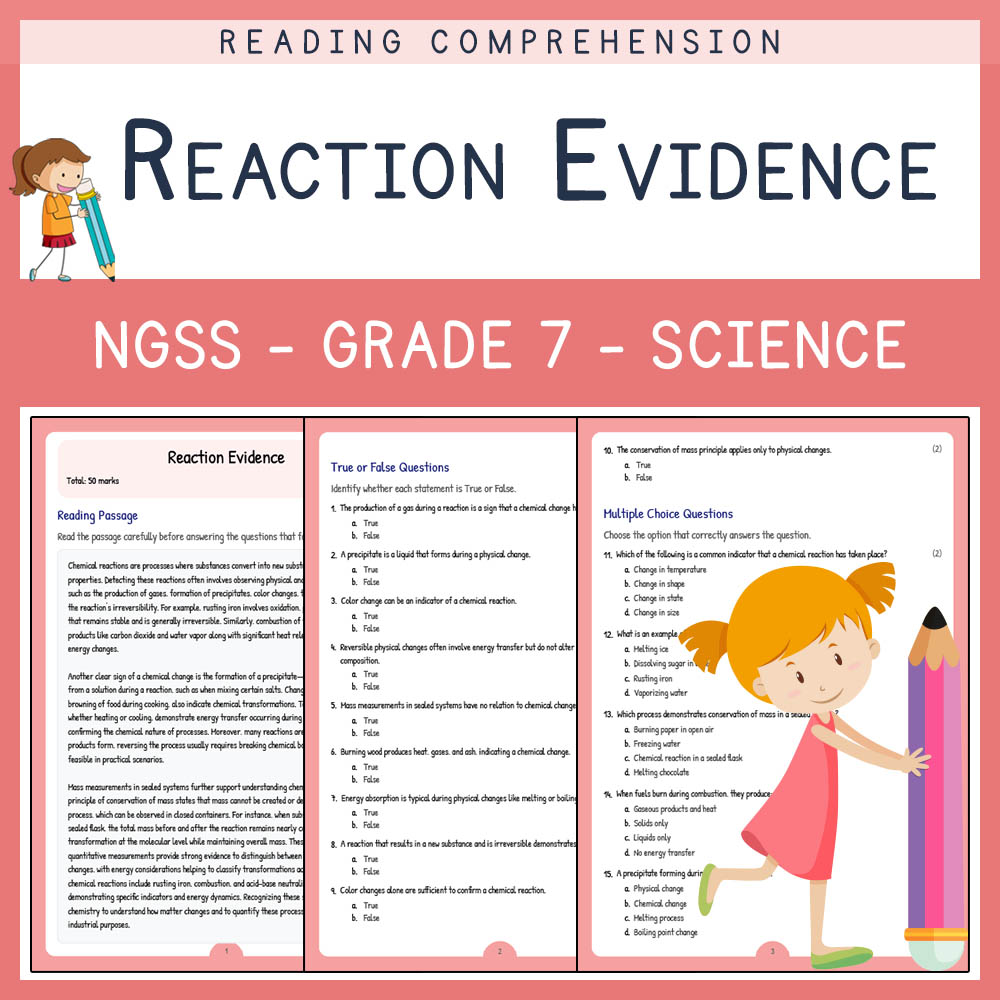
Grade 7 Science | Reaction Evidence Worksheet & Answer Key (NGSS Aligned)
Created byLumora LearningLearning Objectives
- Identify observable indicators that a chemical reaction has occurred, such as gas production, precipitate formation, color change, and temperature change.
- Explain irreversibility in chemical reactions and relate it to composition changes.
- Describe examples of chemical reactions, including rusting, combustion, and neutralization, and discuss how mass measurements in sealed systems demonstrate conservation principles.
Instant download

Grade 7 Science Worksheet | Decomposition Cycles (PDF) – Ontario Standards
 Created byEvergreen Desk Education
Learning Objectives
- Explain how detritivores, fungi, and bacteria break down organic matter and how abiotic factors affect decomposition rates.
- Describe how carbon and nitrogen move and transform during decomposition (including formation of detritus, mineralization, and nutrient uptake).
- Connect decomposition rates to soil fertility and ecosystem productivity in wetlands, forests, and grasslands.
Also included in: Grade 7 Ecosystem Dynamics Science Lesson Bundle (Ontario) Worksheets +1 more
Instant download
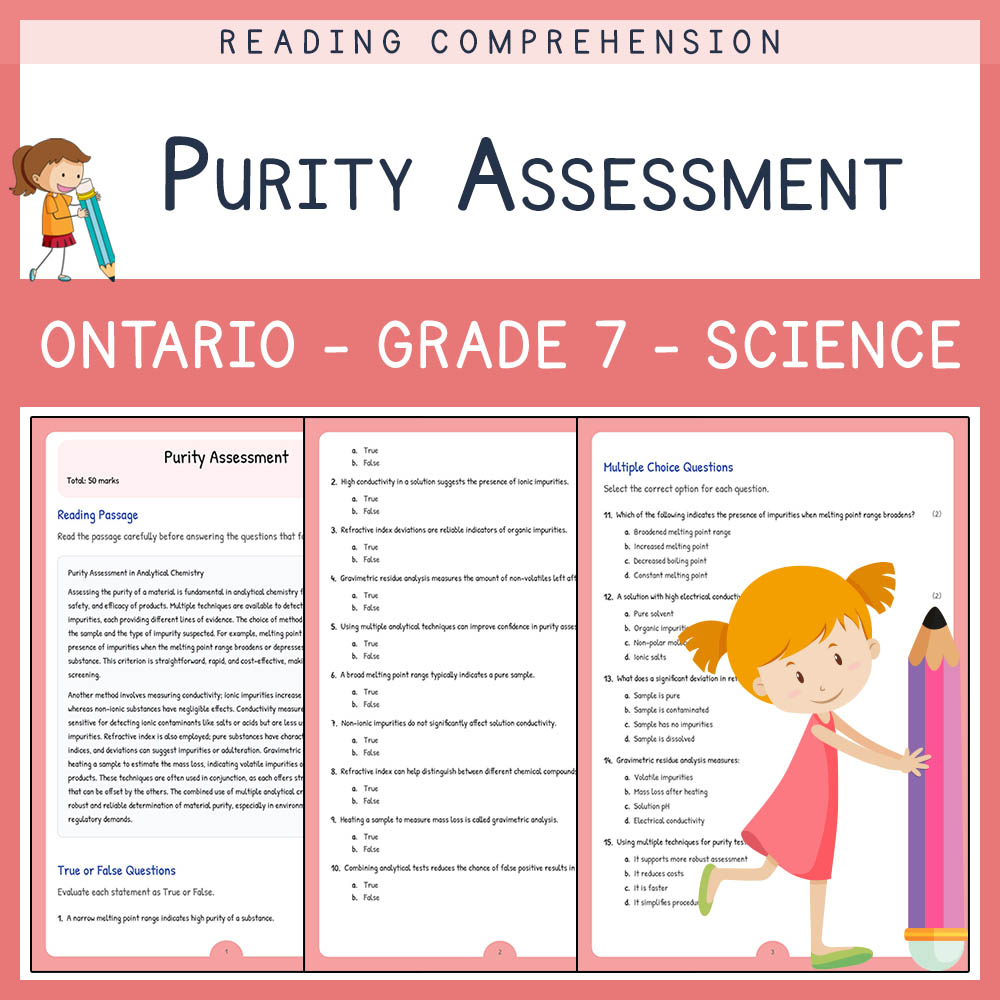
Grade 7 Science | Purity Assessment Worksheet | Ontario Standard
Created byLumora LearningLearning Objectives
- Understand the key analytical indicators used to assess the purity of substances.
- Identify various methods for detecting contamination and impurities.
- Compare and contrast techniques such as melting point ranges, conductivity differences, refractive index, and gravimetric residue.
Also included in: Grade 7 Science | Pure Substances and Mixtures Unit Bundle | Ontario
Instant download
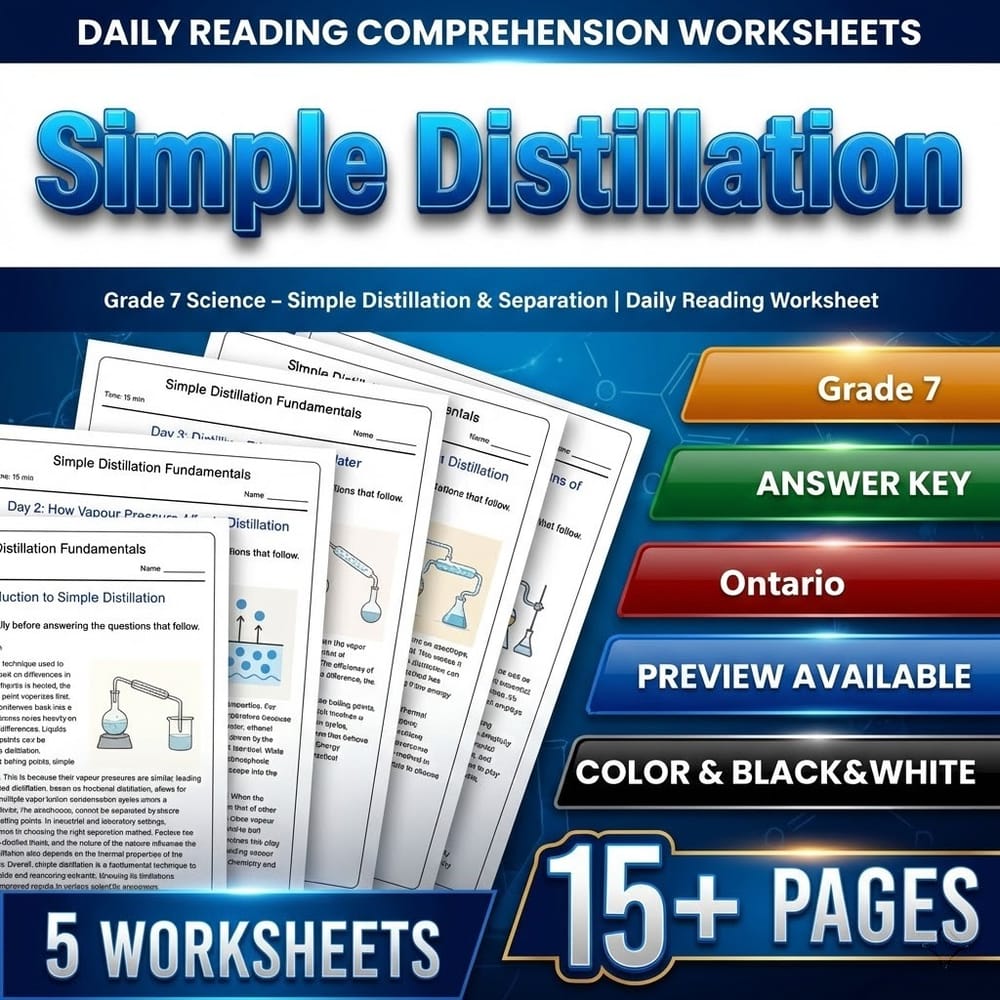
Grade 7 Science – Simple Distillation & Separation | Daily Reading Worksheet
Created byQuiet Forest EducationLearning Objectives
- Understand the basic principles of simple distillation.
- Learn how boiling points relate to vapor pressure and separation.
- Identify the limitations of simple distillation with close-boiling liquids.
Also included in: Elements & Compounds Grade 7 Science Daily Reading Worksheets Bundle | Ontario +1 more
Instant download
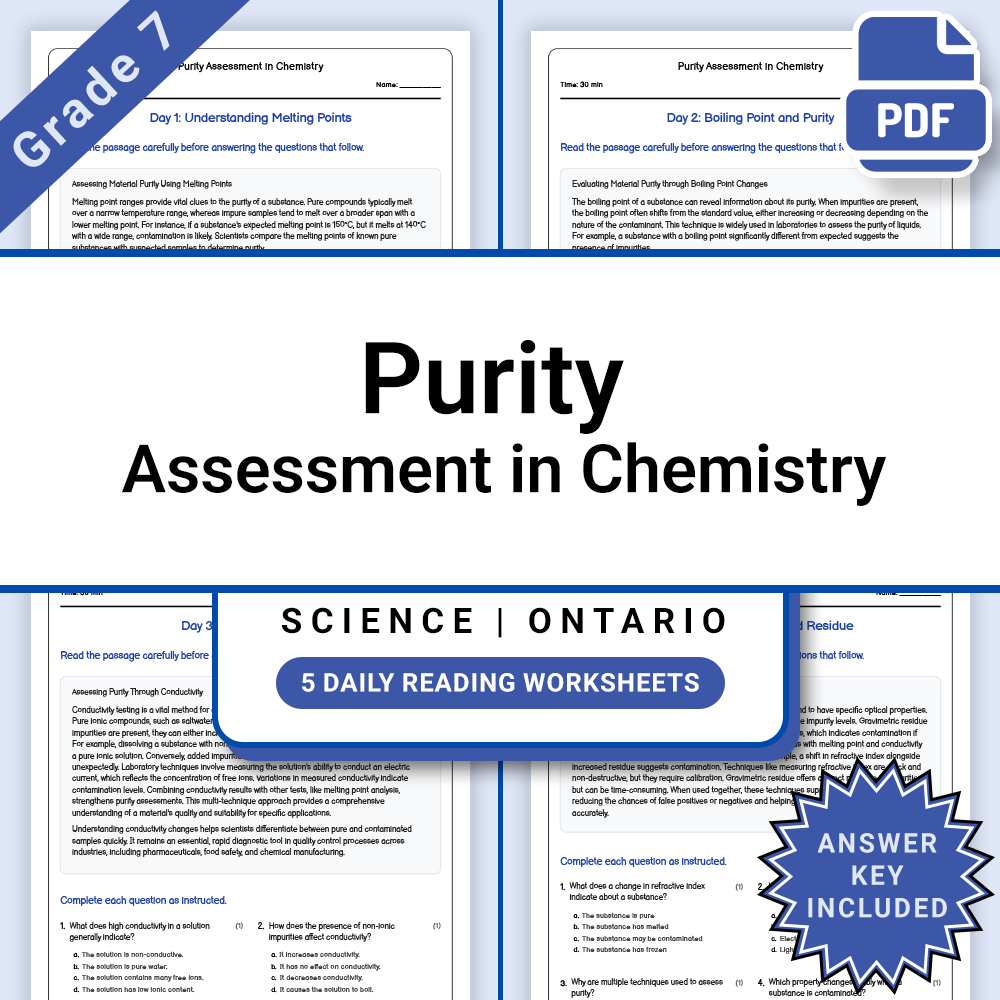
Grade 7 Science – Purity Assessment Daily Reading Worksheet + Answer Key
JCreated byJ.S SheetsLearning Objectives
- Understand how melting point ranges can indicate material purity
- Identify the effects of impurities on boiling points and conductivity
- Learn different techniques to assess contamination in samples
Also included in: Grade 7 Science Lesson Group | Ontario Framework Worksheets Bundle +1 more
Instant download
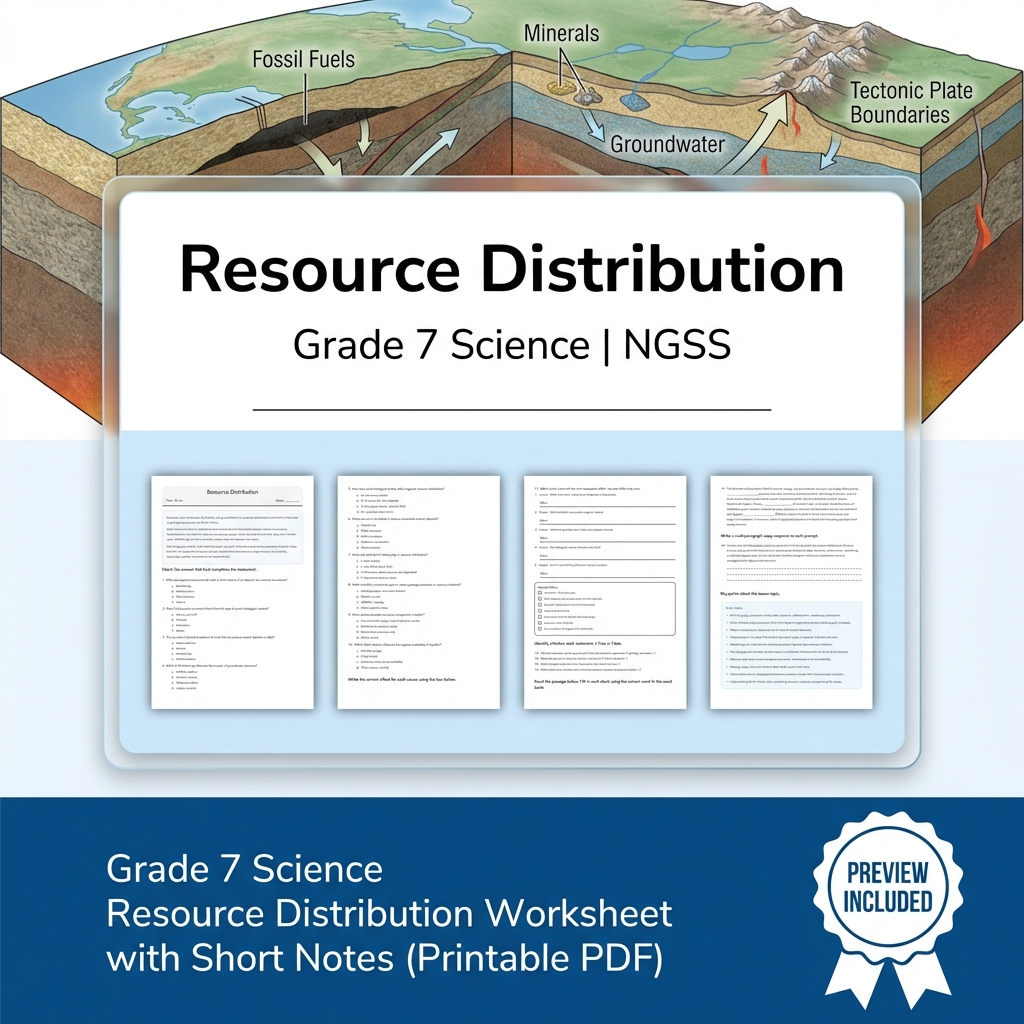
Grade 7 Science Resource Distribution Worksheet with Short Notes (Printable PDF)
Created byMeadowlark WorksheetsLearning Objectives
- Understand geological processes that affect resource placement.
- Explore how Earth history influences mineral, energy, and groundwater resources.
- Connect plate tectonics, sedimentation, and weathering to resource locations.
Also included in: Grade 7 Science | Earth and Human Activity NGSS Unit Bundle (Worksheet Pack) +1 more
Instant download
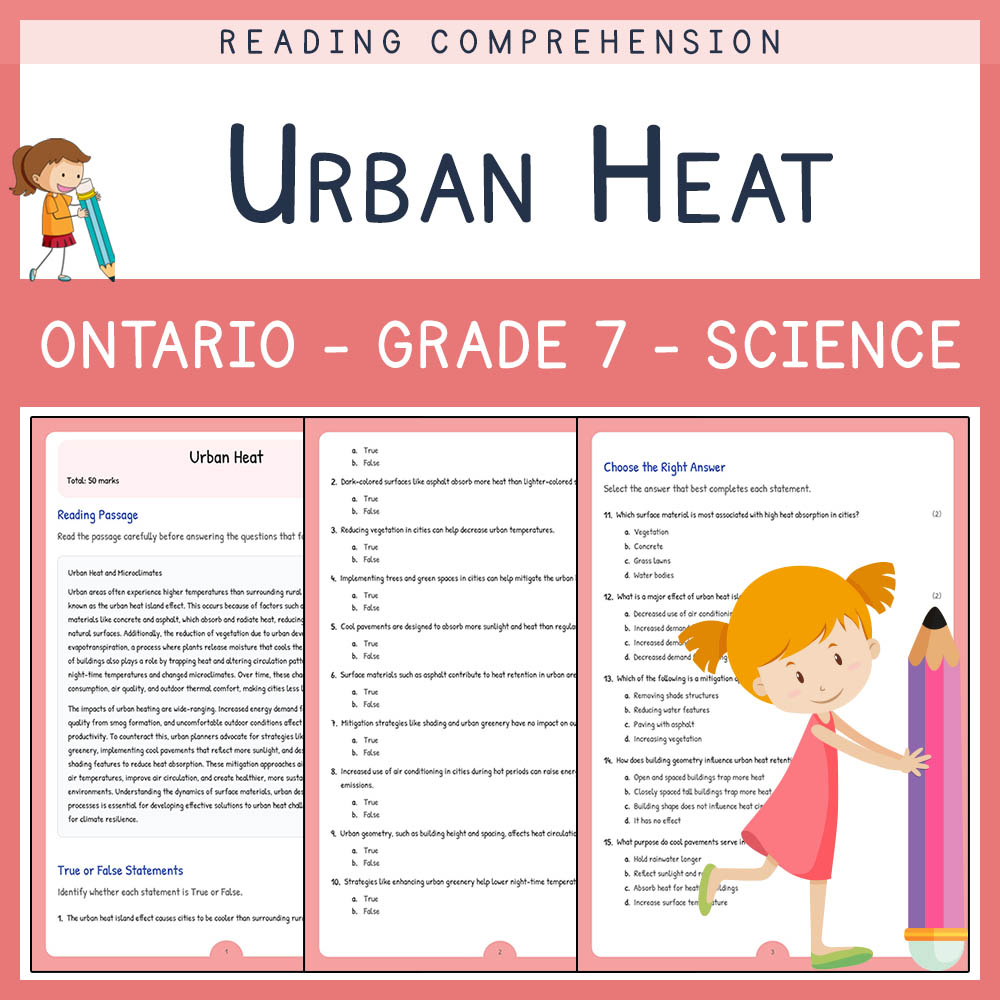
Grade 7 Science | Urban Heat Worksheet Elena | Ontario Standard-Aligned
Created byLumora LearningLearning Objectives
- Understand the causes and effects of urban heat island phenomena.
- Identify surface materials, vegetation, and human activities that influence urban temperatures.
- Analyze how urban design impacts local climate and heat circulation.
Instant download

Grade 7 Science – Density & Particles Reading Worksheet | California Standards
Created byBright Mind ResourcesLearning Objectives
- Understand the concept of density as mass per unit volume.
- Describe how particle arrangement affects the density of materials.
- Explain how heating changes particle spacing and impacts density.
Also included in: Grade 7 Matter & Forces Science Reading Lesson Bundle | California Standards +1 more
Instant download

Digital Data Formats & Sensor Logging Worksheets Grade 7 Science
Created byPrism Point LearningLearning Objectives
- Explain how CSV, timestamps, sampling rates, and metadata support data reuse
- Identify spreadsheet functions used to organize and summarize data
- Describe methods for checking data quality and preserving raw data
Also included in: Scientific Inquiry & Data Practices Lesson Bundle | Grade 7 Science | Ontario +1 more
Instant download
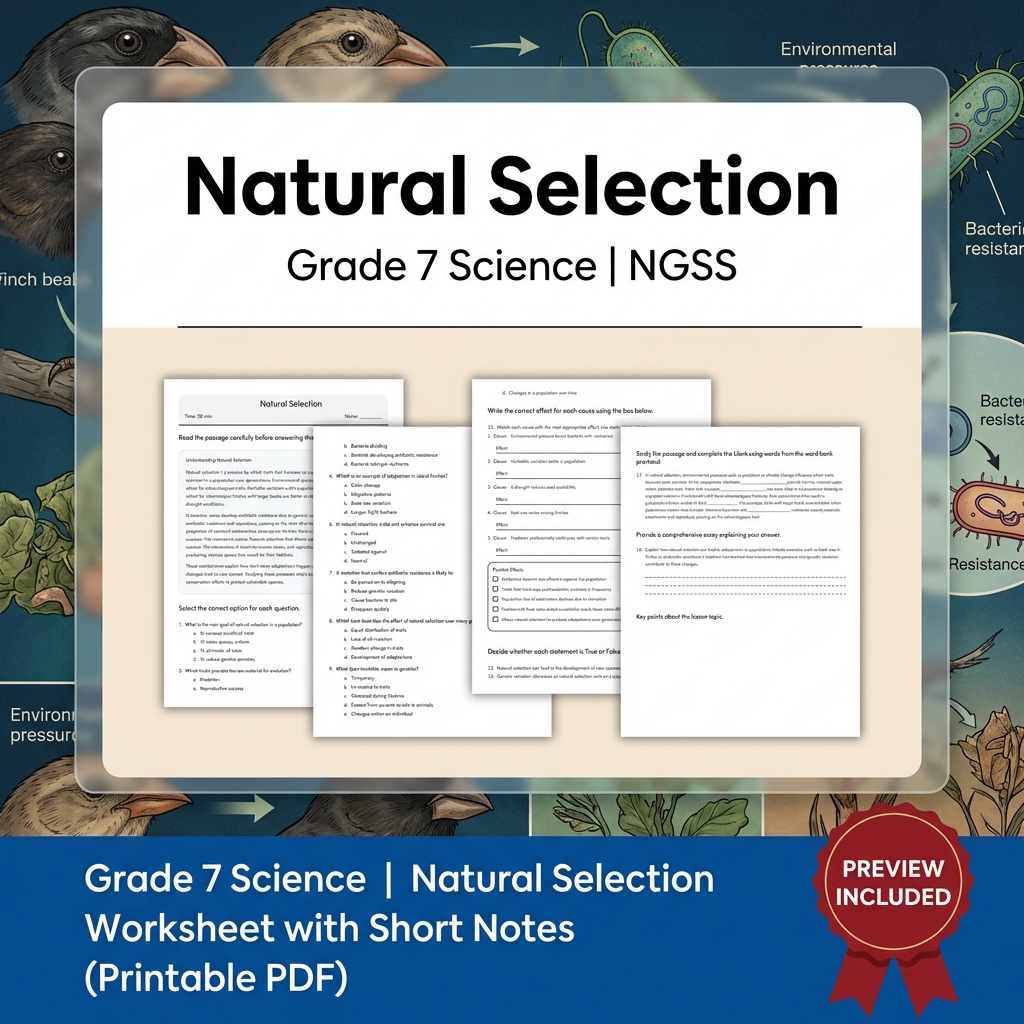
Grade 7 Science | Natural Selection Worksheet with Short Notes (Printable PDF)
Created byMeadowlark WorksheetsLearning Objectives
- Understand the mechanisms of natural selection and how they lead to adaptation.
- Identify key factors like genetic variation and environmental pressures in evolution.
- Analyze examples of adaptation, such as beak size variation in finches and antibiotic resistance in bacteria.
Also included in: Grade 7 Science | Biological Evolution Bundle – Unity & Diversity (NGSS Aligned) +1 more
Instant download
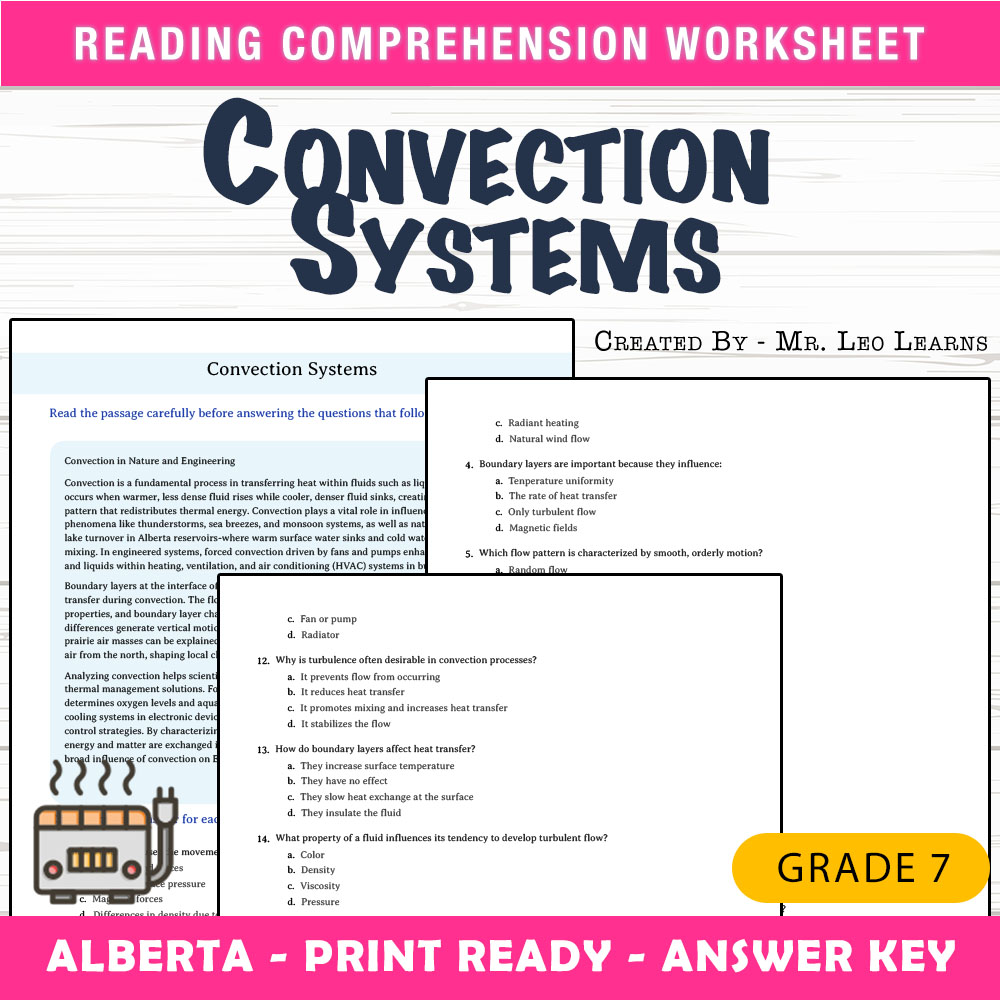
Grade 7 Science — Convection Systems Worksheet MCQ for Mastery
Created byThe Resource HubLearning Objectives
- Understand the process of convection and how it transfers heat through fluids.
- Identify examples of natural and forced convection in real-world scenarios.
- Explain the role of buoyancy forces, boundary layers, and flow patterns in convection.
Also included in: Grade 7 Science Alberta Energy Heat Thermal Processes Worksheet Bundle +1 more
Instant download

Data Representation Assessment | TEKS Grade 7 Science Standards-Aligned
Created byPrism Point LearningLearning Objectives
- Understand various methods of organizing and displaying data to identify trends and relationships.
- Select appropriate graph types for different data sets and interpret their features.
- Calculate summary statistics such as mean and median to analyze data sets.
Also included in: Scientific Inquiry Reasoning Grade 7 Science Lesson Bundle TEKS Unit
Instant download

Grade 7 Ecosystem Dynamics Science Daily Reading Worksheet | TEKS
Created byBRIGHT PATH RESOURCESLearning Objectives
- Identify producers, consumers, and decomposers in a food chain
- Explain how energy moves through trophic levels
- Describe how decomposers help recycle matter in ecosystems
Also included in: Grade 7 Ecosystems Science Daily Reading Worksheets Bundle | TEKS +1 more
Instant download
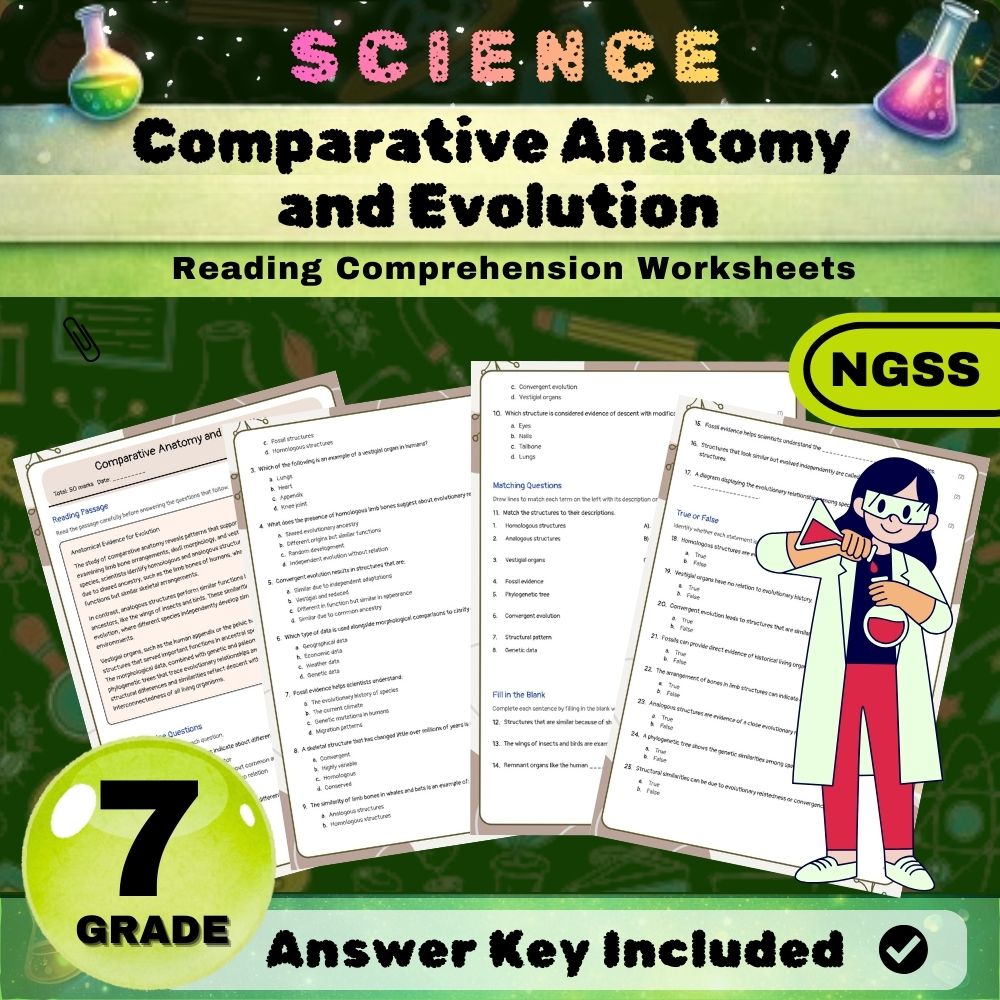
Grade 7 Science – Comparative Anatomy & Evolution NGSS Worksheet (PDF)
 Created byMaple Path Learning
Learning Objectives
- Understand how anatomical features provide evidence for evolution.
- Identify homologous and analogous structures in different species.
- Analyze morphological data to interpret phylogenetic relationships.
Also included in: Grade 7 Science | Evolution & Adaptation NGSS Worksheet Bundle +1 more
Instant download
Browse more categories
About Grade 7 Worksheets
Find Grade 7 worksheets covering math, ELA, science, and social studies. All 8,459 resources download instantly as PDFs for classwork, homework, or review.
MyTeachingSheets worksheets are made by real teacher-authors and checked before they go live. Download any as a print-ready PDF for lessons, homework, or independent practice — most include answer keys, and previews are always free.