
Grade 8 Worksheets
8,330 grade resources
Grade 8 Science Worksheet on Net Force and Acceleration | Standards-Aligned
JCreated byJ.S SheetsLearning Objectives
- Explain how net force is determined when multiple forces act on an object
- Use Newton’s second law idea (a depends on net force and mass) to predict acceleration
- Connect net force to changes in velocity, including changes in speed and direction
Also included in: Grade 8 Energy, Motion, and Matter Changes Science Lesson Bundle: Florida NGSSS +1 more
Instant download

Grade 8 Social Studies — Worksheet MCQ Paper for Mastering Territorial Changes
 Created byThe Resource Hub
Learning Objectives
- Understand the territorial outcomes of the Mexican-American War and the Treaty of Guadalupe Hidalgo.
- Analyze how territorial expansion influenced debates over slavery in the United States.
- Examine the regional and political impacts of territorial changes following the war.
Also included in: Grade 8 Westward Expansion Regional Economies Social Studies Lesson Bundle +1 more
Instant download

Grade 8 Social Studies — Worksheet MCQ Paper for Mastering Territorial Changes
Created byThe Resource HubLearning Objectives
- Understand the significance of the Louisiana Purchase in expanding U.S. territory.
- Analyze the geographic, political, and economic impacts of territorial expansion.
- Evaluate how territorial changes influenced national identity and westward expansion ideas.
Also included in: Grade 8 Early National Foreign Policy & Territorial Growth Social Studies Lesson +1 more
Instant download

Cell Modeling Worksheet | Grade 8 NGSS Structure, Function & Membranes
 Created byNorthstar Worksheets
Learning Objectives
- Explain how models show structure-function relationships in cells.
- Use models to describe how diffusion and osmosis support cell survival.
- Connect organelle roles to energy transfer in cell processes.
Instant download

Grade 8 Social Studies — Worksheet MCQ Paper for Mastering Comparative Change
Created byThe Resource HubLearning Objectives
- Explain how comparative analysis reveals patterns of change and persistence across different time periods
- Identify and use social, political, and economic indicators when comparing historical communities
- Describe how causes such as policy shifts, demographic movements, and economic restructurings can produce different outcomes
Also included in: Grade 8 Urban Growth & Reform Social Studies Custom Bundle Ontario +1 more
Instant download

U.S. in World War I Worksheet Grade 8 Social Studies TEKS + Key
Created byThe Resource HubLearning Objectives
- Explain why the United States initially chose neutrality during World War I
- Identify the economic and security reasons that led the U.S. to join the Allied powers in 1917
- Describe how U.S. participation changed government involvement in the economy and society
Also included in: World War I to Cold War Lesson Bundle | Grade 8 Social Studies | teks +2 more
Instant download

Economic Policies Post-War Worksheet Grade 8 Social Studies TEKS
Created byThe Resource HubLearning Objectives
- Explain how post-World War I economic growth was shaped by government policies and business practices.
- Identify major social conflicts of the post-war period, including labor rights and immigration concerns.
- Analyze how different groups argued for different levels of regulation and government control.
Also included in: World War I to Cold War Lesson Bundle | Grade 8 Social Studies | teks +2 more
Instant download

Grade 8 Science | Molecular Properties Worksheet | California Standards
 Created byLumora Learning
Learning Objectives
- Explain how particle models connect the structure of atoms and molecules to observable properties such as state of matter.
- Compare polar and nonpolar molecular arrangements and predict how they affect interactions with water (solubility and separation).
- Describe how extended structures (polymers and crystalline solids) differ in properties based on particle connections and energy movement.
Instant download

Grade 8 Innovations and Society Worksheet TEKS Social Studies Activity
Created byThe Resource HubLearning Objectives
- Explain how technological and scientific innovations can change economic development and daily routines
- Analyze how inventions can create both opportunities and challenges for different groups in society
- Evaluate historical examples (steam engine, medicine) to describe societal transformation over time
Also included in: Grade 8 Innovations and Society Lesson Bundle | TEKS Social Studies +2 more
Instant download

Participatory Impact Worksheet Grade 8 Social Studies TEKS + Answer Key
Created byThe Resource HubLearning Objectives
- Define civic participation and participatory impact in a democracy.
- Identify examples of civic participation such as voting, volunteering, and advocacy.
- Explain how civic participation can influence public policy decisions and community outcomes.
Also included in: Grade 8 Social Studies Lesson : Participatory Impact & Constitutional Rights +2 more
Instant download
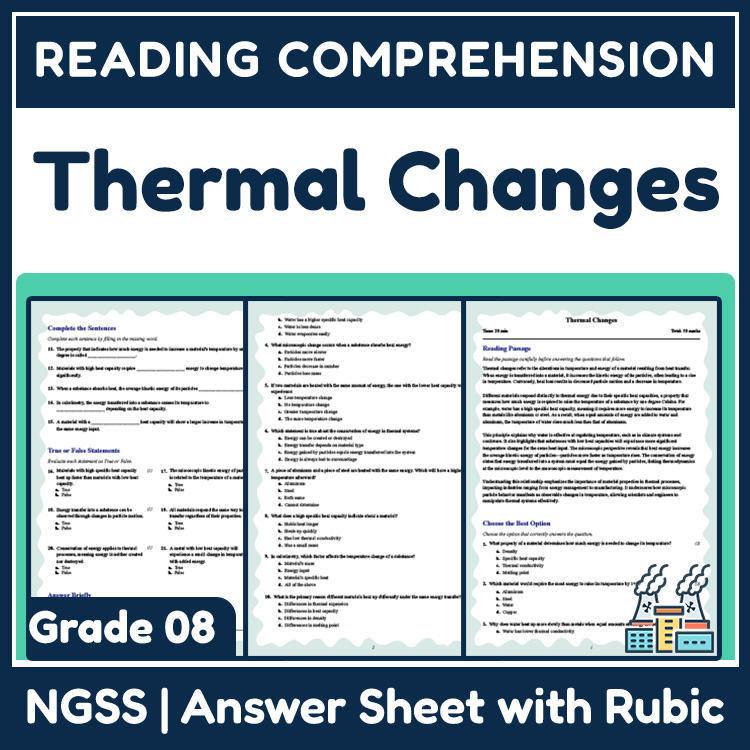
Grade 8 Science | Thermal Changes Reading Worksheet (Worksheet + Answer Key)
JCreated byJ.S SheetsLearning Objectives
- Understand the relationship between energy transfer, material type, mass, and temperature change.
- Explain the concept of specific heat capacity and its role in thermal responses of substances.
- Interpret how different heat capacities affect temperature changes for identical energy inputs.
Instant download

Grade 8 Social Studies - Human–Environment Links Worksheet (Ontario Standards)
 Created bySunny Desk Resources
Learning Objectives
- Explain how human land use (agriculture, forestry, urban growth, and resource extraction) affects natural systems like soil, water, and habitats.
- Assess environmental impacts by identifying cause-and-effect relationships such as erosion, habitat loss, and water-quality changes.
- Describe continuity and change in how communities manage land and resources over time.
Also included in: Grade 8 Human-Environment Systems Social Studies Lesson Bundle – Ontario +1 more
Instant download

Grade 8 Social Studies Worksheet | Human-Environment Interactions (PDF)
Created bySunny Desk ResourcesLearning Objectives
- Explain how human settlements adapt to and modify environmental features.
- Analyze spatial patterns of human-environment interactions using examples from regions.
- Evaluate environmental consequences of land use and resource use for ecosystem sustainability.
Also included in: Grade 8 Land Use and Migration in Social Studies Lesson Bundle TEKS +1 more
Instant download

Grade 8 Science Worksheet | Population Drivers & Ecosystem Dynamics (PDF)
 Created byEvergreen Desk Education
Learning Objectives
- Explain how abiotic and biotic factors interact to change population size and distribution
- Describe how birth, death, immigration, and emigration influence local population trajectories
- Use examples from Alberta to connect density dependence and seasonal climate to population dynamics
Instant download

Grade 8 Human-Environment Interactions Worksheet | TEKS Geography
Created byThe Resource HubLearning Objectives
- Explain how human activities influence environmental features and how environments affect settlement choices
- Analyze examples of human-environment interactions such as urban expansion and agricultural resource use
- Identify consequences of these interactions for ecosystems, land management, and sustainability
Also included in: Grade 8 Social Studies Geography Lesson Bundle: Land Use & Migration +2 more
Instant download
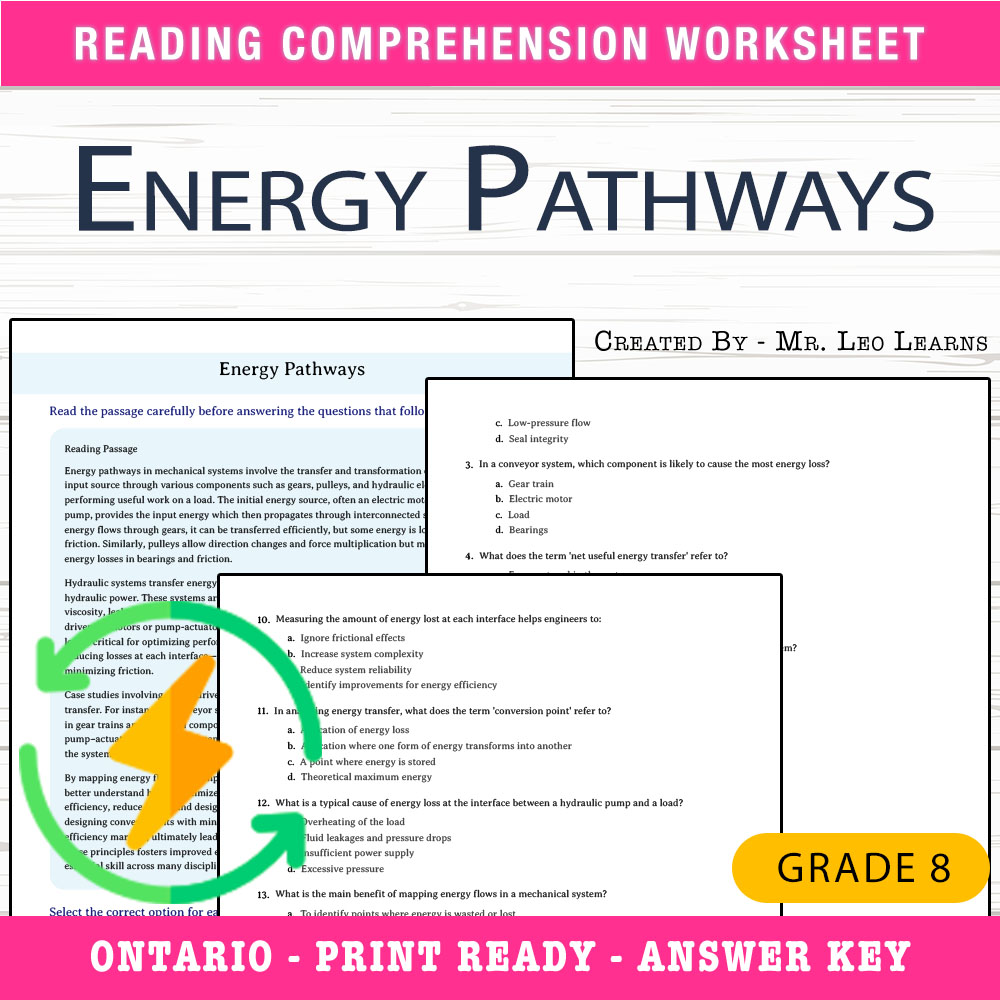
Grade 8 Science — Energy Pathways Worksheet for Mastering Energy Transfer
Created byThe Resource HubLearning Objectives
- Describe how energy transfers through different mechanical subsystems such as gears, pulleys, and hydraulics.
- Identify points of energy conversion and quantify energy losses in system components.
- Calculate the net useful energy transfer in case study systems like conveyor assemblies and pump–actuator systems.
Also included in: Grade 8 Science | Mechanical Systems & Energy Mastery Unit Worksheet Pack +1 more
Instant download

Human–Environment Links Worksheet for Grade 8 Social Studies | Standards-Aligned
JCreated byJ.S SheetsLearning Objectives
- Explain how human activities such as farming, forestry, urban growth, and resource extraction can affect natural systems
- Identify ecosystem responses to land-use changes, including soil erosion, habitat loss, and water quality changes
- Evaluate how economic needs, cultural values, and environmental capacity influence land-use decisions
Instant download

Grade 8 Science – Friction Concepts Worksheet (Alberta Standard) (PDF)
 Created bySilver Birch Teaching
Learning Objectives
- Differentiate between static friction and kinetic friction and explain when each applies.
- Describe how surface texture, normal force, and material pairing affect frictional force.
- Apply friction concepts to real-world scenarios involving traction, road/gravel wear, and slope driving force.
Also included in: Grade 8 Forces, Motion, and Energy Science Lesson Bundle for Alberta +1 more
Instant download
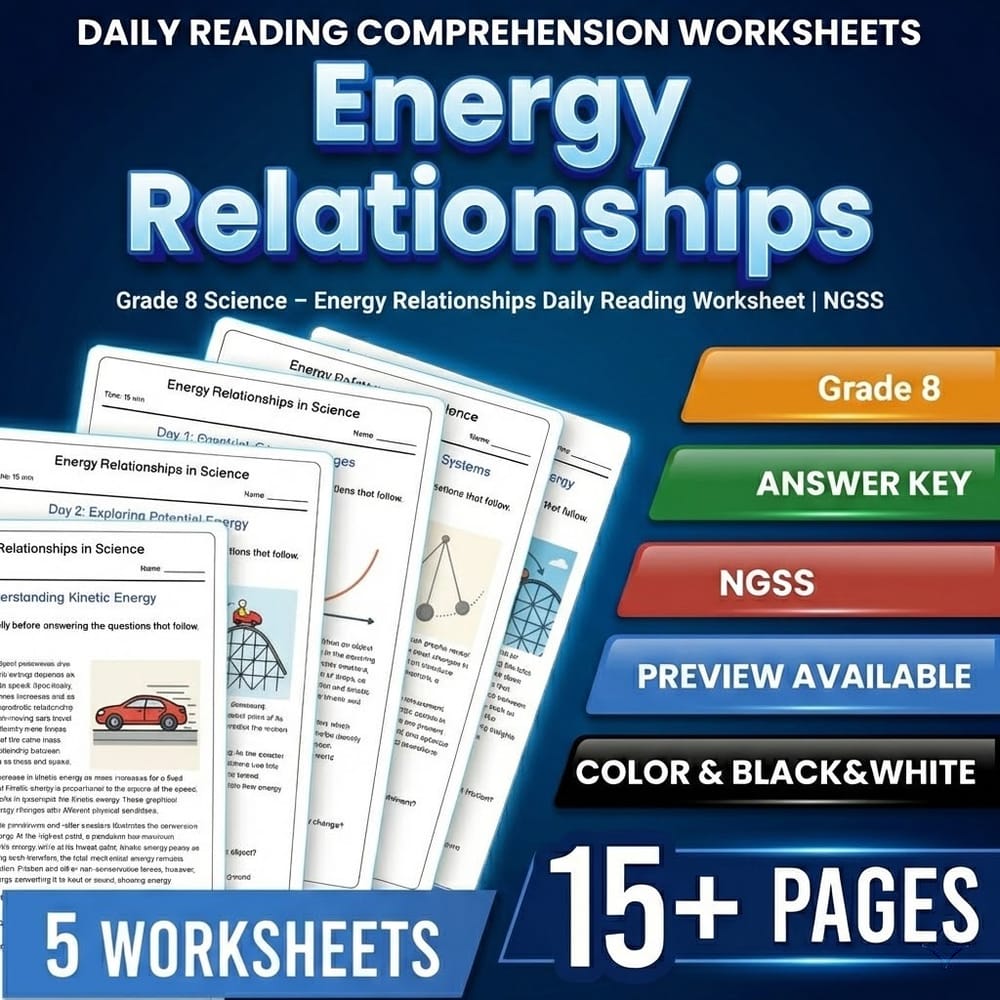
Grade 8 Science – Energy Relationships Daily Reading Worksheet | NGSS
 Created byElena Brooks
Learning Objectives
- Understand the concept of kinetic energy and its dependence on mass and speed.
- Interpret graphs relating kinetic energy to mass and the square of speed.
- Analyze the energy interchange in systems like pendulums and roller coasters.
Instant download
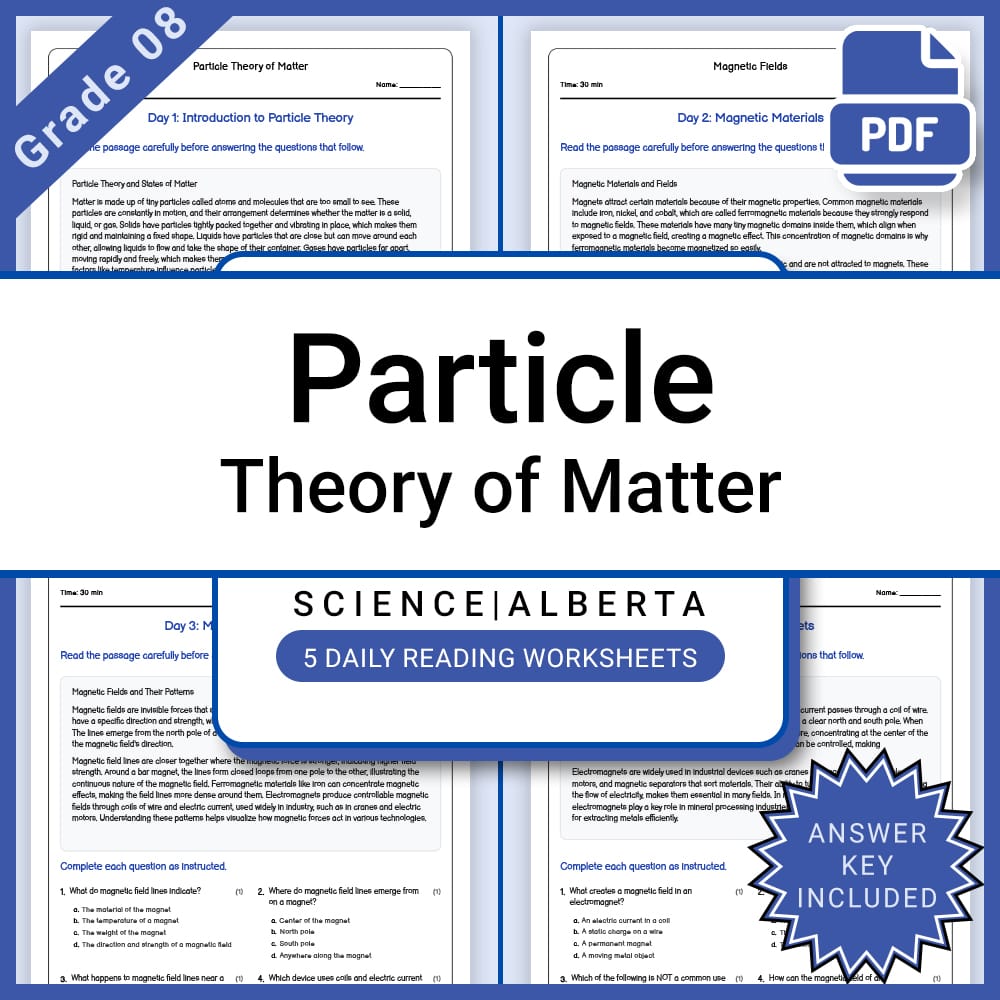
Grade 8 Science Particle Theory of Matter Daily Worksheet with Answer Key
JCreated byJ.S SheetsLearning Objectives
- Understand the basic concepts of particles and their behavior in different states of matter.
- Recognize how particle motion and arrangement influence properties like rigidity, flow, and compressibility.
- Relate microscopic particle behavior to macroscopic observable traits in real-world examples.
Also included in: Grade 8 Science Lesson Group Bundle | Alberta Framework +1 more
Instant download

Grade 8 Independence Day Worksheet for Mastering Colonial Roots|PDF + Answer Key
 Created byShaNova Worksheets
Learning Objectives
- Explain how life in the American colonies under British rule created social and political tensions.
- Describe key conflicts and events that fueled colonial resistance.
- Identify common colonial grievances and connect them to the desire for self-government.
Also included in: Grade 8 Independence Day Holiday Civics Lesson Bundle for C3 Framework
Instant download

Rock Evidence Assessment | TEKS Grade 8 Science Standards-Aligned Assessment
 Created byPrism Point Learning
Learning Objectives
- Describe the classification of igneous, sedimentary, and metamorphic rocks.
- Explain the processes of the rock cycle, including melting, cooling, sedimentation, and metamorphism.
- Identify geological evidence such as strata, fossils, and radiometric dating used to interpret Earth's history.
Also included in: Grade 8 Weather and Earth-Space Science Assessment Lesson Bundle TEKS
Instant download
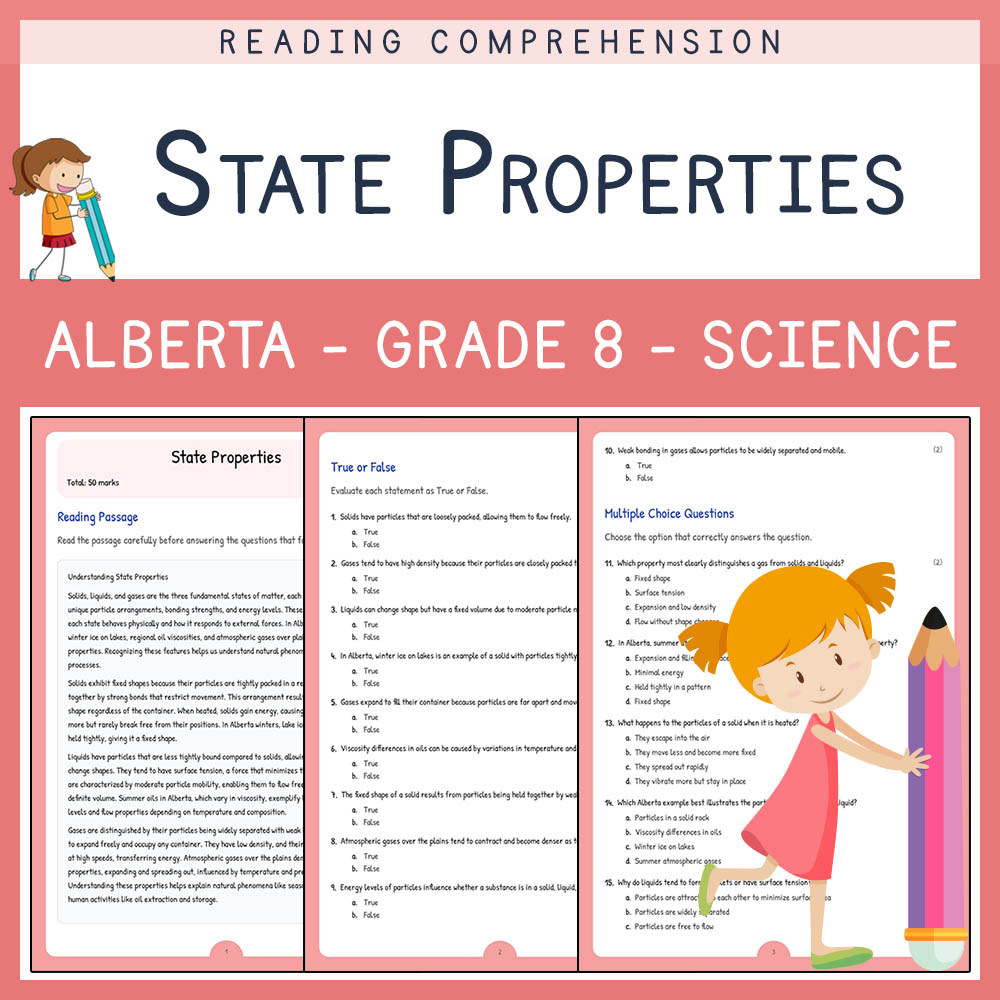
Grade 8 Science | State Properties Worksheet Elena | Alberta Standard
Created byLumora LearningLearning Objectives
- Describe the particle arrangements of solids, liquids, and gases.
- Explain how particle bonding strength and energy influence state properties.
- Identify examples of different states of matter in Alberta environments.
Instant download

Grade 8 Holiday | Pi day for Mastering Pi Fundamentals | PDF + Answer Key
Created byShaNova WorksheetsLearning Objectives
- Understand the cultural and historical significance of Pi Day.
- Explore various ways communities celebrate Pi and promote STEM interests.
- Reflect on the values of curiosity, perseverance, and collaboration in learning math.
Also included in: Grade 8 Pi Day Lesson Bundle | Math & Holiday Activities for Students
Instant download
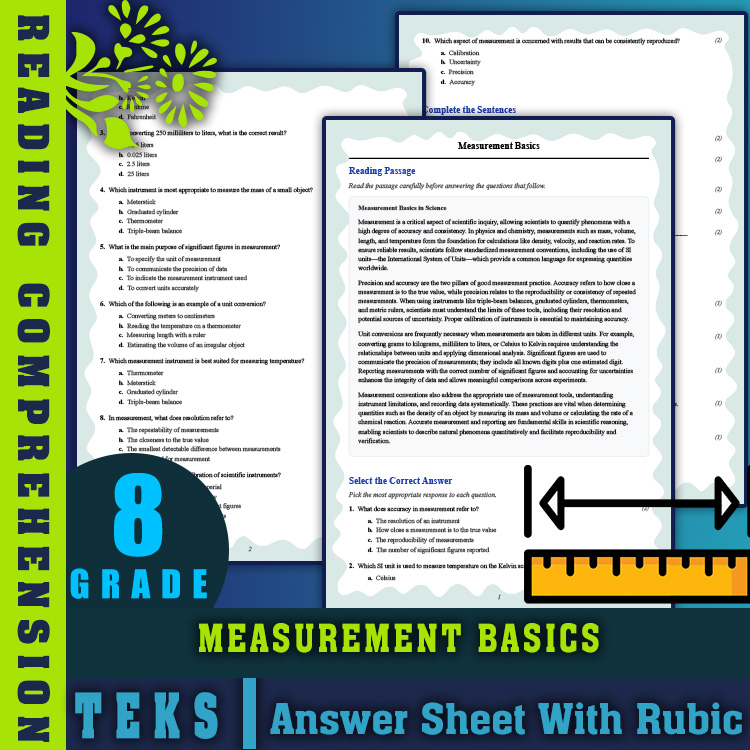
Grade 8 Science | Measurement Basics Reading Worksheet (PDF + Answer Key)
JCreated byJ.S SheetsLearning Objectives
- Understand the fundamental principles of measurement including accuracy, precision, and SI units.
- Apply measurement conventions and unit conversions accurately in scientific contexts.
- Identify appropriate instruments for measuring mass, volume, length, and temperature.
Instant download

Grade 8 Science – Understanding Viscosity & Fluid Flow | Daily Reading Worksheet
 Created byQuiet Forest Education
Learning Objectives
- Define and differentiate between dynamic and kinematic viscosity.
- Explain how viscosity affects fluid flow in pipes and systems.
- Identify factors influencing viscosity, such as temperature and shear.
Also included in: Fluid Dynamics Grade 8 Science Daily Reading Worksheets Bundle | Ontario +1 more
Instant download

Grade 8 Electric Magnetism Worksheet | NGSS Fields, Forces & Doodle Note
 Created byAmber Owl Education
Learning Objectives
- Explain how electric and magnetic forces can be described using field interactions
- Describe how interaction strength changes with separation distance for electric forces and with orientation/pole strength for magnetic interactions
- Use examples (charged pith balls, bar magnets, compass near a wire) to predict force direction and relative magnitude
Also included in: Grade 8 Science Forces and Fields Physics Lesson Bundle | NGSS +1 more
Instant download

Grade 8 Social Studies | Settlement Land Use Worksheet (TEKS)
Created bySunny Desk ResourcesLearning Objectives
- Explain how geographic features and resource availability influence where settlements form and grow
- Interpret map and spatial data to identify patterns in land use (residential, agricultural, industrial)
- Describe how land-use decisions can affect transportation systems and environmental sustainability
Also included in: Grade 8 Land Use and Migration in Social Studies Lesson Bundle TEKS +1 more
Instant download

Spatial Analysis of Land Use Worksheet | TEKS-Aligned Grade 8 Social Studies
JCreated byJ.S SheetsLearning Objectives
- Explain how GIS and spatial data help identify land use changes over time.
- Describe how geographic patterns (such as where development spreads) can be measured using maps.
- Use geographic reasoning to connect land use change to environmental and human impacts.
Instant download

Grade 8 Social Studies — Worksheet MCQ Paper for Mastering Presenting Findings
Created byThe Resource HubLearning Objectives
- Organize historical research into a clear structure that matches a research question.
- Support claims with relevant evidence from primary and secondary sources.
- Use accurate citations so an audience can verify information and give proper credit.
Also included in: Grade 8 Social Studies Lesson Bundle — TEKS Source Reliability & Research Skills +2 more
Instant download
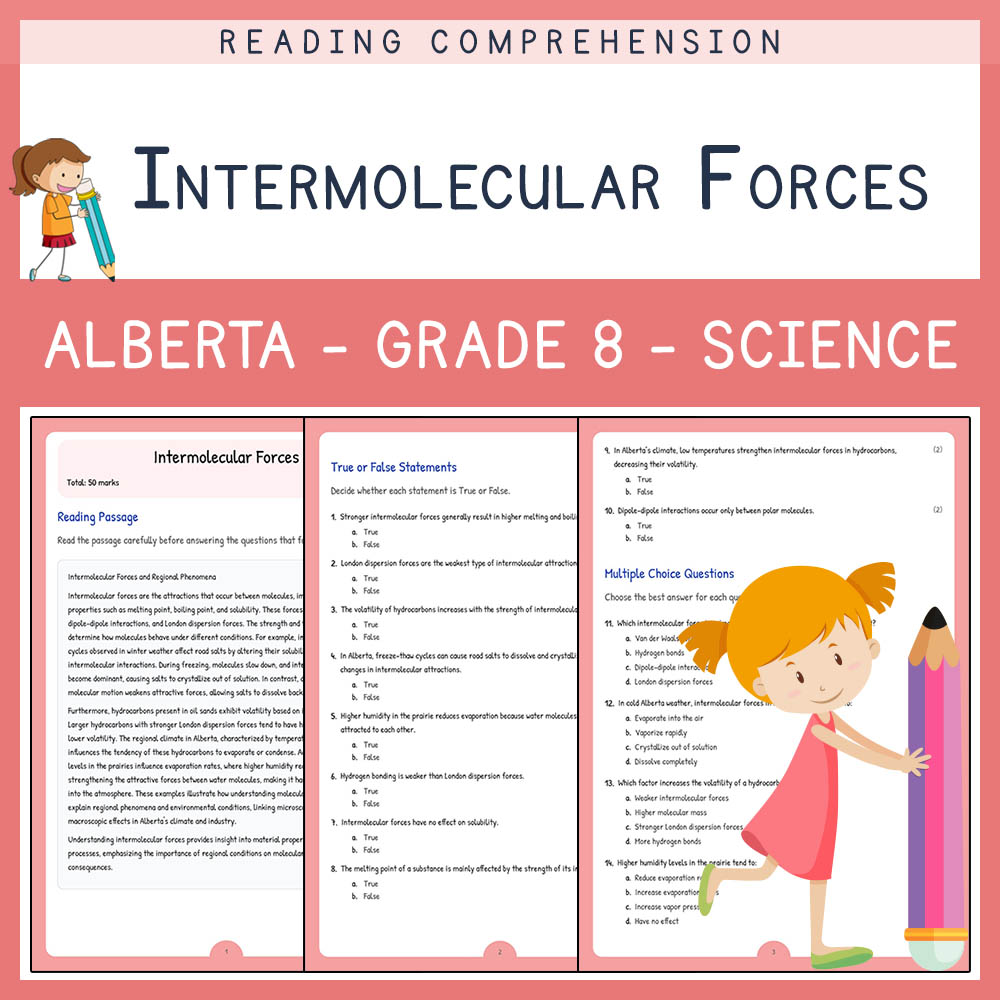
Grade 8 Science | Intermolecular Forces Worksheet | Alberta Standard
Created byLumora LearningLearning Objectives
- Explain how intermolecular forces influence melting point, boiling point, and solubility.
- Describe regional phenomena such as freeze–thaw cycles, hydrocarbon volatility, and humidity effects in terms of molecular interactions.
- Compare the strength of different types of intermolecular forces and their effects on physical properties.
Instant download

Grade 8 Science – Physical Changes Daily Reading Worksheet + Answer Key
JCreated byJ.S SheetsLearning Objectives
- Understand key concepts related to Science
- Apply knowledge through practice questions
- Demonstrate comprehension of the material
Also included in: Grade 8 Science Lesson Group | Physical Changes and Chemical Reactions +1 more
Instant download

Grade 8 Science | Ecological Restoration Strategies for Ecosystem Recovery
 Created byCoral Reef Learning
Learning Objectives
- Understand the principles of habitat reclamation and restoration.
- Identify different strategies used to restore ecological functions.
- Analyze the importance of monitoring recovery metrics.
Also included in: Interactions and Ecosystems Lesson Bundle Grade 8 Science – Alberta +1 more
Instant download
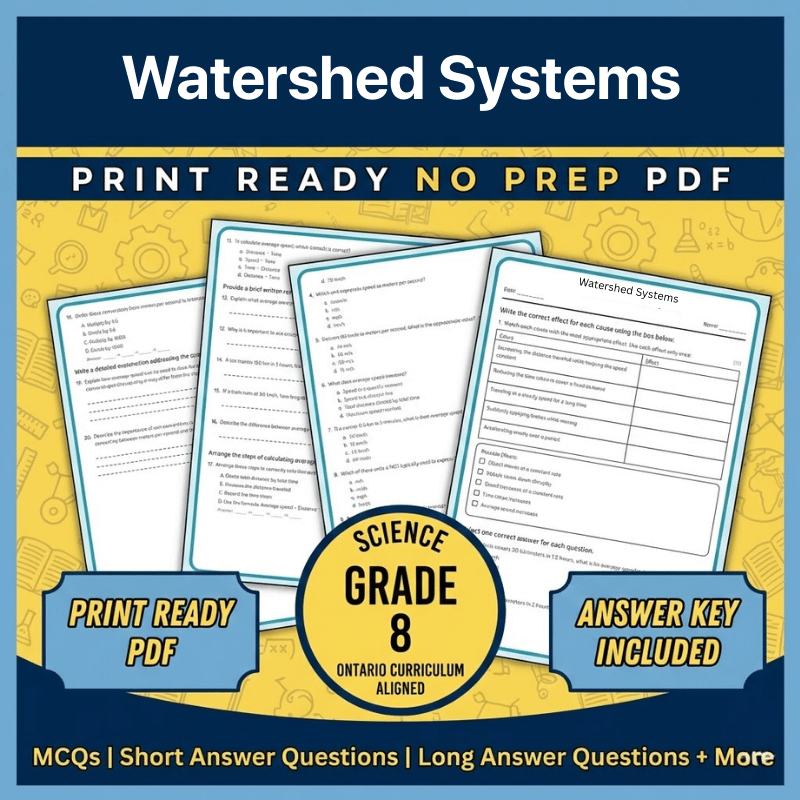
Grade 8 Science | Watershed Systems Worksheet (Ontario, Science 1) (PDF)
 Created byBright Mind Resources
Learning Objectives
- Describe characteristics of drainage basins and watershed boundaries.
- Explain how runoff generation, stream networks, and tributary hierarchy affect watershed functions.
- Analyze the influence of land cover, slope, and soil type on infiltration and overland flow.
Instant download

Grade 8 Spoken Message Analysis Worksheet | TEKS Listening Comprehension
Created bySunny Desk ResourcesLearning Objectives
- Analyze how tone, pacing, emphasis, and supporting details shape meaning in spoken media.
- Identify a speaker’s claim, key reasons, and intended impact in an interview or recorded speech.
- Evaluate credibility and urgency by examining word choice and language structures.
Instant download
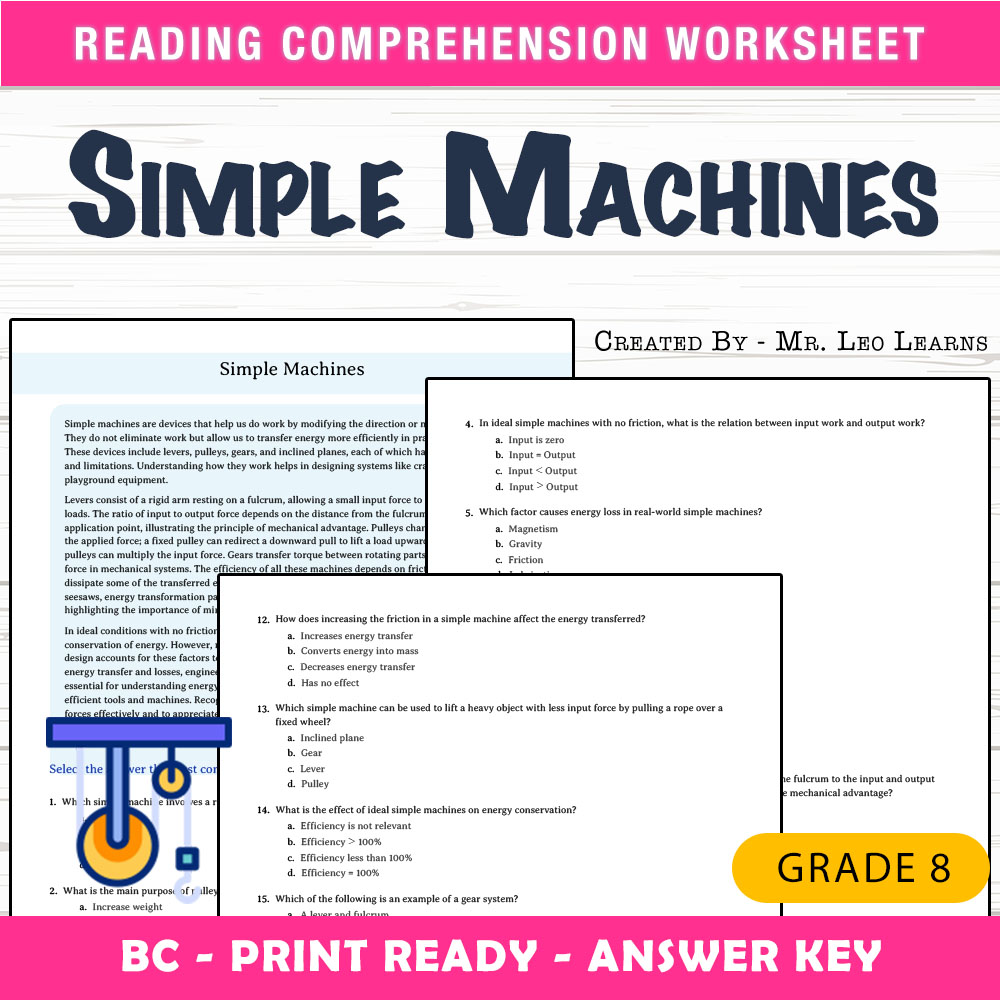
Grade 8 Science — Worksheet MCQ Paper for Mastering Simple Machines
Created byThe Resource HubLearning Objectives
- Explain the function of simple machines in redirecting forces and transferring energy.
- Identify different types of simple machines such as levers, pulleys, and gears.
- Describe how mechanical advantage affects force and displacement in simple machines.
Also included in: Grade 8 Science Forces, Motion & Energy UNIT Bundle +1 more
Instant download

Grade 8 Magnetic Fields Worksheet | NGSS Practice PDF
 Created byClear Sky Classroom
Learning Objectives
- Explain how magnetic fields are produced by magnets and by moving electric charges in current-carrying conductors.
- Use field line ideas to describe polarity, relative strength, and how field patterns form around magnets.
- Compare the behavior of ferromagnetic materials to non-magnetic materials in magnetic fields.
Instant download

Grade 8 Science Worksheet | Regional Hydrology Case Study (Ontario PDF)
Created byEvergreen Desk EducationLearning Objectives
- Explain how the hydrologic cycle shapes water availability in a large basin
- Describe how watershed connectivity influences nutrient loading and ecosystem impacts
- Distinguish groundwater–surface water exchange and identify possible contaminant pathways
Also included in: Grade 8 Watershed and Water Quality Science Lesson Bundle (Ontario) +1 more
Instant download
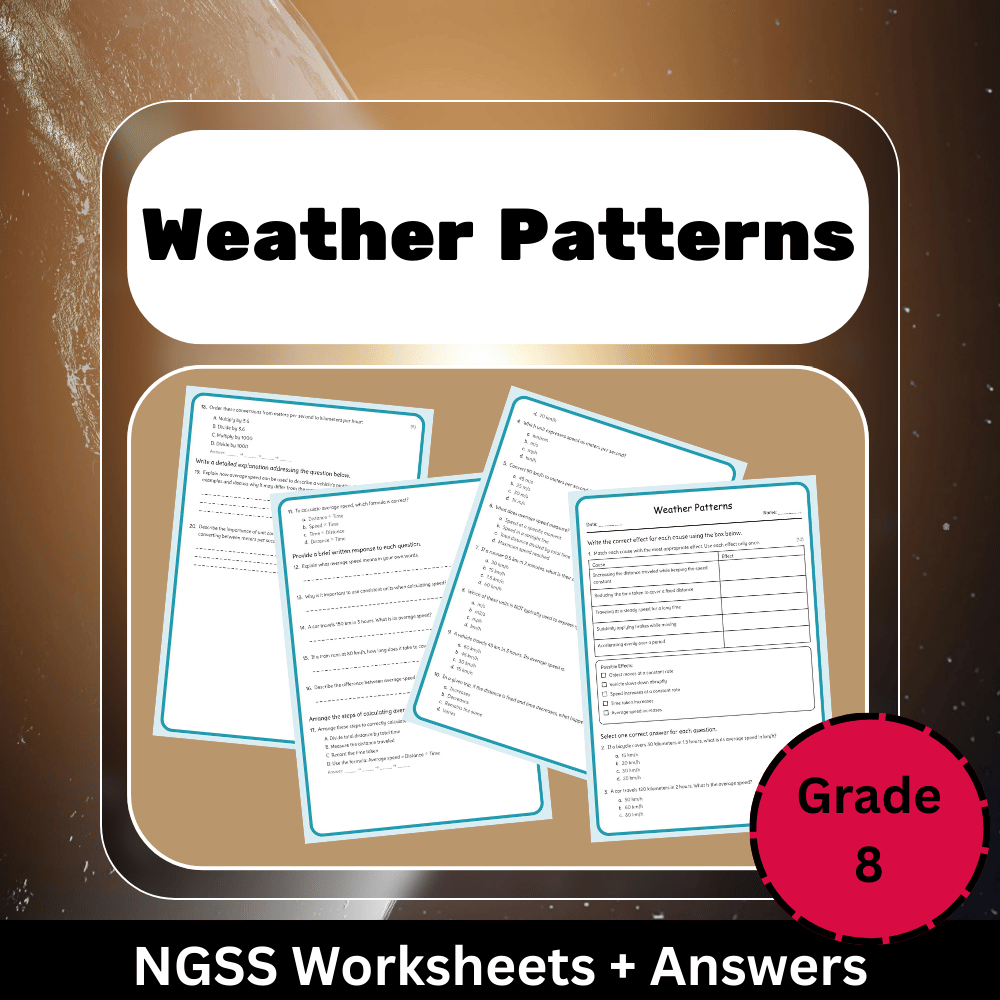
Grade 8 Science | Weather Patterns Worksheet (Worksheet + Answer Key)
Created byBright Mind ResourcesLearning Objectives
- Understand the relationship between air mass motions and weather changes.
- Identify how synoptic-scale analyses explain shifts in weather conditions.
- Describe the processes of frontogenesis and cyclogenesis.
Also included in: Grade 8 Science Unit | Weather, Water Cycle & Climate Circulation Worksheets +2 more
Instant download

Grade 8 Social Studies — Canada and International Peace Worksheet
Created byThe Resource HubLearning Objectives
- Understand Canada's role in international peace efforts after World War I.
- Identify key organizations and events related to Canada's diplomatic history.
- Analyze how wartime experiences influenced Canada's foreign policy decisions.
Also included in: Grade 8 Wartime Pressures & Global Conflict Impacts on Canada Social Studies +1 more
Instant download
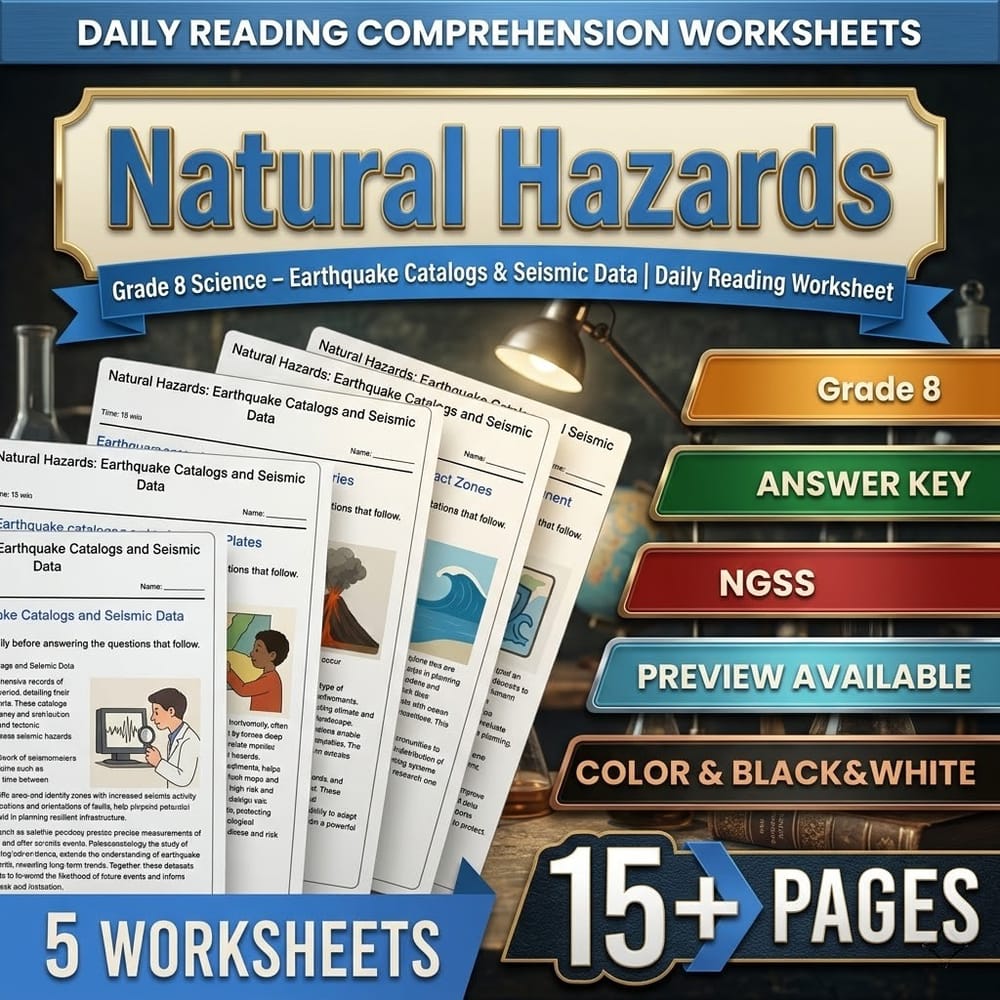
Grade 8 Science – Earthquake Catalogs & Seismic Data | Daily Reading Worksheet
Created byElena BrooksLearning Objectives
- Understand how earthquake catalogs are compiled and interpreted.
- Analyze seismic data to identify patterns and recurrence intervals.
- Explore the role of fault maps and volcanic histories in hazard assessment.
Instant download

Grade 8 Energy Metabolism Worksheet | Ontario Science Cells & Energy
Created byClear Sky ClassroomLearning Objectives
- Explain how aerobic respiration converts chemical energy into ATP through glycolysis, the Krebs cycle, and oxidative phosphorylation
- Describe the role of mitochondria and proton gradients in chemiosmosis
- Compare aerobic ATP production with anaerobic fermentation and connect energy pathways to oxygen availability
Instant download

Population Change Dynamics Worksheet | NGSS Grade 8 Science Assessment
 Created byCedar Grove Learning
Learning Objectives
- Analyze factors that influence population growth and decline in ecosystems.
- Identify and describe biotic and abiotic influences such as resource availability, invasive species, and environmental events.
- Interpret population graphs and birth/death rate trends to understand long-term population stability.
Instant download
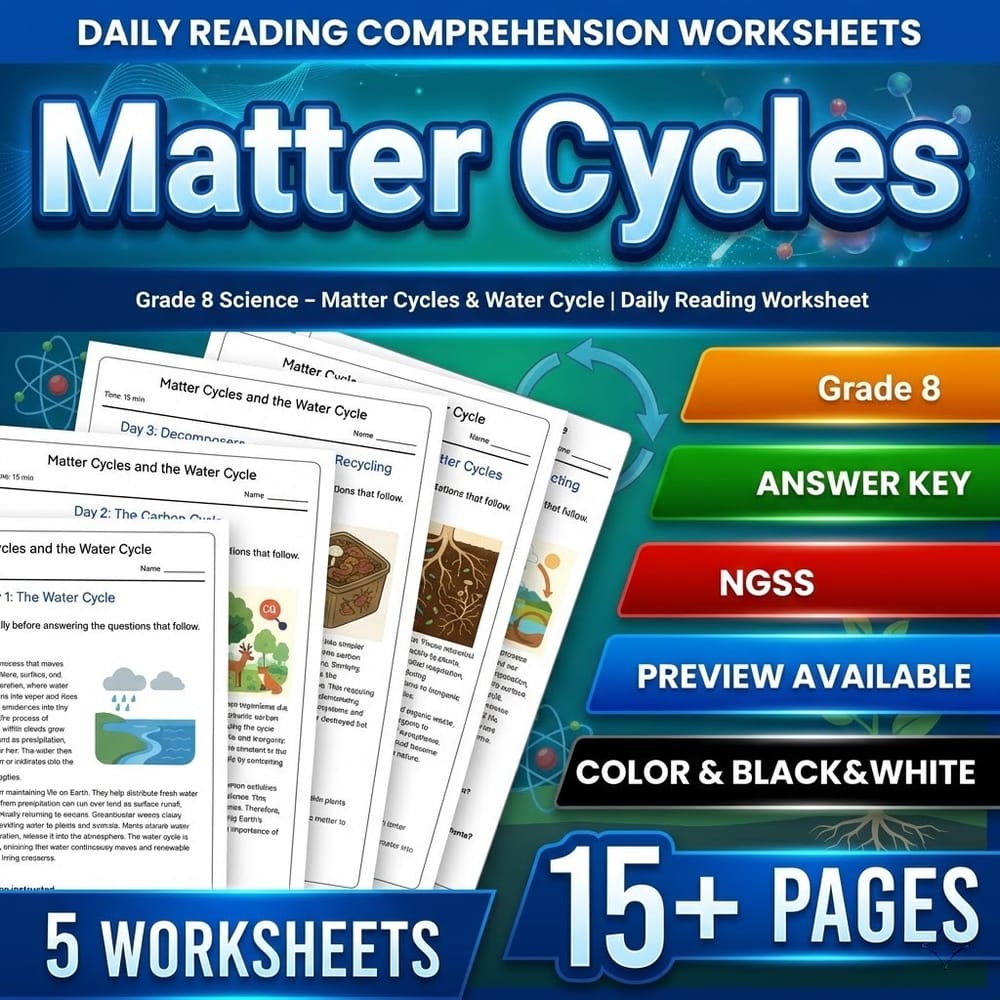
Grade 8 Science – Matter Cycles & Water Cycle | Daily Reading Worksheet
Created byElena BrooksLearning Objectives
- Understand the processes involved in the water cycle, including evaporation, condensation, precipitation, and collection.
- Identify key processes in the cycling of matter within ecosystems, especially photosynthesis, respiration, decomposition, and nutrient transformation.
- Explain how matter, such as water and carbon, moves through living organisms and the environment, and how mass is conserved in these processes.
Instant download

Grade 8 Social Studies — Inclusion and Exclusion MCQ Paper
Created byThe Resource HubLearning Objectives
- Analyze historical practices of social inclusion and exclusion in Canadian history.
- Evaluate the social and ethical impacts of exclusionary policies on marginalized groups.
- Develop critical perspectives on social justice, community belonging, and national identity.
Also included in: Grade 8 Migration Immigration & Regional Economy Social Studies Custom Bundle +1 more
Instant download

Grade 8 Holiday | Flag day for Mastering History of Flag Day | PDF + Answer Key
Created byShaNova WorksheetsLearning Objectives
- Explain key historical events connected to the origin of Flag Day in the United States.
- Describe why Flag Day is significant in American civic culture and community identity.
- Use information from a historical passage to answer comprehension and vocabulary questions.
Instant download

Grade 8 Science Worksheet – Nutrient Cycling | Alberta Standards (PDF)
Created bySilver Birch TeachingLearning Objectives
- Explain how matter cycles through ecosystems using decomposition, mineralization, nitrogen fixation, and sedimentation.
- Describe carbon and nitrogen pathways and how soil organic matter connects biotic and abiotic pools.
- Analyze how temperature, moisture, and altered river flows affect nutrient availability and ecosystem productivity.
Also included in: Grade 8 Trophic Modeling & Ecosystems Science Lesson Bundle for Alberta Standards +1 more
Instant download

Grade 8 Science | Climate Patterns and Feedbacks Worksheet | General Standards
Created byLumora LearningLearning Objectives
- Explain how climate patterns are identified by summarizing many years of weather data into trends and averages.
- Distinguish natural variability from persistent climate change using evidence and reasoning.
- Describe how feedbacks (such as ice-albedo and water-vapor effects) can amplify or reduce climate change.
Instant download
Browse more categories
About Grade 8 Worksheets
Explore Grade 8 worksheets in math, ELA, science, and social studies. Our 8,330 Grade 8 printables print straight from PDF, answer keys included.
Each resource here is built by an independent educator and reviewed for quality. Worksheets print straight from PDF and suit classroom use, homework, or extra practice; most come with answer keys, and you can preview before purchasing.