
Grade 8 Science Worksheets
6,006 worksheets
Grade 8 Cell Cycle Worksheet | Ontario Science Mitosis Review PDF
 Created byClear Sky Classroom
Learning Objectives
- Explain the main stages of the cell cycle, including interphase, mitosis, and cytokinesis
- Describe how DNA replication and chromosome segregation support accurate cell division
- Summarize the roles of cyclins, kinases, and checkpoint mechanisms in preventing genomic instability
Instant download
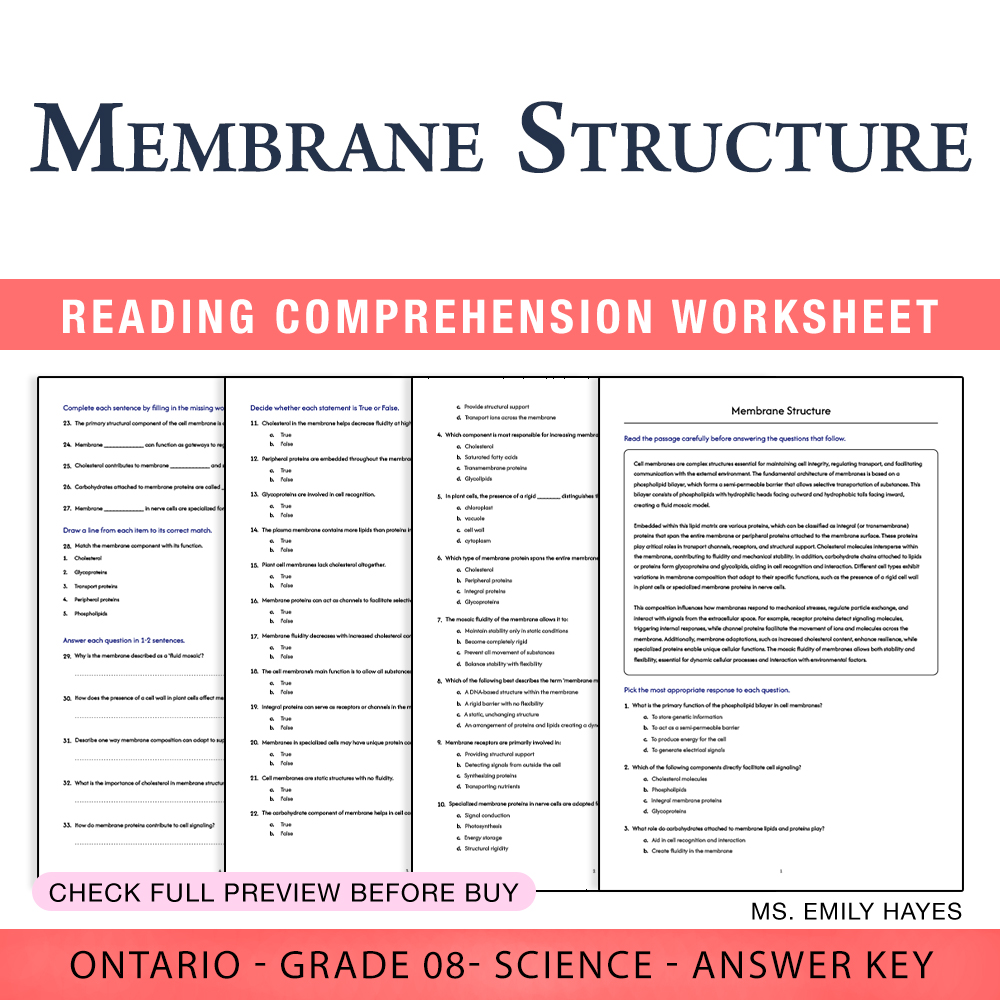
Grade 8 Science | Membrane Structure Worksheet (PDF+ Answer Key)
 Created byCopper Leaf Classroom
Learning Objectives
- Describe the key components of membrane architecture including phospholipids, proteins, cholesterol, and carbohydrates.
- Explain the functions of membrane proteins in transport, signaling, and structural support.
- Compare structural variations of membranes in different cell types and their impact on permeability and environmental interactions.
Instant download

Grade 8 Science Worksheet | Tissue Organization & Cell Structures (PDF)
 Created byEvergreen Desk Education
Learning Objectives
- Identify the four major tissue types (epithelial, connective, muscle, nervous) and describe key structural features.
- Explain how cellular structures and extracellular materials (or junctions) support tissue function.
- Connect tissue-level organization to organ-level functions such as transport, movement, signal transmission, and support.
Also included in: Grade 8 Cell Structure & Homeostasis Science Lesson Bundle (Ontario) +1 more
Instant download
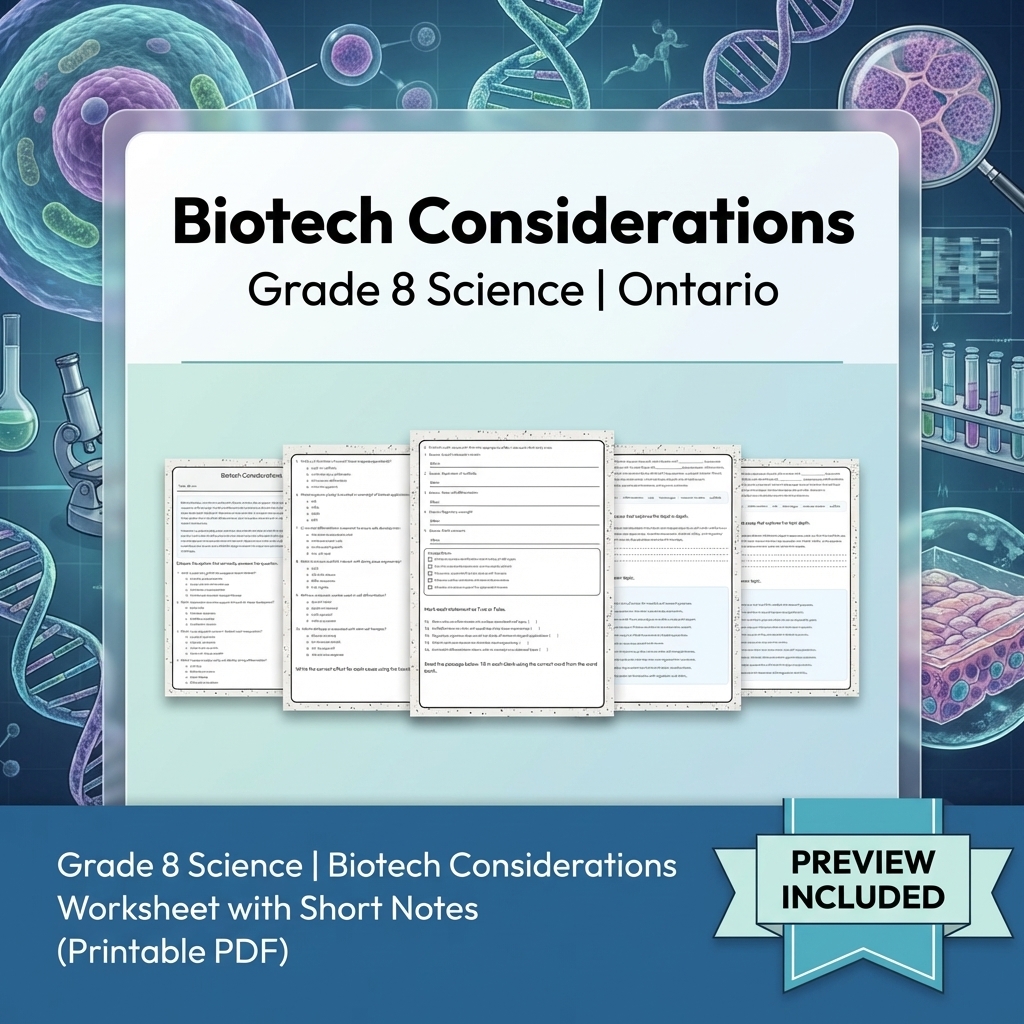
Grade 8 Science | Biotech Considerations Worksheet with Short Notes (PDF)
 Created byMeadowlark Worksheets
Learning Objectives
- Understand key biotechnological approaches such as cell culture and tissue engineering.
- Identify the roles of molecular markers, scaffold interactions, and differentiation in tissue development.
- Recognize ethical, safety, and regulatory considerations in cellular manipulation.
Also included in: Grade 8 Science Lesson Group Bundle | Ontario Curriculum Worksheets +1 more
Instant download
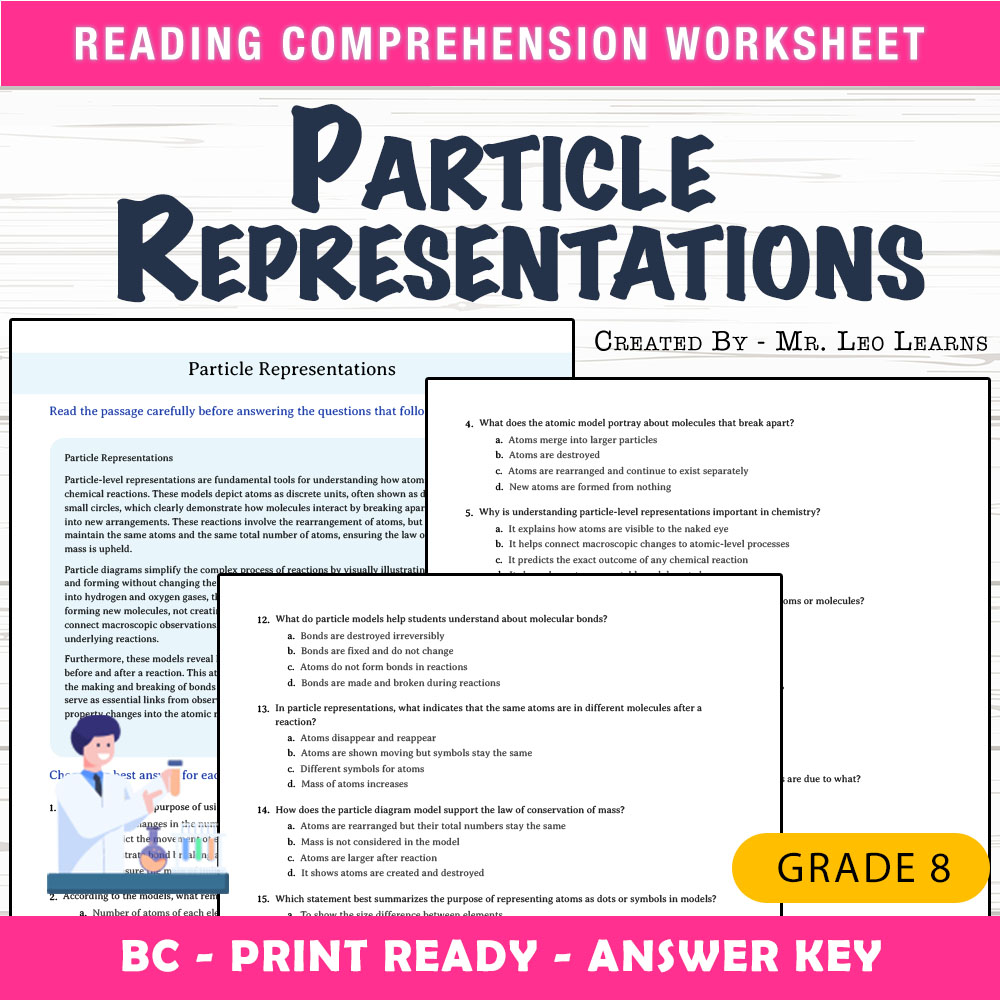
Grade 8 Science — Particle Representations Worksheet MCQ Paper
 Created byThe Resource Hub
Learning Objectives
- Understand how particle-level models depict atoms and bonds during chemical reactions.
- Identify the role of particle diagrams in illustrating molecular rearrangements.
- Explain how atomic identity and mass are preserved during reactions through particle models.
Also included in: Grade 8 Science | Matter & Chemical Change UNIT Worksheet Pack (BC Framework) +1 more
Instant download
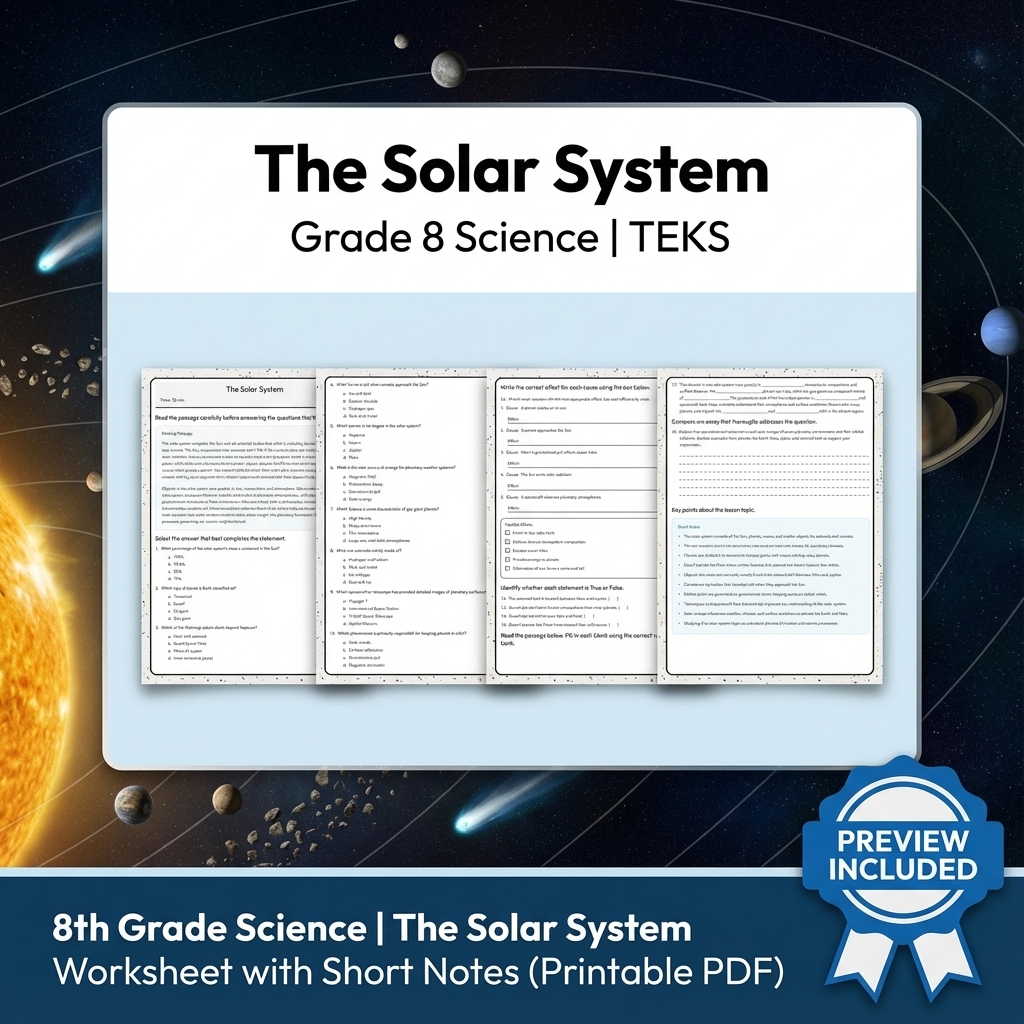
8th Grade Science | The Solar System Worksheet with Short Notes (Printable PDF)
Created byMeadowlark WorksheetsLearning Objectives
- Describe the key components of the solar system including planets, moons, asteroids, and comets.
- Understand the relative scale and composition of different solar system objects.
- Explain orbital characteristics and gravitational interactions within the solar system.
Instant download
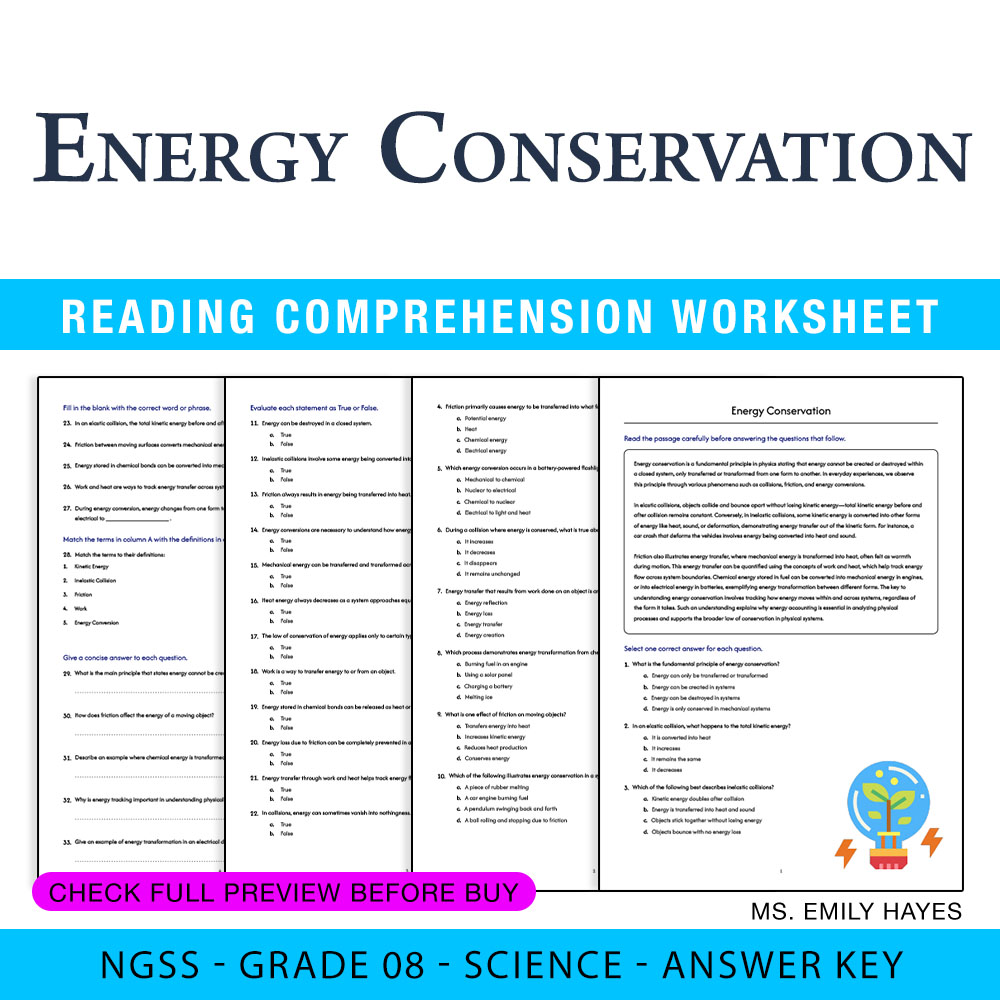
8th Grade Science | Energy Conservation Worksheet (PDF+ Answer Key)
Created byCopper Leaf ClassroomLearning Objectives
- Explain how changes in an object's kinetic energy relate to energy transfer within a system.
- Describe different types of collisions and how energy is conserved or transformed during each.
- Identify sources of energy loss such as frictional heat and analyze their effects.
Instant download
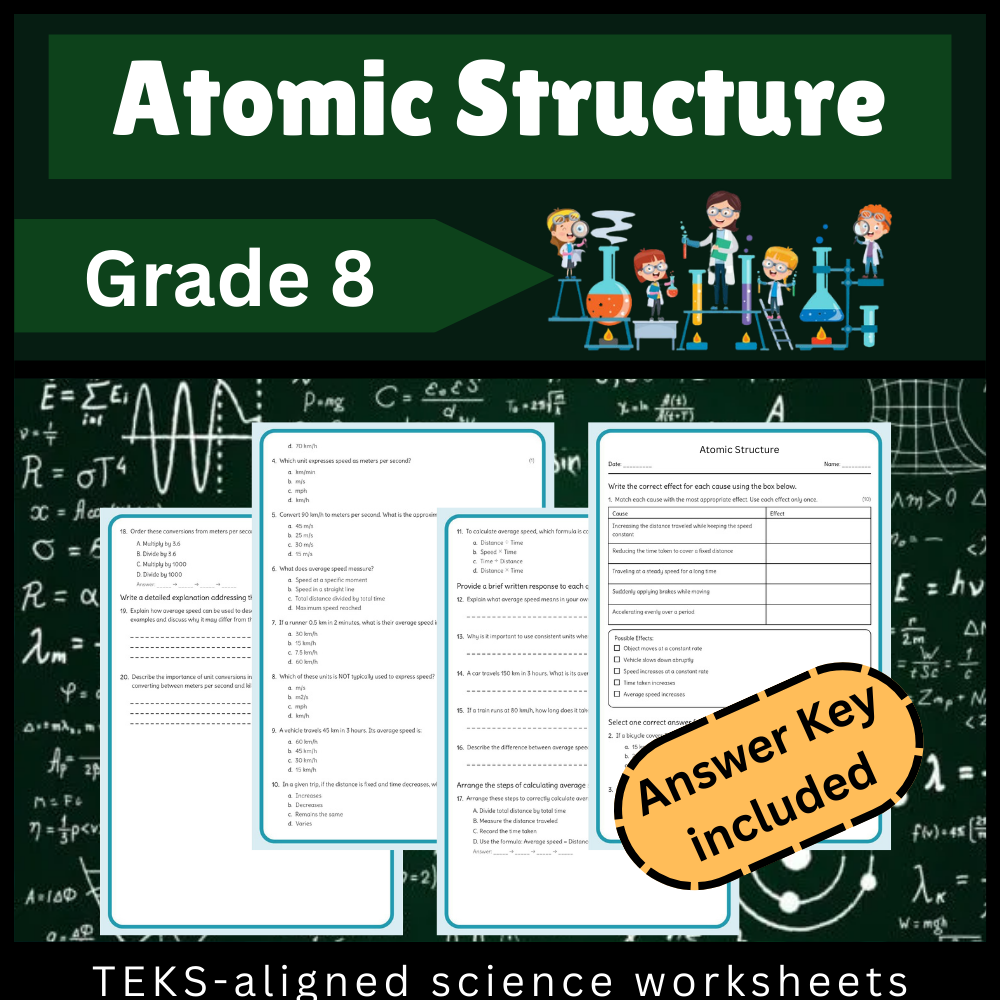
Grade 8 Science – Atomic Structure Worksheet (PDF) – TEKS Aligned & Answer Key
 Created byBright Mind Resources
Learning Objectives
- Describe the basic composition of an atom, including protons, neutrons, and electrons.
- Explain how elements and compounds are formed and represented with formulas.
- Understand the organization of elements in the periodic table and basic atomic models.
Also included in: Grade 8 Science Unit Bundle | States of Matter & Reaction Rates Worksheets- TEKS +1 more
Instant download
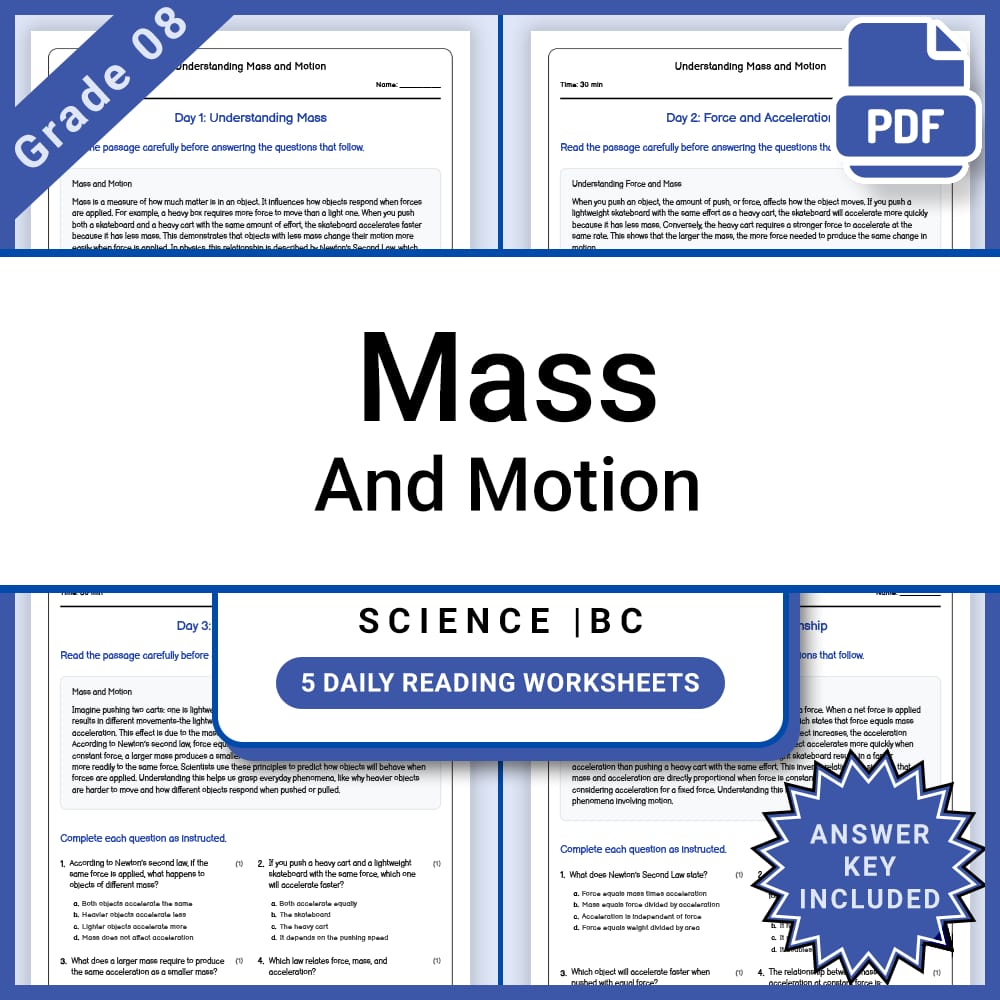
Grade 8 Science – Mass and Motion Daily Reading Worksheet with Answer Key
JCreated byJ.S SheetsLearning Objectives
- Understand key concepts related to Science
- Apply knowledge through practice questions
- Demonstrate comprehension of the material
Also included in: Grade 8 Science Lesson Group | Forces, Motion, Energy & More – Bundle +1 more
Instant download

Science Worksheet Testable Questions | NGSSS Aligned Grade 8 Worksheet
JCreated byJ.S SheetsLearning Objectives
- Distinguish between observations, evidence, claims, and assumptions in science questions.
- Write and evaluate testable questions that lead to measurable or observable outcomes.
- Use relationships supported by data to strengthen or weaken scientific explanations.
Also included in: Grade 8 Evidence-Based Scientific Inquiry Science Lesson Bundle | Florida NGSSS +1 more
Instant download
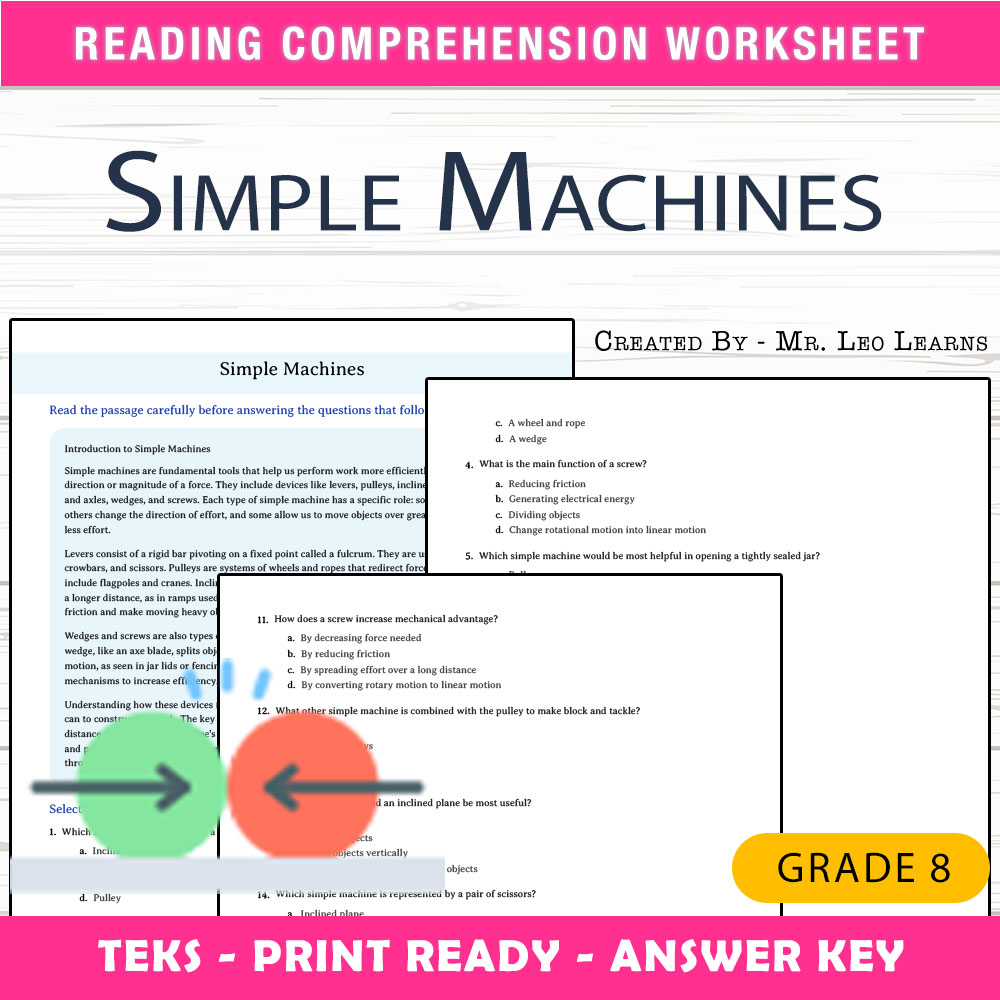
Grade 8 Science — Simple Machines Worksheet for Mastery
Created byThe Resource HubLearning Objectives
- Understand the basic functions of common simple machines such as levers, pulleys, inclined planes, wheels and axles, wedges, and screws.
- Explain how simple machines modify the force and distance in performing work.
- Identify everyday examples of simple machines and their configurations.
Also included in: Grade 8 Science Unit Bundle | Motion, Forces & Energy Mastery Worksheets +1 more
Instant download
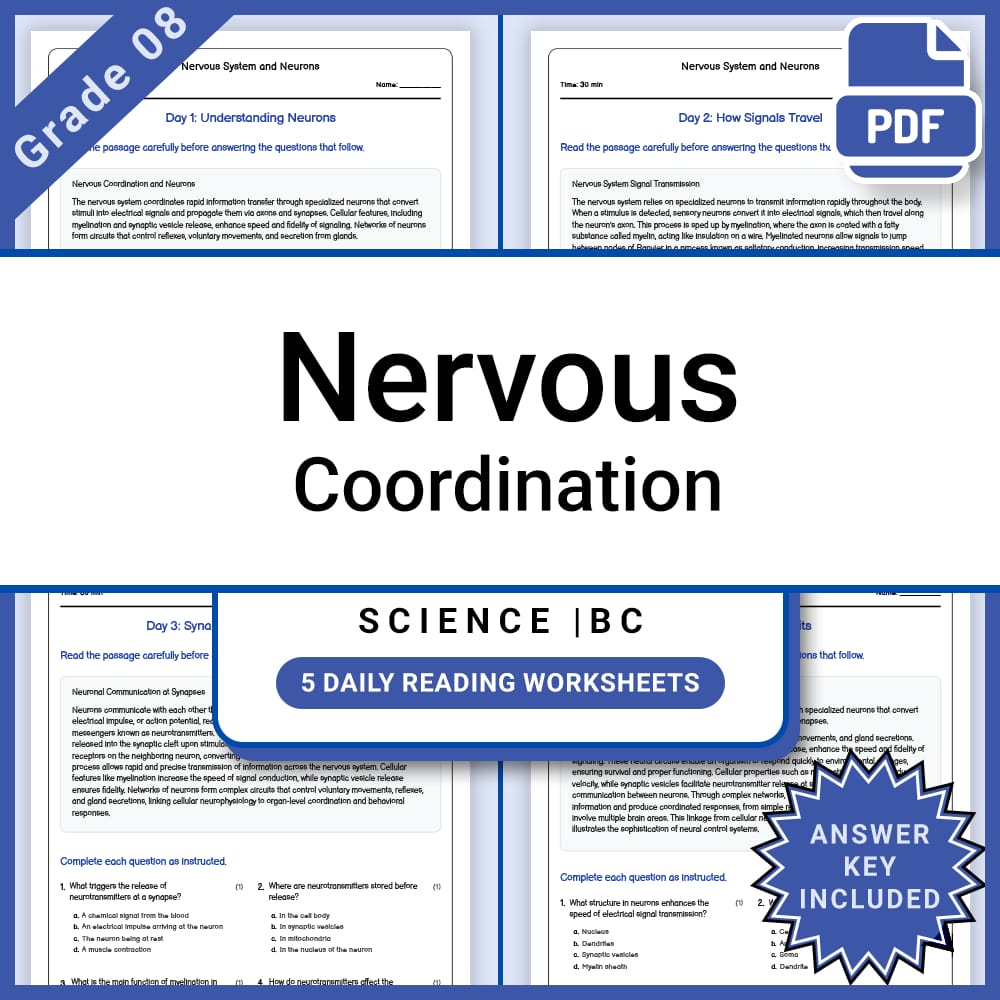
Grade 8 Science – Nervous System Neurons Daily Reading Worksheet with Answer Key
JCreated byJ.S SheetsLearning Objectives
- Identify the parts of a neuron and their functions
- Understand how neurons transmit signals rapidly
- Explain the role of myelination and synapses in neural signaling
Also included in: Grade 8 Science Lesson Group BC Framework | Daily Reading Worksheets +1 more
Instant download

Grade 8 Scientific Inquiry Worksheet | NGSS Practice & PDF
Created byClear Sky ClassroomLearning Objectives
- Explain how scientific inquiry uses observations and testable questions to form evidence-based explanations.
- Identify appropriate methods, careful data recording, and patterns in results as part of inquiry.
- Distinguish evidence-based conclusions from opinions by comparing results to existing knowledge.
Instant download
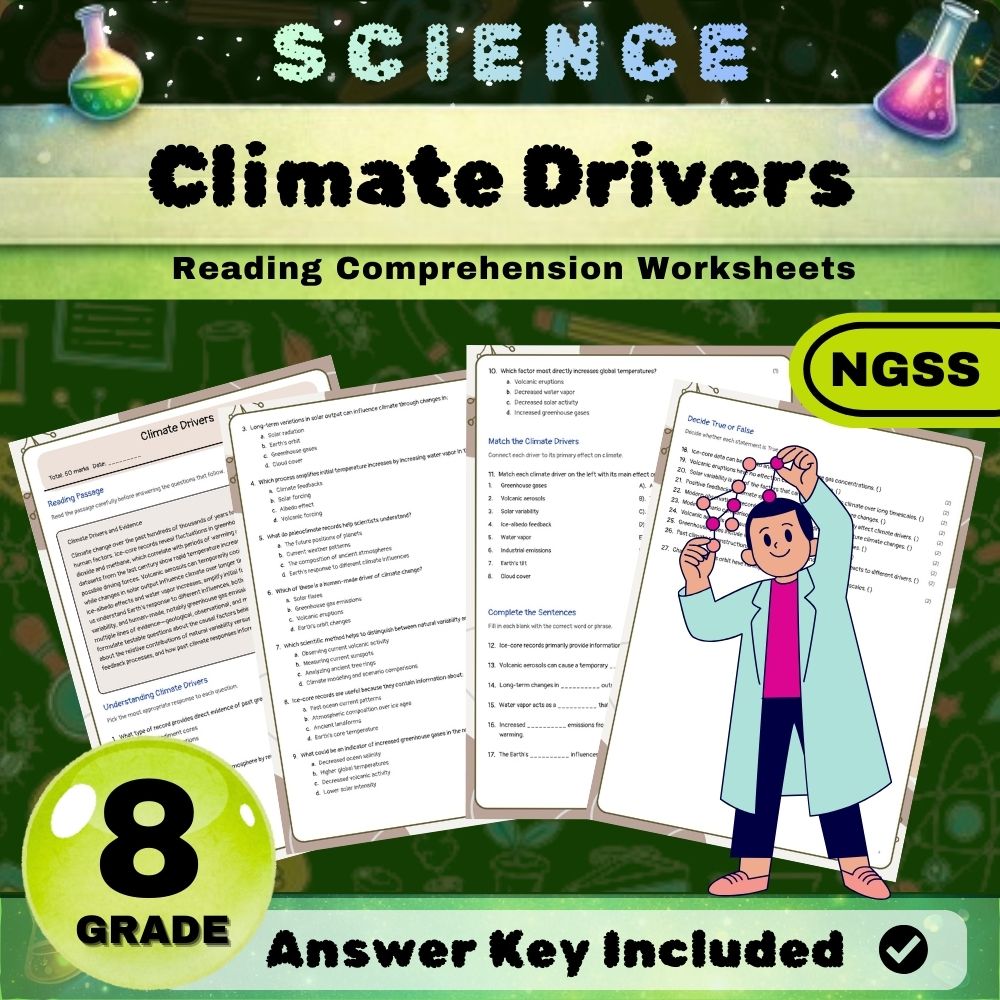
Grade 8 Science – Climate Drivers Worksheet (NGSS) - PDF
 Created byMaple Path Learning
Learning Objectives
- Understand the key drivers influencing global temperature changes over time.
- Evaluate evidence from ice-core, instrumental, and model data to attribute climate change causes.
- Distinguish between natural and anthropogenic influences on climate variability.
Also included in: Grade 8 Science | Earth and Human Activity NGSS Unit Bundle +1 more
Instant download
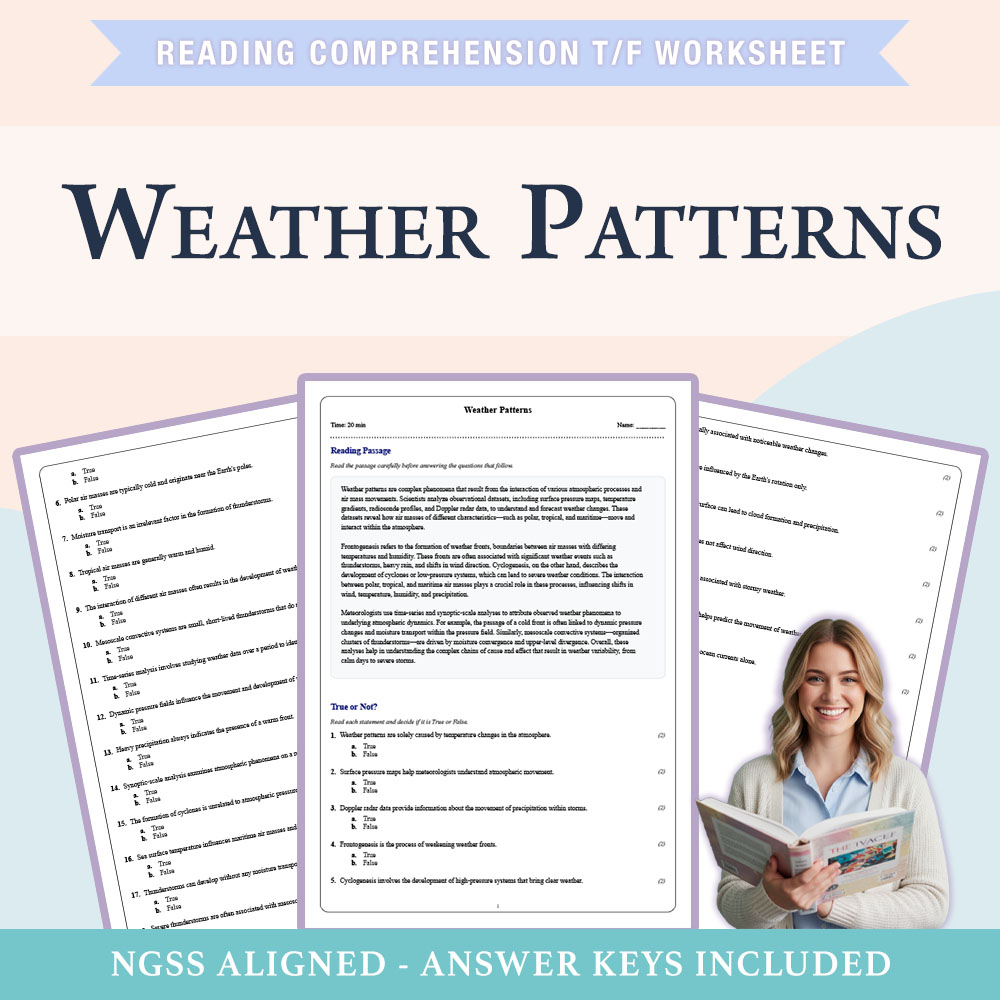
Grade 8 Science | Weather Patterns Worksheet (PDF +Answer Key)
Created byCopper Leaf ClassroomLearning Objectives
- Understand the relationship between air mass motions and weather changes.
- Identify how surface pressure maps, temperature gradients, radiosonde profiles, and Doppler radar contribute to weather analysis.
- Explain concepts of frontogenesis, cyclogenesis, and air mass interactions.
Also included in: Grade 8 Science Unit Bundle | Earth Materials Worksheets (PDF + Answer Key) +1 more
Instant download
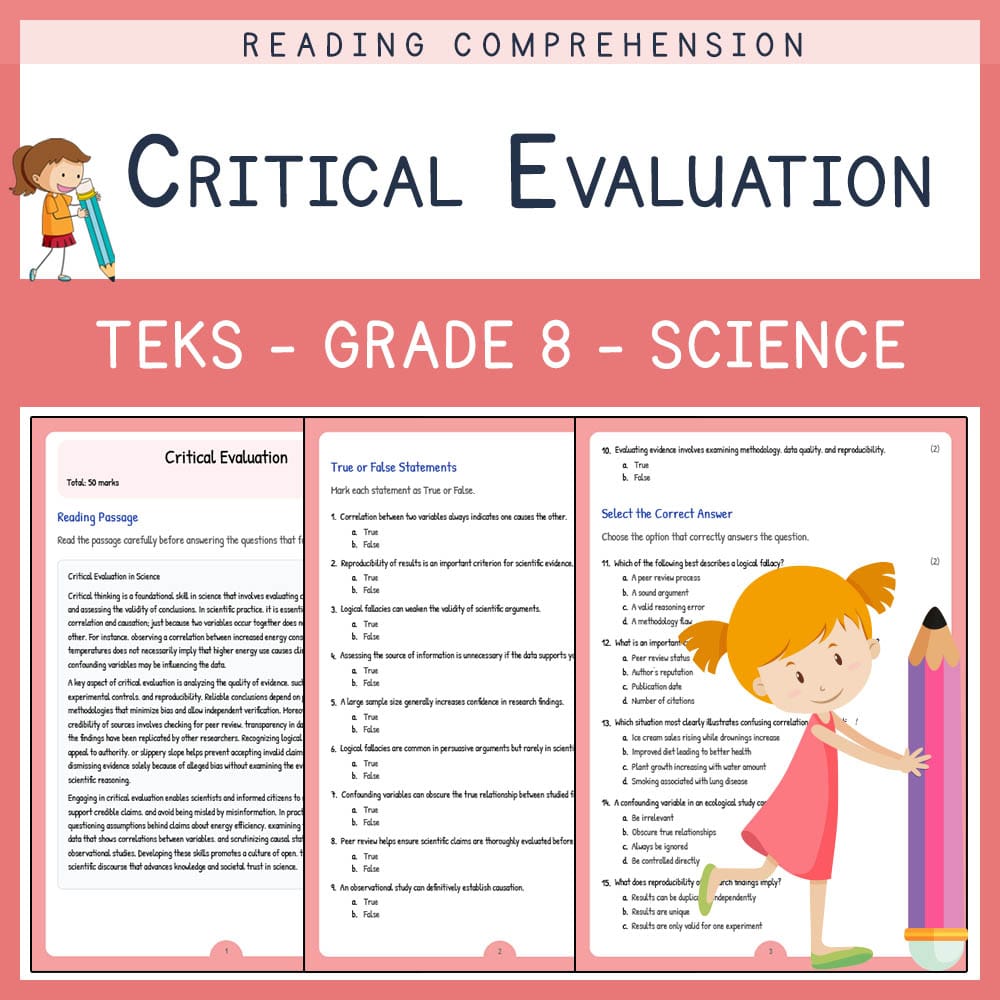
Grade 8 Science | Critical Evaluation Worksheet | TEKS Standards
 Created byLumora Learning
Learning Objectives
- Develop skills in evaluating scientific claims and evidence.
- Identify logical fallacies and distinguish correlation from causation.
- Assess the credibility of sources and interpret data accurately.
Also included in: Grade 8 Science | Science Concepts/Skills Lesson Bundle | TEKS Aligned
Instant download

Grade 8 Land Use Effects Worksheet | BC Practice PDF
Created byClear Sky ClassroomLearning Objectives
- Explain how habitat fragmentation from land use can change resources, edges, and species survival.
- Describe how land use can alter hydrology, soil conditions, and connectivity in an ecosystem.
- Use cause-and-effect reasoning to predict how fragmentation can isolate populations and affect biodiversity.
Instant download
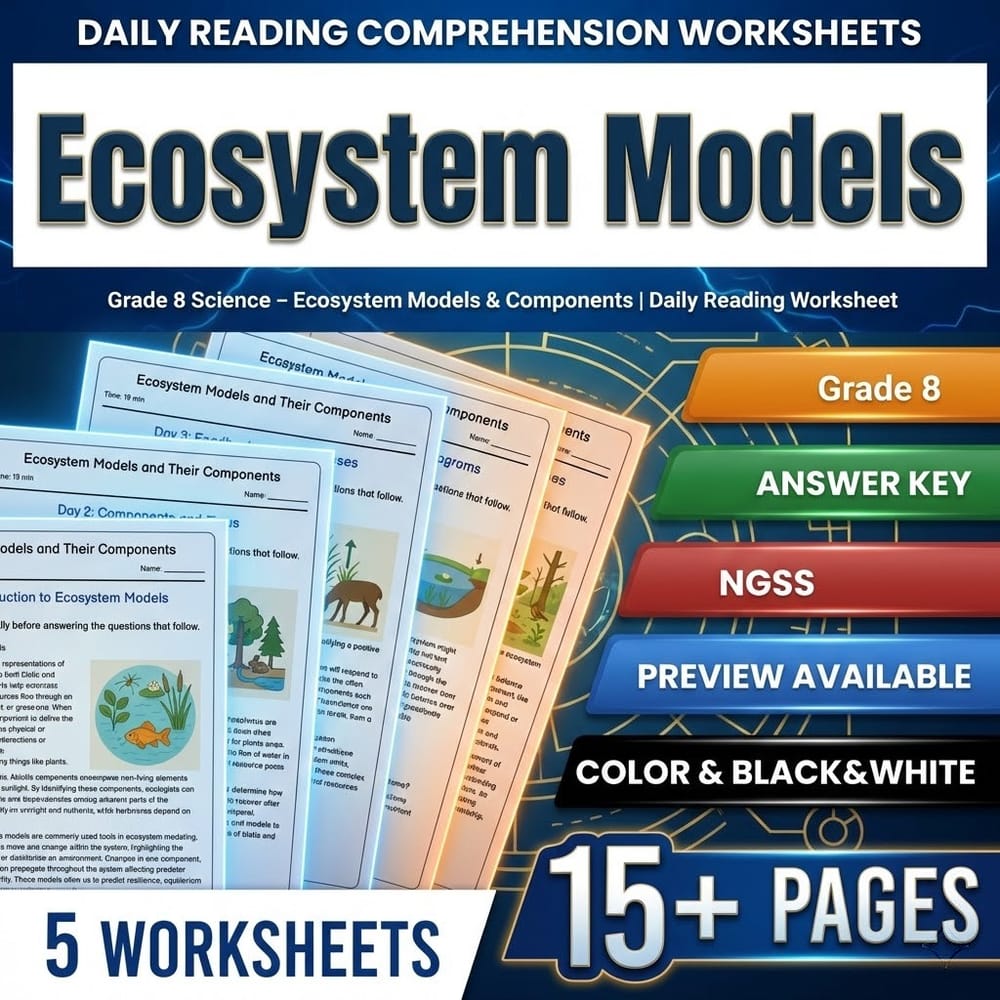
Grade 8 Science – Ecosystem Models & Components | Daily Reading Worksheet
 Created byElena Brooks
Learning Objectives
- Understand the basic components that make up an ecosystem model.
- Learn to identify biotic and abiotic factors in ecological diagrams.
- Recognize boundaries and scales used when constructing ecosystem models.
Instant download
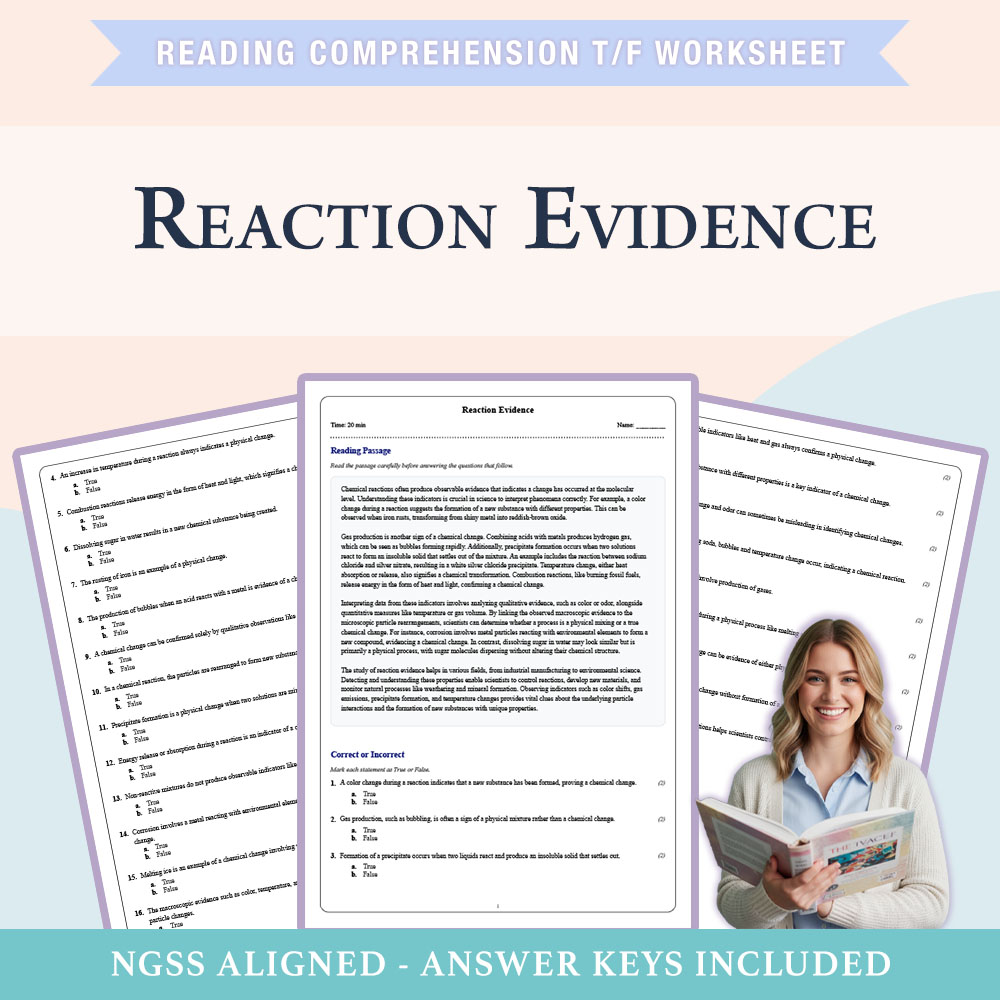
8th Grade Science | Reaction Evidence Worksheet (PDF + Answer Key)
Created byCopper Leaf ClassroomLearning Objectives
- Understand how to identify chemical changes through observable indicators
- Differentiate between chemical and physical processes using qualitative and quantitative data
- Link macroscopic evidence to microscopic particle rearrangements
Also included in: Grade 8 Science Bundle| Critical Concepts & Applications Unit (PDF + Answer Key) +1 more
Instant download
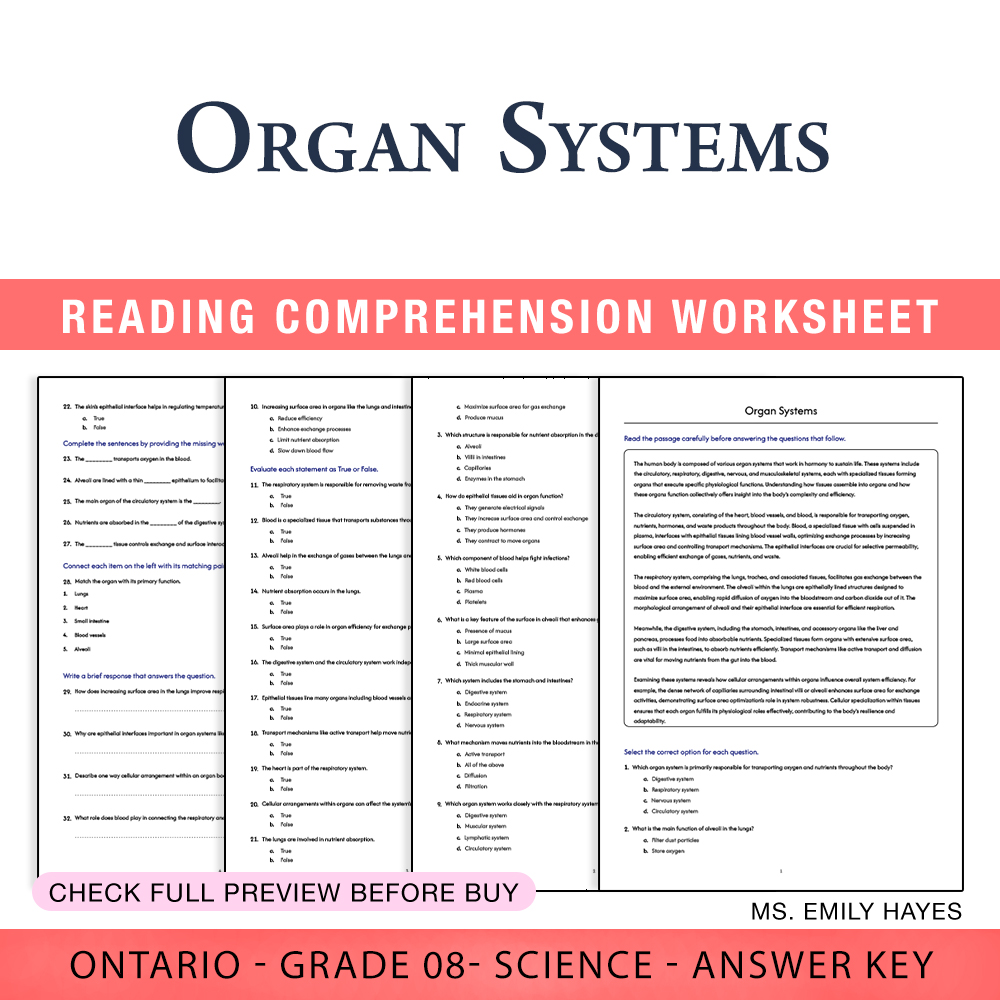
Grade 8 Science | Organ Systems Worksheet (PDF+ Answer Key)
Created byCopper Leaf ClassroomLearning Objectives
- Describe the major functions of circulatory, respiratory, and digestive systems.
- Explain how tissues organize into organs to perform physiological roles.
- Identify how cellular arrangements within organs impact system efficiency.
Instant download

Grade 8 Science | Rate Factors Worksheet (PDF) Aligned to BC Standards
Created byEvergreen Desk EducationLearning Objectives
- Explain how temperature, concentration, and surface area affect reaction rates at the particle level.
- Describe how catalysts change reaction pathways by lowering activation energy.
- Use particle-collision reasoning to predict how changing conditions alters reaction speed.
Instant download
Grade 8 Science | Immune Response Worksheet (Ontario Standards) (PDF)
Created byBright Mind ResourcesLearning Objectives
- Explain the roles of innate and adaptive immune mechanisms in tissue defence.
- Identify cellular players involved in immune response such as macrophages, neutrophils, lymphocytes, and antigen-presenting cells.
- Describe processes like phagocytosis, antibody production, and cell-mediated cytotoxicity.
Instant download
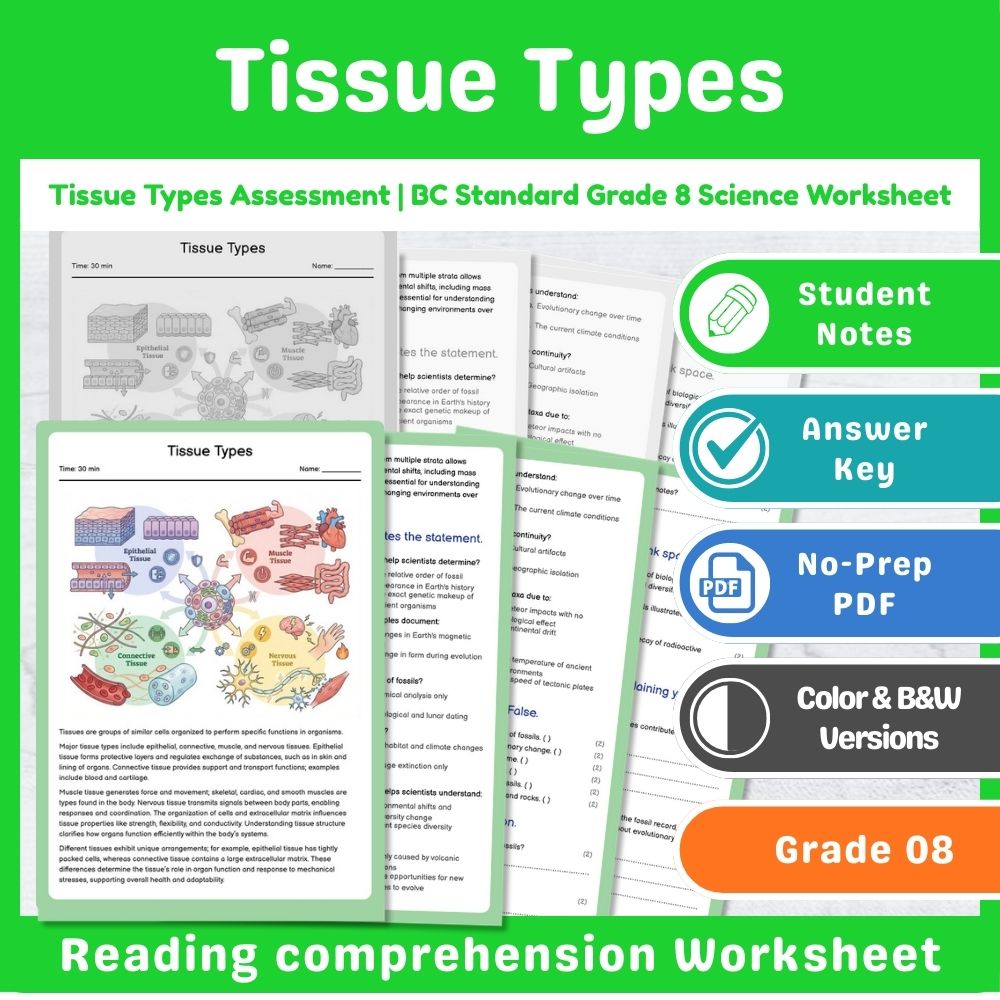
Tissue Types Assessment | BC Standard Grade 8 Science Worksheet
 Created byPrism Point Learning
Learning Objectives
- Identify and describe the four major tissue types: epithelial, connective, muscle, and nervous tissues.
- Compare the structure and functions of different tissue types.
- Explain how cellular organization and extracellular components influence tissue properties.
Instant download
Grade 8 Science – Modeling Data & Models | Daily Reading Worksheet
Created byElena BrooksLearning Objectives
- Understand different types of models used in science including physical, computational, and scaled models.
- Recognize the purpose of models in generating quantitative data and analyzing potential solutions.
- Identify limitations of models and factors like measurement uncertainty and model accuracy.
Instant download
Grade 8 Science | Population Dynamics Worksheet (Worksheet + Answer Key) - TEKS Aligned
Created byBright Mind ResourcesLearning Objectives
- Analyze factors that influence population size and distribution, including resources, competition, and predation.
- Interpret population growth patterns and oscillations using graphs and data.
- Understand the impact of invasive species and community recovery following disturbances.
Also included in: Grade 8 Science Unit Bundle | Ecosystems,Evolution & Cell Processes TEKS Aligned +1 more
Instant download
Grade 8 Science | Population Dynamics Reading Worksheet & Answer Key (PDF)
JCreated byJ.S SheetsLearning Objectives
- Understand the key factors influencing population size and distribution
- Interpret population growth graphs and oscillations
- Analyze case studies of invasive species impacts and recovery after disturbances
Instant download
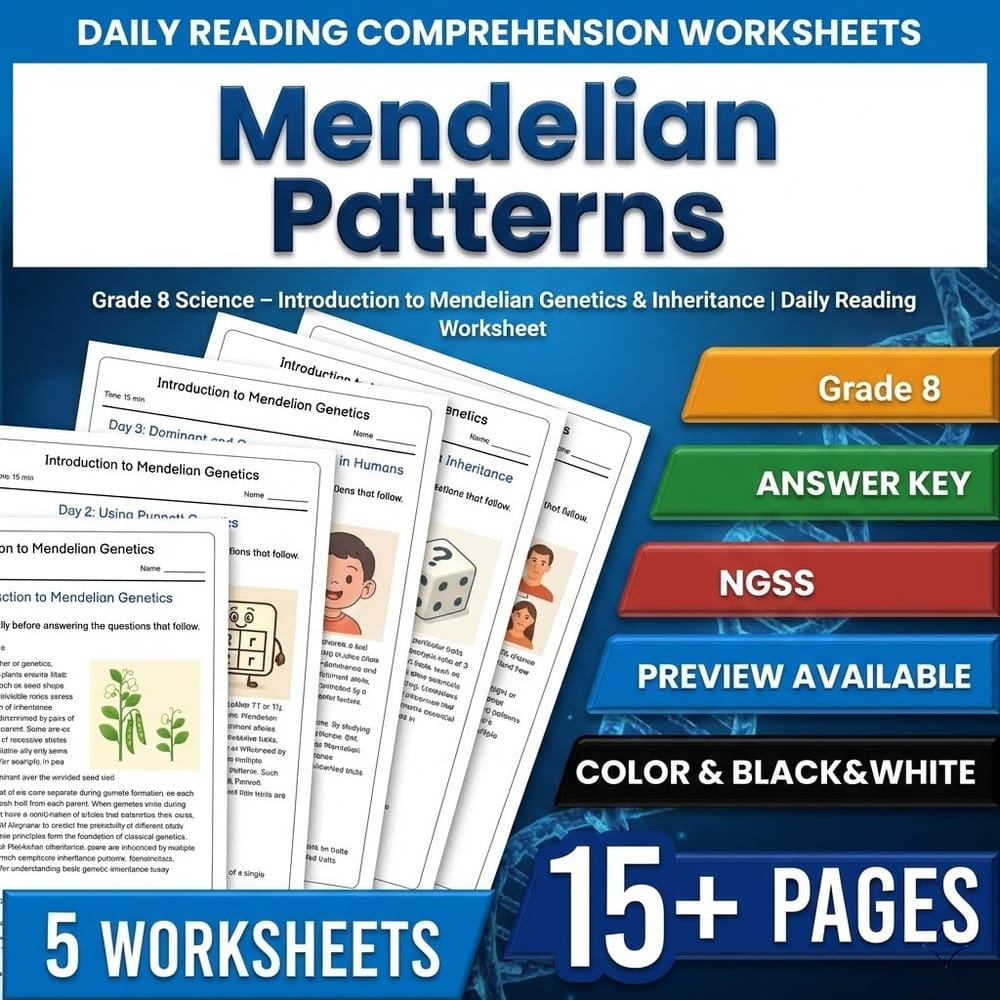
Grade 8 Science – Mendelian Genetics & Inheritance | Daily Reading Worksheet
Created byElena BrooksLearning Objectives
- Understand the basic concepts of dominant and recessive alleles
- Learn how Punnett squares predict inheritance patterns
- Identify observable traits resulting from allele combinations
Instant download
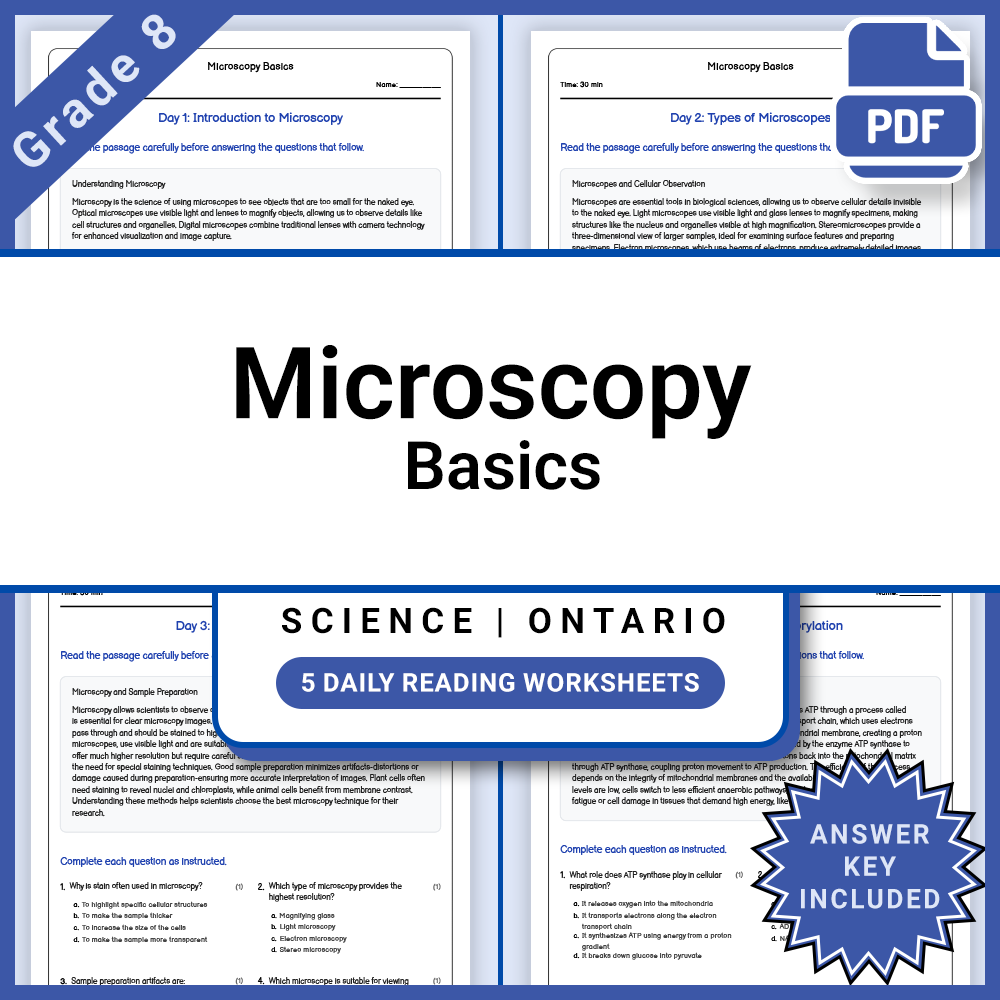
Grade 8 Science – Microscopy Basics Daily Reading Worksheet + Answer Key
JCreated byJ.S SheetsLearning Objectives
- Understand key concepts related to Science
- Apply knowledge through practice questions
- Demonstrate comprehension of the material
Also included in: Grade 8 Science Lesson Group: Ontario Curriculum Reading Worksheets Bundle +1 more
Instant download

Grade 8 Science | Energy Pathways - Daily Reading Comprehension
 Created byCoral Reef Learning
Learning Objectives
- Understand basic concepts of energy transfer in mechanical systems
- Identify how energy flows through gears, pulleys, and hydraulic components
- Recognize points of energy conversion and quantify losses
Instant download

Grade 8 Electrical Safety Worksheet | Grounding & Insulation Alberta
 Created byBRIGHT PATH RESOURCES
Learning Objectives
- Identify how grounding and insulation reduce shock risk in electrical systems
- Explain how protective design and proper material choice lower fire and equipment damage hazards
- Apply safety concepts to everyday scenarios involving electrical devices
Also included in: Grade 8 Alberta Science Electricity and Magnetism Worksheet Bundle +1 more
Instant download
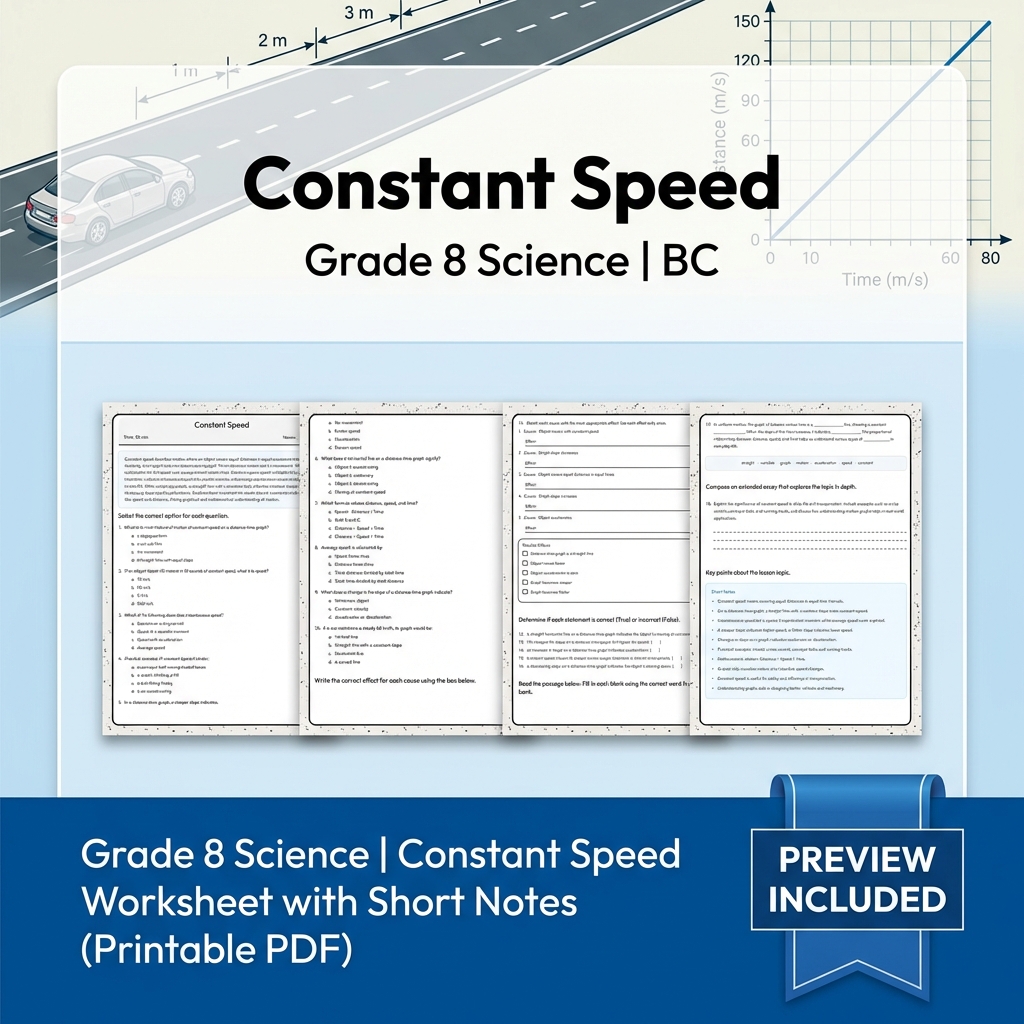
Grade 8 Science | Constant Speed Worksheet with Short Notes (Printable PDF)
Created byMeadowlark WorksheetsLearning Objectives
- Understand the concept of constant speed and its representation on graphs.
- Learn how to calculate average and instantaneous speed in different motion scenarios.
- Interpret distance-time graphs to identify constant speed and acceleration.
Also included in: Grade 8 Science Lesson Bundle | BC Framework & Key Concepts Worksheet Pack +1 more
Instant download
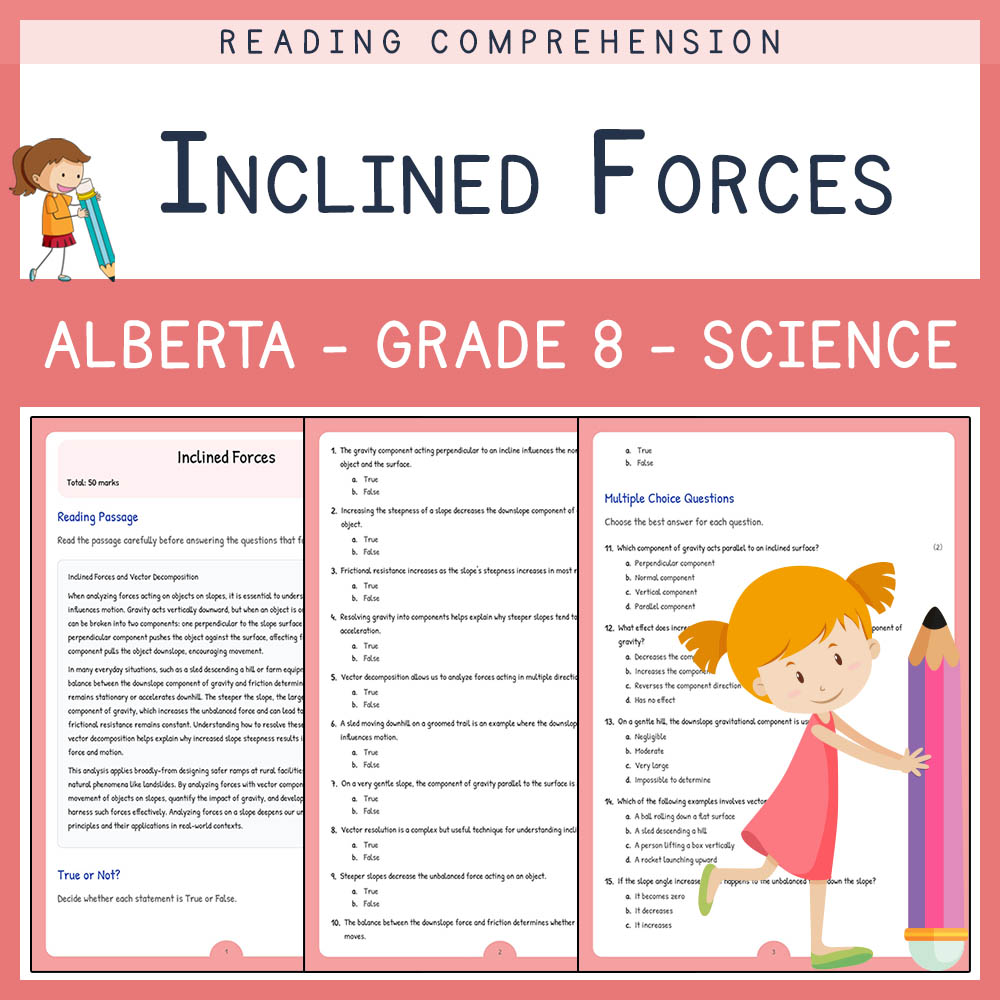
Grade 8 Science | Inclined Forces Worksheet | Alberta Standard
Created byLumora LearningLearning Objectives
- Understand how forces act on slopes and analyze their components
- Learn to resolve gravity into perpendicular and parallel components on an incline
- Evaluate how slope steepness affects the unbalanced force and resulting acceleration
Instant download
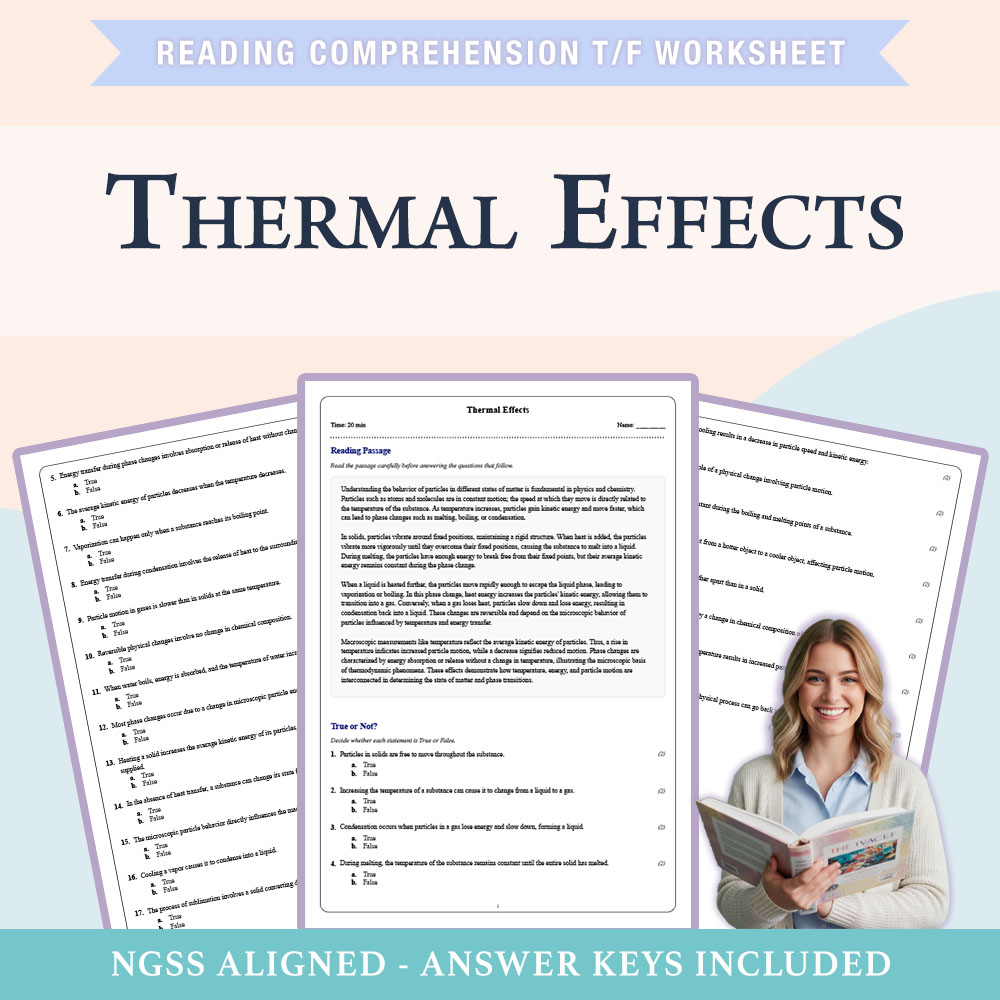
8th Grade Science | Thermal Effects Worksheet (PDF + Answer Key)
Created byCopper Leaf ClassroomLearning Objectives
- Understand how particle motion, temperature, and energy transfer influence states of matter.
- Describe phase changes such as melting, boiling, and condensation from a microscopic perspective.
- Relate macroscopic temperature and heat flow to microscopic particle behavior.
Also included in: Grade 8 Science Bundle| Critical Concepts & Applications Unit (PDF + Answer Key) +1 more
Instant download
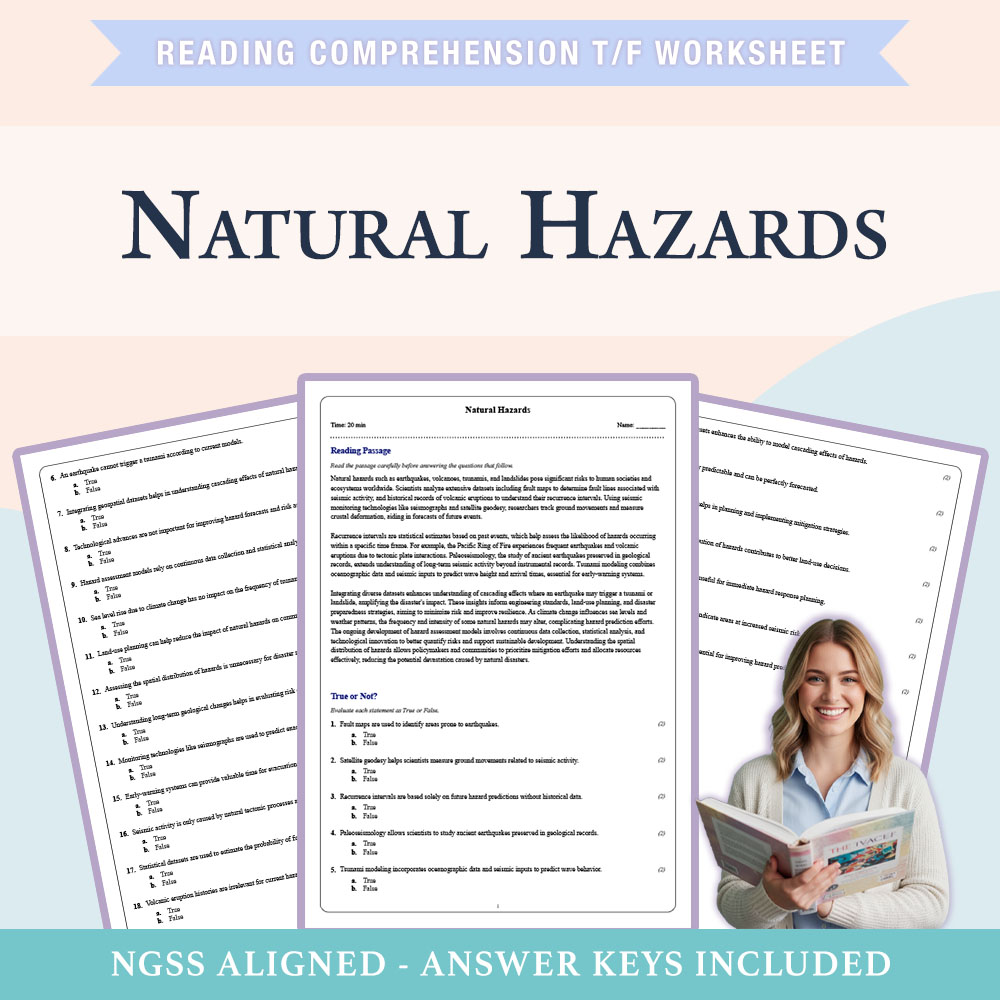
8th Grade Science | Natural Hazards Worksheet (PDF +Answer Key)
Created byCopper Leaf ClassroomLearning Objectives
- Understand and interpret data related to natural hazards such as earthquakes, volcanoes, tsunamis.
- Assess recurrence intervals, spatial distribution, and potential impacts of natural events.
- Evaluate the role of monitoring technologies and modeling in hazard prediction and risk reduction.
Also included in: Grade 8 Science Unit Bundle | Earth Materials Worksheets (PDF + Answer Key) +1 more
Instant download

Grade 8 Science | Cell Structure - Daily Reading Comprehension
Created byCoral Reef LearningLearning Objectives
- Identify the main parts of a cell and explain their functions.
- Differentiate between prokaryotic and eukaryotic cells.
- Compare single-celled and multicellular organisms.
Instant download
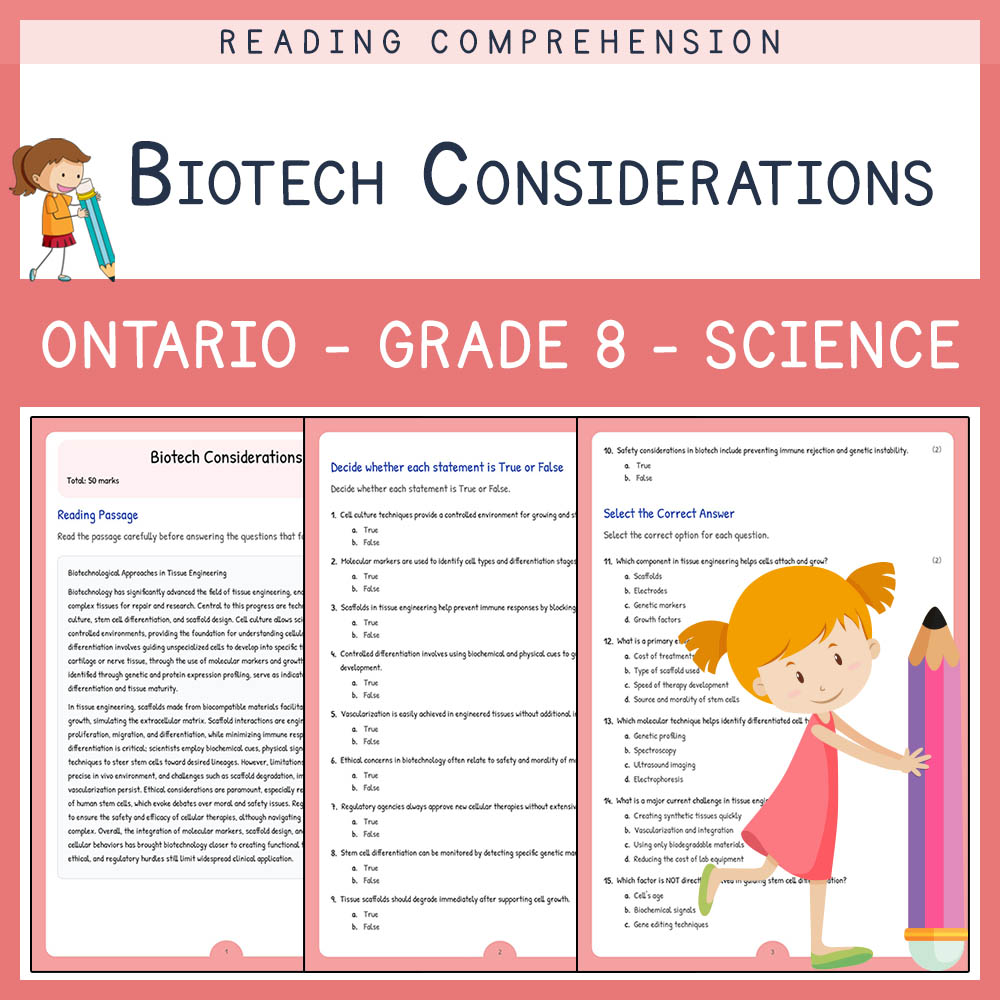
Grade 8 Science Guide | Biotech Considerations Worksheet Elena | Ontario
Created byLumora LearningLearning Objectives
- Understand the key biotechnological methods such as cell culture, stem cell differentiation, and tissue engineering.
- Identify molecular markers and scaffold interactions used in tissue development.
- Discuss ethical, safety, and regulatory considerations in cellular manipulation.
Instant download
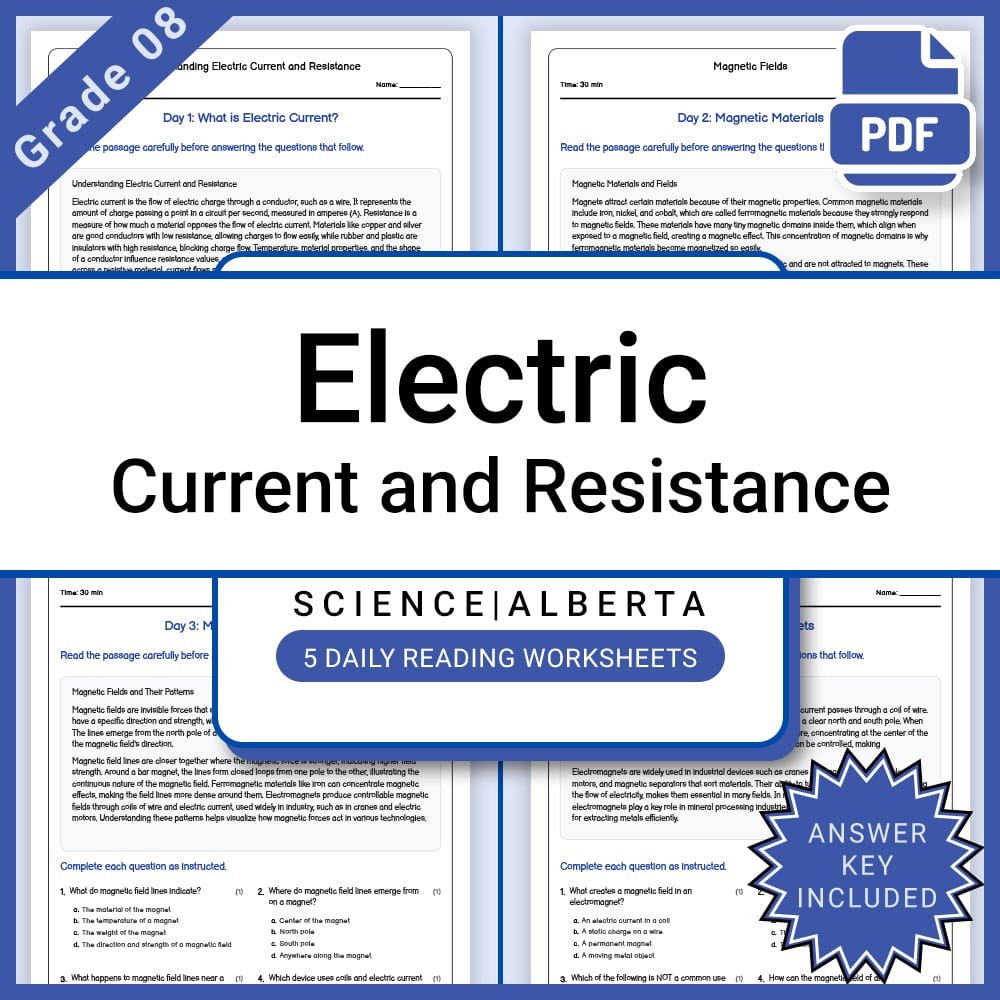
Grade 8 Science – Electric Current and Resistance Daily Worksheet + Answer Key
JCreated byJ.S SheetsLearning Objectives
- Define electric current and resistance
- Explain how material properties affect resistance
- Describe the relationship between voltage, current, and resistance
Also included in: Grade 8 Science Lesson Bundle — Electricity, Circuits & Energy +1 more
Instant download

Grade 8 Science – Electric Current & Resistance | Daily Reading Worksheet
Created byBright Mind ResourcesLearning Objectives
- Define electric current and resistance
- Explain factors affecting resistance in materials
- Describe the relationship between voltage, current, and resistance in circuits
Also included in: Grade 8 Electricity Science Daily Reading Worksheets Lesson Bundle | Alberta +2 more
Instant download
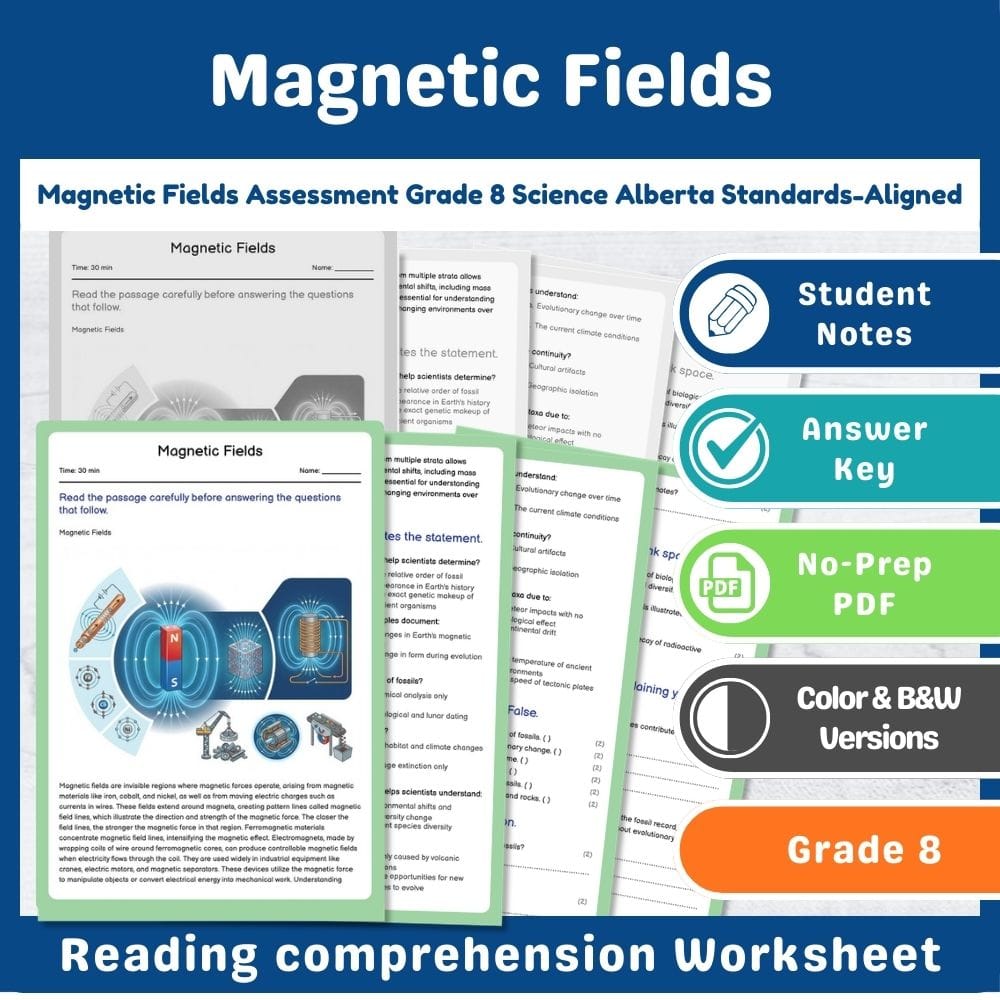
Magnetic Fields Assessment Grade 8 Science Alberta Standards-Aligned
Created byPrism Point LearningLearning Objectives
- Describe the origins and properties of magnetic fields from materials and moving charges.
- Identify the visual representation of magnetic field lines and interpret their significance.
- Explain the concept of ferromagnetic materials and how they concentrate magnetic effects.
Instant download
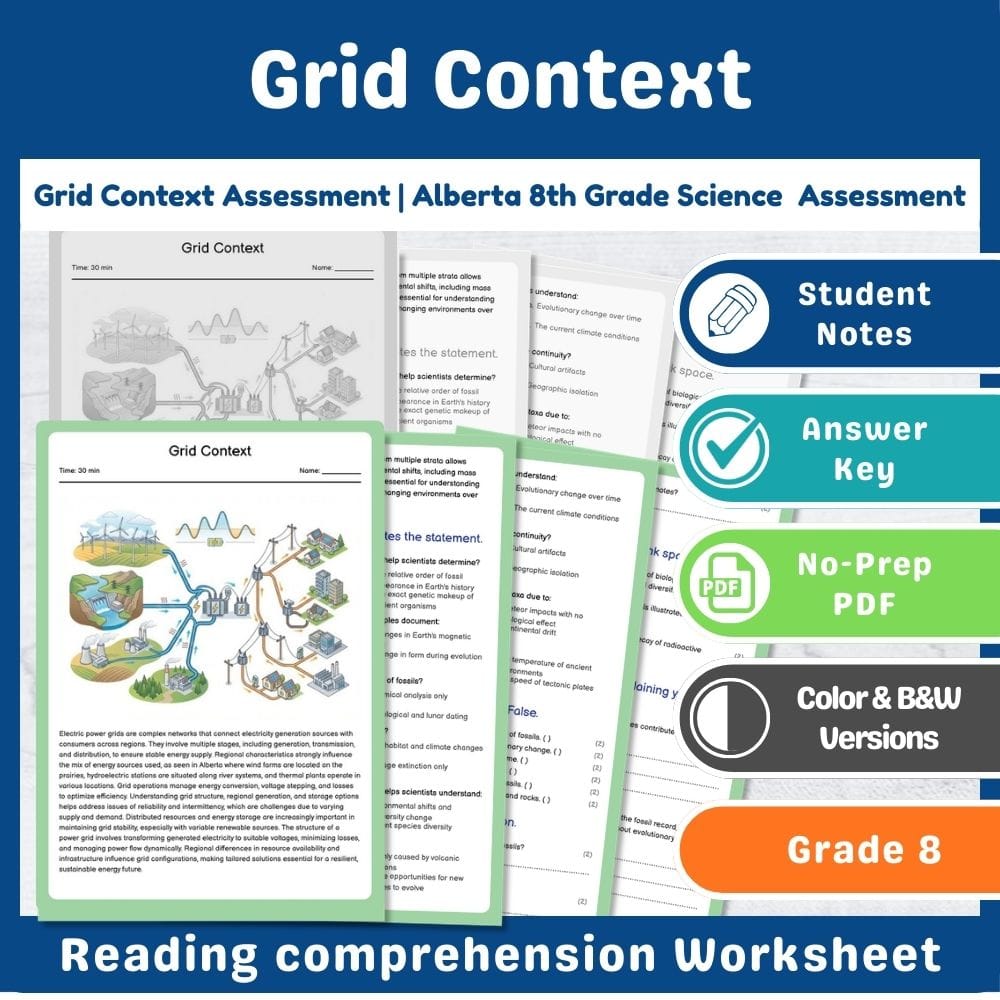
Grid Context Assessment | Alberta 8th Grade Science Standards-Aligned Assessment
Created byPrism Point LearningLearning Objectives
- Understand the components and functions of electric power grids.
- Identify regional characteristics influencing energy generation.
- Explain grid operations including conversion and voltage management.
Instant download
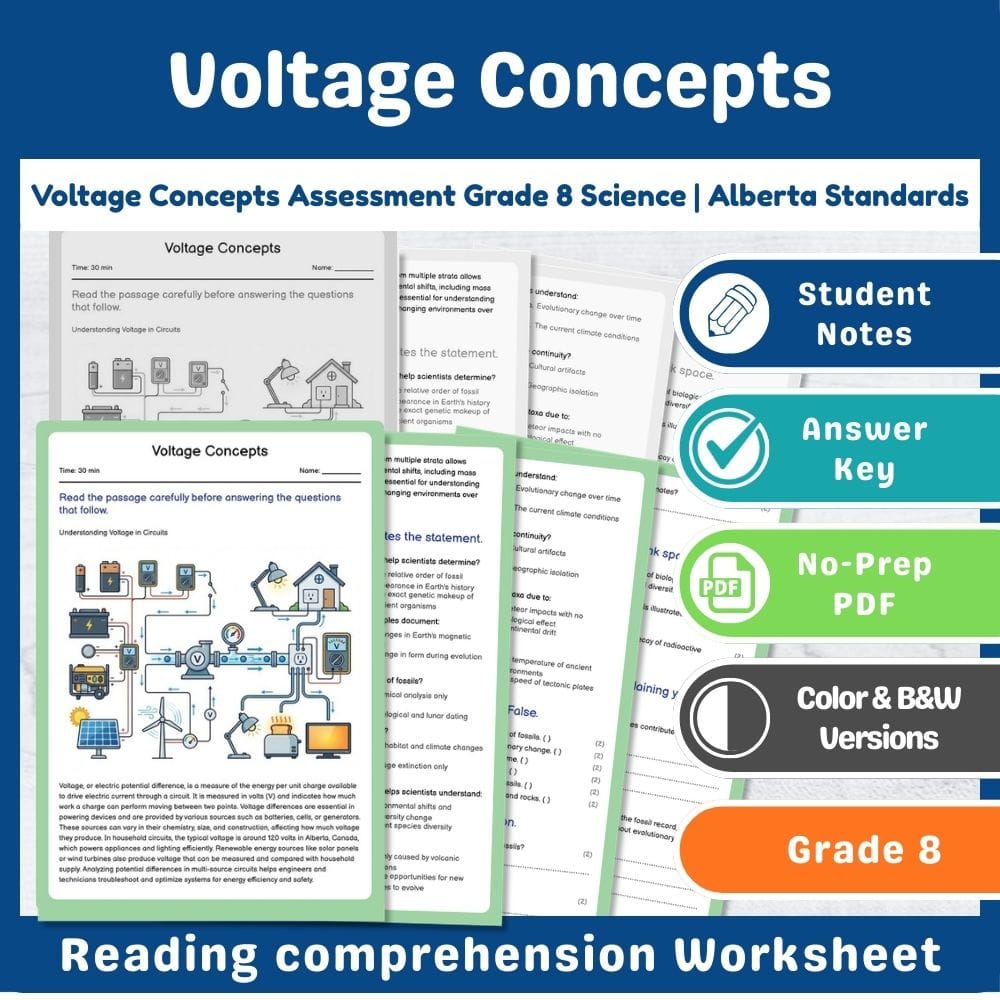
Voltage Concepts Assessment Grade 8 Science | Alberta Standards
Created byPrism Point LearningLearning Objectives
- Understand the concept of electric potential difference and its measurement units.
- Identify different sources of voltage and how they affect current flow in circuits.
- Compare household voltages and renewable energy outputs relevant to Alberta.
Instant download
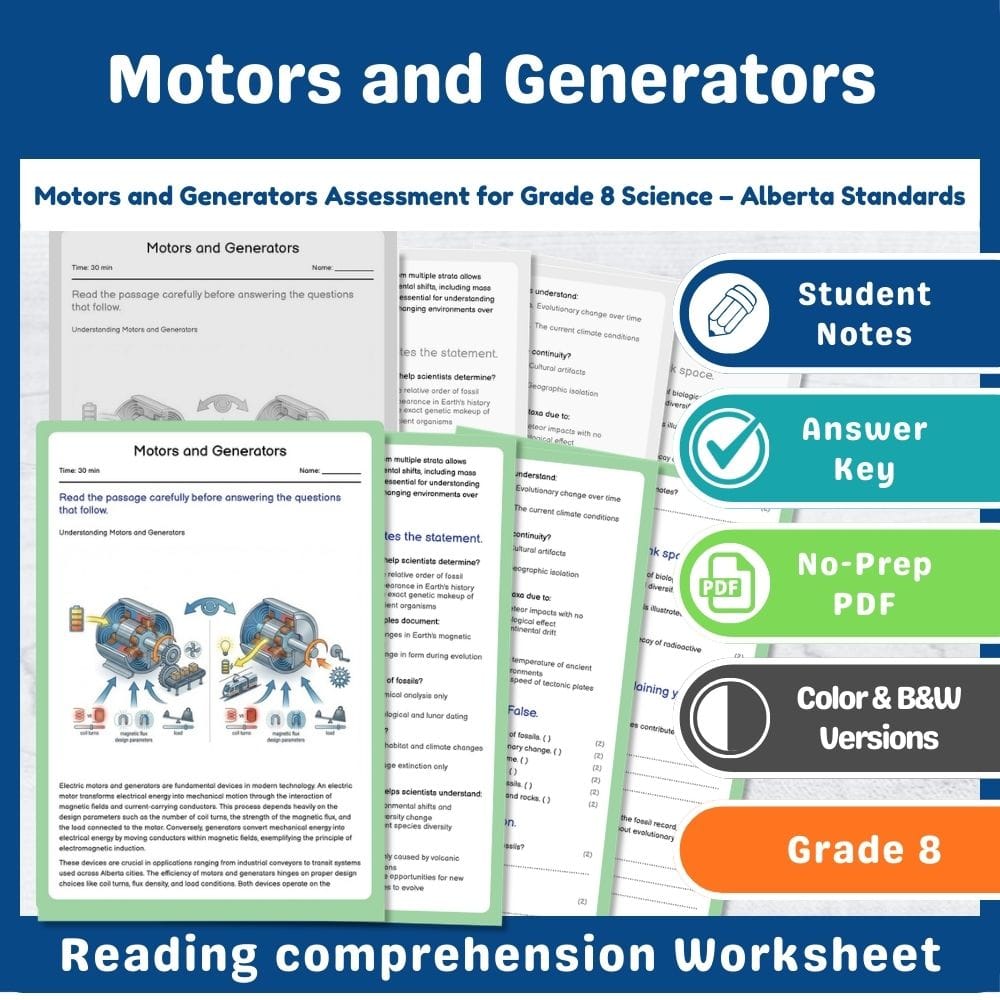
Motors and Generators Assessment for Grade 8 Science – Alberta Standards
Created byPrism Point LearningLearning Objectives
- Understand the principles of how electric motors convert electrical energy into mechanical motion.
- Explain how generators produce electrical energy from mechanical motion.
- Identify design parameters that influence the efficiency and power output of motors and generators.
Instant download
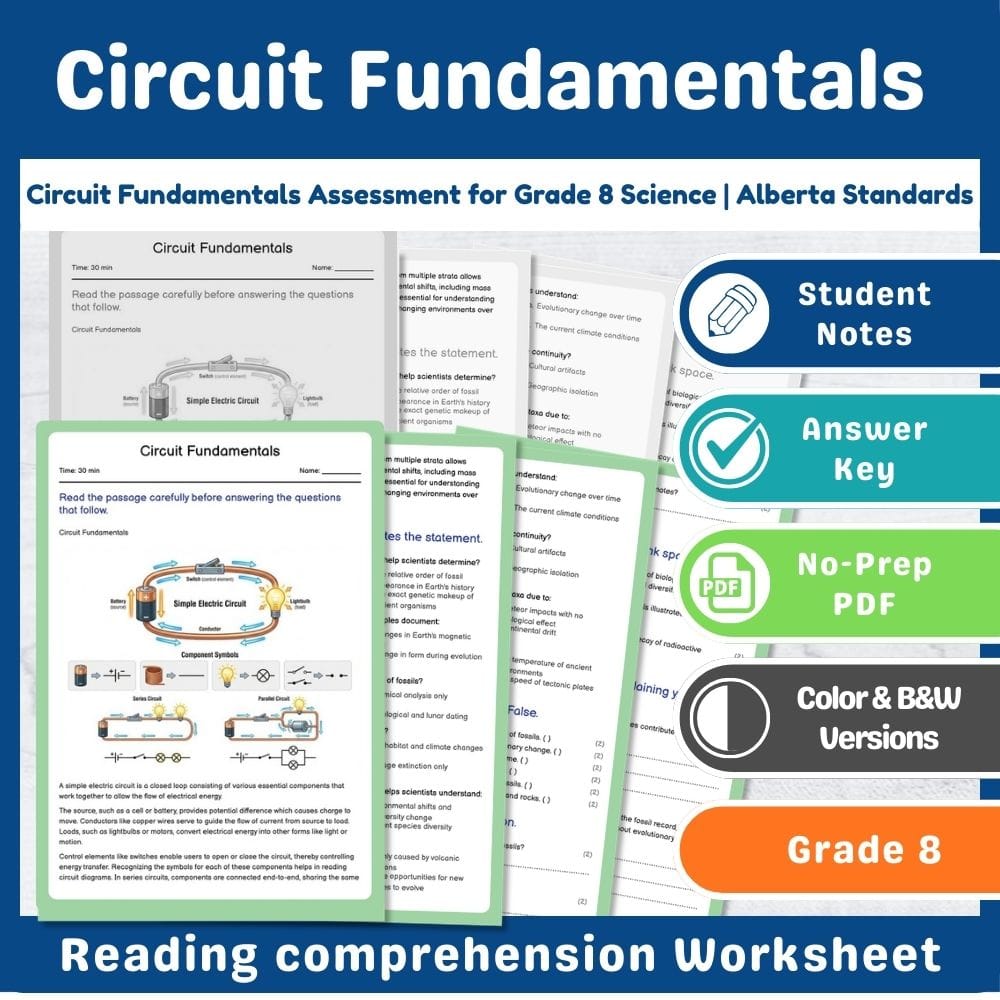
Circuit Fundamentals Assessment for Grade 8 Science | Alberta Standards
Created byPrism Point LearningLearning Objectives
- Identify the main components of a simple electric circuit.
- Explain the functions of sources, conductors, loads, and control elements.
- Recognize schematic symbols for common circuit components.
Instant download
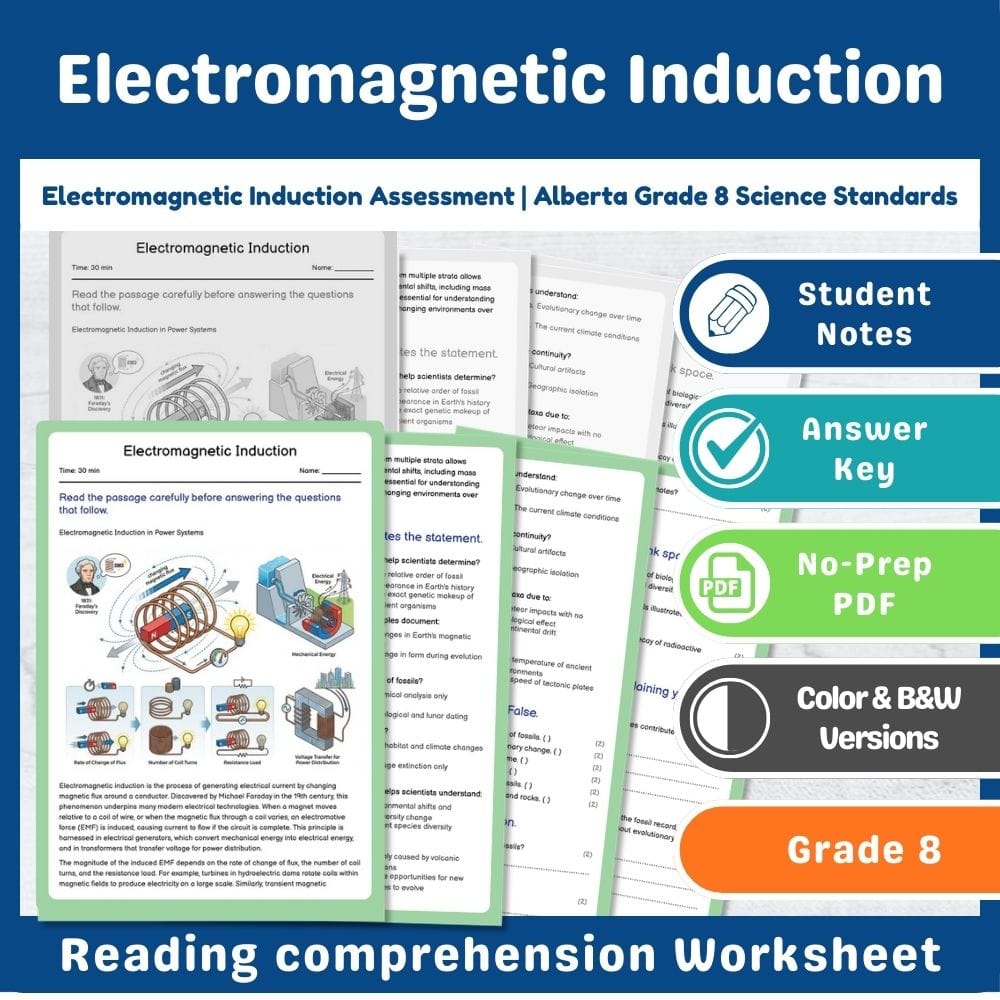
Electromagnetic Induction Assessment | Alberta Grade 8 Science Standards
Created byPrism Point LearningLearning Objectives
- Explain the principle of electromagnetic induction and how changing magnetic flux induces current.
- Identify applications of electromagnetic induction in power generation and renewable energy.
- Describe the factors affecting the magnitude of induced electromotive force in coils.
Instant download
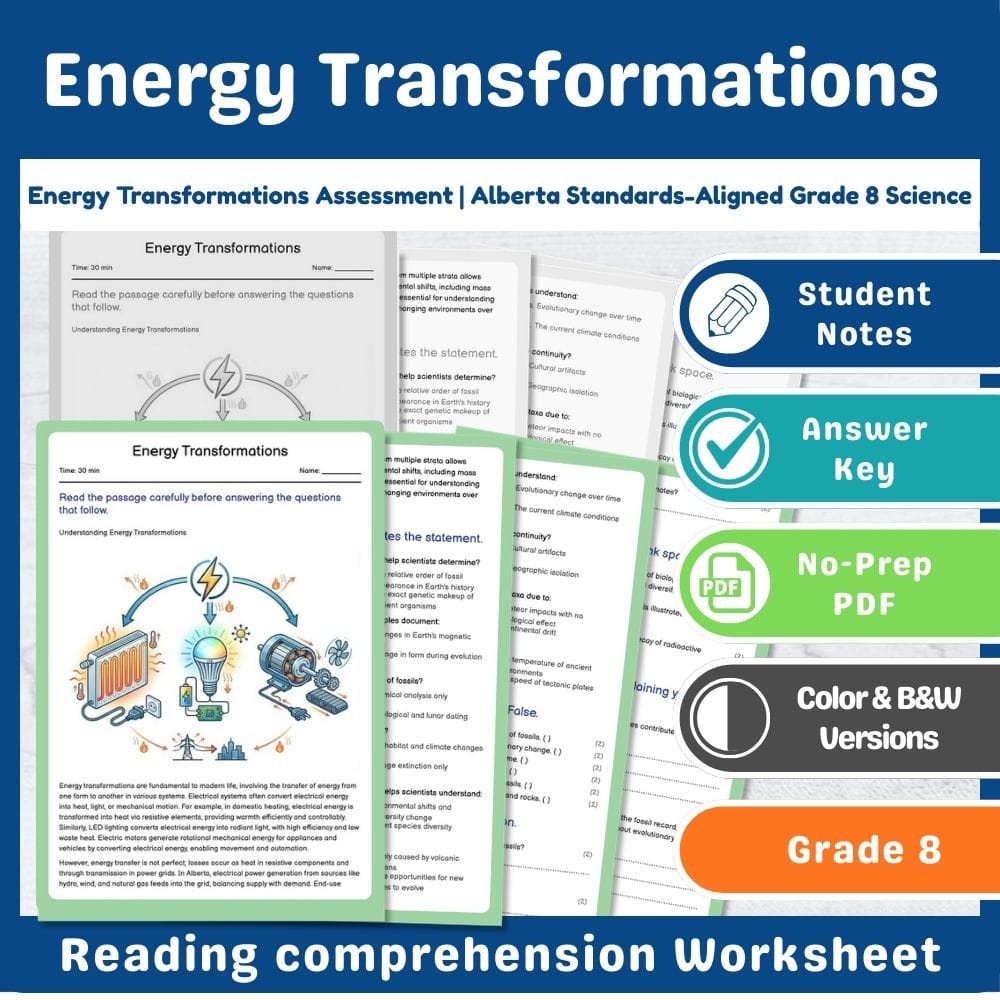
Energy Transformations Assessment | Alberta Standards-Aligned Grade 8 Science
Created byPrism Point LearningLearning Objectives
- Understand how electrical energy is transferred and transformed into thermal, radiant, and mechanical energy.
- Identify examples of energy conversions in domestic and industrial systems.
- Explain the concepts of power and efficiency in energy systems.
Instant download
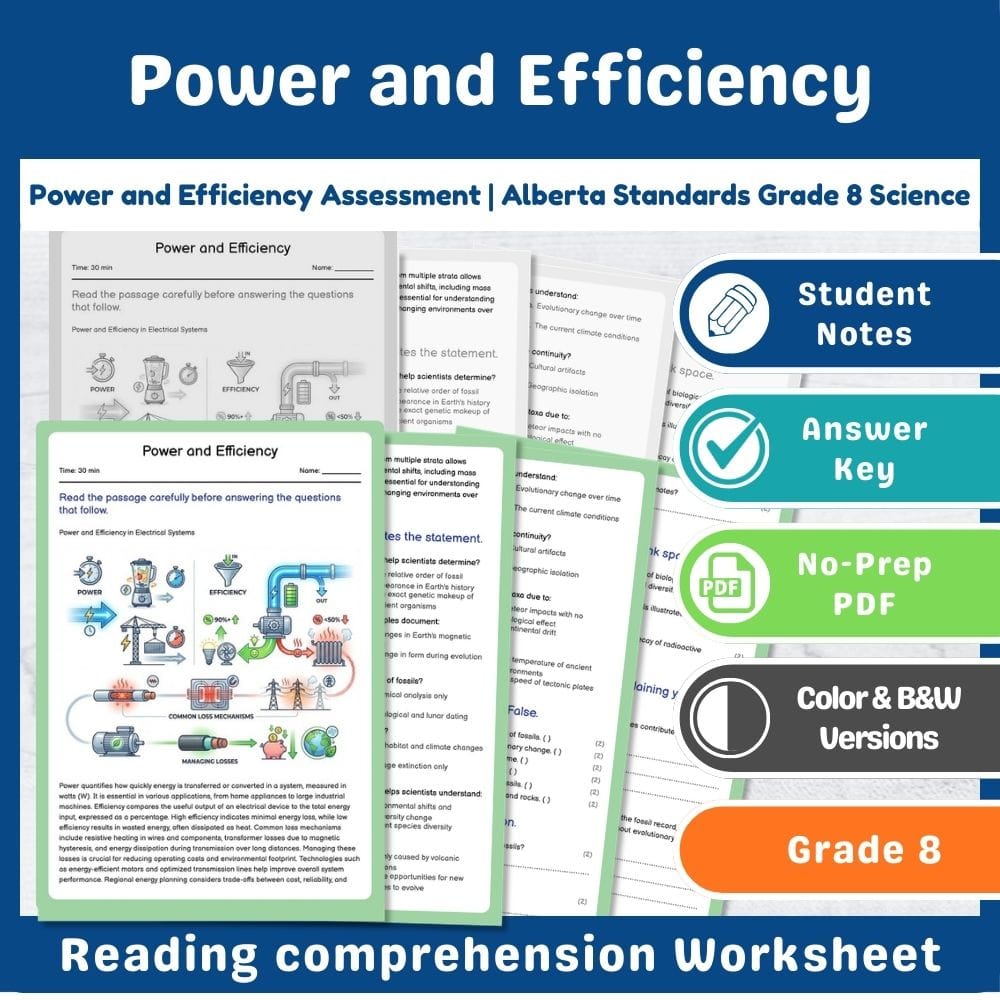
Power and Efficiency Assessment | Alberta Standards Grade 8 Science
Created byPrism Point LearningLearning Objectives
- Understand the concept of power as energy transfer per unit time.
- Identify factors affecting the efficiency of electrical devices.
- Analyze mechanisms of power loss such as resistive heating and transmission dissipation.
Instant download
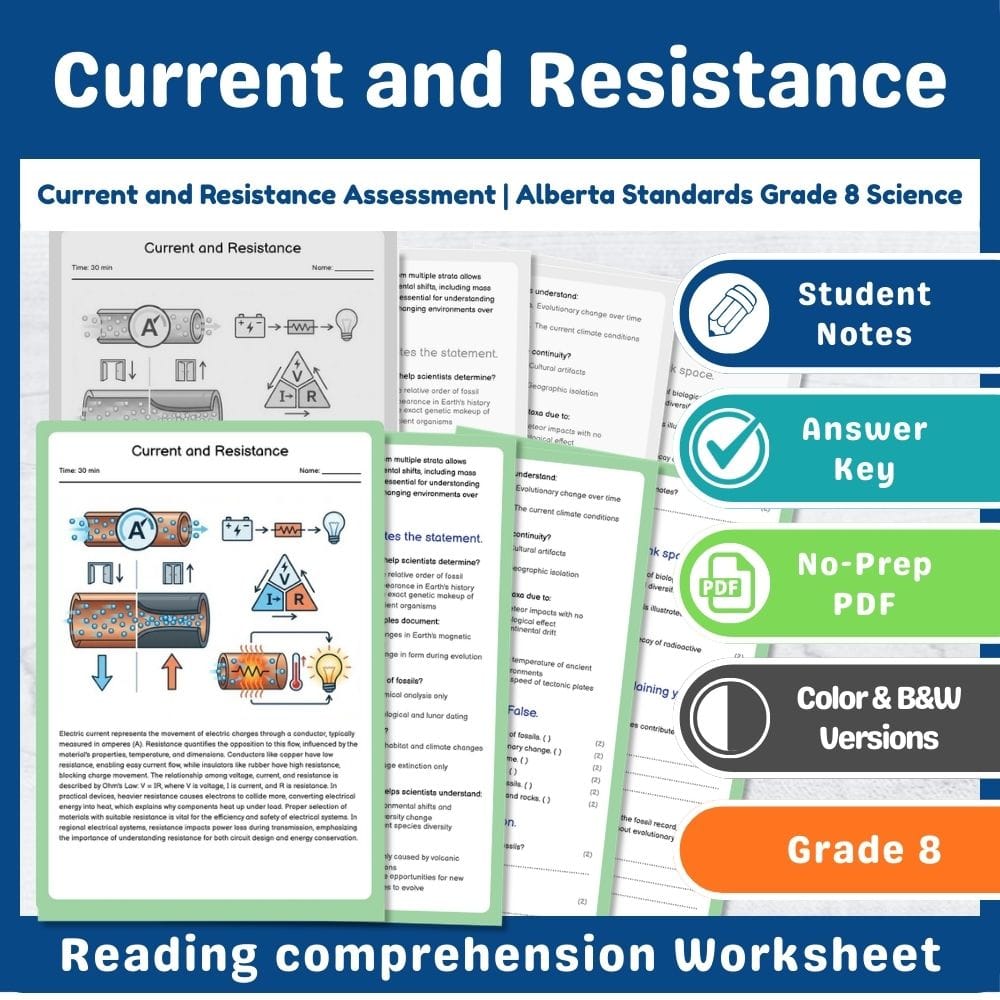
Current and Resistance Assessment | Alberta Standards Grade 8 Science
Created byPrism Point LearningLearning Objectives
- Explain the concept of electric current as the rate of charge flow in materials.
- Describe how resistance affects the flow of current in an electrical circuit.
- Identify factors such as material properties, temperature, and geometry that influence resistance.
Instant download

Electrical Safety and Environmental Implications Assessment for Grade 8 Science
Created byPrism Point LearningLearning Objectives
- Identify key safety considerations in electrical system design and operation.
- Understand environmental impacts related to energy sourcing and infrastructure.
- Recognize protective devices and proper component specifications to mitigate hazards.
Instant download
About Grade 8 Science Worksheets
Explore Grade 8 Science worksheets for classwork, homework, or review. Our 6,006 printables download instantly as PDFs.
Each resource here is built by an independent educator and reviewed for quality. Worksheets print straight from PDF and suit classroom use, homework, or extra practice; most come with answer keys, and you can preview before purchasing.