
Grade 8 Science Worksheets
6,006 worksheets
Grade 8 Science — Statistical Reasoning Worksheet for Data Interpretation
 Created byThe Resource Hub
Learning Objectives
- Understand how to interpret measures of variability and correlation in experimental data.
- Identify appropriate summary statistics for different data distributions.
- Apply basic hypothesis testing logic to evaluate experimental trends.
Also included in: Grade 8 Science Unit Bundle | Scientific Inquiry & Data Skills Worksheet Pack +1 more
Instant download
Grade 8 Science — Communication Skills Worksheet for Mastering Scientific Explanation
Created byThe Resource HubLearning Objectives
- Understand and construct clear, evidence-based scientific explanations
- Apply standard scientific conventions in graphs, tables, and citations
- Utilize claim–evidence–reasoning structure to support scientific arguments
Also included in: Grade 8 Science Unit Bundle | Scientific Inquiry & Data Skills Worksheet Pack +1 more
Instant download
Grade 8 Science — Graphical Reasoning Worksheet for Visual Data Analysis
Created byThe Resource HubLearning Objectives
- Interpret slopes, areas under curves, and rates of change in graphical data.
- Connect graphical representations with physical phenomena like motion, velocity, and reaction rates.
- Translate between equations, data tables, and graphs to analyze and predict physical behaviors.
Also included in: Grade 8 Science Unit Bundle | Scientific Inquiry & Data Skills Worksheet Pack +1 more
Instant download
Grade 8 Science — Applied Investigations Worksheet for Mastery
Created byThe Resource HubLearning Objectives
- Understand how to design experiments that measure real-world phenomena.
- Learn how to select appropriate variables and procedures for investigations.
- Analyze data using graphical and statistical summaries to draw conclusions.
Also included in: Grade 8 Science Unit Bundle | Scientific Inquiry & Data Skills Worksheet Pack +1 more
Instant download
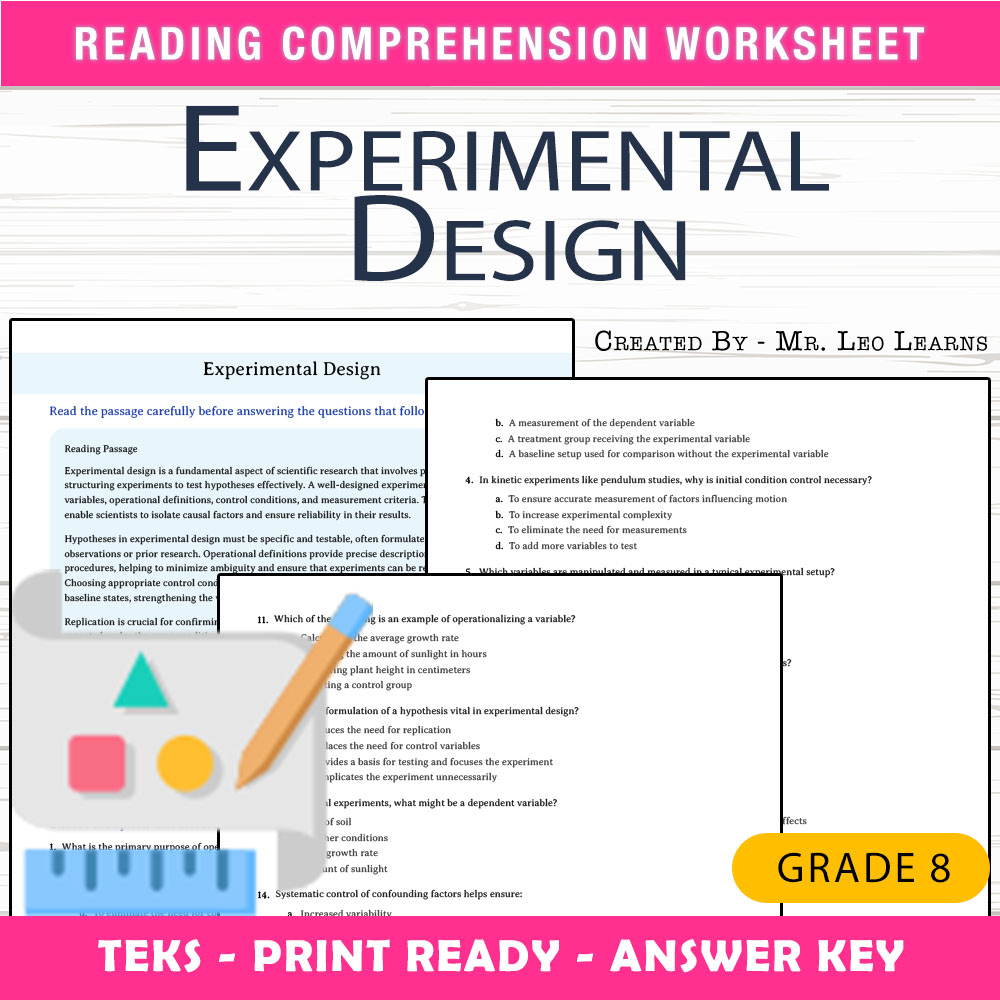
8th Grade Science — Experimental Design Worksheet for Mastery
Created byThe Resource HubLearning Objectives
- Understand the key components and procedures of experimental design.
- Identify variables and controls in scientific experiments.
- Explain the importance of replication and systematic measurement.
Also included in: Grade 8 Science Unit Bundle | Scientific Inquiry & Data Skills Worksheet Pack +1 more
Instant download
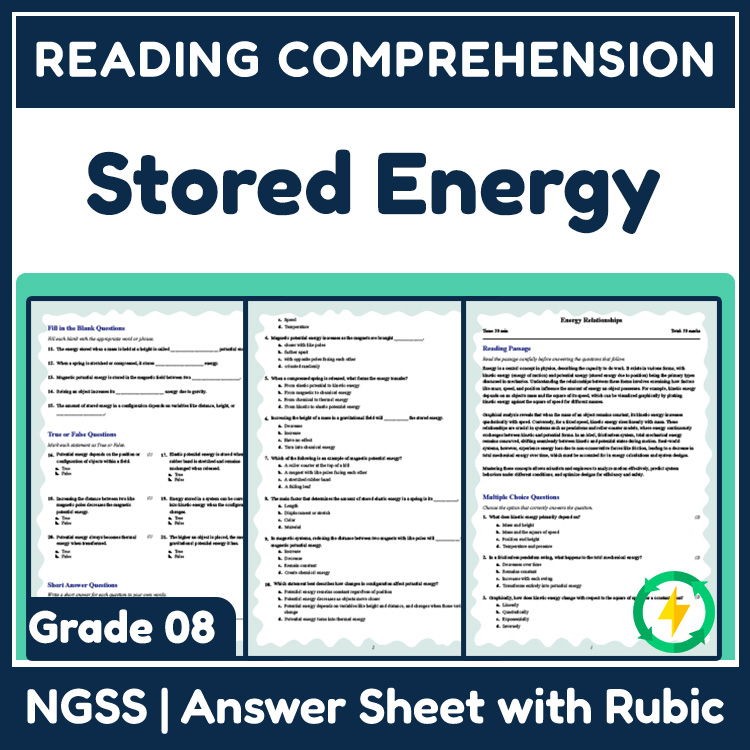
8th Grade Science | Stored Energy Reading Worksheets (NGSS Aligned)
JCreated byJ.S SheetsLearning Objectives
- Understand the concept of stored energy due to the position and configuration of objects
- Identify different types of potential energy including gravitational, elastic, and magnetic
- Analyze how changes in the position or arrangement of objects affect stored energy
Instant download

Grade 8 Science – Stored Energy & Types | Daily Reading Worksheet
 Created byBright Mind Resources
Learning Objectives
- Identify different forms of stored energy based on object positions
- Understand how changes in configuration affect potential energy
- Recognize examples of gravitational, elastic, and magnetic potential energy
Also included in: Thermal Energy Grade 8 Science Daily Reading Worksheets Lesson Bundle | NGSS +1 more
Instant download
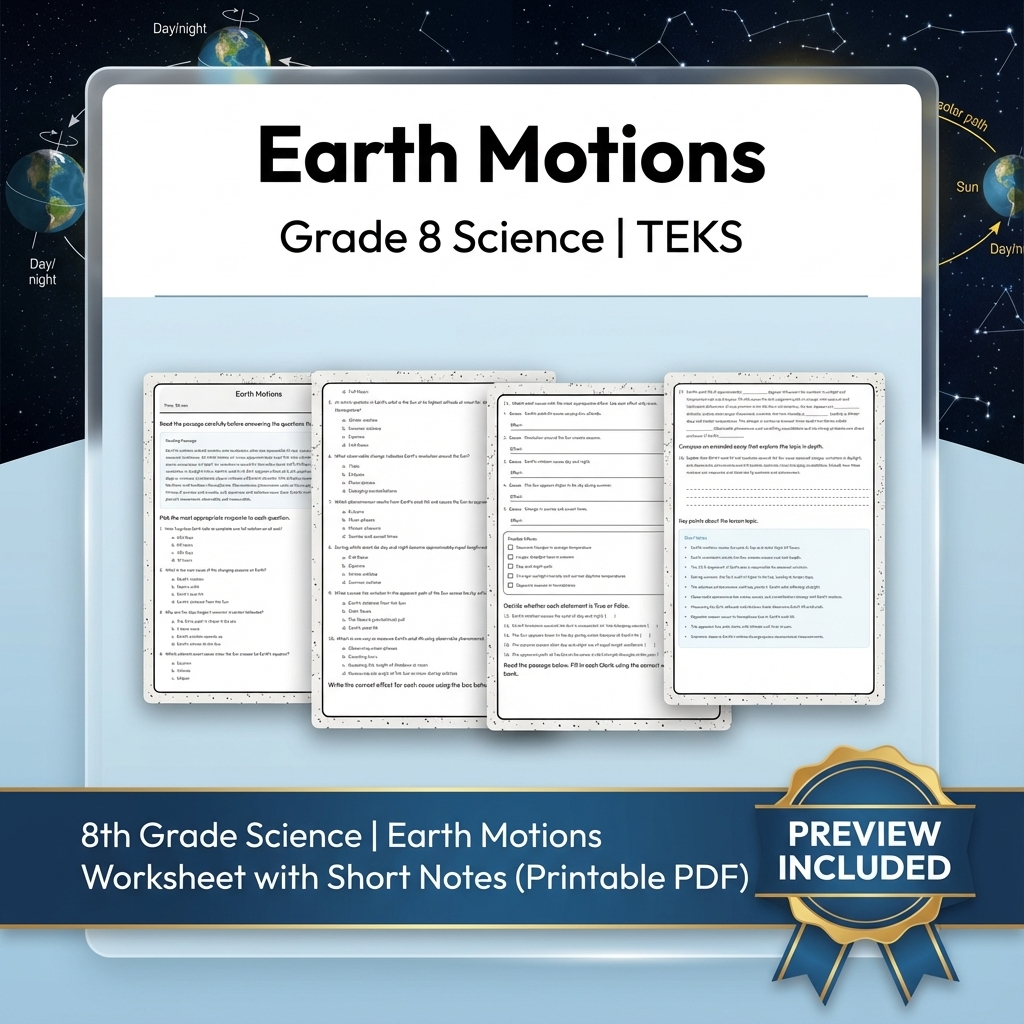
8th Grade Science | Earth Motions Worksheet with Short Notes (Printable PDF)
 Created byMeadowlark Worksheets
Learning Objectives
- Understand Earth's rotation and revolution and their effects on day and night cycles.
- Describe how axial tilt influences seasonal changes in temperature and daylight.
- Explain the apparent path of the Sun and how it varies with latitude and time of year.
Instant download

Atomic Structure Worksheet | Grade 8 Science Practice
 Created byPrism Point Learning
Learning Objectives
- Distinguish elements, compounds, and mixtures using examples such as hydrogen, oxygen, sodium, and sodium chloride
- Explain how atoms combine to form formulas and how that relates to chemical bonding
- Use ideas from simple atomic models (protons, neutrons, electrons) to describe atomic structure
Also included in: Grade 8 Matter & Reactions Science Lesson Bundle (TEKS Worksheets) +1 more
Instant download

Reaction Rates Worksheet | Grade 8 Science Activities
Created byPrism Point LearningLearning Objectives
- Explain how reaction rate changes with temperature, concentration, surface area, and catalysts using collision and activation-energy ideas
- Relate molecular changes to observable time scales, such as rusting and effervescence
- Use quantitative reasoning (relative speed and time) to predict which conditions increase or decrease reaction rates
Also included in: Grade 8 Matter & Reactions Science Lesson Bundle (TEKS Worksheets) +1 more
Instant download

Energy Transfer Worksheet | Grade 8 Science Activities
Created byPrism Point LearningLearning Objectives
- Explain how conduction, convection, and radiation transfer thermal energy.
- Describe how energy transfer can cause observable temperature changes and phase changes.
- Distinguish between endothermic and exothermic processes using everyday examples.
Also included in: Grade 8 Matter & Reactions Science Lesson Bundle (TEKS Worksheets) +1 more
Instant download
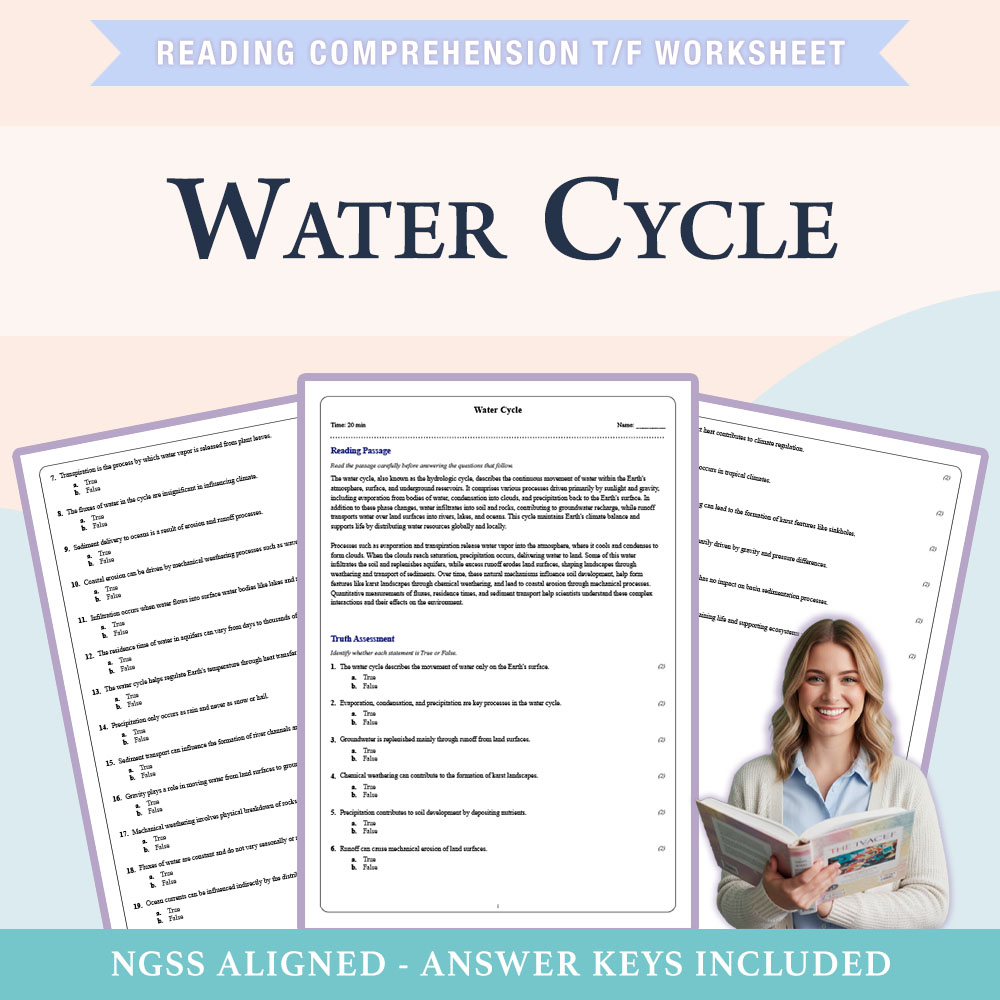
8th Grade Science | Water Cycle Worksheet (PDF +Answer Key)
 Created byCopper Leaf Classroom
Learning Objectives
- Understand the processes involved in the water cycle including evaporation, condensation, precipitation, infiltration, runoff, and groundwater flow.
- Explain how the water cycle influences weathering and erosion processes on land surfaces.
- Identify the connection between hydrologic fluxes and observable environmental effects such as soil development and sediment transport.
Also included in: Grade 8 Science Unit Bundle | Earth Materials Worksheets (PDF + Answer Key) +1 more
Instant download

8th Grade Science | Plate Motions Worksheet (PDF +Answer Key)
Created byCopper Leaf ClassroomLearning Objectives
- Understand the mechanisms of plate tectonics including seafloor spreading, subduction, rifting, and continental collision.
- Identify landforms associated with different plate movements such as mountains, ocean basins, and volcanic arcs.
- Explain how paleomagnetic and stratigraphic evidence support theories of past continental configurations.
Also included in: Grade 8 Science Unit Bundle | Earth Materials Worksheets (PDF + Answer Key) +1 more
Instant download

Grade 8 Science | Ecosystem Shifts - Daily Reading Comprehension
 Created byCoral Reef Learning
Learning Objectives
- Identify components of an ecosystem and their functions
- Understand how natural events cause changes in ecosystems
- Recognize the impact of human activities on ecosystems
Instant download
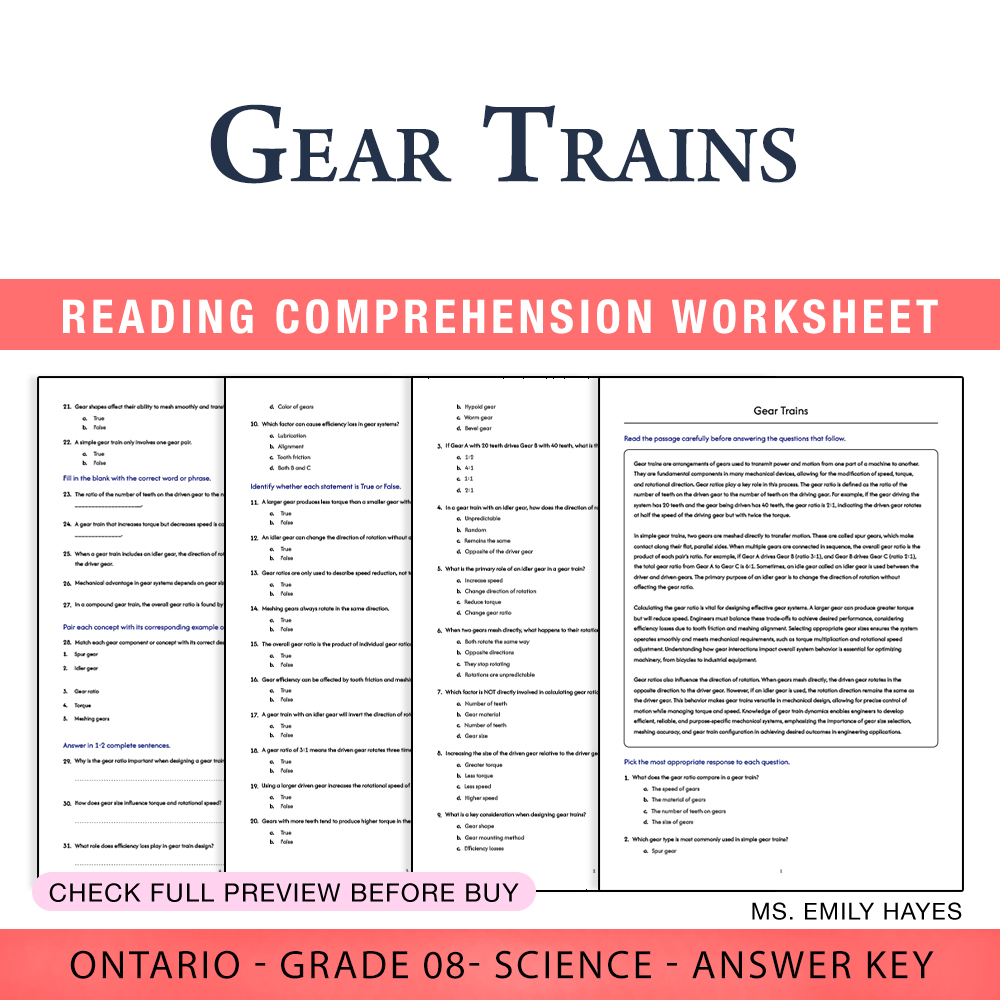
Grade 8 Science | Gear Trains Worksheet (PDF+ Answer Key)
Created byCopper Leaf ClassroomLearning Objectives
- Explain the concept of gear ratios and how they determine mechanical advantage in gear trains.
- Calculate the overall gear ratio, including in simple and compound gear trains.
- Describe the roles of spur gears and idler gears in changing direction and transferring torque.
Instant download
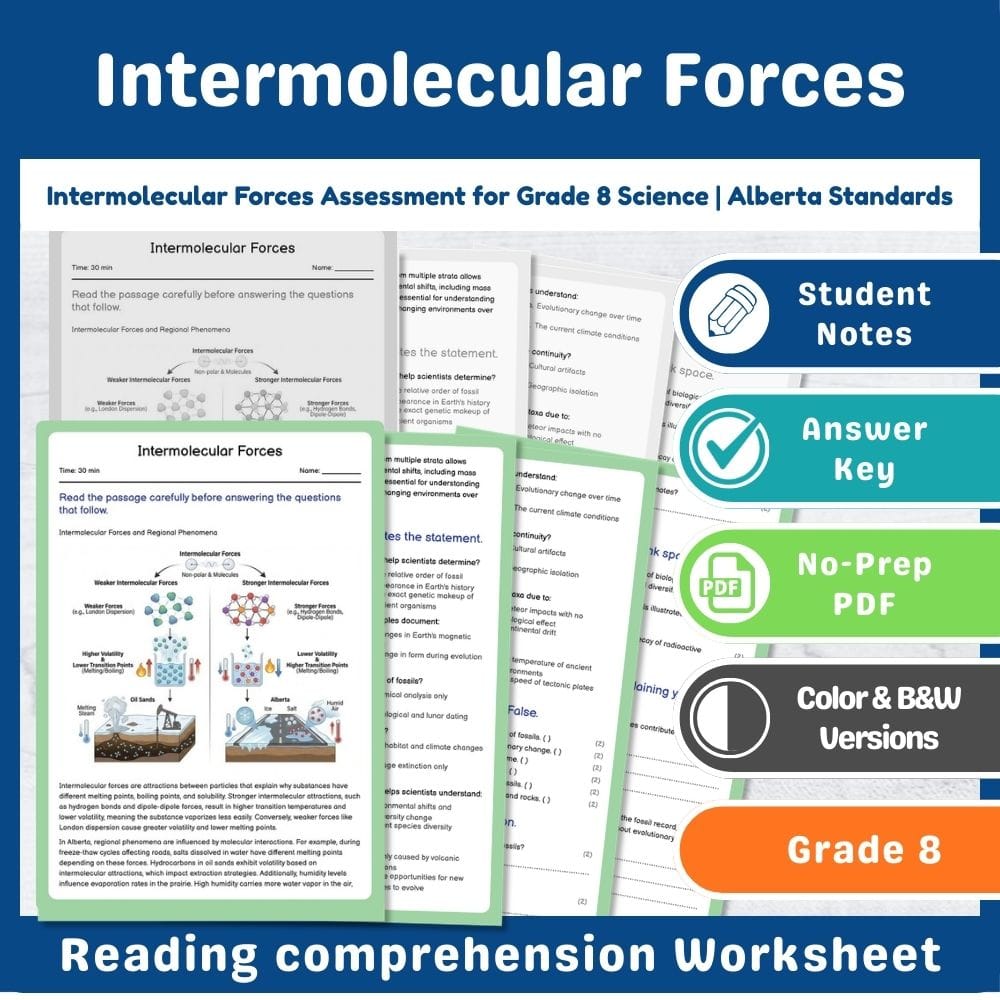
Intermolecular Forces Assessment for Grade 8 Science | Alberta Standards
Created byPrism Point LearningLearning Objectives
- Explain how intermolecular forces affect melting and boiling points.
- Describe the regional effects of molecular interactions, like freeze–thaw cycles and vapor pressures in Alberta.
- Relate intermolecular forces to regional phenomena such as humidity influence on evaporation rates.
Instant download
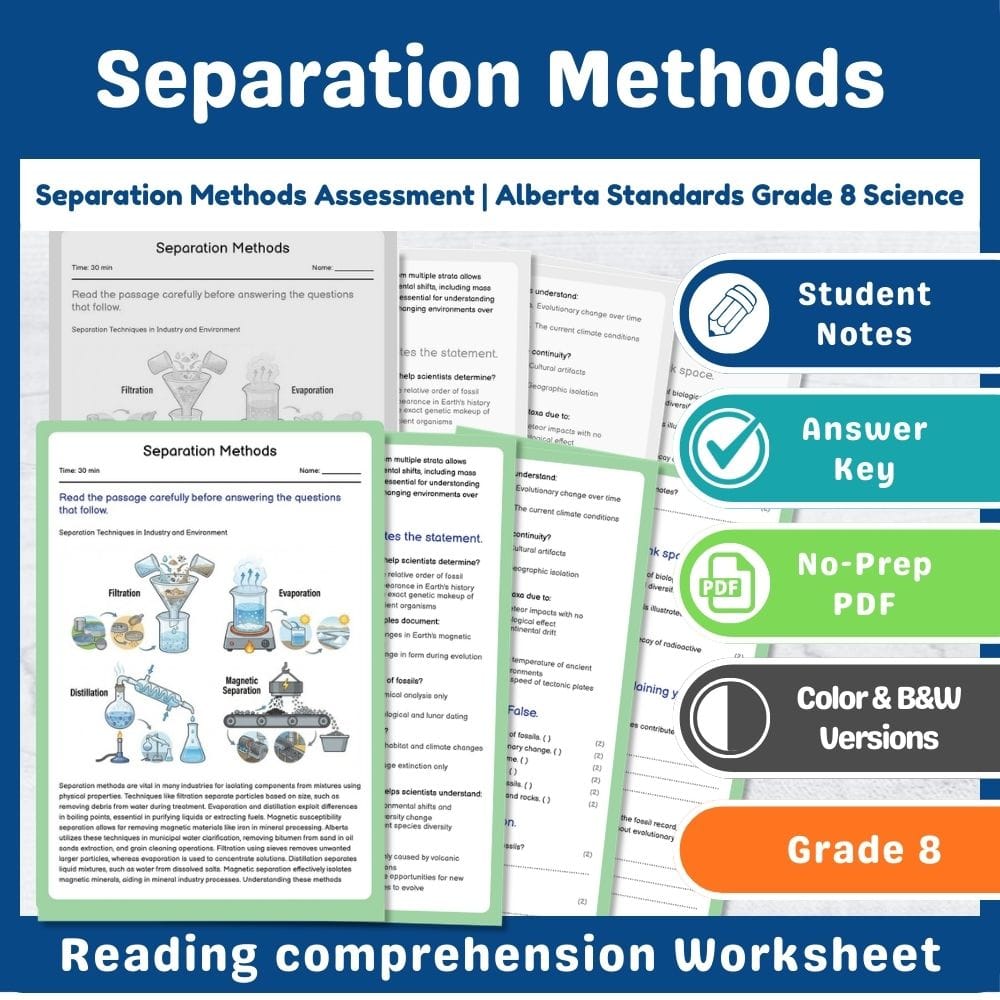
Separation Methods Assessment | Alberta Standards Grade 8 Science
Created byPrism Point LearningLearning Objectives
- Understand the various separation techniques based on physical property differences.
- Identify the applications of filtration, evaporation, distillation, and magnetism in real-world scenarios.
- Describe the purpose of each separation method and how they are used in industry and environmental management.
Instant download
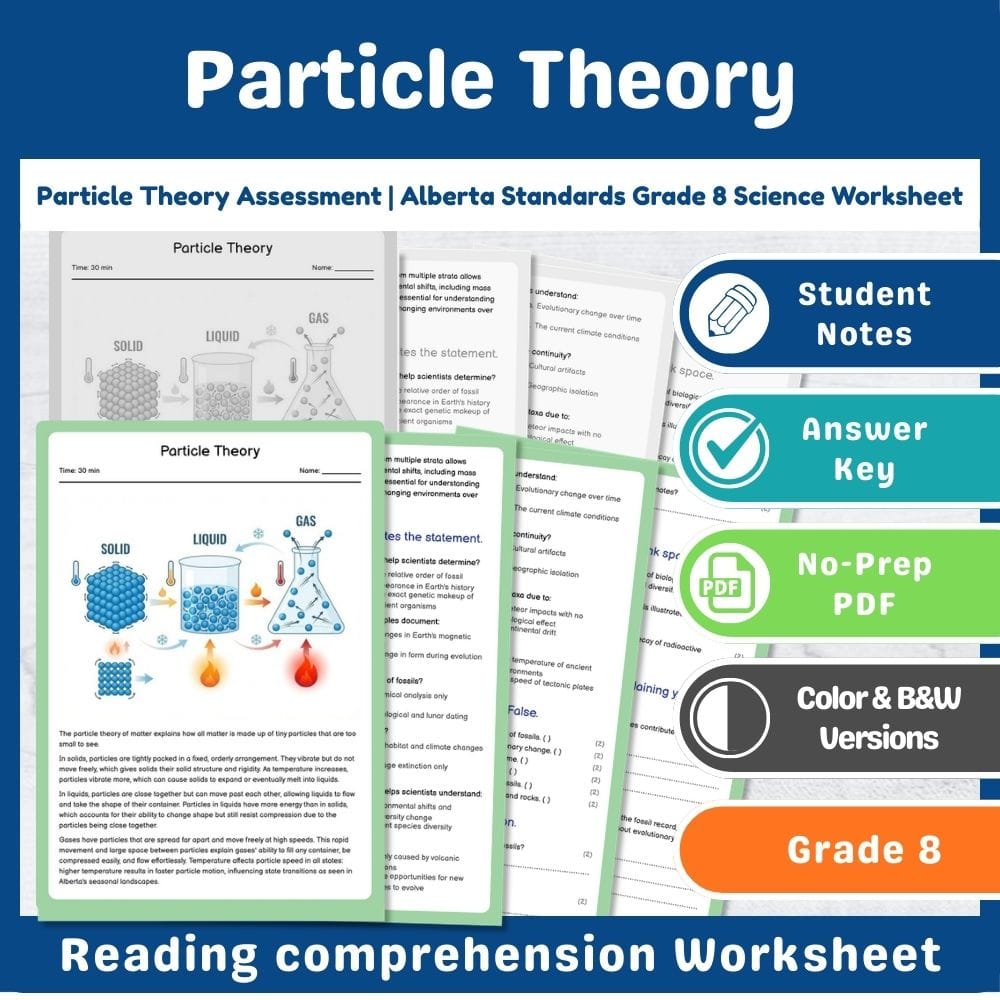
Particle Theory Assessment | Alberta Standards Grade 8 Science Worksheet
Created byPrism Point LearningLearning Objectives
- Describe the basic principles of the particle theory of matter.
- Explain how particle motion and arrangement influence the properties of solids, liquids, and gases.
- Connect microscopic particle behavior with observable macroscopic traits such as rigidity, flow, and compressibility.
Instant download
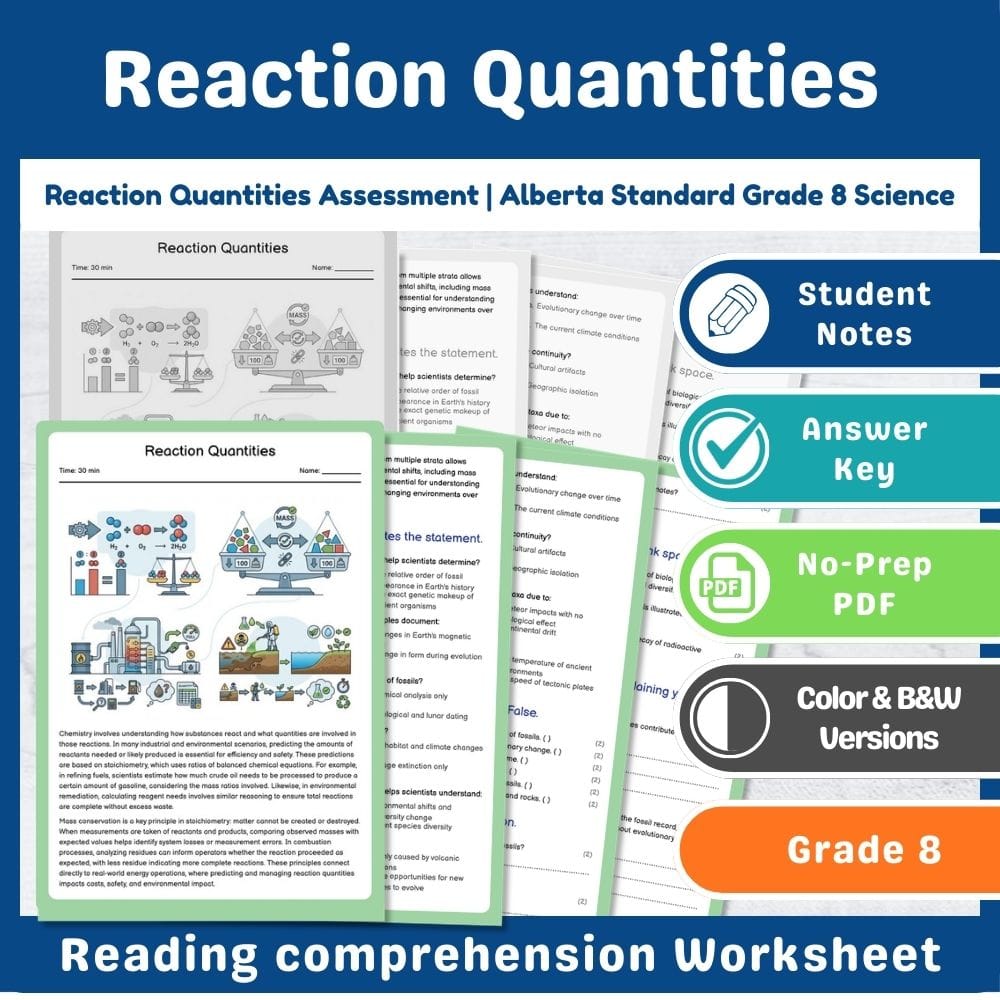
Reaction Quantities Assessment | Alberta Standard Grade 8 Science
Created byPrism Point LearningLearning Objectives
- Understand how to connect measurable masses of reactants and products using proportional reasoning.
- Apply mass conservation principles to interpret chemical reactions in real-world systems.
- Use stoichiometric thinking to estimate material balances and assess reaction outcomes.
Instant download
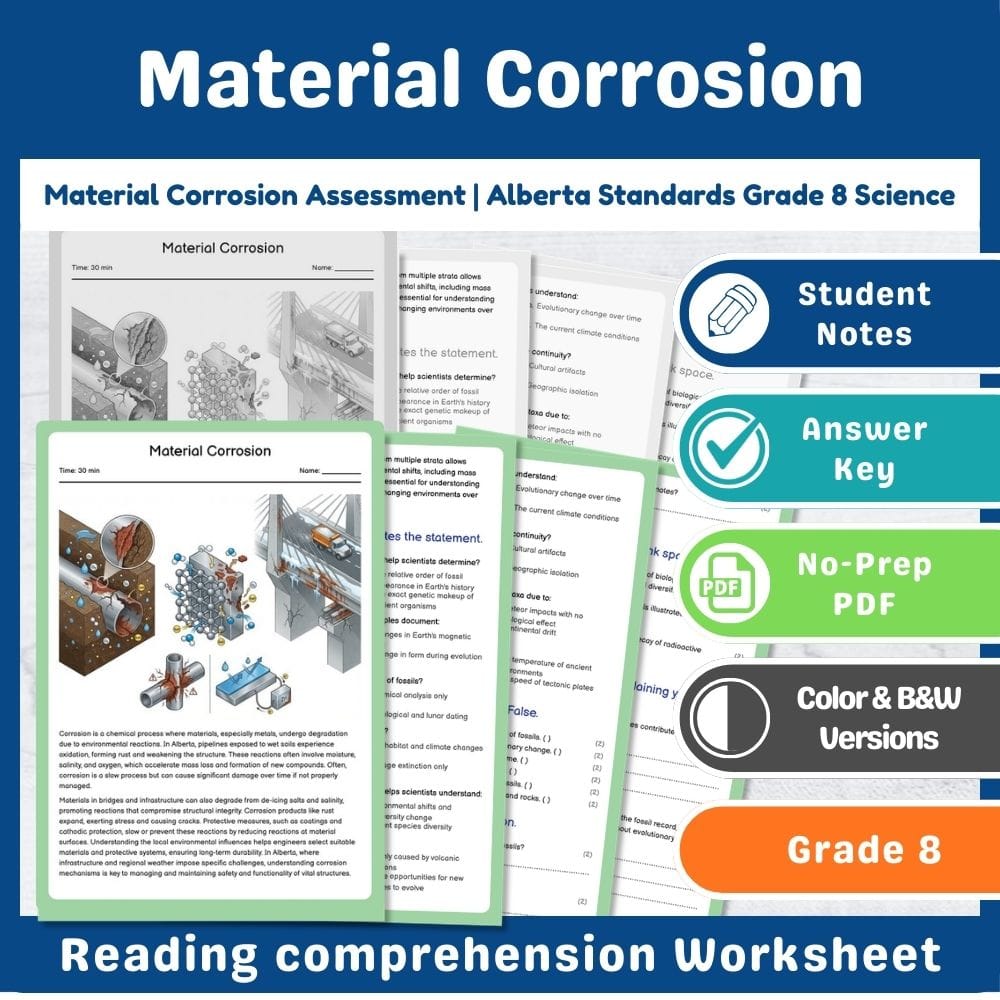
Material Corrosion Assessment | Alberta Standards Grade 8 Science
Created byPrism Point LearningLearning Objectives
- Understand the chemical and environmental factors contributing to material corrosion.
- Identify evidence of corrosion and how environmental conditions influence degradation.
- Explore protective measures and materials science approaches to prevent corrosion.
Instant download
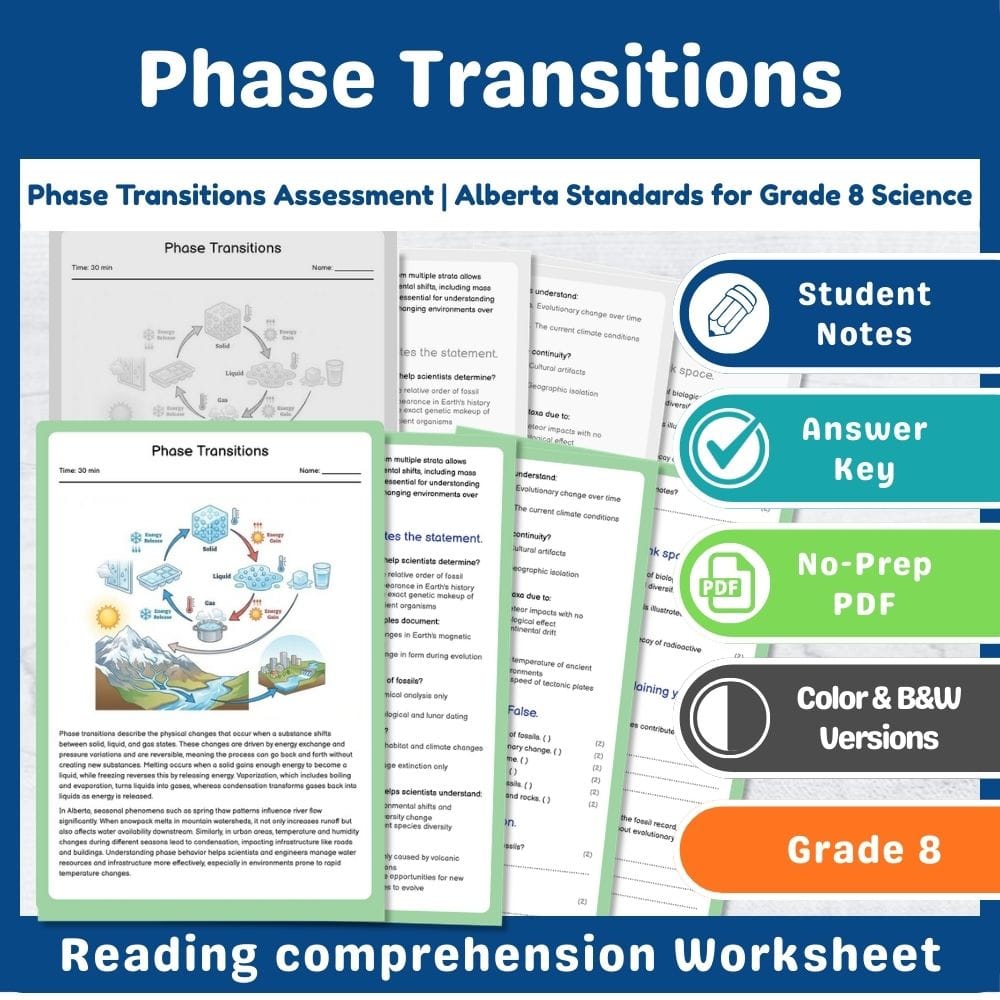
Phase Transitions Assessment | Alberta Standards for Grade 8 Science
Created byPrism Point LearningLearning Objectives
- Understand the different types of phase transitions and the energy changes involved.
- Describe how pressure and temperature influence phase changes such as melting, freezing, vaporization, and condensation.
- Identify real-world examples of phase transitions in Alberta phenomena affecting hydrology and infrastructure.
Instant download
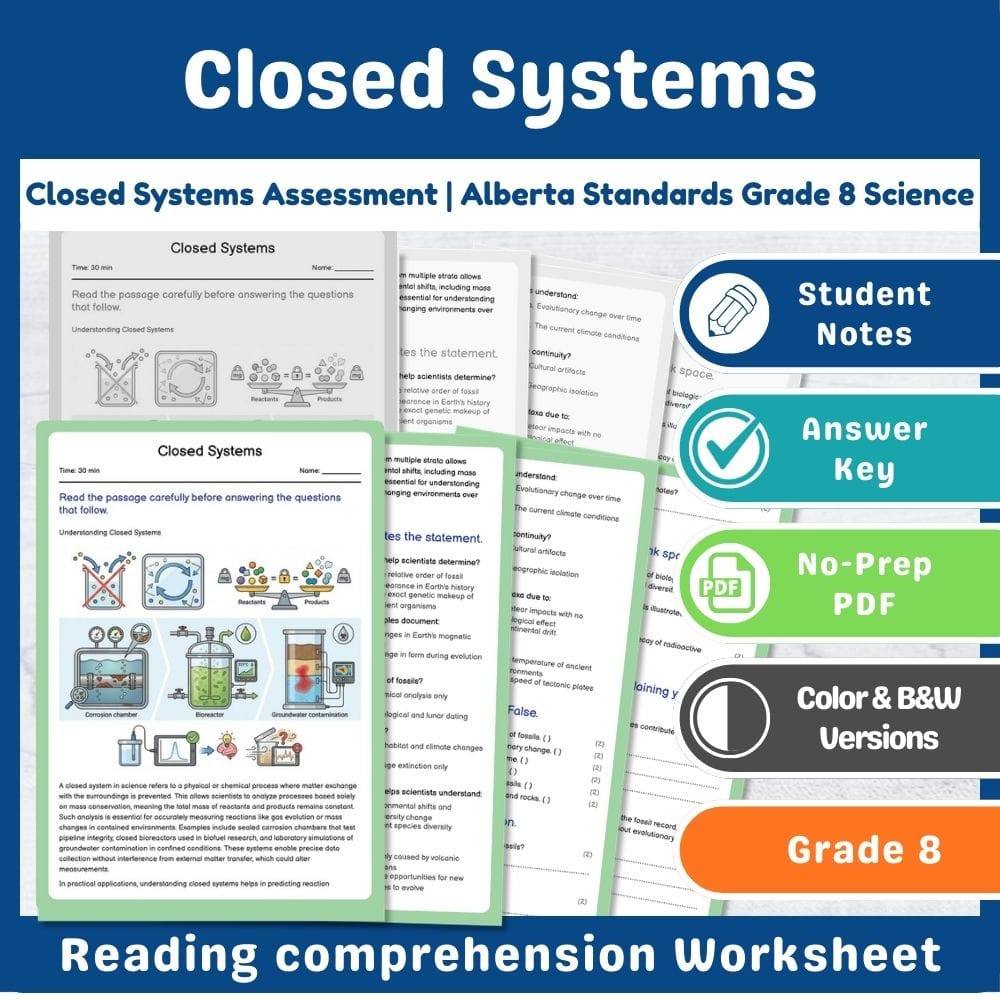
Closed Systems Assessment | Alberta Standards Grade 8 Science
Created byPrism Point LearningLearning Objectives
- Understand the concept of closed systems in chemical and physical processes.
- Identify examples and applications of closed-system analysis in real-world scenarios.
- Explain how mass conservation applies in closed environments to interpret reactions and changes.
Instant download
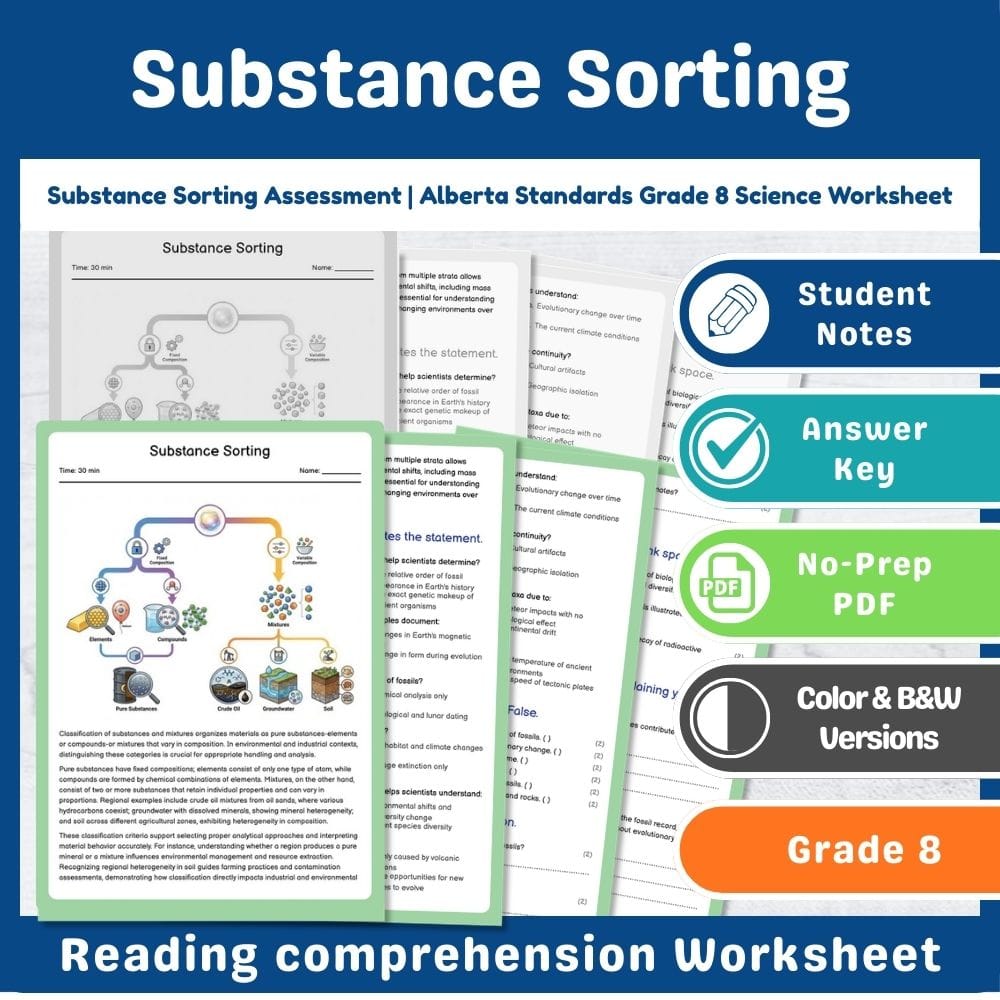
Substance Sorting Assessment | Alberta Standards Grade 8 Science Worksheet
Created byPrism Point LearningLearning Objectives
- Understand the classification of substances as pure elements, compounds, or mixtures.
- Identify different types of mixtures and their characteristics.
- Apply classification criteria to interpret material behavior in environmental and industrial contexts.
Instant download
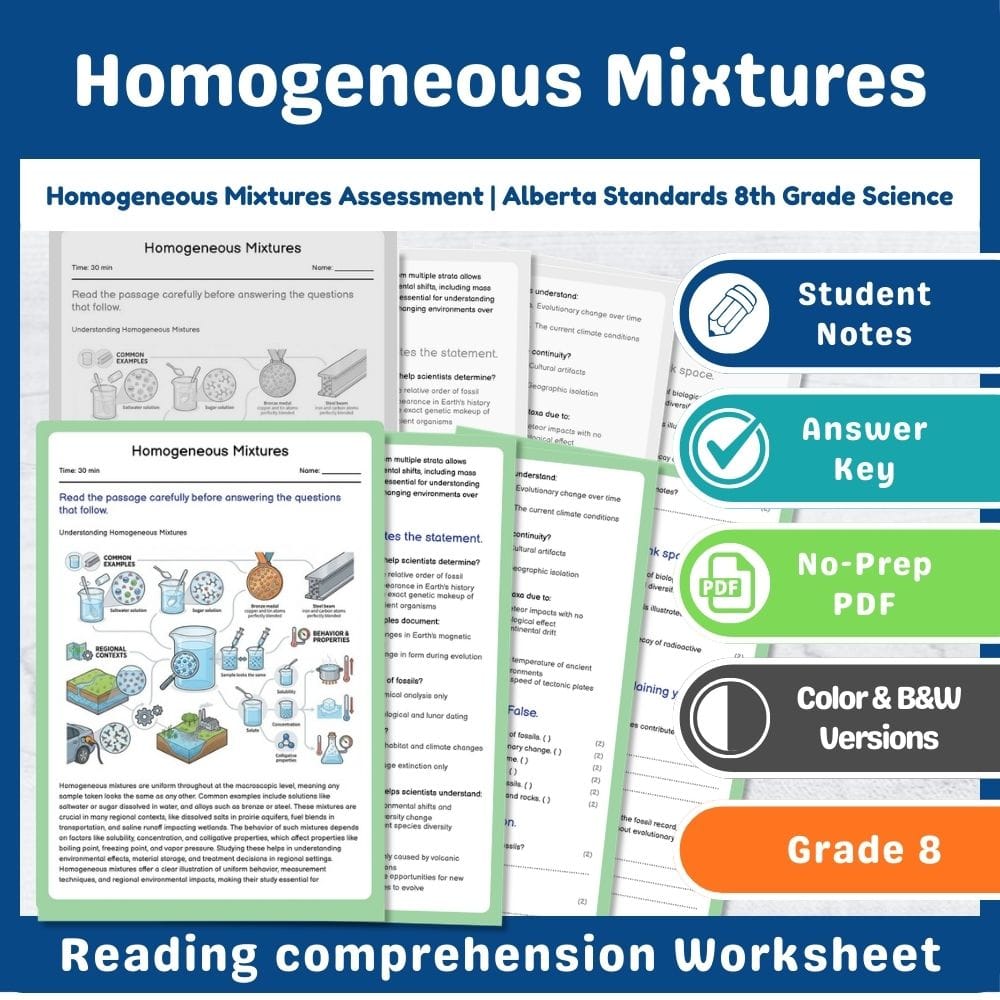
Homogeneous Mixtures Assessment | Alberta Standards 8th Grade Science
Created byPrism Point LearningLearning Objectives
- Understand the concept of homogeneous mixtures and their common examples.
- Identify factors influencing the behavior of solutions and alloys.
- Explain regional examples of uniform mixtures and their environmental impacts.
Instant download
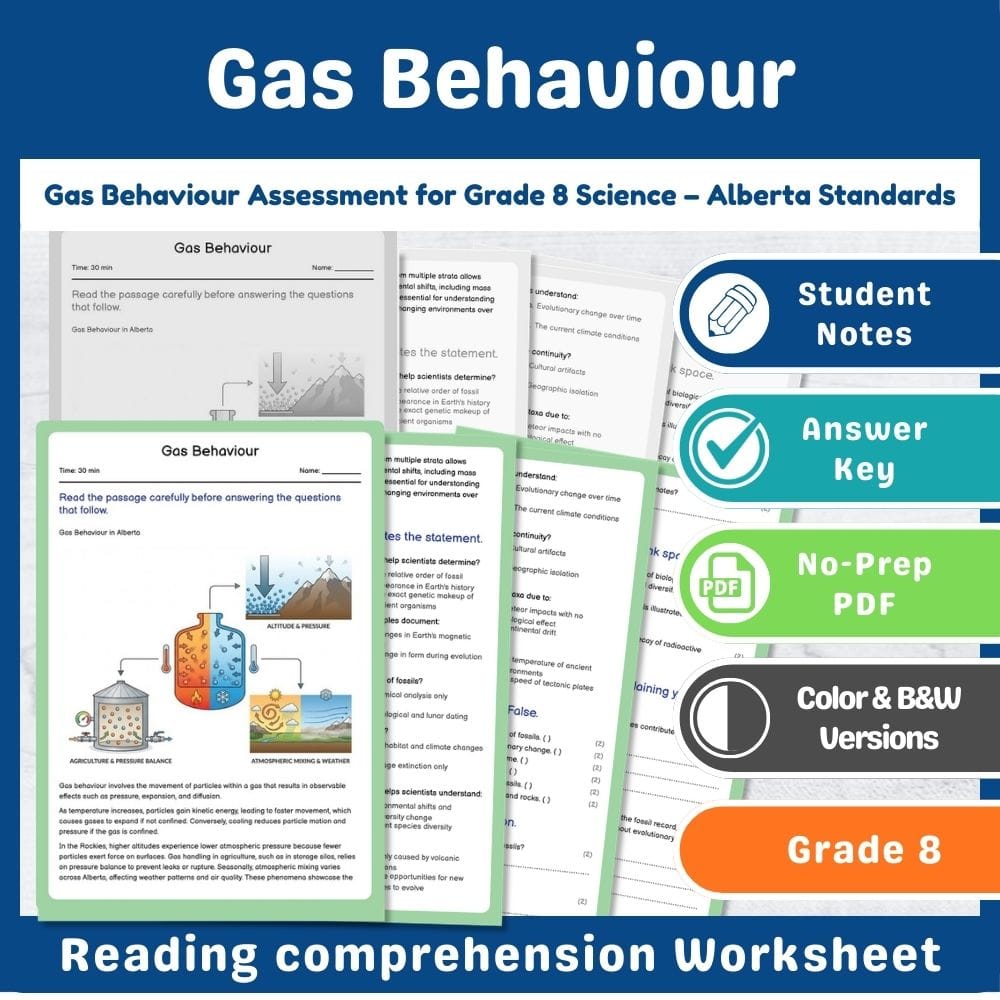
Gas Behaviour Assessment for Grade 8 Science – Alberta Standards
Created byPrism Point LearningLearning Objectives
- Explain how particle motion relates to gas pressure and temperature.
- Describe the effects of temperature changes on gas expansion and compression.
- Analyze real-world examples of gas behaviour in Alberta, such as atmospheric pressure variation with altitude and seasonal mixing.
Instant download
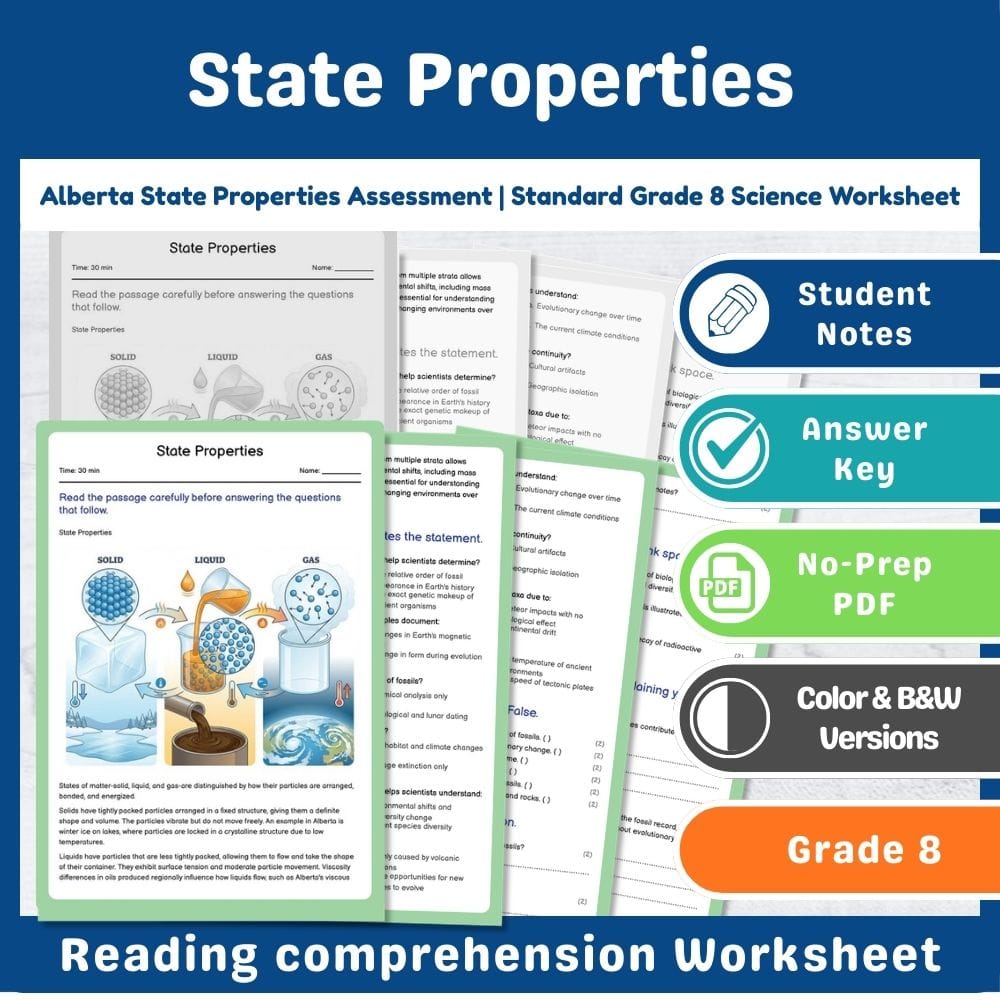
Alberta State Properties Assessment | Standard Grade 8 Science Worksheet
Created byPrism Point LearningLearning Objectives
- Describe the particle arrangement and energy differences in solids, liquids, and gases.
- Explain how particle bonding strength affects the state of matter.
- Identify examples of each state of matter in Alberta and regional contexts.
Instant download
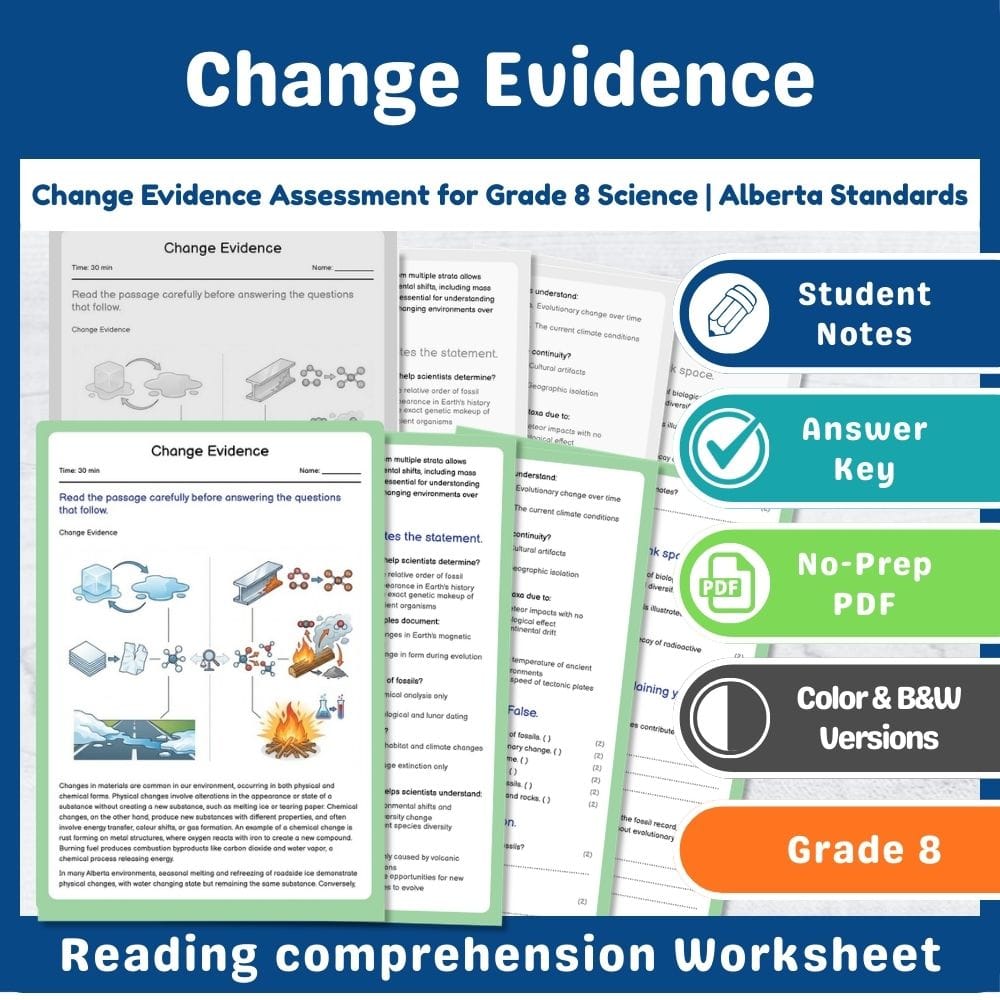
Change Evidence Assessment for Grade 8 Science | Alberta Standards
Created byPrism Point LearningLearning Objectives
- Identify differences between physical and chemical changes in materials.
- Recognize evidence indicating chemical reactions such as colour shifts, gas release, or energy transfer.
- Analyze examples of physical and chemical changes in Alberta environments.
Instant download
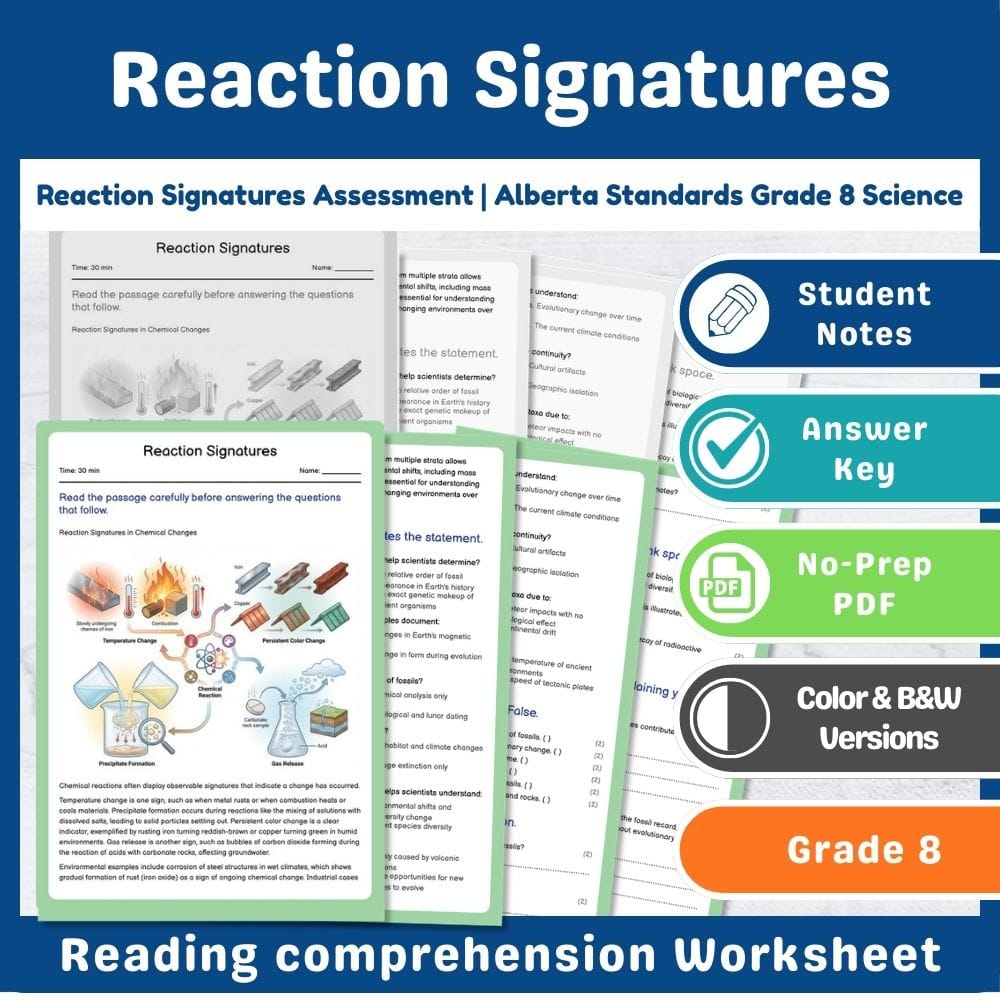
Reaction Signatures Assessment | Alberta Standards Grade 8 Science
Created byPrism Point LearningLearning Objectives
- Identify observable signatures of chemical change such as temperature change, precipitate formation, color change, and gas release.
- Explain the significance of reaction signatures in environmental and industrial contexts.
- Analyze examples involving corrosion, effervescence, and combustion residues to understand chemical transformations.
Instant download
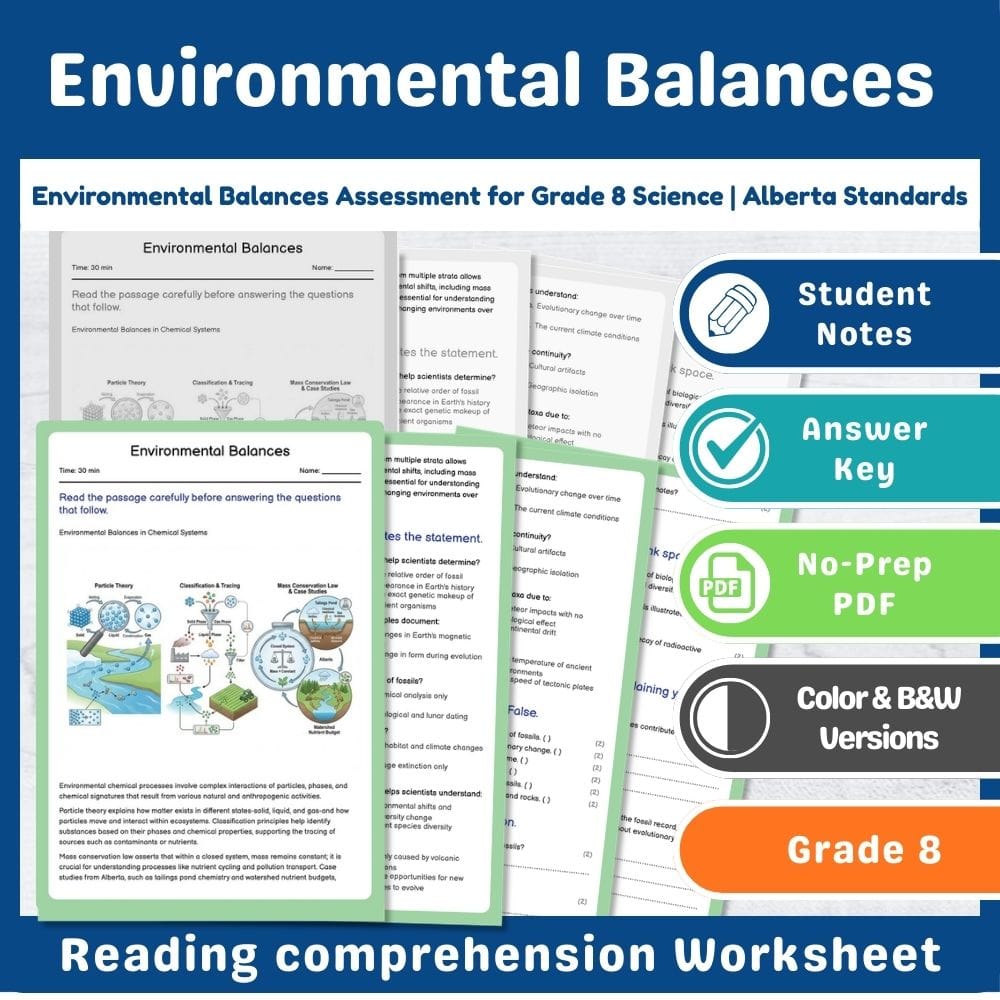
Environmental Balances Assessment for Grade 8 Science | Alberta Standards
Created byPrism Point LearningLearning Objectives
- Understand how particle theory and classification principles help interpret environmental chemical processes.
- Explain the concepts of nutrient cycling, contamination transport, and mass conservation within ecosystems.
- Apply knowledge of phases, mixtures, and chemical signatures to trace sources and sinks in environmental systems.
Instant download
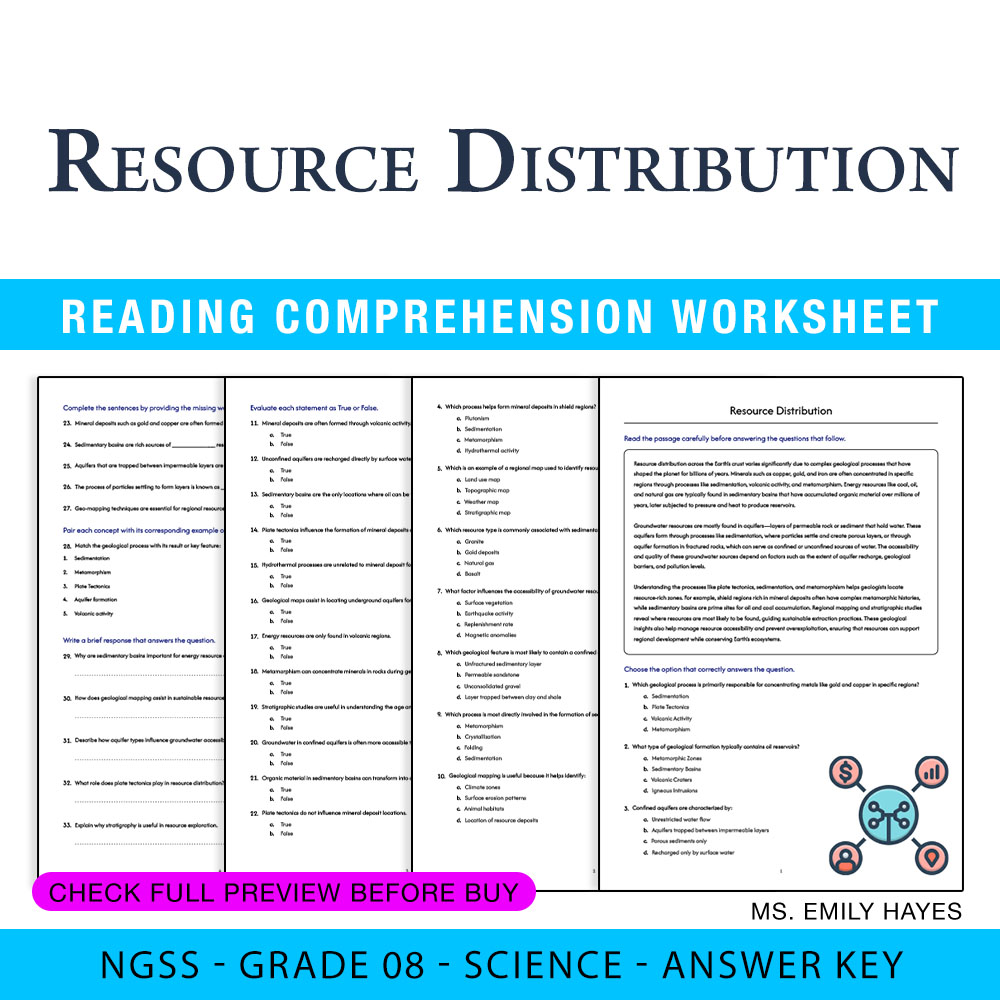
8th Grade Science | Resource Distribution Worksheet (PDF+ Answer Key)
Created byCopper Leaf ClassroomLearning Objectives
- Understand geological processes that influence mineral, energy, and groundwater resource formation.
- Analyze how stratigraphy, rock records, and geologic mapping explain resource accessibility and quality.
- Evaluate implications of resource distribution for sustainable extraction and regional planning.
Instant download

Thermal Changes Worksheet for Grade 8 Science | NGSS-Aligned Practice
JCreated byJ.S SheetsLearning Objectives
- Understand the relationship between energy transfer, material properties, and temperature change.
- Explain the concept of specific heat capacity and how it affects how different materials respond to heat.
- Relate microscopic particle kinetic energy to macroscopic temperature measurements.
Also included in: Grade 8 Energy Conservation and Transfer Science Lesson Bundle: NGSS +1 more
Instant download
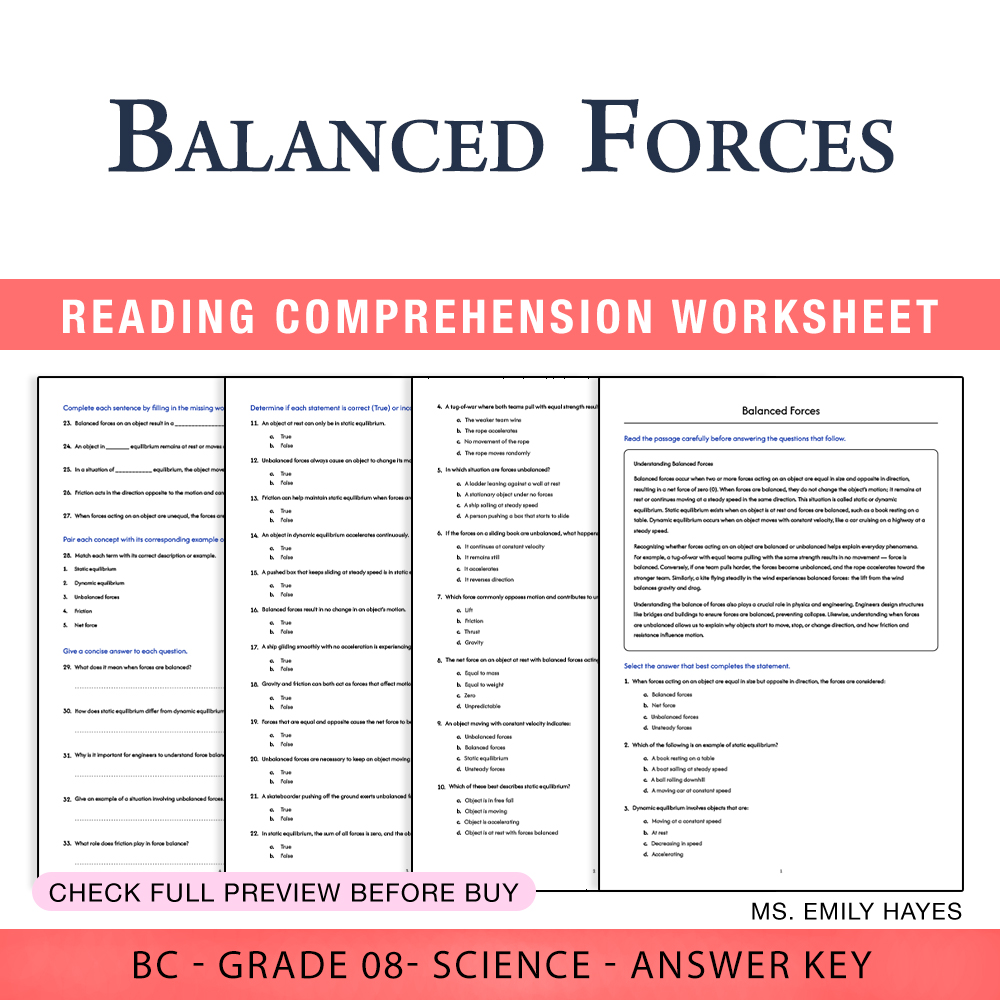
8th Grade Science | Balanced Forces Worksheet (PDF+ Answer Key)
Created byCopper Leaf ClassroomLearning Objectives
- Understand the concept of balanced and unbalanced forces and how they affect motion.
- Identify static and dynamic equilibrium situations.
- Apply the principles of balanced forces to real-world examples.
Also included in: Grade 8 Science Worksheets Bundle | Forces, Motion & Energy (PDF + Answer Keys) +1 more
Instant download
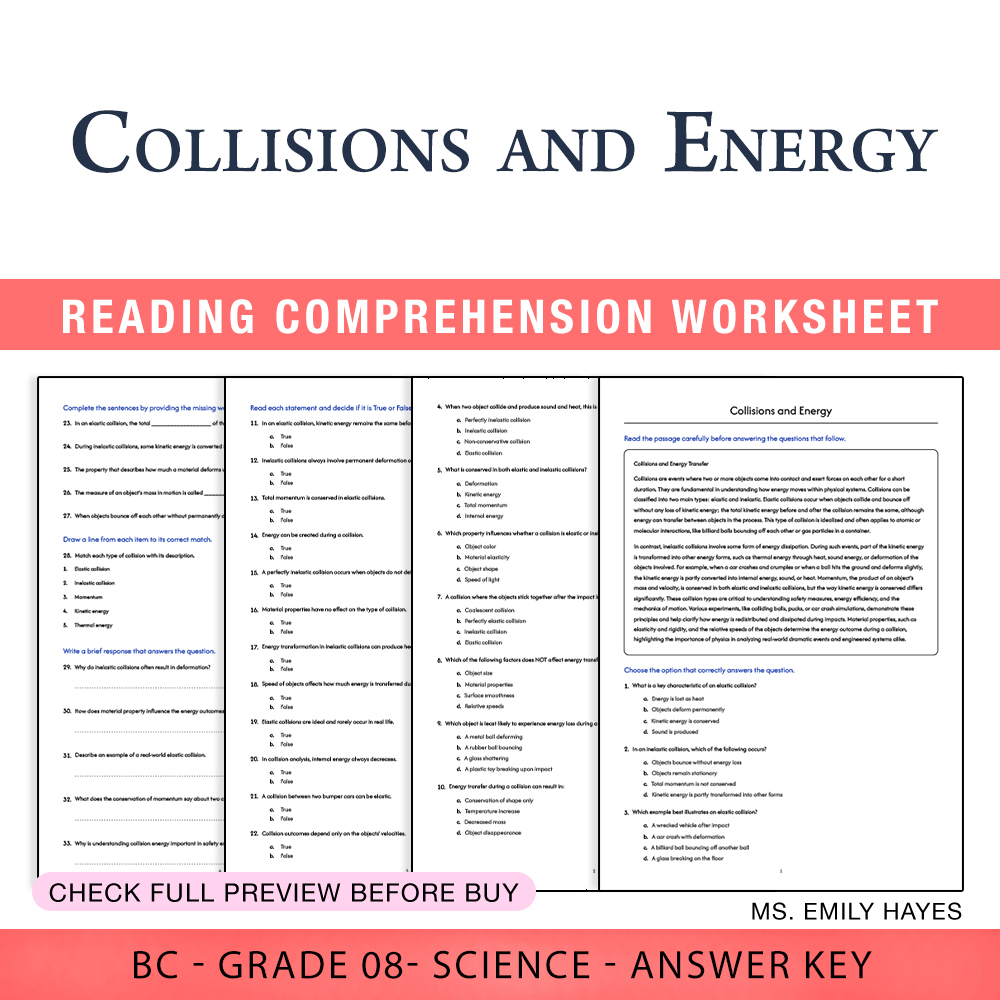
8th Grade Science | Collisions & Energy Worksheet (PDF+ Answer Key)
Created byCopper Leaf ClassroomLearning Objectives
- Understand the difference between elastic and inelastic collisions.
- Explain how energy is transferred and transformed during collisions.
- Describe the role of momentum in collision processes.
Also included in: Grade 8 Science Worksheets Bundle | Forces, Motion & Energy (PDF + Answer Keys) +1 more
Instant download
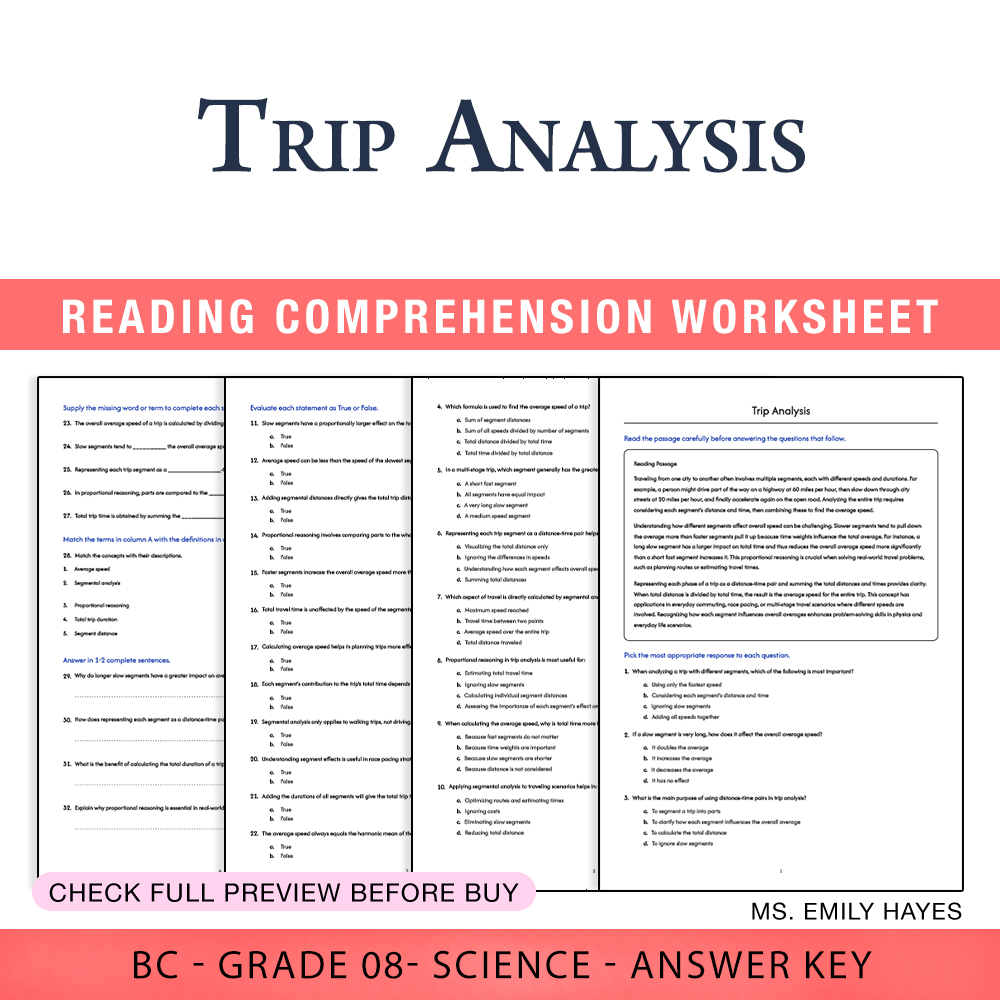
Grade 8 Science | Trip Analysis Worksheet (PDF+ Answer Key)
Created byCopper Leaf ClassroomLearning Objectives
- Understand how to analyze motion composed of multiple segments with different speeds.
- Apply proportional reasoning to compute average speed from total distance and total time.
- Interpret segmental calculations to determine the influence of slower parts on overall average speed.
Also included in: Grade 8 Science Worksheets Bundle | Forces, Motion & Energy (PDF + Answer Keys) +1 more
Instant download
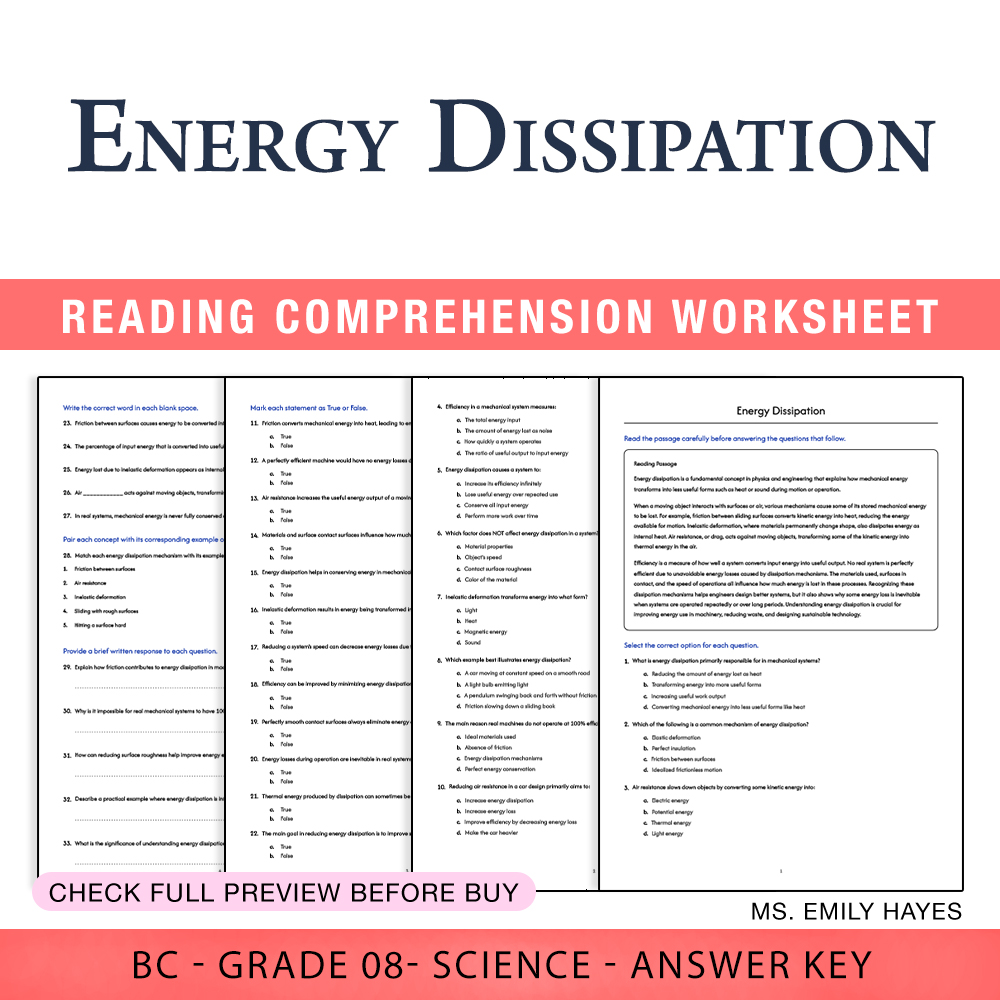
Grade 8 Science | Energy Dissipation Worksheet (PDF+ Answer Key)
Created byCopper Leaf ClassroomLearning Objectives
- Understand the concept of energy dissipation and how it affects mechanical systems.
- Identify different mechanisms by which energy is dissipated, including friction and air resistance.
- Explain the concept of efficiency and factors influencing energy losses in systems.
Also included in: Grade 8 Science Worksheets Bundle | Forces, Motion & Energy (PDF + Answer Keys) +1 more
Instant download
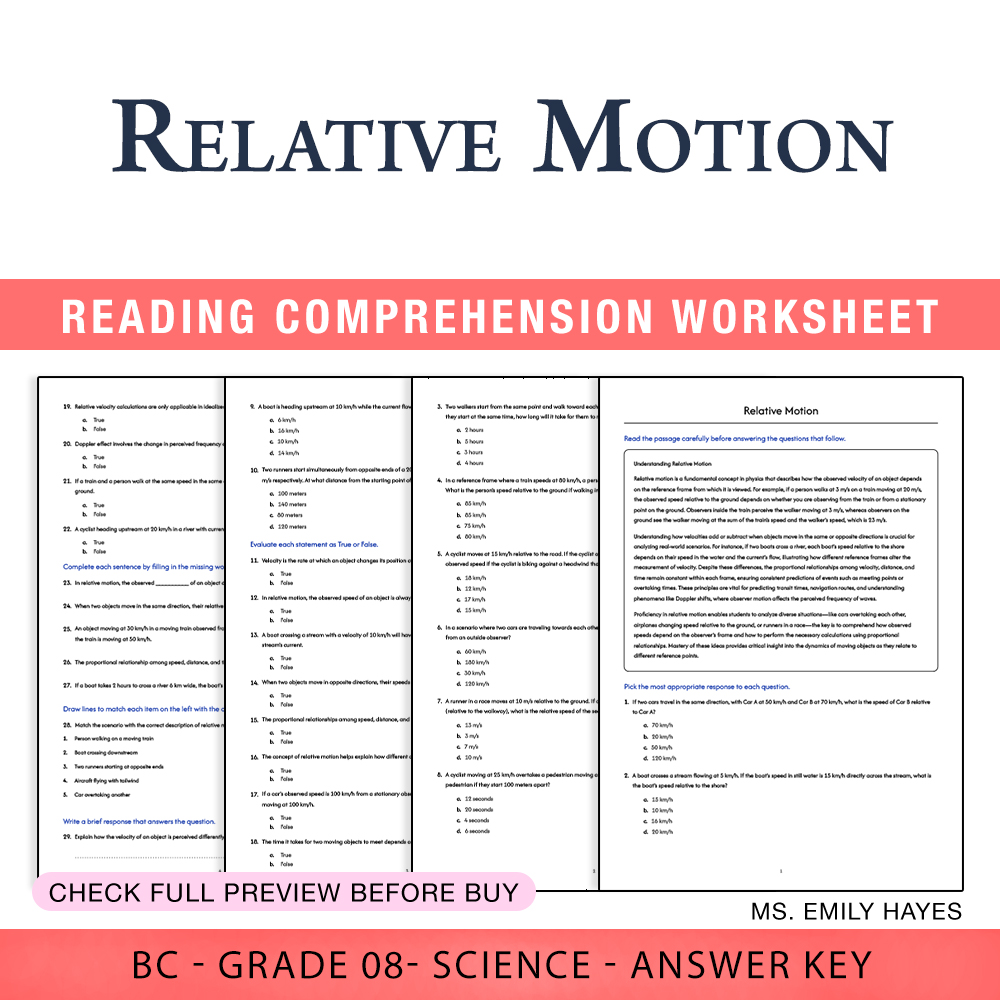
8th Grade Science | Relative Motion Worksheet (PDF+ Answer Key)
Created byCopper Leaf ClassroomLearning Objectives
- Understand how observed speed depends on the reference frame in relative motion scenarios
- Apply the proportional relationships among speed, distance, and time within different frames
- Analyze simple relative motion scenarios such as walkers and boats crossing streams
Also included in: Grade 8 Science Worksheets Bundle | Forces, Motion & Energy (PDF + Answer Keys) +1 more
Instant download
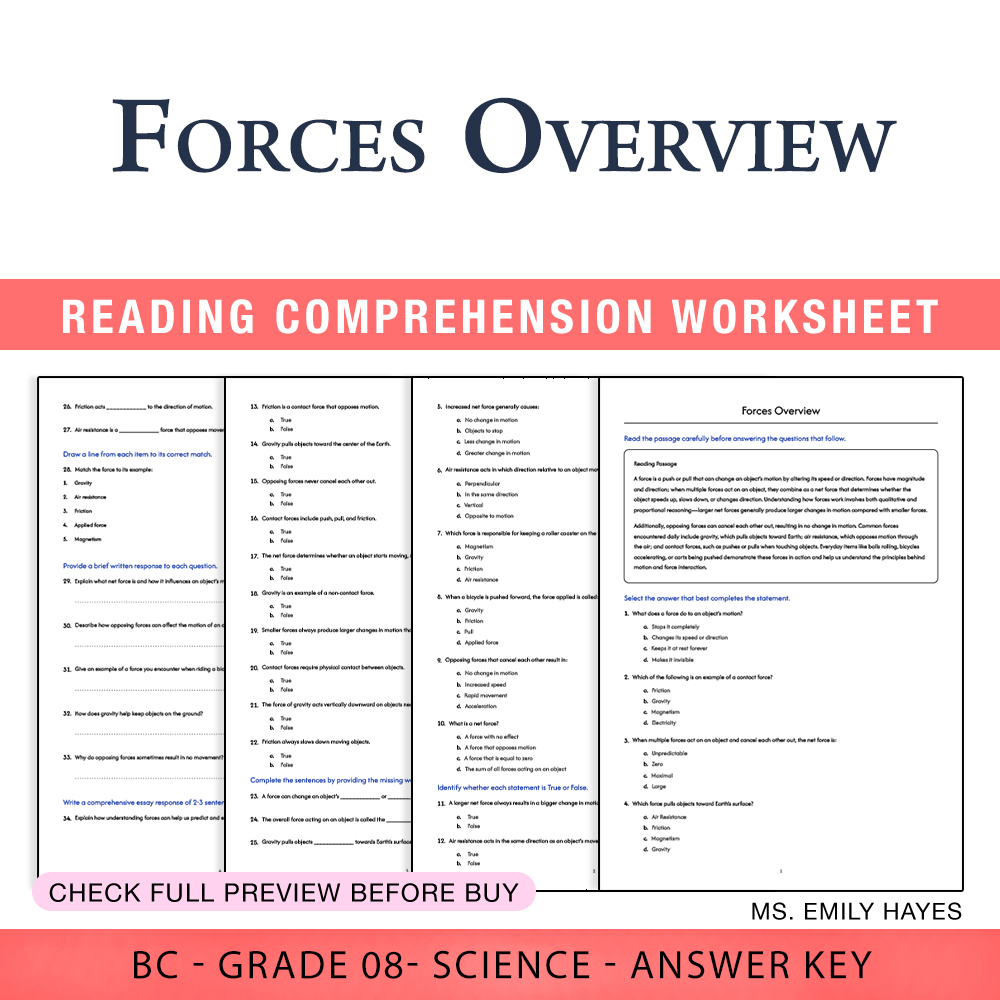
Grade 8 Science | Forces Overview Worksheet (PDF+ Answer Key)
Created byCopper Leaf ClassroomLearning Objectives
- Understand the concept of force as a push or pull affecting objects.
- Identify different types of forces such as gravity, air resistance, and contact forces.
- Explain how forces combine to produce net force and influence motion.
Also included in: Grade 8 Science Worksheets Bundle | Forces, Motion & Energy (PDF + Answer Keys) +1 more
Instant download
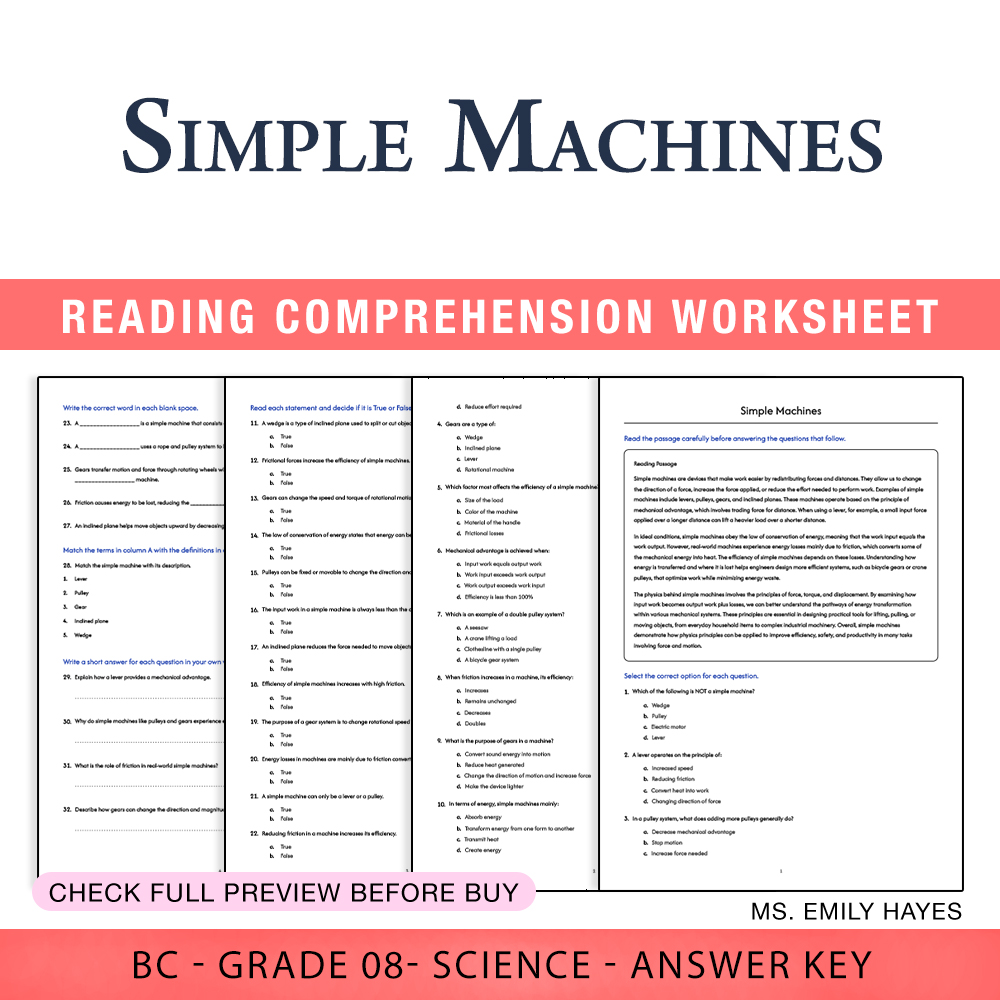
Grade 8 Science | Simple Machines Worksheet (PDF+ Answer Key)
Created byCopper Leaf ClassroomLearning Objectives
- Understand how simple machines redirect and amplify forces in mechanical systems.
- Identify different types of simple machines and their functions.
- Explain how forces and distances change when using levers, pulleys, and gears.
Also included in: Grade 8 Science Worksheets Bundle | Forces, Motion & Energy (PDF + Answer Keys) +1 more
Instant download
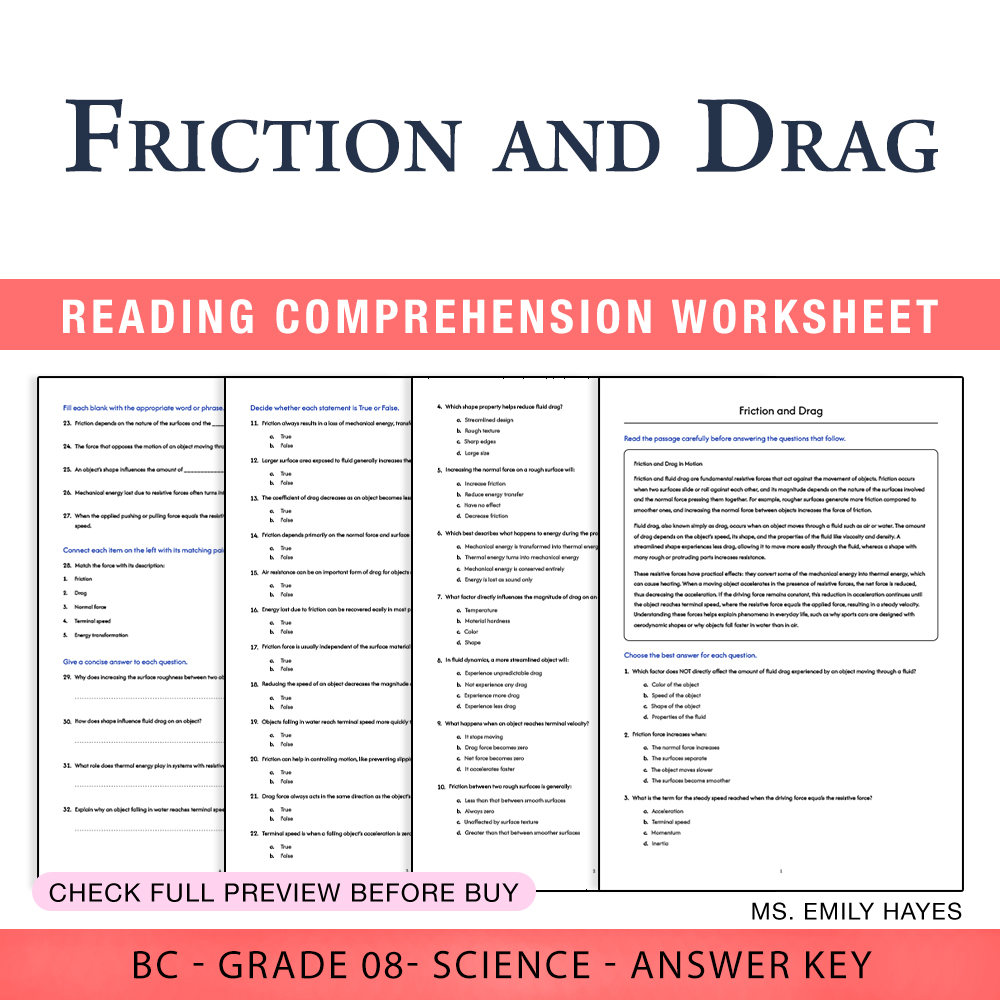
Grade 8 Science | Friction and Drag Worksheet (PDF+ Answer Key)
Created byCopper Leaf ClassroomLearning Objectives
- Understand how friction and drag forces oppose motion and differ based on surface and fluid properties.
- Describe the factors influencing friction and fluid drag, including surface types, normal force, speed, shape, and fluid characteristics.
- Explain the energy transformations associated with resistive forces and the concept of terminal velocity.
Also included in: Grade 8 Science Worksheets Bundle | Forces, Motion & Energy (PDF + Answer Keys) +1 more
Instant download
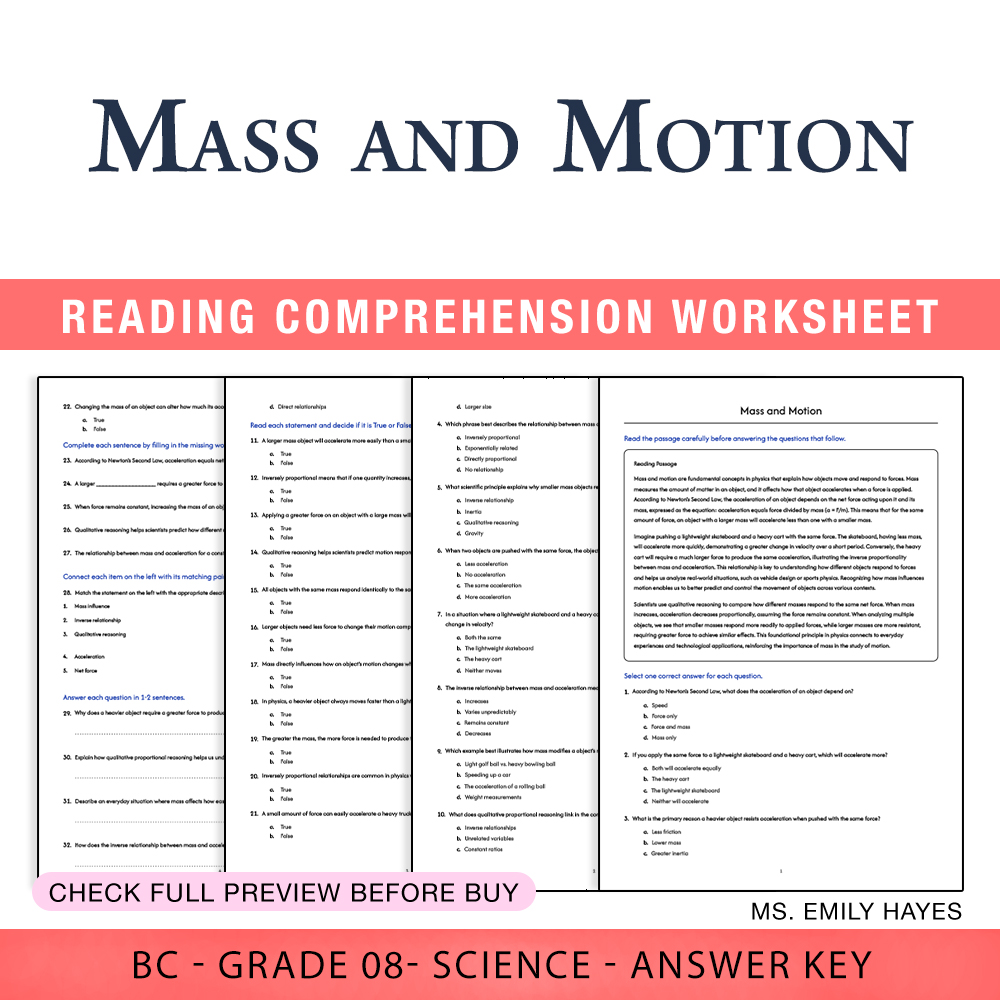
8th Grade Science | Mass and Motion Worksheet (PDF+ Answer Key)
Created byCopper Leaf ClassroomLearning Objectives
- Understand how mass influences the effect of net force on motion.
- Explain the inverse relationship between mass and acceleration for a given force.
- Compare the motion of objects with different masses when pushed with the same force.
Also included in: Grade 8 Science Worksheets Bundle | Forces, Motion & Energy (PDF + Answer Keys) +1 more
Instant download
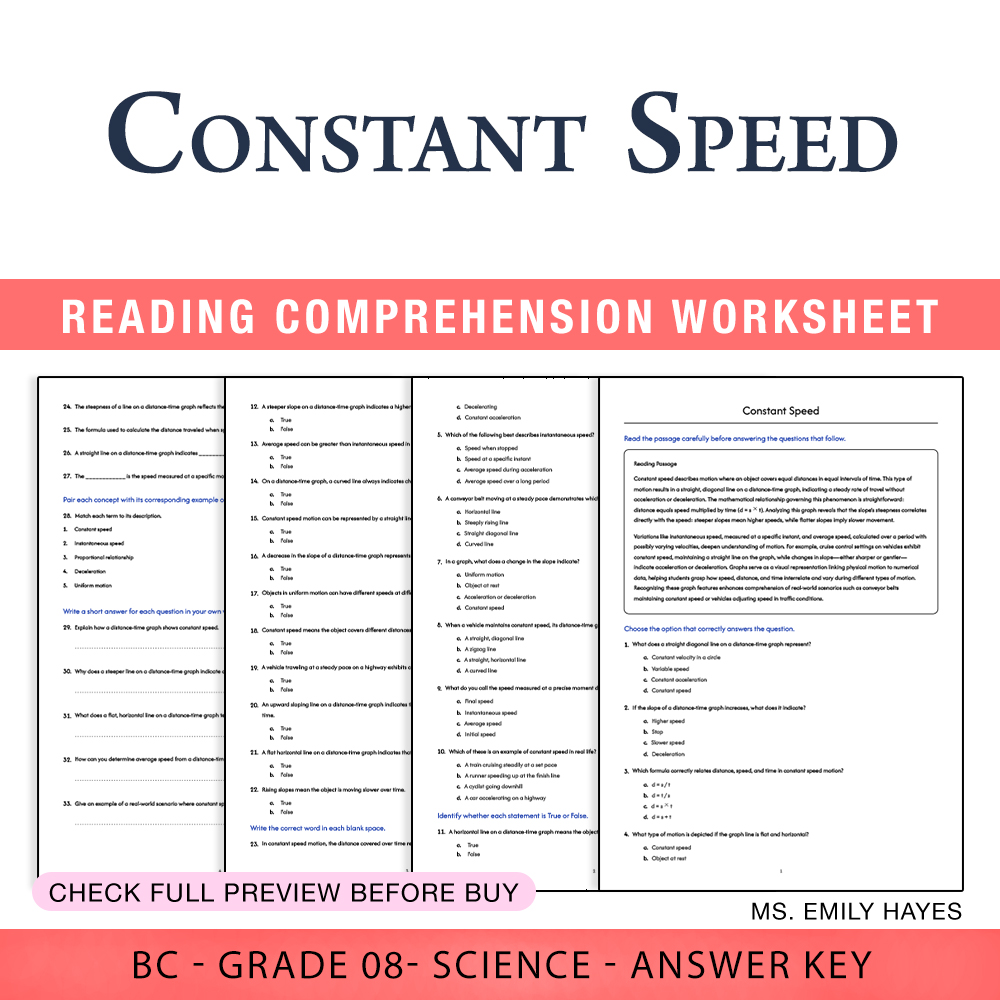
8th Grade Science | Constant Speed Worksheet (PDF+ Answer Key)
Created byCopper Leaf ClassroomLearning Objectives
- Explain the concept of constant speed and how it appears as a straight line on a distance-time graph.
- Calculate distance, speed, and time using proportional relationships in uniform motion.
- Identify how variations like instantaneous and average speed affect motion analysis.
Also included in: Grade 8 Science Worksheets Bundle | Forces, Motion & Energy (PDF + Answer Keys) +1 more
Instant download
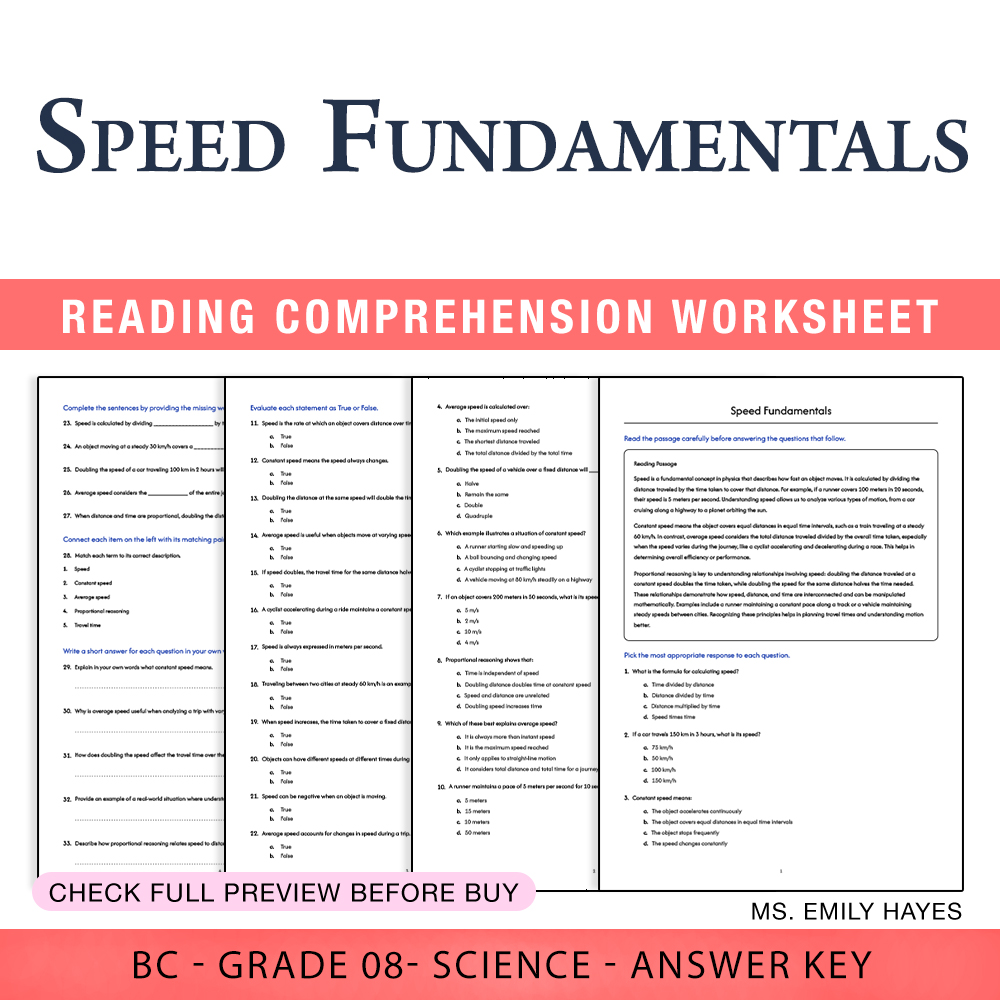
Grade 8 Science | Speed Fundamentals Worksheet (PDF + Answer Key)
Created byCopper Leaf ClassroomLearning Objectives
- Define speed as distance divided by time and explain its significance in motion.
- Differentiate between constant speed and average speed.
- Understand the proportional reasoning relating speed, distance, and time.
Also included in: Grade 8 Science Worksheets Bundle | Forces, Motion & Energy (PDF + Answer Keys) +1 more
Instant download

Grade 8 Science | Energy in Motion - Daily Reading Comprehension
Created byCoral Reef LearningLearning Objectives
- Understand the concepts of gravitational potential energy and kinetic energy.
- Explain how energy transforms during vertical motion in a gravitational field.
- Interpret the energy changes in systems such as roller coasters.
Instant download

Grade 8 DNA Instructions Worksheet | Practice & Assessment PDF
 Created byClear Sky Classroom
Learning Objectives
- Explain how DNA functions as a coded set of instructions in cells.
- Describe the relationships among DNA, genes, chromosomes, proteins, and inherited traits.
- Identify how changes in DNA can affect protein production and variation across generations.
Instant download
Grade 8 Science Water Cycle Study | Daily Reading Worksheet + Answer Key
JCreated byJ.S SheetsLearning Objectives
- Understand key concepts related to Science
- Apply knowledge through practice questions
- Demonstrate comprehension of the material
Also included in: Grade 8 Science Lesson Group: Water Systems and Water Quality Framework +1 more
Instant download
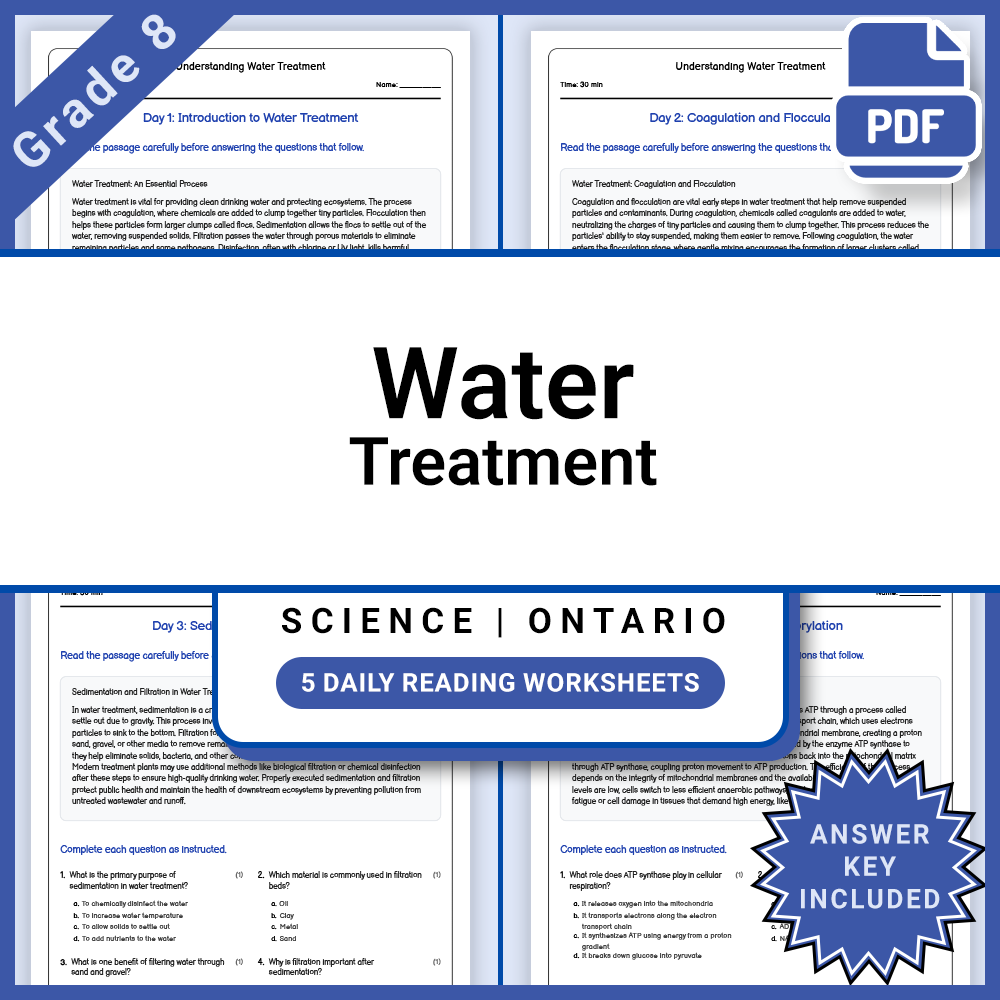
Grade 8 Science – Water Quality Indicators Daily Reading Worksheet + Answer Key
JCreated byJ.S SheetsLearning Objectives
- Identify key physical, chemical, and biological water indicators
- Understand the significance of each water indicator for aquatic health
- Interpret indicator ranges relevant to water quality assessment
Also included in: Grade 8 Science Lesson Group: Water Systems and Water Quality Framework +1 more
Instant download
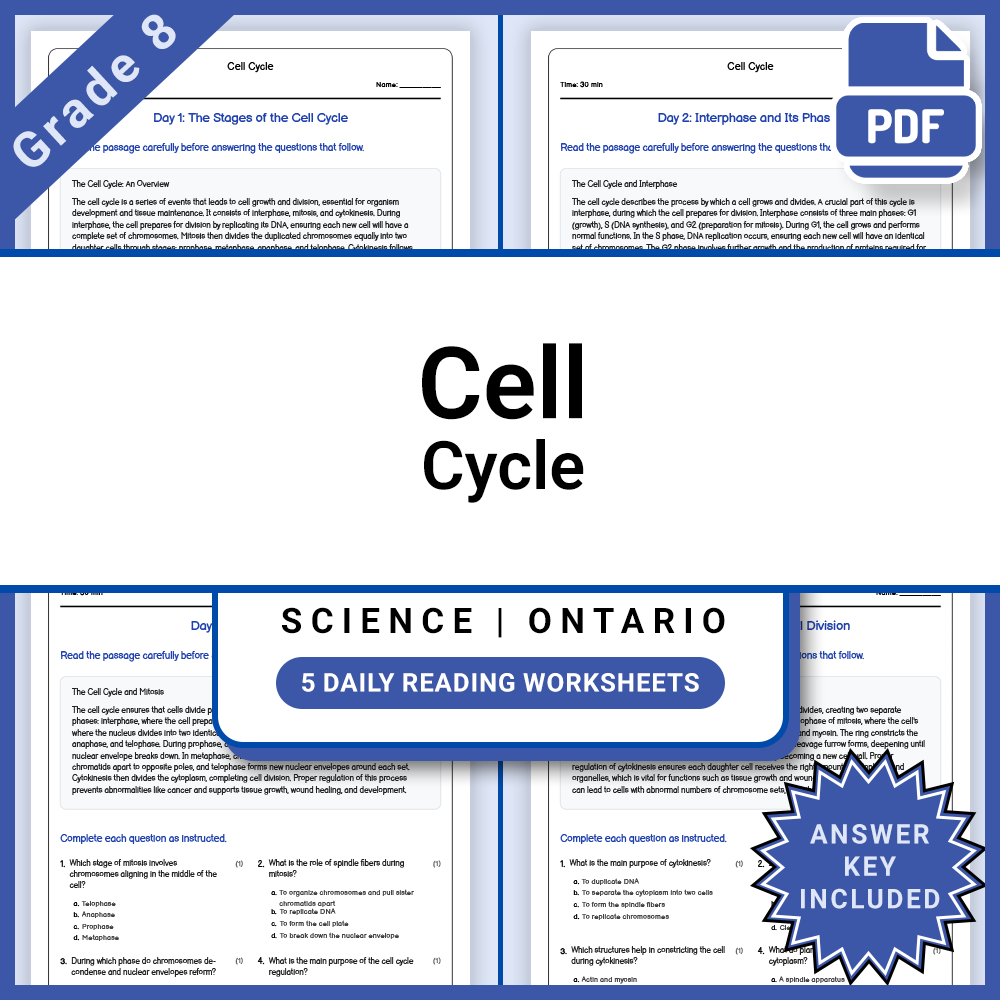
Grade 8 Science Cell Cycle Daily Reading Worksheet with Answer Key
JCreated byJ.S SheetsLearning Objectives
- Identify the stages of the cell cycle
- Understand the processes involved in interphase, mitosis, and cytokinesis
- Recognize the molecules and checkpoints regulating cell division
Also included in: Grade 8 Science Lesson Group: Ontario Curriculum Reading Worksheets Bundle +1 more
Instant download
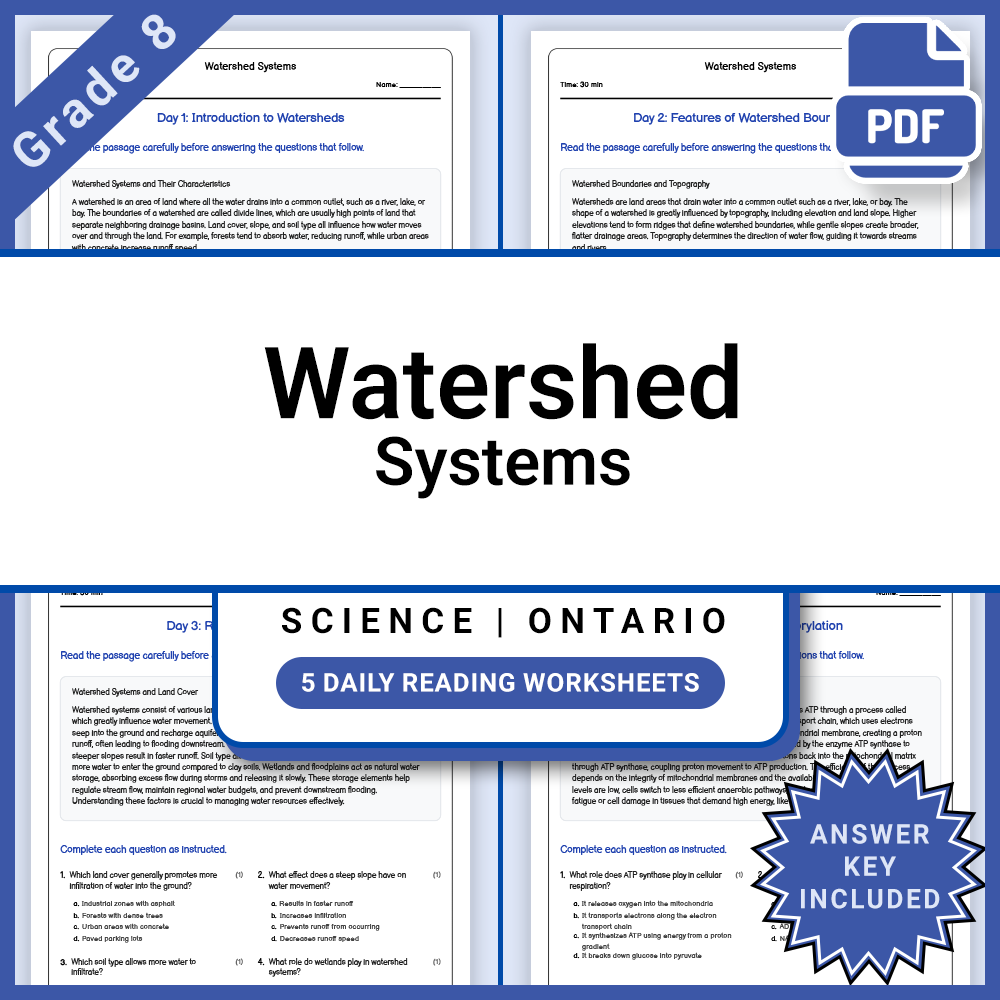
Grade 8 Science – Regional Water System Case Study Worksheet with Answer Key
JCreated byJ.S SheetsLearning Objectives
- Understand the components of the hydrologic cycle in regional contexts
- Identify how watershed connectivity influences water movement
- Analyze groundwater-surface water exchanges
Also included in: Grade 8 Science Lesson Group: Water Systems and Water Quality Framework +1 more
Instant download
About Grade 8 Science Worksheets
Explore Grade 8 Science worksheets for classwork, homework, or review. Our 6,006 printables download instantly as PDFs.
Each resource here is built by an independent educator and reviewed for quality. Worksheets print straight from PDF and suit classroom use, homework, or extra practice; most come with answer keys, and you can preview before purchasing.