
Grade 8 Science Worksheets
5,999 worksheets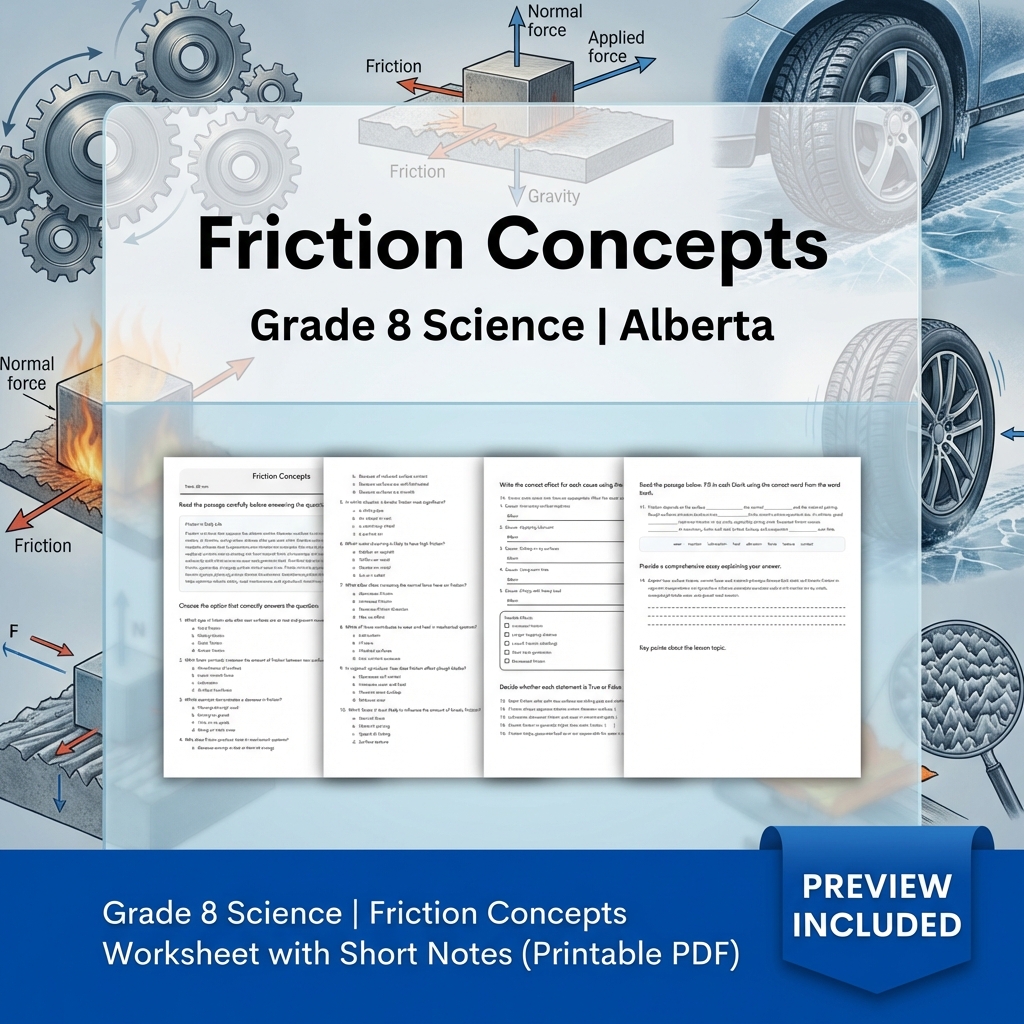
Grade 8 Science | Friction Concepts Worksheet with Short Notes (Printable PDF)
 Created byMeadowlark Worksheets
Learning Objectives
- Understand the difference between static and kinetic friction.
- Identify factors affecting frictional forces such as surface texture and normal force.
- Analyze regional examples where friction plays a vital role in transportation and agriculture.
Also included in: Grade 8 Science Forces & Motion UNIT Bundle – Alberta Curriculum +1 more
Instant download
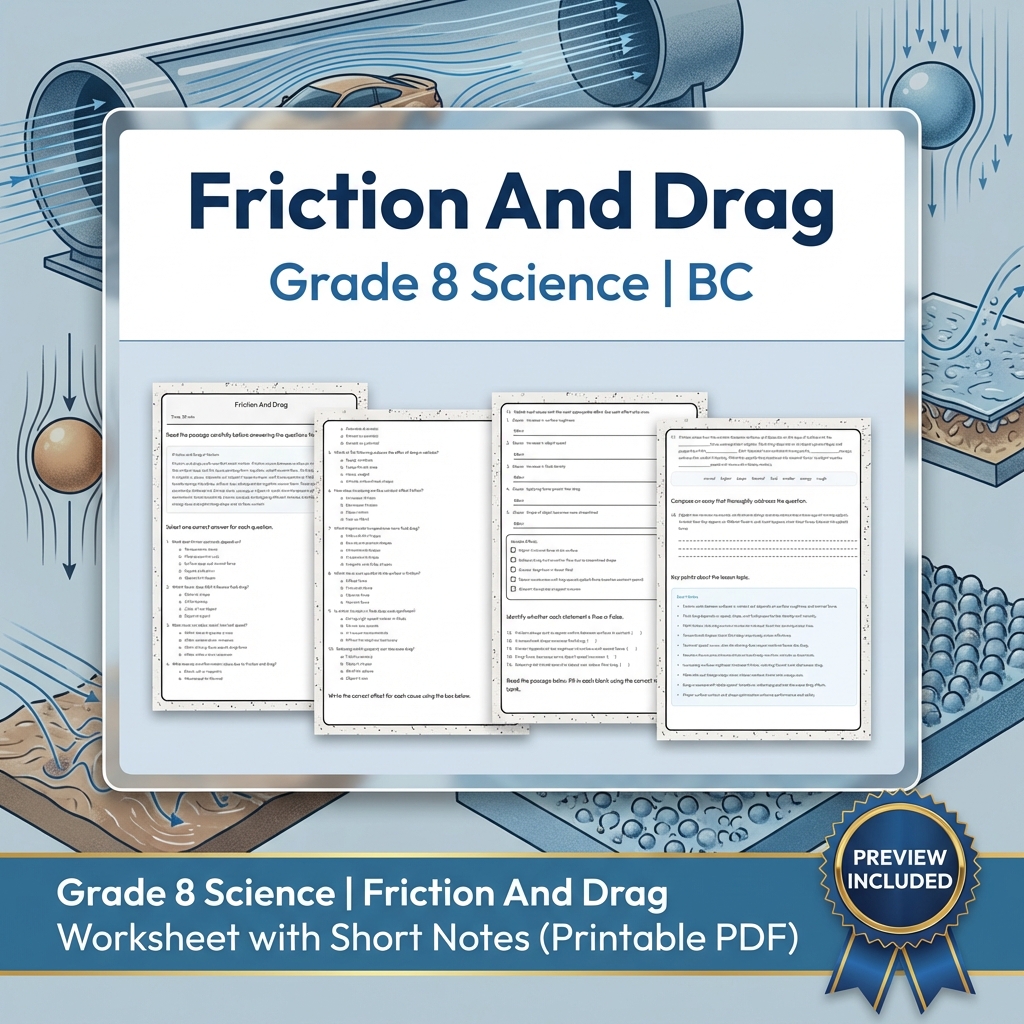
Grade 8 Science | Friction And Drag Worksheet with Short Notes (Printable PDF)
Created byMeadowlark WorksheetsLearning Objectives
- Understand how friction and fluid drag oppose motion and influence acceleration.
- Identify factors affecting friction and drag, such as surface types, speed, and shape.
- Explain how resistive forces transform mechanical energy into thermal energy.
Also included in: Grade 8 Science Lesson Bundle | BC Framework & Key Concepts Worksheet Pack +1 more
Instant download
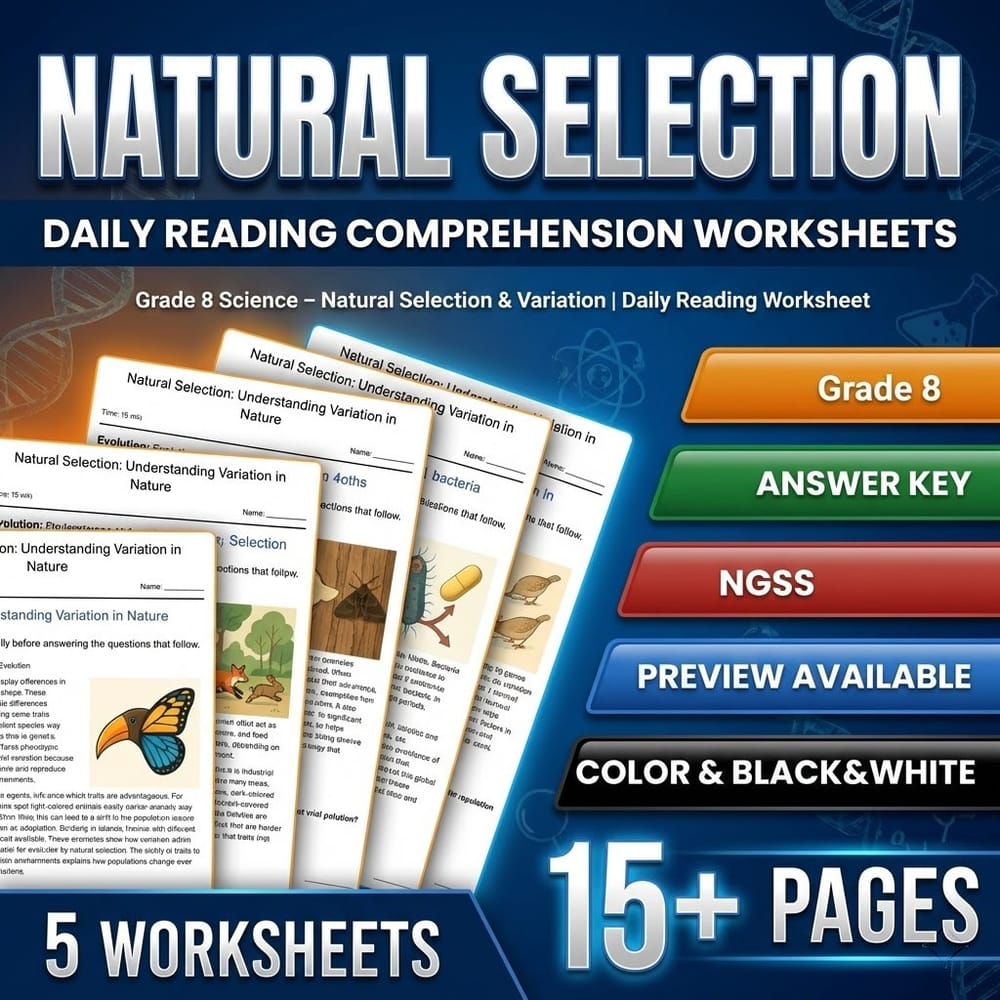
Grade 8 Science – Natural Selection & Variation | Daily Reading Worksheet
 Created byElena Brooks
Learning Objectives
- Identify phenotypic variation among organisms
- Explain how traits are inherited
- Understand environmental factors influencing natural selection
Instant download
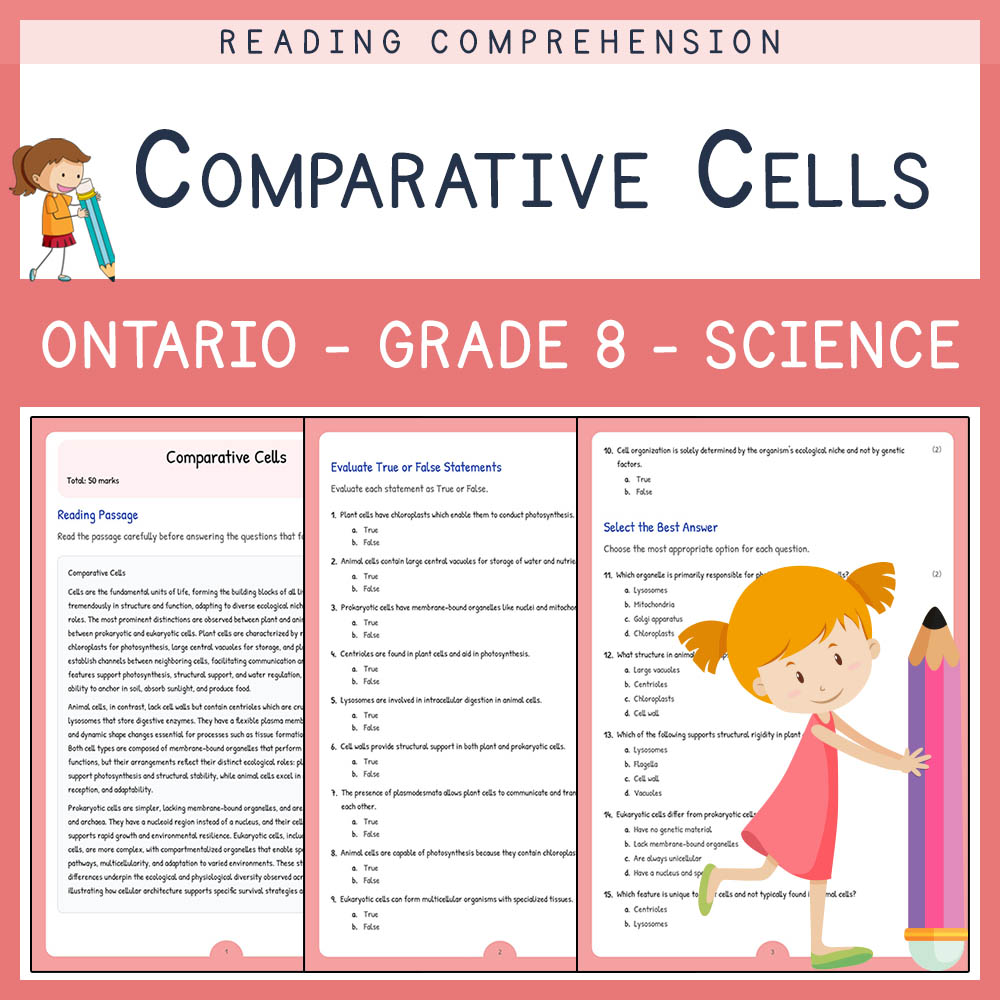
Grade 8 Science | Comparative Cells Worksheet Elena | Ontario Standards
 Created byLumora Learning
Learning Objectives
- Identify the structural differences between plant and animal cells and their functional implications.
- Compare prokaryotic and eukaryotic cells in terms of organization and roles in ecosystems.
- Explain how cellular structures like cell walls, chloroplasts, and lysosomes support specific physiological functions.
Instant download

Grade 8 Science – Mass Conservation & Systems | Daily Reading Worksheet
 Created byBright Mind Resources
Learning Objectives
- Explain the principle of mass conservation in chemical reactions.
- Identify real-world examples of mass conservation in industry and environmental settings.
- Apply the principle to analyze closed system reactions and processes.
Also included in: Matter Change Grade 8 Science Daily Reading Worksheets Lesson Bundle | Alberta +2 more
Instant download

Grade 8 Science Watershed Systems Worksheet | Standards-Aligned Practice
JCreated byJ.S SheetsLearning Objectives
- Explain how watershed boundaries determine where water flows within and between drainage basins
- Describe how land cover, slope, and soil type influence infiltration and runoff generation
- Analyze how stream networks form a hierarchical system of tributaries that affects downstream impacts
Instant download

Layered Fluids Density Stratification and Mixing Worksheet | Ontario Grade 8
JCreated byJ.S SheetsLearning Objectives
- Explain how density differences from temperature and salinity create layered (stratified) fluids and pycnoclines
- Describe how buoyancy acts to resist vertical displacement and what buoyancy frequency tells us about stability
- Predict how mixing limitations affect pollutant dispersion and thermal layering in natural waters and reservoirs
Instant download
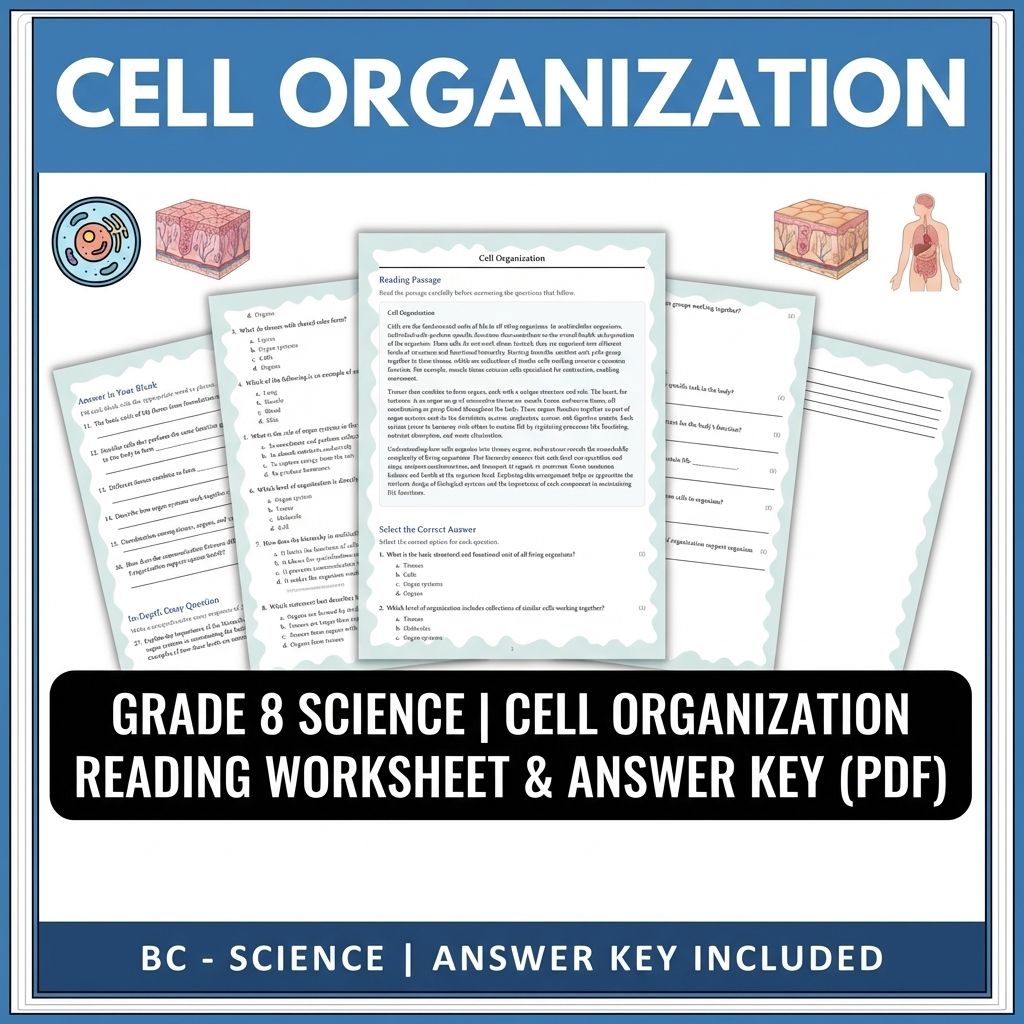
Grade 8 Science | Cell Organization Reading Worksheet & Answer Key (PDF)
JCreated byJ.S SheetsLearning Objectives
- Describe the hierarchical levels of cell organization in multicellular organisms.
- Explain how similar cells form tissues with shared functions.
- Identify how tissues combine to form organs with specific roles.
Instant download

Data Reasoning Assessment | Florida NGSSS Grade 8 Science Standards
 Created byPrism Point Learning
Learning Objectives
- Interpret data by identifying trends, patterns, and relationships in graphs and tables.
- Explain whether data suggest correlation, causation, or no clear relationship while using scientific reasoning.
- Evaluate the role of uncertainty and outliers in forming evidence-based conclusions.
Instant download

Scale and Patterns Practice Test Printable | Grade 8 Science NGSS
Created byPrism Point LearningLearning Objectives
- Use scale factors to compare solar system sizes and explain what changes when objects are scaled up or down.
- Interpret patterns in mean orbital distance (in astronomical units) and orbital period (in Earth days/years).
- Describe how orders of magnitude differ between planetary radii and interplanetary distances.
Also included in: Grade 8 Gravity and Motion Science lesson bundle NGSS worksheet practice
Instant download
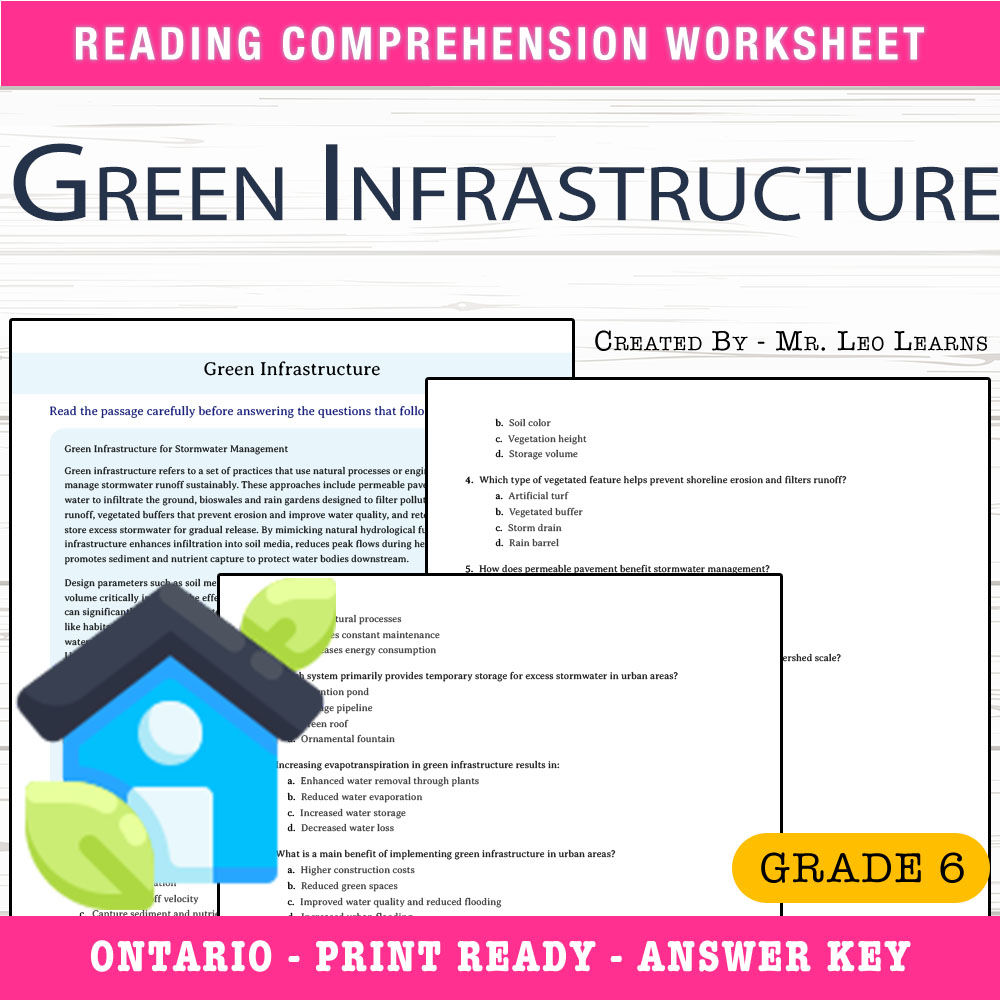
Grade 8 Science – Green Infrastructure Worksheet for Mastery
 Created byThe Resource Hub
Learning Objectives
- Understand the concept of green infrastructure and its role in stormwater management.
- Identify different types of nature-based and engineered green infrastructure practices.
- Explain how design parameters influence the effectiveness of green infrastructure solutions.
Also included in: Grade 8 Science Water Systems UNIT Bundle – Hydrology & Conservation Worksheets +1 more
Instant download

Reaction Evidence Worksheet for Grade 8 Science | Standards-Aligned Practice
JCreated byJ.S SheetsLearning Objectives
- Identify observable evidence distinguishing chemical and physical changes.
- Describe examples of physical and chemical reactions based on evidence.
- Explain how observable signs indicate atomic rearrangement or property change.
Instant download

Grade 8 Science Worksheet | Systems Analysis Practice (PDF) – Alberta Standards
 Created byEvergreen Desk Education
Learning Objectives
- Identify components and interactions in a complex physical system.
- Perform systematic force accounting to determine equilibrium or net acceleration.
- Distinguish internal forces from external forces and explain how each affects motion.
Instant download
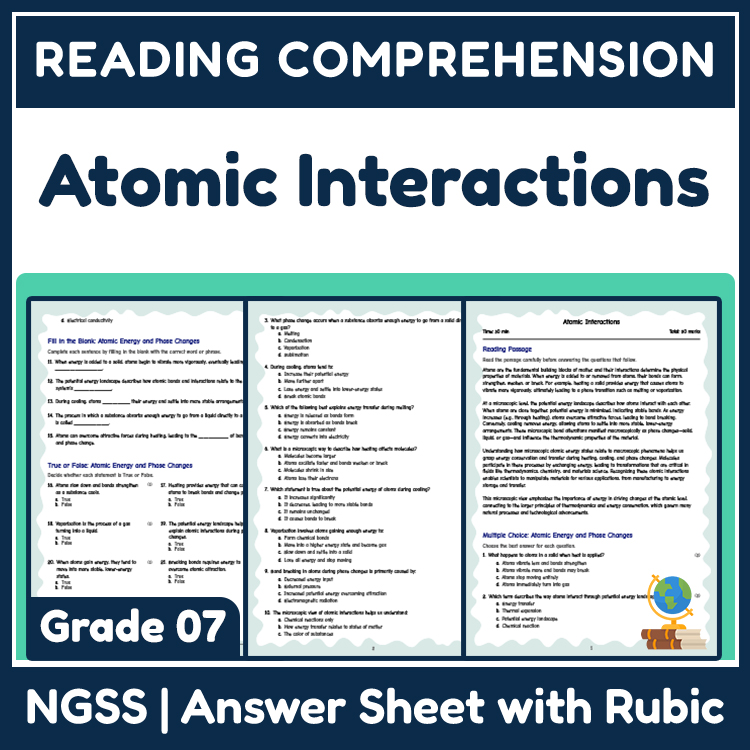
Grade 8 Science | Atomic Interactions Reading Worksheets (Answer Key)
JCreated byJ.S SheetsLearning Objectives
- Understand how energy influences atomic bonds and phase changes
- Model microscopic atomic behavior during heating and cooling
- Connect energy transfer to macroscopic states of matter
Instant download

Food Webs Worksheet | NGSS Grade 8 Science Assessment
 Created byCedar Grove Learning
Learning Objectives
- Understand the roles of producers, consumers, and decomposers in ecosystems.
- Explain energy transfer across trophic levels within food webs.
- Describe how energy loss affects community structure and population size.
Instant download

Grade 8 Species Interactions Worksheet | NGSS Practice & PDF
 Created byClear Sky Classroom
Learning Objectives
- Explain how competition, predation, mutualism, commensalism, and parasitism affect survival and reproduction.
- Describe how symbiotic relationships can benefit one or both species in an ecosystem.
- Analyze how species interactions can change population sizes and ecosystem stability.
Instant download
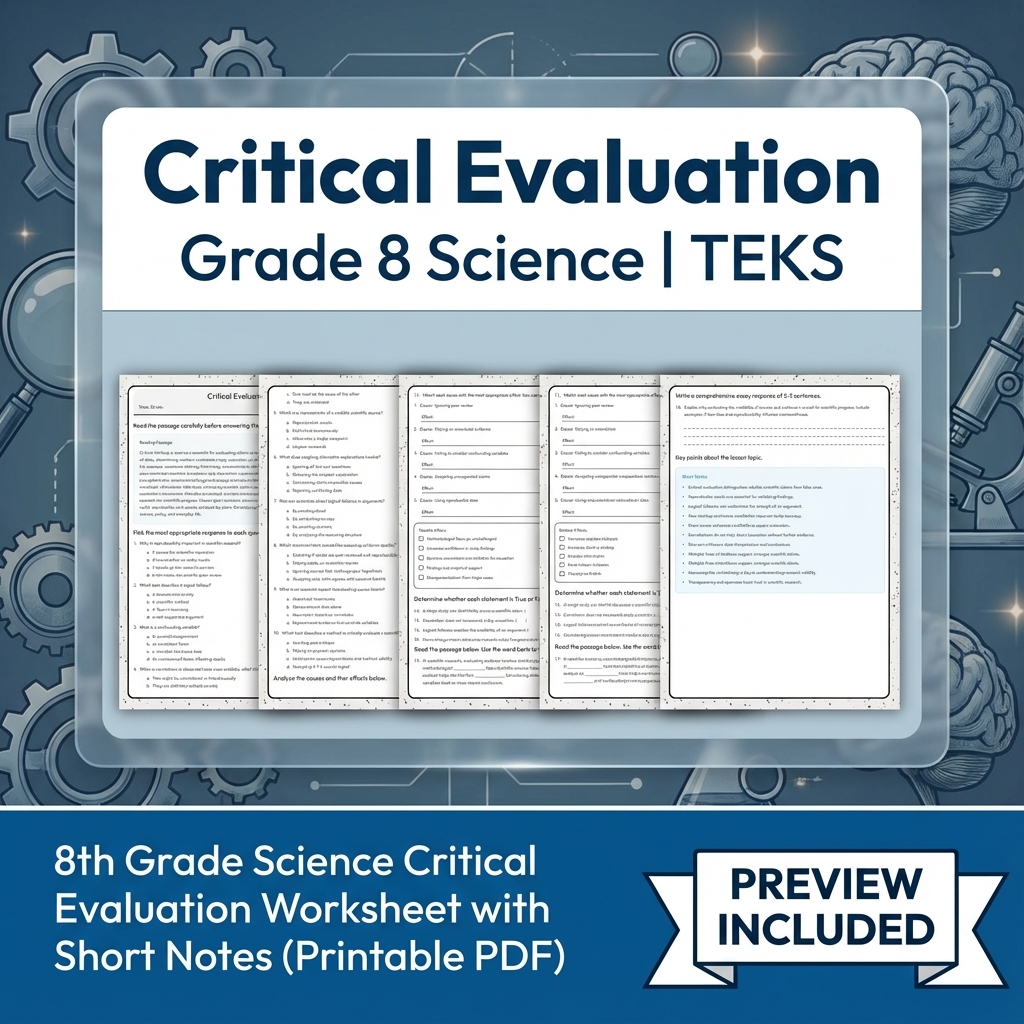
8th Grade Science Critical Evaluation Worksheet with Short Notes (Printable PDF)
Created byMeadowlark WorksheetsLearning Objectives
- Develop skills to assess the validity of scientific claims and evidence.
- Identify logical fallacies and distinguish correlation from causation in data.
- Evaluate the quality and credibility of scientific sources and methodologies.
Instant download
Grade 8 Science — Worksheet MCQ Paper for Understanding Indicator Properties
Created byThe Resource HubLearning Objectives
- Understand how properties such as pH, conductivity, density, and refractive index indicate chemical changes.
- Identify property shifts that signal the formation of new substances during reactions.
- Distinguish between physical and chemical changes based on indicator property measurements.
Also included in: Grade 8 Science | Matter & Chemical Change UNIT Worksheet Pack (BC Framework) +1 more
Instant download
8th Grade Science | Population Models Worksheet (PDF+ Answer Key)
 Created byCopper Leaf Classroom
Learning Objectives
- Understand the mathematical principles behind exponential and logistic growth models in populations.
- Interpret population growth graphs and relate them to real-world ecological scenarios.
- Explain factors such as carrying capacity, predation, and resource availability that influence population dynamics.
Instant download

Criteria and Constraints Worksheet | California Standards Grade 8 Science
JCreated byJ.S SheetsLearning Objectives
- Understand the difference between criteria and constraints in design processes.
- Identify examples of criteria and constraints in real-world projects.
- Analyze how constraints limit design options and how criteria define success.
Also included in: Grade 8 Engineering Design Optimization Science Lesson Bundle +1 more
Instant download
Abiotic Influences Assessment | BC Standards Grade 8 Science
Created byPrism Point LearningLearning Objectives
- Understand how abiotic factors influence species distribution and physiology.
- Identify different abiotic factors such as light, temperature, water, and soil composition.
- Analyze the impact of seasonal and microhabitat variations on ecosystems.
Instant download
Grade 8 Science | Momentum Transfer Worksheet (Ontario Standards) (PDF)
Created byBright Mind ResourcesLearning Objectives
- Explain the concept of linear momentum and how it is transferred during collisions.
- Distinguish between elastic and inelastic collisions at classroom-relevant scales.
- Apply conservation of momentum principles to predict post-collision velocities.
Instant download

Grade 8 Gravitational Interactions Worksheet | NGSS Gravity & Orbits Activity
 Created byAmber Owl Education
Learning Objectives
- Explain how gravitational force depends on mass and separation distance using the inverse-square relationship.
- Describe how gravity produces orbital motion and tidal effects in the Earth–Moon system.
- Use gravitational ideas to make comparisons about attraction strength and motion outcomes.
Also included in: Grade 8 Science Forces and Fields Physics Lesson Bundle | NGSS +1 more
Instant download
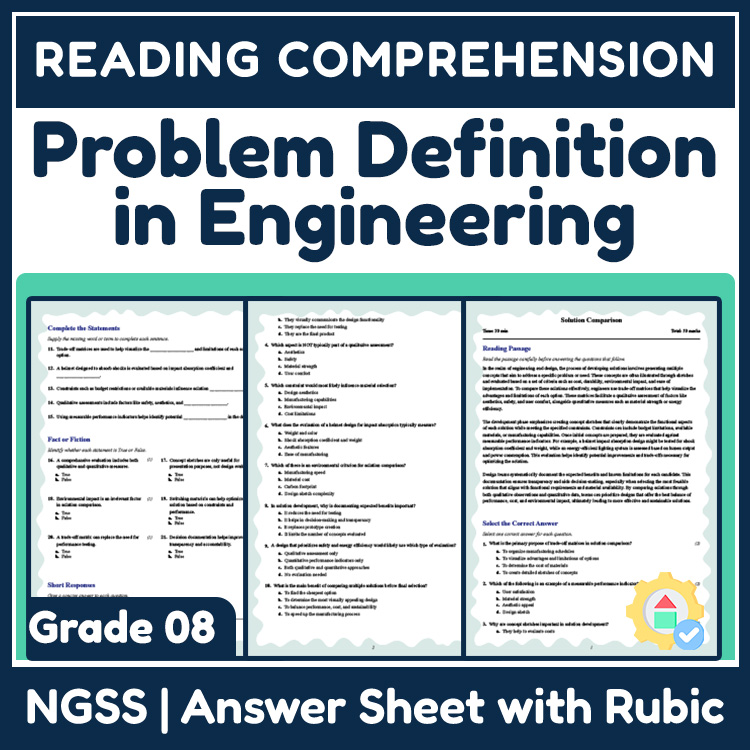
Grade 8 Science | Solution Comparison Reading Worksheet (PDF + Rubric)
JCreated byJ.S SheetsLearning Objectives
- Understand the process of developing and comparing multiple design concepts.
- Recognize criteria, constraints, and performance indicators in solution evaluation.
- Differentiate qualitative and quantitative assessment methods.
Instant download

Grade 8 Control Variables Design Worksheet | Practice & PDF
Created byClear Sky ClassroomLearning Objectives
- Identify independent, dependent, and controlled variables in a science investigation and explain why control variables matter.
- Design a fair study by choosing consistent procedures and measurable outcomes aligned to the research question.
- Select appropriate control variables to reduce confounding factors and plan reliable data collection through replication.
Instant download

Grade 8 Energy Relationships in Science Worksheet | NGSS Reading Activity
 Created byBRIGHT PATH RESOURCES
Learning Objectives
- Understand the concepts of kinetic and potential energy.
- Learn how energy depends on mass, speed, and position.
- Interpret graphs showing relationships between energy and other variables.
Also included in: Thermal Energy Grade 8 Science Daily Reading Worksheets Lesson Bundle | NGSS +2 more
Instant download
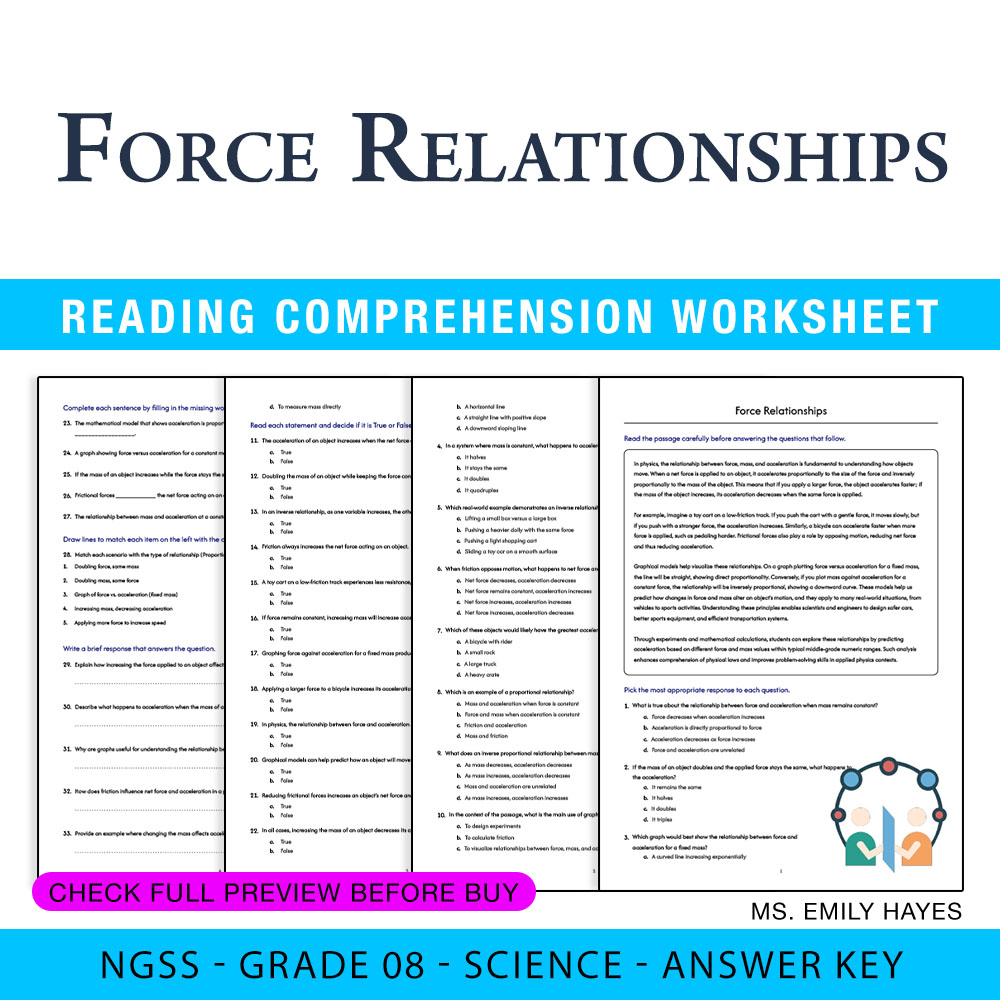
Grade 8 Science | Force Relationships Worksheet (PDF+ Answer Key)
Created byCopper Leaf ClassroomLearning Objectives
- Explain how net force, mass, and acceleration are mathematically related.
- Analyze how changes in force and mass affect an object's acceleration using models and graphs.
- Apply proportional and inverse relationships to predict motion in real-world scenarios.
Instant download

Biotech Considerations Worksheet | Ontario Grade 8 Science Assessment
Created byCedar Grove LearningLearning Objectives
- Explain how cell culture, stem cell differentiation, and tissue engineering can be used for repair and replacement of damaged tissues.
- Describe the roles of molecular markers, scaffolds, and controlled differentiation in biotech applications.
- Identify key ethical, safety, and regulatory considerations when manipulating cells and tissues.
Instant download
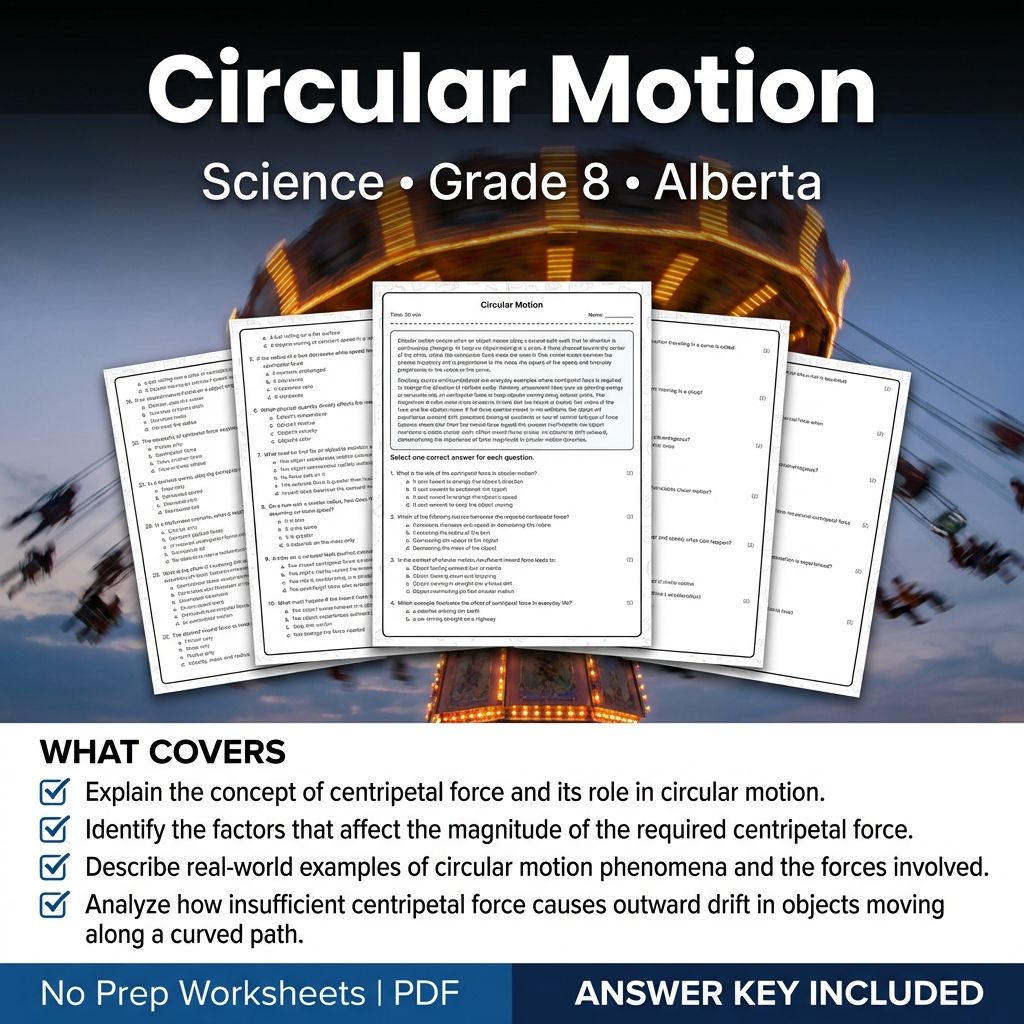
Grade 8 Science Worksheet on Circular Motion | Alberta Standards
 Created byCoral Reef Learning
Learning Objectives
- Explain the concept of centripetal force and its role in circular motion.
- Identify the factors that affect the magnitude of the required centripetal force.
- Describe real-world examples of circular motion phenomena and the forces involved.
Instant download
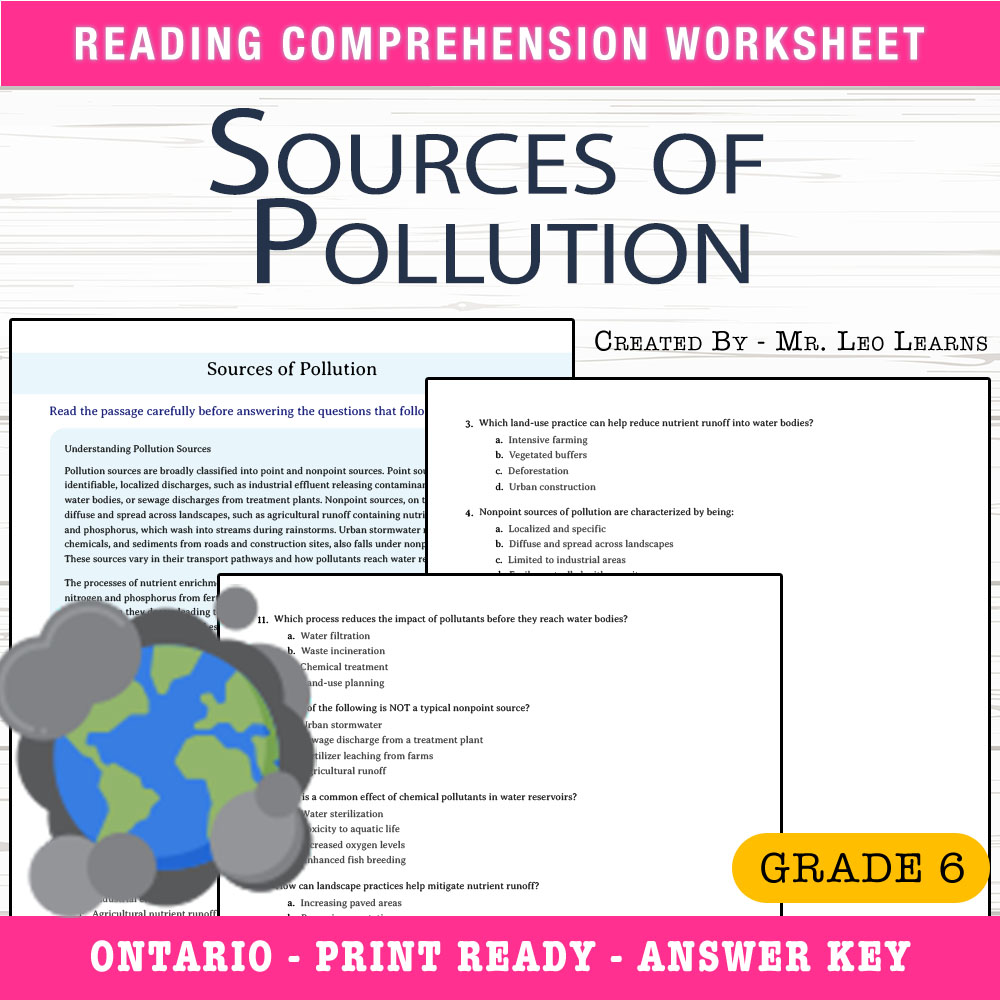
Grade 8 Science – Sources of Pollution Worksheet for Mastery
Created byThe Resource HubLearning Objectives
- Define point and nonpoint sources of pollution with examples.
- Explain processes like eutrophication and oxygen depletion in relation to water contamination.
- Connect land-use practices to pathways of pollutant transport and water reservoir vulnerability.
Also included in: Grade 8 Science Water Systems UNIT Bundle – Hydrology & Conservation Worksheets +1 more
Instant download

Weather Patterns Practice Worksheet | Grade 8 Science NGSS Review
Created byPrism Point LearningLearning Objectives
- Explain how air mass movement and pressure changes relate to weather outcomes like fronts and precipitation.
- Use observational tools (surface pressure maps, temperature gradients, radiosonde profiles, and Doppler radar) to interpret weather patterns.
- Describe how cyclogenesis and frontogenesis can shift wind, temperature, humidity, and precipitation.
Instant download
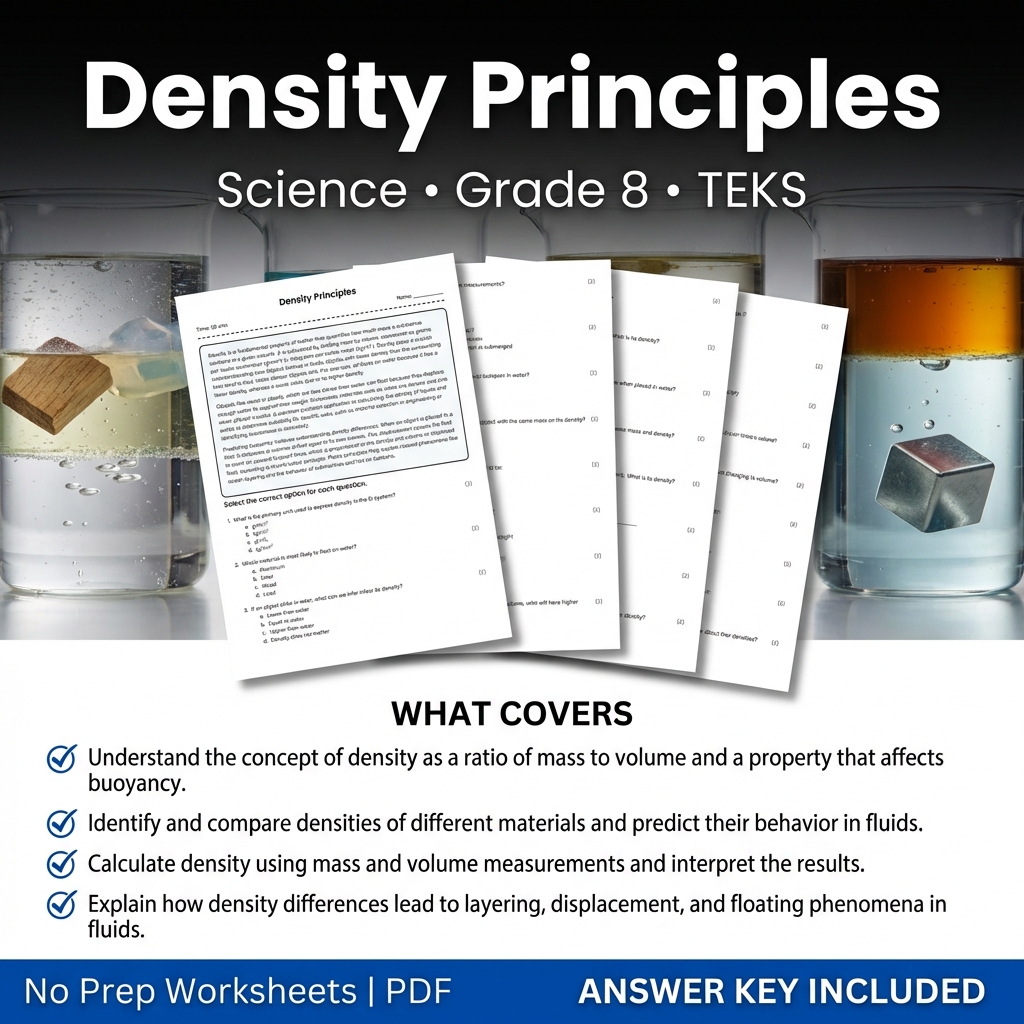
Grade 8 Science Worksheet on Density Principles | Printable Assessment
Created byCoral Reef LearningLearning Objectives
- Understand the concept of density as a ratio of mass to volume and a property that affects buoyancy.
- Identify and compare densities of different materials and predict their behavior in fluids.
- Calculate density using mass and volume measurements and interpret the results.
Instant download

Grade 8 Science | Momentum & Transfer - Daily Reading Comprehension
Created byCoral Reef LearningLearning Objectives
- Define and explain the concept of momentum in physical systems.
- Describe how velocity and mass affect an object's momentum.
- Differentiate between elastic and inelastic collisions in terms of momentum transfer.
Instant download

Systems Analysis Worksheet for Grade 8 Science | Standards-Aligned Practice
JCreated byJ.S SheetsLearning Objectives
- Understand how to identify and decompose forces in complex systems.
- Learn to distinguish between internal and external interactions within systems.
- Apply vector addition principles to evaluate system equilibrium or acceleration.
Also included in: Grade 8 Forces & Motion Science Lesson Bundle – Alberta framework worksheets +1 more
Instant download
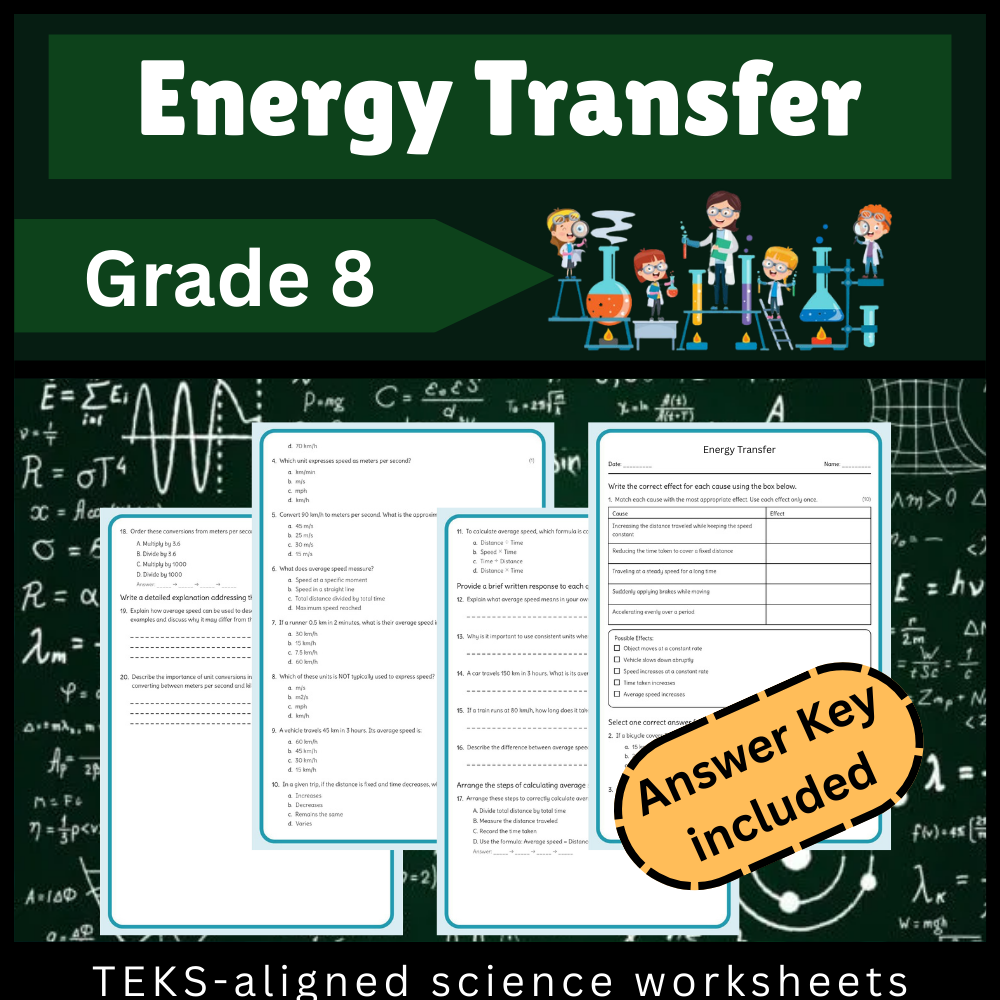
Grade 8 Science | Energy Transfer Worksheet (Worksheet + Answer Key) - TEKS-Aligned
Created byBright Mind ResourcesLearning Objectives
- Explain the mechanisms of conduction, convection, and radiation in thermal processes.
- Identify examples of energy transfer in real-world systems and phase changes.
- Describe how thermal energy exchange leads to observable temperature changes and phase transitions.
Also included in: Grade 8 Science Unit Bundle | States of Matter & Reaction Rates Worksheets- TEKS +1 more
Instant download
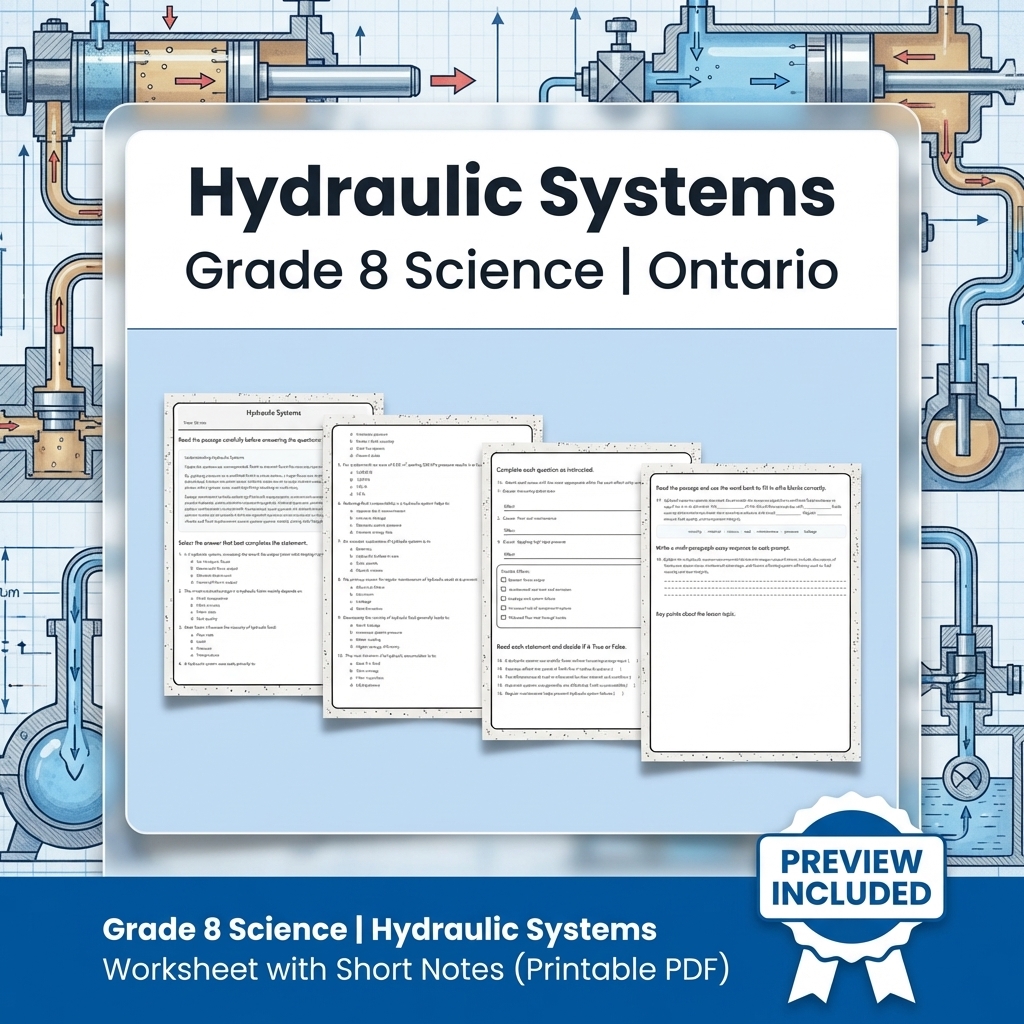
Grade 8 Science | Hydraulic Systems Worksheet with Short Notes (Printable PDF)
Created byMeadowlark WorksheetsLearning Objectives
- Explain the basic principles of hydraulic systems and their force-area relationships.
- Evaluate the mechanical advantages provided by different piston arrangements.
- Calculate the required input pressure for specific output loads.
Also included in: Grade 8 Science Lesson Group Bundle | Hydrostatics & Fluid Mechanics +1 more
Instant download

Thermal Changes Practice Test | Grade 8 Science NGSS Worksheet
Created byPrism Point LearningLearning Objectives
- Use quantitative reasoning to relate energy transferred, mass, and temperature change through specific heat capacity.
- Explain how identical energy inputs produce different temperature changes in materials with different specific heat capacities.
- Connect macroscopic temperature measurements to microscopic particle kinetic energy and apply conservation of energy in thermal processes.
Also included in: Grade 8 Thermal Energy and Conservation Science Lesson Bundle for NGSS
Instant download

Organelles Roles Worksheet | Ontario Grade 8 Science Assessment
Created byCedar Grove LearningLearning Objectives
- Identify major organelles and describe their main functions in a cell
- Explain how energy conversion and protein synthesis depend on multiple organelles
- Use evidence about cell behavior to connect organelle structure to function
Instant download

Earth Materials Worksheet | NGSS Grade 8 Science Assessment
Created byCedar Grove LearningLearning Objectives
- Model Earth's material cycles and energy flows by understanding rock cycle processes, mantle convection, and surface interactions.
- Identify and describe the transfer of mass through melting, crystallization, uplift, weathering, transport, and deposition.
- Explain energy sources such as Earth's internal heat and gravitational potential in shaping Earth's features.
Instant download
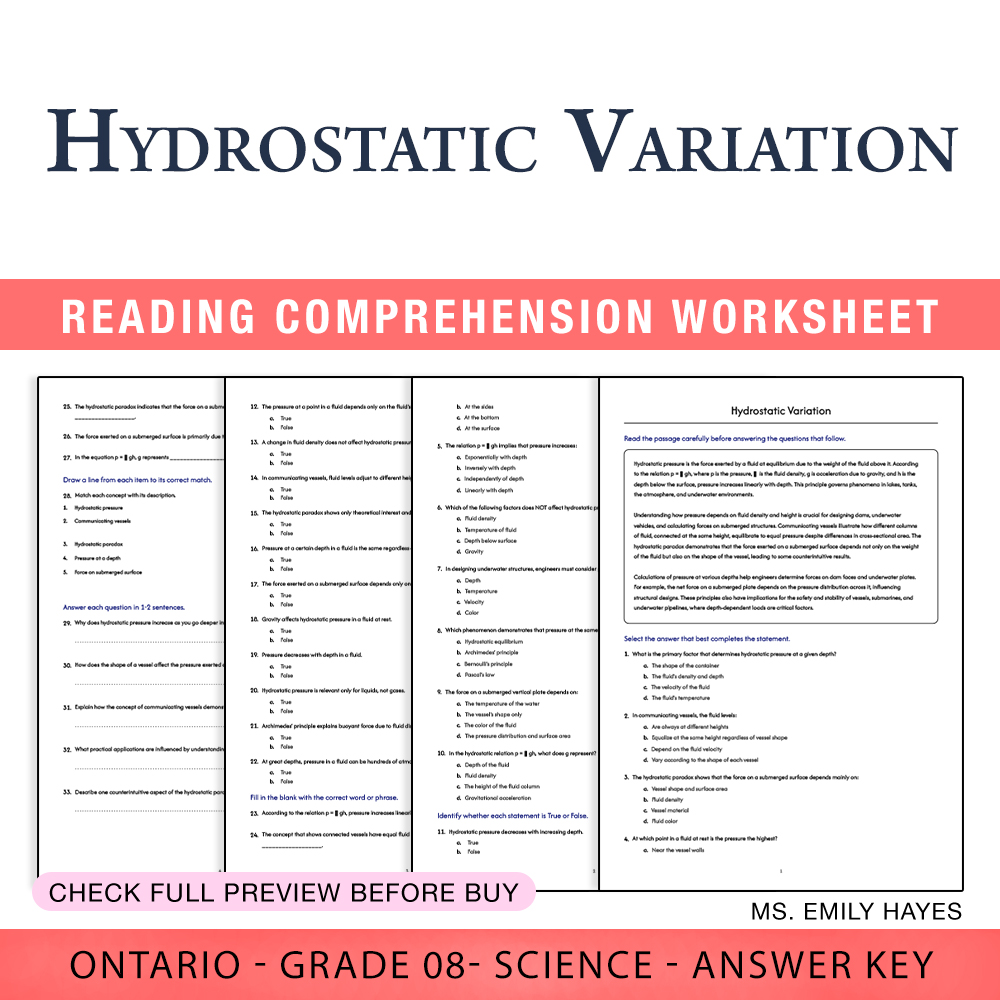
Grade 8 Science | Hydrostatic Variation Worksheet (PDF+ Answer Key)
Created byCopper Leaf ClassroomLearning Objectives
- Understand how hydrostatic pressure varies with depth and fluid density.
- Explain the concepts of communicating vessels and the hydrostatic paradox.
- Calculate pressure at different depths in a fluid and analyze forces on submerged surfaces.
Instant download
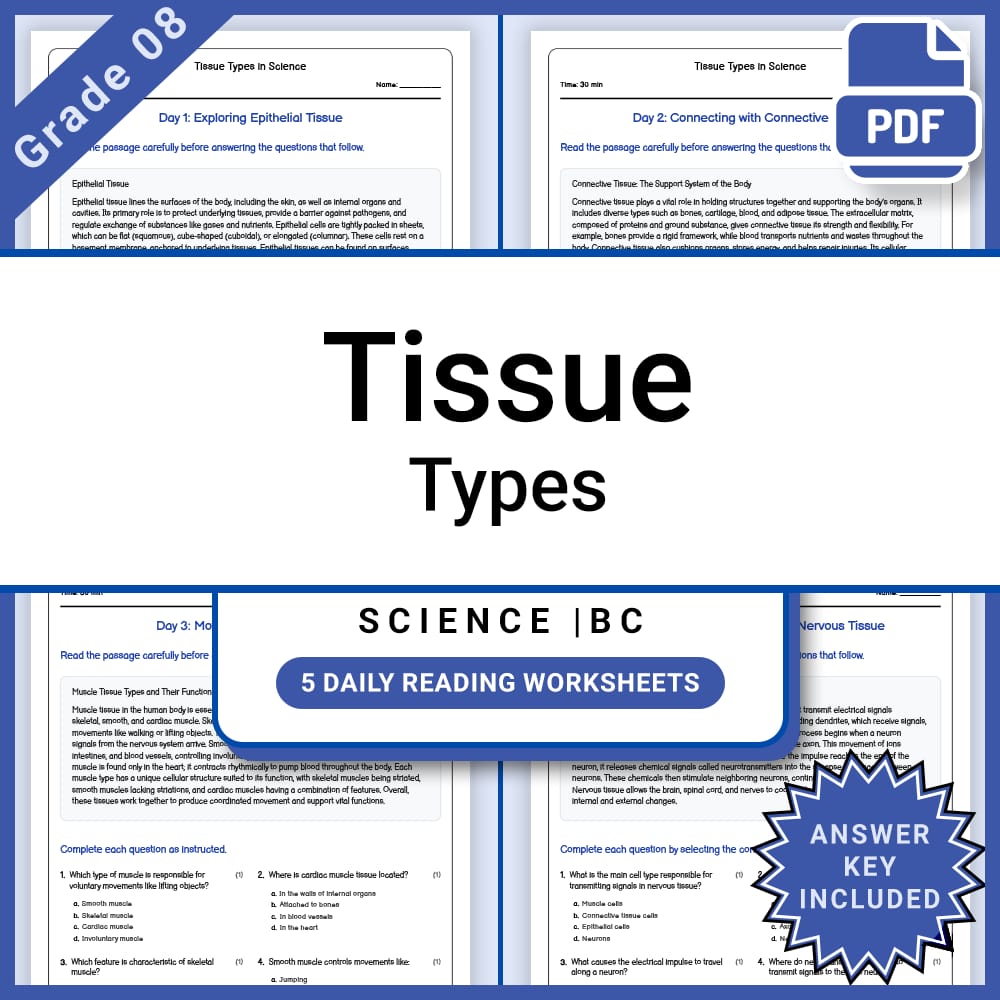
Grade 8 Science – Tissue Types Daily Reading Worksheet with Answer Key
JCreated byJ.S SheetsLearning Objectives
- Identify the major types of tissues: epithelial, connective, muscle, and nervous.
- Describe the structure and role of epithelial tissue.
- Understand how tissue types differ in organization and function.
Also included in: Grade 8 Science Lesson Group BC Framework | Daily Reading Worksheets +1 more
Instant download
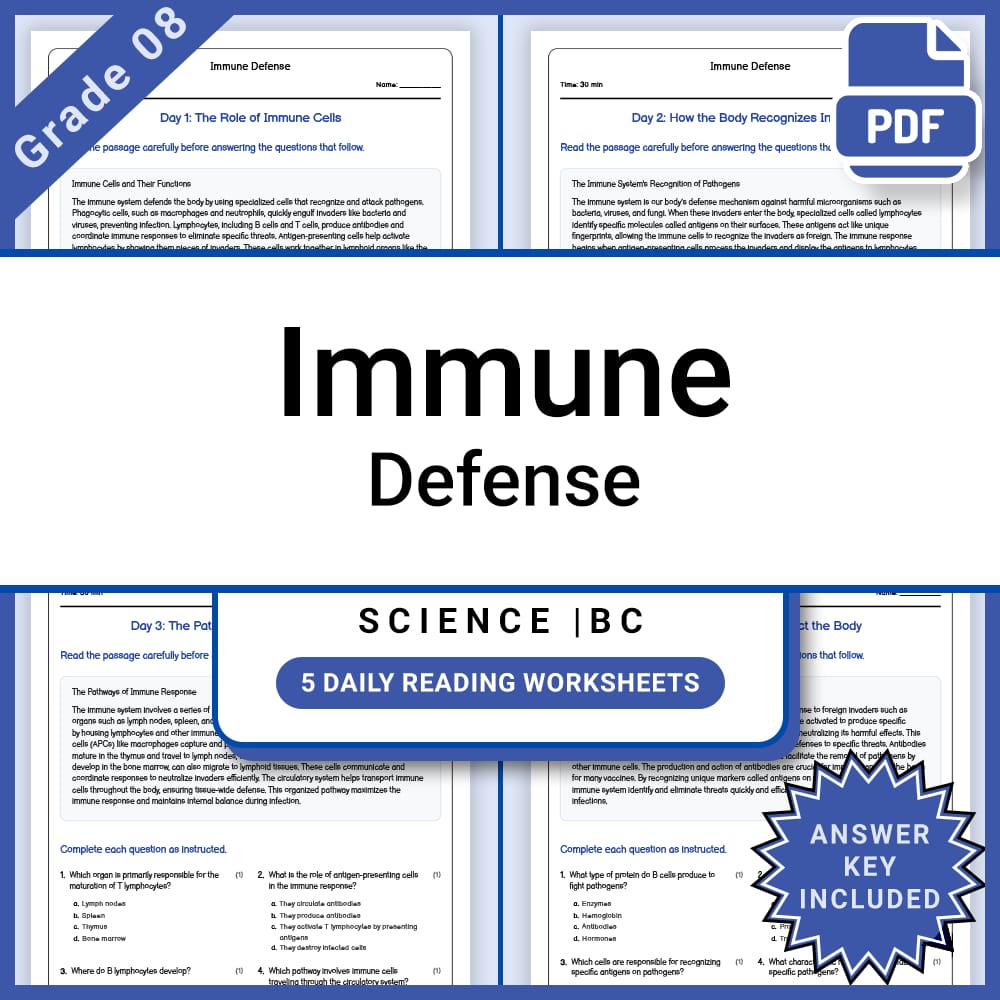
Grade 8 Science – Immune Defense Daily Reading Worksheet + Answer Key
JCreated byJ.S SheetsLearning Objectives
- Identify different immune cells such as phagocytic cells and lymphocytes.
- Understand the functions of various immune cells in defending the body.
- Describe how immune responses coordinate to fight pathogens.
Also included in: Grade 8 Science Lesson Group BC Framework | Daily Reading Worksheets +1 more
Instant download
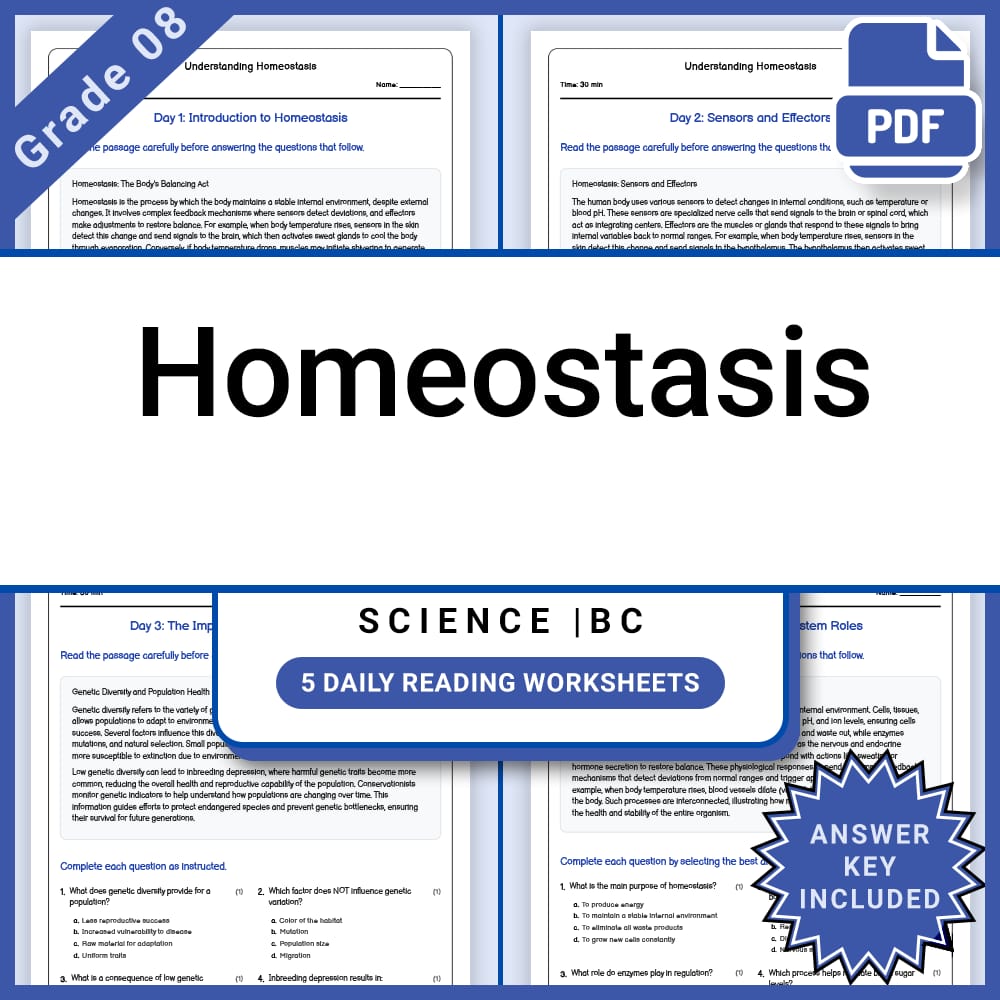
Grade 8 Science – Homeostasis Daily Reading Worksheet with Answer Key
JCreated byJ.S SheetsLearning Objectives
- Define homeostasis and explain its significance in the human body.
- Identify various feedback mechanisms involved in maintaining internal balance.
- Describe the roles of sensors, integrating centers, and effectors.
Also included in: Grade 8 Science Lesson Group BC Framework | Daily Reading Worksheets +1 more
Instant download
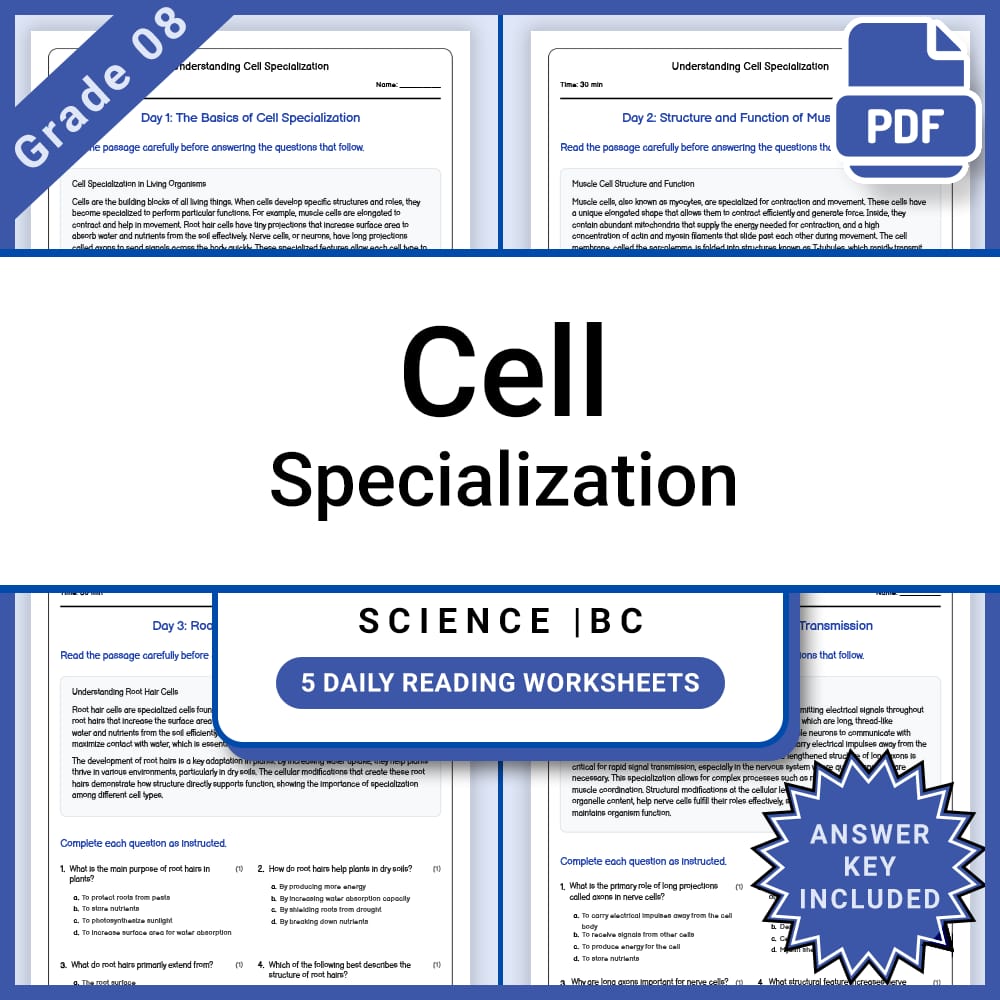
Grade 8 Science – Cell Specialization Daily Reading Worksheet + Answer Key
JCreated byJ.S SheetsLearning Objectives
- Describe what cell specialization means.
- Identify different types of specialized cells and their functions.
- Explain how the structure of specialized cells supports their tasks.
Also included in: Grade 8 Science Lesson Group BC Framework | Daily Reading Worksheets +1 more
Instant download
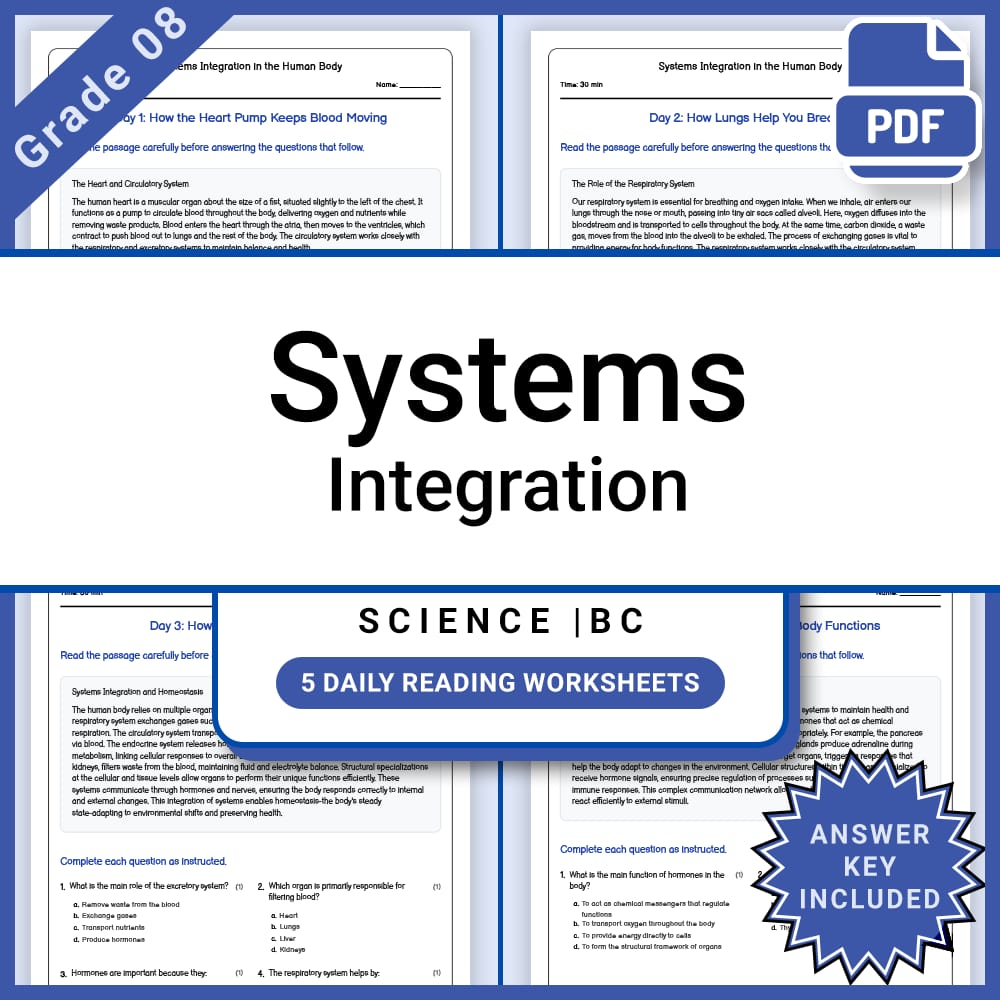
Grade 8 Science – Systems Integration Daily Reading Worksheet + Answer Key
JCreated byJ.S SheetsLearning Objectives
- Understand how the circulatory, respiratory, excretory, and endocrine systems work together to maintain homeostasis.
- Identify key organs and functions within systems that contribute to overall health.
- Explain how cellular specializations support system functions.
Also included in: Grade 8 Science Lesson Group BC Framework | Daily Reading Worksheets +1 more
Instant download
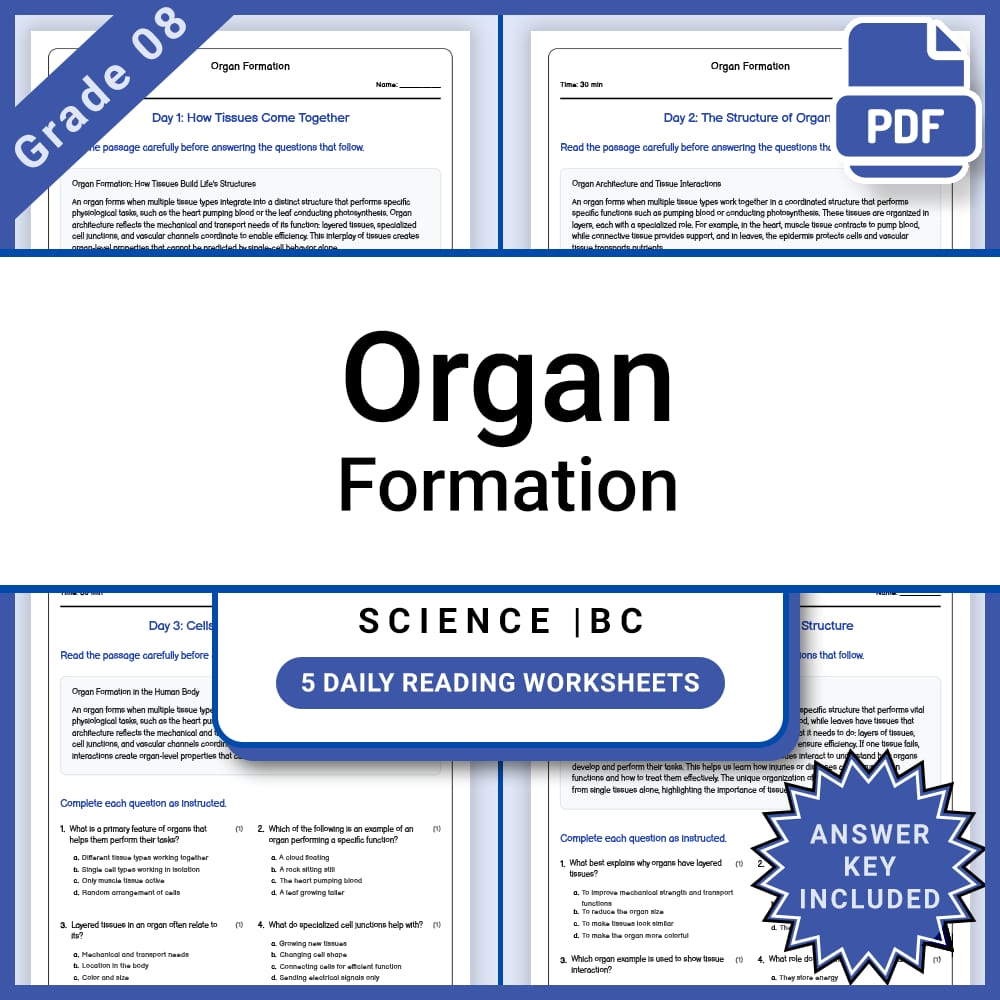
Grade 8 Science – Organ Formation Daily Reading Worksheet with Answer Key
JCreated byJ.S SheetsLearning Objectives
- Understand how tissues interact to form organs
- Identify the types of tissues involved in organ structure
- Explain the role of vascular channels in organs
Also included in: Grade 8 Science Lesson Group BC Framework | Daily Reading Worksheets +1 more
Instant download
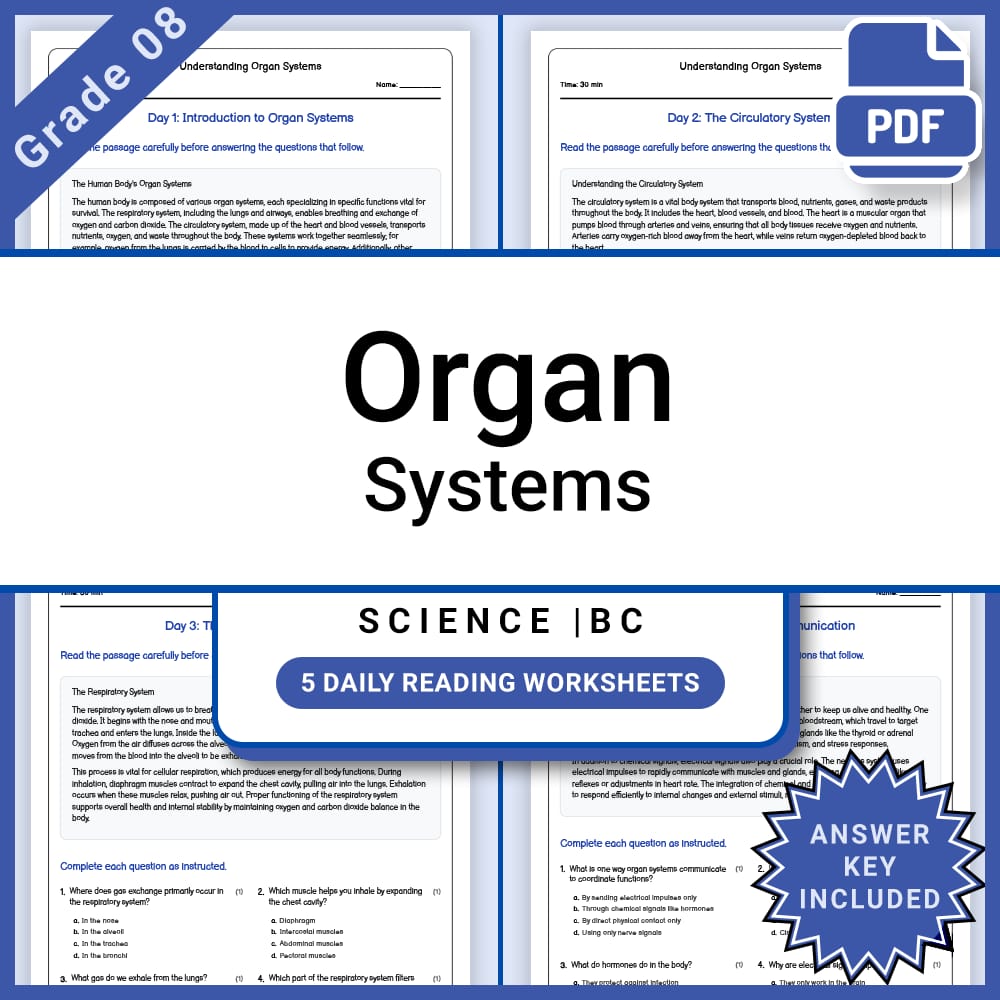
Grade 8 Science – Organ Systems Daily Reading Worksheet with Answer Key
JCreated byJ.S SheetsLearning Objectives
- Describe the major organ systems in the human body
- Explain the functions of key organs within each system
- Understand how organs work together to maintain health and homeostasis
Also included in: Grade 8 Science Lesson Group BC Framework | Daily Reading Worksheets +1 more
Instant download
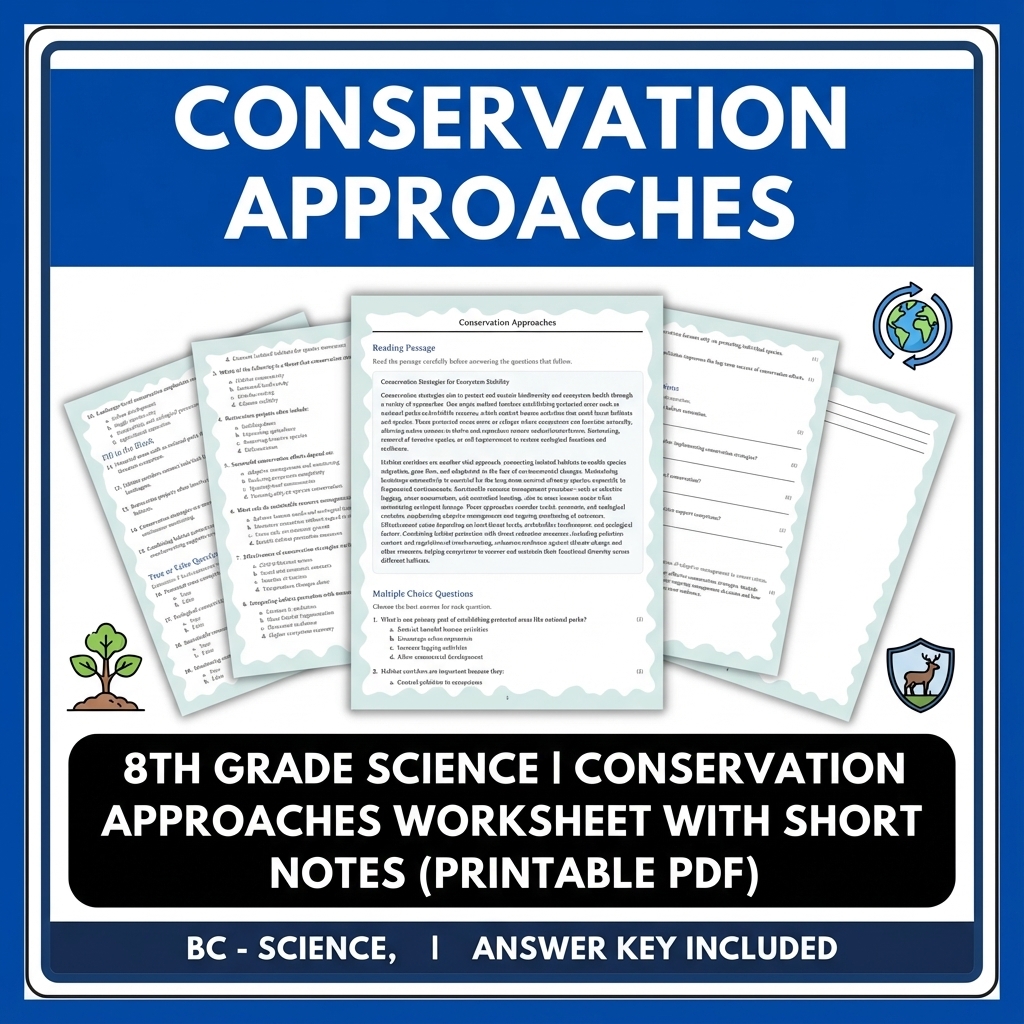
8th Grade Science | Conservation Approaches Reading Worksheet & Answer Key PDF
JCreated byJ.S SheetsLearning Objectives
- Understand various conservation strategies to maintain ecosystem stability and biodiversity.
- Identify different approaches such as protected areas, habitat corridors, and sustainable resource management.
- Analyze the factors influencing the effectiveness of conservation methods and their adaptive management.
Instant download
About Grade 8 Science Worksheets
Explore Grade 8 Science worksheets for classwork, homework, or review. Our 5,999 printables download instantly as PDFs.
Each resource here is built by an independent educator and reviewed for quality. Worksheets print straight from PDF and suit classroom use, homework, or extra practice; most come with answer keys, and you can preview before purchasing.