
Grade 8 Science Worksheets
6,006 worksheets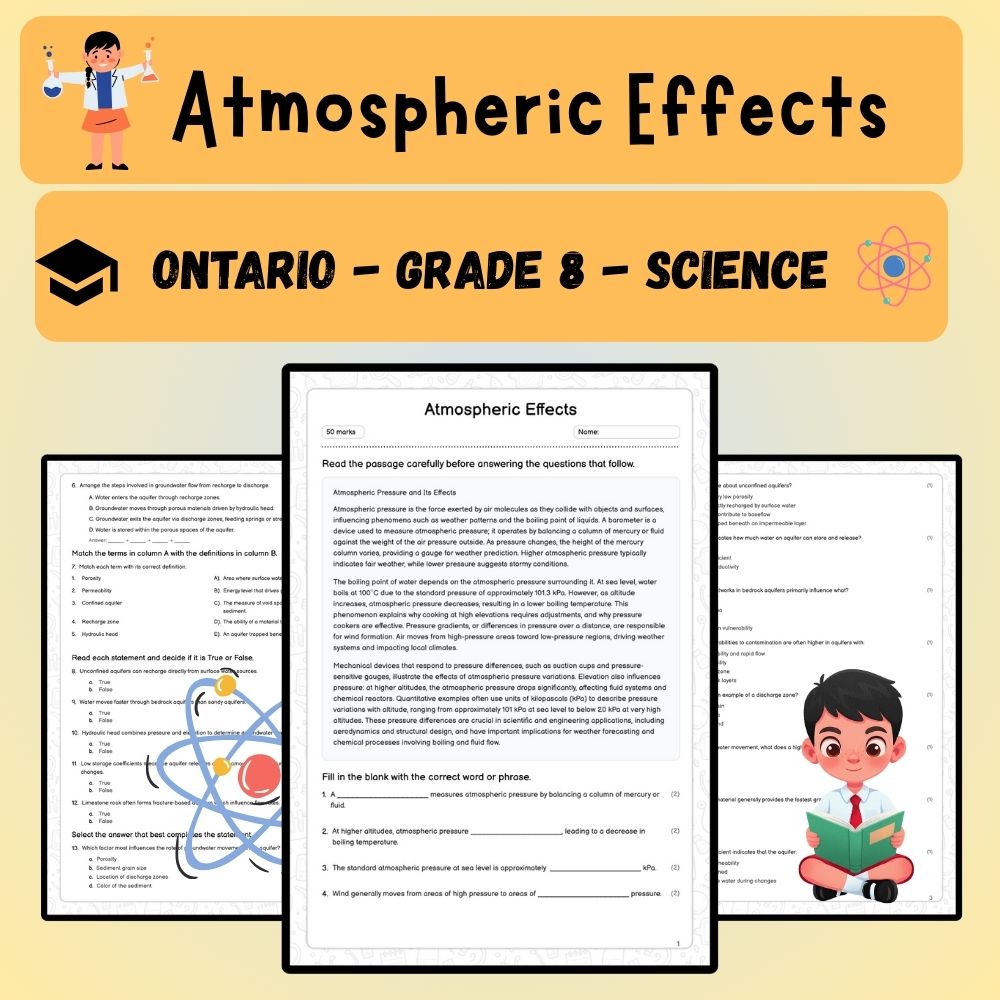
Grade 8 Science | Atmospheric Effects Worksheet (PDF )
 Created byPrism Point Learning
Learning Objectives
- Explain how atmospheric pressure affects boiling points and weather instruments.
- Describe the operation of a barometer and the influence of pressure gradients on wind.
Also included in: Grade 8 Science | Fluid Mechanics & Pressure Unit Worksheet Bundle +1 more
Instant download
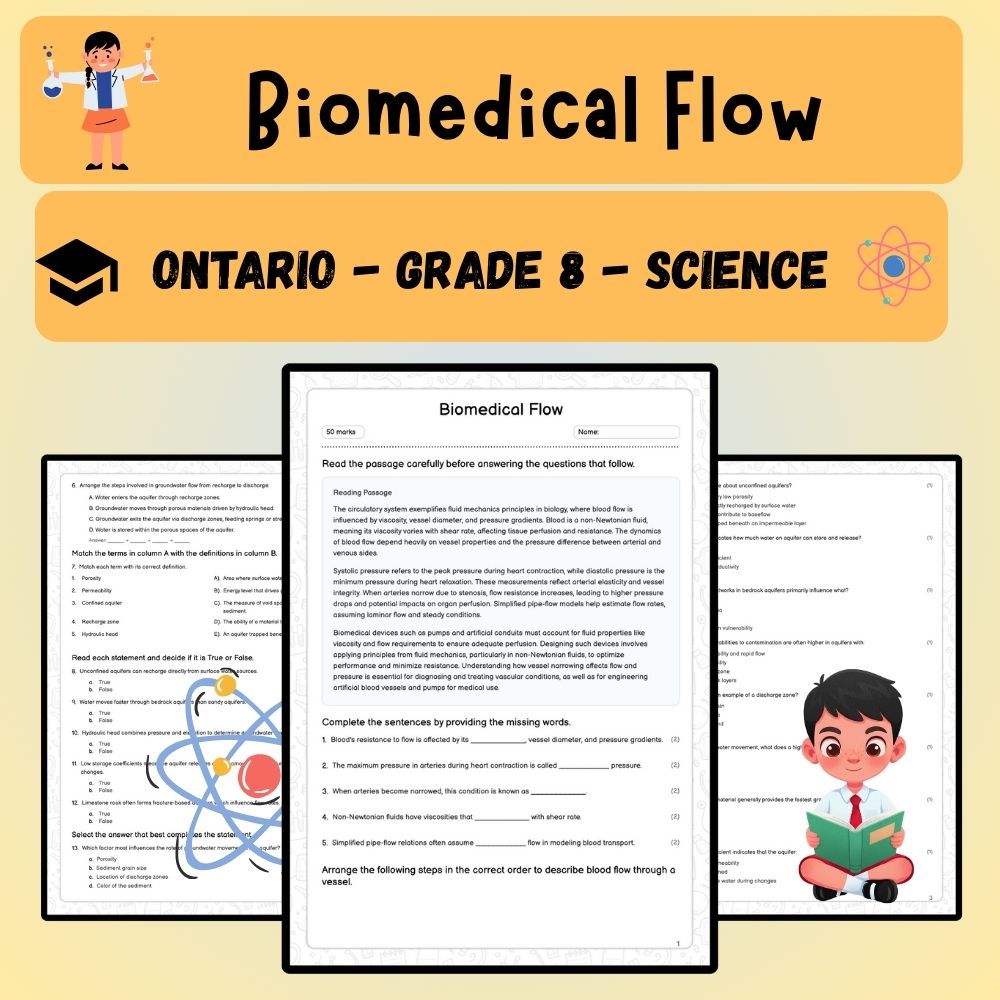
Grade 8 Science | Biomedical Flow Worksheet (PDF) – Ontario Standards
Created byPrism Point LearningLearning Objectives
- Understand how non-Newtonian properties influence blood perfusion and flow resistance.
- Relate systolic and diastolic blood pressures to arterial function.
- Analyze the effects of narrowing (stenosis) on blood flow and pressure.
Also included in: Grade 8 Science | Fluid Mechanics & Pressure Unit Worksheet Bundle +1 more
Instant download
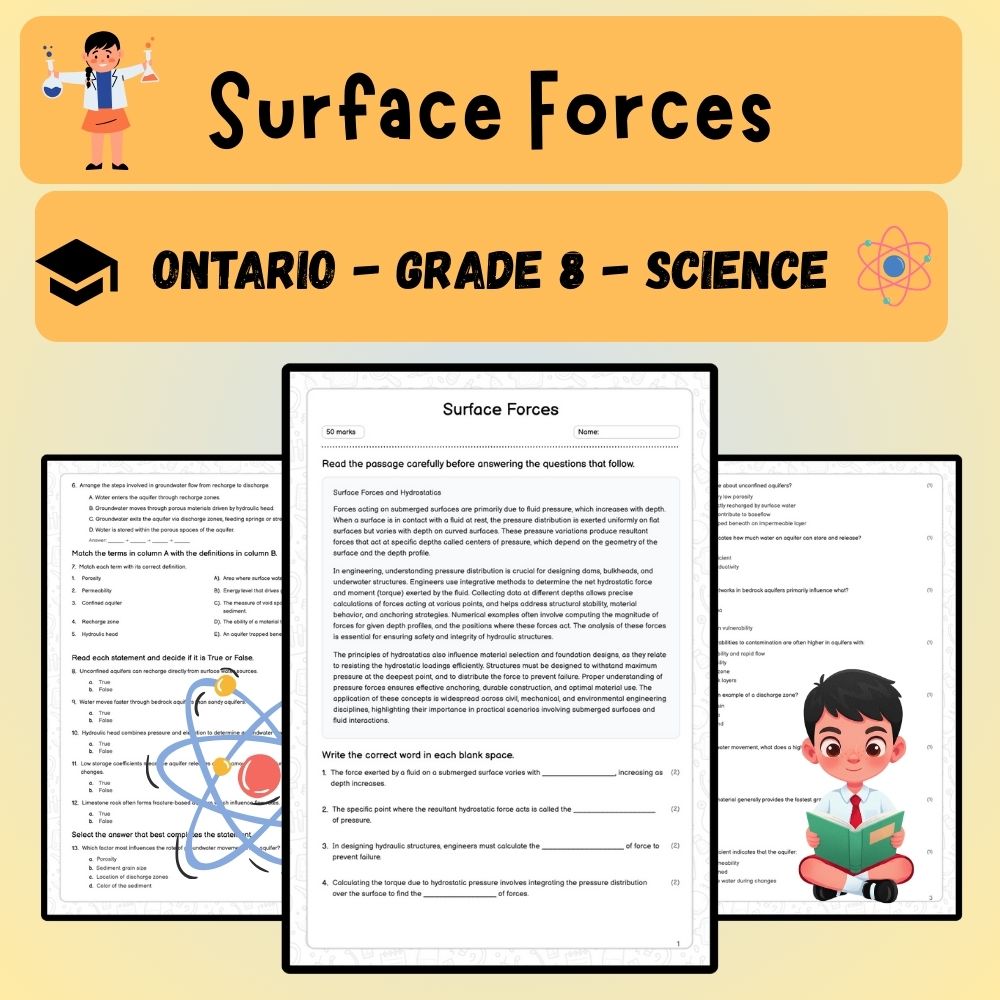
Grade 8 Science | Surface Forces Worksheet – Hydrostatic Pressure & Force (PDF)
Created byPrism Point LearningLearning Objectives
- Understand how pressure distributes on submerged surfaces.
- Apply integrative methods to calculate net force and torque.
- Analyze structural implications of hydrostatic pressure in engineering design.
Also included in: Grade 8 Science | Fluid Mechanics & Pressure Unit Worksheet Bundle +1 more
Instant download
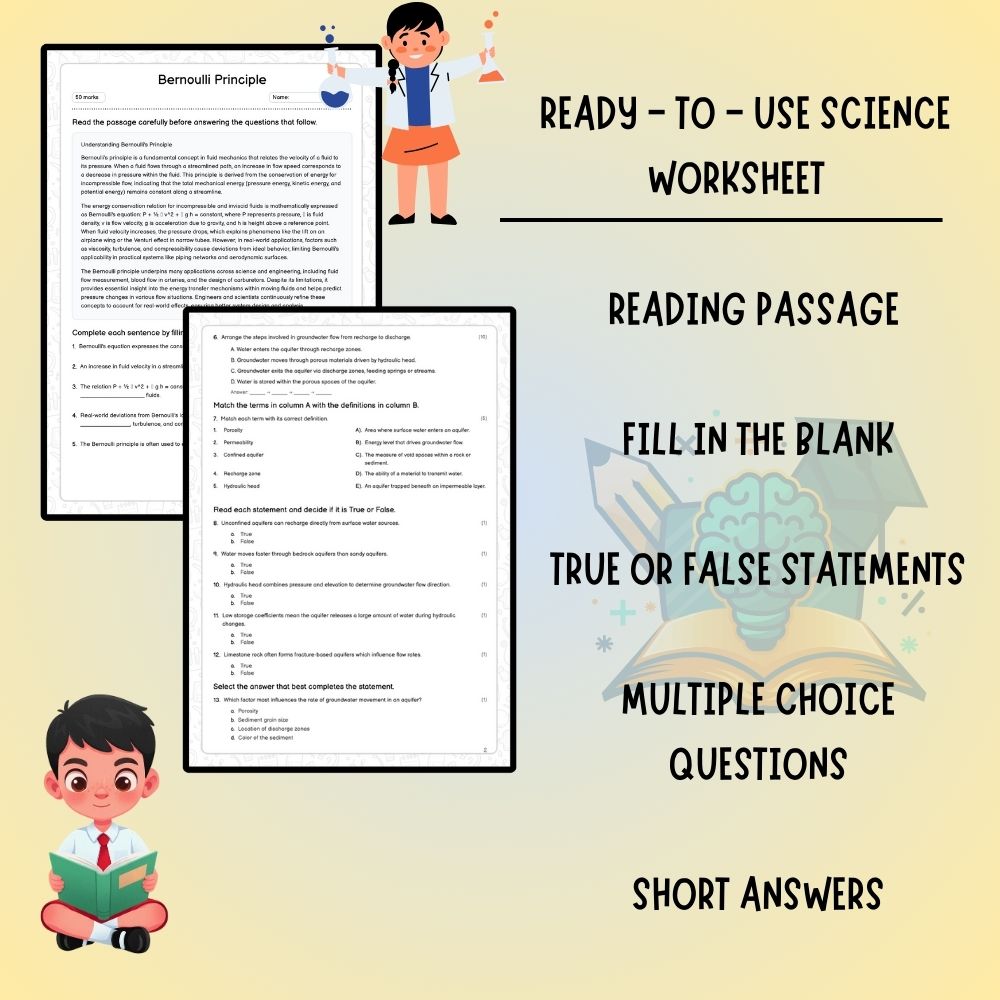
Grade 8 Science | Bernoulli Principle Worksheet (PDF ) - Ontario Standards
Created byPrism Point LearningLearning Objectives
- Explain the relationship between fluid speed and pressure as described by Bernoulli's principle.
- Apply Bernoulli's equation to real-world scenarios such as airfoil lift and pipe flow.
- Describe the limitations of Bernoulli's principle in practical applications due to viscosity, turbulence, and compressibility.
Also included in: Grade 8 Science | Fluid Mechanics & Pressure Unit Worksheet Bundle +1 more
Instant download
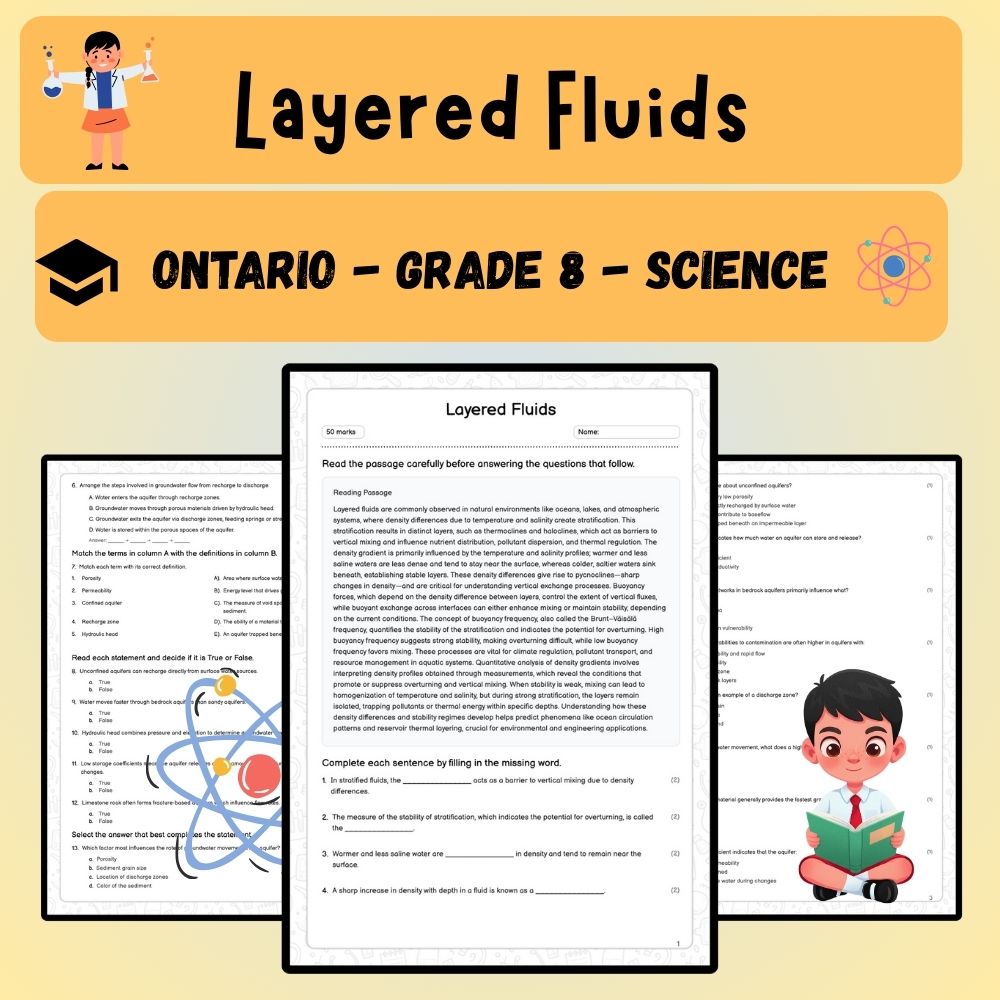
Grade 8 Science | Understanding Layered Fluids Worksheet (PDF )
Created byPrism Point LearningLearning Objectives
- Understand how temperature and salinity create density gradients in fluids.
- Explain the concepts of pycnoclines and stratification in natural and engineered systems.
- Analyze the effects of density differences on vertical mixing and pollutant dispersion.
Also included in: Grade 8 Science | Fluid Mechanics & Pressure Unit Worksheet Bundle +1 more
Instant download
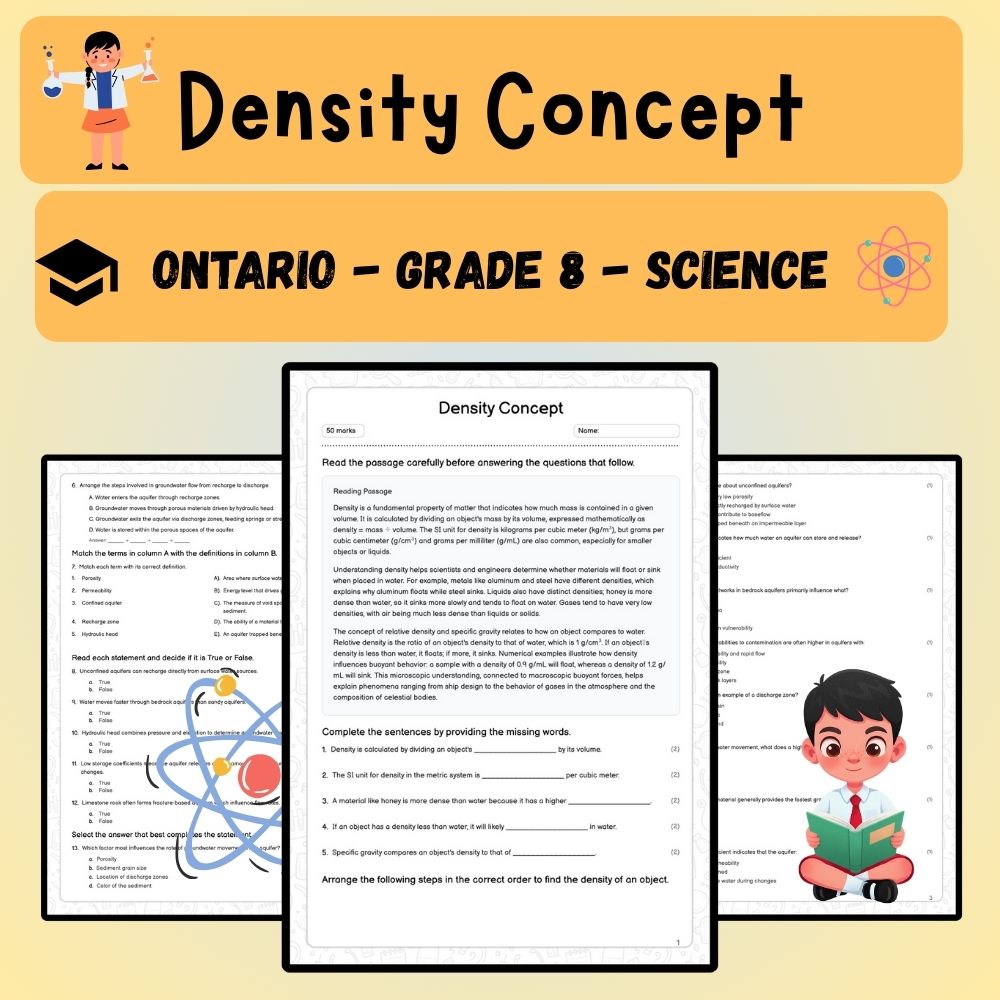
Grade 8 Science – Density Concept Worksheet (PDF ) – Ontario Standards
Created byPrism Point LearningLearning Objectives
- Understand the definition of density and its units of measurement.
- Explain how mass, volume, and density relate to each other.
- Differentiate between low and high-density materials and their buoyant behaviors.
Also included in: Grade 8 Science | Fluid Mechanics & Pressure Unit Worksheet Bundle +1 more
Instant download
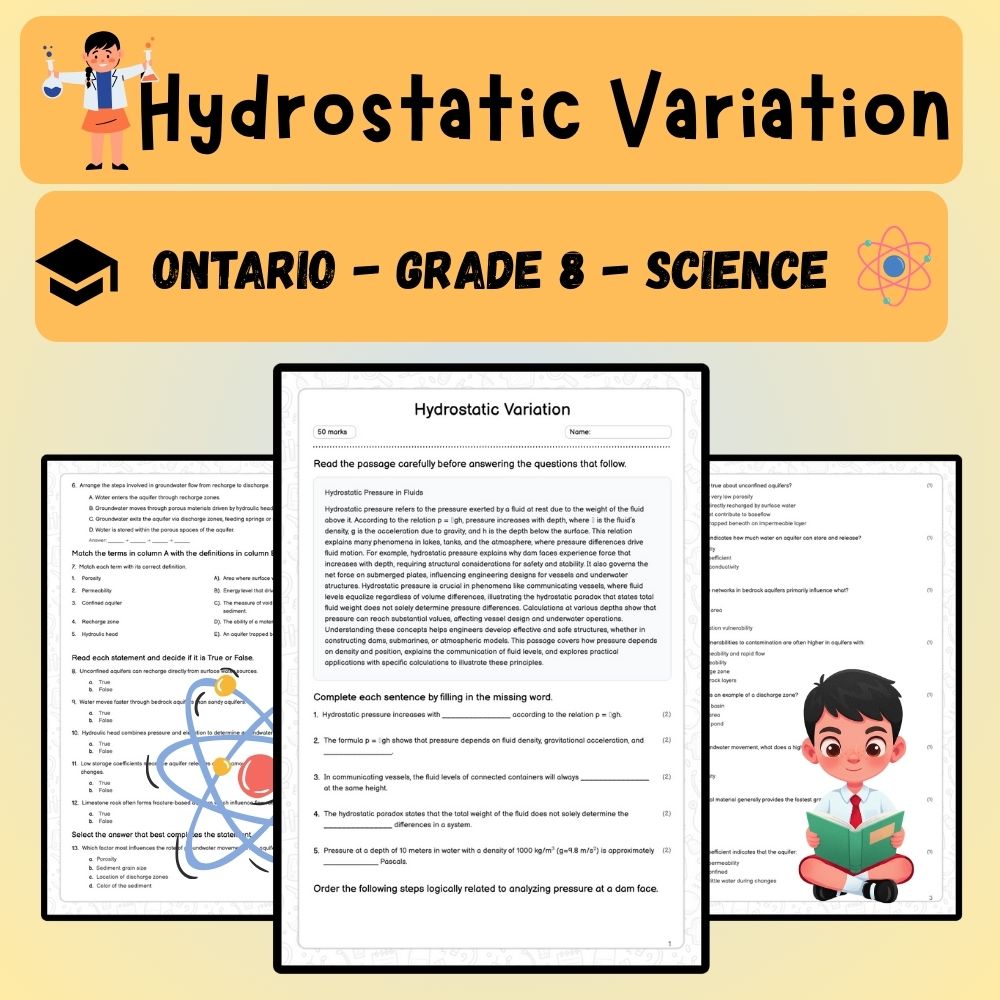
Grade 8 Science Worksheet | Hydrostatic Variation – Concepts & Practice (PDF)
Created byPrism Point LearningLearning Objectives
- Understand how hydrostatic pressure varies with depth and fluid density.
- Explain communicating vessels and the hydrostatic paradox.
- Calculate pressure at different depths and analyze forces on submerged surfaces.
Also included in: Grade 8 Science | Fluid Mechanics & Pressure Unit Worksheet Bundle +1 more
Instant download
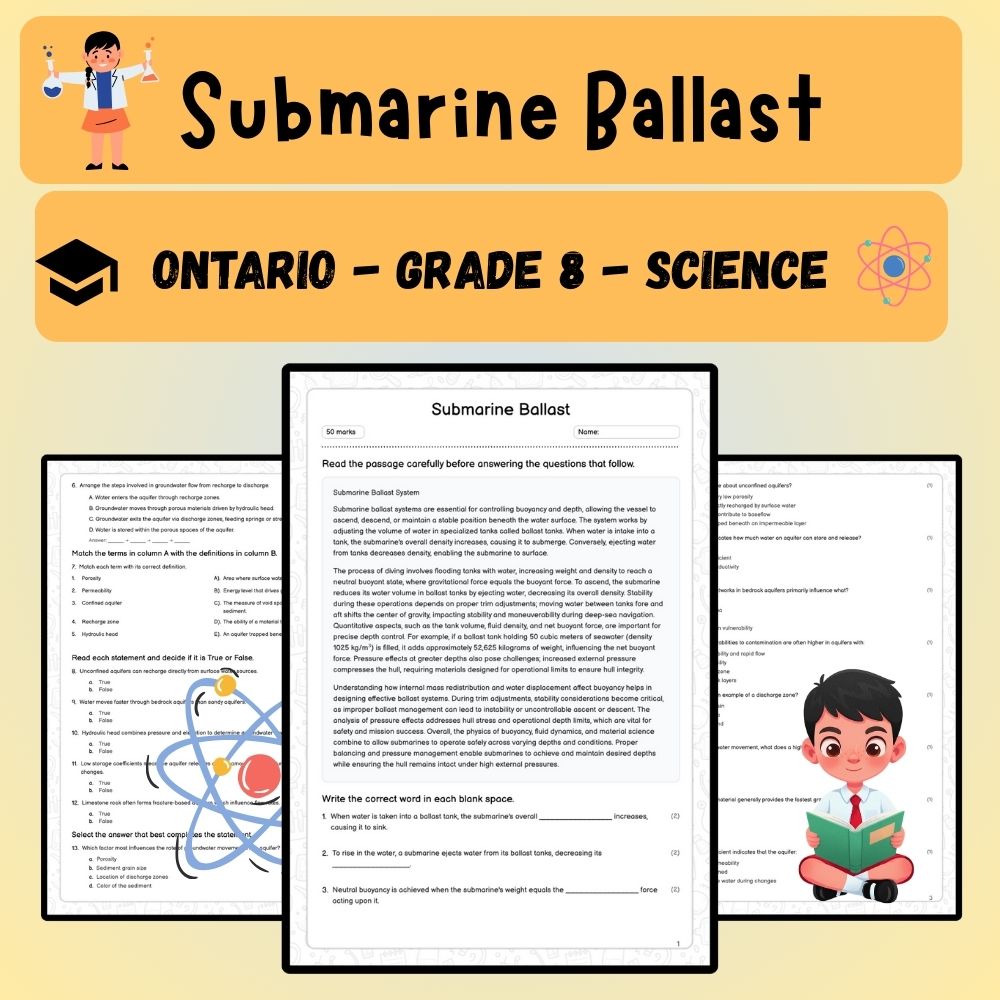
Grade 8 Science | Submarine Ballast Systems Worksheet (PDF )
Created byPrism Point LearningLearning Objectives
- Explain how ballast systems control buoyancy and depth in submarines.
- Describe the process of water intake and ejection in ballast tanks and their effect on density.
- Identify the conditions for achieving neutral buoyancy for submerged navigation.
Also included in: Grade 8 Science | Fluid Mechanics & Pressure Unit Worksheet Bundle +1 more
Instant download
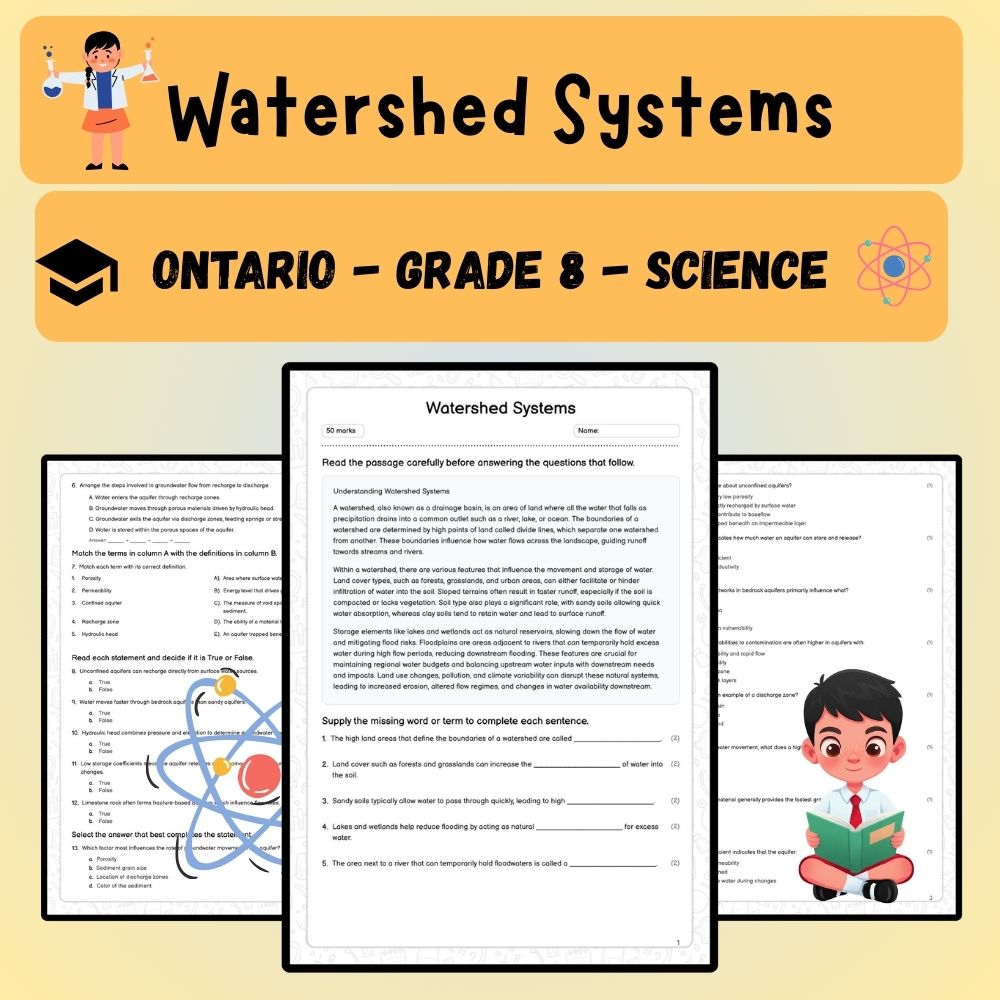
Grade 8 Science | Watershed Systems Worksheet (PDF) – Ontario Standards
Created byPrism Point LearningLearning Objectives
- Describe the characteristics of drainage basins and watershed boundaries.
- Explain how land cover, slope, and soil type influence runoff and infiltration.
- Identify storage elements such as lakes, wetlands, and floodplains as flow modulators.
Also included in: Grade 8 Science Water Management Unit Watershed and Water Resources +1 more
Instant download
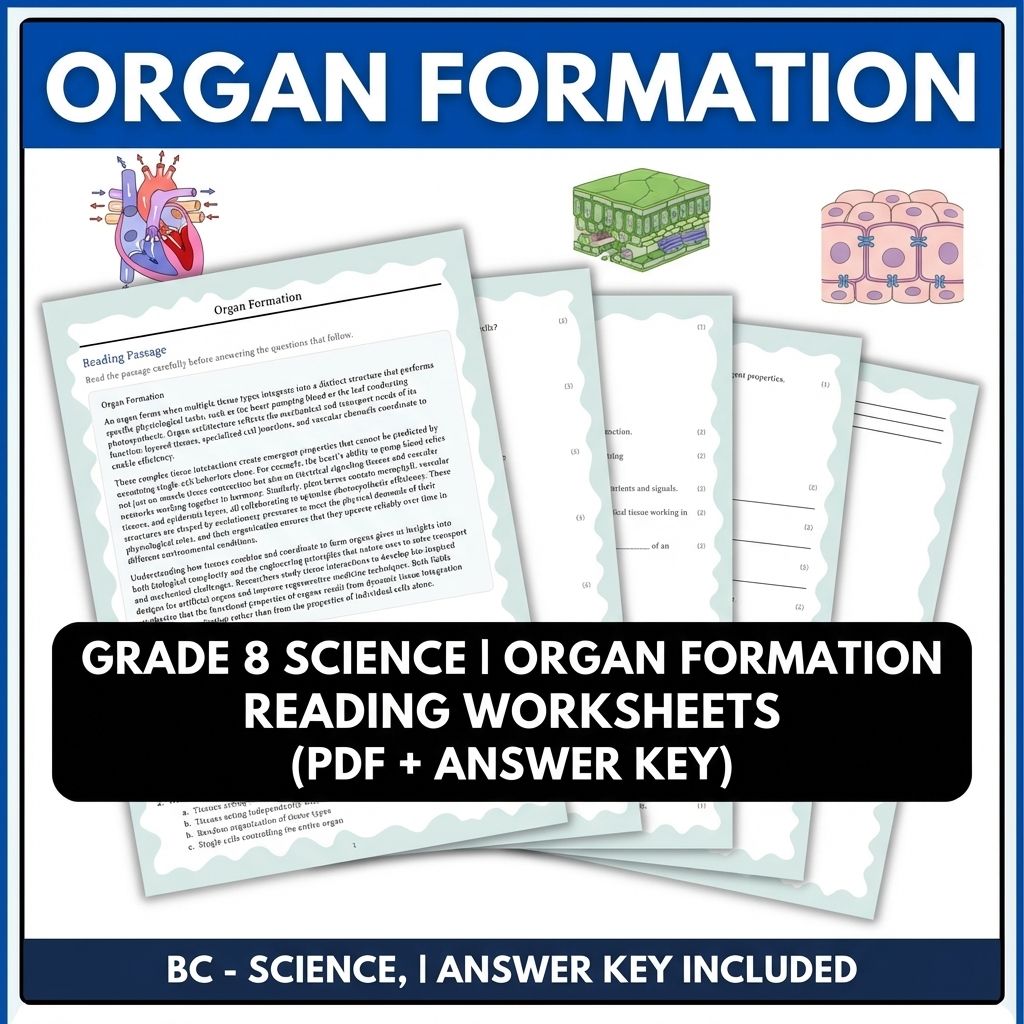
Grade 8 Science | Organ Formation Reading Worksheets (PDF + Answer Key)
JCreated byJ.S SheetsLearning Objectives
- Understand how different tissue types collaborate to form organs.
- Identify structural features that support organ functions.
- Explain the relationship between tissue interactions and organ-level properties.
Instant download
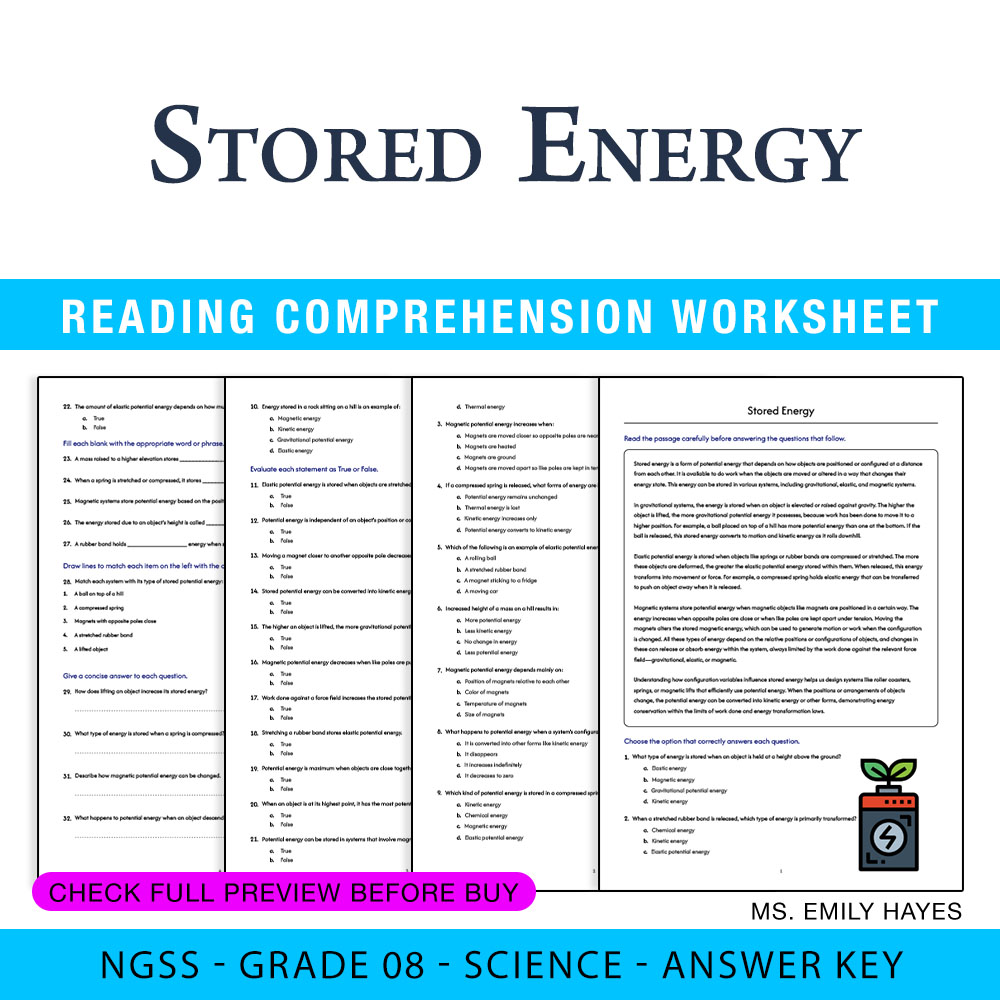
8th Grade Science | Stored Energy Worksheet (PDF+ Answer Key)
 Created byCopper Leaf Classroom
Learning Objectives
- Explain how the arrangement of objects affects stored potential energy in gravitational, elastic, and magnetic systems.
- Analyze how changes in positions or configurations alter the amount of stored energy.
- Connect the concept of potential energy to real-world systems like compressed springs, elevated masses, and magnets.
Instant download
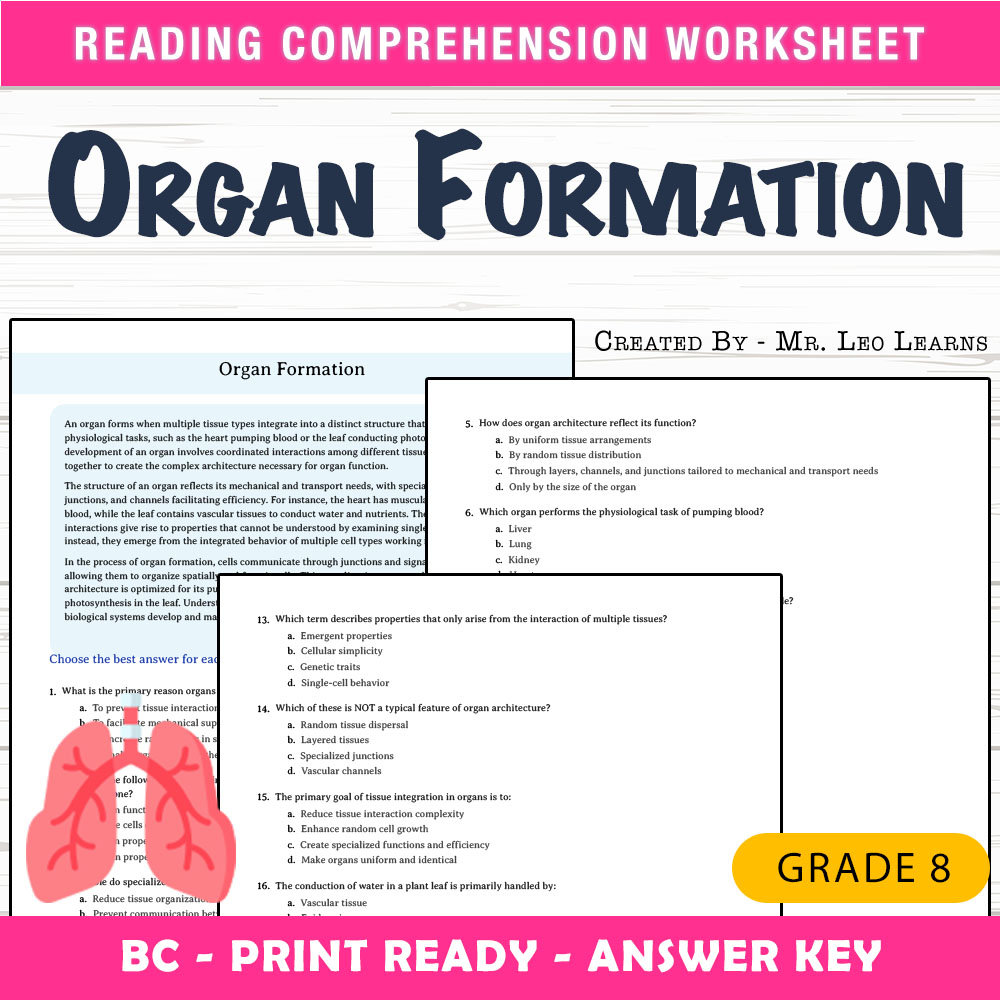
Grade 8 Science — Organ Formation Worksheet MCQ for Mastery
 Created byThe Resource Hub
Learning Objectives
- Understand how tissues interact to form organs and their distinct structures.
- Identify the role of layered tissues, specialized cell junctions, and vascular channels in organ function.
- Explain how organ architecture reflects mechanical and transport needs.
Also included in: Grade 8 Science UNIT | Multicellular Structure & Function Worksheet Bundle +1 more
Instant download
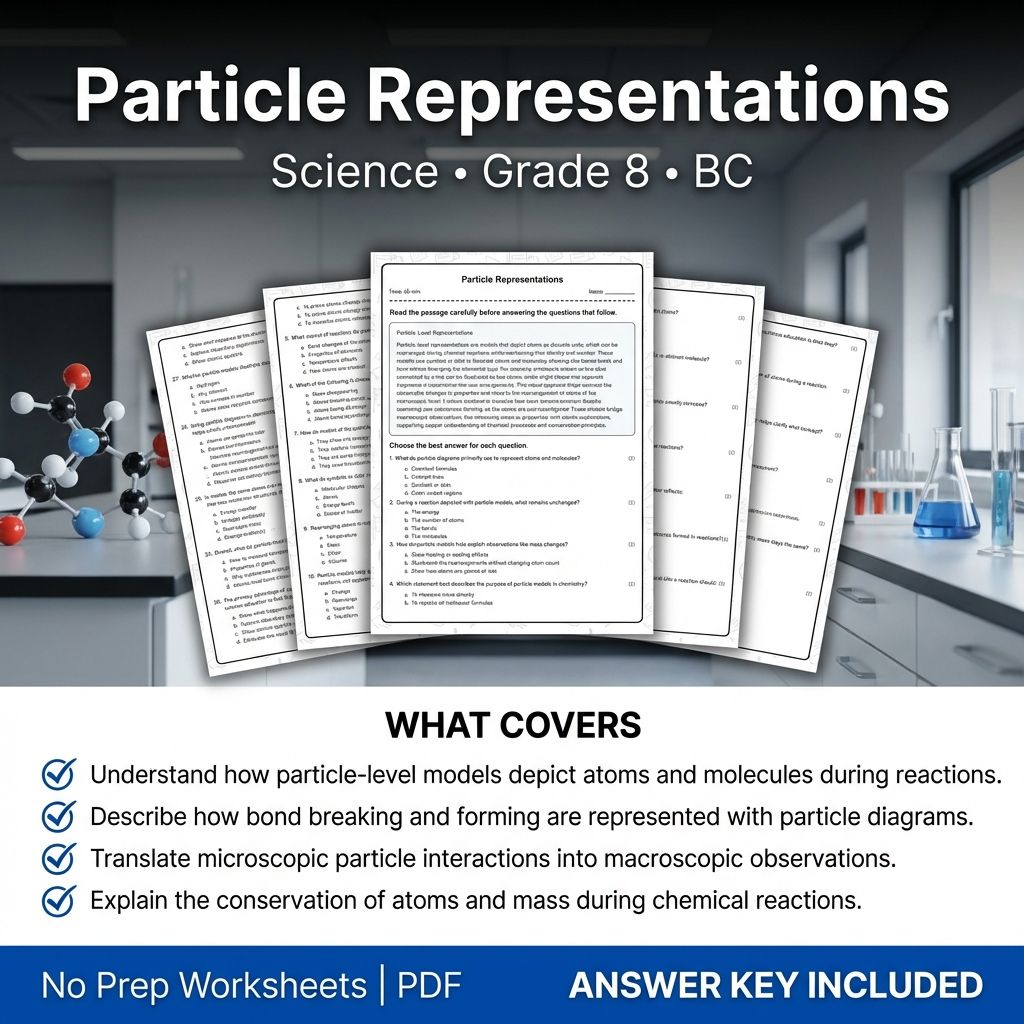
8th Grade Science | Particle Representations Worksheet & Answer Key ( PDF)
 Created byCoral Reef Learning
Learning Objectives
- Understand how particle-level models depict atoms and molecules during reactions.
- Describe how bond breaking and forming are represented with particle diagrams.
- Translate microscopic particle interactions into macroscopic observations.
Instant download
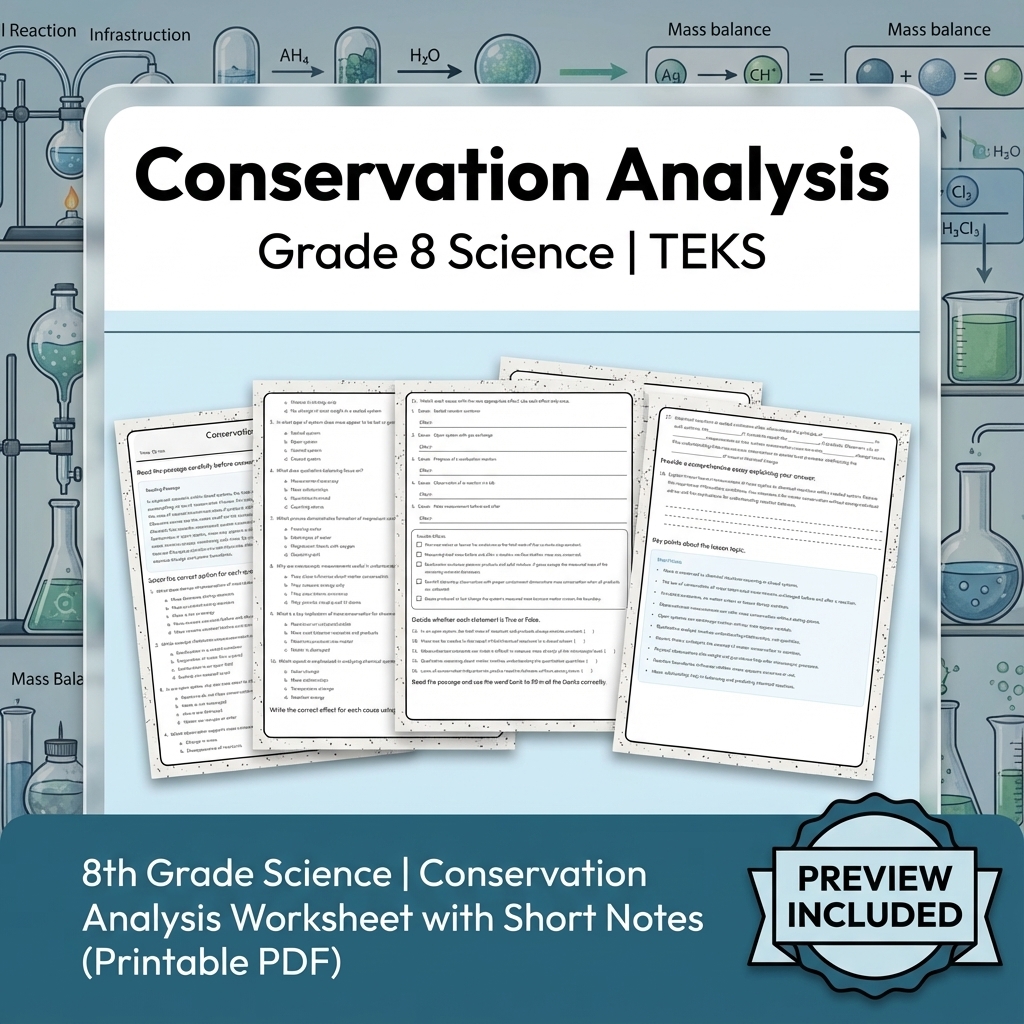
8th Grade Science Conservation Analysis Worksheet with Short Notes (PDF)
 Created byMeadowlark Worksheets
Learning Objectives
- Understand the concept of mass conservation in closed chemical systems.
- Analyze and interpret mass relationships during chemical reactions.
- Distinguish between closed and open systems in chemical processes.
Instant download
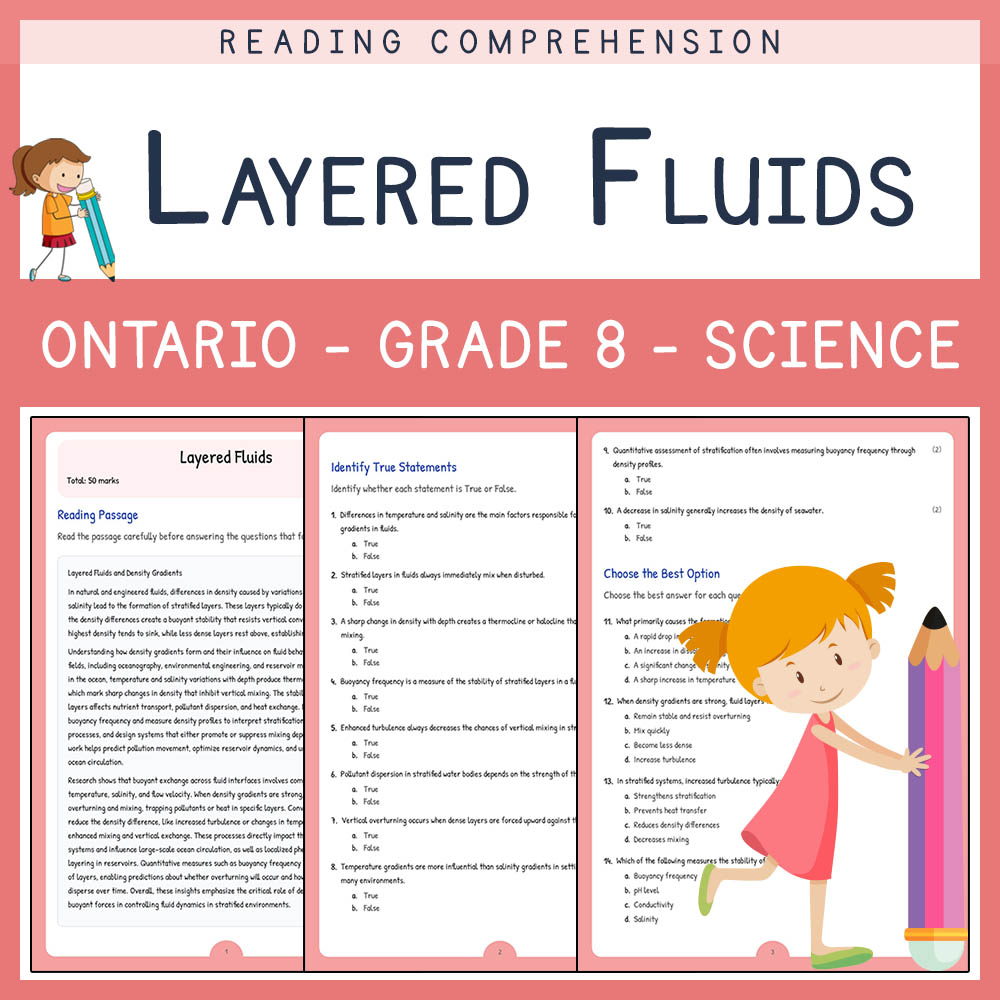
Grade 8 Science Assessment | Layered Fluids Worksheet | Ontario Standard
 Created byLumora Learning
Learning Objectives
- Explain how density differences in fluids create stratified layers in natural and engineered systems.
- Describe how temperature and salinity influence fluid density gradients and buoyancy.
- Understand how density gradients affect vertical mixing, pollutant dispersion, and ocean circulation.
Also included in: Grade 8 Science | Fluids Lesson Bundle | Ontario Framework
Instant download
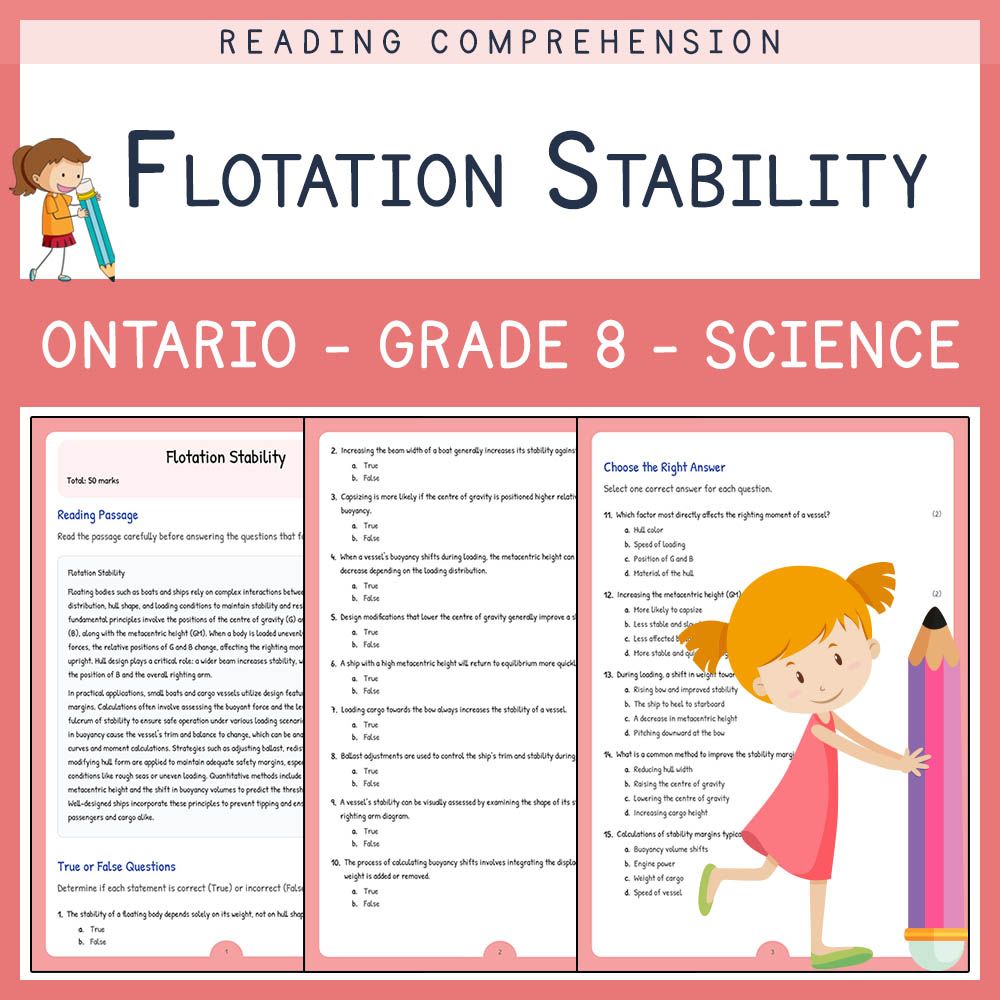
Grade 8 Science Assessment | Flotation Stability Worksheet | Ontario
Created byLumora LearningLearning Objectives
- Explain how the relative positions of the centre of gravity and centre of buoyancy affect a floating body's stability.
- Identify factors such as weight distribution, hull shape, and loading that influence upright equilibrium and capsize risk.
- Describe how design choices in small boats and cargo ships alter righting moments and stability margins through quantitative examples.
Also included in: Grade 8 Science | Fluids Lesson Bundle | Ontario Framework
Instant download
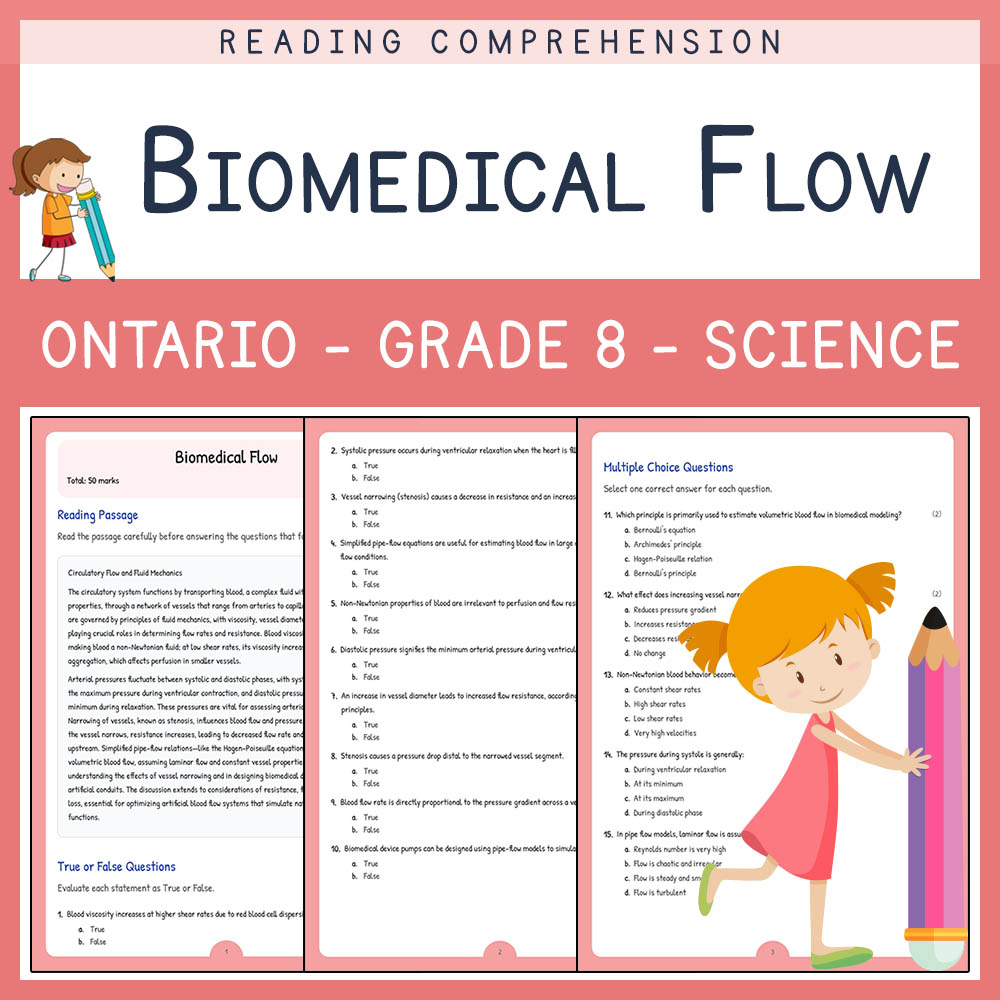
Grade 8 Science Assessment | Biomedical Flow Worksheet Elena | Ontario
Created byLumora LearningLearning Objectives
- Understand the principles of fluid mechanics as they apply to blood flow in the circulatory system.
- Explain how non-Newtonian blood properties influence perfusion and vessel resistance.
- Relate systolic and diastolic pressures to arterial function and health.
Also included in: Grade 8 Science | Fluids Lesson Bundle | Ontario Framework
Instant download
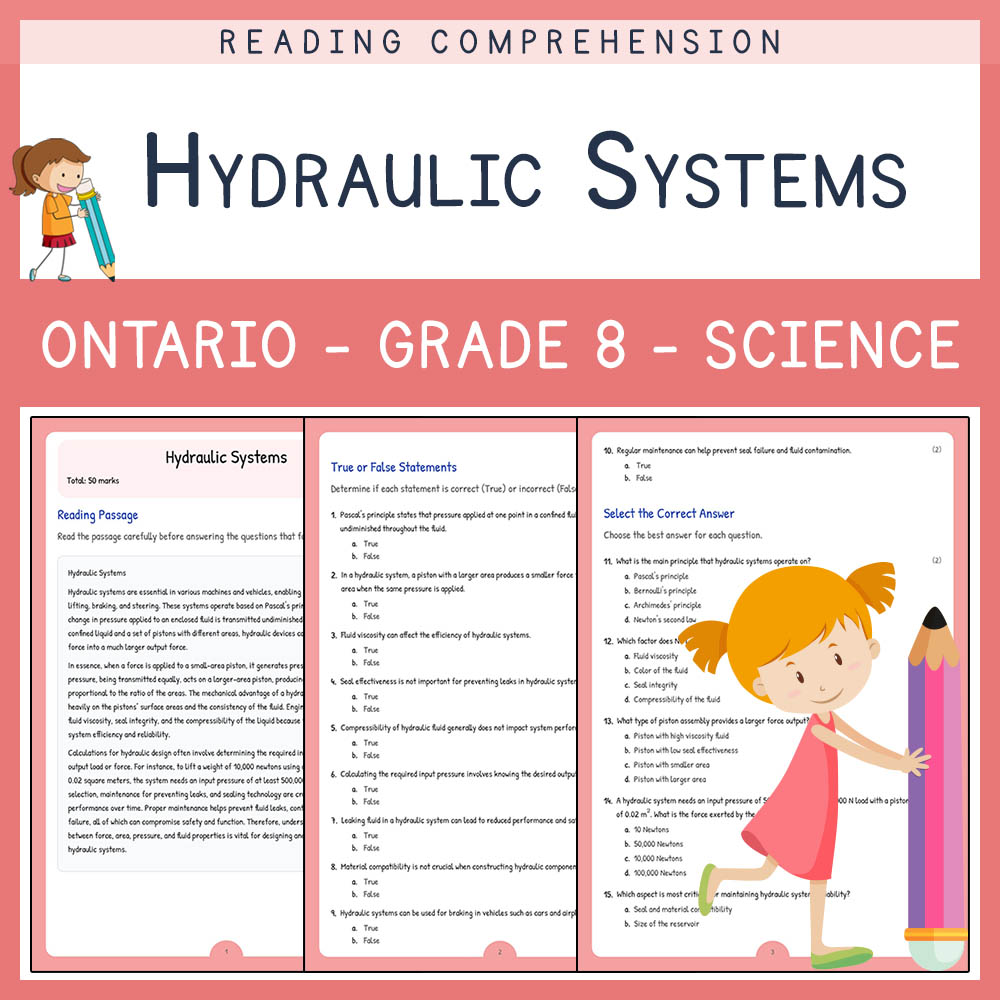
Grade 8 Science Assessment | Hydraulic Systems Worksheet Elena | Ontario
Created byLumora LearningLearning Objectives
- Explain how hydraulic systems convert small forces into larger outputs through pressure transmission.
- Evaluate the mechanical advantage provided by different piston assemblies in hydraulic devices.
- Analyze design constraints such as fluid viscosity, seal effectiveness, and compressibility in hydraulic systems.
Also included in: Grade 8 Science | Fluids Lesson Bundle | Ontario Framework
Instant download
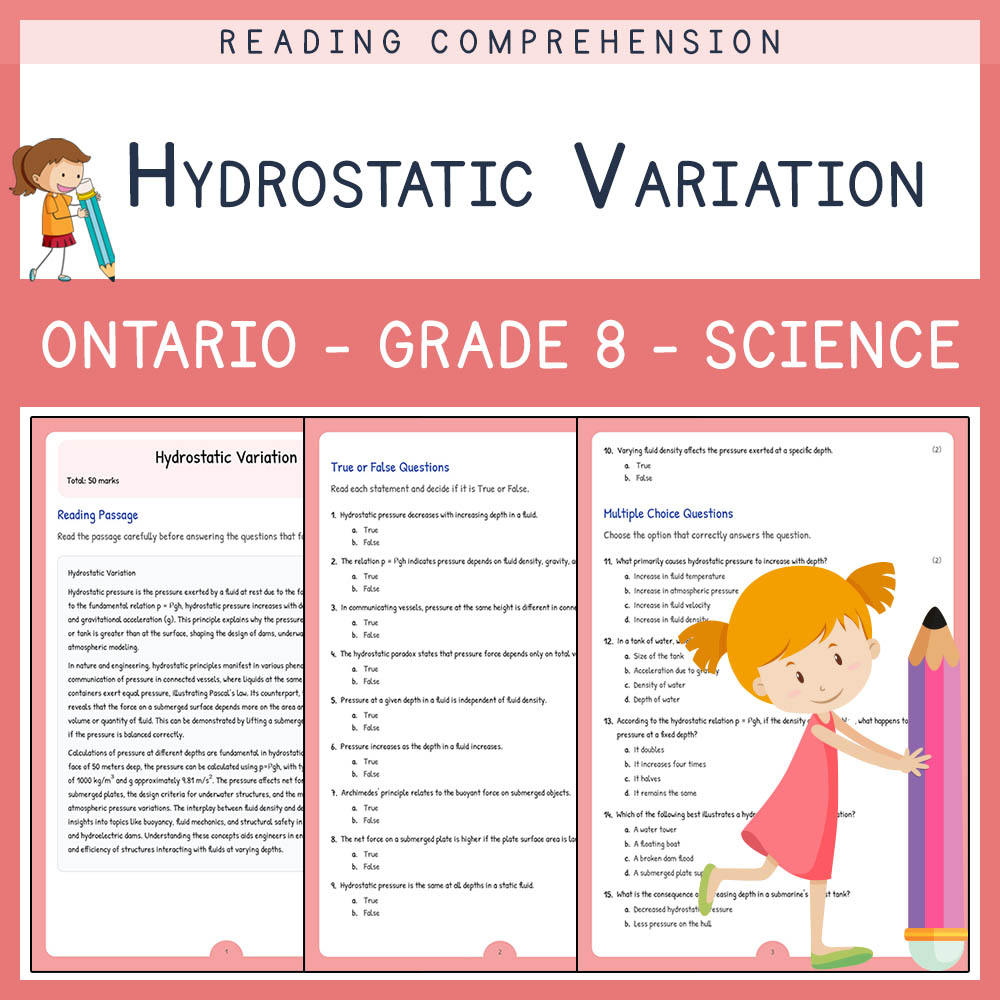
Grade 8 Science | Hydrostatic Variation Worksheet Elena | Ontario
Created byLumora LearningLearning Objectives
- Understand how hydrostatic pressure depends on fluid density and depth.
- Explain communicating vessels and the hydrostatic paradox.
- Calculate pressure at various depths in fluids.
Also included in: Grade 8 Science | Fluids Lesson Bundle | Ontario Framework
Instant download
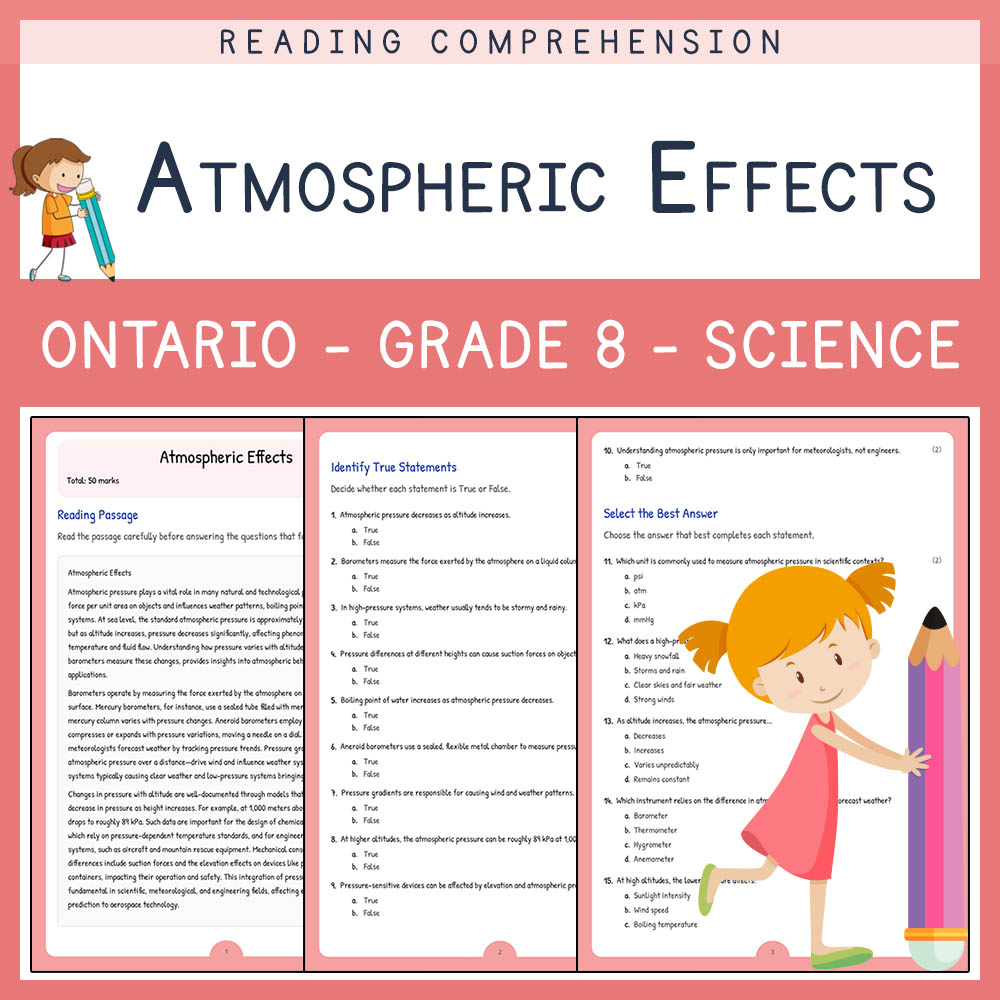
Grade 8 Science Assessment | Atmospheric Effects Worksheet Elena | Ontario
Created byLumora LearningLearning Objectives
- Explain how atmospheric pressure influences boiling points and weather instruments.
- Describe the operation of a barometer and pressure measurement methods.
- Understand pressure gradients and their role in driving wind and weather patterns.
Also included in: Grade 8 Science | Fluids Lesson Bundle | Ontario Framework
Instant download
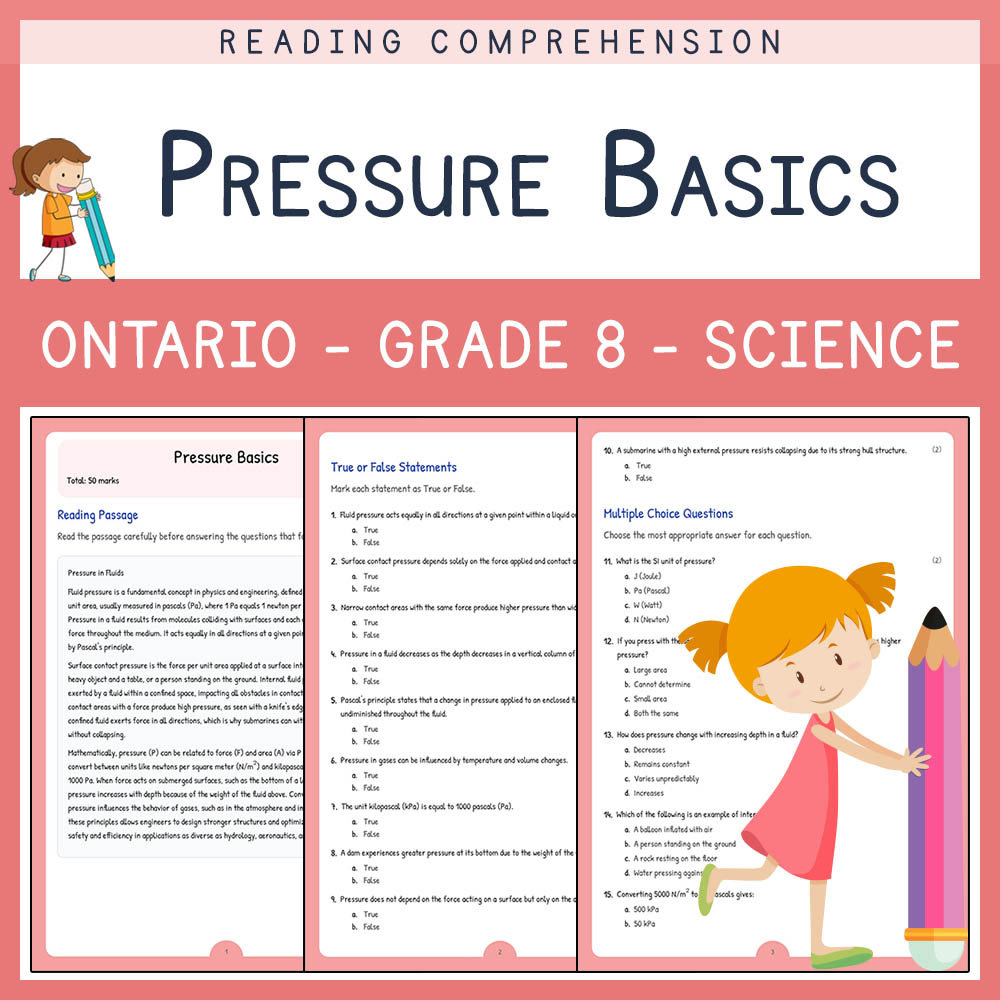
Grade 8 Science Assessment | Pressure Basics Worksheet Elena | Ontario
Created byLumora LearningLearning Objectives
- Define fluid pressure and understand its SI units.
- Distinguish between surface contact pressure and internal fluid pressure.
- Explain how pressure depends on contact area, force, and fluid confinement.
Also included in: Grade 8 Science | Fluids Lesson Bundle | Ontario Framework
Instant download

Grade 8 Science Assessment | Pascal Principle Worksheet Elena | Ontario
Created byLumora LearningLearning Objectives
- Explain the concept of Pascal's principle and its significance in hydraulic systems.
- Calculate the relationships between input and output forces using piston areas.
- Describe real-world applications of Pascal's principle, such as hydraulic brakes and presses.
Also included in: Grade 8 Science | Fluids Lesson Bundle | Ontario Framework
Instant download
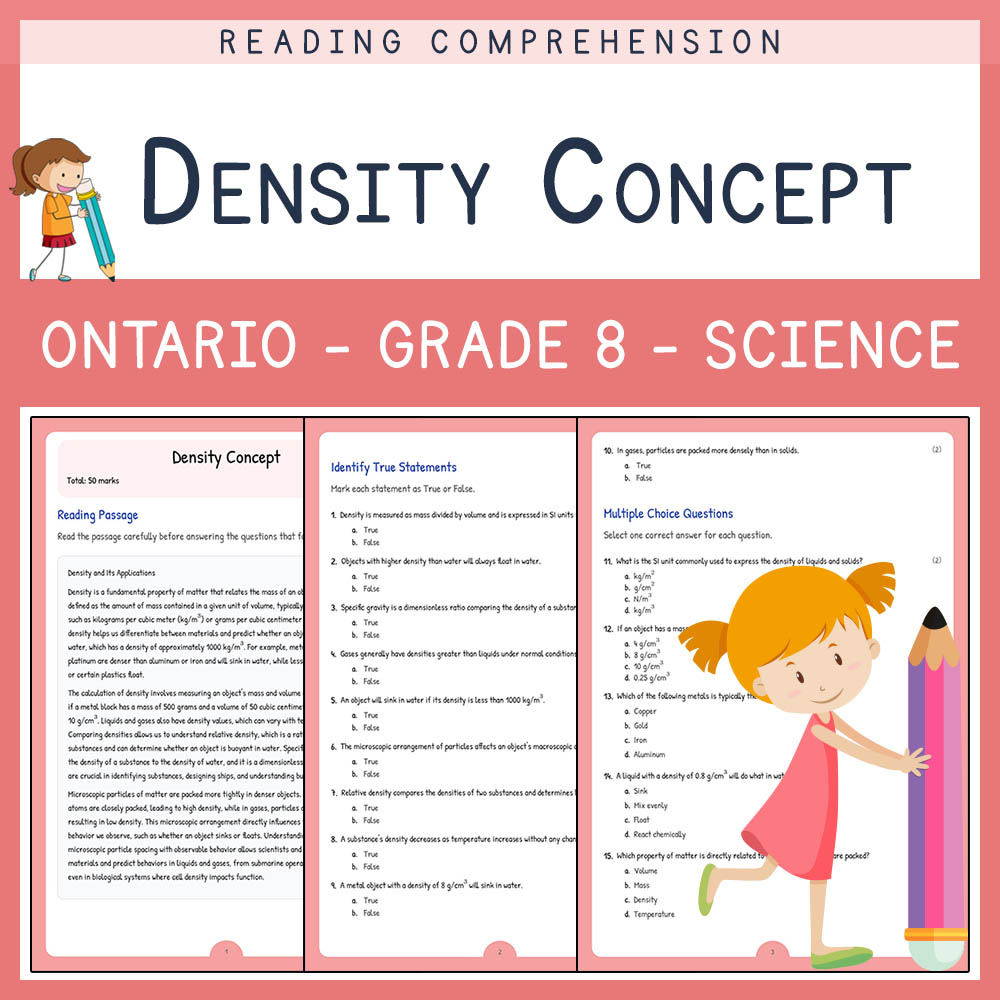
Grade 8 Science Assessment | Density Concept Worksheet Elena | Ontario
Created byLumora LearningLearning Objectives
- Understand the definition of density as mass per unit volume.
- Learn the SI units used to measure mass, volume, and density.
- Explore the relationship between mass, volume, and density through numerical examples.
Also included in: Grade 8 Science | Fluids Lesson Bundle | Ontario Framework
Instant download
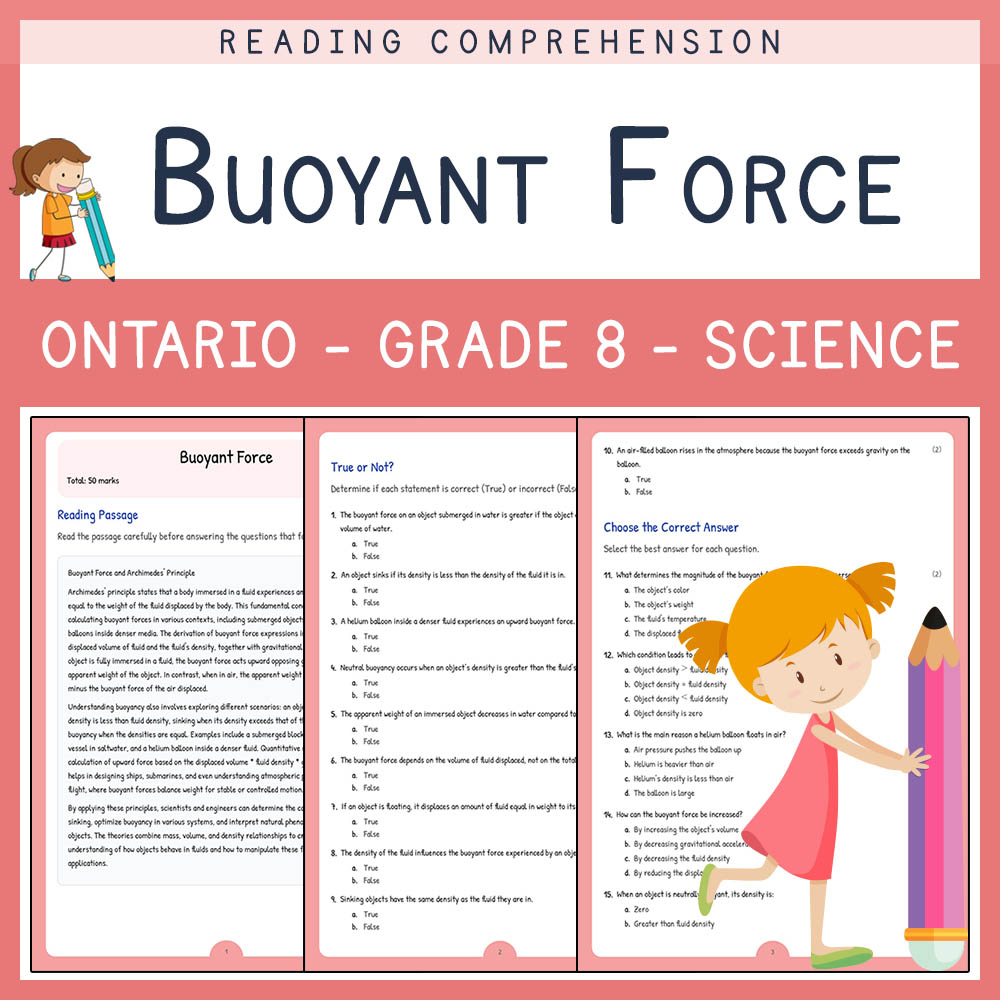
Grade 8 Science Assessment | Buoyant Force Worksheet Elena | Ontario
Created byLumora LearningLearning Objectives
- Understand Archimedes' principle and how buoyant force relates to displaced fluid weight.
- Differentiate between apparent weight in air and when submerged.
- Apply density and volume relationships to analyze floating, sinking, and neutral buoyancy scenarios.
Also included in: Grade 8 Science | Fluids Lesson Bundle | Ontario Framework
Instant download
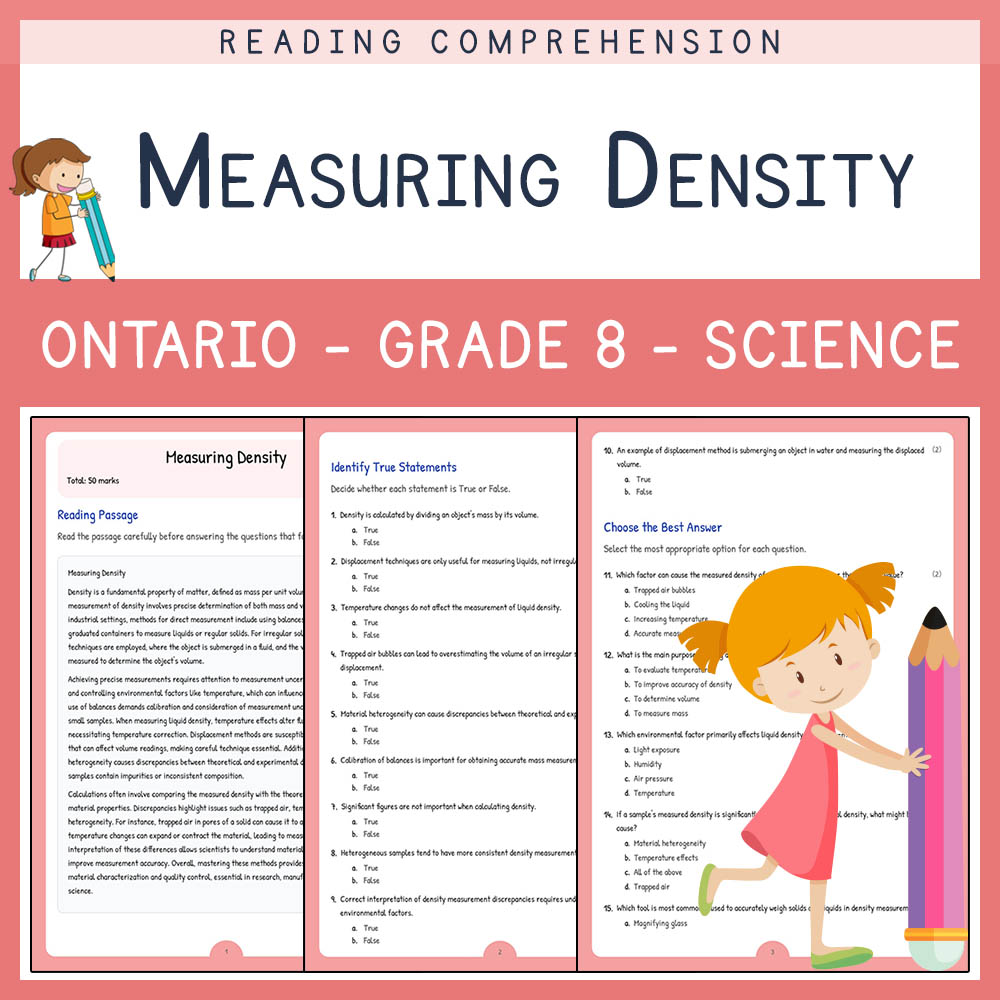
Grade 8 Science Assessment | Measuring Density Worksheet Elena | Ontario
Created byLumora LearningLearning Objectives
- Understand methods for calculating the density of solids and liquids.
- Identify how displacement techniques help measure irregular solids.
- Explain factors affecting measurement accuracy, such as temperature and heterogeneity.
Also included in: Grade 8 Science | Fluids Lesson Bundle | Ontario Framework
Instant download
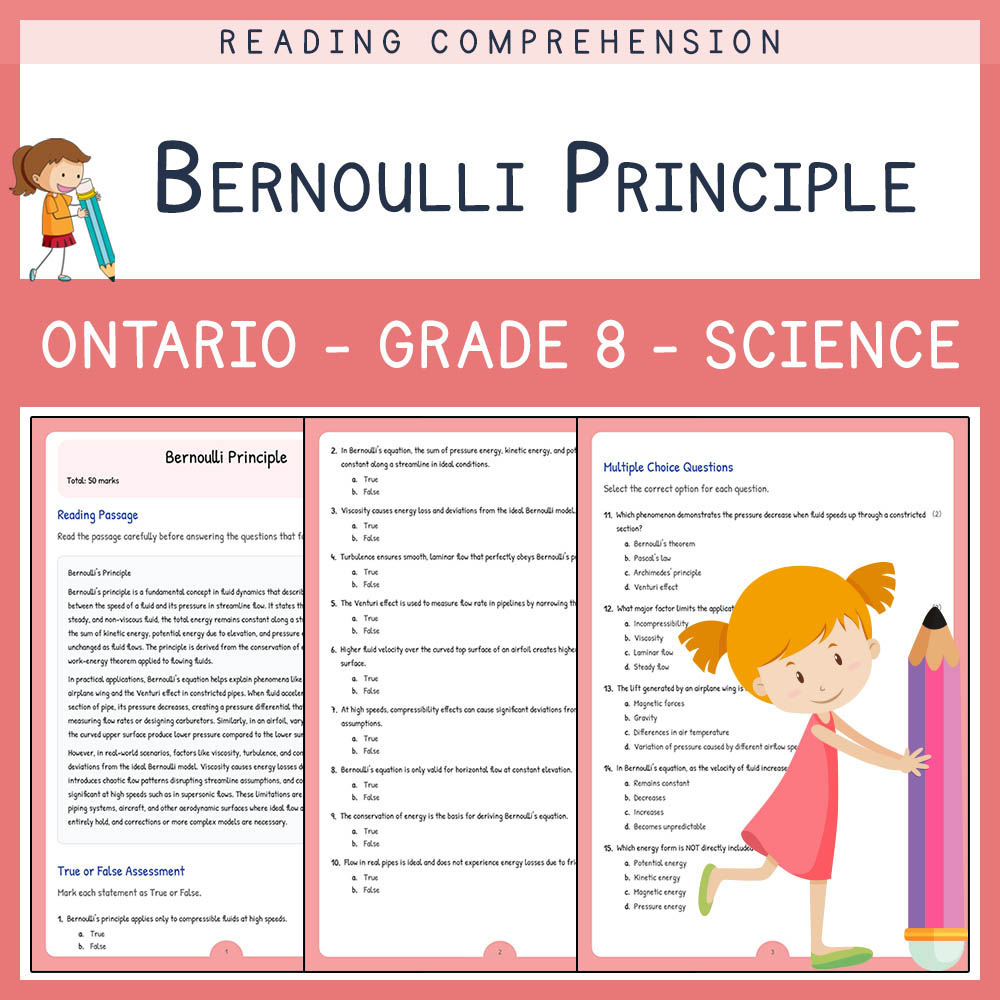
Grade 8 Science Assessment | Bernoulli Principle Worksheet Elena | Ontario
Created byLumora LearningLearning Objectives
- Explain Bernoulli's principle and how it relates fluid velocity and pressure.
- Describe the application of Bernoulli's principle in aerodynamics and fluid flow.
- Derive the Bernoulli equation for incompressible, non-viscous flow.
Also included in: Grade 8 Science | Fluids Lesson Bundle | Ontario Framework
Instant download
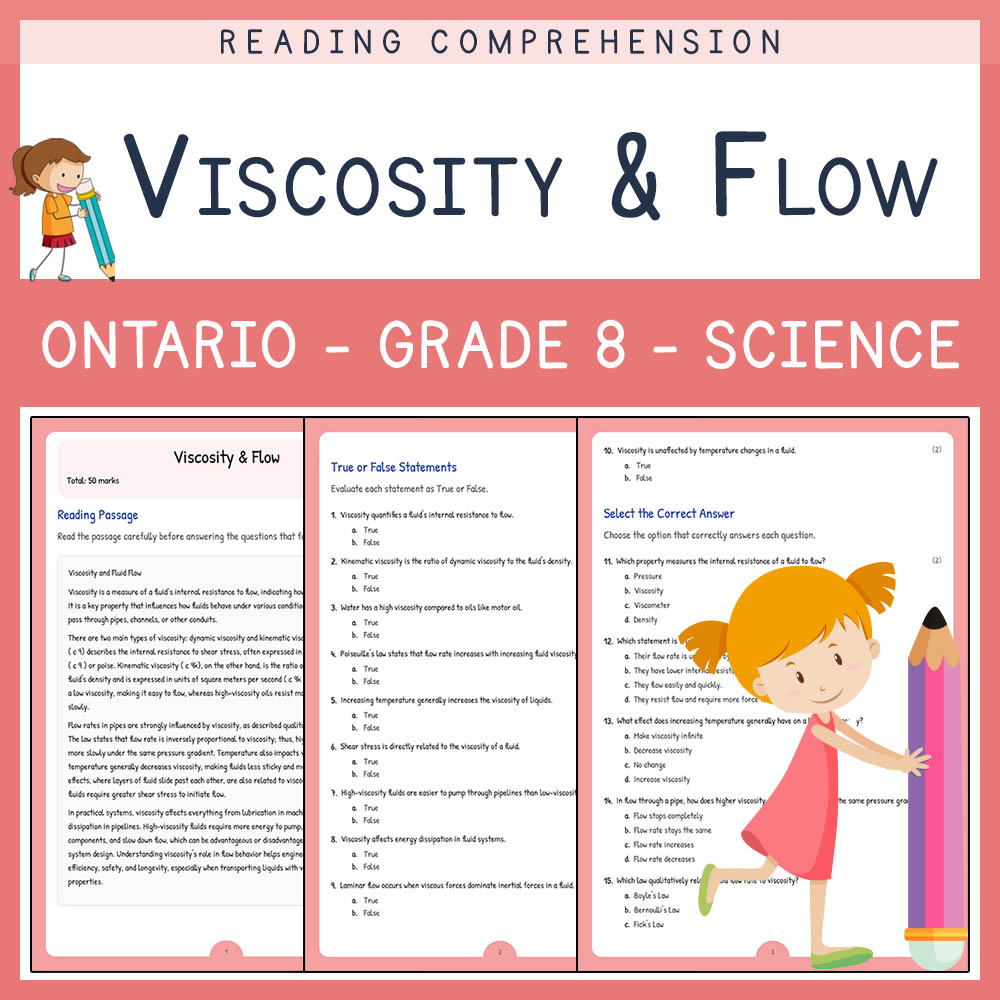
Grade 8 Science Assessment | Viscosity & Flow Worksheet | Ontario Standard
Created byLumora LearningLearning Objectives
- Define and distinguish between dynamic and kinematic viscosity.
- Explain how viscosity affects the flow of fluids in pipes and channels.
- Contrast the flow behavior of low-viscosity fluids like water with high-viscosity fluids like oils.
Also included in: Grade 8 Science | Fluids Lesson Bundle | Ontario Framework
Instant download

Grade 8 Science Assessment | Surface Forces Worksheet Elena | Ontario
Created byLumora LearningLearning Objectives
- Understand how pressure varies on submerged surfaces and affects force and torque.
- Analyze pressure distribution on planar and curved surfaces in hydrostatic conditions.
- Apply integrative methods to calculate net hydrostatic forces and centers of pressure.
Also included in: Grade 8 Science | Fluids Lesson Bundle | Ontario Framework
Instant download

Science Worksheet Speciation and Change Grade 8 | NGSSS Aligned
JCreated byJ.S SheetsLearning Objectives
- Explain how reproductive isolation can lead to speciation
- Describe how variation and natural selection can cause populations to diverge over time
- Identify examples of barriers that reduce gene flow and increase differences between populations
Also included in: Grade 8 Evolution and Ecosystems Science Lesson Bundle | Florida NGSSS +1 more
Instant download
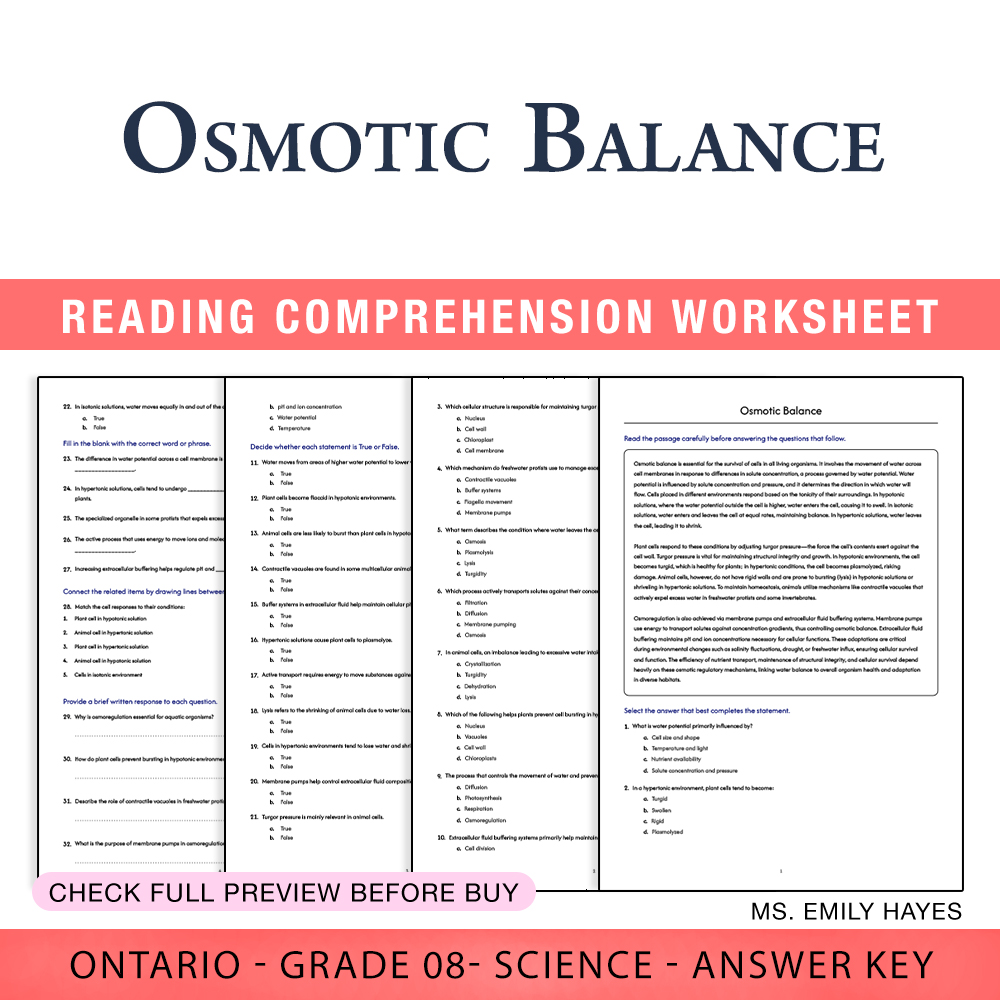
8th Grade Science | Osmotic Balance Worksheet (PDF+ Answer Key)
Created byCopper Leaf ClassroomLearning Objectives
- Understand the principles of water potential and tonicity in cells
- Describe cellular responses to hypotonic, isotonic, and hypertonic environments
- Compare mechanisms maintaining turgor in plant cells and volume in animal cells
Instant download

Grade 8 Science – Energy Transformations & Electrical Systems| Reading Worksheet
 Created byBright Mind Resources
Learning Objectives
- Understand how electrical energy is converted into heat in various devices
- Identify common examples of electrical-to-thermal energy conversion
- Explain the importance of efficiency in electrical heating systems
Also included in: Grade 8 Electricity Science Daily Reading Worksheets Lesson Bundle | Alberta +2 more
Instant download
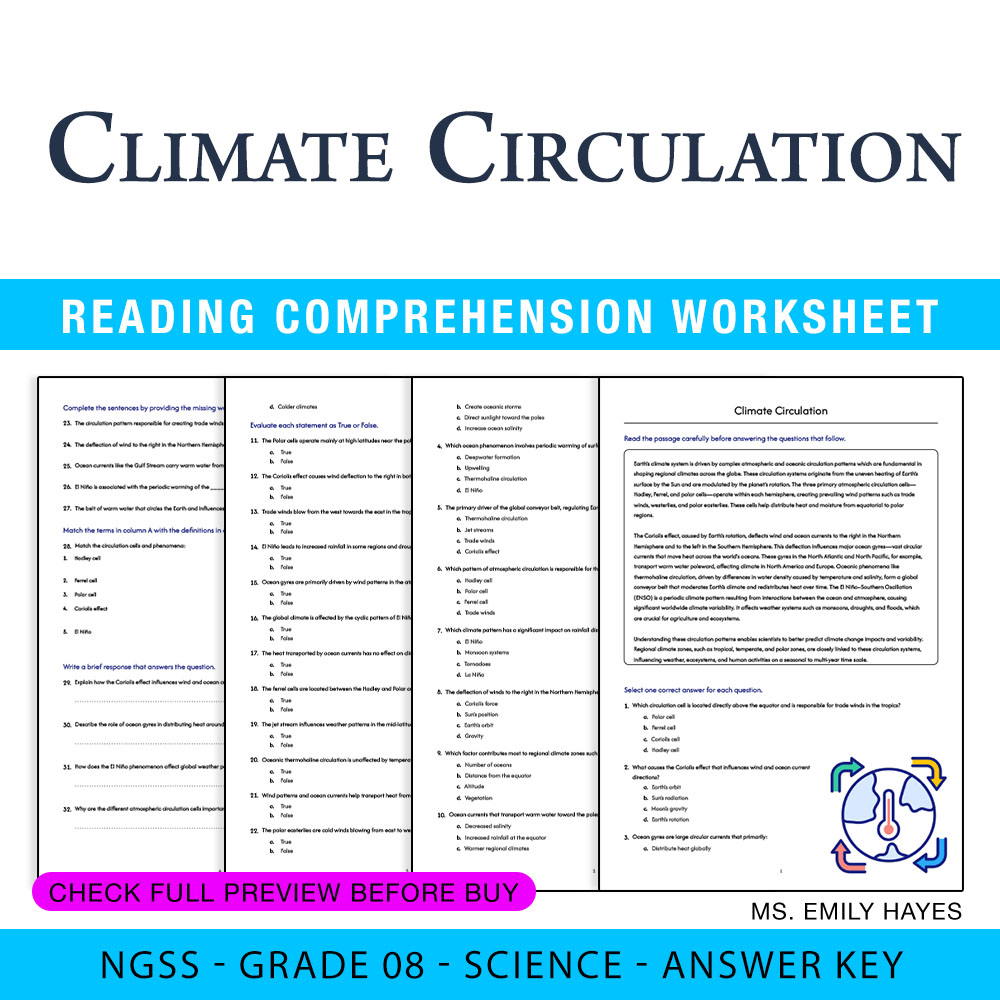
Grade 8 Science | Climate Circulation Worksheet (PDF + Answer Key)
Created byCopper Leaf ClassroomLearning Objectives
- Describe the main models of atmospheric and oceanic circulation such as Hadley, Ferrel, and polar cells.
- Explain how planetary rotation and the Coriolis effect influence wind patterns and ocean gyres.
- Identify links between circulation patterns and regional climate features like trade winds, monsoons, and ocean currents.
Instant download
Grade 8 Science Population Growth Daily Reading Worksheet + Answer Key
JCreated byJ.S SheetsLearning Objectives
- Understand the basic concepts of population change
- Identify factors that influence population growth and decline
- Analyze how environmental and biological factors affect populations
Also included in: Grade 8 Science Lesson Bundle: Ecosystems, Biodiversity & Environmental Impacts +1 more
Instant download
Grade 8 Science – Mass Conservation | Daily Reading Worksheet with Answer Key
JCreated byJ.S SheetsLearning Objectives
- Define the principle of mass conservation.
- Identify real-world examples of mass conservation.
- Explain why total mass remains constant during physical and chemical changes.
Also included in: Grade 8 Science Lesson Group Bundle | Alberta Framework +1 more
Instant download

Mixtures and Changes Worksheet | Grade 8 Science NGSSS + Notes + Key
 Created byEvergreen Desk Education
Learning Objectives
- Explain how mixtures form when substances combine without creating new substances
- Distinguish solutions from other mixtures using solute, solvent, and particle ideas
- Differentiate physical changes from chemical changes using evidence at the particle level
Instant download
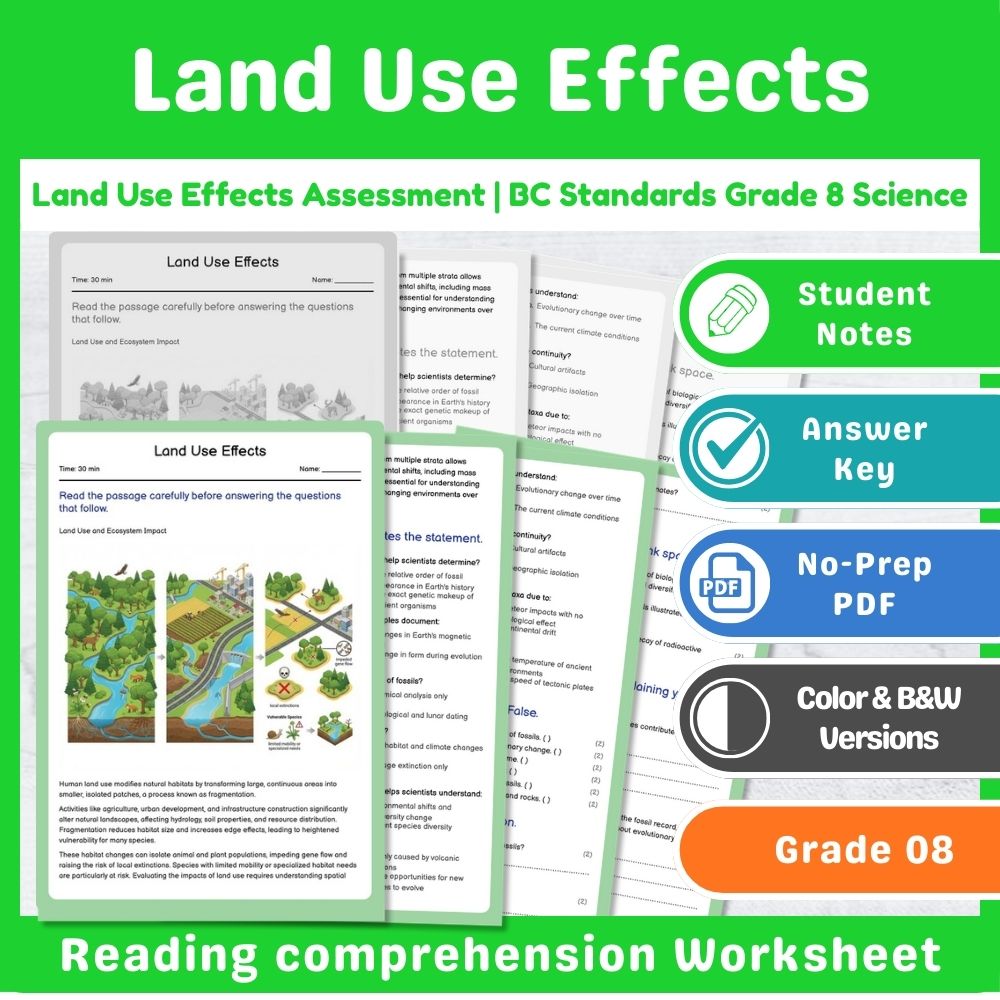
Land Use Effects Assessment | BC Standards Grade 8 Science
Created byPrism Point LearningLearning Objectives
- Understand how human land use alters habitat structure and resource availability.
- Identify the impacts of land fragmentation on species populations and ecosystems.
- Evaluate the long-term consequences of various land use patterns for biodiversity and ecosystem stability.
Instant download
8th Grade Science | Collisions & Energy Reading Worksheet (PDF + Rubric)
JCreated byJ.S SheetsLearning Objectives
- Explain the differences between elastic and inelastic collisions in terms of energy transfer.
- Describe how kinetic energy and momentum behave during different types of collisions.
- Analyze real-world examples of collisions to understand energy transformation and conservation.
Instant download

Grade 8 Science | Earth Materials Worksheet with Short Notes (Printable PDF)
Created byMeadowlark WorksheetsLearning Objectives
- Understand the processes involved in Earth's material cycles, including the rock cycle and mantle convection.
- Identify the interactions among geosphere, hydrosphere, and atmosphere through surface processes.
- Explain how Earth's internal heat and gravitational potential drive surface and subsurface material movements.
Also included in: Grade 8 Science | Earth's Systems NGSS Worksheet Unit Bundle +1 more
Instant download

Design Optimization Worksheet | NGSS Grade 8 Science Assessment
 Created bySkylark Worksheets
Learning Objectives
- Analyze test data to identify performance trends across multiple design versions.
- Isolate which design characteristics cause improvements by comparing controlled changes.
- Quantify trade-offs using ratios, percent change, and simple calculations to support design decisions.
Also included in: Grade 8 Engineering Design Science Lesson Bundle for NGSS Assessment +1 more
Instant download

Solution Comparison Worksheet | NGSS Grade 8 Science Assessment PDF
Created bySkylark WorksheetsLearning Objectives
- Identify criteria, constraints, and measurable performance indicators used to compare multiple engineering design concepts.
- Use a trade-off matrix to compare solutions and describe key benefits and limitations of each concept.
- Differentiate qualitative evidence from quantitative data when justifying a design choice.
Also included in: Grade 8 Engineering Design Science Lesson Bundle for NGSS Assessment +1 more
Instant download

Modeling Data Worksheet | NGSS Grade 8 Science Assessment
Created bySkylark WorksheetsLearning Objectives
- Explain how physical and computational models can be used to generate quantitative data for comparing solutions.
- Identify key controls for consistent input conditions and repeatable measurements in model testing.
- Describe common sources of measurement uncertainty and how model limitations affect results.
Also included in: Grade 8 Engineering Design Science Lesson Bundle for NGSS Assessment +1 more
Instant download
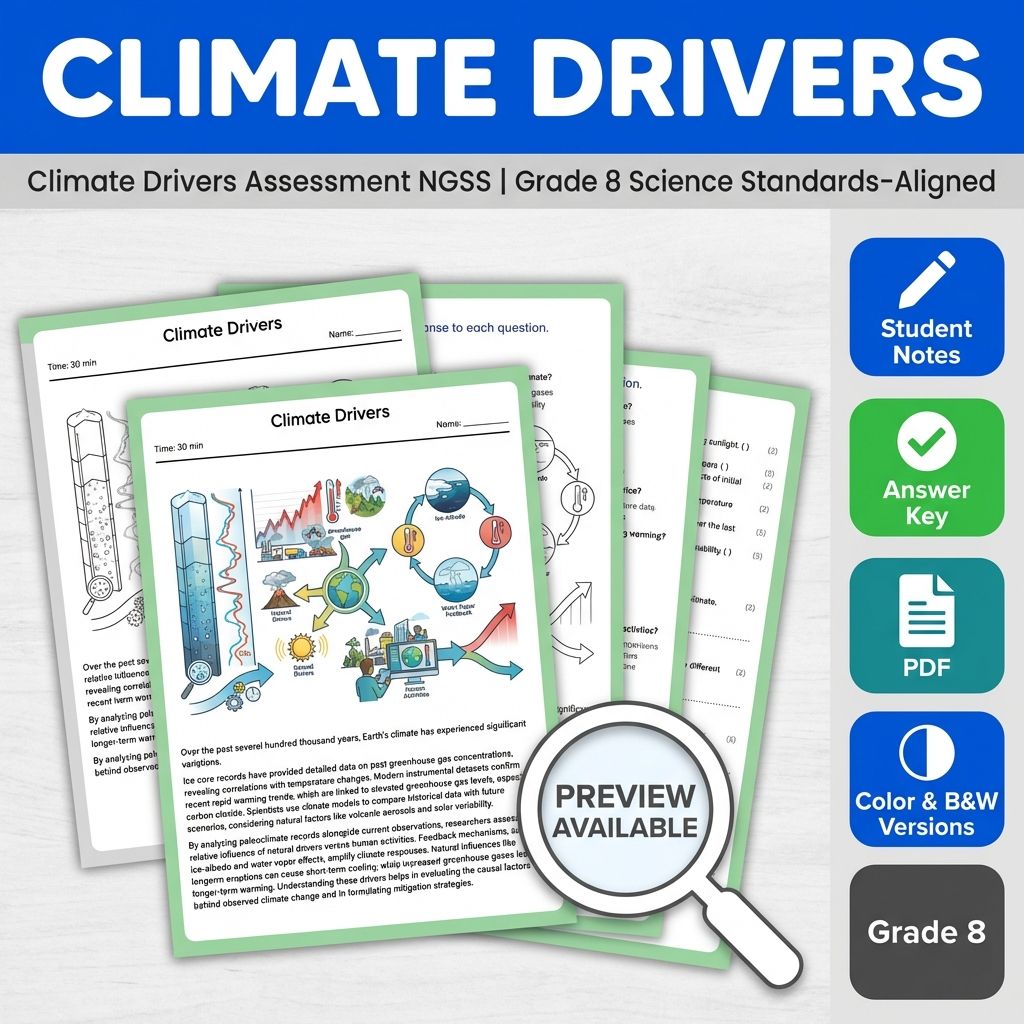
Climate Drivers Assessment NGSS | Grade 8 Science Standards-Aligned
Created byPrism Point LearningLearning Objectives
- Identify the main factors influencing global temperature changes over time.
- Evaluate multiple lines of evidence related to climate change.
- Differentiate between natural and anthropogenic climate drivers.
Also included in: Lesson Grade 8 Science Mini Bundle – Earth & Human Activity Standards-Aligned +1 more
Instant download

Weather Vs Climate Assessment Grade 8 Science | NGSSS Standards
Created byPrism Point LearningLearning Objectives
- Differentiate between weather and climate using examples from temperature, precipitation, and wind.
- Explain why short-term observations can vary while long-term patterns become reliable.
- Describe how energy from the Sun, air-mass movement, and oceans/landmasses influence typical conditions.
Also included in: Grade 8 Earth Systems Science Lesson Bundle: Florida NGSSS Assessment
Instant download

Homogeneous Mixtures Worksheet for Grade 8 Science | Alberta Standards
JCreated byJ.S SheetsLearning Objectives
- Understand the concept of homogeneous mixtures and their examples.
- Identify factors that influence the behavior of solutions and alloys.
- Analyze regional examples of homogeneous mixtures and their environmental impacts.
Also included in: Grade 8 Matter and Chemical Change Science Lesson Bundle – Alberta Framework +1 more
Instant download
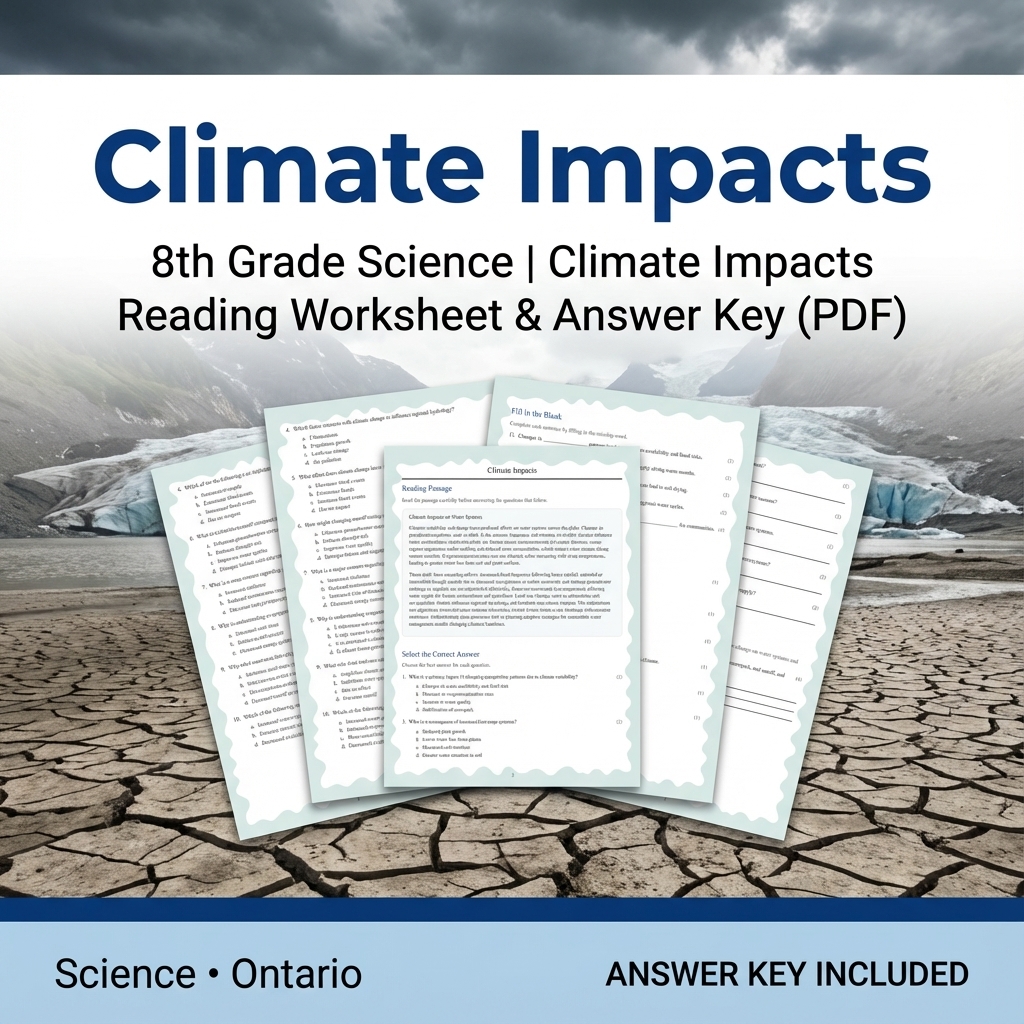
8th Grade Science | Climate Impacts Reading Worksheet & Answer Key (PDF)
JCreated byJ.S SheetsLearning Objectives
- Understand how climate variability affects water systems such as precipitation and snowpack.
- Identify the consequences of changing climate patterns on flood, drought, and groundwater.
- Explain how land-use change interacts with regional hydrology under climate change.
Also included in: Grade 8 Science Bundle | Water Systems Hydrology Concepts (Answer Key Included) +1 more
Instant download

Conservation Analysis Worksheet for Grade 8 Science TEKS Alignment
Created byCoral Reef LearningLearning Objectives
- Understand the principle of mass conservation in chemical processes within closed systems.
- Identify and analyze implications of mass conservation for reaction accounting and qualitative balancing.
- Differentiate between open and closed systems in chemical observations and inferences about matter.
Instant download

Force Relationships Worksheet | NGSS-Aligned Grade 8 Science Practice
JCreated byJ.S SheetsLearning Objectives
- Understand how net force, mass, and acceleration are related through mathematical models.
- Analyze real-world examples involving forces and motion.
- Interpret graphical representations of force and acceleration data.
Also included in: Grade 8 Forces and Electromagnetism Science Lesson Bundle NGSS Worksheets +1 more
Instant download

Weather Patterns Worksheet | NGSS Grade 8 Science Practice and Assessment
JCreated byJ.S SheetsLearning Objectives
- Understand how air mass movements influence weather changes.
- Analyze surface pressure maps, temperature gradients, and radar data to interpret weather patterns.
- Explain the processes of frontogenesis and cyclogenesis in weather systems.
Also included in: Grade 8 Earth Systems Science Lesson Bundle | NGSS-Aligned Worksheets +1 more
Instant download
About Grade 8 Science Worksheets
Explore Grade 8 Science worksheets for classwork, homework, or review. Our 6,006 printables download instantly as PDFs.
Each resource here is built by an independent educator and reviewed for quality. Worksheets print straight from PDF and suit classroom use, homework, or extra practice; most come with answer keys, and you can preview before purchasing.