
Grade 8 Science Worksheets
5,990 worksheets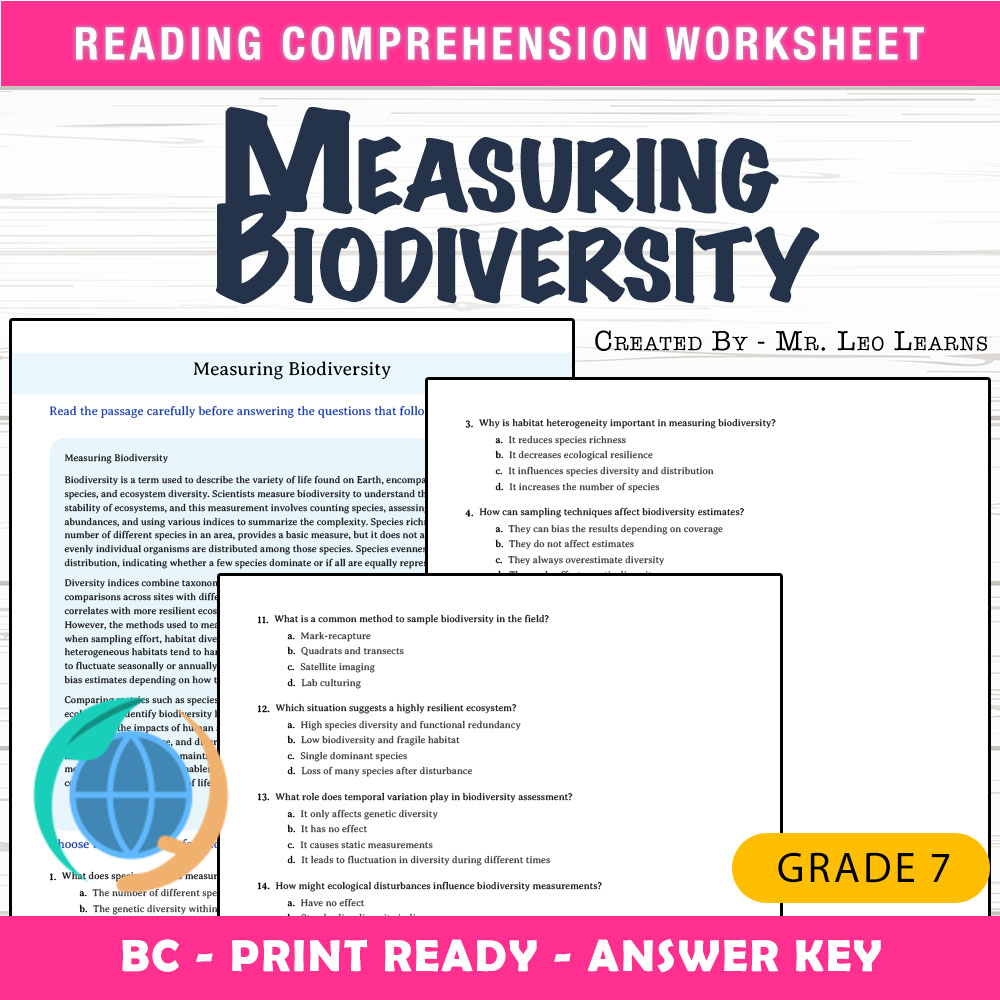
Grade 8 Science — Worksheet MCQ Paper for Mastering Measuring Biodiversity
 Created byThe Resource Hub
Learning Objectives
- Understand the concepts of species richness, evenness, and diversity indices in measuring biodiversity.
- Learn how sampling techniques, habitat heterogeneity, and temporal variation influence biodiversity estimates.
- Compare biodiversity metrics across different environments to assess ecological health and conservation priorities.
Also included in: Grade 8 Science Ecosystems & Biodiversity UNIT Bundle – BC Framework +1 more
Instant download
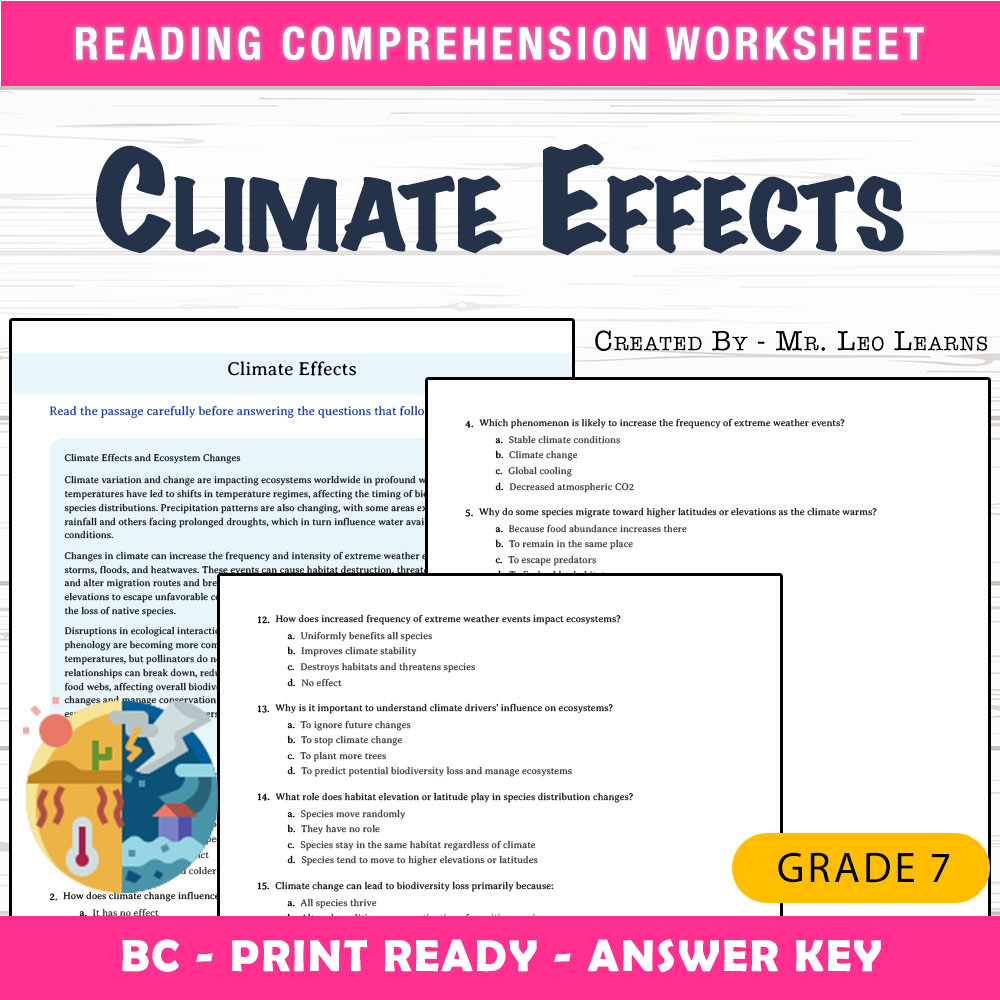
Grade 8 Science — Climate Effects Worksheet for Mastery
Created byThe Resource HubLearning Objectives
- Understand how climate variation influences temperature and precipitation patterns.
- Identify effects of climate change on species distribution and ecosystem interactions.
- Explain the impact of climate drivers on biodiversity, migration, and habitat suitability.
Also included in: Grade 8 Science Ecosystems & Biodiversity UNIT Bundle – BC Framework +1 more
Instant download
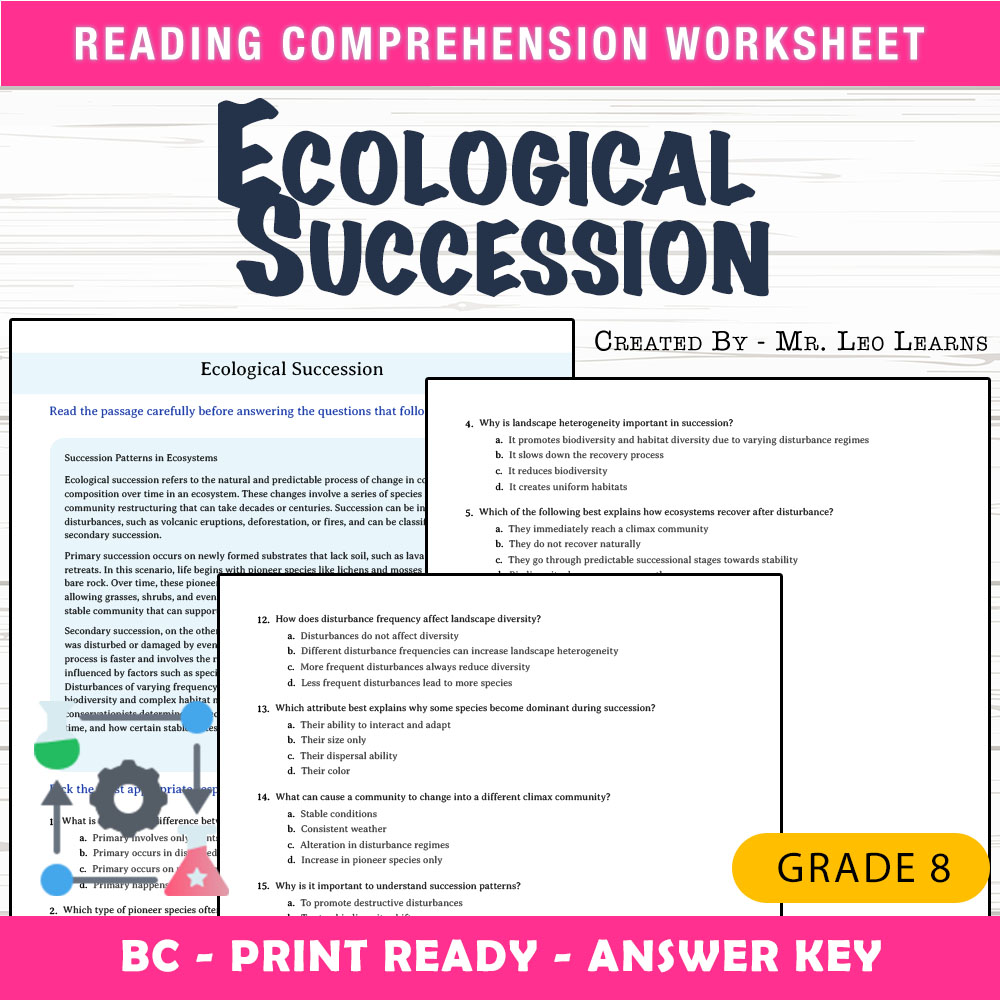
Grade 8 Science — Ecological Succession Worksheet MCQ Paper
Created byThe Resource HubLearning Objectives
- Understand the concept of ecological succession and its types.
- Identify factors that influence succession pathways and landscape heterogeneity.
- Describe how ecosystems recover and how biodiversity shifts over time.
Also included in: Grade 8 Science Ecosystems & Biodiversity UNIT Bundle – BC Framework +1 more
Instant download
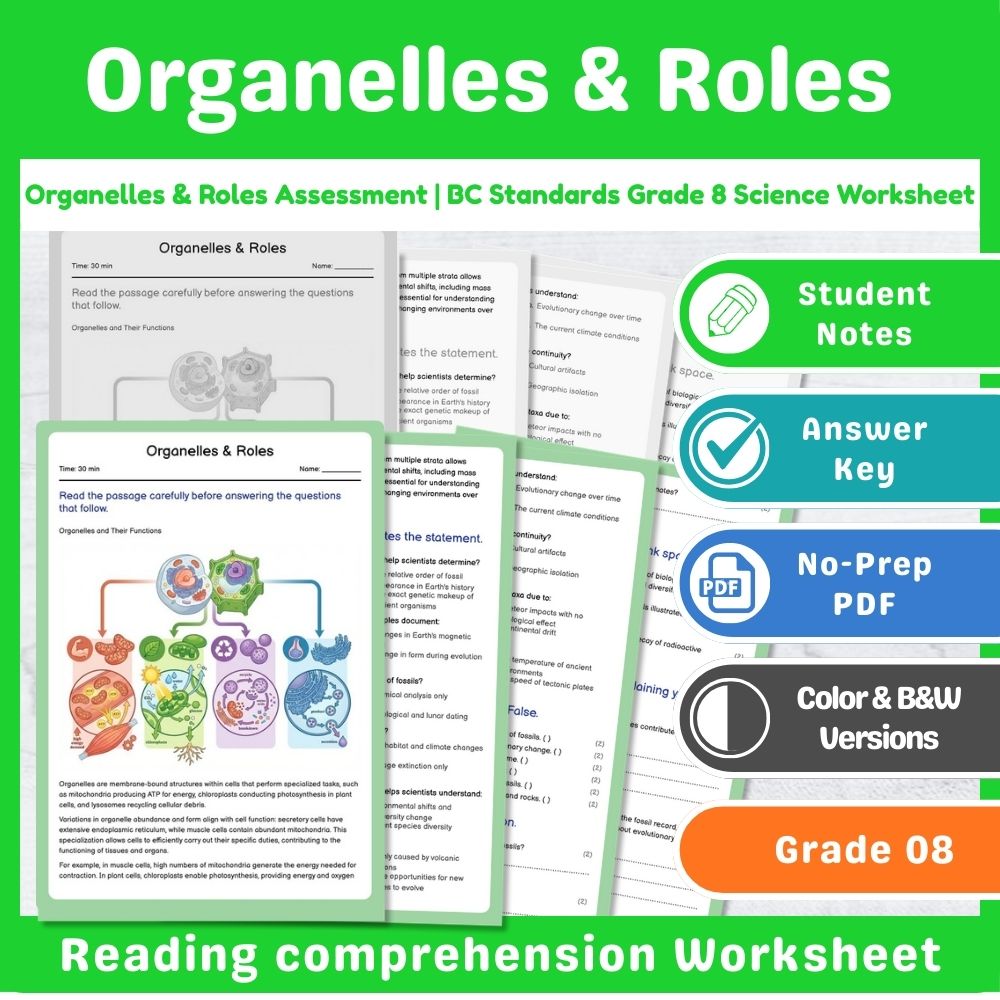
Organelles & Roles Assessment | BC Standards Grade 8 Science Worksheet
 Created byPrism Point Learning
Learning Objectives
- Describe the function of different cell organelles and how their structure supports their role.
- Explain how organelle specialization varies with cell function and tissue type.
- Identify the roles of mitochondria, chloroplasts, and lysosomes in cellular processes.
Instant download

Grade 8 Science | Conservation In Systems Worksheet (General Standards)
 Created byEvergreen Desk Education
Learning Objectives
- Explain energy conservation using the idea of a system and its surroundings
- Describe how energy changes form during transfers while the total energy of the combined system stays constant
- Use the system model to make predictions about mechanical energy, thermal energy, and stored energy from height
Also included in: Grade 8 Matter, Forces, and Energy Science Lesson Bundle: General Framework +1 more
Instant download

Grade 8 Science Forces and Motion Worksheet (PDF) | General Standards
Created byEvergreen Desk EducationLearning Objectives
- Explain how forces can change an object's motion by comparing push and pull interactions.
- Determine how balanced and unbalanced forces affect an object's net force and velocity.
- Use the concept of net force to predict whether an object speeds up, slows down, or changes direction.
Also included in: Grade 8 Matter, Forces, and Energy Science Lesson Bundle: General Framework +1 more
Instant download

Common Ancestry Worksheet | NGSS Grade 8 Science Assessment
 Created byCedar Grove Learning
Learning Objectives
- Analyze fossil, anatomical, embryological, and molecular evidence to understand patterns of unity and diversity in evolution.
- Interpret transitional fossils, homologous structures, conserved developmental stages, and DNA sequence similarities as indicators of common ancestry.
- Evaluate different types of evidence to support hypotheses about lineage relationships among species.
Instant download
Grade 8 Science | Patterns of Speciation Worksheet (PDF + Answer Key)
 Created byRiverstone Classroom
Learning Objectives
- Explain the processes that lead to new species formation, including geographic isolation and adaptive radiation.
- Analyze fossil and genetic evidence to understand evolutionary patterns and extinction events.
- Describe how environmental changes and reproductive barriers influence speciation and extinction.
Instant download
Grade 8 Science | Watershed Systems Worksheet Elena | Ontario Standards
 Created byLumora Learning
Learning Objectives
- Understand the characteristics of drainage basins and watershed boundaries.
- Explain the factors influencing runoff generation, including land cover, slope, and soil type.
- Describe the role of storage elements such as lakes, wetlands, and floodplains in flow modulation.
Instant download

Free Body Worksheet | Grade 8 Science Activities
Created byPrism Point LearningLearning Objectives
- Draw and interpret free-body diagrams by identifying all external forces acting on an object.
- Represent forces as vectors and use their directions to reason about motion.
- Explain how net force is determined from component force vectors in real scenarios.
Also included in: Forces, Motion & Energy Lesson Bundle | Grade 8 Science | Alberta
Instant download

Natural Selection Test Prep Printables | Grade 8 Science
Created byPrism Point LearningLearning Objectives
- Explain how heritable variation and environmental pressures affect differential survival and reproduction in populations.
- Use trait-frequency changes over generations to describe adaptive evolution through natural selection.
- Distinguish between selective agents (e.g., predators, disease, antibiotics) and traits that may be favored.
Also included in: Grade 8 Speciation & Natural Selection Science Lesson Bundle (NGSS)
Instant download

Grade 8 Cell Structure Worksheet | NGSS Practice & PDF
 Created byClear Sky Classroom
Learning Objectives
- Describe the key organelles of cells and their functions.
- Compare prokaryotic and eukaryotic cells in structure and organization.
- Identify differences between single-celled and multicellular organisms.
Also included in: Grade 8 Cell Modeling & Organ Systems Science Lesson Bundle | NGSS +1 more
Instant download

Grade 8 Science Worksheet | Collision Forces & Impact Concepts (PDF)
 Created bySilver Birch Teaching
Learning Objectives
- Explain how collision forces depend on both force magnitude and contact time (duration).
- Describe how collisions change an object's motion and what impulse-like interactions mean.
- Relate structural deformation and safety design to energy absorption during collisions.
Also included in: Grade 8 Forces, Motion, and Energy Science Lesson Bundle for Alberta +1 more
Instant download
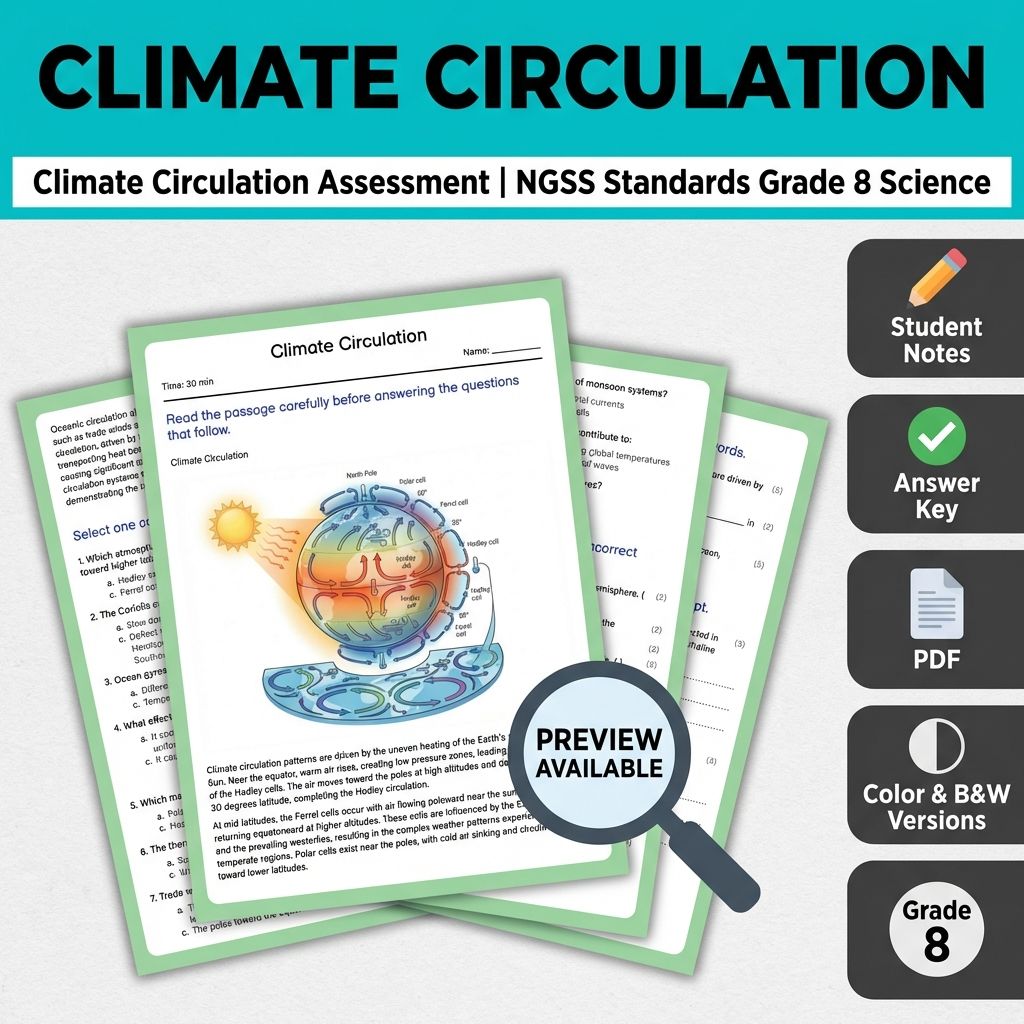
Climate Circulation Assessment | NGSS Standards Grade 8 Science
Created byPrism Point LearningLearning Objectives
- Describe the models of Hadley, Ferrel, and polar cells and their role in atmospheric circulation.
- Explain how planetary rotation affects wind patterns via the Coriolis effect.
- Analyze how oceanic circulation, including gyres and thermohaline circulation, influences regional climates.
Also included in: Grade 8 Science Mini Bundle – Earth's Systems & NGSS Standards-Aligned +1 more
Instant download
Grade 8 Science | Population Models Worksheet (PDF + Answer Key)
Created byRiverstone ClassroomLearning Objectives
- Describe different types of population growth models, including exponential and logistic growth.
- Interpret graphs of population dynamics to identify steady states, oscillations, and overshoot scenarios.
- Explain how limiting factors such as resources and predation influence long-term population trajectories.
Instant download

Grade 8 Science Excel with Motors and Generators Worksheet (Alberta Standard) (PDF)
Created bySilver Birch TeachingLearning Objectives
- Explain how electric motors convert electrical energy into mechanical motion using magnetic fields and current-carrying conductors
- Describe how generators convert mechanical motion into electrical energy using electromagnetic induction
- Compare key design factors (coil turns, magnetic flux strength, and load) that affect efficiency and power output
Also included in: Grade 8 Electricity & Circuits Science Lesson Bundle: Alberta Framework +1 more
Instant download

Circular Motion Worksheet | Grade 8 Science Standards-Aligned
JCreated byJ.S SheetsLearning Objectives
- Understand the concept of centripetal force and how it acts towards the center of curvature.
- Analyze how variables such as mass, turn radius, and force magnitude influence circular motion.
- Evaluate real-world phenomena involving circular motion, such as road curves and amusement rides.
Also included in: Grade 8 Forces & Motion Science Lesson Bundle – Alberta framework worksheets +1 more
Instant download

Grade 8 Total Energy Balance Worksheet | Energy Conservation | CA Standards
Created byEvergreen Desk EducationLearning Objectives
- Explain conservation of energy using energy accounting for a chosen system and its surroundings
- Identify how energy transfers and converts between kinetic, potential, thermal, and other forms
- Use an energy balance model to predict how changes in motion and temperature can occur over time
Instant download
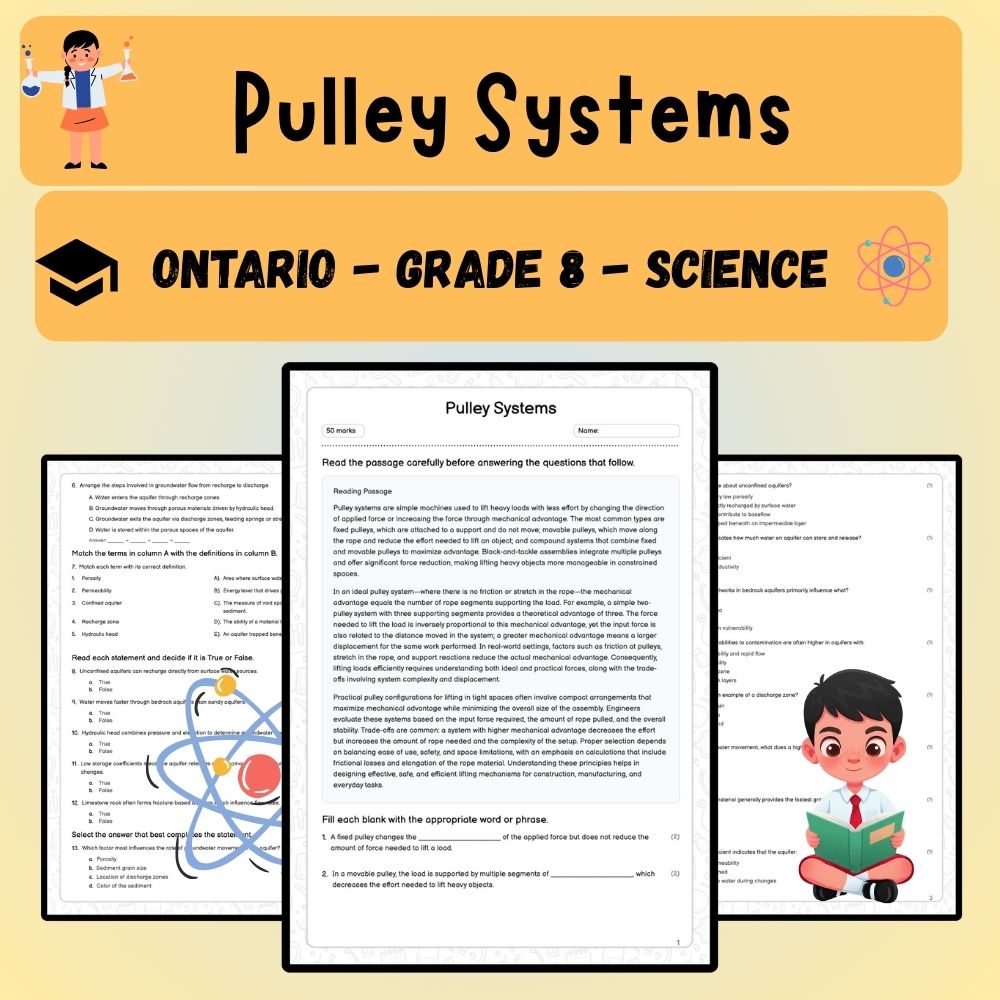
Grade 8 Science | Pulley Systems Worksheet (PDF) – Ontario Standards
Created byPrism Point LearningLearning Objectives
- Understand the difference between fixed, movable, and compound pulley arrangements.
- Explain how mechanical advantage is achieved and calculated in pulley systems.
- Analyze real-world factors such as friction and rope stretch that affect pulley performance.
Also included in: Grade 8 Science Unit Bundle | Forces, Energy & Motion Worksheets +1 more
Instant download
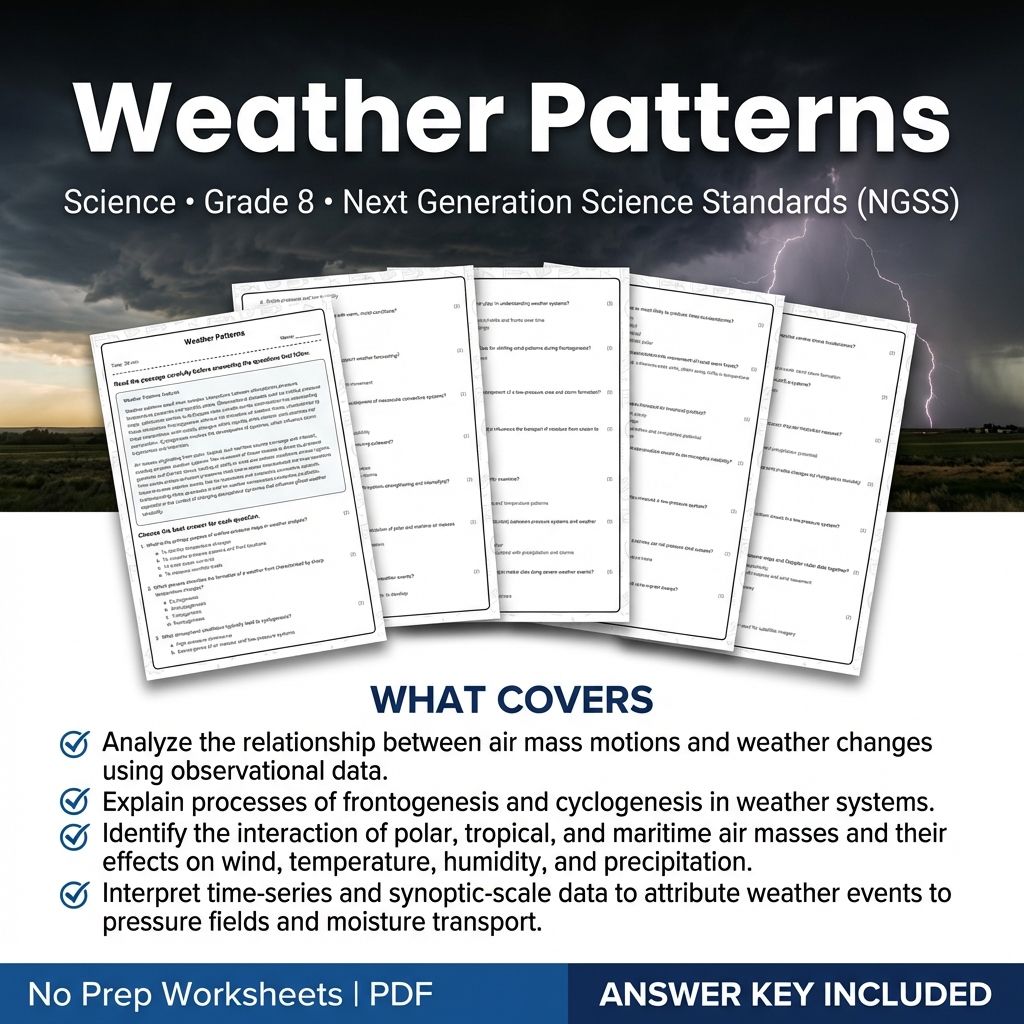
8th Grade Science | Weather Patterns Worksheet & Answer Key (Printable PDF)
 Created byCoral Reef Learning
Learning Objectives
- Analyze the relationship between air mass motions and weather changes using observational data.
- Explain processes of frontogenesis and cyclogenesis in weather systems.
- Identify the interaction of polar, tropical, and maritime air masses and their effects on wind, temperature, humidity, and precipitation.
Instant download
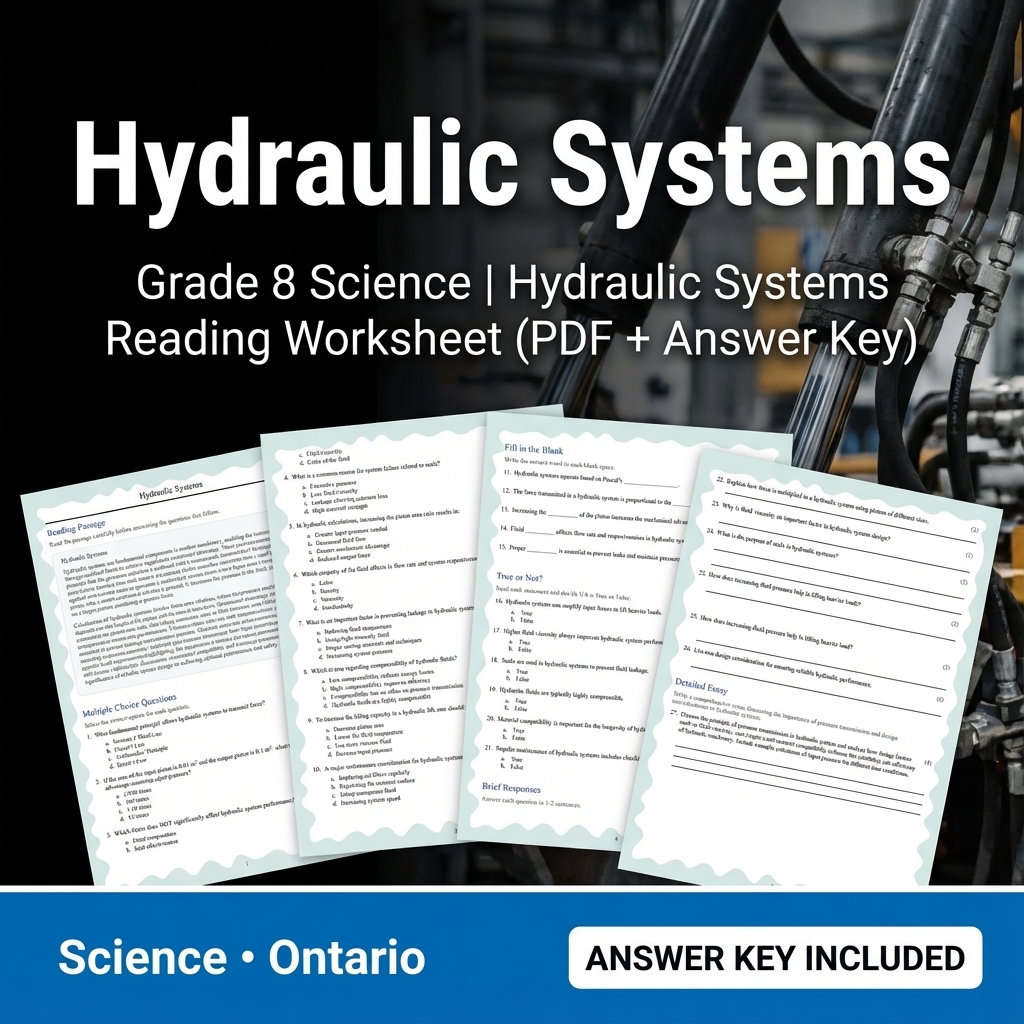
Grade 8 Science | Hydraulic Systems Reading Worksheet (PDF + Answer Key)
JCreated byJ.S SheetsLearning Objectives
- Understand how hydraulic systems convert small forces into larger outputs through pressure transmission.
- Evaluate the force-area relationship in piston assemblies within hydraulic machinery.
- Apply pressure calculations to real-world hydraulic system examples.
Also included in: Grade 8 Science Unit Bundle – Density, Pressure & Fluid Mechanics Worksheets +1 more
Instant download
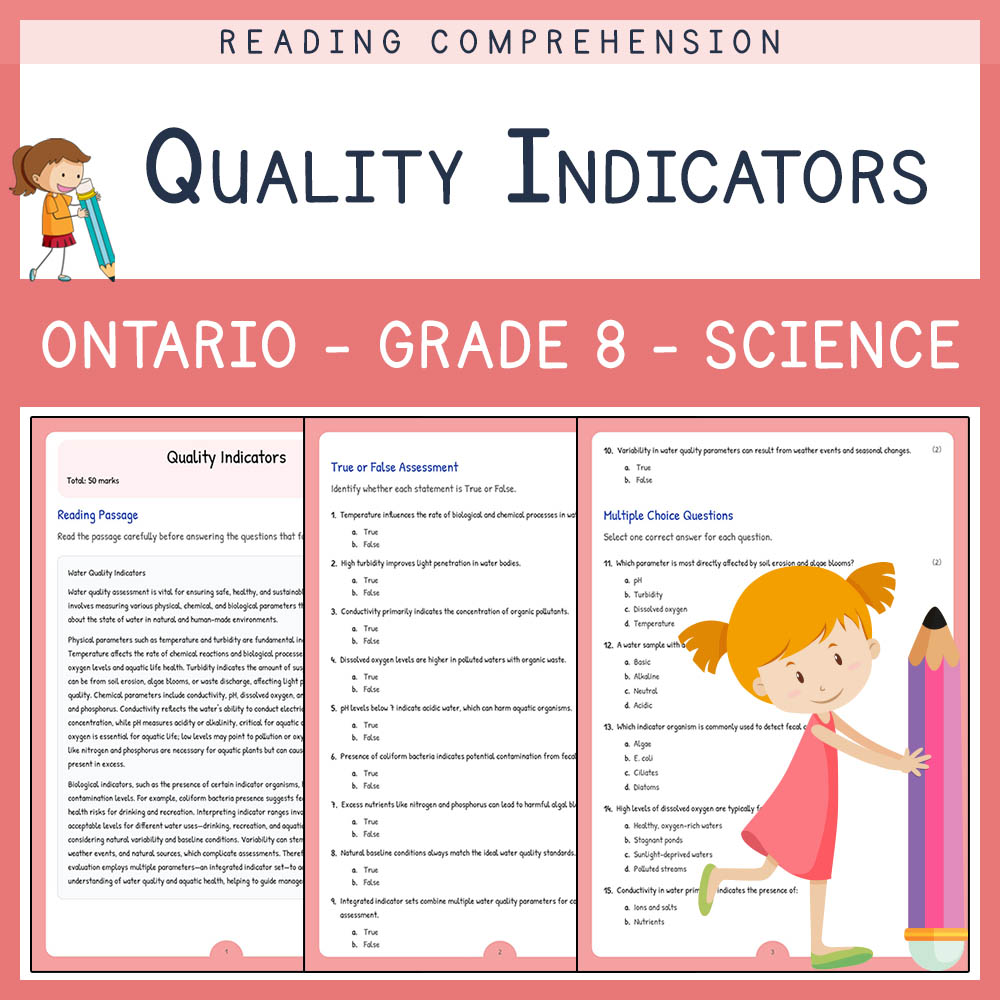
Grade 8 Science Worksheet Elena | Water Quality Indicators | Ontario
Created byLumora LearningLearning Objectives
- Understand the physical, chemical, and biological indicators of water quality.
- Interpret indicator ranges for aquatic health and their uses.
- Recognize sources of variability and natural baseline conditions in water assessments.
Instant download

Grade 8 Science | Design Problem Parameters Worksheet | General Standard
Created byLumora LearningLearning Objectives
- Explain the difference between success criteria and constraints in an engineering design problem
- Identify measurable outcomes that can serve as success criteria for a solution
- Recognize how constraints limit choices such as cost, materials, size, and time
Instant download
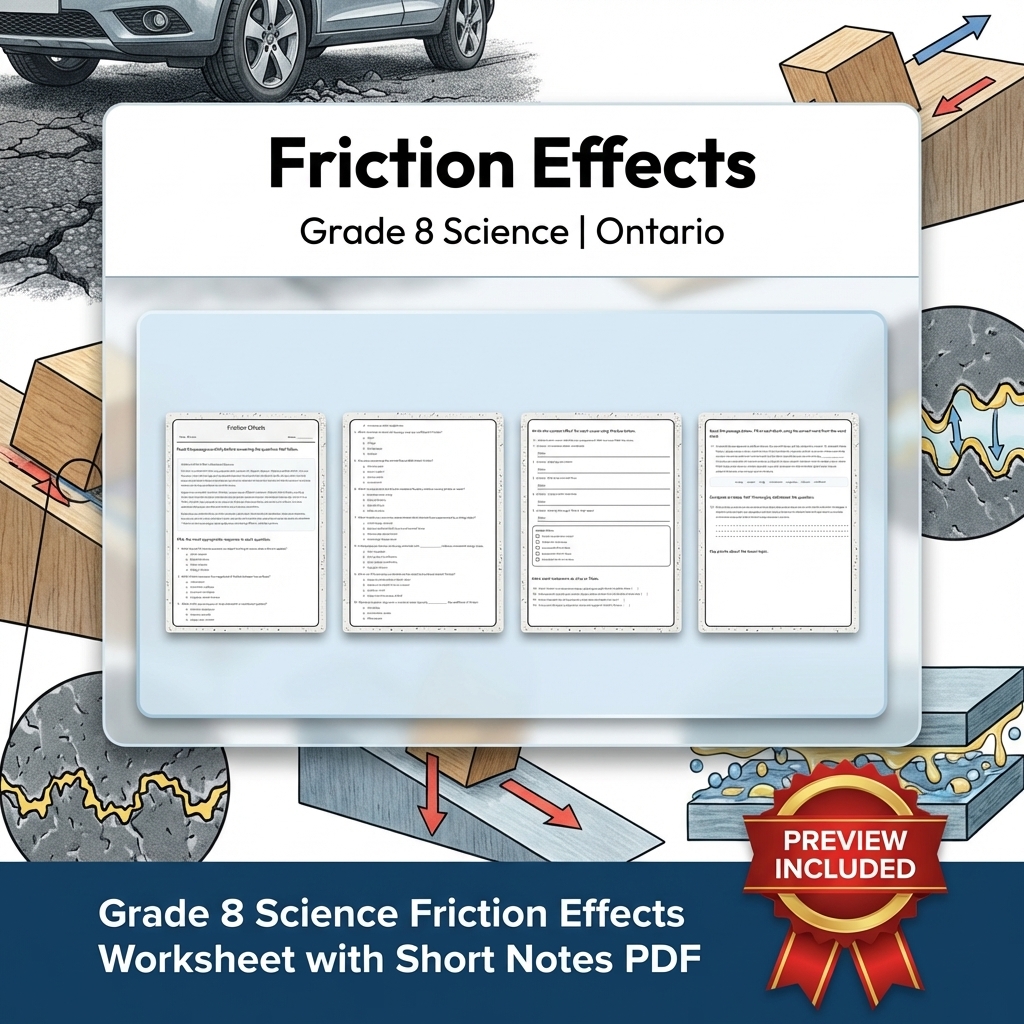
Grade 8 Science Friction Effects Worksheet with Short Notes PDF
 Created byMeadowlark Worksheets
Learning Objectives
- Analyze the different types of friction and their impact on mechanical systems.
- Understand how surface texture, normal force, and material choice influence frictional forces.
- Evaluate methods for estimating friction in simple apparatus.
Also included in: Grade 8 Science Lesson Group Bundle for Ontario Curriculum +1 more
Instant download
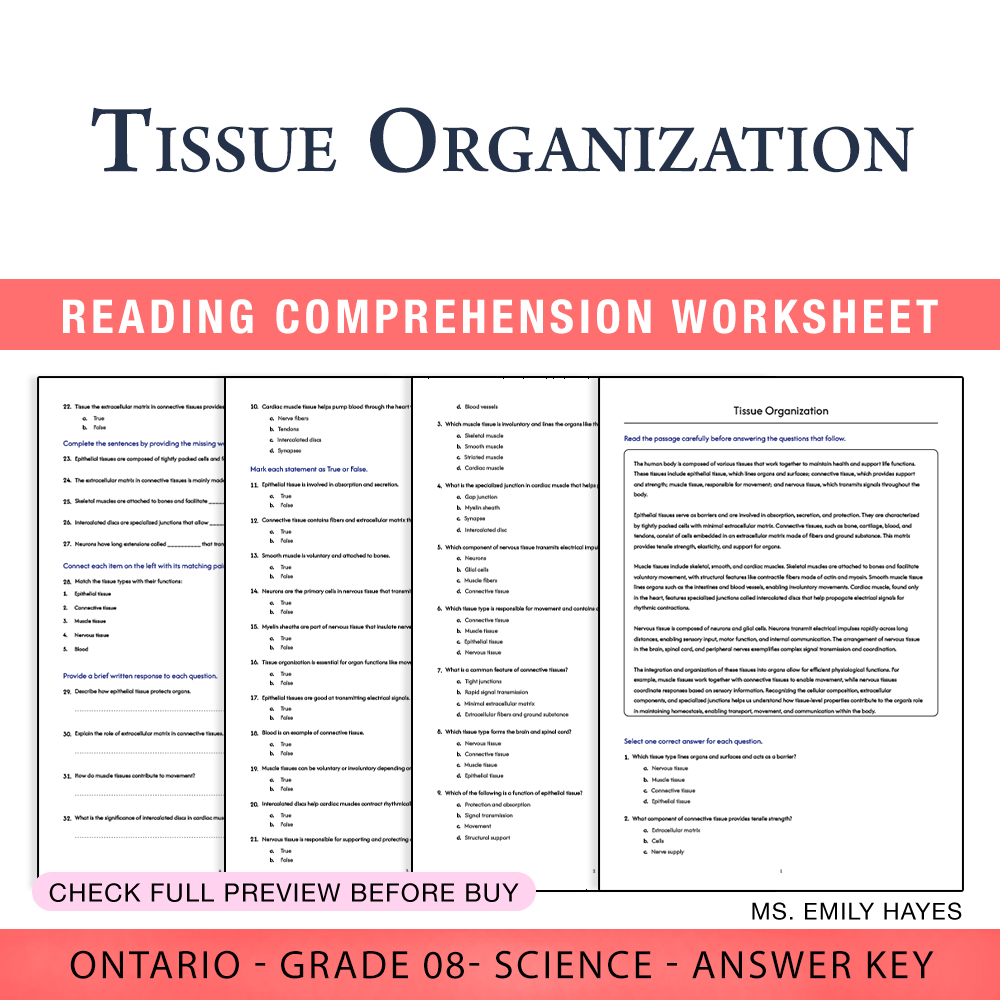
8th Grade Science | Tissue Organization Worksheet (PDF+ Answer Key)
 Created byCopper Leaf Classroom
Learning Objectives
- Describe the major types of tissues: epithelial, connective, muscle, and nervous.
- Identify structural features and functions of different tissue types.
- Explain how tissue organization contributes to organ functions and physiological processes.
Instant download

Grade 8 Science | Design Optimization Analysis - Daily Reading Comprehension
Created byCoral Reef LearningLearning Objectives
- Interpret graphical data and statistical summaries
- Identify performance trends from test data
- Understand how design modifications impact efficiency and strength
Instant download

Model Frameworks Worksheet | Alberta Standards Grade 8 Science Practice
JCreated byJ.S SheetsLearning Objectives
- Understand how models represent ecosystem processes such as matter and energy flow.
- Identify different types of models used in ecological studies, including diagrams and flow charts.
- Interpret outputs from ecological models and recognize their assumptions and limitations.
Instant download

Grade 8 Science – Muscle Contraction & Cell Structure | Daily Reading Worksheet
 Created byBright Mind Resources
Learning Objectives
- Identify parts of muscle cells and their functions
- Understand the process of muscle contraction
- Recognize the roles of actin, myosin, ATP, and calcium in muscle movement
Also included in: Grade 8 Body Systems & Cell Structure Science Daily Reading Lesson Bundle | BC +1 more
Instant download
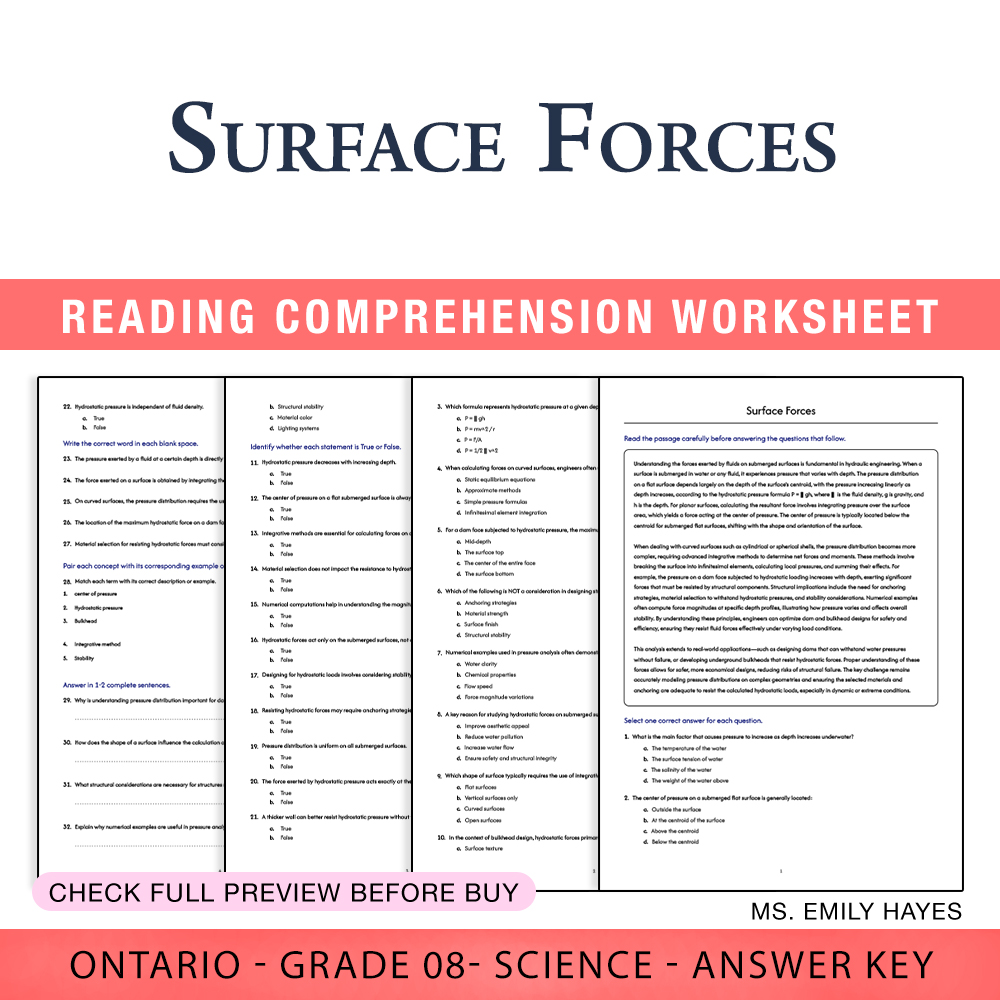
8th Grade Science | Surface Forces Worksheet (PDF+ Answer Key)
Created byCopper Leaf ClassroomLearning Objectives
- Understand the principles of pressure distribution on submerged surfaces
- Analyze how forces act on planar and curved surfaces underwater
- Apply integrative methods to calculate net forces and centers of pressure
Instant download

Grade 8 Science Earth Motions Daily Reading Worksheet with Answer Key
JCreated byJ.S SheetsLearning Objectives
- Understand Earth's rotation and its impact on day and night.
- Describe how Earth's axial tilt and orbit cause seasons.
- Explain the apparent solar path and changes in daylight length.
Also included in: Grade 8 Science Lesson Bundle | TEKS Standards Worksheets for Earth & Space +1 more
Instant download

Abiotic Influences Worksheet | Grade 8 Science Practice
Created byPrism Point LearningLearning Objectives
- Explain how abiotic factors such as light availability, temperature, water supply, soil composition, and nutrient levels affect where species can live.
- Describe how seasonal and microhabitat changes can create different niches within the same ecosystem.
- Use evidence to predict how changing abiotic conditions can influence growth, reproduction, and community structure.
Also included in: Ecosystems & Biodiversity Lesson Bundle | Grade 8 Science | BC +1 more
Instant download
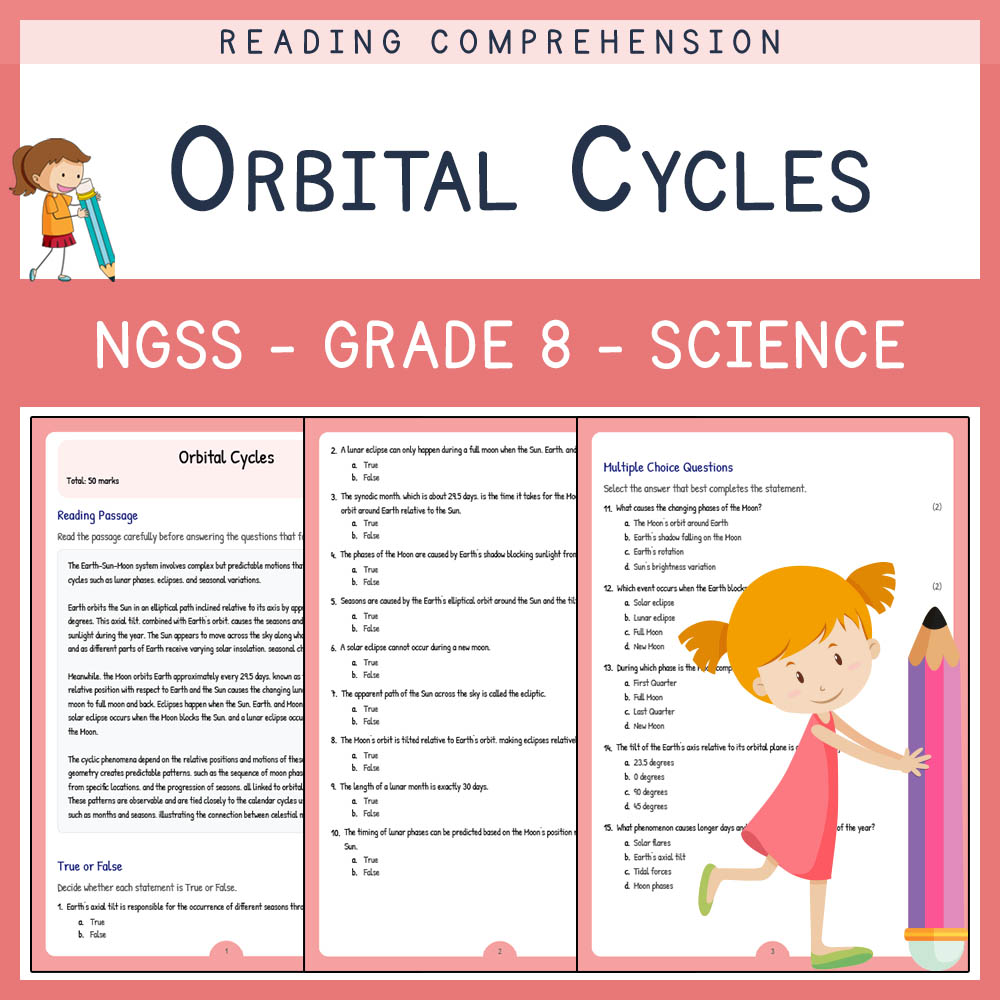
Grade 8 Science | Orbital Cycles Worksheet with Answer Key (NGSS-Aligned)
Created byLumora LearningLearning Objectives
- Explain the relative positions and motions of Earth, the Moon, and the Sun that lead to lunar phases, eclipses, and seasons.
- Describe the geometric and axial factors responsible for cyclic phenomena observed from Earth.
- Relate observable sky patterns and calendar cycles to the orbital relationships of celestial bodies.
Instant download
Grade 8 Science | Food Web Complexity Reading Worksheet (PDF & Answer Key)
JCreated byJ.S SheetsLearning Objectives
- Understand how food webs illustrate energy pathways and species interactions within ecosystems.
- Analyze the concepts of redundancy, indirect interactions, and species roles in food web stability.
- Evaluate how seasonal migrations and life-cycle stages influence ecological links.
Also included in: Grade 8 Science Bundle | Ecosystem Dynamics & Environmental Impact Worksheets +1 more
Instant download
Grade 8 Science | Trophic Modeling Reading Worksheet & Answer Key (PDF)
JCreated byJ.S SheetsLearning Objectives
- Understand the concept of trophic modeling and its applications in ecology.
- Describe how mass-balance approaches and flow diagrams represent energy flow among trophic compartments.
- Explain the assumptions and sensitivities involved in trophic system models.
Also included in: Grade 8 Science Bundle | Ecosystem Dynamics & Environmental Impact Worksheets +1 more
Instant download
Grade 8 Science | Model Frameworks Reading Worksheets – Standards-Aligned PDF
JCreated byJ.S SheetsLearning Objectives
- Understand how models represent matter and energy movement in ecosystems.
- Identify the conventions used in diagrams, flow charts, and balances for ecological models.
- Interpret outputs from models of trophic levels, nutrient pools, and fluxes.
Also included in: Grade 8 Science Bundle | Ecosystem Dynamics & Environmental Impact Worksheets +1 more
Instant download

Grade 8 Science – Energy Transformations & Forms | Daily Reading Worksheet
Created byBright Mind ResourcesLearning Objectives
- Understand different forms of energy such as potential, kinetic, electrical, thermal, and mechanical.
- Identify how energy transforms from one form to another within systems.
- Apply knowledge of energy transformations to real-world examples like bouncing balls and electric motors.
Also included in: Grade 8 States of Matter Science Daily Reading Lesson Bundle | FL-NGSSS +1 more
Instant download

Grade 8 Science – Force & Motion Daily Reading Worksheet | NGSSS Aligned
Created byBright Mind ResourcesLearning Objectives
- Understand the basic concept of force
- Identify different types of forces
- Relate how forces affect the motion of objects
Also included in: Grade 8 States of Matter Science Daily Reading Lesson Bundle | FL-NGSSS +1 more
Instant download

Ecosystem Models Worksheet | Grade 8 NGSS Systems Science Activity Pack
 Created byAmber Owl Education
Learning Objectives
- Explain how ecosystem models represent biotic and abiotic components using boundaries and variables.
- Interpret stock-and-flow relationships and feedbacks to predict how changes spread through an ecosystem.
- Use system diagram ideas to describe resilience, equilibrium, and disturbance responses over time.
Also included in: Grade 8 Science Ecosystem Dynamics Lesson Bundle | NGSS +1 more
Instant download
Grade 8 Science – Thermal Changes Worksheet + Answer Key | NGSS Aligned
Created byBright Mind ResourcesLearning Objectives
- Understand how energy transfer affects temperature and particle kinetic energy.
- Explain the concept of specific heat capacity and its effect on temperature change.
- Apply calorimetric reasoning to compare heat capacities of different materials.
Also included in: Grade 8 Science | Energy Transfer & Conservation Unit Worksheets (NGSS Aligned) +2 more
Instant download
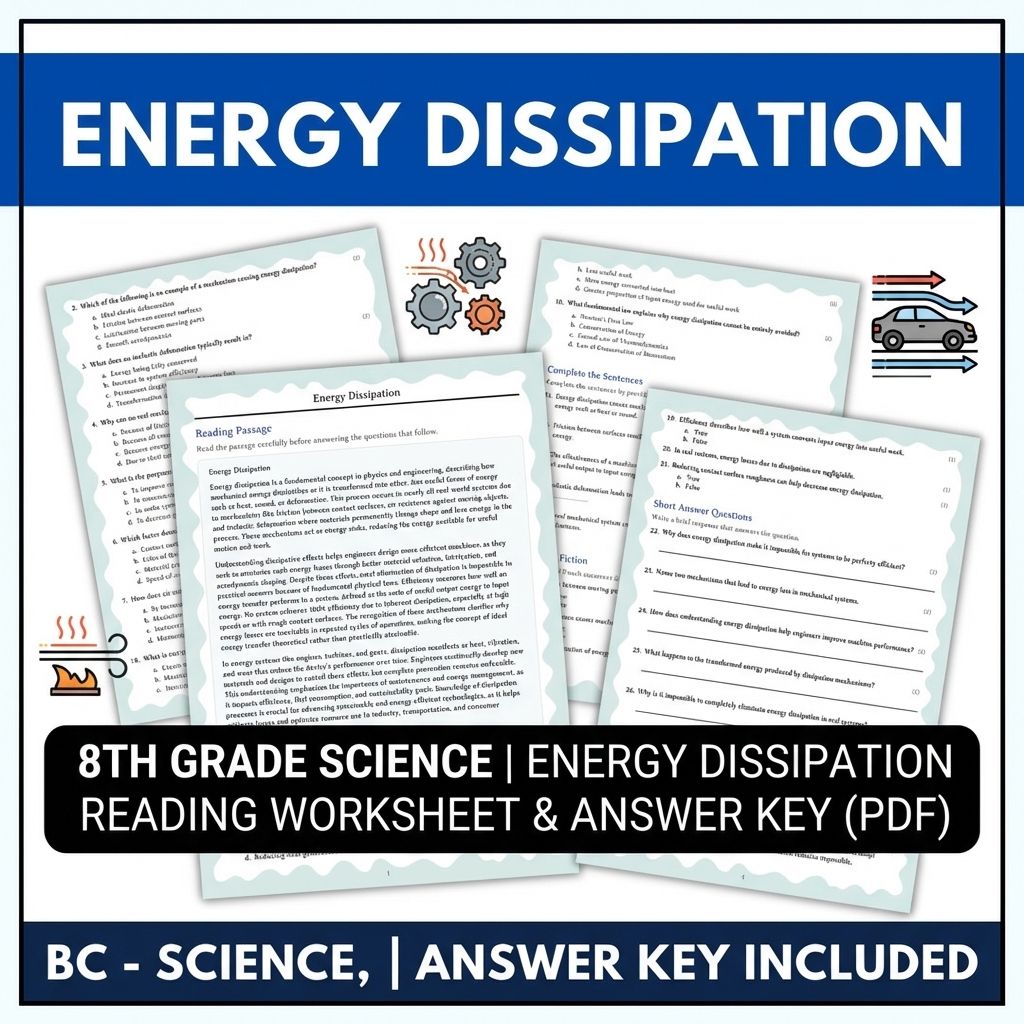
8th Grade Science | Energy Dissipation Reading Worksheet & Answer Key (PDF)
JCreated byJ.S SheetsLearning Objectives
- Explain how mechanical energy transforms into less useful forms such as thermal energy.
- Identify common mechanisms of energy dissipation like friction, air resistance, and inelastic deformation.
- Understand the concept of efficiency and how it quantifies useful energy transfer in mechanical systems.
Instant download

8th Grade Science Biodiversity Conservation Worksheet with Short Notes ( PDF)
Created byMeadowlark WorksheetsLearning Objectives
- Understand the concept of biodiversity and its importance in ecosystem health.
- Identify different strategies and policies utilized for biodiversity conservation.
- Analyze case examples of restoration and management processes.
Instant download
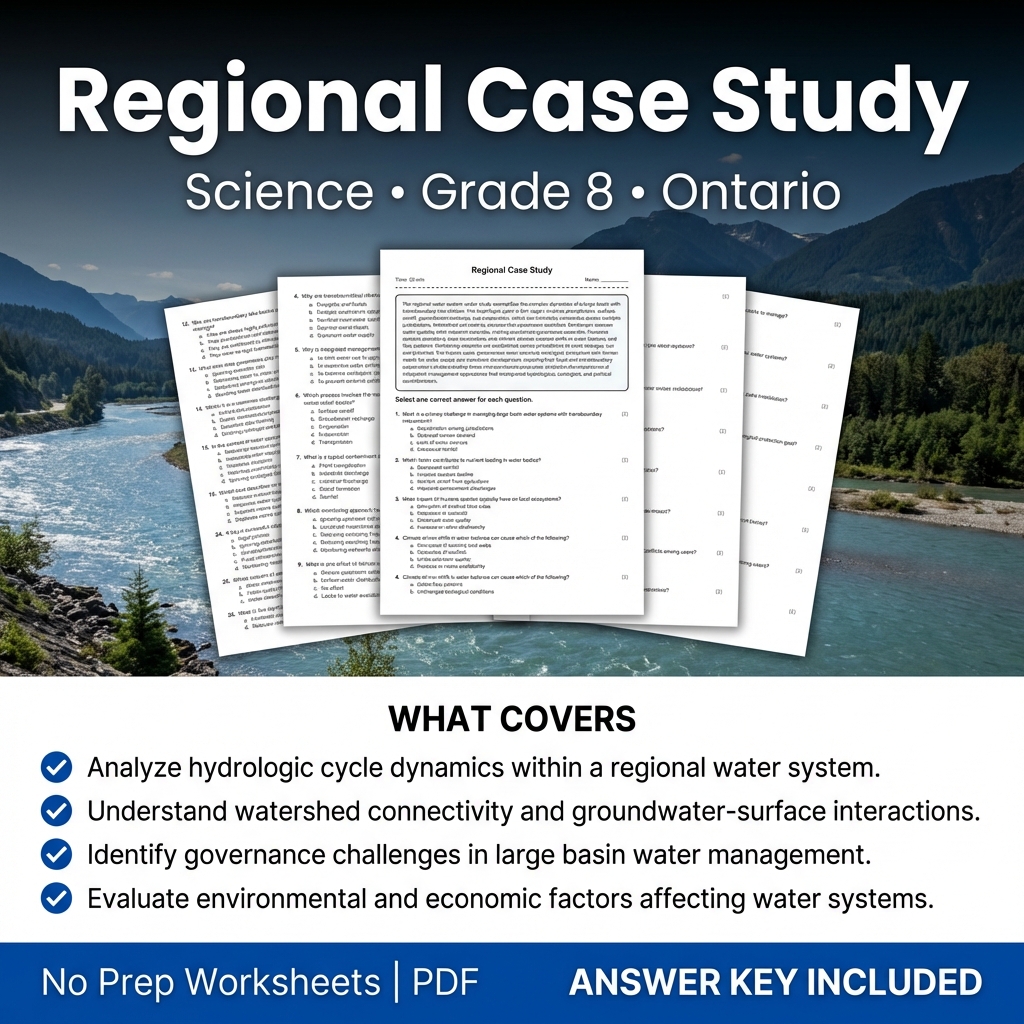
Grade 8 Science Worksheet | Regional Case Study | Ontario Standards
Created byCoral Reef LearningLearning Objectives
- Analyze hydrologic cycle dynamics within a regional water system.
- Understand watershed connectivity and groundwater-surface interactions.
- Identify governance challenges in large basin water management.
Instant download

Immune Response Worksheet | Ontario Grade 8 Science Assessment
Created byCedar Grove LearningLearning Objectives
- Explain how innate immunity and adaptive immunity work together to defend the body
- Describe the roles of macrophages, neutrophils, lymphocytes, and antigen-presenting cells
- Compare phagocytosis, antibody production, and cell-mediated cytotoxicity
Instant download
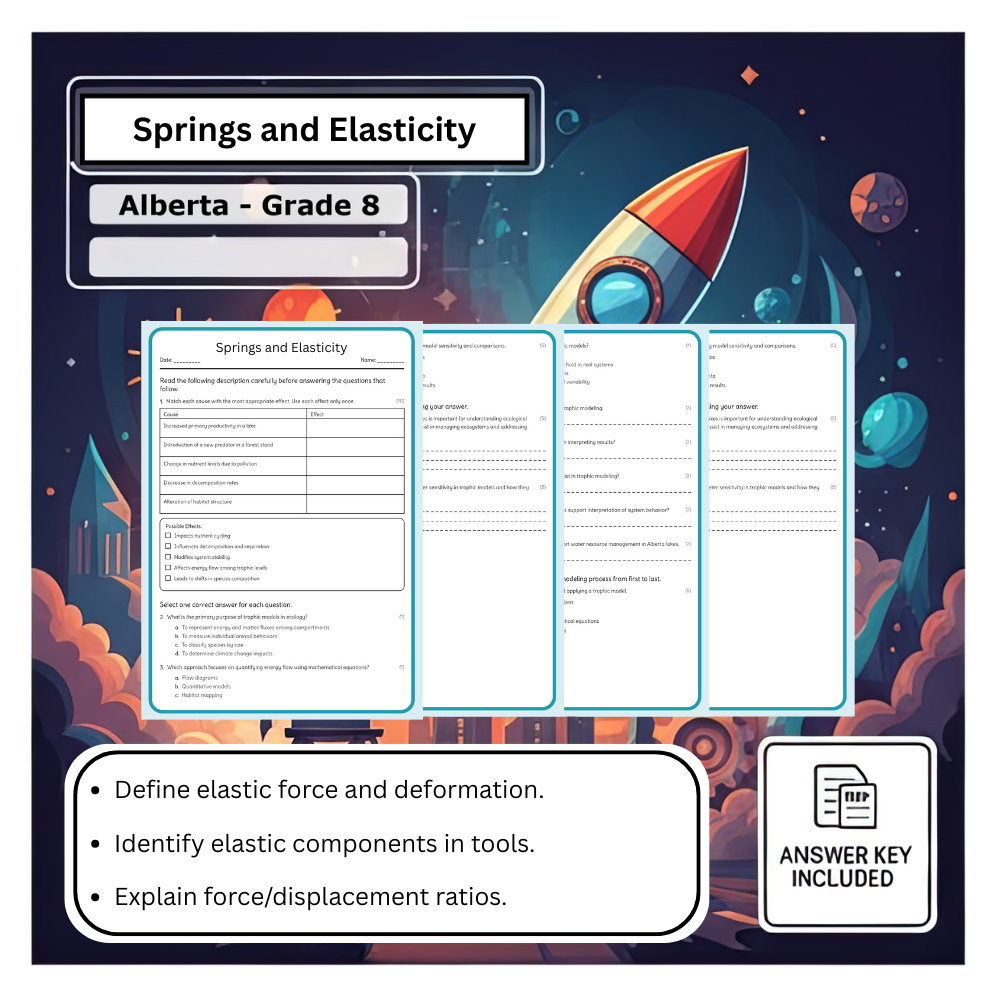
Grade 8 Science | Springs and Elasticity Worksheet (PDF)
Created byBright Mind ResourcesLearning Objectives
- Understand the concept of elastic forces and deformation in materials.
- Identify examples of elastic components in everyday and mechanical systems.
- Explain the proportional relationship between force and displacement in elastic materials.
Instant download
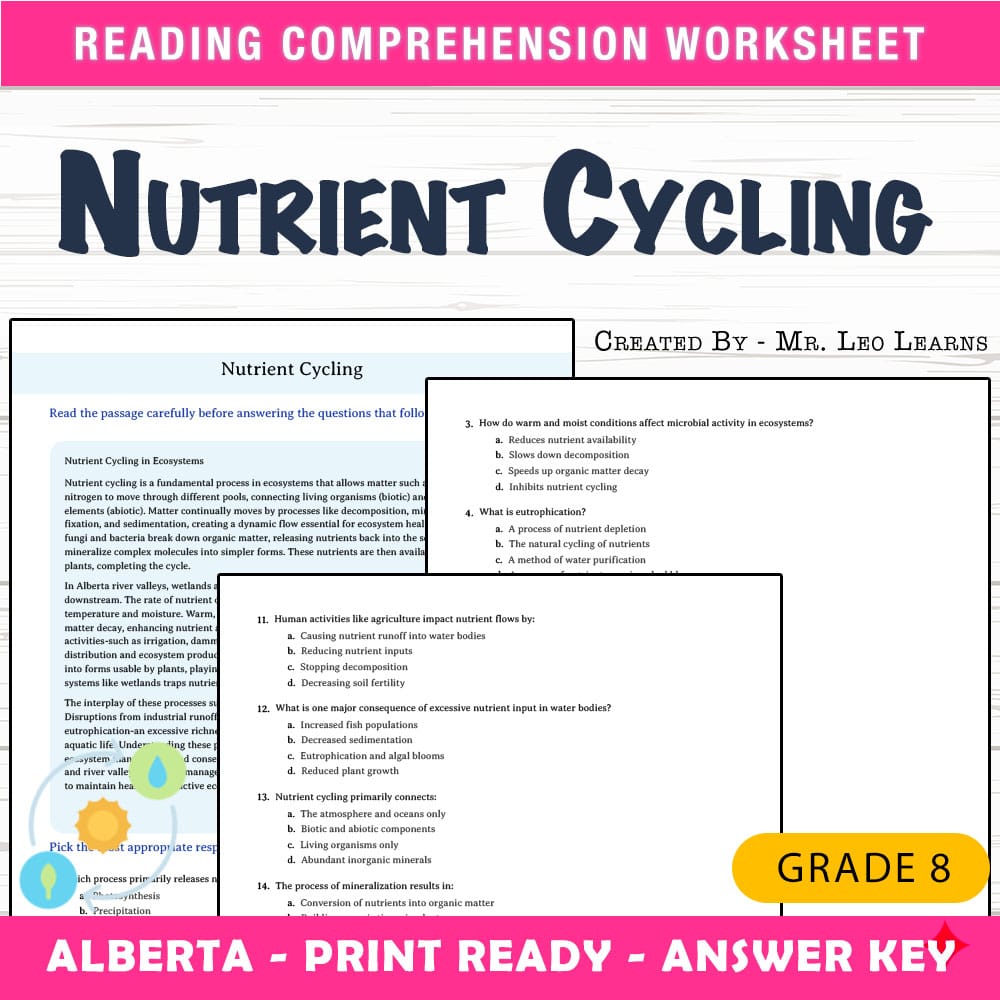
Grade 8 Science — Nutrient Cycling Worksheet MCQ Paper for Mastery
Created byThe Resource HubLearning Objectives
- Understand the processes involved in nutrient cycling within ecosystems.
- Explain the roles of decomposers, nitrogen fixation, and mineralization.
- Identify factors that influence the rates of nutrient cycles such as temperature and moisture.
Also included in: Grade 8 Science Bundle | Interactions and Ecosystems Worksheets +1 more
Instant download
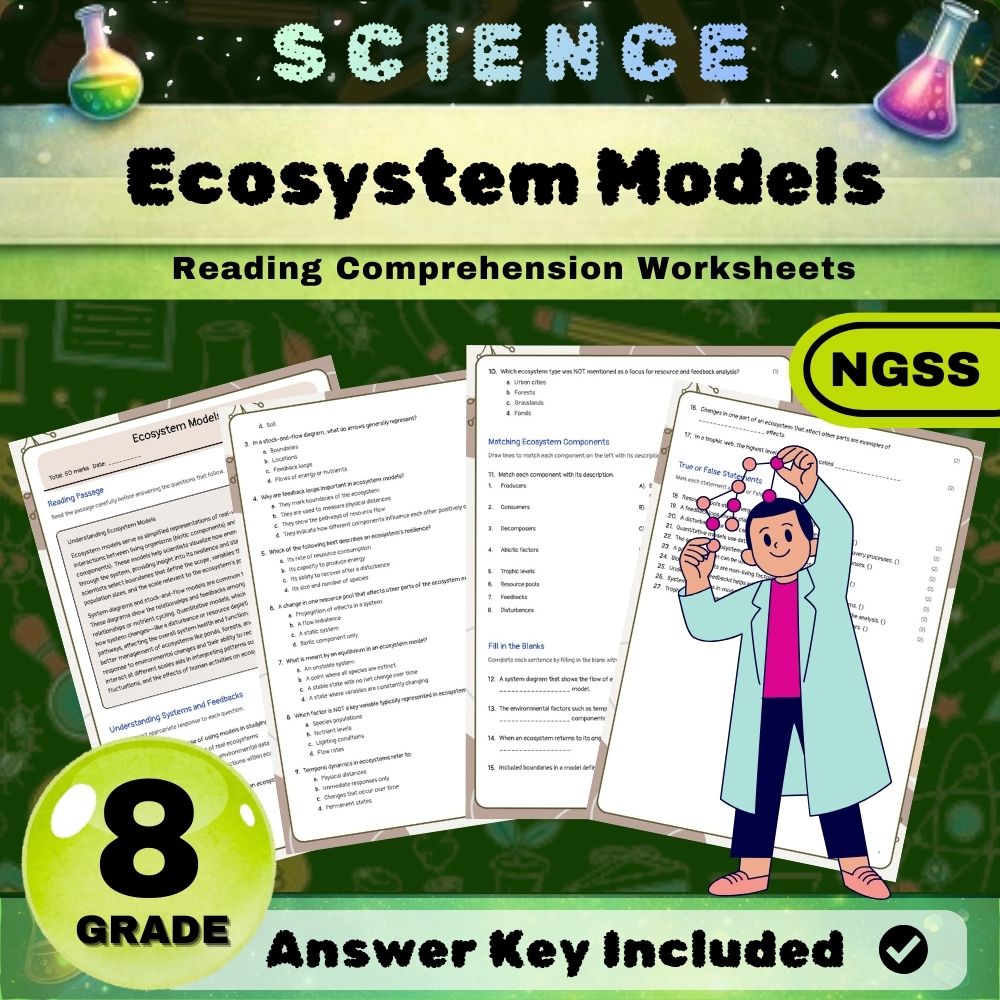
Grade 8 Science – Ecosystem Models Worksheet (NGSS) (PDF)
 Created byMaple Path Learning
Learning Objectives
- Understand the components and functions of ecosystem models, including biotic and abiotic factors.
- Identify different types of flows, feedbacks, and resource pools within ecosystems.
- Interpret how changes in one component can propagate through an ecosystem using system diagrams.
Also included in: Grade 8 Science Ecosystems Unit Bundle | Interactions, Energy & Dynamics (NGSS) +1 more
Instant download
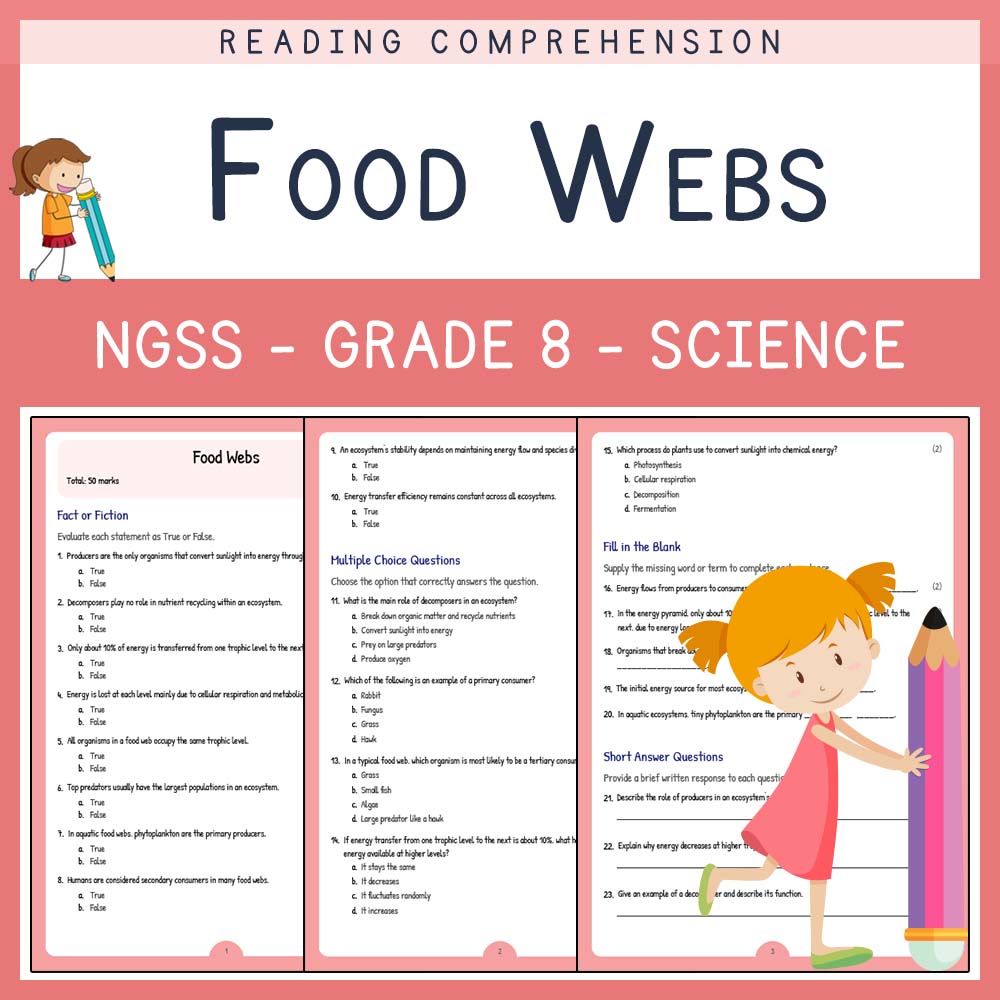
Grade 8 Science | Food Webs Worksheet & Answer Key Aligned with NGSS (PDF)
Created byLumora LearningLearning Objectives
- Explain the roles of producers, consumers, and decomposers in ecosystems.
- Describe trophic levels and the flow of energy through a food web.
- Analyze how energy loss affects population sizes within ecological communities.
Instant download
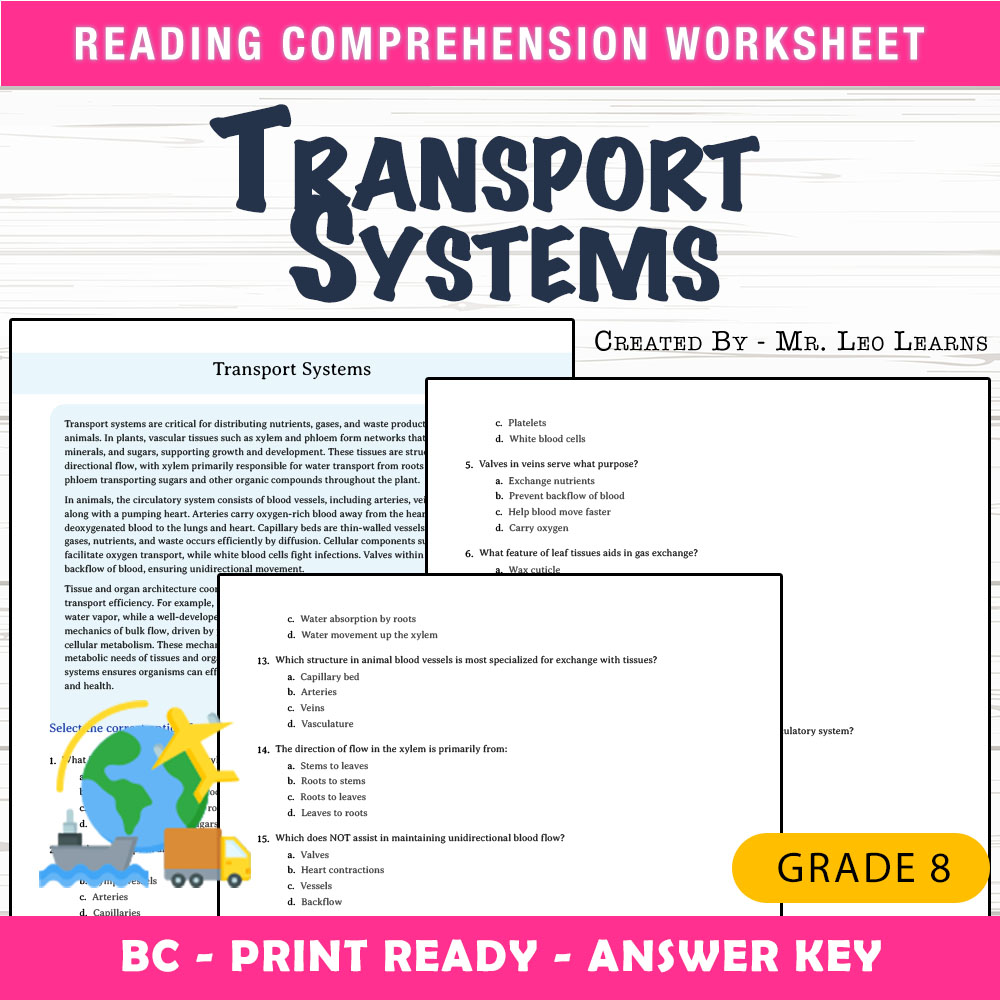
Grade 8 Science — Worksheet MCQ Paper for Transport Systems
Created byThe Resource HubLearning Objectives
- Understand the structure and function of vascular and circulatory transport systems in plants and animals.
- Identify the roles of vessels, valves, capillary beds, blood cells, xylem, and phloem in transport processes.
- Explain how tissue and organ structures facilitate bulk flow and diffusion for cellular metabolism.
Also included in: Grade 8 Science UNIT | Multicellular Structure & Function Worksheet Bundle +1 more
Instant download
About Grade 8 Science Worksheets
Explore Grade 8 Science worksheets for classwork, homework, or review. Our 5,990 printables download instantly as PDFs.
Each resource here is built by an independent educator and reviewed for quality. Worksheets print straight from PDF and suit classroom use, homework, or extra practice; most come with answer keys, and you can preview before purchasing.