
Grade 8 Science Worksheets
6,006 worksheets
Resource Distribution Worksheet | NGSS Grade 8 Science Assessment PDF
JCreated byJ.S SheetsLearning Objectives
- Understand geological processes that influence resource formation.
- Identify different types of mineral, energy, and groundwater resources.
- Analyze how geological features affect resource accessibility and quality.
Also included in: Grade 8 Climate Drivers and Environmental Systems Science Lesson Bundle – NGSS +1 more
Instant download

Grade 8 Science Cell Structure Worksheet | NGSS Aligned Assessments
JCreated byJ.S SheetsLearning Objectives
- Describe the key features and functions of cellular organelles such as nucleus, mitochondria, chloroplasts, ribosomes, cell membrane, and cell wall.
- Compare and contrast prokaryotic and eukaryotic cells, and single-celled versus multicellular organisms.
- Explain how microscopy and cell imaging techniques help in understanding cell structure and function.
Also included in: Grade 8 Cell Modeling and Organ Systems Science Lesson Bundle – NGSS +1 more
Instant download

Climate Drivers Worksheet for Grade 8 Science | NGSS Standards Practice
JCreated byJ.S SheetsLearning Objectives
- Understand the main drivers influencing global temperature changes over time.
- Evaluate evidence from ice-core records, temperature datasets, and climate models.
- Differentiate between natural and anthropogenic factors affecting climate.
Also included in: Grade 8 Climate Drivers and Environmental Systems Science Lesson Bundle – NGSS +1 more
Instant download

Organ Systems Worksheet for Grade 8 Science | NGSS-Aligned Practice
JCreated byJ.S SheetsLearning Objectives
- Describe how different organ systems interact to maintain homeostasis.
- Explain the roles of the circulatory, respiratory, digestive, nervous, and endocrine systems.
- Identify feedback mechanisms involved in regulating blood glucose and temperature.
Also included in: Grade 8 Cell Modeling and Organ Systems Science Lesson Bundle – NGSS +1 more
Instant download
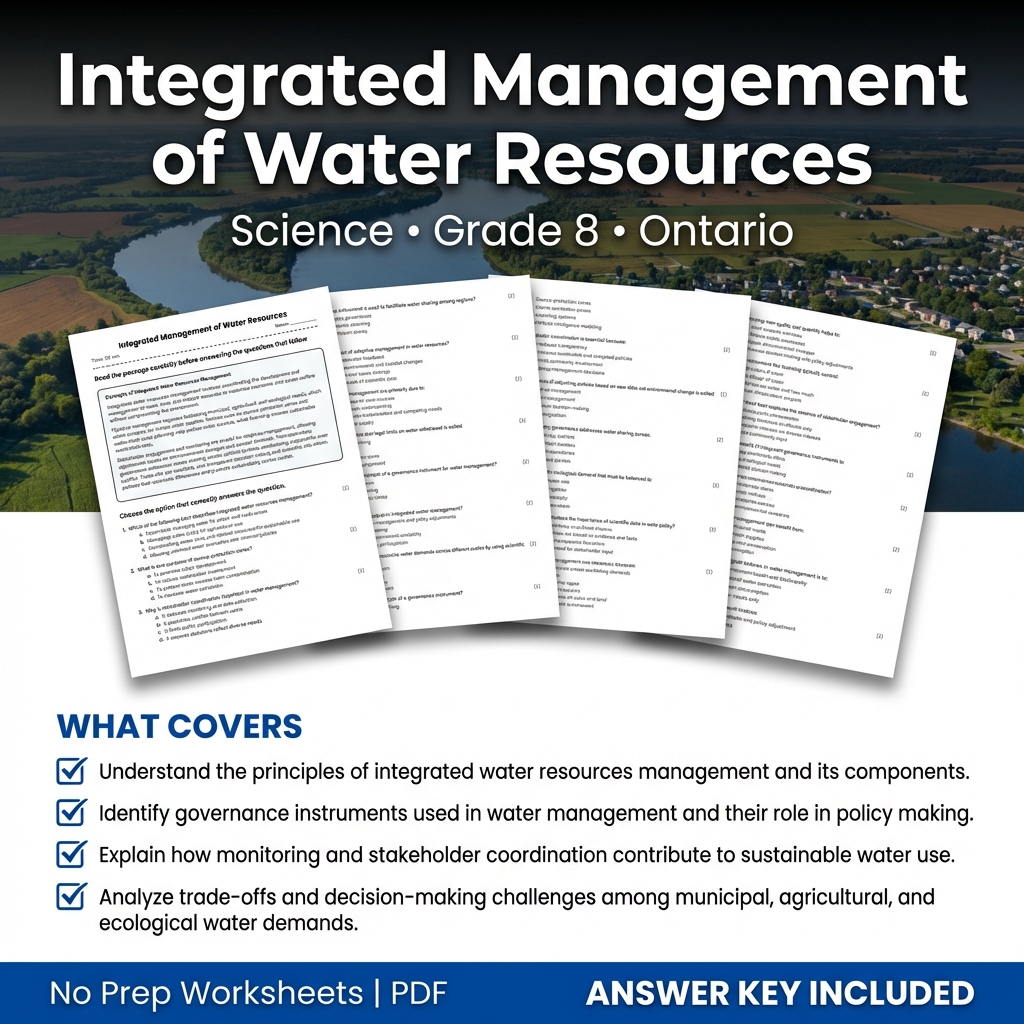
Grade 8 Science Worksheet | Integrated Water Resources Management | Ontario
 Created byCoral Reef Learning
Learning Objectives
- Understand the principles of integrated water resources management and its components.
- Identify governance instruments used in water management and their role in policy making.
- Explain how monitoring and stakeholder coordination contribute to sustainable water use.
Instant download

Environmental Monitoring Worksheet | Grade 8 NGSS Science Doodle Notes & Guide
 Created byAmber Owl Education
Learning Objectives
- Explain how environmental monitoring uses measurements and indicators to assess ecosystem and water health
- Identify monitoring methods (sampling, remote sensing, and field measurements) and how they support mitigation decisions
- Evaluate whether mitigation strategies reduce impacts by using data over time and comparing results to thresholds
Also included in: Grade 8 Science Environmental Monitoring & Climate Drivers Lesson Bundle | NGSS +1 more
Instant download

Grade 8 Population Effects Worksheet | NGSS Human Impact Science Activity
Created byAmber Owl EducationLearning Objectives
- Explain how population growth and per-capita consumption can change Earth systems through resource use and waste.
- Use evidence from emissions, land-cover change, and biogeochemical fluxes to construct and evaluate cause-and-effect arguments.
- Describe how demographic and consumption patterns can affect climate, freshwater availability, and biodiversity.
Also included in: Grade 8 Science Environmental Monitoring & Climate Drivers Lesson Bundle | NGSS +1 more
Instant download

Grade 8 Natural Hazards Worksheet | NGSS Science Activities & Doodle Notes
Created byAmber Owl EducationLearning Objectives
- Analyze patterns, frequency, and magnitude in natural hazard data to support forecasting and risk assessment
- Interpret how historical records and recurrence intervals help estimate likelihood and inform mitigation decisions
- Use hazard mapping and early-warning thresholds to reduce exposure to earthquakes, tsunamis, floods, and landslides
Also included in: Grade 8 Science Environmental Monitoring & Climate Drivers Lesson Bundle | NGSS +1 more
Instant download

Grade 8 Resource Distribution Worksheet | NGSS Earth Science Activity
Created byAmber Owl EducationLearning Objectives
- Explain how geological processes such as plate tectonics, sedimentation, and metamorphism help form mineral, energy, and groundwater resources.
- Compare how stratigraphy and geologic mapping help determine where resources are likely to be found.
- Describe differences between confined and unconfined aquifers and how those differences affect groundwater availability.
Also included in: Grade 8 Science Environmental Monitoring & Climate Drivers Lesson Bundle | NGSS +1 more
Instant download
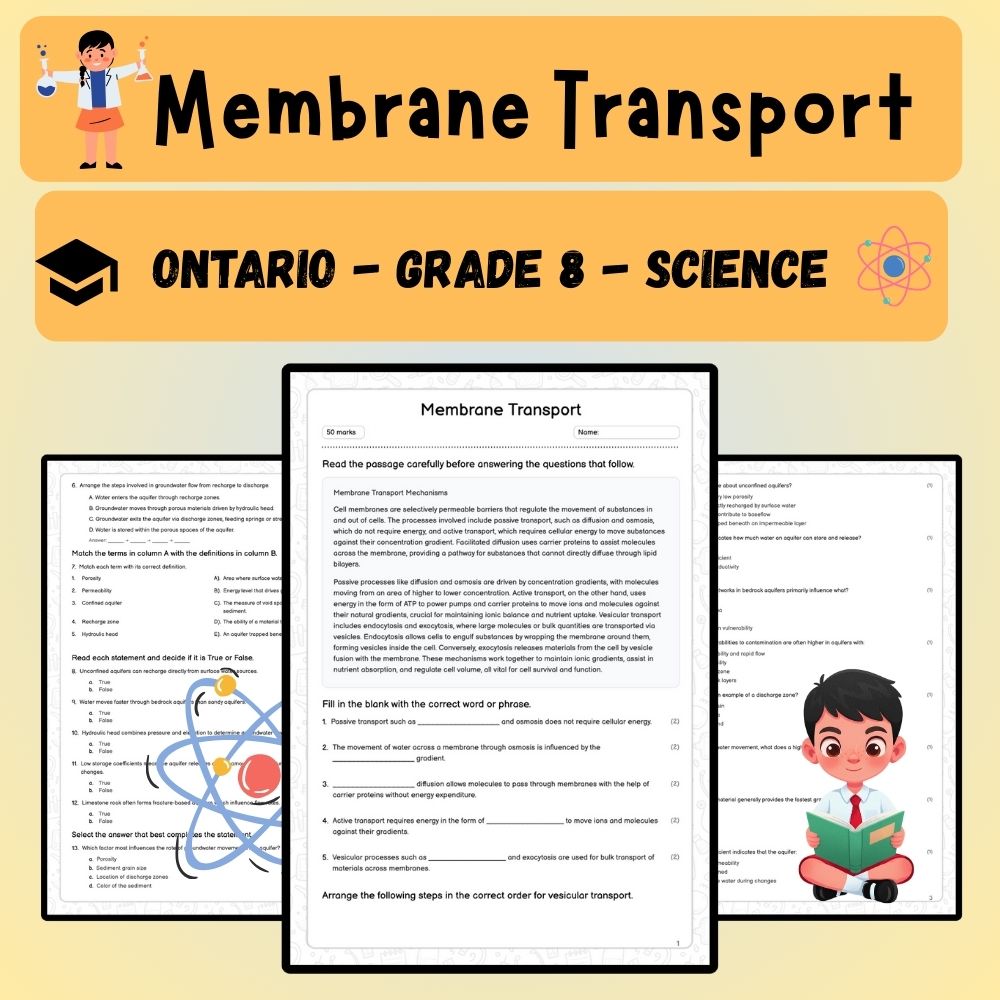
Grade 8 Science | Membrane Transport Worksheet (PDF) – Ontario Standards
 Created byPrism Point Learning
Learning Objectives
- Describe the difference between passive and active transport mechanisms across cell membranes.
- Identify key processes such as diffusion, osmosis, facilitated diffusion, and active transport.
- Explain how vesicular transport mechanisms like endocytosis and exocytosis maintain cellular functions.
Also included in: Grade 8 Science Unit Bundle | Cell Structure & Function Worksheets +1 more
Instant download
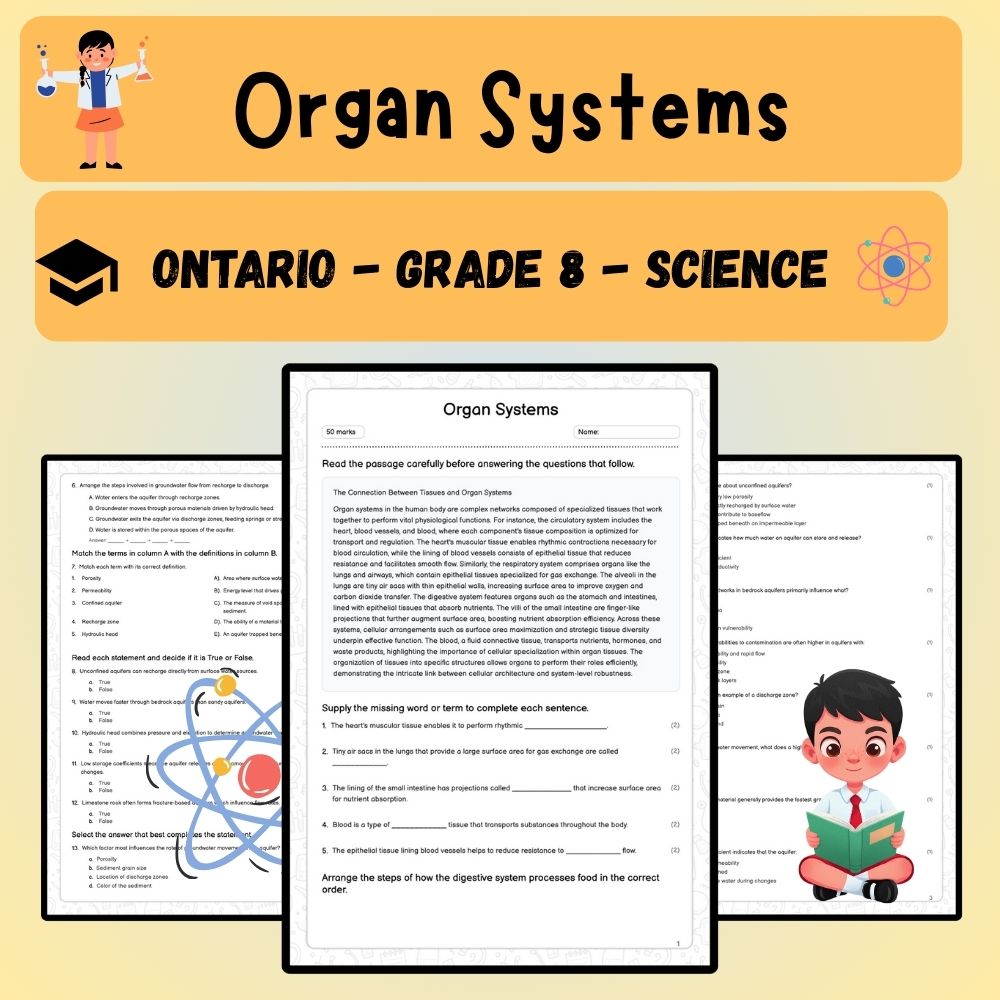
Grade 8 Science | Organ Systems Worksheet (PDF) – Ontario Standards
Created byPrism Point LearningLearning Objectives
- Describe how tissue specialization contributes to organ system functions.
- Identify the main organs within the circulatory, respiratory, and digestive systems.
- Explain how structural features of organs optimize physiological processes such as gas exchange, nutrient absorption, and waste removal.
Also included in: Grade 8 Science Unit Bundle | Cell Structure & Function Worksheets +1 more
Instant download
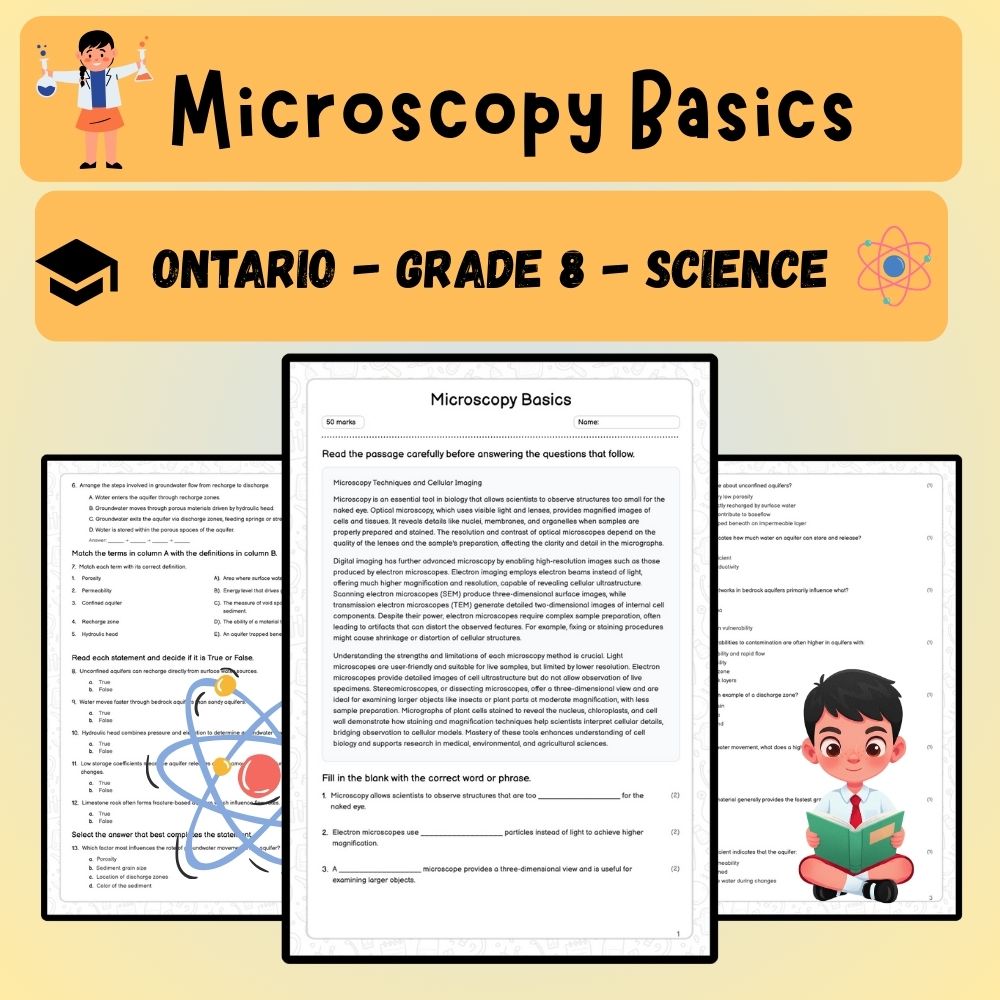
Grade 8 Science – Microscopy Basics Worksheet (PDF ) for Ontario Standards
Created byPrism Point LearningLearning Objectives
- Understand the principles of magnification, resolution, and contrast in microscopy
- Differentiate between light microscopy, stereomicroscopy, and electron imaging
- Recognize sample preparation artifacts and their impact on observations
Also included in: Grade 8 Science Unit Bundle | Cell Structure & Function Worksheets +1 more
Instant download
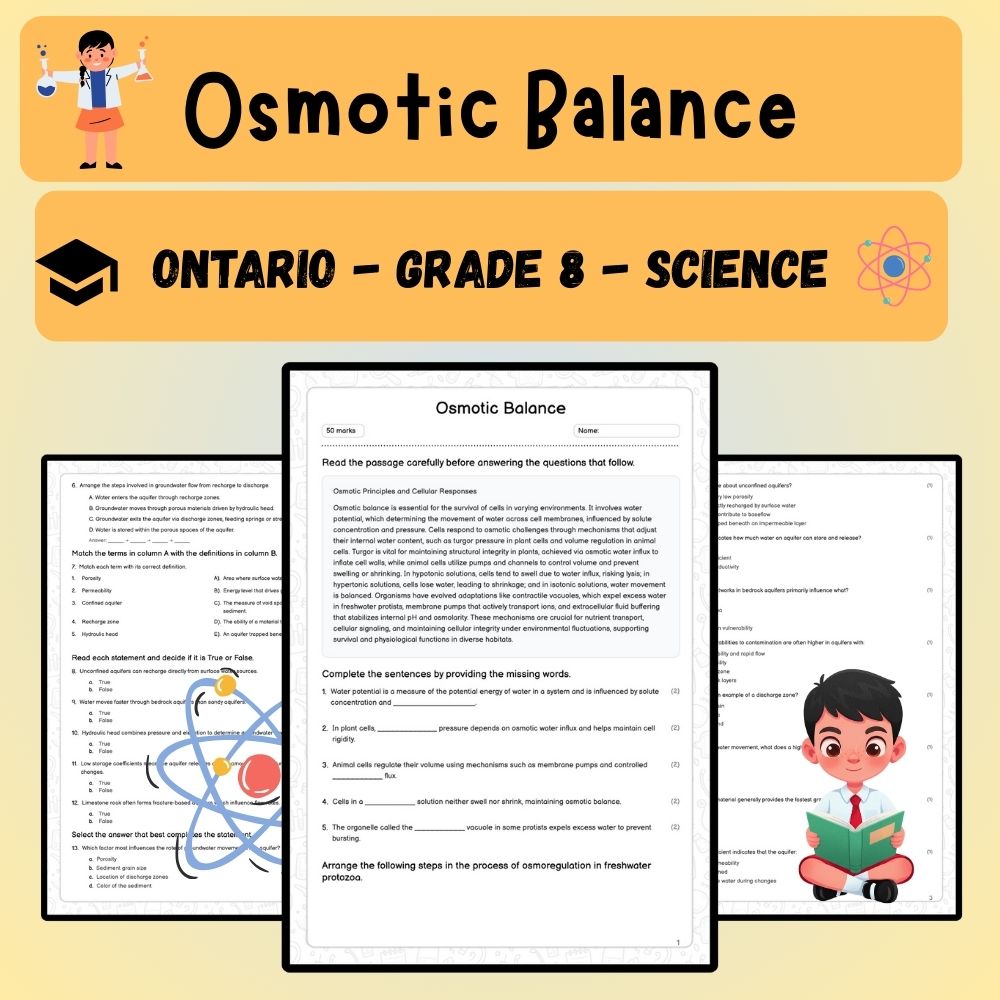
Grade 8 Science | Osmotic Balance Worksheet (PDF) – Ontario Standards
Created byPrism Point LearningLearning Objectives
- Understand the principles of osmotic pressure and water potential in cells.
- Explain cellular responses to hypotonic, isotonic, and hypertonic environments.
- Describe mechanisms like contractile vacuoles, membrane pumps, and extracellular fluid buffering in osmoregulation.
Also included in: Grade 8 Science Unit Bundle | Cell Structure & Function Worksheets +1 more
Instant download
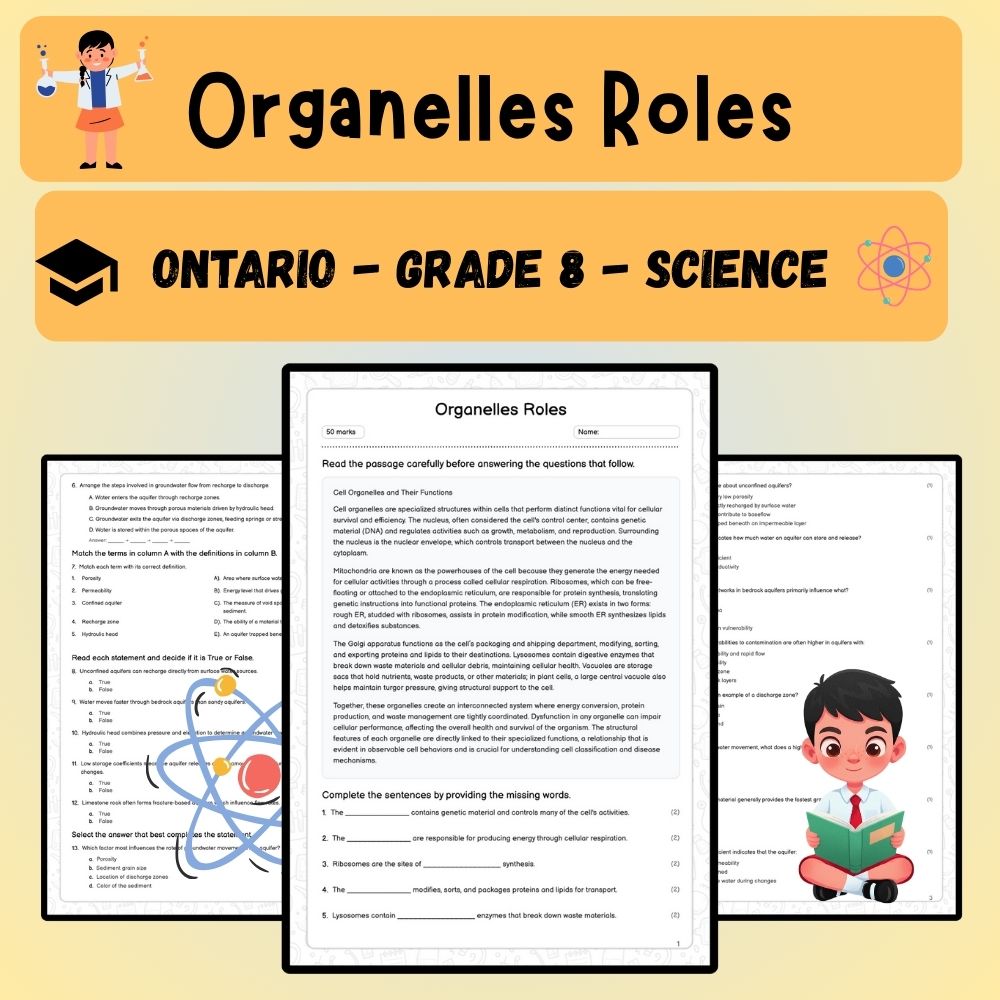
Grade 8 Science | Organelles Roles Worksheet (PDF ) - Ontario Standards
Created byPrism Point LearningLearning Objectives
- Describe the structure and functions of major cellular organelles.
- Explain how organelles work together to perform cellular processes.
- Analyze the impact of organelle dysfunction on cell performance.
Also included in: Grade 8 Science Unit Bundle | Cell Structure & Function Worksheets +1 more
Instant download
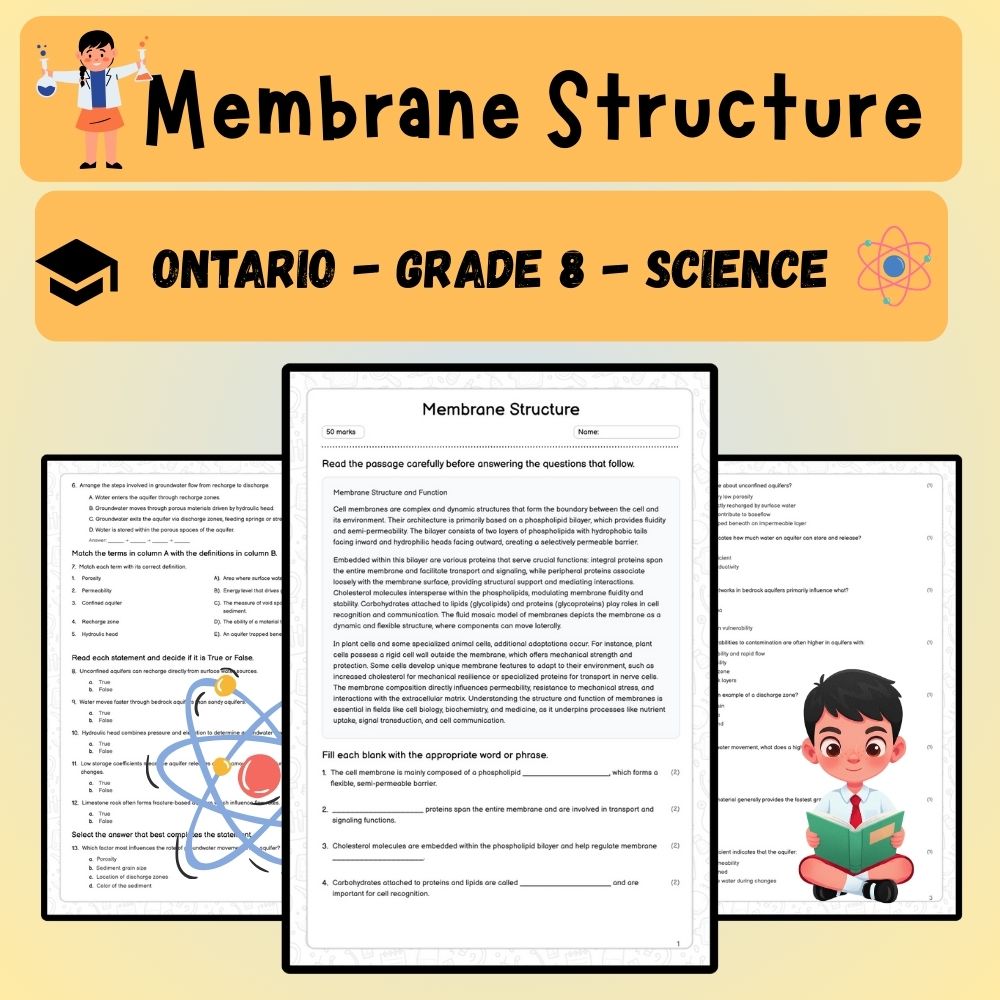
Grade 8 Science | Membrane Structure Worksheet (PDF) – Ontario Standard
Created byPrism Point LearningLearning Objectives
- Describe the key components of membrane architecture including phospholipids, proteins, cholesterol, and carbohydrates.
- Explain the functions of membrane proteins in transport, signaling, and structural support.
- Compare structural variations in membranes across different cell types and their implications for permeability and resilience.
Also included in: Grade 8 Science Unit Bundle | Cell Structure & Function Worksheets +1 more
Instant download
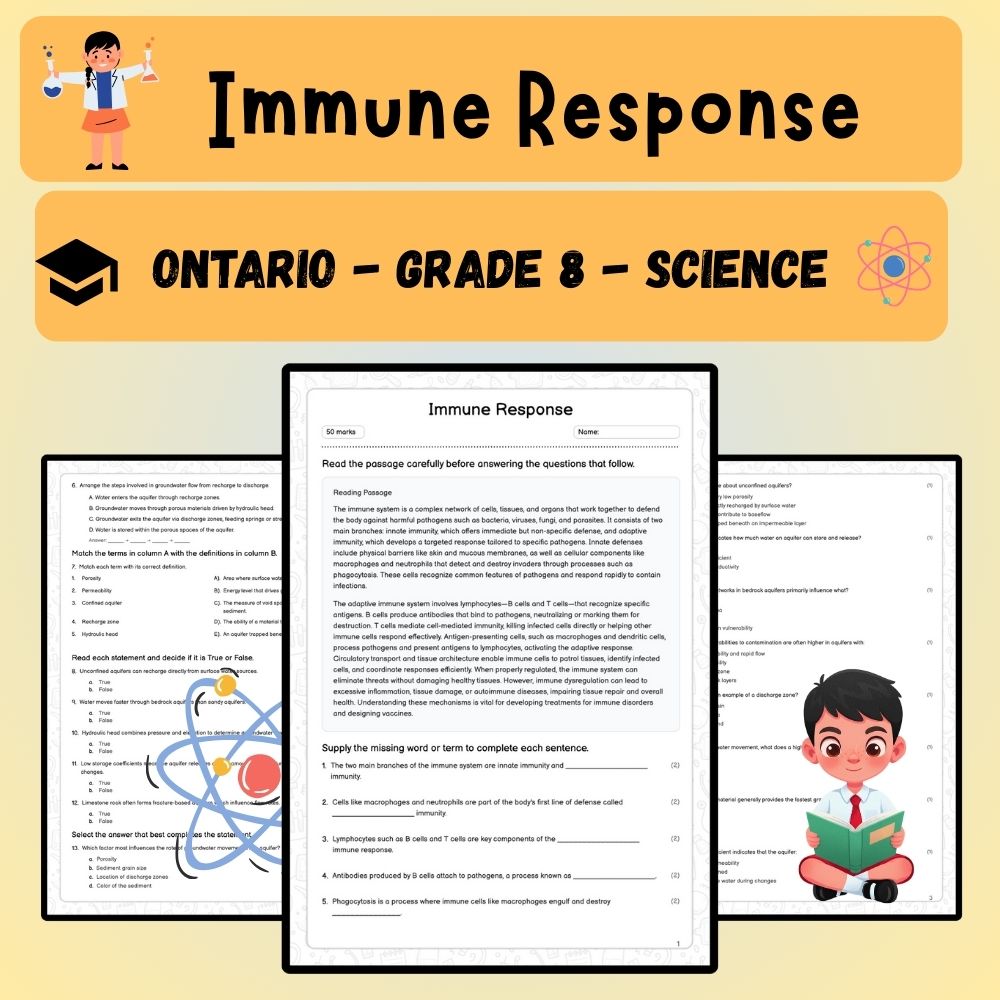
Grade 8 Science – Immune Response Worksheet (PDF ) for Ontario Standards
Created byPrism Point LearningLearning Objectives
- Describe the roles of innate and adaptive immune mechanisms in defending the body.
- Identify key cellular players such as macrophages, neutrophils, lymphocytes, and antigen-presenting cells.
- Explain processes like phagocytosis, antibody production, and cell-mediated cytotoxicity.
Also included in: Grade 8 Science Unit Bundle | Cell Structure & Function Worksheets +1 more
Instant download
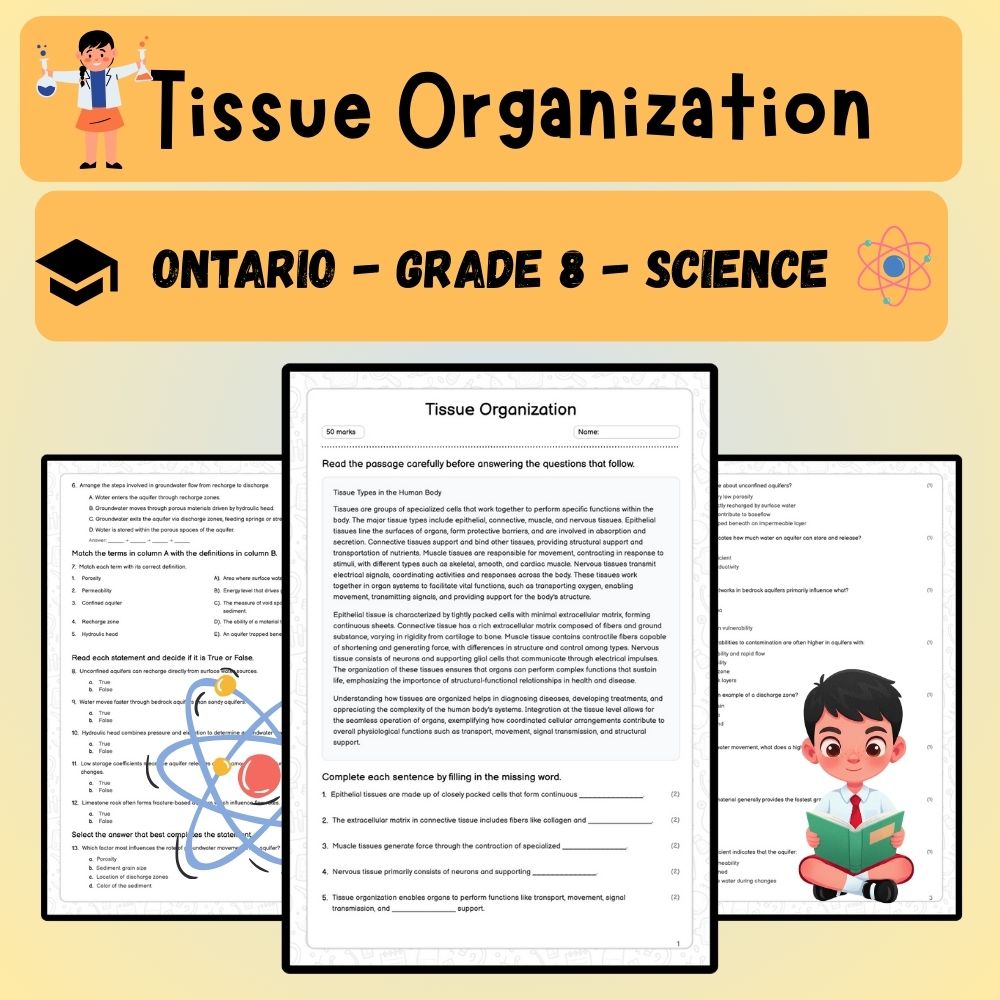
Grade 8 Science | Tissue Organization Worksheet (PDF ) - Ontario Standards
Created byPrism Point LearningLearning Objectives
- Describe the major tissue types in the human body and their cellular components.
- Explain the structural and functional differences among epithelial, connective, muscle, and nervous tissues.
- Identify examples of tissue-level integration that contribute to organ functions in transport, movement, signaling, and support.
Also included in: Grade 8 Science Unit Bundle | Cell Structure & Function Worksheets +1 more
Instant download
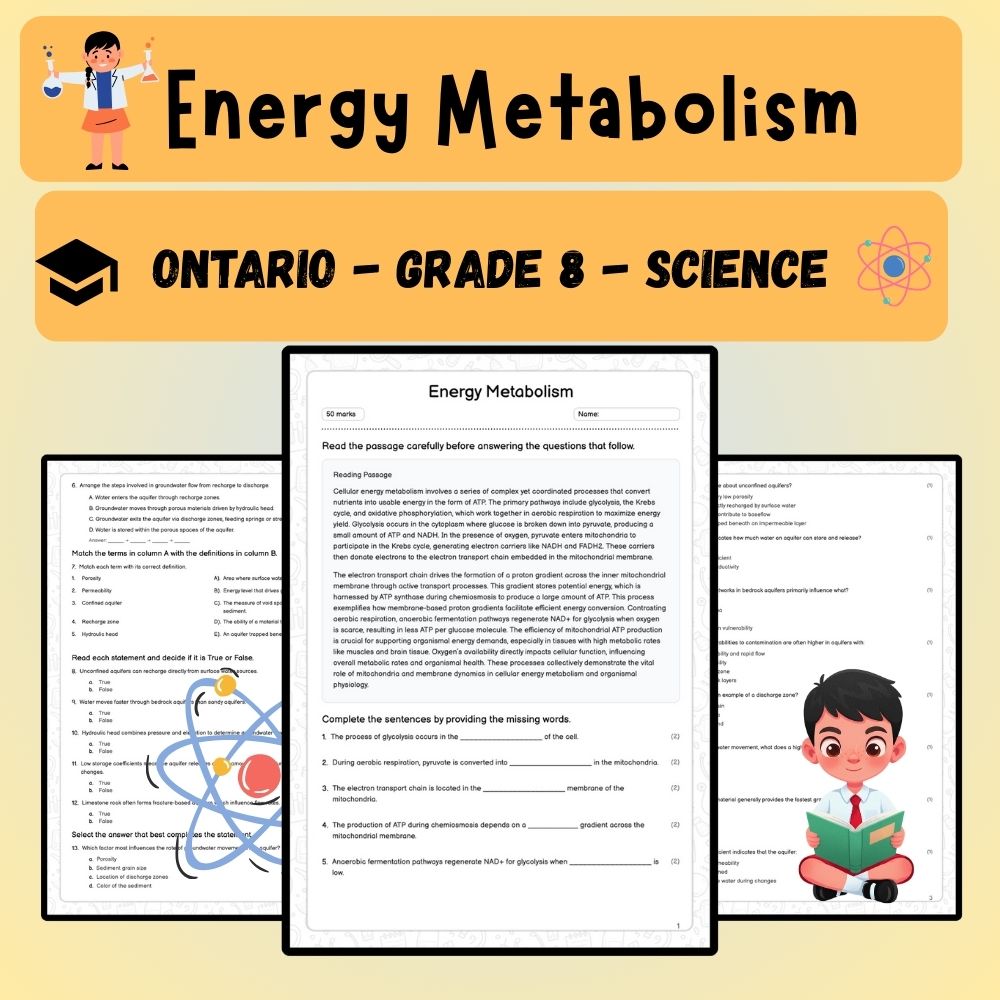
Grade 8 Science – Energy Metabolism Worksheet (PDF ) – Ontario Standards
Created byPrism Point LearningLearning Objectives
- Describe the stages of aerobic respiration and their roles in energy production.
- Compare aerobic respiration with anaerobic fermentation pathways.
- Explain how mitochondria contribute to ATP synthesis via membrane gradients and chemiosmosis.
Also included in: Grade 8 Science Unit Bundle | Cell Structure & Function Worksheets +1 more
Instant download
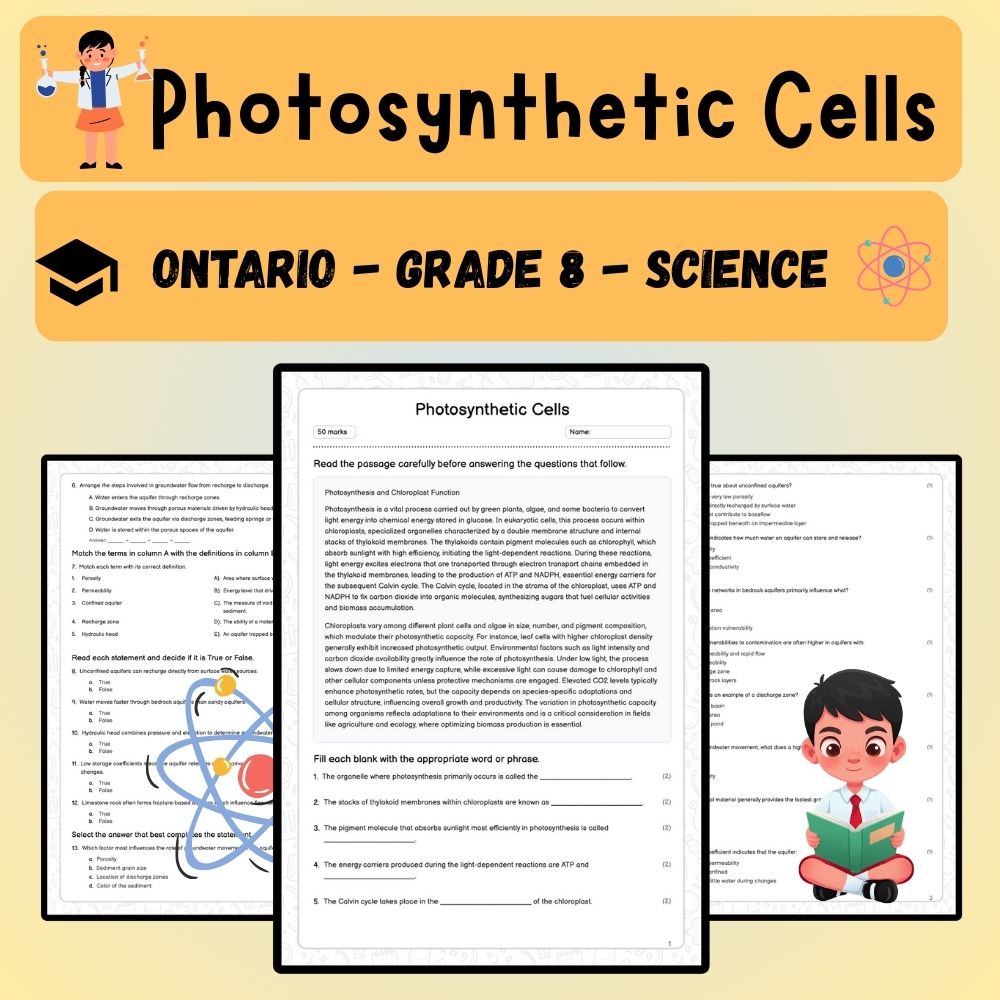
Grade 8 Science | Photosynthetic Cells Worksheet (PDF)
Created byPrism Point LearningLearning Objectives
- Describe the structure of chloroplasts and their role in photosynthesis.
- Explain the light-dependent reactions and the Calvin cycle in photosynthesis.
- Identify environmental factors affecting photosynthetic efficiency.
Also included in: Grade 8 Science Unit Bundle | Cell Structure & Function Worksheets +1 more
Instant download
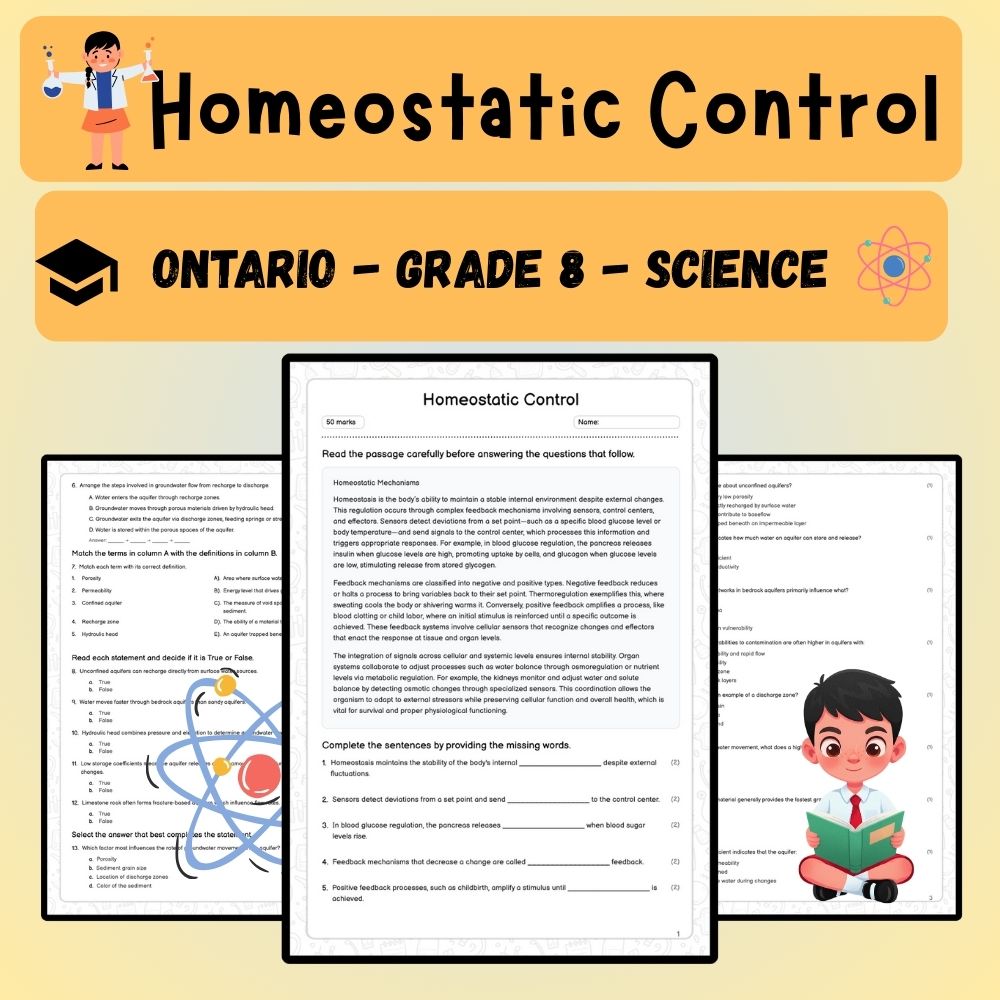
Grade 8 Science | Homeostatic Control Worksheet (PDF )
Created byPrism Point LearningLearning Objectives
- Describe how negative and positive feedback mechanisms maintain internal stability in the body.
- Explain the roles of cellular sensors and effectors in homeostasis.
- Identify examples of homeostatic regulation such as blood glucose, thermoregulation, and osmoregulation.
Also included in: Grade 8 Science Unit Bundle | Cell Structure & Function Worksheets +1 more
Instant download

Science Worksheet Genes and Traits Grade 8 | Standards-Aligned Assessment
JCreated byJ.S SheetsLearning Objectives
- Explain how genes and alleles influence inherited traits
- Describe how offspring receive combinations of alleles from both parents
- Distinguish between dominant and recessive allele effects on traits
Also included in: Grade 8 Evolution and Ecosystems Science Lesson Bundle | Florida NGSSS +1 more
Instant download
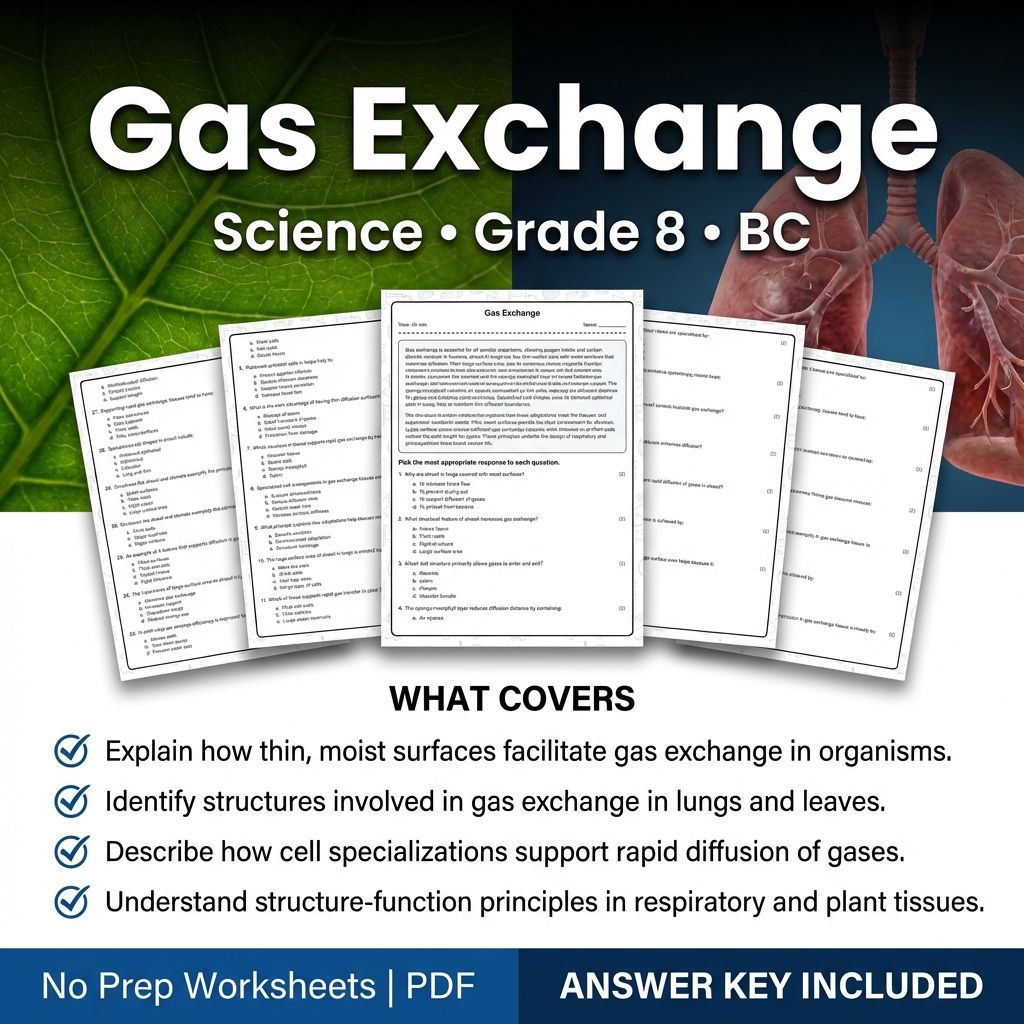
8th Grade Science | Gas Exchange Worksheet with Answer Key (Printable PDF)
Created byCoral Reef LearningLearning Objectives
- Explain how thin, moist surfaces facilitate gas exchange in organisms.
- Identify structures involved in gas exchange in lungs and leaves.
- Describe how cell specializations support rapid diffusion of gases.
Instant download

Weather vs Climate Reading Comprehension Worksheet | Grade 8 Science
 Created byEvergreen Desk Education
Learning Objectives
- Differentiate weather and climate using examples from temperature, precipitation, and wind
- Explain how long-term observations (many years) reveal climate patterns
- Describe factors that influence typical regional conditions, including the sun’s energy, air-mass movement, and oceans/landmasses
Instant download

Grade 8 Science | Nutrient Cycling Worksheet (Alberta Standard) (PDF)
Created byEvergreen Desk EducationLearning Objectives
- Explain how nutrients move through ecosystems using carbon and nitrogen cycle processes.
- Describe how decomposers and soil organic matter influence nutrient availability.
- Analyze how temperature, moisture, and altered flows affect nutrient cycling rates and ecosystem productivity.
Instant download
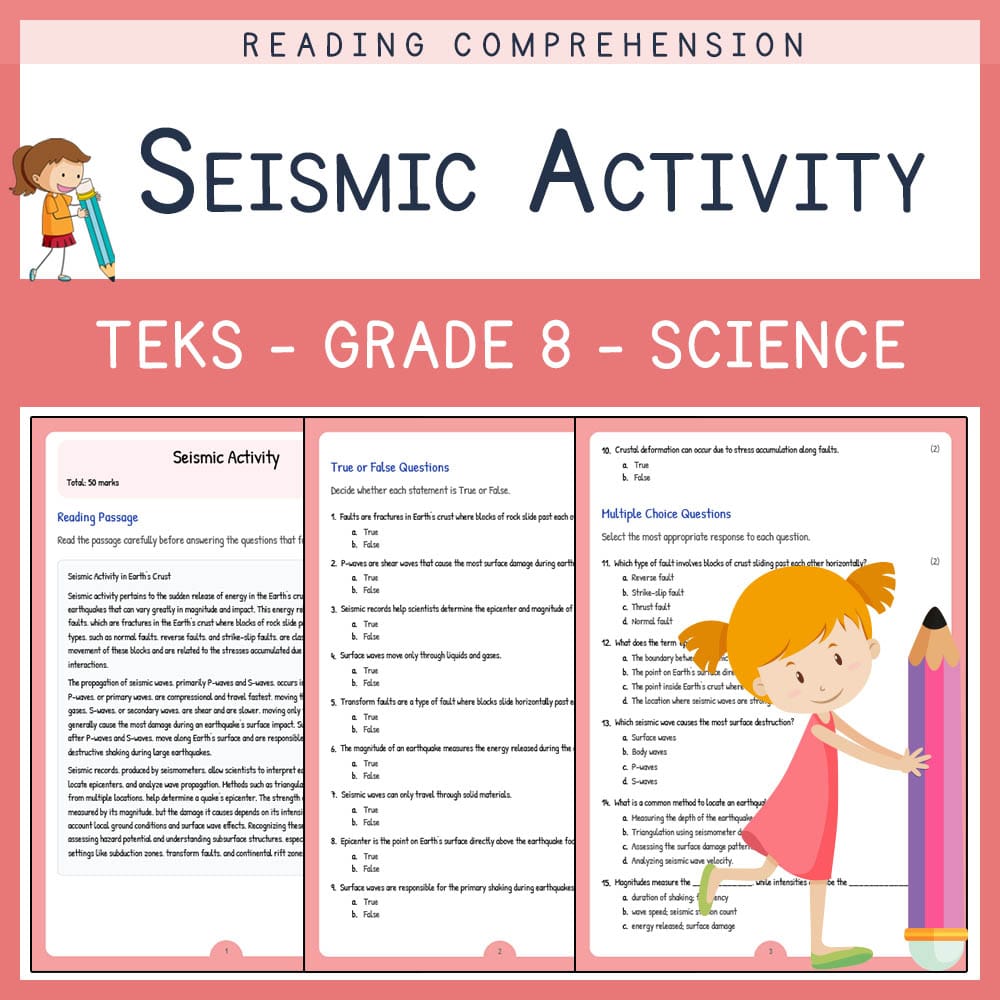
Grade 8 Science | Seismic Activity Worksheet | TEKS-Aligned
 Created byLumora Learning
Learning Objectives
- Understand the causes and types of seismic activity at fault lines.
- Identify how seismic waves propagate and impact Earth's crust.
- Distinguish between seismic record interpretation, epicenter determination, and hazard assessment.
Also included in: Grade 8 Science | Earth and Space Systems Lesson Bundle | TEKS Aligned
Instant download

Grade 8 Science | Exploring Atomic Structures - Daily Reading Comprehension
Created byCoral Reef LearningLearning Objectives
- Understand what atoms and molecules are
- Identify how different atomic arrangements affect properties of materials
- Differentiate between various models of atomic structures
Instant download

Grade 8 Scientific Method Daily Science Reading Worksheet | TEKS Activity
 Created byBRIGHT PATH RESOURCES
Learning Objectives
- Identify questions that can be tested using evidence
- Recognize how variables change in an investigation
- Distinguish between observations and testable predictions
Also included in: Grade 8 Science Skills Daily Reading Worksheets Bundle | TEKS +1 more
Instant download

Grade 8 Science – Human Impact Worksheet (TEKS) with Answer Key (PDF)
Created byEvergreen Desk EducationLearning Objectives
- Explain how habitat alteration, pollution, resource extraction, and invasive species change ecosystems
- Analyze how anthropogenic drivers affect biodiversity, food web integrity, and ecosystem services
- Evaluate trade-offs between economic, social, and ecological priorities in real-world decisions
Instant download
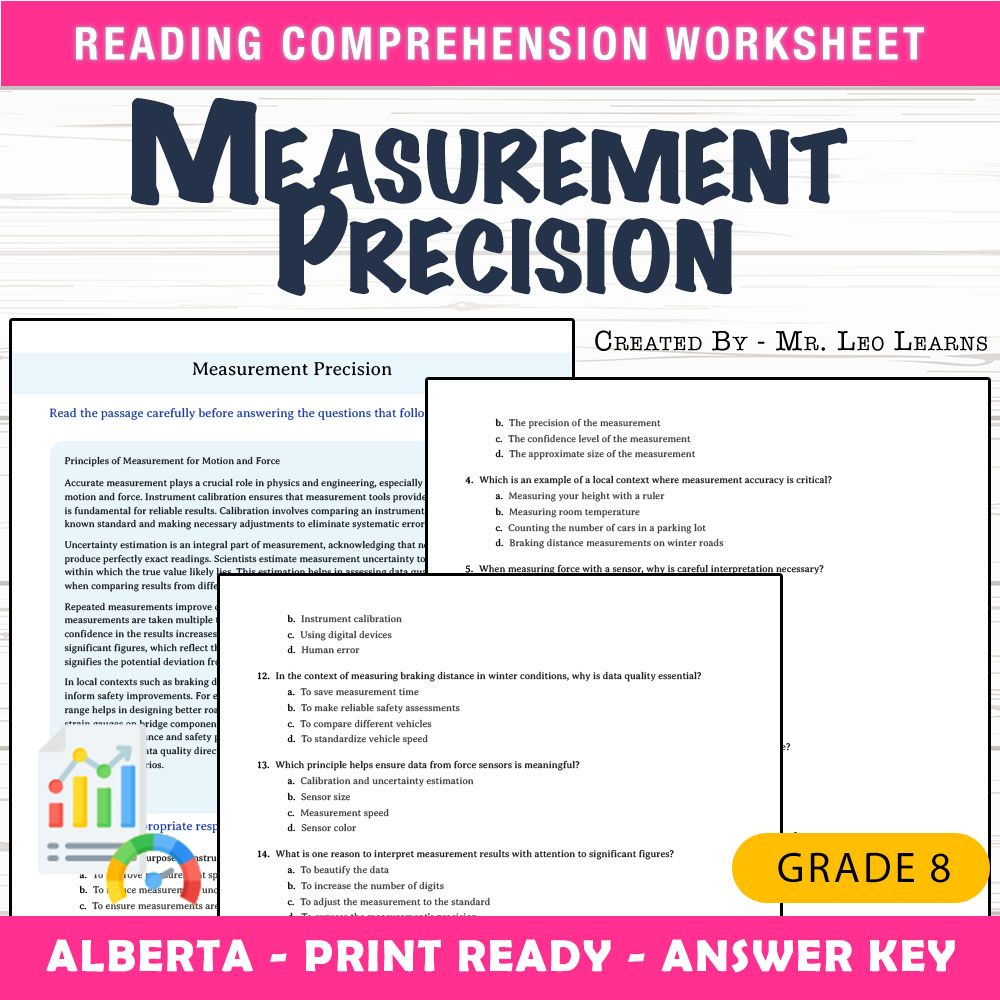
Grade 8 Science — Measurement Precision Worksheet for Mastery
 Created byThe Resource Hub
Learning Objectives
- Understand the principles of measurement calibration and uncertainty.
- Recognize the importance of significant figures and measurement error.
- Interpret data from timed intervals, distances, and force sensors with attention to accuracy.
Also included in: Grade 8 Science Forces and Motion Lesson Bundle | Alberta Curriculum +1 more
Instant download
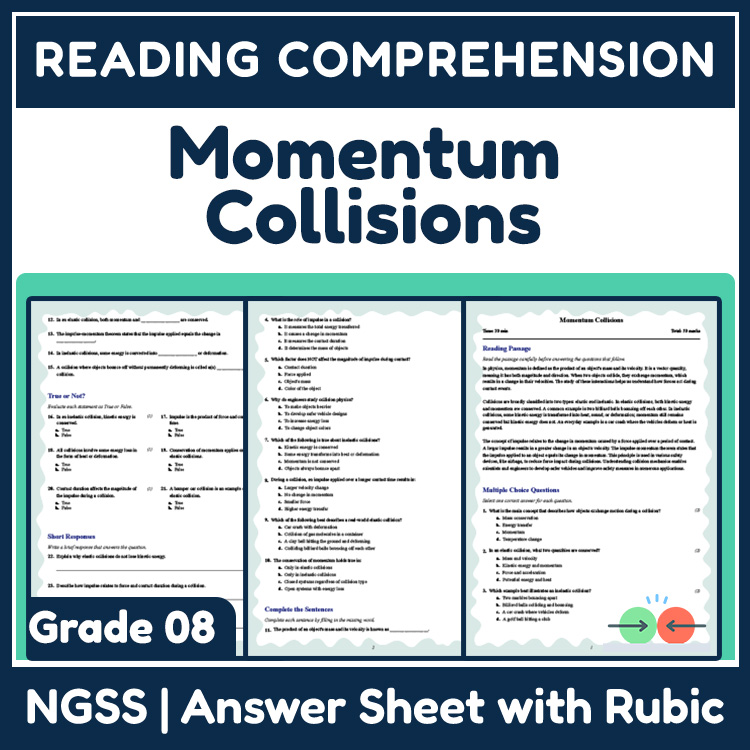
8th Grade Science | Momentum & Collisions Reading Worksheet (NGSS Aligned)
JCreated byJ.S SheetsLearning Objectives
- Understand the principles of momentum conservation in collisions.
- Differentiate between elastic and inelastic collisions based on energy transfer.
- Analyze the effects of forces during contact events in collisions.
Instant download

Grade 8 Science Worksheet | Cell Organelles Roles and Cell Function
JCreated byJ.S SheetsLearning Objectives
- Explain the main functions of key organelles: nucleus, mitochondria, ribosomes, endoplasmic reticulum, Golgi apparatus, lysosomes, and vacuoles
- Describe how energy conversion, protein synthesis, transport, and breakdown work together inside a cell
- Connect organelle structure to the behaviors cells show when organelles are functioning normally or poorly
Instant download

Grade 8 Change Evidence Worksheet | Practice & Assessment PDF
 Created byClear Sky Classroom
Learning Objectives
- Distinguish physical and chemical changes using observable evidence.
- Identify common indicators of chemical changes, such as new substances, energy changes, color shifts, and gas formation.
- Use particle-level thinking to explain why physical changes typically do not form new substances.
Instant download
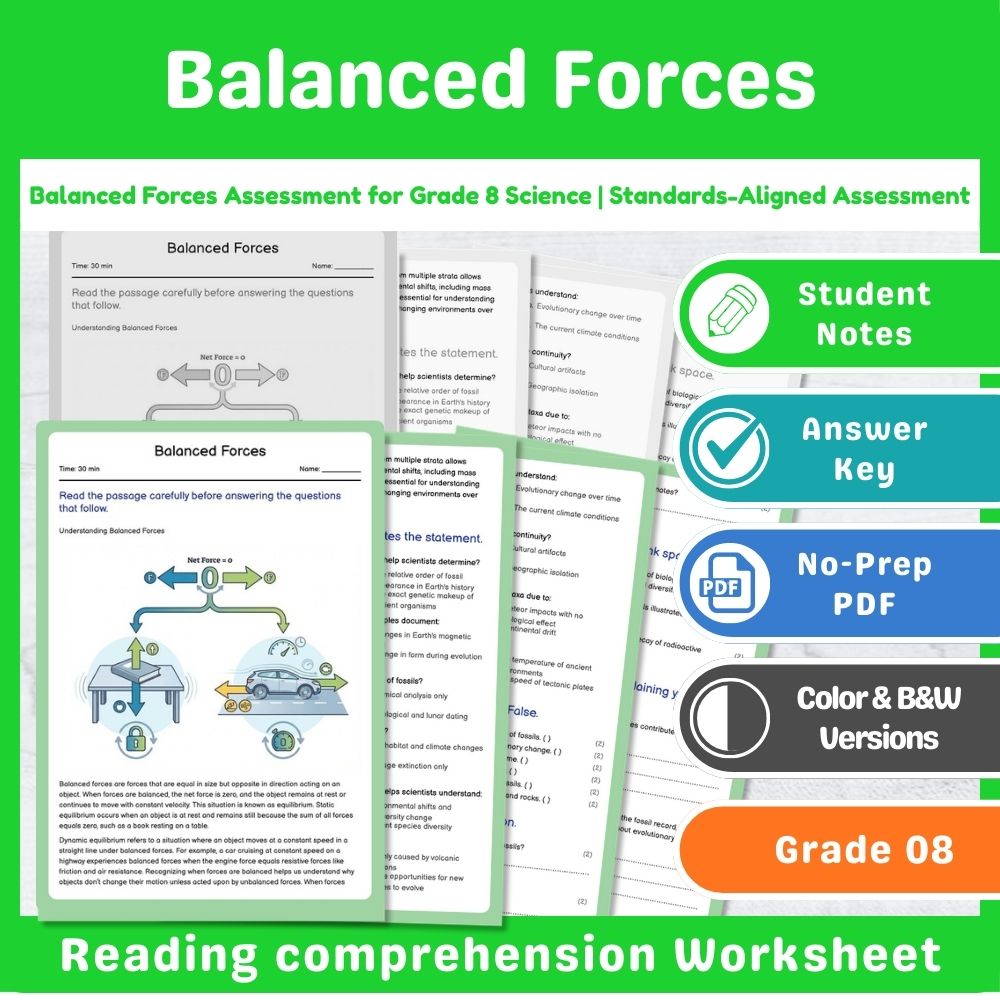
Balanced Forces Assessment for Grade 8 Science | Standards-Aligned Assessment
Created byPrism Point LearningLearning Objectives
- Define and identify conditions of balanced forces in objects.
- Differentiate between static and dynamic equilibrium.
- Explain how balanced forces result in no change in motion.
Instant download
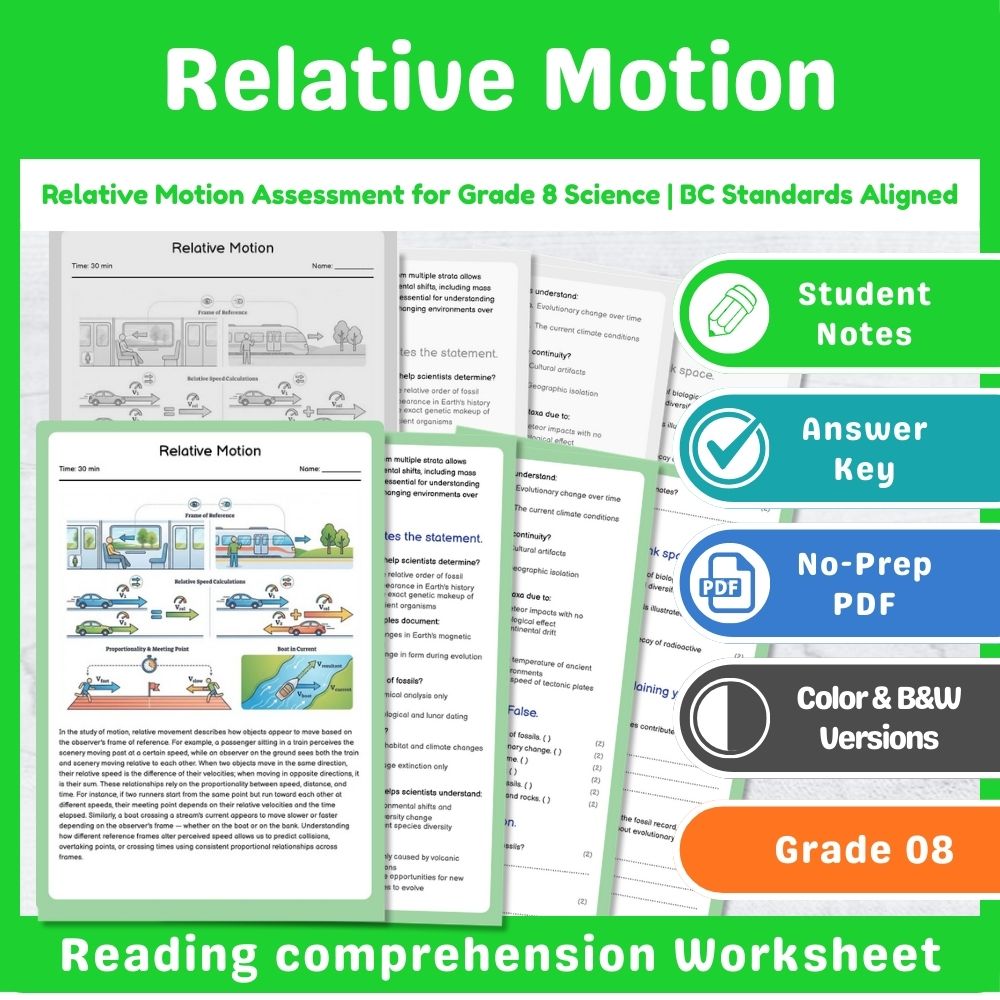
Relative Motion Assessment for Grade 8 Science | BC Standards Aligned
Created byPrism Point LearningLearning Objectives
- Understand the concept of relative motion and how velocity depends on reference frames.
- Apply proportional relationships among speed, distance, and time within different frames.
- Analyze simple scenarios such as two walkers moving towards each other or a boat crossing a stream to determine apparent speeds.
Instant download
Grade 8 Science Reading Worksheet | Gravitational Interactions PDF + Answer Key
JCreated byJ.S SheetsLearning Objectives
- Understand the universal attraction of gravity and how it depends on mass and distance.
- Describe how gravitational forces influence planetary orbits, satellite motion, and tidal effects.
- Apply the inverse-square law to explain variations in gravitational force.
Instant download

Seismic Activity Worksheet for Grade 8 Science | Standards-Aligned Practice
JCreated byJ.S SheetsLearning Objectives
- Explain how earthquakes form at faults due to stress buildup and sudden slip
- Describe how P-waves, S-waves, and surface waves travel and affect Earth’s crust
- Differentiate epicenter location, magnitude, and intensity when interpreting seismic hazards
Instant download
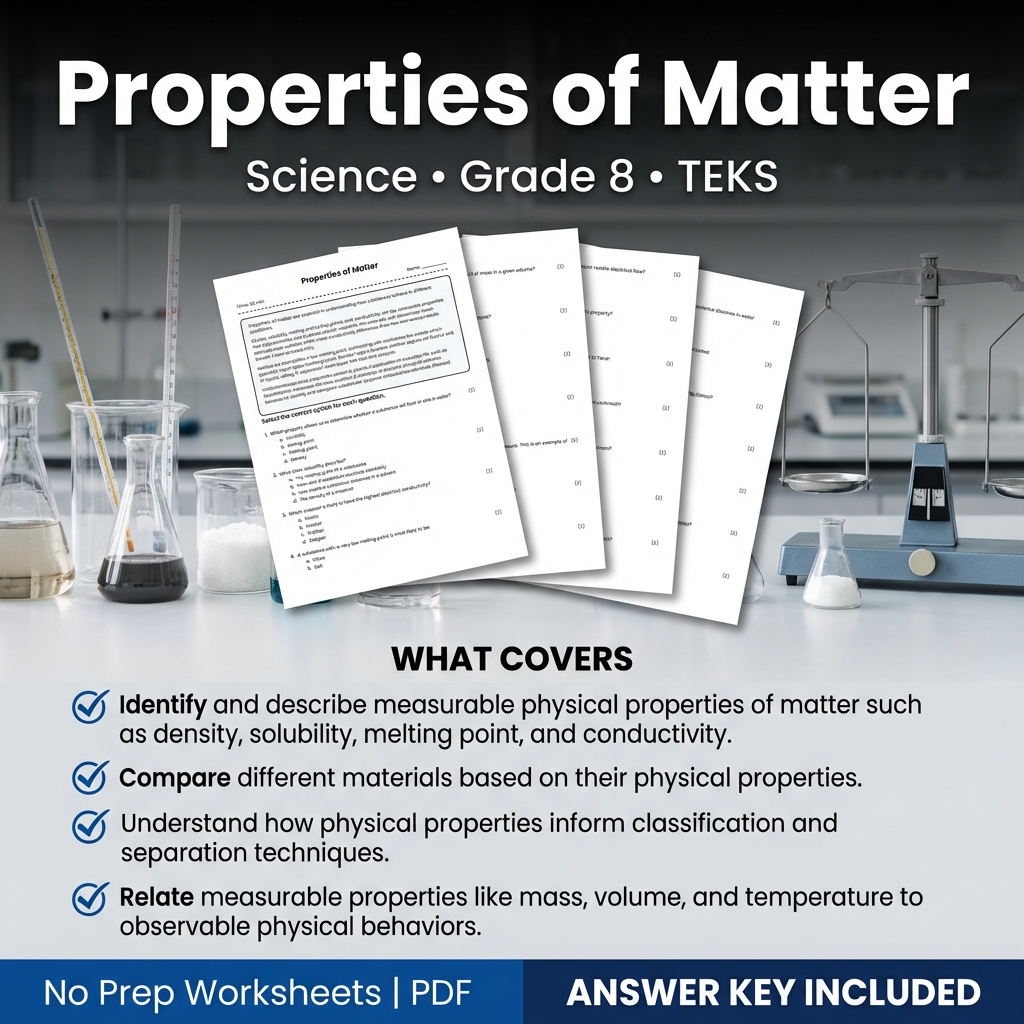
Properties of Matter Worksheet Grade 8 Science | TEKS Practice PDF
Created byCoral Reef LearningLearning Objectives
- Identify and describe measurable physical properties of matter such as density, solubility, melting point, and conductivity.
- Compare different materials based on their physical properties.
- Understand how physical properties inform classification and separation techniques.
Instant download
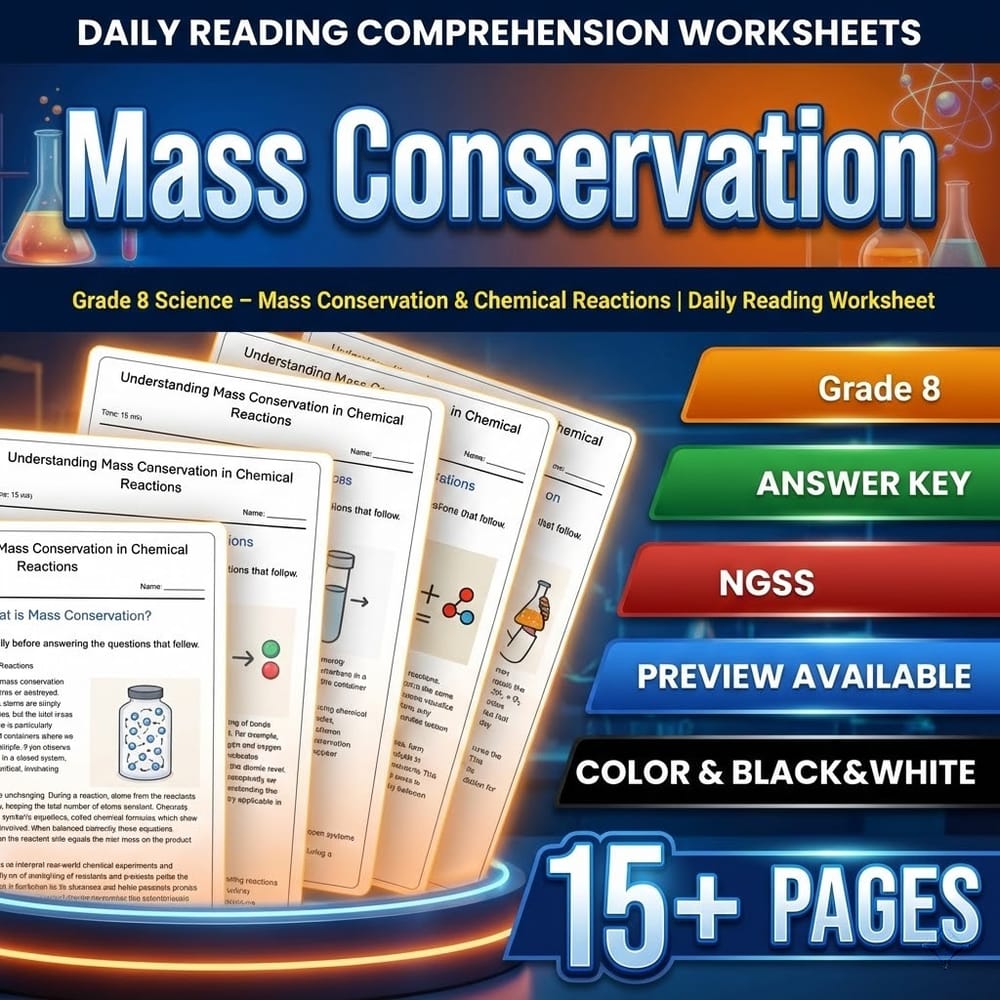
Grade 8 Science – Mass Conservation & Chemical Reactions Daily Reading Worksheet
 Created byElena Brooks
Learning Objectives
- Define mass conservation in the context of chemical reactions
- Explain how atoms are conserved during chemical changes
- Describe how mass measurements reflect atomic conservation in closed systems
Instant download
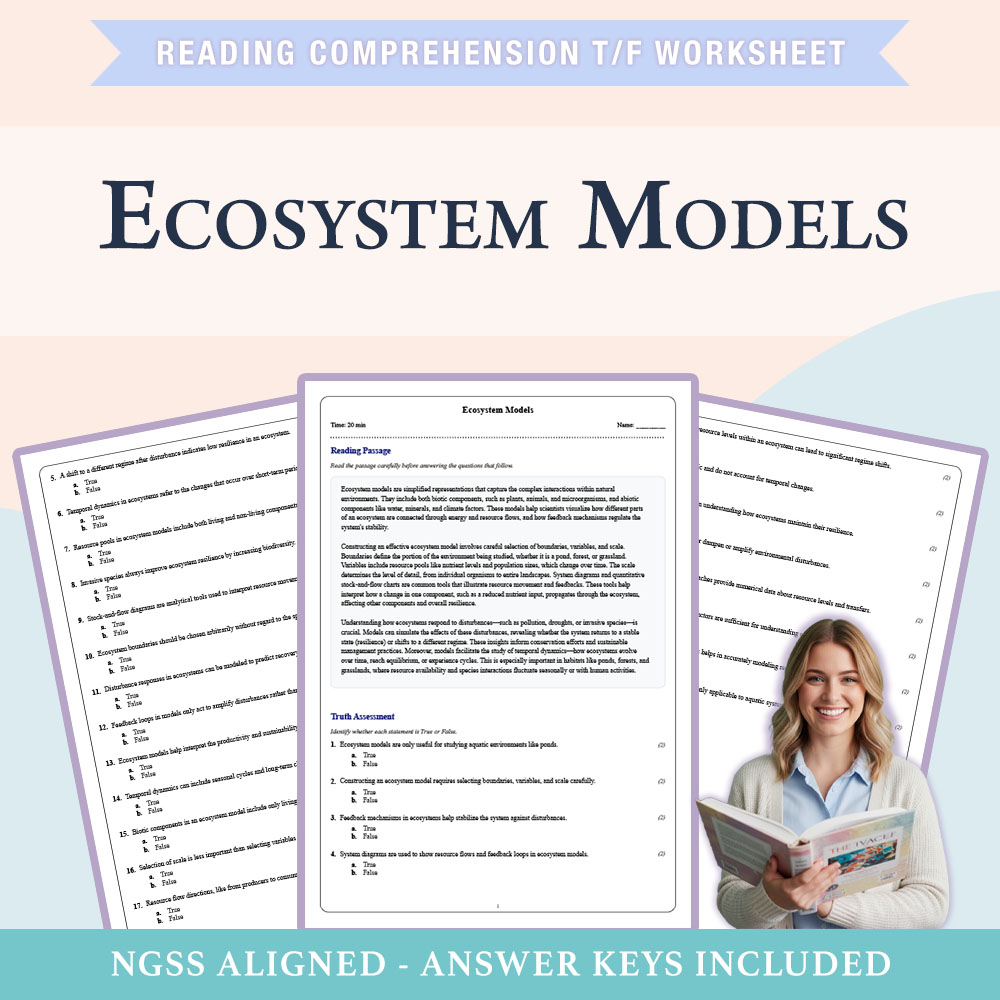
8th Grade Science | Ecosystem Models Worksheet (PDF + Answer Key)
 Created byCopper Leaf Classroom
Learning Objectives
- Understand the components of ecosystem models, including biotic and abiotic factors.
- Interpret how resource flows and feedback mechanisms influence ecosystem stability.
- Analyze different types of ecosystem models like system diagrams and stock-and-flow representations.
Also included in: Grade 8 Science | Ecosystem & Population Change Unit Worksheet(PDF + Answer Key) +1 more
Instant download
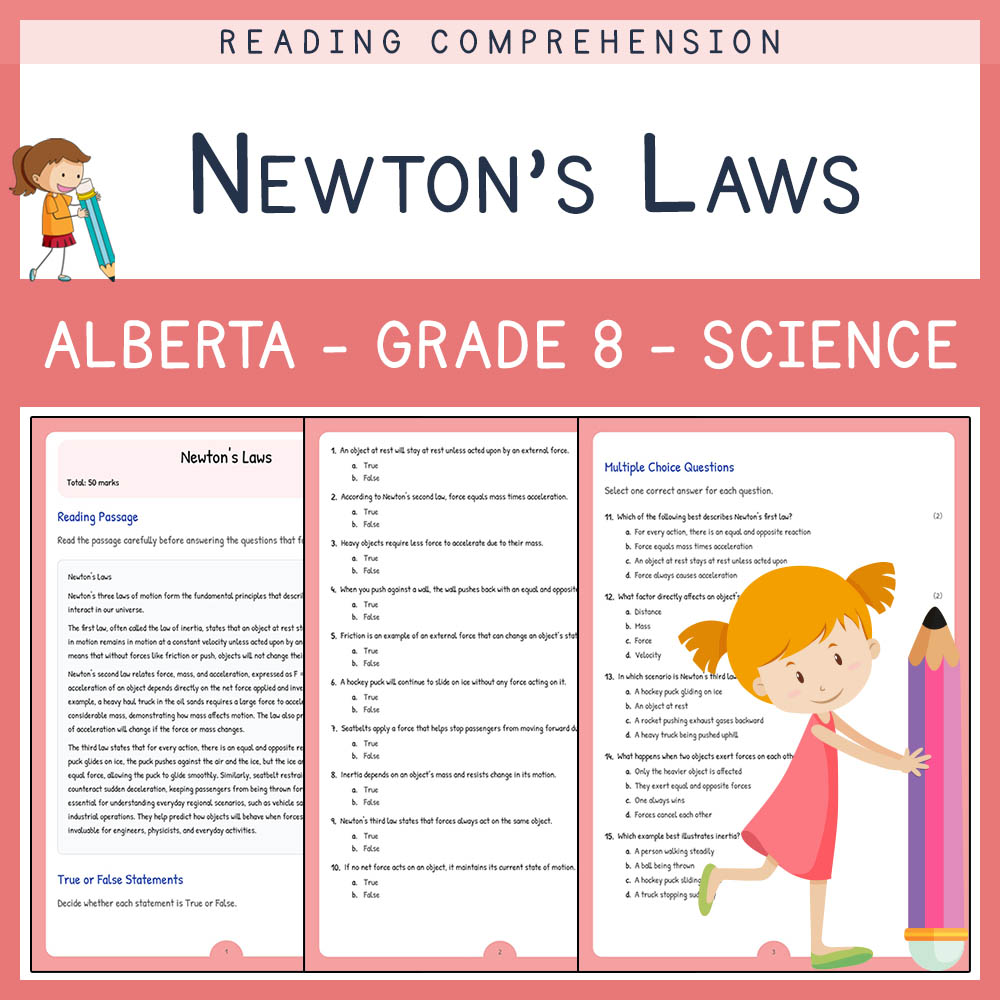
Grade 8 Science | Newton's Laws Worksheet | Alberta Standard
Created byLumora LearningLearning Objectives
- Understand the three laws of Newton and their relationship to force, motion, and mass.
- Apply Newton's laws to predict the direction and magnitude of movement in real-world scenarios.
- Analyze examples such as heavy trucks, hockey puck motion, and seatbelt dynamics to illustrate Newton's principles.
Instant download
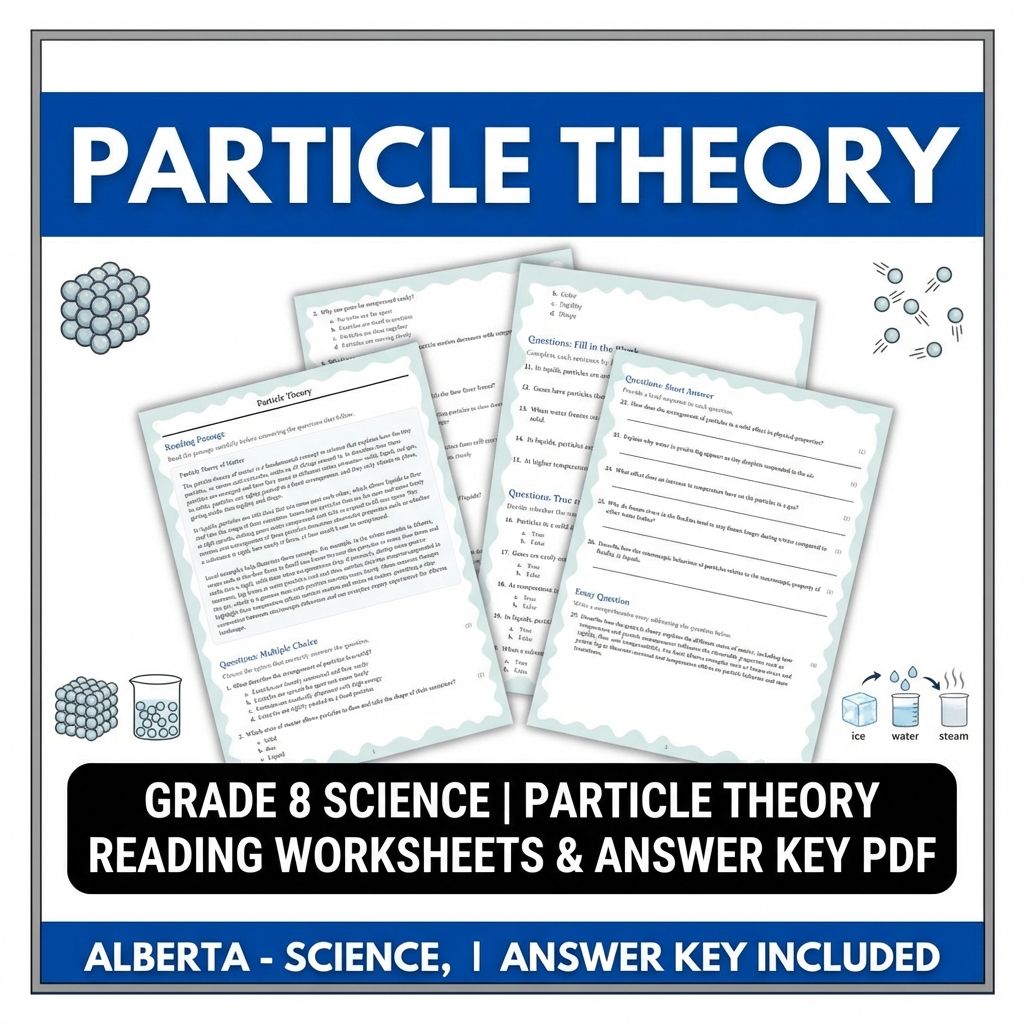
Grade 8 Science | Particle Theory Reading Worksheets & Answer Key PDF
JCreated byJ.S SheetsLearning Objectives
- Explain the basic ideas of the particle theory of matter and how particles behave in different states.
- Describe how particle arrangements influence properties like rigidity, flow, and compressibility.
- Connect microscopic particle motion to macroscopic observations such as freezing, melting, and fog.
Also included in: Grade 8 Science | Essential Concepts & Processes Pack (Answer Key Included) +1 more
Instant download

Conservation Strategies Practice Worksheet | Grade 8 Science
Created byPrism Point LearningLearning Objectives
- Explain how demand management, source protection, riparian buffers, agricultural best management practices, and wetland preservation support freshwater sustainability.
- Analyze trade-offs between water supply, ecological integrity, and economic uses when selecting conservation strategies.
- Describe how catchment-level actions can change flow regimes and reduce pollutant loads over time.
Also included in: Grade 8 Water Systems Science Lesson Bundle for Ontario Framework
Instant download
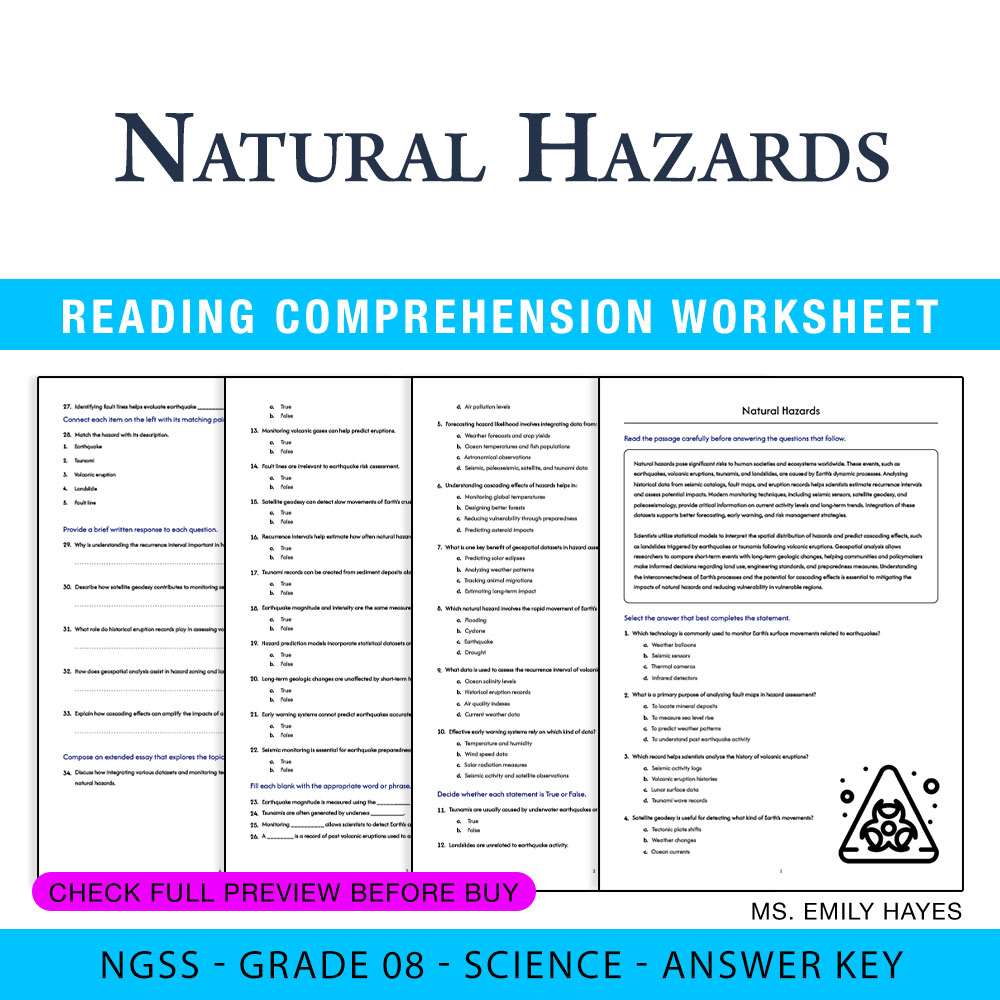
8th Grade Science | Natural Hazards Worksheet (PDF + Answer Key)
Created byCopper Leaf ClassroomLearning Objectives
- Analyze data related to natural hazards such as earthquakes, volcanoes, tsunamis, and faults.
- Interpret statistical and geospatial datasets to assess hazard recurrence, distribution, and impacts.
- Evaluate technologies for monitoring and forecasting natural hazards.
Instant download
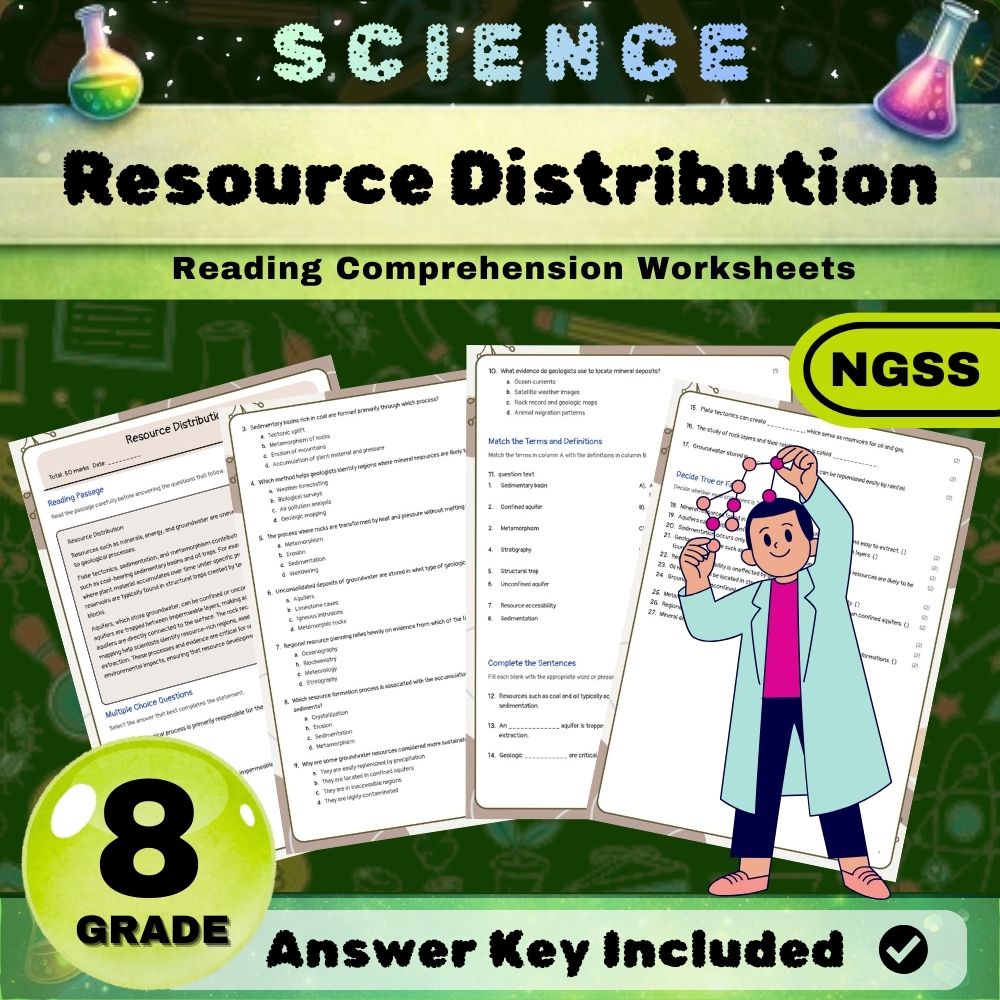
Grade 8 Science – Resource Distribution Worksheet (NGSS) PDF
 Created byMaple Path Learning
Learning Objectives
- Understand geological processes that lead to uneven resource distribution.
- Identify types of mineral, energy, and groundwater resources and how they form.
- Analyze factors affecting accessibility and quality of natural resources.
Also included in: Grade 8 Science | Earth and Human Activity NGSS Unit Bundle +1 more
Instant download

Grade 8 Science – Tissue Organization & Epithelial Tissue | Reading Worksheet
 Created byBright Mind Resources
Learning Objectives
- Identify the main characteristics and functions of epithelial tissue
- Describe the cellular composition of epithelial tissue
- Understand how epithelial tissue contributes to organ-level functions
Also included in: Grade 8 Life Systems Science Daily Reading Worksheets Lesson Bundle | Ontario +1 more
Instant download

Grade 8 Science – Immune Response Daily Reading Worksheet | Ontario Standards
Created byBright Mind ResourcesLearning Objectives
- Identify key components of the immune system such as macrophages, neutrophils, lymphocytes, and antigen-presenting cells.
- Describe the basic processes of innate and adaptive immunity, including phagocytosis, antibody production, and cell-mediated cytotoxicity.
- Understand how tissue architecture and circulatory transport facilitate immune surveillance.
Also included in: Grade 8 Life Systems Science Daily Reading Worksheets Lesson Bundle | Ontario +1 more
Instant download

Osmotic Balance Worksheet | Grade 8 Science | Ontario Standards
 Created byCedar Grove Learning
Learning Objectives
- Explain how water potential and tonicity determine the direction of water movement across cell membranes.
- Describe how plant and animal cells respond to hypotonic, isotonic, and hypertonic solutions.
- Identify key osmoregulatory adaptations (contractile vacuoles, membrane pumps, and extracellular buffering) and relate them to survival in changing environments.
Instant download

Grade 8 Science – Net Force & Forces and Motion | Daily Reading Worksheet
Created byBright Mind ResourcesLearning Objectives
- Define net force and understand its role in moving objects
- Explain how unbalanced forces cause changes in motion
- Differentiate between balanced and unbalanced forces
Also included in: Grade 8 Energy, Forces & Matter Lesson Bundle - Daily Reading | Calif. Std. +1 more
Instant download
About Grade 8 Science Worksheets
Explore Grade 8 Science worksheets for classwork, homework, or review. Our 6,006 printables download instantly as PDFs.
Each resource here is built by an independent educator and reviewed for quality. Worksheets print straight from PDF and suit classroom use, homework, or extra practice; most come with answer keys, and you can preview before purchasing.