
Grade 8 Science Worksheets
5,999 worksheets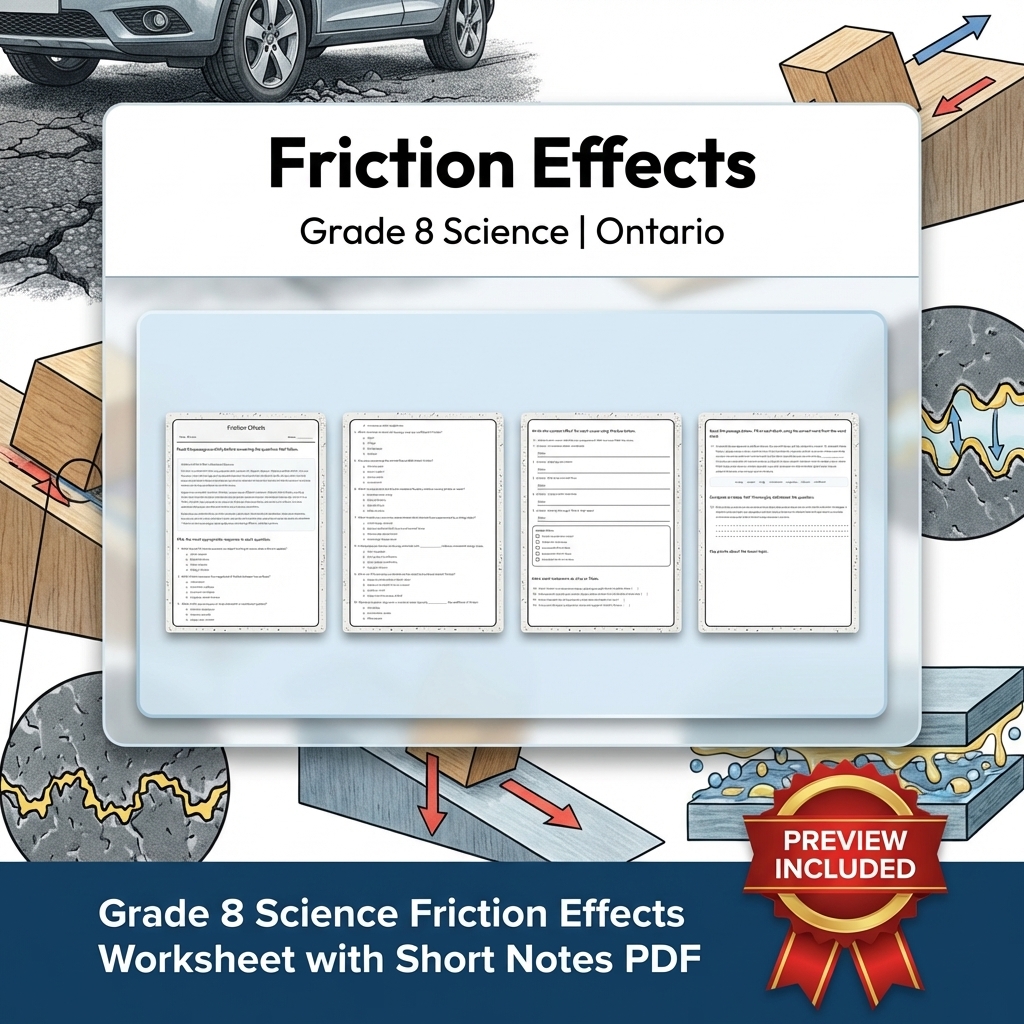
Grade 8 Science Friction Effects Worksheet with Short Notes PDF
 Created byMeadowlark Worksheets
Learning Objectives
- Analyze the different types of friction and their impact on mechanical systems.
- Understand how surface texture, normal force, and material choice influence frictional forces.
- Evaluate methods for estimating friction in simple apparatus.
Also included in: Grade 8 Science Lesson Group Bundle for Ontario Curriculum +1 more
Instant download
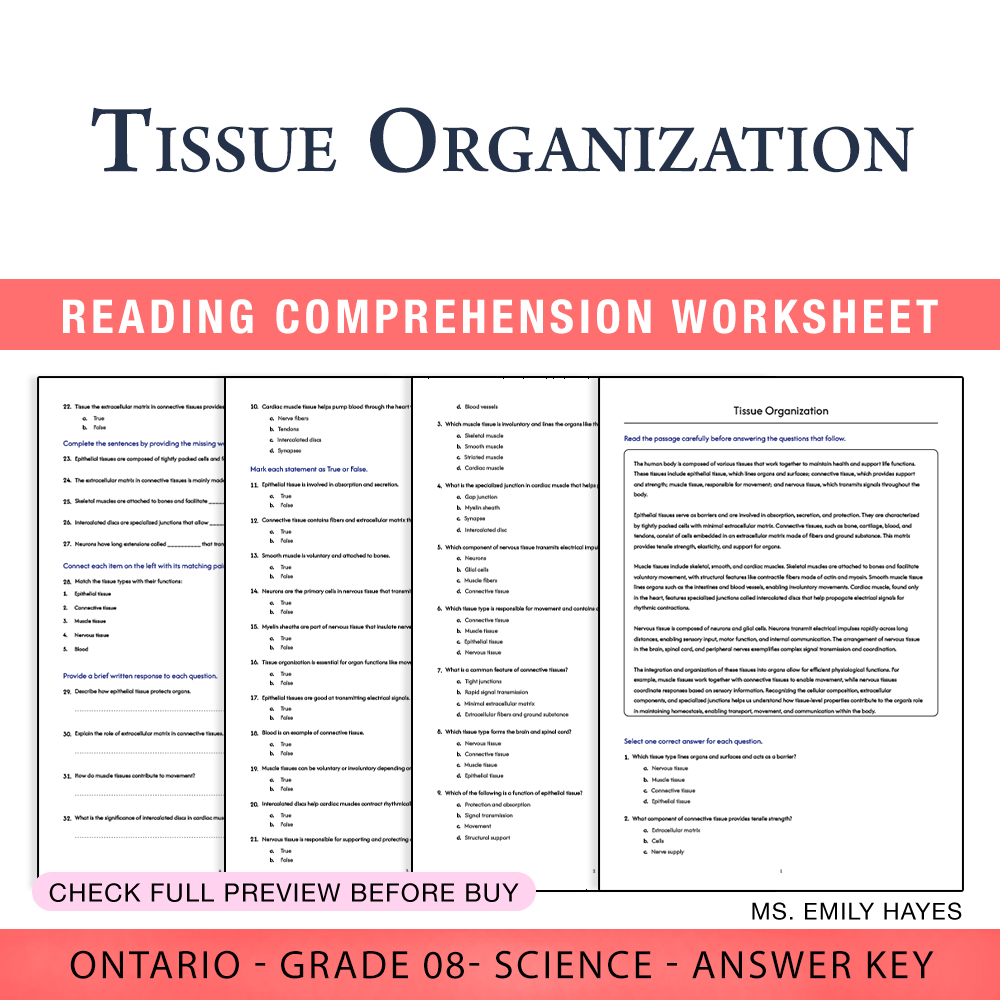
8th Grade Science | Tissue Organization Worksheet (PDF+ Answer Key)
 Created byCopper Leaf Classroom
Learning Objectives
- Describe the major types of tissues: epithelial, connective, muscle, and nervous.
- Identify structural features and functions of different tissue types.
- Explain how tissue organization contributes to organ functions and physiological processes.
Instant download

Grade 8 Science | Design Optimization Analysis - Daily Reading Comprehension
 Created byCoral Reef Learning
Learning Objectives
- Interpret graphical data and statistical summaries
- Identify performance trends from test data
- Understand how design modifications impact efficiency and strength
Instant download

Model Frameworks Worksheet | Alberta Standards Grade 8 Science Practice
JCreated byJ.S SheetsLearning Objectives
- Understand how models represent ecosystem processes such as matter and energy flow.
- Identify different types of models used in ecological studies, including diagrams and flow charts.
- Interpret outputs from ecological models and recognize their assumptions and limitations.
Instant download

Grade 8 Science – Muscle Contraction & Cell Structure | Daily Reading Worksheet
 Created byBright Mind Resources
Learning Objectives
- Identify parts of muscle cells and their functions
- Understand the process of muscle contraction
- Recognize the roles of actin, myosin, ATP, and calcium in muscle movement
Also included in: Grade 8 Body Systems & Cell Structure Science Daily Reading Lesson Bundle | BC +1 more
Instant download
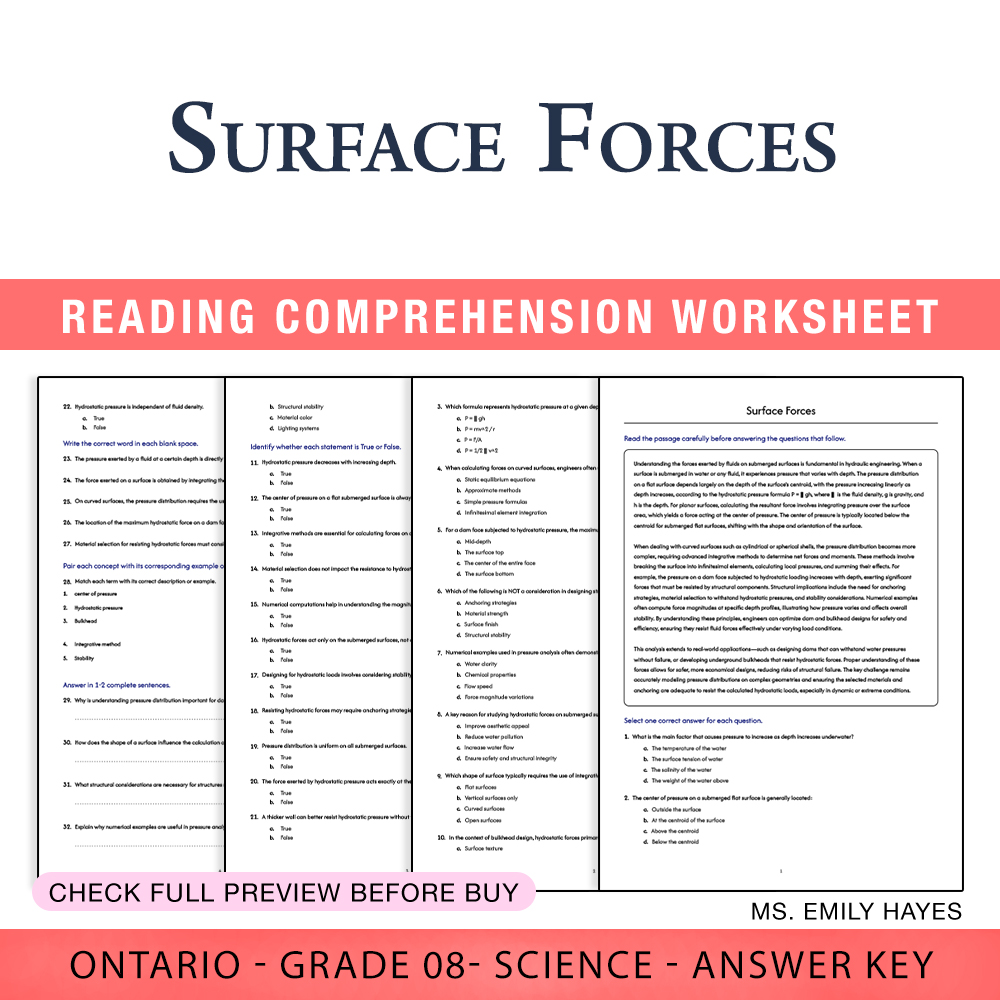
8th Grade Science | Surface Forces Worksheet (PDF+ Answer Key)
Created byCopper Leaf ClassroomLearning Objectives
- Understand the principles of pressure distribution on submerged surfaces
- Analyze how forces act on planar and curved surfaces underwater
- Apply integrative methods to calculate net forces and centers of pressure
Instant download

Grade 8 Science Earth Motions Daily Reading Worksheet with Answer Key
JCreated byJ.S SheetsLearning Objectives
- Understand Earth's rotation and its impact on day and night.
- Describe how Earth's axial tilt and orbit cause seasons.
- Explain the apparent solar path and changes in daylight length.
Also included in: Grade 8 Science Lesson Bundle | TEKS Standards Worksheets for Earth & Space +1 more
Instant download

Abiotic Influences Worksheet | Grade 8 Science Practice
 Created byPrism Point Learning
Learning Objectives
- Explain how abiotic factors such as light availability, temperature, water supply, soil composition, and nutrient levels affect where species can live.
- Describe how seasonal and microhabitat changes can create different niches within the same ecosystem.
- Use evidence to predict how changing abiotic conditions can influence growth, reproduction, and community structure.
Also included in: Ecosystems & Biodiversity Lesson Bundle | Grade 8 Science | BC +1 more
Instant download
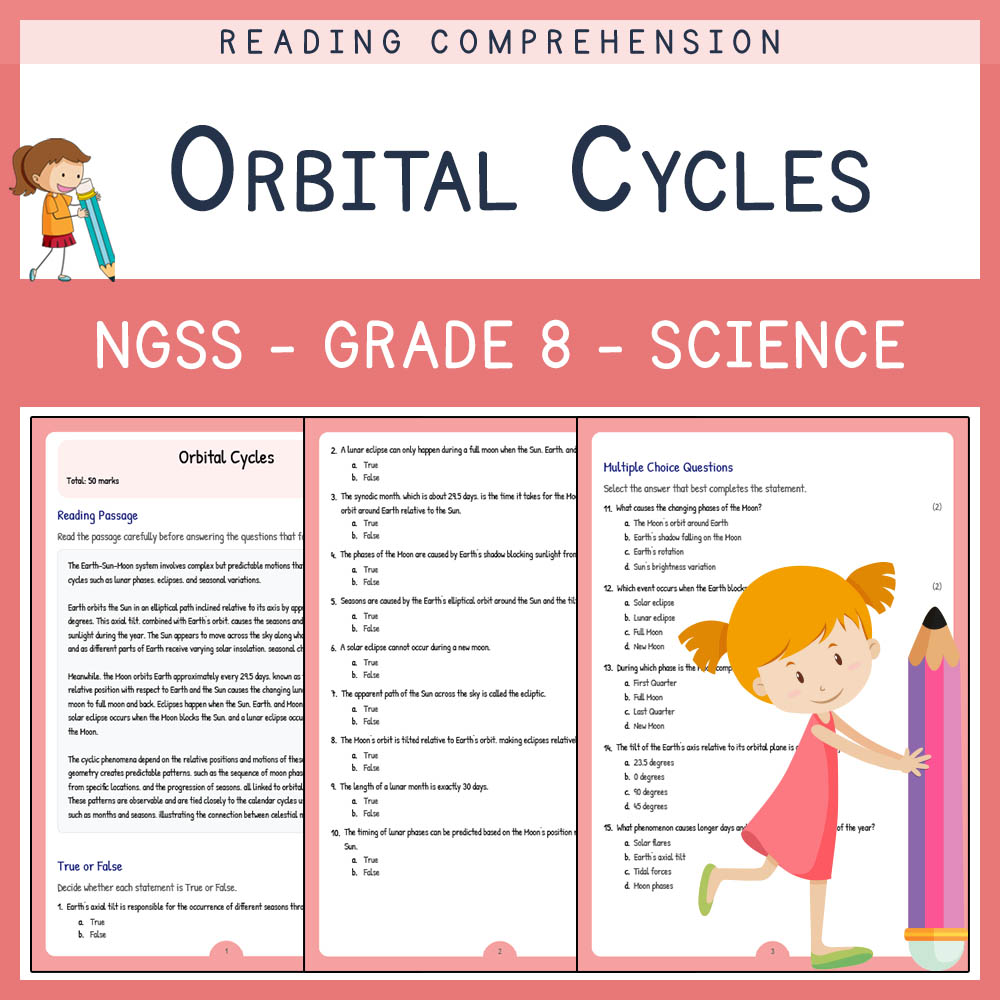
Grade 8 Science | Orbital Cycles Worksheet with Answer Key (NGSS-Aligned)
 Created byLumora Learning
Learning Objectives
- Explain the relative positions and motions of Earth, the Moon, and the Sun that lead to lunar phases, eclipses, and seasons.
- Describe the geometric and axial factors responsible for cyclic phenomena observed from Earth.
- Relate observable sky patterns and calendar cycles to the orbital relationships of celestial bodies.
Instant download
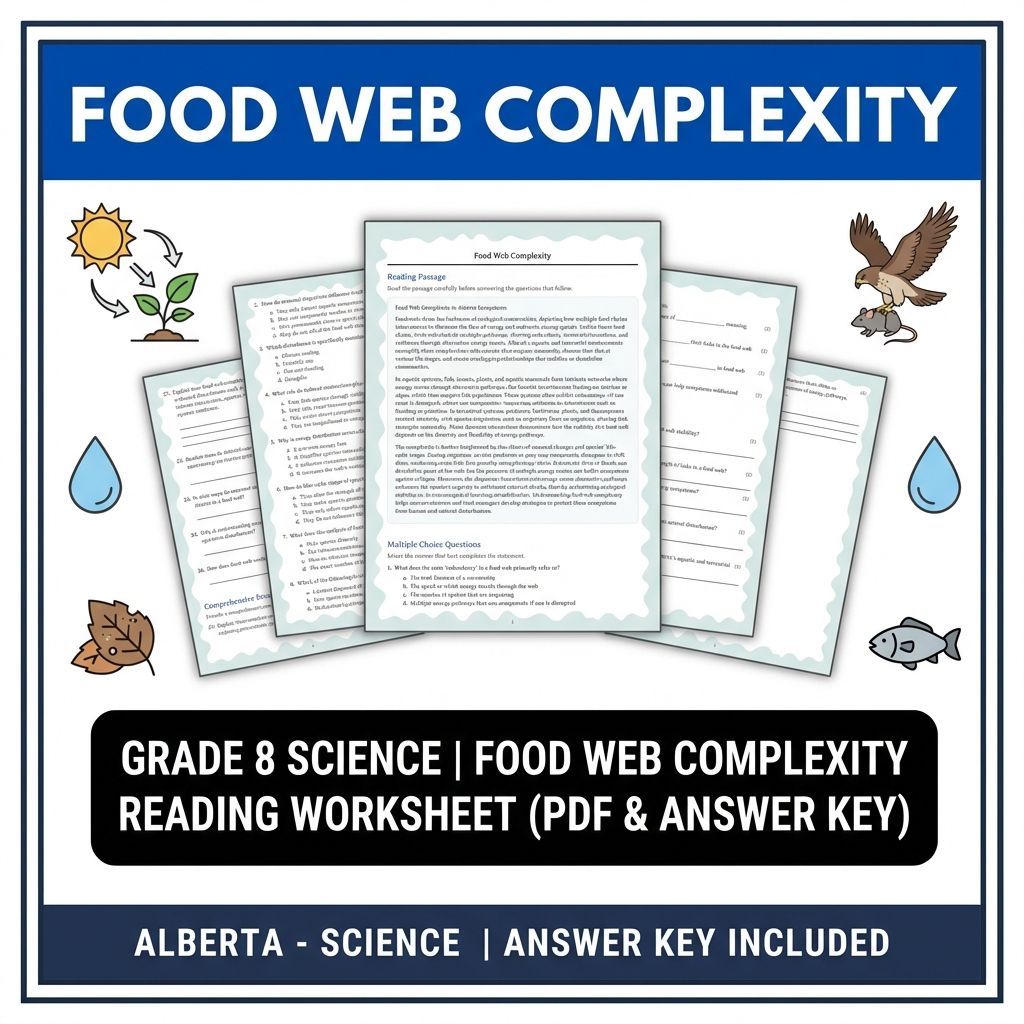
Grade 8 Science | Food Web Complexity Reading Worksheet (PDF & Answer Key)
JCreated byJ.S SheetsLearning Objectives
- Understand how food webs illustrate energy pathways and species interactions within ecosystems.
- Analyze the concepts of redundancy, indirect interactions, and species roles in food web stability.
- Evaluate how seasonal migrations and life-cycle stages influence ecological links.
Also included in: Grade 8 Science Bundle | Ecosystem Dynamics & Environmental Impact Worksheets +1 more
Instant download
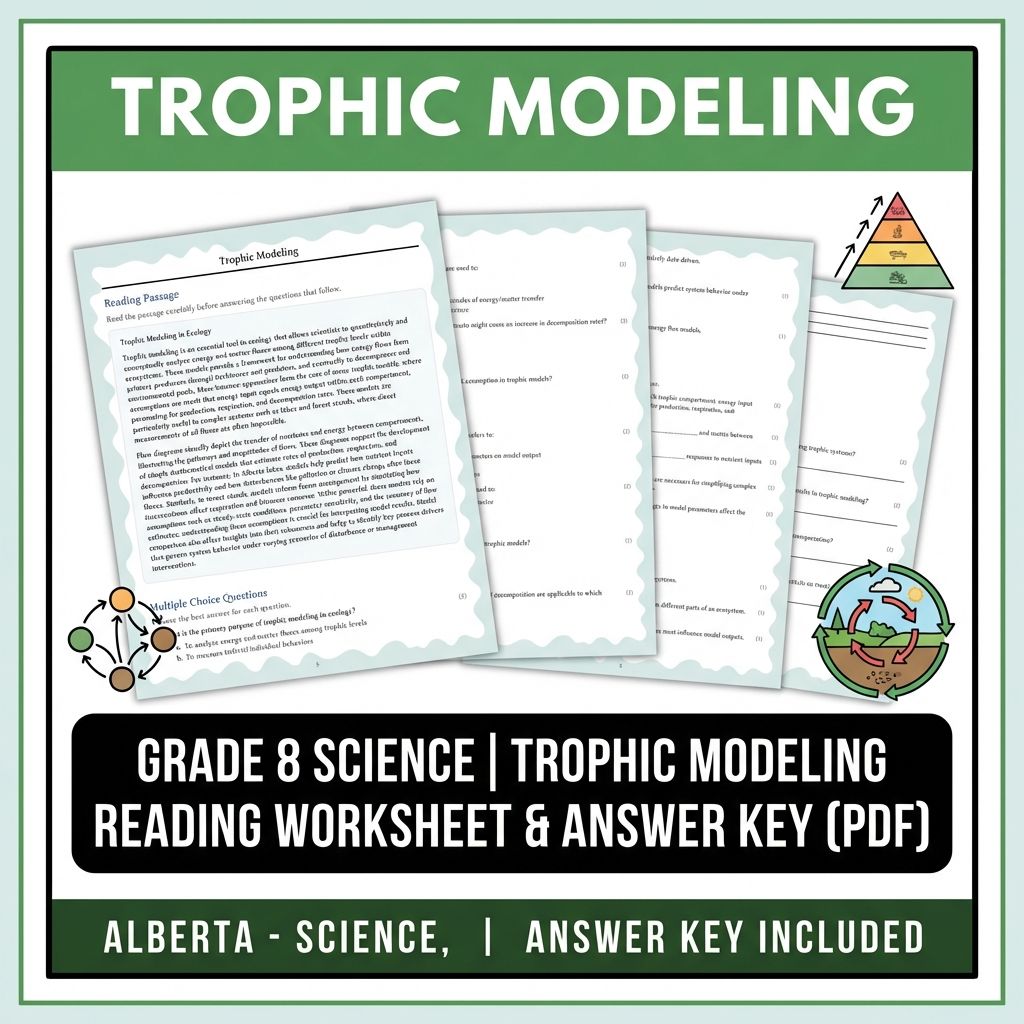
Grade 8 Science | Trophic Modeling Reading Worksheet & Answer Key (PDF)
JCreated byJ.S SheetsLearning Objectives
- Understand the concept of trophic modeling and its applications in ecology.
- Describe how mass-balance approaches and flow diagrams represent energy flow among trophic compartments.
- Explain the assumptions and sensitivities involved in trophic system models.
Also included in: Grade 8 Science Bundle | Ecosystem Dynamics & Environmental Impact Worksheets +1 more
Instant download
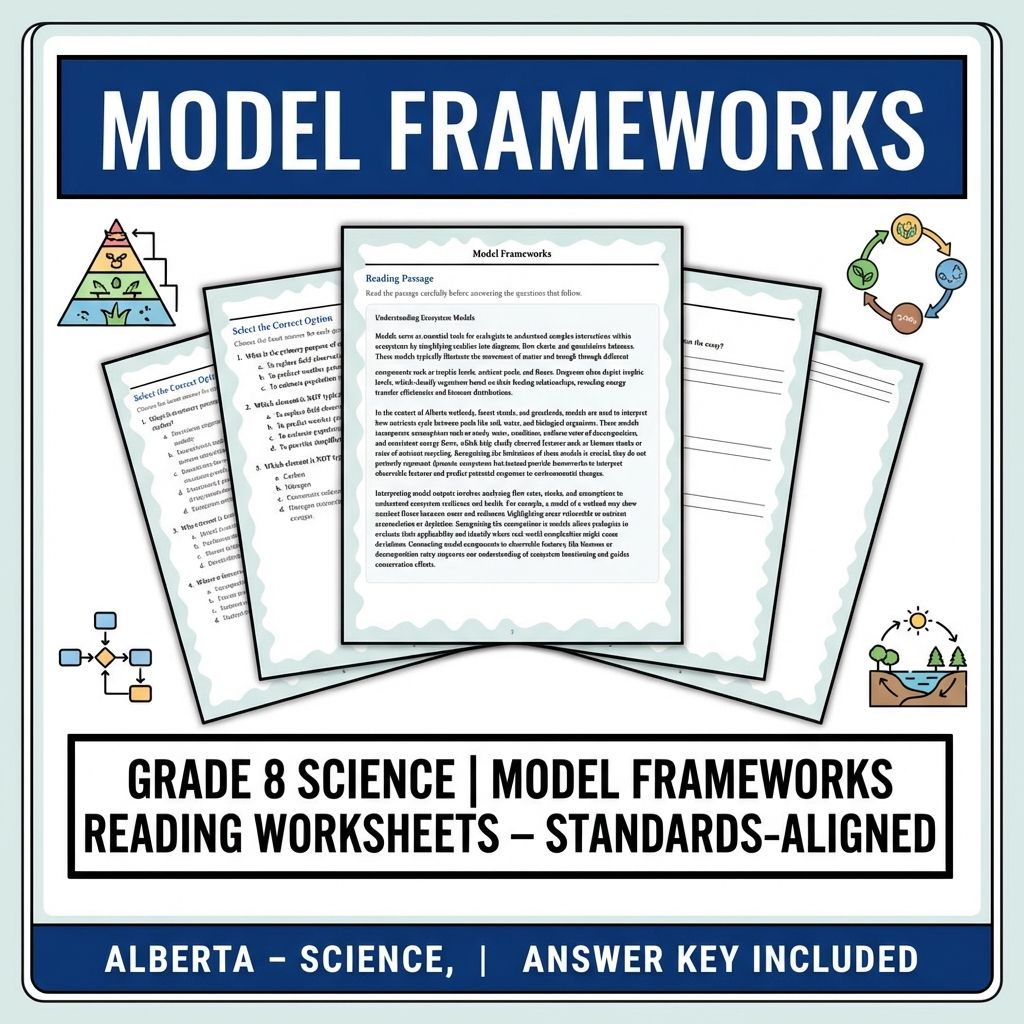
Grade 8 Science | Model Frameworks Reading Worksheets – Standards-Aligned PDF
JCreated byJ.S SheetsLearning Objectives
- Understand how models represent matter and energy movement in ecosystems.
- Identify the conventions used in diagrams, flow charts, and balances for ecological models.
- Interpret outputs from models of trophic levels, nutrient pools, and fluxes.
Also included in: Grade 8 Science Bundle | Ecosystem Dynamics & Environmental Impact Worksheets +1 more
Instant download

Grade 8 Science – Energy Transformations & Forms | Daily Reading Worksheet
Created byBright Mind ResourcesLearning Objectives
- Understand different forms of energy such as potential, kinetic, electrical, thermal, and mechanical.
- Identify how energy transforms from one form to another within systems.
- Apply knowledge of energy transformations to real-world examples like bouncing balls and electric motors.
Also included in: Grade 8 States of Matter Science Daily Reading Lesson Bundle | FL-NGSSS +1 more
Instant download

Grade 8 Science – Force & Motion Daily Reading Worksheet | NGSSS Aligned
Created byBright Mind ResourcesLearning Objectives
- Understand the basic concept of force
- Identify different types of forces
- Relate how forces affect the motion of objects
Also included in: Grade 8 States of Matter Science Daily Reading Lesson Bundle | FL-NGSSS +1 more
Instant download

Ecosystem Models Worksheet | Grade 8 NGSS Systems Science Activity Pack
 Created byAmber Owl Education
Learning Objectives
- Explain how ecosystem models represent biotic and abiotic components using boundaries and variables.
- Interpret stock-and-flow relationships and feedbacks to predict how changes spread through an ecosystem.
- Use system diagram ideas to describe resilience, equilibrium, and disturbance responses over time.
Also included in: Grade 8 Science Ecosystem Dynamics Lesson Bundle | NGSS +1 more
Instant download
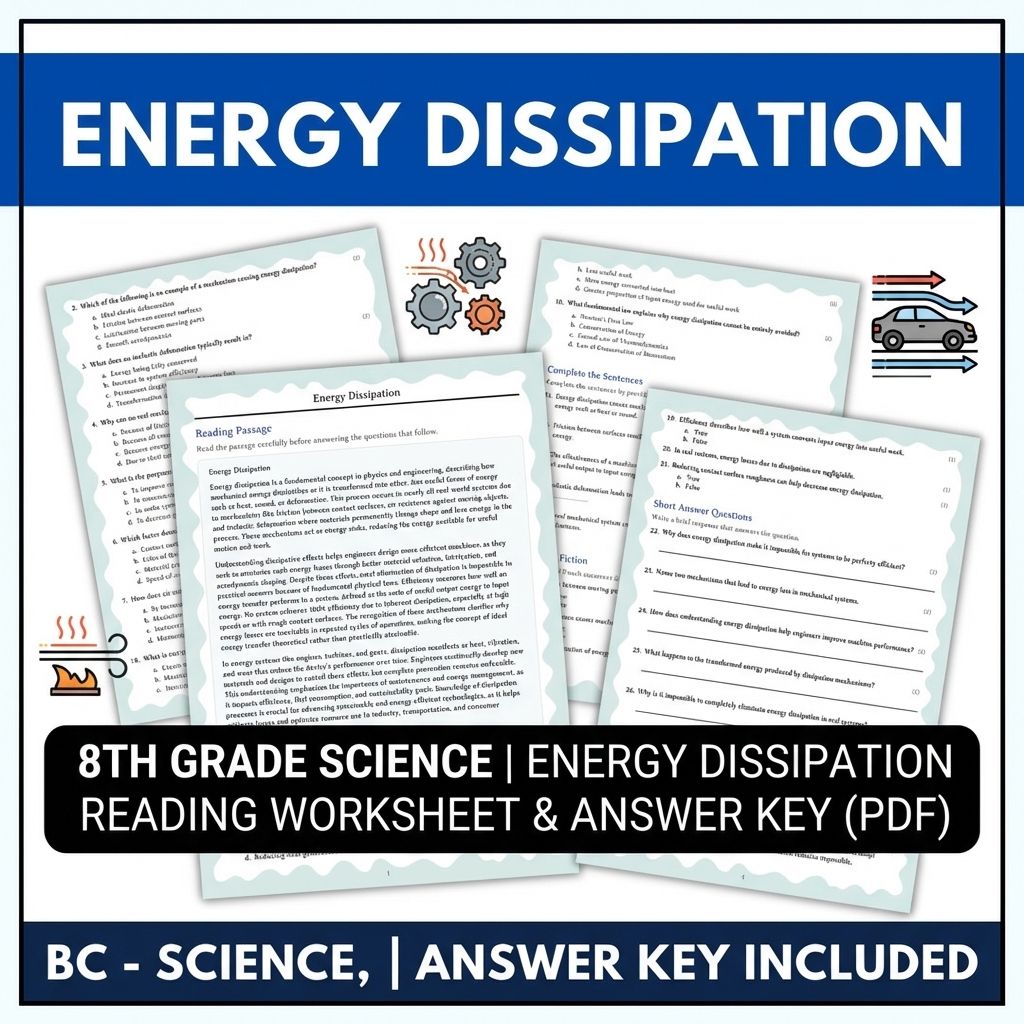
8th Grade Science | Energy Dissipation Reading Worksheet & Answer Key (PDF)
JCreated byJ.S SheetsLearning Objectives
- Explain how mechanical energy transforms into less useful forms such as thermal energy.
- Identify common mechanisms of energy dissipation like friction, air resistance, and inelastic deformation.
- Understand the concept of efficiency and how it quantifies useful energy transfer in mechanical systems.
Instant download

8th Grade Science Biodiversity Conservation Worksheet with Short Notes ( PDF)
Created byMeadowlark WorksheetsLearning Objectives
- Understand the concept of biodiversity and its importance in ecosystem health.
- Identify different strategies and policies utilized for biodiversity conservation.
- Analyze case examples of restoration and management processes.
Instant download
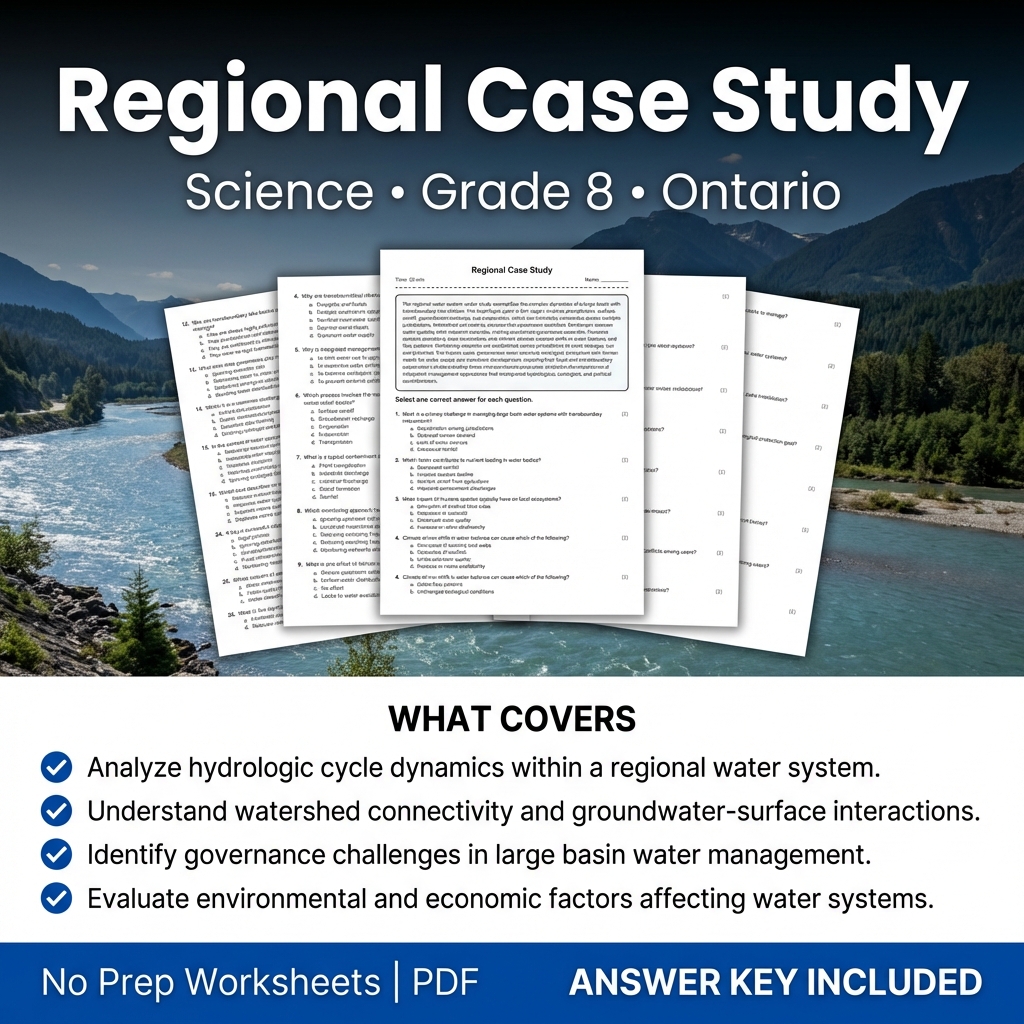
Grade 8 Science Worksheet | Regional Case Study | Ontario Standards
Created byCoral Reef LearningLearning Objectives
- Analyze hydrologic cycle dynamics within a regional water system.
- Understand watershed connectivity and groundwater-surface interactions.
- Identify governance challenges in large basin water management.
Instant download

Immune Response Worksheet | Ontario Grade 8 Science Assessment
 Created byCedar Grove Learning
Learning Objectives
- Explain how innate immunity and adaptive immunity work together to defend the body
- Describe the roles of macrophages, neutrophils, lymphocytes, and antigen-presenting cells
- Compare phagocytosis, antibody production, and cell-mediated cytotoxicity
Instant download
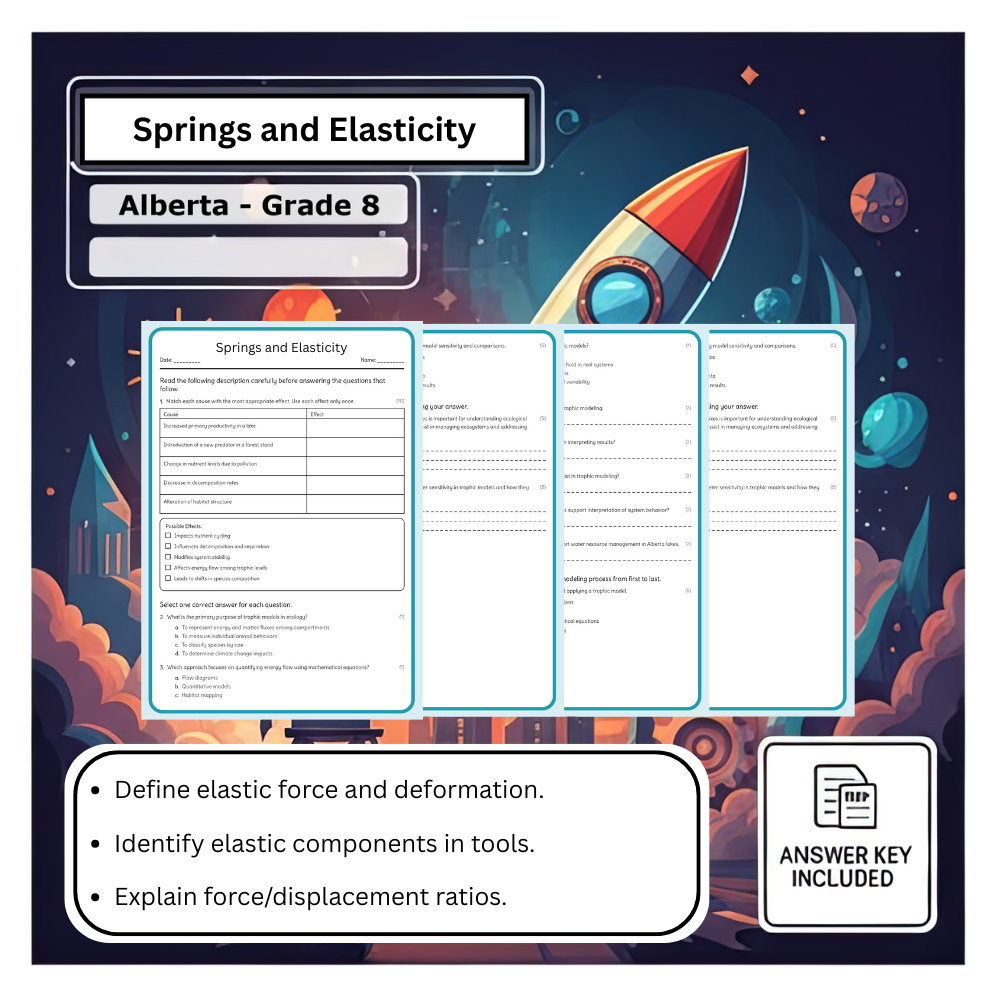
Grade 8 Science | Springs and Elasticity Worksheet (PDF)
Created byBright Mind ResourcesLearning Objectives
- Understand the concept of elastic forces and deformation in materials.
- Identify examples of elastic components in everyday and mechanical systems.
- Explain the proportional relationship between force and displacement in elastic materials.
Instant download
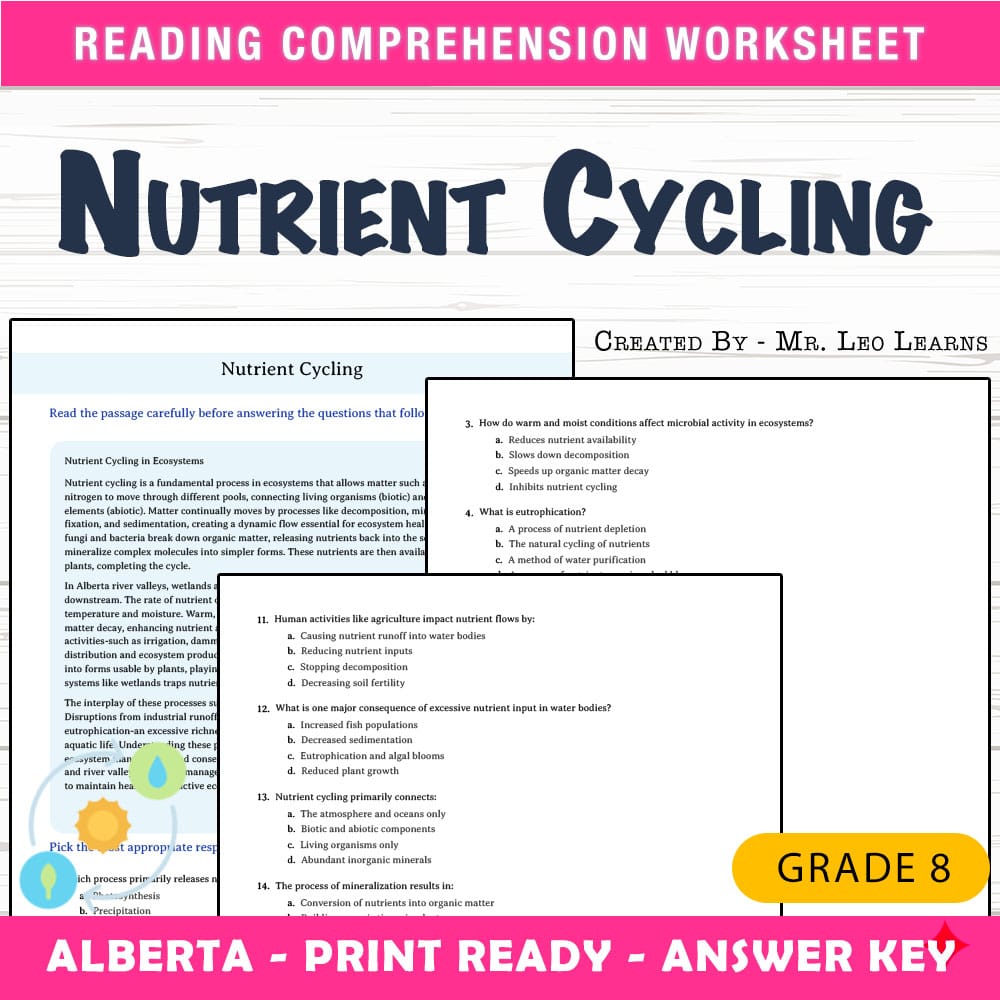
Grade 8 Science — Nutrient Cycling Worksheet MCQ Paper for Mastery
 Created byThe Resource Hub
Learning Objectives
- Understand the processes involved in nutrient cycling within ecosystems.
- Explain the roles of decomposers, nitrogen fixation, and mineralization.
- Identify factors that influence the rates of nutrient cycles such as temperature and moisture.
Also included in: Grade 8 Science Bundle | Interactions and Ecosystems Worksheets +1 more
Instant download
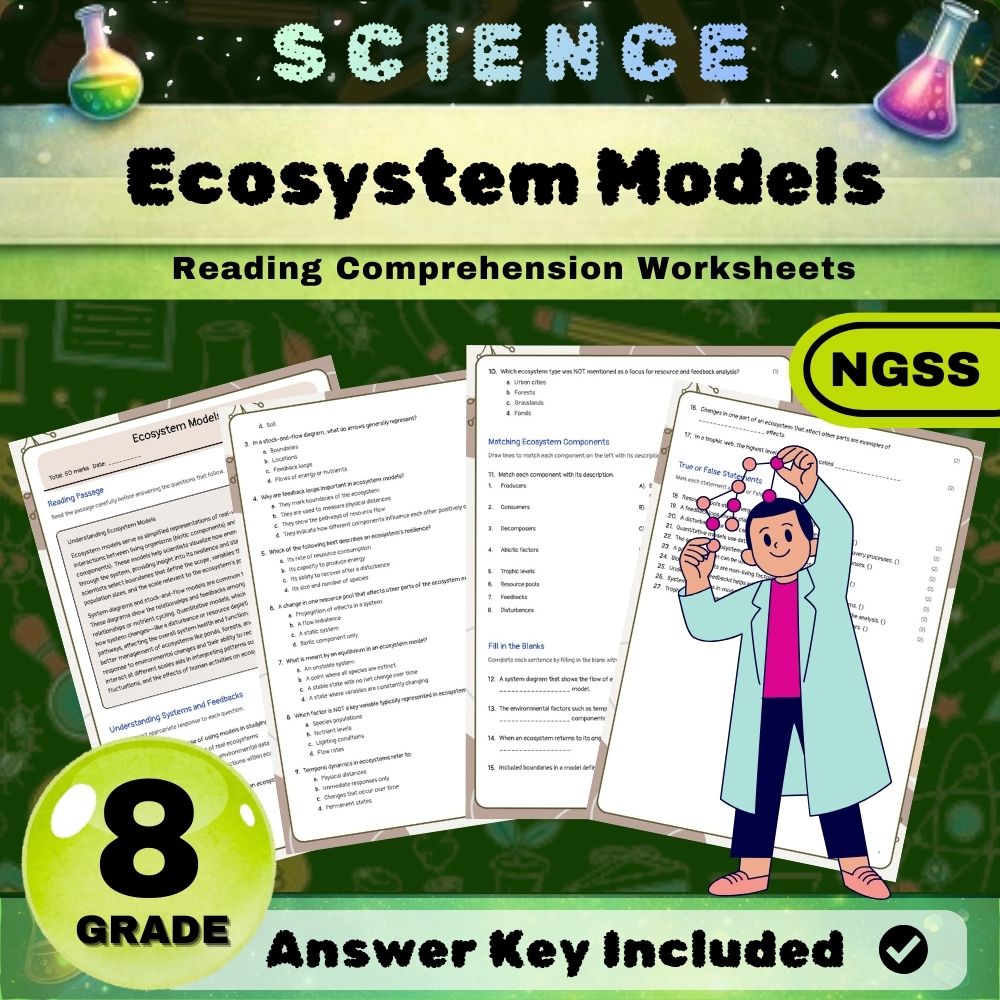
Grade 8 Science – Ecosystem Models Worksheet (NGSS) (PDF)
 Created byMaple Path Learning
Learning Objectives
- Understand the components and functions of ecosystem models, including biotic and abiotic factors.
- Identify different types of flows, feedbacks, and resource pools within ecosystems.
- Interpret how changes in one component can propagate through an ecosystem using system diagrams.
Also included in: Grade 8 Science Ecosystems Unit Bundle | Interactions, Energy & Dynamics (NGSS) +1 more
Instant download

Grade 8 Science | Food Webs Worksheet & Answer Key Aligned with NGSS (PDF)
Created byLumora LearningLearning Objectives
- Explain the roles of producers, consumers, and decomposers in ecosystems.
- Describe trophic levels and the flow of energy through a food web.
- Analyze how energy loss affects population sizes within ecological communities.
Instant download
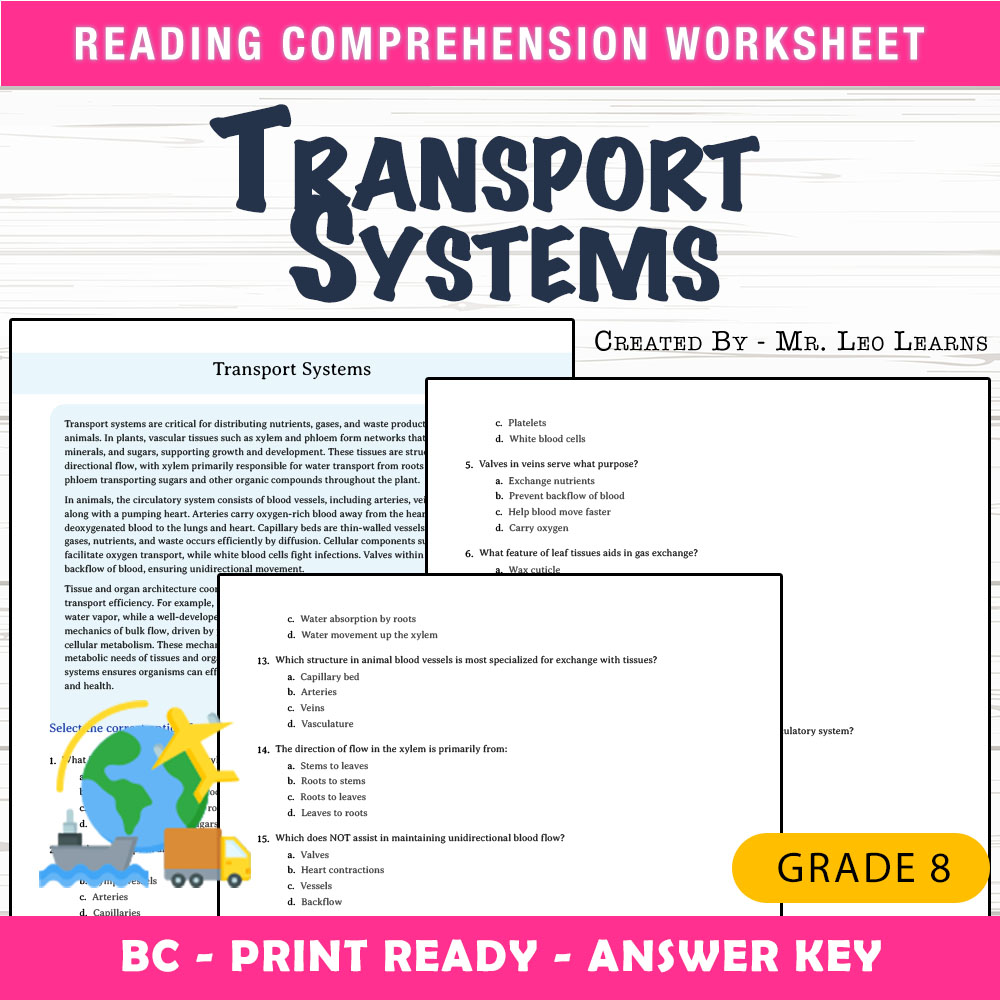
Grade 8 Science — Worksheet MCQ Paper for Transport Systems
Created byThe Resource HubLearning Objectives
- Understand the structure and function of vascular and circulatory transport systems in plants and animals.
- Identify the roles of vessels, valves, capillary beds, blood cells, xylem, and phloem in transport processes.
- Explain how tissue and organ structures facilitate bulk flow and diffusion for cellular metabolism.
Also included in: Grade 8 Science UNIT | Multicellular Structure & Function Worksheet Bundle +1 more
Instant download

Energy Relationships Worksheet | NGSS Grade 8 Science Assessment
Created byCedar Grove LearningLearning Objectives
- Describe the quantitative relationships between kinetic and potential energy, including dependence on mass, velocity, and position.
- Interpret graphical displays relating kinetic energy to mass and the square of velocity.
- Analyze energy exchanges in systems such as pendulums and roller coasters, emphasizing conservation principles.
Instant download
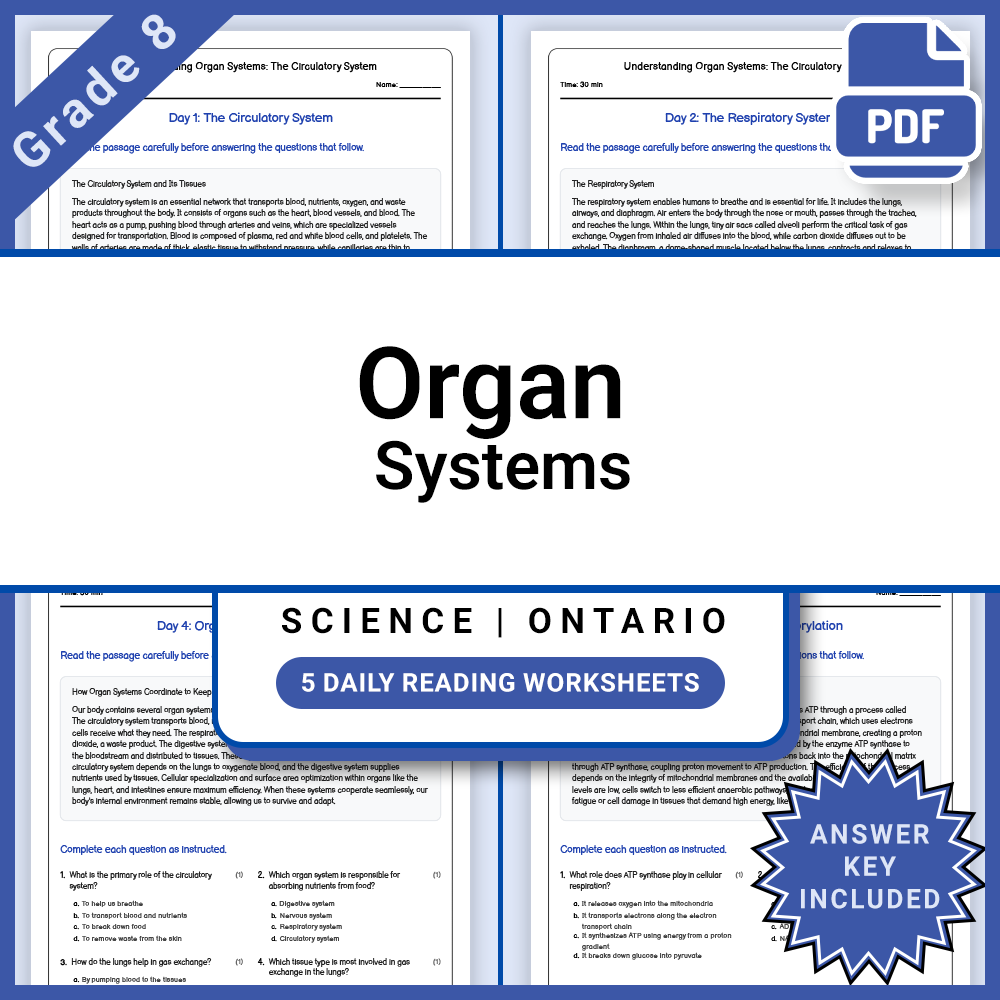
Grade 8 Science – Organ Systems Daily Reading Worksheet + Answer Key
JCreated byJ.S SheetsLearning Objectives
- Identify the main functions of the circulatory system.
- Recognize different tissue types involved in the circulatory system.
- Explain how blood transports nutrients and oxygen.
Also included in: Grade 8 Science Lesson Group: Ontario Curriculum Reading Worksheets Bundle +1 more
Instant download

Grade 8 Science | Energy–Temperature Link Worksheet | California Standards
Created byLumora LearningLearning Objectives
- Explain how energy transfer causes temperature changes in materials
- Use the ideas of thermal energy and thermal equilibrium to predict warming and cooling
- Relate everyday observations of hot and cold to the direction of heat (energy) flow
Instant download

Grade 8 Science | Membrane Functions Worksheet (PDF+ Answer Key)
Created byCopper Leaf ClassroomLearning Objectives
- Describe the role of cell membranes in regulating exchange between the cell and environment.
- Explain how membrane composition and surface area influence diffusion and signaling.
- Link microscopic membrane structures to overall organ and tissue functions in physiological processes.
Also included in: Grade 8 Science Bundle – Cell Structure, Systems & Organisms (PDF + Answer Key) +1 more
Instant download

Ecosystem Models Worksheet | NGSS Grade 8 Science Assessment
 Created bySkylark Worksheets
Learning Objectives
- Explain how ecosystem models represent biotic and abiotic components using boundaries, variables, and scale.
- Interpret stock-and-flow system diagrams to predict how changes propagate through an ecosystem.
- Use model reasoning to describe equilibrium, resilience, and temporal dynamics after disturbances.
Also included in: Grade 8 Ecosystems Interactions Energy Dynamics Science Lesson Bundle NGSS +1 more
Instant download

Grade 8 Science | Producers & Energy Worksheet (Alberta Standards) (PDF)
 Created bySilver Birch Teaching
Learning Objectives
- Explain how primary producers convert solar or chemical energy into organic matter.
- Compare factors that affect primary productivity, including light and soil nutrients.
- Describe how aquatic algae function as producers in food chains.
Also included in: Grade 8 Trophic Modeling & Ecosystems Science Lesson Bundle for Alberta Standards +1 more
Instant download
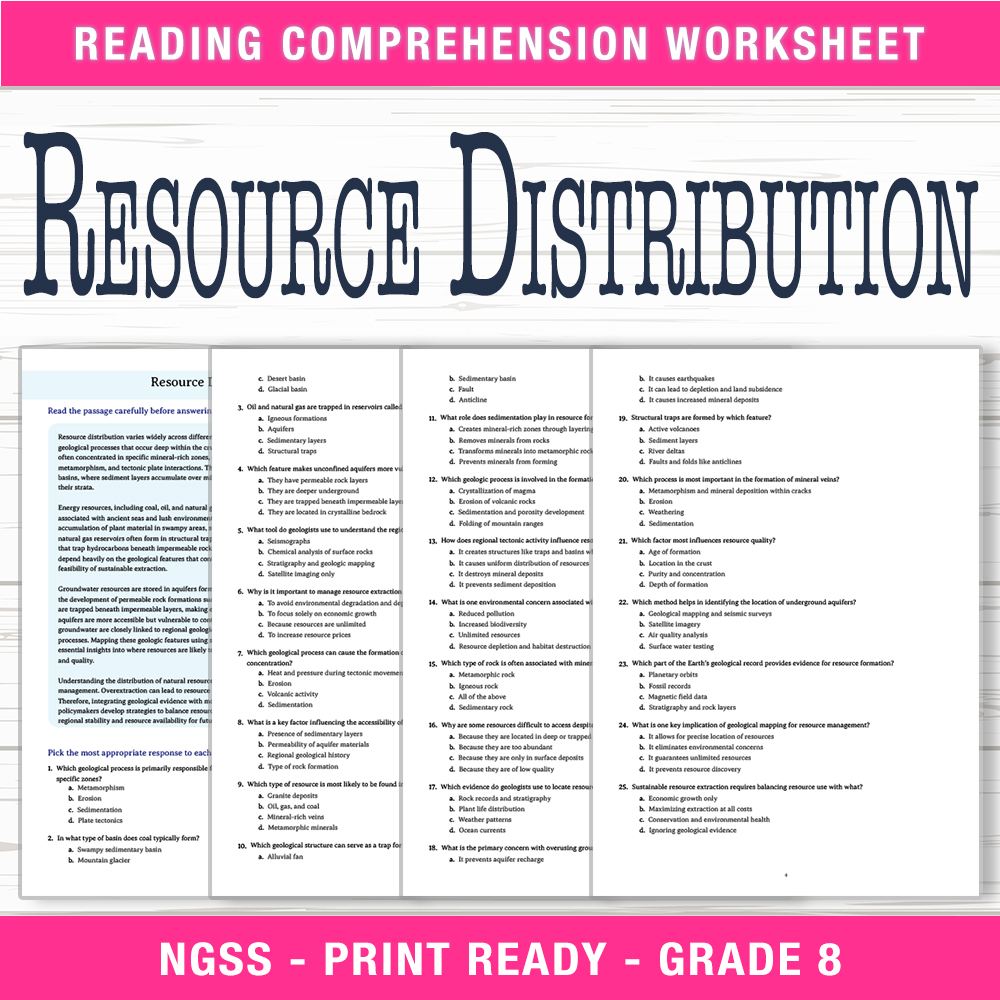
Grade 8 Science | Resource Distribution Worksheet (PDF + Answer Key)
 Created byRiverstone Classroom
Learning Objectives
- Analyze geological processes that lead to the formation of mineral, energy, and groundwater resources.
- Examine how resource distribution affects accessibility and quality.
- Understand implications for sustainable resource extraction and regional planning.
Instant download

Grade 8 Science – Layered Fluids Density & Stability | Daily Reading Worksheet
Created byBright Mind ResourcesLearning Objectives
- Understand how temperature and salinity affect fluid density
- Identify different fluid layers based on their density differences
- Explain the concepts of buoyancy, pycnoclines, and stability regimes in fluids
Also included in: Grade 8 Fluid Mechanics & Pressure Science Lesson Bundle | Ontario +1 more
Instant download
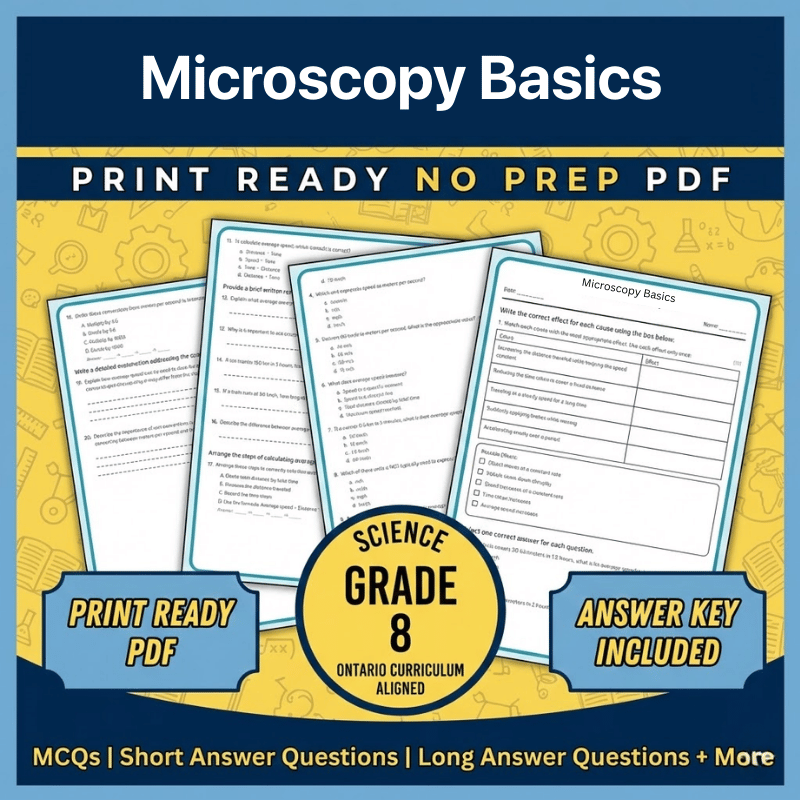
Grade 8 Science | Microscopy Basics Worksheet (Ontario) – Science 1 (PDF)
Created byBright Mind ResourcesLearning Objectives
- Understand the principles of magnification, resolution, and contrast in microscopy.
- Differentiate between light microscopy, stereomicroscopy, and electron imaging techniques.
- Recognize common artifacts and interpret micrographs of plant and animal cells.
Instant download
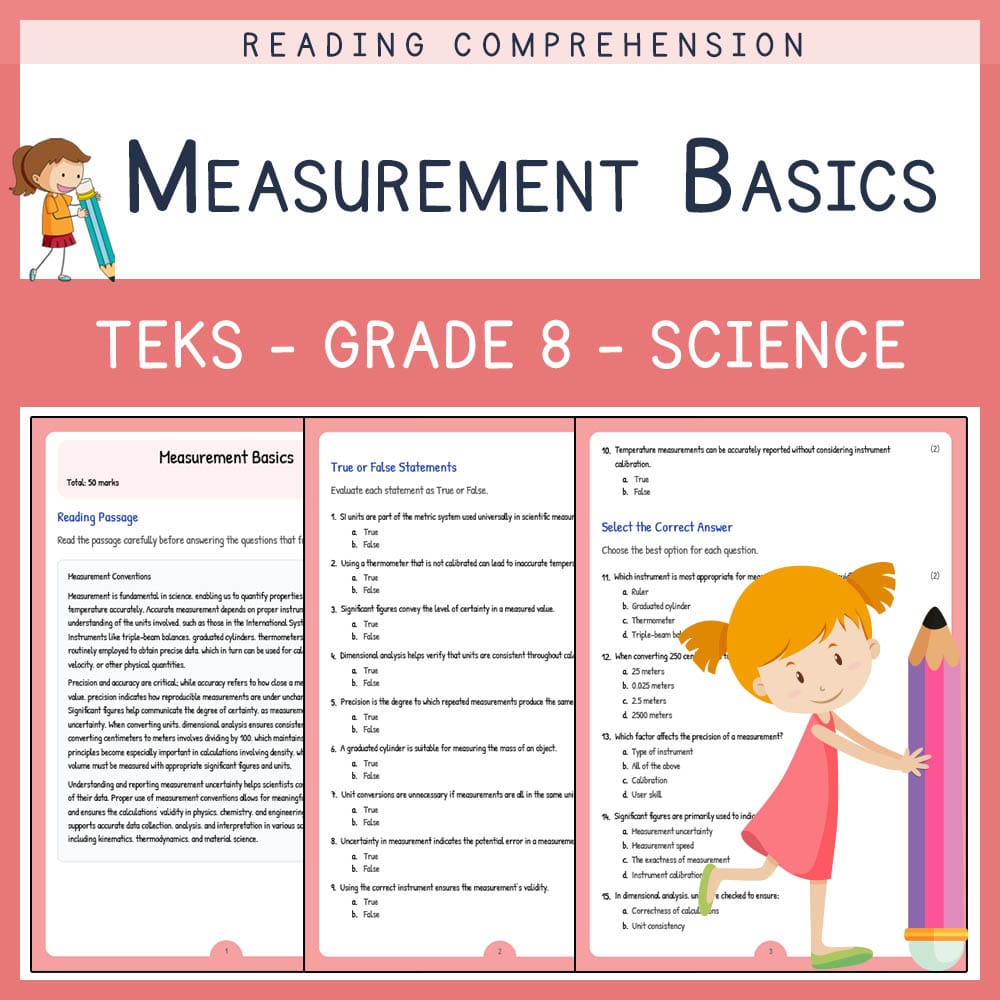
Grade 8 Science | Measurement Basics Worksheet | TEKS Aligned
Created byLumora LearningLearning Objectives
- Understand the principles of accuracy, precision, and SI units in measurements.
- Learn to convert units and use measurement instruments appropriately.
- Apply dimensional analysis to ensure unit consistency in calculations.
Also included in: Grade 8 Science | Science Concepts/Skills Lesson Bundle | TEKS Aligned
Instant download

Grade 8 Science Worksheet | Aerodynamic Drag Practice (Alberta Standard)
 Created byEvergreen Desk Education
Learning Objectives
- Explain how aerodynamic drag depends on velocity and opposes motion through air
- Describe how shape, frontal area, and airflow conditions affect net force on moving objects
- Apply aerodynamic concepts to real-world designs such as vehicles and wind turbines
Instant download

Energy Relationships Worksheet | NGSS Grade 8 Science Assessment
Created bySkylark WorksheetsLearning Objectives
- Describe how kinetic energy depends on mass and speed and how potential energy depends on position.
- Interpret graphs that show kinetic energy as a function of mass and as a function of the square of speed.
- Explain energy transfer and conservation between kinetic and potential energy, including the role of friction.
Also included in: Grade 8 Energy Science Lesson Bundle: NGSS Assessment & Practice Worksheets +1 more
Instant download

Stored Energy Worksheet for Grade 8 Science | NGSS Printable PDF
Learning Objectives
- Understand the concept of stored energy and how it relates to object configuration.
- Identify examples of gravitational, elastic potential, and magnetic energy in systems.
- Analyze how changes in relative positions alter stored energy in various systems.
Also included in: Grade 8 Energy Science Bundle – NGSS Lesson Worksheets for Classroom Use +1 more
Instant download

Thermal Changes Worksheet | Grade 8 Science Printable PDF Assessment
Learning Objectives
- Understand the quantitative relationship between energy transfer, material properties, mass, and temperature change.
- Explain the concepts of specific heat capacity and calorimetry in relation to different substances.
- Analyze how different heat capacities affect temperature responses during heat exchange.
Also included in: Grade 8 Energy Science Bundle – NGSS Lesson Worksheets for Classroom Use +1 more
Instant download

Energy Conservation Worksheet | Grade 8 Science Printable PDF Assessment
Learning Objectives
- Explain how changes in an object's kinetic energy relate to energy transfer and conservation within a system.
- Identify examples of energy transfer, including elastic and inelastic collisions, frictional heating, and energy conversions.
- Describe how energy can be tracked across system boundaries using work and heat measurements.
Also included in: Grade 8 Energy Science Bundle – NGSS Lesson Worksheets for Classroom Use +1 more
Instant download

Grade 8 Science – Climate Circulation & Atmospheric Patterns | Reading Worksheet
Created byBright Mind ResourcesLearning Objectives
- Understand the basic concepts of atmospheric circulation patterns
- Identify the role of solar heating and planetary rotation in climate
- Describe the models of Hadley, Ferrel, and polar cells
Also included in: Grade 8 Earth Systems Science Daily Reading Worksheets Lesson Bundle | NGSS +1 more
Instant download

Power and Efficiency Worksheet | Grade 8 Science Practice
Created byPrism Point LearningLearning Objectives
- Explain the relationship between power, energy transfer, and time in everyday electrical devices.
- Calculate and interpret efficiency as useful output compared to input energy in power systems.
- Identify common loss mechanisms (e.g., resistive heating and transmission losses) and predict how they affect delivered energy.
Also included in: Grade 8 Science Electricity & Electromagnetism Lesson Bundle | Alberta
Instant download
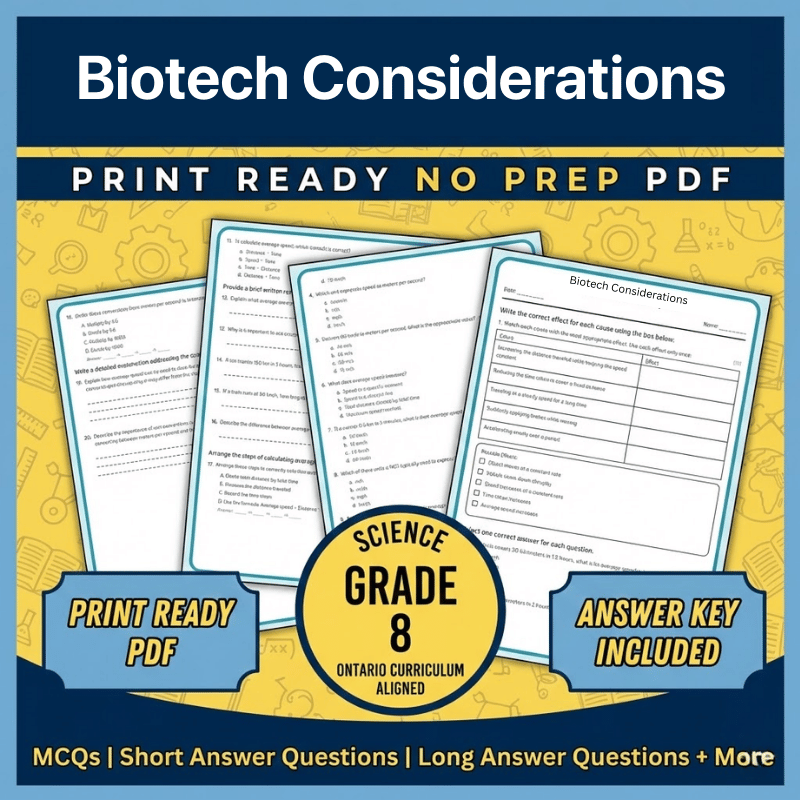
Grade 8 Science – Biotechnology Considerations Worksheet (Ontario PDF)
Created byBright Mind ResourcesLearning Objectives
- Understand the applications and techniques of cell culture, stem cell differentiation, and tissue engineering.
- Recognize molecular markers, scaffold interactions, and controlled differentiation methods.
- Discuss ethical, safety, and regulatory issues related to cellular and tissue manipulation.
Instant download

Science Grade 8 Hydraulic Systems Worksheet | Ontario Standards Aligned
JCreated byJ.S SheetsLearning Objectives
- Explain how hydraulic systems use pressure in confined fluids to produce larger output forces
- Use force–area relationships to determine mechanical advantage in piston assemblies
- Evaluate design constraints that affect hydraulic performance, such as viscosity, seals, and fluid compressibility
Instant download
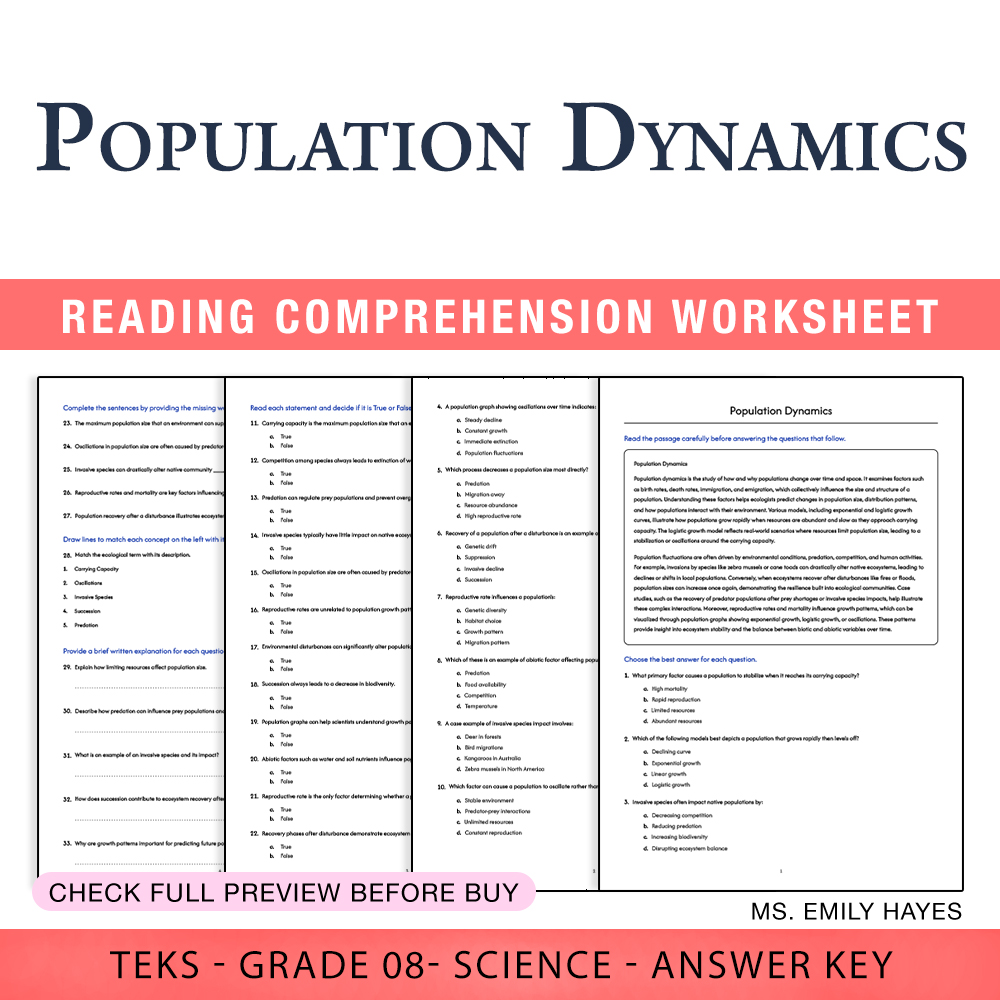
8th Grade Science | Population Dynamics Worksheet (PDF+ Answer Key)
Created byCopper Leaf ClassroomLearning Objectives
- Understand the factors influencing population size and distribution.
- Analyze growth patterns, oscillations, and the effects of limiting resources and competition.
- Interpret population graphs and case studies involving invasive species and disturbance recovery.
Instant download
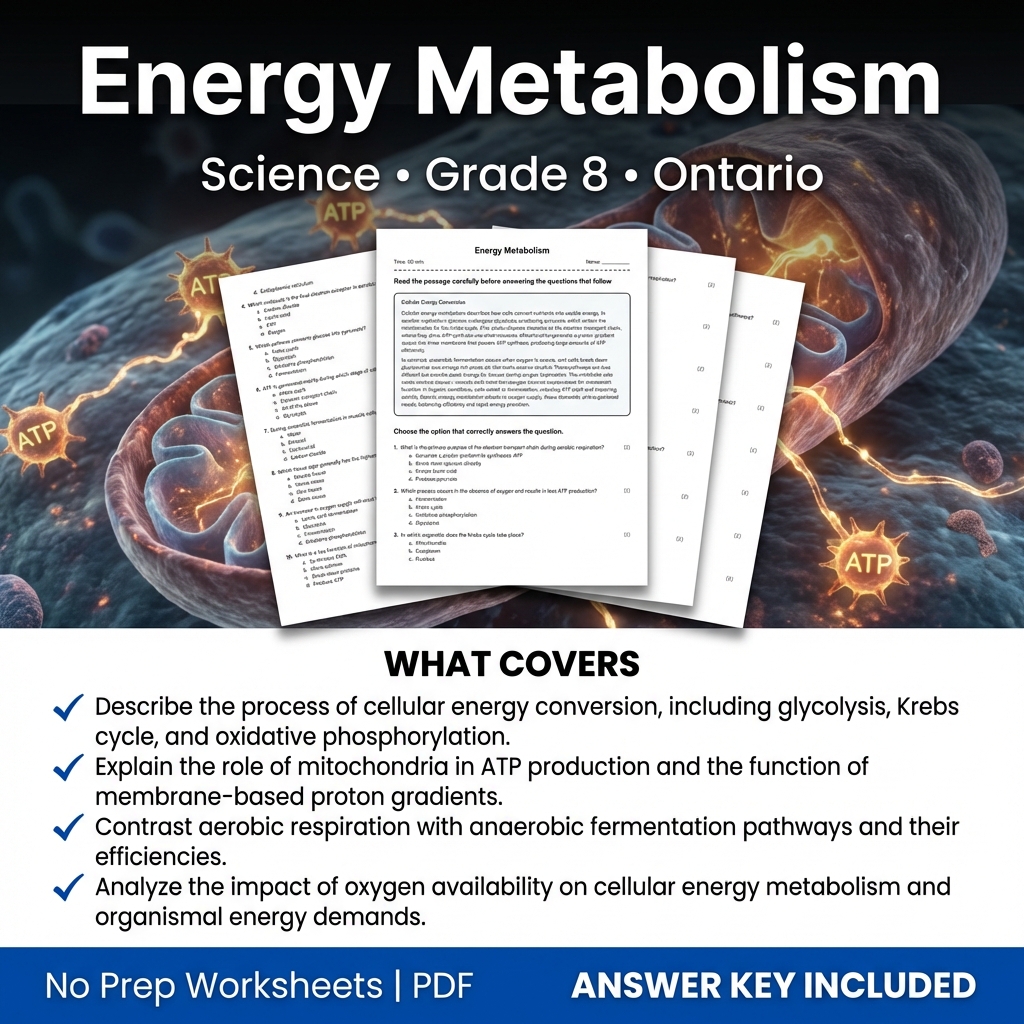
Energy Metabolism Worksheet | Ontario Grade 8 Science Practice PDF
Created byCoral Reef LearningLearning Objectives
- Describe the process of cellular energy conversion, including glycolysis, Krebs cycle, and oxidative phosphorylation.
- Explain the role of mitochondria in ATP production and the function of membrane-based proton gradients.
- Contrast aerobic respiration with anaerobic fermentation pathways and their efficiencies.
Instant download

Solar System Grade 8 Science Worksheet | TEKS-Aligned Practice & Assessment
JCreated byJ.S SheetsLearning Objectives
- Describe the major components of the solar system (Sun, planets, dwarf planets, moons, asteroids, and comets) and how they differ by composition and size.
- Explain how gravity and solar energy affect planetary motion and environments.
- Interpret basic observational evidence from telescopes and spacecraft using examples such as Earth, Mars, Jupiter, and the asteroid belt.
Instant download

Grade 8 Science – Inclined Planes & Mechanical Advantage | Daily Worksheet
 Created byQuiet Forest Education
Learning Objectives
- Identify parts of an inclined plane and describe their functions.
- Understand how inclined planes reduce effort in doing work.
- Calculate ideal mechanical advantage of ramps and wedges.
Also included in: Energy Grade 8 Science Daily Reading Worksheets Bundle | Ontario Framework +1 more
Instant download

Grade 8 Science – Limiting Factors & Ecosystem Balance | Daily Reading Worksheet
Created byBright Mind ResourcesLearning Objectives
- Define limiting factors in relation to population size.
- Identify key food sources as a potential limiting factor.
- Describe how changes in food availability can affect animal populations.
Also included in: Grade 8 Ecosystems Daily Reading Worksheets Lesson Bundle | BC +1 more
Instant download
About Grade 8 Science Worksheets
Explore Grade 8 Science worksheets for classwork, homework, or review. Our 5,999 printables download instantly as PDFs.
Each resource here is built by an independent educator and reviewed for quality. Worksheets print straight from PDF and suit classroom use, homework, or extra practice; most come with answer keys, and you can preview before purchasing.