
Grade 8 Science Worksheets
6,006 worksheets
Grade 8 Science Worksheet | Gravity and Orbits Space Systems Activity (CA Standards)
 Created byEvergreen Desk Education
Learning Objectives
- Explain how gravitational attraction provides the centripetal acceleration that keeps an orbiting object moving on a curved path
- Compare how orbital speed and orbital period change with distance from a massive body
- Describe how satellites and moons follow repeating orbital patterns due to gravity and inertia
Instant download

Grade 8 Particle Theory Worksheet | Alberta Practice PDF
 Created byClear Sky Classroom
Learning Objectives
- Explain how particle motion and arrangement relate to solids, liquids, and gases
- Use particle theory to predict changes of state when temperature changes
- Describe observable properties such as rigidity, flow, and compressibility using particle-level ideas
Instant download

Grade 8 Reaction Quantities Worksheet | Alberta Use Practice PDF
Created byClear Sky ClassroomLearning Objectives
- Use proportional reasoning to relate reactant and product amounts in balanced chemical reactions.
- Apply the law of mass conservation to interpret mass changes in closed systems.
- Estimate reagent needs and expected residues using stoichiometric thinking.
Instant download
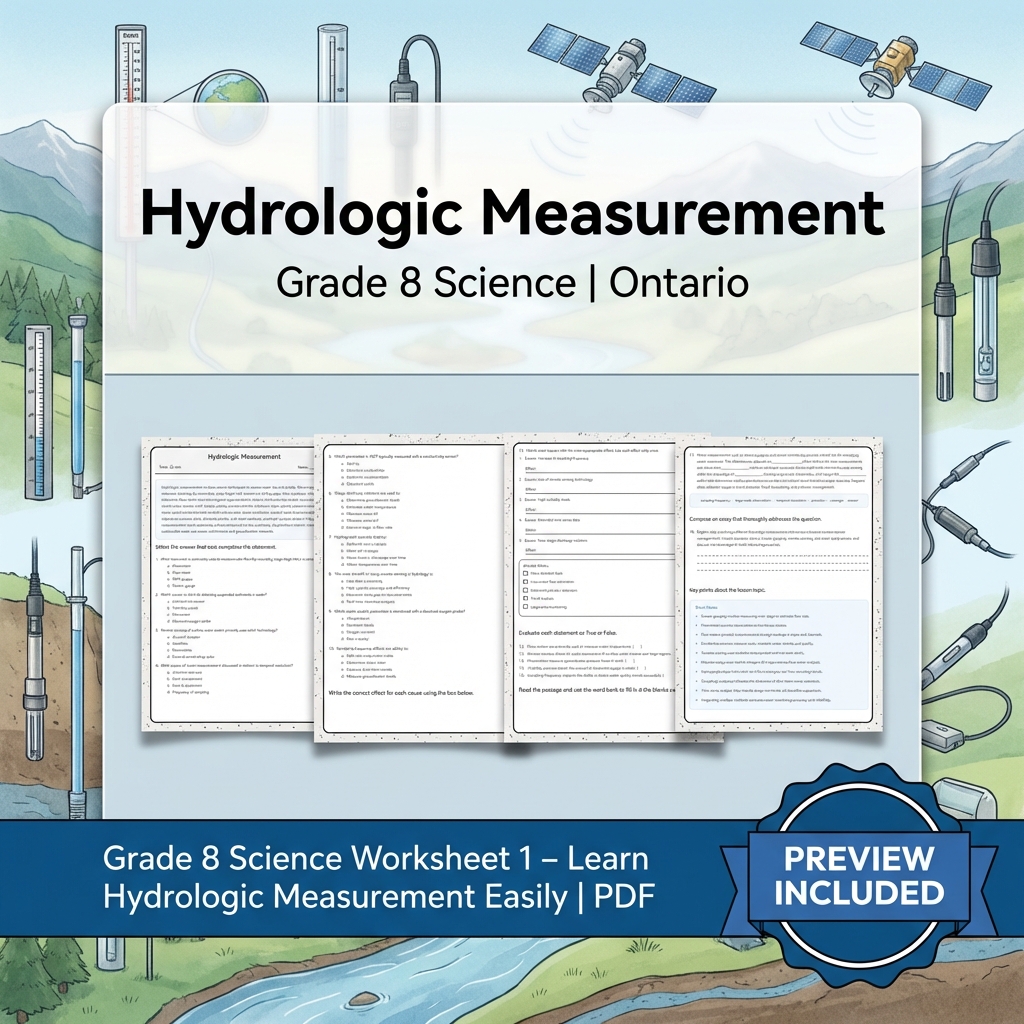
Grade 8 Science Worksheet 1 – Learn Hydrologic Measurement Easily | PDF
 Created byMeadowlark Worksheets
Learning Objectives
- Understand various methods and instruments used to quantify water quantity and quality.
- Explore concepts of stream gauging, rating curves, and stage-discharge relations.
- Identify tools like piezometers, flow meters, and sensors used in water monitoring.
Also included in: Grade 8 Science Watershed and Water Systems Lesson Group – Ontario Framework +1 more
Instant download

Tissue Organization Worksheet | Ontario Grade 8 Science Assessment
 Created byCedar Grove Learning
Learning Objectives
- Identify the major tissue types (epithelial, connective, muscle, and nervous) and describe key structural features.
- Explain how tissue structure supports function using examples of transport, movement, signal transmission, and support.
- Describe how coordinated tissues contribute to organ-level properties and physiological processes.
Instant download
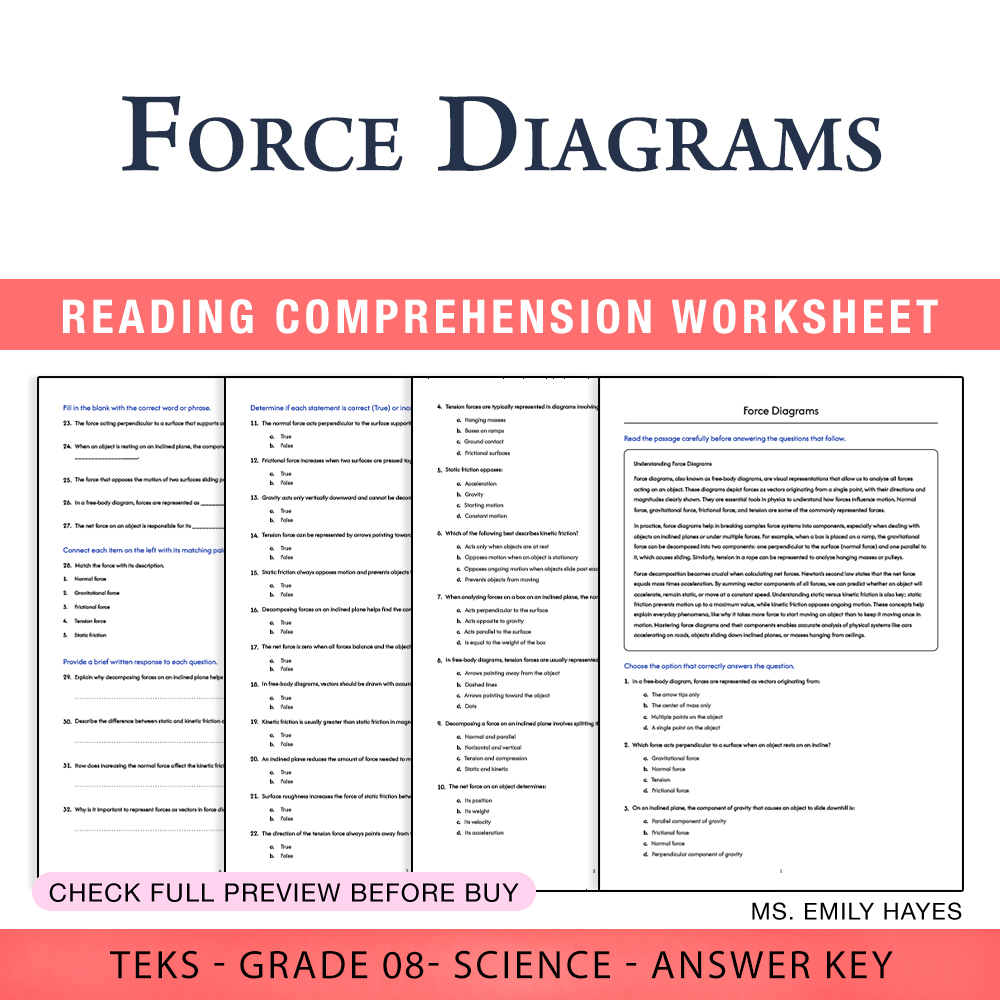
8th Grade Science | Force Diagrams Worksheet (PDF+ Answer Key)
 Created byCopper Leaf Classroom
Learning Objectives
- Describe how to represent forces using free-body diagrams, including normal, gravitational, frictional, and tension forces.
- Identify and analyze vector directions of forces acting on objects in various scenarios.
- Decompose forces on inclined planes into components and calculate net force.
Instant download

Land Use Effects Worksheet | Grade 8 Science Activities
 Created byPrism Point Learning
Learning Objectives
- Explain how human land use can fragment habitats and change habitat size and quality for native species.
- Describe how fragmentation affects edge effects, hydrology, soil properties, and habitat connectivity.
- Use cause-and-effect reasoning to predict how land use changes can influence population survival and biodiversity over time.
Also included in: Ecosystems & Biodiversity Lesson Bundle | Grade 8 Science | BC +1 more
Instant download

Grade 8 Science | Gravity & Motion - Daily Reading Comprehension
 Created byCoral Reef Learning
Learning Objectives
- Understand the concept of gravity and how it governs motion in space.
- Identify how gravitational forces influence planetary, lunar, and cometary trajectories.
- Explain the balance between inertia and gravity that leads to orbit shapes.
Instant download
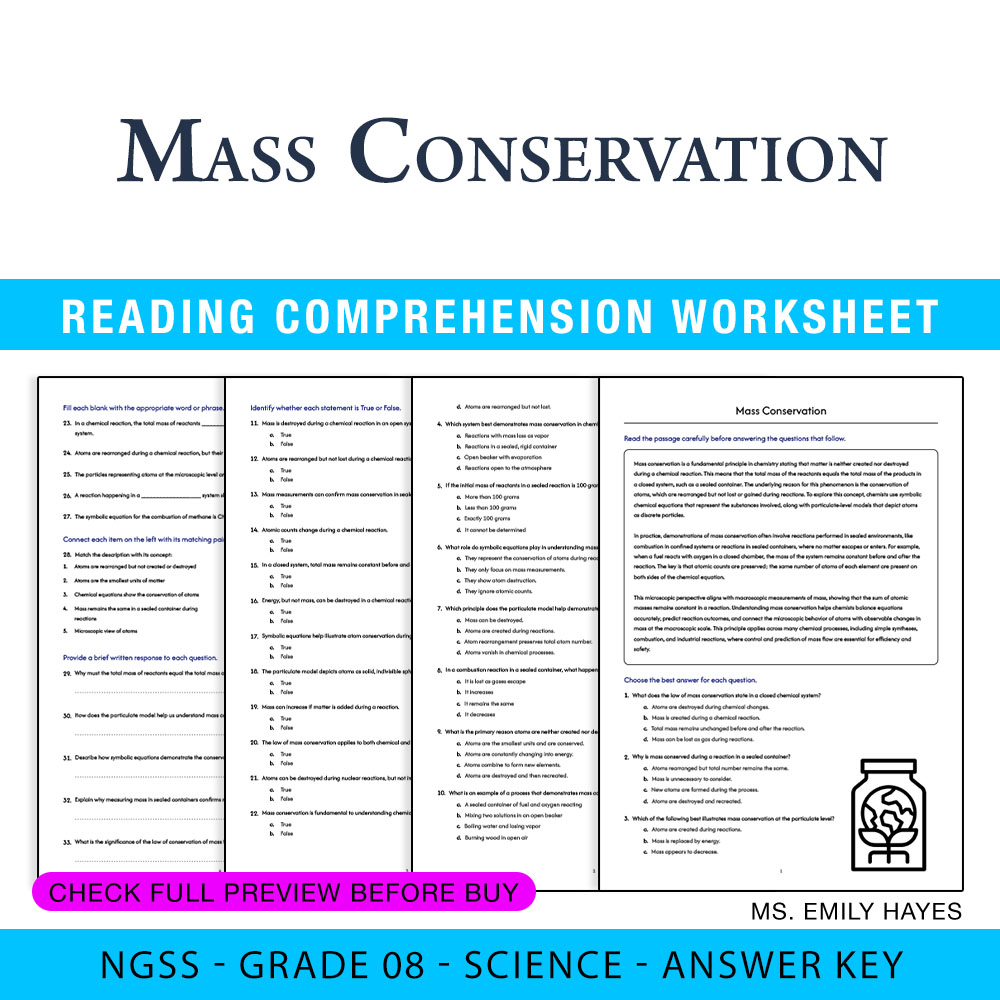
Grade 8 Science | Mass Conservation Worksheet (PDF+ Answer Key)
Created byCopper Leaf ClassroomLearning Objectives
- Explain the principle of mass conservation in chemical reactions within closed systems.
- Describe how atoms are conserved during chemical changes at the particulate level.
- Use symbolic equations and particulate models to demonstrate mass conservation.
Instant download

Grade 8 Science – Variables and Controls Daily Reading Worksheet + Answer Key
JCreated byJ.S SheetsLearning Objectives
- Understand key concepts related to Science
- Apply knowledge through practice questions
- Demonstrate comprehension of the material
Also included in: Grade 8 Science Lesson Group Bundle | TEKS Standards-Aligned Worksheets +1 more
Instant download

Grade 8 Science – Energy & Motion Daily Reading Worksheet | California Standards
 Created byBright Mind Resources
Learning Objectives
- Understand how energy shifts between potential and kinetic during motion.
- Identify examples of energy transformation in real-world systems.
- Explain the concept of energy conservation during movement.
Also included in: Grade 8 Energy, Forces & Matter Lesson Bundle - Daily Reading | Calif. Std. +1 more
Instant download

Grade 8 Science | Predicting Products Worksheet | BC Aligned
 Created byLumora Learning
Learning Objectives
- Understand how to predict reaction products based on reactant identities and reaction patterns.
- Learn to balance chemical equations to ensure conservation of atoms.
- Apply mass-to-mole conversions to compare quantities and estimate yields in reactions.
Instant download
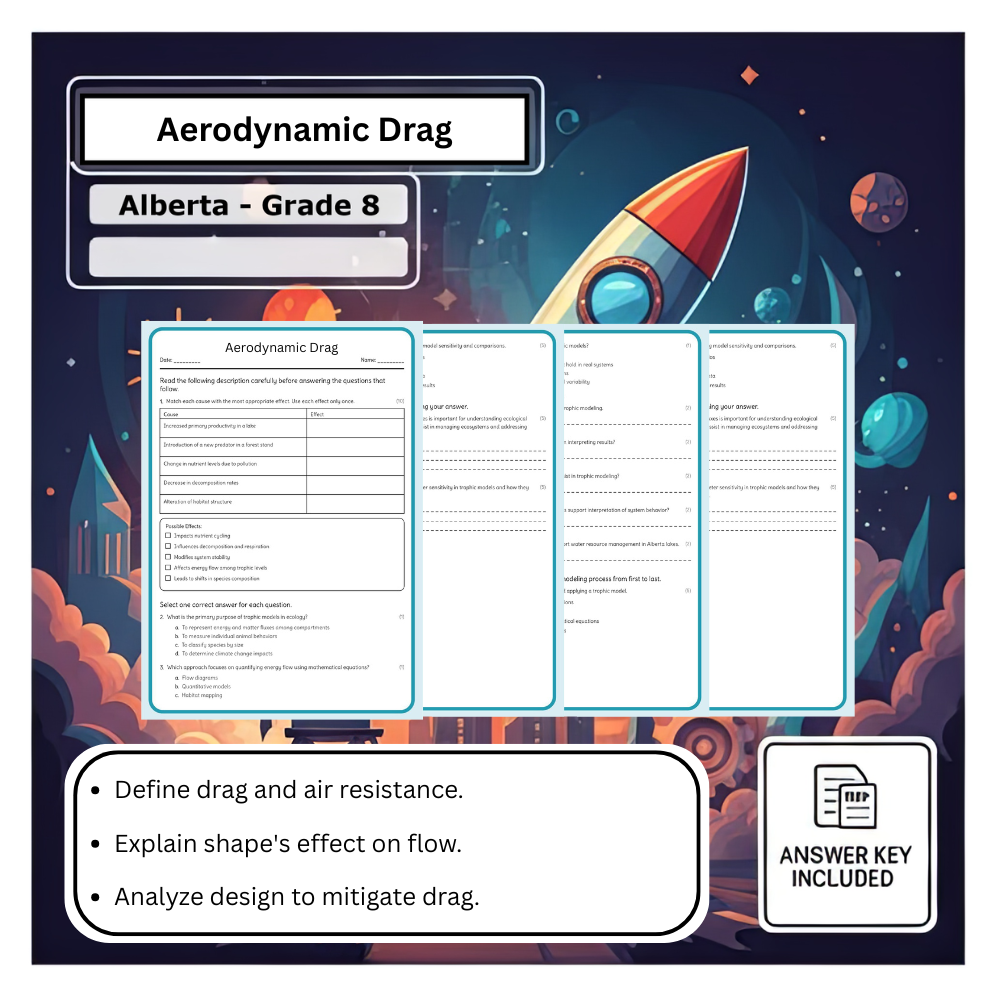
Grade 8 Science | Aerodynamic Drag (Worksheet + Answer Key) – Alberta Standards
Created byBright Mind ResourcesLearning Objectives
- Understand the concept of aerodynamic drag and factors that influence it.
- Describe how shape and flow conditions affect air resistance in practical applications.
- Analyze how design choices can mitigate drag in vehicles and wind turbines.
Instant download

Grade 8 Science Worksheet: Rotational Forces | Standards-Aligned Practice
JCreated byJ.S SheetsLearning Objectives
- Define torque (moment of force) and explain how lever arm and force direction affect rotational effect
- Use the condition for rotational equilibrium (net torque = 0) to predict static balance
- Relate net torque to angular acceleration and describe how moment of inertia affects rotational motion
Instant download
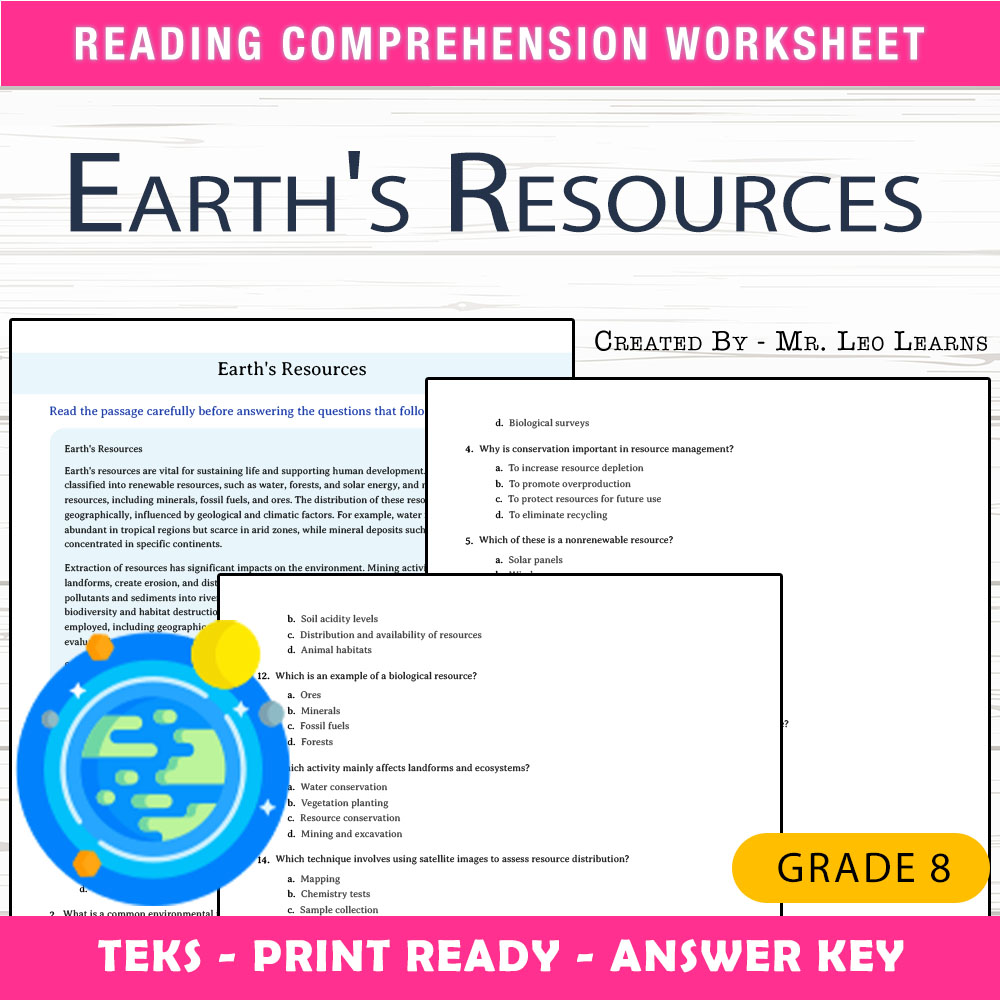
Grade 8 Science — Earth's Resources Worksheet for Mastery
 Created byThe Resource Hub
Learning Objectives
- Understand the distribution and classification of renewable and nonrenewable resources.
- Analyze the environmental impacts of resource extraction on landforms, water quality, and ecosystems.
- Explore assessment methods such as mapping and resource inventories.
Also included in: Grade 8 Science UNIT Bundle – Weather, Solar System & Geological Processes +1 more
Instant download

Testable Claims Assessment | General Standard Grade 8 Science
Created byPrism Point LearningLearning Objectives
- Understand what makes a claim testable through evidence-based observations.
- Identify variables and how they influence observable outcomes.
- Construct clear hypotheses that specify relationships between factors.
Also included in: Grade 8 Scientific Inquiry & Practices Science Lesson Bundle: General
Instant download

Evidence Based Explanations Assessment | General Grade 8 Science Standards
Created byPrism Point LearningLearning Objectives
- Understand how evidence supports scientific claims and explanations.
- Differentiate between claims, reasoning, and alternative explanations.
- Evaluate explanations by comparing evidence and considering limits and uncertainties.
Also included in: Grade 8 Scientific Inquiry & Practices Science Lesson Bundle: General
Instant download
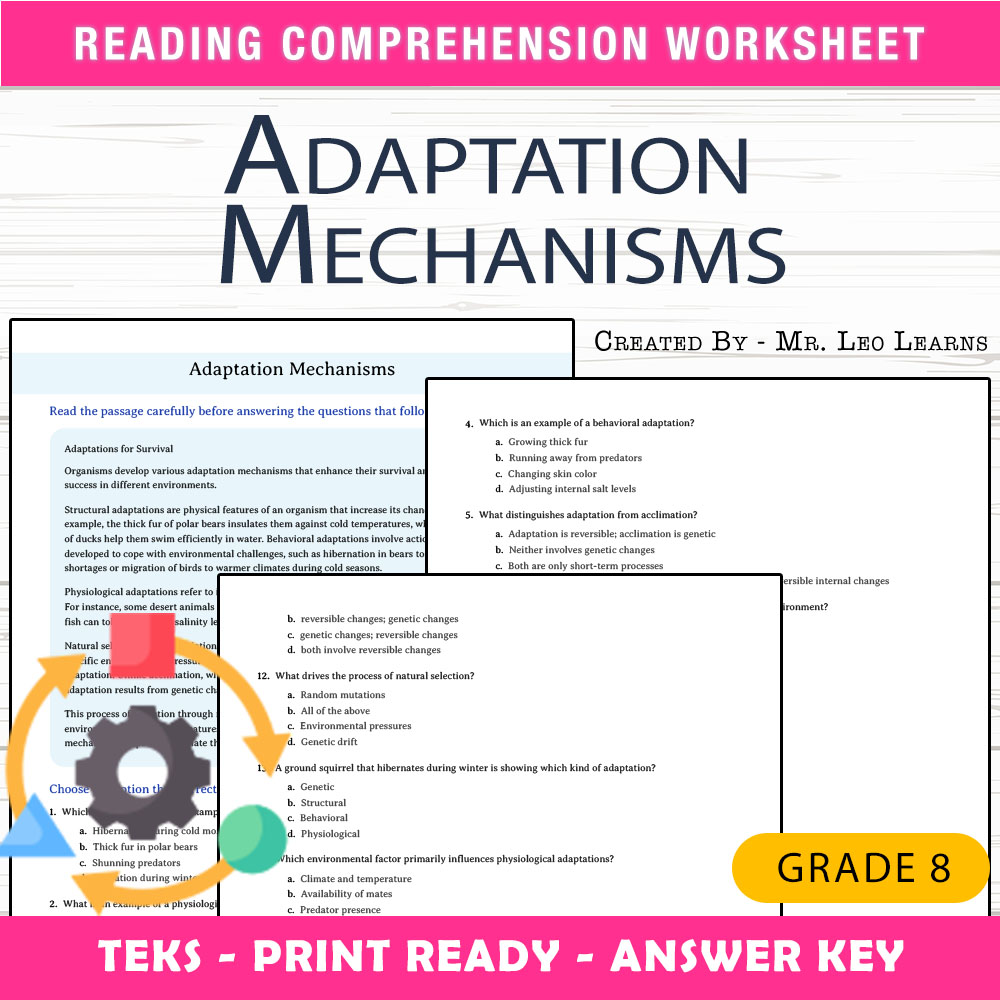
Grade 8 Science – Adaptation Mechanisms Worksheet for Mastery | PDF + Answer Key
Created byThe Resource HubLearning Objectives
- Identify different types of adaptation—structural, behavioral, and physiological—in various organisms.
- Explain the role of adaptation in survival and reproduction within diverse environments.
- Describe how natural selection influences trait variation and adaptive features across generations.
Also included in: Grade 8 Science Unit | Ecosystems, Evolution & Cell Processes Worksheet Pack +1 more
Instant download
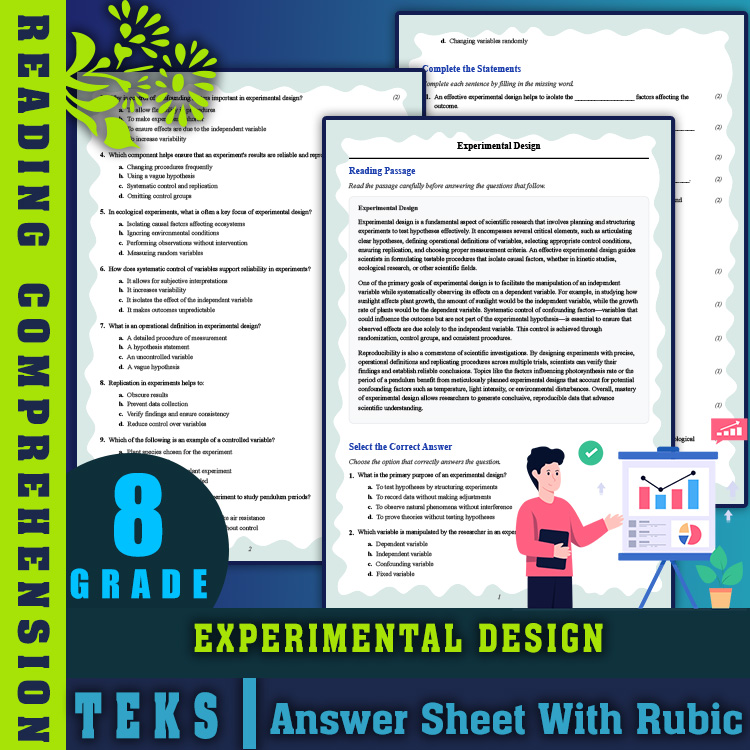
8th Grade Science | Experimental Design Reading Worksheet & Answer Key (PDF)
JCreated byJ.S SheetsLearning Objectives
- Understand the key components of experimental design, including hypothesis formulation, control conditions, and variable manipulation.
- Learn how to identify independent and dependent variables within experimental procedures.
- Recognize the importance of systematic control and replication to ensure reliable and reproducible results.
Instant download

Grade 8 Science | Organ Systems Worksheet (BC) (PDF)
Created byEvergreen Desk EducationLearning Objectives
- Explain how multiple organs work together as an organ system to maintain internal balance
- Describe how communication signals help coordinate system-wide responses to changing conditions
- Connect how tissue interfaces and compatibility support efficient exchange of materials
Instant download

Common Ancestry Worksheet | NGSS Grade 8 Science Practice PDF
JCreated byJ.S SheetsLearning Objectives
- Understand how fossil, anatomical, embryological, and molecular evidence reveal evolutionary relationships.
- Identify key examples of transitional fossils, homologous structures, and DNA sequence similarities.
- Interpret data patterns to support hypotheses about lineage relationships.
Also included in: Grade 8 Speciation and Natural Selection Science Lesson Bundle | NGSS +1 more
Instant download

Natural Selection Worksheet for Grade 8 Science NGSS Practice
JCreated byJ.S SheetsLearning Objectives
- Understand the mechanisms of variation and natural selection in populations.
- Identify examples of adaptive changes like industrial melanism and antibiotic resistance.
- Link phenotypic variation and environmental pressures to population-level trait shifts.
Also included in: Grade 8 Speciation and Natural Selection Science Lesson Bundle | NGSS +1 more
Instant download
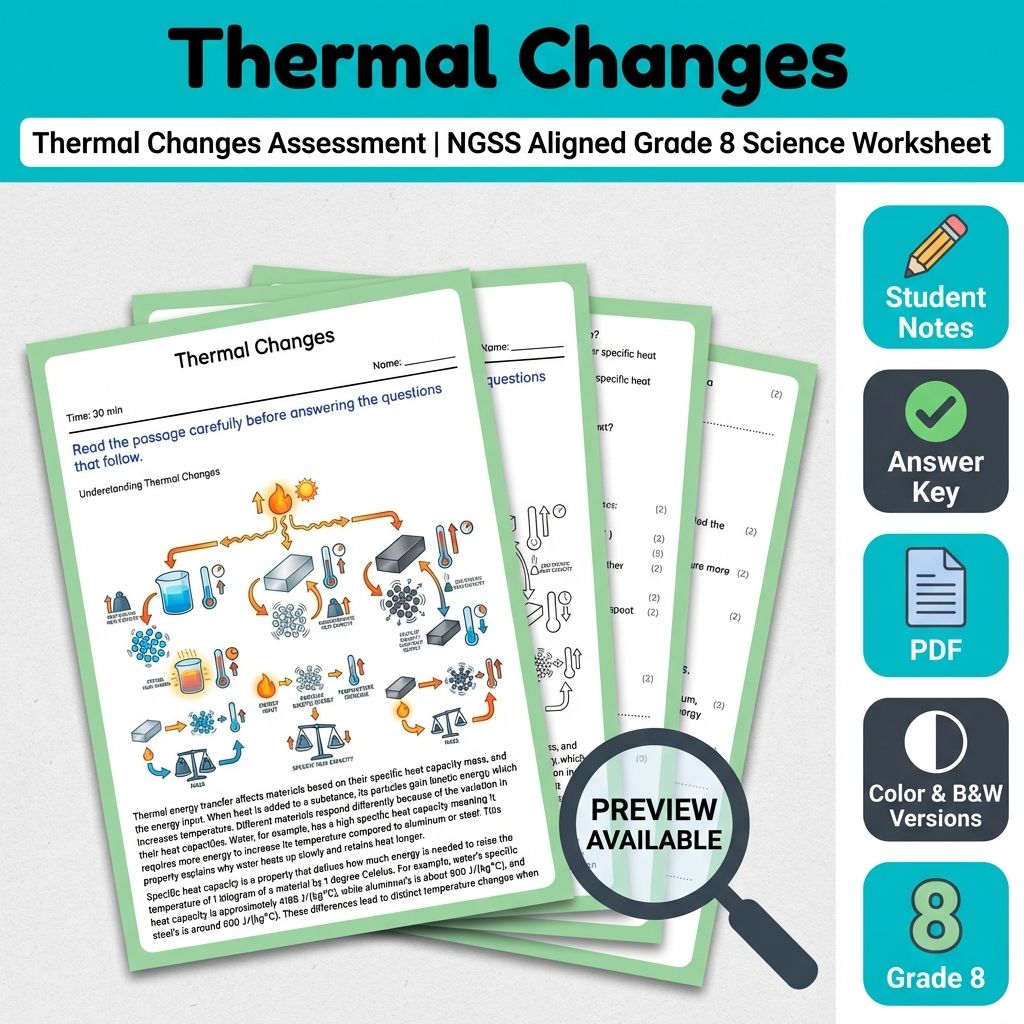
Thermal Changes Assessment | NGSS Aligned Grade 8 Science Worksheet
Created byPrism Point LearningLearning Objectives
- Understand the relationships among energy transfer, material type, mass, and temperature change.
- Explain the concept of specific heat capacity and how it affects temperature response.
- Apply calorimetric reasoning to compare heat capacities of different substances.
Also included in: Grade 8 Science Mini Bundle – Energy NGSS Standards-Aligned Not Specified +1 more
Instant download
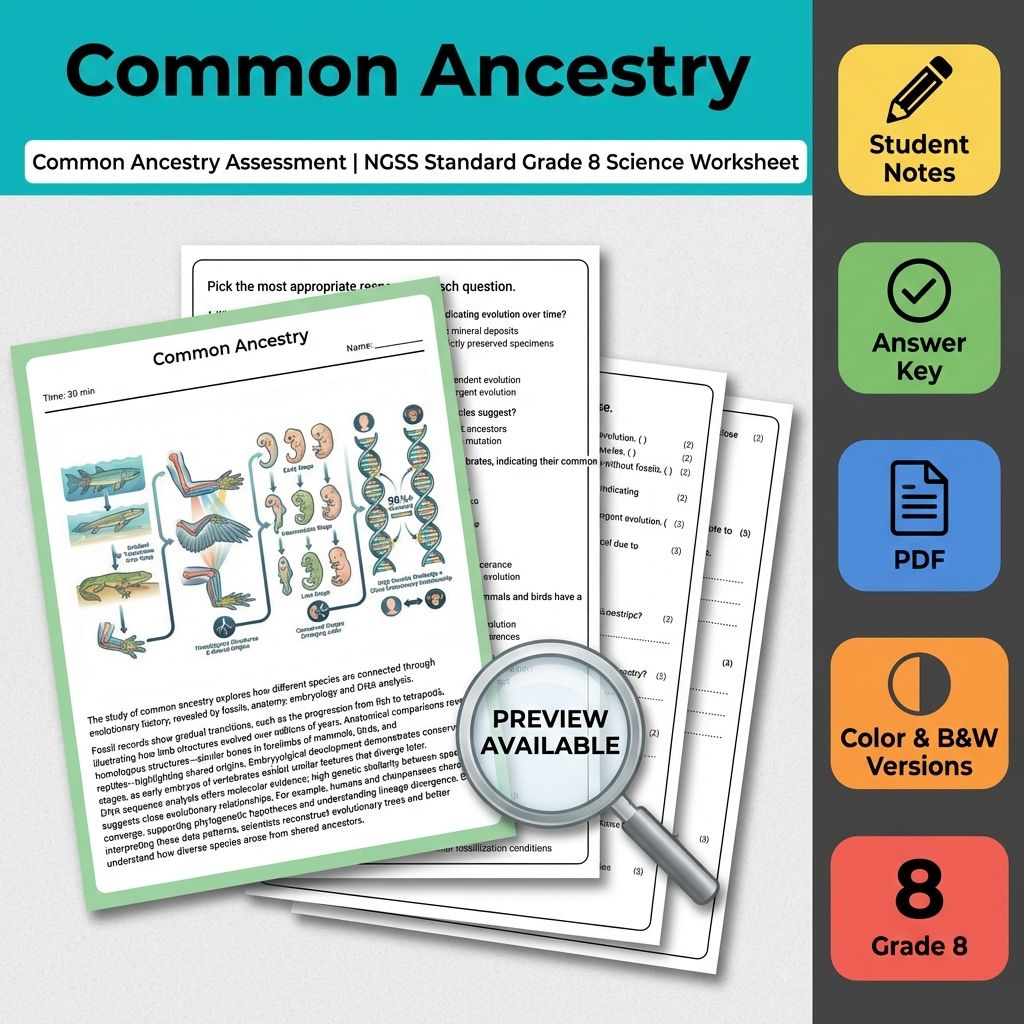
Common Ancestry Assessment | NGSS Standard Grade 8 Science Worksheet
Created byPrism Point LearningLearning Objectives
- Understand multiple lines of evidence—fossil, anatomical, embryological, and molecular—that support common ancestry.
- Interpret data patterns indicating evolutionary relationships through transitional fossils, homologous structures, developmental stages, and DNA similarities.
- Analyze examples such as fossil progression of tetrapods, homologous limb bones, and molecular alignments to infer lineage relationships.
Also included in: Grade 8 Science Mini Bundle | Biological Evolution & Diversity Standards-Aligned +1 more
Instant download
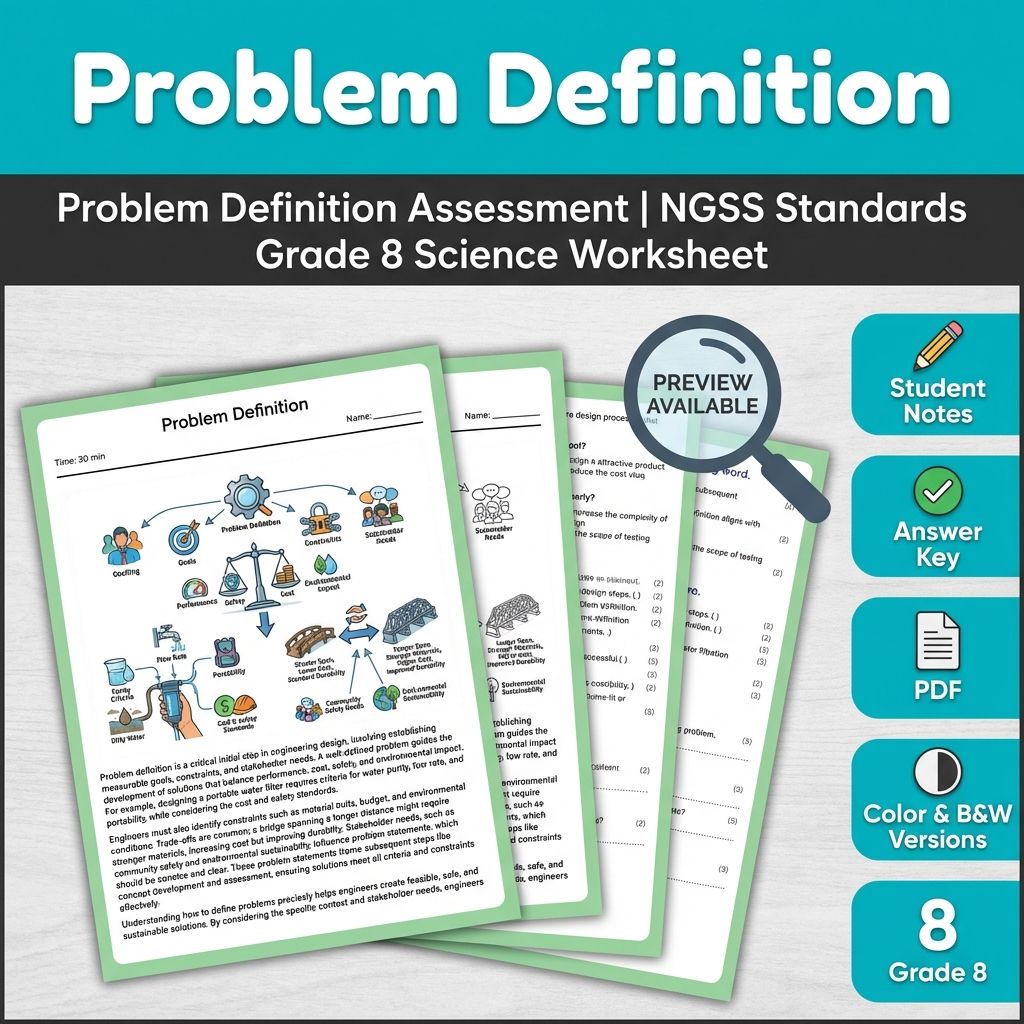
Problem Definition Assessment | NGSS Standards Grade 8 Science Worksheet
Created byPrism Point LearningLearning Objectives
- Understand the criteria and constraints involved in defining engineering problems.
- Identify key stakeholder needs and safety requirements for problem statements.
- Analyze scenarios like water filtration and bridge design to evaluate trade-offs.
Also included in: Grade 8 Science Mini Bundle – Engineering Design Unit & Assessments +1 more
Instant download
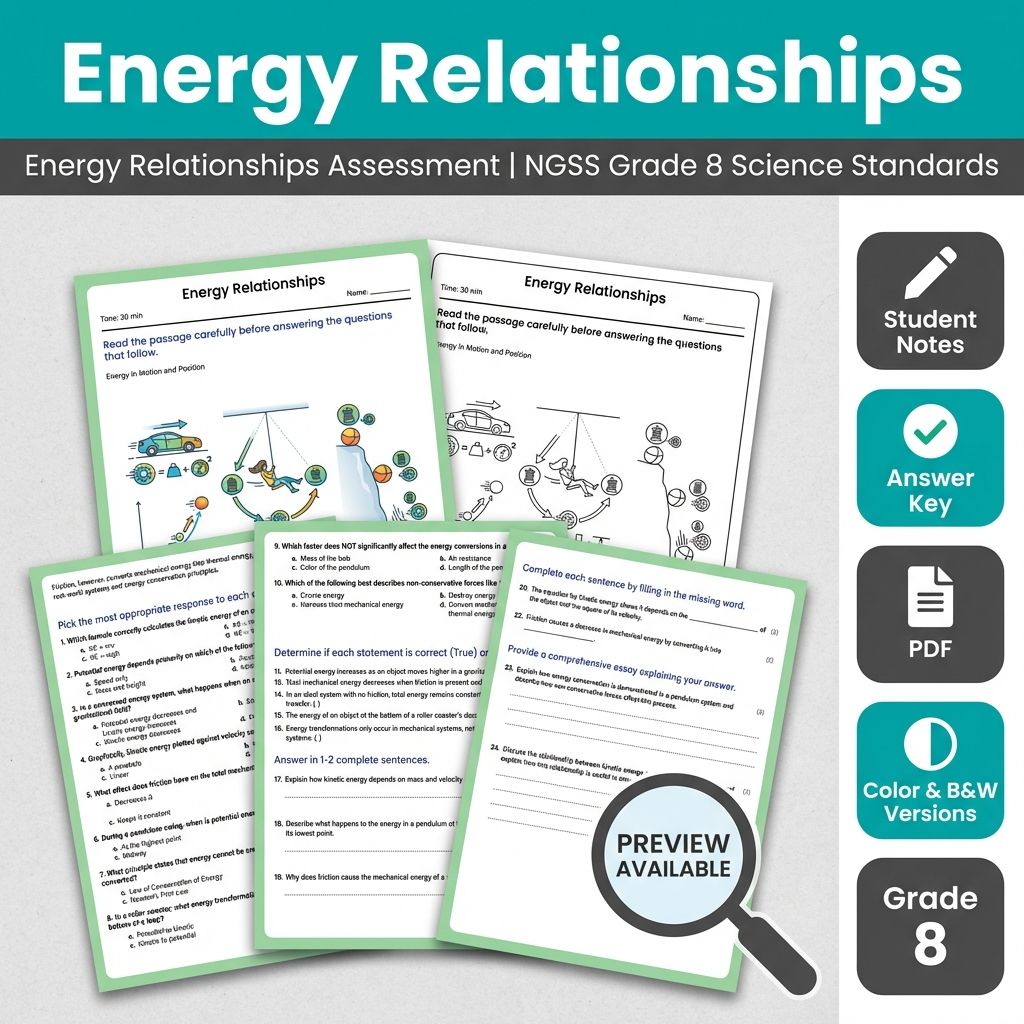
Energy Relationships Assessment | NGSS Grade 8 Science Standards
Created byPrism Point LearningLearning Objectives
- Describe the relationship between kinetic energy, potential energy, and their dependence on mass, speed, and position.
- Interpret graphs relating kinetic energy to mass and to the square of speed.
- Analyze energy interchange in systems like pendulums and roller coasters.
Also included in: Grade 8 Science Mini Bundle – Energy NGSS Standards-Aligned Not Specified +1 more
Instant download
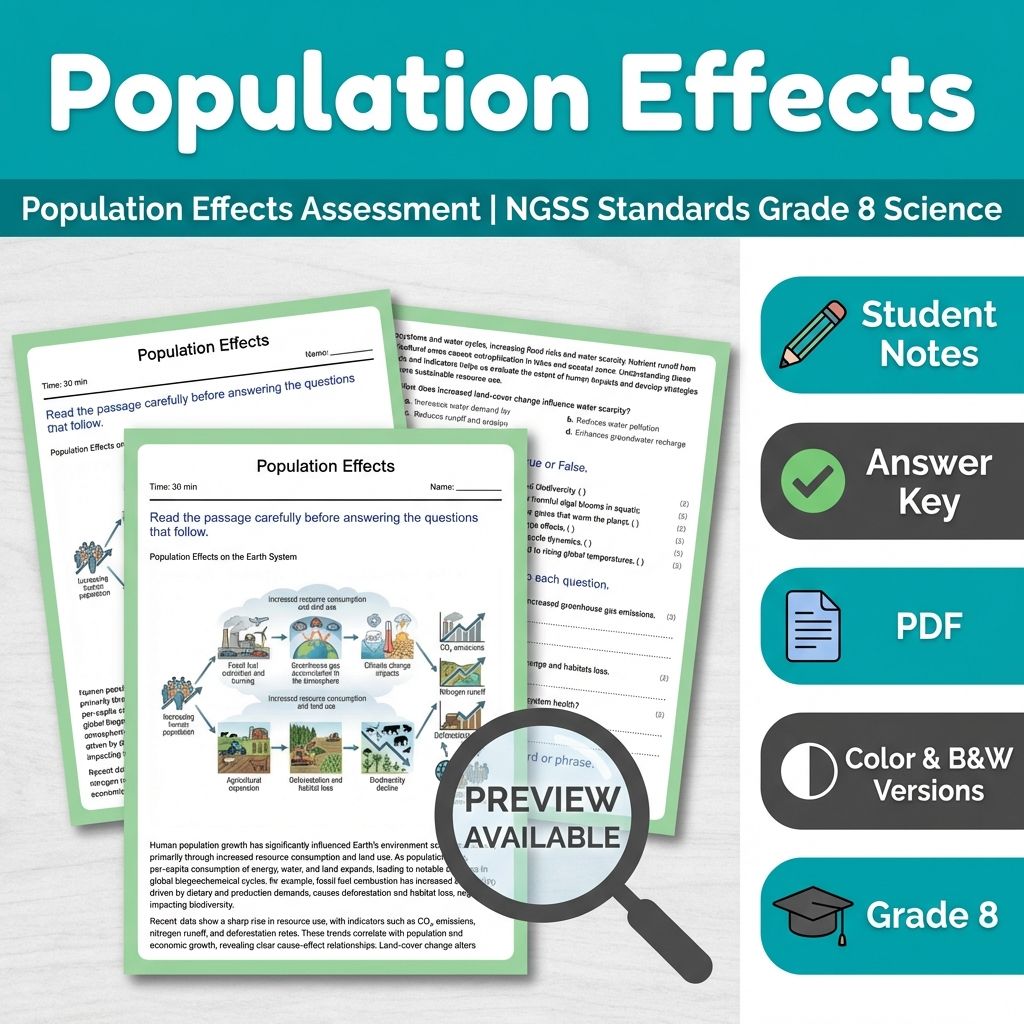
Population Effects Assessment | NGSS Standards Grade 8 Science
Created byPrism Point LearningLearning Objectives
- Analyze the links between population growth, resource consumption, and environmental change.
- Evaluate quantitative indicators and data trends related to climate, land use, and biogeochemical fluxes.
- Apply cause–effect reasoning to assess how demographic and consumption patterns impact Earth systems.
Also included in: Lesson Grade 8 Science Mini Bundle – Earth & Human Activity Standards-Aligned +1 more
Instant download
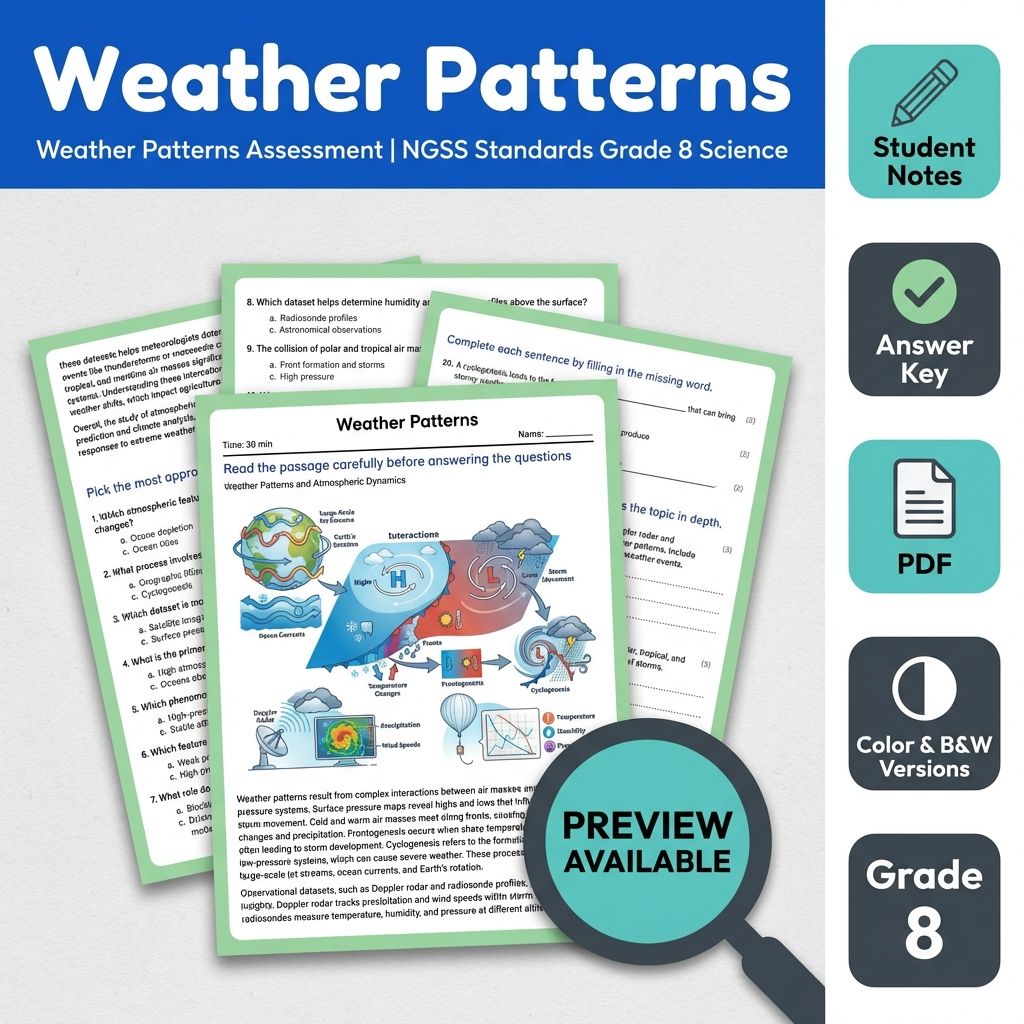
Weather Patterns Assessment | NGSS Standards Grade 8 Science
Created byPrism Point LearningLearning Objectives
- Understand the role of air mass motions in changing weather conditions.
- Identify key features of surface pressure systems and their influence.
- Explain processes such as frontogenesis and cyclogenesis in weather development.
Also included in: Grade 8 Science Mini Bundle – Earth's Systems & NGSS Standards-Aligned +1 more
Instant download
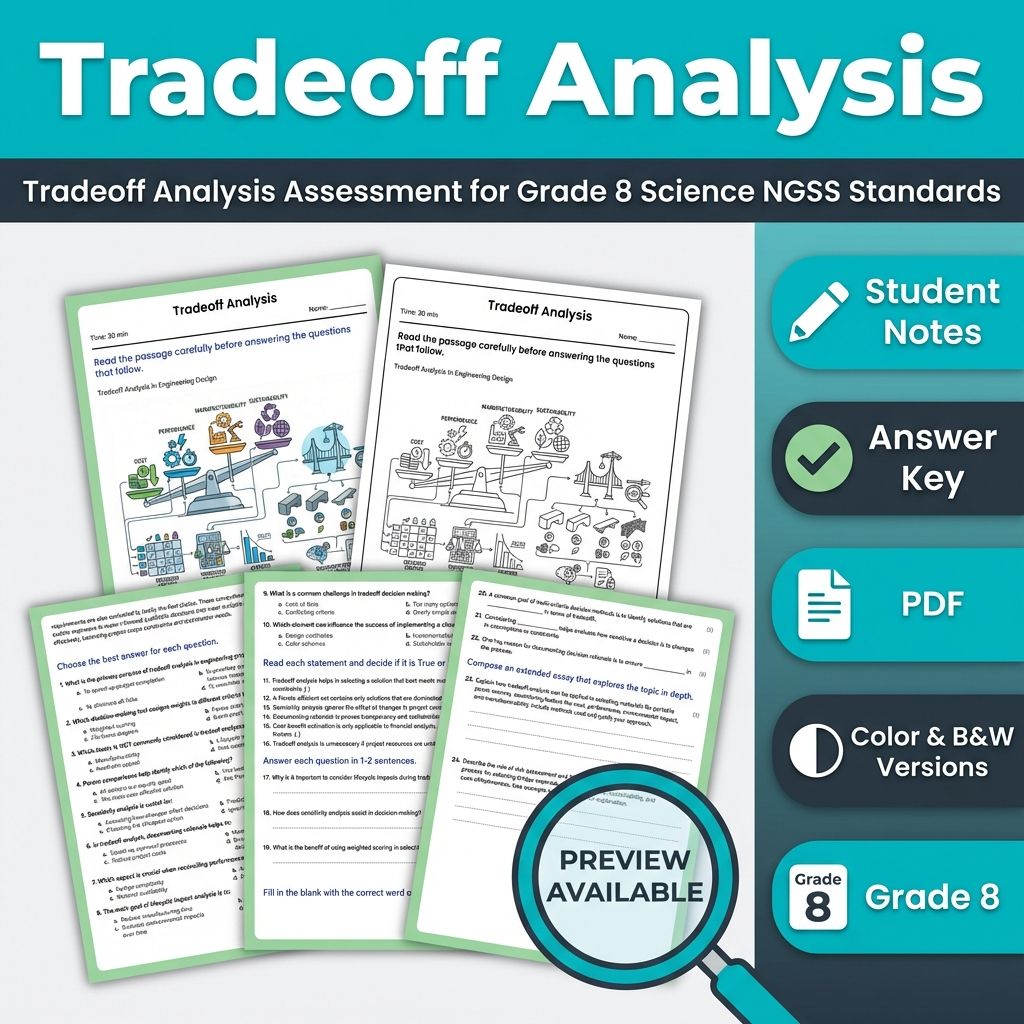
Tradeoff Analysis Assessment for Grade 8 Science NGSS Standards
Created byPrism Point LearningLearning Objectives
- Understand methods for prioritizing competing factors in decision-making.
- Apply multi-criteria decision tools like weighted scoring and Pareto analysis.
- Evaluate tradeoffs among performance, cost, manufacturability, and sustainability.
Also included in: Grade 8 Science Mini Bundle – Engineering Design Unit & Assessments +1 more
Instant download
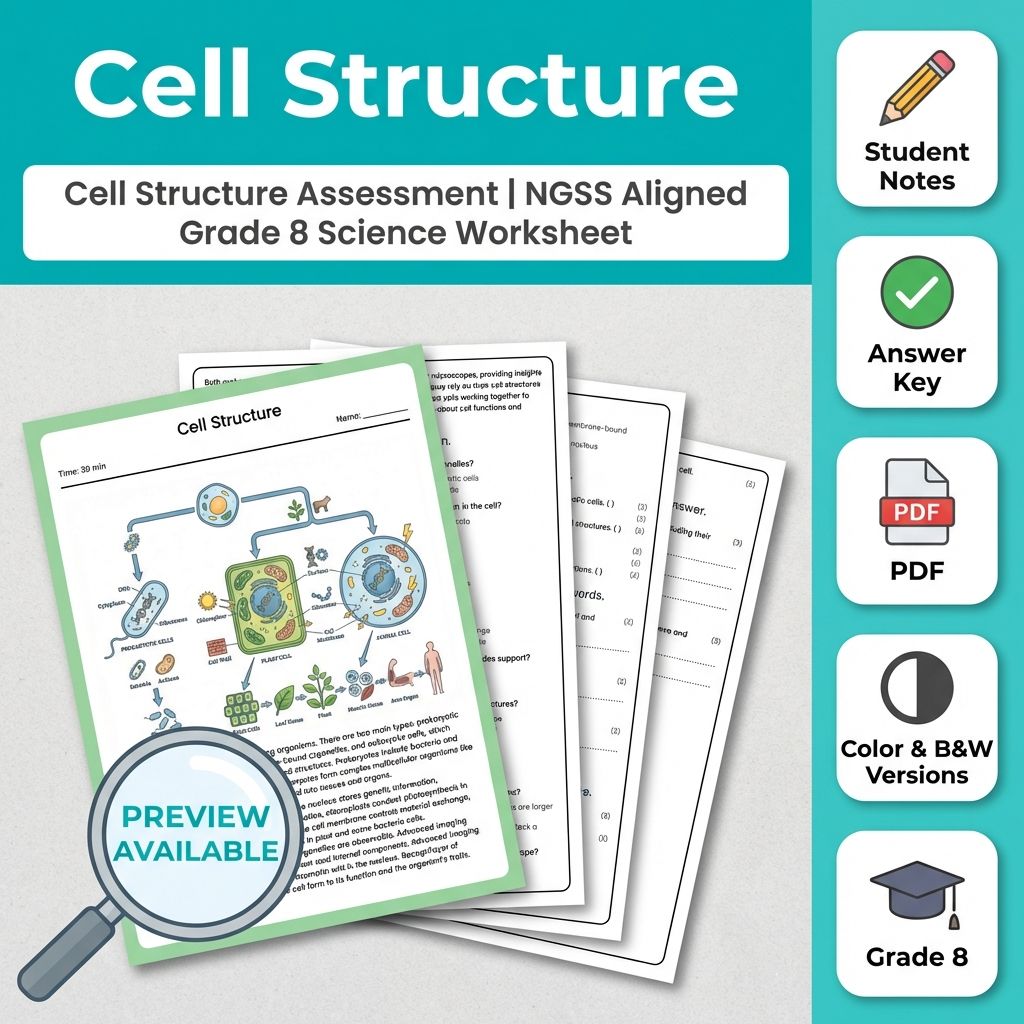
Cell Structure Assessment | NGSS Aligned Grade 8 Science Worksheet
Created byPrism Point LearningLearning Objectives
- Describe the anatomical and functional features of different cell organelles.
- Compare prokaryotic and eukaryotic cells, highlighting key differences.
- Differentiate between single-celled and multicellular organisms based on cellular organization.
Also included in: Grade 8 Science Mini Bundle – Structure & Processes Unit (NGSS Aligned) +1 more
Instant download
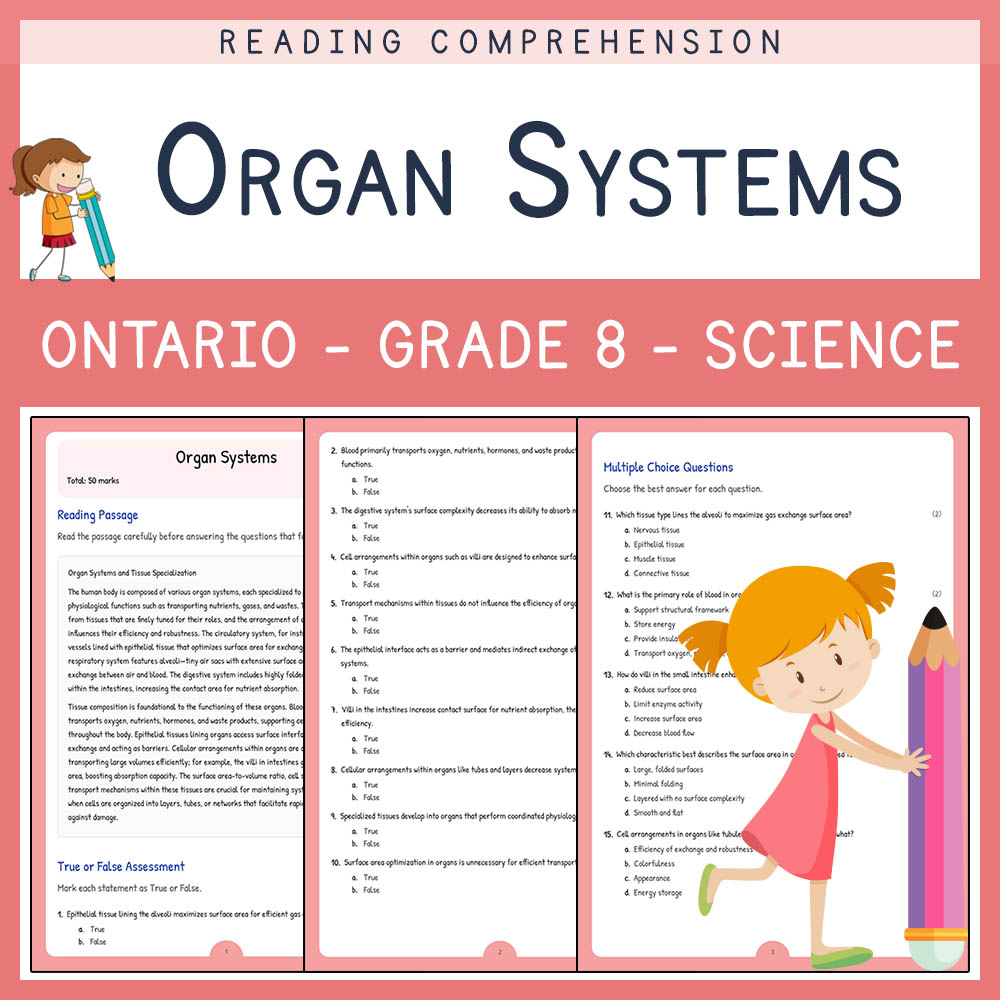
Grade 8 Science | Organ Systems Worksheet Elena | Ontario Standards
Created byLumora LearningLearning Objectives
- Understand how tissue composition influences organ system functions such as gas exchange, nutrient distribution, and waste removal.
- Explain how specialized tissues form organs that perform coordinated physiological roles in the circulatory, respiratory, and digestive systems.
- Recognize the significance of blood and epithelial interfaces in maintaining system efficiency.
Instant download
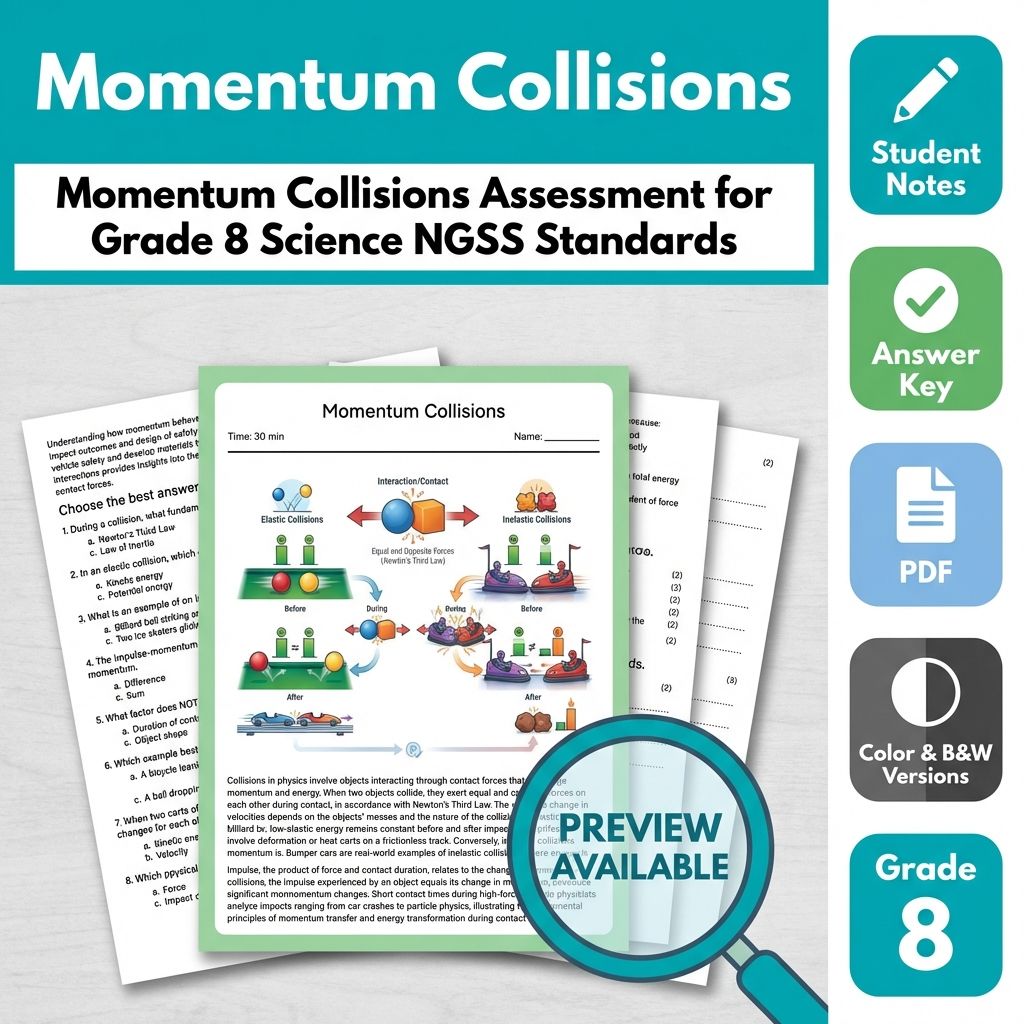
Momentum Collisions Assessment for Grade 8 Science NGSS Standards
Created byPrism Point LearningLearning Objectives
- Understand the principles of momentum exchange during collisions.
- Distinguish between elastic and inelastic collisions through conservation of kinetic energy.
- Analyze real-world examples involving impacts and velocity changes.
Also included in: Grade 8 Science Mini Bundle | Forces and Interactions NGSS-Aligned Unit +1 more
Instant download
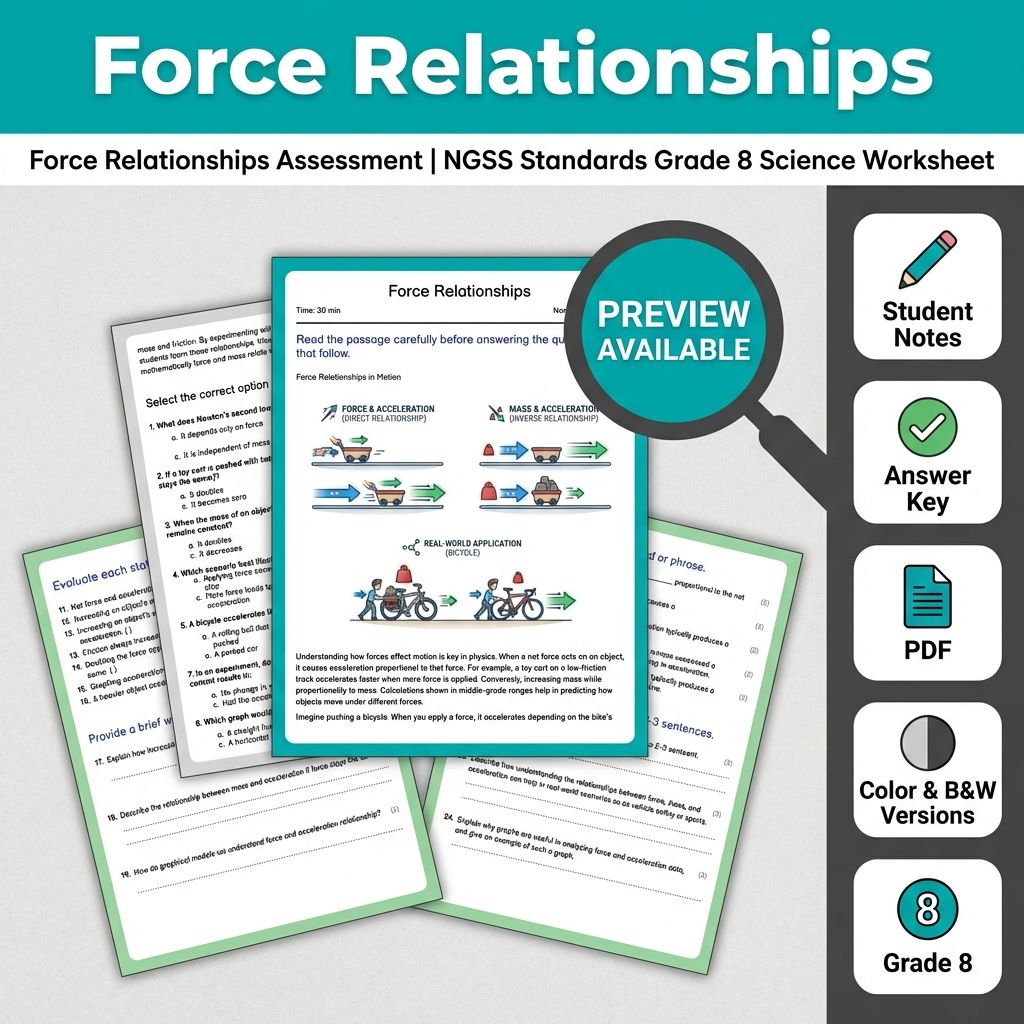
Force Relationships Assessment | NGSS Standards Grade 8 Science Worksheet
Created byPrism Point LearningLearning Objectives
- Analyze and interpret the mathematical relationships among net force, mass, and acceleration.
- Apply proportional calculations to predict changes in motion based on force and mass values.
- Use graphical and numerical models to understand the effects of different forces on objects.
Also included in: Grade 8 Science Mini Bundle | Forces and Interactions NGSS-Aligned Unit +1 more
Instant download
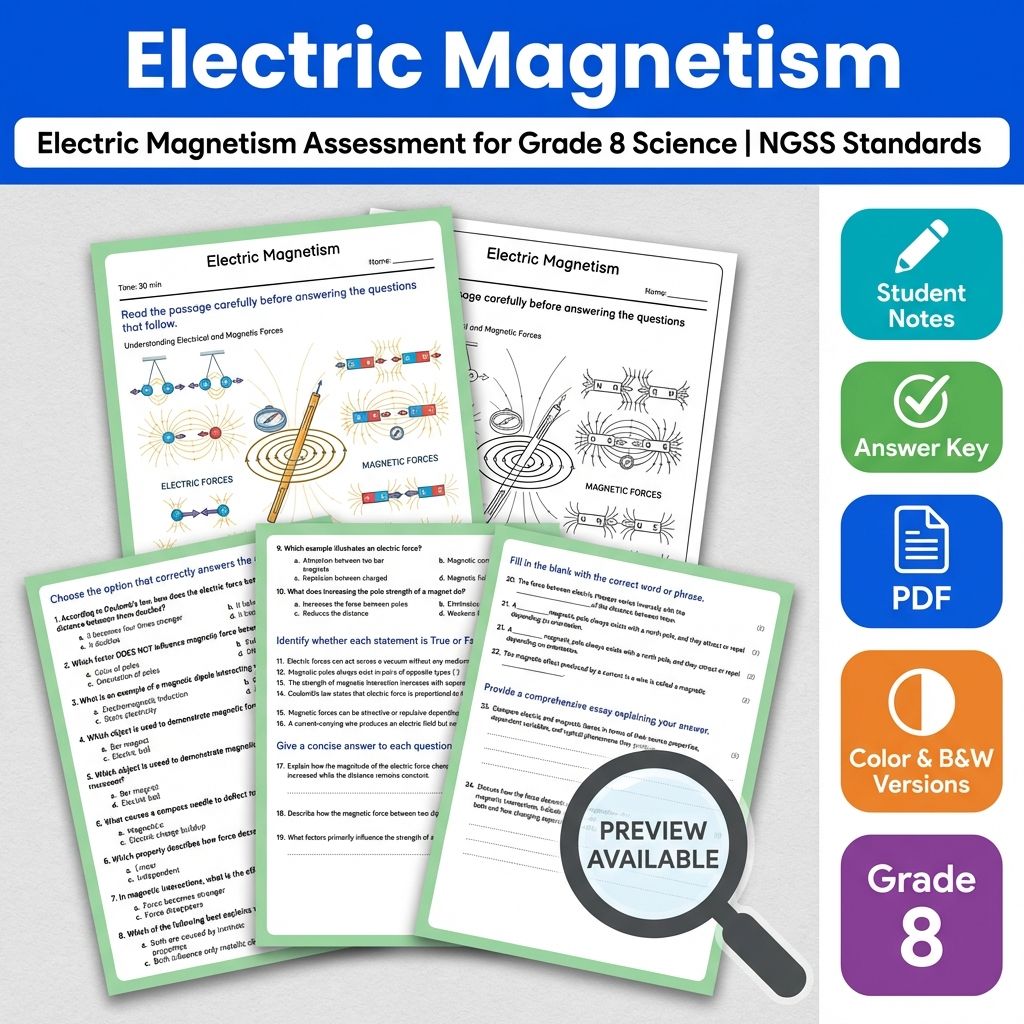
Electric Magnetism Assessment for Grade 8 Science | NGSS Standards
Created byPrism Point LearningLearning Objectives
- Understand how electric and magnetic forces are described through field interactions.
- Identify the relationships between force magnitude, charge/pole properties, and distance.
- Analyze examples such as charged objects, magnetic dipoles, and compass deflections to understand forces.
Also included in: Grade 8 Science Mini Bundle | Forces and Interactions NGSS-Aligned Unit +1 more
Instant download
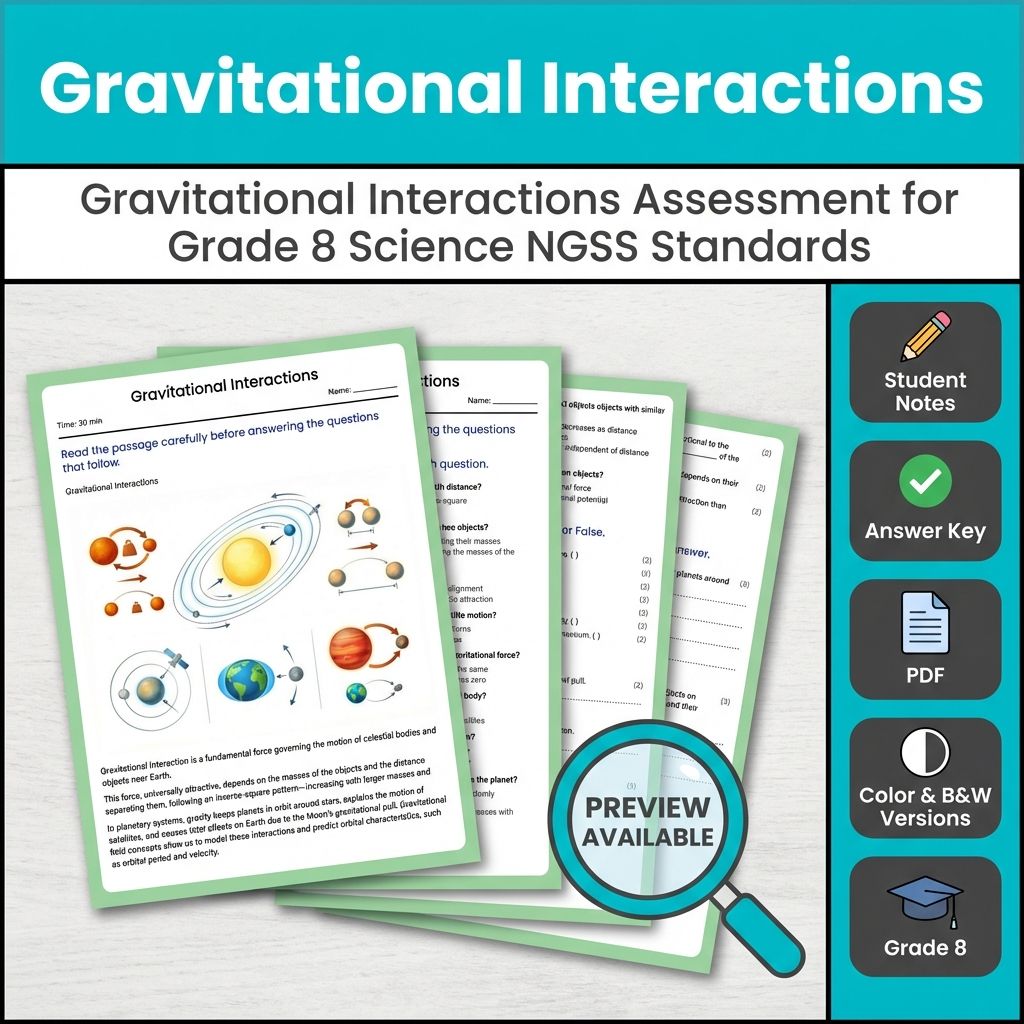
Gravitational Interactions Assessment for Grade 8 Science NGSS Standards
Created byPrism Point LearningLearning Objectives
- Understand the inverse-square law pattern of gravitational force.
- Explain how mass and distance influence gravitational attraction.
- Describe the manifestations of gravity such as planetary orbits and tides.
Also included in: Grade 8 Science Mini Bundle | Forces and Interactions NGSS-Aligned Unit +1 more
Instant download

Grade 8 Science – Circuit Fundamentals Worksheet (Alberta Standards) (PDF)
Created byEvergreen Desk EducationLearning Objectives
- Identify the roles of a power source, conductors, loads, and control elements in a simple electric circuit.
- Interpret common circuit schematic symbols and explain how they relate to circuit behavior.
- Predict what happens to current and continuity when switches are open or closed in series and parallel circuits.
Instant download
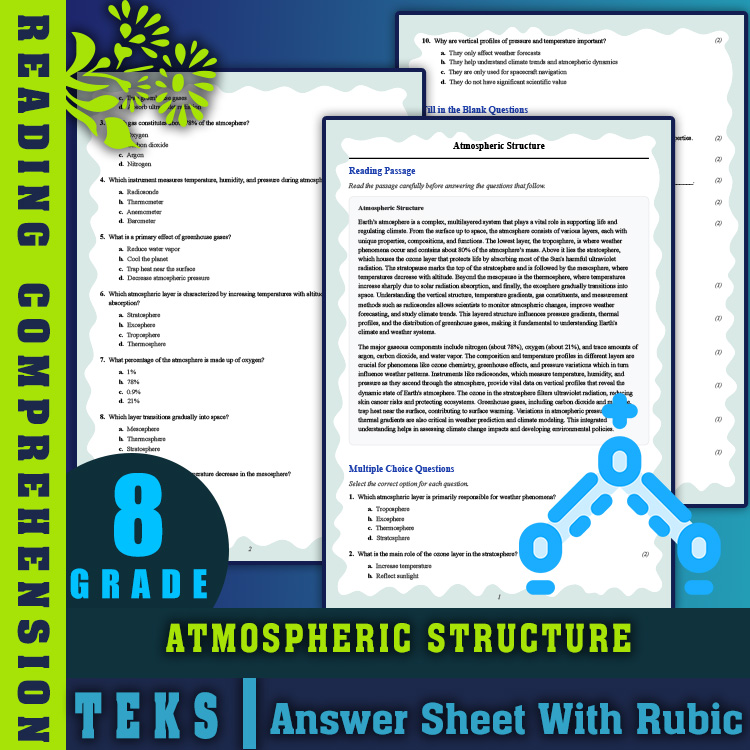
Grade 8 Science | Atmospheric Structure Reading Worksheet (PDF + Answer Key)
JCreated byJ.S SheetsLearning Objectives
- Identify and describe the major layers of Earth's atmosphere.
- Understand the roles of ozone and greenhouse gases in atmospheric processes.
- Interpret pressure and thermal profiles within different atmospheric layers.
Instant download
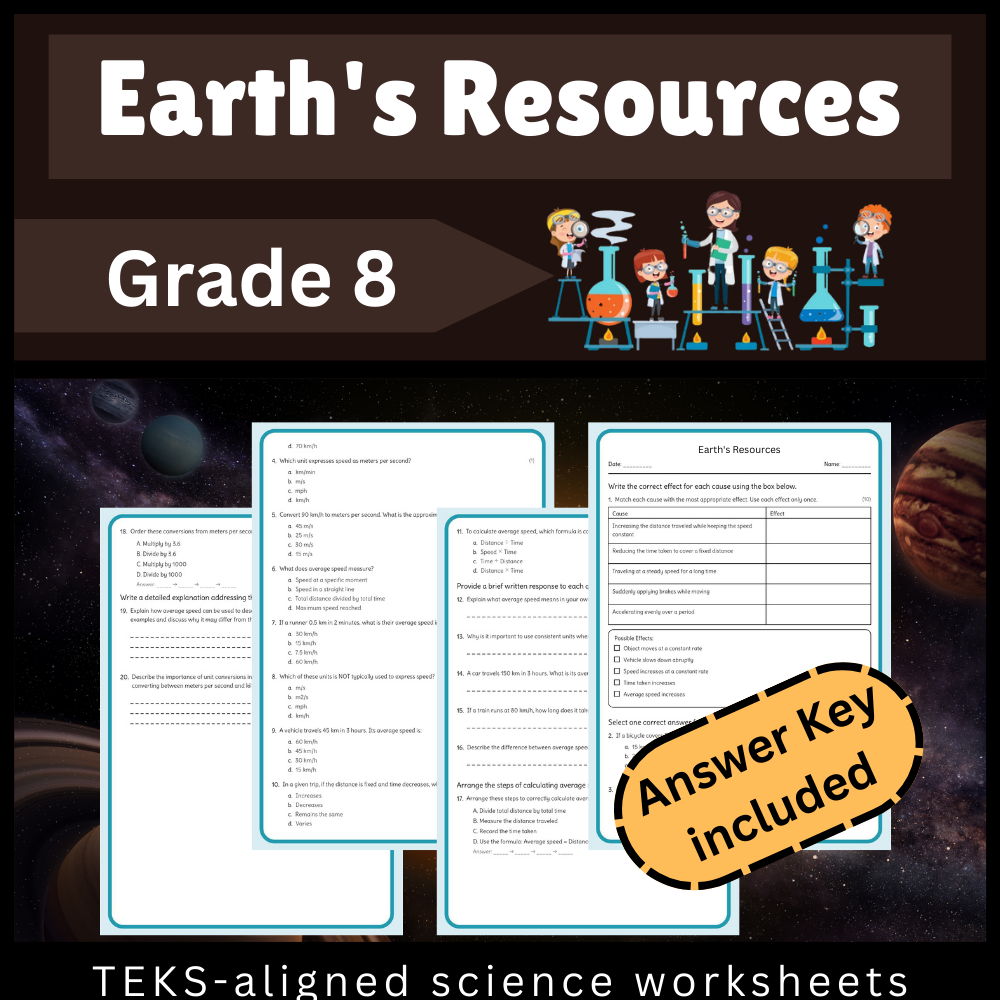
Grade 8 Science | Earth's Resources Worksheet (Worksheet + Answer Key) – TEKS Alignment
Created byBright Mind ResourcesLearning Objectives
- Understand the distribution and classification of renewable and nonrenewable resources.
- Analyze the impacts of resource extraction on landforms, water quality, and ecosystems.
- Explore methods for resource assessment such as mapping and inventories.
Also included in: Grade 8 Science UNIT Bundle | Weather, Solar System & Earth - TEKS Aligned +1 more
Instant download

Reaction Signatures Worksheet | Grade 8 Science Practice
Created byPrism Point LearningLearning Objectives
- Identify common observable signatures of chemical change, including temperature change, precipitate formation, persistent colour change, and gas release.
- Explain how multiple evidence signals together can support the conclusion that a chemical reaction has occurred.
- Apply reaction-signature ideas to environmental and industrial examples such as corrosion, carbonate reactions, and combustion residues.
Also included in: Grade 8 Matter & Chemical Change Lesson Bundle | Alberta Science
Instant download
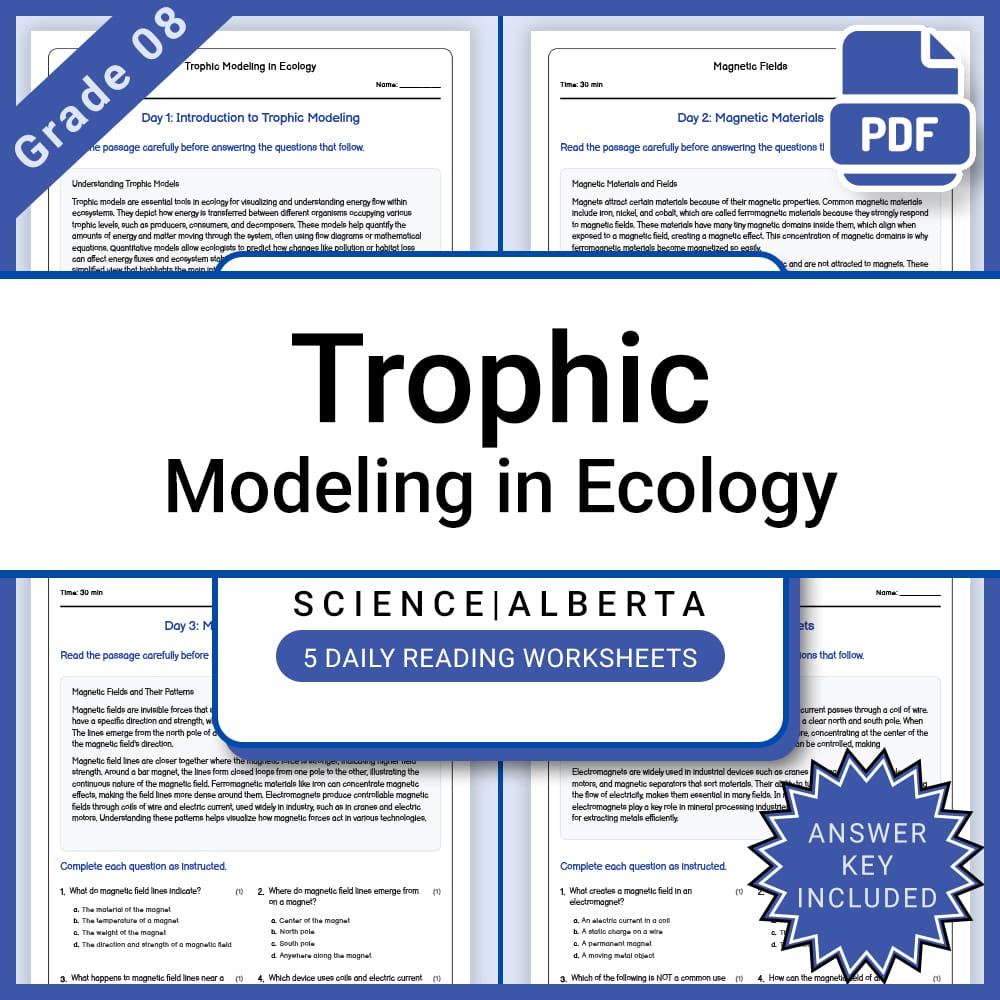
Grade 8 Science Trophic Modeling in Ecology Daily Reading Worksheet + Answer Key
JCreated byJ.S SheetsLearning Objectives
- Understand the concept of trophic levels and energy flow in ecosystems.
- Learn how models represent energy and matter fluxes among trophic compartments.
- Recognize the assumptions and limitations of trophic models.
Also included in: Grade 8 Science Lesson Bundle | Ecosystems, Energy, and Environmental Impact +1 more
Instant download
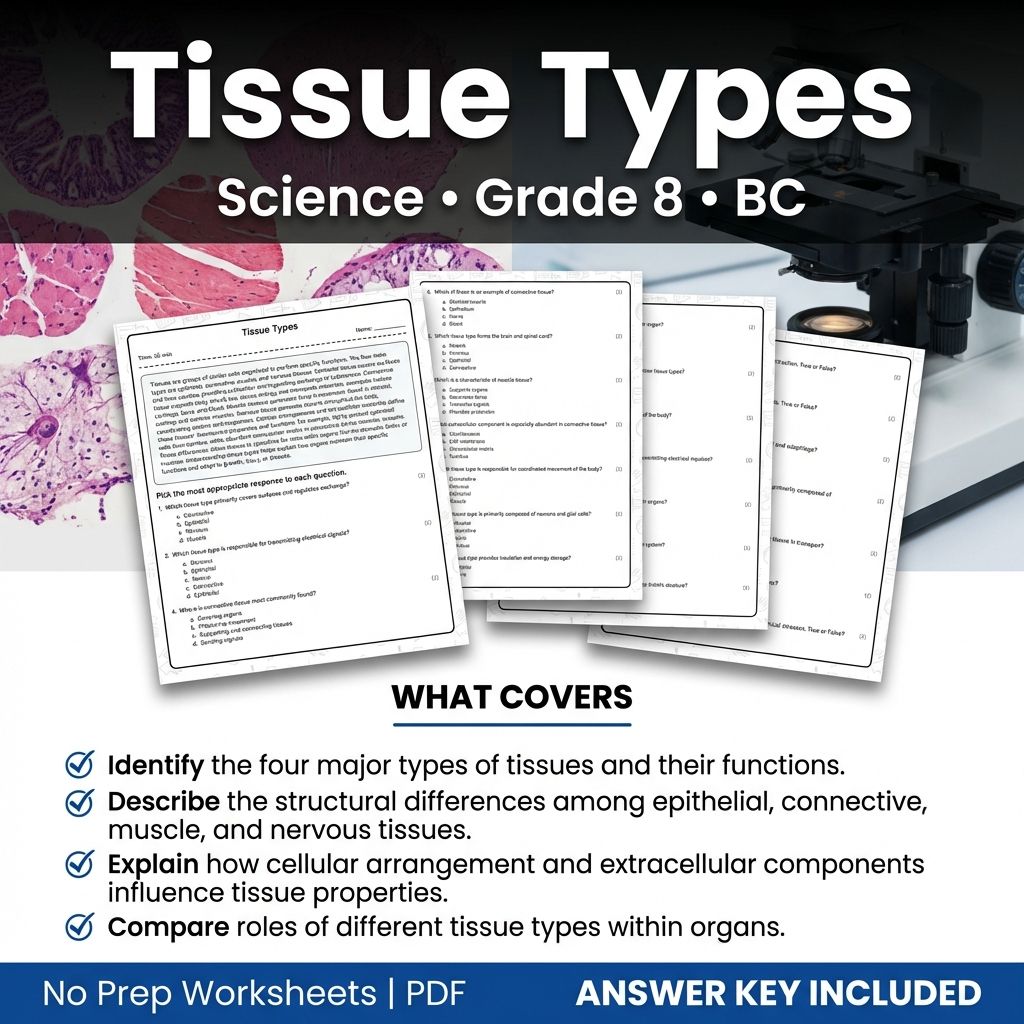
8th Grade Science | Tissue Types Worksheet & Answer Key (Printable PDF)
Created byCoral Reef LearningLearning Objectives
- Identify the four major types of tissues and their functions.
- Describe the structural differences among epithelial, connective, muscle, and nervous tissues.
- Explain how cellular arrangement and extracellular components influence tissue properties.
Instant download
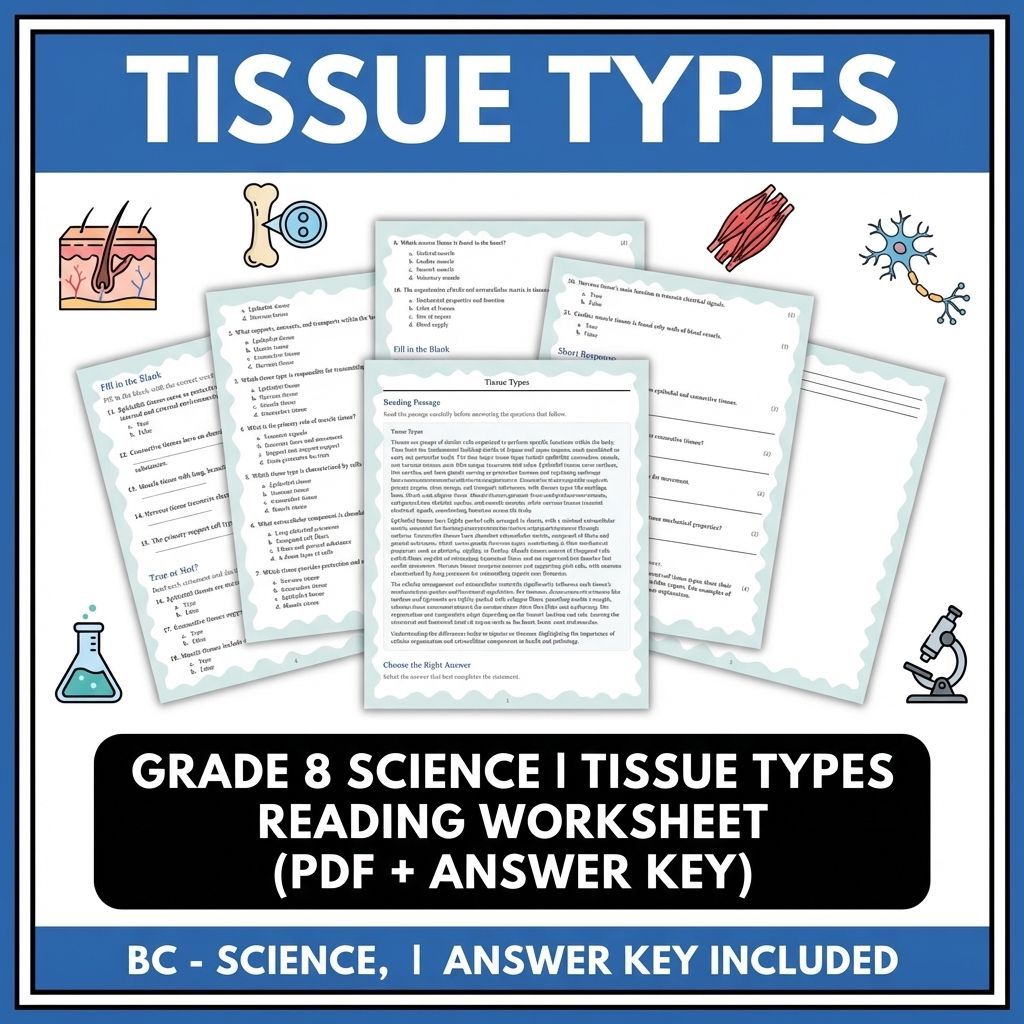
Grade 8 Science | Tissue Types Reading Worksheet (PDF + Answer Key)
JCreated byJ.S SheetsLearning Objectives
- Identify and describe the major types of tissues: epithelial, connective, muscle, and nervous.
- Compare the structure and function of different tissue types.
- Explain how cellular organization and extracellular components influence tissue properties.
Instant download

Grade 8 Science | Cratered vs Resurfaced Worlds Worksheet | General Aligned
Created byLumora LearningLearning Objectives
- Explain how crater density and the presence of smoother plains can indicate relative surface ages on solar system bodies.
- Compare geologic resurfacing processes such as lava flows and impact-related modification of the landscape.
- Use evidence from crater size, spacing, and surrounding materials to infer which surfaces are older or more recently altered.
Instant download
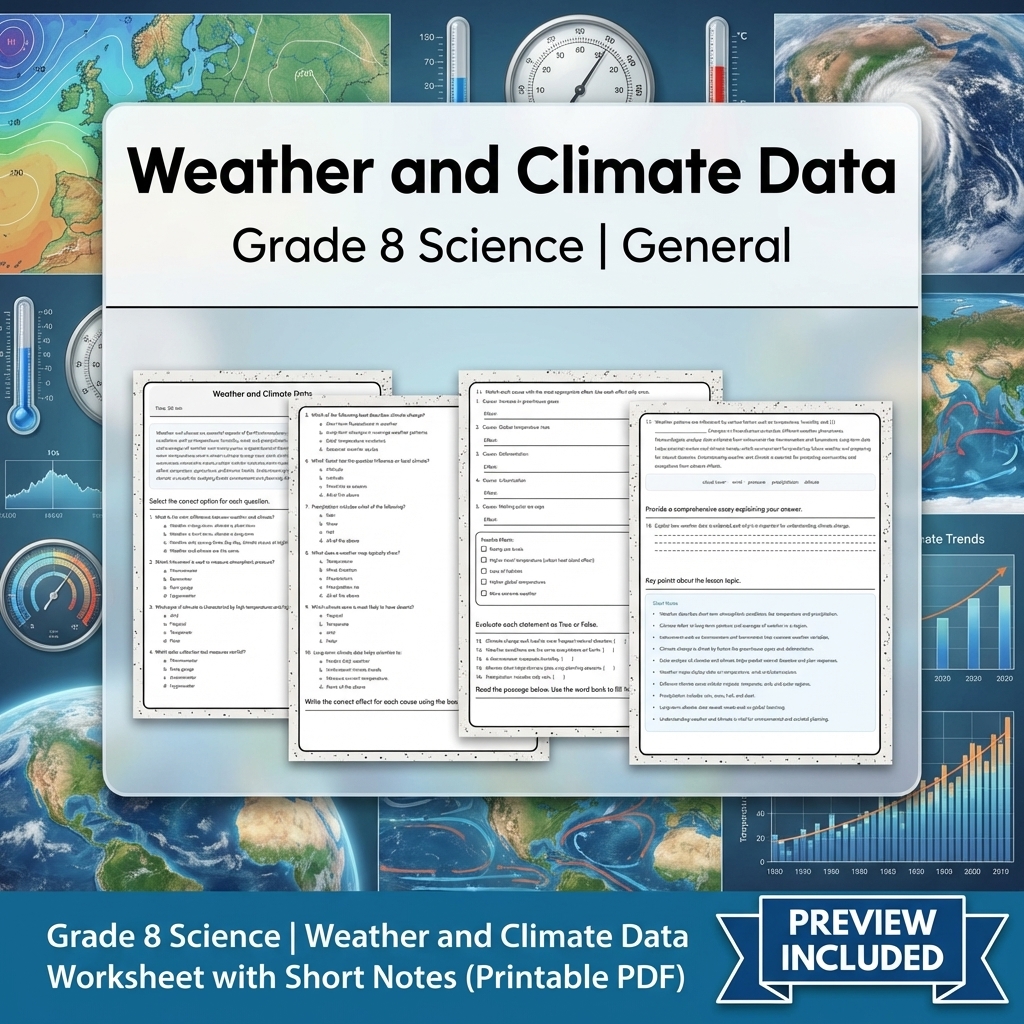
Grade 8 Science | Weather and Climate Data Worksheet with Short Notes
Created byMeadowlark WorksheetsLearning Objectives
- Understand key weather and climate concepts.
- Analyze data related to weather patterns and climate.
- Interpret weather graphs and tables.
Also included in: Grade 8 Weather and Climate Science Lesson Bundle: General Framework +1 more
Instant download
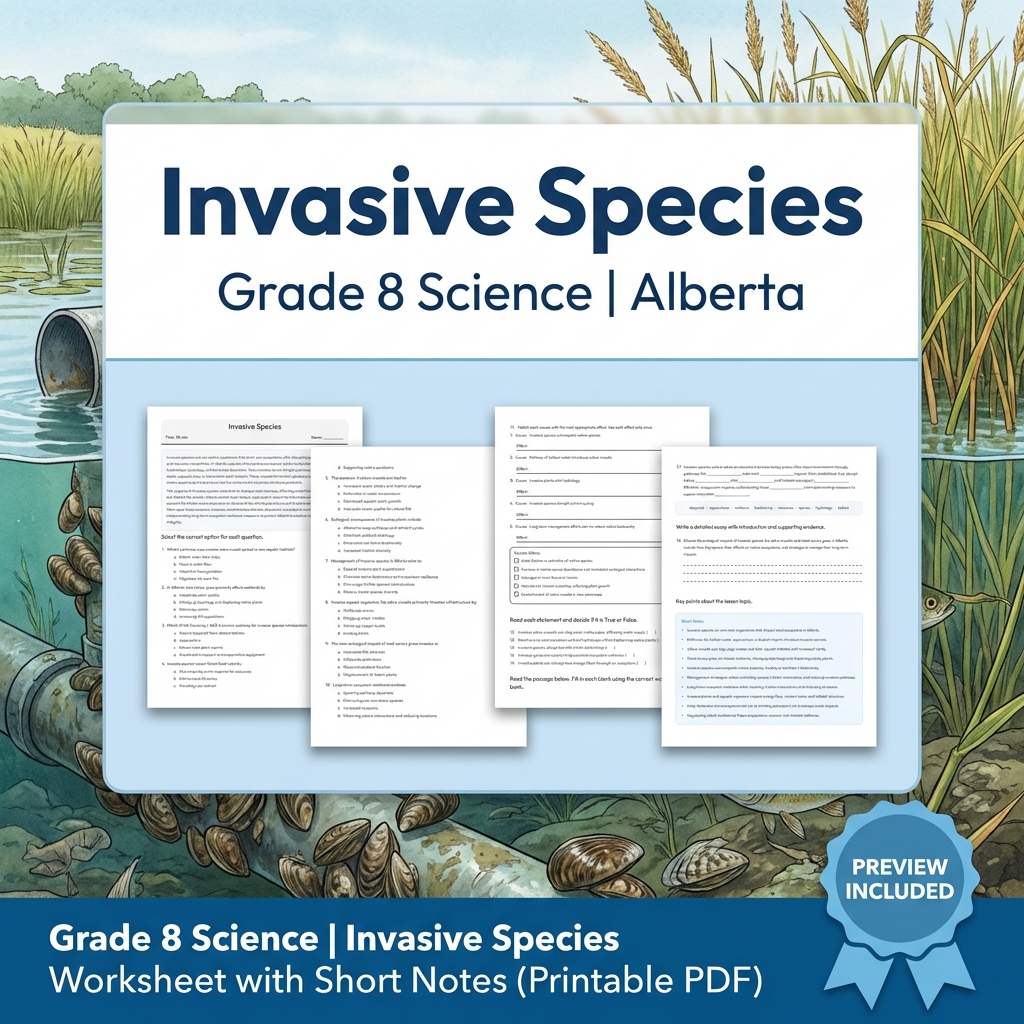
Grade 8 Science | Invasive Species Worksheet with Short Notes (Printable PDF)
Created byMeadowlark WorksheetsLearning Objectives
- Understand the impacts of invasive species on native ecosystems.
- Identify pathways through which invasive species spread and threaten biodiversity.
- Analyze ecological consequences of invasive plants and aquatic organisms in Alberta.
Also included in: Grade 8 Science | Interactions & Ecosystems UNIT Worksheet Bundle +1 more
Instant download
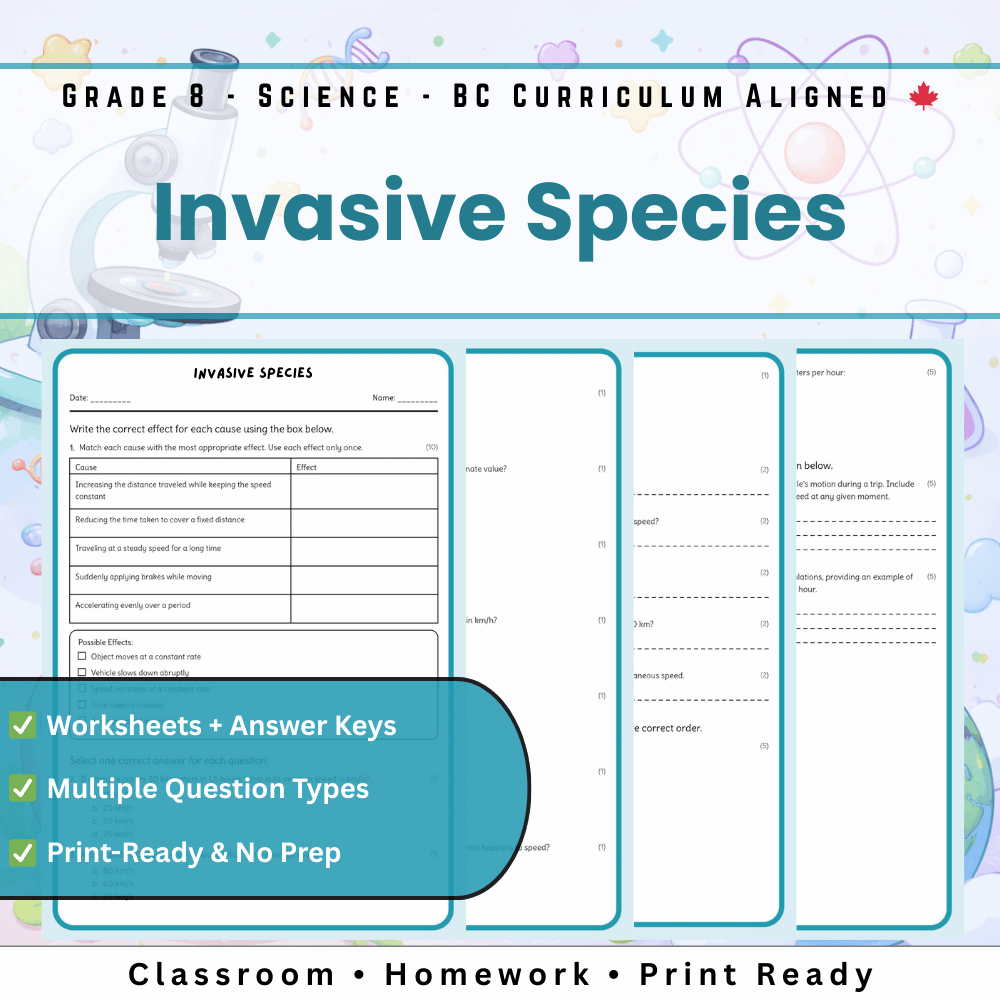
Grade 8 Science | Invasive Species Understanding Worksheet (PDF) – BC Standards
Created byBright Mind ResourcesLearning Objectives
- Explain what invasive species are and how they establish in new ecosystems.
- Identify ecological traits that enable invasive species to spread rapidly.
- Describe the impacts invasive species have on native biodiversity and ecosystem processes.
Instant download

Science Worksheet Life-Cycle Tradeoffs Grade 8 | Standards-Aligned Practice
JCreated byJ.S SheetsLearning Objectives
- Explain how environmental impacts can occur before, during, and after a product’s use.
- Identify trade-offs between materials, maintenance, energy use, and end-of-life disposal.
- Use system-level thinking to compare different design options fairly.
Also included in: Grade 8 Engineering Design Testing Tradeoffs Science Lesson Bundle - General Framework +1 more
Instant download
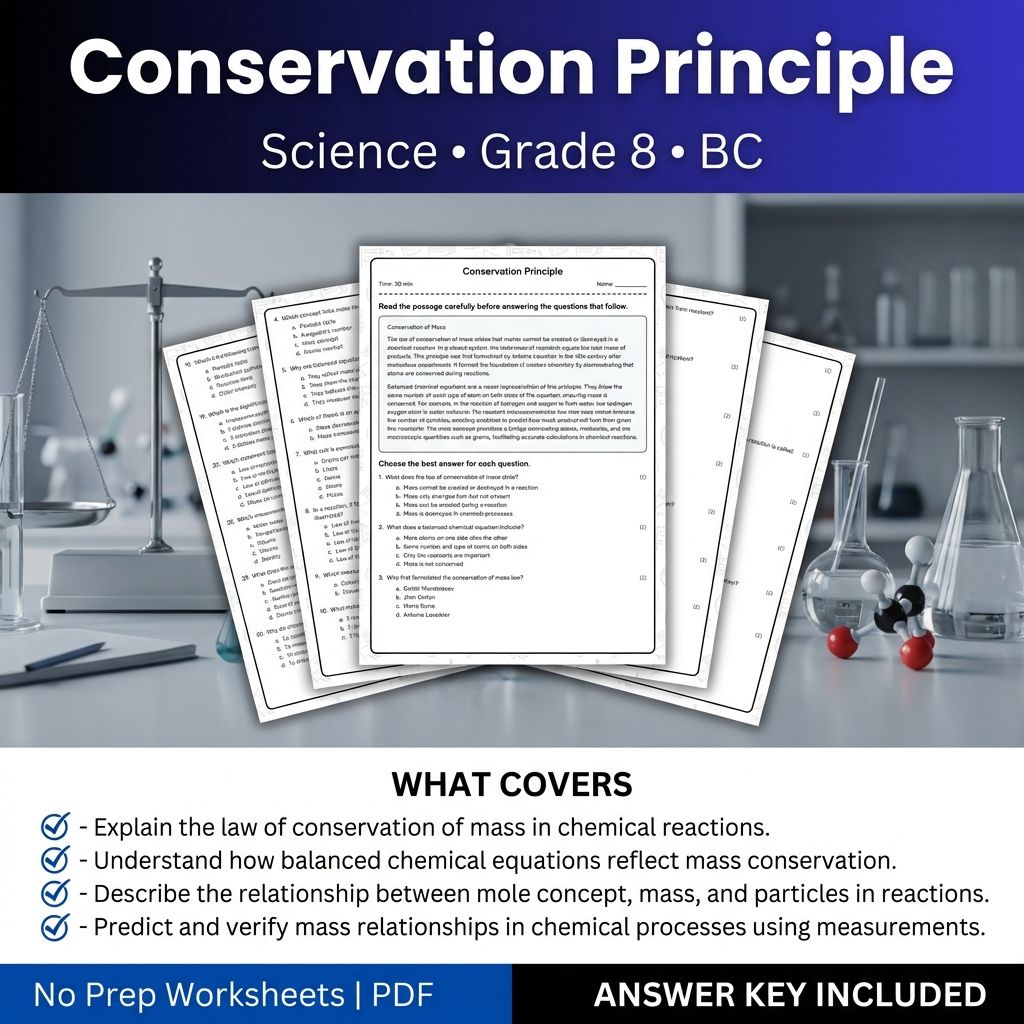
Grade 8 Science Worksheet | Conservation Principle Practice & Answer Key (PDF)
Created byCoral Reef LearningLearning Objectives
- Explain the law of conservation of mass in chemical reactions.
- Understand how balanced chemical equations reflect mass conservation.
- Describe the relationship between mole concept, mass, and particles in reactions.
Instant download
About Grade 8 Science Worksheets
Explore Grade 8 Science worksheets for classwork, homework, or review. Our 6,006 printables download instantly as PDFs.
Each resource here is built by an independent educator and reviewed for quality. Worksheets print straight from PDF and suit classroom use, homework, or extra practice; most come with answer keys, and you can preview before purchasing.