
Grade 8 Science Worksheets
6,006 worksheets
Solution Comparison Test Prep Worksheet | Grade 8 Science NGSS Review
 Created byPrism Point Learning
Learning Objectives
- Compare multiple design concepts using clear selection criteria and constraints.
- Use measurable performance indicators and evidence to support decisions between competing solutions.
- Explain trade-offs between qualitative and quantitative information when evaluating designs.
Also included in: Grade 8 NGSS Science Practice Lesson Bundle: Modeling & Tradeoff Review
Instant download

Modeling Data Assessment Worksheet | Grade 8 Science NGSS Review
Created byPrism Point LearningLearning Objectives
- Construct physical and computational models to generate quantitative data for comparing design options.
- Use consistent input conditions and repeatable procedures to improve the reliability of experimental results.
- Identify sources of measurement uncertainty and explain how they can affect conclusions from model-based data.
Also included in: Grade 8 NGSS Science Practice Lesson Bundle: Modeling & Tradeoff Review
Instant download
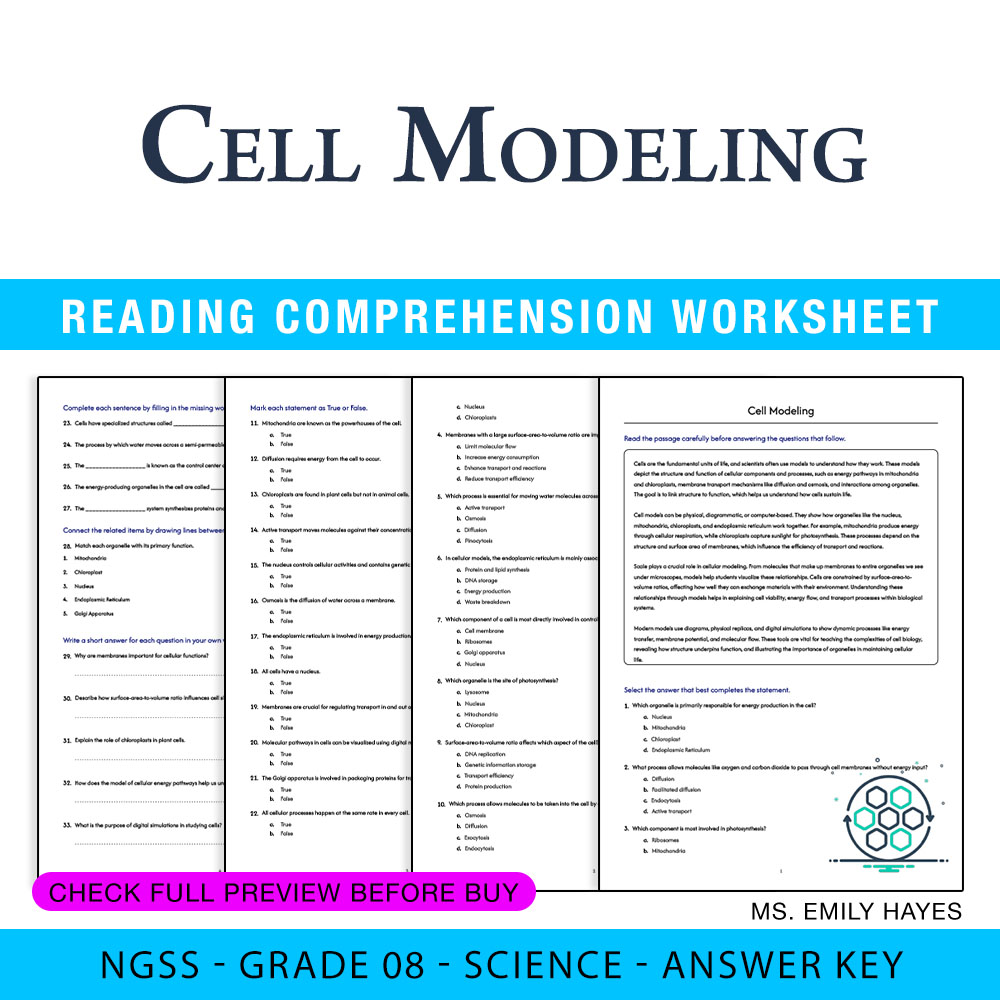
8th Grade Science | Cell Modeling Worksheet (PDF + Answer Key)
 Created byCopper Leaf Classroom
Learning Objectives
- Understand and describe models of cellular processes and structures.
- Identify the roles of organelles and membrane systems in cell function.
- Explain how models link structure to cellular function, including energy pathways and membrane constraints.
Instant download

Grade 8 Atoms And Molecules Worksheet | BC Practice & PDF
 Created byClear Sky Classroom
Learning Objectives
- Explain how atoms and molecules form matter and how their arrangement affects properties.
- Describe how chemical reactions rearrange atoms by breaking and forming bonds while conserving atoms.
- Interpret simple chemical diagrams and use symbols/formulas to identify reactants and products.
Instant download

Plate Tectonics Worksheet Grade 8 Science Activities & Earth Science Practice
Created byPrism Point LearningLearning Objectives
- Explain how plate motions reshape Earth’s landforms over geologic time.
- Describe how evidence (matching coastlines, seafloor features, earthquakes) supports plate tectonics.
- Differentiate divergent, convergent, and transform boundaries by typical landforms and activity.
Also included in: Earth Systems & Climate Lesson Bundle | Grade 8 Science | Florida NGSSS
Instant download

Grade 8 Science | Newtonian Laws Worksheet (PDF) TEKS-Aligned
 Created byEvergreen Desk Education
Learning Objectives
- Explain Newton’s First Law (inertia) and predict how objects respond to changes in net force.
- Use Newton’s Second Law to relate net force, mass, and acceleration in qualitative and quantitative ways.
- Describe Newton’s Third Law (action–reaction) and identify forces that occur in pairs in real situations.
Instant download

Grade 8 Science – Plate Motion Evidence Reading Worksheet | California Standards
 Created byBright Mind Resources
Learning Objectives
- Understand key concepts related to Science
- Apply knowledge through practice questions
- Demonstrate comprehension of the material
Also included in: Earth Grade 8 Science Daily Reading Worksheets Bundle | California Standards +1 more
Instant download
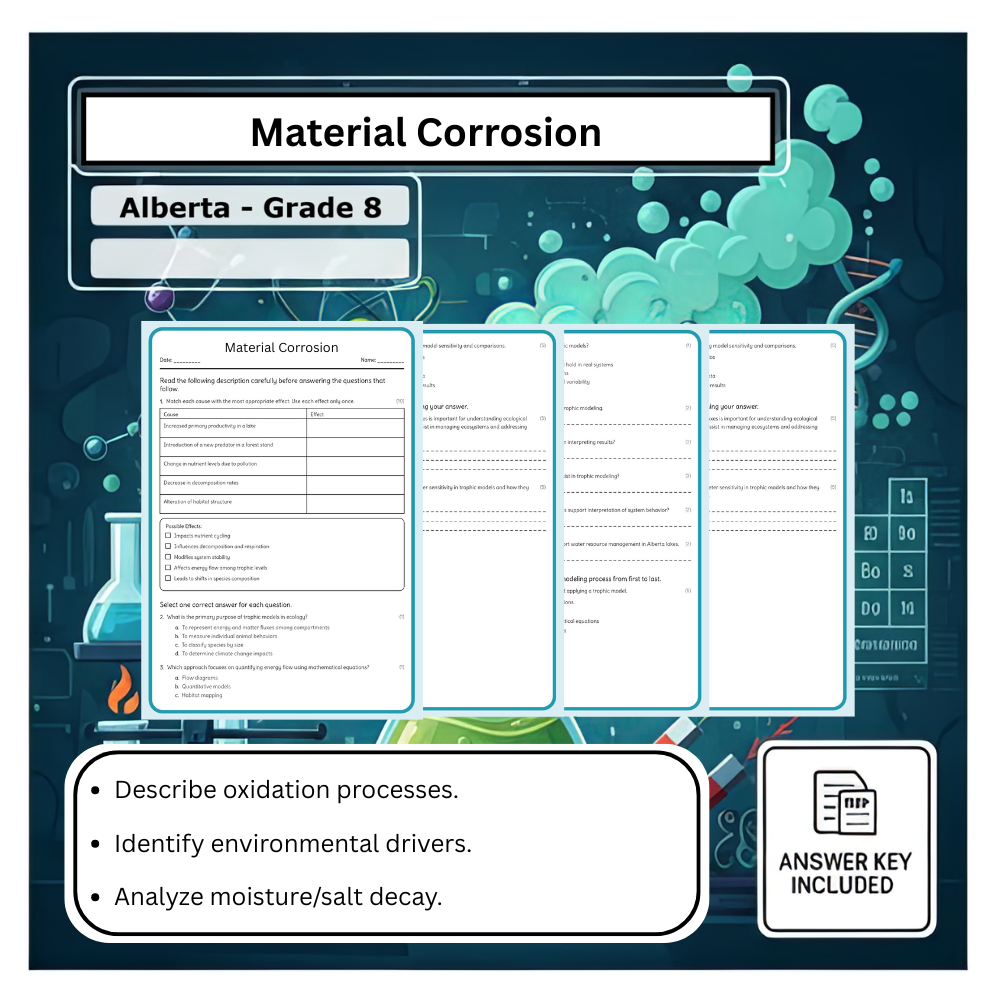
Grade 8 Science | Material Corrosion Worksheet (PDF) – Alberta Standard
Created byBright Mind ResourcesLearning Objectives
- Describe the chemical processes involved in material corrosion.
- Identify environmental factors that influence corrosion in infrastructure.
- Analyze evidence of chemical transformation on materials exposed to moisture and salinity.
Instant download

Contaminant Transport Worksheet Grade 8 Science Ontario + Doodle Note
 Created byChalk and Compass
Learning Objectives
- Explain how advection, dispersion, diffusion, sorption, and biodegradation affect contaminant movement in water
- Describe how redox-driven transformations can change contaminant form and mobility in aquifers
- Use core contaminant transport terms to interpret plume behavior and preferential flow paths
Also included in: Grade 8 Science Watershed Systems Lesson Bundle | Ontario Framework +1 more
Instant download

Gravitational Interactions Worksheet | Grade 8 Science Printable PDF
Learning Objectives
- Understand the universal nature of gravitational attraction and its dependence on mass and distance.
- Explain how gravitational forces influence planetary orbits, satellite movement, and tidal effects.
- Apply inverse-square law concepts to predict orbital characteristics and fall rates of objects.
Also included in: Grade 8 Science Motion and Stability: Forces and Interactions Lesson Bundle +1 more
Instant download
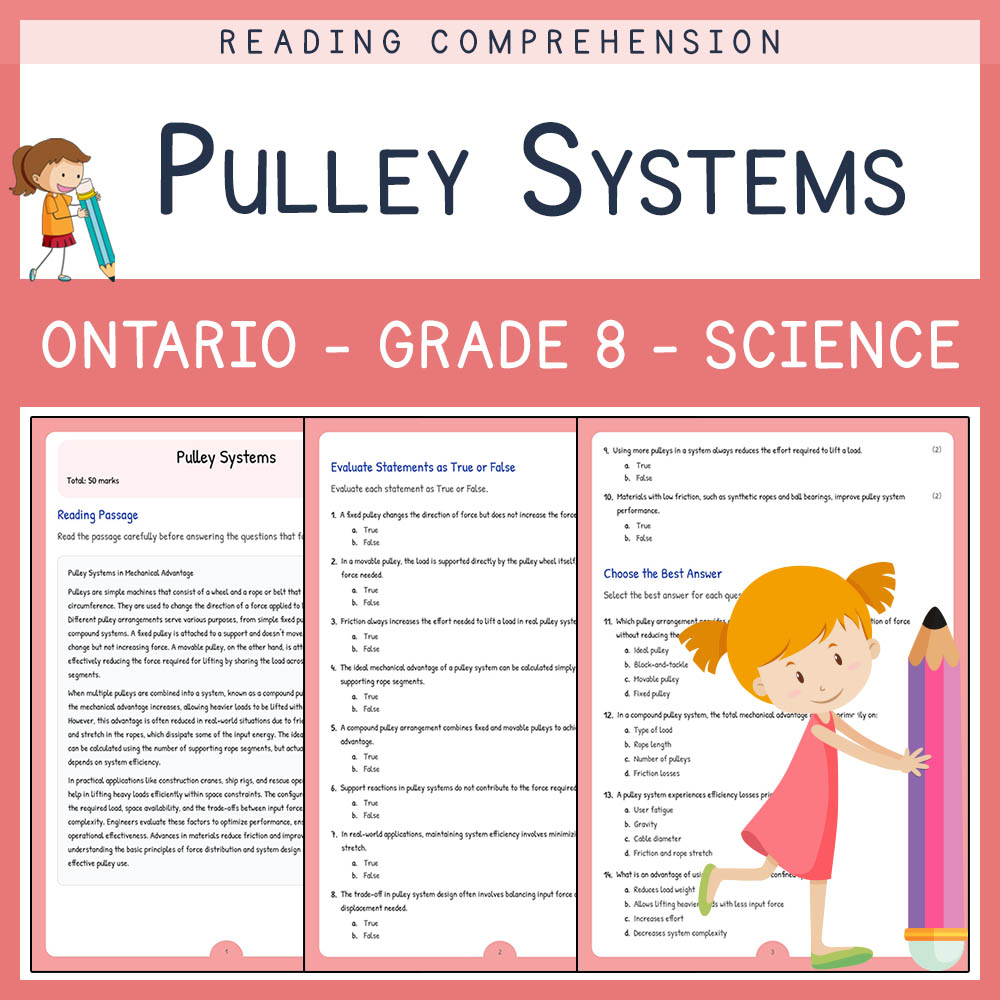
Grade 8 Science Assessment | Pulley Systems Worksheet Elena | Ontario
 Created byLumora Learning
Learning Objectives
- Understand the different types of pulley systems and their configurations.
- Calculate the mechanical advantage of fixed, movable, and compound pulleys.
- Explain force partitioning, support reactions, and how friction affects real-world pulley performance.
Also included in: Grade 8 Science | Systems in Action Lesson Bundle | Ontario Framework
Instant download

Grade 8 Science Worksheet on Free Body Diagrams | Alberta Standards
JCreated byJ.S SheetsLearning Objectives
- Understand how to represent individual forces acting on an object using vectors.
- Identify and describe gravitational, normal, frictional, and applied forces in various scenarios.
- Analyze force vectors to determine net force and predict resulting motion.
Also included in: Grade 8 Forces & Motion Science Lesson Bundle – Alberta framework worksheets +1 more
Instant download
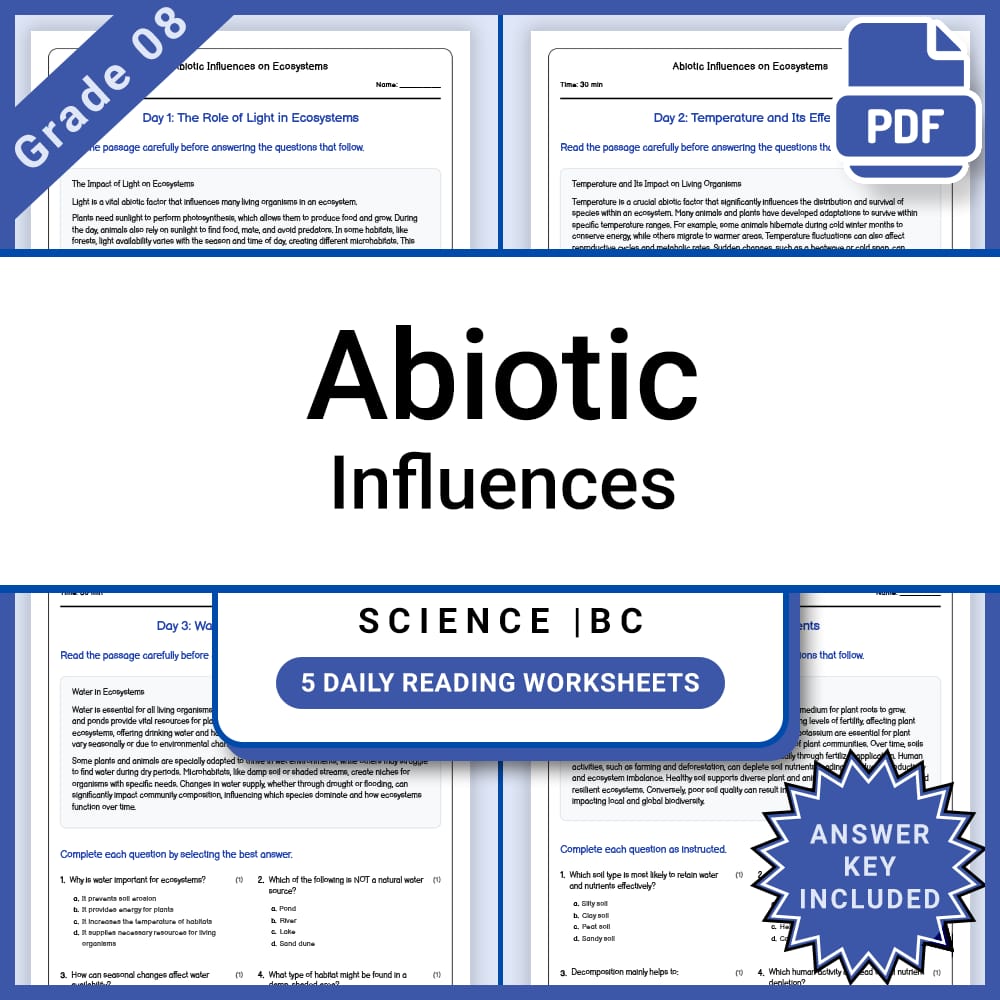
Grade 8 Science – Abiotic Influences on Ecosystems Daily Worksheet + Answer Key
JCreated byJ.S SheetsLearning Objectives
- Understand how light affects plant growth and animal behavior
- Identify different abiotic factors influencing ecosystems
- Analyze how variations in light impact habitats and species
Also included in: Grade 8 Science Lesson Bundle: Ecosystems, Biodiversity & Environmental Impacts +1 more
Instant download

8th Grade Science | Cell Modeling Worksheet (PDF +Answer Key)
Created byCopper Leaf ClassroomLearning Objectives
- Understand how models represent cellular processes
- Identify structural and functional relationships among organelles
- Interpret membrane transport, diffusion, and osmosis through models
Also included in: Grade 8 Science | Cell & Organ Systems Worksheets Bundle (PDF + Answer Key) +1 more
Instant download

8th Grade Science | Solution Comparison Worksheet (PDF + Answer Key)
Created byCopper Leaf ClassroomAlso included in: Grade 8 Science Unit | Engineering Problem-Solving Worksheets (PDF + Answer Key) +1 more
Instant download

8th Grade Science | Modeling Data in Science Worksheet (PDF + Answer Key)
Created byCopper Leaf ClassroomLearning Objectives
- Understand the purpose and construction of physical and computational models.
- Identify sources of measurement uncertainty and model limitations.
- Apply best practices for data collection, repeatability, and analysis in modeling.
Also included in: Grade 8 Science Unit | Engineering Problem-Solving Worksheets (PDF + Answer Key) +1 more
Instant download

8th Grade Science | Matter Cycles Worksheet (PDF + Answer Key)
Created byCopper Leaf ClassroomLearning Objectives
- Understand how matter cycles between living organisms and the abiotic environment.
- Explain processes such as photosynthesis, respiration, and decomposition.
- Trace atoms through different reservoirs such as producers, consumers, and soil.
Also included in: Grade 8 Science | Ecosystem & Population Change Unit Worksheet(PDF + Answer Key) +1 more
Instant download

Grade 8 Science – Forces Overview & Key Concepts | Daily Reading Worksheet
Created byBright Mind ResourcesLearning Objectives
- Understand the concept of force as a push or pull.
- Identify different types of forces such as gravity, air resistance, and contact forces.
- Explain how forces can change an object's motion by altering its speed or direction.
Also included in: Grade 8 Motion Forces Energy Science Daily Reading Lesson Bundle | BC +1 more
Instant download

Grade 8 Science – Applied Investigations Daily Reading Worksheet with Answer Key
JCreated byJ.S SheetsLearning Objectives
- Identify variables in simple experiments related to erosion.
- Design basic experimental procedures to compare factors affecting natural phenomena.
- Analyze data using graphical and statistical summaries to draw conclusions.
Also included in: Grade 8 Science Lesson Group Bundle | TEKS Standards-Aligned Worksheets +1 more
Instant download

Grade 8 Science – Measuring Biodiversity & Ecosystems | Daily Reading Worksheet
Created byBright Mind ResourcesLearning Objectives
- Understand the concept of biodiversity and its importance.
- Identify different levels of biodiversity including genetic, species, and ecosystem diversity.
- Learn about various methods used to measure biodiversity such as species richness, evenness, and diversity indices.
Also included in: Grade 8 Ecosystems Daily Reading Worksheets Lesson Bundle | BC +1 more
Instant download

Grade 8 Science – Genetic Diversity & Variability | Daily Reading Worksheet
Created byBright Mind ResourcesLearning Objectives
- Define genetic diversity and explain its significance in biological populations.
- Identify factors that influence genetic variation within and among species.
- Understand the impact of low genetic diversity on population survival.
Also included in: Grade 8 Ecosystems Daily Reading Worksheets Lesson Bundle | BC +1 more
Instant download
Grade 8 Science – Forces Overview Daily Reading Worksheet with Answer Key
JCreated byJ.S SheetsLearning Objectives
- Understand what a force is and how it affects objects.
- Identify different types of forces such as gravity, air resistance, and contact forces.
- Understand how multiple forces combine to produce a net force and influence motion.
Also included in: Grade 8 Science Lesson Group | Forces, Motion, Energy & More – Bundle +1 more
Instant download
Grade 8 Science – Friction and Drag Daily Reading Worksheet with Answer Key
JCreated byJ.S SheetsLearning Objectives
- Understand what friction and drag are as resistive forces.
- Identify how surface types, speed, and fluid properties influence friction and drag.
- Explain how these forces affect motion, acceleration, and terminal speed.
Also included in: Grade 8 Science Lesson Group | Forces, Motion, Energy & More – Bundle +1 more
Instant download
Grade 8 Science – Collisions and Energy Daily Reading Worksheet with Answer Key
JCreated byJ.S SheetsLearning Objectives
- Understand the difference between elastic and inelastic collisions.
- Identify how energy is transferred during collisions.
- Explain how different materials and speeds affect energy transformations.
Also included in: Grade 8 Science Lesson Group | Forces, Motion, Energy & More – Bundle +1 more
Instant download
Grade 8 Science – Force and Motion Daily Reading Worksheet + Answer Key
JCreated byJ.S SheetsLearning Objectives
- Understand the relationship between force, mass, and acceleration
- Identify different types of forces affecting objects
- Analyze how changes in force and mass influence motion
Also included in: Grade 8 Science Lesson Group | Forces, Motion, Energy & More – Bundle +1 more
Instant download
Grade 8 Science – Pendulum Energy Daily Reading Worksheet + Answer Key
JCreated byJ.S SheetsLearning Objectives
- Identify the parts of a pendulum and describe its basic motion.
- Explain the transfer of energy between potential and kinetic forms in a pendulum.
- Recognize factors influencing the period and energy distribution in a pendulum.
Also included in: Grade 8 Science Lesson Group | Forces, Motion, Energy & More – Bundle +1 more
Instant download
Grade 8 Science – Levers Daily Reading Worksheet with Answer Key
JCreated byJ.S SheetsLearning Objectives
- Identify different types of levers and their characteristics.
- Explain how levers make work easier by changing force and distance.
- Describe real-world examples of levers and their uses.
Also included in: Grade 8 Science Lesson Group | Forces, Motion, Energy & More – Bundle +1 more
Instant download
Grade 8 Science – Balanced Forces Daily Reading Worksheet + Answer Key
JCreated byJ.S SheetsLearning Objectives
- Define balanced forces and describe their effects on objects.
- Identify real-life examples of balanced forces.
- Differentiate between static and dynamic equilibrium.
Also included in: Grade 8 Science Lesson Group | Forces, Motion, Energy & More – Bundle +1 more
Instant download
Grade 8 Science – Relative Motion Daily Reading Worksheet + Answer Key
JCreated byJ.S SheetsLearning Objectives
- Explain the concept of relative motion and how observation changes from different reference points.
- Calculate apparent speeds of moving objects when observed from different frames of reference.
- Apply proportional relationships of speed, distance, and time in different motion scenarios.
Also included in: Grade 8 Science Lesson Group | Forces, Motion, Energy & More – Bundle +1 more
Instant download
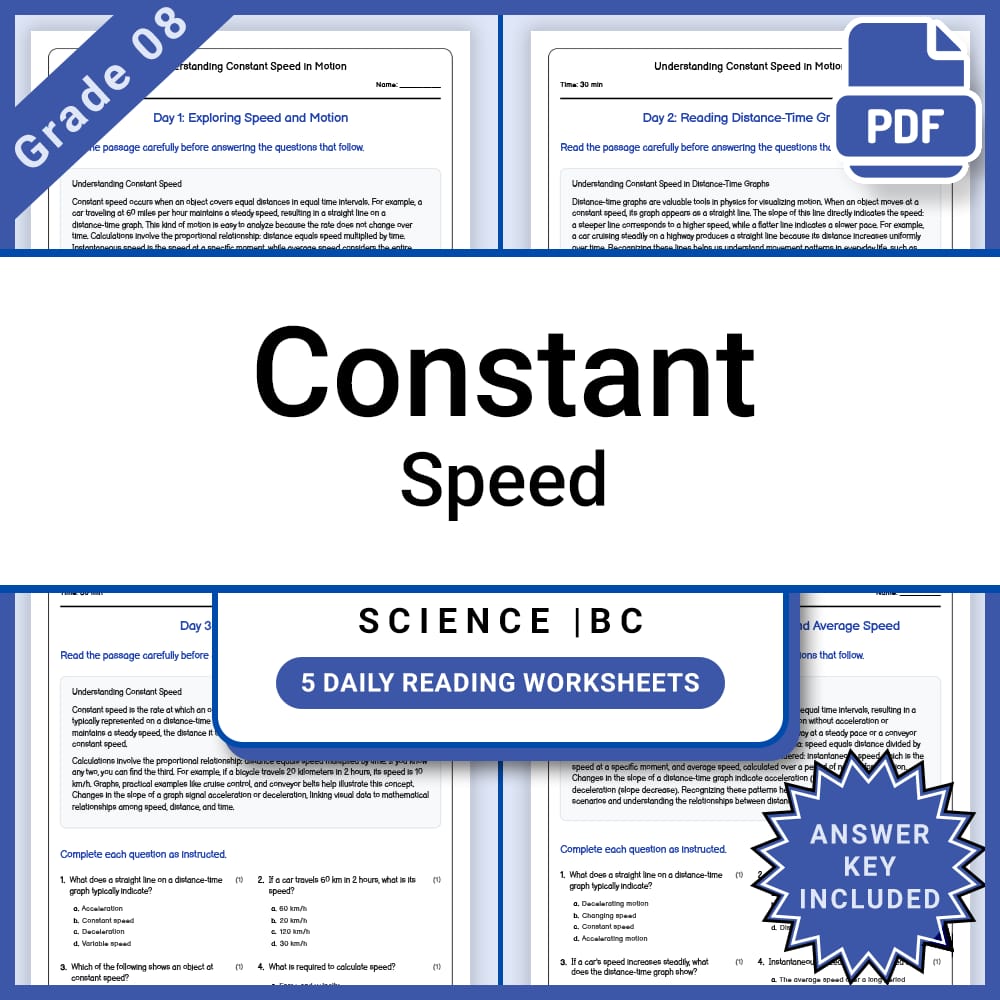
Grade 8 Science – Constant Speed Daily Reading Worksheet + Answer Key
JCreated byJ.S SheetsLearning Objectives
- Define constant speed and describe its characteristics.
- Interpret distance-time graphs to identify constant speed.
- Differentiate between instantaneous speed and average speed.
Also included in: Grade 8 Science Lesson Group | Forces, Motion, Energy & More – Bundle +1 more
Instant download

Grade 8 Science – Mass & Motion | Daily Reading Worksheet
Created byBright Mind ResourcesLearning Objectives
- Understand how mass influences the effect of net force on motion
- Compare responses of objects with different masses to pushes
- Apply qualitative proportional reasoning to situations involving force and acceleration
Also included in: Grade 8 Motion Forces Energy Science Daily Reading Lesson Bundle | BC +1 more
Instant download

Grade 8 Moon Interactions Science Daily Reading Worksheet | TEKS
 Created byBRIGHT PATH RESOURCES
Learning Objectives
- Explain lunar phases using the Moon’s relative position to Earth and the Sun.
- Identify which geometry produces new and full moons.
- Use correct vocabulary related to orbital alignment and lunar phases.
Also included in: Grade 8 Earth and Space Science Daily Reading Worksheets Bundle | TEKS +1 more
Instant download
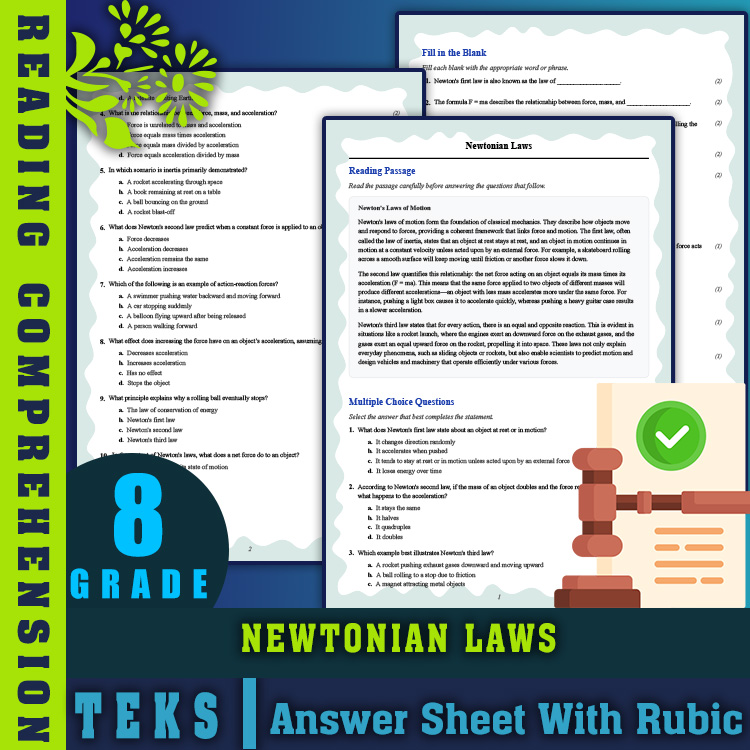
8th Grade Science | Newtonian Laws Reading Worksheet (PDF + Answer Key)
JCreated byJ.S SheetsLearning Objectives
- Describe Newton's three laws of motion and their significance in understanding force and movement.
- Identify real-world examples that demonstrate each of Newton's laws.
- Explain the relationship between force, mass, and acceleration as described by Newton's second law.
Instant download
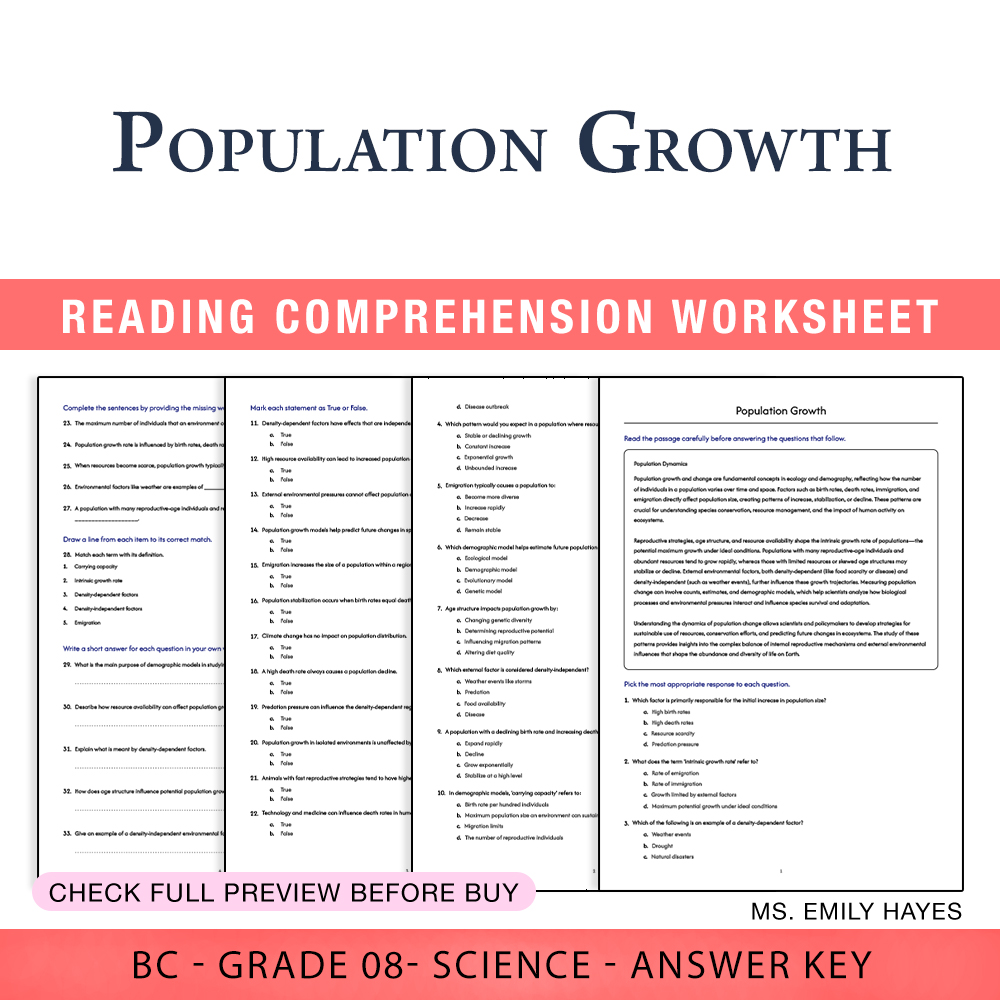
8th Grade Science | Population Growth Worksheet (PDF + Answer Key)
Created byCopper Leaf ClassroomLearning Objectives
- Explain the factors influencing population change, including birth rates, death rates, immigration, and emigration.
- Interpret patterns of population increase, stability, or decline using demographic concepts and models.
- Describe how reproductive strategies, age structure, and resource availability affect intrinsic growth rates.
Also included in: Grade 8 Science– Ecology, Biodiversity & Environmental Impact (PDF + Answer Key) +1 more
Instant download
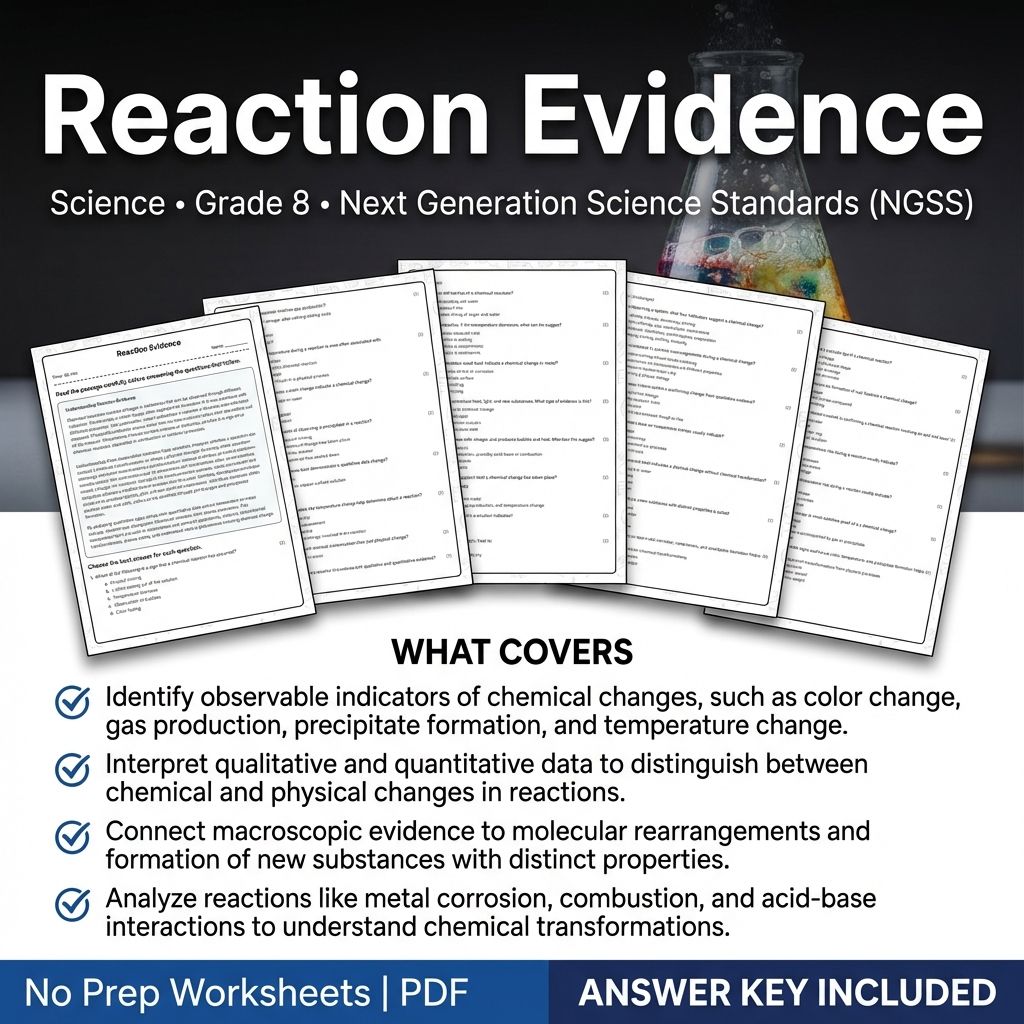
8th Grade Science | Reaction Evidence Worksheet & Answer Key (Printable PDF)
 Created byCoral Reef Learning
Learning Objectives
- Identify observable indicators of chemical changes, such as color change, gas production, precipitate formation, and temperature change.
- Interpret qualitative and quantitative data to distinguish between chemical and physical changes in reactions.
- Connect macroscopic evidence to molecular rearrangements and formation of new substances with distinct properties.
Instant download
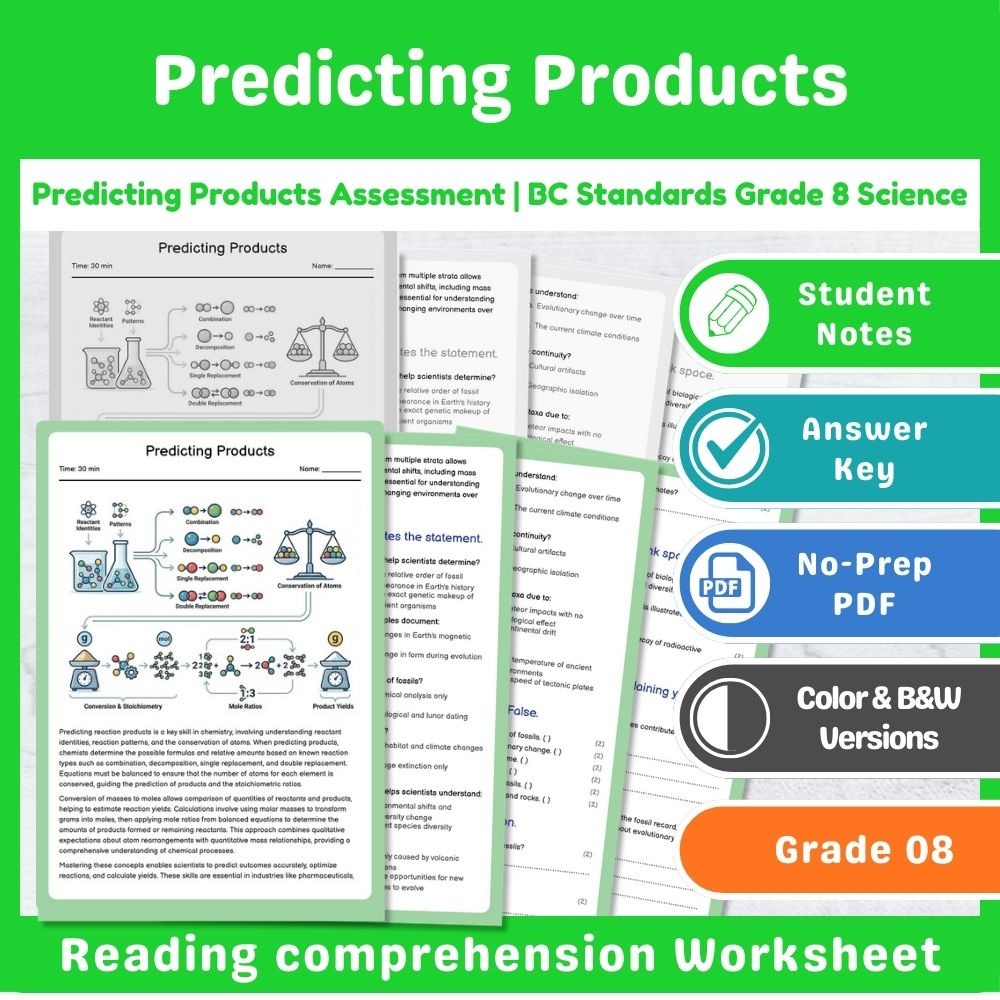
Predicting Products Assessment | BC Standards Grade 8 Science
Created byPrism Point LearningLearning Objectives
- Understand how to predict products in chemical reactions based on reactants and reaction patterns.
- Apply the conservation of atoms principle to balance chemical equations.
- Convert between mass and moles to determine reaction yields and compare quantities.
Also included in: Grade 8 Science Lesson – Reaction Types & Evidence Assessment Bundle
Instant download
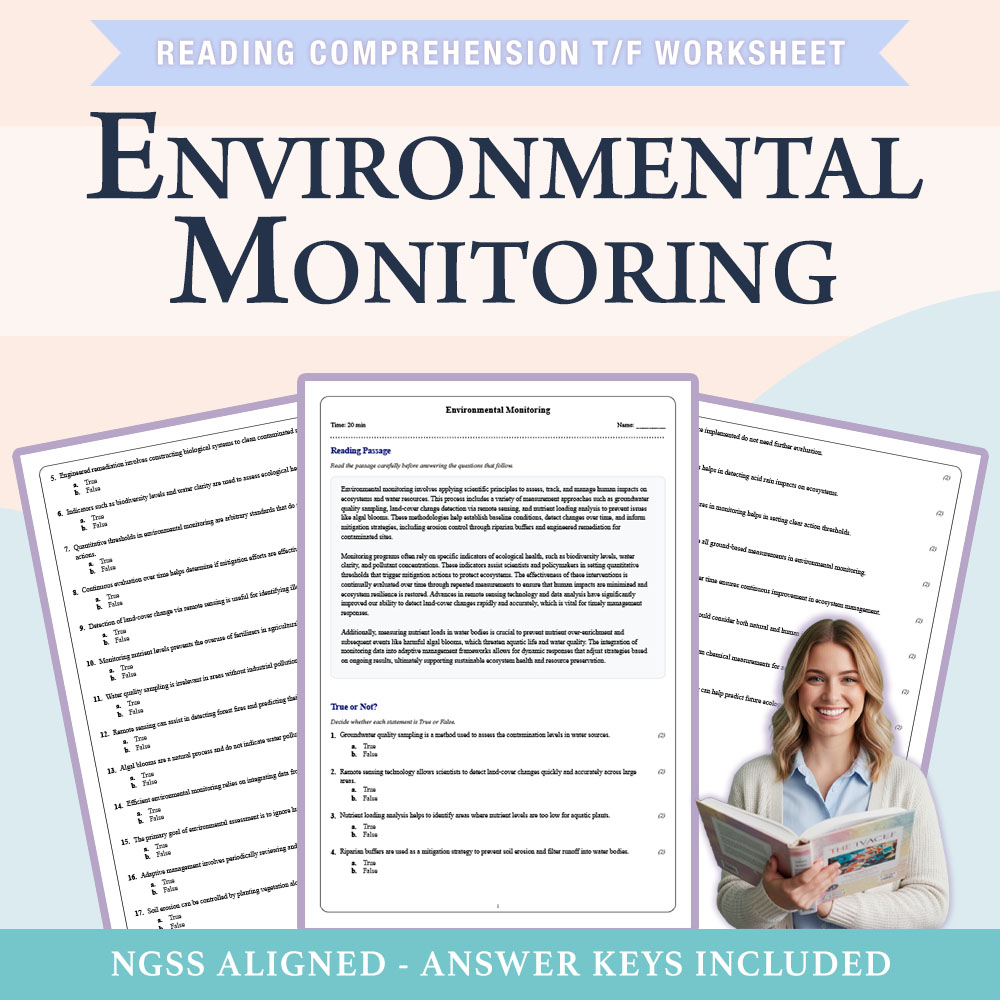
Grade 8 Science | Environmental Monitoring Worksheet (PDF +Answer Key)
Created byCopper Leaf ClassroomLearning Objectives
- Understand scientific methods used in environmental monitoring
- Identify indicators of ecosystem health
- Know mitigation strategies for human impacts on water resources
Also included in: Grade 8 Science Unit | Environmental Change & Climate Drivers (PDF +Answer Key) +1 more
Instant download

Grade 8 Science | Pollution Impacts - Daily Reading Comprehension
Created byCoral Reef LearningLearning Objectives
- Understand how pollution alters ecosystem chemistry.
- Identify sources of water pollution.
- Explain the effects of pollutants on water quality and aquatic life.
Instant download
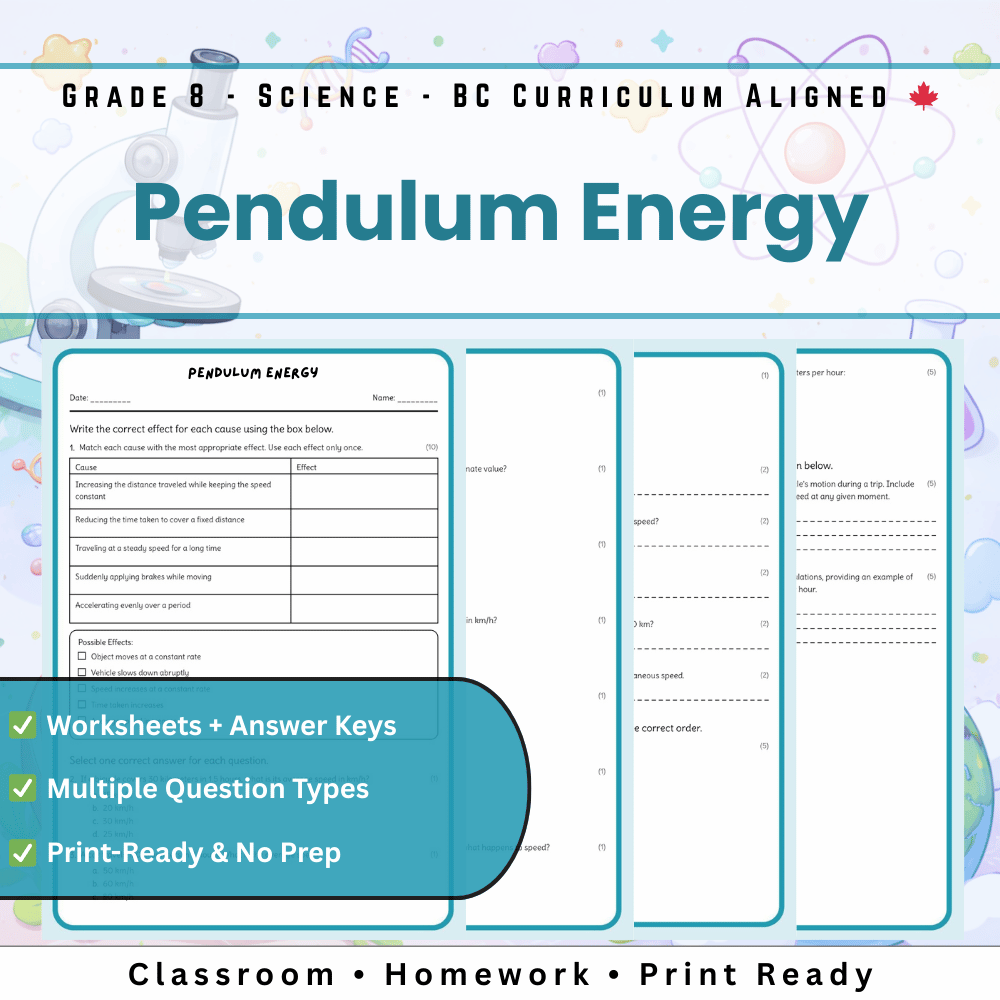
Grade 8 Science | Pendulum Energy Worksheet (Answer Key) – Motion & Energy
Created byBright Mind ResourcesLearning Objectives
- Understand the energy transformations occurring in a pendulum system.
- Identify factors that influence the period and energy distribution of a pendulum.
- Explain the concept of conservation of mechanical energy in ideal systems.
Instant download
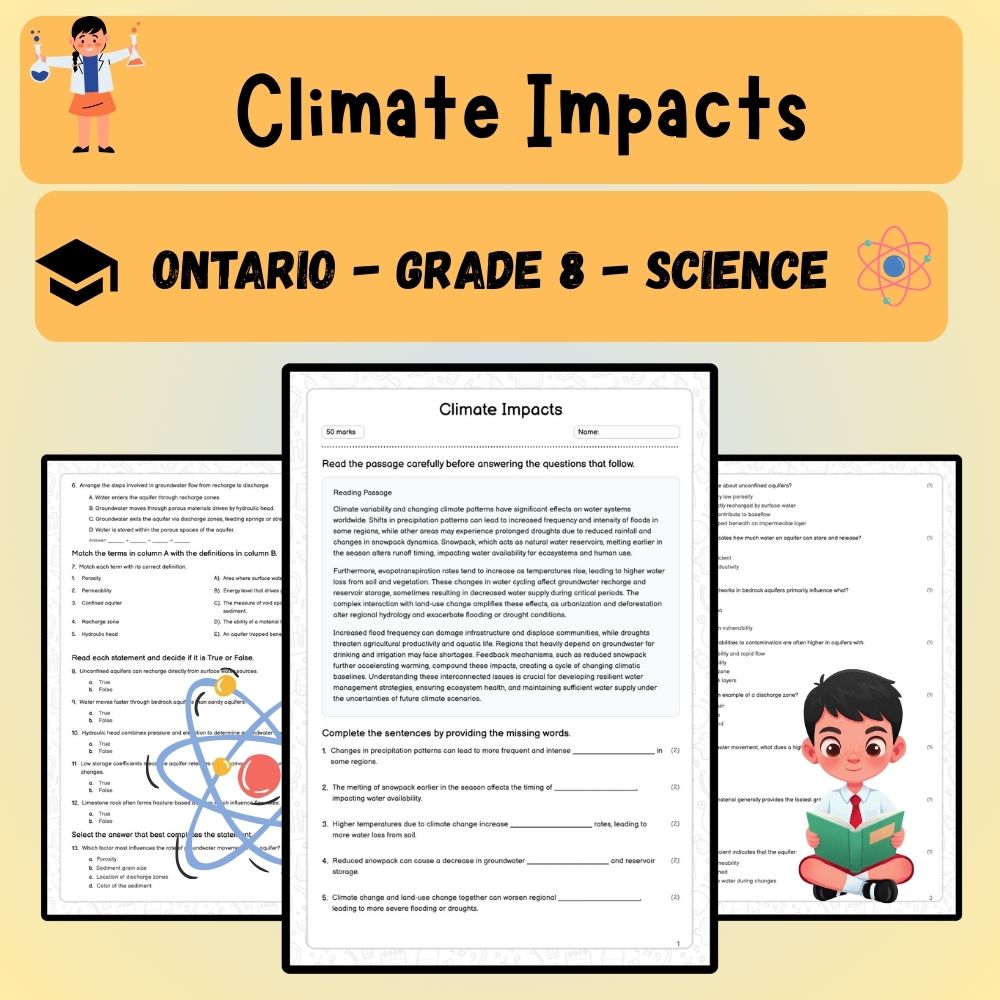
Grade 8 Science | Climate Impacts Worksheet (PDF ) – Ontario Standards
Created byPrism Point LearningLearning Objectives
- Understand how climate variability affects water systems such as precipitation and snowpack.
- Analyze the consequences of climate change on flood frequency, drought, and water availability.
- Examine interactions between climate impacts and land-use change on regional hydrology.
Also included in: Grade 8 Science Water Management Unit Watershed and Water Resources +1 more
Instant download
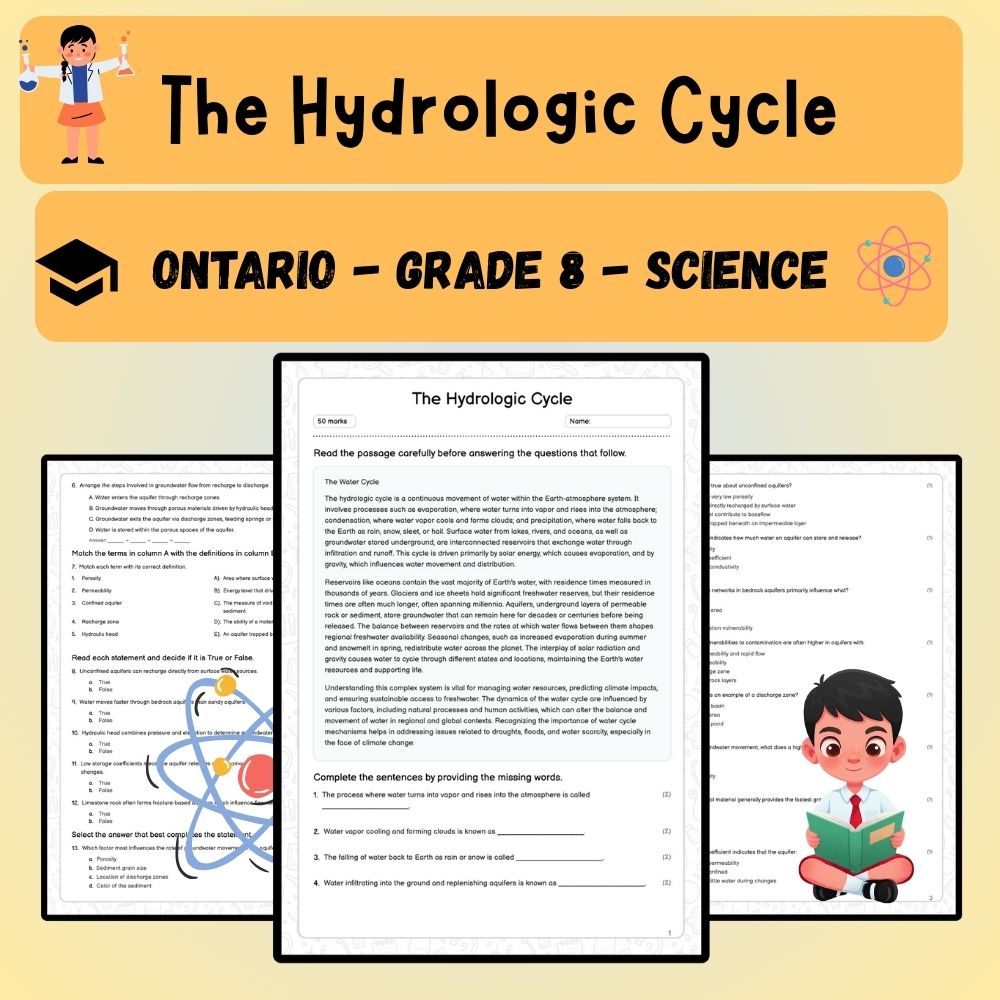
Grade 8 Science | The Hydrologic Cycle Worksheet (PDF)
Created byPrism Point LearningLearning Objectives
- Describe the key processes involved in the water cycle, including evaporation, condensation, precipitation, infiltration, and runoff.
- Explain the concepts of reservoirs, residence times, and the influence of solar energy and gravity on water movement.
- Analyze the importance of water redistribution for freshwater availability at regional scales.
Also included in: Grade 8 Science Water Management Unit Watershed and Water Resources +1 more
Instant download
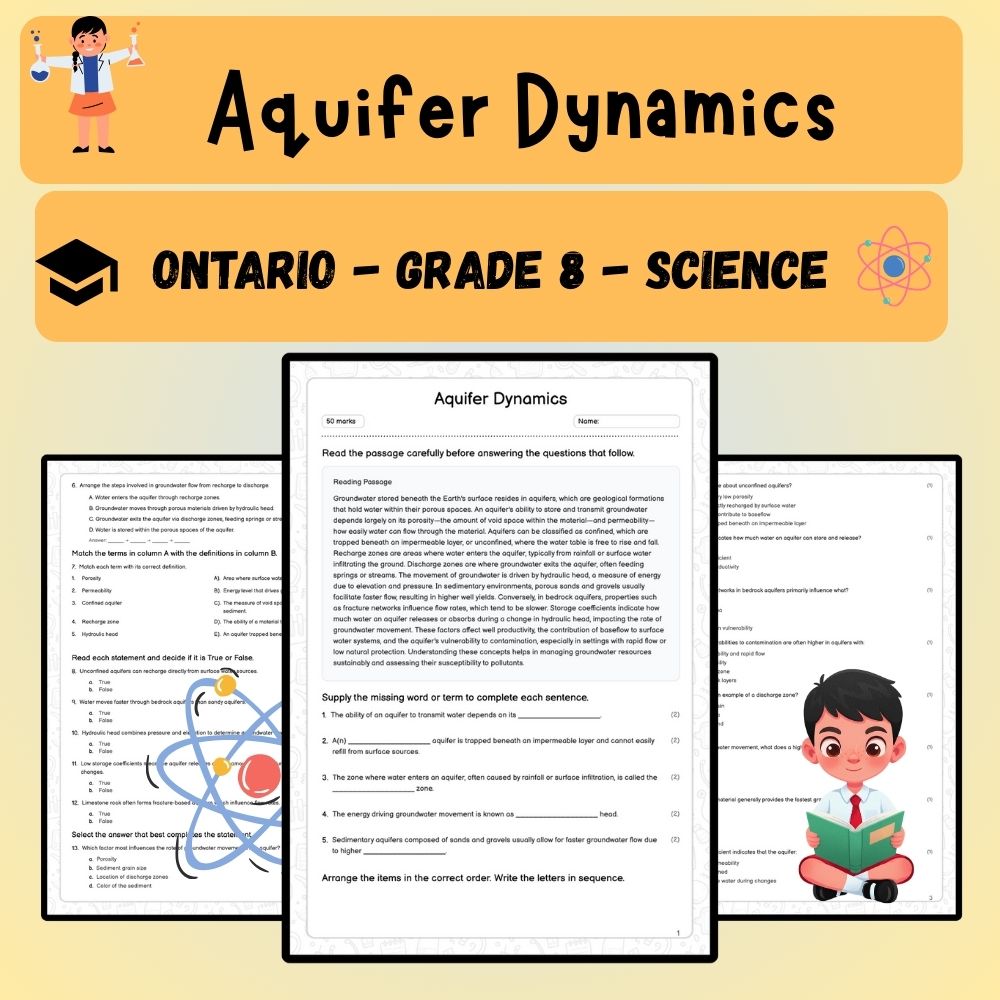
Grade 8 Science | Aquifer Dynamics Worksheet (PDF ) for Ontario Standards
Created byPrism Point LearningLearning Objectives
- Understand the structure and function of aquifers and groundwater flow systems.
- Identify key concepts such as porosity, permeability, confined and unconfined aquifers, recharge and discharge zones.
- Explain how sediment and bedrock properties affect groundwater movement and well yield.
Also included in: Grade 8 Science Water Management Unit Watershed and Water Resources +1 more
Instant download
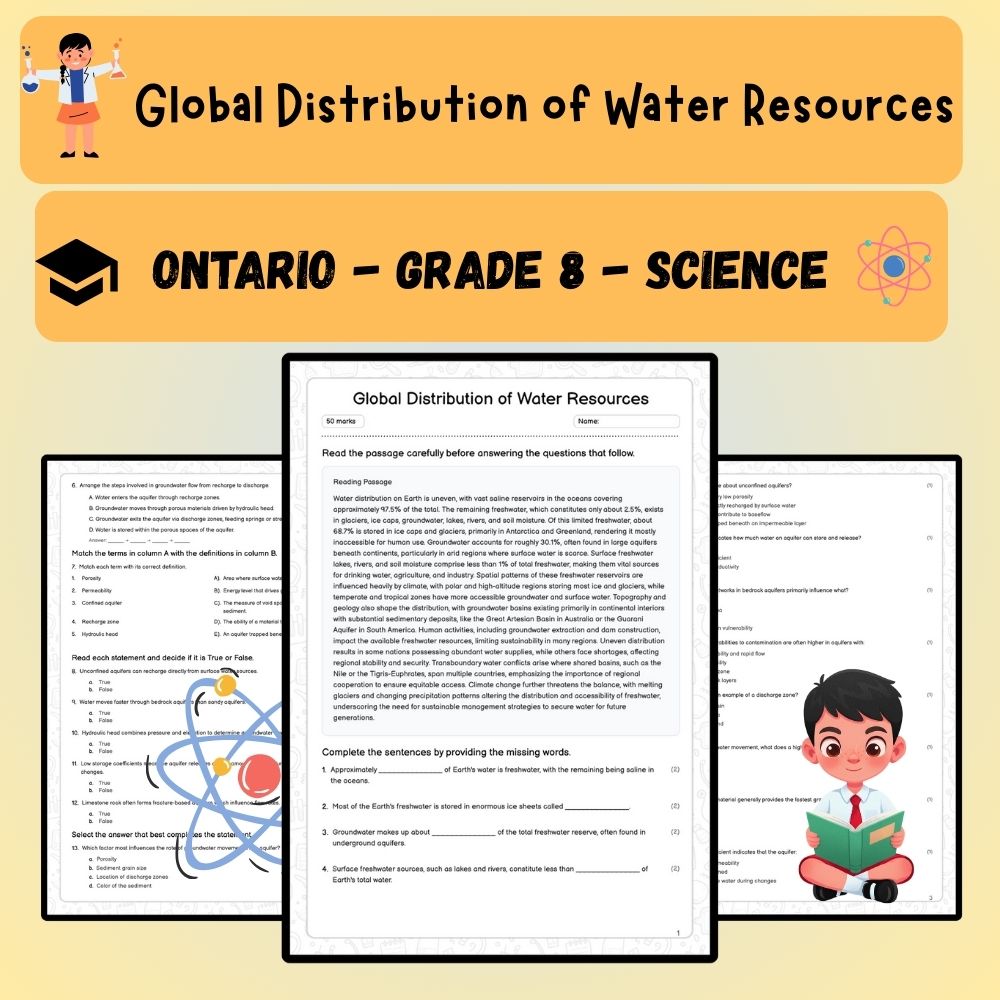
Grade 8 Science | Global Water Resources Distribution Worksheet (PDF)
Created byPrism Point LearningLearning Objectives
- Understand the distribution of freshwater and saline reservoirs globally
- Analyze how climate, topography, and geology influence water storage and access
- Evaluate the implications of uneven water distribution for human use and regional security
Also included in: Grade 8 Science Water Management Unit Watershed and Water Resources +1 more
Instant download
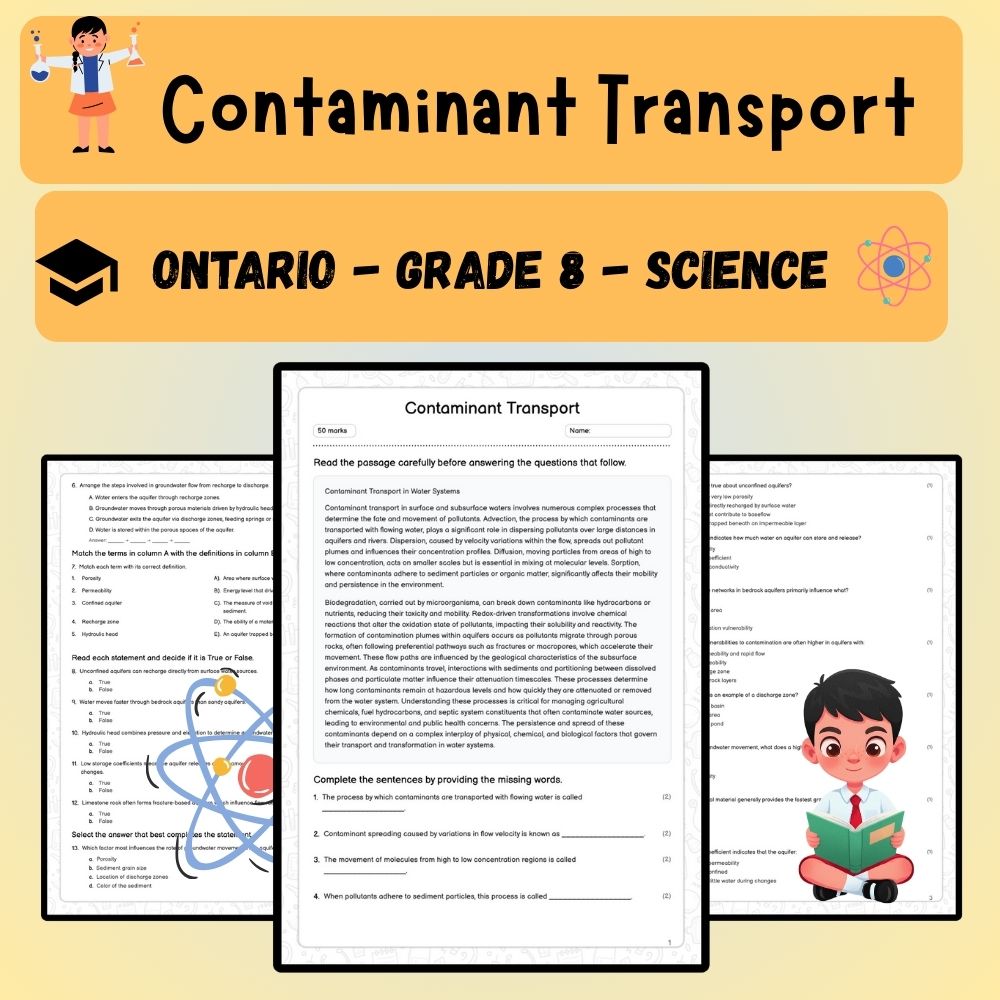
Grade 8 Science | Contaminant Transport Worksheet (PDF ) – Ontario Standards
Created byPrism Point LearningLearning Objectives
- Explain the processes involved in the movement of contaminants in surface and subsurface waters.
- Identify and differentiate between mechanisms such as advection, dispersion, diffusion, sorption, and biodegradation.
- Describe how contaminant plumes form and migrate in aquifers and fractured rock.
Also included in: Grade 8 Science Water Management Unit Watershed and Water Resources +1 more
Instant download

Grade 8 Science | Hydrologic Measurement Worksheet (PDF )
Created byPrism Point LearningLearning Objectives
- Understand the methods used for measuring water quantity and quality in hydrology.
- Identify various instruments and techniques used in stream gauging, sensor monitoring, and remote sensing.
- Explain conceptual factors such as precision, temporal resolution, and sampling frequency in water data collection.
Also included in: Grade 8 Science Water Management Unit Watershed and Water Resources +1 more
Instant download
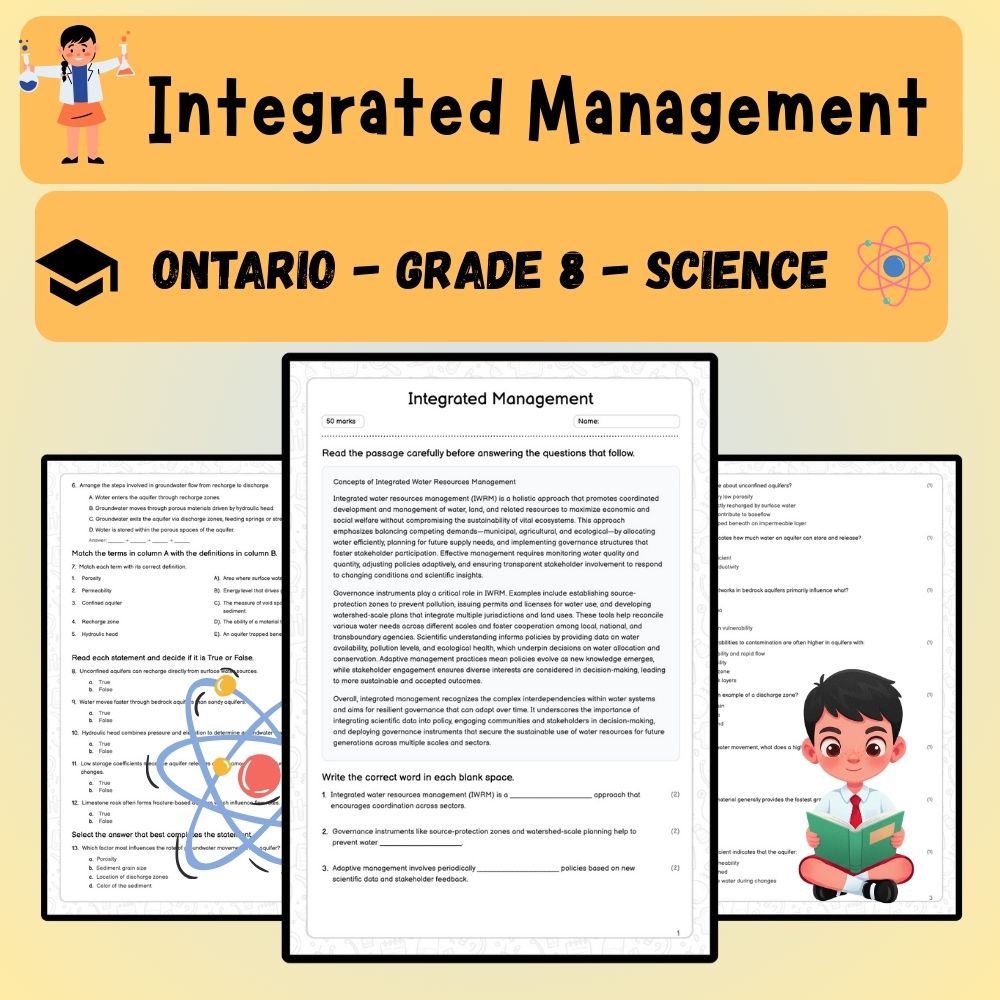
Grade 8 Science – Integrated Water Management Worksheet (PDF )
Created byPrism Point LearningLearning Objectives
- Understand the key concepts of integrated water resources management, including allocation, supply planning, and governance.
- Apply knowledge of governance instruments and stakeholder roles in managing water resources.
Also included in: Grade 8 Science Water Management Unit Watershed and Water Resources +1 more
Instant download

Mutation Effects Worksheet | Grade 8 Science NGSSS Genetics + Answer Key
Created byEvergreen Desk EducationLearning Objectives
- Explain how mutations in DNA can change proteins and affect traits.
- Identify different sources of mutations and describe how they impact populations over generations.
- Distinguish between harmful, neutral, and sometimes beneficial mutation effects under environmental conditions.
Instant download

Grade 8 Mass and Weight in Gravity Science Worksheet | Alberta
Created byBRIGHT PATH RESOURCESLearning Objectives
- Define mass and weight using correct scientific meaning
- Explain how weight depends on mass and gravitational acceleration
- Use examples to distinguish mass (matter) from weight (gravity force)
Also included in: Grade 8 Alberta Science Forces and Motion Physics Worksheet Bundle +1 more
Instant download
About Grade 8 Science Worksheets
Explore Grade 8 Science worksheets for classwork, homework, or review. Our 6,006 printables download instantly as PDFs.
Each resource here is built by an independent educator and reviewed for quality. Worksheets print straight from PDF and suit classroom use, homework, or extra practice; most come with answer keys, and you can preview before purchasing.