
Grade 9 Worksheets
9,322 grade resources
Grade 9 Science – Introduction to Population Genetics Daily Reading Worksheet
 Created byBright Mind Resources
Learning Objectives
- Understand the concept of allele frequency and genetic variation
- Learn about Hardy-Weinberg equilibrium assumptions
- Explore genetic drift, bottlenecks, and founder effects
Also included in: Grade 9 Genetics & Inheritance Science Daily Reading Lesson Bundle | Alberta +1 more
Instant download

Evolution Basics Worksheet for Grade 9 Science | Standards-Aligned Practice
JCreated byJ.S SheetsLearning Objectives
- Define evolution and explain how allele frequencies can change over generations
- Identify and compare the mechanisms of natural selection and genetic drift
- Describe how mutation and gene flow contribute to genetic variation and evolutionary change
Instant download

Classification Overview Worksheet Grade 9 Science | Standards-Aligned Practice
JCreated byJ.S SheetsLearning Objectives
- Differentiate elements, compounds, and mixtures using macroscopic observations and compositional criteria
- Define pure substances as having fixed composition and mixtures as having variable composition
- Interpret and use symbols and formulas to represent elements and compounds (e.g., O, NaCl)
Instant download

Grade 9 Gravity and Orbits Worksheet | California Science + Answer Key
 Created byEvergreen Desk Education
Learning Objectives
- Explain how gravitational attraction influences the motion of planets and moons.
- Use relationships between mass, distance, and orbital speed to predict orbital behavior.
- Connect observed orbital patterns to the idea of predictable trajectories under gravity.
Instant download

Grade 9 Science – Constraints & Trade-Offs | Daily Reading Worksheet
Created byBright Mind ResourcesLearning Objectives
- Define constraints and criteria in scientific design processes.
- Identify how constraints limit design options.
- Explore examples of trade-offs in engineering decisions.
Also included in: Engineering & Technology Lesson Bundle | Grade 9 Science | General +1 more
Instant download

Grade 9 Science Resource Choices Worksheet | NGSS Activities & Doodle Note
 Created byAmber Owl Education
Learning Objectives
- Compare energy and mineral resource options using criteria such as emissions, water use, and land disturbance.
- Explain how extraction impacts can be evaluated using life-cycle thinking and remediation practices.
- Use supply constraints and cost trade-offs to justify sustainable resource management choices.
Also included in: Grade 9 Science Sustainability & Climate Risk Lesson Bundle | NGSS +1 more
Instant download

Grade 9 Science – Reaction Evidence Daily Reading Worksheet | Florida NGSSS
Created byBright Mind ResourcesLearning Objectives
- Identify observable signs of chemical reactions, such as gas formation, precipitate production, color change, temperature change, and odor change.
- Understand how these signs relate to changes in atomic arrangements and bonding patterns.
- Recognize examples of oxidation and combustion reactions based on observable evidence.
Also included in: Grade 9 Forces, Energy & Matter Science lesson bundle Florida NGSSS +1 more
Instant download

Ecological Succession Assessment for Grade 9 Science | TEKS Standards
 Created byPrism Point Learning
Learning Objectives
- Understand the concepts of primary and secondary succession in ecosystems.
- Identify factors influencing succession dynamics and trajectories.
- Describe how species traits, dispersal, and disturbance regimes affect ecosystem recovery.
Also included in: Grade 9 Ecology & Environmental Interactions Science lesson bundle: TEKS
Instant download

Grade 9 Science | Design Communication Worksheet | Assessment PDF
 Created byLumora Learning
Learning Objectives
- Explain how data, labeled diagrams, and reasoning work together to communicate design decisions.
- Use evidence from testing to justify redesign changes and address trade-offs.
- Summarize results in a way that compares performance to requirements and acknowledges uncertainty.
Instant download

Grade 9 Science Worksheet The Rock Cycle | Standards-Aligned Practice
JCreated byJ.S SheetsLearning Objectives
- Explain how igneous, sedimentary, and metamorphic rocks transform through interconnected rock-cycle processes.
- Identify the energy sources and rates that drive rock-cycle transitions, including melting, crystallization, weathering, erosion, deposition, and metamorphism.
- Describe how plate tectonics influences rock-cycle pathways through uplift, burial, and igneous intrusion.
Instant download

Device Systems Assessment for Grade 9 Science | Standards-Aligned Assessment
Created byPrism Point LearningLearning Objectives
- Understand how device systems are composed of interacting parts that serve specific functions.
- Identify and map inputs, outputs, energy transfers, and material flows within device systems.
- Explain the importance of system boundaries and how constraints affect device performance.
Instant download

Grade 9 States of Energy Worksheet | Ontario Science Lesson + Answer Key
 Created byClear Sky Classroom
Learning Objectives
- Explain phase changes using energy transfer (kinetic vs. potential energy) and particle motion.
- Interpret qualitative heating and cooling curves, including temperature plateaus and latent heat.
- Relate specific phase transitions (melting, vaporization, sublimation, condensation) to characteristic temperatures without changing chemical identity.
Instant download

Electron Configuration Worksheet Grade 9 Science Activities
Created byPrism Point LearningLearning Objectives
- Explain what electron configuration represents and how it describes electron distribution in shells and orbitals.
- Determine how valence electrons influence reactivity, ion formation, and bonding patterns.
- Use electron configuration ideas to predict periodic trends in atomic size and ionization energy.
Also included in: Grade 9 Matter and Chemical Change Lesson Bundle | Science | BC +1 more
Instant download
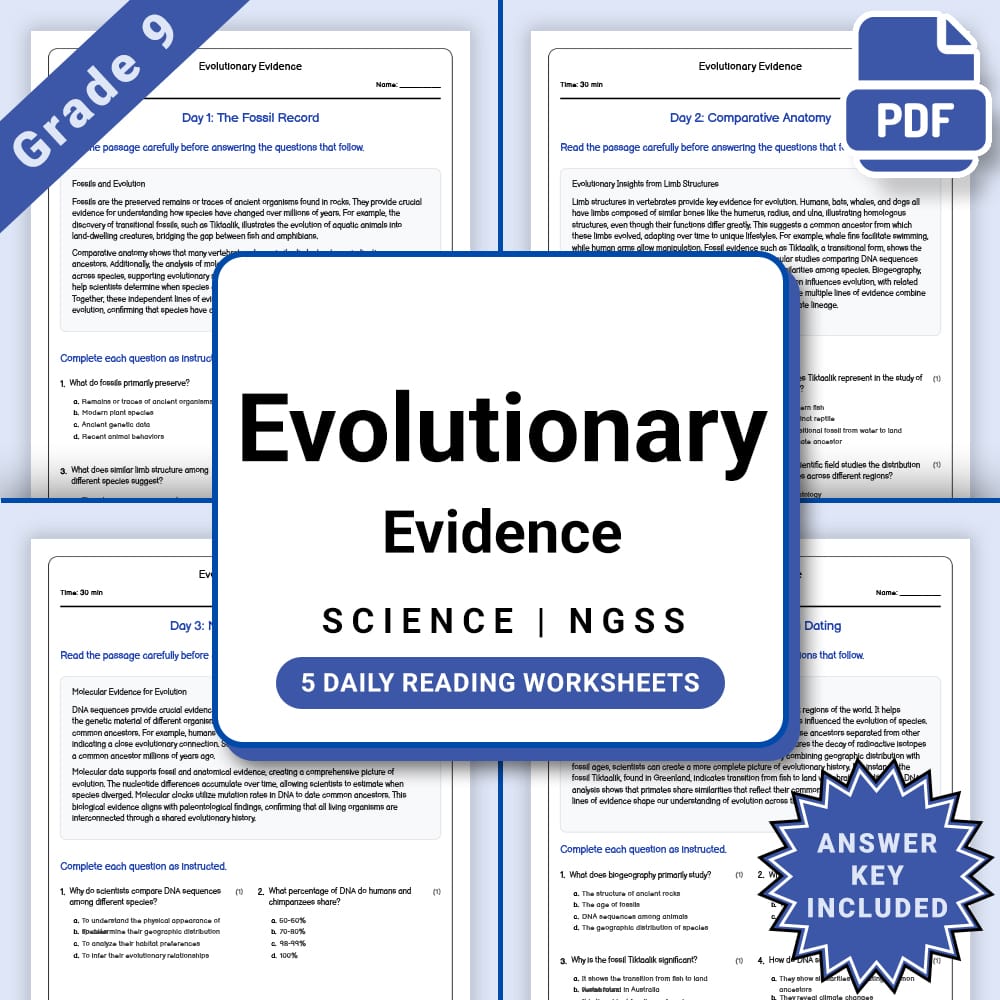
Grade 9 Science – Evolutionary Evidence Worksheet(PDF + Answer Key)
 Created byCopper Leaf Classroom
Learning Objectives
- Understand how fossils provide evidence for evolution
- Recognize the significance of transitional fossils and homologous structures
- Learn how molecular sequences support common ancestry
Instant download

Grade 9 Science | Evidence Chains in Science - Reading Comprehension Practice
 Created byCoral Reef Learning
Learning Objectives
- Understand the concept of evidence chains and their role in scientific reasoning.
- Identify basic components involved in linking observations to scientific claims.
- Recognize the importance of clarity, sufficiency, and consistency in evidence.
Also included in: Science Practices Lesson Bundle – Grade 9 Science, Advanced Placement Reading +1 more
Instant download

Grade 9 Science – Evidence for Scientific Claims | Daily Reading Worksheet
Created byBright Mind ResourcesLearning Objectives
- Understand what constitutes relevant evidence in scientific claims.
- Identify patterns in data that support or weaken claims.
- Evaluate alternative explanations based on evidence.
Also included in: Uncertainty in Graphs & Evidence Lesson Bundle | Grade 9 Science General +1 more
Instant download

Renal Regulation Assessment | TEKS Standards Grade 9 Science
Created byPrism Point LearningLearning Objectives
- Understand the structure and function of nephrons in renal regulation.
- Explain how hormonal feedback mechanisms control kidney function and blood pressure.
- Identify the roles of key hormones like antidiuretic hormone and the renin-angiotensin-aldosterone system.
Also included in: Grade 9 Regulation & Communication Science Assessment Lesson Bundle TEKS
Instant download

Evidence Reasoning Worksheet for Grade 9 ELA | Alberta Standards
Created byLumora LearningLearning Objectives
- Explain how an interpretation must be supported by evidence, using reasoning to connect the two.
- Write short reasoning statements that clarify how a detail reveals character motivation, theme, or a shift in meaning.
- Identify patterns in a text (recurring language, tone changes, or repeated details) and describe what those patterns suggest.
Instant download

Elena Rhetorical Persuasion Analysis Worksheet | Grade 9 Ontario ELA Activity
Created byLumora LearningLearning Objectives
- Identify how rhetorical strategies (rhetorical questions, appeals to emotion and reason) shape an author’s message
- Analyze how evidence is used, including specificity and possible bias
- Evaluate how counterarguments are addressed and how that supports the author’s purpose
Instant download

Grade 9 Science | Power and Efficiency Worksheet (Alberta | PDF)
Created byEvergreen Desk EducationLearning Objectives
- Explain the relationship between power, energy transfer, and time using real-world examples.
- Calculate or interpret efficiency as the fraction of input energy converted to useful output.
- Identify common sources of energy loss and describe how design choices affect operational performance.
Instant download

Grade 9 Science | Balancing Equations Worksheet (PDF) – BC Standards
Created byEvergreen Desk EducationLearning Objectives
- Explain why chemical equations must be balanced to conserve atoms during a reaction.
- Use coefficients and subscripts to determine how many atoms of each element appear on both sides of an equation.
- Apply balancing strategies to write correct balanced chemical equations, including state symbols.
Instant download

Grade 9 Science – Developmental Processes & Gene Regulation | Reading Worksheet
Created byBright Mind ResourcesLearning Objectives
- Understand how gene regulation influences developmental processes
- Describe the roles of regulatory networks, timing changes, and epigenetic modulation in development
- Link genetic variation to trait expression and phenotypic diversity
Also included in: Grade 9 Daily Reading Science Worksheets Lesson Bundle | AP +2 more
Instant download

Grade 9 United Nations Day The Future of Cooperation Worksheet PDF + Answer Key
 Created byShaNova Worksheets
Learning Objectives
- Explain how cooperation and diplomacy can help address global problems
- Identify how cultural understanding and civic responsibility support international partnerships
- Evaluate ideas for shared solutions to climate change and social inequality
Instant download

Grade 9 Science | Chemical Reactions - Daily Reading Comprehension
Created byCoral Reef LearningLearning Objectives
- Understand the basic concept of chemical reactions
- Identify different types of chemical reactions such as combustion, synthesis, and decomposition
- Interpret symbolic chemical equations
Also included in: Matter and Chemical Change Lesson Bundle – Grade 9 Science Alberta +1 more
Instant download

Grade 9 Science – Design Communication & Structural Engineering | Worksheet
Created byBright Mind ResourcesLearning Objectives
- Interpret diagrams to explain design choices
- Analyze data summaries to evaluate design performance
- Provide reasoning connecting test outcomes to design decisions
Also included in: Engineering & Technology Lesson Bundle | Grade 9 Science | General +1 more
Instant download

Grade 9 Science – Understanding Combined Circuits Daily Reading Worksheet
Created byBright Mind ResourcesLearning Objectives
- Identify series and parallel arrangements in electrical circuits.
- Explain how series and parallel circuits differ in current and voltage.
- Simplify complex circuits by reducing series and parallel components.
Also included in: Grade 9 Electrical Circuits & Electromagnetism Science Lesson Bundle | Alberta +1 more
Instant download

Grade 9 Science – Scientific Argumentation & Reading Practice | Worksheet
Created byBright Mind ResourcesLearning Objectives
- Identify claims, evidence, and reasoning within scientific texts
- Analyze how coherence and relevance strengthen scientific arguments
- Evaluate the role of quantitative evidence and model comparisons
Also included in: Grade 9 Science Data Analysis Daily Reading Worksheets Lesson Bundle | AP +2 more
Instant download

Grade 9 Evolution Evidence Worksheet | Practice & Assessment PDF
Created byClear Sky ClassroomLearning Objectives
- Explain how the fossil record supports gradual evolutionary change over time.
- Use evidence from homologous structures and genetic data to infer shared ancestry.
- Differentiate homologous traits from analogous traits caused by convergent evolution.
Instant download

Grade 9 Science – Endocrine Feedback Mechanisms Daily Reading Worksheet
 Created byQuiet Forest Education
Learning Objectives
- Understand the role of hormones in regulating physiological processes.
- Identify feedback loops involved in glucose homeostasis.
- Describe hormone synthesis, transport, and cellular effects.
Also included in: Human Body Science Grade 9 Daily Reading Worksheets Bundle | Ontario +1 more
Instant download

Grade 9 Science – Energy & Matter Flow | Daily Reading Worksheet
Created byBright Mind ResourcesLearning Objectives
- Understand how energy flows through food chains in ecosystems.
- Identify the different roles of producers, consumers, and decomposers.
- Describe how matter cycles through living organisms and the environment.
Also included in: Cells Genetics & Ecosystems Grade 9 Science Reading Lesson Bundle | General +1 more
Instant download

Grade 9 Science – Power & Efficiency in Mechanical Systems | Daily Worksheet
Created byQuiet Forest EducationLearning Objectives
- Define power as the rate of energy transfer or work per unit time.
- Calculate average and instantaneous power in mechanical contexts.
- Understand the concept of mechanical efficiency and how it relates to energy losses.
Also included in: Forces and Energy Grade 9 Science Daily Reading Worksheets Bundle | Ontario +1 more
Instant download

Grade 9 Science | Understanding DNA & Genes - Daily Reading Comprehension
Created byCoral Reef LearningLearning Objectives
- Identify the structure and function of DNA
- Explain what genes are and where they are located
- Describe how chromosomes carry genetic information
Instant download

Grade 9 Science | Environmental Tradeoffs Worksheet | California Standards
Created byLumora LearningLearning Objectives
- Explain how human actions can affect air, water, and land systems through identifiable mechanisms of harm.
- Evaluate environmental solutions by comparing benefits, side effects, and feasibility across interconnected systems.
- Use scientific reasoning to weigh evidence and uncertainty when predicting environmental outcomes.
Instant download

Grade 9 Science – Energy Transfer & Earth's Systems | Daily Reading Worksheet
Created byQuiet Forest EducationLearning Objectives
- Identify different sources of energy that influence Earth's processes.
- Describe how energy is transferred through conduction, convection, and radiation.
- Understand the role of internal heat and radioactive decay in Earth's dynamics.
Also included in: Earth and Space Systems Grade 9 Science Daily Worksheets Bundle | Ontario +1 more
Instant download

Grade 9 Science – Stellar Origins & Birth of Stars | Daily Reading Worksheet
Created byBright Mind ResourcesLearning Objectives
- Explain how stars are formed from gas and dust in space.
- Describe the process of nuclear fusion in stars.
- Identify the types of elements produced during a star's lifecycle.
Also included in: Grade 9 Science Worksheets: Space-to-Climate Lesson Bundle | Calif. Standards +1 more
Instant download

Atmospheric Weather Processes Worksheet Grade 9 Science | NGSSS
Created byPrism Point LearningLearning Objectives
- Explain how air temperature differences and air pressure gradients drive atmospheric circulation.
- Describe how moisture changes through condensation and evaporation lead to clouds and precipitation.
- Connect heat transfer (radiation, conduction, convection) to local weather patterns and larger storm systems.
Also included in: Grade 9 Earth, Weather & Climate Systems Lesson Bundle | Florida ngsss
Instant download

Organelle Interactions Assessment for Grade 9 Science | TEKS Standards
Created byPrism Point LearningLearning Objectives
- Describe how different organelles coordinate to facilitate cellular functions.
- Explain the pathways of genetic information flow within a cell.
- Identify the roles of mitochondria, lysosomes, and the Golgi apparatus in maintaining cellular homeostasis.
Instant download

Grade 9 Models And Theories Worksheet | NGSS Practice PDF
Created byClear Sky ClassroomLearning Objectives
- Distinguish between models, explanations, and scientific theories in science
- Identify how evidence supports scientific ideas and how theories can be revised
- Apply vocabulary to interpret scenarios involving models and predictions
Instant download

Grade 9 Science – Thermoregulation & Body Systems | Daily Reading Worksheet
Created byBright Mind ResourcesLearning Objectives
- Understand the different systems involved in maintaining body temperature
- Identify physiological responses to cold and hot environments
- Explain how feedback loops regulate thermoregulation
Also included in: Grade 9 Homeostasis & Body Systems Science Lesson Bundle Daily Reading | TEKS +2 more
Instant download

Grade 9 Science | Trophic Transfers And Efficiency Worksheet | General Standard
Created byLumora LearningLearning Objectives
- Explain how energy moves between trophic levels and why transfer efficiency differs among organisms.
- Interpret biomass trends to evaluate the effects of trophic transfers on producer and consumer populations.
- Use evidence such as nutrient concentrations and decomposition to describe how matter cycles continue in ecosystems.
Instant download

Grade 9 Science – Newton First Law Worksheet (Ontario Standards) (PDF)
Created byEvergreen Desk EducationLearning Objectives
- Explain Newton’s First Law using the idea of inertia and the relationship between net external force and changes in motion.
- Distinguish between an object at rest and an object moving at constant velocity in terms of net external force.
- Identify examples of static and dynamic equilibrium where balanced forces produce no net change in motion.
Also included in: Grade 9 Forces, Motion & Energy Science Lesson Bundle (Ontario) +1 more
Instant download

Grade 9 Science – Understanding Newton's Second Law & Daily Reading Worksheet
Created byBright Mind ResourcesLearning Objectives
- Explain the relationship between net force, mass, and acceleration.
- Distinguish between mass and weight.
- Apply Newton's second law to real-world scenarios involving force and motion.
Also included in: Grade 9 Work, Energy & Forces Science Daily Reading Lesson Bundle | Ontario +1 more
Instant download

Grade 9 Science Reaction Types Worksheet (Ontario Standard) (PDF)
Created byEvergreen Desk EducationLearning Objectives
- Classify common chemical reactions (synthesis, decomposition, single displacement, double displacement, and combustion) using reactant–product patterns and observable clues.
- Predict likely products from balanced reaction-type patterns and explain why conservation of mass constrains what can happen.
- Connect reaction type to real-world outcomes, including safety and environmental impacts (e.g., burning fuels, reactivity, and salt formation).
Also included in: Grade 9 States & Energy to Chemical Reactions Science Lesson Bundle (Ontario) +1 more
Instant download

Grade 9 Science | Representation Models in Science - Daily Reading Comprehension
Created byCoral Reef LearningLearning Objectives
- Understand different types of scientific models: mathematical, graphical, schematic, and computational.
- Evaluate criteria for selecting appropriate models based on fidelity, simplicity, and predictive ability.
- Interpret how models link to measurable observables and empirical evidence.
Also included in: Science Practices Lesson Bundle – Grade 9 Science, Advanced Placement Reading +1 more
Instant download

Grade 9 One-Dimensional Motion Worksheet | Practice & Assessment PDF
Created byClear Sky ClassroomLearning Objectives
- Interpret motion using position–time and velocity–time graphs, relating slopes to velocity and acceleration.
- Use constant-acceleration equations to predict displacement and velocity in one dimension.
- Connect graphical reasoning (slope and area) to quantitative kinematics for real scenarios.
Also included in: Motion & Forces Grade 9 Science Lesson Bundle: Advanced Placement (AP) +1 more
Instant download

Center Stability Test Prep Worksheets | Grade 9 Science NGSS Practice
Created byPrism Point LearningLearning Objectives
- Calculate the center of mass for simple composite systems and interpret what it means for balance
- Use moment and net-torque ideas to determine static equilibrium conditions
- Analyze tipping stability by comparing the line of action through the center of mass with a support base
Also included in: Grade 9 Newtonian Motion & Collisions Science Lesson Bundle NGSS
Instant download

Grade 9 Science – Understanding Lunar Phases & Cycles | Daily Reading Worksheet
Created byBright Mind ResourcesLearning Objectives
- Identify the main lunar phases and their appearance
- Explain how the Moon's position relative to Earth and Sun causes different lunar phases
- Describe the concept of the synodic month and its significance
Also included in: Grade 9 Earth Systems Science Daily Reading Worksheets Lesson Bundle | BC +1 more
Instant download

Force Laws Practice Worksheet | Grade 9 Science NGSS Review
Created byPrism Point LearningLearning Objectives
- Explain how gravitational and electrostatic force magnitudes depend on separation using inverse-square relationships.
- Use proportionality and vector direction to determine net force between two interacting objects.
- Solve multi-step problems comparing force strengths at different distances and identifying attraction vs. repulsion.
Also included in: Grade 9 Newtonian Motion & Collisions Science Lesson Bundle NGSS
Instant download
Browse more categories
About Grade 9 Worksheets
Browse 9,322 printable Grade 9 worksheets across algebra, biology, literature, and history — each a ready-to-print PDF with optional answer keys.
Every worksheet on MyTeachingSheets is created by independent teacher-authors and reviewed before publication. All resources download as printable PDFs for classroom, homework, or at-home practice, and many include answer keys. Preview any worksheet free before buying.