
Grade 9 Worksheets
9,323 grade resources
Grade 9 Hazard Assessment for Natural Disasters NGSS Science Worksheet
 Created byBRIGHT PATH RESOURCES
Learning Objectives
- Understand how earthquake risks are evaluated using historical and probabilistic methods.
- Identify key factors influencing earthquake hazard assessments, including occurrence, frequency, and impact.
- Analyze how hazard data and mapping inform community preparedness and mitigation strategies.
Also included in: Energy & Env Grade 9 Science Daily Reading Worksheets Lesson Bundle | NGSS +1 more
Instant download
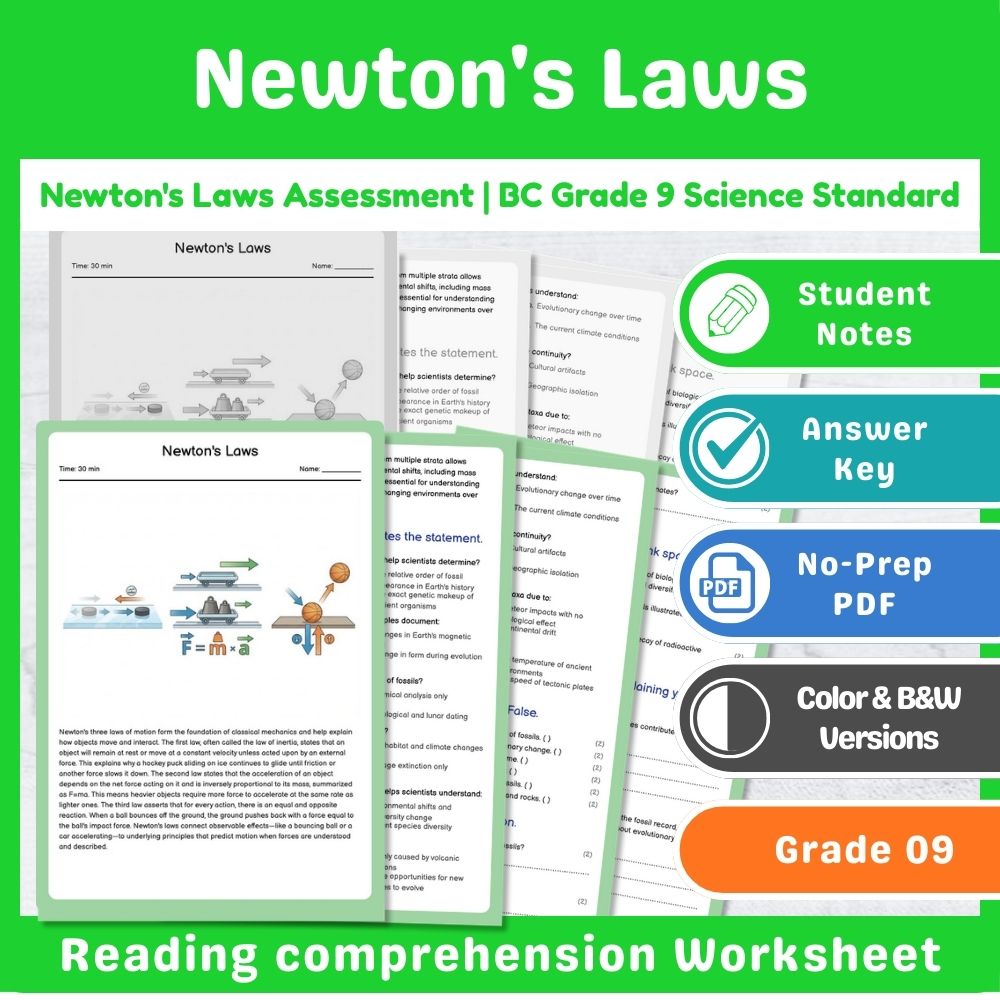
Newton's Laws Assessment | BC Grade 9 Science Standard
 Created byPrism Point Learning
Learning Objectives
- Explain the three laws of motion proposed by Sir Isaac Newton.
- Identify real-world examples that illustrate each of Newton's laws.
- Predict the motion of objects when forces act upon them based on Newton's principles.
Instant download

Grade 9 Chemical Properties Worksheet | Signs of Chemical Change Ontario
 Created byChalk and Compass
Learning Objectives
- Describe chemical properties as tendencies to undergo specific chemical changes.
- Identify evidence of chemical change, such as new substances, gas evolution, precipitate formation, and permanent colour change.
- Distinguish chemical changes from physical changes using reaction observations and product evidence.
Also included in: Matter and Chemical Change - Grade 9 Bundle +1 more
Instant download
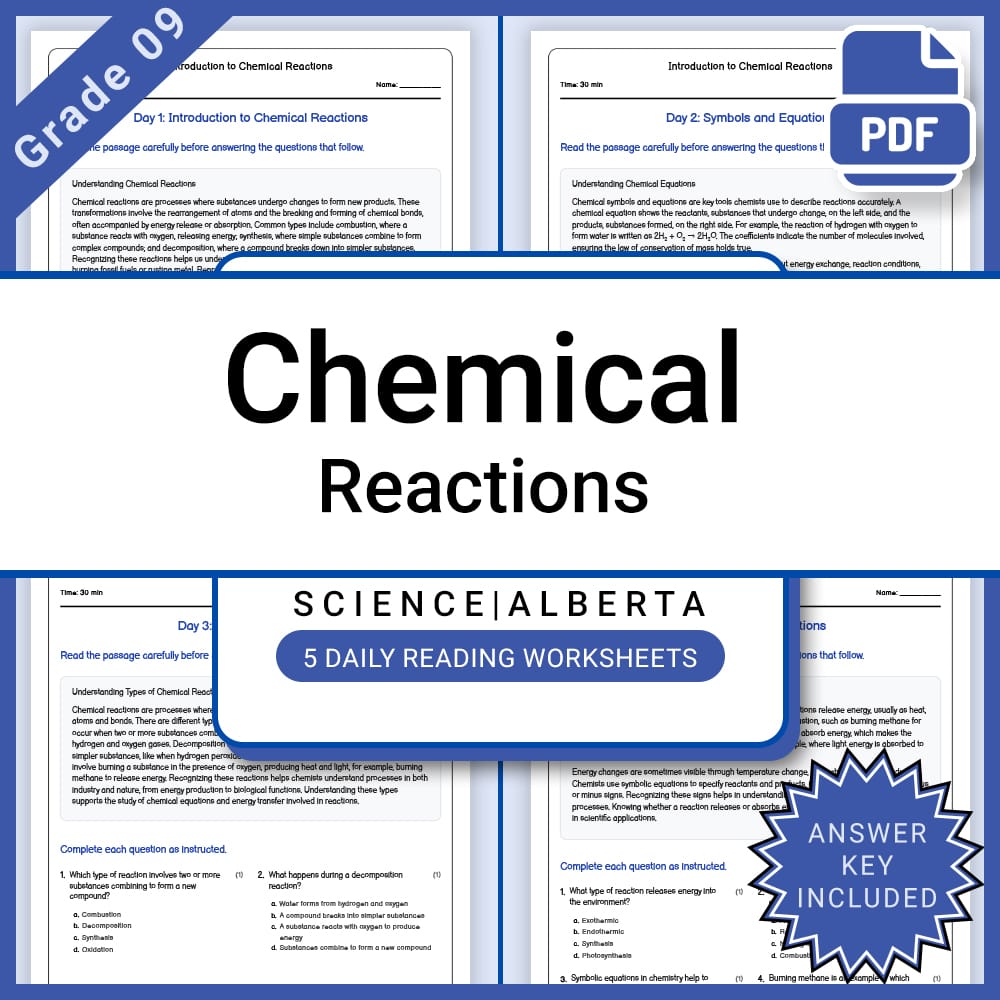
Grade 9 – Introduction to Chemical Reactions Daily Worksheet with Answer Key
JCreated byJ.S SheetsLearning Objectives
- Identify different types of chemical reactions
- Understand the process of chemical transformation and energy exchange
- Recognize examples of reactions in daily life
Also included in: Grade 9 Science Lesson Bundle | Alberta Framework +1 more
Instant download

Grade 9 Science | Gas Exchange in the Lungs - Daily Reading Comprehension
 Created byCoral Reef Learning
Learning Objectives
- Explain how gases are exchanged at the alveolar–capillary interface.
- Identify factors that influence oxygen and carbon dioxide movement between alveoli and blood.
- Describe the mechanics of ventilation and the concept of dead space in breathing.
Instant download

Grade 9 Science – Frictional Forces Worksheet (BC) Practice with Answer Key
 Created byEvergreen Desk Education
Learning Objectives
- Explain how friction opposes relative motion and how it can convert kinetic energy into thermal energy
- Differentiate static friction and kinetic friction and describe how each affects motion
- Use the idea that friction depends on surface properties and normal force to predict net force and acceleration
Instant download
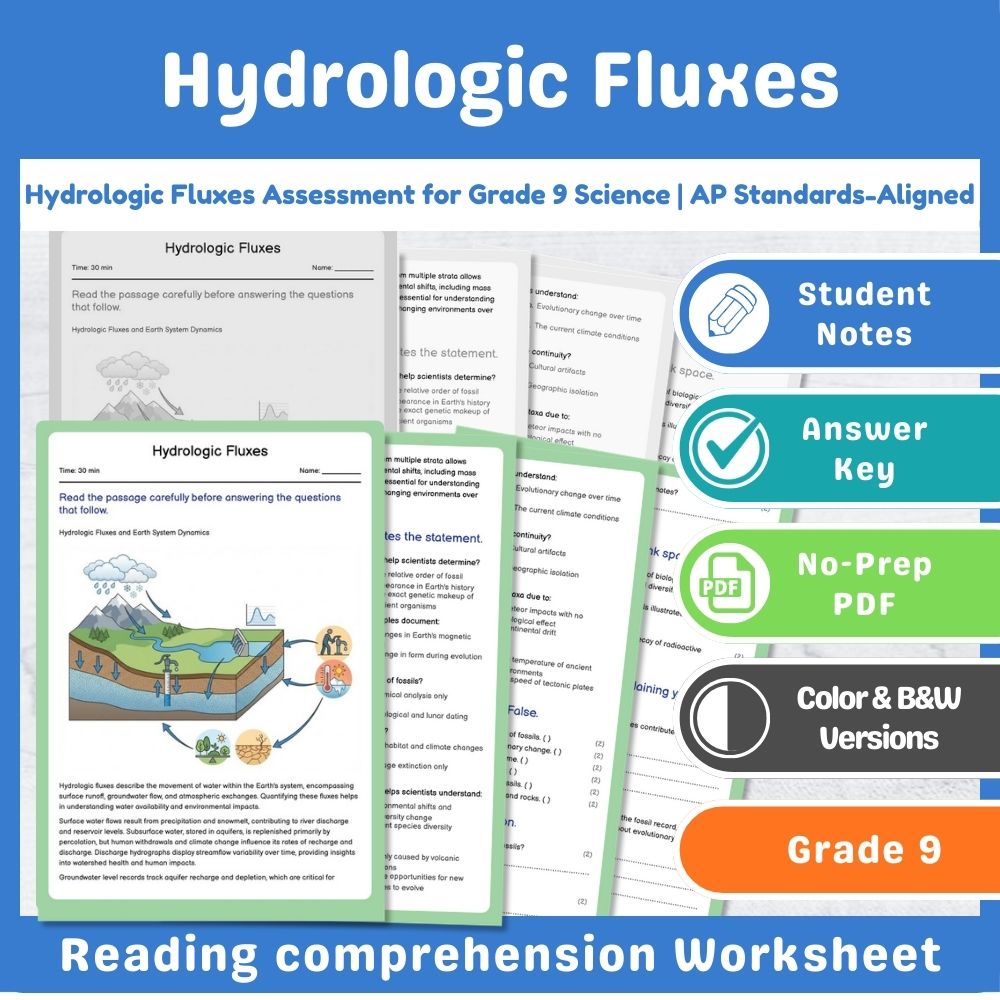
Hydrologic Fluxes Assessment for Grade 9 Science | AP Standards-Aligned
Created byPrism Point LearningLearning Objectives
- Understand the components of the water cycle and hydrologic fluxes.
- Quantify surface and subsurface water flows using water-budget frameworks.
- Relate precipitation, evapotranspiration, and human withdrawals to streamflow variability.
Also included in: Grade 9 Science Mini Bundle | Earth and Space Sciences AP Standards
Instant download
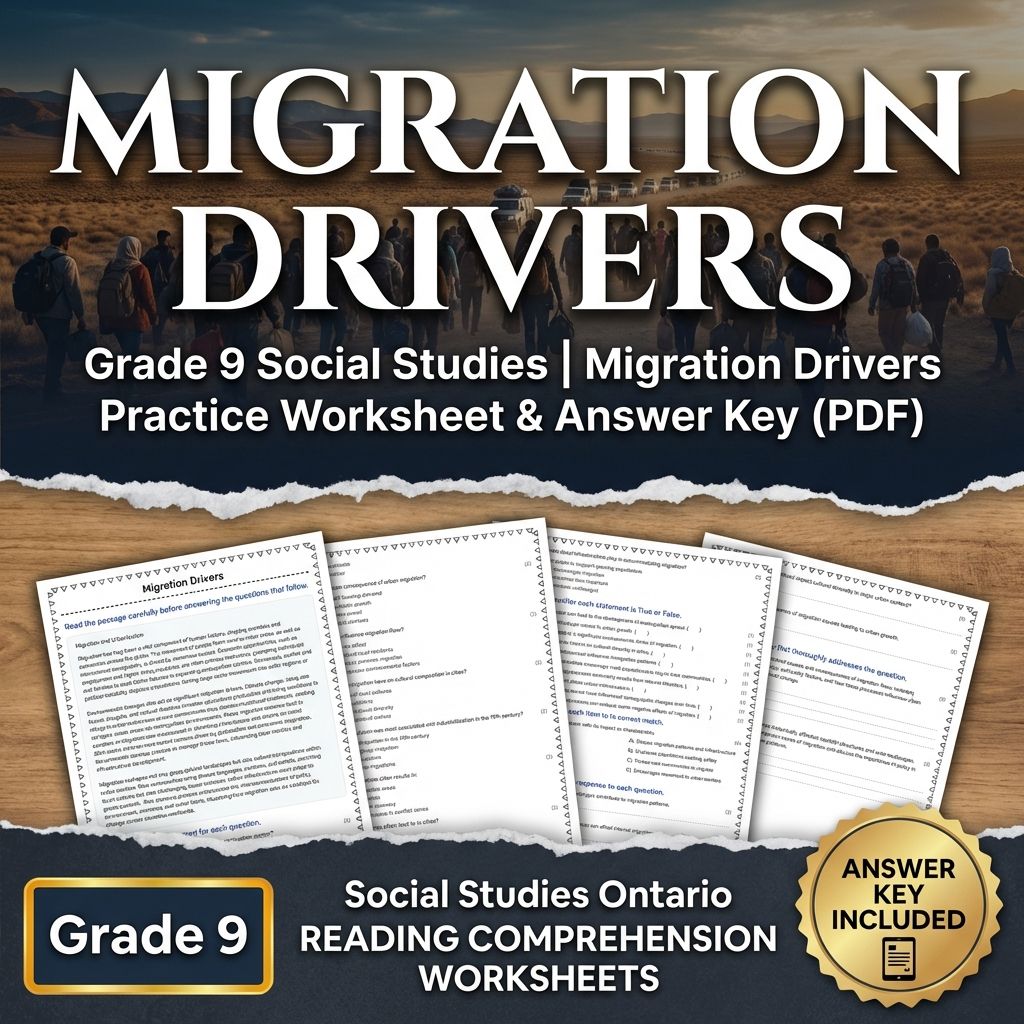
Grade 9 Social Studies | Migration Drivers Practice Worksheet & Answer Key (PDF)
JCreated byJ.S SheetsLearning Objectives
- Identify key causes of migration including economic, environmental, and conflict-related factors.
- Analyze the effects of migration on urban and rural areas and societal composition.
- Trace the patterns and changes in migration waves over time.
Also included in: Grade 9 Social Studies Unit Bundle – Community, Migration & Population Dynamics +1 more
Instant download

Evidence Reasoning Worksheet for Grade 9 ELA | Standards-Aligned Practice
JCreated byJ.S SheetsLearning Objectives
- Explain how to connect evidence to an interpretation using reasoning rather than repeating quotations.
- Identify patterns in text (tone, recurring language, shifts in meaning) and describe how they support a claim.
- Write short reasoning links that make the relationship between a detail and a broader theme or character motivation clear.
Instant download
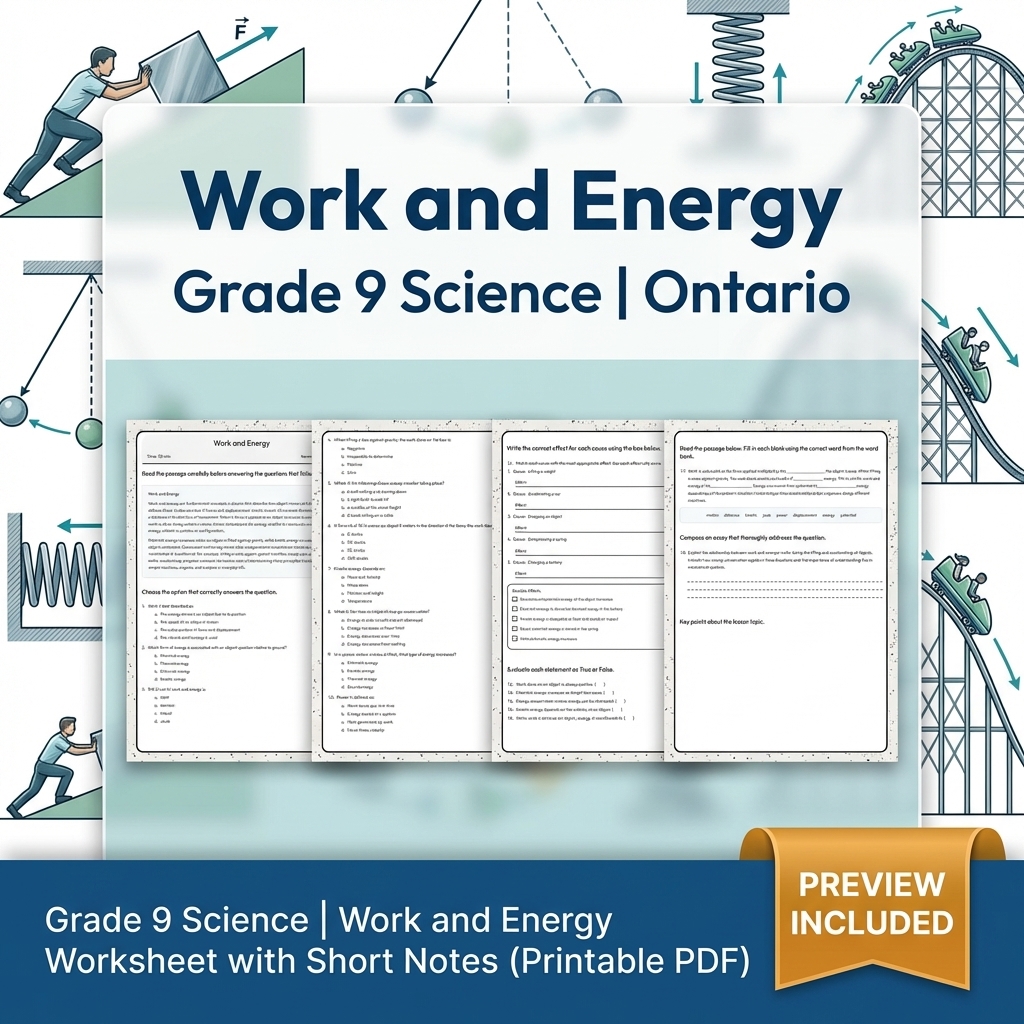
Grade 9 Science | Work and Energy Worksheet with Short Notes (Printable PDF)
 Created byMeadowlark Worksheets
Learning Objectives
- Define and explain the concept of work in physics and how it relates to force and displacement.
- Identify and distinguish between kinetic and potential energy.
- Calculate work done by constant forces in various scenarios.
Also included in: Grade 9 Science Lesson Group: Energy, Forces & Motion Worksheets Bundle
Instant download

Grade 9 Science | Tides & Gravity - Daily Reading Comprehension
Created byCoral Reef LearningLearning Objectives
- Understand how gravity influences ocean tides
- Identify the roles of the Moon and Sun in tidal cycles
- Describe how gravitational differences cause tides
Instant download

Grade 9 Science | Data Representation Tools Worksheet | General Standard
 Created byLumora Learning
Learning Objectives
- Explain how graphs and tables represent data and how axes, labels, and units affect interpretation.
- Identify qualitative trends and quantitative relationships in data displays, including spread and outliers.
- Use evidence from a representation tool to support cautious scientific conclusions.
Instant download

Grade 9 Science | Metabolic Regulation Worksheet (AP) (PDF)
Created byEvergreen Desk EducationLearning Objectives
- Explain how allosteric and covalent mechanisms regulate enzyme activity to control metabolic flux.
- Describe how compartment-specific regulation helps coordinate catabolism and anabolism.
- Use feedback inhibition and hormonal signaling to predict pathway responses to changing substrate levels.
Also included in: Grade 9 Cell, Genetics & Ecology Science Lesson Bundle: AP Standards +1 more
Instant download

Grade 9 Science – Environmental Chemistry Worksheet (Alberta) PDF
 Created bySilver Birch Teaching
Learning Objectives
- Explain how environmental chemical reactions can be analyzed using evidence, atomic/particulate explanations, and mass conservation.
- Apply system boundary ideas to track measurable mass flows in real environmental contexts (e.g., acid deposition, tailings chemistry, nutrient cycling).
- Use chemical and environmental vocabulary to describe how substances transform and where they go in an ecosystem.
Also included in: Grade 9 Chemical Reactions Science Lesson Bundle: Alberta Framework +1 more
Instant download

Electromagnetic Radiation Worksheet | Grade 9 Science NGSS Practice
JCreated byJ.S SheetsLearning Objectives
- Understand the wave and photon descriptions of electromagnetic signals across the spectrum.
- Relate frequency to photon energy and interactions with matter.
- Identify characteristic phenomena such as atomic emission and absorption lines, and spectral attenuation.
Also included in: Grade 9 Electromagnetic Signals and Waves Science Lesson Bundle – NGSS +1 more
Instant download

Revision Clarity Worksheet Grade 9 ELA BC | Writing Revision Skills
Created byLumora LearningLearning Objectives
- Revise writing to remove ambiguity by clarifying vague references and pronouns.
- Strengthen coherence by ensuring each paragraph’s focus supports the central message.
- Improve clarity by tightening wordy phrasing and expanding incomplete explanations.
Instant download
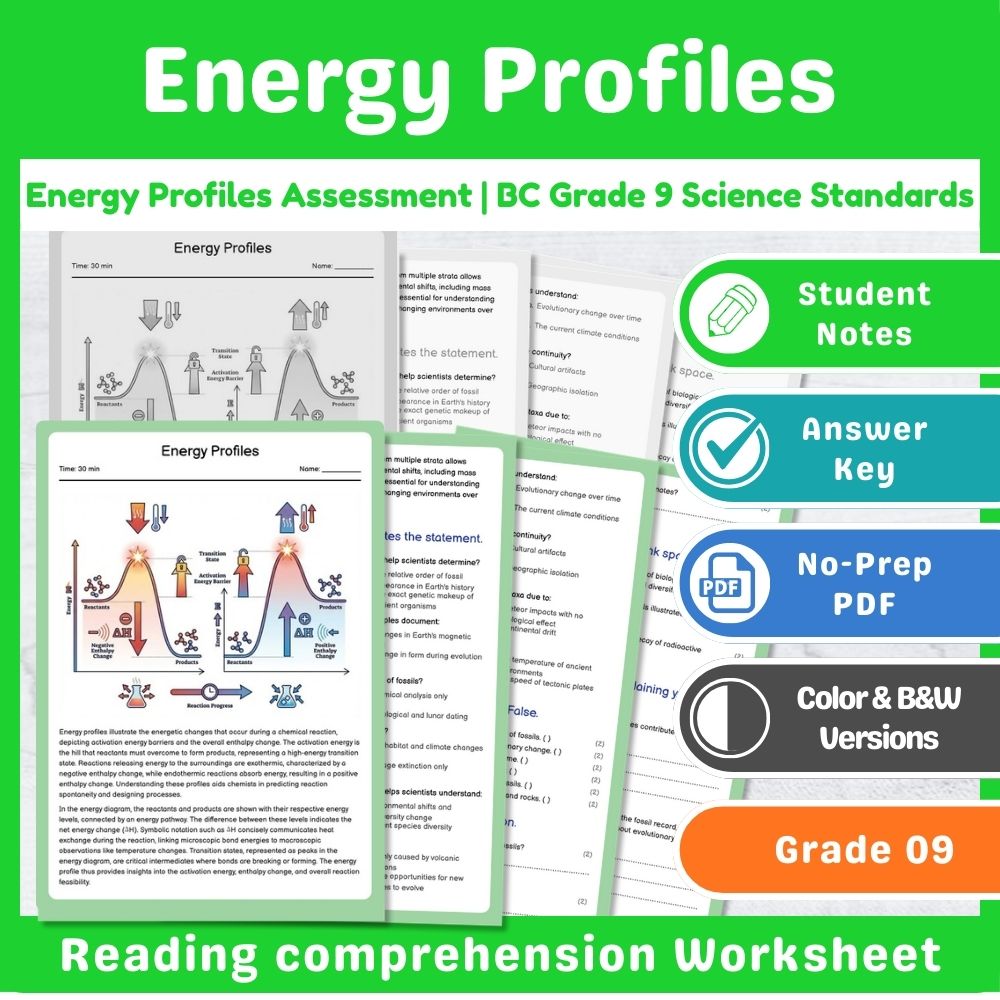
Energy Profiles Assessment | BC Grade 9 Science Standards
Created byPrism Point LearningLearning Objectives
- Understand the concept of energy profiles and their role in chemical reactions.
- Identify the differences between exothermic and endothermic reactions based on energy changes.
- Interpret the significance of activation energy and transition states in reaction pathways.
Instant download
Grade 9 Science | Albedo Feedback – Climate Change & Surface Reflectivity (PDF)
 Created byBright Mind Resources
Learning Objectives
- Explain the concept of albedo feedback and how surface reflectivity influences climate.
- Identify the effects of melting ice and snow on regional warming.
- Analyze how vegetation shifts and cloud cover can affect climate feedbacks.
Instant download

Grade 9 Science – Free-Body Diagrams Worksheet (Ontario Standards) PDF
Created byEvergreen Desk EducationLearning Objectives
- Draw and interpret free-body diagrams by identifying all forces acting on an isolated object
- Apply force-vector conventions (direction, labeled forces, points of application, and coordinate axes)
- Differentiate equilibrium from acceleration using net force and Newton’s second law
Also included in: Grade 9 Forces, Motion & Energy Science Lesson Bundle (Ontario) +1 more
Instant download

Grade 9 Science | Element Symbols in Chemistry - Daily Reading Comprehension
Created byCoral Reef LearningLearning Objectives
- Understand key concepts related to Science
- Apply knowledge through practice questions
- Demonstrate comprehension of the material
Also included in: Matter and Chemical Change Lesson Bundle – Grade 9 Science Alberta +1 more
Instant download

Grade 9 Science | Particle Conservation - Daily Reading Comprehension
Created byCoral Reef LearningLearning Objectives
- Understand the law of conservation of matter during chemical reactions
- Explain how atoms are rearranged during reactions without being created or destroyed
- Identify examples of conservation of atoms in chemical processes
Instant download

Grade 9 ELA Worksheet | Strategic Transitions (Worksheet + Answer Key)
 Created byGolden Apple Studio
Learning Objectives
- Identify how additive, contrastive, causal, and sequential transitions signal relationships between ideas within and across paragraphs.
- Revise sentences and paragraph transitions to improve coherence and strengthen argument development.
- Evaluate whether a transition word or phrase accurately matches the relationship being described.
Also included in: Grade 9 Grammar & Sentence Skills ELA Lesson Bundle Worksheets (Alberta) +1 more
Instant download
Grade 9 Science | Tissue Types Worksheets (PDF) – BC Standard & Practical
Created byBright Mind ResourcesLearning Objectives
- Identify the four main tissue types and their functions.
- Describe tissue structure and how cell specialization influences organ properties.
- Explain how tissues work together at the organ level to perform specific functions.
Instant download

Grade 9 Science | Models & Theories - Daily Reading Comprehension
Created byCoral Reef LearningLearning Objectives
- Understand the purpose and types of scientific models.
- Differentiate between models, explanations, and theories.
- Recognize how scientific models are used to explain phenomena.
Instant download
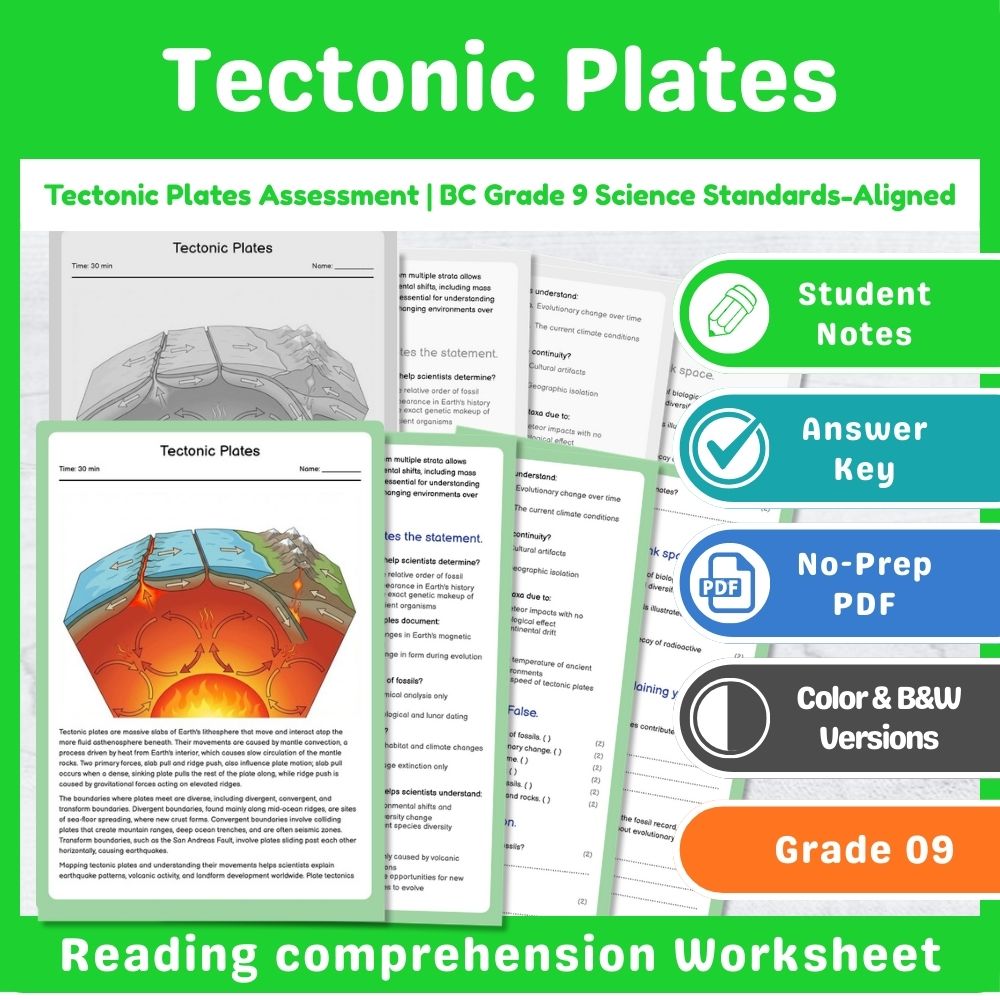
Tectonic Plates Assessment | BC Grade 9 Science Standards-Aligned
Created byPrism Point LearningLearning Objectives
- Describe the structure and composition of Earth's lithosphere and asthenosphere.
- Explain the mechanisms driving tectonic plate movements, such as mantle convection, slab pull, and ridge push.
- Identify the different types of plate boundaries and the landforms and seismic activities associated with each.
Also included in: Grade 9 Science Mini Bundle – Earth & Space Assessment & Activities
Instant download
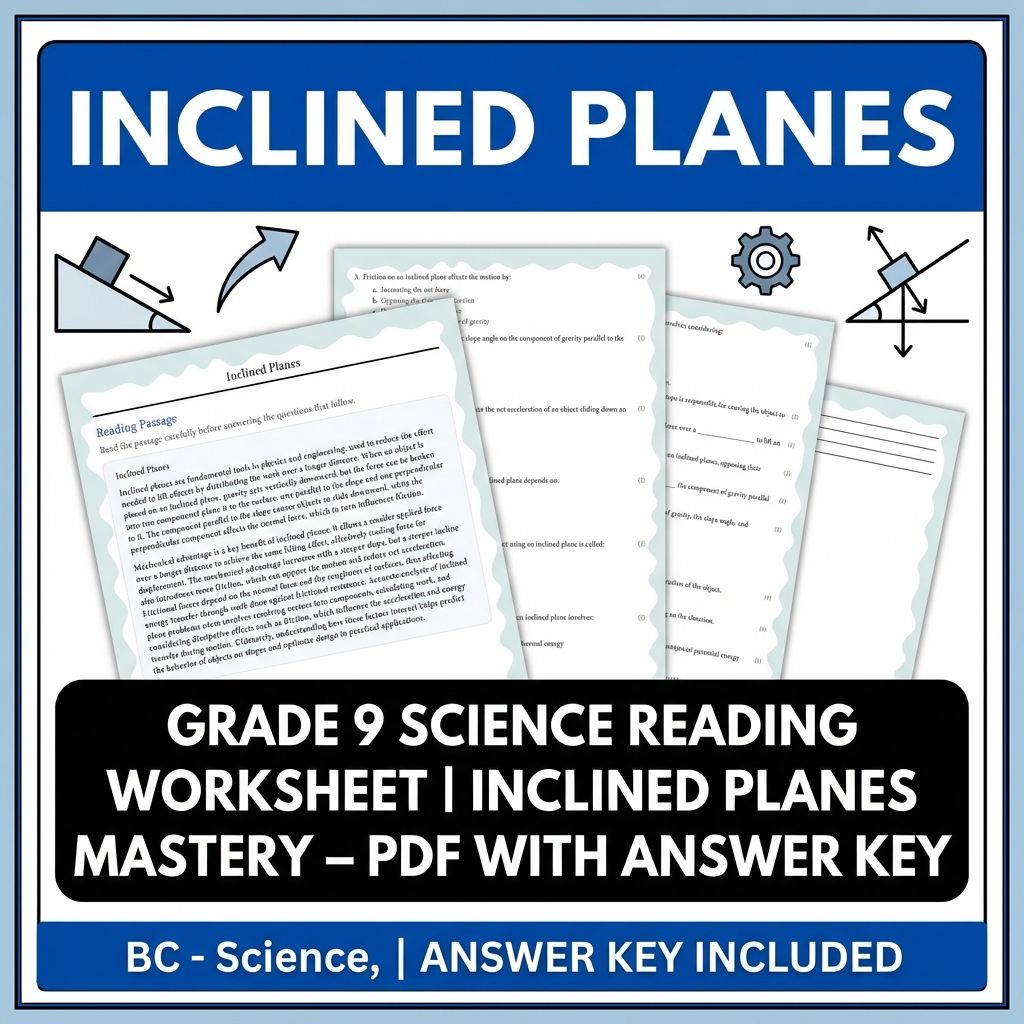
Grade 9 Science Reading Worksheet | Inclined Planes Mastery – PDF with Answer Key
JCreated byJ.S SheetsLearning Objectives
- Understand how inclined planes decompose gravitational forces into components parallel and perpendicular to the surface.
- Identify the effects of mechanical advantage on applied force and displacement when using inclined planes.
- Analyze the role of friction and slope angle in determining net acceleration and energy transfer during motion.
Instant download

Grade 9 ELA - Punctuation Marks Worksheet (Common Core CCSS) PDF
Created byGolden Apple StudioLearning Objectives
- Use end punctuation (period, question mark, exclamation point) correctly in different sentence types.
- Apply comma rules for introductory phrases, nonessential information, and items in a series.
- Use apostrophes for contractions and possession, and use quotation marks for direct text.
Also included in: Grade 9 ELA Writing Precision Tense, Punctuation & Word Choice Lessons CCSS +1 more
Instant download

Land Use Patterns Worksheet | TEKS-Aligned Grade 9 Social Studies Practice
JCreated byJ.S SheetsLearning Objectives
- Explain how physical geography influences land use patterns.
- Analyze how economic factors and government policies affect where people build and work.
- Evaluate how conservation goals and planning decisions shape regional development.
Instant download
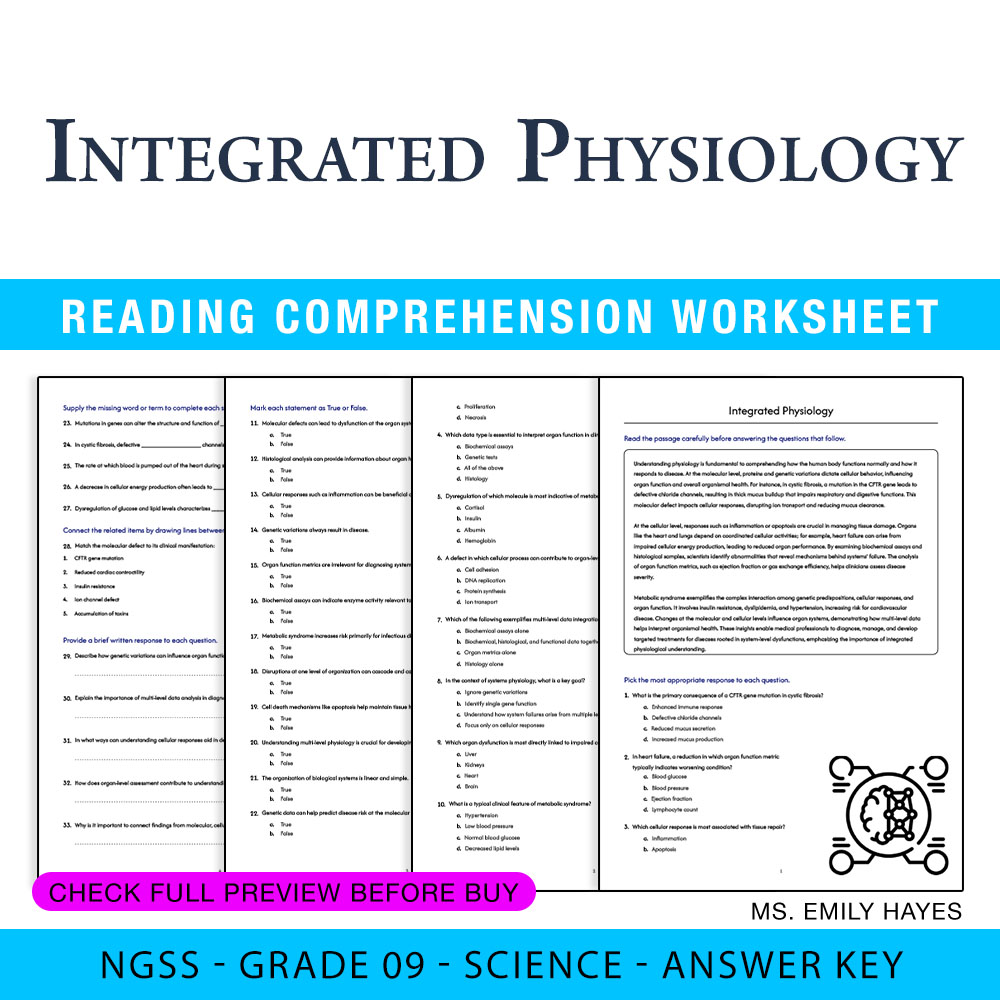
Grade 9 Science | Integrated Physiology Worksheet (PDF+ Answer Key)
 Created byCopper Leaf Classroom
Learning Objectives
- Understand how molecular, cellular, and organ-level interactions contribute to physiological functions and health.
- Analyze clinical and natural exemplars such as cystic fibrosis, heart failure, and metabolic syndrome to understand system dysfunction.
- Construct explanatory accounts connecting genetic variation to cellular responses and organ system performance.
Instant download

Source Evaluation Worksheet for Grade 9 ELA | Common Core aligned PDF
JCreated byJ.S SheetsLearning Objectives
- Evaluate the credibility and relevance of research sources by examining authorship, evidence, and purpose.
- Identify bias and determine how it affects the usefulness of a source for a specific claim.
- Integrate sources in evidence-based writing by synthesizing ideas and using citations to attribute borrowed information.
Instant download

Membrane Transport Worksheet | Grade 9 Science Practice
 Created byBright Quill Resources
Learning Objectives
- Explain how passive diffusion, facilitated transport, and active transport move substances across membranes using gradients and energy sources
- Use concentration differences and permeability ideas to predict transport direction and relative rate in simple scenarios
- Describe how membrane composition and transport proteins influence osmotic balance and electrochemical gradients
Instant download

Plate Boundaries Worksheet | Advanced Placement Science | Grade 9
JCreated byJ.S SheetsLearning Objectives
- Identify and describe the three main types of plate boundaries: divergent, convergent, and transform.
- Explain the surface features and geological processes associated with each boundary type.
- Analyze evidence such as seafloor age patterns, paleomagnetic stripes, and earthquake distributions to understand plate movements.
Instant download

Grade 9 Newtonian Motion Worksheet | NGSS Forces & Motion Science Activity
Created byBRIGHT PATH RESOURCESLearning Objectives
- Understand the basic concepts of Newton's first and second laws
- Analyze free-body diagrams and force components
- Relate net force to acceleration in constant mass systems
Also included in: Newtonian Motion Grade 9 Science Daily Reading Worksheets Lesson Bundle | NGSS +1 more
Instant download
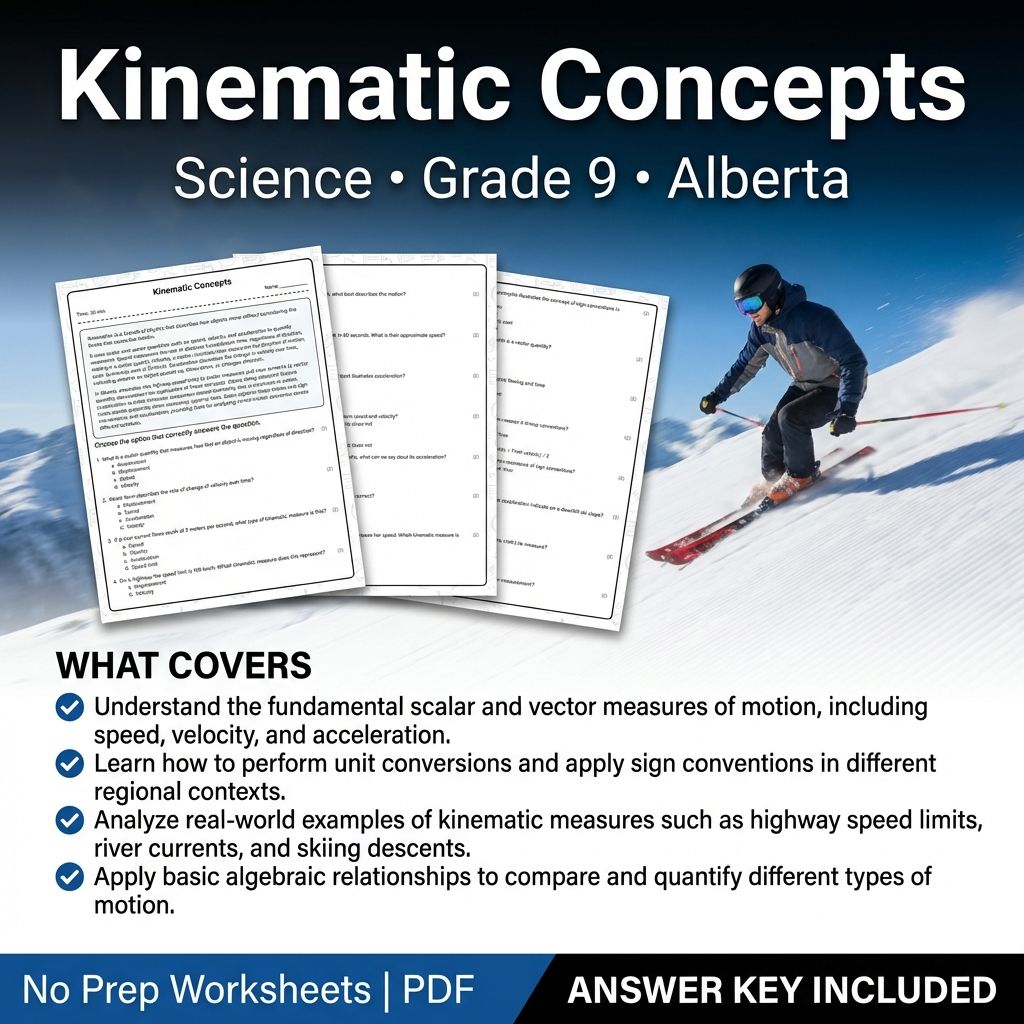
Kinematic Concepts Grade 9 Science Worksheet | Alberta Standards
Created byCoral Reef LearningLearning Objectives
- Understand the fundamental scalar and vector measures of motion, including speed, velocity, and acceleration.
- Learn how to perform unit conversions and apply sign conventions in different regional contexts.
- Analyze real-world examples of kinematic measures such as highway speed limits, river currents, and skiing descents.
Instant download

Grade 9 States of Matter and Particle Model Worksheet | Alberta Science
Created byBRIGHT PATH RESOURCESLearning Objectives
- Describe how particle behavior differs in solids, liquids, and gases
- Identify evidence in a text that matches each state of matter to its particle model
- Explain phase changes using energy and particle motion
Instant download

Inclined Planes Worksheet | Grade 9 Science Practice
Created byPrism Point LearningLearning Objectives
- Explain how an inclined plane changes gravity into components parallel and perpendicular to the surface.
- Predict how friction and slope angle affect acceleration down an incline.
- Relate mechanical advantage to the tradeoff between force and distance using work ideas.
Also included in: Forces and Motion Lesson Bundle – Grade 9 Science Framework BC +1 more
Instant download
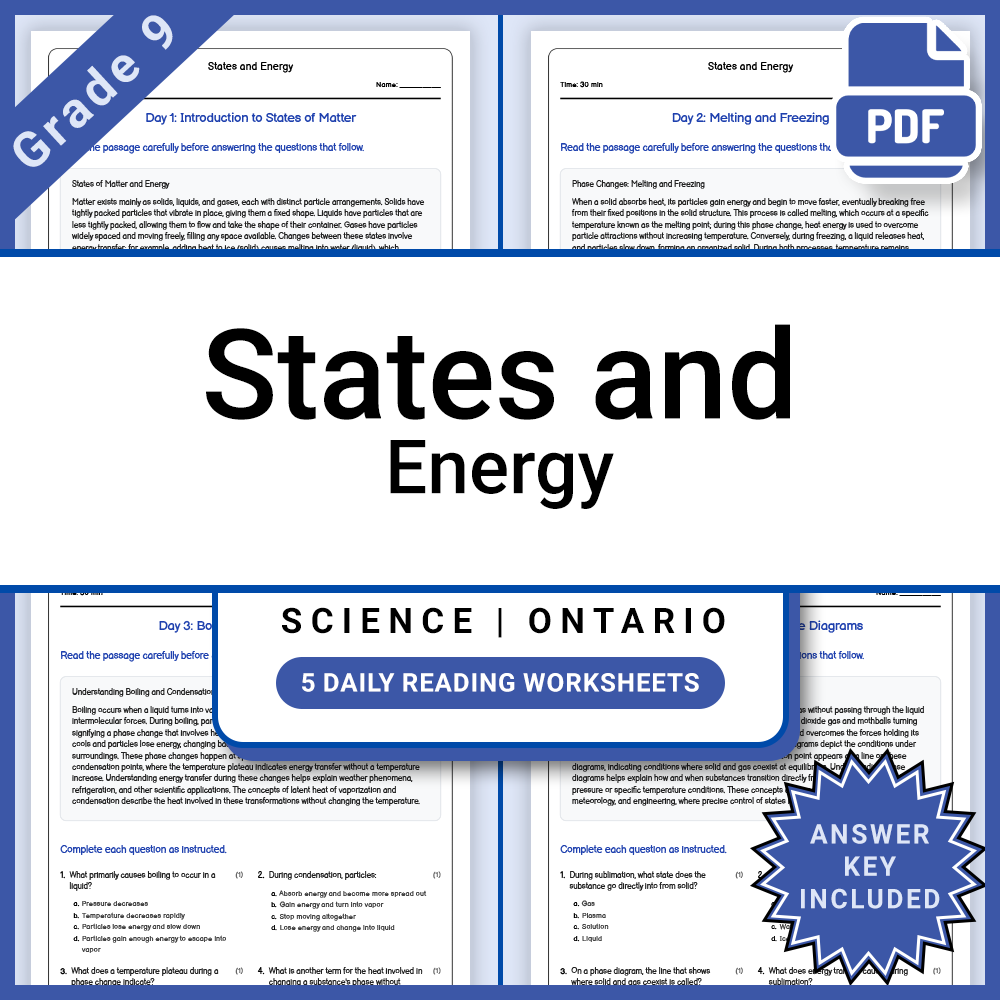
Grade 9 Science – States and Energy Daily Reading Worksheet + Answer Key
JCreated byJ.S SheetsLearning Objectives
- Understand the different states of matter: solid, liquid, and gas.
- Explain phase changes such as melting, vaporization, sublimation, and condensation.
- Describe how energy transfer affects particle motion during phase transitions.
Also included in: Grade 9 Science Lesson Group: Ontario Curriculum Daily Reading Worksheets +1 more
Instant download
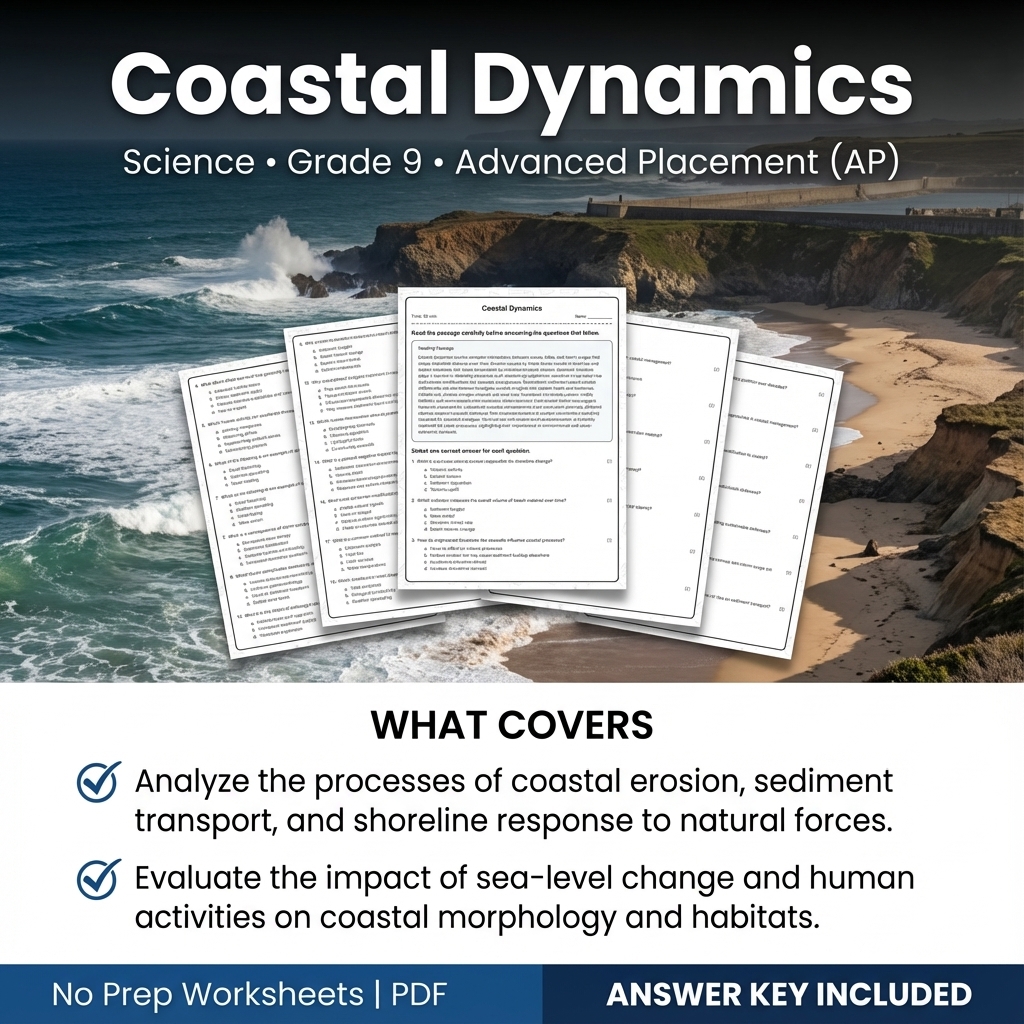
Grade 9 Science | Coastal Dynamics Worksheet (Printable PDF + Answer Key)
Created byCoral Reef LearningLearning Objectives
- Analyze the processes of coastal erosion, sediment transport, and shoreline response to natural forces.
- Evaluate the impact of sea-level change and human activities on coastal morphology and habitats.
Also included in: Grade 9 Science Unit | Earth Processes & Climate Worksheets Pack (PDF & Answer Keys) +2 more
Instant download

Grade 9 Conservation Of Matter Worksheet | Practice & Assessment PDF
 Created byClear Sky Classroom
Learning Objectives
- Explain how atoms are rearranged in chemical reactions while remaining conserved.
- Use particle-level reasoning to connect reactant quantities to possible product quantities.
- Describe how mass is conserved in a closed system during chemical reactions.
Instant download

Grade 9 Health Goal Setting Worksheet (Ontario) PDF
 Created bySunny Desk Resources
Learning Objectives
- Define clear, realistic health goals and explain why specificity and measurability matter.
- Apply a simple goal-setting plan (action steps, timelines, and monitoring) to improve physical activity or sleep habits.
- Use reflection to evaluate results and adjust strategies to support sustained healthy choices.
Also included in: Grade 9 Stress & Mental Health Skills Health Lesson Bundle: Ontario +1 more
Instant download
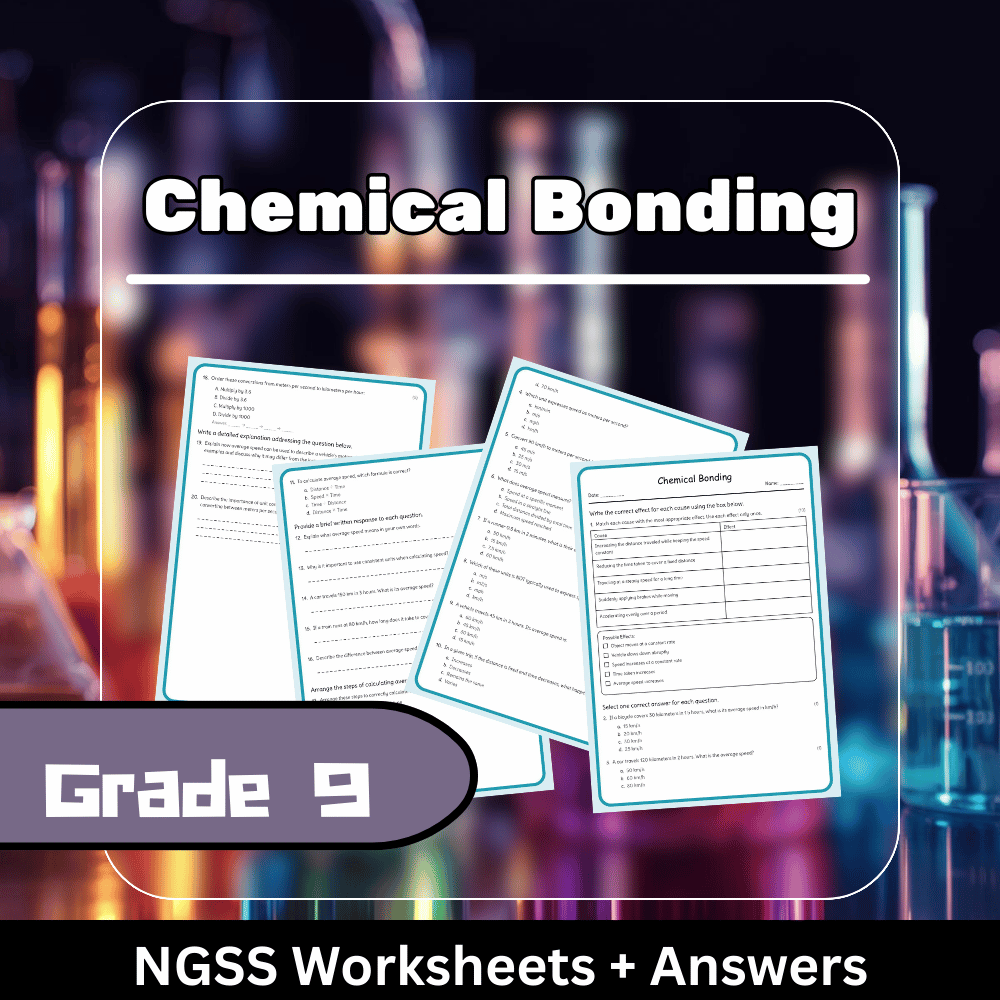
Grade 9 Science | Chemical Bonding Worksheet (Answer Key) – NGSS Alignment
Created byBright Mind ResourcesLearning Objectives
- Understand different types of chemical bonds: ionic, covalent, and metallic.
- Describe how bond energies, polarity, and lattice structures influence material properties.
- Interpret Lewis structures, electron sharing, and electron transfer models to explain molecular geometry.
Instant download

Grade 9 Science | Inclined Planes Worksheet Elena | BC Aligned
Created byLumora LearningLearning Objectives
- Understand how inclined planes decompose gravitational force into components that affect motion.
- Explain the concept of mechanical advantage and its effects on applied force and distance traveled.
- Analyze the roles of friction and slope angle in determining net acceleration and energy transfer during motion.
Instant download
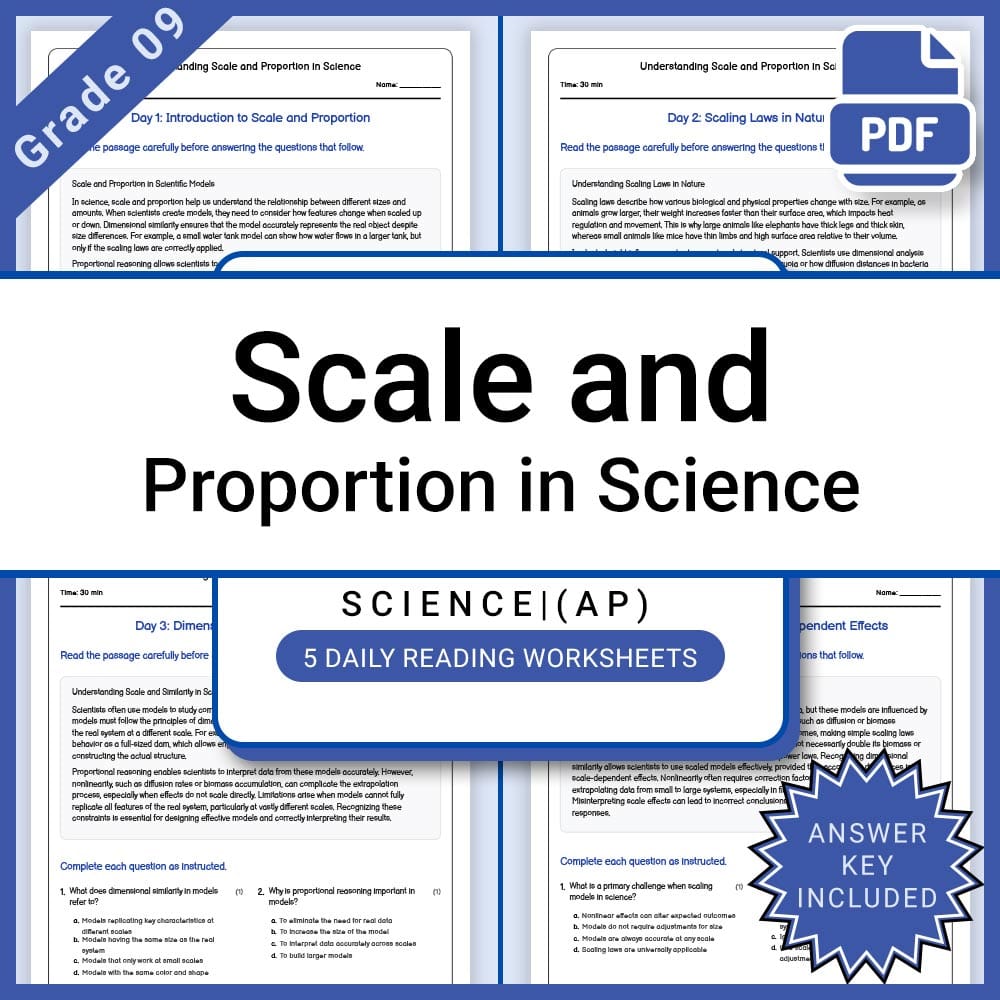
Grade 9 Science – Scale and Proportion Daily Reading Worksheet + Answer Key
JCreated byJ.S SheetsLearning Objectives
- Understand key concepts related to Science
- Apply knowledge through practice questions
- Demonstrate comprehension of the material
Also included in: Grade 9 Science Lesson Group - AP Framework Daily Reading Worksheets +1 more
Instant download

Grade 9 Unbalanced Forces Worksheet | Practice & PDF Answer Key
Created byClear Sky ClassroomLearning Objectives
- Explain how net force and direction determine an object’s acceleration when forces do not balance
- Use force reasoning to predict how changes in net force affect both the magnitude and direction of motion
- Differentiate between balanced and unbalanced forces using examples and real-world scenarios
Instant download

Grade 9 Atomic Particles Worksheet | BC Practice & PDF
Created byClear Sky ClassroomLearning Objectives
- Explain how protons determine the identity of an element and how electrons influence chemical behavior
- Differentiate atomic mass and isotopes by relating them to protons and neutrons
- Use the atom model (nucleus and electron energy regions) to predict basic properties and bonding patterns
Instant download

Inverse-Square Force Laws Worksheets: Gravity & Electrostatics Grade 9
 Created byTeachers Club
Learning Objectives
- Calculate force changes using inverse-square distance relationships
- Compare force magnitudes across different separation distances
- Identify attractive and repulsive electrostatic force directions
Also included in: Motion and Stability Grade 9 Science Worksheets | NGSS Bundle +1 more
Instant download
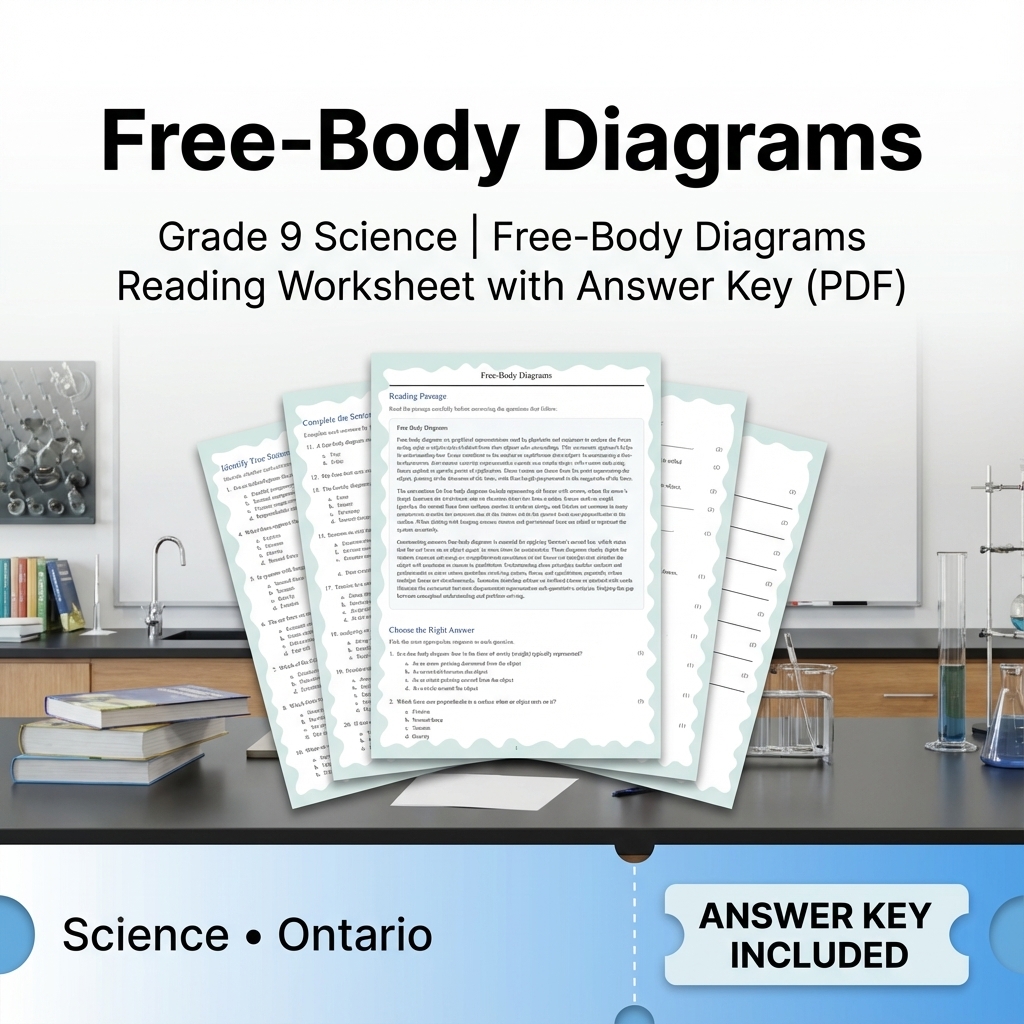
Grade 9 Science | Free-Body Diagrams Reading Worksheet with Answer Key (PDF)
JCreated byJ.S SheetsLearning Objectives
- Understand the conventions and components of free-body diagrams for isolated objects.
- Identify and represent the fundamental forces acting on objects, such as weight, normal force, tension, and friction.
- Apply free-body diagrams to analyze scenarios involving inclined planes and hanging masses.
Also included in: Grade 9 Science Unit | Force, Motion & Energy Worksheets & Answer Keys Bundle +1 more
Instant download

Evidence Support Worksheet Elena | Alberta ELA Grade 9 Standards
Created byLumora LearningLearning Objectives
- Identify evidence (quotations, paraphrases, and concrete details) that directly supports a claim about theme or meaning.
- Explain how chosen evidence clarifies an interpretation by connecting the detail to the reasoning that follows.
- Evaluate evidence quality by checking specificity and alignment with the claim.
Instant download
Browse more categories
About Grade 9 Worksheets
Browse 9,323 printable Grade 9 worksheets across algebra, biology, literature, and history — each a ready-to-print PDF with optional answer keys.
Every worksheet on MyTeachingSheets is created by independent teacher-authors and reviewed before publication. All resources download as printable PDFs for classroom, homework, or at-home practice, and many include answer keys. Preview any worksheet free before buying.