
Grade 9 Worksheets
9,323 grade resources
Nutrient Cycling Worksheet | NGSS Grade 9 Science Assessment
 Created bySkylark Worksheets
Learning Objectives
- Explain how carbon, nitrogen, and phosphorus cycle through ecosystems using reservoirs and fluxes.
- Describe microbial decomposition processes and how they affect nutrient availability and primary productivity.
- Use mass-balance reasoning to predict how changes in nutrient inputs and cycling rates can alter long-term ecosystem outcomes.
Also included in: Grade 9 Science Full-Year Bundle | NGSS Worksheets & Assessments
Instant download

Integrated Case Worksheet | Standards-Aligned Grade 9 Science Practice
JCreated byJ.S SheetsLearning Objectives
- Analyze reproductive strategies and their impacts on genetic diversity.
- Trace inheritance mechanisms through chromosomes and Mendelian patterns.
- Evaluate the ecological and societal implications of breeding technologies.
Also included in: Grade 9 Genetics & Inheritance Science Lesson Bundle – Alberta Framework
Instant download

Grade 9 Science – Net Force Worksheet (PDF) | BC Standards
 Created byEvergreen Desk Education
Learning Objectives
- Explain how net force (vector sum of forces) determines the direction and magnitude of acceleration.
- Distinguish between balanced forces (net force = 0) and unbalanced forces (net force ≠ 0).
- Resolve forces into components and calculate net force using vector addition.
Instant download

Levels of Organization Worksheet | Grade 9 Science Biology Ontario + Answer Key
 Created byClear Sky Classroom
Learning Objectives
- Explain how cells, tissues, organs, and organ systems relate in a hierarchy of biological organization
- Use examples (epithelial linings, muscle tissue, and organ assemblies) to describe how specialization leads to organ-level functions
- Describe how arrangement at the tissue and organ levels supports physiological capacity and constraints
Instant download

Grade 9 Science – Motion Equations & Physics Daily Reading Worksheet
 Created byBright Mind Resources
Learning Objectives
- Understand the basic variables involved in motion equations
- Identify and interpret key components of constant-acceleration equations
- Apply algebraic methods to solve motion problems
Also included in: Grade 9 Simple Machines Science Daily Reading Lesson Bundle | Alberta +1 more
Instant download

Grade 9 Science | Ecosystem Change & Resilience - Daily Reading Comprehension
 Created byCoral Reef Learning
Learning Objectives
- Understand the components and relationships within ecosystems
- Identify factors that cause ecosystem changes
- Explain how ecosystems recover from disturbances
Instant download

Grade 9 Science – Reproductive Modes Worksheet (Alberta Standards) (PDF)
 Created bySilver Birch Teaching
Learning Objectives
- Differentiate between sexual and asexual reproduction in terms of genetic outcomes and parent involvement
- Explain how reproductive strategies affect genetic diversity and population change over time
- Apply Alberta examples to identify whether a reproductive mode is primarily sexual or asexual
Also included in: Grade 9 Genetics and Reproduction Science Lesson Bundle Worksheets – Alberta +1 more
Instant download

Grade 9 Science Worksheet | Regulatory Mechanisms TEKS Practice (PDF)
Created byEvergreen Desk EducationLearning Objectives
- Explain how promoters, enhancers, silencers, and transcription factors control gene transcription.
- Describe how epigenetic modifications (DNA methylation and histone acetylation) change chromatin accessibility.
- Analyze how regulatory networks and feedback loops fine-tune gene expression in response to signals.
Instant download
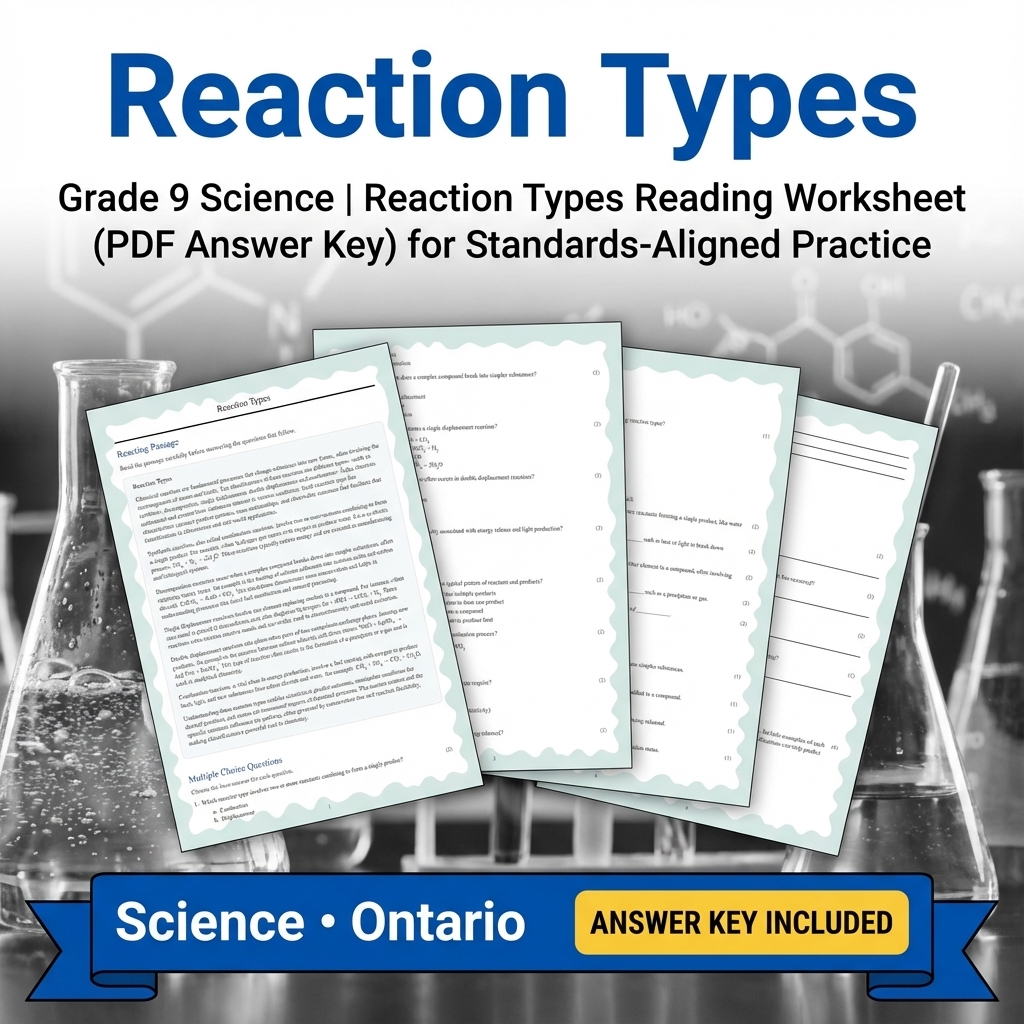
Grade 9 Science | Reaction Types Reading Worksheet (PDF Answer Key)
JCreated byJ.S SheetsLearning Objectives
- Identify and describe the different types of chemical reactions: synthesis, decomposition, single displacement, double displacement, and combustion.
- Recognize practical examples and observable outcomes of each reaction type.
- Understand how reaction patterns relate to reactant-product relationships and conservation of mass.
Also included in: Grade 9 Science Unit Bundle | Essential Concepts & Skills (Answer Keys Included) +1 more
Instant download
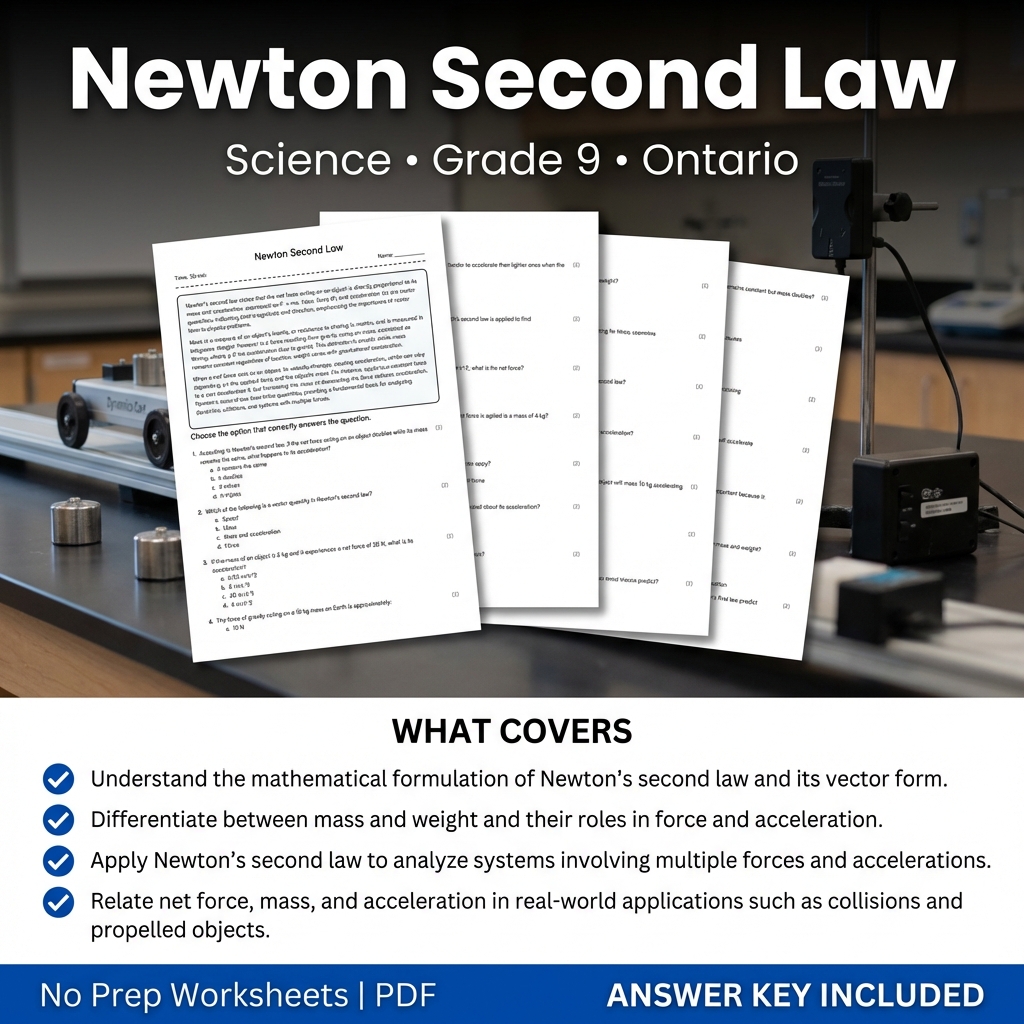
Newton Second Law Worksheet for Grade 9 Science | Ontario Standards
Created byCoral Reef LearningLearning Objectives
- Understand the mathematical formulation of Newton's second law and its vector form.
- Differentiate between mass and weight and their roles in force and acceleration.
- Apply Newton's second law to analyze systems involving multiple forces and accelerations.
Instant download

Grade 9 Science – Observable Properties of Materials | Daily Reading Worksheet
Created byBright Mind ResourcesLearning Objectives
- Understand and describe how materials appear and behave under ordinary conditions.
- Identify different observable properties such as colour, texture, density, and solubility.
- Use vocabulary related to observable material properties to classify and compare substances.
Also included in: States of Matter Grade 9 Science Daily Reading Worksheets lesson bundle |Alberta +1 more
Instant download
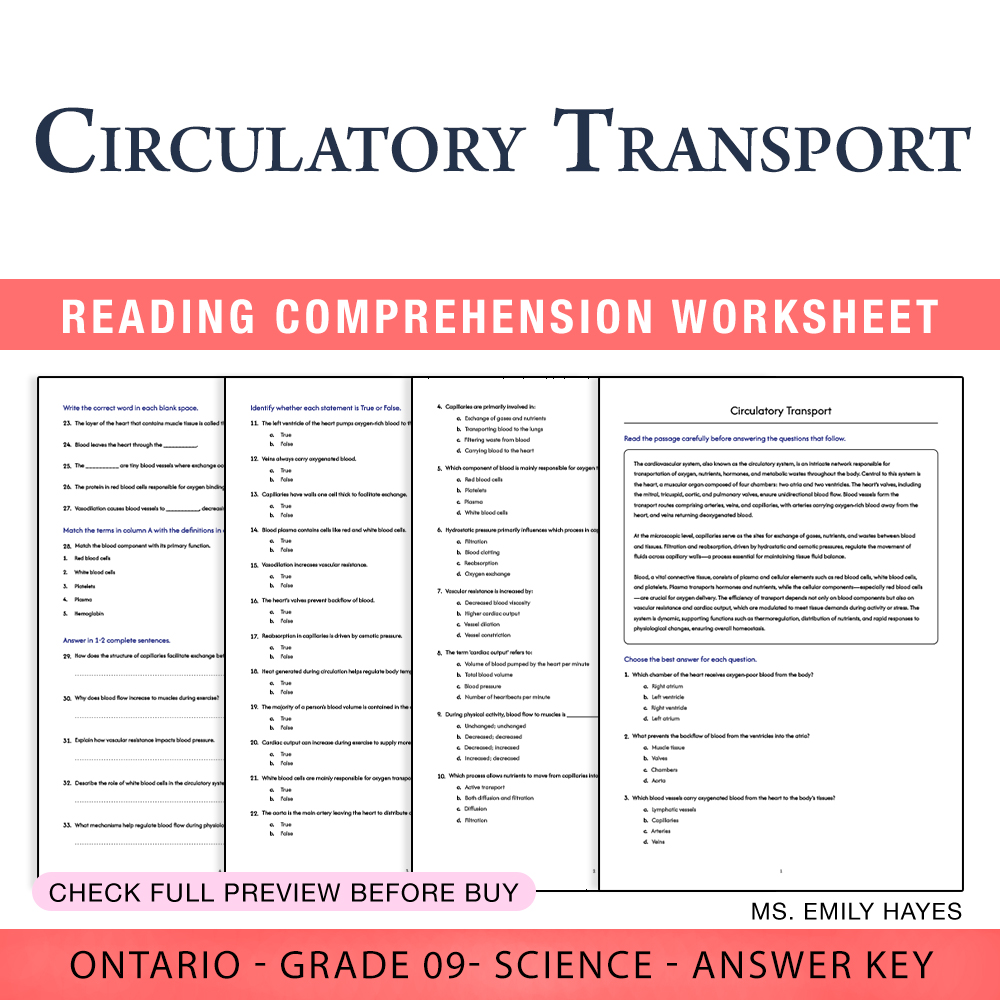
Grade 9 Science | Circulatory Transport Worksheet (PDF + Answer Key)
 Created byCopper Leaf Classroom
Learning Objectives
- Describe the structure and function of the heart, including its valves and chambers.
- Explain the hierarchy of blood vessels and their roles in circulation.
- Understand haemodynamics, including blood flow and vascular resistance.
Instant download
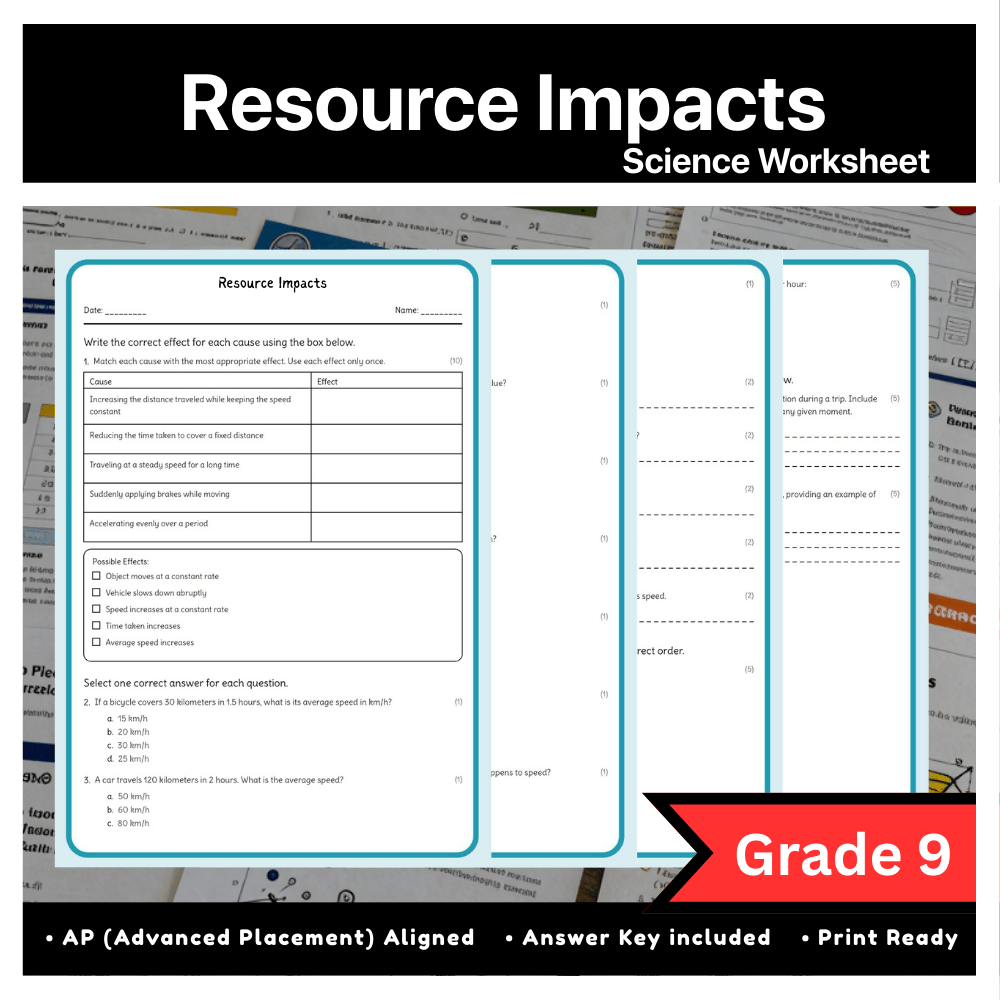
Grade 9 Science | Resource Impacts Worksheet (AP Standard) – Science 1 (PDF)
Created byBright Mind ResourcesLearning Objectives
- Interpret resource trends using indicators such as extraction rates, groundwater levels, and land-use changes.
- Evaluate the consequences of resource depletion, including subsidence and soil erosion.
- Assess sustainability implications through dataset comparisons and ratio-based measures.
Instant download
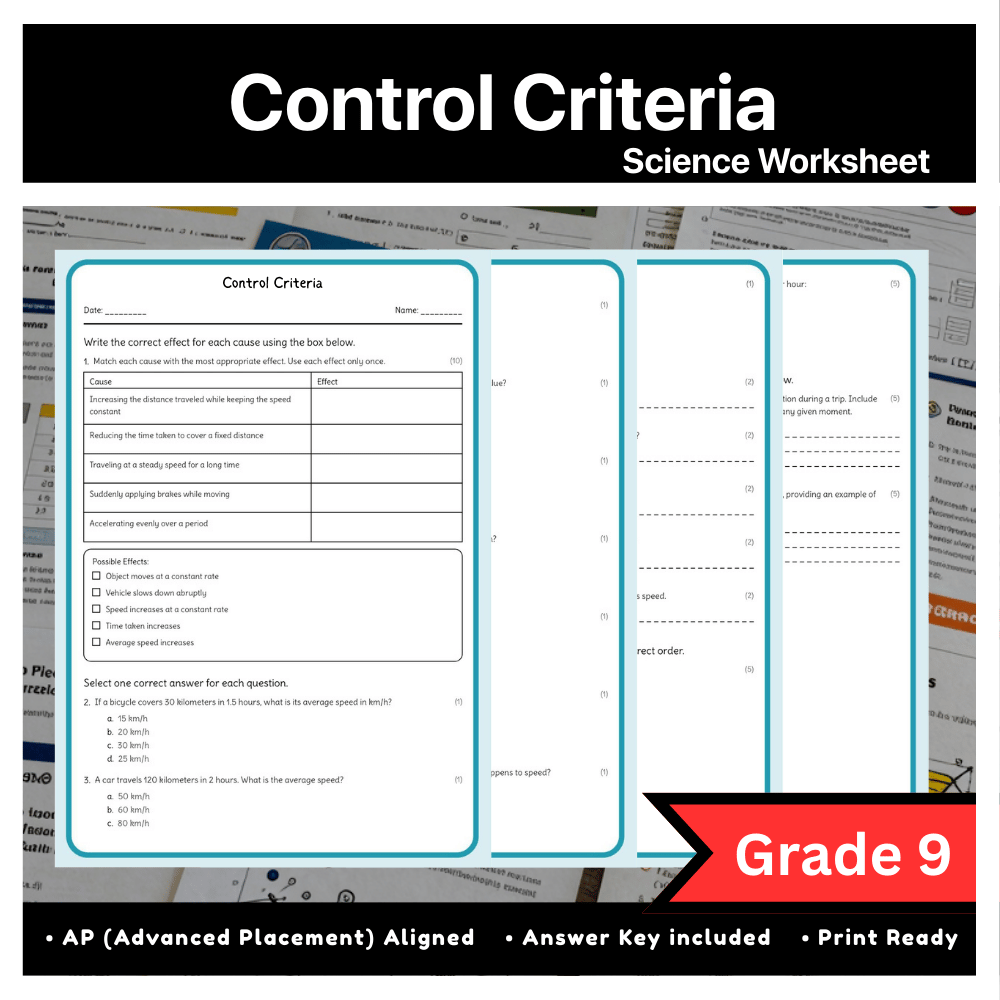
Grade 9 Science | Control Criteria Worksheet + Answer Key (AP Standards)
Created byBright Mind ResourcesLearning Objectives
- Define the criteria for establishing control and comparability in causal inference.
- Understand how variable isolation, replication, baseline characterization, and reference conditions influence causal claims.
- Explain how residual confounding and uncontrolled variation affect the strength of causal inferences.
Instant download
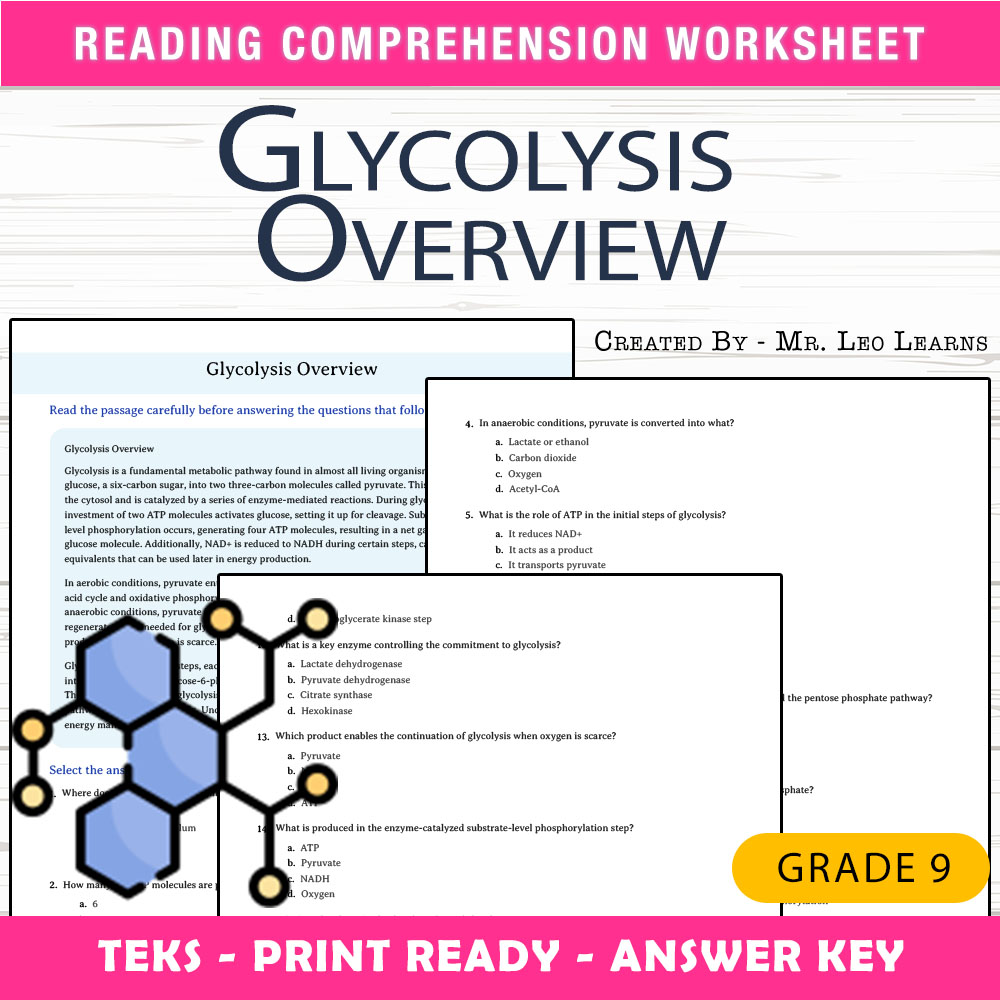
Grade 9 Science – Glycolysis Overview Worksheet for Mastery
 Created byThe Resource Hub
Learning Objectives
- Describe the key steps and intermediates involved in glycolysis.
- Explain the net energy gain from glycolysis, including ATP and NADH production.
- Differentiate between aerobic and anaerobic pathways following glycolysis.
Also included in: Grade 9 Science | Enzymes, Photosynthesis & Metabolic Pathways Unit Bundle +1 more
Instant download

Grade 9| Patriot Day for Mastering Memorials and Stories | PDF + Answer Key
 Created byShaNova Worksheets
Learning Objectives
- Analyze how memorials use symbols and messages to support remembrance and healing after 9/11.
- Interpret resilience stories from survivors and responders and connect them to themes of bravery, sacrifice, and hope.
- Evaluate how public memorials shape collective mourning and shared historical awareness.
Instant download
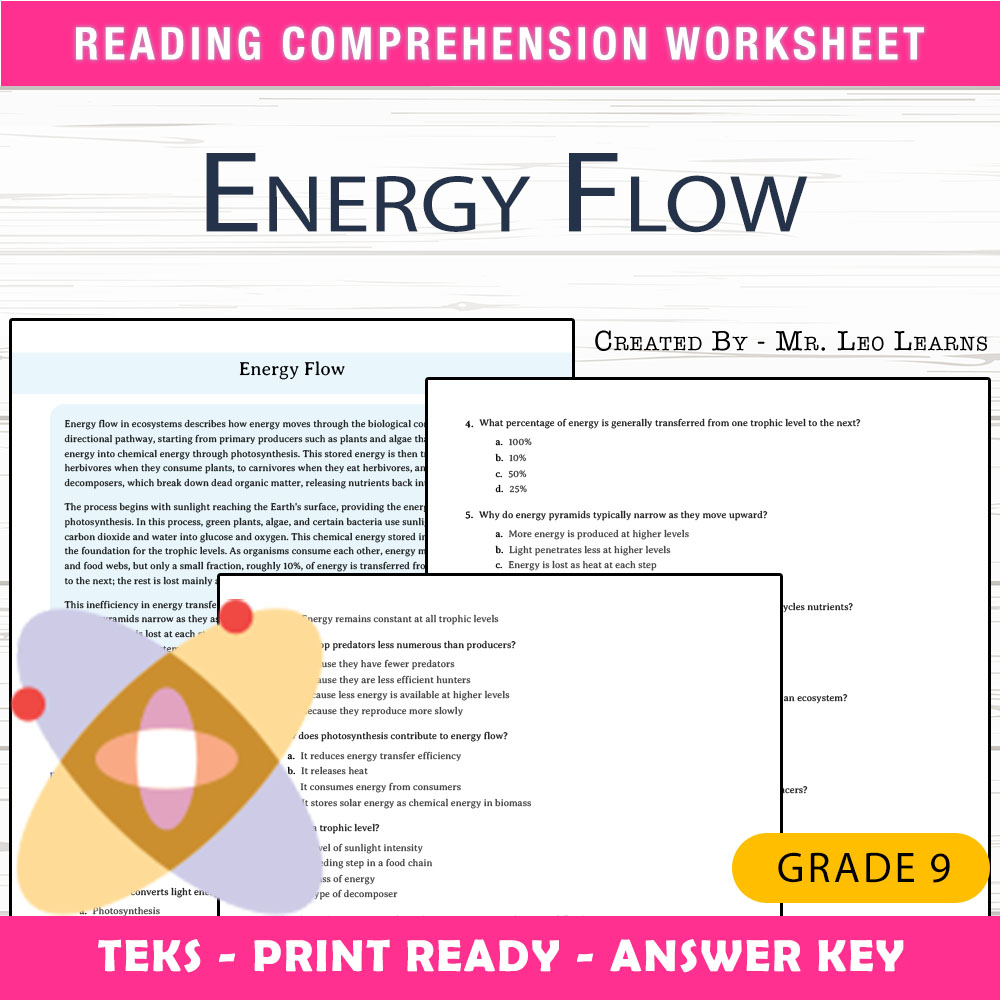
Grade 9 Science | Energy Flow Worksheet for Mastery
Created byThe Resource HubLearning Objectives
- Understand how energy moves through ecosystems from producers to consumers and decomposers.
- Describe the process of photosynthesis and how energy is transferred trophically.
- Explain the concept of energy transfer efficiency and its impact on food chain length.
Also included in: Grade 9 Science Ecosystems & Biogeochemical Cycles Unit Bundle (Worksheet Pack) +1 more
Instant download
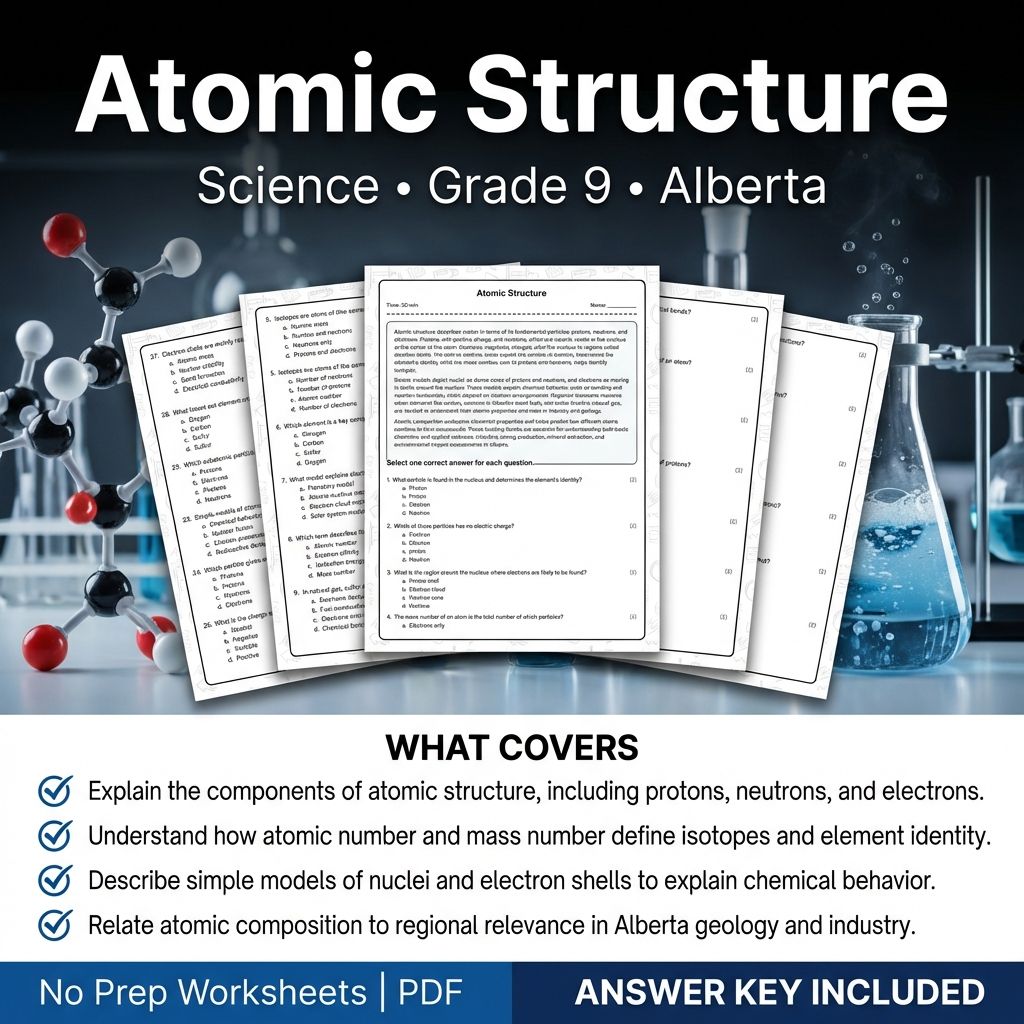
Atomic Structure Worksheet for Grade 9 Science | Alberta Standards
Created byCoral Reef LearningLearning Objectives
- Explain the components of atomic structure, including protons, neutrons, and electrons.
- Understand how atomic number and mass number define isotopes and element identity.
- Describe simple models of nuclei and electron shells to explain chemical behavior.
Instant download

Grade 9 States of Matter Worksheet | Alberta Practice PDF
Created byClear Sky ClassroomLearning Objectives
- Compare the particle models of solids, liquids, and gases based on shape, volume, and particle motion.
- Explain phase changes (melting, freezing, evaporation, condensation, and deposition) using energy changes and particle behavior.
- Predict how temperature and pressure changes can influence the state of matter in real-world examples.
Instant download
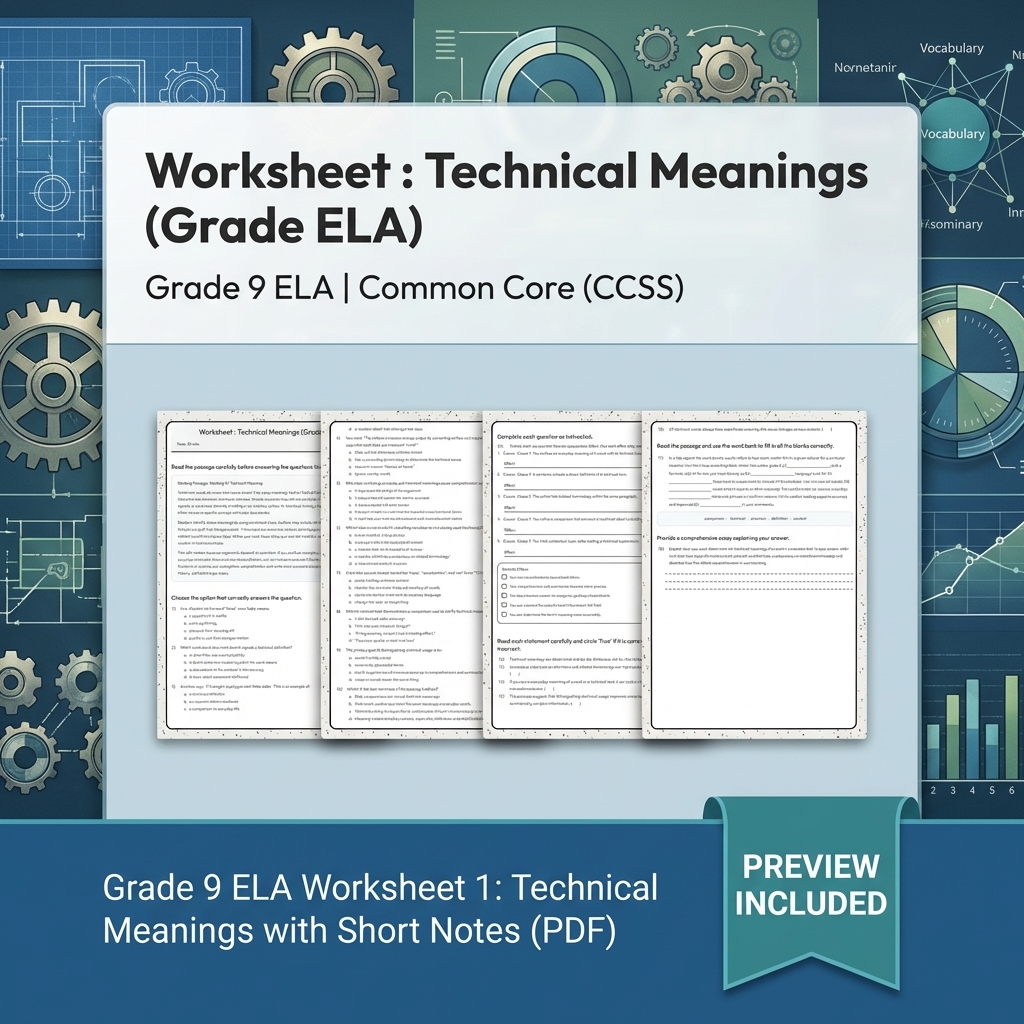
Grade 9 ELA Technical Meanings worksheet with Short Notes (PDF)
 Created byMeadowlark Worksheets
Learning Objectives
- Distinguish technical meanings from everyday meanings using contextual clues.
- Identify definitions, comparisons, and related terminology that signal how a word is used in a text.
- Explain how precise word meanings improve comprehension and accurate summarizing.
Also included in: Grade 9 Sentence & Word Choice ELA Lesson Bundle - Common Core (CCSS) +1 more
Instant download

Grade 9 Science – Renewable Energy & Grid Integration | Daily Reading Worksheet
Created byBright Mind ResourcesLearning Objectives
- Understand how wind energy contributes to renewable power sources.
- Identify concepts related to grid balancing with intermittent energy sources.
- Explain the environmental and economic impacts of renewable energy integration.
Also included in: Grade 9 Electrical Circuits & Electromagnetism Science Lesson Bundle | Alberta +1 more
Instant download

Technical Meanings Worksheet Pack | Grade 9 ELA Practice
 Created bySunny Desk Resources
Learning Objectives
- Identify when a word is being used with a technical meaning rather than an everyday meaning
- Use contextual clues (definitions, comparisons, and related terminology) to determine technical meanings
- Explain how choosing the correct technical meaning improves the clarity of arguments and summaries
Also included in: Grade 9 ELA Language Conventions & Word Choice Lesson Bundle | CCSS +1 more
Instant download

Tone Precision Worksheet | BC Standards Grade 9 ELA Assessment
JCreated byJ.S SheetsLearning Objectives
- Analyze how word choice, formality, and certainty affect tone and reader expectations.
- Revise vague sentences by replacing imprecise wording with specific verbs, nouns, and modifiers.
- Evaluate how diction and language precision change meaning in formal and informal contexts.
Instant download

Grade 9 ELA – Idea Relationships in Informational Texts | Daily Worksheet
 Created byQuiet Forest Education
Learning Objectives
- Identify cause-and-effect relationships within texts
- Differentiate between cause and effect statements
- Analyze how cause-and-effect language builds meaning in informational passages
Also included in: Informational Texts Grade 9 ELA Daily Reading Worksheets Bundle | General ELA +2 more
Instant download

Grade 9 Science Speciation Worksheet (TEKS) | Introductory Assessment PDF
Created byEvergreen Desk EducationLearning Objectives
- Explain speciation as the splitting of one ancestral population into distinct species.
- Compare allopatric and sympatric speciation and identify how gene flow changes in each.
- Distinguish prezygotic and postzygotic reproductive barriers and give examples of each.
Instant download

Grade 9 ELA Source Integration Worksheet (CCSS) PDF
 Created byGolden Apple Studio
Learning Objectives
- Integrate information from multiple sources presented in different formats (text, audio explanation, graph, and interview) to form a claim.
- Evaluate the credibility and relevance of evidence by checking for assumptions, reasoning gaps, and consistency across sources.
- Resolve contradictions by comparing evidence and determining whether differences come from perspective, method, or interpretation.
Also included in: Grade 9 ELA Full-Year Worksheet Bundle | CCSS Common Core
Instant download

Grade 9 Phylogenetic Trees Daily Reading Worksheet | TEKS Science Activity
 Created byBRIGHT PATH RESOURCES
Learning Objectives
- Identify major parts of a phylogenetic tree.
- Interpret what branching patterns suggest about common ancestry.
- Use vocabulary such as rooted, unrooted, ancestor, descendants, and clade to explain tree features.
Also included in: Grade 9 Evolution and Classification Biology Reading Worksheets Bundle | TEKS +1 more
Instant download

Narrative and Reflective Writing Worksheets Grade 9 ELA
Created byGolden Apple StudioLearning Objectives
- Identify how sequence and perspective shape narrative meaning
- Explain how concrete details support narrative clarity
- Distinguish narrative language from reflective language
Also included in: Purpose, Audience, Tone & Argument Writing Lesson Bundle | Grade 9 ELA | Ontario +1 more
Instant download
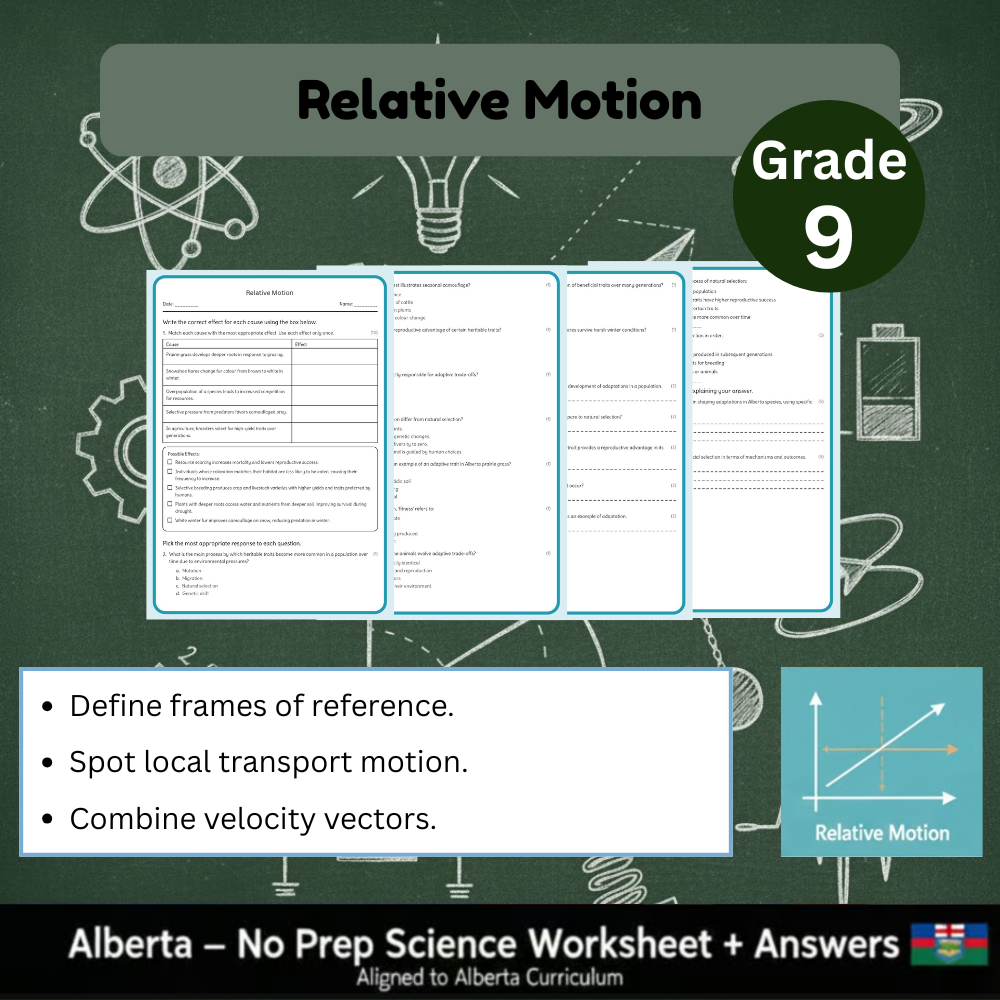
Grade 9 Science | Relative Motion Worksheet (PDF) – Alberta Standards
Created byBright Mind ResourcesLearning Objectives
- Explain the concept of relative motion and how it depends on the chosen frame of reference.
- Identify examples of relative motion in regional transport and recreation scenarios.
- Understand how velocities combine vectorially and how reference frames affect observed motion.
Instant download
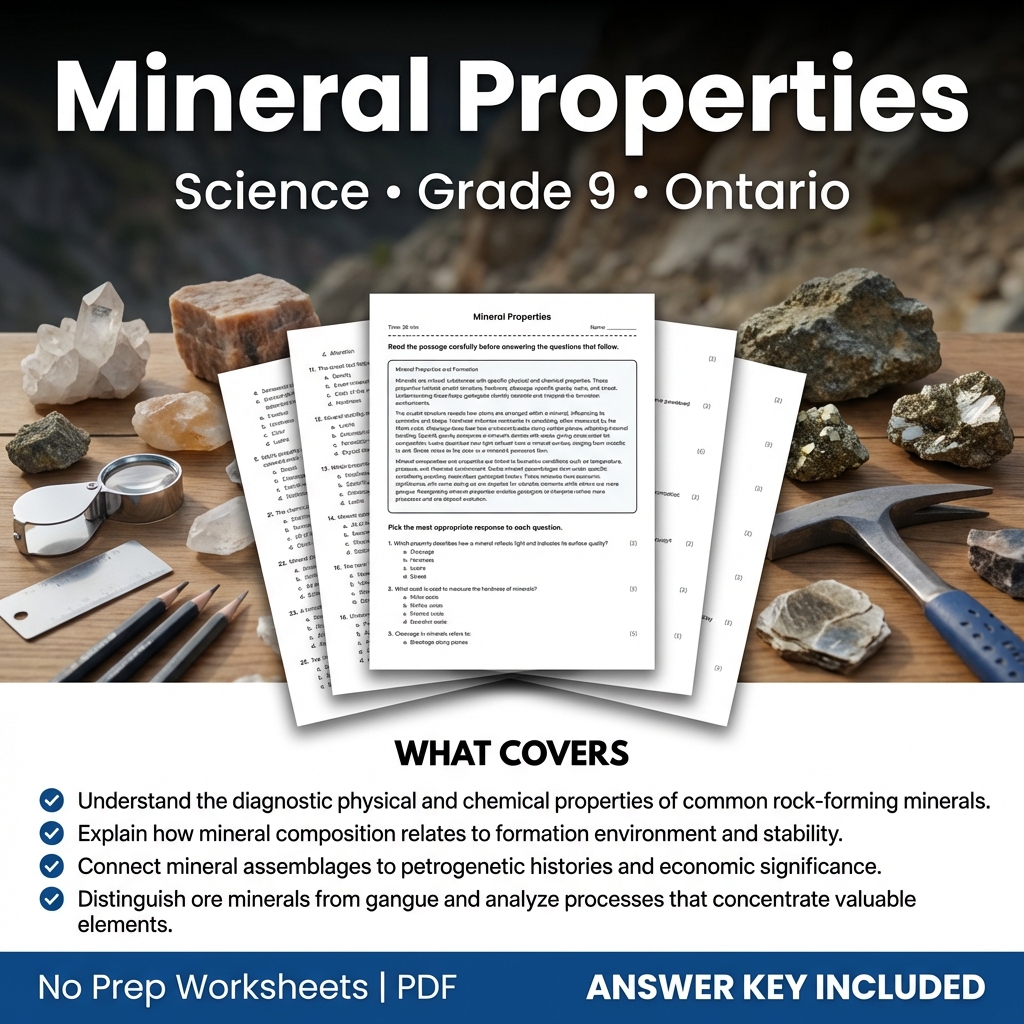
Mineral Properties Worksheet for Grade 9 Science | Ontario Standards
Created byCoral Reef LearningLearning Objectives
- Understand the diagnostic physical and chemical properties of common rock-forming minerals.
- Explain how mineral composition relates to formation environment and stability.
- Connect mineral assemblages to petrogenetic histories and economic significance.
Instant download

Science Worksheet Energy in Changes Physical vs Chemical | Grade 9 Assessment
JCreated byJ.S SheetsLearning Objectives
- Compare physical and chemical changes by describing how energy transfer relates to what happens to particles and bonds.
- Explain endothermic and exothermic processes using the direction of energy flow and the resulting temperature changes.
- Use system–surroundings thinking to predict whether energy is absorbed or released during a change.
Also included in: Grade 9 Energy, Waves, and Motion Science Lesson Bundle: General Framework +1 more
Instant download
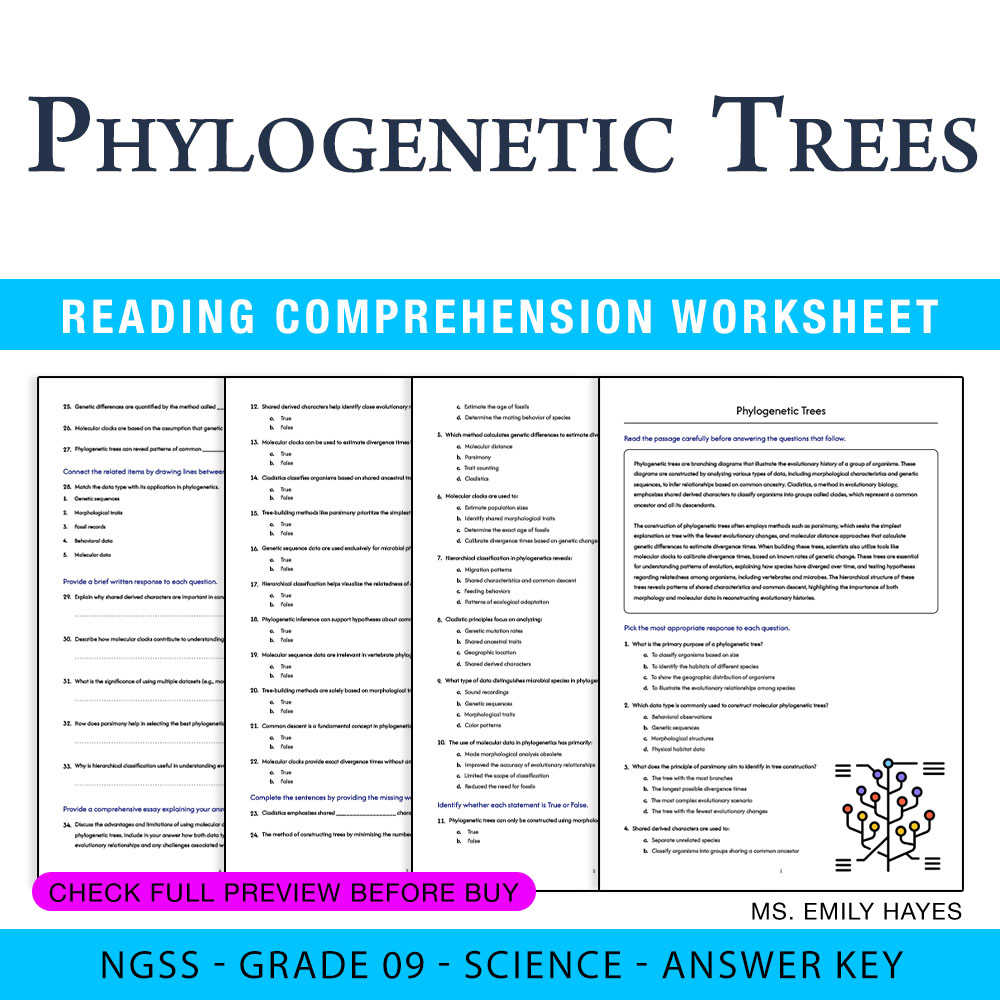
Grade 9 Science | Phylogenetic Trees Worksheet (PDF+ Answer Key)
Created byCopper Leaf ClassroomLearning Objectives
- Understand how to construct phylogenetic trees based on morphological and molecular data.
- Interpret branching diagrams to identify evolutionary relationships and common ancestors.
- Apply cladistic principles such as shared derived characters to classify organisms.
Instant download

Science Grade 9 Earth Season Causes Worksheet | NGSSS Aligned Assessment
JCreated byJ.S SheetsLearning Objectives
- Explain how Earth’s axial tilt affects the angle of sunlight and seasonal conditions in each hemisphere.
- Describe how Earth’s orbit around the Sun changes day length and sunlight duration over the year.
- Connect Sun–Earth geometry to seasonal temperature patterns and broader environmental changes.
Also included in: Grade 9 Earth Systems Weather & Climate Science Lesson Bundle: Florida NGSSS +1 more
Instant download

Strategic Transitions Worksheet Pack | Grade 9 ELA Activities
Created bySunny Desk ResourcesLearning Objectives
- Explain how strategic transitions connect ideas within and across paragraphs to improve coherence.
- Identify whether a transition is additive, contrastive, causal, or sequential based on context.
- Revise sentences by replacing generic transitions with more precise ones that match the relationship between ideas.
Also included in: Grade 9 ELA Grammar & Cohesion Writing Lesson Bundle | Alberta +1 more
Instant download

Mechanical Energy Worksheet | NGSS Grade 9 Science Practice
Created bySkylark WorksheetsLearning Objectives
- Describe and calculate kinetic energy and gravitational potential energy using appropriate formulas and units.
- Use energy accounting to explain how work, power, and mechanical energy change in near-ideal systems.
- Analyze how non-conservative forces (such as friction) affect the mechanical energy budget and motion.
Also included in: Grade 9 Science Full-Year Bundle | NGSS Worksheets & Assessments
Instant download
Grade 9 Social Studies | Ecosystem Recovery Worksheet (PDF & Answer Key)
JCreated byJ.S SheetsLearning Objectives
- Understand how ecosystems respond to disturbances such as fire, floods, and succession.
- Analyze the causes and consequences of altered disturbance regimes.
- Evaluate human impacts on natural recovery processes and resource cycles.
Also included in: Grade 9 Social Studies Unit Bundle | Ecosystems, Climate & Landforms Practice +1 more
Instant download
Work and Energy Assessment for Grade 9 Science | BC Standards
 Created byPrism Point Learning
Learning Objectives
- Explain the concept of work in physics and how it relates to energy transfer.
- Identify situations where work is positive, negative, or zero.
- Describe the relationship between work, force, and displacement.
Instant download

Synthesis of Evidence Worksheet for Grade 9 ELA Common Core Standards
JCreated byJ.S SheetsLearning Objectives
- Define synthesis and distinguish it from simply summarizing or listing quotations.
- Use multiple pieces of evidence to explain a central idea and the way the evidence works together.
- Qualify claims by accounting for nuance, such as when evidence confirms, limits, or shifts emphasis.
Instant download
Grade 9 Science | Particle Theory Worksheet (PDF + Answer Key)
Created byCopper Leaf ClassroomLearning Objectives
- Explain the particle model as a framework for understanding states of matter, diffusion, and temperature-dependent behavior.
- Describe how particle motion, spacing, and forces determine the properties and phases of matter.
- Relate kinetic energy to temperature and explain how particle interactions influence phase stability and response to energy changes.
Instant download
Grade 9 Science | Particle Theory Worksheet (Ontario) – Science (PDF)
Created byBright Mind ResourcesLearning Objectives
- Explain the particle model as a framework for understanding states of matter and particle motion.
- Describe how particle arrangement and forces influence phase stability and behavior.
- Relate temperature changes to particle kinetic energy and movement.
Instant download
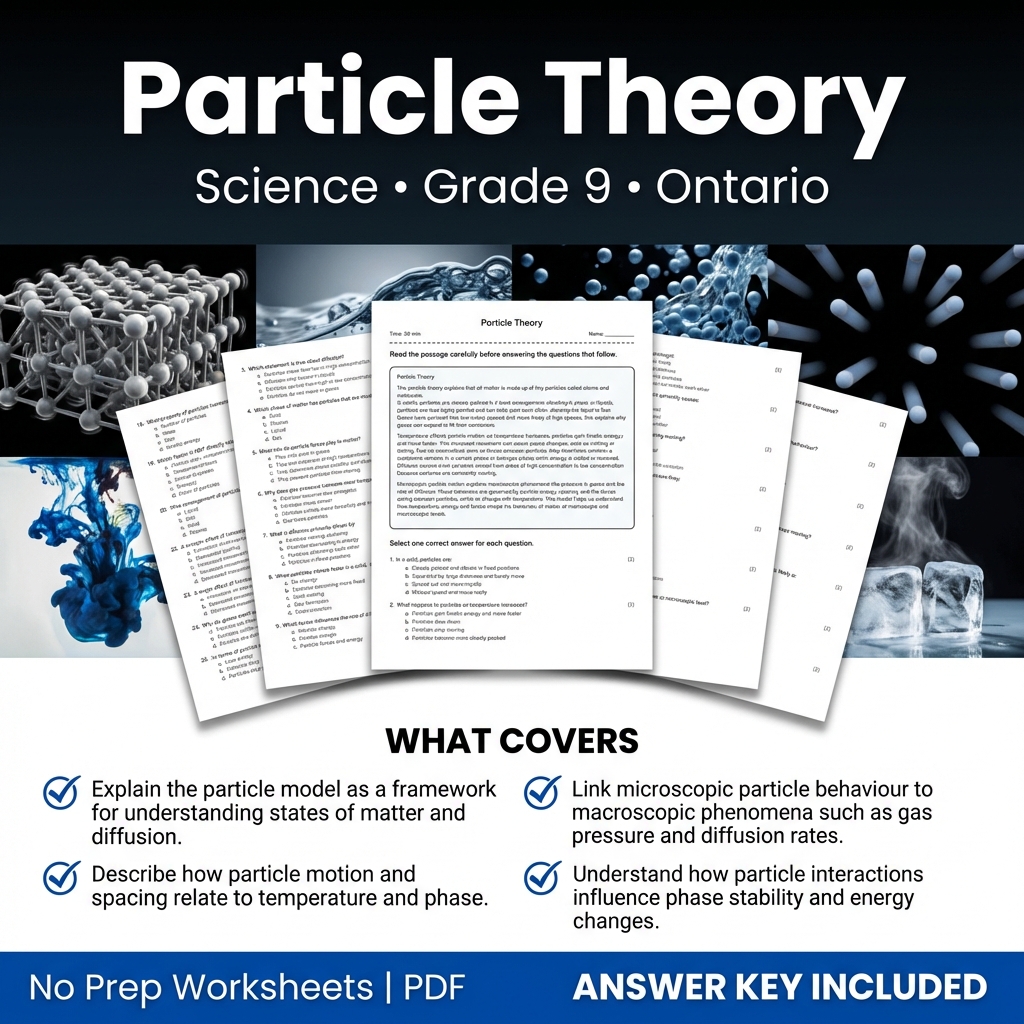
Particle Theory Worksheet Grade 9 Science Ontario Standards PDF
Created byCoral Reef LearningLearning Objectives
- Explain the particle model as a framework for understanding states of matter and diffusion.
- Describe how particle motion and spacing relate to temperature and phase.
- Link microscopic particle behaviour to macroscopic phenomena such as gas pressure and diffusion rates.
Instant download
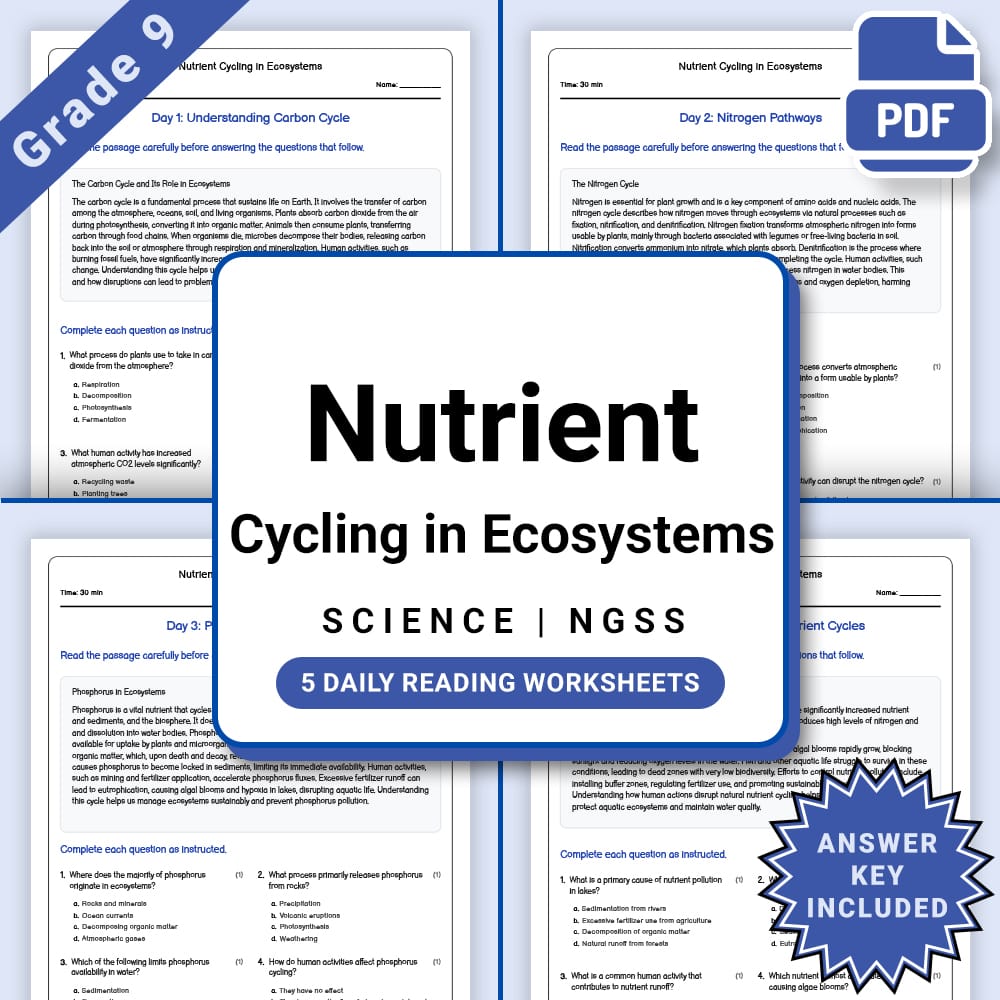
Grade 9 Science – Nutrient Cycling in Ecosystems Worksheet(PDF + Answer Key)
Created byCopper Leaf ClassroomLearning Objectives
- Explain the processes involved in the carbon cycle within ecosystems.
- Identify key pathways of nutrient cycling such as microbial decomposition, fixation, mineralization, and sedimentation.
- Understand human impacts on nutrient cycles, including fertilizer runoff and eutrophication.
Instant download
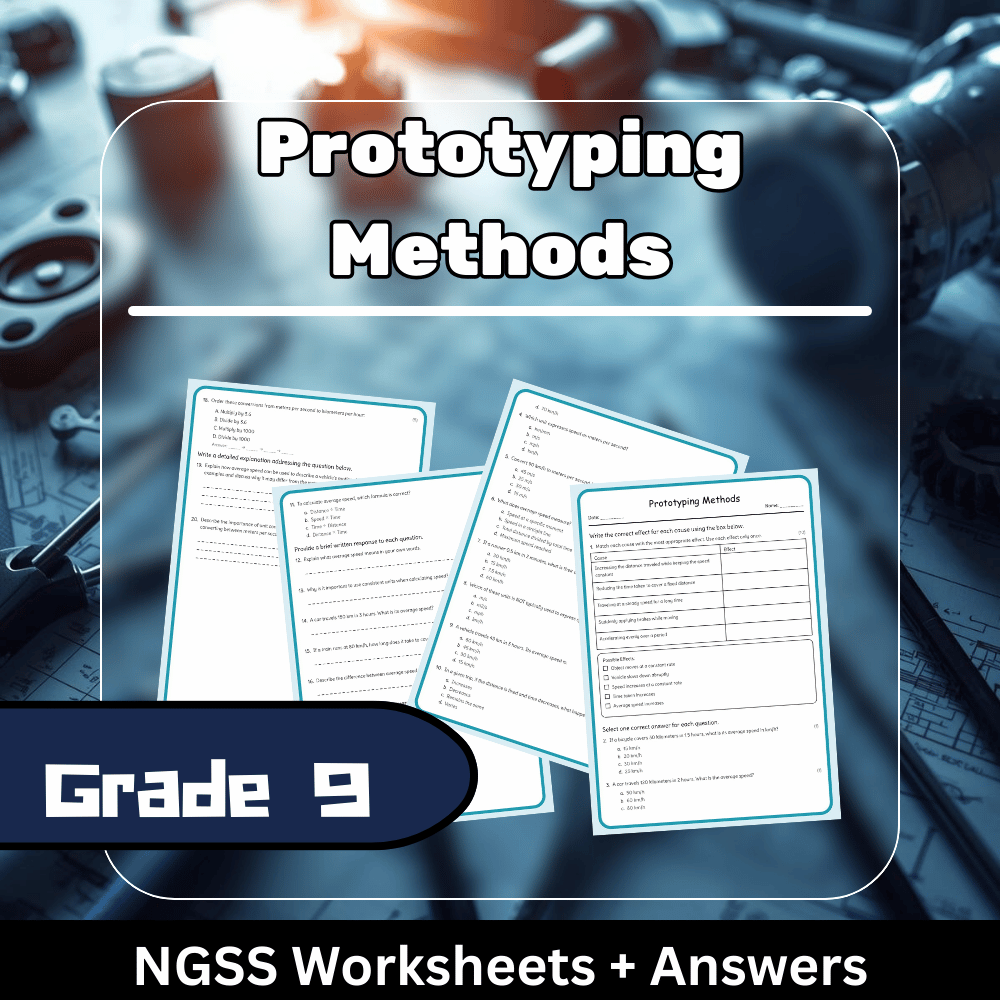
Grade 9 Science – Prototyping Methods Worksheet (PDF) | NGSS Alignment
Created byBright Mind ResourcesLearning Objectives
- Understand different prototyping methods and their appropriate use cases.
- Identify materials and fidelity levels suitable for various prototype types.
- Learn how to measure performance metrics and refine prototypes iteratively.
Instant download

Grade 9 Science | Climate Evidence Worksheet Elena | California Standards
 Created byLumora Learning
Learning Objectives
- Differentiate weather from climate using clear definitions and examples.
- Explain how Earth’s energy balance and greenhouse gases can influence long-term temperature and precipitation patterns.
- Describe how natural records (ice cores and ocean sediments) provide evidence of past climate changes.
Instant download

Grade 9 Hazard Assessment for Natural Disasters NGSS Science Worksheet
Created byBRIGHT PATH RESOURCESLearning Objectives
- Understand how earthquake risks are evaluated using historical and probabilistic methods.
- Identify key factors influencing earthquake hazard assessments, including occurrence, frequency, and impact.
- Analyze how hazard data and mapping inform community preparedness and mitigation strategies.
Also included in: Energy & Env Grade 9 Science Daily Reading Worksheets Lesson Bundle | NGSS +1 more
Instant download
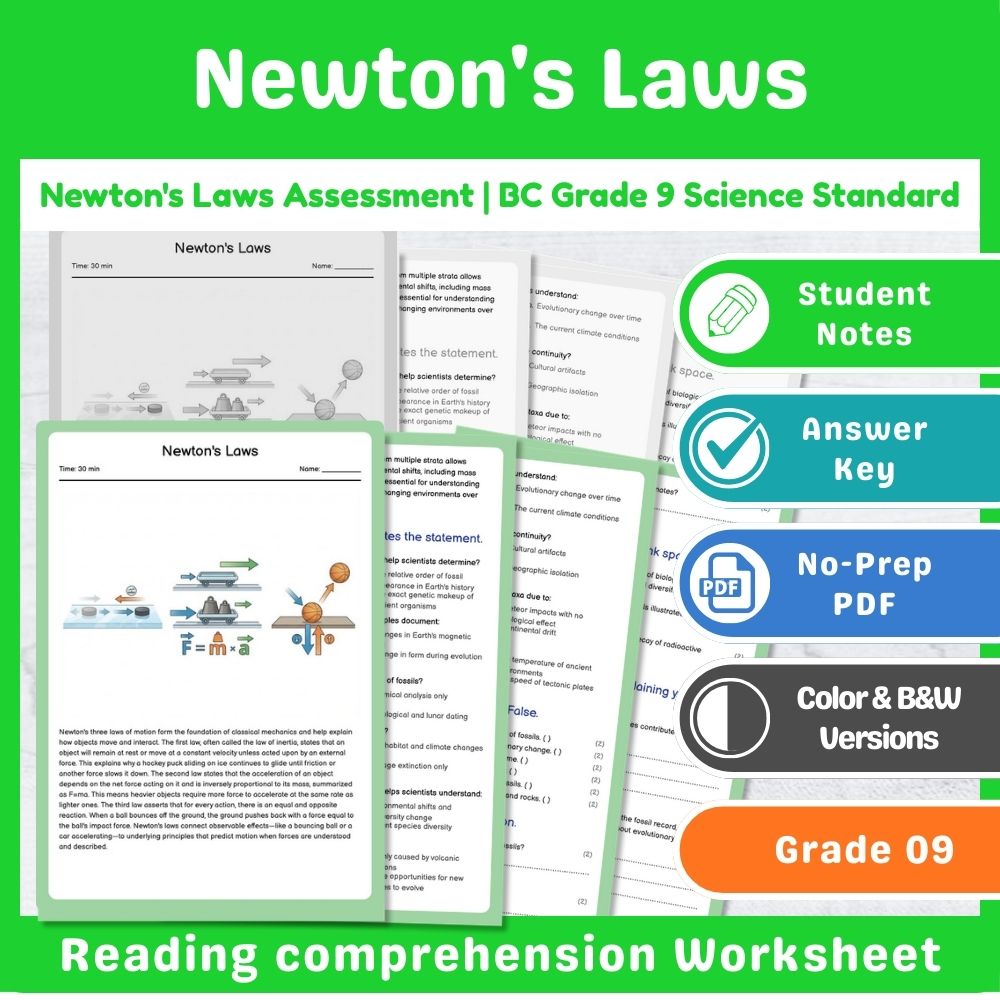
Newton's Laws Assessment | BC Grade 9 Science Standard
Created byPrism Point LearningLearning Objectives
- Explain the three laws of motion proposed by Sir Isaac Newton.
- Identify real-world examples that illustrate each of Newton's laws.
- Predict the motion of objects when forces act upon them based on Newton's principles.
Instant download

Grade 9 Chemical Properties Worksheet | Signs of Chemical Change Ontario
 Created byChalk and Compass
Learning Objectives
- Describe chemical properties as tendencies to undergo specific chemical changes.
- Identify evidence of chemical change, such as new substances, gas evolution, precipitate formation, and permanent colour change.
- Distinguish chemical changes from physical changes using reaction observations and product evidence.
Also included in: Matter and Chemical Change - Grade 9 Bundle +1 more
Instant download
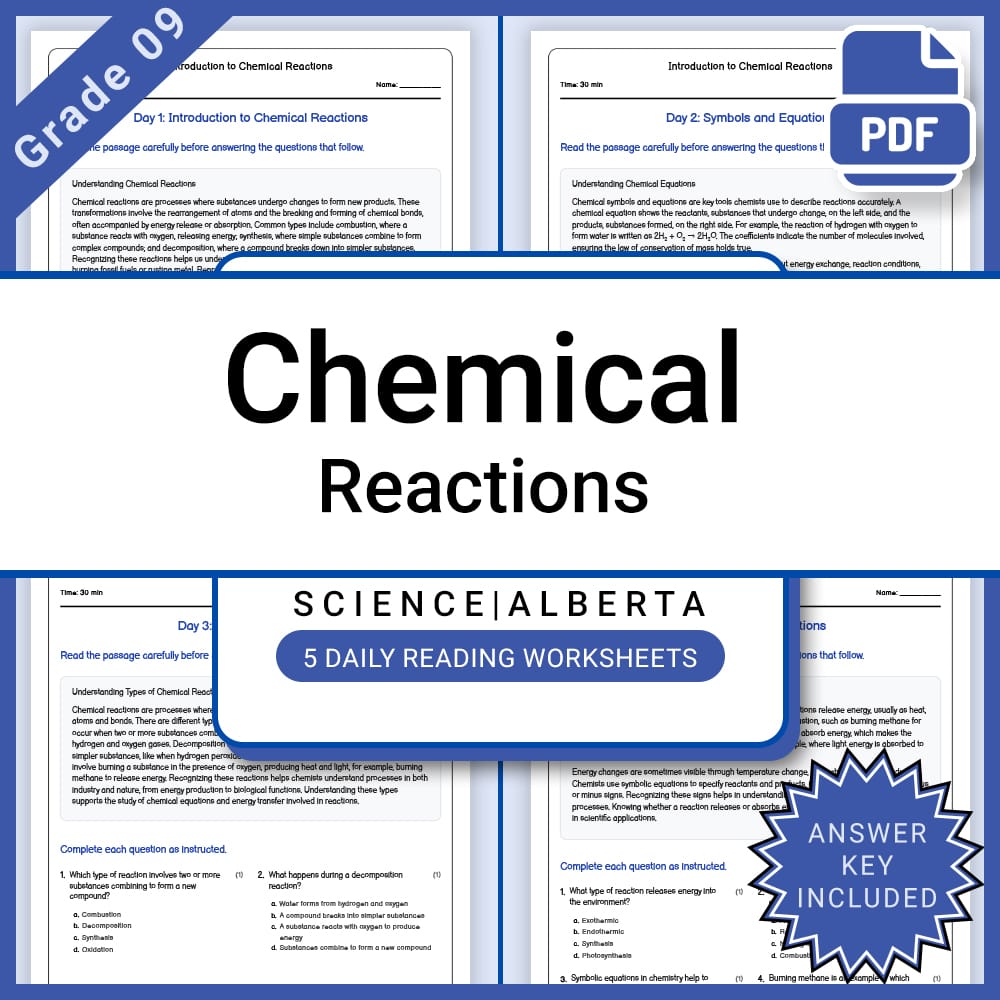
Grade 9 – Introduction to Chemical Reactions Daily Worksheet with Answer Key
JCreated byJ.S SheetsLearning Objectives
- Identify different types of chemical reactions
- Understand the process of chemical transformation and energy exchange
- Recognize examples of reactions in daily life
Also included in: Grade 9 Science Lesson Bundle | Alberta Framework +1 more
Instant download
Browse more categories
About Grade 9 Worksheets
Browse 9,323 printable Grade 9 worksheets across algebra, biology, literature, and history — each a ready-to-print PDF with optional answer keys.
Every worksheet on MyTeachingSheets is created by independent teacher-authors and reviewed before publication. All resources download as printable PDFs for classroom, homework, or at-home practice, and many include answer keys. Preview any worksheet free before buying.