
Grade 9 Worksheets
9,323 grade resources
Recognizing Roles Worksheet Grade 9 | Holiday Subject Assessment
 Created byCedar Grove Learning
Learning Objectives
- Identify multiple roles teachers play beyond instruction, such as mentorship, counseling support, and role modeling.
- Use context clues from a narrative to understand vocabulary related to teaching and student support.
- Explain how adult support in school communities can strengthen student growth and relationships.
Also included in: Grade 9 Lesson Bundle: Teacher Appreciation Day | Roles, Educators & Reflection +1 more
Instant download
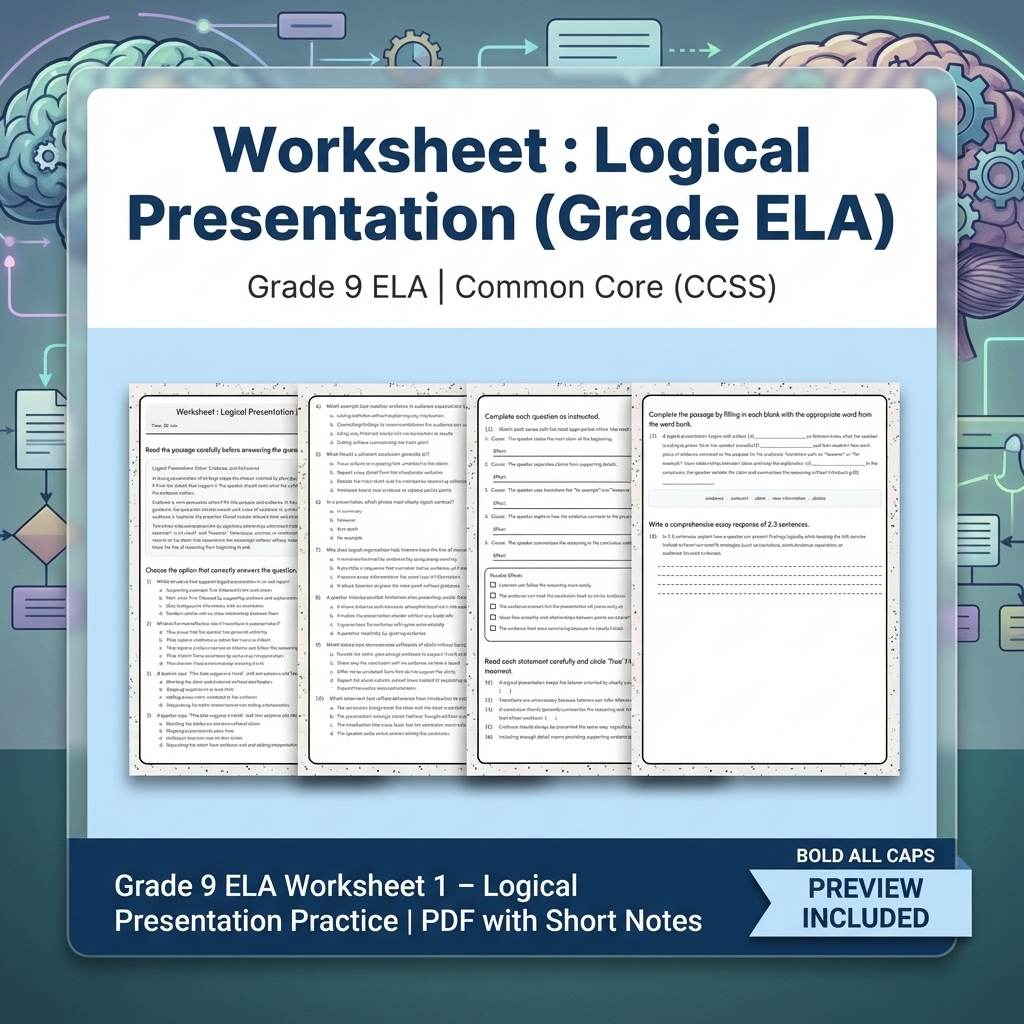
Grade 9 ELA Logical Presentation Practice Worksheet | PDF with Short Notes
 Created byMeadowlark Worksheets
Learning Objectives
- Organize oral or written findings using clear claims, supporting evidence, and logical sequencing.
- Use transitions to guide the listener or reader from introduction to conclusion.
- Match evidence to purpose and audience expectations to maintain coherence and credibility.
Also included in: Grade 9 Speaker Reasoning & Source Integration ELA Lesson Bundle | CCSS +1 more
Instant download
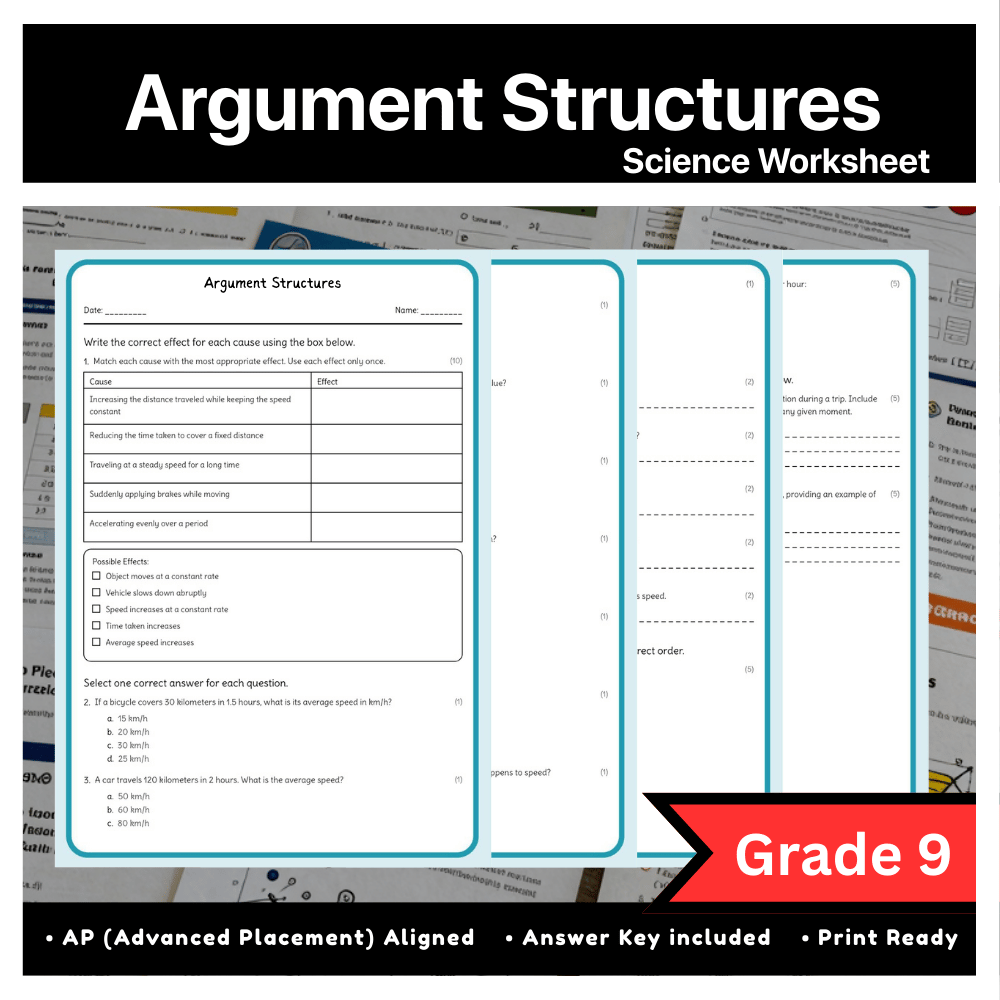
Grade 9 Science – Argument Structures in Scientific Reasoning (AP Standard)
 Created byBright Mind Resources
Learning Objectives
- Understand construction and critique of scientific arguments using claim-evidence-reasoning structures.
- Identify coherence, relevance, and consideration of alternative explanations in scientific arguments.
- Evaluate how quantitative evidence and model comparisons strengthen arguments.
Instant download

Source Integration Worksheet for Grade 9 ELA | Standards-Aligned Practice
JCreated byJ.S SheetsLearning Objectives
- Identify when to use summary, paraphrase, and quotation in research-based writing.
- Explain how introductory context and analysis connect evidence to the writer’s purpose.
- Practice accurate attribution to support credibility and reduce plagiarism risk.
Instant download

Grade 9 Science – Population Genetics Worksheet (Alberta Standards) (PDF)
 Created bySilver Birch Teaching
Learning Objectives
- Explain how allele frequency changes under different evolutionary forces in a population
- Apply the Hardy-Weinberg equilibrium assumptions to predict genotype frequencies
- Analyze how genetic drift, bottlenecks, founder effects, and gene flow can change genetic diversity
Also included in: Grade 9 Genetics and Reproduction Science Lesson Bundle Worksheets – Alberta +1 more
Instant download

Grade 9 Science Tissue Types Worksheet | Ontario Standards Aligned
JCreated byJ.S SheetsLearning Objectives
- Compare the four principal tissue types by their cellular organization and extracellular matrix features.
- Explain how connective tissue matrix properties relate to tissue mechanical strength and function.
- Describe how muscle contraction mechanisms differ among skeletal, smooth, and cardiac muscle.
Instant download
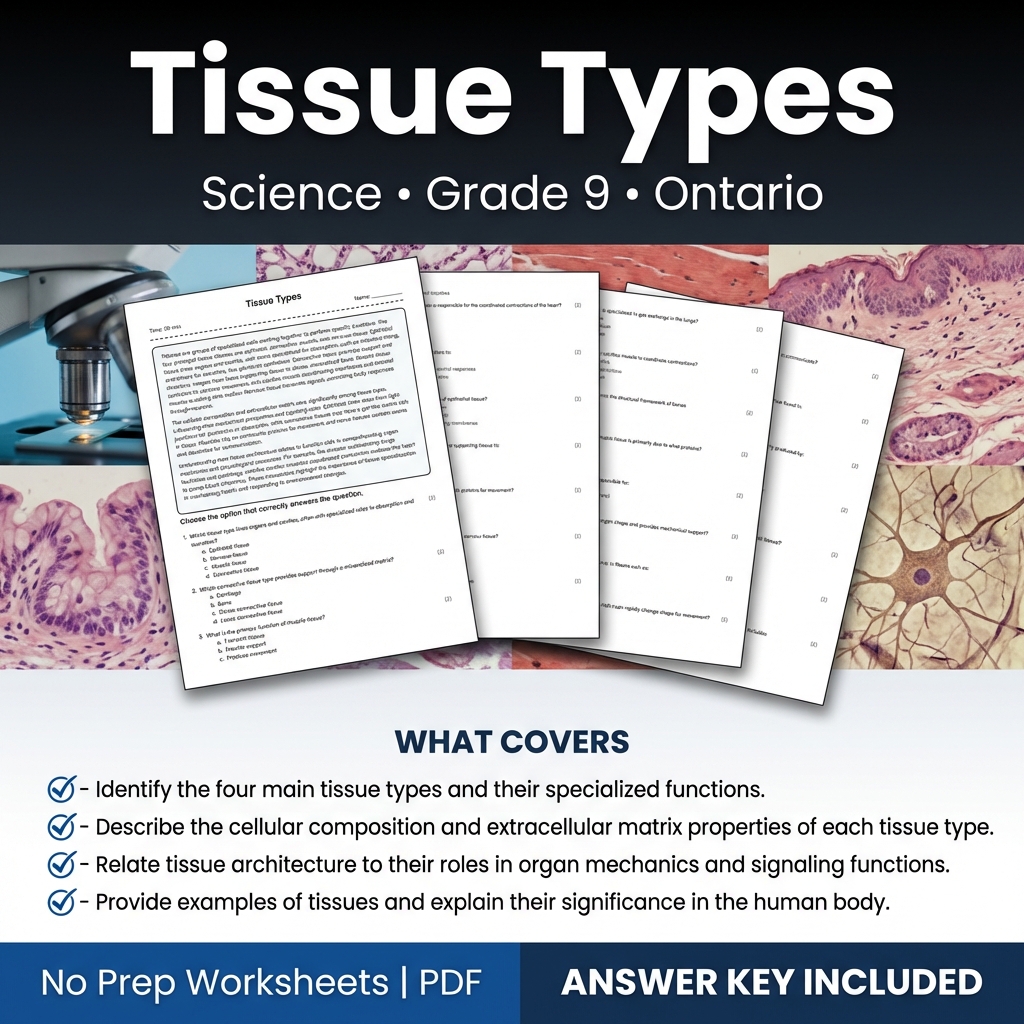
Grade 9 Science Worksheet on Tissue Types | Ontario Standards
 Created byCoral Reef Learning
Learning Objectives
- Identify the four main tissue types and their specialized functions.
- Describe the cellular composition and extracellular matrix properties of each tissue type.
- Relate tissue architecture to their roles in organ mechanics and signaling functions.
Instant download
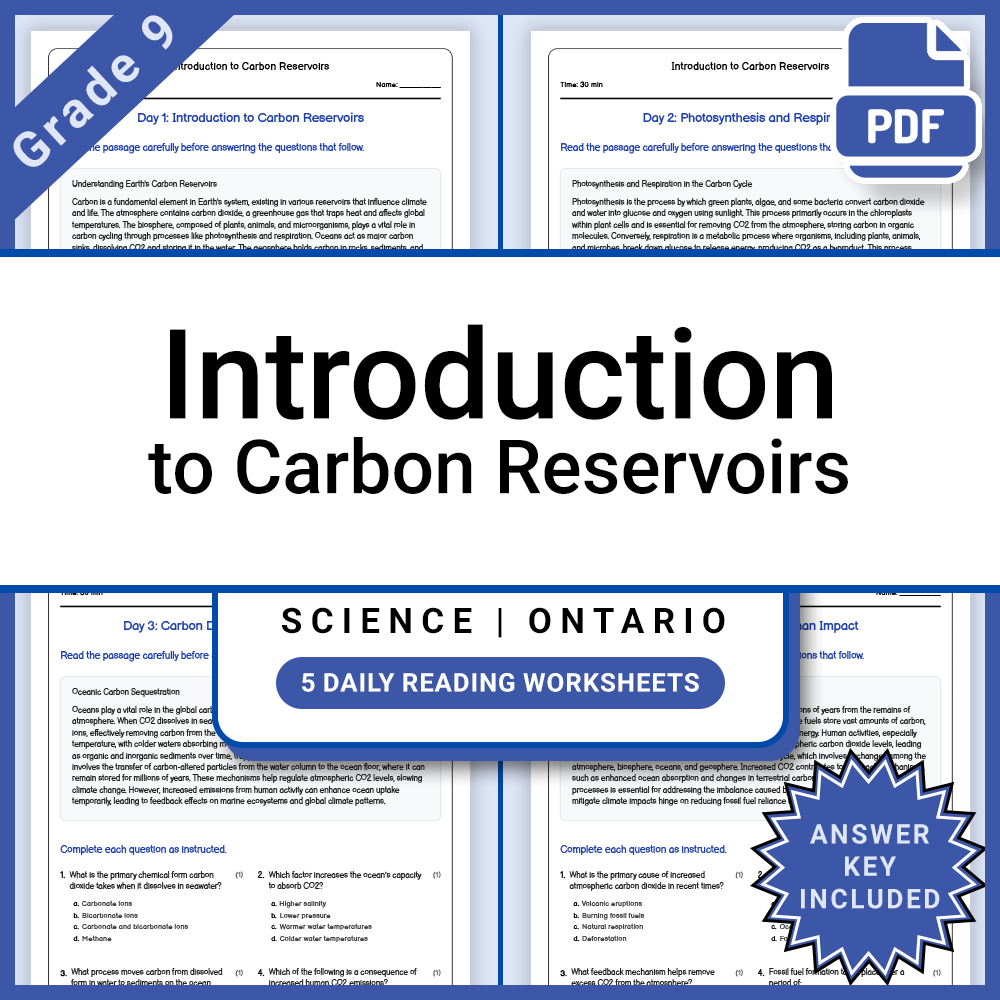
Grade 9 Science – Introduction to Carbon Reservoirs Daily Worksheet + Answer Key
JCreated byJ.S SheetsLearning Objectives
- Identify major carbon reservoirs in Earth's system, including atmosphere, biosphere, oceans, and geosphere.
- Understand how fluxes such as photosynthesis, respiration, dissolution, sedimentation, and fossil fuel formation move carbon among reservoirs.
- Recognize the timescales of carbon exchange and how human activities impact natural carbon budgets.
Also included in: Grade 9 Science Lesson Group Bundle – Earth Systems & Planetary Concepts +1 more
Instant download
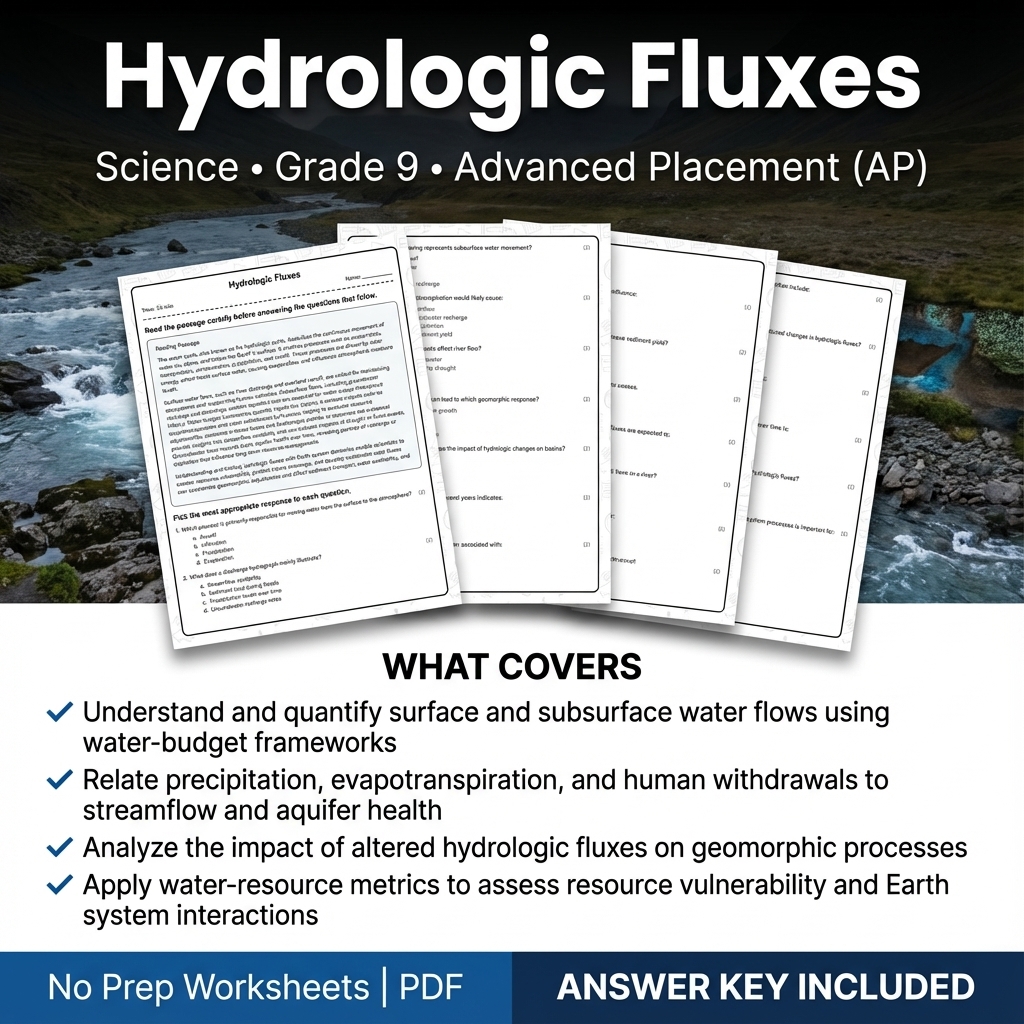
Grade 9 Science | Hydrologic Fluxes Worksheet (Printable PDF + Answer Key)
Created byCoral Reef LearningLearning Objectives
- Understand and quantify surface and subsurface water flows using water-budget frameworks
- Relate precipitation, evapotranspiration, and human withdrawals to streamflow and aquifer health
- Analyze the impact of altered hydrologic fluxes on geomorphic processes
Also included in: Grade 9 Science Unit | Earth Processes & Climate Worksheets Pack (PDF & Answer Keys) +2 more
Instant download
Grade 9 Science – Introduction to Carbon Records Daily Worksheet + Answer Key
JCreated byJ.S SheetsLearning Objectives
- Understand what carbon records are and their sources.
- Identify different methods scientists use to study past atmospheric conditions.
- Recognize the importance of proxies like ice cores and sediments in climate research.
Also included in: Grade 9 Science Lesson Bundle: Tidal Forces, Tectonic Plates & Climate Physics +1 more
Instant download

Grade 9 Science | Evidence for Evolution - Daily Reading Comprehension
Created byCoral Reef LearningLearning Objectives
- Understand the various types of evidence supporting evolution
- Describe how fossils provide clues about organism changes over time
- Identify anatomical similarities that suggest common ancestry
Instant download
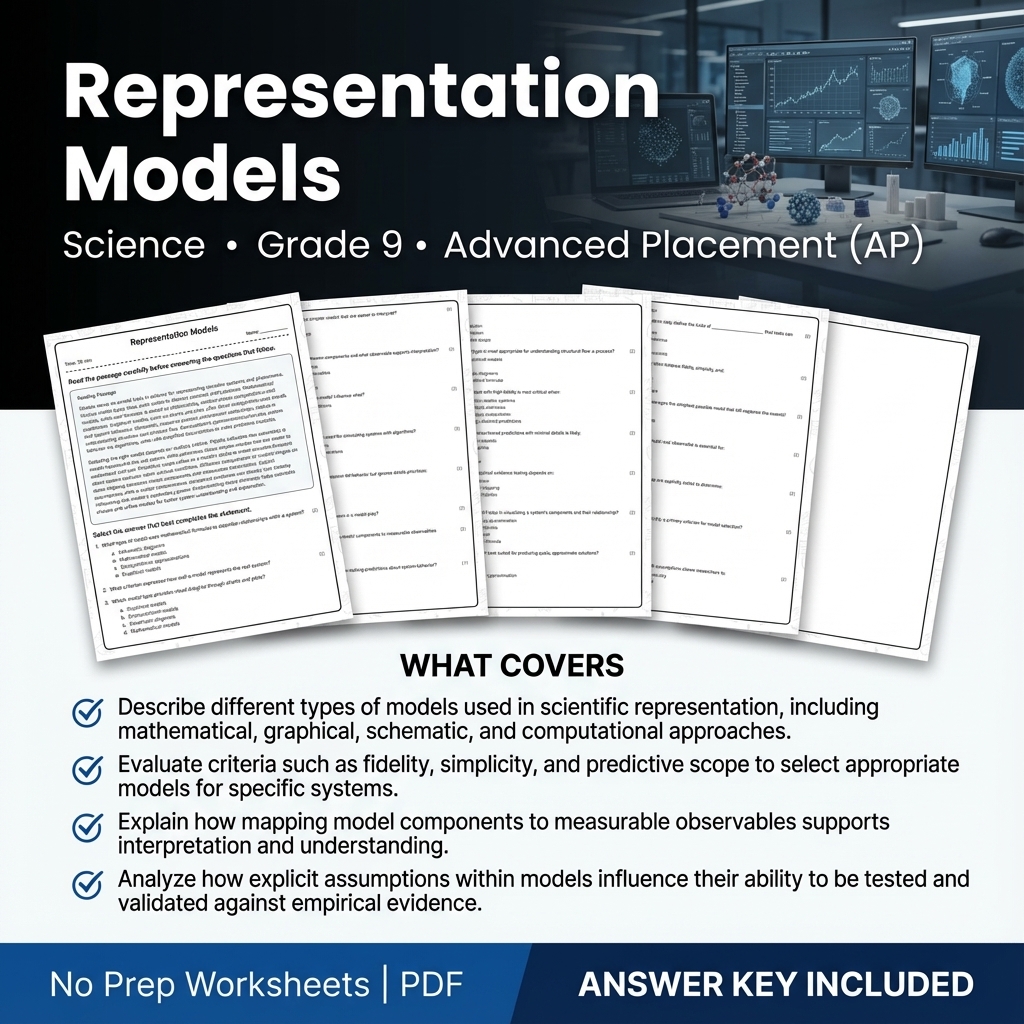
Grade 9 Science | Representation Models Worksheet (Printable PDF + Answer Key)
Created byCoral Reef LearningLearning Objectives
- Describe different types of models used in scientific representation, including mathematical, graphical, schematic, and computational approaches.
- Evaluate criteria such as fidelity, simplicity, and predictive scope to select appropriate models for specific systems.
- Explain how mapping model components to measurable observables supports interpretation and understanding.
Also included in: Grade 9 Science Unit Worksheets | Scientific Methods & Data Analysis Bundle +2 more
Instant download

Grade 9 Social Studies Worksheet – Renaissance Europe & Cultural Revival (PDF)
 Created bySunny Desk Resources
Learning Objectives
- Explain how humanism influenced learning, writing, and education during the Renaissance.
- Describe key artistic and scientific changes that distinguished the Renaissance from earlier periods.
- Analyze how ideas spread across Europe and affected politics, technology, and intellectual life.
Also included in: World Civilizations Grade 9 Social Studies Full-Year Worksheet Bundle | California +1 more
Instant download

Wave Properties Worksheet | NGSS Grade 9 Science Assessment
 Created bySkylark Worksheets
Learning Objectives
- Explain how amplitude, frequency, wavelength, and phase describe wave behavior in both transverse and longitudinal waves.
- Use the wave speed relationship v = fλ to solve problems involving sound, string waves, and water-wave scenarios.
- Apply sinusoidal reasoning to predict how interference and standing waves form from superposition and reflections.
Also included in: Grade 9 Science Full-Year Bundle | NGSS Worksheets & Assessments
Instant download

Grade 9 Mental Health Day Support Networks Worksheet PDF Key
 Created byShaNova Worksheets
Learning Objectives
- Identify key ideas about mental health support networks.
- Evaluate statements about healthy help-seeking and supportive relationships.
- Explain how support networks can improve coping and well-being.
Instant download

Grade 9 Neural Control Worksheet | Synapses, Nerves & Coordination Ontario
 Created byChalk and Compass
Learning Objectives
- Explain how action potentials and synaptic transmission allow information to travel through neural pathways.
- Describe how myelination and synaptic structure affect conduction velocity and neural processing capacity.
- Compare how central integration coordinates behavior through reflex arcs and autonomic pathways.
Also included in: Homeostasis and Human Body Systems Lesson Bundle | Grade 9 Science | Ontario +1 more
Instant download

Grade 9 ELA Signposting and Transitions Worksheet (PDF) | Alberta Standards
 Created byGolden Apple Studio
Learning Objectives
- Identify common signposting phrases that signal a writer’s or speaker’s structure and purpose.
- Use transition words and verbal cues to connect claims, reasons, comparisons, and conclusions.
- Recognize how cause-and-effect language and sequencing help listeners follow an argument or explanation.
Also included in: Grade 9 ELA Signposting & Transitions Skills Lesson Bundle - Alberta +1 more
Instant download

Respectful Discussions Worksheet Pack | Grade 9 ELA Activities
Created bySunny Desk ResourcesLearning Objectives
- Explain what respectful discussion looks like, including turn-taking and staying on topic
- Use discussion moves to acknowledge different perspectives and ask follow-up questions
- Respond to ideas by building on others’ contributions using relevant evidence and reasoning
Also included in: Speaking and Listening Lesson Bundle | Grade 9 ELA | BC +1 more
Instant download

Momentum Conservation Worksheet for Grade 9 Science | NGSS-Aligned Practice
JCreated byJ.S SheetsLearning Objectives
- Understand the principles of conservation of linear momentum in isolated systems.
- Distinguish between elastic and inelastic collisions using vector sums.
- Calculate total momentum before and after interactions in various scenarios.
Also included in: Grade 9 Newtonian Motion and Forces Science Lesson Bundle – NGSS Curriculum +1 more
Instant download

Audience Awareness Worksheet Pack | Grade 9 ELA Practice & Review
Created bySunny Desk ResourcesLearning Objectives
- Explain how audience awareness affects word choice, level of detail, and tone in a spoken message
- Identify how purpose shapes the balance of claims, reasons, and narration
- Revise language for a new audience by using clearer examples and definitions when needed
Also included in: Speaking and Listening Lesson Bundle | Grade 9 ELA | BC +1 more
Instant download

Grade 9 Science – Hazard Assessment & Earthquake Risks | Daily Reading Worksheet
Created byBright Mind ResourcesLearning Objectives
- Understand the causes and effects of earthquakes
- Analyze historical earthquake patterns and damage reports
- Evaluate earthquake risk factors such as exposure and vulnerability
Also included in: Grade 9 Environmental Impact Science Daily Reading Worksheets Lesson Bundle | NGSS +2 more
Instant download

Evidence in Speech Worksheet Pack | Grade 9 ELA Practice
Created bySunny Desk ResourcesLearning Objectives
- Use evidence (facts, data, observations, and quoted text) to support spoken claims.
- Explain how specific evidence connects to a speaker’s point clearly and explicitly.
- Distinguish between interpretation and information when speaking.
Also included in: Speaking and Listening Lesson Bundle | Grade 9 ELA | BC +1 more
Instant download

Grade 9 Science – Motors & Generators | Daily Reading Worksheet
Created byBright Mind ResourcesLearning Objectives
- Identify different types of electric motors and their basic principles
- Explain how electromagnetic induction allows generators to produce electricity
- Apply knowledge of motor and generator operation to real-world applications
Also included in: Grade 9 Electrical Circuits & Electromagnetism Science Lesson Bundle | Alberta +1 more
Instant download

Grades 9 -10. Holiday Worksheet | 🇺🇸 Flag Significance Assessment PDF
Learning Objectives
- Explain how the colors, stars, and stripes of the American flag symbolize national values and history.
- Analyze how the flag’s design has changed as new states were added to the Union.
- Connect flag symbolism to civic identity, freedom, and patriotism using evidence from historical references.
Also included in: Flag Day Reading Comprehension Bundle | Grades 9–10 +2 more
Instant download

Reaction Evidence Assessment | Florida NGSSS Grade 9 Science
 Created byPrism Point Learning
Learning Objectives
- Identify observable evidence that indicates a chemical reaction has formed new substances
- Explain how changes in atoms and bonding patterns connect to reaction evidence such as gas, precipitate, color, temperature, and odor
- Distinguish chemical changes from physical changes using evidence-based reasoning
Also included in: Grade 9 Forces, Energy, and Matter Science Lesson Bundle | Florida NGSSS
Instant download
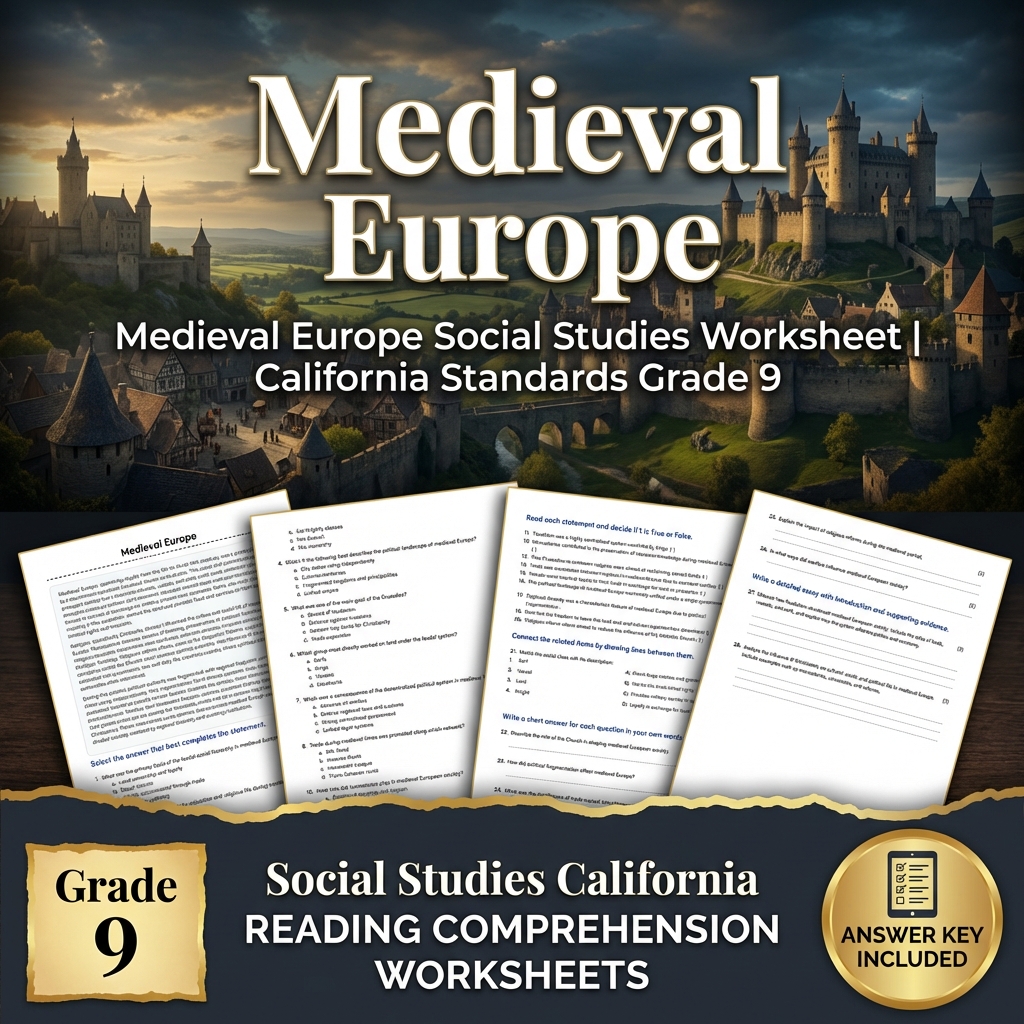
Medieval Europe Social Studies Worksheet | California Standards Grade 9
JCreated byJ.S SheetsLearning Objectives
- Describe the social hierarchy and roles within feudal society.
- Explain how Christianity shaped cultural and social institutions in medieval Europe.
- Identify key features of political fragmentation and regional diversity during the period.
Instant download

Developed Content Worksheet Grade 9 ELA BC | Writing Expansion Practice
 Created byLumora Learning
Learning Objectives
- Identify how relevant details, examples, and explanations develop a text’s main idea.
- Explain how evidence connects to claims through cause-and-effect or implications.
- Revise writing by adding development that clarifies meaning for a specific audience.
Instant download
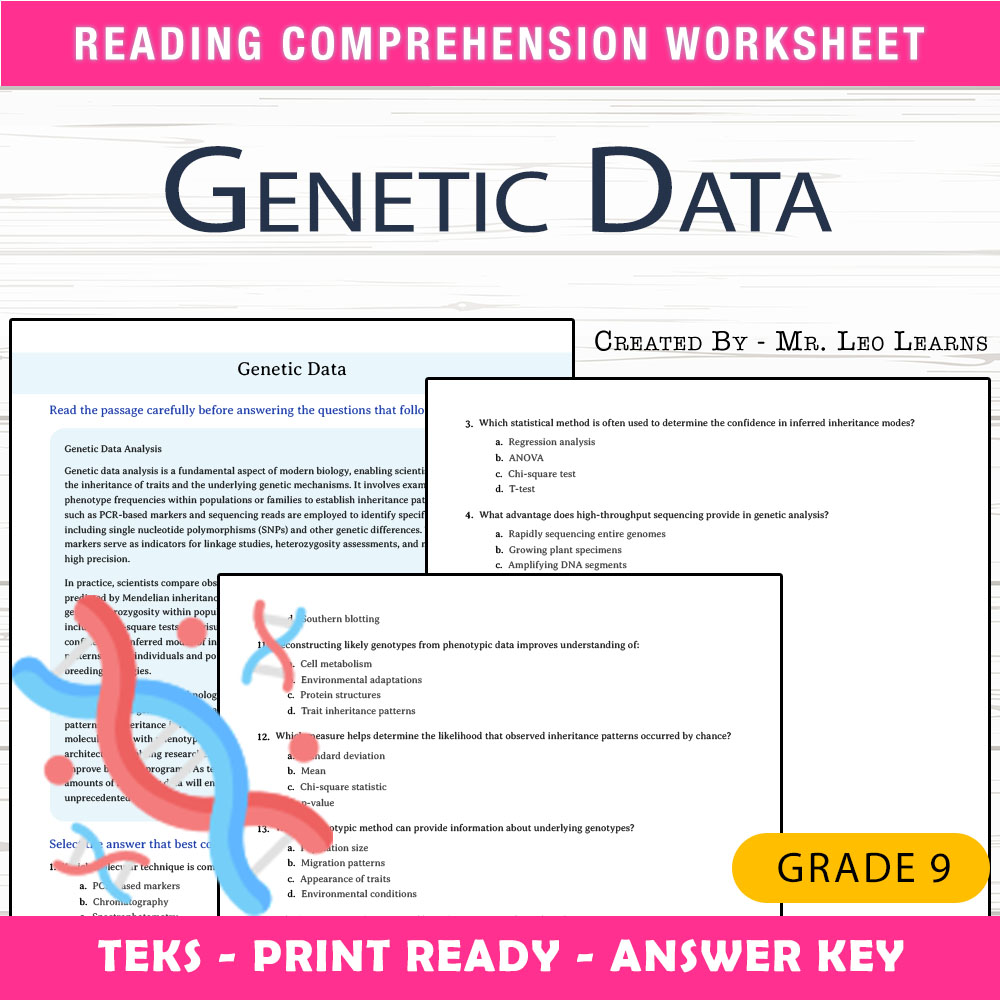
Grade 9 Science – Genetic Data Worksheet for Mastering Genetics Analysis
 Created byThe Resource Hub
Learning Objectives
- Interpret molecular and phenotypic information to analyze inheritance patterns.
- Apply techniques such as genotype frequency analysis, PCR markers, and sequencing reads to identify genetic variants.
- Compare observed and expected trait distributions to detect linkage, heterozygosity, or selection.
Also included in: Grade 9 Science Unit Bundle | Genetics, DNA & Biotechnology Worksheets +1 more
Instant download

Critical Listening Worksheet | Standards-Aligned Grade 9 ELA Practice
JCreated byJ.S SheetsLearning Objectives
- Identify a speaker’s central claim and supporting details by listening for meaning and intent.
- Distinguish stated evidence from implied assumptions and explain how assumptions affect understanding.
- Respond thoughtfully to a message by asking targeted follow-up questions or clarifying misconceptions in a respectful tone.
Instant download

Grade 9 Social Studies | Housing Infrastructure Worksheet (PDF)
Created bySunny Desk ResourcesLearning Objectives
- Explain how housing supply and infrastructure capacity affect community sustainability and resilience.
- Analyze how service delivery (water, sanitation, electricity, transit access) reduces risk during hazards and supports well-being.
- Evaluate how demographic change, market dynamics, and policy choices can create housing affordability and infrastructure strain.
Also included in: Grade 9 Urban Planning Social Studies Lesson Bundle, Ontario +1 more
Instant download

Energy Conversion Worksheet | NGSS Grade 9 Science Assessment
Created bySkylark WorksheetsLearning Objectives
- Explain how energy can change forms in common devices (solar cells, thermoelectric modules, electrochemical cells).
- Use energy bookkeeping ideas to describe useful output energy and energy losses during conversion.
- Interpret efficiency and relate device performance to conservation of energy constraints.
Also included in: Grade 9 Science Full-Year Bundle | NGSS Worksheets & Assessments
Instant download

Parallel Structure Worksheet Elena | Alberta Grade 9 ELA Assessment PDF
Created byLumora LearningLearning Objectives
- Identify and correct broken parallel structure in sentences that contain lists or comparisons
- Select the grammatically consistent form (noun, verb, phrase, or clause) for each item in a parallel series
- Explain how parallelism improves clarity, persuasive force, and logical comparison
Instant download

Grade 9 Science – Friction & Drag Daily Reading Worksheet | Ontario Standards
Created byBright Mind ResourcesLearning Objectives
- Identify and differentiate between static friction, kinetic friction, and fluid drag.
- Understand the factors affecting resistive forces such as surface properties and relative motion.
- Recognize the basic mathematical relationships involving friction coefficients and drag dependencies.
Also included in: Grade 9 Work, Energy & Forces Science Daily Reading Lesson Bundle | Ontario +1 more
Instant download

Grade 9 Connotation vs Denotation Worksheet | TEKS ELA Vocabulary
Created bySunny Desk ResourcesLearning Objectives
- Define denotation and connotation and distinguish between them in context.
- Identify how connotations influence a reader’s interpretation of actions, characters, or events.
- Use evidence from a passage to explain whether a word’s impact comes from denotation, connotation, or both.
Instant download

Grade 9 Holiday Patriot Day for Mastering Building Resilience | PDF + Answer Key
Created byShaNova WorksheetsLearning Objectives
- Explain how communities show resilience through kindness, solidarity, and rebuilding after 9/11.
- Identify social-emotional skills (empathy, coping, and support) that help people heal during and after crises.
- Describe roles students can take to strengthen supportive, resilient communities today.
Instant download

Inference Evidence Worksheet Pack | Grade 9 ELA Practice
Created bySunny Desk ResourcesLearning Objectives
- Make logical inferences using textual evidence (quotes and precise paraphrases).
- Identify how implied relationships and author/character motivation can be inferred from details.
- Explain cause-effect reasoning using clues from a text.
Also included in: Grade 9 Reading and Viewing Lesson Bundle | BC ELA Framework +1 more
Instant download
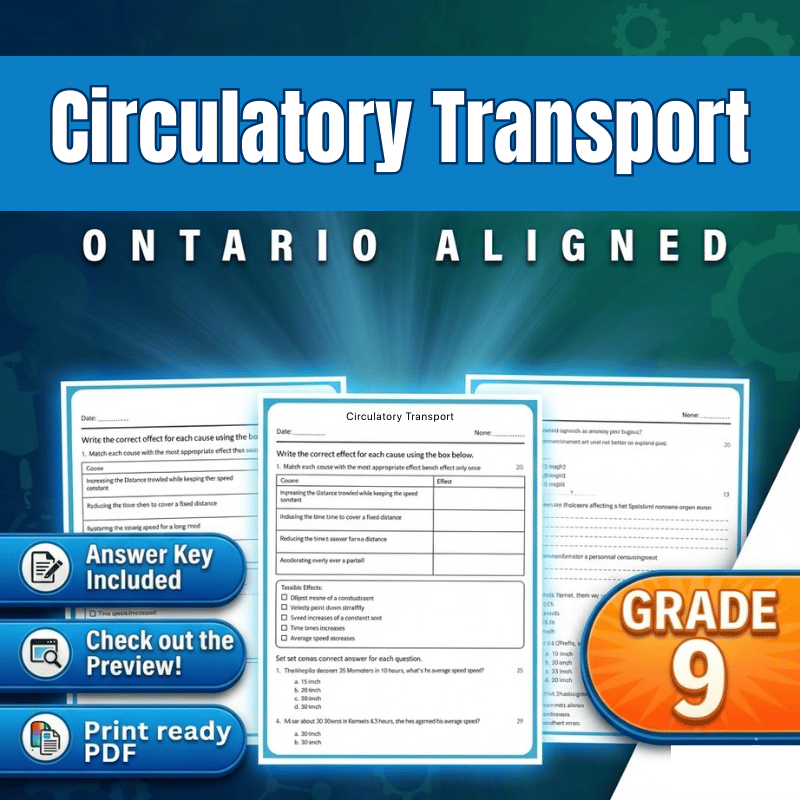
Grade 9 Science | Circulatory Transport Worksheet – Ontario Standards (PDF)
Created byBright Mind ResourcesLearning Objectives
- Understand the structure and function of the cardiovascular system.
- Explain the mechanisms of blood flow, valve functions, and capillary exchange.
- Describe how blood components contribute to transport capacity and regulation.
Instant download

Viewpoint Bias Worksheet Pack | Grade 9 ELA Activities Practice
Created bySunny Desk ResourcesLearning Objectives
- Explain how viewpoint bias can appear through framing choices in texts and media.
- Identify bias by noticing loaded language, selective details, and one-sided sourcing.
- Compare what a passage says to what it omits or minimizes to determine perspective.
Also included in: Grade 9 Reading and Viewing Lesson Bundle | BC ELA Framework +1 more
Instant download

Text Type Analysis Worksheet Pack | Grade 9 ELA Practice
Created bySunny Desk ResourcesLearning Objectives
- Distinguish the purposes of literary and informational texts and explain how that purpose shapes meaning.
- Identify key elements of literary texts (plot, characterization, imagery) and key elements of informational texts (claims, definitions, organization).
- Analyze how evidence and text structure guide readers toward understanding.
Also included in: Grade 9 Reading and Viewing Lesson Bundle | BC ELA Framework +1 more
Instant download
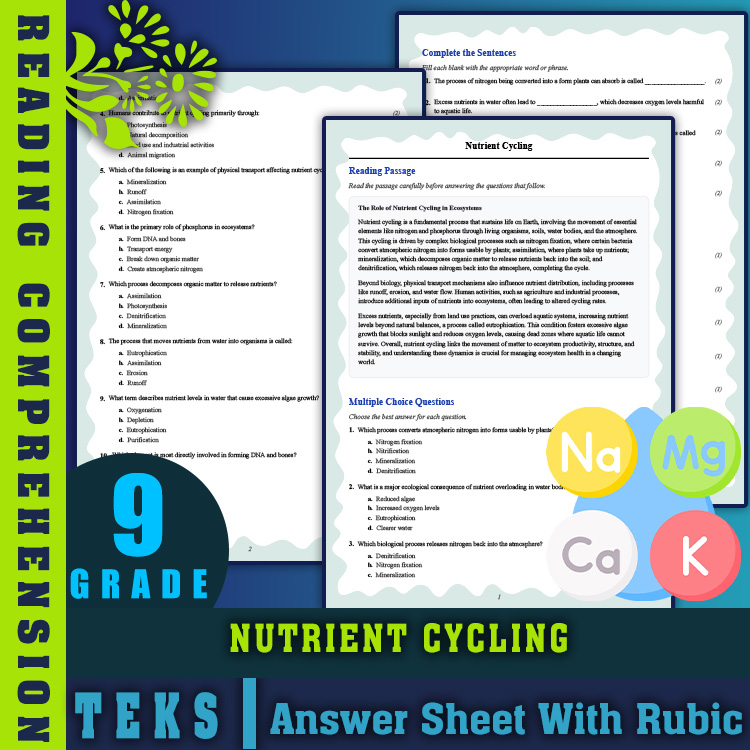
9th Grade Science | Nutrient Cycling Reading Worksheets (PDF + Answer Key)
JCreated byJ.S SheetsLearning Objectives
- Understand the processes involved in nutrient cycling, including biological and physical mechanisms.
- Explain how nutrient cycling impacts ecosystems, primary productivity, and water quality.
- Identify human influences on nutrient cycling and their ecological consequences.
Instant download

Grade 9 Presentation Structure Worksheet | Purpose & Transitions TEKS
Created bySunny Desk ResourcesLearning Objectives
- Identify how an introduction, body, and conclusion work together to support a clear presentation purpose.
- Use transitions to connect ideas logically during a spoken or written presentation.
- Explain how evidence supports a presenter’s claim using clear, grade-appropriate language.
Instant download

Effective Structures Worksheet for Grade 9 ELA | Standards-Aligned Practice
JCreated byJ.S SheetsLearning Objectives
- Identify how introductions, body paragraphs, transitions, paragraph order, and conclusions work together to create coherence in writing.
- Select appropriate structures and transitions that support comparison, cause-effect, and problem-solution reasoning.
- Revise paragraph organization by improving topic sentences, ordering, and concluding synthesis.
Instant download
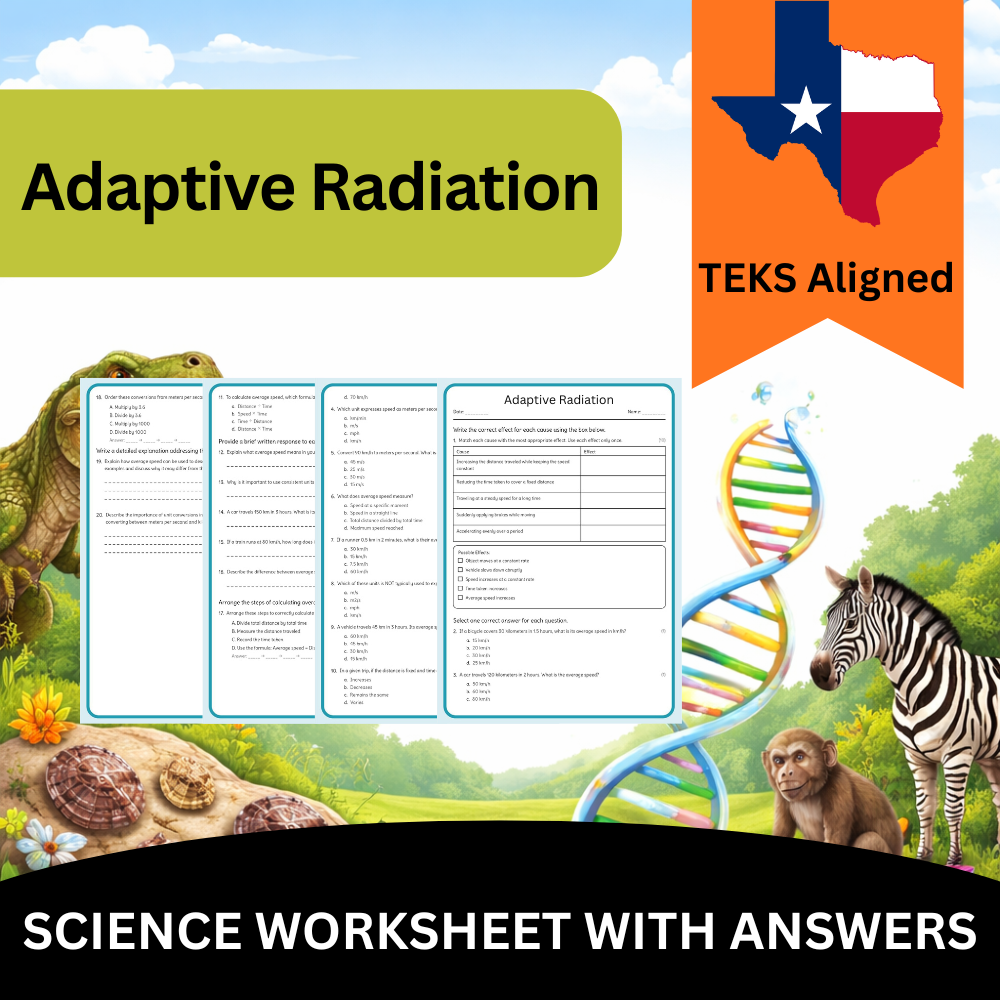
Grade 9 Science – Adaptive Radiation Worksheet (Worksheet + Answer Key) | TEKS-Aligned
Created byBright Mind ResourcesLearning Objectives
- Explain the concept of adaptive radiation and its significance in biodiversity.
- Identify factors that promote adaptive radiations in new environments.
- Analyze how traits evolve during rapid diversification of species.
Also included in: Grade 9 Science Unit | Evolution, Speciation & Genetics Worksheet Pack - TEKS +3 more
Instant download

Comprehension Check Worksheet | Grade 9 ELA Practice and Assessments
Created bySunny Desk ResourcesLearning Objectives
- Identify a text’s main idea and key details from a narrative or explanatory passage.
- Explain how text organization helps readers understand what is explicitly stated.
- Use clues in the passage to make reasonable inferences.
Also included in: Grade 9 Reading and Viewing Lesson Bundle | BC ELA Framework +1 more
Instant download
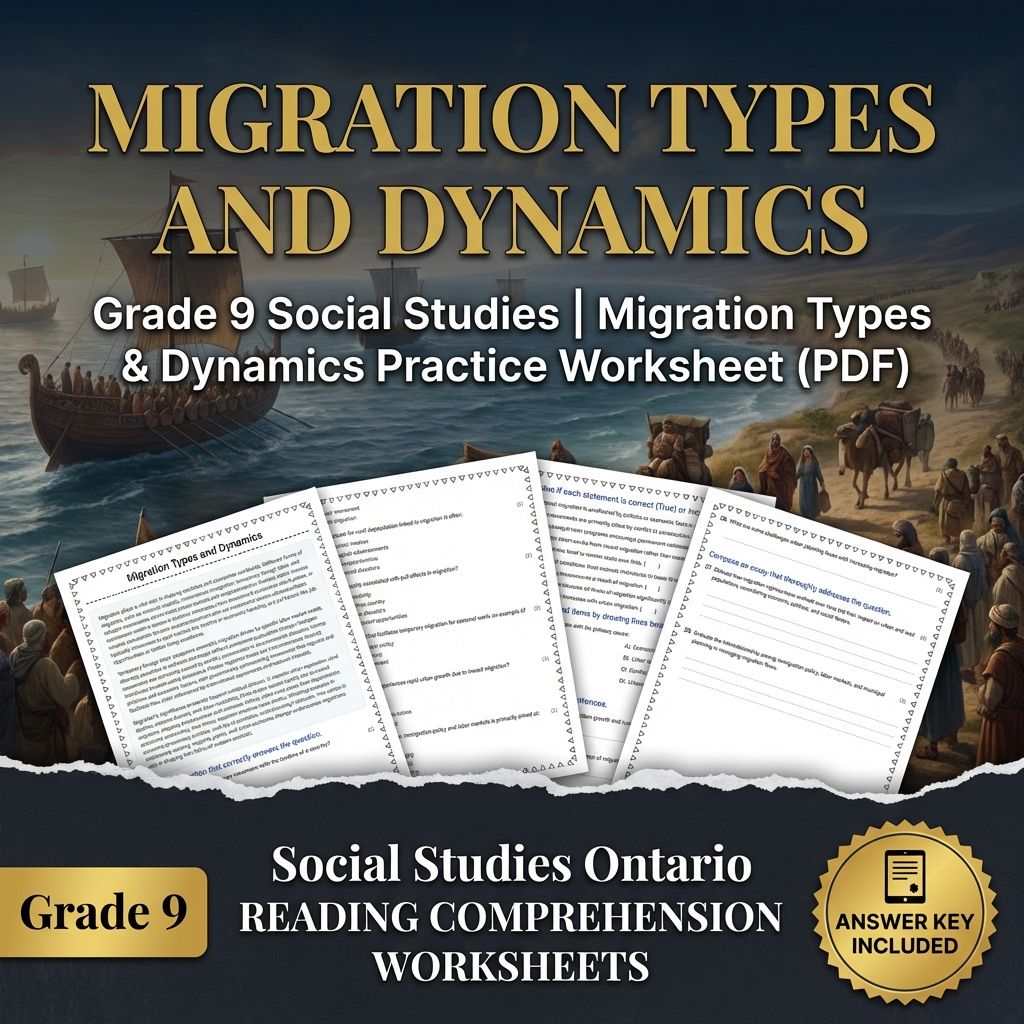
Grade 9 Social Studies | Migration Types & Dynamics Practice Worksheet (PDF)
JCreated byJ.S SheetsLearning Objectives
- Compare and distinguish between different types of migration, including internal, international, temporary foreign labor, and refugee movements.
- Analyze push–pull factors that influence migration decisions and their impact on urban and rural populations.
- Evaluate the effects of migration regimes and policies on cultural diversity, labor markets, and municipal planning.
Also included in: Grade 9 Social Studies Unit Bundle – Community, Migration & Population Dynamics +1 more
Instant download

Grade 9 Science | Tissue Structure Worksheet (TEKS) - PDF
 Created byEvergreen Desk Education
Learning Objectives
- Explain how epithelial, connective, muscle, and nervous tissues are organized at the microscopic level.
- Relate tissue structure (cell shape, junctions, extracellular matrix, and membrane features) to tissue function in organs.
- Use examples to predict how differences in tissue structure affect protection, transport, movement, and signaling.
Instant download

Editing for Correctness Worksheet | Ontario Grade 9 ELA Practice
JCreated byJ.S SheetsLearning Objectives
- Revise writing by correcting grammar, spelling, and punctuation to keep meaning clear and stable.
- Apply consistent verb tense and correct subject-verb agreement during the editing process.
- Use accurate pronoun references and sentence-level punctuation for clarity and coherence.
Instant download
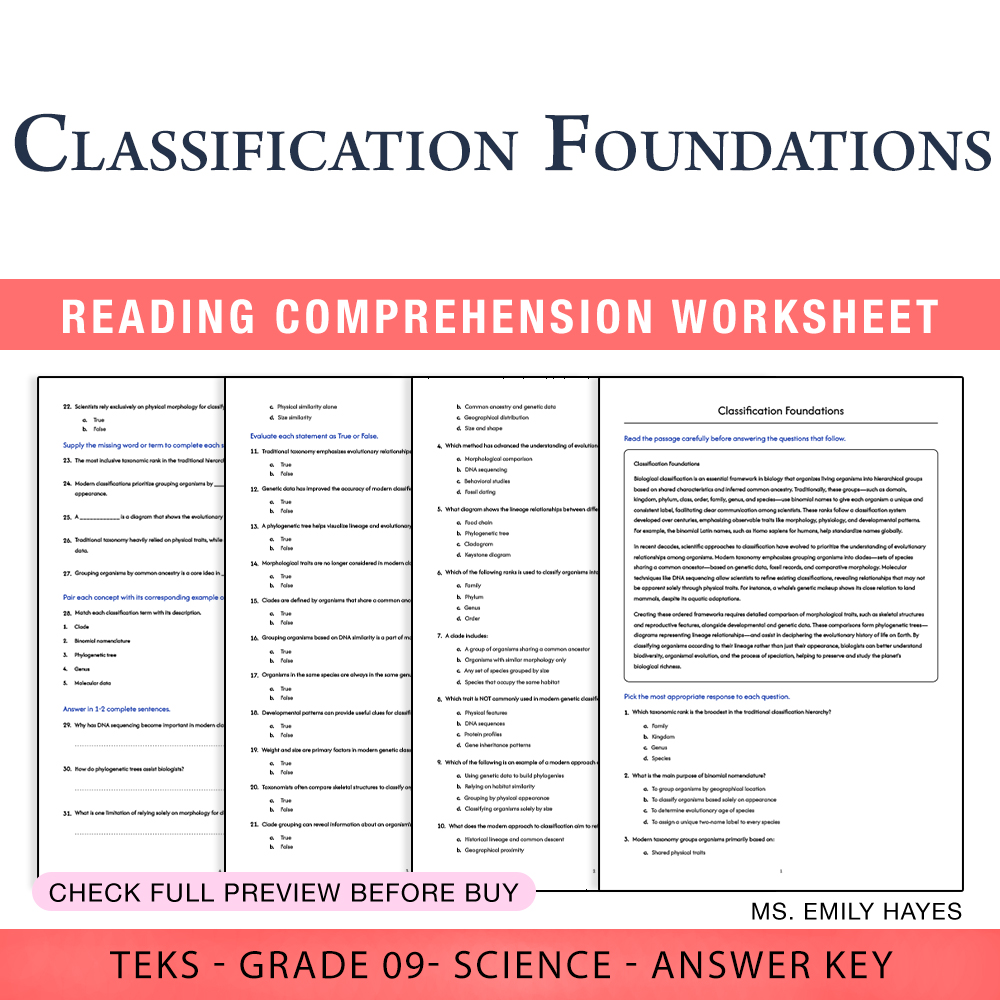
9th Grade Science | Classification Foundations Worksheet (PDF+ Answer Key)
 Created byCopper Leaf Classroom
Learning Objectives
- Understand the structure of biological classification systems and their purposes.
- Identify traditional and modern approaches to classifying living organisms.
- Compare the criteria used in different classification methods, including morphological, developmental, and genetic data.
Instant download
Browse more categories
About Grade 9 Worksheets
Browse 9,323 printable Grade 9 worksheets across algebra, biology, literature, and history — each a ready-to-print PDF with optional answer keys.
Every worksheet on MyTeachingSheets is created by independent teacher-authors and reviewed before publication. All resources download as printable PDFs for classroom, homework, or at-home practice, and many include answer keys. Preview any worksheet free before buying.