
Grade 9 Science Worksheets
6,926 worksheets
Spheres Connectivity Worksheet | Grade 9 Science Practice
 Created byBright Quill Resources
Learning Objectives
- Explain how the geosphere, hydrosphere, atmosphere, and biosphere are connected through material and energy exchanges.
- Use cause-and-effect chains (and simple mass-balance ideas) to describe how nutrients and gases move across Earth systems.
- Interpret how physical processes like river transport, soil gas fluxes, and ocean upwelling can affect biological productivity.
Instant download

Unit Analysis Worksheet | Grade 9 Science Practice AP Standards
Created byBright Quill ResourcesLearning Objectives
- Use dimensional analysis to check whether equations and computations are unit-consistent.
- Derive relationships by combining units and identifying which functional forms are plausible.
- Compute and interpret derived quantities (such as density, flux, and rates) while reporting correct units.
Instant download

Uncertainty Quantified Worksheet Pack | Grade 9 Science Practice
Created byBright Quill ResourcesLearning Objectives
- Explain random and systematic uncertainty using appropriate statistical descriptors
- Use standard deviation and standard error to quantify variability in measurements
- Construct and interpret confidence intervals and explain what they mean for evidence
Instant download

Seismic Records Worksheet | Grade 9 AP Science Practice
Created byBright Quill ResourcesLearning Objectives
- Interpret seismic waveforms and identify likely P-wave and S-wave arrivals
- Use travel-time ideas to connect arrival-time differences to earthquake distance and epicenter location
- Compare waveform amplitude and frequency patterns to infer differences between shallow and deep earthquakes
Instant download

Model-Data Fit Worksheet | Grade 9 AP Science Practice
Created byBright Quill ResourcesLearning Objectives
- Explain how residuals and diagnostic plots reveal whether a model matches experimental data
- Use goodness-of-fit ideas (including visual agreement and error patterns) to judge model consistency
- Identify common signs of problems such as heteroscedasticity, systematic divergence, or missing variables
Instant download

Energy Pathways Worksheet Pack | Grade 9 AP Science Activities
Created byBright Quill ResourcesLearning Objectives
- Describe how ATP is produced during cellular energy pathways, including coupling of catabolic and anabolic reactions
- Compare the roles of electron transport chains in photosynthesis and cellular respiration
- Use simplified stoichiometry and energy diagrams to connect molecular processes to organism-level energy budgets
Instant download

Communicating Uncertainty Worksheet Pack | Grade 9 Science Practice
Created byBright Quill ResourcesLearning Objectives
- Explain why uncertainty is an expected part of scientific measurement and inference.
- Use interval estimates and confidence statements to communicate how reliable results are.
- Describe how effect sizes and likelihood statements help interpret and compare evidence.
Instant download

Photosynthetic Capture Worksheet | Grade 9 Science Practice
Created byBright Quill ResourcesLearning Objectives
- Explain how pigment absorption spectra determine which wavelengths of light are captured for photosynthesis
- Describe how excitation energy is transferred among pigments and converted to chemical energy at photosystems
- Use ideas of rate, efficiency, and quantum yield to predict how light intensity and wavelength affect photosynthesis
Instant download

Respiratory Pathways Worksheet | Grade 9 Science Practice
Created byBright Quill ResourcesLearning Objectives
- Explain how glycolysis, the citric acid (TCA) cycle, and the electron transport chain work together in cellular respiration.
- Compare aerobic and anaerobic outcomes by tracking ATP yield and redox (NADH/FADH2 vs. NAD+ re-oxidation).
- Connect pathway flux regulation (substrate availability and enzyme control) to changes in cellular energy currency.
Instant download

Control Criteria Worksheet Pack | Grade 9 AP Science Practice
Created byBright Quill ResourcesLearning Objectives
- Define control criteria used to establish comparability in causal inference (isolation of variables, replication, baseline characterization, and reference conditions).
- Explain how controlled conditions strengthen causal claims and how uncontrolled variation or residual confounding weakens them.
- Connect data collection choices to the credibility of causal conclusions and model-based explanations, including limits from uncertainty.
Instant download

Ecosystem Cycling Worksheet for Grade 9 Science Practice and Review
Created byBright Quill ResourcesLearning Objectives
- Explain how carbon and nitrogen move through ecosystems via trophic transfer and decomposition
- Describe how abiotic factors (temperature, oxygen, soils) affect rates of material cycling
- Use stoichiometric constraints to predict how nutrient availability can change biomass distribution
Instant download

Graphical Literacy Worksheet Pack | Grade 9 AP Science Practice
Created byBright Quill ResourcesLearning Objectives
- Select an appropriate graph type (scatterplot, histogram, line graph, or residual display) for a given data question.
- Construct graphs with correct axis scaling, units, labels, and (when needed) reasonable binning choices.
- Interpret patterns, trends, and outliers while recognizing when visual correlation may be misleading.
Instant download

Evolution Evidence Worksheet | Grade 9 Science Practice
Created byBright Quill ResourcesLearning Objectives
- Interpret multiple lines of evidence (fossil sequences, comparative anatomy, biogeography, and molecular phylogenies) for descent with modification.
- Explain how natural selection, genetic drift, gene flow, and mutation can change allele frequencies over short and long timescales.
- Use models and scenarios to predict how populations respond to changing environments.
Instant download

Paleoclimate Proxies Worksheet for Grade 9 Science Practice
Created byBright Quill ResourcesLearning Objectives
- Explain how different paleoclimate archives (ice cores, tree rings, marine sediments, and speleothems) record past climate conditions.
- Interpret proxy indicators such as isotopic ratios, growth increments, and microfossil assemblages to reconstruct climate patterns.
- Describe how age models and uncertainty help link proxy records to timing and climate drivers.
Instant download

Hydrologic Fluxes Worksheet Pack | Grade 9 Science Practice
Created byBright Quill ResourcesLearning Objectives
- Explain how precipitation, evapotranspiration, infiltration, and runoff fit into a water-budget framework.
- Interpret discharge hydrographs and connect changes in streamflow to altered hydrologic fluxes.
- Use groundwater level observations to reason about aquifer storage and sustainability.
Instant download
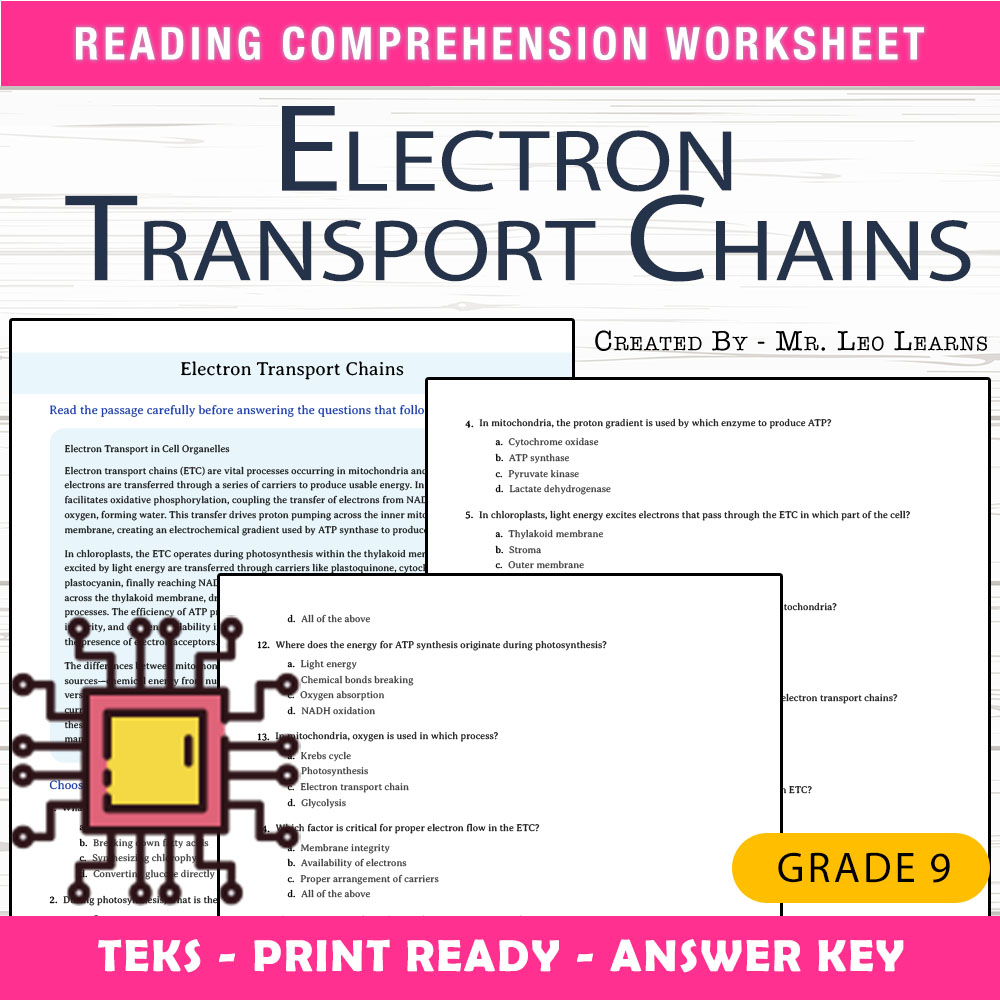
Grade 9 Science — Electron Transport Chains Worksheet for Mastery
 Created byThe Resource Hub
Learning Objectives
- Describe the process of electron transport in mitochondria and chloroplasts.
- Identify the role of proton gradients and ATP synthase in energy production.
- Compare mitochondrial and thylakoid electron transport mechanisms.
Also included in: Grade 9 Science | Enzymes, Photosynthesis & Metabolic Pathways Unit Bundle +1 more
Instant download

Grade 9 Science – Membrane Transport & Cell Homeostasis | Reading Worksheet
 Created byBright Mind Resources
Learning Objectives
- Describe the basic mechanisms of passive diffusion, facilitated transport, and active transport across cell membranes.
- Explain how membrane composition and transport proteins influence cellular homeostasis.
- Predict the effects of structural modifications in membrane transport proteins on their function.
Also included in: Grade 9 Daily Reading Science Worksheets Lesson Bundle | AP +2 more
Instant download

Grade 9 Science – Integrated Modeling & Environmental Science | Worksheet
Created byBright Mind ResourcesLearning Objectives
- Understand the principles of integrated environmental models
- Interpret the structure and variables of coupled models
- Recognize the role of parameter sensitivity and uncertainty in modeling
Also included in: Grade 9 Earth Systems Science Daily Reading Worksheets Lesson Bundle | AP +2 more
Instant download

Grade 9 Science – Dynamic Systems & Data Representation | Reading Worksheet
Created byBright Mind ResourcesLearning Objectives
- Understand the concept of dynamic systems and how they change over time.
- Identify different types of changes and patterns in system behavior.
- Analyze simple phase diagrams and interpret rate changes in systems.
Also included in: Grade 9 Science Data Analysis Daily Reading Worksheets Lesson Bundle | AP +2 more
Instant download

Grade 9 Science – Measurement & Uncertainty | Daily Reading Worksheet
Created byBright Mind ResourcesLearning Objectives
- Define and distinguish between random and systematic uncertainties in measurements.
- Explain the significance of statistical descriptors such as standard deviation and standard error.
- Describe methods used to propagate uncertainty through calculations.
Also included in: Grade 9 Science Data Analysis Daily Reading Worksheets Lesson Bundle | AP +2 more
Instant download

Grade 9 Science – Plate Boundaries & Tectonic Movements | Reading Worksheet
Created byBright Mind ResourcesLearning Objectives
- Identify the three main types of plate boundaries: divergent, convergent, and transform.
- Describe the surface features associated with each type of boundary.
- Recognize real-world examples of each boundary type from maps and cross-sections.
Also included in: Grade 9 Earth Systems Science Daily Reading Worksheets Lesson Bundle | AP +2 more
Instant download

Grade 9 Science – Gas Behaviour & Particle Model | Daily Reading Worksheet
 Created byQuiet Forest Education
Learning Objectives
- Understand the properties and behavior of gases based on the particle model
- Explain how particle motion relates to pressure, volume, and temperature changes
- Connect microscopic particle behavior to macroscopic gas phenomena
Also included in: Matter and Chemical Change Grade 9 Science Daily Worksheets Bundle | Ontario +1 more
Instant download

Grade 9 Science – Acceleration & Data Analysis | Daily Reading Worksheet
Created byBright Mind ResourcesLearning Objectives
- Define acceleration and describe its relationship with speed.
- Interpret distance–time and speed–time graphs to identify patterns of acceleration.
- Differentiate between constant acceleration and changing acceleration using data patterns.
Also included in: Waves & Forces Grade 9 Science Daily Reading Worksheets Lesson Bundle | General +1 more
Instant download

Grade 9 Science – Heat & Work Understanding Energy Transfer | Reading Worksheet
Created byBright Mind ResourcesLearning Objectives
- Define heat transfer and work as pathways of energy transfer.
- Explain the difference between heat and work in terms of energy movement.
- Describe how energy changes involve the surroundings during physical and chemical changes.
Also included in: Waves & Forces Grade 9 Science Daily Reading Worksheets Lesson Bundle | General +1 more
Instant download

Grade 9 Science – Genetic Drift & Evolution | Daily Reading Worksheet
Created byBright Mind ResourcesLearning Objectives
- Define genetic drift and understand its role in evolution
- Identify events that cause genetic drift such as bottlenecks and founder effects
- Distinguish between genetic drift and natural selection
Also included in: Grade 9 Evolution Science Daily Reading Worksheets Lesson Bundle | TEKS +2 more
Instant download

Grade 9 Science – Enzymes & Catalysis Daily Reading Worksheet | TEKS Aligned
Created byBright Mind ResourcesLearning Objectives
- Understand what enzymes are and their role as biological catalysts.
- Identify how enzymes lower activation energy to speed up reactions.
- Describe the importance of enzyme structure and substrate specificity.
Also included in: Photosynthesis Grade 9 Science Daily Reading Worksheets Lesson Bundle | TEKS +2 more
Instant download

Grade 9 Science – Biotech Ethics & Responsible Innovation | Reading Worksheet
Created byBright Mind ResourcesLearning Objectives
- Understand fundamental concepts of biotechnology.
- Identify ethical considerations associated with genetic manipulation.
- Analyze societal implications of biotech advances.
Also included in: Grade 9 Gene Expression & Genetics Science Daily Reading Lesson Bundle | TEKS +2 more
Instant download

Grade 9 Science – Light Reactions & Photosynthesis | Daily Reading Worksheet
Created byBright Mind ResourcesLearning Objectives
- Understand how pigment complexes absorb light energy in the thylakoid membranes.
- Explain the process of photon-driven charge separation and electron flow through photosystems.
- Describe how high-energy electrons are transferred to electron acceptors and used to produce ATP and NADPH.
Also included in: Photosynthesis Grade 9 Science Daily Reading Worksheets Lesson Bundle | TEKS +2 more
Instant download

Grade 9 Science – Membrane Transport & Cell Movement | Daily Reading Worksheet
Created byBright Mind ResourcesLearning Objectives
- Understand the different types of passive and active membrane transport processes.
- Explain how molecules move across cell membranes through diffusion, osmosis, and active transport.
- Identify the differences between diffusion, facilitated diffusion, and osmosis.
Also included in: Grade 9 Homeostasis & Body Systems Science Lesson Bundle Daily Reading | TEKS +2 more
Instant download

Grade 9 Science – Trophic Structure & Food Webs | Daily Reading Worksheet
Created byBright Mind ResourcesLearning Objectives
- Identify producers, consumers, and decomposers in various ecosystems
- Describe the roles of different trophic levels in food chains and webs
- Understand key concepts such as trophic efficiency and trophic cascades
Also included in: Ecosystem Ecology Grade 9 Science Daily Reading Worksheets Bundle | TEKS +2 more
Instant download

Grade 9 Science – Regulation & Gene Expression | Daily Reading Worksheet
Created byBright Mind ResourcesLearning Objectives
- Understand key elements involved in gene regulation such as promoters, enhancers, silencers, transcription factors, and repressors.
- Describe how epigenetic modifications influence gene expression without changing DNA sequence.
- Recognize the role of regulatory networks and feedback loops in controlling gene activity.
Also included in: Grade 9 Gene Expression & Genetics Science Daily Reading Lesson Bundle | TEKS +2 more
Instant download

Grade 9 Science – Homeostasis Feedback & Regulation | Daily Reading Worksheet
Created byBright Mind ResourcesLearning Objectives
- Understand the concept of homeostasis and its importance in maintaining internal balance.
- Identify key feedback mechanisms, especially negative feedback, in biological systems.
- Analyze how the body responds to internal changes to sustain stable conditions.
Also included in: Evolution Grade 9 Science Daily Reading Worksheets Lesson Bundle | CA Standards +1 more
Instant download

Grade 9 Science – Net Acceleration & Forces | Daily Reading Worksheet
Created byBright Mind ResourcesLearning Objectives
- Define net acceleration and explain its relationship with force and mass.
- Identify unbalanced forces acting on objects in everyday situations.
- Understand how the direction of forces affects acceleration.
Also included in: Science Grade 9 Science Daily Reading Worksheets lesson-bundle | Calif. Stds +1 more
Instant download

Grade 9 Science – Mass & Acceleration | Daily Reading Worksheet
Created byBright Mind ResourcesLearning Objectives
- Understand how mass influences acceleration when a force is applied
- Distinguish between inertial mass and gravitational effects
- Apply the force–acceleration relationship in problem-solving
Also included in: Grade 9 Forces, Motion & Energy Science Lesson Bundle for Daily Reading | BC +1 more
Instant download

Grade 9 Science – Fluid Balance & Kidney Function | Daily Reading Worksheet
Created byBright Mind ResourcesLearning Objectives
- Understand the basic role of kidneys in regulating water and electrolytes.
- Identify key processes in nephron segments related to osmoregulation.
- Recognize hormonal influences on kidney functions, such as antidiuretic hormone and aldosterone.
Also included in: Grade 9 Cell and Human Body Systems Science Daily Reading Lesson Bundle | BC +1 more
Instant download

Grade 9 Science – Cardiopulmonary Interaction & Systems | Reading Worksheet
Created byBright Mind ResourcesLearning Objectives
- Understand how the heart and lungs collaborate to deliver oxygen to the body
- Identify key components involved in cardiopulmonary function
- Explain the processes of pulmonary ventilation and cardiovascular transport
Also included in: Grade 9 Homeostasis & Body Systems Science Lesson Bundle Daily Reading | TEKS +2 more
Instant download

Grade 9 Science – Energy Transfer Modes | Daily Reading Worksheet
Created byBright Mind ResourcesLearning Objectives
- Identify different mechanisms of energy transfer such as work, thermal transfer, and radiation.
- Understand the mathematical relationships involved in energy transfer.
- Differentiate between stored energy and transferred energy.
Also included in: Science Grade 9 Science Daily Reading Worksheets lesson-bundle | Calif. Stds +1 more
Instant download

Grade 9 Science – Evidence with Models Reading Worksheet | Standards Aligned
Created byBright Mind ResourcesLearning Objectives
- Understand what scientific models are and their purpose
- Learn how evidence from measurements supports models
- Recognize how models summarize patterns connecting variables
Also included in: Waves & Forces Grade 9 Science Daily Reading Worksheets Lesson Bundle | General +1 more
Instant download

Grade 9 Science – Microscopes & Cell Structures | Daily Reading Worksheet
Created byBright Mind ResourcesLearning Objectives
- Identify the main parts of a microscope.
- Understand the basic functions of microscope components.
- Learn how microscopes enhance our view of tiny objects and structures.
Also included in: Grade 9 Cell and Human Body Systems Science Daily Reading Lesson Bundle | BC +1 more
Instant download

Grade 9 Science – Optimization Tradeoffs in Design | Daily Reading Worksheet
Created byBright Mind ResourcesLearning Objectives
- Understand the concept of tradeoffs in engineering design.
- Identify competing goals such as strength, weight, cost, and manufacturability.
- Analyze how different design choices impact multiple performance criteria.
Also included in: Systems Thinking Grade 9 Science Daily Reading Worksheets Bundle | CA Standards +1 more
Instant download

Grade 9 Science – Energy in Changes Daily Reading Worksheet | Standards-Aligned
Created byBright Mind ResourcesLearning Objectives
- Understand the difference between physical and chemical changes.
- Identify examples of energy transfer during physical changes.
- Describe endothermic and exothermic processes and their effects on temperature.
Also included in: Waves & Forces Grade 9 Science Daily Reading Worksheets Lesson Bundle | General +1 more
Instant download

Grade 9 Science – Climate Change & Climate Forcing | Daily Reading Worksheet
Created byBright Mind ResourcesLearning Objectives
- Define climate forcing and describe its role in climate change.
- Explain the Earth's energy budget and how radiative transfer affects surface temperature.
- Identify different types of climate drivers such as greenhouse gases, albedo changes, aerosols, and land-use feedbacks.
Also included in: Grade 9 Earth & Space Science Daily Reading Worksheets Lesson Bundle | Ontario +1 more
Instant download

Grade 9 Science – Resources & Landforms | Daily Reading Worksheet
Created byBright Mind ResourcesLearning Objectives
- Understand the basic concepts of landforms and natural resources
- Describe Earth's processes that create and modify landforms
- Identify how resources are concentrated through geological processes
Also included in: Grade 9 Science Worksheets: Space-to-Climate Lesson Bundle | Calif. Standards +1 more
Instant download

Grade 9 Science – Tides & Gravity | Daily Reading Worksheet
Created byBright Mind ResourcesLearning Objectives
- Explain how the Moon's gravitational pull affects Earth's ocean tides.
- Describe the role of the Sun in influencing tidal amplitudes.
- Identify the relative positions of Earth, Moon, and Sun during different tidal cycles.
Also included in: Earth Systems Grade 9 Science Daily Reading Worksheets Bundle | Florida NGSSS +1 more
Instant download

Grade 9 Science – Work & Kinetic Energy Daily Reading Worksheet | Florida NGSSS
Created byBright Mind ResourcesLearning Objectives
- Understand the concept of work as energy transfer by a force over a distance.
- Recognize how work affects kinetic energy and speed of an object.
- Identify how the direction of force determines energy transfer into potential or kinetic energy.
Also included in: Grade 9 Forces, Energy & Matter Science lesson bundle Florida NGSSS +1 more
Instant download

Grade 9 Science – Population Trait Variation & Natural Selection | Worksheet
Created byBright Mind ResourcesLearning Objectives
- Understand how genetic variation occurs within populations
- Learn about factors influencing allele frequencies and trait distributions
- Explore how natural selection impacts genetic traits in populations
Also included in: Evolution Grade 9 Science Daily Reading Worksheets Lesson Bundle | CA Standards +1 more
Instant download

Grade 9 Science – Seismic Signals & Earth’s Inner Waves | Reading Worksheet
Created byBright Mind ResourcesLearning Objectives
- Identify and describe different types of seismic waves
- Understand seismic wave propagation and their characteristics
- Relate seismic wave travel times to Earth's interior structure
Also included in: Grade 9 Earth & Space Science Daily Reading Worksheets Lesson Bundle | Ontario +1 more
Instant download

Grade 9 Science – Understanding Circuit Types & Daily Reading Worksheet
Created byBright Mind ResourcesLearning Objectives
- Define series and parallel circuits
- Identify the behaviour of current and voltage in series circuits
- Recognize examples of series circuits and their applications
Also included in: Grade 9 Electrical Circuits & Electromagnetism Science Lesson Bundle | Alberta +1 more
Instant download
About Grade 9 Science Worksheets
Find Science worksheets built for Grade 9. All 6,926 cover core skills, practice, and review, each an instant PDF download.
Every worksheet on MyTeachingSheets is created by independent teacher-authors and reviewed before publication. All resources download as printable PDFs for classroom, homework, or at-home practice, and many include answer keys. Preview any worksheet free before buying.