
Grade 9 Science Worksheets
6,926 worksheets
Grade 9 Science – Population Trait Variation & Natural Selection | Worksheet
 Created byBright Mind Resources
Learning Objectives
- Understand how genetic variation occurs within populations
- Learn about factors influencing allele frequencies and trait distributions
- Explore how natural selection impacts genetic traits in populations
Also included in: Evolution Grade 9 Science Daily Reading Worksheets Lesson Bundle | CA Standards +1 more
Instant download

Grade 9 Science – Resources & Landforms | Daily Reading Worksheet
Created byBright Mind ResourcesLearning Objectives
- Understand the basic concepts of landforms and natural resources
- Describe Earth's processes that create and modify landforms
- Identify how resources are concentrated through geological processes
Also included in: Grade 9 Science Worksheets: Space-to-Climate Lesson Bundle | Calif. Standards +1 more
Instant download

Grade 9 Science – Climate Change & Climate Forcing | Daily Reading Worksheet
Created byBright Mind ResourcesLearning Objectives
- Define climate forcing and describe its role in climate change.
- Explain the Earth's energy budget and how radiative transfer affects surface temperature.
- Identify different types of climate drivers such as greenhouse gases, albedo changes, aerosols, and land-use feedbacks.
Also included in: Grade 9 Earth & Space Science Daily Reading Worksheets Lesson Bundle | Ontario +1 more
Instant download

Grade 9 Science – Tides & Gravity | Daily Reading Worksheet
Created byBright Mind ResourcesLearning Objectives
- Explain how the Moon's gravitational pull affects Earth's ocean tides.
- Describe the role of the Sun in influencing tidal amplitudes.
- Identify the relative positions of Earth, Moon, and Sun during different tidal cycles.
Also included in: Earth Systems Grade 9 Science Daily Reading Worksheets Bundle | Florida NGSSS +1 more
Instant download

Grade 9 Science – Work & Kinetic Energy Daily Reading Worksheet | Florida NGSSS
Created byBright Mind ResourcesLearning Objectives
- Understand the concept of work as energy transfer by a force over a distance.
- Recognize how work affects kinetic energy and speed of an object.
- Identify how the direction of force determines energy transfer into potential or kinetic energy.
Also included in: Grade 9 Forces, Energy & Matter Science lesson bundle Florida NGSSS +1 more
Instant download

Grade 9 Science – Understanding Circuit Types & Daily Reading Worksheet
Created byBright Mind ResourcesLearning Objectives
- Define series and parallel circuits
- Identify the behaviour of current and voltage in series circuits
- Recognize examples of series circuits and their applications
Also included in: Grade 9 Electrical Circuits & Electromagnetism Science Lesson Bundle | Alberta +1 more
Instant download

Grade 9 Science – Seismic Signals & Earth’s Inner Waves | Reading Worksheet
Created byBright Mind ResourcesLearning Objectives
- Identify and describe different types of seismic waves
- Understand seismic wave propagation and their characteristics
- Relate seismic wave travel times to Earth's interior structure
Also included in: Grade 9 Earth & Space Science Daily Reading Worksheets Lesson Bundle | Ontario +1 more
Instant download

Grade 9 Science – Resource Impacts Daily Reading Worksheet | Ontario Standards
Created byBright Mind ResourcesLearning Objectives
- Understand key concepts related to Science
- Apply knowledge through practice questions
- Demonstrate comprehension of the material
Also included in: Grade 9 Earth & Space Science Daily Reading Worksheets Lesson Bundle | Ontario +1 more
Instant download

Grade 9 Science – Orbital Interactions & Climate Effects | Daily Worksheet
 Created byQuiet Forest Education
Learning Objectives
- Explain how Earth's eccentricity influences seasonal insolation.
- Identify the effects of axial tilt and precession on long-term climate variability.
- Describe tidal forcing mechanisms driven by the Moon and Sun.
Also included in: Earth and Space Systems Grade 9 Science Daily Worksheets Bundle | Ontario +1 more
Instant download

Grade 9 Science – Neuroendocrine Control Daily Reading Worksheet | TEKS Aligned
Created byBright Mind ResourcesLearning Objectives
- Understand the function of the hypothalamus in hormone regulation
- Describe how the pituitary gland responds to hypothalamic signals
- Identify key anatomical features involved in neuroendocrine control
Also included in: Grade 9 Homeostasis & Body Systems Science Lesson Bundle Daily Reading | TEKS +2 more
Instant download

Grade 9 Science – Integrated Case & Daily Reading Worksheet | Alberta Standards
Created byBright Mind ResourcesLearning Objectives
- Compare sexual and asexual reproductive strategies and their impacts on genetic diversity.
- Understand how traits are inherited through chromosomes following Mendelian principles.
- Analyze the adaptive advantages of different selection methods in regional breeding programs.
Also included in: Grade 9 Genetics & Inheritance Science Daily Reading Lesson Bundle | Alberta +1 more
Instant download

Grade 9 Science – Chemical Reactions & Types | Daily Reading Worksheet
Created byBright Mind ResourcesLearning Objectives
- Define what a chemical reaction is and describe the basic process.
- Identify common types of chemical reactions such as combustion, synthesis, and decomposition.
- Read and interpret symbolic chemical equations representing reactions.
Also included in: States of Matter Grade 9 Science Daily Reading Worksheets lesson bundle |Alberta +1 more
Instant download

Grade 9 Science – Genetic Variation Sources & Effects | Daily Reading Worksheet
Created byBright Mind ResourcesLearning Objectives
- Identify different sources of genetic variation in populations
- Explain how mutation, recombination, gene flow, and chromosomal rearrangements contribute to diversity
- Recognize regional examples illustrating the impact of genetic variation
Also included in: Grade 9 Genetics & Inheritance Science Daily Reading Lesson Bundle | Alberta +1 more
Instant download

Grade 9 Science – Prokaryote & Eukaryote Comparison | Daily Reading Worksheet
Created byBright Mind ResourcesLearning Objectives
- Identify key differences between prokaryotic and eukaryotic cells
- Understand cell structure and function in bacteria, archaea, and eukaryotes
- Describe how cell components relate to their roles in the organism
Also included in: Grade 9 Cell Structure Science Daily Reading Lesson Bundle | TEKS +2 more
Instant download

Grade 9 Science – Hydrologic Change & River Systems | Daily Reading Worksheet
Created byBright Mind ResourcesLearning Objectives
- Understand how rivers shape Earth's surface through erosion, transport, and deposition.
- Analyze river discharge and sediment data to interpret landscape evolution.
- Identify examples of river-related landscape features such as valleys and fjords.
Also included in: Grade 9 Earth Processes Science Daily Reading Worksheets lesson bundle | NGSS +2 more
Instant download

Grade 9 Science – Nutritional Impact & Health Risks | Daily Reading Worksheet
Created byBright Mind ResourcesLearning Objectives
- Understand how dietary choices influence cellular functions and overall health.
- Identify key nutrients that affect physiological processes.
- Analyze evidence linking nutrition to chronic diseases and health outcomes.
Also included in: Grade 9 Science Daily Reading Worksheets: Body Systems Lesson Bundle | Ontario +1 more
Instant download

Grade 9 Science – Tissue Types & Function | Daily Reading Worksheet
Created byBright Mind ResourcesLearning Objectives
- Understand key concepts related to Science
- Apply knowledge through practice questions
- Demonstrate comprehension of the material
Also included in: Grade 9 Science Daily Reading Worksheets: Body Systems Lesson Bundle | Ontario +1 more
Instant download

Grade 9 Science – Particle Conservation & Reactions Daily Reading Worksheet
Created byBright Mind ResourcesLearning Objectives
- Understand the principle that matter is neither created nor destroyed during chemical reactions.
- Recognize that atoms are rearranged during reactions, but their total number remains constant.
- Explain the importance of conserving atoms in understanding chemical processes.
Also included in: Waves & Forces Grade 9 Science Daily Reading Worksheets Lesson Bundle | General +1 more
Instant download

Grade 9 Science – Power & Rates | Daily Reading Worksheet
Created byBright Mind ResourcesLearning Objectives
- Understand the concept of power in energy transfer.
- Differentiate between total energy and power as a rate of transfer.
- Apply understanding of power to real-world examples involving appliances and motors.
Also included in: Grade 9 Forces, Energy & Matter Science lesson bundle Florida NGSSS +1 more
Instant download

Grade 9 Science – Energy Flow & Ecosystems | Daily Reading Worksheet
Created byBright Mind ResourcesLearning Objectives
- Understand the roles of producers and consumers in energy transfer
- Describe how energy decreases at higher trophic levels
- Explain the flow of energy from the environment through living organisms
Also included in: Evolution Grade 9 Science Daily Reading Worksheets Lesson Bundle | CA Standards +1 more
Instant download

Grade 9 Science – Integrated Metabolism & Hormonal Regulation | Worksheet
Created byBright Mind ResourcesLearning Objectives
- Understand the basic concepts of metabolism
- Distinguish between catabolic and anabolic pathways
- Comprehend how hormonal signals and nutrient availability influence metabolic priorities
Also included in: Photosynthesis Grade 9 Science Daily Reading Worksheets Lesson Bundle | TEKS +2 more
Instant download

Grade 9 Science – Systems Thinking & Interconnected Parts | Reading Worksheet
Created byBright Mind ResourcesLearning Objectives
- Understand the concept of systems thinking and how components within a system interact
- Identify examples of systems in nature and engineered solutions
- Describe how changes in one part of a system can affect other parts and overall system behavior
Also included in: Systems Thinking Grade 9 Science Daily Reading Worksheets Bundle | CA Standards +1 more
Instant download

Grade 9 Science – Stellar Evolution & Star Life Cycle | Daily Reading Worksheet
Created byBright Mind ResourcesLearning Objectives
- Understand key concepts related to Science
- Apply knowledge through practice questions
- Demonstrate comprehension of the material
Also included in: Astronomy Grade 9 Science Daily Reading Worksheets Bundle | NGSS +2 more
Instant download

Grade 9 Science – Orbital Motion & Kepler's Laws | Daily Reading Worksheet
Created byBright Mind ResourcesLearning Objectives
- Explain the basic concepts of orbital motion and gravitational forces.
- Describe Kepler's laws and their significance in planetary motion.
- Understand the relationship between orbital period, semi-major axis, and escape velocity.
Also included in: Astronomy Grade 9 Science Daily Reading Worksheets Bundle | NGSS +2 more
Instant download

Grade 9 Science – Land Sustainability & Water Management | Reading Worksheet
Created byBright Mind ResourcesLearning Objectives
- Understand soil conservation methods and their importance.
- Learn water management practices to prevent land degradation.
- Identify challenges such as salinization and groundwater depletion.
Also included in: Grade 9 Environmental Impact Science Daily Reading Worksheets Lesson Bundle | NGSS +2 more
Instant download

Grade 9 Science – Landslides & Natural Hazards Daily Reading Worksheet
Created byBright Mind ResourcesLearning Objectives
- Understand geological factors that contribute to landslide occurrences.
- Analyze indicators used to identify potential landslide zones.
- Evaluate how slope stability influences landslide risk.
Also included in: Grade 9 Earth Processes Science Daily Reading Worksheets lesson bundle | NGSS +2 more
Instant download

Grade 9 Science – Resource Choices & Environmental Impact | Reading Worksheet
Created byBright Mind ResourcesLearning Objectives
- Understand the environmental effects of coal mining and other resource extraction methods
- Evaluate the sustainability and ecological trade-offs of different energy resources
- Analyze the long-term impacts of resource management practices
Also included in: Grade 9 Environmental Impact Science Daily Reading Worksheets Lesson Bundle | NGSS +2 more
Instant download

Grade 9 Science – Atomic Structure & Models | Daily Reading Worksheet
Created byBright Mind ResourcesLearning Objectives
- Identify the basic parts of an atom: protons, neutrons, electrons
- Understand electron configurations and energy levels
- Explain how the periodic table organizes elements based on valence electrons
Also included in: Grade 9 Chemical Reactions Science Daily Reading Worksheets Lesson Bundle | NGSS +2 more
Instant download

Grade 9 Science – Wave Properties & Concepts | Daily Reading Worksheet
Created byBright Mind ResourcesLearning Objectives
- Identify and describe the basic parts and types of waves
- Explain wave behavior through amplitude, frequency, wavelength, and phase
- Understand the relationship between wave speed, frequency, and wavelength
Also included in: Grade 9 Wave and Signal Science Daily Reading Lesson Bundle | NGSS +2 more
Instant download

Grade 9 Science – Evolutionary Evidence & NGSS Daily Reading Worksheet
Created byBright Mind ResourcesLearning Objectives
- Understand the role of fossil evidence in understanding evolution
- Identify transitional fossils and their significance
- Compare anatomical features across species to infer common ancestry
Also included in: Grade 9 Speciation Science Daily Reading Worksheets Lesson Bundle | NGSS +2 more
Instant download

Grade 9 Science – Inheritance & DNA | Daily Reading Worksheet
Created byBright Mind ResourcesLearning Objectives
- Understand the structure and function of chromosomes and DNA
- Describe how genetic information is transmitted through replication and meiosis
- Identify observable hereditary phenomena such as karyotype patterns
Also included in: Grade 9 Genetics Science Daily Reading Worksheets Lesson Bundle | NGSS +2 more
Instant download

Grade 9 Science – Transmission & Communication Systems | Daily Reading Worksheet
Created byBright Mind ResourcesLearning Objectives
- Understand the difference between digital and analog communication methods.
- Identify key performance metrics such as bandwidth, signal-to-noise ratio, and channel capacity.
- Analyze tradeoffs involved in designing reliable transmission systems under noise and interference.
Also included in: Grade 9 Wave and Signal Science Daily Reading Lesson Bundle | NGSS +2 more
Instant download

Grade 9 Science – Reaction Design & Chemical Equilibrium Daily Reading Worksheet
Created byBright Mind ResourcesLearning Objectives
- Understand the concept of chemical equilibrium and its role in chemical reactions.
- Identify factors that influence the position and rate of equilibrium.
- Analyze how temperature, pressure, concentration, and catalysts affect reaction outcomes.
Also included in: Grade 9 Chemical Reactions Science Daily Reading Worksheets Lesson Bundle | NGSS +2 more
Instant download

Grade 9 Science – Molecules & Lattices in Matter | Daily Reading Worksheet
Created byBright Mind ResourcesLearning Objectives
- Understand the different types of particle arrangements in solids
- Differentiate between ionic, covalent, and molecular structures
- Explain how lattice organization affects material properties such as melting point and conductivity
Also included in: Grade 9 Chemical Reactions Science Daily Reading Worksheets Lesson Bundle | NGSS +2 more
Instant download
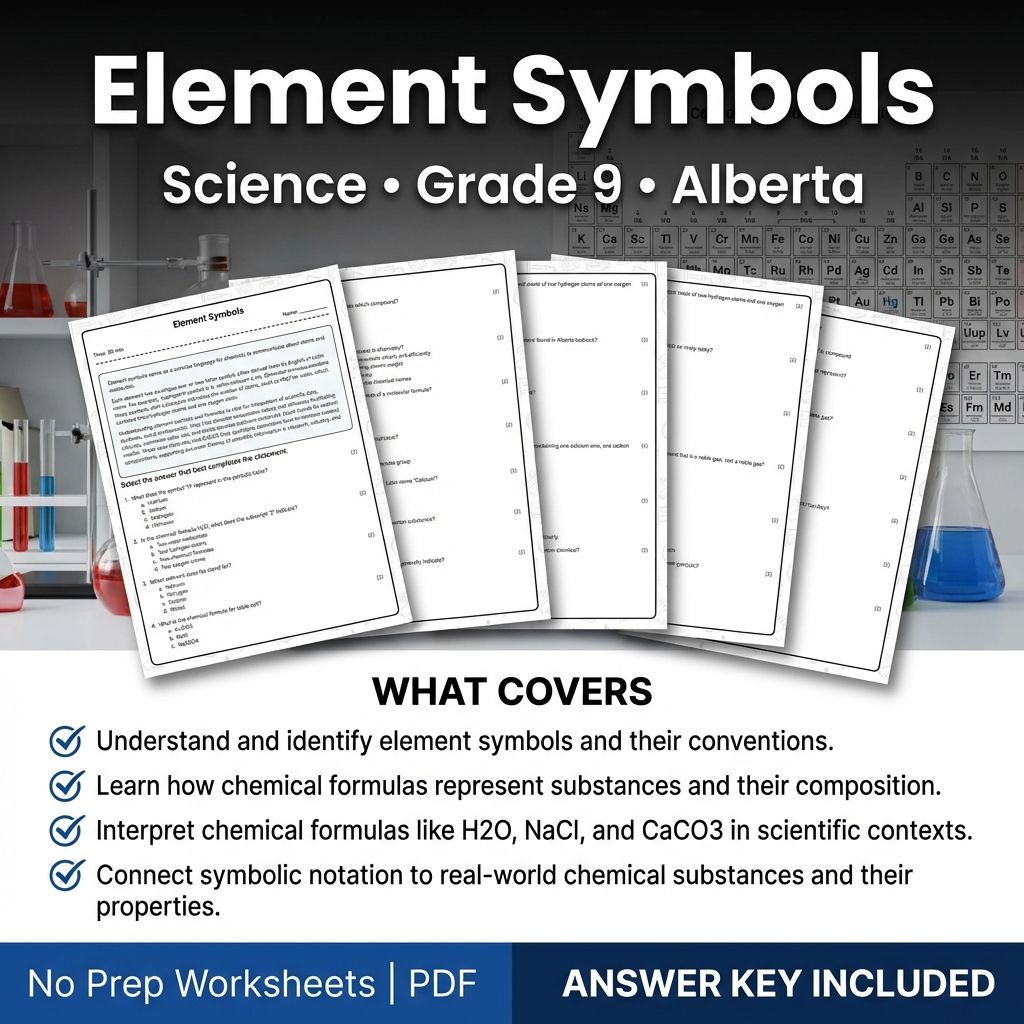
Element Symbols Worksheet Grade 9 Science | Alberta Standards
 Created byCoral Reef Learning
Learning Objectives
- Understand and identify element symbols and their conventions.
- Learn how chemical formulas represent substances and their composition.
- Interpret chemical formulas like H2O, NaCl, and CaCO3 in scientific contexts.
Instant download
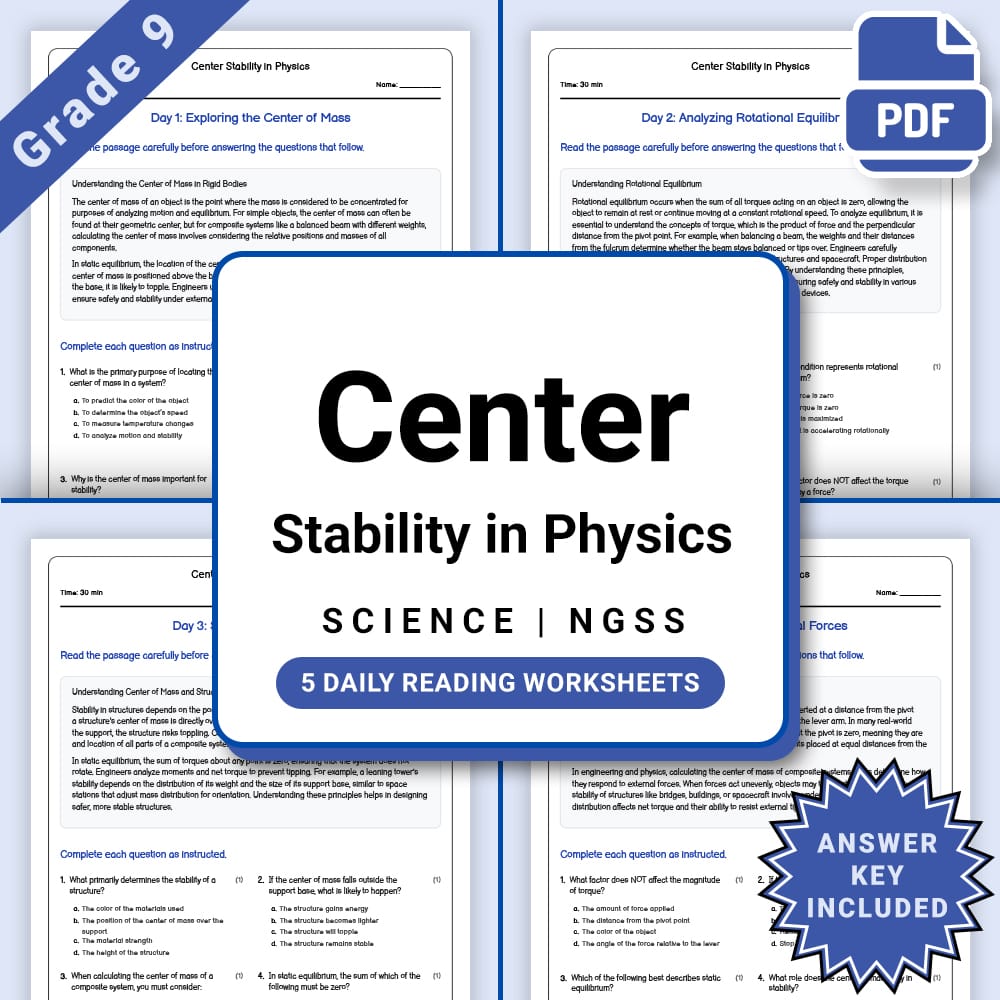
Grade 9 Science – Center Stability in Physics Worksheet(PDF + Answer Key)
 Created byCopper Leaf Classroom
Learning Objectives
- Understand key concepts related to Science
- Apply knowledge through practice questions
- Demonstrate comprehension of the material
Instant download
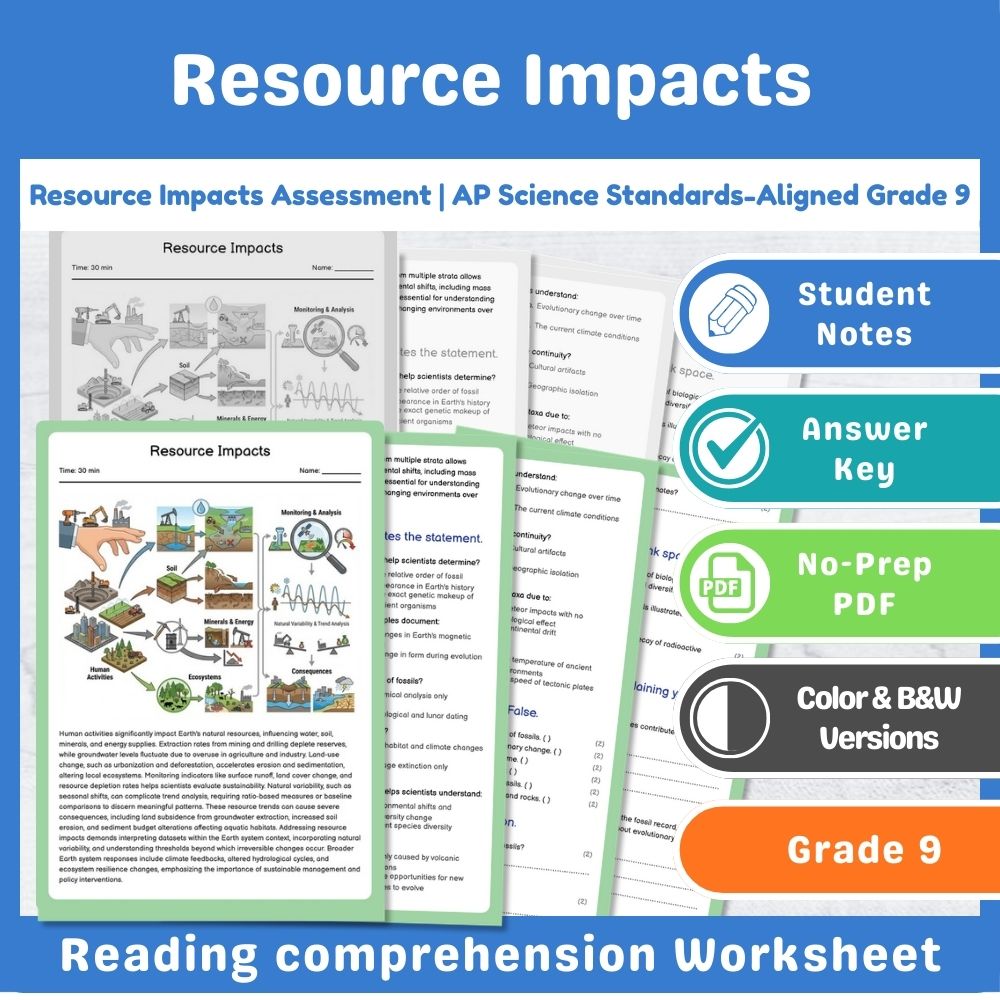
Resource Impacts Assessment | AP Science Standards-Aligned Grade 9
 Created byPrism Point Learning
Learning Objectives
- Evaluate how human activities affect Earth's water, soil, mineral, and energy resources using quantifiable indicators.
- Interpret resource trend data considering natural variability and system thresholds.
- Assess sustainability implications by comparing datasets and ratio measures.
Also included in: Grade 9 Science Mini Bundle | Earth and Space Sciences AP Standards
Instant download
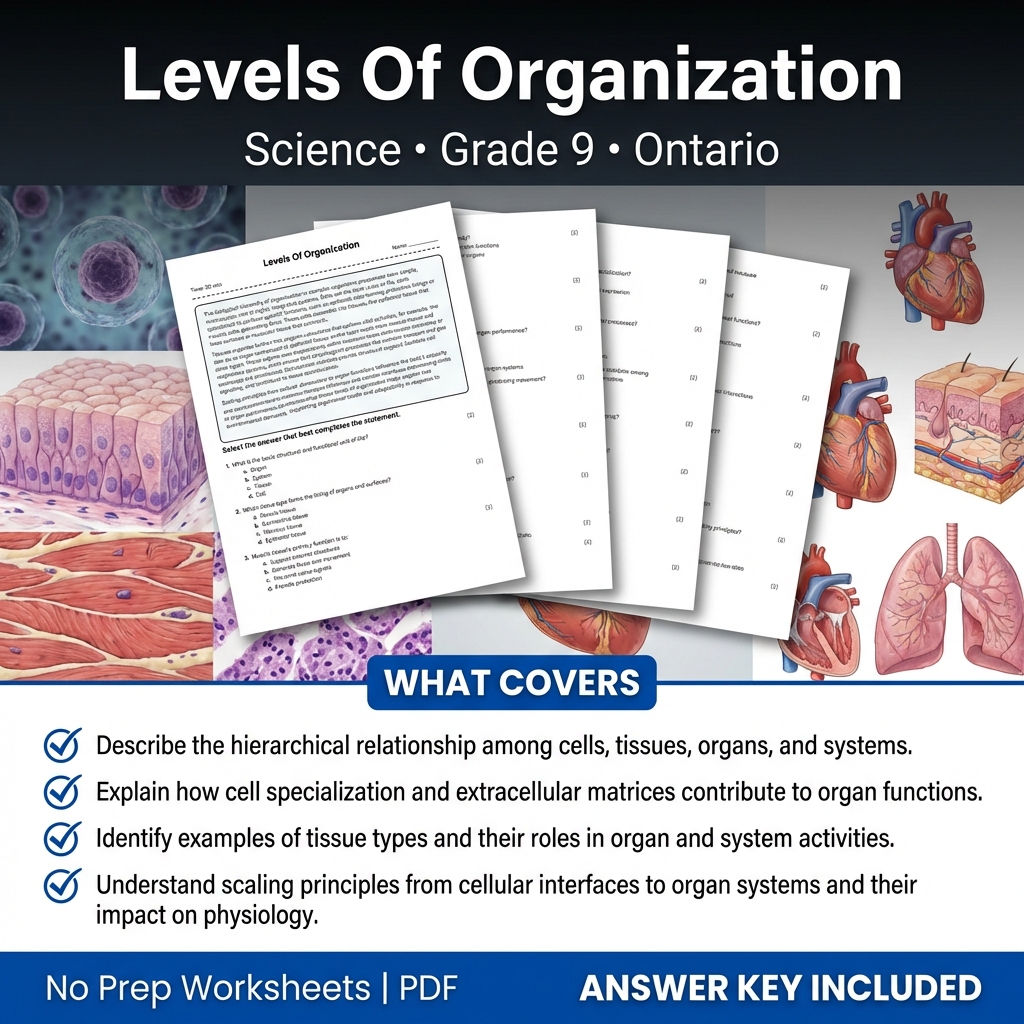
Levels Of Organization Worksheet for Grade 9 Science | Ontario Standards
Created byCoral Reef LearningLearning Objectives
- Describe the hierarchical relationship among cells, tissues, organs, and systems.
- Explain how cell specialization and extracellular matrices contribute to organ functions.
- Identify examples of tissue types and their roles in organ and system activities.
Instant download
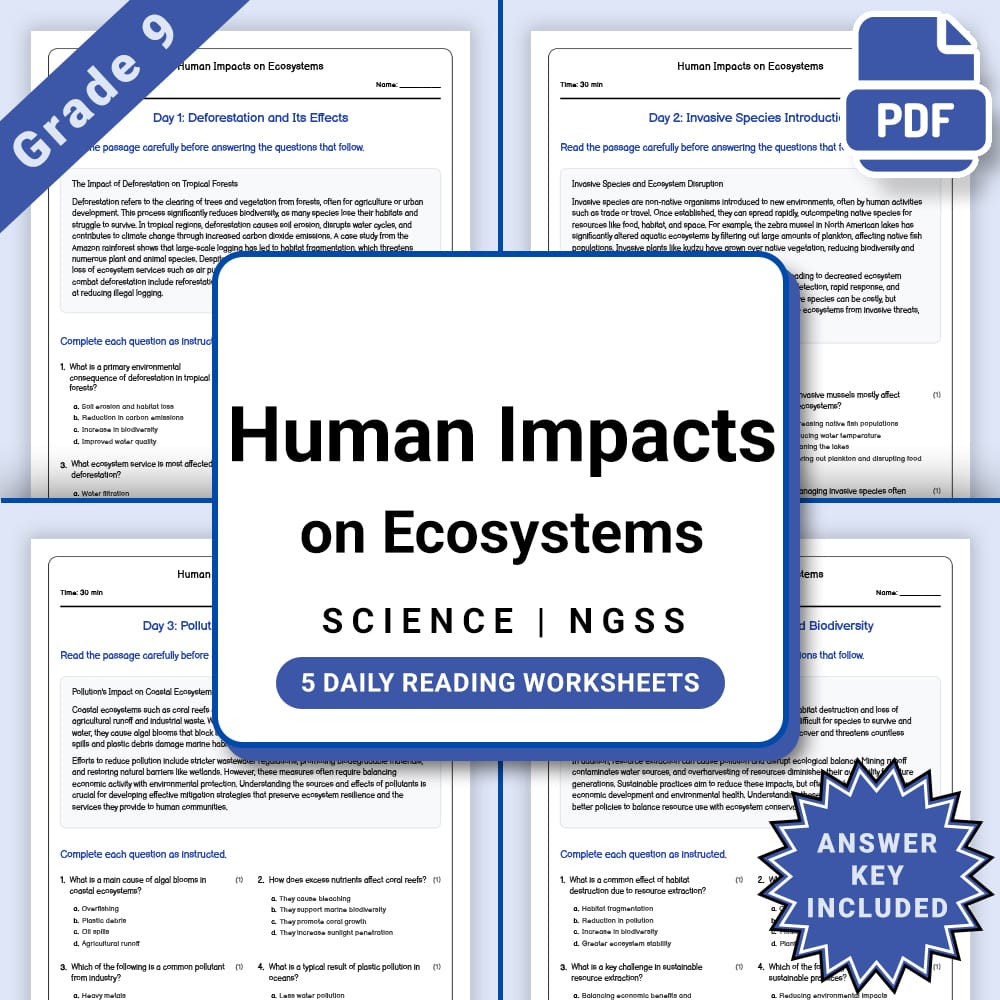
Grade 9 Science – Human Impacts on Ecosystems Worksheet(PDF + Answer Key)
Created byCopper Leaf ClassroomLearning Objectives
- Understand how land-use changes like deforestation impact biodiversity.
- Analyze case studies related to ecosystem degradation.
- Interpret empirical data from environmental case studies.
Instant download
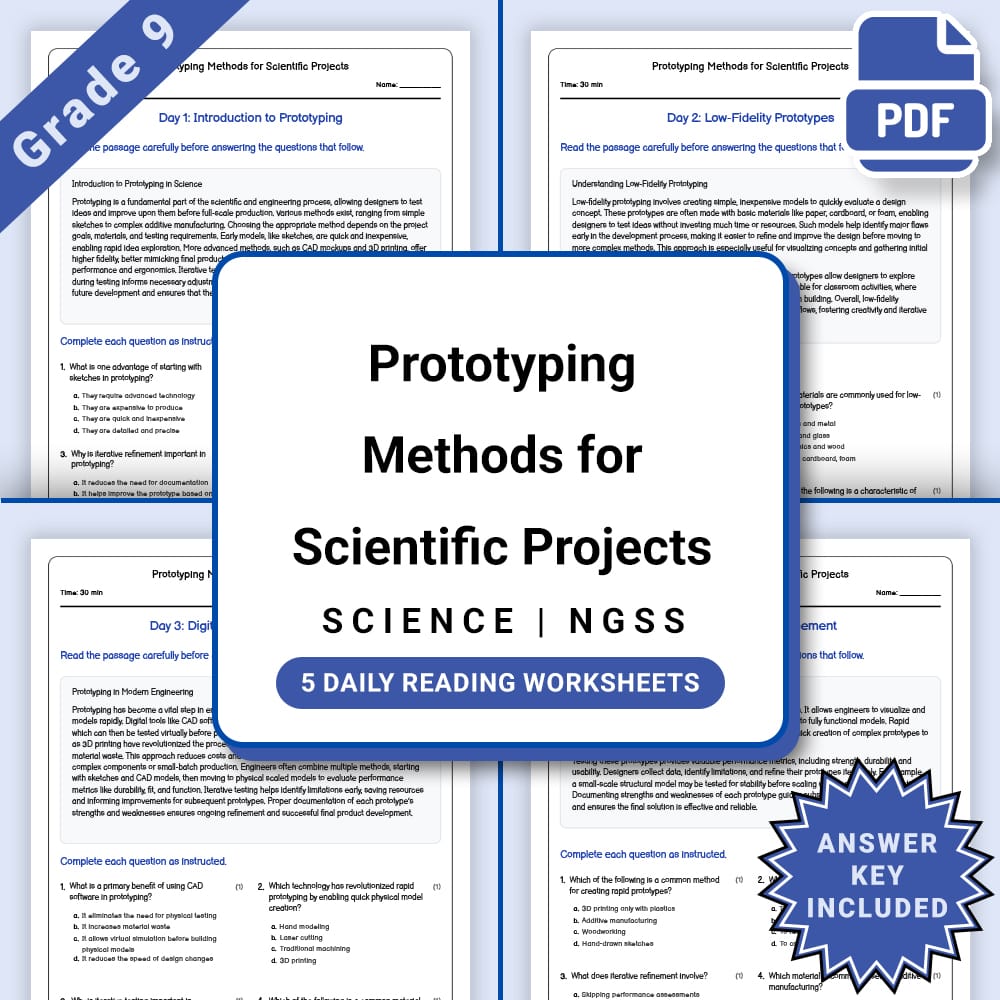
Grade 9 Science – Prototyping Methods Worksheet(PDF + Answer Key)
Created byCopper Leaf ClassroomLearning Objectives
- Understand different prototyping methods and their applications.
- Learn how to select appropriate fidelity levels and materials for prototypes.
- Recognize the importance of iterative testing and documentation in prototyping processes.
Instant download

Atomic Structure Worksheet | NGSS Grade 9 Science Assessment
 Created byCedar Grove Learning
Learning Objectives
- Describe the fundamental particles that make up atoms, including protons, neutrons, and electrons.
- Explain electron configurations and how they relate to atomic properties and periodic table organization.
- Analyze models of atomic structure to predict properties such as metallic character and electronegativity.
Instant download
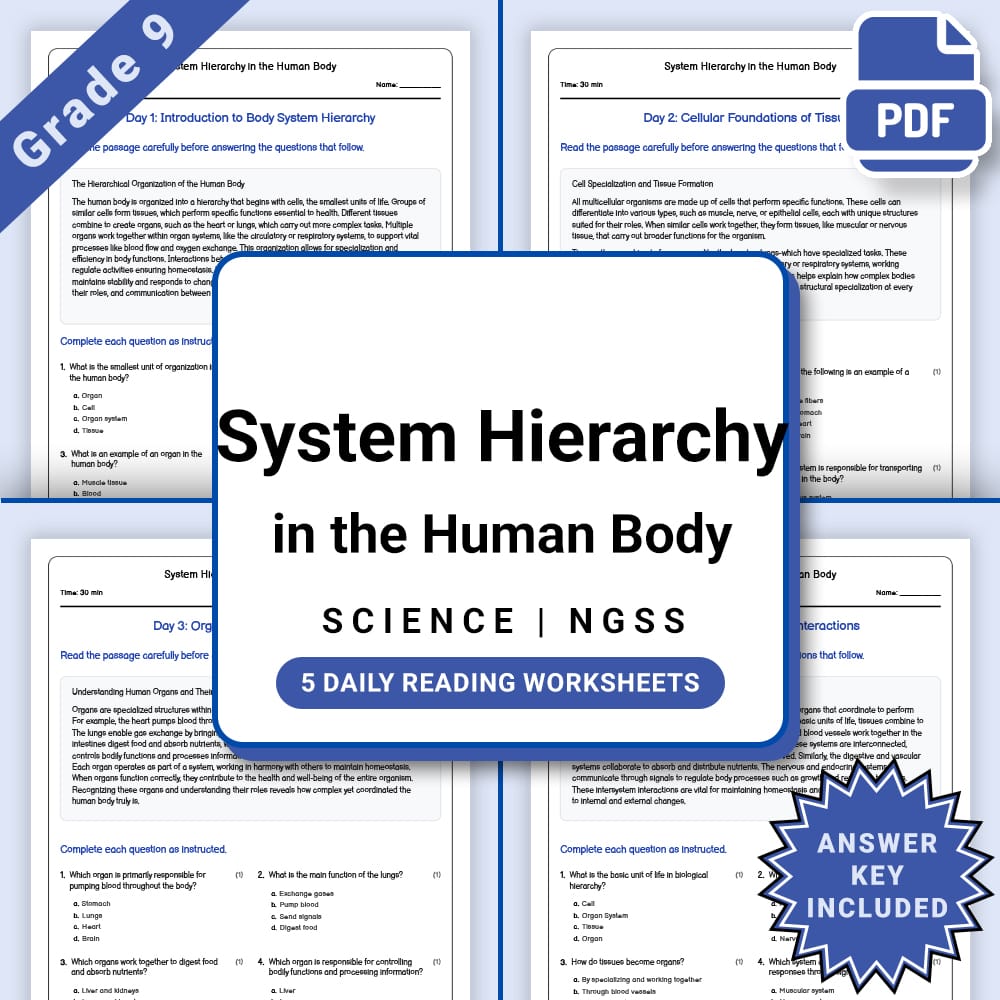
Grade 9 Science – Human Body System Hierarchy Worksheet(PDF + Answer Key)
Created byCopper Leaf ClassroomLearning Objectives
- Understand key concepts related to Science
- Apply knowledge through practice questions
- Demonstrate comprehension of the material
Instant download
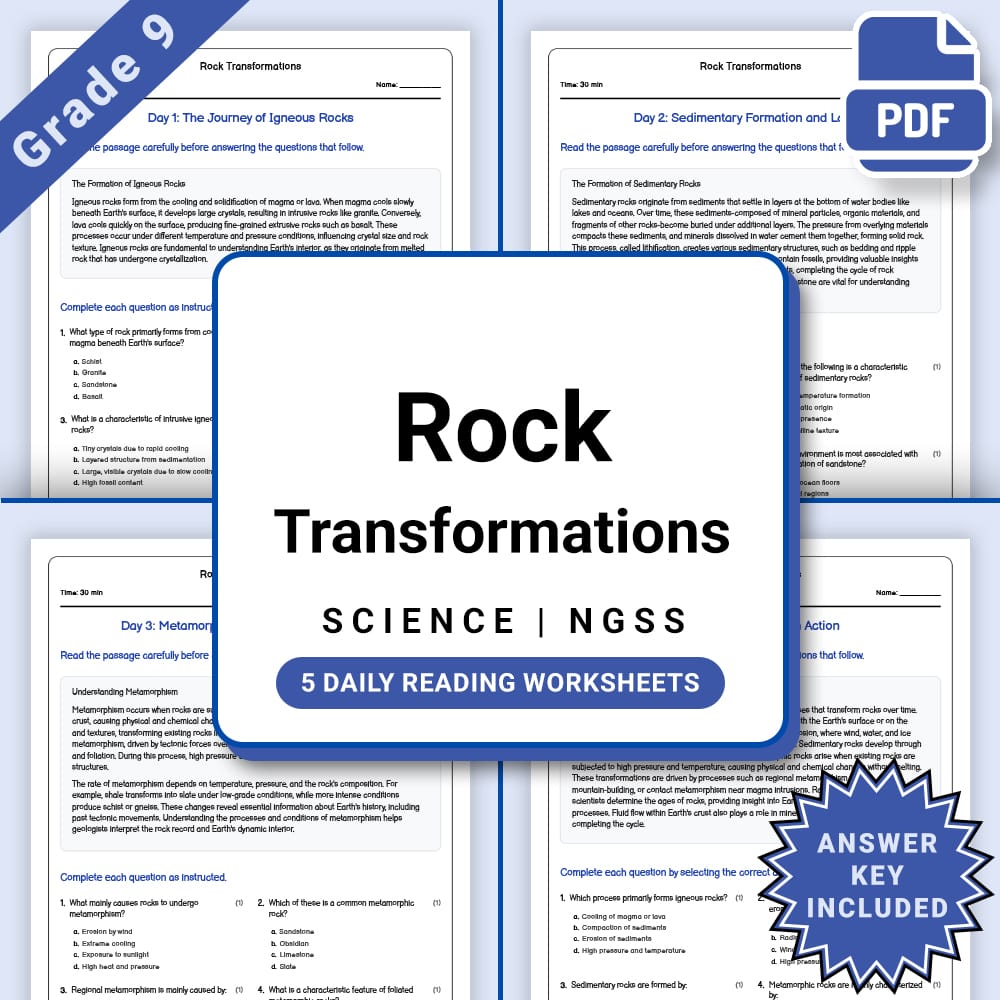
Grade 9 Science Rock Transformations Worksheet(PDF + Answer Key)
Created byCopper Leaf ClassroomLearning Objectives
- Describe the processes involved in the formation of igneous, sedimentary, and metamorphic rocks.
- Explain how different rock types transition from one to another in the rock cycle.
- Identify examples of rocks generated through melting, erosion, compaction, and metamorphism.
Instant download
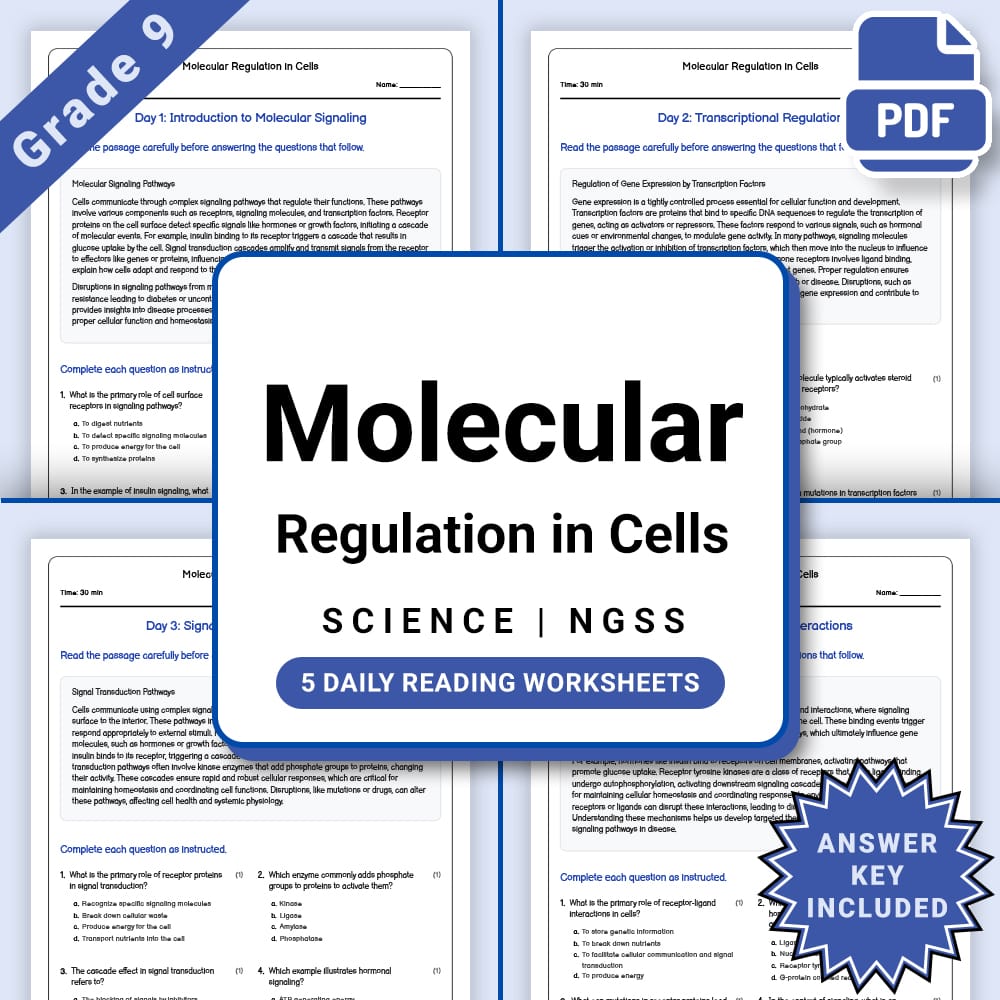
Grade 9 Science – Molecular Regulation in Cells Worksheet(PDF + Answer Key)
Created byCopper Leaf ClassroomLearning Objectives
- Identify key components involved in molecular signaling pathways.
- Understand how signal transduction cascades influence gene expression.
- Explain mechanisms of hormonal and receptor-ligand signaling.
Instant download
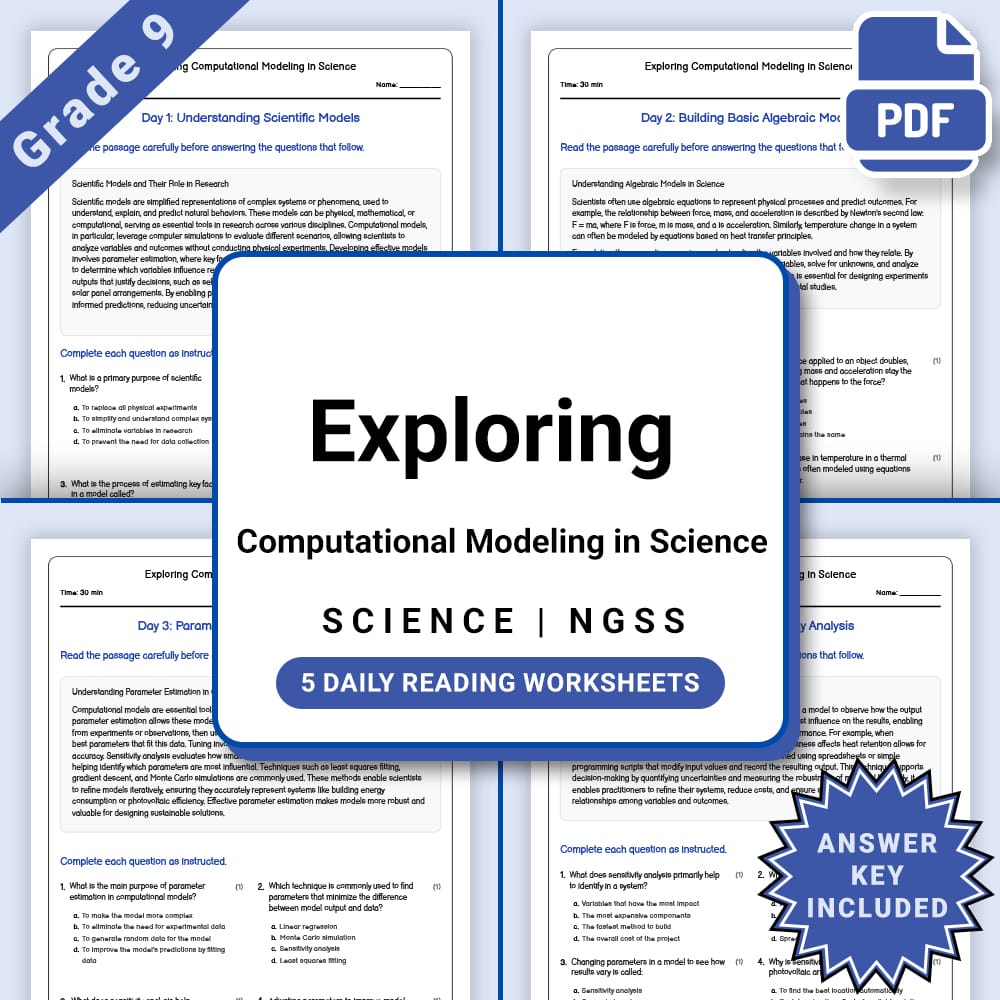
Grade 9 Science – Exploring Computational Modeling Worksheet(PDF + Answer Key)
Created byCopper Leaf ClassroomLearning Objectives
- Understand the concept of scientific models and their purpose.
- Identify how mathematical and computational methods are used in scientific modeling.
- Recognize the components involved in developing performance objective functions and sensitivity analysis.
Instant download
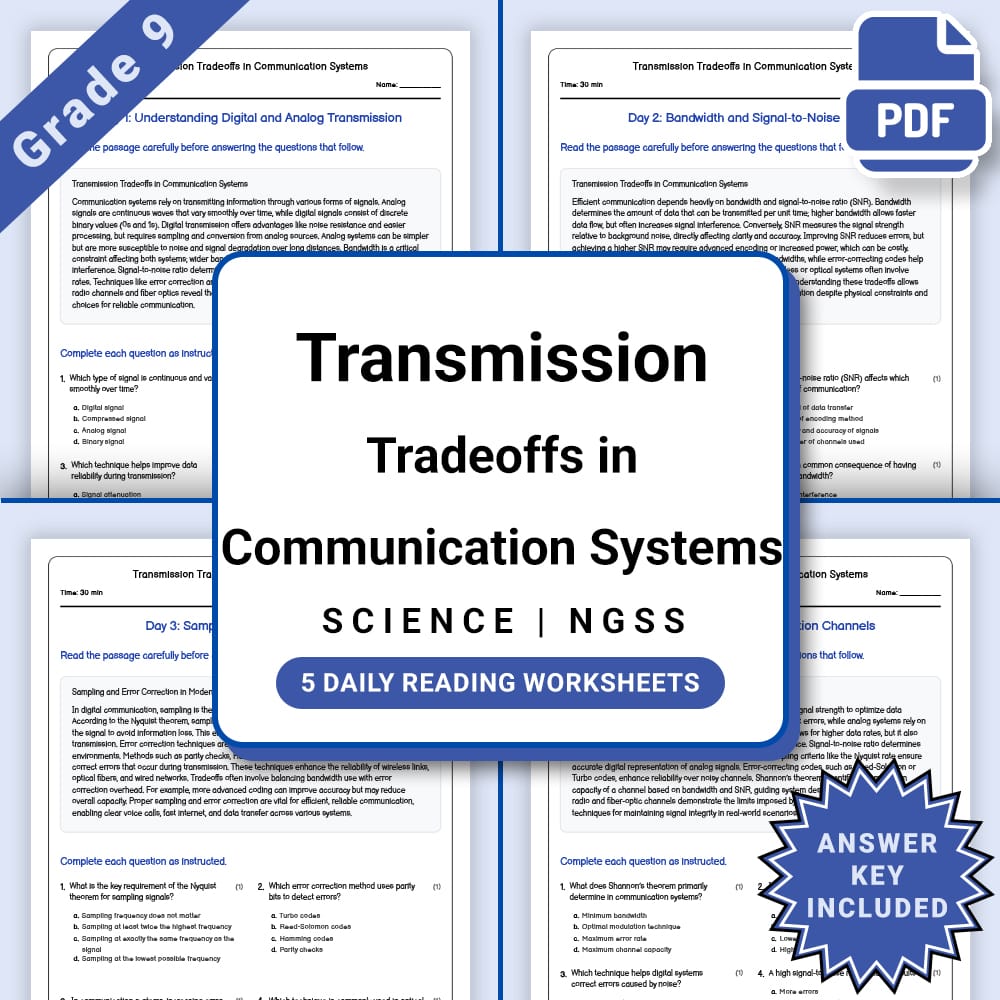
Grade 9 Science Transmission Tradeoffs in Communication Systems(PDF + Answers)
Created byCopper Leaf ClassroomLearning Objectives
- Understand the differences between digital and analog signals.
- Learn how bandwidth and signal-to-noise ratio affect data transmission.
- Explore sampling criteria and error-correcting techniques used in communication.
Instant download
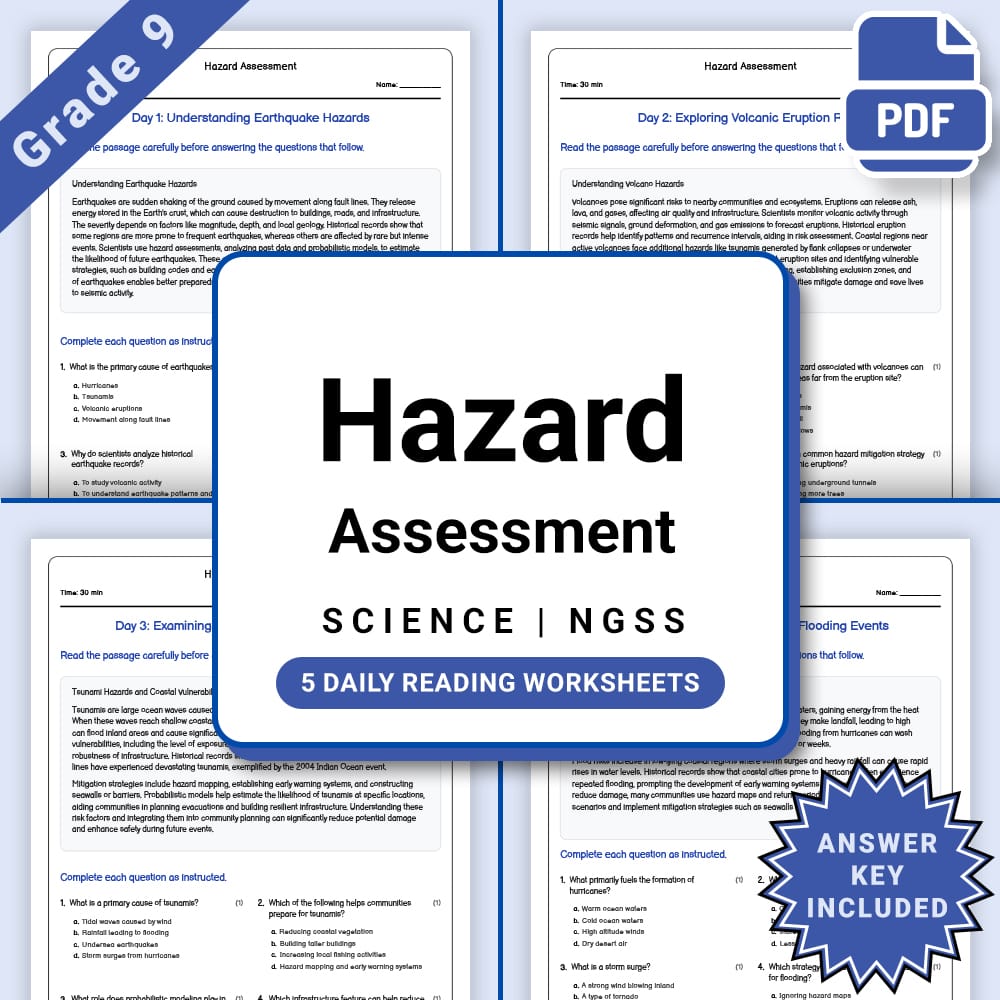
Grade 9 Science – Hazard Assessment Daily Worksheet(PDF + Answer Key)
Created byCopper Leaf ClassroomLearning Objectives
- Understand the causes and effects of earthquakes and related hazards.
- Learn to evaluate hazard risks through data analysis and modeling.
- Explore case studies involving natural hazard impacts on communities.
Instant download
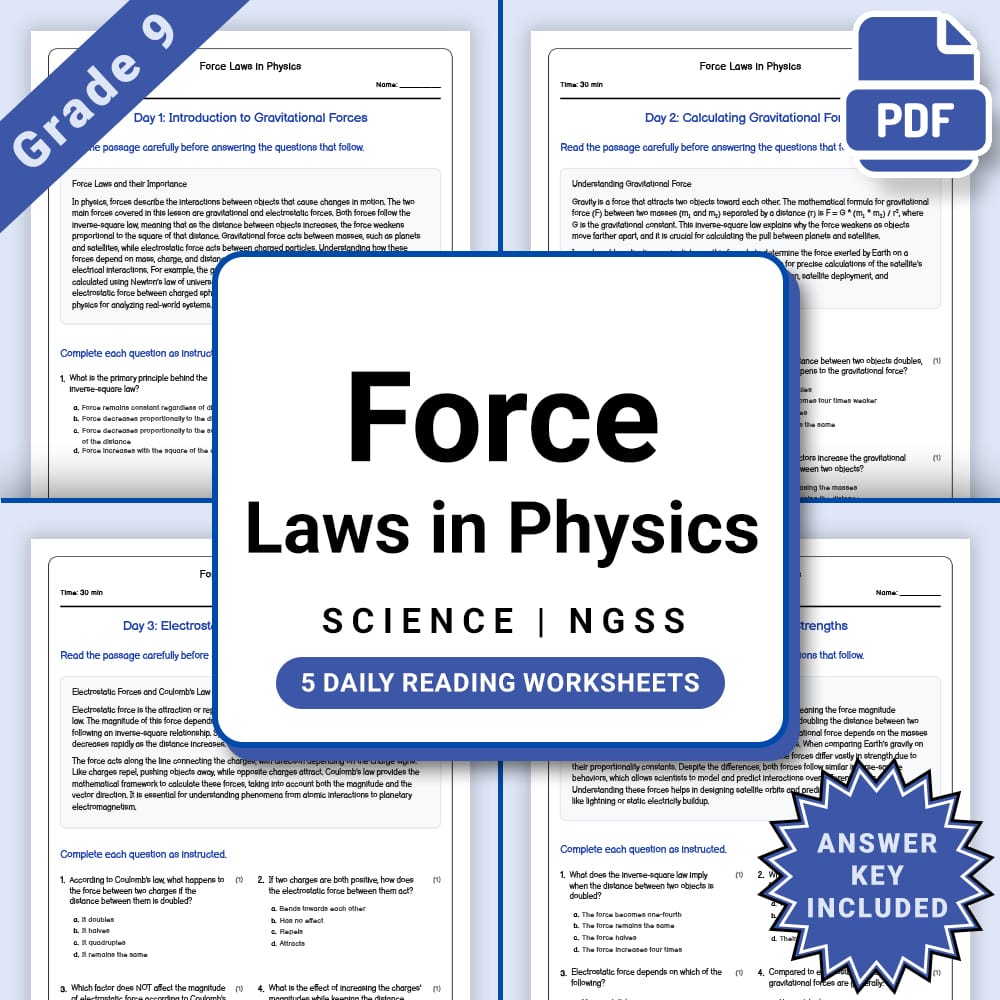
Grade 9 Science – Force Laws Daily Reading Worksheet(PDF + Answer Key)
Created byCopper Leaf ClassroomLearning Objectives
- Understand the concept of gravitational and electrostatic forces.
- Learn the inverse-square law and its impact on force magnitude.
- Apply mathematical formulas to calculate forces between objects.
Instant download
About Grade 9 Science Worksheets
Find Science worksheets built for Grade 9. All 6,926 cover core skills, practice, and review, each an instant PDF download.
Every worksheet on MyTeachingSheets is created by independent teacher-authors and reviewed before publication. All resources download as printable PDFs for classroom, homework, or at-home practice, and many include answer keys. Preview any worksheet free before buying.