
Grade 9 Science Worksheets
6,926 worksheets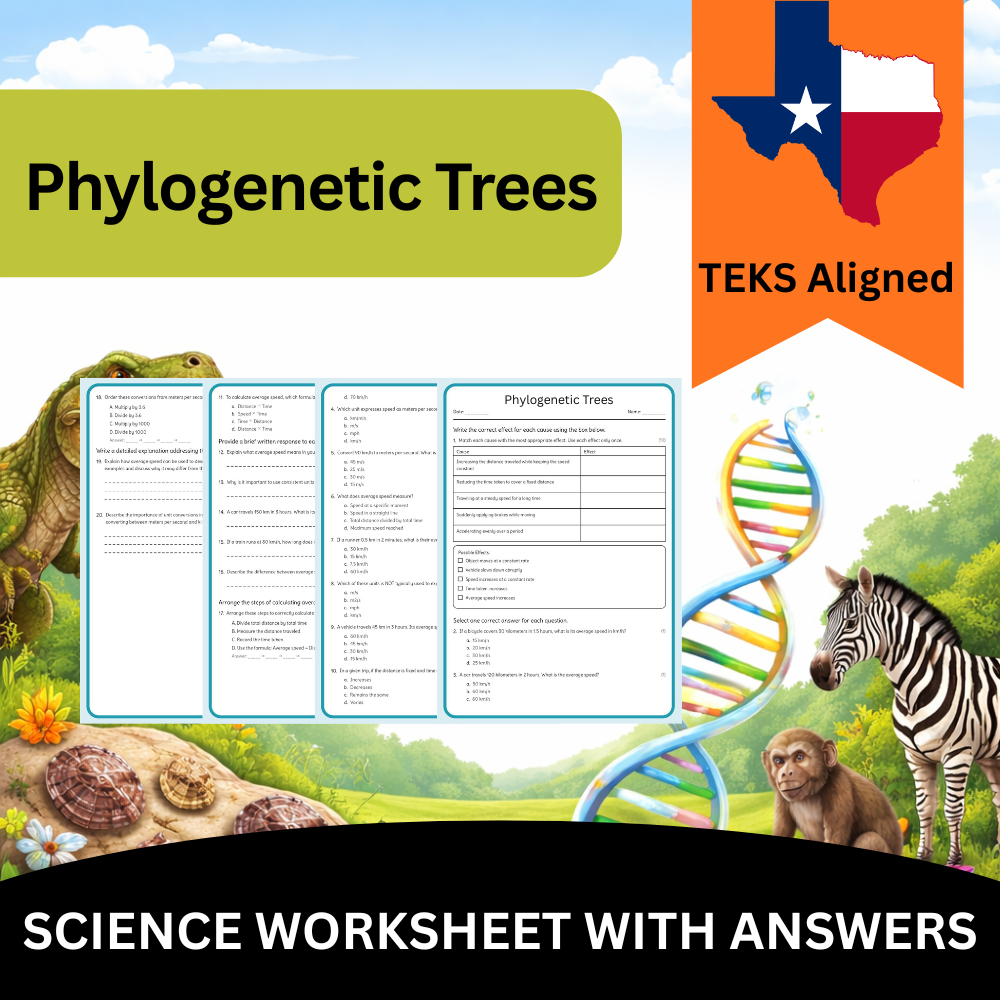
Grade 9 Science | Phylogenetic Trees Worksheet (Answer Key) – TEKS Aligned
 Created byBright Mind Resources
Learning Objectives
- Understand the concept of phylogenetic trees and their purpose in illustrating evolutionary relationships.
- Interpret different types of phylogenetic trees, including rooted and unrooted trees.
- Identify monophyletic, paraphyletic, and polyphyletic groups within trees.
Also included in: Grade 9 Science Unit | Evolution, Speciation & Genetics Worksheet Pack - TEKS +3 more
Instant download
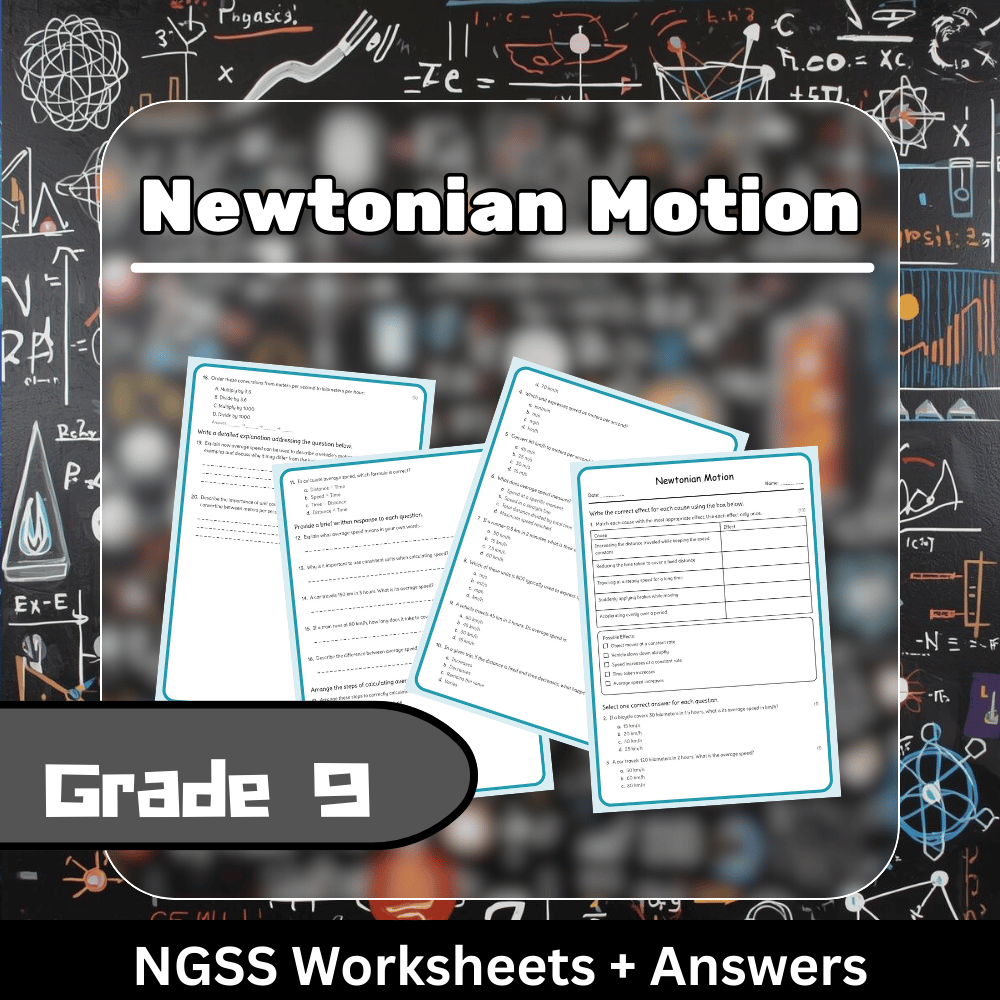
Grade 9 Science | Newtonian Motion Worksheet (Answer Key) – NGSS Aligned
Created byBright Mind ResourcesLearning Objectives
- Understand the relationship between net force, mass, and acceleration as described by Newton's laws.
- Analyze free-body diagrams and force components in various motion scenarios.
- Apply proportionality between net force and acceleration to solve problems involving constant mass systems.
Instant download
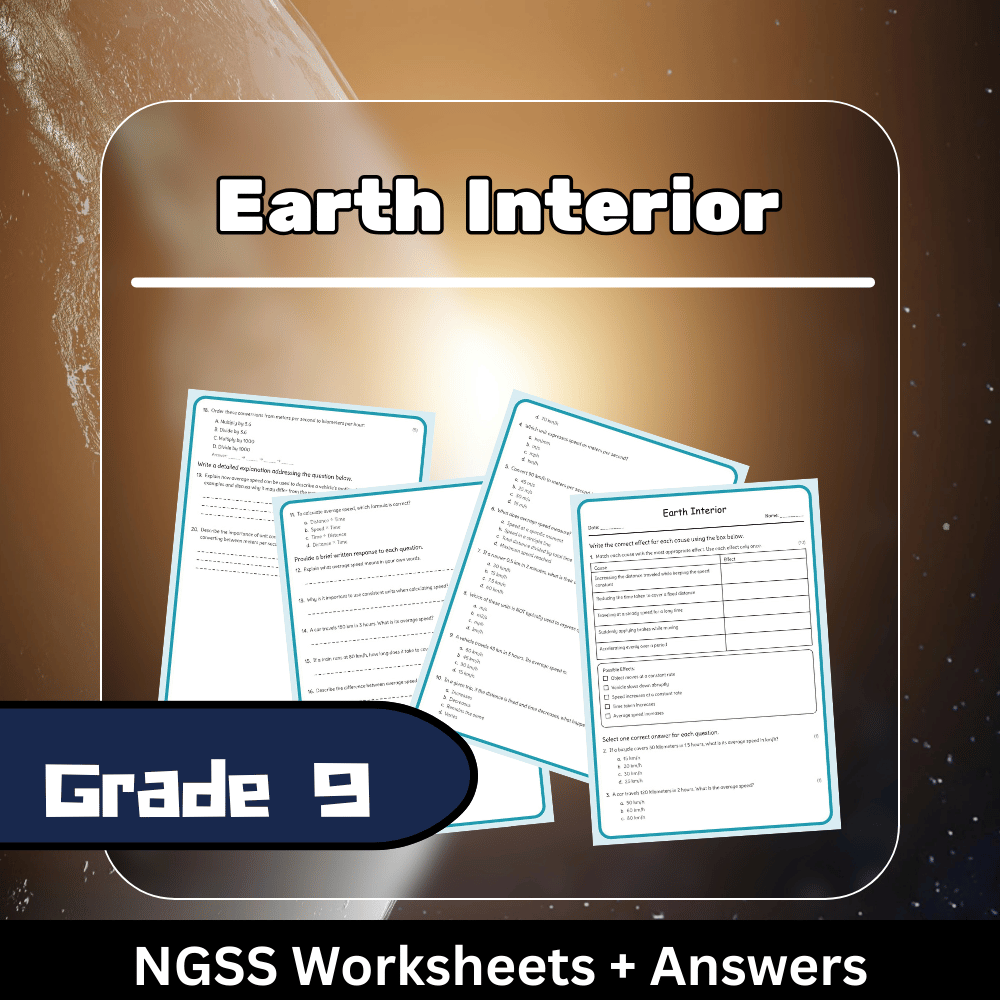
Grade 9 Science | Earth's Interior NGSS Worksheet (Worksheet + Answer Key)
Created byBright Mind ResourcesLearning Objectives
- Describe the layered structure of Earth's interior based on seismic, gravity, and heat-flow evidence.
- Interpret the behavior of P-waves and S-waves and their implications for Earth's composition and structure.
- Explain how density contrasts and mantle temperature gradients drive convective processes within Earth.
Instant download
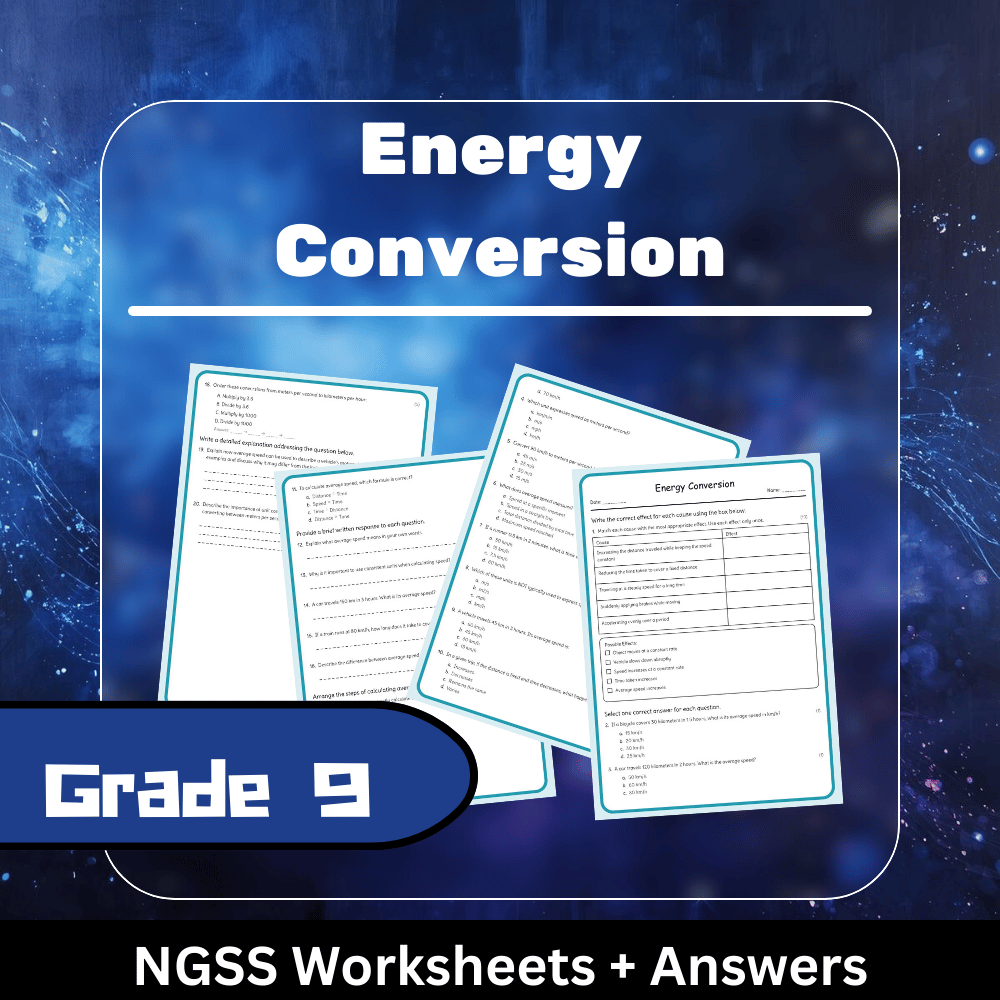
Grade 9 Science | Energy Conversion Worksheet (Answer Key) NGSS-Aligned
Created byBright Mind ResourcesLearning Objectives
- Understand different types of energy conversion devices and processes.
- Identify key examples of energy conversion such as photovoltaic cells, thermoelectric modules, and electrochemical cells.
- Analyze energy efficiency and account for losses during conversion.
Instant download
Grade 9 Science | Integrated Physiology Worksheet (Answer Key) - NGSS Aligned
Created byBright Mind ResourcesLearning Objectives
- Understand how molecular and cellular interactions influence organ system function.
- Link genetic variations to physiological responses and clinical outcomes.
- Interpret biochemical, histological, and organ performance data related to organism health.
Instant download
Grade 9 Science – Paleoclimate Proxies Worksheet (AP Standard, PDF)
Created byBright Mind ResourcesLearning Objectives
- Interpret paleoclimate evidence from various proxy indicators such as isotopic ratios, growth increments, and microfossil assemblages.
- Relate proxy records to past climate patterns including glacial-interglacial cycles and abrupt events.
- Employ age models and quantify uncertainty to link proxy signals to climate forcing mechanisms.
Instant download
Grade 9 Science | Population Genetics Worksheet + Answer Key (AP Standard)
Created byBright Mind ResourcesLearning Objectives
- Describe how allele frequencies change under selection, drift, migration, and mutation.
- Explain the Hardy-Weinberg equilibrium as a null model for populations.
- Analyze the effects of bottlenecks and founder events on genetic variation.
Instant download
Grade 9 Science | Photosynthetic Capture Worksheet (Answer Key) – AP Standard
Created byBright Mind ResourcesLearning Objectives
- Describe the molecular basis of photosynthetic light capture.
- Explain pigment absorption spectra and energy transfer among pigments.
- Discuss how reaction centers convert light energy into chemical energy.
Instant download
Grade 9 Science – Evolutionary Evidence Worksheet (NGSS Aligned) PDF
Created byBright Mind ResourcesLearning Objectives
- Identify different lines of empirical evidence supporting evolution, including fossil, anatomical, and molecular data.
- Explain how comparative anatomy and genetic sequences provide evidence for common ancestry.
- Describe the significance of transitional fossils and biogeographic distributions in understanding evolution.
Instant download
Grade 9 Science | Energy Transfer Worksheets + Answer Key – BC Standards
Created byBright Mind ResourcesLearning Objectives
- Understand how mechanical systems transfer energy through work, collisions, and friction.
- Explain how energy is gained or lost in motion and the transformation of energy into heat.
- Identify real-world examples illustrating energy conversion pathways and energy accounting.
Instant download
Grade 9 Science | Natural Hazards Worksheet + Answer Key (NGSS-Aligned, PDF)
Created byBright Mind ResourcesLearning Objectives
- Understand the different types of natural hazards and their triggers.
- Analyze geologic and atmospheric indicators used to assess hazards.
- Interpret hazard maps, recurrence intervals, and paleoevidence to evaluate risks.
Instant download
Grade 9 Science | Producers & Consumers NGSS Worksheet (PDF) – Science
Created byBright Mind ResourcesLearning Objectives
- Explain the roles of producers and consumers in the ecosystem.
- Describe how photosynthesis and respiration transfer energy and cycle oxygen and carbon.
- Analyze the impact of net primary productivity and biomass on energy flow.
Instant download
Grade 9 Science | Human Impacts Worksheet (Answer Key) – NGSS Aligned
Created byBright Mind ResourcesLearning Objectives
- Analyze how land-use change, invasive species, pollution, and resource extraction affect biodiversity and ecosystems.
- Interpret empirical data from case studies such as deforestation and coral reef degradation.
- Evaluate trade-offs among conservation, ecosystem services, and socioecological outcomes.
Instant download
Grade 9 Science | Molecular Regulation Worksheet (Answer Key) NGSS-Aligned
Created byBright Mind ResourcesLearning Objectives
- Understand the mechanisms of gene expression regulation and signal transduction pathways.
- Identify key molecular components involved in intercellular communication.
- Analyze how mutations and pharmacological inhibitors affect cellular signaling and systemic functions.
Instant download
Grade 9 Science | Classification Foundations Worksheet (Answer Key) – TEKS Aligned
Created byBright Mind ResourcesLearning Objectives
- Understand the hierarchical structure of biological classification systems.
- Identify key taxonomic ranks and their characteristics.
- Differentiate between traditional and modern classification approaches.
Also included in: Grade 9 Science Unit | Evolution, Speciation & Genetics Worksheet Pack - TEKS +3 more
Instant download
Grade 9 Science | Kinematic Concepts Worksheet (PDF) – Alberta Standards
Created byBright Mind ResourcesLearning Objectives
- Define and differentiate among speed, velocity, and acceleration
- Apply unit conversions and sign conventions in motion analysis
- Describe real-world examples of kinematic measures in regional contexts
Instant download
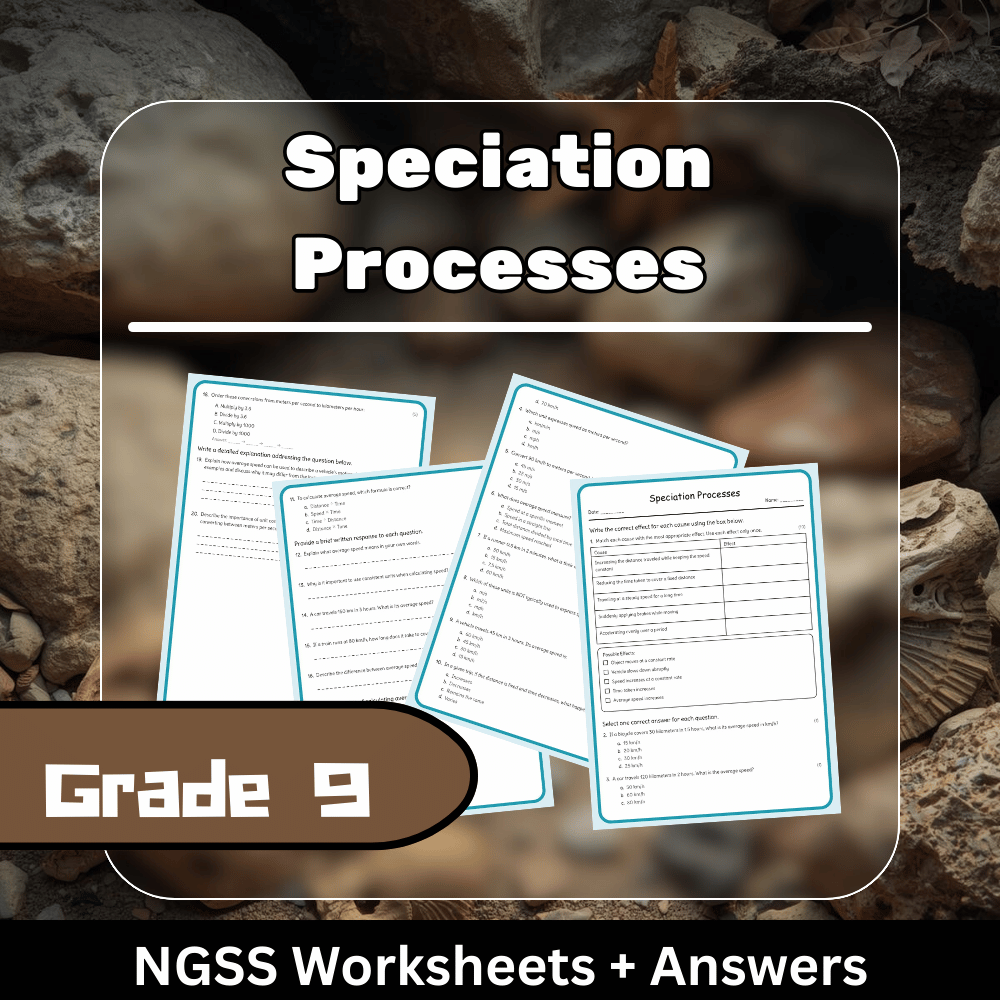
Grade 9 Science | Speciation Processes Worksheet - Answer Key (NGSS Standards)
Created byBright Mind ResourcesLearning Objectives
- Understand the mechanisms that lead to new species formation, including reproductive isolation and genetic divergence.
- Identify and differentiate between allopatric and sympatric speciation models and their examples.
- Explain the significance of hybrid zones, polyploidy, and adaptive radiation in speciation.
Instant download
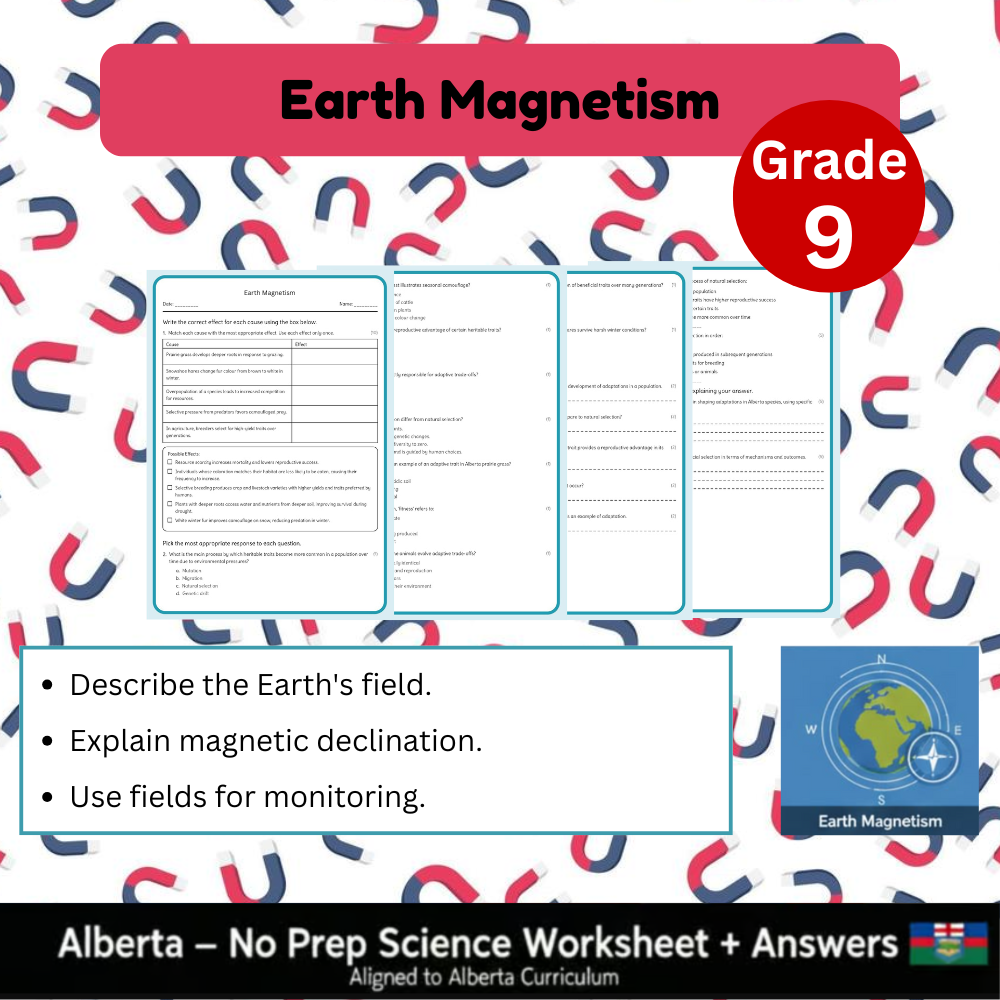
Grade 9 Science | Earth Magnetism (Worksheet + Answer Key) – Alberta Standards
Created byBright Mind ResourcesLearning Objectives
- Understand the origin and nature of Earth's magnetic field.
- Describe regional variation in magnetic declination and its implications.
- Explain how magnetic field measurements are used in geological and environmental monitoring.
Instant download
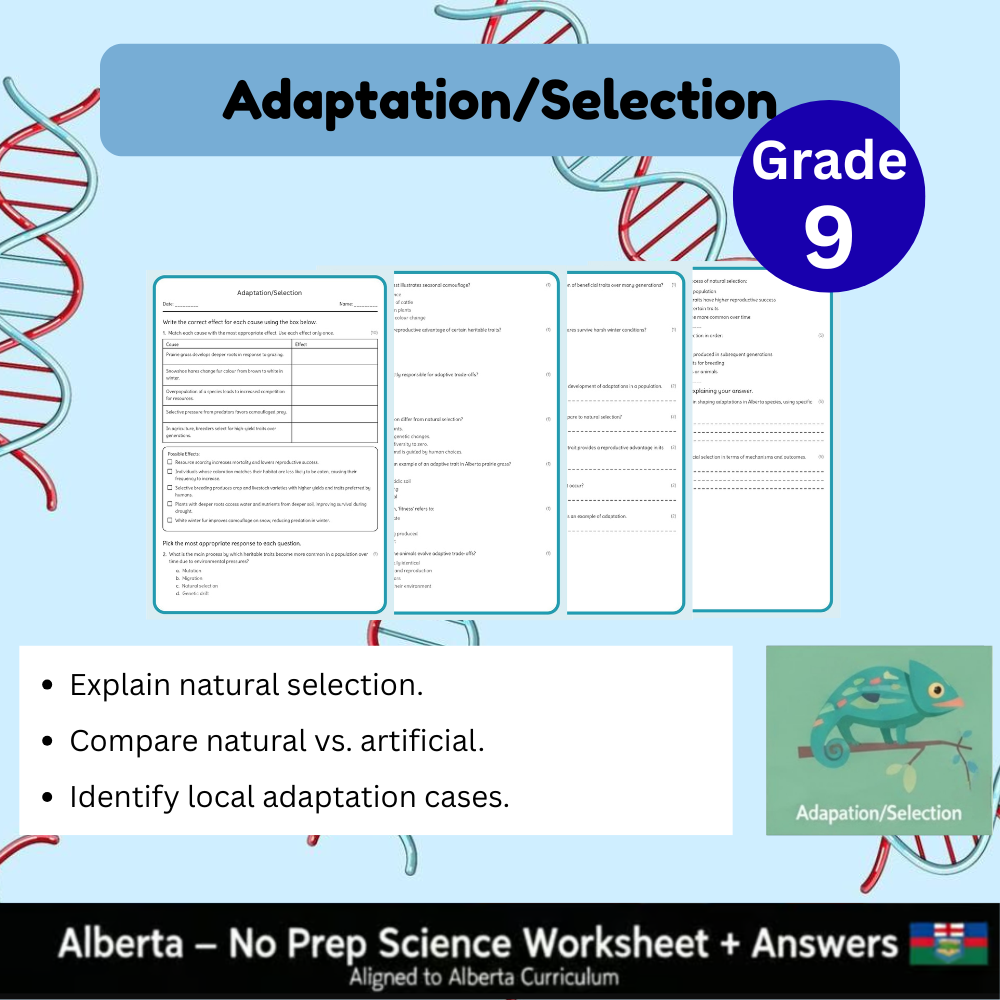
Grade 9 Science – Adaptation and Selection Worksheet (PDF)
Created byBright Mind ResourcesLearning Objectives
- Explain the process of natural selection and how heritable traits influence reproductive success.
- Distinguish between natural selection and artificial selection in shaping populations.
- Identify examples of adaptation in Alberta species such as prairie grass resilience and snowshoe hare camouflage.
Instant download
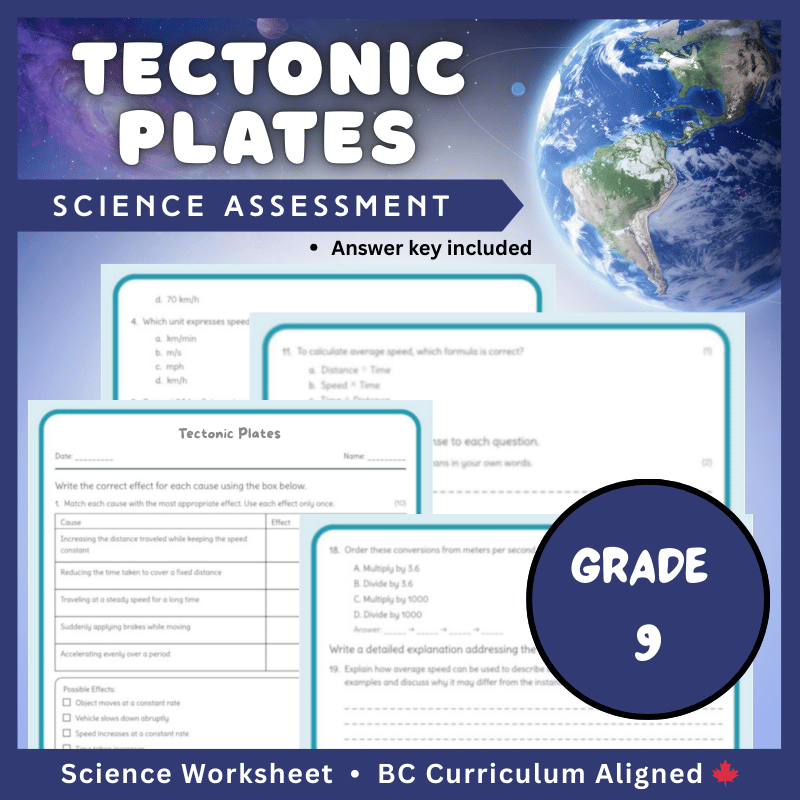
Grade 9 Science | Tectonic Plates Worksheet (Answer Key) – BC Standards
Created byBright Mind ResourcesLearning Objectives
- Understand the composition and movement of Earth's tectonic plates.
- Identify the forces responsible for plate movements such as mantle convection, slab pull, and ridge push.
- Explain how plate interactions cause earthquakes, volcanoes, and mountain formations.
Instant download
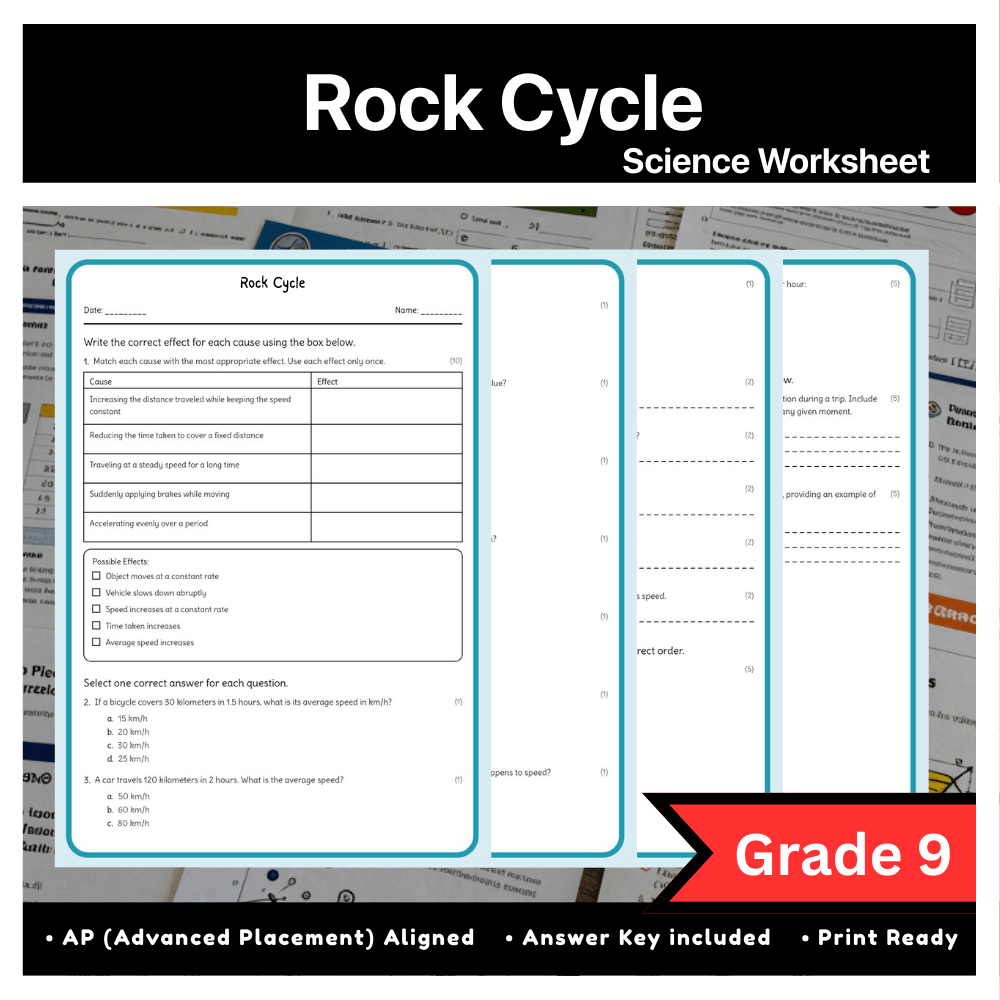
Grade 9 Science | Rock Cycle Worksheet (AP Standards) – Science 1 (PDF)
Created byBright Mind ResourcesLearning Objectives
- Describe the processes involved in the rock cycle, including melting, crystallization, weathering, transport, deposition, and metamorphism.
- Explain the physical and chemical mechanisms that drive transformations among igneous, sedimentary, and metamorphic rocks.
- Relate rock-forming processes to tectonic settings such as mid-ocean ridges, subduction zones, and continental interiors.
Instant download
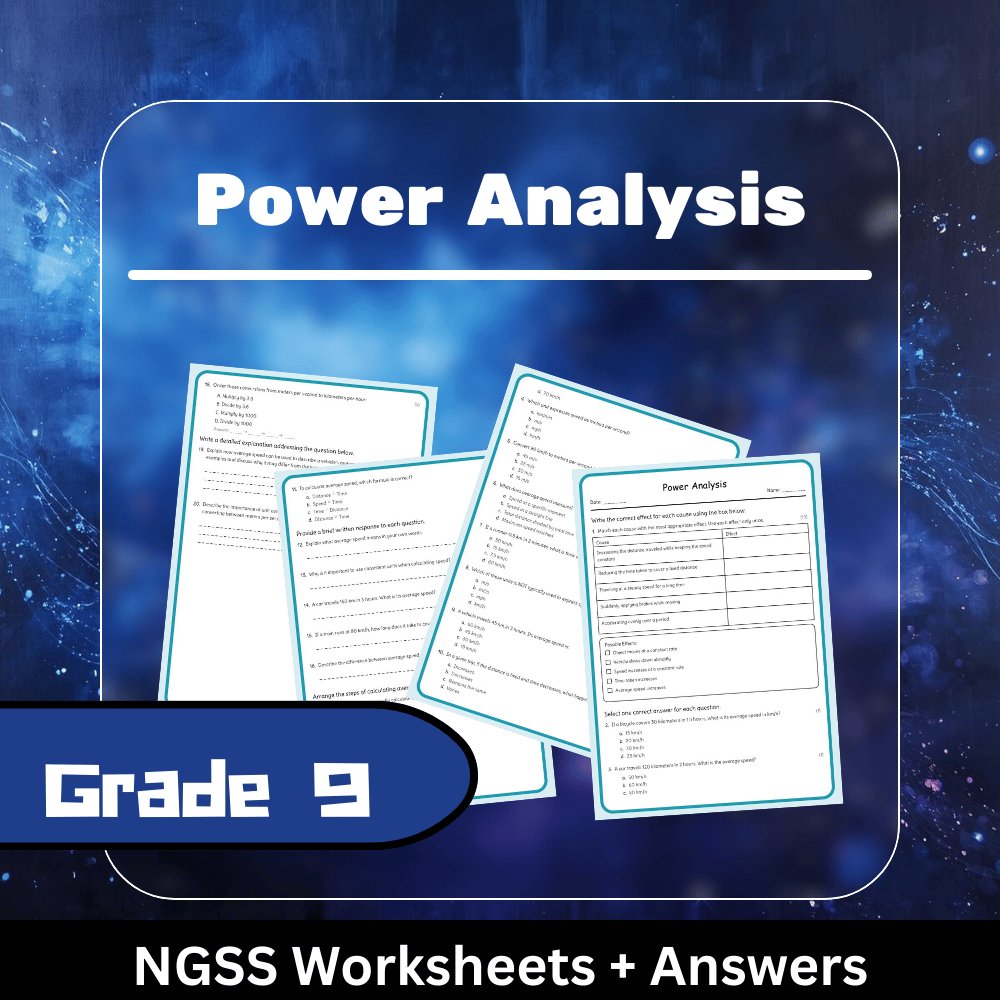
Grade 9 Science | Power Analysis Worksheet (Answer Key) aligned with NGSS
Created byBright Mind ResourcesLearning Objectives
- Understand the concepts of power, energy, and efficiency in technological systems.
- Calculate energy demand over time and assess system performance related to power output.
- Analyze energy loss and conversion efficiency in electrical systems.
Instant download
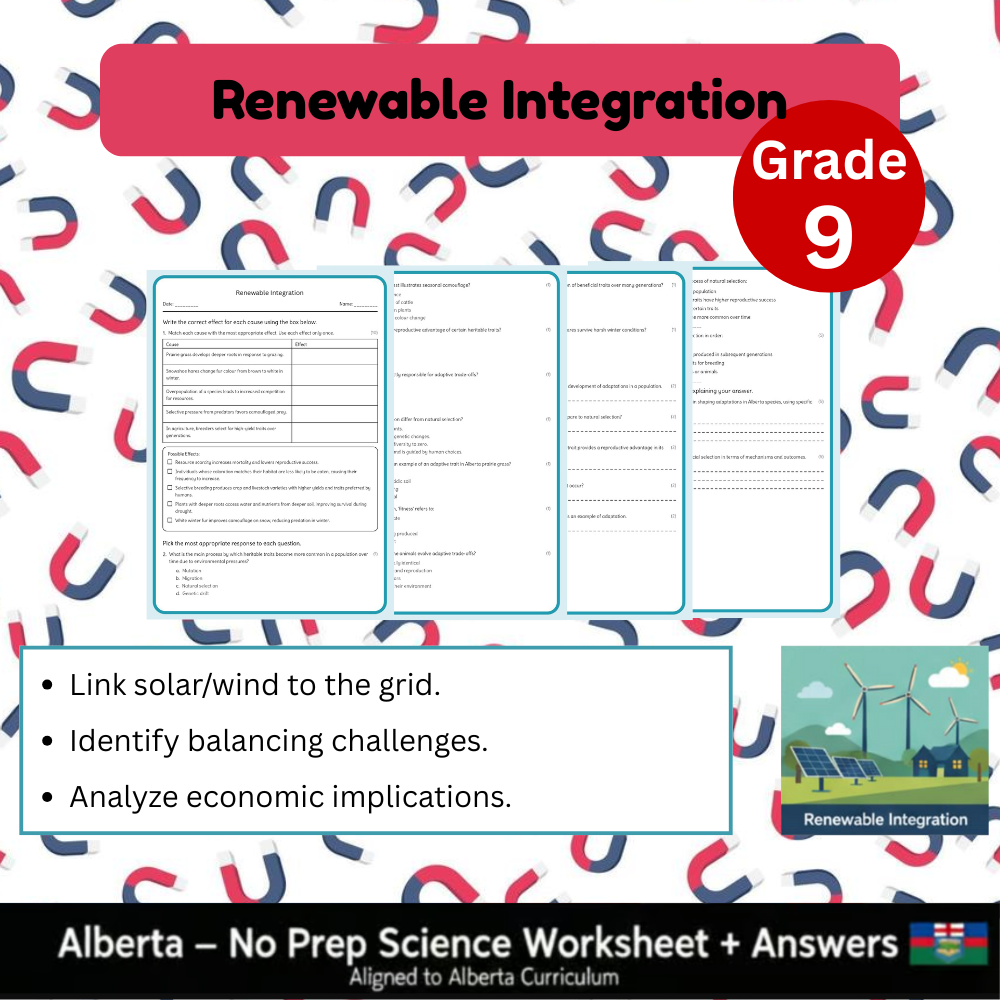
Grade 9 Science – Renewable Integration Worksheet (PDF) – Alberta Standards
Created byBright Mind ResourcesLearning Objectives
- Understand how wind and solar resources are integrated into the electrical grid.
- Identify challenges such as intermittency and balancing mechanisms.
- Analyze the environmental and economic implications of renewable energy sources.
Instant download
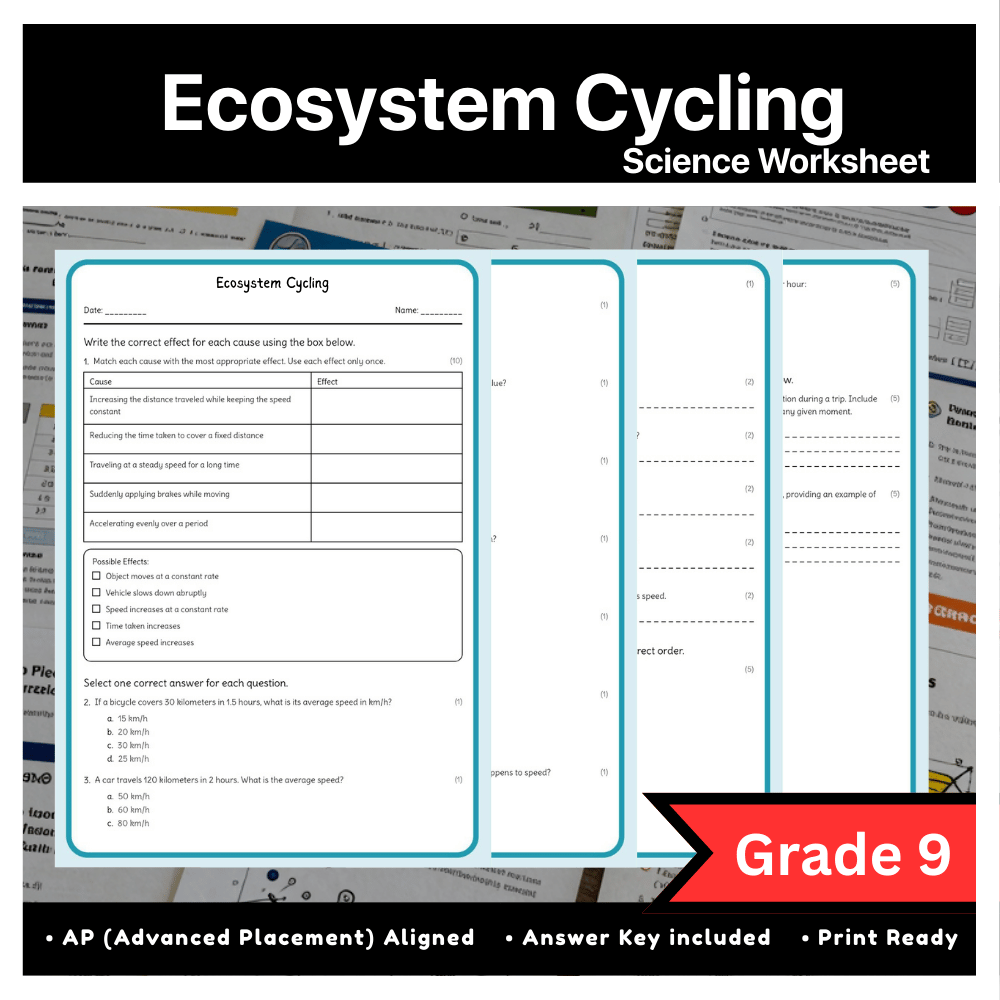
Grade 9 Science | Ecosystem Cycling Worksheet (AP Standards) PDF
Created byBright Mind ResourcesLearning Objectives
- Describe interactions among organisms and abiotic components that drive material cycling and energy flow in ecosystems.
- Explain the processes of carbon and nitrogen cycles, trophic transfer, and stoichiometric constraints.
- Analyze the impacts of perturbations such as nutrient enrichment, habitat alteration, and invasive species on ecosystem function.
Instant download
Grade 9 Science | Human Influence Worksheet + Answer Key | NGSS Standards
Created byBright Mind ResourcesLearning Objectives
- Analyze the effects of human activities such as fossil fuel combustion, deforestation, and urbanization on climate variables.
- Interpret data trends from indicators like the Keeling Curve and vegetation loss satellites.
- Evaluate evidence linking emissions to regional and global ecosystem changes.
Instant download
Grade 9 Science – Free-Body Diagrams Worksheet (Ontario, PDF)
Created byBright Mind ResourcesLearning Objectives
- Understand the conventions for representing forces in free-body diagrams.
- Identify and label common forces such as weight, normal force, tension, and friction.
- Apply free-body diagrams to analyze situations involving equilibrium and acceleration.
Instant download
Grade 9 Science | Enzyme Basics Worksheet (Answer Key) – TEKS Standards
Created byBright Mind ResourcesLearning Objectives
- Explain how enzymes act as biological catalysts and lower activation energy in metabolic reactions.
- Understand the role of enzyme structure and active sites in substrate specificity and catalysis.
- Describe the functions of cofactors and coenzymes in enzyme activity.
Also included in: Grade 9 Science | Photosynthesis & Metabolic Pathways Unit Bundle (TEKS Aligned) +3 more
Instant download
Grade 9 Science | Graphing Motion (Worksheet + Answer Key) – Alberta Standards
Created byBright Mind ResourcesLearning Objectives
- Understand how to interpret displacement–time, velocity–time, and acceleration–time graphs.
- Learn how the slope of a graph relates to physical quantities like speed and acceleration.
- Identify curved segments on graphs to recognize changing acceleration.
Instant download
Grade 9 Science | Net Force Concept Worksheet (Answer Key) | BC Standards
Created byBright Mind ResourcesLearning Objectives
- Understand that net force is the vector sum of all forces acting on an object.
- Describe how balanced and unbalanced forces affect motion.
- Solve problems involving resolving forces into components and calculating resulting acceleration.
Instant download
Grade 9 Science | Ocean-Atmosphere Coupling Worksheet (AP Standards) PDF
Created byBright Mind ResourcesLearning Objectives
- Understand the mechanisms linking ocean surface temperatures and atmospheric variability.
- Identify phenomena such as ENSO and their impacts on regional and global climate patterns.
- Describe methods like time-series analysis and lag-correlation to study ocean-atmosphere interactions.
Instant download
Grade 9 Science | Reaction Categories Worksheet (Answer Key) – BC Standard
Created byBright Mind ResourcesLearning Objectives
- Identify and describe the different categories of chemical reactions.
- Recognize characteristic reactant patterns and products in various reactions.
- Classify reactions into synthesis, decomposition, displacement, and combustion based on their features.
Instant download
Grade 9 Science – Component Behavior Worksheet (PDF) – Alberta Standards
Created byBright Mind ResourcesLearning Objectives
- Understand how electrical components exhibit characteristic behaviors such as resistance and nonlinear conduction.
- Identify real-world examples of electrical components and their behaviors.
- Analyze the effects of temperature and load changes on component performance.
Instant download
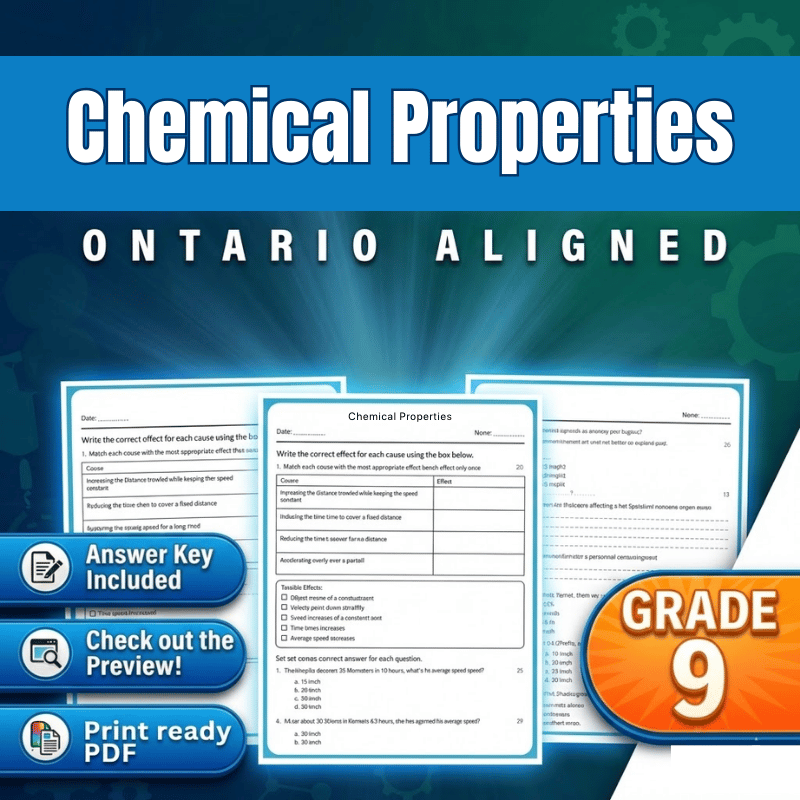
Grade 9 Science | Chemical Properties Worksheet (Ontario Standards) (PDF)
Created byBright Mind ResourcesLearning Objectives
- Define chemical properties and identify examples in real substances.
- Describe how observations such as gas evolution and color change signify chemical reactions.
- Differentiate between physical and chemical changes based on reaction products.
Instant download
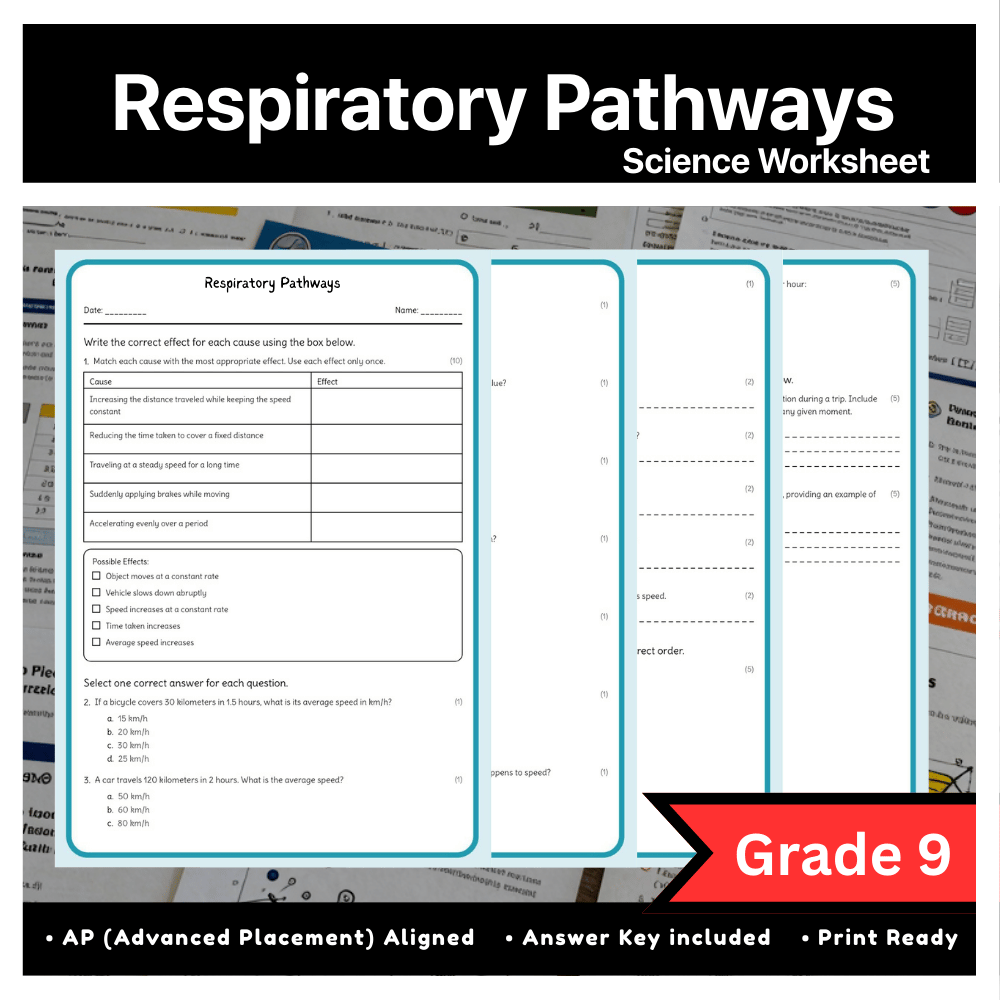
Grade 9 Science | Respiratory Pathways Worksheet (AP Standard) – PDF
Created byBright Mind ResourcesLearning Objectives
- Describe the main pathways involved in cellular respiration, including glycolysis, the citric acid cycle, and electron transport chain.
- Explain how substrate-level and oxidative phosphorylation contribute to ATP production.
- Compare aerobic and anaerobic respiration in terms of ATP yield and metabolic outcomes.
Instant download
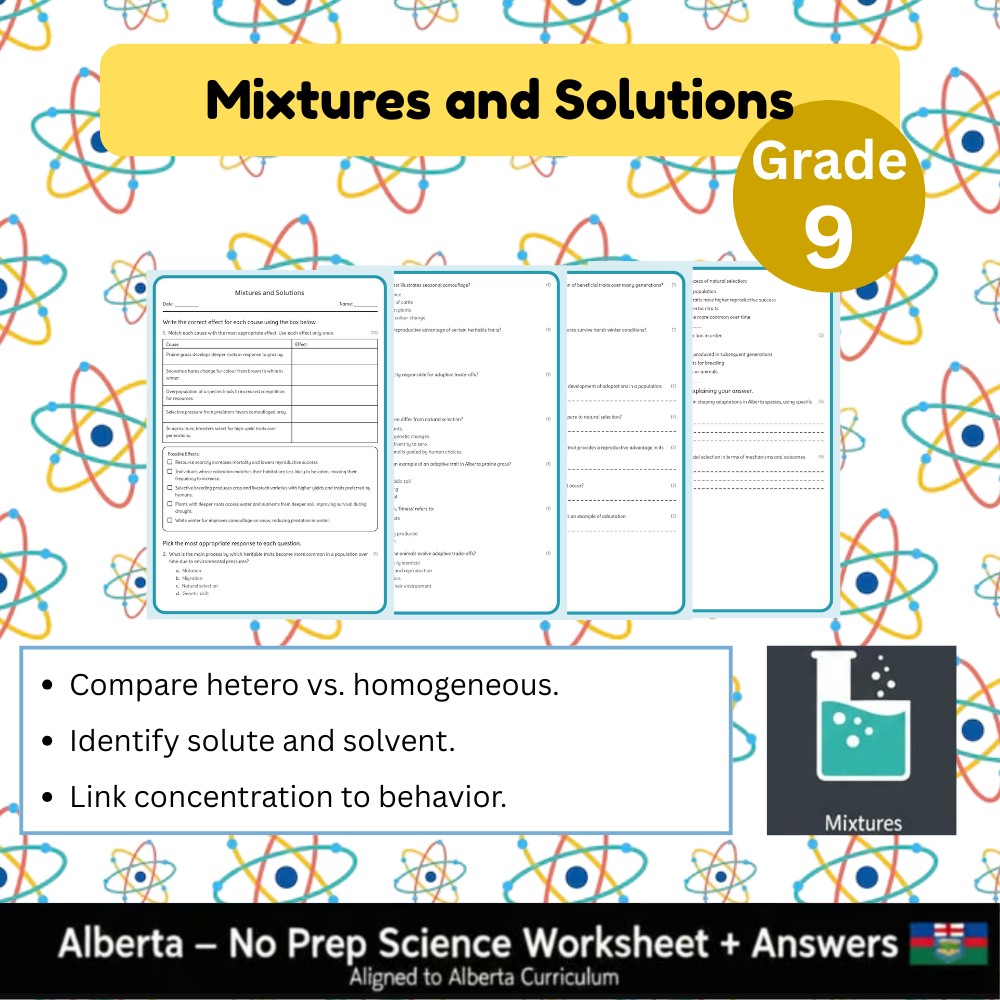
Grade 9 Science | Mixtures and Solutions Worksheet (PDF) – Alberta Standards
Created byBright Mind ResourcesLearning Objectives
- Differentiate between heterogeneous mixtures and homogeneous solutions.
- Identify key components such as solute and solvent in a mixture.
- Understand how concentration affects the appearance and behavior of solutions.
Instant download
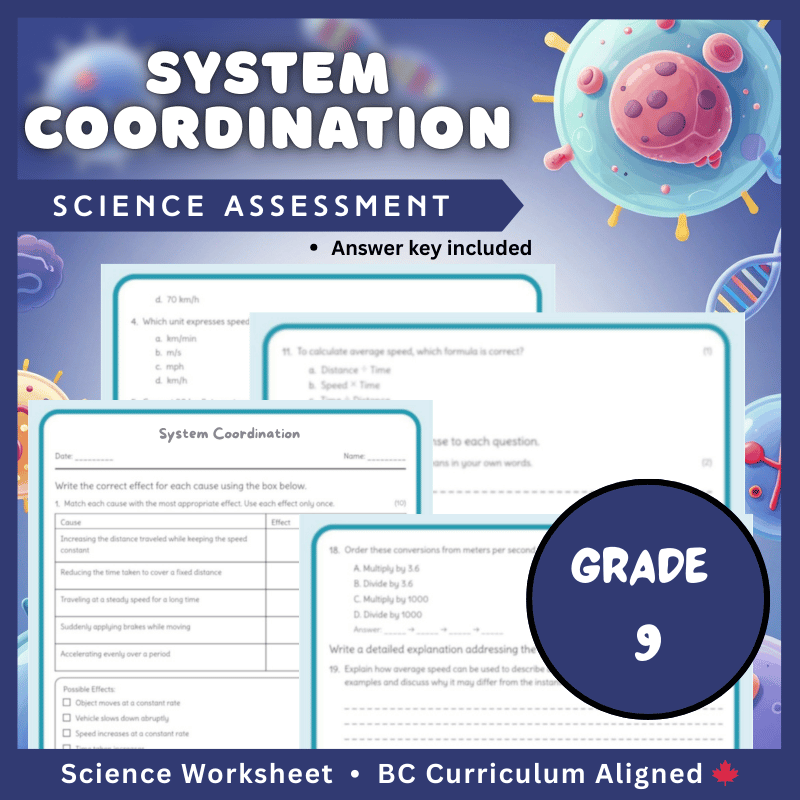
Grade 9 Science | System Coordination Worksheet (PDF) with Answer Key
Created byBright Mind ResourcesLearning Objectives
- Understand how feedback loops, redundancy, and cross-regulation contribute to multi-system coordination.
- Describe how exercise affects respiratory, cardiovascular, and metabolic responses via neural, hormonal, and local signals.
- Explain the impact of disruptions in one organ system on overall homeostasis and health outcomes.
Instant download
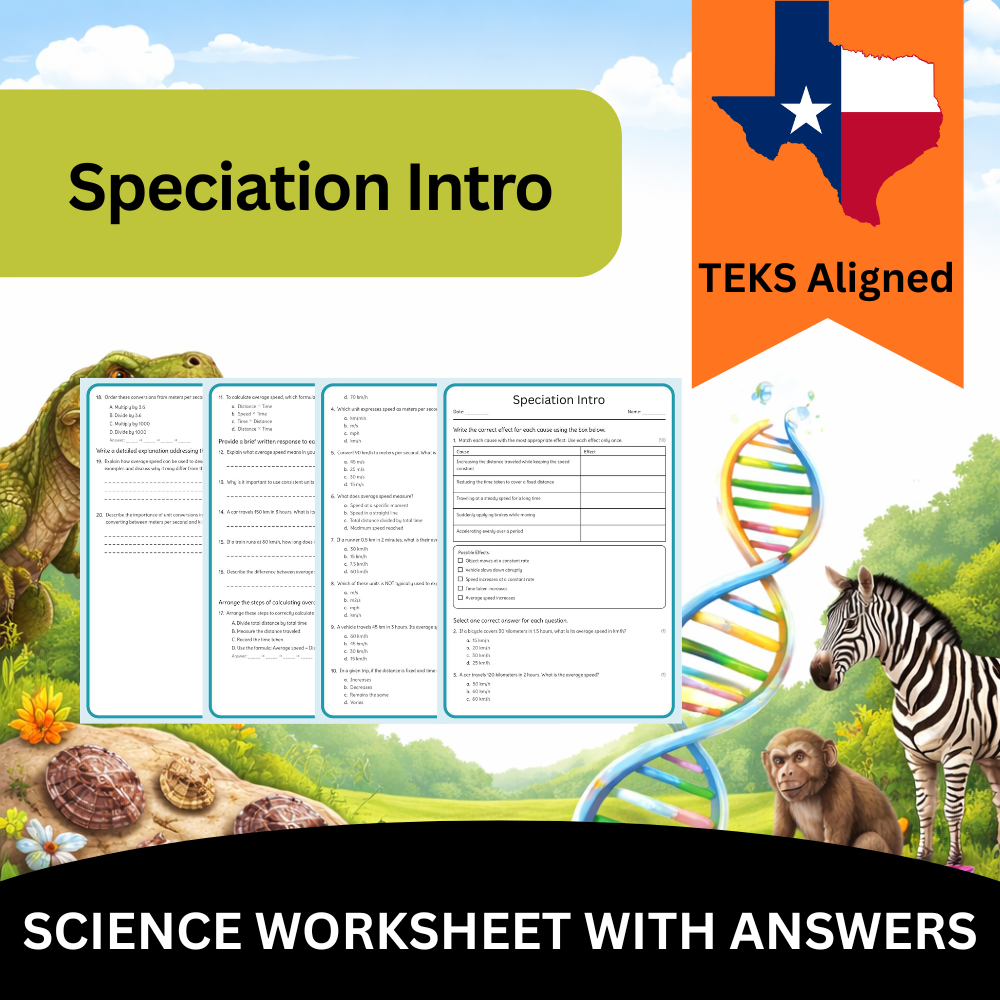
Grade 9 Science | Speciation Introduction Worksheet (Answer Key) – TEKS Aligned
Created byBright Mind ResourcesLearning Objectives
- Understand the process of speciation and how it contributes to biodiversity.
- Identify different reproductive barriers and mechanisms involved in speciation.
- Differentiate between allopatric and sympatric speciation and their causes.
Also included in: Grade 9 Science Unit | Evolution, Speciation & Genetics Worksheet Pack - TEKS +3 more
Instant download
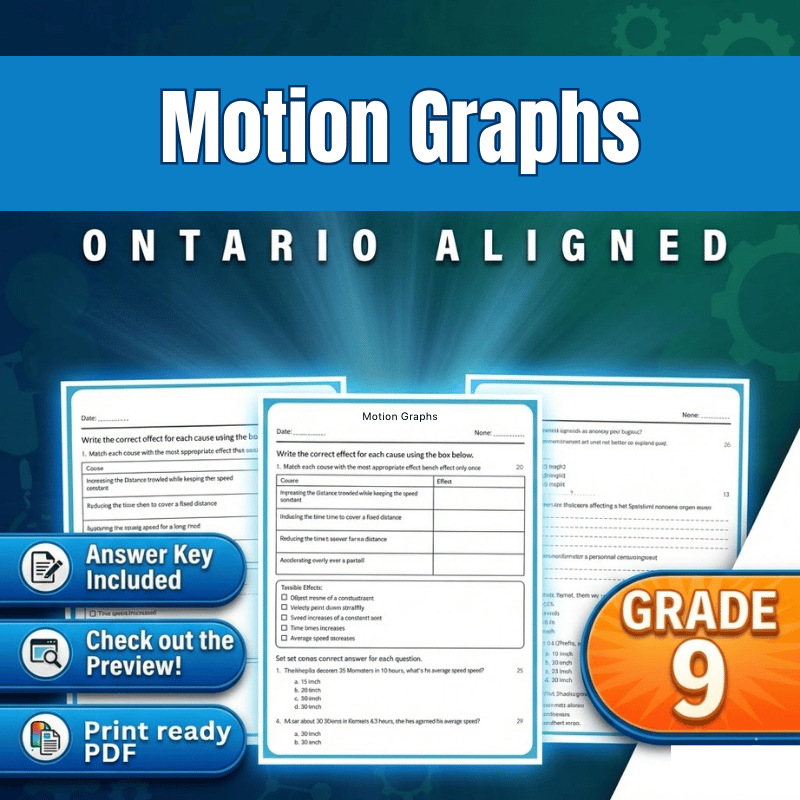
Grade 9 Science – Motion Graphs Worksheet (Ontario – Science) (PDF)
Created byBright Mind ResourcesLearning Objectives
- Interpret position–time and velocity–time graphs to describe motion.
- Understand the significance of slopes and areas under graphs in kinematics.
- Link graphical representations to algebraic formulas of velocity and acceleration.
Instant download
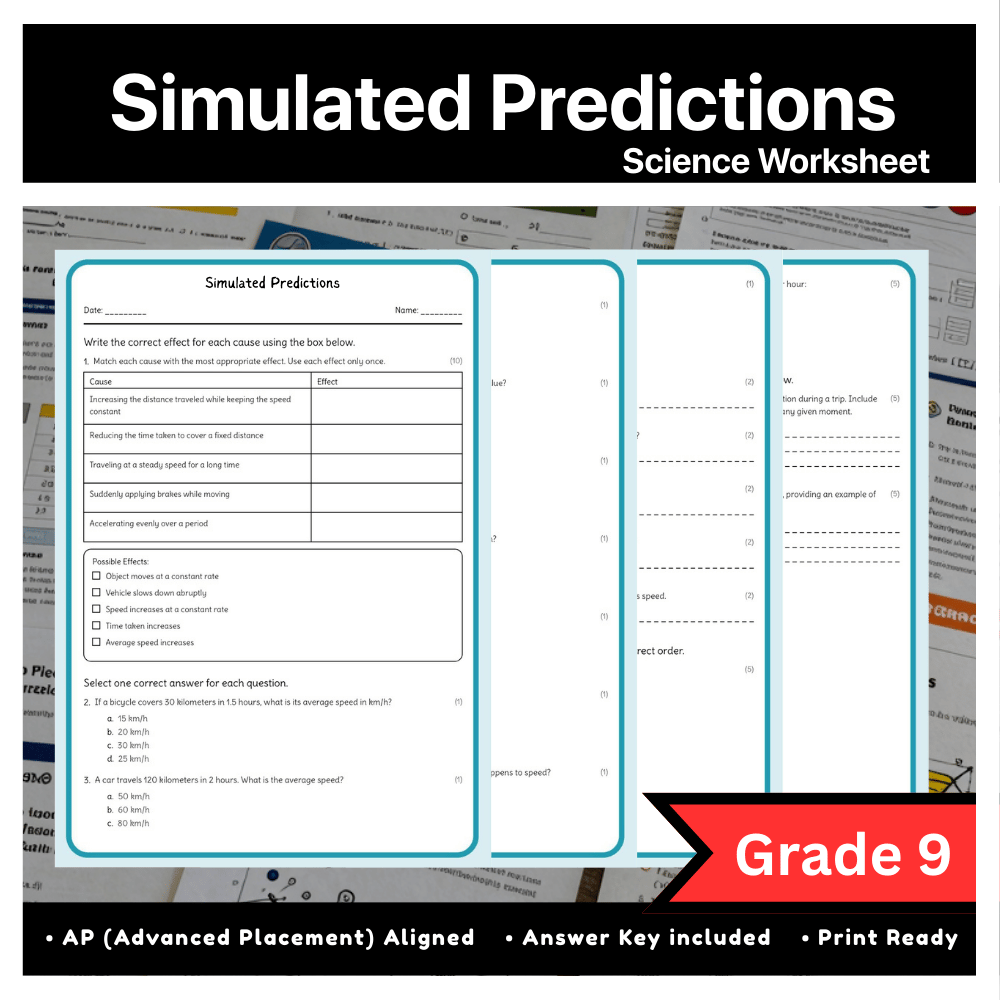
Grade 9 Science – Simulated Predictions Worksheet + Answer Key | AP Standard
Created byBright Mind ResourcesLearning Objectives
- Explain the role of simple computational simulations and numerical models in generating predictions.
- Identify how parameters influence simulation outcomes and the importance of scenario comparison.
- Describe how ensembles and visualizations represent forecast uncertainty.
Instant download
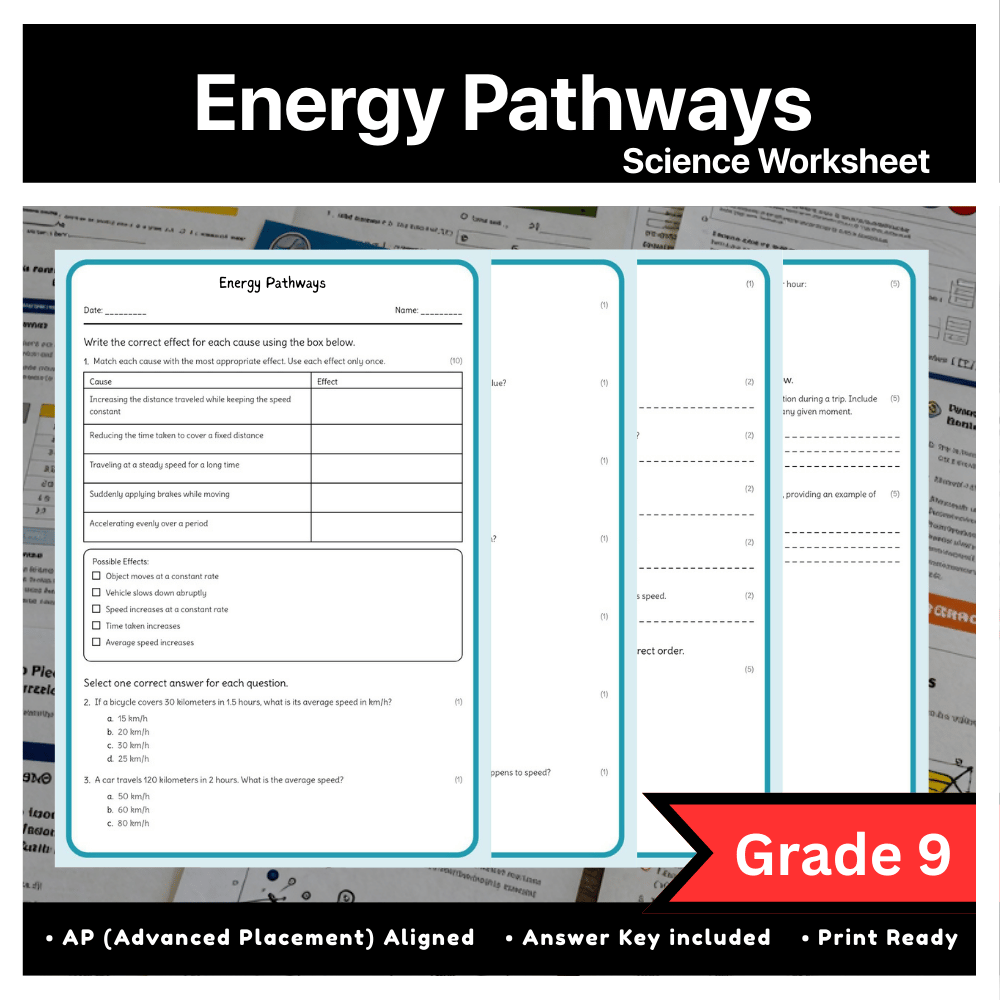
Grade 9 Science – Energy Pathways Worksheet (Answer Key) | AP Standard
Created byBright Mind ResourcesLearning Objectives
- Describe the main processes involved in energy transfer within the atmosphere and oceans.
- Interpret diagrams and tables illustrating the global energy budget and fluxes.
- Explain how differential heating influences atmospheric circulation and climate patterns.
Instant download
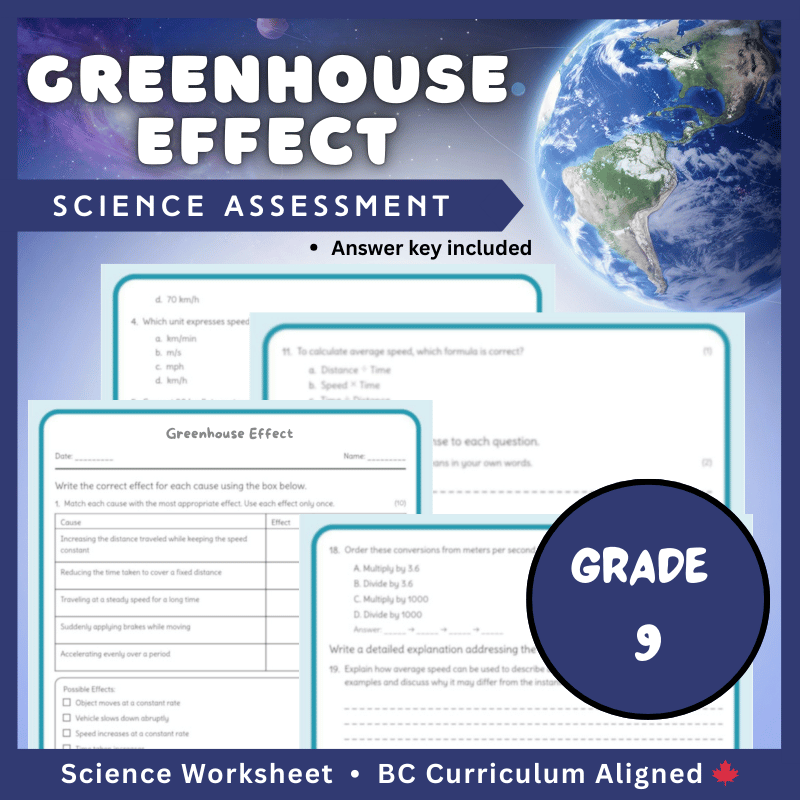
Grade 9 Science | Understanding the Greenhouse Effect Worksheet (Answer Key)
Created byBright Mind ResourcesLearning Objectives
- Understand how greenhouse gases trap outgoing radiation and influence Earth's surface temperature.
- Identify natural and human sources of greenhouse gases and their effects on climate.
- Explain how small changes in atmospheric composition can alter the energy balance and climate responses.
Instant download
Grade 9 Science | Newton's First Law Worksheet (Ontario Standard) (PDF)
Created byBright Mind ResourcesLearning Objectives
- Explain Newton's First Law as a statement about inertia and its relationship with external forces.
- Distinguish between rest and constant velocity states of motion.
- Describe how balanced forces contribute to static and dynamic equilibrium.
Instant download
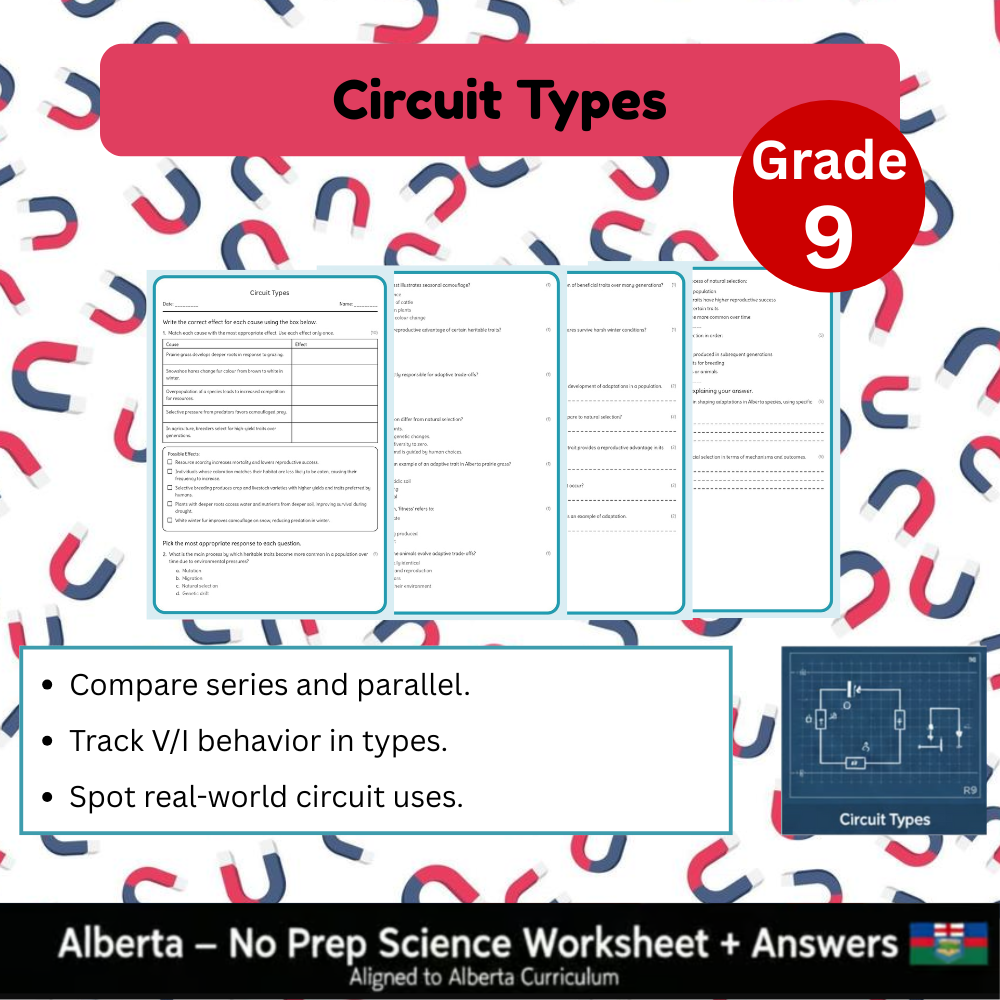
Grade 9 Science – Circuit Types Worksheet (PDF) | Alberta Standard
Created byBright Mind ResourcesLearning Objectives
- Understand the differences between series and parallel circuits.
- Identify how current and voltage behave in different circuit arrangements.
- Recognize real-world examples of series and parallel circuits.
Instant download
Grade 9 Science – Energy Conservation Worksheet (Ontario) – PDF
Created byBright Mind ResourcesLearning Objectives
- Understand the principles of mechanical energy conservation in ideal systems.
- Identify conditions under which total mechanical energy remains constant.
- Explore the role of non-conservative work, such as friction, in energy dissipation.
Instant download
Grade 9 Science | Organ Structures Worksheet + Answer Key (PDF) | BC Standards
Created byBright Mind ResourcesLearning Objectives
- Identify the organization of tissues within organs.
- Understand how organs and systems collaborate to sustain the organism.
- Describe the relationship between tissue types, organs, and organ systems.
Instant download
Grade 9 Science | Cellular Metabolism Worksheet & Answer Key (PDF) NGSS Aligned
Created byBright Mind ResourcesLearning Objectives
- Describe the biochemical pathways involved in cellular respiration, including glycolysis, the citric acid cycle, and electron transport.
- Explain how ATP is produced through energy coupling in cells.
- Relate mitochondrial and chloroplast functions to metabolic processes like respiration and photosynthesis.
Instant download
Grade 9 Science | Cosmic Timescales Worksheet (NGSS Aligned + PDF)
Created byBright Mind ResourcesLearning Objectives
- Understand key observational evidence used to determine the age and expansion of the universe.
- Explain the significance of redshift surveys, Hubble's law, and cosmic microwave background measurements.
- Analyze how primordial element abundances help constrain cosmic history.
Instant download
Grade 9 Science| Glucose Balance Worksheet (Answer Key) – Blood Sugar Regulation
Created byBright Mind ResourcesLearning Objectives
- Explain how insulin and glucagon regulate blood glucose levels.
- Identify the roles of liver, muscle, and adipose tissues in glucose metabolism.
- Describe endocrine feedback loops involved in glucose homeostasis.
Instant download
About Grade 9 Science Worksheets
Find Science worksheets built for Grade 9. All 6,926 cover core skills, practice, and review, each an instant PDF download.
Every worksheet on MyTeachingSheets is created by independent teacher-authors and reviewed before publication. All resources download as printable PDFs for classroom, homework, or at-home practice, and many include answer keys. Preview any worksheet free before buying.