
Grade 9 Science Worksheets
6,986 worksheets
Mixtures and Solutions Assessment | Alberta Standards Grade 9 Science
 Created byPrism Point Learning
Learning Objectives
- Differentiate between heterogeneous mixtures and homogeneous solutions.
- Explain the roles of solute and solvent in a solution.
- Describe methods of separating mixture components based on physical properties.
Also included in: Grade 9 Matter and Chemical Change Science Lesson Bundle | Alberta +1 more
Instant download
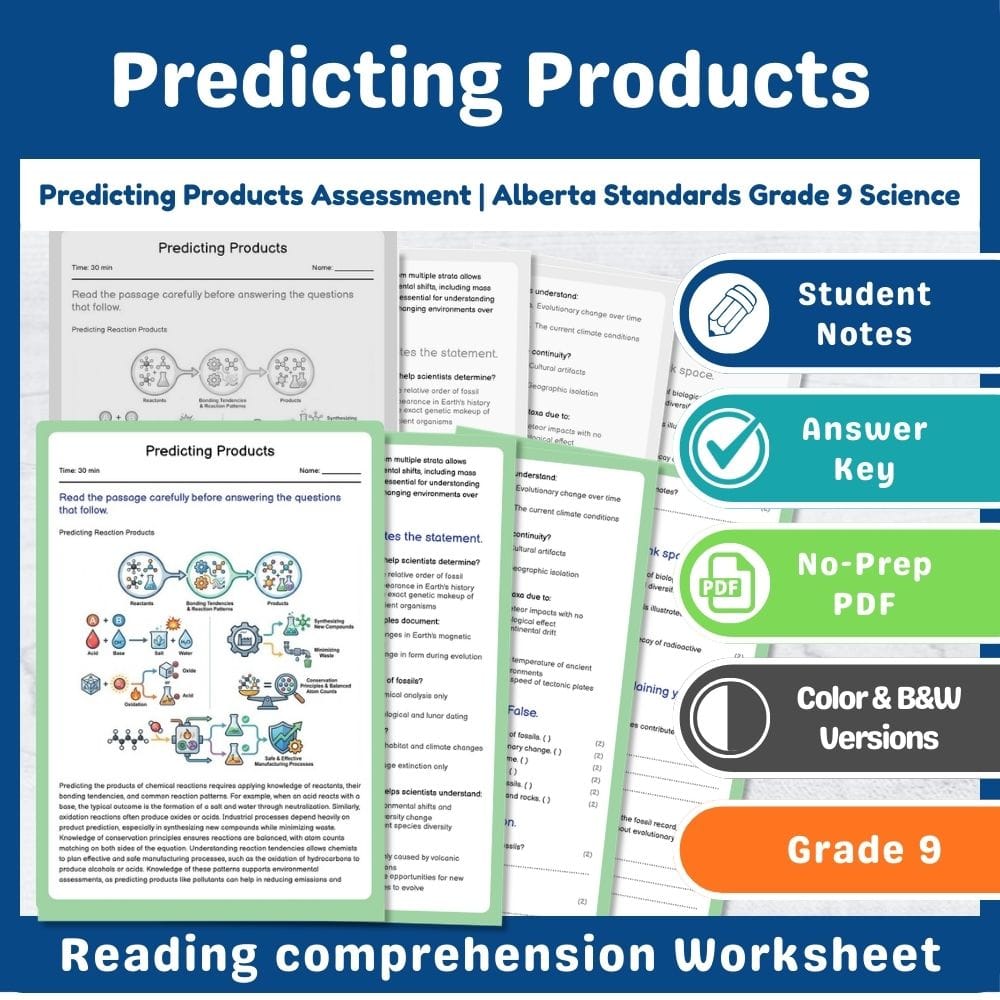
Predicting Products Assessment | Alberta Standards Grade 9 Science
Created byPrism Point LearningLearning Objectives
- Understand patterns of chemical reactions to predict likely products.
- Apply conservation principles and reactant identities in product prediction.
- Analyze industrial examples such as oxidation of hydrocarbons and neutralization reactions.
Also included in: Grade 9 Matter and Chemical Change Science Lesson Bundle | Alberta +1 more
Instant download
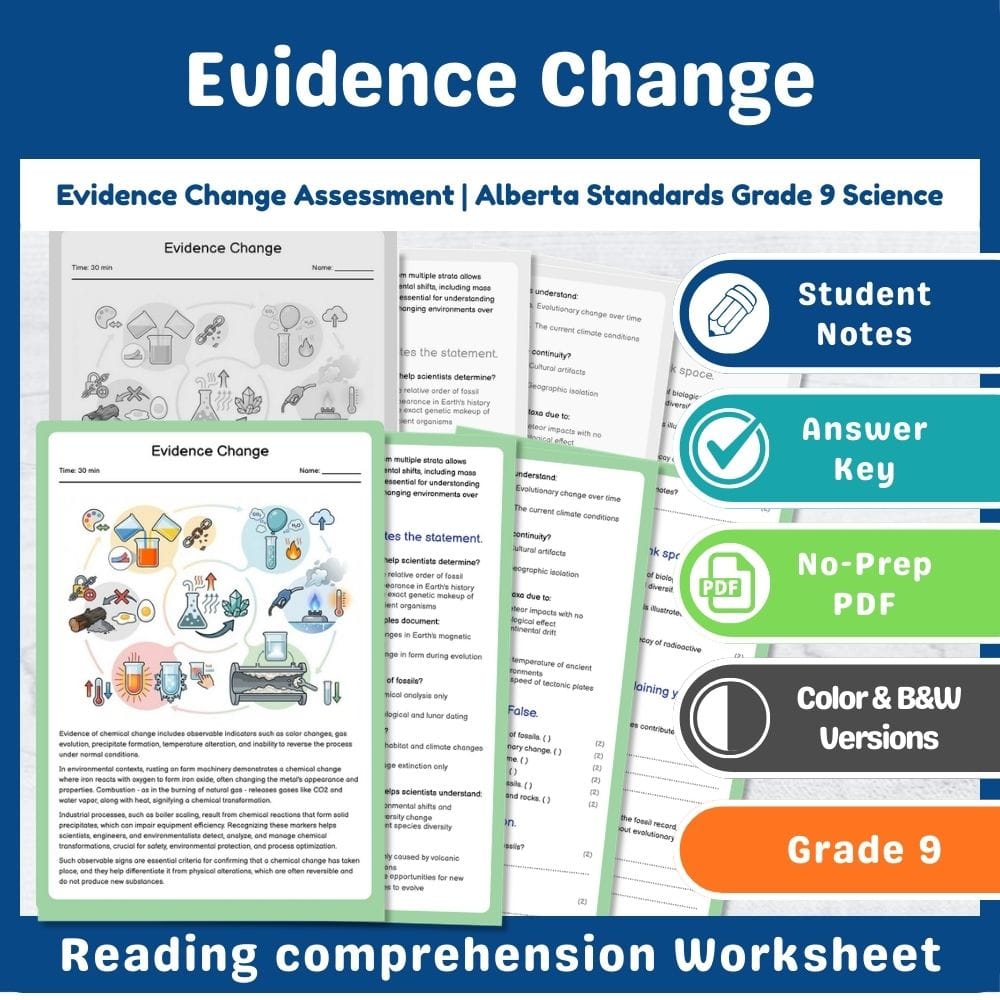
Evidence Change Assessment | Alberta Standards Grade 9 Science
Created byPrism Point LearningLearning Objectives
- Identify observable signs that indicate a chemical change has occurred.
- Distinguish between physical and chemical change markers in environmental and industrial contexts.
- Understand examples of chemical change such as rusting, combustion, and scale formation.
Also included in: Grade 9 Matter and Chemical Change Science Lesson Bundle | Alberta +1 more
Instant download
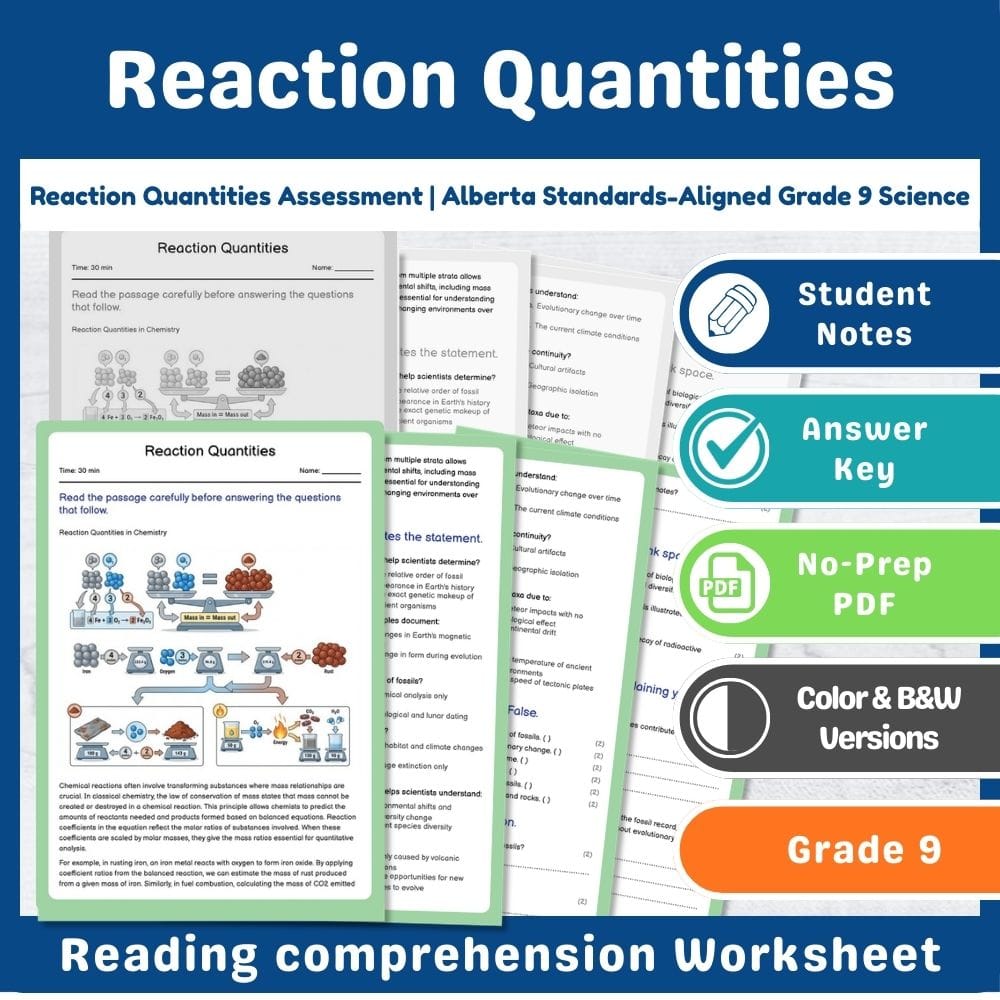
Reaction Quantities Assessment | Alberta Standards-Aligned Grade 9 Science
Created byPrism Point LearningLearning Objectives
- Understand how to interpret and use coefficient ratios in balanced chemical equations.
- Learn to relate mass measurements of reactants and products through proportional relationships.
- Apply relative mass concepts to practical scenarios involving chemical reactions.
Also included in: Grade 9 Matter and Chemical Change Science Lesson Bundle | Alberta +1 more
Instant download
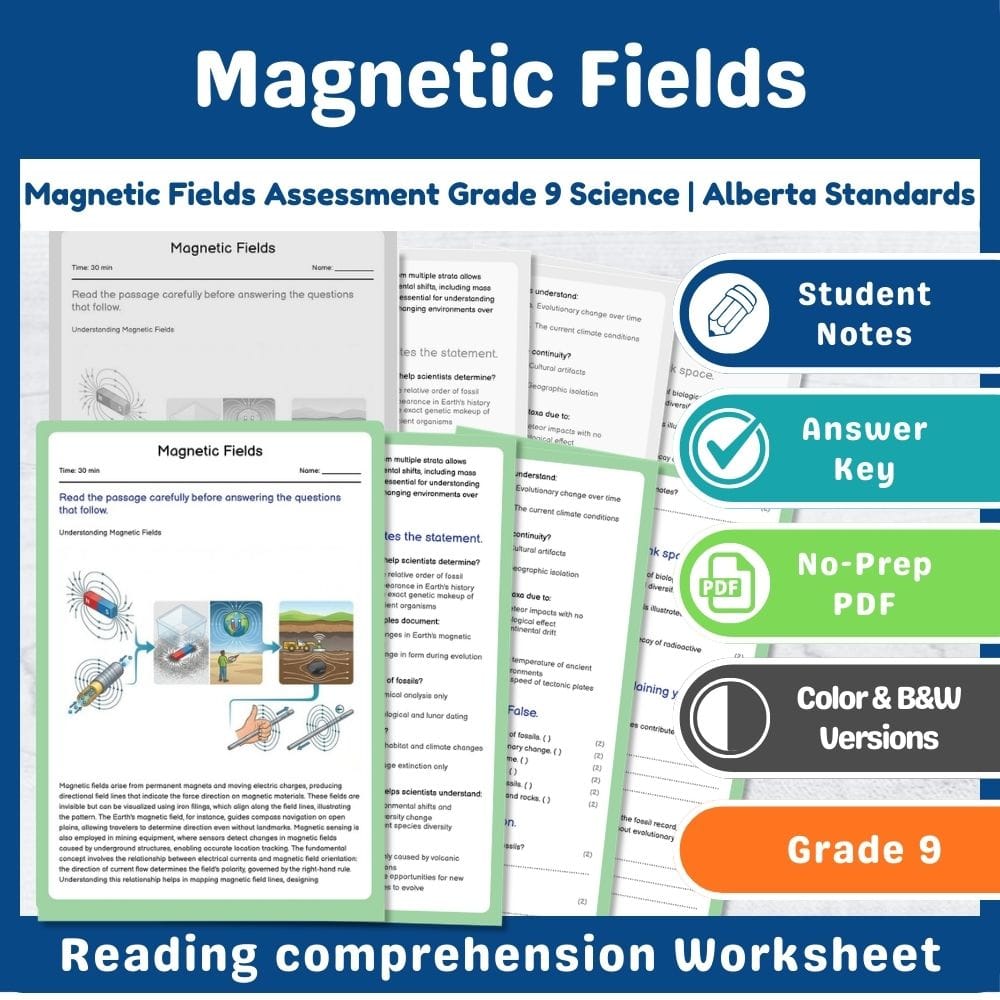
Magnetic Fields Assessment Grade 9 Science | Alberta Standards
Created byPrism Point LearningLearning Objectives
- Explain how magnetic fields are generated by permanent magnets and moving electric charges.
- Describe the concept of magnetic field lines and their directional properties.
- Connect regional phenomena like compass navigation and magnetic sensing in industry to magnetic fields.
Also included in: Grade 9 Electricity and Magnetism Science Lesson Bundle | Alberta Framework +1 more
Instant download
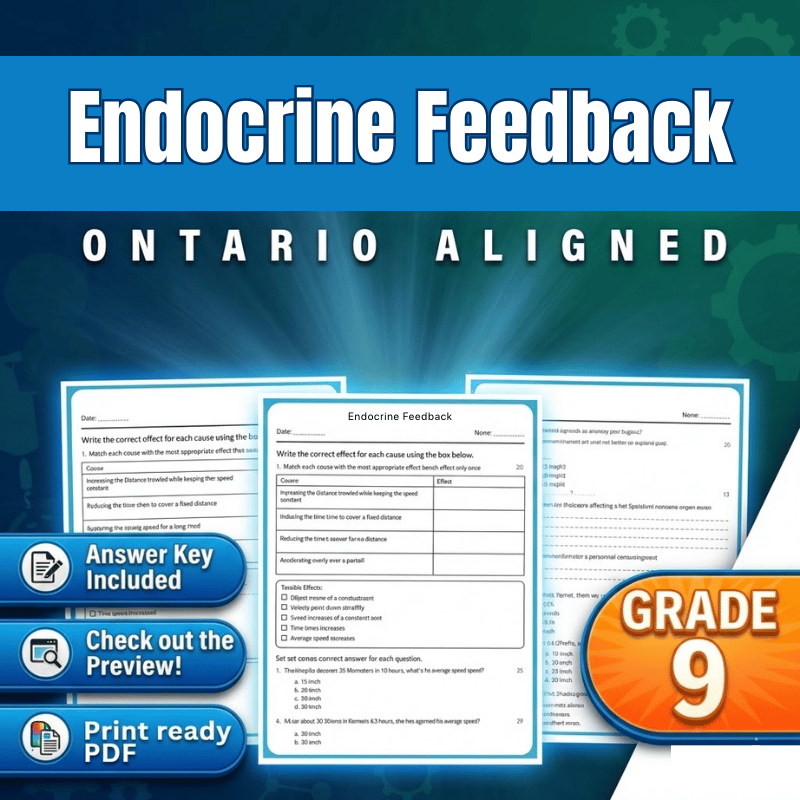
Grade 9 Science | Endocrine Feedback Worksheet (Ontario) – Science (PDF)
 Created byBright Mind Resources
Learning Objectives
- Describe how hormones are synthesized, transported, and act on cells through receptor-mediated actions.
- Explain the roles of negative and positive feedback loops in hormonal regulation.
- Analyze mechanisms of glucose homeostasis involving insulin and glucagon.
Instant download
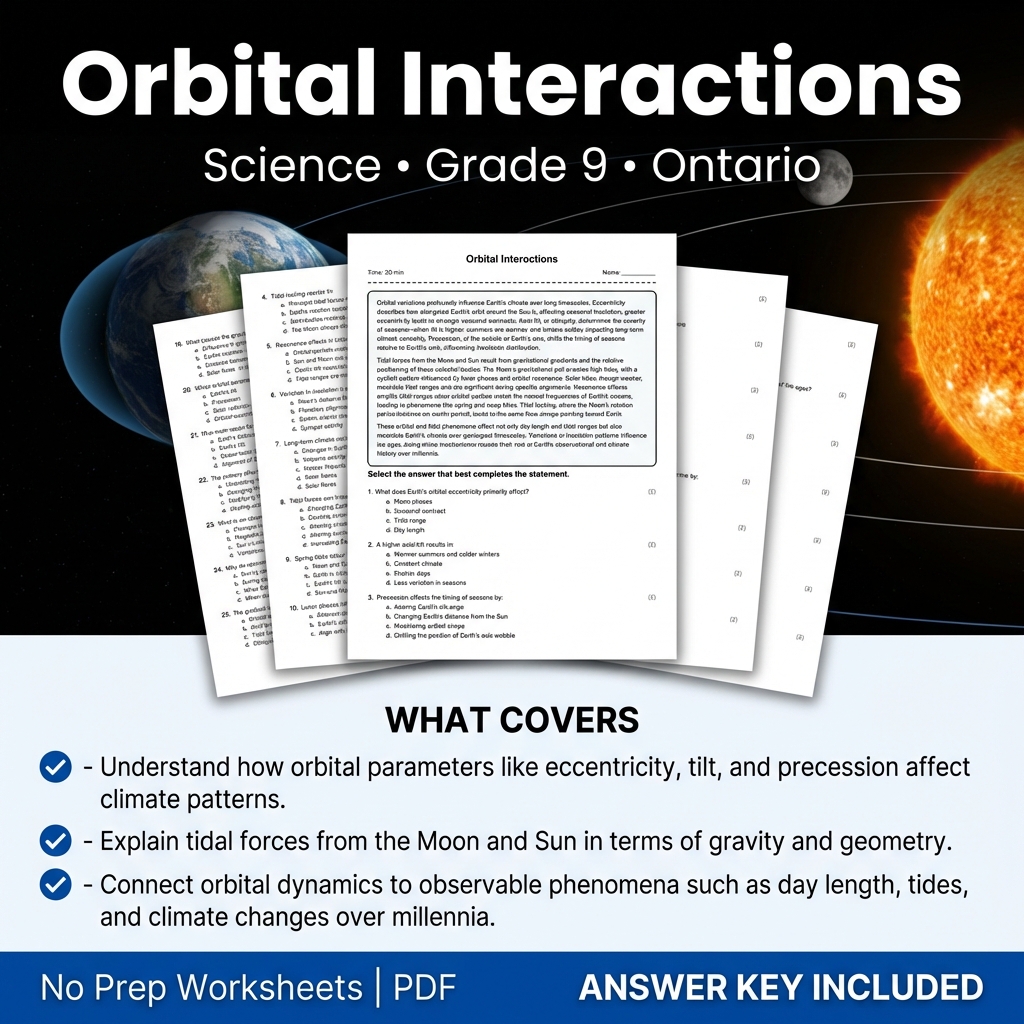
Orbital Interactions Worksheet for Grade 9 Science – Ontario Standards
 Created byCoral Reef Learning
Learning Objectives
- Understand how orbital parameters like eccentricity, tilt, and precession affect climate patterns.
- Explain tidal forces from the Moon and Sun in terms of gravity and geometry.
- Connect orbital dynamics to observable phenomena such as day length, tides, and climate changes over millennia.
Instant download
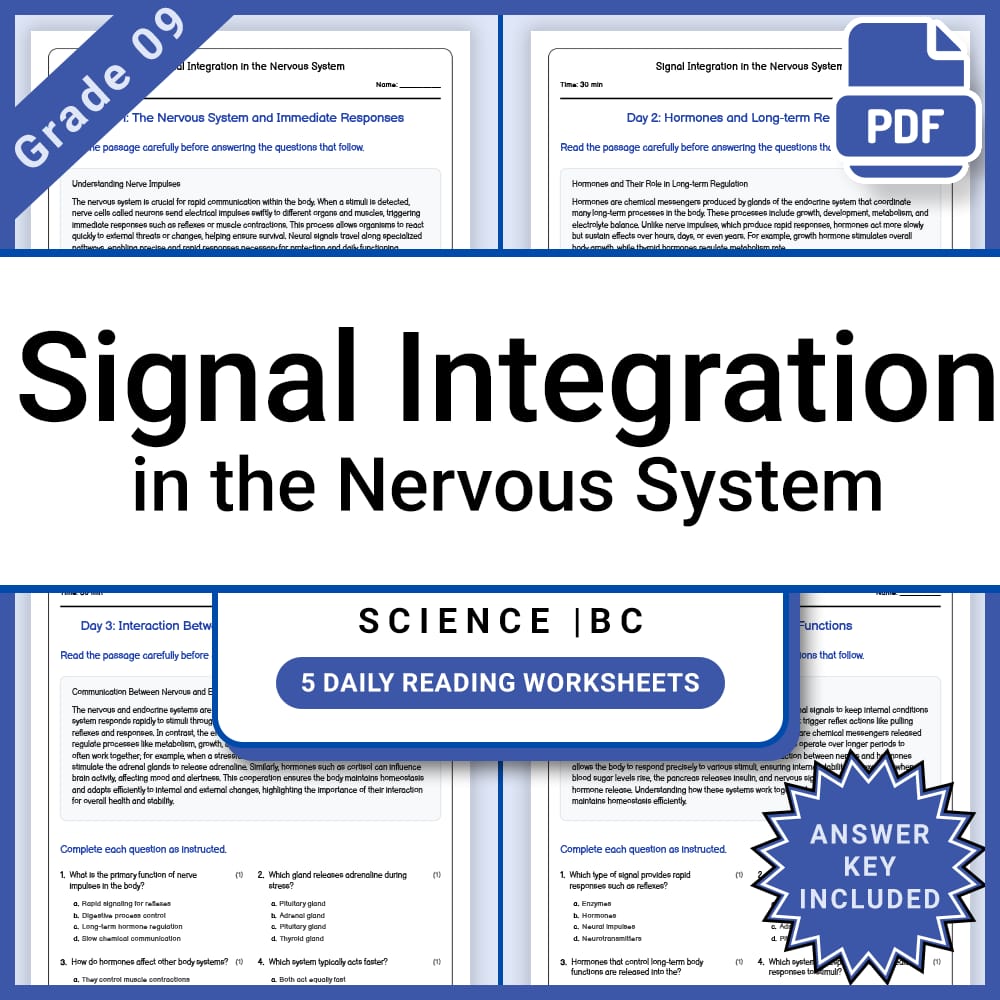
Grade 9 – Signal Integration in the Nervous System Worksheet with Answer Key
JCreated byJ.S SheetsLearning Objectives
- Understand how nerve impulses provide quick responses to stimuli
- Identify the role of the nervous system in maintaining homeostasis
- Explain the interaction between neural responses and hormonal regulation
Also included in: Grade 9 Science Lesson Group Bundle | BC Framework Activities & Worksheets +1 more
Instant download
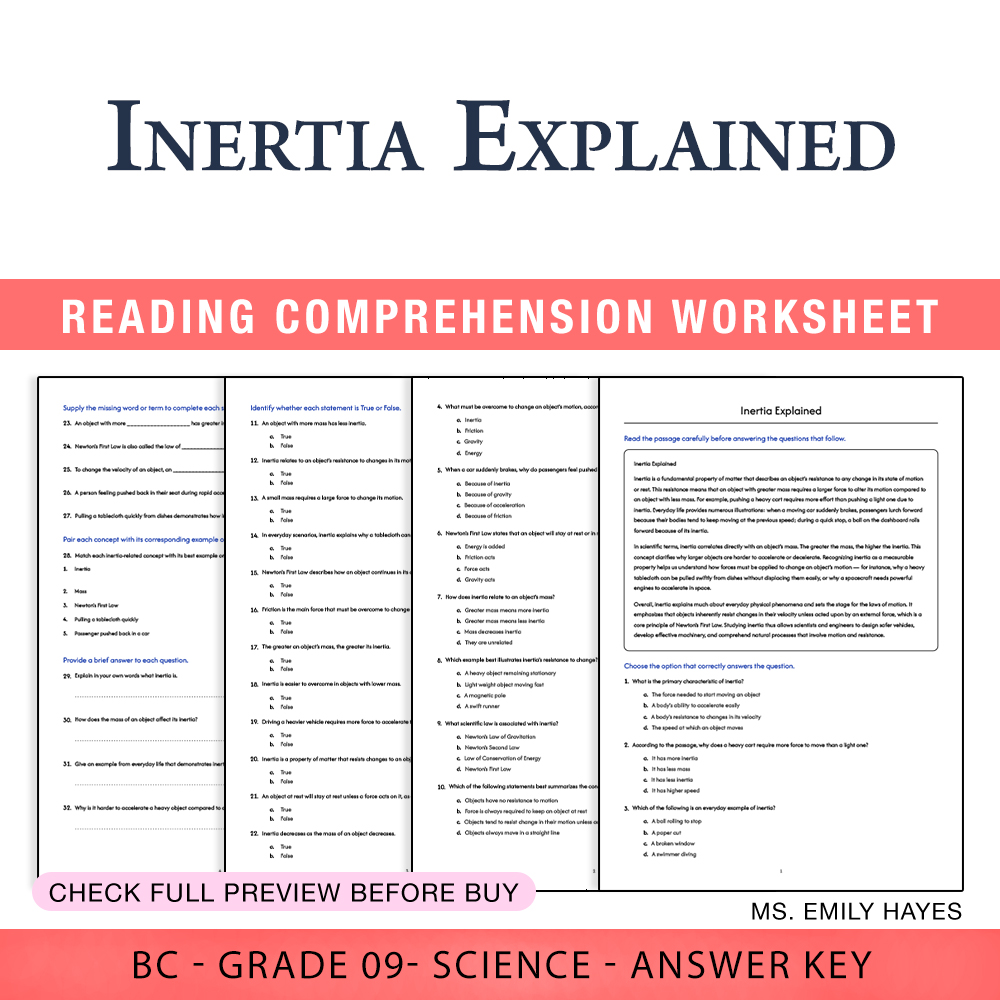
9th Grade Science | Inertia Explained Worksheet (PDF+ Answer Key)
 Created byCopper Leaf Classroom
Learning Objectives
- Understand the concept of inertia and its relation to mass.
- Identify real-world examples that demonstrate inertia.
- Explain how force overcomes inertia to change an object's motion.
Also included in: Grade 9 Science Worksheet Bundle | Forces, Energy & Motion (PDF + Answer Key) +1 more
Instant download
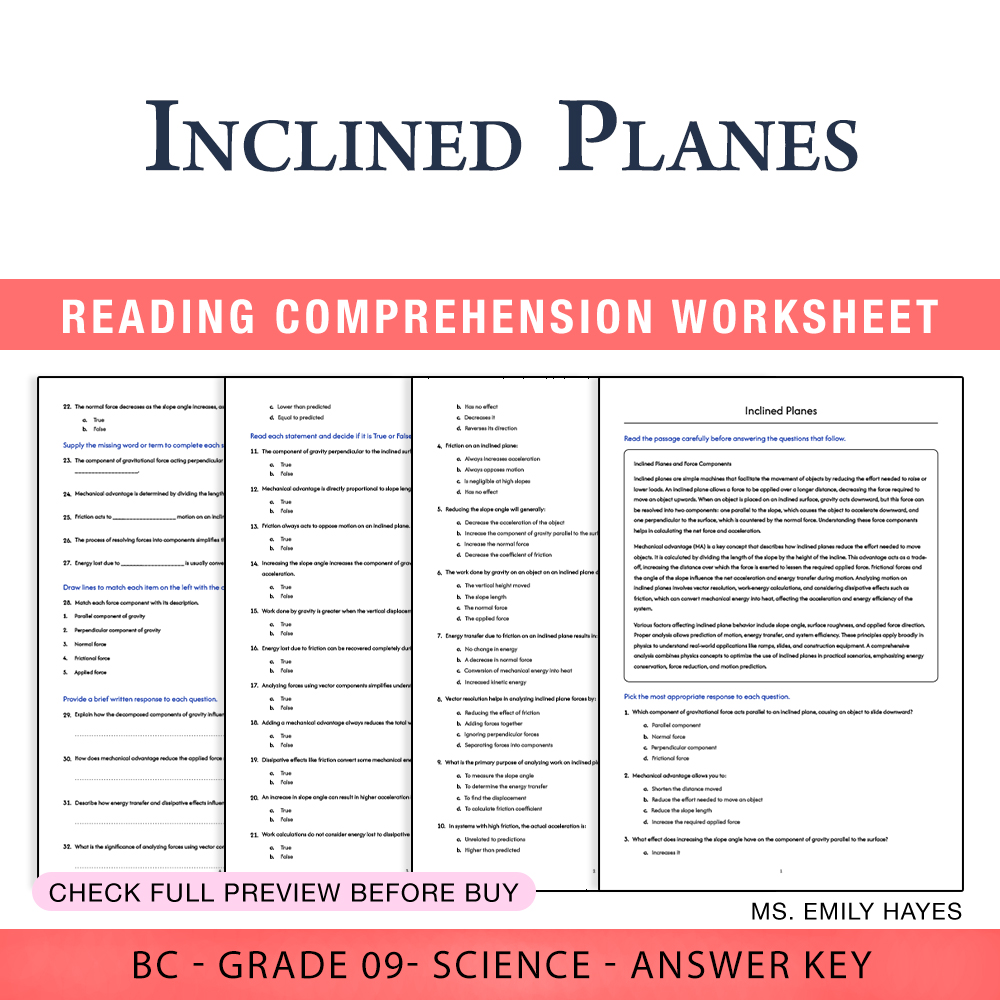
9th Grade Science | Inclined Planes Worksheet (PDF+ Answer Key)
Created byCopper Leaf ClassroomLearning Objectives
- Explain how inclined planes decompose gravitational force into components parallel and perpendicular to the surface.
- Describe the concept of mechanical advantage and how it reduces applied force at the expense of distance.
- Analyze the effects of slope angle and friction on the motion, acceleration, and energy transfer of objects on inclined planes.
Also included in: Grade 9 Science Worksheet Bundle | Forces, Energy & Motion (PDF + Answer Key) +1 more
Instant download
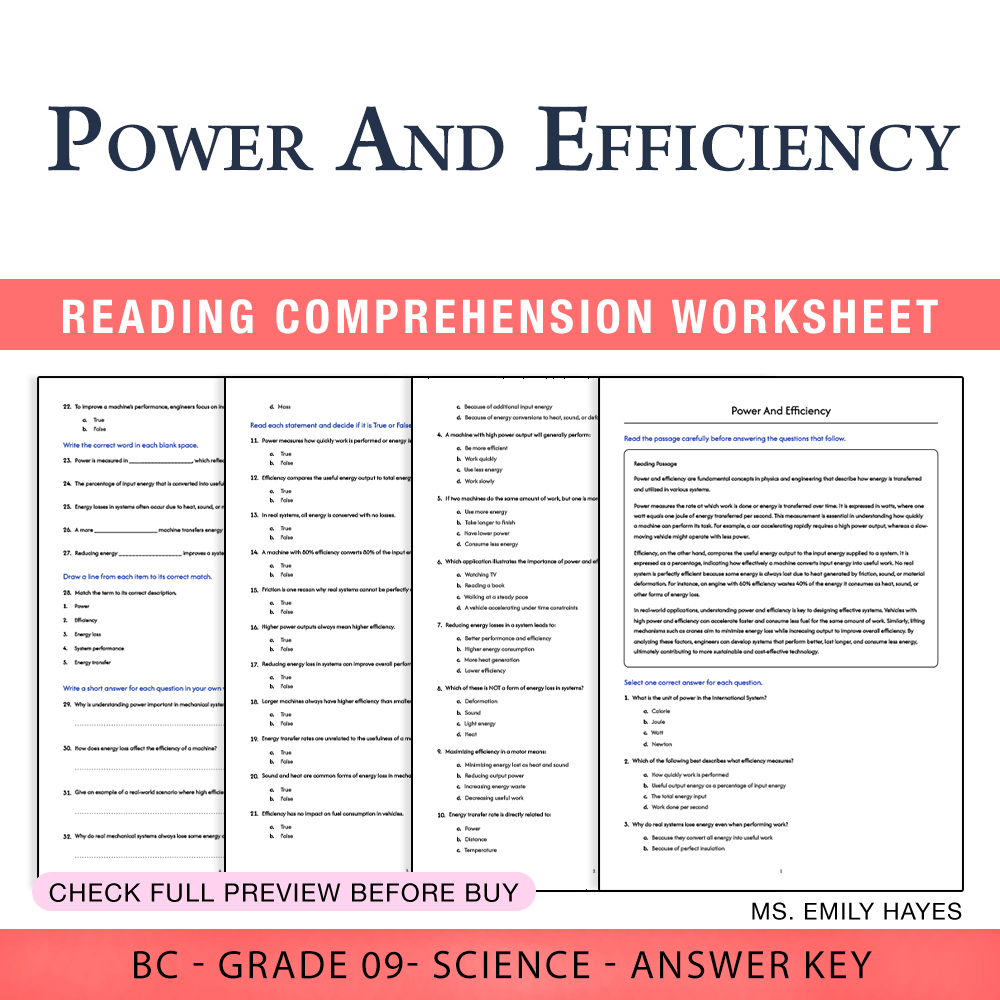
9th Grade Science | Power and Efficiency Worksheet (PDF+ Answer Key)
Created byCopper Leaf ClassroomLearning Objectives
- Understand the concepts of power and how it measures the rate of energy transfer in systems.
- Explain the meaning of efficiency and how it compares useful output energy to input energy.
- Recognize factors that cause energy loss in real systems and how they reduce efficiency.
Also included in: Grade 9 Science Worksheet Bundle | Forces, Energy & Motion (PDF + Answer Key) +1 more
Instant download
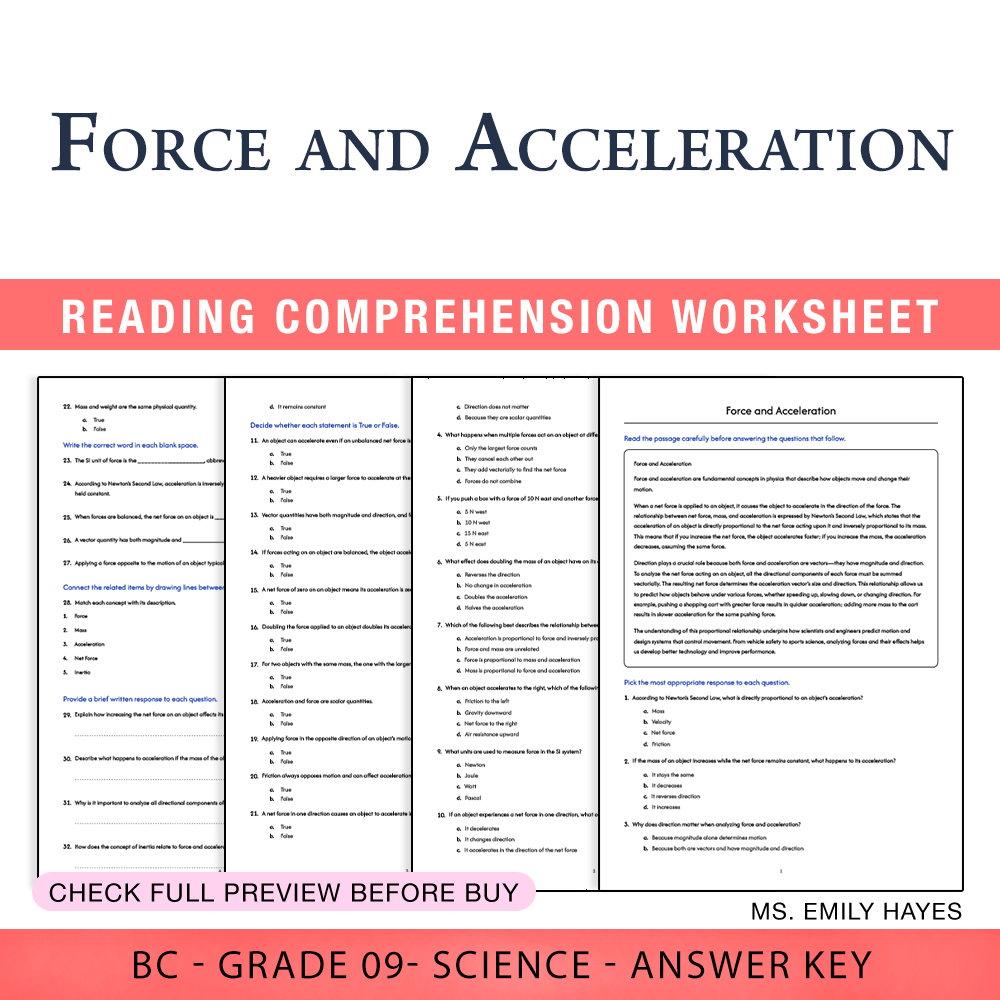
Grade 9 Science | Force and Acceleration Worksheet (PDF+ Answer Key)
Created byCopper Leaf ClassroomLearning Objectives
- Understand the relationship between net force, mass, and acceleration.
- Analyze how changes in force or mass affect acceleration.
- Apply vector concepts to force and acceleration in different directions.
Also included in: Grade 9 Science Worksheet Bundle | Forces, Energy & Motion (PDF + Answer Key) +1 more
Instant download
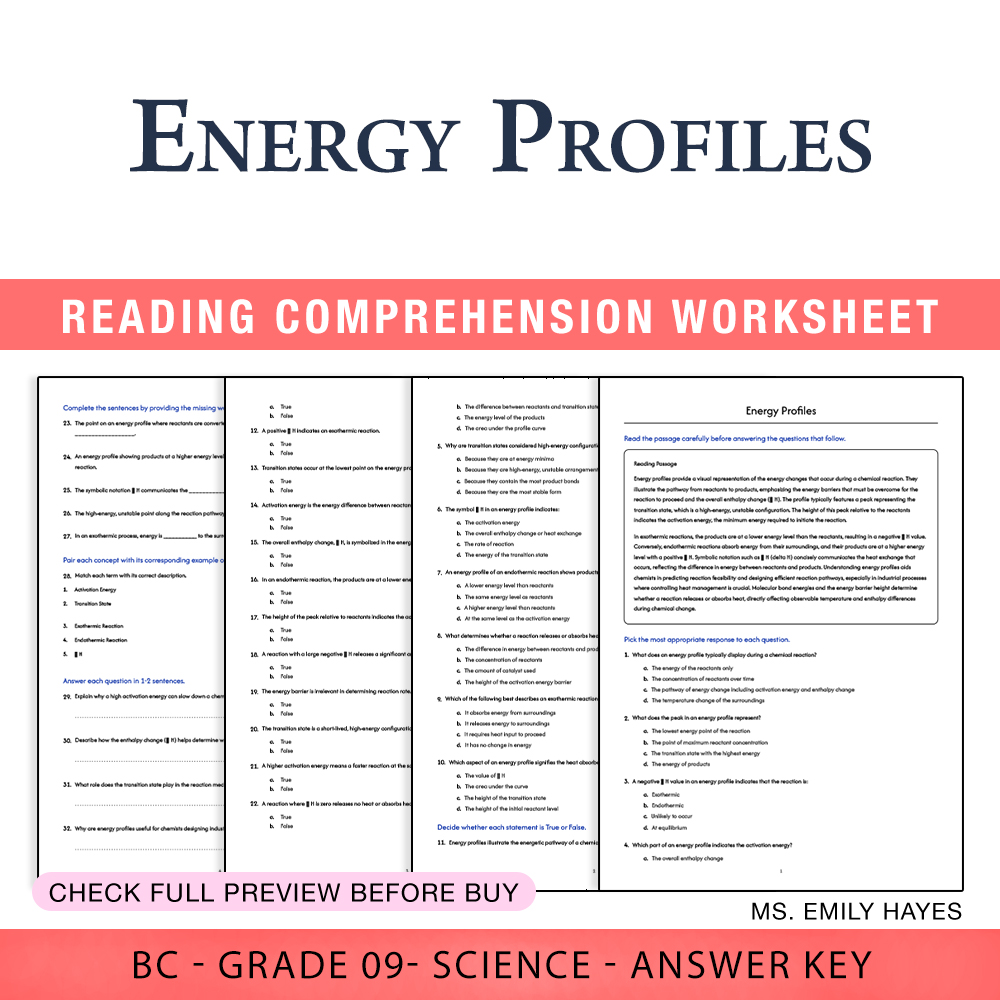
Grade 9 Science | Energy Profiles Worksheet (PDF+ Answer Key)
Created byCopper Leaf ClassroomLearning Objectives
- Describe the concept of energy profiles and their purpose in analyzing chemical reactions.
- Distinguish between exothermic and endothermic reactions based on enthalpy changes.
- Identify the significance of activation energy and transition states in reaction pathways.
Also included in: Grade 9 Science Bundle | Chemistry, Physics & Atomic Concepts (PDF + Answer Key) +1 more
Instant download
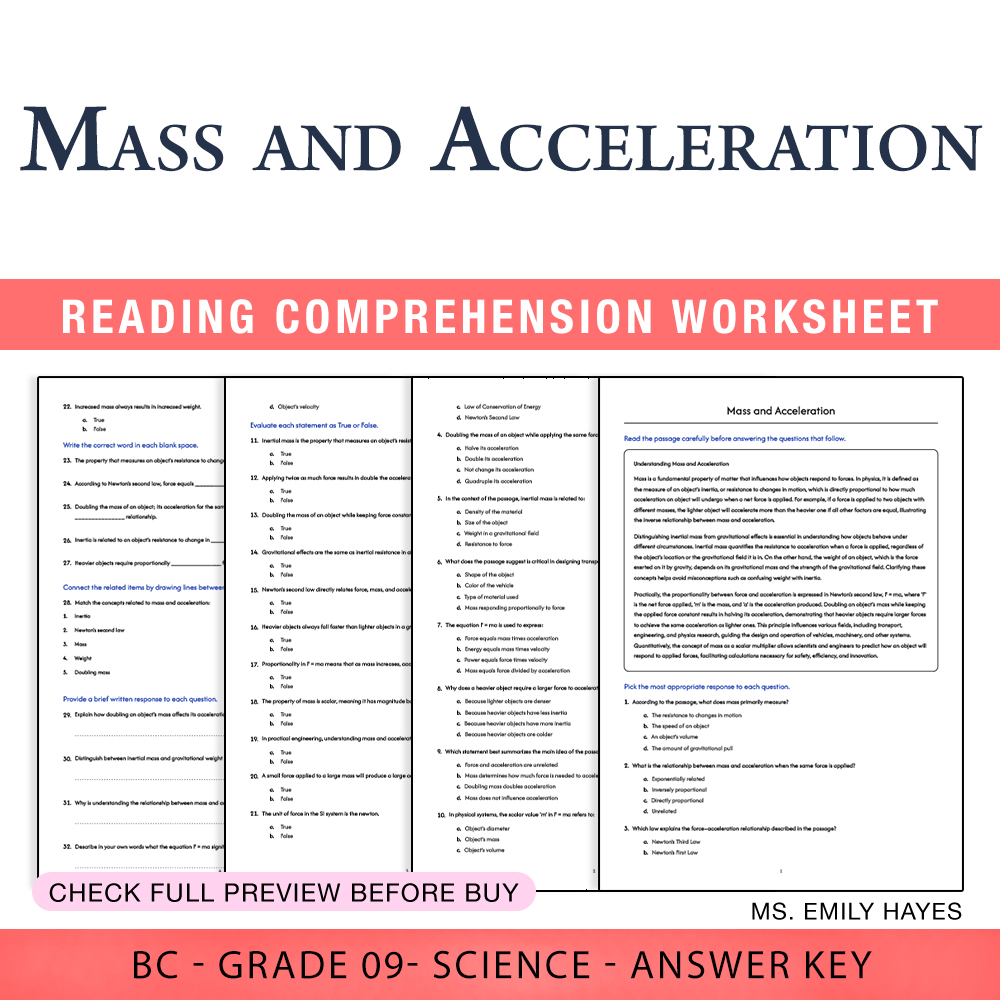
9th Grade Science | Mass and Acceleration Worksheet (PDF + Answer Key)
Created byCopper Leaf ClassroomLearning Objectives
- Explain how mass influences acceleration under a given net force.
- Distinguish between inertial mass and gravitational effects in response to forces.
- Apply the force–acceleration relationship in practical problems involving mass.
Also included in: Grade 9 Science Worksheet Bundle | Forces, Energy & Motion (PDF + Answer Key) +1 more
Instant download
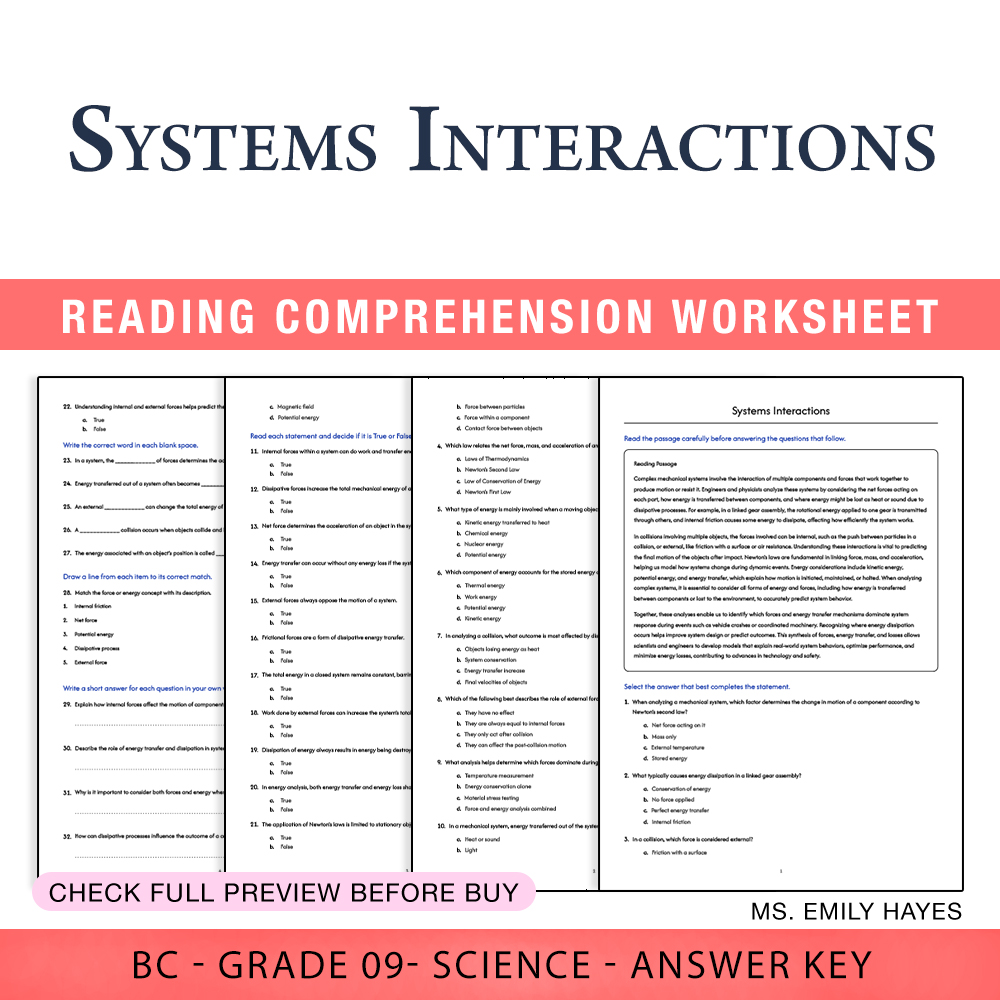
Grade 9 Science | Systems Interactions Worksheet (PDF+ Answer Key)
Created byCopper Leaf ClassroomLearning Objectives
- Understand how multiple bodies and forces interact within complex mechanical systems.
- Apply Newton’s laws, net force analysis, and energy accounting to predict system motion.
- Analyze internal and external forces, energy transfer, and energy loss in systems during events like collisions.
Also included in: Grade 9 Science Worksheet Bundle | Forces, Energy & Motion (PDF + Answer Key) +1 more
Instant download
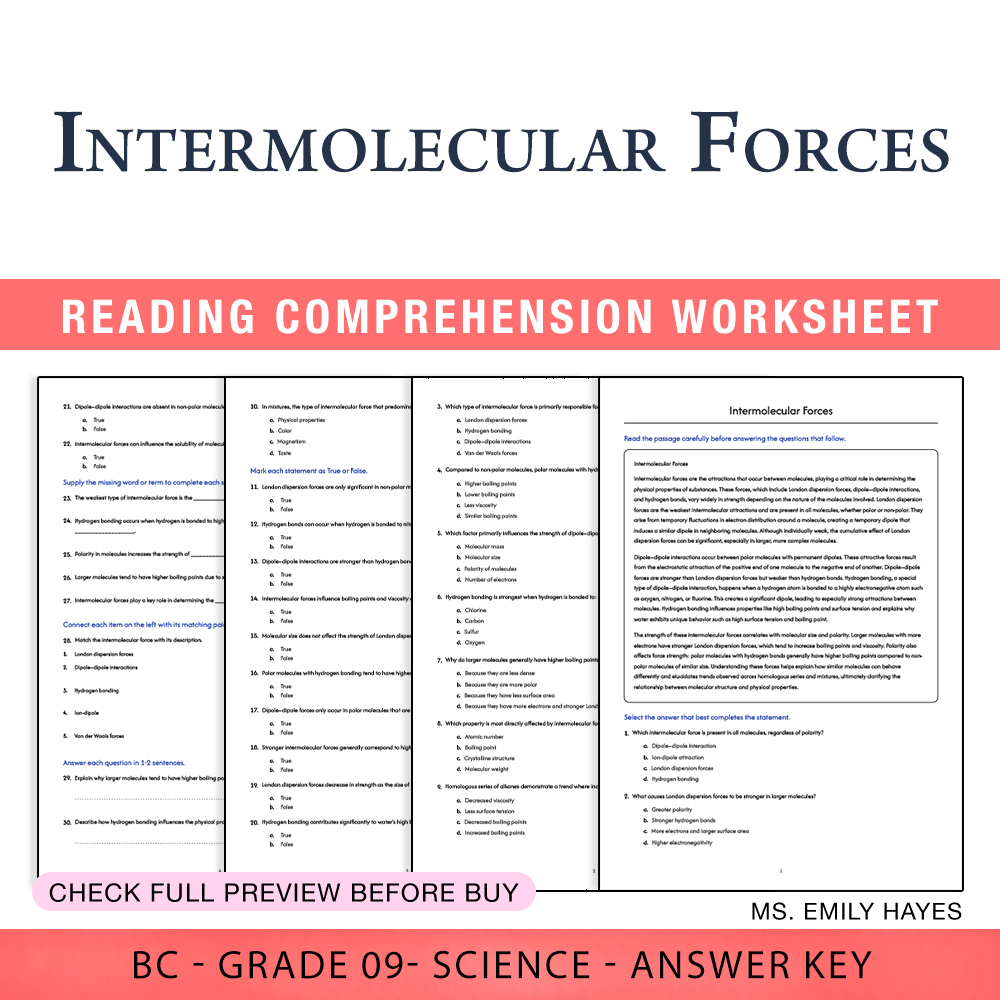
9th Grade Science | Intermolecular Forces Worksheet (PDF+ Answer Key)
Created byCopper Leaf ClassroomLearning Objectives
- Explain the types of intermolecular forces and how they affect physical properties of molecules.
- Compare London dispersion, dipole–dipole, and hydrogen bonding in terms of strength and molecular influence.
- Relate molecular structure and polarity to the strength of intermolecular forces and properties like boiling point and viscosity.
Also included in: Grade 9 Science Bundle | Chemistry, Physics & Atomic Concepts (PDF + Answer Key) +1 more
Instant download
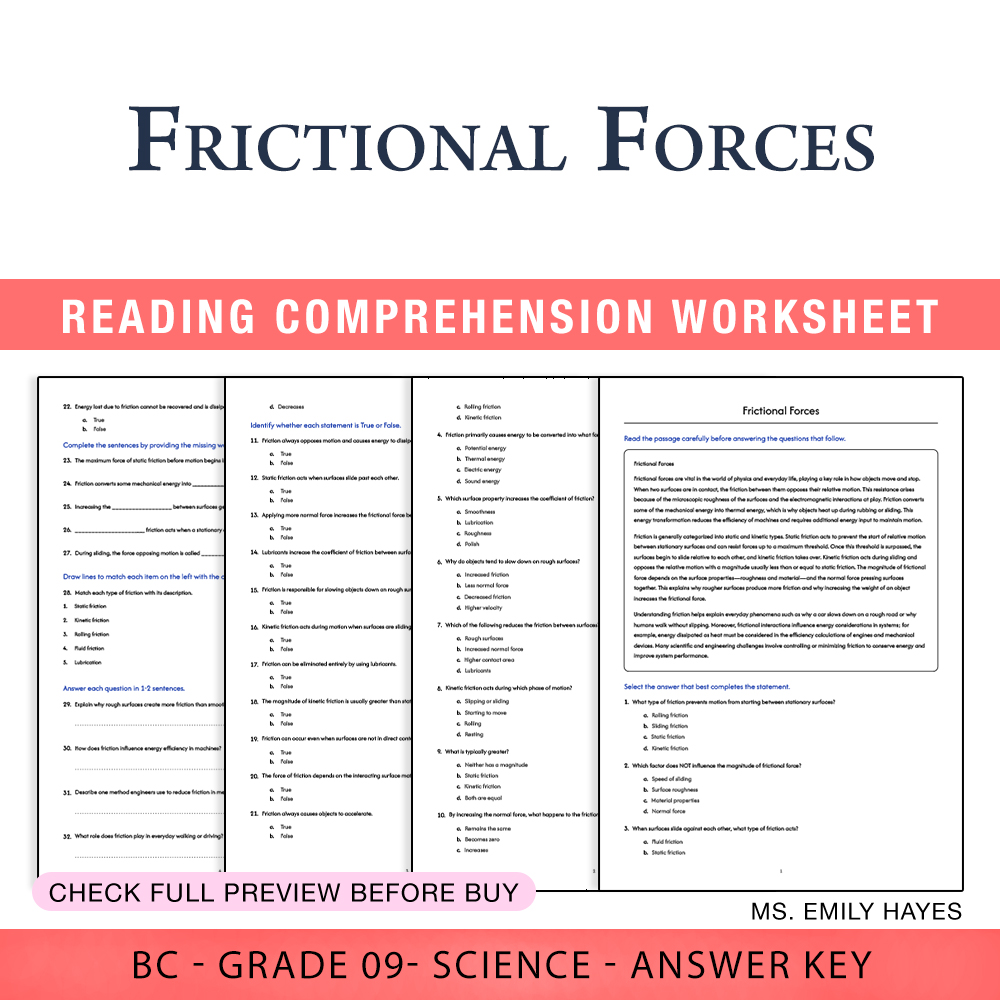
Grade 9 Science | Frictional Forces Worksheet (PDF+ Answer Key)
Created byCopper Leaf ClassroomLearning Objectives
- Explain how friction opposes motion between surfaces and converts kinetic energy to heat.
- Differentiate between static and kinetic friction and understand their roles.
- Describe factors affecting the magnitude of frictional forces.
Also included in: Grade 9 Science Worksheet Bundle | Forces, Energy & Motion (PDF + Answer Key) +1 more
Instant download
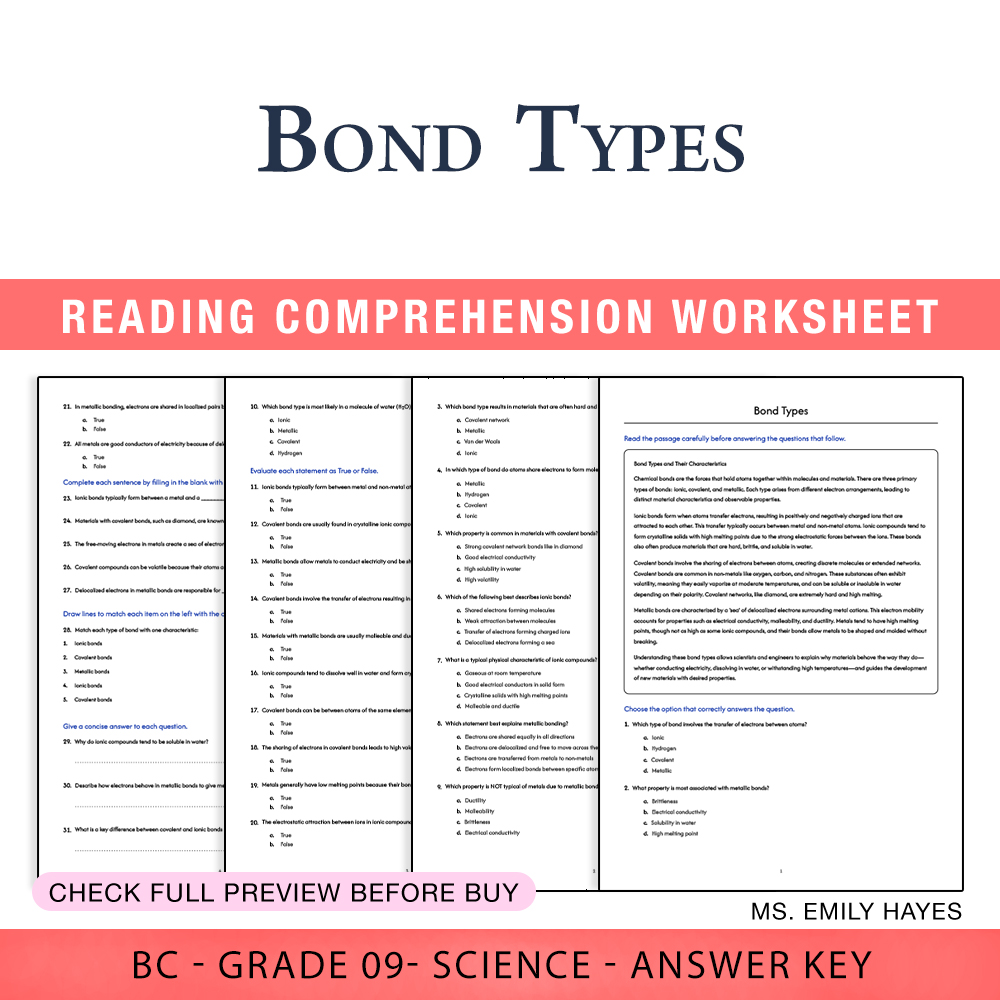
9th Grade Science | Bond Types Worksheet (PDF+ Answer Key)
Created byCopper Leaf ClassroomLearning Objectives
- Identify different types of chemical bonds: ionic, covalent, and metallic.
- Explain how electron arrangements influence bond formation and material properties.
- Distinguish between ionic, covalent, and metallic bonds based on their characteristics.
Also included in: Grade 9 Science Bundle | Chemistry, Physics & Atomic Concepts (PDF + Answer Key) +1 more
Instant download
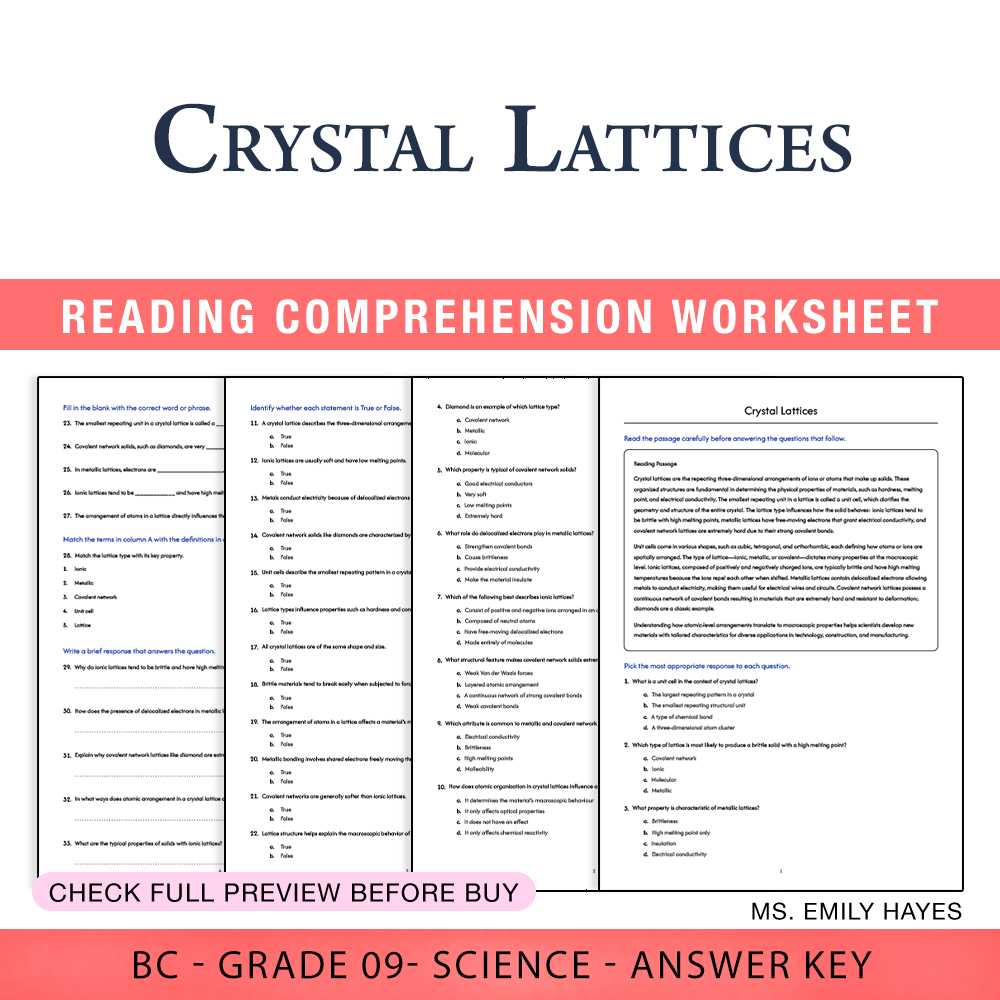
9th Grade Science | Crystal Lattices Worksheet (PDF+ Answer Key)
Created byCopper Leaf ClassroomLearning Objectives
- Understand the structure and function of different types of crystal lattices.
- Identify the characteristics and properties associated with ionic, metallic, and covalent network lattices.
- Explain how atomic arrangements influence the macroscopic properties of solids.
Also included in: Grade 9 Science Bundle | Chemistry, Physics & Atomic Concepts (PDF + Answer Key) +1 more
Instant download
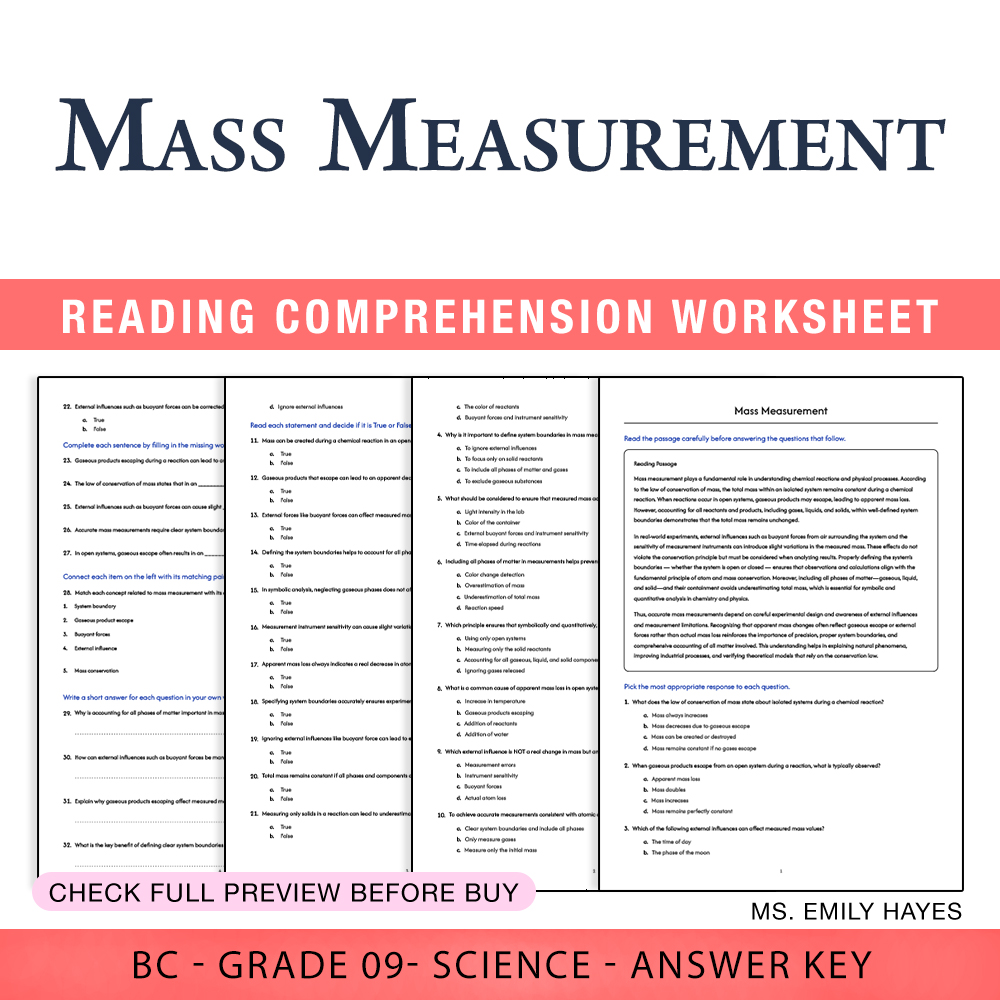
9th Grade Science | Mass Measurement Worksheet (PDF+ Answer Key)
Created byCopper Leaf ClassroomLearning Objectives
- Understand the principle of conservation of mass in chemical reactions.
- Identify factors affecting measured mass during experiments.
- Explain the importance of system boundaries in mass measurements.
Also included in: Grade 9 Science Bundle | Chemistry, Physics & Atomic Concepts (PDF + Answer Key) +1 more
Instant download
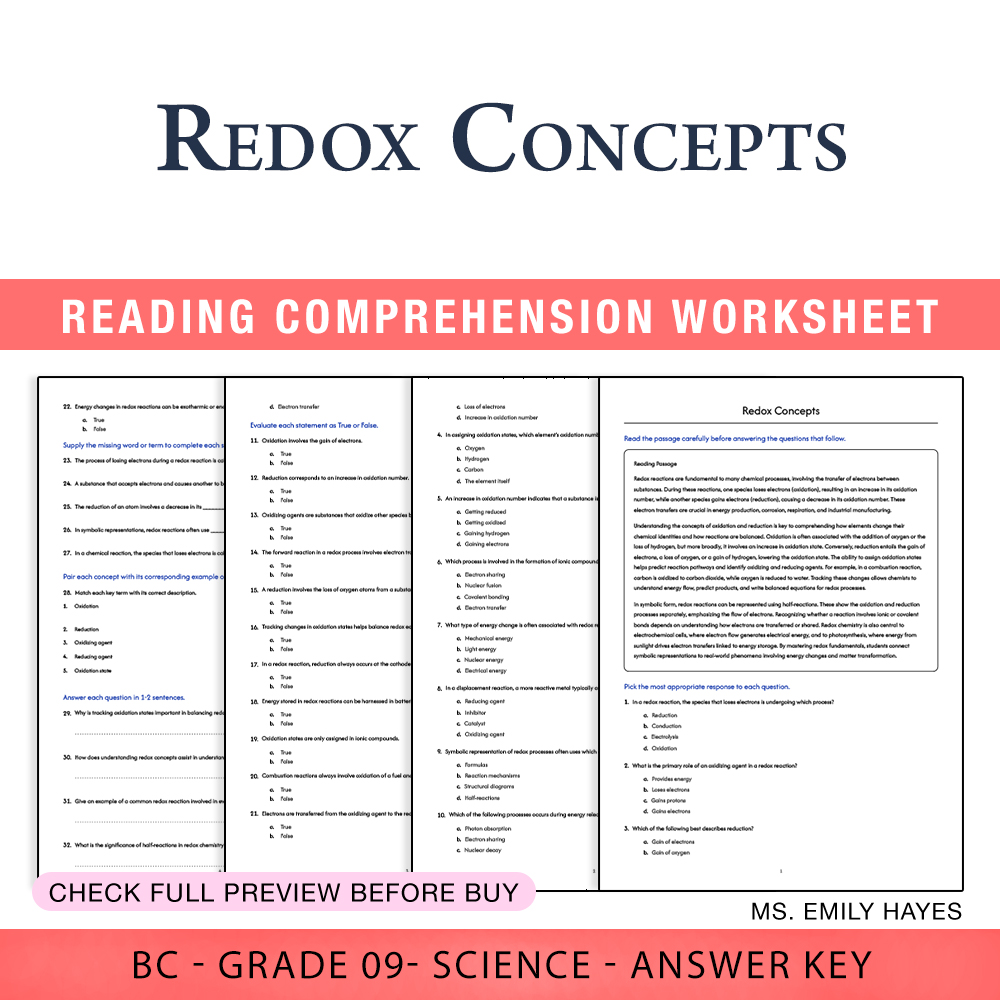
Grade 9 Science | Redox Concepts Worksheet (PDF+ Answer Key)
Created byCopper Leaf ClassroomLearning Objectives
- Explain the basic principles of oxidation and reduction in redox reactions.
- Identify oxidation states of elements in chemical equations.
- Track electron transfer to determine oxidizing and reducing agents.
Also included in: Grade 9 Science Bundle | Chemistry, Physics & Atomic Concepts (PDF + Answer Key) +1 more
Instant download
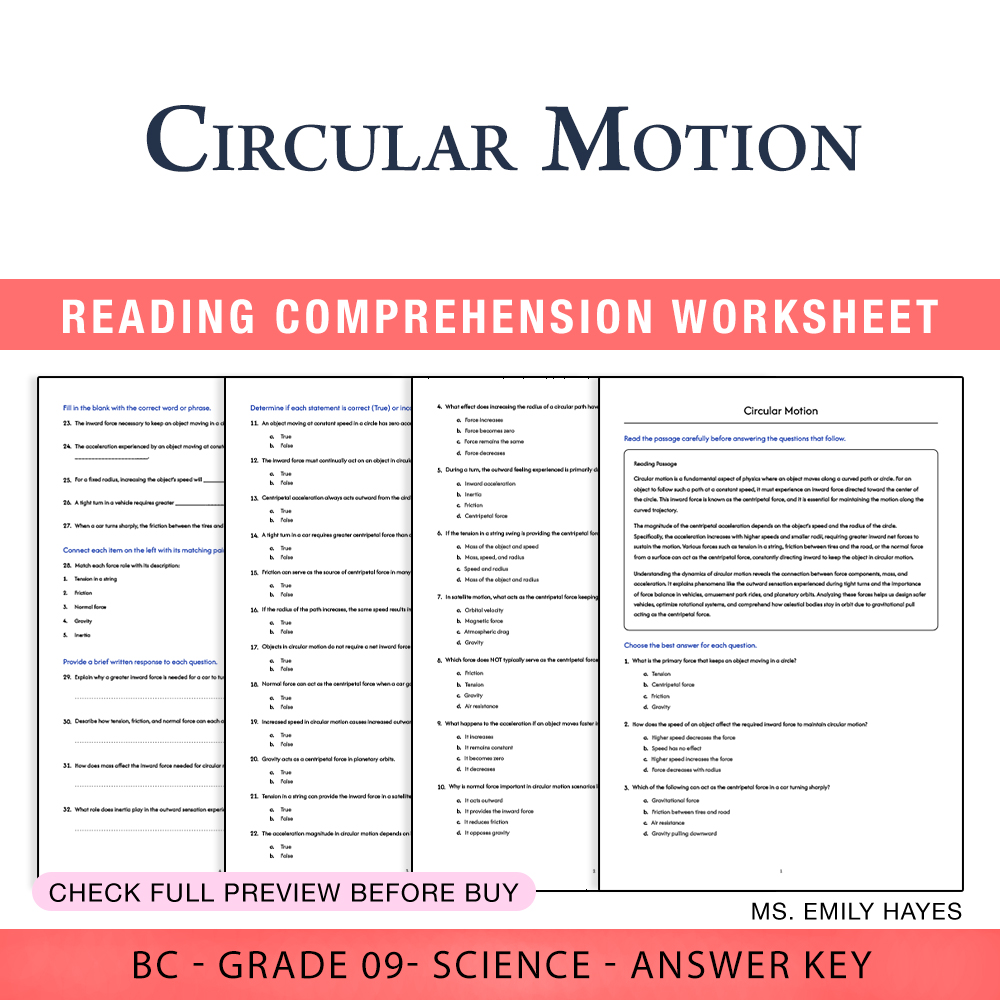
Grade 9 Science | Circular Motion Worksheet (PDF+ Answer Key)
Created byCopper Leaf ClassroomLearning Objectives
- Understand the role of centripetal force in circular motion.
- Identify the effects of inward acceleration on moving objects.
- Connect force components, mass, and acceleration in analyzing circular motion.
Also included in: Grade 9 Science Worksheet Bundle | Forces, Energy & Motion (PDF + Answer Key) +1 more
Instant download
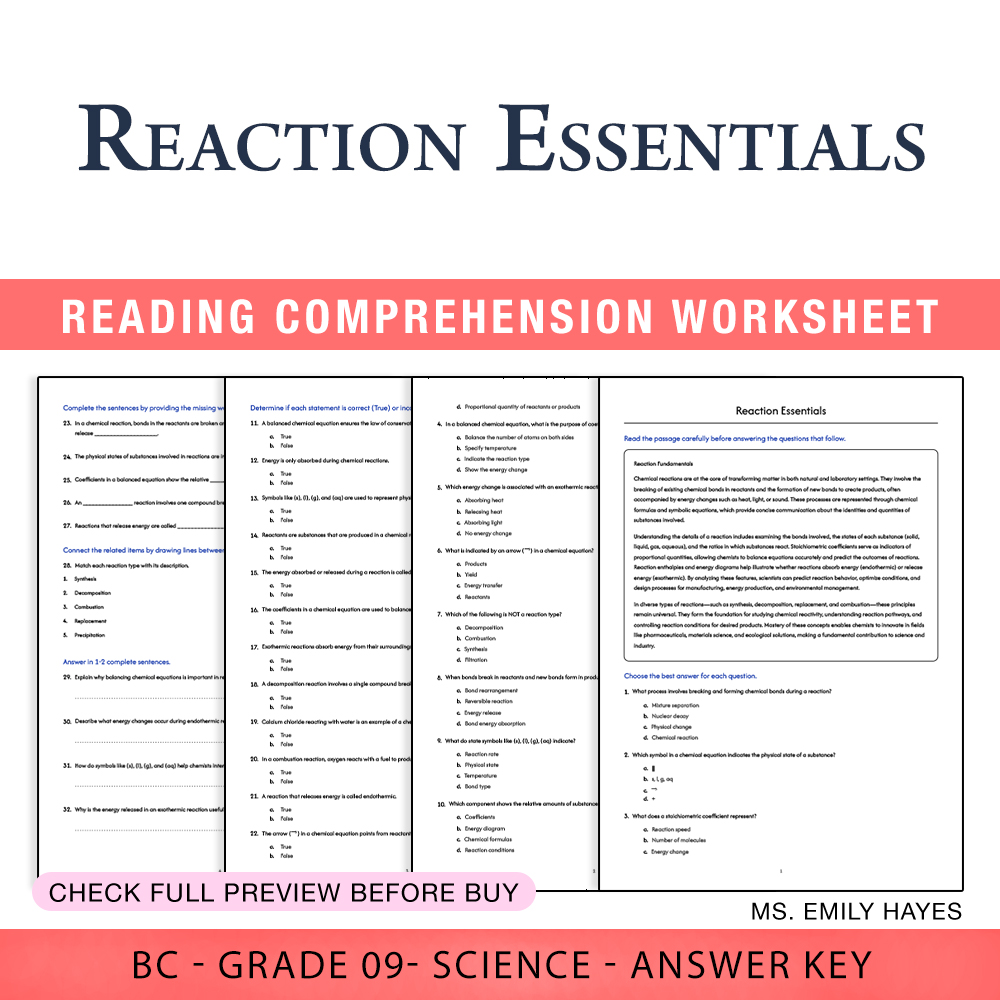
Grade 9 Science | Reaction Essentials Worksheet (PDF+ Answer Key)
Created byCopper Leaf ClassroomLearning Objectives
- Describe the components involved in chemical reactions and their transformations.
- Interpret chemical formulas and symbolic equations to understand reactions.
- Explain how bonds break and form, releasing or absorbing energy.
Also included in: Grade 9 Science Bundle | Chemistry, Physics & Atomic Concepts (PDF + Answer Key) +1 more
Instant download
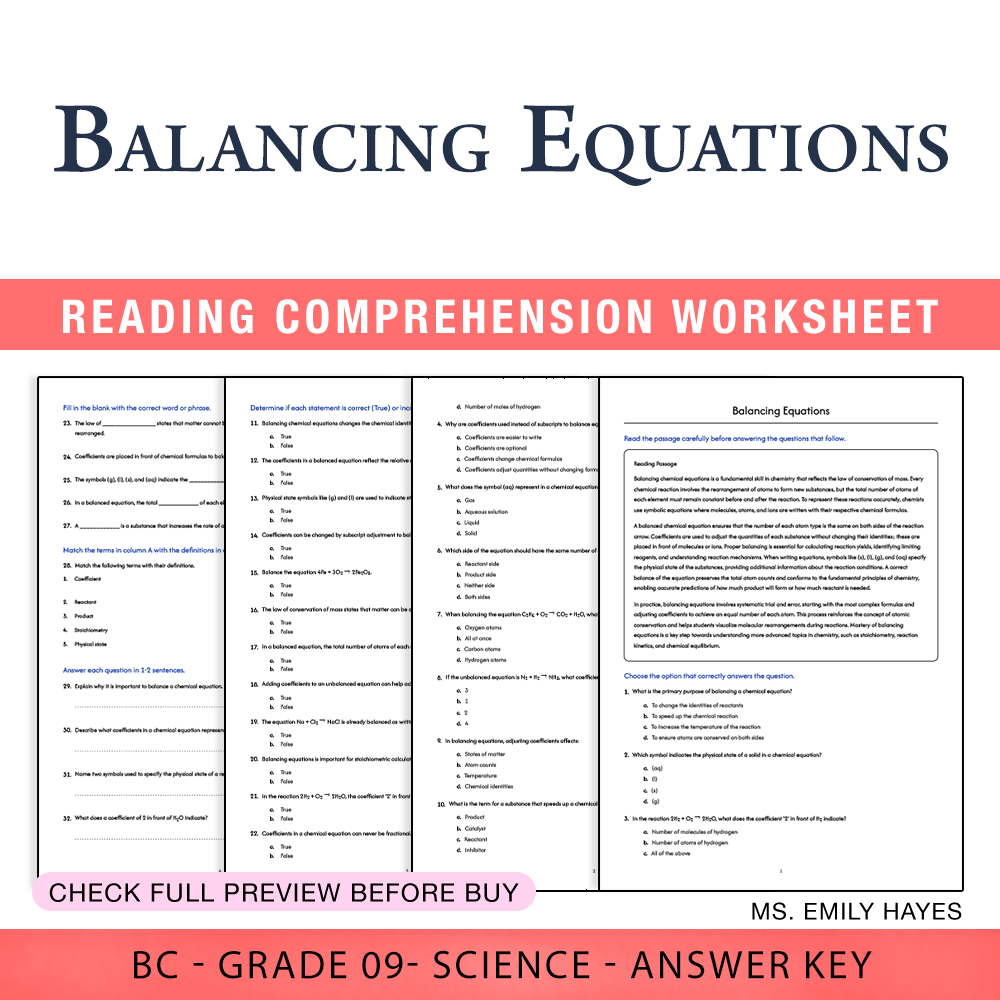
9th Grade Science | Balancing Equations Worksheet (PDF+ Answer Key)
Created byCopper Leaf ClassroomLearning Objectives
- Understand the purpose and importance of balancing chemical equations.
- Learn how to correctly balance chemical equations using coefficients.
- Identify the roles of coefficients and state symbols in chemical equations.
Also included in: Grade 9 Science Bundle | Chemistry, Physics & Atomic Concepts (PDF + Answer Key) +1 more
Instant download
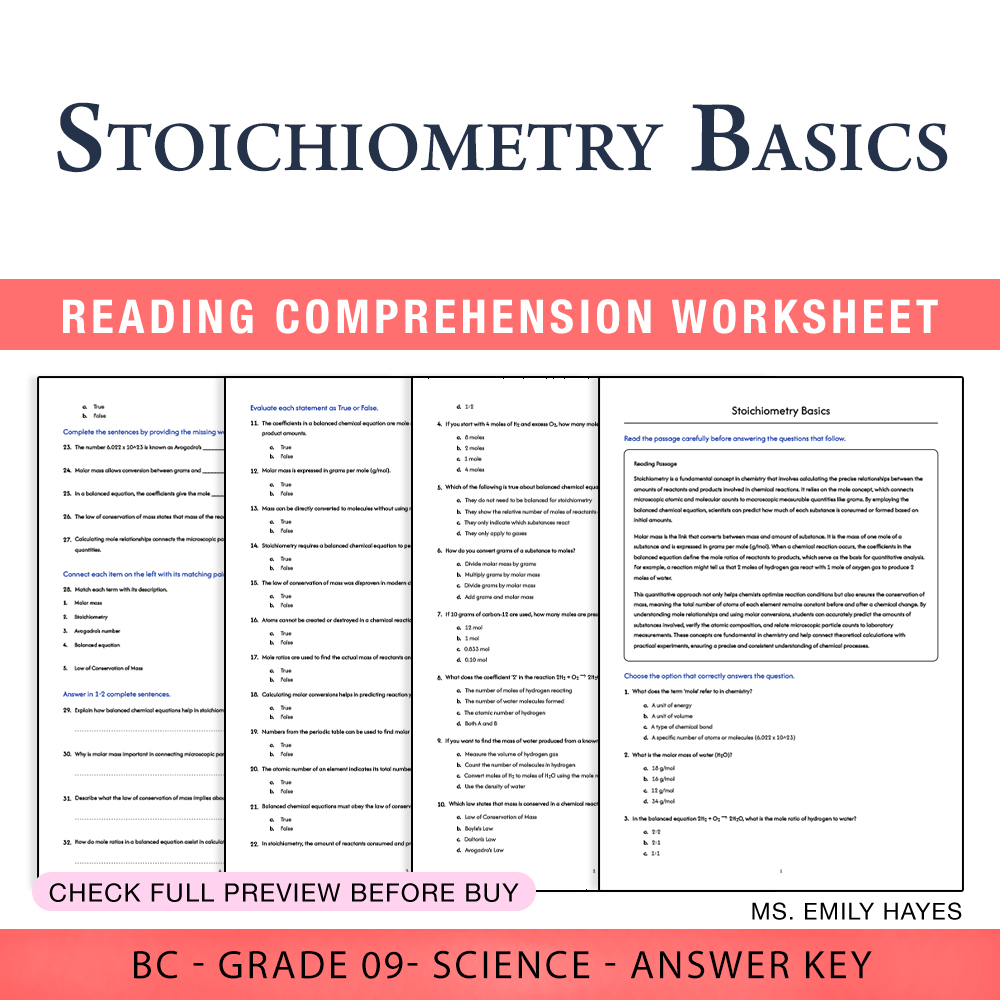
9th Grade Science | Stoichiometry Basics Worksheet (PDF+ Answer Key)
Created byCopper Leaf ClassroomLearning Objectives
- Understand how mole relationships connect reactants and products in chemical equations.
- Calculate masses and amounts of substances using molar mass and balanced equations.
- Interpret mole ratios and convert between grams and moles in chemical reactions.
Also included in: Grade 9 Science Bundle | Chemistry, Physics & Atomic Concepts (PDF + Answer Key) +1 more
Instant download
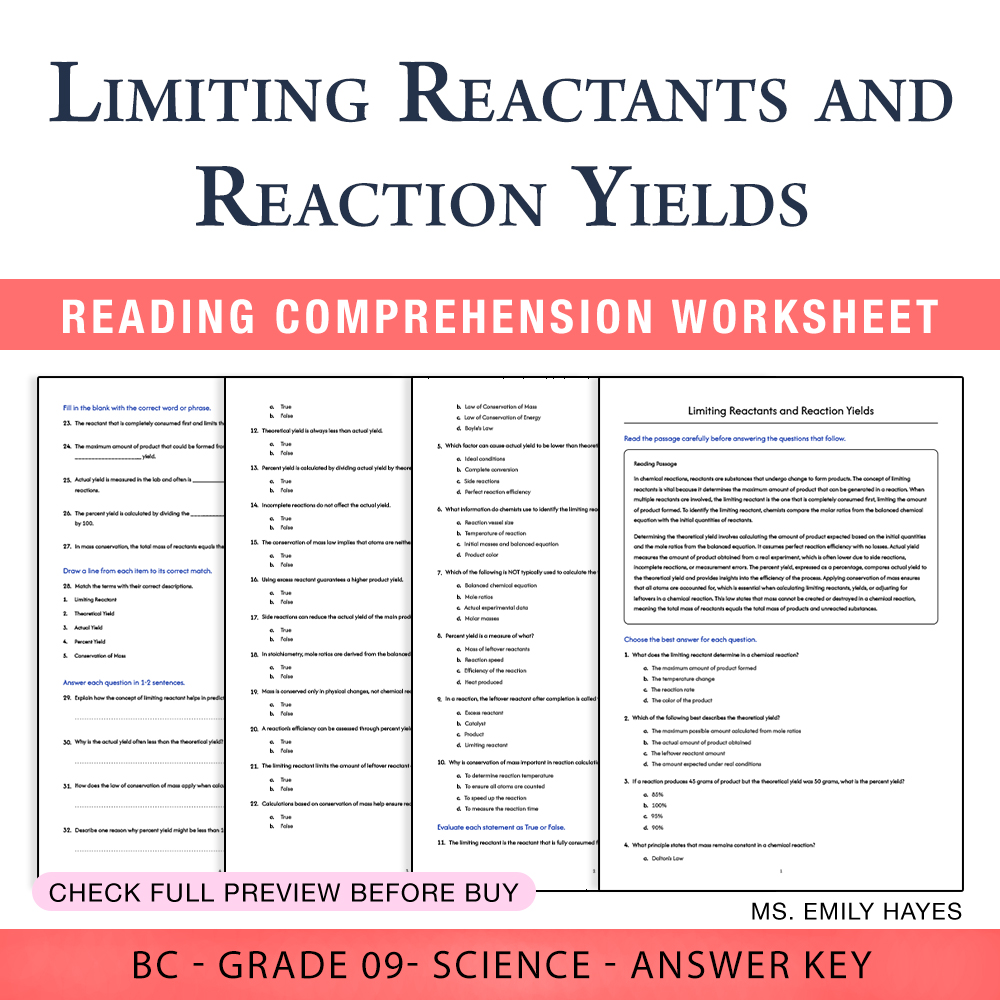
Grade 9 Science | Limiting Reactants & Reaction Yields Worksheet (PDF + Answers)
Created byCopper Leaf ClassroomLearning Objectives
- Understand the concept of limiting reactants and how they determine product formation.
- Calculate theoretical, actual, and percent yields in chemical reactions.
- Apply conservation of mass principles to reaction calculations.
Also included in: Grade 9 Science Bundle | Chemistry, Physics & Atomic Concepts (PDF + Answer Key) +1 more
Instant download
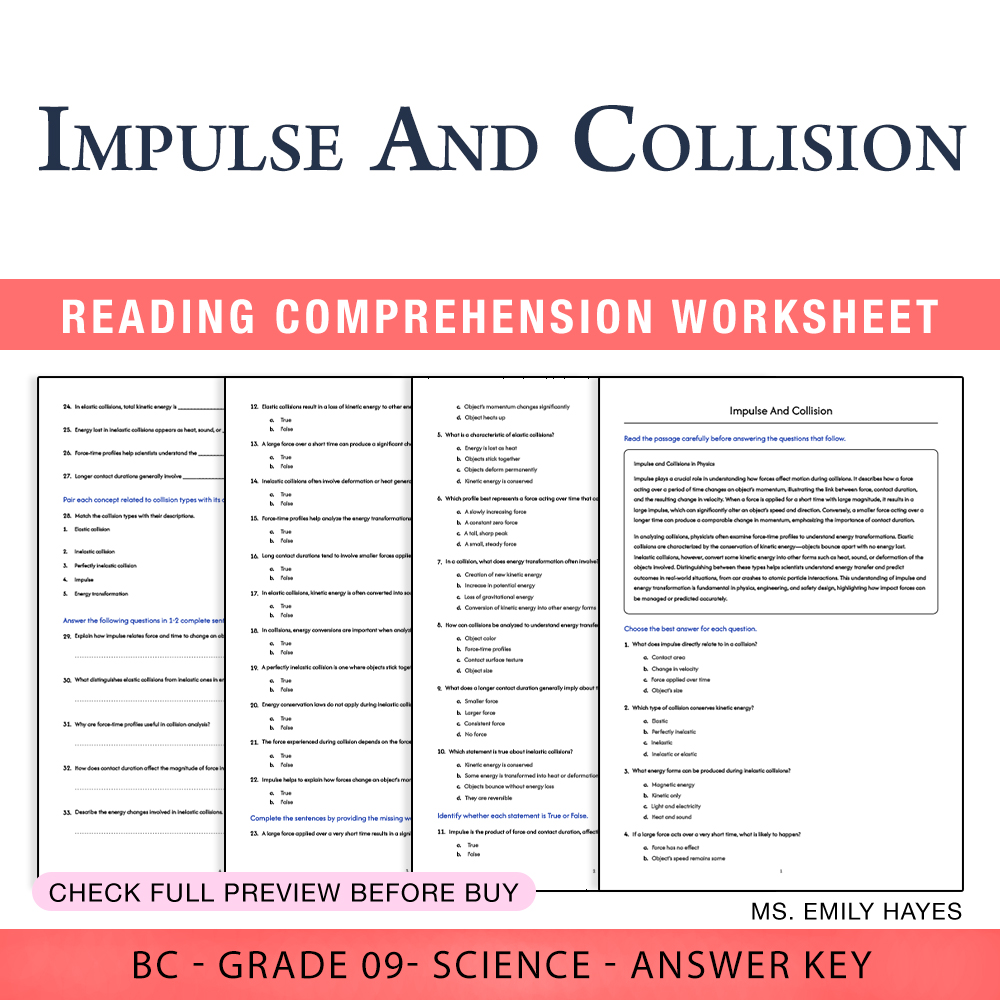
Grade 9 Science | Impulse & Collision Worksheet (PDF+ Answer Key)
Created byCopper Leaf ClassroomLearning Objectives
- Describe how impulse relates force, contact duration, and change in an object's momentum during collisions.
- Differentiate between elastic and inelastic collisions based on energy transformations.
- Analyze force-time profiles involved in collisions to predict resulting velocities and energy changes.
Also included in: Grade 9 Science Worksheet Bundle | Forces, Energy & Motion (PDF + Answer Key) +1 more
Instant download
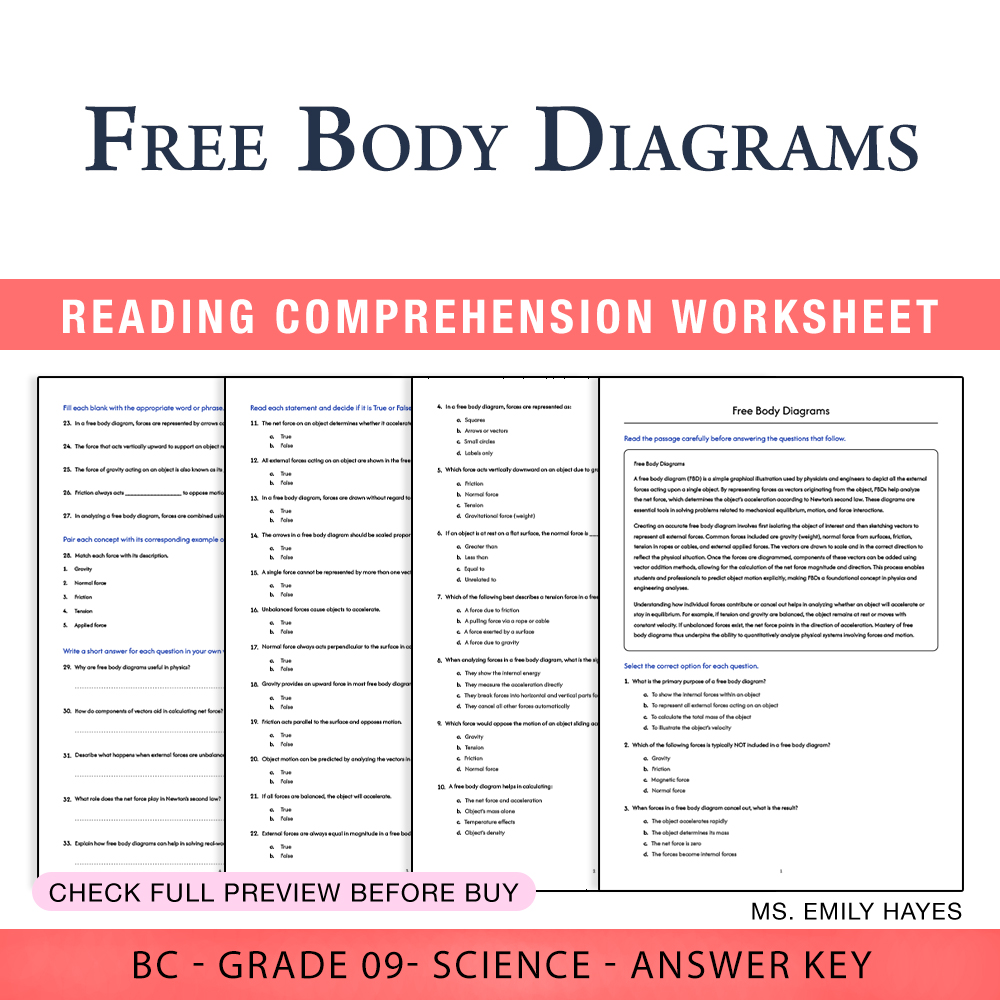
Grade 9 Science | Free Body Diagrams Worksheet (PDF+ Answer Key)
Created byCopper Leaf ClassroomLearning Objectives
- Understand the purpose and components of free body diagrams.
- Identify and sketch external forces acting on an object in various scenarios.
- Calculate net force vectors from individual force components.
Also included in: Grade 9 Science Worksheet Bundle | Forces, Energy & Motion (PDF + Answer Key) +1 more
Instant download

9th Grade Science | Mass Conservation Worksheet (PDF+ Answer Key)
Created byCopper Leaf ClassroomLearning Objectives
- Understand the principle of conservation of mass during chemical reactions.
- Interpret balanced chemical equations in terms of atoms and mass.
- Apply the law of conservation of mass to solve quantitative problems in chemistry.
Also included in: Grade 9 Science Bundle | Chemistry, Physics & Atomic Concepts (PDF + Answer Key) +1 more
Instant download
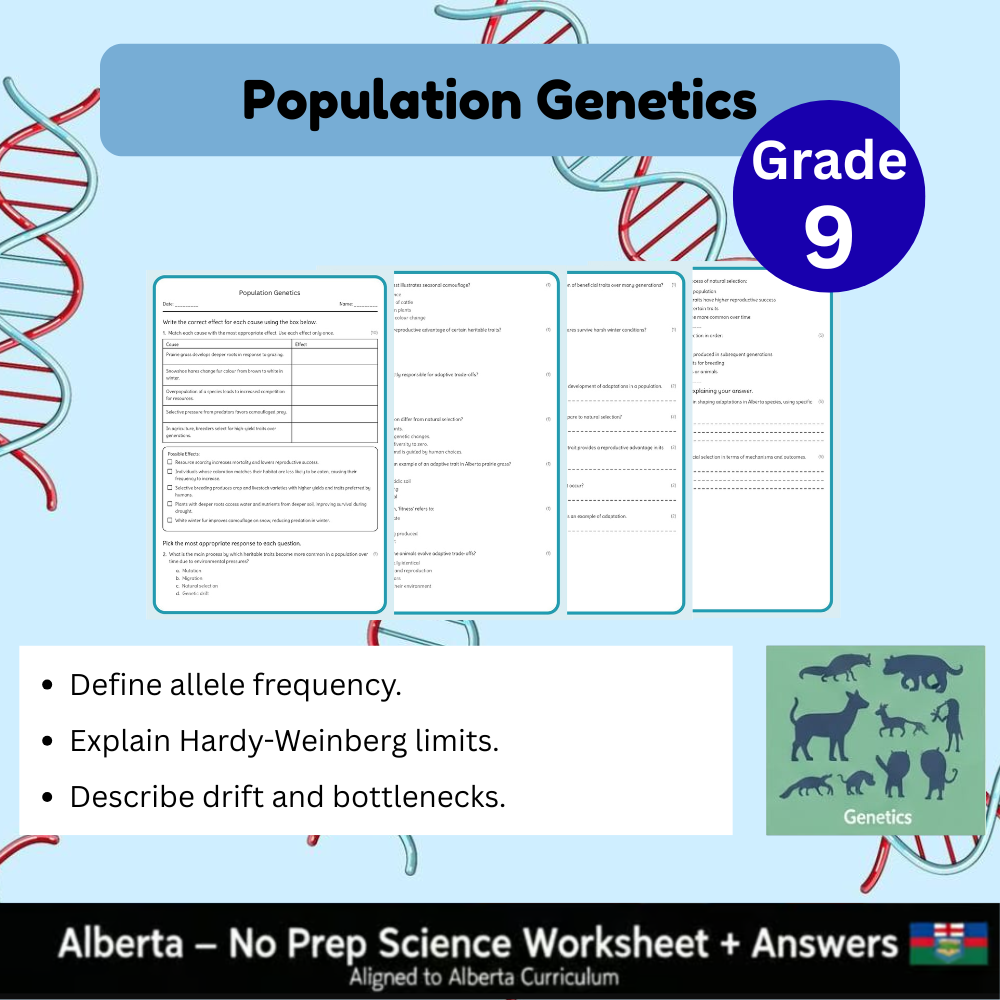
Grade 9 Science – Population Genetics Worksheet (PDF) – Alberta Standard
Created byBright Mind ResourcesLearning Objectives
- Understand the principles of allele frequency and genetic variation in populations.
- Explain the assumptions of Hardy-Weinberg equilibrium and factors disrupting it.
- Describe the effects of genetic drift, bottlenecks, and founder effects on genetic diversity.
Instant download

Grade 9 Climate Forcing Drivers Worksheet | Ontario Science Activities
 Created byChalk and Compass
Learning Objectives
- Explain how greenhouse gases, albedo changes, aerosols, and land-use feedbacks can alter Earth’s energy balance.
- Use basic radiative transfer and energy-budget ideas to describe how atmospheric composition affects surface temperature.
- Connect human emissions to carbon-cycle changes and to likely climate responses under different emission pathways.
Also included in: Earth Systems & Space Lesson Bundle – Grade 9 Science Ontario Framework +1 more
Instant download
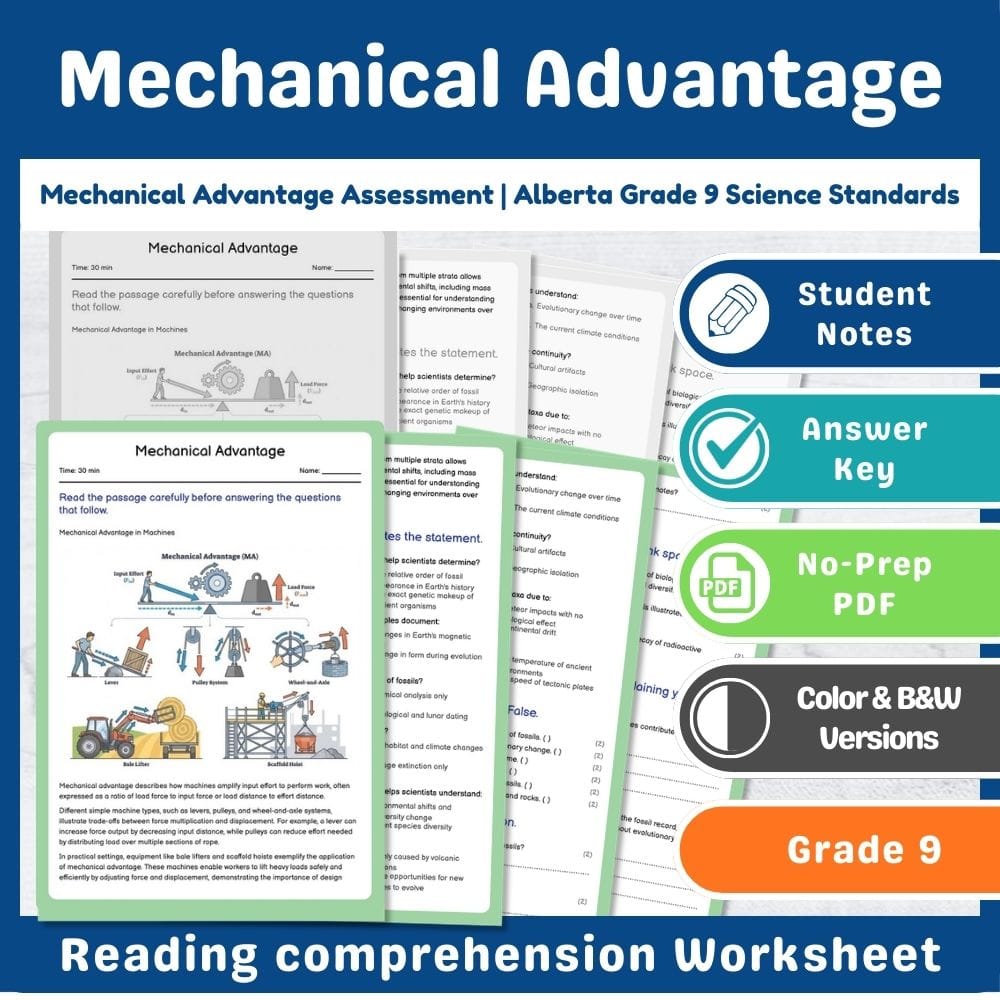
Mechanical Advantage Assessment | Alberta Grade 9 Science Standards
Created byPrism Point LearningLearning Objectives
- Understand the concept of mechanical advantage and how it is expressed as a ratio.
- Calculate mechanical advantage for different machine types such as levers, pulleys, and wheel systems.
- Analyze trade-offs between force reduction and displacement increase in simple machines.
Also included in: Grade 9 Forces and Motion Science Lesson Bundle Alberta Framework +1 more
Instant download

Grade 9 Science — Worksheet MCQ Paper for Mastering Scientific Predictions
 Created byThe Resource Hub
Learning Objectives
- Understand the role of computational simulations and models in forecasting.
- Identify how sensitivity analysis influences prediction accuracy.
- Describe how ensembles and visualizations convey uncertainty in simulation outputs.
Also included in: Grade 9 Science Practices Lesson Bundle for AP Standards +1 more
Instant download

Grade 9 Science — Worksheet MCQ Paper for Mastering Unit Analysis
Created byThe Resource HubLearning Objectives
- Understand the principles of dimensional analysis and unit consistency.
- Apply unit checking to identify algebraic errors and validate models.
- Demonstrate how units constrain plausible relationships and assist in measurement transformations.
Also included in: Grade 9 Science Practices Lesson Bundle for AP Standards +1 more
Instant download
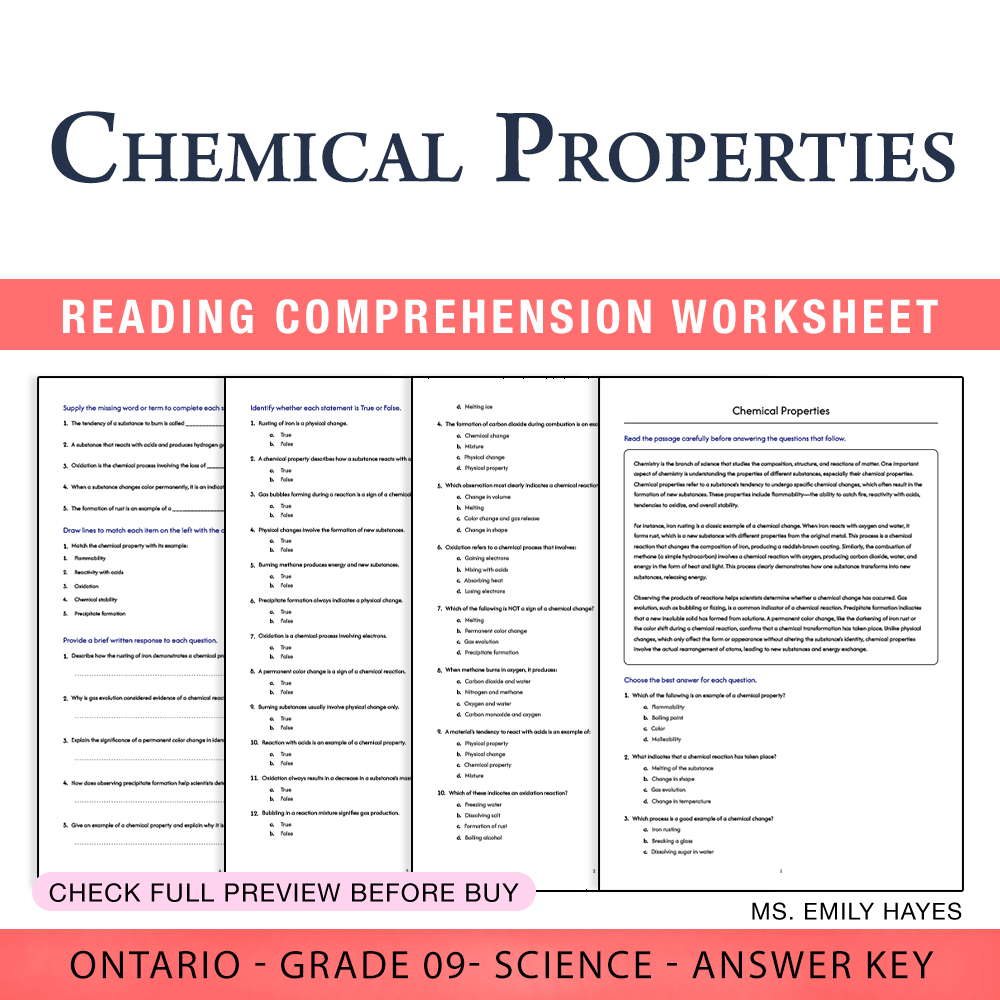
Grade 9 Science | Chemical Properties Worksheet (PDF + Answer Key)
Created byCopper Leaf ClassroomLearning Objectives
- Understand the definition of chemical properties and how they differ from physical properties.
- Identify common chemical properties such as flammability, reactivity, oxidation, and stability.
- Interpret observations indicating chemical reactions, including gas evolution, precipitate formation, and color change.
Instant download
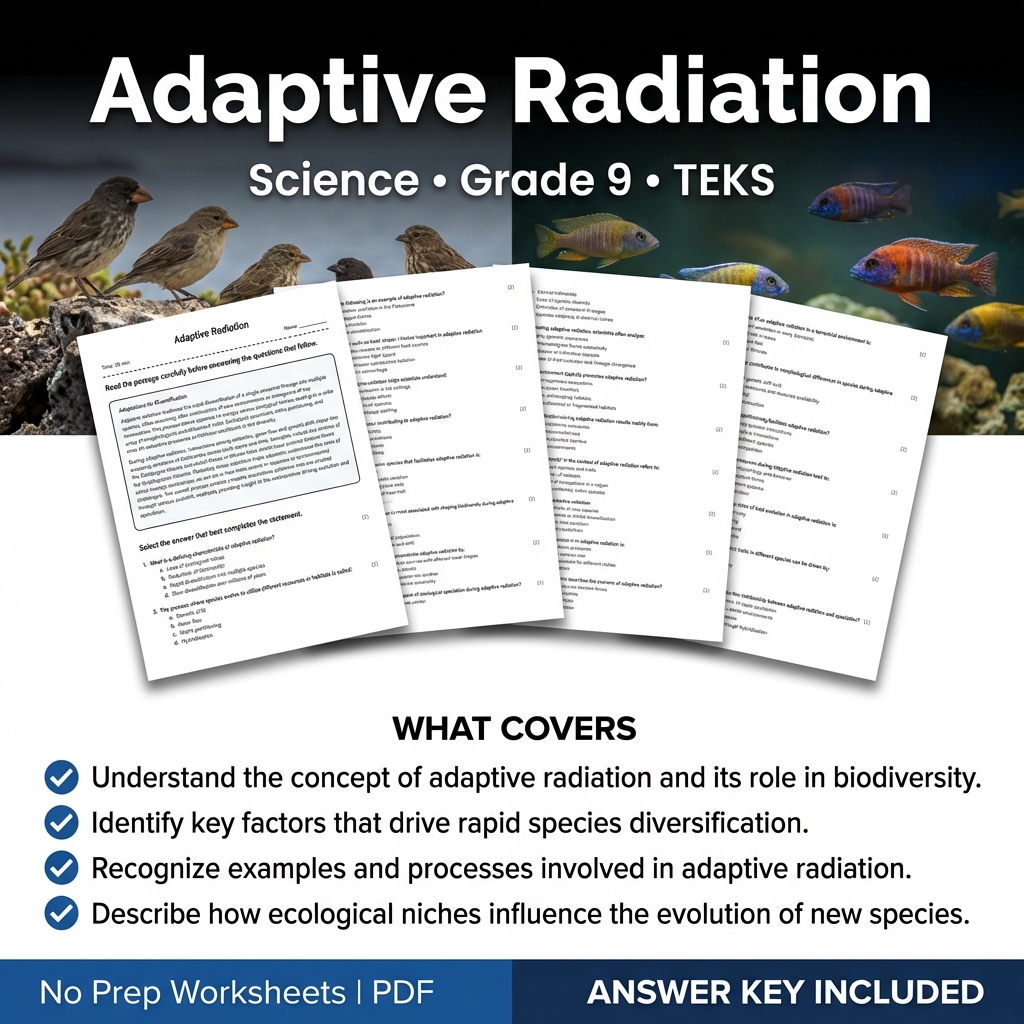
Grade 9 Science Worksheet on Adaptive Radiation | TEKS Aligned
Created byCoral Reef LearningLearning Objectives
- Understand the concept of adaptive radiation and its role in biodiversity.
- Identify key factors that drive rapid species diversification.
- Recognize examples and processes involved in adaptive radiation.
Instant download
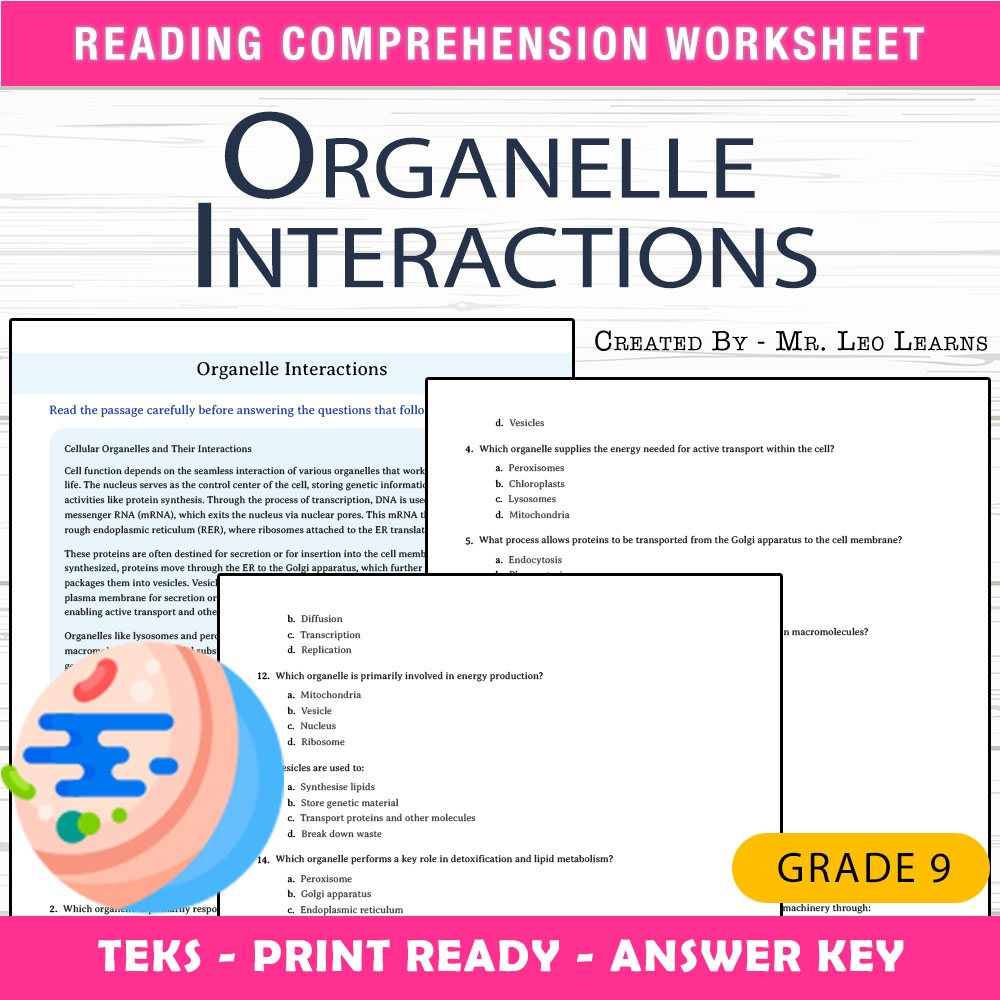
Grade 9 Science | Organelles Interactions Worksheet for Mastery
Created byThe Resource HubLearning Objectives
- Describe how different organelles in a cell coordinate to maintain cellular functions.
- Explain the flow of genetic information and protein trafficking from the nucleus to secretion.
- Identify the roles of mitochondria, lysosomes, and peroxisomes in energy production and recycling.
Also included in: Grade 9 Science Unit Bundle | Cell Structures & Transport Mechanisms Worksheets +1 more
Instant download

Grade 9 Science – Organ Systems Worksheet (TEKS) (PDF)
 Created byEvergreen Desk Education
Learning Objectives
- Explain how major organ systems (circulatory, respiratory, digestive, renal, nervous, endocrine) work together to maintain homeostasis
- Describe how feedback communication helps coordinate body functions under changing external conditions
- Use evidence from a reading passage to connect organ system roles with specific physiological outcomes
Instant download
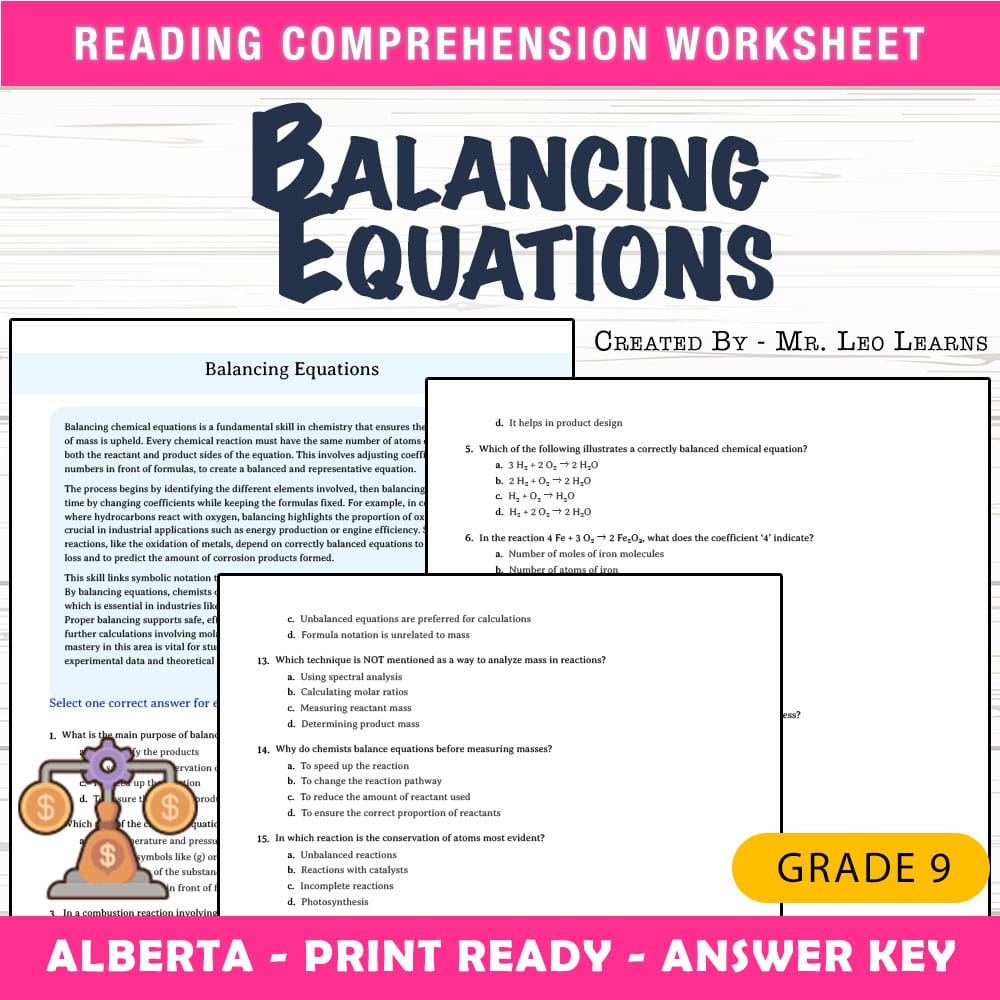
Grade 9 Science — Worksheet MCQ Paper for Mastering Balancing Equations
Created byThe Resource HubLearning Objectives
- Understand the importance of balancing chemical equations to obey the conservation of atoms and mass.
- Identify the correct coefficients to balance chemical reactions.
- Relate formula notation to measurable mass relationships in chemical reactions.
Also included in: Grade 9 Science Bundle | Matter and Chemical Change Worksheets Pack +1 more
Instant download
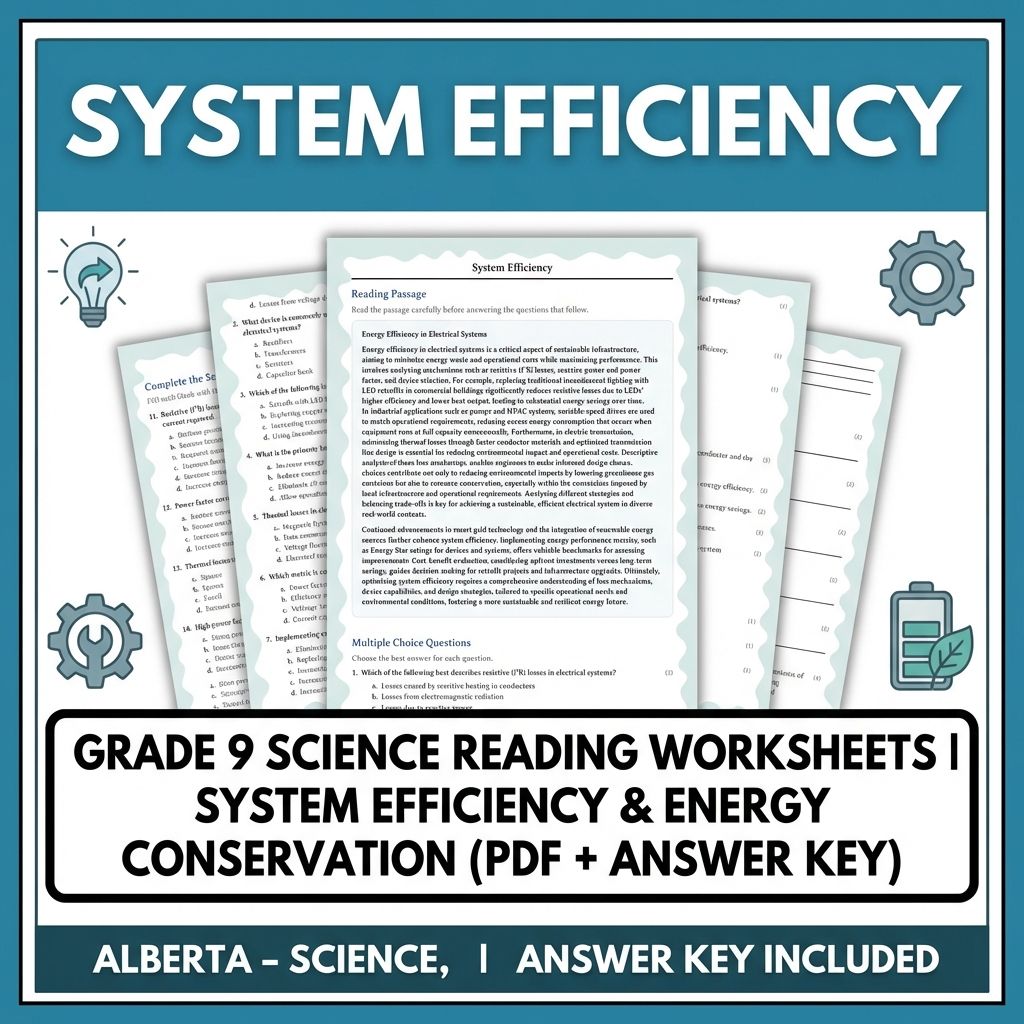
Grade 9 Science | System Efficiency & Energy Conservation (PDF + Answer Key)
JCreated byJ.S SheetsLearning Objectives
- Understand the mechanisms of energy loss in electrical systems.
- Identify strategies to improve system efficiency and reduce environmental impact.
- Compare different device options and design considerations for energy-efficient systems.
Also included in: Grade 9 Science Bundle | Electricity, Energy & Magnetism (PDF + Answer Keys) +1 more
Instant download
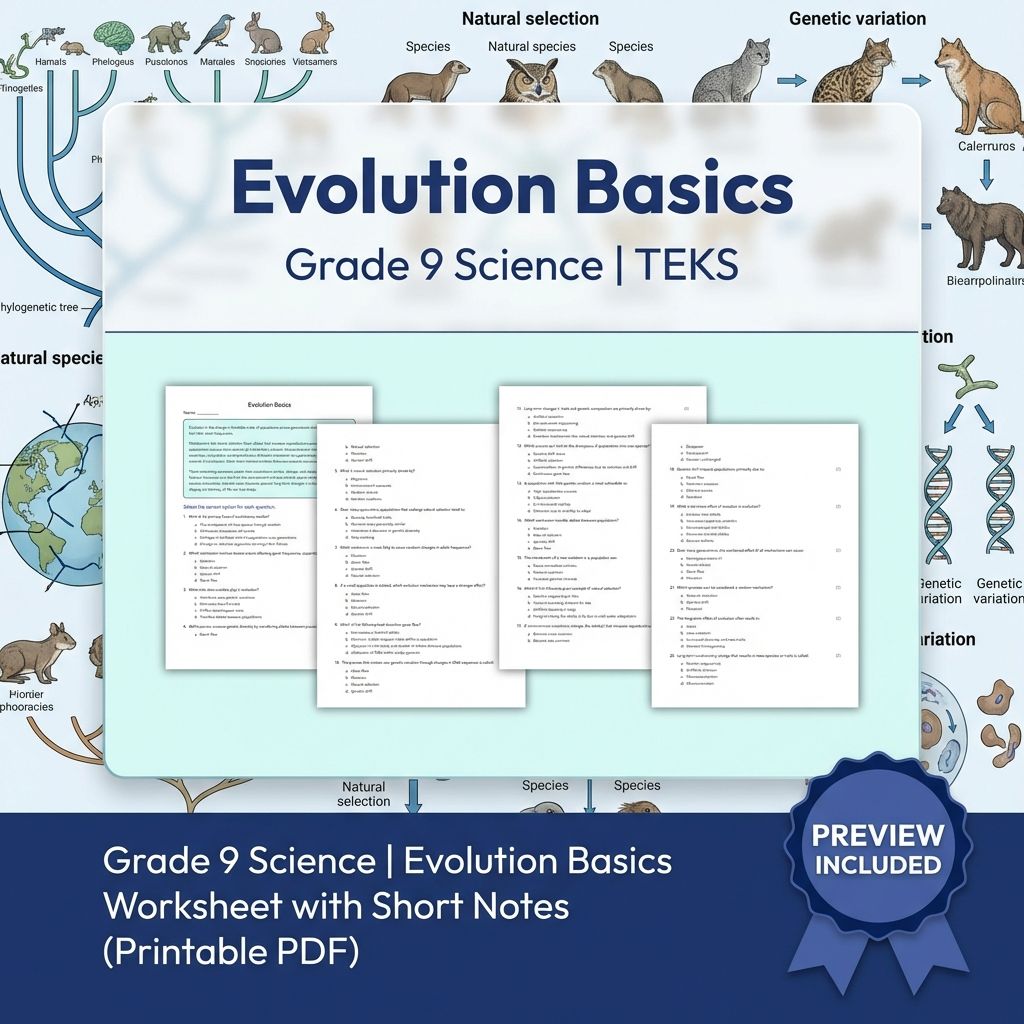
Grade 9 Science | Evolution Basics Worksheet with Short Notes (Printable PDF)
 Created byMeadowlark Worksheets
Learning Objectives
- Understand the fundamental mechanisms driving evolution, including natural selection, genetic drift, mutation, and gene flow.
- Describe how these mechanisms influence allele frequencies and lead to change in populations over time.
- Explain how populations adapt, diverge, and show long-term genetic and trait changes due to evolutionary processes.
Instant download
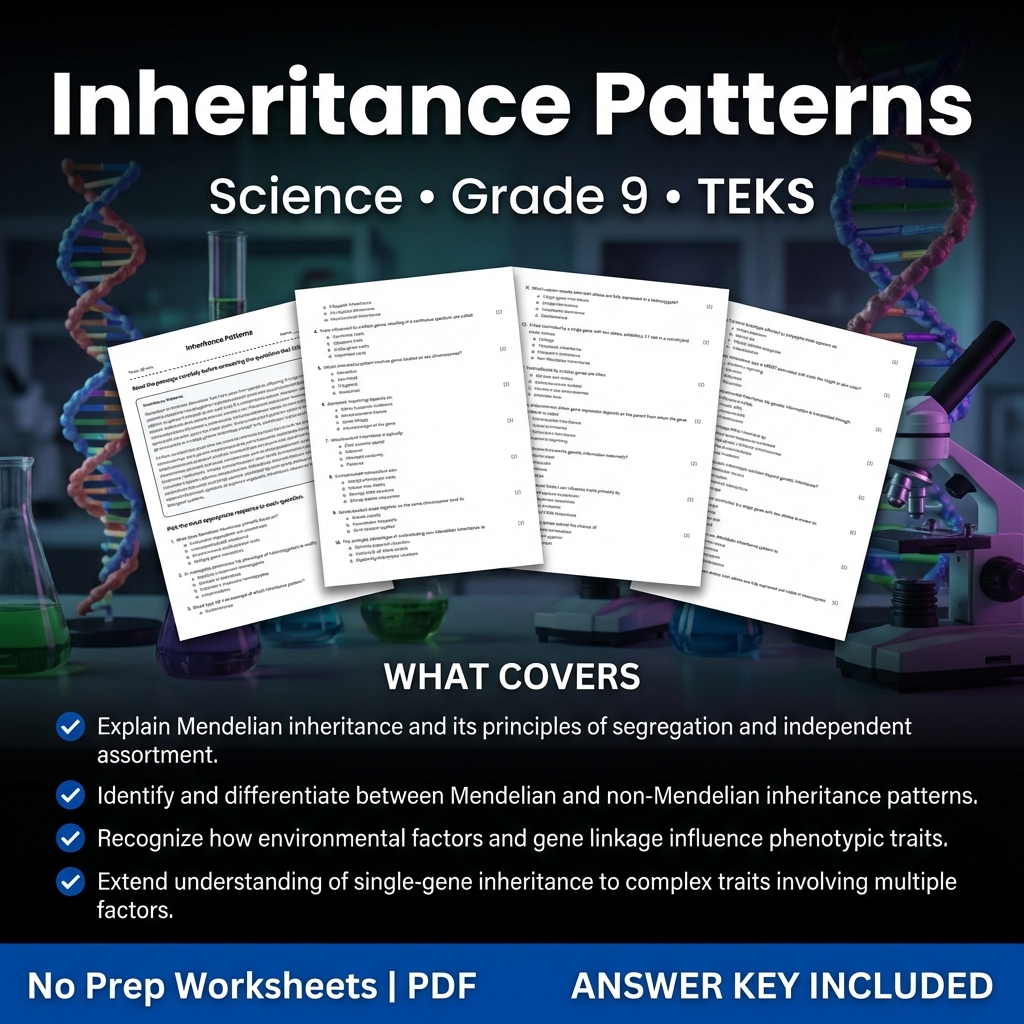
Inheritance Patterns Science Worksheet Grade 9 TEKS Practice PDF
Created byCoral Reef LearningLearning Objectives
- Explain Mendelian inheritance and its principles of segregation and independent assortment.
- Identify and differentiate between Mendelian and non-Mendelian inheritance patterns.
- Recognize how environmental factors and gene linkage influence phenotypic traits.
Instant download
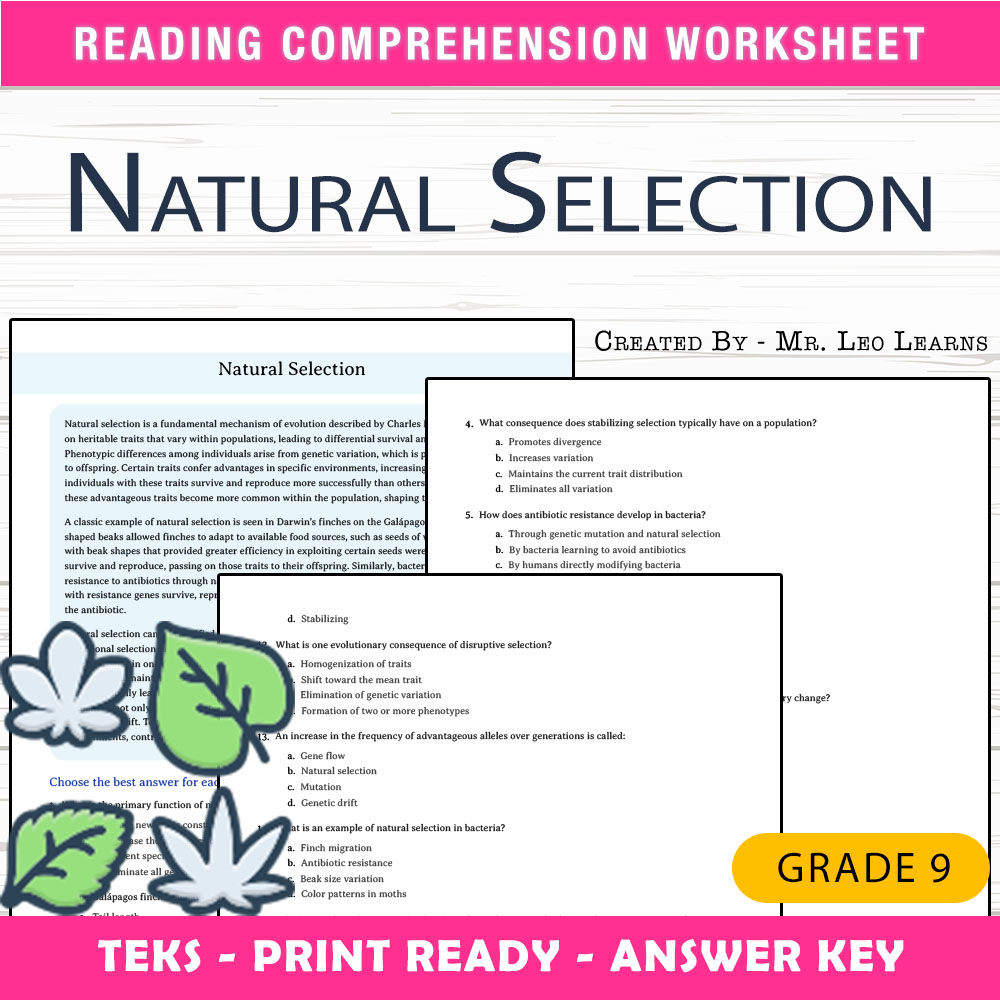
Grade 9 Science – Natural Selection Worksheet for Mastery
Created byThe Resource HubLearning Objectives
- Explain the basic mechanisms of natural selection and how it contributes to evolution.
- Identify examples of natural selection in nature, such as beak variation in finches and antibiotic resistance in bacteria.
- Describe different types of selection: directional, stabilizing, and disruptive.
Also included in: Grade 9 Science Evolution & Classification Unit Worksheet Pack +1 more
Instant download

Inheritance Patterns Assessment | TEKS Grade 9 Science Standards
Created byPrism Point LearningLearning Objectives
- Describe Mendelian patterns like segregation and independent assortment.
- Identify and compare non-Mendelian inheritance patterns such as incomplete dominance and codominance.
- Recognize how environmental factors and gene linkage influence trait expression.
Instant download
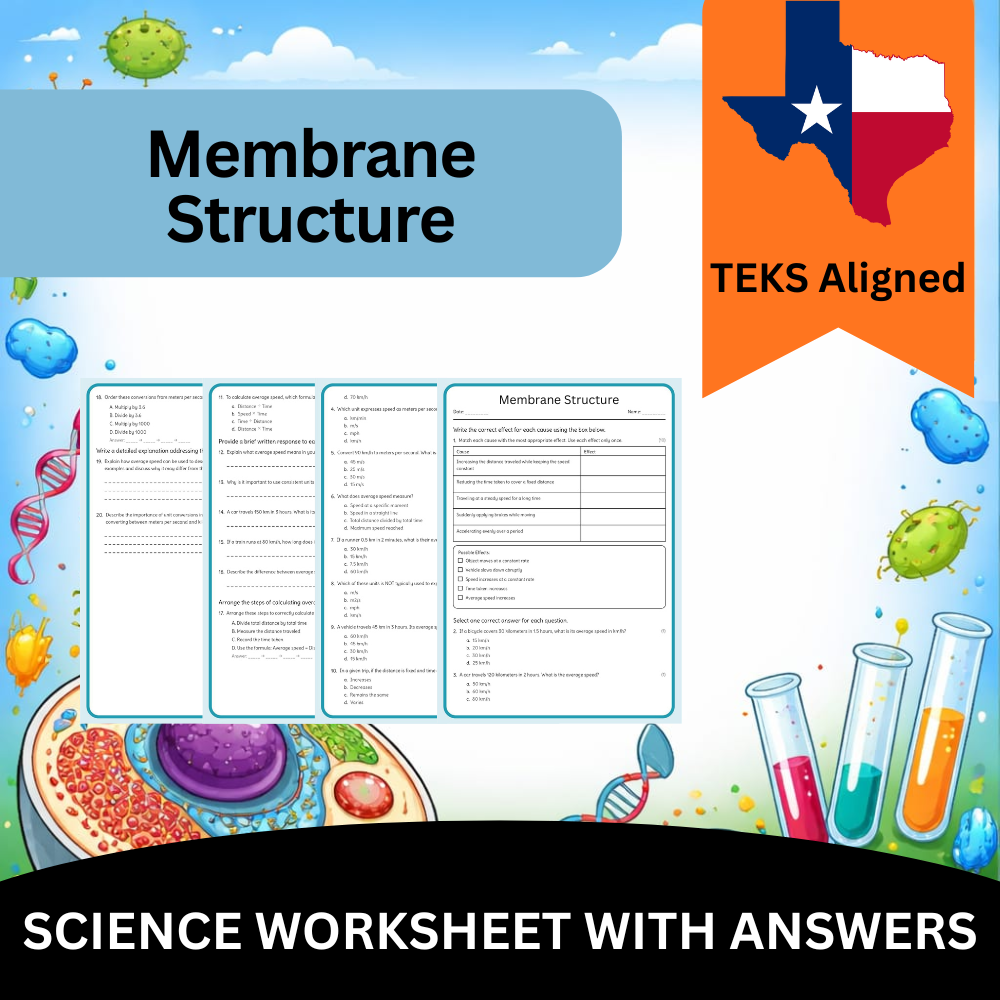
Grade 9 Science – Membrane Structure Worksheet (Worksheet + Answer Key) – TEKS Aligned
Created byBright Mind ResourcesLearning Objectives
- Describe the basic components and organization of the phospholipid bilayer.
- Explain the roles of integral and peripheral proteins in membrane function.
- Understand how cholesterol and carbohydrate chains influence membrane fluidity and recognition.
Also included in: Grade 9 Science Unit | Cell Structures & Transport Mechanisms Pack(TEKS-Aligned) +3 more
Instant download

Grade 9 Science – Reaction Quantities Daily Reading Worksheet| Alberta Standards
Created byBright Mind ResourcesLearning Objectives
- Understand how to interpret coefficient ratios in balanced chemical equations
- Relate chemical equation coefficients to quantities of reactants and products
- Apply proportional reasoning to real-world chemical problems involving mass
Also included in: States of Matter Grade 9 Science Daily Reading Worksheets lesson bundle |Alberta +1 more
Instant download

Grade 9 Science – Element Symbols & Chemical Formulas | Daily Reading Worksheet
Created byBright Mind ResourcesLearning Objectives
- Identify the symbols of common elements.
- Understand how chemical formulas represent compounds.
- Learn the significance of element symbols in scientific communication.
Also included in: States of Matter Grade 9 Science Daily Reading Worksheets lesson bundle |Alberta +1 more
Instant download

Grade 9 Science – Environmental Chemistry & Acid Deposition | Reading Worksheet
Created byBright Mind ResourcesLearning Objectives
- Understand the chemical processes involved in acid deposition
- Identify the environmental impacts of acid rain on limestone formations
- Analyze real-world examples of acid rain effects in regional contexts
Also included in: States of Matter Grade 9 Science Daily Reading Worksheets lesson bundle |Alberta +1 more
Instant download
About Grade 9 Science Worksheets
Find Science worksheets built for Grade 9. All 6,986 cover core skills, practice, and review, each an instant PDF download.
Every worksheet on MyTeachingSheets is created by independent teacher-authors and reviewed before publication. All resources download as printable PDFs for classroom, homework, or at-home practice, and many include answer keys. Preview any worksheet free before buying.