
Grade 9 Science Worksheets
6,986 worksheets
Grade 9 Science – Element Symbols & Chemical Formulas | Daily Reading Worksheet
 Created byBright Mind Resources
Learning Objectives
- Identify the symbols of common elements.
- Understand how chemical formulas represent compounds.
- Learn the significance of element symbols in scientific communication.
Also included in: States of Matter Grade 9 Science Daily Reading Worksheets lesson bundle |Alberta +1 more
Instant download

Grade 9 Science – Environmental Chemistry & Acid Deposition | Reading Worksheet
Created byBright Mind ResourcesLearning Objectives
- Understand the chemical processes involved in acid deposition
- Identify the environmental impacts of acid rain on limestone formations
- Analyze real-world examples of acid rain effects in regional contexts
Also included in: States of Matter Grade 9 Science Daily Reading Worksheets lesson bundle |Alberta +1 more
Instant download
Grade 9 Science – Units in Physics Daily Reading Worksheet + Answer Key
JCreated byJ.S SheetsLearning Objectives
- Understand key concepts related to Science
- Apply knowledge through practice questions
- Demonstrate comprehension of the material
Also included in: Grade 9 Science Lesson Group - AP Framework Daily Reading Worksheets +1 more
Instant download

Grade 9 Science | Power Distribution - Daily Reading Comprehension
 Created byCoral Reef Learning
Learning Objectives
- Understand how electricity is generated at power plants.
- Learn the basic steps of initial electricity transmission from power plants.
- Identify components of modern power distribution systems.
Also included in: Electricity and Magnetism Lesson Bundle – Grade 9 Science Alberta +1 more
Instant download

Grade 9 Science | Circuit Types - Daily Reading Comprehension
Created byCoral Reef LearningLearning Objectives
- Identify the characteristics of series and parallel circuits
- Explain how current and voltage behave in different circuit arrangements
- Recognize real-world examples of series and parallel circuits
Also included in: Electricity and Magnetism Lesson Bundle – Grade 9 Science Alberta +1 more
Instant download

Grade 9 Science | Renewable Energy Sources - Daily Reading Comprehension
Created byCoral Reef LearningLearning Objectives
- Identify different renewable energy sources such as wind, solar, and hydroelectric power.
- Understand the basic functions of these renewable sources in electricity generation.
- Comprehend the importance of integrating renewable sources into the electrical grid.
Also included in: Electricity and Magnetism Lesson Bundle – Grade 9 Science Alberta +1 more
Instant download

Grade 9 Science | Electrical Applications - Daily Reading Comprehension
Created byCoral Reef LearningLearning Objectives
- Understand the importance of device ratings in electrical systems
- Identify appropriate uses for various electrical devices
- Evaluate safety measures related to electrical device implementation
Also included in: Electricity and Magnetism Lesson Bundle – Grade 9 Science Alberta +1 more
Instant download
Grade 9 Science – Adaptation and Selection Daily Reading Worksheet + Answer Key
JCreated byJ.S SheetsLearning Objectives
- Understand key concepts related to Science
- Apply knowledge through practice questions
- Demonstrate comprehension of the material
Also included in: Grade 9 Science Lesson Group | Genetics, Reproduction, and Biotechnology +1 more
Instant download
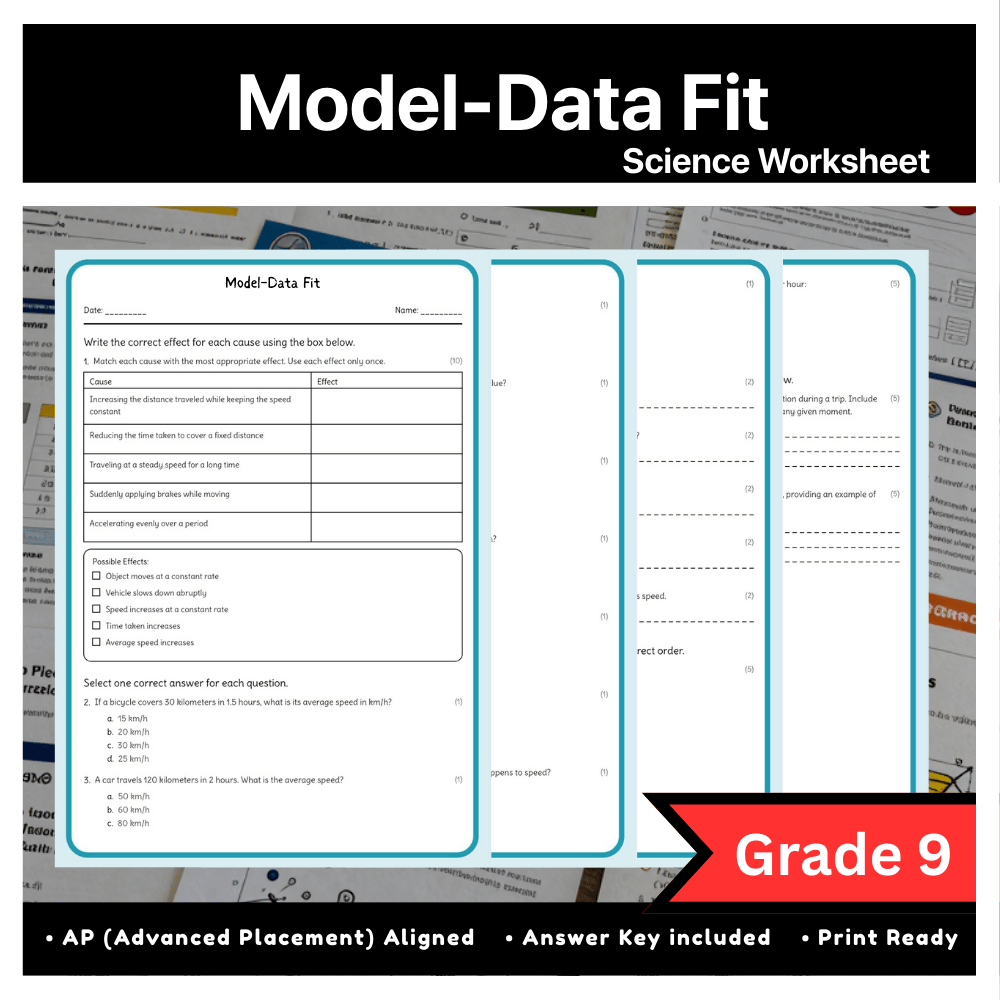
Grade 9 Science | Model-Data Fit AP Practice Worksheet (PDF)
Created byBright Mind ResourcesLearning Objectives
- Understand methods for assessing the fit between models and empirical data.
- Interpret residual plots and goodness-of-fit measures to evaluate models.
- Identify patterns indicating issues like heteroscedasticity or missing variables.
Instant download

Grade 9 Science | The Calvin Cycle - Daily Reading Comprehension
Created byCoral Reef LearningLearning Objectives
- Understand the basic steps of the Calvin cycle
- Identify the key enzymes involved in carbon fixation
- Explain how plants synthesize sugars during photosynthesis
Instant download
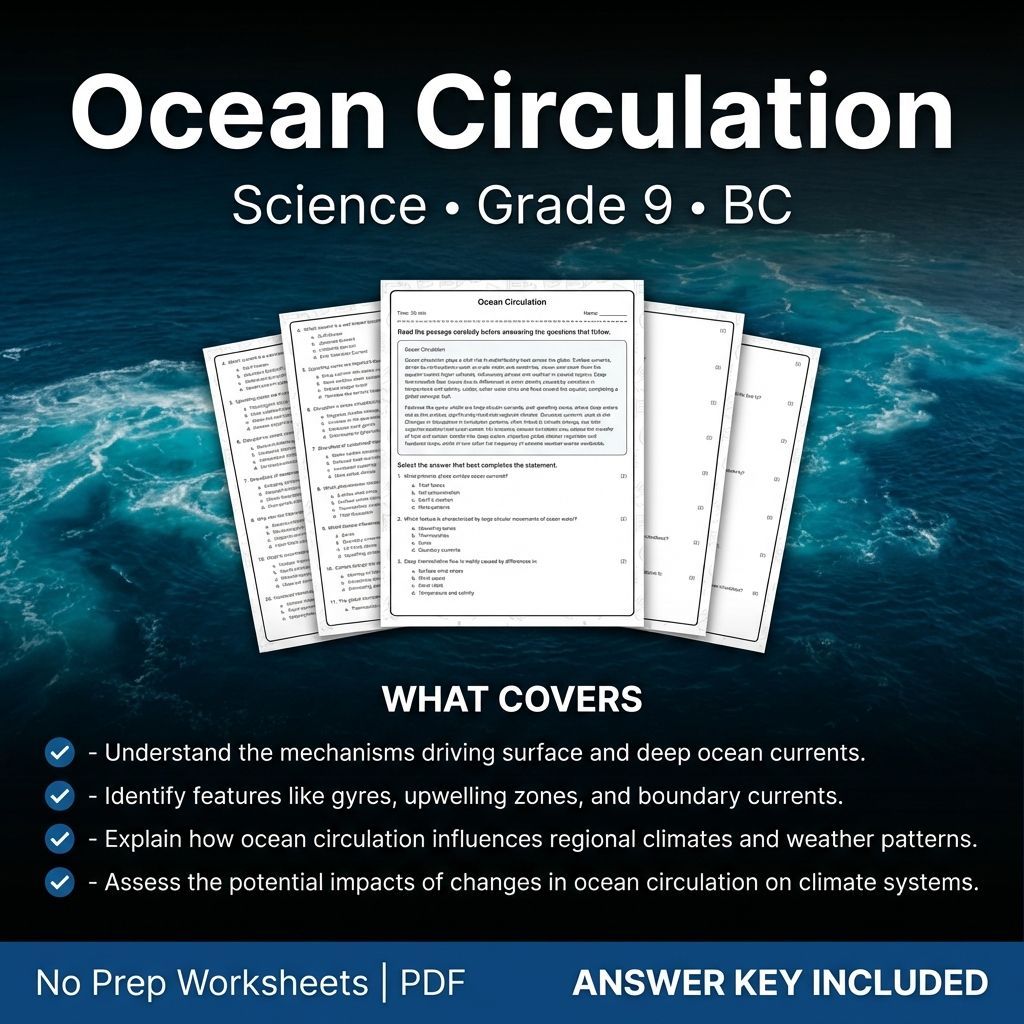
Grade 9 Science | Ocean Circulation Worksheet & Answer Key (Printable PDF)
Created byCoral Reef LearningLearning Objectives
- Understand the mechanisms driving surface and deep ocean currents.
- Identify features like gyres, upwelling zones, and boundary currents.
- Explain how ocean circulation influences regional climates and weather patterns.
Instant download
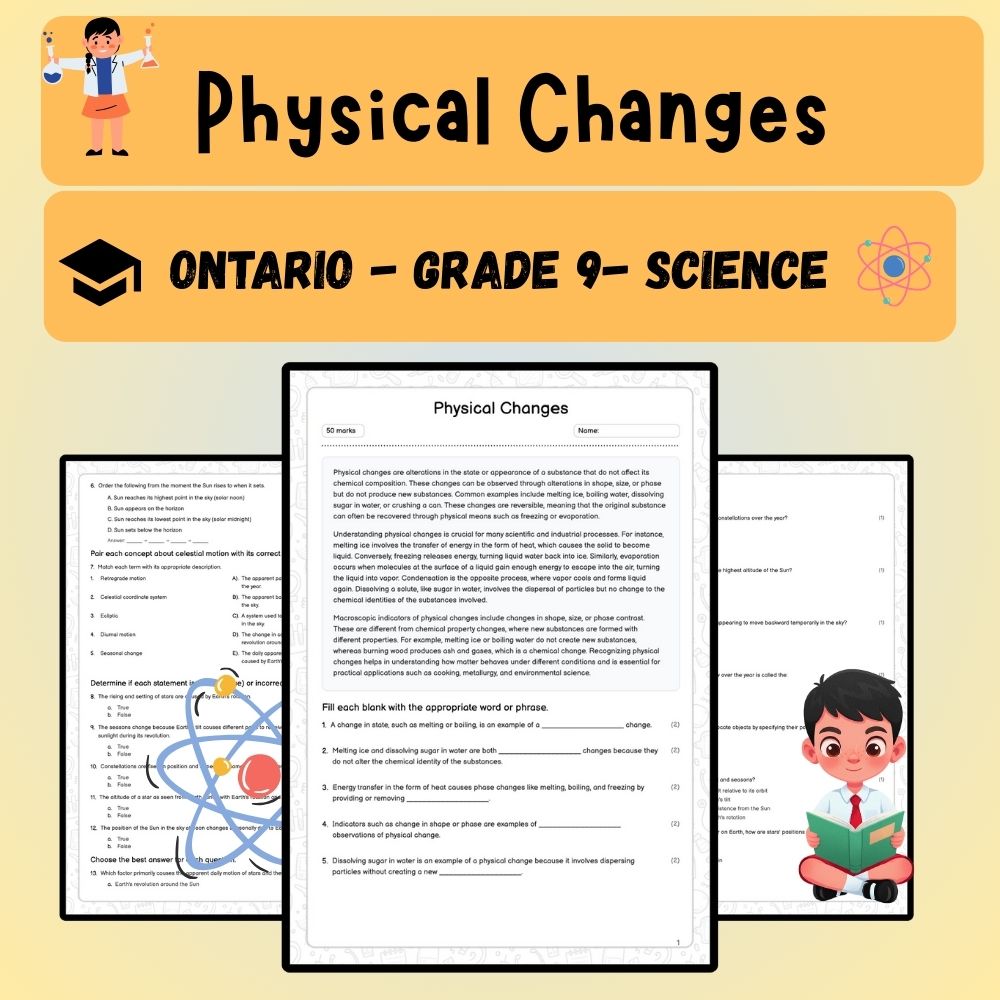
Grade 9 Science | Physical Changes Worksheet (PDF) – Ontario Curriculum
 Created byPrism Point Learning
Learning Objectives
- Define and distinguish between physical and chemical changes.
- Identify examples of physical changes such as melting, freezing, evaporation, condensation, and dissolving.
- Explain how energy transfer relates to phase changes.
Also included in: Grade 9 Science UNIT Worksheet Pack | Chemical Properties, Energy & Reactions +1 more
Instant download

Grade 9 Science – System Coordination Worksheet (BC Standards) (PDF)
 Created byEvergreen Desk Education
Learning Objectives
- Explain how feedback loops help maintain homeostasis in multi-system coordination.
- Describe how redundancy and cross-regulation allow the body to compensate for disruptions.
- Analyze how exercise triggers neural, hormonal, and local signals across respiratory, cardiovascular, and metabolic pathways.
Instant download
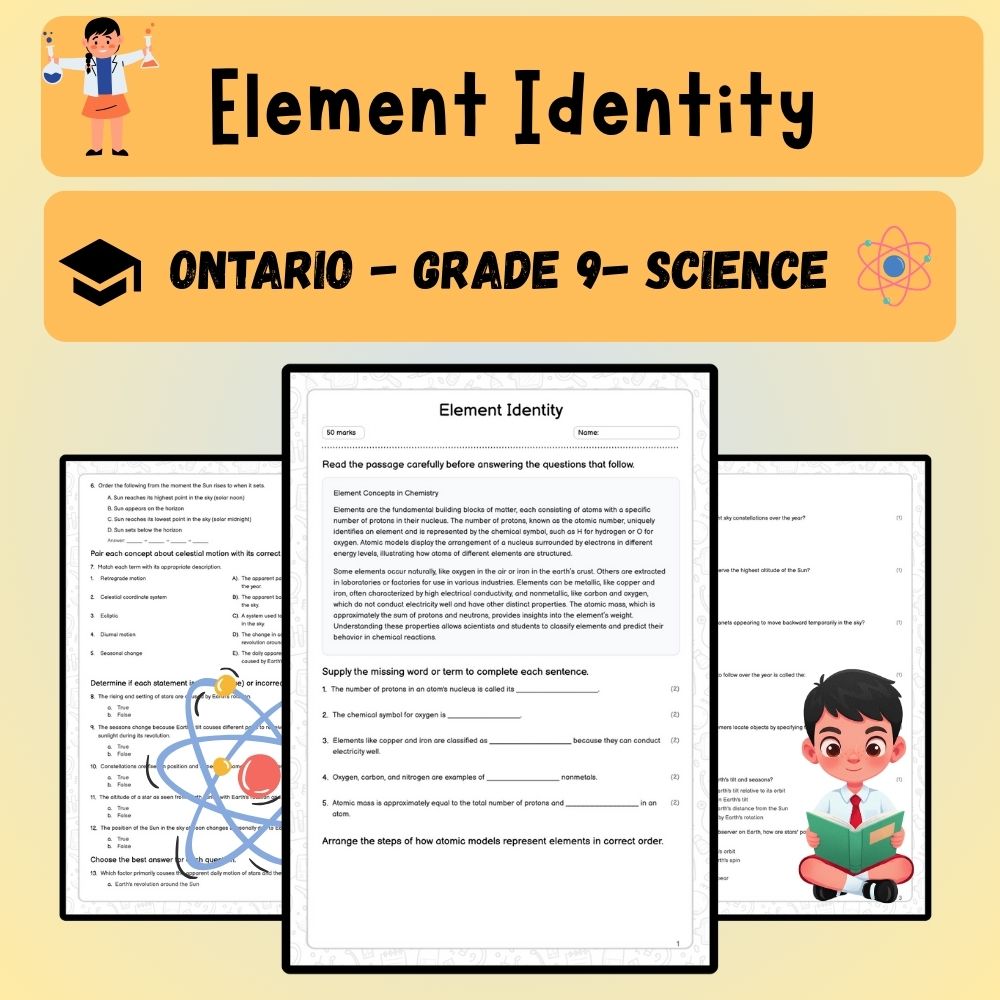
Grade 9 Science | Element Identity Worksheet (Answer Key) – Ontario Standard
Created byPrism Point LearningLearning Objectives
- Understand that elements are defined by specific numbers of protons and their unique symbols.
- Describe how atomic models represent the atomic identity of elements.
- Identify properties of representative elements, including atomic mass and symbolism.
Also included in: Grade 9 Science UNIT Worksheet Pack | Chemical Properties, Energy & Reactions +1 more
Instant download
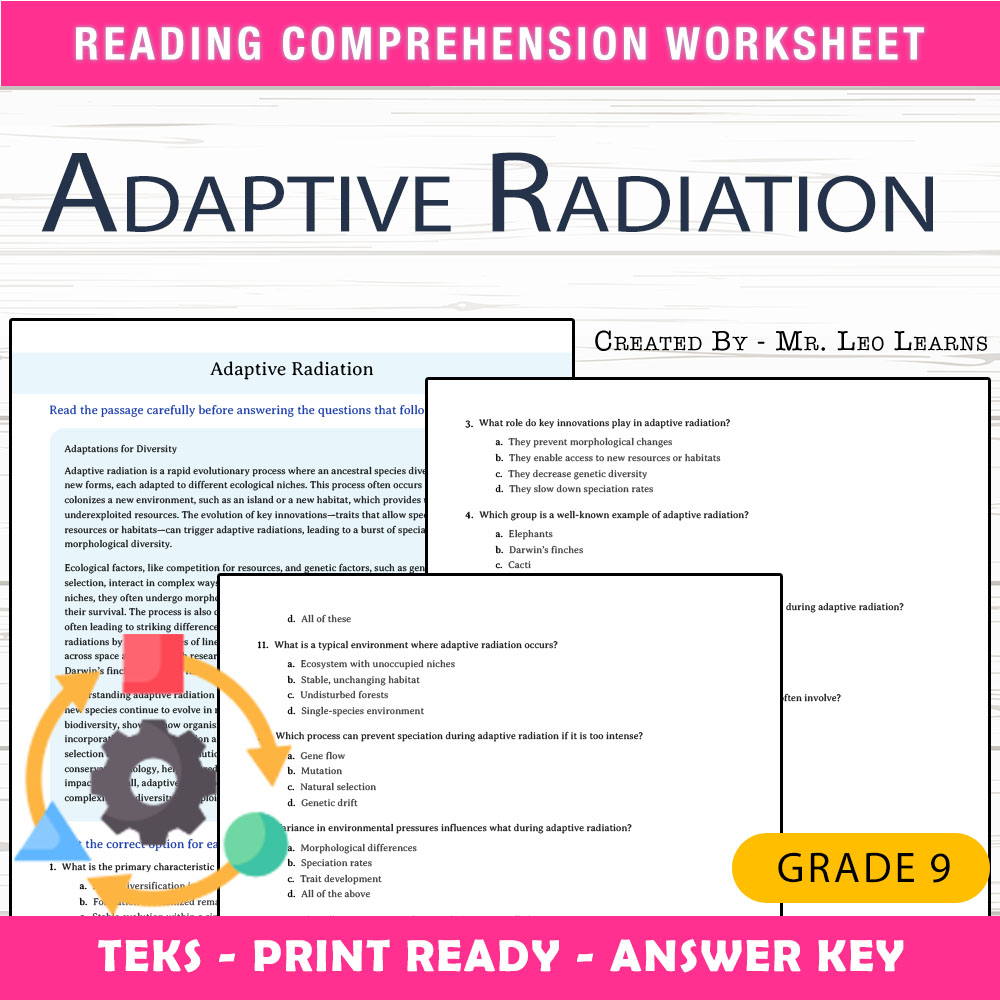
Grade 9 Science | Adaptive Radiation Worksheet for Mastery
 Created byThe Resource Hub
Learning Objectives
- Define adaptive radiation and explain its significance in evolution.
- Describe the ecological and genetic factors that drive adaptive radiations.
- Identify examples of adaptive radiation in the natural world.
Also included in: Grade 9 Science Evolution & Classification Unit Worksheet Pack +1 more
Instant download

Grade 9 Science – Endocrine Feedback Worksheet (Ontario Standard) (PDF)
Created byEvergreen Desk EducationLearning Objectives
- Explain how negative feedback helps maintain internal stability in hormone-regulated systems (e.g., glucose homeostasis and thyroid control).
- Describe how hormones are synthesized, transported in blood, and produce cellular effects through receptor-mediated mechanisms.
- Compare hormone half-life and feedback loop timing to predict how endocrine systems respond to changing conditions.
Also included in: Grade 9 Human Body Systems & Cellular Processes Science Lesson Bundle: Ontario +1 more
Instant download

Grade 9 Science | System Coordination Worksheet | BC Standards
 Created byLumora Learning
Learning Objectives
- Understand how multiple organ systems coordinate through feedback loops and regulatory mechanisms.
- Describe how neural, hormonal, and local signals contribute to homeostasis during exercise.
- Analyze the cascade effects caused by disruptions in one component of multi-system networks.
Instant download

Metabolic Pathways Assessment for Grade 9 Science | TEKS Standards
Created byPrism Point LearningLearning Objectives
- Understand the sequence and function of catabolic and anabolic pathways
- Explain how energy is harvested and stored in metabolic processes
- Identify mechanisms regulating pathway activity in cells
Instant download
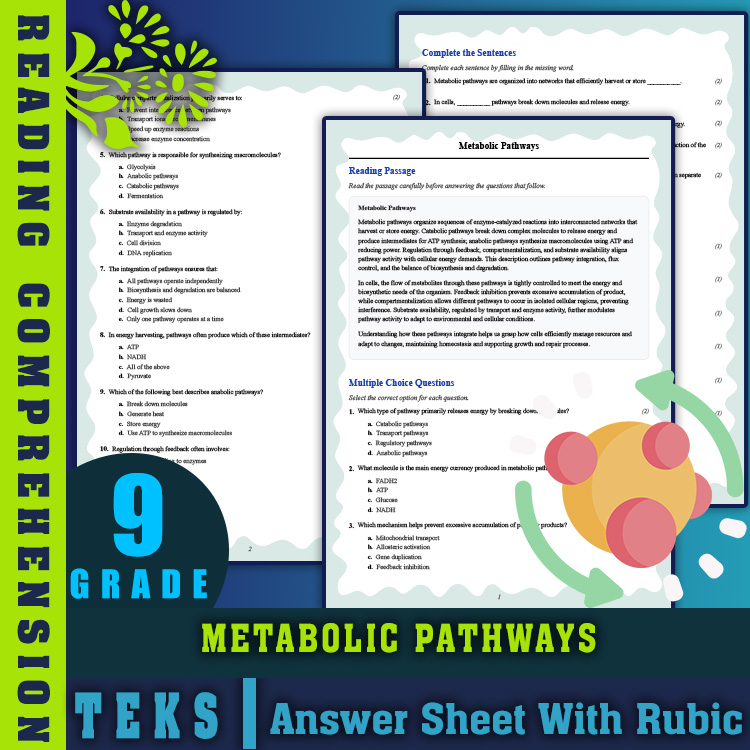
9th Grade Science | Metabolic Pathways Reading Worksheet & Answer Key PDF
JCreated byJ.S SheetsLearning Objectives
- Understand the basic concepts of metabolic pathways and their organization in cells.
- Differentiate between catabolic and anabolic pathways and their roles in energy management.
- Describe mechanisms of pathway regulation, including feedback inhibition and compartmentalization.
Instant download
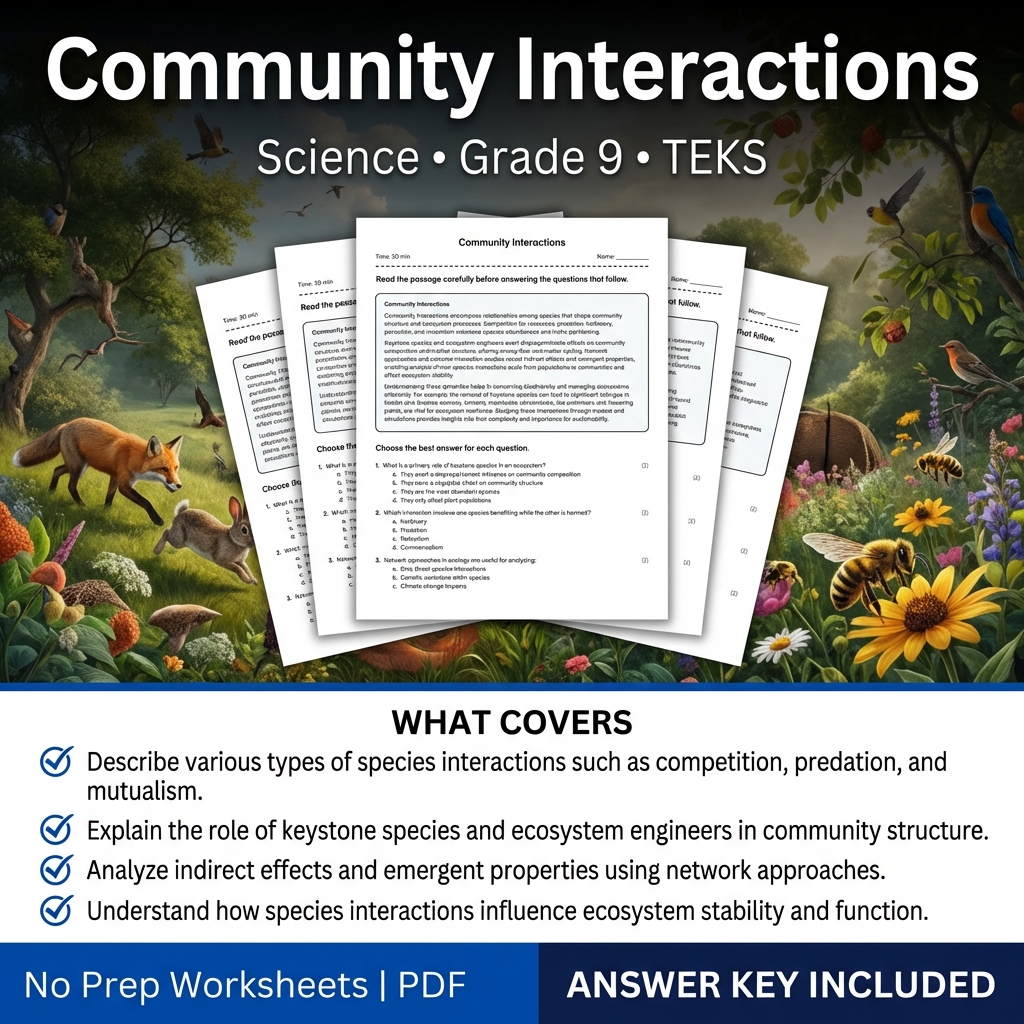
Community Interactions Worksheet for Grade 9 Science TEKS Alignment
Created byCoral Reef LearningLearning Objectives
- Describe various types of species interactions such as competition, predation, and mutualism.
- Explain the role of keystone species and ecosystem engineers in community structure.
- Analyze indirect effects and emergent properties using network approaches.
Instant download

Grade 9 Science | Understanding Compound Formulas - Daily Reading Comprehension
Created byCoral Reef LearningLearning Objectives
- Identify elements and their ratios in chemical formulas.
- Distinguish between covalent and ionic bonds and their effects.
- Understand the law of definite composition.
Instant download
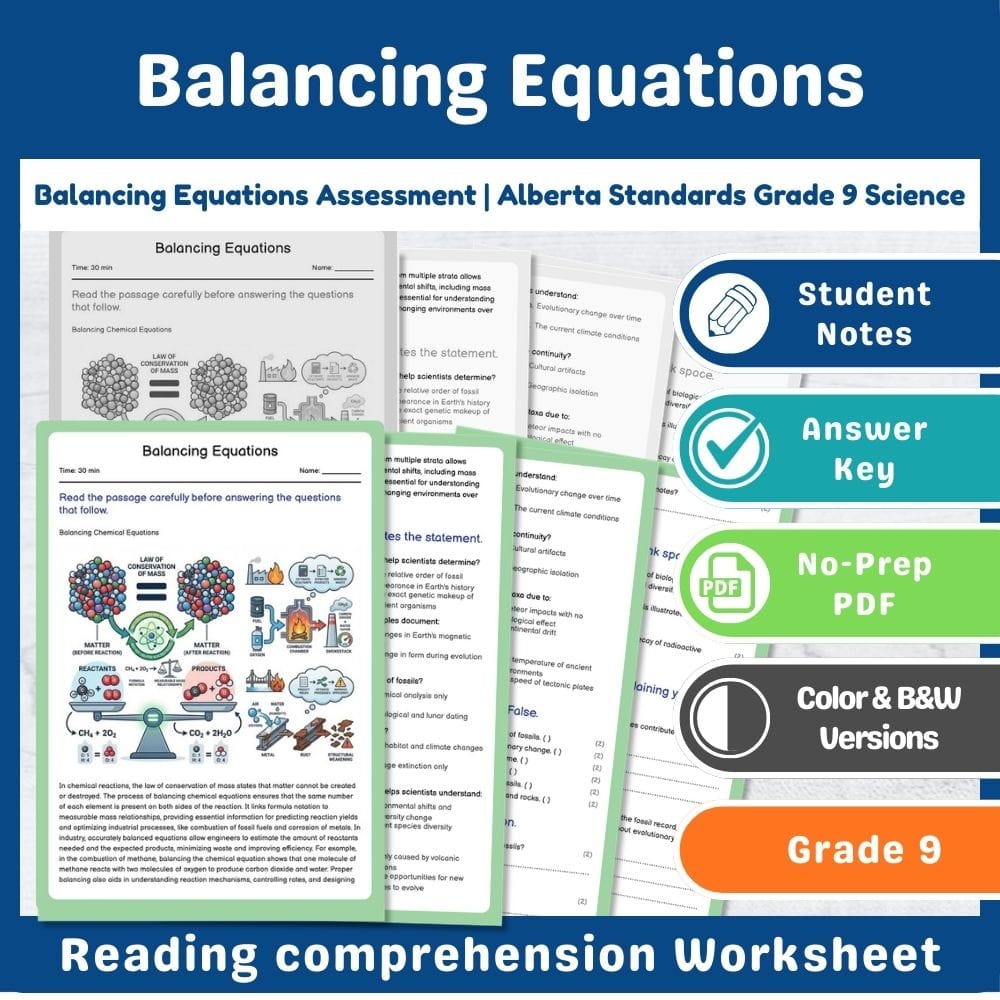
Balancing Equations Assessment | Alberta Standards Grade 9 Science
Created byPrism Point LearningLearning Objectives
- Understand the principle of conservation of atoms and mass in chemical reactions.
- Apply techniques to balance chemical equations accurately.
- Connect symbolic equations to measurable mass relationships in chemical processes.
Also included in: Grade 9 Matter and Chemical Change Science Lesson Bundle | Alberta +1 more
Instant download

Grade 9 Molecules & Lattices Worksheet | Structure & Properties | NGSS
 Created byAmber Owl Education
Learning Objectives
- Explain how particle arrangement and electrical forces influence melting point and electrical conductivity.
- Differentiate ionic lattices, covalent networks, and molecular solids using particle behavior.
- Use material-property evidence to infer the likely type of bonding or lattice structure.
Also included in: Grade 9 Science Chemical Reactions Lesson Bundle | NGSS +1 more
Instant download
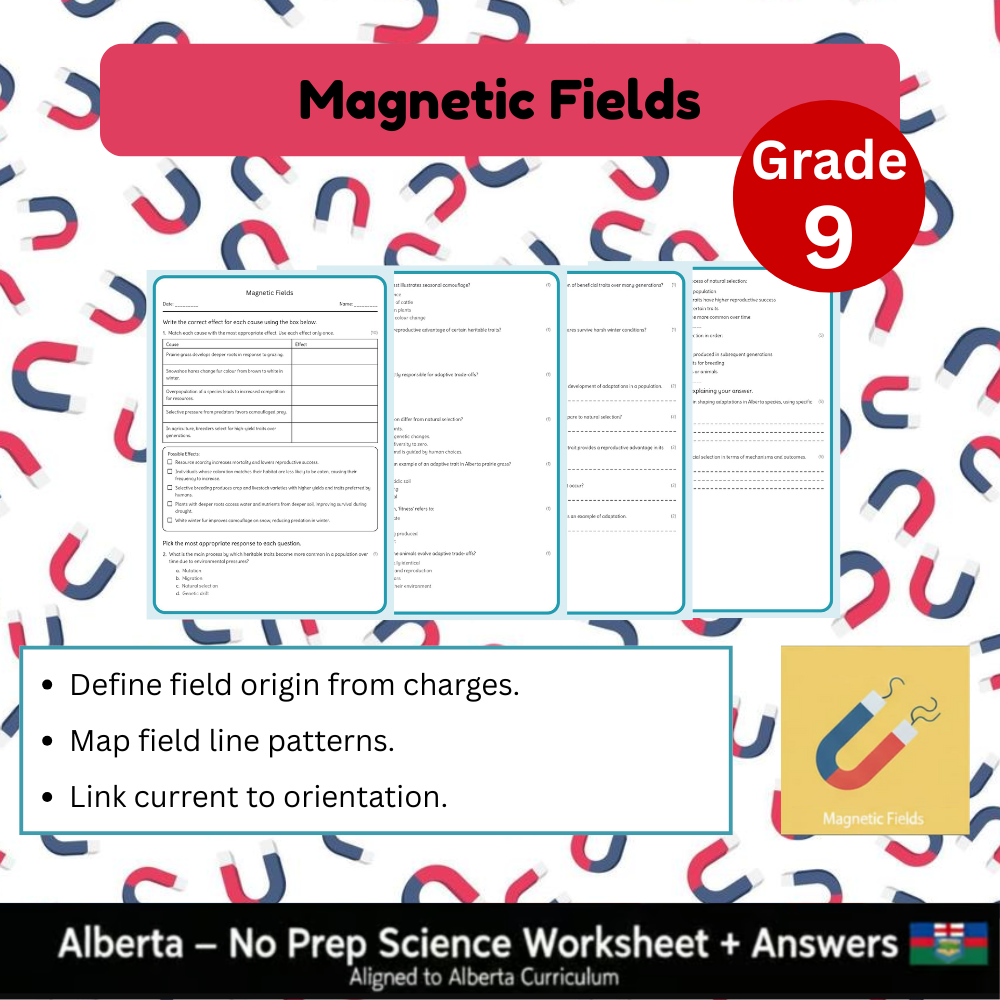
Grade 9 Science | Magnetic Fields (Worksheet + Answer Key) – Alberta Standards
Created byBright Mind ResourcesLearning Objectives
- Understand how magnetic fields arise from permanent magnets and moving electric charges.
- Identify the pattern of magnetic field lines around various magnetic objects.
- Explain the relationship between electric currents and magnetic field orientation.
Instant download

Evidence Chains Worksheet Pack | Grade 9 Science Practice
 Created byBright Quill Resources
Learning Objectives
- Explain how empirical observations, quantitative analyses, and model outputs can be connected to form an evidence-based explanatory claim.
- Use standards of sufficiency and consistency to judge whether evidence is strong enough to support an inference.
- Compare competing explanations by checking which explanation best matches multiple lines of evidence and why.
Instant download

Grade 9 Science | Inheritance Patterns Worksheet (TEKS) Practice Set
Created byEvergreen Desk EducationLearning Objectives
- Explain Mendelian inheritance using dominant/recessive phenotypes and genotype ratios
- Compare non-Mendelian patterns (incomplete dominance, codominance, multiple alleles, polygenic, sex-linked, imprinting, mitochondrial) to Mendelian expectations
- Apply gene interaction ideas (environmental effects and linkage) to predict why phenotype ratios change
Instant download

Grade 9 Science – Patterns of Inheritance Reading Worksheet | Alberta Standards
Created byBright Mind ResourcesLearning Objectives
- Understand Mendelian inheritance patterns including dominant and recessive alleles
- Distinguish between genotype and phenotype
- Use Punnett squares to predict trait inheritance
Also included in: Grade 9 Genetics & Inheritance Science Daily Reading Lesson Bundle | Alberta +1 more
Instant download

Endocrine Feedback Mastery Worksheet | Ontario Science Grade 9
JCreated byJ.S SheetsLearning Objectives
- Explain how endocrine glands produce hormones that regulate long-term body processes through feedback mechanisms.
- Describe negative and positive feedback loops using glucose homeostasis (insulin and glucagon) as an example.
- Connect hormone transport, receptor-mediated action, and cellular effects (enzyme activity and gene expression).
Instant download

Grade 9 Science Worksheet – Refining Explanatory Models (PDF)
Created byEvergreen Desk EducationLearning Objectives
- Explain how scientific models use observable evidence to represent causal mechanisms and predict outcomes.
- Identify how changing assumptions, parameters, or relationships can refine a model when evidence conflicts with predictions.
- Evaluate whether a model’s structure supports explanation within its valid limits.
Also included in: Grade 9 Uncertainty & Evidence Science Lesson Bundle (General) +1 more
Instant download

Grade 9 Science Worksheet | Sources of Uncertainty (PDF) (General Standard)
Created byEvergreen Desk EducationLearning Objectives
- Explain how measurement limitations and model differences create uncertainty in scientific results.
- Identify common sources of error, including instrument limits, human judgment, environmental variation, and simplifications.
- Interpret uncertainty by relating it to how much results could deviate from the true value and how confidence changes when uncertainty is large.
Also included in: Grade 9 Uncertainty & Evidence Science Lesson Bundle (General) +1 more
Instant download

Grade 9 Science | Acceleration From Data Worksheet (PDF)
Created byEvergreen Desk EducationLearning Objectives
- Interpret acceleration using speed–time and distance–time data during measured intervals.
- Determine whether acceleration is approximately constant or changing from the shape of a data curve or the pattern of slopes.
- Explain how acceleration direction relates to the direction of speed change.
Also included in: Grade 9 Waves, Forces, and Energy Science Lesson Bundle | General +1 more
Instant download

Grade 9 Science | Climate Variability Worksheet (PDF) for General Standards
Created byEvergreen Desk EducationLearning Objectives
- Explain how climate variability is identified by comparing weather-related measurements over longer time scales.
- Distinguish climate variability from long-term climate change using evidence from temperature, precipitation, and wind/humidity patterns.
- Interpret how large-scale ocean-atmosphere interactions (such as El Niño) can shift regional weather statistics.
Also included in: Grade 9 Earth and Space Science Lesson Bundle (General) Science Worksheets +1 more
Instant download

Grade 9 Science | Prototype Evidence Worksheet (PDF) for Engineering
Created byEvergreen Desk EducationLearning Objectives
- Explain how prototypes provide observable evidence linked to success criteria.
- Identify appropriate metrics (e.g., flow rate, temperature change, accuracy) for evaluating prototype performance.
- Use test results to decide whether to refine a design or revise the approach.
Also included in: Grade 9 Engineering Design & Prototype Evidence Science Lesson Bundle: General +1 more
Instant download

Grade 9 Science Worksheet – Iteration Loop & Engineering Design (PDF)
Created byEvergreen Desk EducationLearning Objectives
- Explain how an iteration loop uses test evidence to improve a design repeatedly until it meets criteria.
- Describe how design cycle changes (dimensions, materials, alignment, and component interactions) relate to observed test results.
- Evaluate reliability and safety margin considerations during repeated revisions.
Also included in: Grade 9 Engineering Design & Prototype Evidence Science Lesson Bundle: General +1 more
Instant download
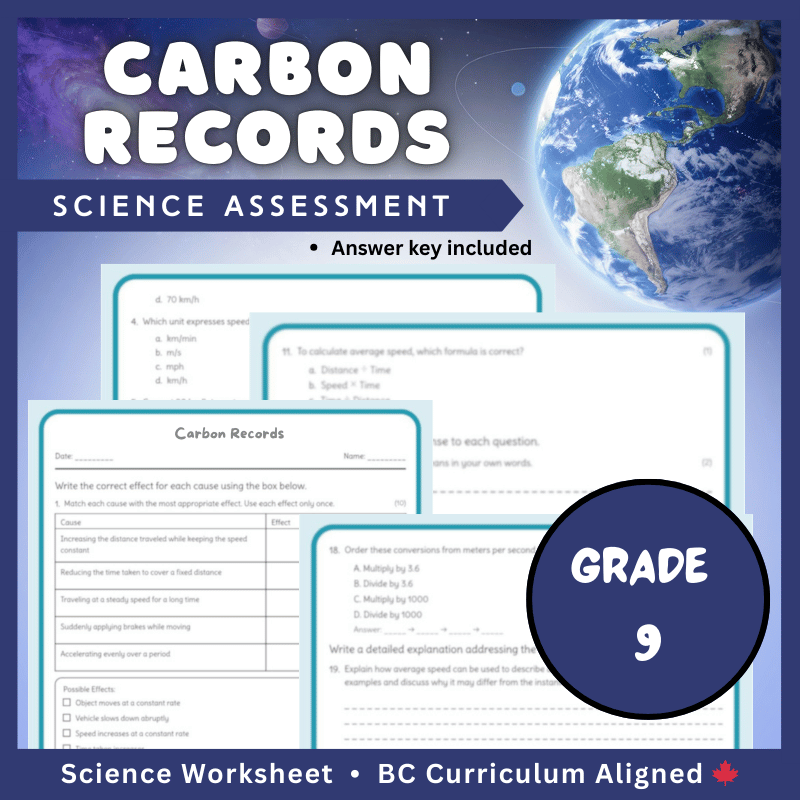
Grade 9 Science | Carbon Records Worksheet (PDF) – Climate Proxy Data & Analysis
Created byBright Mind ResourcesLearning Objectives
- Understand how carbon records from various proxies reveal past atmospheric conditions.
- Identify the methods used to analyze past greenhouse gas concentrations and climate variability.
- Evaluate the significance of combining proxy data with instrumental measurements to assess recent climate change.
Instant download
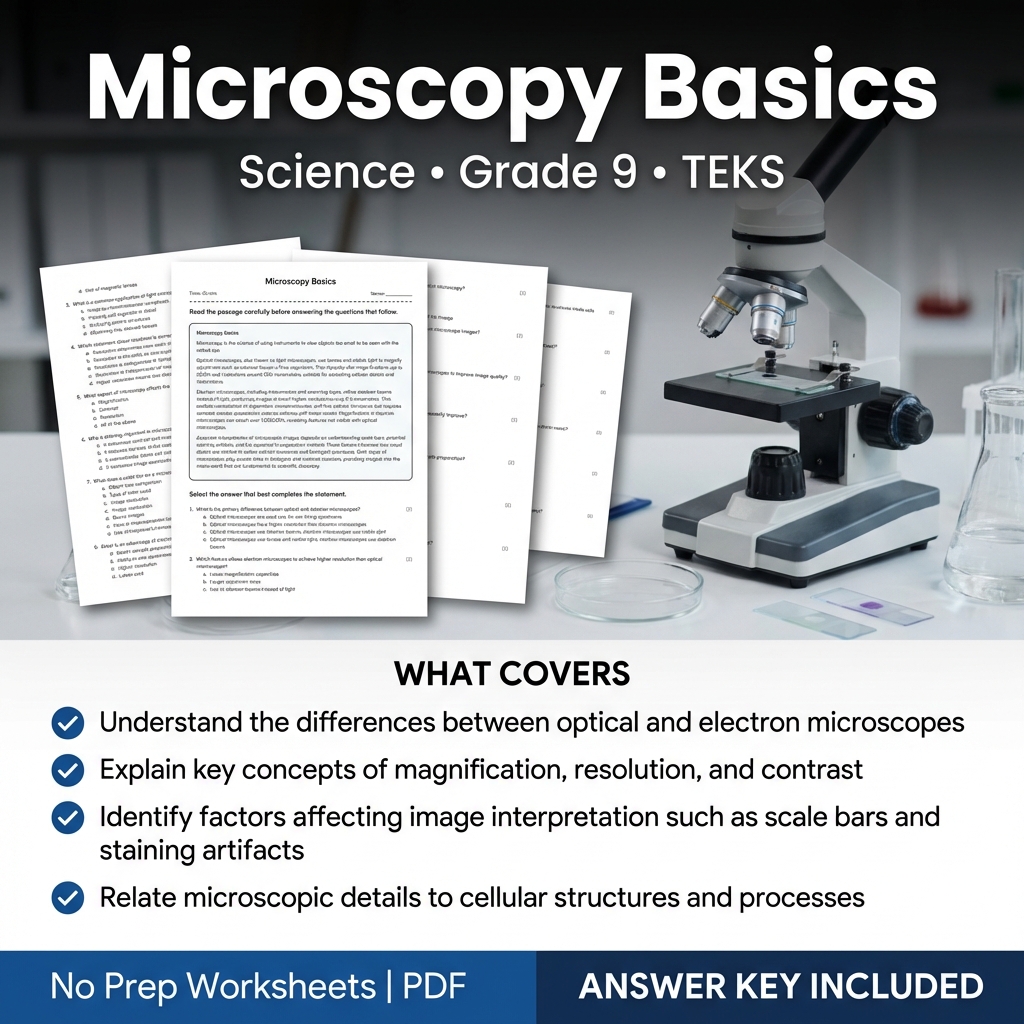
Grade 9 Science Worksheet on Microscopy Basics – Printable PDF & Answer Key
Created byCoral Reef LearningLearning Objectives
- Understand the differences between optical and electron microscopes
- Explain key concepts of magnification, resolution, and contrast
- Identify factors affecting image interpretation such as scale bars and staining artifacts
Instant download

Gravity and Orbits Assessment for Grade 9 Science | Standards-Aligned
Created byPrism Point LearningLearning Objectives
- Understand how gravity influences planetary and lunar motion in the solar system.
- Describe the relationship between orbital speed, distance from the Sun, and gravitational force.
- Explain how gravitational attraction provides the centripetal force for orbiting bodies.
Instant download
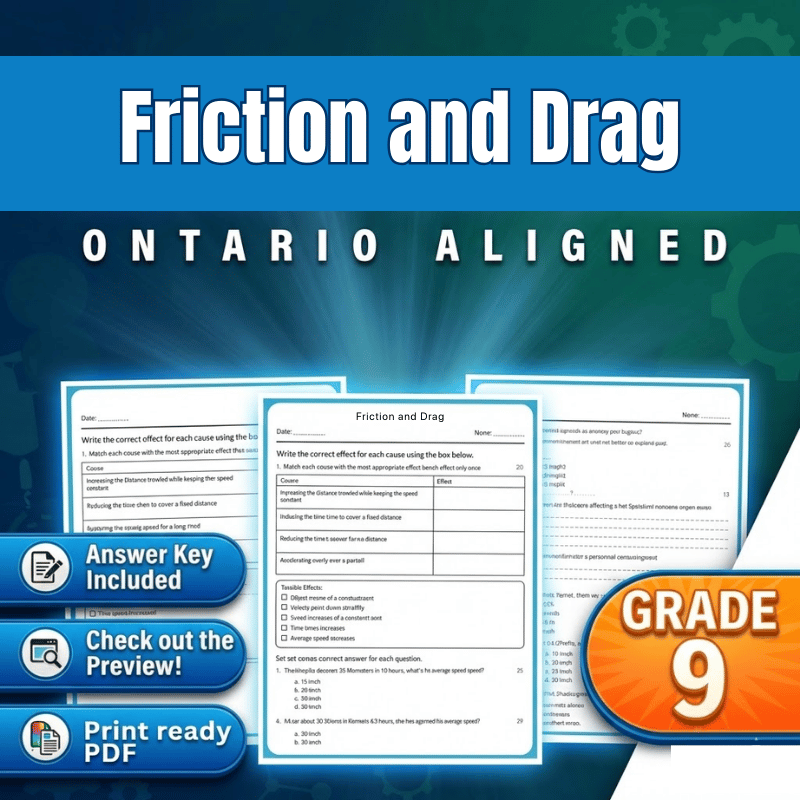
Grade 9 Science – Friction and Drag Worksheet (Ontario) (PDF)
Created byBright Mind ResourcesLearning Objectives
- Understand the differences between static and kinetic friction and how they resist motion.
- Describe how fluid drag depends on velocity, surface area, and medium density.
- Apply the concepts of friction and drag to real-world motion scenarios involving energy dissipation.
Instant download
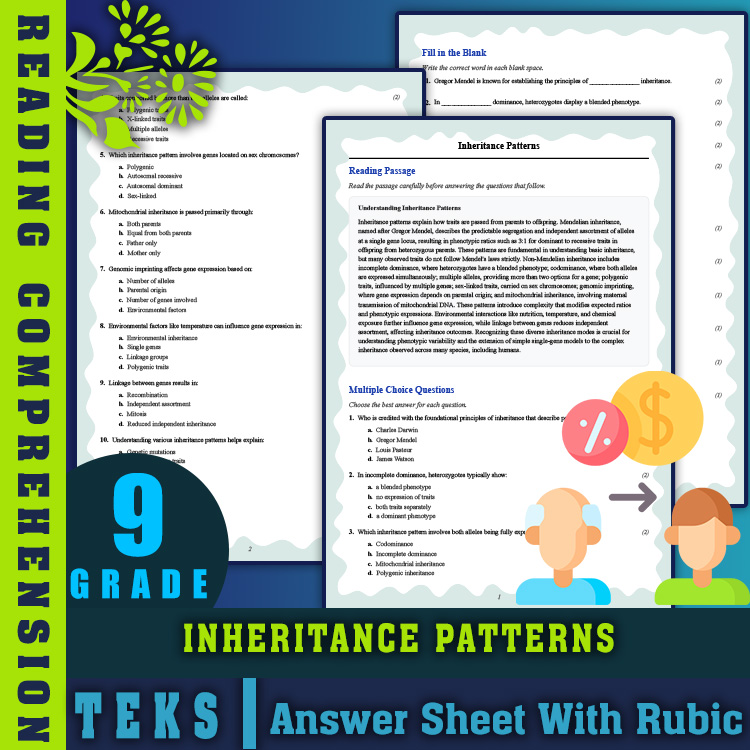
9th Grade Science | Inheritance Patterns Reading Worksheet (PDF + Answer Key)
JCreated byJ.S SheetsLearning Objectives
- Understand Mendelian inheritance, including dominant and recessive traits.
- Recognize non-Mendelian inheritance patterns such as incomplete dominance, codominance, and sex-linked traits.
- Analyze how environmental factors and gene linkage influence phenotypic variation.
Instant download
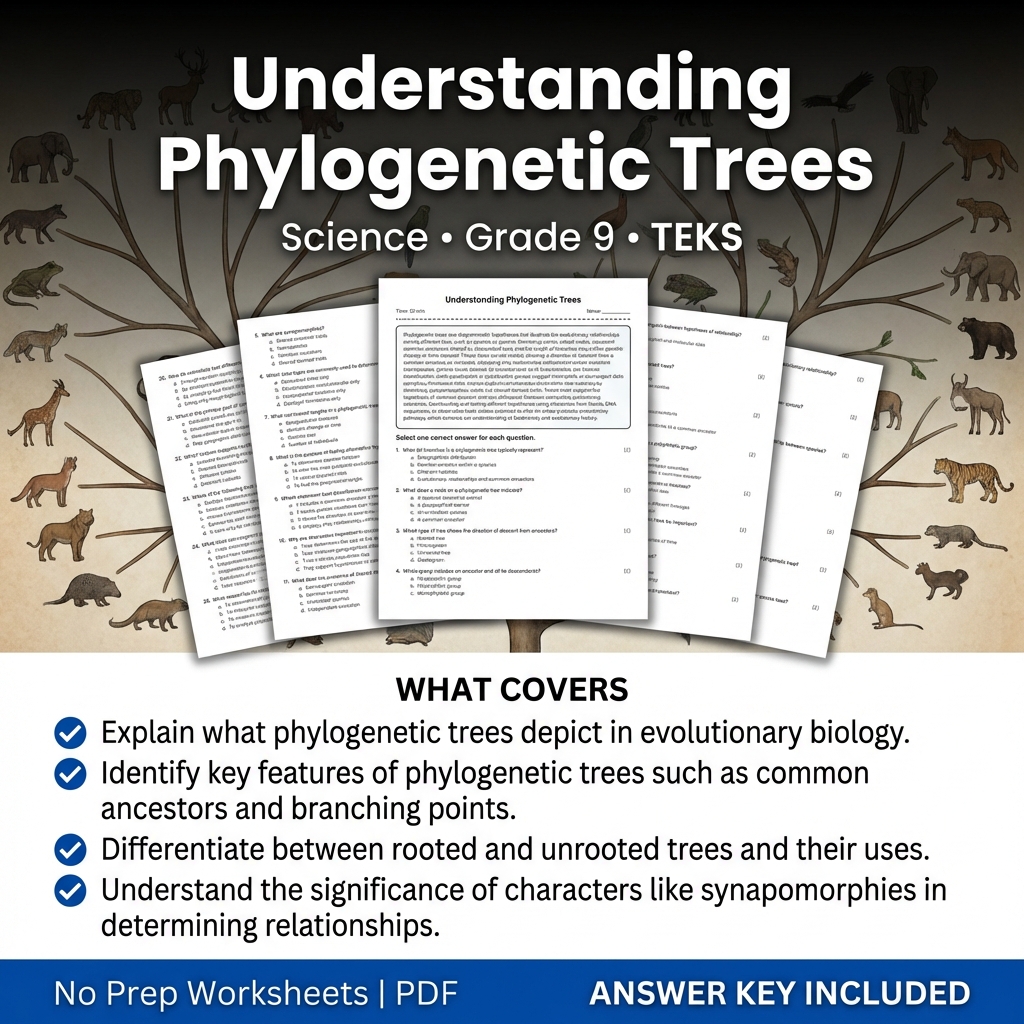
Understanding Phylogenetic Trees Science Worksheet Grade 9 | TEKS
Created byCoral Reef LearningLearning Objectives
- Explain what phylogenetic trees depict in evolutionary biology.
- Identify key features of phylogenetic trees such as common ancestors and branching points.
- Differentiate between rooted and unrooted trees and their uses.
Instant download

Electron Transport Worksheet | TEKS Science Grade 9 Practice PDF
JCreated byJ.S SheetsLearning Objectives
- Explain how electron transport chains transfer electrons through sequential carriers to terminal electron acceptors
- Describe how proton pumping creates an electrochemical gradient that powers ATP synthase through chemiosmosis
- Compare electron transport in mitochondria and chloroplasts in terms of membrane location and end acceptors
Instant download
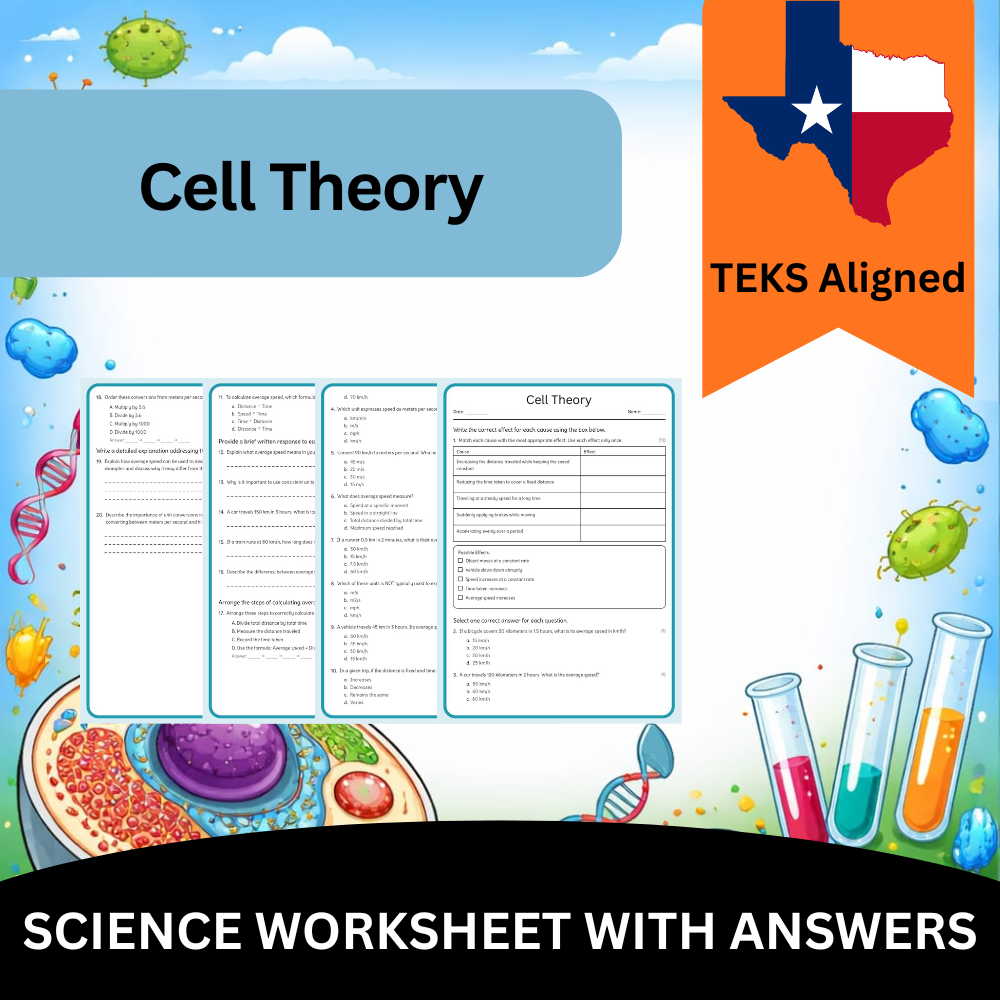
Grade 9 Science | Cell Theory Worksheet (Answer Key) – TEKS-Aligned
Created byBright Mind ResourcesLearning Objectives
- Describe the main ideas of cell theory including the role of cells in all living organisms.
- Differentiate between unicellular and multicellular organisms and understand cell specialization.
- Compare prokaryotic and eukaryotic cell structures and explain how cellular organization underlies organism functions.
Also included in: Grade 9 Science Unit | Cell Structures & Transport Mechanisms Pack(TEKS-Aligned) +3 more
Instant download

Grade 9 Science | Atomic Structure - Daily Reading Comprehension
Created byCoral Reef LearningLearning Objectives
- Understand the basic components of an atom: protons, neutrons, electrons.
- Learn about electron configurations and quantized energy levels.
- Explore how the periodic table organizes elements based on valence electrons.
Instant download

Grade 9 Science – Energy Molecules Daily Reading Worksheet with Answer Key
JCreated byJ.S SheetsLearning Objectives
- Understand the structure of ATP
- Explain how ATP stores and releases energy
- Describe the process of ATP regeneration
Also included in: Grade 9 Science Lesson Group: Photosynthesis & Metabolism TEKS Bundle +1 more
Instant download
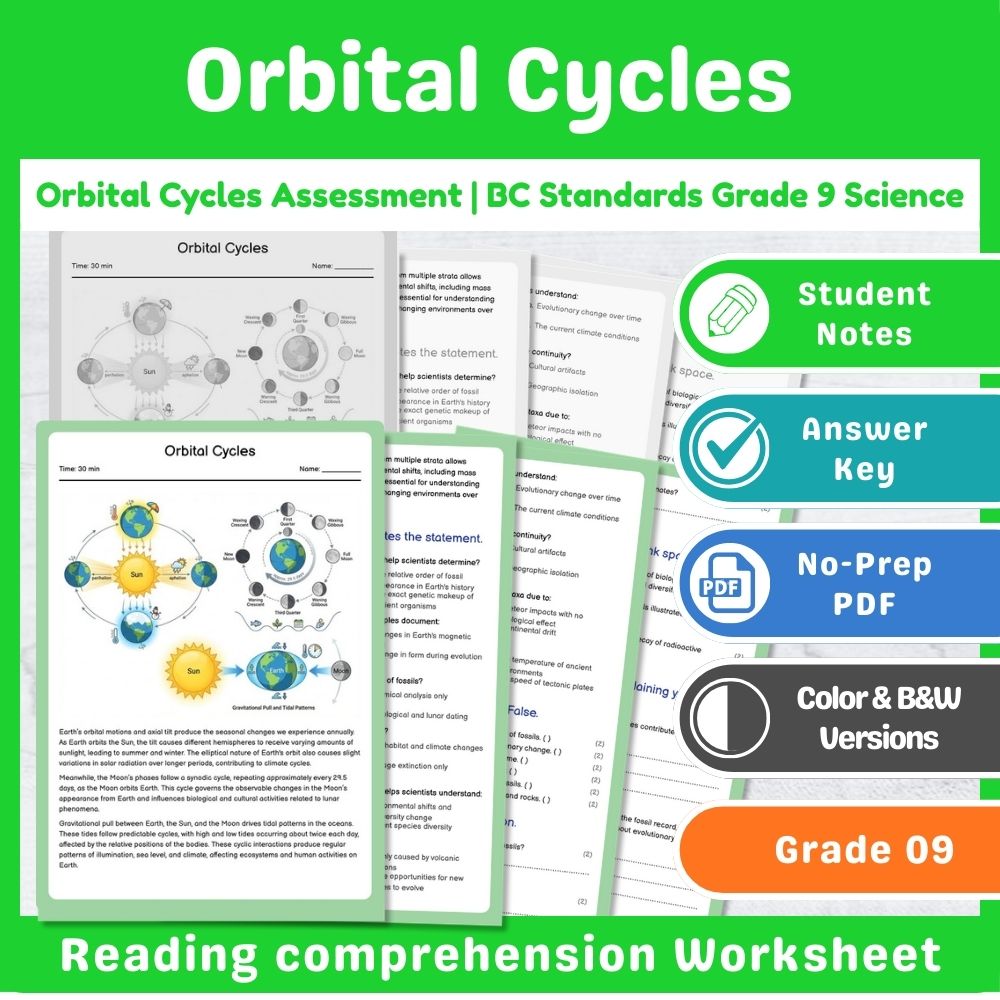
Orbital Cycles Assessment | BC Standards Grade 9 Science
Created byPrism Point LearningLearning Objectives
- Understand how Earth's orbital relationships influence seasons and climate patterns.
- Identify the Moon's phases and the cycles that determine lunar illumination.
- Explain how gravitational interactions between Earth, Moon, and Sun drive tides and cyclic phenomena.
Also included in: Grade 9 Science Mini Bundle – Earth & Space Assessment & Activities
Instant download
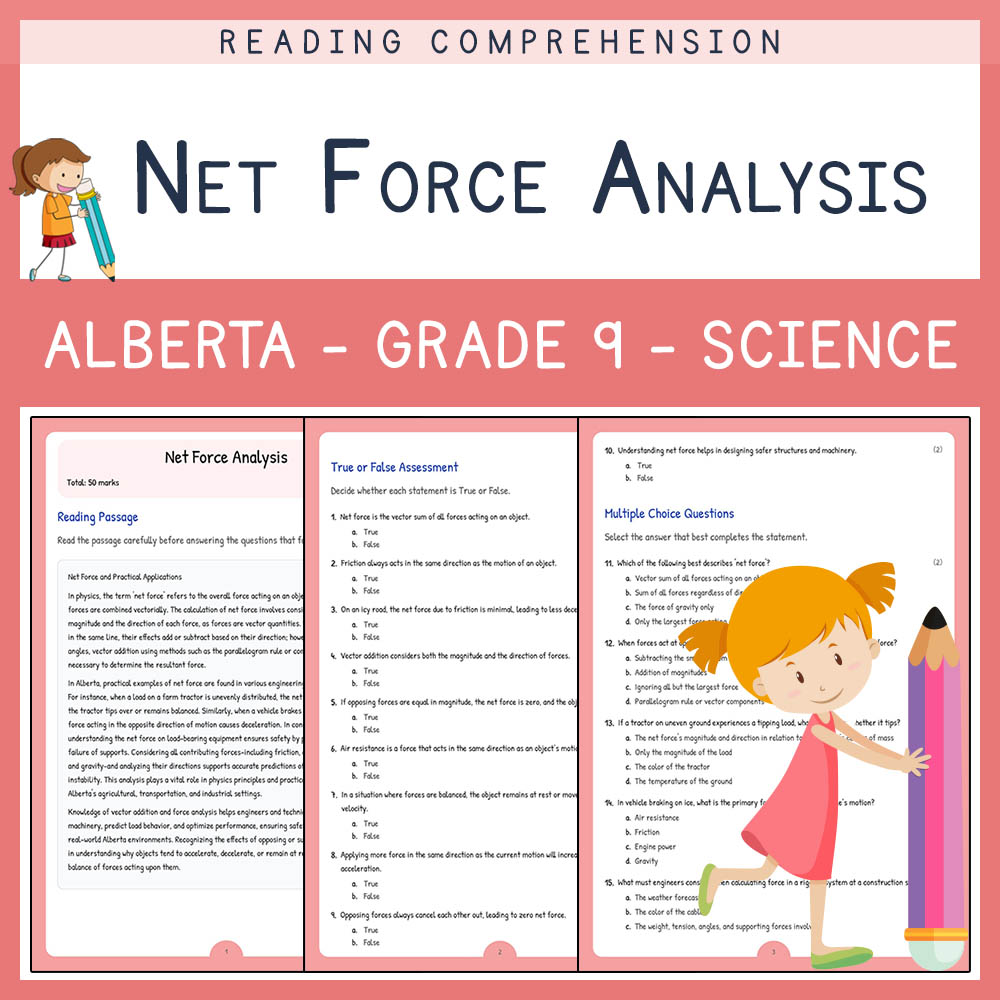
Grade 9 Science | Net Force Analysis Worksheet | Alberta Standards
Created byLumora LearningLearning Objectives
- Understand the concept of net force and how vector addition determines the resultant acceleration of objects.
- Analyze real-world scenarios involving opposing forces such as friction, air resistance, and applied loads.
- Calculate net force through vector analysis in practical Alberta situations like load tipping, vehicle deceleration, and rigging.
Instant download
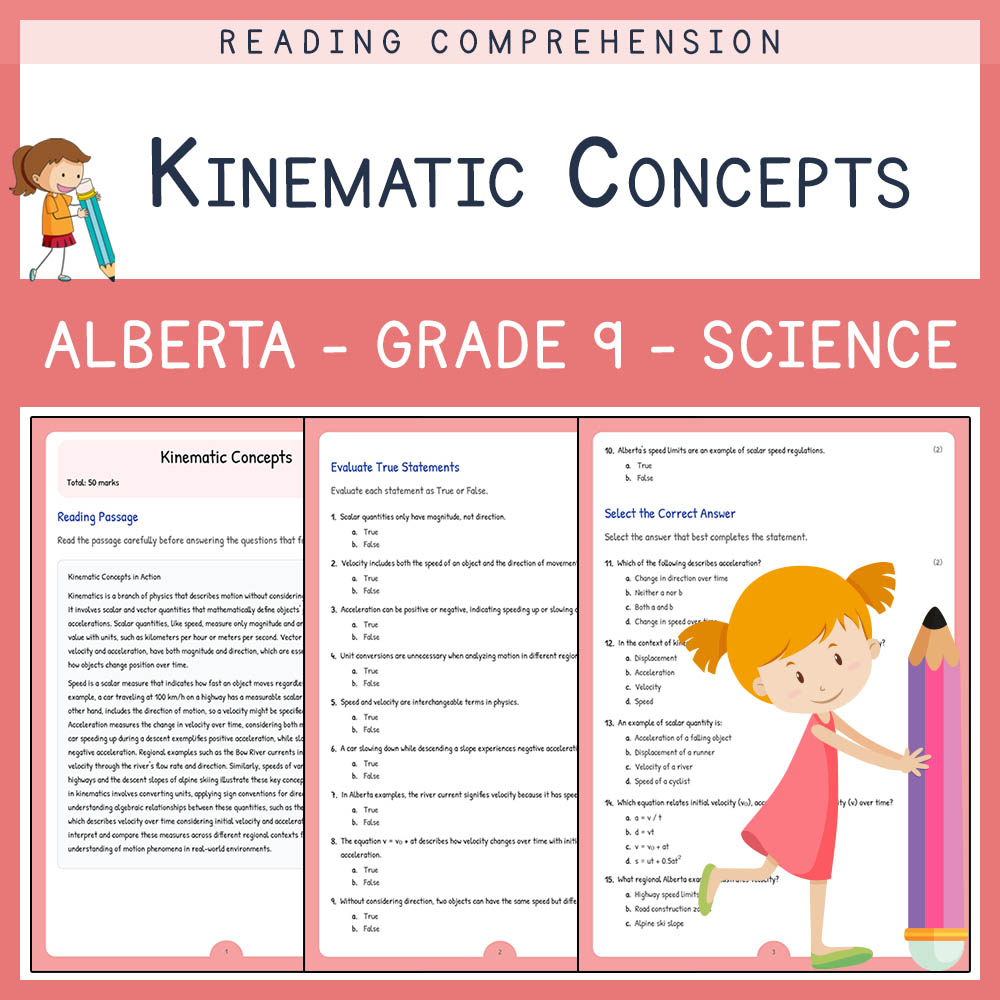
Grade 9 Science | Kinematic Concepts Worksheet | Alberta Standards
Created byLumora LearningLearning Objectives
- Understand how scalar and vector measures describe object motion.
- Identify and differentiate between speed, velocity, and acceleration.
- Apply unit conversions and sign conventions to analyze motion data.
Instant download
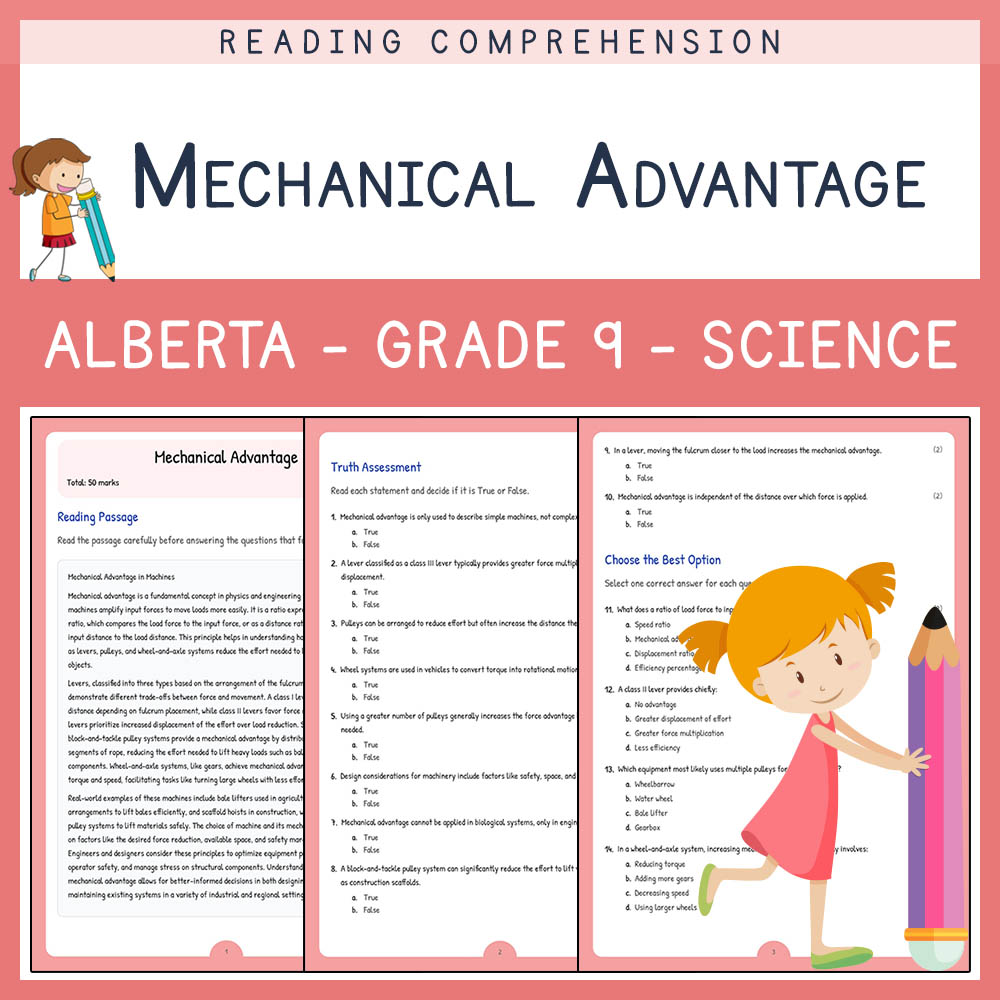
Grade 9 Science | Mechanical Advantage Worksheet | Alberta Standards
Created byLumora LearningLearning Objectives
- Explain the concept of mechanical advantage and how it is used in different machines.
- Calculate mechanical advantage for levers, pulleys, and wheel systems.
- Analyze trade-offs between force reduction and displacement in mechanical systems.
Instant download
About Grade 9 Science Worksheets
Find Science worksheets built for Grade 9. All 6,986 cover core skills, practice, and review, each an instant PDF download.
Every worksheet on MyTeachingSheets is created by independent teacher-authors and reviewed before publication. All resources download as printable PDFs for classroom, homework, or at-home practice, and many include answer keys. Preview any worksheet free before buying.