
Grade 9 Science Worksheets
6,986 worksheets
Grade 9 Science | Carbon Pathways Worksheet Elena | Ontario Standards
 Created byLumora Learning
Learning Objectives
- Understand the major reservoirs of carbon in Earth's system and the fluxes that transfer carbon between them.
- Quantify basic exchanges and residence times of carbon in atmosphere, biosphere, oceans, and geosphere.
- Explain how human activities influence natural carbon budgets and detail feedback mechanisms such as ocean uptake and terrestrial responses.
Instant download
Grade 9 Science | Climate Forcing Worksheet Elena | Ontario Standards
Created byLumora LearningLearning Objectives
- Understand the various drivers of climate change including greenhouse gases, albedo changes, aerosols, and land-use feedbacks.
- Explain basic radiative transfer concepts and how they influence the Earth's energy budget.
- Assess the impact of human emissions on the carbon cycle and projected climate responses.
Instant download
Grade 9 Science | Seismic Signals Worksheet Elena | Ontario Standard
Created byLumora LearningLearning Objectives
- Describe the different types of seismic waves and their propagation characteristics.
- Explain how seismic wave travel times help us understand Earth’s interior structure.
- Identify how focal mechanisms reveal fault types and stress orientations during earthquakes.
Instant download
Grade 9 Science – Magnetic Fields Daily Reading Worksheet with Answer Key
JCreated byJ.S SheetsLearning Objectives
- Understand the basic concept of magnetic fields and their sources.
- Identify how moving electric charges produce magnetic fields.
- Recognize the relationship between current direction and magnetic field orientation.
Also included in: Grade 9 Science Lesson Bundle: Electrical Systems and Energy Concepts +1 more
Instant download
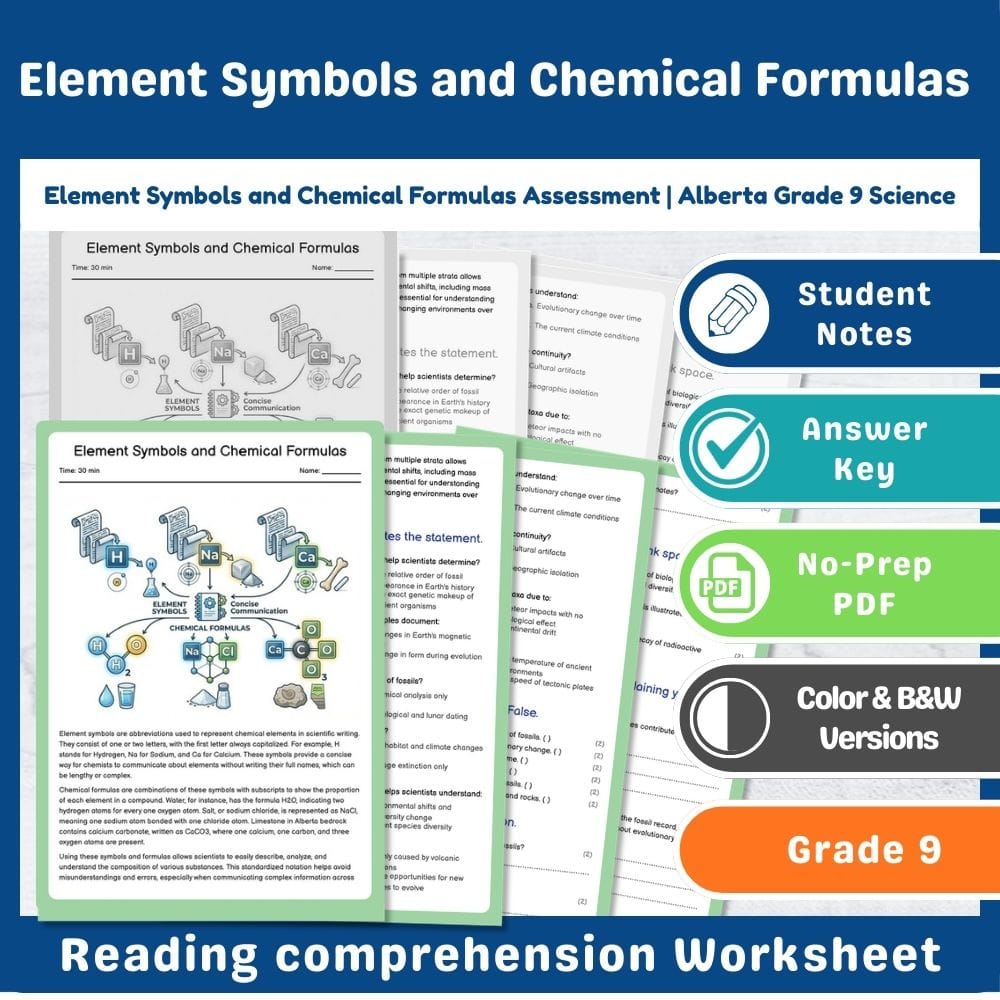
Element Symbols and Chemical Formulas Assessment | Alberta Grade 9 Science
 Created byPrism Point Learning
Learning Objectives
- Understand the use of element symbols and chemical formulas to represent elements and compounds.
- Identify and interpret common chemical formulas such as H2O, NaCl, and CaCO3.
- Explain how formulas indicate the proportions of elements in a substance.
Also included in: Grade 9 Matter and Chemical Change Science Lesson Bundle | Alberta +1 more
Instant download
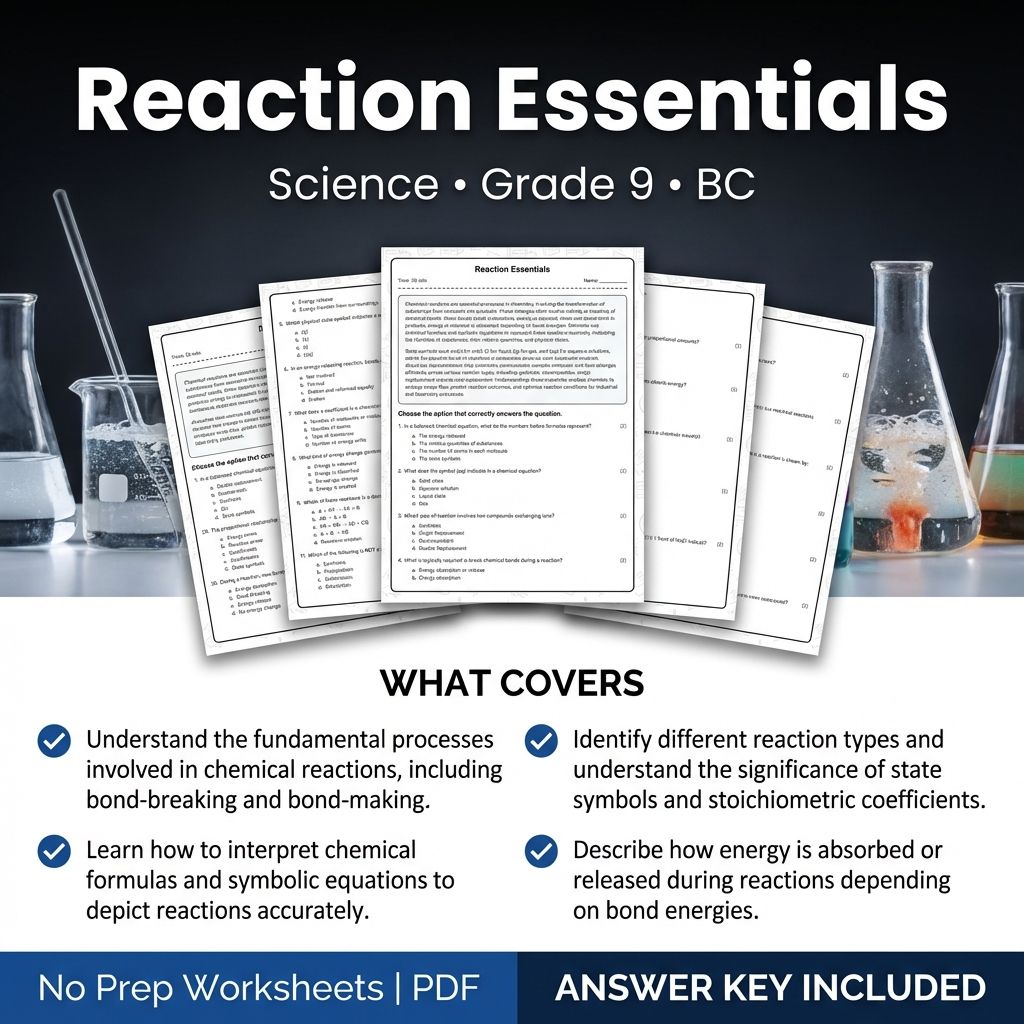
Grade 9 Science | Reaction Essentials Worksheet & Answer Key (Printable PDF)
 Created byCoral Reef Learning
Learning Objectives
- Understand the fundamental processes involved in chemical reactions, including bond-breaking and bond-making.
- Learn how to interpret chemical formulas and symbolic equations to depict reactions accurately.
- Identify different reaction types and understand the significance of state symbols and stoichiometric coefficients.
Instant download

Speciation Intro Worksheet | Grade 9 Science Activities
Created byPrism Point LearningLearning Objectives
- Explain how speciation can occur through reproductive isolating mechanisms over time
- Distinguish between allopatric and sympatric speciation in terms of gene flow and separation
- Classify reproductive barriers as prezygotic or postzygotic and describe examples of each
Also included in: Grade 9 Evolution & Speciation Lesson Bundle | TEKS Science
Instant download
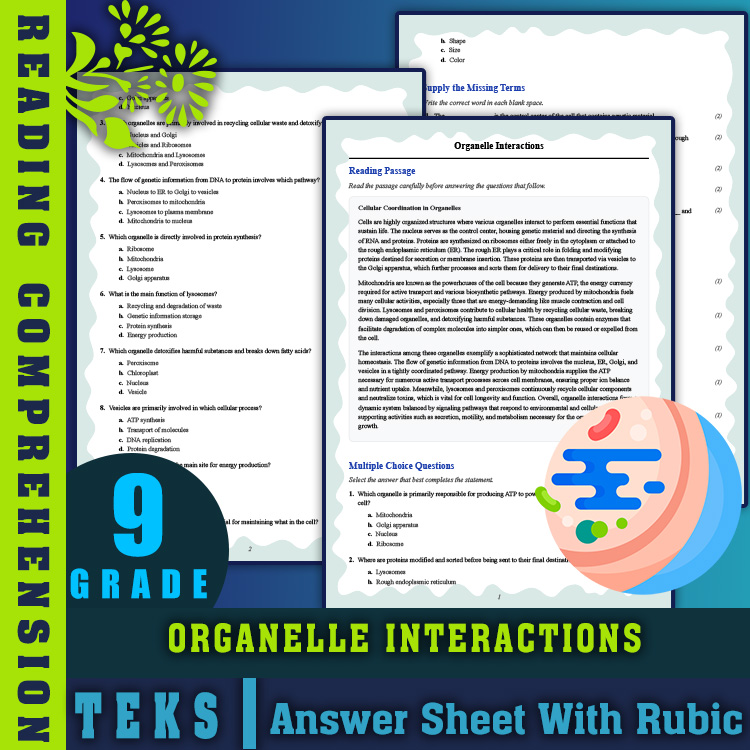
9th Grade Science | Organelle Interactions Reading Worksheet with PDF Answer Key
JCreated byJ.S SheetsLearning Objectives
- Understand how different organelles coordinate to maintain cellular functions.
- Describe the flow of genetic information and protein trafficking within a cell.
- Explain the roles of mitochondria, lysosomes, and peroxisomes in cellular metabolism.
Instant download

Grade 9 Science – Work & Force Calculations Worksheet | Ontario Standards
 Created byBright Mind Resources
Learning Objectives
- Understand the concept of work as the dot product of force and displacement.
- Learn to calculate work when force and displacement are in the same or different directions.
- Explore the methods for calculating work done by variable forces.
Also included in: Grade 9 Work, Energy & Forces Science Daily Reading Lesson Bundle | Ontario +1 more
Instant download
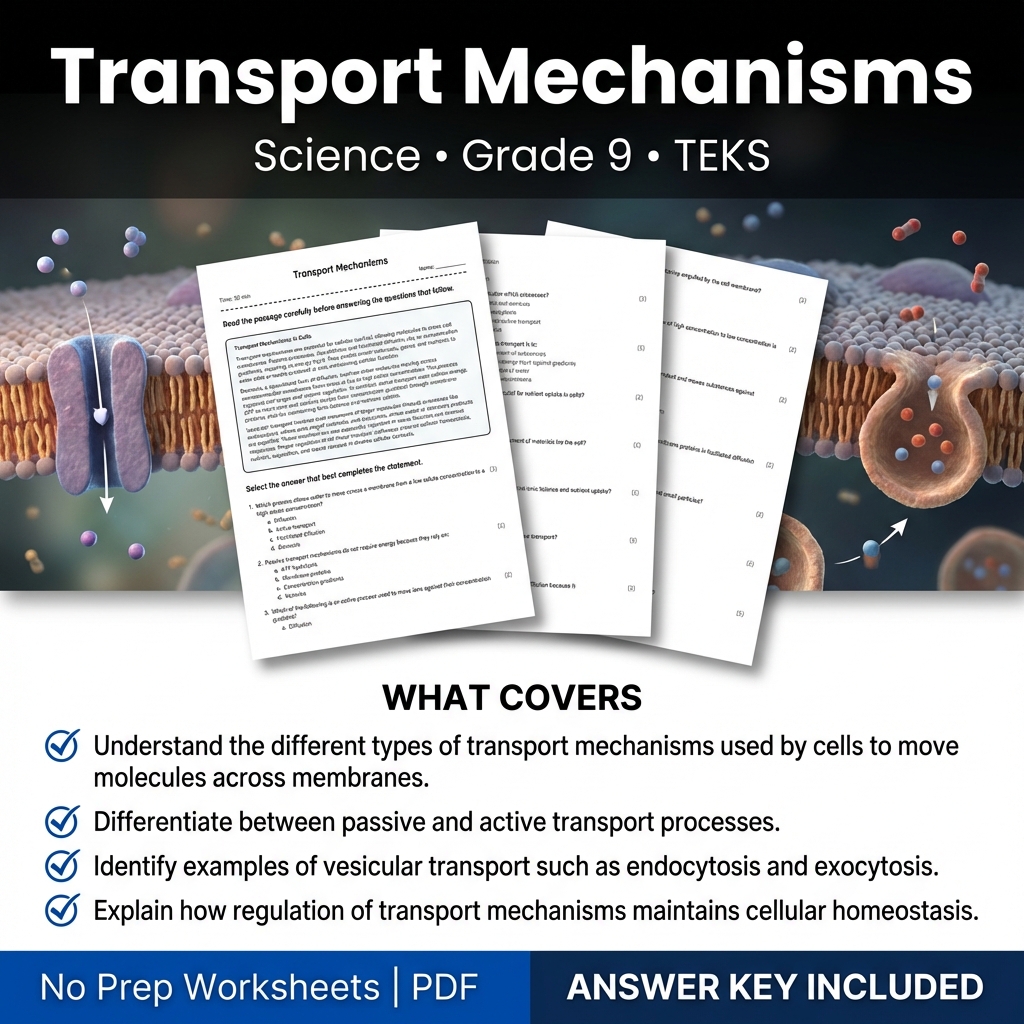
Transport Mechanisms Worksheet for Grade 9 Science TEKS Practice
Created byCoral Reef LearningLearning Objectives
- Understand the different types of transport mechanisms used by cells to move molecules across membranes.
- Differentiate between passive and active transport processes.
- Identify examples of vesicular transport such as endocytosis and exocytosis.
Instant download

Risks and Benefits Worksheet Pack | Grade 9 Science Activities
Created byPrism Point LearningLearning Objectives
- Identify ecological, economic, and health risks and benefits linked to genetic technologies
- Explain how risk assessment, mitigation, and long-term monitoring reduce uncertainty
- Evaluate trade-offs using Alberta-relevant examples such as canola and cattle genetics
Instant download

Mass And Acceleration Worksheet | Grade 9 Science Practice
Created byPrism Point LearningLearning Objectives
- Explain how mass affects acceleration when the net force is fixed using the idea of an inverse relationship.
- Distinguish inertial mass from gravitational effects and relate each to force, acceleration, and weight.
- Use F = ma to predict acceleration changes when mass or net force changes.
Also included in: Forces and Motion Lesson Bundle – Grade 9 Science Framework BC +1 more
Instant download
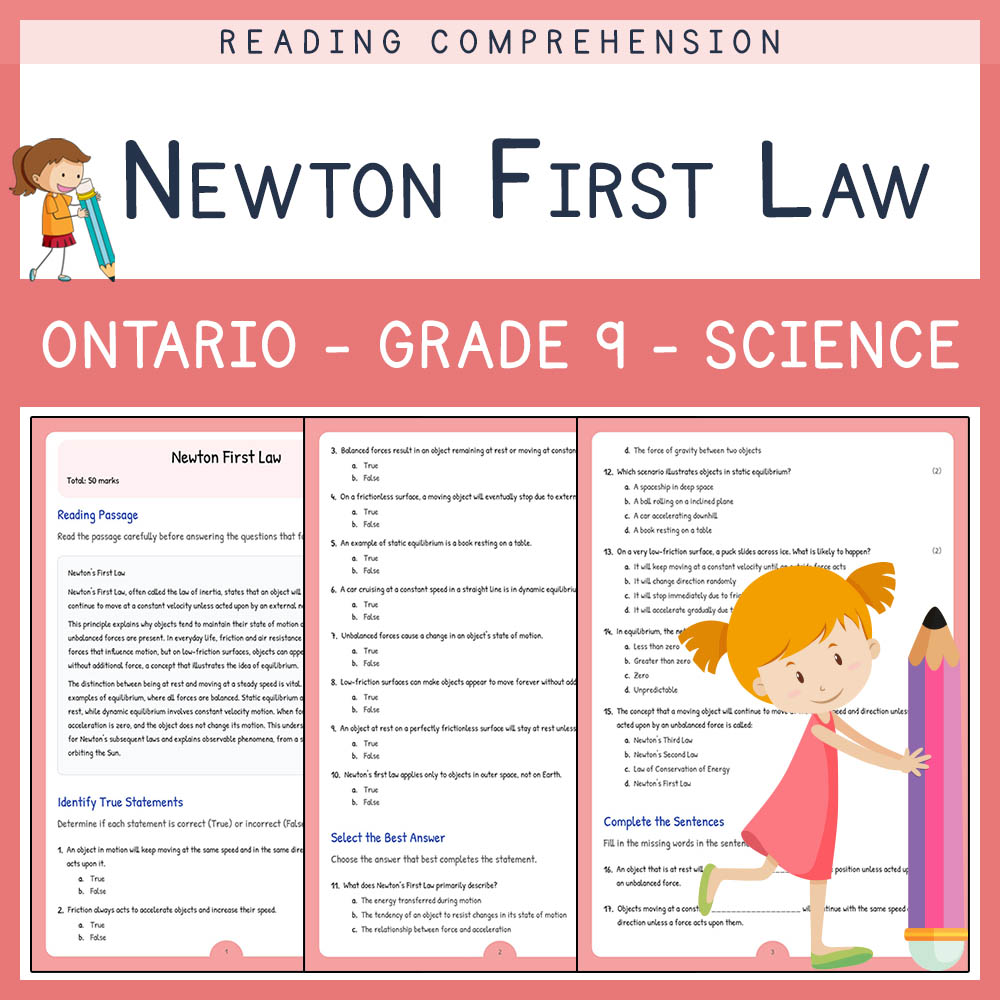
Grade 9 Science | Newton First Law Worksheet Elena | Ontario Standard
Created byLumora LearningLearning Objectives
- Explain Newton's First Law as a statement about inertia and the relationship between net external force and motion.
- Differentiate between objects at rest and those moving at constant velocity.
- Describe the role of balanced forces in static and dynamic equilibrium.
Instant download

Grade 9 Cell Overview Worksheet | Practice BC + PDF
 Created byClear Sky Classroom
Learning Objectives
- Describe the cell membrane, cytoplasm, and genetic material and how they support cell function
- Explain how different organelles contribute to processes such as energy production and protein synthesis
- Interpret how cell models (diagrams and 3D representations) help connect structure to function
Instant download
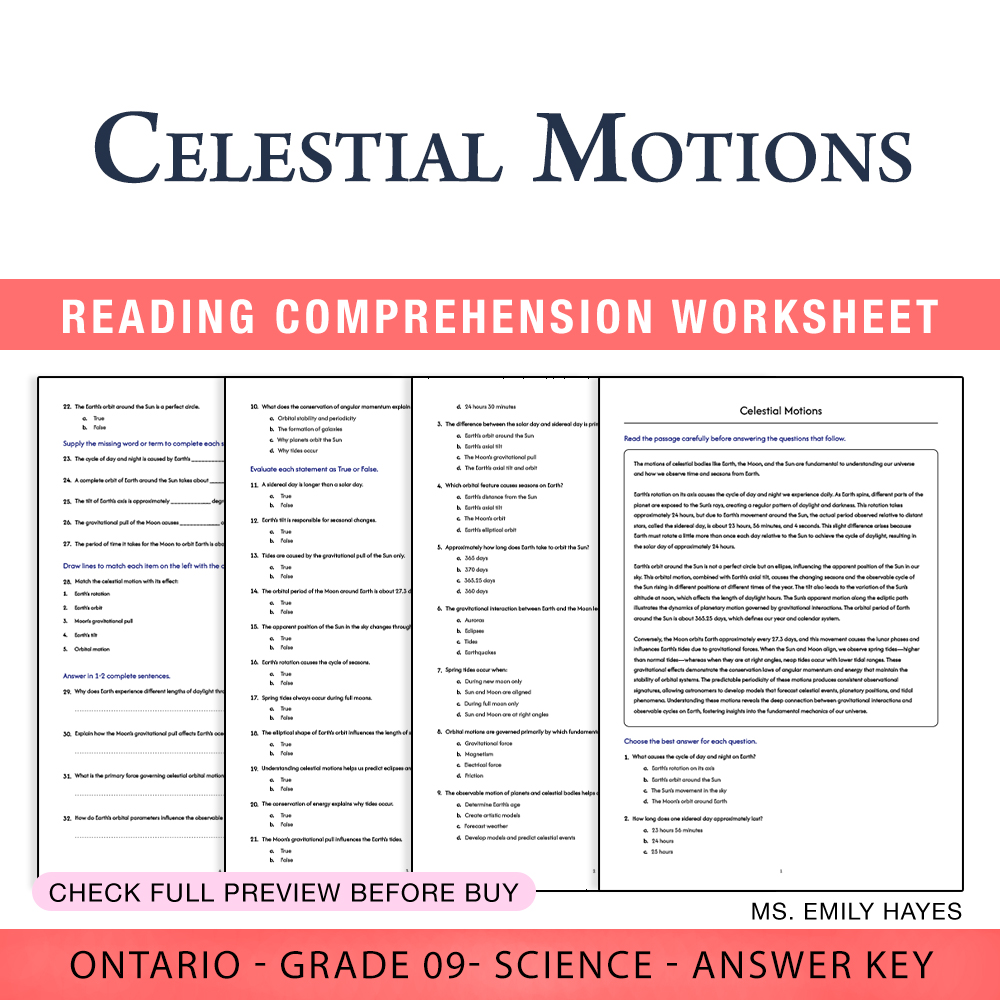
Grade 9 Science | Celestial Motions Worksheet (PDF + Answer Key)
 Created byCopper Leaf Classroom
Learning Objectives
- Understand the relationship between Earth's rotation, orbital motion, and observed day-night cycles.
- Explain the causes of different periods such as sidereal and solar days and their significance.
- Describe how gravitational interactions between Earth, Moon, and Sun influence tides and orbital stability.
Instant download
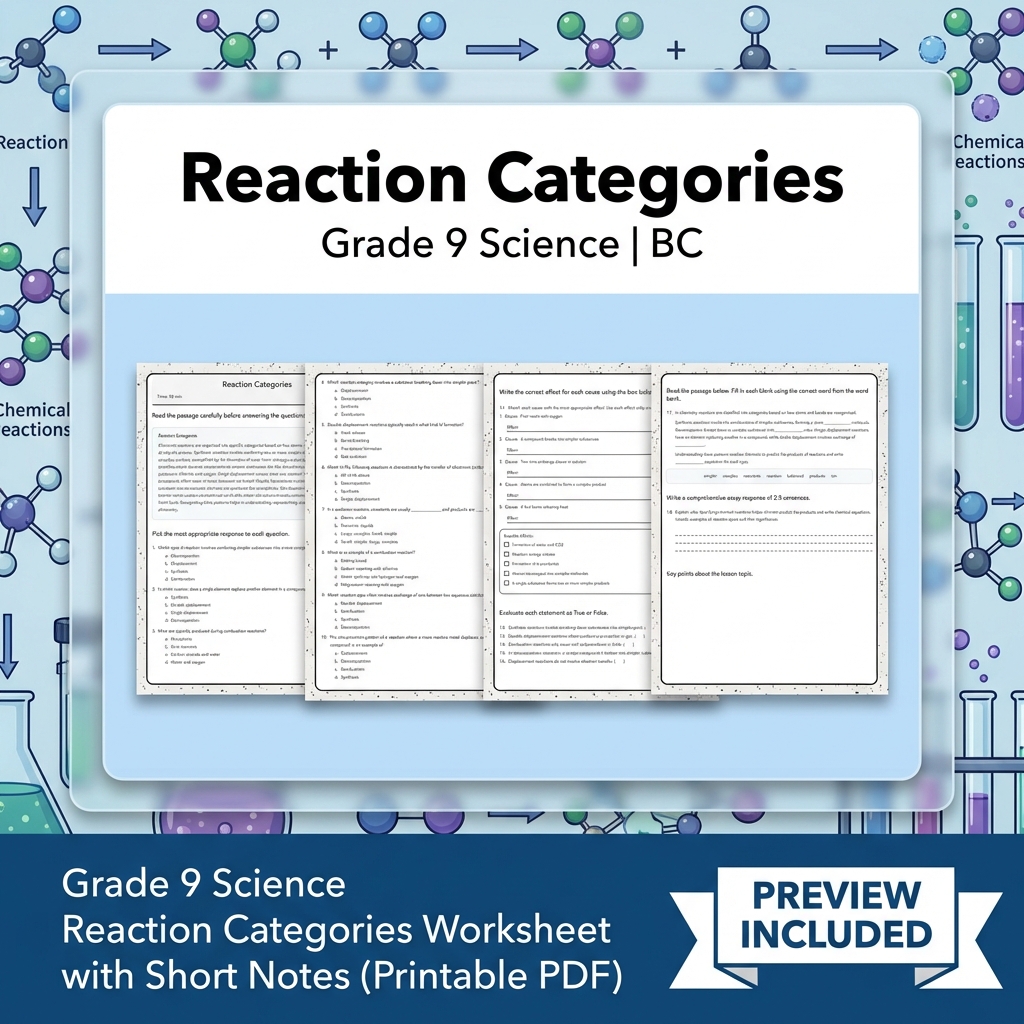
Grade 9 Science Reaction Categories Worksheet with Short Notes (Printable PDF)
 Created byMeadowlark Worksheets
Learning Objectives
- Identify and describe the different types of chemical reactions and their characteristic patterns.
- Classify reactions as synthesis, decomposition, single displacement, double displacement, or combustion.
- Understand the typical reactants and products for each reaction category.
Also included in: Grade 9 Science Lesson Bundle | BC Framework Focused Worksheets +1 more
Instant download
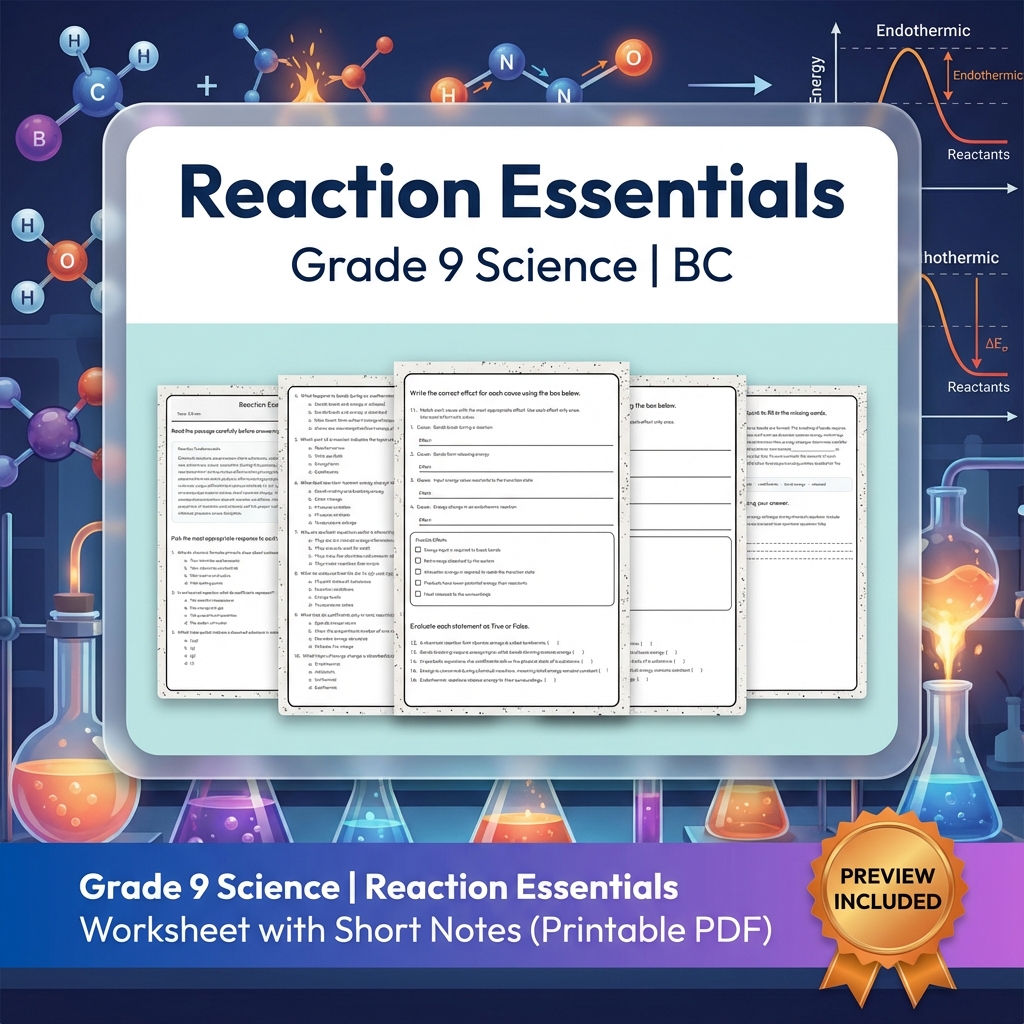
Grade 9 Science | Reaction Essentials Worksheet with Short Notes (Printable PDF)
Created byMeadowlark WorksheetsLearning Objectives
- Understand the basic principles of chemical reactions, including bonds and energy changes.
- Interpret chemical formulas and symbolic equations to identify reactants and products.
- Explain the role of state symbols and coefficients in representing reactions.
Also included in: Grade 9 Science Lesson Bundle | BC Framework Focused Worksheets +1 more
Instant download
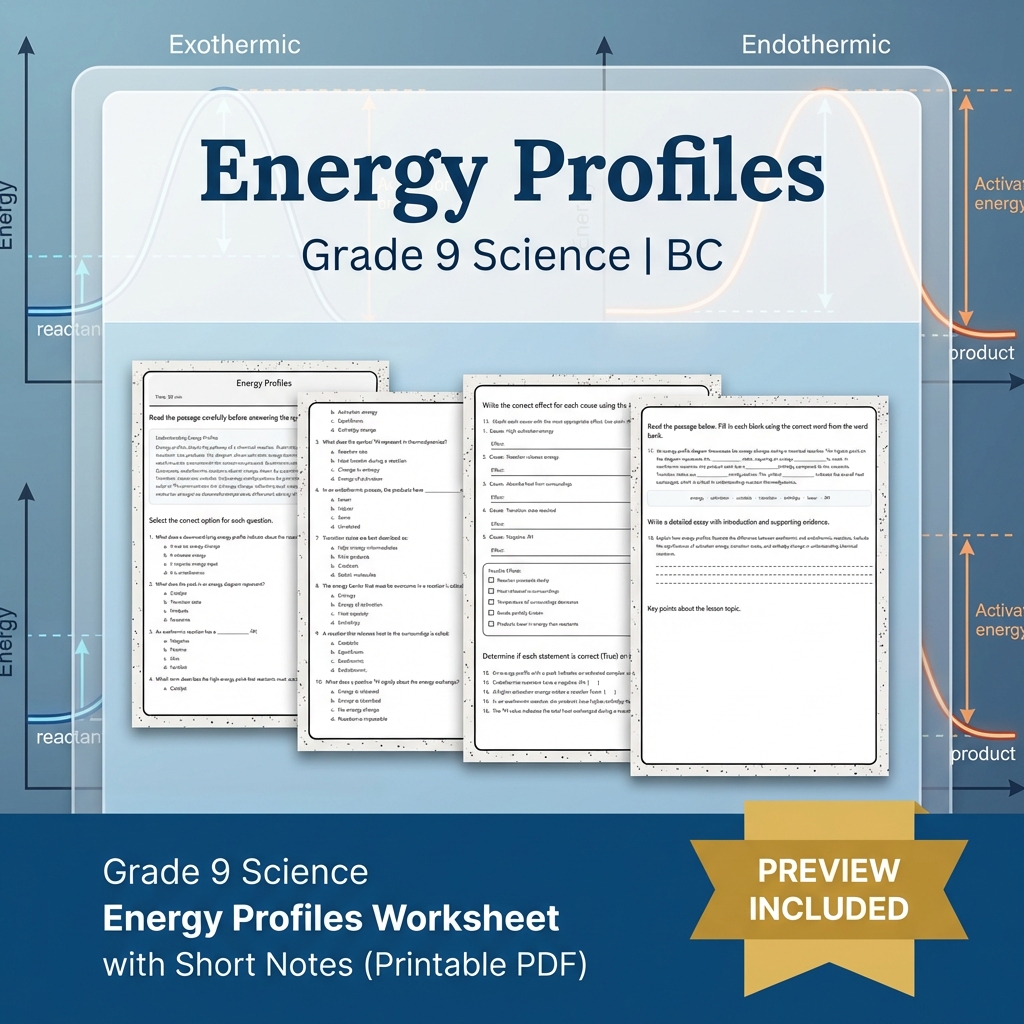
Grade 9 Science Energy Profiles Worksheet with Short Notes (Printable PDF)
Created byMeadowlark WorksheetsLearning Objectives
- Understand the concept of energy profiles and their components.
- Differentiate between exothermic and endothermic reactions based on energy diagrams.
- Interpret transition states and activation energy in chemical reactions.
Also included in: Grade 9 Science Lesson Bundle | BC Framework Focused Worksheets +1 more
Instant download
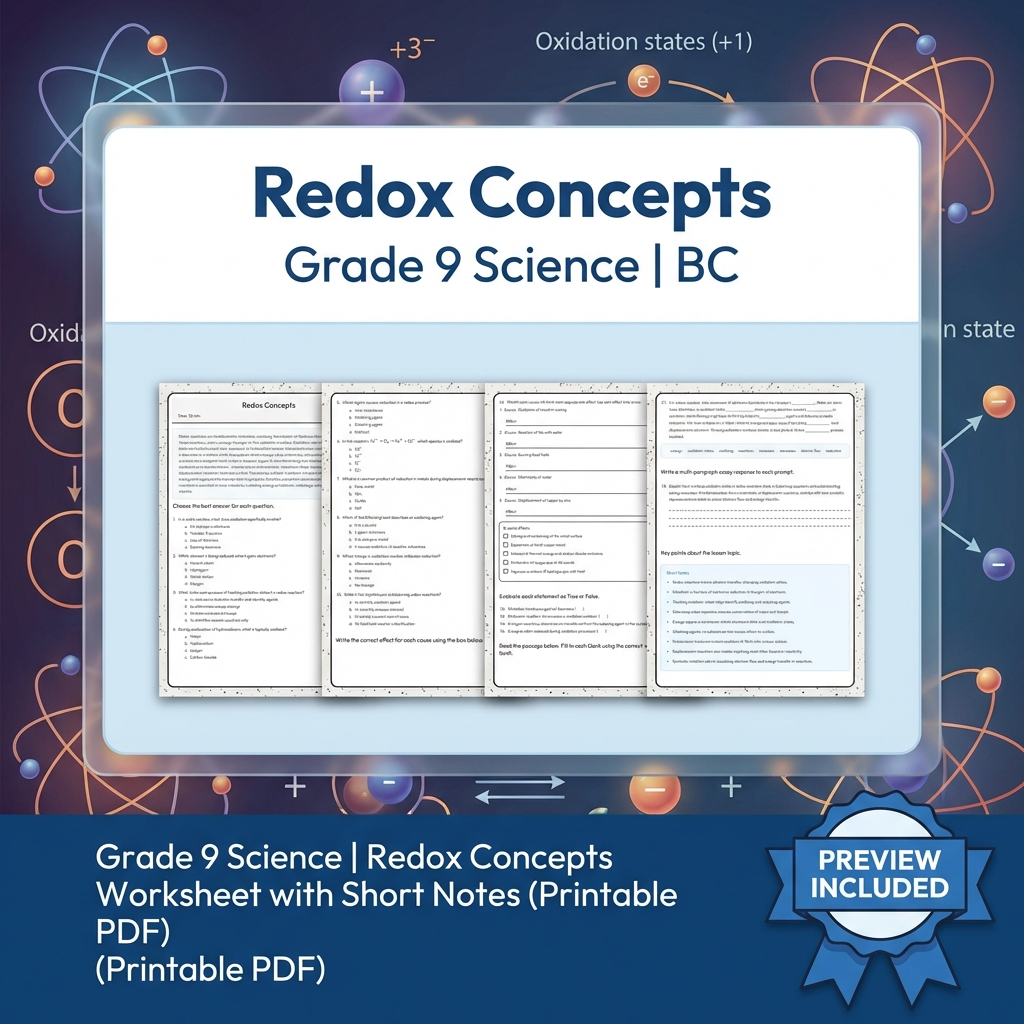
Grade 9 Science | Redox Concepts Worksheet with Short Notes (Printable PDF)
Created byMeadowlark WorksheetsLearning Objectives
- Understand the fundamental ideas of oxidation and reduction in chemical reactions.
- Track changes in oxidation states to identify oxidizing and reducing agents.
- Balance redox equations in combustion and displacement reactions.
Also included in: Grade 9 Science Lesson Bundle | BC Framework Focused Worksheets +1 more
Instant download
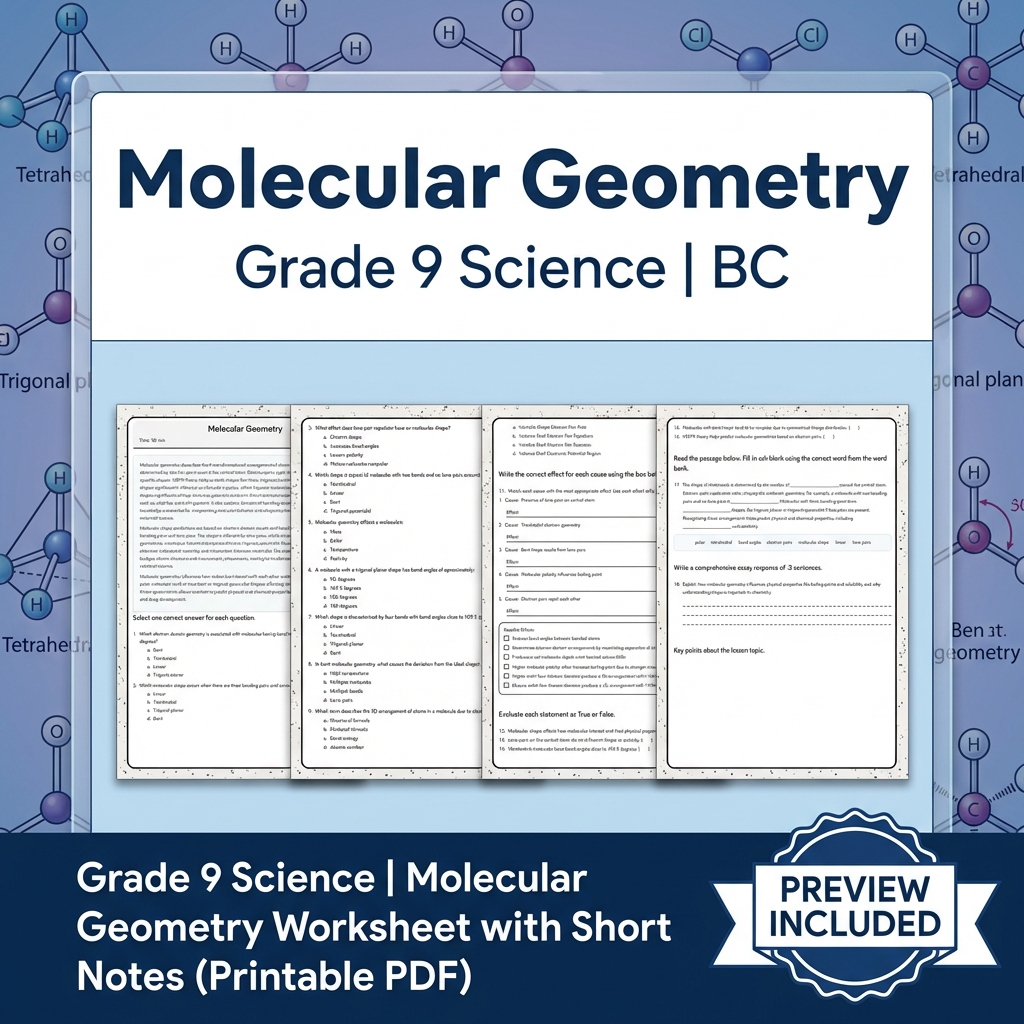
Grade 9 Science | Molecular Geometry Worksheet with Short Notes (Printable PDF)
Created byMeadowlark WorksheetsLearning Objectives
- Understand how electron pairs influence molecular shape based on VSEPR theory.
- Identify common molecular geometries such as linear, trigonal planar, tetrahedral, and bent.
- Explain how molecular geometry affects polarity and physical properties.
Also included in: Grade 9 Science Lesson Bundle | BC Framework Focused Worksheets +1 more
Instant download
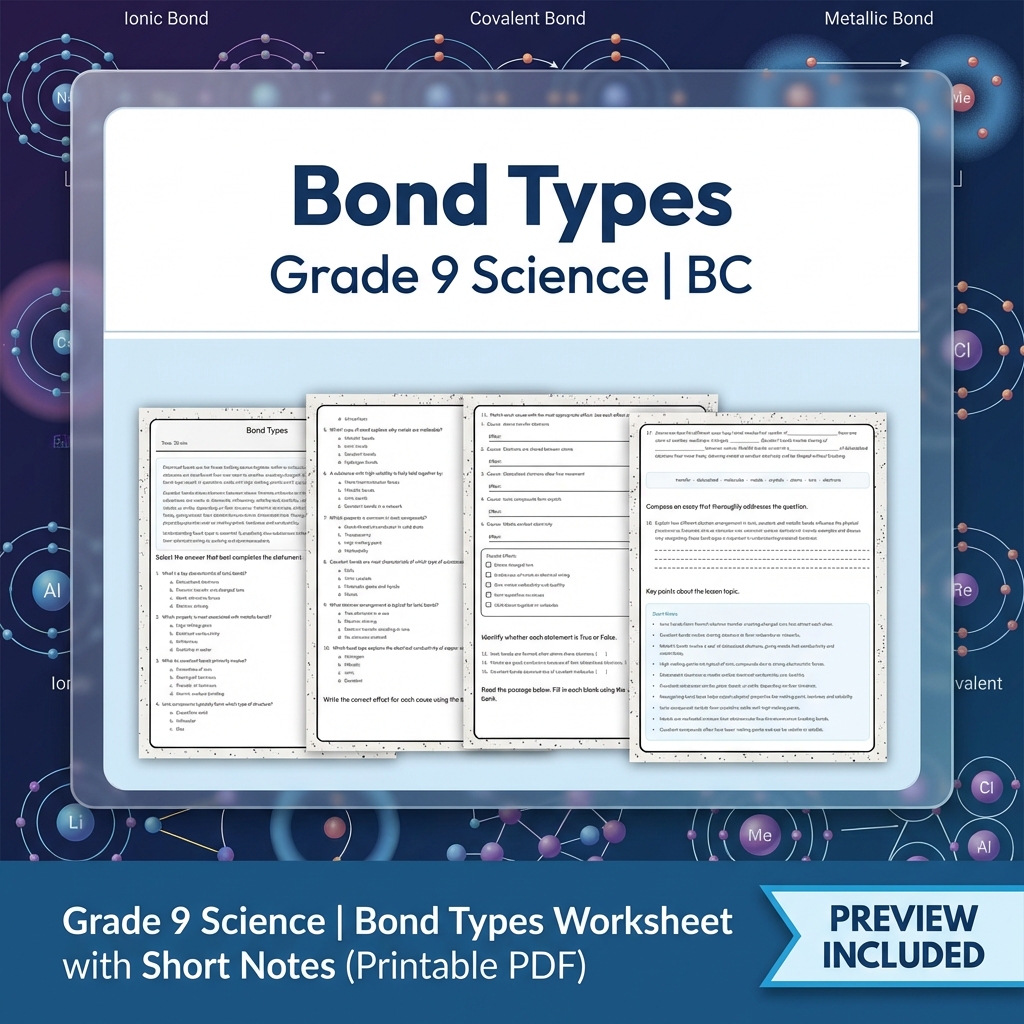
Grade 9 Science | Bond Types Worksheet with Short Notes (Printable PDF)
Created byMeadowlark WorksheetsLearning Objectives
- Identify the characteristics of ionic, covalent, and metallic bonds.
- Explain how electron arrangements influence material properties.
- Distinguish between different bond types based on observable properties.
Also included in: Grade 9 Science Lesson Bundle | BC Framework Focused Worksheets +1 more
Instant download
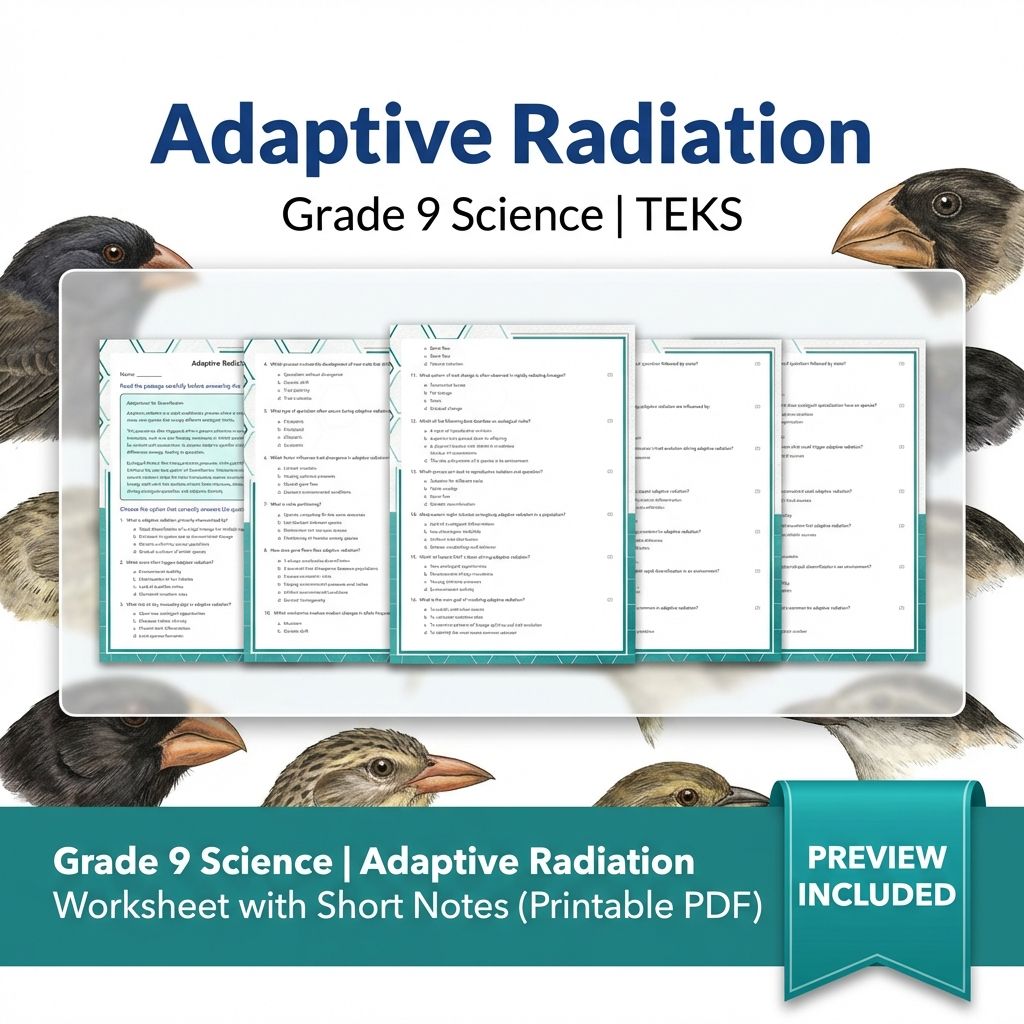
Grade 9 Science | Adaptive Radiation Worksheet with Short Notes (PDF)
Created byMeadowlark WorksheetsLearning Objectives
- Understand the concept of adaptive radiation and its role in biodiversity.
- Identify key processes involved in adaptive radiation such as ecological niches and speciation.
- Explain how variations in selective pressures influence trait evolution during adaptive radiation.
Instant download
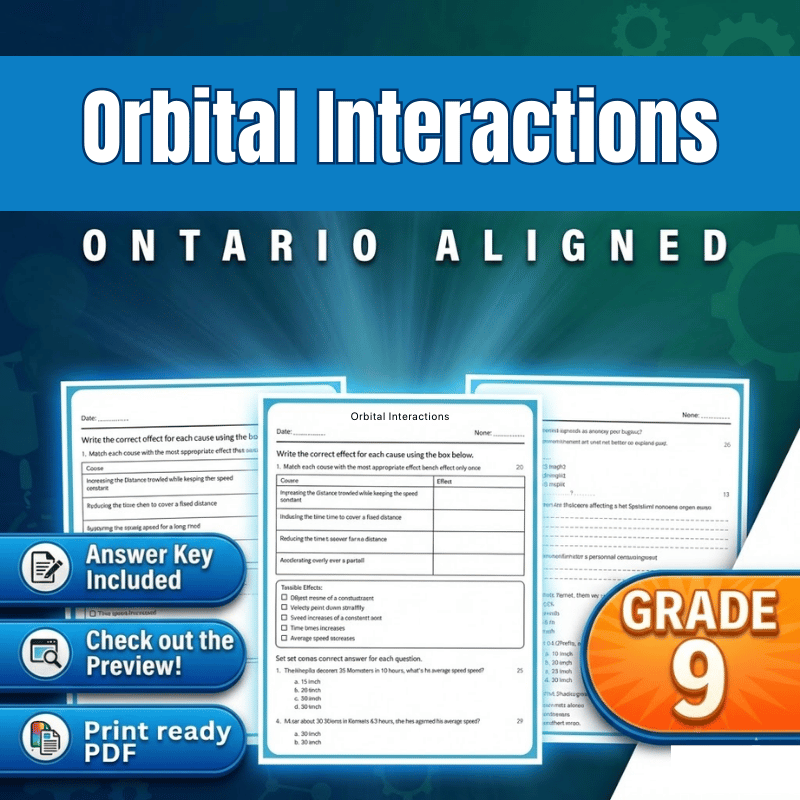
Grade 9 Science | Orbital Interactions Worksheet (Ontario Standards) (PDF)
Created byBright Mind ResourcesLearning Objectives
- Understand how orbital parameters such as eccentricity, axial tilt, and precession influence climate patterns and insolation.
- Explain tidal forces generated by the Moon and Sun through gravitational effects and their observable consequences.
- Connect orbital dynamics, such as resonance and tidal locking, to long-term climate variations and Earth's day length.
Instant download
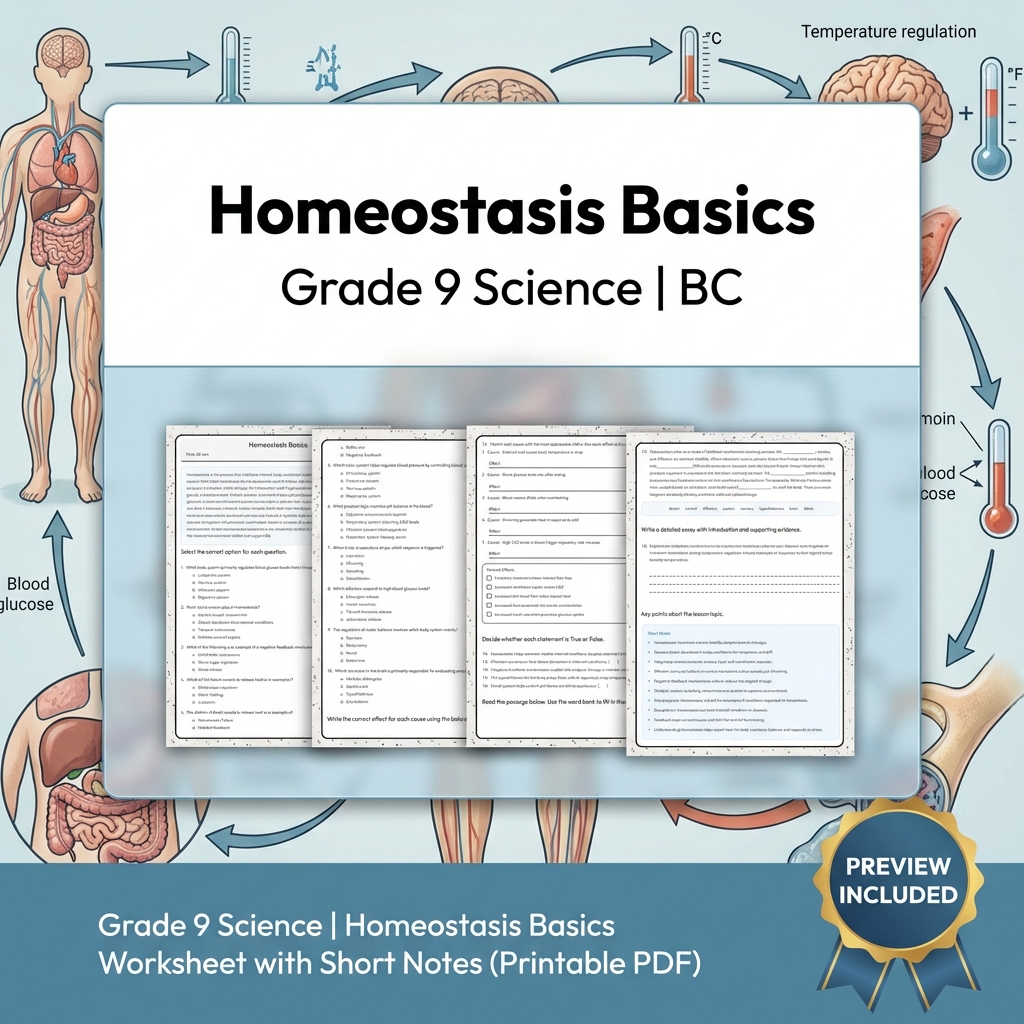
Grade 9 Science | Homeostasis Basics Worksheet with Short Notes (Printable PDF)
Created byMeadowlark WorksheetsLearning Objectives
- Explain the concept of homeostasis and its importance for maintaining internal stability.
- Identify the different body systems involved in homeostasis and their functions.
- Describe feedback mechanisms that regulate internal conditions such as temperature, pH, and blood glucose.
Also included in: Grade 9 Science Lesson Bundle | BC Framework Worksheets (15-Piece Collection) +1 more
Instant download
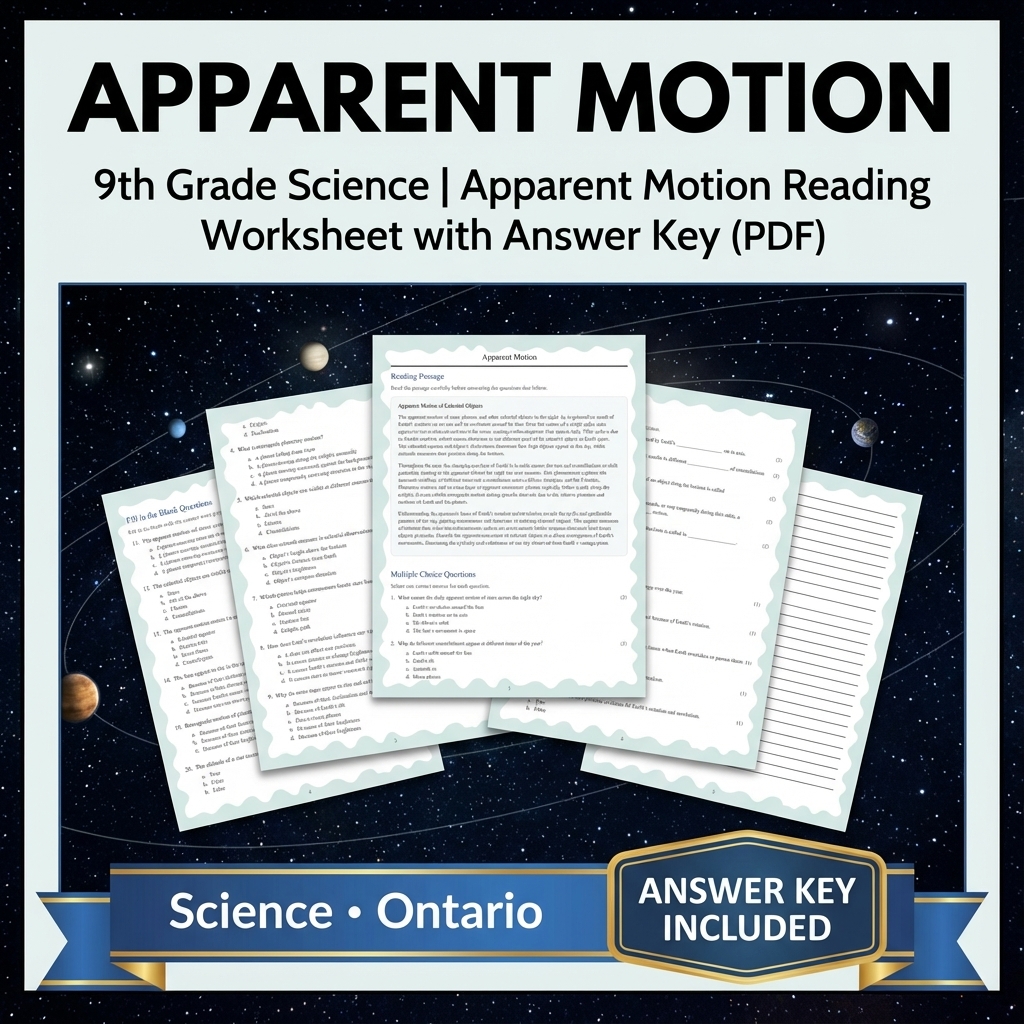
9th Grade Science | Apparent Motion Reading Worksheet with Answer Key (PDF)
JCreated byJ.S SheetsLearning Objectives
- Describe the apparent daily and annual motion of celestial objects caused by Earth's rotation and revolution.
- Explain how Earth's movements create changing sky patterns over nights and seasons.
- Use celestial coordinate concepts like rising, setting, altitude, and azimuth to understand observed motions.
Also included in: Grade 9 Science | Earth Processes & Celestial Phenomena Worksheets Collection +1 more
Instant download
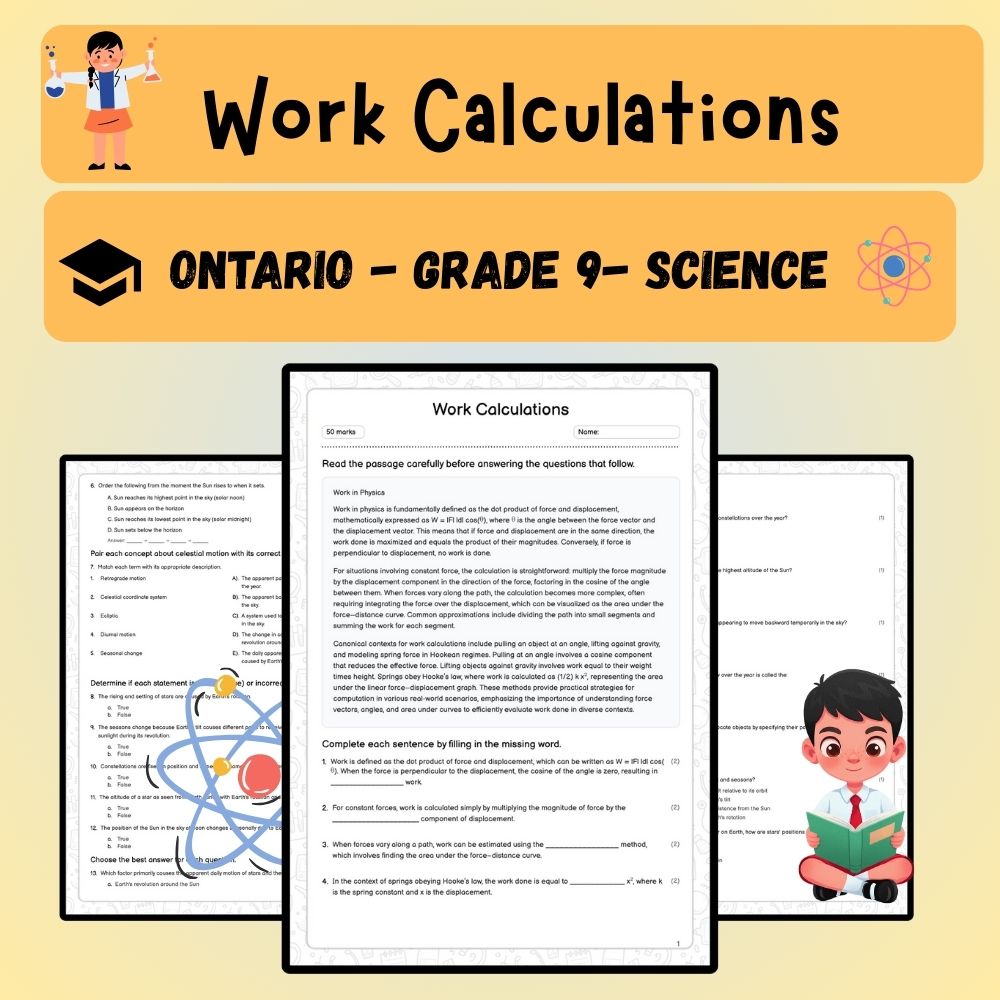
Grade 9 Science | Work Calculations Worksheet (Answer Key) – Ontario Standard
Created byPrism Point LearningLearning Objectives
- Understand the concept of work as the dot product of force and displacement, incorporating the angle between them.
- Differentiate methods for calculating work with constant and variable forces.
- Apply area-under-curve methods to estimate work for non-constant forces using common approximations.
Also included in: Grade 9 Science Unit | Forces, Motion & Energy Worksheets (Ontario Standards) +1 more
Instant download
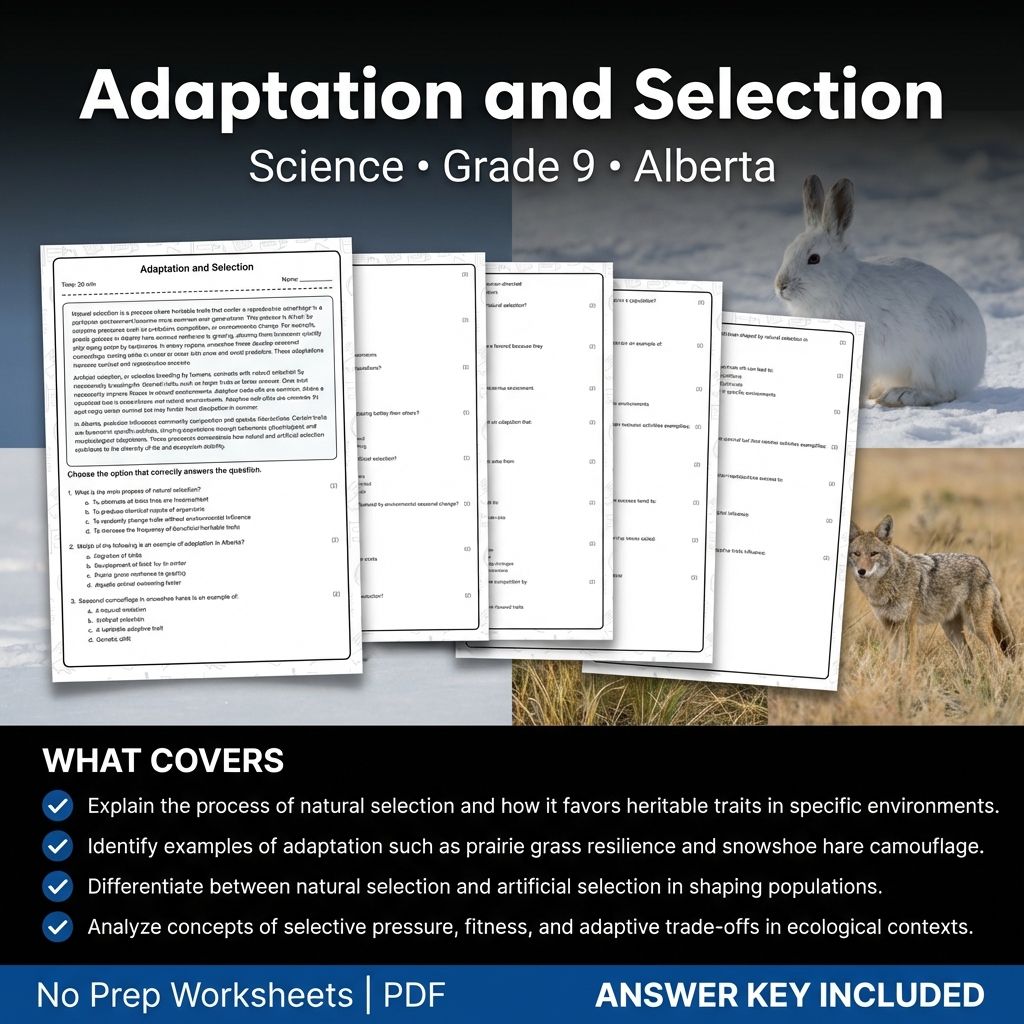
Grade 9 Science Worksheet Adaptation and Selection | Alberta Standards
Created byCoral Reef LearningLearning Objectives
- Explain the process of natural selection and how it favors heritable traits in specific environments.
- Identify examples of adaptation such as prairie grass resilience and snowshoe hare camouflage.
- Differentiate between natural selection and artificial selection in shaping populations.
Instant download
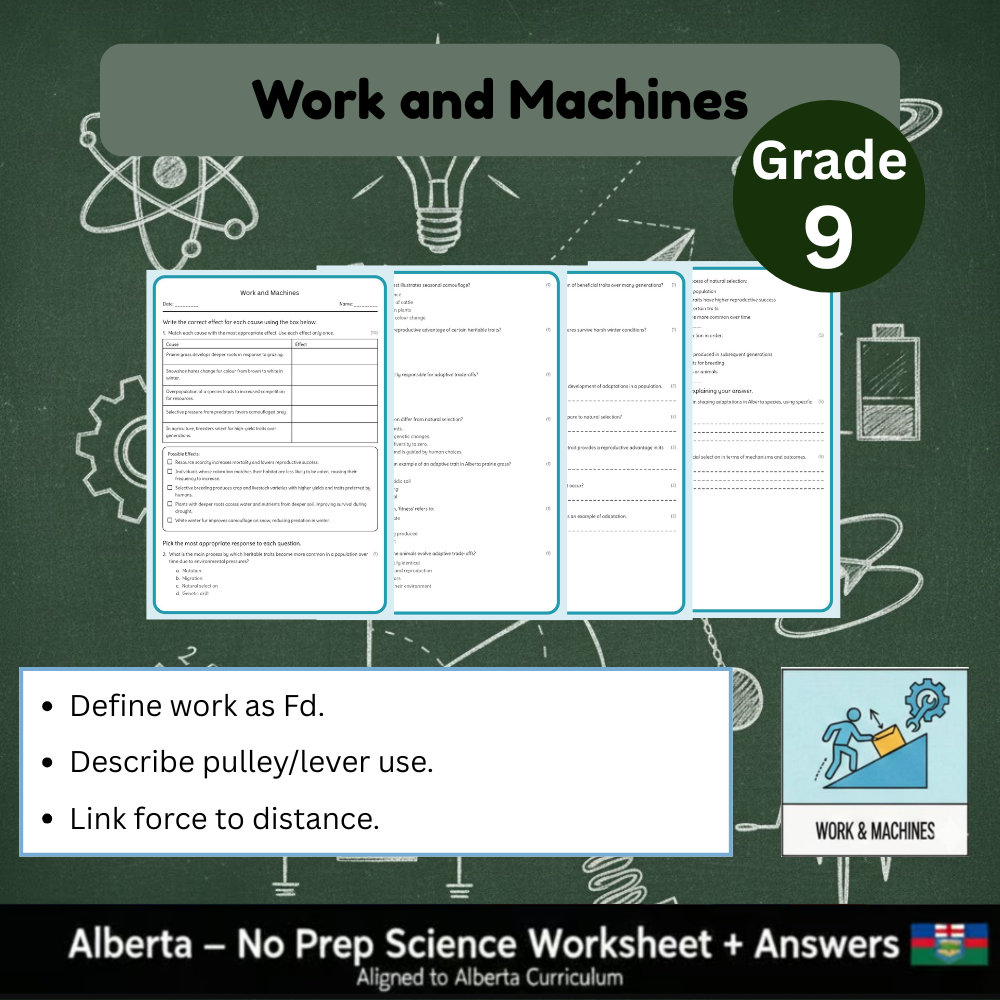
Grade 9 Science | Work and Machines Worksheet (PDF) – Alberta Standard
Created byBright Mind ResourcesLearning Objectives
- Explain the concept of work as energy transfer by a force acting through a distance.
- Identify and describe simple machines such as levers, pulleys, and inclined ramps and their functions.
- Analyze the relationship between force, distance, and mechanical advantage in machine operation.
Instant download
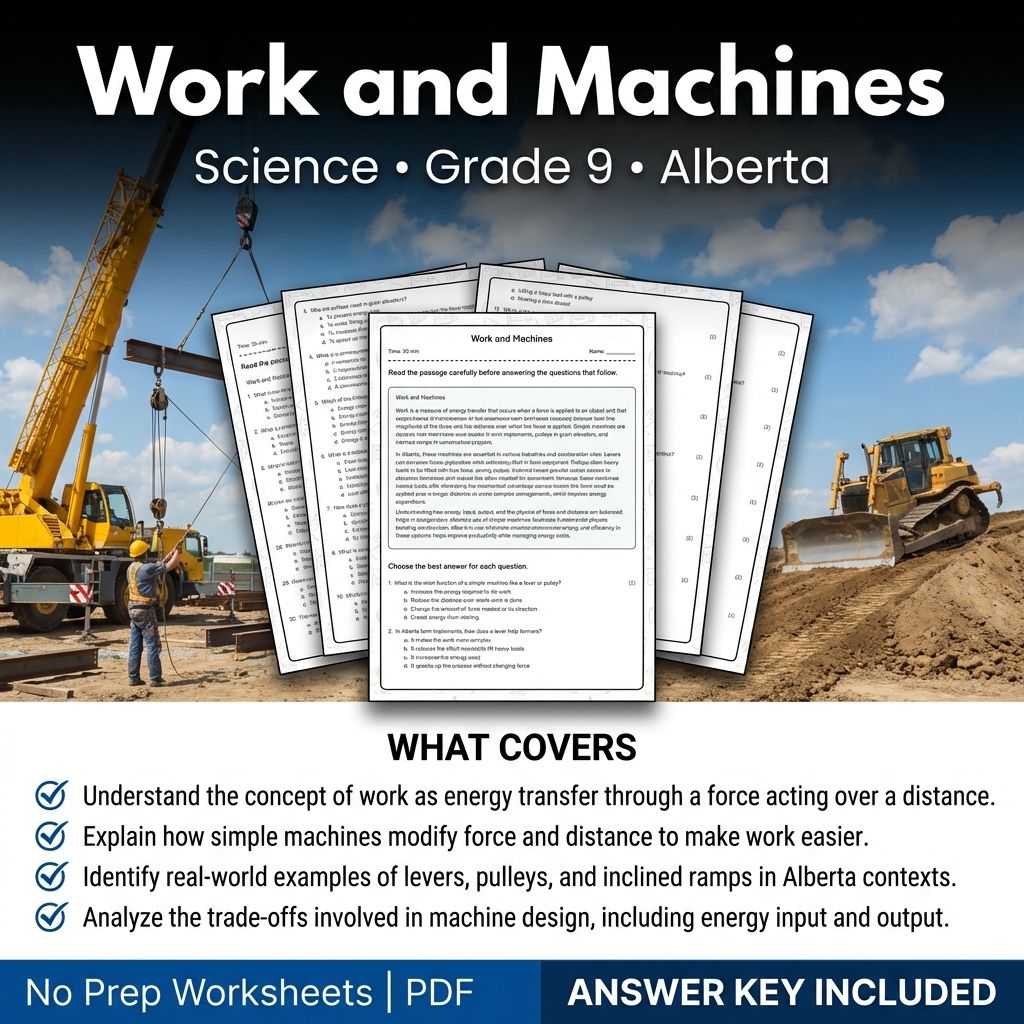
Work and Machines Grade 9 Science Worksheet | Alberta Standards
Created byCoral Reef LearningLearning Objectives
- Understand the concept of work as energy transfer through a force acting over a distance.
- Explain how simple machines modify force and distance to make work easier.
- Identify real-world examples of levers, pulleys, and inclined ramps in Alberta contexts.
Instant download

Grade 9 Science Worksheet | Atomic Structure Alberta Standards (PDF)
 Created byEvergreen Desk Education
Learning Objectives
- Explain how atomic number and mass number determine the identity and isotopes of elements
- Describe the roles of protons, neutrons, and electrons in atomic structure
- Use simple nucleus and electron-shell models to predict basic chemical behaviour
Instant download

Biotech Ethics Worksheet for Grade 9 Science | Standards-Aligned Practice
JCreated byJ.S SheetsLearning Objectives
- Evaluate biotechnological proposals by balancing potential benefits and potential risks to individuals and communities.
- Explain ethical concerns related to genetic privacy, informed consent, off-target genome-editing effects, and ecological consequences.
- Identify how equitable access and public engagement influence regulation and policy decisions for biotechnology.
Instant download
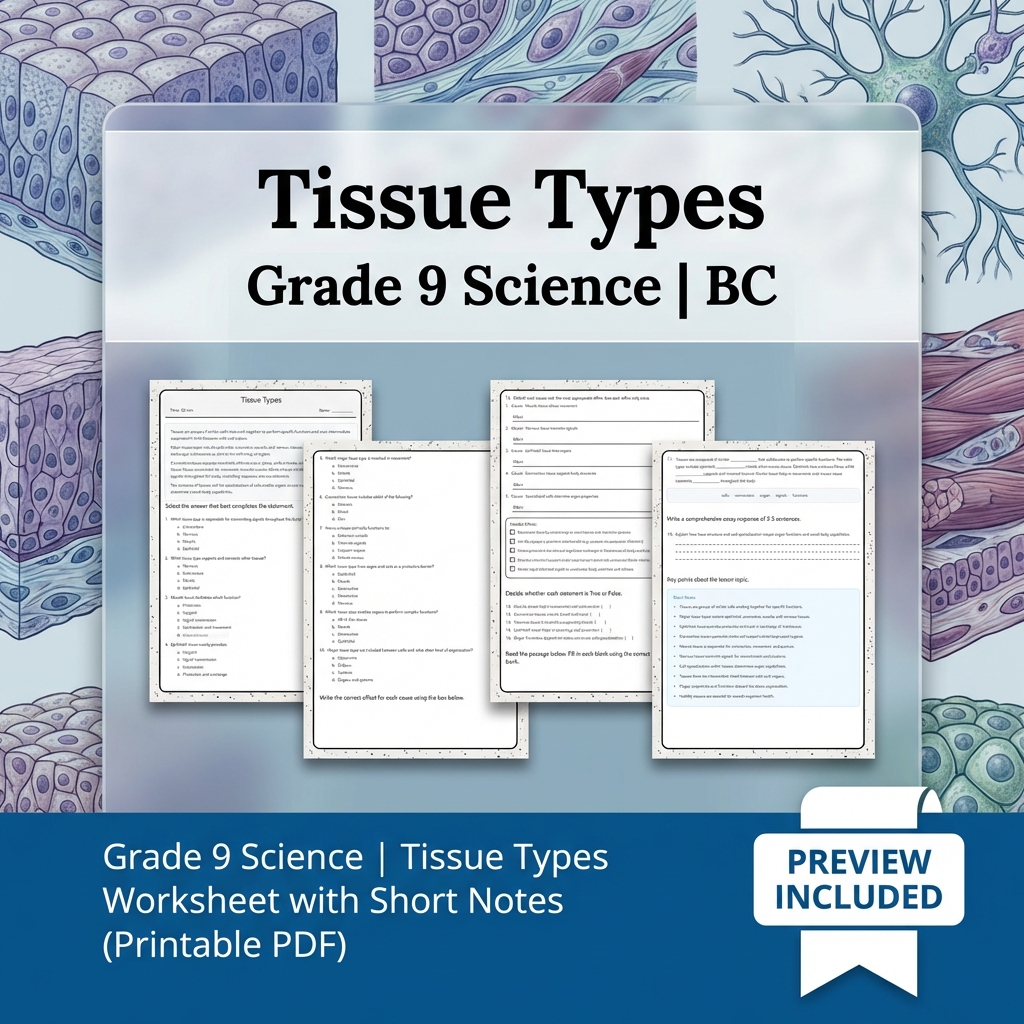
Grade 9 Science | Tissue Types Worksheet with Short Notes (Printable PDF)
Created byMeadowlark WorksheetsLearning Objectives
- Identify and describe the major tissue types in the human body.
- Understand the functions of epithelial, connective, muscle, and nervous tissues.
- Explain how tissue structure relates to tissue function and organ properties.
Also included in: Grade 9 Science Lesson Bundle | BC Framework Worksheets (15-Piece Collection) +1 more
Instant download
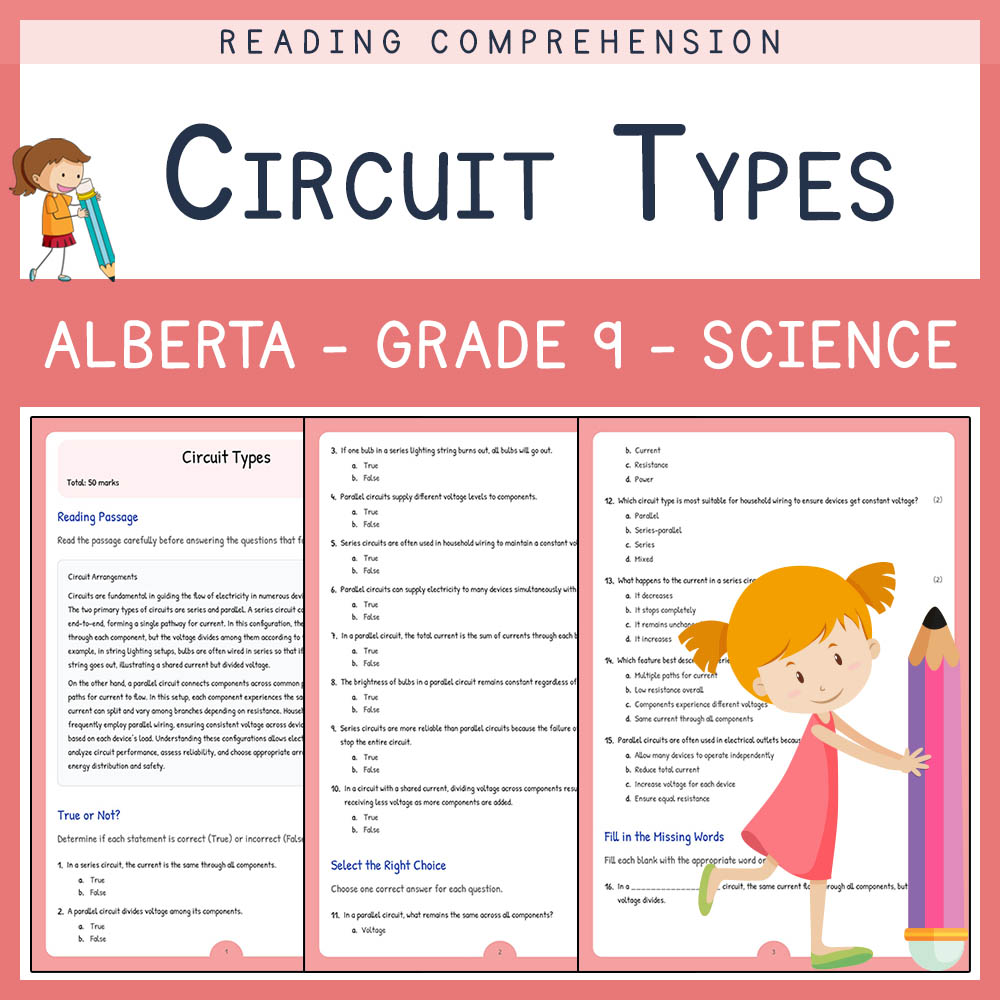
Grade 9 Science | Circuit Types Worksheet Elena | Alberta Standards
Created byLumora LearningLearning Objectives
- Understand the difference between series and parallel circuits.
- Identify circuit behavior based on component arrangements.
- Explain how current and voltage behave in series and parallel circuits.
Instant download
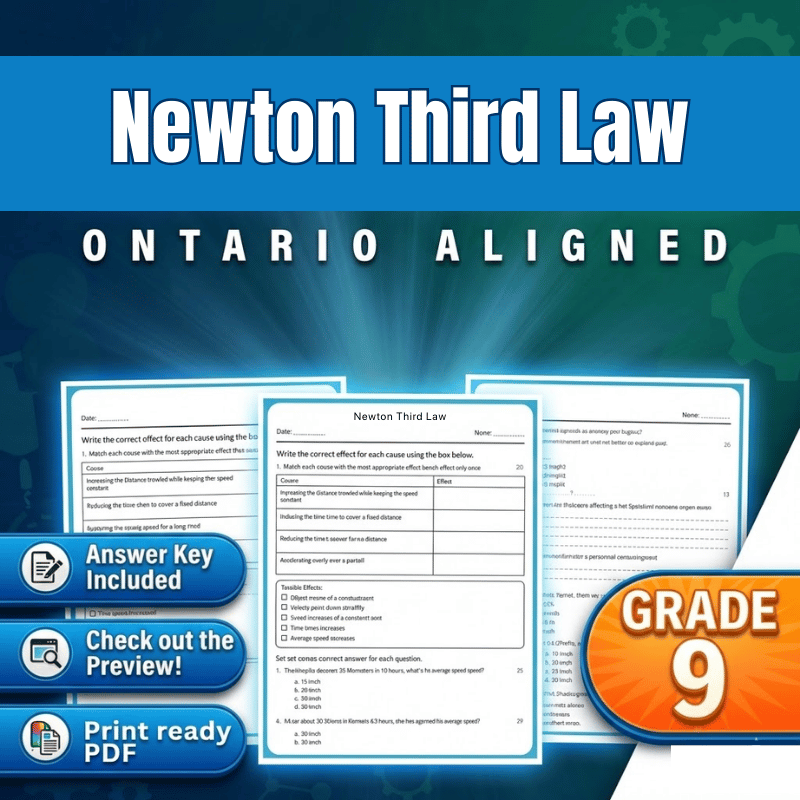
Grade 9 Science | Newton's Third Law Worksheet (Ontario Standards) (PDF)
Created byBright Mind ResourcesLearning Objectives
- Understand the concept of action–reaction force pairs in Newton's third law.
- Identify examples of equal magnitude and opposite directions in force interactions.
- Analyze the implications of Newton's third law in real-world phenomena like propulsion and collisions.
Instant download
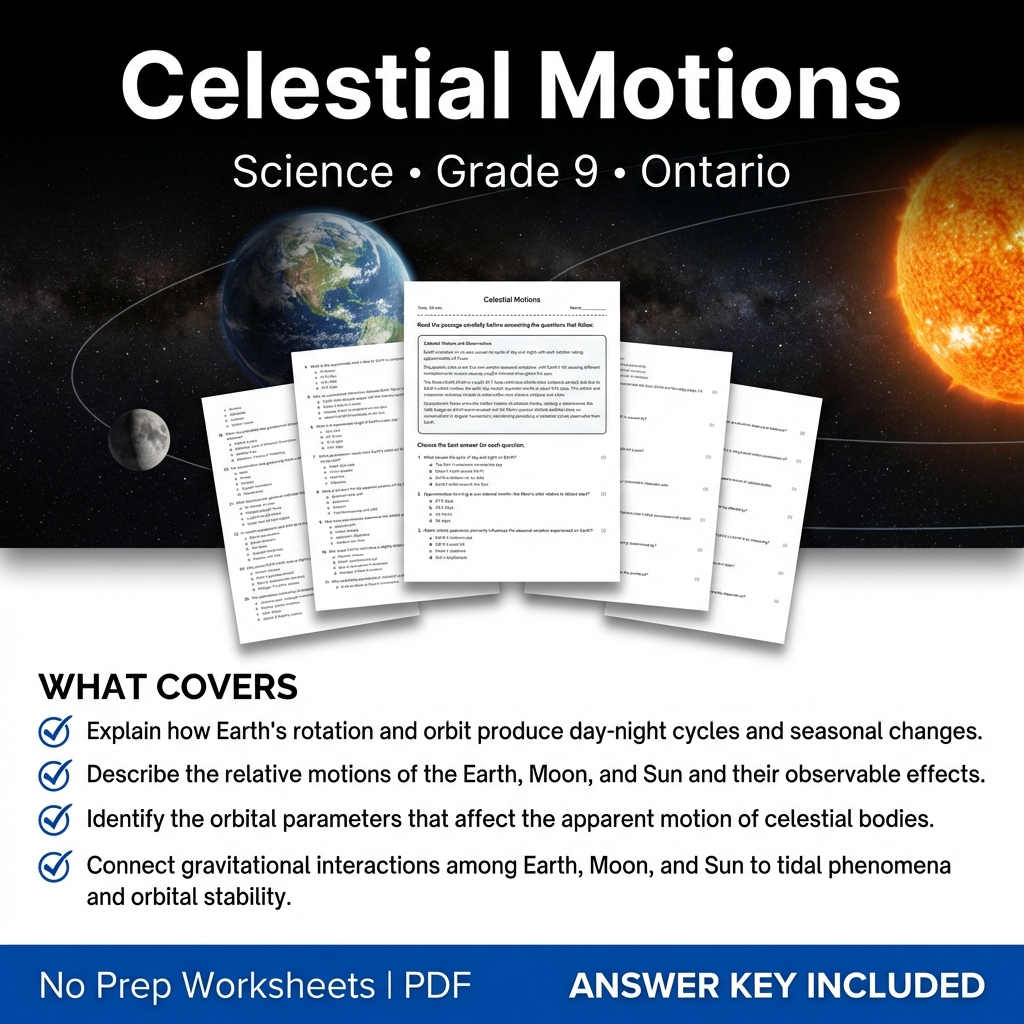
Celestial Motions Worksheet for Grade 9 Science | Ontario Standards
Created byCoral Reef LearningLearning Objectives
- Explain how Earth's rotation and orbit produce day-night cycles and seasonal changes.
- Describe the relative motions of the Earth, Moon, and Sun and their observable effects.
- Identify the orbital parameters that affect the apparent motion of celestial bodies.
Instant download
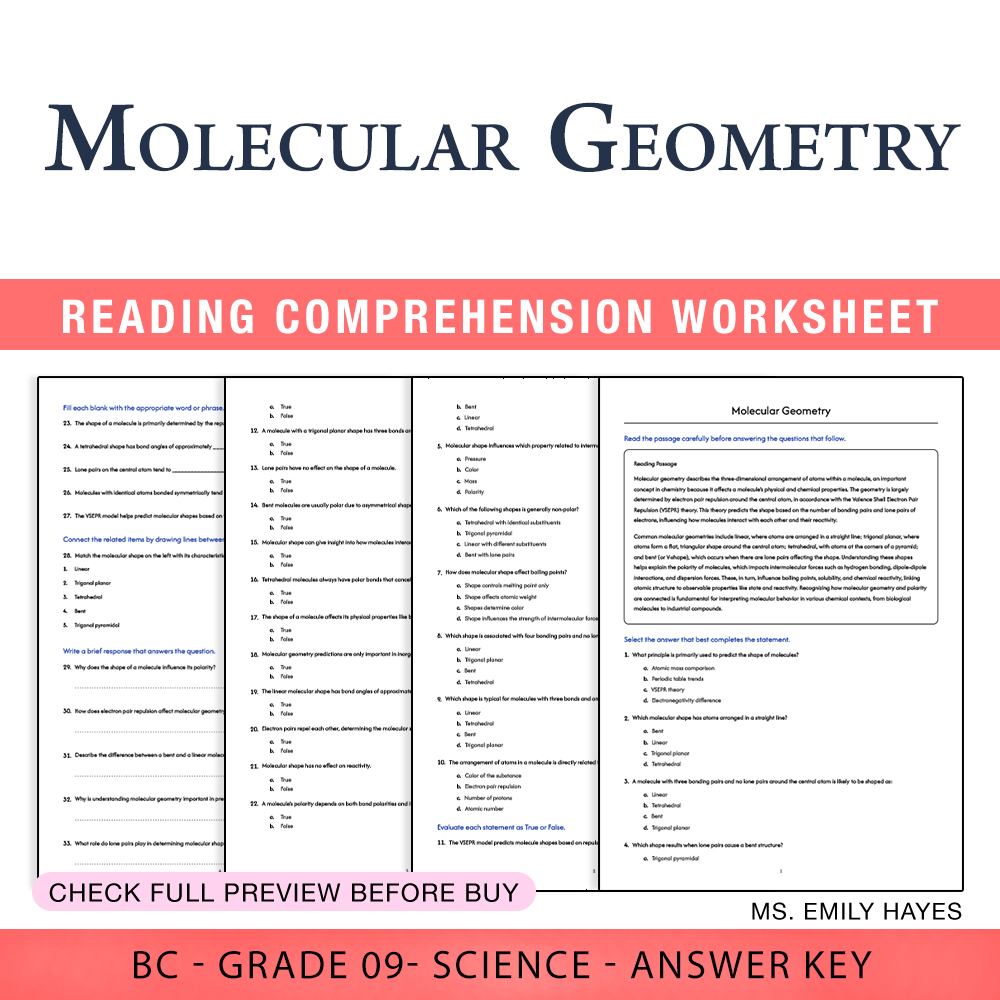
Grade 9 Science | Molecular Geometry Worksheet (PDF+ Answer Key)
Created byCopper Leaf ClassroomLearning Objectives
- Explain the principles of VSEPR theory related to molecular shapes.
- Identify common molecular geometries such as linear, trigonal planar, tetrahedral, and bent.
- Understand how molecular shape influences polarity and physical properties.
Also included in: Grade 9 Science Bundle | Chemistry, Physics & Atomic Concepts (PDF + Answer Key) +1 more
Instant download
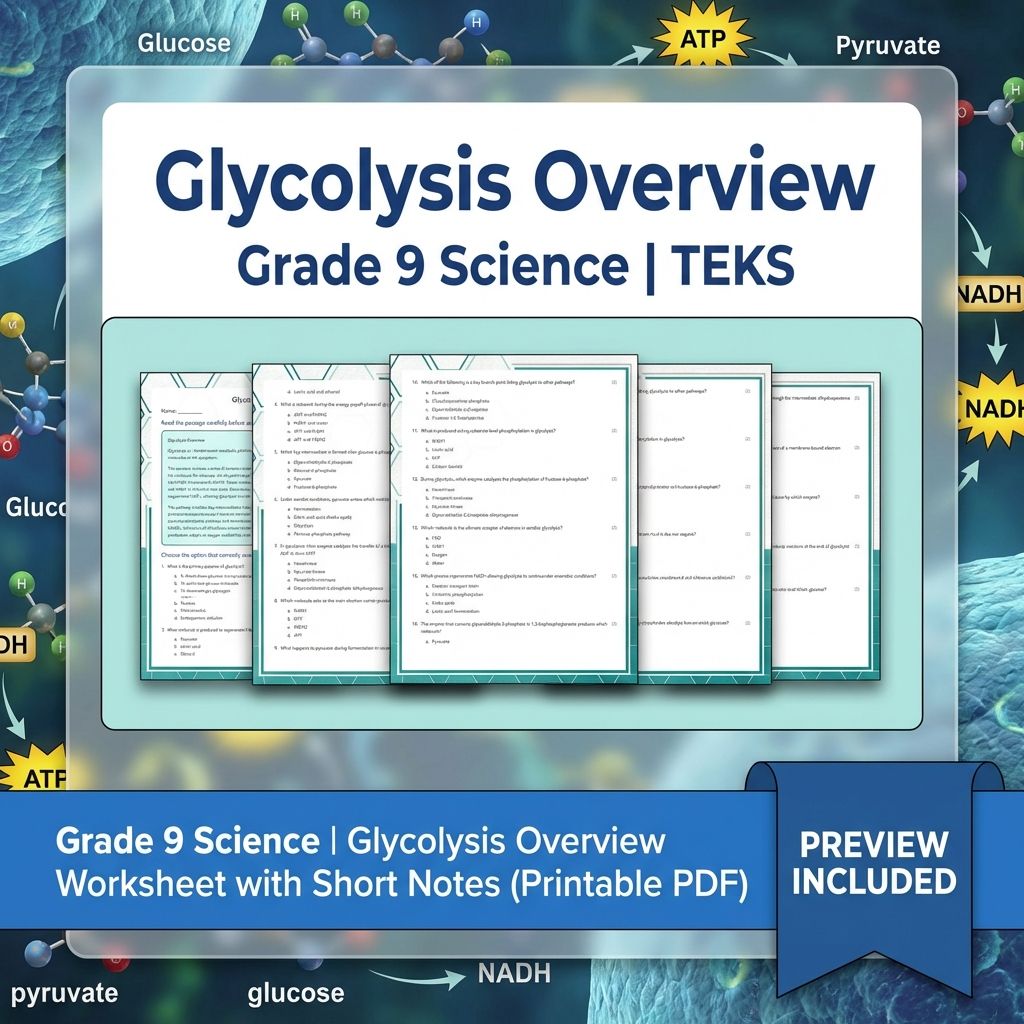
Grade 9 Science | Glycolysis Overview Worksheet with Short Notes(Printable PDF)
Created byMeadowlark WorksheetsLearning Objectives
- Understand the stepwise process of glycolysis and its energy changes.
- Identify the key intermediates and branch points in glycolysis.
- Describe how glycolysis functions under aerobic and anaerobic conditions.
Instant download
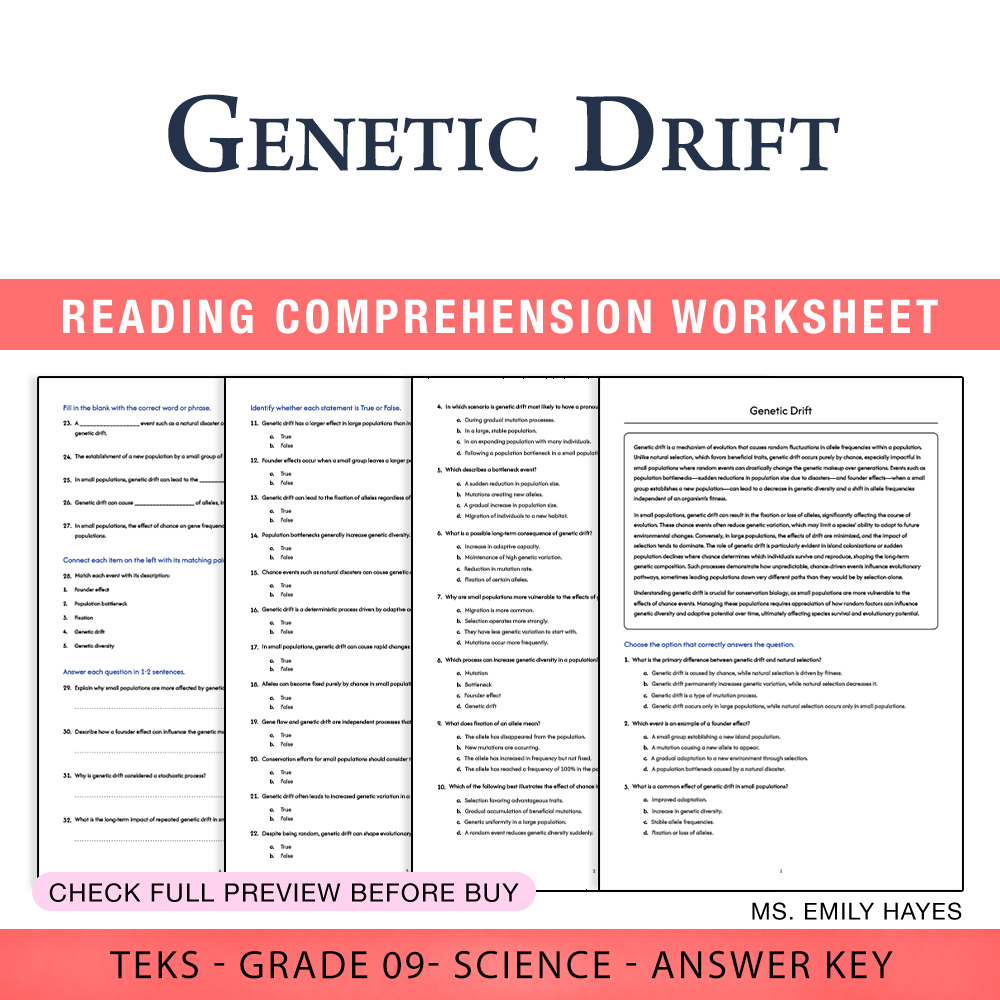
9th Grade Science | Genetic Drift Worksheet (PDF+ Answer Key)
Created byCopper Leaf ClassroomLearning Objectives
- Understand the concept of genetic drift and its role in evolution.
- Identify different events that cause genetic drift, such as bottlenecks and founder effects.
- Explain how chance events can influence genetic diversity in small populations.
Instant download
Grade 9 Science | Chemical Changes Worksheet (Ontario) (PDF)
Created byBright Mind ResourcesLearning Objectives
- Understand what constitutes a chemical change and how it differs from physical change.
- Identify common observable indicators of chemical reactions such as temperature change, gas production, precipitate formation, and color change.
- Interpret microscopic evidence of reactant-to-product transformation in chemical reactions.
Instant download
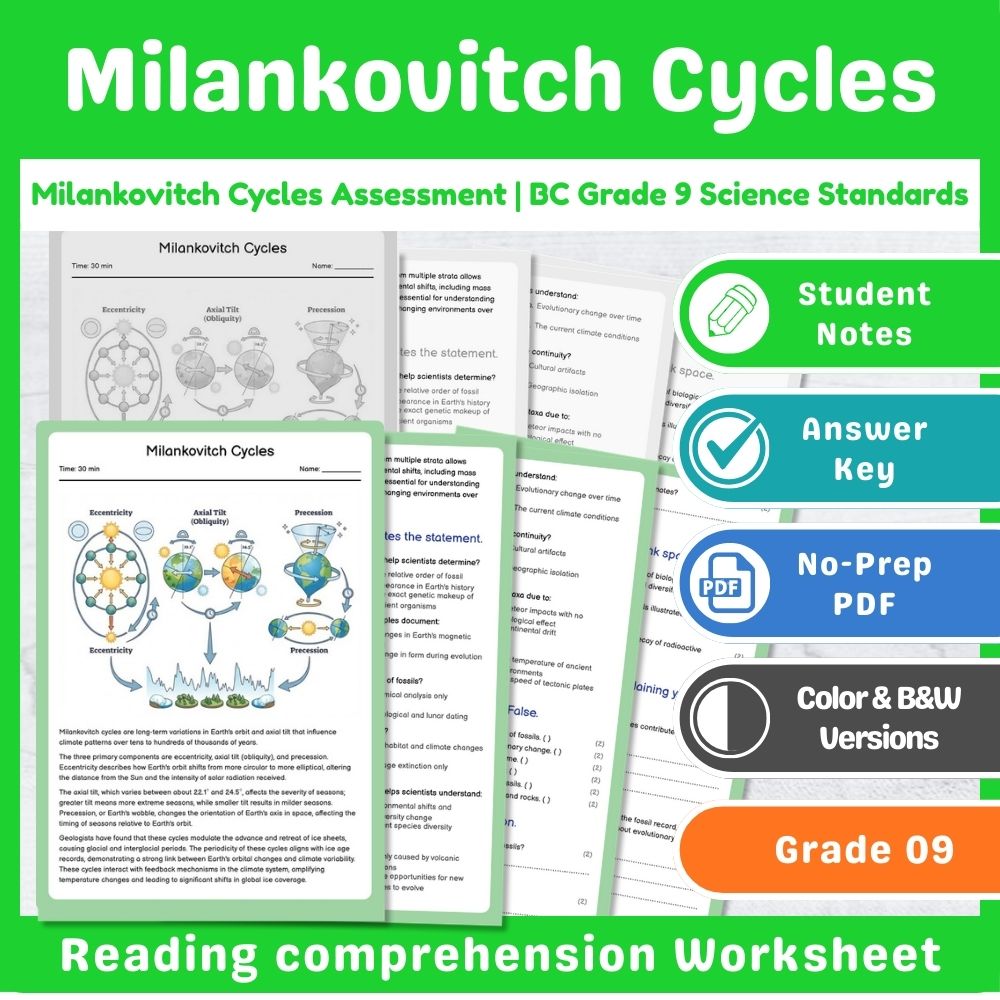
Milankovitch Cycles Assessment | BC Grade 9 Science Standards
Created byPrism Point LearningLearning Objectives
- Describe the key components of Milankovitch cycles and their effects on Earth's climate.
- Explain how variations in Earth's orbit influence glacial and interglacial periods.
- Analyze the relationship between astronomical forcing and long-term climate variability.
Also included in: Grade 9 Science Mini Bundle – Earth & Space Assessment & Activities
Instant download
9th Grade Science | Succession Dynamics Worksheet (PDF+ Answer Key)
Created byCopper Leaf ClassroomLearning Objectives
- Explain the process and stages of ecological succession, including primary and secondary succession.
- Identify key species and environmental factors involved in succession.
- Model and predict long-term ecosystem changes using species traits, dispersal, and disturbance regimes.
Instant download

Grade 9 Science – Levels Of Organization & Tissues Daily Reading Worksheet
Created byBright Mind ResourcesLearning Objectives
- Understand the hierarchical organization of cells, tissues, organs, and systems.
- Identify examples of different tissue types and their functions.
- Explain how cell specialization leads to specific tissue and organ functions.
Also included in: Grade 9 Science Daily Reading Worksheets: Body Systems Lesson Bundle | Ontario +1 more
Instant download
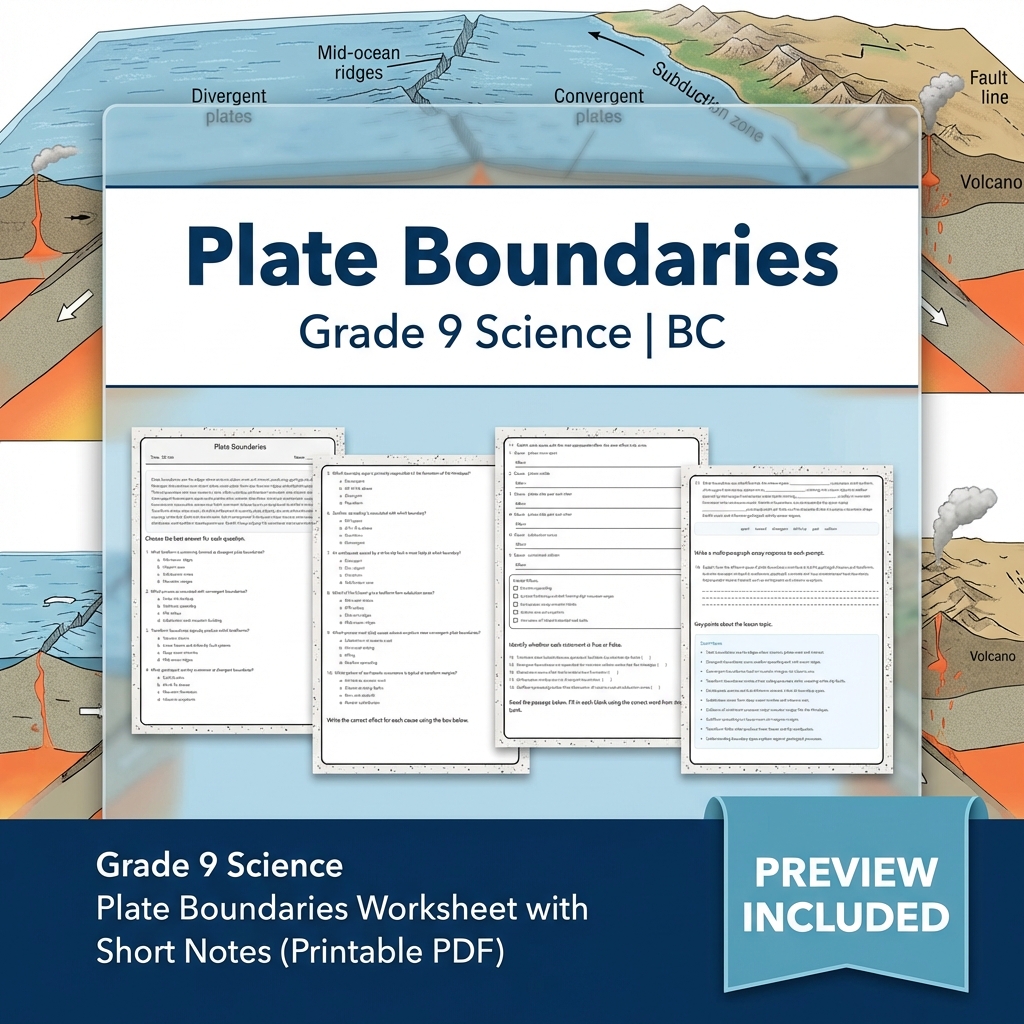
Grade 9 Science Plate Boundaries Worksheet with Short Notes (Printable PDF)
Created byMeadowlark WorksheetsLearning Objectives
- Identify the different types of plate boundaries and their characteristics.
- Explain the geological processes associated with divergent, convergent, and transform boundaries.
- Describe landforms and land features resulting from each boundary type.
Also included in: Grade 9 Science | BC Framework Lesson Bundle on Earth Systems & Climate +1 more
Instant download
Grade 9 Science Limiting Reactants Worksheet with Short Notes (Printable PDF)
Created byMeadowlark WorksheetsLearning Objectives
- Explain the concept of a limiting reactant in chemical reactions.
- Calculate the theoretical yield of products based on limiting reactants.
- Differentiate between actual yield and theoretical yield.
Also included in: Grade 9 Science Lesson Bundle | BC Framework Focused Worksheets +1 more
Instant download
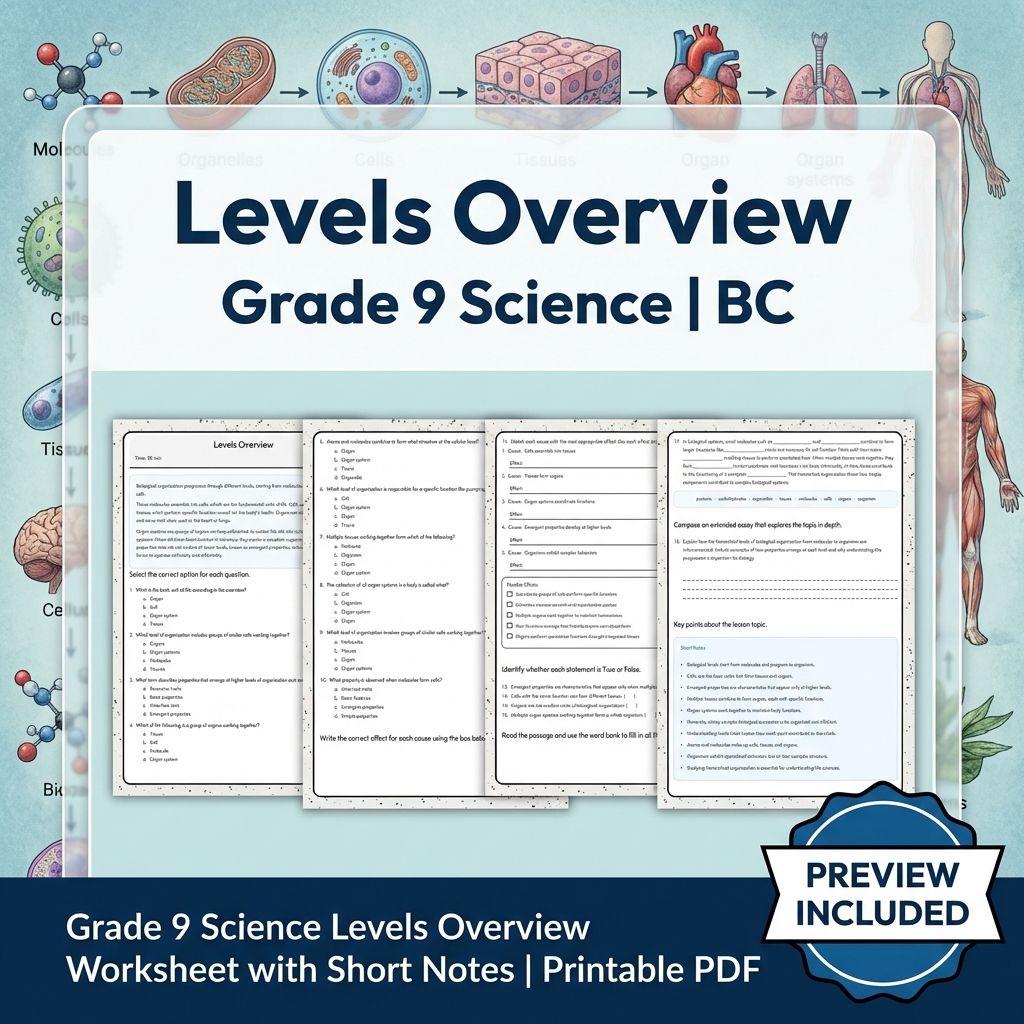
Grade 9 Science Levels Overview Worksheet with Short Notes | Printable PDF
Created byMeadowlark WorksheetsLearning Objectives
- Understand the hierarchical levels in biological organization from molecules to organisms.
- Recognize that each level exhibits emergent properties not present at lower levels.
- Explain how components assemble into complex biological systems scaling from cellular to organismal levels.
Also included in: Grade 9 Science Lesson Bundle | BC Framework Worksheets (15-Piece Collection) +1 more
Instant download
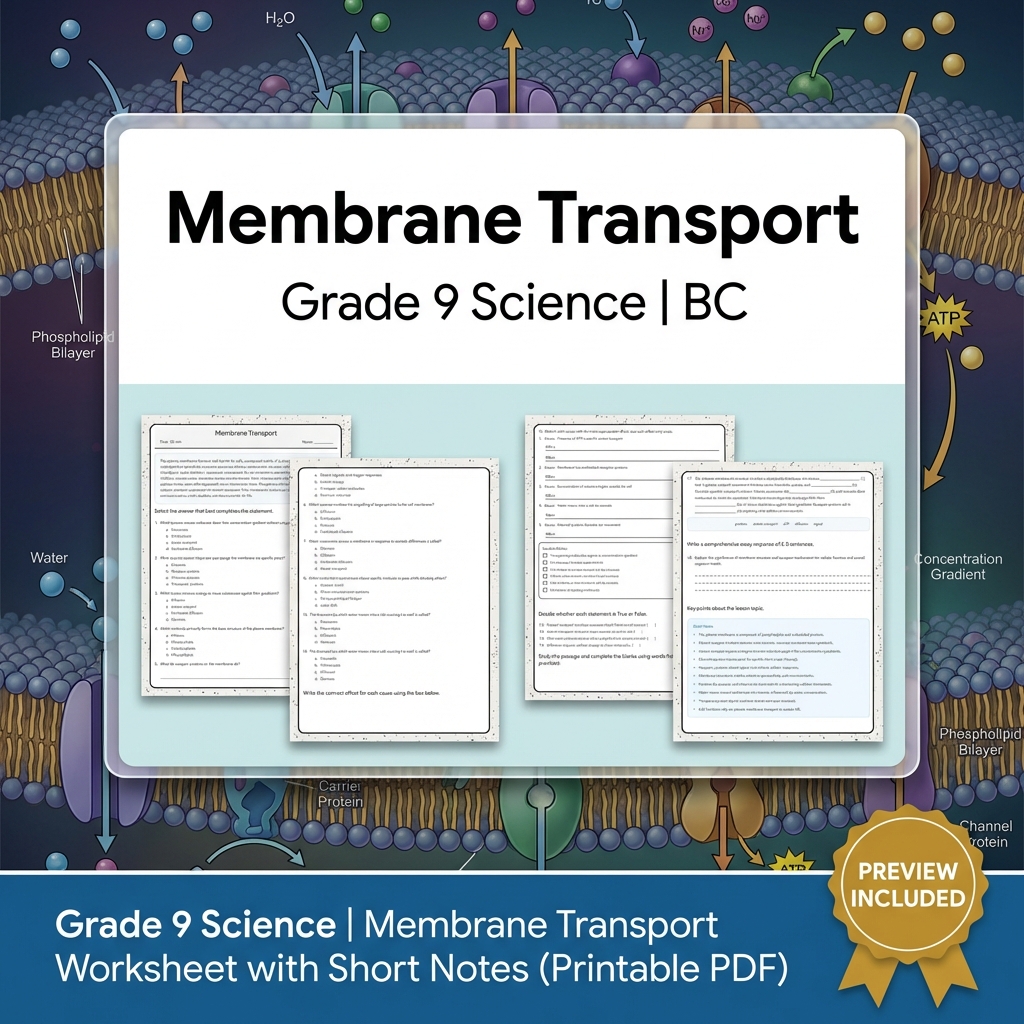
Grade 9 Science | Membrane Transport Worksheet with Short Notes (Printable PDF)
Created byMeadowlark WorksheetsLearning Objectives
- Understand the structure and function of the plasma membrane in cells.
- Differentiate between passive and active transport processes across membranes.
- Identify various proteins involved in membrane transport and their roles.
Also included in: Grade 9 Science Lesson Bundle | BC Framework Worksheets (15-Piece Collection) +1 more
Instant download
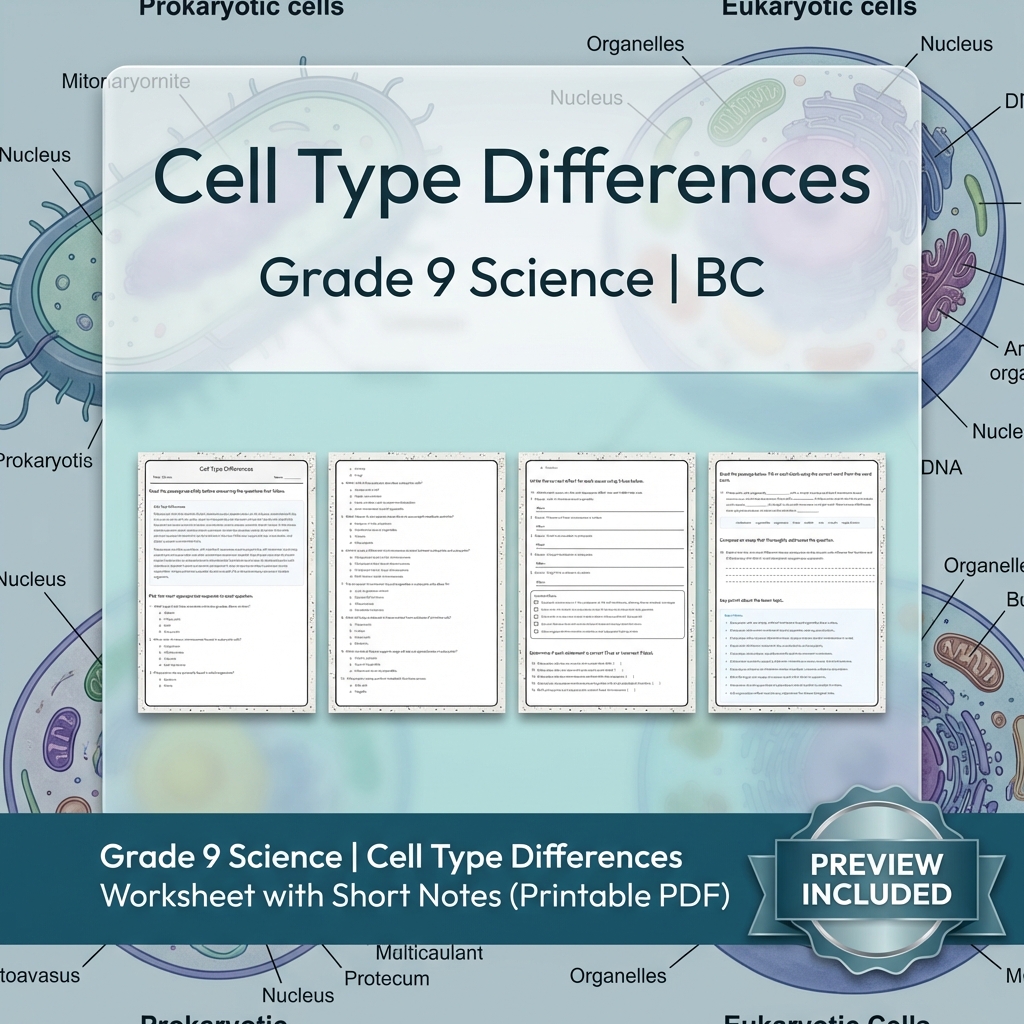
Grade 9 Science | Cell Type Differences Worksheet with Short Notes (PDF)
Created byMeadowlark WorksheetsLearning Objectives
- Describe the fundamental structural differences between prokaryotic and eukaryotic cells.
- Identify key components/organelles unique to each cell type.
- Explain how structural differences relate to cell functions and diversity.
Also included in: Grade 9 Science Lesson Bundle | BC Framework Worksheets (15-Piece Collection) +1 more
Instant download
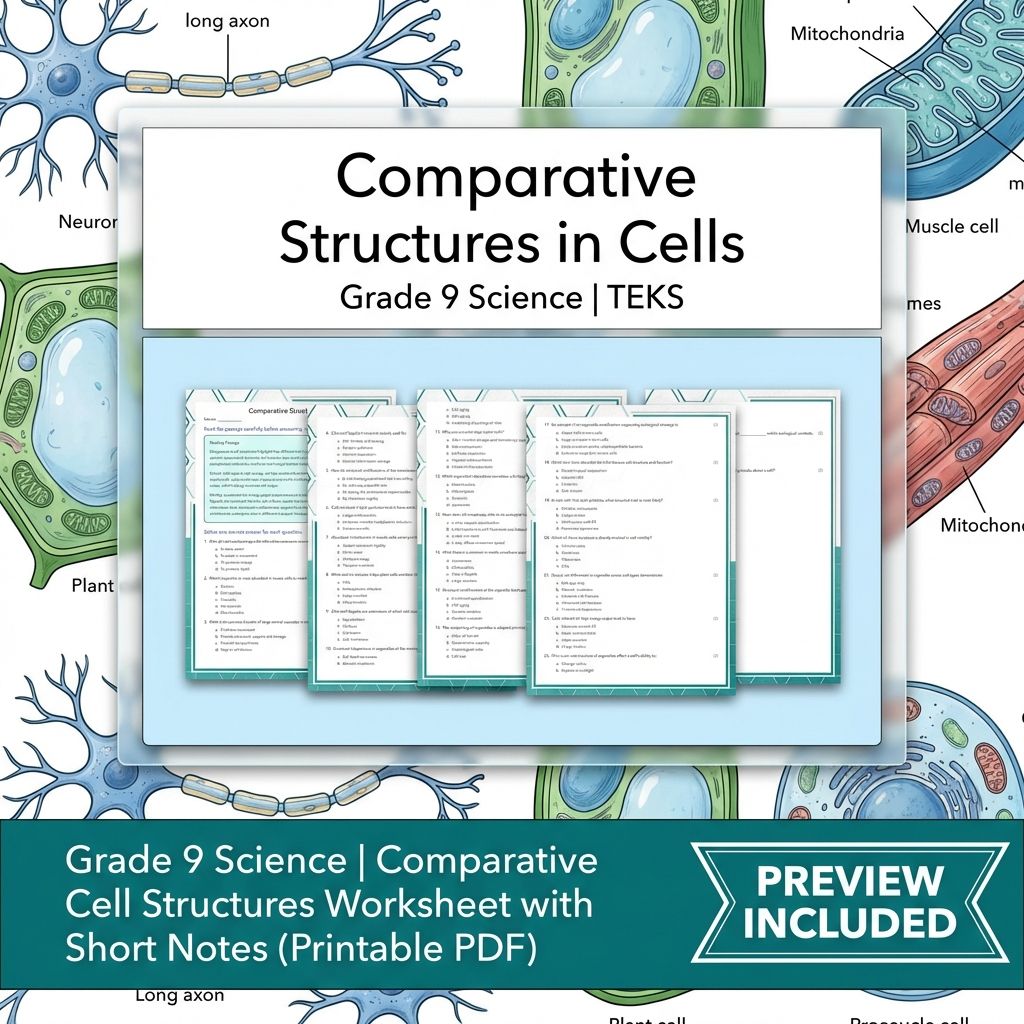
Grade 9 Science Comparative Cell Structures Worksheet with Short Notes (PDF)
Created byMeadowlark WorksheetsLearning Objectives
- Understand how organelle structures vary across cell types and taxa.
- Identify examples of structural adaptations that relate form to function.
- Explain how morphology influences physiological roles and ecological strategies.
Instant download
About Grade 9 Science Worksheets
Find Science worksheets built for Grade 9. All 6,986 cover core skills, practice, and review, each an instant PDF download.
Every worksheet on MyTeachingSheets is created by independent teacher-authors and reviewed before publication. All resources download as printable PDFs for classroom, homework, or at-home practice, and many include answer keys. Preview any worksheet free before buying.