
Grade 9 Science Worksheets
6,986 worksheets
Grade 9 Science | States of Matter - Daily Reading Comprehension
 Created byCoral Reef Learning
Learning Objectives
- Identify the three main states of matter: solid, liquid, and gas.
- Describe the characteristic properties of each state of matter.
- Understand how temperature and pressure influence state changes.
Also included in: Matter and Chemical Change Lesson Bundle – Grade 9 Science Alberta +1 more
Instant download
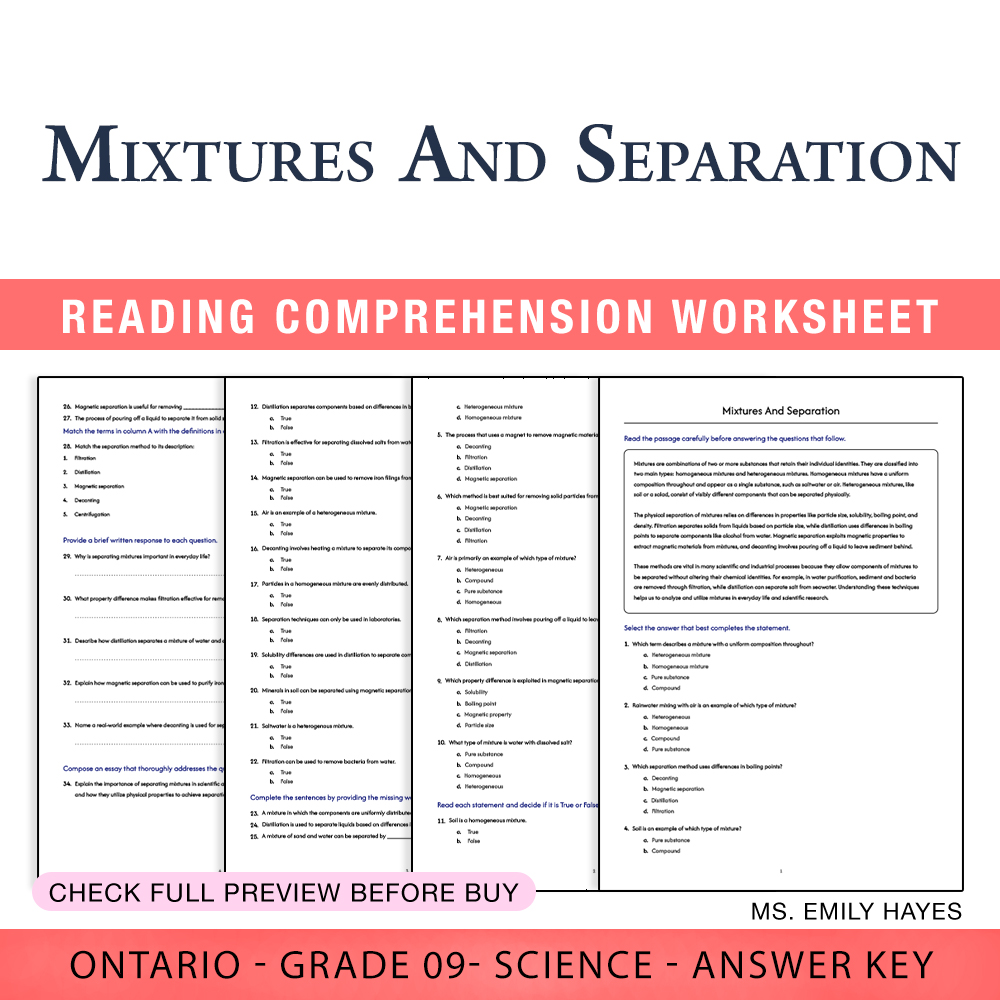
Grade 9 Science | Mixtures and Separation Worksheet (PDF + Answer Key)
 Created byCopper Leaf Classroom
Learning Objectives
- Explain the difference between homogeneous and heterogeneous mixtures.
- Describe physical methods used to separate mixture components based on their physical properties (filtration, distillation, magnetic separation, decanting).
- Identify examples of mixtures such as saltwater, soil, and air, and relate them to separation principles.
Instant download

Grade 9 Science | Design Cycle Worksheet | General Standards
 Created byLumora Learning
Learning Objectives
- Explain the purpose of a design cycle and the role of criteria and constraints in engineering solutions
- Identify steps in the design cycle and describe how testing evidence leads to refinement
- Apply design-cycle thinking to a real-world protective device by predicting improvements and trade-offs
Instant download

Grade 9 Science | States of Matter Worksheet (Alberta Standards) (PDF)
 Created byEvergreen Desk Education
Learning Objectives
- Describe how solids, liquids, and gases differ in structure and properties (lattice arrangement, fluidity, and compressibility).
- Explain phase changes using temperature/pressure changes and energy transfer (heating and cooling).
- Use particle ideas to predict how matter behaves during freezing, melting, evaporation, condensation, and sublimation.
Instant download
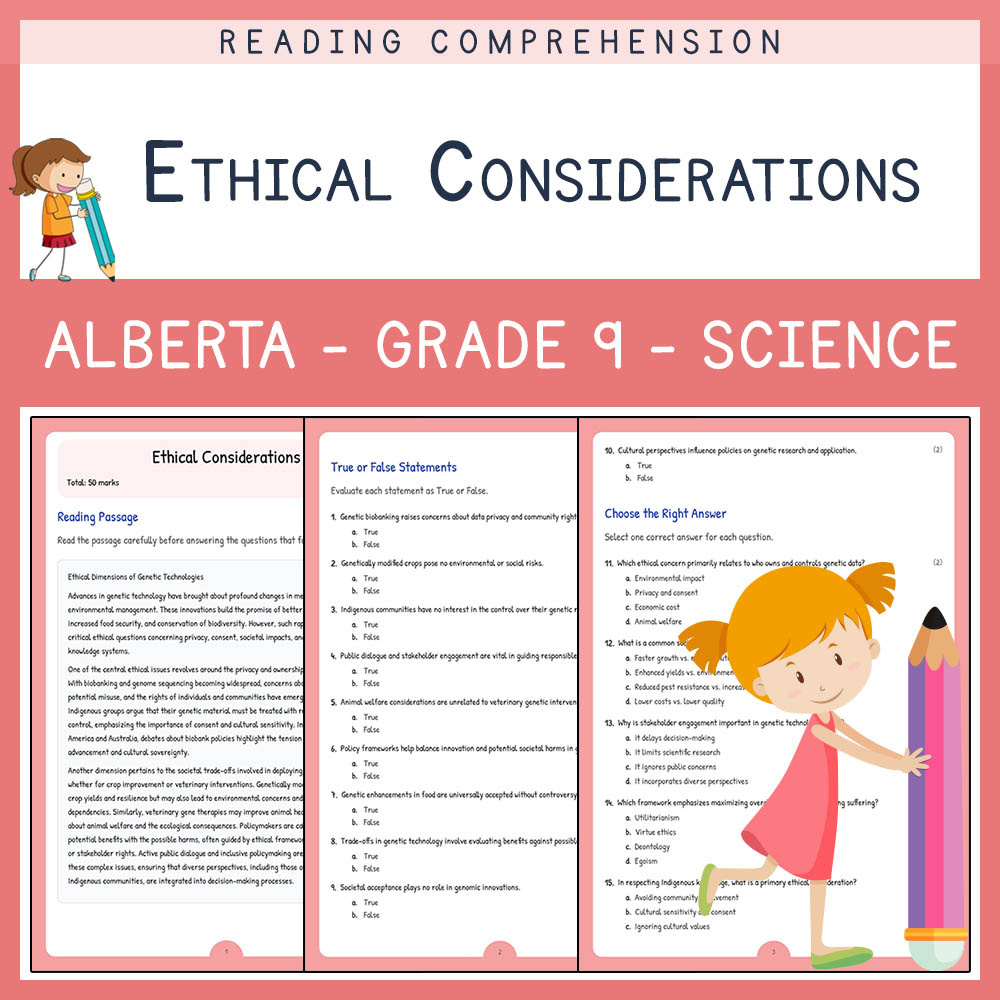
Grade 9 Science | Ethical Considerations Worksheet | Alberta Standards
Created byLumora LearningLearning Objectives
- Analyze societal and ethical dimensions of genetic technologies.
- Evaluate the responsibilities of stakeholders in genetic science.
- Discuss the role of policy, public dialogue, and ethical frameworks in responsible innovation.
Instant download
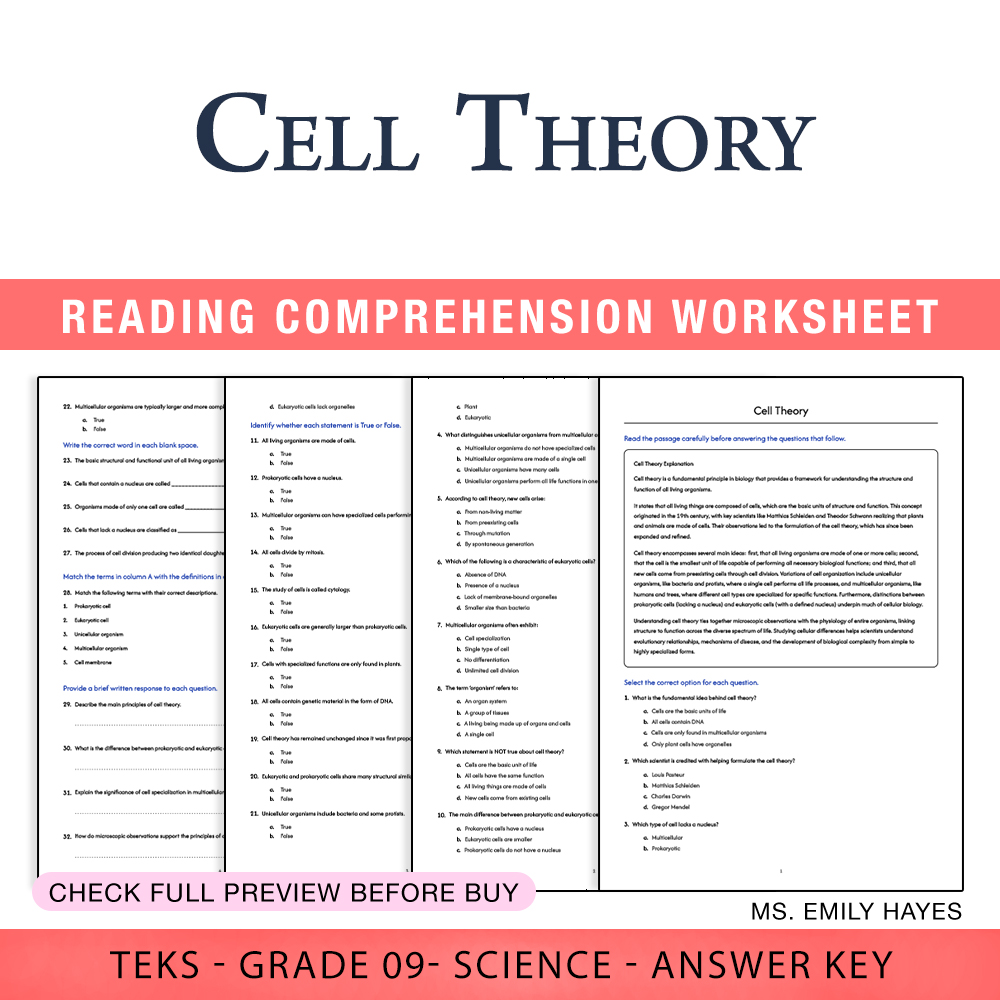
9th Grade Science | Cell Theory Worksheet (PDF+ Answer Key)
Created byCopper Leaf ClassroomLearning Objectives
- Understand the main principles of cell theory and their historical development.
- Differentiate between prokaryotic and eukaryotic cells and their structures.
- Explain the concept of unicellular versus multicellular organisms and specialization of cells.
Instant download
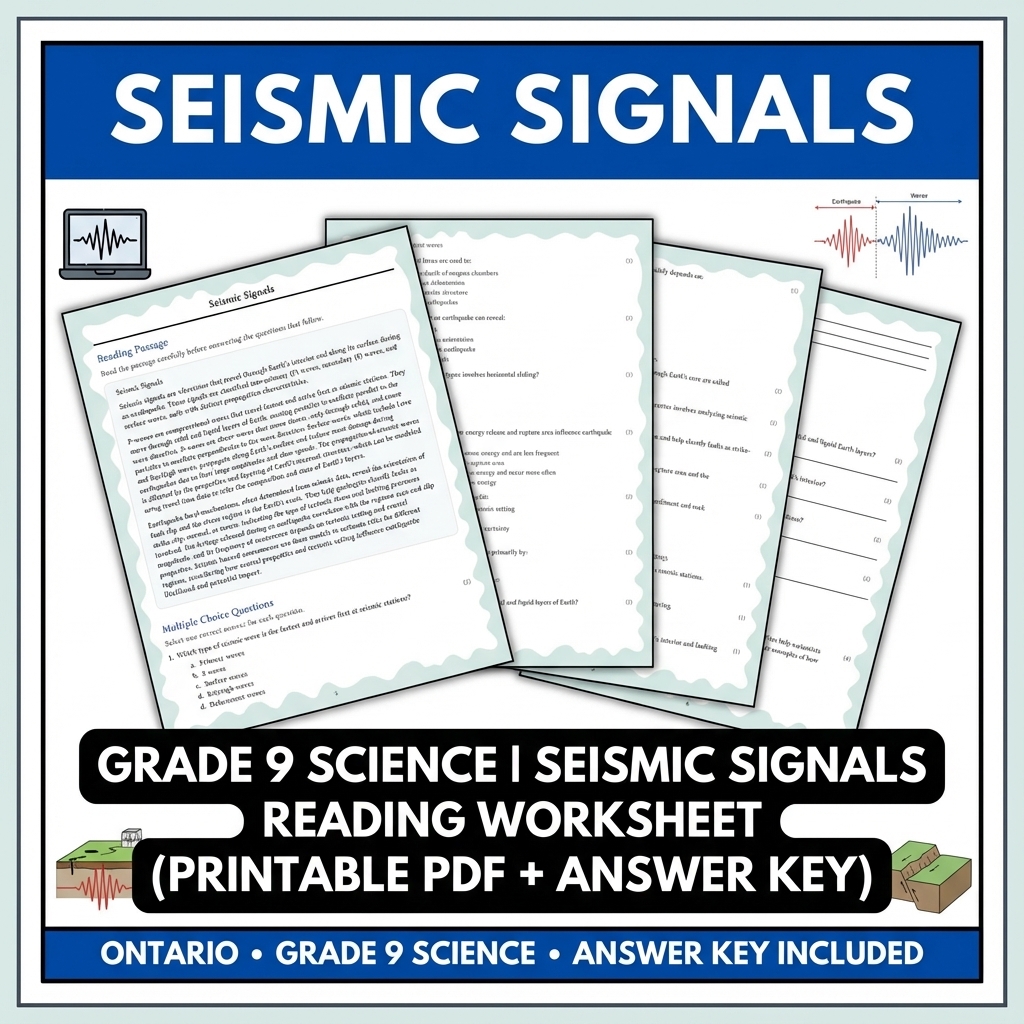
Grade 9 Science | Seismic Signals Reading Worksheets (PDF + Answer Key)
JCreated byJ.S SheetsLearning Objectives
- Understand the types and propagation characteristics of seismic waves.
- Learn how earthquake focal mechanisms reveal fault types and stress orientations.
- Relate seismic wave travel times to Earth's interior structure and earthquake epicenter location.
Also included in: Grade 9 Science | Earth Processes & Celestial Phenomena Worksheets Collection +1 more
Instant download
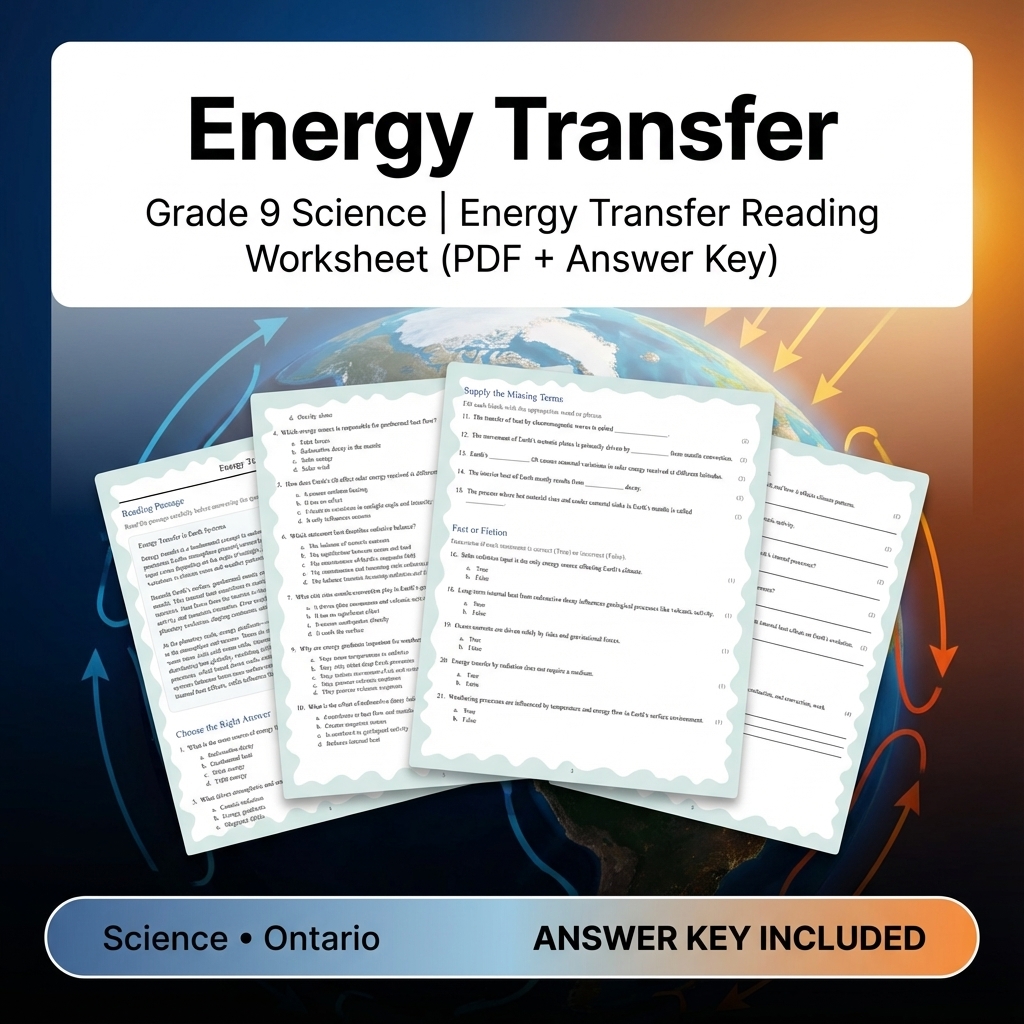
Grade 9 Science | Energy Transfer Reading Worksheet (PDF + Answer Key)
JCreated byJ.S SheetsLearning Objectives
- Describe the sources of energy within Earth systems, including solar radiation and geothermal heat.
- Explain how energy is transferred through conduction, convection, and radiation.
- Analyze how energy gradients drive atmospheric and oceanic circulation, weathering, and tectonic processes.
Also included in: Grade 9 Science | Earth Processes & Celestial Phenomena Worksheets Collection +1 more
Instant download
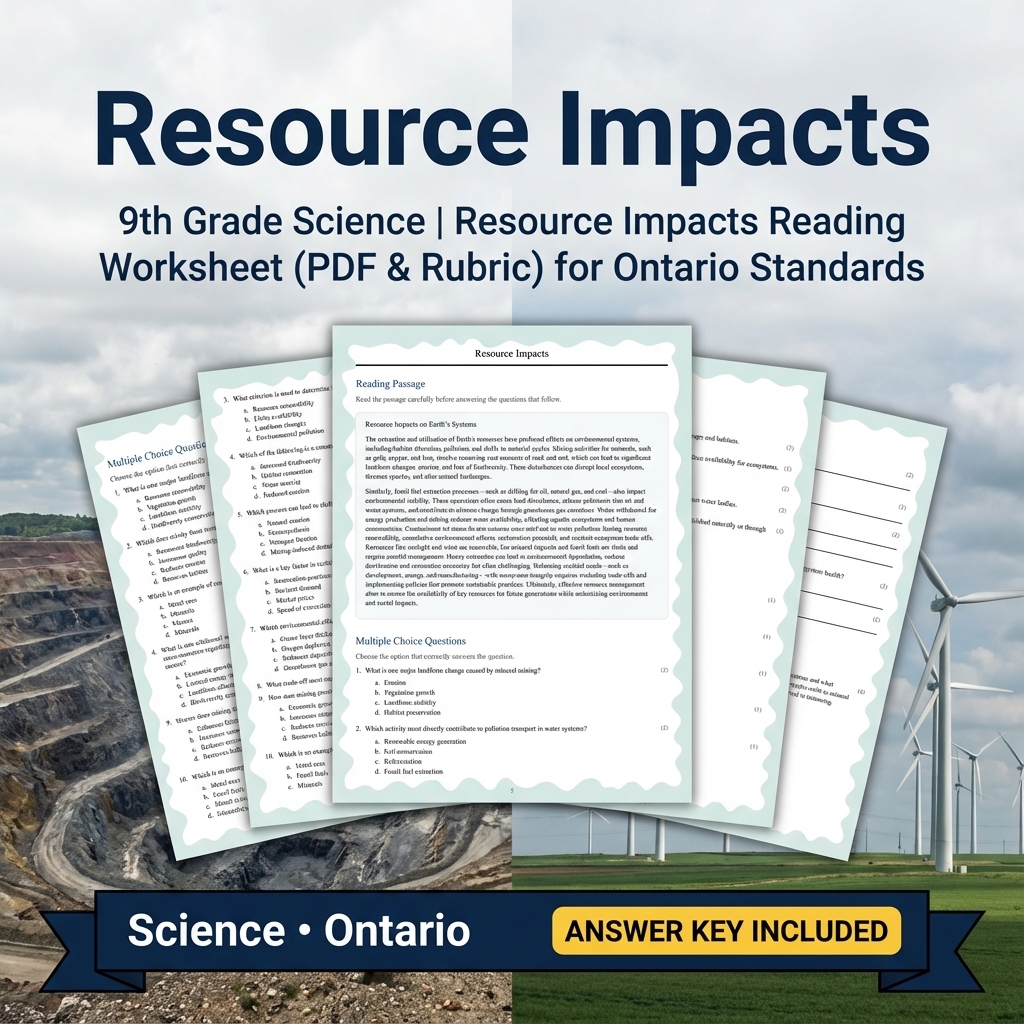
9th Grade Science | Resource Impacts Reading Worksheet (PDF & Rubric)
JCreated byJ.S SheetsLearning Objectives
- Understand how resource extraction affects ecosystems and landforms.
- Identify the environmental consequences of mining, fossil fuel use, and water withdrawal.
- Evaluate criteria for assessing the sustainability of resource use.
Also included in: Grade 9 Science | Earth Processes & Celestial Phenomena Worksheets Collection +1 more
Instant download
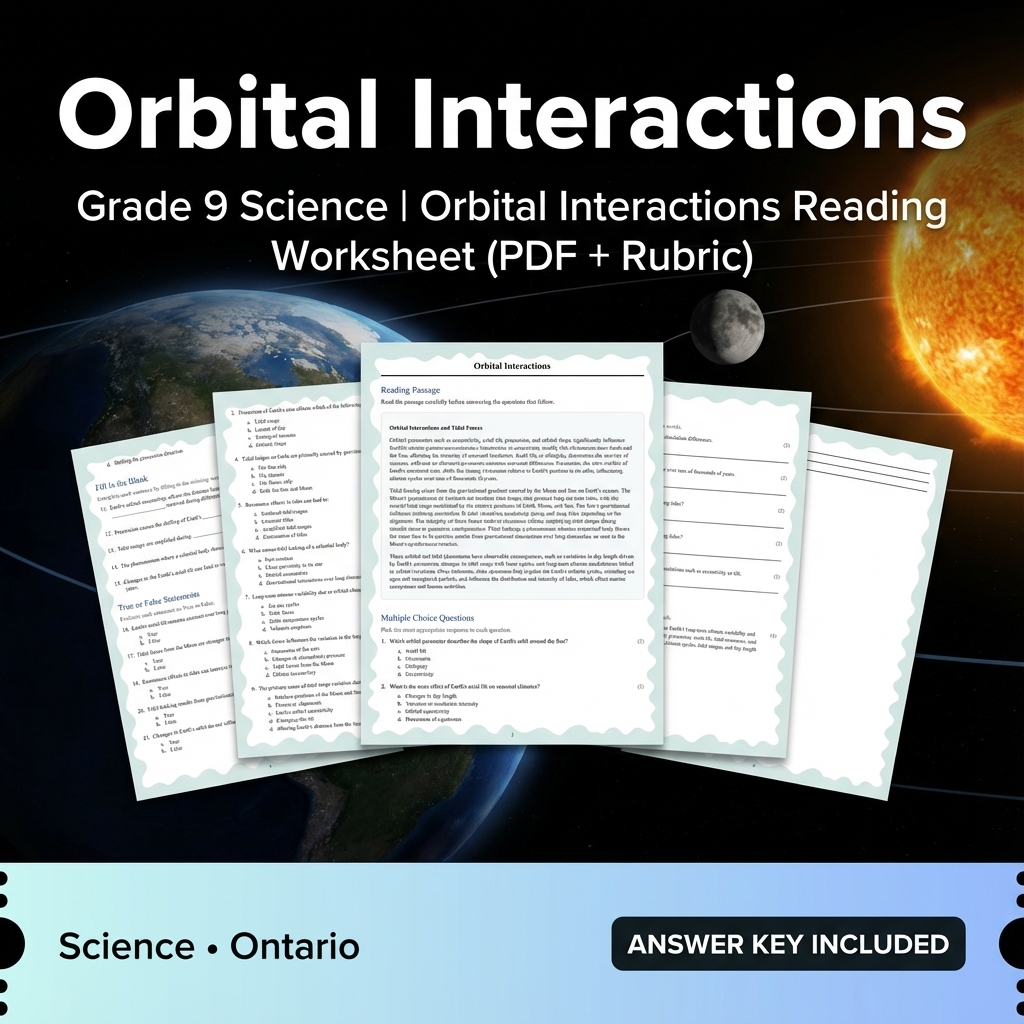
Grade 9 Science | Orbital Interactions Reading Worksheet (PDF + Rubric)
JCreated byJ.S SheetsLearning Objectives
- Understand how orbital parameters such as eccentricity, axial tilt, and precession influence seasonal insolation and climate variability.
- Explain the gravitational effects of the Moon and Sun in terms of tidal forces and resonance phenomena.
- Connect orbital dynamics to observable effects like changes in day length, tidal range, and long-term climate modulation.
Also included in: Grade 9 Science | Earth Processes & Celestial Phenomena Worksheets Collection +1 more
Instant download
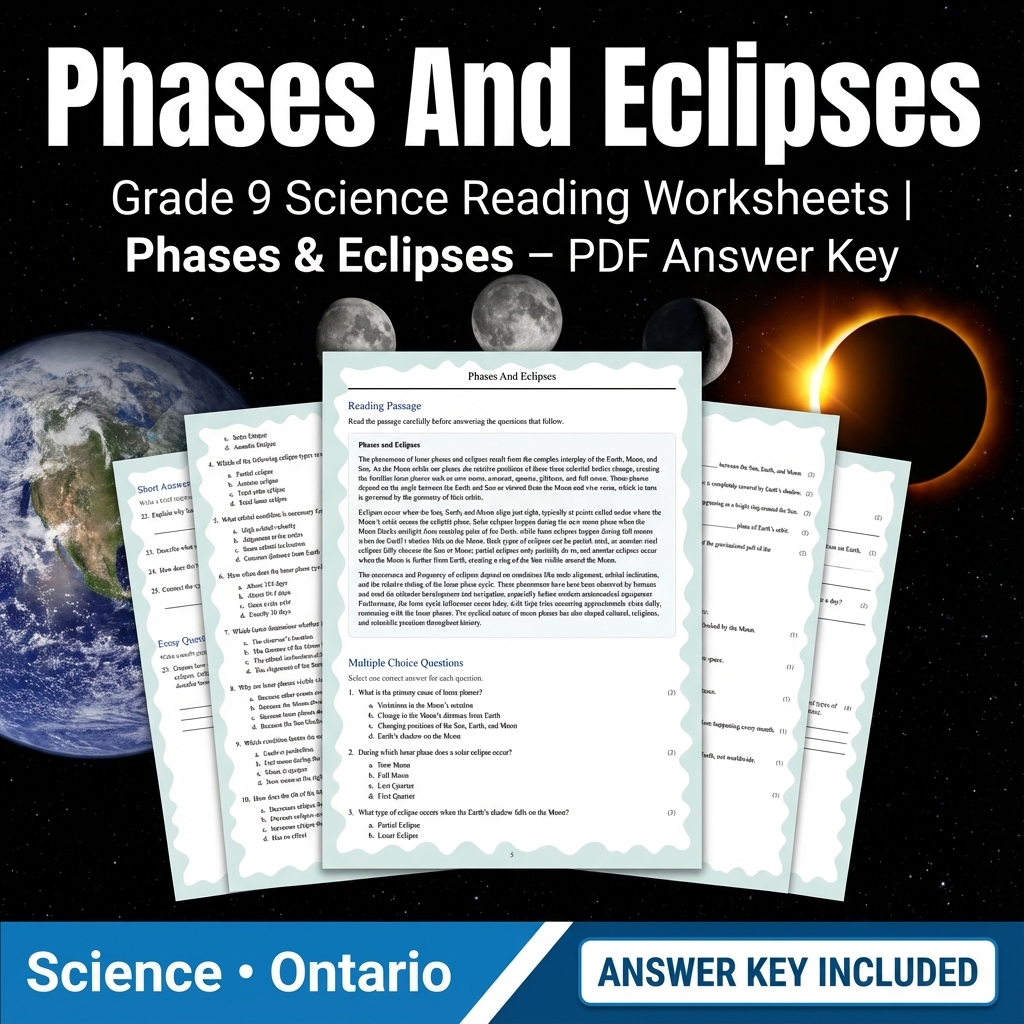
Grade 9 Science Reading Worksheets | Phases & Eclipses – PDF Answer Key
JCreated byJ.S SheetsLearning Objectives
- Describe the different lunar phases and the geometric arrangements of Earth, Moon, and Sun that produce them.
- Distinguish between partial, total, and annular solar and lunar eclipses based on observational conditions.
- Explain the factors, such as node alignment and orbital inclination, that influence eclipse occurrence.
Also included in: Grade 9 Science | Earth Processes & Celestial Phenomena Worksheets Collection +1 more
Instant download
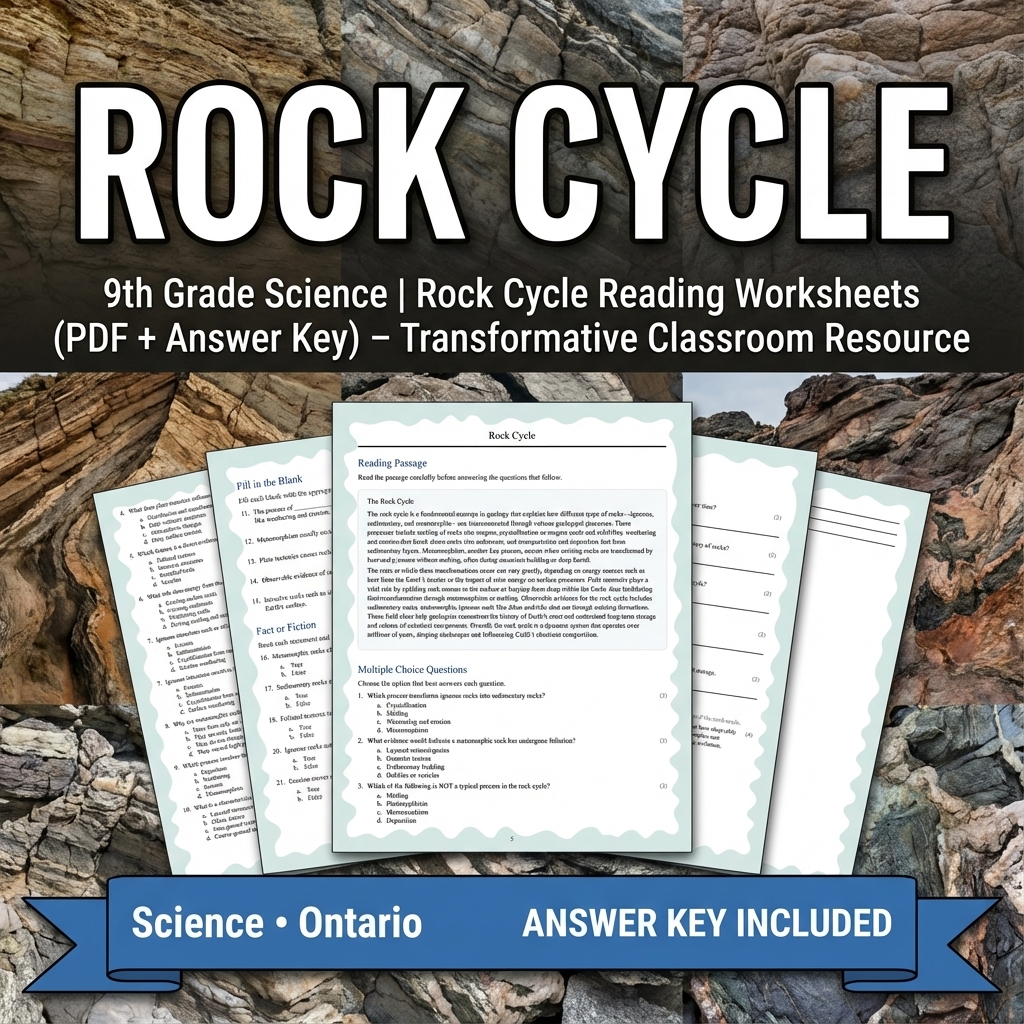
9th Grade Science | Rock Cycle Reading Worksheets (PDF + Answer Key)
JCreated byJ.S SheetsLearning Objectives
- Describe the processes involved in the rock cycle, including melting, crystallization, weathering, erosion, deposition, and metamorphism.
- Explain how plate tectonics influence the formation and transformation of rocks over geological time.
- Identify observable evidence such as foliated textures, sedimentary layering, and igneous intrusions that support the understanding of the rock cycle.
Also included in: Grade 9 Science | Earth Processes & Celestial Phenomena Worksheets Collection +1 more
Instant download
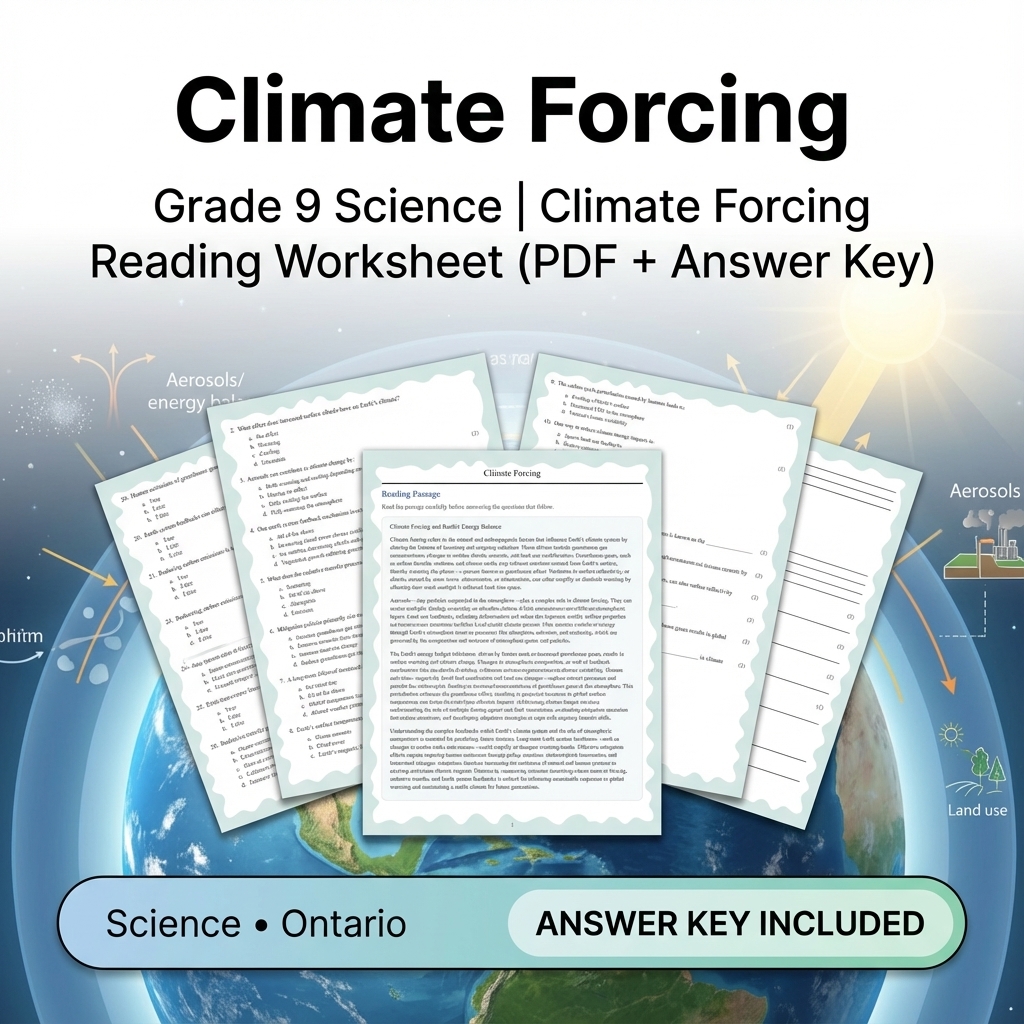
Grade 9 Science | Climate Forcing Reading Worksheet (PDF + Answer Key)
JCreated byJ.S SheetsLearning Objectives
- Understand the main drivers of climate change, including greenhouse gases, albedo changes, aerosol effects, and land-use feedbacks.
- Explain how radiative transfer concepts influence Earth's energy budget and surface temperature regulation.
- Analyze connections between human emissions, the carbon cycle, and projected climate responses.
Also included in: Grade 9 Science | Earth Processes & Celestial Phenomena Worksheets Collection +1 more
Instant download
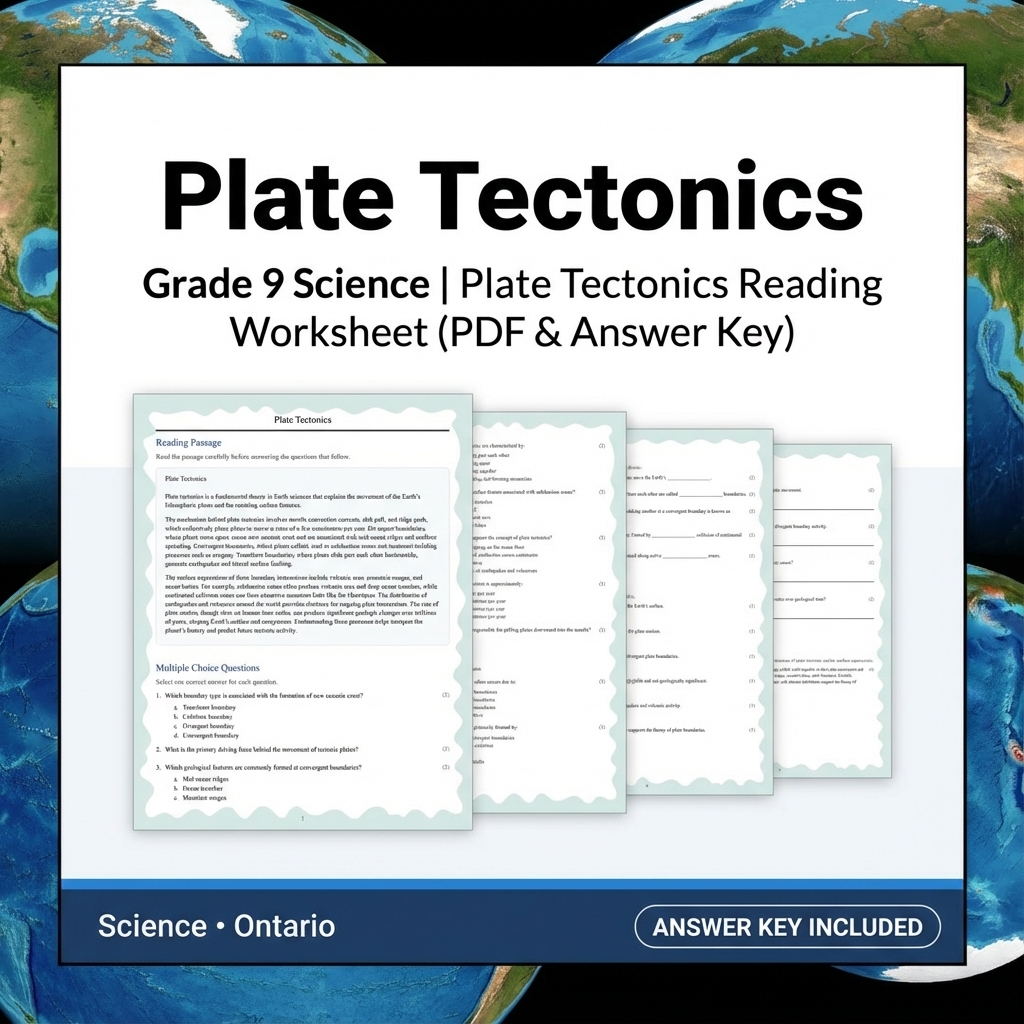
Grade 9 Science | Plate Tectonics Reading Worksheet (PDF & Answer Key)
JCreated byJ.S SheetsLearning Objectives
- Describe the mechanisms and surface expressions of plate tectonics including divergent, convergent, and transform boundaries.
- Explain how mantle convection and slab pull drive plate movements and produce geological features such as volcanism and mountain ranges.
- Analyze the distribution of earthquakes and volcanic arcs as evidence for plate interactions and understand the rates and consequences of plate motion over geological time.
Also included in: Grade 9 Science | Earth Processes & Celestial Phenomena Worksheets Collection +1 more
Instant download
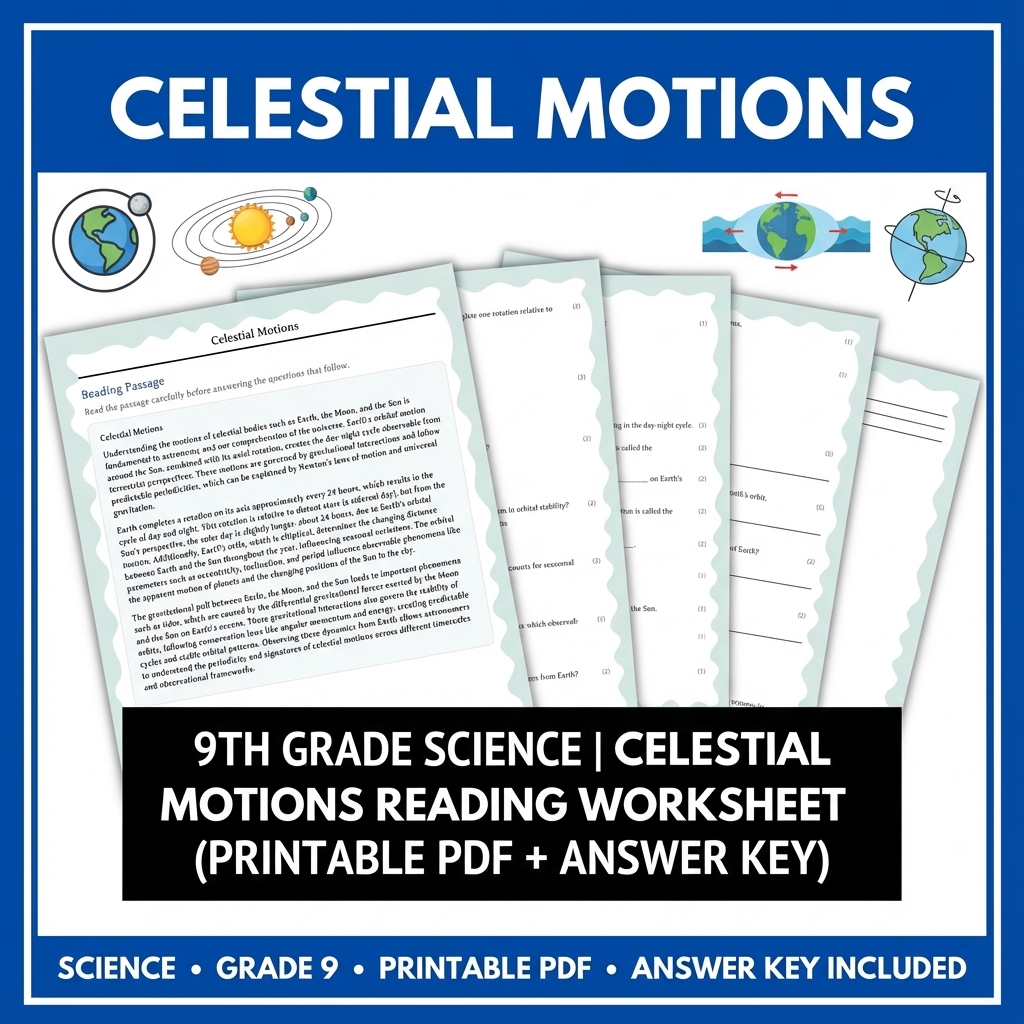
Grade 9 Science | Celestial Motions Reading Worksheet (PDF & Rubric)
JCreated byJ.S SheetsLearning Objectives
- Understand the orbital motions of Earth, Moon, and Sun and their observable effects.
- Explain the concepts of day-night cycles, Earth's rotation, and relative orbital parameters.
- Describe how gravitational interactions influence tidal phenomena and orbital stability.
Also included in: Grade 9 Science | Earth Processes & Celestial Phenomena Worksheets Collection +1 more
Instant download
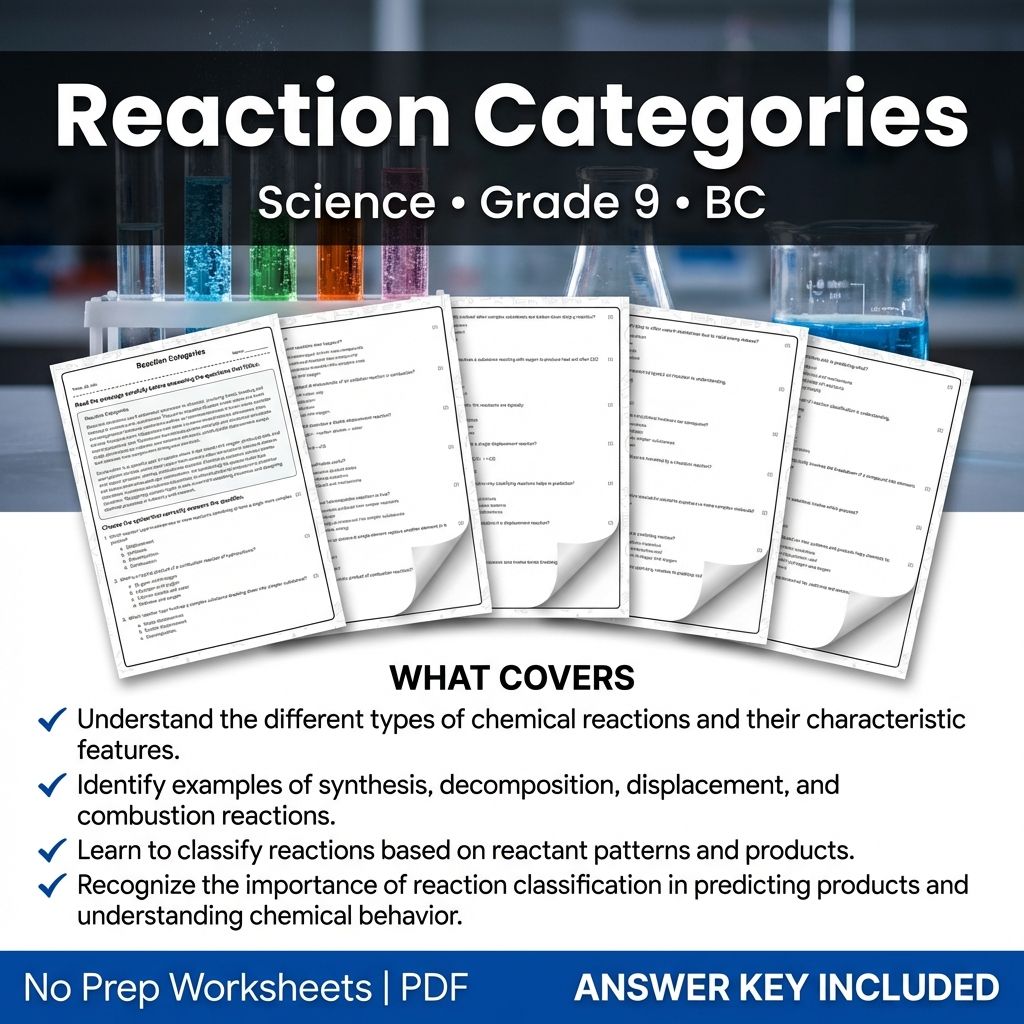
9th Grade Science | Reaction Categories Worksheet & Answer Key (PDF)
Created byCoral Reef LearningLearning Objectives
- Understand the different types of chemical reactions and their characteristic features.
- Identify examples of synthesis, decomposition, displacement, and combustion reactions.
- Learn to classify reactions based on reactant patterns and products.
Instant download
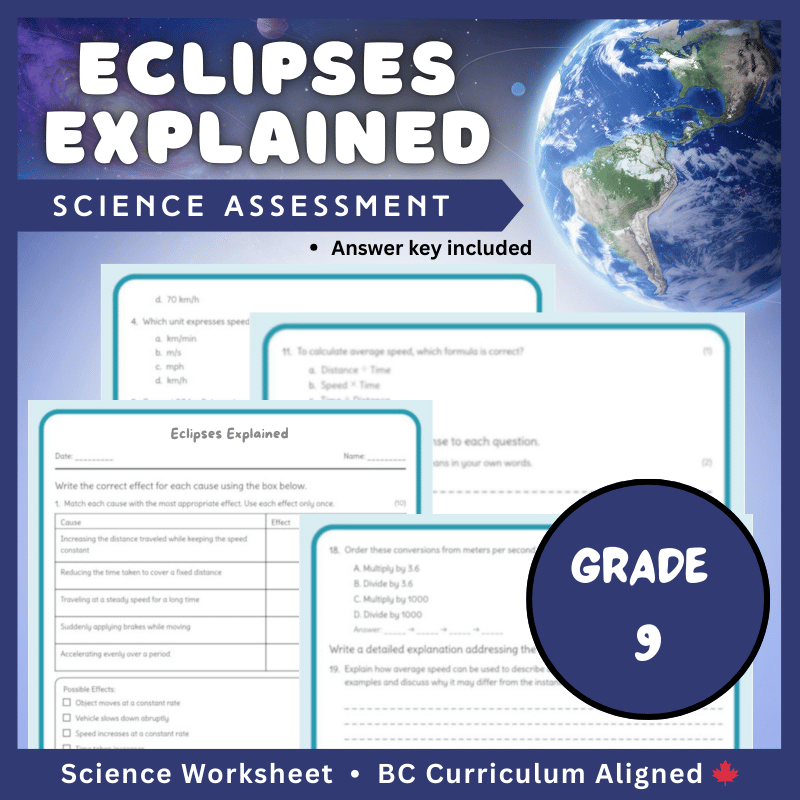
Grade 9 Science | Eclipses Explained Worksheet (Answer Key) – BC Standards
 Created byBright Mind Resources
Learning Objectives
- Understand the causes and types of lunar and solar eclipses.
- Identify the alignments needed for different eclipse events.
- Learn how orbital inclination affects eclipse frequency and visibility.
Instant download

Electron Transport Worksheet | Grade 9 Science Activities
 Created byPrism Point Learning
Learning Objectives
- Explain how electron transport chains transfer electrons through sequential carriers in mitochondria and chloroplasts
- Describe how exergonic electron transfer can be coupled to proton pumping to build an electrochemical gradient
- Connect chemiosmosis and ATP synthase activity to cellular energy production and the role of oxygen availability in aerobic systems
Instant download

Glycolysis Overview Worksheet | Grade 9 Science Practice
Created byPrism Point LearningLearning Objectives
- Explain the overall purpose of glycolysis and its main products.
- Describe the stepwise energy changes during glycolysis, including ATP investment and ATP payoff.
- Compare what happens to pyruvate under aerobic versus anaerobic conditions.
Instant download

Metabolic Pathways Worksheet | Grade 9 Science Activities
Created byPrism Point LearningLearning Objectives
- Distinguish catabolic and anabolic pathways based on energy use and product outcomes
- Explain how regulation (feedback, compartmentalization, and substrate availability) controls metabolic pathway flux
- Describe how interconnected enzyme-catalyzed reactions enable ATP synthesis and balanced biosynthesis and breakdown
Instant download
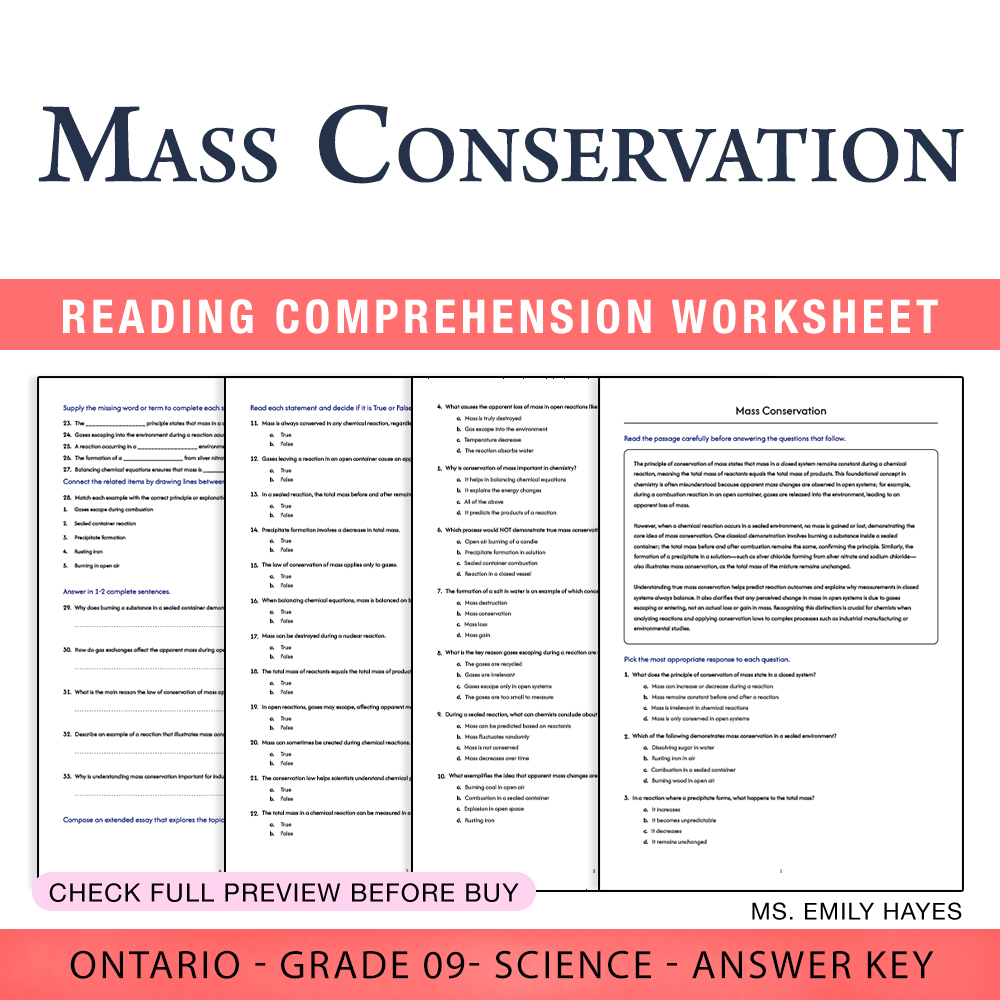
9th Grade Science | Mass Conservation Worksheet (PDF + Answer Key)
Created byCopper Leaf ClassroomLearning Objectives
- Understand the principle of conservation of mass in closed systems during chemical reactions.
- Explain how mass is conserved despite apparent changes during chemical processes.
- Identify examples of mass conservation in real-world chemical reactions.
Instant download
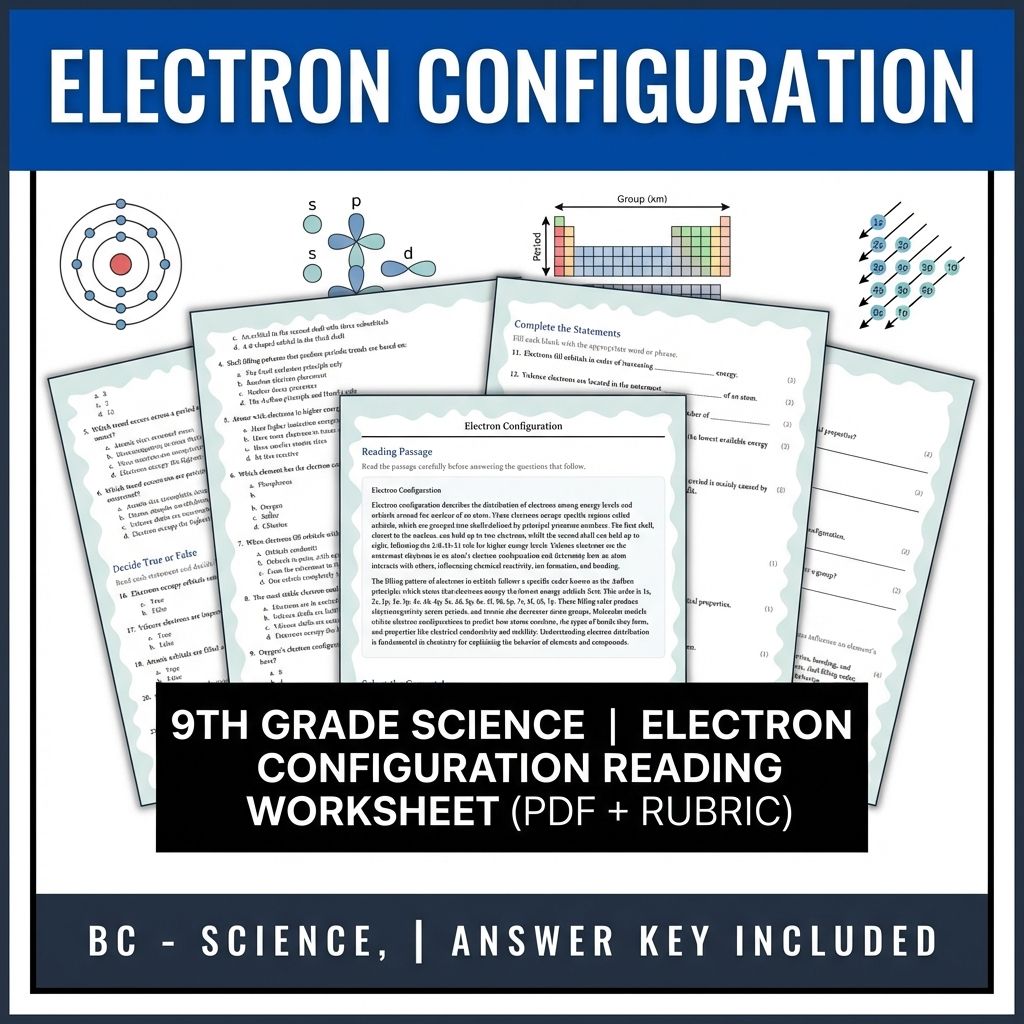
9th Grade Science | Electron Configuration Reading Worksheet (PDF + Rubric)
JCreated byJ.S SheetsLearning Objectives
- Describe how electrons are distributed among energy levels and orbitals in an atom.
- Explain the significance of valence electrons in chemical reactions and bonding.
- Understand the principles of shell filling and how they produce periodic trends.
Instant download
9th Grade Science | Biogeochemical Cycles Worksheet (PDF+ Answer Key)
Created byCopper Leaf ClassroomLearning Objectives
- Describe the main components and processes involved in biogeochemical cycles.
- Explain the roles of key elements like carbon, nitrogen, and phosphorus in ecosystems.
- Understand how fluxes and reservoir sizes influence ecosystem responses to environmental changes.
Instant download
Grade 9 Science – Reproductive Modes Daily Reading Worksheet with Answer Key
JCreated byJ.S SheetsLearning Objectives
- Understand the differences between sexual and asexual reproduction
- Identify examples of reproductive strategies in Alberta species
- Analyze ecological trade-offs related to reproduction
Also included in: Grade 9 Science Lesson Group | Genetics, Reproduction, and Biotechnology +1 more
Instant download
Grade 9 Science – Chromosomes and DNA Daily Reading Worksheet with Answer Key
JCreated byJ.S SheetsLearning Objectives
- Understand the structure of DNA and how it forms the double helix.
- Identify the organization of chromosomes within cells.
- Differentiate between nuclear and organelle genomes.
Also included in: Grade 9 Science Lesson Group | Genetics, Reproduction, and Biotechnology +1 more
Instant download
Grade 9 Science – Cell Division Basics Daily Reading Worksheet with Answer Key
JCreated byJ.S SheetsLearning Objectives
- Understand key concepts related to Science
- Apply knowledge through practice questions
- Demonstrate comprehension of the material
Also included in: Grade 9 Science Lesson Group | Genetics, Reproduction, and Biotechnology +1 more
Instant download
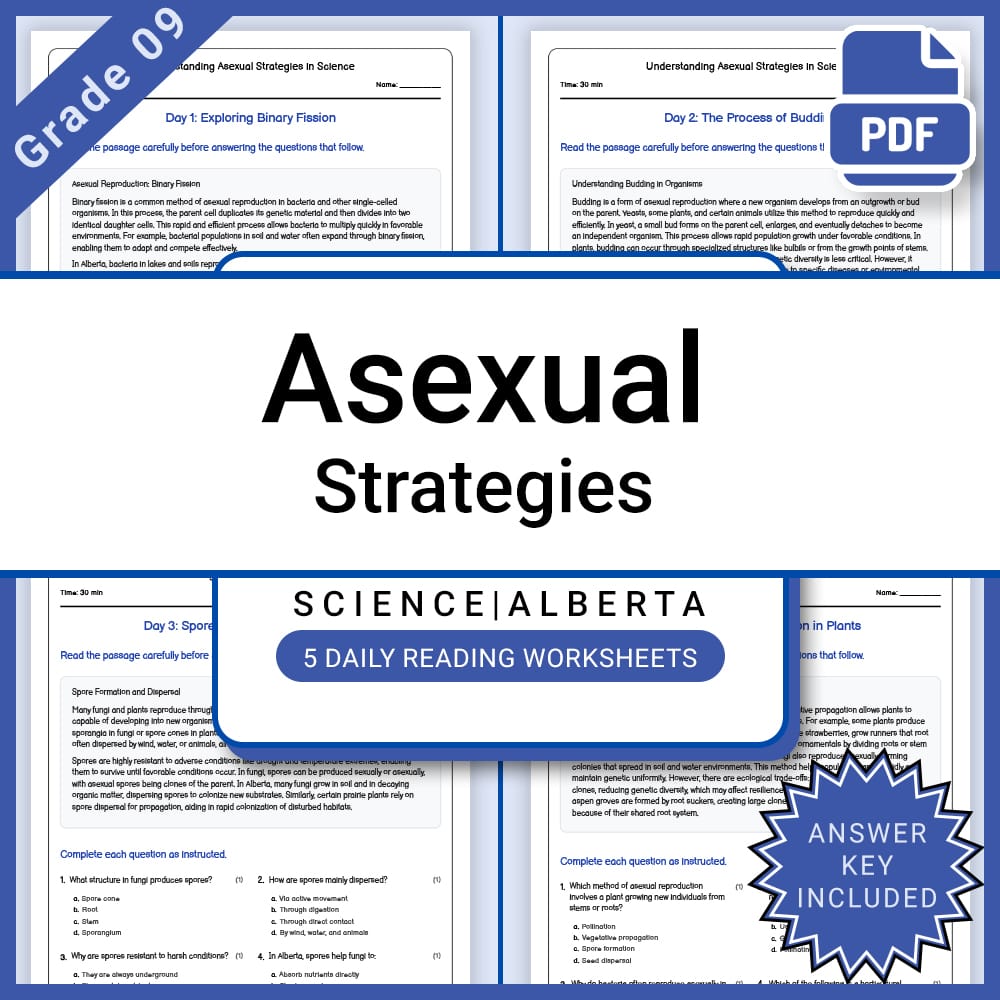
Grade 9 Science – Asexual Strategies Daily Reading Worksheet + Answer Key
JCreated byJ.S SheetsLearning Objectives
- Define and describe binary fission, budding, spore formation, and vegetative propagation.
- Identify examples of asexual reproduction in Alberta flora and bacterial populations.
- Analyze the ecological contexts favoring asexual versus sexual reproduction.
Also included in: Grade 9 Science Lesson Group | Genetics, Reproduction, and Biotechnology +1 more
Instant download
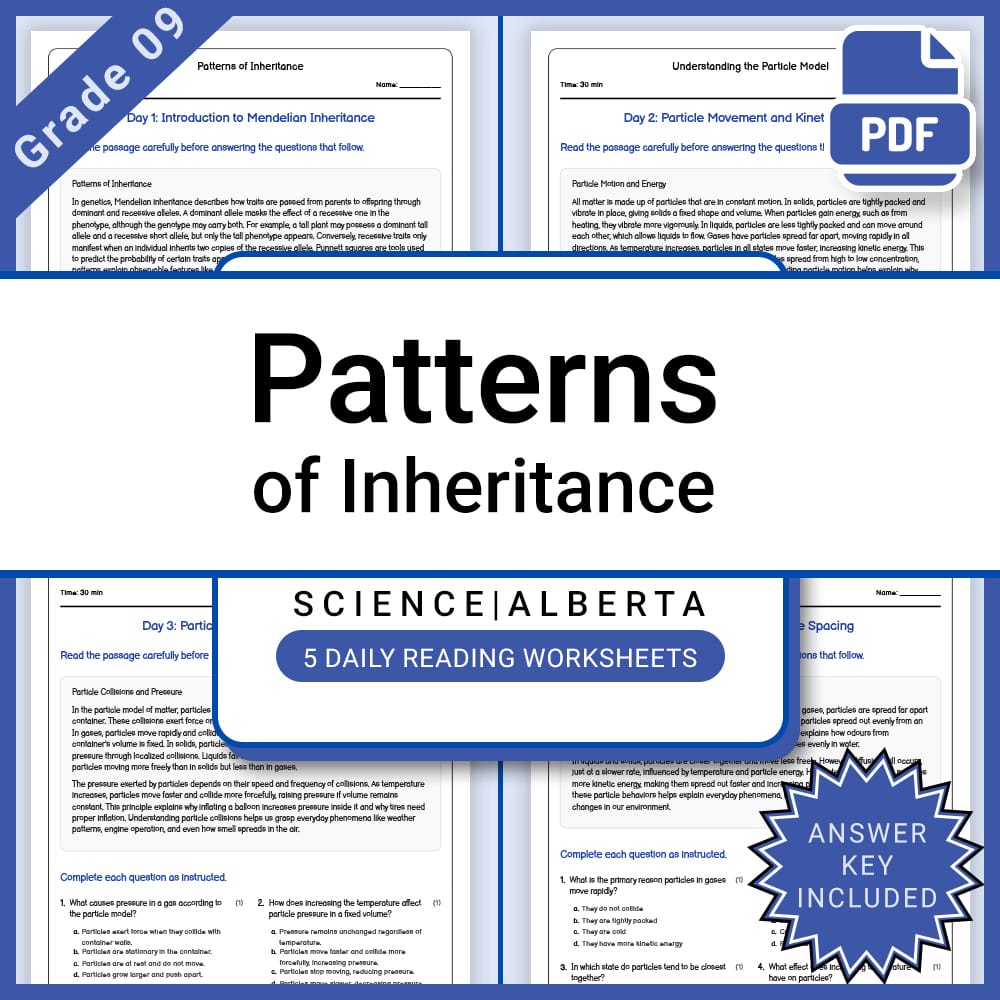
Grade 9 Science – Patterns of Inheritance Daily Reading Worksheet + Answer Key
JCreated byJ.S SheetsLearning Objectives
- Understand Mendelian inheritance patterns including dominance and recessiveness.
- Differentiate between genotype and phenotype.
- Use Punnett squares to predict offspring traits.
Also included in: Grade 9 Science Lesson Group | Genetics, Reproduction, and Biotechnology +1 more
Instant download
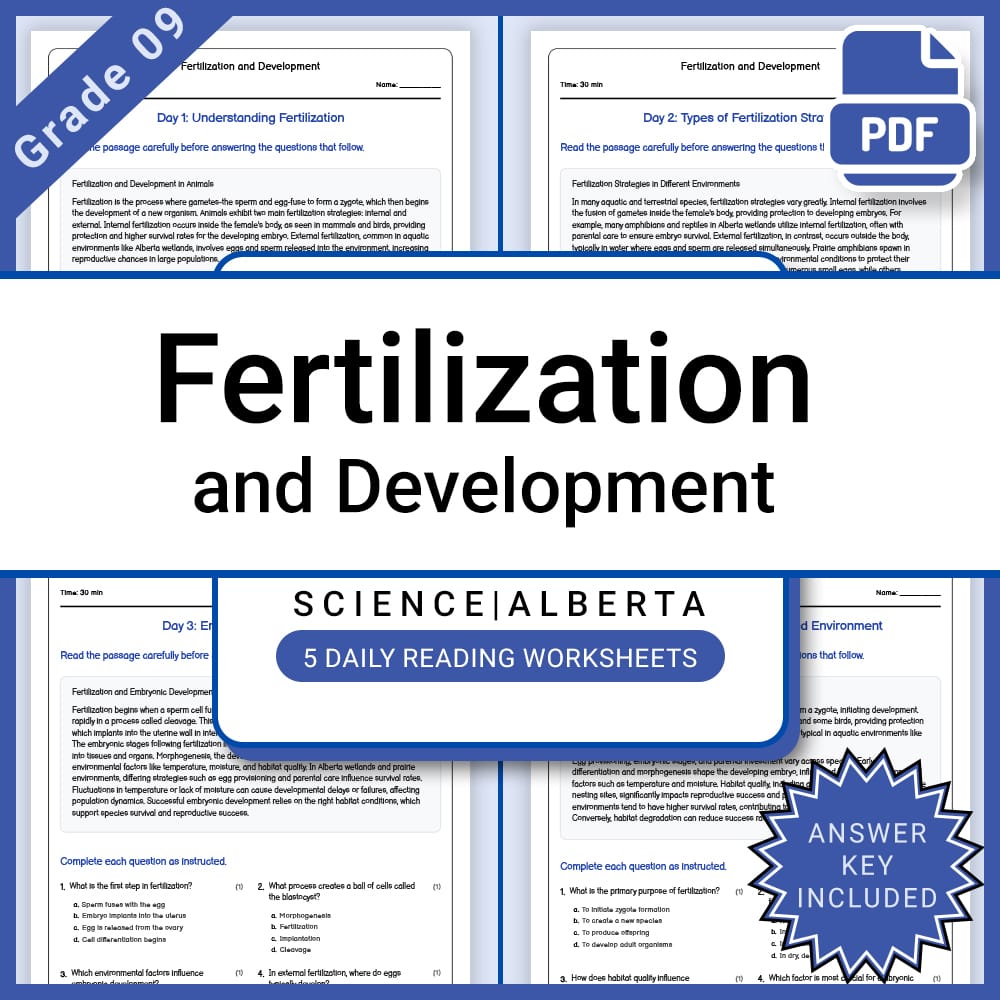
Grade 9 Science – Fertilization and Development Daily Worksheet + Answer Key
JCreated byJ.S SheetsLearning Objectives
- Understand the process of fertilization in animal reproduction.
- Differentiate between internal and external fertilization strategies.
- Identify factors influencing successful embryonic development.
Also included in: Grade 9 Science Lesson Group | Genetics, Reproduction, and Biotechnology +1 more
Instant download

Grade 9 Science | Weather Data Patterns - Daily Reading Comprehension
Created byCoral Reef LearningLearning Objectives
- Understand basic weather measurements such as temperature, humidity, wind, and pressure.
- Learn how weather data patterns can indicate atmospheric conditions.
- Recognize the relationship between atmospheric measurements and observable weather phenomena.
Instant download
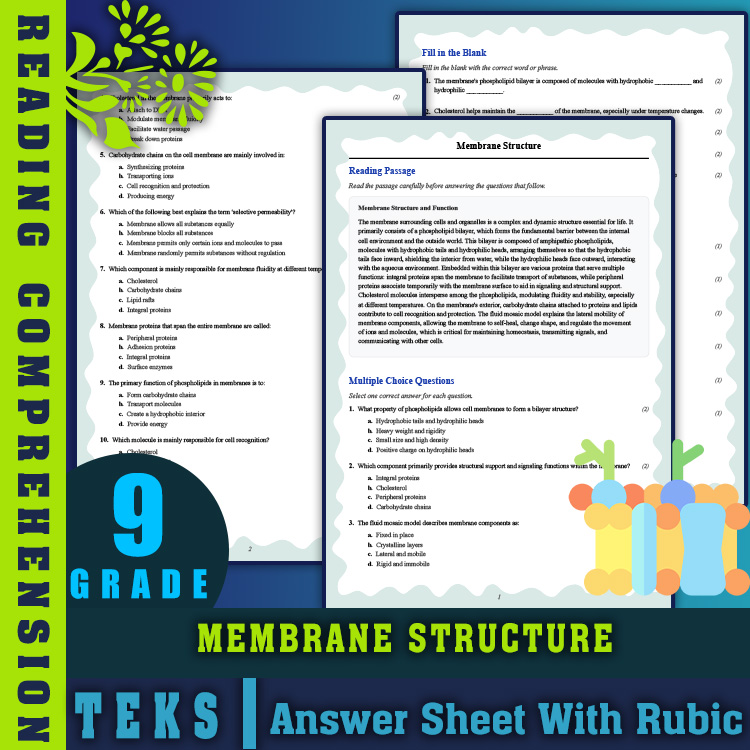
9th Grade Science | Membrane Structure Reading Worksheet (PDF + Rubric)
JCreated byJ.S SheetsLearning Objectives
- Describe the basic components of the cell membrane and their functions.
- Explain the fluid mosaic model and how it accounts for membrane permeability and signaling.
- Identify the roles of phospholipids, proteins, cholesterol, and carbohydrate chains in membrane structure.
Instant download
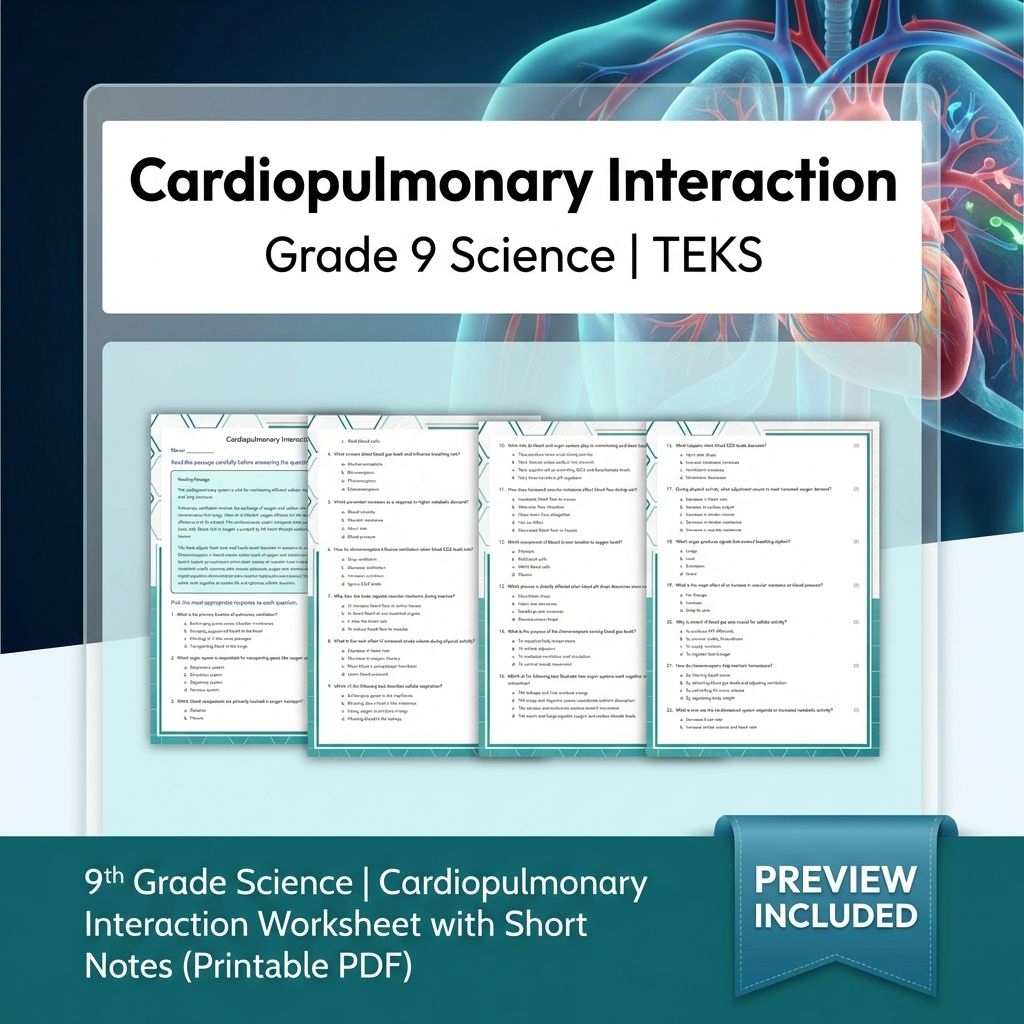
9th Grade Science | Cardiopulmonary Interaction Worksheet with Short Notes (PDF)
 Created byMeadowlark Worksheets
Learning Objectives
- Explain how the heart and lungs work together to regulate oxygen and carbon dioxide levels in the blood.
- Describe the processes of pulmonary ventilation and systemic circulation.
- Identify how chemoreceptors monitor blood gases and influence respiratory and cardiac responses.
Instant download

Representation Models Worksheet Pack | Grade 9 Science Practice
 Created byBright Quill Resources
Learning Objectives
- Identify different types of representation models (mathematical formulas, graphs, schematic diagrams, and computational approximations) and explain what each is best at capturing.
- Use criteria of representational fidelity, parsimony, and predictive scope to justify why a model is selected for a specific system.
- Explain how mapping model components to measurable observables helps interpret results and test assumptions with evidence.
Instant download
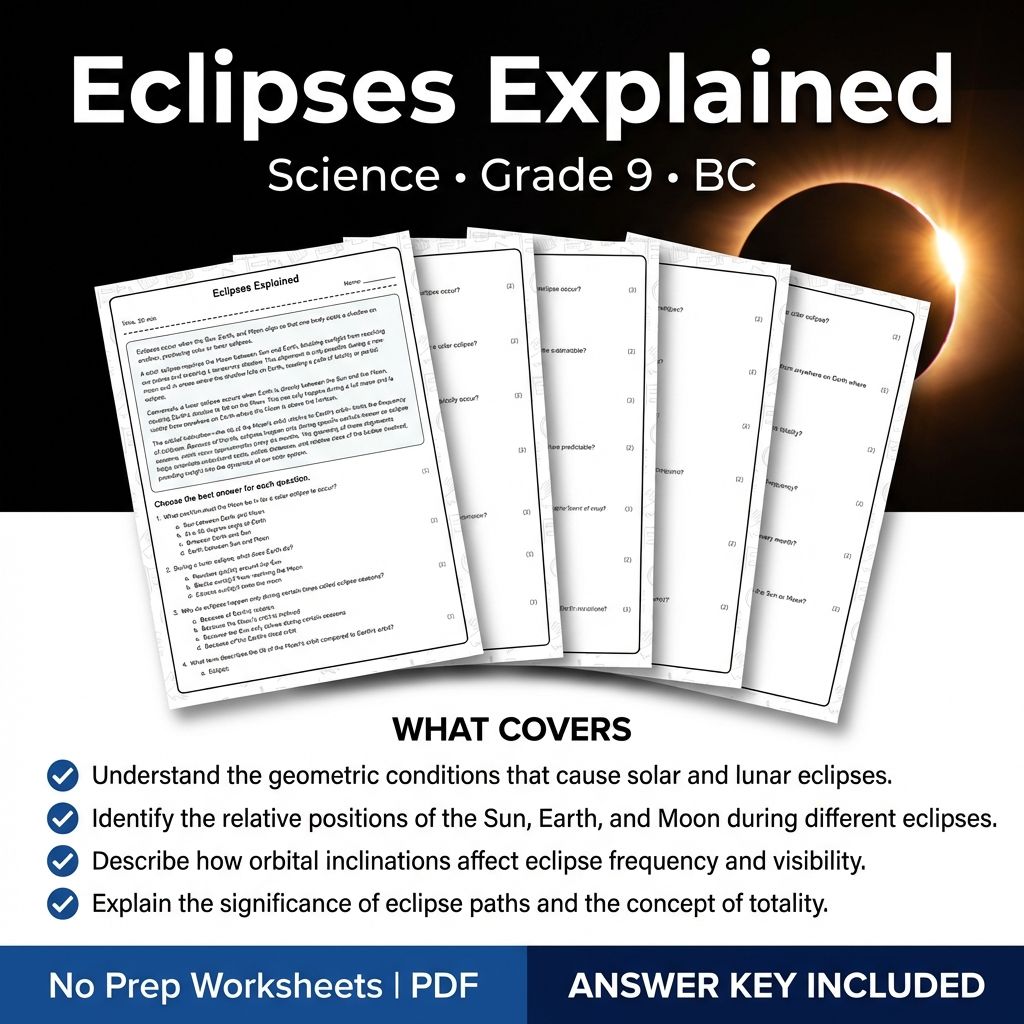
Grade 9 Science | Eclipses Explained Worksheet & Answer Key (Printable PDF)
Created byCoral Reef LearningLearning Objectives
- Understand the geometric conditions that cause solar and lunar eclipses.
- Identify the relative positions of the Sun, Earth, and Moon during different eclipses.
- Describe how orbital inclinations affect eclipse frequency and visibility.
Instant download
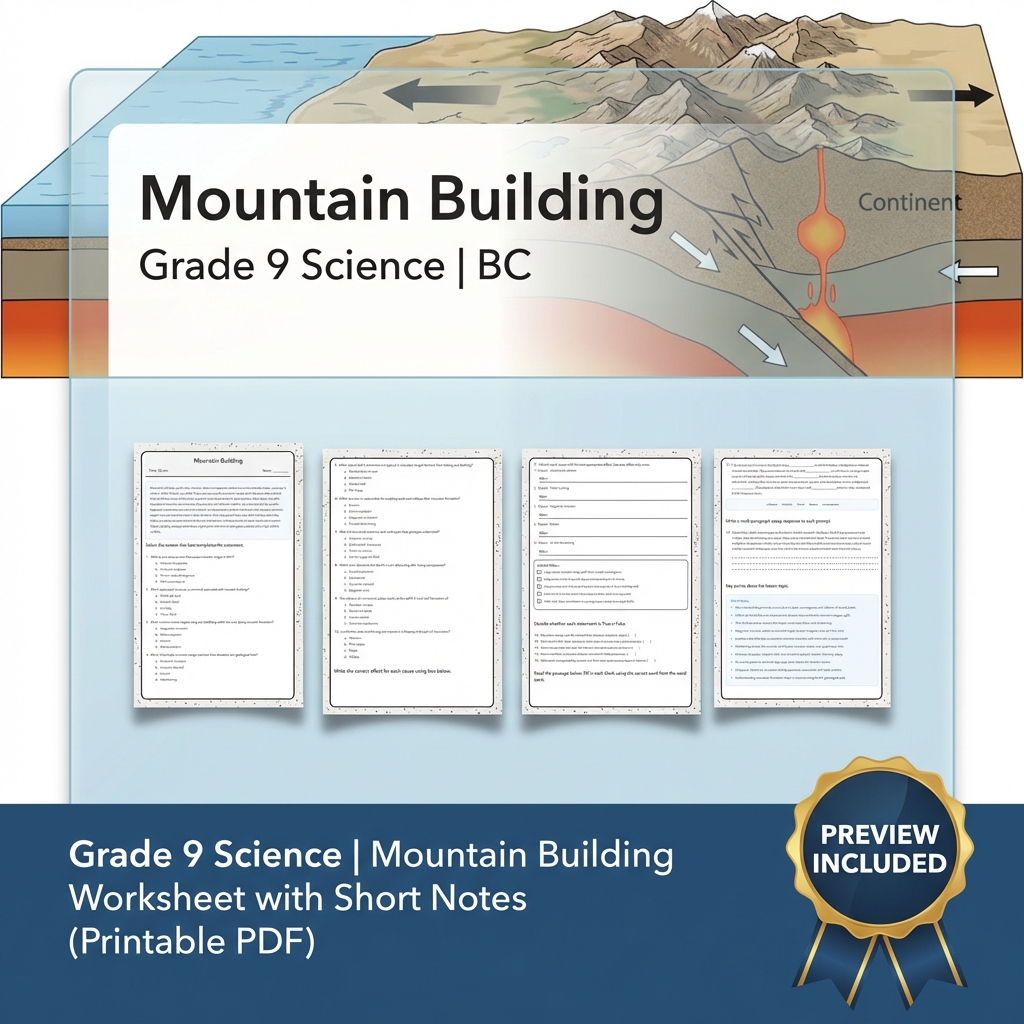
Grade 9 Science | Mountain Building Worksheet with Short Notes (Printable PDF)
Created byMeadowlark WorksheetsLearning Objectives
- Understand the geological processes involved in mountain formation from plate convergence and collision.
- Identify different structures such as thrust faults, fold belts, and crustal shortening associated with mountain ranges.
- Explain how weathering and erosion shape mountain landscapes over time.
Also included in: Grade 9 Science | BC Framework Lesson Bundle on Earth Systems & Climate +1 more
Instant download
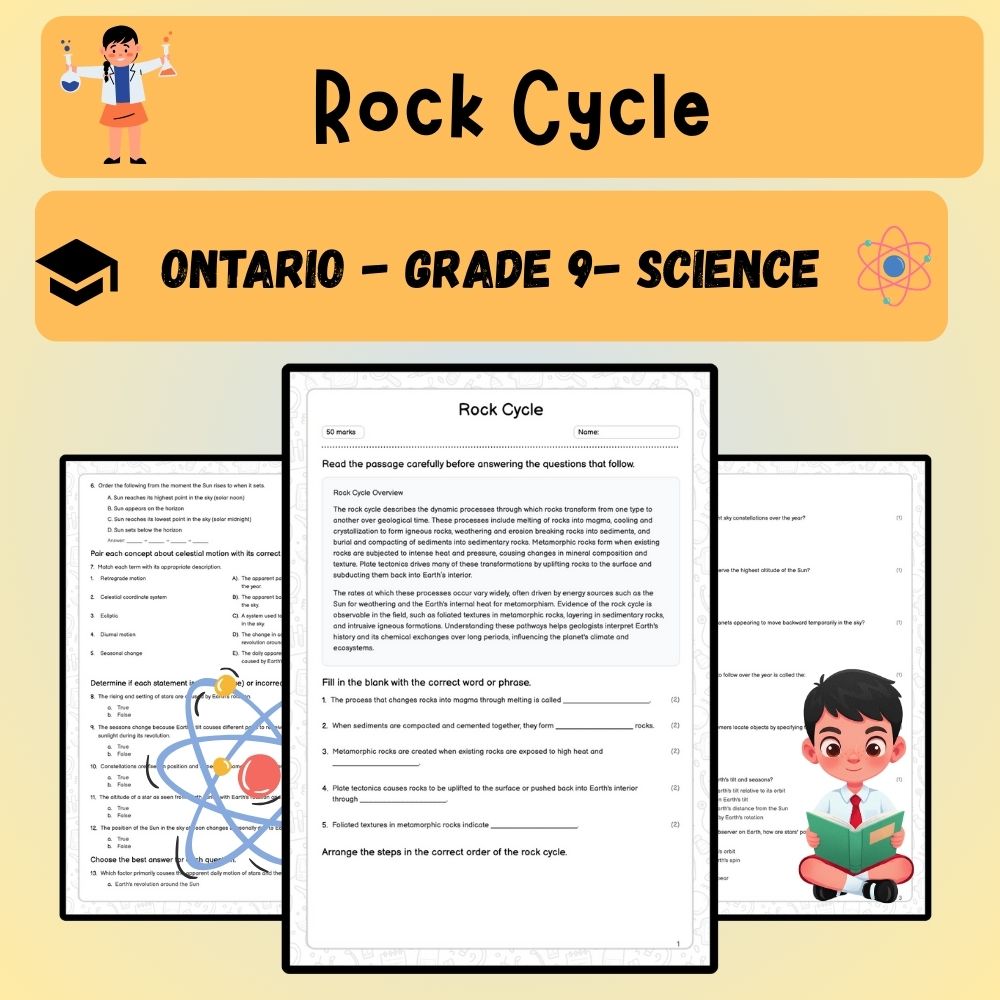
Grade 9 Science – Rock Cycle Worksheet (PDF) | Ontario Standards & Practice
Created byPrism Point LearningLearning Objectives
- Describe the processes involved in the rock cycle and how they transform different types of rocks.
- Identify observable evidence of the rock cycle in the field, such as layering and textures.
- Explain the role of plate tectonics, energy sources, and processes like weathering and metamorphism in shaping rocks.
Also included in: Grade 9 Science Unit Bundle | Earth, Weather, Energy & Tectonics +1 more
Instant download
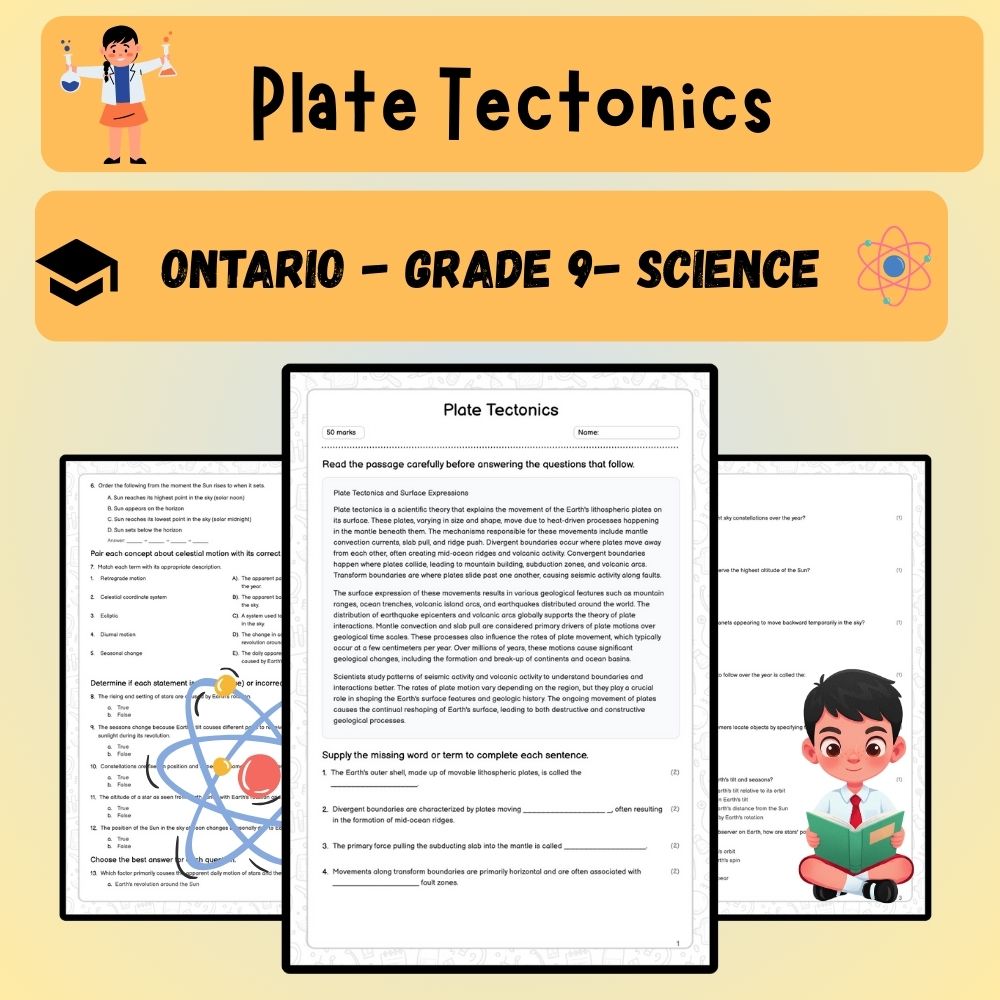
Grade 9 Science | Plate Tectonics Worksheet (Answer Key) – Ontario Standard
Created byPrism Point LearningLearning Objectives
- Describe the different types of plate boundaries and their surface expressions.
- Explain the mechanisms driving plate motions such as mantle convection and slab pull.
- Analyze global distribution of earthquakes and volcanic arcs as evidence for plate interactions.
Also included in: Grade 9 Science Unit Bundle | Earth, Weather, Energy & Tectonics +1 more
Instant download
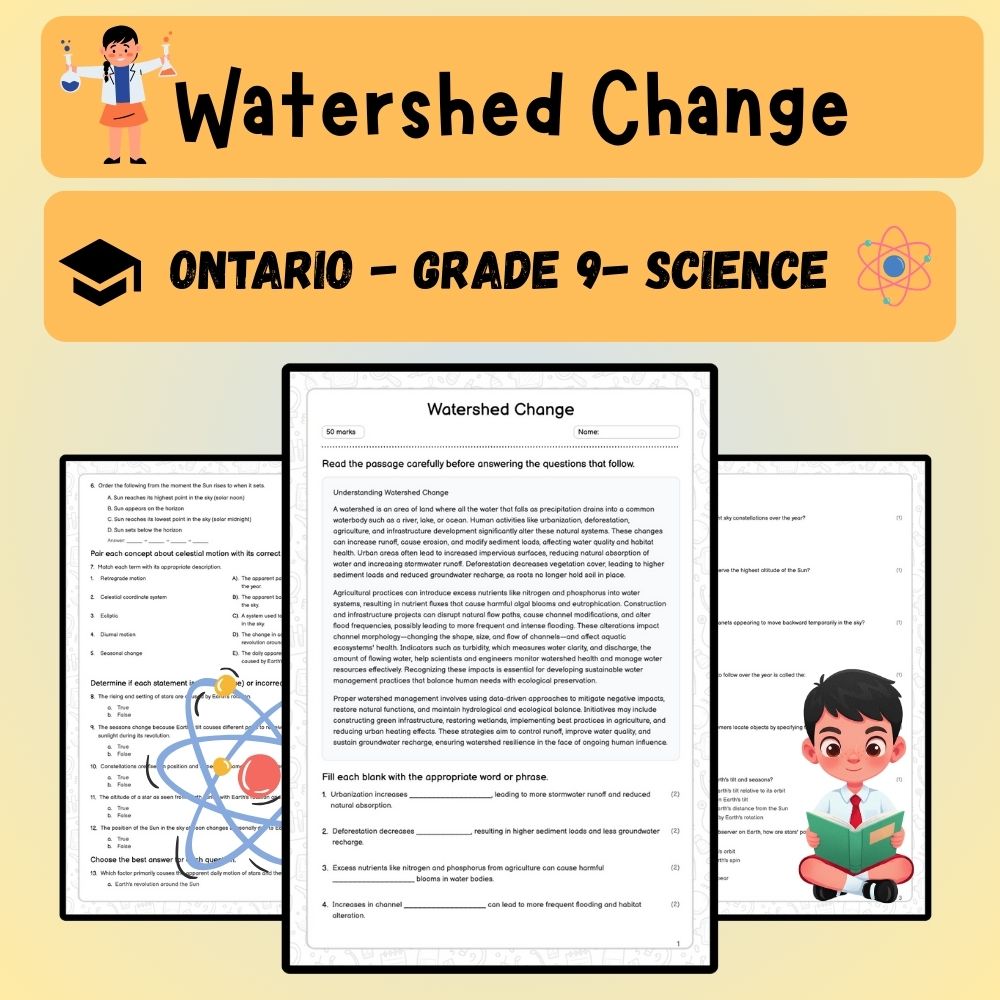
Grade 9 Science | Watershed Change Worksheet (PDF) – Ontario Standards
Created byPrism Point LearningLearning Objectives
- Understand human impacts on watershed processes such as urbanization, deforestation, agriculture, and infrastructure.
- Identify consequences of watershed alterations including runoff, sediment load, nutrient fluxes, and groundwater recharge.
- Describe how changes in watersheds affect channel morphology, flood frequency, and aquatic ecosystems.
Also included in: Grade 9 Science Unit Bundle | Earth, Weather, Energy & Tectonics +1 more
Instant download
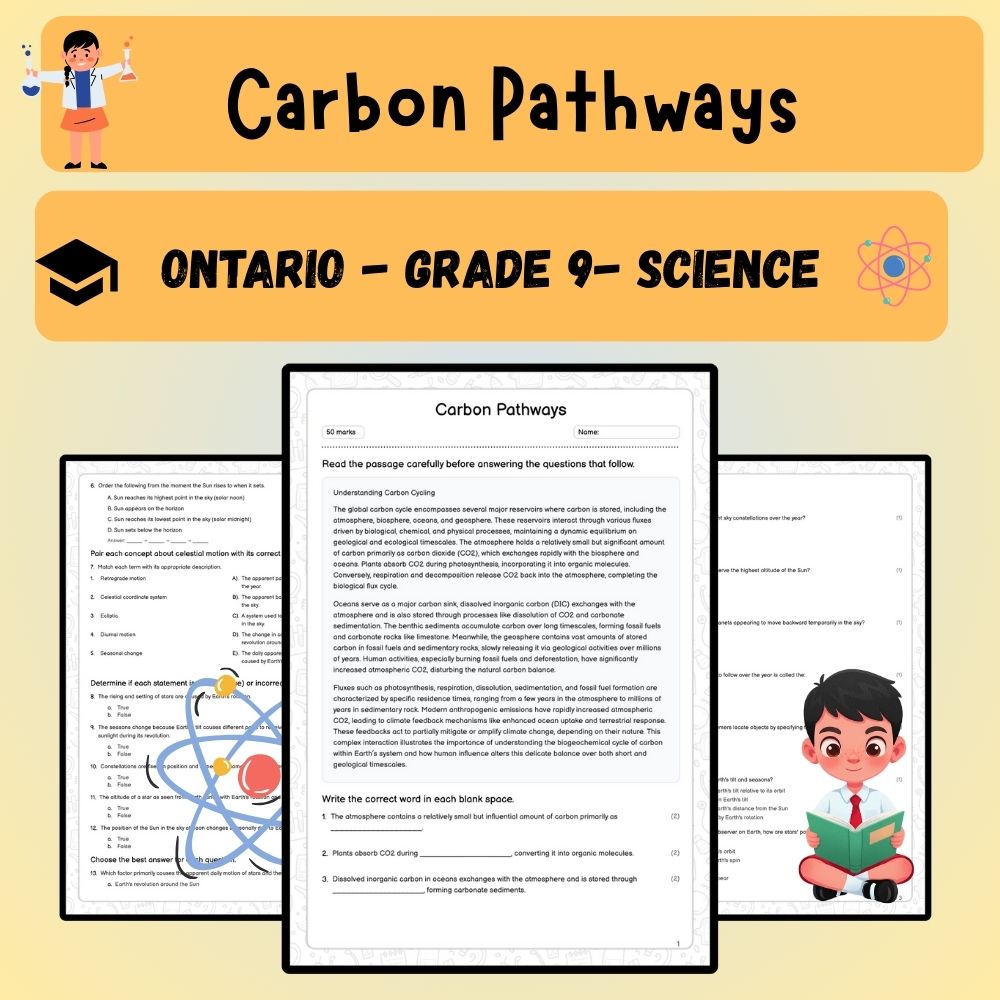
Grade 9 Science | Carbon Pathways Worksheet (Worksheet + Answer Key) - Ontario Standards
Created byPrism Point LearningLearning Objectives
- Describe the major carbon reservoirs in the atmosphere, biosphere, oceans, and geosphere.
- Explain the fluxes and processes that transfer carbon among different reservoirs, including photosynthesis, respiration, dissolution, sedimentation, and fossil fuel formation.
- Quantify basic exchanges and residence times of carbon in different parts of Earth's system.
Also included in: Grade 9 Science Unit Bundle | Earth, Weather, Energy & Tectonics +1 more
Instant download
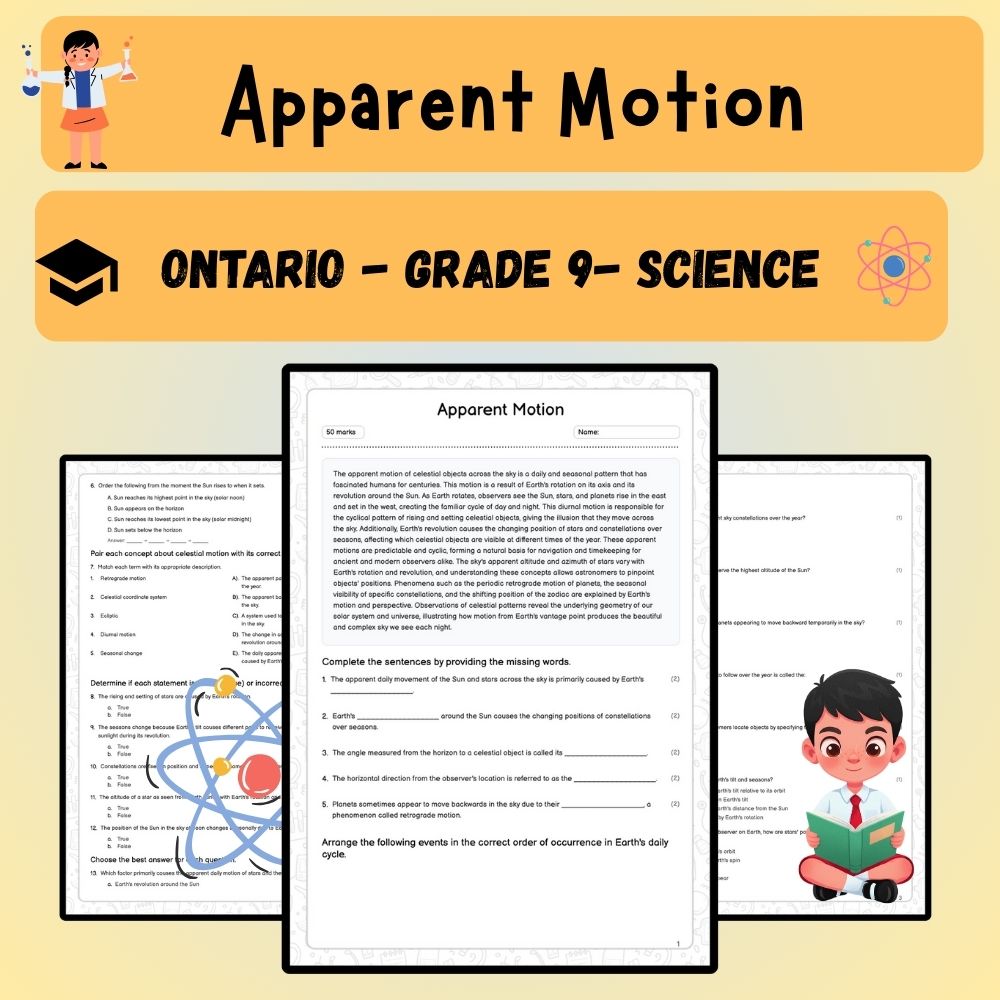
Grade 9 Science Worksheet | Apparent Motion of Celestial Objects (PDF)
Created byPrism Point LearningLearning Objectives
- Explain the causes of apparent diurnal and annual motion of celestial objects as observed from Earth.
- Describe how Earth's rotation and revolution produce observable changes in the night sky over nights and seasons.
- Use celestial coordinate concepts such as rising, setting, altitude, and azimuth to relate observed positions of celestial objects.
Also included in: Grade 9 Science Unit Bundle | Earth, Weather, Energy & Tectonics +1 more
Instant download
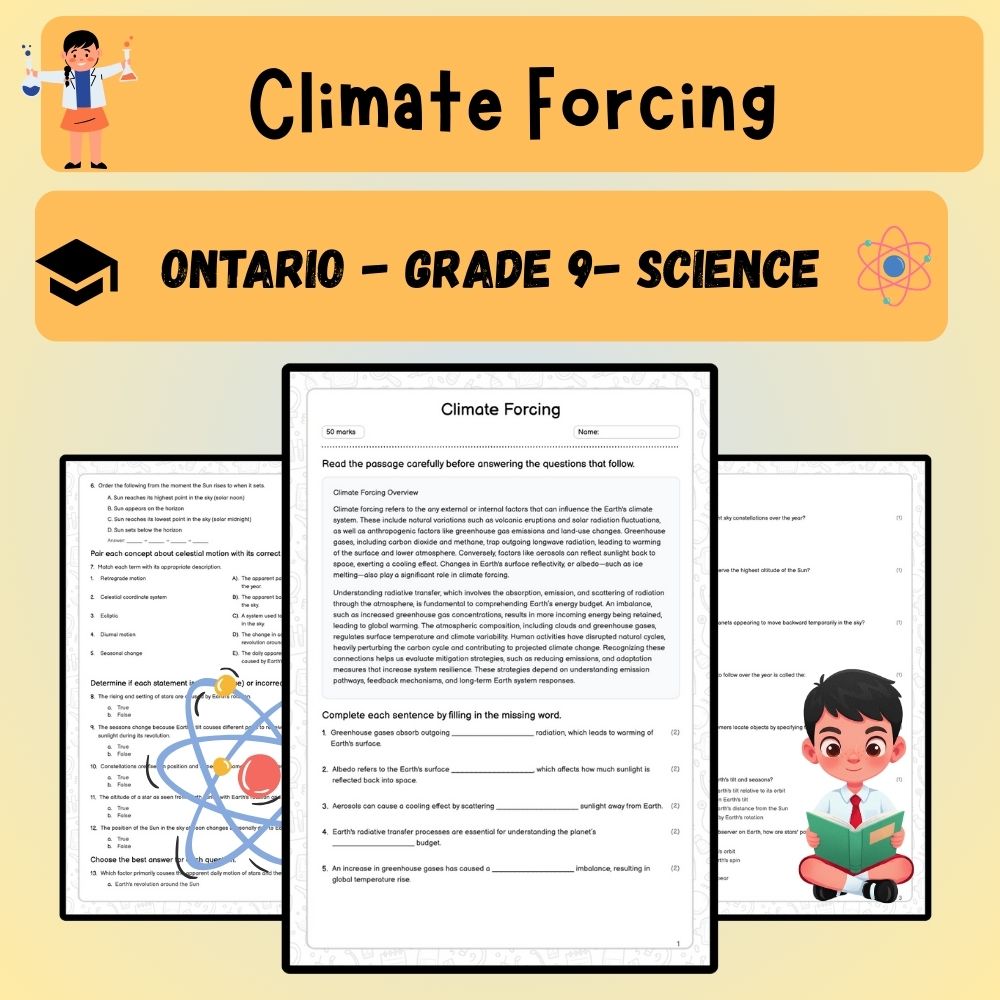
Grade 9 Science | Climate Forcing Worksheet (PDF) – Ontario Standards
Created byPrism Point LearningLearning Objectives
- Describe the basic mechanisms of climate forcing including greenhouse gases, albedo changes, and aerosols.
- Explain the concept of radiative transfer and how Earth's energy budget influences surface temperature.
- Analyze the links between human emissions, the carbon cycle, and climate change projections.
Also included in: Grade 9 Science Unit Bundle | Earth, Weather, Energy & Tectonics +1 more
Instant download
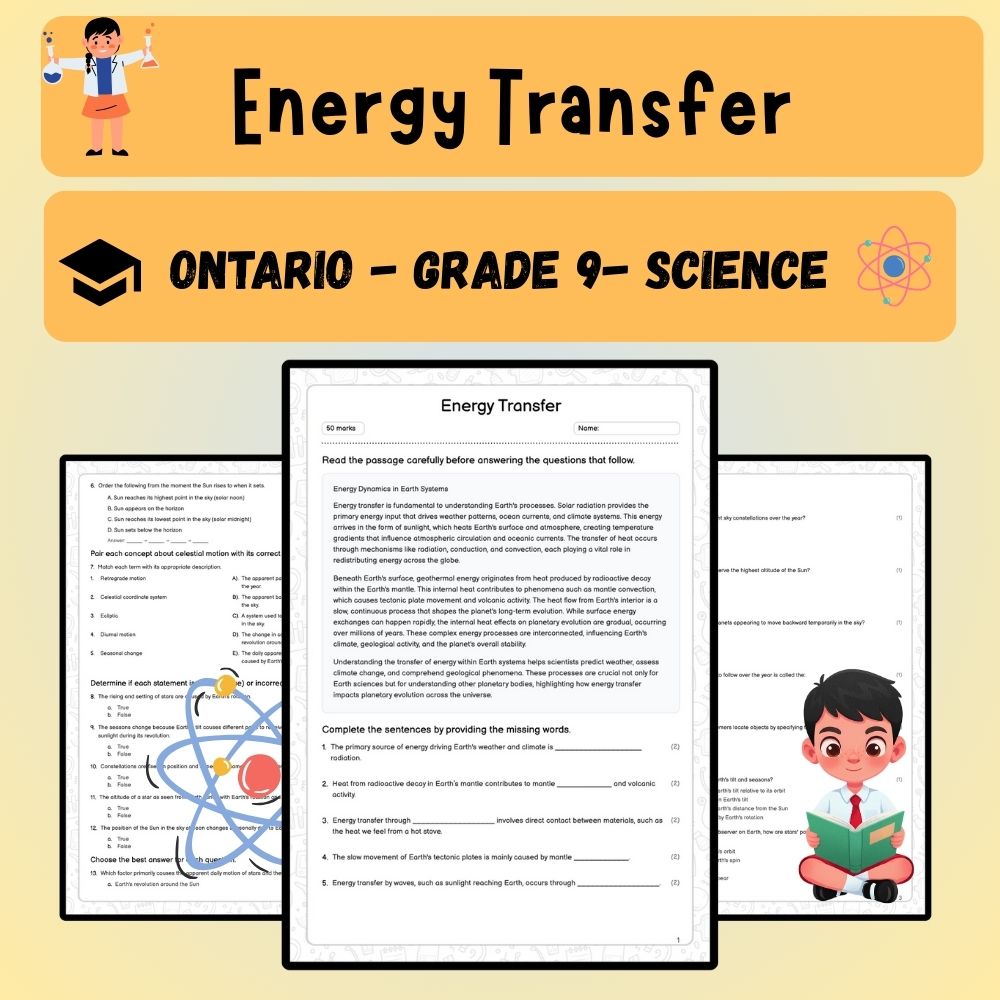
Grade 9 Science | Energy Transfer Worksheet (Ontario Standards) – PDF
Created byPrism Point LearningLearning Objectives
- Explain the sources of energy within Earth's systems, including solar radiation and geothermal heat
- Describe how energy transfer occurs through conduction, convection, and radiation
- Analyze how energy gradients influence atmospheric and oceanic circulation and geological processes
Also included in: Grade 9 Science Unit Bundle | Earth, Weather, Energy & Tectonics +1 more
Instant download
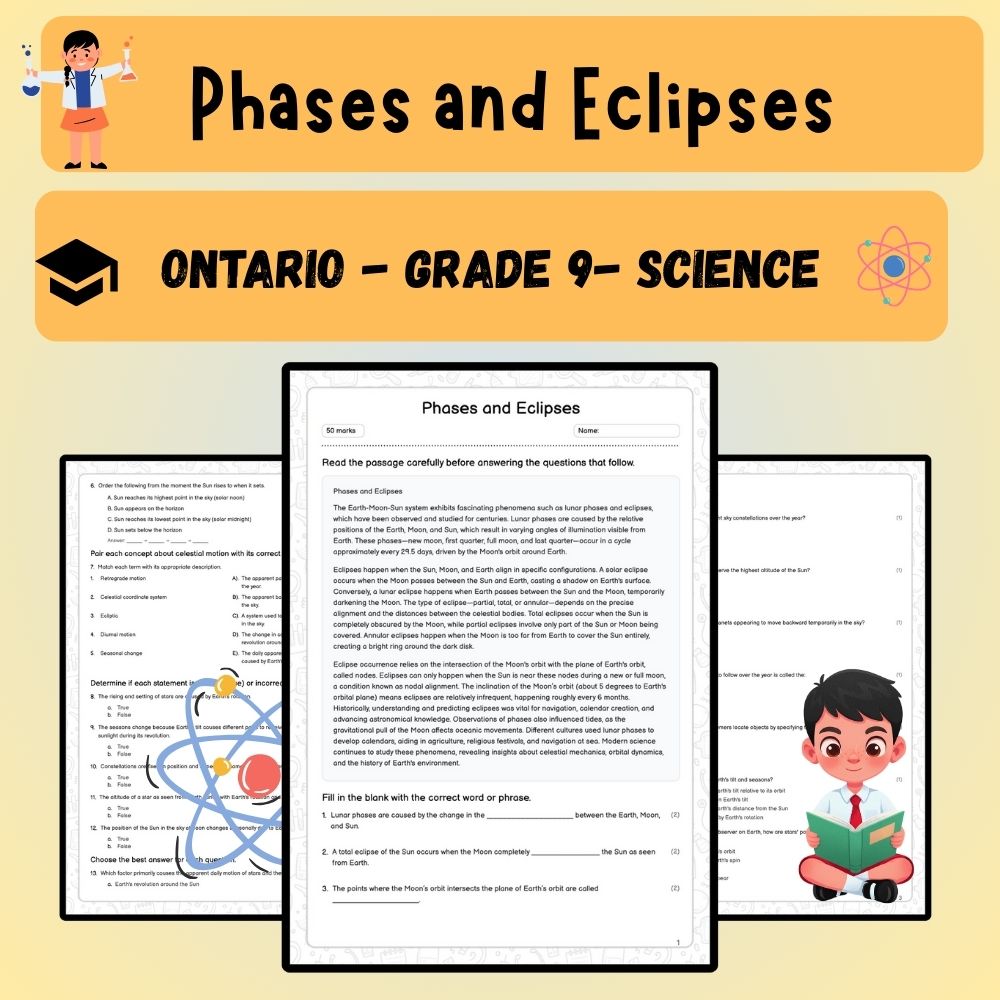
Grade 9 Science | Phases and Eclipses Worksheet (Worksheet + Answer Key) - Ontario
Created byPrism Point LearningLearning Objectives
- Describe the geometric conditions that lead to lunar phases, solar, and lunar eclipses.
- Differentiate between partial, total, and annular eclipses and identify their observational characteristics.
- Explain the importance of node alignment and orbital inclination in eclipse occurrence.
Also included in: Grade 9 Science Unit Bundle | Earth, Weather, Energy & Tectonics +1 more
Instant download
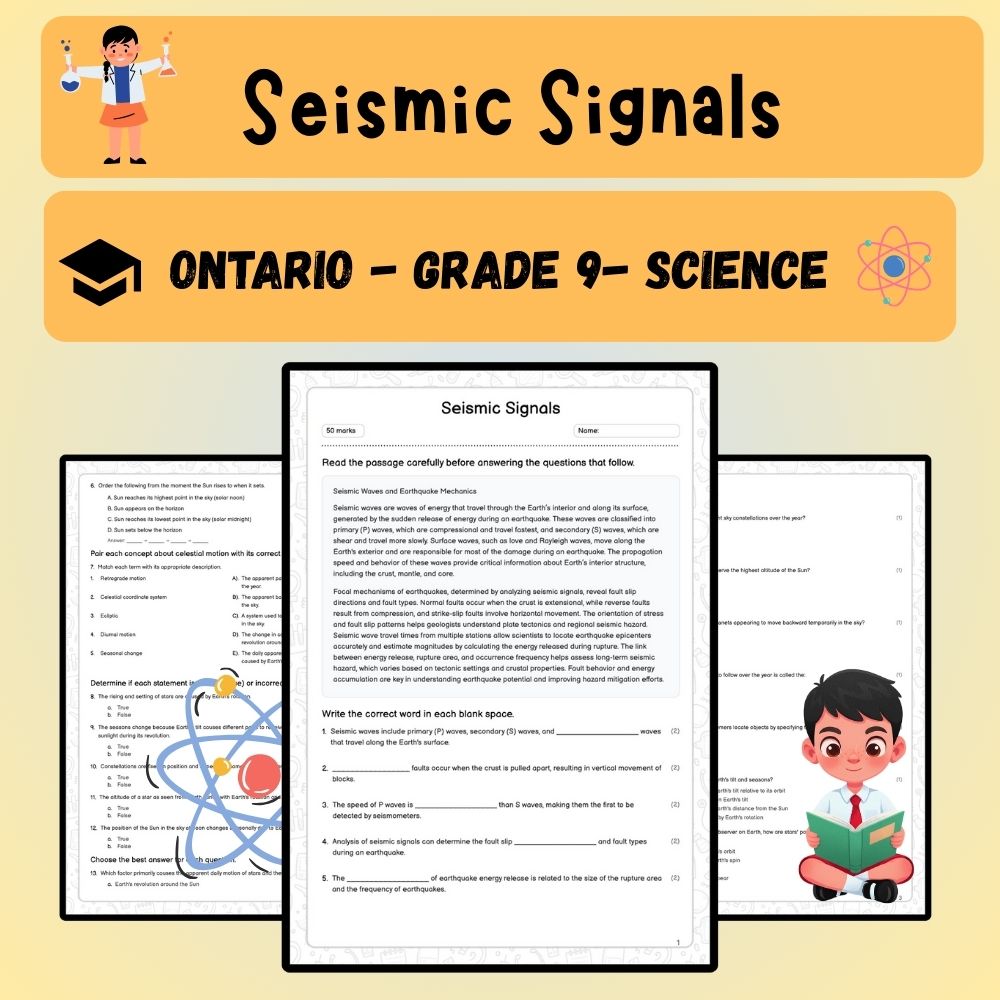
Grade 9 Science | Seismic Signals Worksheet (Worksheet + Answer Key) – Ontario Standards
Created byPrism Point LearningLearning Objectives
- Understand the types and propagation characteristics of seismic waves.
- Explain how earthquake focal mechanisms reveal fault types and stress orientations.
- Relate seismic wave travel times to Earth's interior structure and methods for locating epicentres.
Also included in: Grade 9 Science Unit Bundle | Earth, Weather, Energy & Tectonics +1 more
Instant download
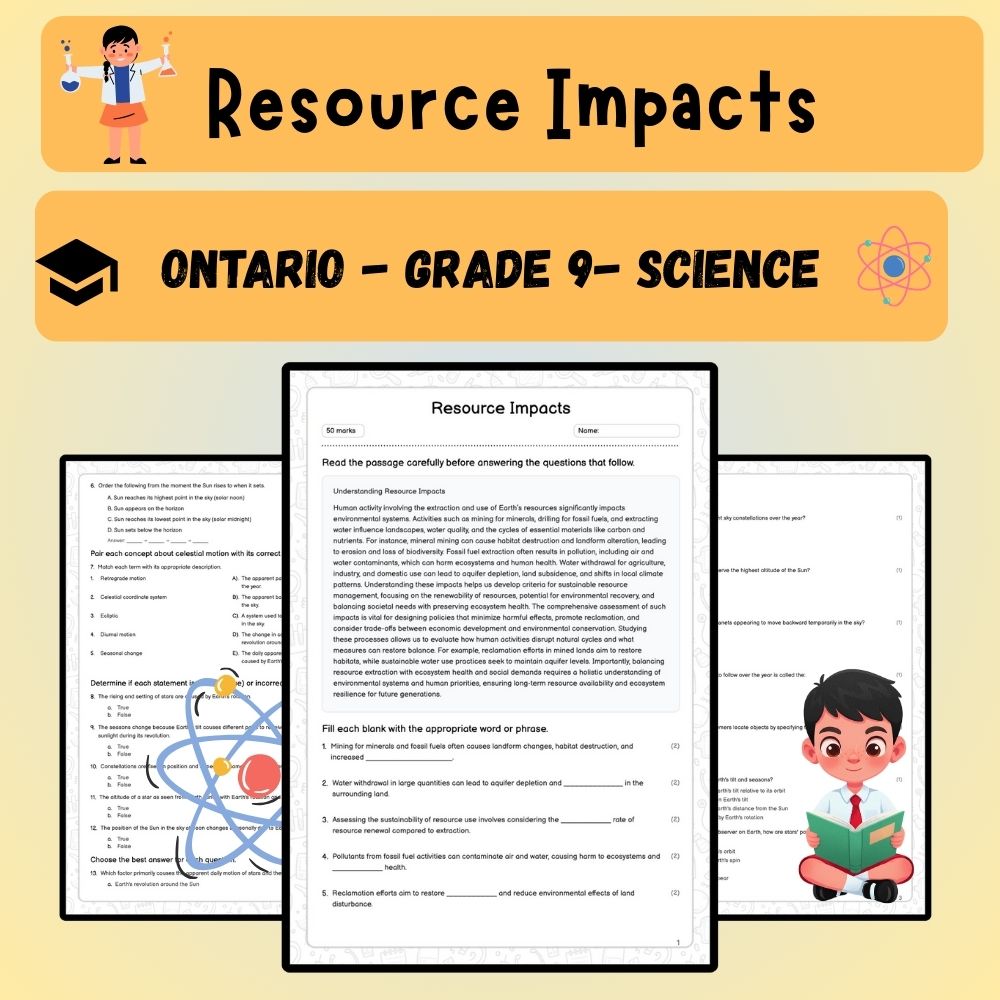
Grade 9 Science Resource Impacts Worksheet – Ontario Standards (PDF)
Created byPrism Point LearningLearning Objectives
- Understand how resource extraction influences landforms, ecosystems, and material cycles.
- Evaluate sustainability criteria related to resource use—including renewability, environmental effects, and reclamation potential.
- Analyze the trade-offs between societal needs and ecosystem integrity in resource management.
Also included in: Grade 9 Science Unit Bundle | Earth, Weather, Energy & Tectonics +1 more
Instant download
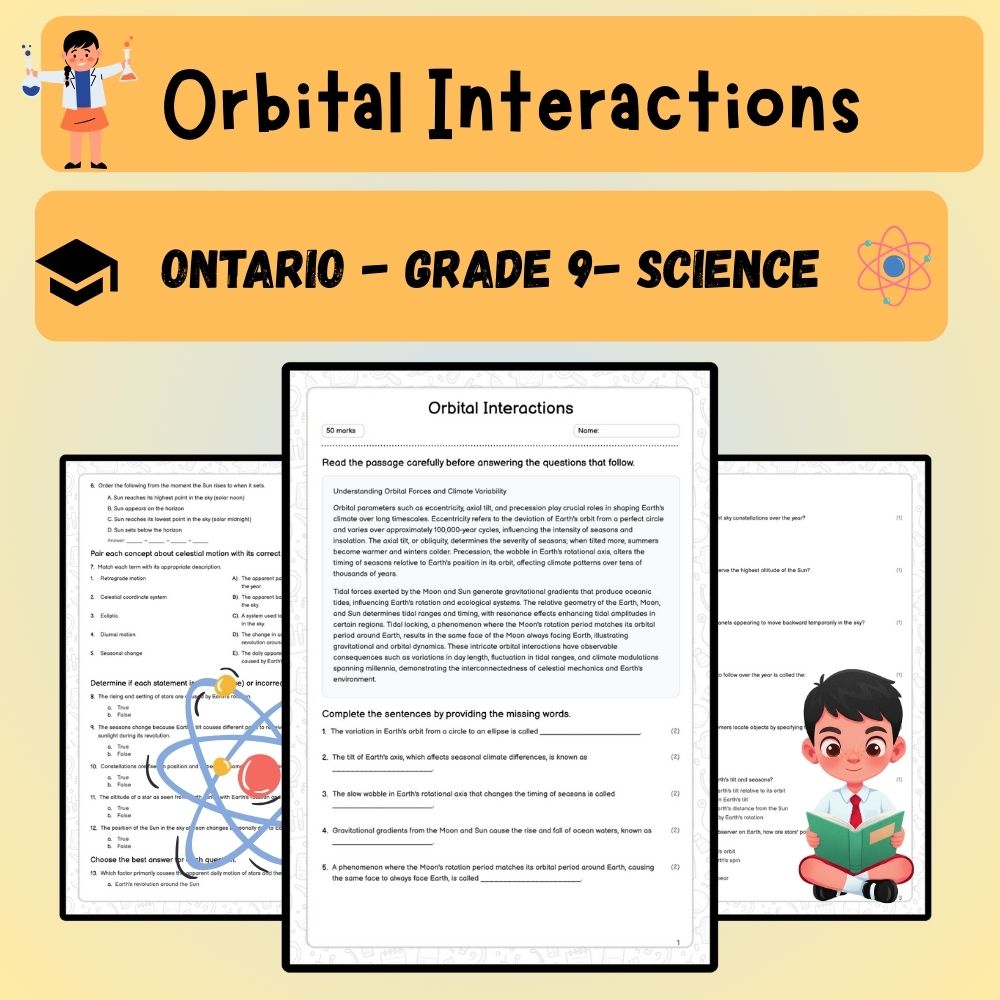
Grade 9 Science | Orbital Interactions Worksheet (Ontario Standard) – PDF
Created byPrism Point LearningLearning Objectives
- Understand how orbital parameters such as eccentricity, axial tilt, and precession affect seasonal insolation and climate patterns.
- Explain tidal forces caused by the Moon and Sun through gravitational gradients and relative geometry.
- Describe resonance effects and tidal locking phenomena in celestial mechanics.
Also included in: Grade 9 Science Unit Bundle | Earth, Weather, Energy & Tectonics +1 more
Instant download
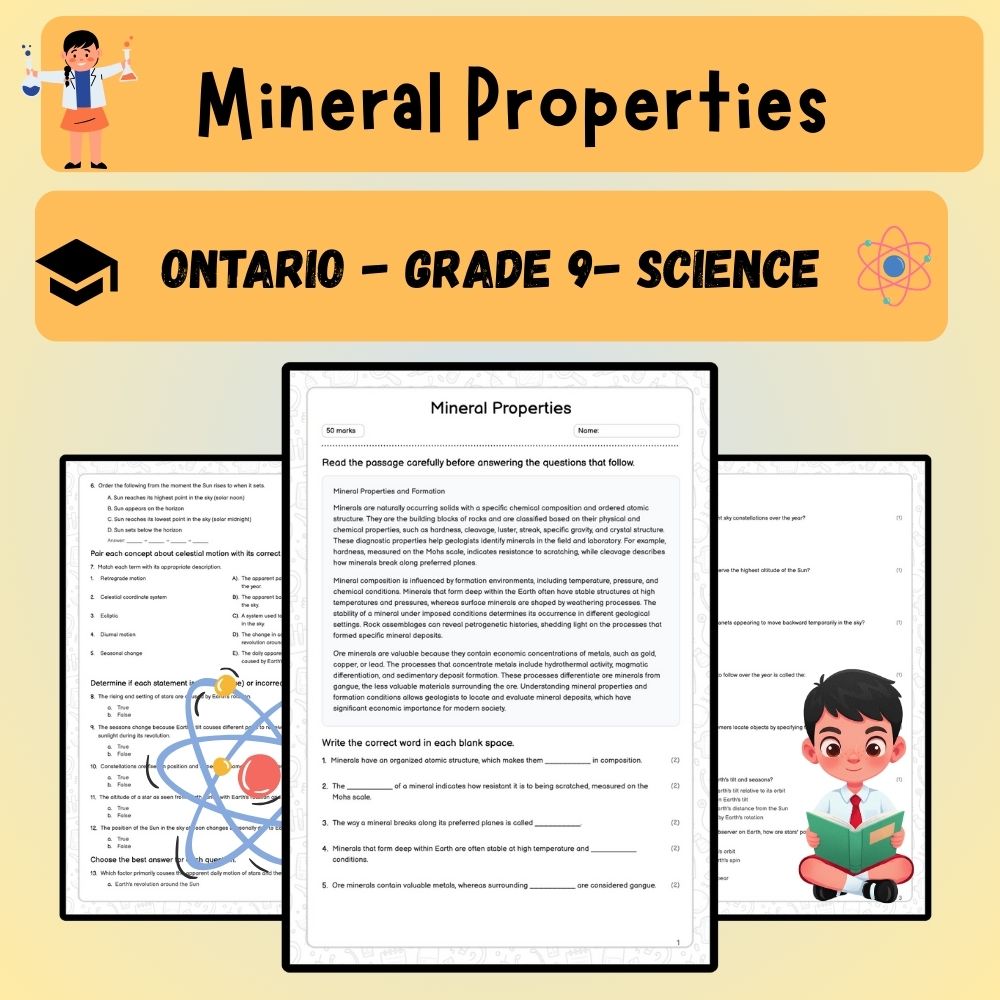
Grade 9 Science | Mineral Properties Worksheet (PDF) – Ontario Standards
Created byPrism Point LearningLearning Objectives
- Identify and describe diagnostic physical and chemical properties of common rock-forming minerals.
- Explain how mineral composition relates to formation environments and stability under various conditions.
- Connect mineral assemblages to petrogenetic histories and distinguish ore minerals from gangue in economic contexts.
Also included in: Grade 9 Science Unit Bundle | Earth, Weather, Energy & Tectonics +1 more
Instant download

Grade 9 Science | Planetary Layers Worksheet (PDF) – Ontario Standard
Created byPrism Point LearningLearning Objectives
- Understand the structure and composition of Earth's concentric layers: crust, mantle, and core.
- Explain the differences between the lithosphere and asthenosphere in mechanical behavior.
- Describe how variations in density, temperature, and pressure with depth influence material phases and planetary processes.
Also included in: Grade 9 Science Unit Bundle | Earth, Weather, Energy & Tectonics +1 more
Instant download
About Grade 9 Science Worksheets
Find Science worksheets built for Grade 9. All 6,986 cover core skills, practice, and review, each an instant PDF download.
Every worksheet on MyTeachingSheets is created by independent teacher-authors and reviewed before publication. All resources download as printable PDFs for classroom, homework, or at-home practice, and many include answer keys. Preview any worksheet free before buying.