
Grade 9 Science Worksheets
6,986 worksheets
Grade 9 Genetic Drift Daily Reading Worksheet | TEKS Science Biology
 Created byBRIGHT PATH RESOURCES
Learning Objectives
- Explain genetic drift as a random change in allele frequencies.
- Identify key vocabulary including allele and frequency.
- Describe how small populations and chance events can cause allele loss or fixation.
Also included in: Grade 9 Evolution and Classification Biology Reading Worksheets Bundle | TEKS +1 more
Instant download

Classification Foundations Worksheet for Grade 9 Science | TEKS Aligned
JCreated byJ.S SheetsLearning Objectives
- Describe the purpose of biological classification and how it supports communication about biodiversity
- Explain how traditional taxonomic ranks and binomial nomenclature help organize organisms
- Compare traditional classification with modern approaches that use evolutionary relationships and clades
Instant download
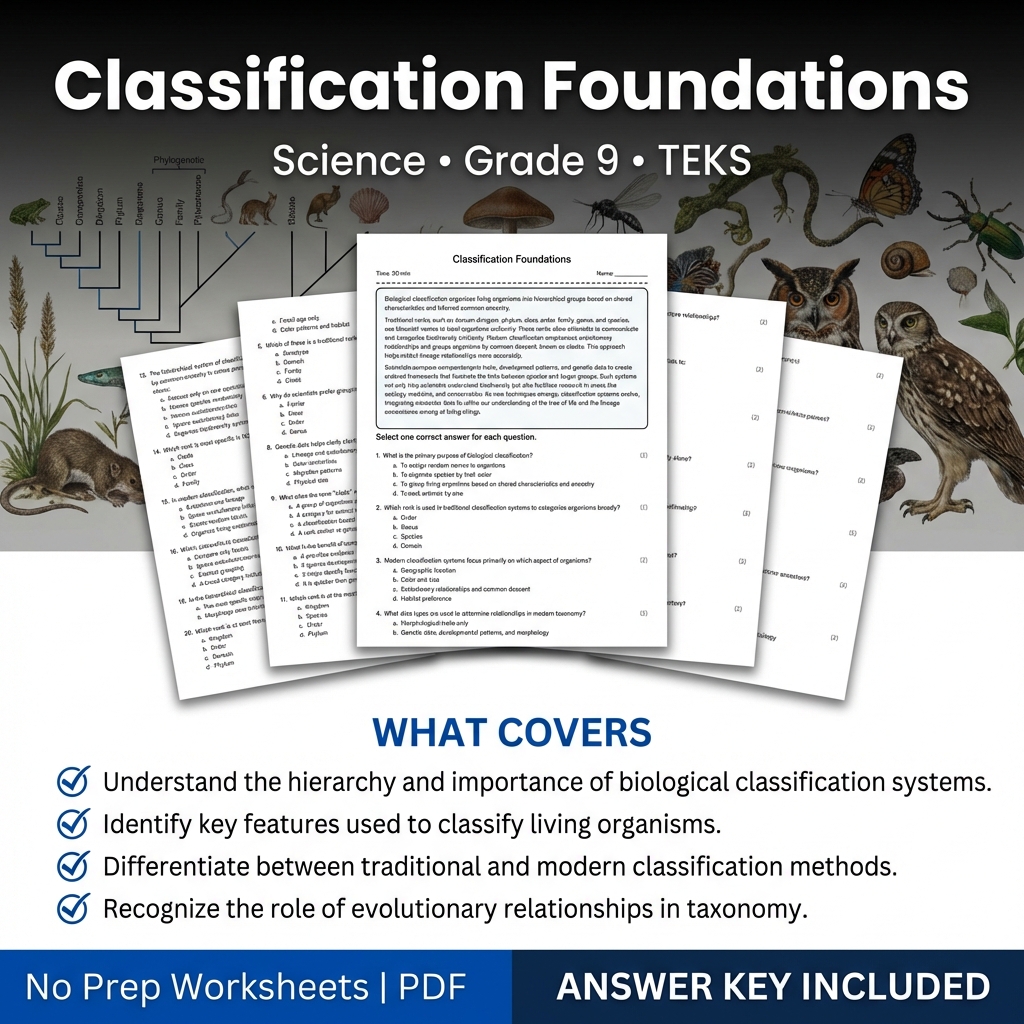
Classification Foundations Worksheet for Grade 9 Science | TEKS Aligned
 Created byCoral Reef Learning
Learning Objectives
- Understand the hierarchy and importance of biological classification systems.
- Identify key features used to classify living organisms.
- Differentiate between traditional and modern classification methods.
Instant download
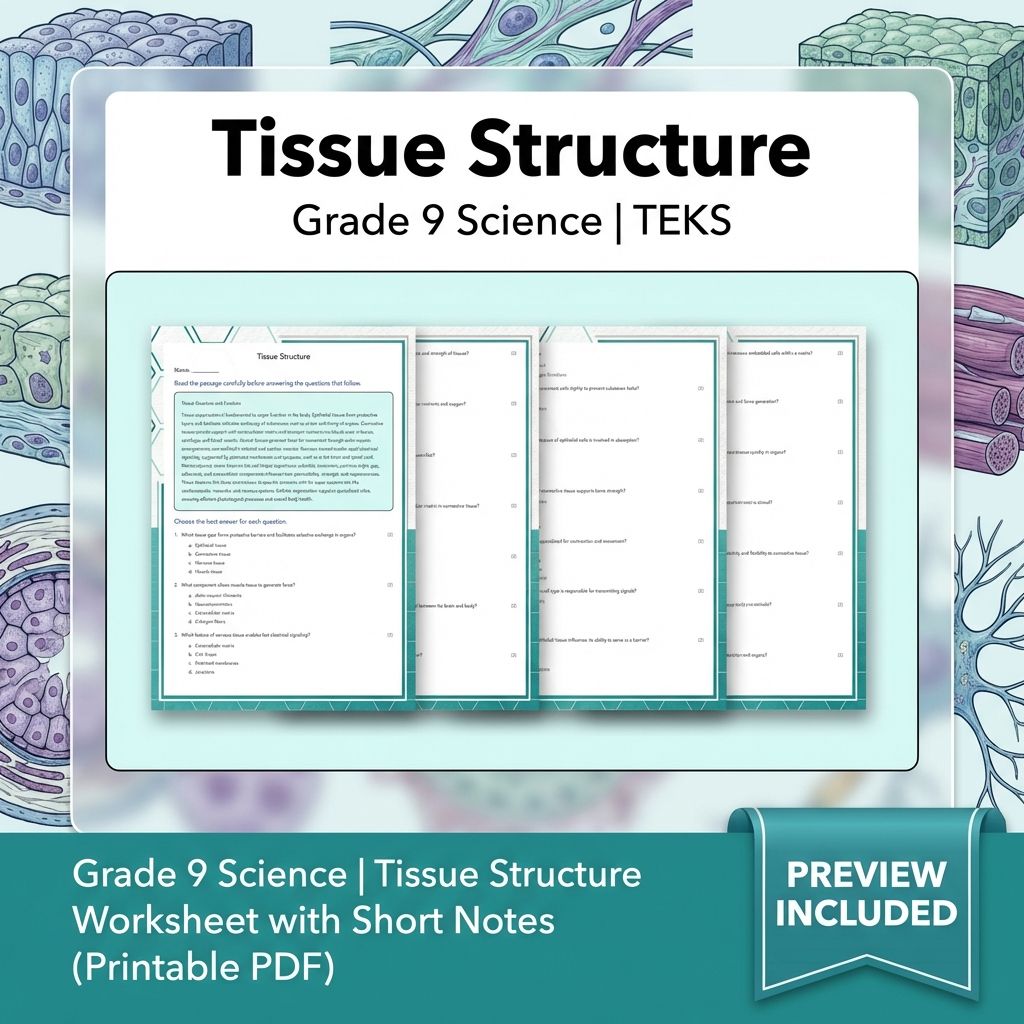
Grade 9 Science | Tissue Structure Worksheet with Short Notes (Printable PDF)
 Created byMeadowlark Worksheets
Learning Objectives
- Understand the organization of different tissue types and their roles in organ systems.
- Identify microscopic features of tissues and relate their structure to function.
- Describe how cellular organization supports physiological roles in tissues.
Instant download

Grade 9 Science – Chemical Equations & Reactions | Daily Reading Worksheet
 Created byBright Mind Resources
Learning Objectives
- Learn about the conservation of matter in chemical reactions.
- Identify elements in unbalanced chemical equations.
- Practice balancing chemical equations by adjusting coefficients.
Also included in: Waves & Forces Grade 9 Science Daily Reading Worksheets Lesson Bundle | General +1 more
Instant download

Measurement Fundamentals Worksheet | Grade 9 AP Science Practice
 Created byBright Quill Resources
Learning Objectives
- Explain how metric units and precise definitions support consistent measurement in science.
- Describe how instrument resolution and calibration affect measurement reliability and data quality.
- Connect measurement results to tabular and graphical representations to support scientific claims.
Instant download
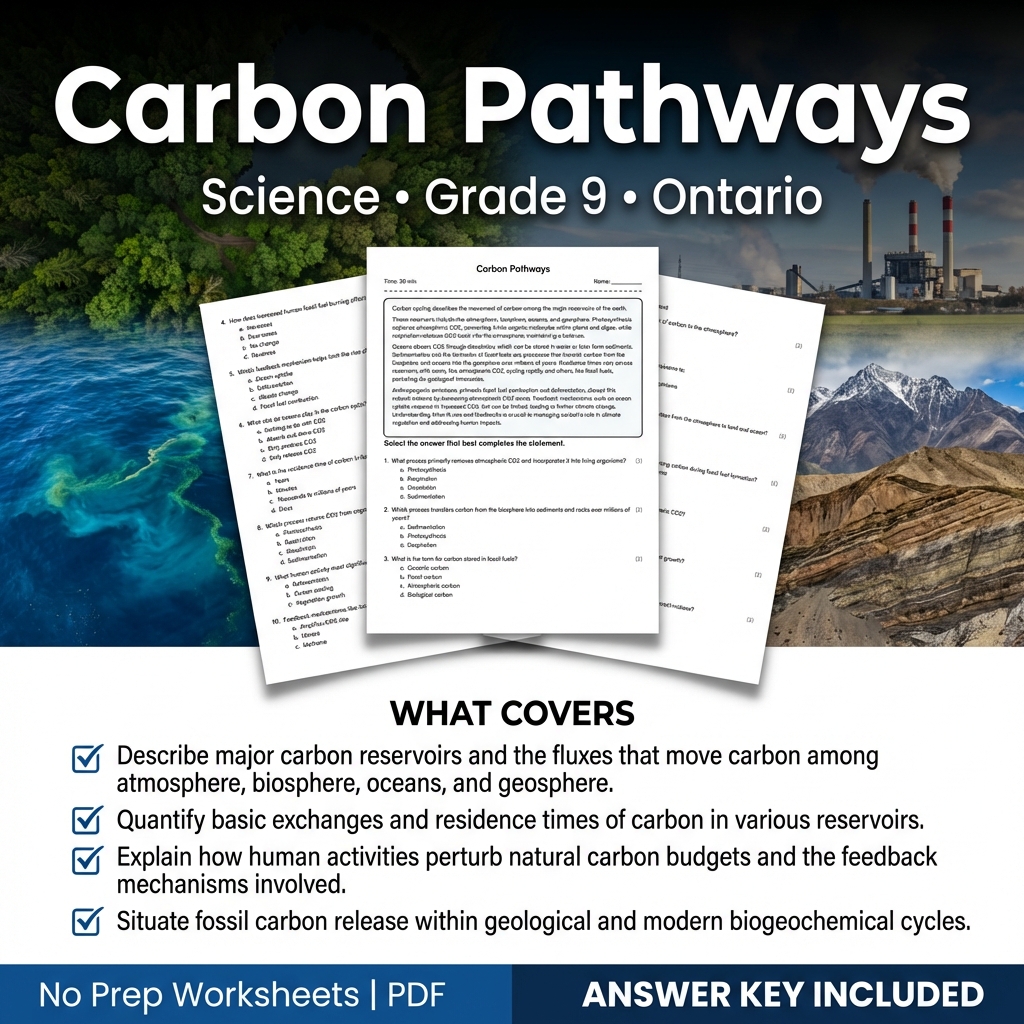
Carbon Pathways Worksheet for Grade 9 Science | Ontario Standard
Created byCoral Reef LearningLearning Objectives
- Describe major carbon reservoirs and the fluxes that move carbon among atmosphere, biosphere, oceans, and geosphere.
- Quantify basic exchanges and residence times of carbon in various reservoirs.
- Explain how human activities perturb natural carbon budgets and the feedback mechanisms involved.
Instant download

Grade 9 Simple Machines Worksheet | Mechanical Advantage & Force Ontario
 Created byChalk and Compass
Learning Objectives
- Compare how simple machines change input force, output force, and displacement.
- Explain the relationship between mechanical advantage and ideal mechanical advantage.
- Identify key parts and use cases of levers, pulleys, inclined planes, wedges, wheel and axle, and screws.
Also included in: Grade 9 Science Work, Energy & Forces Lesson Bundle | Ontario +1 more
Instant download

Grade 9 Work Calculations Worksheet | Dot Product, Cosine & Ontario Science
Created byChalk and CompassLearning Objectives
- Calculate work using W = F d cos(θ) for constant forces at an angle to displacement.
- Explain why the work from a variable force can be found from the area under a force–distance graph.
- Choose the correct method for computing work in everyday physics situations.
Also included in: Grade 9 Science Work, Energy & Forces Lesson Bundle | Ontario +1 more
Instant download

Grade 9 Science | Systems Interactions Worksheet | BC Aligned
 Created byLumora Learning
Learning Objectives
- Understand how multiple bodies and forces interact in mechanical systems.
- Apply Newton’s laws, net force analysis, and energy concepts to predict system motion.
- Analyze energy transfer, dissipative processes, and internal forces in complex systems.
Instant download
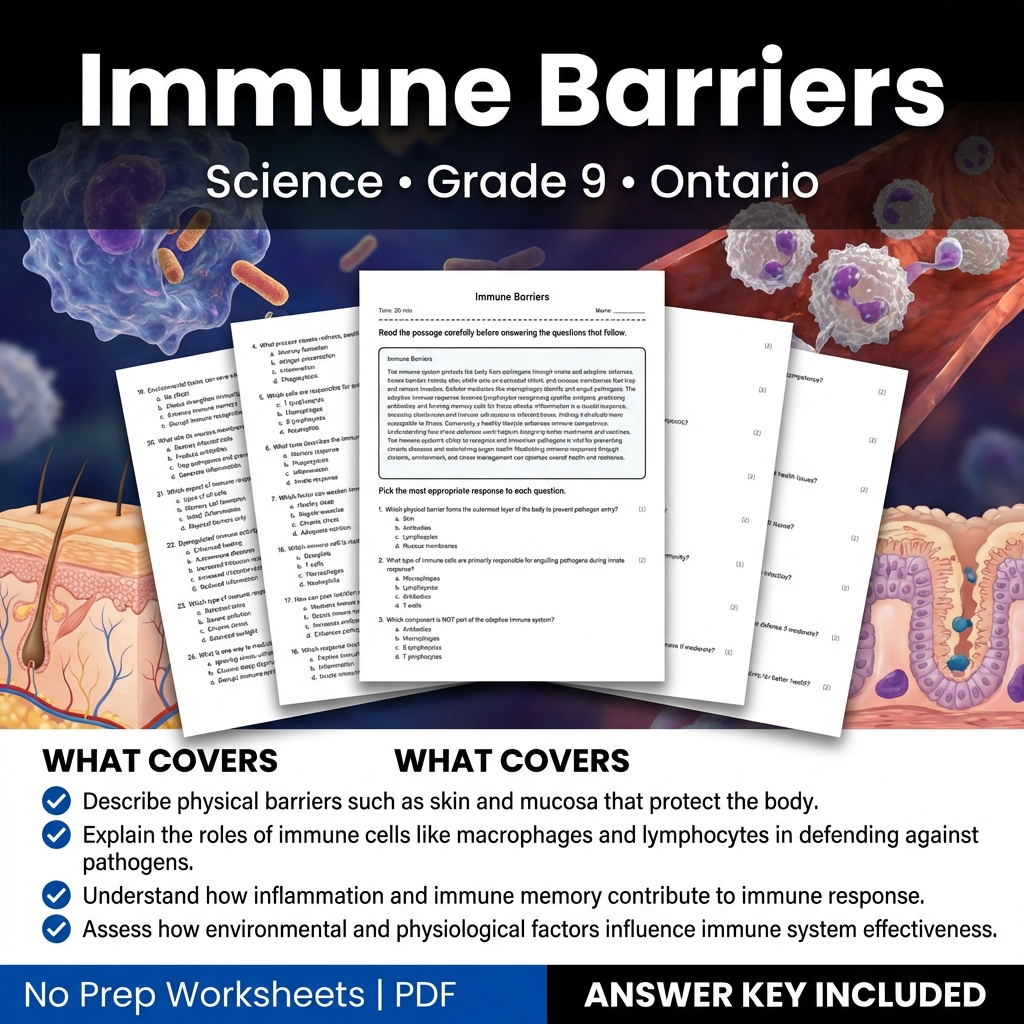
Grade 9 Science Worksheet on Immune Barriers | Ontario Standards
Created byCoral Reef LearningLearning Objectives
- Describe physical barriers such as skin and mucosa that protect the body.
- Explain the roles of immune cells like macrophages and lymphocytes in defending against pathogens.
- Understand how inflammation and immune memory contribute to immune response.
Instant download
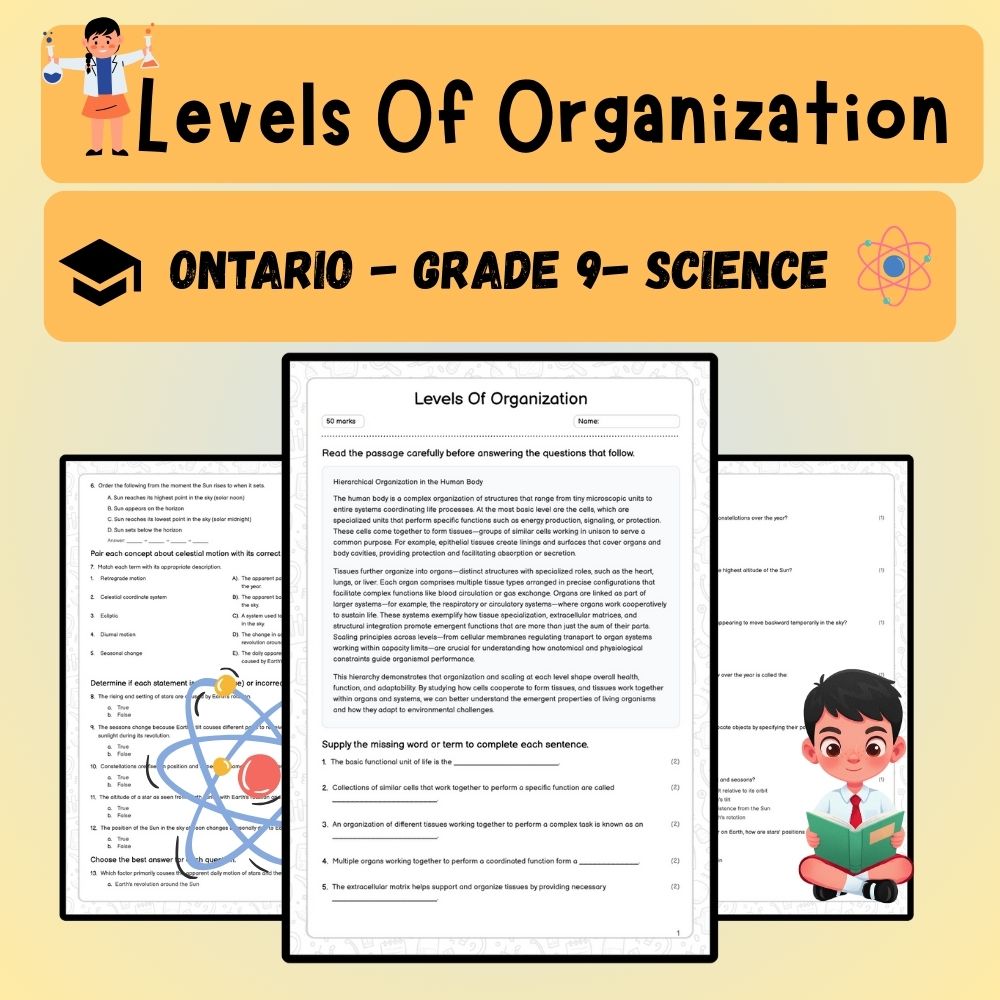
Grade 9 Science | Levels Of Organization Worksheet (PDF) Aligned with Ontario Standards
 Created byPrism Point Learning
Learning Objectives
- Explain the hierarchical relationship among cells, tissues, organs, and systems.
- Describe how cell specialization and extracellular matrices contribute to organ functions.
- Analyze how tissue arrangement supports organ-level processes.
Also included in: Grade 9 Science Unit Bundle | Human Body Systems & Cell Functions +1 more
Instant download

Grade 9 Science – Ecosystem Services & Biodiversity | Daily Reading Worksheet
Created byBright Mind ResourcesLearning Objectives
- Identify different types of ecosystem services
- Understand the importance of biodiversity for ecosystem functions
- Recognize human impacts on ecosystem services
Also included in: Ecosystem Ecology Grade 9 Science Daily Reading Worksheets Bundle | TEKS +2 more
Instant download
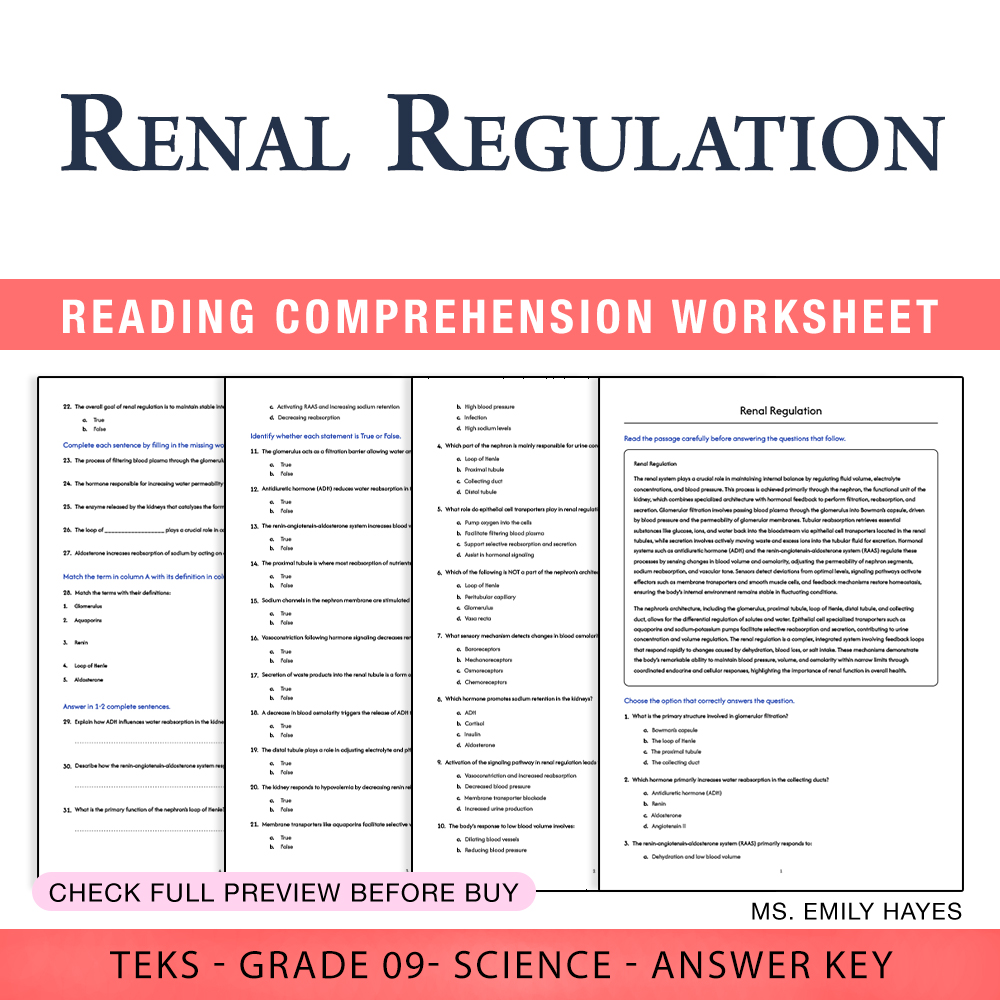
9th Grade Science | Renal Regulation Worksheet (PDF+ Answer Key)
 Created byCopper Leaf Classroom
Learning Objectives
- Understand the mechanisms of renal regulation involved in fluid, electrolyte, and blood pressure homeostasis.
- Identify the roles of hormonal feedback systems such as ADH and the renin-angiotensin-aldosterone system.
- Explain how nephron architecture and membrane specialization facilitate glomerular filtration, reabsorption, and secretion.
Instant download
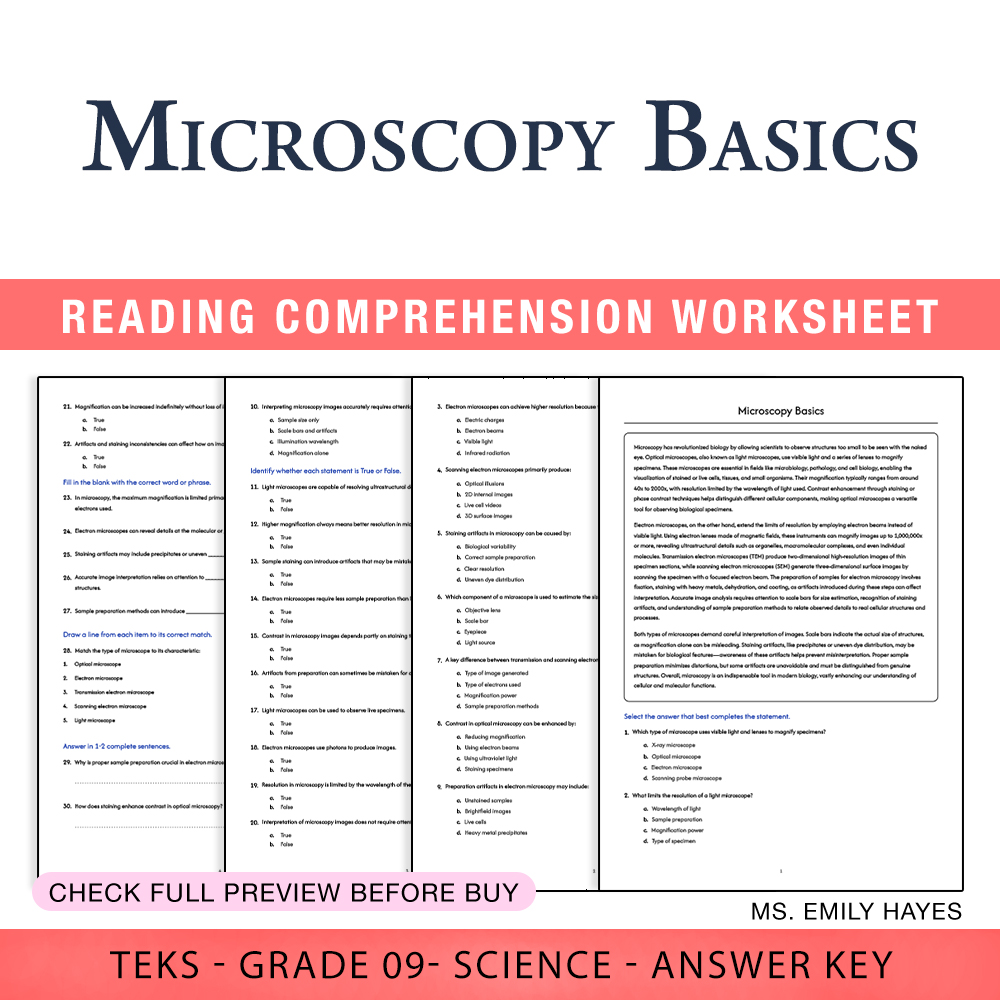
9th Grade Science | Microscopy Basics Worksheet (PDF+ Answer Key)
Created byCopper Leaf ClassroomLearning Objectives
- Understand how optical and electron microscopes produce magnified images.
- Identify the key differences between light and electron microscopy.
- Explain concepts of magnification, resolution, and contrast in microscopy.
Instant download
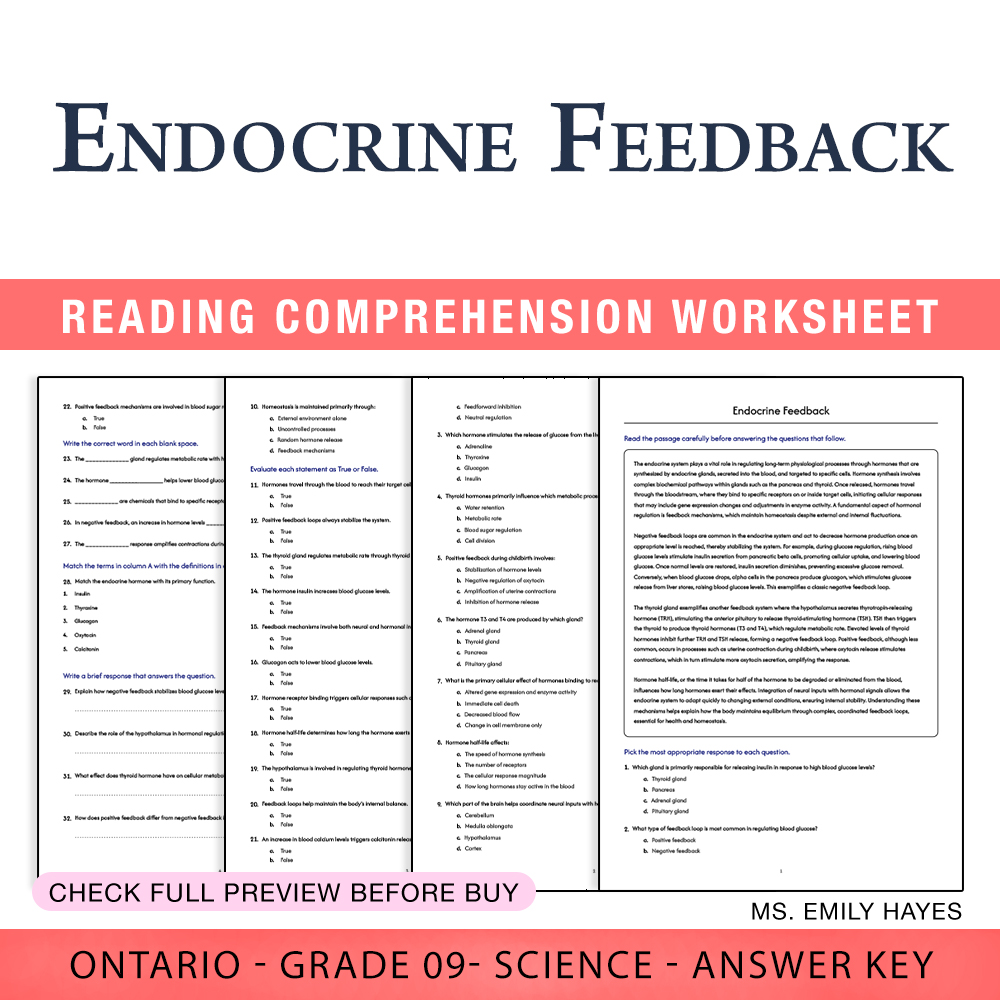
9th Grade Science | Endocrine Feedback Worksheet (PDF + Answer Key)
Created byCopper Leaf ClassroomLearning Objectives
- Explain the principles of hormonal regulation and feedback mechanisms in the endocrine system.
- Describe how hormones are synthesized, transported, and act on target cells.
- Analyze examples of negative and positive feedback in glucose regulation and thyroid function.
Instant download

Grade 9 Science | Transport Mechanisms Worksheet (PDF) Aligned to TEKS
 Created byEvergreen Desk Education
Learning Objectives
- Explain how diffusion, facilitated diffusion, and osmosis move substances across cell membranes using concentration and water potential gradients
- Describe how active transport uses membrane proteins and ATP to move substances against gradients
- Compare vesicular transport (endocytosis and exocytosis) with transport through membrane proteins
Instant download
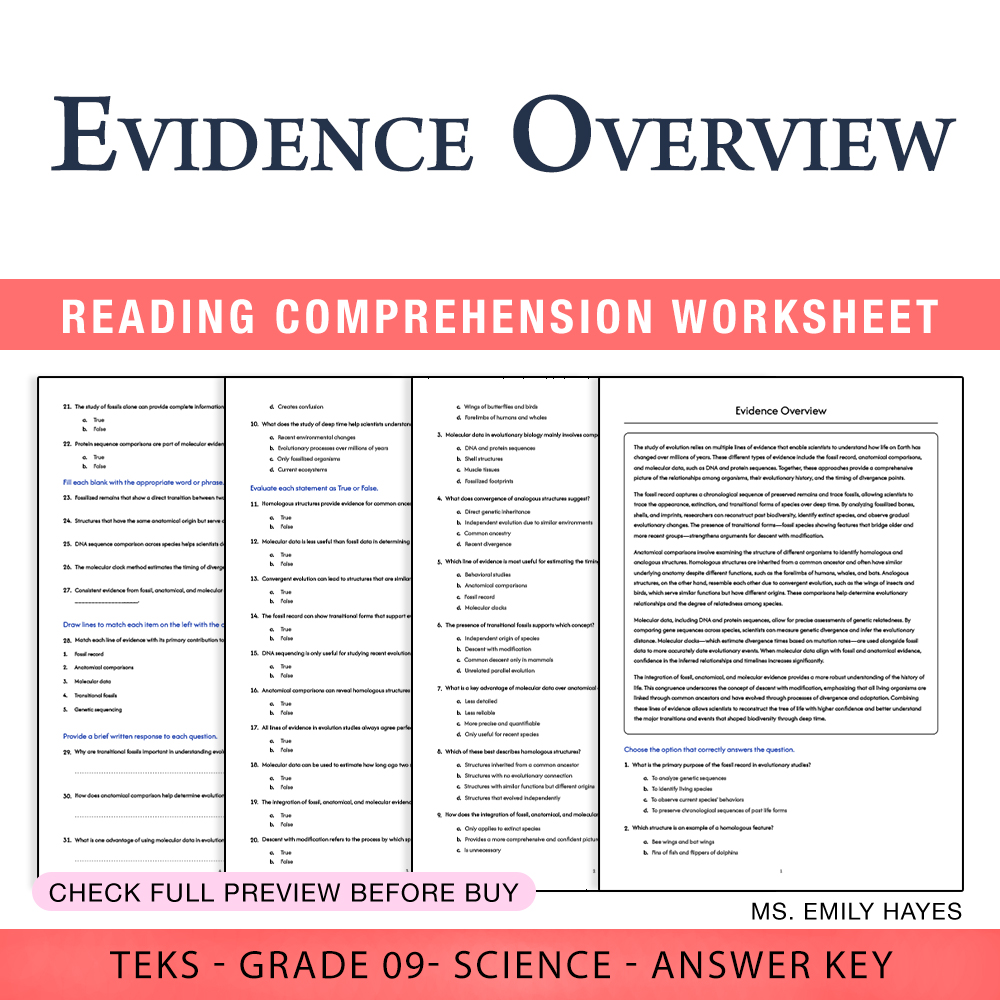
9th Grade Science | Evidence of Evolution Worksheet (PDF+ Answer Key)
Created byCopper Leaf ClassroomLearning Objectives
- Understand the different lines of evidence used to support evolutionary relationships among organisms.
- Identify how fossil records, anatomical comparisons, and molecular data contribute to understanding biodiversity through time.
- Evaluate the strength of evidence derived from different sources and their integration in evolutionary studies.
Instant download

Grade 9 Science – Friction & Drag | Daily Reading Worksheet
Created byBright Mind ResourcesLearning Objectives
- Understand the factors that influence friction and drag forces.
- Identify how surface texture, normal force, and speed affect friction.
- Recognize the impact of air density and shape on aerodynamic drag.
Also included in: Grade 9 Simple Machines Science Daily Reading Lesson Bundle | Alberta +1 more
Instant download
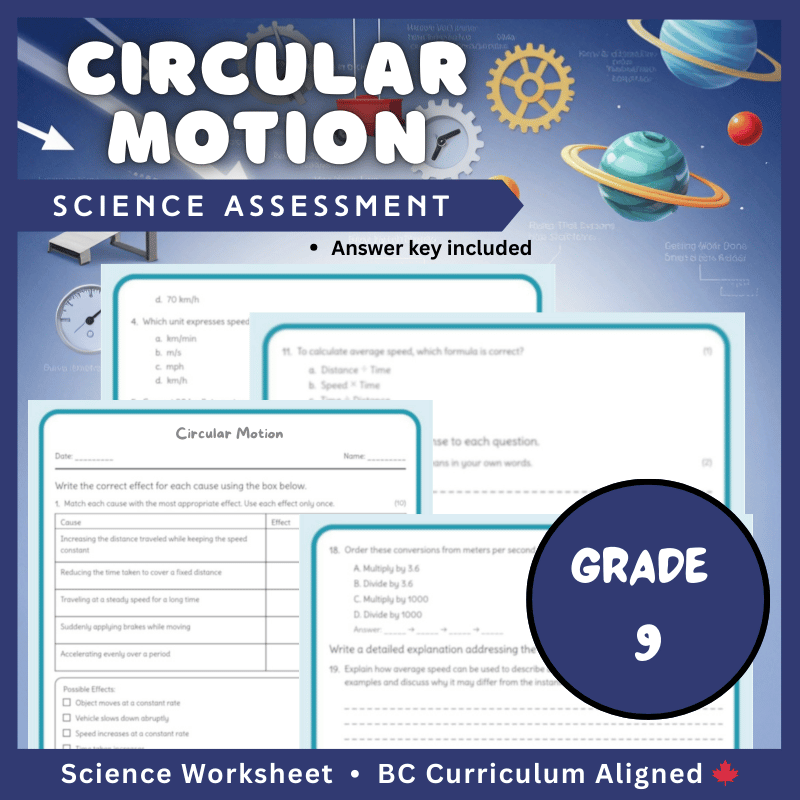
Grade 9 Science | Circular Motion Worksheet (PDF) – BC Standards
Created byBright Mind ResourcesLearning Objectives
- Understand the role of centripetal force in maintaining circular motion.
- Identify the factors influencing the acceleration and force in circular paths.
- Connect force components like tension, friction, and normal force to circular motion.
Instant download

Science Evidence for Claims Worksheet | Grade 9 Science - Standards-Aligned
JCreated byJ.S SheetsLearning Objectives
- Explain how scientific arguments connect evidence to reasoning when evaluating a claim.
- Identify patterns in data and interpret what they imply about a proposed explanation.
- Evaluate how uncertainty and potential bias affect confidence in a scientific claim.
Also included in: Grade 9 Claims & Uncertainty Science – lesson bundle: General framework +1 more
Instant download

Grade 9 Science Adaptation and Selection Worksheet – Alberta Standards (PDF)
 Created bySilver Birch Teaching
Learning Objectives
- Explain how natural selection works by linking heritable traits, selective pressure, and reproductive success
- Define fitness and describe how adaptive trade-offs affect survival and reproduction
- Compare natural selection with artificial selection and predict how traits can change over generations
Also included in: Grade 9 Genetics and Reproduction Science Lesson Bundle Worksheets – Alberta +1 more
Instant download
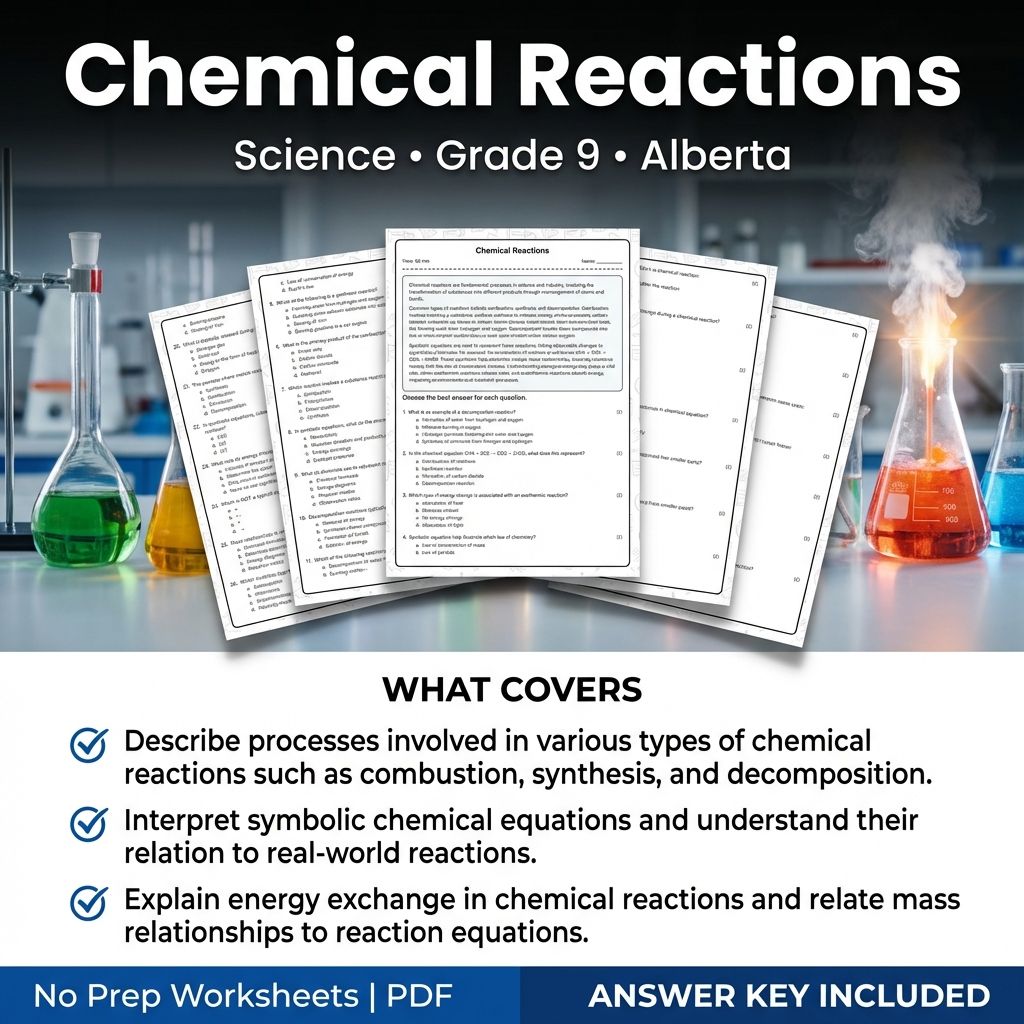
Chemical Reactions Worksheet for Grade 9 Science | Alberta Standards
Created byCoral Reef LearningLearning Objectives
- Describe processes involved in various types of chemical reactions such as combustion, synthesis, and decomposition.
- Interpret symbolic chemical equations and understand their relation to real-world reactions.
- Explain energy exchange in chemical reactions and relate mass relationships to reaction equations.
Instant download

Grade 9 Science Worksheet | Energy in Changes – Standard Practice (PDF)
Created byEvergreen Desk EducationLearning Objectives
- Compare physical and chemical changes in terms of energy transfer and system–surroundings interactions.
- Explain how endothermic and exothermic processes relate to temperature changes.
- Use particle-bond ideas to describe what changes during physical vs. chemical processes.
Also included in: Grade 9 Waves, Forces, and Energy Science Lesson Bundle | General +1 more
Instant download
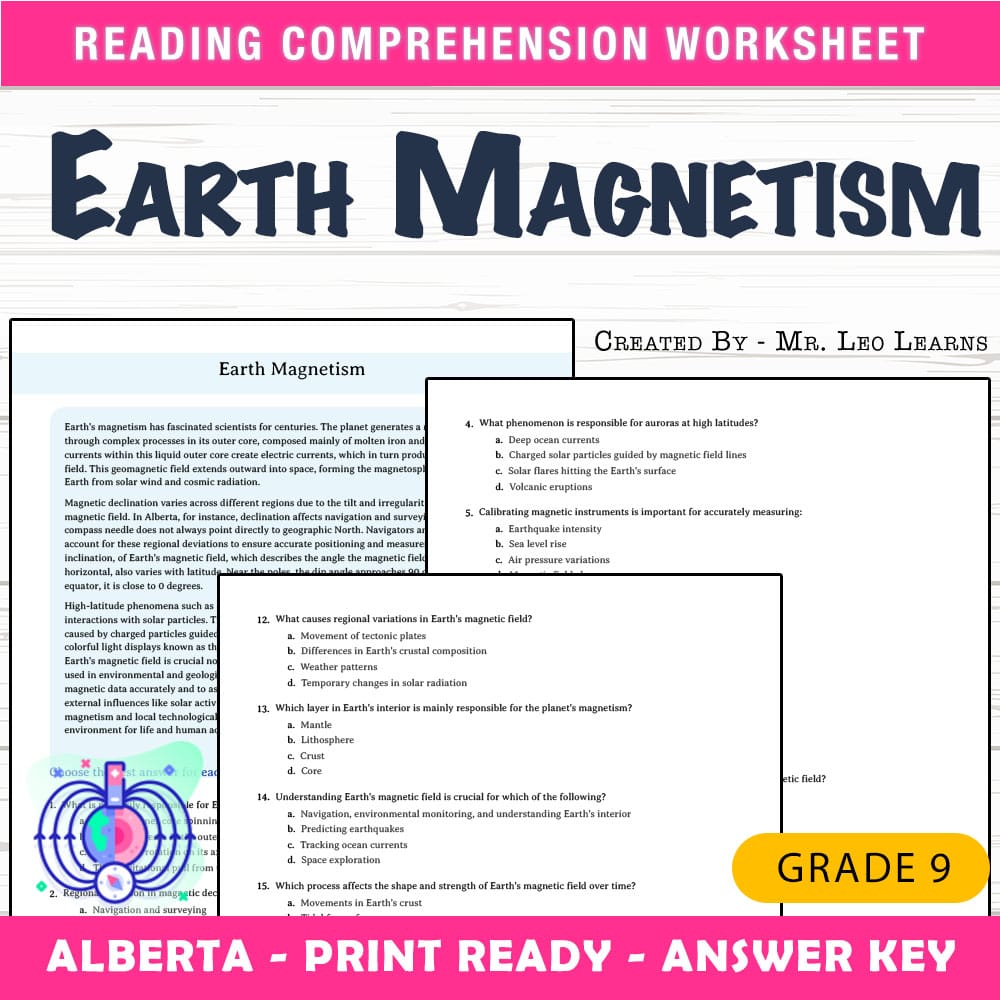
Grade 9 Science—Earth Magnetism Worksheet for Mastery
 Created byThe Resource Hub
Learning Objectives
- Understand the origin and nature of Earth's magnetic field.
- Identify the regional variation in magnetic declination and its effects.
- Explain how Earth's magnetic properties influence navigation and environmental monitoring.
Also included in: Grade 9 Science Electricity and Magnetism Worksheet Bundle | Alberta Curriculum +1 more
Instant download
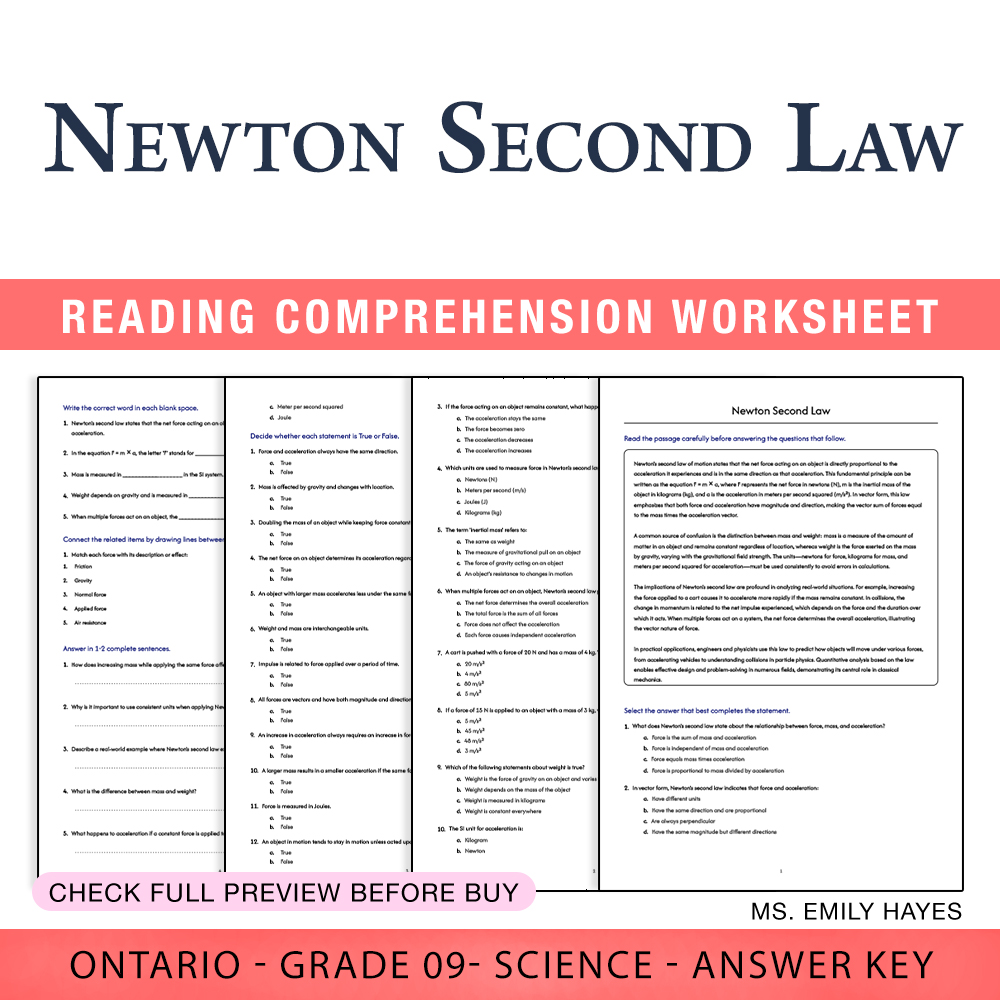
9th Grade Science | Newton Second Law Worksheet (PDF + Answer Key)
Created byCopper Leaf ClassroomLearning Objectives
- Explain the relationship between net force, mass, and acceleration as described by Newton's second law.
- Differentiate between mass and weight and understand their implications in force and acceleration.
- Apply the principles of Newton's second law to analyze various physical situations such as accelerating carts and collisions.
Instant download
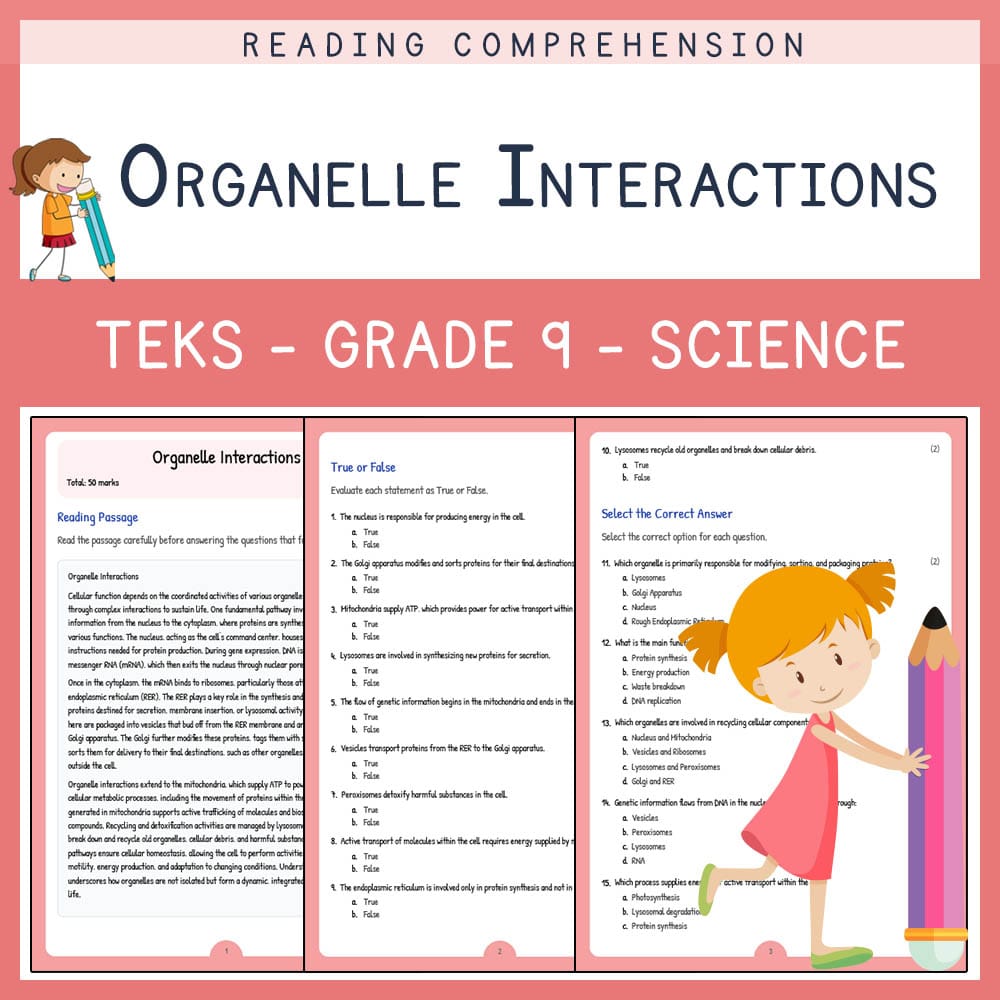
Grade 9 Science | Organelle Interactions Worksheet | TEKS Aligned
Created byLumora LearningLearning Objectives
- Explain how different organelles work together to maintain cellular functions.
- Describe the pathways of genetic information flow and protein trafficking within a cell.
- Identify the roles of mitochondria, lysosomes, and the Golgi apparatus in cellular processes.
Also included in: Grade 9 Science | Cell Structure & Function Lesson Bundle | TEKS Aligned
Instant download
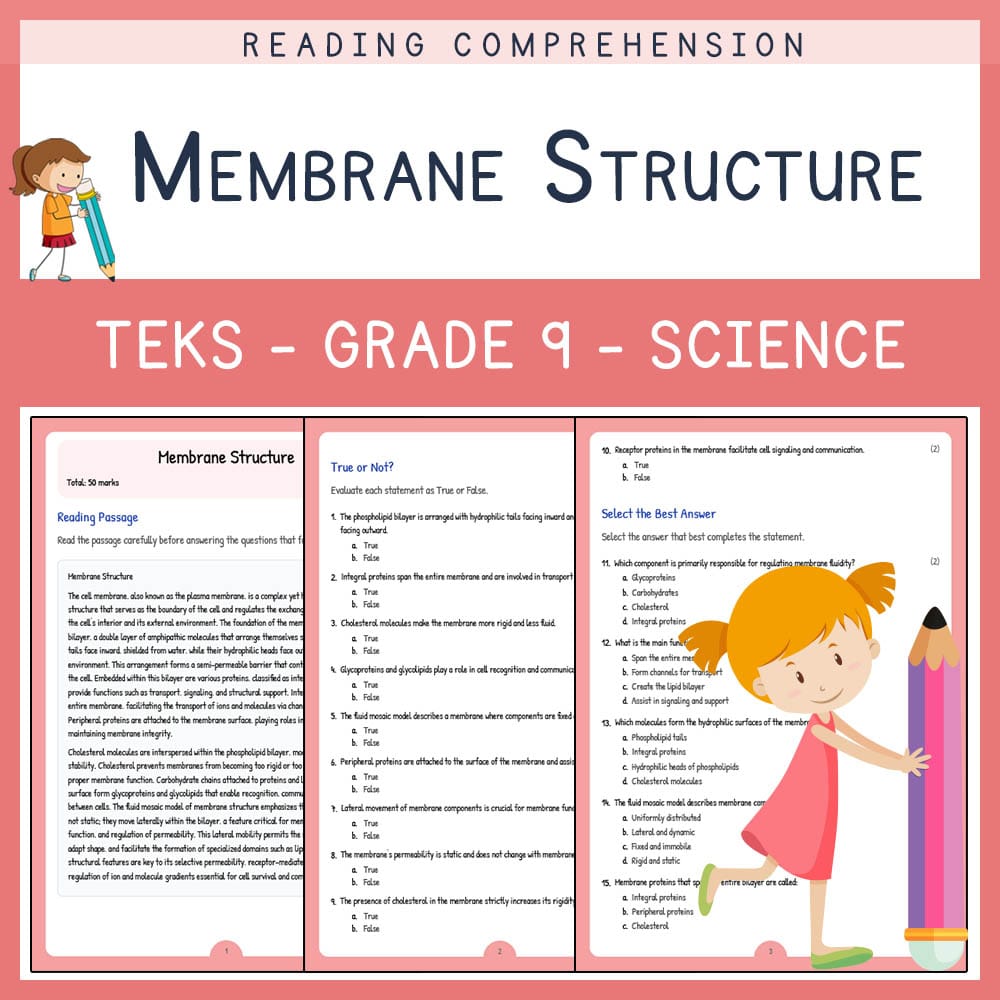
Grade 9 Science | Membrane Structure Worksheet | TEKS Aligned
Created byLumora LearningLearning Objectives
- Describe the basic components of the cell membrane and their roles.
- Explain the fluid mosaic model and its significance in membrane function.
- Identify how membrane components influence permeability, signaling, and ion regulation.
Also included in: Grade 9 Science | Cell Structure & Function Lesson Bundle | TEKS Aligned
Instant download
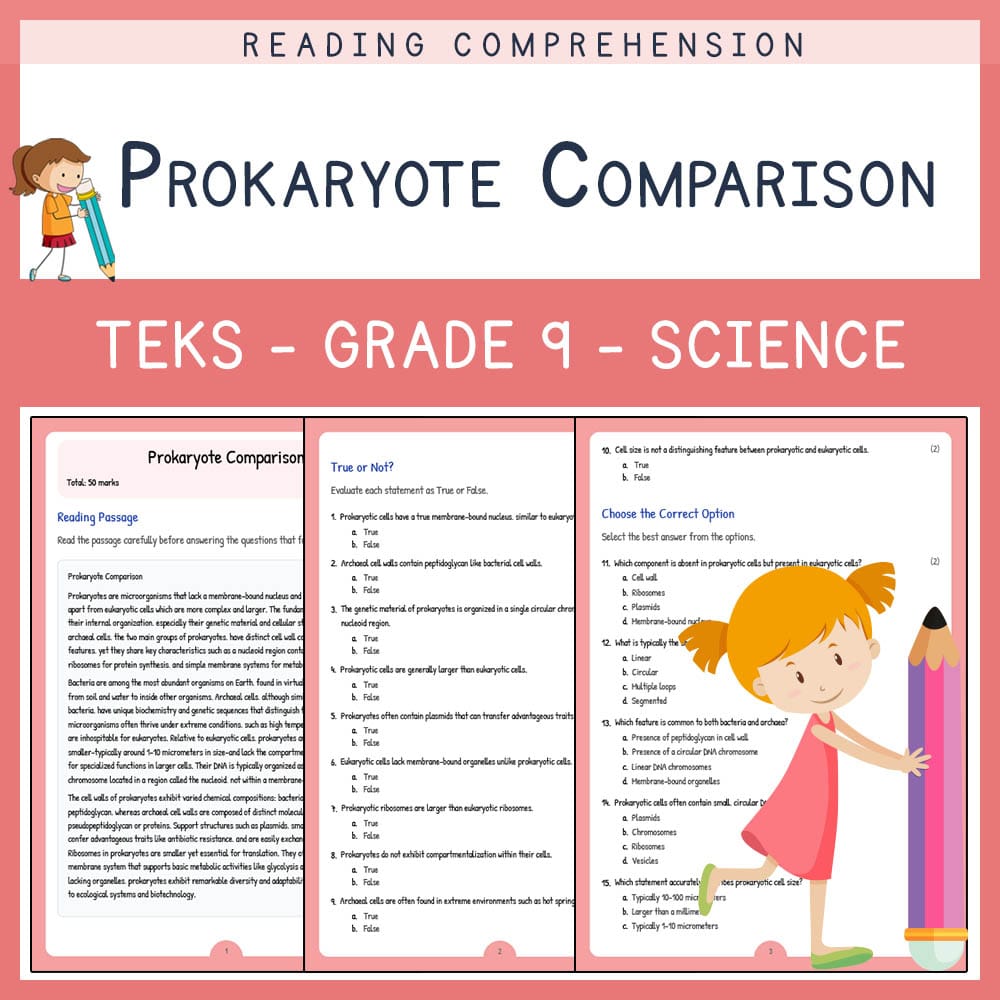
Grade 9 Science | Prokaryote Comparison Worksheet | TEKS Alignment
Created byLumora LearningLearning Objectives
- Understand the differences between prokaryotic and eukaryotic cells in terms of size, organization, and genetic structure.
- Identify features unique to bacterial and archaeal cells compared to eukaryotic cells.
- Explain the significance of cell compartmentalization and genetic arrangement in cellular functions.
Also included in: Grade 9 Science | Cell Structure & Function Lesson Bundle | TEKS Aligned
Instant download

Grade 9 Science – Climate Variability Reading Worksheet | Standard Practice
Created byBright Mind ResourcesLearning Objectives
- Understand how long-term temperature patterns relate to climate variability.
- Identify the significance of data such as temperature records, precipitation, and wind in climate studies.
- Analyze how phenomena like El Niño influence regional weather patterns over time.
Also included in: Earth & Space Systems Grade 9 Science Daily Reading Worksheets Bundle | General +1 more
Instant download

Grade 9 Science – Earth System Cycles & Daily Reading Worksheet | Daily Reading
Created byBright Mind ResourcesLearning Objectives
- Understand how water moves through Earth's systems
- Identify the processes involved in the water cycle
- Recognize the role of solar energy in driving Earth's processes
Also included in: Earth & Space Systems Grade 9 Science Daily Reading Worksheets Bundle | General +1 more
Instant download

Grade 9 Science worksheet – Membrane Structure TEKS (Worksheet + Answer Key)
Created byEvergreen Desk EducationLearning Objectives
- Explain how the phospholipid bilayer provides selective permeability through hydrophobic and hydrophilic regions.
- Describe the roles of integral and peripheral membrane proteins in transport, signaling, and structural support.
- Connect membrane components (cholesterol and carbohydrate chains) to changes in fluidity and cell recognition.
Instant download

Chemical Bonding Worksheet for Grade 9 Science | Assessment & Student Practice PDF
Learning Objectives
- Explain the different types of chemical bonds: ionic, covalent, and metallic.
- Describe how Lewis structures illustrate electron sharing and transfer.
- Relate atomic electron configurations to properties like melting point and conductivity.
Also included in: Grade 9 Science Lesson Bundle on Matter and Its Interactions +1 more
Instant download
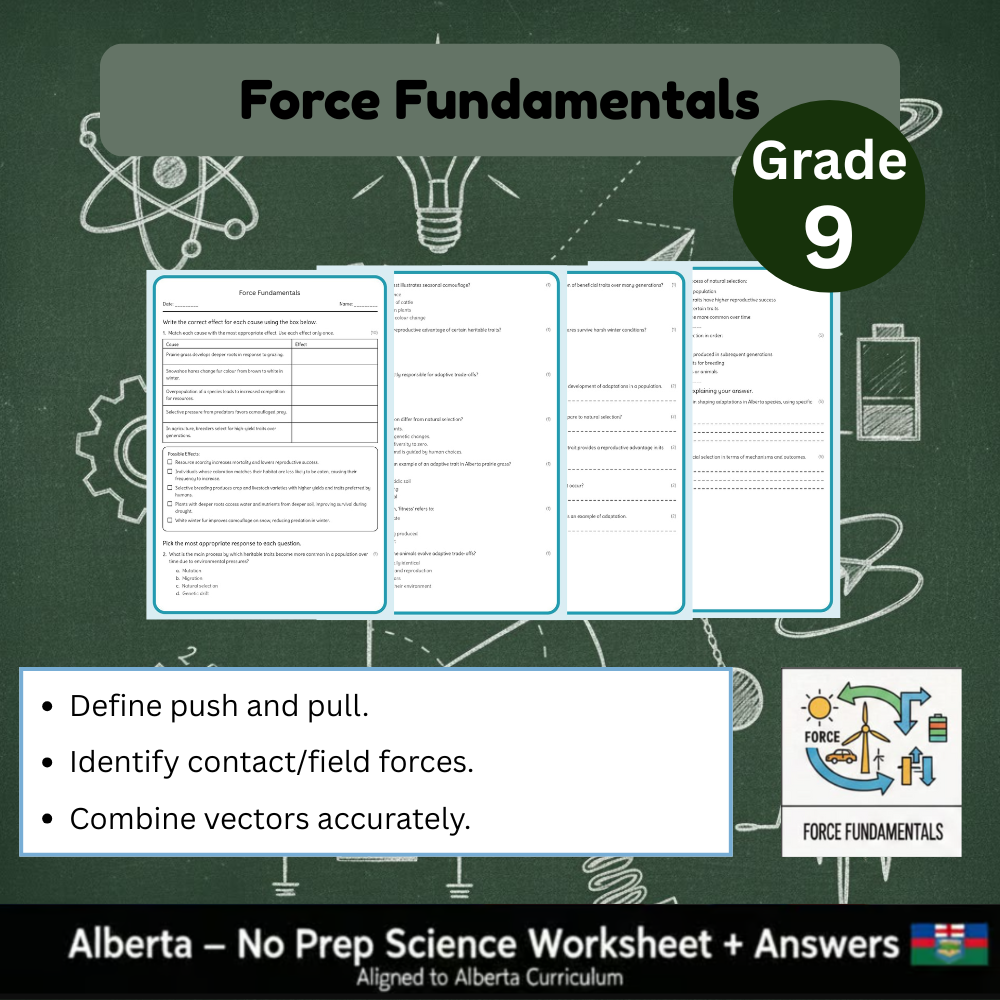
Grade 9 Science | Force Fundamentals Worksheet (PDF) – Alberta Standards
Created byBright Mind ResourcesLearning Objectives
- Understand the basic interactions involved in forces such as push and pull
- Identify contact and non-contact forces in real-world Alberta settings
- Explain how magnitude and direction of forces combine vectorially
Instant download
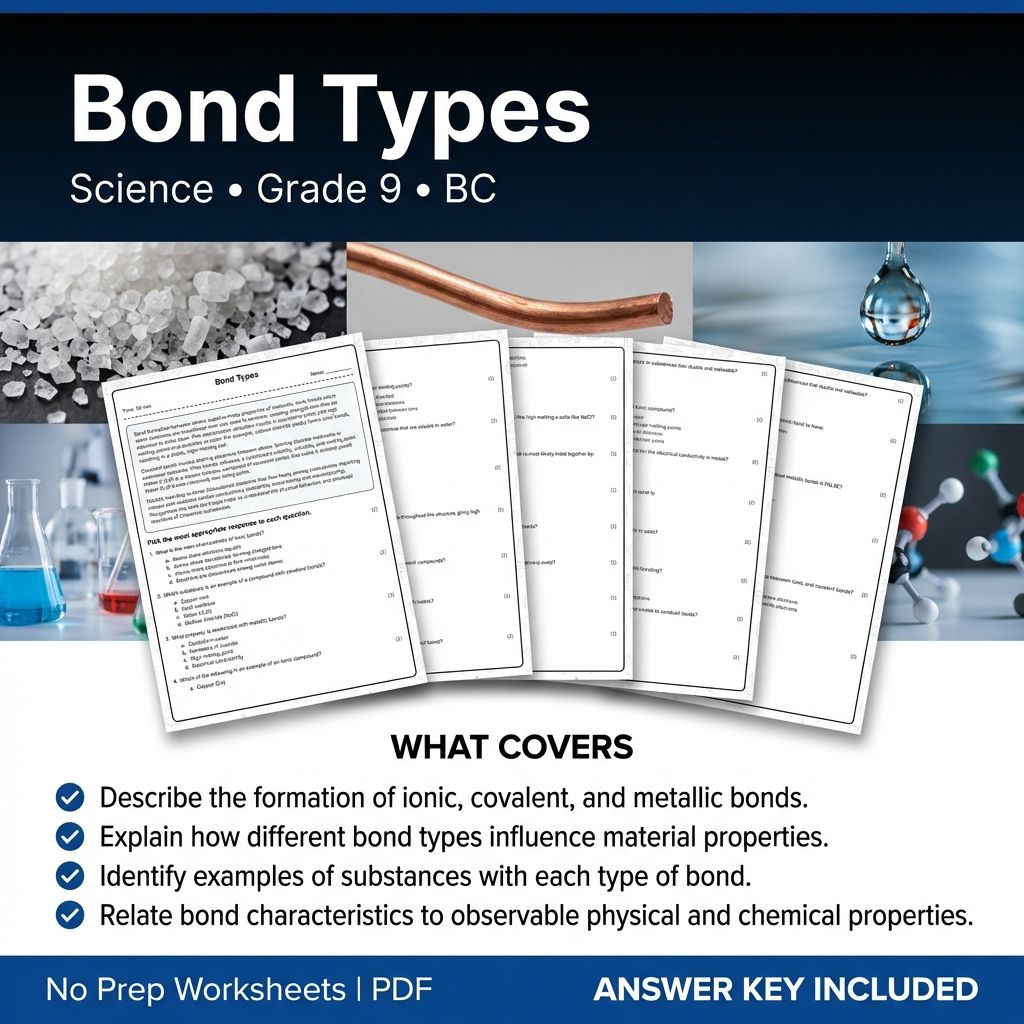
9th Grade Science | Bond Types Worksheet & Answer Key for Classroom Practice
Created byCoral Reef LearningLearning Objectives
- Describe the formation of ionic, covalent, and metallic bonds.
- Explain how different bond types influence material properties.
- Identify examples of substances with each type of bond.
Instant download
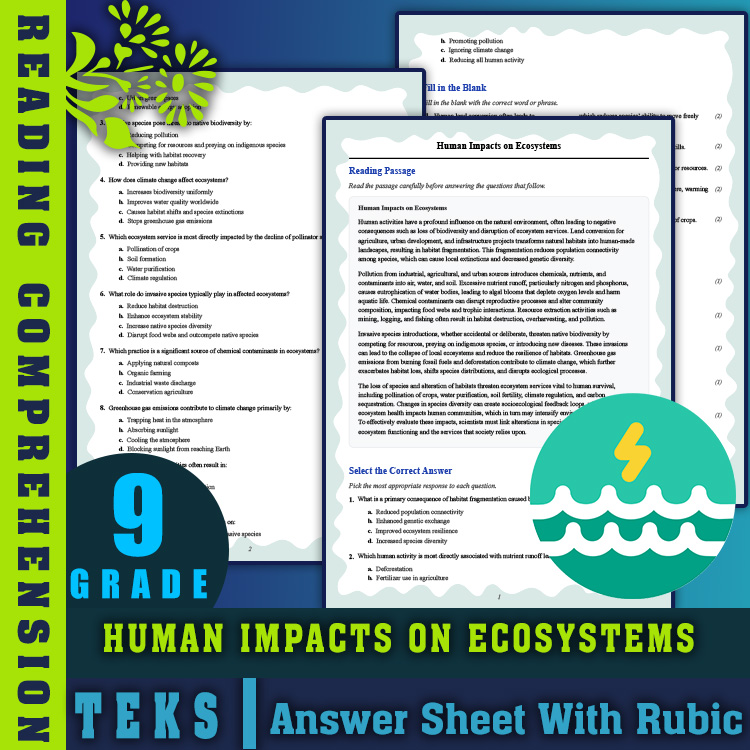
9th Grade Science | Human Impacts on Ecosystems Reading (PDF + Answer Key)
JCreated byJ.S SheetsLearning Objectives
- Understand how human activities affect biodiversity and ecosystem services.
- Identify specific human actions that lead to habitat alteration and resource depletion.
- Analyze the ecological consequences of human impacts on ecosystems.
Instant download
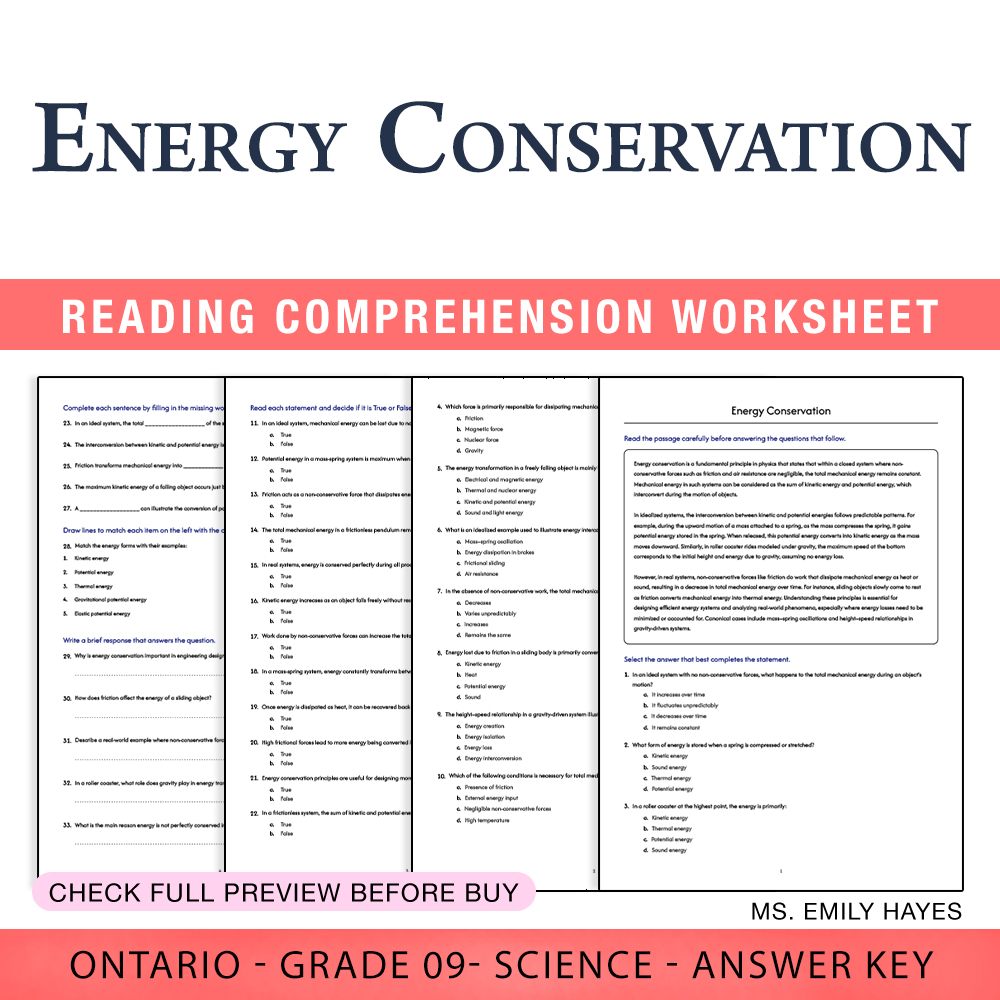
Grade 9 Science | Energy Conservation Worksheet (PDF + Answer Key)
Created byCopper Leaf ClassroomLearning Objectives
- Describe the principle of conservation of mechanical energy in systems where non-conservative forces are negligible.
- Explain the interconversion between kinetic and potential energies in various physical scenarios.
- Identify conditions under which total mechanical energy remains constant.
Instant download
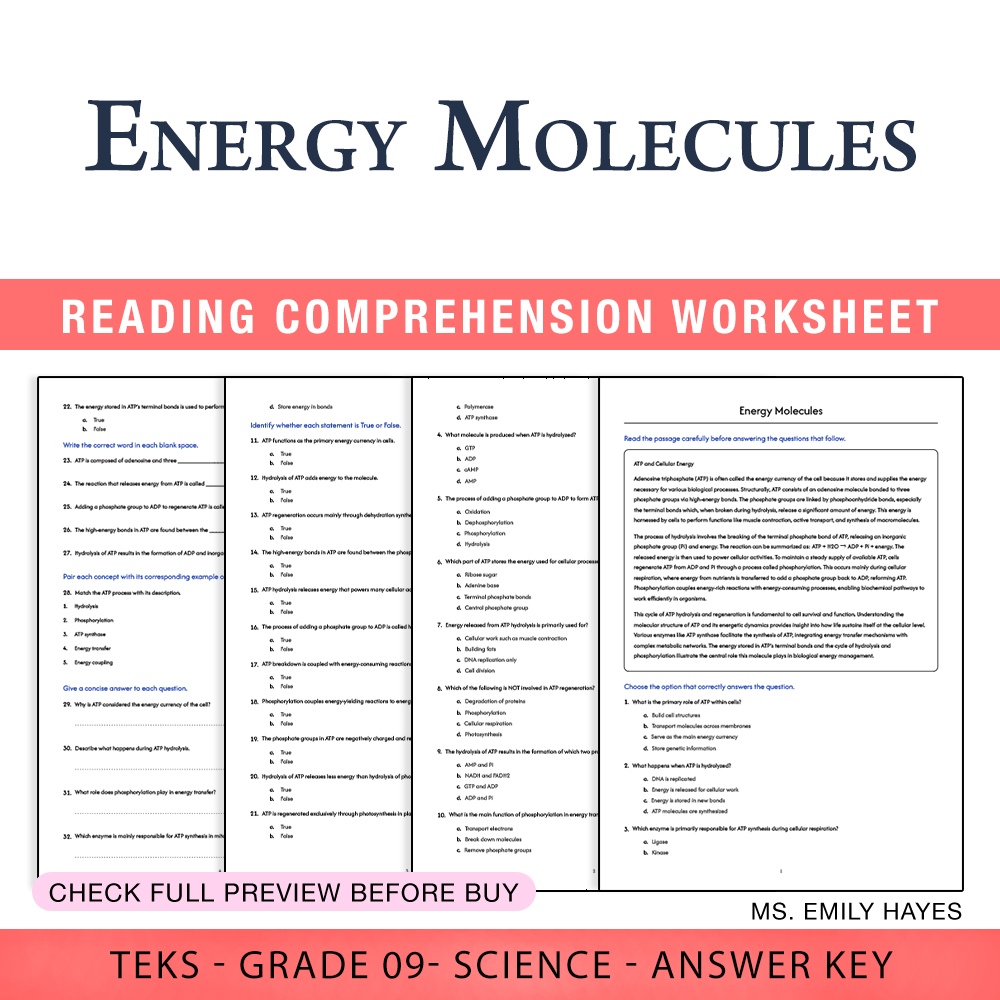
9th Grade Science | Energy Molecules Worksheet (PDF+ Answer Key)
Created byCopper Leaf ClassroomLearning Objectives
- Describe the structure of ATP and its role as the primary energy currency within cells.
- Explain how hydrolysis of ATP releases energy for cellular processes.
- Understand the process of ATP regeneration through phosphorylation.
Instant download
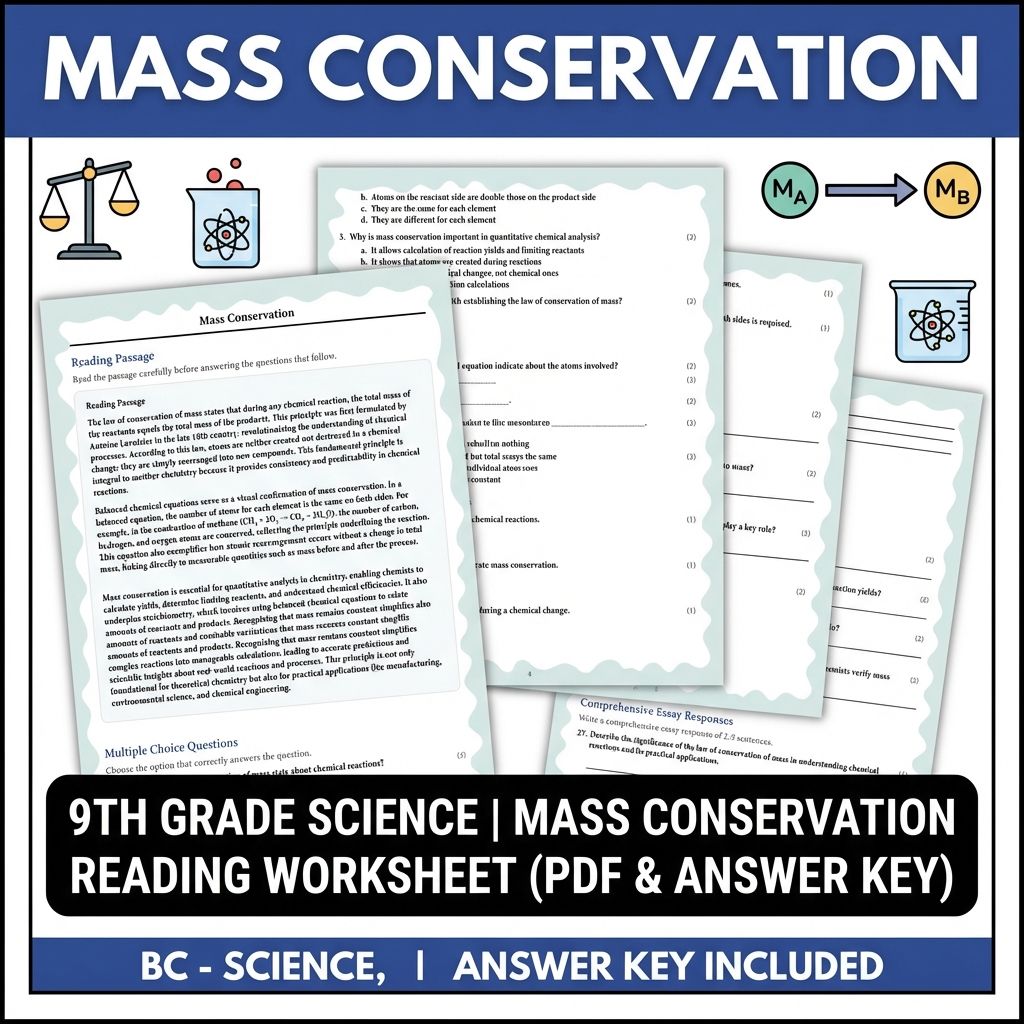
9th Grade Science | Mass Conservation Reading Worksheet (PDF & Answer Key)
JCreated byJ.S SheetsLearning Objectives
- Understand the law of conservation of mass during chemical changes.
- Identify how balanced chemical equations reflect mass conservation.
- Explain the significance of mass conservation in stoichiometry and reactions.
Instant download
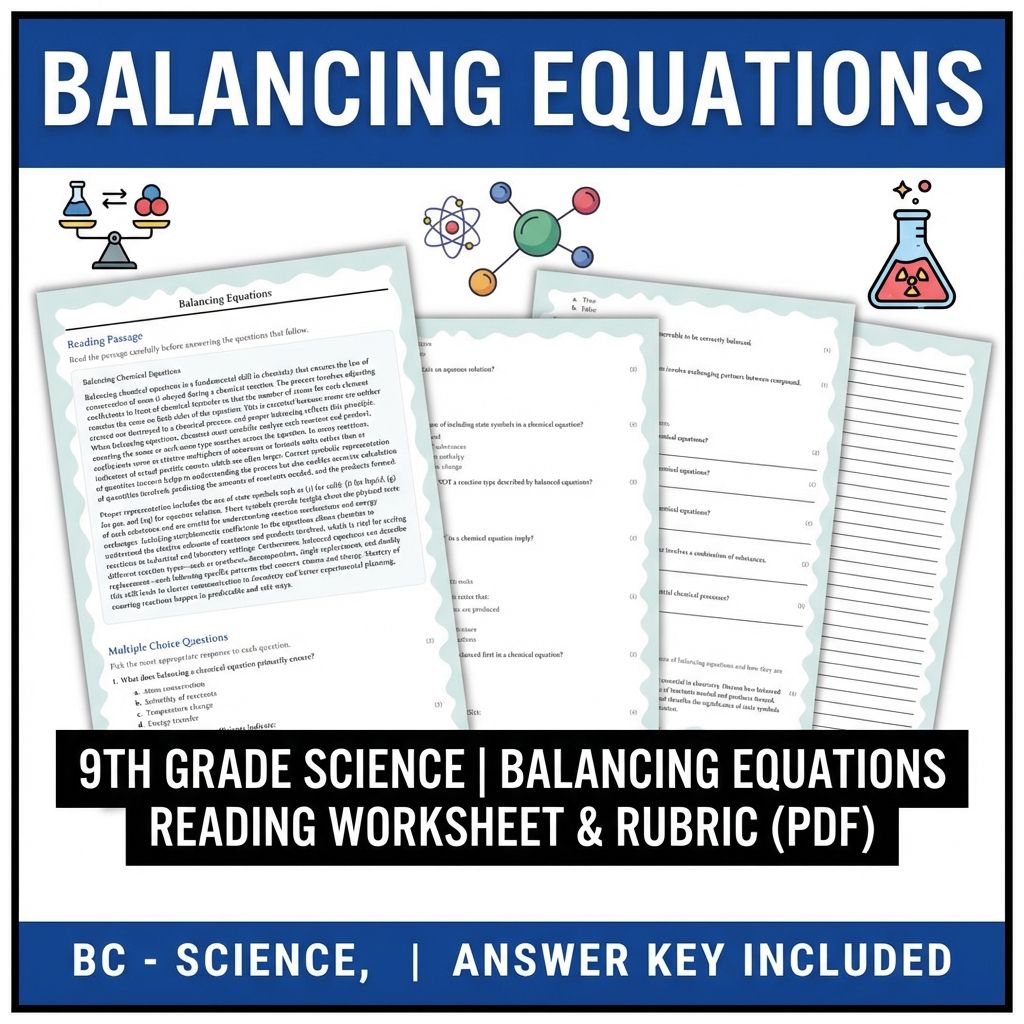
9th Grade Science | Balancing Equations Reading Worksheet & Rubric (PDF)
JCreated byJ.S SheetsLearning Objectives
- Understand the importance of balancing chemical equations to reflect atomic conservation.
- Identify coefficients and symbols that accurately represent reactions.
- Learn how to interpret balanced symbolic equations for predicting reaction outcomes.
Instant download
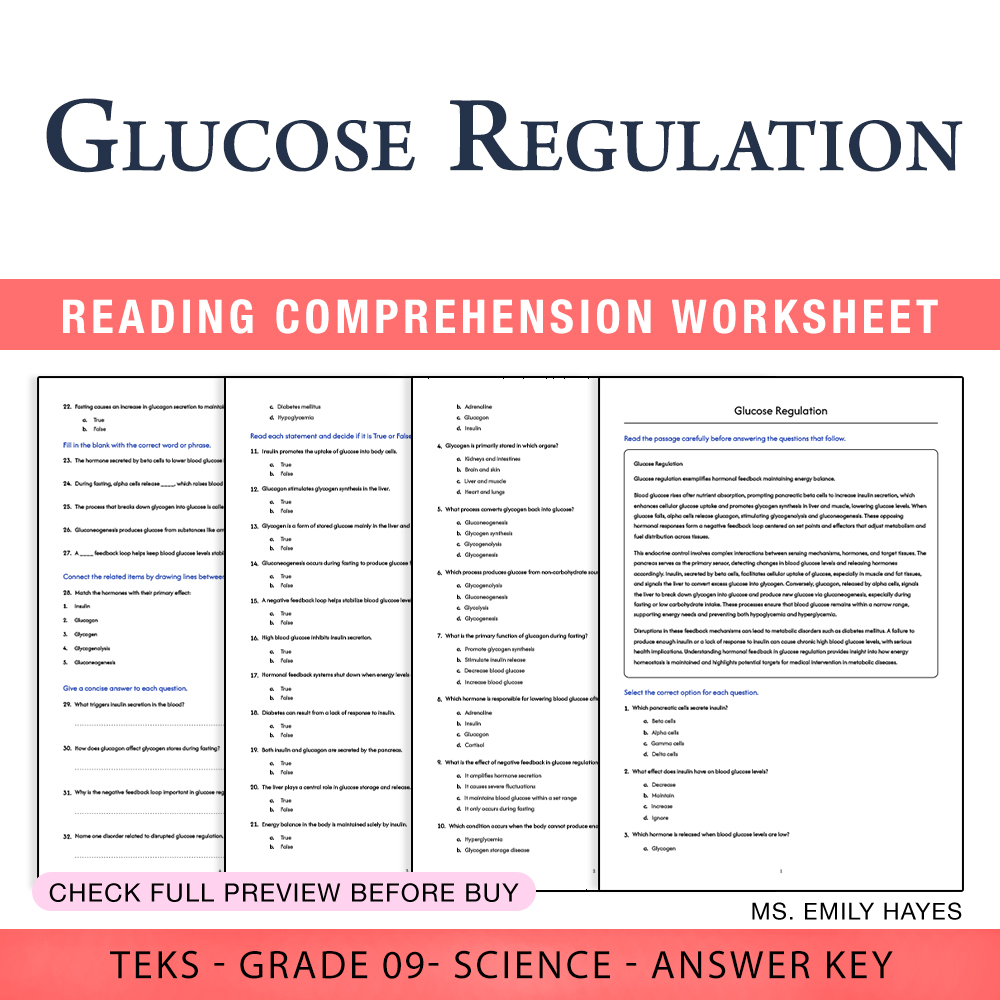
9th Grade Science | Glucose Regulation Worksheet (PDF+ Answer Key)
Created byCopper Leaf ClassroomLearning Objectives
- Understand the hormonal feedback mechanisms involved in glucose regulation.
- Identify the roles of insulin and glucagon in maintaining blood glucose levels.
- Describe the processes of glycogen synthesis, glycogenolysis, and gluconeogenesis.
Instant download
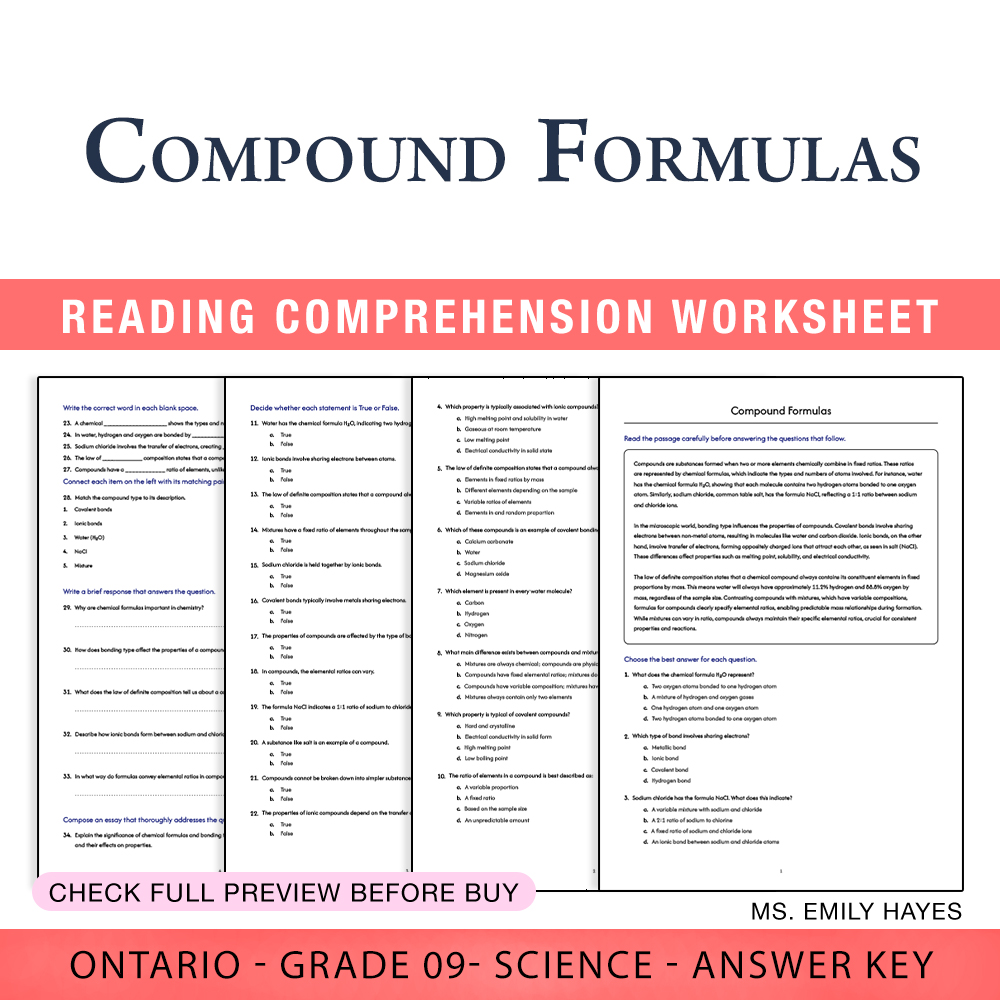
9th Grade Science | Compound Formulas Worksheet (PDF + Answer Key)
Created byCopper Leaf ClassroomLearning Objectives
- Understand what compounds are and how they are composed of fixed ratios of elements.
- Learn to interpret and write chemical formulas for common compounds.
- Distinguish between covalent and ionic bonds and their effects on properties.
Instant download
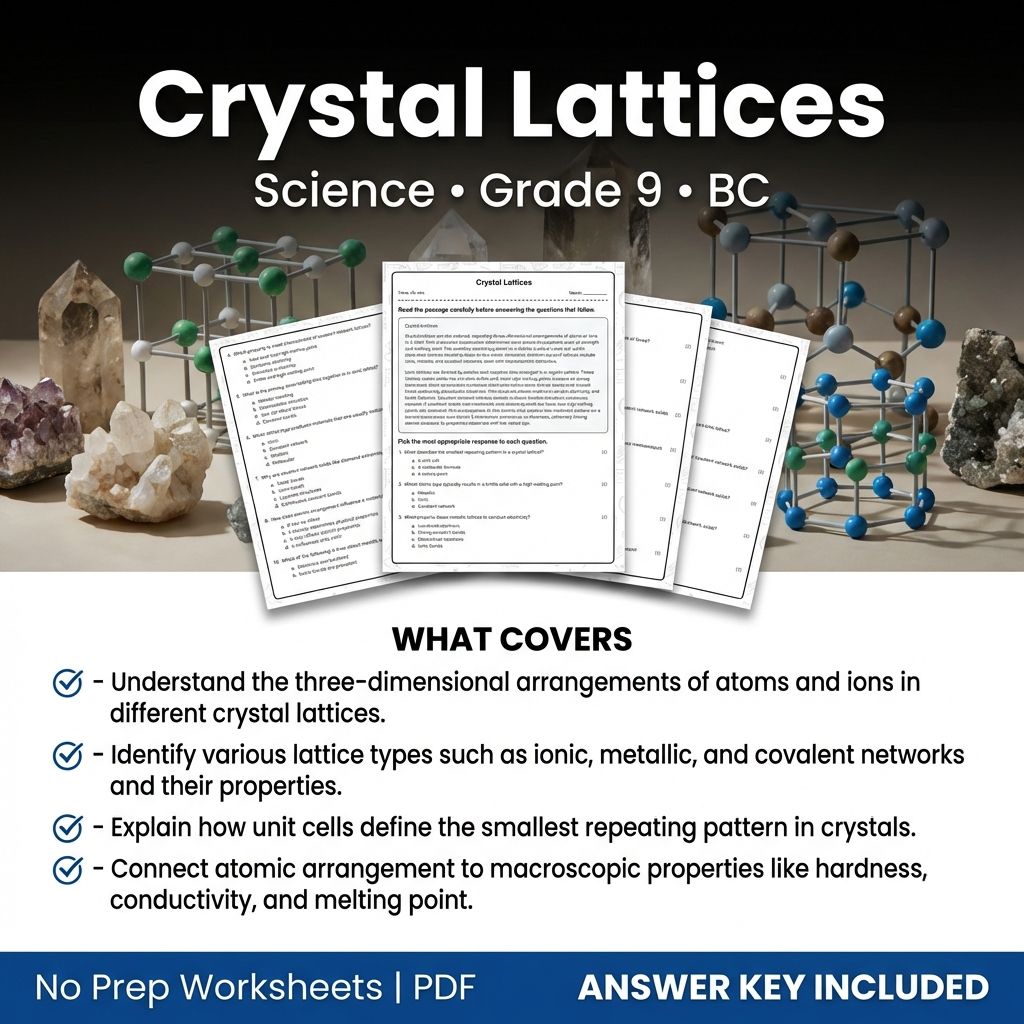
9th Grade Science | Crystal Lattices Worksheet & Answer Key (Printable PDF)
Created byCoral Reef LearningLearning Objectives
- Understand the three-dimensional arrangements of atoms and ions in different crystal lattices.
- Identify various lattice types such as ionic, metallic, and covalent networks and their properties.
- Explain how unit cells define the smallest repeating pattern in crystals.
Instant download
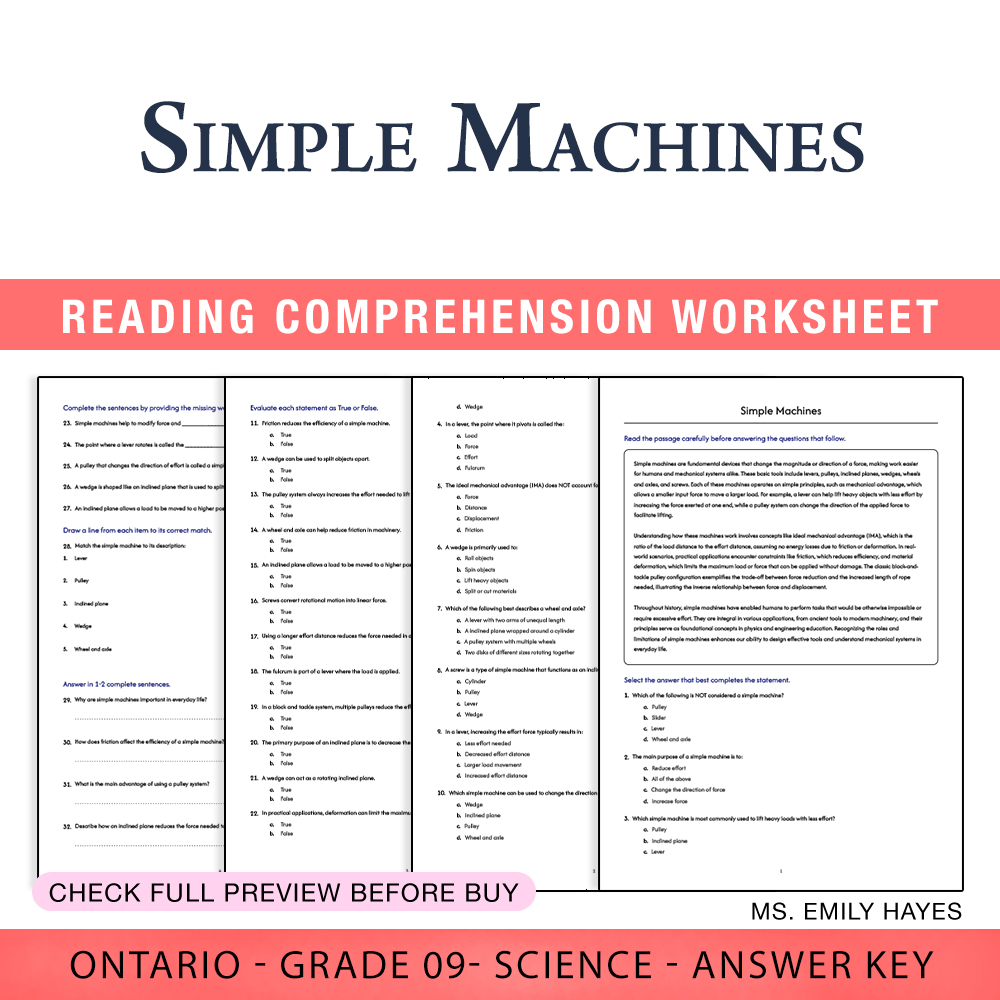
9th Grade Science | Simple Machines Worksheet (PDF + Answer Key)
Created byCopper Leaf ClassroomLearning Objectives
- Understand the basic types of simple machines and their functions.
- Explain how simple machines modify force and displacement to achieve mechanical advantage.
- Identify different classes of levers, pulley systems, inclined planes, wedges, wheels and axles, and screws.
Instant download
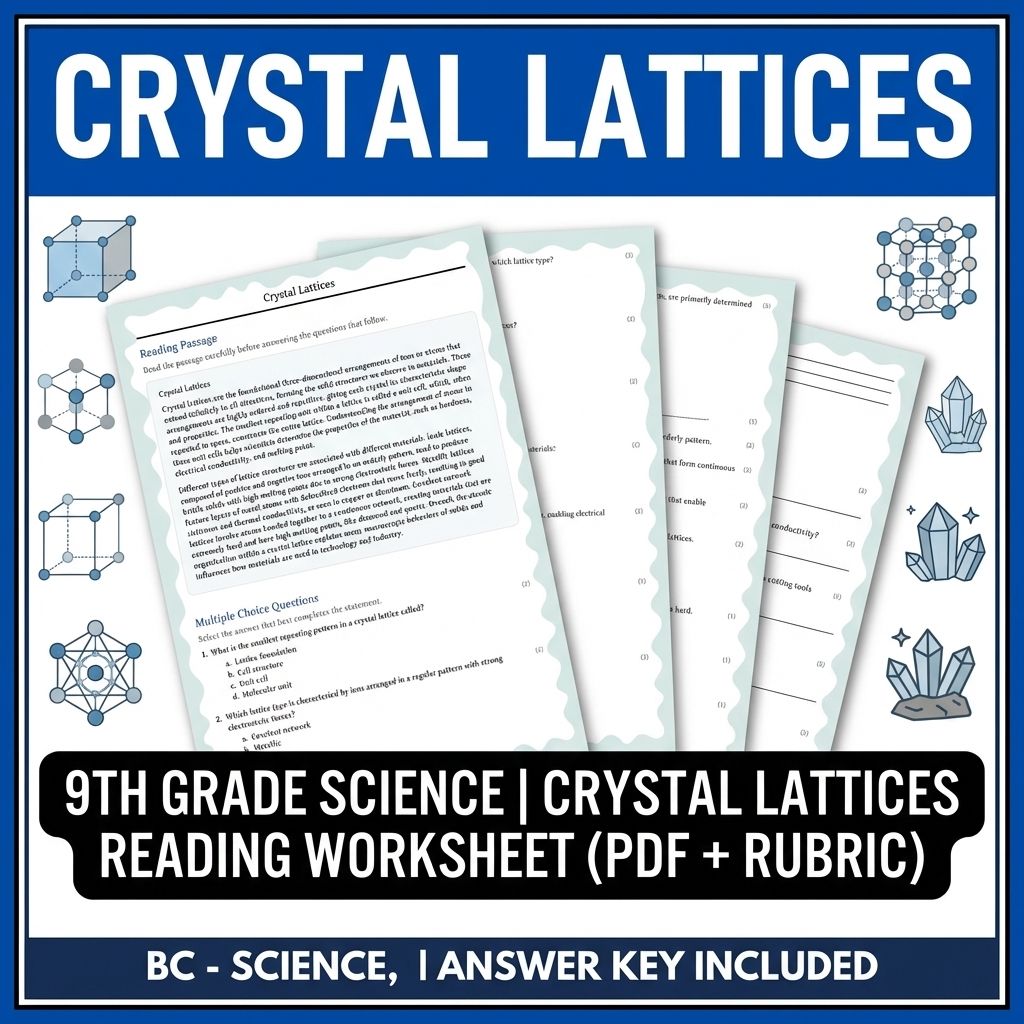
9th Grade Science | Crystal Lattices Reading Worksheet (PDF + Rubric)
JCreated byJ.S SheetsLearning Objectives
- Describe the structure and arrangement of atoms or ions in different crystal lattices.
- Explain how unit cells define the smallest repeating pattern in solids.
- Identify lattice types such as ionic, metallic, and covalent networks and their properties.
Instant download
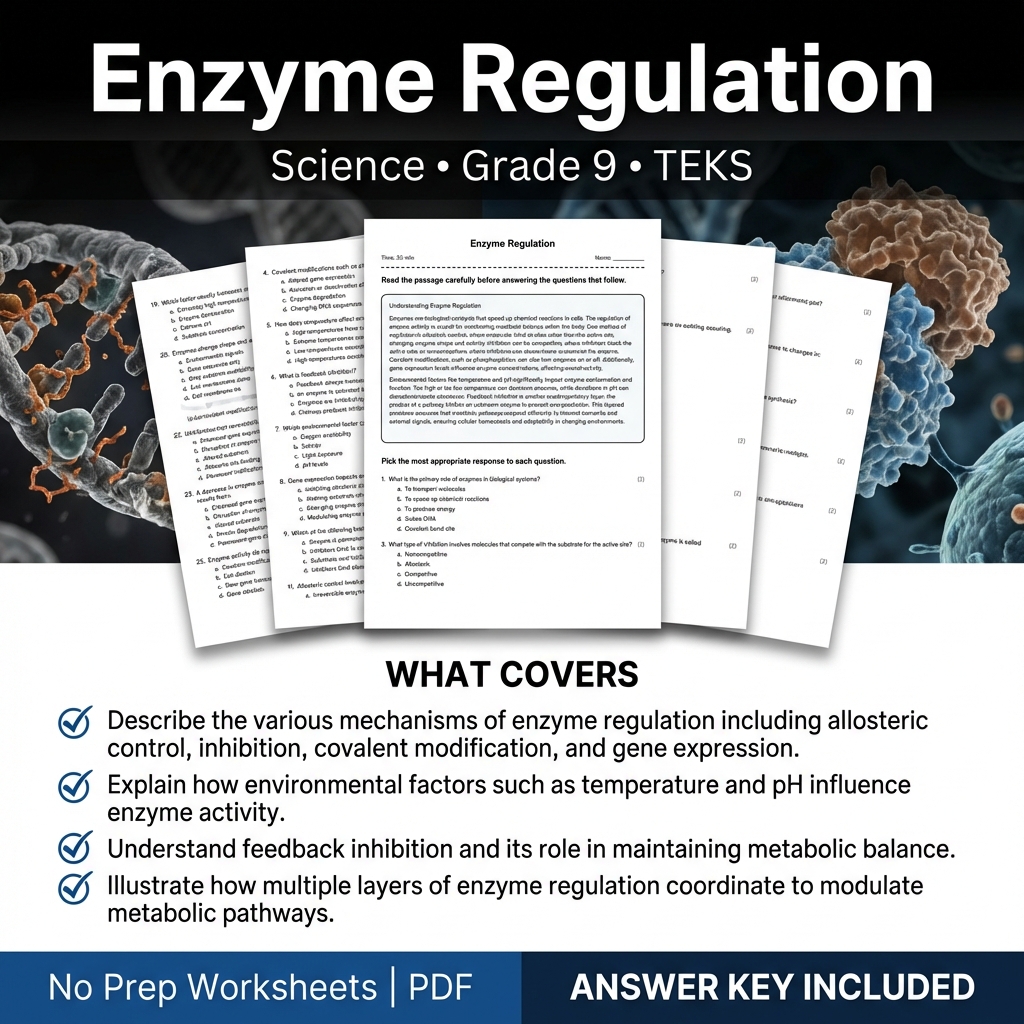
Grade 9 Science Worksheet on Enzyme Regulation | TEKS Aligned Practice
Created byCoral Reef LearningLearning Objectives
- Describe the various mechanisms of enzyme regulation including allosteric control, inhibition, covalent modification, and gene expression.
- Explain how environmental factors such as temperature and pH influence enzyme activity.
- Understand feedback inhibition and its role in maintaining metabolic balance.
Instant download
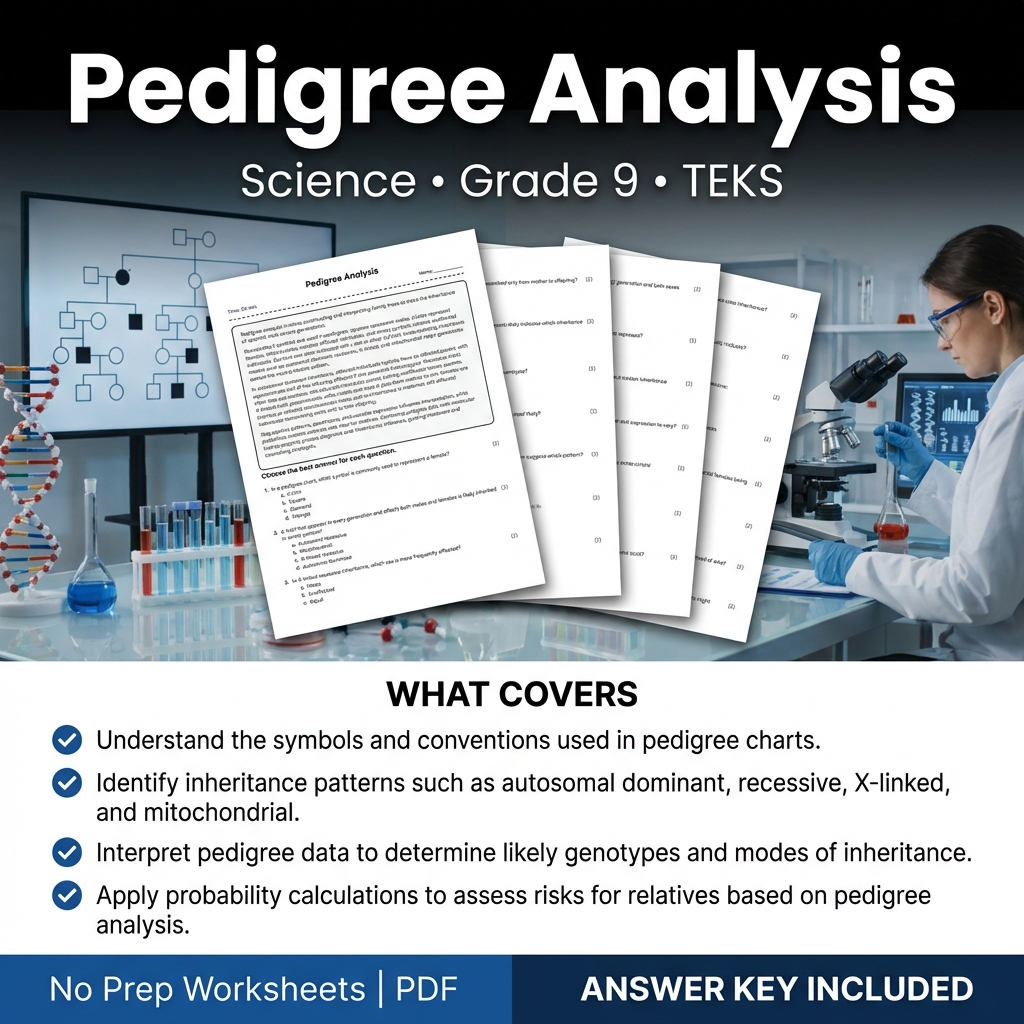
Grade 9 Science Pedigree Analysis Worksheet with Answer Key PDF
Created byCoral Reef LearningLearning Objectives
- Understand the symbols and conventions used in pedigree charts.
- Identify inheritance patterns such as autosomal dominant, recessive, X-linked, and mitochondrial.
- Interpret pedigree data to determine likely genotypes and modes of inheritance.
Instant download
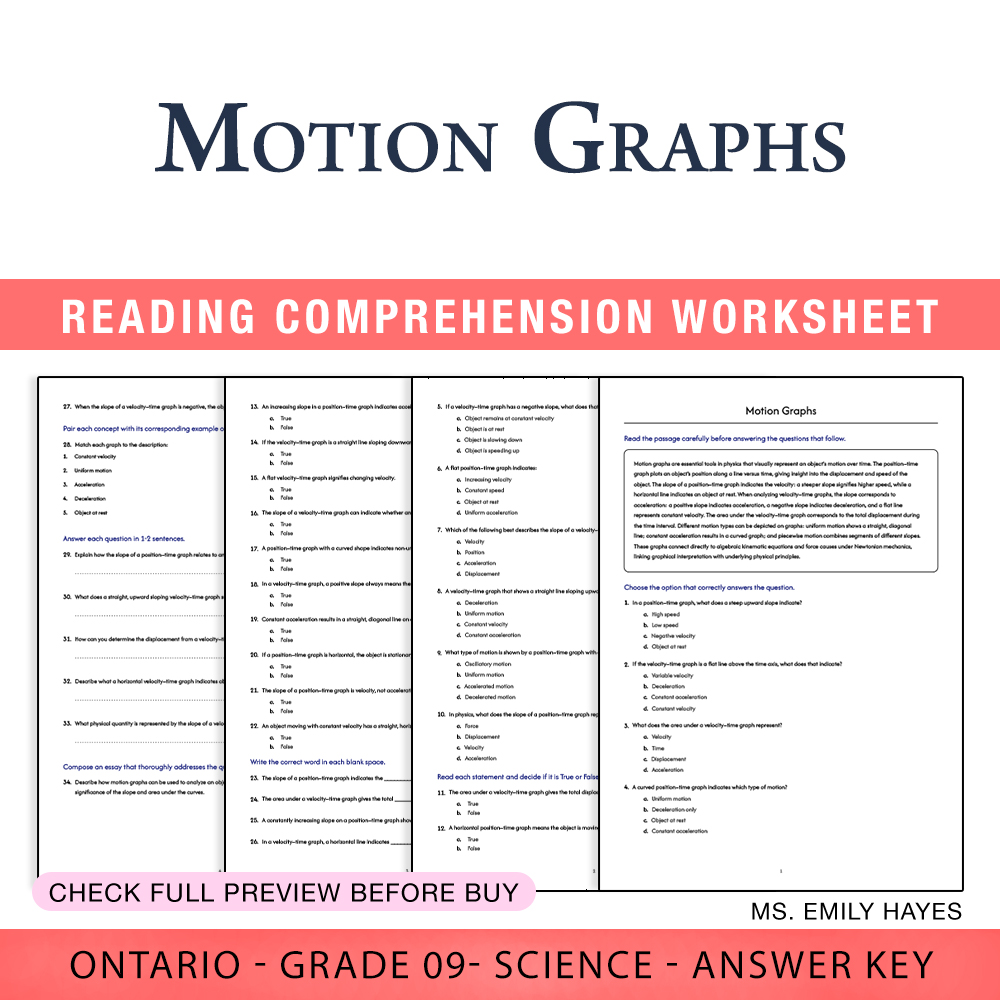
9th Grade Science | Motion Graphs Worksheet (PDF + Answer Key)
Created byCopper Leaf ClassroomLearning Objectives
- Interpret position–time graphs to determine an object's motion and understand what the slope indicates about velocity.
- Explain how the slope of a velocity–time graph relates to acceleration.
- Calculate displacement from the area under a velocity–time graph.
Instant download
About Grade 9 Science Worksheets
Find Science worksheets built for Grade 9. All 6,986 cover core skills, practice, and review, each an instant PDF download.
Every worksheet on MyTeachingSheets is created by independent teacher-authors and reviewed before publication. All resources download as printable PDFs for classroom, homework, or at-home practice, and many include answer keys. Preview any worksheet free before buying.