
Science Worksheets
44,342 subject resources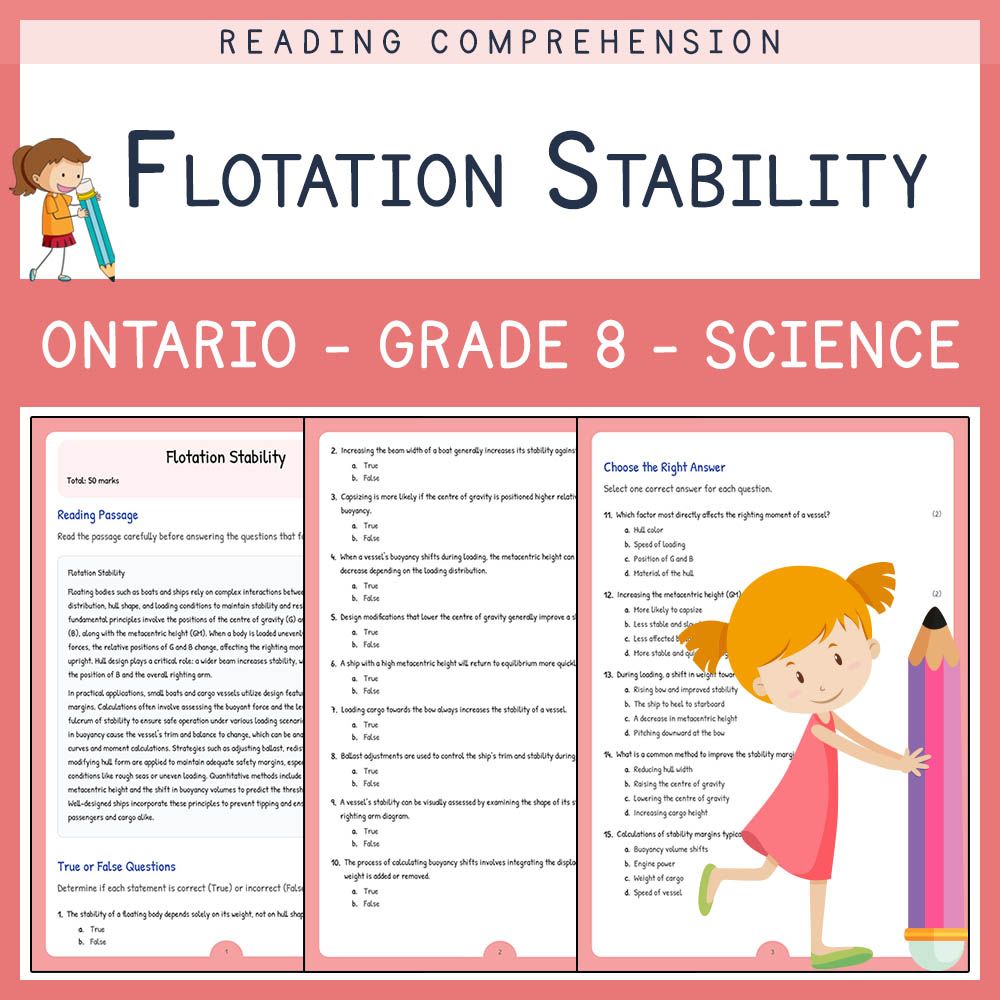
Grade 8 Science Assessment | Flotation Stability Worksheet | Ontario
 Created byLumora Learning
Learning Objectives
- Explain how the relative positions of the centre of gravity and centre of buoyancy affect a floating body's stability.
- Identify factors such as weight distribution, hull shape, and loading that influence upright equilibrium and capsize risk.
- Describe how design choices in small boats and cargo ships alter righting moments and stability margins through quantitative examples.
Also included in: Grade 8 Science | Fluids Lesson Bundle | Ontario Framework
Instant download
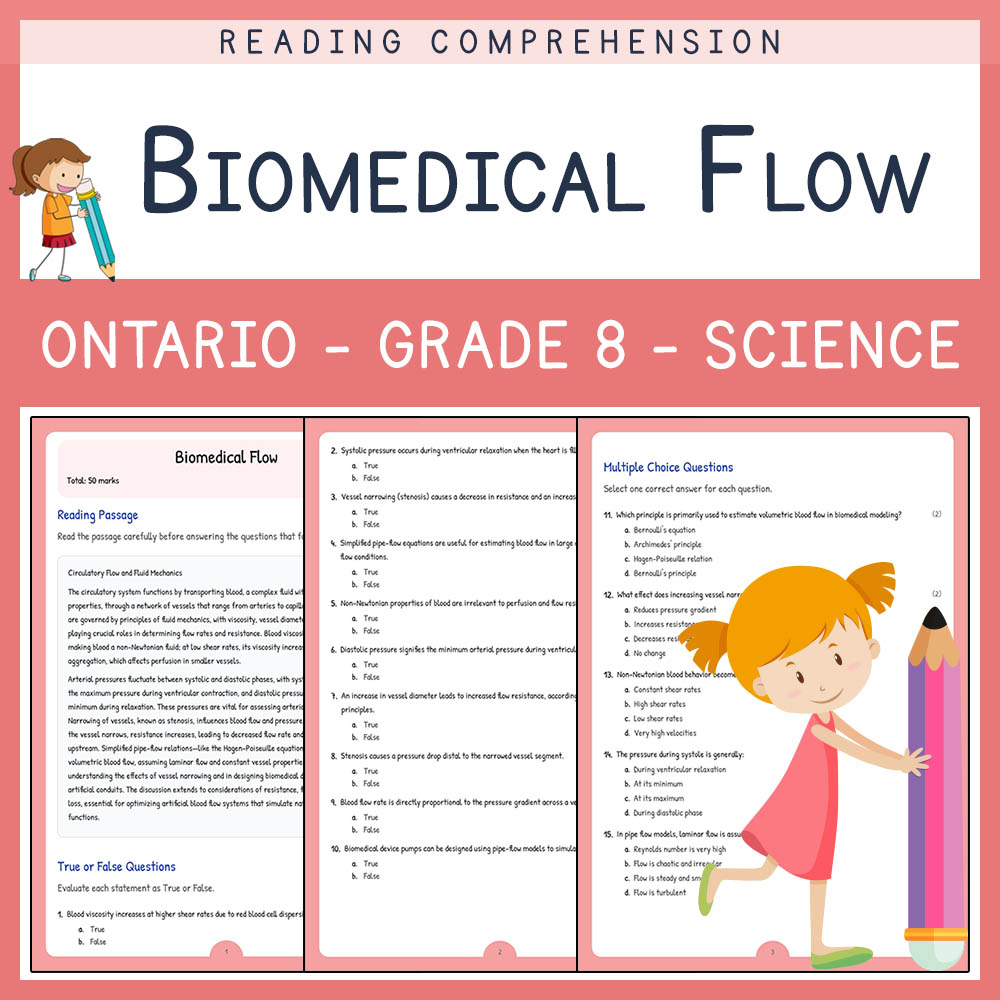
Grade 8 Science Assessment | Biomedical Flow Worksheet Elena | Ontario
Created byLumora LearningLearning Objectives
- Understand the principles of fluid mechanics as they apply to blood flow in the circulatory system.
- Explain how non-Newtonian blood properties influence perfusion and vessel resistance.
- Relate systolic and diastolic pressures to arterial function and health.
Also included in: Grade 8 Science | Fluids Lesson Bundle | Ontario Framework
Instant download
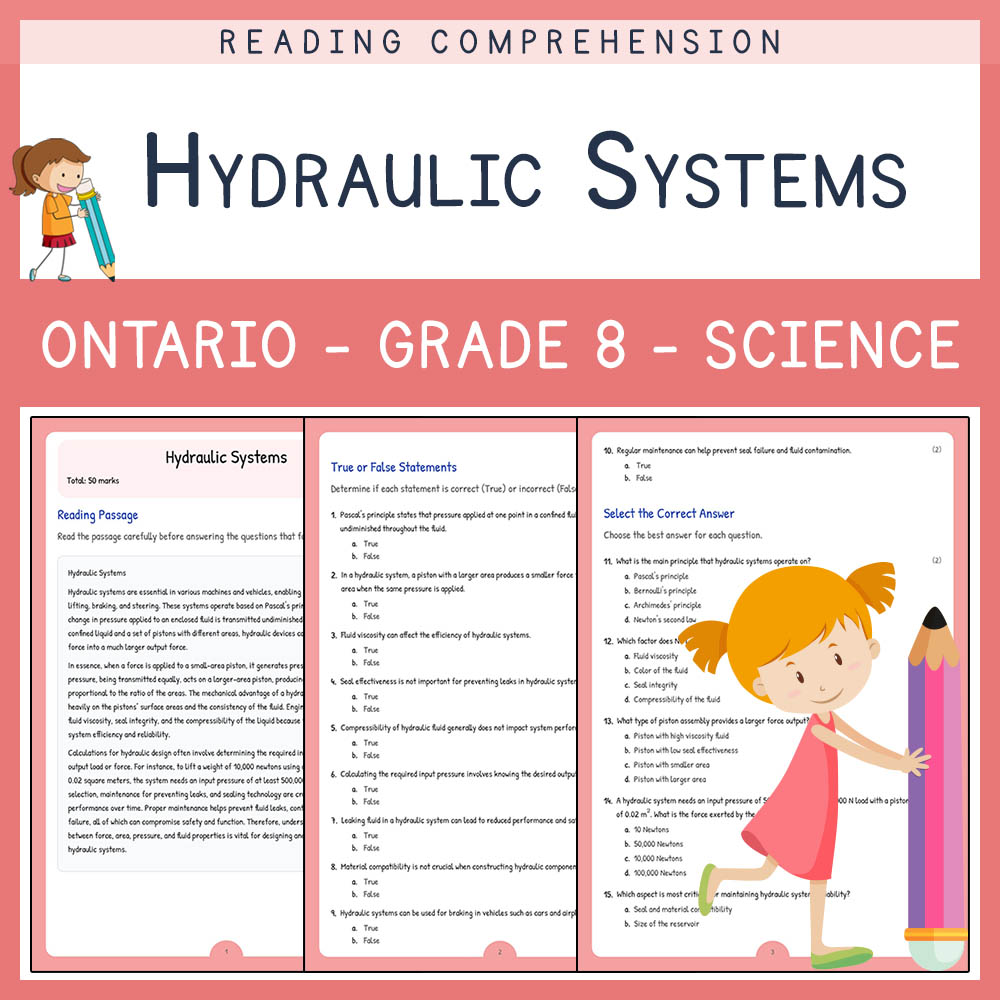
Grade 8 Science Assessment | Hydraulic Systems Worksheet Elena | Ontario
Created byLumora LearningLearning Objectives
- Explain how hydraulic systems convert small forces into larger outputs through pressure transmission.
- Evaluate the mechanical advantage provided by different piston assemblies in hydraulic devices.
- Analyze design constraints such as fluid viscosity, seal effectiveness, and compressibility in hydraulic systems.
Also included in: Grade 8 Science | Fluids Lesson Bundle | Ontario Framework
Instant download
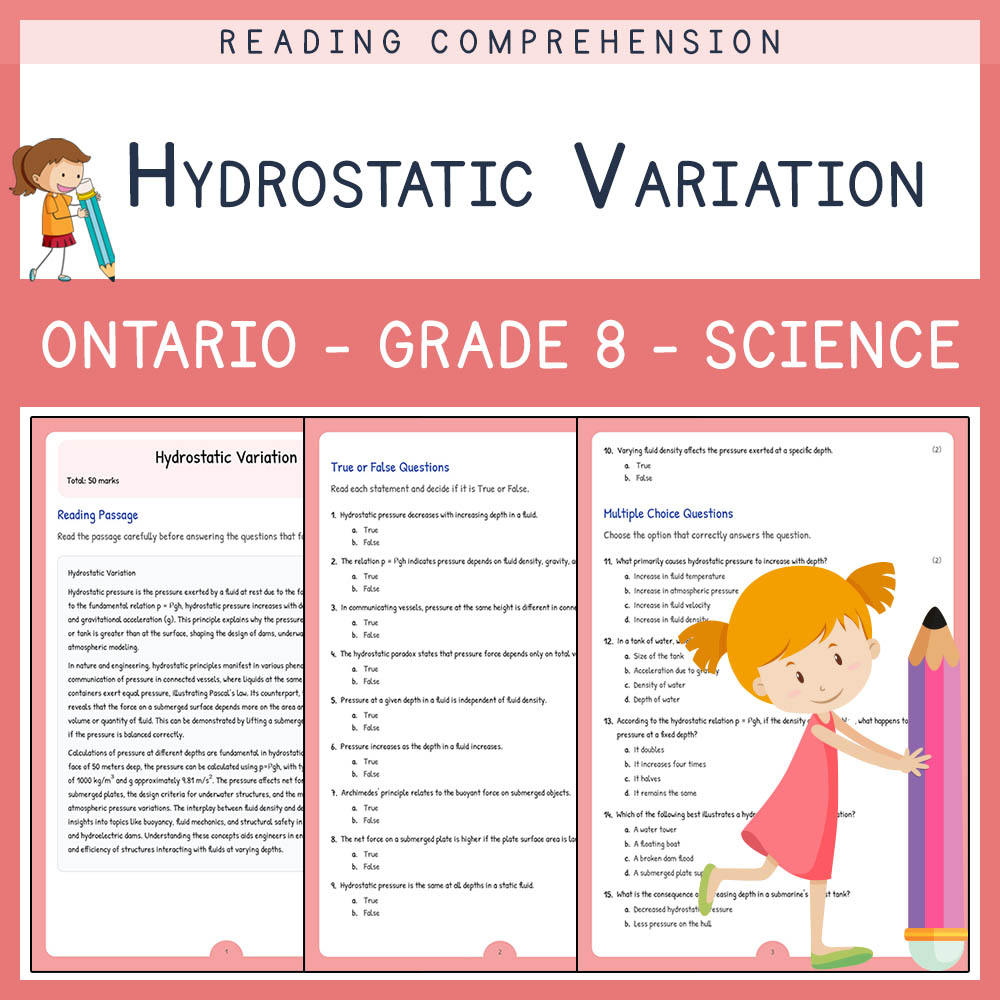
Grade 8 Science | Hydrostatic Variation Worksheet Elena | Ontario
Created byLumora LearningLearning Objectives
- Understand how hydrostatic pressure depends on fluid density and depth.
- Explain communicating vessels and the hydrostatic paradox.
- Calculate pressure at various depths in fluids.
Also included in: Grade 8 Science | Fluids Lesson Bundle | Ontario Framework
Instant download
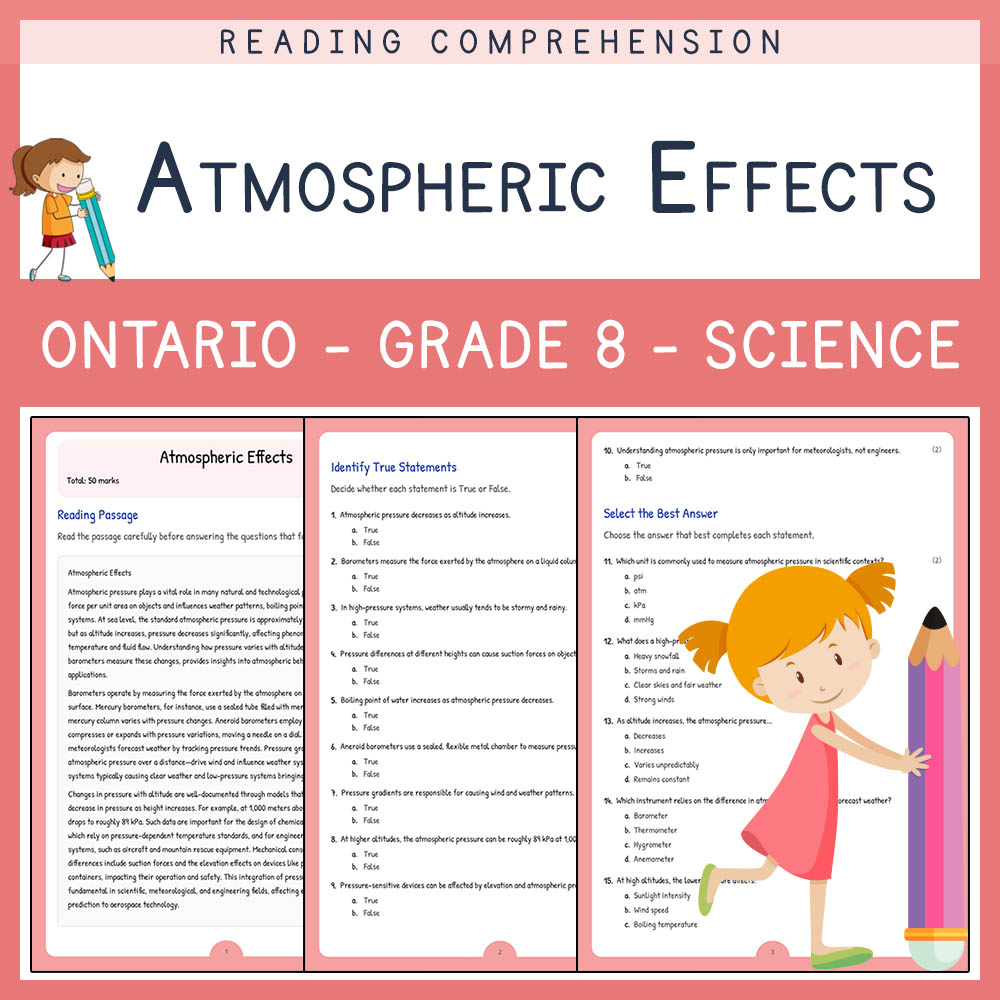
Grade 8 Science Assessment | Atmospheric Effects Worksheet Elena | Ontario
Created byLumora LearningLearning Objectives
- Explain how atmospheric pressure influences boiling points and weather instruments.
- Describe the operation of a barometer and pressure measurement methods.
- Understand pressure gradients and their role in driving wind and weather patterns.
Also included in: Grade 8 Science | Fluids Lesson Bundle | Ontario Framework
Instant download
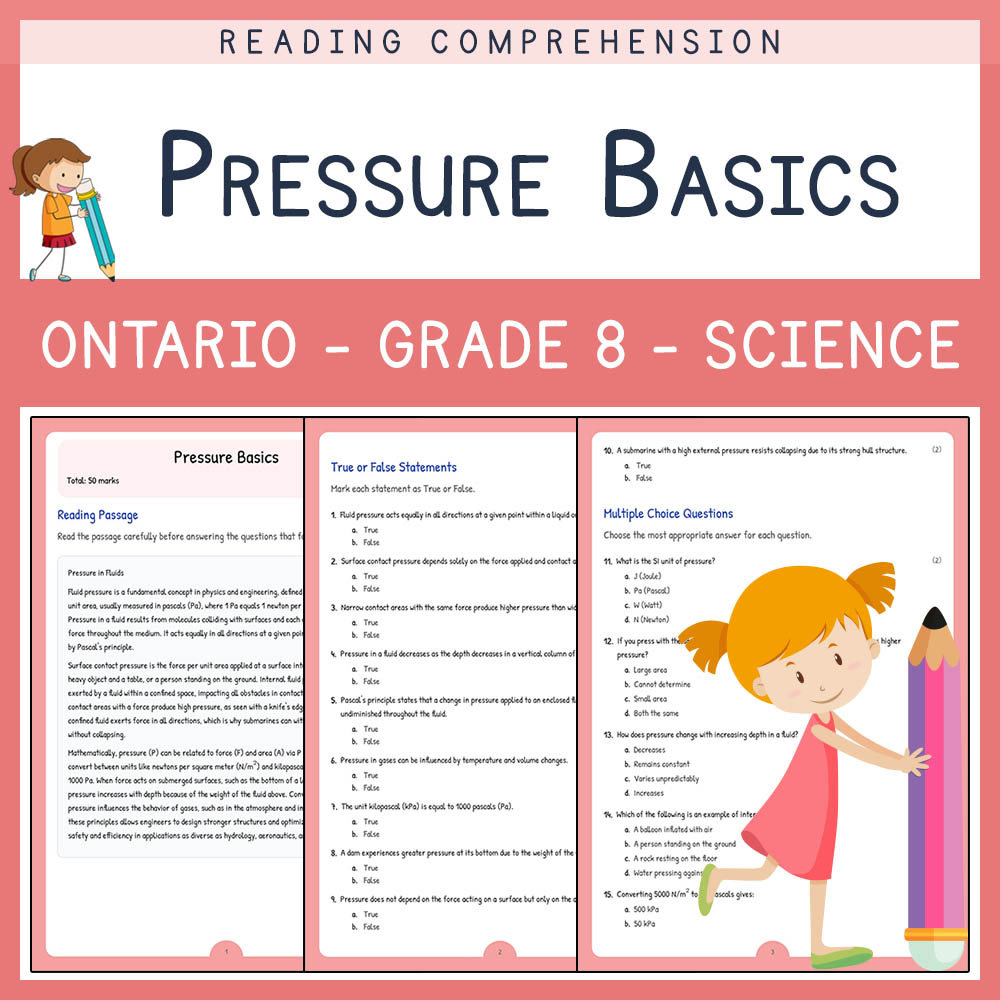
Grade 8 Science Assessment | Pressure Basics Worksheet Elena | Ontario
Created byLumora LearningLearning Objectives
- Define fluid pressure and understand its SI units.
- Distinguish between surface contact pressure and internal fluid pressure.
- Explain how pressure depends on contact area, force, and fluid confinement.
Also included in: Grade 8 Science | Fluids Lesson Bundle | Ontario Framework
Instant download
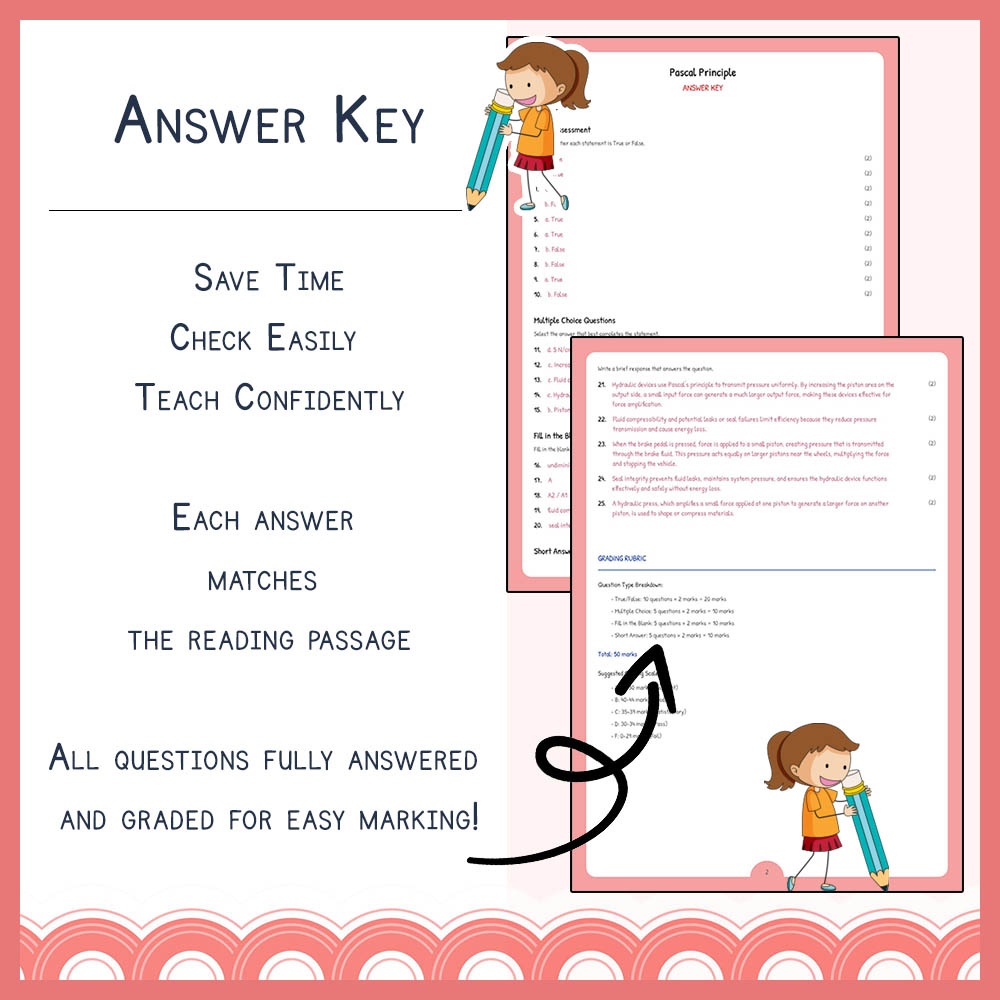
Grade 8 Science Assessment | Pascal Principle Worksheet Elena | Ontario
Created byLumora LearningLearning Objectives
- Explain the concept of Pascal's principle and its significance in hydraulic systems.
- Calculate the relationships between input and output forces using piston areas.
- Describe real-world applications of Pascal's principle, such as hydraulic brakes and presses.
Also included in: Grade 8 Science | Fluids Lesson Bundle | Ontario Framework
Instant download
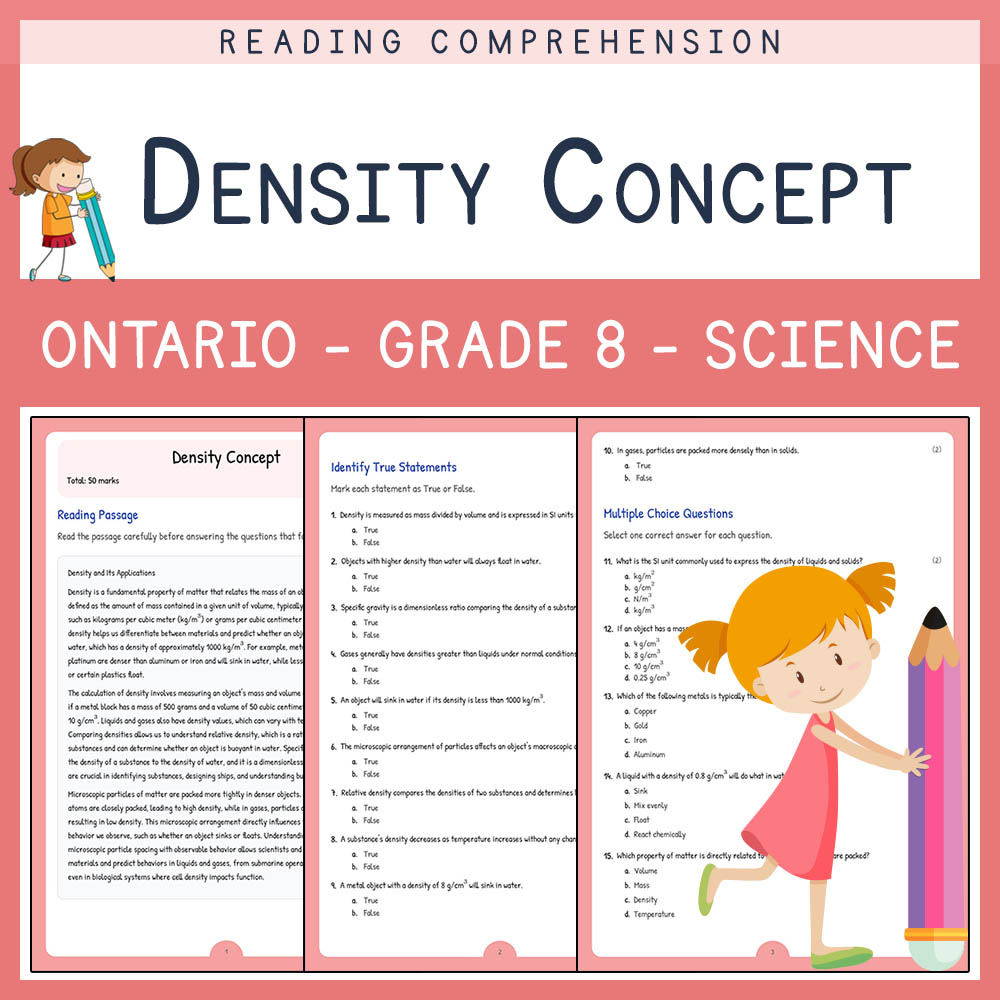
Grade 8 Science Assessment | Density Concept Worksheet Elena | Ontario
Created byLumora LearningLearning Objectives
- Understand the definition of density as mass per unit volume.
- Learn the SI units used to measure mass, volume, and density.
- Explore the relationship between mass, volume, and density through numerical examples.
Also included in: Grade 8 Science | Fluids Lesson Bundle | Ontario Framework
Instant download
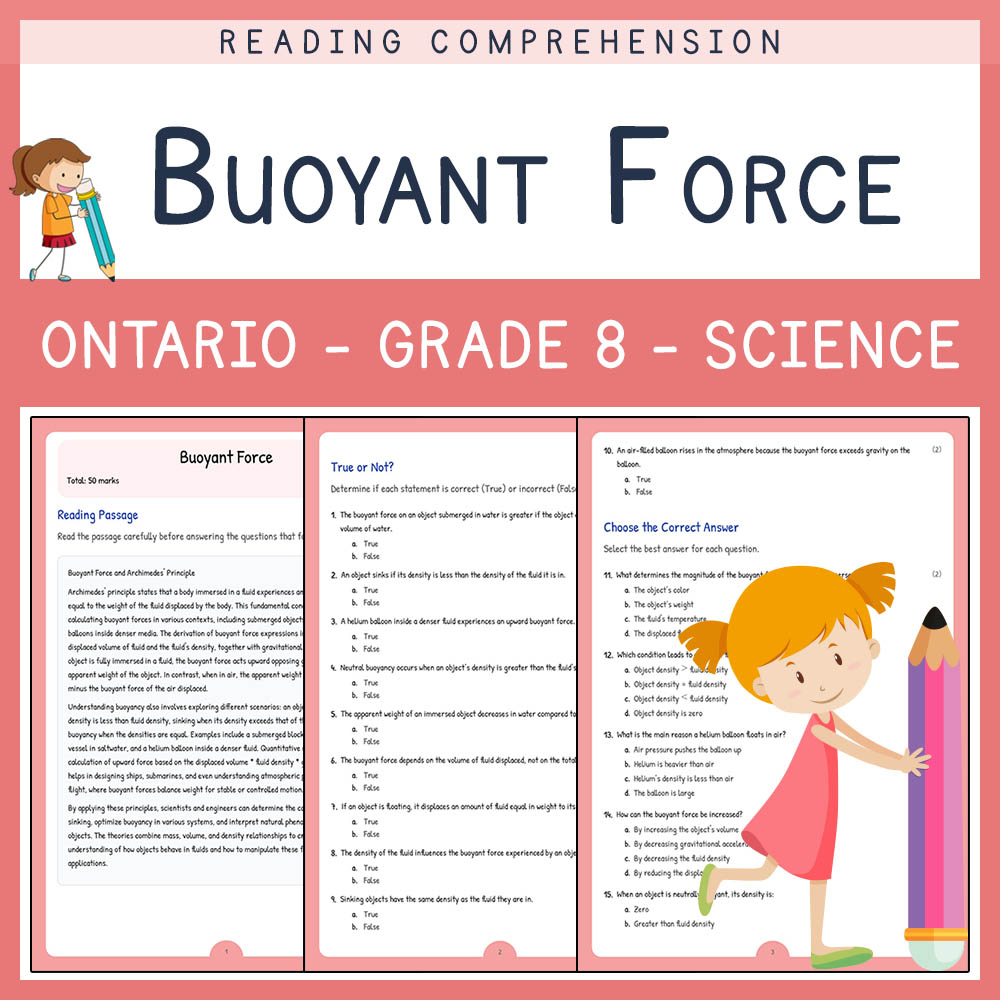
Grade 8 Science Assessment | Buoyant Force Worksheet Elena | Ontario
Created byLumora LearningLearning Objectives
- Understand Archimedes' principle and how buoyant force relates to displaced fluid weight.
- Differentiate between apparent weight in air and when submerged.
- Apply density and volume relationships to analyze floating, sinking, and neutral buoyancy scenarios.
Also included in: Grade 8 Science | Fluids Lesson Bundle | Ontario Framework
Instant download
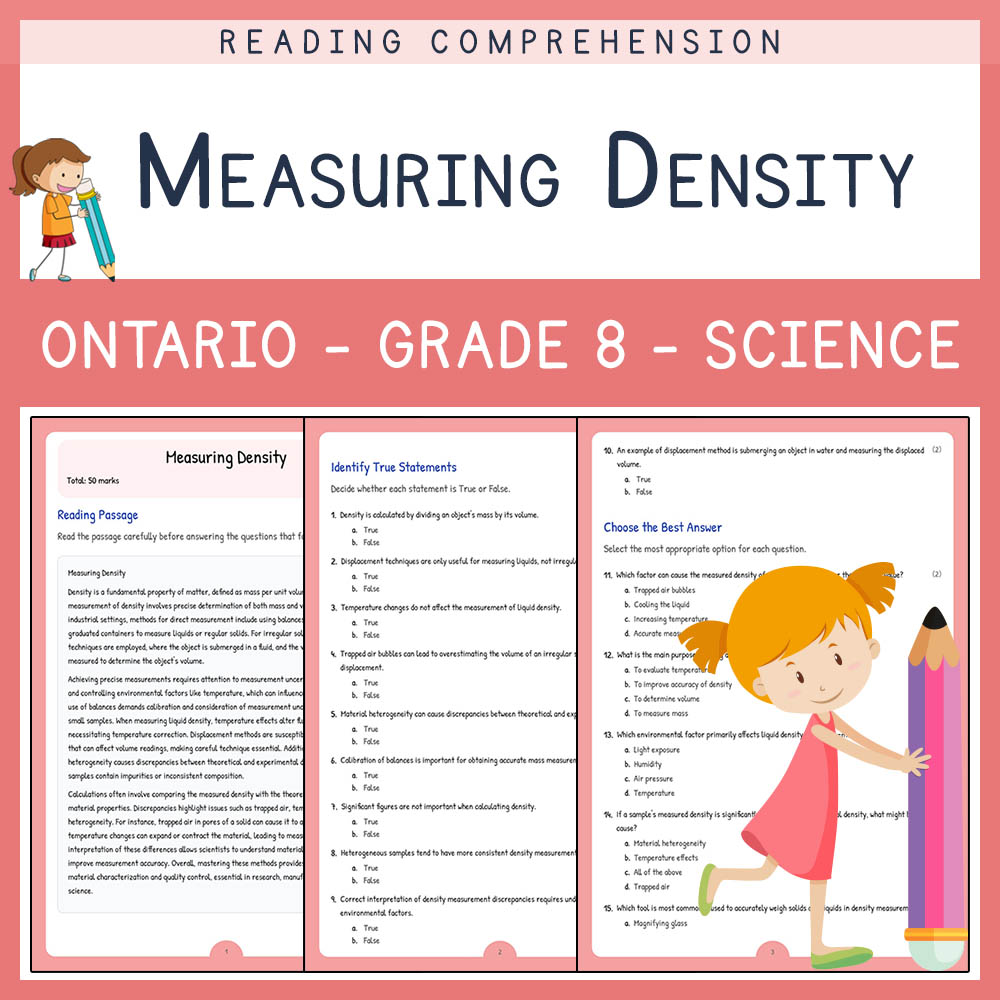
Grade 8 Science Assessment | Measuring Density Worksheet Elena | Ontario
Created byLumora LearningLearning Objectives
- Understand methods for calculating the density of solids and liquids.
- Identify how displacement techniques help measure irregular solids.
- Explain factors affecting measurement accuracy, such as temperature and heterogeneity.
Also included in: Grade 8 Science | Fluids Lesson Bundle | Ontario Framework
Instant download
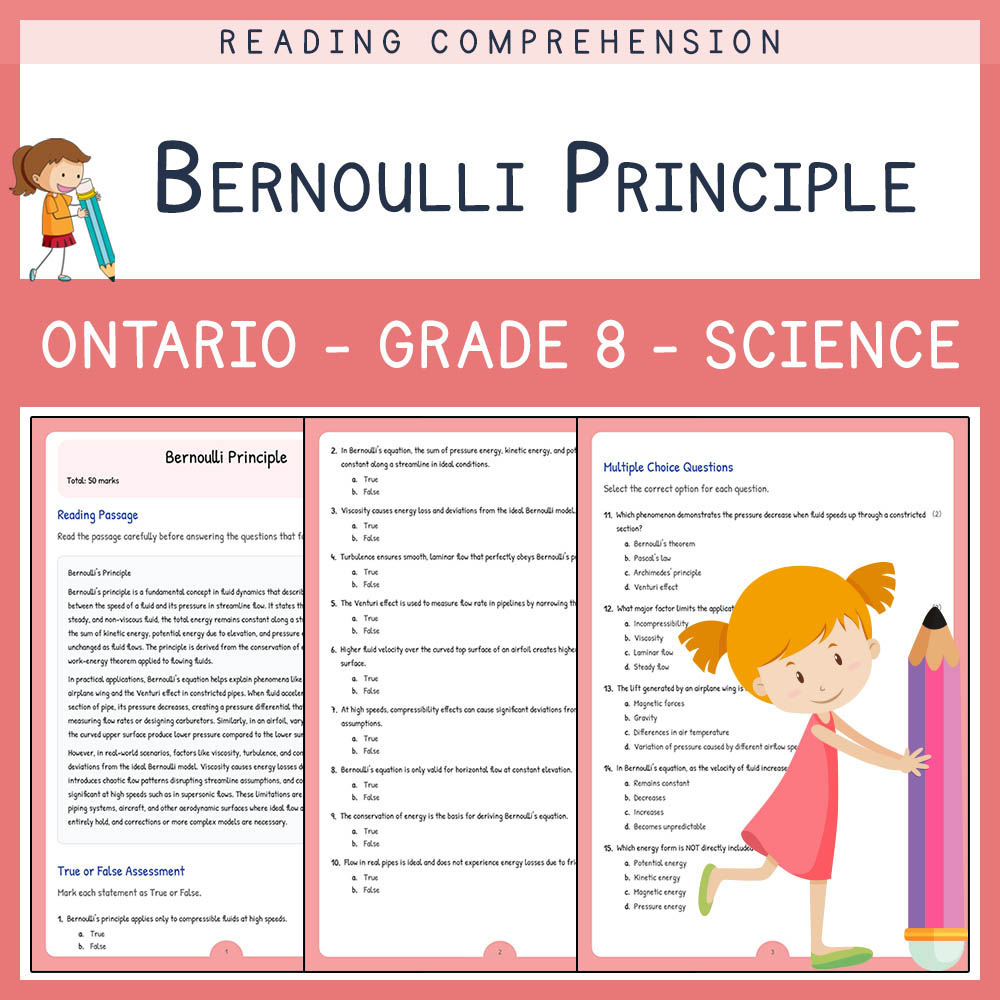
Grade 8 Science Assessment | Bernoulli Principle Worksheet Elena | Ontario
Created byLumora LearningLearning Objectives
- Explain Bernoulli's principle and how it relates fluid velocity and pressure.
- Describe the application of Bernoulli's principle in aerodynamics and fluid flow.
- Derive the Bernoulli equation for incompressible, non-viscous flow.
Also included in: Grade 8 Science | Fluids Lesson Bundle | Ontario Framework
Instant download
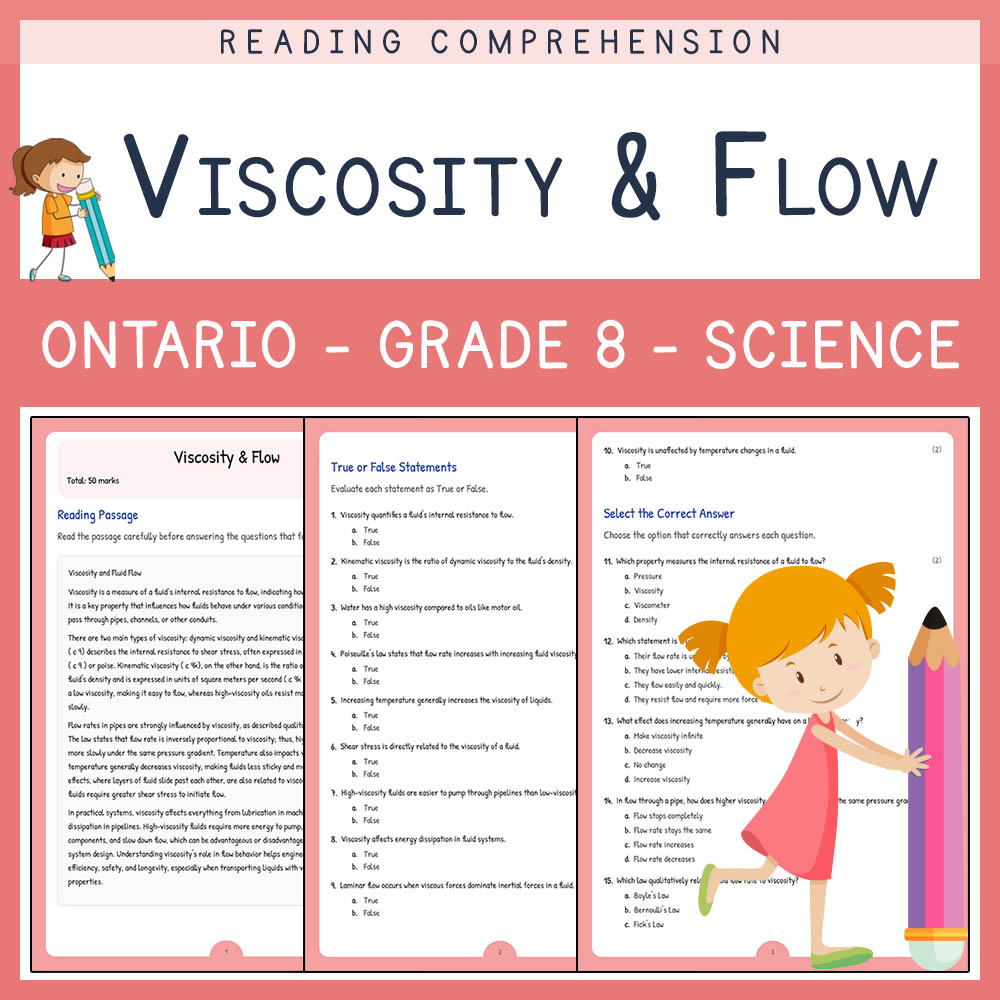
Grade 8 Science Assessment | Viscosity & Flow Worksheet | Ontario Standard
Created byLumora LearningLearning Objectives
- Define and distinguish between dynamic and kinematic viscosity.
- Explain how viscosity affects the flow of fluids in pipes and channels.
- Contrast the flow behavior of low-viscosity fluids like water with high-viscosity fluids like oils.
Also included in: Grade 8 Science | Fluids Lesson Bundle | Ontario Framework
Instant download

Grade 8 Science Assessment | Surface Forces Worksheet Elena | Ontario
Created byLumora LearningLearning Objectives
- Understand how pressure varies on submerged surfaces and affects force and torque.
- Analyze pressure distribution on planar and curved surfaces in hydrostatic conditions.
- Apply integrative methods to calculate net hydrostatic forces and centers of pressure.
Also included in: Grade 8 Science | Fluids Lesson Bundle | Ontario Framework
Instant download
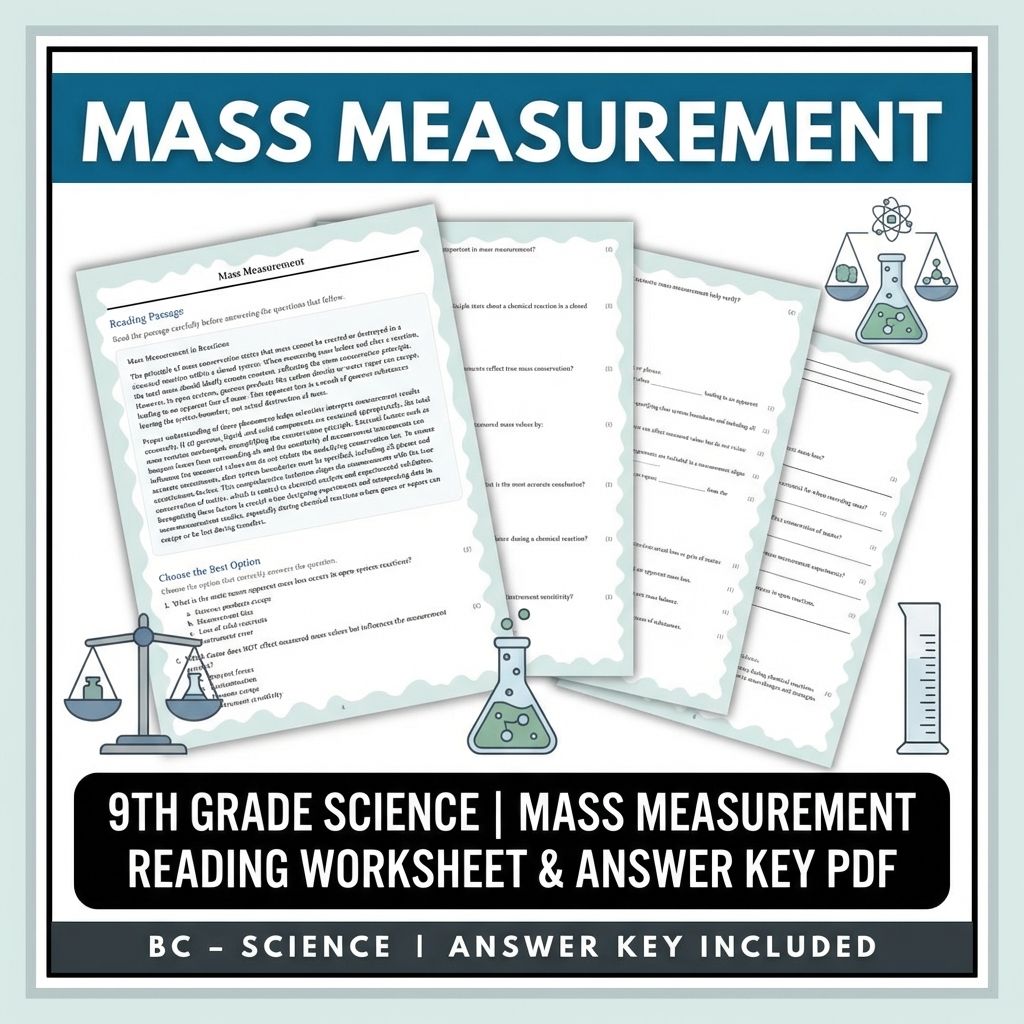
9th Grade Science | Mass Measurement Reading Worksheet & Answer Key PDF
JCreated byJ.S SheetsLearning Objectives
- Understand how measured mass reflects the conservation of atoms during reactions.
- Identify factors affecting the accuracy of mass measurements, such as gaseous escape and external influences.
- Explain the importance of defining system boundaries for mass conservation analysis.
Instant download
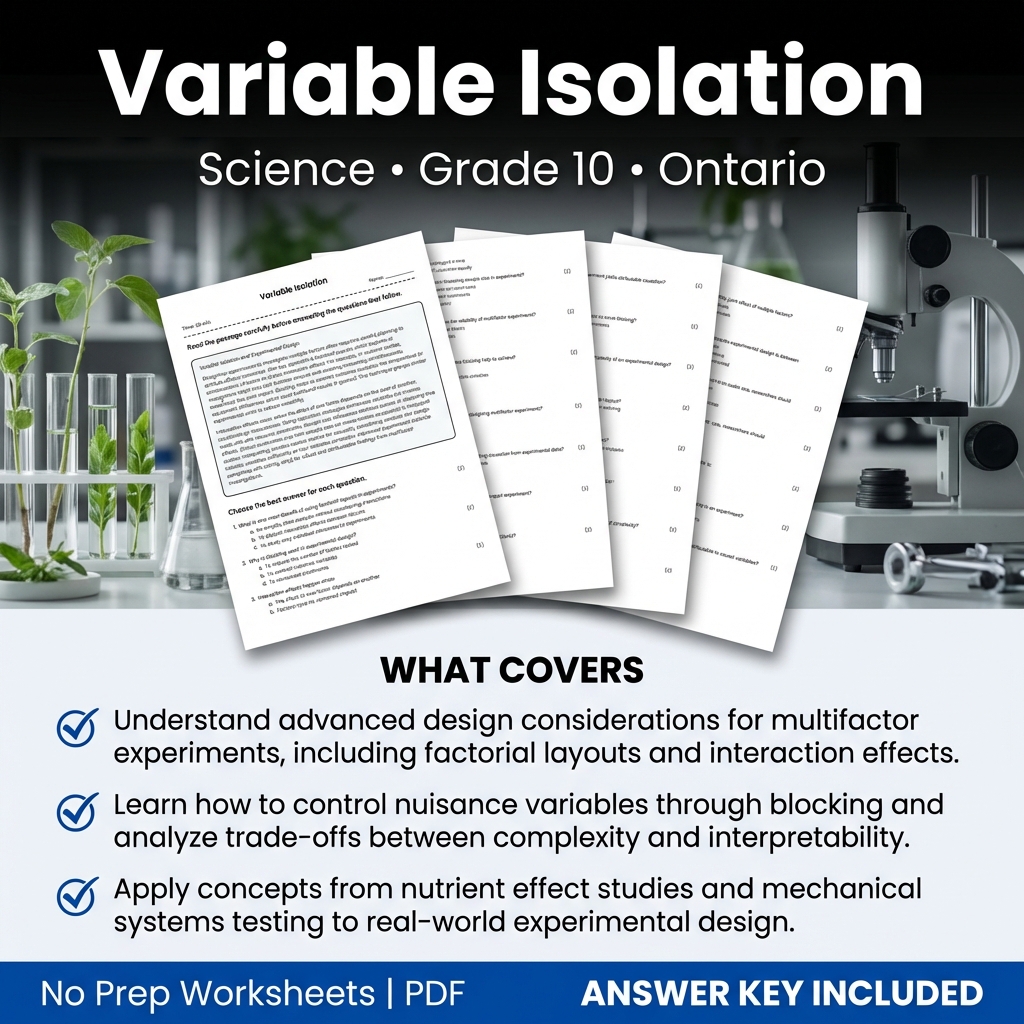
Grade 10 Science Worksheet on Variable Isolation | Ontario Standards
 Created byCoral Reef Learning
Learning Objectives
- Understand advanced design considerations for multifactor experiments, including factorial layouts and interaction effects.
- Learn how to control nuisance variables through blocking and analyze trade-offs between complexity and interpretability.
- Apply concepts from nutrient effect studies and mechanical systems testing to real-world experimental design.
Instant download
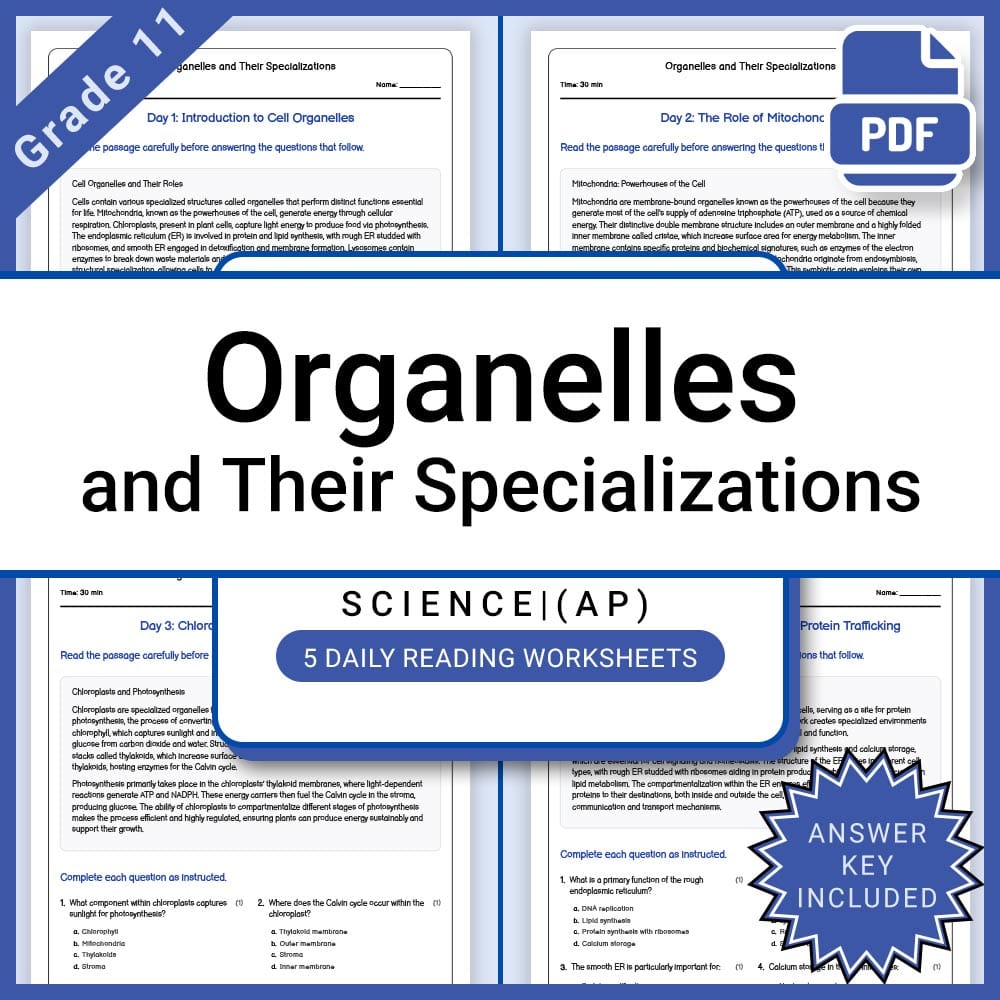
Grade 11 Science – Organelles and Their Specializations Worksheet + Answer Key
JCreated byJ.S SheetsLearning Objectives
- Understand the structural differences of key organelles: mitochondria, chloroplasts, endoplasmic reticulum, and lysosomes.
- Explain how compartmentalization enhances metabolic pathways and cellular functions.
- Describe the origins and membrane compositions of different organelles.
Also included in: Grade 11 Science Biology and Ecosystems AP Lesson Bundle +1 more
Instant download

Decomposition Recycling Worksheet Grade 6 Science NGSSS Florida
 Created byPrism Point Learning
Learning Objectives
- Explain how decomposers break down dead organisms and waste into simpler materials
- Describe how decomposition returns nutrients to the environment for producers to use again
- Connect decomposition to ecosystem stability over time
Instant download
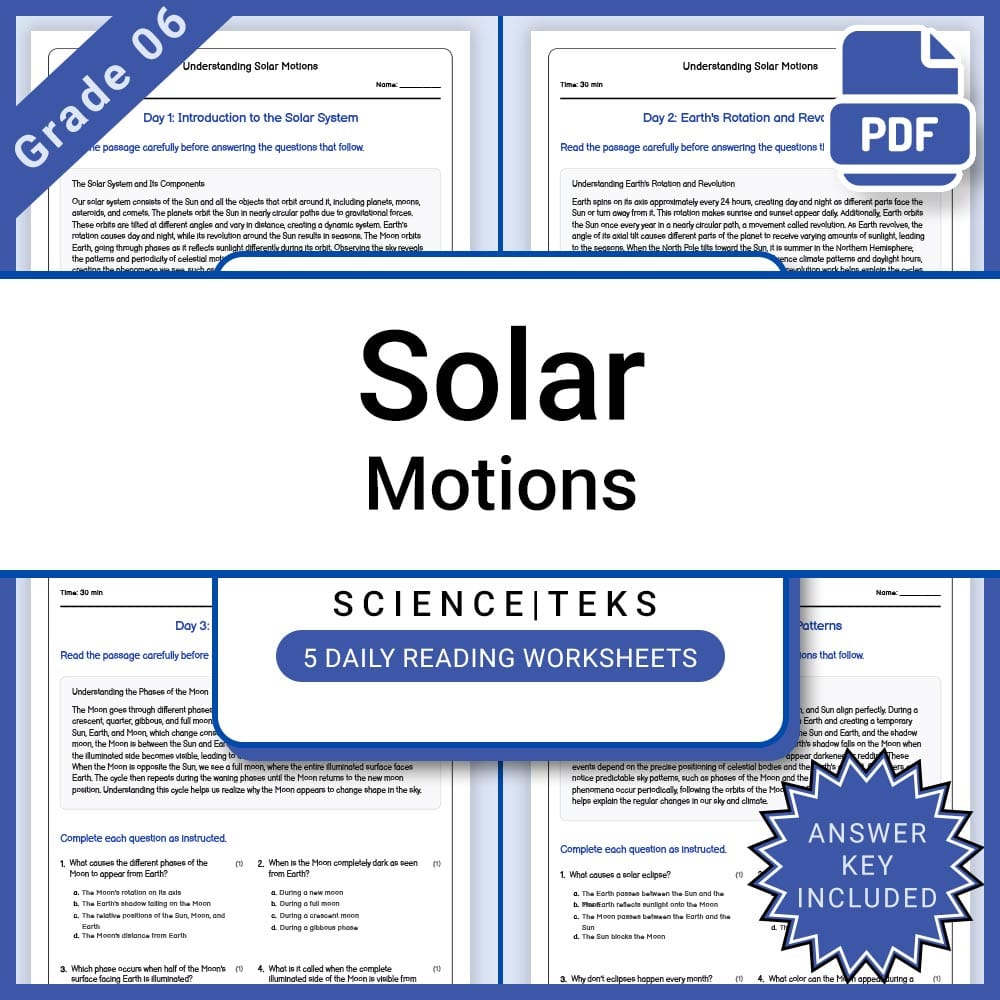
Grade 6 Science – Solar Motions Daily Reading Worksheet + Answer Key
JCreated byJ.S SheetsLearning Objectives
- Identify the main components of the solar system.
- Explain the orbital motions of planets around the Sun.
- Describe how gravitational interactions influence planetary paths.
Also included in: Grade 6 Science Lesson Bundle: Space, Water, Earth, and Resources TEKS +1 more
Instant download
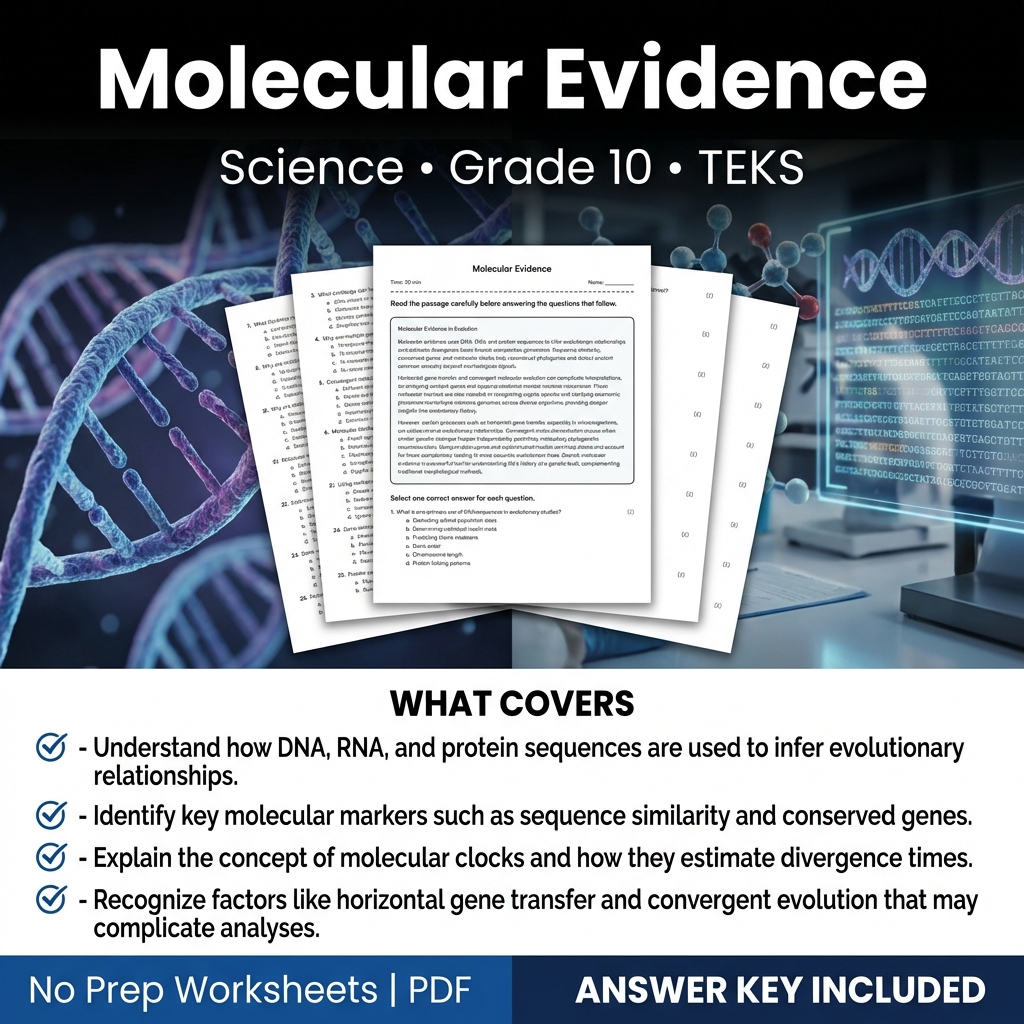
Molecular Evidence Worksheet for Grade 10 Science | TEKS
Created byCoral Reef LearningLearning Objectives
- Understand how DNA, RNA, and protein sequences are used to infer evolutionary relationships.
- Identify key molecular markers such as sequence similarity and conserved genes.
- Explain the concept of molecular clocks and how they estimate divergence times.
Instant download

Grade 11 Science – Anatomical Clues & Evolution | Daily Reading Worksheet
 Created byBright Mind Resources
Learning Objectives
- Identify homologous structures across different species.
- Understand how homologous structures provide evidence of common ancestry.
- Differentiate between homologous and analogous structures.
Also included in: Grade 11 Evolution Science Lesson Bundle Daily Reading Worksheets | TEKS +2 more
Instant download
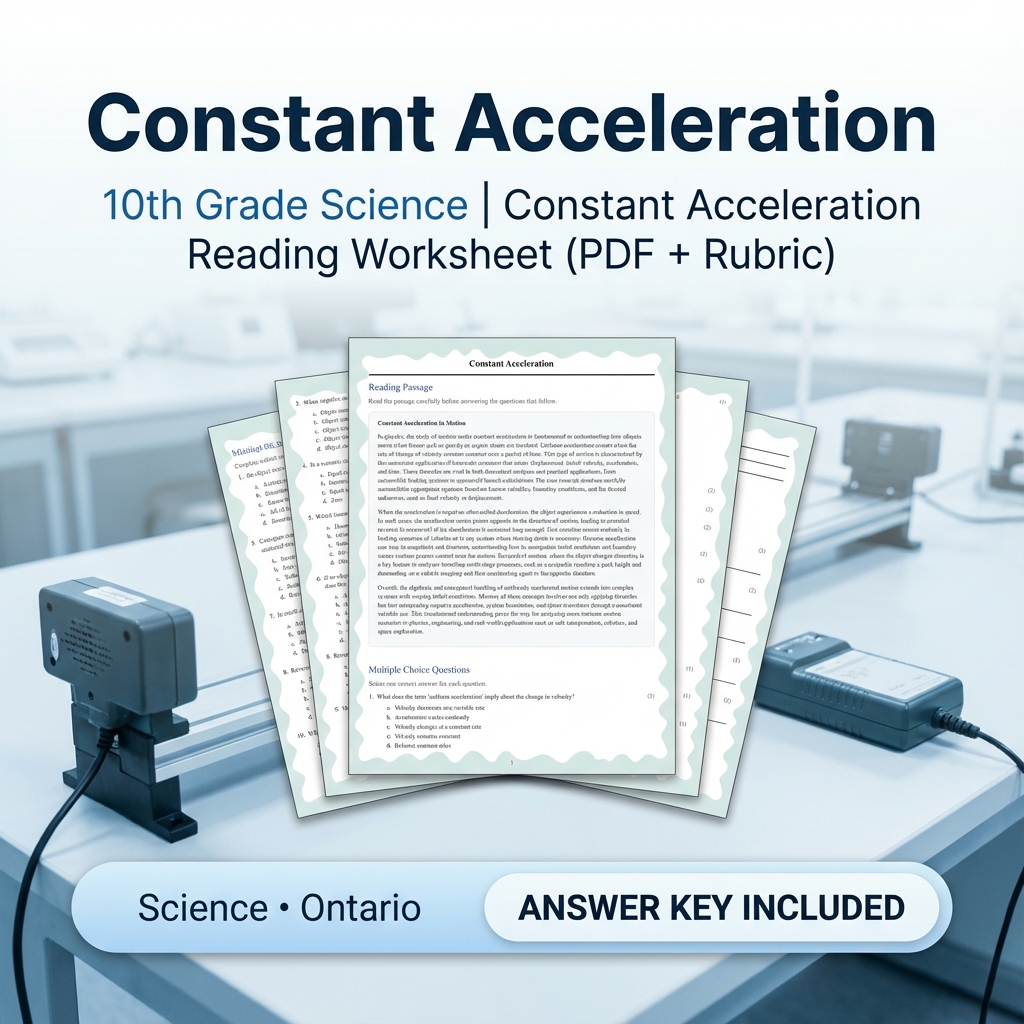
10th Grade Science | Constant Acceleration Reading Worksheet (PDF + Rubric)
JCreated byJ.S SheetsLearning Objectives
- Understand the basic concepts of uniform acceleration in one-dimensional motion.
- Apply kinematic formulas to analyze systems with initial velocities, displacements, and varying acceleration.
- Interpret the effects of negative acceleration and motion reversal in different scenarios.
Also included in: Grade 10 Science Unit Bundle – Motion, Forces & Mechanics (Answer Keys Included) +1 more
Instant download
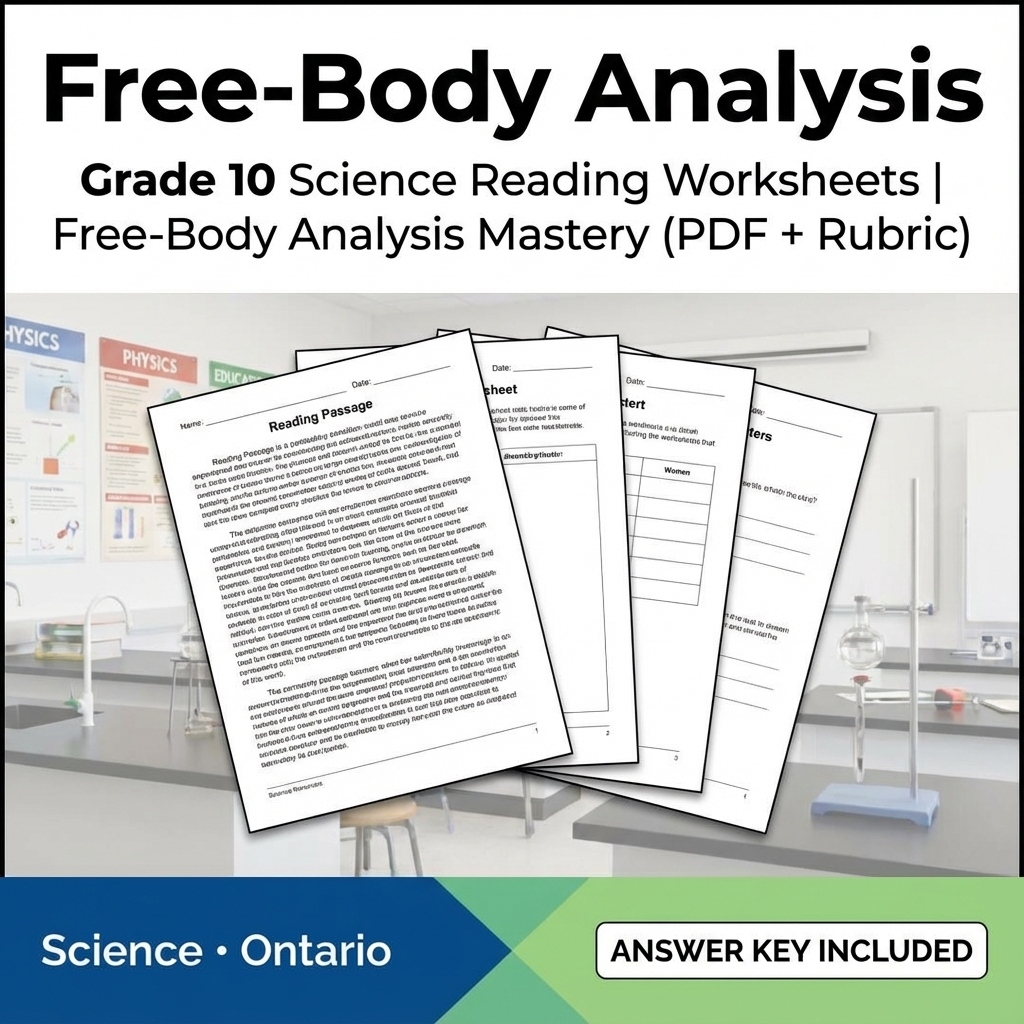
Grade 10 Science Reading Worksheets | Free-Body Analysis Mastery (PDF + Rubric)
JCreated byJ.S SheetsLearning Objectives
- Understand the concept of free-body diagrams and their role in force analysis.
- Learn procedures for identifying individual forces acting on an object.
- Recognize how to choose coordinate axes and resolve vectors into components.
Also included in: Grade 10 Science Unit Bundle – Motion, Forces & Mechanics (Answer Keys Included) +1 more
Instant download
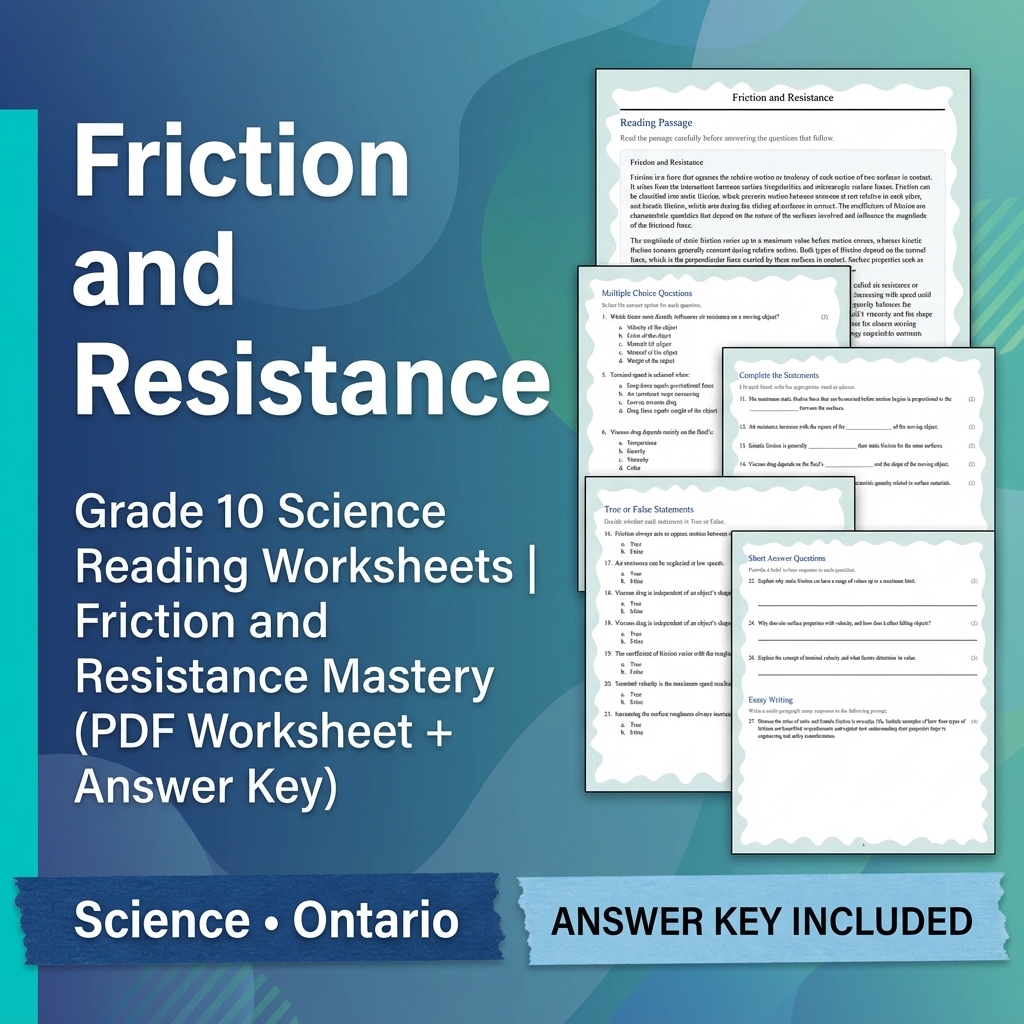
Grade 10 Science | Friction and Resistance Mastery (PDF Worksheet + Answer Key)
JCreated byJ.S SheetsLearning Objectives
- Understand the different types of friction and their characteristics.
- Explain how normal force and surface properties influence friction.
- Describe the concepts of air resistance and viscous drag and their effects on motion.
Also included in: Grade 10 Science Unit Bundle – Motion, Forces & Mechanics (Answer Keys Included) +1 more
Instant download
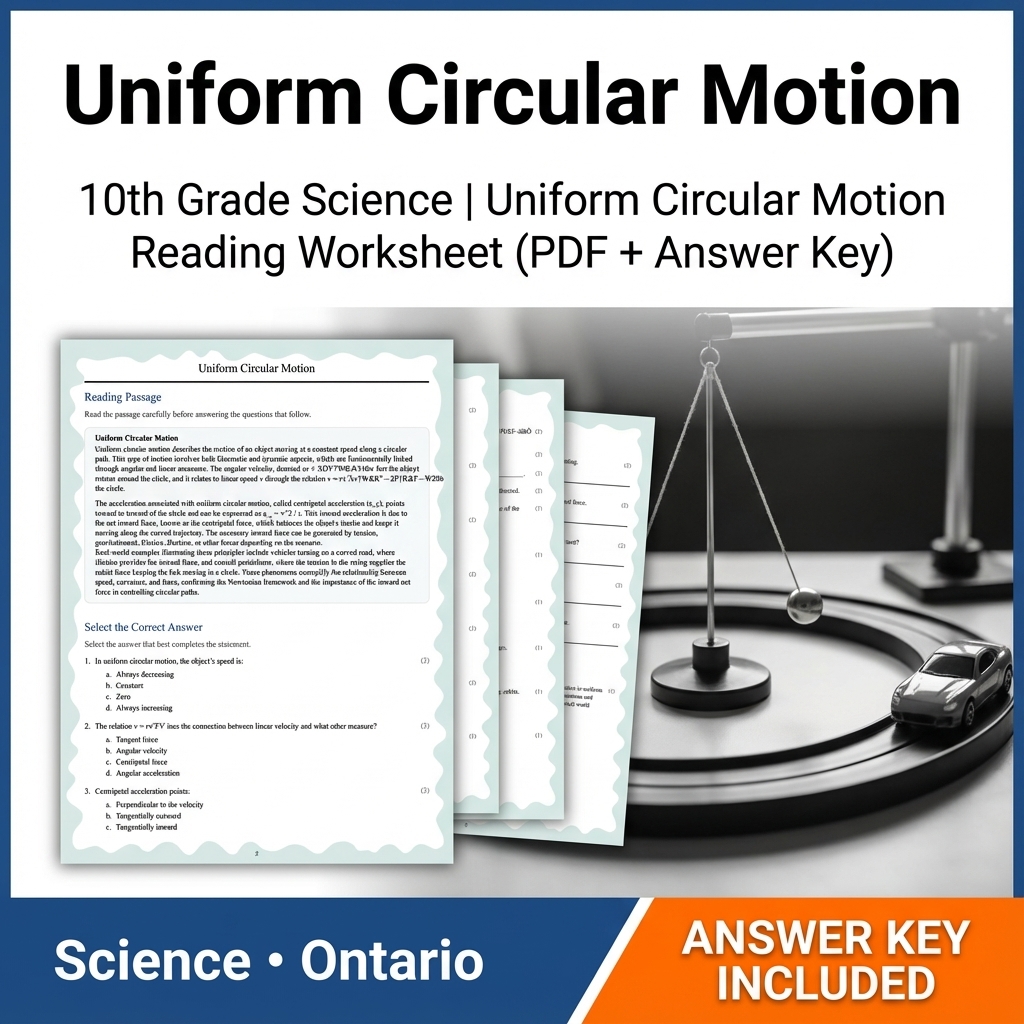
10th Grade Science | Uniform Circular Motion (PDF + Answer Key)
JCreated byJ.S SheetsLearning Objectives
- Understand the kinematic and dynamic principles of motion on a circular path.
- Relate angular velocity to linear speed and comprehend centripetal acceleration.
- Explain the role of inward net force in maintaining uniform circular motion.
Also included in: Grade 10 Science Unit Bundle – Motion, Forces & Mechanics (Answer Keys Included) +1 more
Instant download
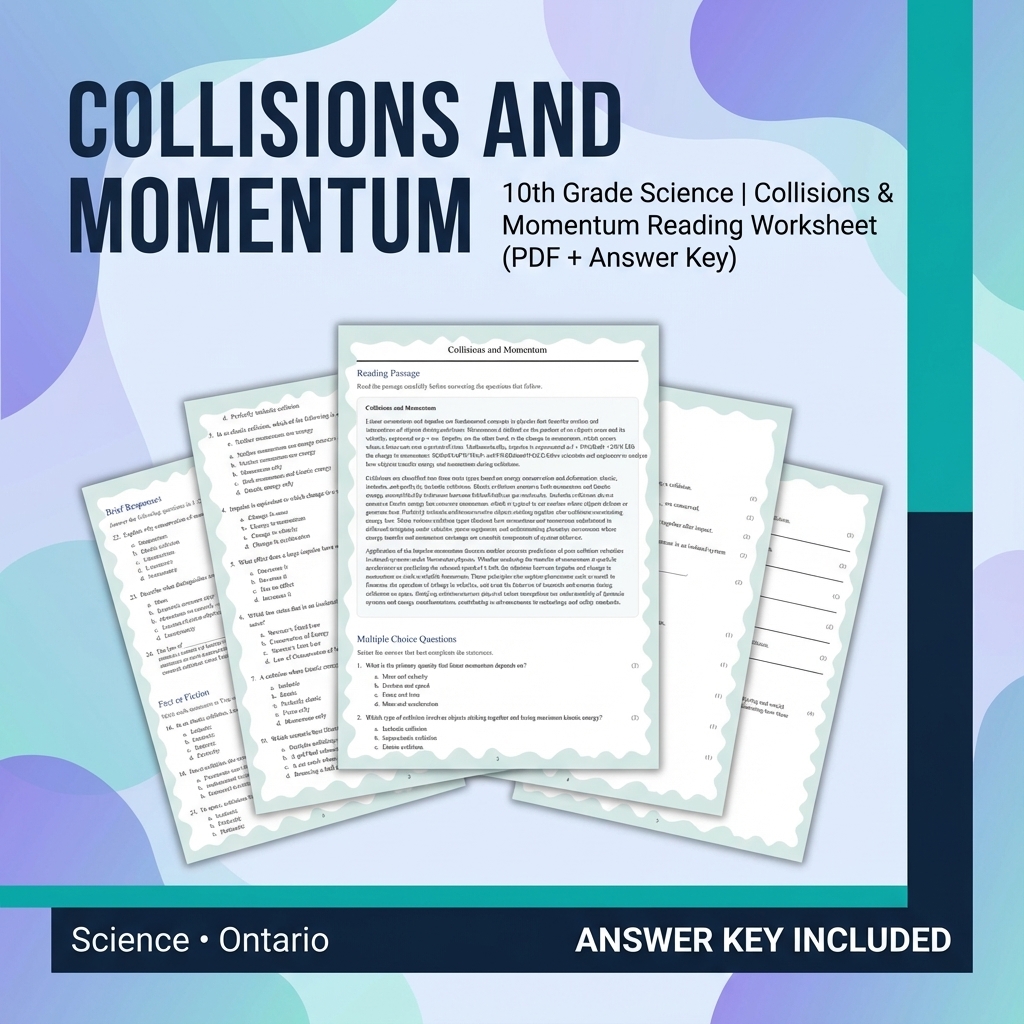
10th Grade Science | Collisions & Momentum Reading Worksheet (PDF + Answer Key)
JCreated byJ.S SheetsLearning Objectives
- Define and explain the concepts of linear momentum and impulse.
- Describe the different types of collisions: elastic, inelastic, and perfectly inelastic.
- Apply conservation of momentum principles to analyze two-body collision scenarios.
Also included in: Grade 10 Science Unit Bundle – Motion, Forces & Mechanics (Answer Keys Included) +1 more
Instant download
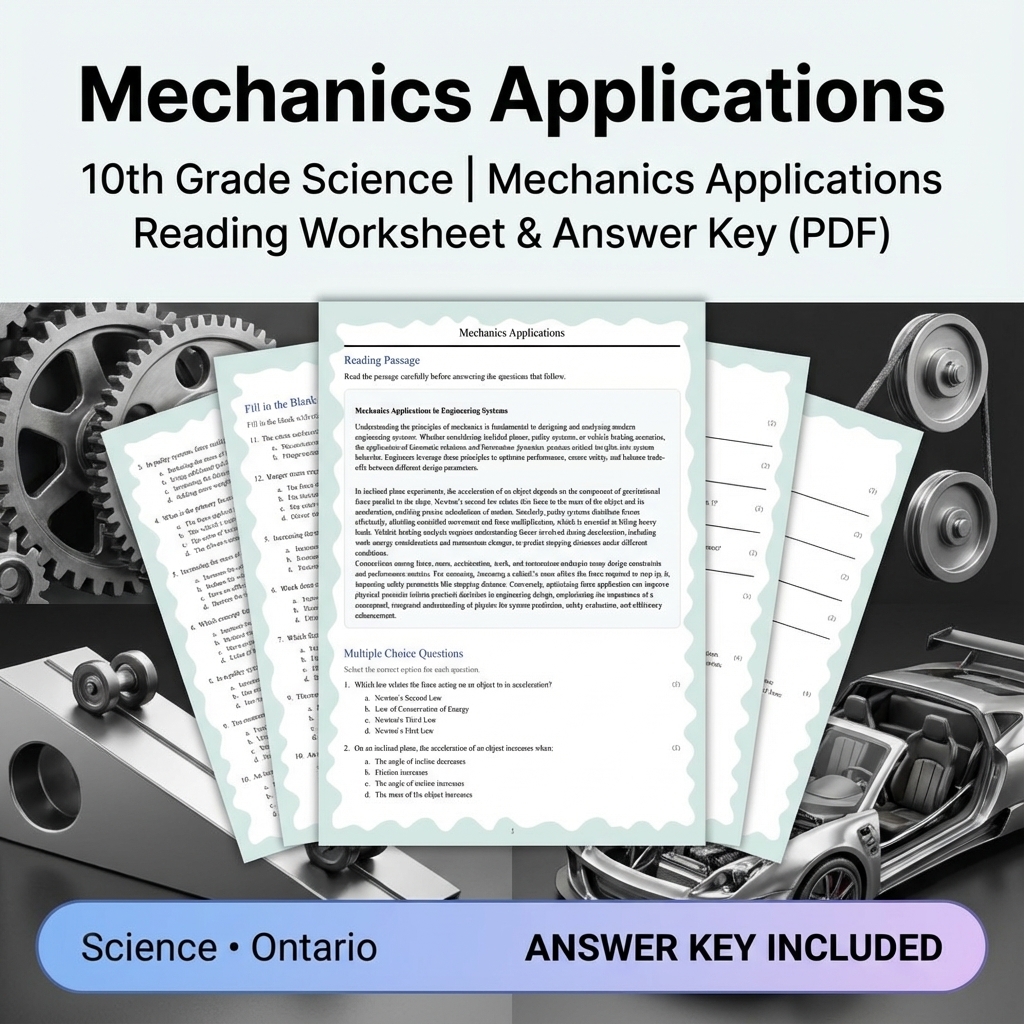
10th Grade Science | Mechanics Applications Reading Worksheet & Answer Key (PDF)
JCreated byJ.S SheetsLearning Objectives
- Understand how kinematic relations and Newtonian dynamics are applied in practical mechanical systems.
- Analyze the connections between force, mass, acceleration, work, and momentum in engineering contexts.
- Interpret safety parameters like stopping distance through conceptual integration of physical laws.
Also included in: Grade 10 Science Unit Bundle – Motion, Forces & Mechanics (Answer Keys Included) +1 more
Instant download

Science Worksheet Speciation and Change Grade 8 | NGSSS Aligned
JCreated byJ.S SheetsLearning Objectives
- Explain how reproductive isolation can lead to speciation
- Describe how variation and natural selection can cause populations to diverge over time
- Identify examples of barriers that reduce gene flow and increase differences between populations
Also included in: Grade 8 Evolution and Ecosystems Science Lesson Bundle | Florida NGSSS +1 more
Instant download
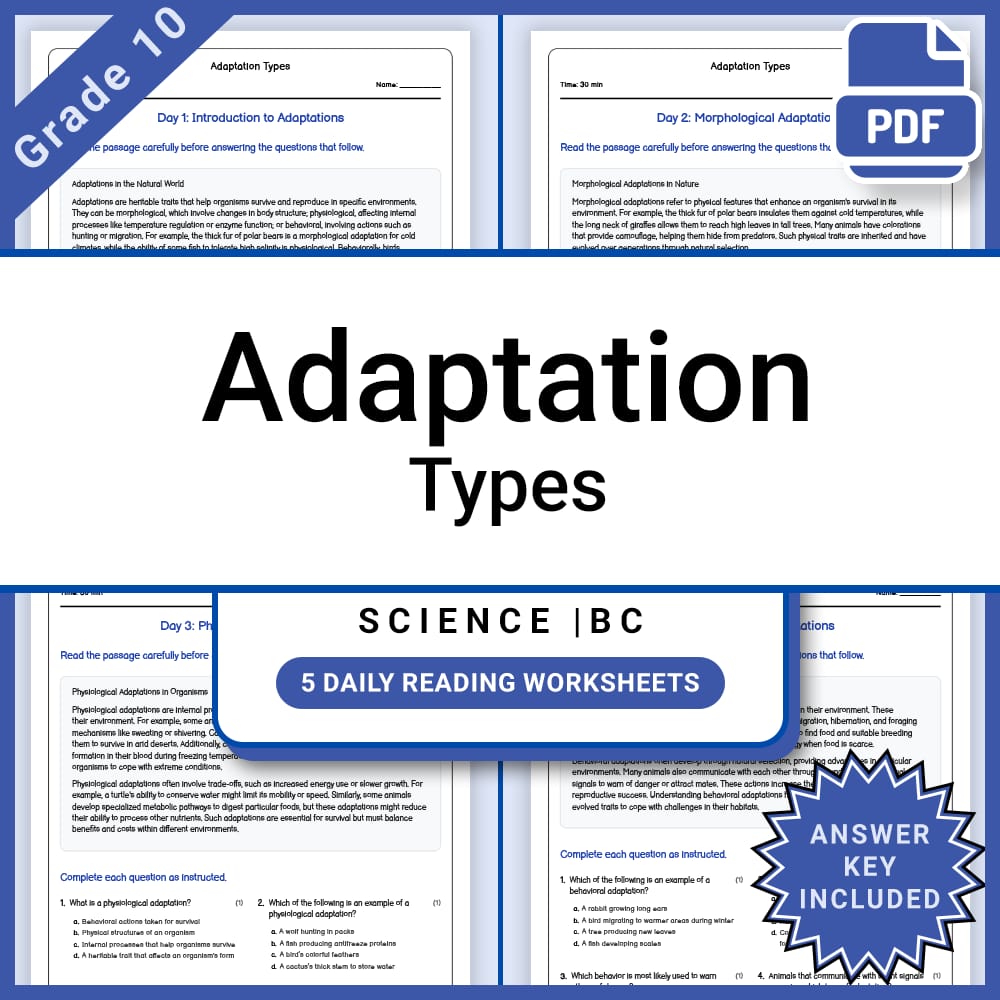
Grade 10 Science – Adaptation Types Daily Reading Worksheet with Answer Key
JCreated byJ.S SheetsLearning Objectives
- Define morphological, physiological, and behavioral adaptations.
- Explain how adaptations improve survival or reproduction in specific environments.
- Identify examples of different adaptation types.
Also included in: Grade 10 Science Lesson Bundle | Genetics, Evolution, Biodiversity & More +1 more
Instant download
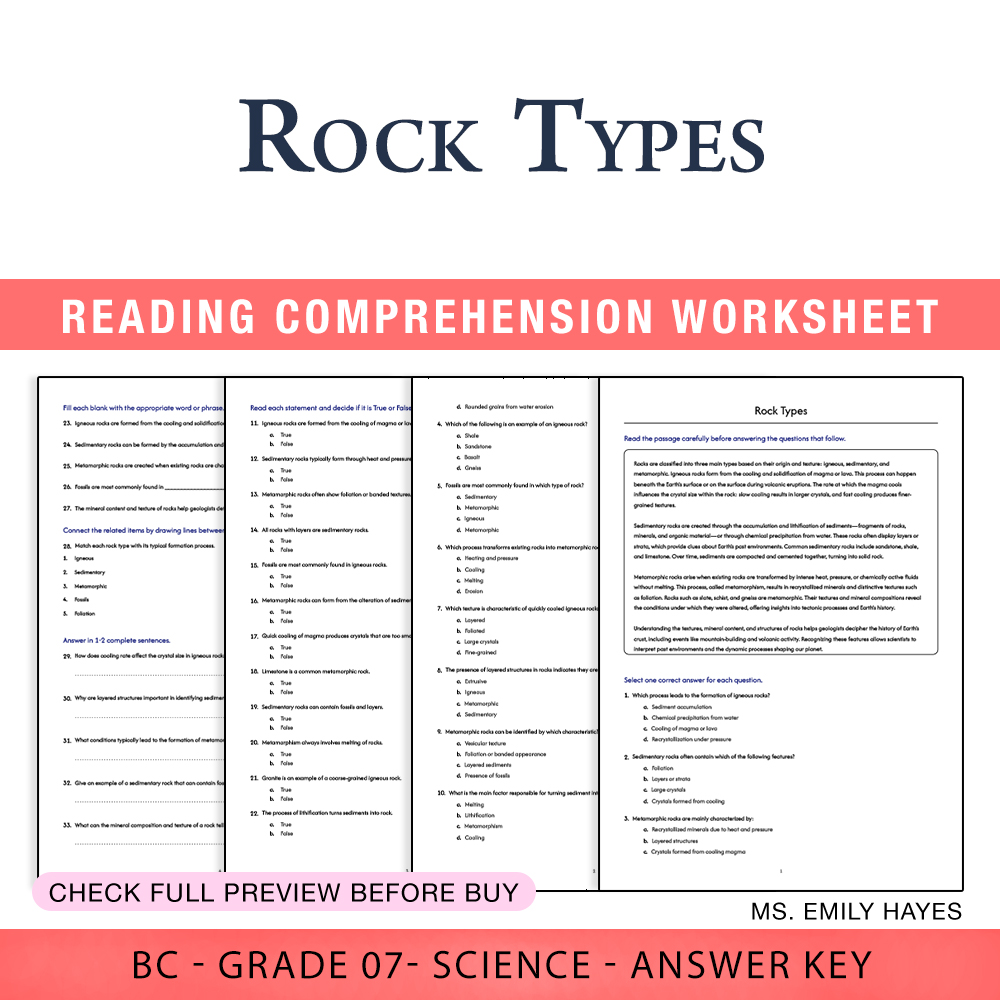
7th Grade Science | Rock Types Worksheet (PDF+ Answer Key)
 Created byCopper Leaf Classroom
Learning Objectives
- Describe the three main types of rocks: igneous, sedimentary, and metamorphic.
- Identify features and textures characteristic of each rock type.
- Explain how rocks are classified based on their origin and appearance.
Also included in: Grade 7 Science | Earth Systems & Geology Unit (PDF+ Answer Keys) +1 more
Instant download

Computational Modeling Science Reading Worksheet | Grade 11 NGSS
 Created byBRIGHT PATH RESOURCES
Learning Objectives
- Identify the purpose of a computational model in engineering and science contexts.
- Recognize key parts of building a simulation model, including assumptions, parameters, and boundary conditions.
- Connect validation and sensitivity ideas to how models are used for predictions.
Also included in: Engineering Design Grade 11 Science Daily Reading Worksheets Bundle | NGss +1 more
Instant download
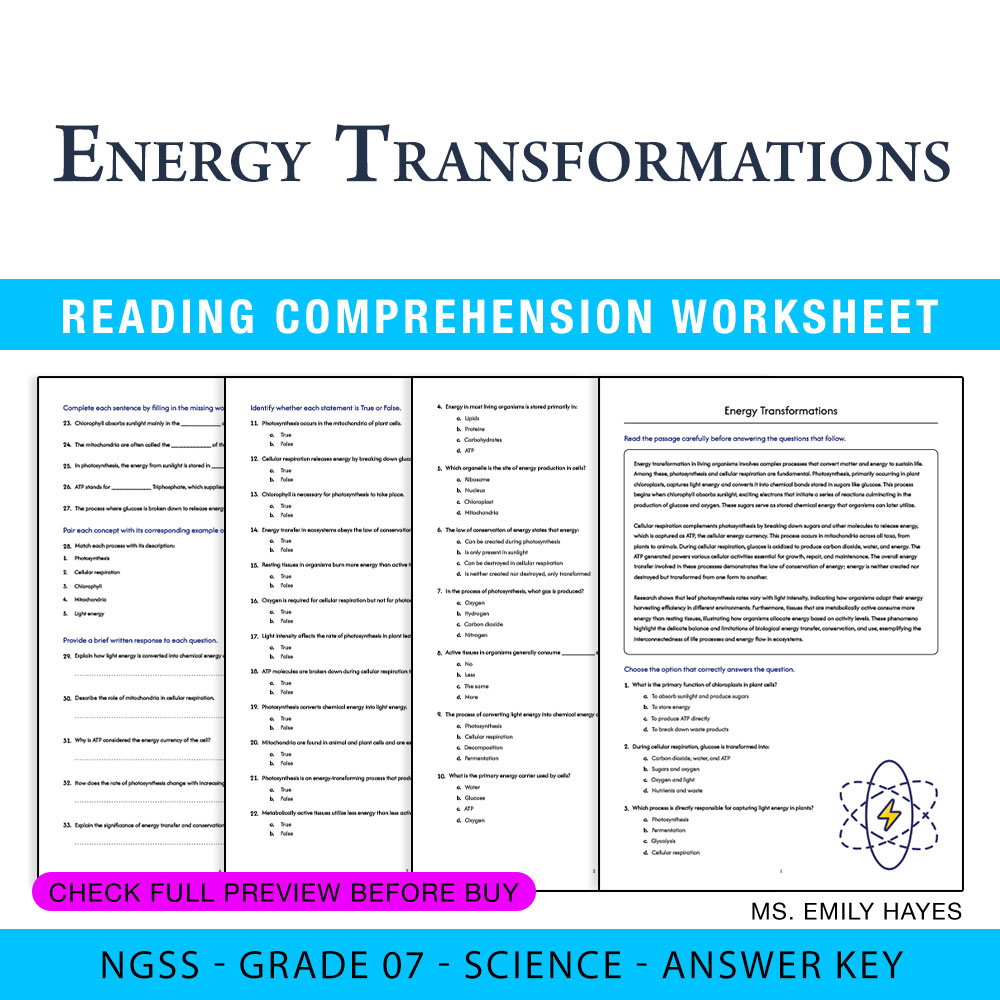
7th Grade Science | Energy Transformations Worksheet (PDF + Answer Key)
Created byCopper Leaf ClassroomLearning Objectives
- Explain how light energy is converted into chemical energy during photosynthesis.
- Describe how cellular respiration releases energy stored in food molecules.
- Connect processes of sugar production in chloroplasts to ATP generation in mitochondria across different organisms.
Instant download

Energy Transformations Worksheet | Grade 7 Science Practice
Created byPrism Point LearningLearning Objectives
- Explain how energy can change forms (mechanical, chemical, electrical, and thermal) while total energy is conserved.
- Use cause-and-effect reasoning to describe energy transformations in everyday systems.
- Identify examples of energy transformations, including hydroelectric and wind power, and combustion for heating.
Instant download

Grade 7 Conservation Strategies Worksheet | BC Use Practice PDF
 Created byClear Sky Classroom
Learning Objectives
- Explain how conservation strategies such as protected areas, habitat restoration, invasive species control, and sustainable harvesting reduce human impacts.
- Use ecological ideas (food webs, population dynamics, and abiotic constraints) to predict why conservation actions help ecosystems.
- Evaluate and propose conservation strategies using adaptive monitoring and evidence-based decision-making.
Instant download
Grade 11 Science | Thermochemistry Worksheet (Answer Key) – BC Standards
Created byBright Mind ResourcesLearning Objectives
- Understand the concept of enthalpy change in chemical reactions.
- Differentiate between endothermic and exothermic processes.
- Calculate reaction enthalpy using bond energies and standard enthalpies of formation.
Instant download
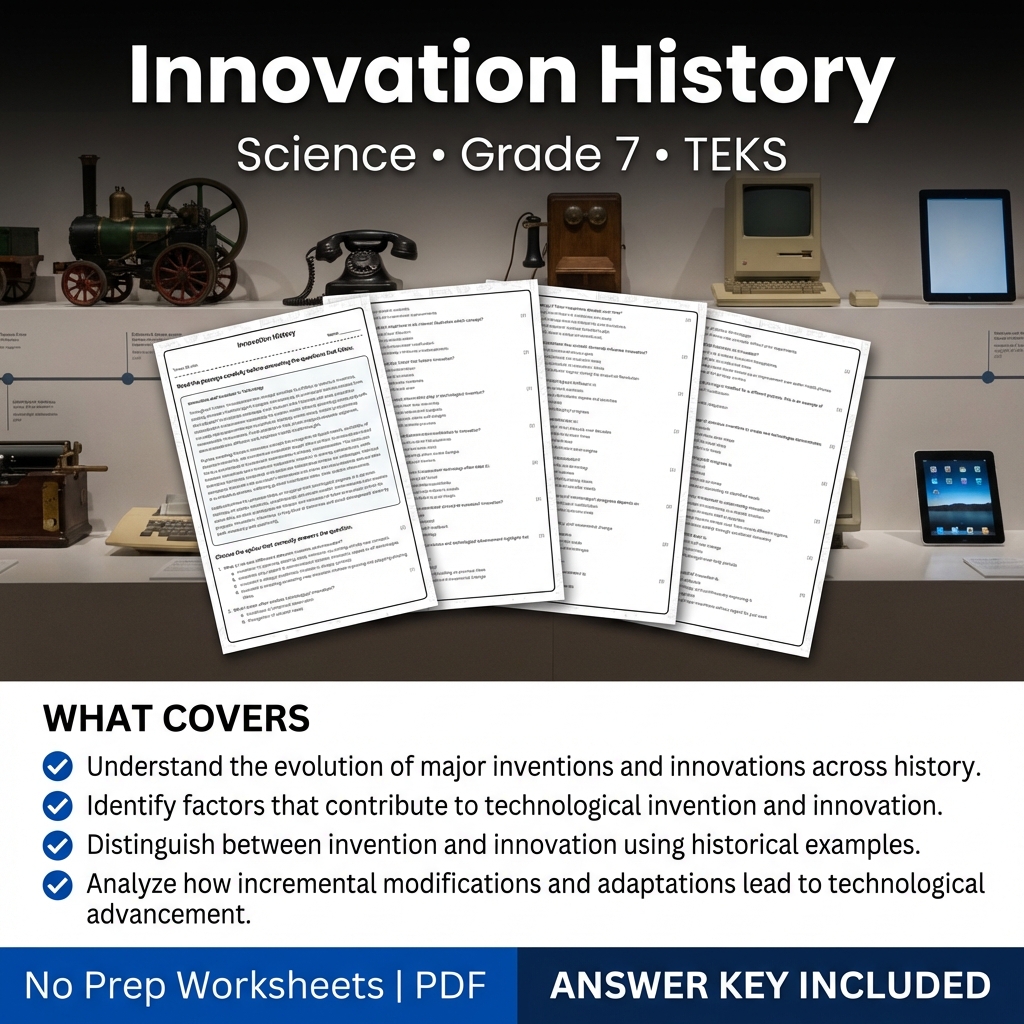
Grade 7 Science Worksheet on Innovation History | TEKS Standards Practice
Created byCoral Reef LearningLearning Objectives
- Understand the evolution of major inventions and innovations across history.
- Identify factors that contribute to technological invention and innovation.
- Distinguish between invention and innovation using historical examples.
Instant download
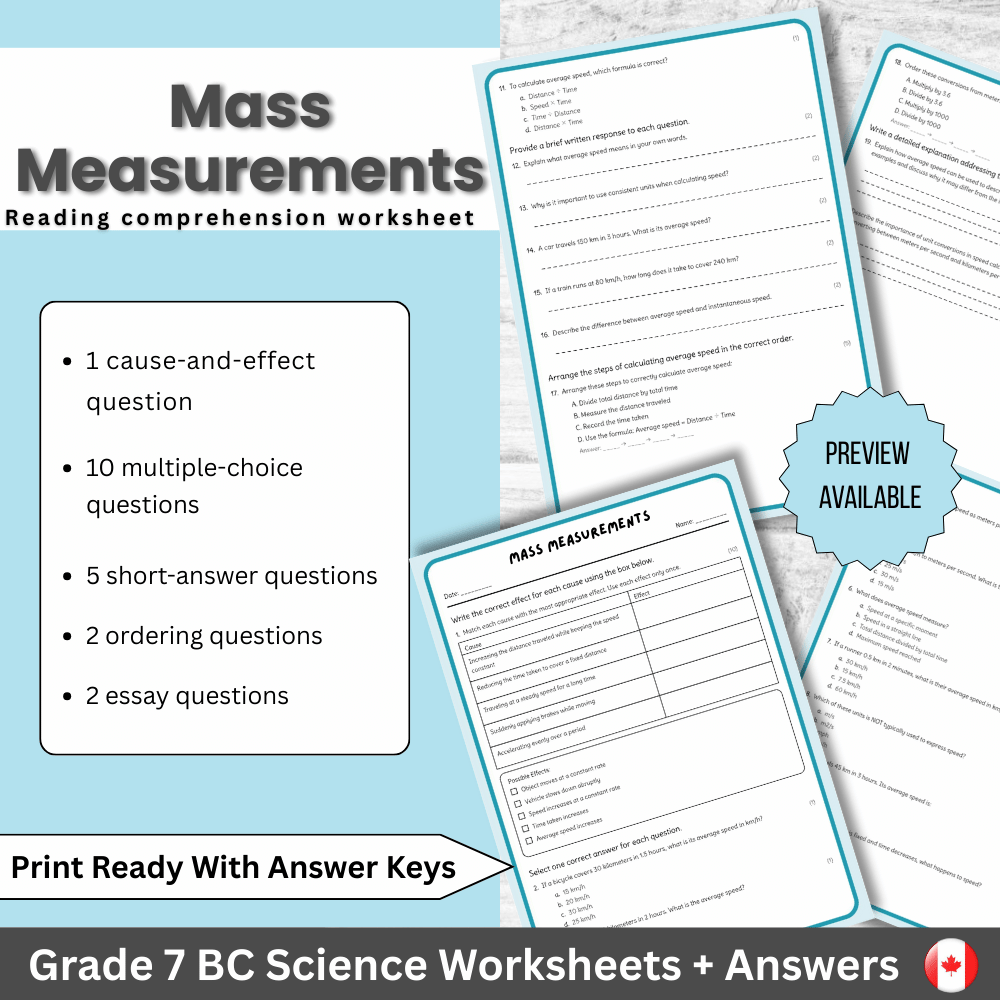
Grade 7 Science | Mass Measurements Worksheet (Answer Key) | BC Standards
Created byBright Mind ResourcesLearning Objectives
- Understand how mass measurements relate to conservation of mass during chemical processes.
- Identify factors that can affect mass measurements and how to control them.
- Describe the importance of including all phases of reactants and products in mass accounting.
Instant download
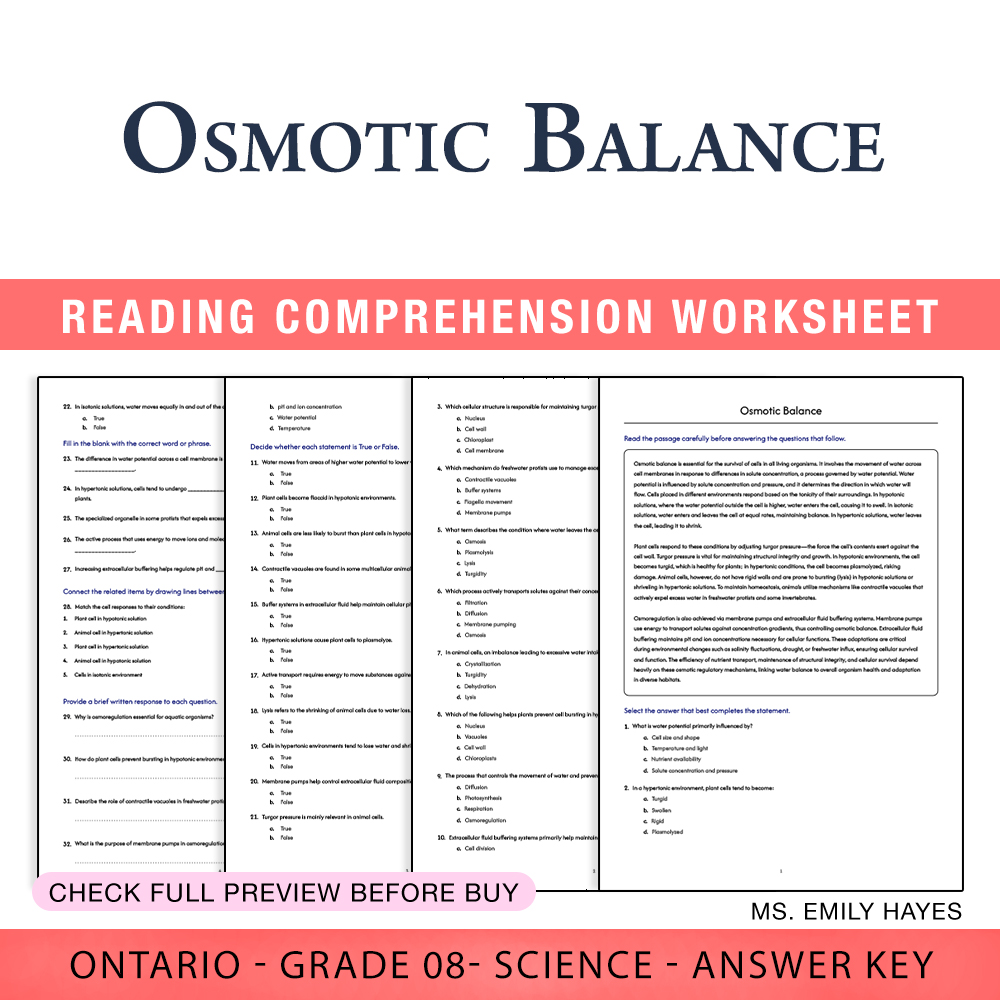
8th Grade Science | Osmotic Balance Worksheet (PDF+ Answer Key)
Created byCopper Leaf ClassroomLearning Objectives
- Understand the principles of water potential and tonicity in cells
- Describe cellular responses to hypotonic, isotonic, and hypertonic environments
- Compare mechanisms maintaining turgor in plant cells and volume in animal cells
Instant download
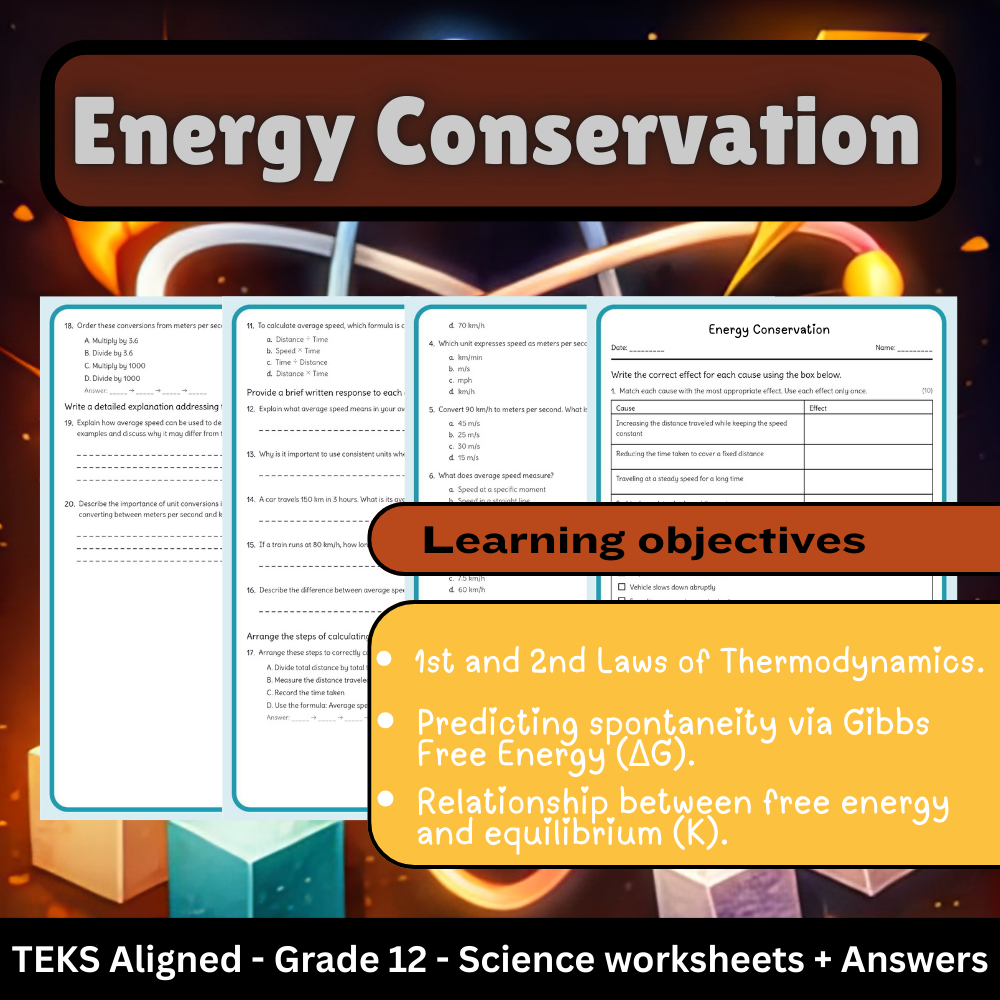
Grade 12 Science – Energy Conservation TEKS Aligned Worksheet (PDF)
Created byBright Mind ResourcesLearning Objectives
- Understand the principles of the first and second laws of thermodynamics as they apply to chemical systems.
- Predict spontaneity and direction of reactions using Gibbs free energy, enthalpy, and entropy.
- Interpret free energy changes from equilibrium constants in practical chemical processes.
Instant download
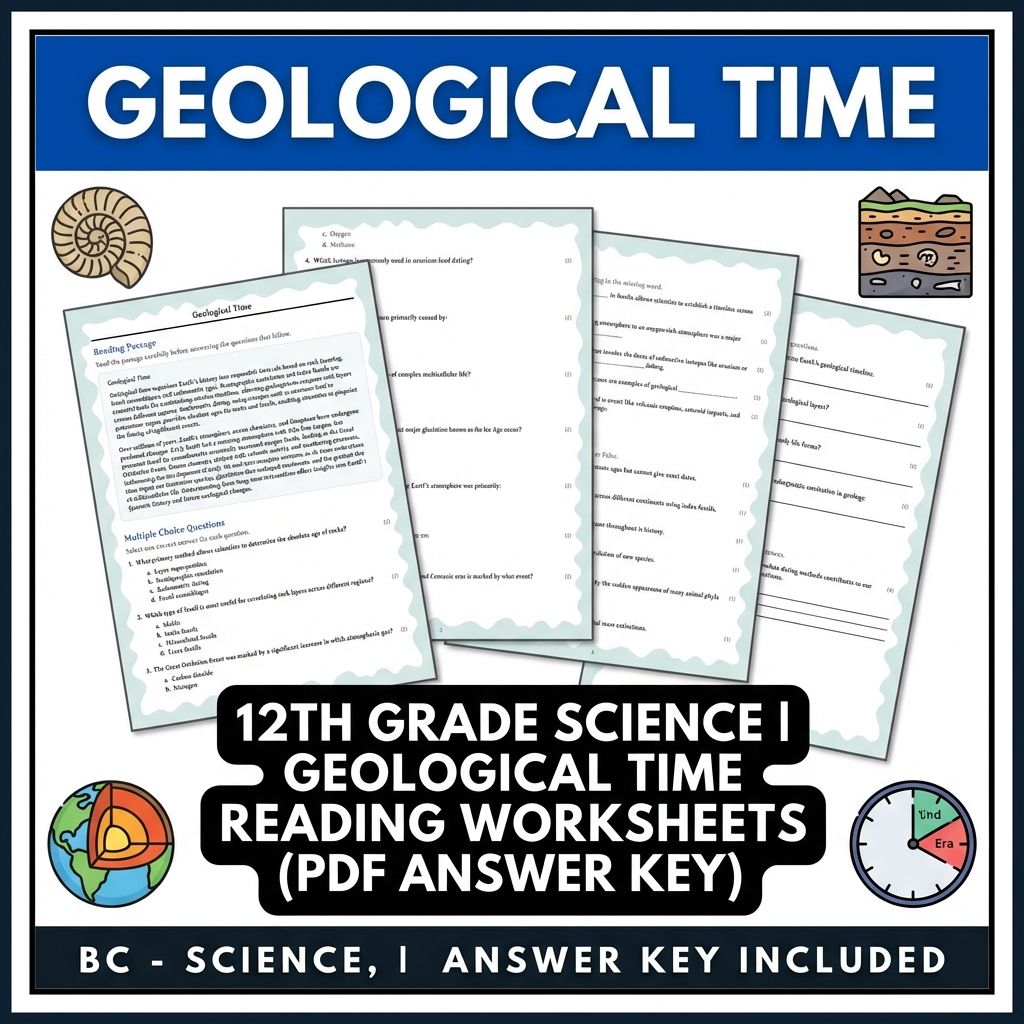
12th Grade Science | Geological Time Reading Worksheets (PDF Answer Key)
JCreated byJ.S SheetsLearning Objectives
- Understand the methods used to organize Earth's history through geological time intervals.
- Identify differences between relative and absolute dating techniques.
- Explain how Earth's biosphere, atmosphere, and oceans have evolved over geological periods.
Instant download

Grade 8 Science – Energy Transformations & Electrical Systems| Reading Worksheet
Created byBright Mind ResourcesLearning Objectives
- Understand how electrical energy is converted into heat in various devices
- Identify common examples of electrical-to-thermal energy conversion
- Explain the importance of efficiency in electrical heating systems
Also included in: Grade 8 Electricity Science Daily Reading Worksheets Lesson Bundle | Alberta +2 more
Instant download

Grade 10 Science | Energy Accounting - Daily Reading Comprehension
Created byCoral Reef LearningLearning Objectives
- Understand and describe energy transfer mechanisms in different systems
- Identify types of energy flows within mechanical, electrical, and thermal systems
- Utilize energy flow diagrams to analyze energy transfer
Instant download

Remote Sensing Spectral Data Worksheets for Grade 10 Science
 Created bySunny Desk Resources
Learning Objectives
- Describe how satellite and aerial remote sensing collect information about land cover, vegetation health, water extent, and surface temperature.
- Explain how spectral information and multi-spectral indices can reveal environmental change over time.
- Identify common derived remote sensing products and how they support system-scale interpretation with ground measurements.
Also included in: Earth Systems, Climate, and Sustainability Lesson Bundle | Grade 10 Science | Alberta +1 more
Instant download

Grade 10 Science | Membrane Dynamics Worksheet (AP Standards) (PDF)
 Created byEvergreen Desk Education
Learning Objectives
- Explain how membrane composition and selective permeability create electrochemical gradients
- Compare diffusion, carrier-mediated transport, and vesicular trafficking in terms of energy use and directionality
- Use Nernst concepts and flux-rate reasoning to predict ion distribution and signal propagation
Also included in: Grade 10 Genetics & Cell Systems Science Lesson Bundle – Advanced Placement (AP) +1 more
Instant download
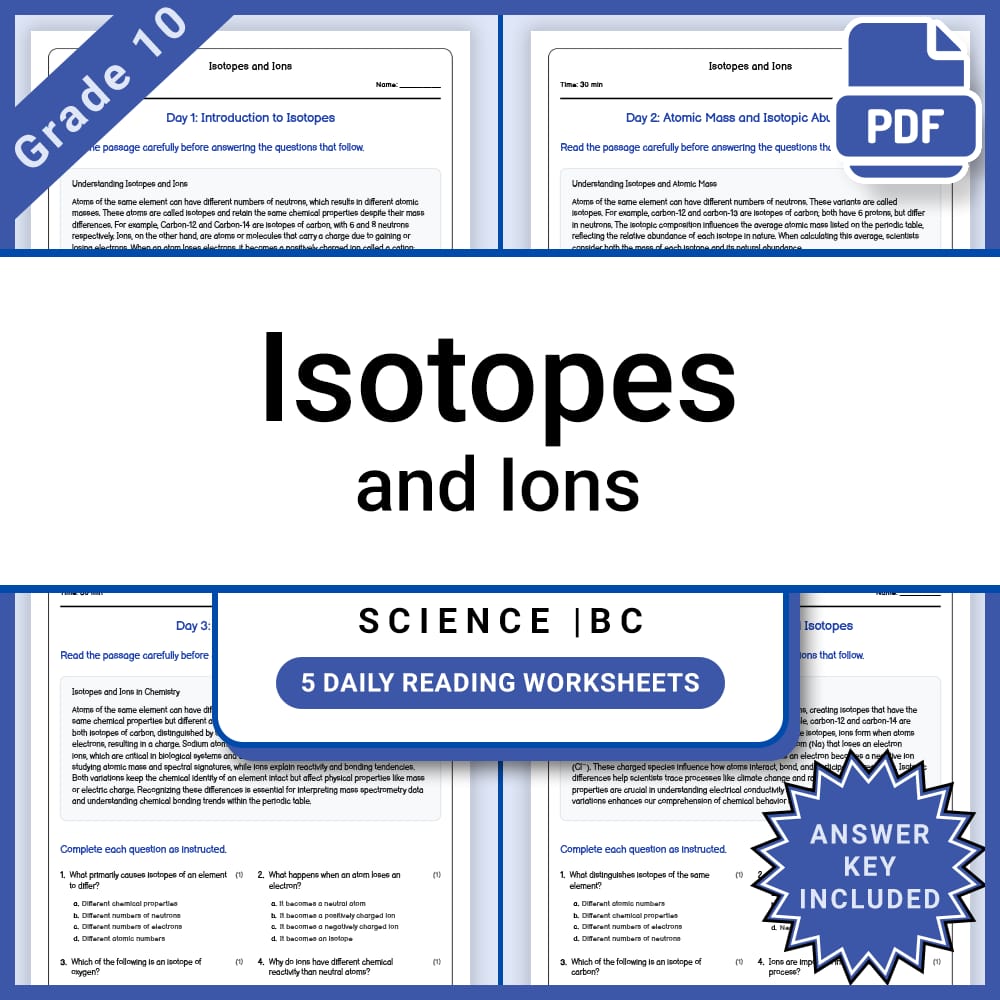
Grade 10 Science – Isotopes and Ions Daily Reading Worksheet + Answer Key
JCreated byJ.S SheetsLearning Objectives
- Understand key concepts related to Science
- Apply knowledge through practice questions
- Demonstrate comprehension of the material
Also included in: Grade 10 Science Lesson Group – Core Concepts & Skills Bundle +1 more
Instant download
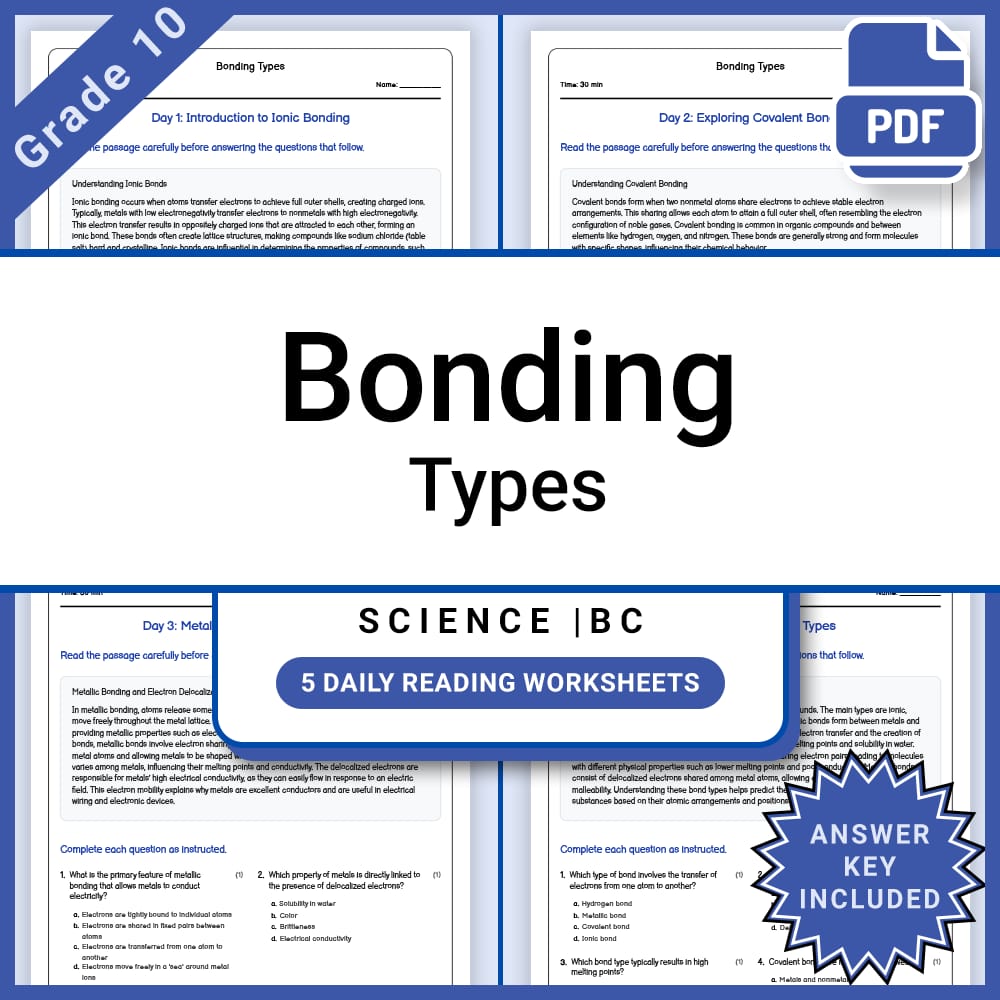
Grade 10 Science – Bonding Types Daily Reading Worksheet with Answer Key
JCreated byJ.S SheetsLearning Objectives
- Understand the different types of chemical bonds: ionic, covalent, and metallic.
- Identify ionic bonds based on electron transfer and element properties.
- Describe how atoms achieve stability through bonding mechanisms.
Also included in: Grade 10 Science Lesson Group – Core Concepts & Skills Bundle +1 more
Instant download
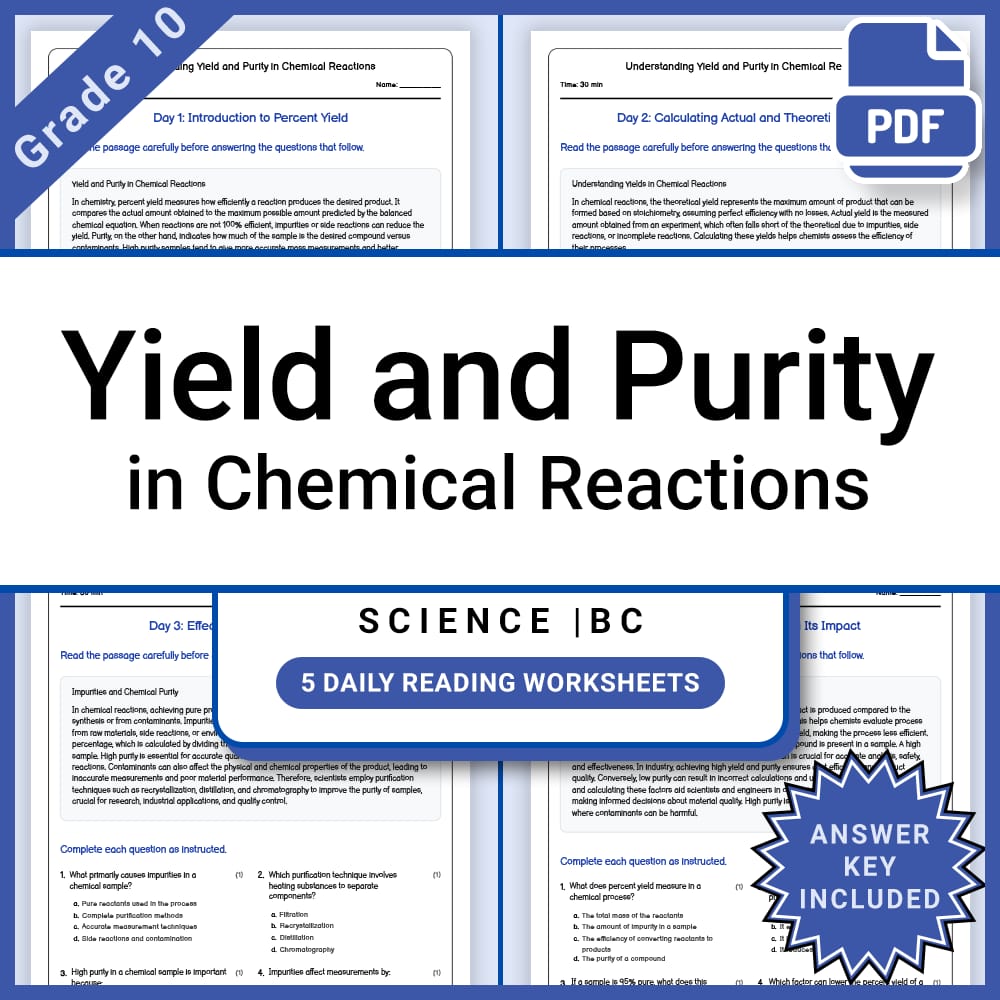
Grade 10 Science – Yield and Purity Daily Reading Worksheet + Answer Key
JCreated byJ.S SheetsLearning Objectives
- Define percent yield and explain how it measures process efficiency.
- Describe the concept of purity and its importance in chemical samples.
- Connect measured mass to atomic conservation in chemical transformations.
Also included in: Grade 10 Science Lesson Group – Core Concepts & Skills Bundle +1 more
Instant download
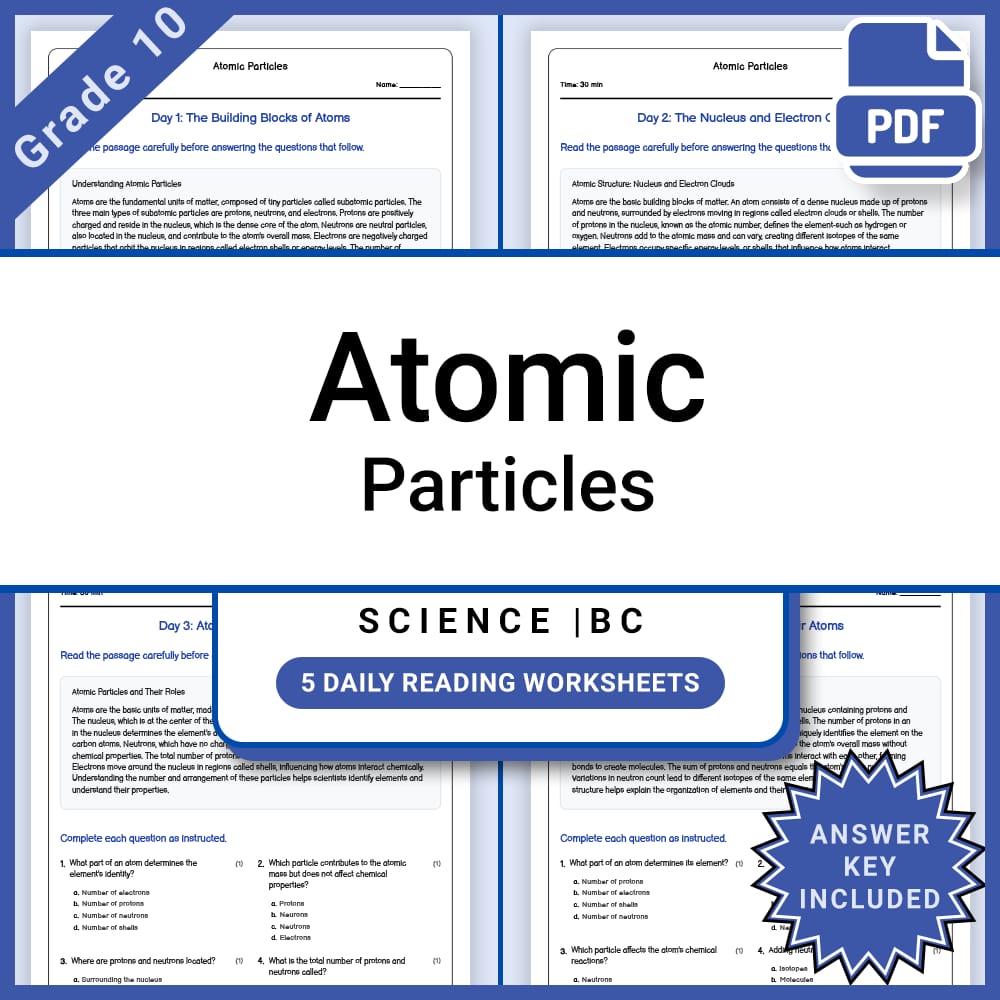
Grade 10 Science – Atomic Particles Daily Reading Worksheet with Answer Key
JCreated byJ.S SheetsLearning Objectives
- Identify the subatomic particles that make up atoms.
- Describe the roles of protons, neutrons, and electrons within an atom.
- Understand how atomic number and mass number relate to atomic structure.
Also included in: Grade 10 Science Lesson Group – Core Concepts & Skills Bundle +1 more
Instant download
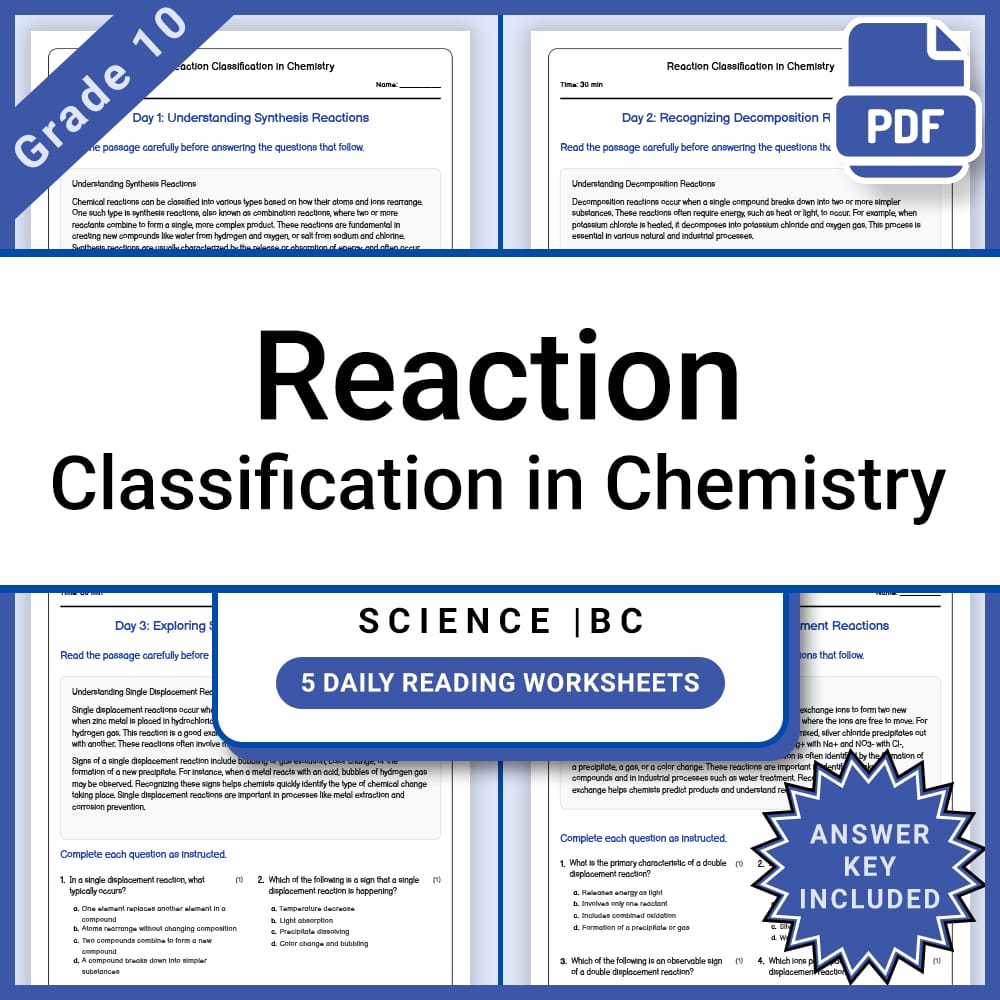
Grade 10 Science Reaction Classification Daily Reading Worksheet + Answer Key
JCreated byJ.S SheetsLearning Objectives
- Understand the different types of chemical reactions, especially synthesis reactions.
- Identify synthesis reactions based on reactants and products.
- Explain the characteristic features of synthesis reactions and their significance.
Also included in: Grade 10 Science Lesson Group – Core Concepts & Skills Bundle +1 more
Instant download
Browse more categories
About Science Worksheets
Find Science worksheets spanning core skills, practice, and review. All 44,342 resources are instant PDF downloads for the classroom or home.
Every worksheet on MyTeachingSheets is created by independent teacher-authors and reviewed before publication. All resources download as printable PDFs for classroom, homework, or at-home practice, and many include answer keys. Preview any worksheet free before buying.