
Science Worksheets
44,342 subject resources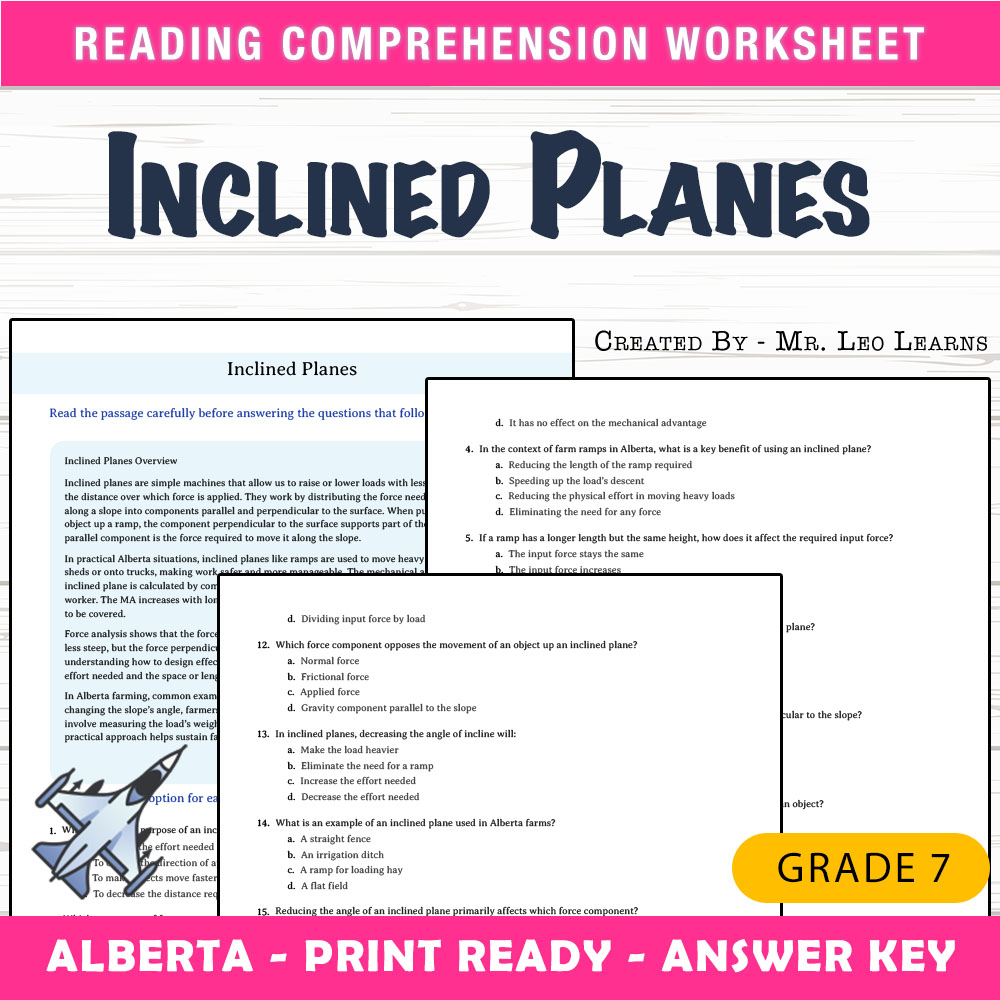
Grade 7 Science — Inclined Planes MCQ Worksheet for Mastering Simple Machines
 Created byThe Resource Hub
Learning Objectives
- Understand how inclined planes reduce the effort needed to lift loads by changing force components.
- Identify the parts of force parallel and perpendicular to an inclined plane.
- Calculate mechanical advantage of inclined planes using input force and load.
Also included in: Grade 7 Science Alberta Forces Structures and Motion Worksheet Bundle +1 more
Instant download

Grade 10 Science Periodic Trends Worksheet | Standards-Aligned Practice
JCreated byJ.S SheetsLearning Objectives
- Explain periodic trends in atomic radius, ionization energy, and electronegativity across periods and down groups
- Use group and period relationships to predict valence electron patterns and likely reactivity
- Classify elements as metals, nonmetals, or metalloids based on shared properties and trend behavior
Instant download
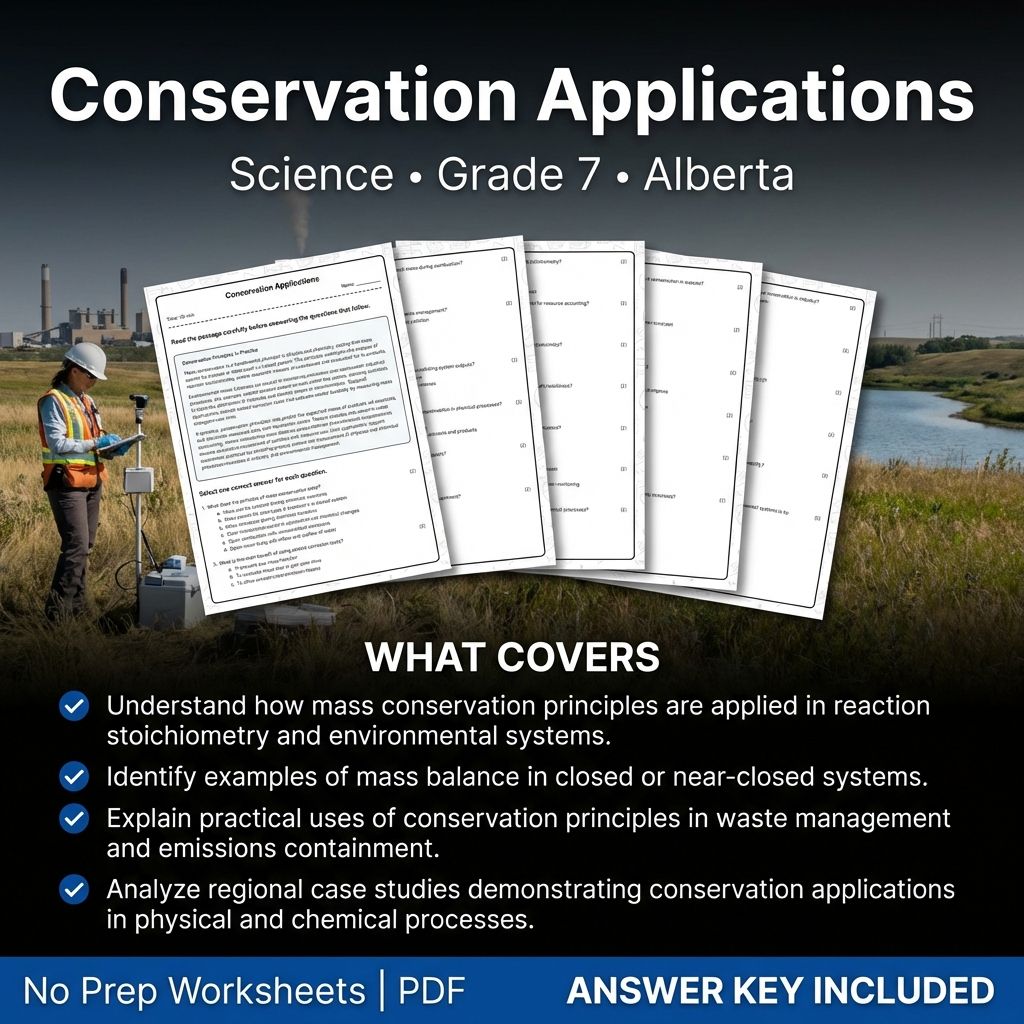
Grade 7 Science Worksheet on Conservation Applications | Alberta Standards
 Created byCoral Reef Learning
Learning Objectives
- Understand how mass conservation principles are applied in reaction stoichiometry and environmental systems.
- Identify examples of mass balance in closed or near-closed systems.
- Explain practical uses of conservation principles in waste management and emissions containment.
Instant download

Grade 6 Science – Atoms & Molecules Reading Worksheet | California Standards
 Created byBright Mind Resources
Learning Objectives
- Understand the concept of atoms and molecules.
- Learn how to count atoms of each element in chemical reactions.
- Recognize the conservation of atoms during chemical changes.
Also included in: Grade 6 Matter Science Daily Reading Worksheets Lesson Bundle | CA Standards +1 more
Instant download

Grade 6 Science – Understanding Mixtures & Compounds | Daily Reading Worksheet
Created byBright Mind ResourcesLearning Objectives
- Define mixtures and compounds.
- Identify differences between mixtures and compounds.
- Understand particle models of matter.
Also included in: Grade 6 Matter Science Daily Reading Worksheets Lesson Bundle | CA Standards +1 more
Instant download

Grade 6 Science – Atom Conservation & Reactions | Daily Reading Worksheet
Created byBright Mind ResourcesLearning Objectives
- Understand that atoms are neither created nor destroyed in chemical reactions.
- Recognize how atoms are rearranged to form new substances during reactions.
- Describe the particle-level explanation of atom conservation using diagrams.
Also included in: Grade 6 Matter Science Daily Reading Worksheets Lesson Bundle | CA Standards +1 more
Instant download

Grade 6 Science – Lunar Motion & Phases | Daily Reading Worksheet
Created byBright Mind ResourcesLearning Objectives
- Describe the different phases of the Moon and what causes them.
- Understand the pattern of the Moon's cycle over time.
- Identify observable changes in the Moon's appearance from Earth.
Also included in: Grade 6 Solar System & Seasons Science Daily Reading Lesson Bundle | Alberta +2 more
Instant download

Grade 6 Science – Historical Perspectives on Celestial Motion | Worksheet
Created byBright Mind ResourcesLearning Objectives
- Understand how Indigenous communities interpreted sky patterns for cultural and practical purposes.
- Explore different historical methods of observing and recording celestial motions.
- Recognize the cultural significance of solar and lunar cycles in various traditions.
Also included in: Grade 6 Solar System & Seasons Science Daily Reading Lesson Bundle | Alberta +2 more
Instant download
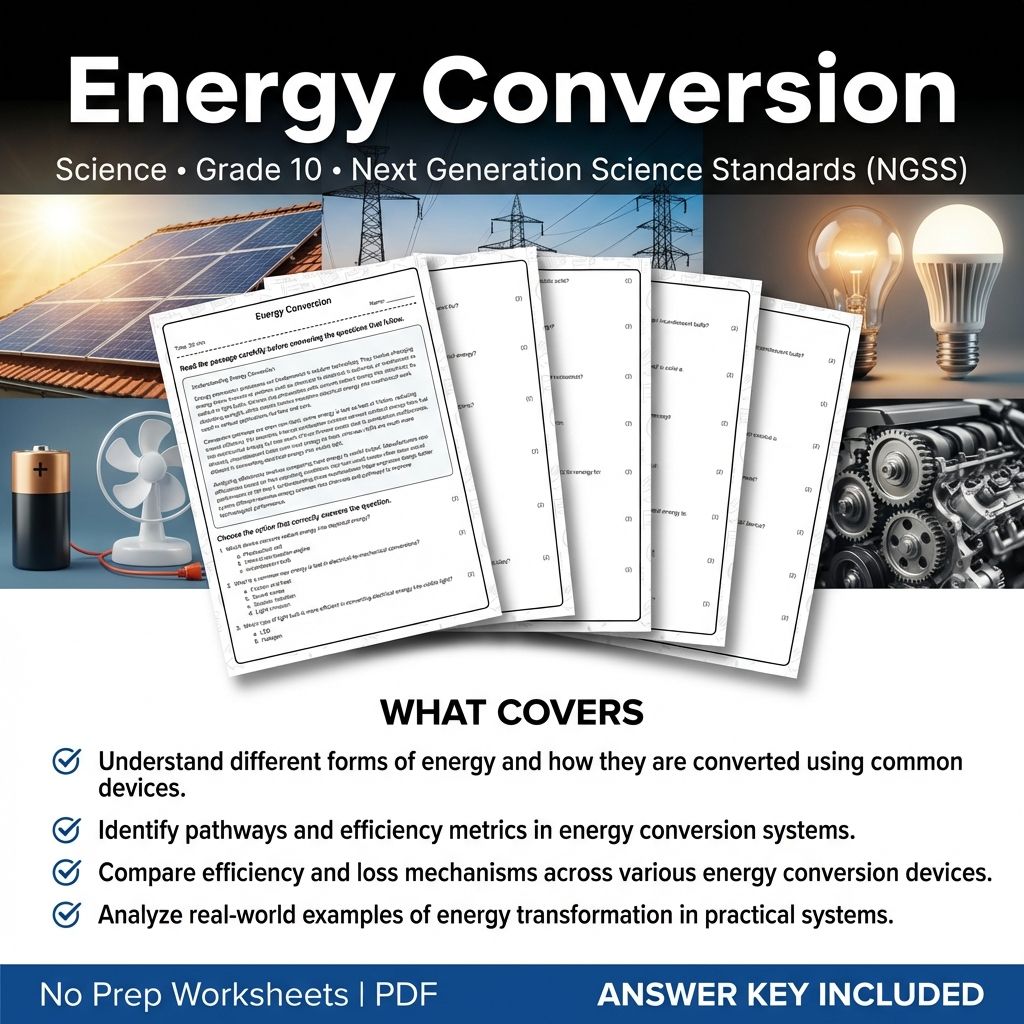
10th Grade Science | Energy Conversion Worksheet with Answer Key (Printable PDF)
Created byCoral Reef LearningLearning Objectives
- Understand different forms of energy and how they are converted using common devices.
- Identify pathways and efficiency metrics in energy conversion systems.
- Compare efficiency and loss mechanisms across various energy conversion devices.
Also included in: Grade 10 Science Unit Bundle | Work, Energy Transfer & Conservation Worksheets +1 more
Instant download
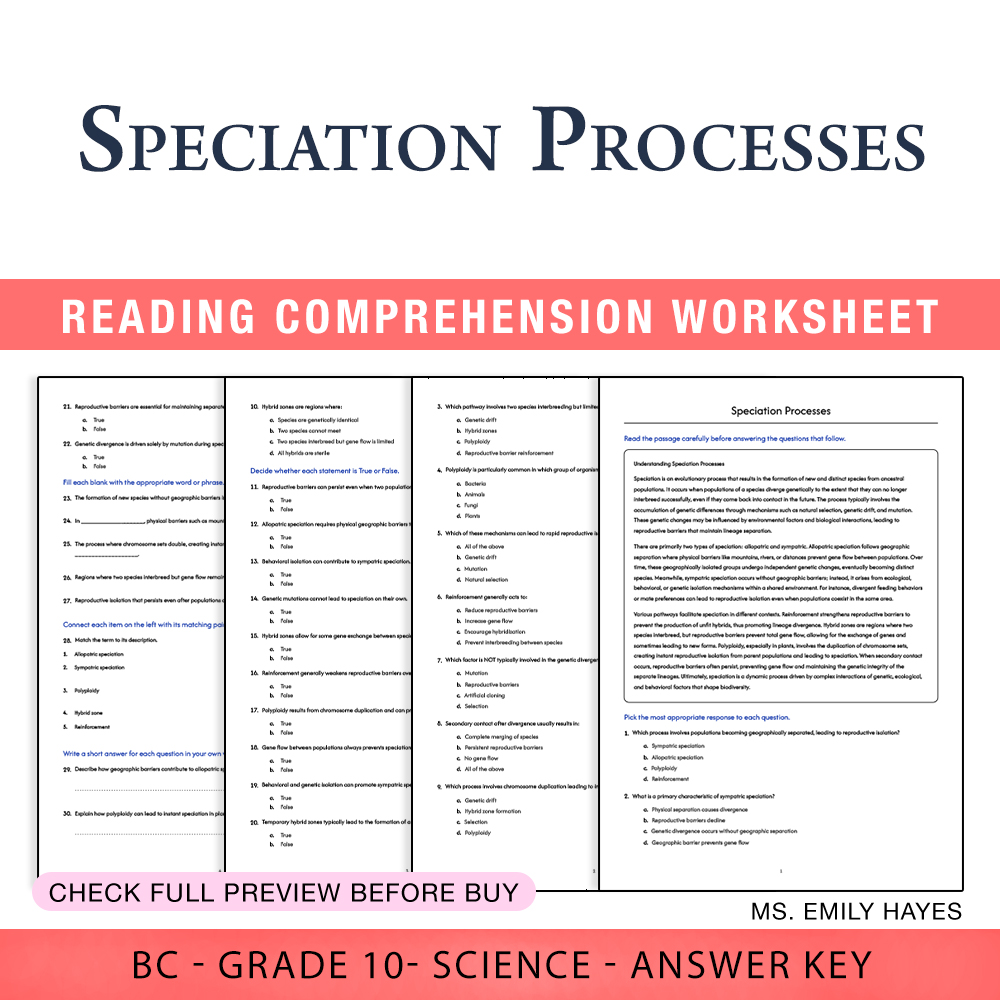
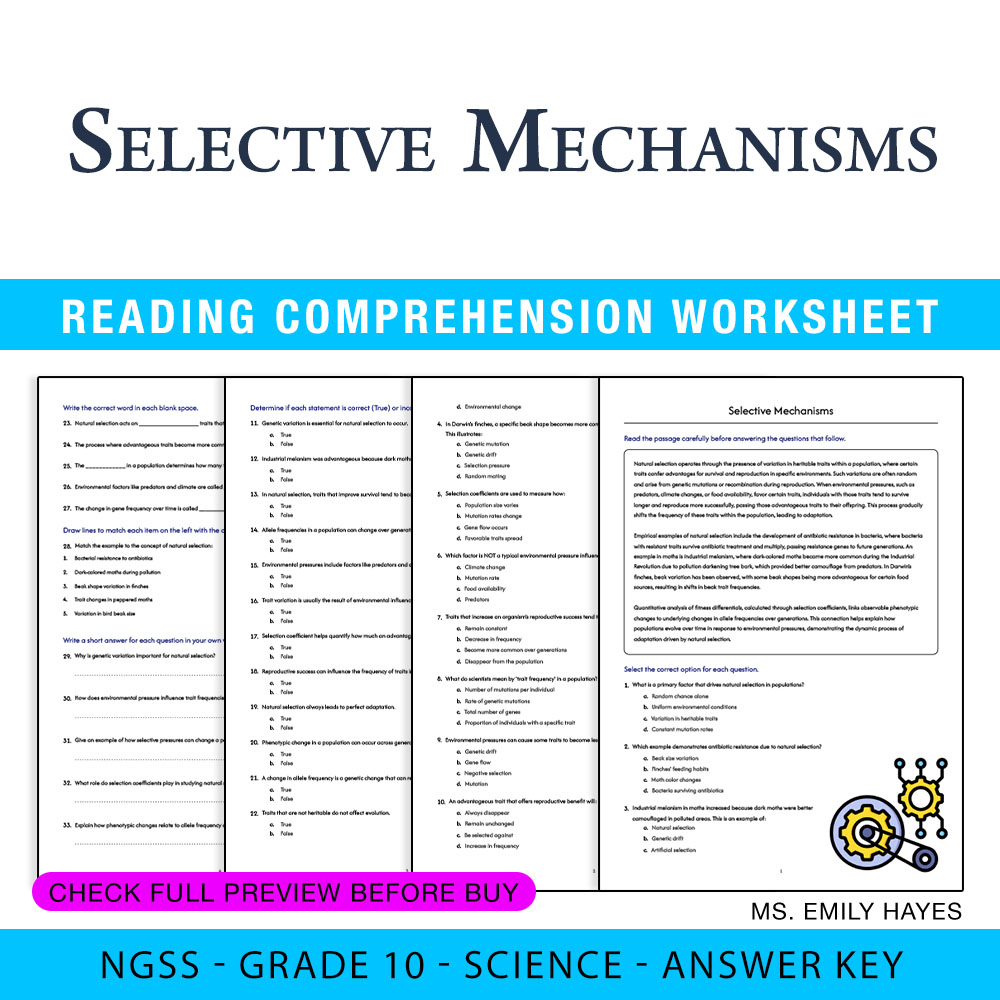
Grade 10 Science | Speciation Processes Worksheet (PDF+ Answer Key)
 Created byCopper Leaf Classroom
Learning Objectives
- Explain the concept of speciation and how reproductive barriers lead to the formation of new species.
- Differentiate between allopatric and sympatric speciation in various contexts.
- Identify pathways such as reinforcement, hybrid zones, and polyploidy that promote speciation.
Also included in: Grade 10 Science BC | Evolution, Biodiversity & Ecology (PDF + Answer Key) +1 more
Instant download
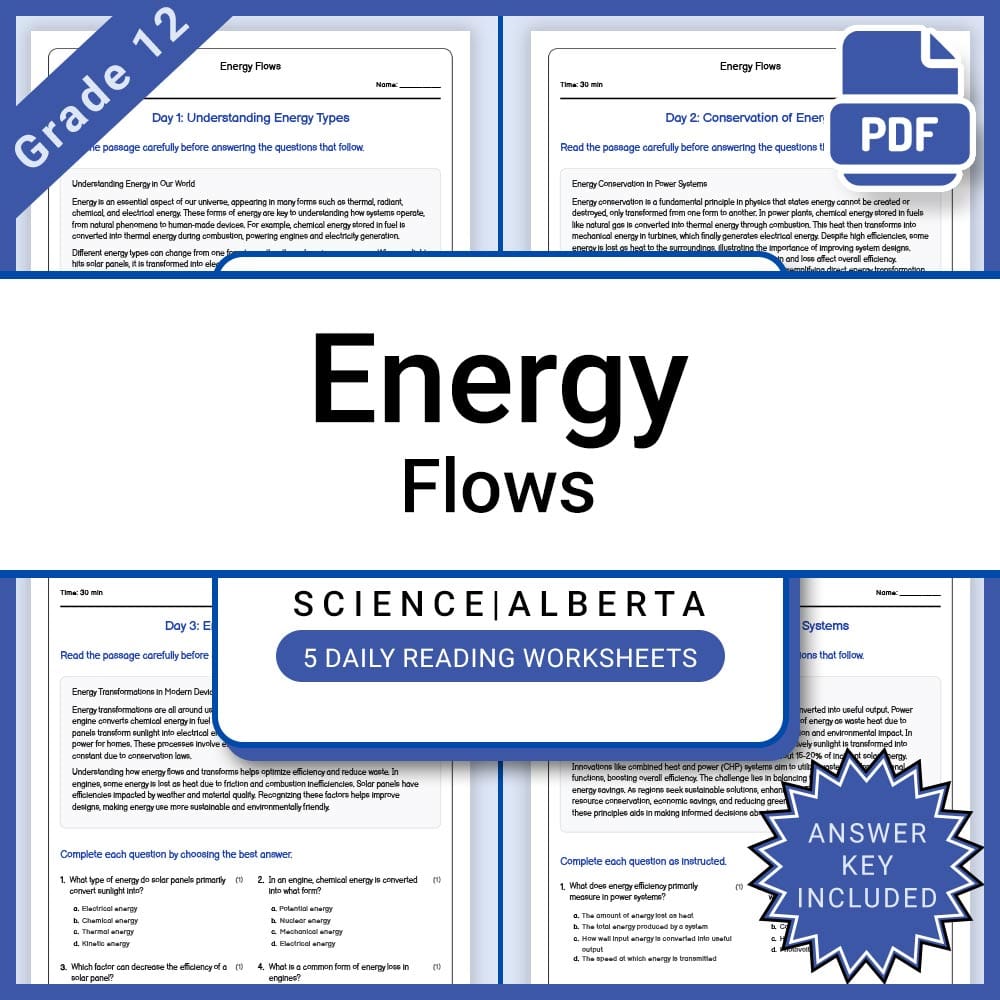
Grade 12 Science – Energy Flows Daily Reading Worksheet + Answer Key
JCreated byJ.S SheetsLearning Objectives
- Identify different forms of energy such as thermal, chemical, electrical, and radiant.
- Understand how energy transforms from one type to another in various systems.
- Apply thermodynamic principles to real-world energy processes like combustion, heat loss, and solar energy conversion.
Also included in: Grade 12 Science Lesson Bundle | Alberta Framework and Real-World Applications +1 more
Instant download
Grade 10 Science | Speciation Processes Worksheet (PDF + Answer Key)
Created byCopper Leaf ClassroomLearning Objectives
- Explain the mechanisms that lead to reproductive isolation and speciation.
- Identify empirical examples of different speciation processes.
- Describe phylogenetic patterns and evidence for lineage splitting.
Instant download

Grade 10 Science – Redox Reactions & Electron Transfer | Daily Reading Worksheet
Created byBright Mind ResourcesLearning Objectives
- Define oxidation and reduction processes in chemical reactions.
- Identify oxidation and reduction in simple chemical equations.
- Explain the transfer of electrons and changes in oxidation states.
Also included in: Chem Reactions Grade 10 Science Daily Reading Worksheets Lesson Bundle | BC +1 more
Instant download

Hess Cycles Worksheet | Grade 12 Science Activities
 Created byPrism Point Learning
Learning Objectives
- Explain how Hess’s law uses conservation of enthalpy to relate reaction energetics across multiple pathways.
- Use thermochemical cycle ideas to show how enthalpy changes cancel and add to give an overall ΔH.
- Connect Hess cycles to indirect determination of difficult quantities such as lattice energy.
Instant download

Le Chatelier Worksheet | Grade 12 Science Activities
Created byPrism Point LearningLearning Objectives
- Apply Le Chatelier’s principle to predict how equilibrium shifts when concentration, pressure, or temperature changes.
- Determine which side of a gaseous equilibrium will be favored based on relative moles of gas and pressure changes.
- Explain how temperature changes depend on reaction enthalpy and how catalysts affect reaction rates without changing equilibrium position.
Instant download
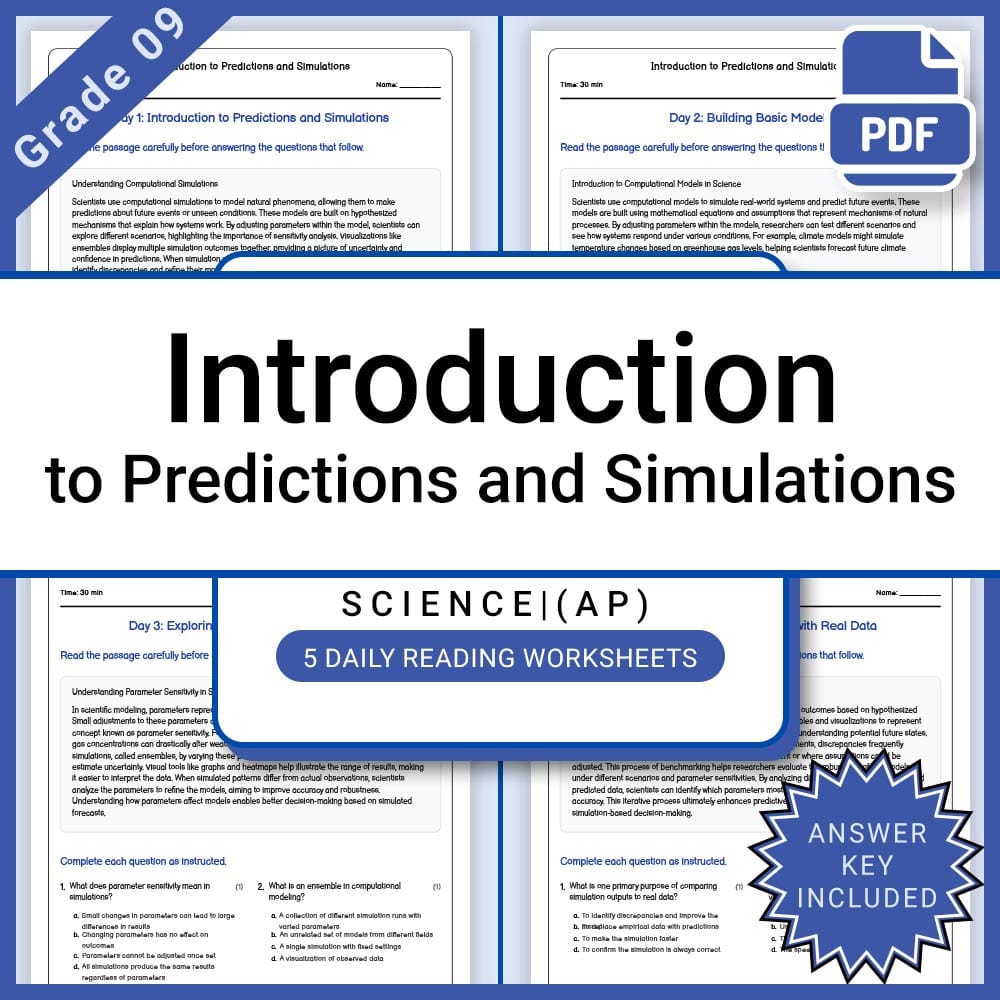
Grade 9 – Introduction to Predictions and Simulations Worksheet + Answer Key
JCreated byJ.S SheetsLearning Objectives
- Understand the purpose of simple computational simulations in science.
- Recognize how models generate predictions based on hypotheses.
- Learn about the role of parameter sensitivity in simulations.
Also included in: Grade 9 Science Lesson Group - AP Framework Daily Reading Worksheets +1 more
Instant download
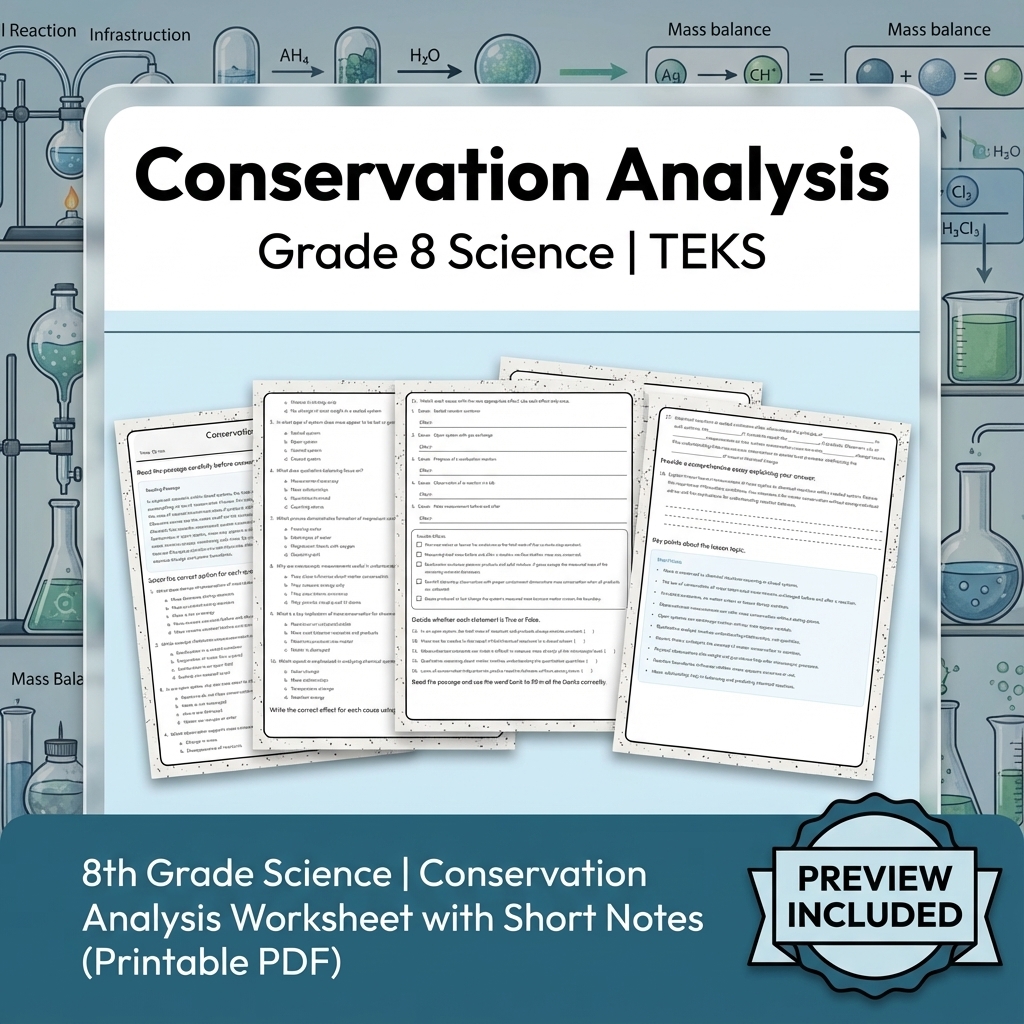
8th Grade Science Conservation Analysis Worksheet with Short Notes (PDF)
 Created byMeadowlark Worksheets
Learning Objectives
- Understand the concept of mass conservation in closed chemical systems.
- Analyze and interpret mass relationships during chemical reactions.
- Distinguish between closed and open systems in chemical processes.
Instant download

Molecular Signaling Gene Expression Worksheets | Grade 9 Science
 Created byTeachers Club
Learning Objectives
- Explain how molecular signaling regulates gene expression and protein activity.
- Describe receptor-ligand binding and signal transduction cascades.
- Interpret how mutations alter molecular regulation and systemic outcomes.
Also included in: Grade 9 Science Worksheets: From Molecules to Organisms NGSS Bundle +1 more
Instant download
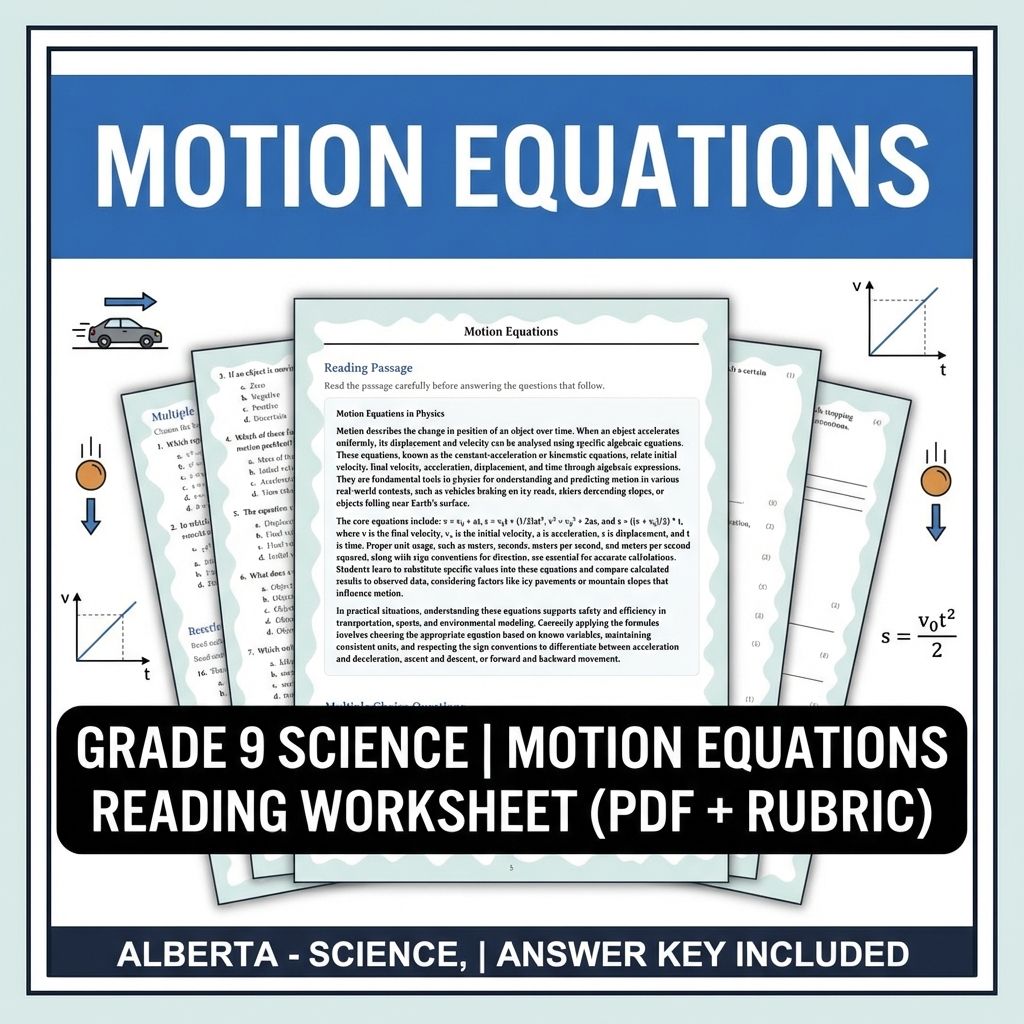
Grade 9 Science | Motion Equations Reading Worksheet (PDF + Rubric)
JCreated byJ.S SheetsLearning Objectives
- Understand the basic form of constant-acceleration motion equations.
- Apply algebraic substitution to solve for displacement, velocity, or time.
- Interpret real-world applications such as stopping distances and falling objects.
Also included in: Grade 9 Science Unit Bundle | Motion, Forces & Energy Activities (PDF) +1 more
Instant download

Grade 6 Science | Animals Matter Use of Food Worksheet | California Standards
 Created byLumora Learning
Learning Objectives
- Explain how animals use both matter and energy to live, grow, and function.
- Describe how food provides matter that becomes parts of an animal’s body.
- Describe how food provides energy that powers life processes and releases energy to the environment.
Instant download
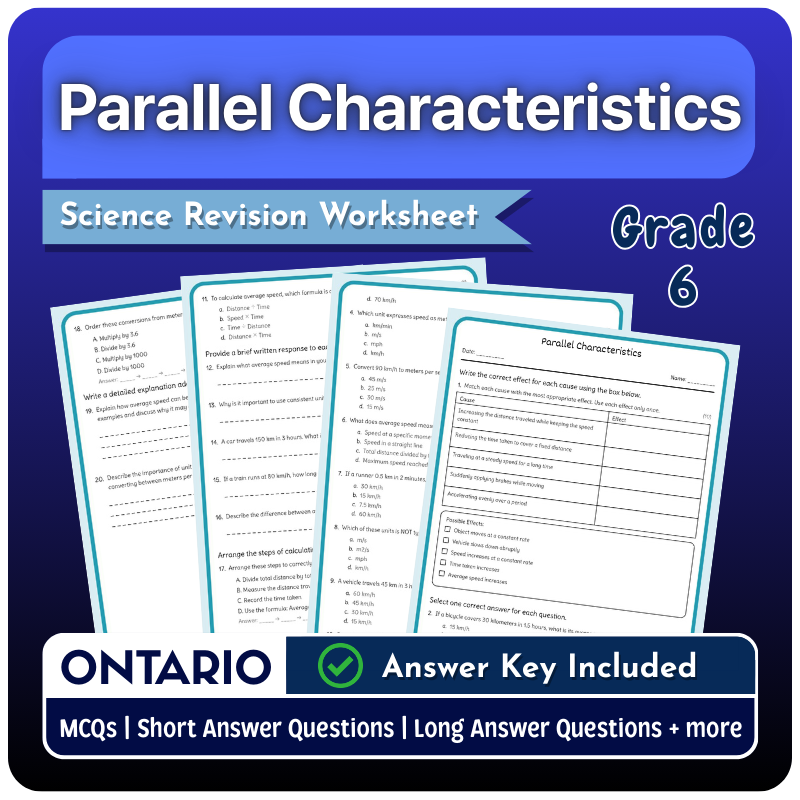
6th Grade Science | Parallel Circuit Characteristics Worksheet (PDF)
Created byBright Mind ResourcesLearning Objectives
- Understand the concept of parallel circuits and their branch structure.
- Explain how equal potential difference exists across branches in parallel wiring.
- Describe how overall current in a parallel circuit is the sum of branch currents.
Instant download
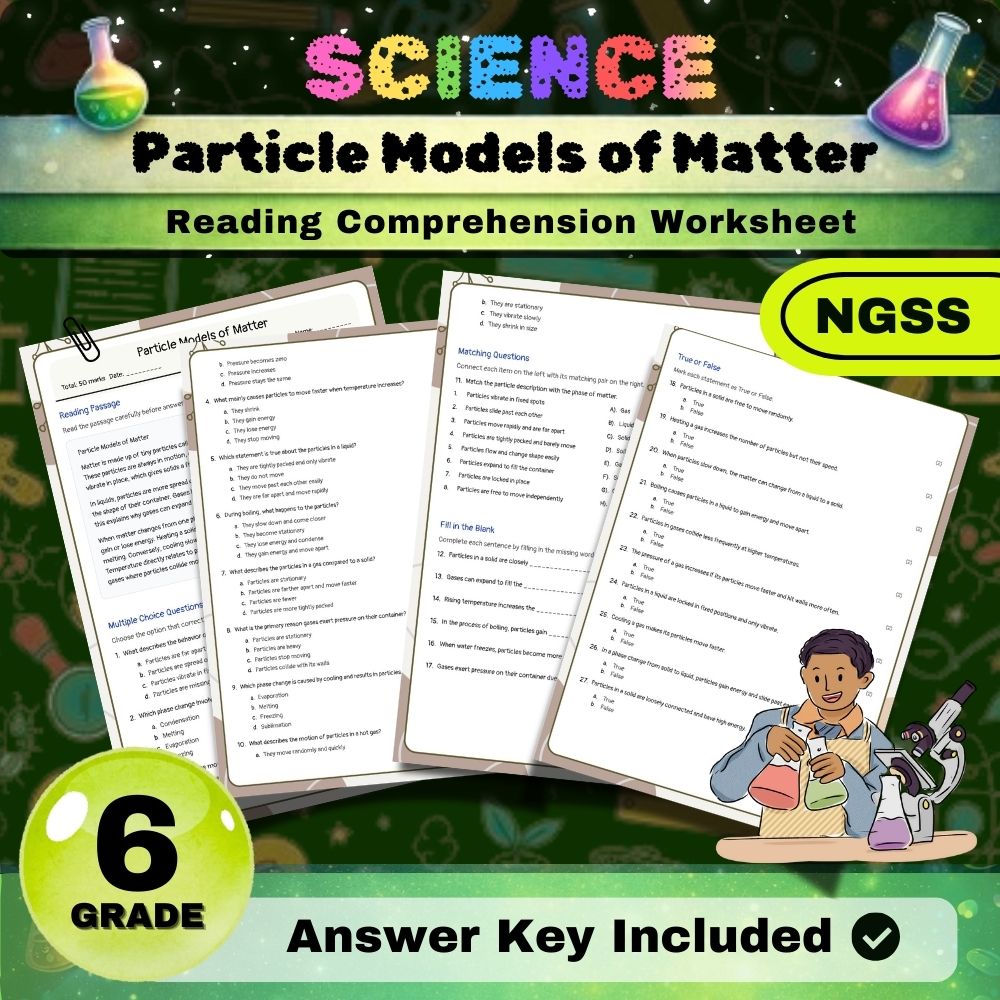
6th Grade Science | Particle Models of Matter Worksheet (PDF + Answer Key)
 Created byMaple Path Learning
Learning Objectives
- Explain how particles behave and interact in different states of matter
- Describe how temperature affects particle speed and energy
- Relate microscopic particle motion to macroscopic properties like melting and boiling
Also included in: Grade 6 Science| Matter, Chemical Reactions & Conservation NGSS Worksheet Bundle +1 more
Instant download
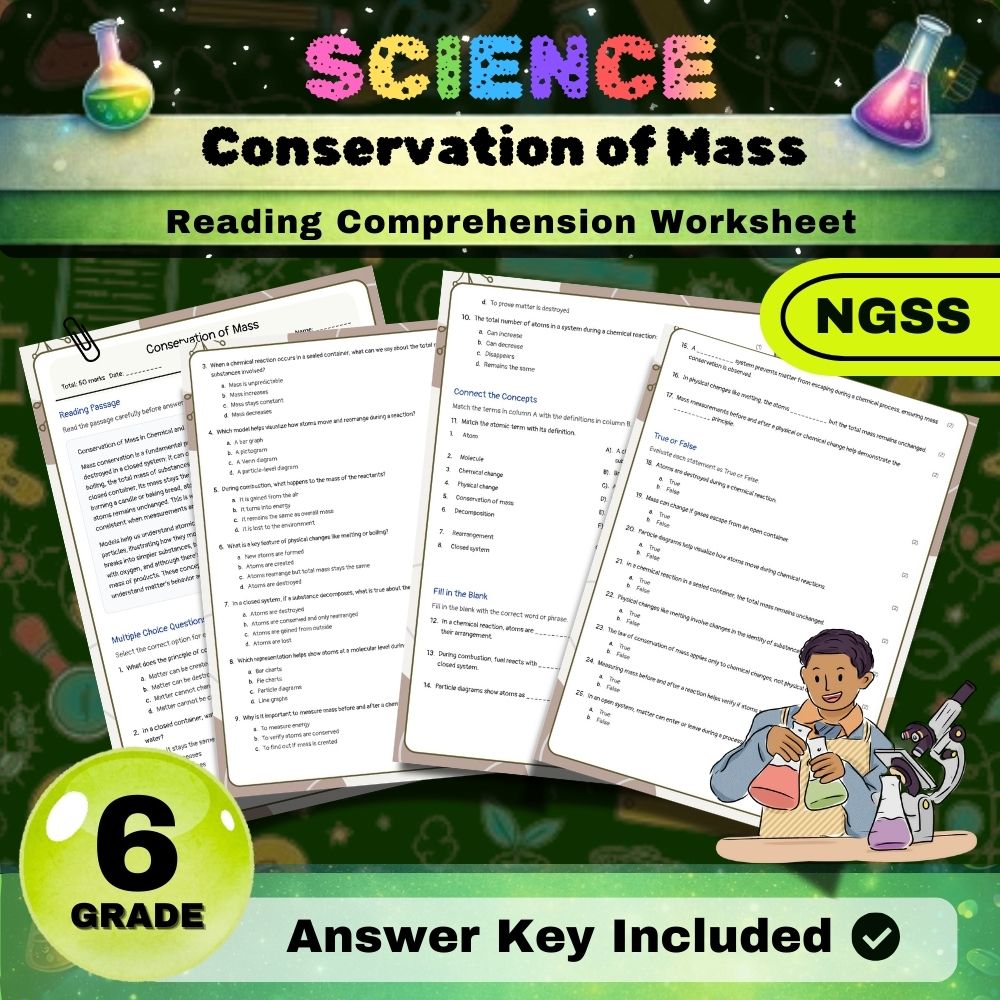
6th Grade Science | Conservation of Mass NGSS Worksheet (PDF)
Created byMaple Path LearningLearning Objectives
- Develop models that demonstrate the conservation of mass during physical and chemical changes.
- Trace atoms and measure total mass before and after physical and chemical processes.
- Use particle-level diagrams and symbolic representations to explain that atoms are conserved.
Also included in: Grade 6 Science| Matter, Chemical Reactions & Conservation NGSS Worksheet Bundle +1 more
Instant download

Light and Carbon Assessment | TEKS Grade 10 Science
Created byPrism Point LearningLearning Objectives
- Describe the process of light reactions and their role in photosynthesis.
- Understand how the Calvin cycle fixes carbon dioxide into sugars.
- Identify the roles of chlorophyll, accessory pigments, and enzymes like RuBisCO.
Instant download
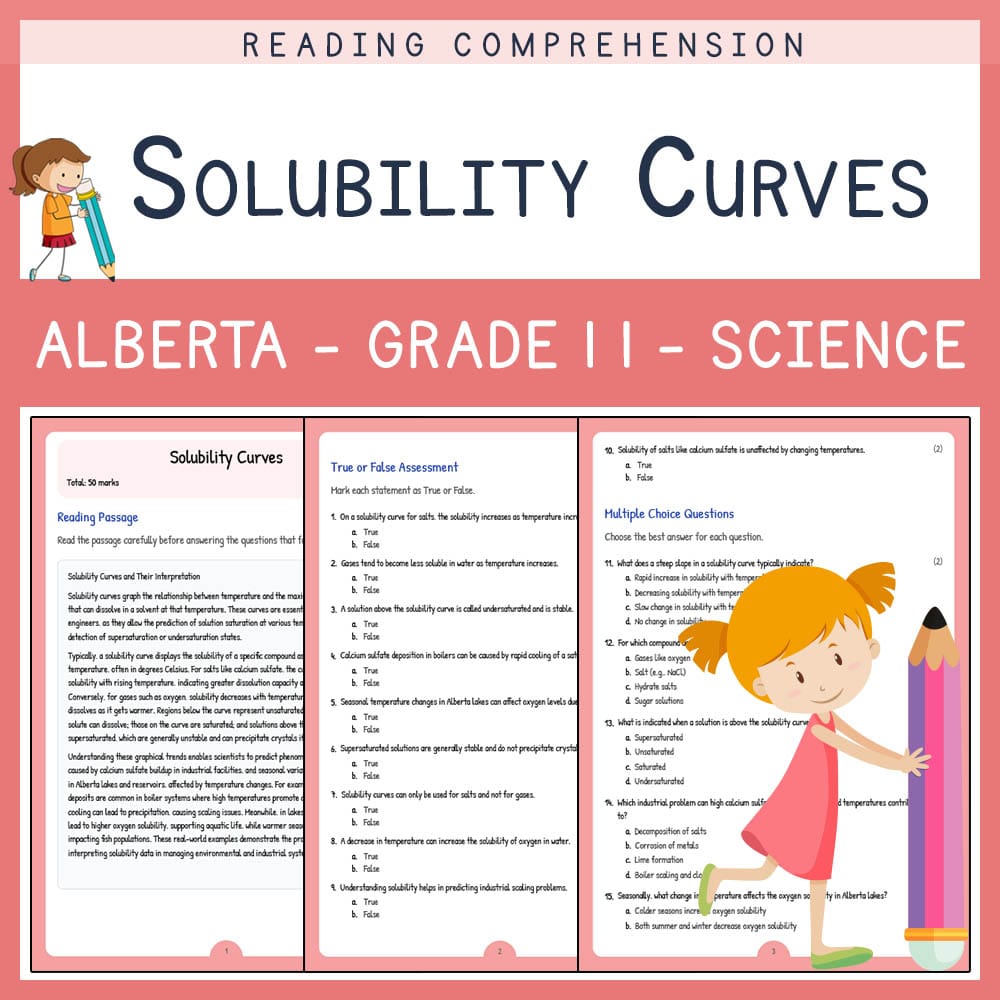
Grade 11 Science | Solubility Curves Worksheet | Alberta Standards
Created byLumora LearningLearning Objectives
- Understand how to read and interpret solubility curves for different compounds.
- Identify regions of unsaturated, saturated, and supersaturated solutions on a graph.
- Connect graphical trends to molecular interactions and predict solution states.
Instant download
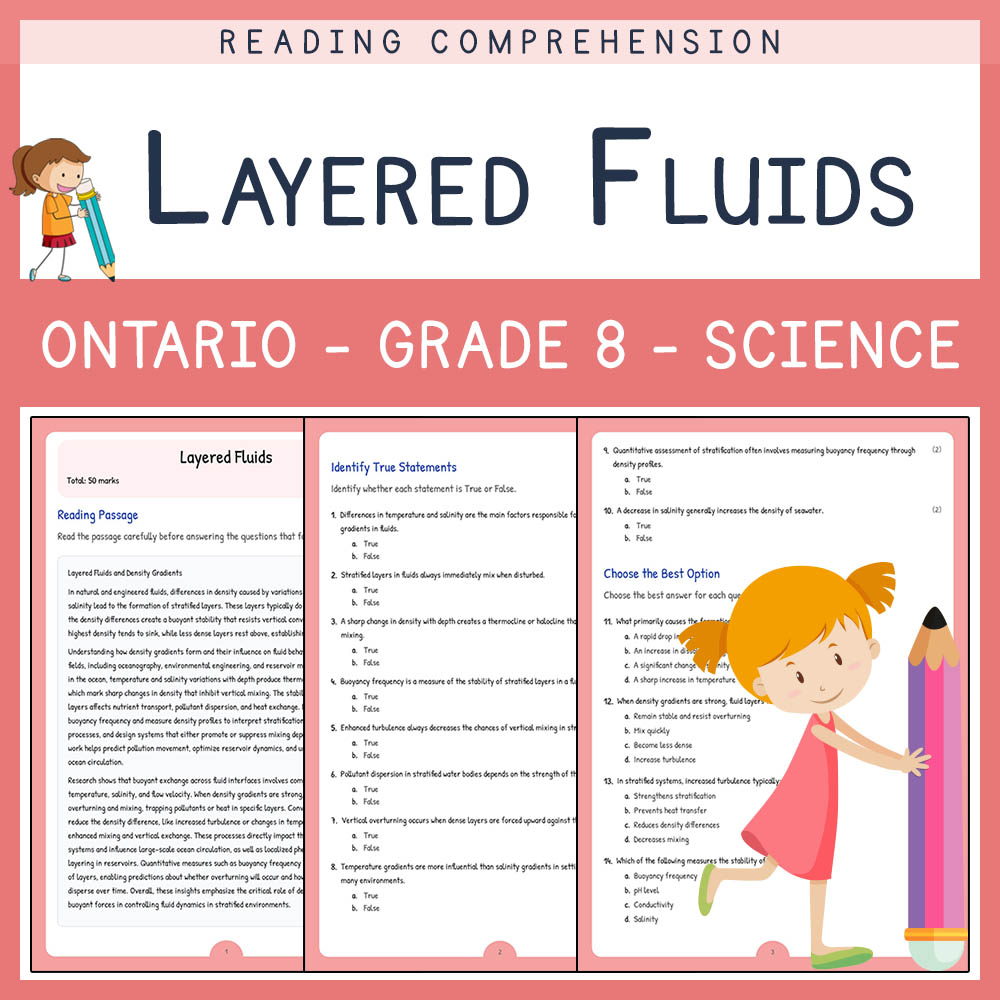
Grade 8 Science Assessment | Layered Fluids Worksheet | Ontario Standard
Created byLumora LearningLearning Objectives
- Explain how density differences in fluids create stratified layers in natural and engineered systems.
- Describe how temperature and salinity influence fluid density gradients and buoyancy.
- Understand how density gradients affect vertical mixing, pollutant dispersion, and ocean circulation.
Also included in: Grade 8 Science | Fluids Lesson Bundle | Ontario Framework
Instant download
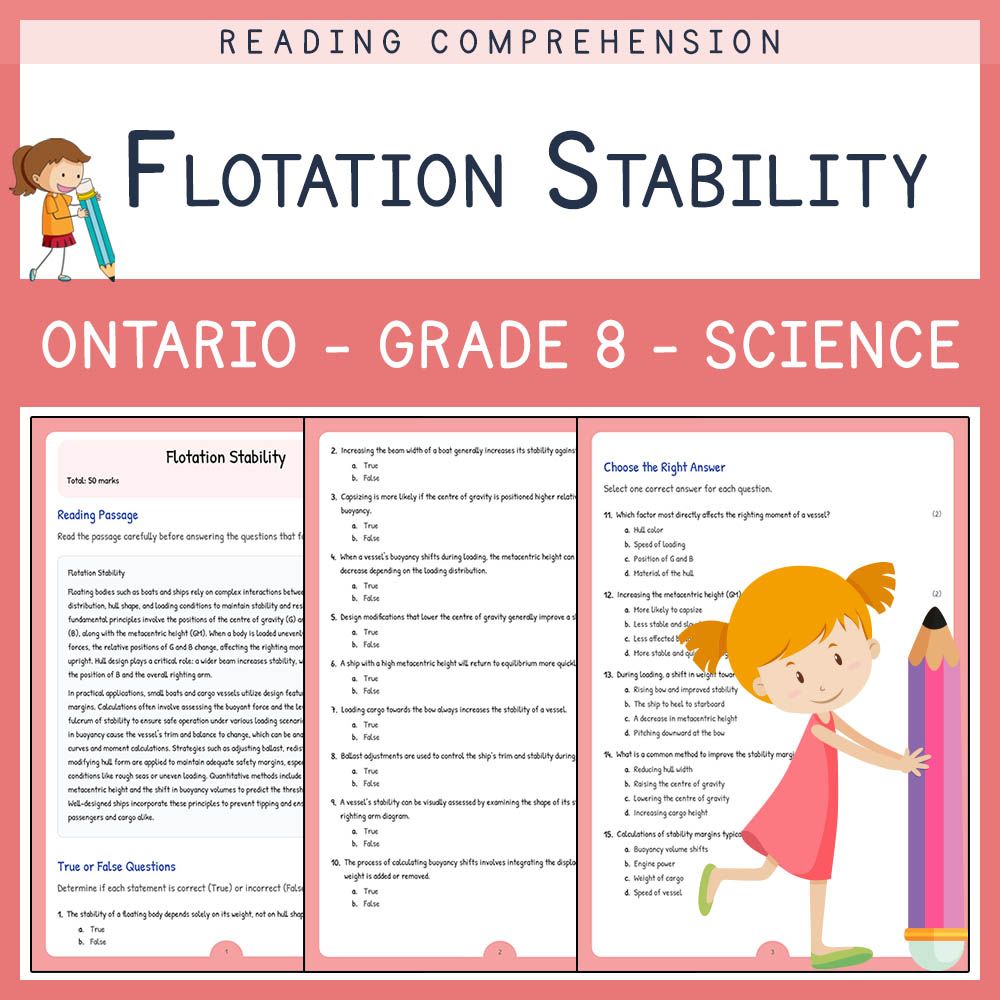
Grade 8 Science Assessment | Flotation Stability Worksheet | Ontario
Created byLumora LearningLearning Objectives
- Explain how the relative positions of the centre of gravity and centre of buoyancy affect a floating body's stability.
- Identify factors such as weight distribution, hull shape, and loading that influence upright equilibrium and capsize risk.
- Describe how design choices in small boats and cargo ships alter righting moments and stability margins through quantitative examples.
Also included in: Grade 8 Science | Fluids Lesson Bundle | Ontario Framework
Instant download
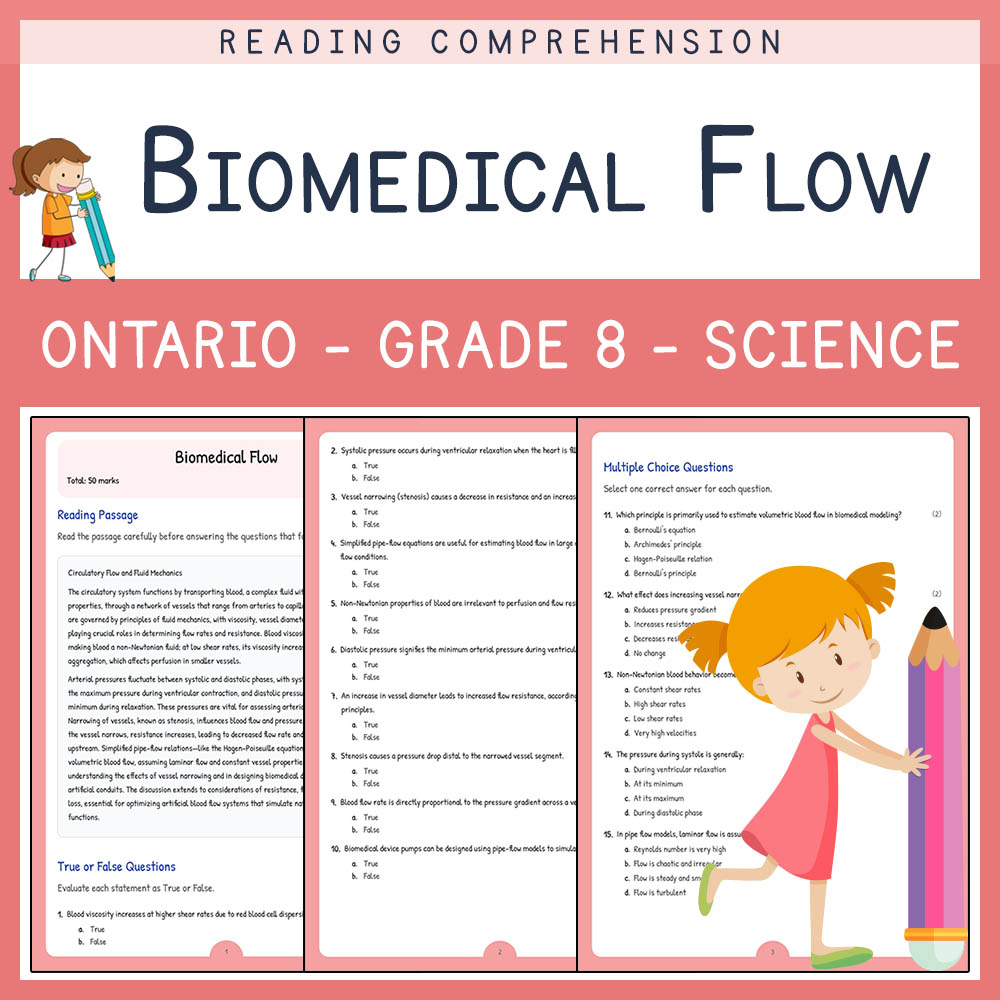
Grade 8 Science Assessment | Biomedical Flow Worksheet Elena | Ontario
Created byLumora LearningLearning Objectives
- Understand the principles of fluid mechanics as they apply to blood flow in the circulatory system.
- Explain how non-Newtonian blood properties influence perfusion and vessel resistance.
- Relate systolic and diastolic pressures to arterial function and health.
Also included in: Grade 8 Science | Fluids Lesson Bundle | Ontario Framework
Instant download
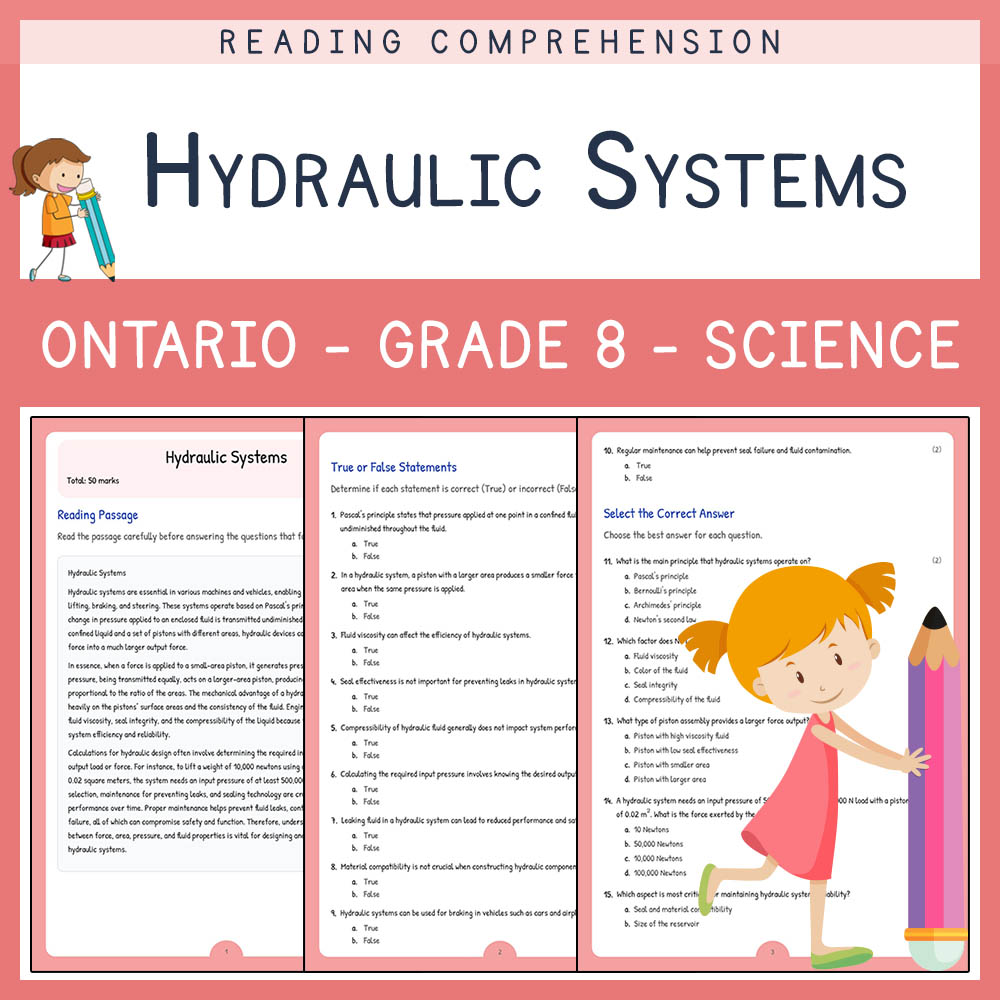
Grade 8 Science Assessment | Hydraulic Systems Worksheet Elena | Ontario
Created byLumora LearningLearning Objectives
- Explain how hydraulic systems convert small forces into larger outputs through pressure transmission.
- Evaluate the mechanical advantage provided by different piston assemblies in hydraulic devices.
- Analyze design constraints such as fluid viscosity, seal effectiveness, and compressibility in hydraulic systems.
Also included in: Grade 8 Science | Fluids Lesson Bundle | Ontario Framework
Instant download
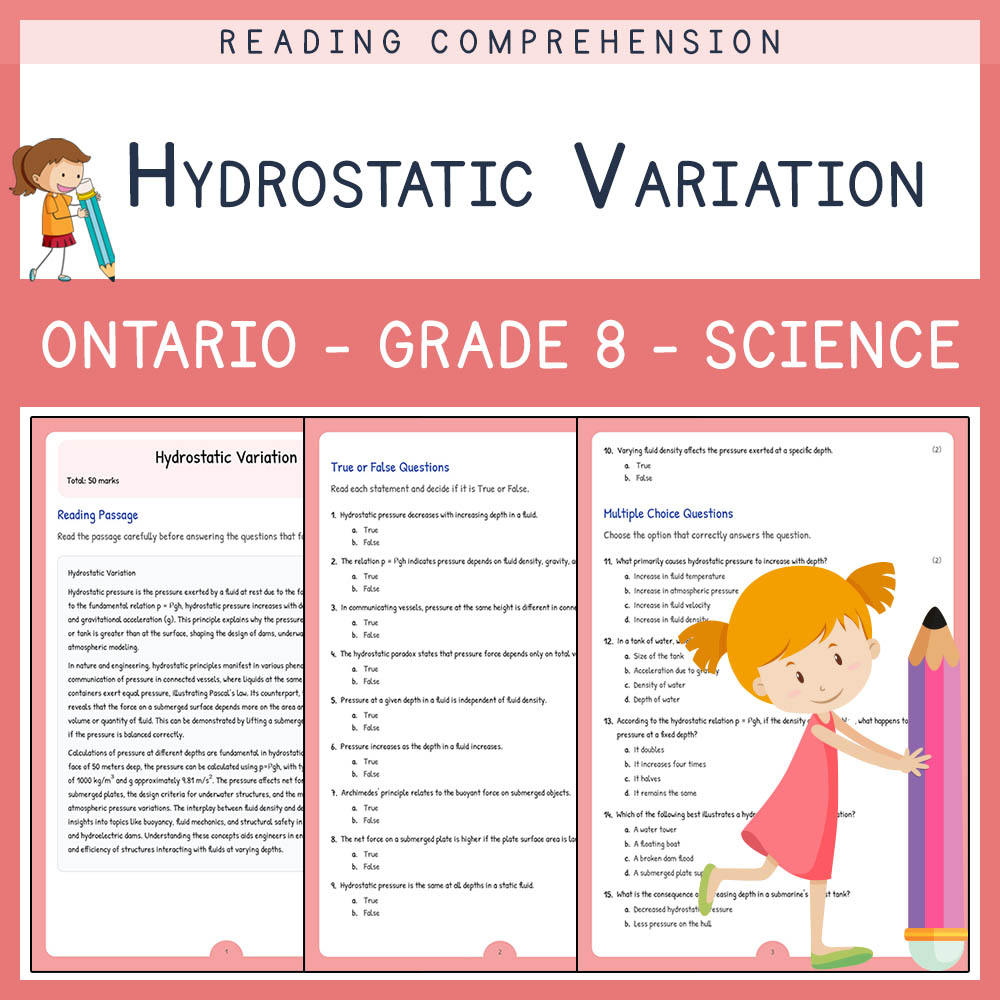
Grade 8 Science | Hydrostatic Variation Worksheet Elena | Ontario
Created byLumora LearningLearning Objectives
- Understand how hydrostatic pressure depends on fluid density and depth.
- Explain communicating vessels and the hydrostatic paradox.
- Calculate pressure at various depths in fluids.
Also included in: Grade 8 Science | Fluids Lesson Bundle | Ontario Framework
Instant download
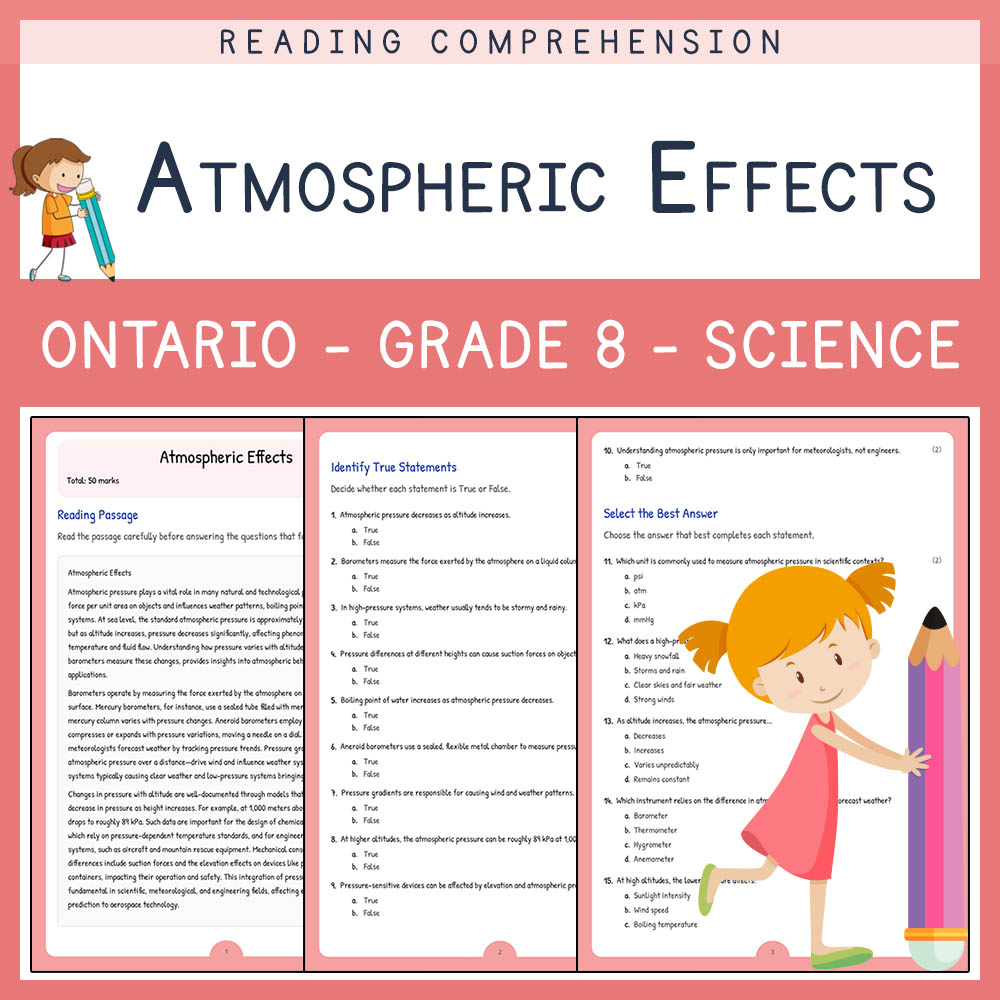
Grade 8 Science Assessment | Atmospheric Effects Worksheet Elena | Ontario
Created byLumora LearningLearning Objectives
- Explain how atmospheric pressure influences boiling points and weather instruments.
- Describe the operation of a barometer and pressure measurement methods.
- Understand pressure gradients and their role in driving wind and weather patterns.
Also included in: Grade 8 Science | Fluids Lesson Bundle | Ontario Framework
Instant download
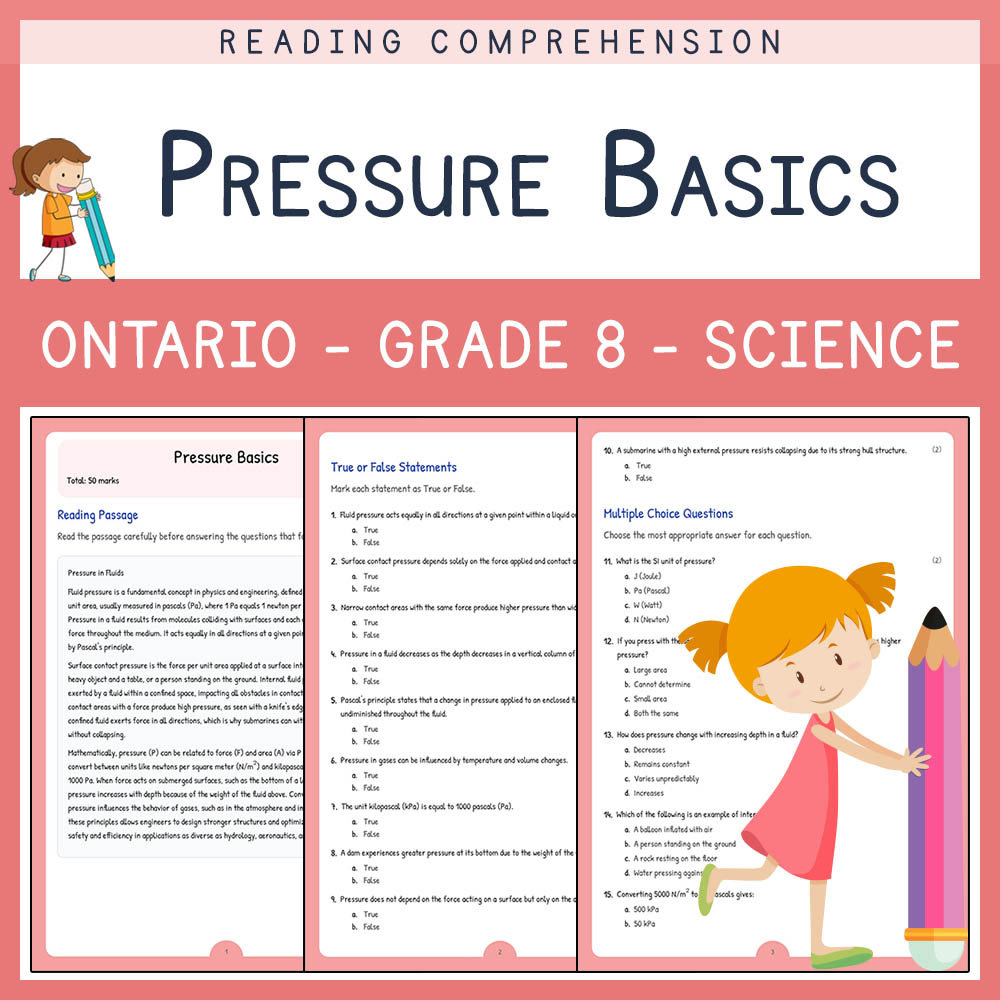
Grade 8 Science Assessment | Pressure Basics Worksheet Elena | Ontario
Created byLumora LearningLearning Objectives
- Define fluid pressure and understand its SI units.
- Distinguish between surface contact pressure and internal fluid pressure.
- Explain how pressure depends on contact area, force, and fluid confinement.
Also included in: Grade 8 Science | Fluids Lesson Bundle | Ontario Framework
Instant download

Grade 8 Science Assessment | Pascal Principle Worksheet Elena | Ontario
Created byLumora LearningLearning Objectives
- Explain the concept of Pascal's principle and its significance in hydraulic systems.
- Calculate the relationships between input and output forces using piston areas.
- Describe real-world applications of Pascal's principle, such as hydraulic brakes and presses.
Also included in: Grade 8 Science | Fluids Lesson Bundle | Ontario Framework
Instant download
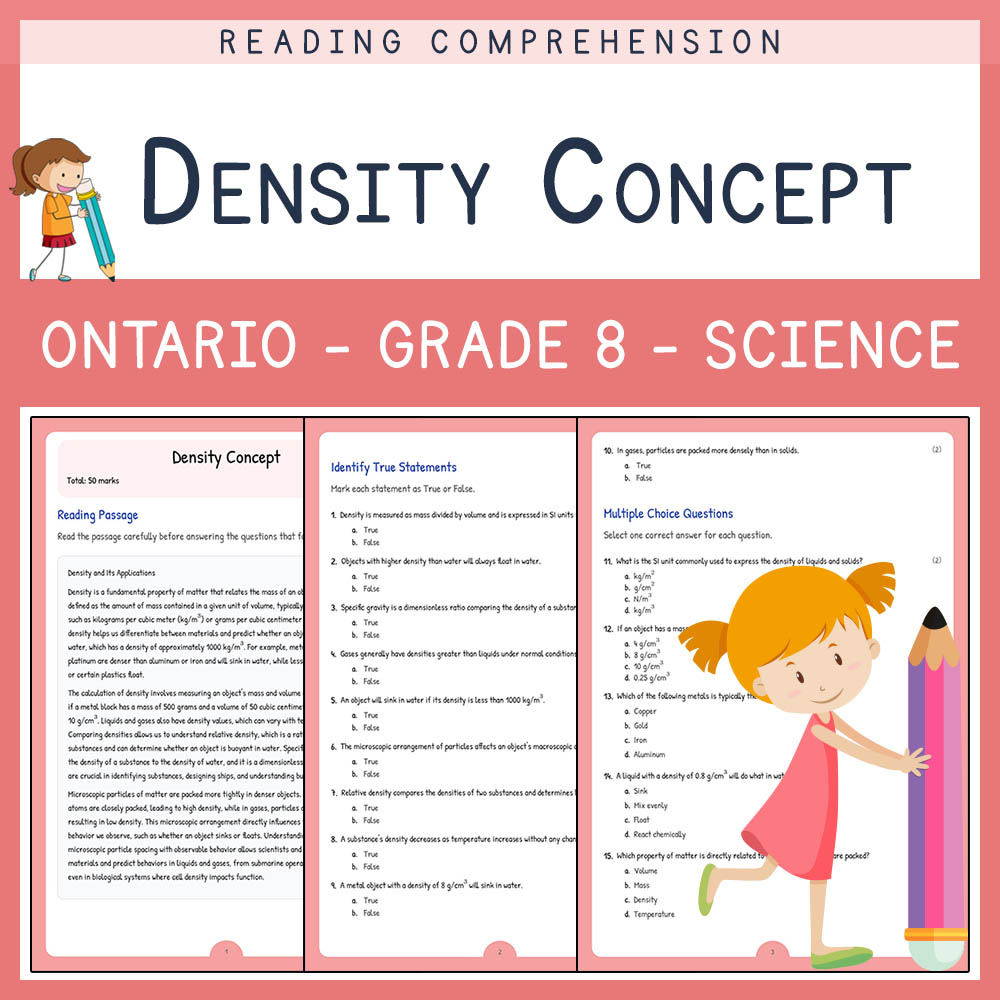
Grade 8 Science Assessment | Density Concept Worksheet Elena | Ontario
Created byLumora LearningLearning Objectives
- Understand the definition of density as mass per unit volume.
- Learn the SI units used to measure mass, volume, and density.
- Explore the relationship between mass, volume, and density through numerical examples.
Also included in: Grade 8 Science | Fluids Lesson Bundle | Ontario Framework
Instant download
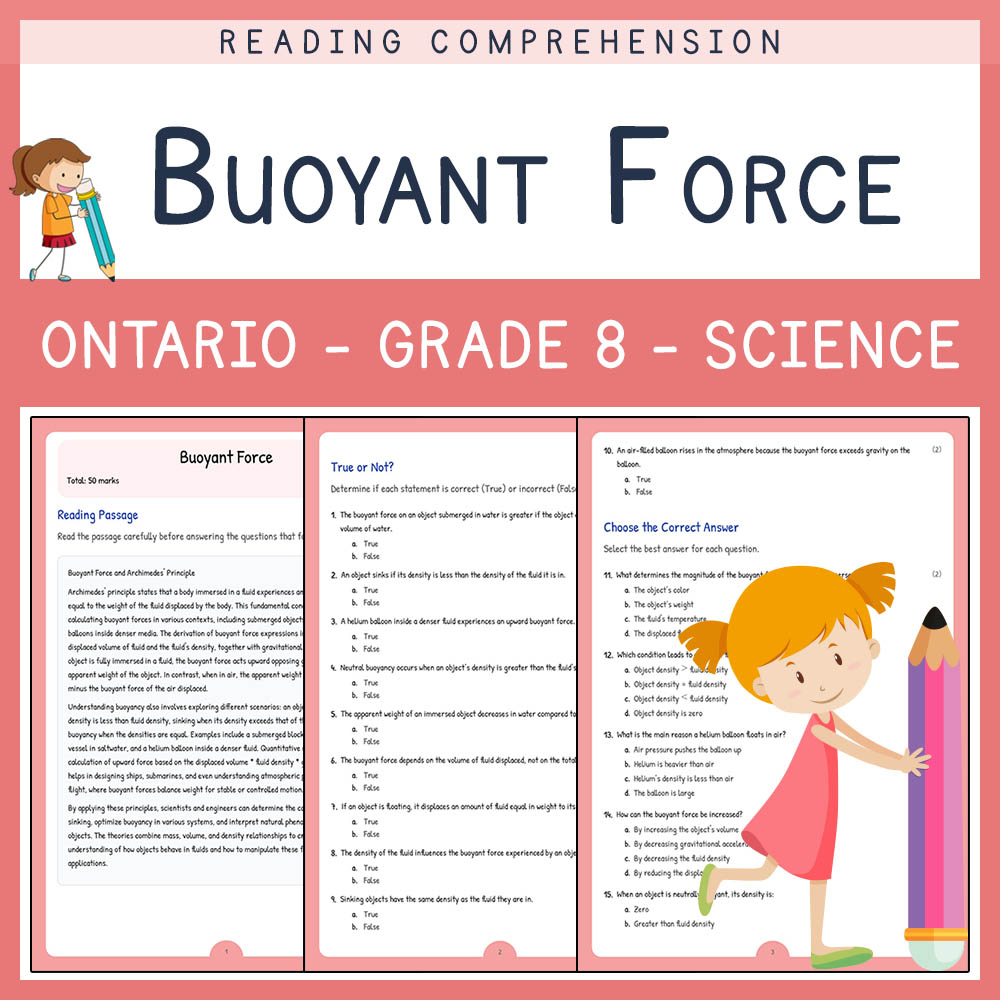
Grade 8 Science Assessment | Buoyant Force Worksheet Elena | Ontario
Created byLumora LearningLearning Objectives
- Understand Archimedes' principle and how buoyant force relates to displaced fluid weight.
- Differentiate between apparent weight in air and when submerged.
- Apply density and volume relationships to analyze floating, sinking, and neutral buoyancy scenarios.
Also included in: Grade 8 Science | Fluids Lesson Bundle | Ontario Framework
Instant download
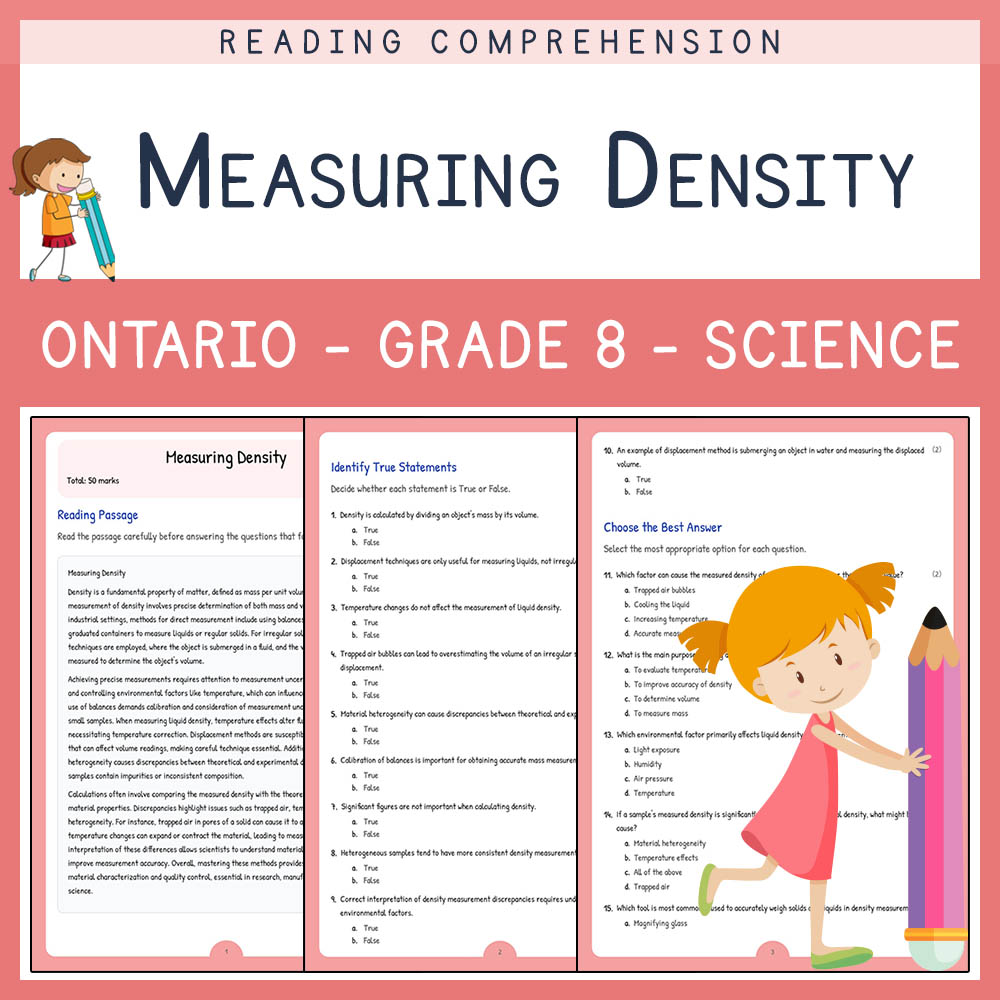
Grade 8 Science Assessment | Measuring Density Worksheet Elena | Ontario
Created byLumora LearningLearning Objectives
- Understand methods for calculating the density of solids and liquids.
- Identify how displacement techniques help measure irregular solids.
- Explain factors affecting measurement accuracy, such as temperature and heterogeneity.
Also included in: Grade 8 Science | Fluids Lesson Bundle | Ontario Framework
Instant download
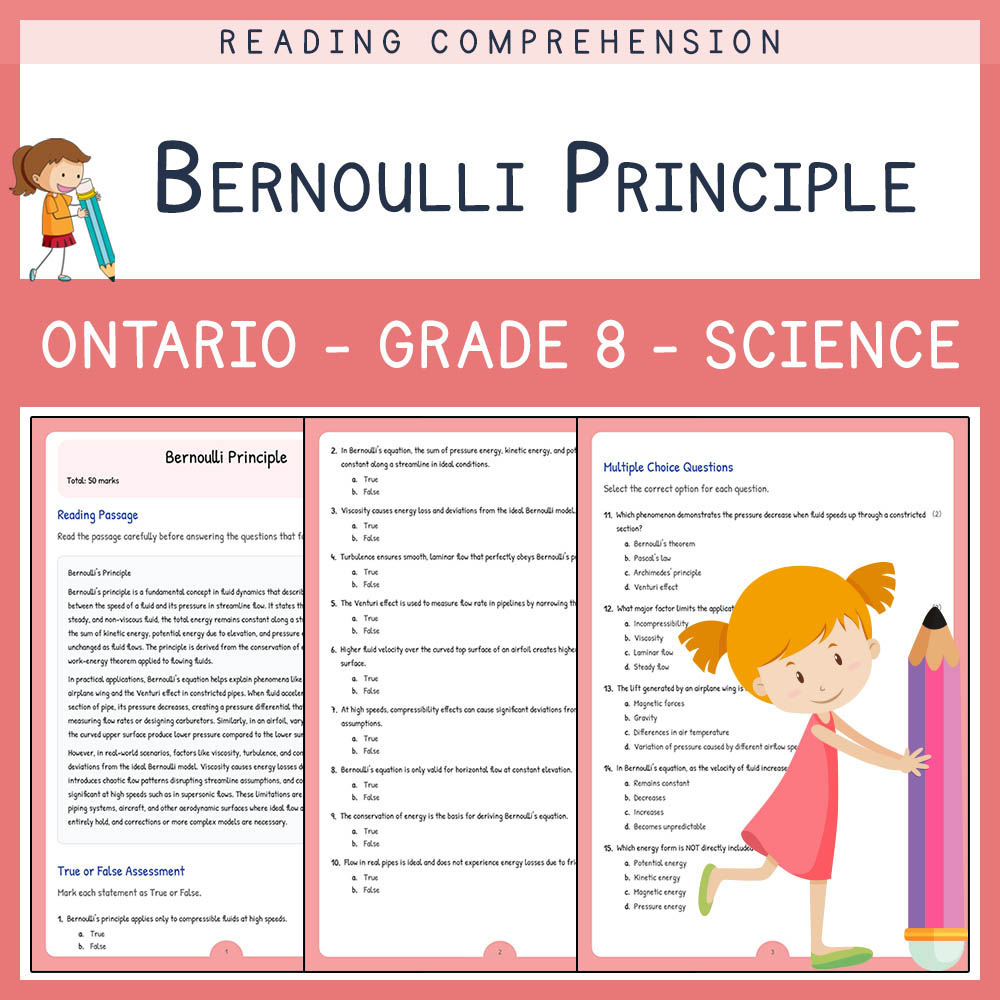
Grade 8 Science Assessment | Bernoulli Principle Worksheet Elena | Ontario
Created byLumora LearningLearning Objectives
- Explain Bernoulli's principle and how it relates fluid velocity and pressure.
- Describe the application of Bernoulli's principle in aerodynamics and fluid flow.
- Derive the Bernoulli equation for incompressible, non-viscous flow.
Also included in: Grade 8 Science | Fluids Lesson Bundle | Ontario Framework
Instant download
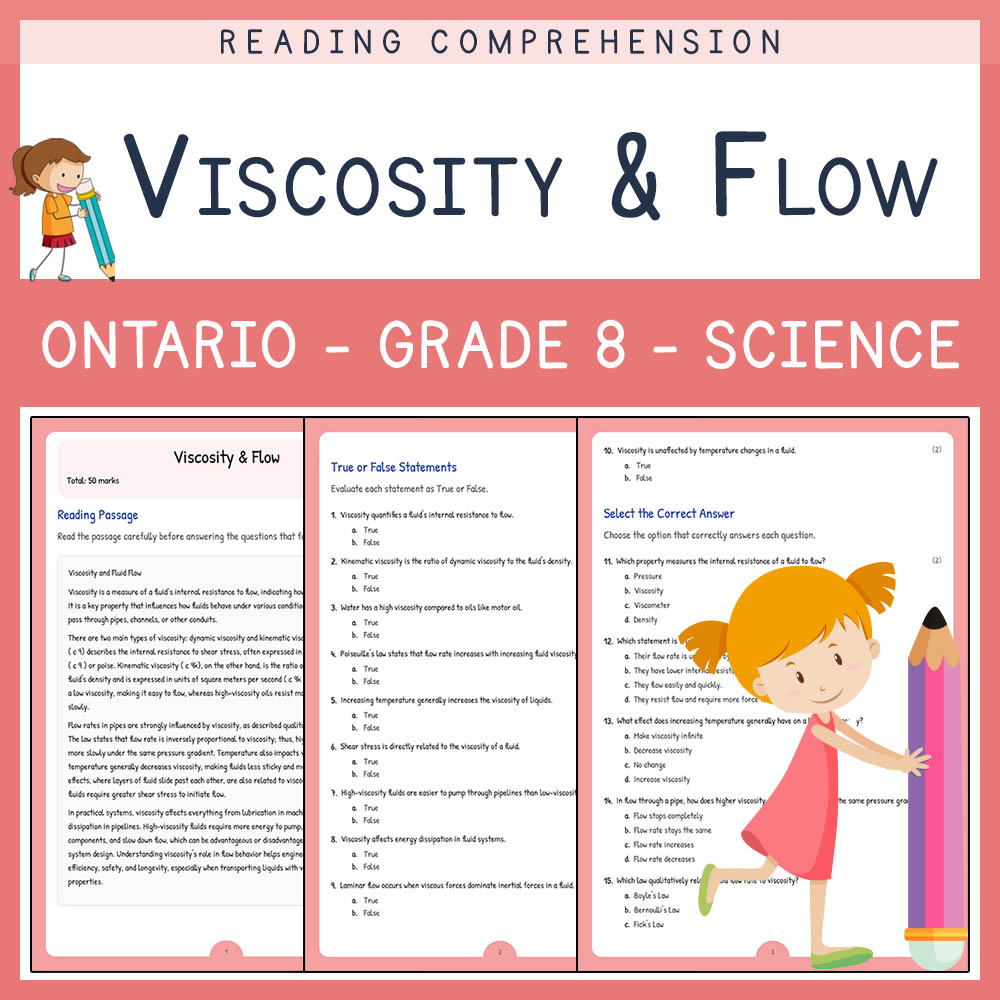
Grade 8 Science Assessment | Viscosity & Flow Worksheet | Ontario Standard
Created byLumora LearningLearning Objectives
- Define and distinguish between dynamic and kinematic viscosity.
- Explain how viscosity affects the flow of fluids in pipes and channels.
- Contrast the flow behavior of low-viscosity fluids like water with high-viscosity fluids like oils.
Also included in: Grade 8 Science | Fluids Lesson Bundle | Ontario Framework
Instant download

Grade 8 Science Assessment | Surface Forces Worksheet Elena | Ontario
Created byLumora LearningLearning Objectives
- Understand how pressure varies on submerged surfaces and affects force and torque.
- Analyze pressure distribution on planar and curved surfaces in hydrostatic conditions.
- Apply integrative methods to calculate net hydrostatic forces and centers of pressure.
Also included in: Grade 8 Science | Fluids Lesson Bundle | Ontario Framework
Instant download
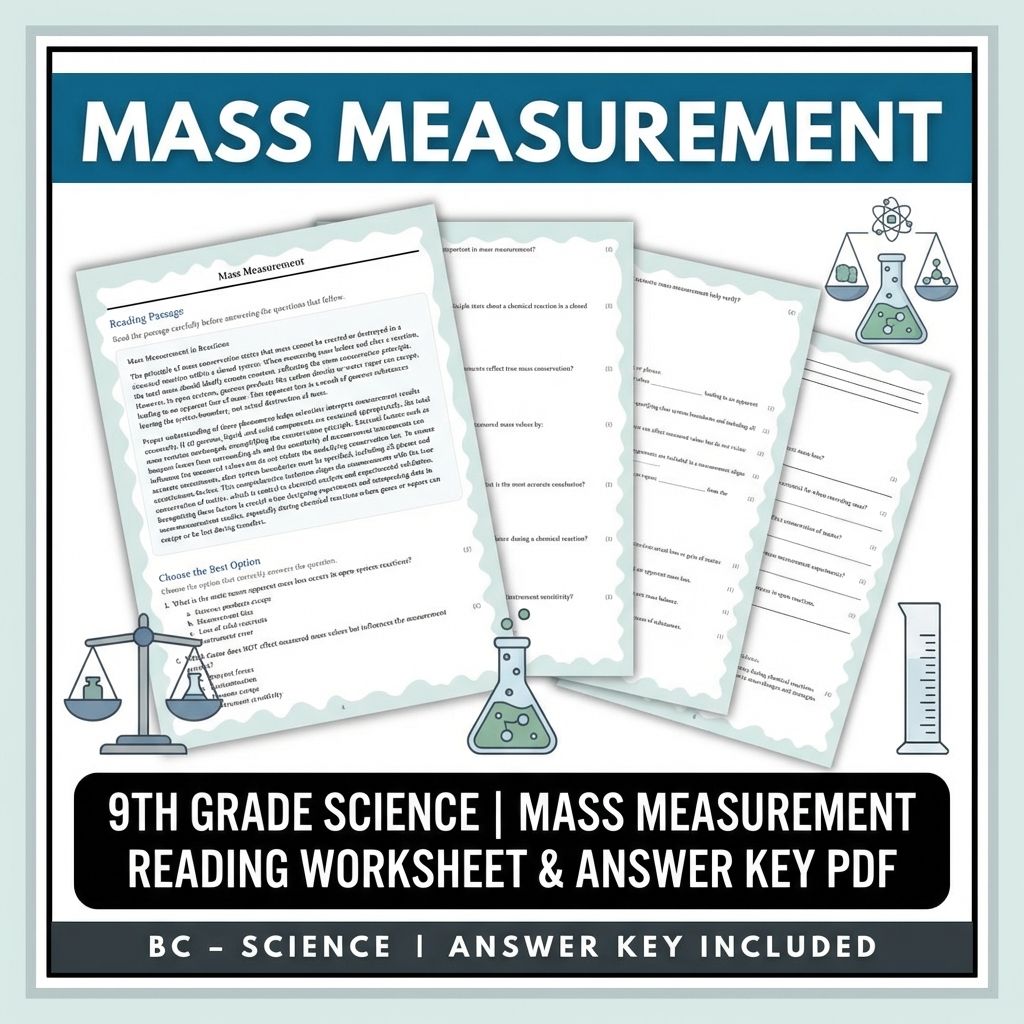
9th Grade Science | Mass Measurement Reading Worksheet & Answer Key PDF
JCreated byJ.S SheetsLearning Objectives
- Understand how measured mass reflects the conservation of atoms during reactions.
- Identify factors affecting the accuracy of mass measurements, such as gaseous escape and external influences.
- Explain the importance of defining system boundaries for mass conservation analysis.
Instant download
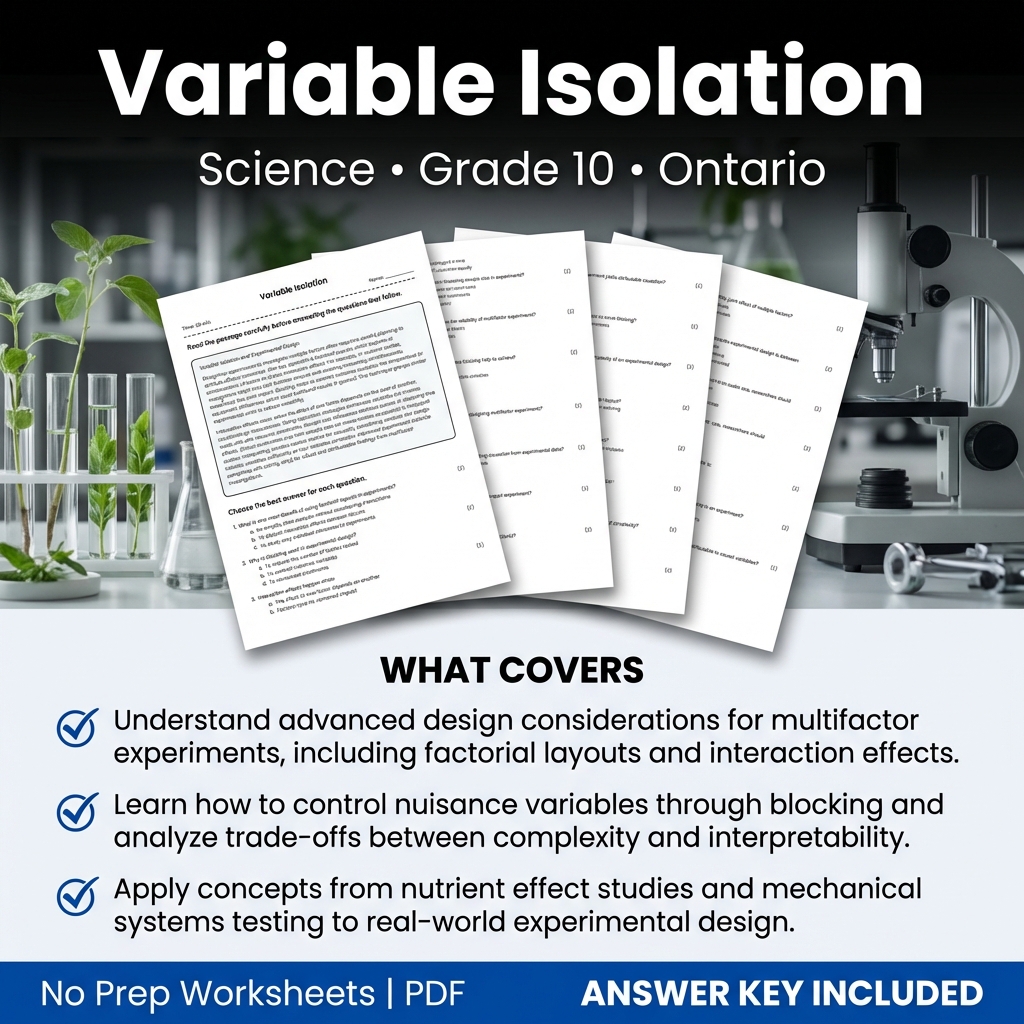
Grade 10 Science Worksheet on Variable Isolation | Ontario Standards
Created byCoral Reef LearningLearning Objectives
- Understand advanced design considerations for multifactor experiments, including factorial layouts and interaction effects.
- Learn how to control nuisance variables through blocking and analyze trade-offs between complexity and interpretability.
- Apply concepts from nutrient effect studies and mechanical systems testing to real-world experimental design.
Instant download
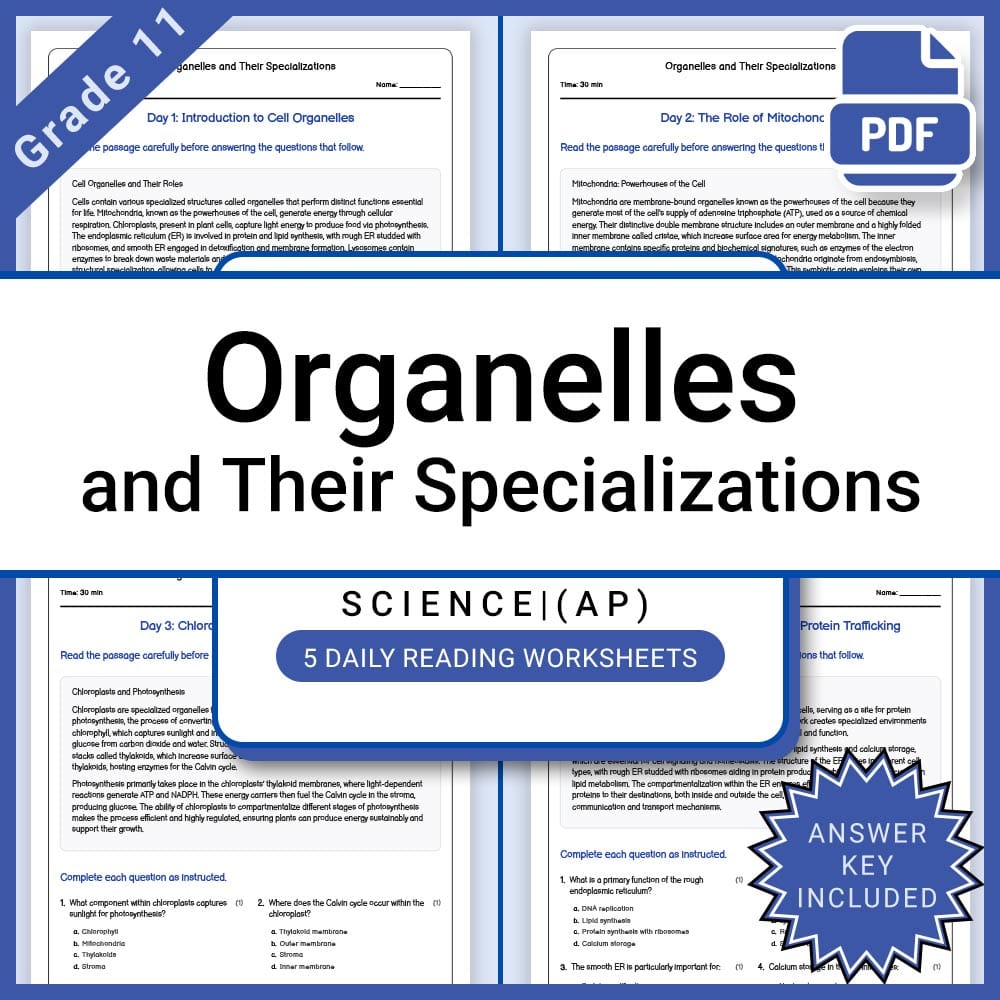
Grade 11 Science – Organelles and Their Specializations Worksheet + Answer Key
JCreated byJ.S SheetsLearning Objectives
- Understand the structural differences of key organelles: mitochondria, chloroplasts, endoplasmic reticulum, and lysosomes.
- Explain how compartmentalization enhances metabolic pathways and cellular functions.
- Describe the origins and membrane compositions of different organelles.
Also included in: Grade 11 Science Biology and Ecosystems AP Lesson Bundle +1 more
Instant download

Decomposition Recycling Worksheet Grade 6 Science NGSSS Florida
Created byPrism Point LearningLearning Objectives
- Explain how decomposers break down dead organisms and waste into simpler materials
- Describe how decomposition returns nutrients to the environment for producers to use again
- Connect decomposition to ecosystem stability over time
Instant download
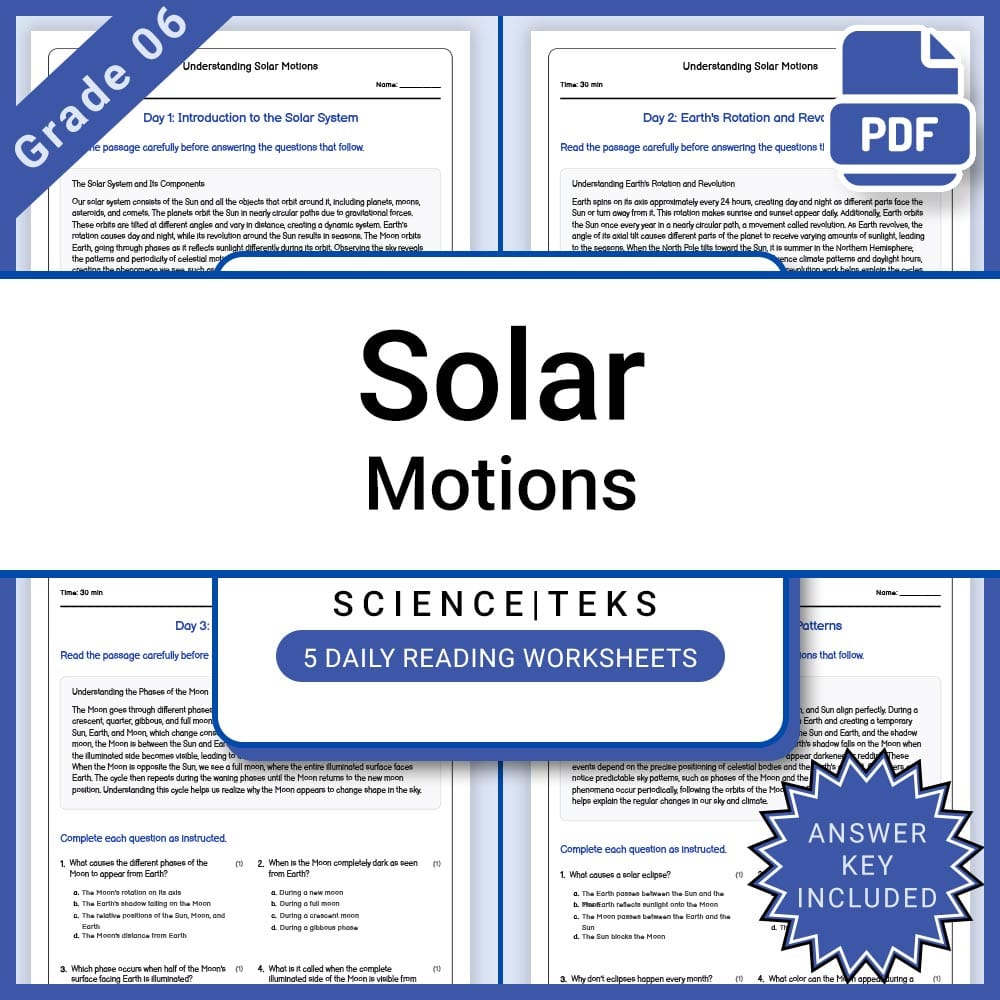
Grade 6 Science – Solar Motions Daily Reading Worksheet + Answer Key
JCreated byJ.S SheetsLearning Objectives
- Identify the main components of the solar system.
- Explain the orbital motions of planets around the Sun.
- Describe how gravitational interactions influence planetary paths.
Also included in: Grade 6 Science Lesson Bundle: Space, Water, Earth, and Resources TEKS +1 more
Instant download
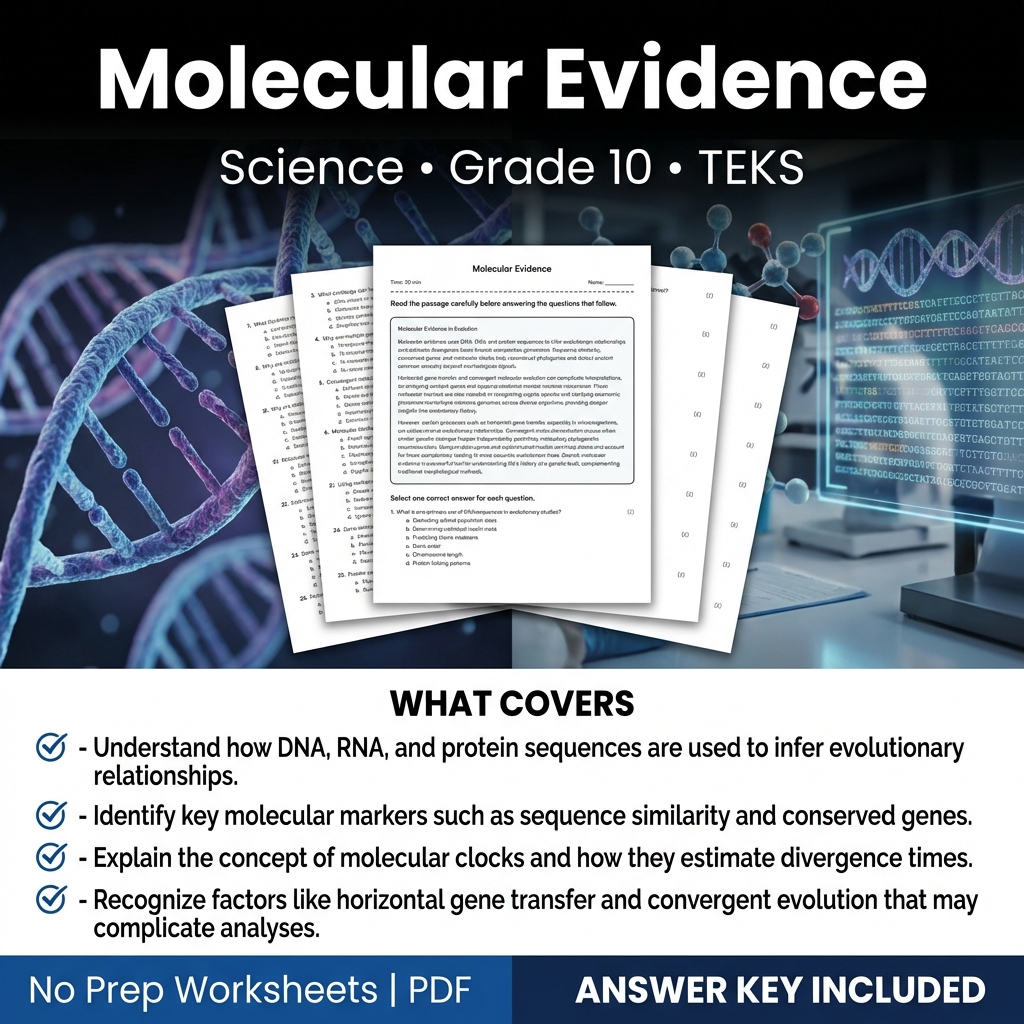
Molecular Evidence Worksheet for Grade 10 Science | TEKS
Created byCoral Reef LearningLearning Objectives
- Understand how DNA, RNA, and protein sequences are used to infer evolutionary relationships.
- Identify key molecular markers such as sequence similarity and conserved genes.
- Explain the concept of molecular clocks and how they estimate divergence times.
Instant download

Grade 11 Science – Anatomical Clues & Evolution | Daily Reading Worksheet
Created byBright Mind ResourcesLearning Objectives
- Identify homologous structures across different species.
- Understand how homologous structures provide evidence of common ancestry.
- Differentiate between homologous and analogous structures.
Also included in: Grade 11 Evolution Science Lesson Bundle Daily Reading Worksheets | TEKS +2 more
Instant download
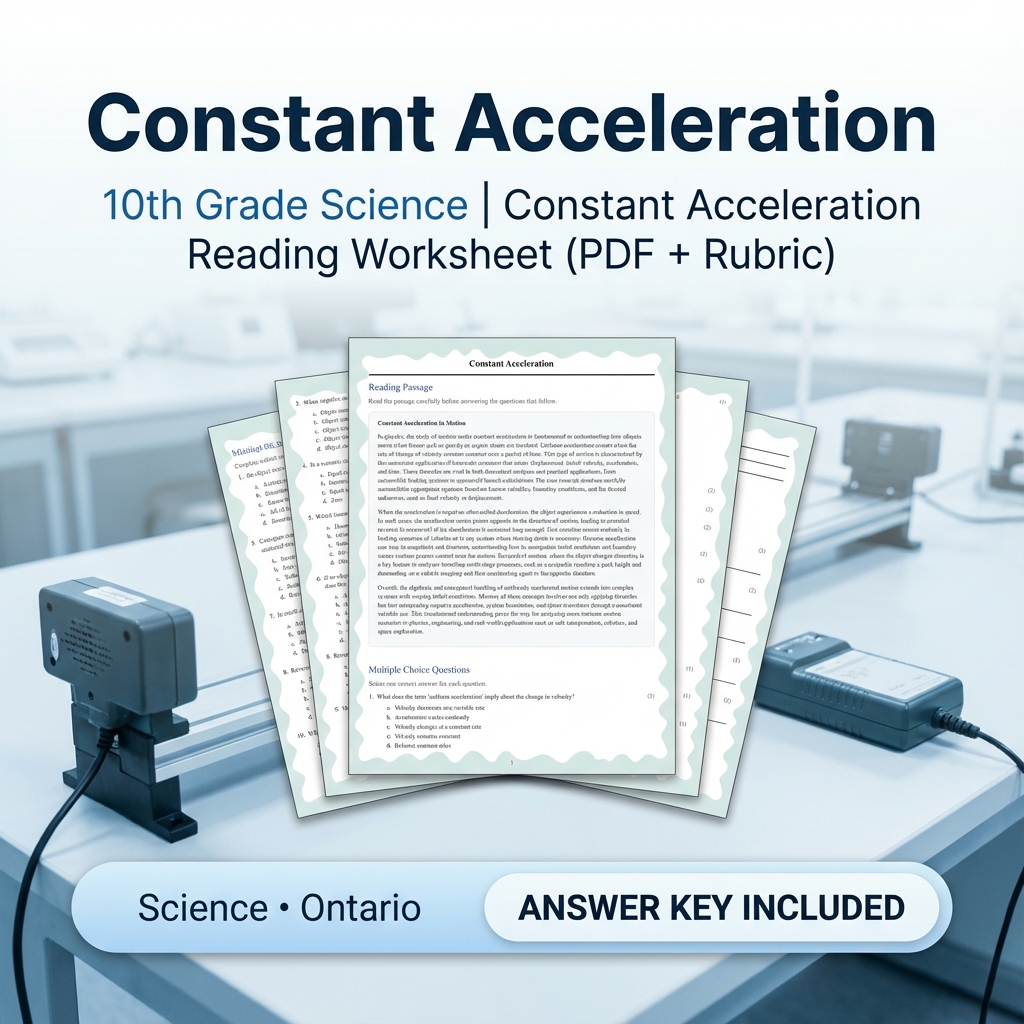
10th Grade Science | Constant Acceleration Reading Worksheet (PDF + Rubric)
JCreated byJ.S SheetsLearning Objectives
- Understand the basic concepts of uniform acceleration in one-dimensional motion.
- Apply kinematic formulas to analyze systems with initial velocities, displacements, and varying acceleration.
- Interpret the effects of negative acceleration and motion reversal in different scenarios.
Also included in: Grade 10 Science Unit Bundle – Motion, Forces & Mechanics (Answer Keys Included) +1 more
Instant download
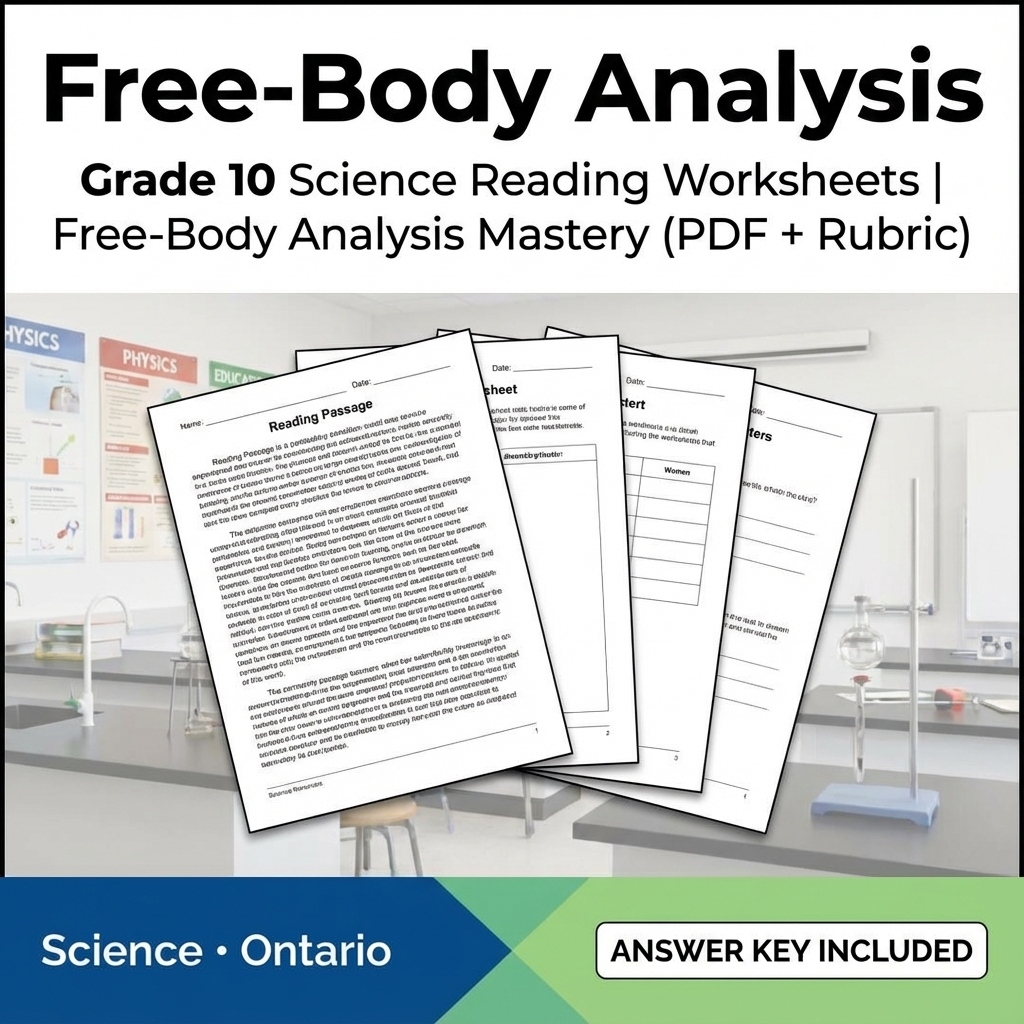
Grade 10 Science Reading Worksheets | Free-Body Analysis Mastery (PDF + Rubric)
JCreated byJ.S SheetsLearning Objectives
- Understand the concept of free-body diagrams and their role in force analysis.
- Learn procedures for identifying individual forces acting on an object.
- Recognize how to choose coordinate axes and resolve vectors into components.
Also included in: Grade 10 Science Unit Bundle – Motion, Forces & Mechanics (Answer Keys Included) +1 more
Instant download
Browse more categories
About Science Worksheets
Find Science worksheets spanning core skills, practice, and review. All 44,342 resources are instant PDF downloads for the classroom or home.
Every worksheet on MyTeachingSheets is created by independent teacher-authors and reviewed before publication. All resources download as printable PDFs for classroom, homework, or at-home practice, and many include answer keys. Preview any worksheet free before buying.