
Science Worksheets
44,538 subject resources
Grade 11 Science – Error Propagation Worksheet (AP Standards) PDF
 Created byEvergreen Desk Education
Learning Objectives
- Use linear approximation to estimate how measurement uncertainty changes through a calculation.
- Apply Monte Carlo sampling to propagate uncertainty when a formula is nonlinear or complex.
- Use sensitivity coefficients to identify dominant sources of uncertainty in a derived result.
Also included in: Grade 11 Science Practices AP Framework Science Lesson Bundle Worksheets +1 more
Instant download
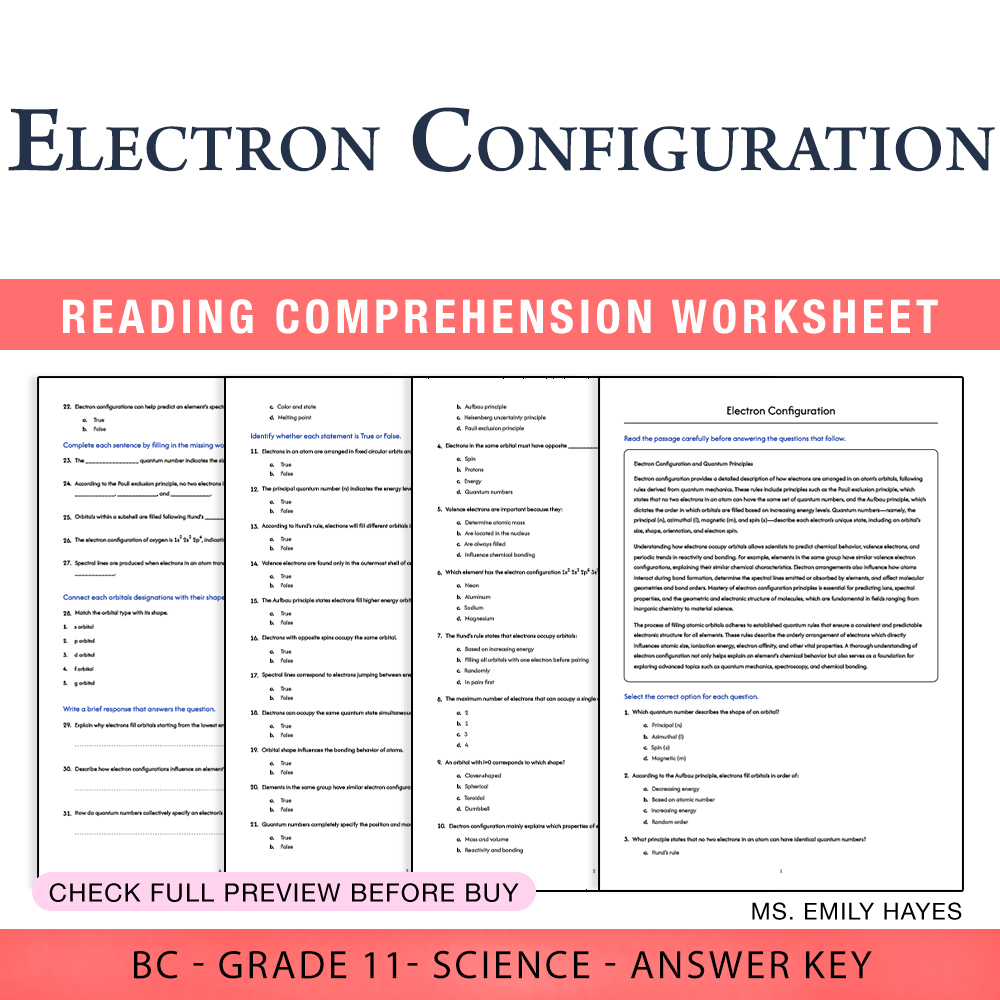
11th Grade Science | Electron Configuration Worksheet (PDF + Answer Key)
 Created byCopper Leaf Classroom
Learning Objectives
- Describe how electrons occupy atomic orbitals based on quantum principles.
- Identify the roles of quantum numbers in electron arrangements within atoms.
- Explain how electron configurations influence elemental properties and periodic patterns.
Also included in: Grade 11 Science BC– Thermochemistry, Bonding & Reactions (PDF + Answer Key) +1 more
Instant download
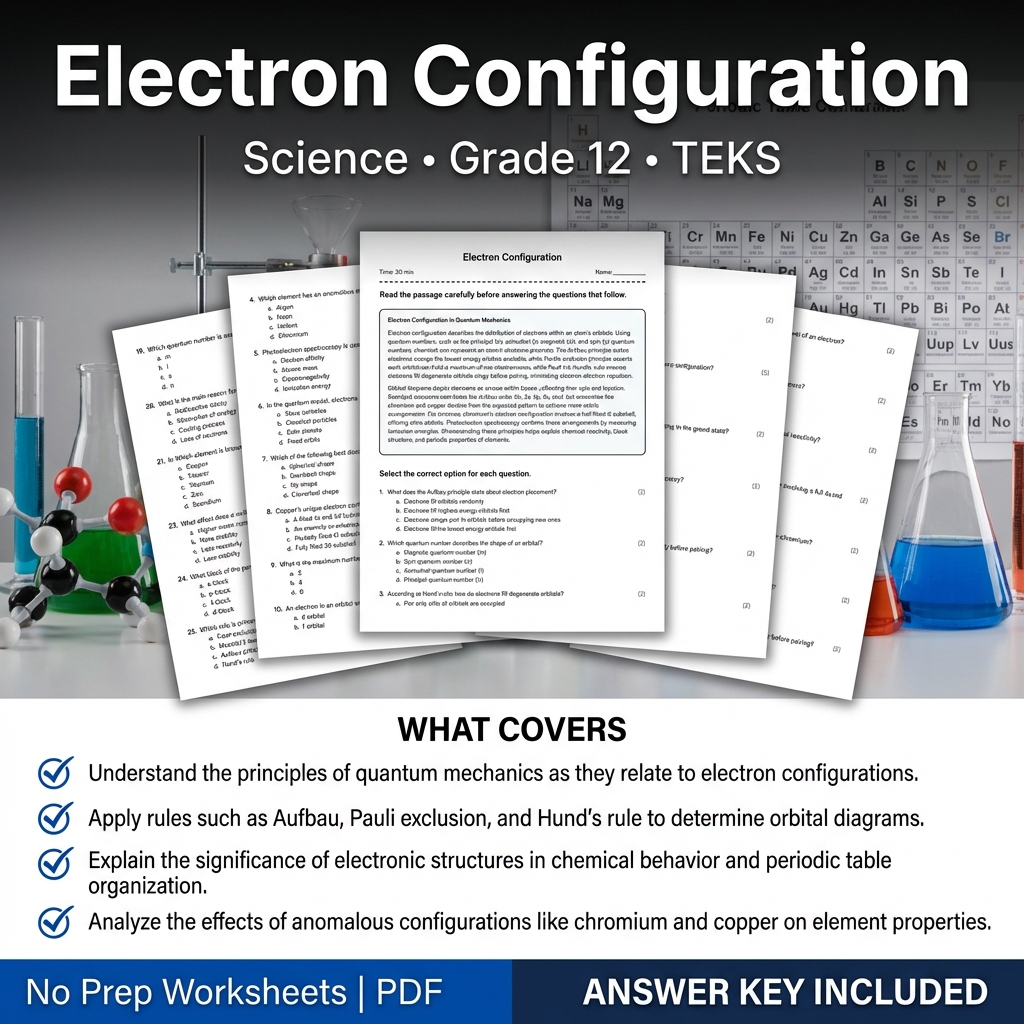
Electron Configuration Worksheet for Grade 12 Science | TEKS Aligned
 Created byCoral Reef Learning
Learning Objectives
- Understand the principles of quantum mechanics as they relate to electron configurations.
- Apply rules such as Aufbau, Pauli exclusion, and Hund’s rule to determine orbital diagrams.
- Explain the significance of electronic structures in chemical behavior and periodic table organization.
Instant download
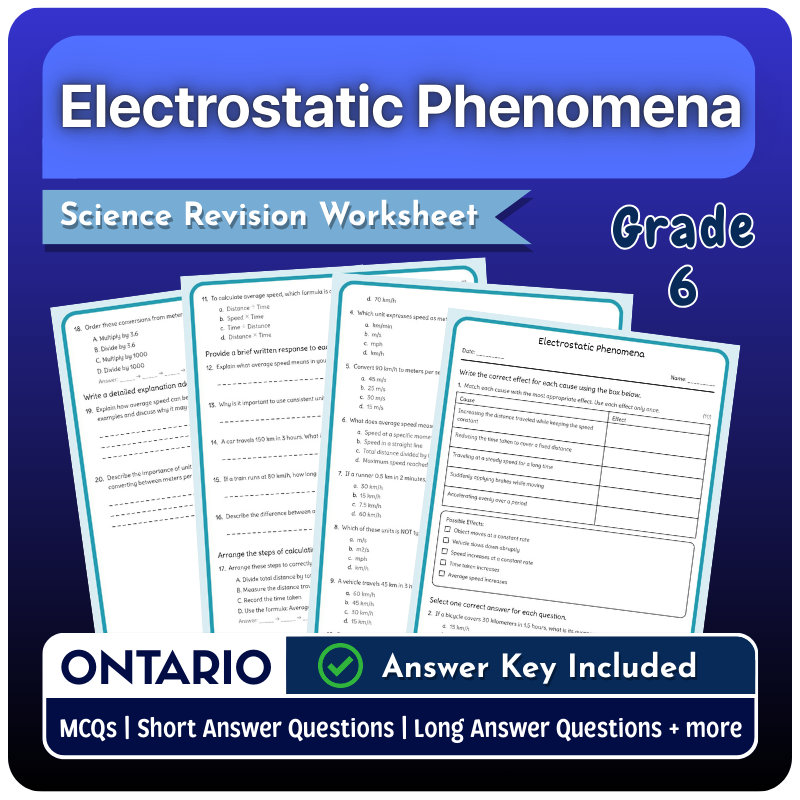
6th Grade Science | Electrostatic Phenomena Worksheet (PDF) Ontario Standard
 Created byBright Mind Resources
Learning Objectives
- Understand the causes and effects of static charge transfer between materials.
- Identify and interpret the triboelectric series and its application in predicting charge tendencies.
- Describe phenomena such as attraction, repulsion, and discharge sparked by static electricity.
Instant download

Grade 7 Science Worksheet | Understanding Balanced Forces (PDF)
Created byEvergreen Desk EducationLearning Objectives
- Explain equilibrium as a state where net force is zero and motion does not change
- Differentiate static equilibrium from dynamic equilibrium using examples and force diagrams
- Identify balanced force pairs and predict how structures respond to gravity and wind
Instant download

Non-Mendelian Patterns Assessment for Grade 11 Science TEKS
 Created byPrism Point Learning
Learning Objectives
- Understand different non-Mendelian inheritance patterns such as incomplete dominance and codominance.
- Identify the roles of multiple alleles and polygenic inheritance in trait variation.
- Explain the concepts of pleiotropy, variable penetrance, and expressivity.
Also included in: Grade 11 Molecular Genetics Science Lesson Bundle: TEKS Assessments
Instant download

Grade 6 Science – Organ Systems Overview Daily Reading Worksheet | BC Standards
Created byBright Mind ResourcesLearning Objectives
- Identify the main organs of the circulatory system.
- Describe the primary functions of the circulatory system.
- Understand how the circulatory system interacts with other body systems.
Also included in: Grade 6 Science: Organ Systems & Adaptations Daily Reading Lesson Bundle | BC +1 more
Instant download
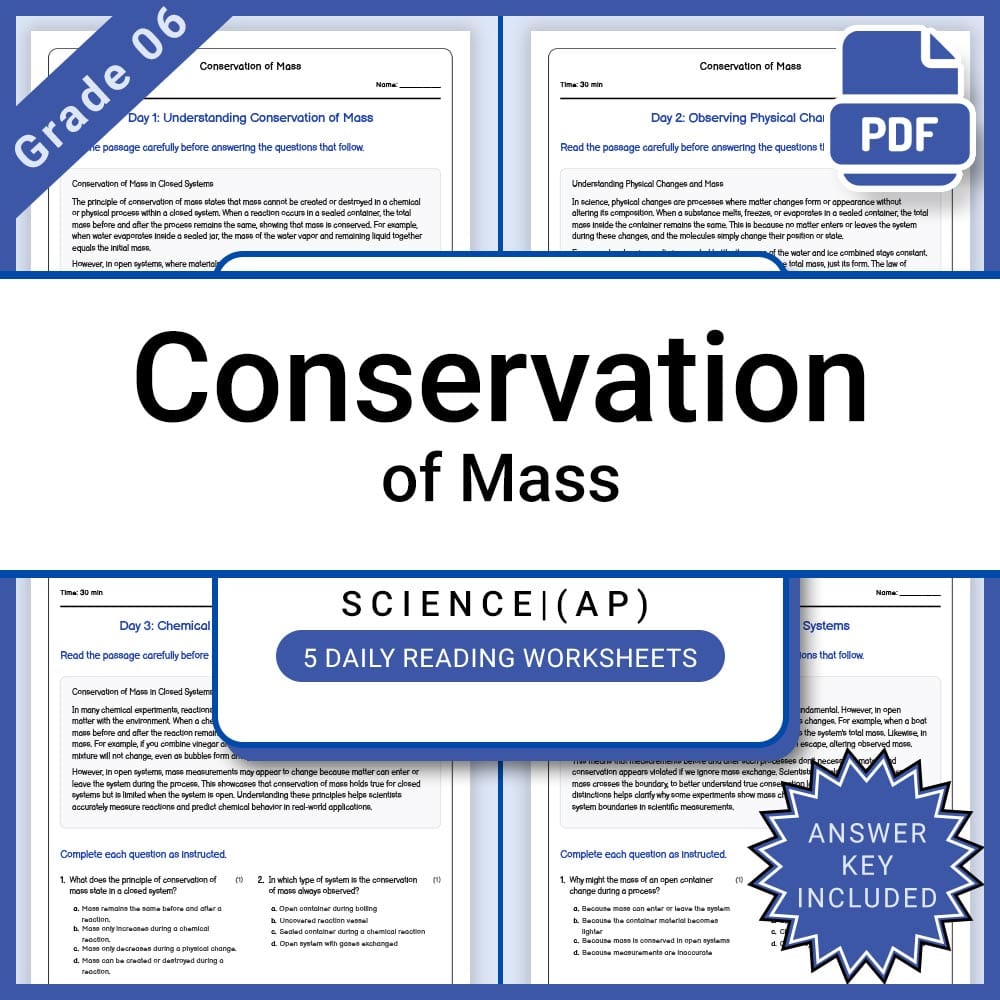
Grade 6 Science – Conservation of Mass Daily Reading Worksheet + Answer Key
JCreated byJ.S SheetsLearning Objectives
- Understand the principle of mass conservation in closed systems.
- Identify examples of physical and chemical processes that illustrate mass conservation.
- Distinguish between closed and open systems regarding mass exchange.
Also included in: Grade 6 Science Lesson Bundle | States of Matter, Energy, and More +1 more
Instant download
Grade 6 Science – Change Evidence Daily Reading Worksheet with Answer Key
JCreated byJ.S SheetsLearning Objectives
- Identify observable indicators of chemical changes
- Differentiate between physical and chemical changes using examples
- Understand the signs that indicate a chemical reaction has taken place
Also included in: Grade 6 Science Lesson Bundle | States of Matter, Energy, and More +1 more
Instant download
Grade 6 Science – Mass and Density Daily Reading Worksheet + Answer Key
JCreated byJ.S SheetsLearning Objectives
- Define and measure mass and volume of various objects.
- Calculate density using mass and volume measurements.
- Interpret density values to classify objects as solids or liquids.
Also included in: Grade 6 Science Lesson Bundle | States of Matter, Energy, and More +1 more
Instant download
Grade 6 Science – Energy Forms Daily Reading Worksheet + Answer Key
JCreated byJ.S SheetsLearning Objectives
- Identify different forms of energy including kinetic, potential, thermal, chemical, and electrical.
- Relate each energy form to familiar phenomena such as moving objects, stretched springs, warm objects, and batteries.
- Describe how energy is associated with motion, position, and internal molecular activity.
Also included in: Grade 6 Science Lesson Bundle | States of Matter, Energy, and More +1 more
Instant download
Grade 6 Science Forces Basics Daily Reading Worksheet with Answer Key
JCreated byJ.S SheetsLearning Objectives
- Understand the difference between contact and non-contact forces
- Identify examples of gravity, friction, and normal force
- Explain the concepts of balanced and unbalanced forces
Also included in: Grade 6 Science Lesson Bundle | States of Matter, Energy, and More +1 more
Instant download
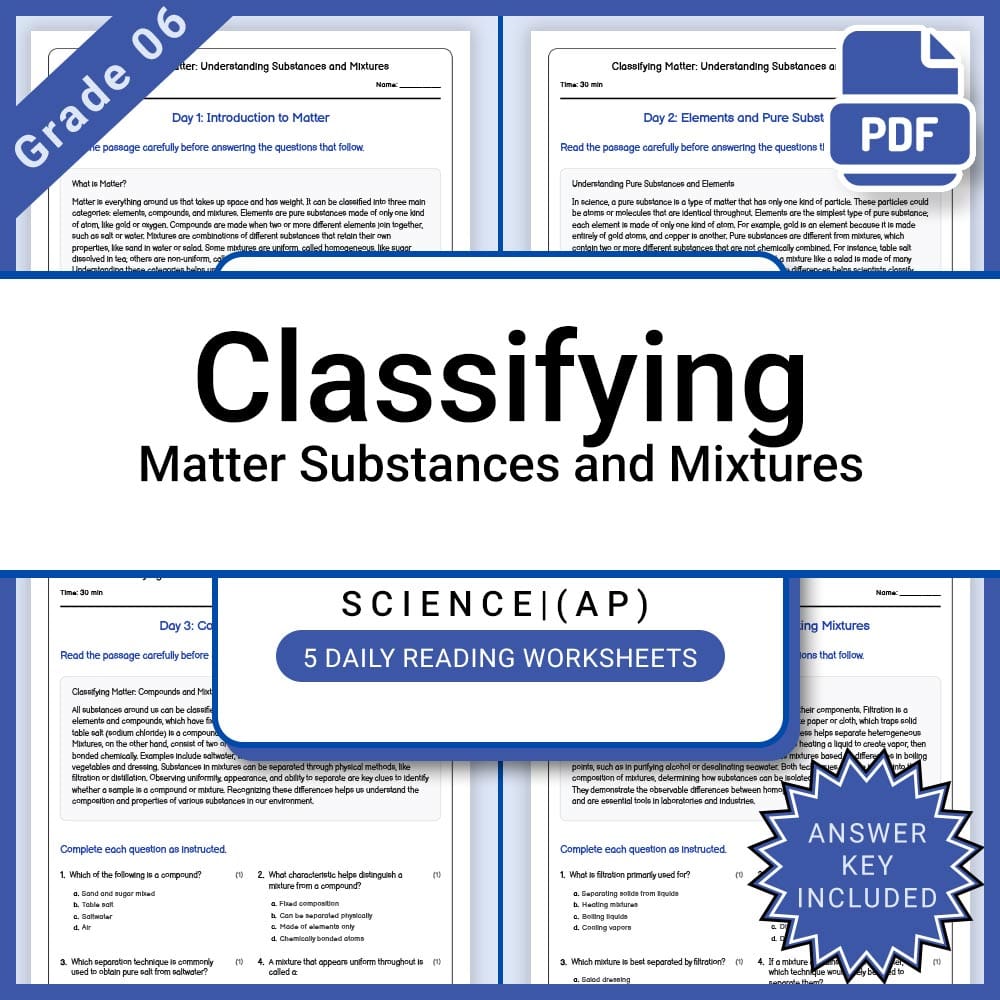
Grade 6 Science – Classifying Matter Daily Reading Worksheet + Answer Key
JCreated byJ.S SheetsLearning Objectives
- Define matter and distinguish between elements, compounds, and mixtures.
- Identify observable characteristics that differentiate pure substances from mixtures.
- Understand basic separation techniques such as filtration and distillation.
Also included in: Grade 6 Science Lesson Bundle | States of Matter, Energy, and More +1 more
Instant download
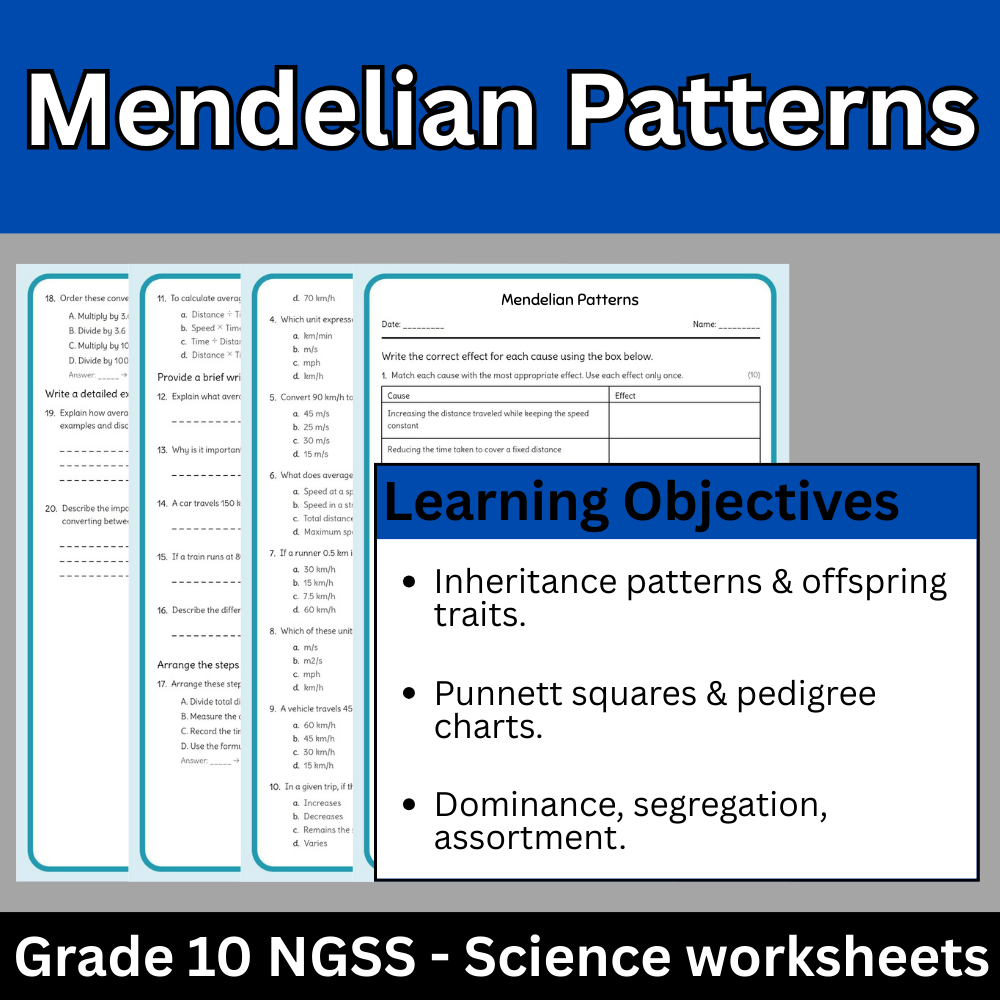
Grade 10 Science – Mendelian Patterns Worksheet (NGSS Aligned) (PDF)
Created byBright Mind ResourcesLearning Objectives
- Understand basic Mendelian inheritance patterns and how they relate to offspring traits.
- Analyze Punnett squares, pedigree charts, and probability in genetic inheritance.
- Explain concepts of dominance, segregation, and independent assortment during meiosis.
Instant download

Earth Structure Worksheet | Grade 6 Science Activities
Created byPrism Point LearningLearning Objectives
- Explain how Earth's internal layers and plate motion drive tectonic processes.
- Compare divergent, convergent, and transform plate boundaries and predict their effects on Earth’s surface.
- Connect real-world events like earthquakes, volcanic eruptions, and mountain building to plate boundaries.
Also included in: Grade 6 Earth and Space Science Lesson Bundle TEKS (8 worksheets) +1 more
Instant download
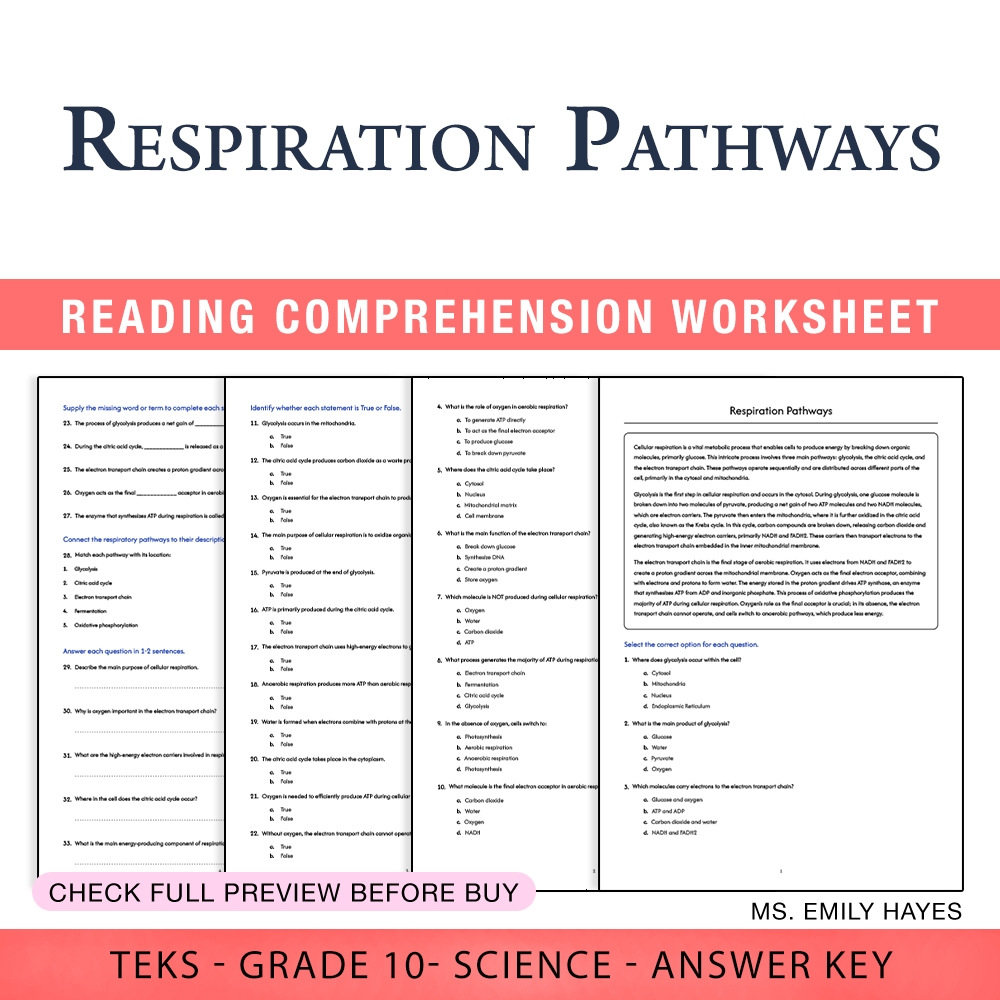
10th Grade Science | Respiration Pathways Worksheet (PDF+ Answer Key)
Created byCopper Leaf ClassroomLearning Objectives
- Describe the main stages of cellular respiration: glycolysis, the citric acid cycle, and the electron transport chain.
- Explain where each stage occurs within the cell and what molecules are produced.
- Identify the role of oxygen as the final electron acceptor in aerobic respiration.
Instant download
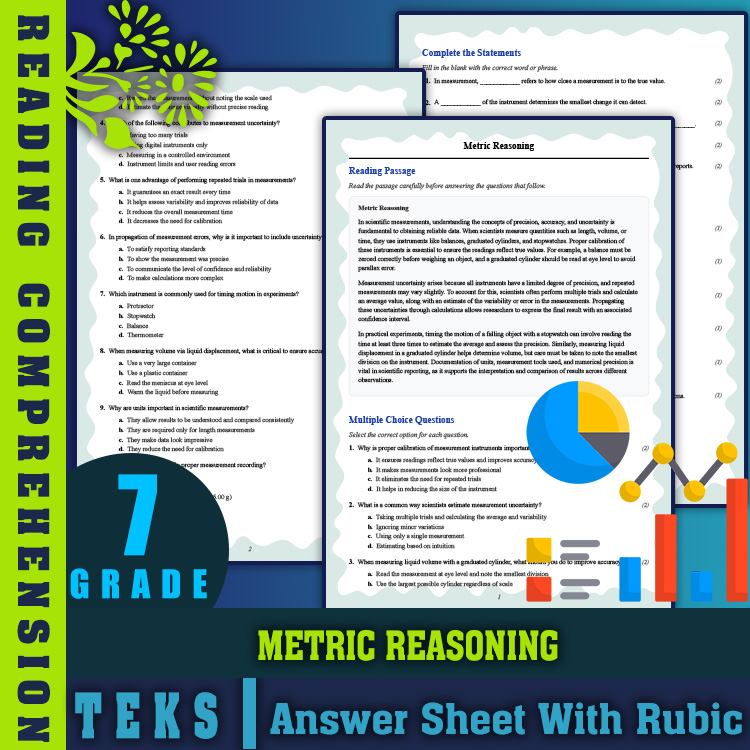
7th Grade Science | Metric Reasoning Reading Worksheets with Answer Key (PDF)
JCreated byJ.S SheetsLearning Objectives
- Understand the importance of measurement precision and uncertainty in scientific observations.
- Learn how to properly calibrate and select measurement instruments for accurate data collection.
- Develop skills in estimating measurement uncertainty and propagating errors in calculations.
Instant download

Grade 12 Science | Reaction Rates in Chemistry - Daily Reading Comprehension
Created byCoral Reef LearningLearning Objectives
- Understand the factors that influence the rate of chemical reactions
- Describe the collision theory and how it explains reaction speed
- Identify the role of catalysts and activated complexes in reaction mechanisms
Also included in: Chemistry 30 Reading Comprehension Lesson Bundle – Grade 12 Science Alberta +1 more
Instant download
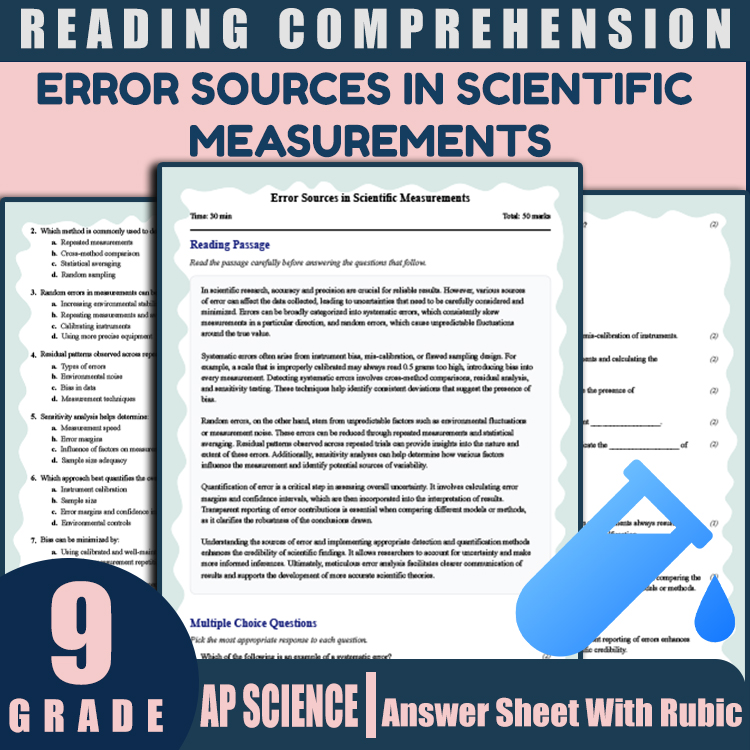
9th Grade Science | Error Sources in Scientific Measurements Reading Worksheet
JCreated byJ.S SheetsLearning Objectives
- Identify common sources of systematic and random errors in scientific experiments.
- Understand methods for detecting and quantifying errors such as bias, confounding, and model mis-specification.
- Explain how error contributes to overall uncertainty and how to interpret robust conclusions based on error analysis.
Instant download
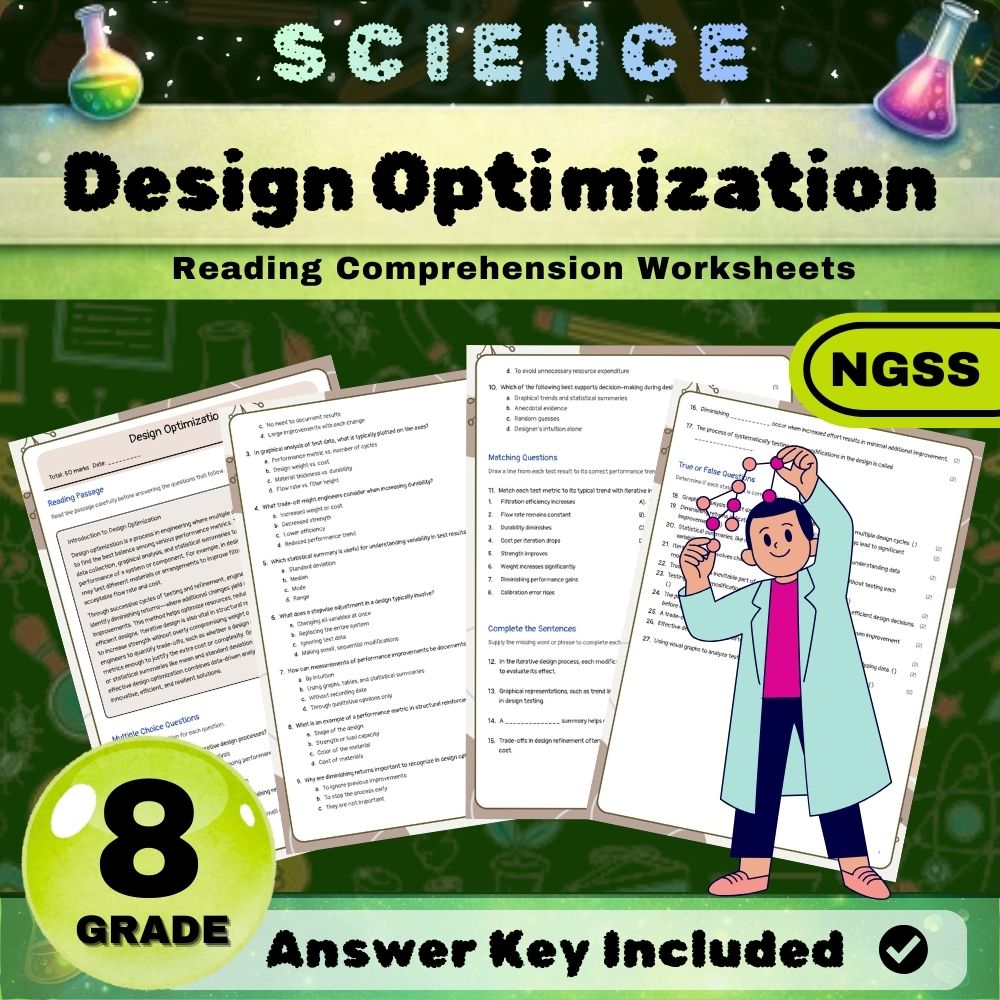
Grade 8 Science – Design Optimization Worksheet (NGSS) (PDF)
 Created byMaple Path Learning
Learning Objectives
- Analyze test data to identify performance trends in design modifications.
- Interpret graphical representations and statistical summaries of test results.
- Evaluate trade-offs among different design metrics such as efficiency, strength, and durability.
Also included in: Grade 8 Science | Engineering Design Unit Bundle – NGSS Practice & Worksheets +1 more
Instant download
Grade 11 Science – Organelles Specialization Worksheet (AP Standards) – PDF
Created byBright Mind ResourcesLearning Objectives
- Understand the structural differences among mitochondria, chloroplasts, endoplasmic reticulum, and lysosomes.
- Explain how organelle compartmentalization enhances metabolic efficiency.
- Compare the origins, membrane composition, and functions of different organelles.
Instant download
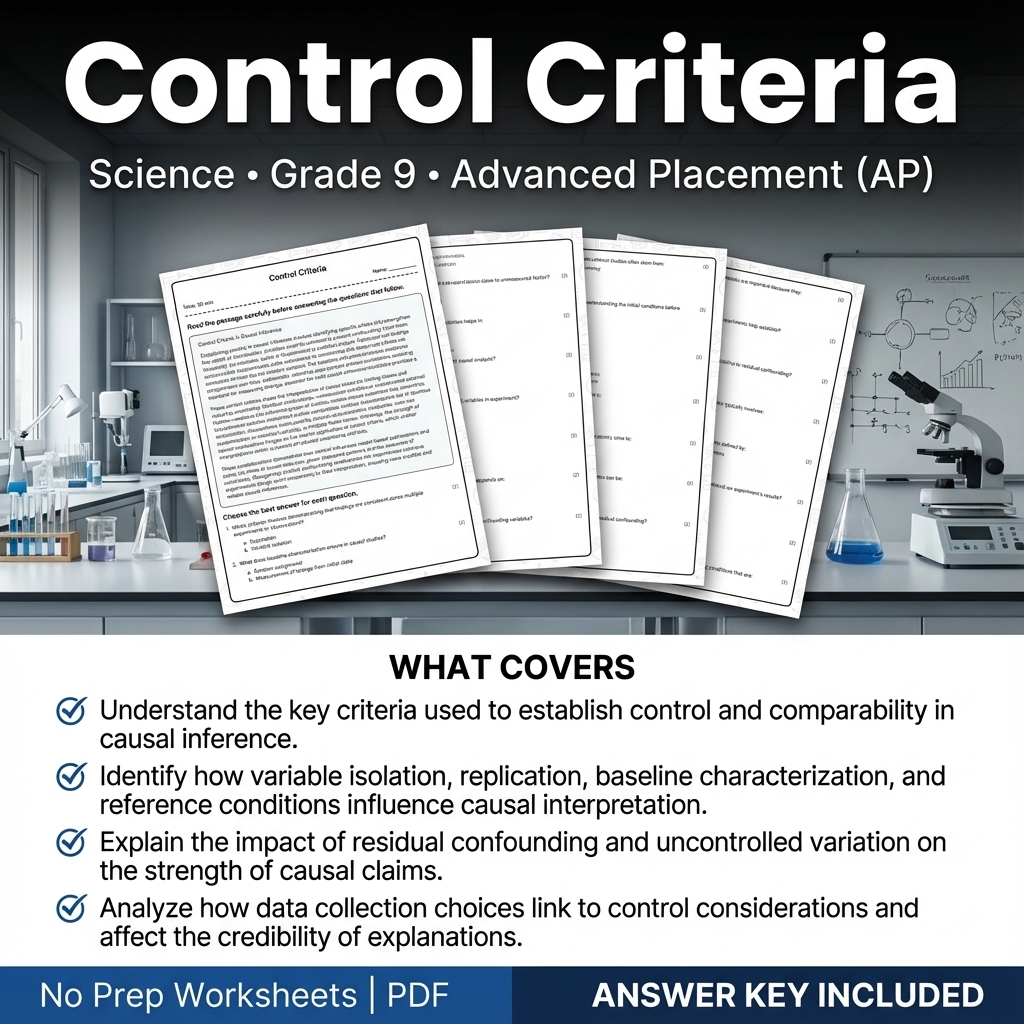
9th Grade Science | Control Criteria Worksheet (Printable PDF + Answer Key)
Created byCoral Reef LearningLearning Objectives
- Understand the key criteria used to establish control and comparability in causal inference.
- Identify how variable isolation, replication, baseline characterization, and reference conditions influence causal interpretation.
- Explain the impact of residual confounding and uncontrolled variation on the strength of causal claims.
Also included in: Grade 9 Science Unit Worksheets | Scientific Methods & Data Analysis Bundle +2 more
Instant download
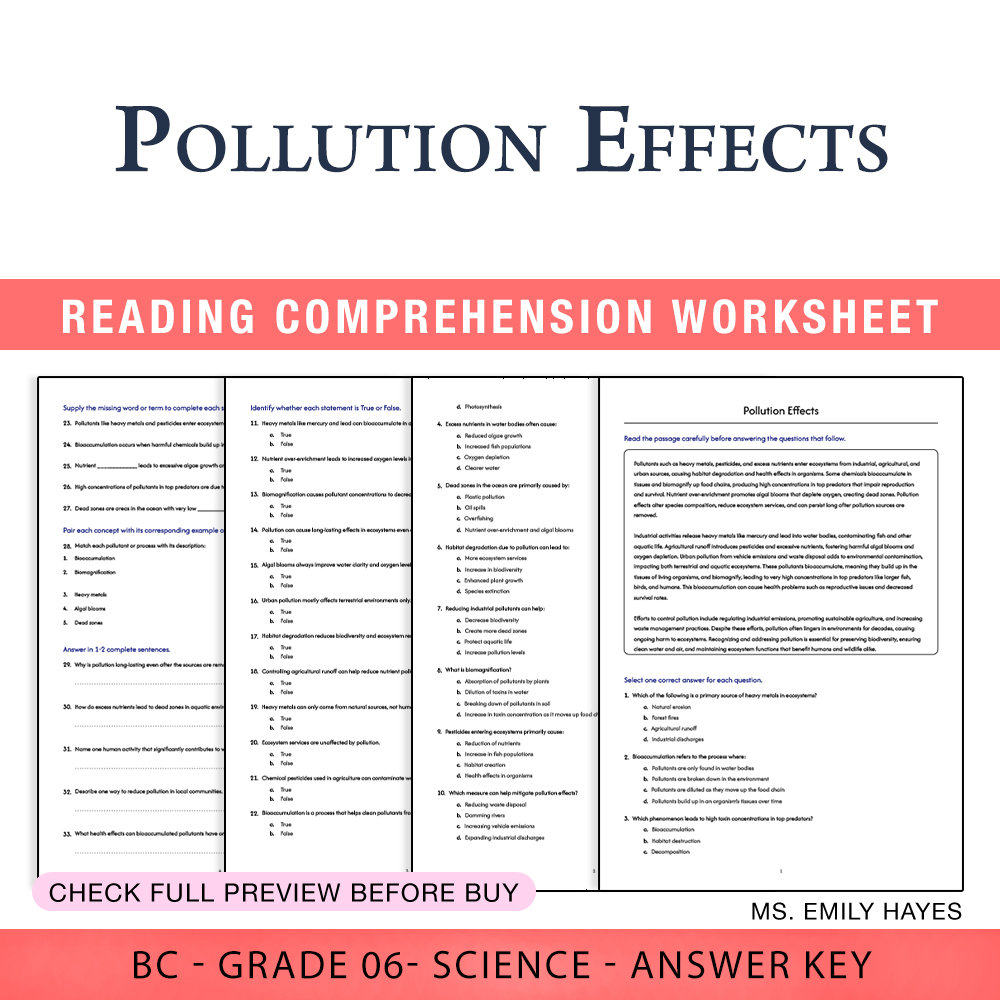
6th Grade Science | Pollution Effects Worksheet (PDF+ Answer Key)
Created byCopper Leaf ClassroomLearning Objectives
- Understand the sources and types of pollutants affecting ecosystems.
- Explain how pollutants bioaccumulate and biomagnify in food chains.
- Describe the consequences of nutrient over-enrichment and habitat degradation.
Also included in: Grade 6 Science BC | Ecosystems and Human Impact Unit (PDF + Answer Keys) +1 more
Instant download

Grade 12 Science – Engineering Trade-Offs & Decision-Making | Reading Worksheet
Created byBright Mind ResourcesLearning Objectives
- Define what an engineering trade-off is.
- Identify common trade-offs in engineered systems.
- Analyze how trade-offs affect system performance and safety.
Also included in: Engineering Design Grade 12 Science Daily Reading Worksheets Bundle | General +1 more
Instant download
Grade 10 Science | Metabolic Pathways Reading Worksheet & Answer Key (PDF)
JCreated byJ.S SheetsLearning Objectives
- Understand the key steps and components of glycolysis, the tricarboxylic acid cycle, and oxidative phosphorylation.
- Identify where energy is conserved and released in metabolic pathways.
- Explain how electrons flow through redox reactions during cellular respiration.
Also included in: Grade 10 Science Unit | Cell Biology, Genetics, & Ecosystems Worksheet Pack +1 more
Instant download
10th Grade Science | Meiosis & Genetic Variation Reading Worksheet
JCreated byJ.S SheetsLearning Objectives
- Understand the processes involved in meiosis, including homologous pairing, recombination, and chromosomal segregation.
- Explain how genetic variation arises through mechanisms such as crossing-over and independent assortment.
- Relate the mechanisms of meiosis to evolutionary outcomes and inheritance patterns.
Also included in: Grade 10 Science Unit | Cell Biology, Genetics, & Ecosystems Worksheet Pack +1 more
Instant download
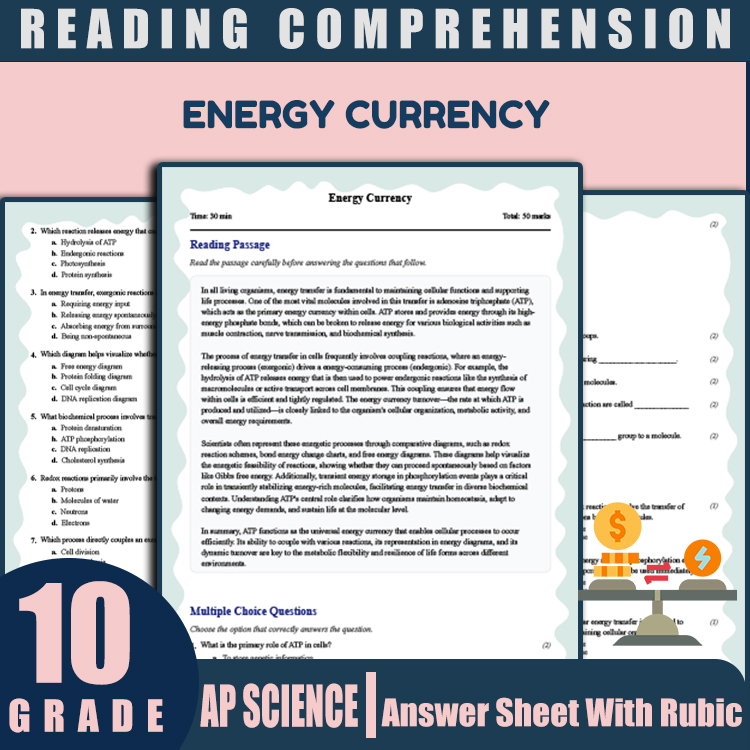
10th Grade Science | Energy Currency Reading Worksheet (PDF Answer Key & Rubric)
JCreated byJ.S SheetsLearning Objectives
- Understand the role of adenosine triphosphate (ATP) as the energy currency in biological systems.
- Explain the coupling of exergonic and endergonic reactions in cellular energy transfer.
- Compare different representations of redox reactions, bond energy changes, and free energy diagrams.
Also included in: Grade 10 Science Unit | Cell Biology, Genetics, & Ecosystems Worksheet Pack +1 more
Instant download
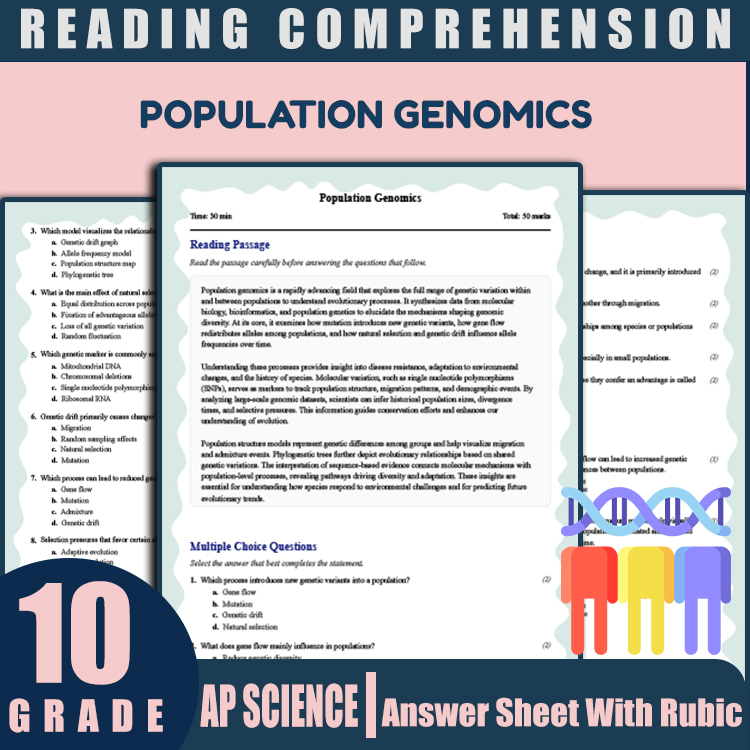
10th Grade Science | Population Genomics Reading Worksheet (PDF + Answer Key)
JCreated byJ.S SheetsLearning Objectives
- Understand how molecular variation contributes to population diversity.
- Interpret allele frequency models and their role in population structure.
- Describe the processes of mutation, gene flow, selection, and genetic drift.
Also included in: Grade 10 Science Unit | Cell Biology, Genetics, & Ecosystems Worksheet Pack +1 more
Instant download
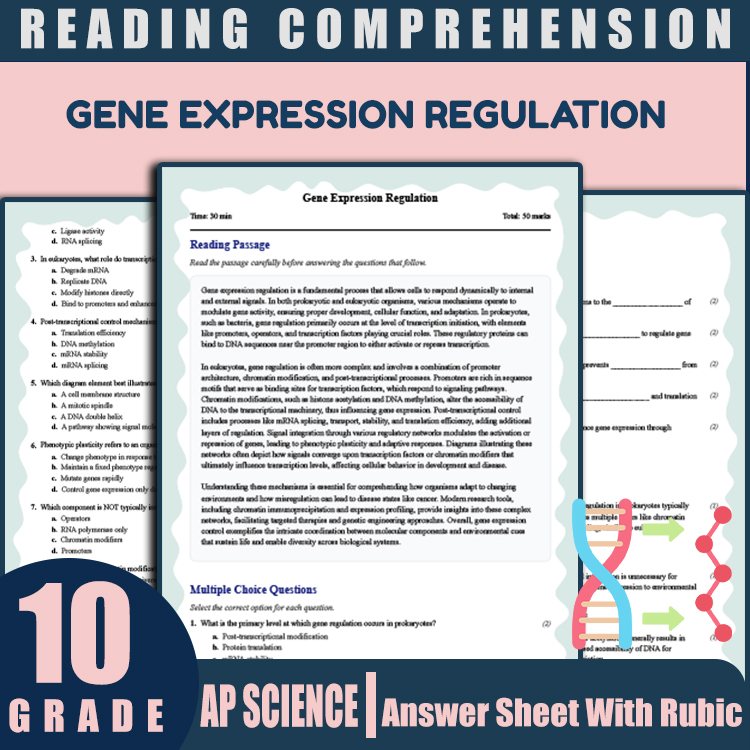
10th Grade Science | Gene Expression Regulation Reading Worksheet
JCreated byJ.S SheetsLearning Objectives
- Understand the mechanisms controlling gene expression in prokaryotic and eukaryotic systems.
- Identify key components such as promoters, transcription factors, chromatin modifications, and post-transcriptional controls.
- Analyze regulatory network diagrams and interpret expression profiles to understand signal integration.
Also included in: Grade 10 Science Unit | Cell Biology, Genetics, & Ecosystems Worksheet Pack +1 more
Instant download
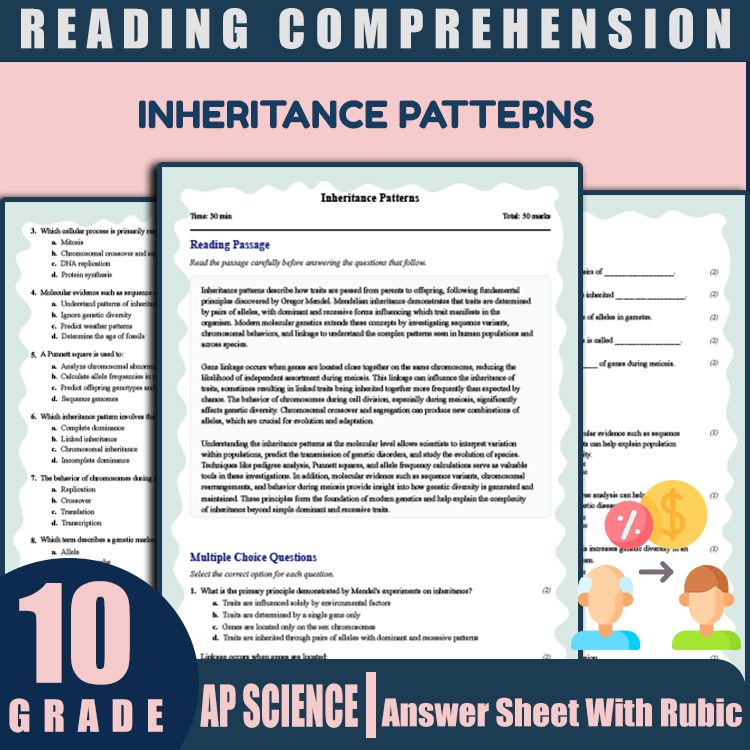
Grade 10 Science | Inheritance Patterns Reading Worksheet (PDF + Answer Key)
JCreated byJ.S SheetsLearning Objectives
- Understand the principles of Mendelian inheritance and how traits are transmitted across generations.
- Describe various inheritance patterns including dominance, linkage, and chromosomal inheritance.
- Interpret genetic information using pedigree charts, Punnett squares, and allele frequency data.
Also included in: Grade 10 Science Unit | Cell Biology, Genetics, & Ecosystems Worksheet Pack +1 more
Instant download
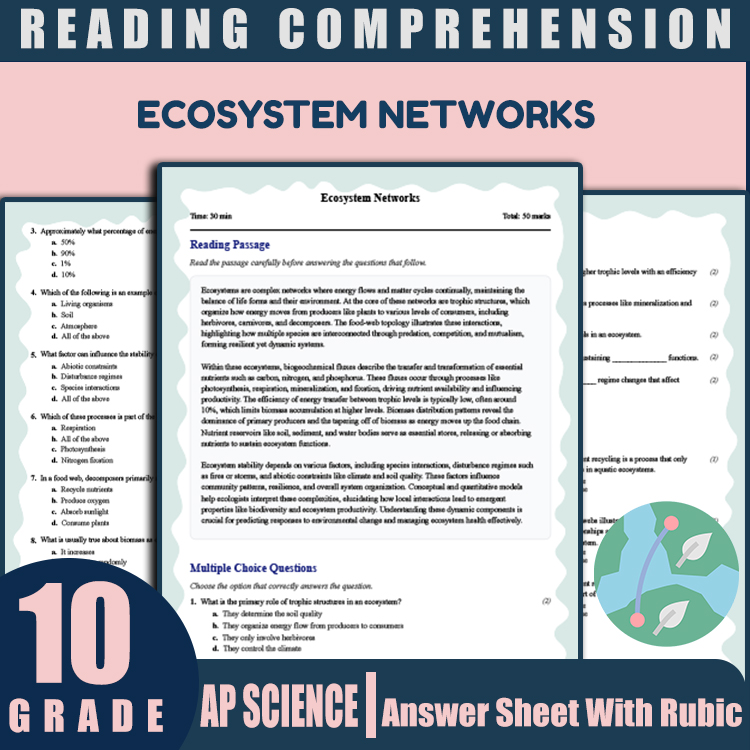
10th Grade Science | Ecosystem Networks Reading Worksheet (PDF + Answer Key)
JCreated byJ.S SheetsLearning Objectives
- Understand the flow of energy within ecosystems and how matter cycles through various components.
- Identify key structures like food webs, trophic levels, and biogeochemical fluxes in ecosystems.
- Quantify energy transfer efficiencies, biomass distributions, and nutrient reservoirs.
Also included in: Grade 10 Science Unit | Cell Biology, Genetics, & Ecosystems Worksheet Pack +1 more
Instant download
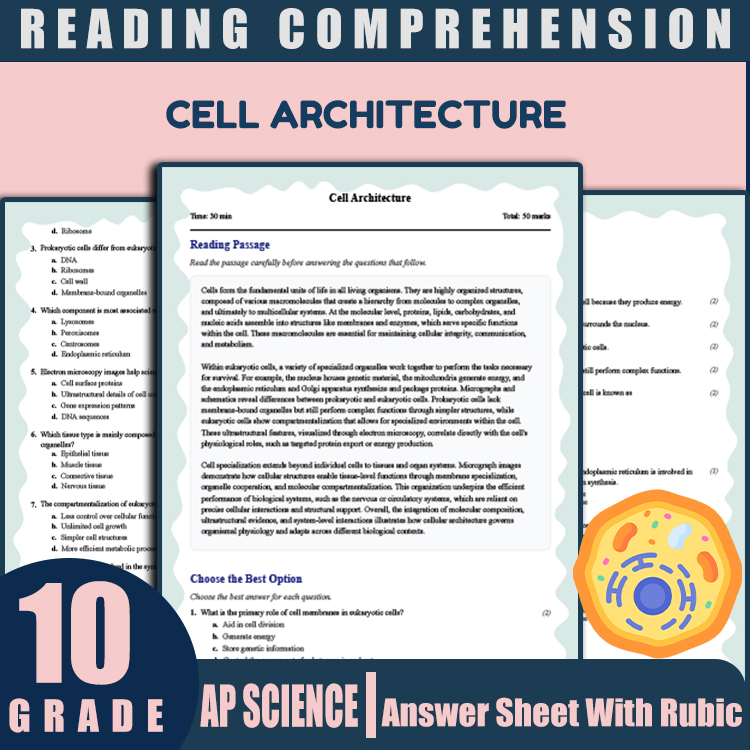
10th Grade Science | Cell Architecture Reading Worksheet & Answer Key (PDF)
JCreated byJ.S SheetsLearning Objectives
- Understand the hierarchical organization of biological molecules, organelles, and cellular systems.
- Compare structural features of prokaryotic and eukaryotic cells and relate ultrastructural evidence to their functions.
- Explain how cell structures enable processes such as compartmentalization and protein targeting in organisms.
Also included in: Grade 10 Science Unit | Cell Biology, Genetics, & Ecosystems Worksheet Pack +1 more
Instant download

Tectonic Forces Worksheet | NGSS Grade 9 Science Assessment
 Created bySkylark Worksheets
Learning Objectives
- Model how seafloor spreading and subduction zones drive changes in Earth’s surface and seafloor features.
- Explain how volcanic arc systems and mountain belt uplift result from crustal deformation and faulting.
- Use evidence such as seafloor magnetic anomaly patterns and geologic cross-sections to support plate tectonics.
Also included in: Grade 9 Science Lesson Bundle Earth Systems & Tectonic Forces | NGSS +1 more
Instant download
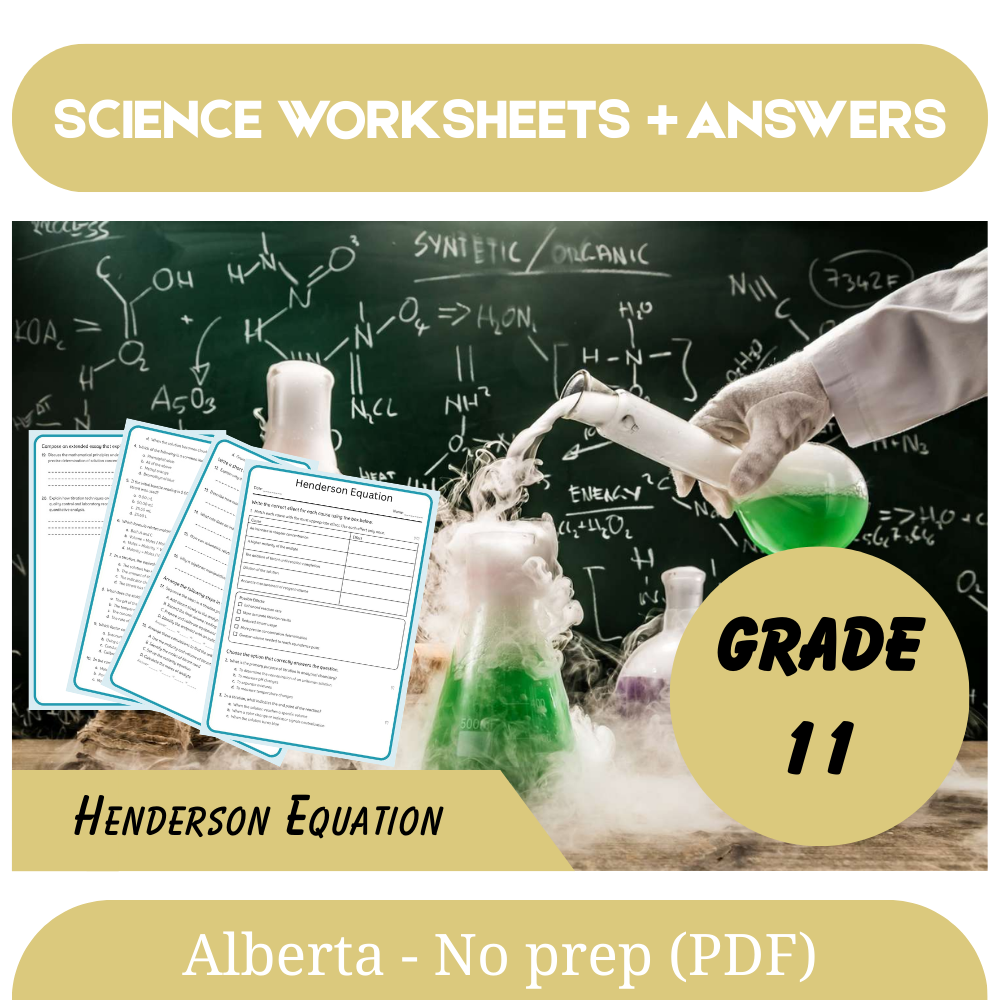
Grade 11 Science | Henderson Equation Worksheet – Chemistry Buffer Systems (PDF)
Created byBright Mind ResourcesLearning Objectives
- Understand the significance of the Henderson–Hasselbalch equation in calculating buffer pH.
- Apply the Henderson–Hasselbalch equation to real-world environmental and industrial scenarios.
- Analyze and interpret buffer system data to determine necessary component ratios.
Instant download

Grade 10 Science | Ocean Atmosphere Coupling Worksheet (PDF)
Created byEvergreen Desk EducationLearning Objectives
- Explain how the ocean and atmosphere exchange heat and moisture and how this affects winds and convection.
- Describe how changes in sea-surface temperature can shift evaporation, storms, and rainfall belts.
- Compare El Niño and La Niña as coupled ocean-atmosphere climate patterns and infer likely regional impacts.
Also included in: Grade 10 Weather & Climate Science Lesson Bundle - General Framework +1 more
Instant download
Grade 12 Science – Limiting Reagent Worksheet (PDF) | Alberta Standards
Created byBright Mind ResourcesLearning Objectives
- Identify the limiting reagent in a chemical reaction using stoichiometric ratios.
- Calculate theoretical and percent yields based on balanced chemical equations.
- Understand the impact of excess reagents and side reactions on industrial chemical processes.
Instant download
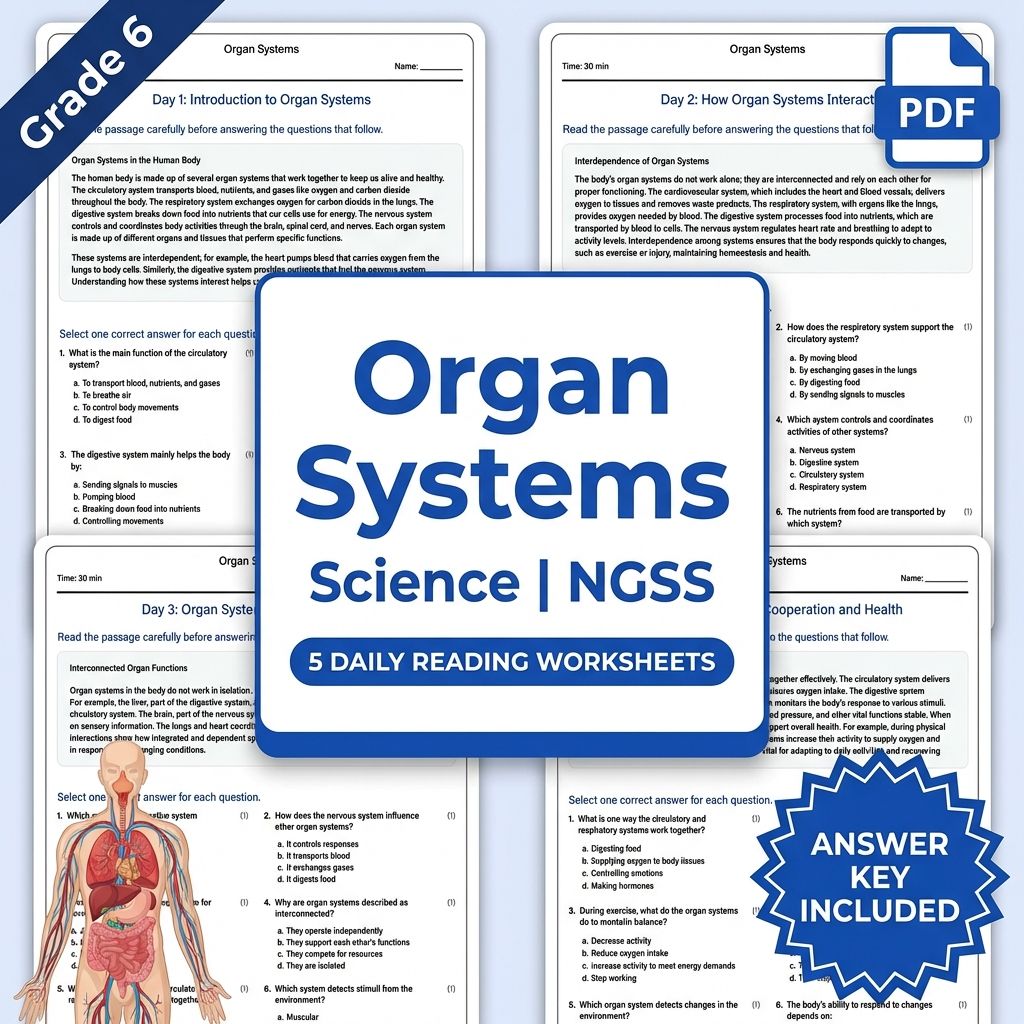
6th Grade Science | Organ Systems Daily Reading Worksheet (PDF & Answer Key)
Created byCopper Leaf ClassroomLearning Objectives
- Understand the organization of body systems and their functions.
- Identify the roles of tissues and organs in circulatory, respiratory, digestive, and nervous systems.
- Describe how organs work together within each system and how cellular functions relate to overall body processes.
Instant download
Design Optimization Worksheet | NGSS Grade 7 Science Assessment
 Created byCedar Grove Learning
Learning Objectives
- Analyze test data to identify factors affecting design performance.
- Refine design parameters through iterative testing and data comparison.
- Use quantitative data to justify modifications that improve design within constraints.
Instant download
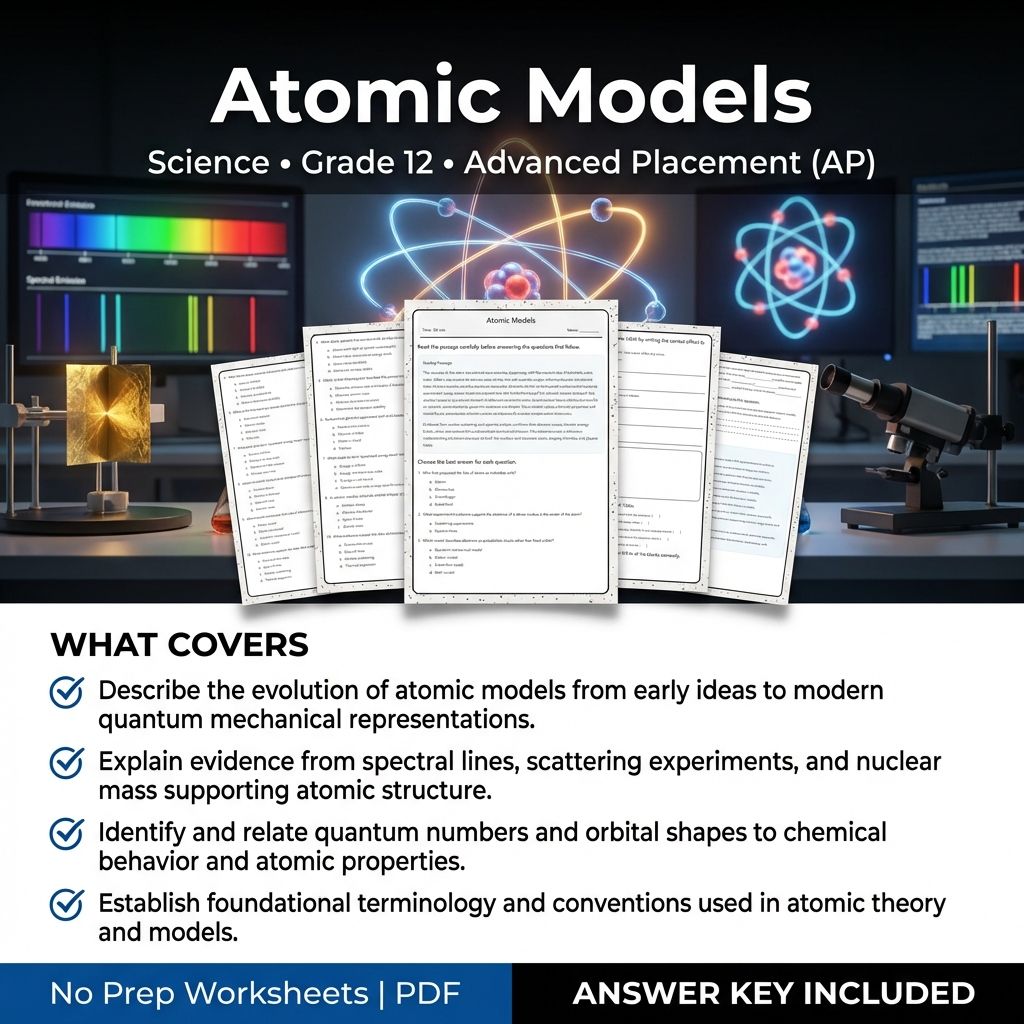
12th Grade Science | Atomic Models Worksheet & Answer Key (PDF) for Classroom Use
Created byCoral Reef LearningLearning Objectives
- Describe the evolution of atomic models from early ideas to modern quantum mechanical representations.
- Explain evidence from spectral lines, scattering experiments, and nuclear mass supporting atomic structure.
- Identify and relate quantum numbers and orbital shapes to chemical behavior and atomic properties.
Also included in: Grade 12 Science Unit Worksheet Bundle – Advanced Chemistry Concepts & Topics +1 more
Instant download

Grade 9 Science | Work and Kinetic Energy Worksheet | Florida NGSSS Aligned
 Created byLumora Learning
Learning Objectives
- Explain how work depends on force, displacement, and the angle between them.
- Use the work–energy theorem to predict how net work changes kinetic energy.
- Determine whether an object speeds up or slows down based on the direction of net force relative to motion.
Instant download
Grade 7 Science | Resource Distribution NGSS Worksheet & Answer Key (Printable)
Created byCedar Grove LearningLearning Objectives
- Explain how geologic processes and Earth history influence the distribution of mineral, energy, and groundwater resources.
- Connect plate tectonics, sedimentation, weathering, and past biological activity to the locations of resource deposits.
- Analyze the impacts of resource extraction and evaluate renewable versus nonrenewable resources.
Instant download

Grade 6 Science | Graph Selection - Daily Reading Comprehension
Created byCoral Reef LearningLearning Objectives
- Understand when to use different types of graphs to represent data.
- Identify the appropriate graph for continuous data, categorical data, and data relationships.
- Learn how to label axes properly and choose scales that accurately portray datasets.
Also included in: Evidence and Investigation Lesson Bundle | Grade 6 Science | Alberta +1 more
Instant download

Climate Modeling Worksheet | TEKS Grade 12 Science Assessment
JCreated byJ.S SheetsLearning Objectives
- Explain how different climate models represent energy balance, atmospheric processes, and ocean–atmosphere interactions.
- Use radiative transfer, cloud feedback, and parameterization concepts to interpret how models project climate change.
- Evaluate model reliability by describing validation with paleoclimate proxies, instrumental records, and sensitivity experiments.
Instant download

Physical and Chemical Changes Worksheet | NGSSS Grade 6 Science
JCreated byJ.S SheetsLearning Objectives
- Identify and distinguish between physical and chemical changes in matter.
- Recognize evidence that indicates whether a change is physical or chemical.
- Describe real-world examples of each type of change.
Also included in: Grade 6 Matter, Energy, and Forces Science lesson bundle – Florida (NGSSS) +1 more
Instant download

Speed and Velocity Worksheet | Standards-Aligned Grade 6 Science Practice
JCreated byJ.S SheetsLearning Objectives
- Understand the difference between speed and velocity in describing motion.
- Explain how direction affects velocity even when speed remains constant.
- Calculate average speed using total distance and elapsed time.
Also included in: Grade 6 Matter, Energy, and Forces Science lesson bundle – Florida (NGSSS) +1 more
Instant download

States of Matter Worksheet | Standards-Aligned Grade 6 Science Practice
JCreated byJ.S SheetsLearning Objectives
- Describe the different states of matter: solids, liquids, and gases.
- Explain how particles behave in each state of matter.
- Identify changes in state and relate them to energy and particle motion.
Also included in: Grade 6 Matter, Energy, and Forces Science lesson bundle – Florida (NGSSS) +1 more
Instant download

Heat and Temperature Worksheet | Standards-Aligned Grade 6 Science Practice
JCreated byJ.S SheetsLearning Objectives
- Understand the difference between heat and temperature and how they relate to energy transfer.
- Describe how heat moves from warmer to cooler regions and how this affects systems.
- Explain why the same temperature does not necessarily mean the same amount of energy.
Also included in: Grade 6 Matter, Energy, and Forces Science lesson bundle – Florida (NGSSS) +1 more
Instant download

Thermal Energy Transfer Worksheet | Standards-Aligned Grade 6 Science Practice
JCreated byJ.S SheetsLearning Objectives
- Understand the three main mechanisms of thermal energy transfer: conduction, convection, and radiation.
- Identify examples of each energy transfer mechanism in real-world situations.
- Explain how the medium involved affects the process of thermal energy transfer.
Also included in: Grade 6 Matter, Energy, and Forces Science lesson bundle – Florida (NGSSS) +1 more
Instant download
Browse more categories
About Science Worksheets
Find Science worksheets spanning core skills, practice, and review. All 44,538 resources are instant PDF downloads for the classroom or home.
Every worksheet on MyTeachingSheets is created by independent teacher-authors and reviewed before publication. All resources download as printable PDFs for classroom, homework, or at-home practice, and many include answer keys. Preview any worksheet free before buying.