
Science Worksheets
44,620 subject resources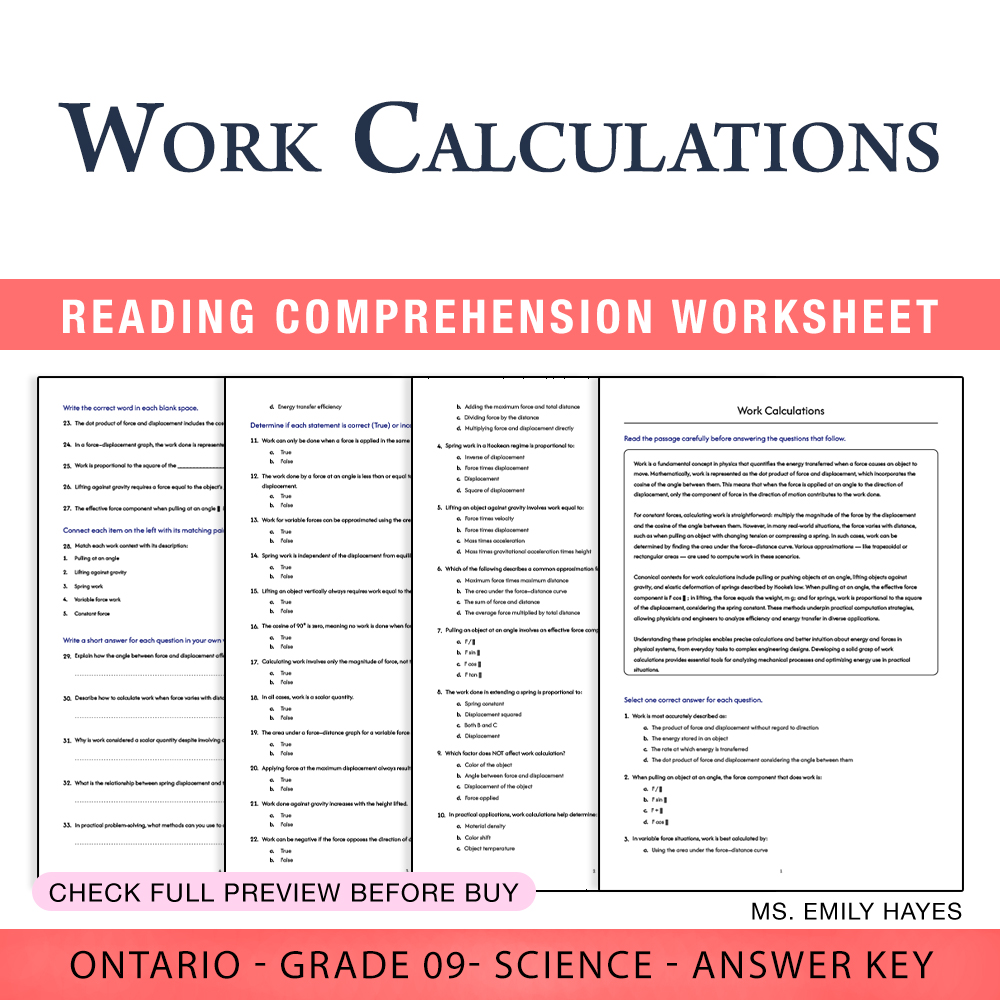
9th Grade Science | Work Calculations Worksheet (PDF + Answer Key)
 Created byCopper Leaf Classroom
Learning Objectives
- Understand the concept of work as the dot product of force and displacement, considering the angle between them.
- Calculate work done in various contexts including pulling at an angle, lifting against gravity, and spring work.
- Differentiate methods for calculating work with constant and variable forces, including the area under force–distance curves.
Instant download
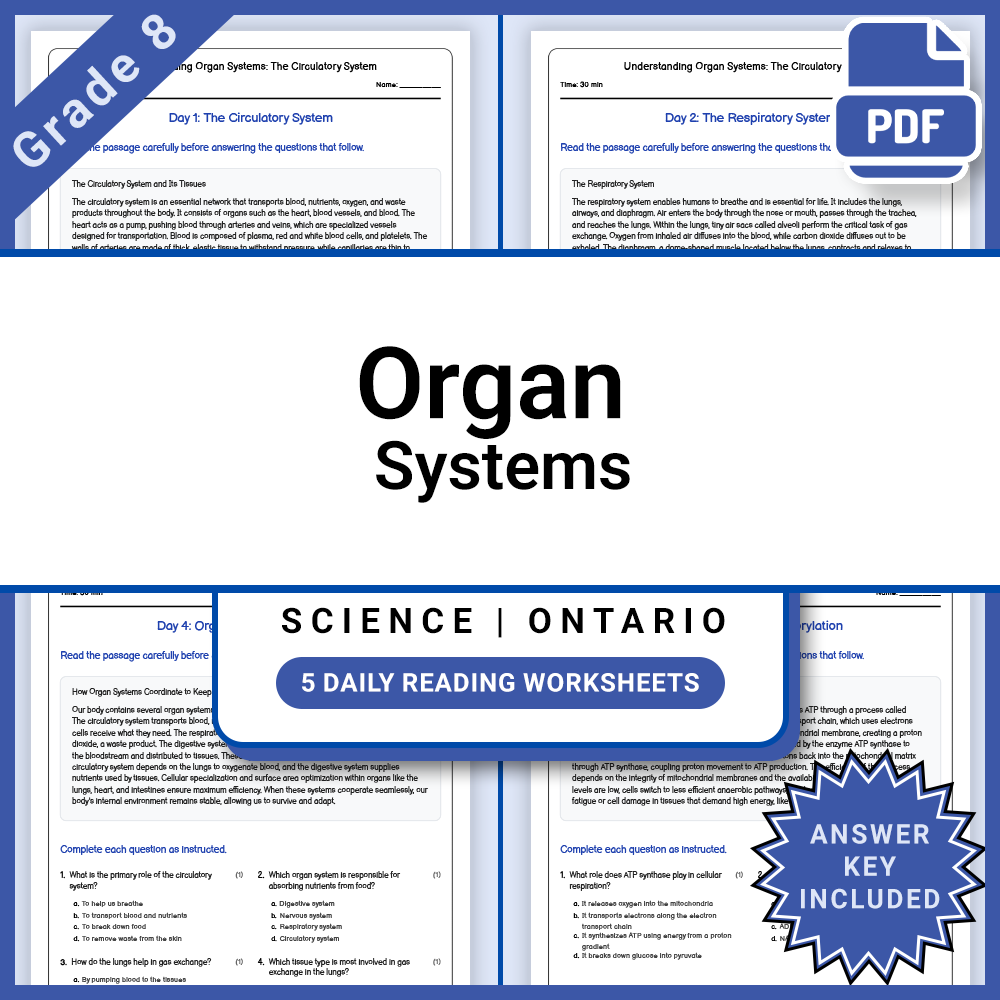
Grade 8 Science – Organ Systems Daily Reading Worksheet + Answer Key
JCreated byJ.S SheetsLearning Objectives
- Identify the main functions of the circulatory system.
- Recognize different tissue types involved in the circulatory system.
- Explain how blood transports nutrients and oxygen.
Also included in: Grade 8 Science Lesson Group: Ontario Curriculum Reading Worksheets Bundle +1 more
Instant download
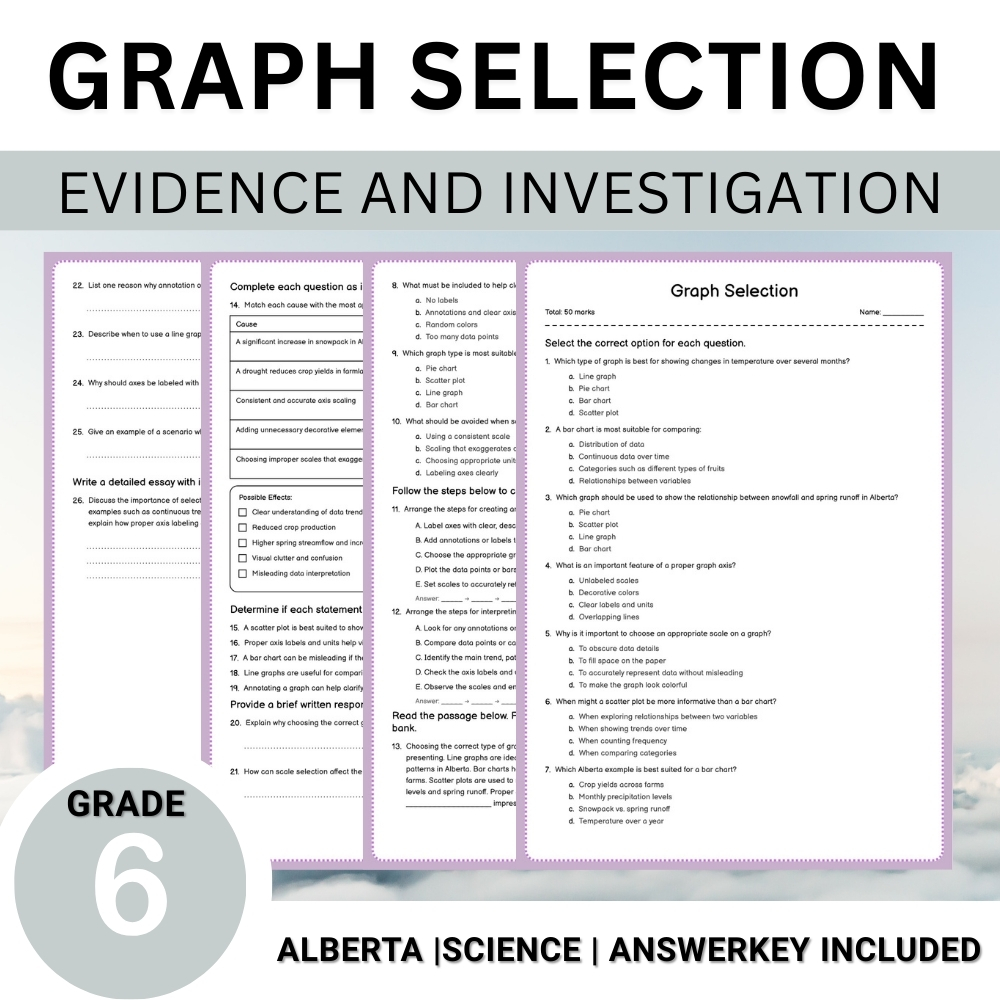
Grade 6 Science | Graph Selection Worksheet (Answer Key) for Classroom Assessment
Learning Objectives
- Identify different types of graphs and their appropriate uses.
- Match data types with suitable graph types and scales.
- Understand how to label axes and interpret visual data representations.
Also included in: Grade 6 Science Unit | Data & Measurement Worksheets Bundle (Assessment & Practice) +1 more
Instant download

Circular Motion Worksheet for Grade 11 Science | Standards-Aligned Practice
JCreated byJ.S SheetsLearning Objectives
- Explain uniform vs. non-uniform circular motion and identify tangential vs. centripetal acceleration components
- Apply centripetal force relationships using v^2/r and ω^2r to solve force and motion problems
- Connect period and frequency with angular speed and interpret how changing radius and speed affect centripetal acceleration
Instant download

Grade 8 Science | Energy–Temperature Link Worksheet | California Standards
 Created byLumora Learning
Learning Objectives
- Explain how energy transfer causes temperature changes in materials
- Use the ideas of thermal energy and thermal equilibrium to predict warming and cooling
- Relate everyday observations of hot and cold to the direction of heat (energy) flow
Instant download

6th Grade Science | Tissue Types Worksheet (PDF) – BC Standards
 Created byEvergreen Desk Education
Learning Objectives
- Identify the four general tissue types in multicellular animals: epithelial, connective, muscle, and nervous.
- Describe how each tissue type’s structures support its specific functions.
- Use evidence from a passage and tissue examples to explain relationships between tissues and organs.
Instant download

Earth System Spheres Worksheet for Grade 6 Science | Standards-Aligned Practice
JCreated byJ.S SheetsLearning Objectives
- Identify the four main Earth system spheres and their interactions.
- Describe processes such as weathering, evaporation, and biological activity.
- Explain how energy and gravity influence changes within Earth spheres.
Also included in: Grade 6 Earth & Space Science Lesson Bundle: California Standards +1 more
Instant download
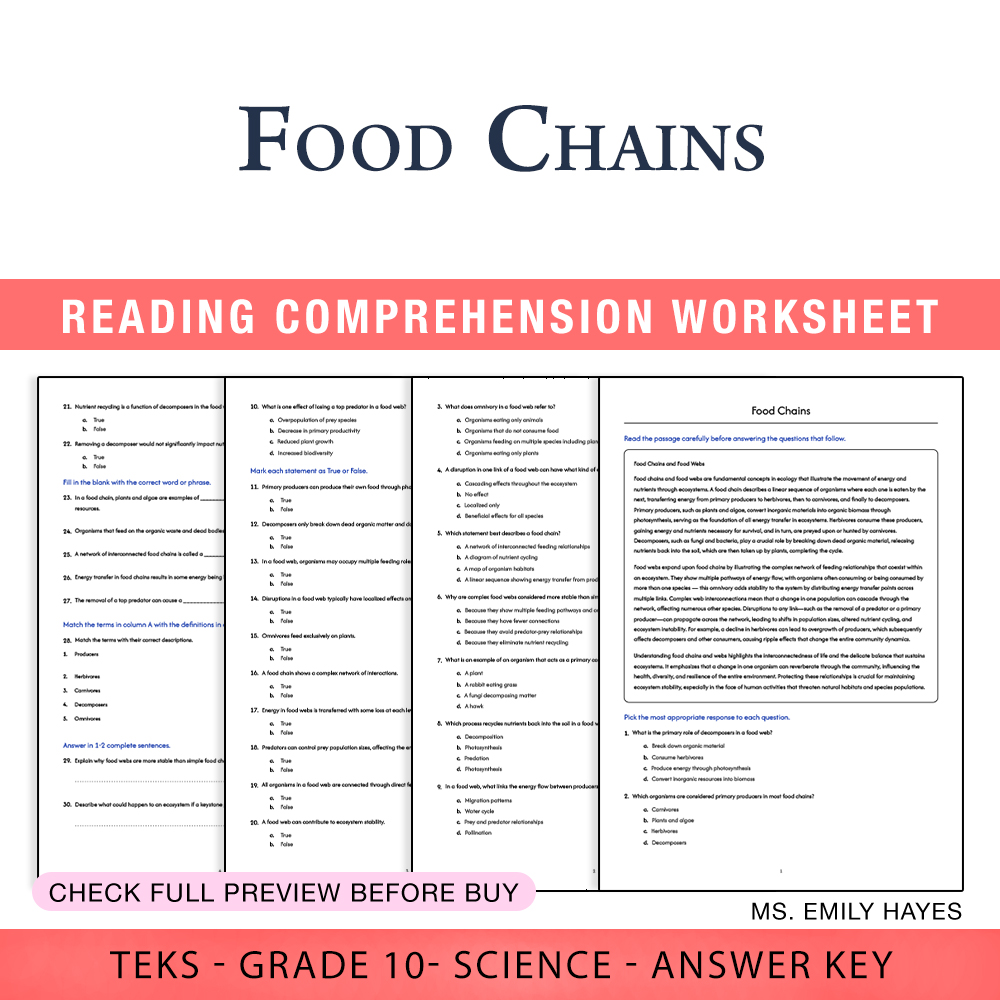
10th Grade Science | Food Chains & Food Webs Worksheet (PDF + Answer Key)
Created byCopper Leaf ClassroomLearning Objectives
- Understand the structure and role of food chains and food webs in ecosystems.
- Identify different organism types involved in food chains, such as producers, consumers, and decomposers.
- Explain the transfer of energy and matter through feeding relationships.
Instant download

Grade 9 Science – Collision Safety & Impact Impulse Daily Reading Worksheet
 Created byBright Mind Resources
Learning Objectives
- Interpret force-time graphs to analyze collision forces
- Calculate impulse from given force and time data
- Understand how various safety devices influence collision outcomes
Also included in: Newtonian Motion Grade 9 Science Daily Reading Worksheets Lesson Bundle | NGSS +2 more
Instant download

Grade 9 Science – Field Dynamics & Magnetism Daily Reading Worksheet
Created byBright Mind ResourcesLearning Objectives
- Understand the concepts of electric and magnetic fields and their vectors.
- Identify the use of field lines to represent magnetic and electric fields.
- Learn how charged particles move in magnetic fields and how forces affect their trajectories.
Also included in: Newtonian Motion Grade 9 Science Daily Reading Worksheets Lesson Bundle | NGSS +2 more
Instant download

Grade 9 Science – Momentum & Conservation | Daily Reading Worksheet
Created byBright Mind ResourcesLearning Objectives
- Define momentum in the context of physics.
- Describe the principle of conservation of linear momentum in isolated systems.
- Differentiate between elastic and inelastic collisions.
Also included in: Newtonian Motion Grade 9 Science Daily Reading Worksheets Lesson Bundle | NGSS +2 more
Instant download

Grade 7 Science | Conservation of Mass - Daily Reading Comprehension
 Created byCoral Reef Learning
Learning Objectives
- Understand the principle that matter is conserved during chemical reactions.
- Recognize how atoms rearrange during reactions without changing the total mass.
- Explain the concept of a closed system in mass conservation.
Instant download

Grade 12 Biology Mutation Impacts Worksheet Alberta Science
Created byEvergreen Desk EducationLearning Objectives
- Explain how different mutation types (point substitutions, insertions, deletions, and chromosomal rearrangements) can change gene products.
- Predict possible consequences of mutations, ranging from silent effects to frameshifts and altered protein function.
- Describe how mutational outcomes can affect crop traits, livestock genetics, and pathogen variation in Alberta.
Instant download
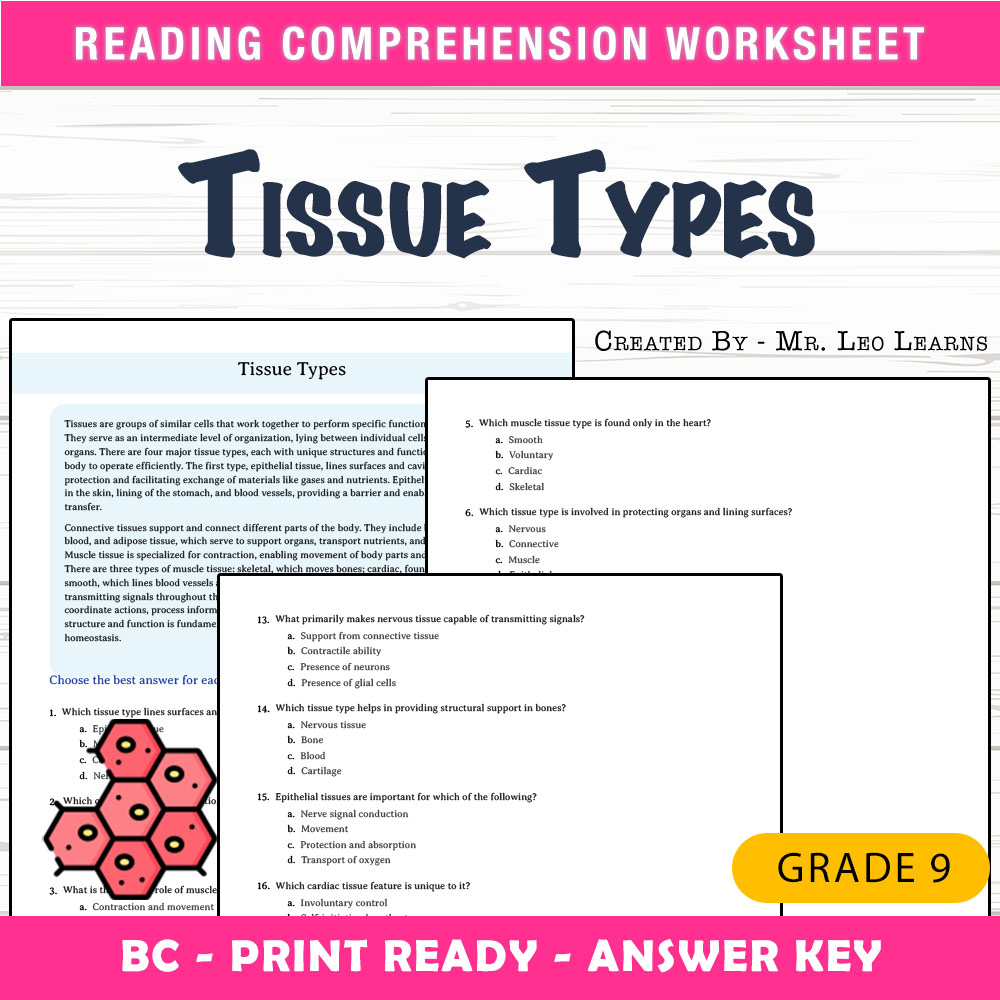
Grade 9 Science — Tissue Types Worksheet MCQ Paper for Master
 Created byThe Resource Hub
Learning Objectives
- Identify and describe the four main tissue types in the human body.
- Understand the functions of epithelial, connective, muscle, and nervous tissues.
- Recognize how tissue structure relates to their specific functions.
Also included in: Grade 9 Science Cells & Body Systems Worksheet Bundle | BC Curriculum Resources +1 more
Instant download

Grade 8 Science | Membrane Functions Worksheet (PDF+ Answer Key)
Created byCopper Leaf ClassroomLearning Objectives
- Describe the role of cell membranes in regulating exchange between the cell and environment.
- Explain how membrane composition and surface area influence diffusion and signaling.
- Link microscopic membrane structures to overall organ and tissue functions in physiological processes.
Also included in: Grade 8 Science Bundle – Cell Structure, Systems & Organisms (PDF + Answer Key) +1 more
Instant download
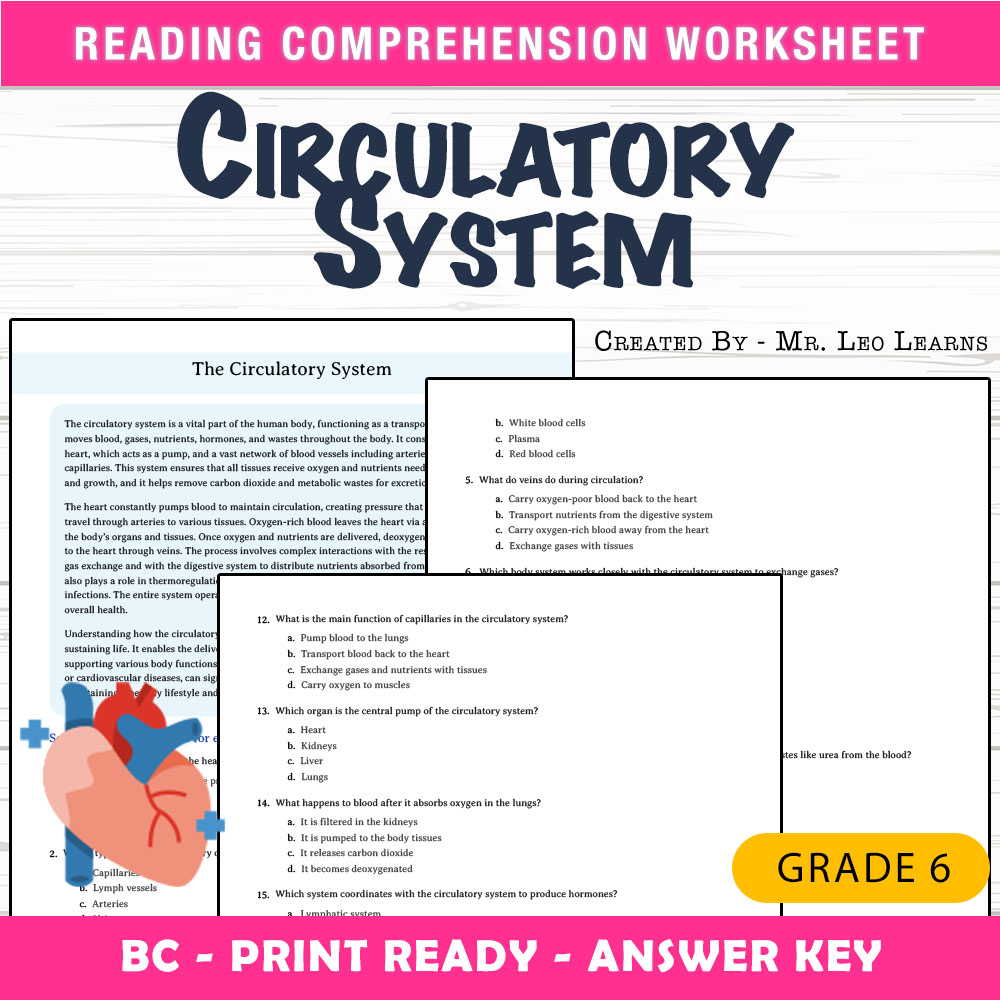
Grade 6 Science – The Circulatory System MCQ Worksheet for Mastery
Created byThe Resource HubLearning Objectives
- Understand how the circulatory system transports blood, gases, nutrients, hormones, and wastes.
- Identify the roles of the heart and blood vessels in circulation.
- Explain how circulation interacts with other body systems like respiratory and digestive systems.
Also included in: Grade 6 Science Unit | Multicellular Systems & Functions Worksheet Bundle +1 more
Instant download
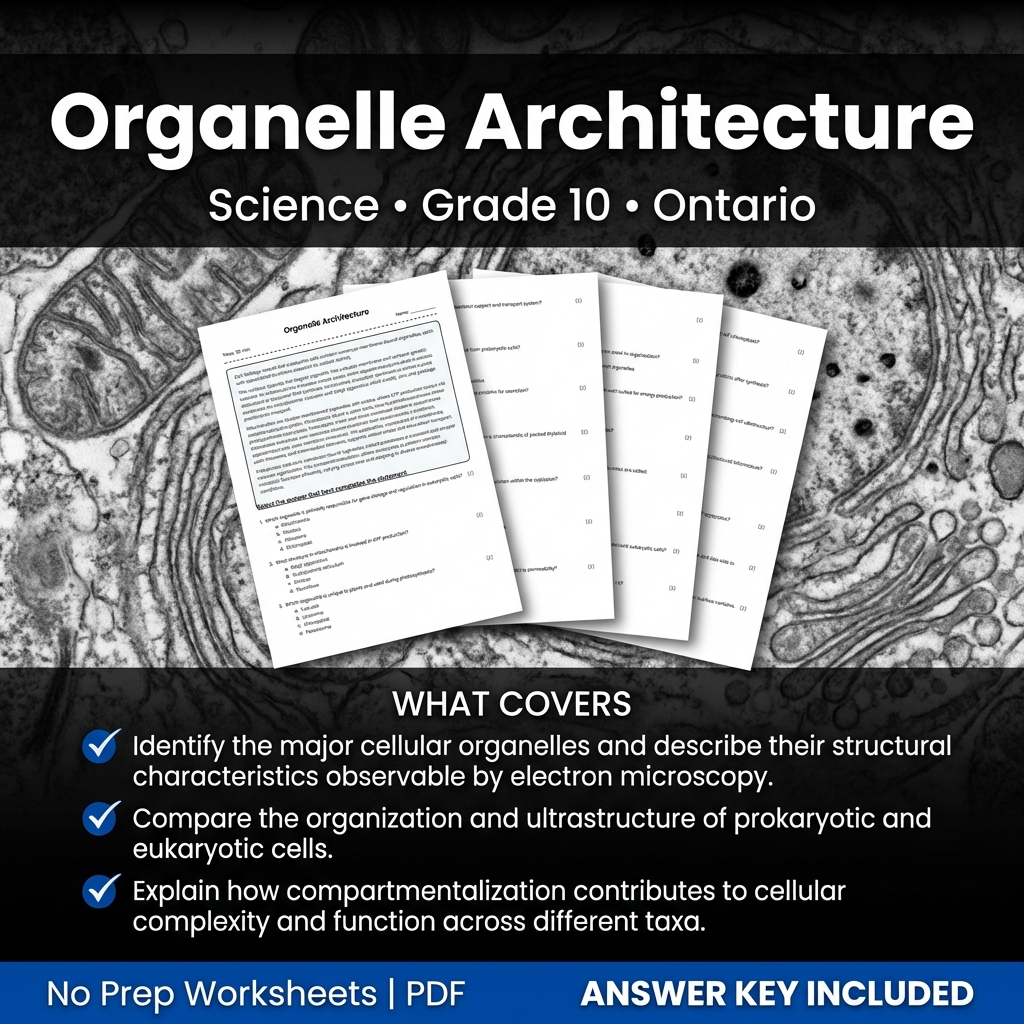
Organelle Architecture Worksheet | Science Assessment | Ontario Grade 10
Created byCoral Reef LearningLearning Objectives
- Identify the major cellular organelles and describe their structural characteristics observable by electron microscopy.
- Compare the organization and ultrastructure of prokaryotic and eukaryotic cells.
- Explain how compartmentalization contributes to cellular complexity and function across different taxa.
Instant download
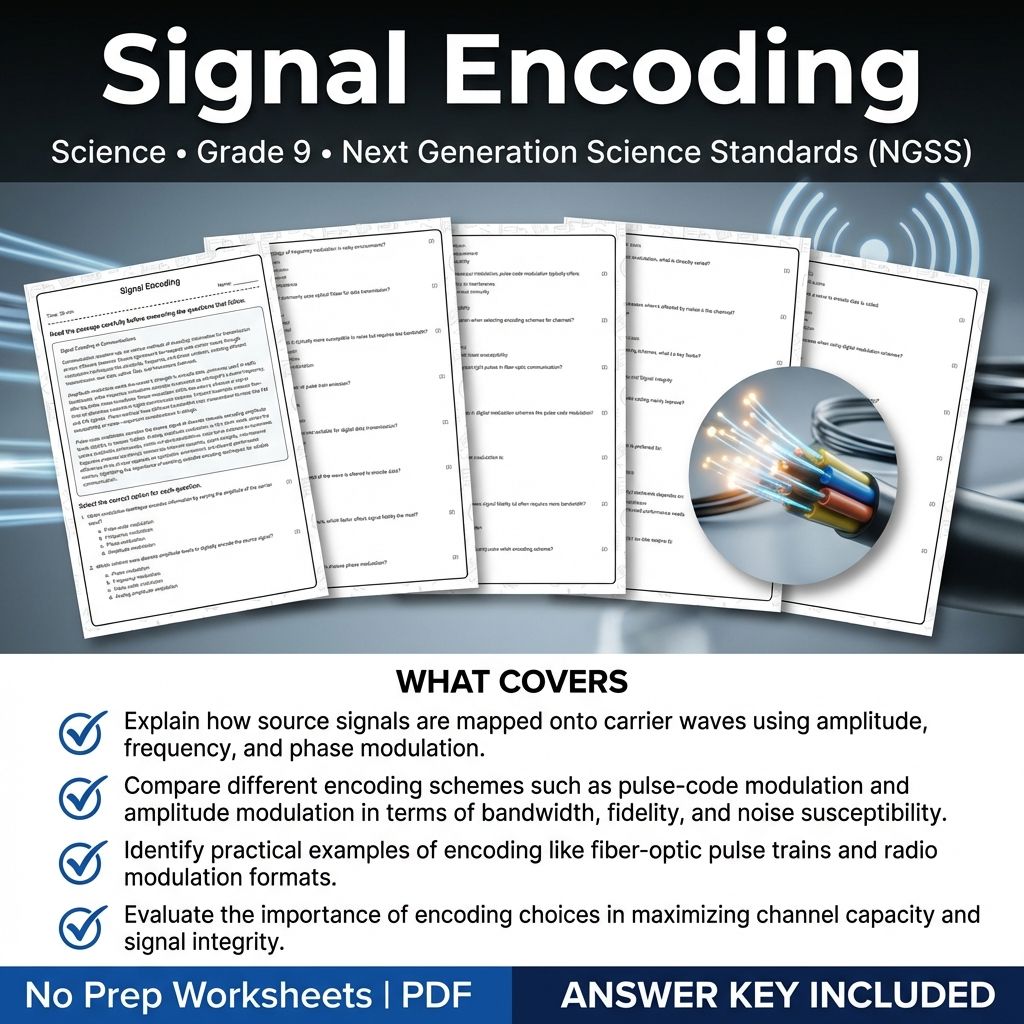
Grade 9 Science | Signal Encoding Worksheet & Answer Key (Printable PDF)
Created byCoral Reef LearningLearning Objectives
- Explain how source signals are mapped onto carrier waves using amplitude, frequency, and phase modulation.
- Compare different encoding schemes such as pulse-code modulation and amplitude modulation in terms of bandwidth, fidelity, and noise susceptibility.
- Identify practical examples of encoding like fiber-optic pulse trains and radio modulation formats.
Also included in: Grade 9 Science | Wave Properties & Electromagnetic Radiation Worksheet Bundle +1 more
Instant download

Grade 12 Science | Representation Basics in Science - Reading Comprehension
Created byCoral Reef LearningLearning Objectives
- Understand the purpose and types of scientific models
- Identify different kinds of models used in scientific research
- Learn how to interpret and select appropriate models for phenomena
Also included in: Science Practices Lesson Bundle | Grade 12 Science | AP +1 more
Instant download

Grade 10 Science — Worksheet MCQ Paper for Mastering Membrane Dynamics
Created byThe Resource HubLearning Objectives
- Understand membrane composition and its role in cellular function.
- Explain mechanisms of membrane transport, including diffusion and carrier-mediated processes.
- Analyze how electrochemical gradients are established and maintained.
Also included in: Grade 10 Biology and Ecosystems Lesson Bundle | AP Science +1 more
Instant download

Grade 10 Science — Worksheet MCQ Paper for Mastering Circuit Fundamentals
Created byThe Resource HubLearning Objectives
- Understand the basic components and layout of simple direct-current circuits.
- Apply Ohm’s law to calculate current, voltage, resistance, and power dissipation.
- Differentiate between series and parallel resistor configurations and analyze their equivalent resistance.
Also included in: Grade 10 Science AP Bundle – Comprehensive Curriculum with 60 Worksheets
Instant download

Grade 10 Science — Worksheet MCQ Paper for Mastering Surface Processes
Created byThe Resource HubLearning Objectives
- Define and differentiate weathering, erosion, sediment transport, and deposition in landscape development.
- Interpret physical and graphical evidence of surface processes such as sediment grain-size distribution, channel profiles, and delta growth.
- Relate surface process outcomes to climate, lithology, and human modifications affecting landscape evolution.
Also included in: Grade 10 Earth and Space Sciences Lesson Bundle | AP Curriculum +1 more
Instant download

Grade 10 Science — Worksheet MCQ Paper for Mastering Atmospheric Patterns
Created byThe Resource HubLearning Objectives
- Understand the structure and circulation of atmospheric pressure systems.
- Identify how synoptic-scale patterns influence regional weather phenomena.
- Explain the role of thermodynamic profiles and moisture processes in precipitation.
Also included in: Grade 10 Earth and Space Sciences Lesson Bundle | AP Curriculum +1 more
Instant download

Grade 10 Science — Worksheet MCQ Paper for Mastering Energy Pathways
Created byThe Resource HubLearning Objectives
- Understand the transfer of energy within Earth's systems, including solar radiation absorption and heat fluxes.
- Analyze how oceanic heat transport influences regional climate variability.
- Apply algebraic models to relate radiative inputs to surface temperature and phase changes.
Also included in: Grade 10 Earth and Space Sciences Lesson Bundle | AP Curriculum +1 more
Instant download

Grade 10 Science — Worksheet MCQ Paper for Mastering Bond Polarity
Created byThe Resource HubLearning Objectives
- Understand how electronegativity differences influence bond polarity.
- Interpret vector and quantitative representations of dipole moments.
- Distinguish between polar covalent and ionic bonds on a continuum.
Also included in: Grade 10 Science Chemistry Foundations Lesson Bundle for AP Curriculum +1 more
Instant download

Grade 10 Science — Worksheet MCQ Paper for Mastering Projectile Motion
Created byThe Resource HubLearning Objectives
- Understand the independence of horizontal and vertical components in projectile motion.
- Apply vector decomposition to predict the range, time of flight, and peak height of projectiles.
- Use parametric equations to link initial velocity and angle to motion outcomes.
Also included in: Grade 10 Science AP Bundle – Comprehensive Curriculum with 60 Worksheets
Instant download

Grade 10 Science — Inheritance Patterns Worksheet MCQ Paper PDF + Answer Key
Created byThe Resource HubLearning Objectives
- Understand Mendelian principles of heredity, including segregation and dominance.
- Interpret genetic inheritance using Punnett squares and pedigree analysis.
- Explain linkage and chromosomal inheritance patterns at the molecular level.
Also included in: Grade 10 Biology and Ecosystems Lesson Bundle | AP Science +1 more
Instant download

Grade 10 Science — Oscillations MCQ Worksheet for Mastery
Created byThe Resource HubLearning Objectives
- Understand the fundamental concepts of simple harmonic motion and oscillations.
- Identify key parameters such as period, frequency, amplitude, and phase in oscillatory systems.
- Explain energy transfer between kinetic and potential forms during oscillations.
Also included in: Grade 10 Science AP Bundle – Comprehensive Curriculum with 60 Worksheets
Instant download

Grade 10 Science — Worksheet MCQ Paper for Mastering Causal Complexity
Created byThe Resource HubLearning Objectives
- Understand how to disentangle multivariable causal relationships using frameworks like control matrices and causal graphs.
- Identify confounding factors and interaction effects in complex systems such as ecosystems.
- Evaluate the impact of study design, measurement limitations, and model assumptions on causal inference.
Also included in: Grade 10 Science Bundle: Master Scientific Modeling & Data Analysis +1 more
Instant download

Grade 10 Science — Adaptation Strategies Worksheet for Mastery
Created byThe Resource HubLearning Objectives
- Understand different conceptual approaches to climate adaptation and mitigation.
- Analyze trade-offs and unintended consequences of Earth system interventions.
- Evaluate criteria for scalable and monitorable adaptation measures.
Also included in: Grade 10 Earth and Space Sciences Lesson Bundle | AP Curriculum +1 more
Instant download

Grade 10 Science — Fields Overview Worksheet MCQ Paper PDF + Answer Key
Created byThe Resource HubLearning Objectives
- Understand basic concepts of electric and magnetic fields and how they interact with charges.
- Identify the representation of field lines and their significance in explaining forces.
- Relate field concepts to potential energy differences and forces on charges.
Also included in: Grade 10 Science AP Bundle – Comprehensive Curriculum with 60 Worksheets
Instant download

Grade 10 Science — Argument Critique Worksheet MCQ Paper
Created byThe Resource HubLearning Objectives
- Evaluate explanatory claims by examining evidence and reasoning.
- Identify criteria for refutation and corroboration of arguments.
- Analyze how statistical strength and methodological choices influence argument persuasion.
Also included in: Grade 10 Science Bundle: Master Scientific Modeling & Data Analysis +1 more
Instant download

Grade 10 Science — Worksheet MCQ Paper for Mastering Population Patterns
Created byThe Resource HubLearning Objectives
- Understand the factors that influence population structure, including birth and death rates.
- Identify and interpret population models and age-structure diagrams.
- Analyze how organismal traits and environmental factors shape population dynamics.
Also included in: Grade 10 Biology and Ecosystems Lesson Bundle | AP Science +1 more
Instant download

Grade 10 Science — Worksheet MCQ Paper for Mastering Population Genomics
Created byThe Resource HubLearning Objectives
- Understand the role of molecular variation in shaping population diversity.
- Identify models of allele frequency changes influenced by mutation, gene flow, selection, and drift.
- Interpret phylogenetic trees and population structure data to infer evolutionary relationships.
Also included in: Grade 10 Biology and Ecosystems Lesson Bundle | AP Science +1 more
Instant download

Grade 10 Science — Impulse and Momentum Worksheet MCQ Paper
Created byThe Resource HubLearning Objectives
- Understand the relationship between impulse and change in momentum.
- Identify different types of collisions: elastic, inelastic, perfectly inelastic.
- Analyze momentum conservation in multi-object systems using vector considerations.
Also included in: Grade 10 Science AP Bundle – Comprehensive Curriculum with 60 Worksheets
Instant download

Grade 10 Science — Worksheet MCQ Paper for Mastering Constraint-Based Design
Created byThe Resource HubLearning Objectives
- Understand the role of constraints in observational and comparative research.
- Identify trade-offs among replication, measurement precision, and scope under practical limitations.
- Evaluate scenarios involving rapid assessments or limited instrumentation to determine prioritized design choices.
Also included in: Grade 10 Science Bundle: Master Scientific Modeling & Data Analysis +1 more
Instant download

Grade 10 Science — Model-Data Fit Worksheet MCQ Paper for Mastery
Created byThe Resource HubLearning Objectives
- Understand how to compare model predictions with observed data using residual analysis.
- Identify criteria for evaluating the goodness-of-fit of a model.
- Interpret discrepancies between models with and without air resistance in projectile motion.
Also included in: Grade 10 Science Bundle: Master Scientific Modeling & Data Analysis +1 more
Instant download

Grade 10 Science — Worksheet MCQ Paper for Mastering Periodic Patterns
Created byThe Resource HubLearning Objectives
- Understand how the organization of the periodic table reflects underlying electron configurations.
- Interpret trends in atomic radius, ionization energy, and electronegativity across periods and groups.
- Explain how effective nuclear charge and shielding influence periodic trends.
Also included in: Grade 10 Science Chemistry Foundations Lesson Bundle for AP Curriculum +1 more
Instant download

Grade 10 Science — Ecosystem Networks Worksheet MCQ Paper for Mastery
Created byThe Resource HubLearning Objectives
- Understand the flow of energy through trophic levels in ecosystems.
- Identify the components and topology of food webs.
- Explain matter cycling and biogeochemical fluxes within ecosystems.
Also included in: Grade 10 Biology and Ecosystems Lesson Bundle | AP Science +1 more
Instant download

Grade 10 Science — Worksheet MCQ Paper for Data Visualization
Created byThe Resource HubLearning Objectives
- Understand principles and conventions for graphical and tabular data representation.
- Identify appropriate visualization methods such as scatterplots, histograms, and boxplots.
- Interpret data patterns, variability, outliers, and uncertainty in visualizations.
Also included in: Grade 10 Science Bundle: Master Scientific Modeling & Data Analysis +1 more
Instant download

Grade 10 Science — Worksheet MCQ Paper for Mastering Quantitative Communication
Created byThe Resource HubLearning Objectives
- Understand conventions for reporting quantitative results, including uncertainty notation and significant digits.
- Apply graphical annotation and visual aids to effectively communicate data findings.
- Evaluate how confidence intervals and numerical summaries enhance the credibility of scientific conclusions.
Also included in: Grade 10 Science Bundle: Master Scientific Modeling & Data Analysis +1 more
Instant download

Grade 10 Science — Worksheet MCQ Paper for Mastering Reaction Rates
Created byThe Resource HubLearning Objectives
- Understand the factors influencing reaction rates, including collision frequency, orientation, and activation energy.
- Interpret graphical and mathematical representations of concentration versus time to determine reaction order.
- Recognize how temperature and catalysts modify reaction pathways and rates.
Also included in: Grade 10 Science Chemistry Foundations Lesson Bundle for AP Curriculum +1 more
Instant download

Grade 10 Science — Worksheet MCQ Paper for Mastering Cell Architecture
Created byThe Resource HubLearning Objectives
- Describe the hierarchical organization of cellular components from macromolecules to organelles.
- Compare structural features and functions of prokaryotic and eukaryotic cells.
- Explain how ultrastructural evidence supports cellular functions such as compartmentalization and protein targeting.
Also included in: Grade 10 Biology and Ecosystems Lesson Bundle | AP Science +1 more
Instant download

Grade 10 Science — Worksheet MCQ Paper for Mastering Comparative Design
Created byThe Resource HubLearning Objectives
- Understand principles of comparative observational approaches and controlled trials.
- Identify independent and dependent variables in experimental design.
- Learn strategies for matching, randomization, and minimizing bias.
Also included in: Grade 10 Science Bundle: Master Scientific Modeling & Data Analysis +1 more
Instant download

Grade 10 Science — Worksheet MCQ Paper for Mastering Scientific Models
Created byThe Resource HubLearning Objectives
- Explain the core purposes and types of scientific models.
- Compare strengths and limitations of different model representations.
- Understand how models are calibrated and assumptions influence their applicability.
Also included in: Grade 10 Science Bundle: Master Scientific Modeling & Data Analysis +1 more
Instant download

6th Grade Science | Particle Model Worksheet (PDF) BC Standards
Created byEvergreen Desk EducationLearning Objectives
- Explain how the particle model describes matter using tiny particles in constant motion
- Compare particle spacing and motion in solids, liquids, and gases
- Predict macroscopic properties (shape, volume, compressibility, and flow) from particle behavior
Instant download

Grade 7 Food Web Complexity Worksheet | BC Use Practice PDF
 Created byClear Sky Classroom
Learning Objectives
- Explain how energy flows through producers, consumers, and decomposers in a food web
- Describe how food webs are more resilient than simple food chains due to redundancy and alternative pathways
- Predict how changes to one species can cascade through multiple relationships in an ecosystem
Instant download
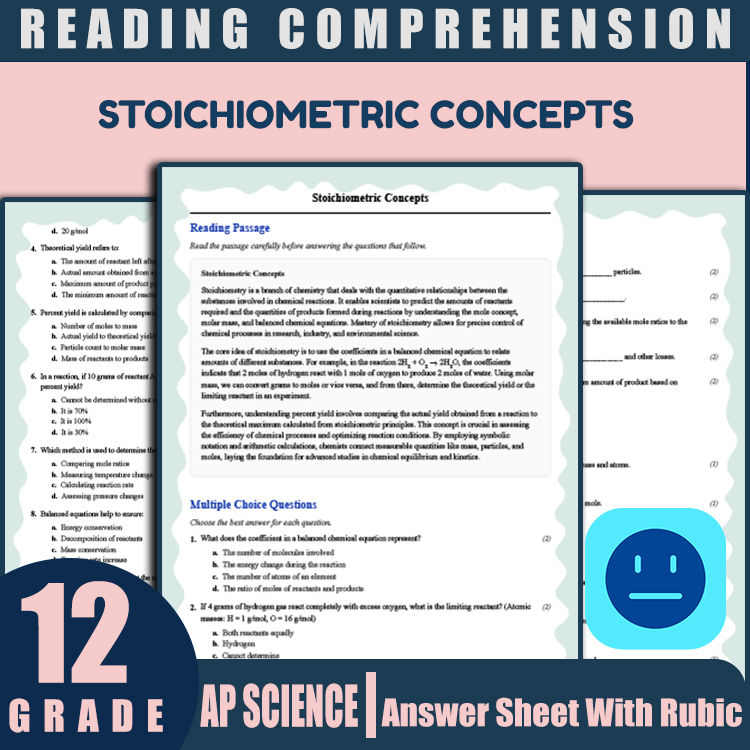
12th Grade Science | Stoichiometric Concepts Reading Worksheet & Answer Key
JCreated byJ.S SheetsLearning Objectives
- Understand and interpret balanced chemical equations in relation to quantities of reactants and products.
- Calculate molar relationships, limiting reactants, theoretical yield, and percent yield using mass and mole data.
- Apply symbolic and arithmetic methods to connect mass, particle count, and mole relationships in chemical reactions.
Also included in: Grade 12 Science Unit Bundle | Atomic Structure & Chemical Reactions Worksheets +1 more
Instant download
Browse more categories
About Science Worksheets
Find Science worksheets spanning core skills, practice, and review. All 44,620 resources are instant PDF downloads for the classroom or home.
Every worksheet on MyTeachingSheets is created by independent teacher-authors and reviewed before publication. All resources download as printable PDFs for classroom, homework, or at-home practice, and many include answer keys. Preview any worksheet free before buying.