
Science Worksheets
44,573 subject resources
Human Impacts Assessment | TEKS Standards Grade 10 Science
 Created byPrism Point Learning
Learning Objectives
- Understand how human activities modify ecosystems through habitat alteration and pollution.
- Identify the effects of resource extraction, invasive species, and climate change on biodiversity.
- Explain how human activities influence energy flows and nutrient cycles in ecosystems.
Also included in: Grade 10 Ecosystems Science Lesson Bundle for TEKS Assessment Worksheets
Instant download

Food Chains Assessment for Grade 10 Science | TEKS Standards
Created byPrism Point LearningLearning Objectives
- Understand the flow of energy through food chains and food webs.
- Identify the roles of producers, consumers, and decomposers in ecosystems.
- Explain the concepts of interconnections and stability in complex food webs.
Also included in: Grade 10 Ecosystems Science Lesson Bundle for TEKS Assessment Worksheets
Instant download

Carrying Capacity Assessment for Grade 10 Science TEKS Standards
Created byPrism Point LearningLearning Objectives
- Understand the concept of carrying capacity and its importance in ecosystems.
- Identify factors that influence an environment's carrying capacity.
- Apply knowledge of resource limitations, predation, disease, and ecosystem interactions.
Also included in: Grade 10 Ecosystems Science Lesson Bundle for TEKS Assessment Worksheets
Instant download

Ecological Succession Assessment for Grade 10 Science TEKS Standards
Created byPrism Point LearningLearning Objectives
- Understand the concepts of primary and secondary succession in ecosystems.
- Identify the processes involved in succession such as colonization, competition, and facilitation.
- Explain how disturbance frequency and intensity influence succession pathways and biodiversity.
Also included in: Grade 10 Ecosystems Science Lesson Bundle for TEKS Assessment Worksheets
Instant download

Ecosystem Basics Assessment for Grade 10 Science | TEKS Standards
Created byPrism Point LearningLearning Objectives
- Understand the key components that make up an ecosystem.
- Identify the flows of energy and matter within ecosystems.
- Describe how different components in an ecosystem interact and influence each other.
Also included in: Grade 10 Ecosystems Science Lesson Bundle for TEKS Assessment Worksheets
Instant download
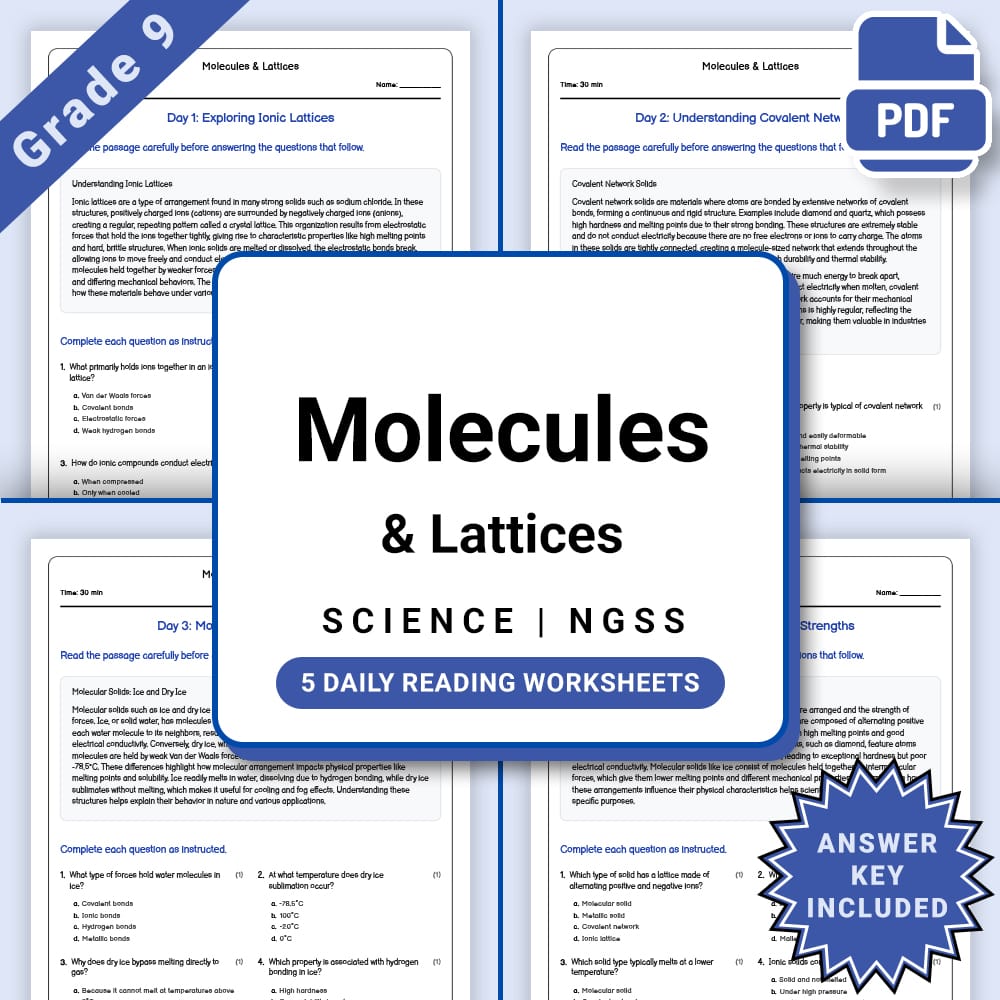
Grade 9 Science – Molecules & Lattices Worksheet(PDF + Answer Key)
 Created byCopper Leaf Classroom
Learning Objectives
- Understand the structure of ionic lattices and how they differ from covalent networks and molecular solids.
- Identify the physical properties that reflect the arrangement of particles in different solid structures.
- Explain how electrical forces among particles influence melting points, electrical conductivity, hardness, and solubility.
Instant download
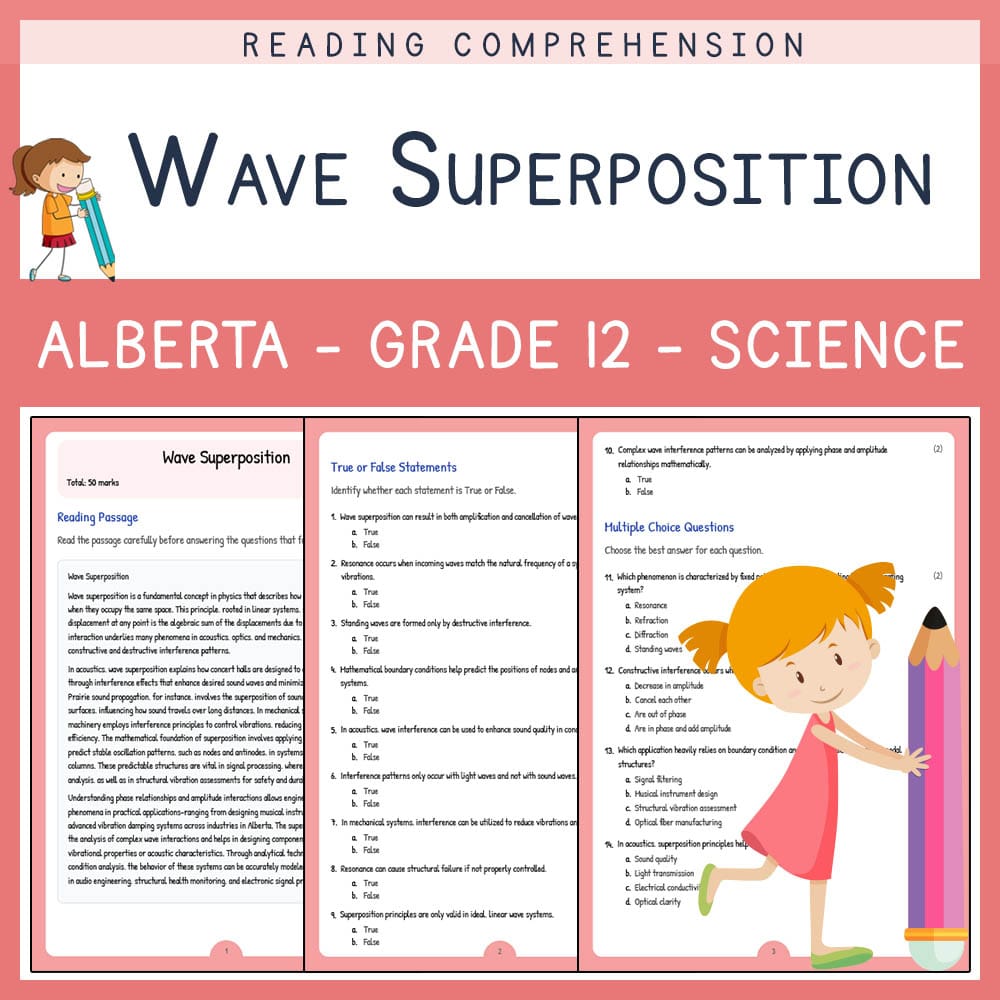
Grade 12 Science | Wave Superposition Worksheet | Alberta Standards
 Created byLumora Learning
Learning Objectives
- Analyze the principles of wave superposition, including interference patterns and phase relationships.
- Understand how constructive and destructive interference influence standing waves and resonance phenomena.
- Apply mathematical boundary condition analysis to predict nodal and antinodal structures in various wave systems.
Also included in: Grade 12 Science | Physics Science Lesson Bundle Worksheet Set | Alberta
Instant download
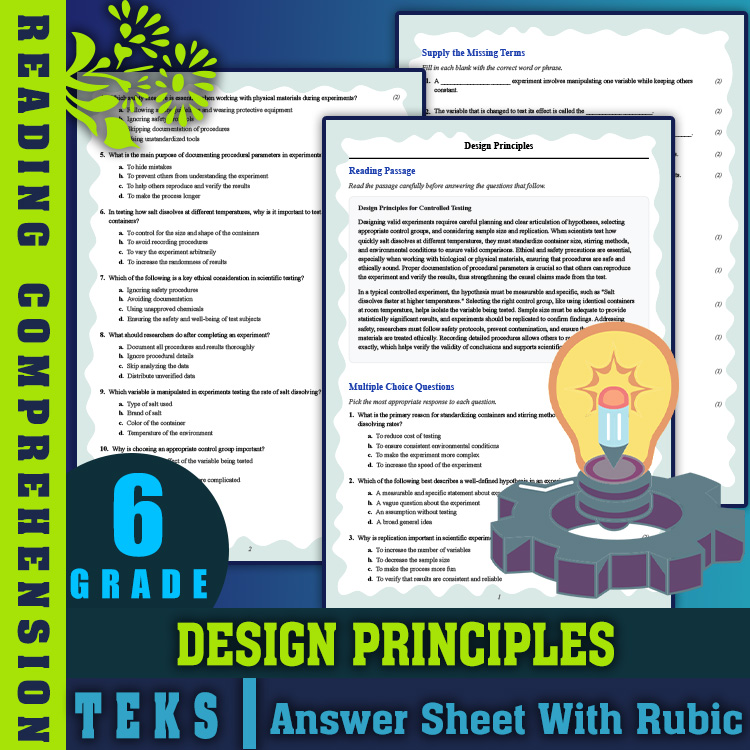
6th Grade Science | Design Principles Reading Worksheet & Answer Key (PDF)
JCreated byJ.S SheetsLearning Objectives
- Understand the key principles involved in designing valid controlled experiments.
- Identify the importance of hypotheses articulated in measurable terms and proper control groups.
- Recognize strategies for ensuring reproducibility, safety, and ethical considerations in testing.
Instant download
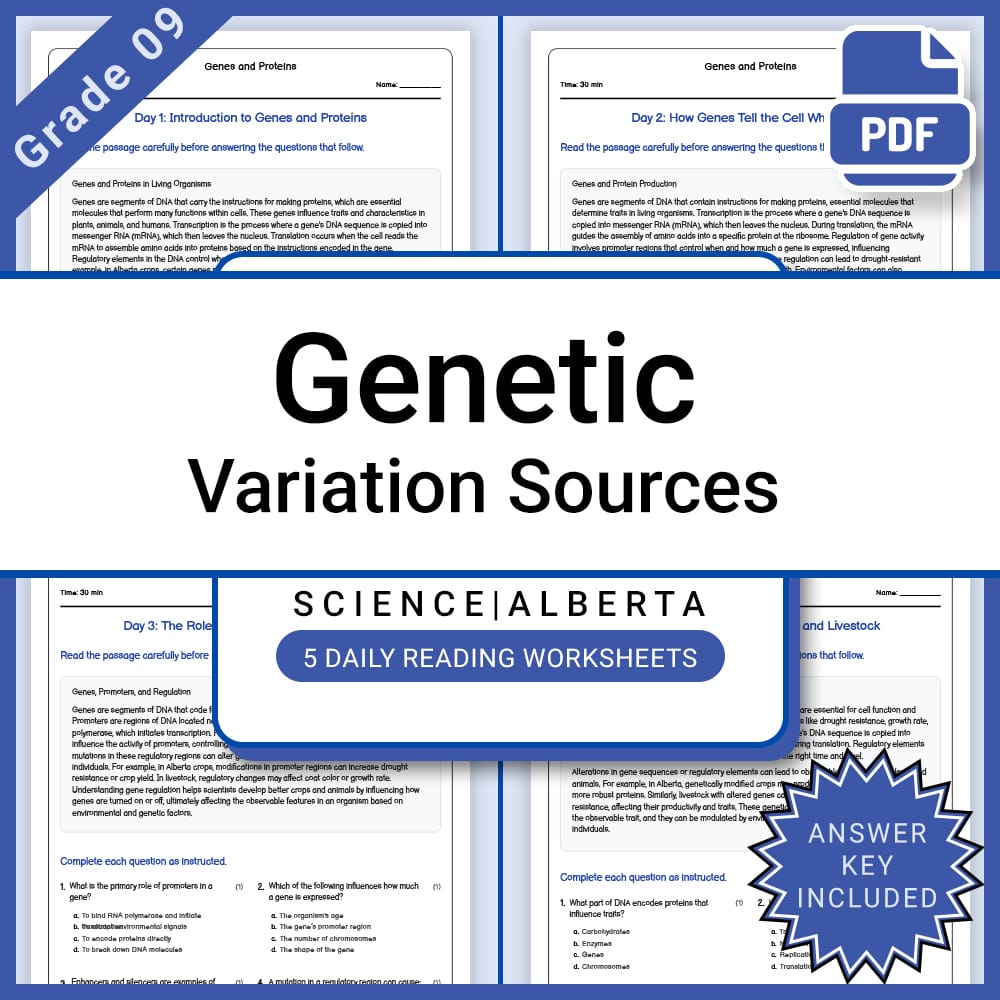
Grade 9 Science – Genetic Variation Sources Daily Reading Worksheet + Answer Key
JCreated byJ.S SheetsLearning Objectives
- Understand key concepts related to Science
- Apply knowledge through practice questions
- Demonstrate comprehension of the material
Also included in: Grade 9 Science Lesson Group | Genetics, Reproduction, and Biotechnology +1 more
Instant download
Grade 9 Science – Genes and Proteins Daily Reading Worksheet with Answer Key
JCreated byJ.S SheetsLearning Objectives
- Understand what genes and proteins are and their roles in living organisms.
- Explain the processes of transcription and translation in gene expression.
- Recognize how gene regulation influences traits and phenotypes.
Also included in: Grade 9 Science Lesson Group | Genetics, Reproduction, and Biotechnology +1 more
Instant download
Grade 9 Science – Population Genetics Daily Reading Worksheet + Answer Key
JCreated byJ.S SheetsLearning Objectives
- Understand basic concepts of population genetics, including allele frequency and genetic variation.
- Identify the assumptions of Hardy-Weinberg equilibrium.
- Describe processes such as genetic drift, bottlenecks, and founder effects, and their impact on genetic diversity.
Also included in: Grade 9 Science Lesson Group | Genetics, Reproduction, and Biotechnology +1 more
Instant download
Grade 9 Science – Ethical Considerations Daily Reading Worksheet + Answer Key
JCreated byJ.S SheetsLearning Objectives
- Recognize basic ethical questions related to genetic science
- Understand societal concerns about privacy and consent in genetics
- Identify different perspectives on food labeling and indigenous knowledge
Also included in: Grade 9 Science Lesson Group | Genetics, Reproduction, and Biotechnology +1 more
Instant download
Grade 9 Science – Molecular Bonding Daily Reading Worksheet + Answer Key
JCreated byJ.S SheetsLearning Objectives
- Understand the concept of ionic bonds and their properties
- Identify examples of ionic compounds
- Describe how ionic bonds affect the physical properties of substances
Also included in: Grade 9 Science Lesson Bundle | Alberta Framework +1 more
Instant download

Grade 9 Science – Balancing Chemical Equations Daily Worksheet + Answer Key
JCreated byJ.S SheetsLearning Objectives
- Understand the concept of chemical equations and atoms conservation.
- Identify elements and symbols in chemical formulas.
- Comprehend the importance of balancing equations to reflect mass conservation.
Also included in: Grade 9 Science Lesson Bundle | Alberta Framework +1 more
Instant download

Grade 9 Science – Introduction to Biotechnology Daily Reading Worksheet + Answer Key
JCreated byJ.S SheetsLearning Objectives
- Understand the basic concepts and history of biotechnology
- Identify major genetic technologies and their applications
- Explain mechanisms of trait introduction at molecular and population levels
Also included in: Grade 9 Science Lesson Group | Genetics, Reproduction, and Biotechnology +1 more
Instant download

Grade 9 – Element Symbols and Chemical Formulas Daily Worksheet with Answer Key
JCreated byJ.S SheetsLearning Objectives
- Identify common chemical element symbols.
- Recognize and interpret basic chemical formulas.
- Understand how symbols and formulas communicate chemical composition.
Also included in: Grade 9 Science Lesson Bundle | Alberta Framework +1 more
Instant download
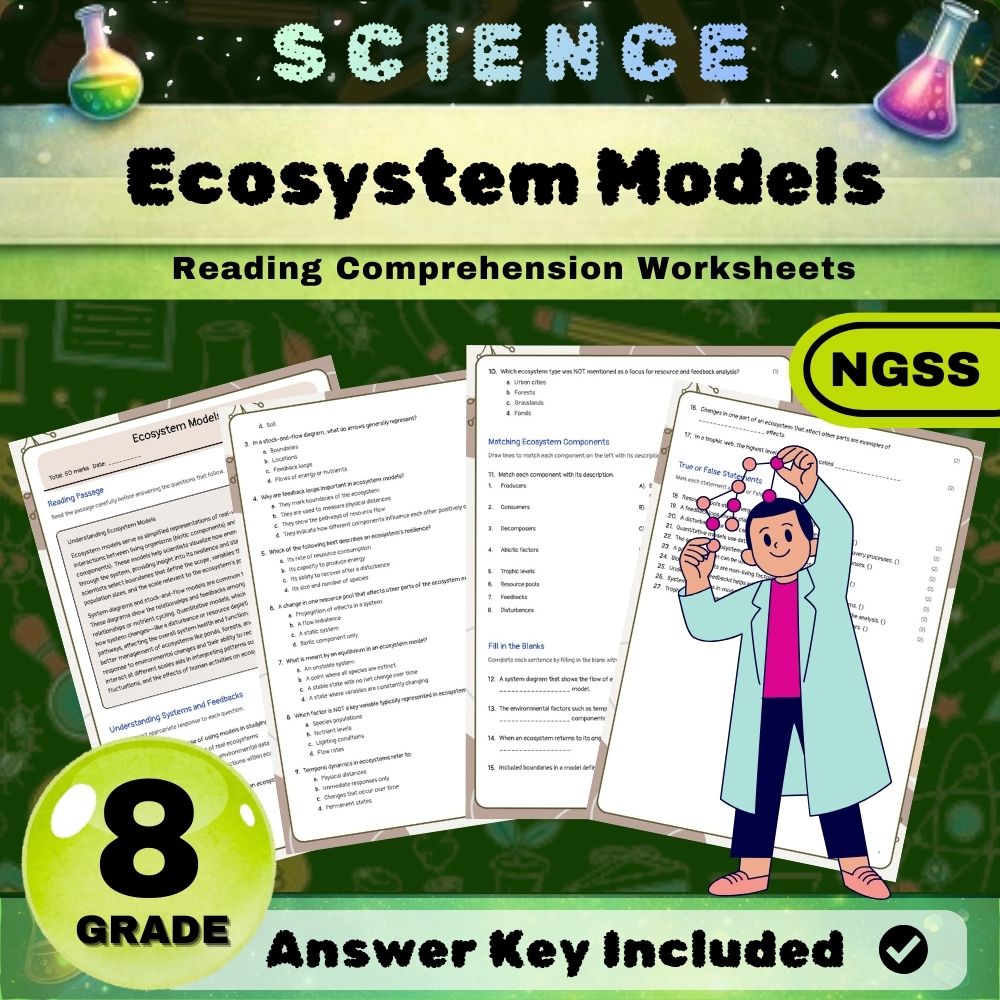
Grade 8 Science – Ecosystem Models Worksheet (NGSS) (PDF)
 Created byMaple Path Learning
Learning Objectives
- Understand the components and functions of ecosystem models, including biotic and abiotic factors.
- Identify different types of flows, feedbacks, and resource pools within ecosystems.
- Interpret how changes in one component can propagate through an ecosystem using system diagrams.
Also included in: Grade 8 Science Ecosystems Unit Bundle | Interactions, Energy & Dynamics (NGSS) +1 more
Instant download
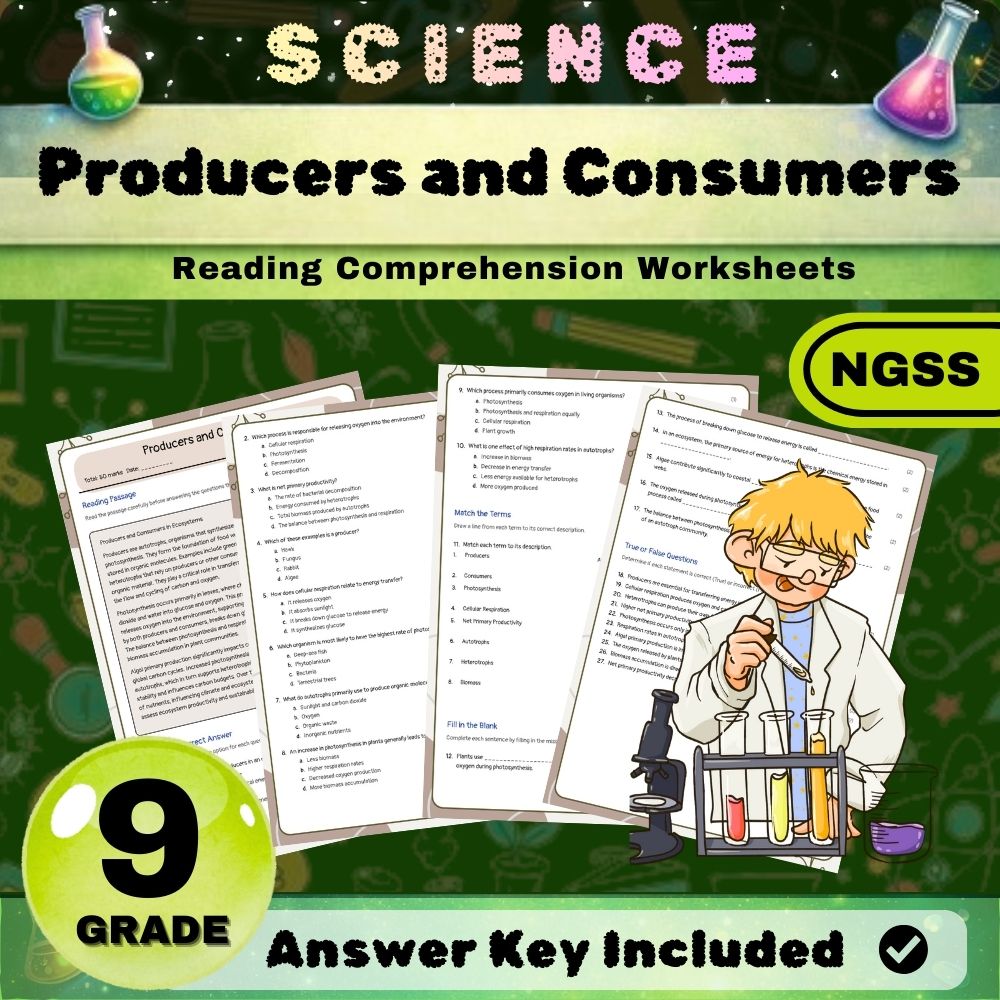
Grade 9 Science | Producers and Consumers Worksheet (NGSS) (PDF)
Created byMaple Path LearningLearning Objectives
- Explain the roles of producers and consumers in ecosystems.
- Analyze how photosynthesis and cellular respiration transfer energy and cycle carbon and oxygen.
- Evaluate the impact of net primary productivity on biomass accumulation and energy availability.
Also included in: Grade 9 Science Ecosystems Lesson Bundle | NGSS Interactions & Energy +1 more
Instant download

Grade 11 Science | Scientific Inquiry - Daily Reading Comprehension
 Created byCoral Reef Learning
Learning Objectives
- Understand how observations of seasons provide evidence for natural patterns.
- Learn to identify evidence used in scientific explanations of seasonal changes.
- Develop skills in analyzing scientific passages related to seasonal observations.
Instant download
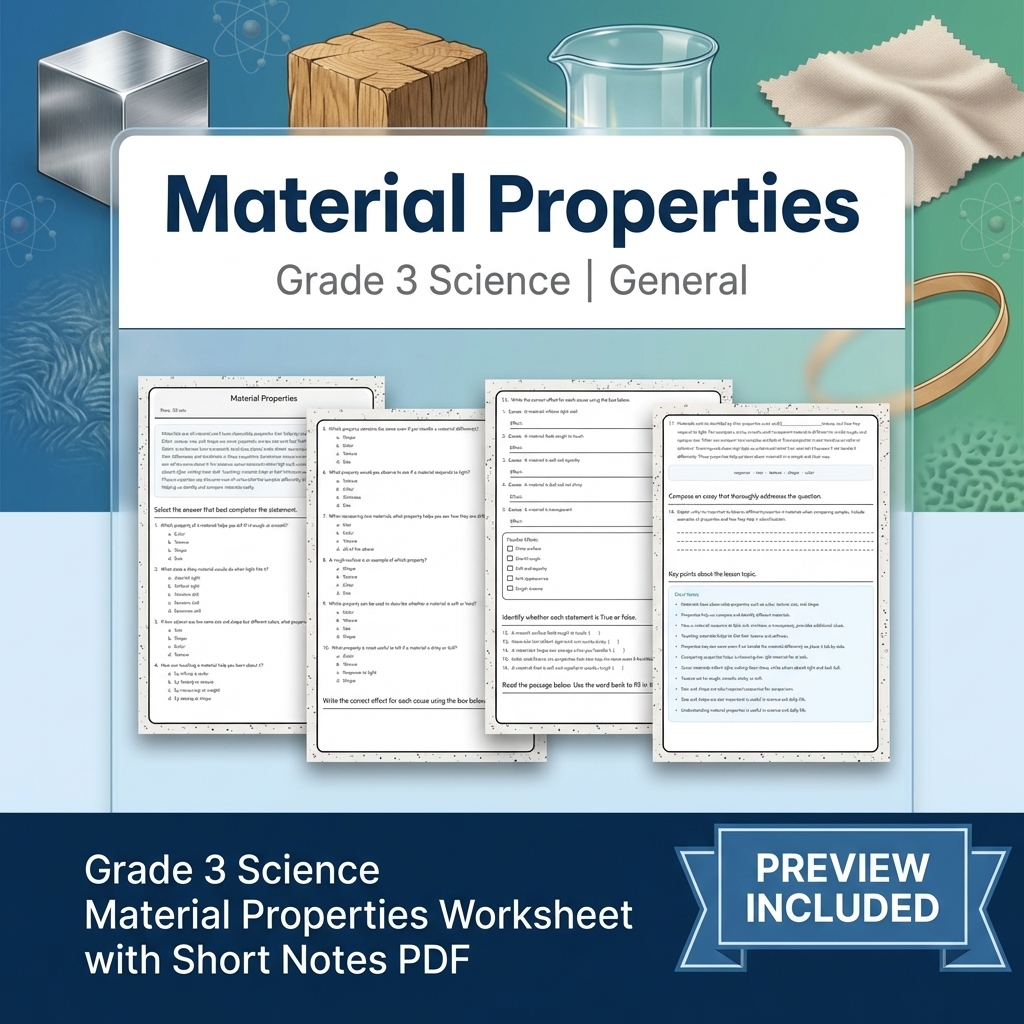
Grade 3 Science Material Properties Worksheet with Short Notes PDF
 Created byMeadowlark Worksheets
Learning Objectives
- Identify observable properties of materials such as color, texture, size, and shape.
- Compare two material samples based on their properties.
- Understand how materials respond to light and touch.
Also included in: Grade 3 Science Lesson Group: Worksheets for Properties, Water, Sound & Light +1 more
Instant download

Grade 9 Science | Power & Efficiency in Mechanical Systems - Reading Practice
Created byCoral Reef LearningLearning Objectives
- Understand the concept of power as the rate of energy transfer
- Explain how efficiency compares useful output energy to input energy
- Recognize the factors that lead to energy loss in systems
Instant download
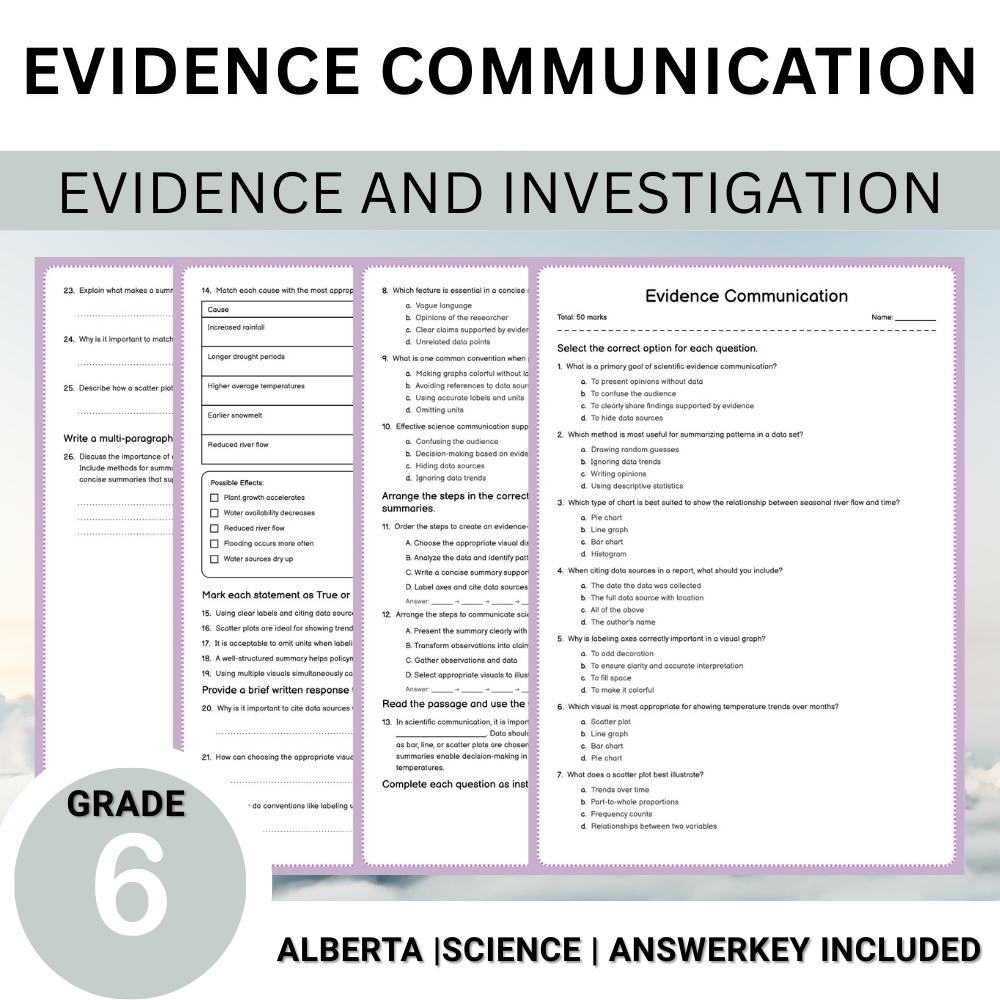
Grade 6 Science | Evidence Communication Worksheet (Printable PDF & Assessment)
Learning Objectives
- Understand how to interpret observations and transform them into clear scientific claims supported by evidence.
- Learn methods for summarizing data patterns, using descriptive statistics, and selecting appropriate visuals like bar, line, and scatter plots.
- Recognize conventions for citing data sources, labeling units, and crafting concise, evidence-based summaries for environmental decision-making.
Also included in: Grade 6 Science Unit | Data & Measurement Worksheets Bundle (Assessment & Practice) +1 more
Instant download

Variables Control Worksheet for Grade 6 Science | TEKS Standards Practice
JCreated byJ.S SheetsLearning Objectives
- Identify independent, dependent, and controlled variables in a controlled experiment
- Use operational definitions to describe how variables are measured or applied
- Recognize potential confounding influences and explain how control strategies reduce them
Instant download
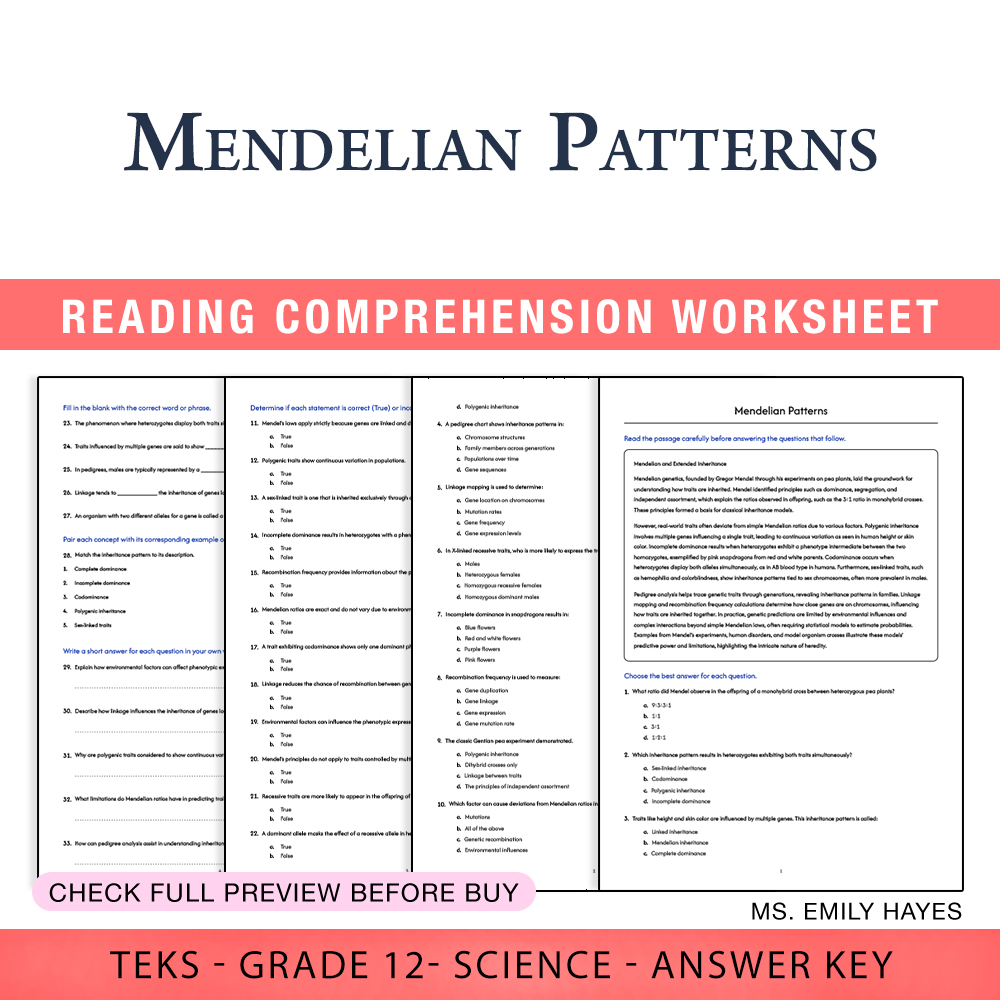
12th Grade Science | Mendelian Patterns Worksheet (PDF+ Answer Key)
Created byCopper Leaf ClassroomLearning Objectives
- Understand Mendelian inheritance and classical genetic ratios.
- Analyze inheritance patterns including dominance, incomplete dominance, and codominance.
- Interpret pedigrees, linkage maps, and recombination frequencies in genetic analysis.
Instant download
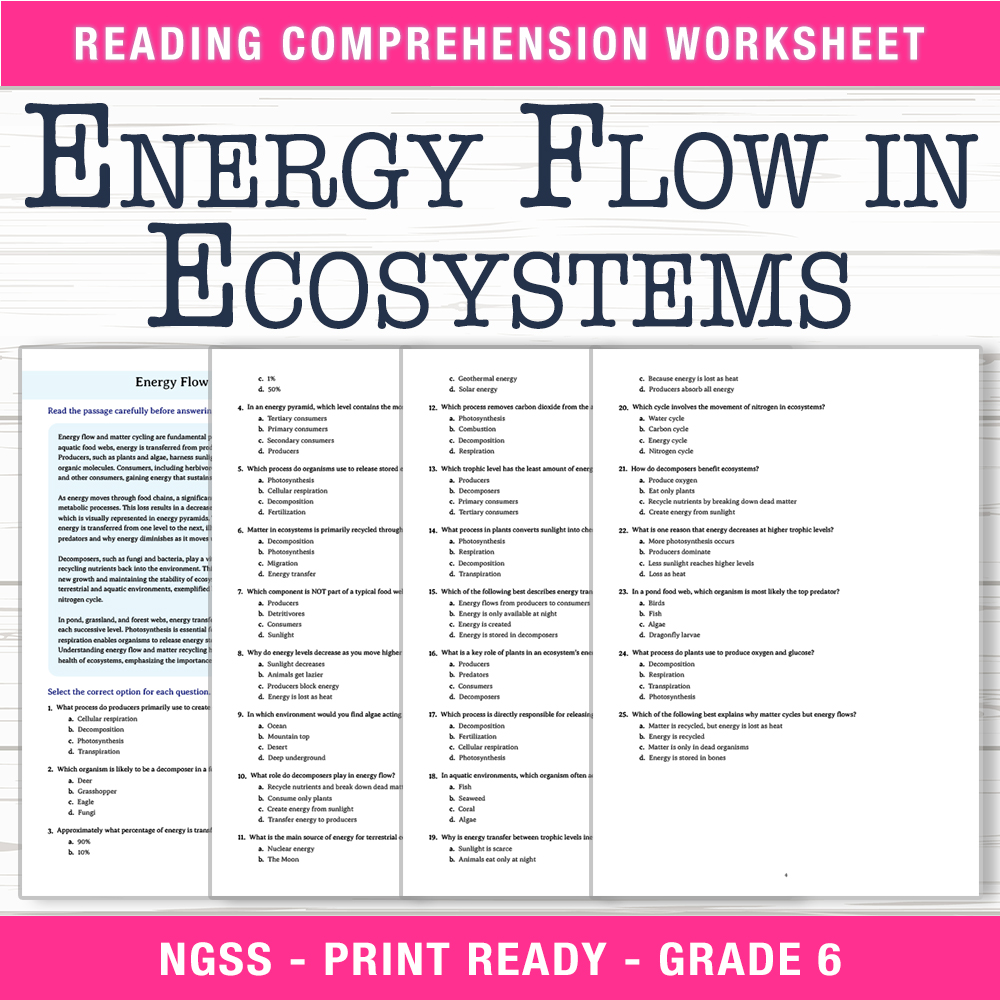
6th Grade Science | Energy Flow in Ecosystems Worksheet (PDF + Answer Key)
 Created byRiverstone Classroom
Learning Objectives
- Explain the concept of energy flow and matter cycling within food webs.
- Identify producers, consumers, and decomposers in terrestrial and aquatic ecosystems.
- Describe how energy diminishes across trophic levels in energy pyramids.
Also included in: Grade 6 Science Unit Bundle | Ecosystems & Biodiversity Worksheets
Instant download
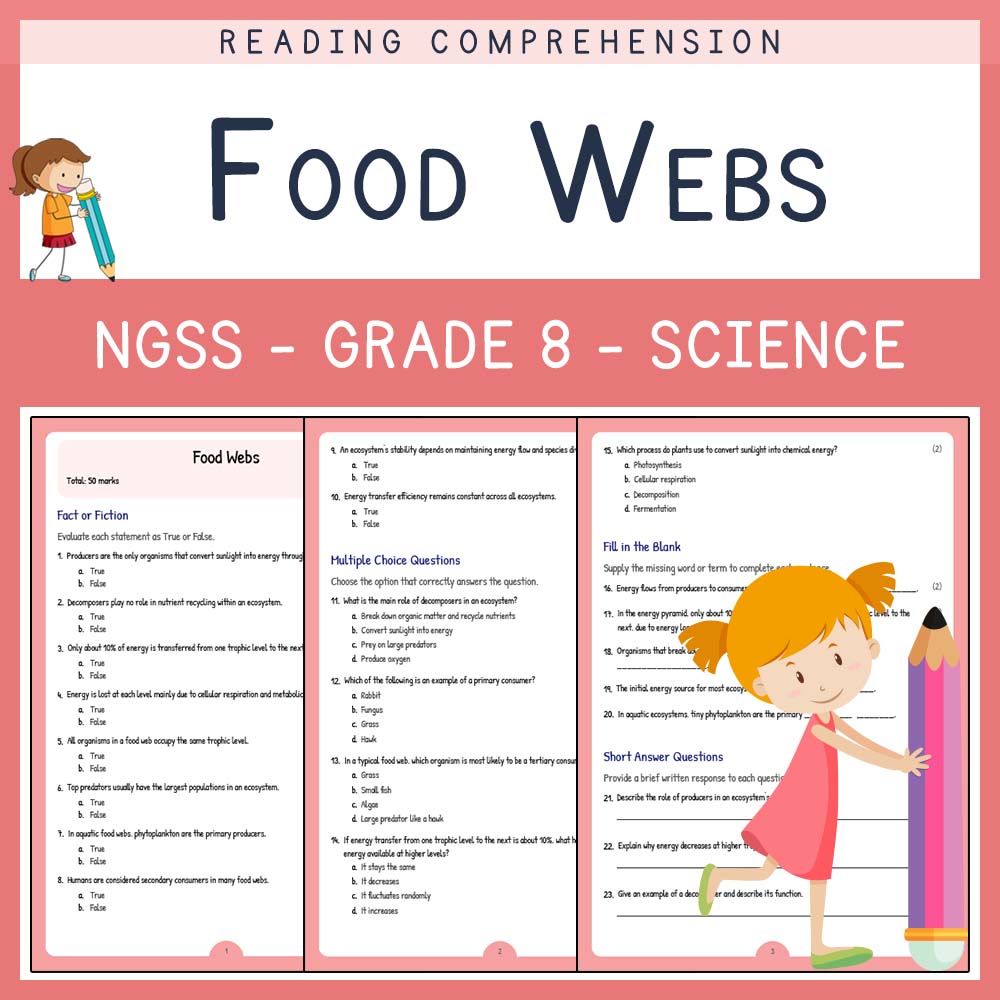
Grade 8 Science | Food Webs Worksheet & Answer Key Aligned with NGSS (PDF)
Created byLumora LearningLearning Objectives
- Explain the roles of producers, consumers, and decomposers in ecosystems.
- Describe trophic levels and the flow of energy through a food web.
- Analyze how energy loss affects population sizes within ecological communities.
Instant download

Grade 11 Science | Chemical Energy Capture - Daily Reading Comprehension
Created byCoral Reef LearningLearning Objectives
- Understand the process of photosynthesis and how light energy is converted into chemical energy in plants.
- Identify the key components involved in photosynthesis.
- Explain the significance of photosynthesis to ecosystems and life on Earth.
Instant download
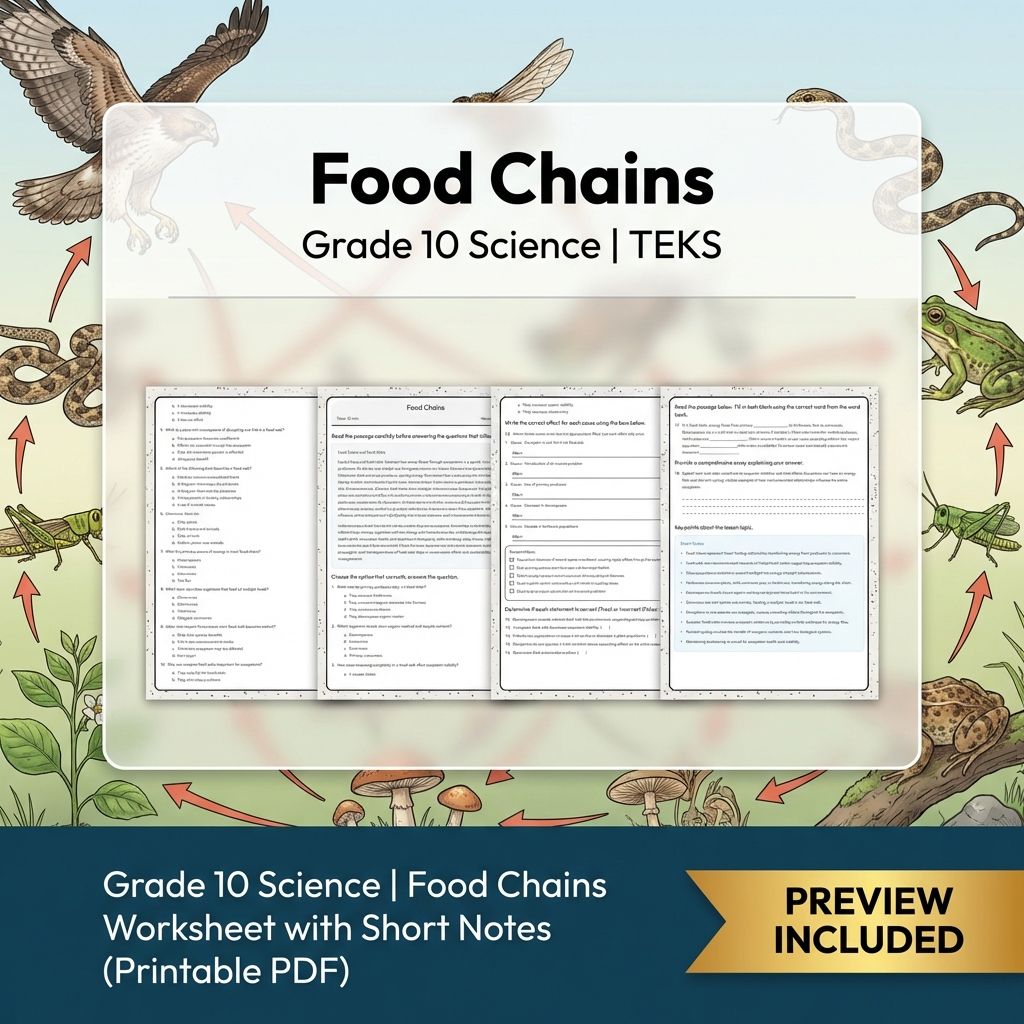
Grade 10 Science | Food Chains Worksheet with Short Notes (PDF)
Created byMeadowlark WorksheetsLearning Objectives
- Understand the concept of food chains and food webs and how energy and matter transfer within ecosystems.
- Identify the roles of primary producers, herbivores, carnivores, and decomposers in food chains.
- Explain how complex food webs increase ecosystem stability.
Instant download

Electric Circuits Worksheet for Grade 11 Science | Standards-Aligned Practice
JCreated byJ.S SheetsLearning Objectives
- Describe how charge, current, potential difference, and resistance relate to direct-current circuit behavior.
- Apply Ohm’s law to determine voltage, current, or resistance in simple circuit situations.
- Use series and parallel resistor concepts to predict equivalent resistance and current distribution.
Instant download

Speciation Processes Assessment | TEKS Standards Grade 10 Science
Created byPrism Point LearningLearning Objectives
- Understand the various mechanisms and modes of speciation.
- Identify reproductive barriers and their causes in species divergence.
- Explain how genetic changes contribute to the formation of new species.
Also included in: Grade 10 Evolution and Heredity Science Lesson Bundle for TEKS Standards
Instant download
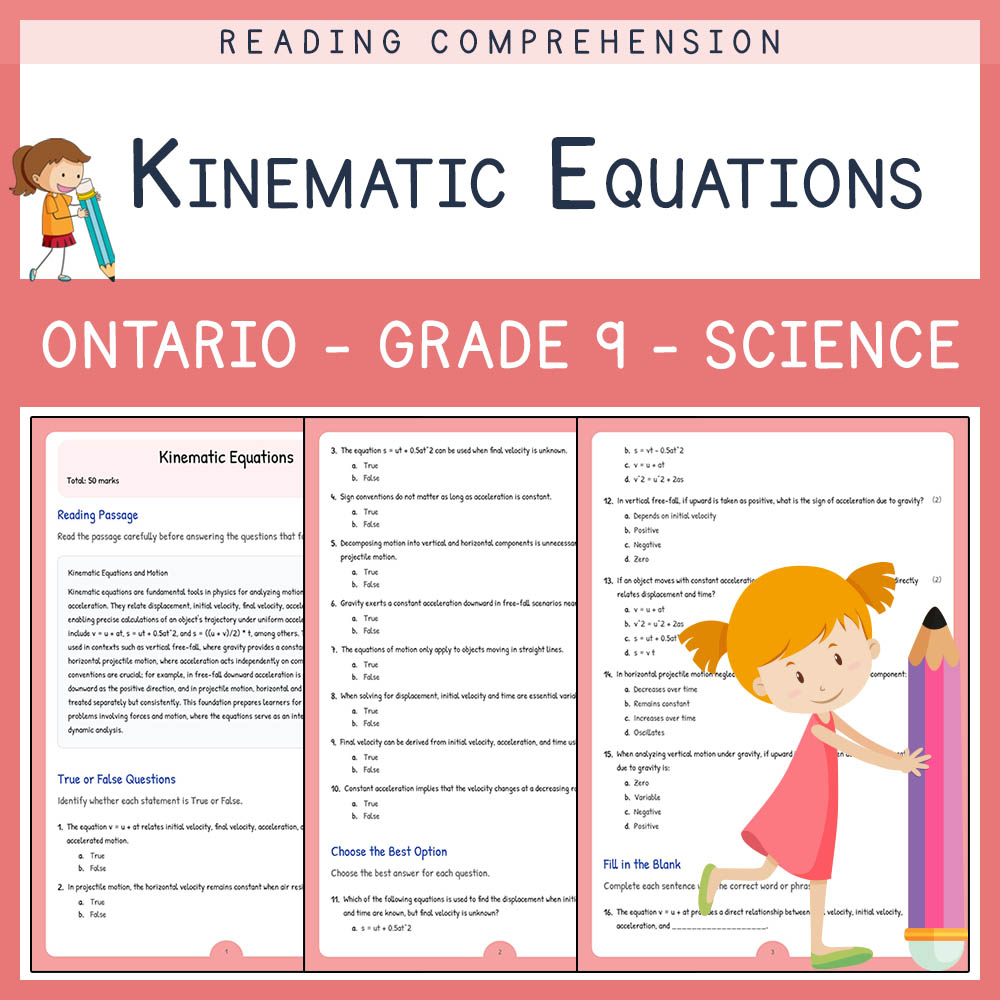
rade 9 Science Physics | Kinematic Equations Worksheet | Ontario Standard
Created byLumora LearningLearning Objectives
- Understand the derivation and form of constant-acceleration kinematic equations.
- Apply kinematic equations to solve problems involving vertical free-fall and projectile motion.
- Interpret sign conventions and component-wise treatment in motion analysis.
Instant download

Grade 10 Science – Genetic Drift Daily Reading Worksheet + Answer Key
JCreated byJ.S SheetsLearning Objectives
- Understand the concept of genetic drift and its role in small populations.
- Identify how chance events influence allele frequencies.
- Distinguish between genetic drift and natural selection.
Also included in: Grade 10 Science Lesson Bundle: Evolution and Genetics TEKS Framework +1 more
Instant download

Grade 10 Science – Variation and Heredity Daily Reading Worksheet + Answer Key
JCreated byJ.S SheetsLearning Objectives
- Identify sources of genetic variation among individuals.
- Understand how mutation, recombination, and gene flow contribute to variation.
- Explain the role of natural selection in shaping heritable traits.
Also included in: Grade 10 Science Lesson Bundle: Evolution and Genetics TEKS Framework +1 more
Instant download
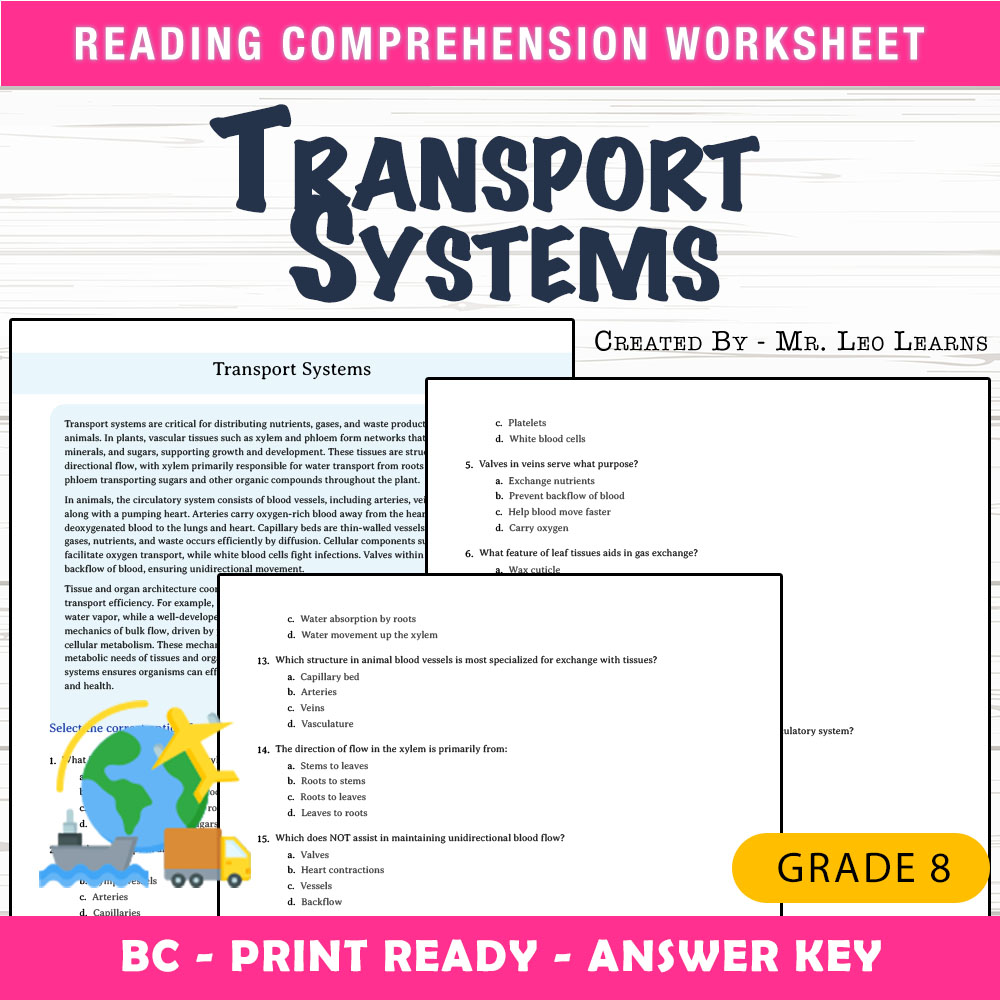
Grade 8 Science — Worksheet MCQ Paper for Transport Systems
 Created byThe Resource Hub
Learning Objectives
- Understand the structure and function of vascular and circulatory transport systems in plants and animals.
- Identify the roles of vessels, valves, capillary beds, blood cells, xylem, and phloem in transport processes.
- Explain how tissue and organ structures facilitate bulk flow and diffusion for cellular metabolism.
Also included in: Grade 8 Science UNIT | Multicellular Structure & Function Worksheet Bundle +1 more
Instant download

Energy Relationships Worksheet | NGSS Grade 8 Science Assessment
 Created byCedar Grove Learning
Learning Objectives
- Describe the quantitative relationships between kinetic and potential energy, including dependence on mass, velocity, and position.
- Interpret graphical displays relating kinetic energy to mass and the square of velocity.
- Analyze energy exchanges in systems such as pendulums and roller coasters, emphasizing conservation principles.
Instant download
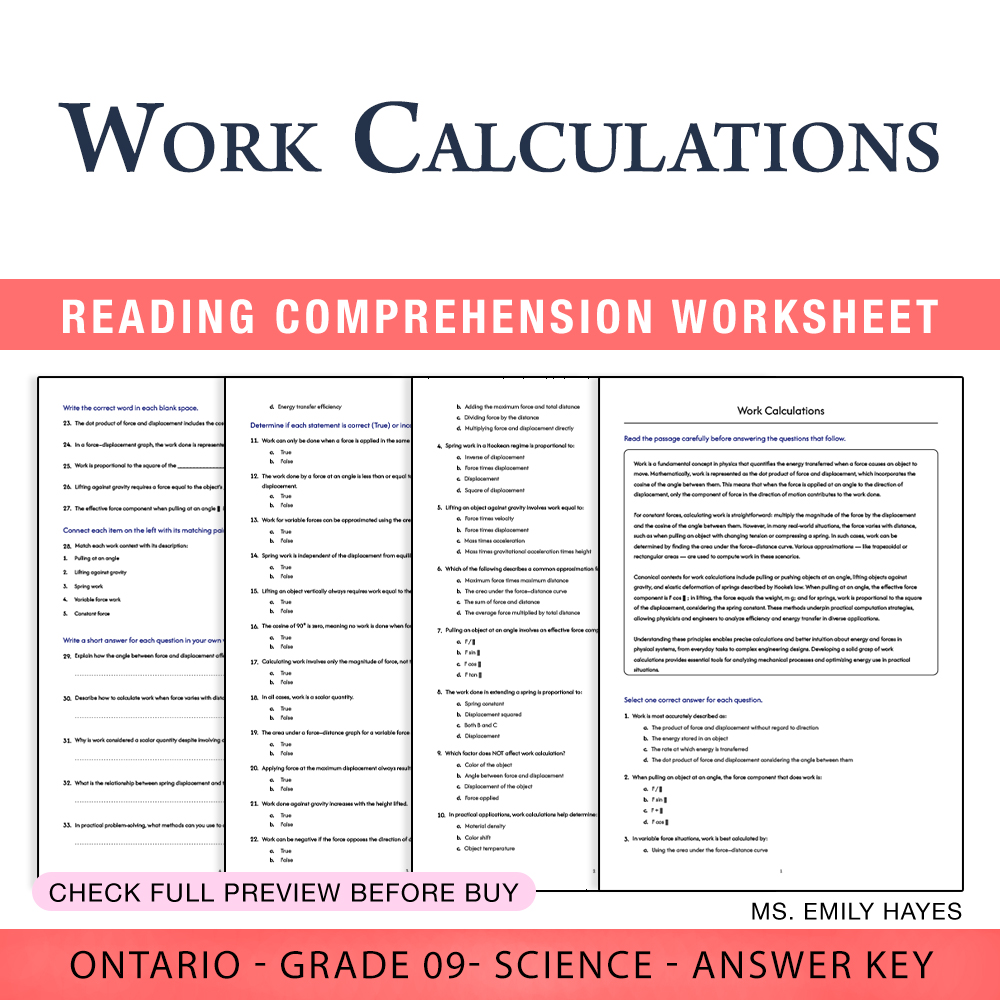
9th Grade Science | Work Calculations Worksheet (PDF + Answer Key)
Created byCopper Leaf ClassroomLearning Objectives
- Understand the concept of work as the dot product of force and displacement, considering the angle between them.
- Calculate work done in various contexts including pulling at an angle, lifting against gravity, and spring work.
- Differentiate methods for calculating work with constant and variable forces, including the area under force–distance curves.
Instant download
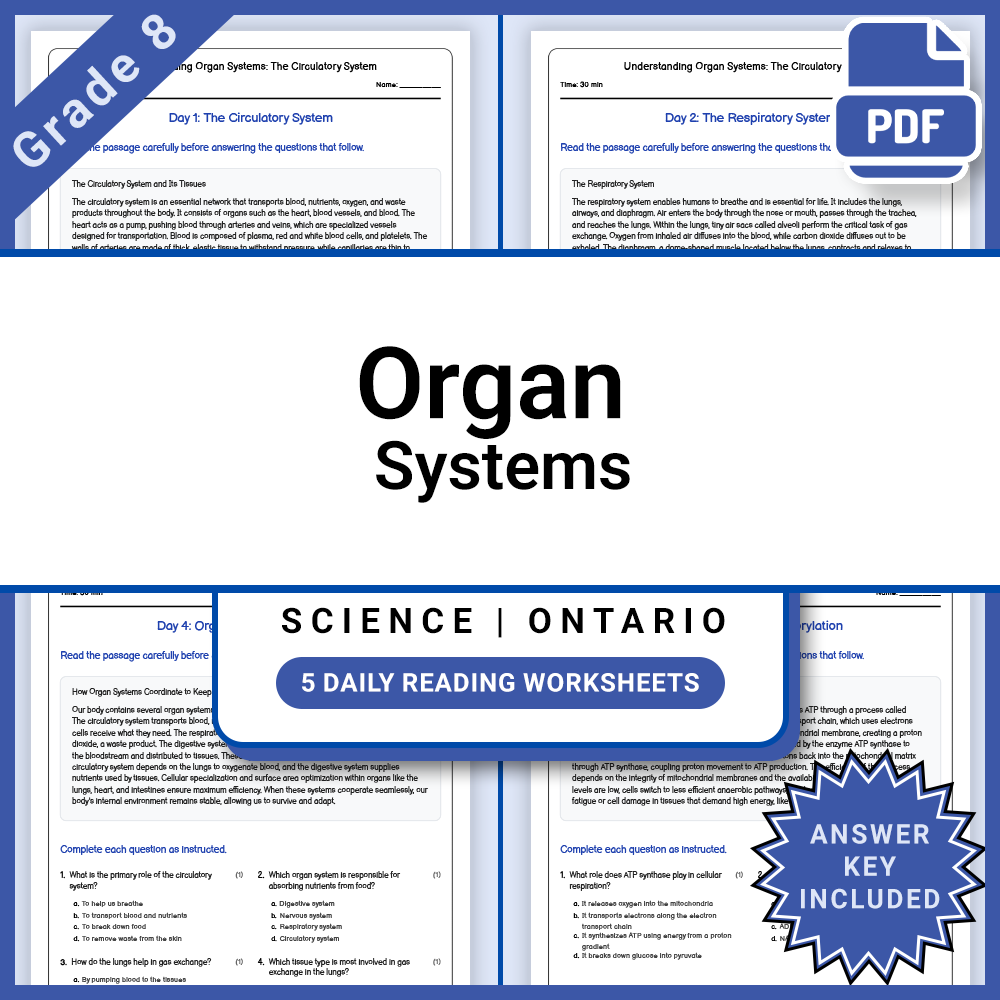
Grade 8 Science – Organ Systems Daily Reading Worksheet + Answer Key
JCreated byJ.S SheetsLearning Objectives
- Identify the main functions of the circulatory system.
- Recognize different tissue types involved in the circulatory system.
- Explain how blood transports nutrients and oxygen.
Also included in: Grade 8 Science Lesson Group: Ontario Curriculum Reading Worksheets Bundle +1 more
Instant download
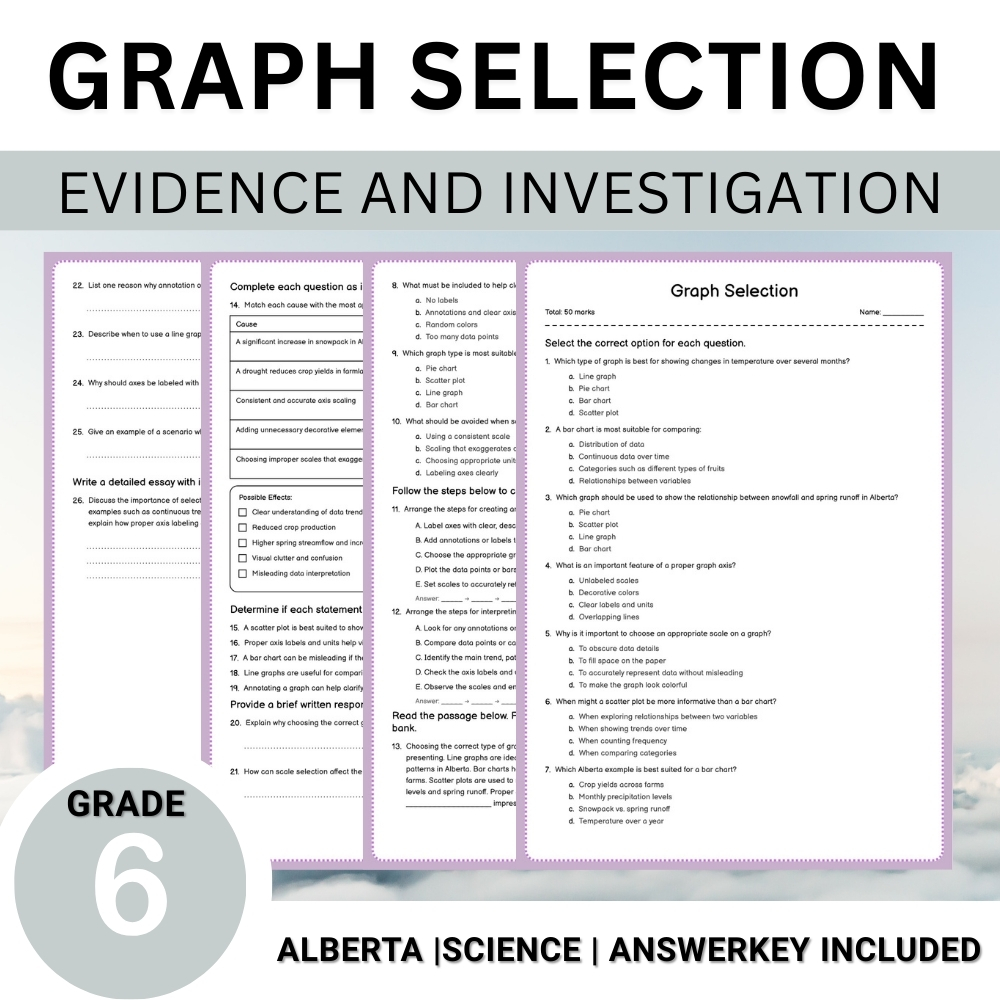
Grade 6 Science | Graph Selection Worksheet (Answer Key) for Classroom Assessment
Learning Objectives
- Identify different types of graphs and their appropriate uses.
- Match data types with suitable graph types and scales.
- Understand how to label axes and interpret visual data representations.
Also included in: Grade 6 Science Unit | Data & Measurement Worksheets Bundle (Assessment & Practice) +1 more
Instant download

Circular Motion Worksheet for Grade 11 Science | Standards-Aligned Practice
JCreated byJ.S SheetsLearning Objectives
- Explain uniform vs. non-uniform circular motion and identify tangential vs. centripetal acceleration components
- Apply centripetal force relationships using v^2/r and ω^2r to solve force and motion problems
- Connect period and frequency with angular speed and interpret how changing radius and speed affect centripetal acceleration
Instant download

Grade 8 Science | Energy–Temperature Link Worksheet | California Standards
Created byLumora LearningLearning Objectives
- Explain how energy transfer causes temperature changes in materials
- Use the ideas of thermal energy and thermal equilibrium to predict warming and cooling
- Relate everyday observations of hot and cold to the direction of heat (energy) flow
Instant download

6th Grade Science | Tissue Types Worksheet (PDF) – BC Standards
 Created byEvergreen Desk Education
Learning Objectives
- Identify the four general tissue types in multicellular animals: epithelial, connective, muscle, and nervous.
- Describe how each tissue type’s structures support its specific functions.
- Use evidence from a passage and tissue examples to explain relationships between tissues and organs.
Instant download

Earth System Spheres Worksheet for Grade 6 Science | Standards-Aligned Practice
JCreated byJ.S SheetsLearning Objectives
- Identify the four main Earth system spheres and their interactions.
- Describe processes such as weathering, evaporation, and biological activity.
- Explain how energy and gravity influence changes within Earth spheres.
Also included in: Grade 6 Earth & Space Science Lesson Bundle: California Standards +1 more
Instant download
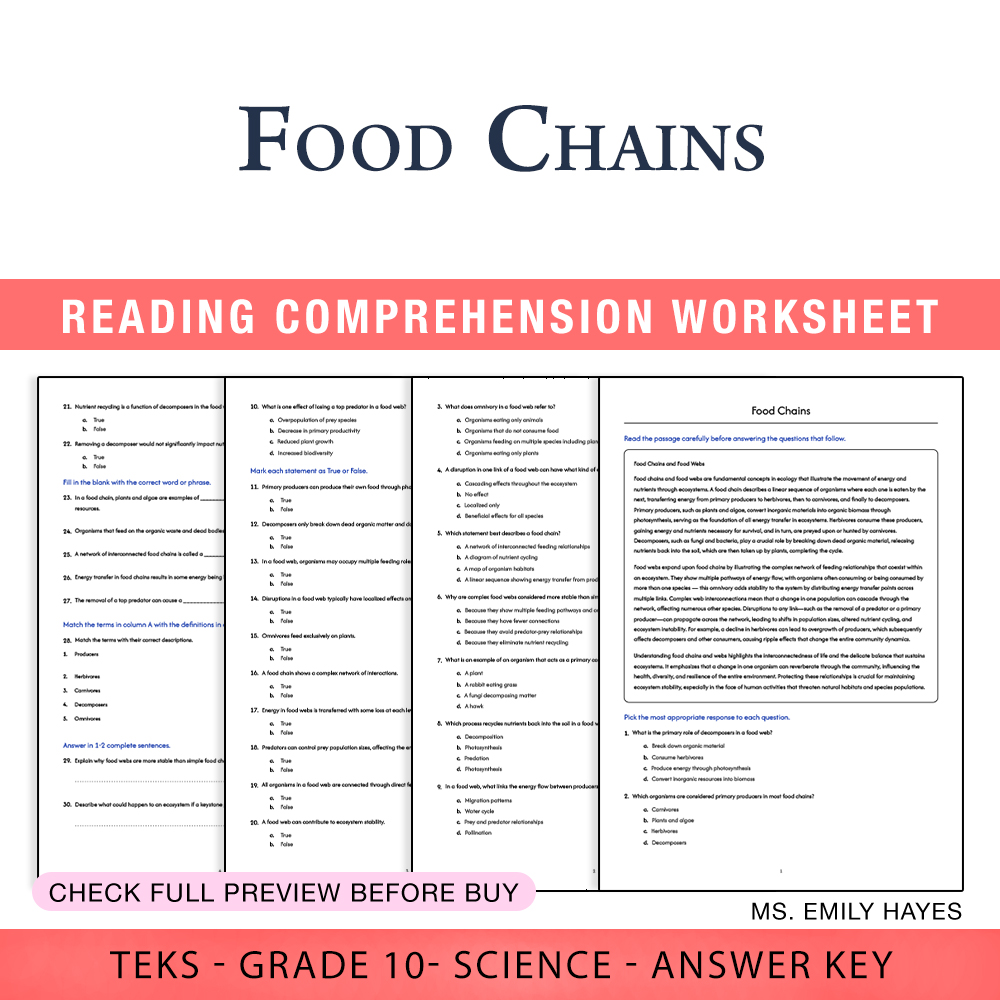
10th Grade Science | Food Chains & Food Webs Worksheet (PDF + Answer Key)
Created byCopper Leaf ClassroomLearning Objectives
- Understand the structure and role of food chains and food webs in ecosystems.
- Identify different organism types involved in food chains, such as producers, consumers, and decomposers.
- Explain the transfer of energy and matter through feeding relationships.
Instant download

Grade 9 Science – Collision Safety & Impact Impulse Daily Reading Worksheet
 Created byBright Mind Resources
Learning Objectives
- Interpret force-time graphs to analyze collision forces
- Calculate impulse from given force and time data
- Understand how various safety devices influence collision outcomes
Also included in: Newtonian Motion Grade 9 Science Daily Reading Worksheets Lesson Bundle | NGSS +2 more
Instant download

Grade 9 Science – Field Dynamics & Magnetism Daily Reading Worksheet
Created byBright Mind ResourcesLearning Objectives
- Understand the concepts of electric and magnetic fields and their vectors.
- Identify the use of field lines to represent magnetic and electric fields.
- Learn how charged particles move in magnetic fields and how forces affect their trajectories.
Also included in: Newtonian Motion Grade 9 Science Daily Reading Worksheets Lesson Bundle | NGSS +2 more
Instant download

Grade 9 Science – Momentum & Conservation | Daily Reading Worksheet
Created byBright Mind ResourcesLearning Objectives
- Define momentum in the context of physics.
- Describe the principle of conservation of linear momentum in isolated systems.
- Differentiate between elastic and inelastic collisions.
Also included in: Newtonian Motion Grade 9 Science Daily Reading Worksheets Lesson Bundle | NGSS +2 more
Instant download

Grade 7 Science | Conservation of Mass - Daily Reading Comprehension
Created byCoral Reef LearningLearning Objectives
- Understand the principle that matter is conserved during chemical reactions.
- Recognize how atoms rearrange during reactions without changing the total mass.
- Explain the concept of a closed system in mass conservation.
Instant download

Grade 12 Biology Mutation Impacts Worksheet Alberta Science
Created byEvergreen Desk EducationLearning Objectives
- Explain how different mutation types (point substitutions, insertions, deletions, and chromosomal rearrangements) can change gene products.
- Predict possible consequences of mutations, ranging from silent effects to frameshifts and altered protein function.
- Describe how mutational outcomes can affect crop traits, livestock genetics, and pathogen variation in Alberta.
Instant download
Browse more categories
About Science Worksheets
Find Science worksheets spanning core skills, practice, and review. All 44,573 resources are instant PDF downloads for the classroom or home.
Every worksheet on MyTeachingSheets is created by independent teacher-authors and reviewed before publication. All resources download as printable PDFs for classroom, homework, or at-home practice, and many include answer keys. Preview any worksheet free before buying.