
Science Worksheets
44,573 subject resources
Grade 10 Science – Resource Policy & Environmental Management | Daily Worksheet
 Created byQuiet Forest Education
Learning Objectives
- Understand the key governance instruments used in natural resource management.
- Identify economic mechanisms that influence resource use decisions.
- Appreciate the role of Indigenous rights, international markets, and environmental monitoring.
Also included in: Earth Science Grade 10 Daily Reading Worksheets Bundle | Ontario Framework +1 more
Instant download

Grade 10 Science – Understanding the Mole & Stoichiometry | Daily Worksheet
Created byQuiet Forest EducationLearning Objectives
- Define the concept of a mole and explain its significance in chemistry.
- Describe Avogadro's number and how it relates to counting particles.
- Calculate molar masses of common elements and compounds.
Also included in: Matter and Chemical Change Grade 10 Science Daily Reading Bundle | Ontario +1 more
Instant download

Grade 11 Science | Periodic Trends in Atomic Radius & Properties - Practice
 Created byCoral Reef Learning
Learning Objectives
- Understand what atomic radius is and how it varies across periods and groups in the periodic table.
- Explain the concepts of effective nuclear charge, shielding, and orbital penetration.
- Identify factors influencing atomic size, ionization energy, and electronegativity.
Instant download
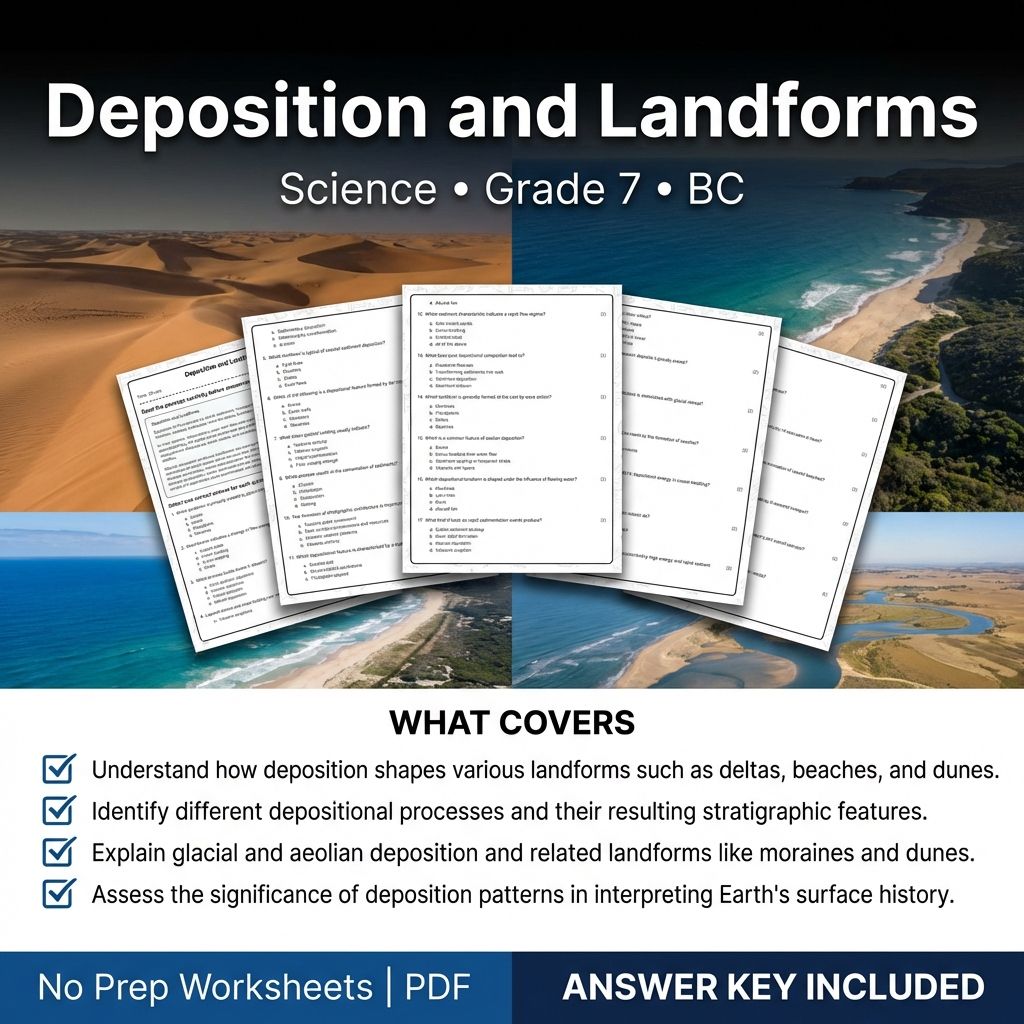
7th Grade Science | Deposition and Landforms Worksheet with Answer Key (Printable PDF)
Created byCoral Reef LearningLearning Objectives
- Understand how deposition shapes various landforms such as deltas, beaches, and dunes.
- Identify different depositional processes and their resulting stratigraphic features.
- Explain glacial and aeolian deposition and related landforms like moraines and dunes.
Instant download

Orbital Forcing and Long-Term Climate Cycles Grade 10 Worksheet
 Created bySunny Desk Resources
Learning Objectives
- Describe how changes in Earth’s orbit, axial tilt, and precession change the seasonal distribution of solar energy.
- Explain how orbital forcing can produce slow climate cycles over thousands to tens of thousands of years.
- Differentiate orbital influences from shorter-term atmospheric or human effects on climate.
Also included in: Earth Systems, Climate, and Sustainability Lesson Bundle | Grade 10 Science | Alberta +1 more
Instant download

Grade 10 Science | Conservation Energy Worksheet | General Standards
 Created byLumora Learning
Learning Objectives
- Explain the law of conservation of energy and how energy transfers and transforms within a closed system
- Use qualitative energy accounting to predict how energy forms change between initial and final states
- Justify conclusions about mechanical energy losses due to nonconservative forces using cause-and-effect reasoning
Instant download

Grade 7 Science – Quantitative Heat & Energy Transfer | Daily Reading Worksheet
 Created byBright Mind Resources
Learning Objectives
- Understand how heat and energy transfer are measured and expressed mathematically.
- Learn about specific heat capacity, mass, and temperature change in energy calculations.
- Interpret practical examples of thermal energy transfer, such as heating water, melting snow, and warming air.
Also included in: Grade 7 Heat Transfer Science Daily Reading Worksheets Lesson Bundle | Alberta +2 more
Instant download

Grade 7 Science – Convection Systems Daily Reading Worksheet | Alberta Standards
Created byBright Mind ResourcesLearning Objectives
- Understand the basic concept of convection
- Identify natural and forced convection in daily life
- Recognize how temperature differences cause fluid movement
Also included in: Grade 7 Heat Transfer Science Daily Reading Worksheets Lesson Bundle | Alberta +2 more
Instant download
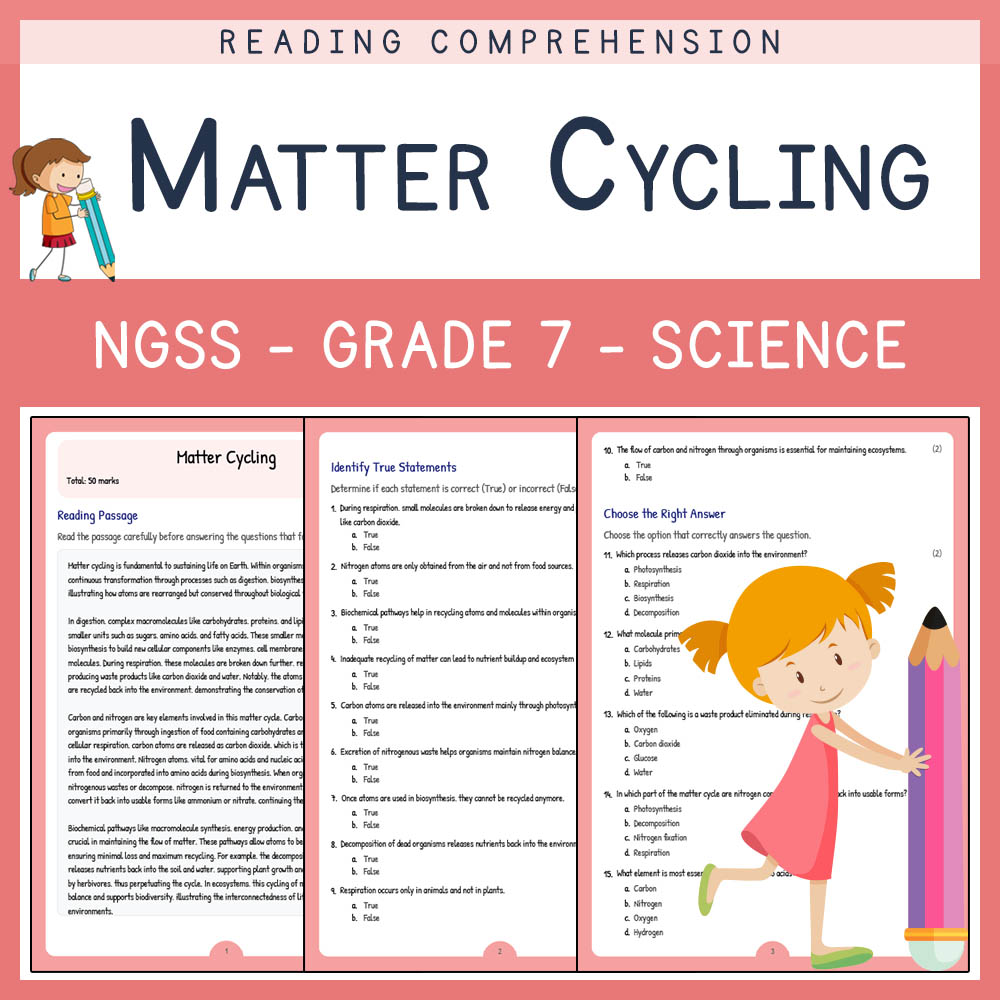
Grade 7 Science | Matter Cycling Worksheet + Answer Key – NGSS Aligned
Created byLumora LearningLearning Objectives
- Describe the process of matter cycling within organisms, including digestion, biosynthesis, and respiration.
- Explain the conservation of matter during biochemical pathways such as macromolecule synthesis and decomposition.
- Identify how carbon and nitrogen flow through organisms and are eventually released or excreted.
Instant download
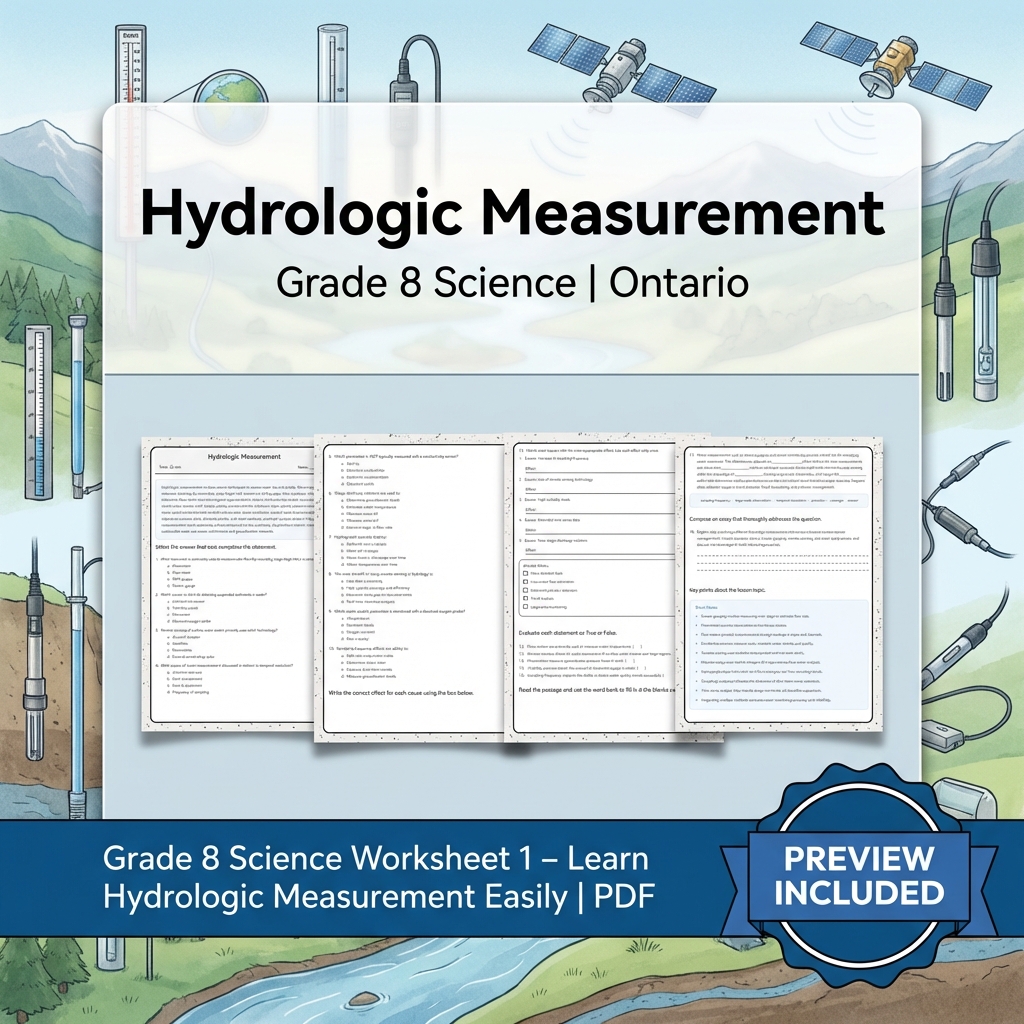
Grade 8 Science Worksheet 1 – Learn Hydrologic Measurement Easily | PDF
 Created byMeadowlark Worksheets
Learning Objectives
- Understand various methods and instruments used to quantify water quantity and quality.
- Explore concepts of stream gauging, rating curves, and stage-discharge relations.
- Identify tools like piezometers, flow meters, and sensors used in water monitoring.
Also included in: Grade 8 Science Watershed and Water Systems Lesson Group – Ontario Framework +1 more
Instant download
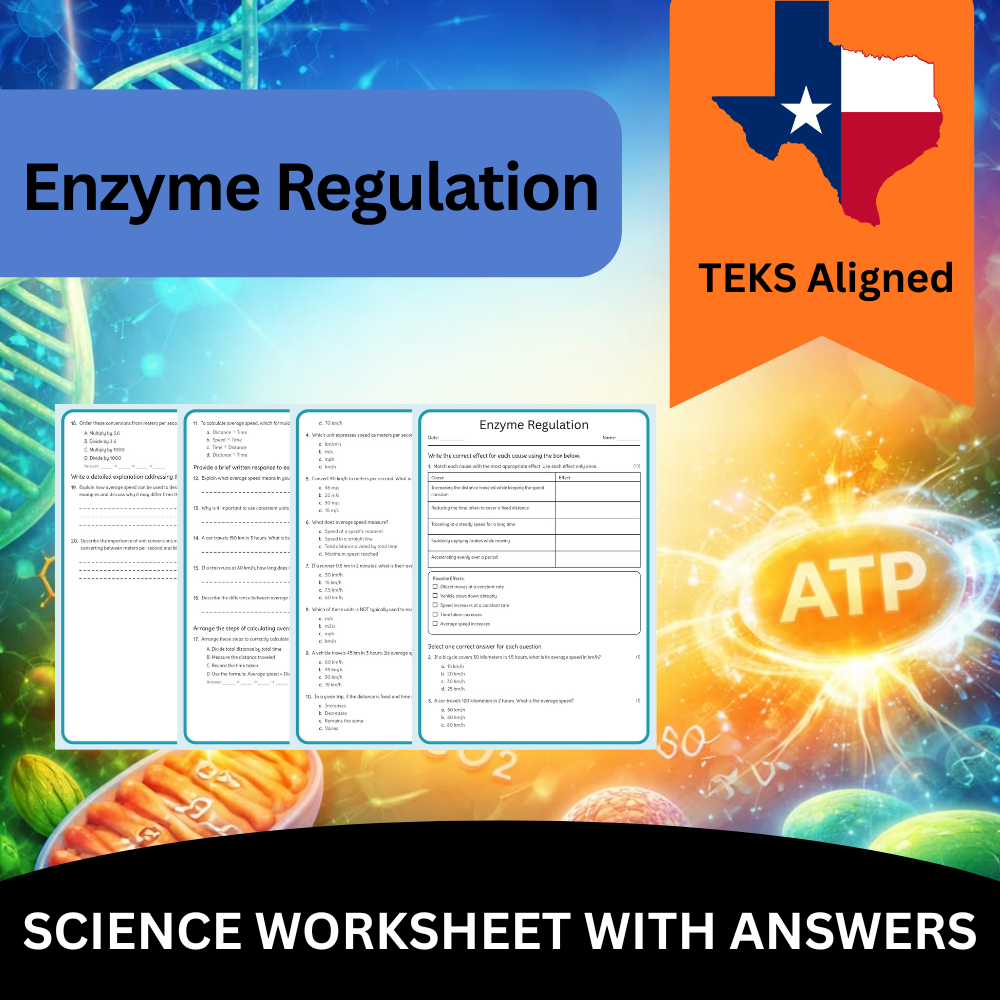
Grade 9 Science | Enzyme Regulation Worksheet (Worksheet + Answer Key) – TEKS Aligned
Created byBright Mind ResourcesLearning Objectives
- Understand the mechanisms of enzyme regulation such as allosteric control, inhibition, covalent modification, and gene expression.
- Describe how environmental factors affect enzyme activity and reaction rates.
- Explain feedback inhibition and its role in metabolic pathways.
Also included in: Grade 9 Science | Photosynthesis & Metabolic Pathways Unit Bundle (TEKS Aligned) +3 more
Instant download
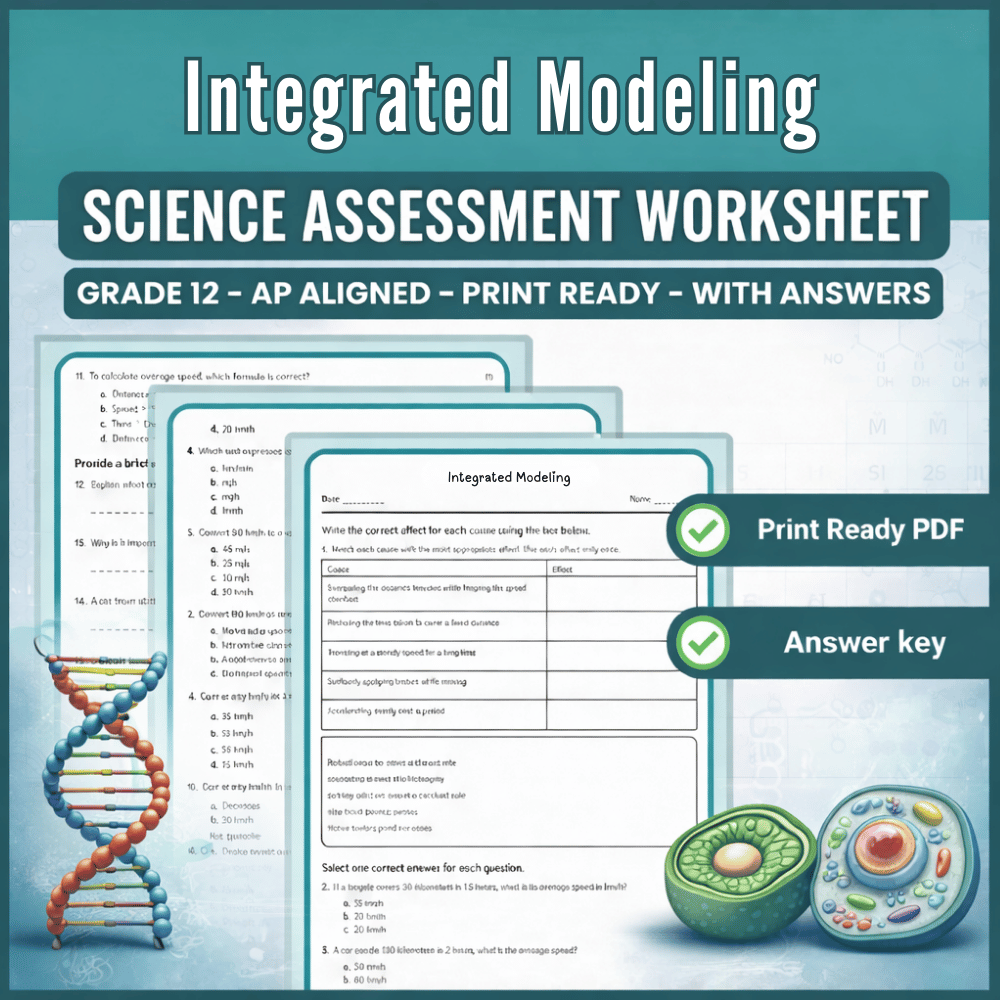
Grade 12 Science – Integrated Modeling Worksheet (AP) with Answer Key (PDF)
Created byBright Mind ResourcesLearning Objectives
- Understand how models link processes across molecular to ecosystem scales.
- Analyze the effects of assumptions in system models on predictions.
- Apply coupled differential equations and network models to biological systems.
Instant download

Tissue Organization Worksheet | Ontario Grade 8 Science Assessment
 Created byCedar Grove Learning
Learning Objectives
- Identify the major tissue types (epithelial, connective, muscle, and nervous) and describe key structural features.
- Explain how tissue structure supports function using examples of transport, movement, signal transmission, and support.
- Describe how coordinated tissues contribute to organ-level properties and physiological processes.
Instant download
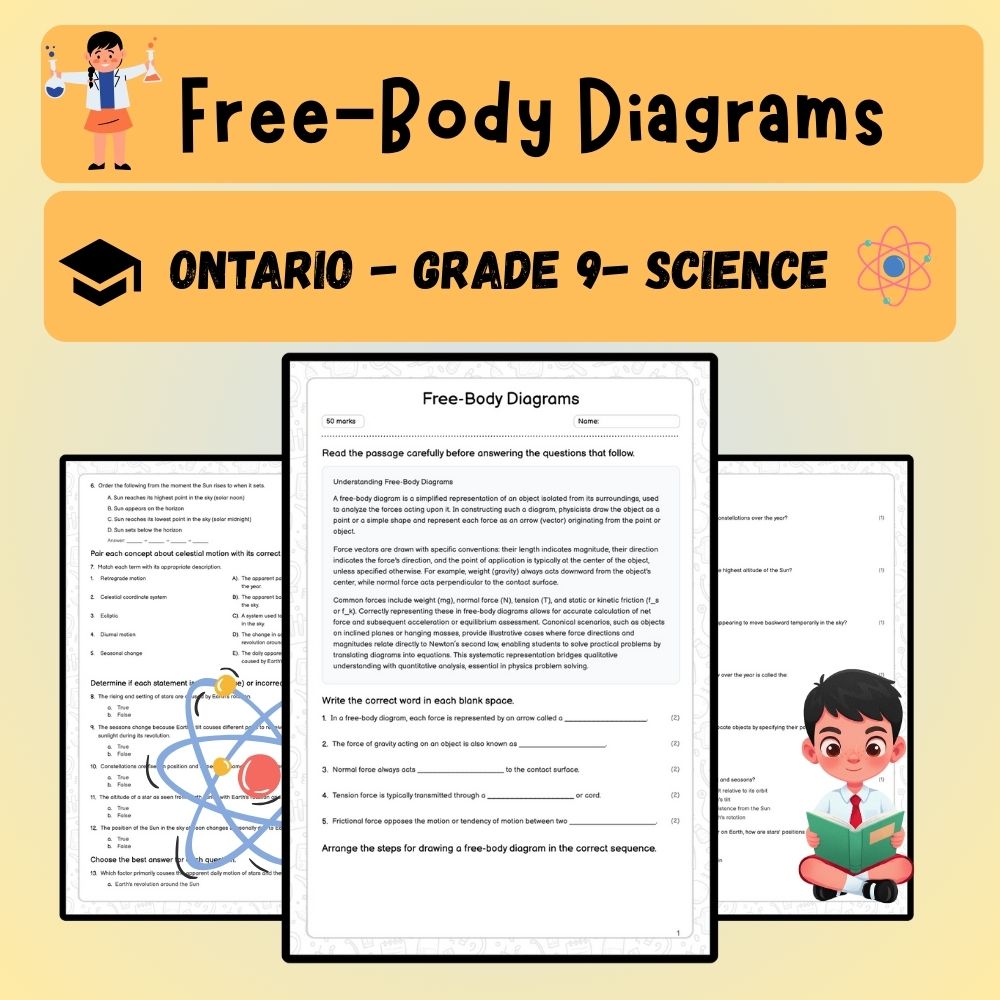
Grade 9 Science | Free-Body Diagrams Worksheet (Ontario Standards)
 Created byPrism Point Learning
Learning Objectives
- Understand the conventions and components involved in drawing free-body diagrams for isolated objects.
- Identify and represent different forces such as weight, normal force, tension, and friction with proper vector notation.
- Apply free-body diagrams to analyze equilibrium and acceleration in physical systems, including objects on inclined planes and hanging masses.
Also included in: Grade 9 Science Unit | Forces, Motion & Energy Worksheets (Ontario Standards) +1 more
Instant download

Momentum and Impulse Worksheet for Grade 10 Science | NGSS Assessment
JCreated byJ.S SheetsLearning Objectives
- Understand the quantitative relationship between impulse and momentum.
- Explain the impulse-momentum theorem and conservation principles in closed systems.
- Analyze elastic and inelastic collisions using impulse and momentum concepts.
Also included in: Grade 10 Forces, Momentum & Collisions Science Lesson Bundle – NGSS
Instant download
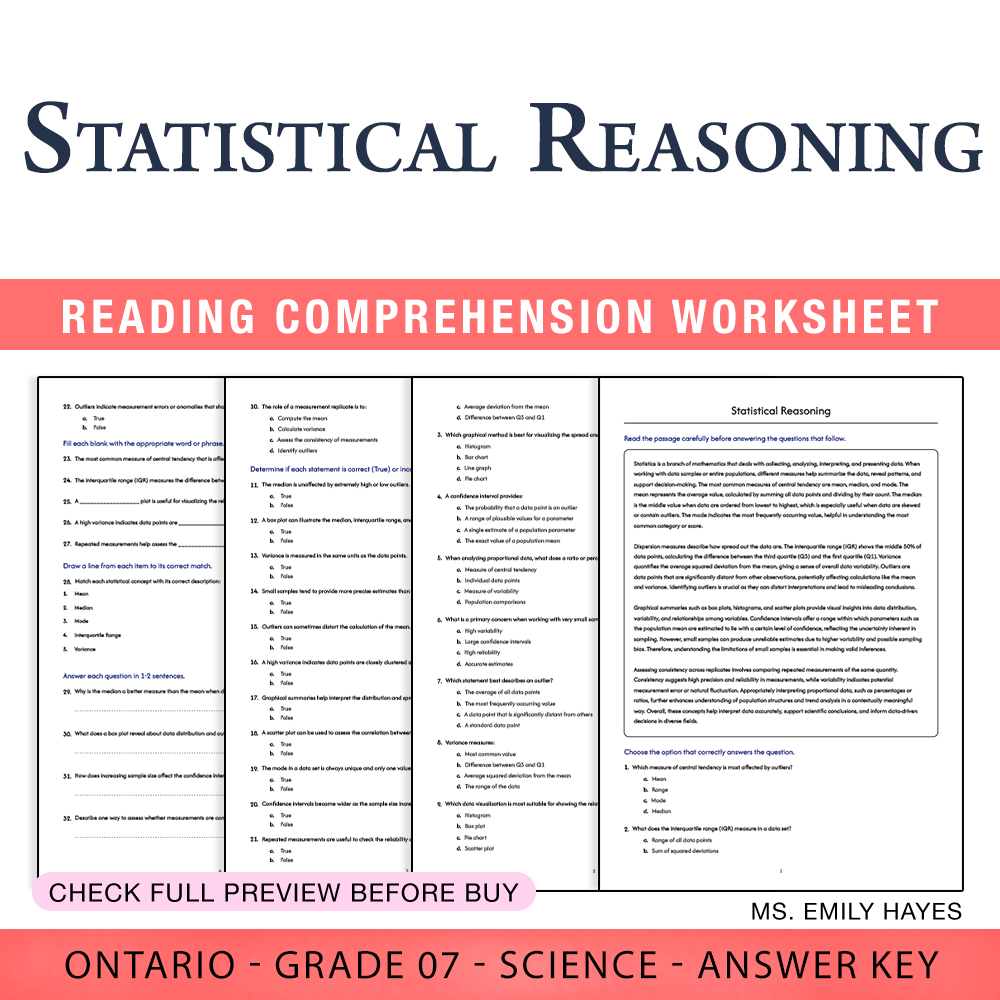
7th Grade Science | Statistical Reasoning Worksheet (PDF+ Answer Key)
 Created byCopper Leaf Classroom
Learning Objectives
- Understand and define key descriptive statistics such as mean, median, and mode.
- Interpret measures of dispersion including interquartile range, variance, and the role of outliers.
- Create and analyze simple graphical summaries of data.
Instant download
Grade 10 Science Worksheet on Solar Context | Alberta Standards
Created byCoral Reef LearningLearning Objectives
- Understand planetary motions, solar irradiance, and gravitational interactions among Earth, Moon, and Sun.
- Explain how the Sun's position influences seasonal daylight variation and solar angles on Earth.
- Relate solar forcing to atmospheric circulation and regional weather patterns.
Instant download

Reaction Energy Grade 10 Science – Endothermic & Exothermic Processes
JCreated byJ.S SheetsLearning Objectives
- Explain how reaction energy changes by comparing the total energy of reactants and products.
- Distinguish endothermic and exothermic reactions using energy profiles and ΔH.
- Describe activation energy and the role it plays in reaching the transition state.
Also included in: Grade 10 Matter, Energy, and Waves Science Lesson Bundle – Florida (NGSSS) +1 more
Instant download

Science Worksheet Electromagnetic Waves Grade 10 | Standards-Aligned Practice
JCreated byJ.S SheetsLearning Objectives
- Explain how electromagnetic waves propagate through a vacuum using oscillating electric and magnetic fields.
- Relate wavelength, frequency, and photon energy using the electromagnetic spectrum.
- Describe how reflection, transmission, and absorption depend on material properties and wave frequency/wavelength.
Also included in: Grade 10 Matter, Energy, and Waves Science Lesson Bundle – Florida (NGSSS) +1 more
Instant download

Atomic Structure Worksheet for Grade 10 Science | Standards-Aligned Practice
JCreated byJ.S SheetsLearning Objectives
- Describe atomic structure using subatomic particles (protons, neutrons, electrons) and their roles in determining an atom’s identity and mass.
- Explain isotopes as atoms with the same number of protons but different numbers of neutrons, and relate isotopic mass differences to nuclear composition.
- Use the idea of energy levels and electron configurations to predict patterns in how atoms store and transfer energy.
Also included in: Grade 10 Matter, Energy, and Waves Science Lesson Bundle – Florida (NGSSS) +1 more
Instant download

Science Worksheet Friction and Drag Grade 10 | Standards-Aligned Practice
JCreated byJ.S SheetsLearning Objectives
- Explain how friction and air resistance are nonconservative forces that oppose motion or impending motion
- Analyze how friction and drag change acceleration and cause velocity to evolve over time
- Relate energy loss from friction and drag to real-world deviations from ideal motion predictions
Also included in: Grade 10 Matter, Energy, and Waves Science Lesson Bundle – Florida (NGSSS) +1 more
Instant download
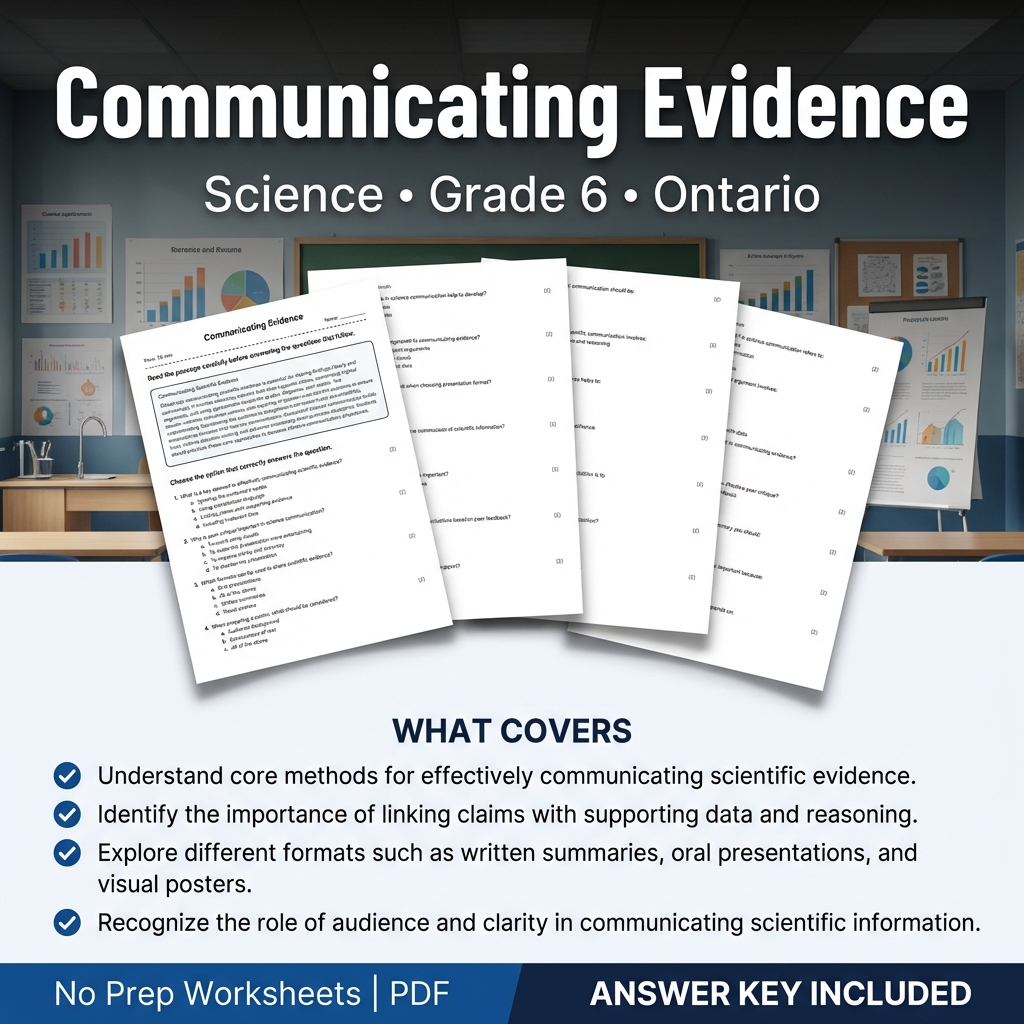
Grade 6 Science Worksheet | Communicating Evidence | Ontario Standards
Created byCoral Reef LearningLearning Objectives
- Understand core methods for effectively communicating scientific evidence.
- Identify the importance of linking claims with supporting data and reasoning.
- Explore different formats such as written summaries, oral presentations, and visual posters.
Instant download
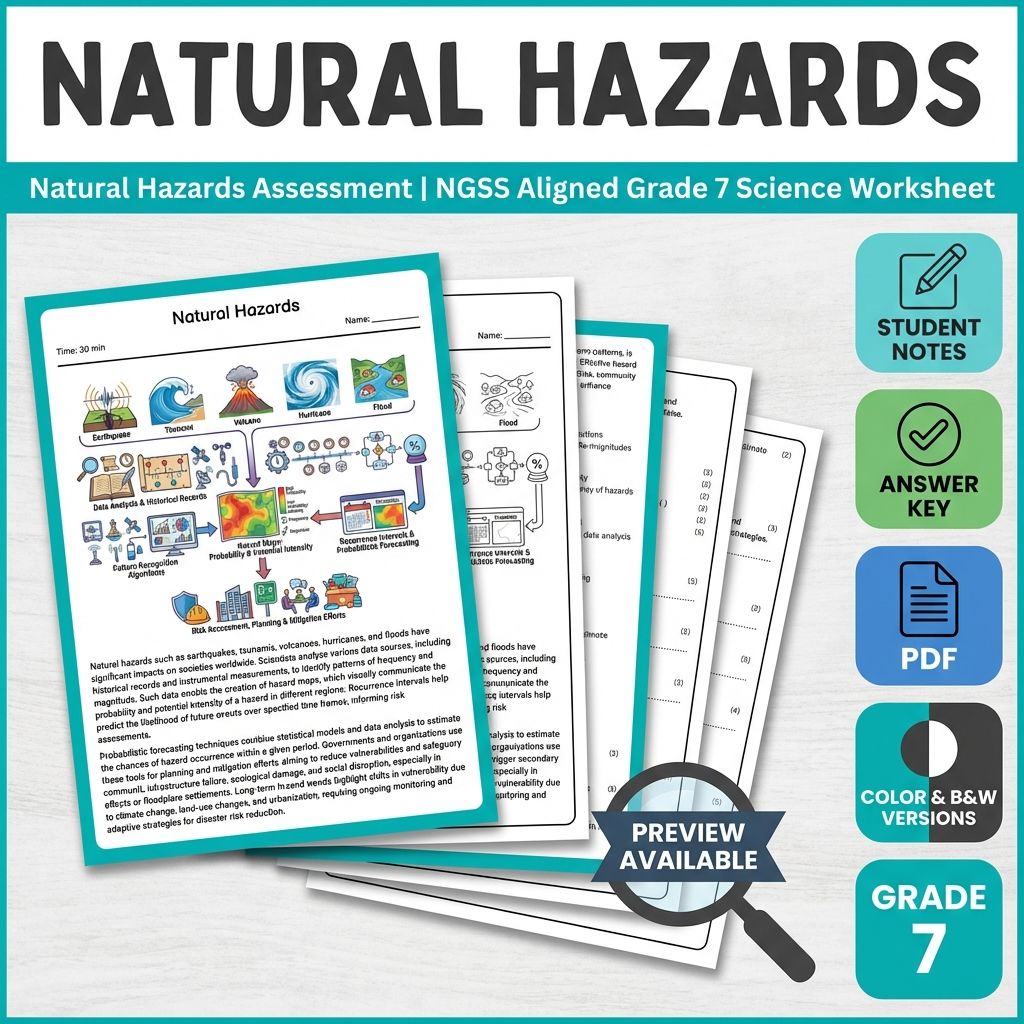
Natural Hazards Assessment | NGSS Aligned Grade 7 Science Worksheet
Created byPrism Point LearningLearning Objectives
- Understand key concepts related to Science
- Apply knowledge through practice questions
- Demonstrate comprehension of the material
Also included in: Grade 7 Science Mini Bundle | Earth and Human Activity NGSS Not specified +1 more
Instant download
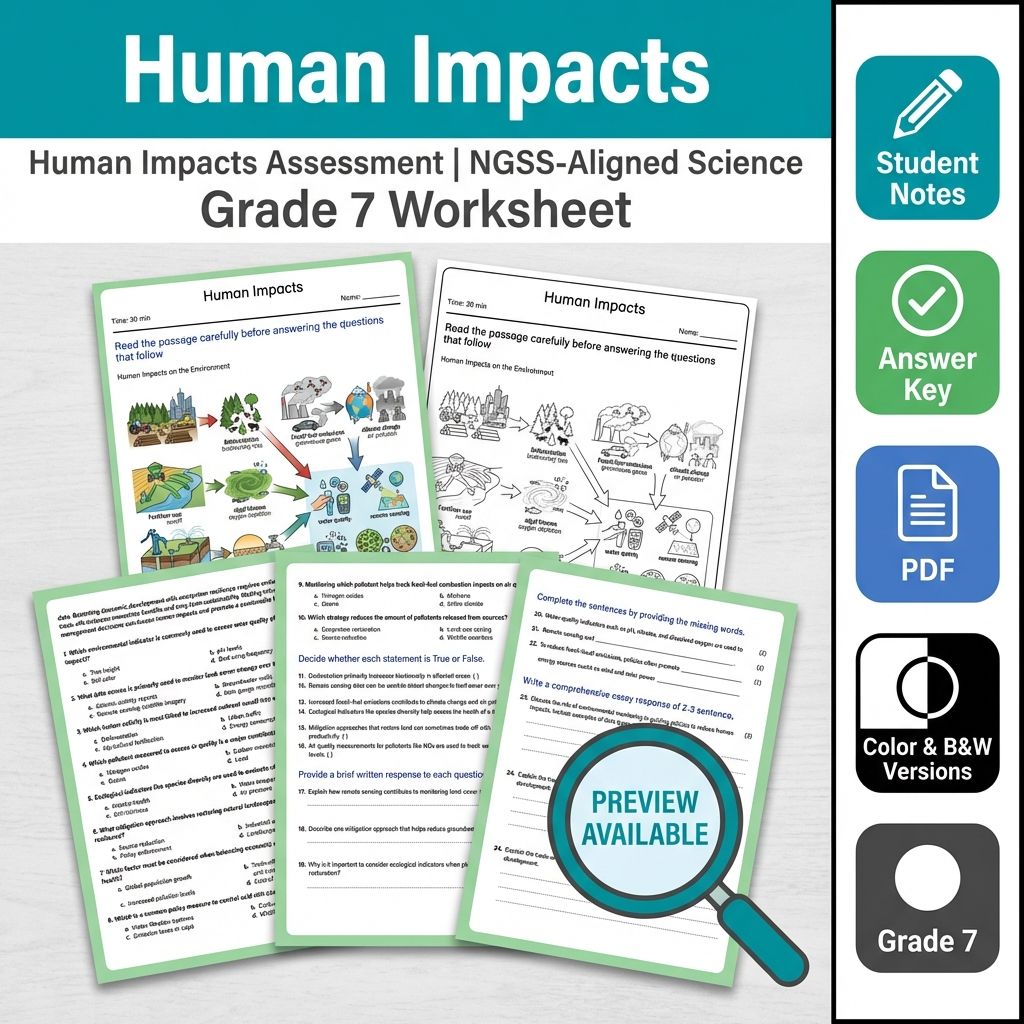
Human Impacts Assessment | NGSS-Aligned Science Grade 7 Worksheet
Created byPrism Point LearningLearning Objectives
- Understand the scientific principles used to monitor human impacts on the environment.
- Identify indicators and data sources used to assess environmental changes.
- Evaluate mitigation approaches and their trade-offs among economic, ecological, and social factors.
Also included in: Grade 7 Science Mini Bundle | Earth and Human Activity NGSS Not specified +1 more
Instant download
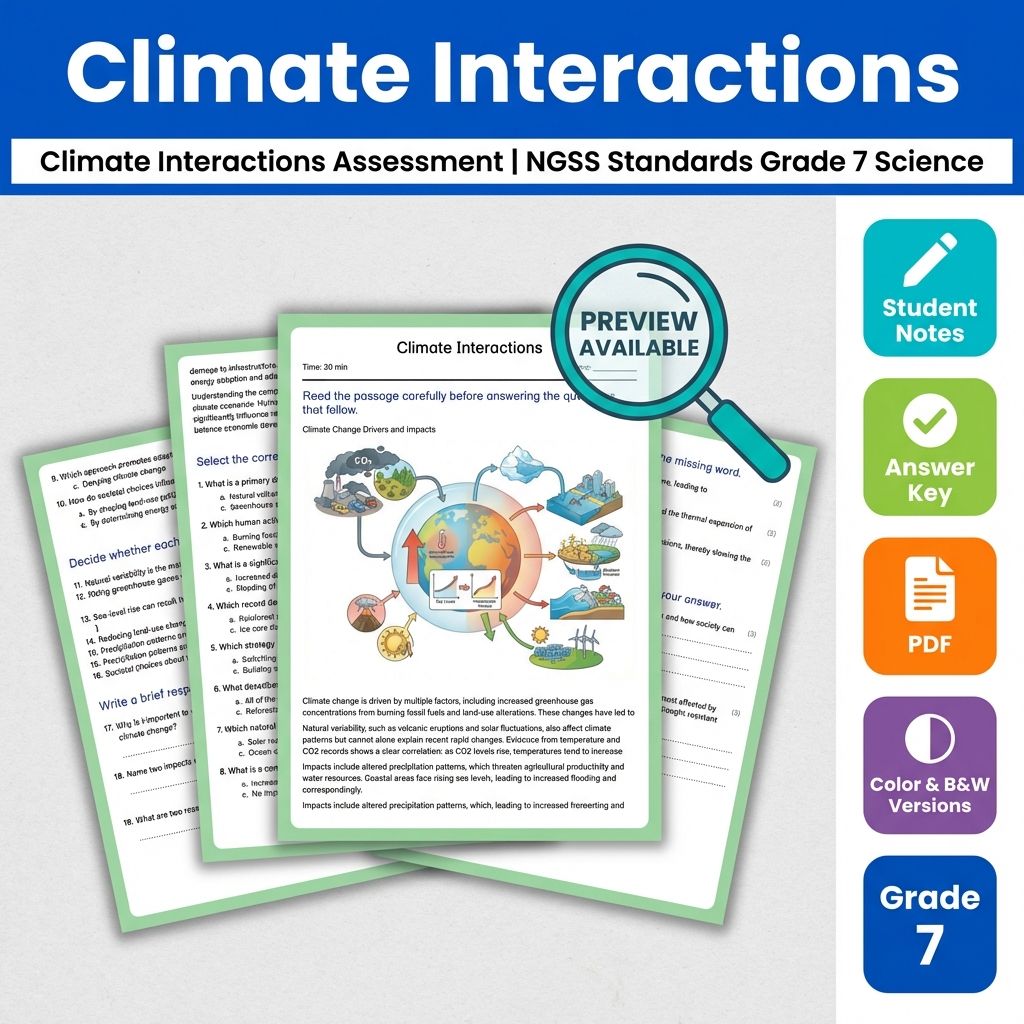
Climate Interactions Assessment | NGSS Standards Grade 7 Science
Created byPrism Point LearningLearning Objectives
- Examine evidence for climate change drivers, including greenhouse gases, land-use change, and natural variability.
- Assess impacts of climate change on sea levels, precipitation patterns, and agriculture.
- Analyze temperature and CO2 records, and understand carbon-cycle exchanges.
Also included in: Grade 7 Science Mini Bundle | Earth and Human Activity NGSS Not specified +1 more
Instant download
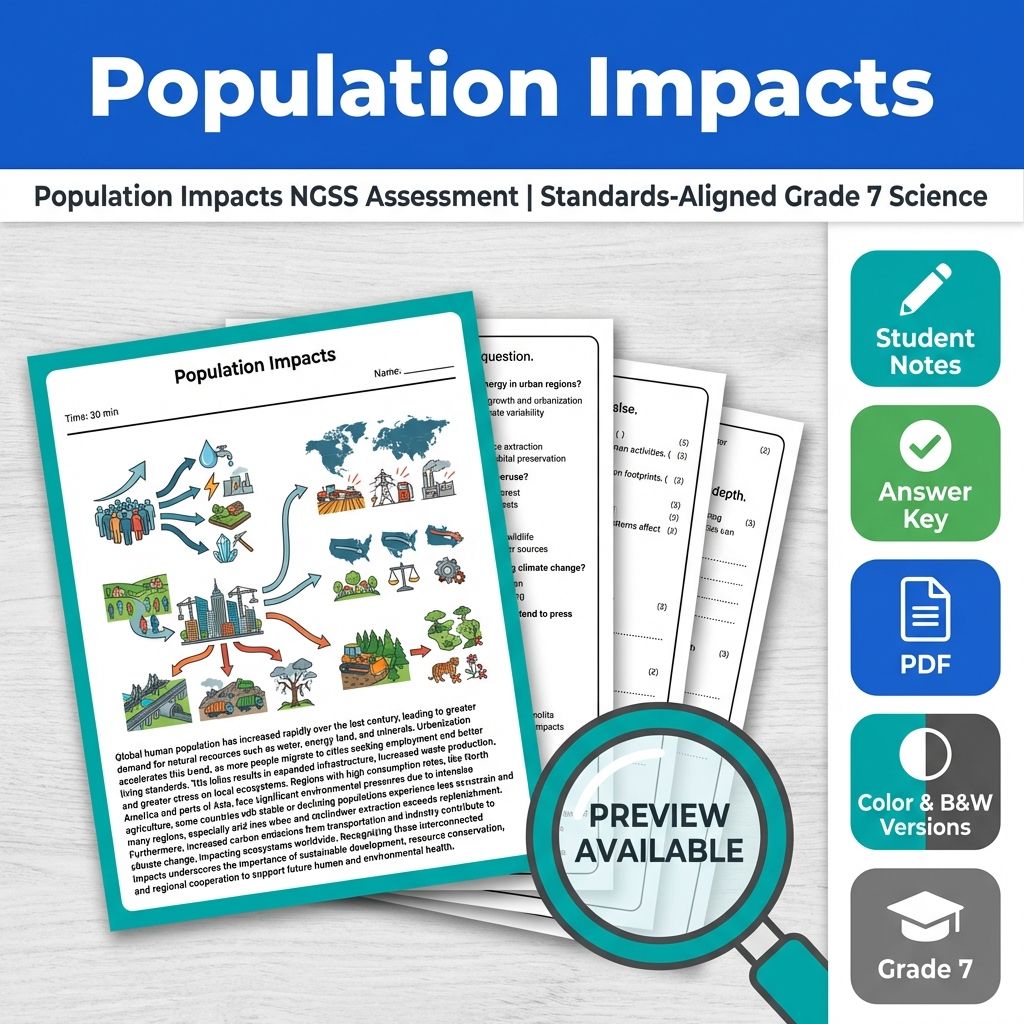
Population Impacts NGSS Assessment | Standards-Aligned Grade 7 Science
Created byPrism Point LearningLearning Objectives
- Understand how increased human population affects demand for water, energy, land, and raw materials.
- Analyze the consequences of population growth on ecosystems, biodiversity, and resource cycles.
- Evaluate regional examples to compare how consumption patterns influence environmental pressures.
Also included in: Grade 7 Science Mini Bundle | Earth and Human Activity NGSS Not specified +1 more
Instant download
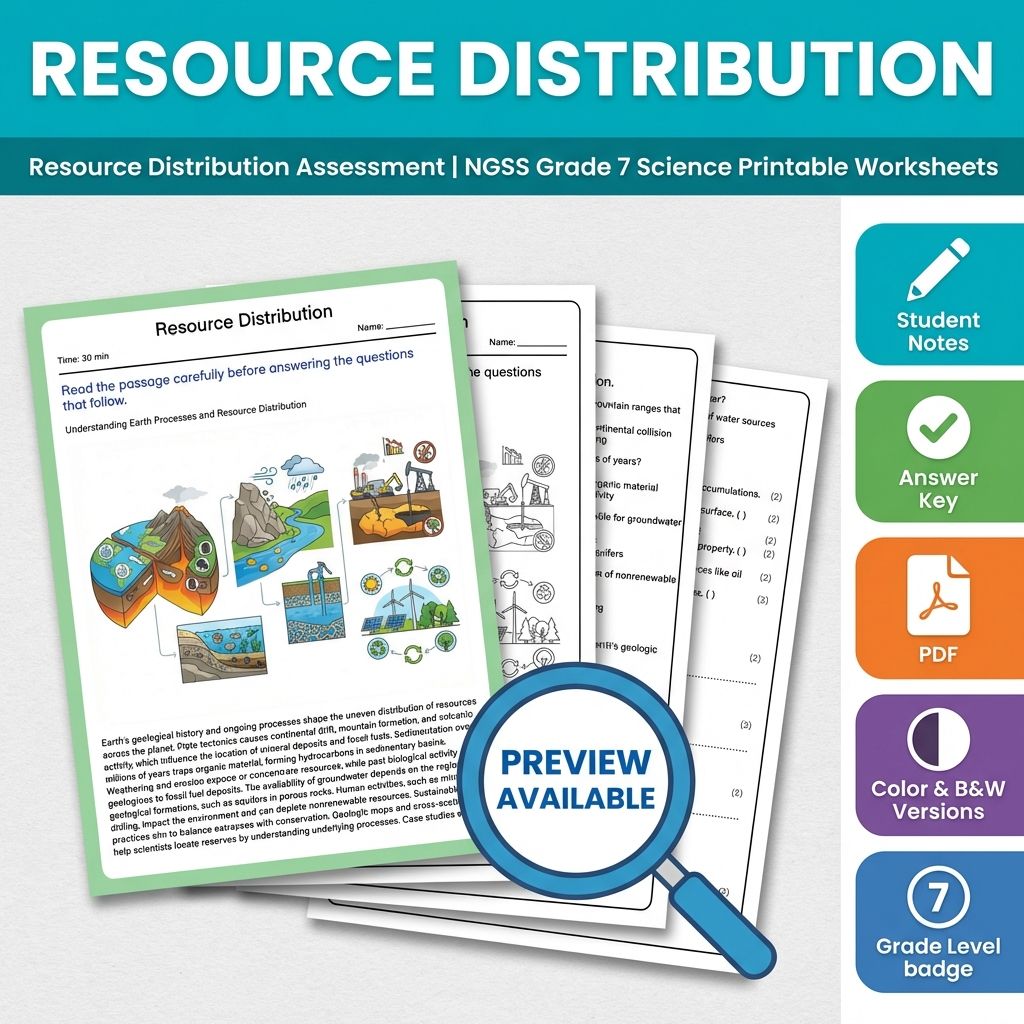
Resource Distribution Assessment | NGSS Grade 7 Science Printable Worksheets
Created byPrism Point LearningLearning Objectives
- Understand how geologic processes influence the distribution of mineral, energy, and groundwater resources.
- Connect plate tectonics, sedimentation, weathering, and biological activity to resource locations.
- Evaluate the impacts of resource extraction and consider sustainability and access issues.
Also included in: Grade 7 Science Mini Bundle | Earth and Human Activity NGSS Not specified +1 more
Instant download
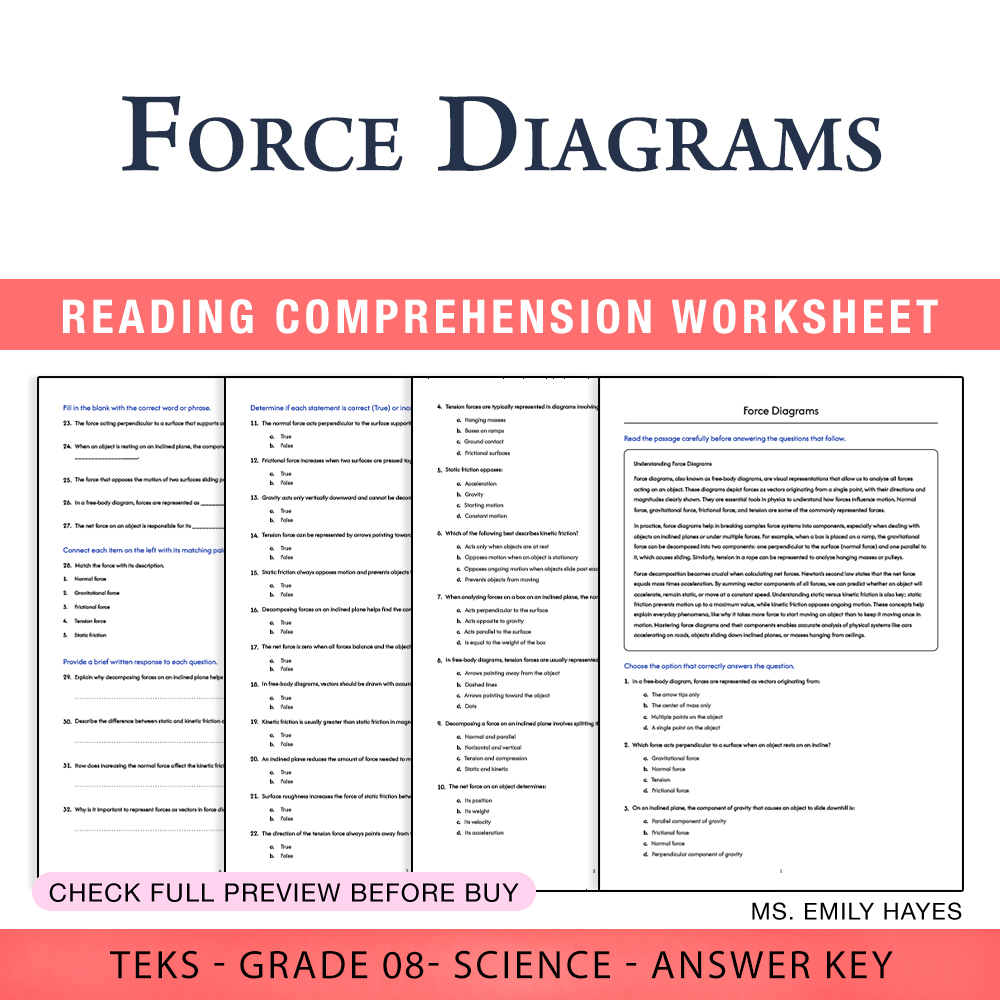
8th Grade Science | Force Diagrams Worksheet (PDF+ Answer Key)
Created byCopper Leaf ClassroomLearning Objectives
- Describe how to represent forces using free-body diagrams, including normal, gravitational, frictional, and tension forces.
- Identify and analyze vector directions of forces acting on objects in various scenarios.
- Decompose forces on inclined planes into components and calculate net force.
Instant download
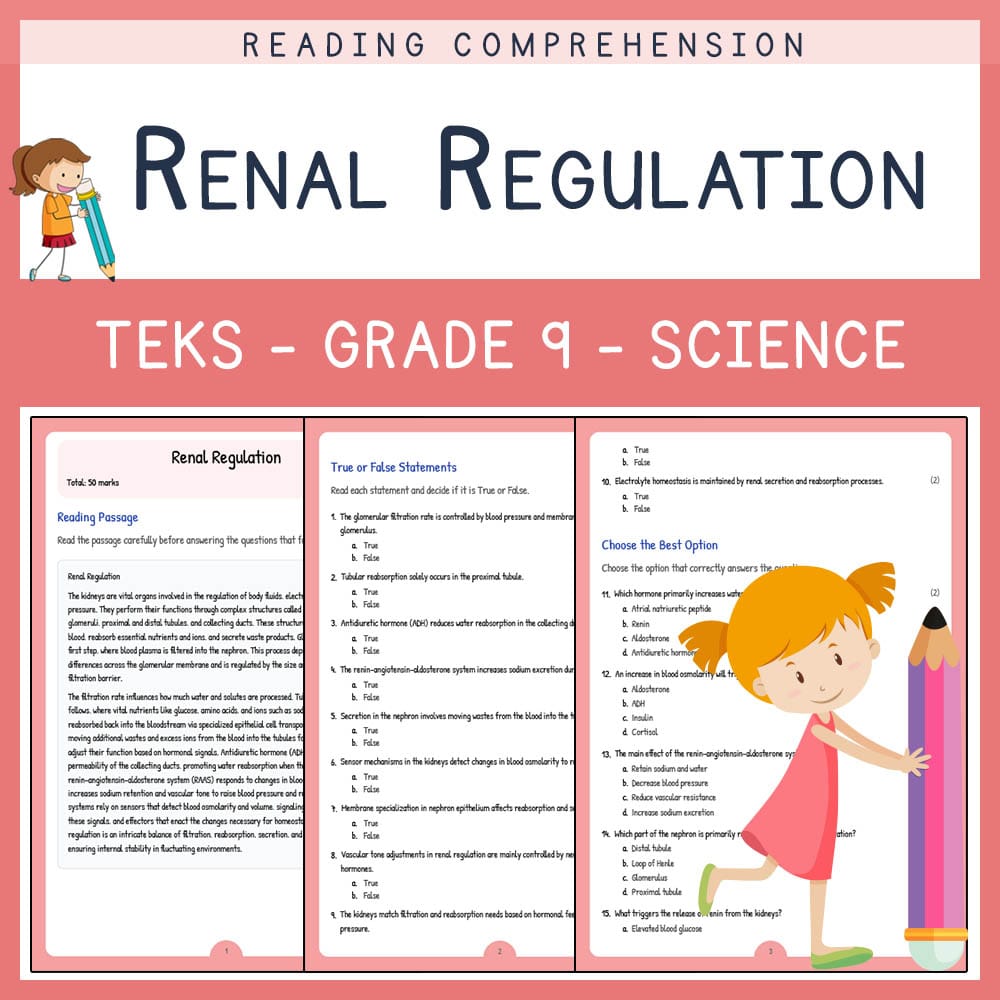
Grade 9 Science | Renal Regulation Worksheet | TEKS-Aligned
Created byLumora LearningLearning Objectives
- Describe how hormonal feedback mechanisms regulate kidney function and help maintain homeostasis.
- Explain the processes of glomerular filtration, tubular reabsorption, and secretion in the nephron.
- Identify the roles of specific hormones such as antidiuretic hormone and the renin–angiotensin–aldosterone system in fluid and electrolyte balance.
Instant download
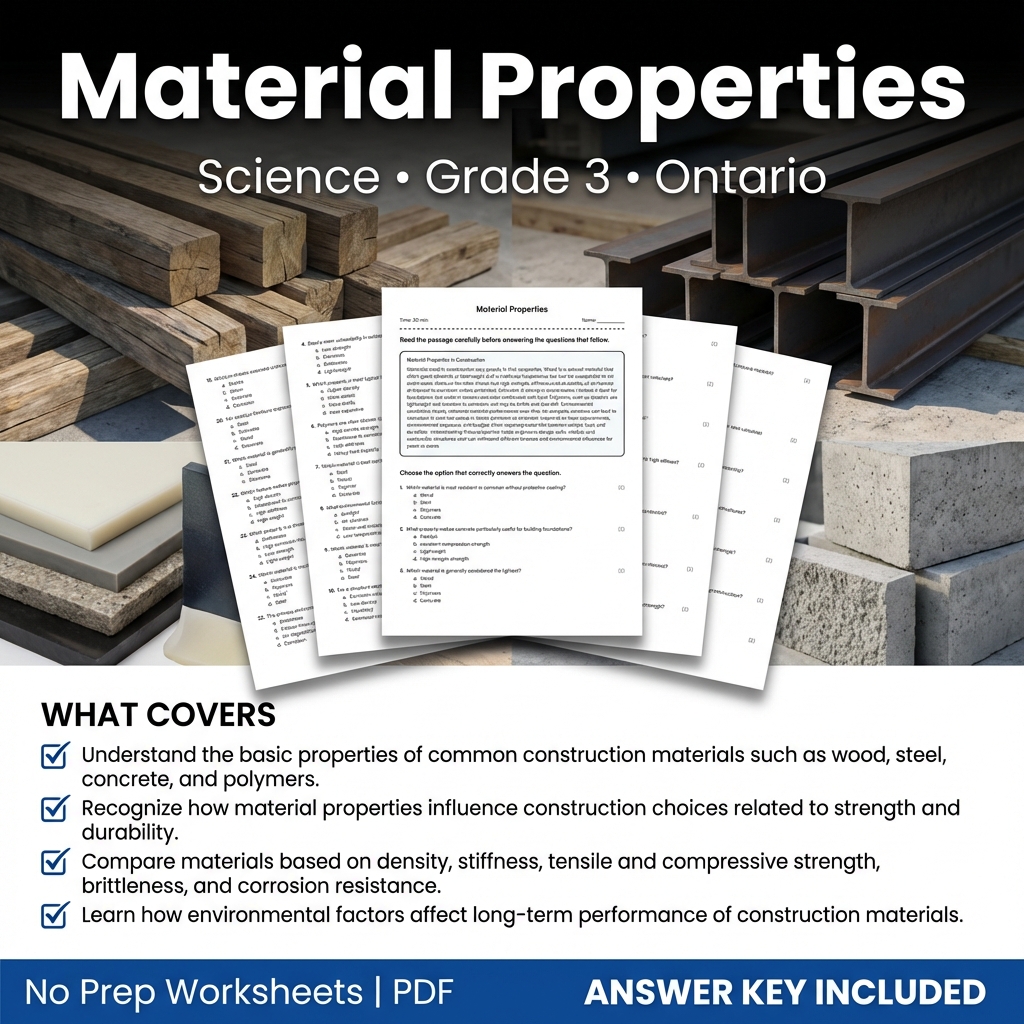
Material Properties Worksheet for Grade 3 Science | Ontario Framework
Created byCoral Reef LearningLearning Objectives
- Understand the basic properties of common construction materials such as wood, steel, concrete, and polymers.
- Recognize how material properties influence construction choices related to strength and durability.
- Compare materials based on density, stiffness, tensile and compressive strength, brittleness, and corrosion resistance.
Instant download
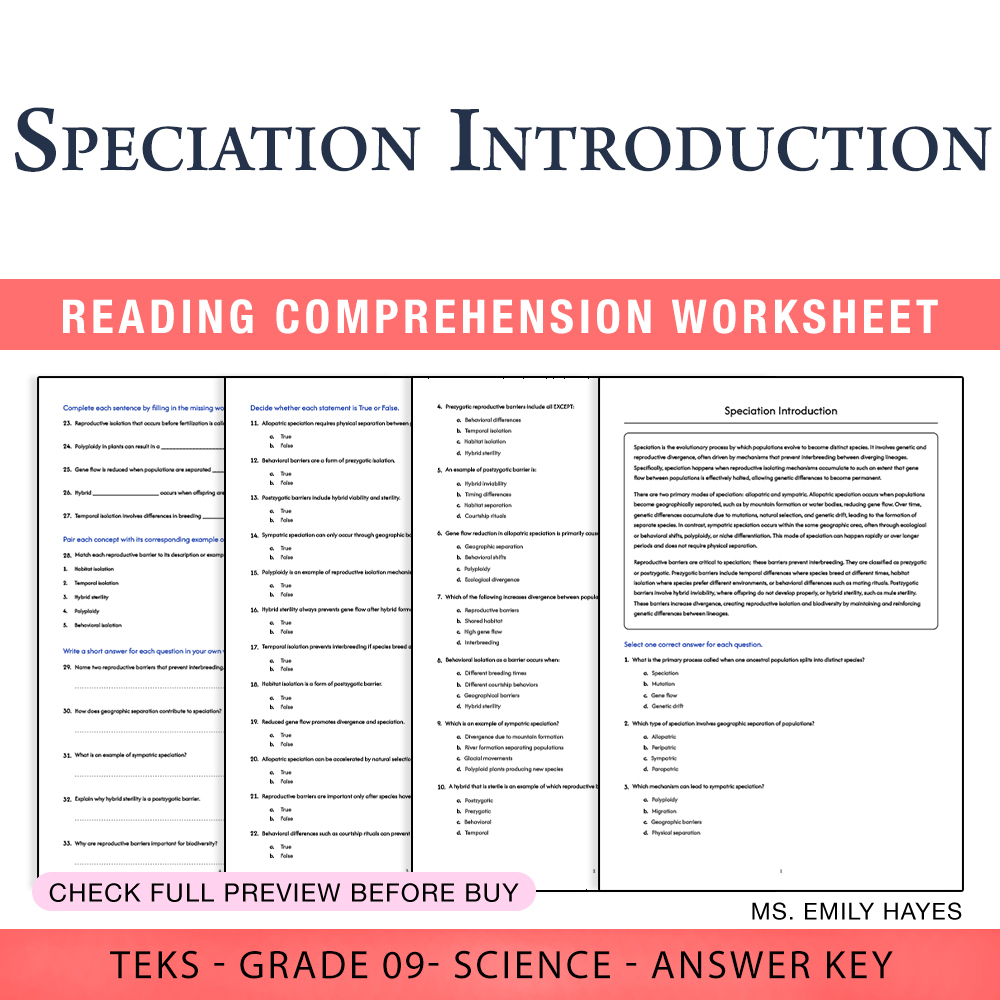
9th Grade Science | Speciation Introduction Worksheet (PDF+ Answer Key)
Created byCopper Leaf ClassroomLearning Objectives
- Understand the process of speciation and the mechanisms involved.
- Differentiate between allopatric and sympatric speciation.
- Identify types of reproductive barriers that contribute to speciation.
Instant download
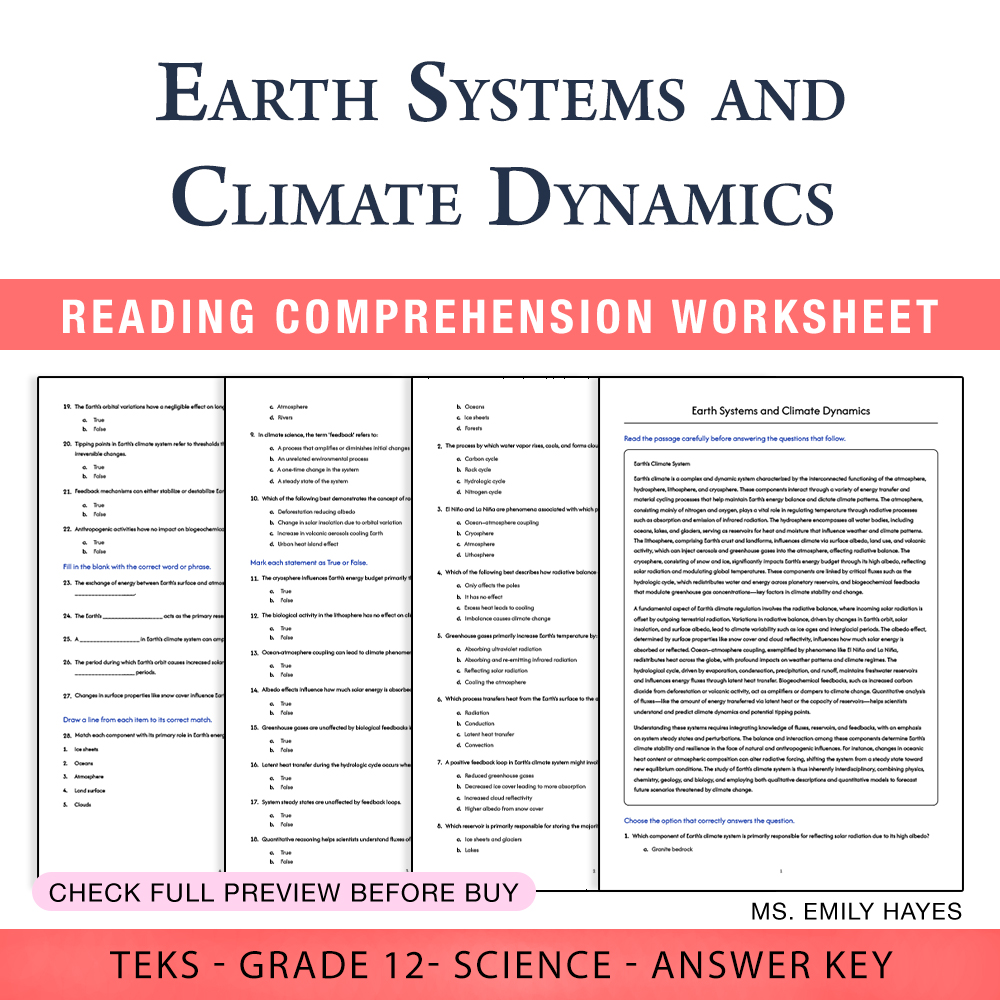
12th Grade Science |Earth Systems & Climate Dynamics Worksheet(PDF + Answer Key)
Created byCopper Leaf ClassroomLearning Objectives
- Describe the interactions between atmosphere, hydrosphere, lithosphere, and cryosphere in Earth's climate system.
- Explain energy transfer mechanisms such as radiative balance and albedo effects.
- Analyze the role of the hydrologic cycle, biogeochemical feedbacks, and ocean–atmosphere coupling in climate variability.
Instant download

Land Use Effects Worksheet | Grade 8 Science Activities
Created byPrism Point LearningLearning Objectives
- Explain how human land use can fragment habitats and change habitat size and quality for native species.
- Describe how fragmentation affects edge effects, hydrology, soil properties, and habitat connectivity.
- Use cause-and-effect reasoning to predict how land use changes can influence population survival and biodiversity over time.
Also included in: Ecosystems & Biodiversity Lesson Bundle | Grade 8 Science | BC +1 more
Instant download

Cell Biochemistry Worksheets: Enzymes, ATP & Membranes Grade 10
 Created byBRIGHT PATH RESOURCES
Learning Objectives
- Explain how cell membranes regulate material movement
- Describe how enzymes lower activation energy
- Connect ATP with energy-requiring cellular processes
Also included in: Grade 10 Life Science Worksheets Bundle | Evolution & Genetics +1 more
Instant download

Genetic Variation Worksheets: Meiosis, Mutation & Gene Flow Grade 10
Created byBRIGHT PATH RESOURCESLearning Objectives
- Explain how random assortment creates new allele combinations
- Describe how crossing over contributes to genetic variation
- Explain how mutation introduces genetic variation into populations
Also included in: Grade 10 Life Science Worksheets Bundle | Evolution & Genetics +1 more
Instant download

Enzymes and Membrane Transport Worksheets: Grade 10 Science
Created byBRIGHT PATH RESOURCESLearning Objectives
- Explain how enzyme specificity affects reaction efficiency
- Describe diffusion and osmosis across cell membranes
- Predict the direction of net membrane movement
Also included in: Grade 10 Life Science Worksheets Bundle | Evolution & Genetics +1 more
Instant download
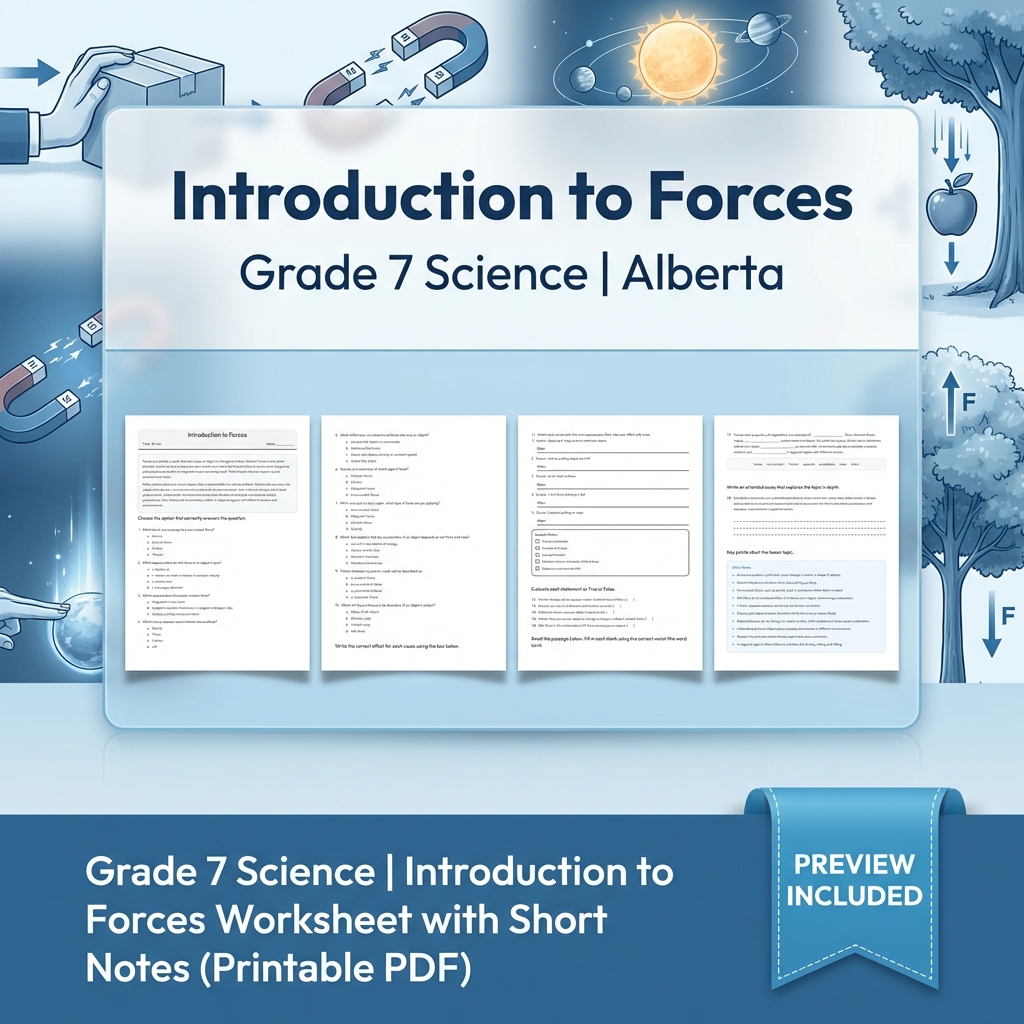
Grade 7 Science | Introduction to Forces Worksheet with Short Notes (PDF)
Created byMeadowlark WorksheetsLearning Objectives
- Define and distinguish between contact and non-contact forces.
- Explain how net force influences the motion of objects.
- Identify real-life examples of different forces such as friction and gravity.
Also included in: Grade 7 Science | Forces, Structures & Motion UNIT Worksheet Bundle
Instant download
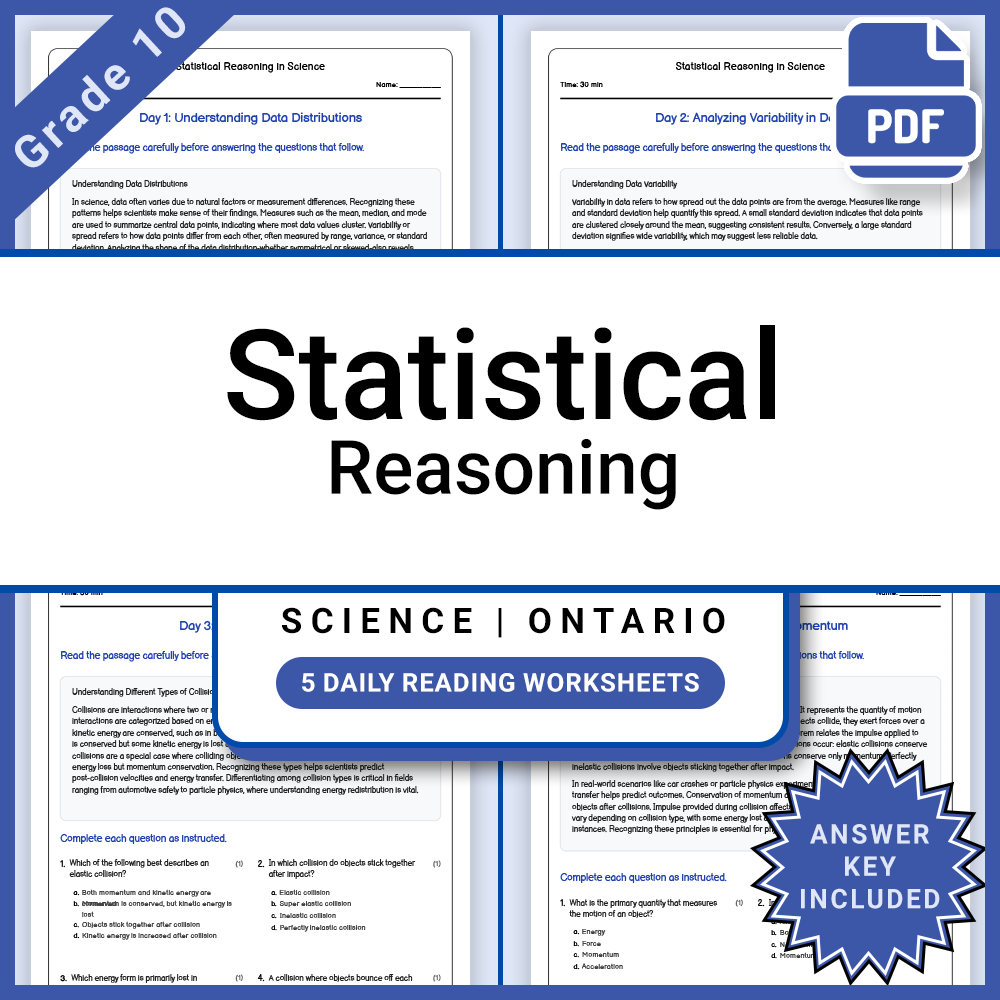
Grade 10 Science – Statistical Reasoning Daily Reading Worksheet + Answer Key
JCreated byJ.S SheetsLearning Objectives
- Understand the concepts of measures of central tendency and variability.
- Interpret data distribution patterns visually and numerically.
- Distinguish between measures of data spread and central tendency.
Also included in: Grade 10 Science Lesson Bundle | Ontario Framework Reading Worksheets +1 more
Instant download
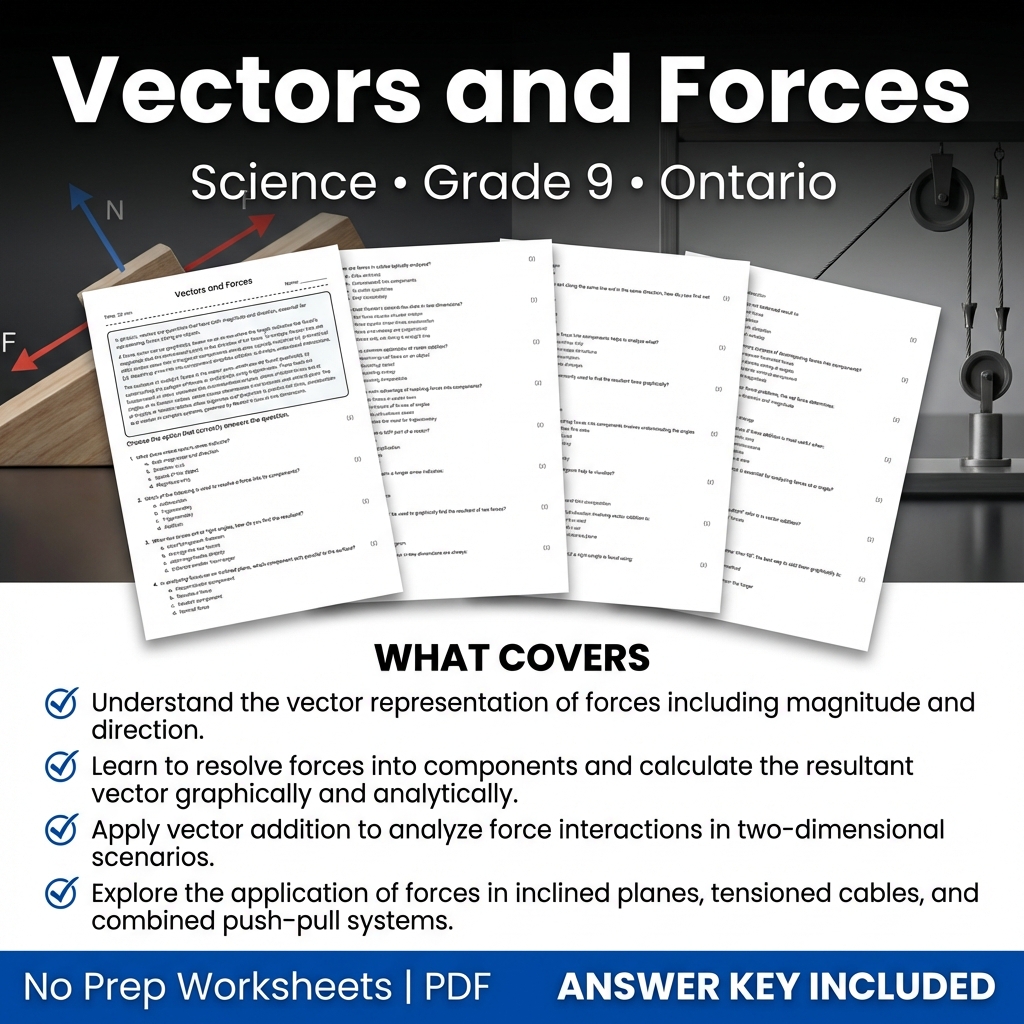
Vectors and Forces Worksheet Grade 9 Science Ontario Standard
Created byCoral Reef LearningLearning Objectives
- Understand the vector representation of forces including magnitude and direction.
- Learn to resolve forces into components and calculate the resultant vector graphically and analytically.
- Apply vector addition to analyze force interactions in two-dimensional scenarios.
Instant download
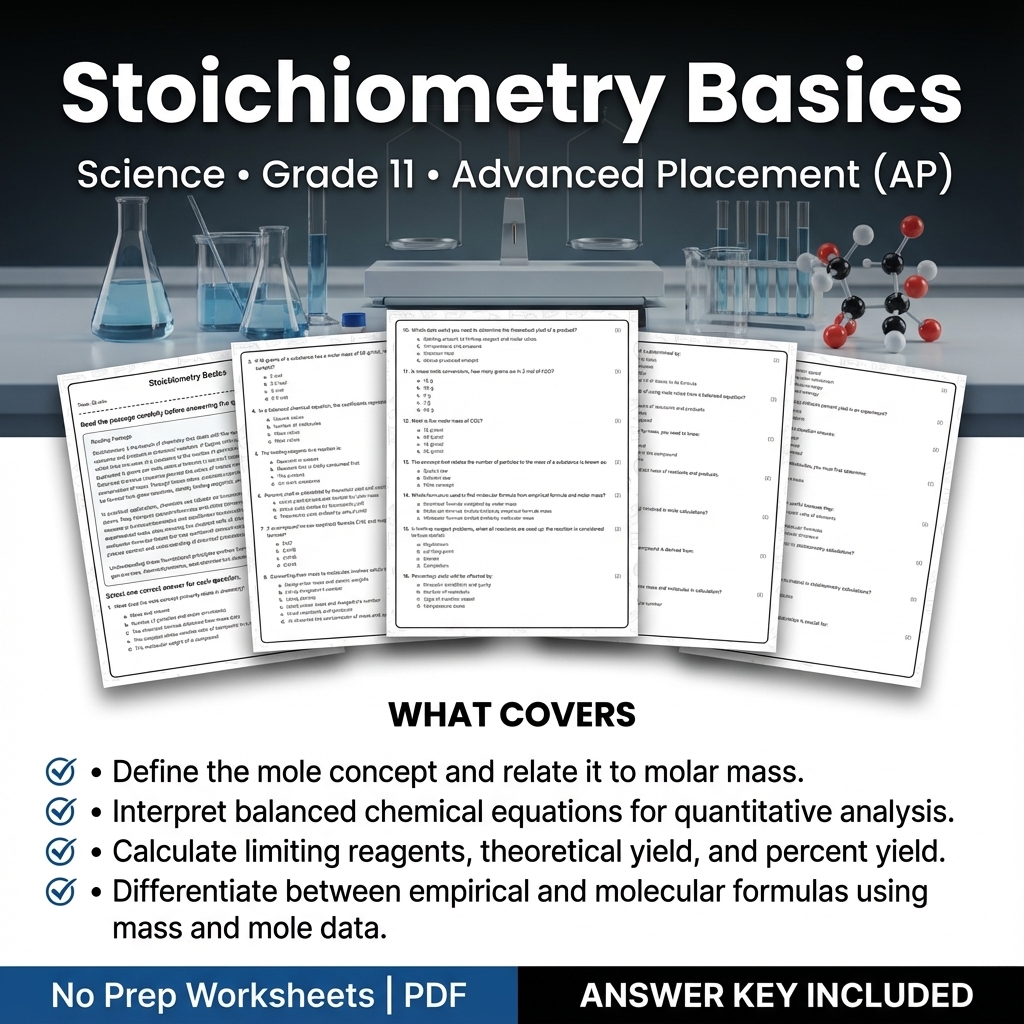
11th Grade Science | Stoichiometry Basics Worksheet (Printable PDF + Answer Key)
Created byCoral Reef LearningLearning Objectives
- Define the mole concept and relate it to molar mass.
- Interpret balanced chemical equations for quantitative analysis.
- Calculate limiting reagents, theoretical yield, and percent yield.
Also included in: Grade 11 Science Unit Worksheet Pack | Chemistry & Atomic Structure +1 more
Instant download
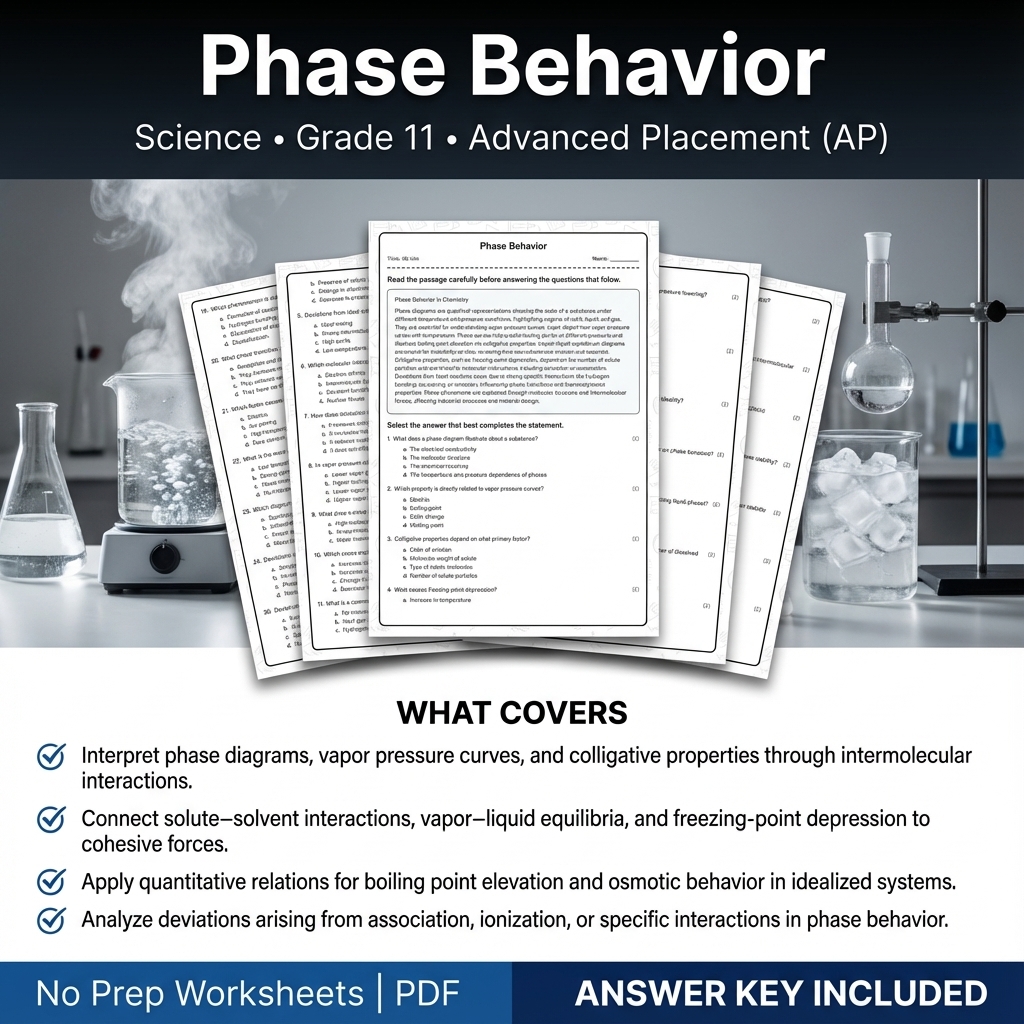
Grade 11 Science | Phase Behavior Worksheet (Printable PDF + Answer Key)
Created byCoral Reef LearningLearning Objectives
- Interpret phase diagrams, vapor pressure curves, and colligative properties through intermolecular interactions.
- Connect solute–solvent interactions, vapor–liquid equilibria, and freezing-point depression to cohesive forces.
- Apply quantitative relations for boiling point elevation and osmotic behavior in idealized systems.
Also included in: Grade 11 Science Unit Worksheet Pack | Chemistry & Atomic Structure +1 more
Instant download
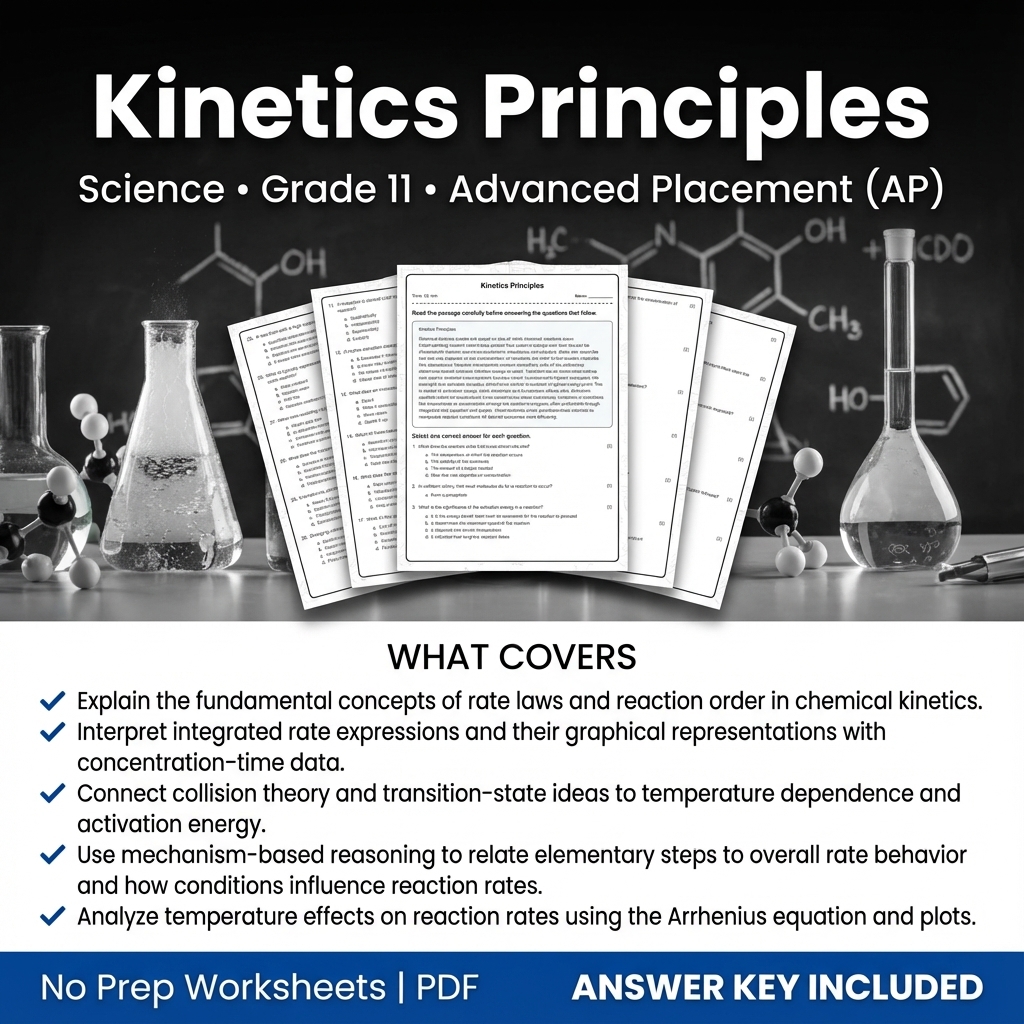
11th Grade Science | Kinetics Principles Worksheet (Printable PDF + Answer Key)
Created byCoral Reef LearningLearning Objectives
- Explain the fundamental concepts of rate laws and reaction order in chemical kinetics.
- Interpret integrated rate expressions and their graphical representations with concentration–time data.
- Connect collision theory and transition-state ideas to temperature dependence and activation energy.
Also included in: Grade 11 Science Unit Worksheet Pack | Chemistry & Atomic Structure +1 more
Instant download
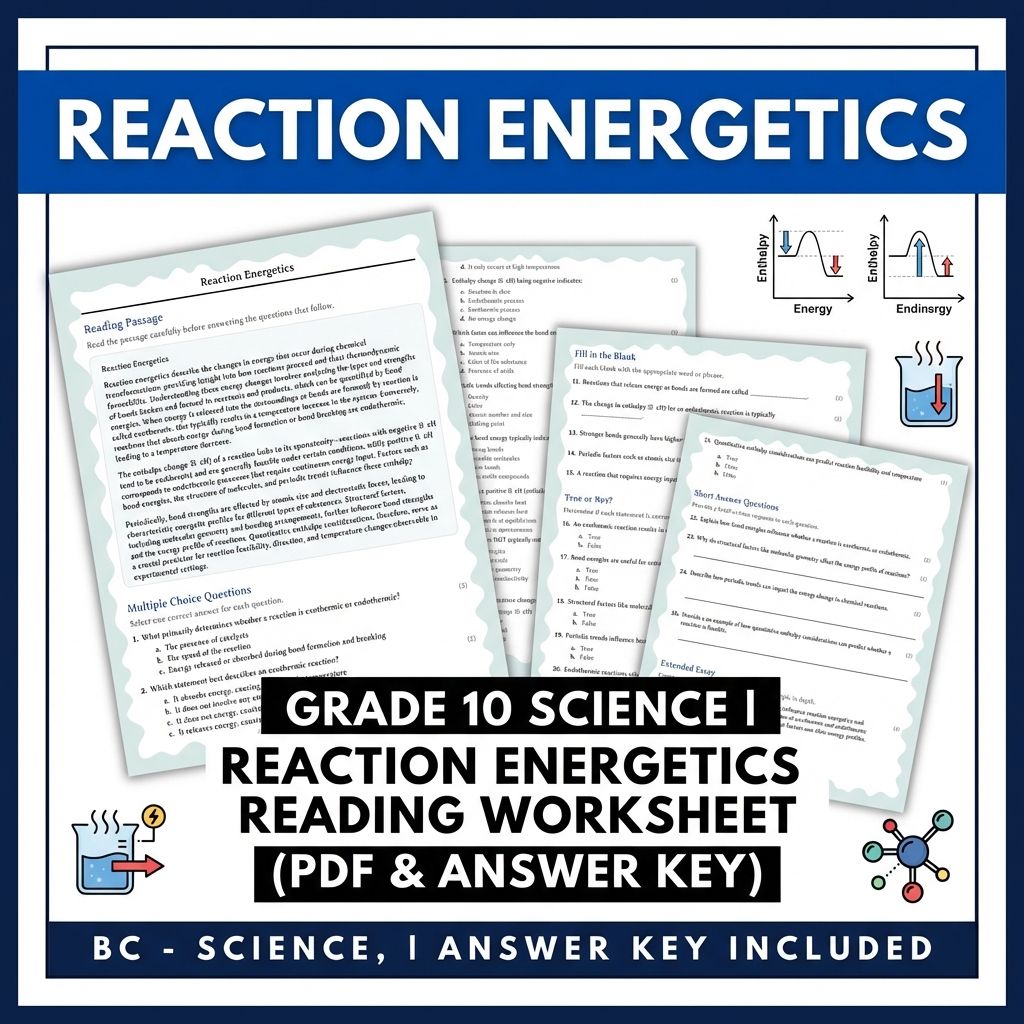
Grade 10 Science | Reaction Energetics Reading Worksheet (PDF & Answer Key)
JCreated byJ.S SheetsLearning Objectives
- Understand energy changes during chemical reactions and how bond energies influence reaction profiles.
- Differentiate between exothermic and endothermic reactions based on energy flow.
- Link enthalpy changes to reaction direction, feasibility, and observable temperature changes.
Instant download

Grade 8 Science | Gravity & Motion - Daily Reading Comprehension
Created byCoral Reef LearningLearning Objectives
- Understand the concept of gravity and how it governs motion in space.
- Identify how gravitational forces influence planetary, lunar, and cometary trajectories.
- Explain the balance between inertia and gravity that leads to orbit shapes.
Instant download
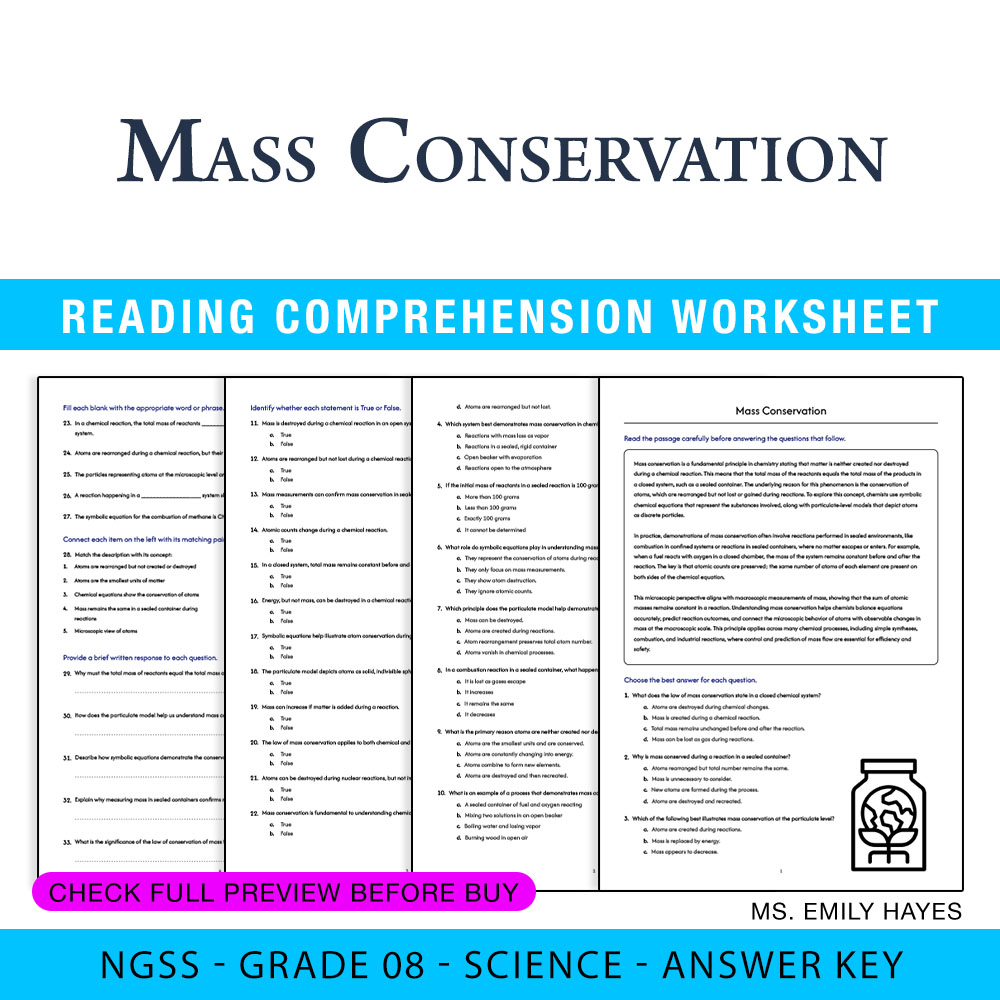
Grade 8 Science | Mass Conservation Worksheet (PDF+ Answer Key)
Created byCopper Leaf ClassroomLearning Objectives
- Explain the principle of mass conservation in chemical reactions within closed systems.
- Describe how atoms are conserved during chemical changes at the particulate level.
- Use symbolic equations and particulate models to demonstrate mass conservation.
Instant download
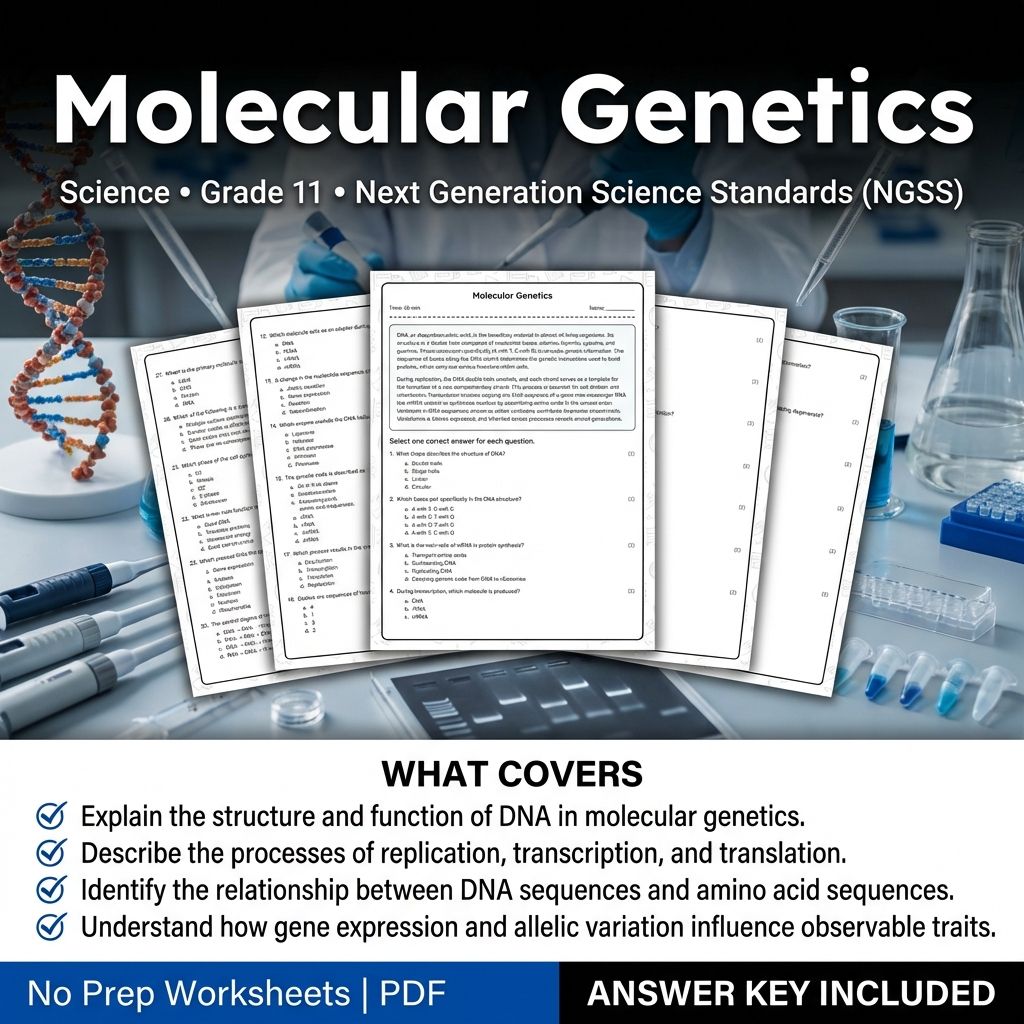
11th Grade Science | Molecular Genetics Worksheet & Answer Key (Printable PDF)
Created byCoral Reef LearningLearning Objectives
- Explain the structure and function of DNA in molecular genetics.
- Describe the processes of replication, transcription, and translation.
- Identify the relationship between DNA sequences and amino acid sequences.
Also included in: Grade 11 Science | Genetics & Mutation Dynamics Worksheet Bundle(PDF Answer Key) +1 more
Instant download
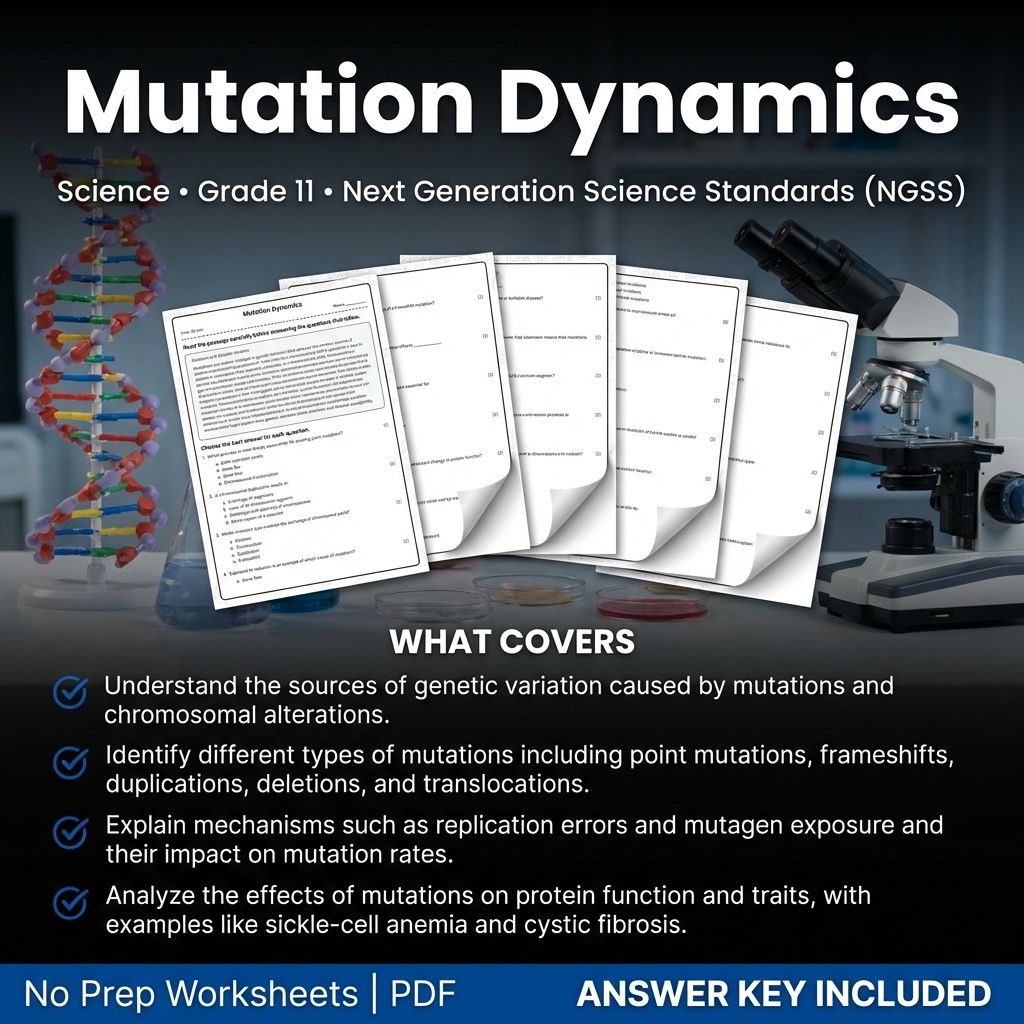
11th Grade Science – Mutation Dynamics Worksheet & Answer Key (Printable PDF)
Created byCoral Reef LearningLearning Objectives
- Understand the sources of genetic variation caused by mutations and chromosomal alterations.
- Identify different types of mutations including point mutations, frameshifts, duplications, deletions, and translocations.
- Explain mechanisms such as replication errors and mutagen exposure and their impact on mutation rates.
Also included in: Grade 11 Science | Genetics & Mutation Dynamics Worksheet Bundle(PDF Answer Key) +1 more
Instant download

Grade 11 Science – Cell Interactions Reading Worksheet | California Standards
Created byBright Mind ResourcesLearning Objectives
- Identify various organelles within a cell
- Understand the functions of different cell components
- Explain how membranes compartmentalize reactions
Also included in: Evolution Grade 11 Science Daily Reading Worksheets Lesson Bundle | CA Standards +1 more
Instant download
Browse more categories
About Science Worksheets
Find Science worksheets spanning core skills, practice, and review. All 44,573 resources are instant PDF downloads for the classroom or home.
Every worksheet on MyTeachingSheets is created by independent teacher-authors and reviewed before publication. All resources download as printable PDFs for classroom, homework, or at-home practice, and many include answer keys. Preview any worksheet free before buying.