
Science Worksheets
44,620 subject resources
Circulatory Function Science Worksheet | Standards-Aligned for Grade 11
JCreated byJ.S SheetsLearning Objectives
- Explain how cardiac output, vessel resistance, and blood composition influence tissue perfusion and homeostasis
- Describe the roles of plasma proteins and cellular elements in clotting and immune defense
- Connect circulatory function to respiratory gas exchange and renal fluid balance
Instant download

Grade 12 Science | Magnetic Applications Worksheet (BC Standard) (PDF)
 Created byEvergreen Desk Education
Learning Objectives
- Explain how Lorentz forces produce torque in electric motors and how this converts electrical energy to mechanical motion
- Describe how magnetic field gradients and resonance concepts enable imaging techniques such as magnetic resonance
- Compare magnetic storage, electromagnetic induction sensing, and the Hall effect as ways to encode or measure magnetic fields
Instant download

Cell Architecture Practice Worksheet | Grade 9 Science NGSS Review
 Created byPrism Point Learning
Learning Objectives
- Explain how nucleic acid sequence information can specify amino acid chains through genetic coding.
- Connect protein folding and 3D structure to how cells build organelles and carry out functions.
- Describe how specific cellular components (e.g., ribosomes, endoplasmic reticulum, mitochondria) relate to macromolecular structure and function.
Also included in: Grade 9 Cell Systems Regulation Science Lesson Bundle – NGSS Practice
Instant download
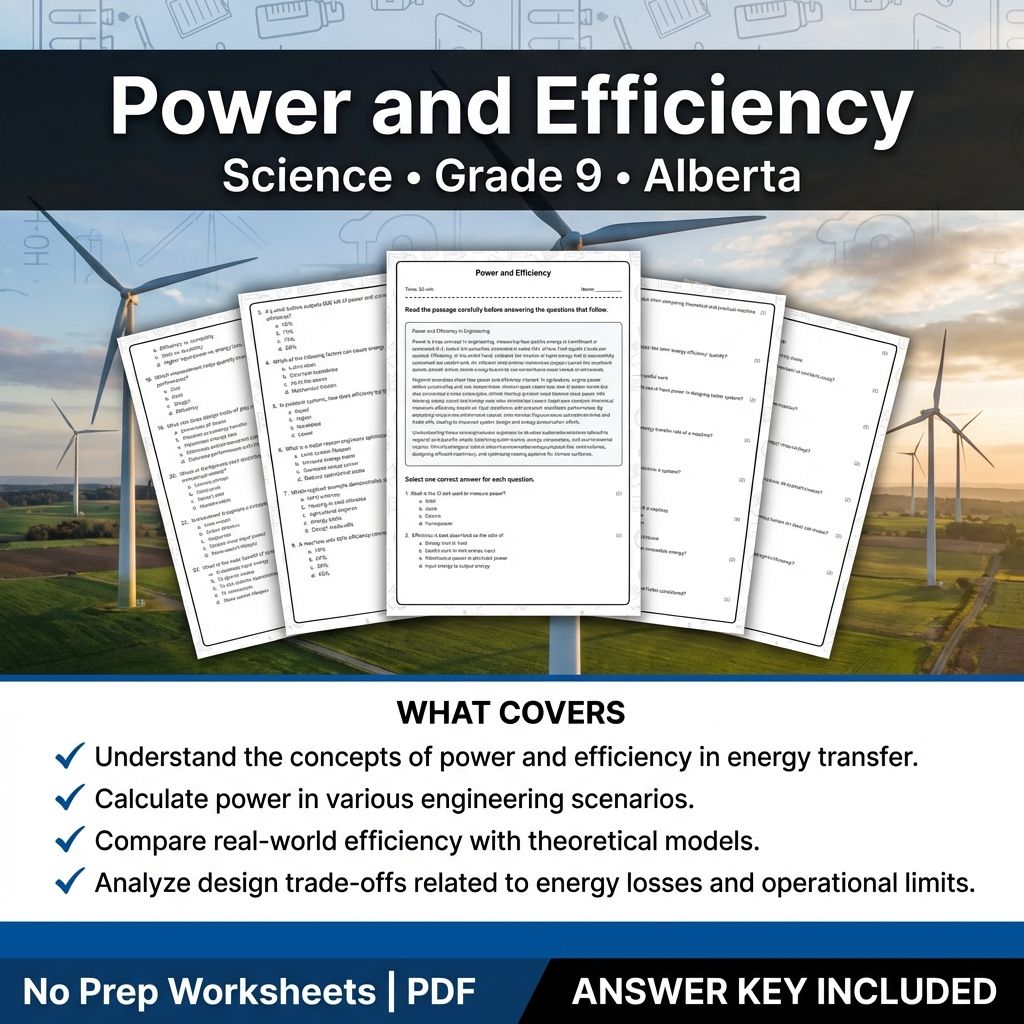
Power and Efficiency Worksheet for Grade 9 Science | Alberta Standards
 Created byCoral Reef Learning
Learning Objectives
- Understand the concepts of power and efficiency in energy transfer.
- Calculate power in various engineering scenarios.
- Compare real-world efficiency with theoretical models.
Instant download
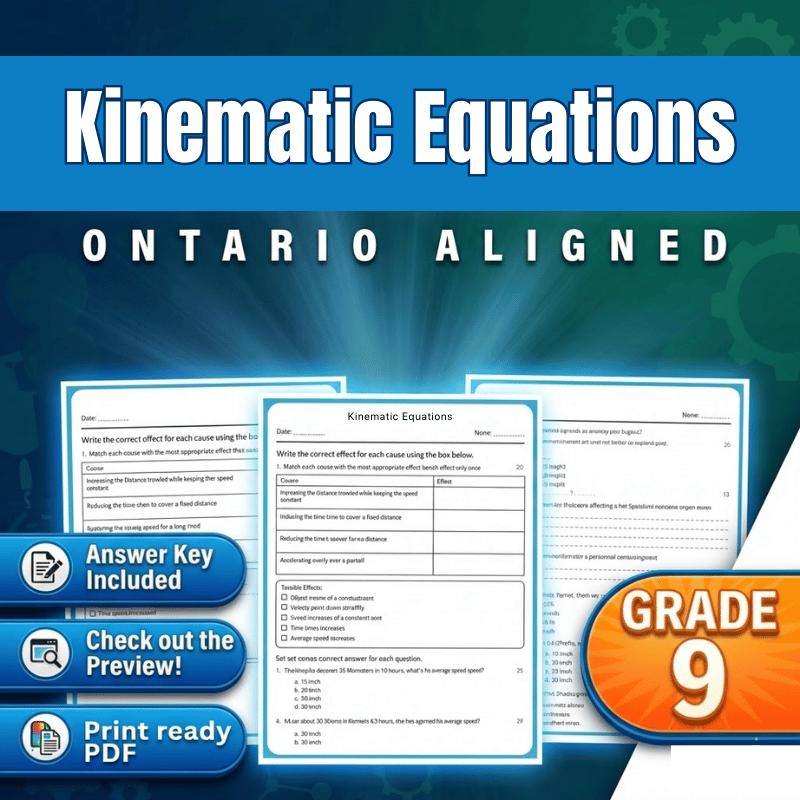
Grade 9 Science | Kinematic Equations Worksheet (Ontario) (PDF)
 Created byBright Mind Resources
Learning Objectives
- Understand the basic kinematic equations relating displacement, velocity, acceleration, and time.
- Apply the equations to scenarios involving free-fall and projectile motion.
- Interpret sign conventions and component-wise treatment in uniform acceleration problems.
Instant download

Food Webs Practice Worksheet | Grade 6 Science Test Prep Ontario
Created byPrism Point LearningLearning Objectives
- Identify producers, consumers, and decomposers in different ecosystems.
- Explain how energy moves through trophic levels in a food web and why energy decreases at each step.
- Describe how removing or adding a species can affect other organisms through interconnected feeding relationships.
Also included in: Grade 6 Biodiversity & Adaptation Science Lesson Bundle Ontario
Instant download
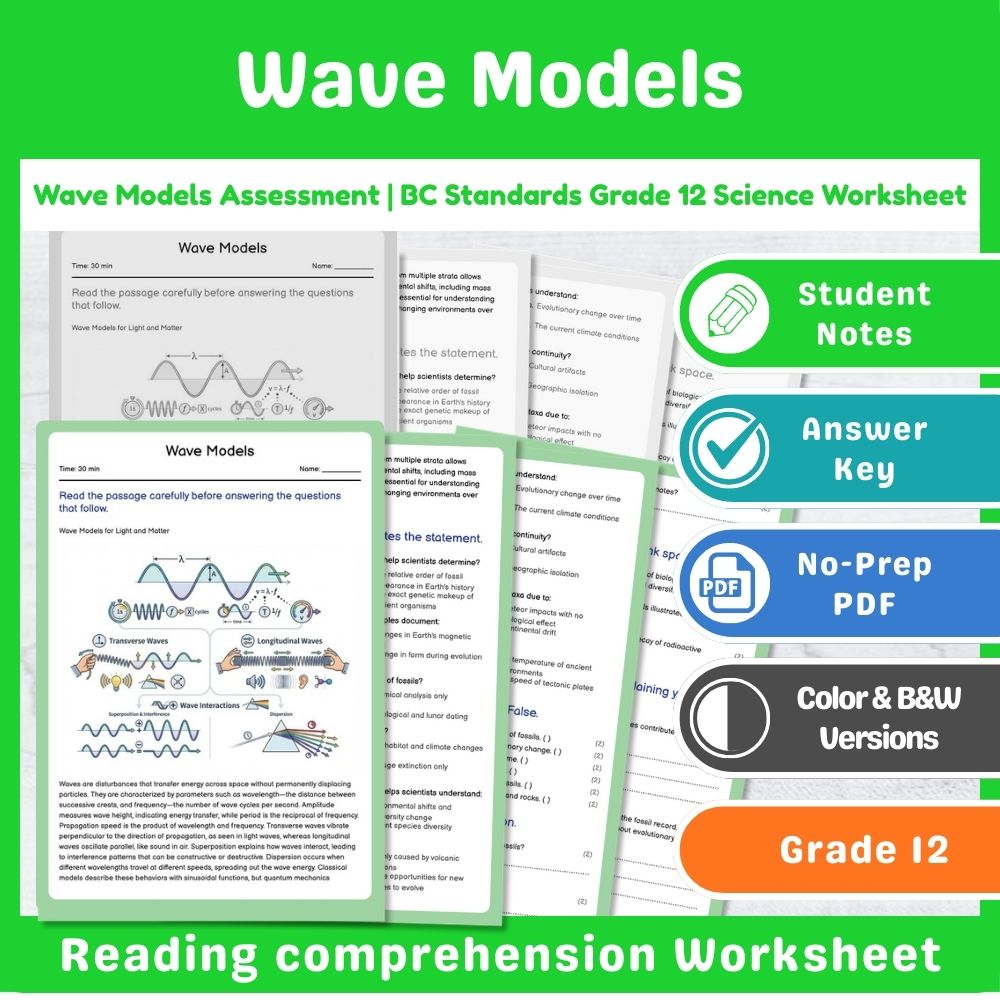
Wave Models Assessment | BC Standards Grade 12 Science Worksheet
Created byPrism Point LearningLearning Objectives
- Understand the fundamental parameters that define wave behavior, including wavelength, frequency, amplitude, period, and propagation speed.
- Distinguish between transverse and longitudinal waves and describe their characteristics.
- Explain superposition, interference, and dispersion phenomena in waves.
Also included in: Grade 12 Science Wave & Quantum Assessment Mini Bundle – BC Standards
Instant download

DNA Replication Worksheet | Grade 9 Science TEKS Practice PDF
JCreated byJ.S SheetsLearning Objectives
- Explain the semi-conservative model of DNA replication and how daughter DNA molecules are formed
- Describe the main roles of helicase, primase, DNA polymerase, and ligase during replication
- Differentiate leading-strand and lagging-strand synthesis, including Okazaki fragments
Instant download
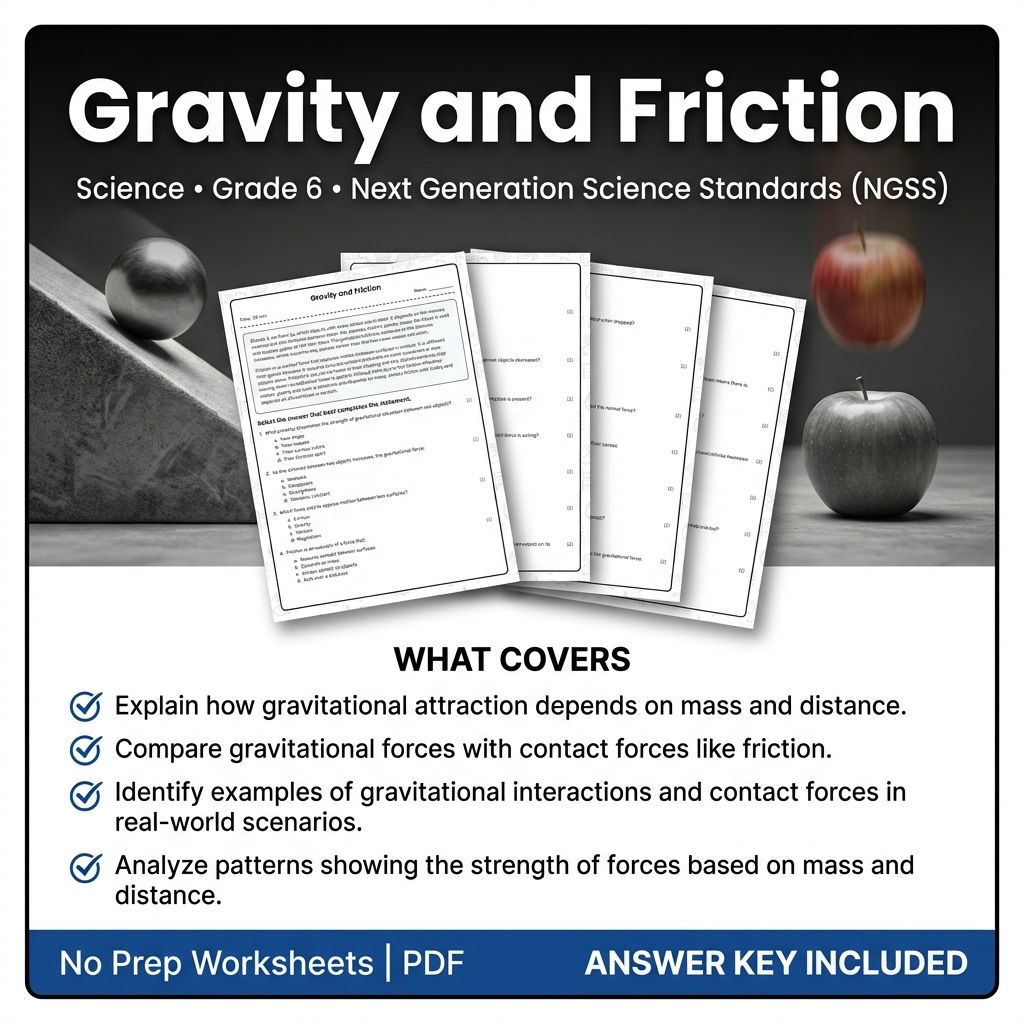
Grade 6 Science | Gravity and Friction Worksheet with Answer Key (Printable PDF)
Created byCoral Reef LearningLearning Objectives
- Explain how gravitational attraction depends on mass and distance.
- Compare gravitational forces with contact forces like friction.
- Identify examples of gravitational interactions and contact forces in real-world scenarios.
Instant download

Kinematic Equations Worksheet | BC Standard Grade 11 Science Practice
JCreated byJ.S SheetsLearning Objectives
- Understand the fundamental kinematic equations used to describe motion with constant acceleration.
- Apply the equations v = v0 + at and x = x0 + v0t + ½at² to solve problems involving displacement, velocity, and time.
- Derive the kinematic equations using algebraic manipulation and calculus.
Instant download

Grade 9 Seasons And Day Length Worksheet | General Practice PDF
 Created byClear Sky Classroom
Learning Objectives
- Explain how Earth’s axial tilt and its orbit around the Sun change the angle of sunlight
- Describe how these changes affect day length and solar heating at different latitudes
- Analyze how repeating Earth–Sun motions help determine seasonal timing
Instant download
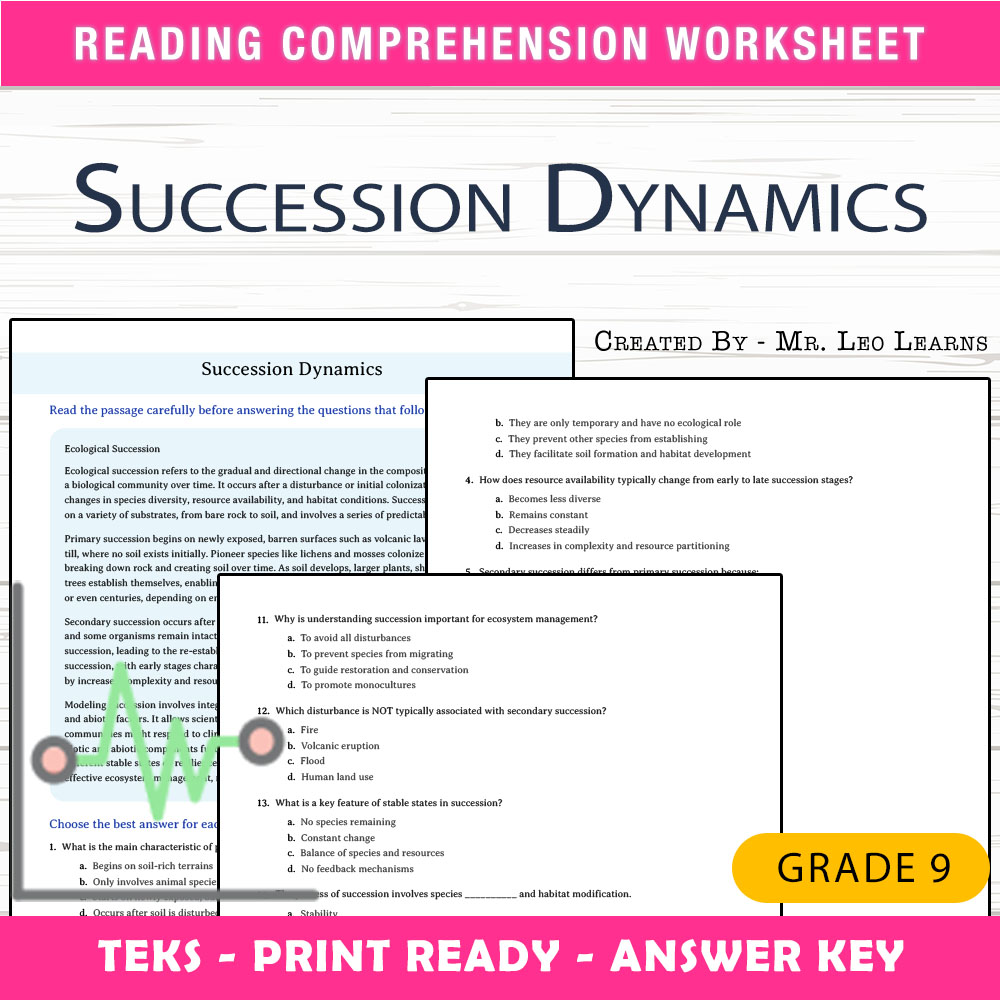
Grade 9 Science – Succession Dynamics Worksheet for Mastery
 Created byThe Resource Hub
Learning Objectives
- Understand the stages and types of ecological succession, including primary and secondary succession.
- Identify key species traits and environmental factors influencing succession trajectories.
- Explain how modeling succession helps predict ecosystem responses to disturbances and environmental change.
Also included in: Grade 9 Science Ecosystems & Biogeochemical Cycles Unit Bundle (Worksheet Pack) +1 more
Instant download
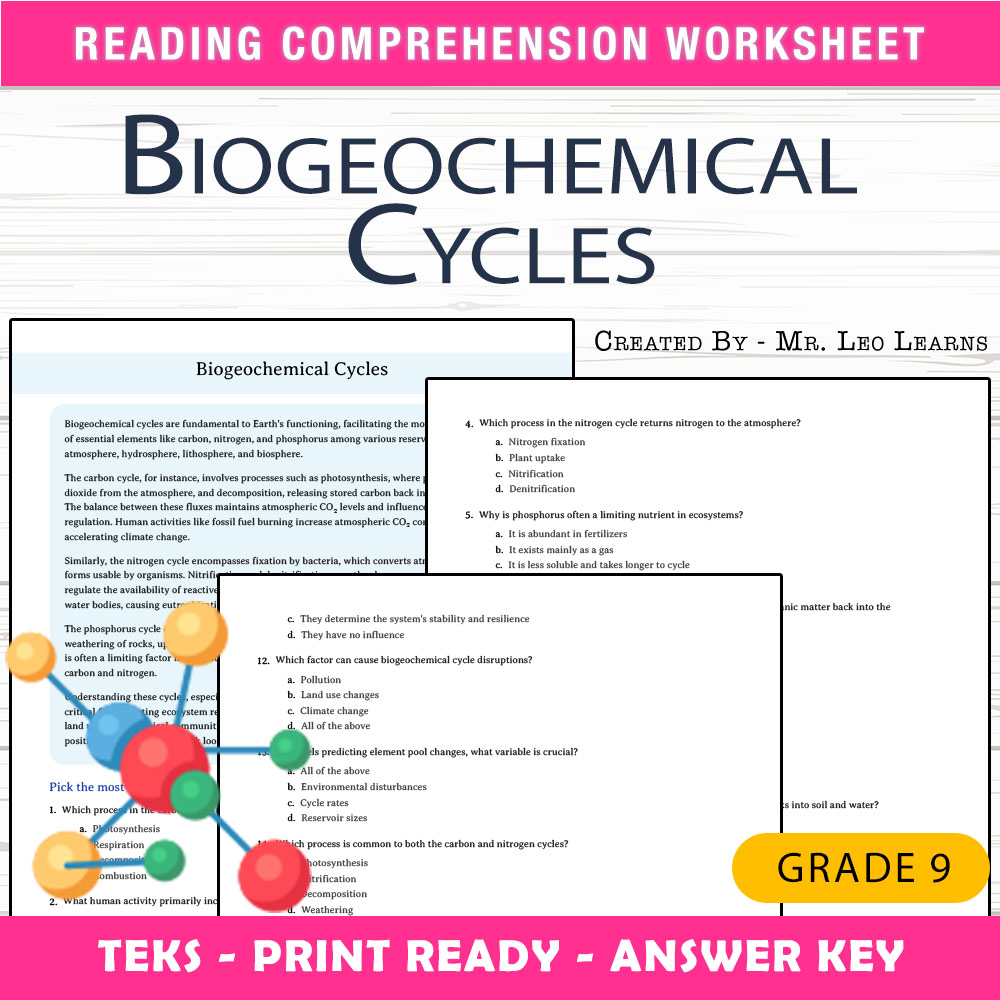
Grade 9 Science | Biogeochemical Cycles Worksheet for Mastery
Created byThe Resource HubLearning Objectives
- Understand the main processes involved in biogeochemical cycles such as carbon, nitrogen, and phosphorus.
- Identify the reservoirs and fluxes of key elements within Earth's systems.
- Explain how factors like climate change and land use impact biogeochemical cycle dynamics.
Also included in: Grade 9 Science Ecosystems & Biogeochemical Cycles Unit Bundle (Worksheet Pack) +1 more
Instant download
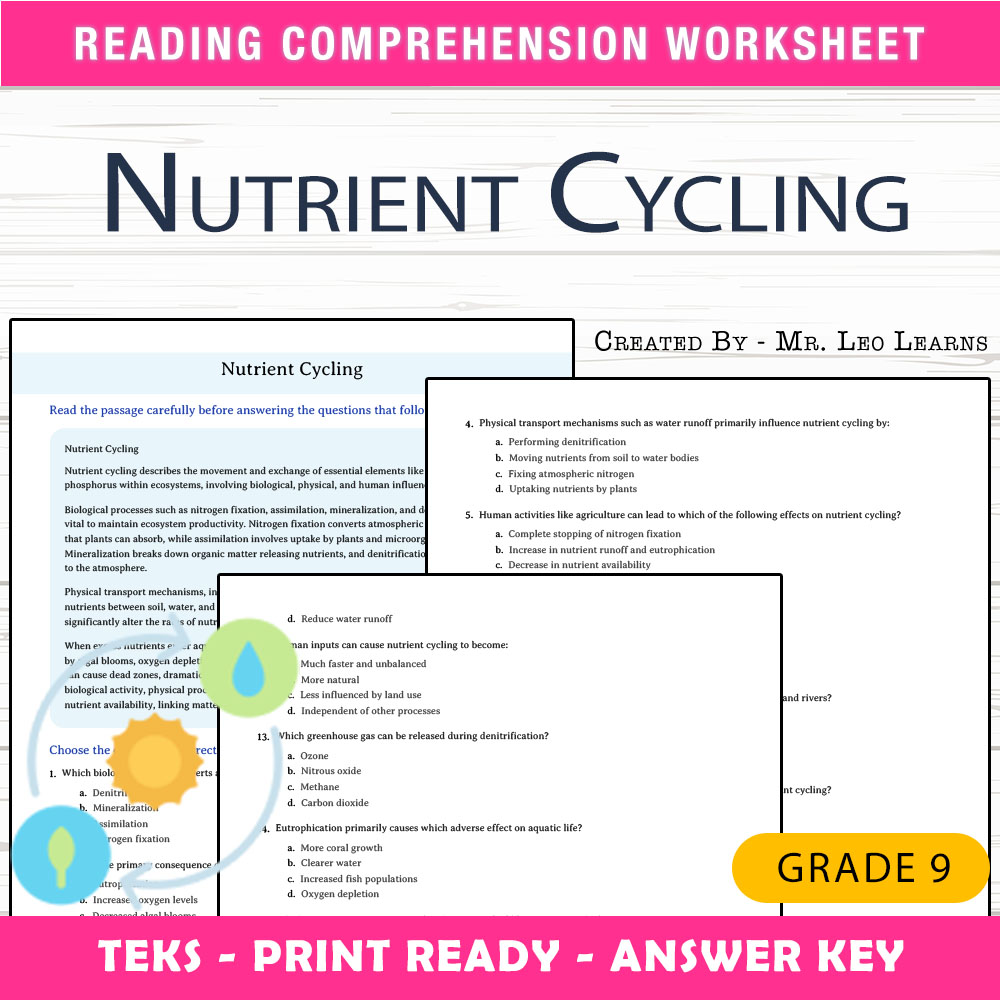
Grade 9 Science – Nutrient Cycling Worksheet for Mastery
Created byThe Resource HubLearning Objectives
- Understand the processes involved in nutrient cycling such as nitrogen fixation, assimilation, mineralization, and denitrification.
- Explain how physical transport and human activities influence nutrient availability and cycling rates.
- Assess the impact of excess nutrient loading on aquatic ecosystems, including eutrophication and species composition changes.
Also included in: Grade 9 Science Ecosystems & Biogeochemical Cycles Unit Bundle (Worksheet Pack) +1 more
Instant download
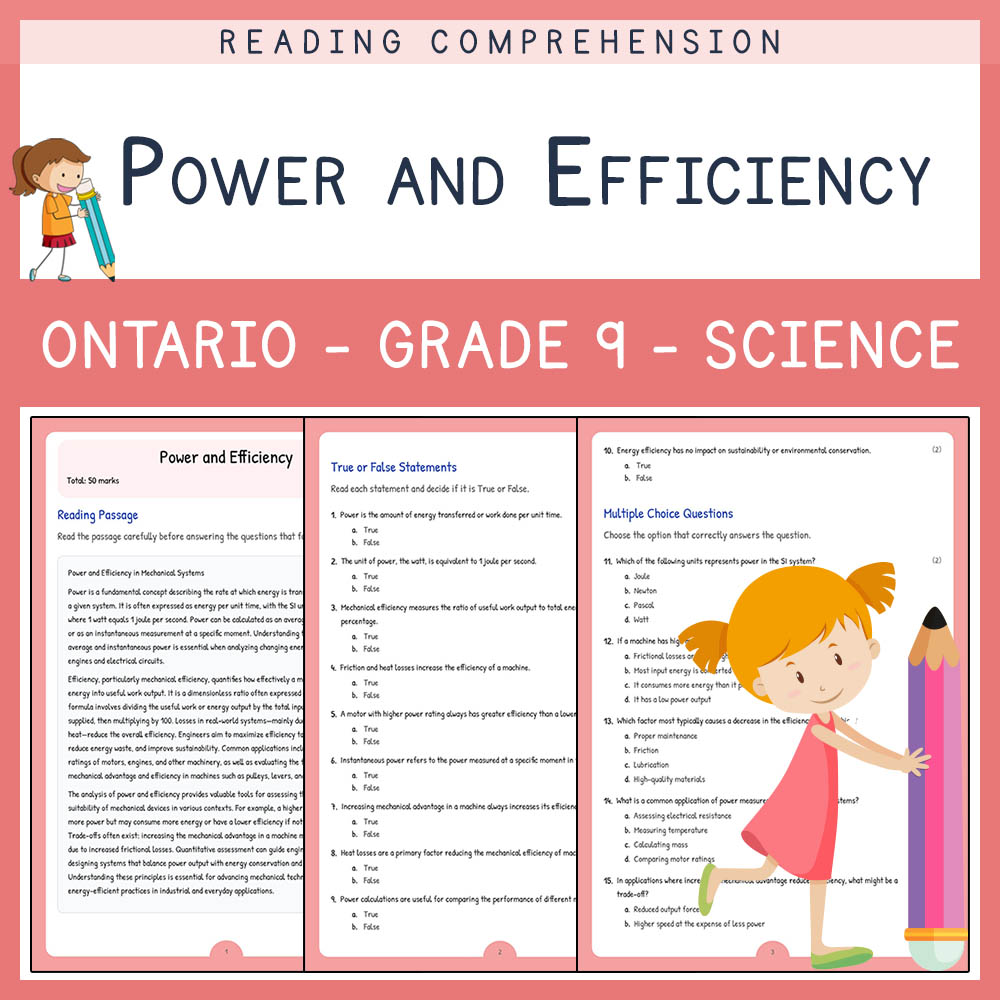
Grade 9 Science | Power and Efficiency Worksheet Elena | Ontario Standards
 Created byLumora Learning
Learning Objectives
- Understand the concepts of power as energy transfer rate and work per unit time.
- Differentiate between average and instantaneous power and their units.
- Explain mechanical efficiency as useful output energy relative to input energy.
Instant download
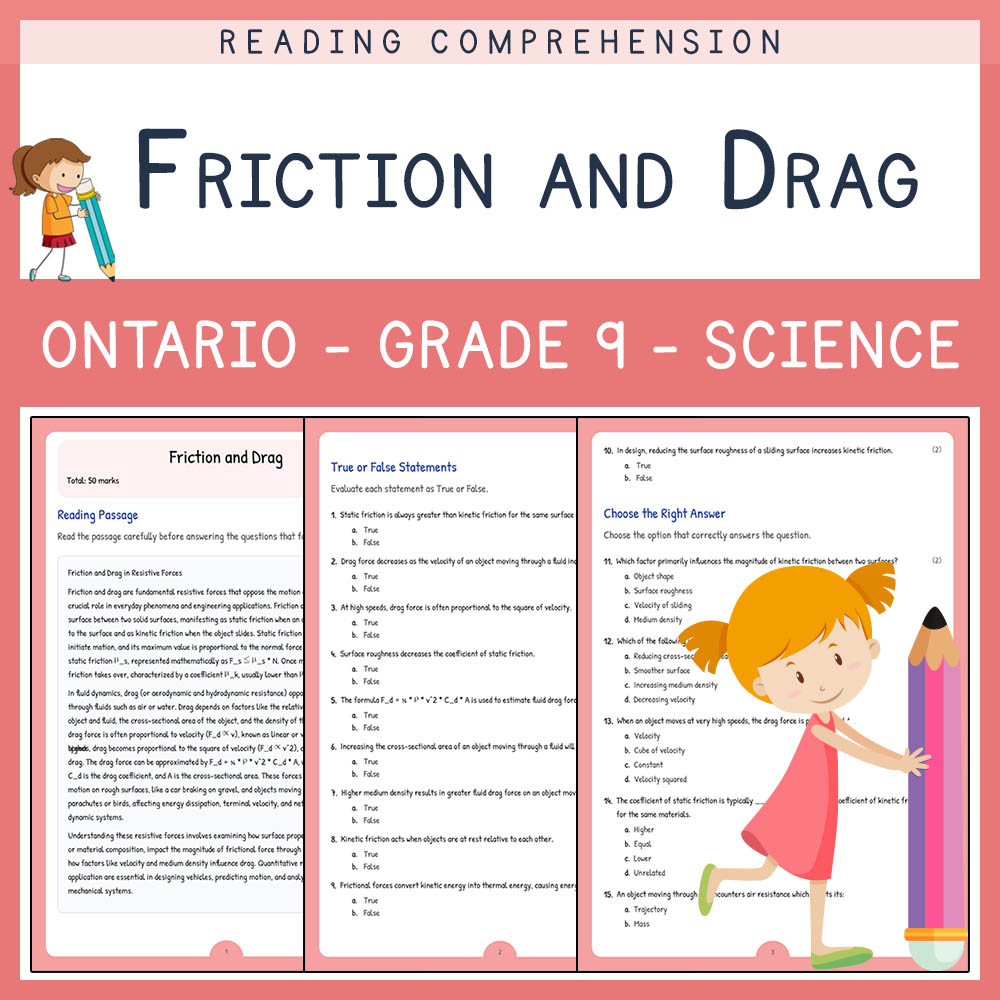
Grade 9 Science | Friction and Drag Worksheet Elena | Ontario Standard
Created byLumora LearningLearning Objectives
- Explain the differences between static and kinetic friction and how surface properties affect them.
- Describe the role of fluid drag and how it depends on velocity, surface area, and medium density.
- Apply quantitative relations involving μ coefficients and drag dependencies to real-world motion scenarios.
Instant download
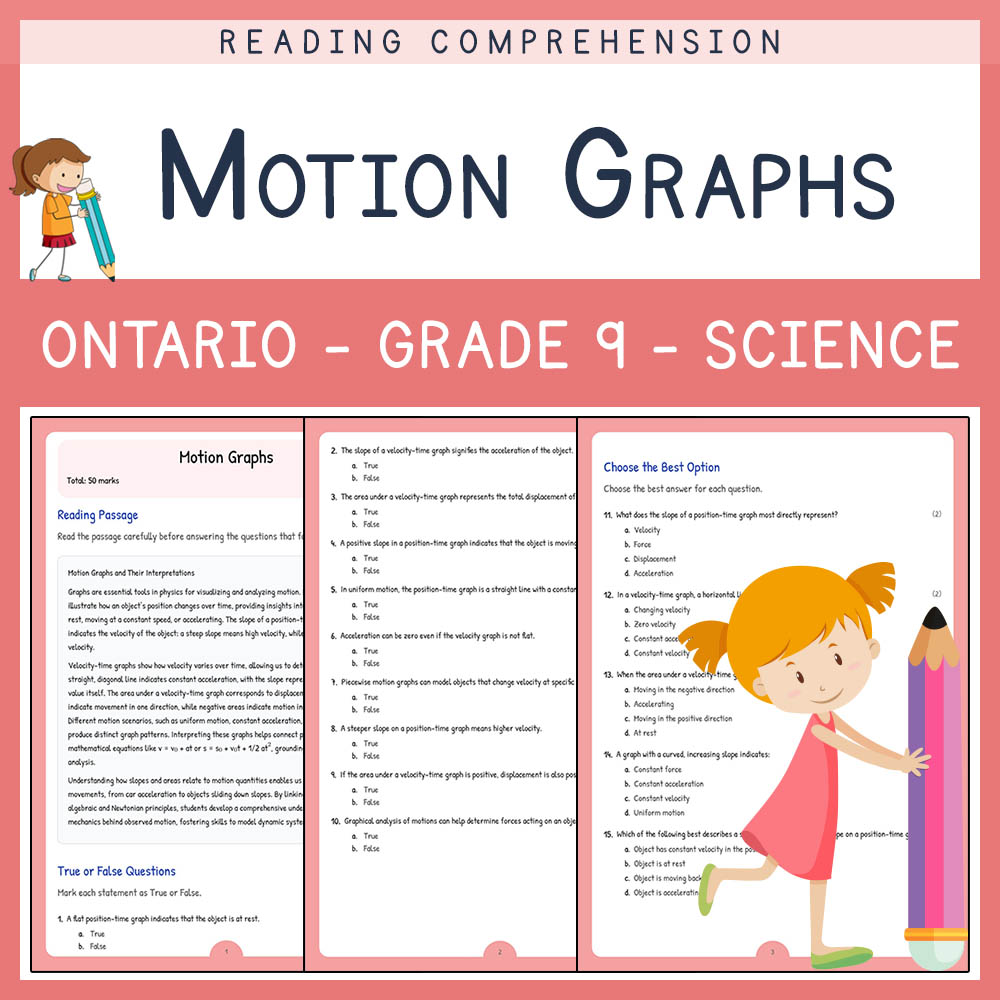
Grade 9 Science Assessment | Motion Graphs Worksheet Elena | Ontario Standard
Created byLumora LearningLearning Objectives
- Interpret position–time and velocity–time graphs in various motion scenarios.
- Understand how slopes of graphs relate to physical quantities like velocity and acceleration.
- Calculate displacement from areas under velocity–time graphs.
Instant download
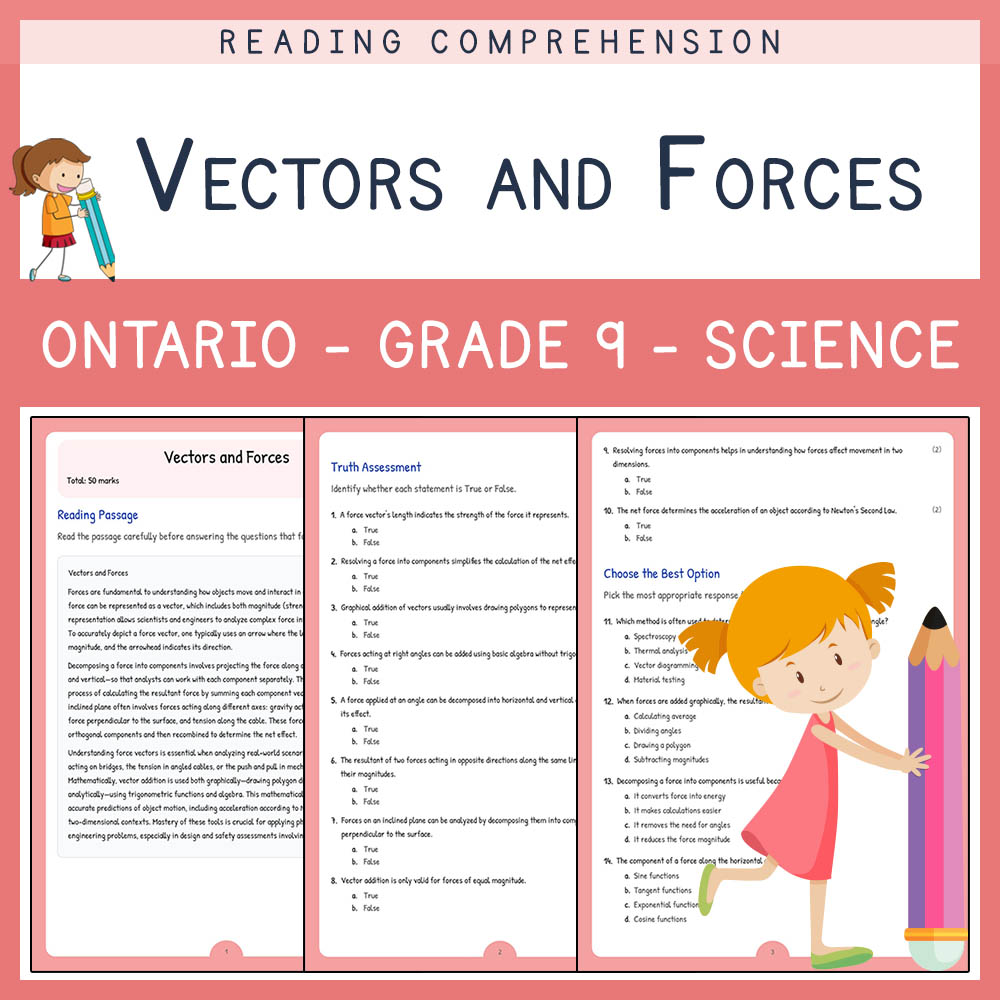
Grade 9 Science | Vectors and Forces Worksheet Elena | Ontario Standard
Created byLumora LearningLearning Objectives
- Understand the representation of forces as vectors including magnitude and direction.
- Learn to decompose forces into components and compute resultant forces graphically and analytically.
- Apply vector addition to force interactions in two-dimensional contexts such as inclined planes and angled cables.
Instant download
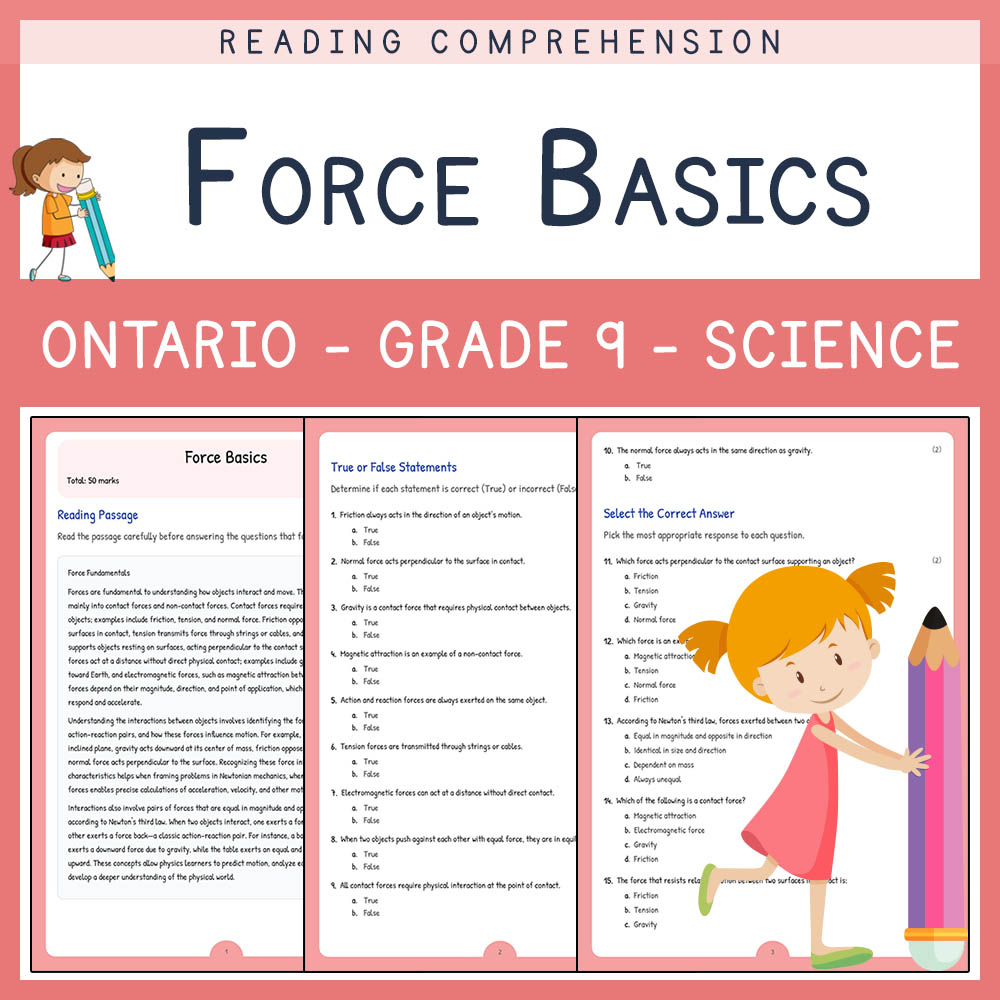
Grade 9 Science | Force Basics Worksheet Elena | Ontario Standard
Created byLumora LearningLearning Objectives
- Distinguish between contact and non-contact forces with examples.
- Identify the magnitude, direction, and point of application in force interactions.
- Understand action-reaction force pairs and their roles in physical interactions.
Instant download
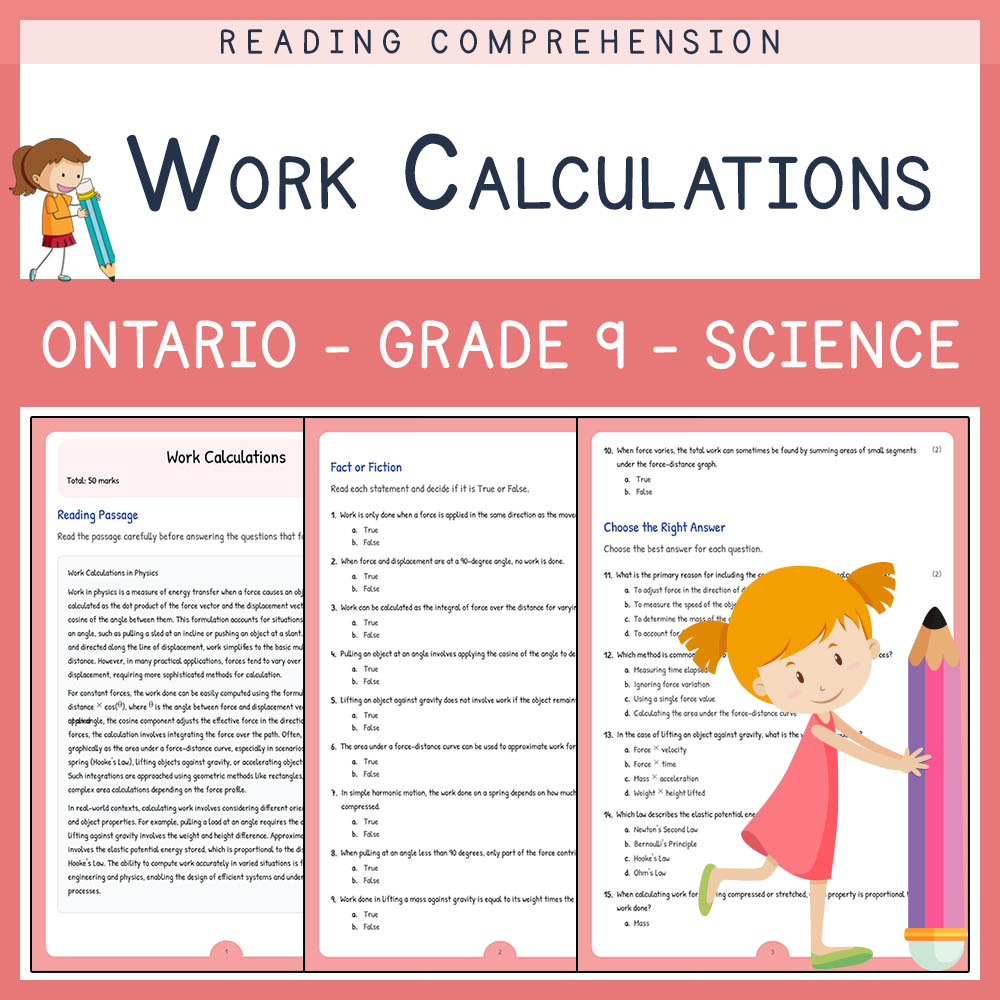
Grade 9 Science Assessment | Work Calculations Worksheet | Ontario Standard
Created byLumora LearningLearning Objectives
- Understand the concept of work as the dot product of force and displacement, including the role of the cosine of the angle between them.
- Calculate work done by constant forces at an angle, including lifting against gravity and pulling objects.
- Compare methods for calculating work when forces vary, including using the area under force–distance curves in common approximations.
Instant download

6th Grade Science | Climate Systems | NGSS Worksheet & Answer Key
 Created byCedar Grove Learning
Learning Objectives
- Explain how unequal solar heating and planetary rotation create global circulation patterns.
- Identify and describe major atmospheric cells, wind systems, and ocean currents that influence regional climates.
- Analyze how circulation patterns like Hadley, Ferrel, and polar cells affect climate zones and phenomena like El Niño.
Also included in: Grade 6 Science | Weather, Water Cycle & Climate NGSS Worksheet Bundle +1 more
Instant download

Grade 9 Science – Mineral Properties & Identification | Daily Reading Worksheet
Created byBright Mind ResourcesLearning Objectives
- Identify and describe physical and chemical properties of common rock-forming minerals.
- Understand how mineral properties relate to their formation environment and stability.
- Recognize economic significance of minerals and distinguish ore minerals from gangue.
Also included in: Grade 9 Earth & Space Science Daily Reading Worksheets Lesson Bundle | Ontario +1 more
Instant download

Organ Definition Worksheet for Grade 6 Science | Standards-Aligned Practice
JCreated byJ.S SheetsLearning Objectives
- Understand what an organ is and how it is composed of different tissue types.
- Identify examples of organs and their functions within the human body.
- Explain how tissue interactions within organs enable vital processes like secretion, contraction, and absorption.
Instant download

Food Building Blocks Worksheet Grade 7 Science | Nutrients & Molecules
Created byPrism Point LearningLearning Objectives
- Explain how food molecules are broken down and rearranged inside the body to support growth and repair
- Describe how chemical energy in food becomes usable energy for life processes
- Identify the roles of carbohydrates, proteins, lipids, and vitamins/minerals as food components
Also included in: Life Science - Grade 7 Bundle
Instant download

Speed Calculations Worksheet for Grade 7 Science – Standards-Aligned Practice
JCreated byJ.S SheetsLearning Objectives
- Calculate average speed using distance and time with correct units
- Convert between meters per second (m/s) and kilometers per hour (km/h)
- Differentiate average speed from instantaneous speed using real-world examples
Instant download
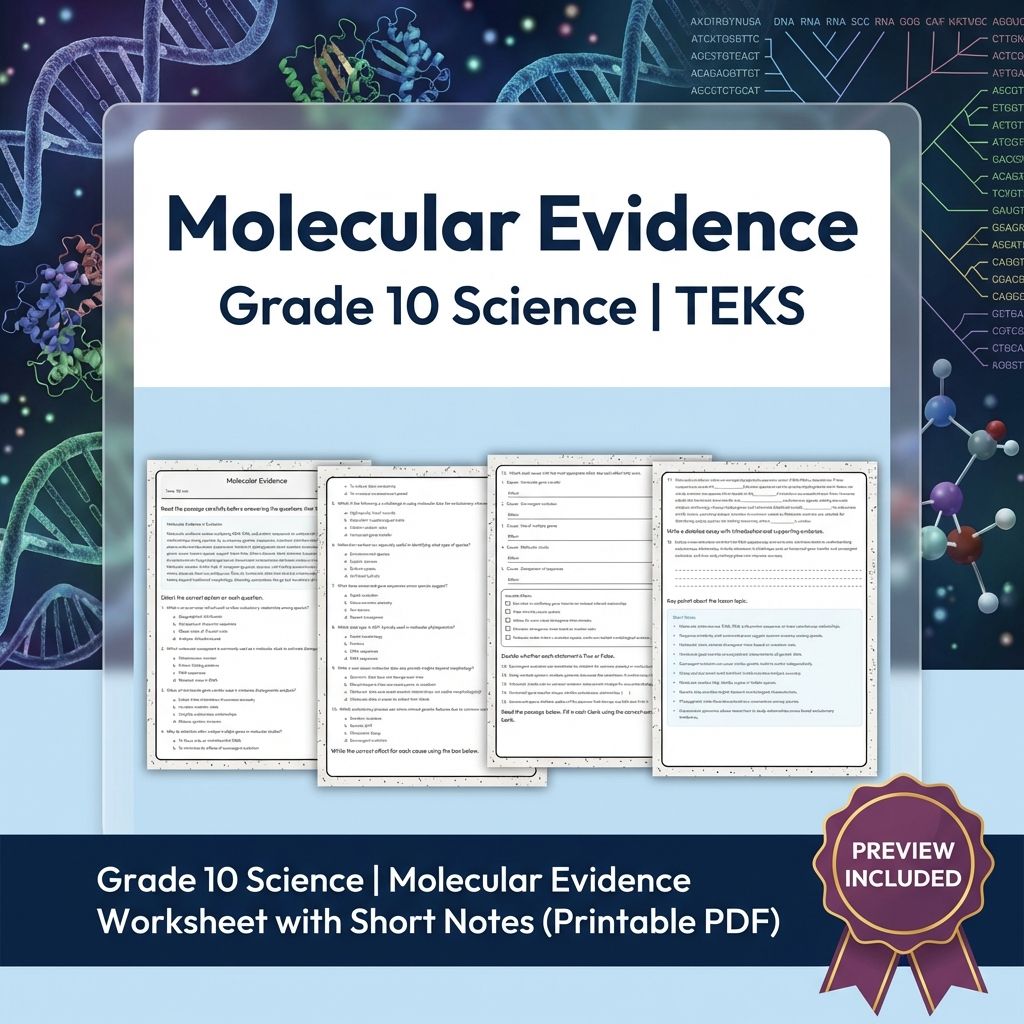
Grade 10 Science | Molecular Evidence Worksheet with Short Notes (Printable PDF)
 Created byMeadowlark Worksheets
Learning Objectives
- Understand how DNA, RNA, and protein sequences are used to infer evolutionary relationships.
- Describe the concepts of sequence similarity, conserved genes, and molecular clocks.
- Explain how molecular data helps reconstruct phylogenies and detect common ancestry.
Instant download
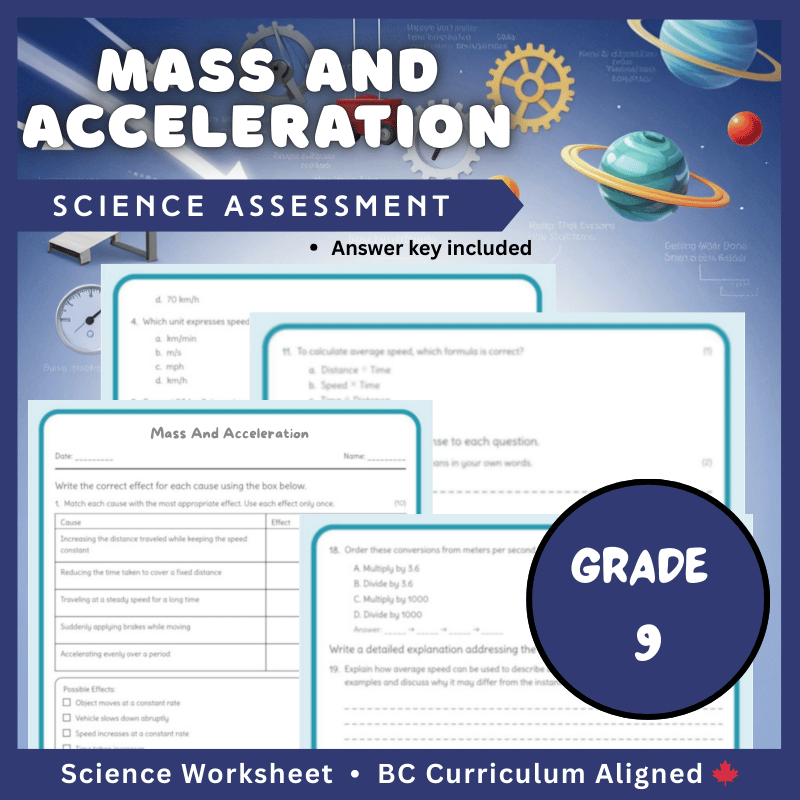
Grade 9 Science – Mass & Acceleration Worksheet + Answer Key | BC Standards
Created byBright Mind ResourcesLearning Objectives
- Understand the relationship between mass and acceleration under a given net force.
- Distinguish between inertial mass and gravitational effects in responses to forces.
- Analyze how changes in mass affect acceleration in practical scenarios.
Instant download
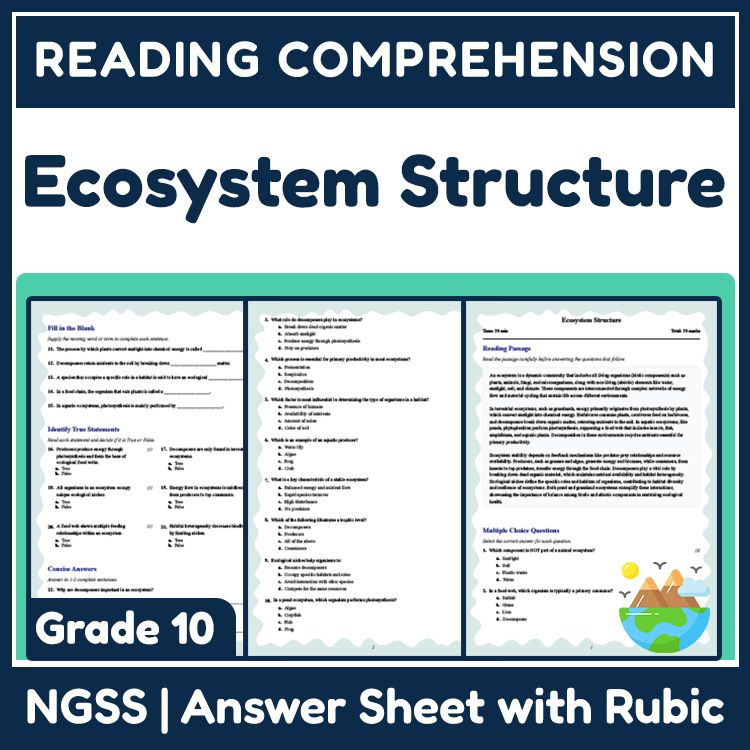
10th Grade Science | Ecosystem Structure Reading Worksheet (PDF + Rubric)
JCreated byJ.S SheetsLearning Objectives
- Understand the components of terrestrial and aquatic ecosystems, including biotic and abiotic factors
- Analyze energy flow, food webs, and trophic levels within different ecosystems
- Explore ecosystem stability, feedback mechanisms, and the roles of producers, consumers, and decomposers
Also included in: Grade 10 Science | Ecosystems & Biodiversity Uanit Worksheets
Instant download
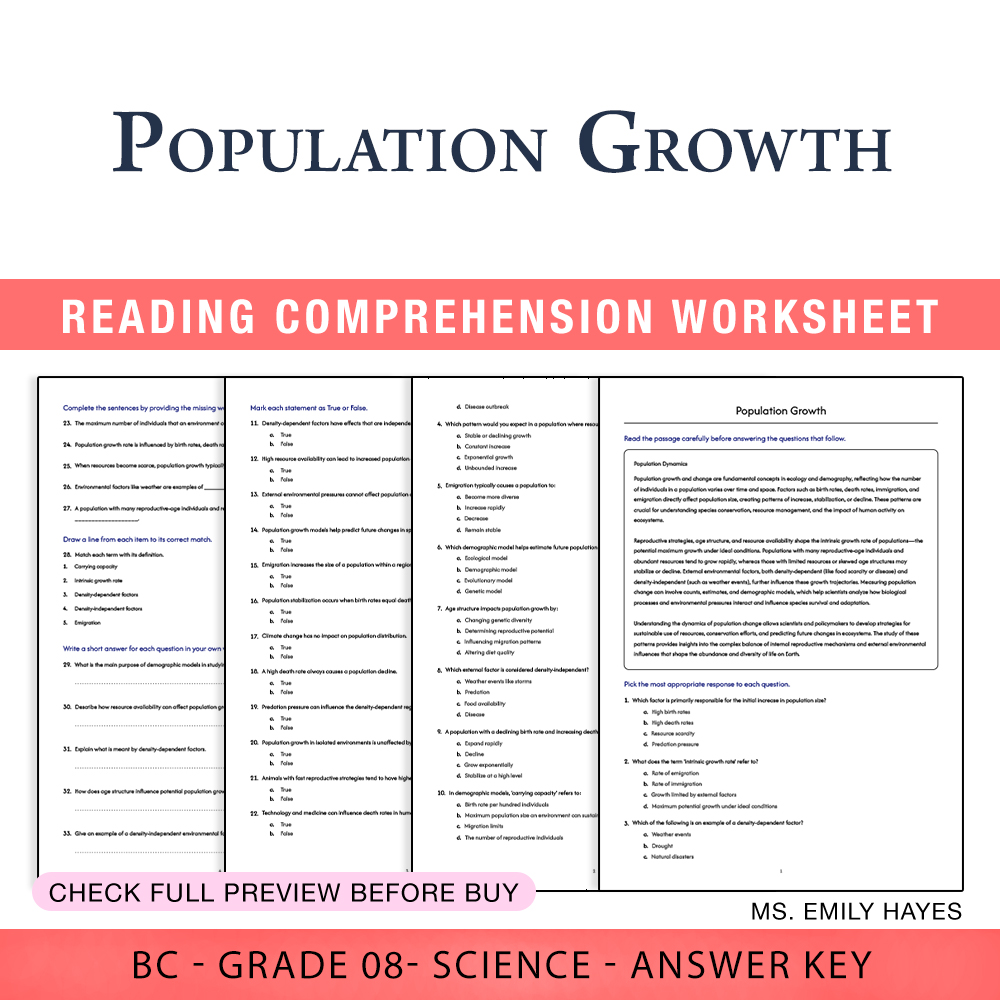
8th Grade Science | Population Growth Worksheet (PDF + Answer Key)
 Created byCopper Leaf Classroom
Learning Objectives
- Explain the factors influencing population change, including birth rates, death rates, immigration, and emigration.
- Interpret patterns of population increase, stability, or decline using demographic concepts and models.
- Describe how reproductive strategies, age structure, and resource availability affect intrinsic growth rates.
Also included in: Grade 8 Science– Ecology, Biodiversity & Environmental Impact (PDF + Answer Key) +1 more
Instant download
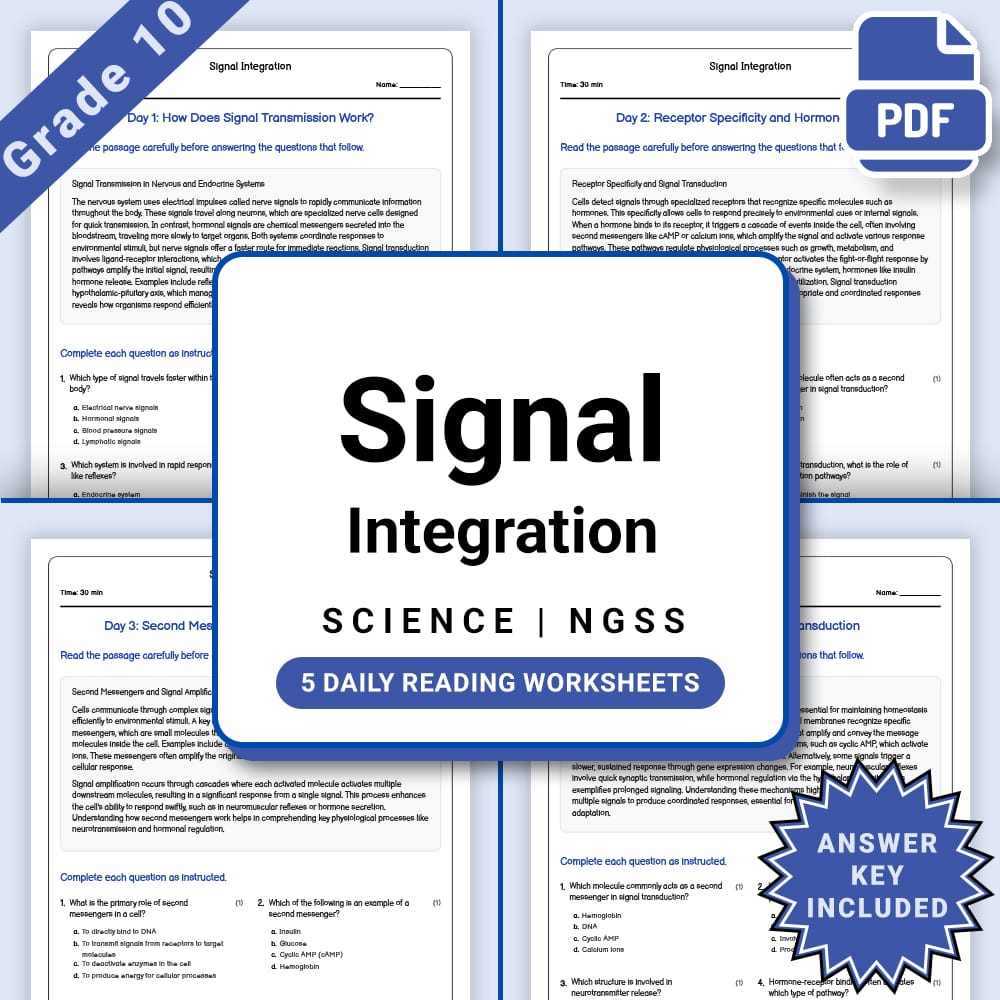
Grade 10 Science – Signal Integration Worksheet (PDF +Answer Key)
Created byCopper Leaf ClassroomLearning Objectives
- Understand how nerve signals travel faster than hormonal signals
- Identify mechanisms of neural signaling
- Describe signal transduction cascades
Instant download

Grade 10 Science | Ocean Atmosphere Coupling - Daily Reading Comprehension
Created byCoral Reef LearningLearning Objectives
- Understand how water's high heat capacity affects ocean and atmosphere interactions.
- Learn how changes in sea surface temperatures influence weather patterns.
- Explore the concepts of heat transfer, evaporation, and their roles in climate variability.
Instant download

Collision Theory Assessment for Grade 10 Science | Alberta Standards
Created byPrism Point LearningLearning Objectives
- Explain the principles of collision theory and its relation to reaction rates.
- Identify factors affecting molecular collision frequency and energy.
- Describe how catalysts lower activation energy to facilitate reactions.
Also included in: Grade 10 Matter and Chemical Change Science Lesson Bundle: Alberta +1 more
Instant download
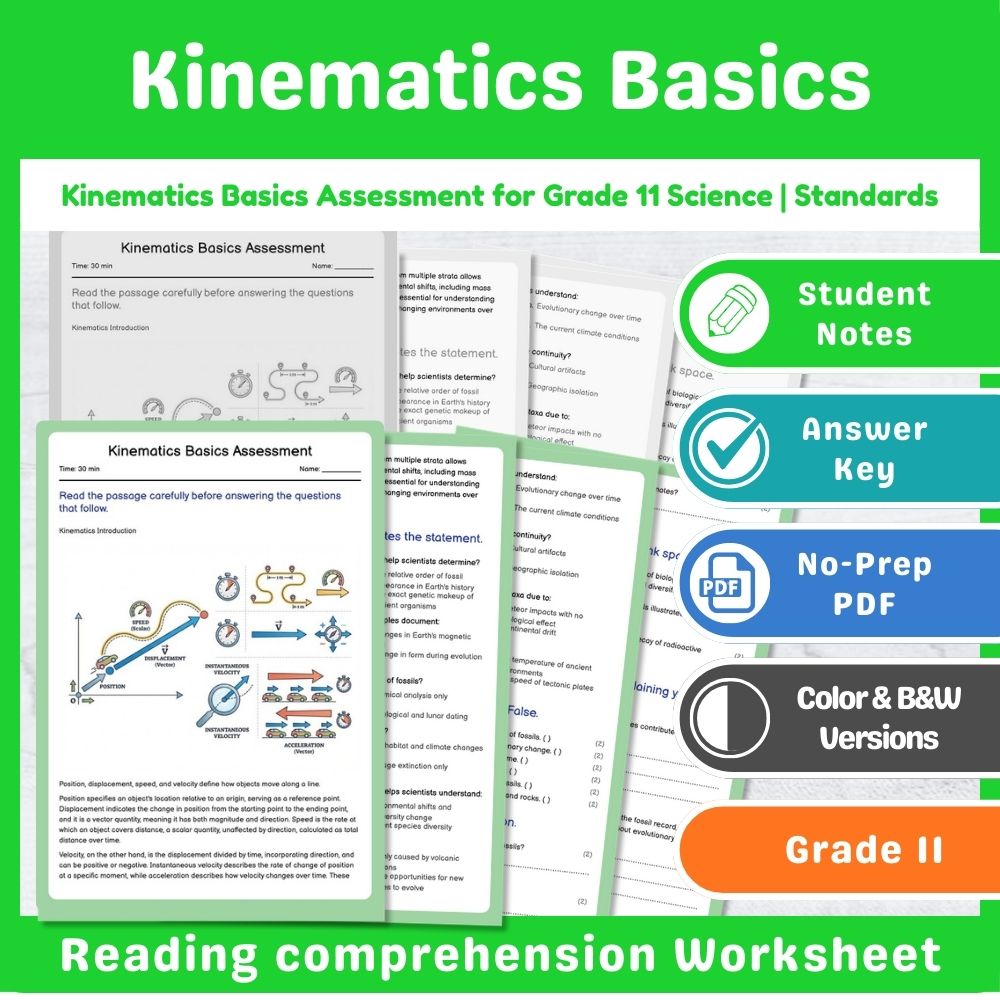
Kinematics Basics Assessment for Grade 11 Science | Standards-Aligned Assessment
Created byPrism Point LearningLearning Objectives
- Understand key concepts of position, displacement, speed, and velocity in one-dimensional motion.
- Differentiate between average and instantaneous measures of motion.
- Apply the formulas for displacement, velocity, and acceleration to problem situations.
Also included in: Grade 11 Science Assessment Bundle | Classical Mechanics & Motion Topics
Instant download
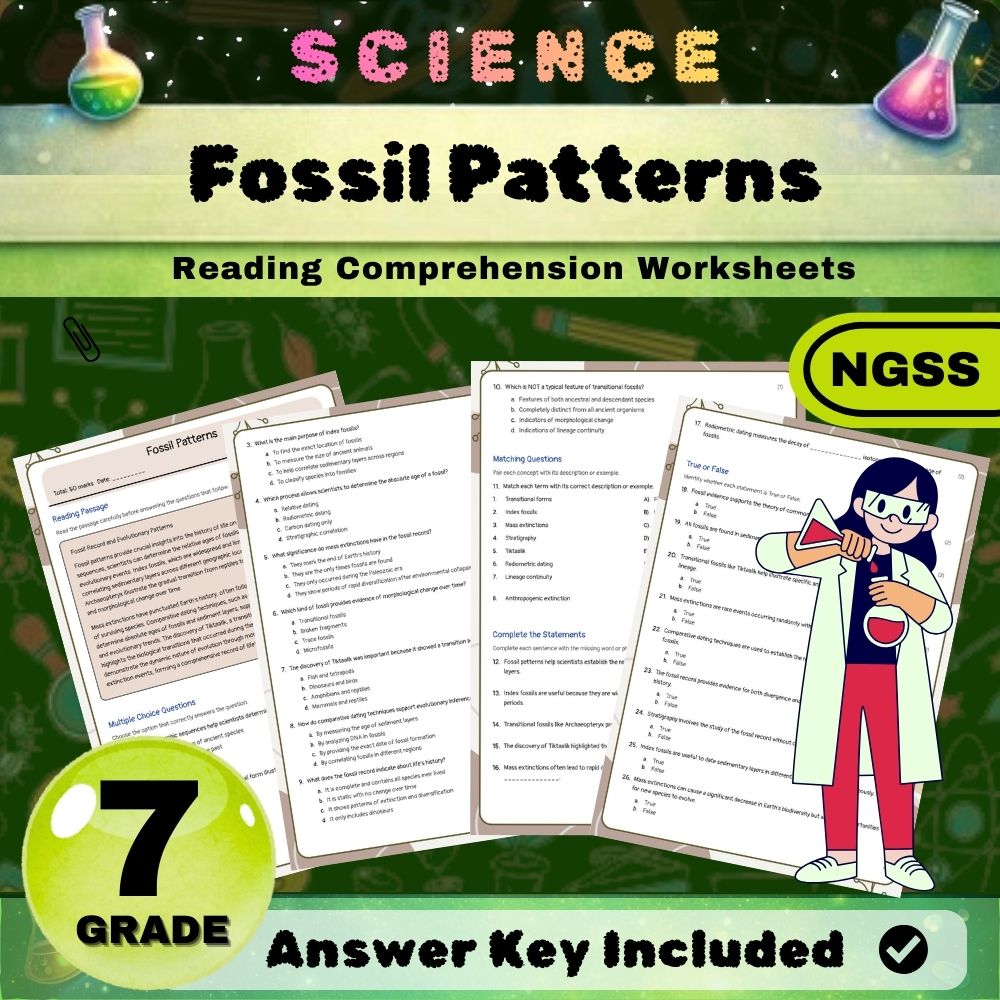
Grade 7 Science | Fossil Patterns NGSS Worksheet (PDF)
 Created byMaple Path Learning
Learning Objectives
- Understand the significance of fossil patterns in revealing evolutionary history.
- Identify key concepts such as stratigraphy, index fossils, transitional forms, and macroevolutionary trends.
- Analyze fossil evidence to infer common ancestry and extinction events.
Also included in: Grade 7 Science | Evolution & Adaptation NGSS Worksheet Bundle +1 more
Instant download
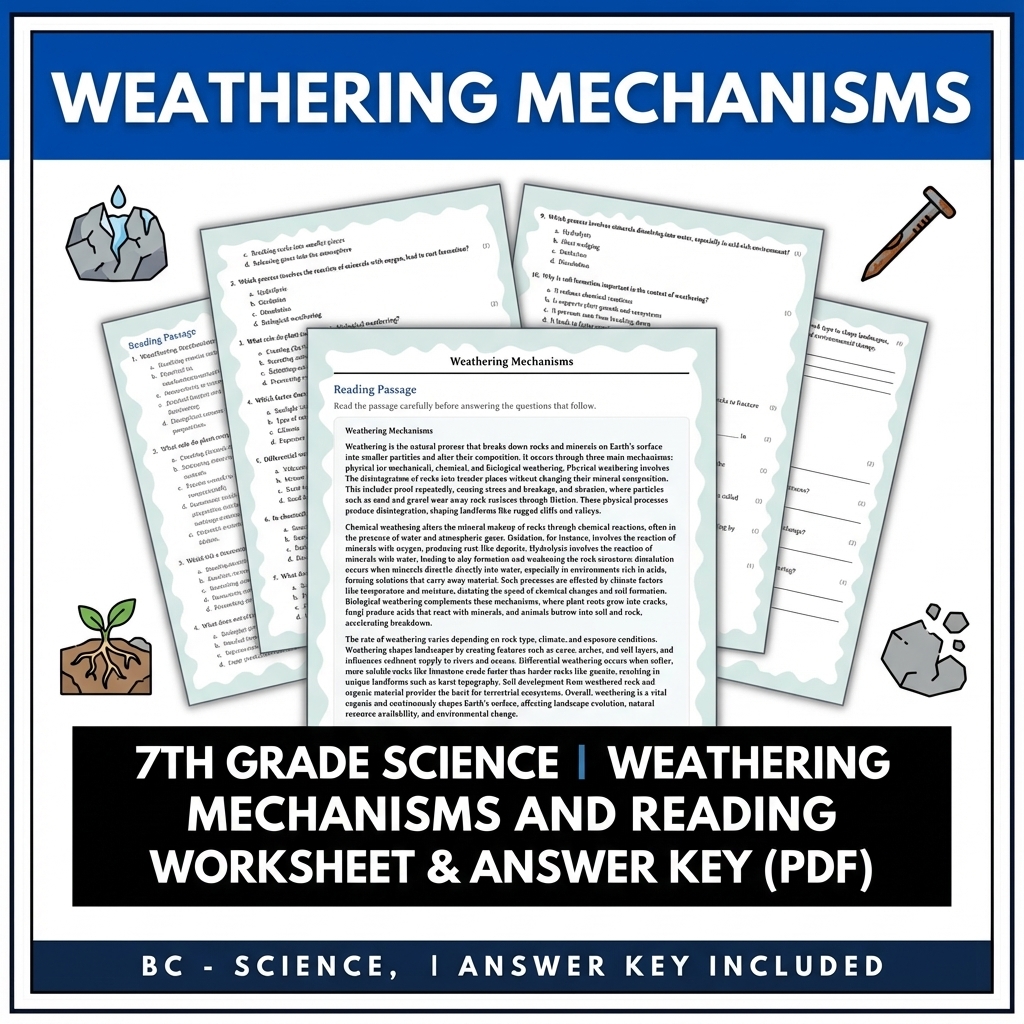
7th Grade Science | Weathering Mechanisms Reading Worksheet & Answer Key (PDF)
JCreated byJ.S SheetsLearning Objectives
- Understand the processes involved in physical, chemical, and biological weathering of rocks.
- Identify factors that influence the rate and effects of weathering on landforms.
- Describe how weathering contributes to soil formation and landscape development.
Instant download

Body Temperature Assessment for Grade 10 Science TEKS Standards
Created byPrism Point LearningLearning Objectives
- Understand how the body's temperature is regulated through organ system responses.
- Describe the role of the hypothalamus in maintaining thermal balance.
- Identify mechanisms such as vasodilation, vasoconstriction, sweating, and shivering in temperature regulation.
Also included in: Grade 10 Homeostasis and Feedback Science Lesson Bundle | TEKS
Instant download
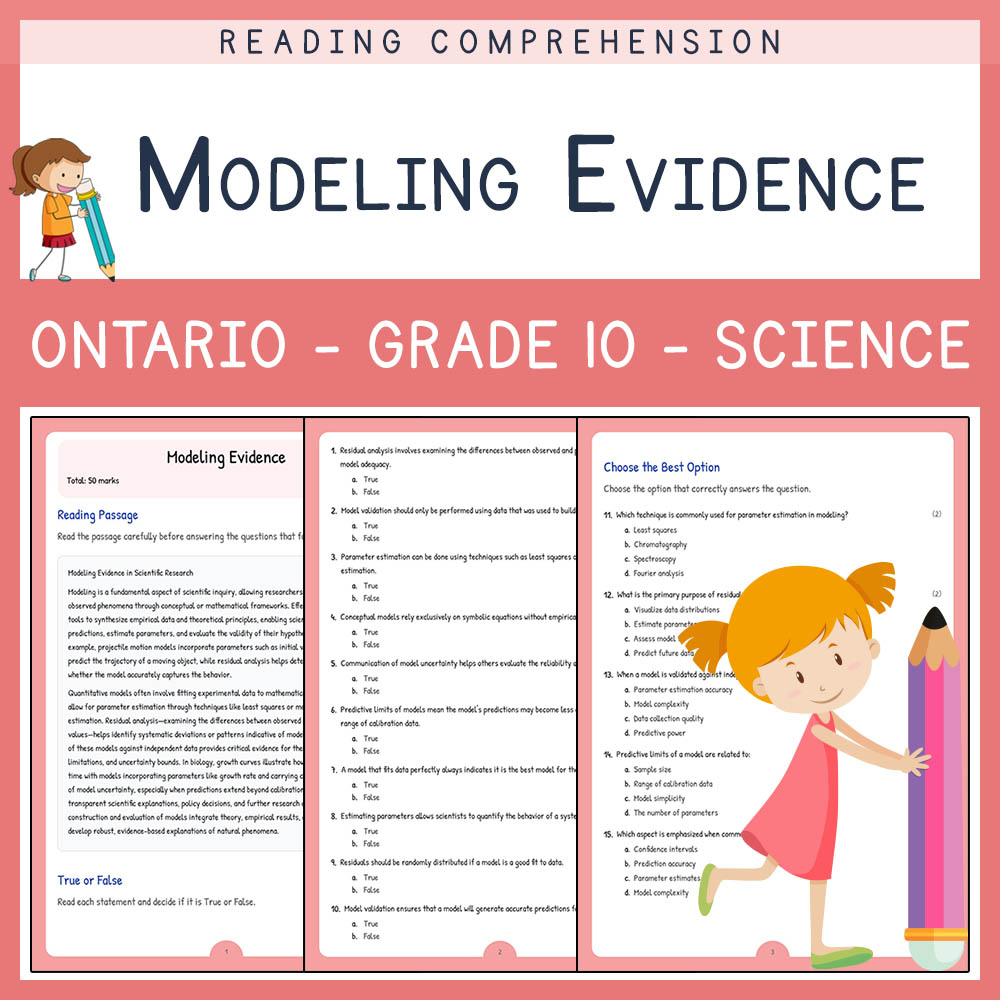
Grade 10 Science | Modeling Evidence Worksheet | Ontario Standards
Created byLumora LearningLearning Objectives
- Understand how to construct and evaluate conceptual and quantitative models to explain phenomena.
- Analyze residuals and perform model validation against independent data.
- Apply parameter estimation techniques in modeling physical and biological systems.
Instant download

Grade 4 Energy Transfer Worksheet | NGSS Practice PDF
Created byClear Sky ClassroomLearning Objectives
- Identify mechanisms of energy transfer between objects and across different media (solids, liquids, gases).
- Connect energy transfer to observable changes in motion and to changes in thermal state.
- Use evidence from temperature or motion observations to explain what energy was transferred and how.
Instant download

6th Grade Science Worksheet – Transfer Mechanisms of Heat (PDF)
Created byEvergreen Desk EducationLearning Objectives
- Identify the three main mechanisms of heat transfer: conduction, convection, and radiation.
- Use evidence from everyday examples to determine which mechanism is most likely occurring.
- Explain how temperature and state changes can indicate the dominant heat-transfer pathway.
Also included in: Grade 6 Heat and Matter Science Lesson Bundle for General Framework +1 more
Instant download

Cell Overview Worksheet | Grade 9 Science Practice
Created byPrism Point LearningLearning Objectives
- Explain how the cell membrane controls exchange between a cell and its environment
- Identify major organelles and describe how their structures relate to their functions
- Use models to compare cell structures and understand relative sizes and interactions
Also included in: Cells and Body Systems Lesson Bundle | Grade 9 Science | BC +1 more
Instant download

Organelles Specialization Worksheet | Grade 9 Science Practice
Created byPrism Point LearningLearning Objectives
- Explain how membrane-bound organelles specialize to carry out distinct cellular functions in eukaryotic cells.
- Describe the roles of mitochondria, ribosomes, rough endoplasmic reticulum, Golgi apparatus, lysosomes, and peroxisomes in metabolism and transport.
- Connect organelle specialization to efficiency and coordination of energy transfer and macromolecule processing.
Also included in: Cells and Body Systems Lesson Bundle | Grade 9 Science | BC +1 more
Instant download

Temperature Control Worksheet | Grade 9 Science Activities
Created byPrism Point LearningLearning Objectives
- Explain how thermoregulation maintains internal temperature within functional limits through coordinated body responses
- Describe the roles of the hypothalamus, skin blood flow, sweating, shivering, and metabolic adjustments in homeostasis
- Analyze how temperature changes affect enzyme activity, membrane stability, and overall cellular function
Also included in: Cells and Body Systems Lesson Bundle | Grade 9 Science | BC +1 more
Instant download
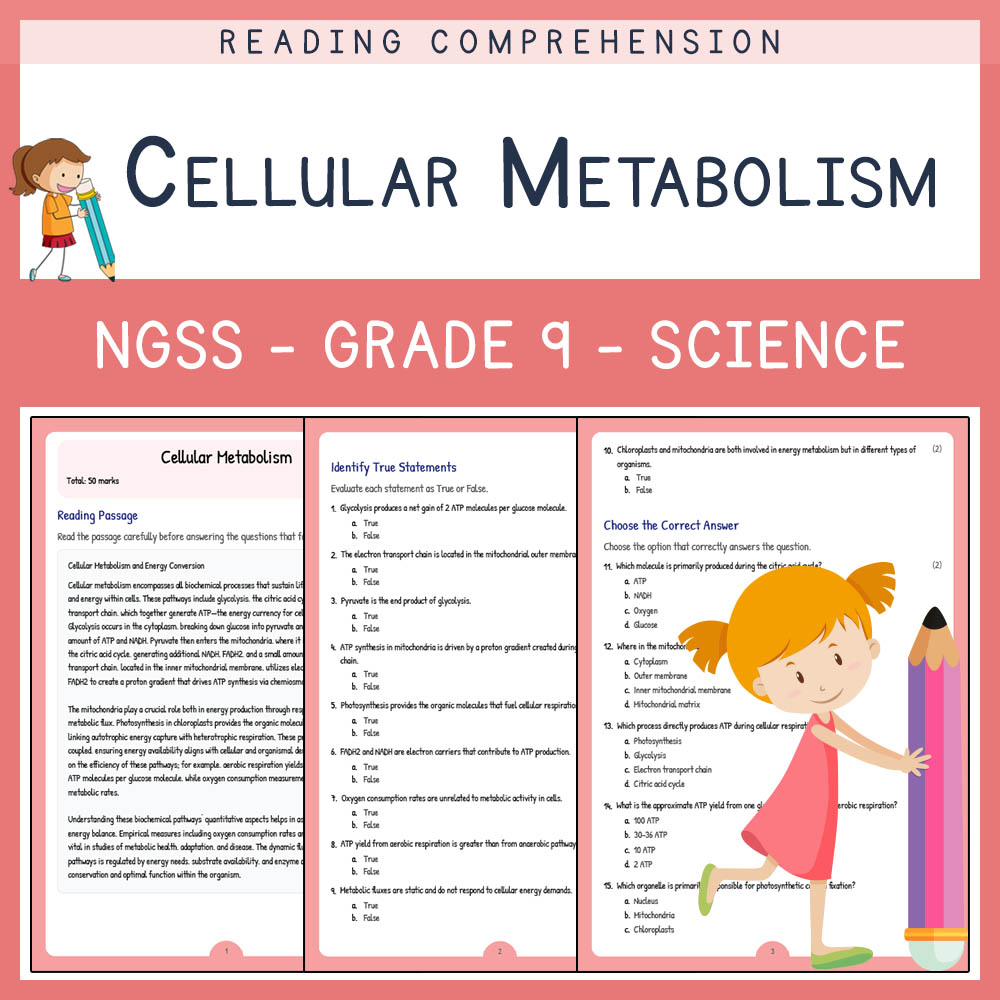
Grade 9 Science | Cellular Metabolism Worksheet & Answer Key (PDF)
Created byLumora LearningLearning Objectives
- Explain the biochemical pathways involved in cellular respiration and energy production.
- Describe the roles of mitochondria and chloroplasts in metabolism.
- Quantitatively analyze reactants and products in metabolic pathways, including ATP yield and oxygen consumption.
Instant download
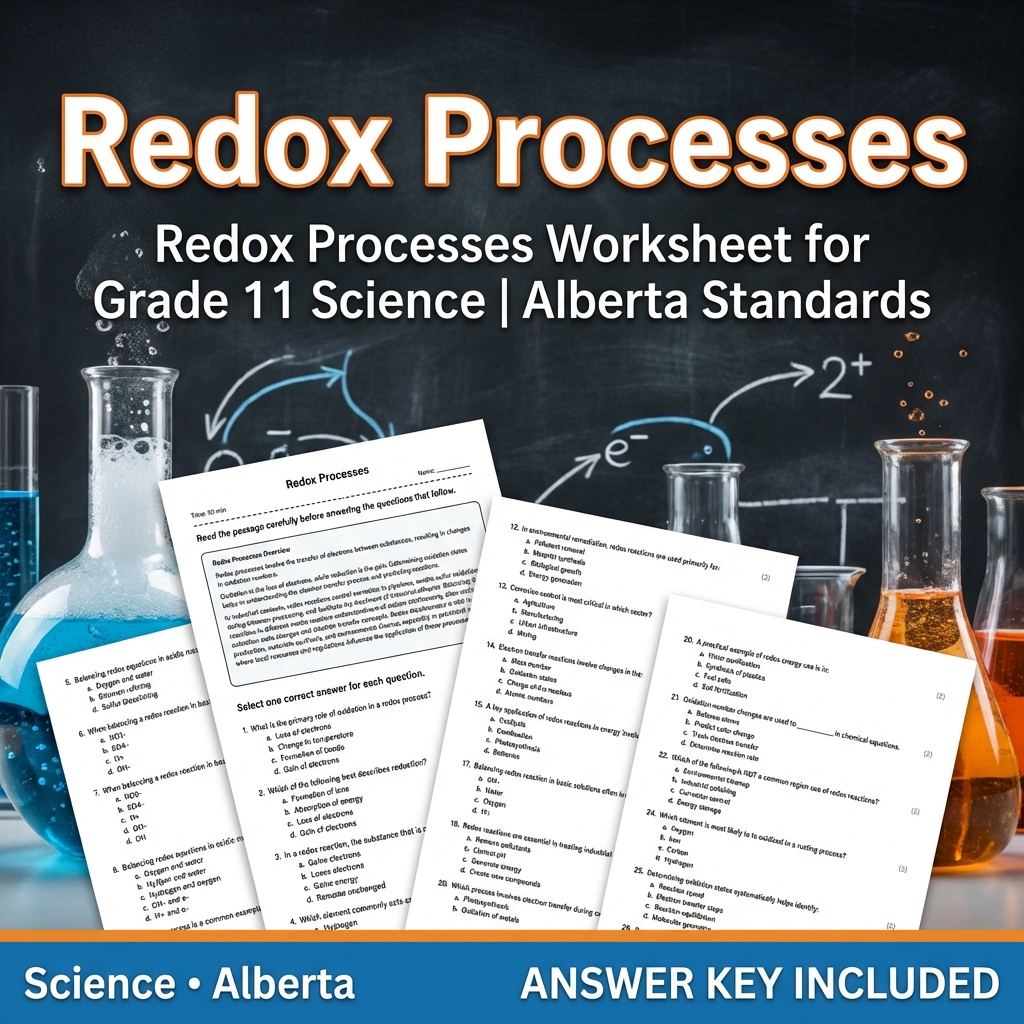
Redox Processes Worksheet for Grade 11 Science | Alberta Standards
Created byCoral Reef LearningLearning Objectives
- Explain the concept of oxidation states and their systematic determination.
- Balance redox equations in acidic and basic media accurately.
- Identify real-world applications of redox reactions in environmental and industrial contexts.
Instant download
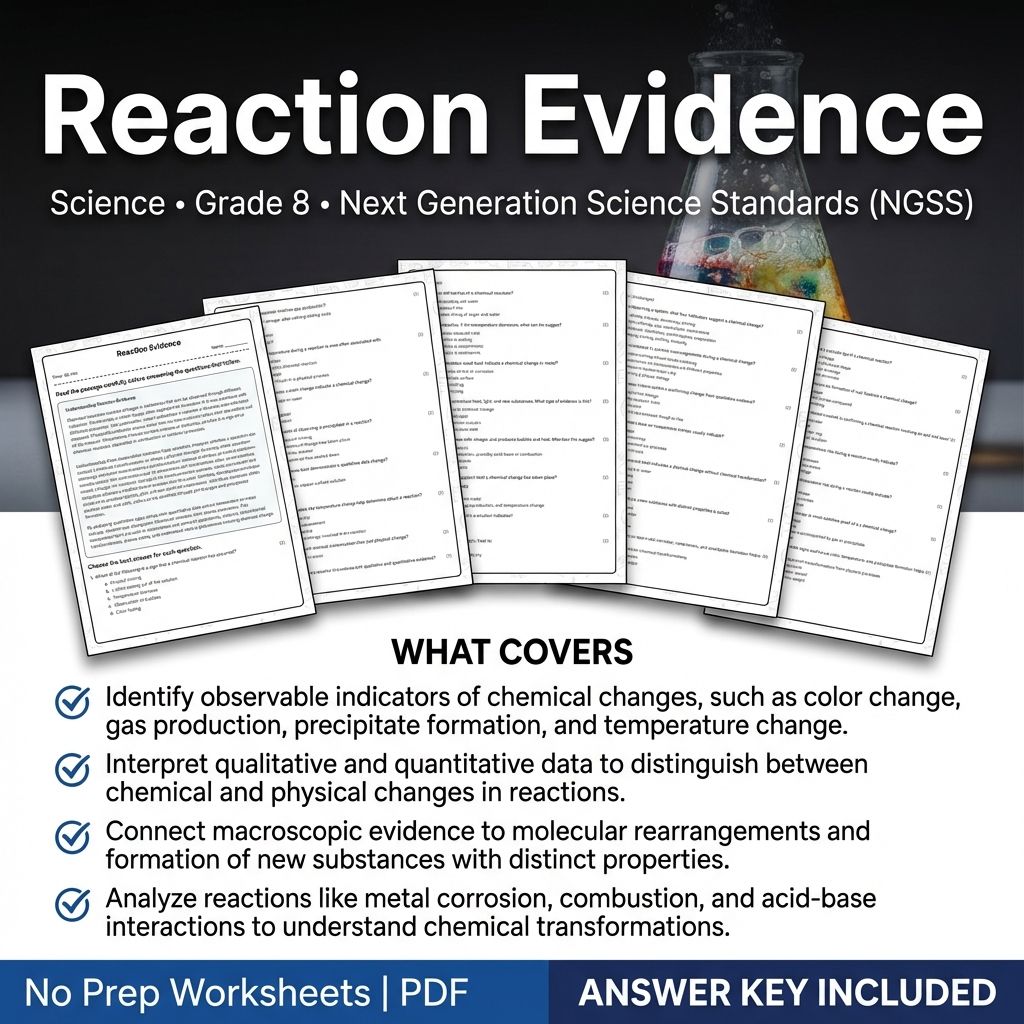
8th Grade Science | Reaction Evidence Worksheet & Answer Key (Printable PDF)
Created byCoral Reef LearningLearning Objectives
- Identify observable indicators of chemical changes, such as color change, gas production, precipitate formation, and temperature change.
- Interpret qualitative and quantitative data to distinguish between chemical and physical changes in reactions.
- Connect macroscopic evidence to molecular rearrangements and formation of new substances with distinct properties.
Instant download
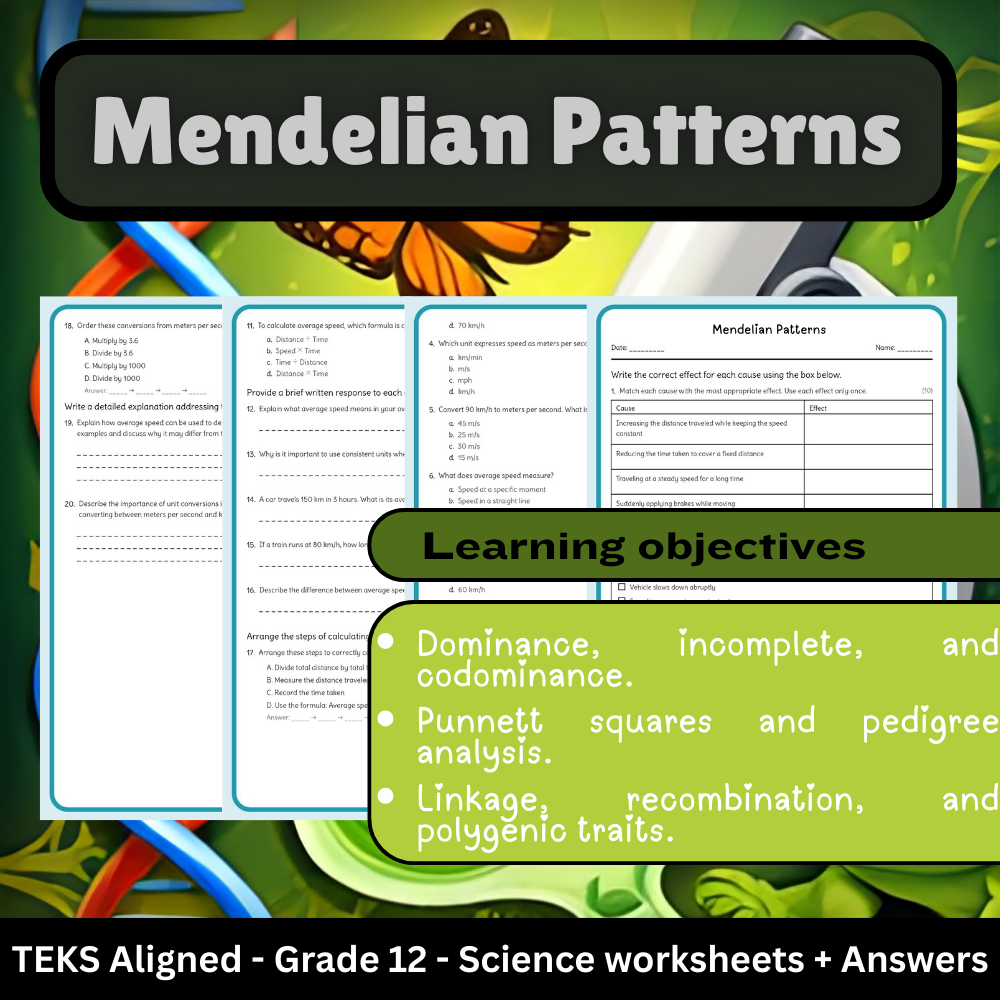
Grade 12 Science | Mendelian Patterns Worksheet (Answer Key) aligned with TEKS
Created byBright Mind ResourcesLearning Objectives
- Describe Mendelian inheritance patterns including dominance, incomplete dominance, and codominance.
- Interpret genetic ratios from Punnett squares and pedigree analysis.
- Explain the concepts of linkage, recombination frequency, and polygenic traits.
Instant download
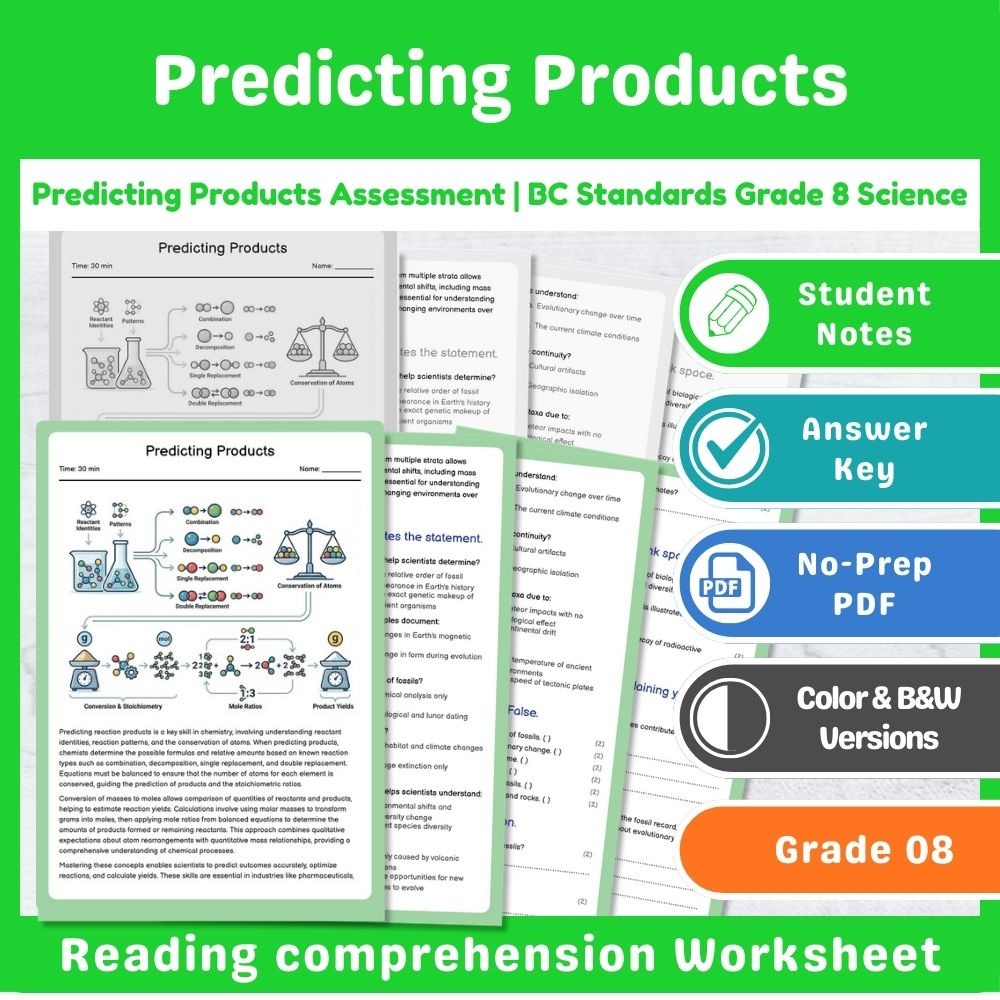
Predicting Products Assessment | BC Standards Grade 8 Science
Created byPrism Point LearningLearning Objectives
- Understand how to predict products in chemical reactions based on reactants and reaction patterns.
- Apply the conservation of atoms principle to balance chemical equations.
- Convert between mass and moles to determine reaction yields and compare quantities.
Also included in: Grade 8 Science Lesson – Reaction Types & Evidence Assessment Bundle
Instant download
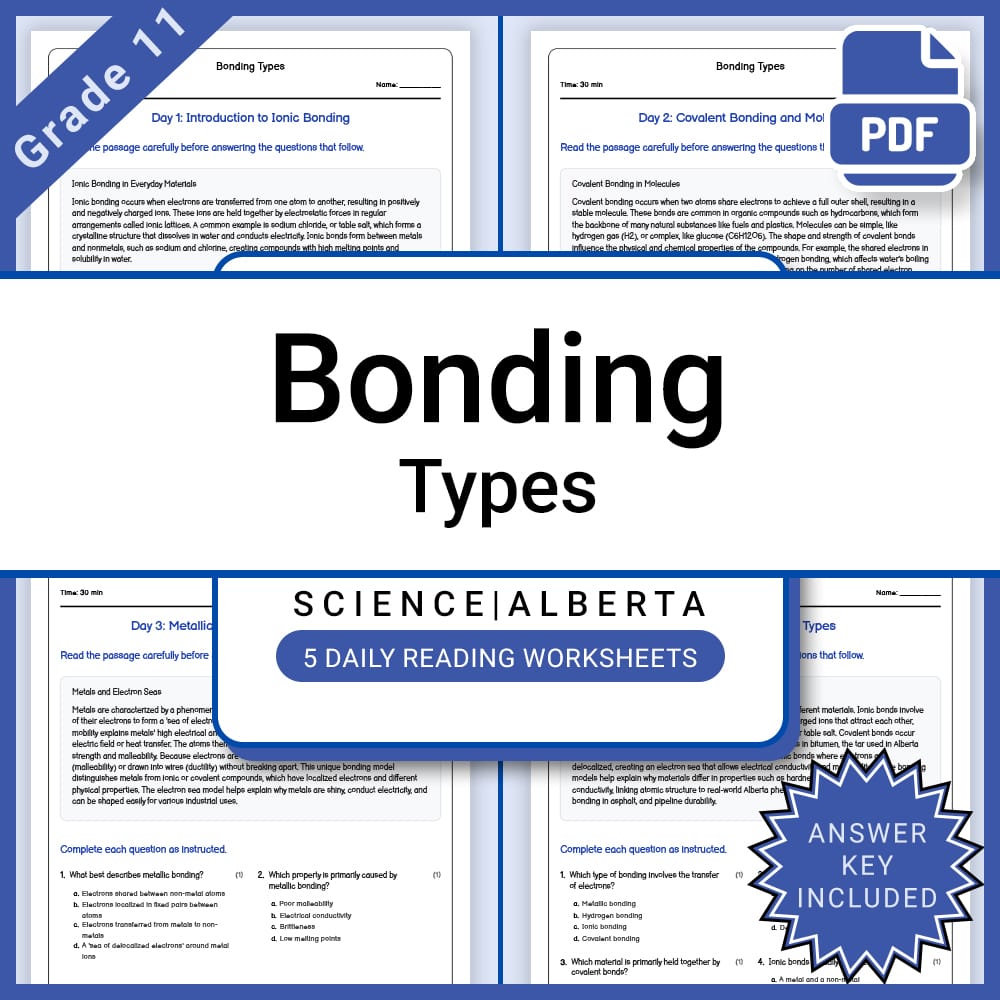
Grade 11 Science – Bonding Types Daily Reading Worksheet with Answer Key
JCreated byJ.S SheetsLearning Objectives
- Understand the differences between ionic, covalent, and metallic bonding.
- Identify characteristics of ionic bonds and their resulting structures.
- Relate bonding types to real-world materials and their properties.
Also included in: Grade 11 Science Lesson Bundle | Molecular Structure and Bonding +1 more
Instant download
Browse more categories
About Science Worksheets
Find Science worksheets spanning core skills, practice, and review. All 44,620 resources are instant PDF downloads for the classroom or home.
Every worksheet on MyTeachingSheets is created by independent teacher-authors and reviewed before publication. All resources download as printable PDFs for classroom, homework, or at-home practice, and many include answer keys. Preview any worksheet free before buying.