
Science Worksheets
44,628 subject resources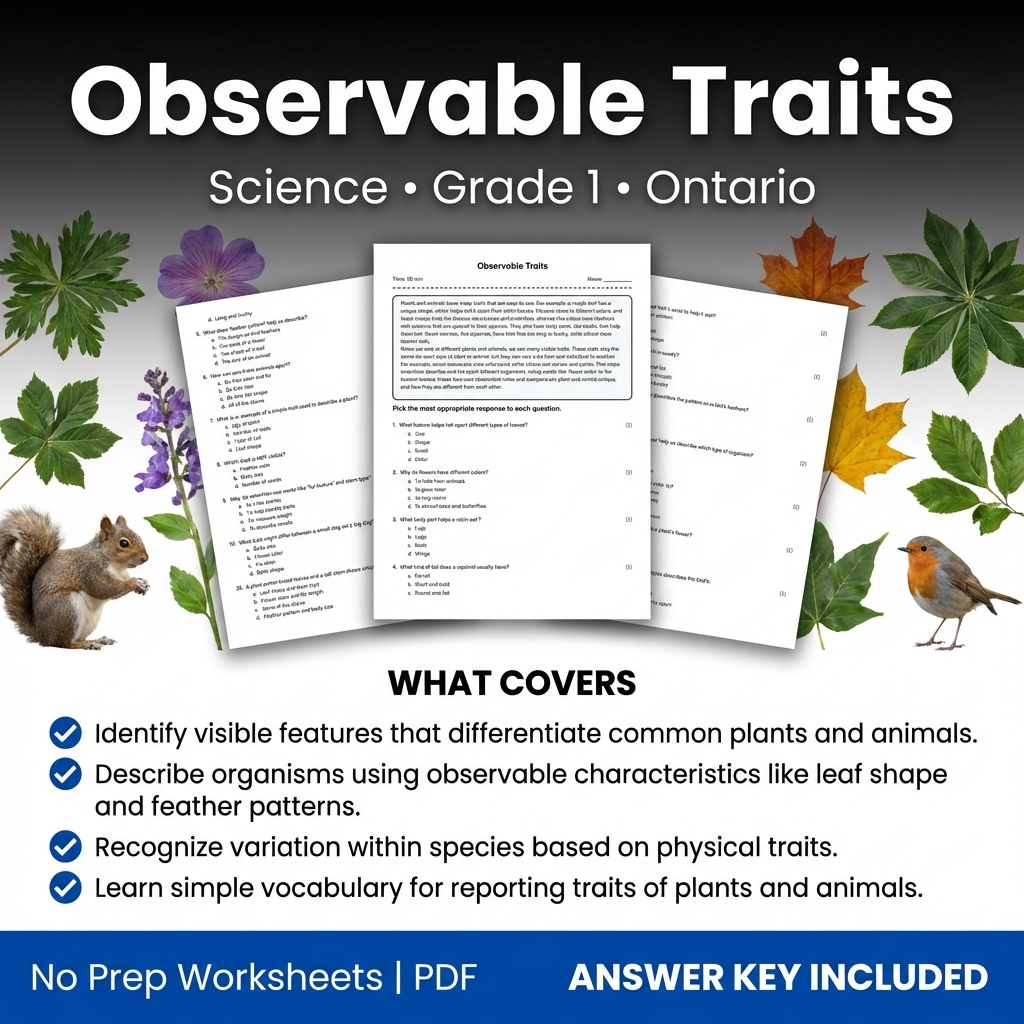
Observable Traits Worksheet for Grade 1 Science – Ontario Standards
 Created byCoral Reef Learning
Learning Objectives
- Identify visible features that differentiate common plants and animals.
- Describe organisms using observable characteristics like leaf shape and feather patterns.
- Recognize variation within species based on physical traits.
Instant download

Grade 11 Science – Atmospheric Structure Worksheet (AP) (PDF)
 Created byEvergreen Desk Education
Learning Objectives
- Describe the vertical and horizontal structure of the atmosphere using pressure, composition, and temperature profiles.
- Explain how pressure gradients and temperature changes drive atmospheric circulation.
- Interpret sounding profiles, lapse rates, and inversion layers to predict weather and climate responses.
Also included in: Grade 11 Earth and Space Science Lesson Bundle for Advanced Placement (AP) +1 more
Instant download

Grade 11 Science | Sea-Level Change Worksheet (AP Standards) (PDF)
Created byEvergreen Desk EducationLearning Objectives
- Explain how satellite altimetry and tide-gauge records help quantify sea-level variability over time.
- Decompose observed sea-level change into contributions from thermal expansion, ice-sheet mass loss, and local subsidence.
- Use coastal stratigraphy and geomorphology to infer past sea-level rates and impacts across decades to millennia.
Also included in: Grade 11 Earth and Space Science Lesson Bundle for Advanced Placement (AP) +1 more
Instant download

Grade 11 Science Resource Distribution Worksheet (AP Standards) (PDF)
Created byEvergreen Desk EducationLearning Objectives
- Interpret how geologic maps, geophysical surveys, and basin models reveal spatial patterns of mineral, water, and energy resources.
- Differentiate renewable and nonrenewable reservoirs and evaluate sustainability using reserve quality and extraction-related fluxes.
- Connect resource occurrence to tectonic setting and sedimentary processes that control reservoir formation and accessibility.
Also included in: Grade 11 Earth and Space Science Lesson Bundle for Advanced Placement (AP) +1 more
Instant download

Grade 8 Science | Predicting Products Worksheet | BC Aligned
 Created byLumora Learning
Learning Objectives
- Understand how to predict reaction products based on reactant identities and reaction patterns.
- Learn to balance chemical equations to ensure conservation of atoms.
- Apply mass-to-mole conversions to compare quantities and estimate yields in reactions.
Instant download
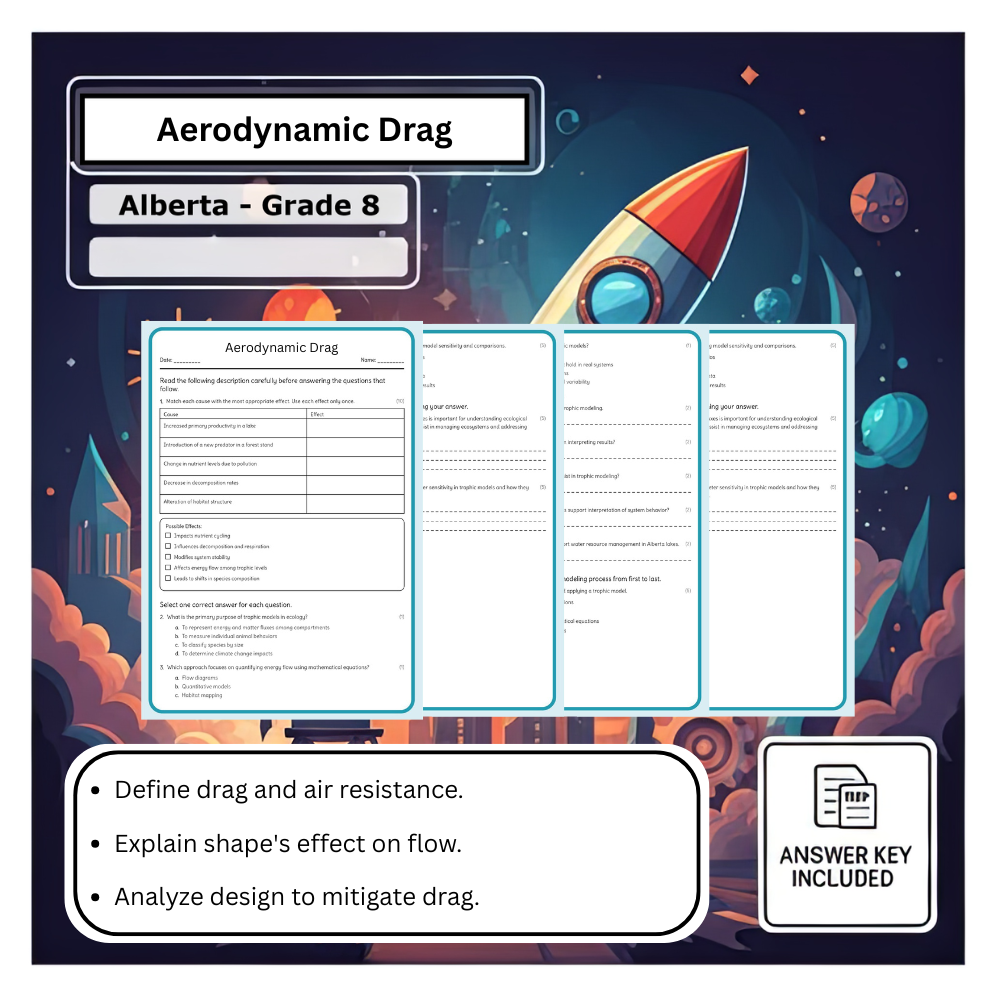
Grade 8 Science | Aerodynamic Drag (Worksheet + Answer Key) – Alberta Standards
 Created byBright Mind Resources
Learning Objectives
- Understand the concept of aerodynamic drag and factors that influence it.
- Describe how shape and flow conditions affect air resistance in practical applications.
- Analyze how design choices can mitigate drag in vehicles and wind turbines.
Instant download
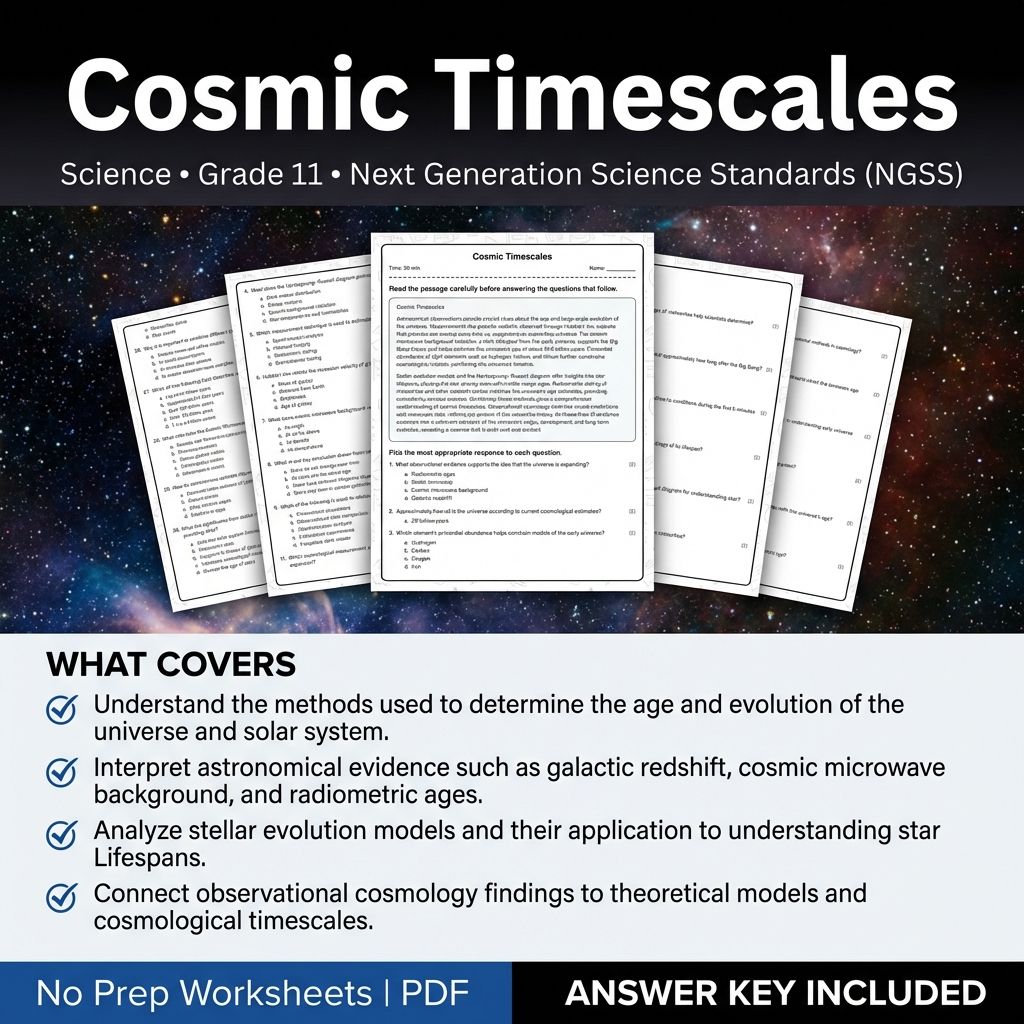
Grade 11 Science | Cosmic Timescales Worksheet & Answer Key (Printable PDF)
Created byCoral Reef LearningLearning Objectives
- Understand the methods used to determine the age and evolution of the universe and solar system.
- Interpret astronomical evidence such as galactic redshift, cosmic microwave background, and radiometric ages.
- Analyze stellar evolution models and their application to understanding star Lifespans.
Also included in: Grade 11 Science Unit Bundle | Orbital Mechanics & Cosmic Timescales Worksheets +1 more
Instant download
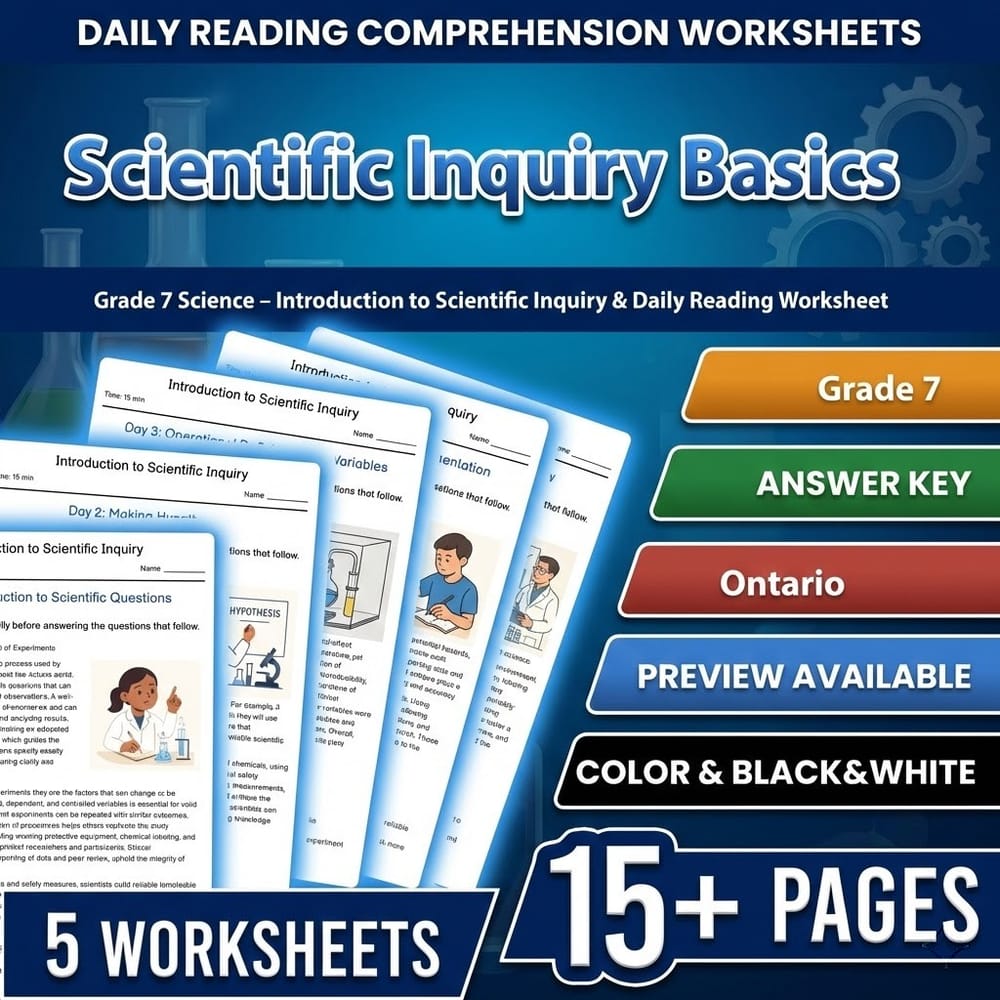
Grade 7 Science – Introduction to Scientific Inquiry & Daily Reading Worksheet
 Created byQuiet Forest Education
Learning Objectives
- Understand the basic components of scientific questions.
- Learn how to formulate clear and testable hypotheses.
- Recognize the importance of operational definitions and variables.
Also included in: STEM Skills and Connections Grade 7 Science Daily Worksheets Bundle | Ontario +1 more
Instant download
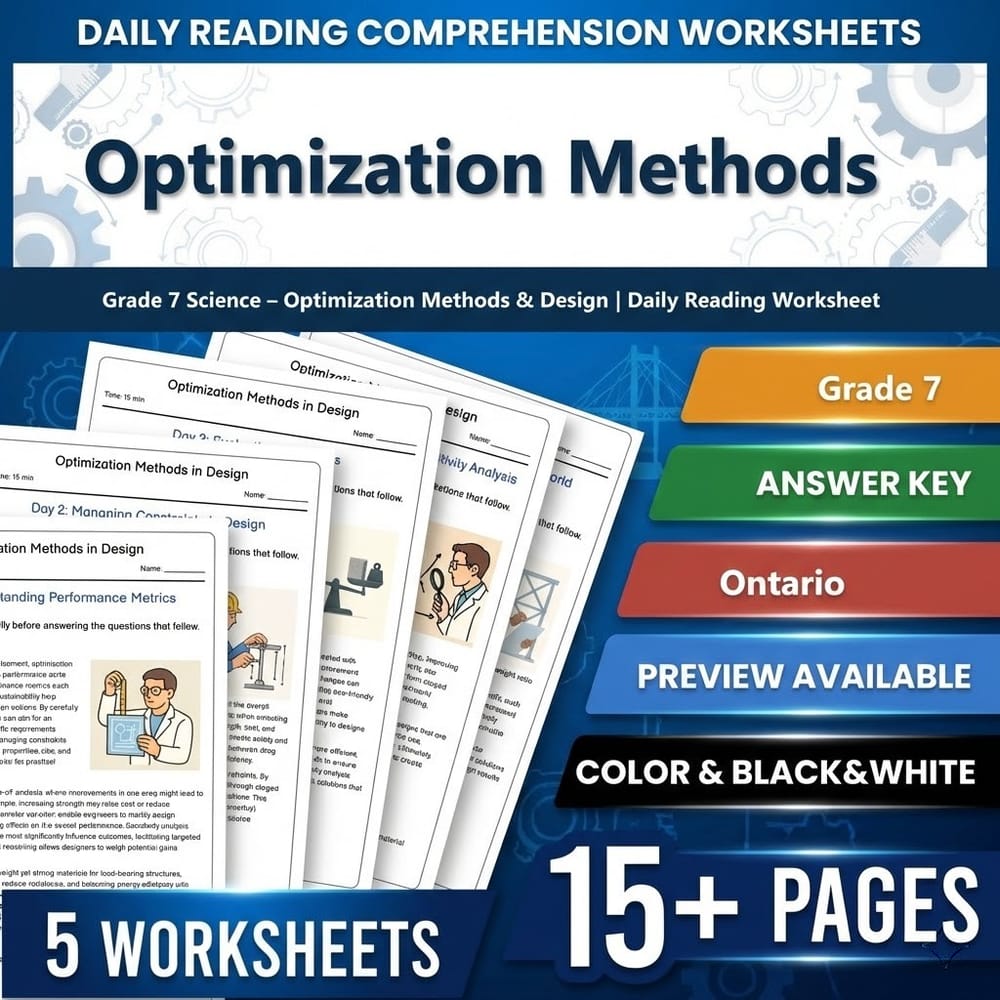
Grade 7 Science – Optimization Methods & Design | Daily Reading Worksheet
Created byQuiet Forest EducationLearning Objectives
- Understand key concepts related to Science
- Apply knowledge through practice questions
- Demonstrate comprehension of the material
Also included in: STEM Skills and Connections Grade 7 Science Daily Worksheets Bundle | Ontario +1 more
Instant download
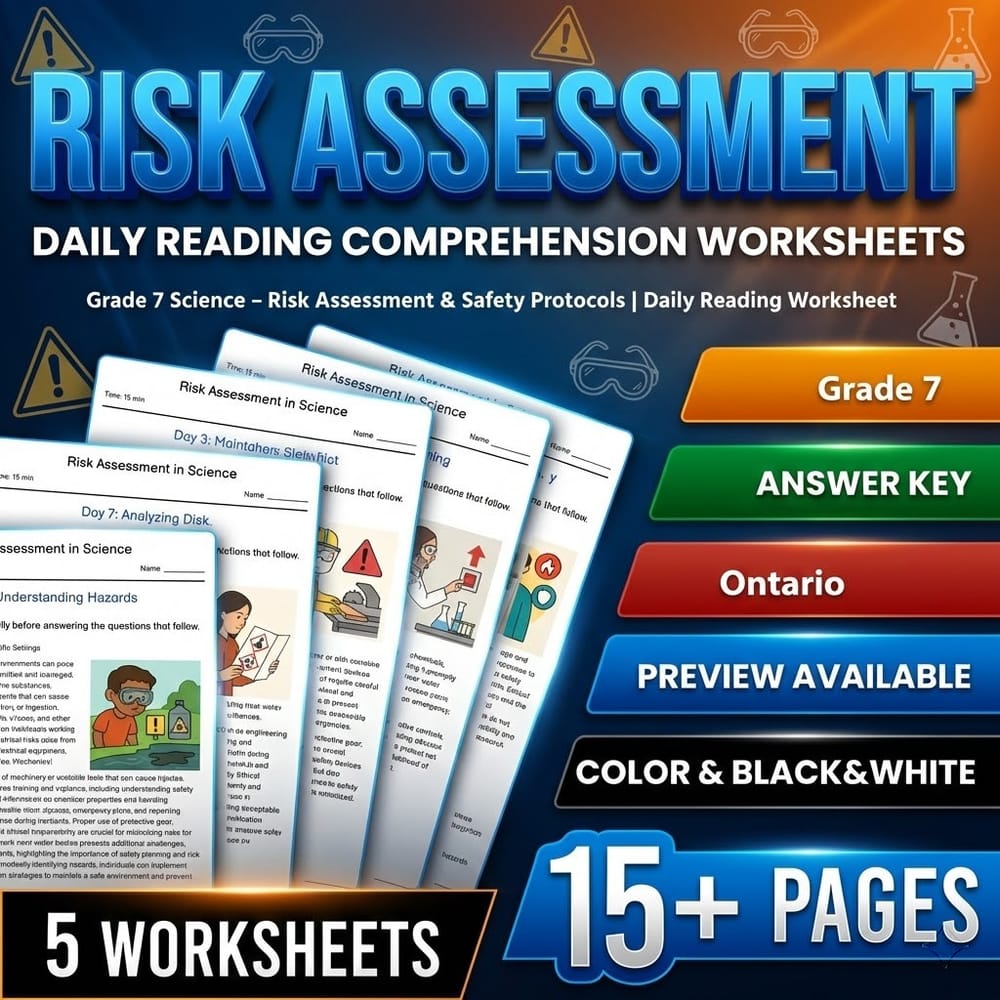
Grade 7 Science – Risk Assessment & Safety Protocols | Daily Reading Worksheet
Created byQuiet Forest EducationLearning Objectives
- Understand the concept of hazards in laboratory and field settings.
- Identify different types of hazards such as chemical, biological, electrical, and mechanical risks.
- Learn how to interpret safety data sheets and hazard classifications.
Also included in: STEM Skills and Connections Grade 7 Science Daily Worksheets Bundle | Ontario +1 more
Instant download
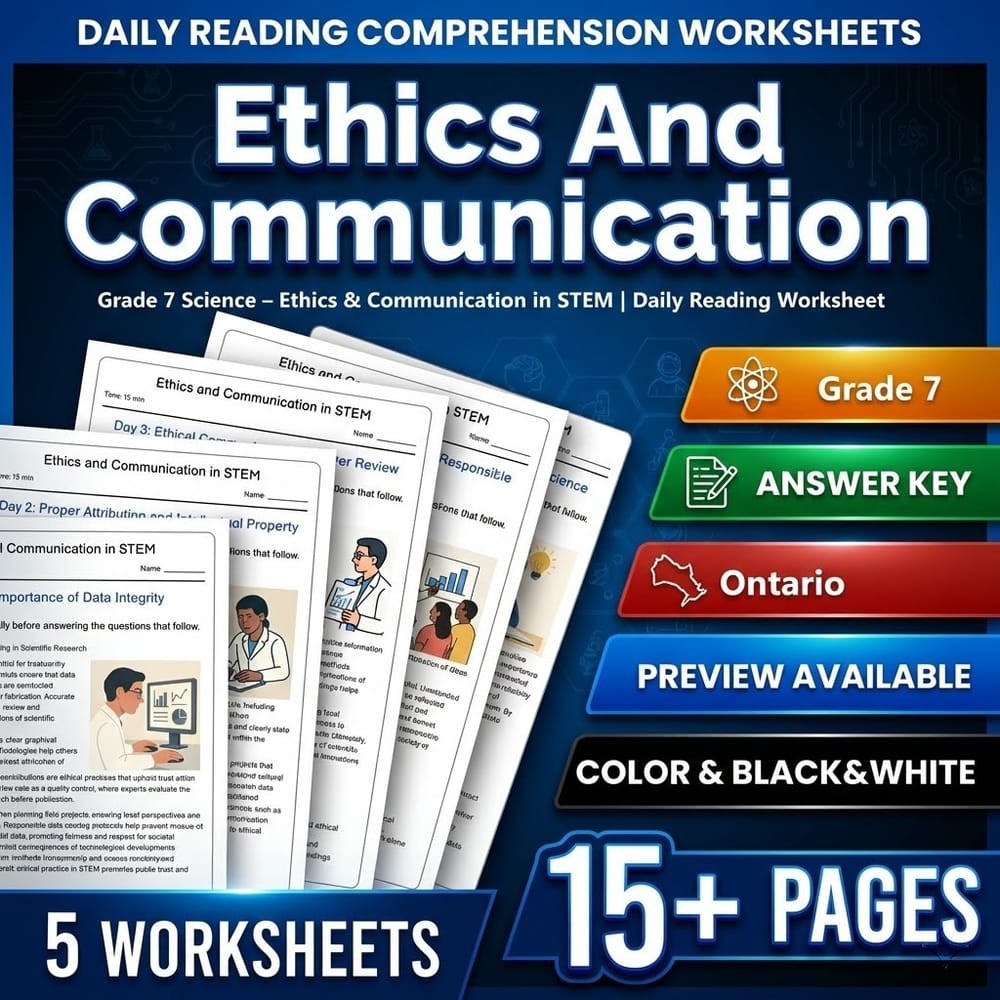
Grade 7 Science – Ethics & Communication in STEM | Daily Reading Worksheet
Created byQuiet Forest EducationLearning Objectives
- Understand the importance of data integrity in scientific research
- Identify responsible practices for technical reporting and graphical annotation
- Recognize ethical considerations in community consultation and data sharing
Also included in: STEM Skills and Connections Grade 7 Science Daily Worksheets Bundle | Ontario +1 more
Instant download
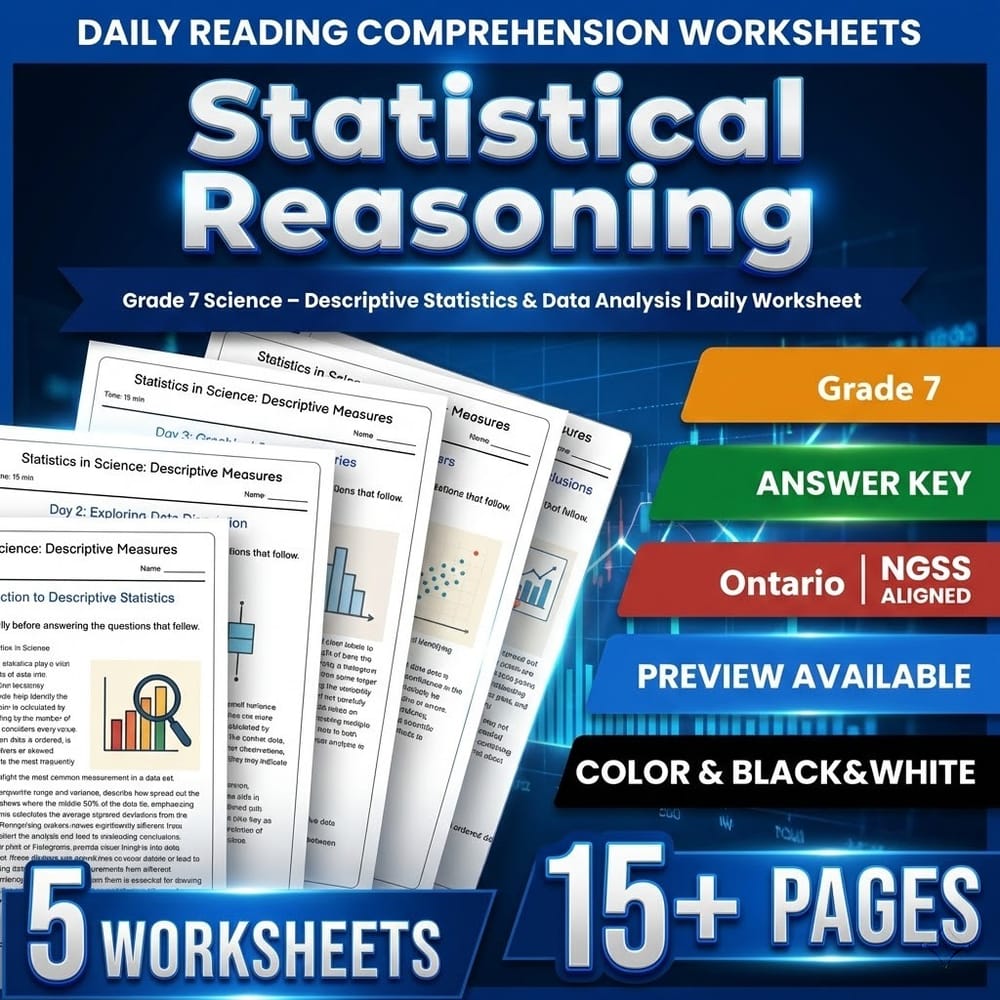
Grade 7 Science – Descriptive Statistics & Data Analysis | Daily Worksheet
Created byQuiet Forest EducationLearning Objectives
- Define and differentiate between mean, median, and mode.
- Describe the concept of dispersion including interquartile range and variance.
- Identify outliers and understand their impact on statistical data.
Also included in: STEM Skills and Connections Grade 7 Science Daily Worksheets Bundle | Ontario +1 more
Instant download
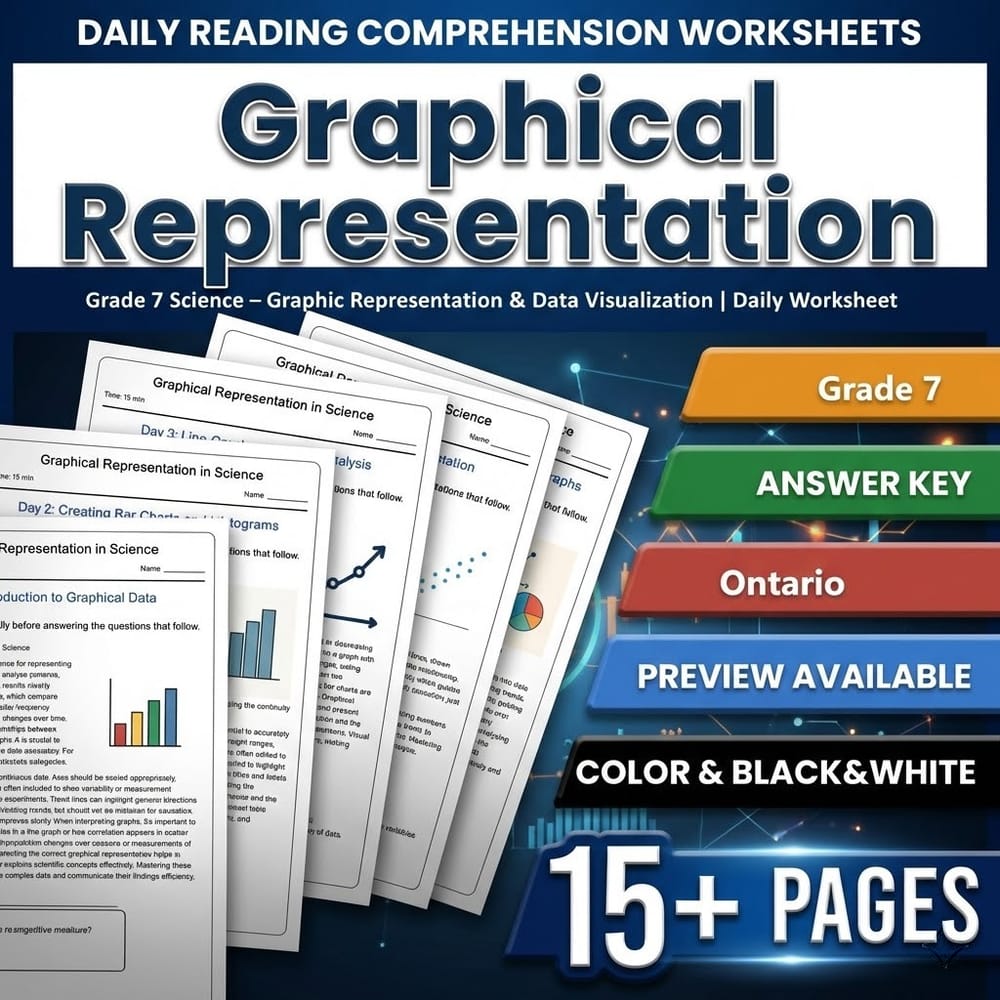
Grade 7 Science – Graphic Representation & Data Visualization | Daily Worksheet
Created byQuiet Forest EducationLearning Objectives
- Understand different types of graphs used in science data presentation
- Learn how to interpret axes, proportional representations, and error bars
- Identify appropriate graph types for various data sets
Also included in: STEM Skills and Connections Grade 7 Science Daily Worksheets Bundle | Ontario +1 more
Instant download
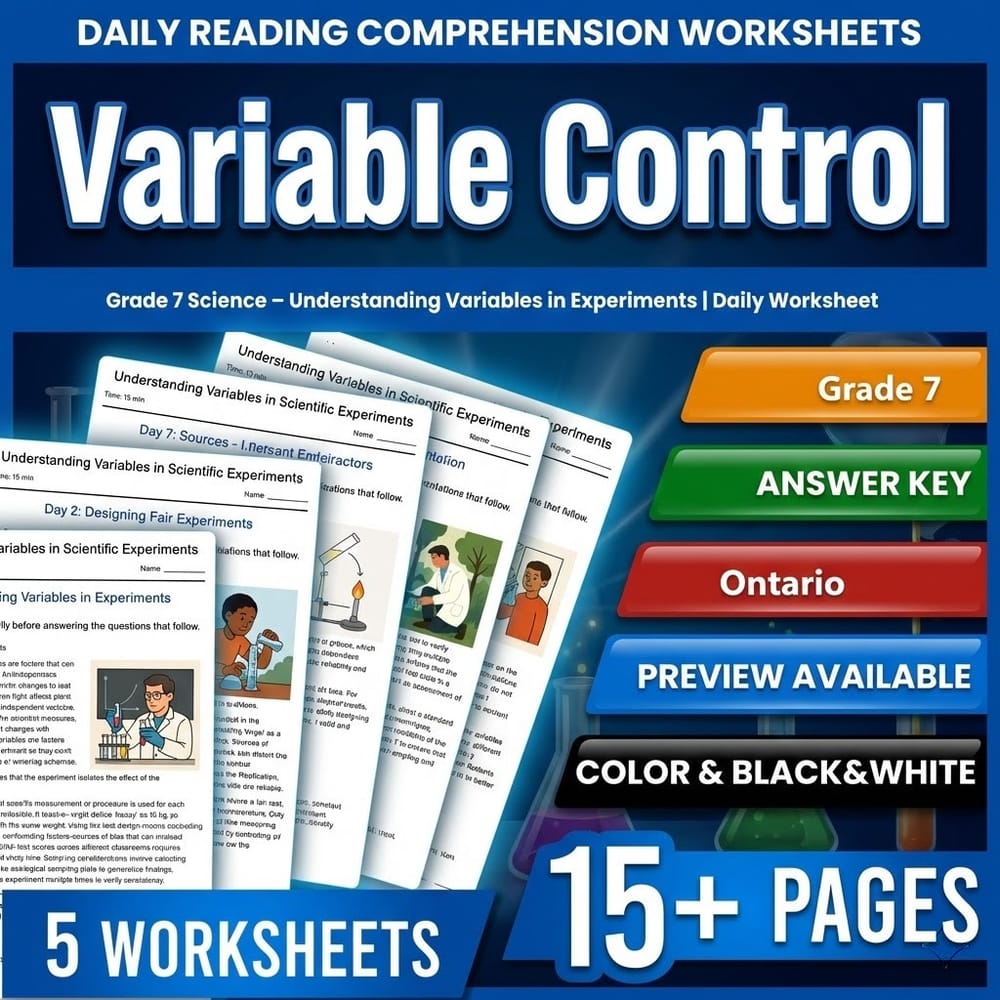
Grade 7 Science – Understanding Variables in Experiments | Daily Worksheet
Created byQuiet Forest EducationLearning Objectives
- Identify independent, dependent, and controlled variables in experiments
- Understand the importance of operational definitions and fair test design
- Recognize sources of confounding variables and ways to control them
Also included in: STEM Skills and Connections Grade 7 Science Daily Worksheets Bundle | Ontario +1 more
Instant download
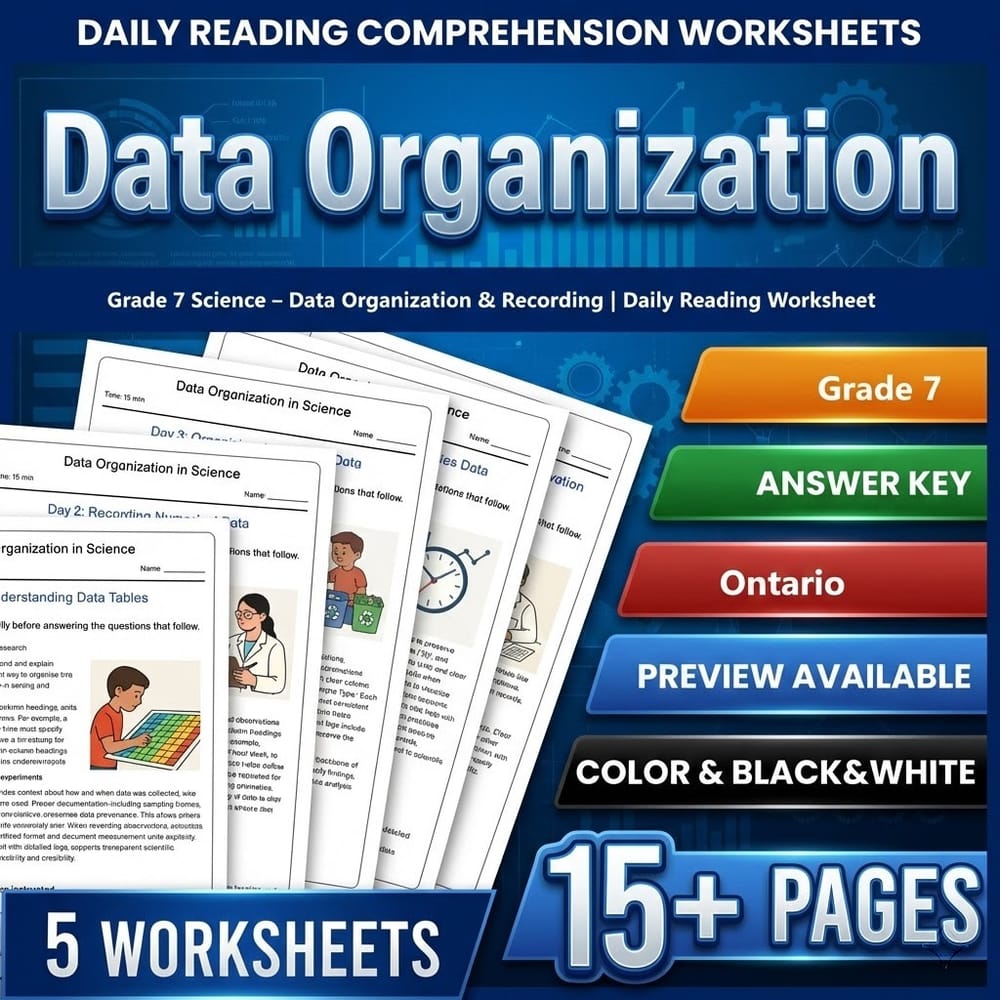
Grade 7 Science – Data Organization & Recording | Daily Reading Worksheet
Created byQuiet Forest EducationLearning Objectives
- Understand different types of data structures such as tables and logs
- Identify proper formatting and units in recorded data
- Learn the importance of metadata and documentation for scientific data
Also included in: STEM Skills and Connections Grade 7 Science Daily Worksheets Bundle | Ontario +1 more
Instant download
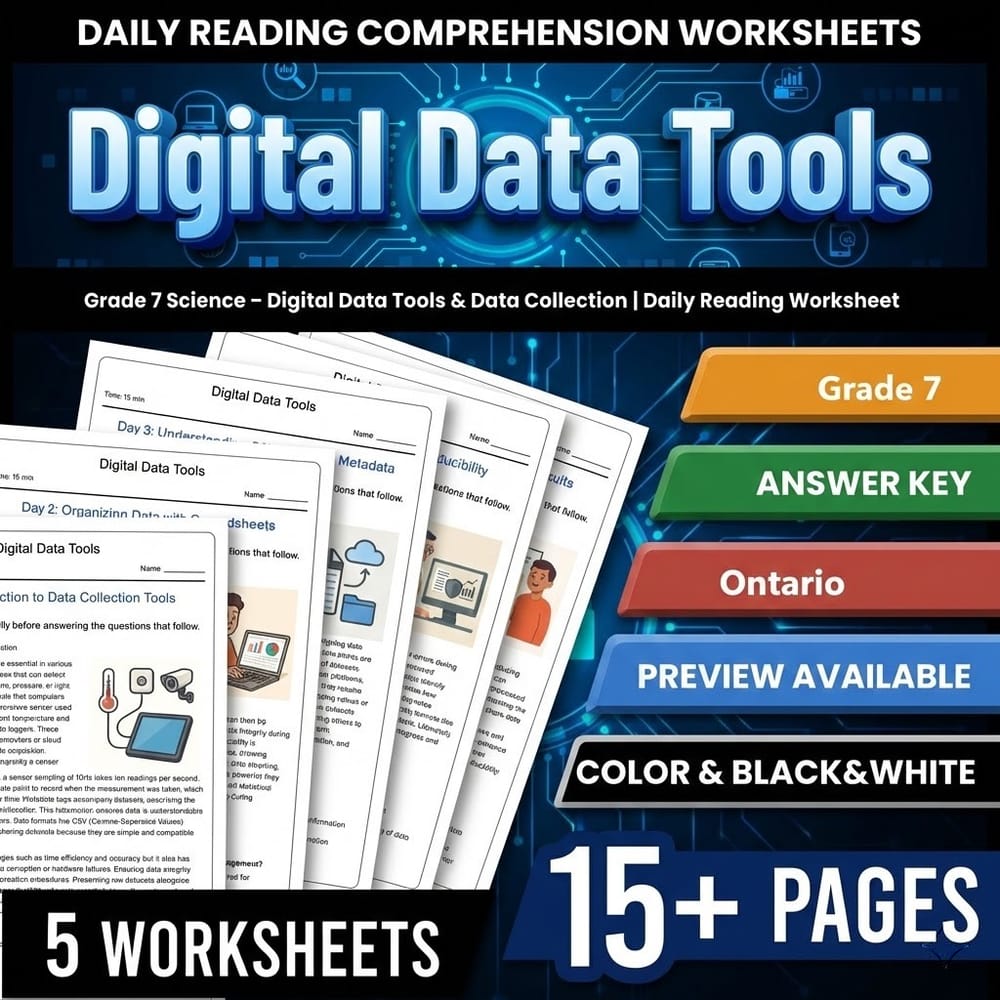
Grade 7 Science – Digital Data Tools & Data Collection | Daily Reading Worksheet
Created byQuiet Forest EducationLearning Objectives
- Understand key concepts related to Science
- Apply knowledge through practice questions
- Demonstrate comprehension of the material
Also included in: STEM Skills and Connections Grade 7 Science Daily Worksheets Bundle | Ontario +1 more
Instant download
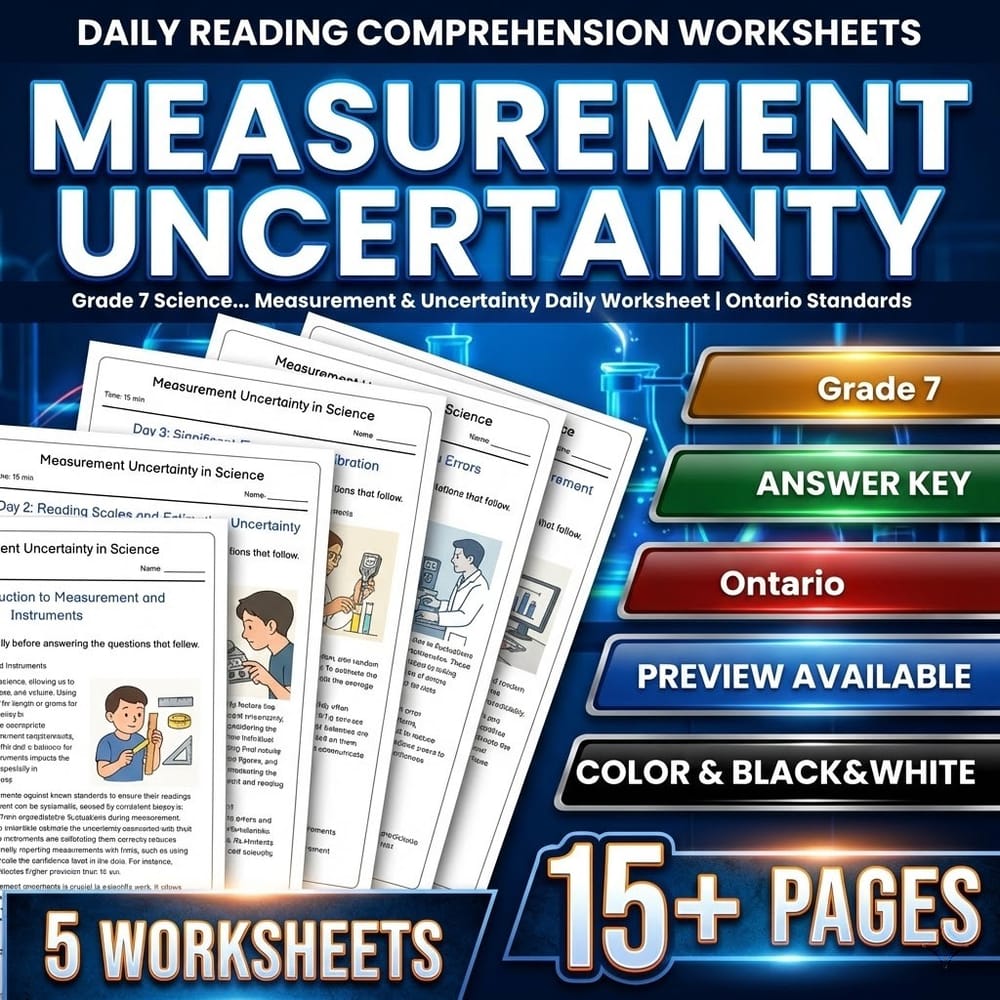
Grade 7 Science – Measurement & Uncertainty Daily Worksheet | Ontario Standards
Created byQuiet Forest EducationLearning Objectives
- Understand the concept of measurement units and their importance.
- Learn how to select appropriate instruments for different measurements.
- Explore the significance of accuracy and precision in scientific measurements.
Also included in: STEM Skills and Connections Grade 7 Science Daily Worksheets Bundle | Ontario +1 more
Instant download
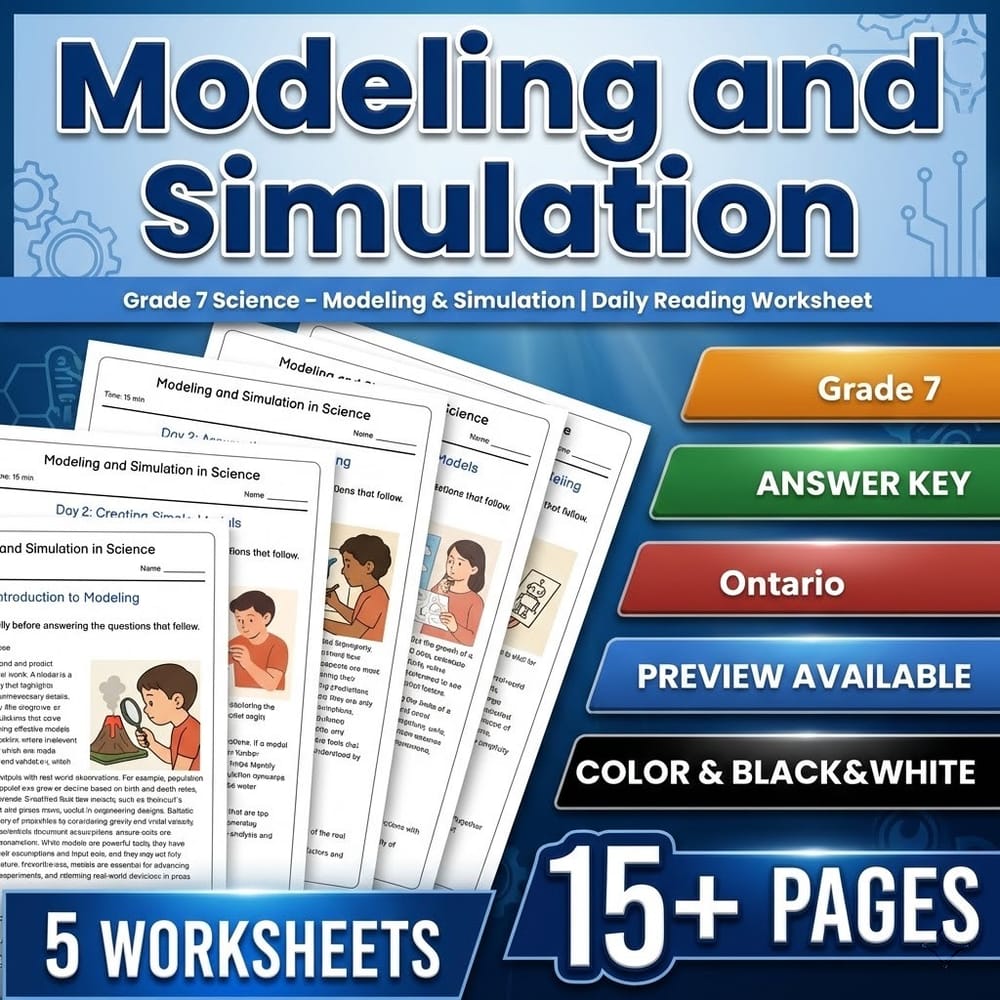
Grade 7 Science – Modeling & Simulation | Daily Reading Worksheet
Created byQuiet Forest EducationLearning Objectives
- Understand what models are and their purpose in scientific investigation
- Identify different types of models used in science, such as conceptual and computational
- Recognize key practices in creating effective models, including abstraction, assumptions, and validation
Also included in: STEM Skills and Connections Grade 7 Science Daily Worksheets Bundle | Ontario +1 more
Instant download
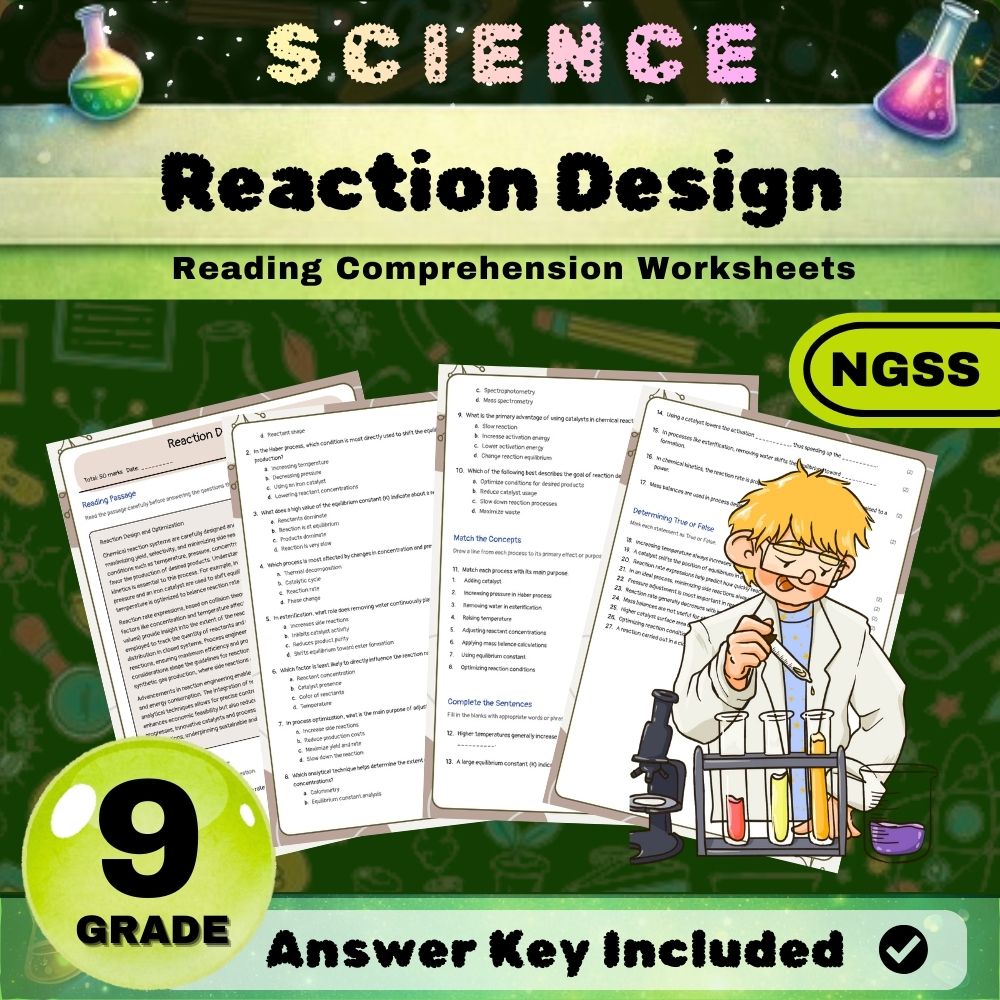
Grade 9 Science | Reaction Design Worksheet (NGSS) Practice PDF
 Created byMaple Path Learning
Learning Objectives
- Understand how temperature, pressure, concentration, and catalysts influence chemical reactions.
- Explain the principles of chemical equilibrium and reaction kinetics in process optimization.
- Apply equilibrium constants, reaction-rate expressions, and mass balances to predict product outcomes.
Also included in: Grade 9 Science | Matter and Its Interactions NGSS Unit Bundle – Worksheets +1 more
Instant download
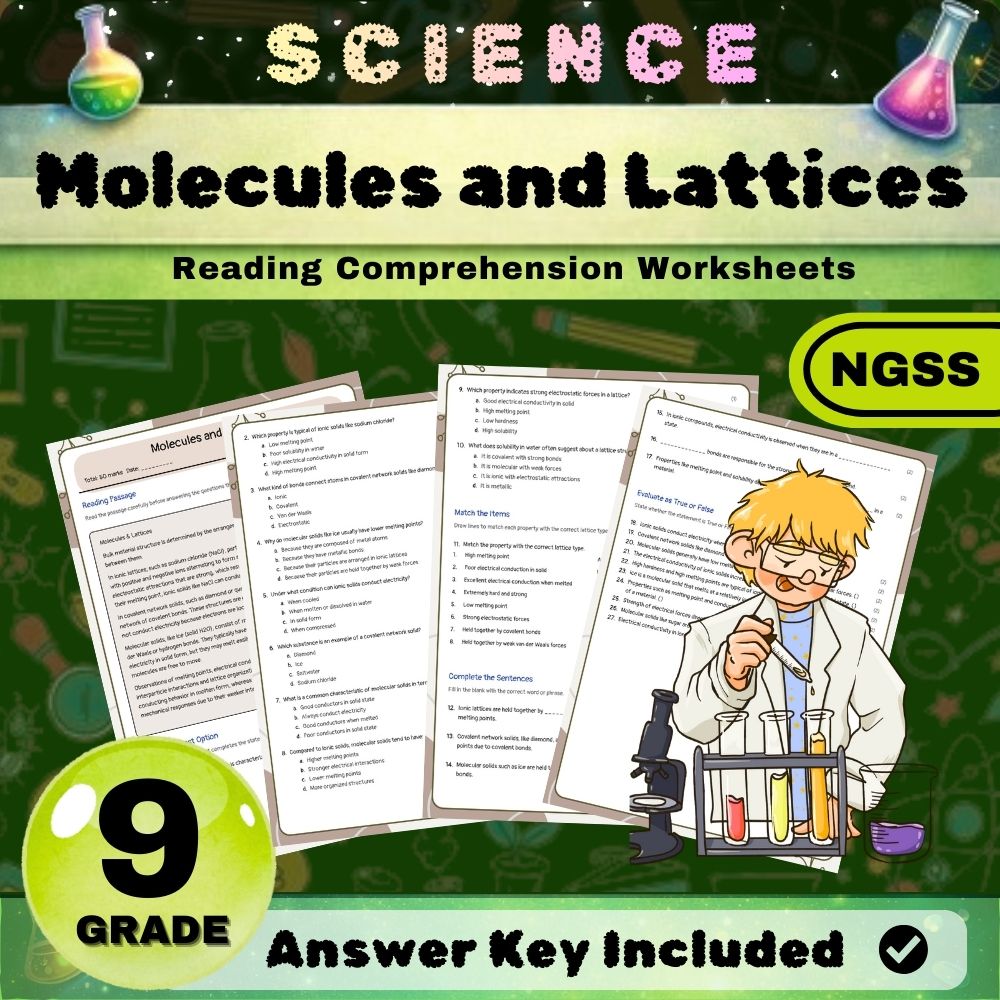
Grade 9 Science – Molecules and Lattices Worksheet (NGSS) PDF
Created byMaple Path LearningLearning Objectives
- Understand the relationship between particle arrangement and bulk material properties in different lattice structures.
- Distinguish between ionic lattices, covalent networks, and molecular solids based on physical and electrical characteristics.
- Describe how melting point, electrical conductivity, hardness, and solubility are affected by lattice organization and interparticle forces.
Also included in: Grade 9 Science | Matter and Its Interactions NGSS Unit Bundle – Worksheets +1 more
Instant download
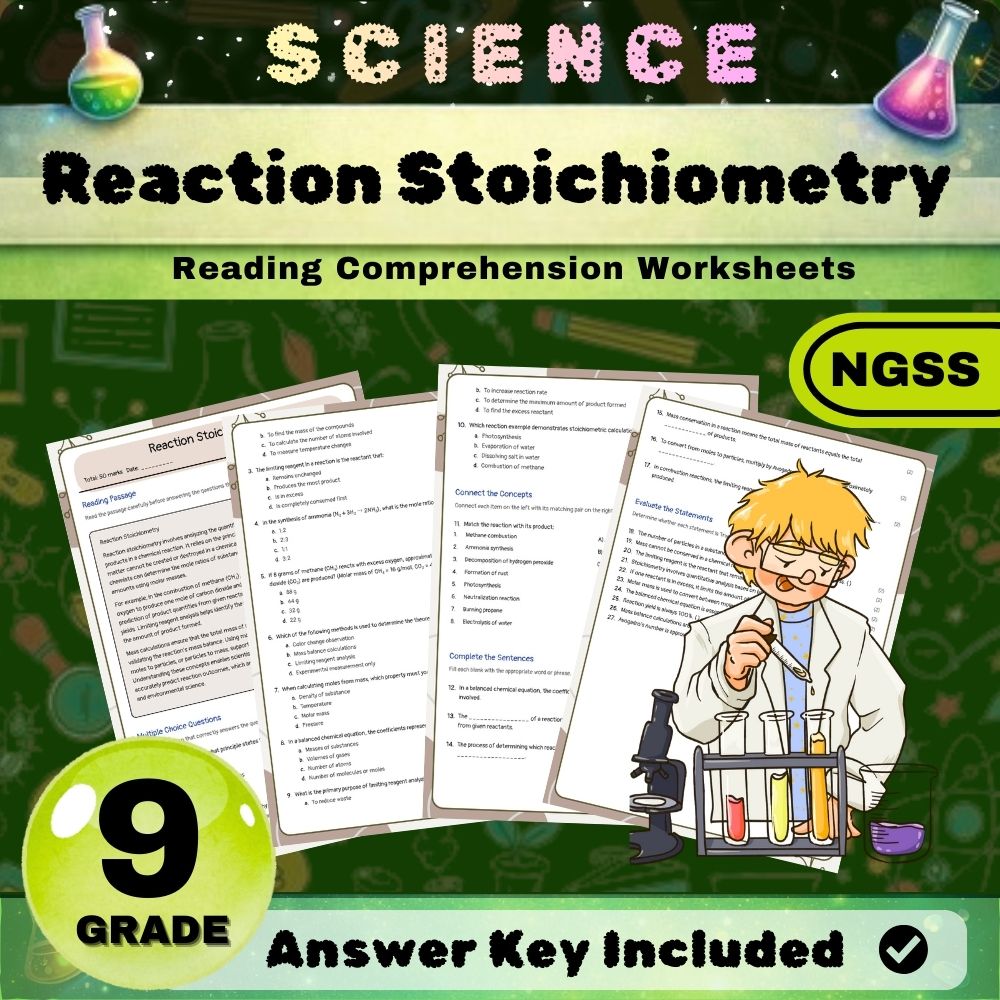
Grade 9 Science | Reaction Stoichiometry Worksheet (NGSS PDF)
Created byMaple Path LearningLearning Objectives
- Understand the concept of molar relationships in balanced chemical equations.
- Apply conservation of mass to relate reactant and product quantities in chemical reactions.
- Calculate moles, mass, and particle counts using molar mass conversions.
Also included in: Grade 9 Science | Matter and Its Interactions NGSS Unit Bundle – Worksheets +1 more
Instant download
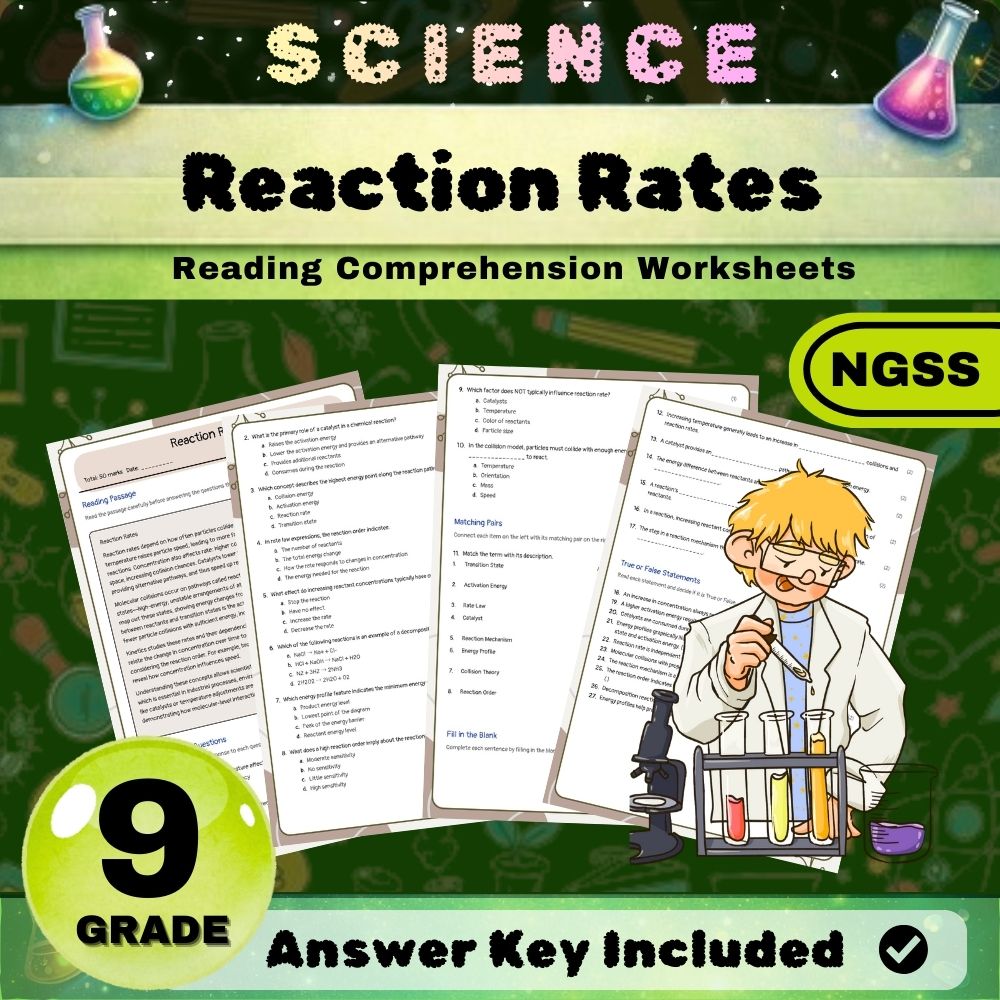
Grade 9 Science | Reaction Rates Worksheet (NGSS) – PDF
Created byMaple Path LearningLearning Objectives
- Explain how collision frequency, activation energy, and reaction pathways influence reaction rates.
- Analyze the effects of temperature, concentration, and catalysts on reaction speed.
- Apply rate laws and reaction order concepts to specific chemical reactions like bromine-iodide kinetics.
Also included in: Grade 9 Science | Matter and Its Interactions NGSS Unit Bundle – Worksheets +1 more
Instant download
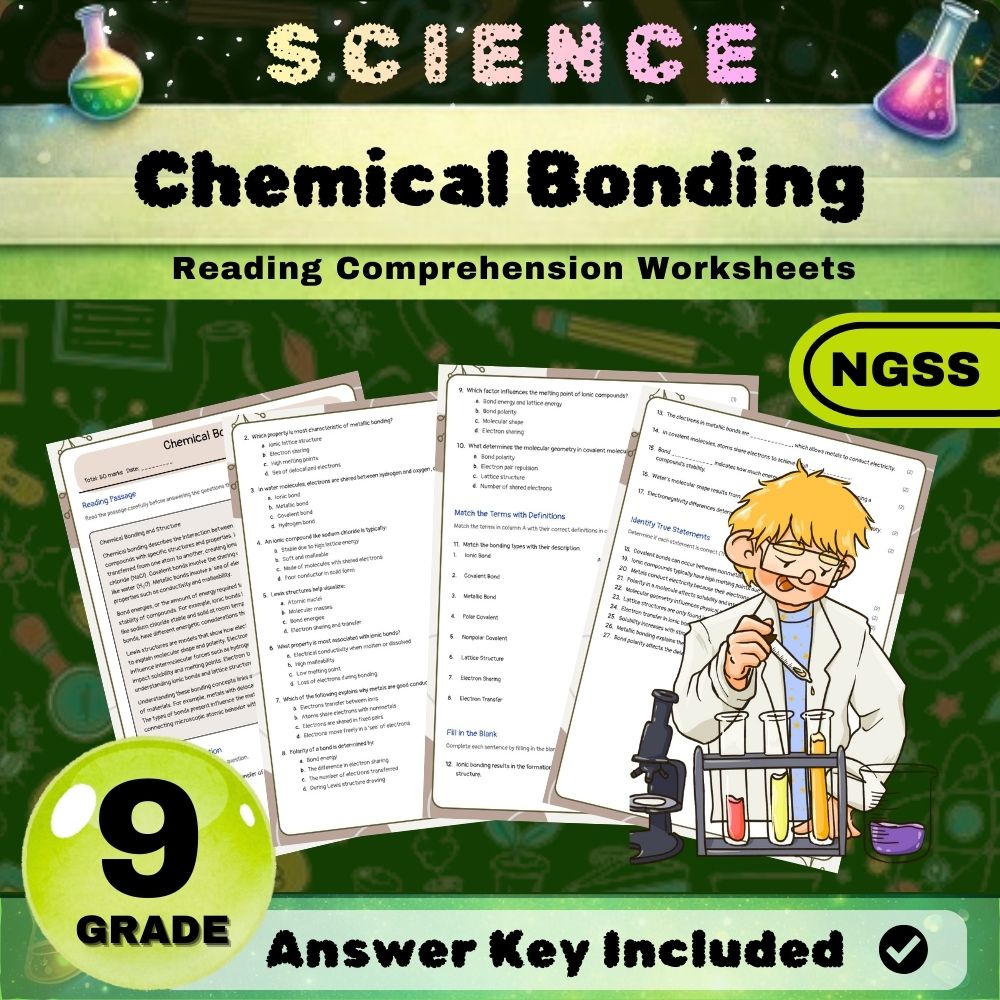
Grade 9 Science | Chemical Bonding Worksheet (NGSS) – PDF
Created byMaple Path LearningLearning Objectives
- Explain the differences between ionic, covalent, and metallic bonds.
- Describe how electron sharing and transfer affect molecular and lattice structures.
- Analyze how bond energies influence the stability of compounds like sodium chloride and water.
Also included in: Grade 9 Science | Matter and Its Interactions NGSS Unit Bundle – Worksheets +1 more
Instant download

Meiosis and Diversity Worksheet Grade 12 NGSSS Science Genetics
Created byEvergreen Desk EducationLearning Objectives
- Explain how meiosis produces gametes with half the chromosome number
- Describe how crossing over and independent assortment create genetic diversity
- Connect meiotic processes to variation in allele combinations and evolutionary outcomes
Instant download

Human Impacts Worksheet for Grade 10 Science | BC Standard-Aligned Practice
JCreated byJ.S SheetsLearning Objectives
- Understand how human activities affect biodiversity and ecosystems.
- Identify major factors such as habitat fragmentation, pollution, and climate change.
- Analyze the interactions between different environmental pressures.
Instant download

Grade 8 Science Worksheet: Rotational Forces | Standards-Aligned Practice
JCreated byJ.S SheetsLearning Objectives
- Define torque (moment of force) and explain how lever arm and force direction affect rotational effect
- Use the condition for rotational equilibrium (net torque = 0) to predict static balance
- Relate net torque to angular acceleration and describe how moment of inertia affects rotational motion
Instant download
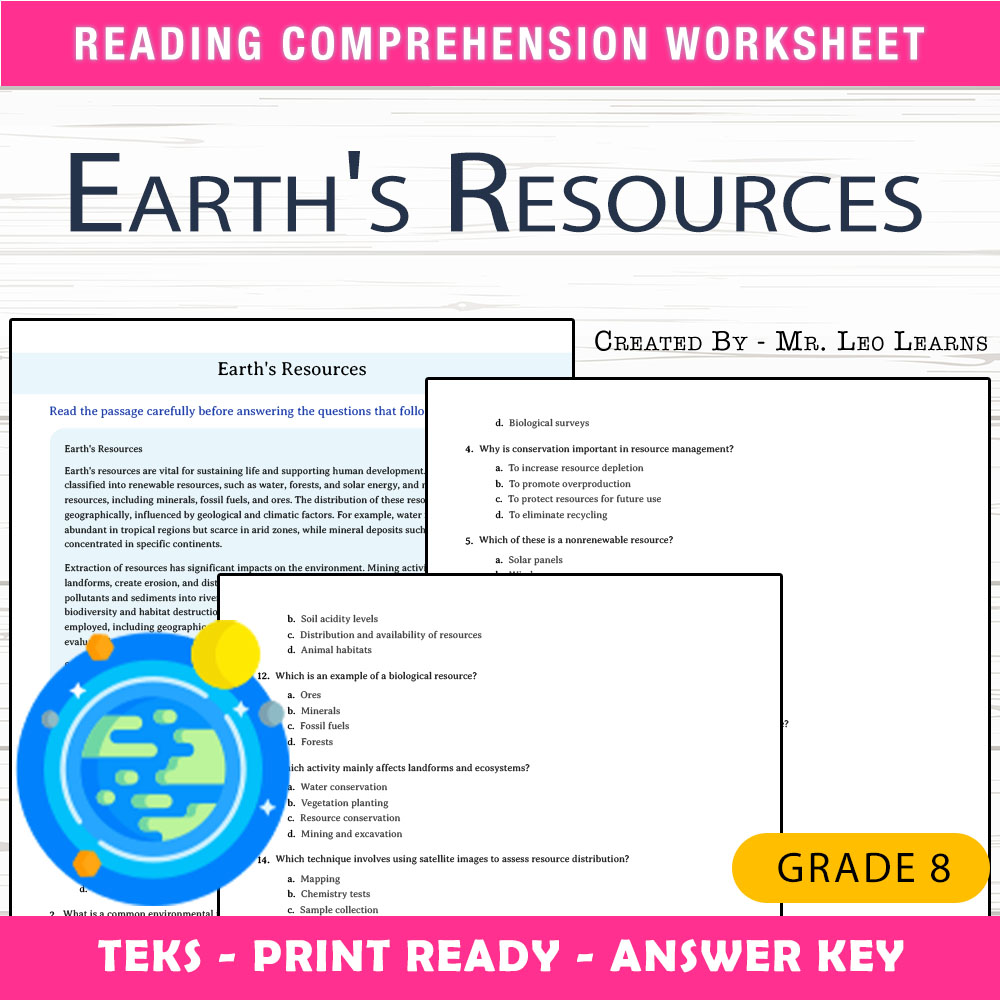
Grade 8 Science — Earth's Resources Worksheet for Mastery
 Created byThe Resource Hub
Learning Objectives
- Understand the distribution and classification of renewable and nonrenewable resources.
- Analyze the environmental impacts of resource extraction on landforms, water quality, and ecosystems.
- Explore assessment methods such as mapping and resource inventories.
Also included in: Grade 8 Science UNIT Bundle – Weather, Solar System & Geological Processes +1 more
Instant download

Testable Claims Assessment | General Standard Grade 8 Science
 Created byPrism Point Learning
Learning Objectives
- Understand what makes a claim testable through evidence-based observations.
- Identify variables and how they influence observable outcomes.
- Construct clear hypotheses that specify relationships between factors.
Also included in: Grade 8 Scientific Inquiry & Practices Science Lesson Bundle: General
Instant download

Evidence Based Explanations Assessment | General Grade 8 Science Standards
Created byPrism Point LearningLearning Objectives
- Understand how evidence supports scientific claims and explanations.
- Differentiate between claims, reasoning, and alternative explanations.
- Evaluate explanations by comparing evidence and considering limits and uncertainties.
Also included in: Grade 8 Scientific Inquiry & Practices Science Lesson Bundle: General
Instant download

Safe Data Collection Assessment | Standards-Aligned Grade 10 Science
Created byPrism Point LearningLearning Objectives
- Understand the importance of safety considerations during data collection in investigations.
- Identify appropriate methods for collecting and recording data safely and accurately.
- Recognize variables, controls, and risks involved in scientific data collection.
Instant download

Grade 9 Science – Simple Machines & Levers | Daily Reading Worksheet
Created byBright Mind ResourcesLearning Objectives
- Understand the basic components of a lever
- Identify levers in everyday objects
- Explain how levers make work easier
Also included in: Grade 9 Simple Machines Science Daily Reading Lesson Bundle | Alberta +1 more
Instant download
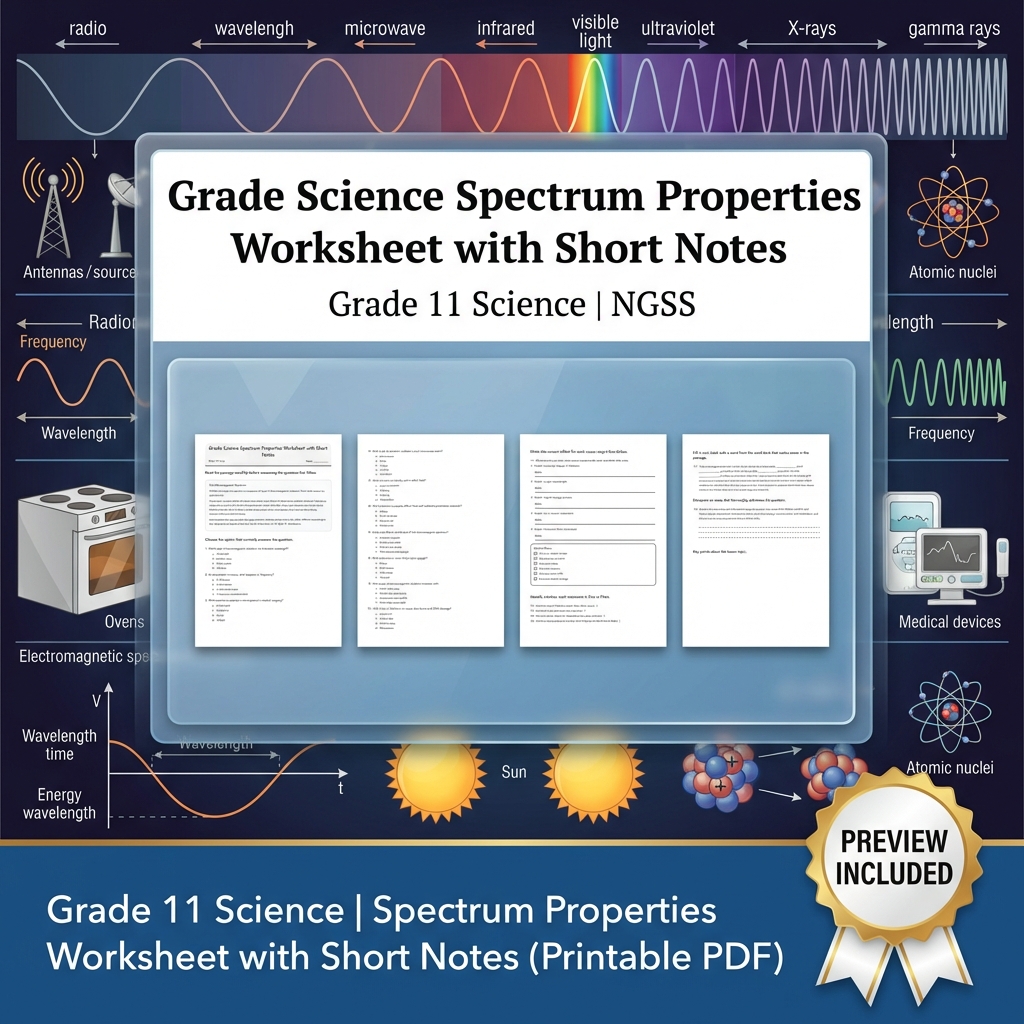
Grade 11 Science | Spectrum Properties Worksheet with Short Notes (PDF)
 Created byMeadowlark Worksheets
Learning Objectives
- Understand the key properties of the electromagnetic spectrum.
- Identify different types of electromagnetic radiation and their uses.
- Explain how wavelength and frequency relate to spectrum properties.
Also included in: Grade 11 Science | Waves and Their Applications in Technologies NGSS Unit Bundle +2 more
Instant download

Wave Reflection Refraction Assessment for Grade 12 Science Standards
Created byPrism Point LearningLearning Objectives
- Explain reflection and refraction using wave behavior at boundaries between media with different properties.
- Apply frequency conservation and predict changes in direction, speed, and wavelength when waves encounter a boundary.
- Use the ideas of refractive index (for light) and impedance/speed mismatch (for reflection) to interpret real-world phenomena.
Instant download

Grade 9 Science | Force and Acceleration Worksheet | BC Standards
Created byLumora LearningLearning Objectives
- Understand the relationship between net force, mass, and acceleration.
- Explain how vector quantities of force and acceleration influence movement.
- Analyze the effect of changing forces and mass on an object's acceleration.
Instant download

Yield and Conditions Assessment | General Standards Ali gned Grade 12 Science
Created byPrism Point LearningLearning Objectives
- Interpret reaction yield as the extent of reactant conversion into products under specific conditions
- Explain how particle-model ideas (collisions, activation energy, depletion) affect reaction rate and final yield
- Evaluate how competing pathways can change product distribution and reduce desired yield
Instant download

Grade 9 Science | Energy Conservation Worksheet | BC Aligned
Created byLumora LearningLearning Objectives
- Understand the principle of conservation of energy in isolated systems.
- Identify how kinetic and potential energy transform during motion.
- Explain the role of nonconservative forces like friction in dissipating mechanical energy.
Instant download

Energy Transformations Assessment | General Standards Grade 12 Science
Created byPrism Point LearningLearning Objectives
- Explain how energy transformation between a system and its surroundings relates to temperature change using conservation of energy
- Differentiate exothermic and endothermic processes in terms of internal energy, particle motion, and energy storage
- Interpret calorimetry-style reasoning by connecting measured temperature change to the direction of heat transfer
Instant download

Grade 9 Science | Net Force Concept Worksheet | BC Aligned
Created byLumora LearningLearning Objectives
- Understand the definition and significance of net force in motion.
- Identify when forces are balanced or unbalanced and predict object motion.
- Learn how to resolve forces into components and add them to determine net force.
Instant download

Phase Change Heat Assessment for Grade 12 Science | Standards-Aligned
Created byPrism Point LearningLearning Objectives
- Explain how heating curves show temperature plateaus during melting and boiling
- Use the particle model to describe energy changes during phase transitions
- Compare solid, liquid, and gas particle interactions as temperature changes
Instant download

Grade 9 Science | Power and Efficiency Worksheet | BC Standards
Created byLumora LearningLearning Objectives
- Describe how power measures the rate of energy transfer in mechanical systems.
- Explain the concept of efficiency and how it relates useful output energy to input energy.
- Identify factors that cause energy loss such as heat, sound, or deformation.
Instant download

Grade 9 Science | Work and Energy Worksheet | BC Standards
Created byLumora LearningLearning Objectives
- Define and describe the concept of work in physics.
- Explain how work relates to energy transfer and energy change in systems.
- Identify scenarios where work is positive, negative, or zero.
Instant download
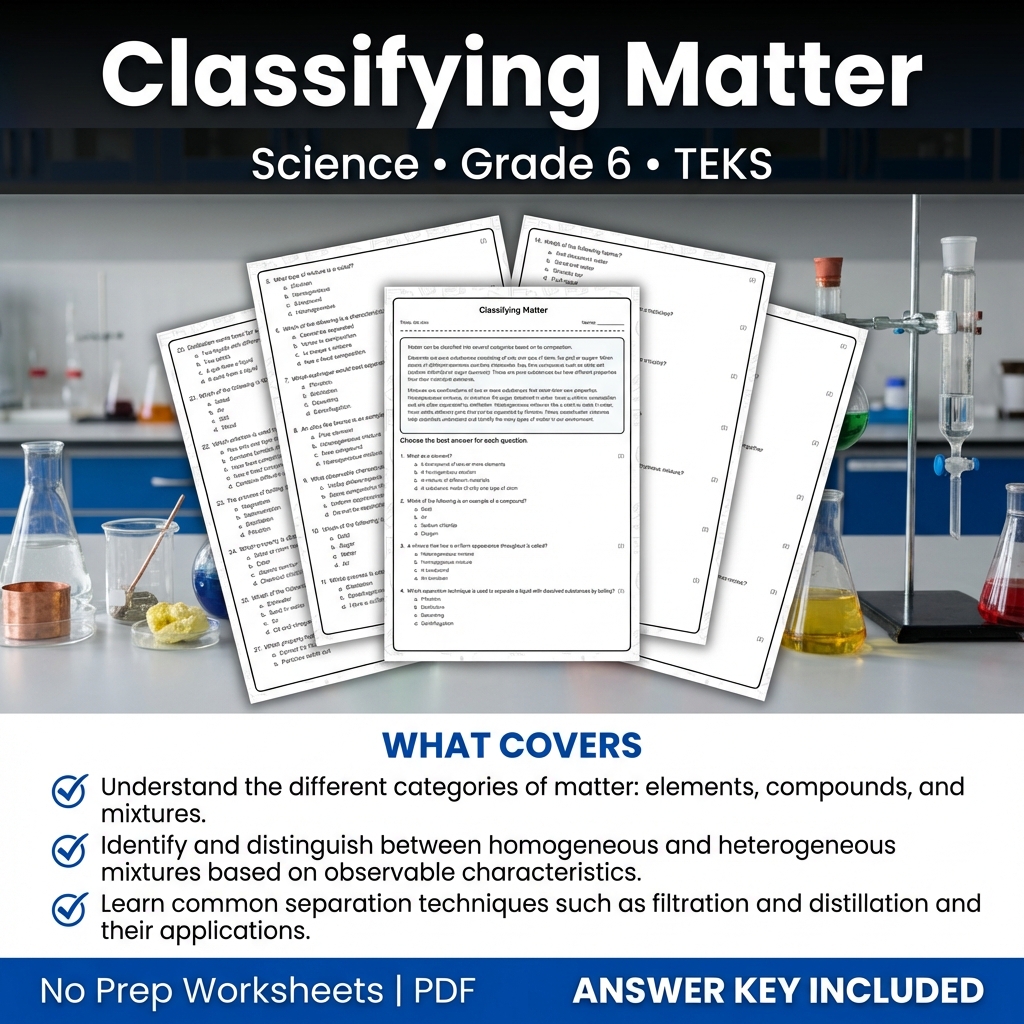
Classifying Matter Worksheet | TEKS Grade 6 Science Practice
Created byCoral Reef LearningLearning Objectives
- Understand the different categories of matter: elements, compounds, and mixtures.
- Identify and distinguish between homogeneous and heterogeneous mixtures based on observable characteristics.
- Learn common separation techniques such as filtration and distillation and their applications.
Instant download

Grade 7 Science Worksheets – Invasive Species Impacts (PDF)
Created byEvergreen Desk EducationLearning Objectives
- Explain how invasive, non-native species can harm ecosystems through competition, changed food webs, and habitat structure.
- Describe common pathways by which non-native species are introduced and identify factors that help them become established.
- Evaluate how invasive species can create economic costs and increased long-term management needs.
Also included in: Grade 7 Ecosystem Dynamics Science Lesson Bundle (Ontario) Worksheets +1 more
Instant download
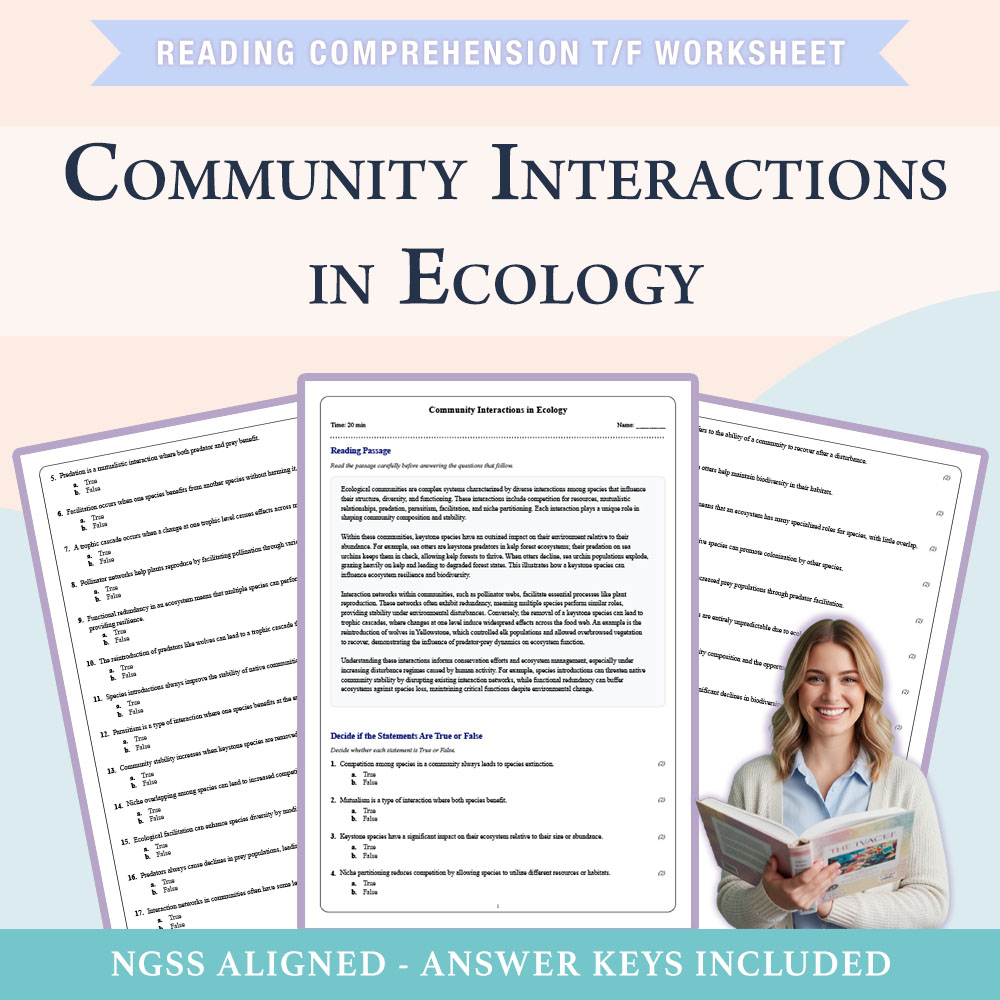
11th Grade Science | Community Interactions in Ecology Worksheet (PDF + Answers)
 Created byCopper Leaf Classroom
Learning Objectives
- Understand different types of species interactions within ecological communities.
- Evaluate statements about community dynamics as true or false.
- Analyze examples of mutualism, predation, and keystone species effects.
Instant download
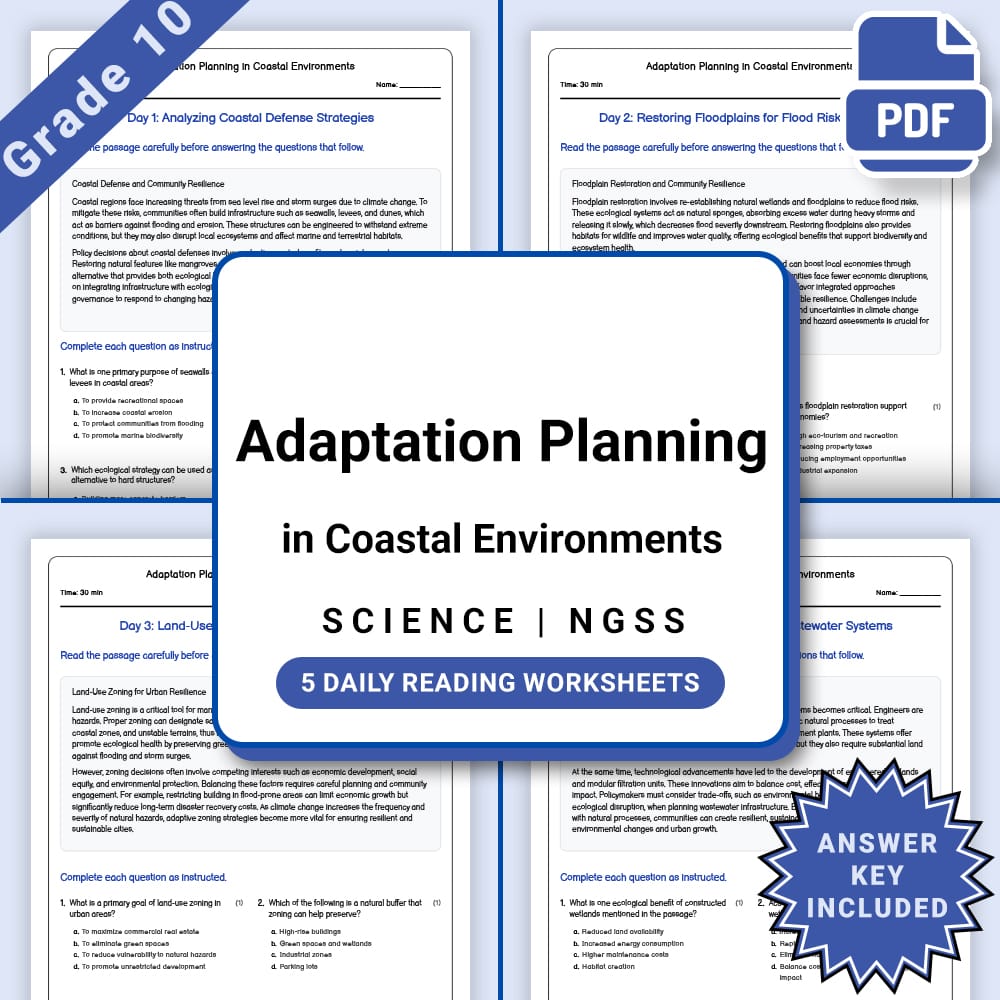
Grade 10 Science – Adaptation Planning in Coastal Environments(PDF + Answers)
Created byCopper Leaf ClassroomLearning Objectives
- Understand the concept of infrastructural adaptation for coastal protection.
- Evaluate different strategies such as seawalls, floodplain restoration, and land-use zoning.
- Analyze the ecological, social, and economic trade-offs involved in adaptation measures.
Instant download
Grade 8 Science – Adaptation Mechanisms Worksheet for Mastery | PDF + Answer Key
Created byThe Resource HubLearning Objectives
- Identify different types of adaptation—structural, behavioral, and physiological—in various organisms.
- Explain the role of adaptation in survival and reproduction within diverse environments.
- Describe how natural selection influences trait variation and adaptive features across generations.
Also included in: Grade 8 Science Unit | Ecosystems, Evolution & Cell Processes Worksheet Pack +1 more
Instant download

Grade 11 Science Worksheet on Stoichiometric Calculations | Ontario
Created byCoral Reef LearningLearning Objectives
- Understand and apply molar mass conversions and Avogadro's number to relate mass, moles, and particle count.
- Perform limiting reagent analysis and determine theoretical and percent yields in chemical reactions.
- Derive empirical and molecular formulas from percent composition data and predict product quantities based on reactant amounts.
Instant download
9th Grade Science | Speciation Introduction Worksheet with Short Notes (PDF)
Created byMeadowlark WorksheetsLearning Objectives
- Define the process of speciation and its significance in biodiversity.
- Differentiate between allopatric and sympatric speciation.
- Identify reproductive barriers and their roles in speciation.
Instant download
Browse more categories
About Science Worksheets
Find Science worksheets spanning core skills, practice, and review. All 44,628 resources are instant PDF downloads for the classroom or home.
Every worksheet on MyTeachingSheets is created by independent teacher-authors and reviewed before publication. All resources download as printable PDFs for classroom, homework, or at-home practice, and many include answer keys. Preview any worksheet free before buying.