
Science Worksheets
44,573 subject resources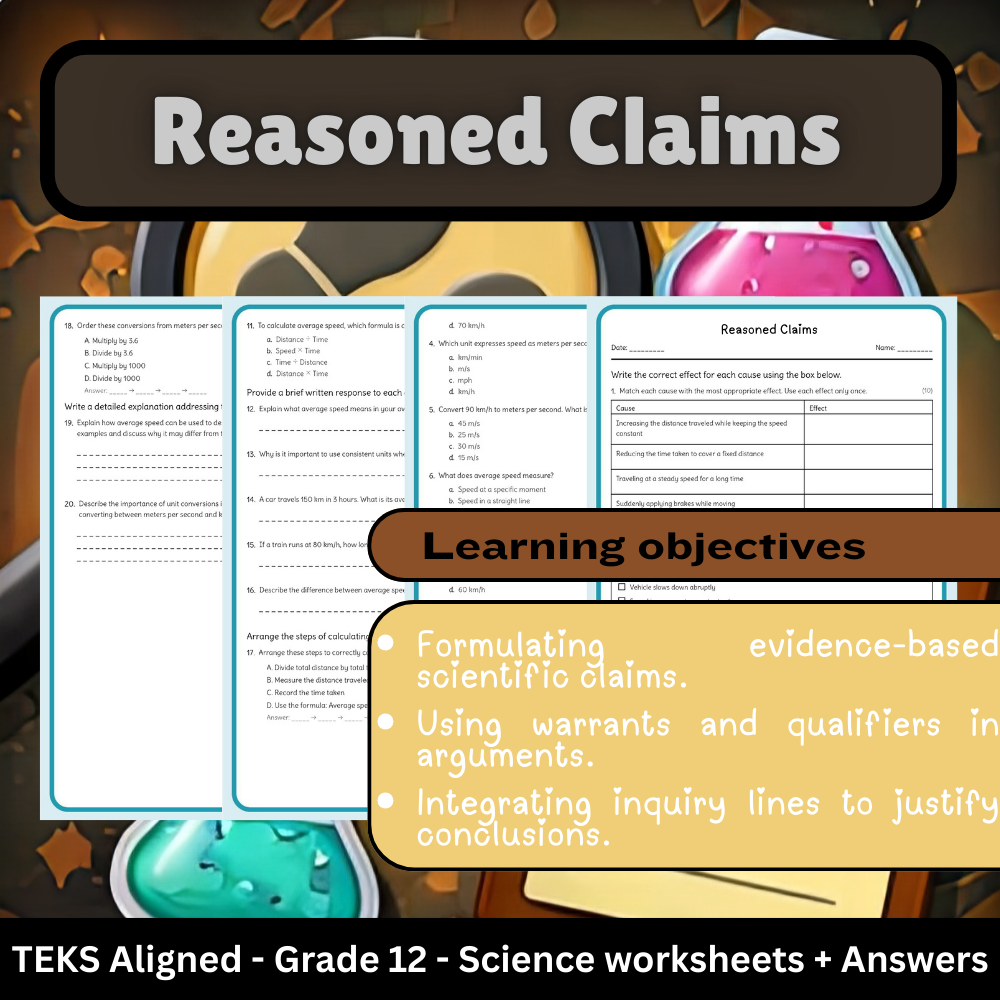
Grade 12 Science | Reasoned Claims Worksheet – TEKS-Aligned Practice (PDF)
 Created byBright Mind Resources
Learning Objectives
- Understand how to formulate and evaluate scientific claims grounded in evidence.
- Use warrants and qualifiers to strengthen scientific arguments.
- Integrate multiple lines of inquiry to support and justify conclusions.
Instant download
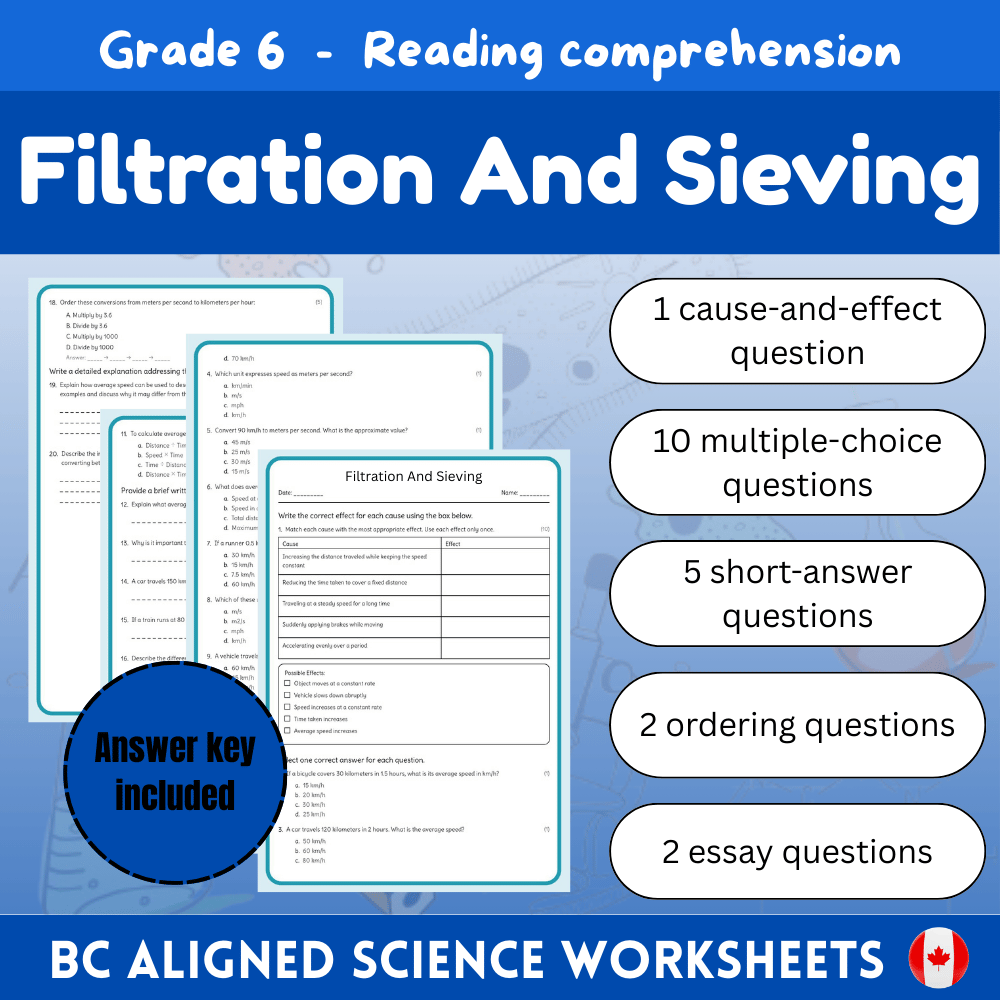
6th Grade Science | Filtration & Sieving Techniques Worksheet (PDF)
Created byBright Mind ResourcesLearning Objectives
- Understand the differences between filtration and sieving as methods of separating mixtures.
- Identify examples of mixtures suitable for filtration and sieving.
- Explain how particle size and phase difference influence the separation process.
Instant download
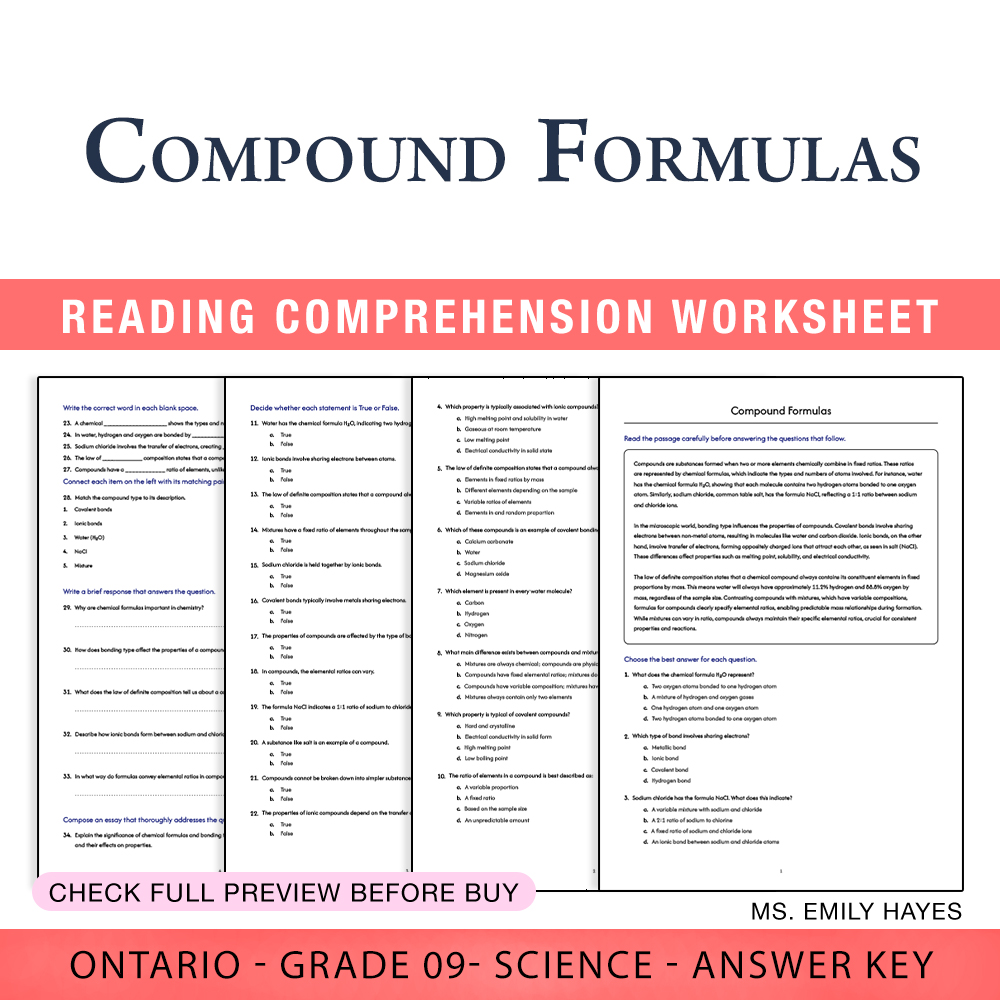
9th Grade Science | Compound Formulas Worksheet (PDF + Answer Key)
 Created byCopper Leaf Classroom
Learning Objectives
- Understand what compounds are and how they are composed of fixed ratios of elements.
- Learn to interpret and write chemical formulas for common compounds.
- Distinguish between covalent and ionic bonds and their effects on properties.
Instant download
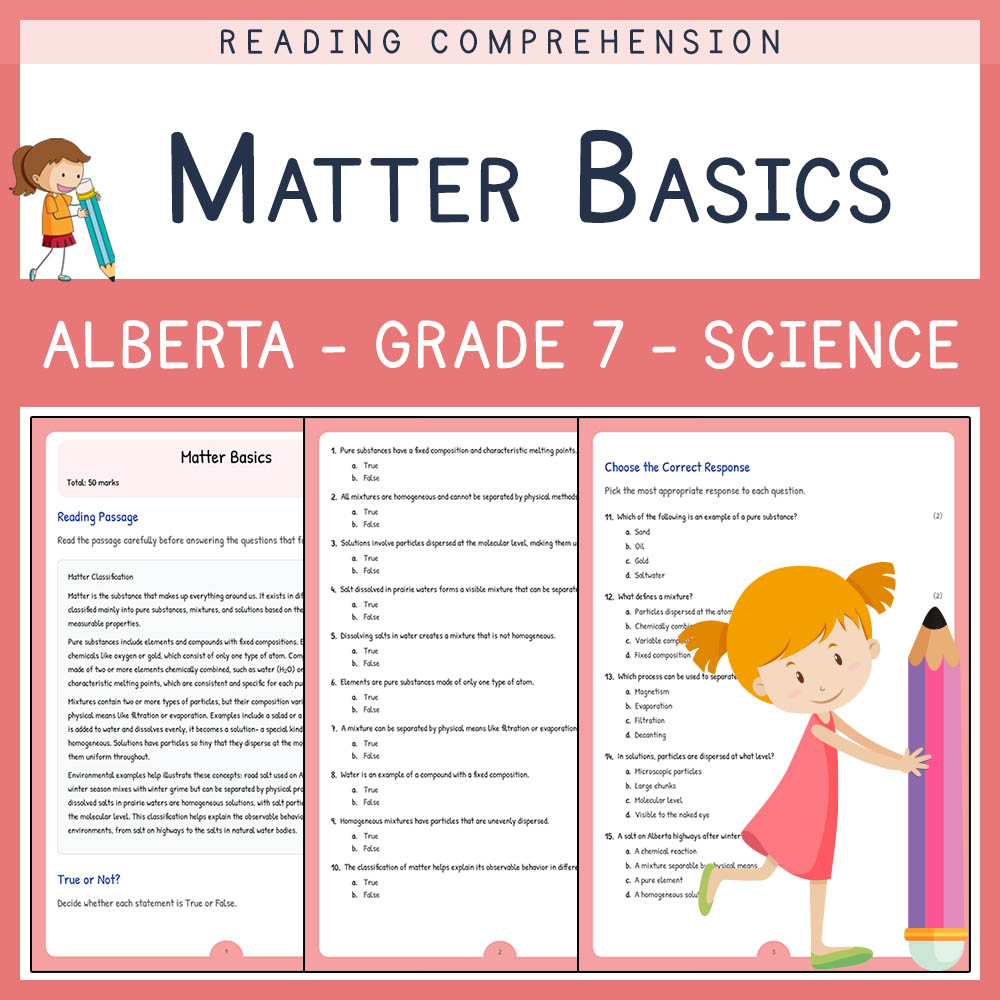
Grade 7 Science | Matter Basics Worksheet | Alberta Standards
 Created byLumora Learning
Learning Objectives
- Understand the classification of matter into pure substances, mixtures, and solutions.
- Identify properties that distinguish pure substances from mixtures.
- Describe how solutions are homogeneous and the particles disperse at a molecular level.
Instant download

Physiological Systems Worksheet for Grade 10 Science | NGSS Assessment
Learning Objectives
- Compare how the circulatory, respiratory, digestive, excretory, and integumentary systems support internal transport and homeostasis
- Explain how structure (e.g., vascular networks, alveoli, nephrons, epithelial barriers) supports function (e.g., diffusion, filtration, reabsorption, waste removal)
- Describe how flow rates, surface area-to-volume ratios, and transport kinetics affect the movement of gases, nutrients, and wastes
Also included in: From Molecules to Organisms Lesson Bundle | Grade 10 Science | NGSS
Instant download

Molecular Coding Worksheet | Assessment Grade 10 NGSS Science printable PDF
Learning Objectives
- Explain how DNA nucleotide order determines mRNA codons and the resulting amino-acid sequence of a protein.
- Describe how codon usage, translation timing, protein folding, and post-translational modification contribute to protein function.
- Analyze how mutations (point mutations and frameshifts) can change proteins and affect organismal traits, using sickle-cell hemoglobin as an example.
Also included in: From Molecules to Organisms Lesson Bundle | Grade 10 Science | NGSS
Instant download

Signal Integration Worksheet | NGSS Grade 10 Science printable PDF
Learning Objectives
- Explain how receptor specificity enables cells to respond to particular hormones or neurotransmitters.
- Describe signal transduction cascades, including second messengers and amplification, that link stimuli to cellular responses.
- Compare how nervous and endocrine signaling contribute to rapid versus sustained physiological changes.
Also included in: From Molecules to Organisms Lesson Bundle | Grade 10 Science | NGSS
Instant download
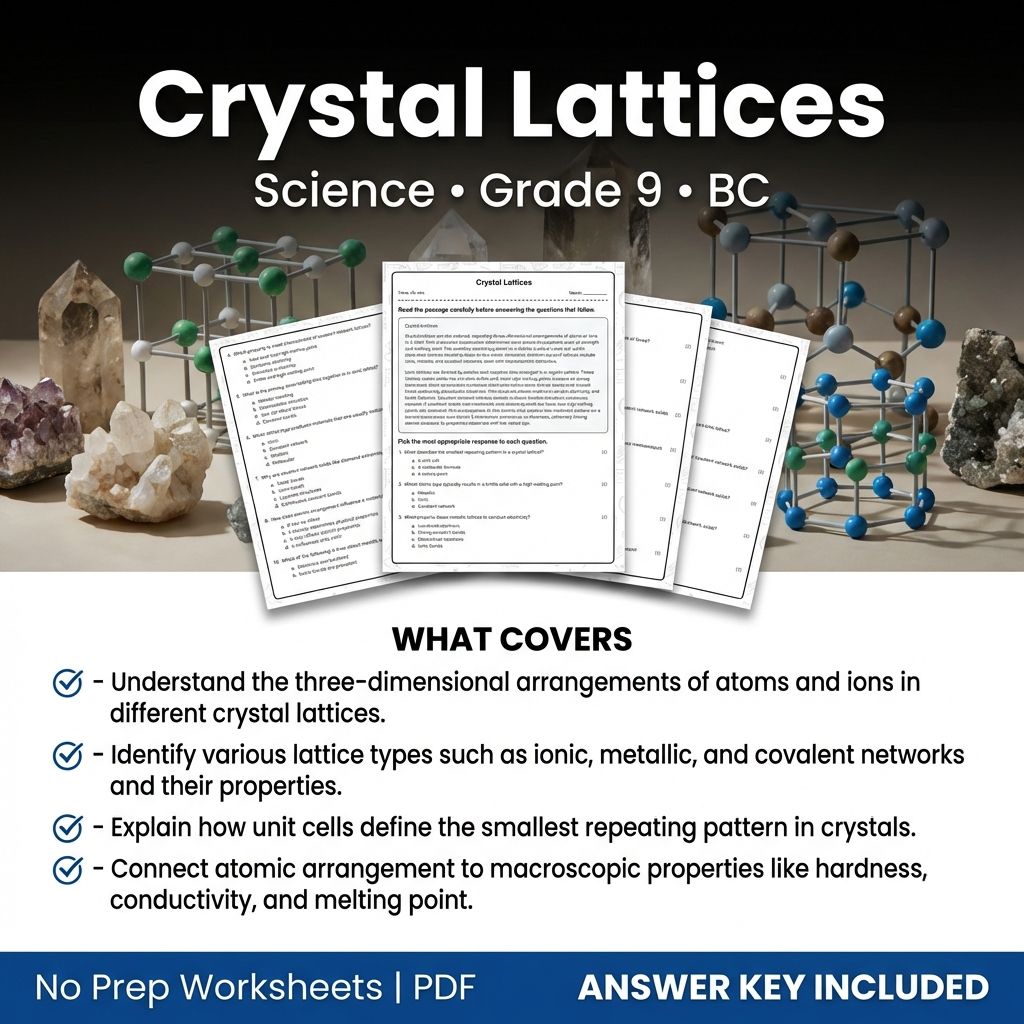
9th Grade Science | Crystal Lattices Worksheet & Answer Key (Printable PDF)
 Created byCoral Reef Learning
Learning Objectives
- Understand the three-dimensional arrangements of atoms and ions in different crystal lattices.
- Identify various lattice types such as ionic, metallic, and covalent networks and their properties.
- Explain how unit cells define the smallest repeating pattern in crystals.
Instant download
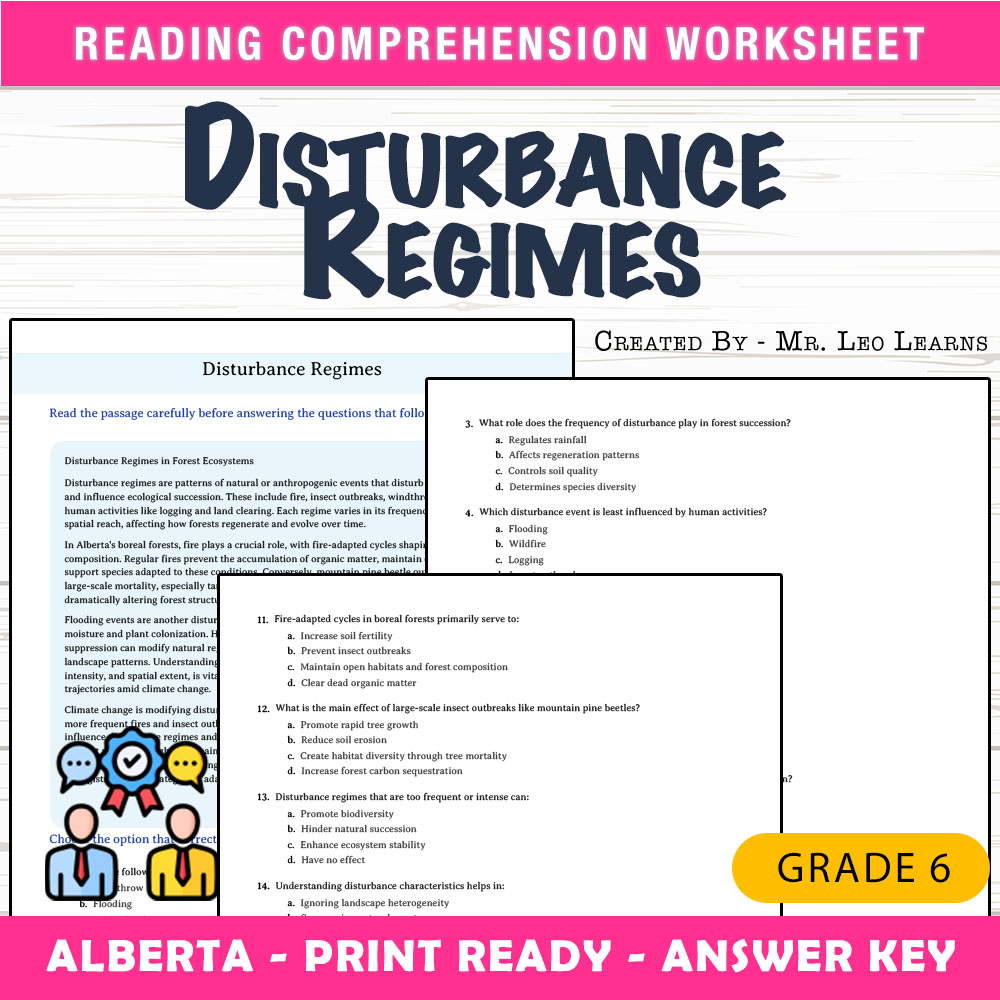
Grade 6 Science — Disturbance Regimes Worksheet MCQ Paper for Mastery
 Created byThe Resource Hub
Learning Objectives
- Understand different types of disturbance regimes and their characteristics in forest ecosystems.
- Identify how disturbance frequency, intensity, and spatial extent influence forest succession and habitat diversity.
- Describe specific disturbance events such as fires and insect outbreaks in Alberta boreal forests.
Also included in: Grade 6 Science | Trees and Forests Unit Bundle for Alberta (Worksheet Pack) +1 more
Instant download
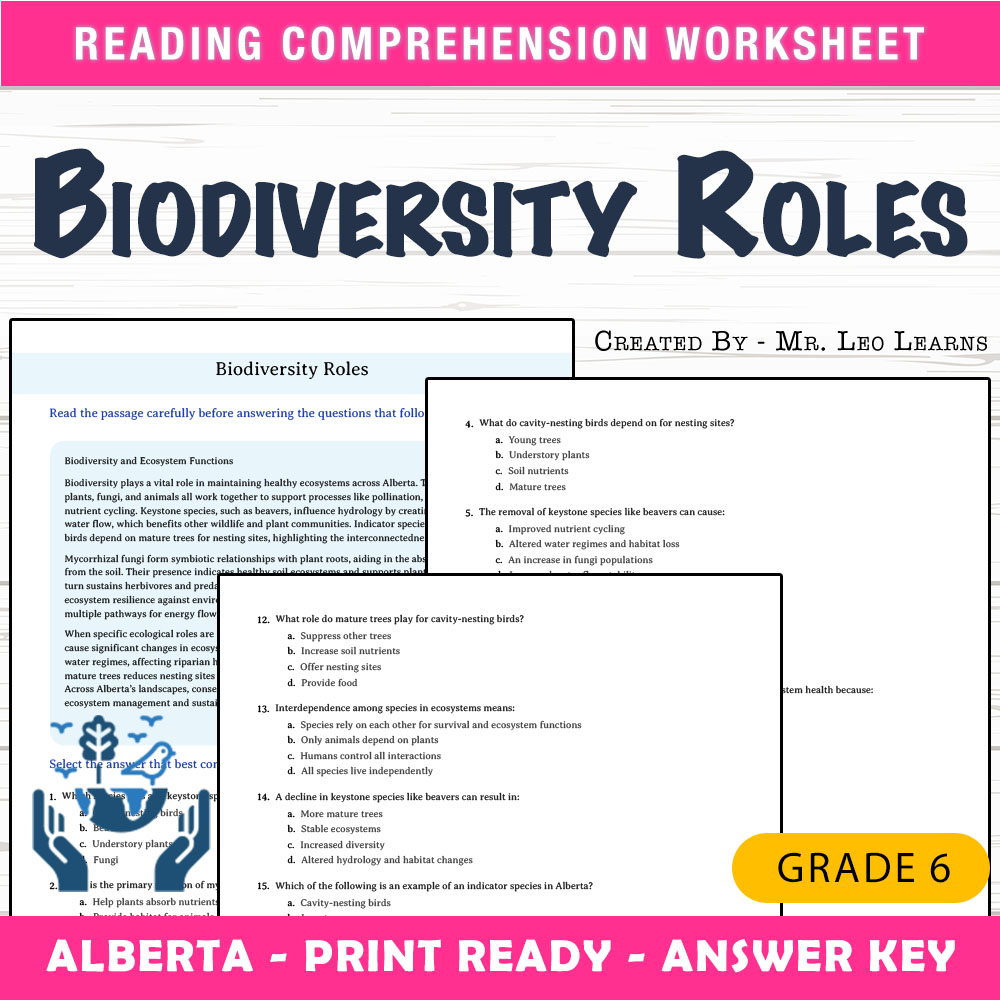
Grade 6 Science — Biodiversity Roles Worksheet MCQ Paper
Created byThe Resource HubLearning Objectives
- Understand the interactions among trees, plants, fungi, and animals in ecosystems.
- Identify key species such as keystone and indicator species in Alberta.
- Explain how species diversity contributes to ecosystem resilience.
Also included in: Grade 6 Science | Trees and Forests Unit Bundle for Alberta (Worksheet Pack) +1 more
Instant download
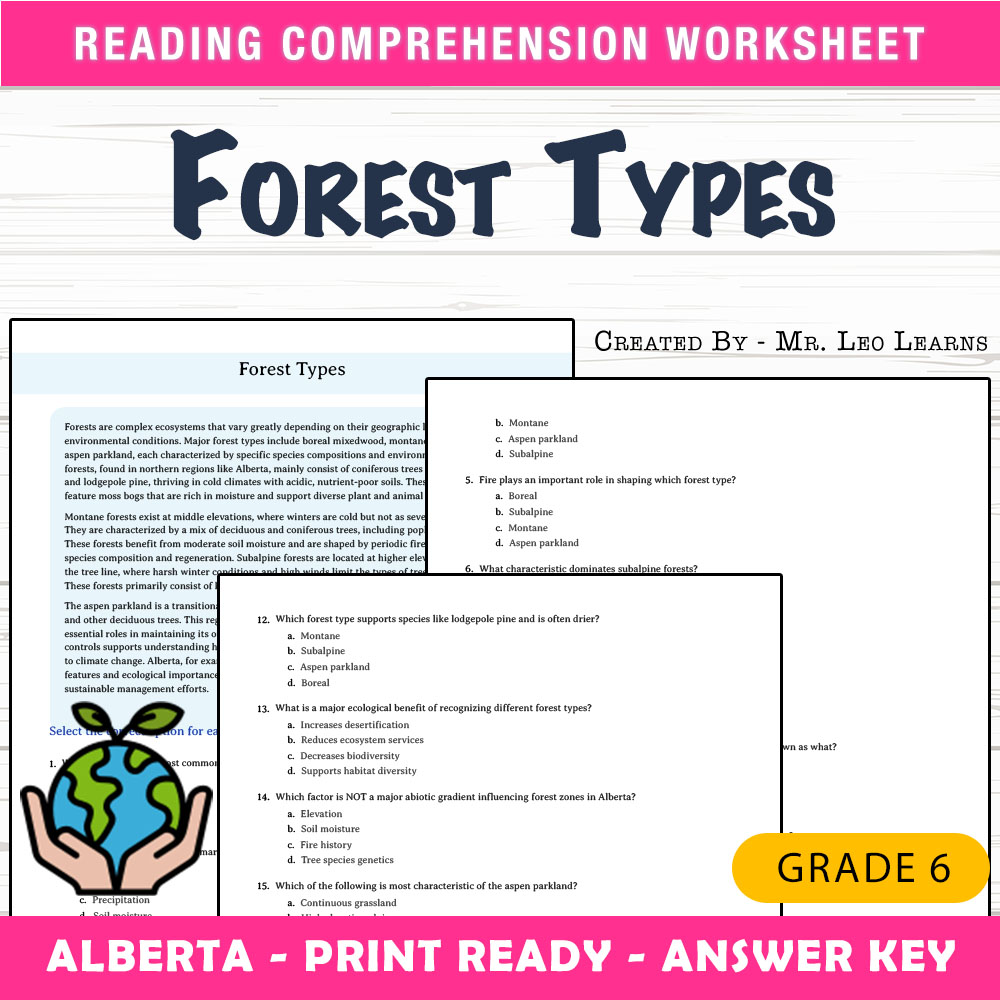
Grade 6 Science — Forest Types Worksheet for Mastery
Created byThe Resource HubLearning Objectives
- Identify different major regional forest types and their characteristic species.
- Understand how environmental factors influence forest distribution and boundaries.
- Recognize examples of forest types found in Alberta.
Also included in: Grade 6 Science | Trees and Forests Unit Bundle for Alberta (Worksheet Pack) +1 more
Instant download
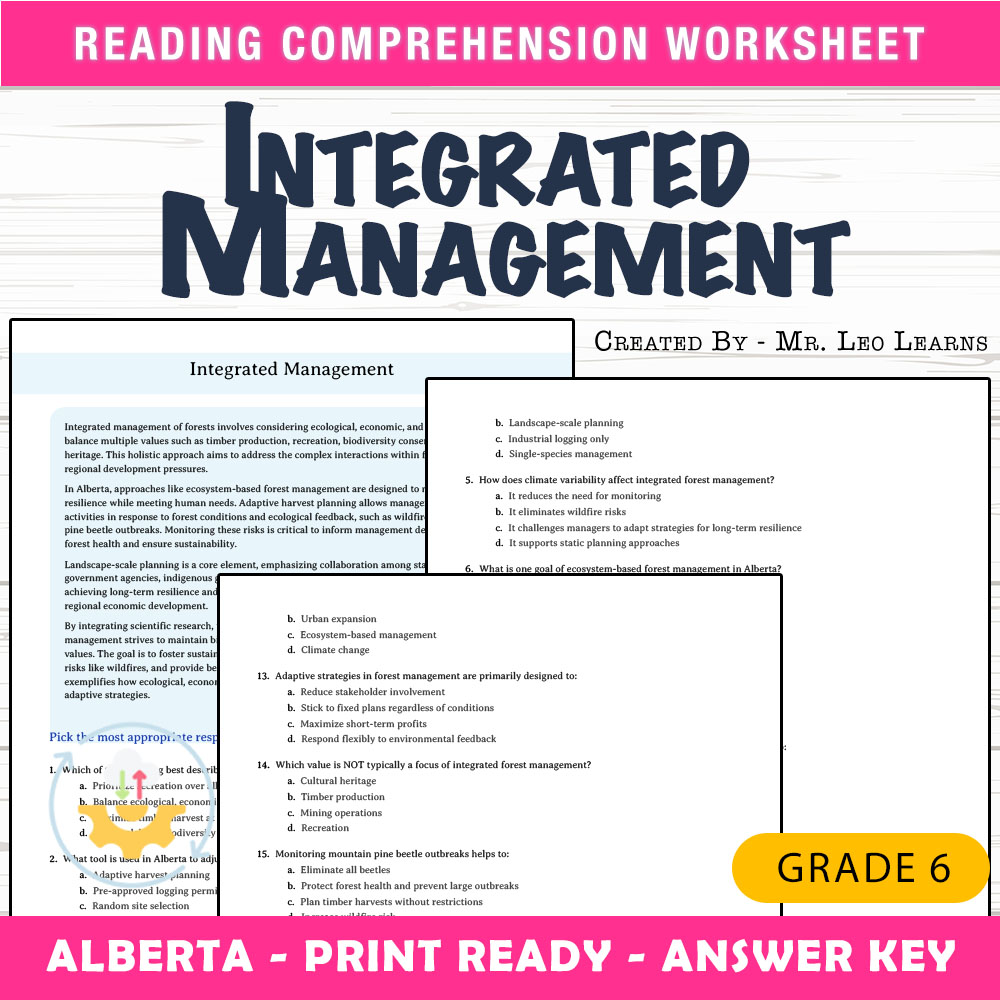
Grade 6 Science — Worksheet MCQ Paper for Mastering Integrated Management
Created byThe Resource HubLearning Objectives
- Understand the key concepts of integrated management in forest ecosystems.
- Identify approaches used in Alberta for sustainable forest management.
- Recognize the importance of ecological, economic, and social objectives.
Also included in: Grade 6 Science | Trees and Forests Unit Bundle for Alberta (Worksheet Pack) +1 more
Instant download
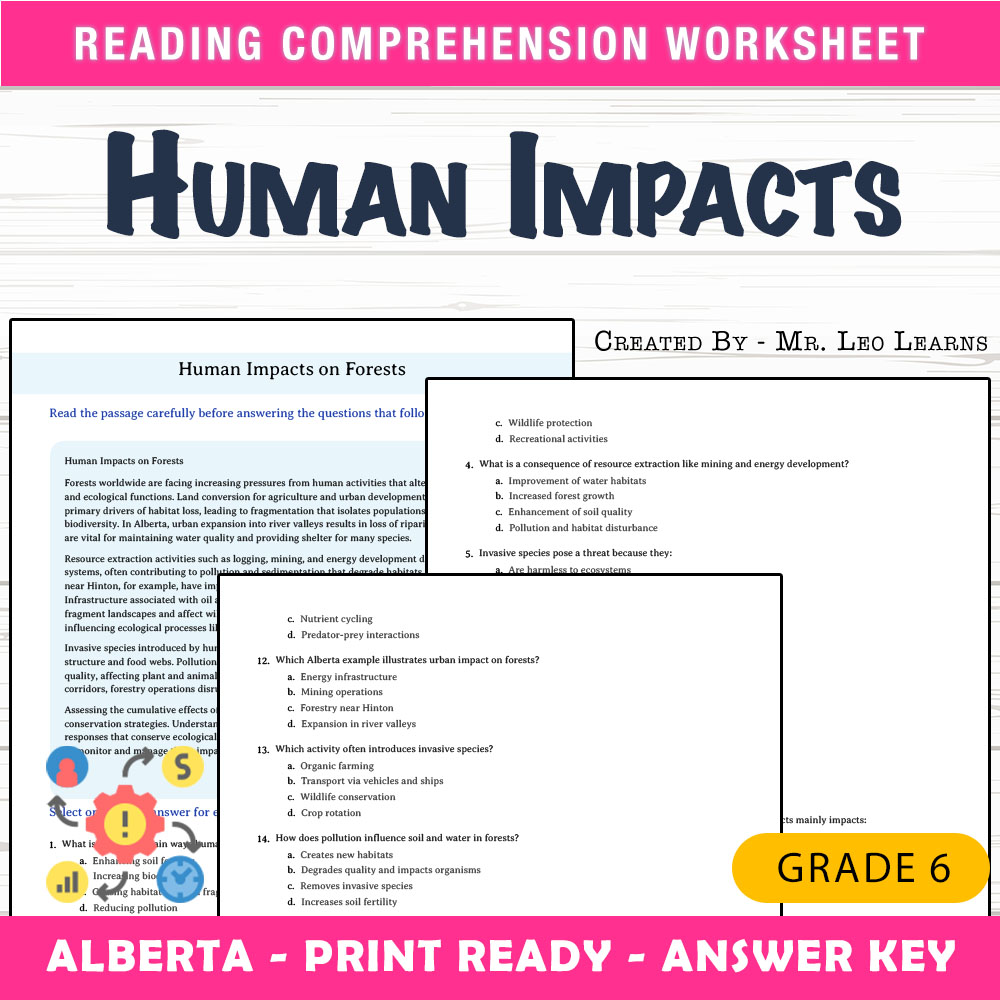
Grade 6 Science — Human Impacts on Forests Worksheet MCQ Paper
Created byThe Resource HubLearning Objectives
- Identify various human activities that affect forest ecosystems.
- Understand the consequences of habitat fragmentation and pollution.
- Recognize examples of human impacts in Alberta and their ecological effects.
Also included in: Grade 6 Science | Trees and Forests Unit Bundle for Alberta (Worksheet Pack) +1 more
Instant download
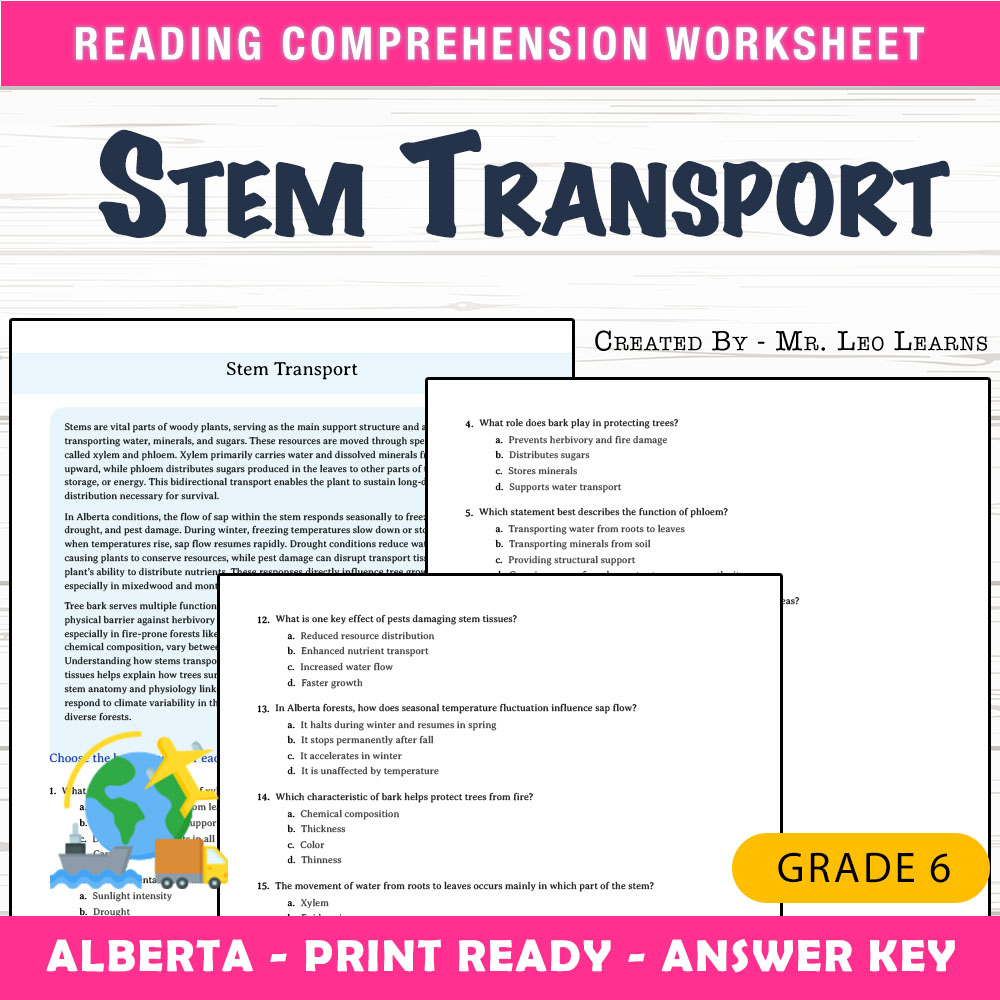
Grade 6 Science — Stem Transport Worksheet for Mastery
Created byThe Resource HubLearning Objectives
- Understand how water, minerals, and sugars are transported within a plant stem via xylem and phloem.
- Explain how stem characteristics contribute to protection and resource allocation in trees.
- Connect stem transport mechanisms to how trees respond to environmental factors like climate, pests, and fire.
Also included in: Grade 6 Science | Trees and Forests Unit Bundle for Alberta (Worksheet Pack) +1 more
Instant download
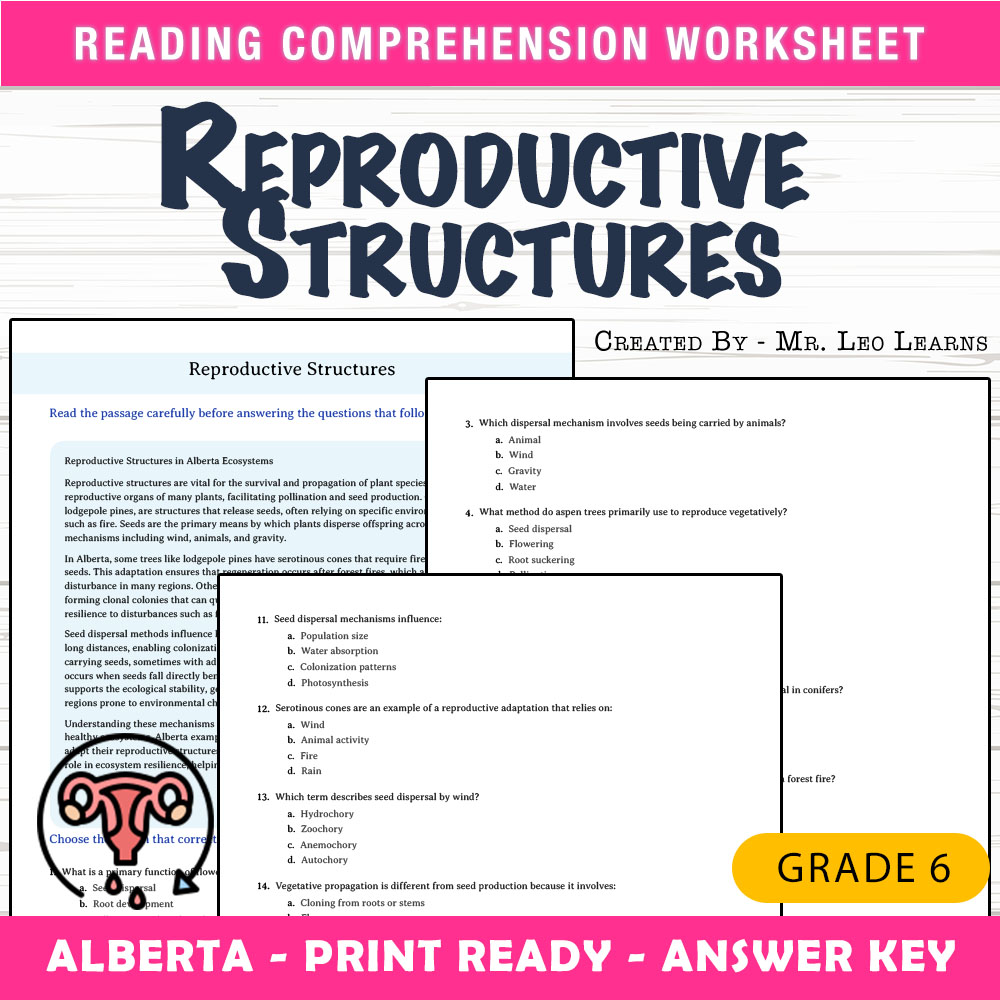
Grade 6 Science — Reproductive Structures Worksheet MCQ Paper
Created byThe Resource HubLearning Objectives
- Understand the different reproductive structures such as flowers, cones, and seeds.
- Identify examples of reproductive strategies like seed dispersal and vegetative propagation.
- Explain how reproductive diversity affects population dynamics and ecosystem resilience.
Also included in: Grade 6 Science | Trees and Forests Unit Bundle for Alberta (Worksheet Pack) +1 more
Instant download
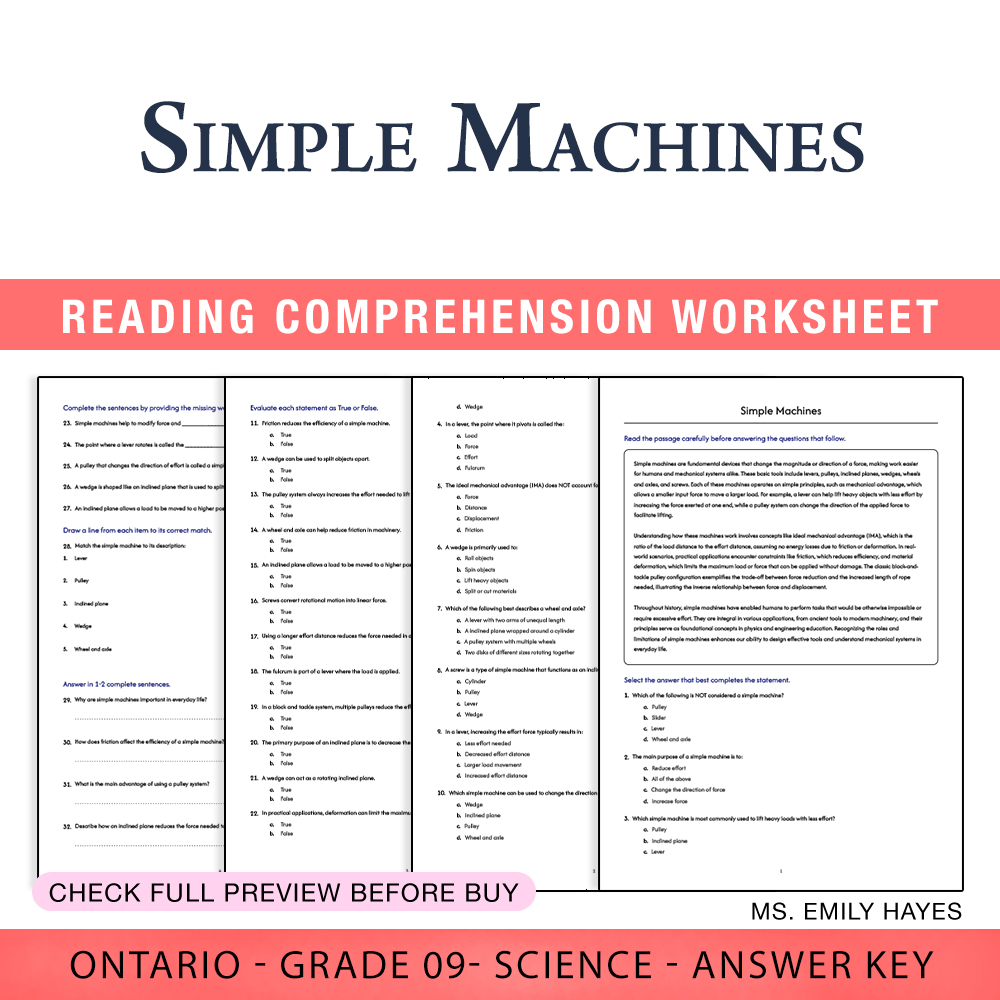
9th Grade Science | Simple Machines Worksheet (PDF + Answer Key)
Created byCopper Leaf ClassroomLearning Objectives
- Understand the basic types of simple machines and their functions.
- Explain how simple machines modify force and displacement to achieve mechanical advantage.
- Identify different classes of levers, pulley systems, inclined planes, wedges, wheels and axles, and screws.
Instant download

Fossil Patterns Practice Worksheet | Grade 7 Science NGSS Review
 Created byPrism Point Learning
Learning Objectives
- Analyze patterns in the fossil record to make inferences about ancestry and macroevolution over geologic time.
- Explain how stratigraphic sequences, index fossils, and transitional forms provide evidence for evolutionary change.
- Describe how mass extinctions and radiations can be recognized in fossil assemblages and sedimentary layers.
Also included in: Grade 7 Evolution, Natural Selection Science Lesson Bundle for NGSS
Instant download

Quantitative Models Assessment | Grade 7 Science NGSS Practice Worksheet
Created byPrism Point LearningLearning Objectives
- Use quantitative models to describe how allele frequencies change over time under selection and drift.
- Interpret statistical and graphical information (fitness differentials, probability-based inheritance) to explain evolutionary outcomes.
- Apply Hardy–Weinberg ideas and calculate/compare frequencies to support hypotheses about trait change.
Also included in: Grade 7 Evolution, Natural Selection Science Lesson Bundle for NGSS
Instant download
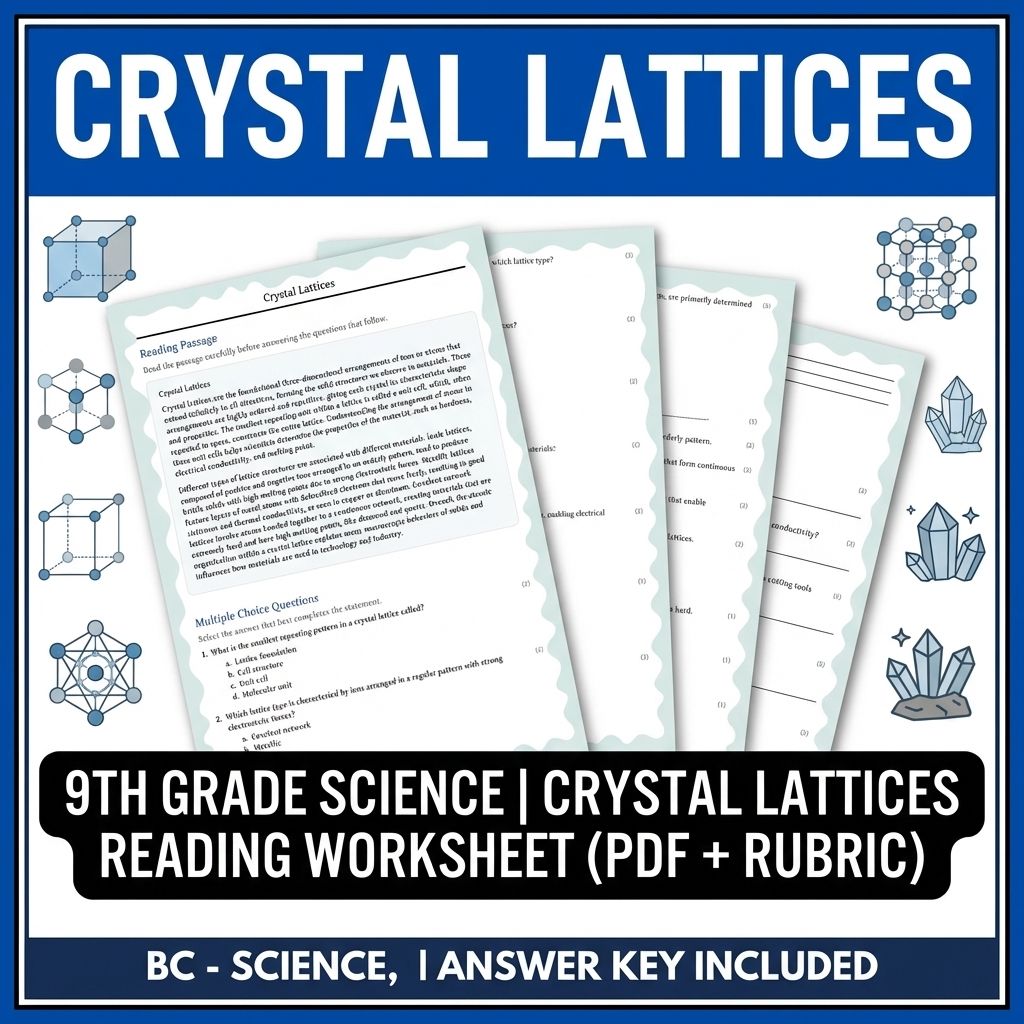
9th Grade Science | Crystal Lattices Reading Worksheet (PDF + Rubric)
JCreated byJ.S SheetsLearning Objectives
- Describe the structure and arrangement of atoms or ions in different crystal lattices.
- Explain how unit cells define the smallest repeating pattern in solids.
- Identify lattice types such as ionic, metallic, and covalent networks and their properties.
Instant download
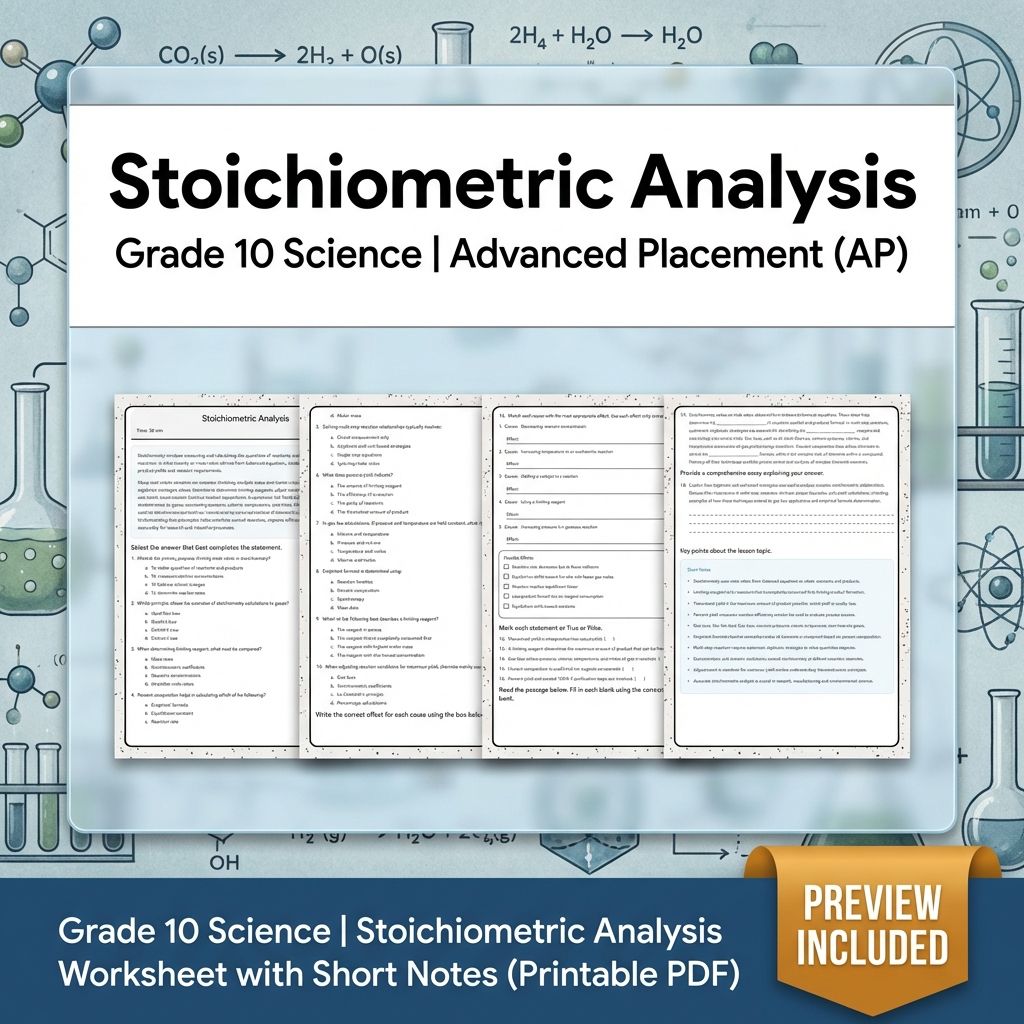
Grade 10 Science | Stoichiometric Analysis Worksheet with Short Notes (PDF)
 Created byMeadowlark Worksheets
Learning Objectives
- Apply algebraic methods and unit conversions to solve complex stoichiometric problems.
- Identify limiting reagents and calculate theoretical and actual yields.
- Utilize gas law principles and concentration concepts in chemical calculations.
Also included in: Grade 10 Science | Comprehensive Unit Bundle on Atomic Structure
Instant download
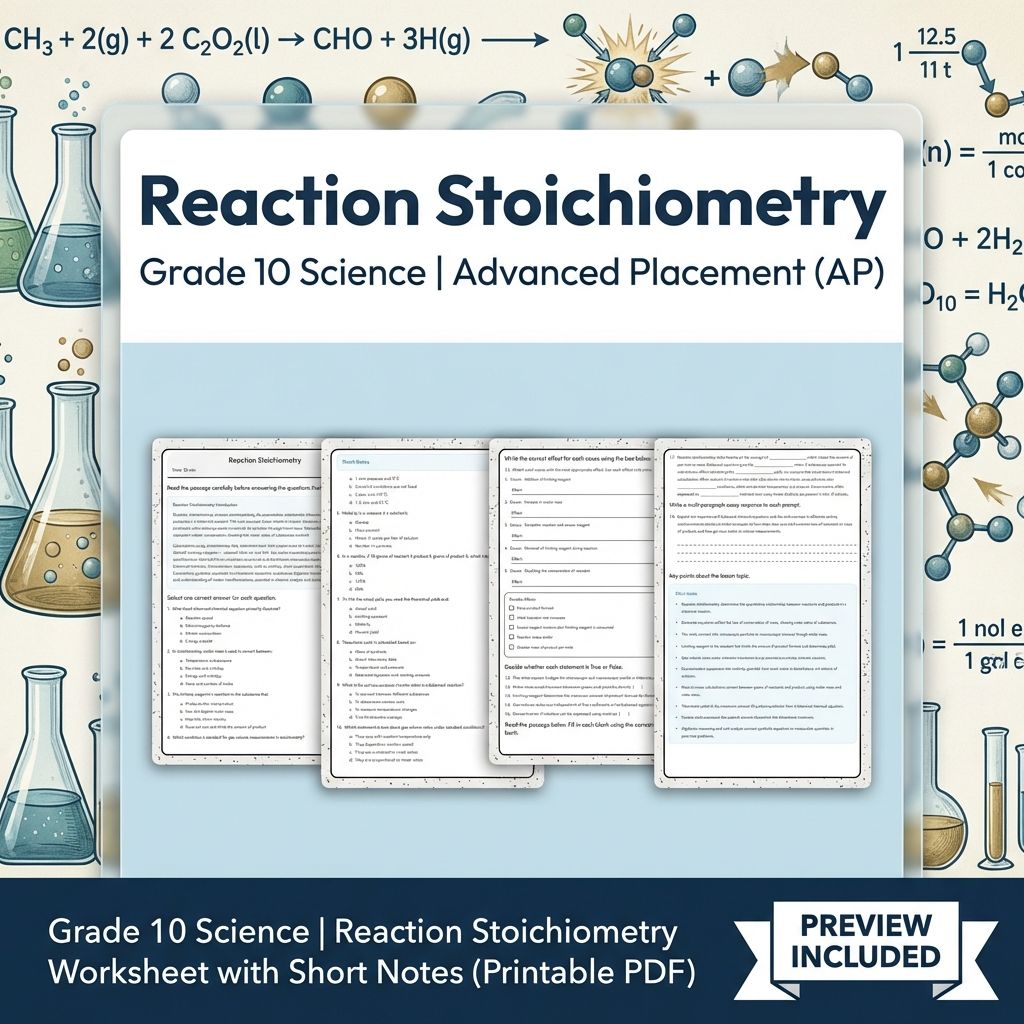
Grade 10 Science | Reaction Stoichiometry Worksheet with Short Notes (PDF)
Created byMeadowlark WorksheetsLearning Objectives
- Understand and interpret chemical reactions through mole ratios and balanced equations.
- Perform mass-to-mass conversion calculations using molar masses and mole ratios.
- Identify limiting reagents and calculate theoretical yields in chemical reactions.
Also included in: Grade 10 Science | Comprehensive Unit Bundle on Atomic Structure
Instant download
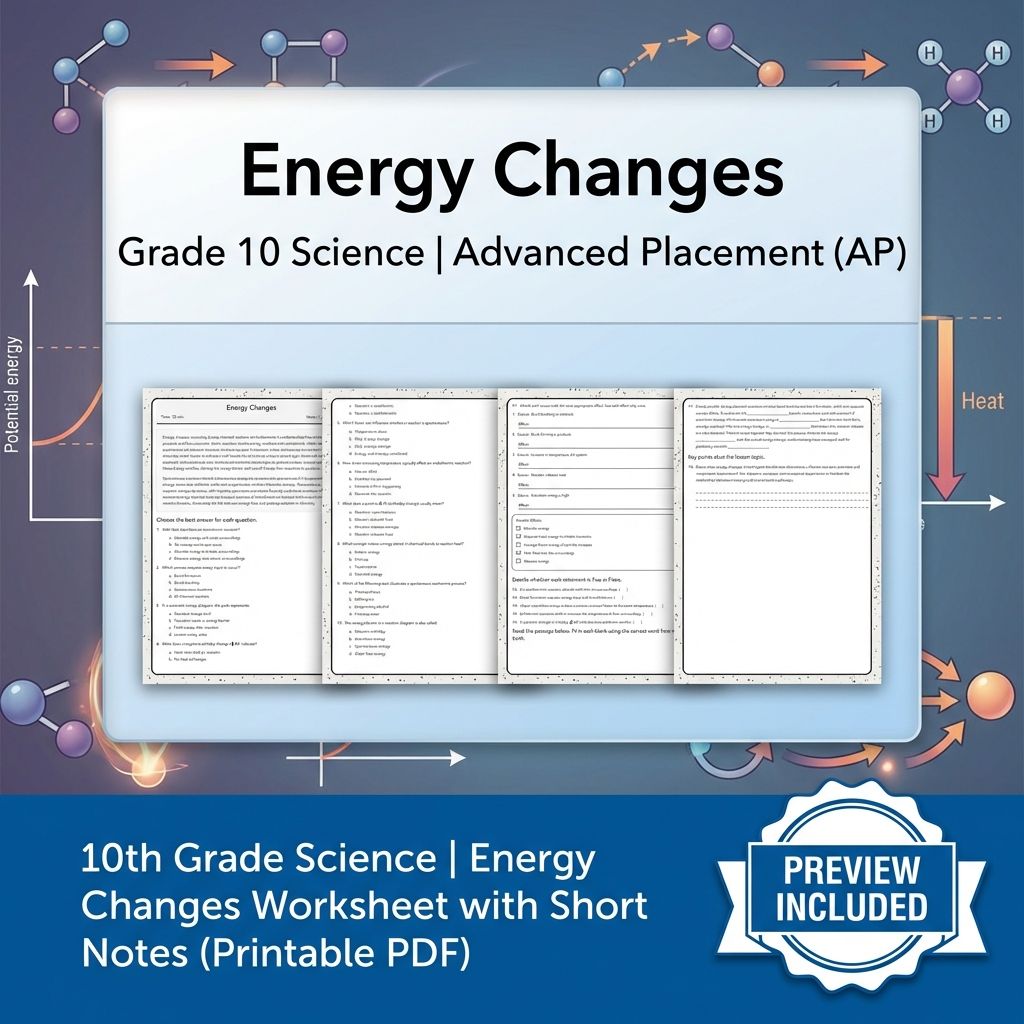
10th Grade Science | Energy Changes Worksheet with Short Notes (Printable PDF)
Created byMeadowlark WorksheetsLearning Objectives
- Explain the difference between endothermic and exothermic processes in chemical reactions.
- Describe the concepts of enthalpy and bond energetics in relation to reaction heat.
- Relate potential energy diagrams to energy changes during reactions.
Also included in: Grade 10 Science | Comprehensive Unit Bundle on Atomic Structure
Instant download
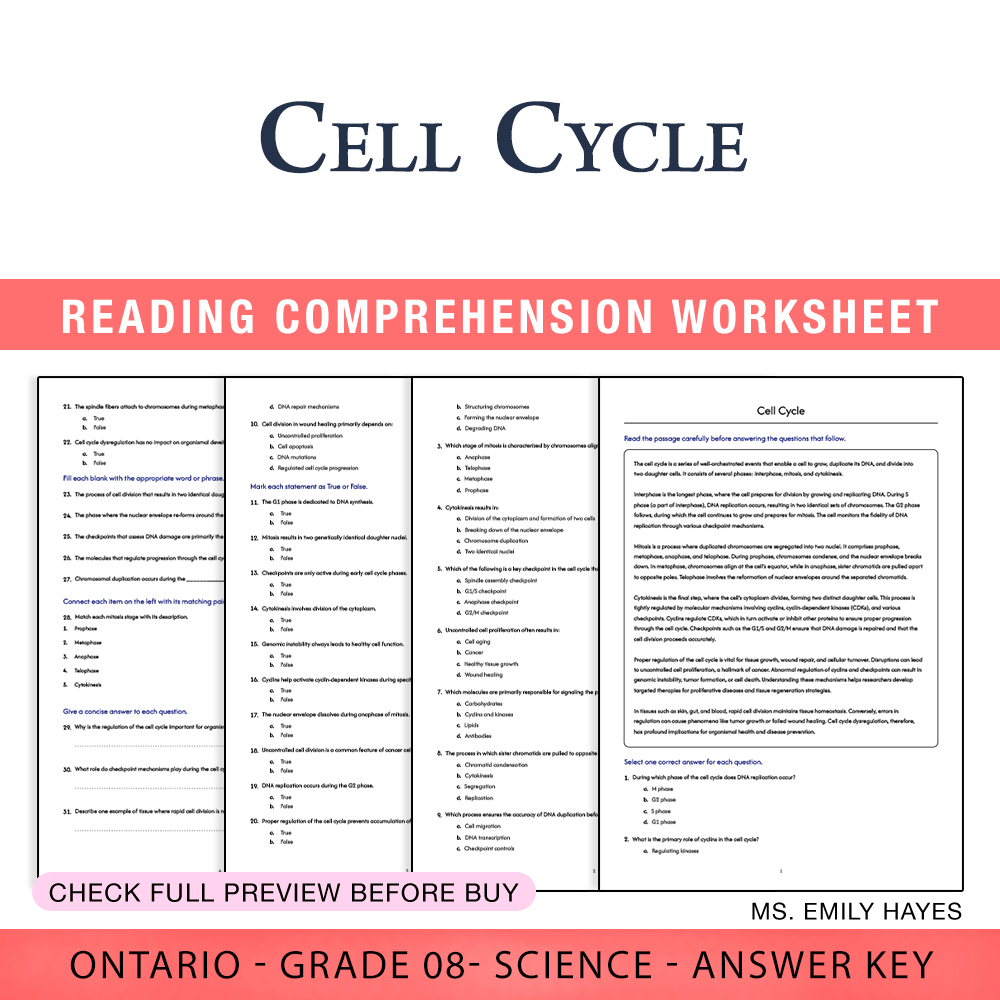
8th Grade Science | Cell Cycle Worksheet (PDF+ Answer Key)
Created byCopper Leaf ClassroomLearning Objectives
- Describe the phases of the cell cycle, including interphase, mitosis, and cytokinesis.
- Explain the molecular mechanisms regulating the cell cycle, focusing on cyclins, kinases, and checkpoints.
- Identify examples of tissue growth and regeneration related to cell division.
Instant download

Grade 10 Science | Resource Availability & Tradeoffs - Reading Comprehension
Created byCoral Reef LearningLearning Objectives
- Identify renewable and non-renewable resources in different contexts.
- Understand how resource limits influence ecosystem and human system decisions.
- Analyze case studies related to freshwater stress, mineral extraction, and land use.
Instant download
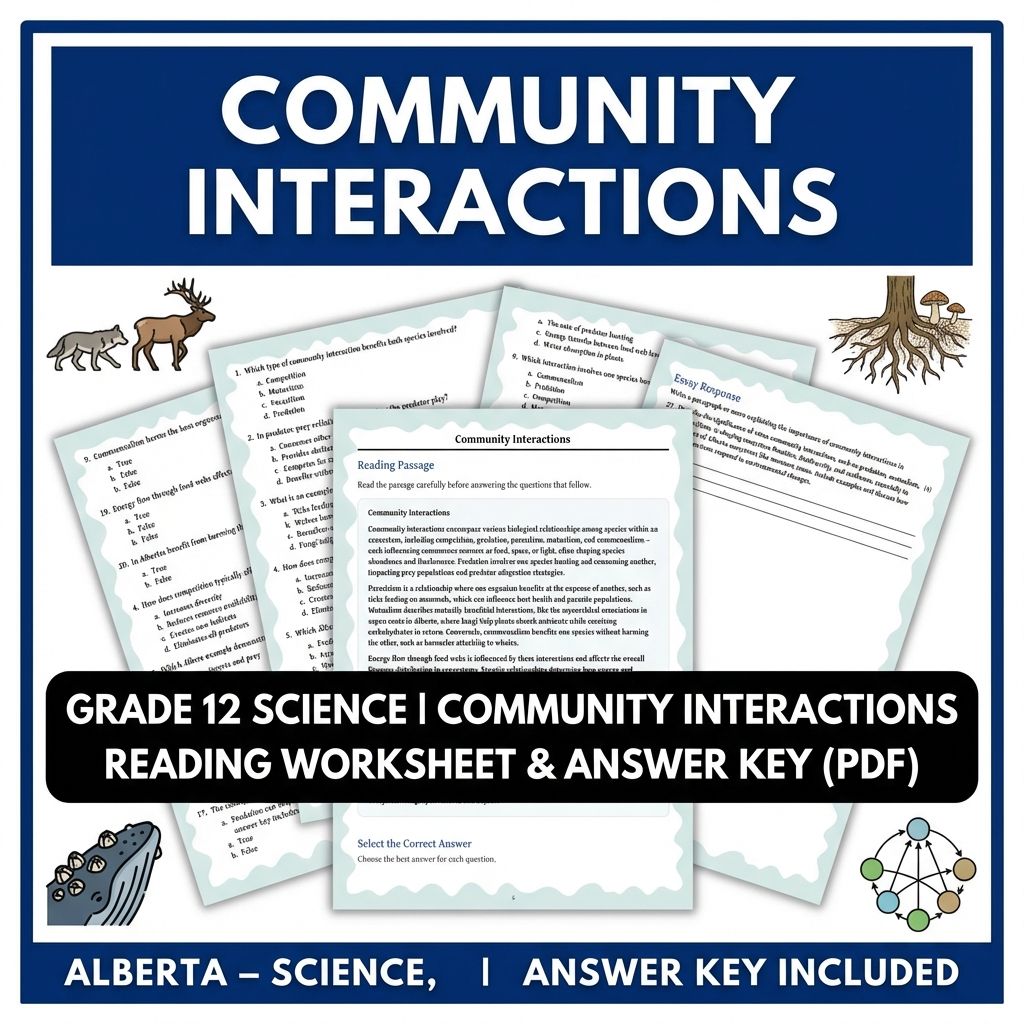
Grade 12 Science | Community Interactions Reading Worksheet & Answer Key (PDF)
JCreated byJ.S SheetsLearning Objectives
- Understand the different types of community interactions such as competition, predation, parasitism, mutualism, and commensalism.
- Analyze how energy flow affects ecological networks and biodiversity.
- Evaluate examples of community interactions in Alberta ecosystems.
Also included in: Grade 12 Science UNIT Bundle: Molecular Genetics, Evolution & Ecology Activities +1 more
Instant download
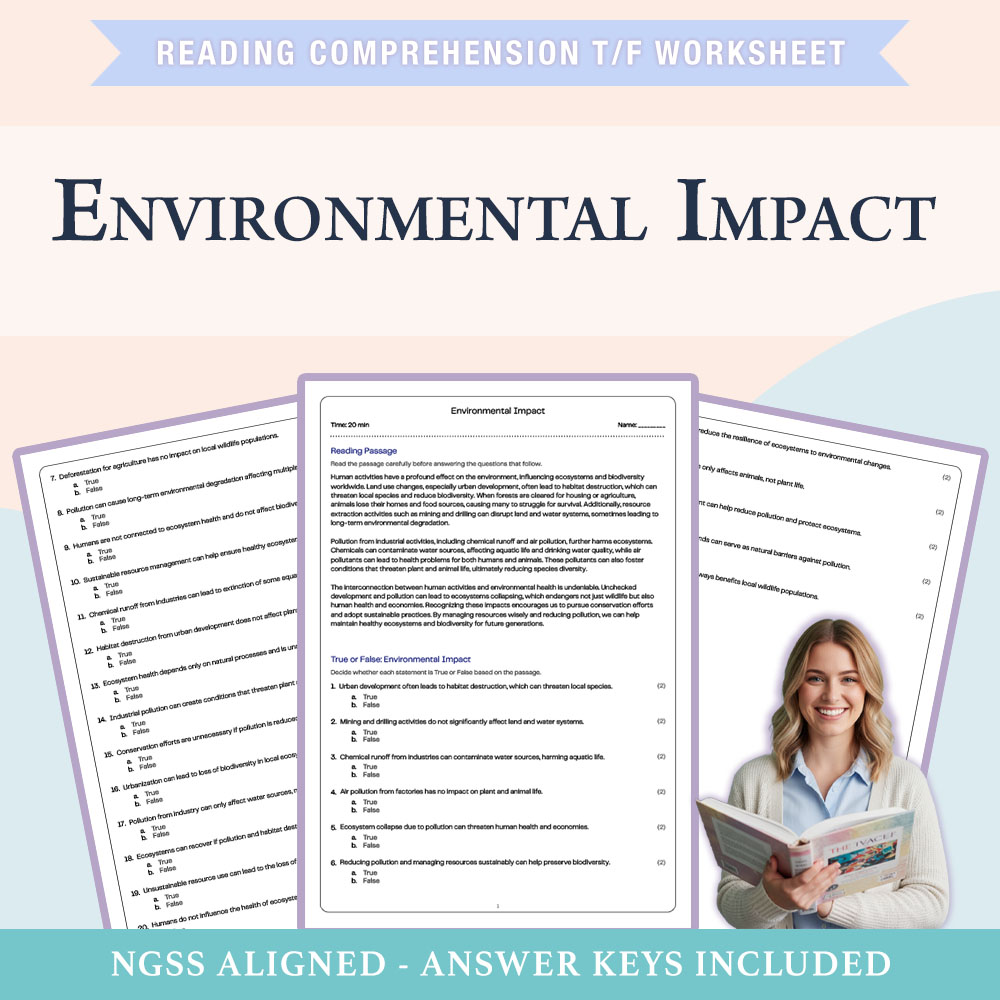
6th Grade Science |Environmental Impact True or False Worksheet(PDF +Answer Key)
Created byCopper Leaf ClassroomLearning Objectives
- Understand how land use, resource extraction, and pollution affect ecosystems and biodiversity
- Identify examples of habitat destruction and pollution
- Explain the effects on species survival and ecosystem health
Instant download
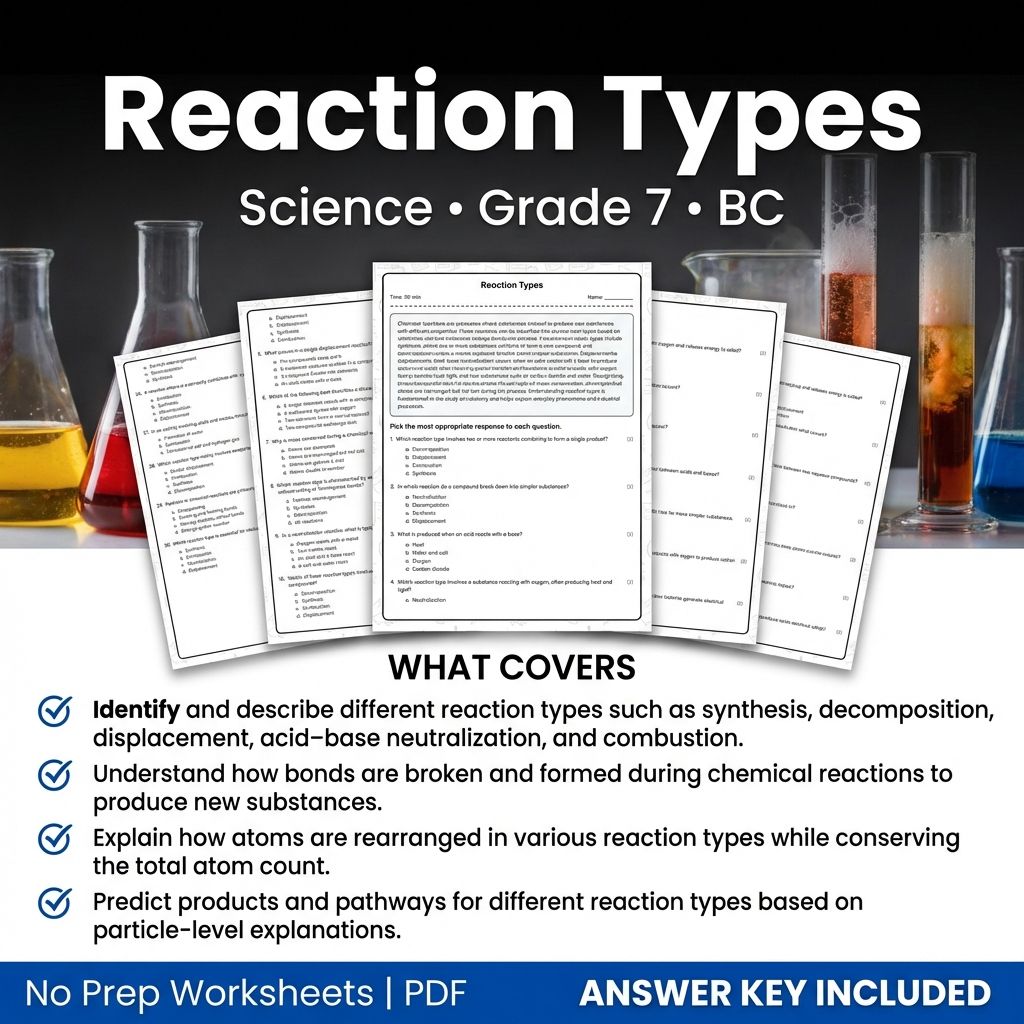
7th Grade Science | Reaction Types Worksheet & Answer Key (Printable PDF)
Created byCoral Reef LearningLearning Objectives
- Identify and describe different reaction types such as synthesis, decomposition, displacement, acid–base neutralization, and combustion.
- Understand how bonds are broken and formed during chemical reactions to produce new substances.
- Explain how atoms are rearranged in various reaction types while conserving the total atom count.
Instant download
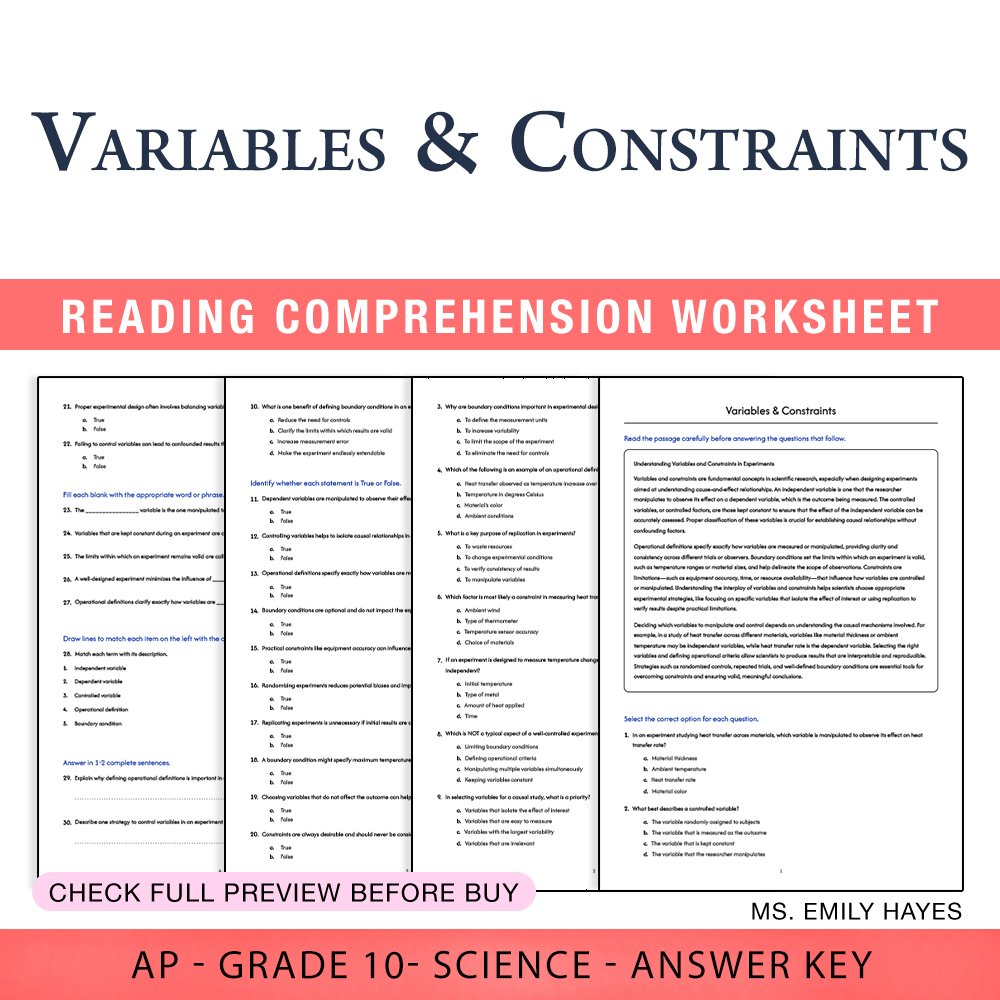
10th Grade Science | Variables & Constraints Worksheet (PDF+ Answer Key)
Created byCopper Leaf ClassroomLearning Objectives
- Identify and classify independent, dependent, and controlled variables in experimental scenarios.
- Explain the role of operational definitions, boundary conditions, and constraints in scientific measurements.
- Select and justify variables that isolate causal relationships within experimental design.
Also included in: Grade 10 Science AP | Data Analysis & Modeling Skills (PDF + Answer Key) +1 more
Instant download
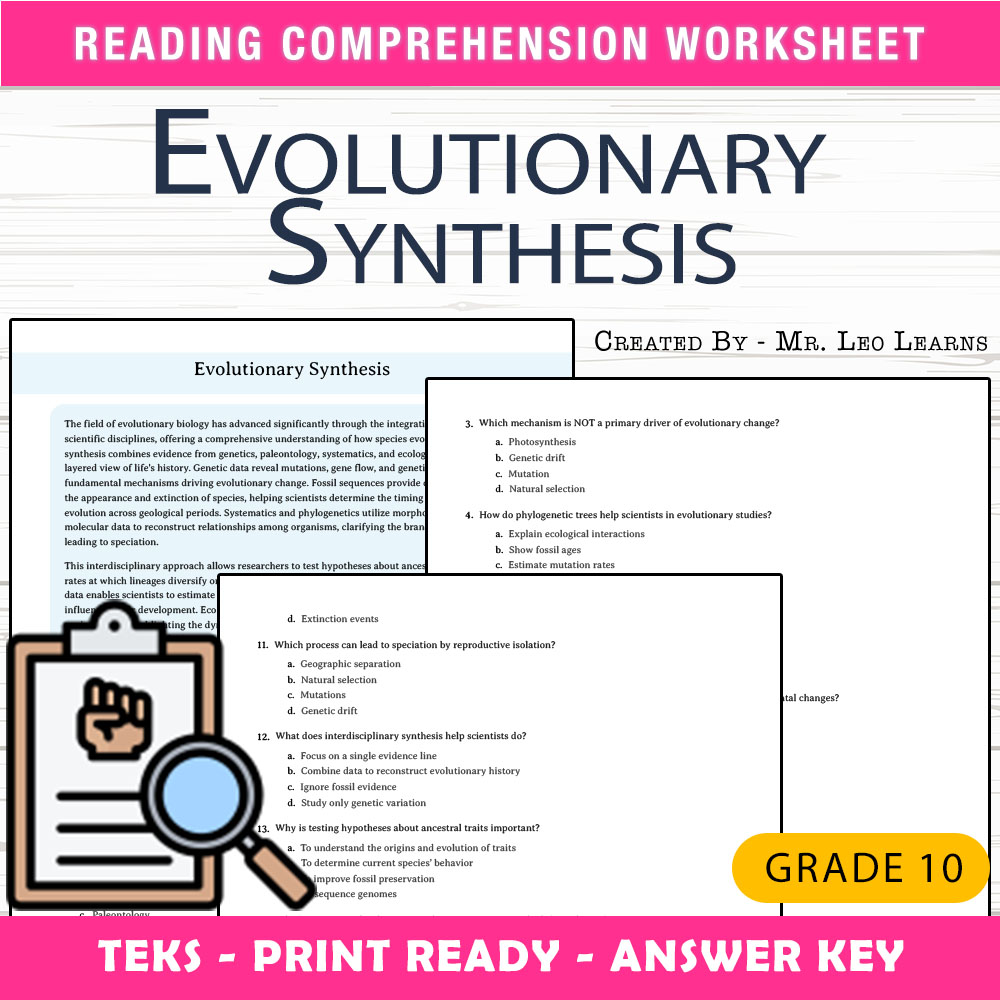
Grade 10 Science – Evolutionary Synthesis Worksheet for Mastery
Created byThe Resource HubLearning Objectives
- Understand how genetics, paleontology, systematics, and ecology contribute to evolutionary theory.
- Explain mechanisms such as natural selection, genetic drift, mutation, and gene flow in species change.
- Interpret fossil records, phylogenetic trees, and ecological data to reconstruct evolutionary history.
Also included in: Grade 10 Science | Evolution & Heredity Worksheet Bundle (Mastery Skills Pack) +2 more
Instant download
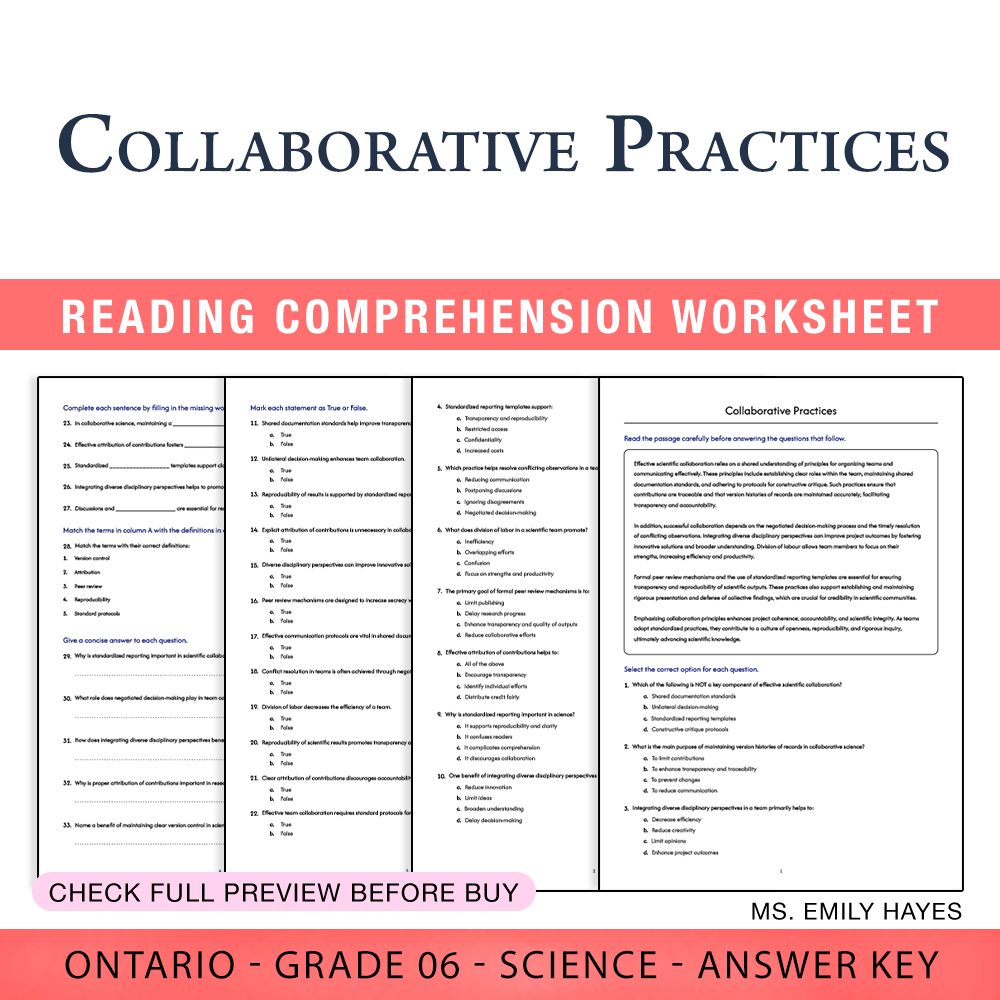
6th Grade Science | Collaborative Practices Worksheet (PDF+ Answer Key)
Created byCopper Leaf ClassroomLearning Objectives
- Understand principles of team-based organization and communication in scientific collaboration.
- Identify key components such as versioning, attribution, and peer review in scientific teamwork.
- Evaluate the importance of diverse disciplinary perspectives and standard protocols in collaboration.
Instant download
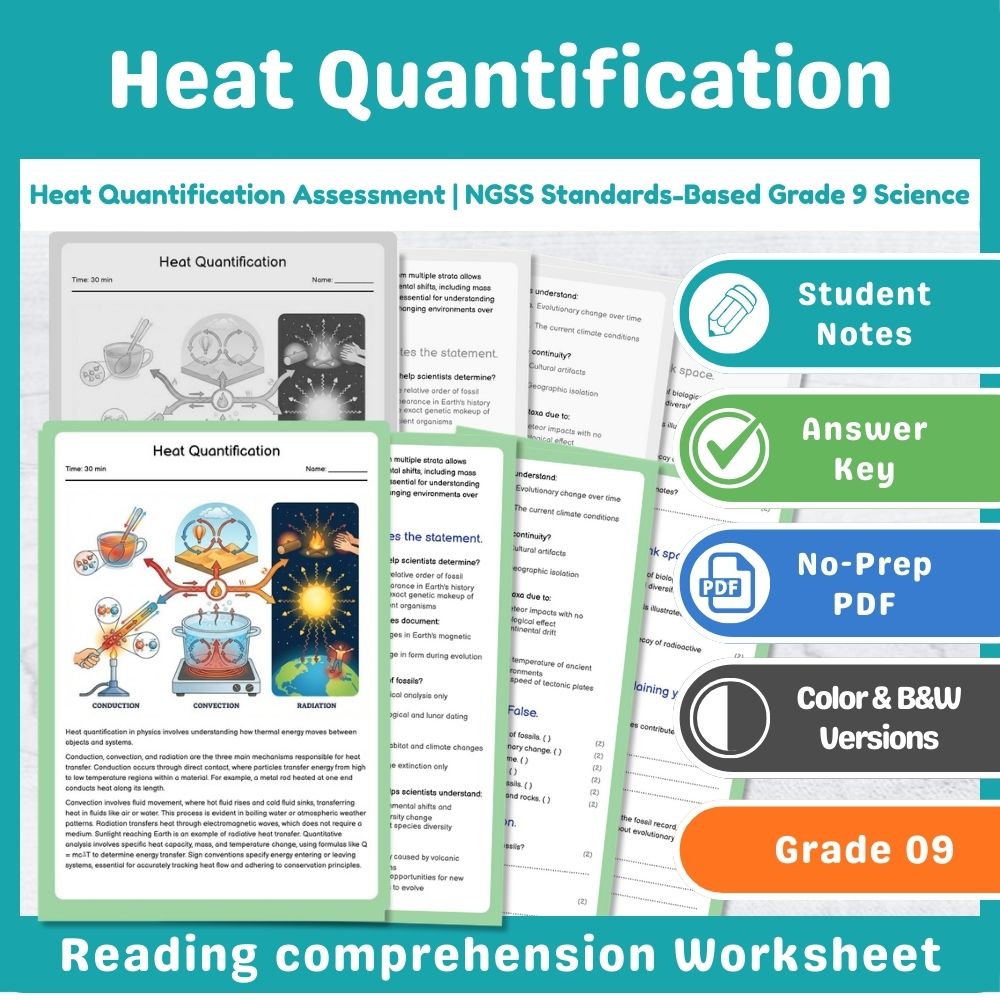
Energy Conversion Assessment | NGSS Standards Grade 9 Science
Created byPrism Point LearningLearning Objectives
- Explain the different types of energy conversion devices and processes.
- Analyze how energy transfer involves losses and efficiency considerations.
- Evaluate real-world examples of energy conversion such as photovoltaic cells, thermoelectric modules, and electrochemical cells.
Instant download
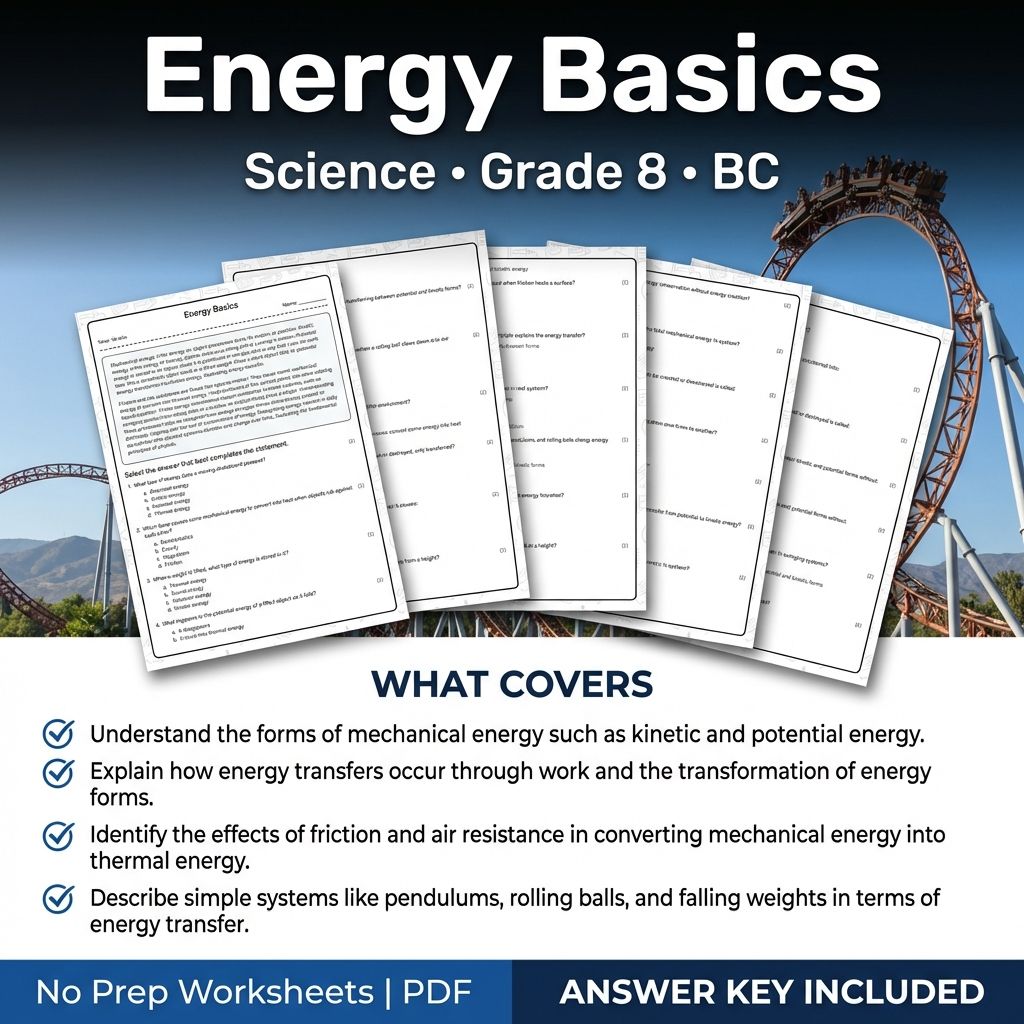
8th Grade Science | Energy Basics Worksheet & Answer Key (Printable PDFs)
Created byCoral Reef LearningLearning Objectives
- Understand the forms of mechanical energy such as kinetic and potential energy.
- Explain how energy transfers occur through work and the transformation of energy forms.
- Identify the effects of friction and air resistance in converting mechanical energy into thermal energy.
Instant download
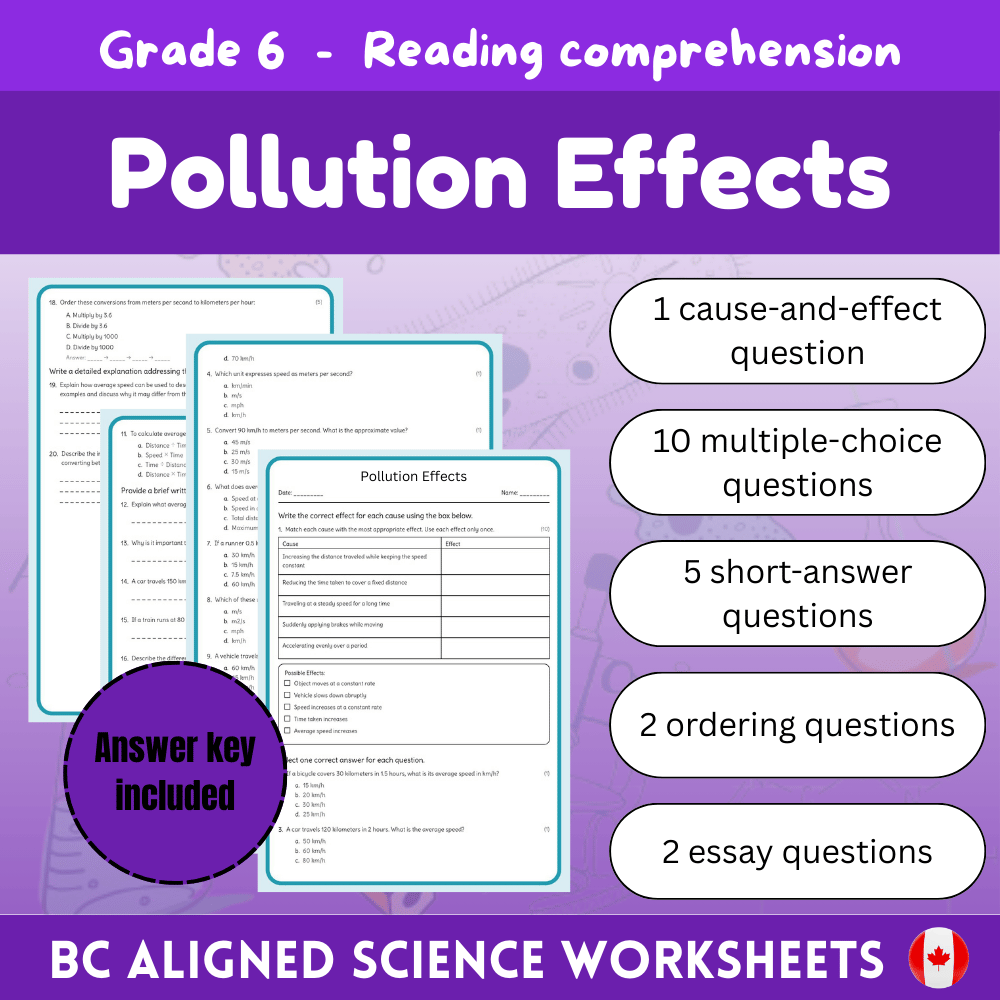
6th Grade Science | Pollution Effects Worksheet + Answer Key (PDF)
Created byBright Mind ResourcesLearning Objectives
- Explain how pollutants enter ecosystems and their impacts on organisms.
- Identify the processes of bioaccumulation and biomagnification in food chains.
- Describe how nutrient over-enrichment causes hypoxia and dead zones.
Instant download
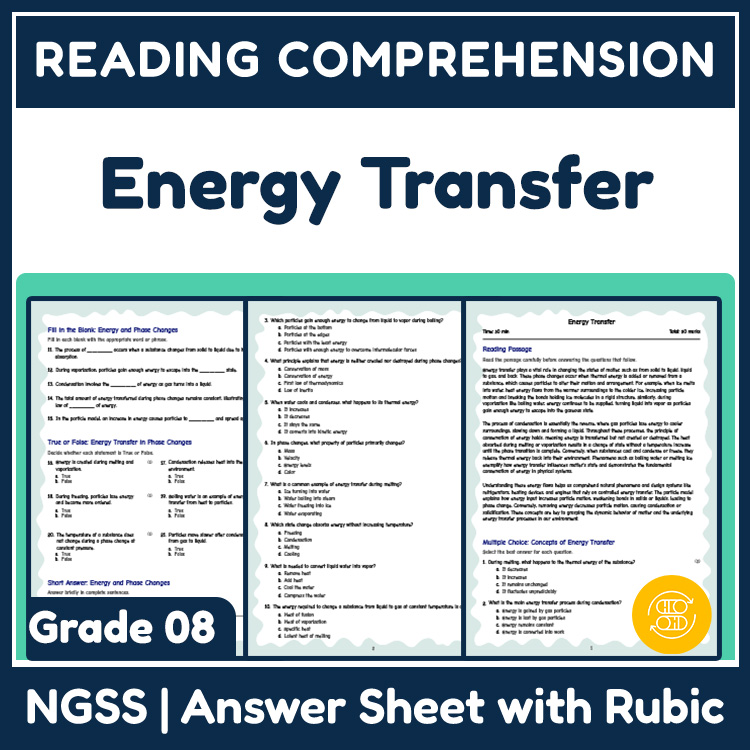
8th Grade Science | Energy Transfer Reading Worksheet (Answer Key Included)
JCreated byJ.S SheetsLearning Objectives
- Understand how energy moves during phase changes such as melting, vaporization, and condensation.
- Analyze how heat flow demonstrates energy transfer processes.
- Describe how particle motion and arrangement change during phase transitions.
Instant download

Material Properties Worksheet | Grade 7 Science | Ontario Standards
 Created byCedar Grove Learning
Learning Objectives
- Define and compare key material properties: density, tensile strength, compressive strength, stiffness (modulus), ductility, toughness, and thermal expansion.
- Explain how material properties influence structural performance, including deformation, serviceability, and durability.
- Contrast wood, steel, and reinforced concrete by strength-to-weight ratio, deformation under load, and typical failure modes.
Also included in: Grade 7 Materials Testing & Prototyping Science Lesson Bundle – Ontario +1 more
Instant download
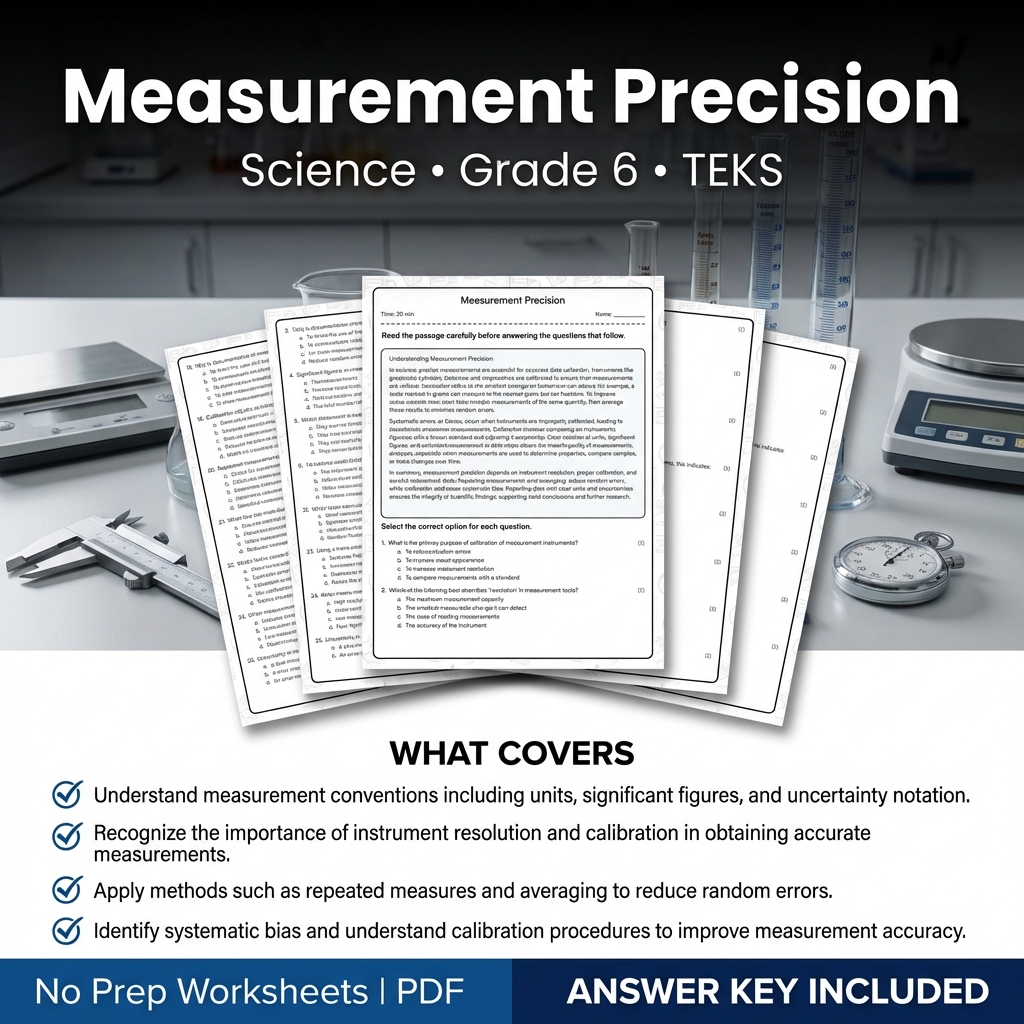
Grade 6 Science Worksheet on Measurement Precision TEKS Alignment
Created byCoral Reef LearningLearning Objectives
- Understand measurement conventions including units, significant figures, and uncertainty notation.
- Recognize the importance of instrument resolution and calibration in obtaining accurate measurements.
- Apply methods such as repeated measures and averaging to reduce random errors.
Instant download
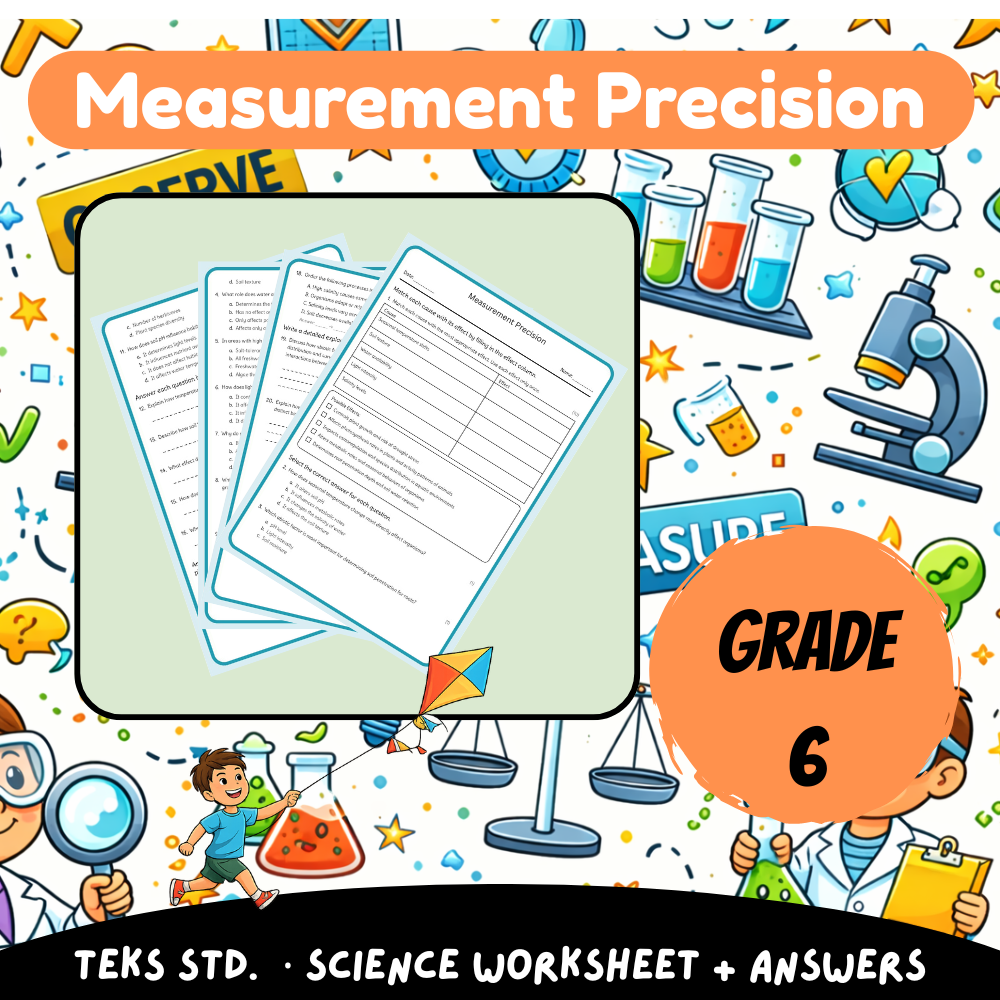
6th Grade Science | Measurement Precision Worksheet (Worksheet + Answer Key) - TEKS Aligned
Created byBright Mind ResourcesLearning Objectives
- Understand the conventions of quantitative measurement, including units and significant figures.
- Explain the role of instrument resolution and measurement uncertainty.
- Describe methods to reduce errors through repeated measurements and calibration.
Instant download

Variation Effects Worksheet for Grade 6 Science NGSS Practice and Assessment
JCreated byJ.S SheetsLearning Objectives
- Understand how genetic and environmental factors influence phenotypic variation.
- Identify examples of phenotypic variation caused by genetic and environmental interactions.
- Explain the links between DNA, gene expression, and organism traits.
Also included in: Grade 6 Cellular Processes and Feedback Science Lesson Bundle – NGSS +1 more
Instant download

Cell Evidence Worksheet | Standards-Aligned Grade 6 Science Practice
JCreated byJ.S SheetsLearning Objectives
- Identify observable characteristics that distinguish single-celled from multicellular organisms.
- Understand the relationship between cells, tissues, organs, and whole organisms.
- Recognize empirical features such as membrane-bound compartments, cell size ranges, and specialization in different organism types.
Also included in: Grade 6 Cellular Processes and Feedback Science Lesson Bundle – NGSS +1 more
Instant download
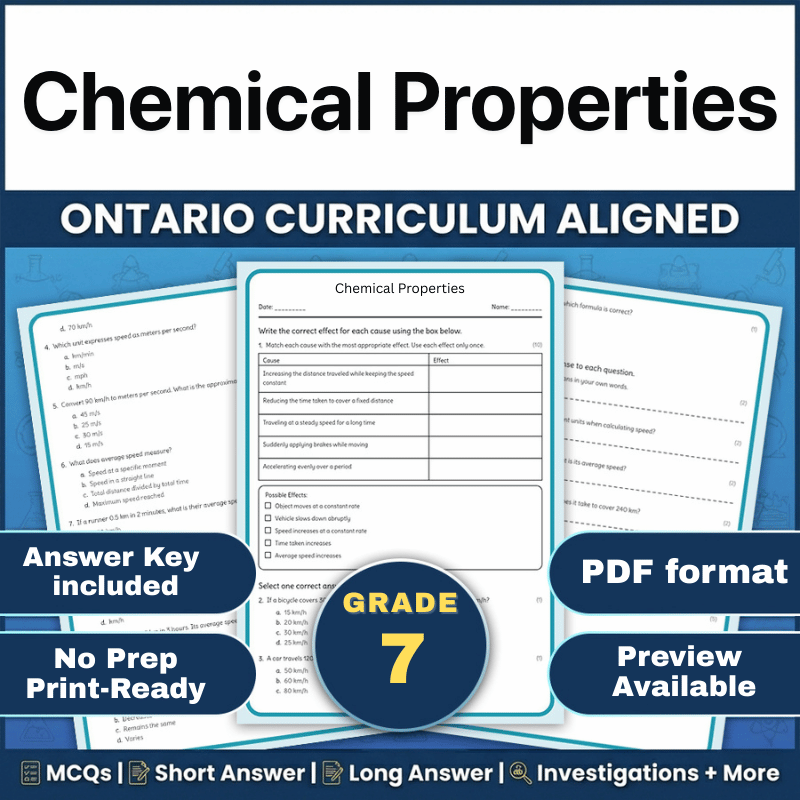
Grade 7 Science | Chemical Properties Worksheet - Ontario (PDF)
Created byBright Mind ResourcesLearning Objectives
- Describe key chemical properties such as reactivity, combustion potential, and oxidation tendencies.
- Explain how observable indicators like gas evolution, colour change, and precipitate formation relate to chemical reactions.
- Differentiate the chemical stability of noble metals from reactive non-metals and their implications for material choice.
Instant download

Measurement Precision Worksheet | TEKS Grade 6 Science Assessment
JCreated byJ.S SheetsLearning Objectives
- Explain how instrument resolution affects what digits we record in scientific measurements
- Use consistent units and correct significant figures when reporting measurements
- Describe how calibration reduces systematic error and how repeated trials and averaging reduce random error
Instant download

Grade 7 Science | Ecosystem Dynamics Worksheet | California Standards
Created byLumora LearningLearning Objectives
- Explain how energy flows through trophic levels in an ecosystem and how that flow decreases across levels.
- Describe how matter cycles through ecosystems and how nutrient availability affects organism survival and biomass.
- Predict how changes in decomposition conditions, plant growth, or resource inputs can cause cascading effects on consumer populations.
Instant download

Grade 12 Science | Wave Behavior Worksheet | AP Aligned
Created byLumora LearningLearning Objectives
- Describe wave phenomena using mathematical descriptions such as wavelength, frequency, phase velocity, and amplitude.
- Explain the principles of superposition, interference, and standing waves in strings and air columns.
- Apply sinusoidal representations, phasor reasoning, and energy transport concepts to analyze wave patterns.
Instant download
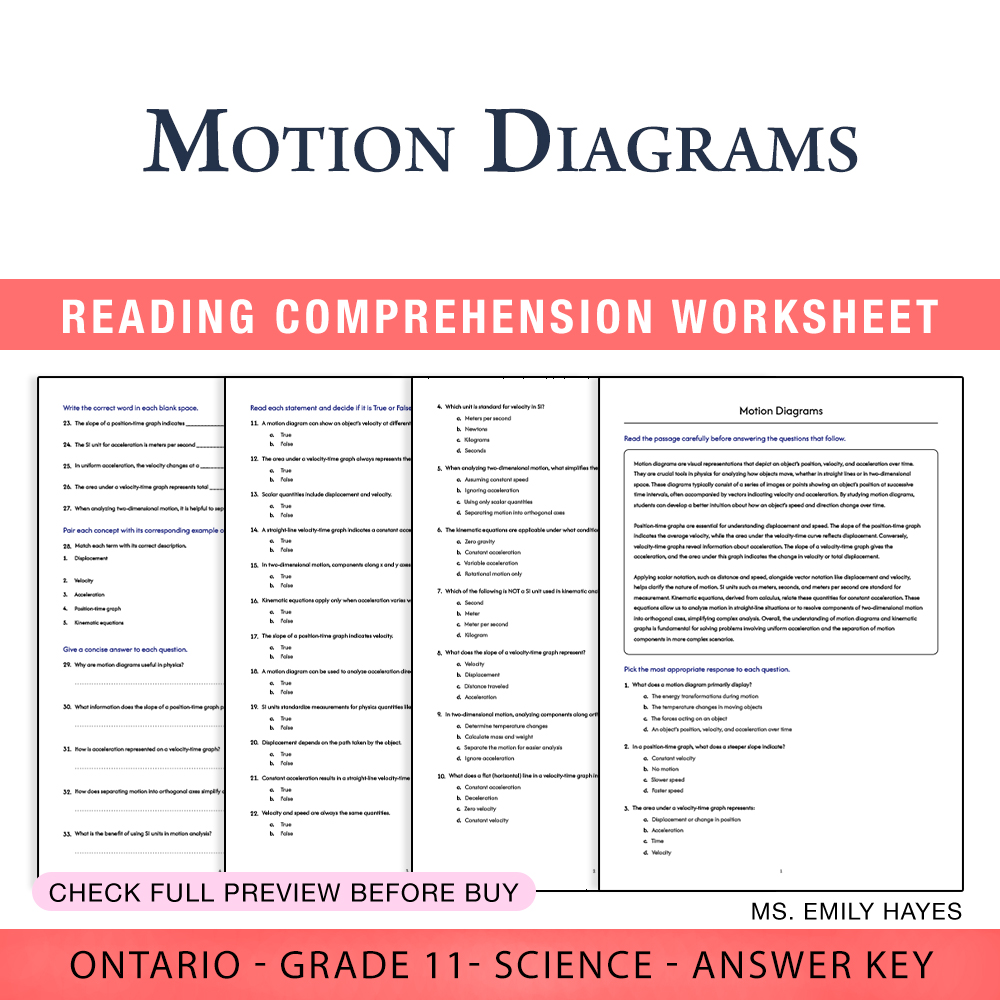
11th Grade Science | Motion Diagrams Worksheet (PDF + Answer Key)
Created byCopper Leaf ClassroomLearning Objectives
- Understand how motion diagrams visually represent an object's position, velocity, and acceleration.
- Interpret position-time and velocity-time graphs, including their slopes and areas, to analyze motion.
- Apply scalar and vector notation, SI units, and kinematic equations for uniform acceleration.
Instant download
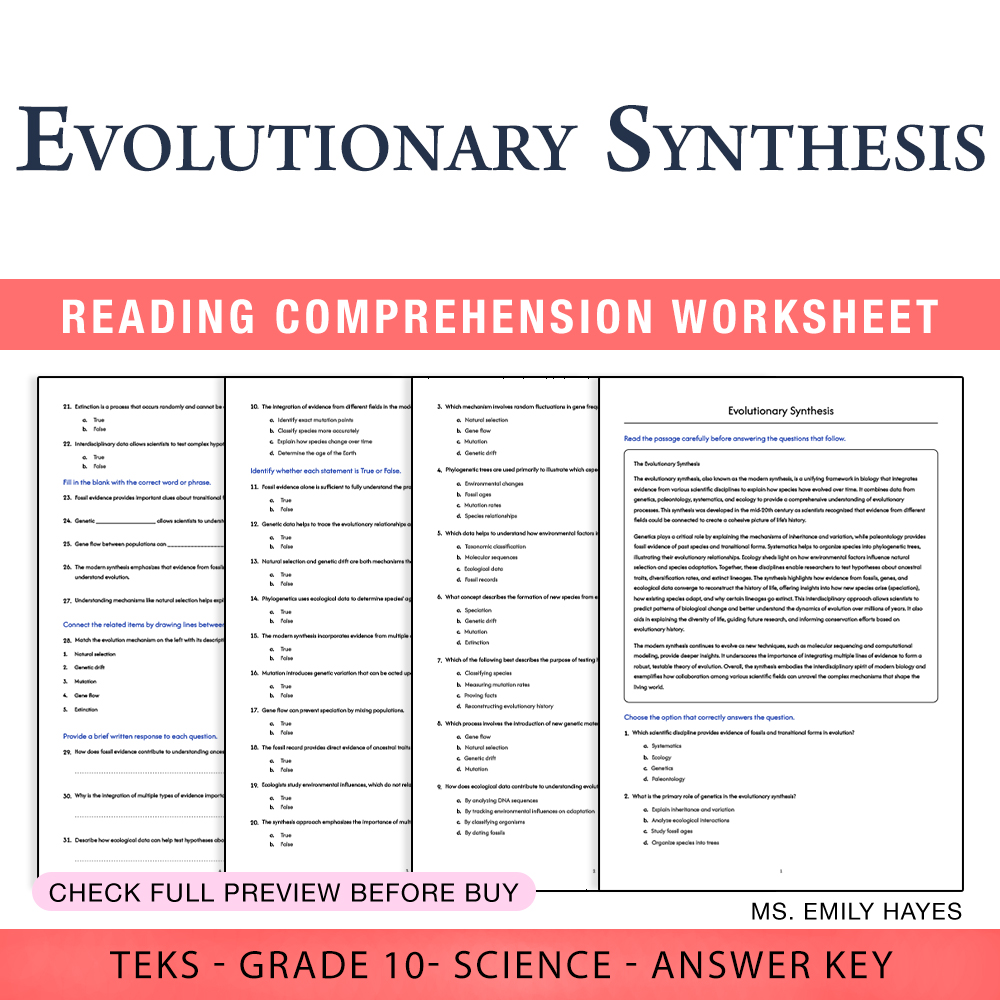
10th Grade Science | Evolutionary Synthesis Worksheet (PDF+ Answer Key)
Created byCopper Leaf ClassroomLearning Objectives
- Understand the interdisciplinary evidence supporting the evolutionary synthesis model.
- Identify mechanisms such as natural selection, genetic drift, mutation, and gene flow in evolution.
- Explain how fossil records, phylogenetic trees, and ecological data converge to elucidate species change.
Instant download
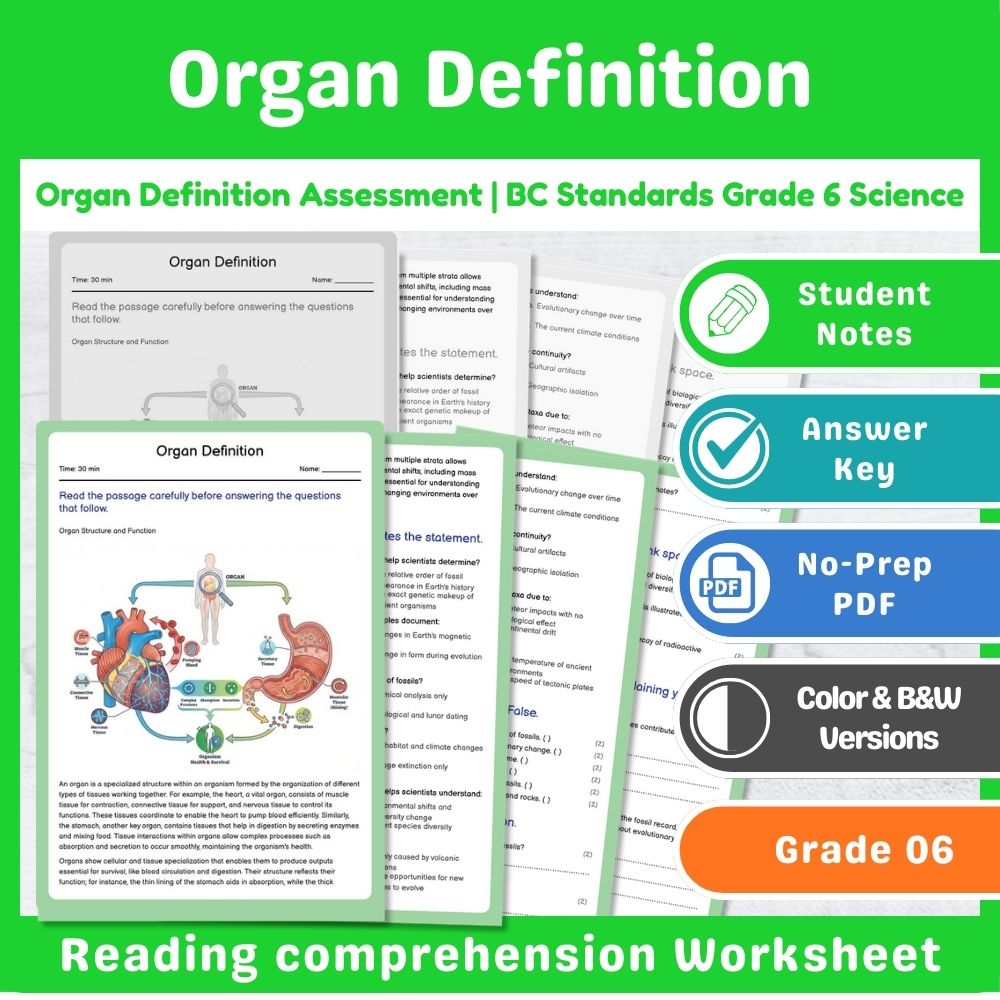
Organ Definition Assessment | BC Standards Grade 6 Science
Created byPrism Point LearningLearning Objectives
- Understand what an organ is and its composition of tissue types
- Recognize examples of organs and their functions
- Describe how tissue interactions within organs support organism survival and system regulation
Instant download
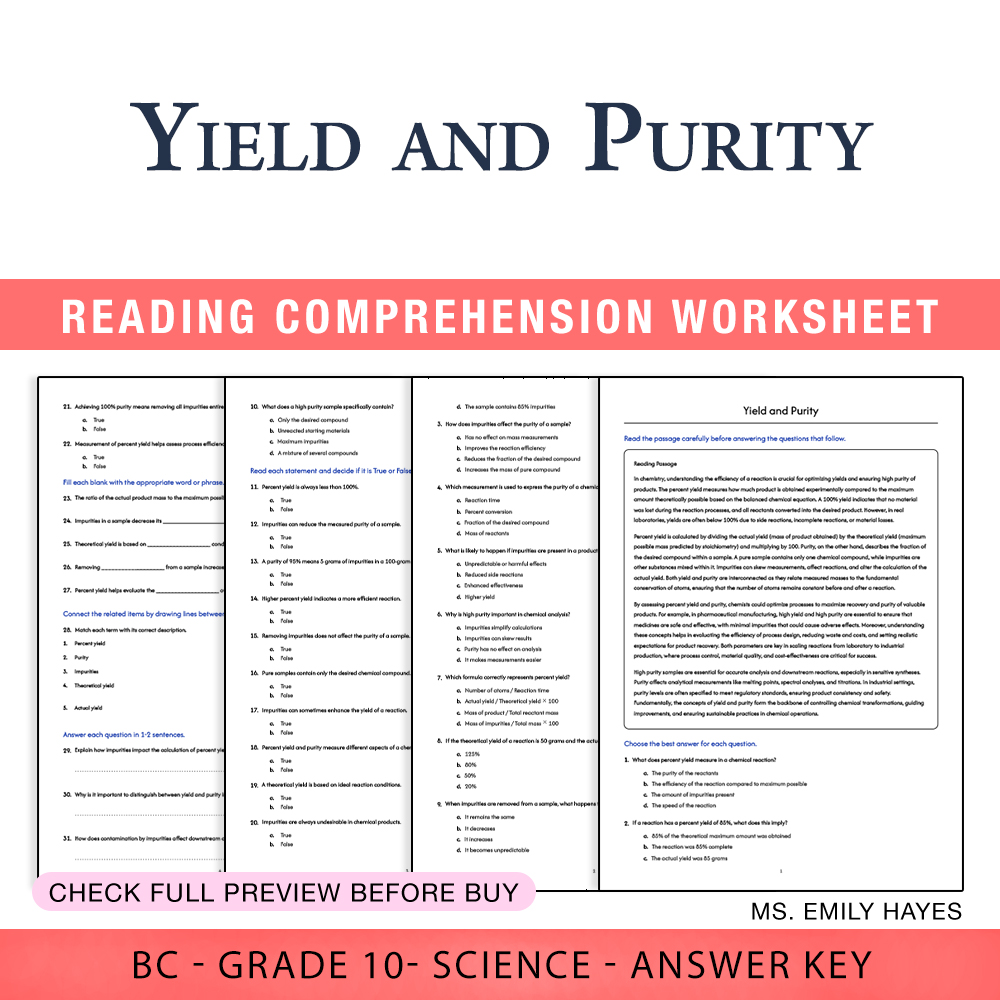
Grade 10 Science | Yield and Purity Worksheet (PDF + Answer Key)
Created byCopper Leaf ClassroomLearning Objectives
- Understand the concepts of percent yield and purity in chemical reactions.
- Calculate percent yield using actual and theoretical product masses.
- Explain how impurities affect the purity of a sample.
Also included in: Grade 10 Science BC| Chemistry, Reactions & Atomic Structure (PDF+ Answer Keys) +1 more
Instant download
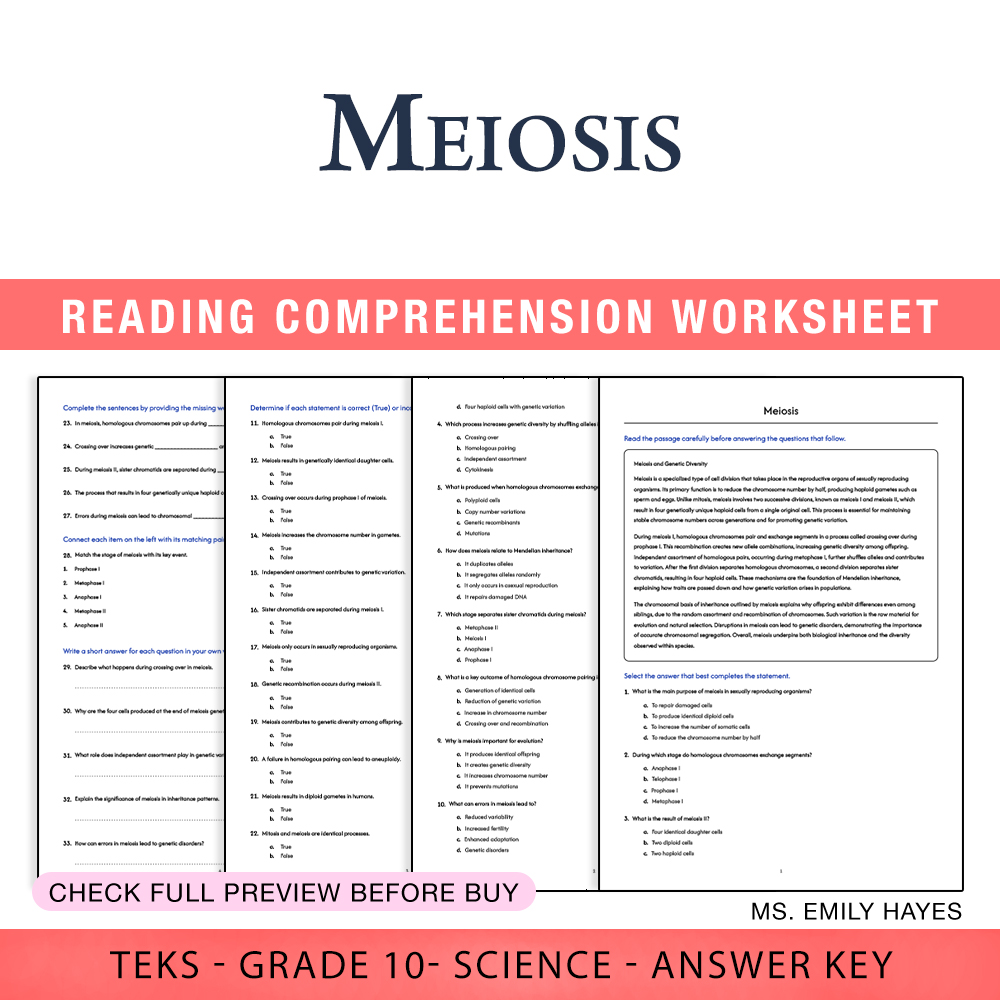
10th Grade Science | Meiosis Worksheet (PDF+ Answer Key)
Created byCopper Leaf ClassroomLearning Objectives
- Understand the process of meiosis and its role in reducing chromosome numbers.
- Describe how genetic diversity is produced during meiosis through recombination and independent assortment.
- Explain the stages of meiosis and the significance of homologous chromosome pairing and separation.
Instant download
Browse more categories
About Science Worksheets
Find Science worksheets spanning core skills, practice, and review. All 44,573 resources are instant PDF downloads for the classroom or home.
Every worksheet on MyTeachingSheets is created by independent teacher-authors and reviewed before publication. All resources download as printable PDFs for classroom, homework, or at-home practice, and many include answer keys. Preview any worksheet free before buying.