
Science Worksheets
44,628 subject resources
Grade 7 Science – Earth Structure & Interior | Daily Reading Worksheet
 Created byBright Mind Resources
Learning Objectives
- Identify and describe the main layers of the Earth: crust, mantle, outer core, and inner core.
- Understand how seismic waves provide evidence for Earth's internal structure.
- Explain mantle convection and its role in plate motion.
Also included in: Earth & Space Grade 7 Science Daily Reading Worksheets Bundle | TEKS +2 more
Instant download

Grade 12 Science | Projectile Motion Worksheet Elena | AP Aligned
 Created byLumora Learning
Learning Objectives
- Analyze two-dimensional projectile motion using vector components.
- Understand the independence of horizontal and vertical motions in projectile trajectories.
- Apply equations of range, time-of-flight, and parametric equations to solve projectile problems.
Instant download

Grade 7 Heat Energy Temperature Change Worksheet | Alberta Science Activity
 Created byBRIGHT PATH RESOURCES
Learning Objectives
- Explain how temperature change relates to energy transfer in heating and cooling
- Use energy units (J and kJ) and temperature scales to describe thermal processes
- Identify key variables in heat calculations: specific heat, mass, and temperature change
Also included in: Grade 7 Alberta Science Energy Heat and Thermal Processes Worksheet Bundle +1 more
Instant download
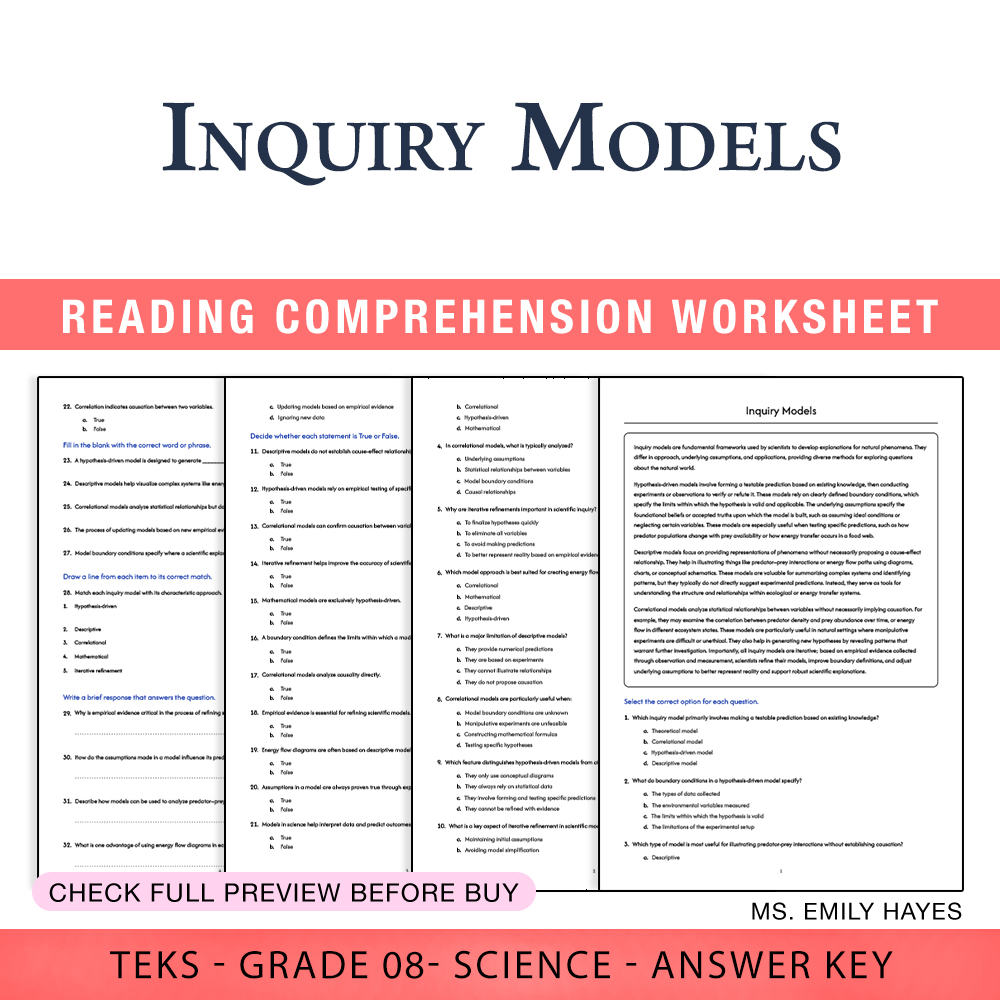
8th Grade Science | Inquiry Models Worksheet (PDF+ Answer Key)
 Created byCopper Leaf Classroom
Learning Objectives
- Compare hypothesis-driven, descriptive, and correlational inquiry models.
- Identify the boundary conditions, assumptions, and testable predictions of each model.
- Analyze how different inquiry approaches are applied to predator–prey relationships or energy flow diagrams.
Instant download
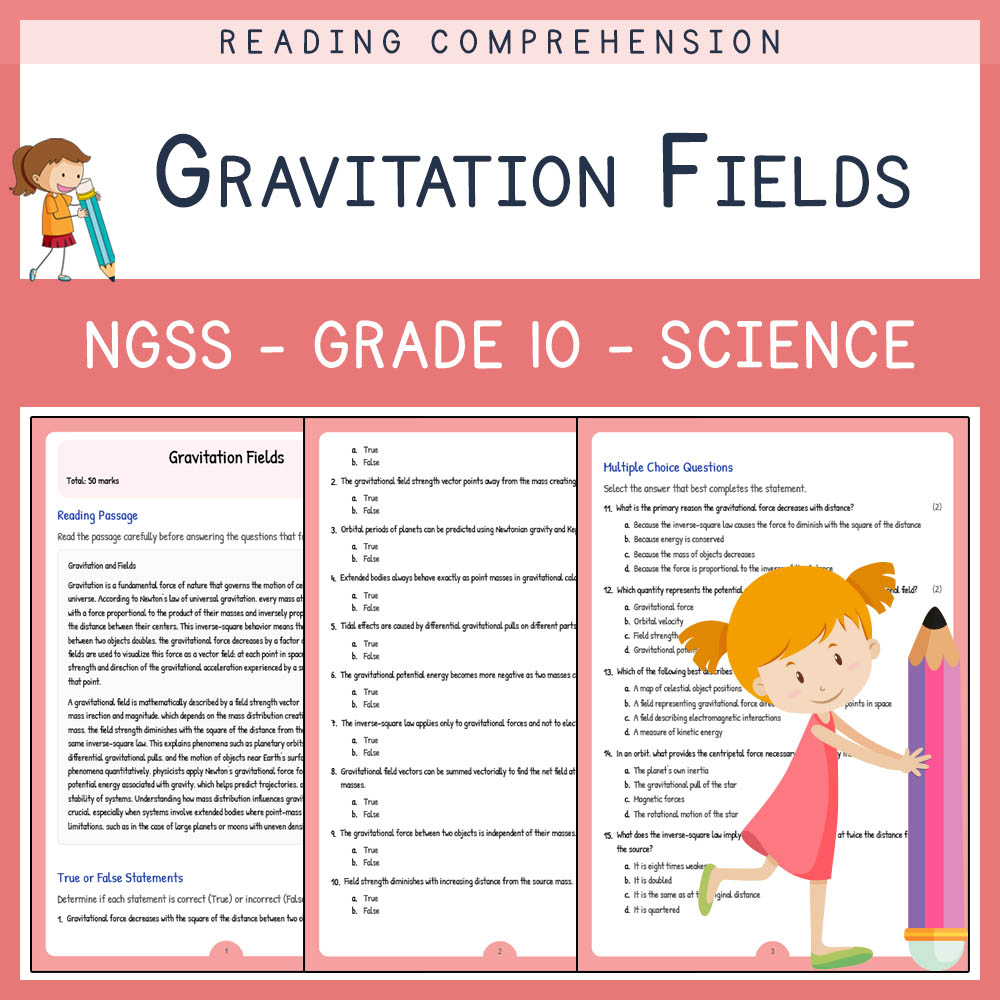
Grade 10 Science | Gravitation Fields Worksheet & Answer Key (PDF)
Created byLumora LearningLearning Objectives
- Understand the inverse-square law behavior of gravitational fields.
- Explain how gravitational fields are represented vectorially and with potential.
- Apply Newtonian gravity to predict planetary orbits and analyze orbital dynamics.
Instant download
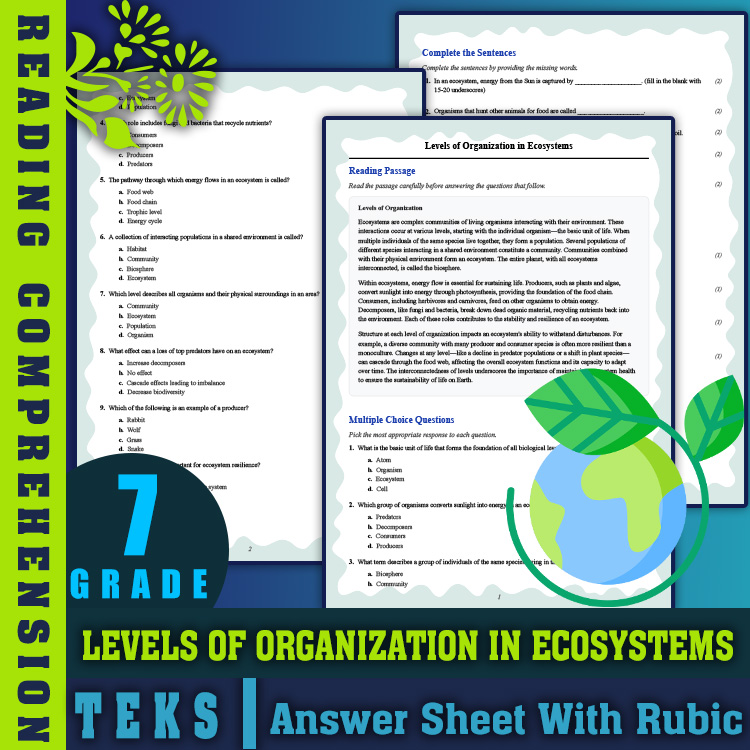
7th Grade Science | Levels of Ecosystem Organization Reading Worksheet
JCreated byJ.S SheetsLearning Objectives
- Understand the hierarchical levels of biological organization from individuals to the biosphere.
- Identify roles of producers, consumers, and decomposers within food webs.
- Explain how energy flows through trophic levels and impacts ecosystem stability.
Instant download
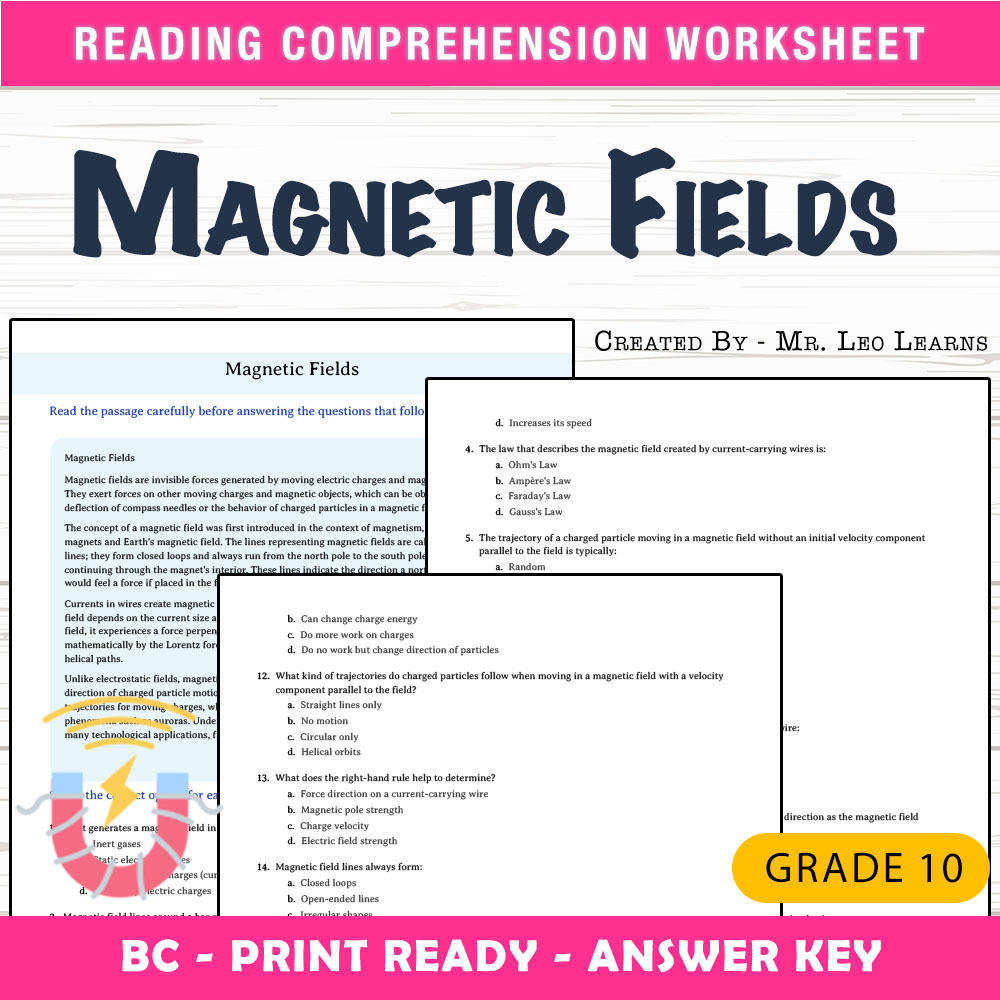
Grade 10 Science — Worksheet MCQ Paper for Mastering Magnetic Fields
 Created byThe Resource Hub
Learning Objectives
- Understand the origin of magnetic fields from moving charges and currents.
- Interpret magnetic field line patterns and their direction.
- Explain how magnetic forces act on moving charges without doing work, and how this affects charge trajectories.
Also included in: Grade 10 Science | Forces, Motion & Fields UNIT Worksheet Bundle +1 more
Instant download
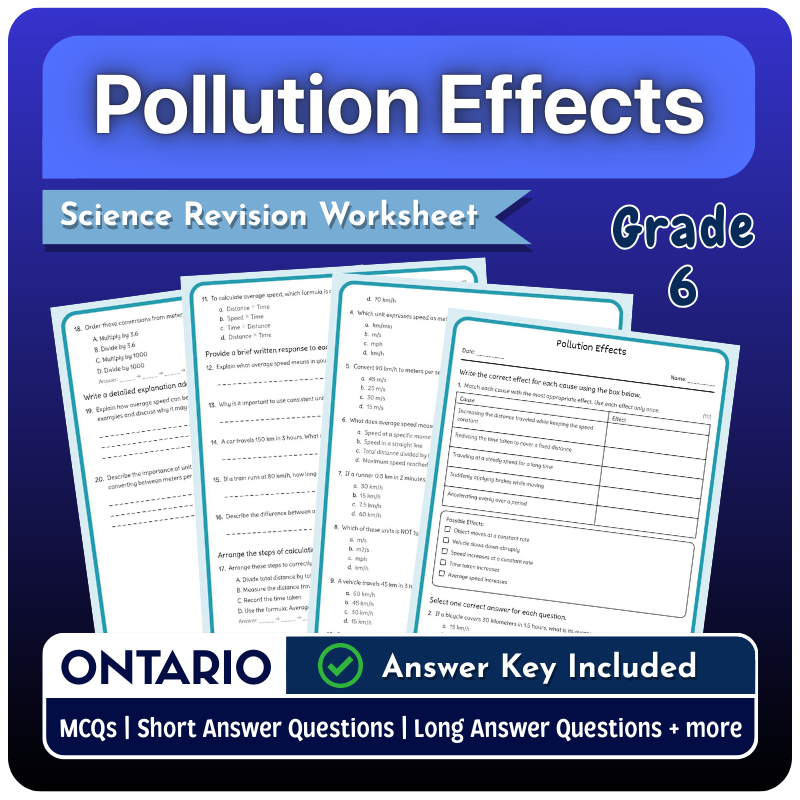
6th Grade Science | Pollution Effects Worksheet (Ontario) (Practice Set)
Created byBright Mind ResourcesLearning Objectives
- Understand the ecological impacts of pollution such as eutrophication, endocrine disruption, and biomagnification.
- Identify measurable indicators like dissolved oxygen, algal biomass, and contaminant residues for assessing pollution effects.
- Analyze how pollution influences species diversity and ecosystem functioning.
Instant download
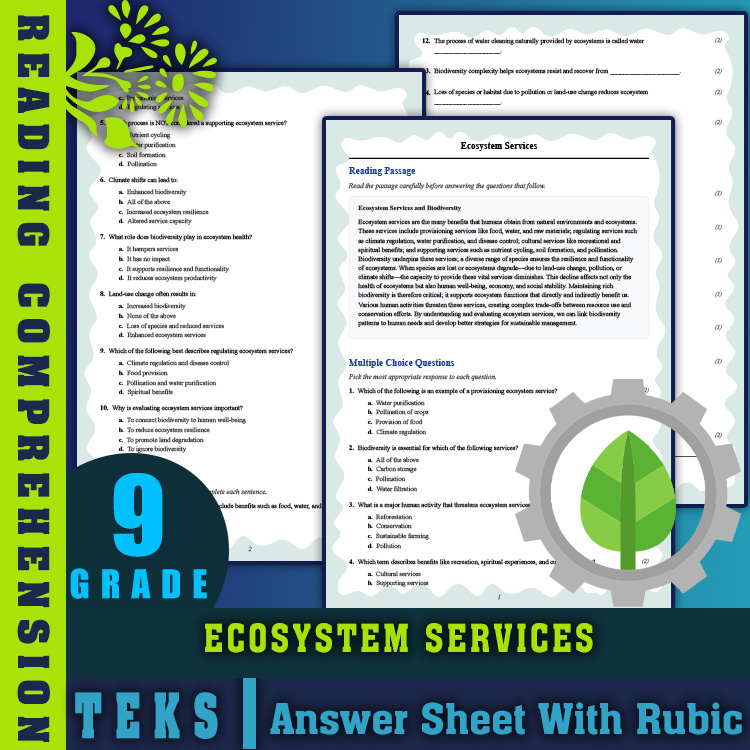
9th Grade Science | Ecosystem Services Reading Worksheets (PDF & Rubric)
JCreated byJ.S SheetsLearning Objectives
- Understand the concept of ecosystem services and their importance to human well-being.
- Identify different types of ecosystem services and how biodiversity supports them.
- Evaluate human impacts on ecosystem services and the resulting trade-offs.
Instant download

6th Grade Science | Pattern Analysis Worksheet (PDF) - Alberta Standards
Created byBright Mind ResourcesLearning Objectives
- Identify different methods used for detecting patterns in datasets.
- Explain how environmental factors influence observable patterns in nature.
- Use visual and statistical techniques to interpret data trends and cycles.
Instant download

11th Grade Science | Electron Configuration Reading Worksheet (PDF + Answer Key)
JCreated byJ.S SheetsLearning Objectives
- Understand the principles governing electron arrangements in atoms.
- Identify and explain quantum numbers, the Aufbau principle, and Pauli exclusion principle.
- Relate electron configurations to elemental chemical behavior, valence electrons, and periodic trends.
Instant download
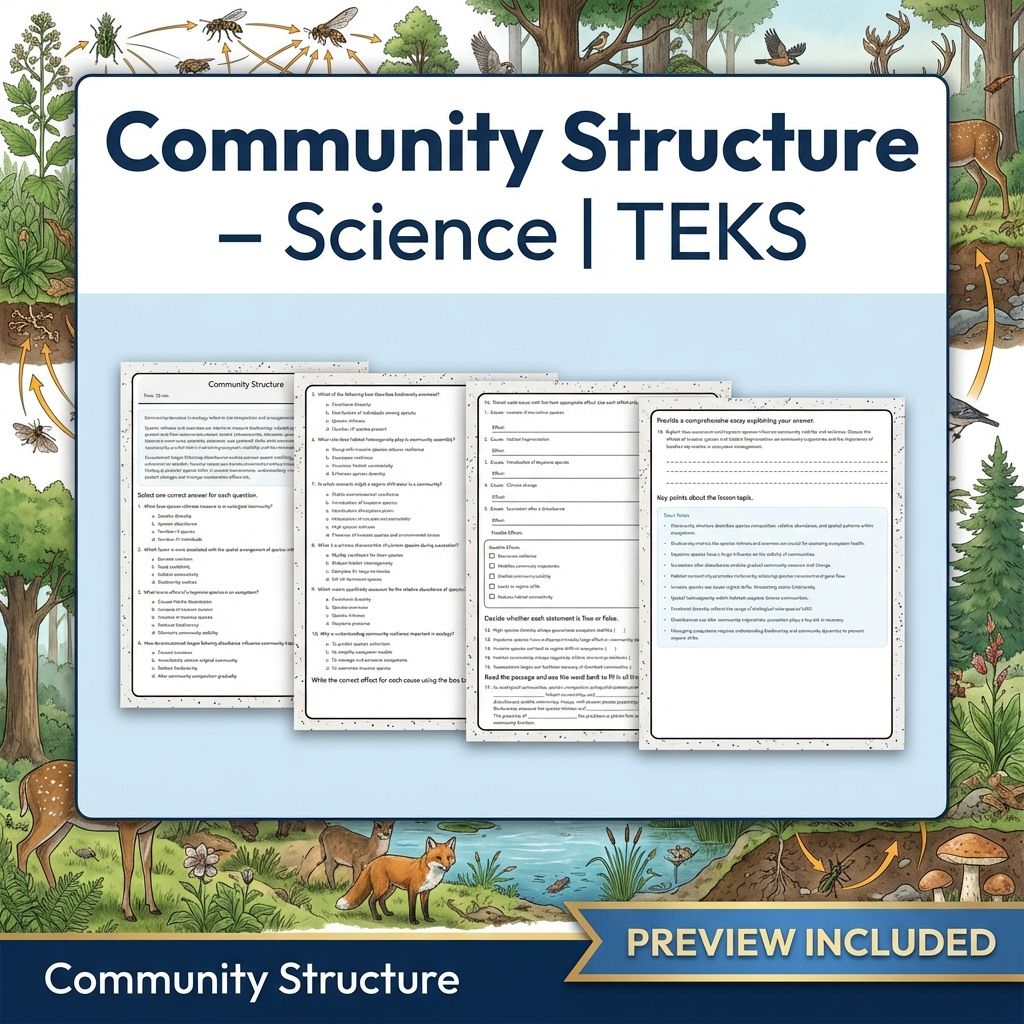
11th Grade Science | Community Structure Worksheet with Short Notes (Printable PDF)
 Created byMeadowlark Worksheets
Learning Objectives
- Understand the key components that define community structure in ecology.
- Identify factors that influence species diversity and spatial arrangement in ecosystems.
- Describe the role of succession, keystone species, and habitat connectivity in community resilience.
Instant download
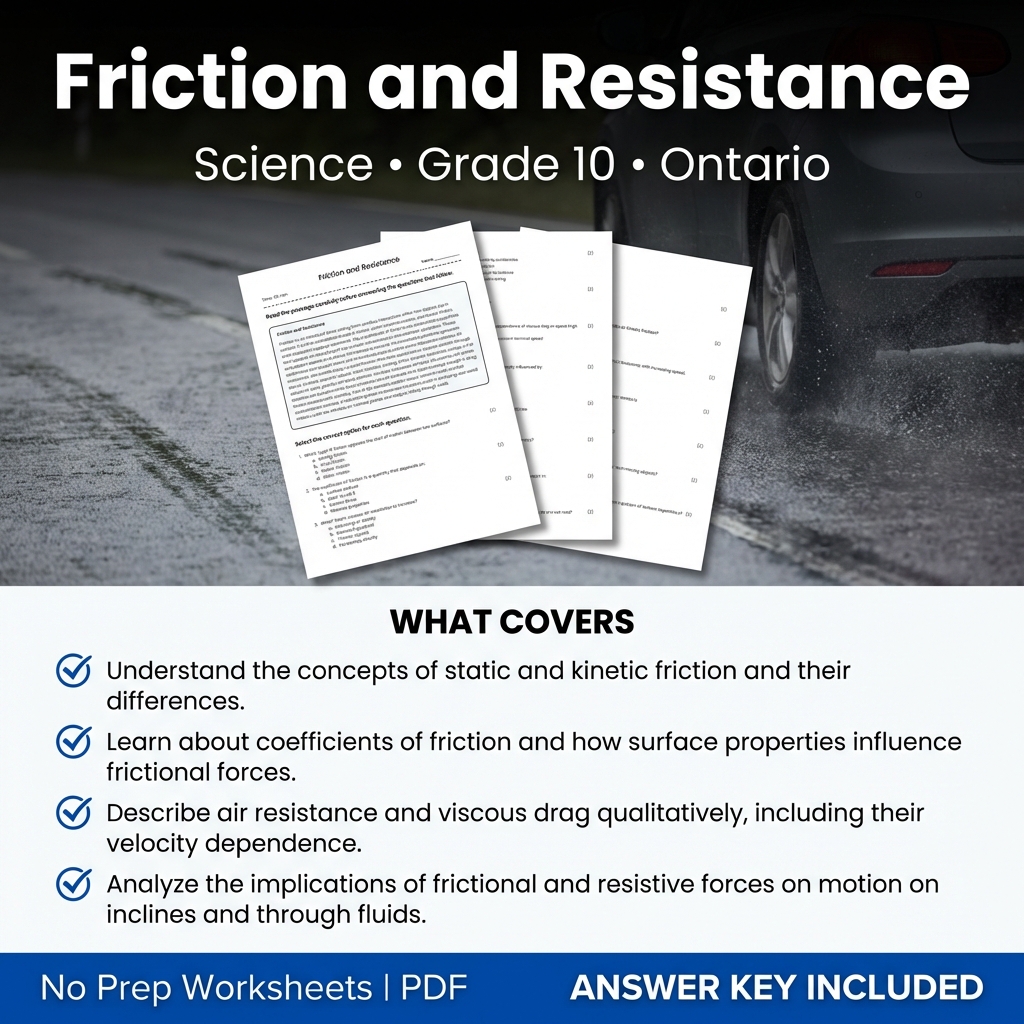
Friction and Resistance Worksheet for Grade 10 Science – Ontario Standards
 Created byCoral Reef Learning
Learning Objectives
- Understand the concepts of static and kinetic friction and their differences.
- Learn about coefficients of friction and how surface properties influence frictional forces.
- Describe air resistance and viscous drag qualitatively, including their velocity dependence.
Instant download
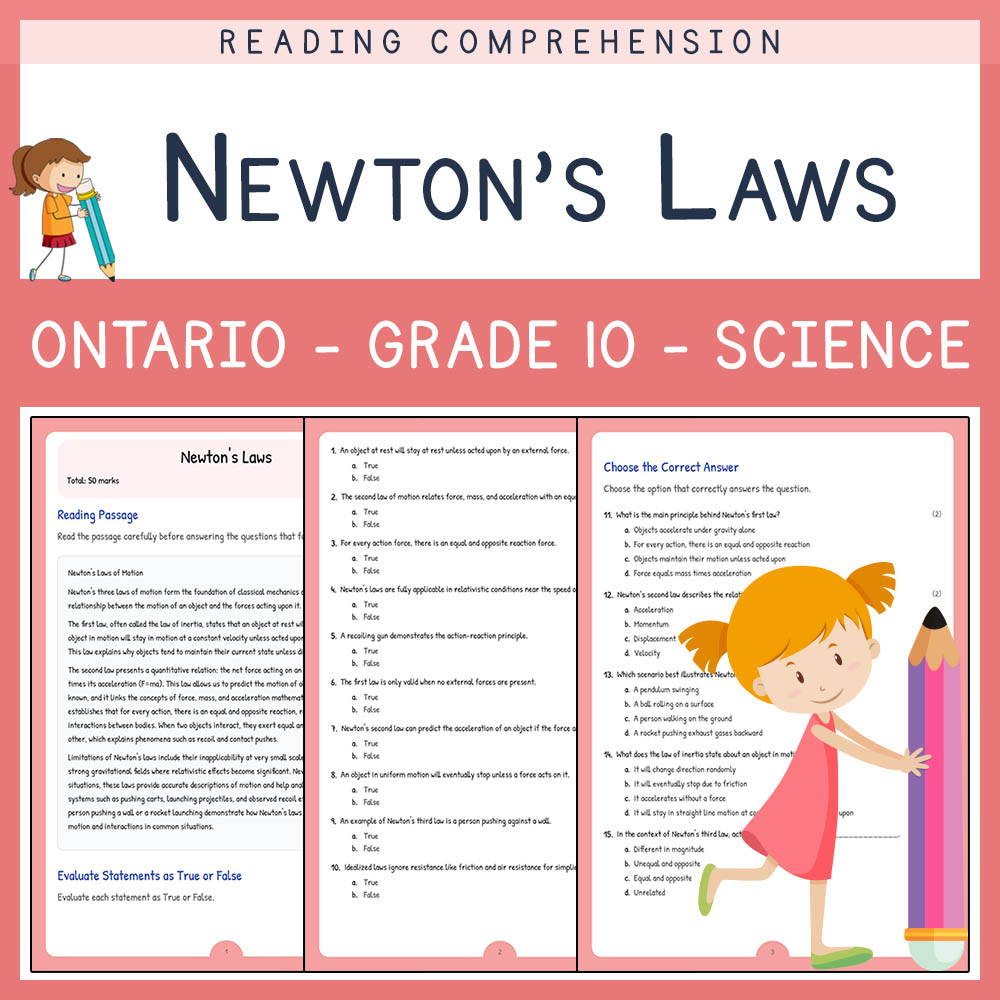
Grade 10 Science Assessment | Newton's Laws Worksheet Elena | Ontario
Created byLumora LearningLearning Objectives
- Understand and describe the three laws of motion articulated by Newton.
- Connect concepts of inertia, force, and acceleration in practical examples.
- Analyze action-reaction pairs and conservation laws in mechanics.
Also included in: Grade 10 Science | Motion & Forces Lesson Bundle | Ontario Standards
Instant download
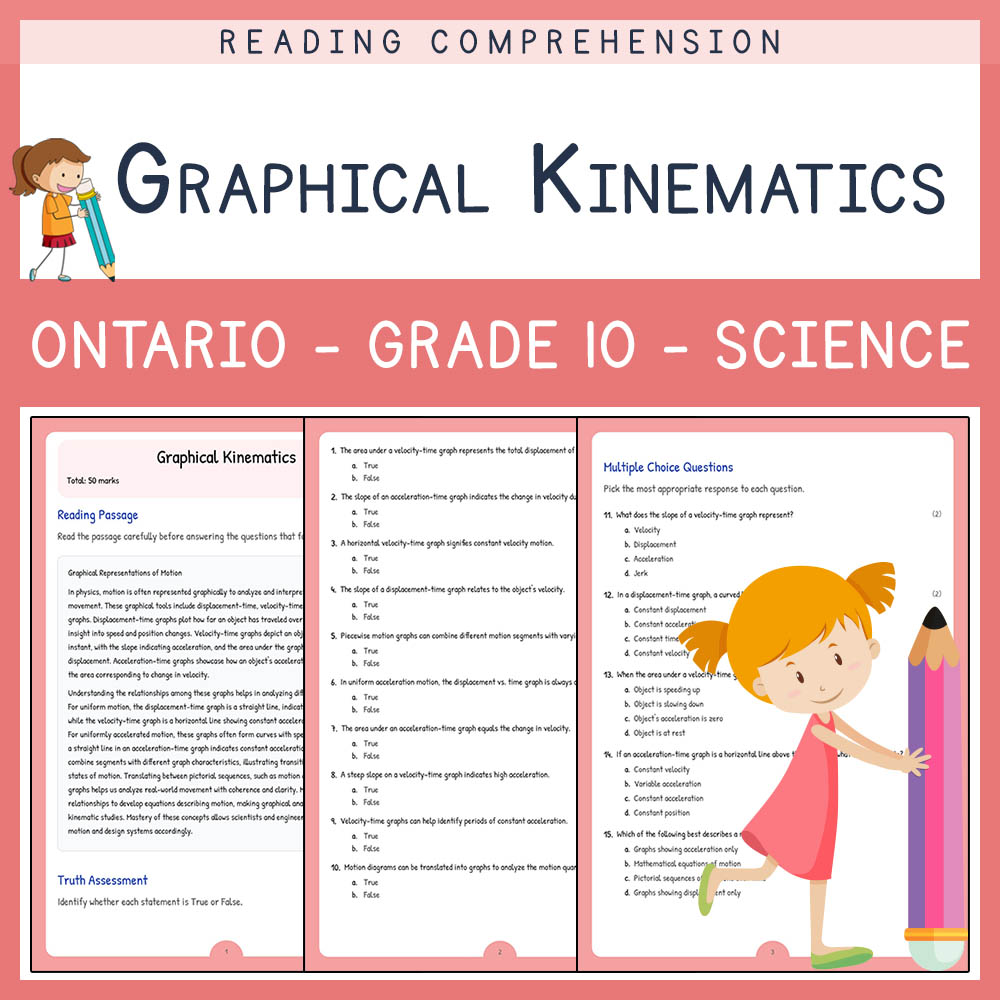
Grade 10 Science | Graphical Kinematics Worksheet | Ontario Standard
Created byLumora LearningLearning Objectives
- Understand and interpret displacement–time, velocity–time, and acceleration–time graphs.
- Explain the relationships among slope, area, and kinematic quantities in motion graphs.
- Differentiate between piecewise and uniformly accelerating motion through graphical analysis.
Also included in: Grade 10 Science | Motion & Forces Lesson Bundle | Ontario Standards
Instant download
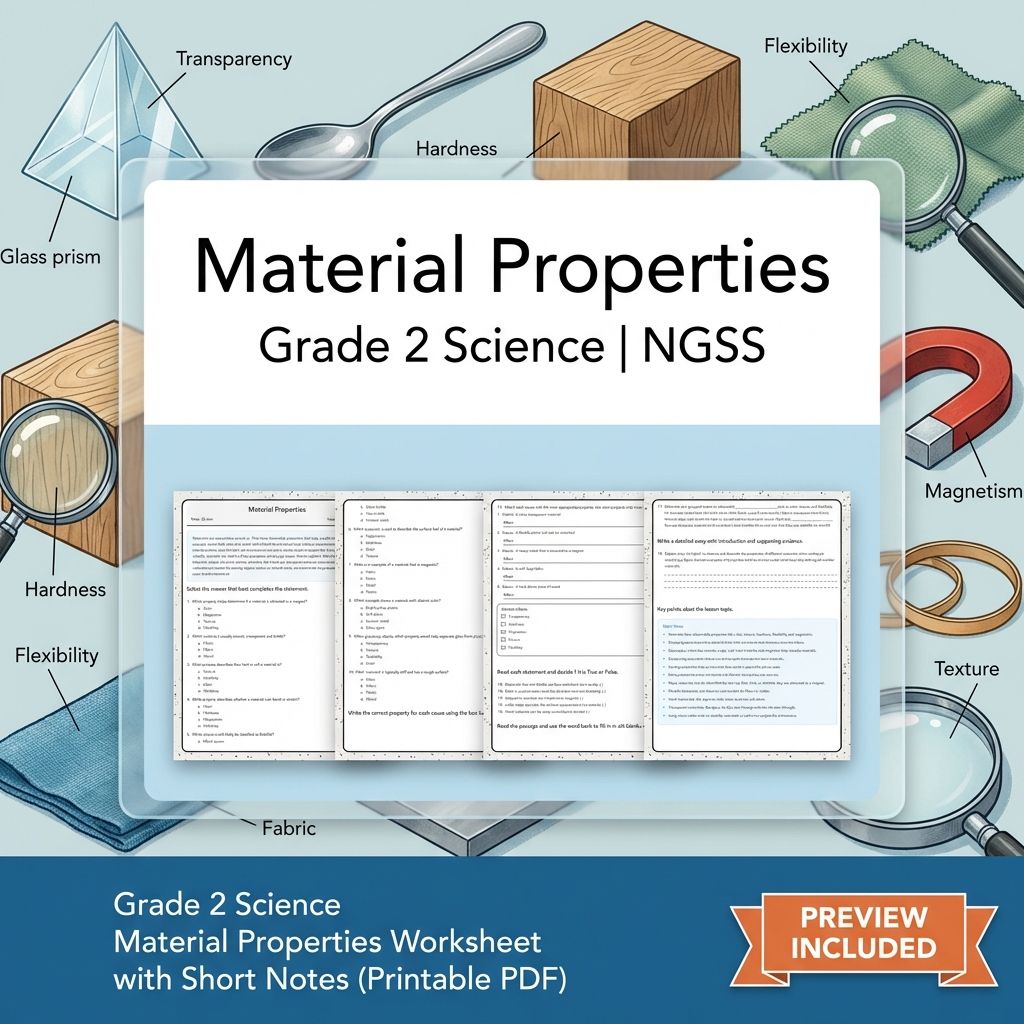
Grade 2 Science Material Properties Worksheet with Short Notes (Printable PDF)
Created byMeadowlark WorksheetsLearning Objectives
- Identify and describe materials based on observable properties such as color, texture, hardness, flexibility, and magnetism.
- Group objects according to shared characteristics using descriptive vocabulary.
- Interpret patterns in sorted sets of materials and justify categorization choices.
Also included in: Grade 2 Science Unit | Matter and Its Interactions NGSS Worksheet Collection +1 more
Instant download
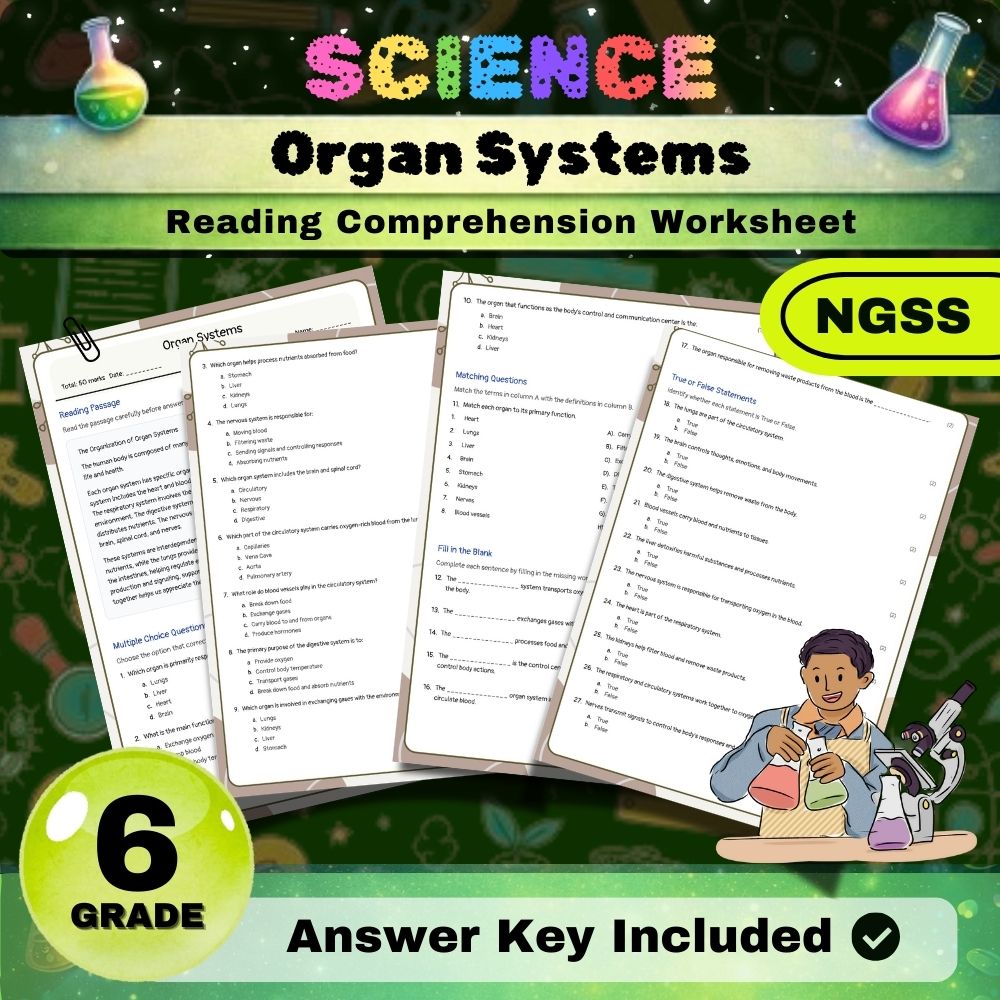
6th Grade Science | Organ Systems Worksheet (PDF) NGSS-Aligned
 Created byMaple Path Learning
Learning Objectives
- Understand the structure and function of key organ systems such as circulatory, respiratory, digestive, and nervous systems.
- Describe how tissues and organs work together to maintain homeostasis and overall health.
- Explain the interdependence of different organs within organ systems and how they contribute to physiological processes.
Also included in: Grade 6 Science Unit Bundle – Cell Functions, Energy & Organ Systems Worksheets +1 more
Instant download
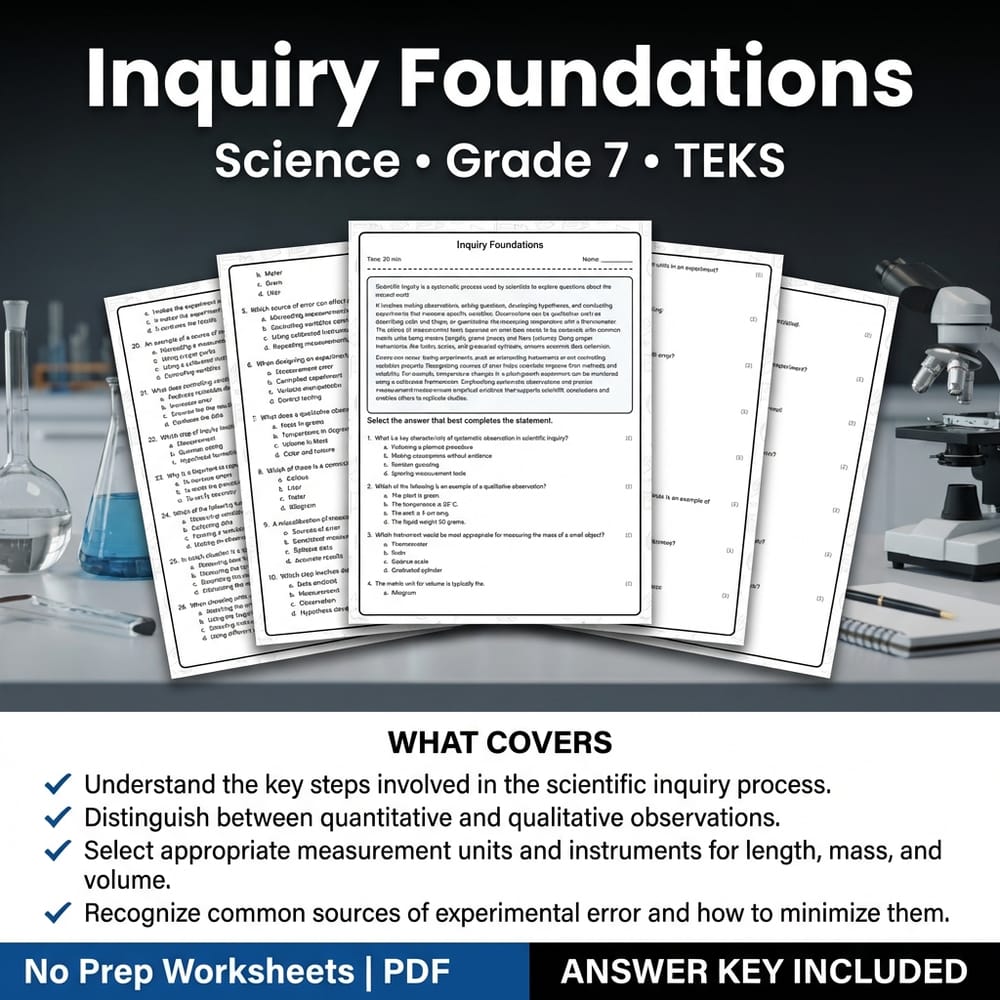
Grade 7 Science Inquiry Foundations Worksheet with Answer Key | TEKS
Created byCoral Reef LearningLearning Objectives
- Understand the key steps involved in the scientific inquiry process.
- Distinguish between quantitative and qualitative observations.
- Select appropriate measurement units and instruments for length, mass, and volume.
Instant download
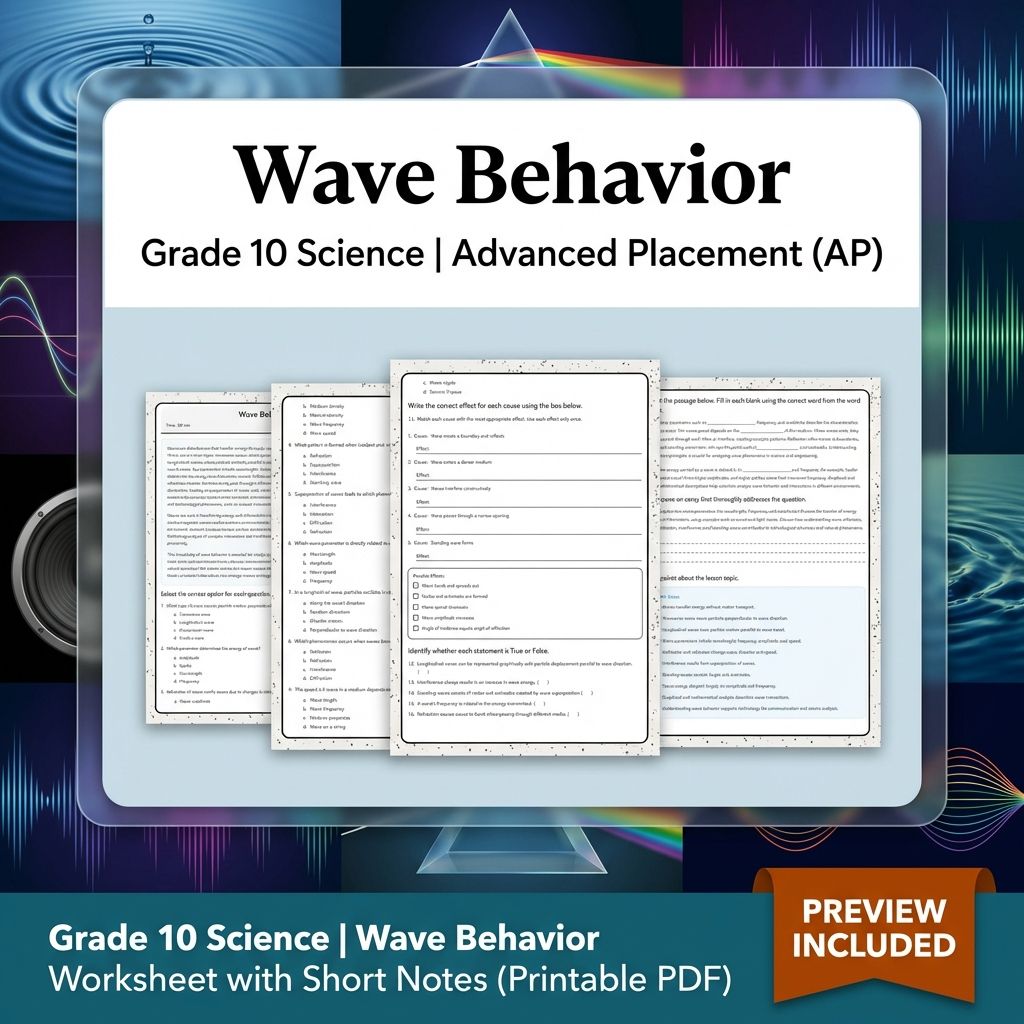
Grade 10 Science | Wave Behavior Worksheet with Short Notes (Printable PDF)
Created byMeadowlark WorksheetsLearning Objectives
- Describe transverse and longitudinal wave characteristics using parameters such as wavelength, frequency, amplitude, and wave speed.
- Explain the relationship between wave parameters and energy transfer.
- Analyze wave phenomena including reflection, refraction, interference, superposition, and standing waves.
Instant download

Grade 10 Science | Motion Graphs Worksheet with Short Notes (Printable PDF)
Created byMeadowlark WorksheetsLearning Objectives
- Analyze how slopes encode velocity and acceleration in motion graphs.
- Understand how area under graphs relates to change in position and speed.
- Extract kinematic quantities from graphical data in non-uniform motion.
Instant download
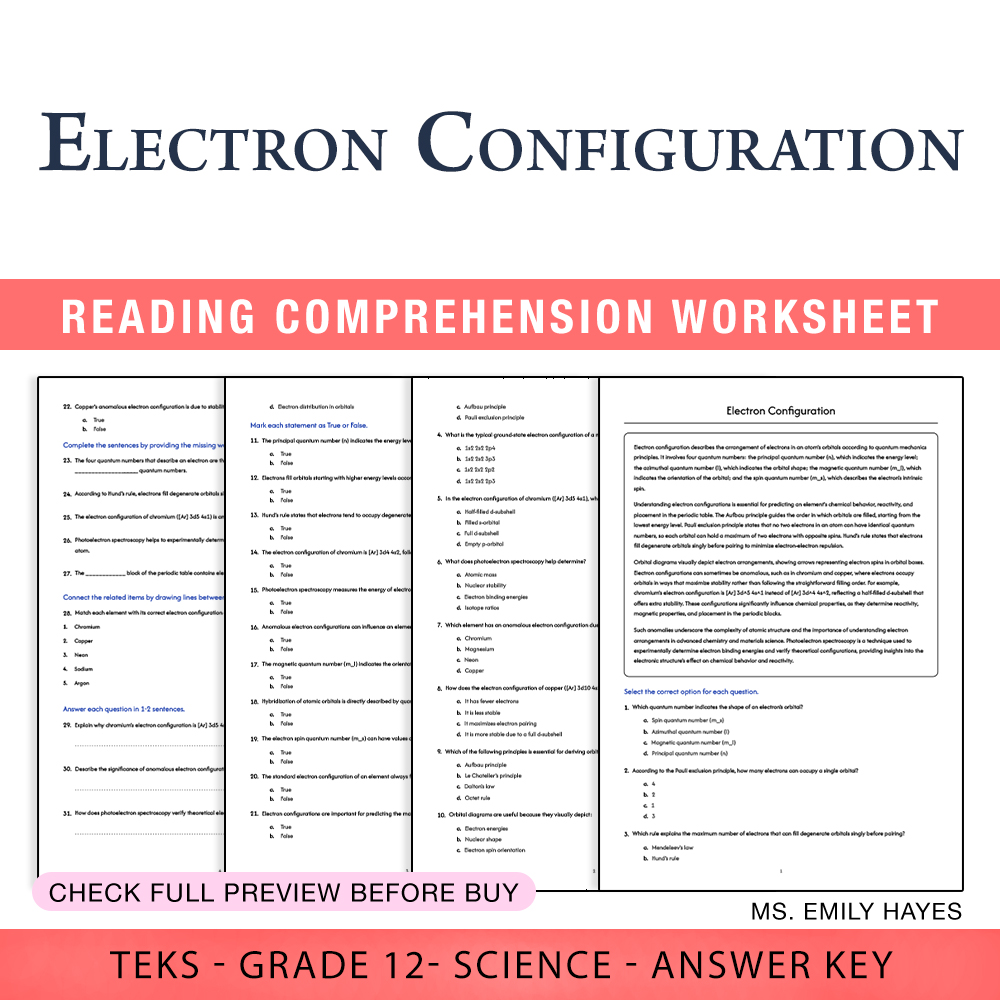
12th Grade Science | Electron Configuration Worksheet (PDF+ Answer Key)
Created byCopper Leaf ClassroomLearning Objectives
- Explain the quantum mechanical model of electrons using principal, azimuthal, magnetic, and spin quantum numbers.
- Apply the Aufbau principle, Pauli exclusion principle, and Hund’s rule to derive electron configurations and orbital diagrams.
- Analyze the anomalous electron configurations of elements like chromium and copper and understand their impact on chemical properties.
Instant download

Grade 6 Science | Population Change Worksheet | California Standards
Created byLumora LearningLearning Objectives
- Explain how birth rates, death rates, and resource availability affect population size over time.
- Interpret trends in population data to infer why populations increase or decrease in different seasons or habitats.
- Use population-change reasoning to connect environmental conditions to survival and reproduction.
Instant download

Grade 9 Science — Worksheet MCQ Paper for Mastering Plate Boundaries
Created byThe Resource HubLearning Objectives
- Understand the different types of plate boundaries and their surface expressions.
- Identify characteristic features associated with divergent, convergent, and transform margins.
- Interpret geologic evidence such as seafloor age patterns and paleomagnetic stripes.
Also included in: Grade 9 Earth and Space Sciences AP Bundle | Science Worksheets and Activities +1 more
Instant download
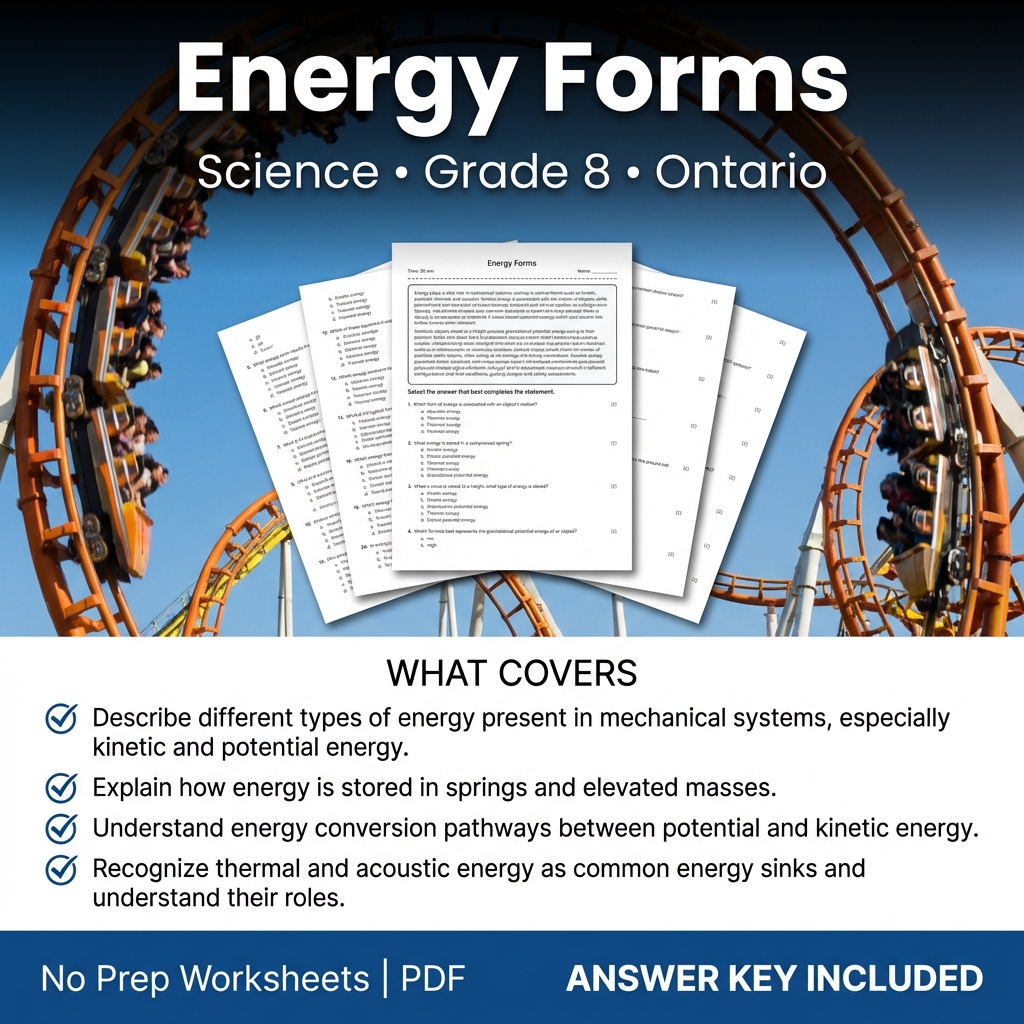
Energy Forms Worksheet for Grade 8 Science | Ontario Standards
Created byCoral Reef LearningLearning Objectives
- Describe different types of energy present in mechanical systems, especially kinetic and potential energy.
- Explain how energy is stored in springs and elevated masses.
- Understand energy conversion pathways between potential and kinetic energy.
Instant download
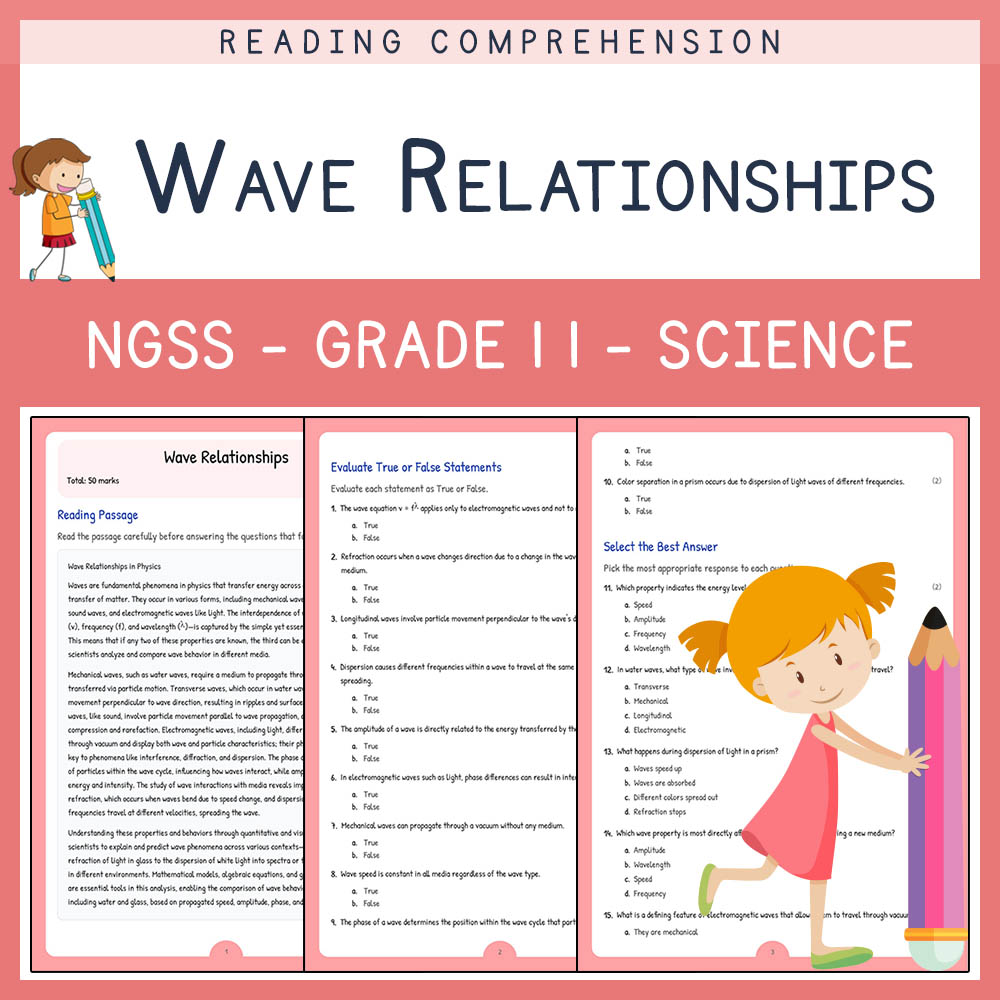
Grade 11 Science | Wave Relationships Worksheet (PDF + Answer Key) – NGSS Alignment
Created byLumora LearningLearning Objectives
- Understand the mathematical relationship among wave speed, frequency, and wavelength and perform related calculations.
- Describe the differences between transverse and longitudinal waves, including examples and their properties.
- Analyze wave behaviors such as refraction and dispersion using graphs and algebraic representations.
Instant download

Sea-Floor Spreading Worksheet | Grade 12 Science Practice
 Created byPrism Point Learning
Learning Objectives
- Explain how sea-floor spreading at mid-ocean ridges creates new oceanic crust.
- Describe how magnetic stripes form and why they appear symmetrically on both sides of a ridge.
- Interpret relationships among magnetic anomaly patterns, radiometric ages, and plate motion.
Instant download
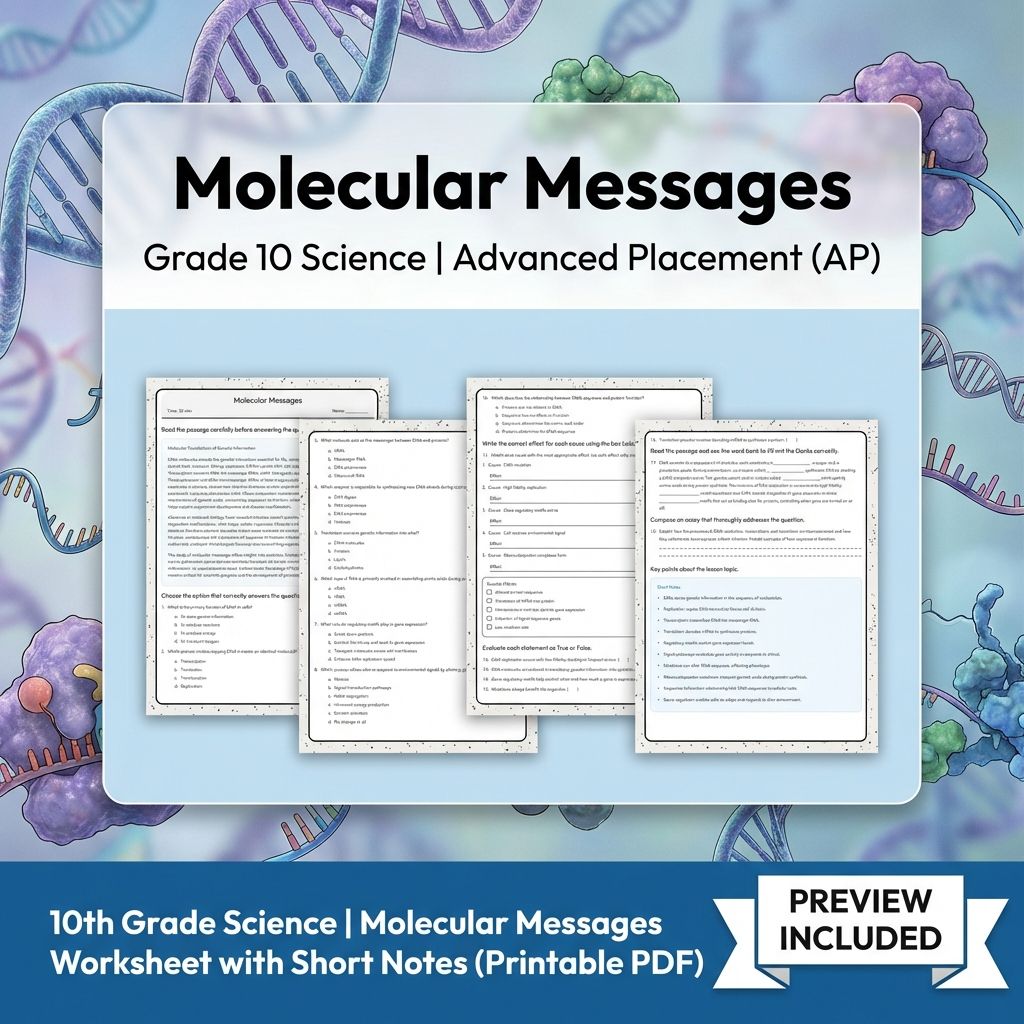
10th Grade Science | Molecular Messages Worksheet with Short Notes (PDF)
Created byMeadowlark WorksheetsLearning Objectives
- Understand the structure and function of DNA and how genetic information is stored and transmitted.
- Describe the processes of DNA replication, transcription, and translation at the molecular level.
- Explain how sequence-to-function relationships influence cellular phenotypes within biological systems.
Instant download
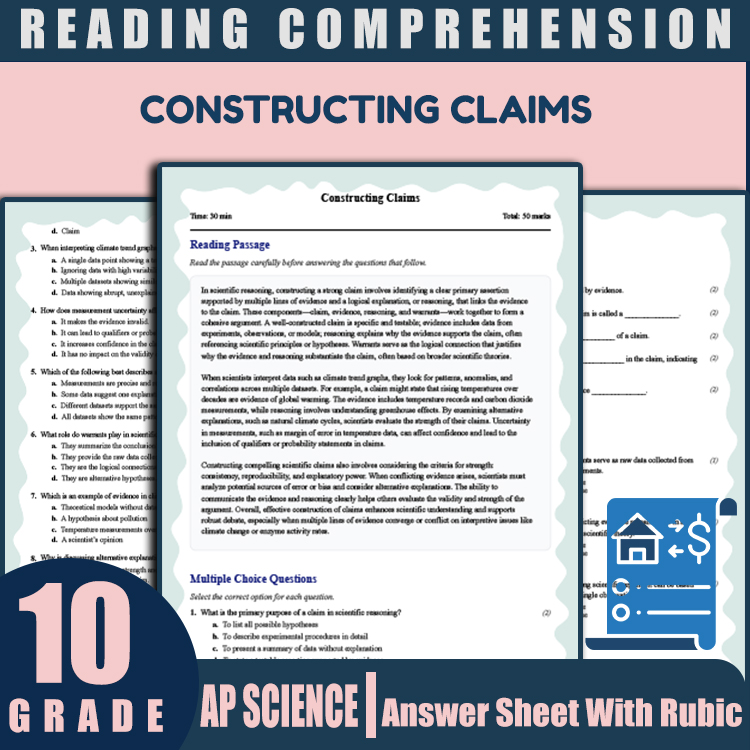
10th Grade Science | Constructing Claims Reading Worksheet & Answer Key (PDF)
JCreated byJ.S SheetsLearning Objectives
- Understand the components of evidence-based claims, including claim, evidence, and reasoning.
- Distinguish between different parts of an argument and how they connect logically.
- Apply criteria for evaluating the strength of a scientific argument based on evidence and warrants.
Also included in: Grade 10 Science Unit Worksheet Pack – Data Analysis & Scientific Reasoning +1 more
Instant download

Groundwater Systems Worksheet for Grade 10 Science | Standards-Aligned Practice
JCreated byJ.S SheetsLearning Objectives
- Describe how aquifer properties such as porosity and permeability influence groundwater storage and flow.
- Explain how recharge and discharge control groundwater levels and support connected surface-water systems.
- Evaluate how groundwater vulnerability affects contaminant transport, including risks to ecosystems and communities.
Instant download
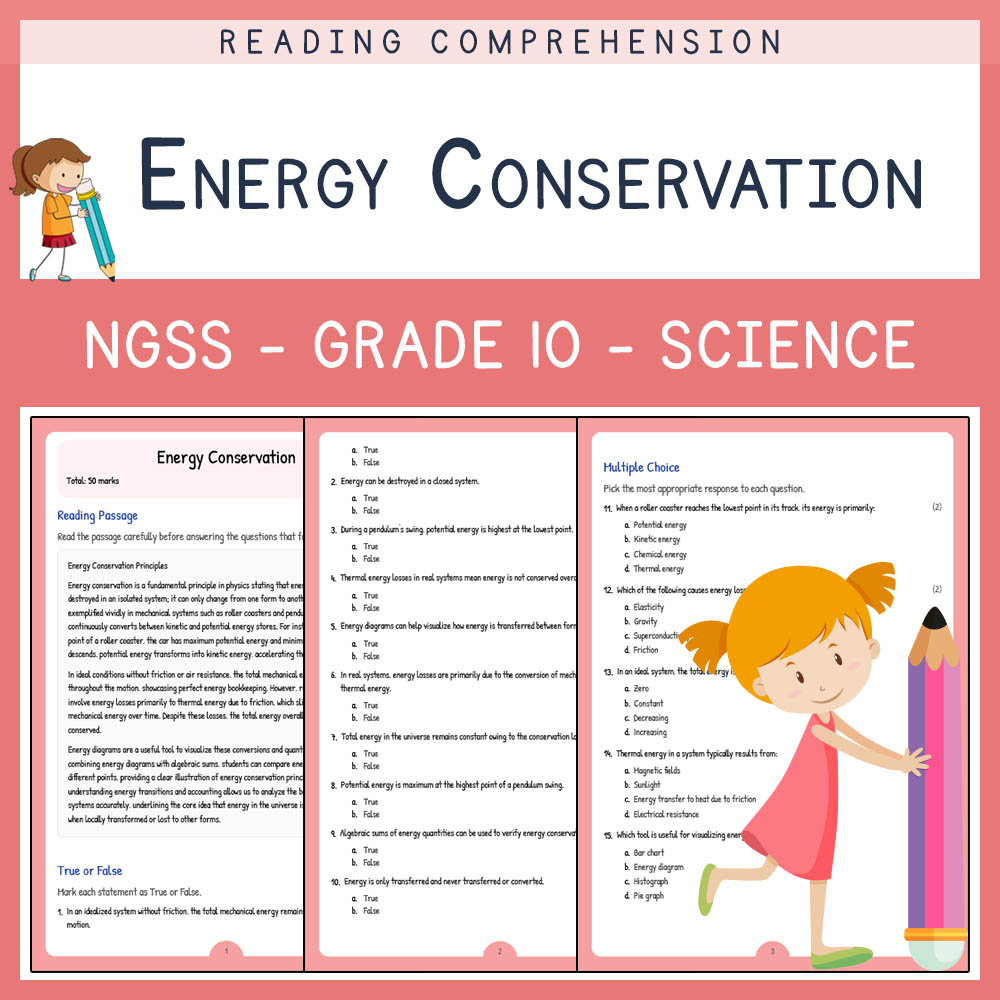
Grade 10 Science | Energy Conservation Worksheet (PDF + Answer Key)
Created byLumora LearningLearning Objectives
- Understand the principle of energy conservation in mechanical systems such as roller coasters and pendulums.
- Analyze energy transfers between kinetic, potential, and thermal stores during physical processes.
- Apply energy bookkeeping methods to quantify energy stores and transfers in idealized systems.
Instant download

6th Grade Science | Reasoning Claims Worksheet (TEKS) PDF
 Created byEvergreen Desk Education
Learning Objectives
- Explain the difference between raw observations and explanatory science claims.
- Use evidence to decide whether a scientific claim is strongly supported or weakly supported.
- Interpret patterns in data to strengthen (or question) an inference.
Instant download
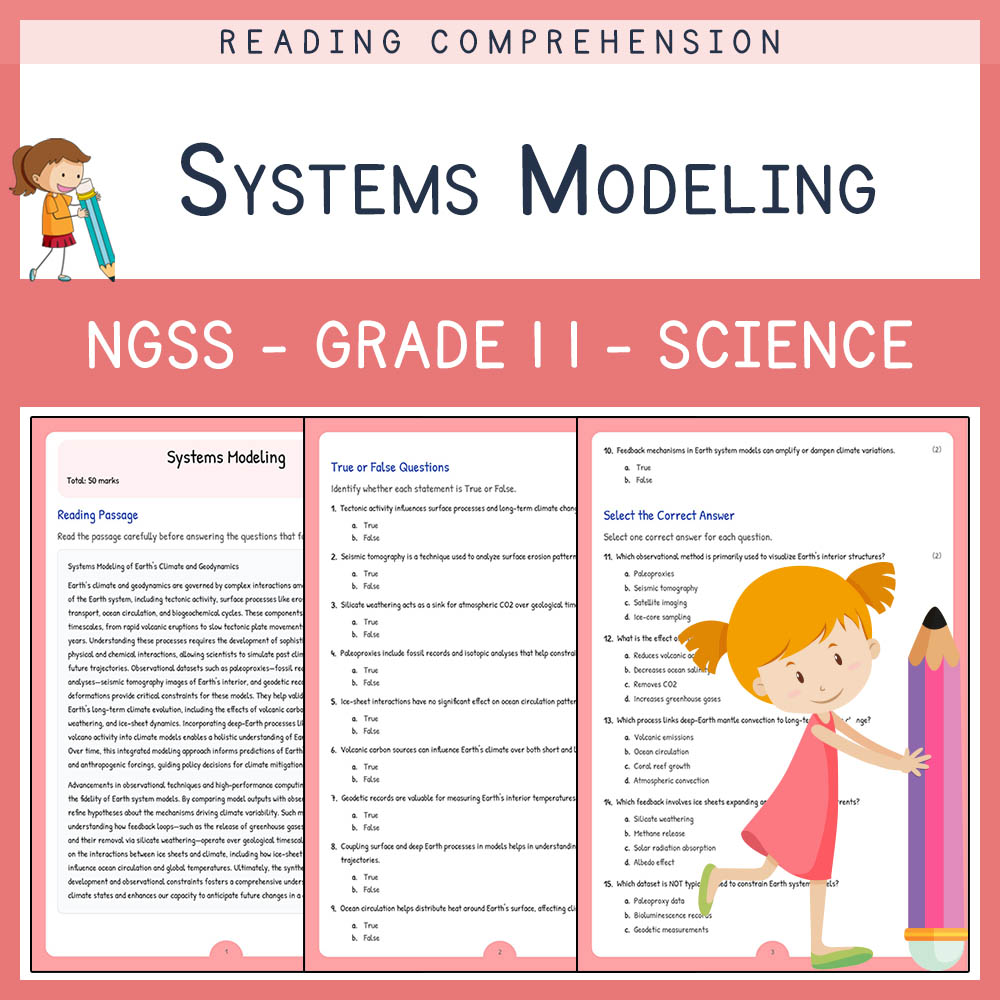
Grade 11 Science | Systems Modeling Worksheet & Answer Key for NGSS
Created byLumora LearningLearning Objectives
- Understand the components and interactions of Earth system models including tectonics, surface processes, ocean circulation, and biogeochemical feedbacks.
- Analyze how observational datasets constrain Earth system hypotheses and model predictions.
- Describe the role of volcanic carbon sources, silicate weathering sinks, and ice-sheet interactions in climate evolution.
Instant download

Grade 8 Science | Force Diagrams - Daily Reading Comprehension
Created byCoral Reef LearningLearning Objectives
- Understand the concept of free-body diagrams
- Identify different types of forces such as normal force, tension, friction, and gravity
- Interpret and draw force diagrams for various systems
Instant download
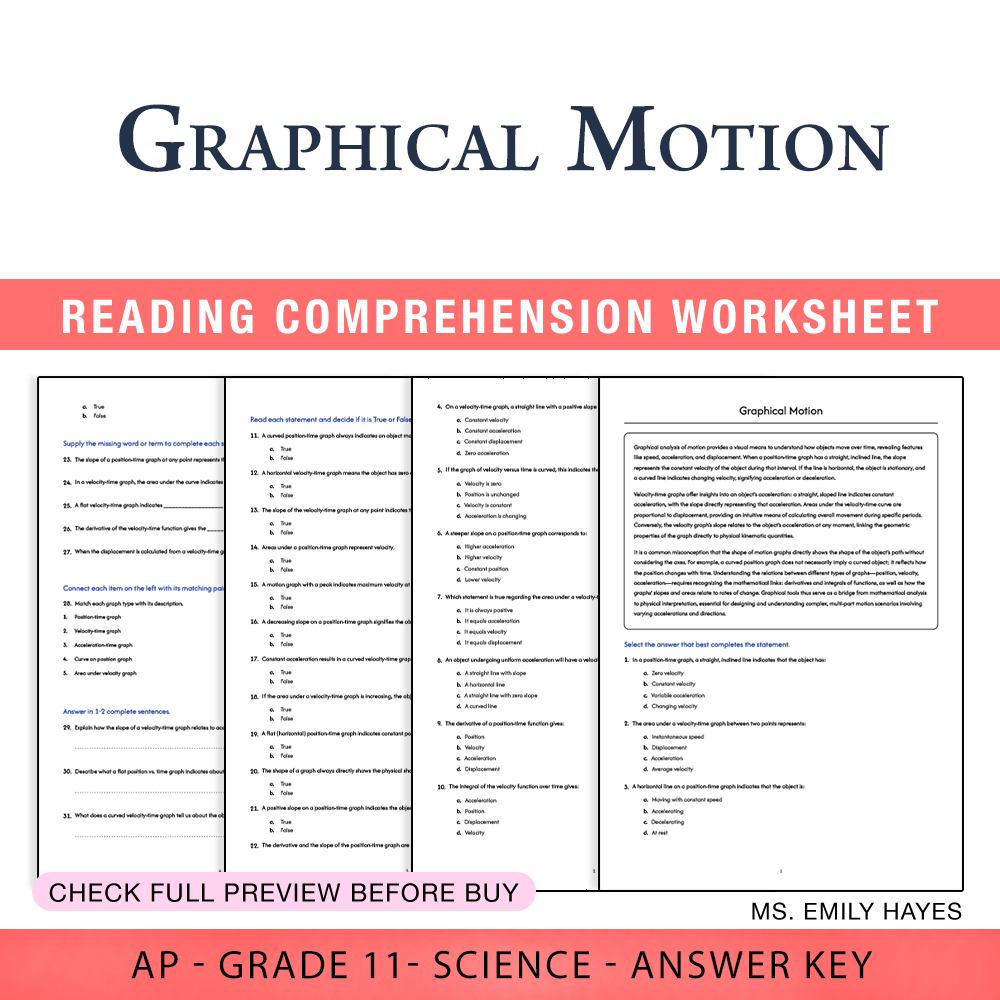
11th Grade Science | Graphical Motion Worksheet (PDF+ Answer Key)
Created byCopper Leaf ClassroomLearning Objectives
- Interpret and analyze motion graphs including position, velocity, and acceleration.
- Construct and compare different types of motion graphs for constant and variable acceleration scenarios.
- Relate slopes and areas on graphs to instantaneous and average kinematic quantities.
Also included in: Grade 11 Science | Physics Principles Worksheet Bundle (PDF+ Answer Key)) +1 more
Instant download
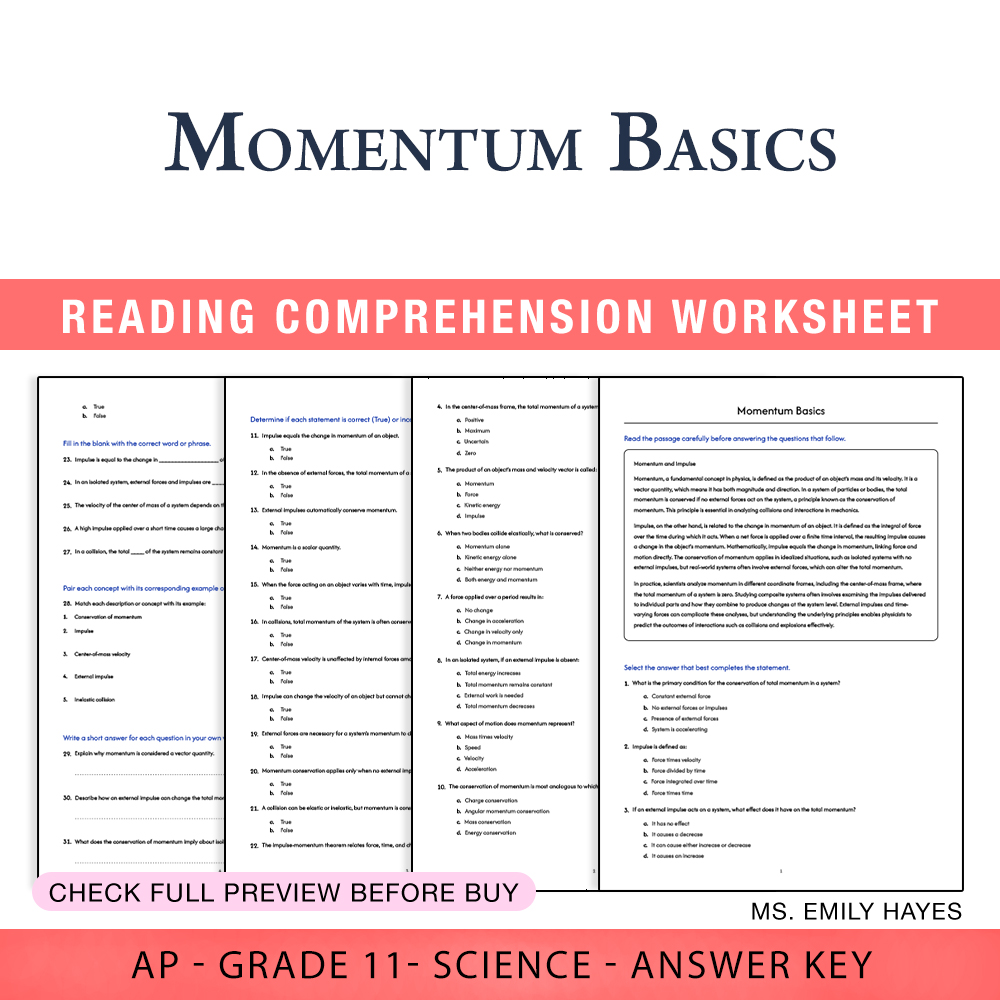
11th Grade Science | Momentum Basics Worksheet (PDF+ Answer Key)
Created byCopper Leaf ClassroomLearning Objectives
- Understand the concept of linear momentum as a conserved vector quantity in isolated systems.
- Explain the relationship between impulse and change in momentum.
- Apply conservation of momentum in different coordinate frames and analyze external impulses.
Also included in: Grade 11 Science | Physics Principles Worksheet Bundle (PDF+ Answer Key)) +1 more
Instant download
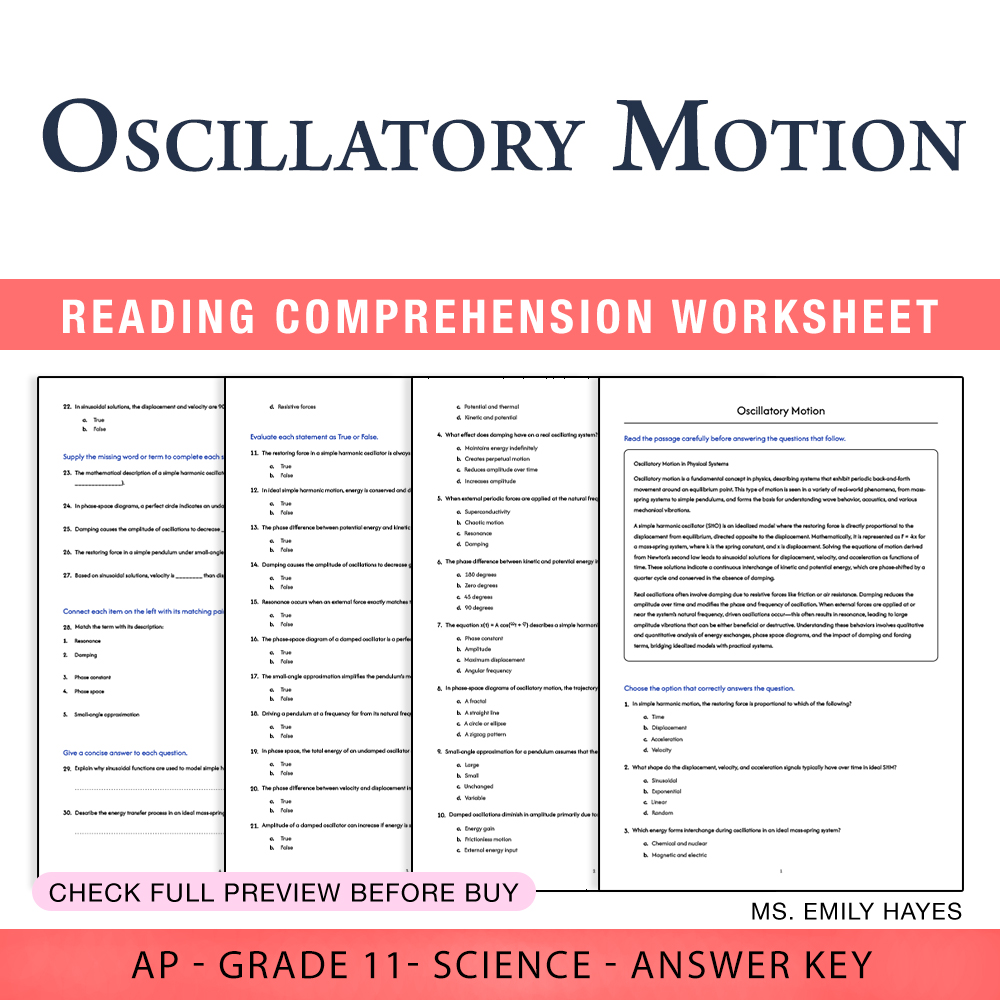
11th Grade Science | Oscillatory Motion Worksheet (PDF+ Answer Key)
Created byCopper Leaf ClassroomLearning Objectives
- Explain the principles of simple harmonic motion in mass–spring systems and pendulums.
- Derive the equations of motion for oscillatory systems and interpret their physical meaning.
- Connect the concept of restoring force linearity to sinusoidal solutions in oscillations.
Also included in: Grade 11 Science | Physics Principles Worksheet Bundle (PDF+ Answer Key)) +1 more
Instant download
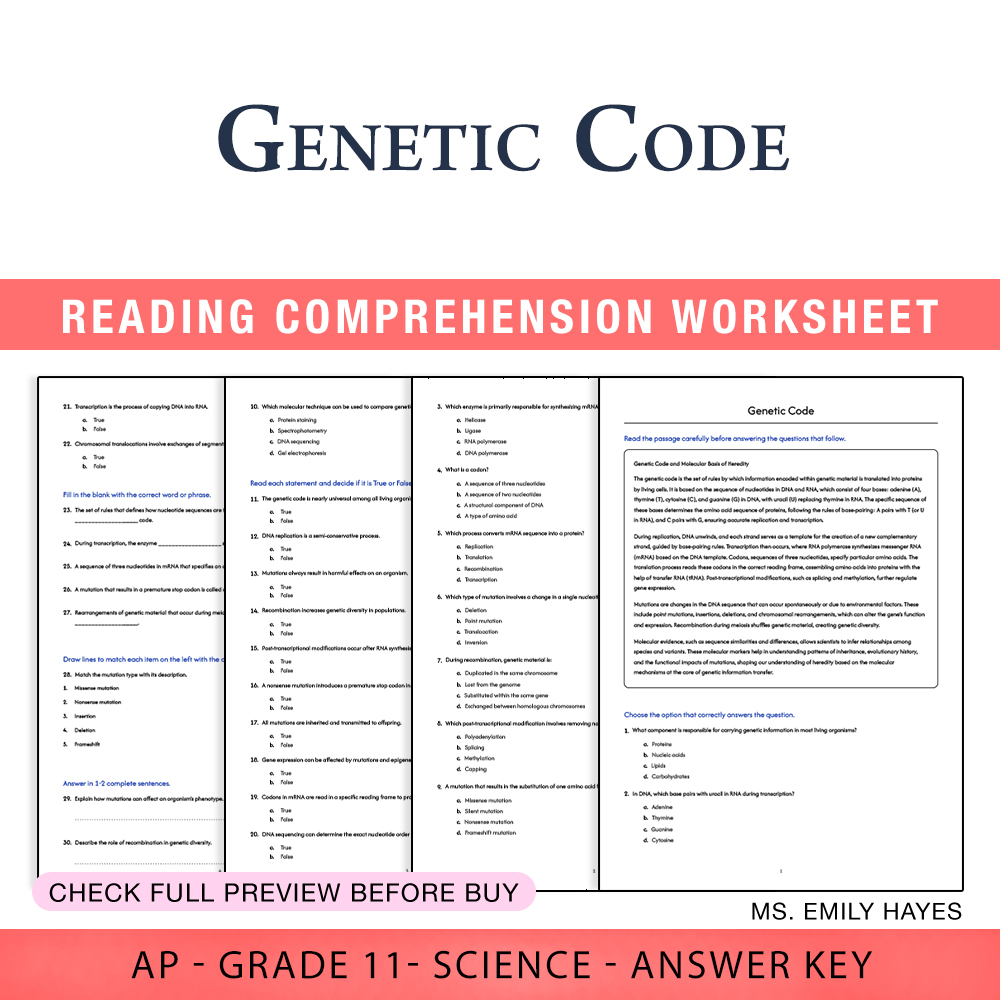
11th Grade Science | Genetic Code Worksheet (PDF+ Answer Key)
Created byCopper Leaf ClassroomLearning Objectives
- Understand the molecular basis of heredity including nucleic acid structure and base-pairing rules.
- Describe the processes of transcription and translation, including codon usage and reading frames.
- Identify different types of mutations and recombination and analyze their effects on gene expression and phenotype.
Also included in: Grade 11 Science | Biology & Ecosystems AP Worksheet Bundle (PDF+ Answer Keys) +1 more
Instant download
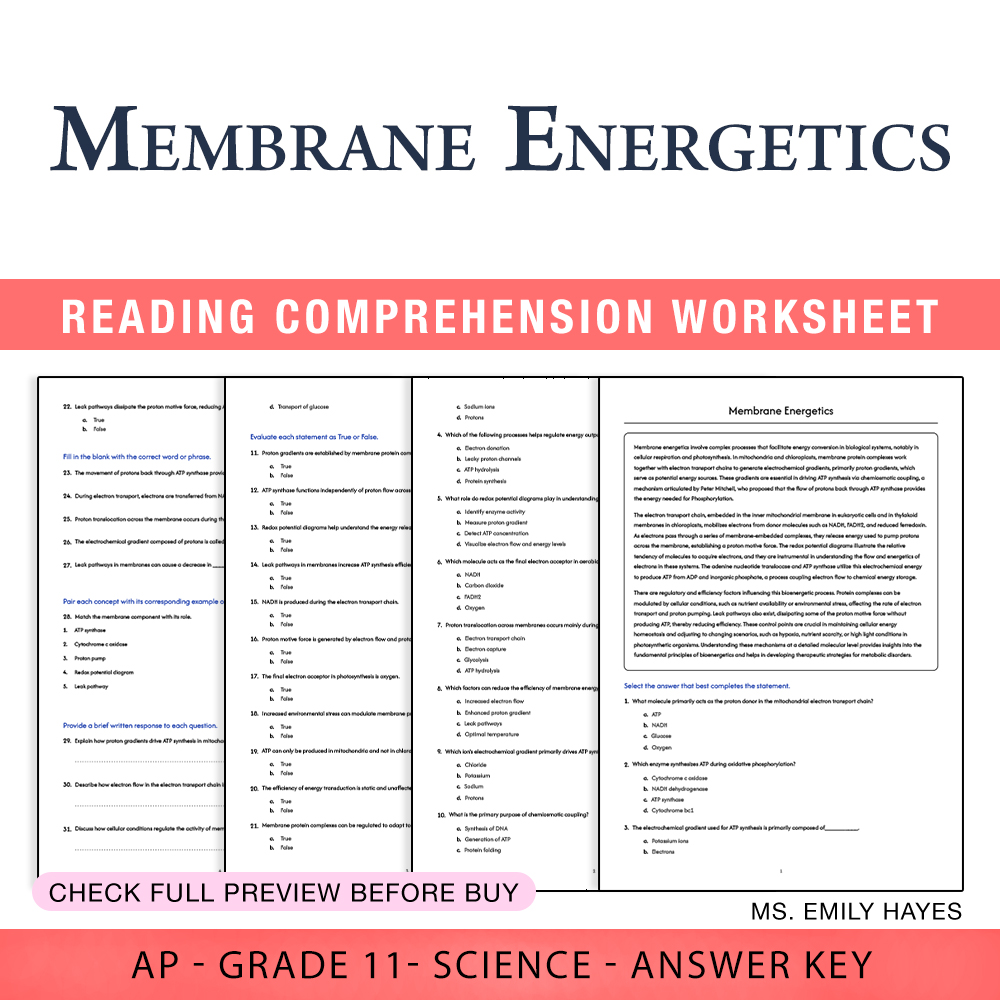
Grade 11 Science | Membrane Energetics Assessment Worksheet (PDF+ Answer Key)
Created byCopper Leaf ClassroomLearning Objectives
- Analyze bioenergetic principles of membrane-associated energy transduction.
- Explain the role of proton gradients, chemiosmotic coupling, and electron transport chains in energy generation.
- Interpret redox potential diagrams and electrochemical gradients related to ATP synthesis.
Also included in: Grade 11 Science | Biology & Ecosystems AP Worksheet Bundle (PDF+ Answer Keys) +1 more
Instant download

Grade 3 Science | Safe Tool Use Worksheet (Practice Set) - General Standards
Created byEvergreen Desk EducationLearning Objectives
- Identify safe tool-use practices for measuring, joining, and shaping materials.
- Explain why using a tool for its intended purpose helps prevent accidents and improves results.
- Apply safety rules to a classroom tool-work scenario.
Also included in: Grade 3 Simple Machines Science Lesson Bundle: General +1 more
Instant download

Grade 3 Science Worksheet | Prototype Testing (PDF) - General Standards
Created byEvergreen Desk EducationLearning Objectives
- Explain what a prototype is and why testing is important for improving a design
- Identify key observation criteria during prototype testing: strength, fit, stability, and function
- Compare testing results to the intended goal to decide what to improve in a design
Also included in: Grade 3 Simple Machines Science Lesson Bundle: General +1 more
Instant download

Grade 3 Science | Load-Bearing Structures Worksheet (PDF) – General Standards
Created byEvergreen Desk EducationLearning Objectives
- Explain how engineers help structures support forces without collapsing
- Identify how shape and connections (such as triangles and cross-bracing) improve stability
- Describe how testing shows whether a structure stays aligned and resists bending
Also included in: Grade 3 Simple Machines Science Lesson Bundle: General +1 more
Instant download
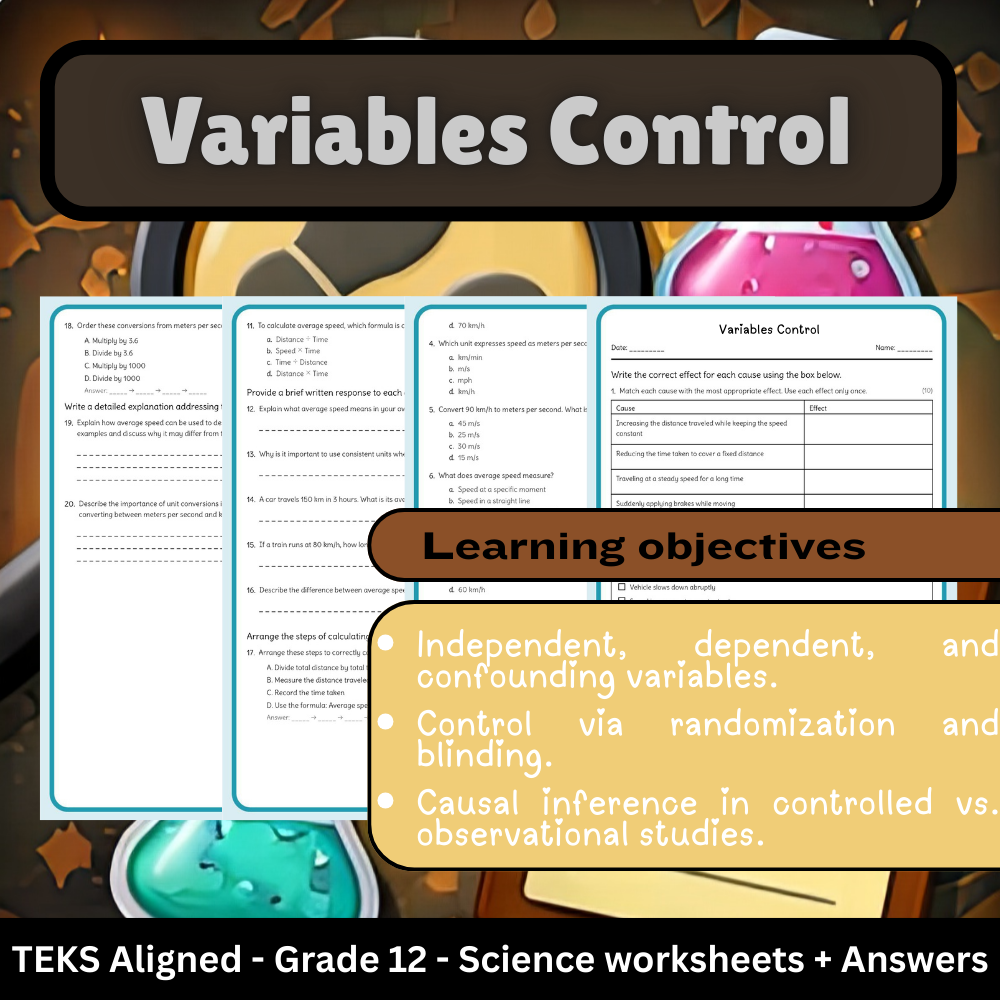
12th Grade Science | Variables Control Worksheet (Answer Key) for TEKS Standards
Created byBright Mind ResourcesLearning Objectives
- Identify independent, dependent, and confounding variables in experimental designs.
- Understand strategies for controlling variables including randomization and blinding.
- Interpret causal inferences from observational and controlled experiments.
Instant download
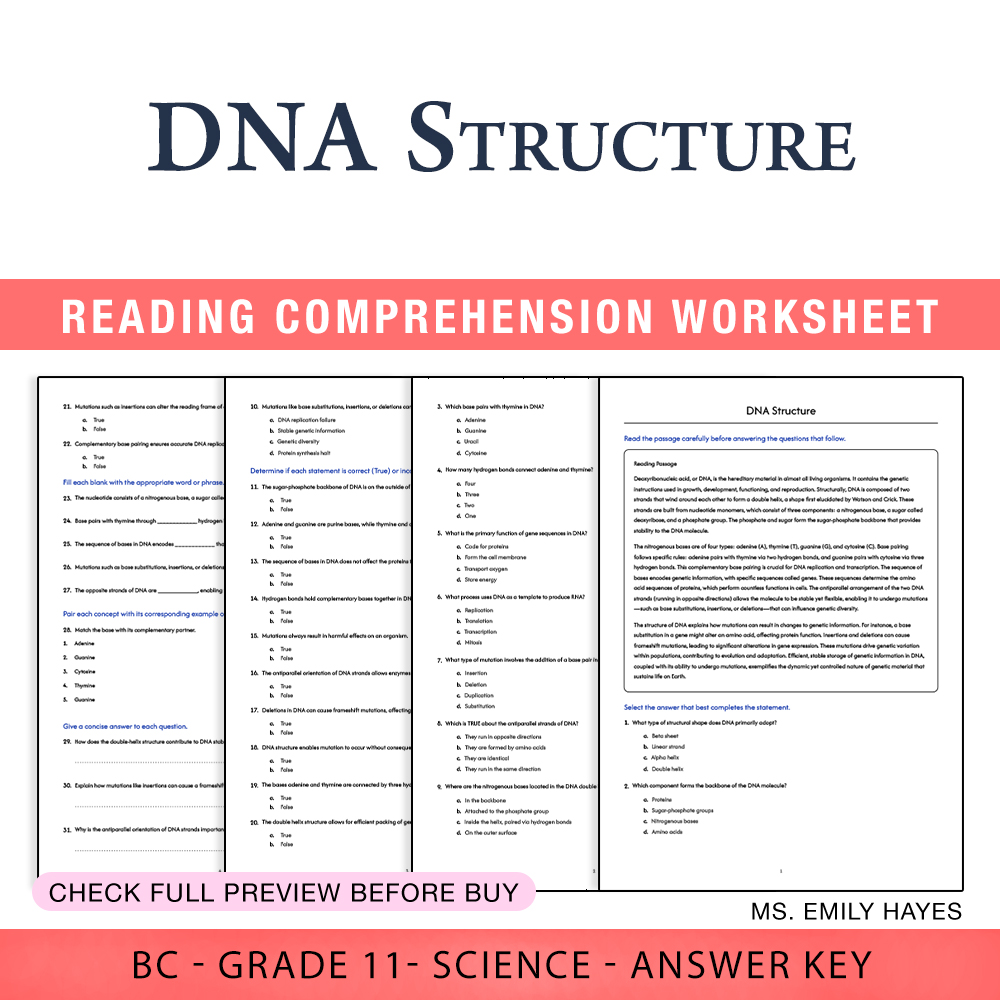
11th Grade Science | DNA Structure Worksheet (PDF + Answer Key)
Created byCopper Leaf ClassroomLearning Objectives
- Describe the basic structure of DNA, including its double helix and nucleotide components.
- Explain the principles of complementary base pairing in DNA.
- Understand how DNA's structural properties enable genetic storage, mutation, and replication.
Also included in: Grade 11 Science BC | Genetics, Evolution & Cell Biology (PDF + Answer Keys) +1 more
Instant download
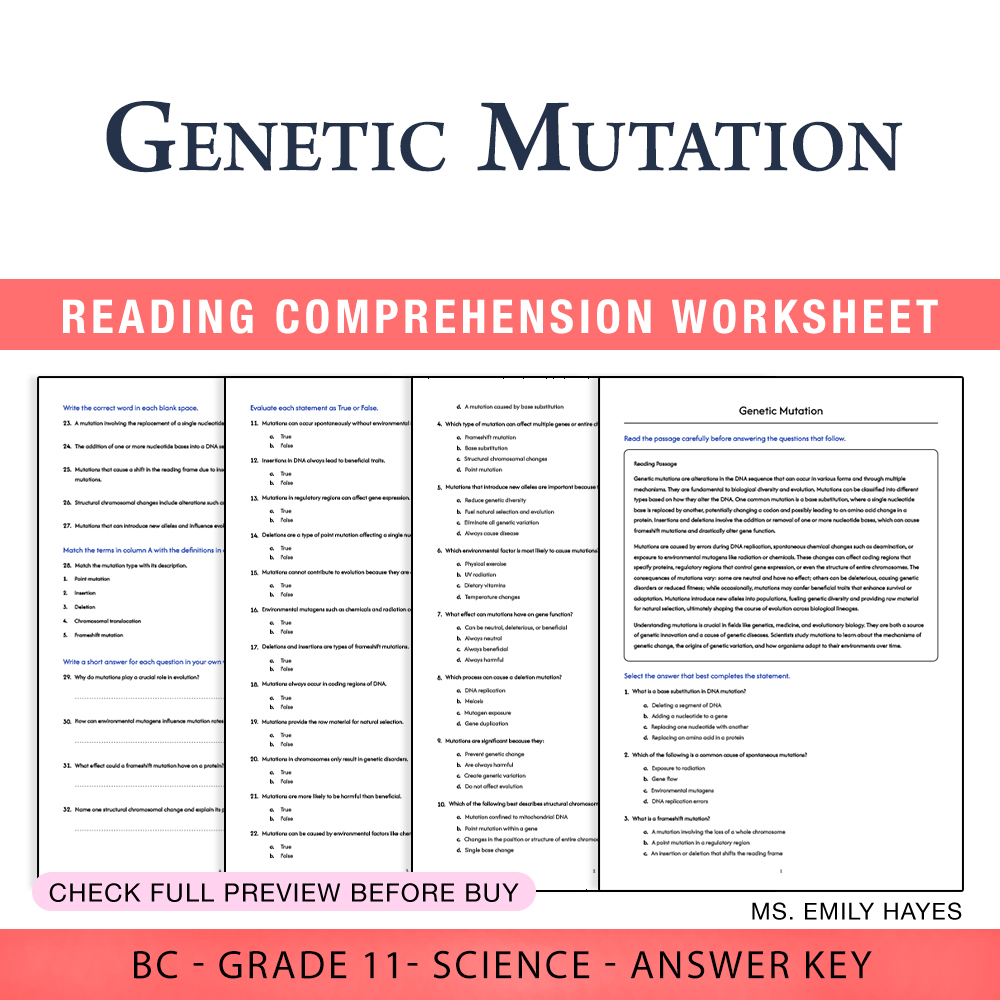
11th Grade Science | Genetic Mutation Worksheet (PDF + Answer Key)
Created byCopper Leaf ClassroomLearning Objectives
- Understand what genetic mutations are and their types.
- Identify causes and effects of mutations in DNA sequences.
- Differentiate between base substitutions, insertions, deletions, and chromosomal changes.
Also included in: Grade 11 Science BC | Genetics, Evolution & Cell Biology (PDF + Answer Keys) +1 more
Instant download

Inheritance Modeling Worksheet | NGSS-Aligned Grade 6 Science Practice
JCreated byJ.S SheetsLearning Objectives
- Understand how traits are transmitted from parents to offspring through genes.
- Model inheritance patterns using Punnett squares and probability.
- Differentiate between dominant and recessive traits in inheritance examples.
Also included in: Grade 6 Variation and Inheritance Science Lesson Bundle | NGSS Practice +1 more
Instant download
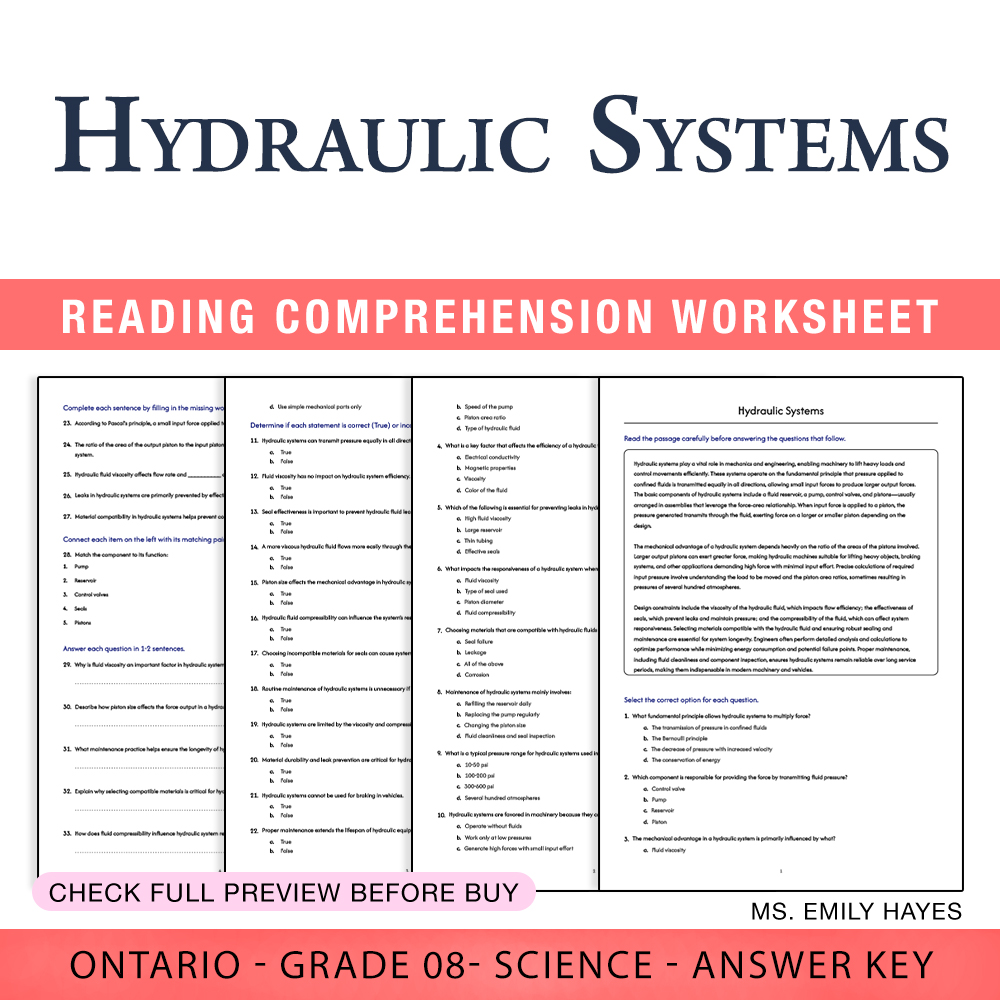
8th Grade Science | Hydraulic Systems Worksheet (PDF+ Answer Key)
Created byCopper Leaf ClassroomLearning Objectives
- Explain how hydraulic systems convert input forces into larger output forces using pressure and area relationships.
- Calculate the mechanical advantage provided by piston assemblies in hydraulic devices.
- Identify factors affecting hydraulic system performance, including fluid viscosity, seal effectiveness, and compressibility.
Instant download
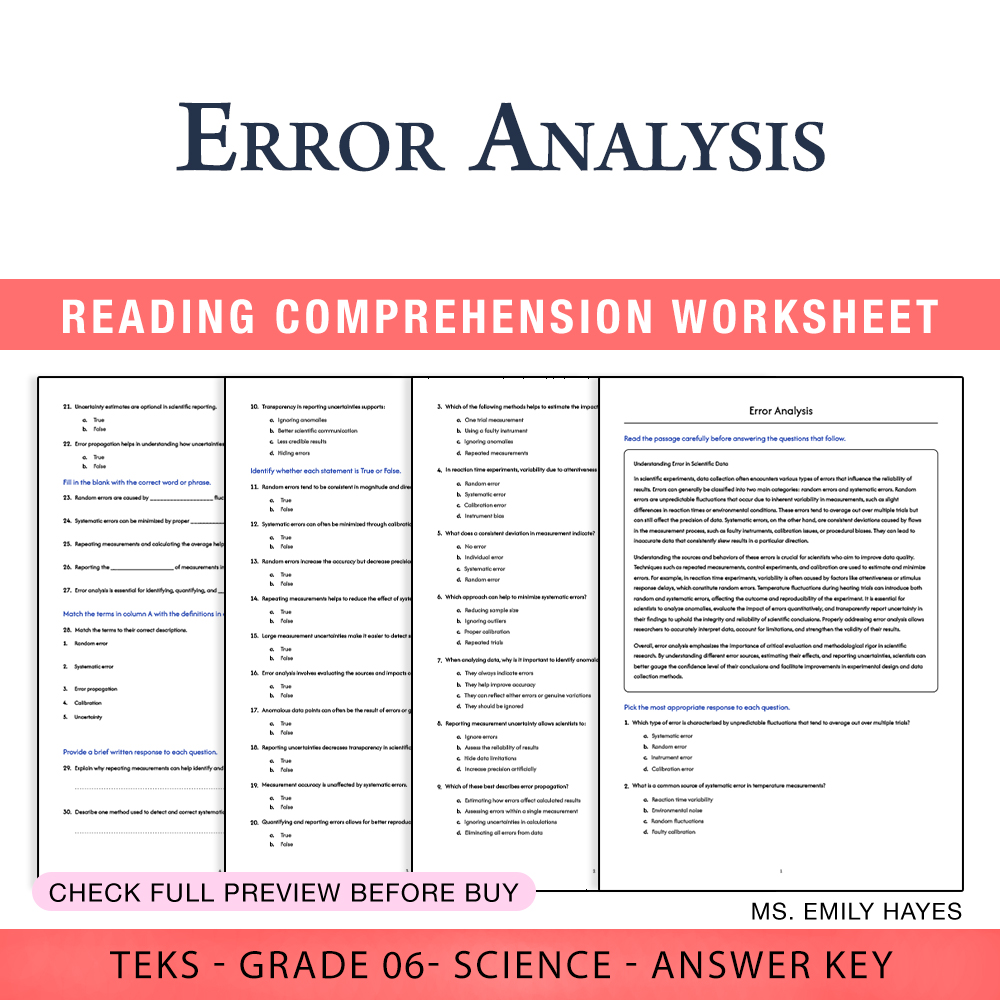
6th Grade Science | Error Analysis Worksheet (PDF+ Answer Key)
Created byCopper Leaf ClassroomLearning Objectives
- Identify different sources of error in experimental data and characterize their impact.
- Distinguish between random errors and systematic errors in scientific measurements.
- Analyze methods for estimating uncertainty and propagating errors through calculations.
Instant download
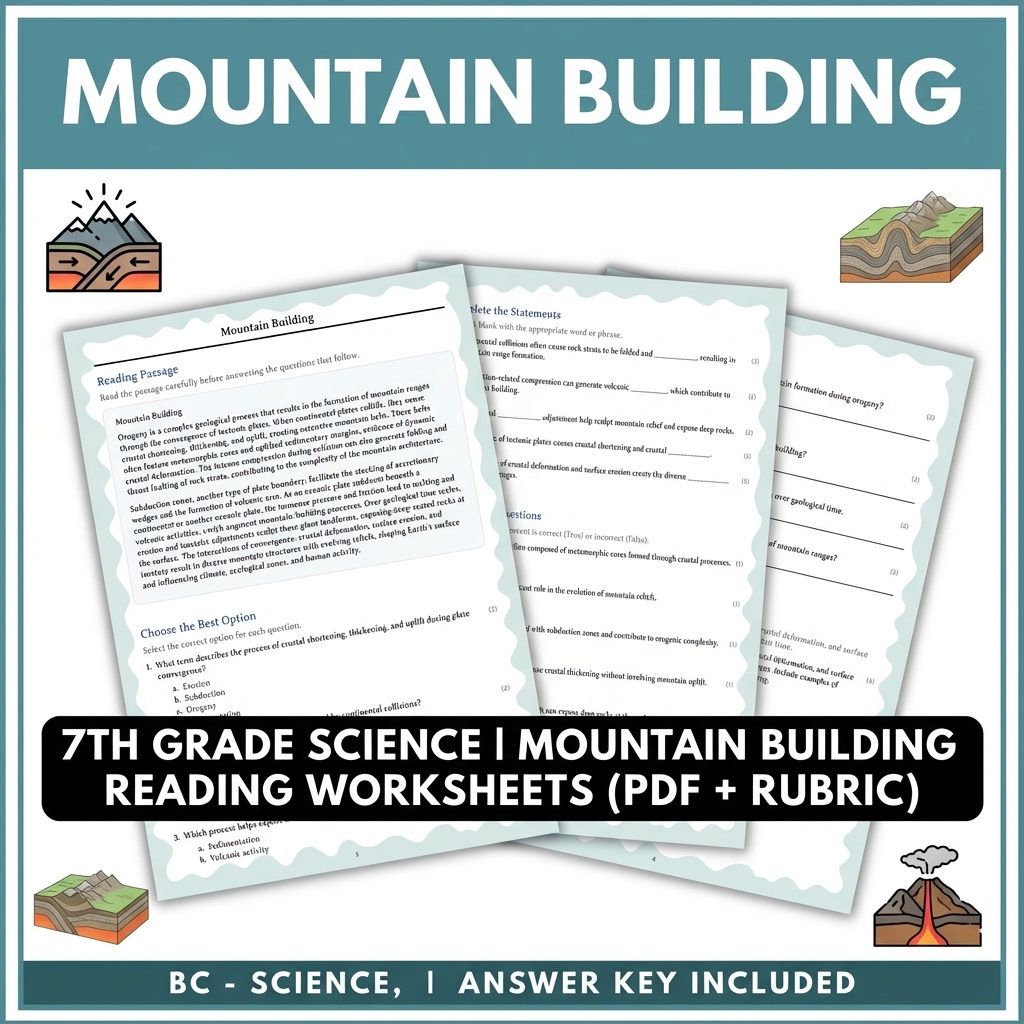
7th Grade Science | Mountain Building Reading Worksheets (PDF + Rubric)
JCreated byJ.S SheetsLearning Objectives
- Understand the processes involved in mountain building and orogeny.
- Identify different geological features associated with convergent plate boundaries.
- Explain how tectonic activities shape mountain architecture over time.
Instant download
Browse more categories
About Science Worksheets
Find Science worksheets spanning core skills, practice, and review. All 44,628 resources are instant PDF downloads for the classroom or home.
Every worksheet on MyTeachingSheets is created by independent teacher-authors and reviewed before publication. All resources download as printable PDFs for classroom, homework, or at-home practice, and many include answer keys. Preview any worksheet free before buying.