
Science Worksheets
44,628 subject resources
6th Grade Science | Series and Parallel Circuits Worksheet & Answer Key (PDF)
JCreated byJ.S SheetsLearning Objectives
- Understand the fundamental differences between series and parallel circuit arrangements.
- Explain how current and voltage distribute in series and parallel circuits.
- Describe how energy flow and device behavior are affected by circuit configurations.
Instant download
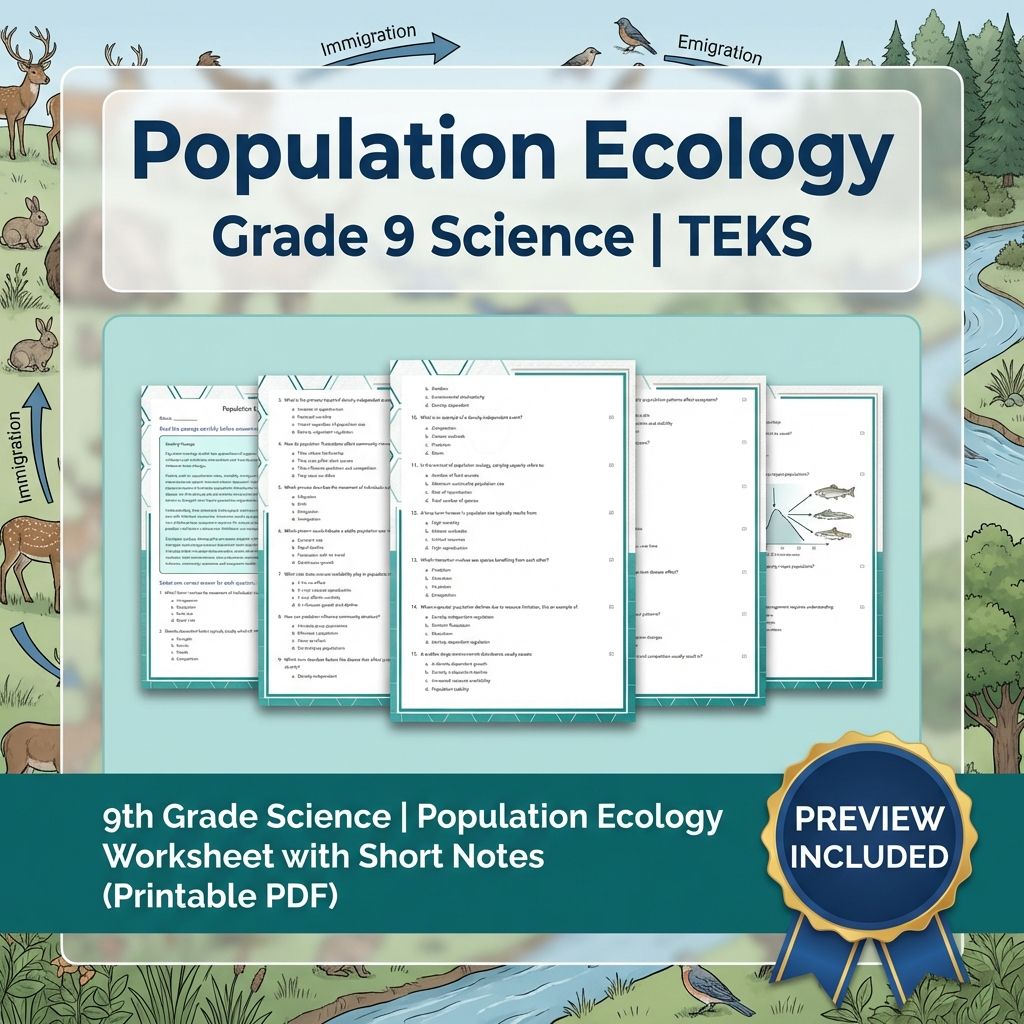
9th Grade Science | Population Ecology Worksheet with Short Notes (PDF)
 Created byMeadowlark Worksheets
Learning Objectives
- Understand the factors that influence population growth and decline.
- Identify density-dependent and density-independent factors affecting populations.
- Analyze how population patterns impact community structure and ecosystem dynamics.
Instant download
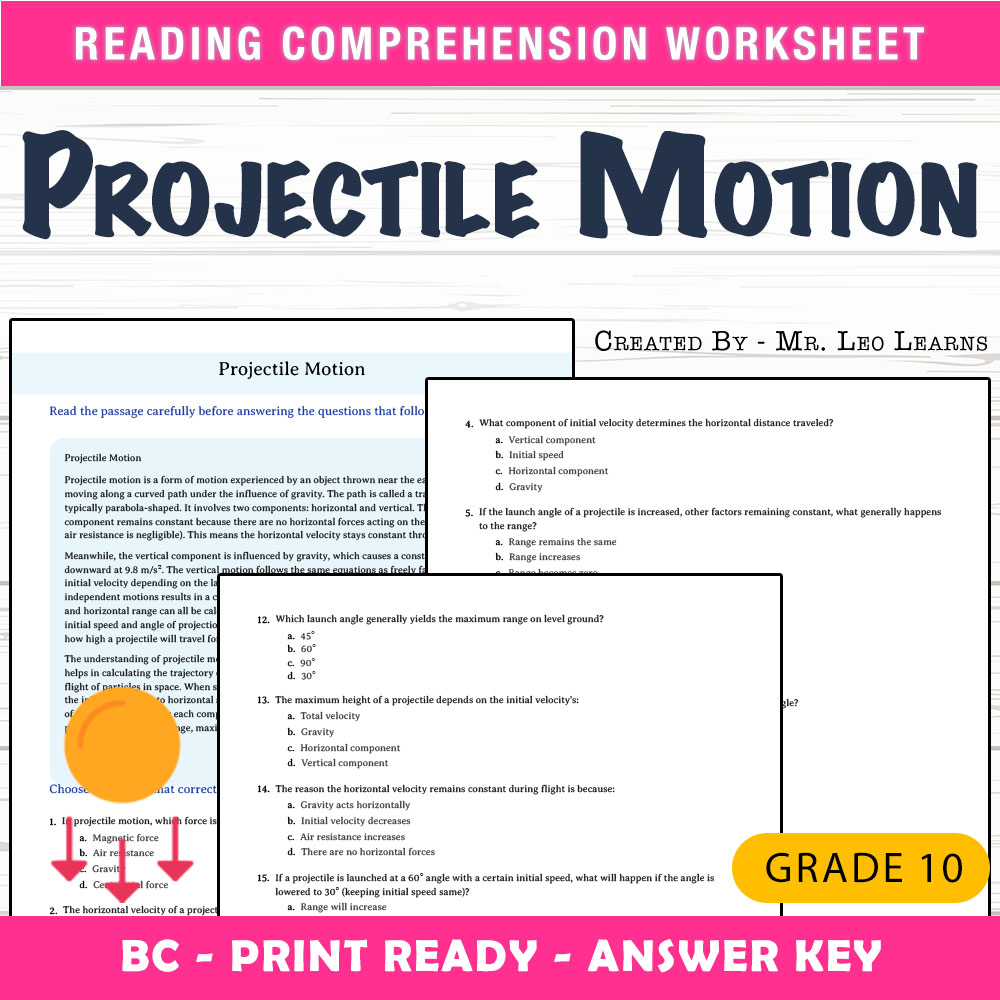
Grade 10 Science — Worksheet MCQ Paper for Mastering Projectile Motion
 Created byThe Resource Hub
Learning Objectives
- Understand the components of projectile motion and their independence.
- Calculate the time of flight, range, and maximum height using kinematic equations.
- Explain how initial velocity and launch angle affect projectile trajectory.
Also included in: Grade 10 Science | Forces, Motion & Fields UNIT Worksheet Bundle +1 more
Instant download
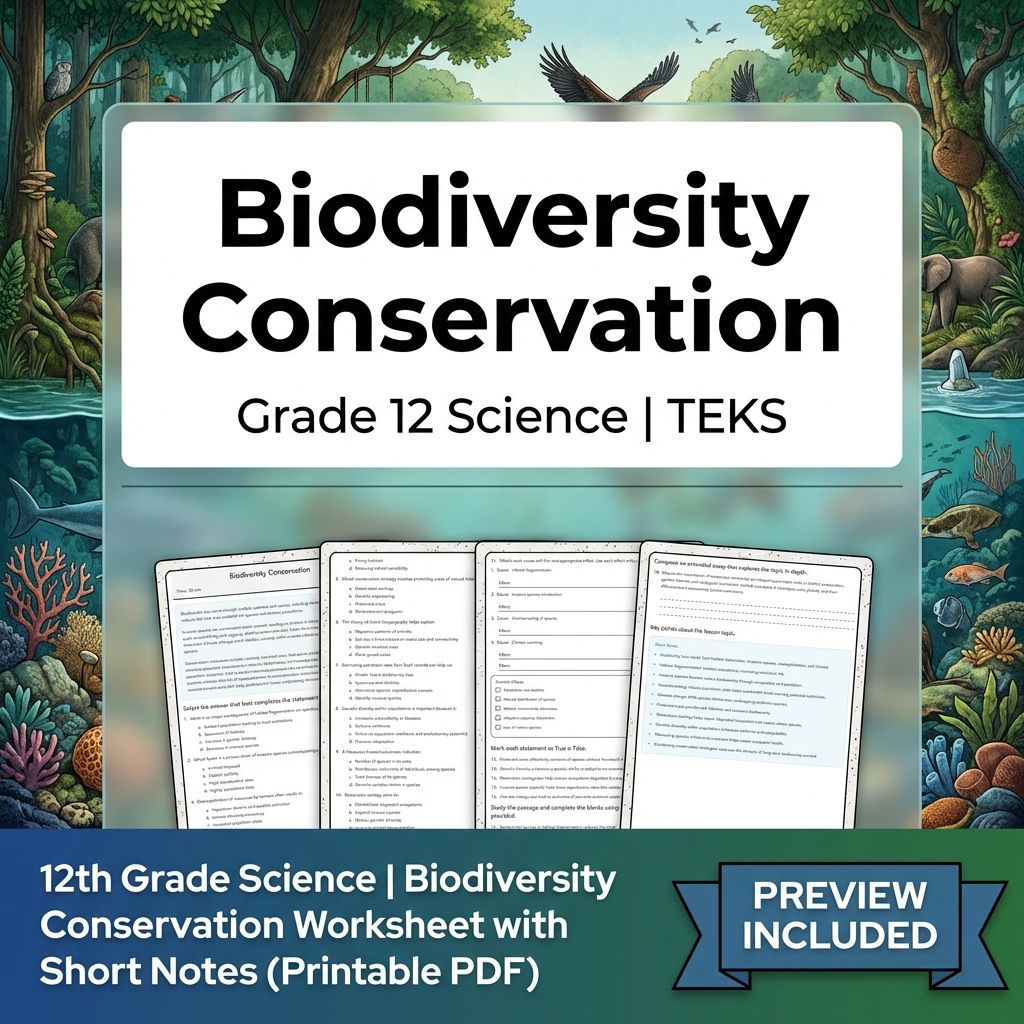
12th Grade Science | Biodiversity Conservation Worksheet with Short Notes (PDF)
Created byMeadowlark WorksheetsLearning Objectives
- Understand the patterns and causes of biodiversity loss including habitat fragmentation, invasive species, overexploitation, and climate change.
- Learn about measures of species richness, evenness, and diversity that assist in conservation efforts.
- Explore conservation strategies such as protected areas, restoration ecology, and genetic management.
Also included in: Grade 12 Science Unit Bundle | Genetics, Evolution & Cell Biology Worksheets +2 more
Instant download
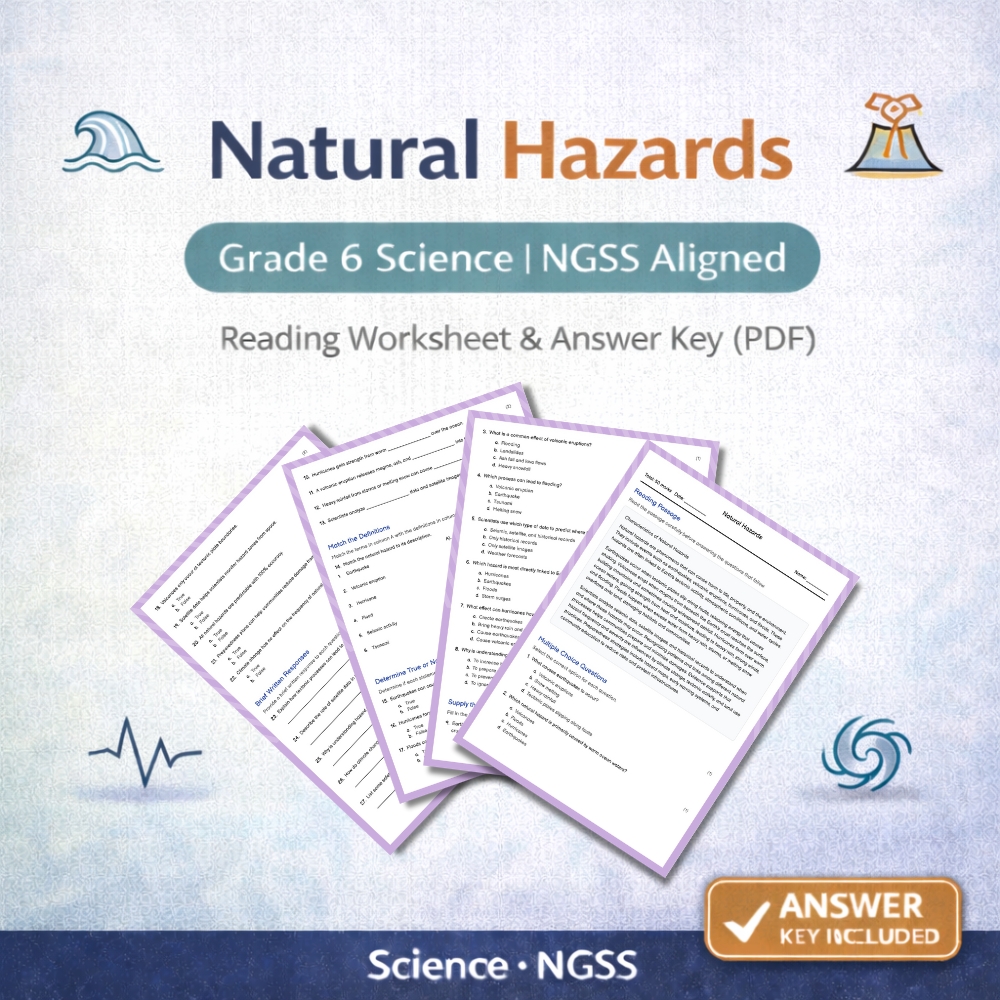
6th Grade Science | Natural Hazards Worksheet | NGSS Alignment
 Created byCedar Grove Learning
Learning Objectives
- Understand the causes and types of natural hazards such as earthquakes, volcanoes, hurricanes, and floods.
- Analyze patterns and effects of natural hazards on communities and infrastructure.
- Evaluate evidence from scientific data to explain hazard occurrences and severity.
Also included in: Grade 6 Science Bundle | Sustainability, Hazards & Earth Systems NGSS Worksheets +1 more
Instant download
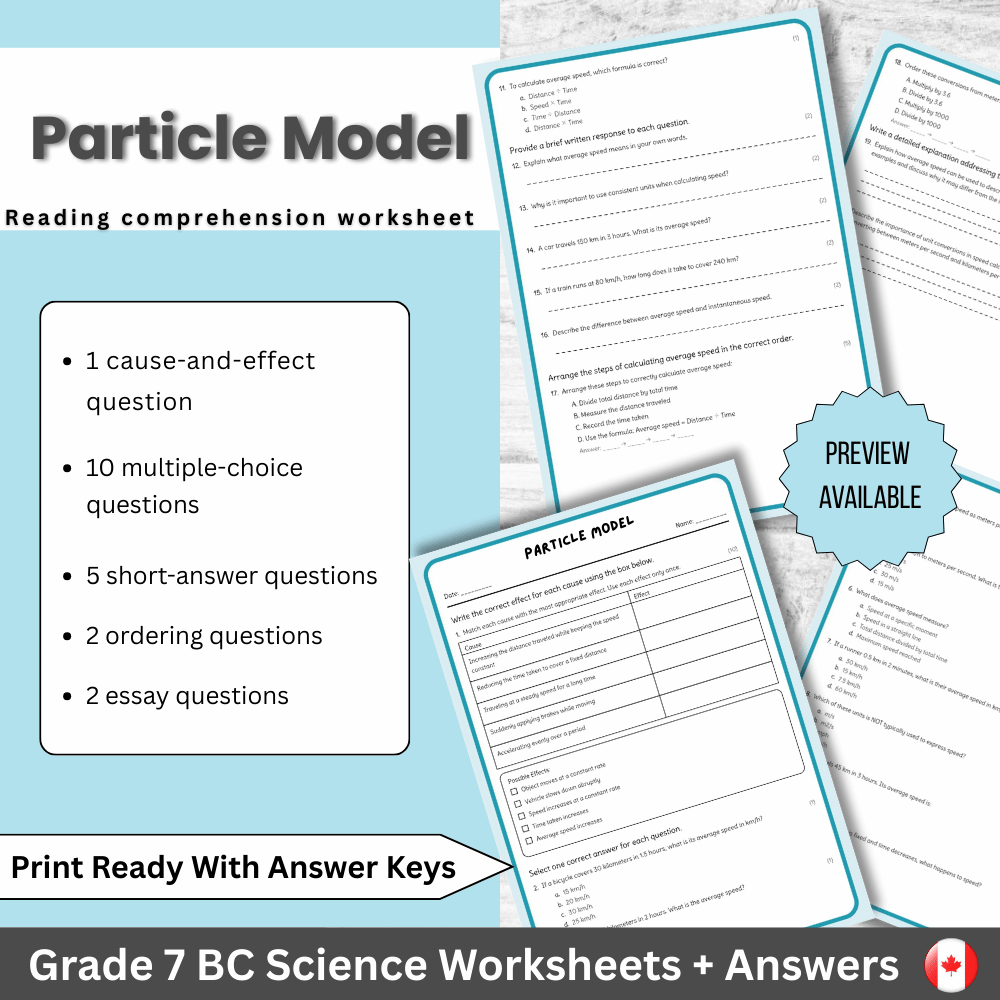
Grade 7 Science | Particle Model Worksheet (PDF) – Standards-Based Practice
 Created byBright Mind Resources
Learning Objectives
- Understand how the particle model explains the behavior of matter.
- Describe how chemical changes involve breaking and forming bonds between particles.
- Explain the conservation of mass during chemical reactions using the particle model.
Instant download
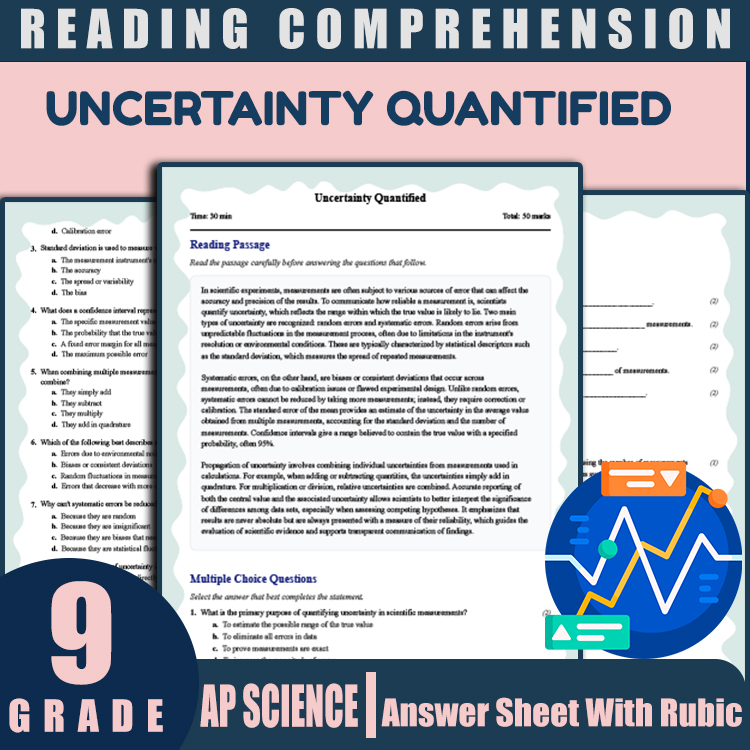
9th Grade Science | Uncertainty Quantified Reading Worksheet (PDF + Rubric)
JCreated byJ.S SheetsLearning Objectives
- Understand the concepts of random and systematic uncertainty in measurements.
- Learn how to quantify uncertainty using statistical descriptors such as standard deviation and standard error.
- Apply basic error propagation methods to combined quantities.
Instant download

Grade 9 Collision Safety Worksheet | Peak Force & Acceleration | NGSS
 Created byAmber Owl Education
Learning Objectives
- Explain how impulse relates to changes in force and collision time in collision safety design.
- Interpret a force-time idea to describe how longer stopping time can reduce peak force and acceleration.
- Describe how energy dissipation and staged deformation help protect people in high-impact events.
Also included in: Grade 9 Science Forces, Motion, Momentum & Fields Lesson Bundle – NGSS +1 more
Instant download

Science Statistics and Uncertainty Worksheet | Grade 12 Science PDF
JCreated byJ.S SheetsLearning Objectives
- Explain how measures of central tendency and spread describe data variability
- Interpret confidence intervals and uncertainty statements appropriately
- Use error bars, residuals, and dispersion concepts to evaluate evidence strength
Also included in: Grade 12 Scientific Reasoning Science Lesson Bundle – General Framework +1 more
Instant download
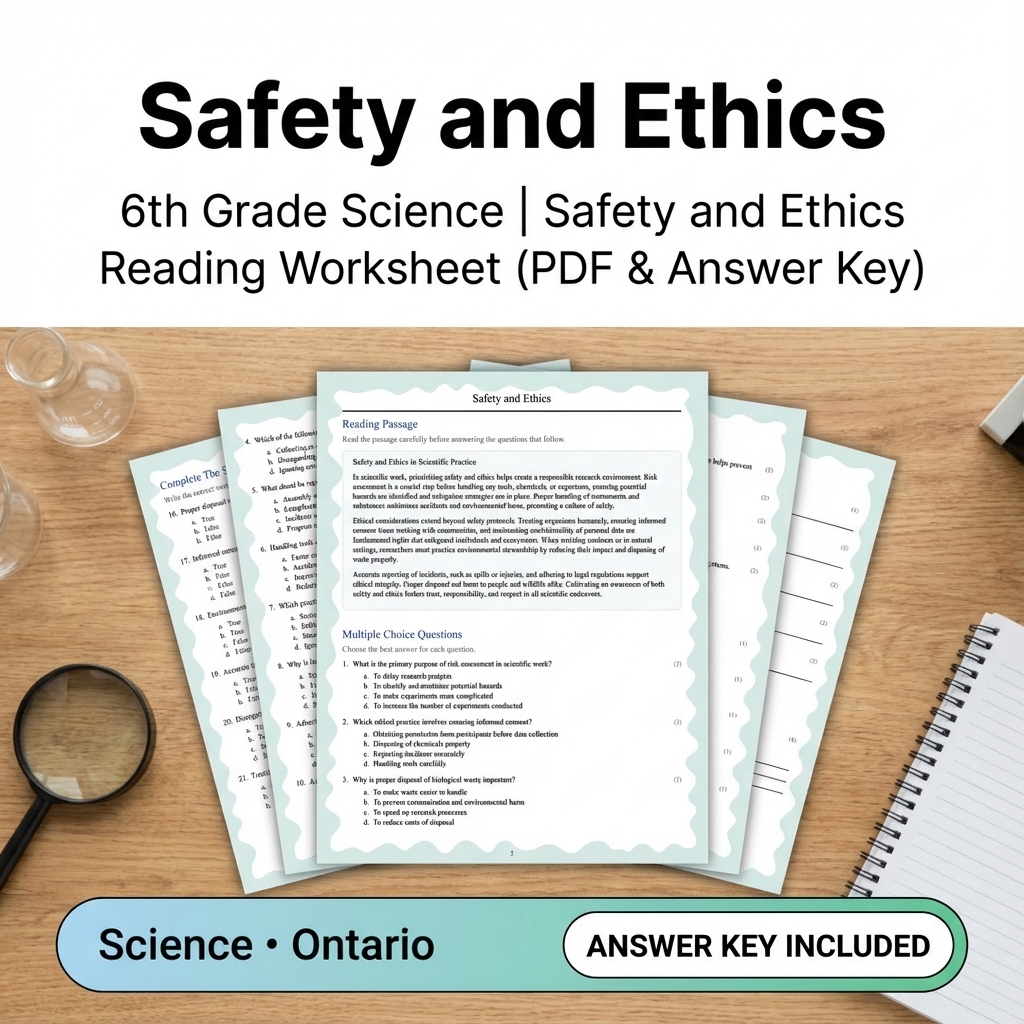
6th Grade Science | Safety and Ethics Reading Worksheet (PDF & Answer Key)
JCreated byJ.S SheetsLearning Objectives
- Understand the importance of risk assessment and hazard prevention in scientific work.
- Recognize ethical practices such as humane treatment, informed consent, and confidentiality.
- Apply safety protocols for handling tools and substances responsibly.
Also included in: Grade 6 Science Unit | Inquiry, Data, & Ethical Practices Worksheet Pack +1 more
Instant download

Grade 12 Science – Bonding Structures & Characteristics | Reading Worksheet
Created byBright Mind ResourcesLearning Objectives
- Understand the differences between ionic, covalent, and metallic bonds.
- Identify characteristics and properties associated with each bonding type.
- Apply Lewis structures and VSEPR theory to determine molecular shapes and polarity.
Also included in: Grade 12 Chemistry Science Lesson Bundle, Daily Reading Worksheets | TEKS +2 more
Instant download
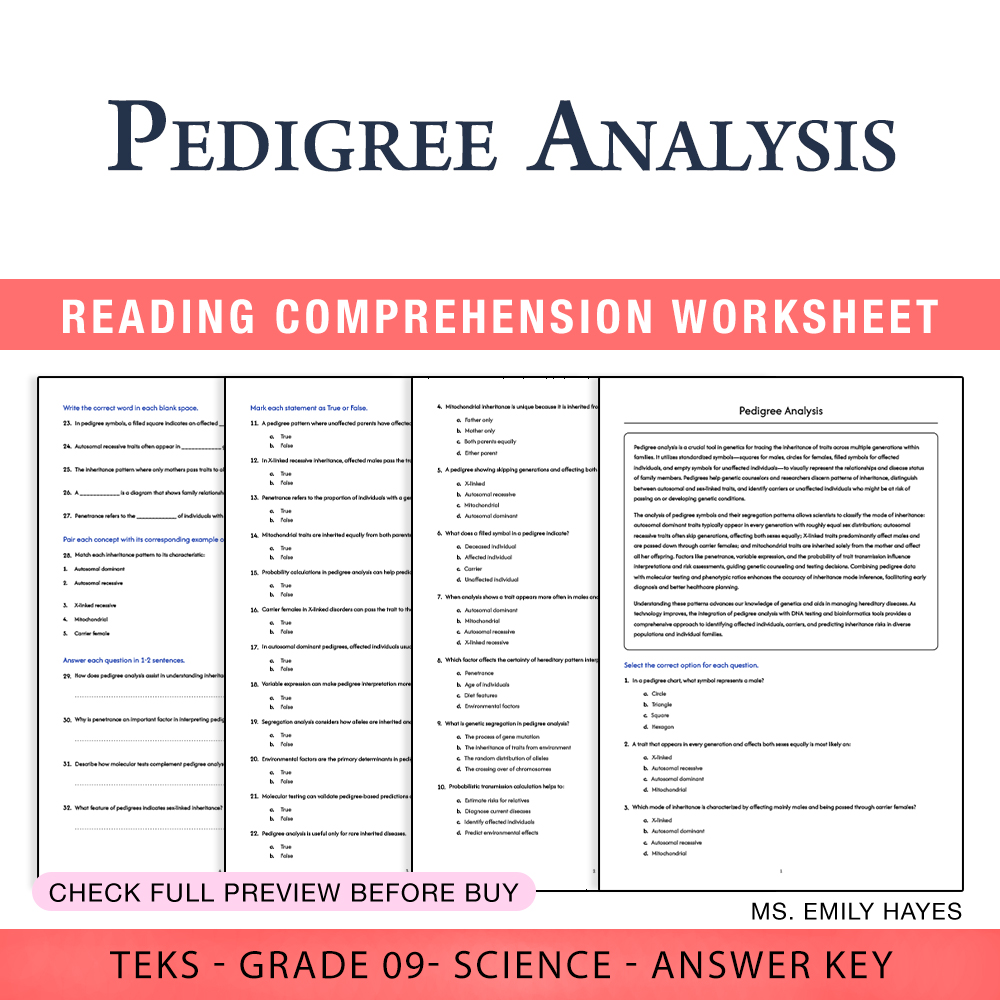
9th Grade Science | Pedigree Analysis Worksheet (PDF+ Answer Key)
 Created byCopper Leaf Classroom
Learning Objectives
- Understand the symbols and conventions used in pedigree charts.
- Identify inheritance patterns such as autosomal dominant, autosomal recessive, X-linked, and mitochondrial.
- Analyze pedigree data to determine likely modes of inheritance.
Instant download
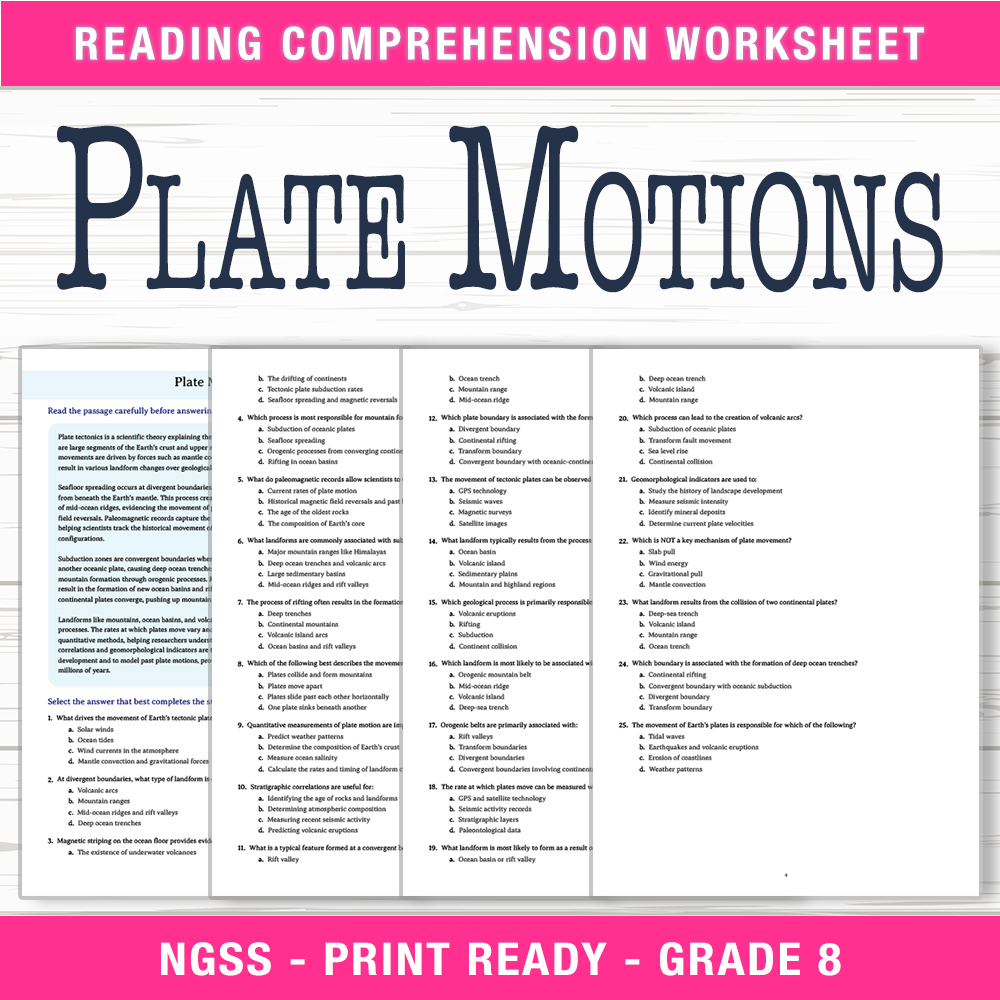
Grade 8 Science – Plate Motions Worksheet (PDF + Answer Key)
 Created byRiverstone Classroom
Learning Objectives
- Explain the mechanisms of plate tectonics including seafloor spreading, magnetic striping, and paleomagnetic records.
- Describe the processes of subduction, rifting, continental collision, and uplift that lead to landform changes.
- Identify landforms such as mountains, ocean basins, and volcanic arcs that result from plate movements.
Instant download

Grade 12 Science – Electromagnetic Induction & Power Systems - Reading Worksheet
Created byBright Mind ResourcesLearning Objectives
- Understand key concepts related to Science
- Apply knowledge through practice questions
- Demonstrate comprehension of the material
Also included in: Grade 12 Waves and Electricity Science Lesson Bundle | Alberta Daily Reading +1 more
Instant download

Grade 8 Science | Physical Models in Science - Daily Reading Comprehension
 Created byCoral Reef Learning
Learning Objectives
- Define what a physical model is and identify its key features.
- Explain how physical models are used to represent real-world systems.
- Identify examples of physical models in scientific investigations.
Instant download
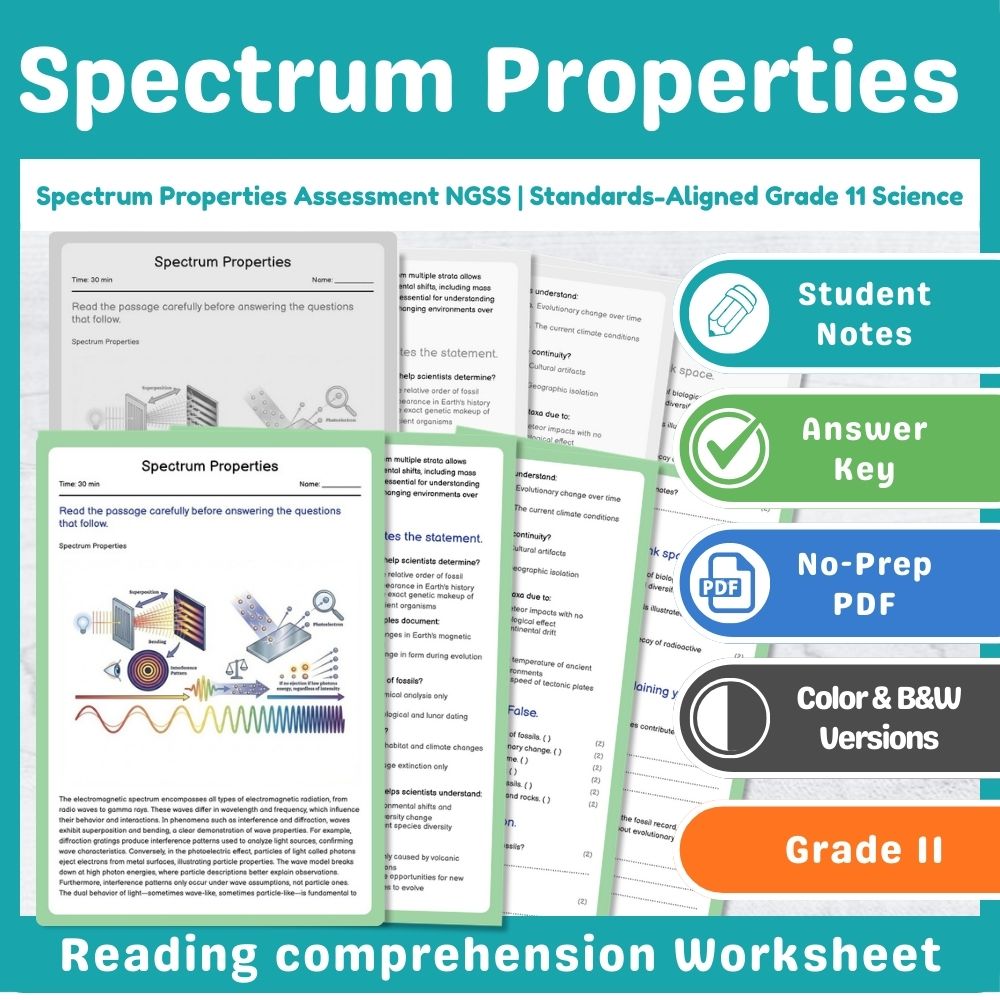
Spectrum Properties Assessment NGSS | Standards-Aligned Grade 11 Science
 Created byPrism Point Learning
Learning Objectives
- Evaluate evidence for wave and particle models of electromagnetic radiation using phenomena such as interference, diffraction gratings, and the photoelectric effect.
- Explain where each EM radiation model (wave or particle) works and where it breaks down.
- Describe phenomena demonstrating wave behavior and particle behavior of light.
Instant download
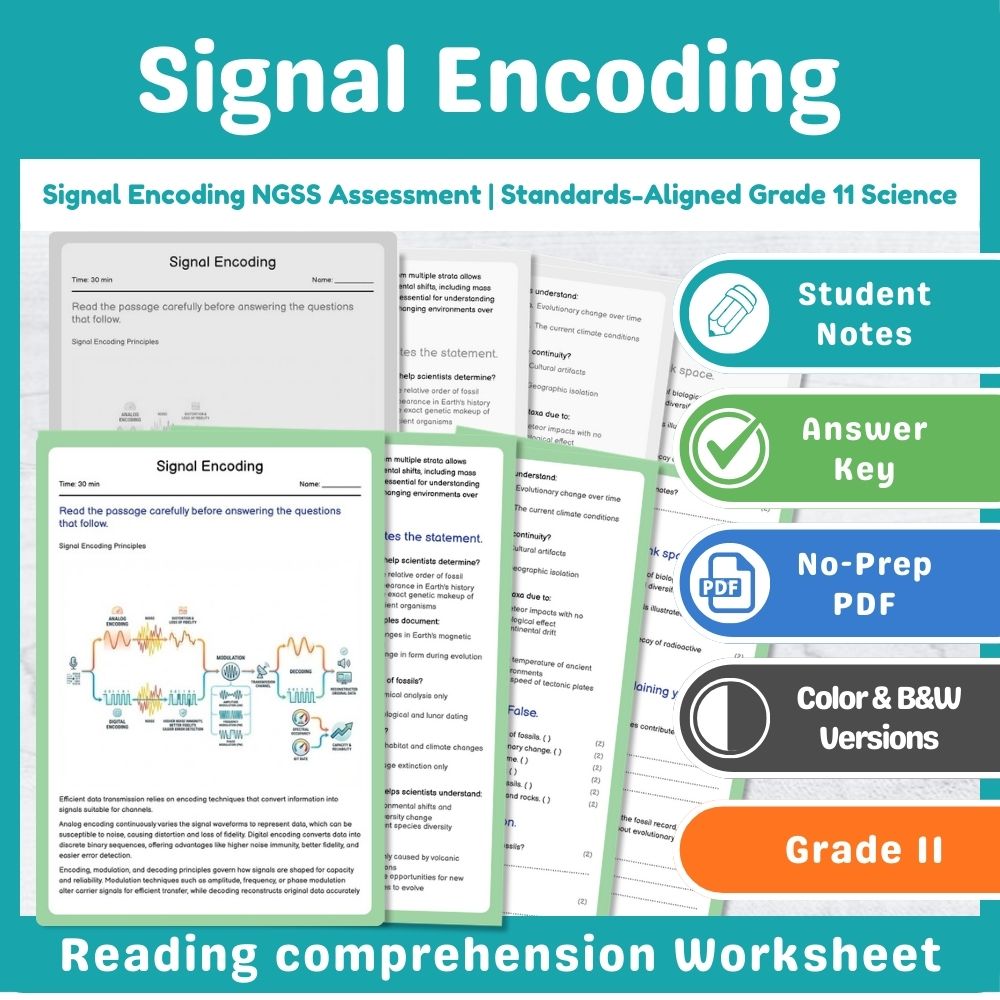
Signal Encoding NGSS Assessment | Standards-Aligned Grade 11 Science
Created byPrism Point LearningLearning Objectives
- Compare advantages of digital and analog transmission and storage focusing on bandwidth, noise, and fidelity.
- Explain the principles of encoding, modulation, and decoding in communication systems.
- Evaluate capacity and reliability of transmission methods using quantitative measures such as bit rate and signal-to-noise ratio.
Instant download

Science Worksheet Conservation In Reactions Grade 10
JCreated byJ.S SheetsLearning Objectives
- Explain how balanced chemical equations model the conservation of atoms in chemical reactions.
- Describe how conservation of mass relates to what is included within the system boundary.
- Interpret experimental mass changes by accounting for matter that enters or leaves a system.
Also included in: Grade 10 Matter, Energy, and Waves Science Lesson Bundle – Florida (NGSSS) +1 more
Instant download
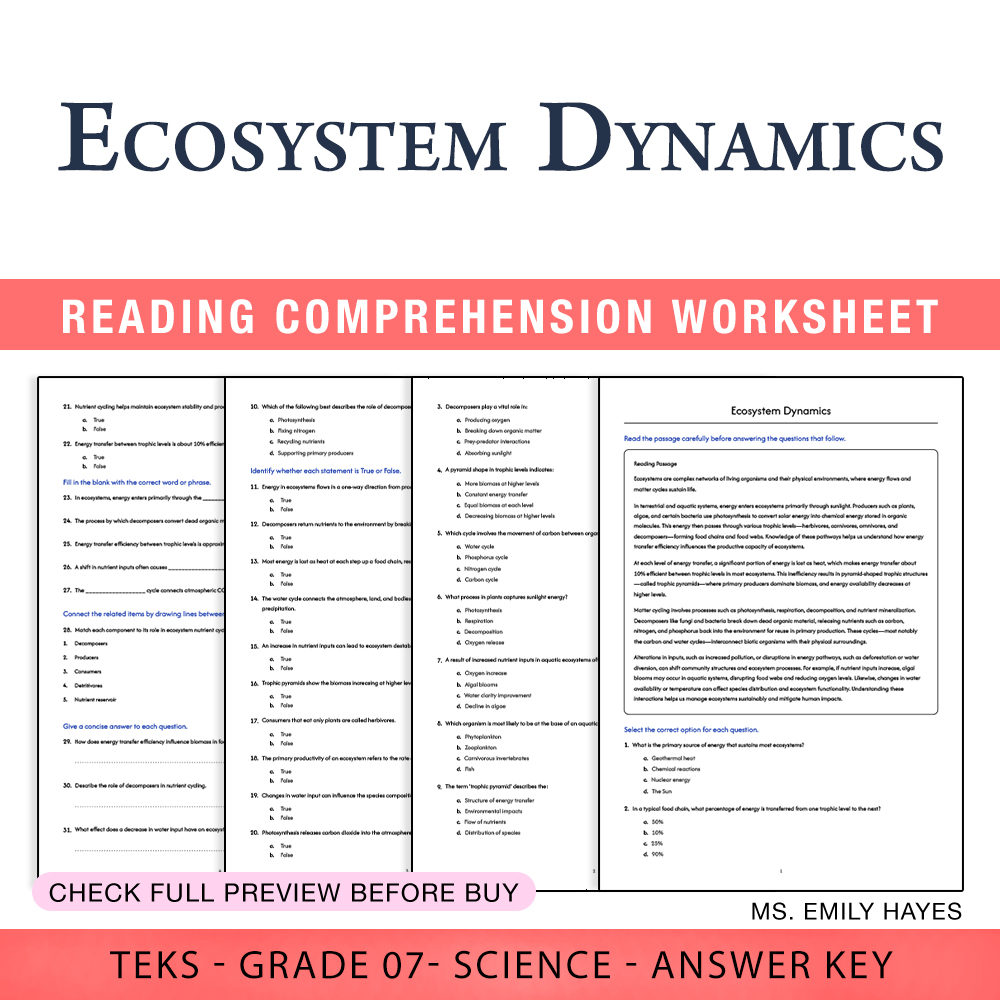
7th Grade Science | Ecosystem Dynamics Worksheet (PDF+ Answer Key)
Created byCopper Leaf ClassroomLearning Objectives
- Describe how energy flows through food chains, food webs, and trophic pyramids in ecosystems.
- Explain the cycling of matter and the roles of decomposers in nutrient recycling.
- Analyze how changes in inputs or energy pathways affect community composition and ecosystem functions.
Instant download
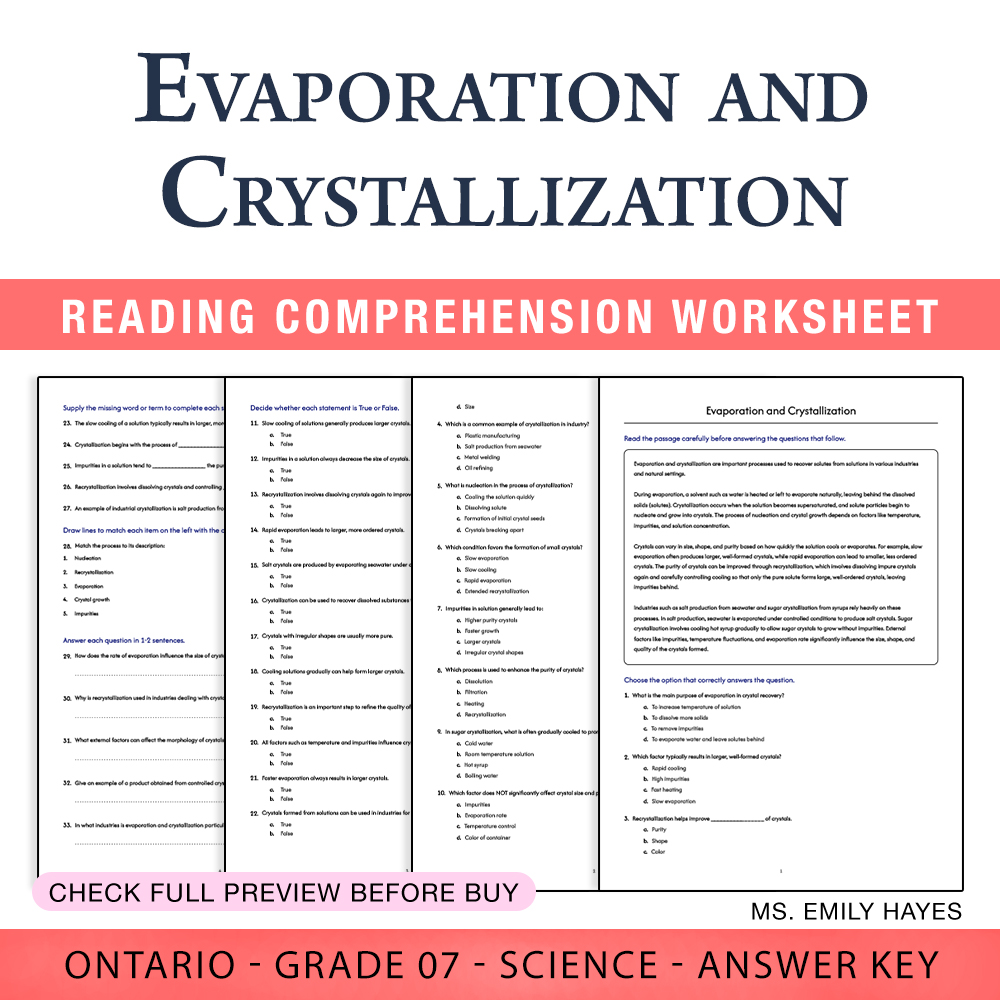
7th Grade Science | Evaporation & Crystallization Worksheet (PDF + Answer Key)
Created byCopper Leaf ClassroomLearning Objectives
- Explain the processes of evaporation and crystallization and how they recover solutes from solutions.
- Identify factors that influence crystal formation, size, and purity.
- Describe real-world examples of crystallization, such as salt production and sugar crystallization.
Instant download

7th Grade Science Worksheet – Trophic Efficiency (PDF) BC Standards
 Created byEvergreen Desk Education
Learning Objectives
- Define trophic efficiency and describe how energy transfer changes between trophic levels
- Explain why energy pyramids show fewer organisms and less energy at higher levels
- Use a trophic efficiency idea to interpret ecosystem energy flow and predator-prey patterns
Instant download
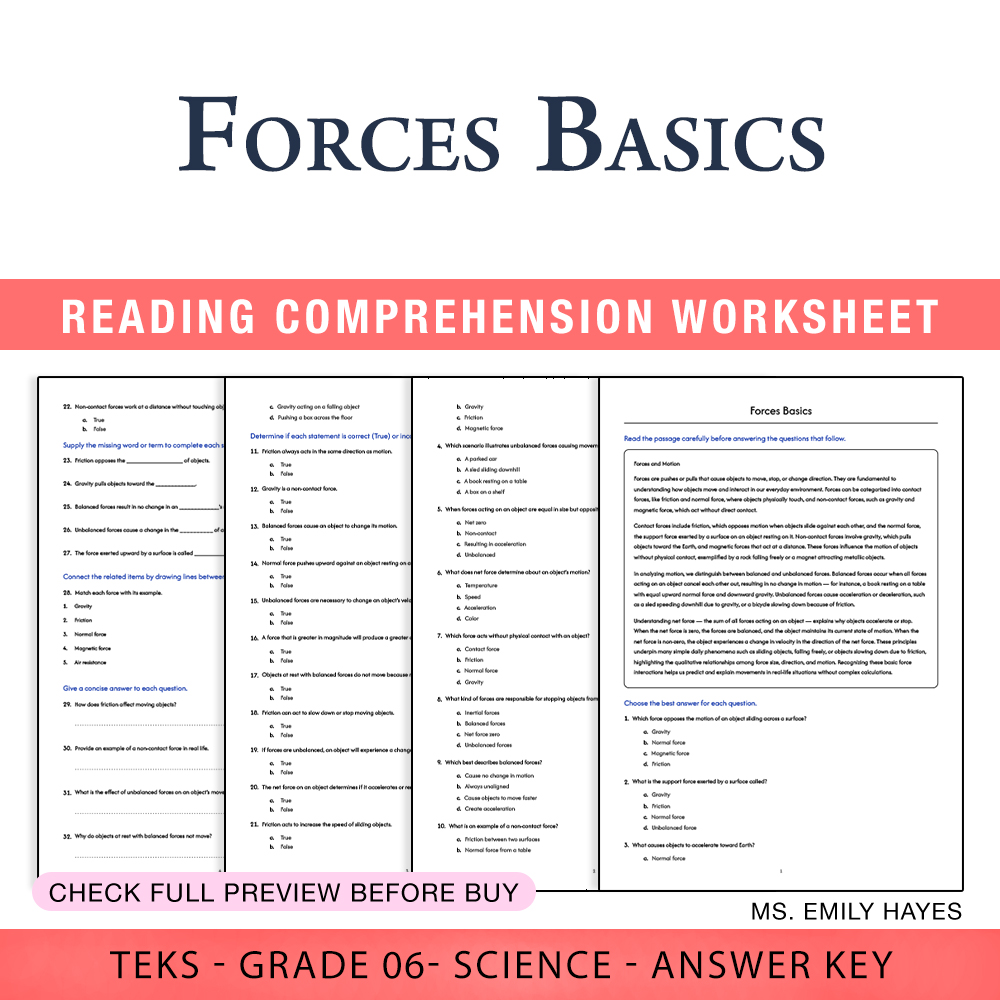
6th Grade Science | Forces Basics Worksheet (PDF+ Answer Key)
Created byCopper Leaf ClassroomLearning Objectives
- Understand the differences between contact and non-contact forces such as gravity, friction, and normal force.
- Describe how balanced and unbalanced forces affect the motion of objects.
- Introduce the concept of net force and its effects on everyday objects without using vector calculations.
Instant download
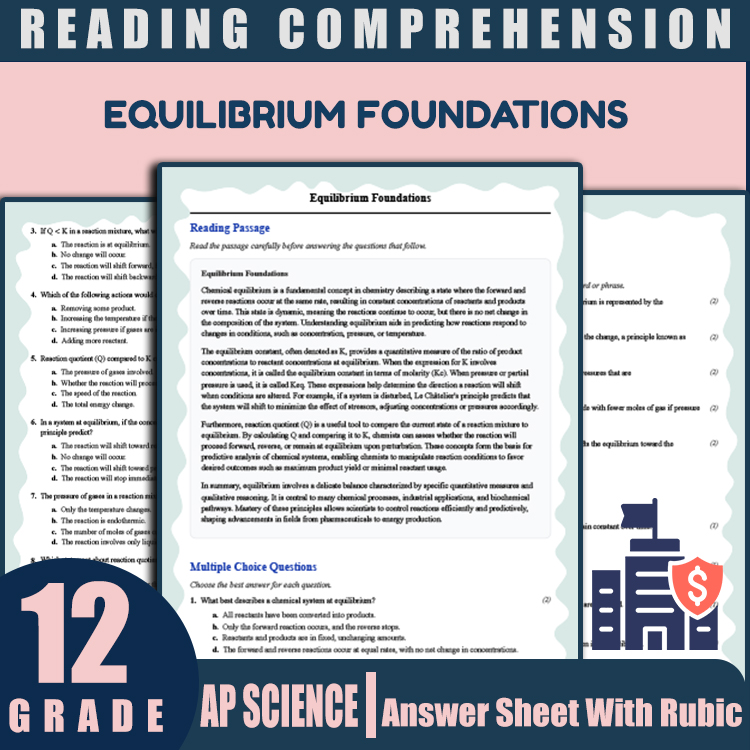
12th Grade Science | Equilibrium Foundations Reading Worksheet (PDF + Rubric)
JCreated byJ.S SheetsLearning Objectives
- Explain the concept of chemical equilibrium as a dynamic balance between forward and reverse reactions.
- Describe how the equilibrium constant characterizes the relative concentrations of reactants and products at equilibrium.
- Relate concentration and pressure expressions to reaction directionality and shifts due to stressors.
Also included in: Grade 12 Science Unit Bundle | Atomic Structure & Chemical Reactions Worksheets +1 more
Instant download
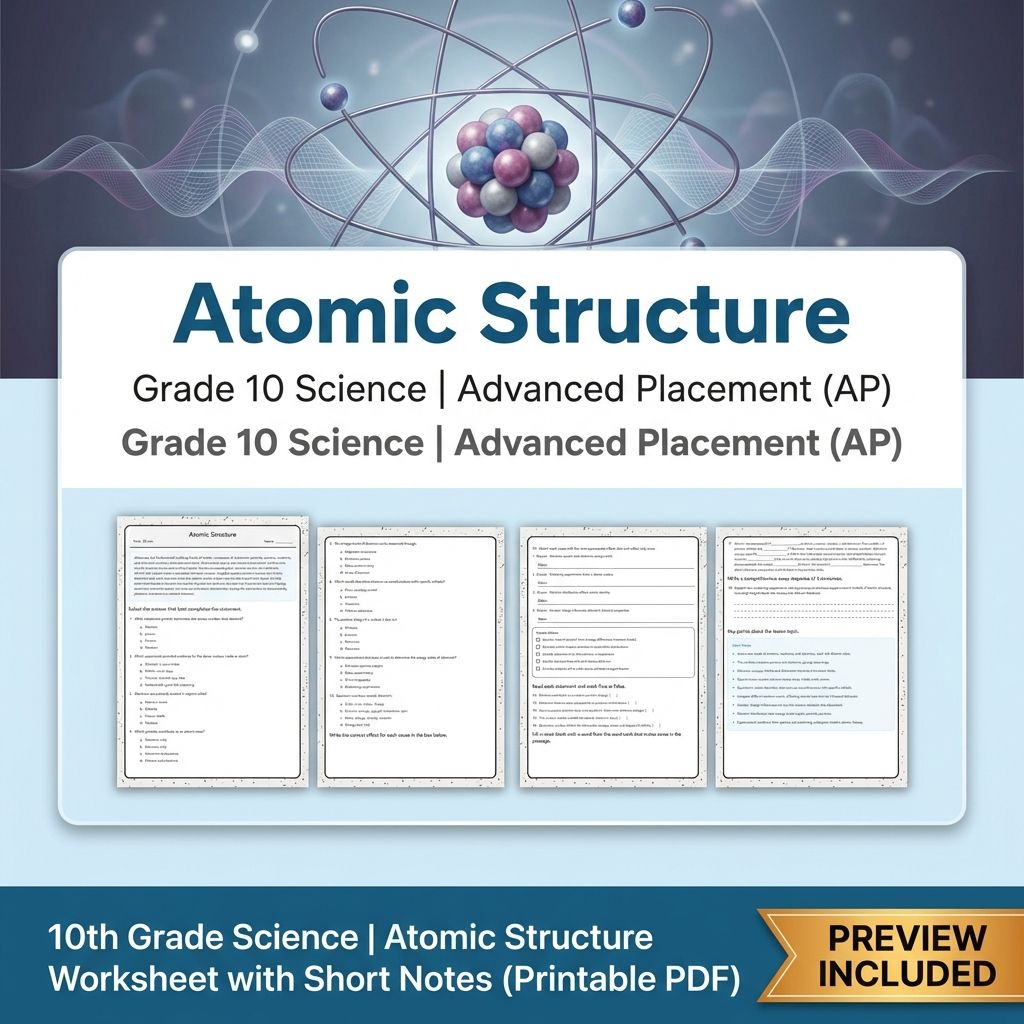
10th Grade Science | Atomic Structure Worksheet with Short Notes (Printable PDF)
Created byMeadowlark WorksheetsLearning Objectives
- Describe the subatomic components of atoms and their roles, including protons, neutrons, and electrons.
- Explain how nuclear charge and electron distribution influence elemental identity and isotopic variation.
- Connect evidence from emission spectra and scattering experiments to atomic models and quantum numbers.
Also included in: Grade 10 Science | Comprehensive Unit Bundle on Atomic Structure
Instant download
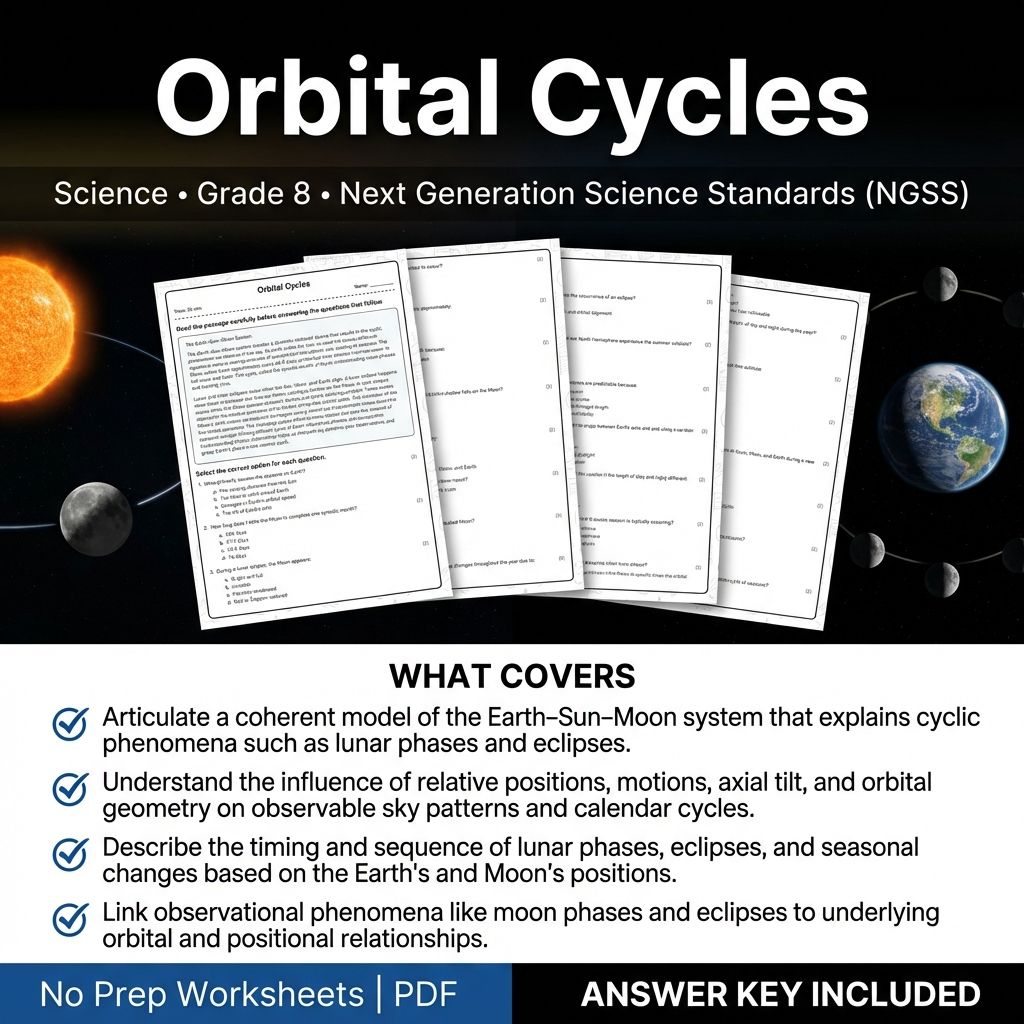
8th Grade Science | Orbital Cycles Worksheet + Answer Key (PDF)
Created byCoral Reef LearningLearning Objectives
- Articulate a coherent model of the Earth–Sun–Moon system that explains cyclic phenomena such as lunar phases and eclipses.
- Understand the influence of relative positions, motions, axial tilt, and orbital geometry on observable sky patterns and calendar cycles.
- Describe the timing and sequence of lunar phases, eclipses, and seasonal changes based on the Earth's and Moon's positions.
Instant download

Grade 9 Science – Simple Machines & Tools -Daily Worksheet | Ontario Standards
 Created byQuiet Forest Education
Learning Objectives
- Understand the structure and function of different classes of levers
- Identify the components and principles of levers
- Explain how levers modify force and displacement to achieve mechanical advantage
Also included in: Forces and Energy Grade 9 Science Daily Reading Worksheets Bundle | Ontario +1 more
Instant download

Grade 9 Science – Kinematic Equations & Motion | Daily Reading Worksheet
Created byQuiet Forest EducationLearning Objectives
- Understand key concepts related to Science
- Apply knowledge through practice questions
- Demonstrate comprehension of the material
Also included in: Forces and Energy Grade 9 Science Daily Reading Worksheets Bundle | Ontario +1 more
Instant download

Grade 9 Science – Force Basics | Daily Reading Worksheet
Created byQuiet Forest EducationLearning Objectives
- Distinguish between contact forces and non-contact forces
- Identify examples of different types of forces
- Understand how forces act on objects in different scenarios
Also included in: Forces and Energy Grade 9 Science Daily Reading Worksheets Bundle | Ontario +1 more
Instant download

Grade 9 Science – Understanding Compound Machines | Daily Reading Worksheet
Created byQuiet Forest EducationLearning Objectives
- Define what compound machines are and identify examples
- Explain how simple machines combine to form compound machines
- Calculate overall mechanical advantage considering force and distance
Also included in: Forces and Energy Grade 9 Science Daily Reading Worksheets Bundle | Ontario +1 more
Instant download

6th Grade Science – Biodiversity Patterns Worksheet (PDF) Ontario Standards
Created byEvergreen Desk EducationLearning Objectives
- Explain how species richness, abundance, and evenness describe biodiversity in different ecosystems.
- Use sampling ideas (transects and quadrats) to quantify biodiversity and compare habitats.
- Interpret simple biodiversity indices and relate diversity patterns to ecosystem stability, resilience, and conservation.
Also included in: Grade 6 Biodiversity, Adaptation & Ecology Science Lesson Bundle | Ontario +1 more
Instant download
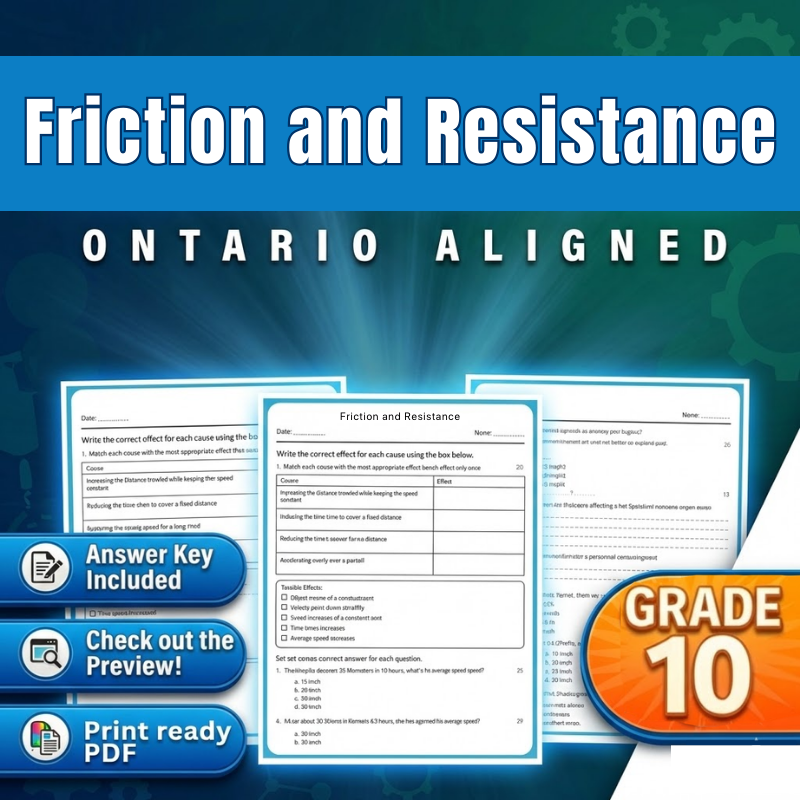
Grade 10 Science – Friction and Resistance Worksheet (PDF) | Ontario Standards
Created byBright Mind ResourcesLearning Objectives
- Understand the differences between static and kinetic friction and how coefficients of friction are characterized.
- Describe how normal force and surface properties influence frictional forces.
- Qualitatively analyze air resistance and viscous drag, including their velocity dependence and effects on motion.
Instant download
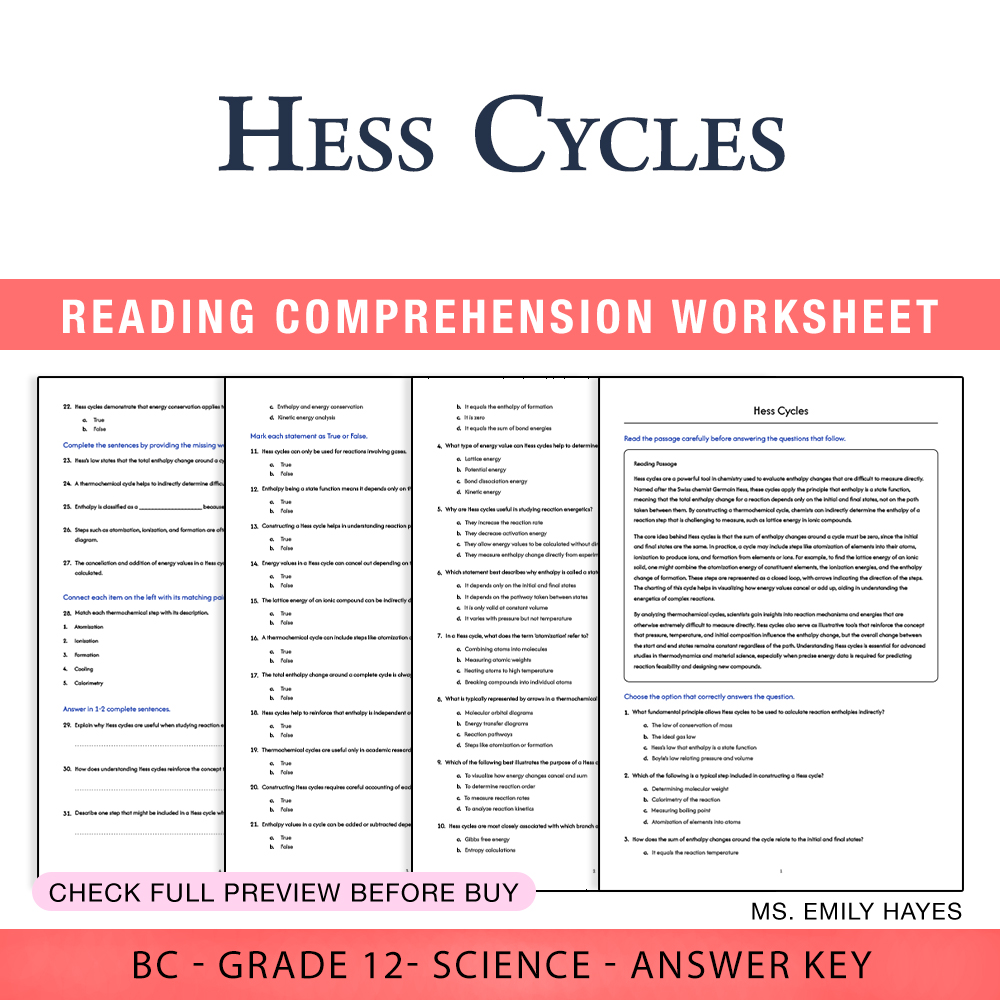
12th Grade Science | Hess Cycles Worksheet (PDF + Answer Key)
Created byCopper Leaf ClassroomLearning Objectives
- Understand the concept of Hess cycles and how they apply to thermochemical calculations.
- Explain how enthalpy conservation is used to determine reaction energetics indirectly.
- Identify the steps involved in constructing a thermochemical cycle, including formation, atomization, and ionization.
Also included in: Grade 12 Science BC – Thermochemistry to Atomic Structures (PDF+ Answer Keys) +1 more
Instant download
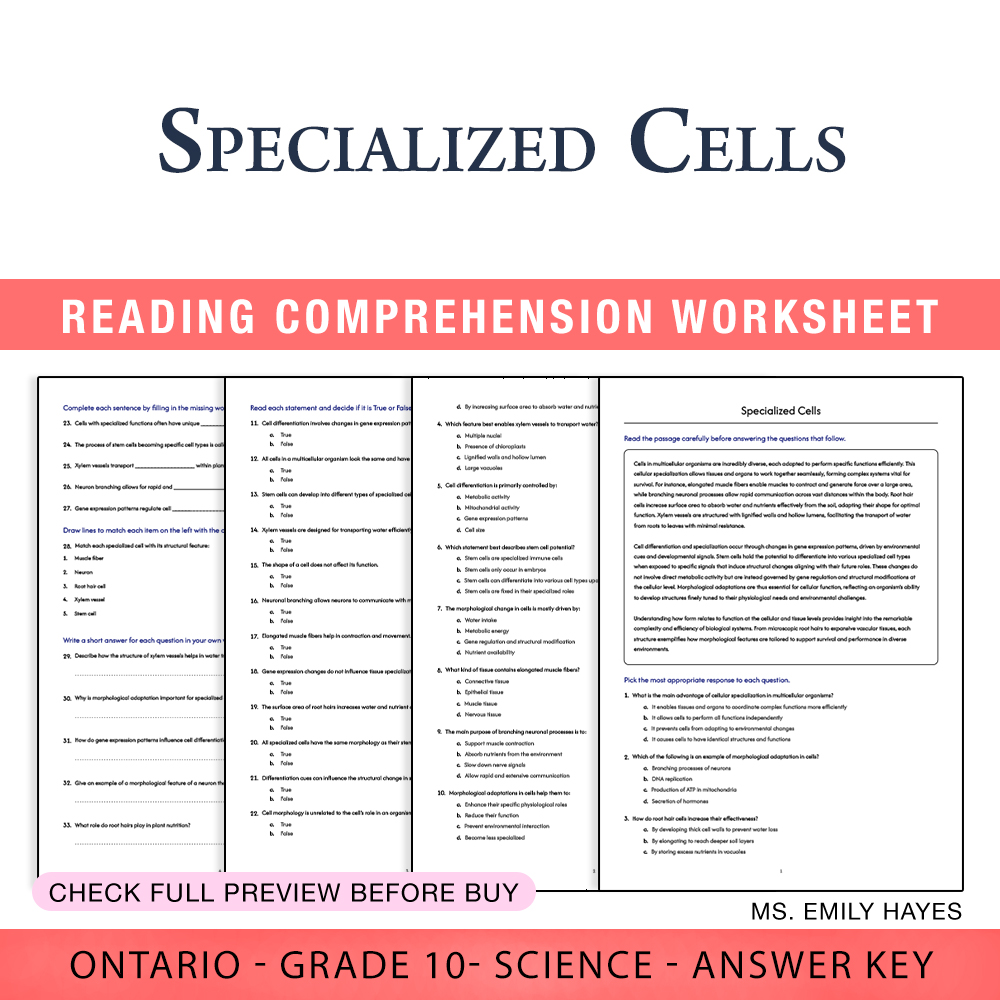
10th Grade Science | Specialized Cells Worksheet (PDF + Answer Key)
Created byCopper Leaf ClassroomLearning Objectives
- Understand the concept of cellular specialization and how tissue organization relates to function.
- Identify morphological adaptations in cells that enhance their specific physiological roles.
- Describe examples of specialized cells such as muscle fibers, neurons, root hairs, and xylem vessels.
Instant download
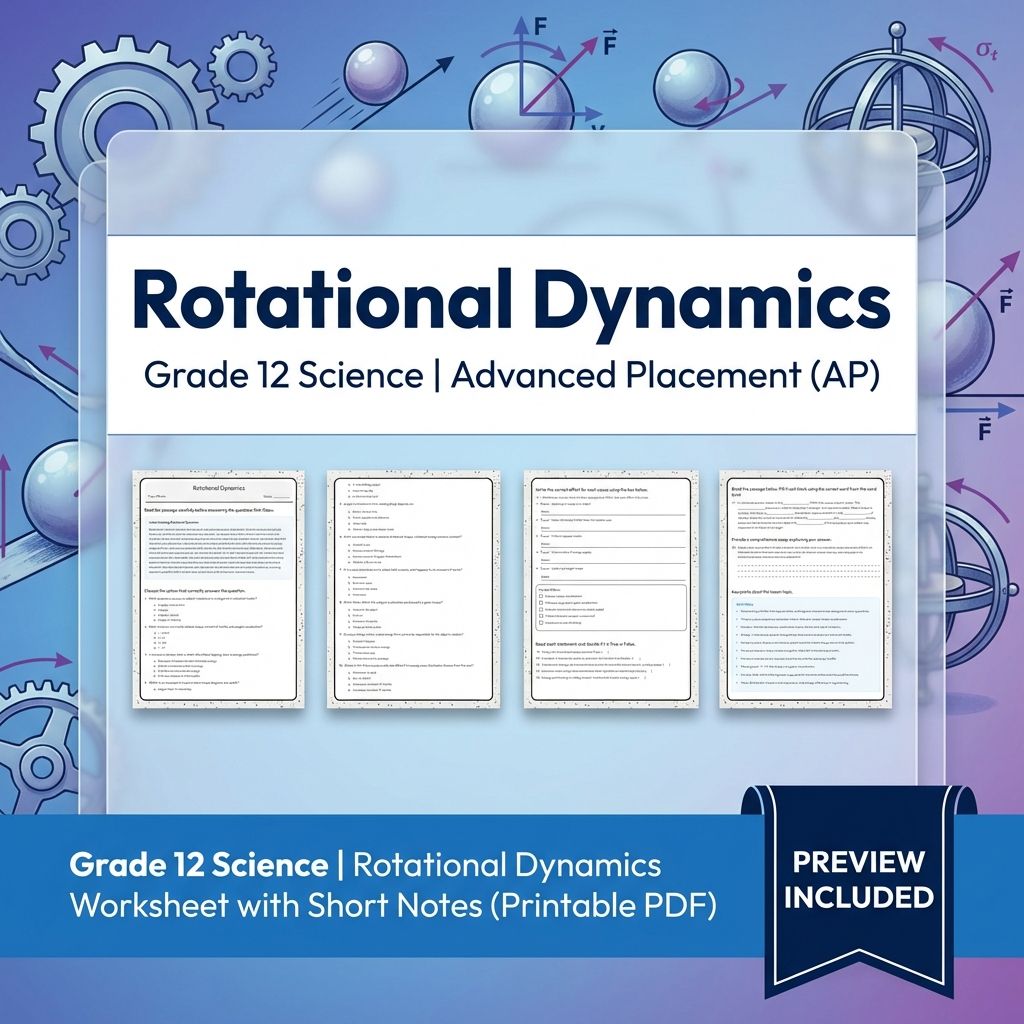
Grade 12 Science | Rotational Dynamics Worksheet with Short Notes (PDF)
Created byMeadowlark WorksheetsLearning Objectives
- Understand the rotational analogs of linear quantities such as torque, moment of inertia, and angular momentum.
- Develop equations linking net torque to angular acceleration in rigid bodies.
- Apply conservation of energy principles to rotational and translational systems.
Also included in: 12th Grade Science | Work, Energy & Motion Unit Worksheet Bundle +1 more
Instant download

Grade 10 Science | Wave Behavior Worksheet | AP-Aligned
 Created byLumora Learning
Learning Objectives
- Describe the characteristics of transverse and longitudinal waves using parameters such as wavelength, frequency, amplitude, and wave speed.
- Explain the concepts of reflection, refraction, interference, superposition, and standing waves with graphical and mathematical descriptions.
- Analyze examples like string waves and sound pulses to understand boundary effects and spectral representations.
Instant download
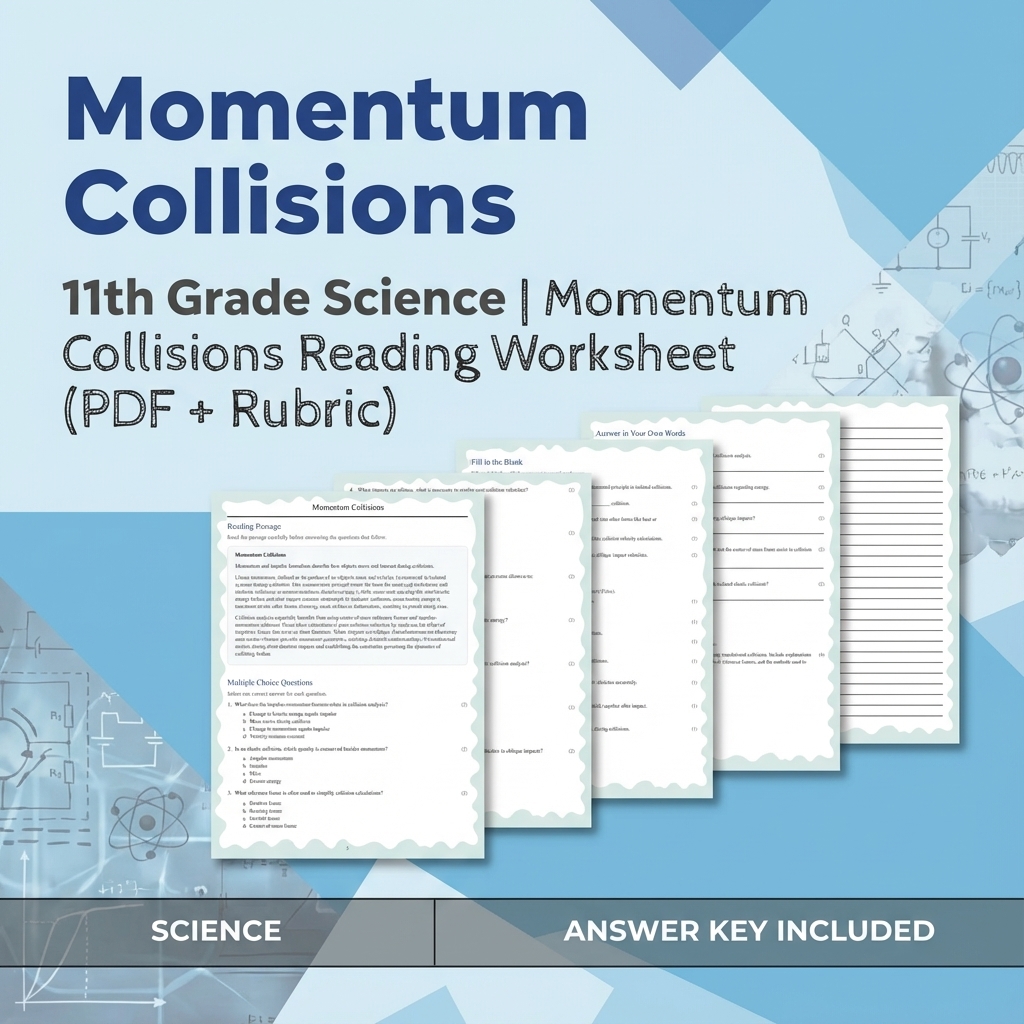
11th Grade Science | Momentum Collisions Reading Worksheet (PDF + Rubric)
JCreated byJ.S SheetsLearning Objectives
- Understand the principles of linear momentum and impulse in translational motion.
- Explain conservation of momentum in elastic and inelastic collisions.
- Analyze two-body collision problems using center-of-mass reference frames.
Also included in: Grade 11 Science Unit Bundle: Physics, Waves & Motion (Answer Keys Included) +1 more
Instant download

Grade 7 Science – Earth Structure & Interior | Daily Reading Worksheet
Created byBright Mind ResourcesLearning Objectives
- Identify and describe the main layers of the Earth: crust, mantle, outer core, and inner core.
- Understand how seismic waves provide evidence for Earth's internal structure.
- Explain mantle convection and its role in plate motion.
Also included in: Earth & Space Grade 7 Science Daily Reading Worksheets Bundle | TEKS +2 more
Instant download

Grade 12 Science | Projectile Motion Worksheet Elena | AP Aligned
Created byLumora LearningLearning Objectives
- Analyze two-dimensional projectile motion using vector components.
- Understand the independence of horizontal and vertical motions in projectile trajectories.
- Apply equations of range, time-of-flight, and parametric equations to solve projectile problems.
Instant download

Grade 7 Heat Energy Temperature Change Worksheet | Alberta Science Activity
 Created byBRIGHT PATH RESOURCES
Learning Objectives
- Explain how temperature change relates to energy transfer in heating and cooling
- Use energy units (J and kJ) and temperature scales to describe thermal processes
- Identify key variables in heat calculations: specific heat, mass, and temperature change
Also included in: Grade 7 Alberta Science Energy Heat and Thermal Processes Worksheet Bundle +1 more
Instant download
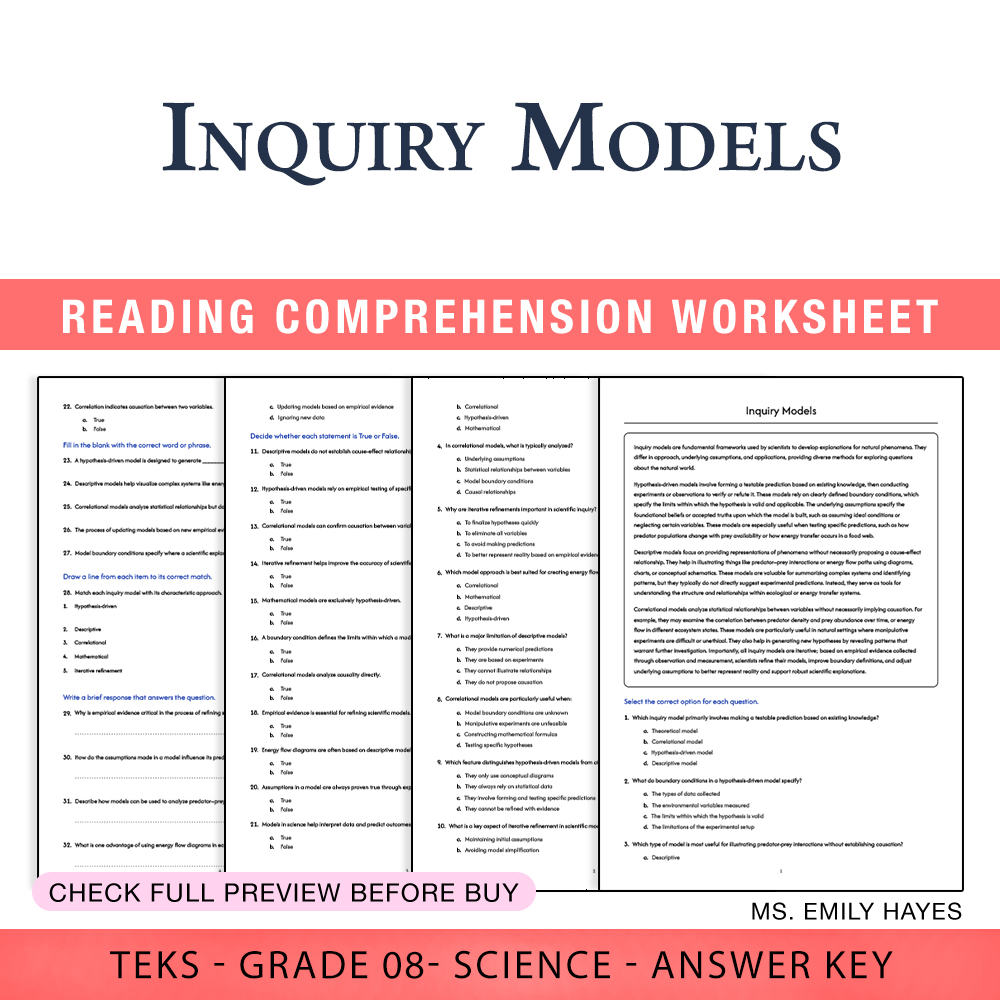
8th Grade Science | Inquiry Models Worksheet (PDF+ Answer Key)
Created byCopper Leaf ClassroomLearning Objectives
- Compare hypothesis-driven, descriptive, and correlational inquiry models.
- Identify the boundary conditions, assumptions, and testable predictions of each model.
- Analyze how different inquiry approaches are applied to predator–prey relationships or energy flow diagrams.
Instant download
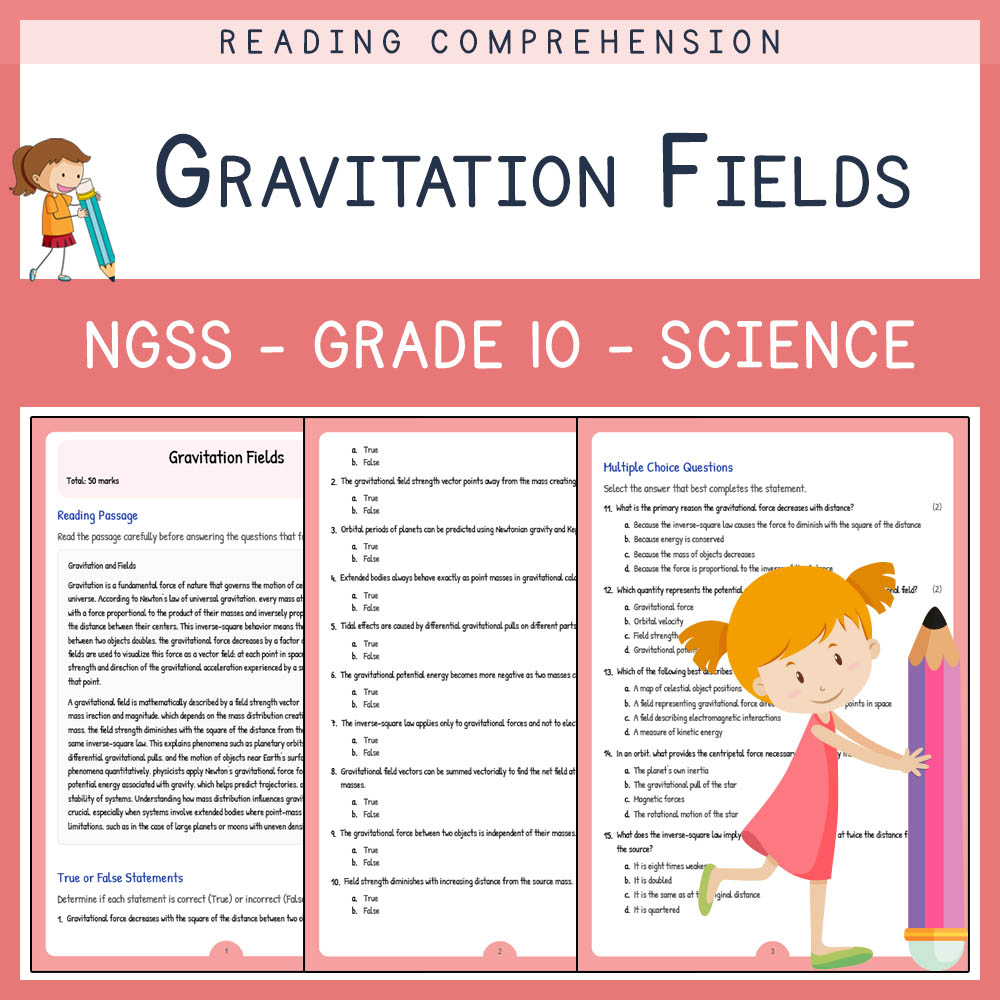
Grade 10 Science | Gravitation Fields Worksheet & Answer Key (PDF)
Created byLumora LearningLearning Objectives
- Understand the inverse-square law behavior of gravitational fields.
- Explain how gravitational fields are represented vectorially and with potential.
- Apply Newtonian gravity to predict planetary orbits and analyze orbital dynamics.
Instant download
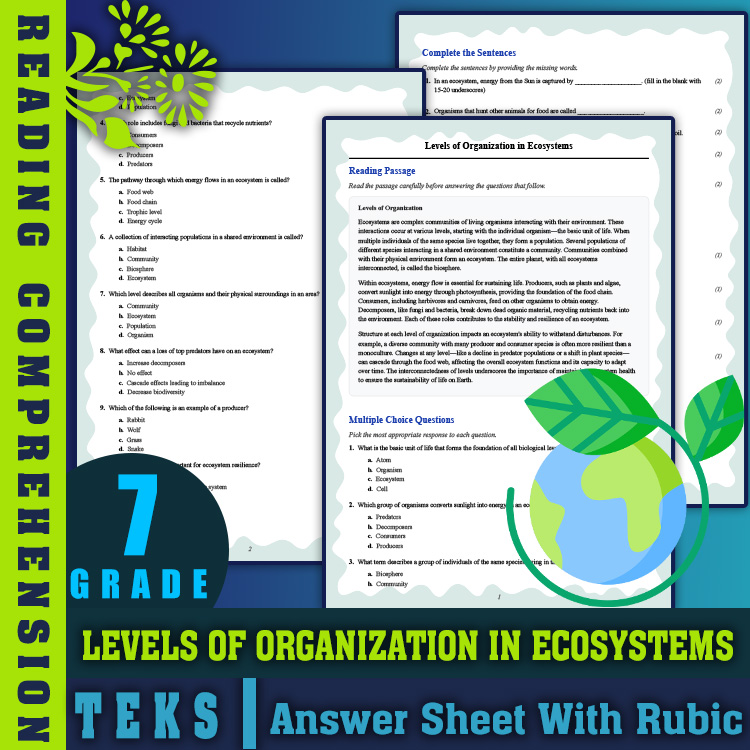
7th Grade Science | Levels of Ecosystem Organization Reading Worksheet
JCreated byJ.S SheetsLearning Objectives
- Understand the hierarchical levels of biological organization from individuals to the biosphere.
- Identify roles of producers, consumers, and decomposers within food webs.
- Explain how energy flows through trophic levels and impacts ecosystem stability.
Instant download
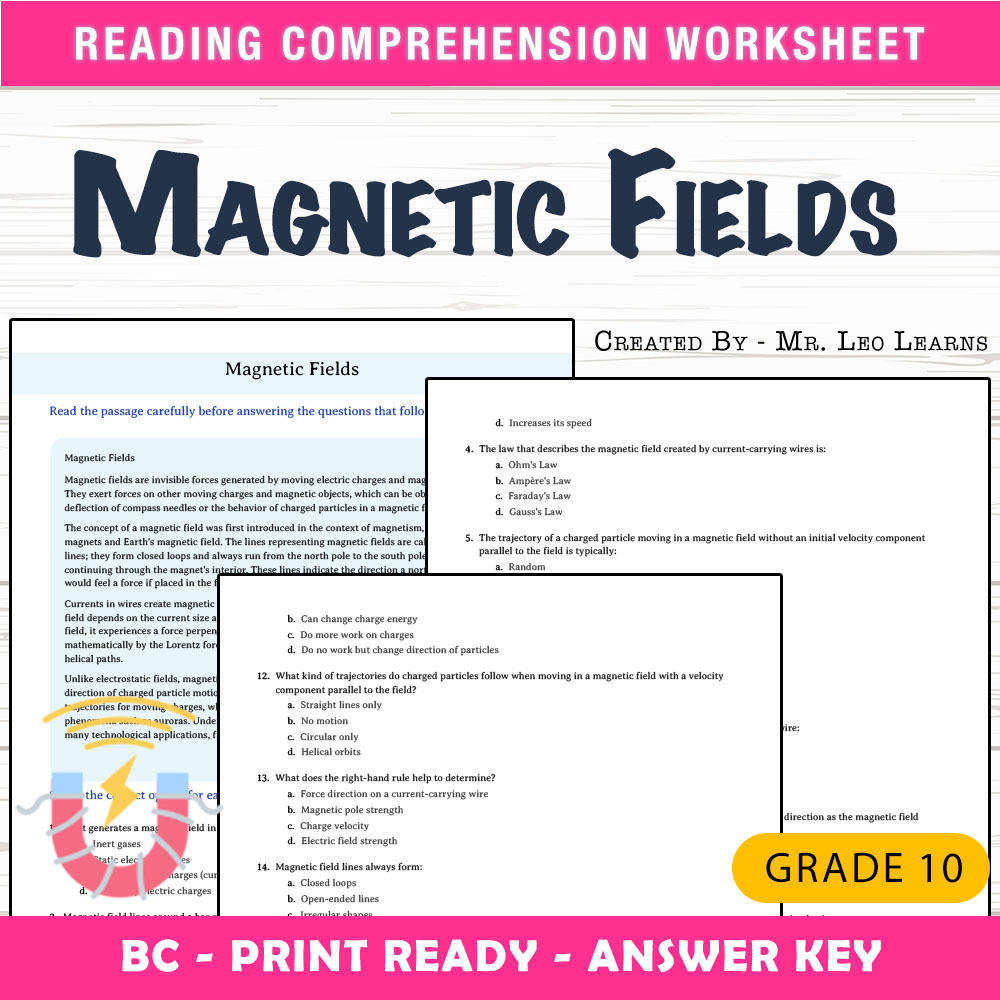
Grade 10 Science — Worksheet MCQ Paper for Mastering Magnetic Fields
Created byThe Resource HubLearning Objectives
- Understand the origin of magnetic fields from moving charges and currents.
- Interpret magnetic field line patterns and their direction.
- Explain how magnetic forces act on moving charges without doing work, and how this affects charge trajectories.
Also included in: Grade 10 Science | Forces, Motion & Fields UNIT Worksheet Bundle +1 more
Instant download
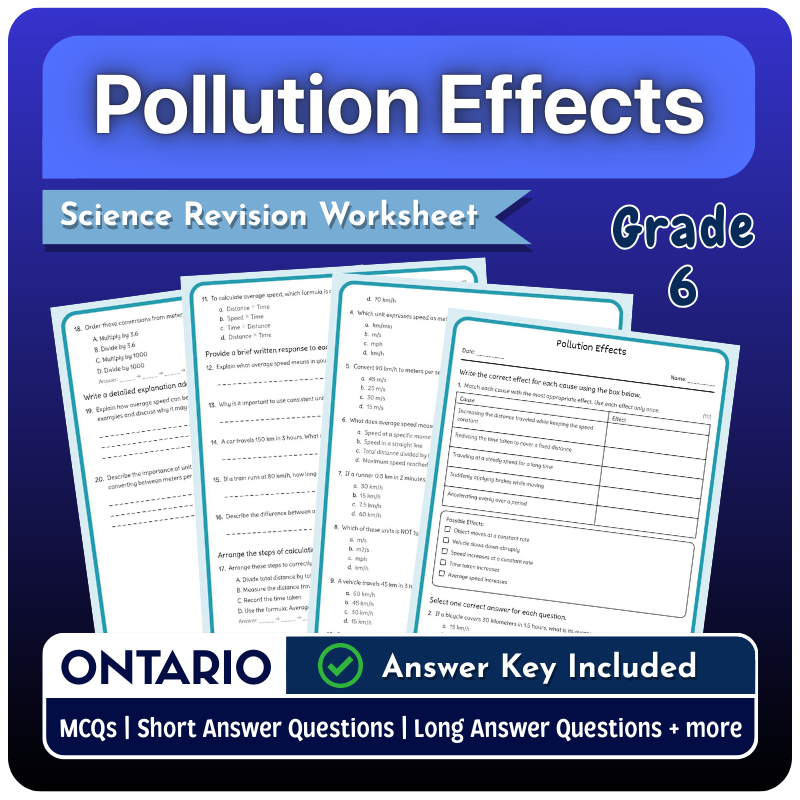
6th Grade Science | Pollution Effects Worksheet (Ontario) (Practice Set)
Created byBright Mind ResourcesLearning Objectives
- Understand the ecological impacts of pollution such as eutrophication, endocrine disruption, and biomagnification.
- Identify measurable indicators like dissolved oxygen, algal biomass, and contaminant residues for assessing pollution effects.
- Analyze how pollution influences species diversity and ecosystem functioning.
Instant download
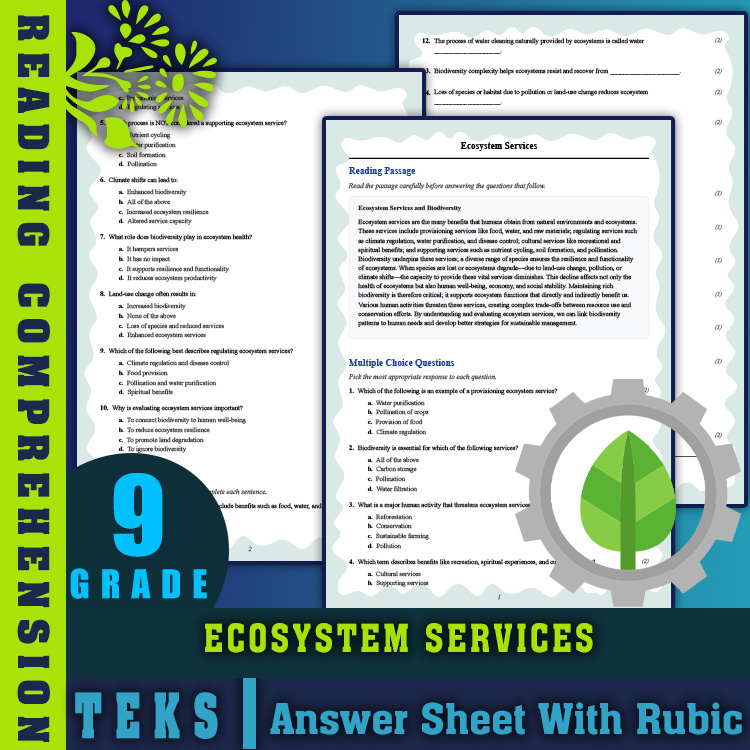
9th Grade Science | Ecosystem Services Reading Worksheets (PDF & Rubric)
JCreated byJ.S SheetsLearning Objectives
- Understand the concept of ecosystem services and their importance to human well-being.
- Identify different types of ecosystem services and how biodiversity supports them.
- Evaluate human impacts on ecosystem services and the resulting trade-offs.
Instant download

6th Grade Science | Pattern Analysis Worksheet (PDF) - Alberta Standards
Created byBright Mind ResourcesLearning Objectives
- Identify different methods used for detecting patterns in datasets.
- Explain how environmental factors influence observable patterns in nature.
- Use visual and statistical techniques to interpret data trends and cycles.
Instant download

11th Grade Science | Electron Configuration Reading Worksheet (PDF + Answer Key)
JCreated byJ.S SheetsLearning Objectives
- Understand the principles governing electron arrangements in atoms.
- Identify and explain quantum numbers, the Aufbau principle, and Pauli exclusion principle.
- Relate electron configurations to elemental chemical behavior, valence electrons, and periodic trends.
Instant download
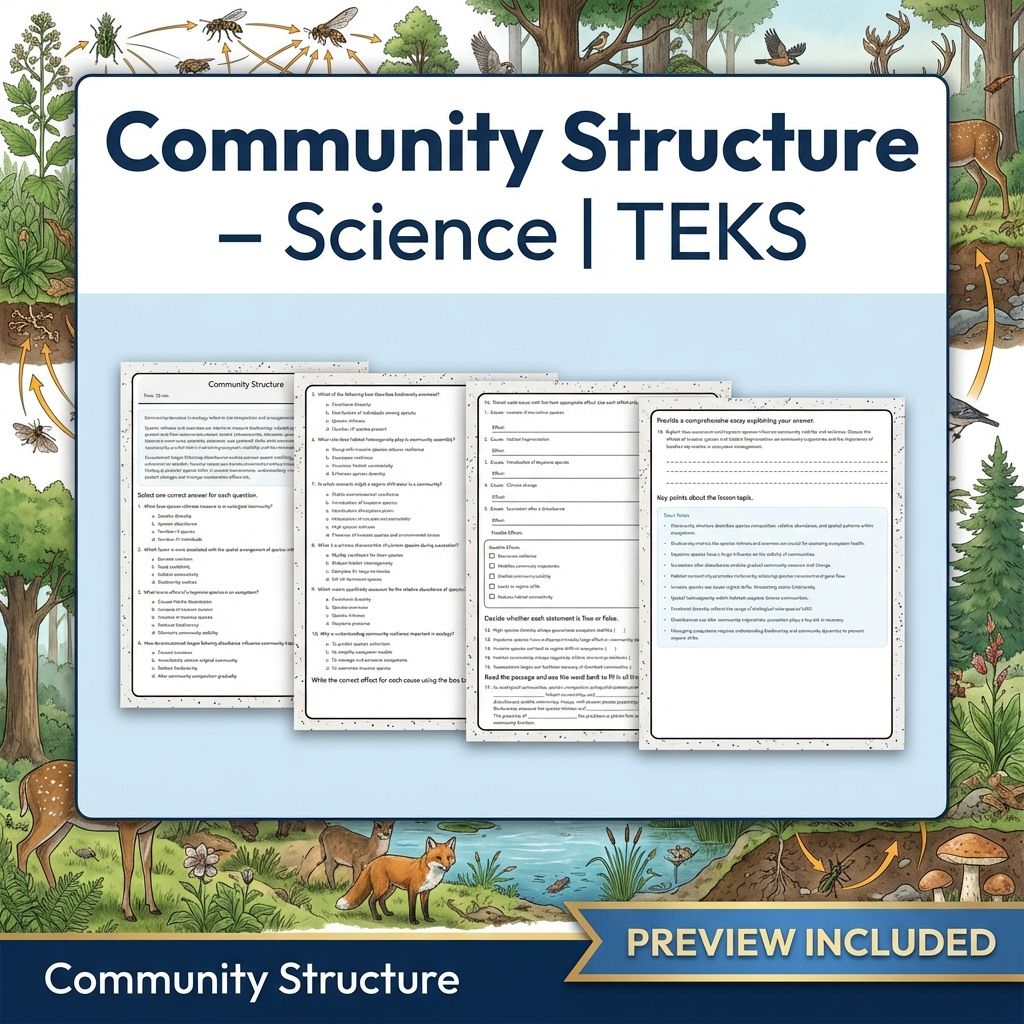
11th Grade Science | Community Structure Worksheet with Short Notes (Printable PDF)
Created byMeadowlark WorksheetsLearning Objectives
- Understand the key components that define community structure in ecology.
- Identify factors that influence species diversity and spatial arrangement in ecosystems.
- Describe the role of succession, keystone species, and habitat connectivity in community resilience.
Instant download
Browse more categories
About Science Worksheets
Find Science worksheets spanning core skills, practice, and review. All 44,628 resources are instant PDF downloads for the classroom or home.
Every worksheet on MyTeachingSheets is created by independent teacher-authors and reviewed before publication. All resources download as printable PDFs for classroom, homework, or at-home practice, and many include answer keys. Preview any worksheet free before buying.