
Science Worksheets
44,573 subject resources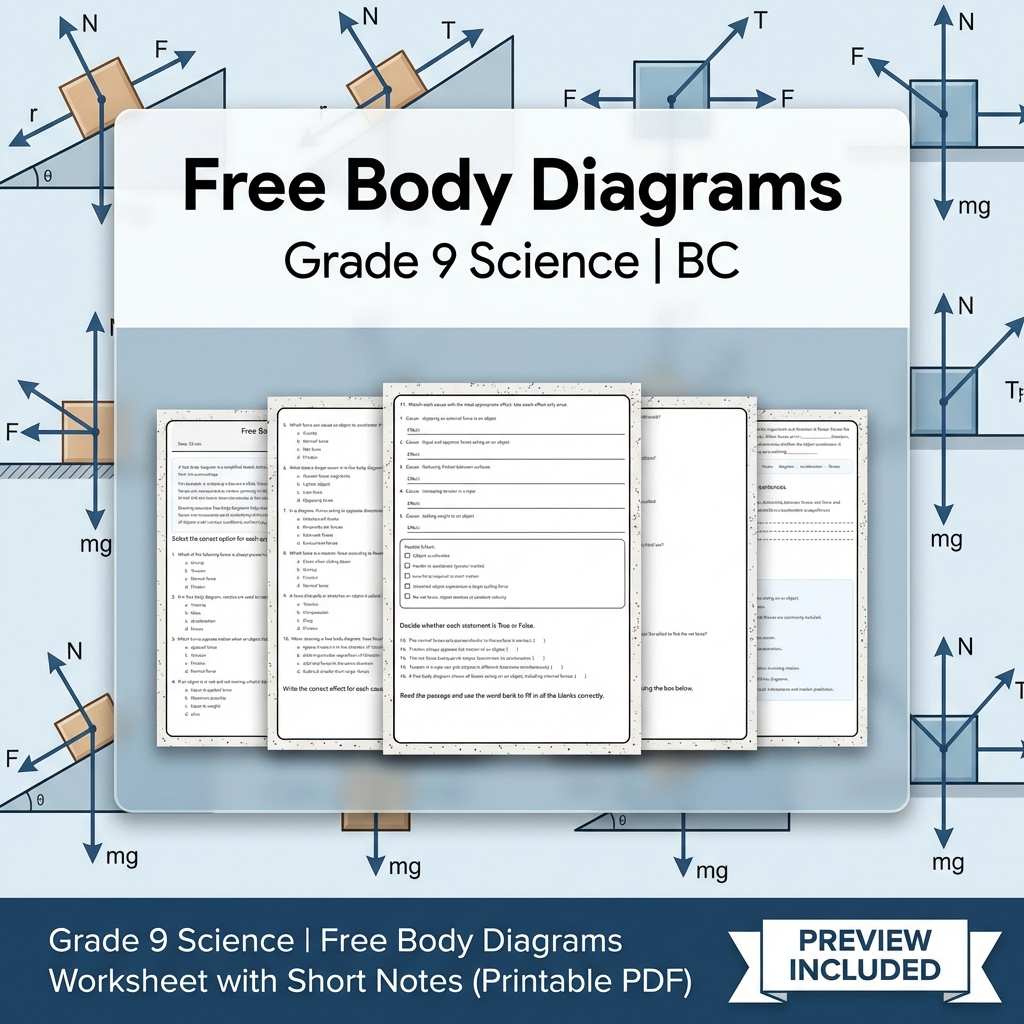
Grade 9 Science | Free Body Diagrams Worksheet with Short Notes (Printable PDF)
 Created byMeadowlark Worksheets
Learning Objectives
- Understand the purpose and components of free body diagrams.
- Learn how to sketch and interpret vectors for forces acting on objects.
- Calculate net force and analyze how forces contribute to motion.
Also included in: Grade 9 Science Lesson Bundle | Energy, Forces & Motion Worksheets +1 more
Instant download
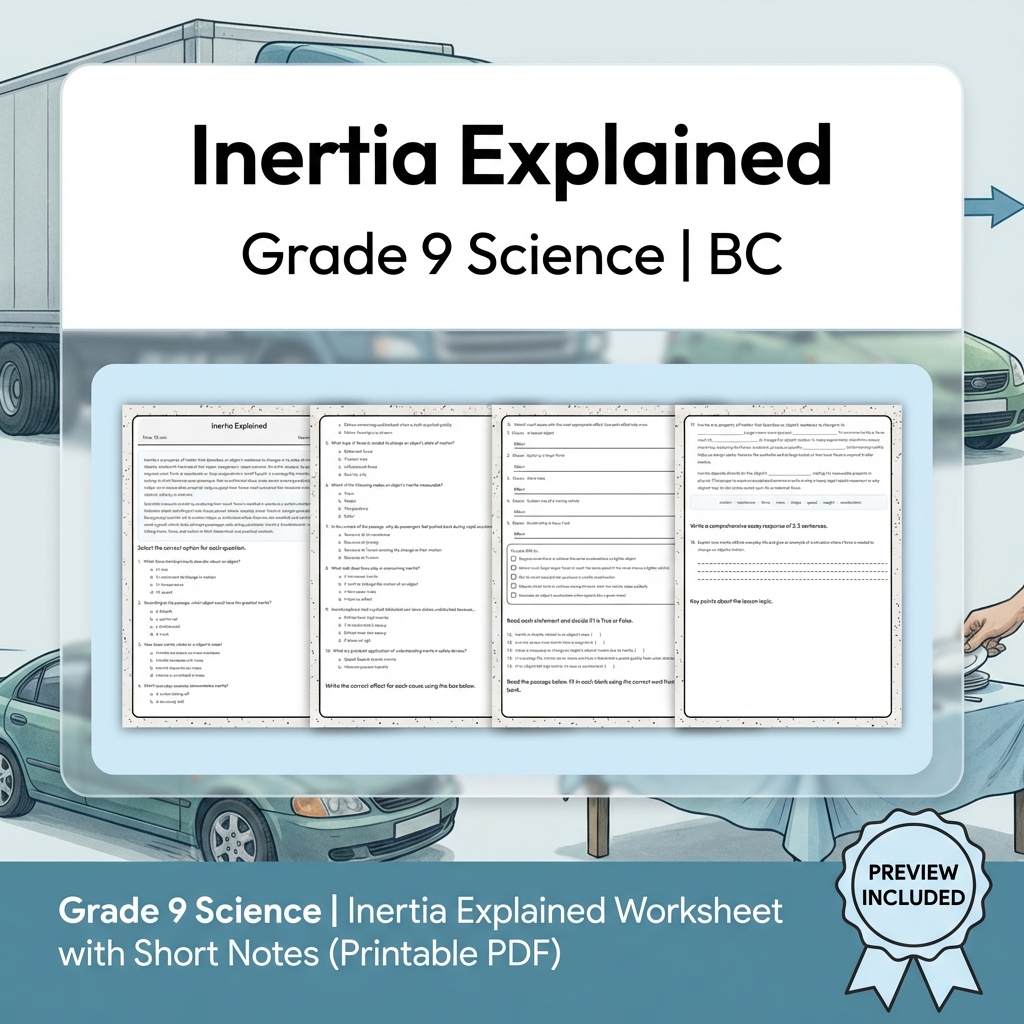
Grade 9 Science | Inertia Explained Worksheet with Short Notes (Printable PDF)
Created byMeadowlark WorksheetsLearning Objectives
- Understand the concept of inertia and how it relates to an object's mass.
- Explain real-world examples of inertia to demonstrate understanding.
- Analyze how forces overcome inertia to change an object's motion.
Also included in: Grade 9 Science Lesson Bundle | Energy, Forces & Motion Worksheets +1 more
Instant download

Genetic Drift Worksheet | Grade 12 Science Practice and Assessment
 Created byPrism Point Learning
Learning Objectives
- Explain how genetic drift causes random changes in allele frequencies, especially in small populations.
- Describe how bottleneck and founder events reduce genetic diversity and can increase inbreeding risk.
- Compare the effects of genetic drift and natural selection using effective population size.
Also included in: Evolution, Speciation & Genetics Lesson Bundle | Grade 12 Science | BC
Instant download

Grade 6 TEKS Minerals and Rocks Daily Science Reading Worksheet
 Created byBRIGHT PATH RESOURCES
Learning Objectives
- Identify the main idea and key details about minerals and rocks.
- Distinguish minerals from rocks using physical properties.
- Recognize how properties like hardness, cleavage, and grain size help identify rock types.
Also included in: Earth & Space Grade 6 Science Daily Reading Worksheets Lesson Bundle | TEKS +1 more
Instant download

Trophic Efficiency Worksheet | Standards-Aligned Grade 10 Science Practice
JCreated byJ.S SheetsLearning Objectives
- Define trophic efficiency and explain why energy transfer between trophic levels is usually low
- Analyze how trophic efficiency affects biomass pyramids and the number of trophic levels in an ecosystem
- Evaluate how differences in trophic efficiency can influence food-web structure and predator abundance
Instant download

Linkage Explains Deviations from Mendelian Ratios Worksheet TEKS Grade 11
Created byBRIGHT PATH RESOURCESLearning Objectives
- Identify how linkage between genes alters Mendelian inheritance expectations
- Use details from a passage to explain why linked traits tend to be inherited together
- Predict which phenotype combinations become more common when genes are linked
Instant download
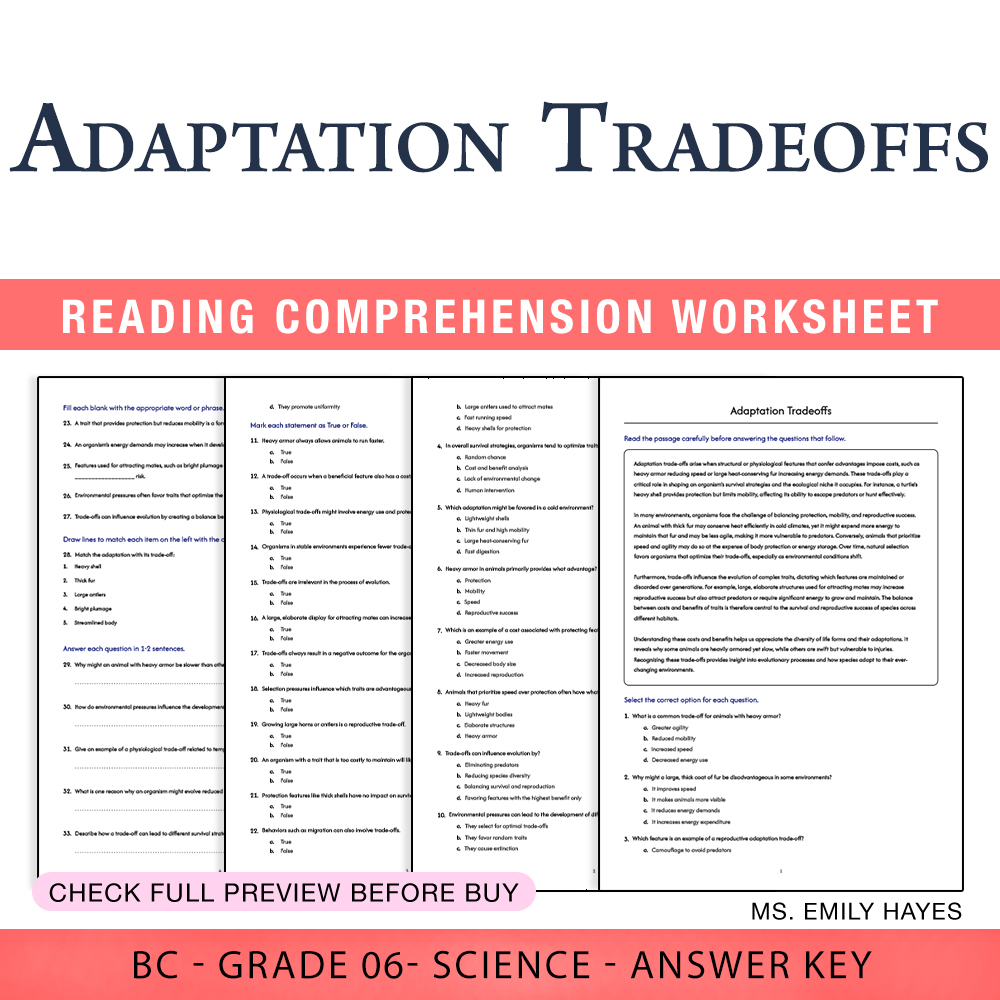
6th Grade Science | Adaptation Tradeoffs Worksheet (PDF+ Answer Key)
 Created byCopper Leaf Classroom
Learning Objectives
- Understand the concept of adaptation trade-offs and how they affect organism survival
- Describe different types of trade-offs in structural and physiological features
- Evaluate the costs and benefits associated with specific adaptations
Also included in: Grade 6 Science BC | Human Body Systems & Adaptations (PDF+ Answer Keys) +1 more
Instant download
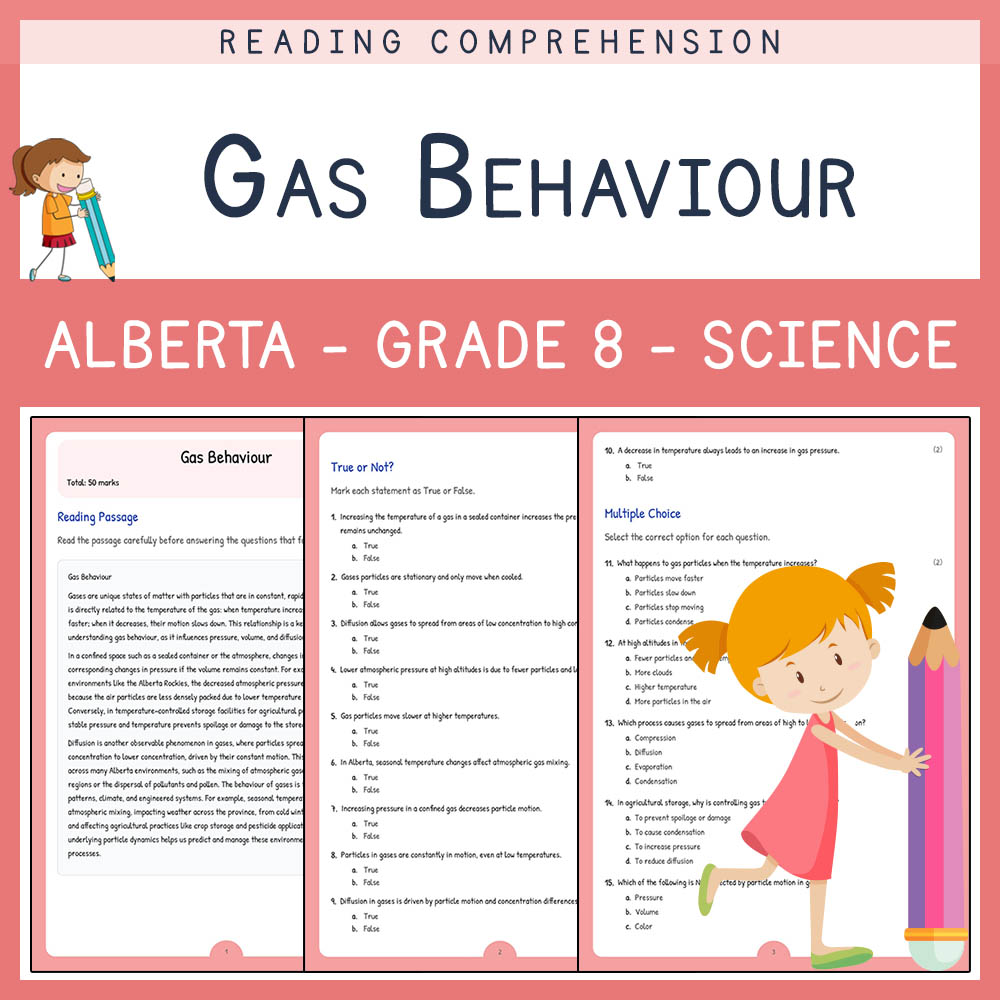
Grade 8 Science | Gas Behaviour Worksheet | Alberta Standards
 Created byLumora Learning
Learning Objectives
- Understand how particle motion, pressure, and temperature are interconnected in gases.
- Explain how changes in temperature can affect gas pressure and volume in closed systems.
- Describe real-world examples of gas behaviour, including atmospheric pressure variations and gas handling in agriculture.
Instant download

Reaction Kinetics Worksheet | Grade 12 Science Activities
Created byPrism Point LearningLearning Objectives
- Explain how collision theory, activation energy, and temperature influence reaction rates.
- Use rate laws and experimental reaction orders to predict how concentration affects reaction rates.
- Relate temperature changes to rate constants using the Arrhenius equation concepts.
Instant download
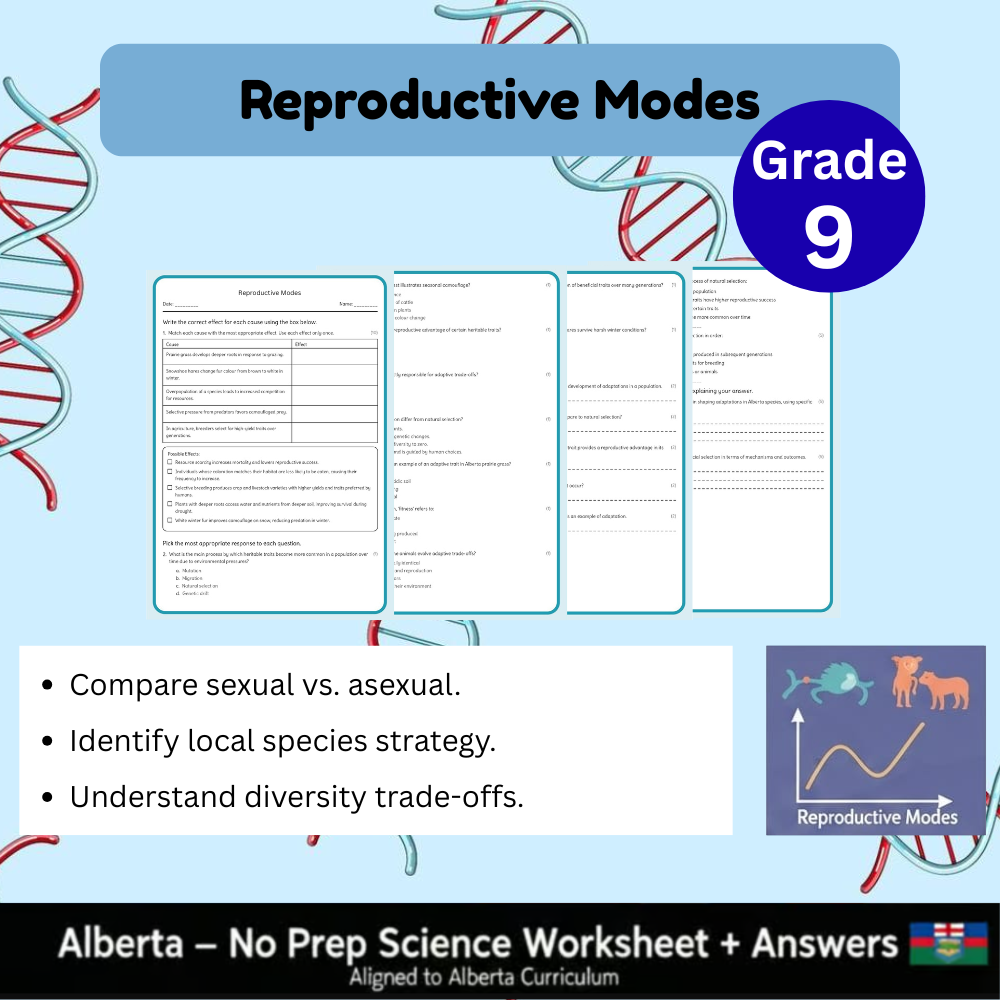
Grade 9 Science | Reproductive Modes Worksheet (PDF) - Alberta Standards
 Created byBright Mind Resources
Learning Objectives
- Compare and contrast sexual and asexual reproduction strategies.
- Identify examples of reproductive strategies in Alberta species.
- Understand ecological trade-offs between genetic diversity and population growth.
Instant download

Science Worksheet: Relative Geologic Time | NGSSS Grade 7 Science
JCreated byJ.S SheetsLearning Objectives
- Use the principles of superposition and cross-cutting relationships to place geologic events in order.
- Explain how geologists infer relative ages of rock layers and features without exact numeric dates.
- Identify which rock relationships indicate older versus younger formations in a geologic history.
Also included in: Grade 7 Weather, Climate, and Earth Processes Science Lesson Bundle +1 more
Instant download

Mass Wasting and Coasts Surface Impacts Worksheet | NGSSS Grade 7 Science
JCreated byJ.S SheetsLearning Objectives
- Explain how gravity and water-driven forces contribute to mass wasting and coastal erosion
- Describe how saturation from prolonged rain can trigger landslides
- Identify how waves and storm surge reshape beaches, dunes, and shorelines over time
Also included in: Grade 7 Weather, Climate, and Earth Processes Science Lesson Bundle +1 more
Instant download

Grade 9 Science Worksheet on Physical Changes (Alberta Standards) (PDF)
 Created bySilver Birch Teaching
Learning Objectives
- Explain what a physical change is and how it differs from a chemical change
- Identify examples of physical changes in everyday and engineered processes
- Use particle/identity reasoning to describe how matter can change phase or form without forming new substances
Also included in: Grade 9 Chemical Reactions Science Lesson Bundle: Alberta Framework +1 more
Instant download
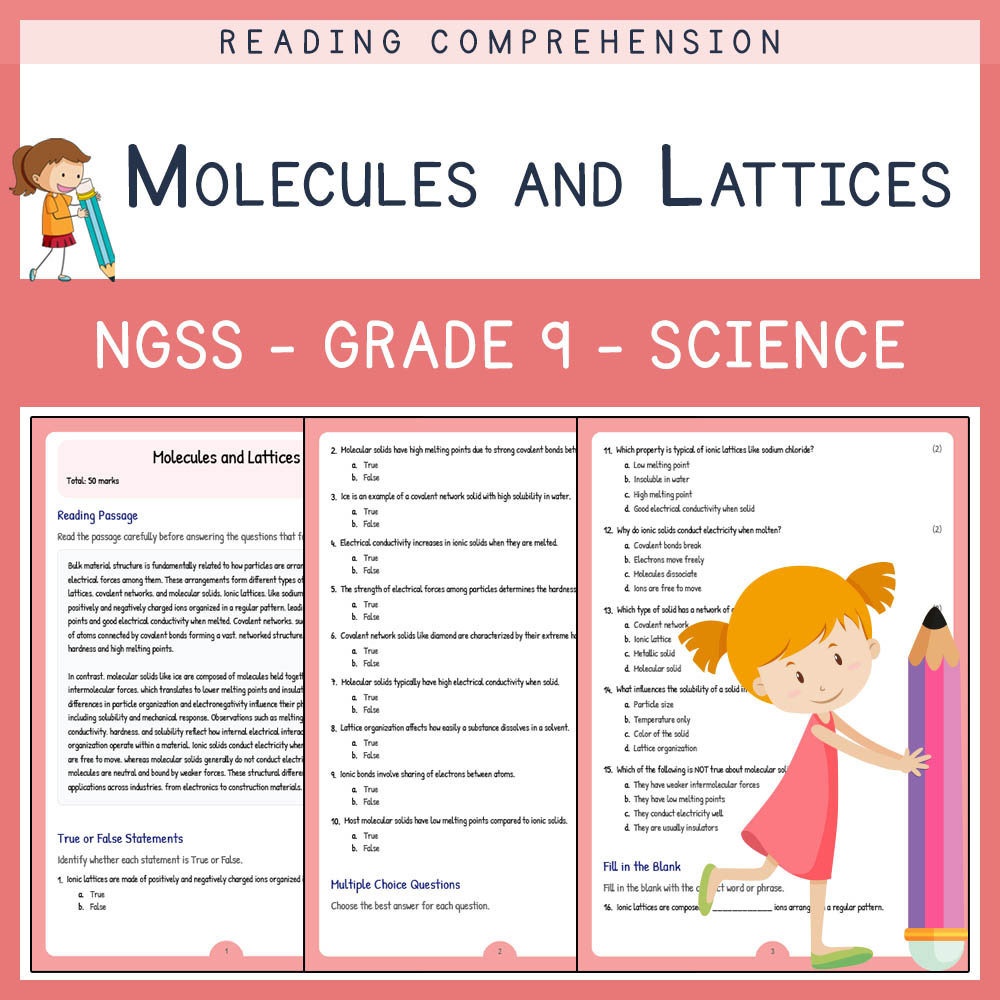
Grade 9 Science | Molecules and Lattices Worksheet & Answer Key (NGSS Standards)
Created byLumora LearningLearning Objectives
- Understand the different types of particle arrangements in solids, including ionic and covalent lattices.
- Explain how the structure of molecules and lattices influences properties such as melting point, electrical conductivity, and solubility.
- Describe the distinctions between ionic solids and molecular solids based on their organization and electrical forces.
Instant download

Forces Overview Worksheet Grade 9 Science NGSSS Physics Bundle
 Created byEvergreen Desk Education
Learning Objectives
- Explain how forces affect an object’s motion by changing acceleration and/or velocity
- Differentiate contact forces from field forces and give examples of each
- Use vector ideas (magnitude and direction) to describe forces and combine multiple forces conceptually
Instant download
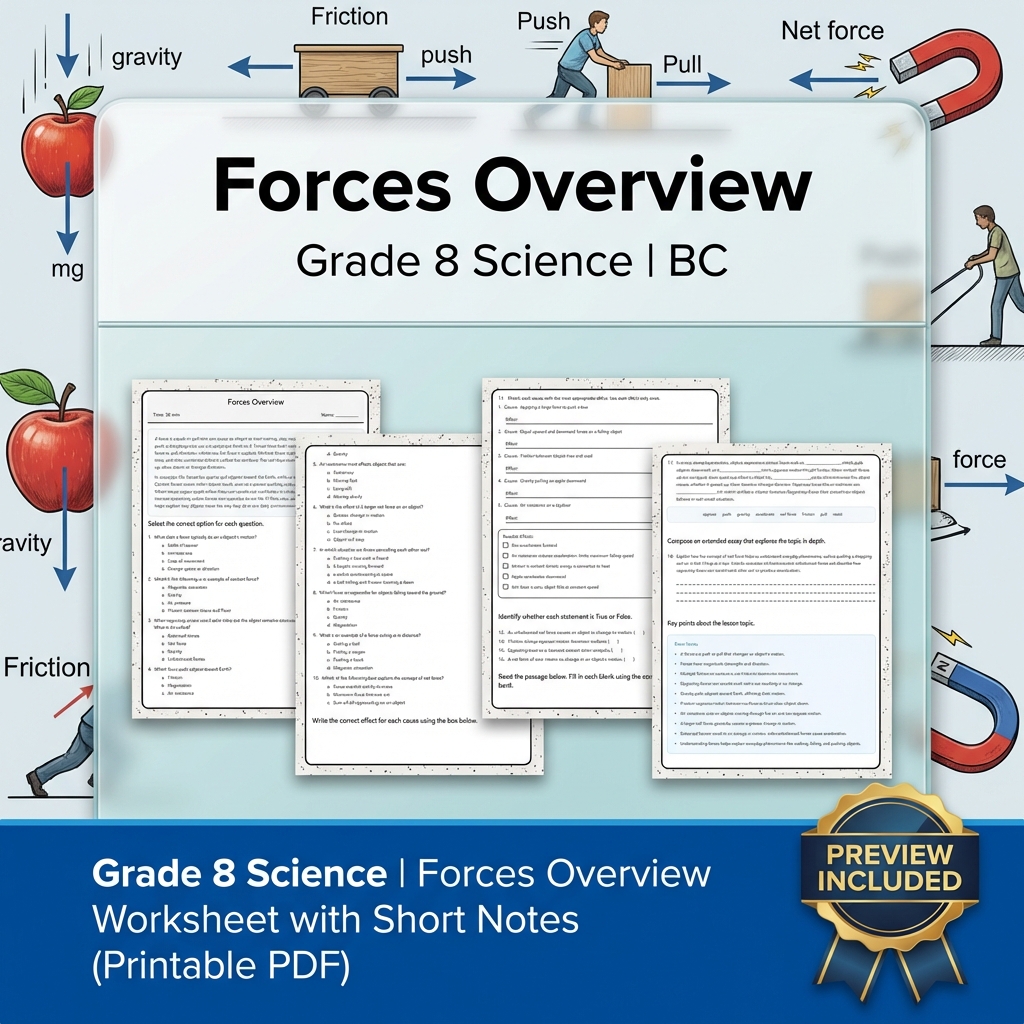
Grade 8 Science | Forces Overview Worksheet with Short Notes (Printable PDF)
Created byMeadowlark WorksheetsLearning Objectives
- Describe what a force is and its effect on objects.
- Identify different types of forces such as gravity, air resistance, and contact forces.
- Explain how forces combine as net forces to change motion.
Also included in: Grade 8 Science Lesson Bundle | BC Framework & Key Concepts Worksheet Pack +1 more
Instant download
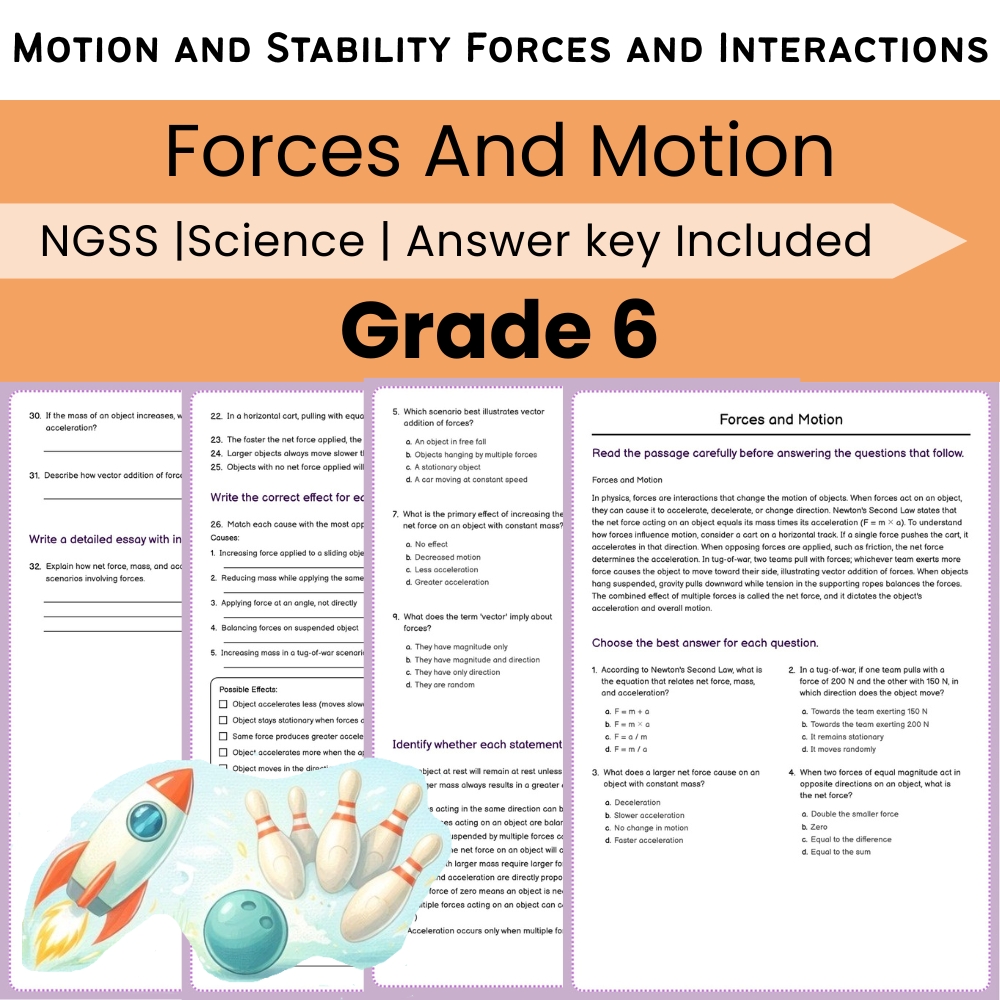
Forces and Motion Worksheet | NGSS Grade 6 Science printable PDF
Learning Objectives
- Understand the relationship between net force, mass, and acceleration.
- Explain how vector addition affects motion in different scenarios.
- Apply the formula net force equals mass times acceleration to solve problems.
Also included in: Grade 6 Science | Forces and Motion NGSS Unit Bundle (4 Worksheets Included) +1 more
Instant download
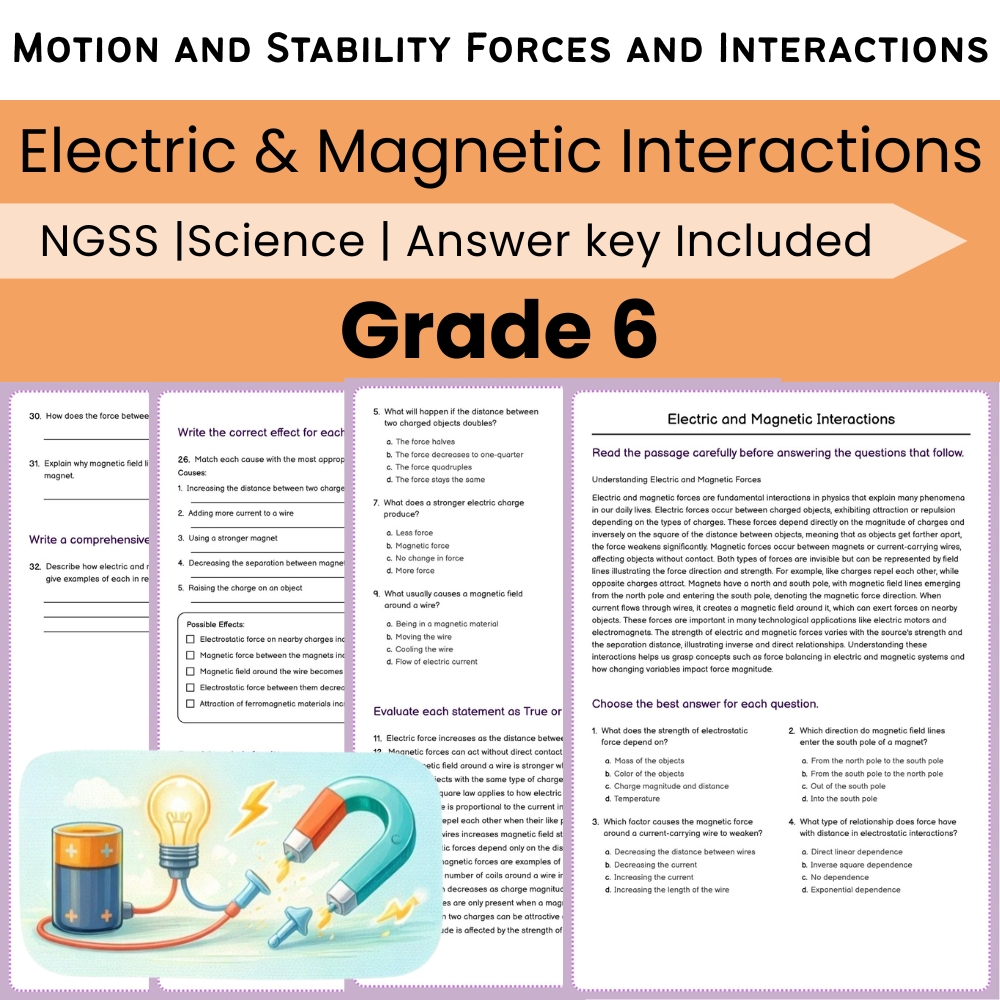
Electric and Magnetic Interactions Worksheet | Grade 6 Science PDF
Learning Objectives
- Understand how electric and magnetic forces depend on source strength and separation.
- Identify examples of electrostatic and magnetic forces in real-world situations.
- Explain how factors like distance, charge, and current influence force strength.
Also included in: Grade 6 Science | Forces and Motion NGSS Unit Bundle (4 Worksheets Included) +1 more
Instant download
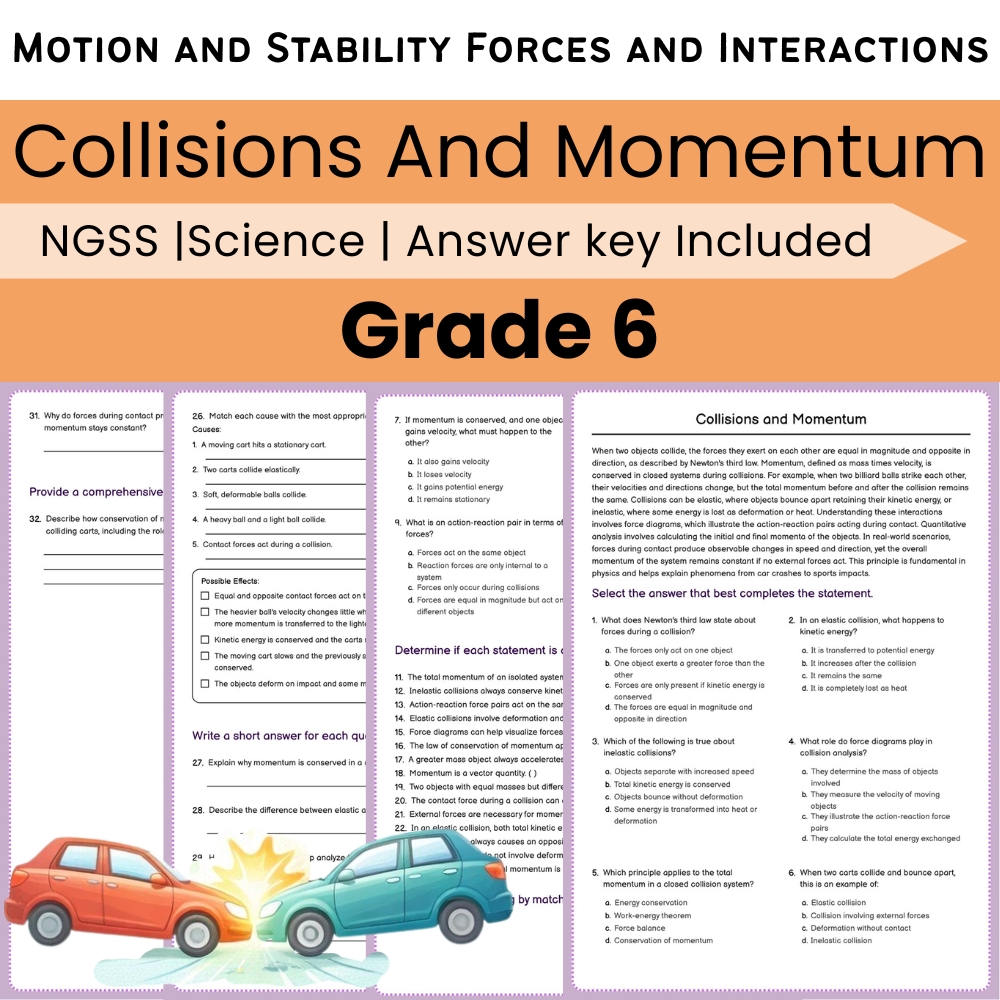
Collisions and Momentum Worksheet | Grade 6 Science NGSS Printable PDF
Learning Objectives
- Understand the law of conservation of momentum during two-body collisions.
- Identify the differences between elastic and inelastic collisions.
- Apply force diagrams to analyze action-reaction pairs during contact.
Also included in: Grade 6 Science | Forces and Motion NGSS Unit Bundle (4 Worksheets Included) +1 more
Instant download

Mixtures And Solutions Practice Worksheet | Grade 7 Science NGSS
Created byPrism Point LearningLearning Objectives
- Differentiate homogeneous and heterogeneous mixtures based on how substances are distributed and how they can be separated.
- Describe solubility and saturation, and connect concentration to observable properties of solutions.
- Compare solutions, colloids, and suspensions using particle size and separation behavior.
Also included in: Grade 7 Matter & Atomic Models Science Lesson Bundle Review | NGSS
Instant download
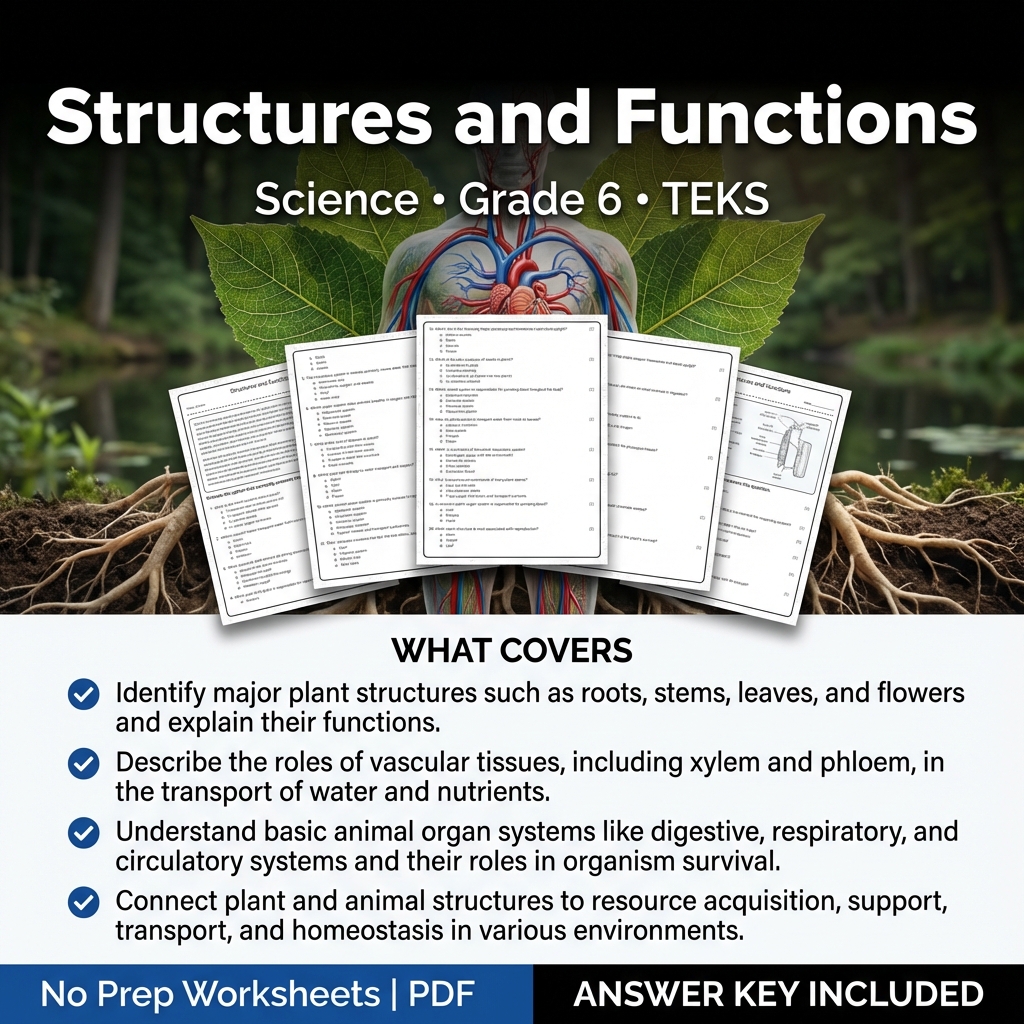
Grade 6 Science Worksheet on Structures and Functions | TEKS Aligned
 Created byCoral Reef Learning
Learning Objectives
- Identify major plant structures such as roots, stems, leaves, and flowers and explain their functions.
- Describe the roles of vascular tissues, including xylem and phloem, in the transport of water and nutrients.
- Understand basic animal organ systems like digestive, respiratory, and circulatory systems and their roles in organism survival.
Instant download

Balanced Forces Worksheet | Grade 8 Science Practice
Created byPrism Point LearningLearning Objectives
- Explain how balanced forces lead to zero net force and no change in motion
- Differentiate static equilibrium from dynamic equilibrium using real-life examples
- Determine whether a situation shows balanced or unbalanced forces by considering opposing forces
Also included in: Forces, Motion & Energy Lesson Bundle | Grade 8 Science | BC +1 more
Instant download
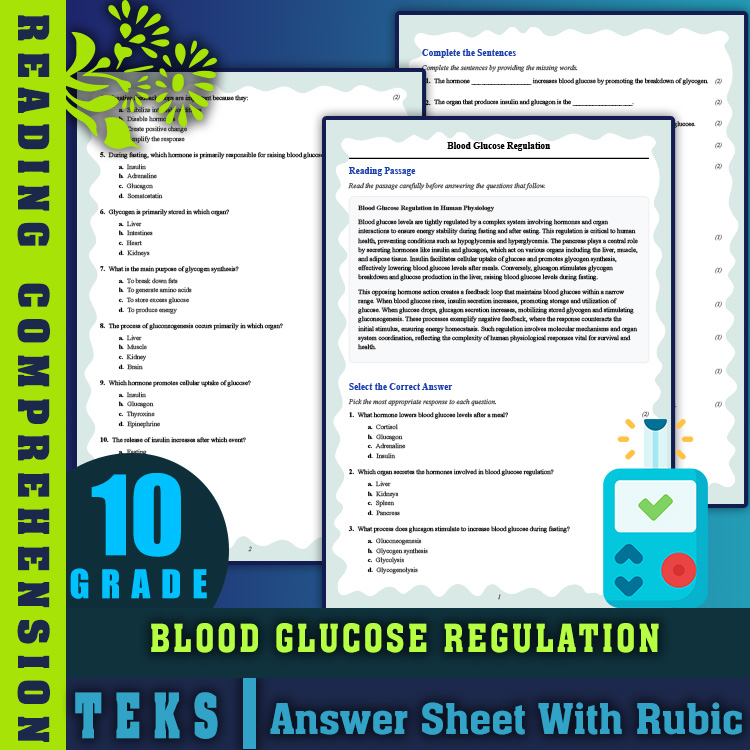
Grade 10 Science | Blood Glucose Regulation Reading Worksheet & Answer Key PDF
JCreated byJ.S SheetsLearning Objectives
- Understand the roles of insulin and glucagon in blood glucose regulation.
- Explain how endocrine signaling maintains energy homeostasis.
- Describe feedback mechanisms involved in blood glucose control.
Instant download

Acid-Base Concentration & pH/pOH Calculation Worksheets Grade 11
 Created bySunny Desk Resources
Learning Objectives
- Calculate [H+] from pH using logarithmic relationships
- Calculate [OH-] from pOH using logarithmic relationships
- Apply Kw to relate hydrogen and hydroxide concentrations
Also included in: Grade 11 Acid-Base Chemistry Lesson Bundle: Alberta Science +1 more
Instant download

Climate Feedbacks Worksheet | Climate Change & Earth Systems Activities
Created byPrism Point LearningLearning Objectives
- Explain how greenhouse gases trigger climate warming and how that warming can lead to additional warming through feedbacks.
- Describe how surface properties (like ice/snow reflectivity) and clouds can either amplify or reduce climate change.
- Analyze how changes in aerosols can shift Earth’s radiation balance and influence temperature and precipitation.
Instant download

Chemical Properties Test Prep Printable | Grade 7 Science
Created byPrism Point LearningLearning Objectives
- Explain how chemical properties affect what happens during chemical changes
- Identify observable indicators (gas, colour change, precipitates) linked to chemical processes
- Compare stability of different materials using reactivity, oxidation, corrosion, and pH-related behaviour
Also included in: Grade 7 Substance & Mixture Properties Science Lesson Bundle (Ontario)
Instant download

Systems In Ecology Worksheet | Grade 11 Science | Ontario Standards
JCreated byJ.S SheetsLearning Objectives
- Explain population dynamics using logistic growth and the idea of carrying capacity (K).
- Describe how community interactions (e.g., predator–prey relationships) can be represented with Lotka–Volterra dynamics.
- Connect biogeochemical cycling and feedback processes to ecosystem stability, resilience, and human impacts.
Instant download
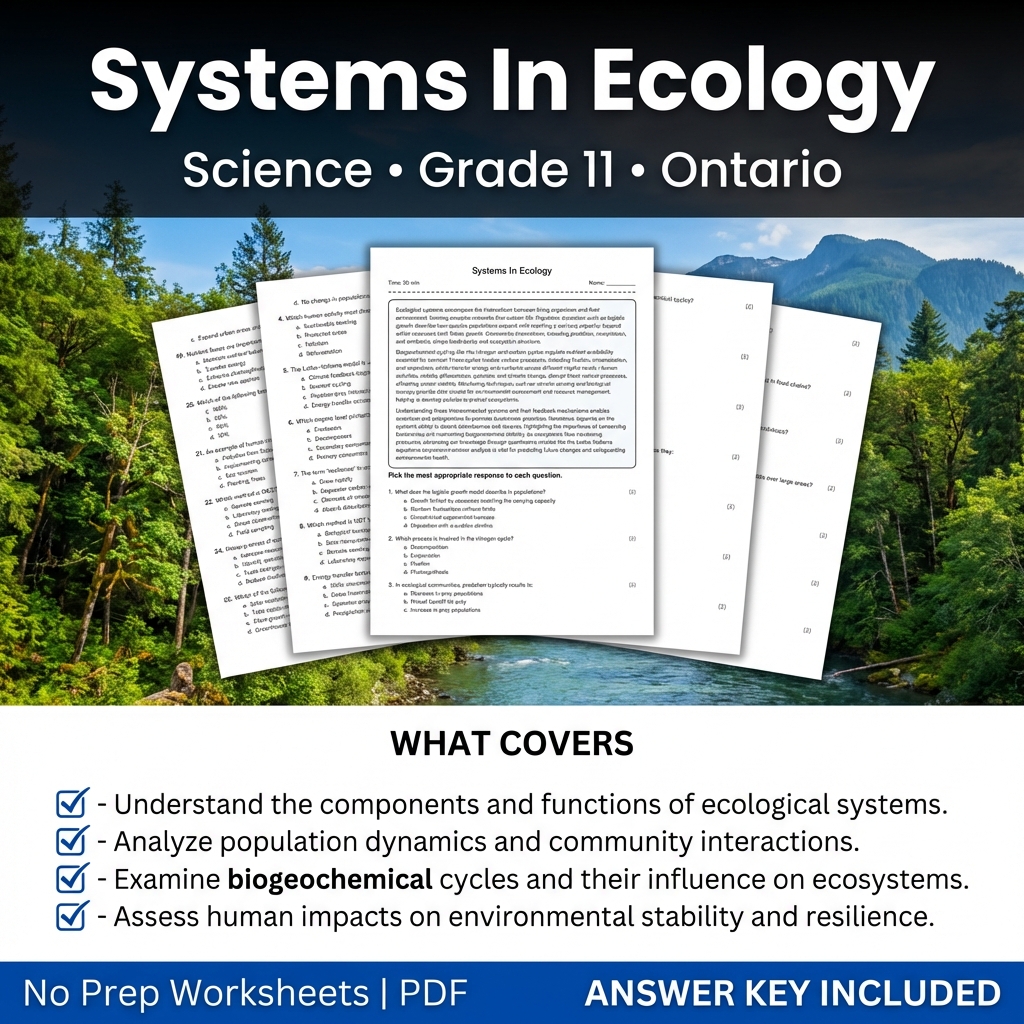
Systems In Ecology Grade 11 Science Worksheet | Ontario Standards
Created byCoral Reef LearningLearning Objectives
- Understand the components and functions of ecological systems.
- Analyze population dynamics and community interactions.
- Examine biogeochemical cycles and their influence on ecosystems.
Instant download
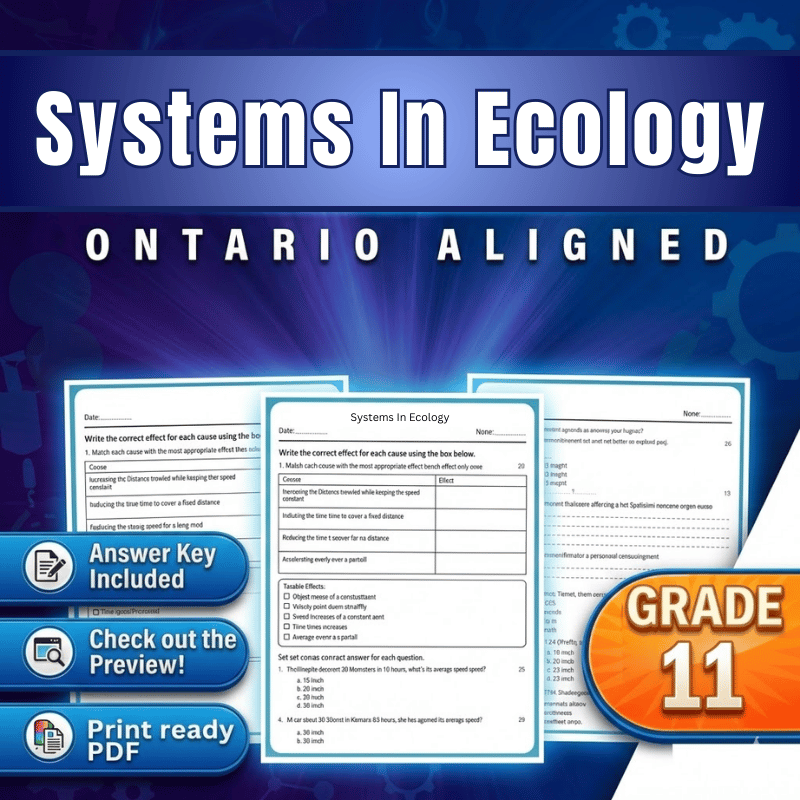
Grade 11 Science – Systems in Ecology Worksheet (Ontario) (PDF)
Created byBright Mind ResourcesLearning Objectives
- Understand the components and functions of ecological systems.
- Analyze population dynamics and community interactions.
- Explore biogeochemical cycles and energy transfer in ecosystems.
Instant download

Redox Processes Worksheet | Grade 12 Science Practice
Created byPrism Point LearningLearning Objectives
- Explain how oxidation and reduction relate to electron transfer and identify the oxidizing/reducing agents.
- Determine oxidation states and interpret what changes during redox reactions.
- Balance redox reactions by conserving mass and charge using half-reactions.
Instant download
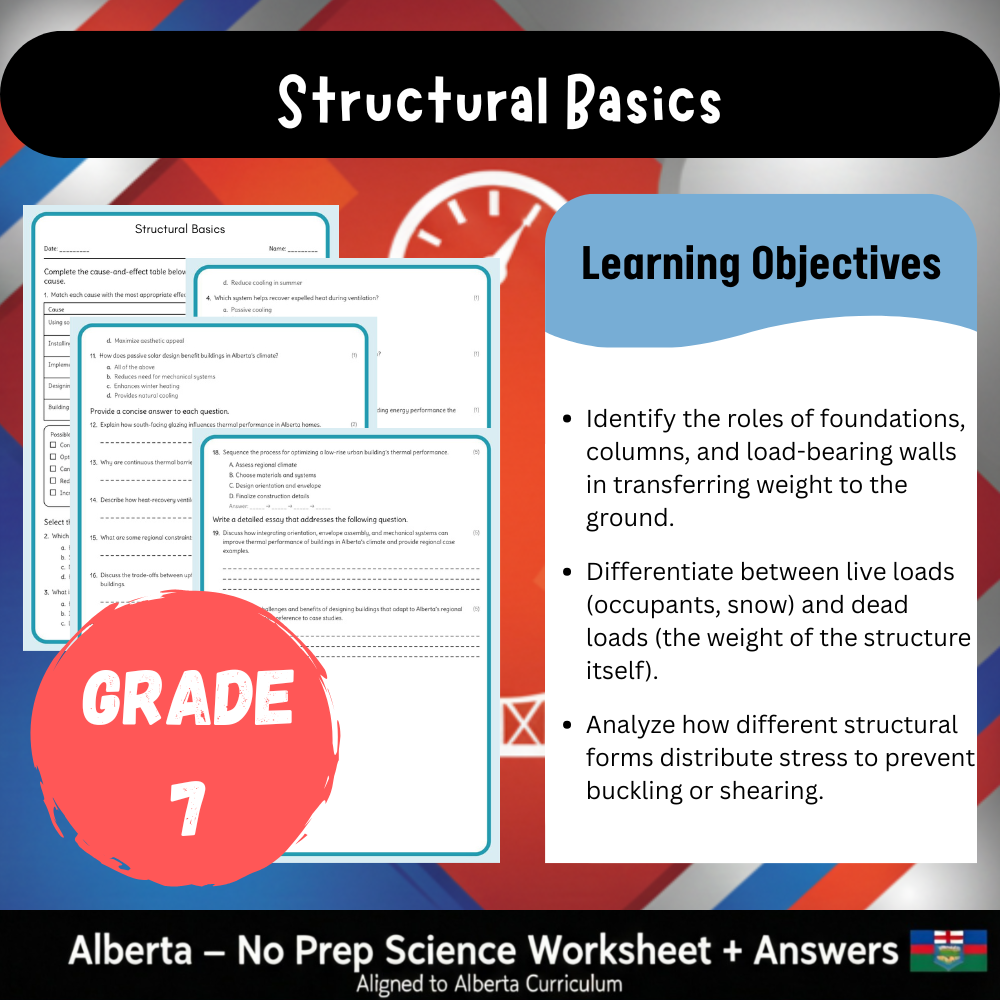
Grade 7 Science | Structural Basics Worksheet (PDF) – Alberta Standards
Created byBright Mind ResourcesLearning Objectives
- Understand the roles of supports, foundations, and load paths in construction.
- Identify how compression, tension, and shear forces affect structural elements.
- Evaluate materials based on properties like stiffness, strength, and durability.
Instant download
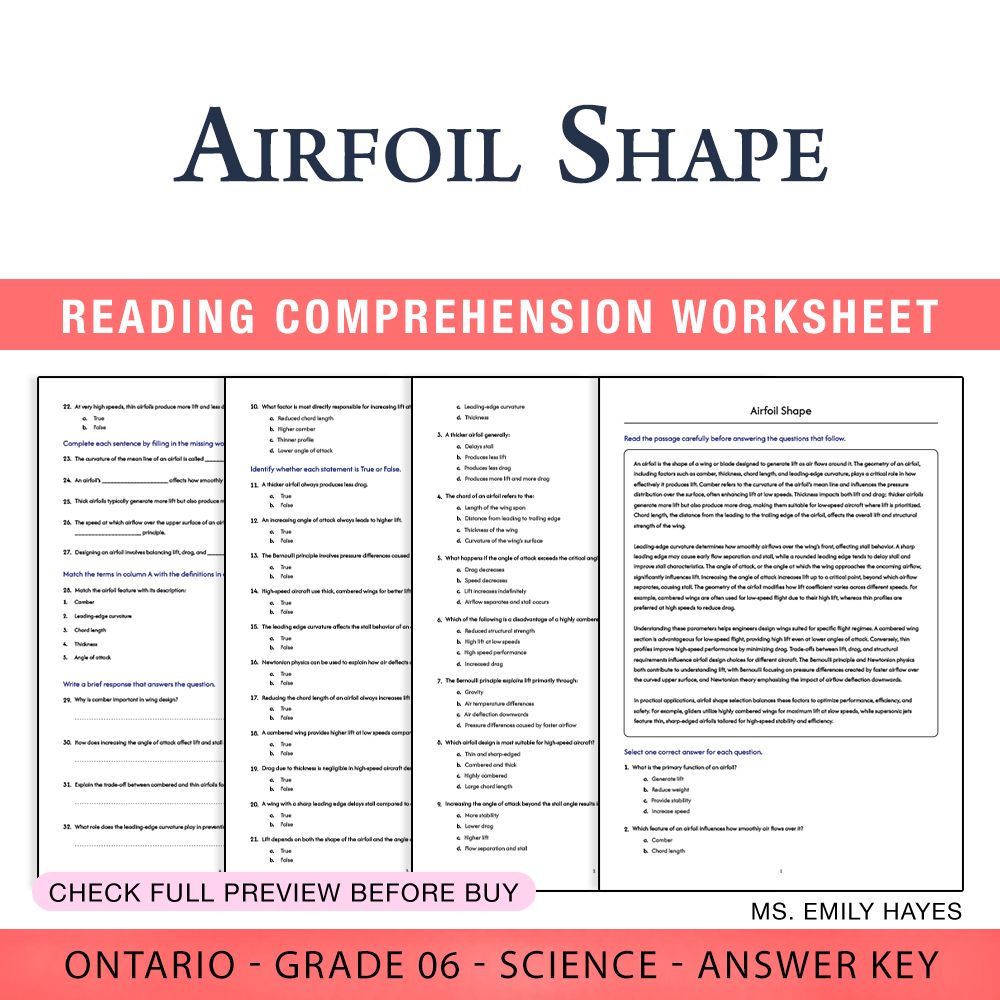
6th Grade Science | Airfoil Shape Worksheet (PDF + Answer Key)
Created byCopper Leaf ClassroomLearning Objectives
- Explain how camber, thickness, chord length, and leading-edge curvature influence pressure distribution and lift.
- Describe the differences between Bernoulli and Newtonian approaches to understanding lift.
- Identify the effects of angle of attack and critical angles for stall on lift production.
Instant download

Model-Data Fit Worksheet | Residual Analysis & AP Science Modeling
Created byPrism Point LearningLearning Objectives
- Use residuals and diagnostic graphical patterns to judge whether a model matches empirical data.
- Apply goodness-of-fit ideas to decide when a model is acceptable versus when it should be revised.
- Explain how heteroscedasticity and missing-variable clues motivate alternate hypotheses.
Instant download
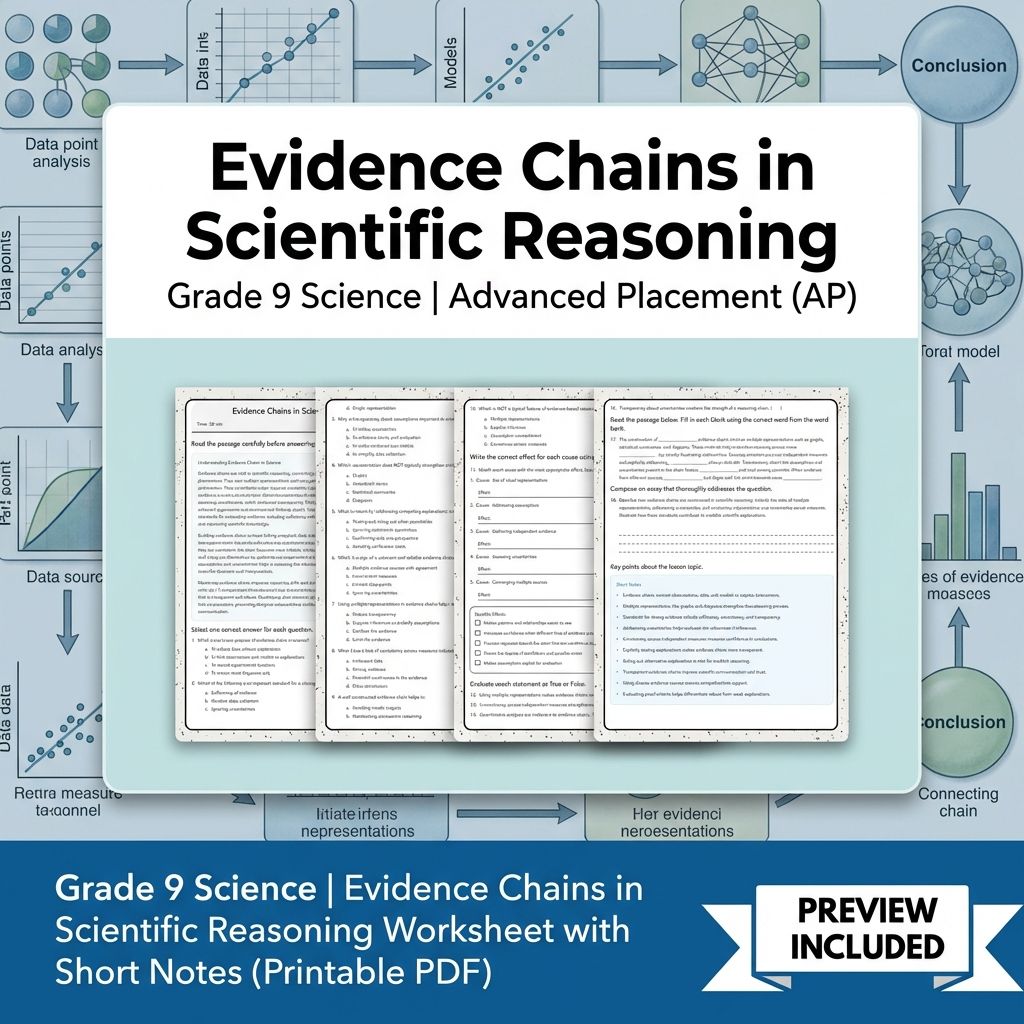
Grade 9 Science | Evidence Chains in Scientific Reasoning Worksheet (PDF)
Created byMeadowlark WorksheetsLearning Objectives
- Understand the structure of evidence-based reasoning in science.
- Identify different types of evidence and their roles in supporting claims.
- Analyze how multiple representations strengthen inference chains.
Also included in: Grade 9 Science | Critical Thinking & Data Analysis Unit Bundle (Worksheets) +1 more
Instant download

Mixtures and Compounds Worksheet Pack Grade 6 Science Chemistry
Created byPrism Point LearningLearning Objectives
- Explain how mixtures and compounds differ in particle arrangement and atomic composition
- Identify examples of mixtures and compounds using particle model ideas
- Describe how physical separation often works for mixtures but not for compounds
Instant download

Grade 7 Gravity And Weight Worksheet | NGSS Practice PDF
 Created byClear Sky Classroom
Learning Objectives
- Differentiate between gravity, weight, and mass and explain how they relate to motion near Earth.
- Use Newtonian ideas (net force and acceleration) to predict how objects move as they fall.
- Interpret simple scenarios comparing objects with different masses in the same gravitational field.
Instant download
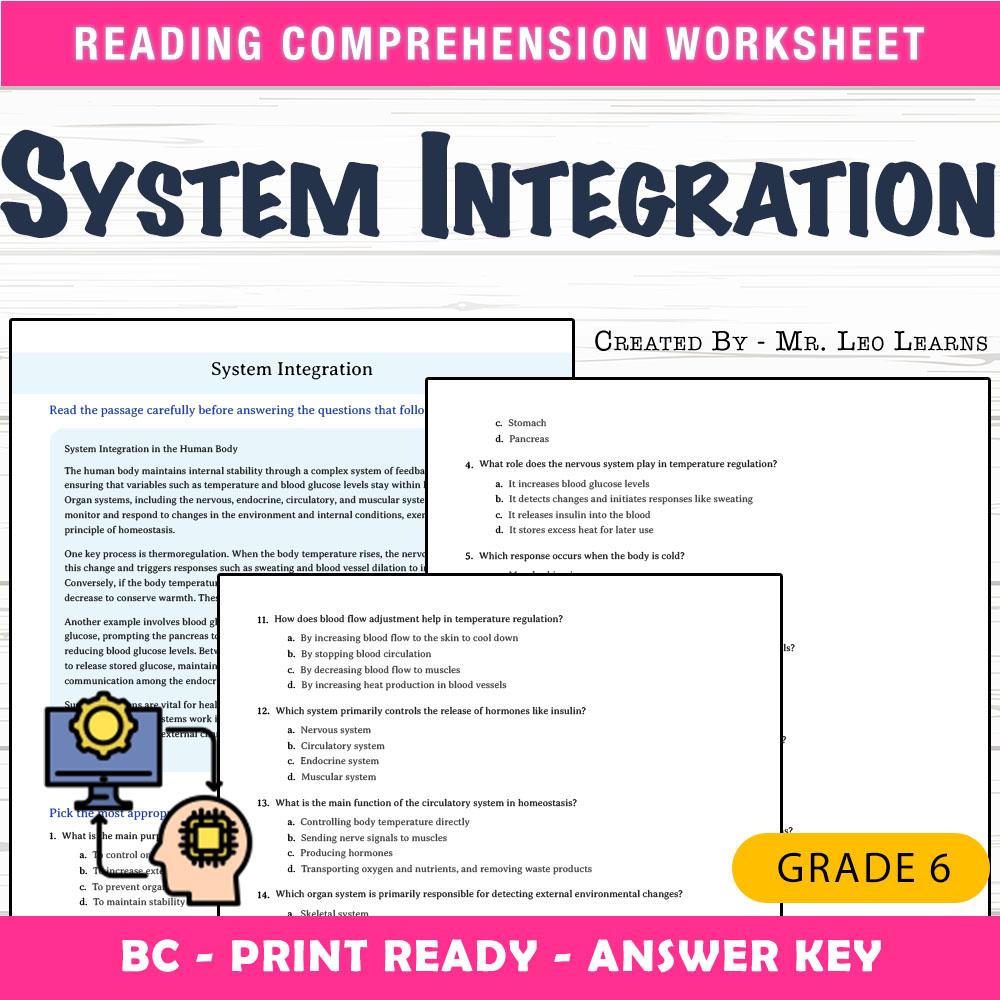
Grade 6 Science — System Integration MCQ Worksheet for Mastery
 Created byThe Resource Hub
Learning Objectives
- Understand how organ systems interact to maintain homeostasis.
- Identify feedback mechanisms involved in regulating internal conditions.
- Explore examples of system responses like temperature regulation and blood glucose control.
Also included in: Grade 6 Science Unit | Multicellular Systems & Functions Worksheet Bundle +1 more
Instant download
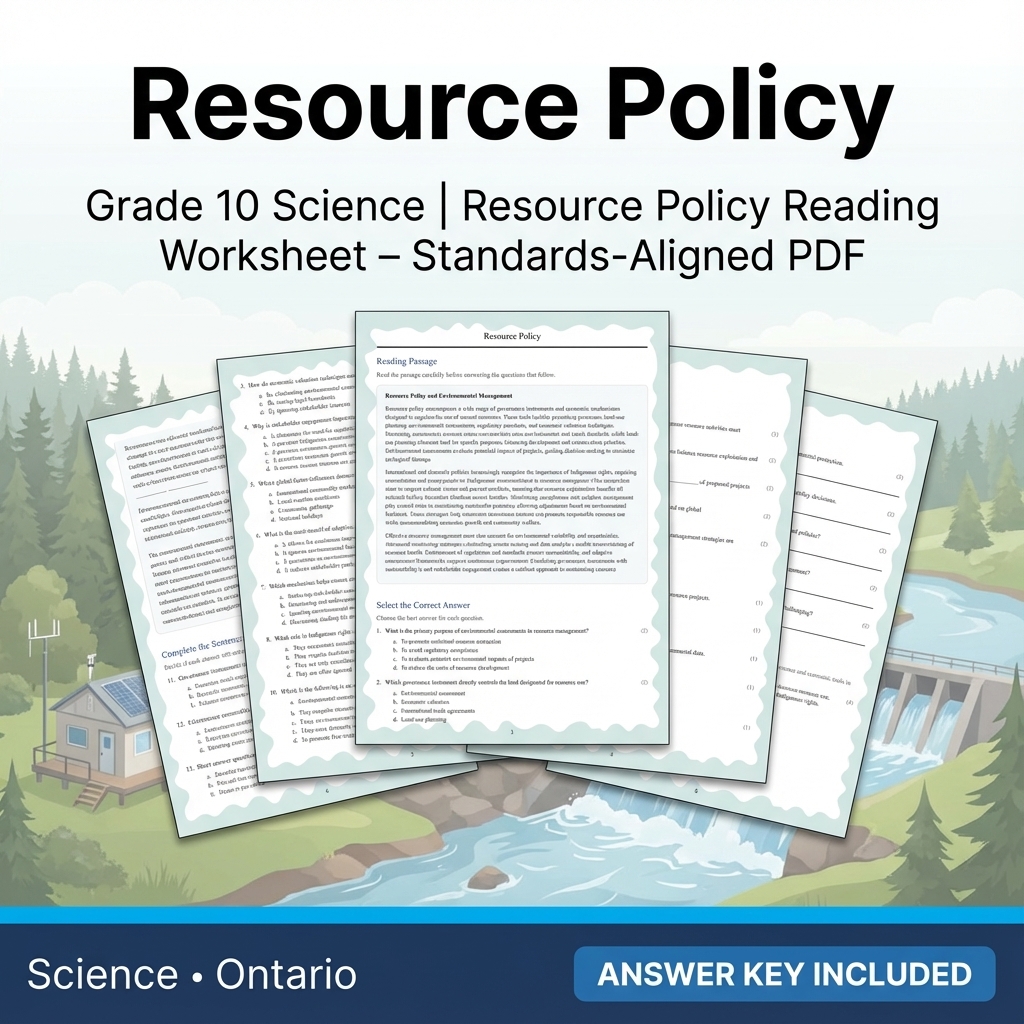
Grade 10 Science | Resource Policy Reading Worksheet – Standards-Aligned PDF
JCreated byJ.S SheetsLearning Objectives
- Understand governance instruments and economic mechanisms influencing resource use.
- Analyze the role of environmental assessment, permitting, and land‑use planning.
- Examine the importance of Indigenous rights, international markets, and monitoring in resource management.
Also included in: Grade 10 Science Unit Bundle – Earth Dynamics & Resources (PDF + Rubrics) +1 more
Instant download

Grade 10 Science | Mining Impacts Reading Worksheet (PDF + Answer Key)
JCreated byJ.S SheetsLearning Objectives
- Understand the environmental and social consequences of mineral extraction.
- Identify methods used to assess and manage mining impacts.
- Recognize the relationship between deposit types, extraction methods, and environmental outcomes.
Also included in: Grade 10 Science Unit Bundle – Earth Dynamics & Resources (PDF + Rubrics) +1 more
Instant download

Chemical Changes Test Prep Printables | Grade 9 Science
Created byPrism Point LearningLearning Objectives
- Explain how a chemical change forms new substances with different properties and composition.
- Identify observable evidence of chemical changes such as temperature change, gas formation, and precipitate formation.
- Distinguish chemical evidence from physical rearrangement of matter using the particle-level (microscopic) viewpoint.
Also included in: Grade 9 Chemistry Test Prep Science Lesson Bundle: Ontario Framework
Instant download

Reaction Types Practice Worksheet | Grade 9 Science Review Assessment
Created byPrism Point LearningLearning Objectives
- Identify and distinguish common reaction types: synthesis, decomposition, single/double displacement, and combustion.
- Predict likely products from reactants by using particle and bonding patterns.
- Explain how conservation of mass constrains reaction outcomes and evidence from observations.
Also included in: Grade 9 Chemistry Test Prep Science Lesson Bundle: Ontario Framework
Instant download

Element Identity Test Prep Printables | Grade 9 Science
Created byPrism Point LearningLearning Objectives
- Explain how the number of protons and the chemical symbol identify an element.
- Describe how atomic models help represent the identity of atoms and elements.
- Classify elements as metals or nonmetals and use examples (iron, carbon, oxygen).
Also included in: Grade 9 Chemistry Test Prep Science Lesson Bundle: Ontario Framework
Instant download

Chemical Properties Worksheet Practice and Review | Grade 9 Science
Created byPrism Point LearningLearning Objectives
- Define chemical properties as the tendencies of substances to undergo specific chemical changes.
- Identify evidence of chemical change, such as new substances, gas evolution, precipitate formation, and permanent colour change.
- Distinguish chemical change from physical change using observable reaction outcomes.
Also included in: Grade 9 Chemistry Test Prep Science Lesson Bundle: Ontario Framework
Instant download

Physical Properties Test Prep Printables | Grade 9 Science
Created byPrism Point LearningLearning Objectives
- Define physical properties as observable or measurable characteristics that do not change a substance’s chemical identity.
- Identify and distinguish common intensive and extensive physical properties in everyday materials.
- Explain how physical properties can be used to classify materials and choose separation or testing methods.
Also included in: Grade 9 Chemistry Test Prep Science Lesson Bundle: Ontario Framework
Instant download

Physical Changes Test Prep Worksheets | Grade 9 Science
Created byPrism Point LearningLearning Objectives
- Describe physical changes as changes in state or form that keep the same chemical identity.
- Differentiate reversible and irreversible physical transformations using everyday examples.
- Explain how energy transfer is involved in melting, freezing, evaporation, and condensation.
Also included in: Grade 9 Chemistry Test Prep Science Lesson Bundle: Ontario Framework
Instant download

Compound Formulas Practice Worksheet | Grade 9 Science Review
Created byPrism Point LearningLearning Objectives
- Explain how chemical formulas represent compounds as fixed combinations of elements and relate to the law of definite composition
- Differentiate covalent and ionic bonding and predict how bonding type can affect observable properties
- Use chemical formulas to describe elemental ratios and to distinguish compounds from mixtures
Also included in: Grade 9 Chemistry Test Prep Science Lesson Bundle: Ontario Framework
Instant download

Societal Impacts Test Prep Worksheet | Grade 9 Science
Created byPrism Point LearningLearning Objectives
- Evaluate how everyday chemicals provide benefits while creating risks to health and the environment.
- Use chemical properties and exposure routes to explain why some substances persist or spread.
- Apply evidence-based reasoning to compare safe handling, disposal, and regulatory options.
Also included in: Grade 9 Chemistry Test Prep Science Lesson Bundle: Ontario Framework
Instant download

Mixtures And Separation Test Prep Worksheet | Grade 9 Science
Created byPrism Point LearningLearning Objectives
- Distinguish between homogeneous and heterogeneous mixtures using evidence such as visible phases
- Identify physical methods of separation and match them to differences in particle size, solubility, boiling point, and density
- Explain why physical separation preserves the chemical identity of mixture components
Also included in: Grade 9 Chemistry Test Prep Science Lesson Bundle: Ontario Framework
Instant download
Browse more categories
About Science Worksheets
Find Science worksheets spanning core skills, practice, and review. All 44,573 resources are instant PDF downloads for the classroom or home.
Every worksheet on MyTeachingSheets is created by independent teacher-authors and reviewed before publication. All resources download as printable PDFs for classroom, homework, or at-home practice, and many include answer keys. Preview any worksheet free before buying.