
Science Worksheets
42,859 subject resources
Prototyping Methods Worksheet | Ontario Grade 7 Science Assessment
 Created byCedar Grove Learning
Learning Objectives
- Compare scaled physical models, digital finite-element models, and laboratory load rigs for evaluating strength, stiffness, and failure modes.
- Explain how strain gauges and displacement transducers help quantify a structure’s response during testing.
- Identify limitations of scaling, including effects of material heterogeneity and joint behavior.

Conductive Materials Worksheet | Ontario Grade 7 Science Assessment PDF
Created byCedar Grove LearningLearning Objectives
- Compare thermal conductivity in metals, ceramics, polymers, and composites using qualitative reasoning.
- Explain how free electrons and lattice vibrations affect heat transfer in different materials.
- Describe how density, porosity, and moisture can change effective thermal conductivity.

Connection Design Worksheet | Ontario Grade 7 Science Assessment
Created byCedar Grove LearningLearning Objectives
- Explain how connections and joints help maintain continuous load paths in structures.
- Compare bolted, welded, and bearing connections in terms of load transfer and redundancy.
- Describe shear, bearing, and slip at connections and how detailing can affect structural capacity.

Species Adaptations Worksheet | Ontario Grade 7 Science Assessment
Created byCedar Grove LearningLearning Objectives
- Explain how structural, physiological, and behavioral adaptations help organisms survive in specific habitats.
- Describe how selective pressures such as temperature, moisture, predation, and resource availability can shape adaptations.
- Identify adaptive trade-offs and how adaptations influence where organisms can live.

Data Organization Worksheet Grade 7 Science | Ontario Standard Assessment
Created byCedar Grove LearningLearning Objectives
- Identify how to organize categorical and numerical data using clear tabular structures
- Apply consistent units, column headings, and timestamp conventions for time-series data
- Describe metadata, sampling frames, and replication records to preserve data provenance and context

Quantitative Heat Worksheet | Ontario Grade 7 Science Assessment
Created byCedar Grove LearningLearning Objectives
- Use the quantitative heat equation Q = mcΔT to calculate thermal energy changes for common materials
- Identify and apply appropriate units for heat (joules) and power (watts)
- Explain how heat-transfer rate depends on temperature gradient, surface area, and time

Density Separation Worksheet | Ontario Grade 7 Science Assessment
Created byCedar Grove LearningLearning Objectives
- Explain how density differences drive the movement of particles during separation
- Compare decanting, floatation, and centrifugation based on buoyant force, sedimentation rate, and centrifugal acceleration
- Predict which particles will separate together by considering density contrast and suitable media/conditions

Grade 7 Science Worksheet on Advanced Materials | Ontario Standards
Created byCedar Grove LearningLearning Objectives
- Explain how microstructure and manufacturing choices can increase strength, stiffness, and durability in advanced materials.
- Compare engineered timber, fibre-reinforced polymers, high-performance concrete, and composite systems using key properties and limitations.
- Describe how prefabrication, connections, and retrofits affect the real-world performance of advanced materials.

Biodiversity Patterns Worksheet | Ontario Grade 6 Science Assessment
Created byCedar Grove LearningLearning Objectives
- Explain how species richness, abundance, and evenness describe biodiversity patterns across ecosystems
- Use basic sampling ideas (transects and quadrats) to understand how scientists measure diversity
- Interpret how habitat heterogeneity can influence spatial patterns of biodiversity

Mixture Types Worksheet | Ontario Grade 7 Science Assessment
Created byCedar Grove LearningLearning Objectives
- Classify mixtures as solutions, colloids, or suspensions based on particle size and observable behavior
- Distinguish homogeneous from heterogeneous mixtures using uniformity and visible phases
- Use evidence such as light scattering and stability to predict how mixtures behave during separation

Hydraulic Transmission Worksheet | Ontario Grade 8 Science Assessment
Created byCedar Grove LearningLearning Objectives
- Explain Pascal’s principle and how pressure is transmitted through a fluid
- Use the relationship between pressure, force, and piston area to predict force changes
- Describe how nearly incompressible fluids enable remote force transmission in hydraulic systems

Communicating Evidence Worksheet | Ontario Grade 6 Science Assessment
Created byCedar Grove LearningLearning Objectives
- Explain how claims, evidence, and reasoning work together in scientific communication.
- Choose relevant data and describe how graphs and diagrams support scientific conclusions.
- Communicate evidence clearly for an audience using accurate language, organization, and citations.

Tradeoff Analysis Worksheet | NGSS Grade 8 Science Assessment PDF
Created byCedar Grove LearningLearning Objectives
- Understand how to prioritize among competing constraints using decision methods.
- Apply cost-benefit estimation and sensitivity analysis to project decisions.
- Use tools such as weighted scoring and pareto comparisons to evaluate design options.

Environmental Monitoring Worksheet | NGSS G8 Science Practice Assessment
Created byCedar Grove LearningLearning Objectives
- Understand scientific measurement methods used to assess ecosystem and water resource health.
- Identify indicators and thresholds for ecological impact assessments.
- Analyze approaches for monitoring land-cover change, water quality, and erosion control.

Niche Dynamics Worksheet | Ontario Grade 6 Science Assessment
Created byCedar Grove LearningLearning Objectives
- Distinguish between fundamental niche and realized niche using measurable environmental factors
- Explain how abiotic factors and species interactions affect where organisms can live and what resources they use
- Describe how spatial and temporal partitioning reduce competition among similar species

Instrumentation Accuracy Worksheet | Ontario Grade 7 Science Assessment
Created byCedar Grove LearningLearning Objectives
- Explain how calibration, resolution, and uncertainty affect the accuracy of temperature measurements.
- Identify common sources of error in temperature sensors, including response time, spatial placement, and radiation/thermal-contact effects.
- Compare how thermocouples, resistance temperature detectors (RTDs), and infrared sensors perform in different environmental conditions.

Cell Theory Worksheet | Ontario Grade 8 Science Assessment
Created byCedar Grove LearningLearning Objectives
- Explain the three core ideas of cell theory and how they apply to living things
- Connect microscopy evidence (historical and modern) to each principle of cell theory
- Describe how cells arise from pre-existing cells and what that implies about cell division

Lever Mechanics Worksheet | Ontario Grade 8 Science Assessment
Created byCedar Grove LearningLearning Objectives
- Classify levers as first-, second-, or third-class based on the locations of the fulcrum, input force, and output force.
- Use moment balance to relate input and output forces for ideal lever mechanical advantage.
- Calculate mechanical advantage using distances from the fulcrum and interpret results for real-world tools.
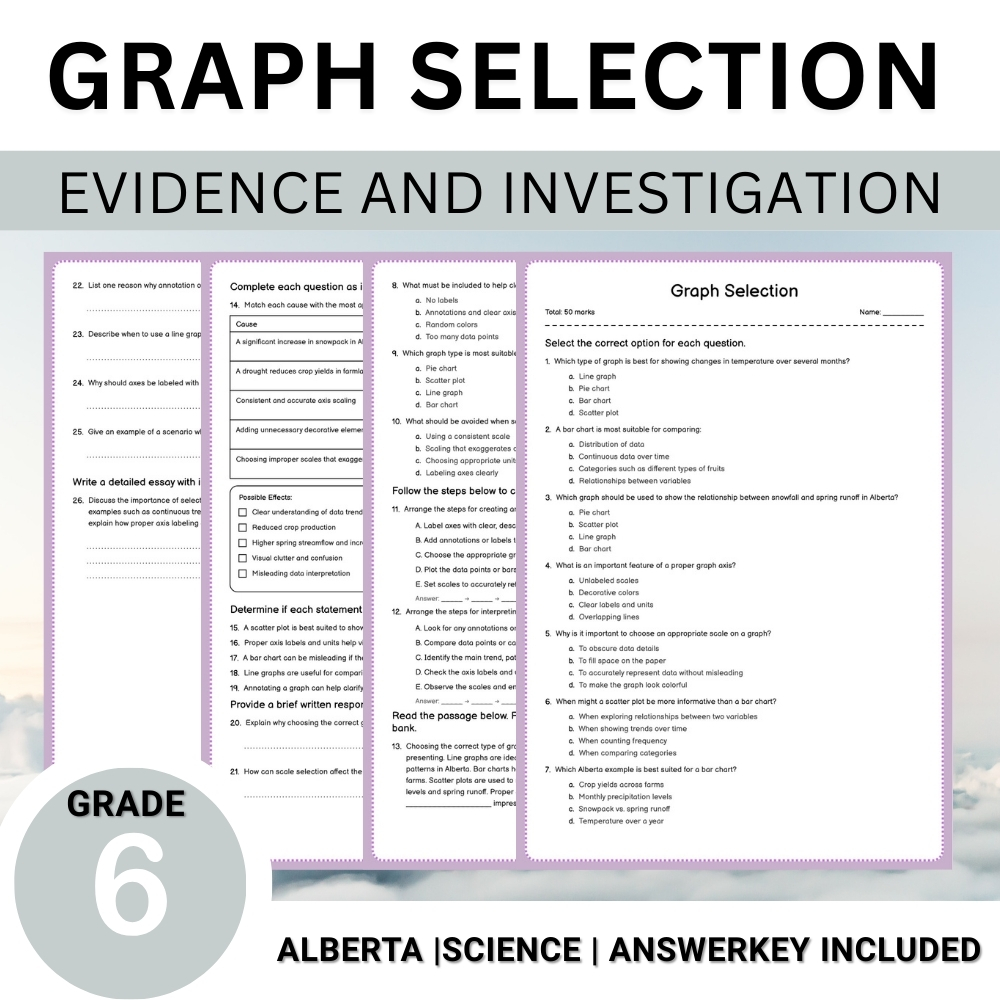
Grade 6 Science | Graph Selection Worksheet (Answer Key) for Classroom Assessment
Learning Objectives
- Identify different types of graphs and their appropriate uses.
- Match data types with suitable graph types and scales.
- Understand how to label axes and interpret visual data representations.
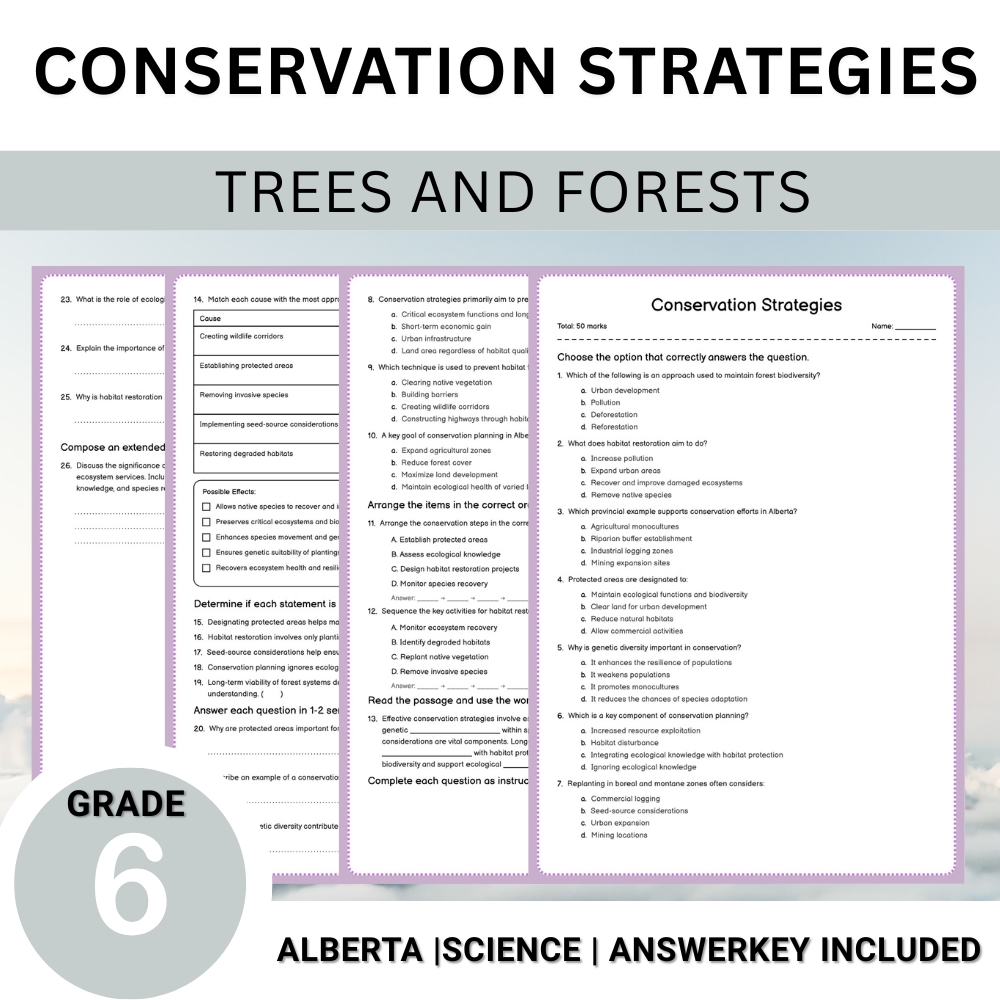
Grade 6 Science | Conservation Strategies Worksheet (Printable PDF + Answer Key)
Learning Objectives
- Identify different conservation strategies used to maintain biodiversity.
- Understand examples of conservation practices in Alberta landscapes.
- Describe the importance of habitat protection and ecological knowledge.
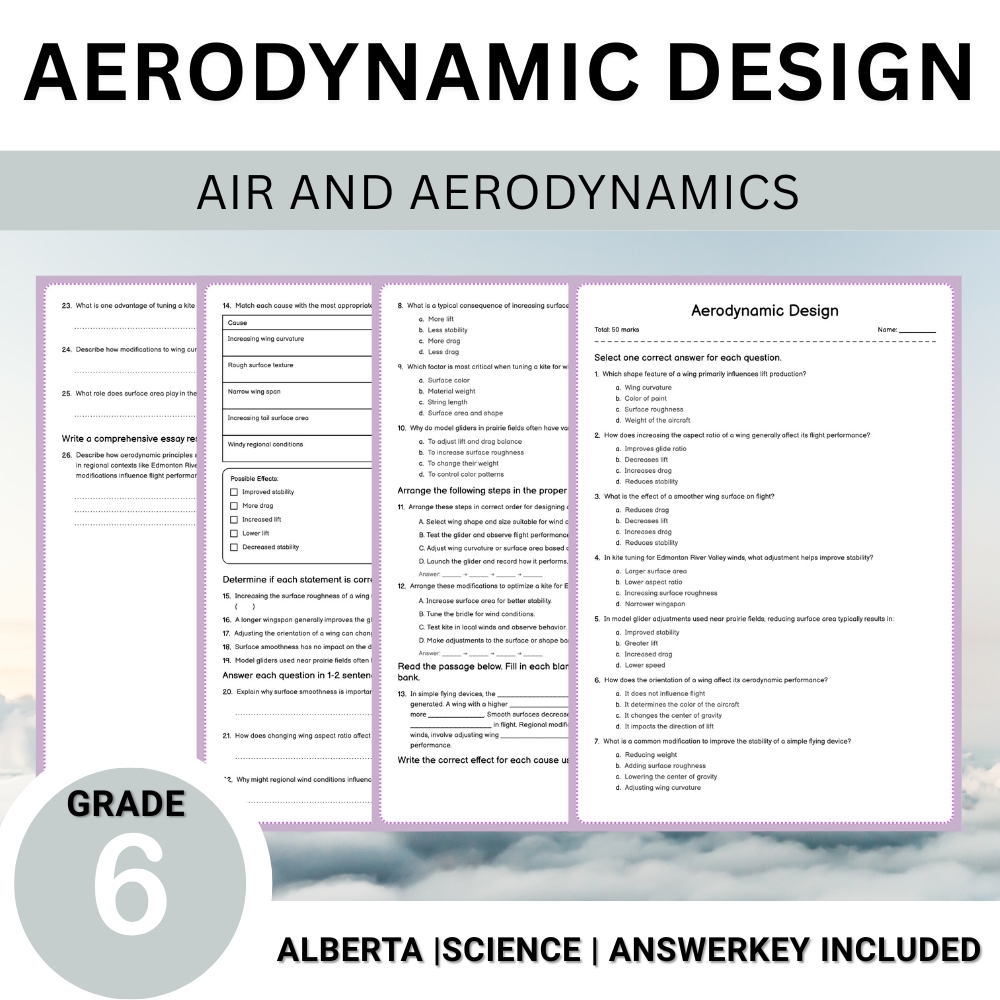
Grade 6 Science | Aerodynamic Design Worksheet (Printable PDF) for Assessment & Student Practice
Learning Objectives
- Understand the principles of aerodynamics that affect flight, including lift, drag, and stability.
- Identify how shape, surface smoothness, and orientation influence aircraft performance.
- Describe practical applications of aerodynamic modifications in kite tuning and model glider adjustments.
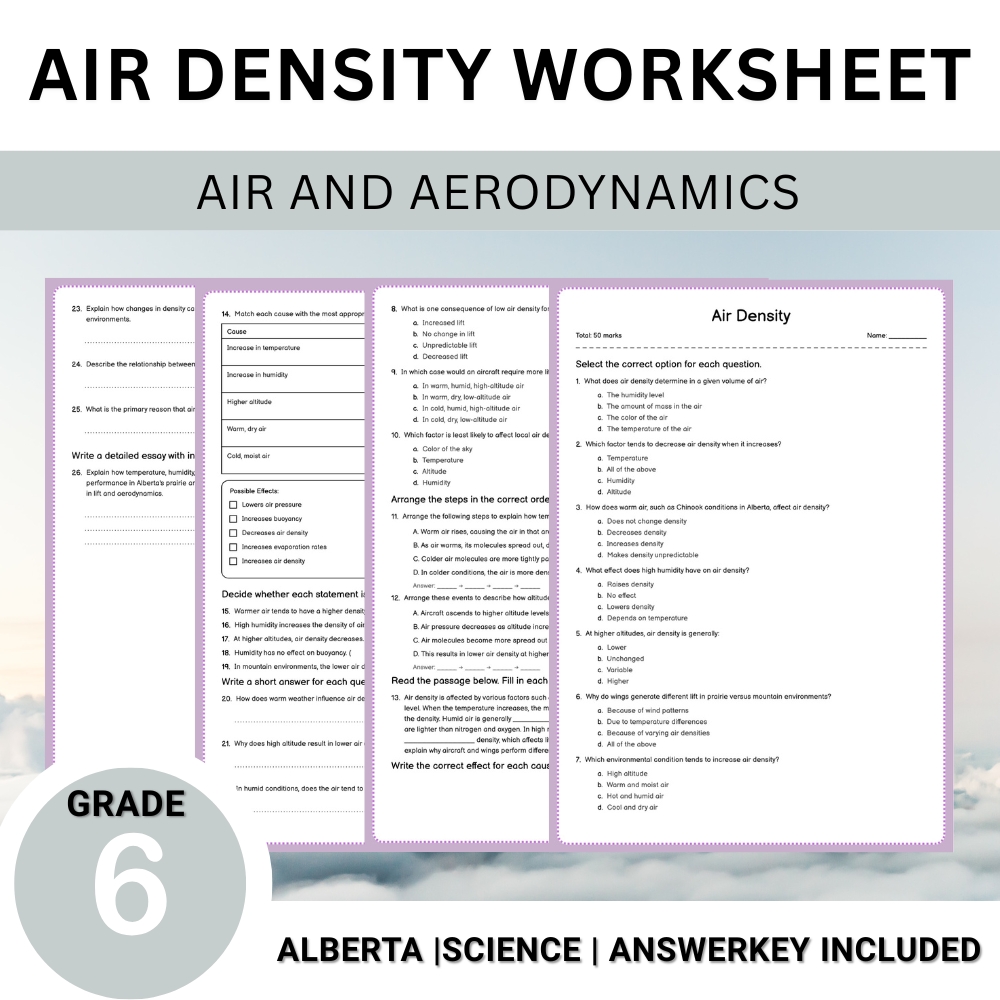
Grade 6 Science | Air Density Worksheet (Printable PDF & Assessment)
Learning Objectives
- Understand what air density is and how it affects buoyancy and aerodynamics.
- Explain how temperature, humidity, and altitude influence air density.
- Describe the differences in air density under various atmospheric conditions.
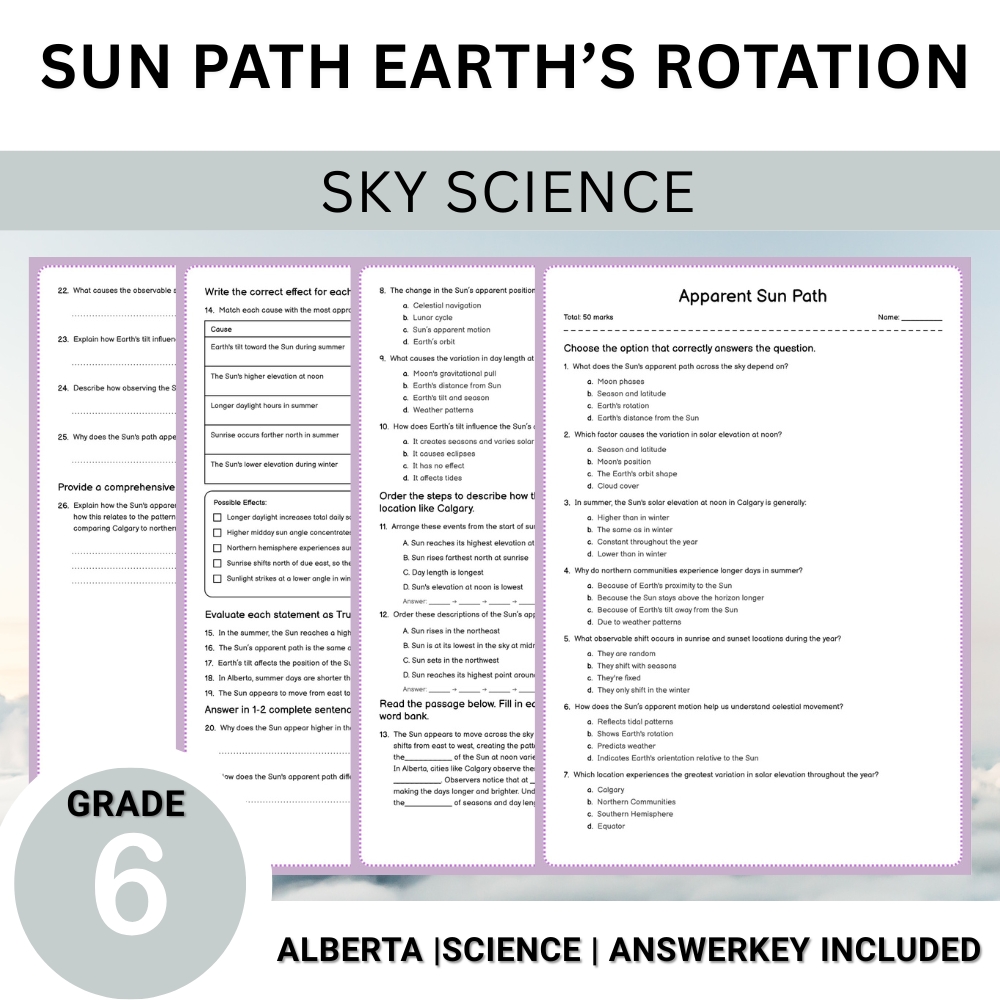
6th Grade Science | Apparent Sun Path Worksheet (Printable PDF with Answer Key)
Learning Objectives
- Understand how the Sun's apparent path varies with season and latitude.
- Describe how solar elevation at noon influences day length and solar intensity.
- Compare the Sun's apparent motion in different geographic locations, such as Calgary and northern communities.
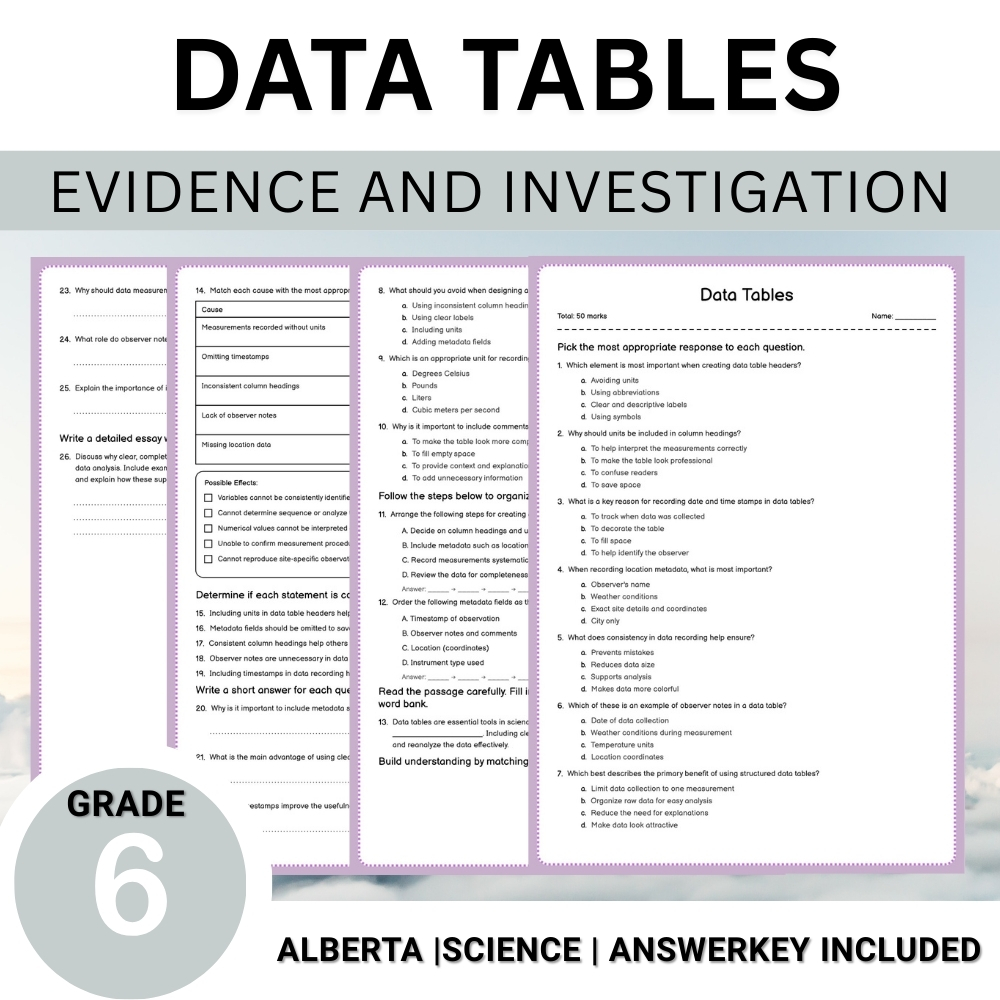
Grade 6 Science Data Tables Worksheet | .Printable PDF & Assessment
Learning Objectives
- Understand the purpose and structure of data tables in scientific recordings.
- Identify appropriate column headings, units, and metadata for clarity and completeness.
- Interpret and analyze data presented in structured table formats.
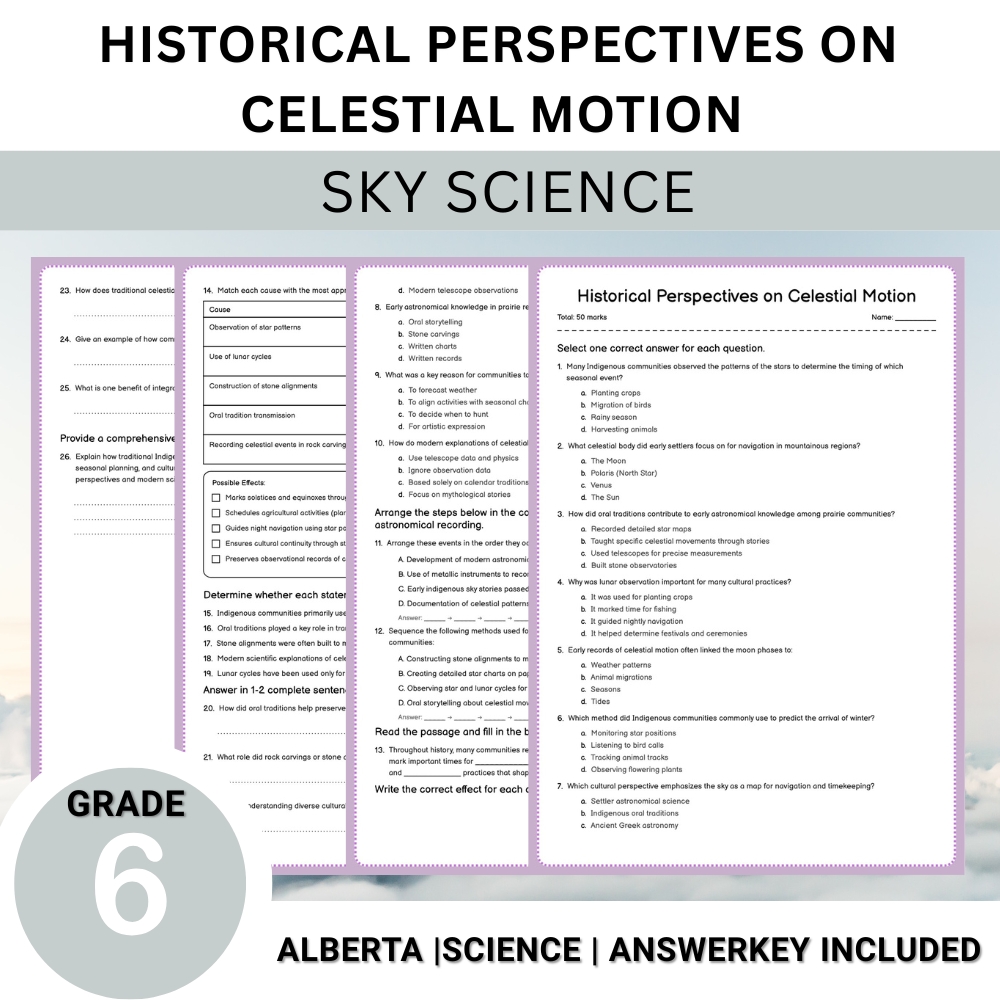
6th Grade Science | Historical Perspectives on Celestial Motion Worksheet (Answer Key)
Learning Objectives
- Understand how Indigenous and settler communities interpreted celestial patterns for cultural and practical purposes.
- Identify different observational strategies related to solar and lunar cycles used historically.
- Describe how cultural context influences methods of predicting celestial positions.
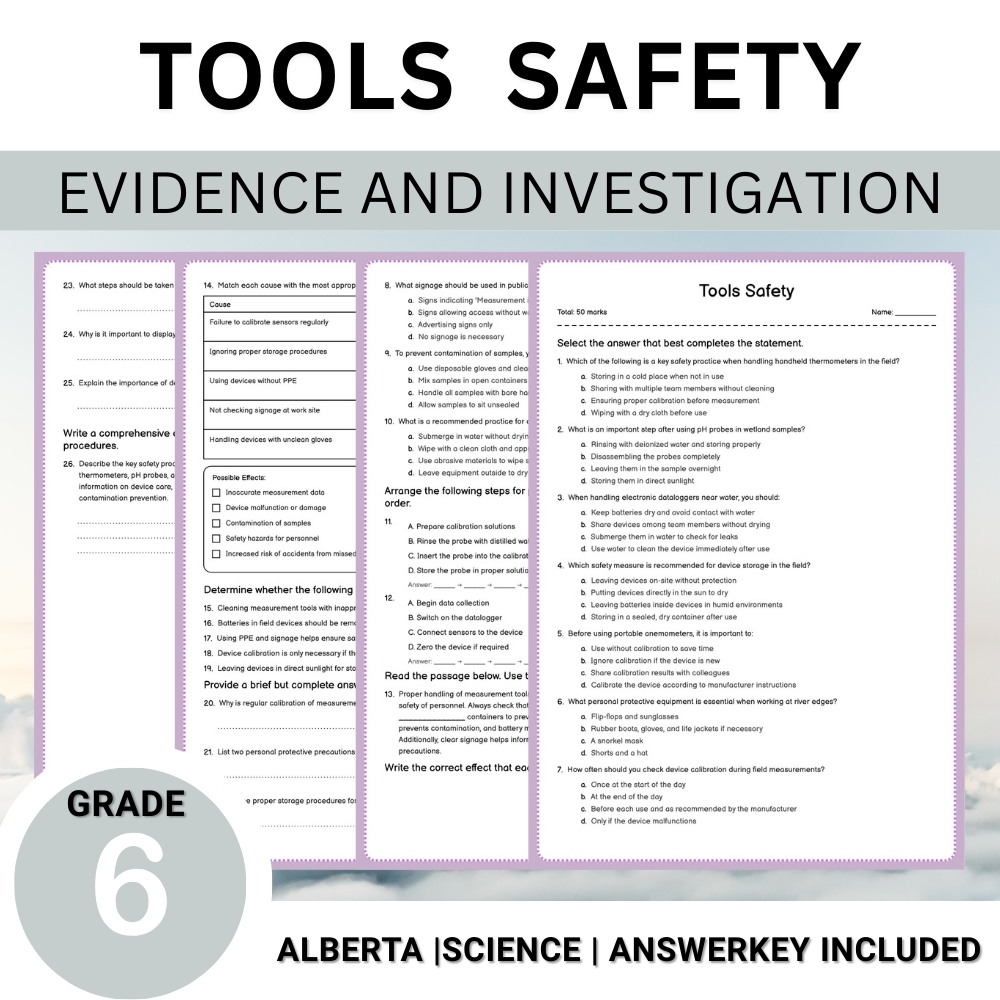
Grade 6 Science | Tools Safety Worksheet – Classroom Assessment & Student Practice (Printable PDF)
Learning Objectives
- Identify safe practices for handling measurement tools near Alberta field sites.
- Explain proper storage, cleaning, and maintenance of scientific devices.
- Describe personal protective precautions for wetland or river-edge work.
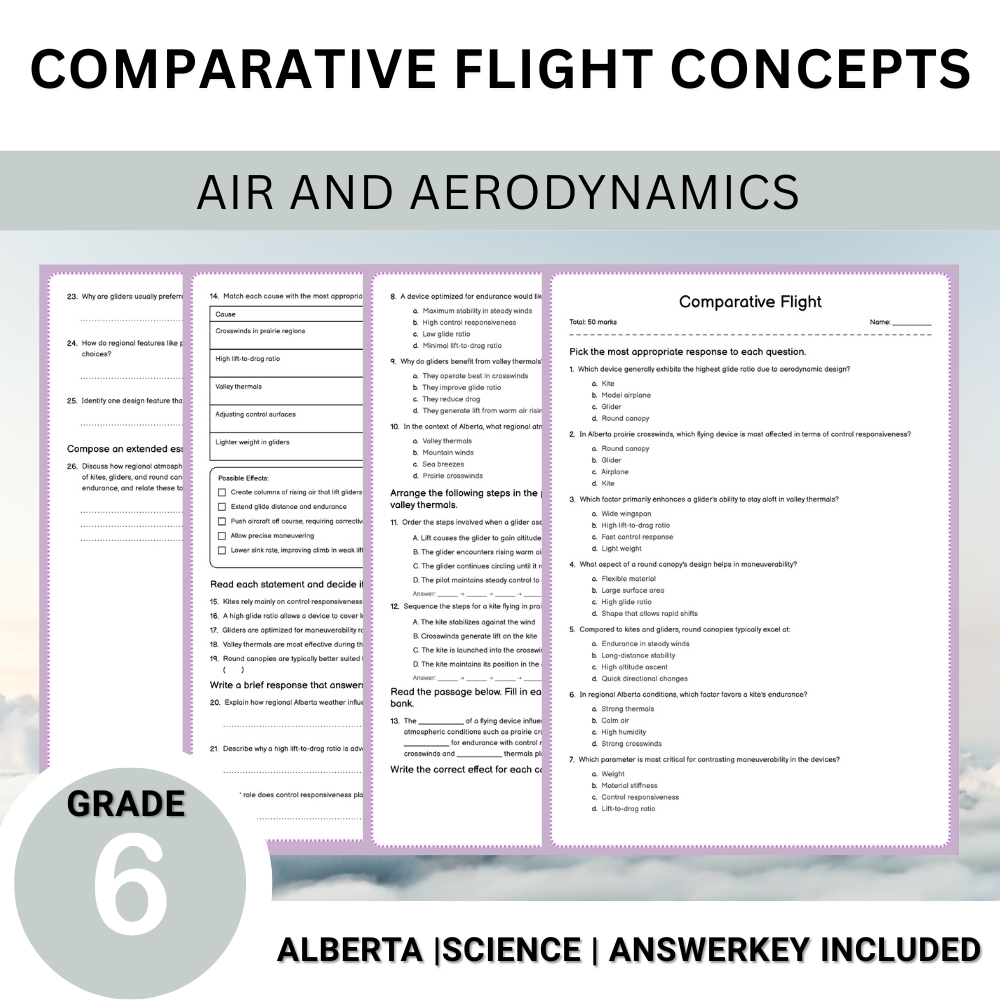
Grade 6 Science | Comparative Flight Worksheet (Assessment & Student Practice PDF)
Learning Objectives
- Compare the flight performance of kites, gliders, and round canopies based on glide ratio, lift-to-drag performance, and control responsiveness.
- Analyze how design parameters influence endurance versus maneuverability in different flying devices.
- Apply regional atmospheric concepts such as prairie crosswinds and valley thermals to understanding flight outcomes.
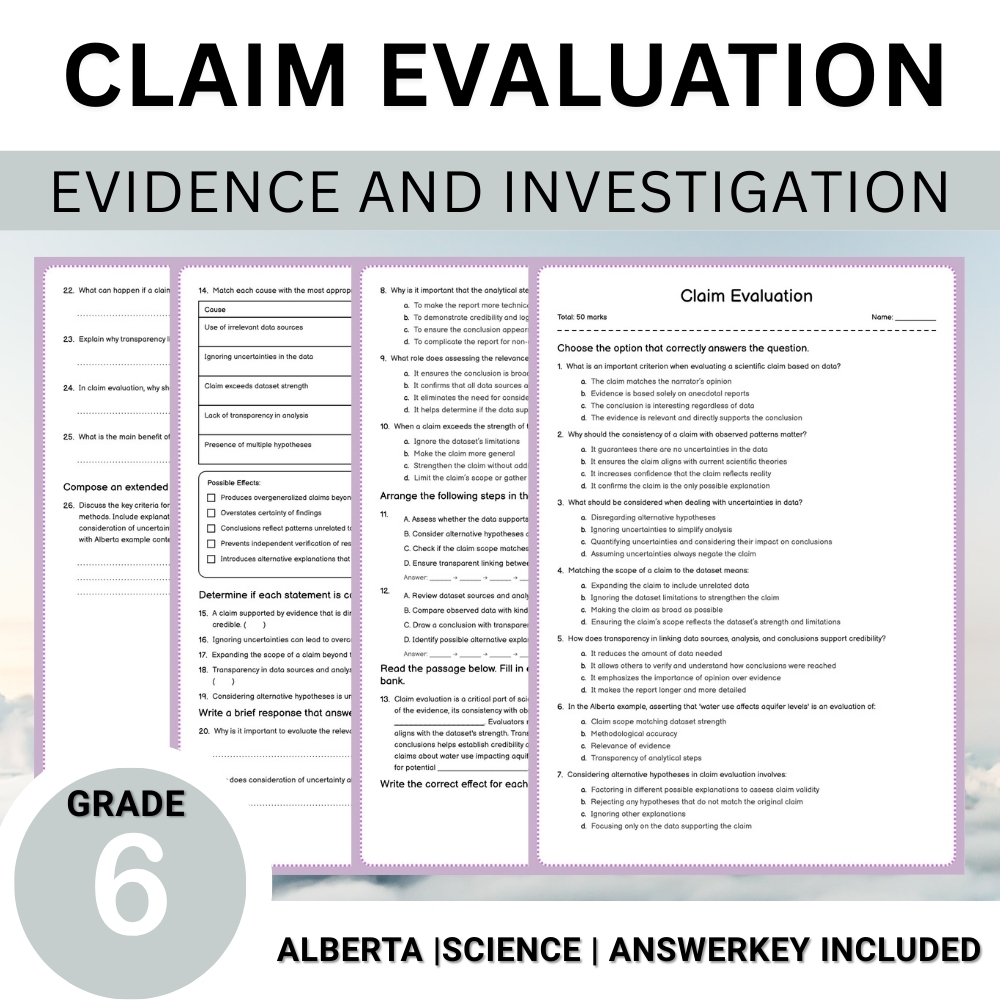
Grade 6 Science | Claim Evaluation Worksheet (Printable PDF & Assessment)
Learning Objectives
- Understand criteria for judging whether conclusions follow from data and methods.
- Evaluate evidence relevance, consistency with observed patterns, and consideration of uncertainties.
- Match claim scope to the dataset strength and assess transparency linking data, analysis, and conclusions.
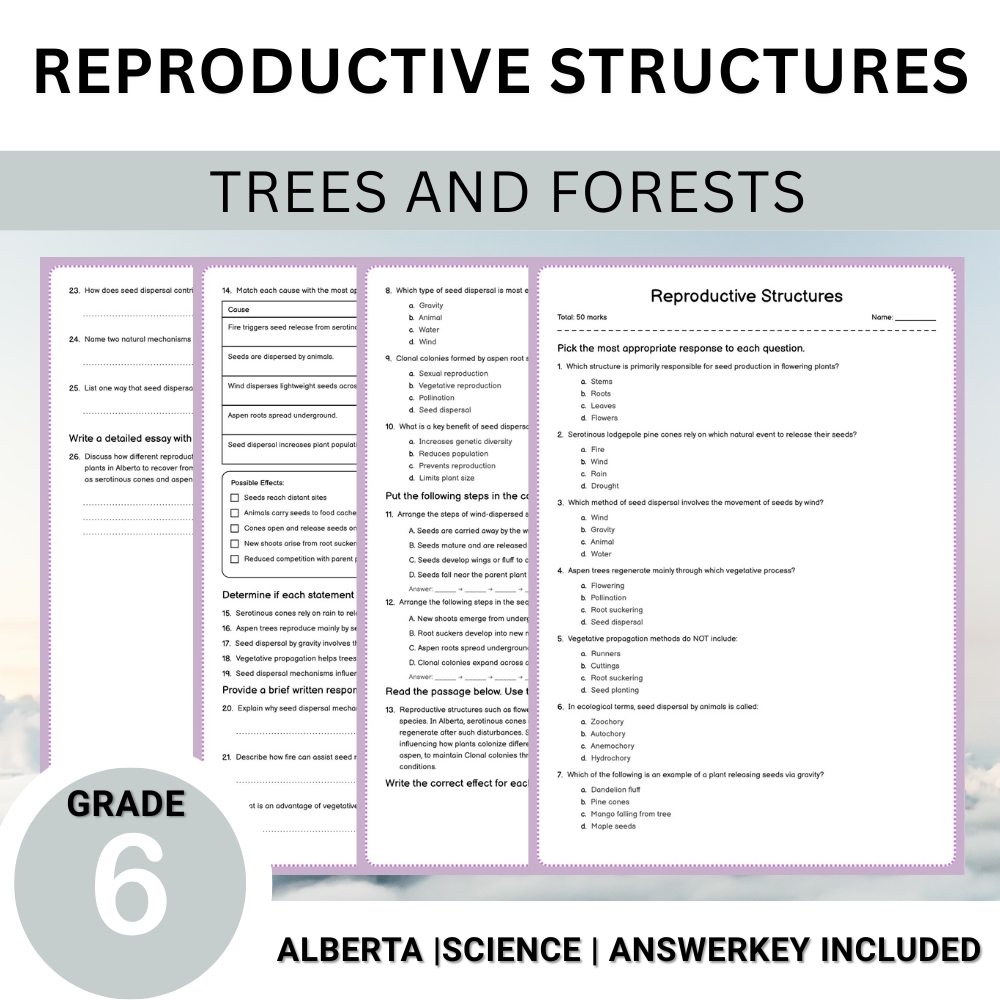
Grade 6 Science | Reproductive Structures Worksheet (Printable PDF & Answer Key)
Learning Objectives
- Identify different reproductive structures in plants and trees.
- Understand seed dispersal mechanisms and their effects on plant distribution.
- Explain regeneration strategies like seed release and vegetative propagation.
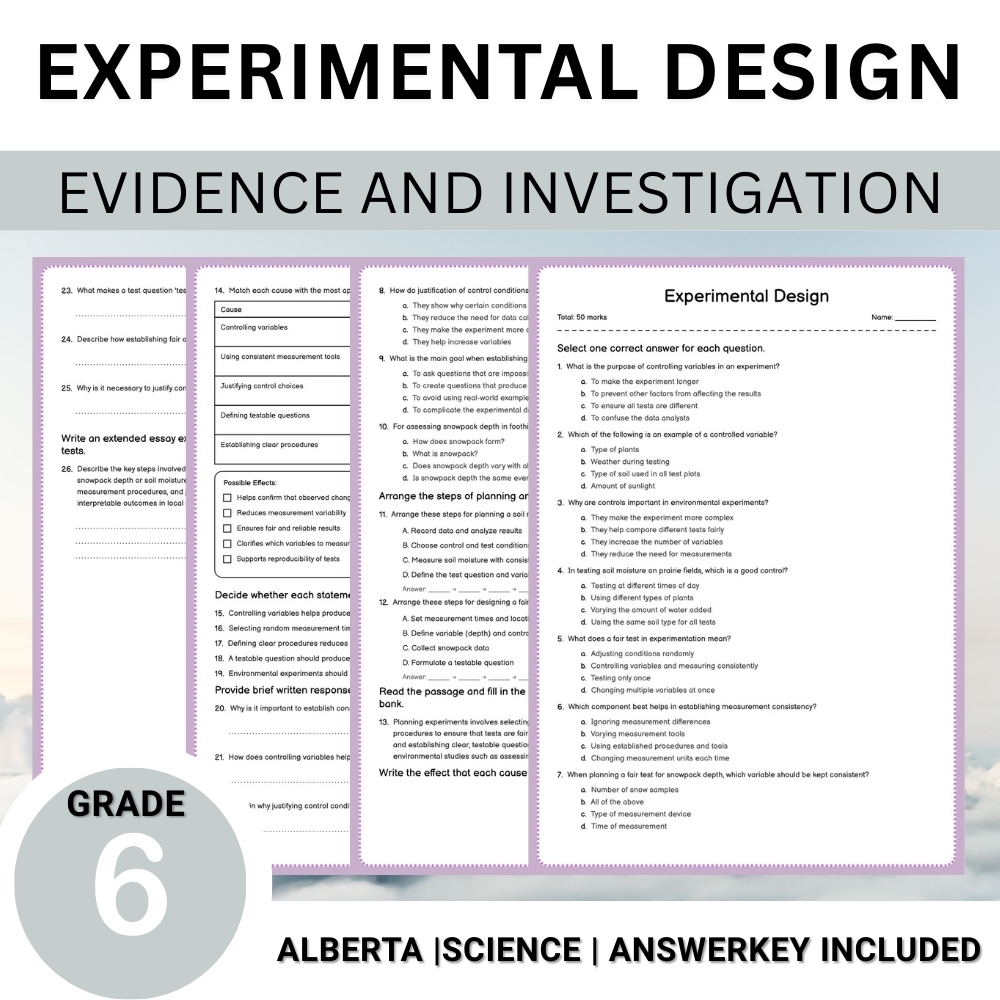
Grade 6 Science | Experimental Design Worksheet (Printable PDF & Assessment)
Learning Objectives
- Identify variables, controls, and measurement procedures in experiments.
- Explain how to plan fair tests for meaningful comparisons.
- Justify choices of control conditions in environmental experiments.
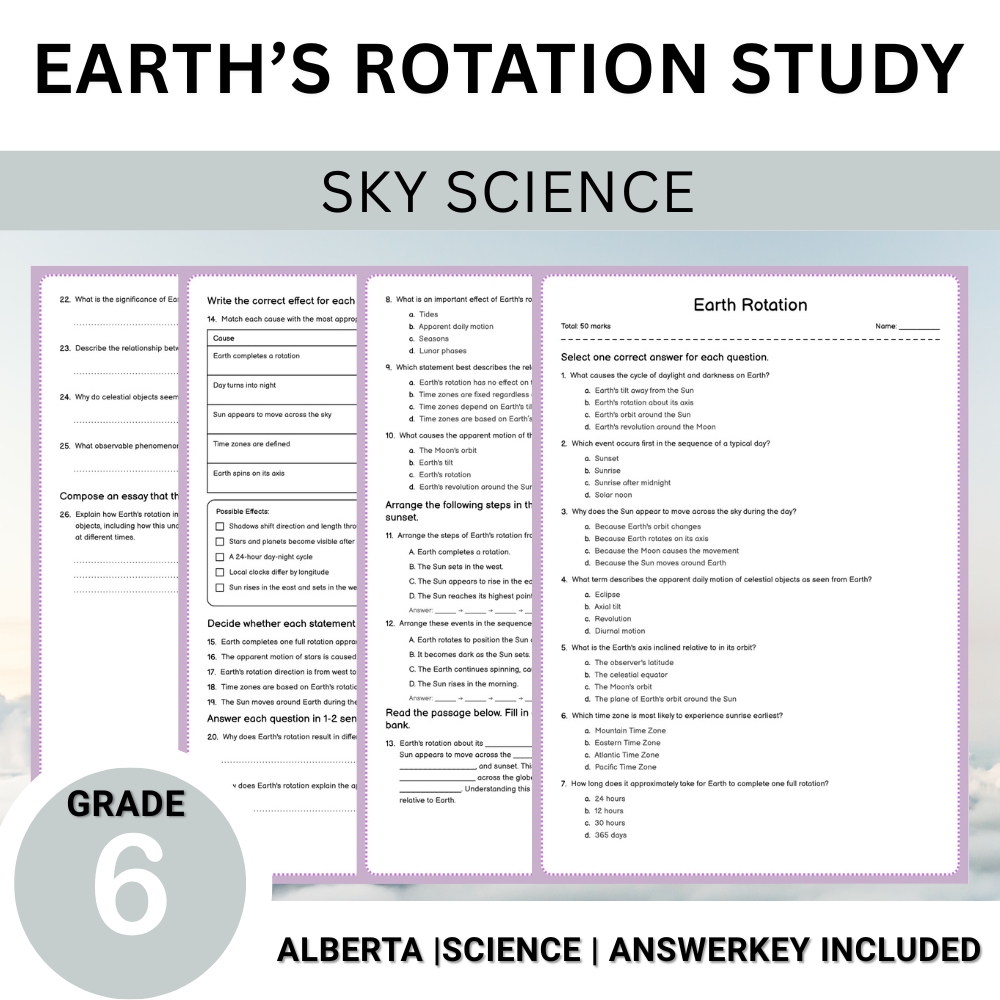
Grade 6 Science | Earth Rotation Worksheet (Printable PDF) for Classroom Assessment
Learning Objectives
- Explain how Earth's rotation causes day and night.
- Identify the sequence of sunrise, solar noon, and sunset.
- Describe how Earth's rotation affects the apparent motion of celestial objects.
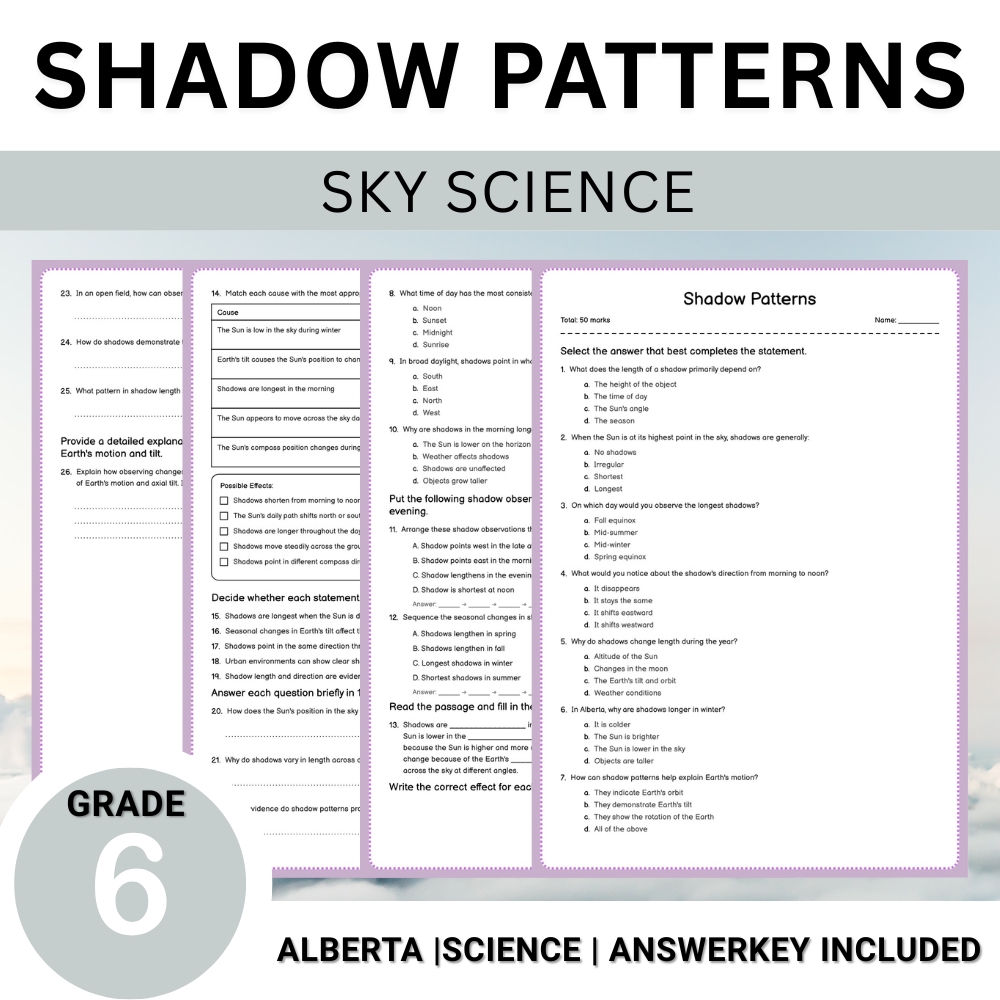
Grade 6 Science | Shadow Patterns Worksheet (Printable PDF & Assessment)
Learning Objectives
- Understand how daily and seasonal changes in the Sun's angle affect shadow length and direction.
- Observe and describe patterns of shadows at different times of the day and year.
- Explain how shadow changes provide evidence of Earth's motion and tilt.
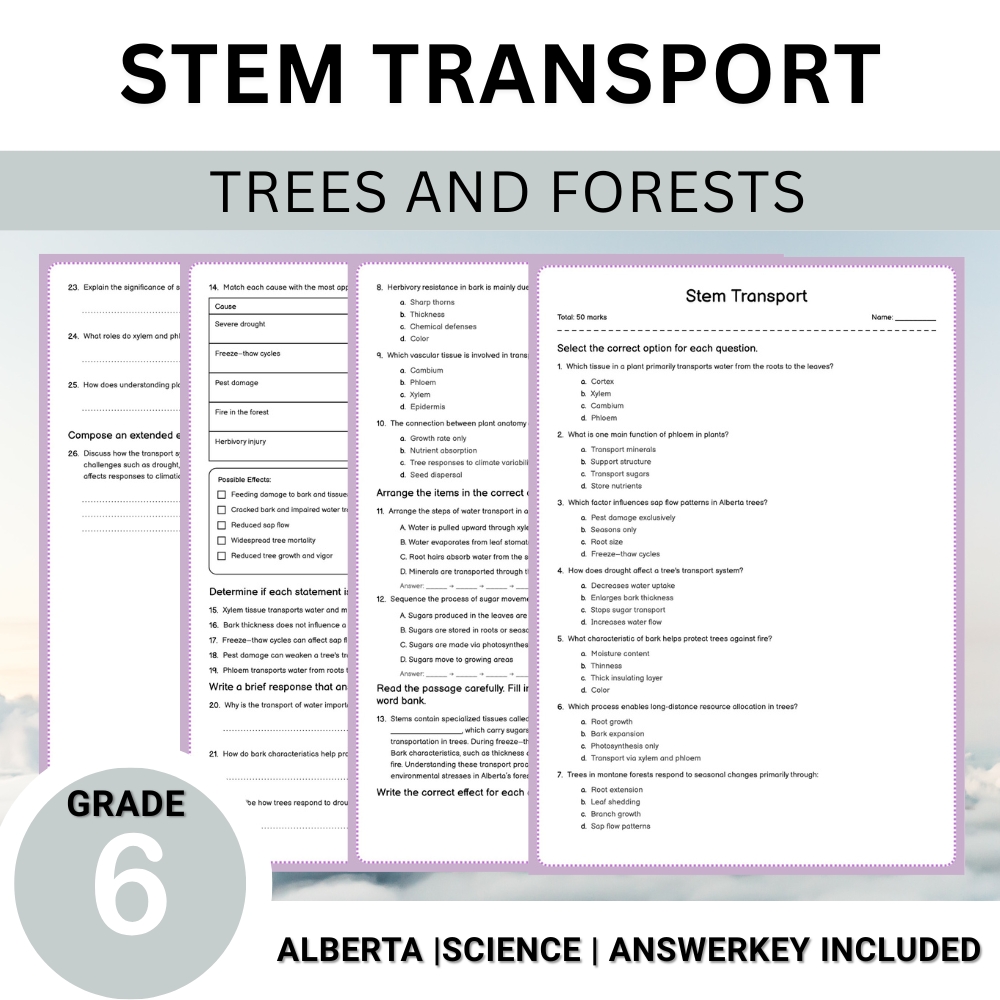
Grade 6 Science | Stem Transport Worksheet (Printable PDF & Assessment)
Learning Objectives
- Understand how stems and vascular tissues transport water, minerals, and sugars in plants.
- Describe the roles of xylem and phloem in resource transport.
- Explain how trees respond to climatic factors such as freeze–thaw cycles, drought, and pest damage through their transport systems.
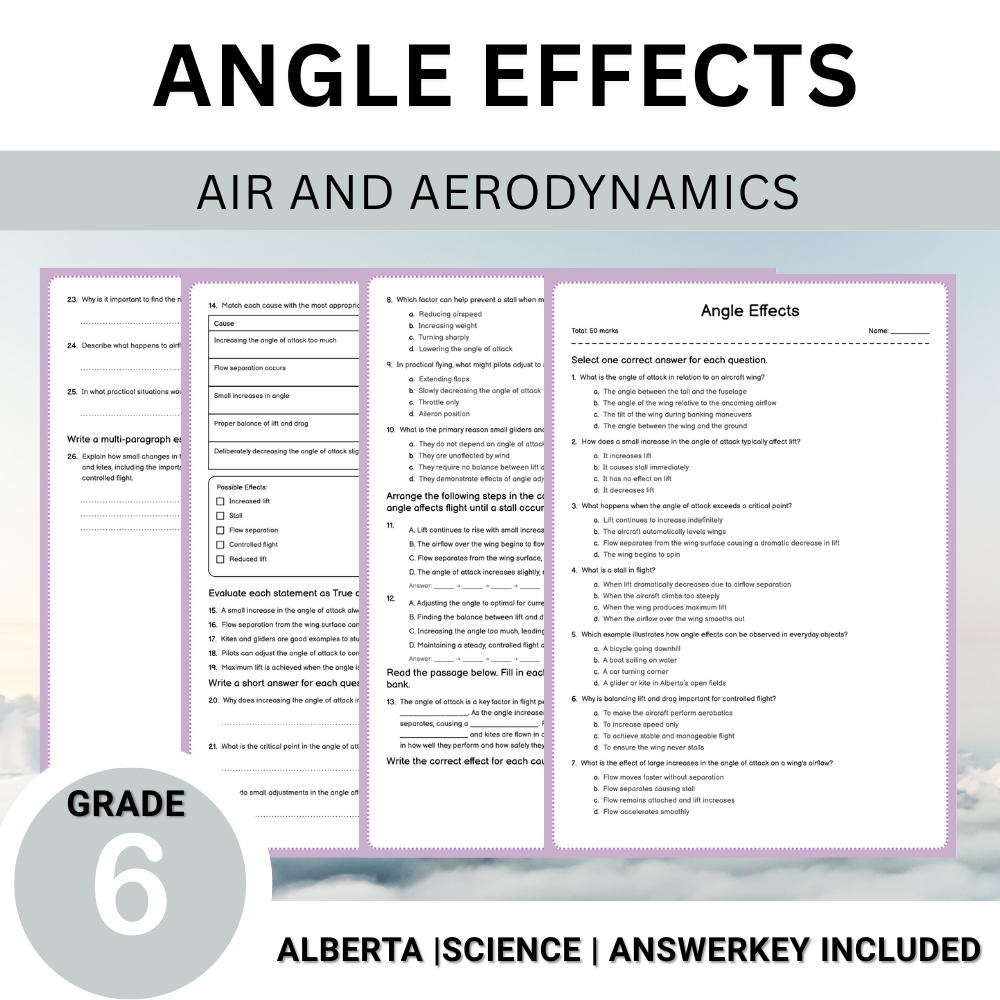
Grade 6 Science | Angle Effects Worksheet (Printable PDF & Assessment)
Learning Objectives
- Understand how the angle of attack influences lift and drag on wings.
- Identify the effects of increasing the angle of attack on flight performance.
- Explain what occurs during a stall when the angle exceeds a critical point.

6th Grade Science | Drag Types Worksheet ( Answer Key) – Alberta Standards
Learning Objectives
- Describe the two main types of drag: parasitic and induced.
- Explain how surface roughness and wingtip vortices affect drag.
- Identify design features that reduce drag, such as streamlined shapes and fairings.
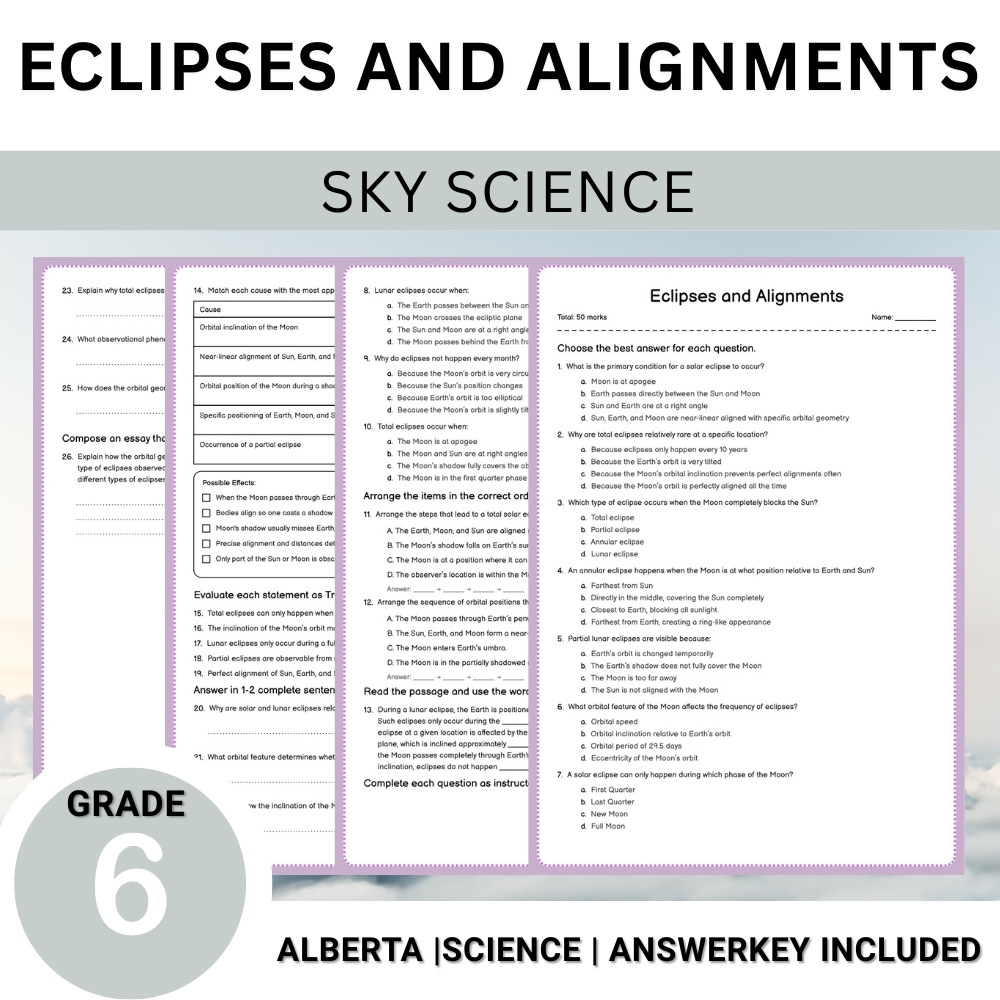
Grade 6 Science | Eclipses and Alignments Worksheet (Printable PDF & Answer Key)
Learning Objectives
- Describe the celestial alignment conditions that produce solar and lunar eclipses.
- Explain why eclipses are relatively rare for a given location.
- Differentiate between partial, total, and annular eclipses based on orbital geometry.
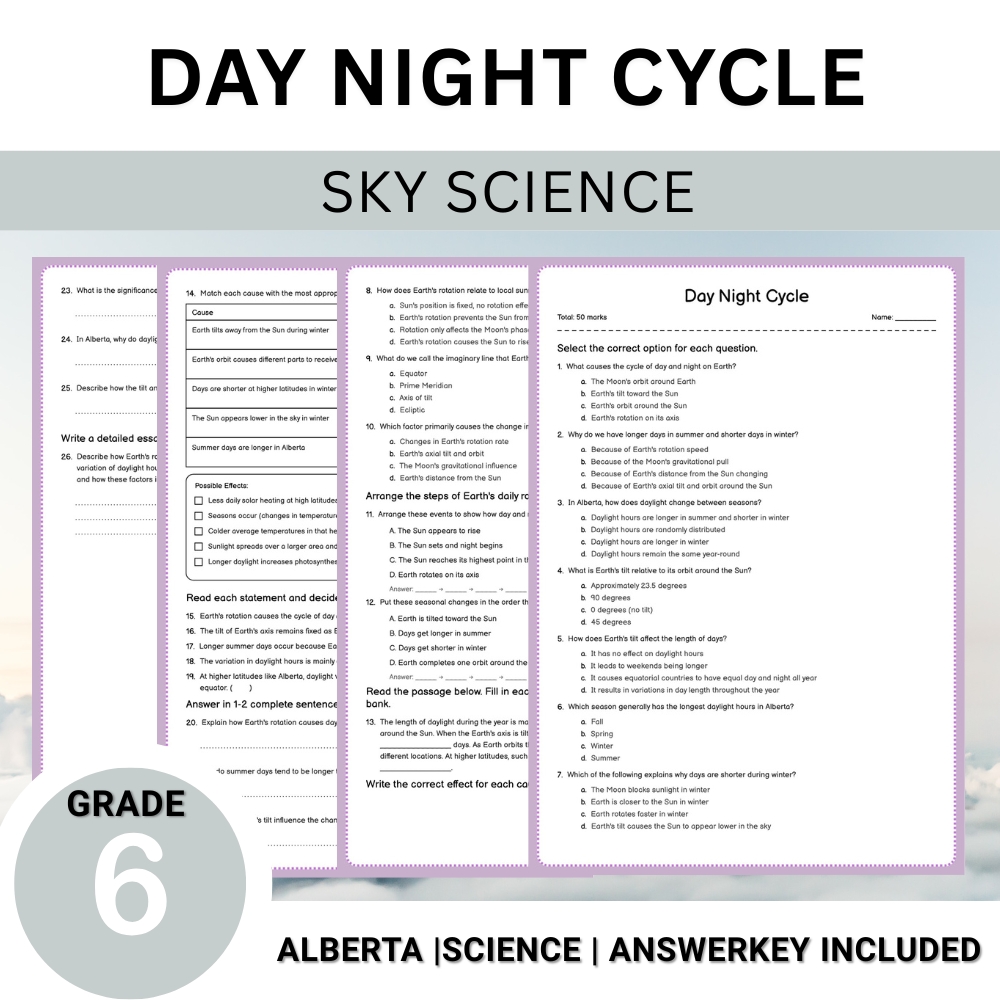
Grade 6 Science | Day Night Cycle Worksheet (Printable PDF with Answer Key)
Learning Objectives
- Understand how Earth's rotation causes day and night.
- Explain the role of Earth's tilt and orbit in changing day length through the year.
- Describe how latitude affects daily daylight hours within Alberta.
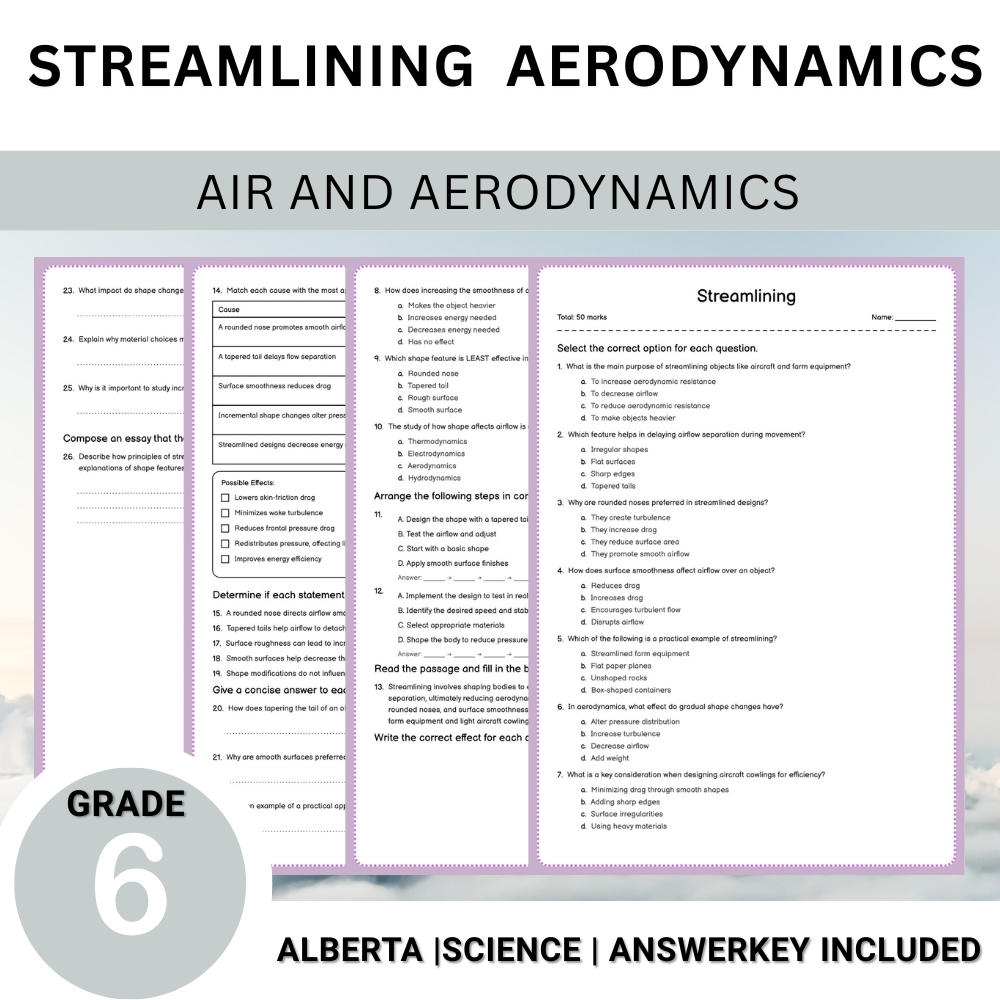
Grade 6 Science | Streamlining Worksheet – Assessment & Student Practice
Learning Objectives
- Understand how shape modifications in objects reduce aerodynamic resistance.
- Identify key principles like tapered tails, rounded noses, and surface smoothness that influence airflow.
- Connect practical examples such as farm equipment and aircraft cowlings to aerodynamic efficiency.
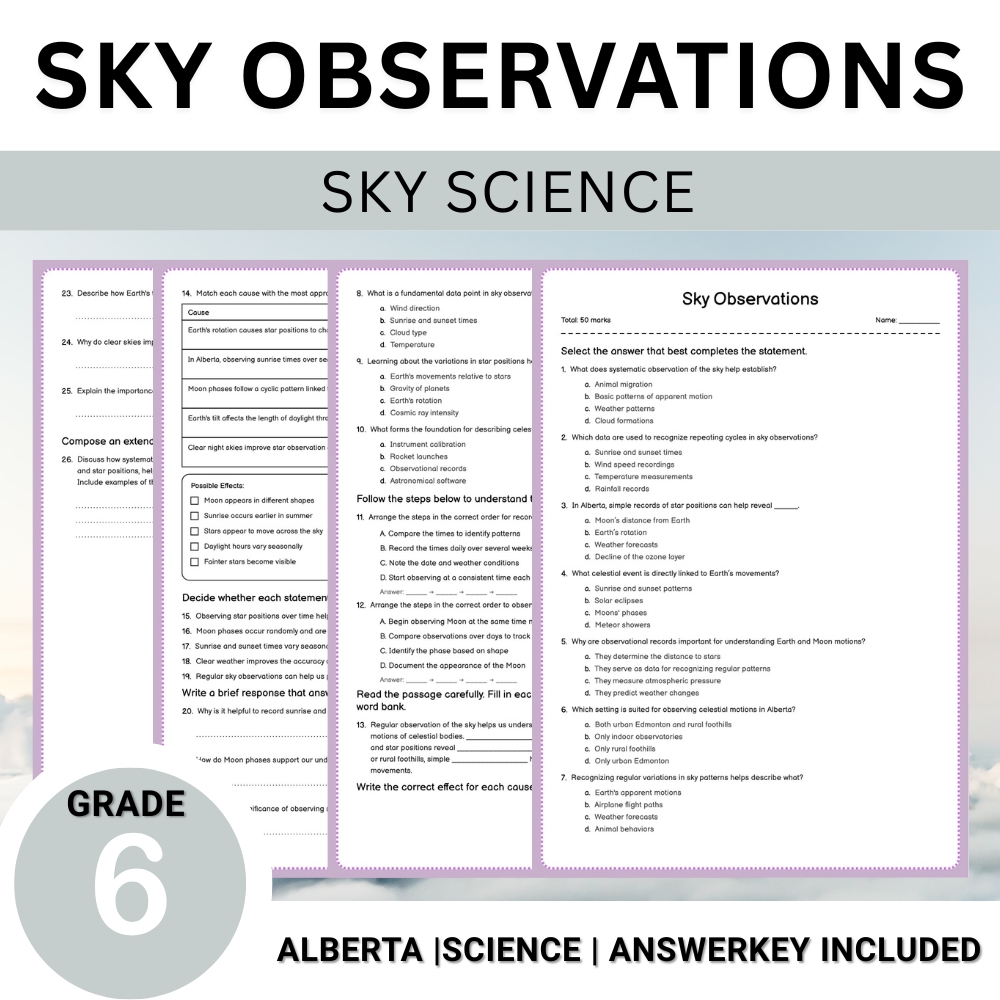
Grade 6 Science | Sky Observations Worksheet (Printable PDF & Assessment)
Learning Objectives
- Understand how systematic observations of the sky can reveal patterns of Earth's apparent motion.
- Record and interpret data related to sunrise and sunset times, Moon phases, and star positions.
- Recognize the cyclic nature of celestial movements and how they relate to Earth's movements.
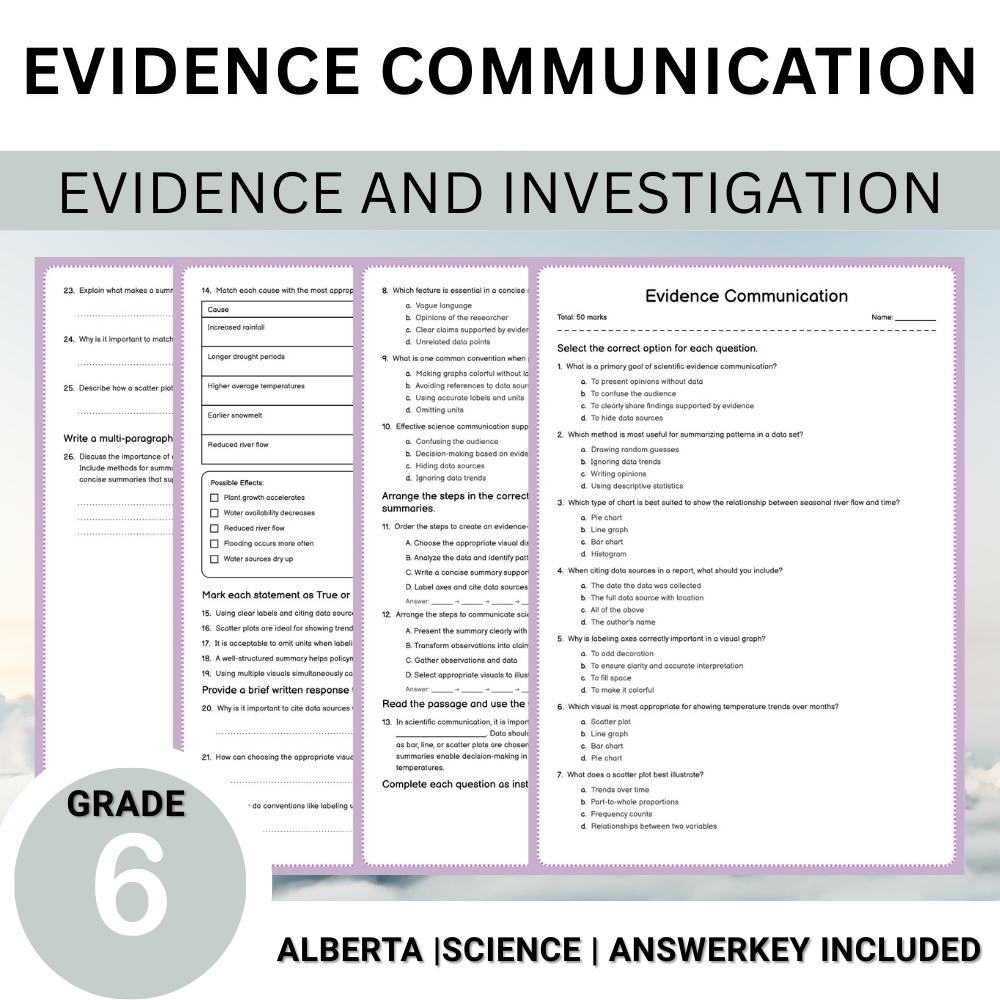
Grade 6 Science | Evidence Communication Worksheet (Printable PDF & Assessment)
Learning Objectives
- Understand how to interpret observations and transform them into clear scientific claims supported by evidence.
- Learn methods for summarizing data patterns, using descriptive statistics, and selecting appropriate visuals like bar, line, and scatter plots.
- Recognize conventions for citing data sources, labeling units, and crafting concise, evidence-based summaries for environmental decision-making.
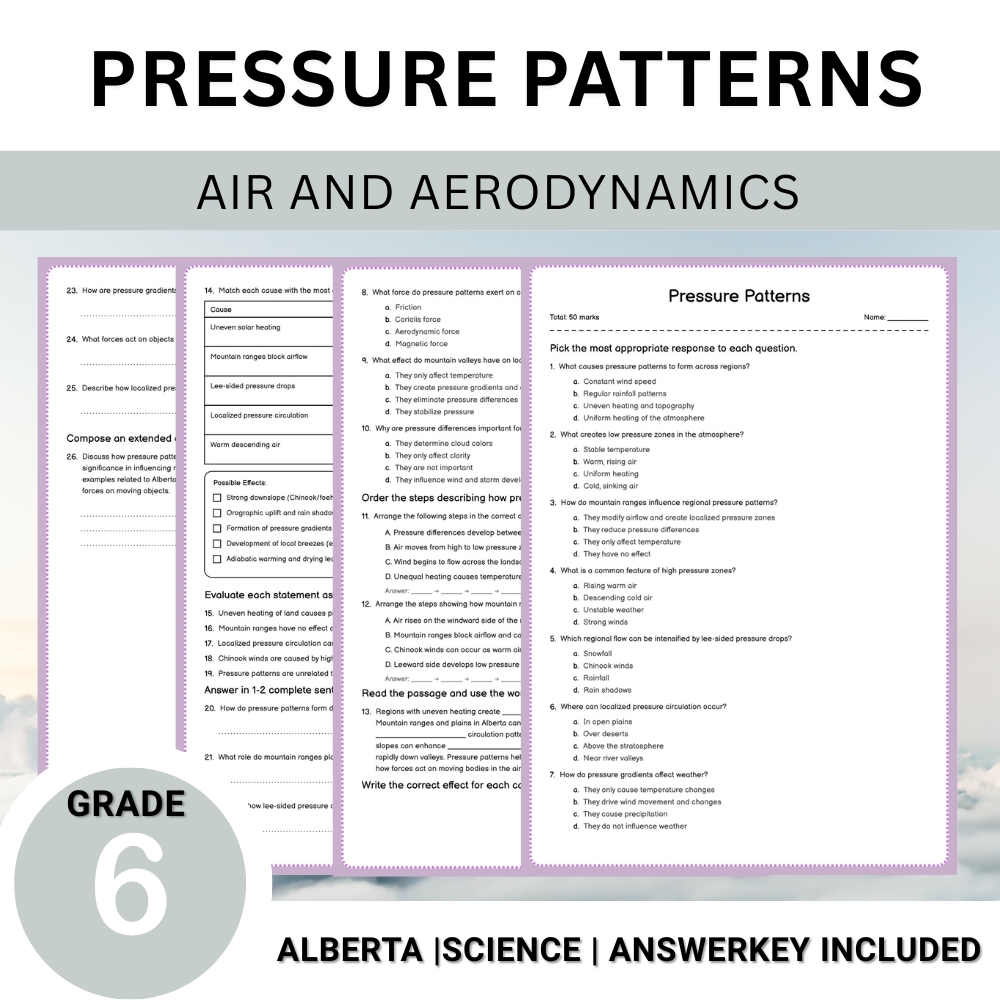
Grade 6 Science | Pressure Patterns Worksheet (Printable PDF & Assessment)
Learning Objectives
- Understand how uneven heating and topography create pressure differences that influence wind.
- Identify low and high pressure zones and their effects on regional weather.
- Explain how mountain ranges and plains modify pressure and airflow patterns in Alberta.
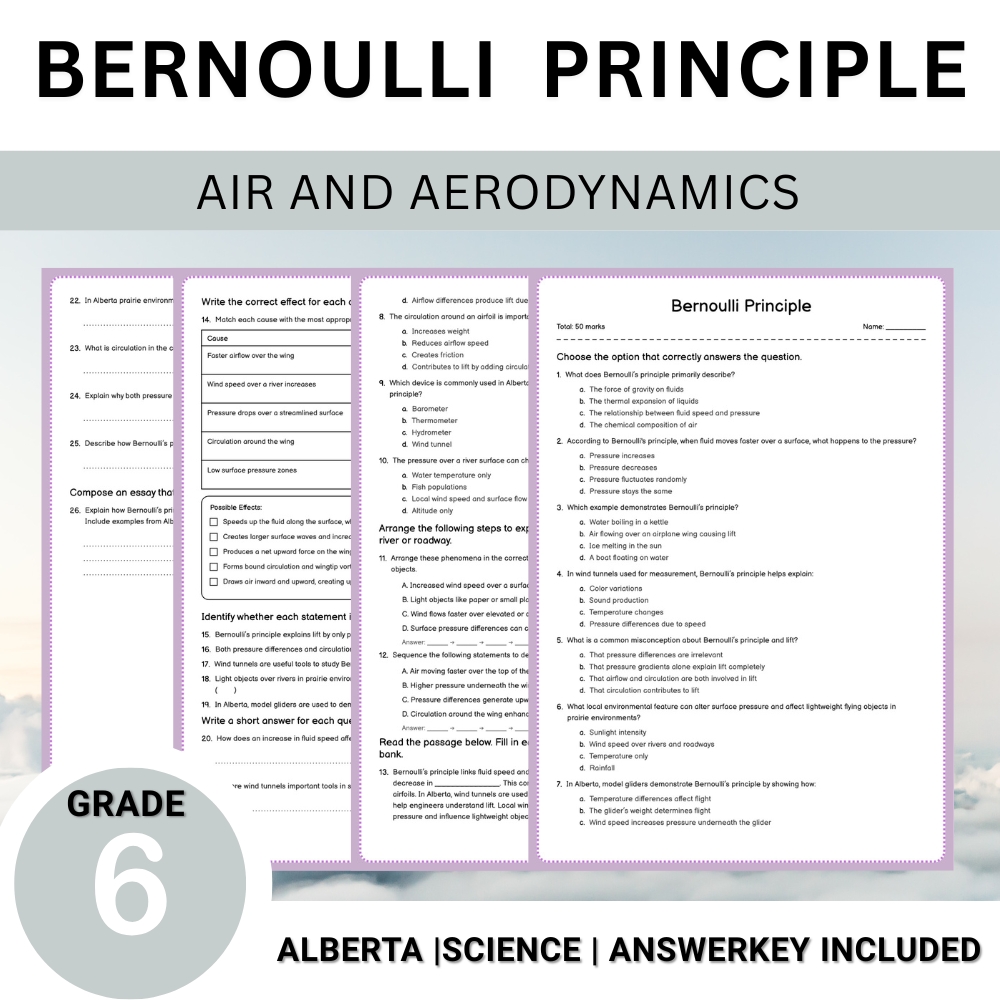
Grade 6 Science | Bernoulli Principle Worksheet (Printable PDF & Assessment)
Learning Objectives
- Explain how Bernoulli’s principle relates fluid speed to pressure.
- Describe how pressure differences contribute to lift on airfoils.
- Identify real-world applications of Bernoulli’s principle, such as wind tunnels and model gliders.
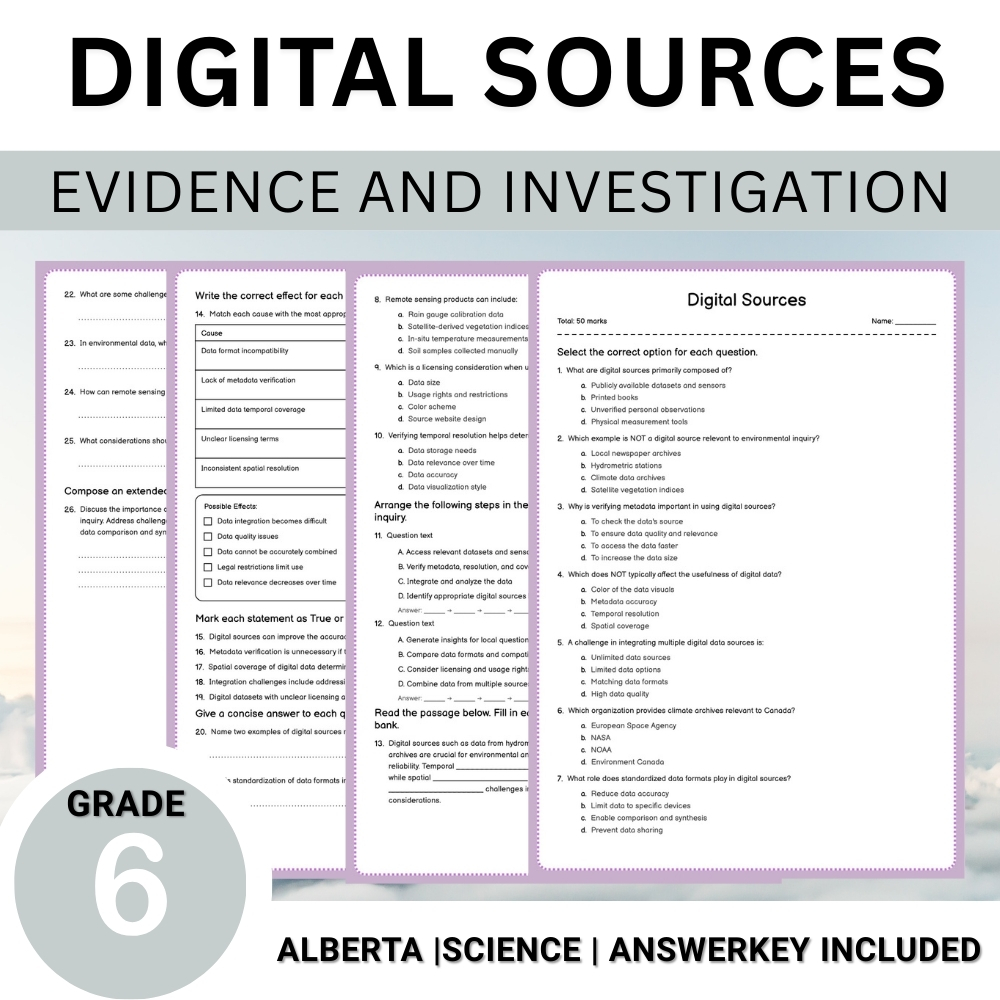
Grade 6 Science | Digital Sources Worksheet – Assessment & Student Practice (Printable PDF)
Learning Objectives
- Understand what digital sources are and their relevance to local inquiry.
- Identify examples of digital data used in environmental and climate analysis.
- Learn how to verify metadata, temporal resolution, and spatial coverage for digital sources.
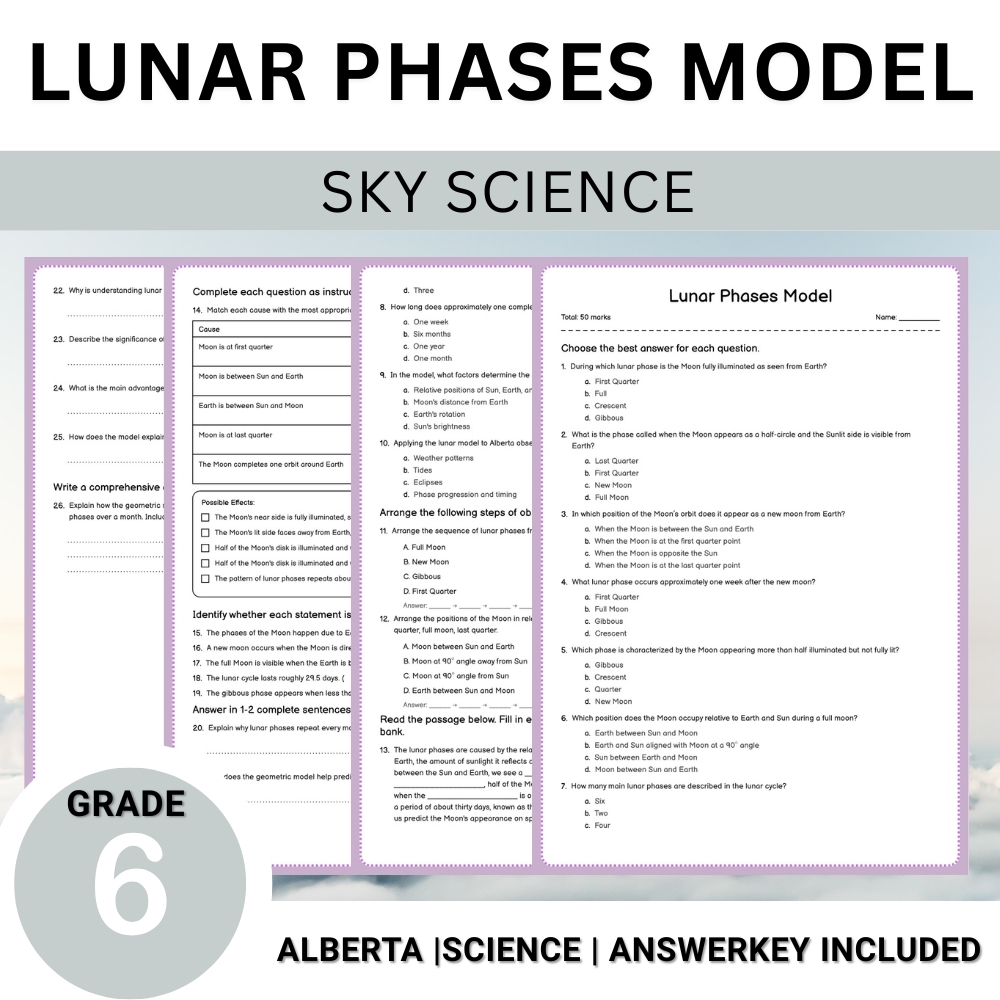
6th Grade Science | Lunar Phases Model Worksheet (Printable PDF & Assessment)
Learning Objectives
- Understand how the geometric model of the Moon's orbit explains lunar phases.
- Identify the relative positions of Sun, Earth, and Moon during different phases.
- Predict lunar phases based on the Moon's position in its orbit.
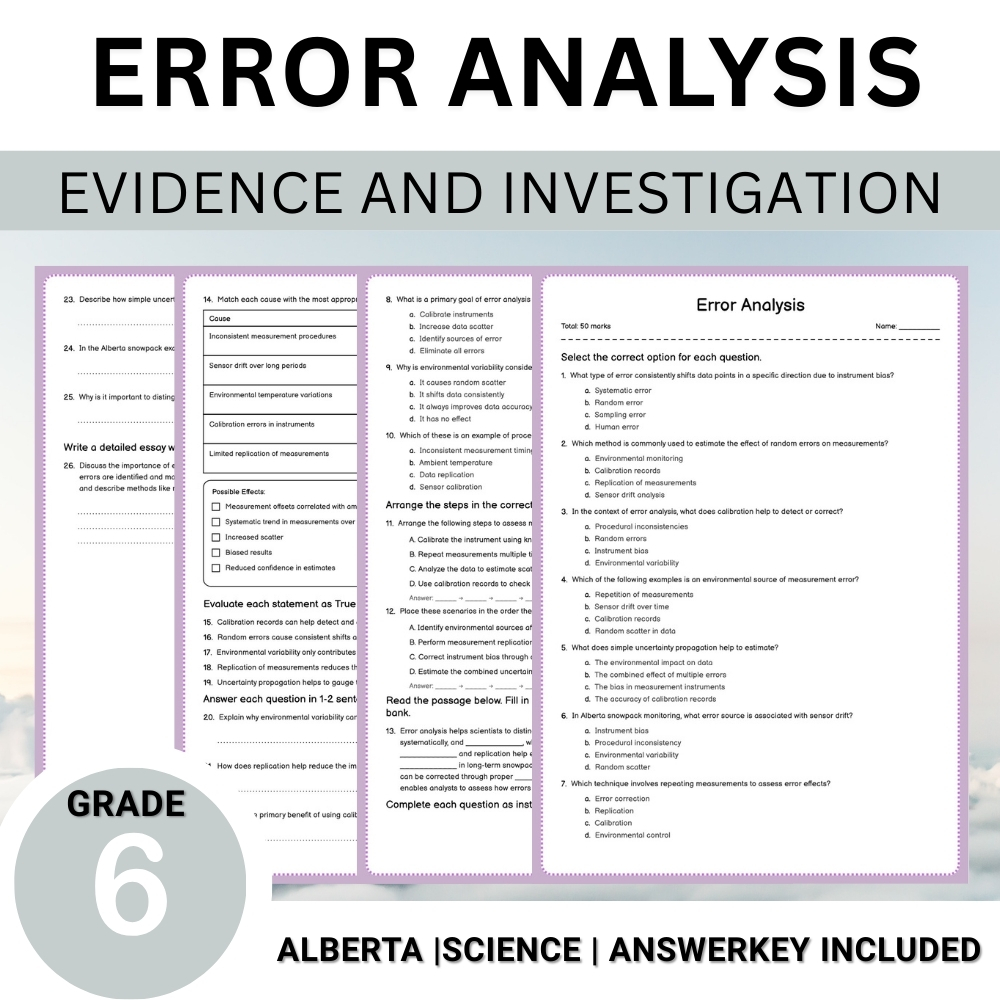
Grade 6 Science | Error Analysis Worksheet (Printable PDF + Answer Key)
Learning Objectives
- Understand sources of systematic and random errors in scientific data.
- Identify methods for estimating and analyzing errors in datasets.
- Apply error analysis techniques to real-world examples, including environmental measurements.
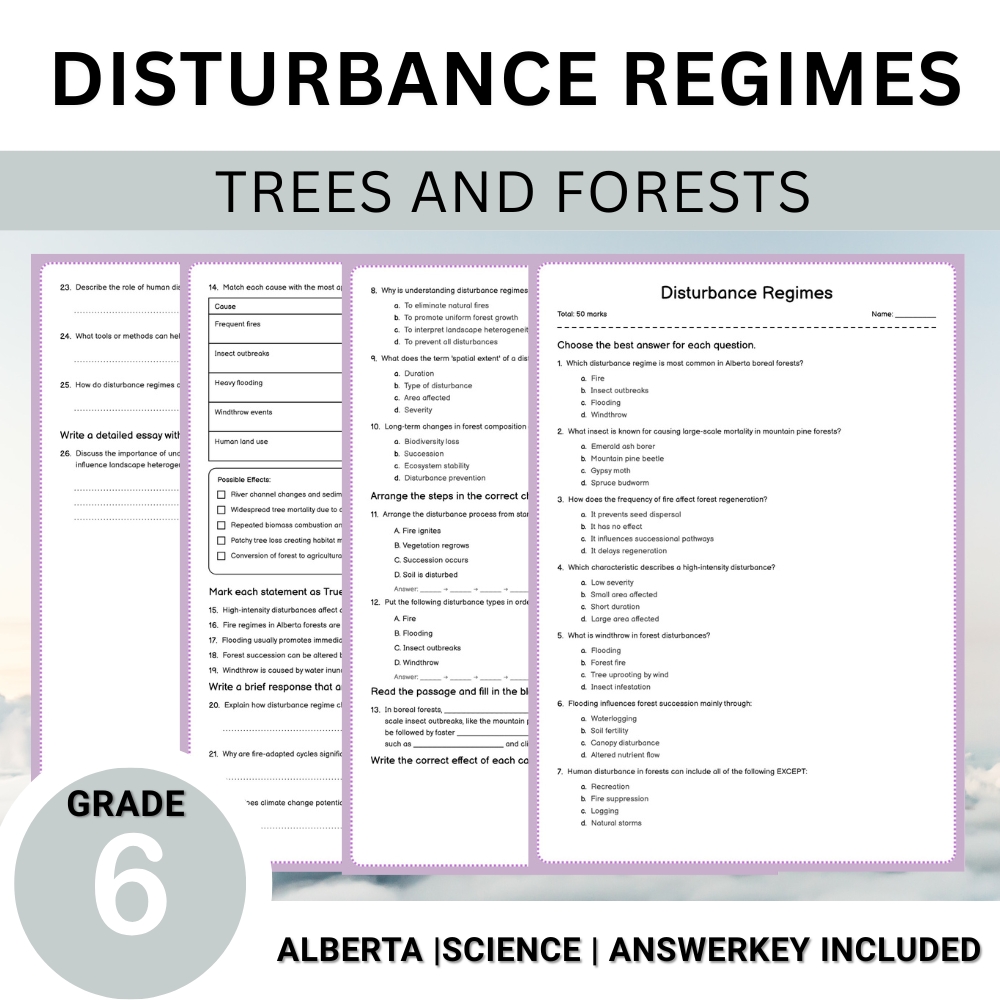
Grade 6 Science | Disturbance Regimes Worksheet (Printable PDF & Assessment)
Learning Objectives
- Identify different types of disturbance regimes in forest ecosystems.
- Understand how disturbance characteristics influence landscape patterns.
- Explain the role of disturbances like fire and insect outbreaks in succession.
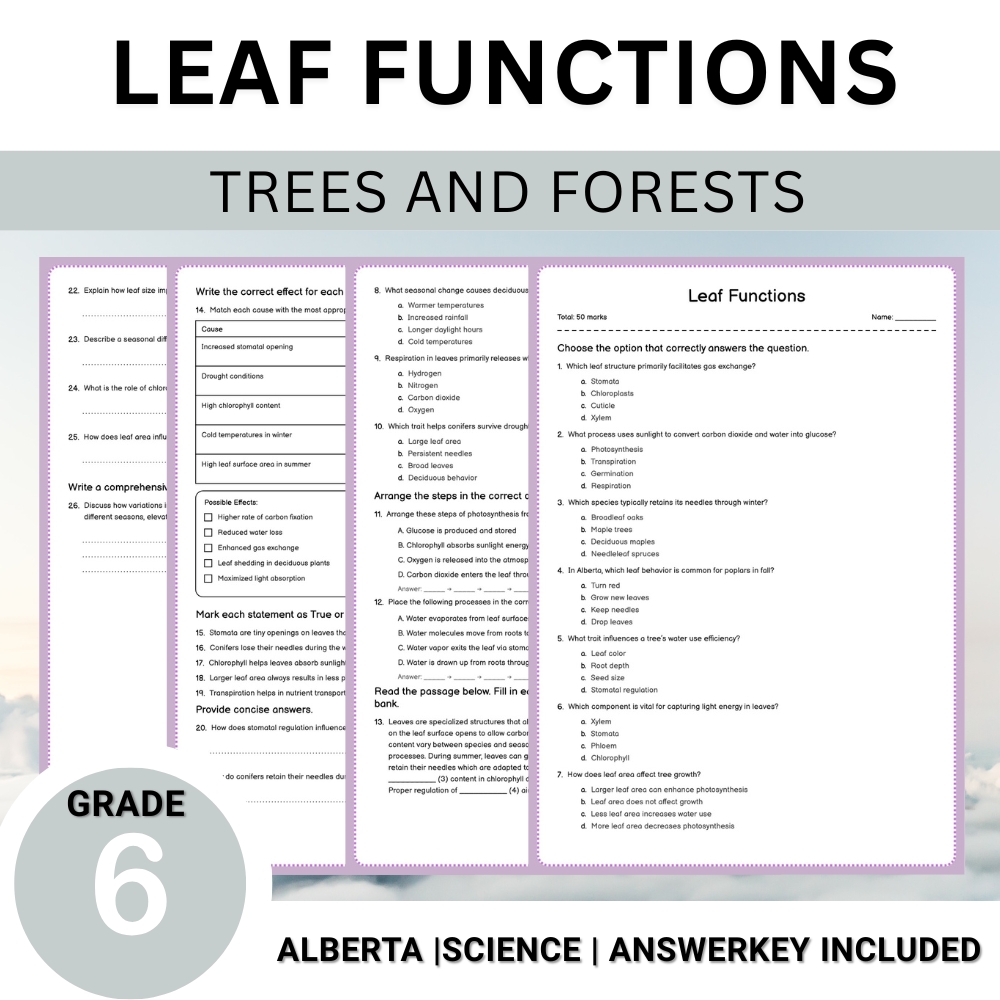
Grade 6 Science | Leaf Functions Worksheet & Assessment (Printable PDF)
Learning Objectives
- Describe the main structures of leaves and their functions in gas exchange, photosynthesis, and transpiration.
- Compare needlelike conifers and broadleaf deciduous species in seasonal leaf behaviors.
- Explain how stomatal regulation, leaf area, and chlorophyll content influence plant growth and water efficiency.
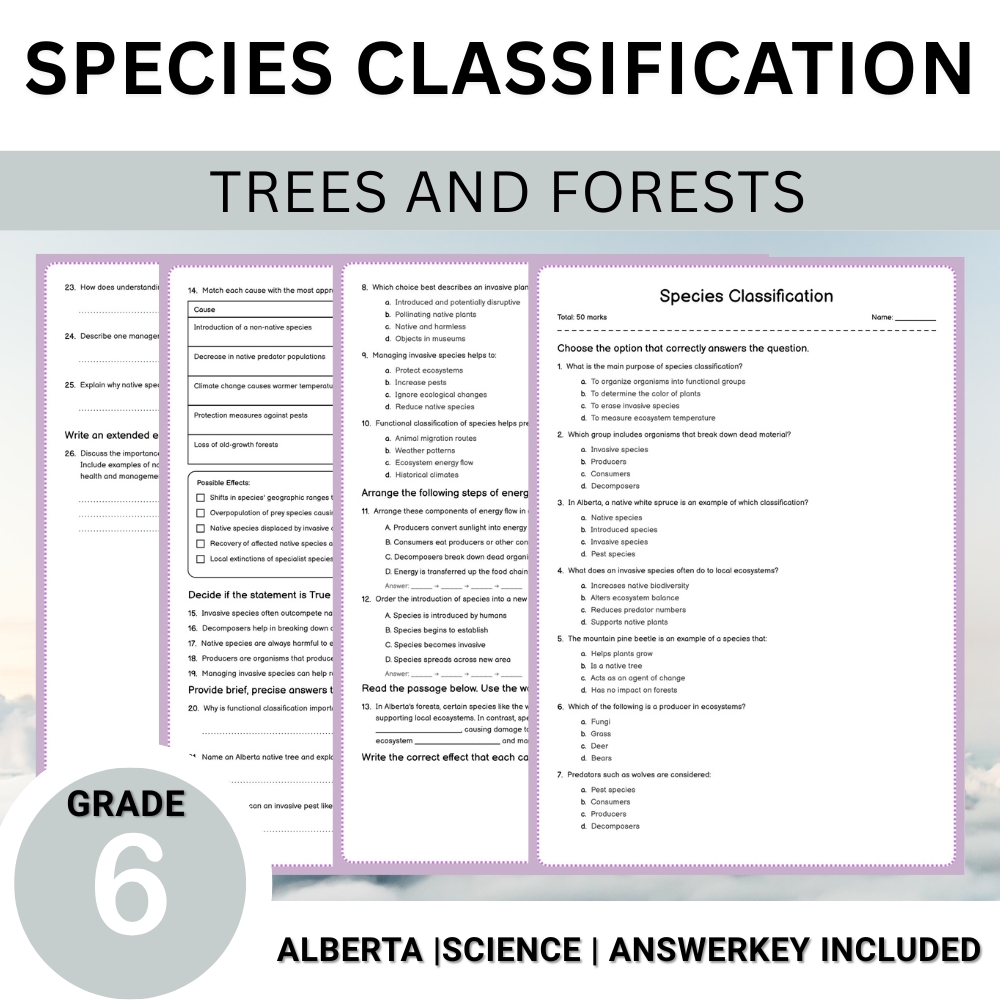
Grade 6 Science – Species Classification Worksheet (Printable PDF) for Assessment & Student Practice
Learning Objectives
- Understand the different functional groups of organisms and their roles in ecosystems.
- Distinguish between native and invasive species in Alberta's biogeographic zones.
- Learn how species classification supports ecosystem management and prediction.
Browse more categories
About Science Worksheets
Find Science worksheets spanning core skills, practice, and review. All 42,859 resources are instant PDF downloads for the classroom or home.
Every worksheet on MyTeachingSheets is created by independent teacher-authors and reviewed before publication. All resources download as printable PDFs for classroom, homework, or at-home practice, and many include answer keys. Preview any worksheet free before buying.