
Science Worksheets
44,295 subject resources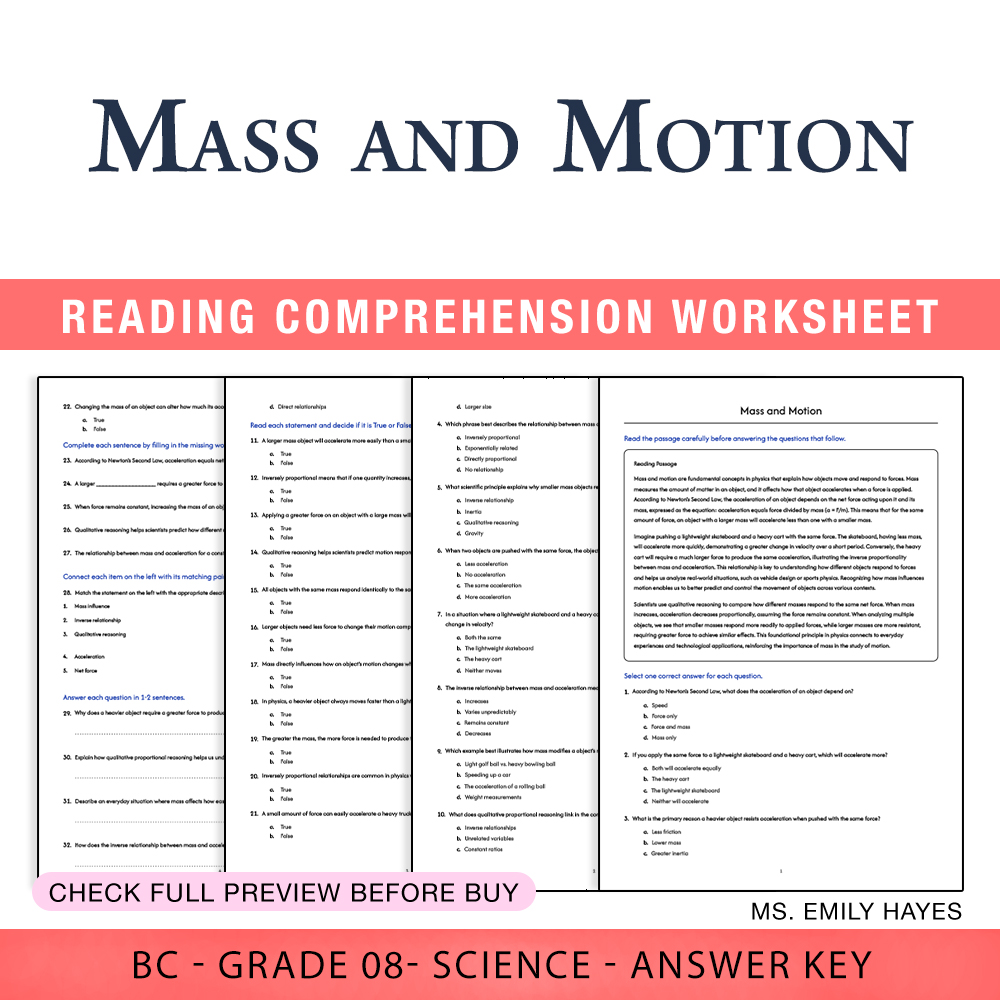
8th Grade Science | Mass and Motion Worksheet (PDF+ Answer Key)
 Created byCopper Leaf Classroom
Learning Objectives
- Understand how mass influences the effect of net force on motion.
- Explain the inverse relationship between mass and acceleration for a given force.
- Compare the motion of objects with different masses when pushed with the same force.
Also included in: Grade 8 Science Worksheets Bundle | Forces, Motion & Energy (PDF + Answer Keys) +1 more
Instant download
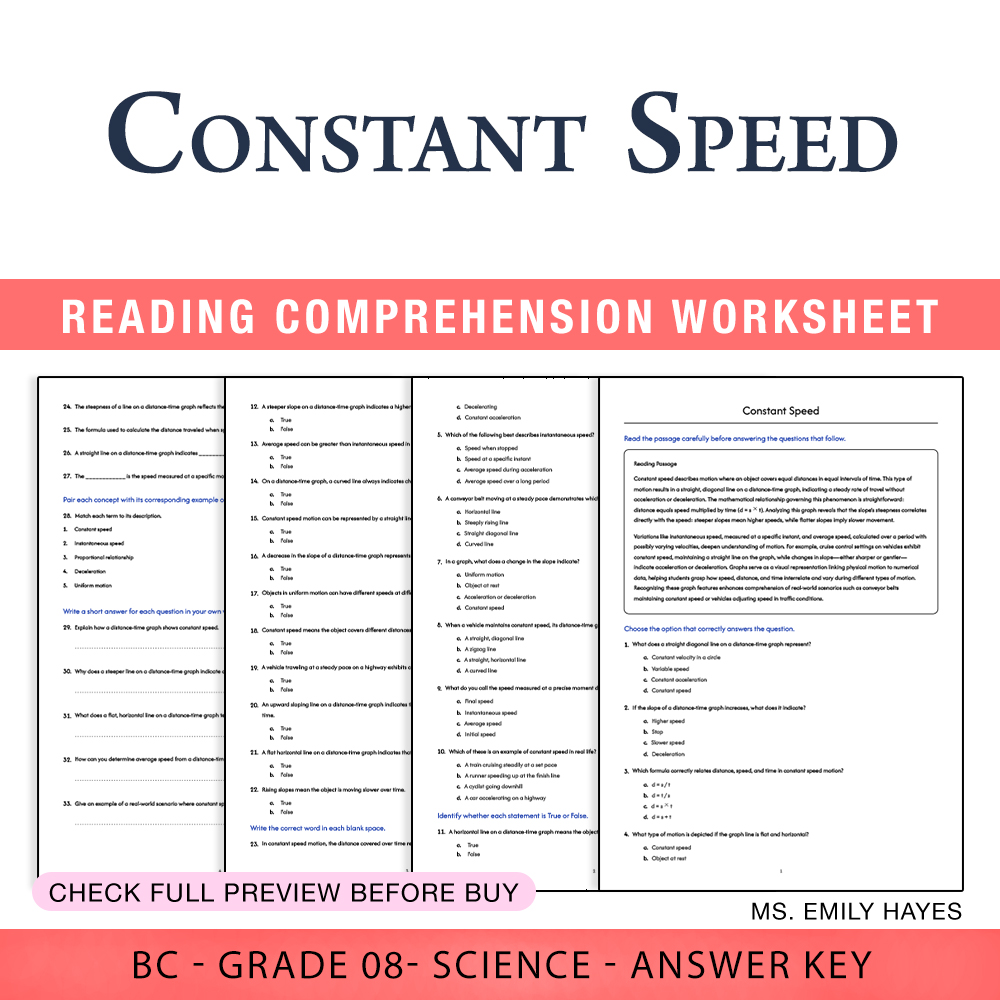
8th Grade Science | Constant Speed Worksheet (PDF+ Answer Key)
Created byCopper Leaf ClassroomLearning Objectives
- Explain the concept of constant speed and how it appears as a straight line on a distance-time graph.
- Calculate distance, speed, and time using proportional relationships in uniform motion.
- Identify how variations like instantaneous and average speed affect motion analysis.
Also included in: Grade 8 Science Worksheets Bundle | Forces, Motion & Energy (PDF + Answer Keys) +1 more
Instant download
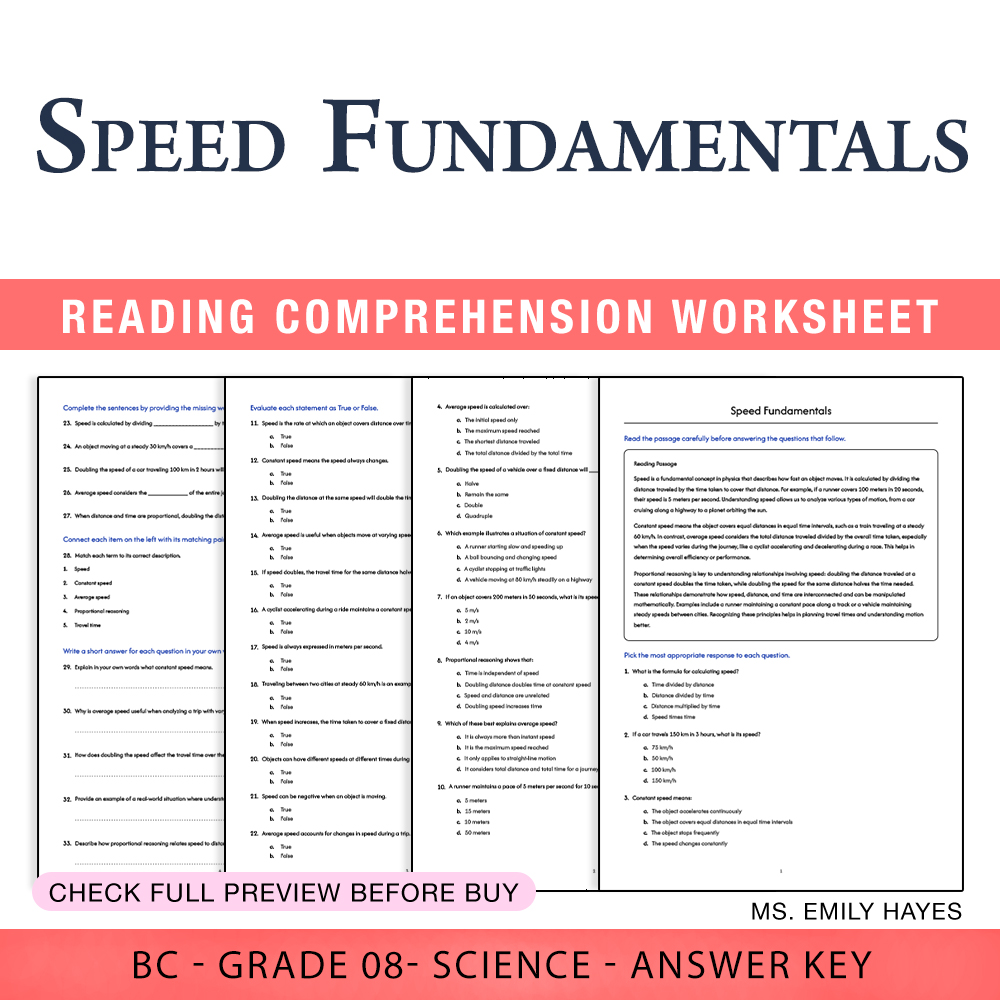
Grade 8 Science | Speed Fundamentals Worksheet (PDF + Answer Key)
Created byCopper Leaf ClassroomLearning Objectives
- Define speed as distance divided by time and explain its significance in motion.
- Differentiate between constant speed and average speed.
- Understand the proportional reasoning relating speed, distance, and time.
Also included in: Grade 8 Science Worksheets Bundle | Forces, Motion & Energy (PDF + Answer Keys) +1 more
Instant download

Grade 5 Balanced Forces Contrast Worksheet | California Standards Practice PDF
 Created byClear Sky Classroom
Learning Objectives
- Explain how balanced forces produce a net force of zero and do not change an object’s motion
- Use the net force idea to predict changes in direction and speed when forces are unbalanced
- Distinguish between balanced and unbalanced forces in real-world push-and-pull situations
Instant download

Grade 8 Science | Energy in Motion - Daily Reading Comprehension
 Created byCoral Reef Learning
Learning Objectives
- Understand the concepts of gravitational potential energy and kinetic energy.
- Explain how energy transforms during vertical motion in a gravitational field.
- Interpret the energy changes in systems such as roller coasters.
Instant download
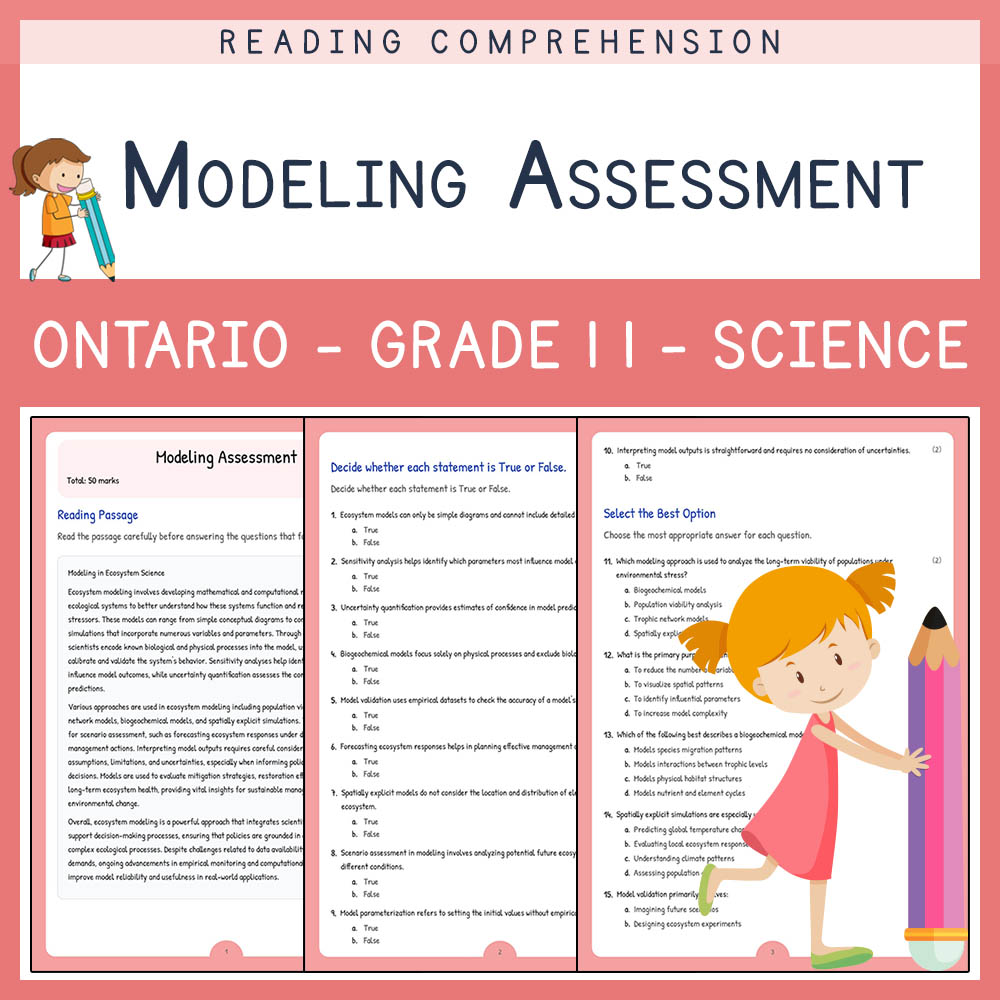
Grade 11 Science | Modeling Assessment Worksheet | Ontario Standards
 Created byLumora Learning
Learning Objectives
- Understand the principles of ecosystem modeling and scenario assessment.
- Identify various approaches for ecosystem model parameterization and validation.
- Evaluate the use of model outputs in policy decisions and ecosystem management.
Instant download
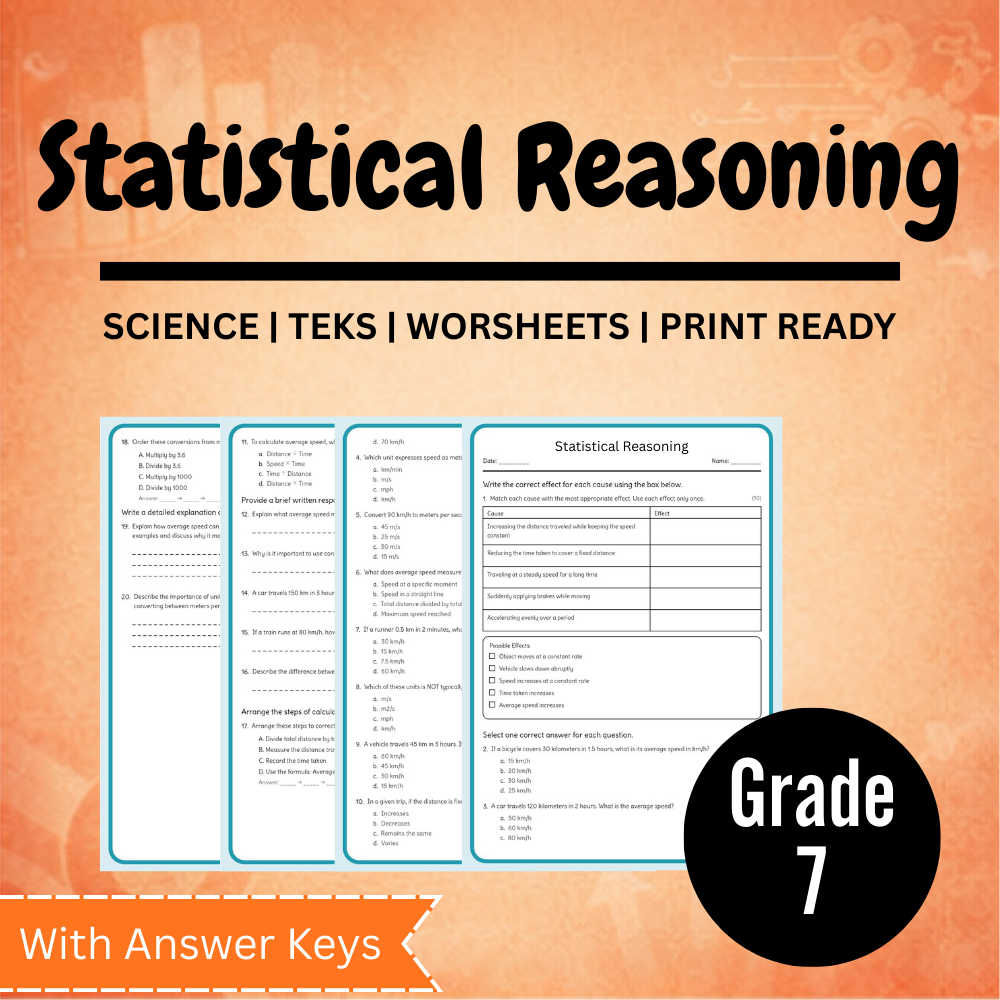
Grade 7 Science | Statistical Reasoning Worksheet (Worksheet + Answer Key) – TEKS Standards
 Created byBright Mind Resources
Learning Objectives
- Interpret variability and measures of central tendency in data sets.
- Analyze graphical representations such as box plots and histograms for spread and reliability.
- Calculate and compare mean, median, and range to assess data distribution.
Also included in: Grade 7 Science Unit Worksheet Pack- Data Analysis,Experimental Design & Inquiry +2 more
Instant download
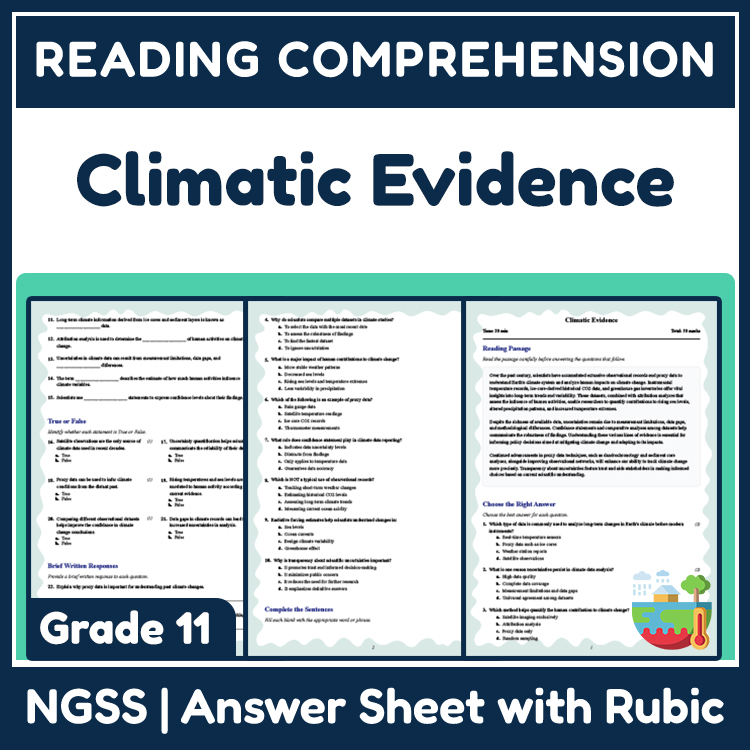
Grade 11 Science | Climatic Evidence Reading Worksheet (PDF + Answer Key)
JCreated byJ.S SheetsLearning Objectives
- Understand how observational records and proxy data provide evidence for climate change.
- Analyze the methods used in attribution studies to determine human contributions to climate change.
- Interpret data related to sea-level rise, temperature extremes, and precipitation patterns.
Also included in: Grade 11 Science | Climate Change & Environmental Management Unit Bundle
Instant download
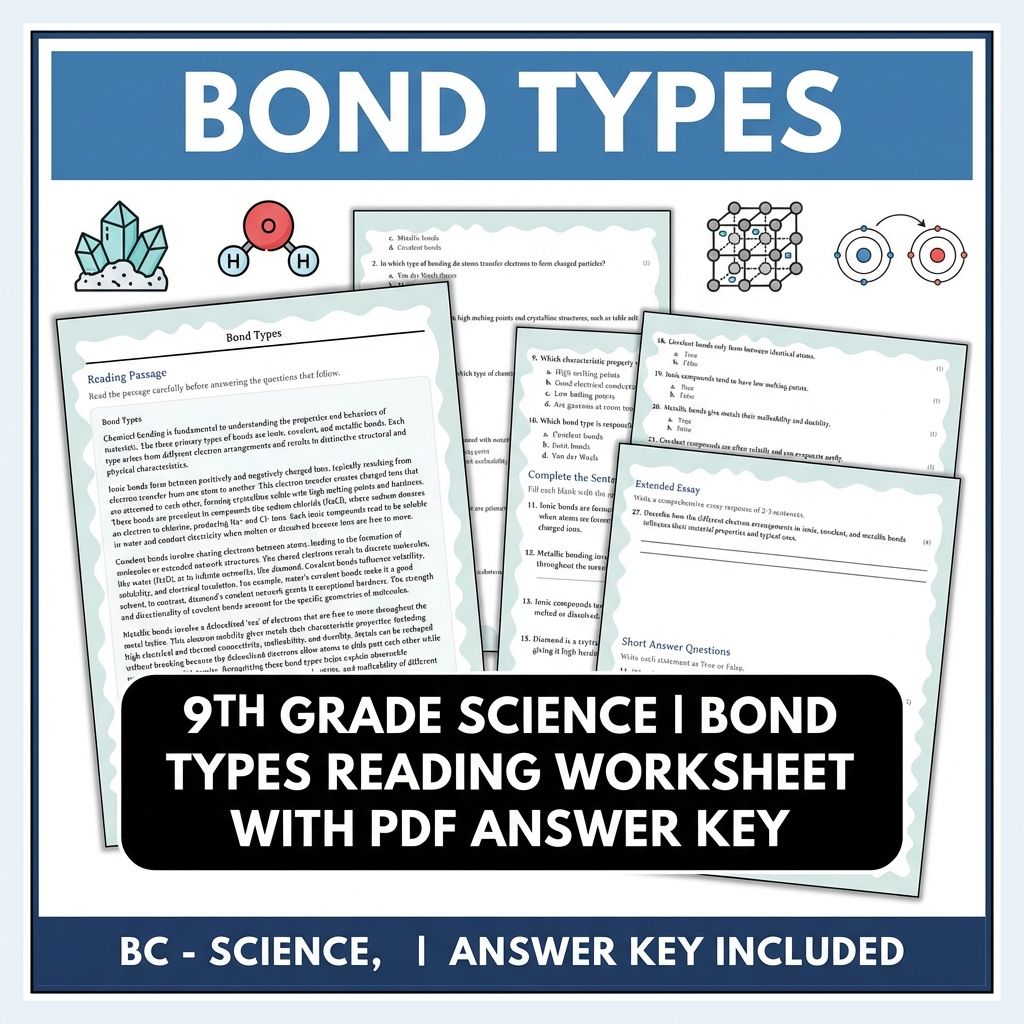
9th Grade Science | Bond Types Reading Worksheet with PDF Answer Key
JCreated byJ.S SheetsLearning Objectives
- Identify the characteristics of ionic, covalent, and metallic bonds.
- Understand how electron arrangements determine the type of bonding.
- Explain the physical properties resulting from different bond types.
Instant download
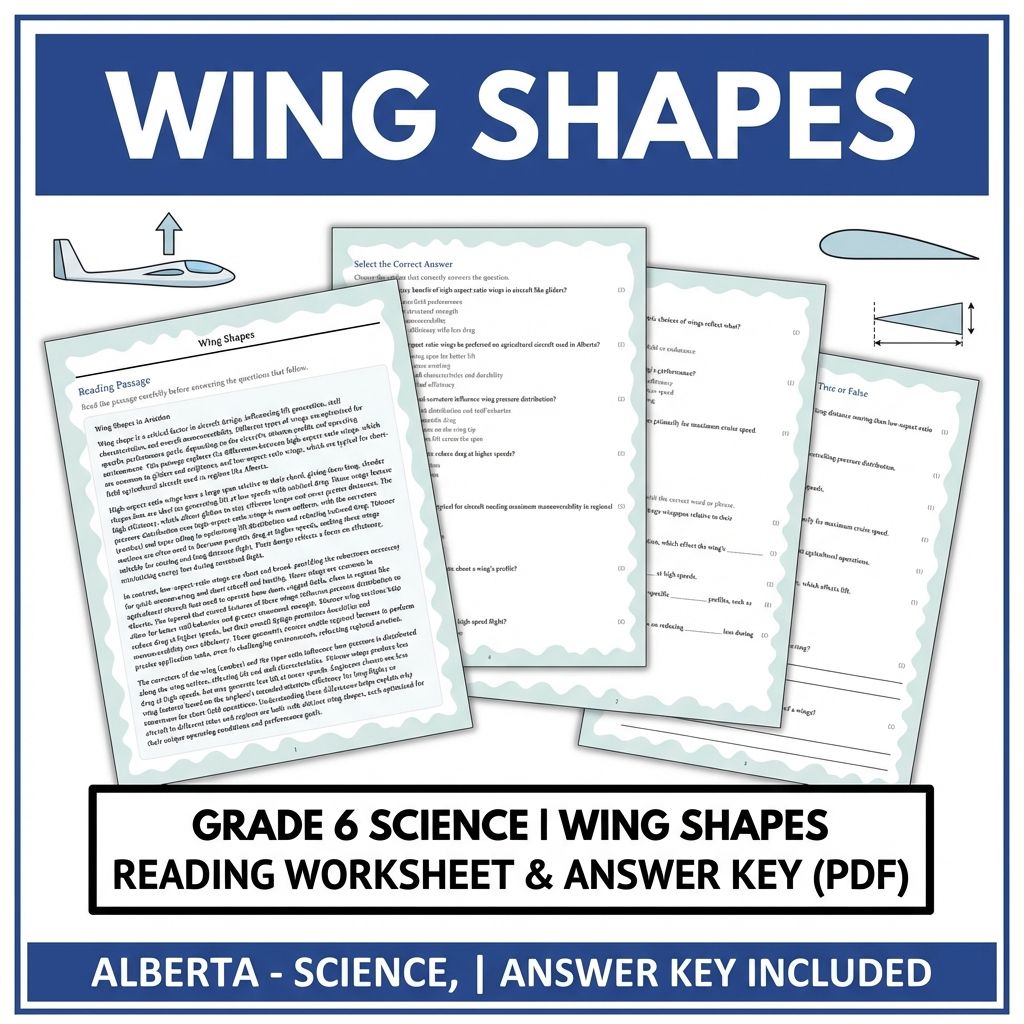
Grade 6 Science | Wing Shapes Reading Worksheet & Answer Key (PDF)
JCreated byJ.S SheetsLearning Objectives
- Understand how wing shape affects lift, stall behavior, and maneuverability.
- Compare high-aspect-ratio wings used in gliders with low-aspect-ratio wings on agricultural aircraft.
- Explain the influence of curvature, taper, and thickness on pressure distribution and drag.
Also included in: Grade 6 Science | Flight Physics & Aerodynamics UNIT Pack (Answer Keys Included) +1 more
Instant download
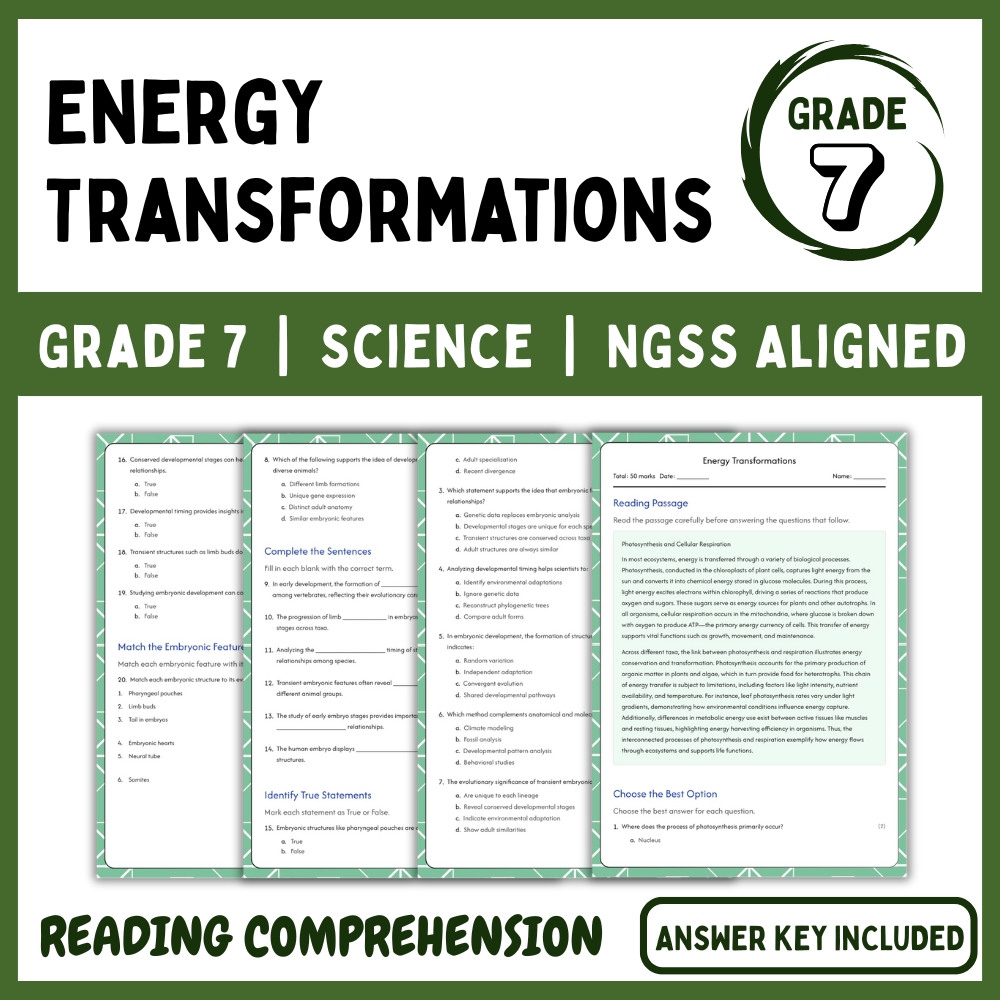
Grade 7 Science | Energy Transformations Worksheet (NGSS & Answer Key)
 Created byCedar Grove Learning
Learning Objectives
- Describe how light energy is converted into chemical energy during photosynthesis
- Explain how organisms harvest energy from food through cellular respiration
- Connect chloroplast-based sugar production with mitochondrial ATP generation across different taxa
Instant download
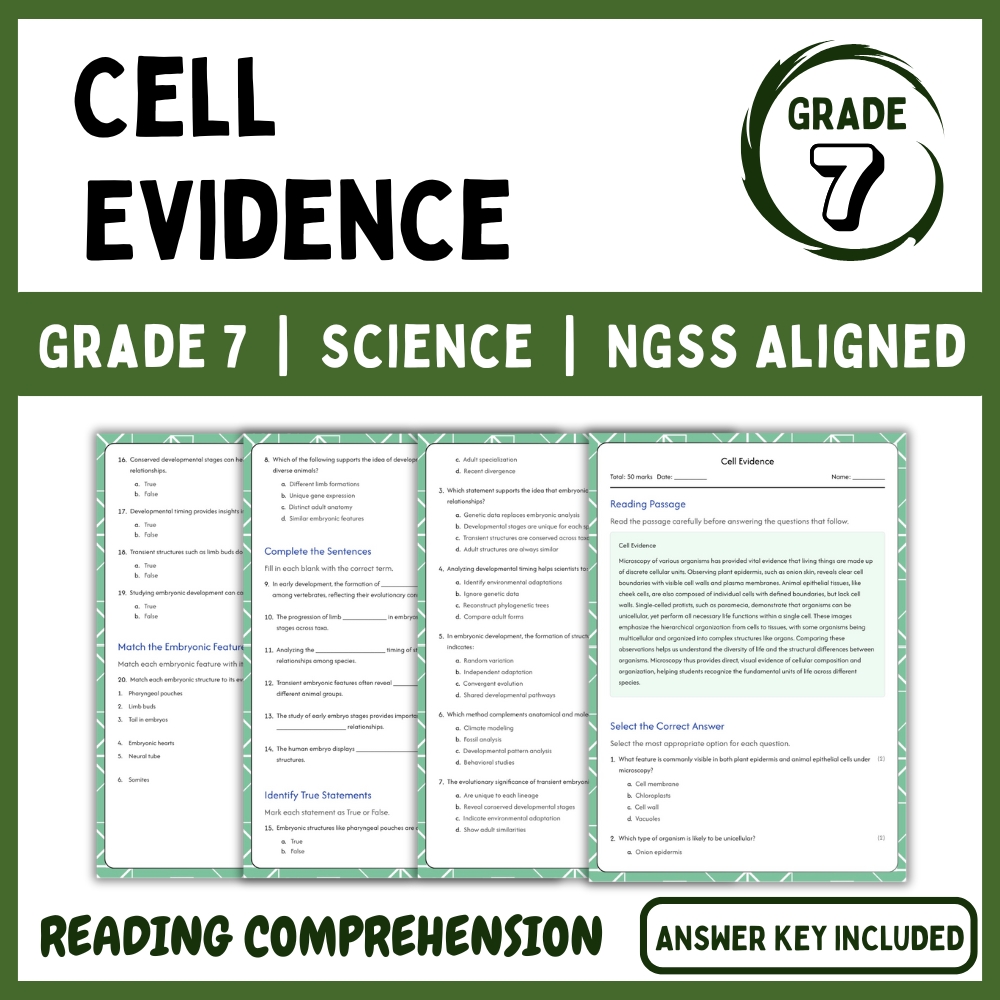
7th Grade Science | Cell Evidence Worksheet (NGSS Practice + Answer Key)
Created byCedar Grove LearningLearning Objectives
- Observe and compare plant epidermis, animal epithelial tissue, and protists using microscopy.
- Identify cell boundaries such as plasma membranes and cell walls in observed specimens.
- Distinguish between unicellular and multicellular organisms based on microscopic observations.
Instant download
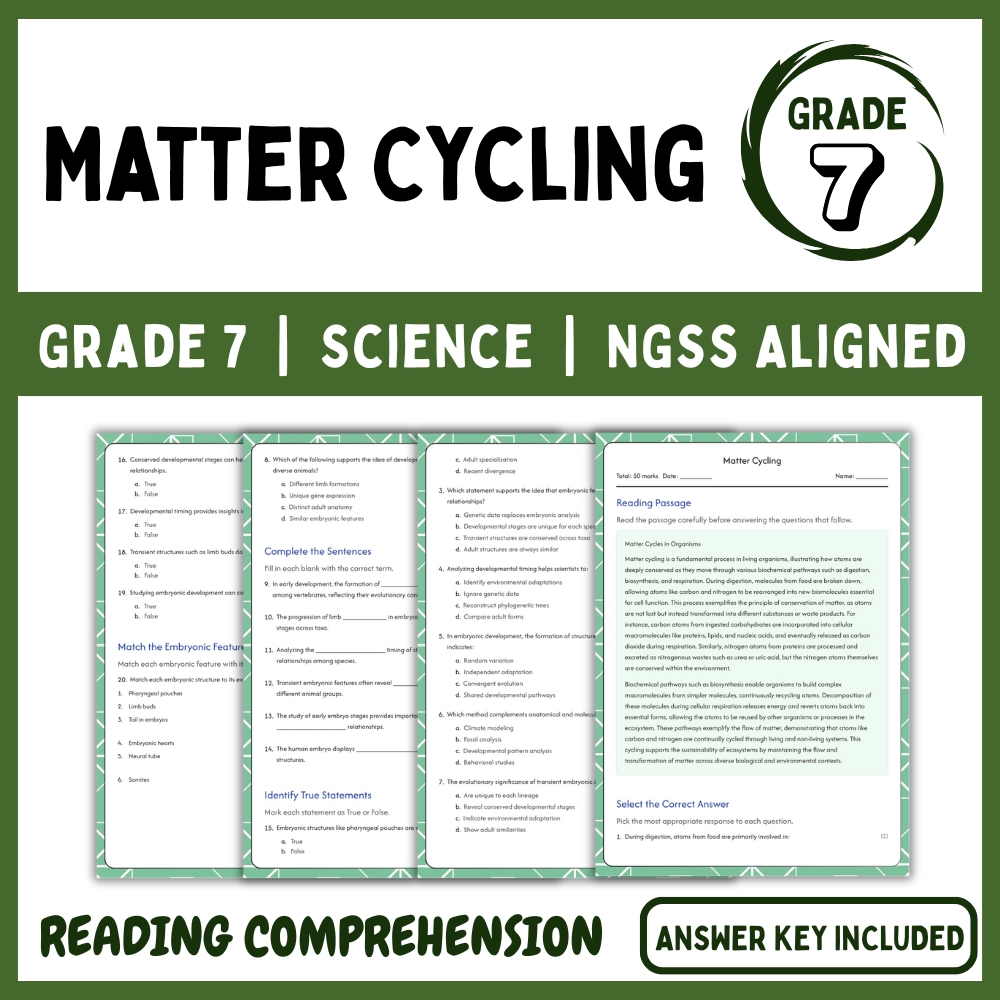
Grade 7 Science | Matter Cycling Worksheet (NGSS Practice & Assessment PDF)
Created byCedar Grove LearningLearning Objectives
- Describe how atoms are rearranged during digestion, biosynthesis, and respiration within organisms.
- Explain the conservation of matter during biochemical pathways like macromolecule synthesis and decomposition.
- Identify examples of carbon and nitrogen flow in biological processes.
Instant download
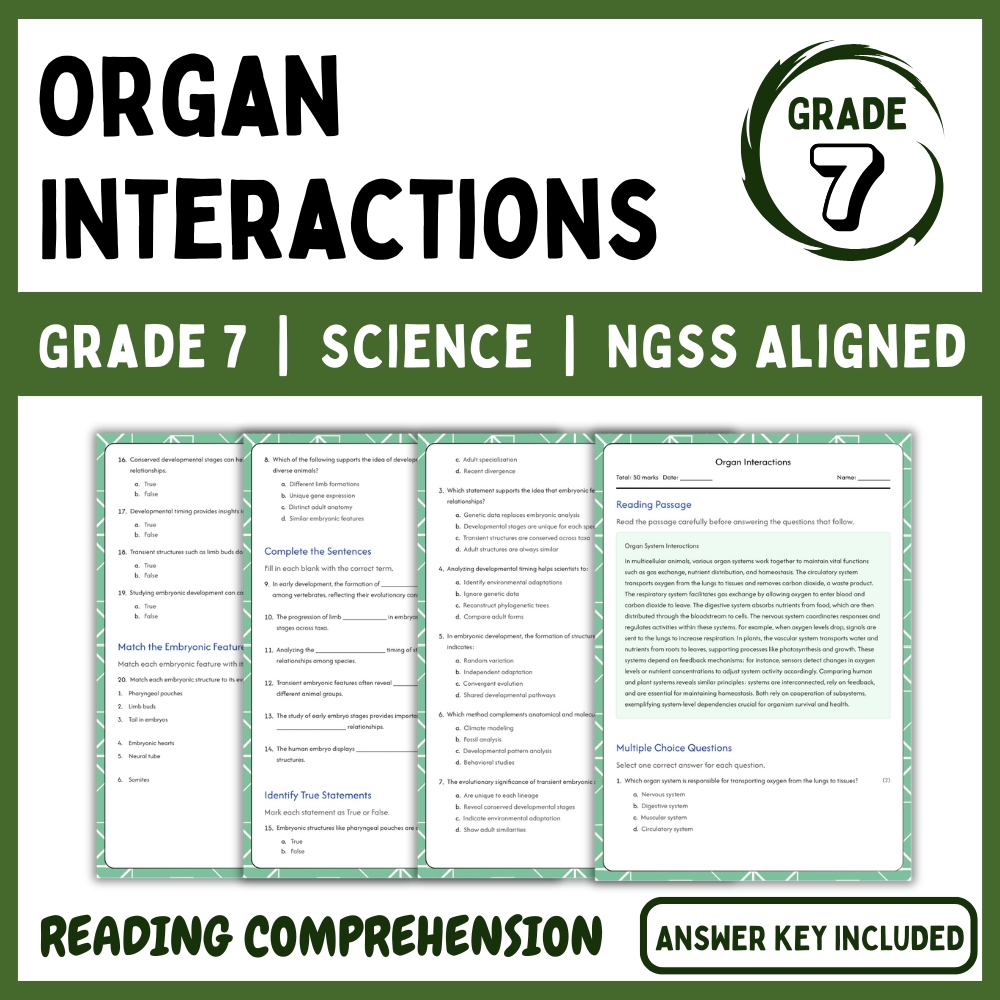
Grade 7 Science | Organ Interactions NGSS Worksheet PDF & Answer Key
Created byCedar Grove LearningLearning Objectives
- Describe the structure and function of major organ systems in multicellular animals.
- Explain how organ systems interact to support processes like gas exchange, nutrient transport, and homeostasis.
- Compare system interactions in mammals and plants, highlighting system dependencies and feedback mechanisms.
Instant download
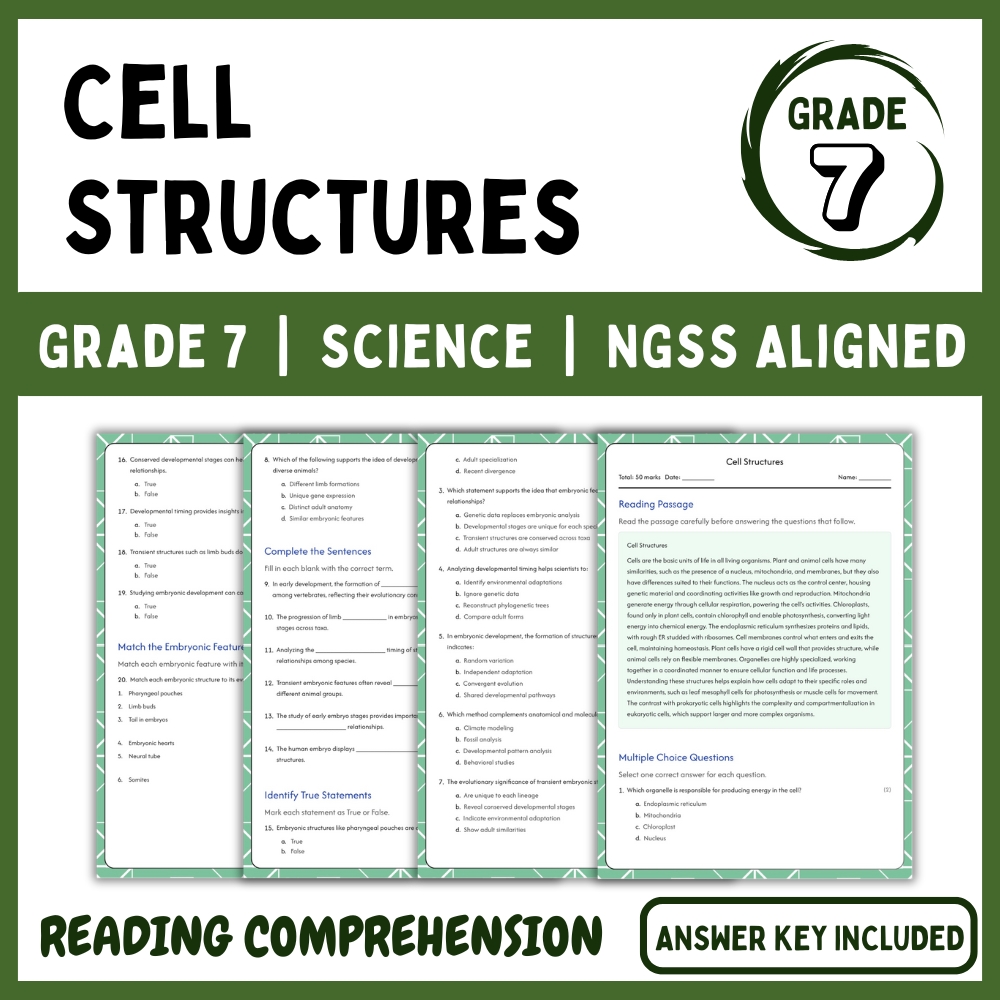
7th Grade Science | Cell Structures Worksheet (NGSS Practice & Review)
Created byCedar Grove LearningLearning Objectives
- Identify and describe the functions of key organelles in plant and animal cells.
- Differentiate between eukaryotic and prokaryotic cell organization.
- Connect cell structure features to their roles in processes like transport, synthesis, and compartmentalization.
Instant download
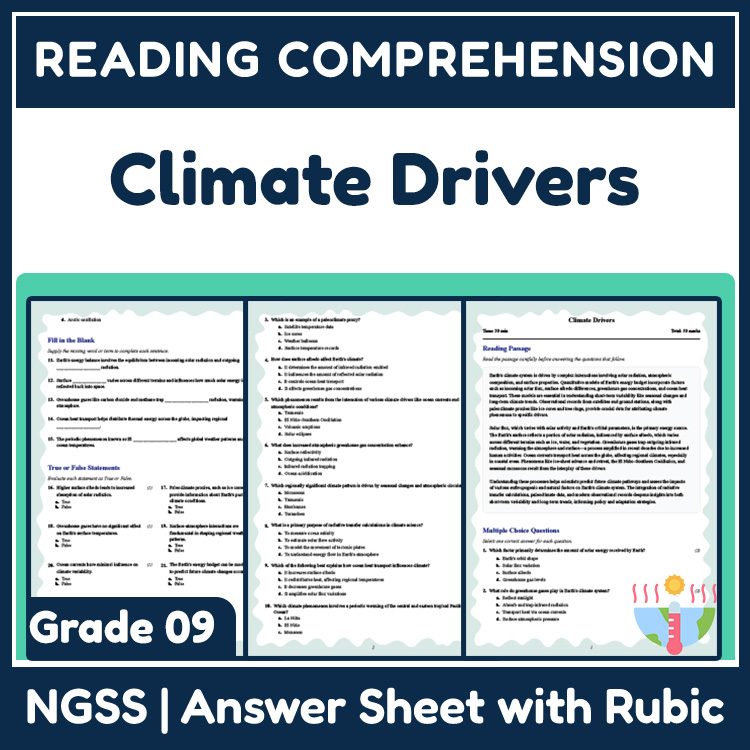
9th Grade Science | Climate Drivers Reading Worksheet (PDF + Answer Key)
JCreated byJ.S SheetsLearning Objectives
- Understand the main factors influencing Earth's climate, including solar flux, albedo, greenhouse gases, and ocean heat transport.
- Analyze how variations in these factors contribute to climate phenomena such as ice-sheet changes and El Niño–Southern Oscillation.
- Interpret observational records and paleoclimate proxies to assess climate variability and trends.
Instant download

Grade 5 Energy Interactions Worksheet | Practice & Assessment PDF
Created byClear Sky ClassroomLearning Objectives
- Identify common forms of energy (light, thermal, motion, electrical) and describe how they can change during interactions.
- Explain energy transfer and energy transformation using real-world examples.
- Use evidence from statements or scenarios to classify whether energy changes form or transfers to a new location.
Instant download

Grade 7 Science | Effects of Disturbances in Ecosystems - Reading Comprehension
Created byCoral Reef LearningLearning Objectives
- Understand how fire as a disturbance impacts forest habitats
- Identify both positive and negative effects of forest fires
- Learn about the role of disturbance regimes in ecological succession
Instant download

Energy Transfer Worksheet for Grade 9 Science – Classroom Practice
Created byCoral Reef LearningLearning Objectives
- Describe how mechanical systems transfer energy as kinetic or potential energy.
- Explain the roles of work, collisions, and friction in energy transfer.
- Identify examples of energy conversion pathways such as braking a bicycle or compressing a spring.
Instant download

Grade 6 Science | Measurement Precision Worksheet | Florida NGSSS Aligned
Created byLumora LearningLearning Objectives
- Differentiate between precision and accuracy in scientific measurements
- Choose appropriate tools and correct units for measurement tasks
- Identify common sources of error and describe ways to reduce them
Instant download
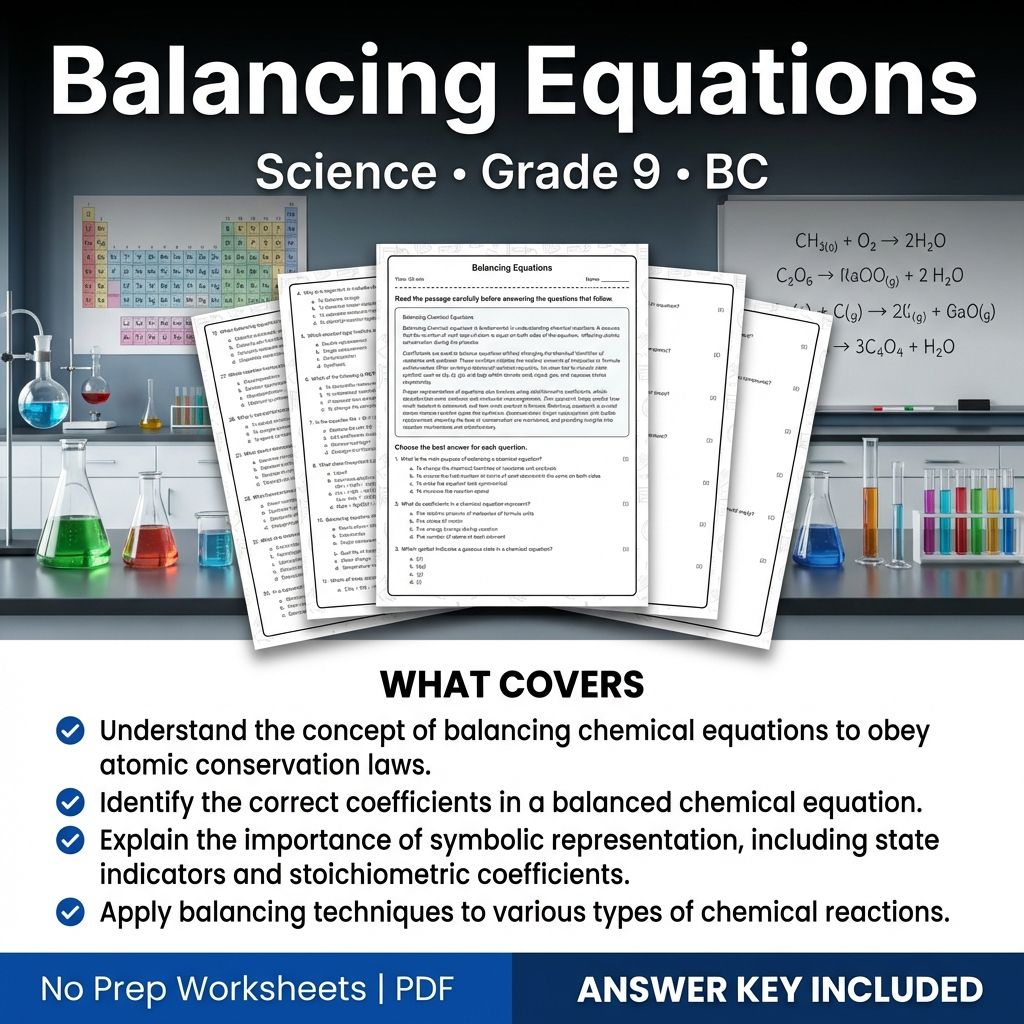
Grade 9 Science | Balancing Equations Worksheet & Answer Key (Printable PDF)
Created byCoral Reef LearningLearning Objectives
- Understand the concept of balancing chemical equations to obey atomic conservation laws.
- Identify the correct coefficients in a balanced chemical equation.
- Explain the importance of symbolic representation, including state indicators and stoichiometric coefficients.
Instant download
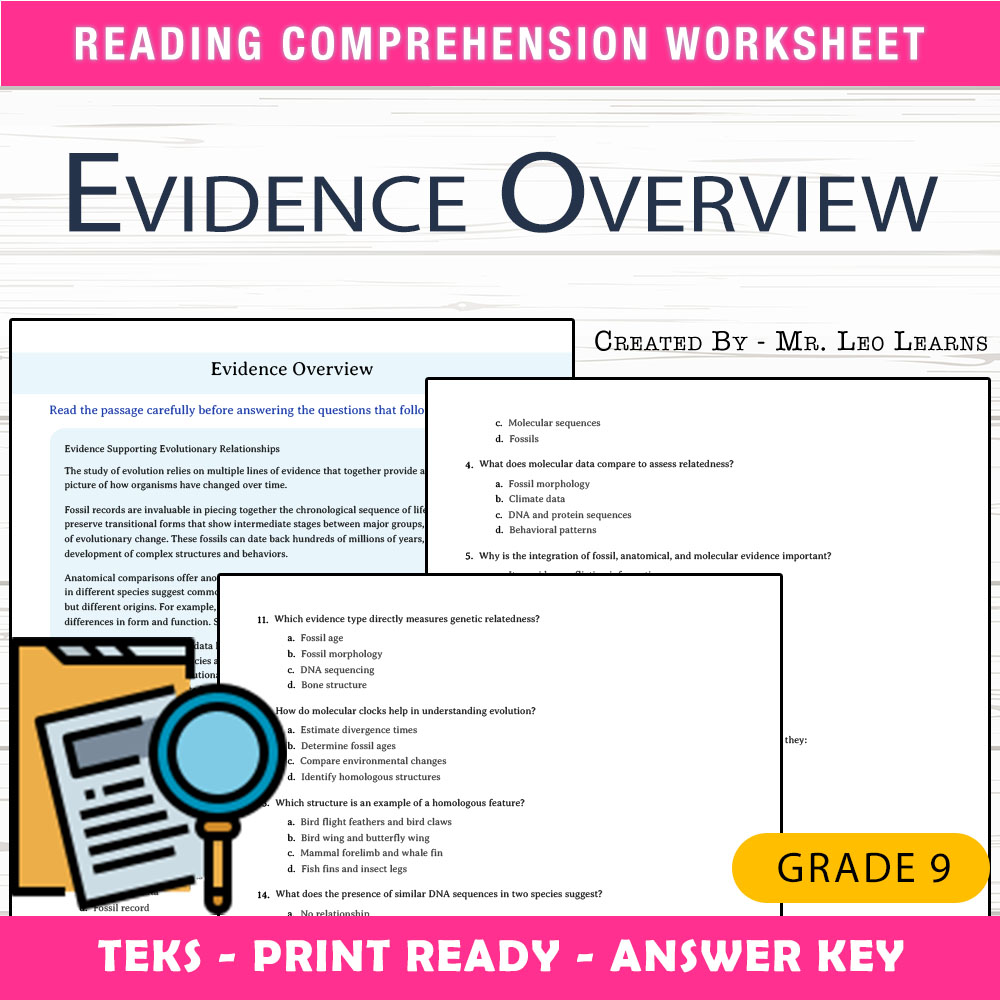
Grade 9 Science – Evidence Overview Worksheet for Mastery
 Created byThe Resource Hub
Learning Objectives
- Understand the different lines of evidence used in studying evolutionary history.
- Identify how fossil, anatomical, and molecular data contribute to understanding relationships among organisms.
- Explain how integrating multiple lines of evidence strengthens conclusions about evolution.
Also included in: Grade 9 Science Evolution & Classification Unit Worksheet Pack +1 more
Instant download
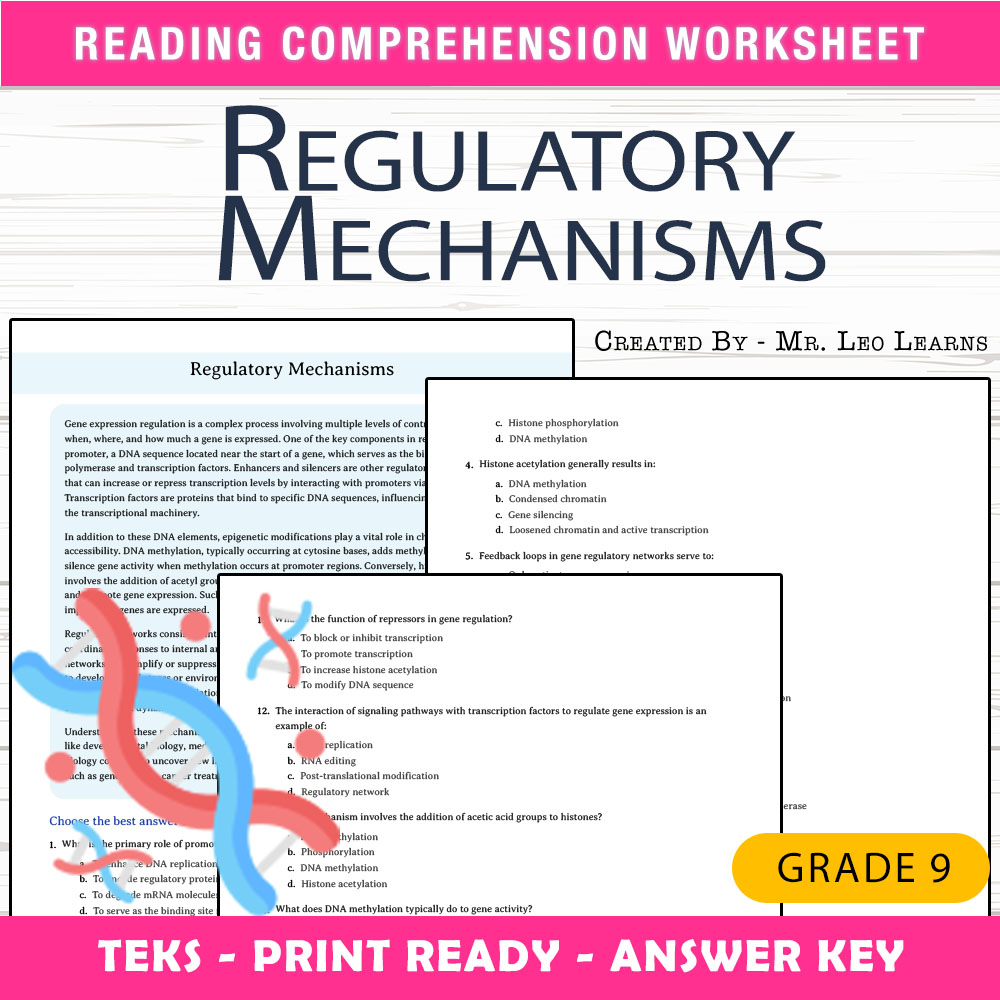
Grade 9 Science – Regulatory Mechanisms Worksheet for Mastery
Created byThe Resource HubLearning Objectives
- Understand how gene expression is controlled through various regulatory elements and epigenetic modifications.
- Identify the roles of promoters, enhancers, silencers, transcription factors, and repressors in gene regulation.
- Explain how DNA methylation and histone acetylation influence chromatin structure and transcriptional activity.
Also included in: Grade 9 Science Unit Bundle | Genetics, DNA & Biotechnology Worksheets +1 more
Instant download
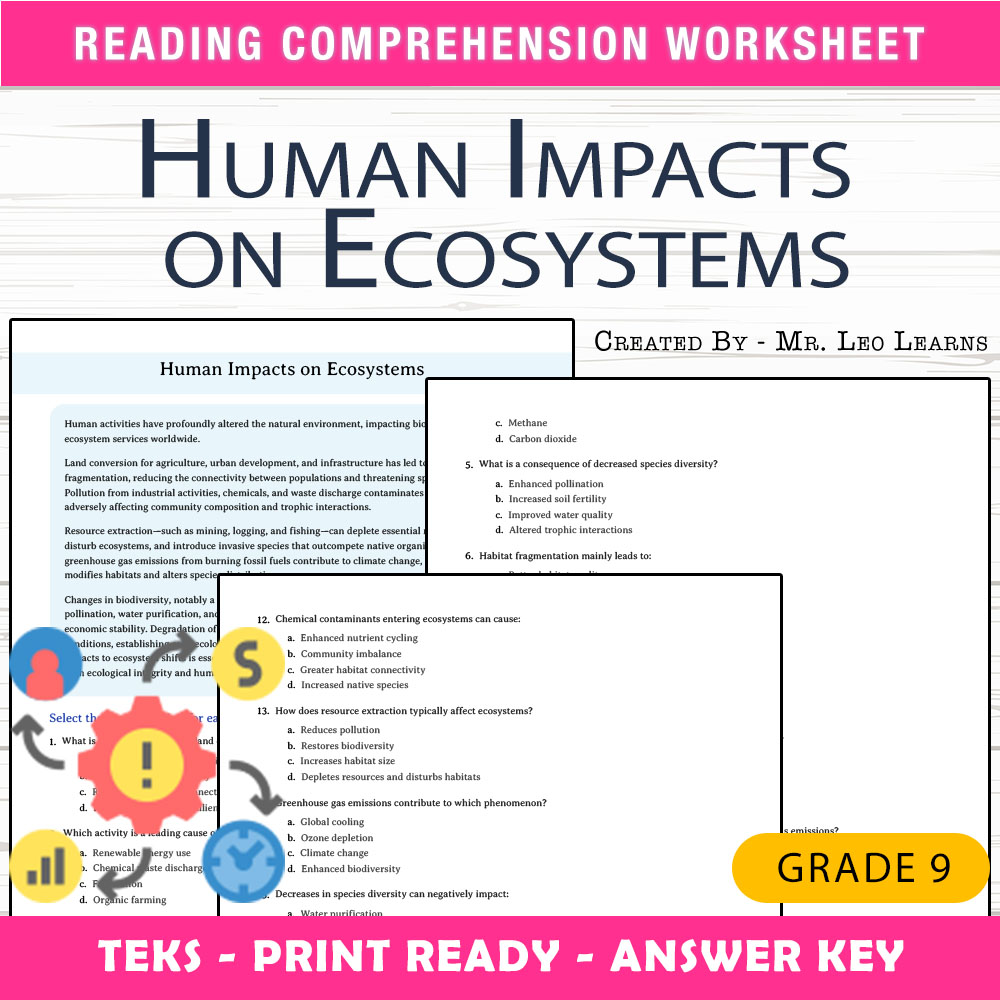
Grade 9 Science — Human Impacts on Ecosystems Worksheet for Mastery
Created byThe Resource HubLearning Objectives
- Understand how human activities such as land use change, pollution, and resource extraction impact biodiversity and ecosystem services.
- Identify the effects of habitat fragmentation and invasive species on community interactions.
- Describe how changes in species diversity influence ecosystem functions like pollination and water purification.
Also included in: Grade 9 Science Ecosystems & Biogeochemical Cycles Unit Bundle (Worksheet Pack) +1 more
Instant download
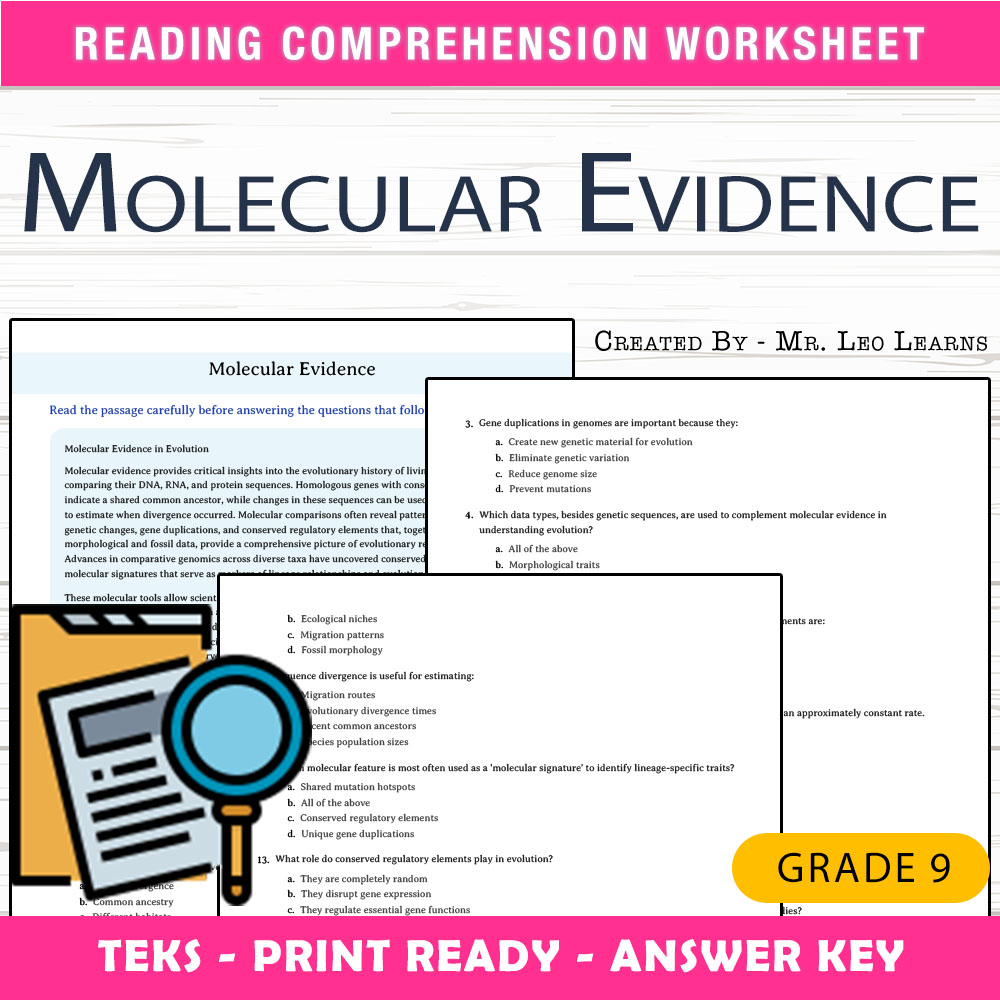
Grade 9 Science — Molecular Evidence Worksheet for Mastery
Created byThe Resource HubLearning Objectives
- Understand how DNA, RNA, and protein sequences are used to infer evolutionary relationships.
- Identify the significance of homologous genes and conserved sequences in determining common ancestry.
- Explain the concept of molecular clocks and how sequence divergence helps estimate divergence times.
Also included in: Grade 9 Science Evolution & Classification Unit Worksheet Pack +1 more
Instant download
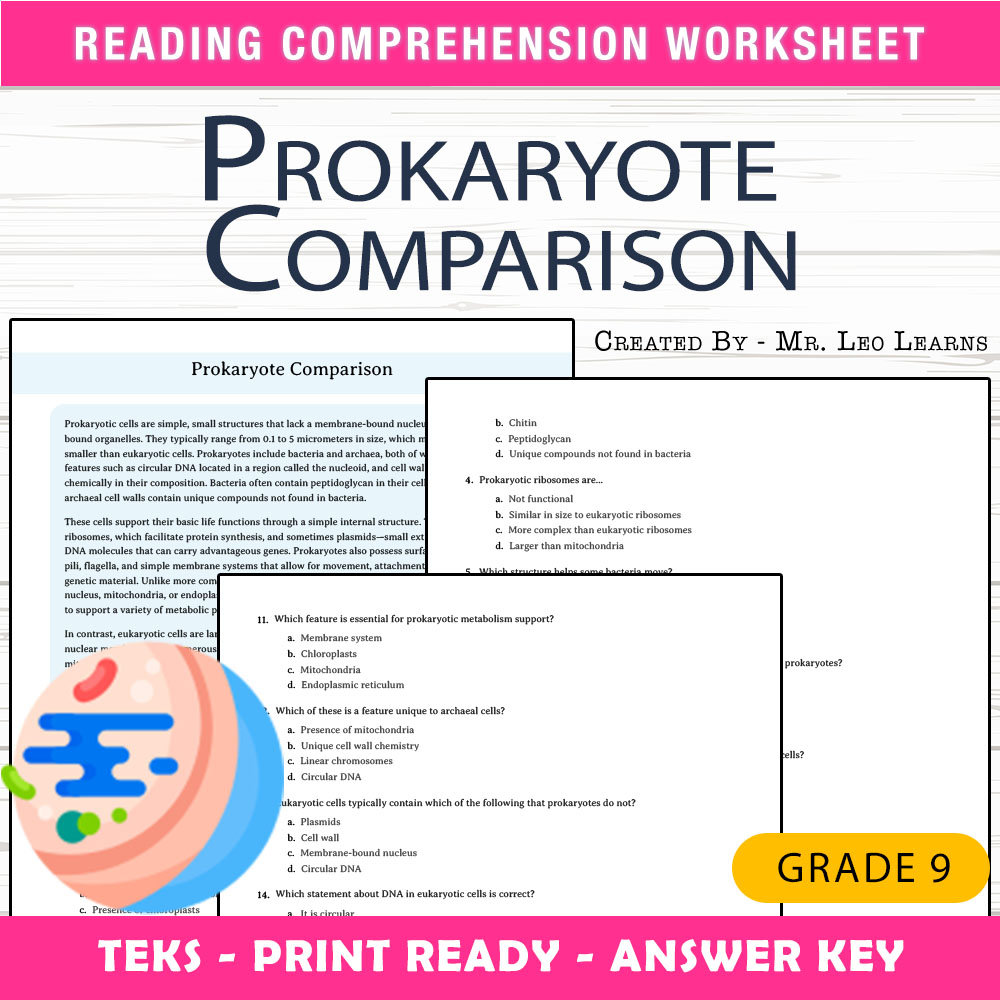
Grade 9 Science – Prokaryote Comparison Worksheet for Mastery
Created byThe Resource HubLearning Objectives
- Compare the structural differences between prokaryotic and eukaryotic cells.
- Identify key features of bacterial and archaeal cells.
- Understand the organization of genetic material in prokaryotes and eukaryotes.
Also included in: Grade 9 Science Unit Bundle | Cell Structures & Transport Mechanisms Worksheets +1 more
Instant download
Grade 9 Science – Complex Inheritance Worksheet for Mastery
Created byThe Resource HubLearning Objectives
- Understand the different mechanisms of complex inheritance such as polygenic traits, epistasis, and pleiotropy.
- Evaluate how variable penetrance and expressivity affect phenotype expression.
- Analyze the role of linkage and environmental factors in inheritance patterns.
Also included in: Grade 9 Science Unit Bundle | Genetics, DNA & Biotechnology Worksheets +1 more
Instant download
Grade 9 Science — Organelle Systems Worksheet for Mastery | PDF + Answer Key
Created byThe Resource HubLearning Objectives
- Describe the interactions and functions of different organelles within cell systems.
- Explain how organelle cooperation supports cell growth, division, and responses to environmental changes.
- Identify and analyze the roles of energy transduction, lipid synthesis, detoxification, and intracellular transport in cells.
Also included in: Grade 9 Science Unit Bundle | Cell Structures & Transport Mechanisms Worksheets +1 more
Instant download
Grade 9 Science – Genetic Drift Worksheet for Mastery
Created byThe Resource HubLearning Objectives
- Understand what genetic drift is and how it affects small populations.
- Identify examples of events that cause genetic drift, such as bottlenecks and founder effects.
- Explain the consequences of genetic drift on allele frequencies and genetic diversity.
Also included in: Grade 9 Science Evolution & Classification Unit Worksheet Pack +1 more
Instant download

Grade 9 Science – Microscopy Analysis Worksheet for Mastery | PDF + Answer Key
Created byThe Resource HubLearning Objectives
- Understand the use of scale bars, resolution limits, and staining patterns in microscopy.
- Identify different microscopy techniques such as electron and fluorescence microscopy.
- Interpret visual data from micrographs to analyze cellular structures and processes.
Also included in: Grade 9 Science Unit Bundle | Cell Structures & Transport Mechanisms Worksheets +1 more
Instant download
Grade 9 Science — Transport Mechanisms Worksheet for Mastery | PDF + Answer Key
Created byThe Resource HubLearning Objectives
- Describe how molecules move across cell membranes through passive processes like diffusion and osmosis.
- Explain the role of membrane proteins and ATP in active transport.
- Differentiate between vesicular transport, including endocytosis and exocytosis.
Also included in: Grade 9 Science Unit Bundle | Cell Structures & Transport Mechanisms Worksheets +1 more
Instant download
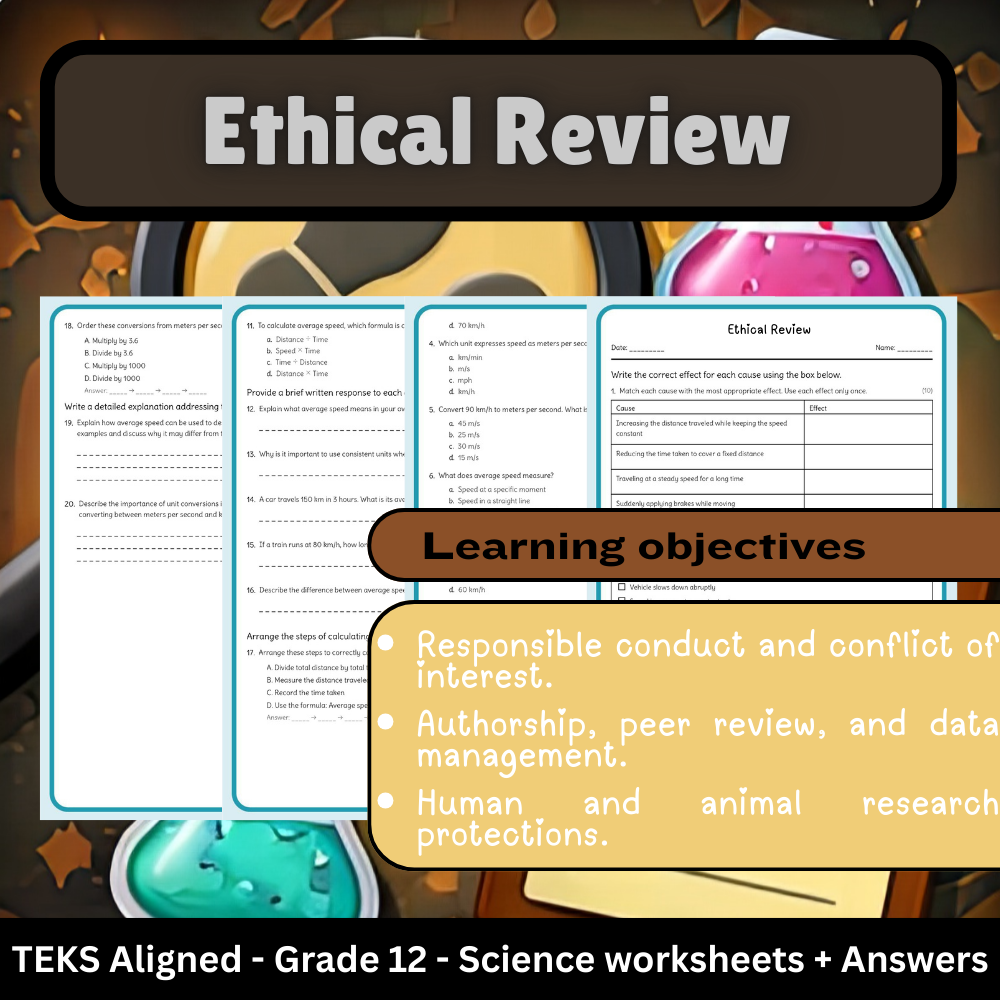
Grade 12 Science | Ethical Review Worksheet (PDF) aligned with TEKS standards
Created byBright Mind ResourcesLearning Objectives
- Understand the principles of responsible conduct of research, including conflicts of interest and data management.
- Identify standards and procedures for authorship, peer review, and reporting of results.
- Recognize ethical considerations in human and animal research protections.
Instant download

Grade 6 Fundamental vs Realized Niche Dynamics Worksheet | Ontario Science
 Created byTeacher's Corner
Learning Objectives
- Distinguish between fundamental niches and realized niches using environmental and biotic factors
- Describe how abiotic conditions and interspecific interactions influence where organisms live
- Use measurable parameters to predict how habitat changes could affect species distribution
Instant download

Grade 7 Science – Material Selection Properties | Daily Reading Worksheet
Created byBright Mind ResourcesLearning Objectives
- Identify physical properties such as density, hardness, and melting point.
- Explain chemical properties like corrosion resistance and reactivity.
- Match material properties to their practical applications.
Also included in: Grade 7 States of Matter & Reactions Science Daily Reading Lesson Bundle | BC +1 more
Instant download

Grade 10 Science | System Optimization Worksheet with Short Notes (PDF)
 Created byMeadowlark Worksheets
Learning Objectives
- Understand the key principles involved in optimizing communication systems.
- Apply mathematical models and analysis techniques to evaluate system performance.
- Identify trade-offs among range, throughput, and reliability in communication networks.
Also included in: Grade 10 Science NGSS Waves & Technology Unit Bundle +1 more
Instant download

Grade 10 Science | Wave Properties Worksheet with Short Notes (Printable PDF)
Created byMeadowlark WorksheetsLearning Objectives
- Understand and describe the key properties of waves: amplitude, wavelength, frequency, and speed.
- Apply the relationship v = fλ to quantitative problems involving wave motion.
- Explain the concepts of superposition, interference, and standing waves using trigonometric and phase relationships.
Also included in: Grade 10 Science NGSS Waves & Technology Unit Bundle +1 more
Instant download

Grade 10 Science | Signal Transmission Worksheet with Short Notes (PDF)
Created byMeadowlark WorksheetsLearning Objectives
- Understand the different modulation schemes used in signal transmission.
- Identify channel constraints and their effects on communication quality.
- Compare the advantages and limitations of radio frequency and optical fiber links.
Also included in: Grade 10 Science NGSS Waves & Technology Unit Bundle +1 more
Instant download

Grade 10 Science | Electromagnetic Behavior Worksheet with Short Notes (PDF)
Created byMeadowlark WorksheetsLearning Objectives
- Understand the relationship between photon energy and electromagnetic spectra using Planck’s relation E=hf.
- Identify the characteristics of continuous and line spectra from thermal sources.
- Explain how spectral signatures assist in identifying electromagnetic emissions across various bands.
Also included in: Grade 10 Science NGSS Waves & Technology Unit Bundle +1 more
Instant download
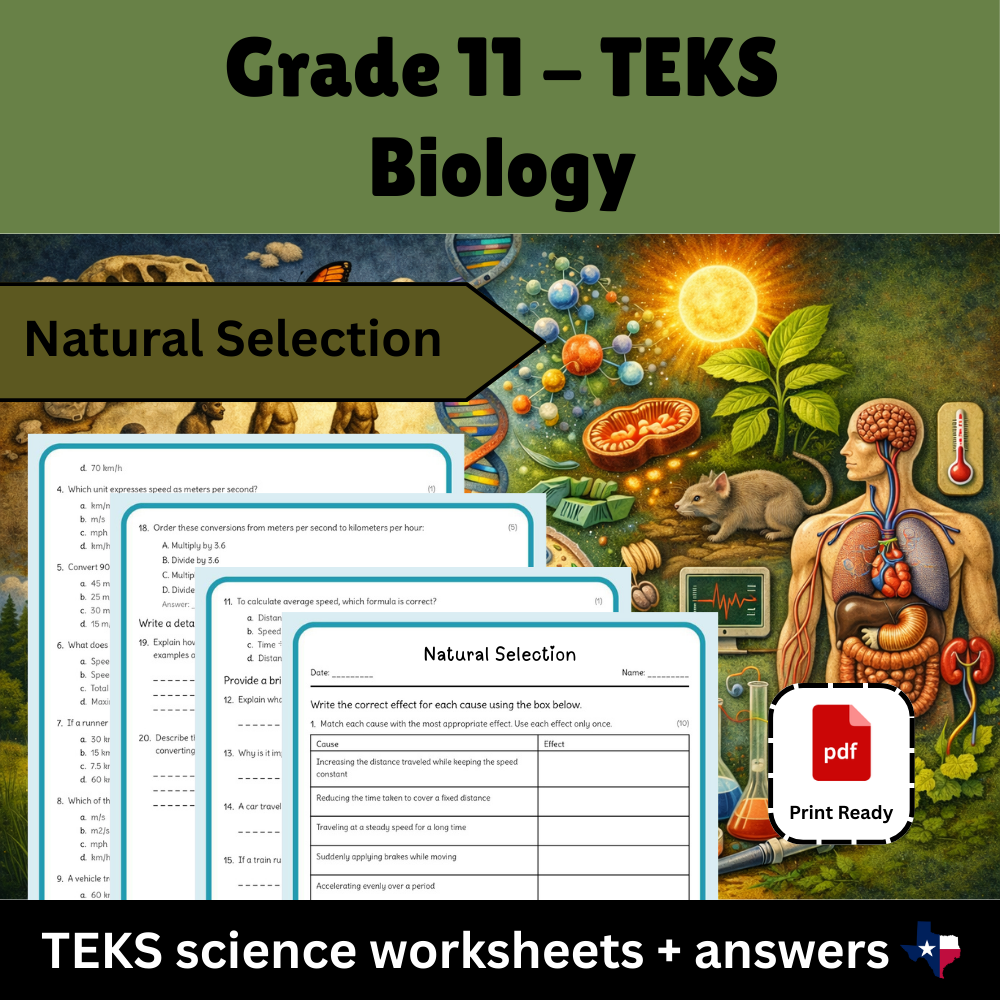
Grade 11 Science – Natural Selection Worksheet (Worksheet + Answer Key) | TEKS-Aligned
Created byBright Mind ResourcesLearning Objectives
- Understand the concept of natural selection and how heritable variation affects survival.
- Identify different modes of selection: directional, stabilizing, and disruptive.
- Recognize examples of natural selection such as antibiotic resistance and camouflage.
Also included in: Grade 11 Science | Evolution & Phylogenetics Worksheet Bundle (TEKS Aligned) +2 more
Instant download
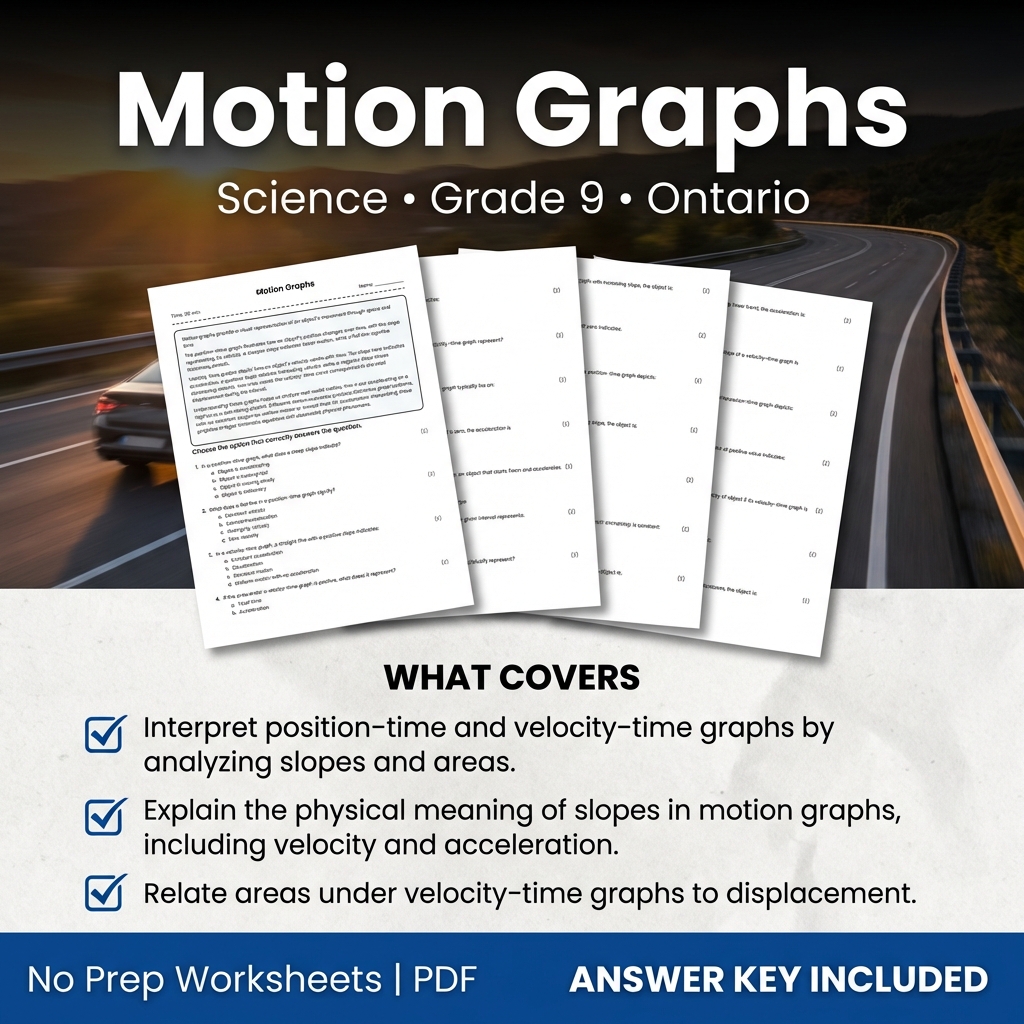
Motion Graphs Worksheet for Grade 9 Science | Ontario Standards
Created byCoral Reef LearningLearning Objectives
- Interpret position–time and velocity–time graphs by analyzing slopes and areas.
- Explain the physical meaning of slopes in motion graphs, including velocity and acceleration.
- Relate areas under velocity–time graphs to displacement.
Instant download
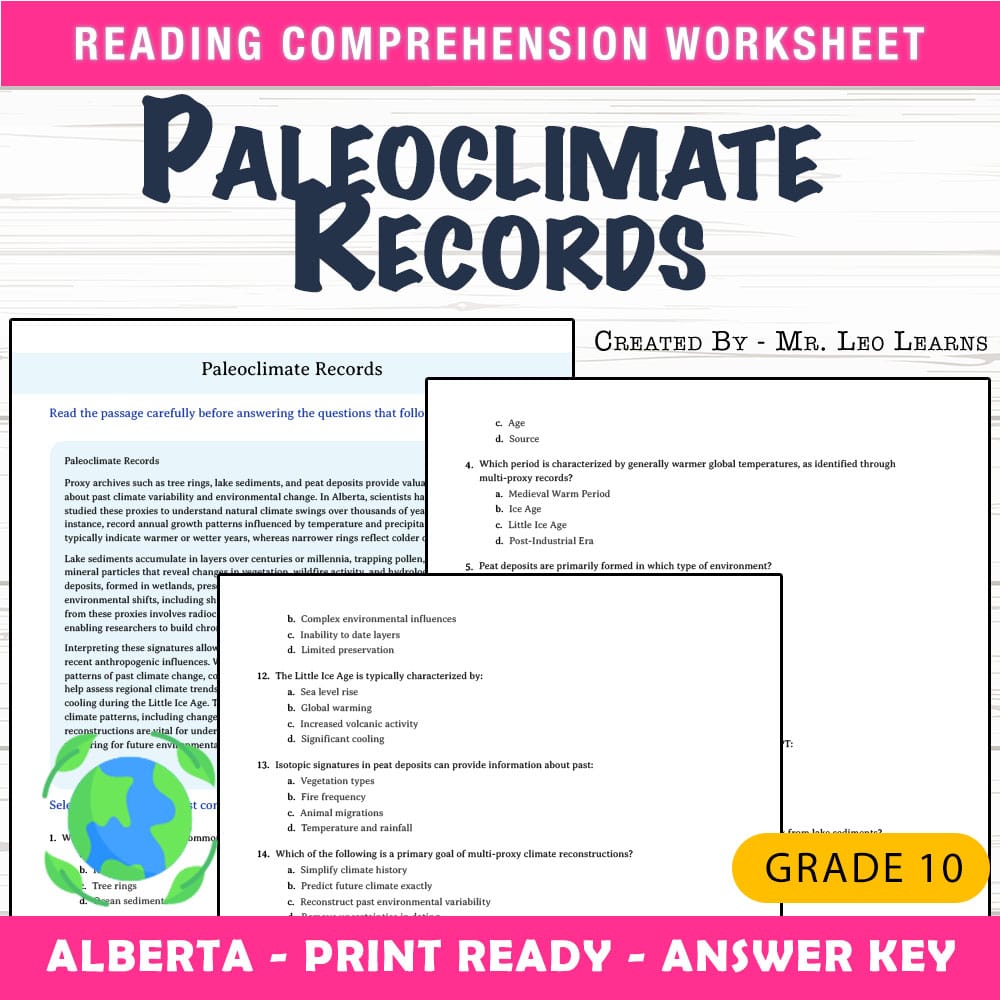
Grade 10 Science — Paleoclimate Records Worksheet MCQ Paper
Created byThe Resource HubLearning Objectives
- Understand the concept of proxy archives and their role in reconstructing past climates.
- Identify various types of paleoclimate proxies found in Alberta.
- Learn methods used to extract and interpret climate signals from proxy records.
Also included in: Grade 10 Science Bundle | Earth and Space Systems Worksheets +1 more
Instant download
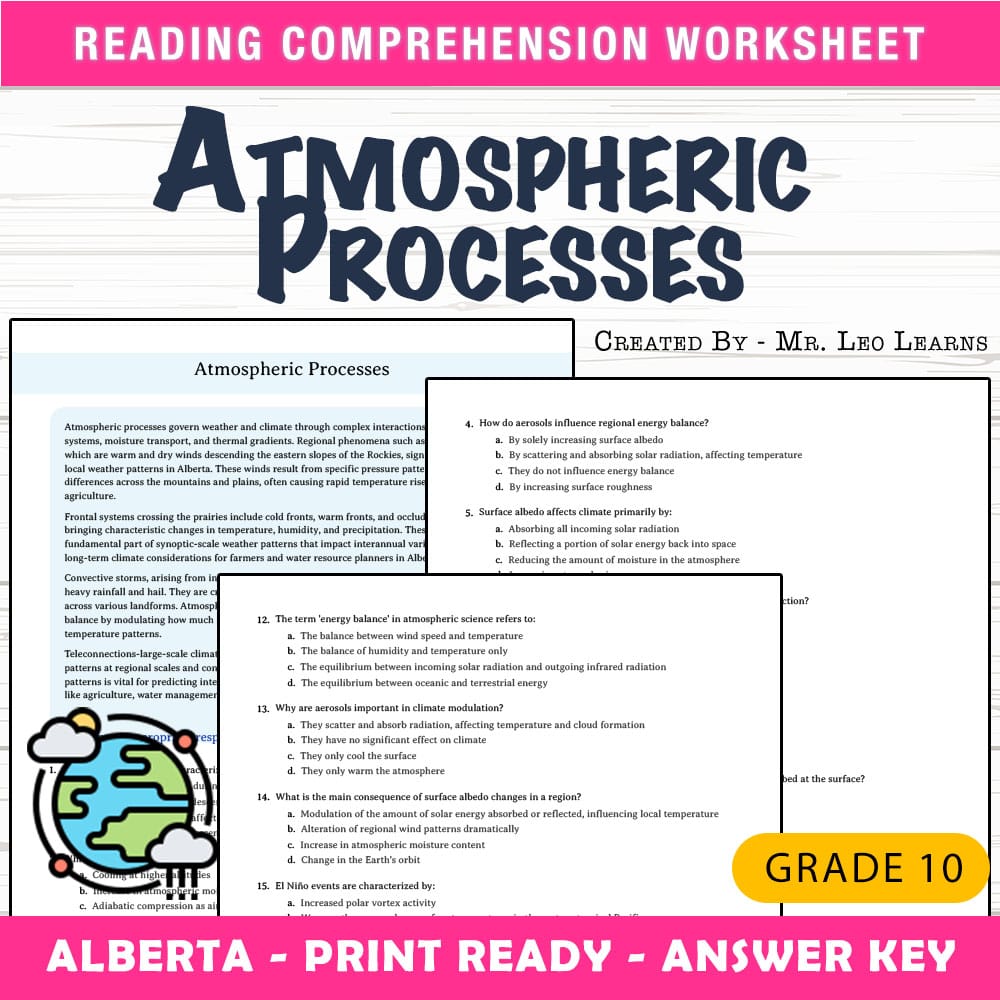
Grade 10 Science — Worksheet MCQ Paper for Mastering Atmospheric Processes
Created byThe Resource HubLearning Objectives
- Understand regional atmospheric phenomena such as Chinook winds, frontal systems, and convective storms.
- Explain how atmospheric composition, aerosols, and surface albedo influence energy balance.
- Analyze how teleconnections and synoptic patterns produce variability affecting agriculture and water resources.
Also included in: Grade 10 Science Bundle | Earth and Space Systems Worksheets +1 more
Instant download
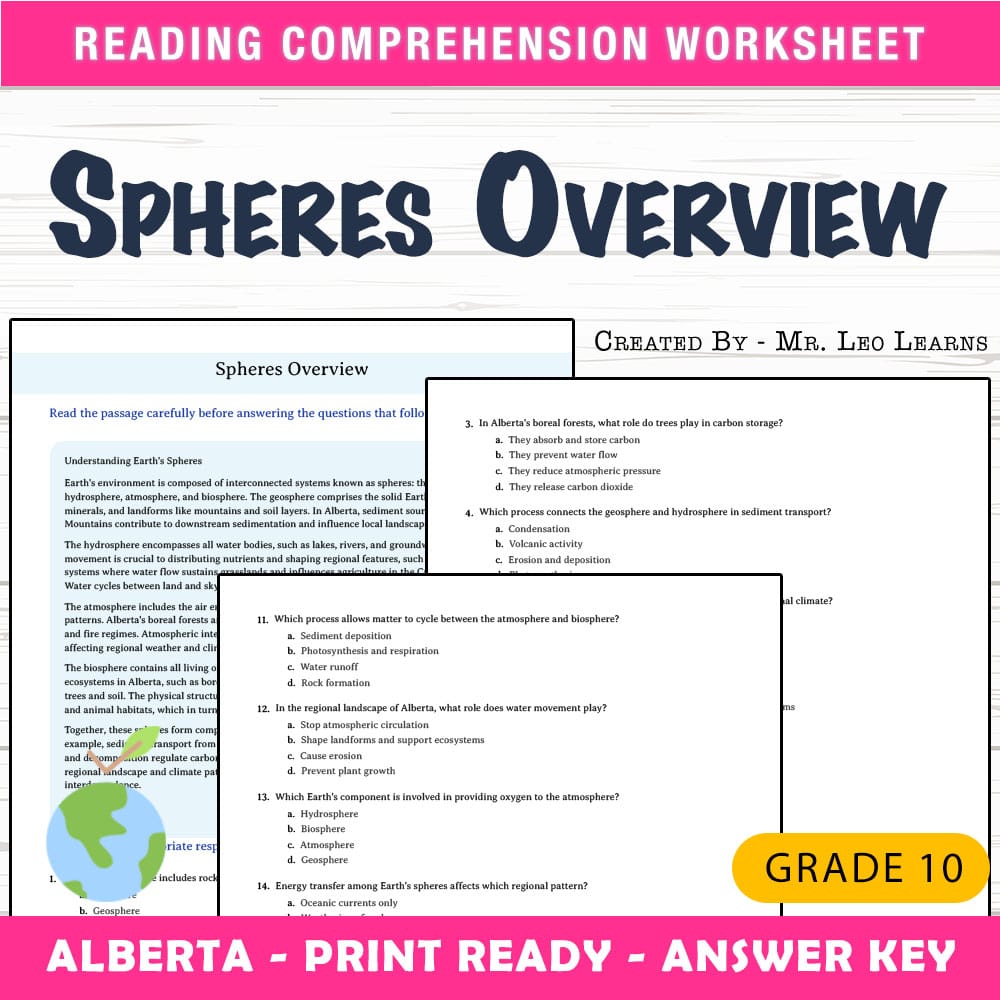
Grade 10 Science — Spheres Overview Worksheet MCQ Paper for Mastery
Created byThe Resource HubLearning Objectives
- Describe the basic properties of Earth's geosphere, hydrosphere, atmosphere, and biosphere.
- Explain how matter and energy pathways connect the different Earth spheres.
- Identify regional examples of Earth spheres, such as sediment sources and forest carbon storage.
Also included in: Grade 10 Science Bundle | Earth and Space Systems Worksheets +1 more
Instant download
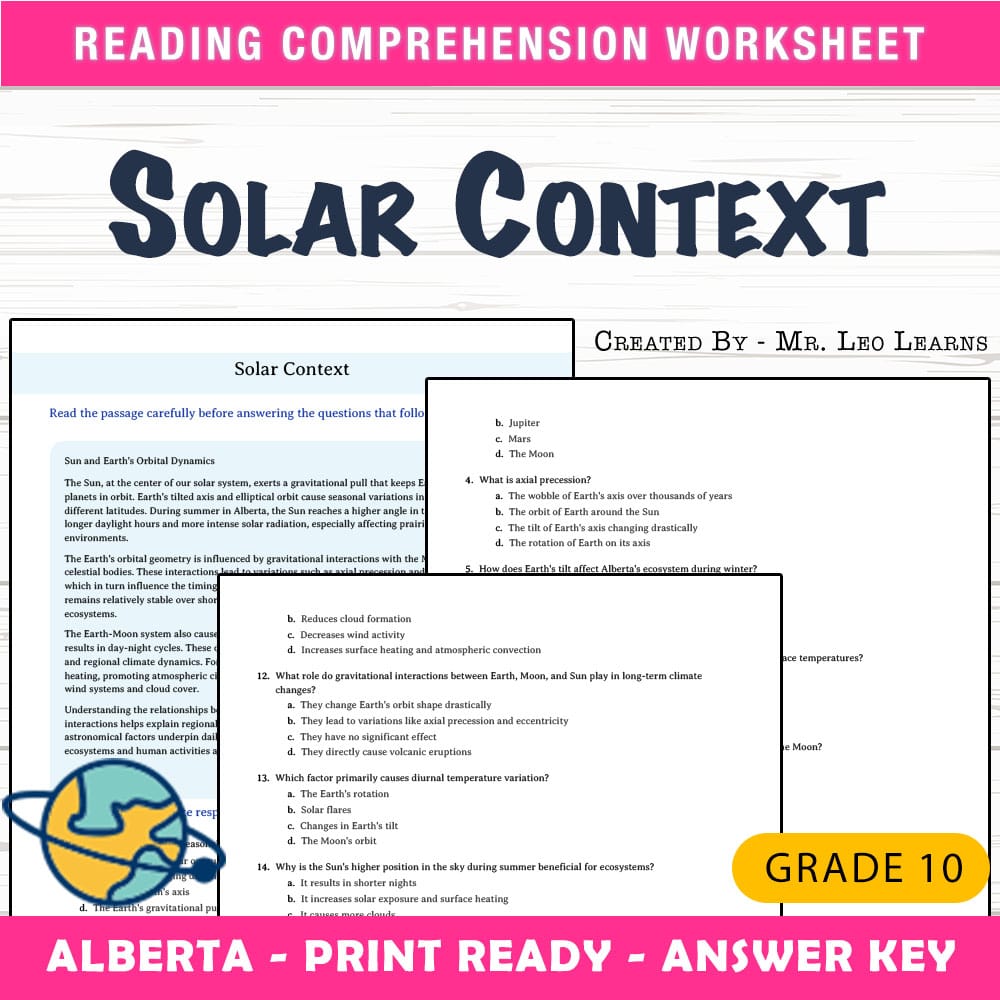
Grade 10 Science — Solar Context Worksheet MCQ Paper for Mastery
Created byThe Resource HubLearning Objectives
- Understand how the Sun's position influences Earth's seasons and daily energy input.
- Identify the effects of orbital geometry and solar angles on climate and ecosystems.
- Explain the gravitational interactions among Earth, Moon, and Sun and their impact on regional phenomena.
Also included in: Grade 10 Science Bundle | Earth and Space Systems Worksheets +1 more
Instant download

Grade 8 DNA Instructions Worksheet | Practice & Assessment PDF
Created byClear Sky ClassroomLearning Objectives
- Explain how DNA functions as a coded set of instructions in cells.
- Describe the relationships among DNA, genes, chromosomes, proteins, and inherited traits.
- Identify how changes in DNA can affect protein production and variation across generations.
Instant download
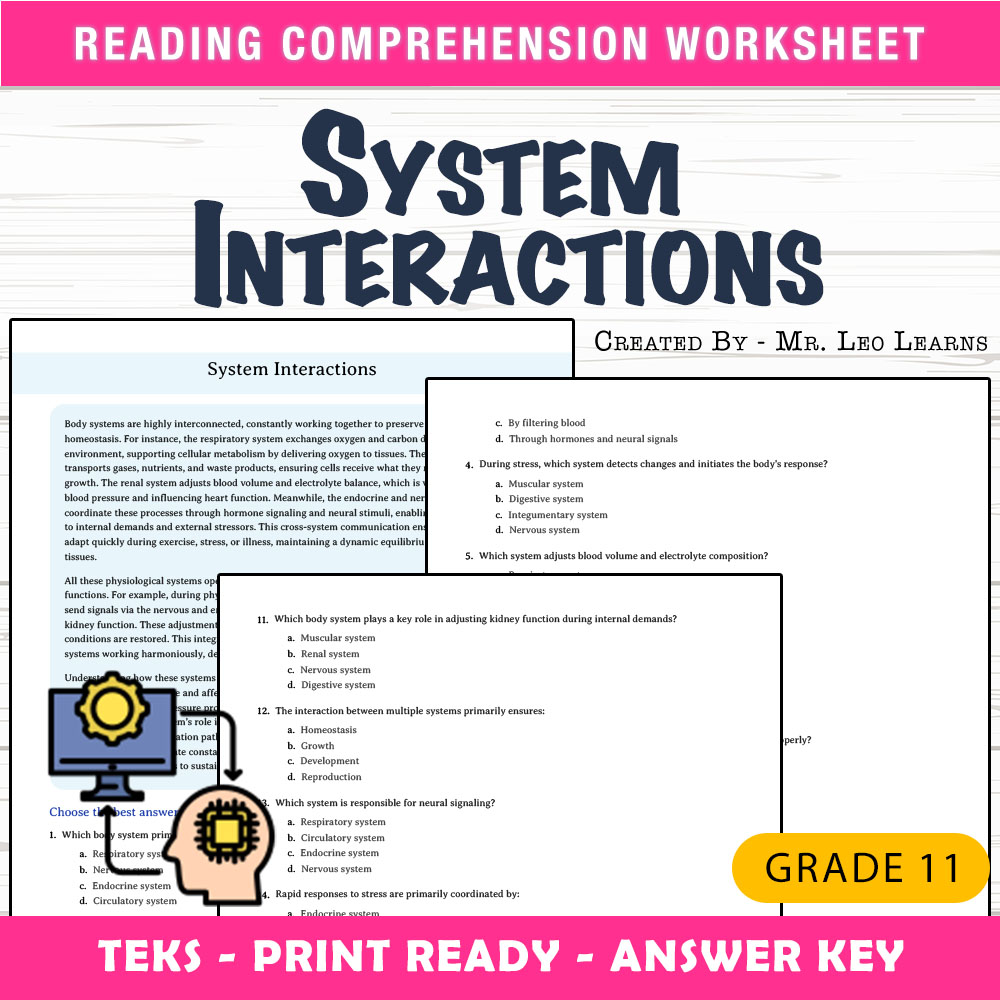
11th Grade Science – System Interactions Worksheet for Mastering Body Systems
Created byThe Resource HubLearning Objectives
- Understand how different body systems communicate to maintain internal balance.
- Identify specific roles of the respiratory, circulatory, renal, endocrine, and nervous systems.
- Explain how cross-system communication supports homeostasis during stress and activity.
Also included in: Grade 11 Science | Human Body Systems & Physiology Worksheet Bundle +1 more
Instant download

Natural Selection Worksheet | TEKS-Aligned Science Practice for Grade 11
JCreated byJ.S SheetsLearning Objectives
- Explain how heritable variation and environmental pressures can change allele frequencies over generations
- Differentiate directional, stabilizing, and disruptive selection by predicting shifts in trait distributions
- Use real examples (e.g., antibiotic resistance, camouflage) to describe evidence of adaptive change
Instant download
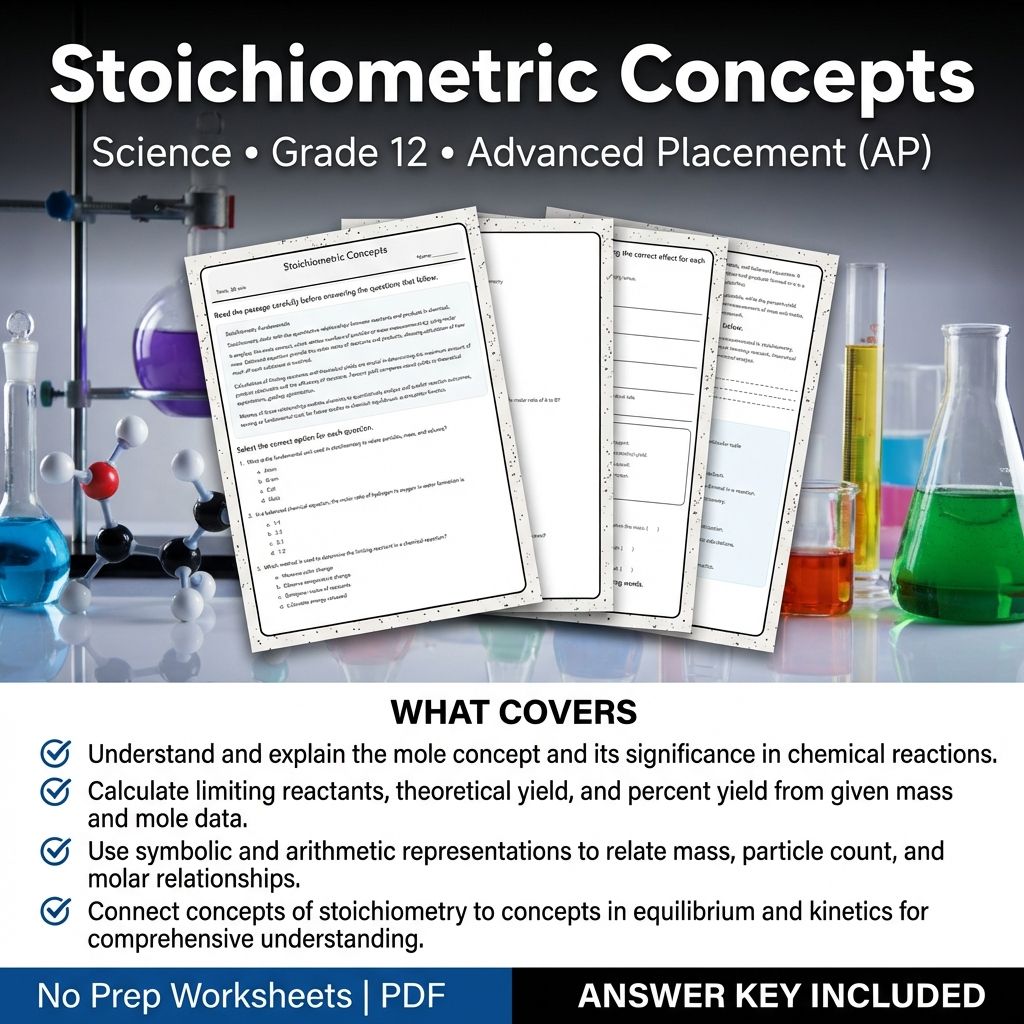
Grade 12 Science | Stoichiometric Concepts Worksheet & Answer Key (Printable PDF)
Created byCoral Reef LearningLearning Objectives
- Understand and explain the mole concept and its significance in chemical reactions.
- Calculate limiting reactants, theoretical yield, and percent yield from given mass and mole data.
- Use symbolic and arithmetic representations to relate mass, particle count, and molar relationships.
Also included in: Grade 12 Science Unit Worksheet Bundle – Advanced Chemistry Concepts & Topics +1 more
Instant download
Browse more categories
About Science Worksheets
Find Science worksheets spanning core skills, practice, and review. All 44,295 resources are instant PDF downloads for the classroom or home.
Every worksheet on MyTeachingSheets is created by independent teacher-authors and reviewed before publication. All resources download as printable PDFs for classroom, homework, or at-home practice, and many include answer keys. Preview any worksheet free before buying.