
Science Worksheets
42,822 subject resources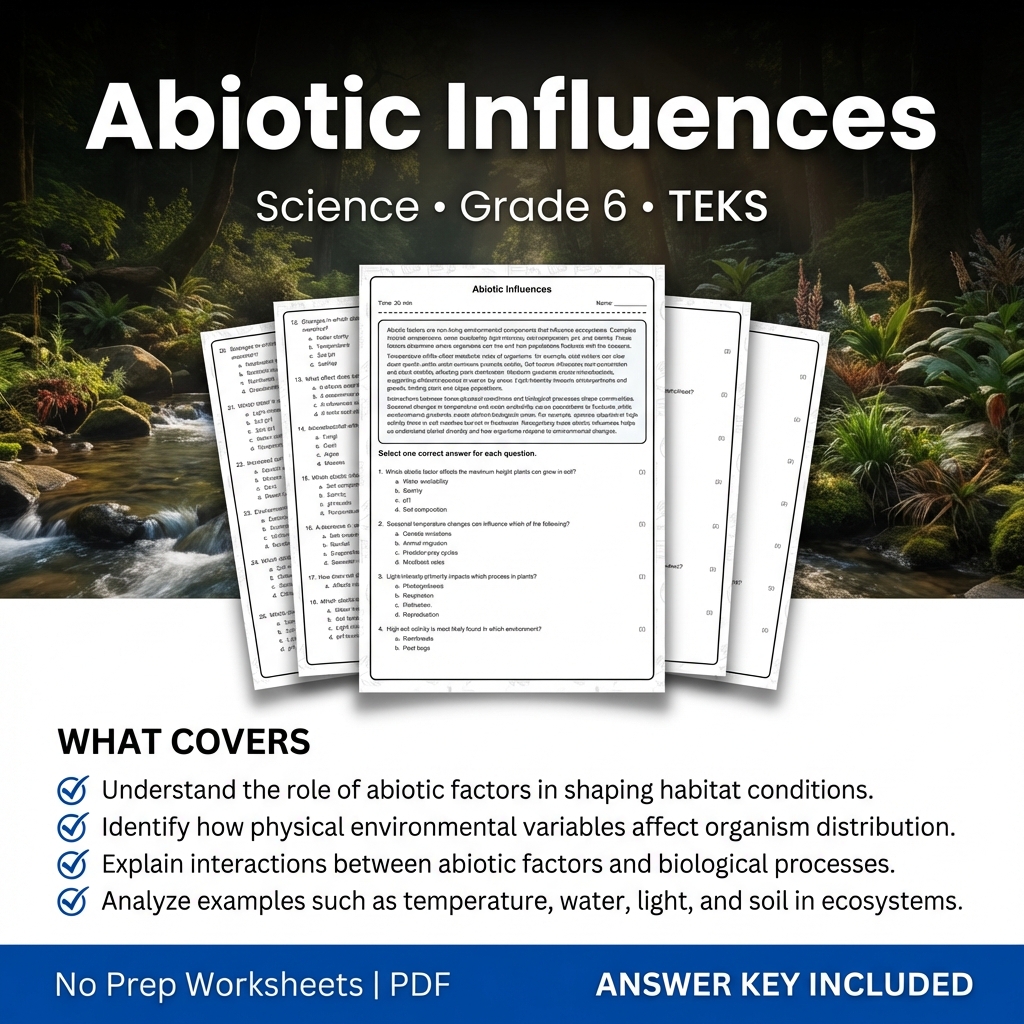
Grade 6 Science Worksheet on Abiotic Influences | TEKS Aligned
 Created byCoral Reef Learning
Learning Objectives
- Understand the role of abiotic factors in shaping habitat conditions.
- Identify how physical environmental variables affect organism distribution.
- Explain interactions between abiotic factors and biological processes.
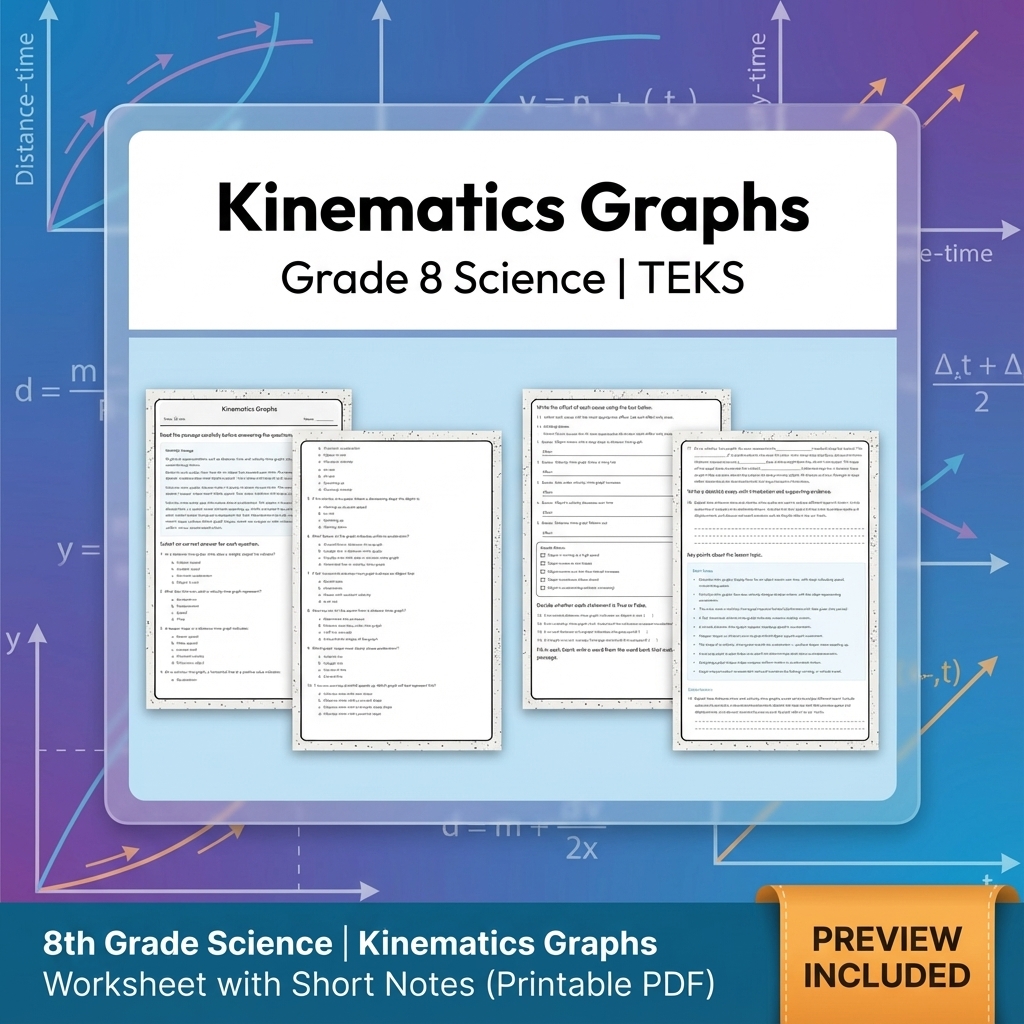
8th Grade Science | Kinematics Graphs Worksheet with Short Notes (Printable PDF)
 Created byMeadowlark Worksheets
Learning Objectives
- Understand how to interpret and analyze distance–time and velocity–time graphs.
- Learn to calculate speed and acceleration from the slope of graphs.
- Use area under graphs to determine displacement and understand motion profiles.
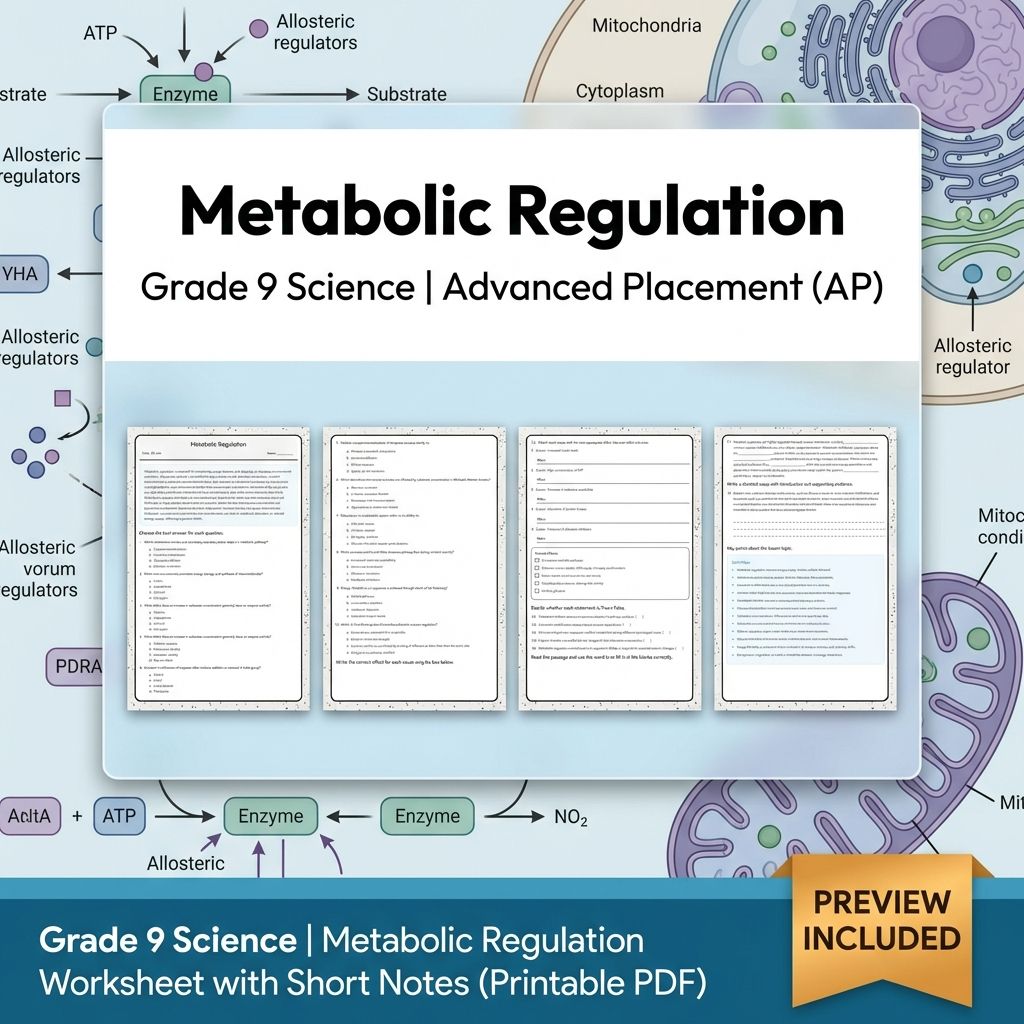
Grade 9 Science | Metabolic Regulation Worksheet with Short Notes (PDF)
Created byMeadowlark WorksheetsLearning Objectives
- Understand the regulatory mechanisms that coordinate metabolic pathways, including allosteric enzyme control and covalent modifications.
- Explain feedback inhibition and hormonal signals that shift metabolic flux between catabolism and anabolism.
- Model how enzyme kinetics and substrate concentrations influence pathway rates.
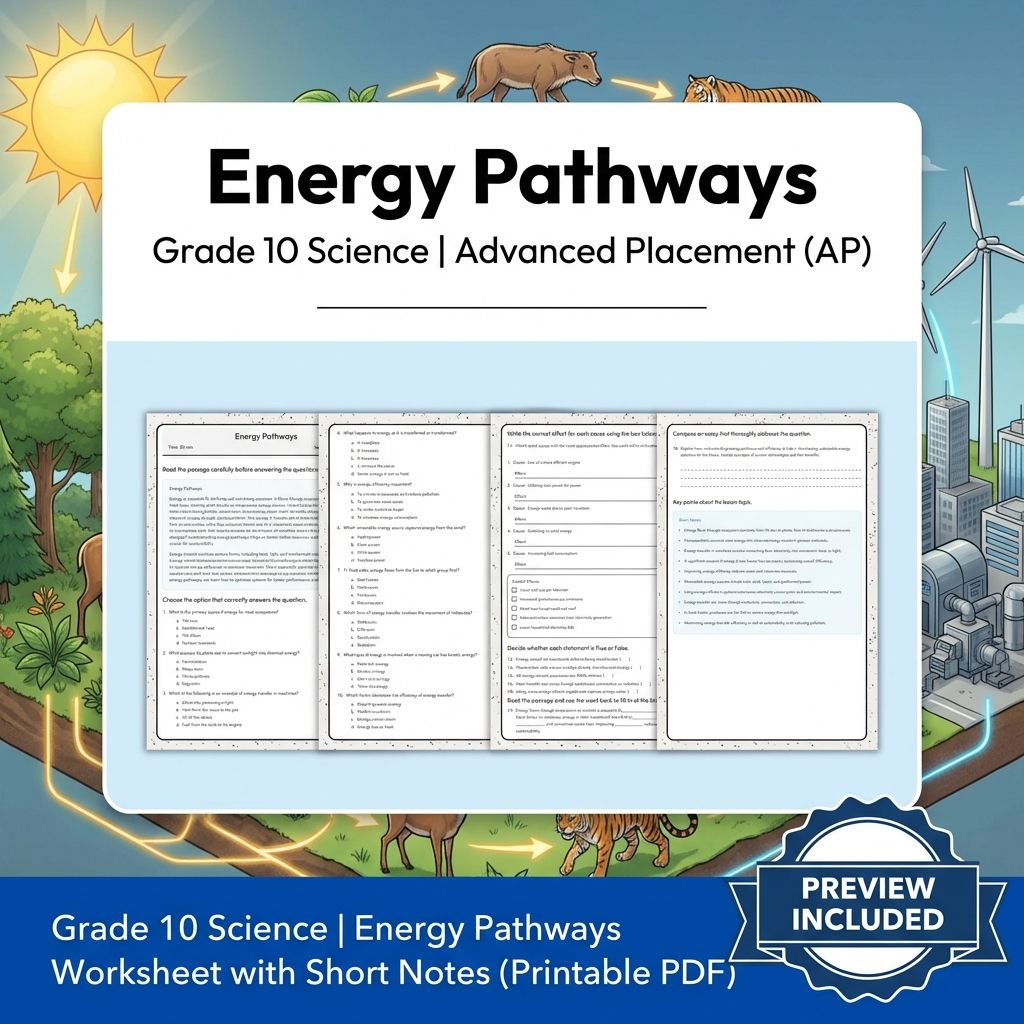
Grade 10 Science | Energy Pathways Worksheet with Short Notes (Printable PDF)
Created byMeadowlark WorksheetsLearning Objectives
- Understand the concept of energy transfer and transformation in different pathways.
- Identify various energy sources and their roles in energy transfer.
- Analyze how energy flows through ecosystems and machines.
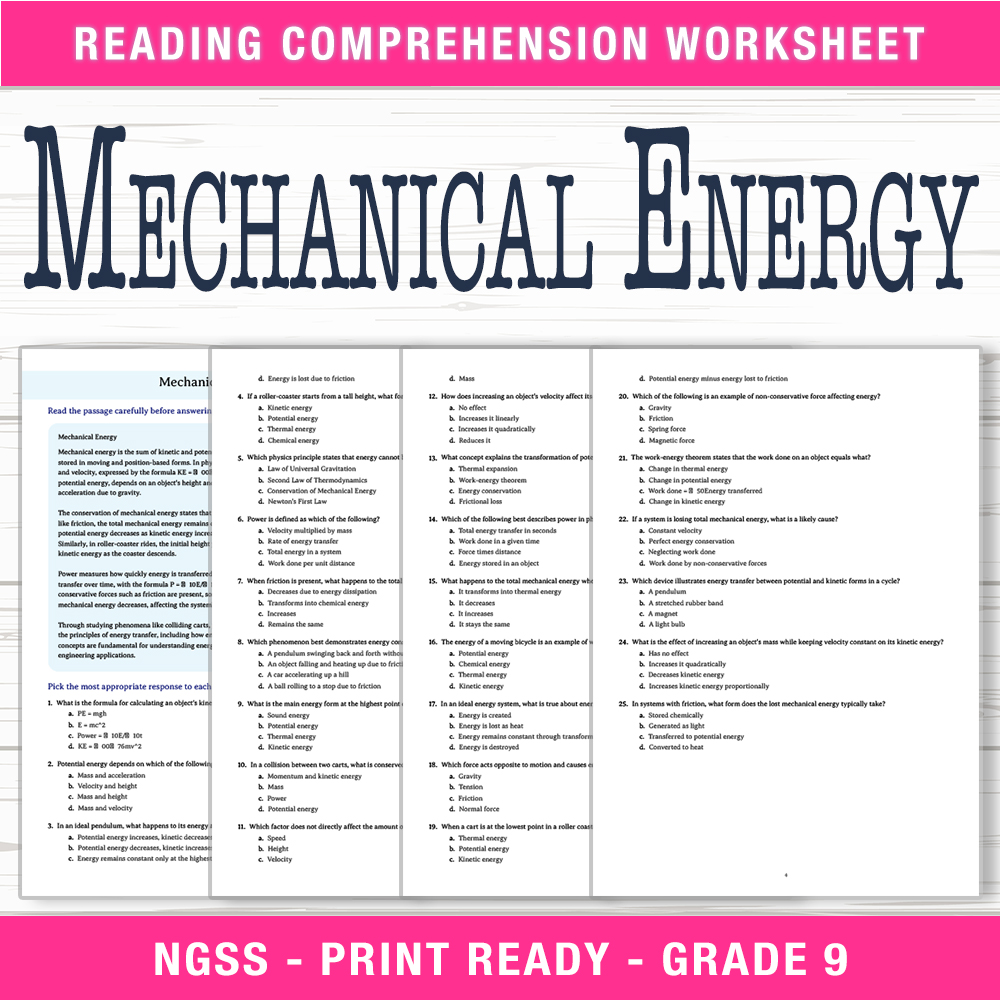
Grade 9 Science | Mechanical Energy Worksheet (PDF + Answer Key)
 Created byRiverstone Classroom
Learning Objectives
- Define and differentiate between kinetic and potential energy in mechanical systems.
- Apply the work-energy theorem to analyze energy transfer in near-ideal systems.
- Calculate mechanical energy, power, and analyze the effects of non-conservative forces like friction.
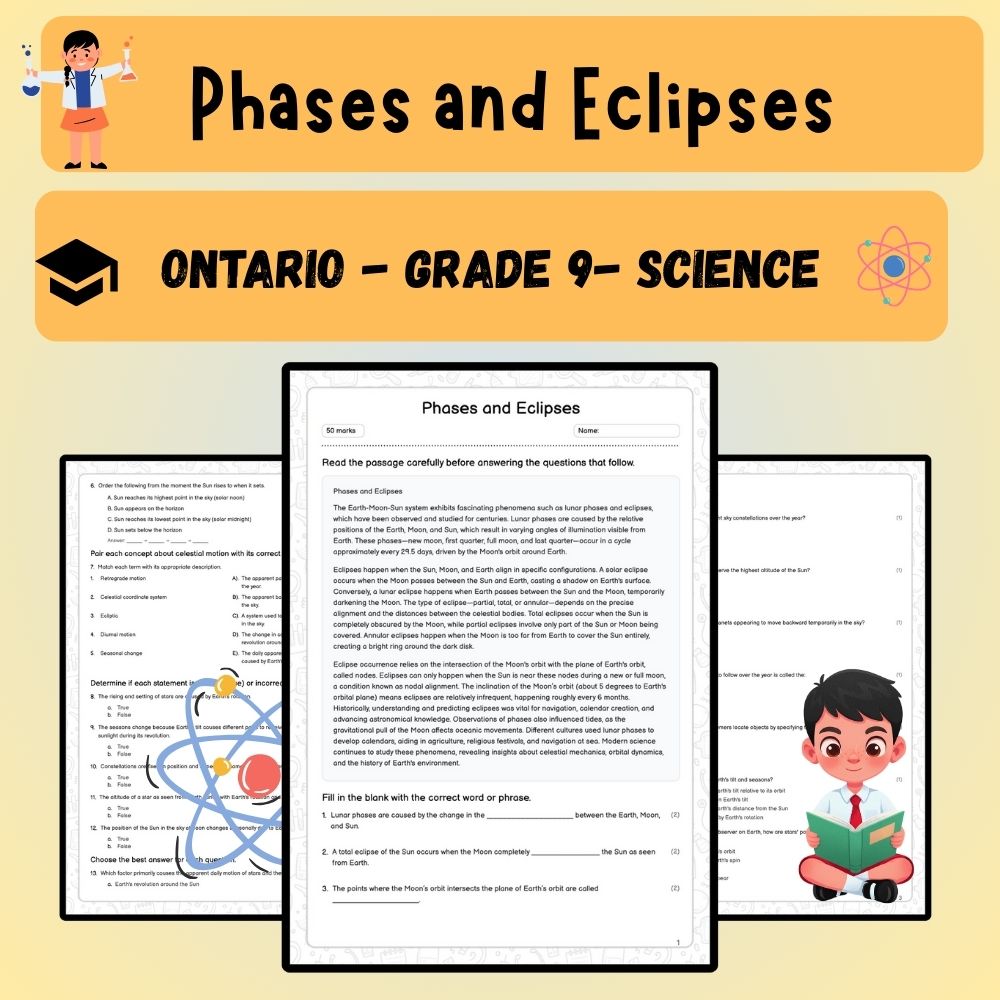
Grade 9 Science | Phases and Eclipses Worksheet (Worksheet + Answer Key) - Ontario
 Created byPrism Point Learning
Learning Objectives
- Describe the geometric conditions that lead to lunar phases, solar, and lunar eclipses.
- Differentiate between partial, total, and annular eclipses and identify their observational characteristics.
- Explain the importance of node alignment and orbital inclination in eclipse occurrence.
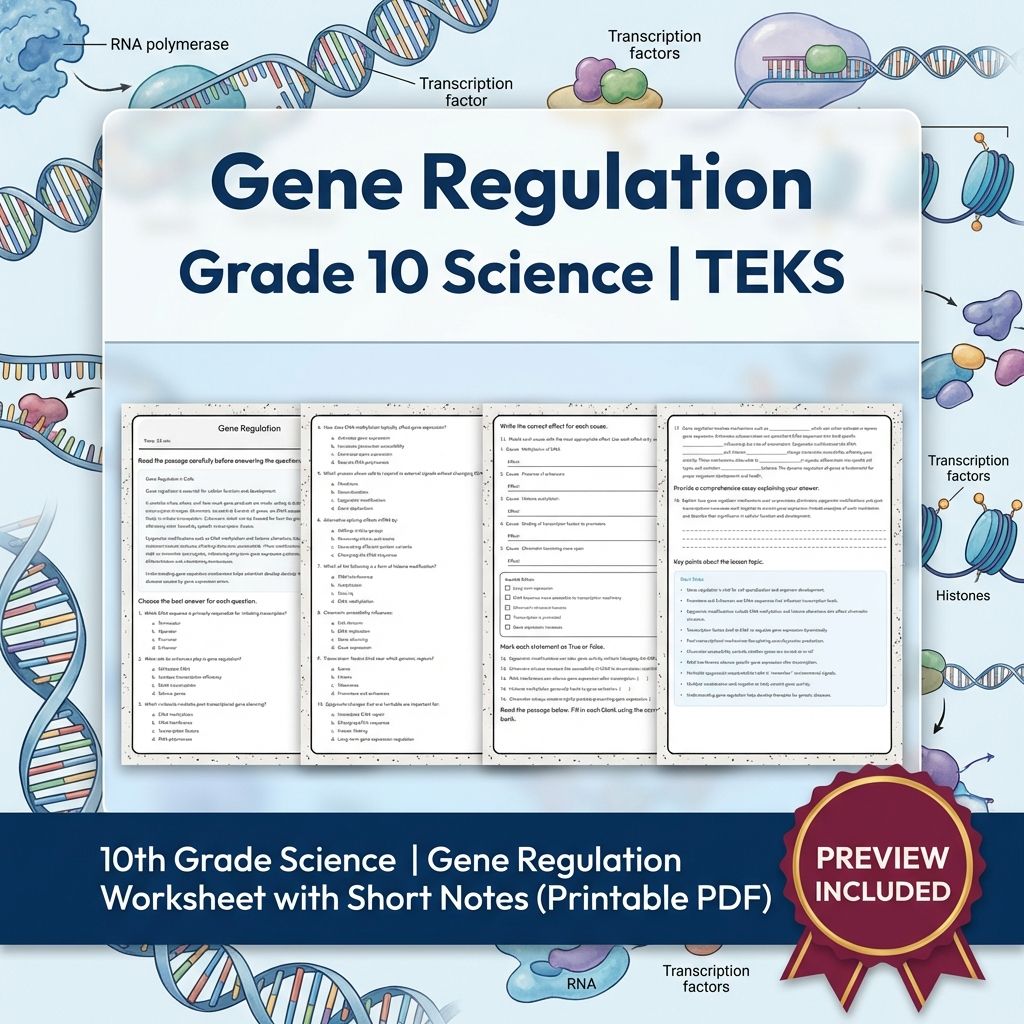
10th Grade Science | Gene Regulation Worksheet with Short Notes (Printable PDF)
Created byMeadowlark WorksheetsLearning Objectives
- Understand the mechanisms involved in gene regulation at transcriptional and post-transcriptional levels.
- Identify the roles of promoters, enhancers, and transcription factors in gene expression.
- Explain how epigenetic modifications influence gene activity.
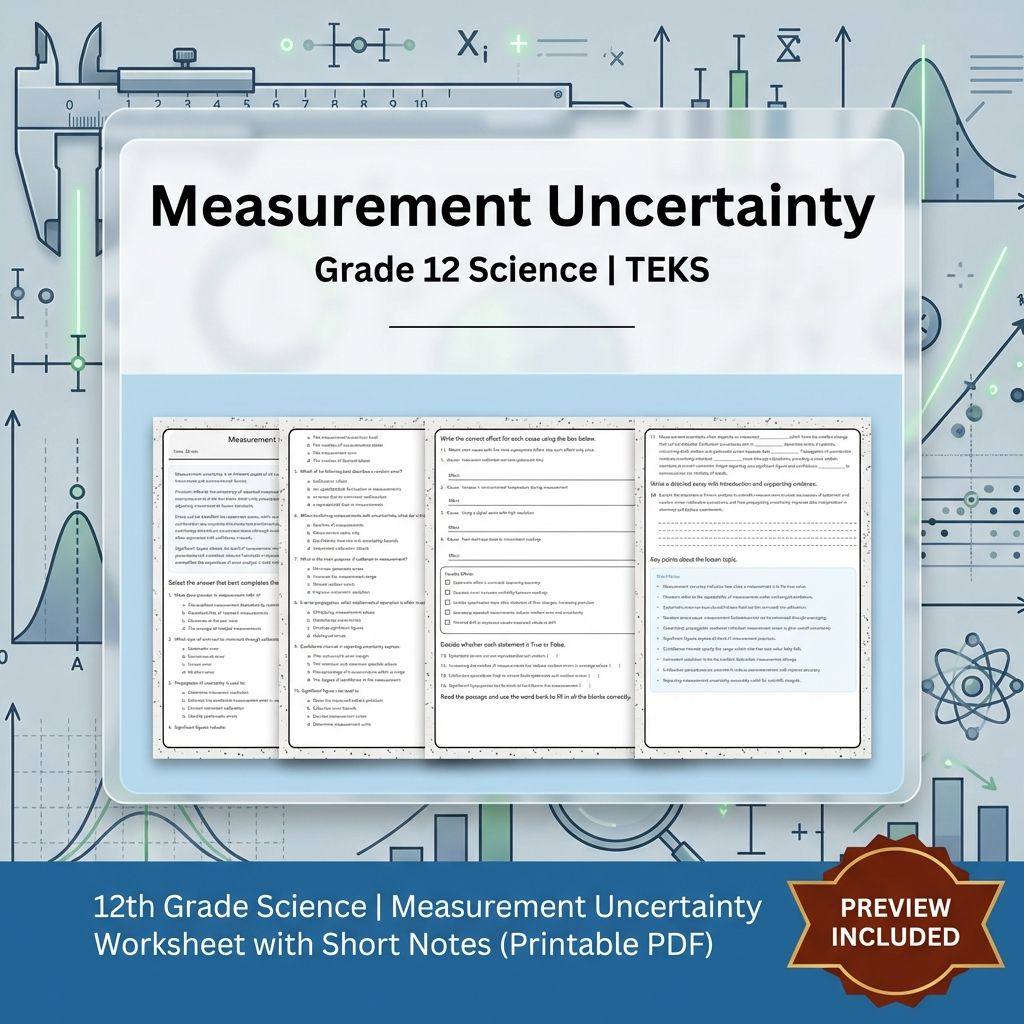
12th Grade Science | Measurement Uncertainty Worksheet with Short Notes (PDF)
Created byMeadowlark WorksheetsLearning Objectives
- Understand the concepts of measurement accuracy and precision in scientific experiments.
- Identify types of errors and methods for error propagation in calculations.
- Apply significant figures, calibration procedures, and reporting conventions for uncertainty.
8th Grade Science Critical Evaluation Worksheet with Short Notes (Printable PDF)
Created byMeadowlark WorksheetsLearning Objectives
- Develop skills to assess the validity of scientific claims and evidence.
- Identify logical fallacies and distinguish correlation from causation in data.
- Evaluate the quality and credibility of scientific sources and methodologies.
10th Grade Science | Sphere Connections Worksheet with Short Notes (PDF)
Created byMeadowlark WorksheetsLearning Objectives
- Explain how the four spheres—geosphere, hydrosphere, atmosphere, and biosphere—interact through coupled processes.
- Use flow diagrams and mass-balance reasoning to understand system perturbations and their propagation.
- Identify observable indicators such as streamflow, soil moisture, and primary productivity that reflect sphere interactions.
8th Grade Science Ecosystem Structure Worksheet with Short Notes (Printable PDF)
Created byMeadowlark WorksheetsLearning Objectives
- Describe the components and functions of different ecosystems.
- Identify biotic and abiotic factors influencing ecosystems.
- Explain the roles of producers, consumers, and decomposers in energy flow.
8th Grade Science Applications Design Worksheet with Short Notes (Printable PDF)
Created byMeadowlark WorksheetsLearning Objectives
- Understand how matter and energy influence material choices in engineering applications.
- Analyze trade-offs among material properties such as density, conductivity, and reactivity.
- Evaluate real-world examples of energy storage and insulation with conceptual reasoning.
Grade 10 Science | Statistical Reasoning Worksheet with Short Notes (PDF)
Created byMeadowlark WorksheetsLearning Objectives
- Understand how to summarize and compare datasets using measures of central tendency and variability.
- Learn to interpret confidence intervals and effect sizes in research contexts.
- Apply basic hypothesis testing principles to evaluate observed differences.
Grade 11 Science | Photosynthesis Processes Worksheet (PDF + Answer Key)
Created byRiverstone ClassroomLearning Objectives
- Explain the light-dependent and light-independent (Calvin cycle) stages of photosynthesis.
- Describe the electron transport chain, photophosphorylation, and carbon fixation mechanisms in chloroplasts.
- Analyze the integration of photosynthesis with mitochondrial respiration in gas exchange and energy transfer.
Grade 10 Science | Quantitative Uncertainty Worksheet with Short Notes (PDF)
Created byMeadowlark WorksheetsLearning Objectives
- Understand measurement uncertainty and sources of error in experiments.
- Apply propagation methods to combine uncertainties in calculations.
- Use significant figures and dimensional analysis to report precise results.
8th Grade Science | Motion Basics Worksheet with Short Notes (Printable PDF)
Created byMeadowlark WorksheetsLearning Objectives
- Understand the fundamental concepts of motion, including position, distance, speed, velocity, and acceleration.
- Differentiate between scalar and vector quantities related to motion.
- Interpret and analyze distance-time and velocity-time graphs.
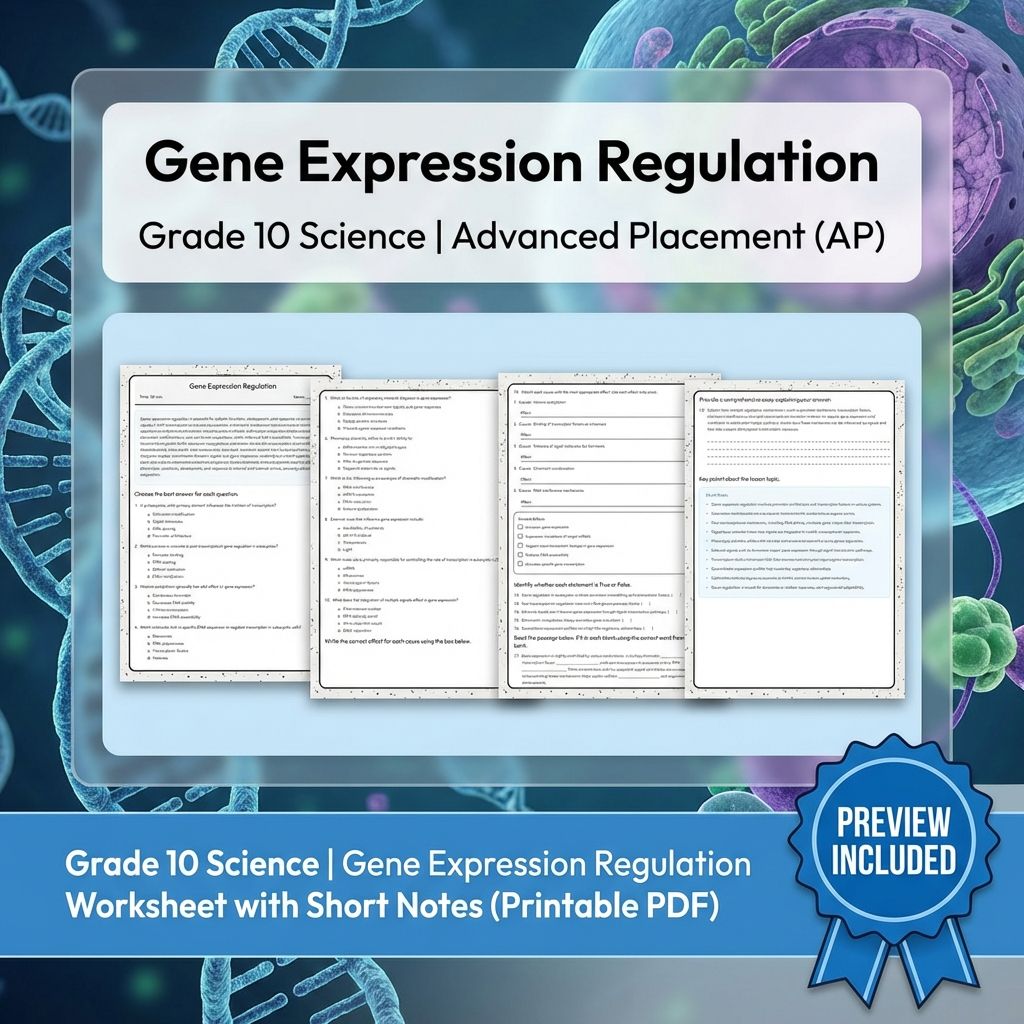
Grade 10 Science | Gene Expression Regulation Worksheet with Short Notes (PDF)
Created byMeadowlark WorksheetsLearning Objectives
- Understand mechanisms that control gene expression in prokaryotic and eukaryotic cells.
- Identify key components such as promoters, transcription factors, and chromatin modifiers.
- Explain how regulatory networks influence cellular responses and phenotypic plasticity.
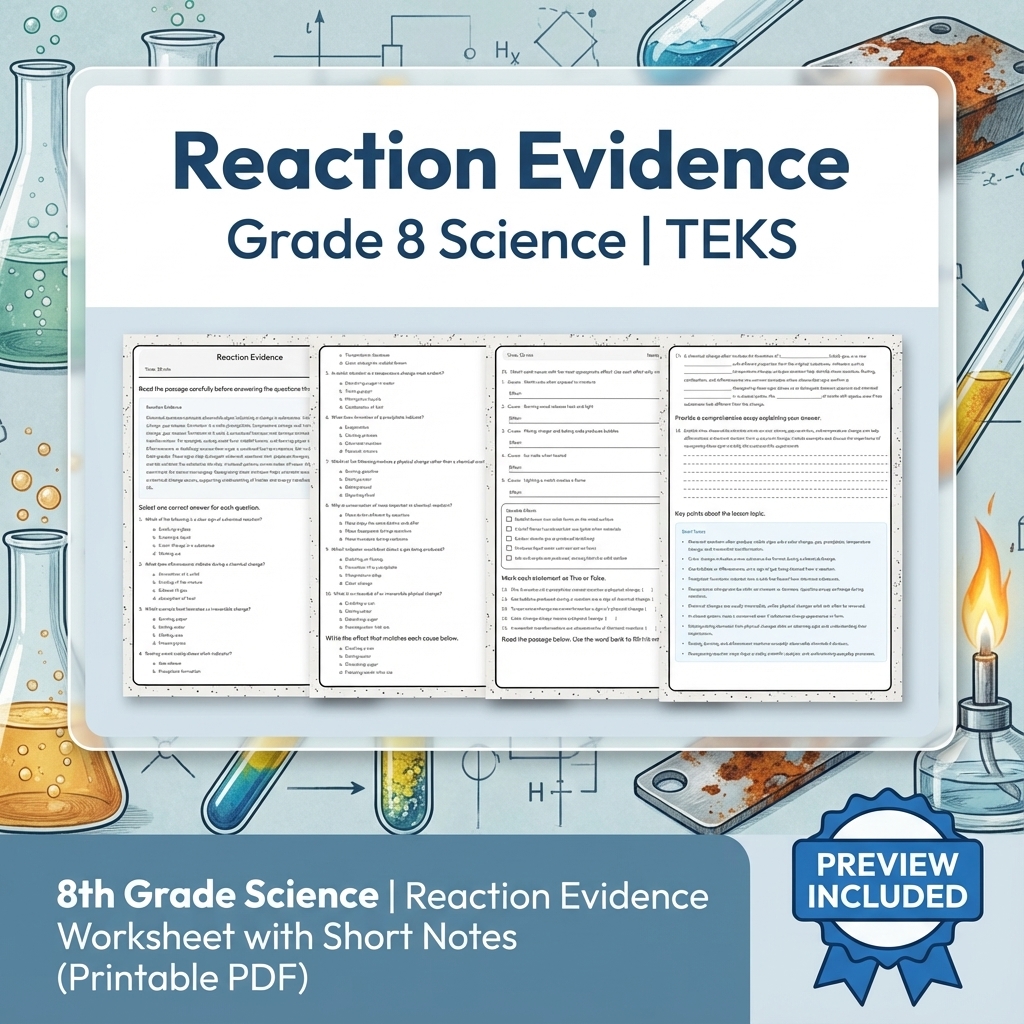
8th Grade Science | Reaction Evidence Worksheet with Short Notes (Printable PDF)
Created byMeadowlark WorksheetsLearning Objectives
- Identify observable indicators of chemical reactions such as color change, gas evolution, precipitate formation, temperature change, and irreversible transformation.
- Differentiate between chemical and physical changes using reaction evidence.
- Understand conservation concepts in closed systems during chemical reactions.
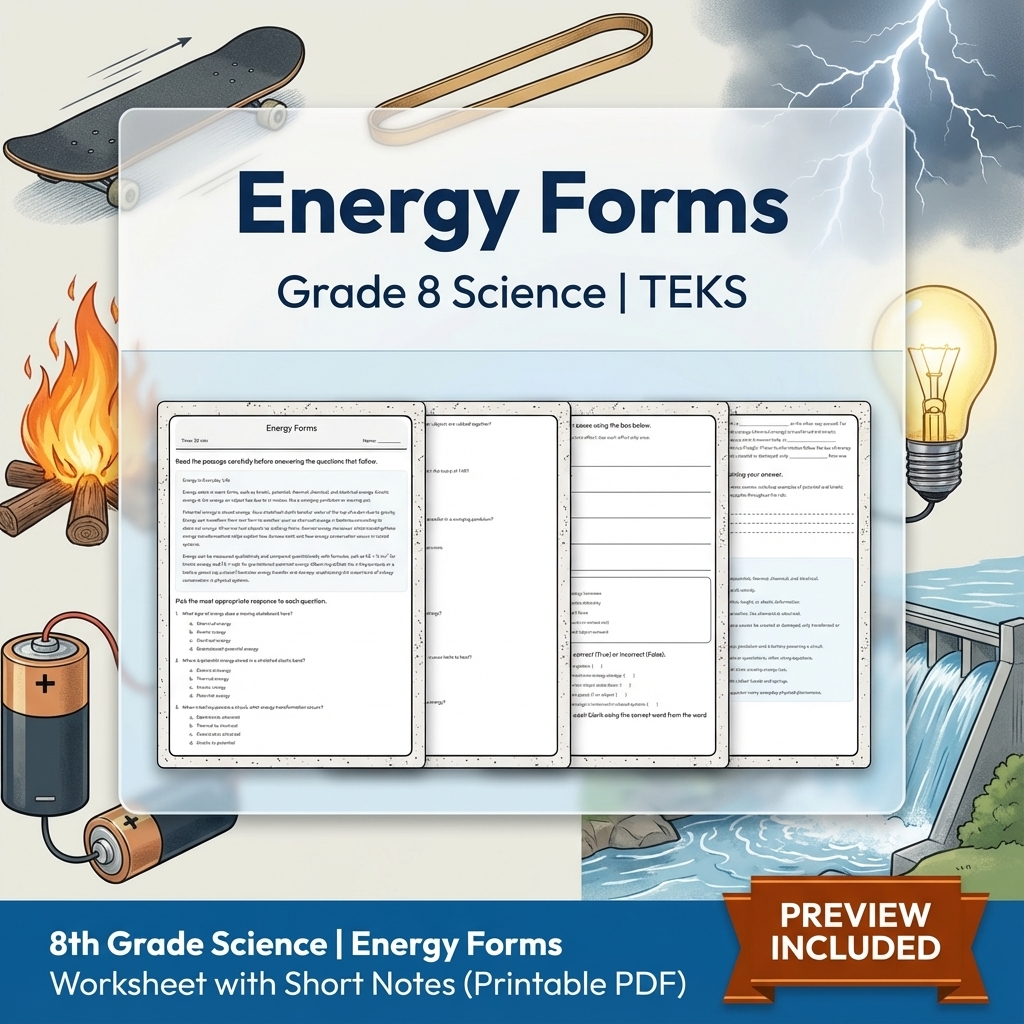
8th Grade Science | Energy Forms Worksheet with Short Notes (Printable PDF)
Created byMeadowlark WorksheetsLearning Objectives
- Identify and describe different types of energy, including kinetic, gravitational potential, elastic, thermal, chemical, and electrical energy.
- Explain examples of energy transfer and transformation in everyday systems.
- Use basic equations to compare kinetic and potential energy in real-world contexts.
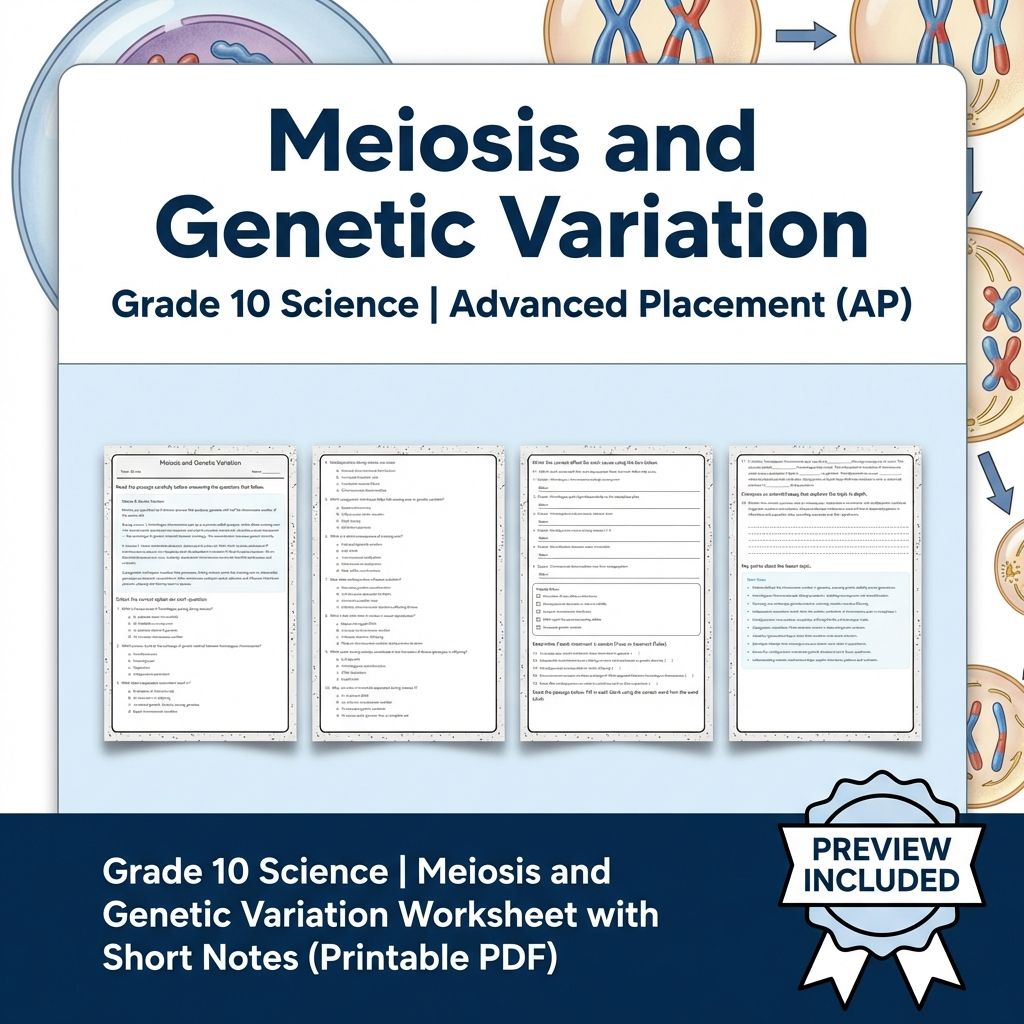
Grade 10 Science | Meiosis and Genetic Variation Worksheet with Short Notes(PDF)
Created byMeadowlark WorksheetsLearning Objectives
- Explain how homologous pairing, recombination, and independent assortment generate genetic variation during meiosis.
- Describe the processes of crossing-over and nondisjunction and their effects on genetic outputs.
- Relate mechanisms of variation to evolutionary patterns and inheritance studies.
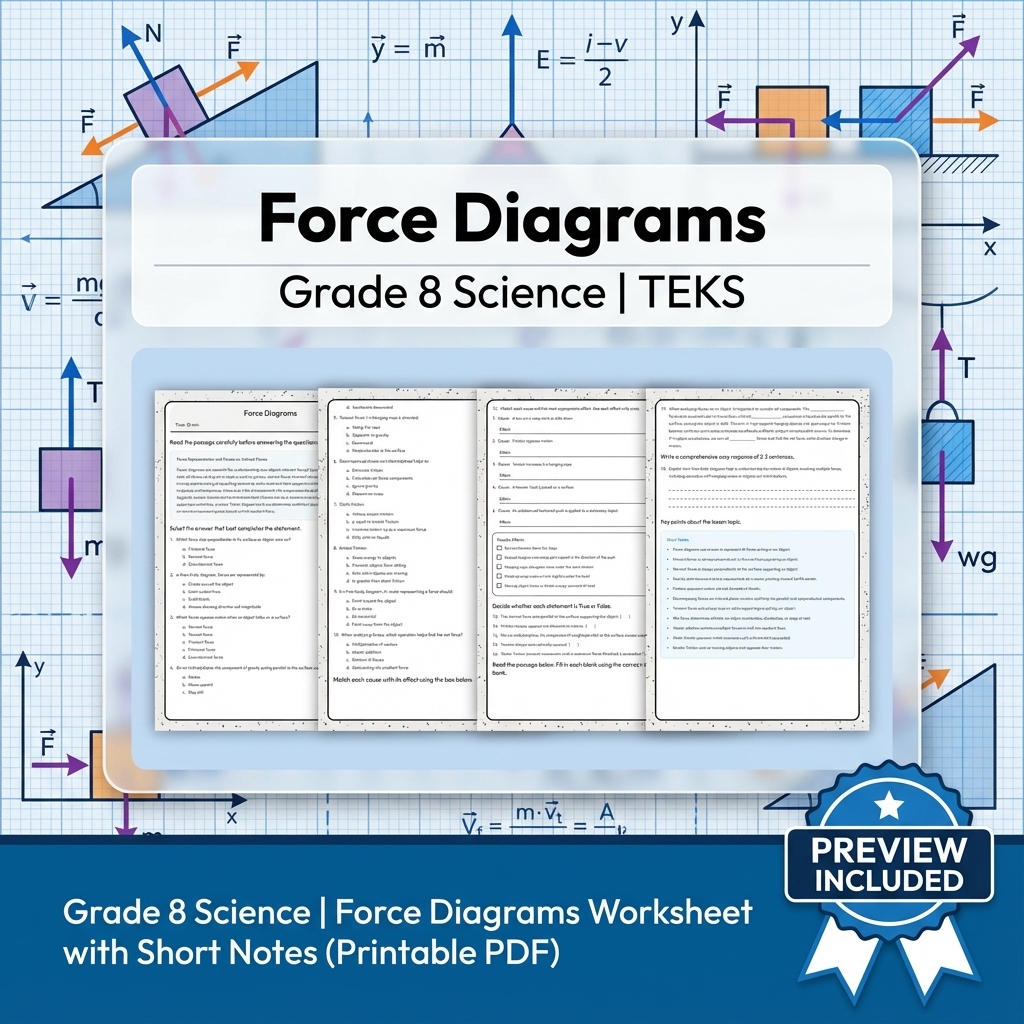
Grade 8 Science | Force Diagrams Worksheet with Short Notes (Printable PDF)
Created byMeadowlark WorksheetsLearning Objectives
- Understand how to represent forces using free-body diagrams.
- Identify and label normal, gravitational, frictional, and tension forces in diagrams.
- Decompose forces on inclined planes into vector components.
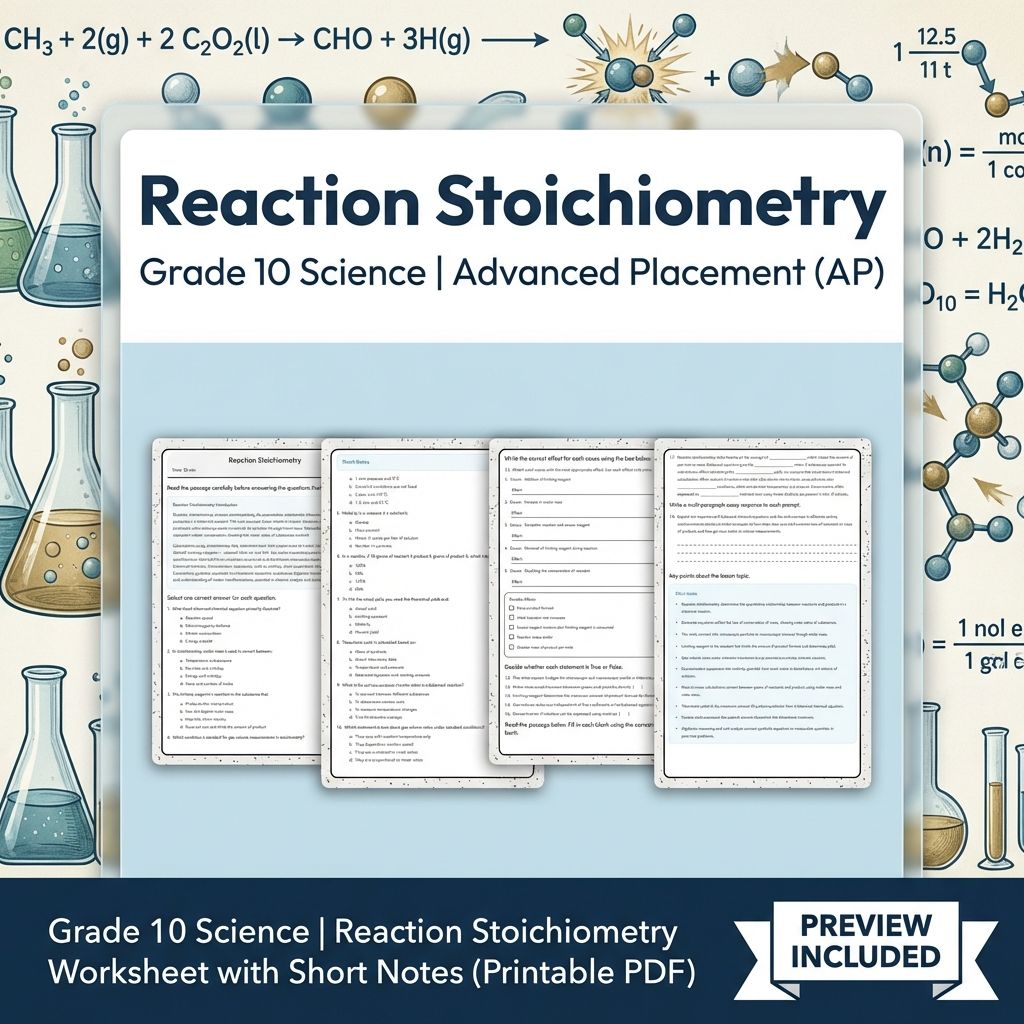
Grade 10 Science | Reaction Stoichiometry Worksheet with Short Notes (PDF)
Created byMeadowlark WorksheetsLearning Objectives
- Understand and interpret chemical reactions through mole ratios and balanced equations.
- Perform mass-to-mass conversion calculations using molar masses and mole ratios.
- Identify limiting reagents and calculate theoretical yields in chemical reactions.
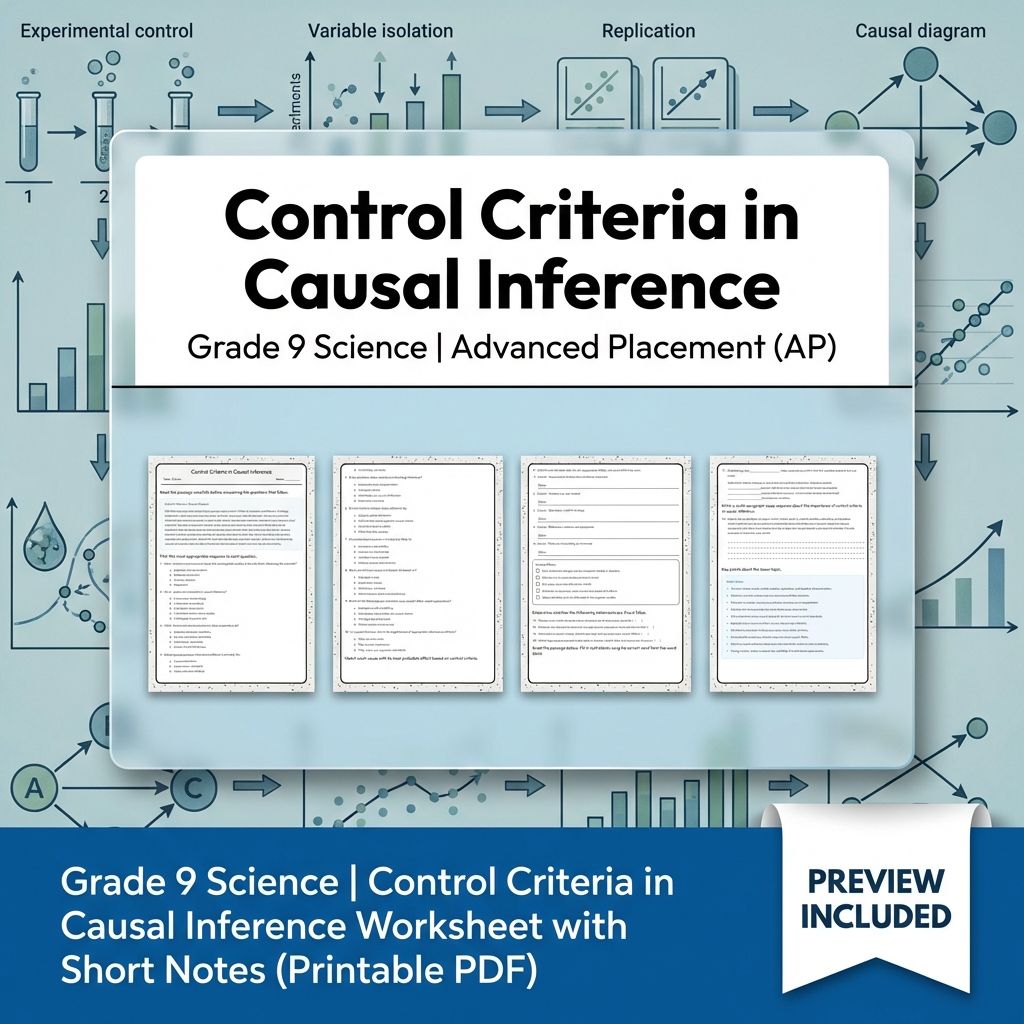
Grade 9 Science | Control Criteria in Causal Inference Worksheet (PDF)
Created byMeadowlark WorksheetsLearning Objectives
- Define the key control criteria used to establish causality in research.
- Explain how variable isolation, replication, and baseline characterization influence causal interpretation.
- Assess the impact of residual confounding and uncontrolled variation on causal claims.
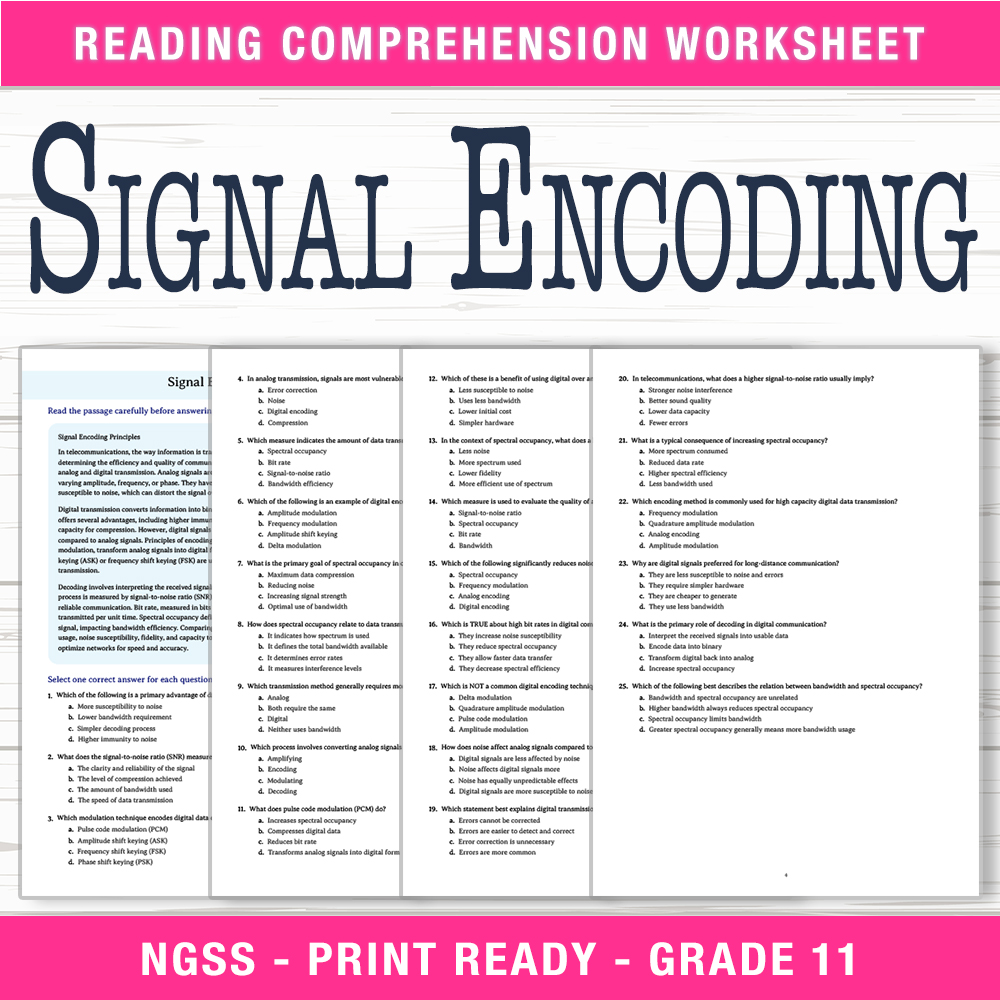
Grade 11 Science | Signal Encoding Worksheet (PDF + Answer Key)
Created byRiverstone ClassroomLearning Objectives
- Understand the advantages and disadvantages of digital versus analog transmission and storage.
- Evaluate the principles of encoding, modulation, and decoding in terms of capacity and reliability.
- Interpret quantitative measures such as bit rate, signal-to-noise ratio, and spectral occupancy in communication systems.
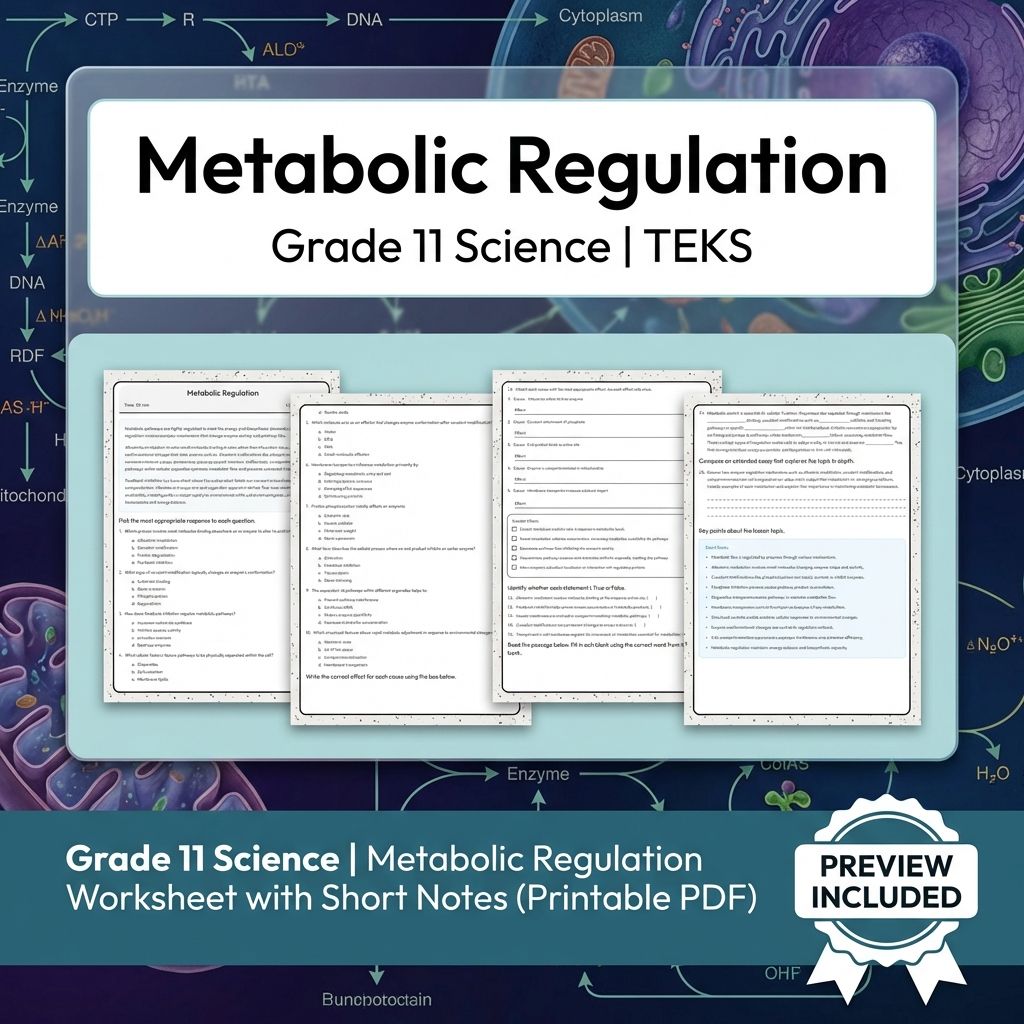
Grade 11 Science | Metabolic Regulation Worksheet with Short Notes (PDF)
Created byMeadowlark WorksheetsLearning Objectives
- Understand mechanisms controlling metabolic flux such as allosteric modulation, covalent modification, and compartmentalization.
- Identify different enzyme regulation methods including feedback inhibition and phosphorylation.
- Describe how structural controls enable dynamic metabolic adjustments in cells.
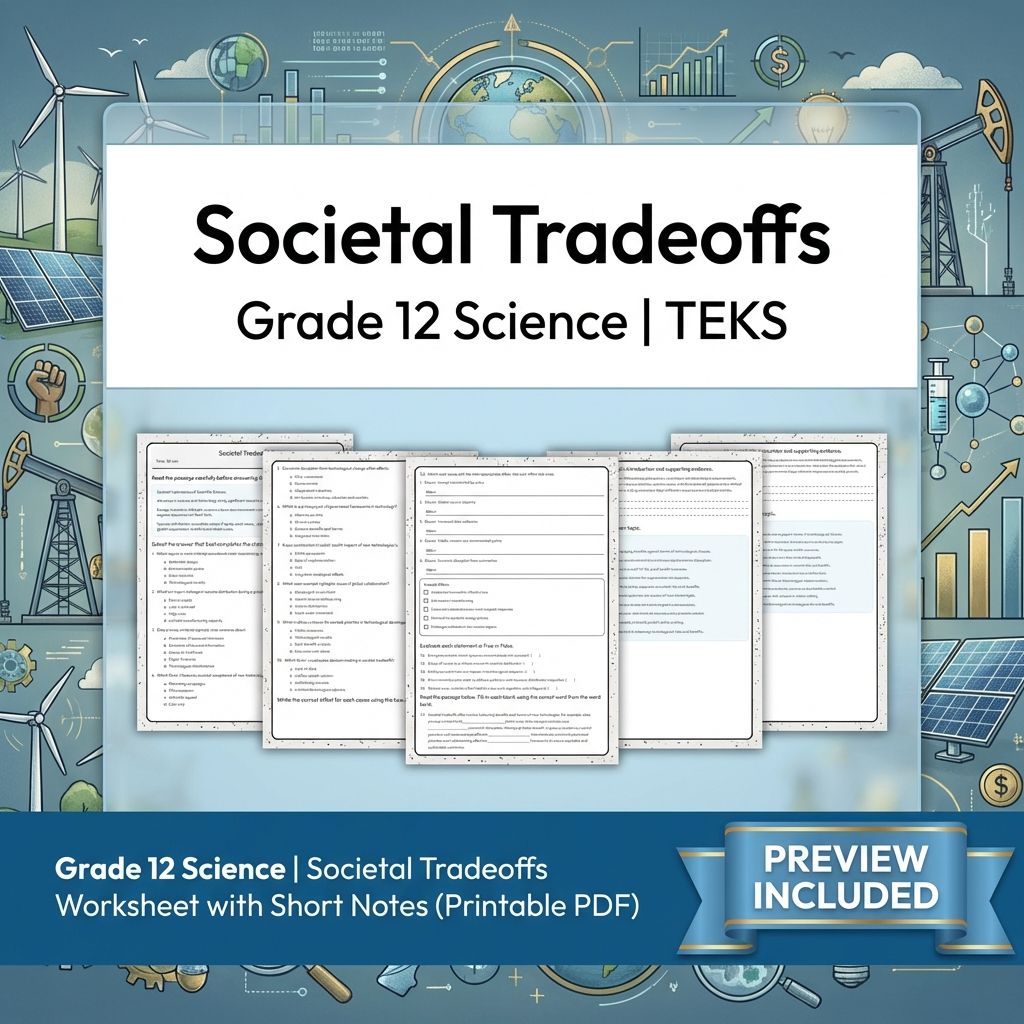
Grade 12 Science | Societal Tradeoffs Worksheet with Short Notes (Printable PDF)
Created byMeadowlark WorksheetsLearning Objectives
- Analyze the societal implications of scientific and technological choices.
- Evaluate the trade-offs between benefits, harms, and distributional effects.
- Understand case examples such as energy transitions, vaccine distribution, and data privacy incidents.
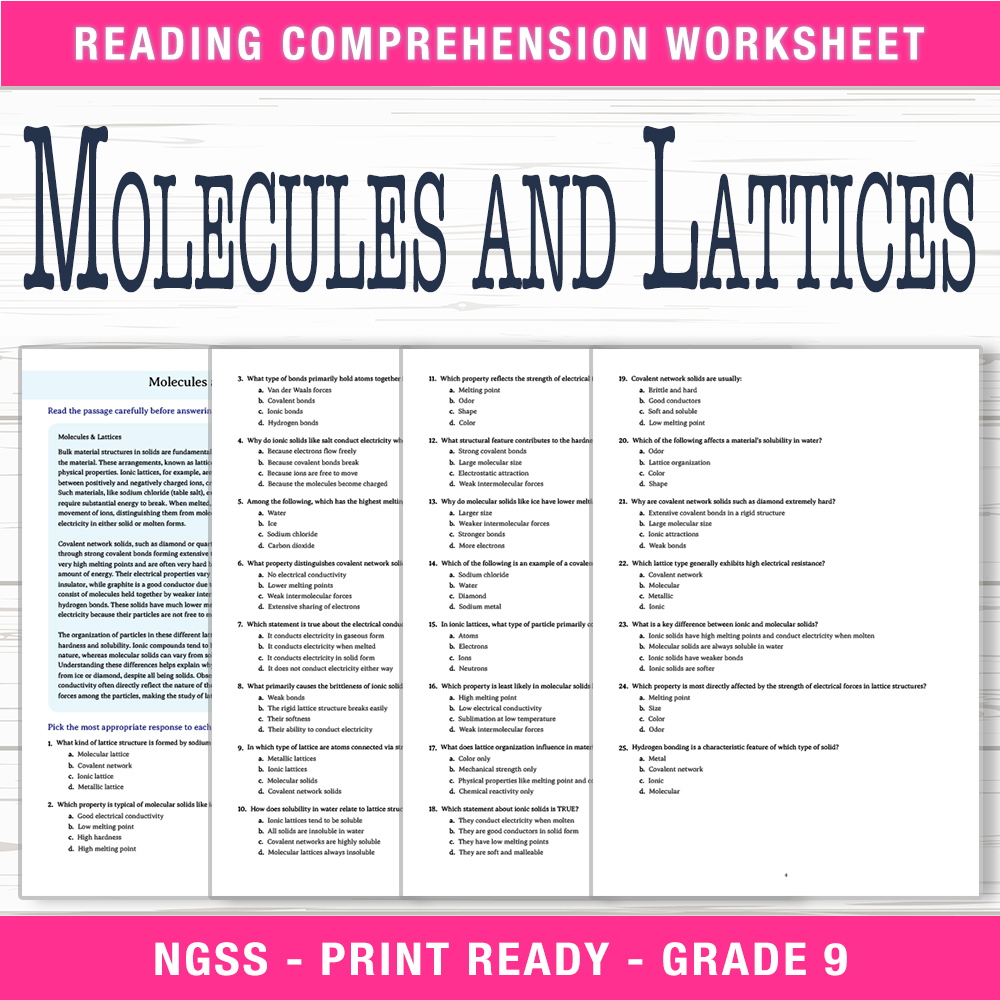
Grade 9 Science | Molecules and Lattices Worksheet (PDF + Answer Key)
Created byRiverstone ClassroomLearning Objectives
- Understand the different types of particle arrangements in solid materials, including ionic, covalent network, and molecular lattices.
- Identify how lattice organization influences physical properties such as melting point, electrical conductivity, hardness, and solubility.
- Compare the properties of ionic solids like sodium chloride with molecular solids like ice based on their particle arrangements and electrical interactions.
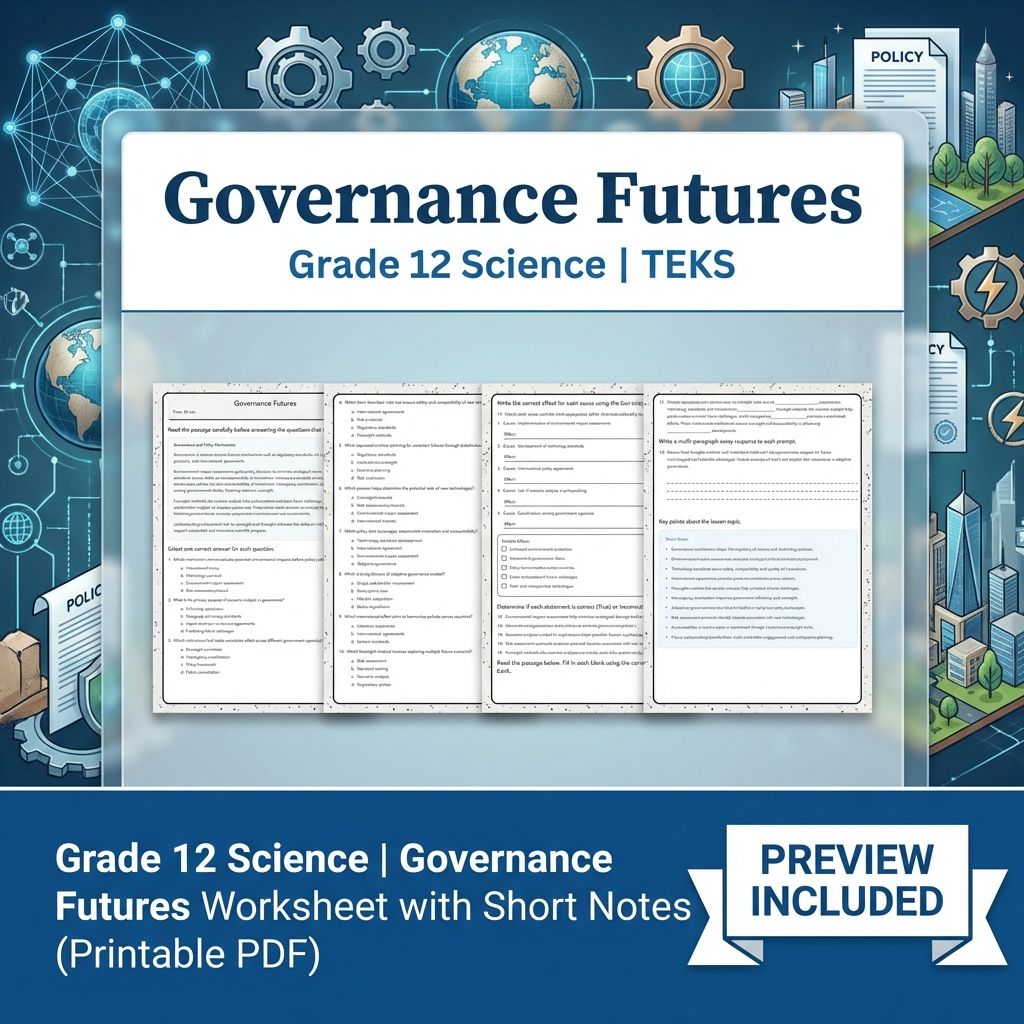
Grade 12 Science | Governance Futures Worksheet with Short Notes (Printable PDF)
Created byMeadowlark WorksheetsLearning Objectives
- Understand key governance mechanisms and their roles in shaping scientific and technological development.
- Identify regulatory standards, risk assessment protocols, and international agreements used in science governance.
- Analyze adaptive governance models and foresight methods for future policymaking.
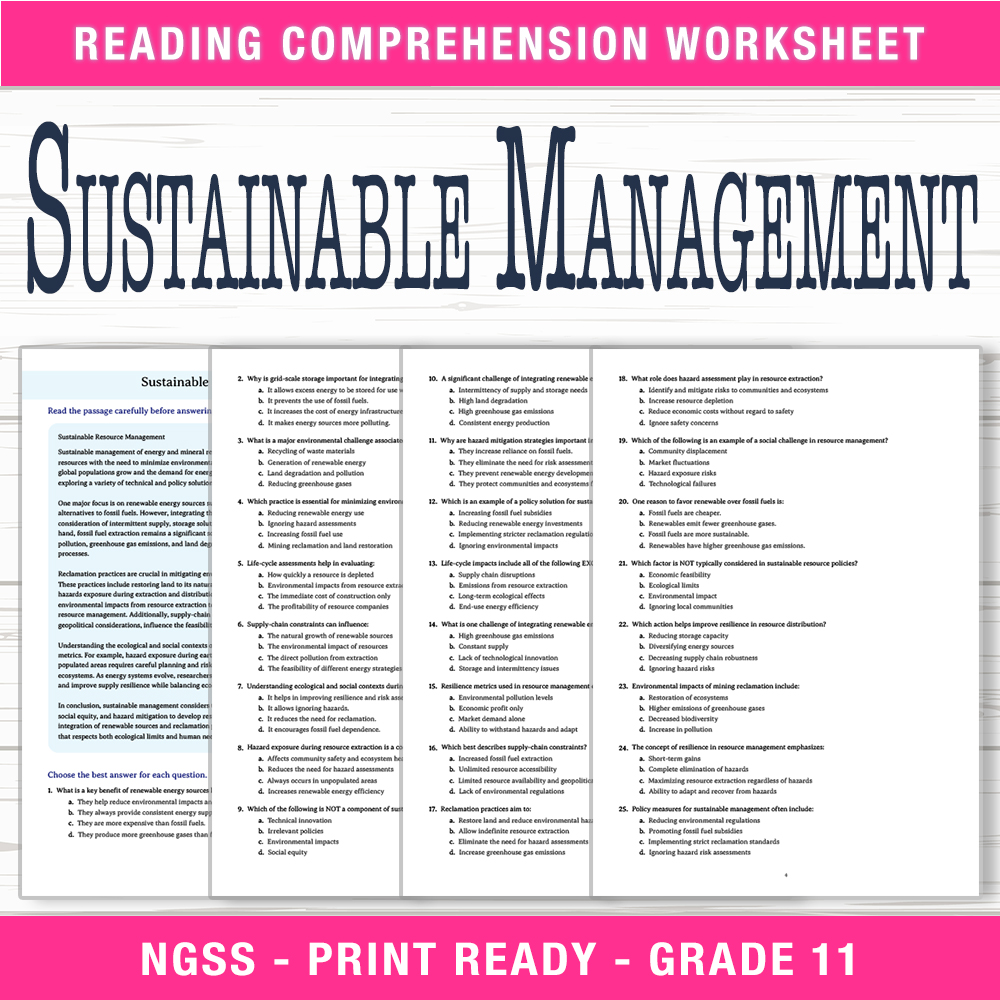
Grade 11 Science | Sustainable Management Worksheet (PDF + Answer Key)
Created byRiverstone ClassroomLearning Objectives
- Understand the different technical and policy solutions for developing, managing, and monitoring energy and mineral resources.
- Analyze the life-cycle impacts, reclamation, and supply-chain constraints associated with resource management strategies.
- Compare renewable energy integration methods with fossil fuel extraction and understand associated environmental and social impacts.
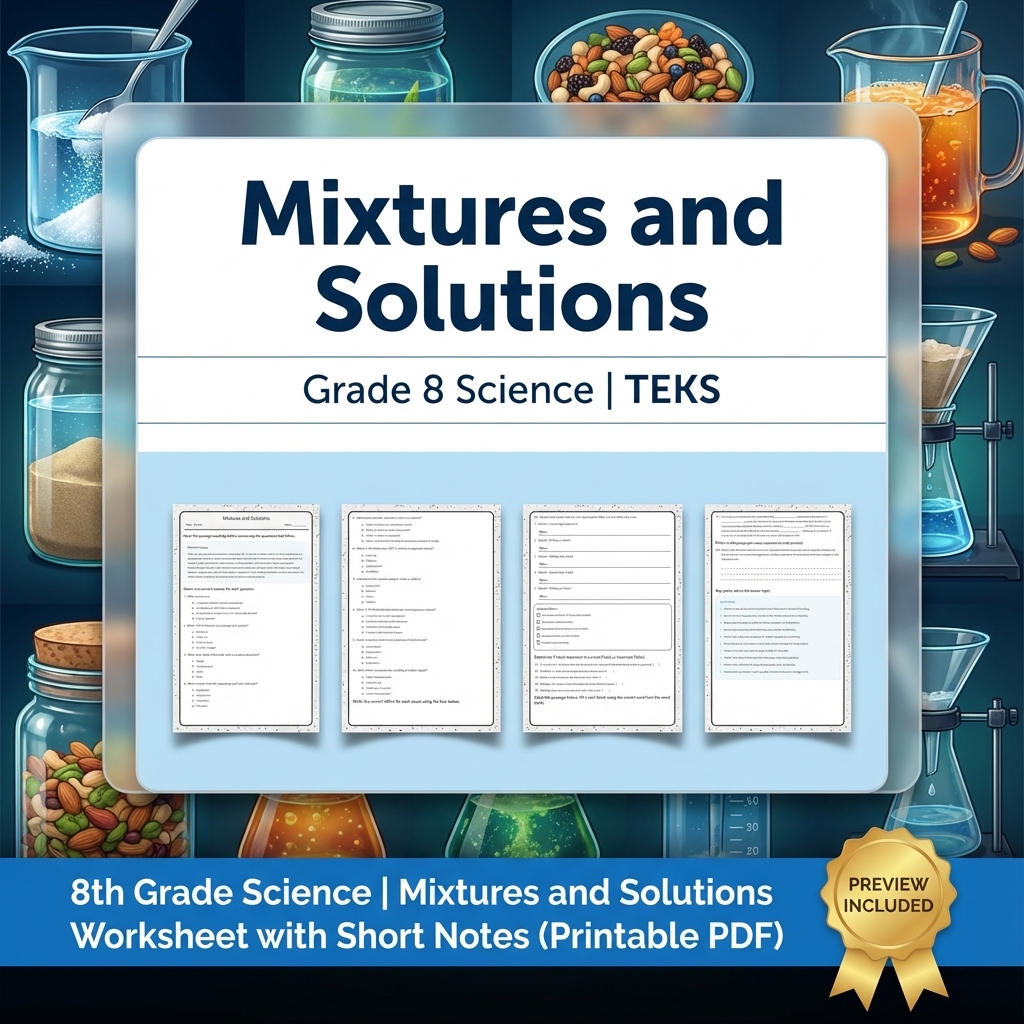
8th Grade Science Mixtures and Solutions Worksheet with Short Notes (PDF)
Created byMeadowlark WorksheetsLearning Objectives
- Understand the difference between mixtures and solutions.
- Identify examples of different types of mixtures and solutions.
- Describe methods used to separate mixtures.
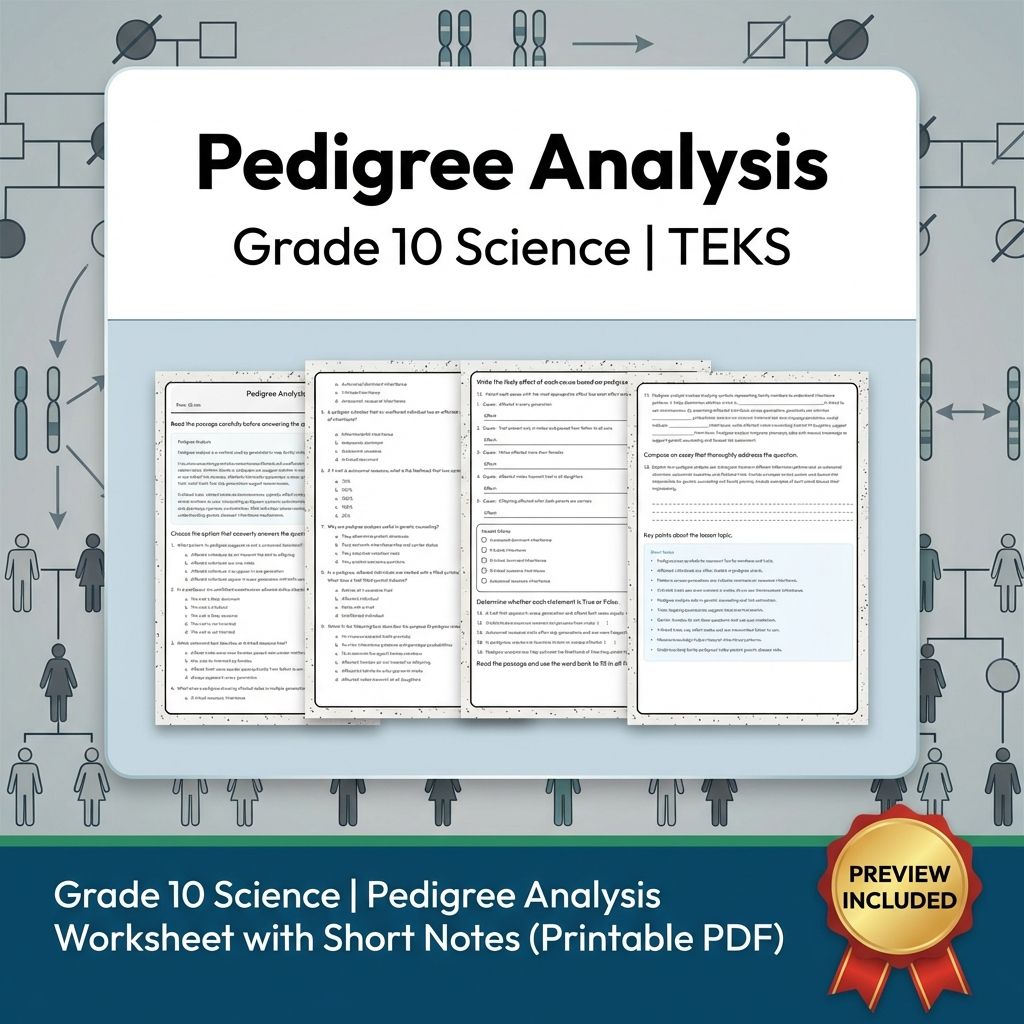
Grade 10 Science | Pedigree Analysis Worksheet with Short Notes (Printable PDF)
Created byMeadowlark WorksheetsLearning Objectives
- Interpret family pedigrees to identify inheritance patterns.
- Distinguish between autosomal dominant, autosomal recessive, and X-linked traits.
- Use pedigree data to predict inheritance probabilities and carrier status.
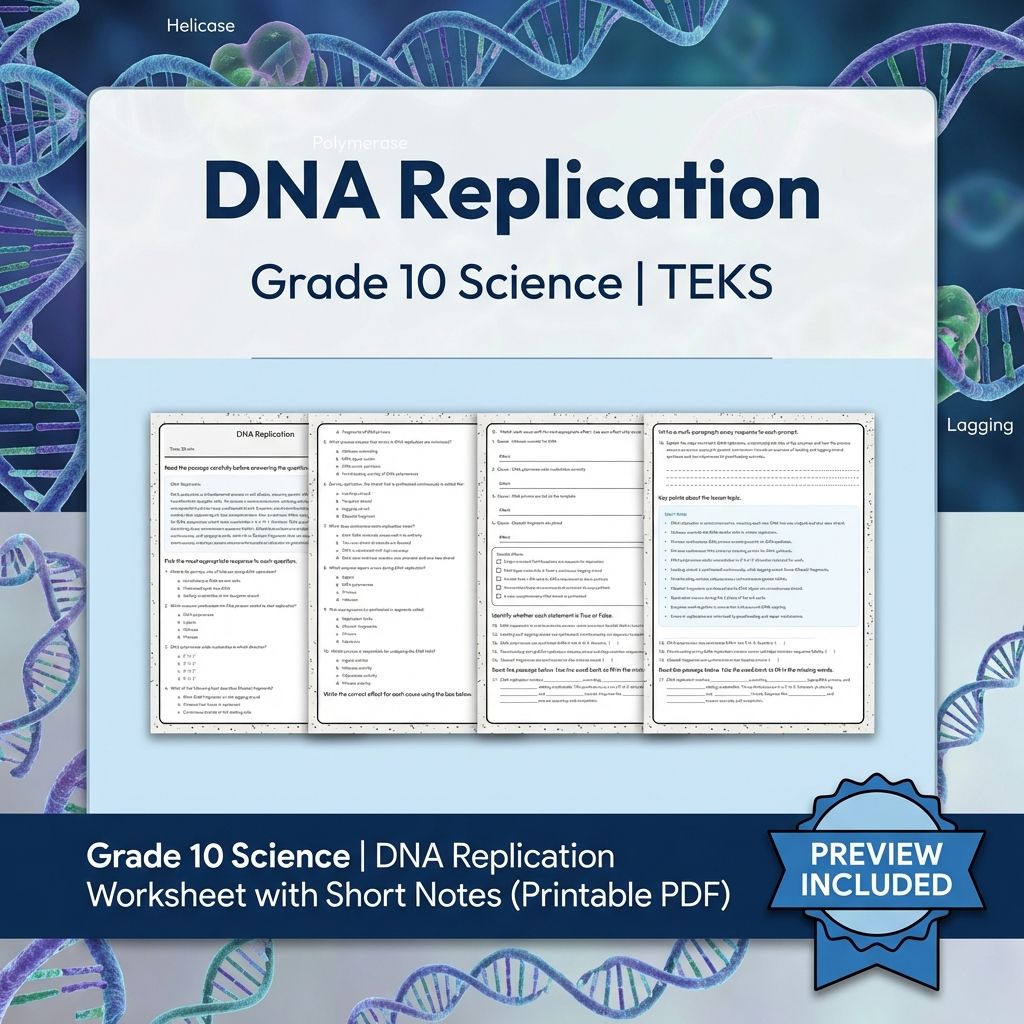
Grade 10 Science | DNA Replication Worksheet with Short Notes (Printable PDF)
Created byMeadowlark WorksheetsLearning Objectives
- Describe the process of DNA replication including the roles of enzymes.
- Identify leading and lagging strands, Okazaki fragments, and proofreading functions.
- Explain the semi-conservative nature of DNA replication.
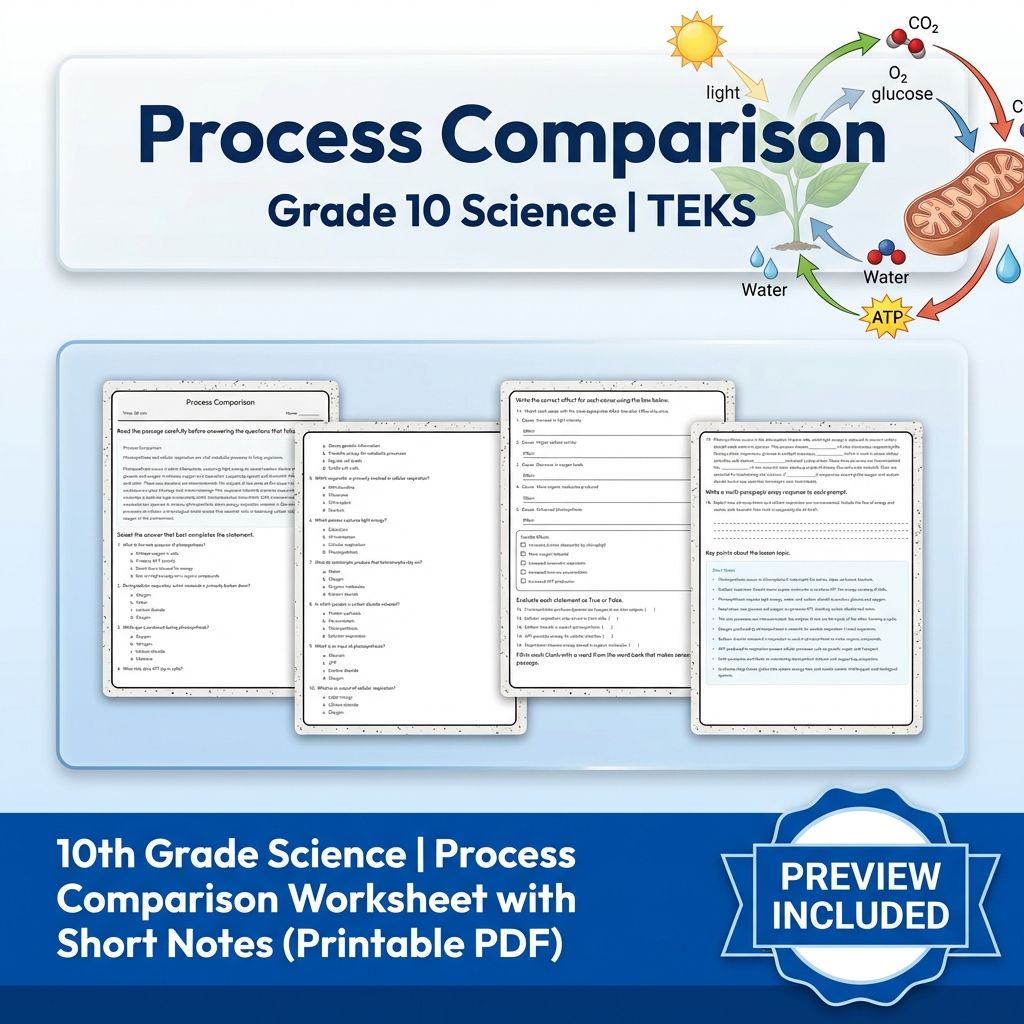
Grade 10 Science | Process Comparison Worksheet with Short Notes(Printable PDF)
Created byMeadowlark WorksheetsLearning Objectives
- Compare the inputs and outputs of photosynthesis and cellular respiration.
- Explain how carbon and energy circulate through biological systems.
- Identify the reactions and products of photosynthesis and respiration.
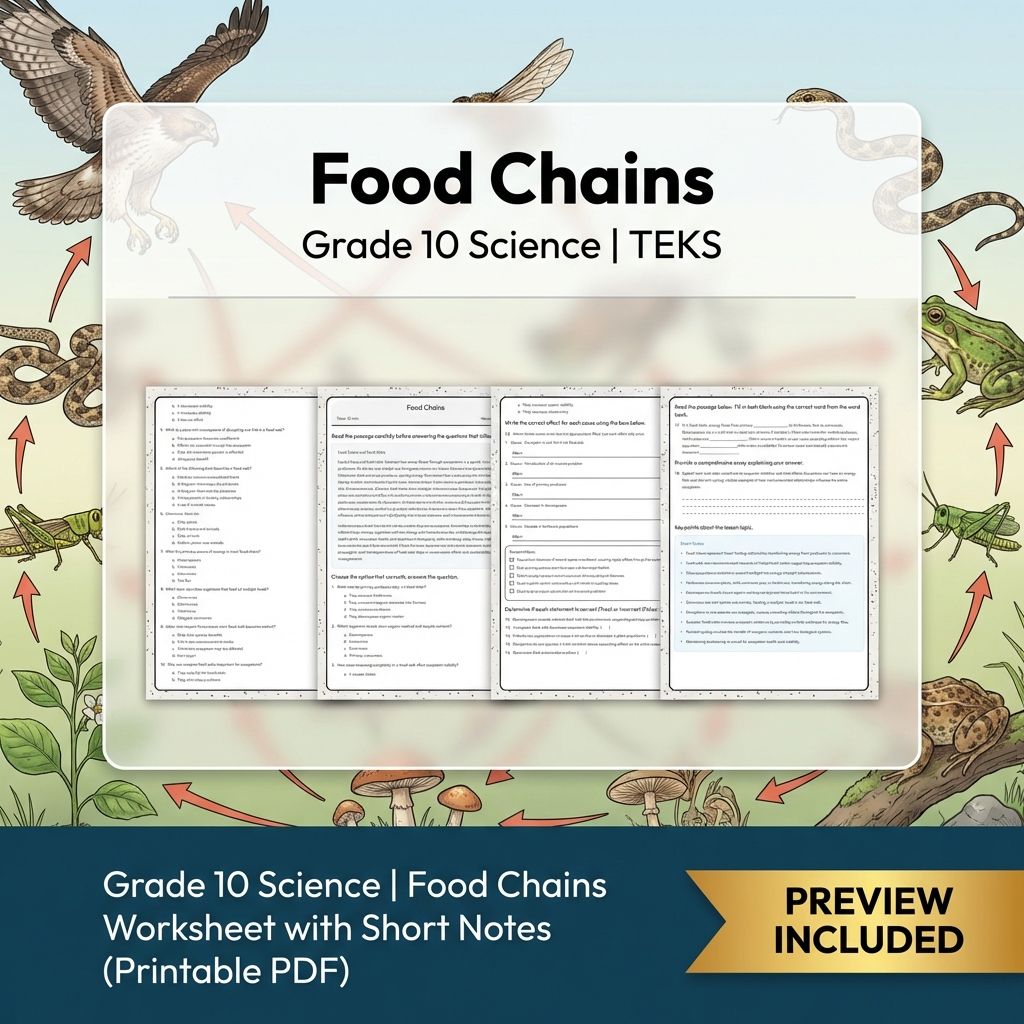
Grade 10 Science | Food Chains Worksheet with Short Notes (PDF)
Created byMeadowlark WorksheetsLearning Objectives
- Understand the concept of food chains and food webs and how energy and matter transfer within ecosystems.
- Identify the roles of primary producers, herbivores, carnivores, and decomposers in food chains.
- Explain how complex food webs increase ecosystem stability.
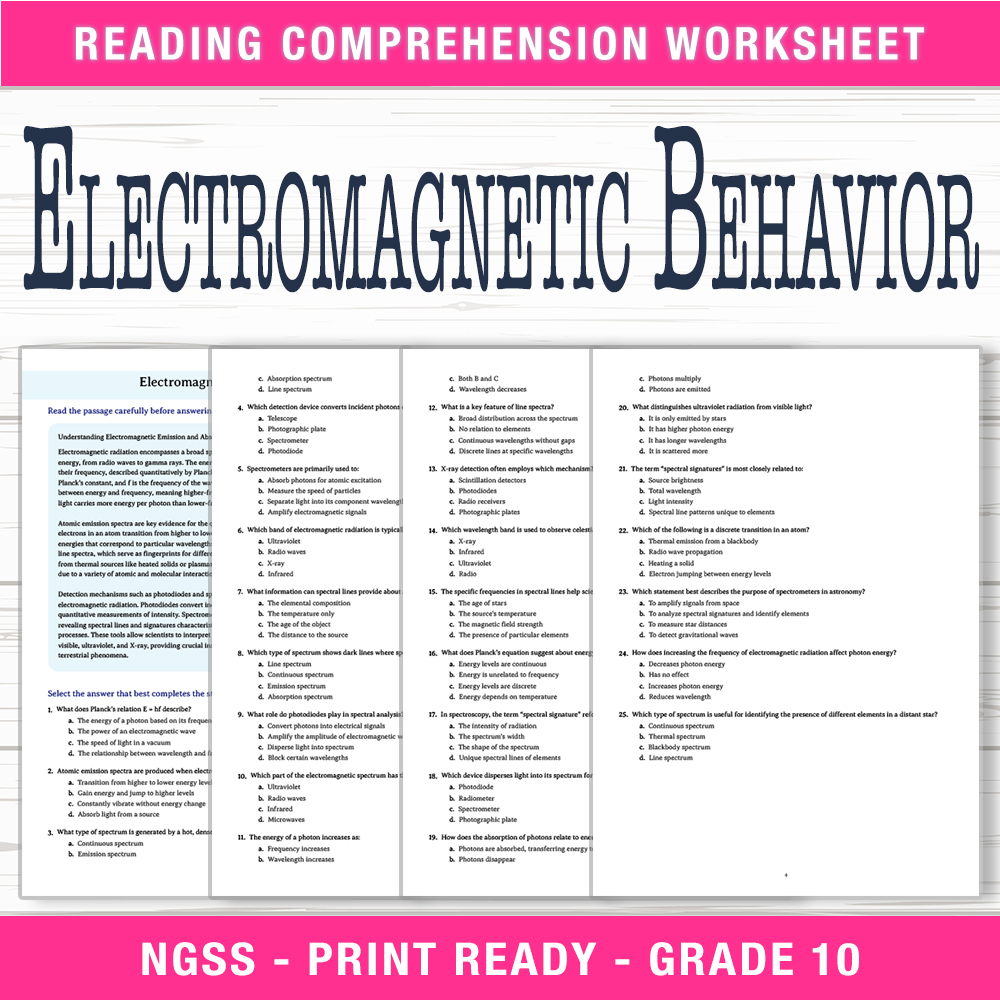
Grade 10 Science | Electromagnetic Behavior Worksheet (PDF + Answer Key)
Created byRiverstone ClassroomLearning Objectives
- Explain the relationship between photon energy and electromagnetic radiation using Planck's equation E = hf.
- Describe how atomic emission spectra provide evidence for discrete energy transitions in atoms.
- Identify different detection mechanisms such as photodiodes and spectrometers and their applications in spectral analysis.
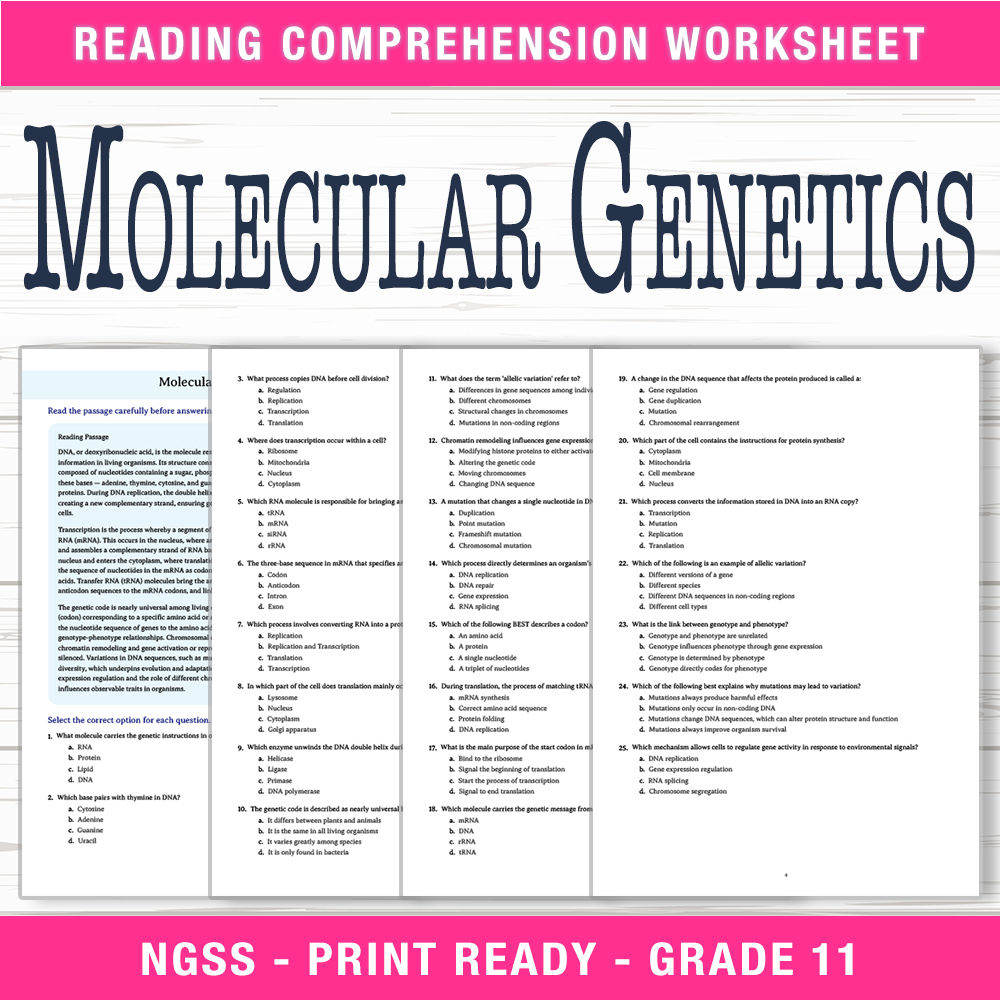
Grade 11 Science | Molecular Genetics Worksheet (PDF + Answer Key)
Created byRiverstone ClassroomLearning Objectives
- Explain the process of DNA replication, transcription, and translation and their roles in gene expression.
- Describe the structure of DNA and how its nucleotide sequence determines amino acid sequences in proteins.
- Analyze the relationship between chromosomal organization, genetic code, and observable traits.
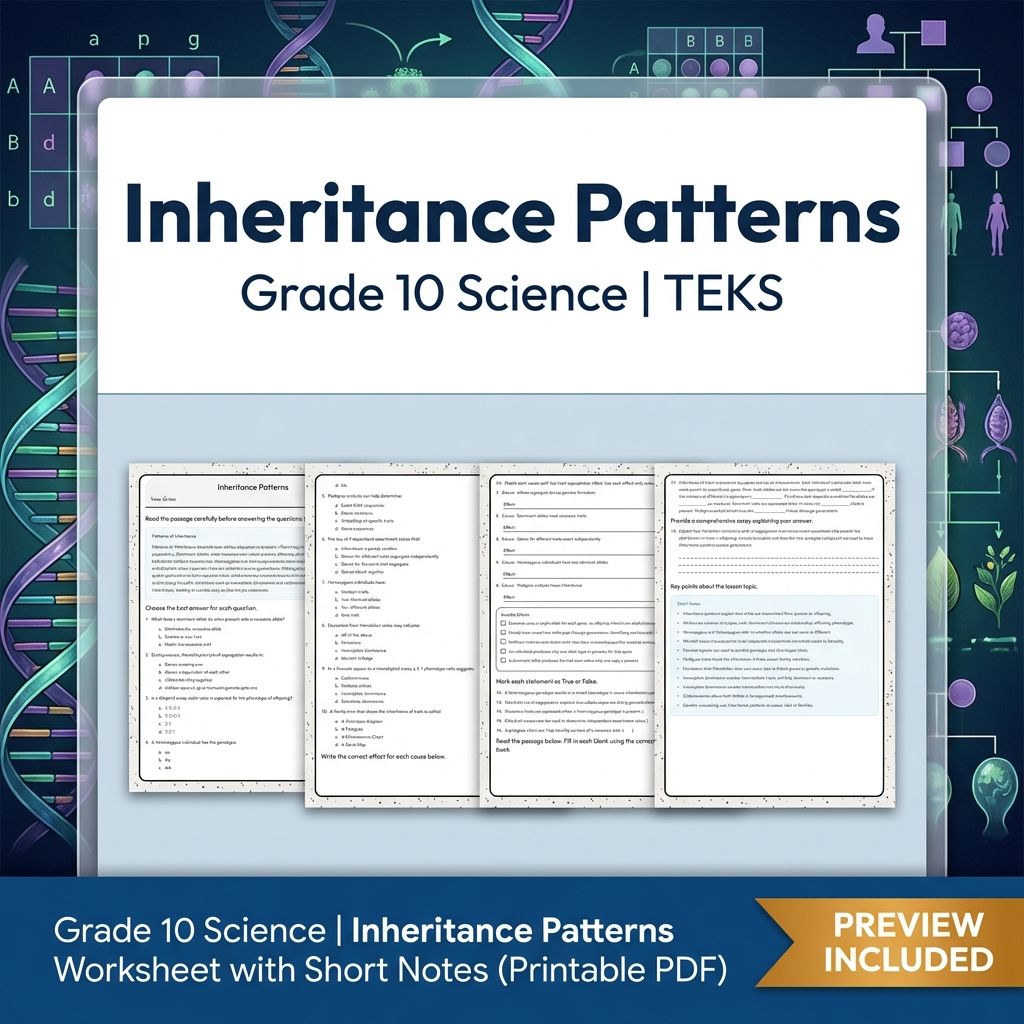
Grade 10 Science | Inheritance Patterns Worksheet with Short Notes (PDF)
Created byMeadowlark WorksheetsLearning Objectives
- Explain how dominant and recessive alleles influence traits.
- Describe Mendelian principles such as segregation and independent assortment.
- Interpret pedigree charts to analyze trait inheritance.
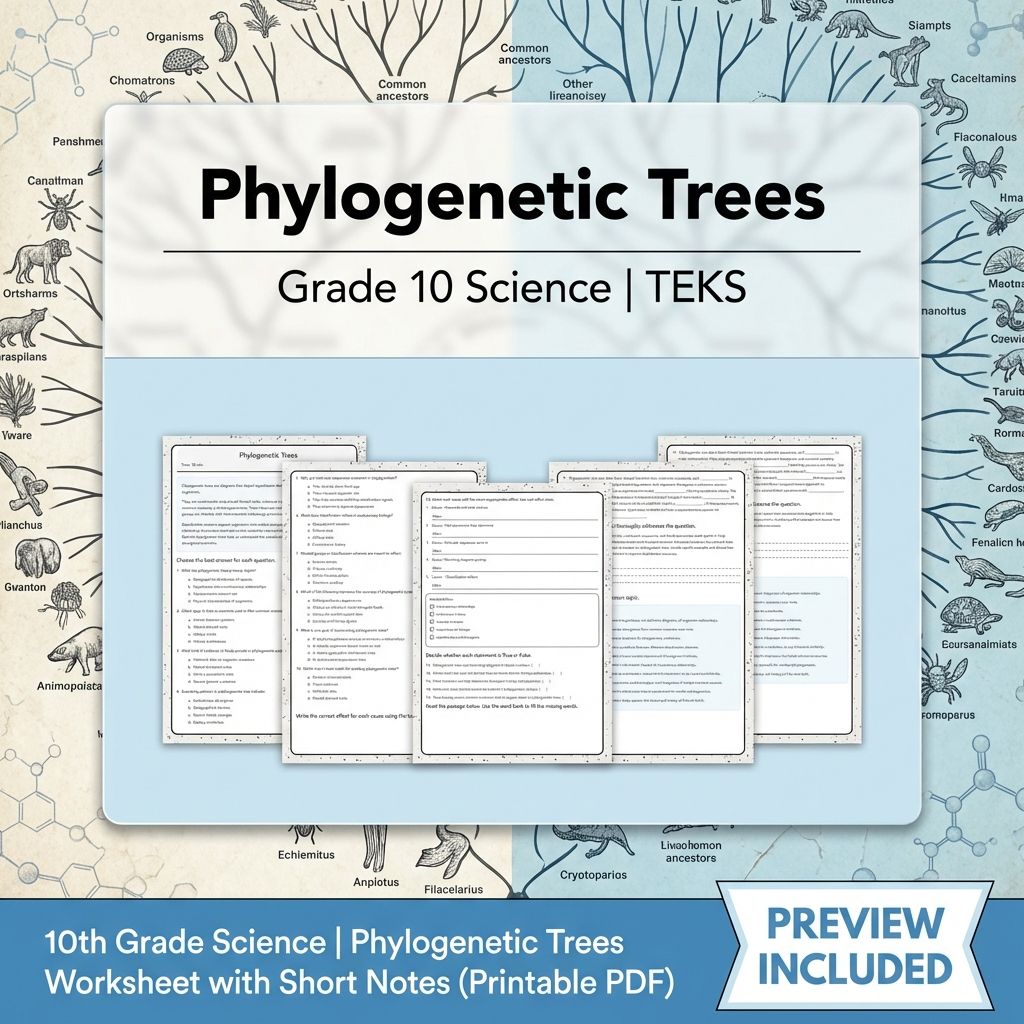
10th Grade Science | Phylogenetic Trees Worksheet with Short Notes (PDF)
Created byMeadowlark WorksheetsLearning Objectives
- Understand the purpose and structure of phylogenetic trees.
- Identify shared traits used to infer evolutionary relationships.
- Interpret how molecular data and fossil evidence contribute to classification.
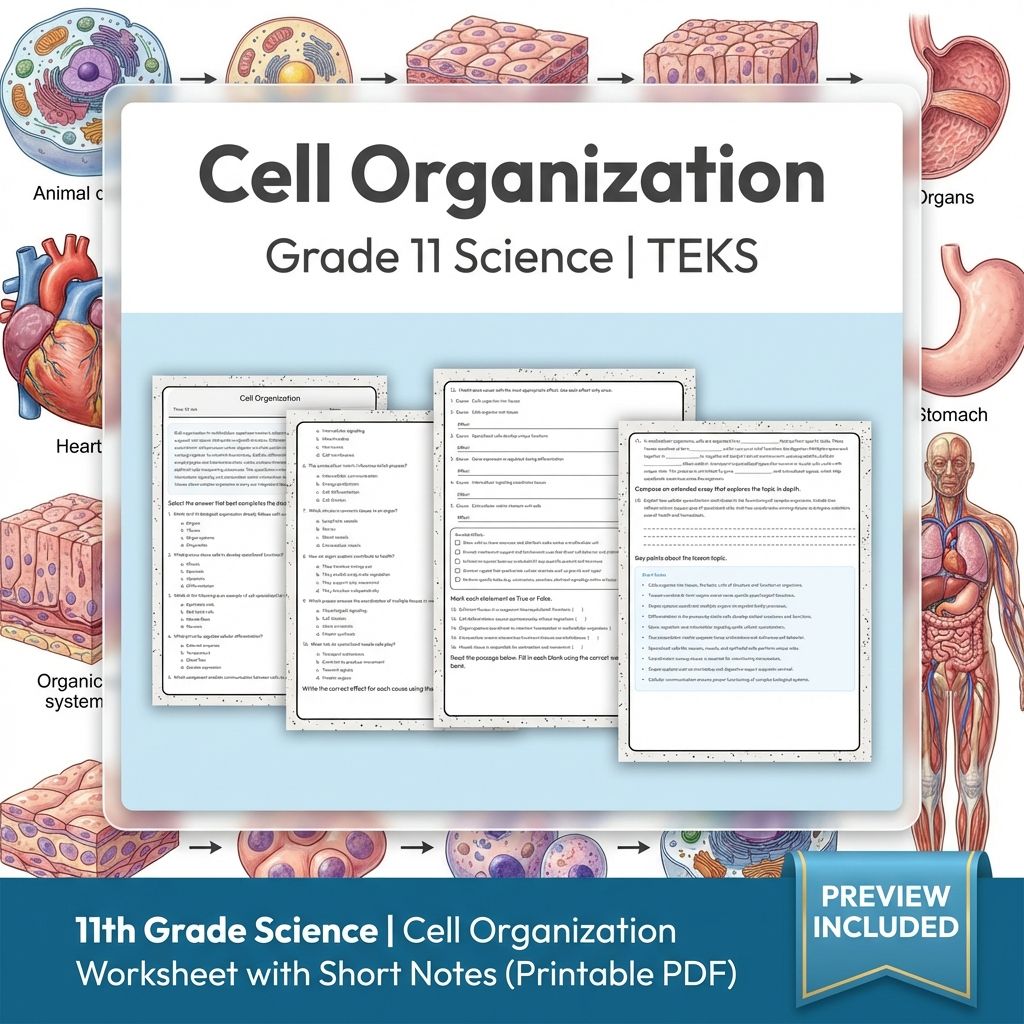
11th Grade Science | Cell Organization Worksheet with Short Notes (PDF)
Created byMeadowlark WorksheetsLearning Objectives
- Describe the hierarchical levels of organization from cells to organ systems.
- Explain how specialized cells perform distinct functions in multicellular organisms.
- Understand the processes of differentiation and cellular specialization.
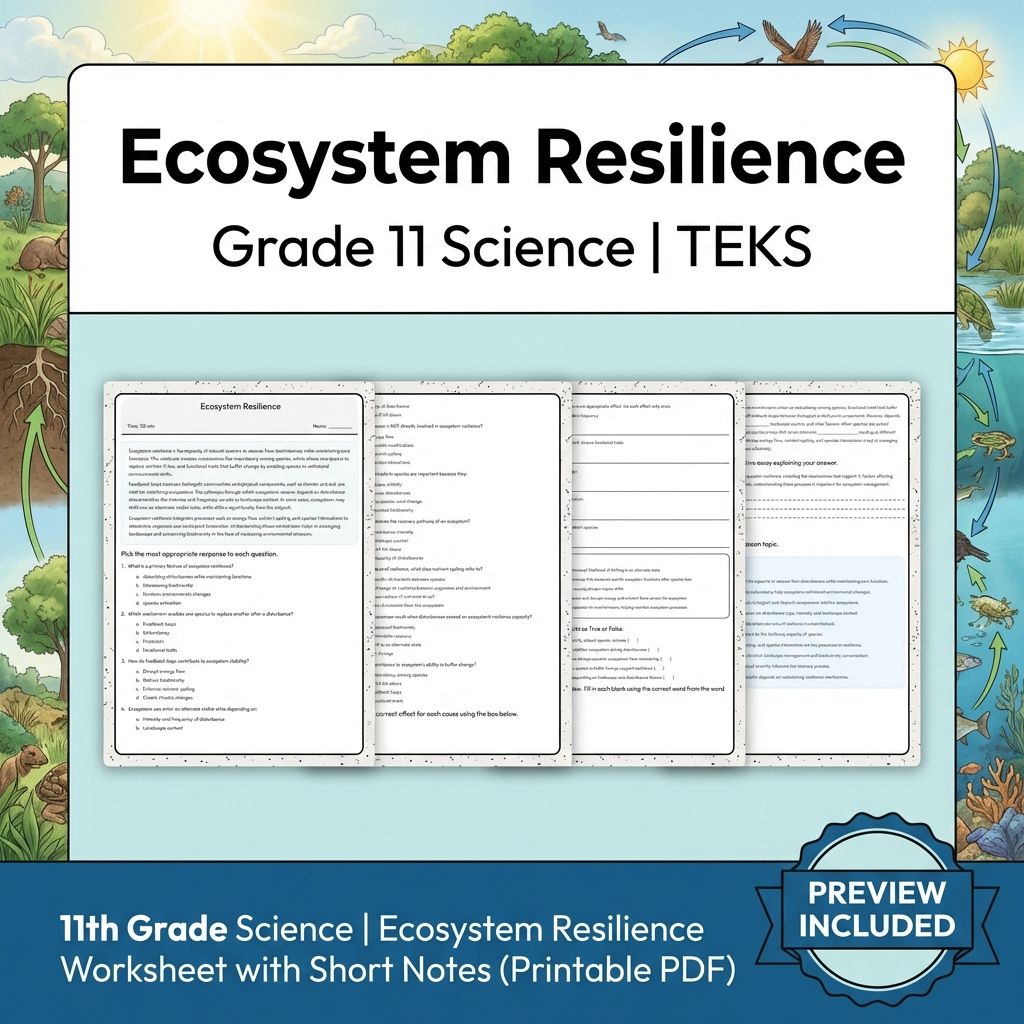
11th Grade Science | Ecosystem Resilience Worksheet with Short Notes (PDF)
Created byMeadowlark WorksheetsLearning Objectives
- Define ecosystem resilience and identify its key mechanisms.
- Explain how ecosystems recover from disturbances and the factors influencing their stability.
- Describe the role of feedback loops, redundancy, and functional traits in resilience.
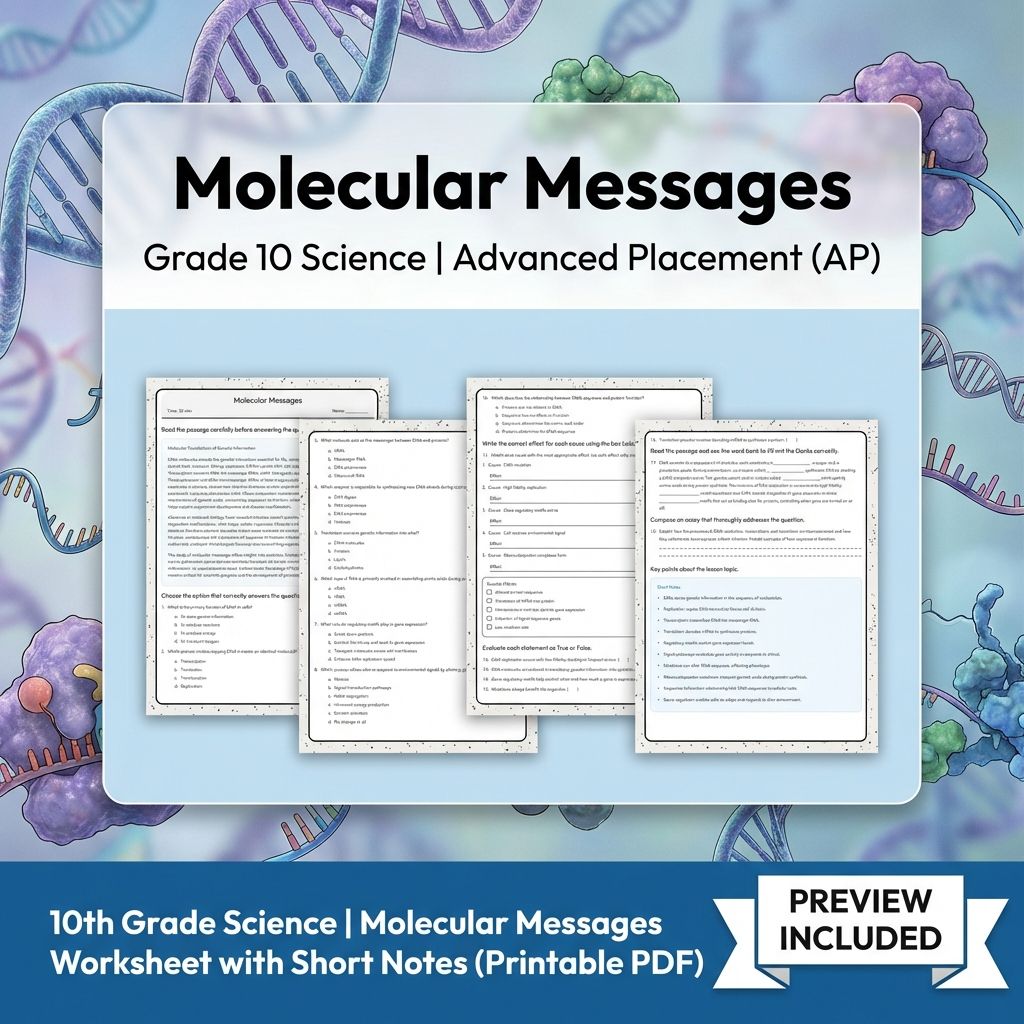
10th Grade Science | Molecular Messages Worksheet with Short Notes (PDF)
Created byMeadowlark WorksheetsLearning Objectives
- Understand the structure and function of DNA and how genetic information is stored and transmitted.
- Describe the processes of DNA replication, transcription, and translation at the molecular level.
- Explain how sequence-to-function relationships influence cellular phenotypes within biological systems.
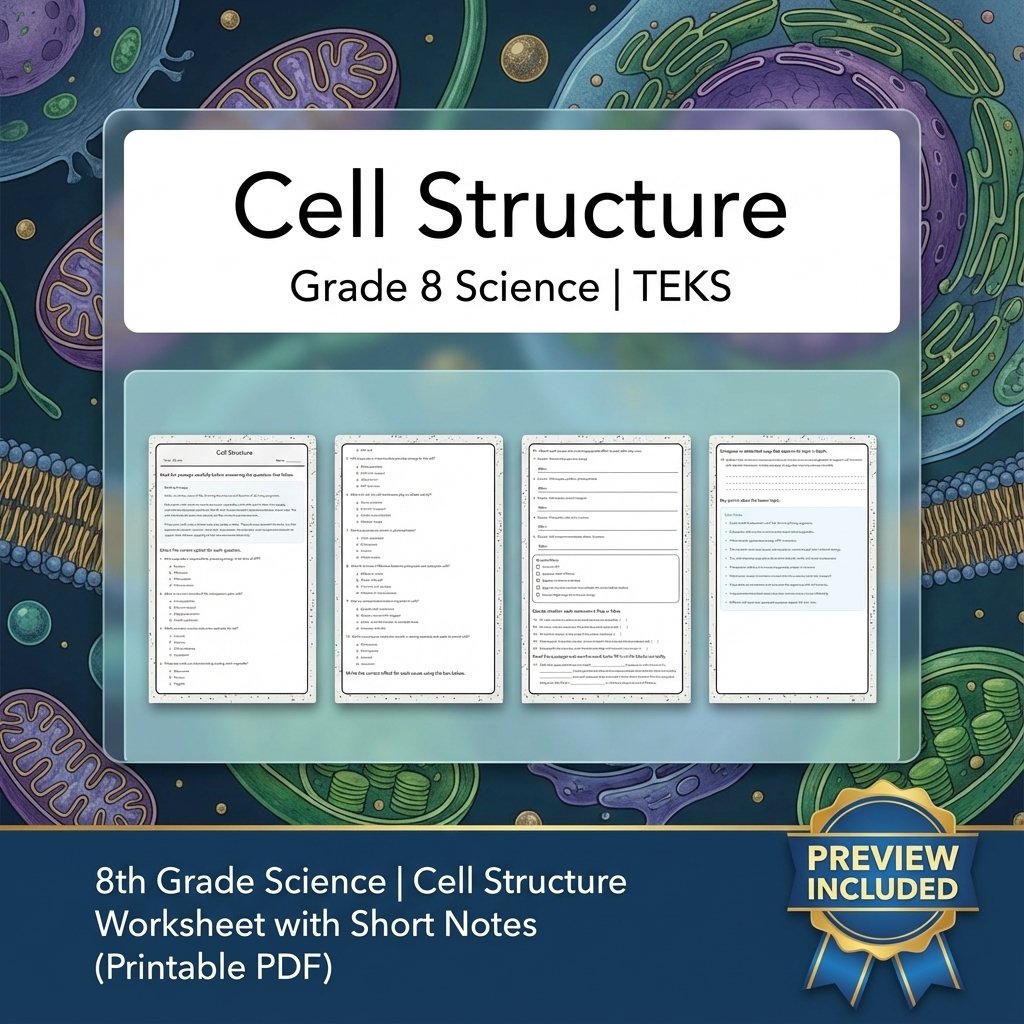
8th Grade Science | Cell Structure Worksheet with Short Notes (Printable PDF)
Created byMeadowlark WorksheetsLearning Objectives
- Describe the internal organization of cells, including membranes and organelles.
- Explain the functions of key organelles such as the nucleus, mitochondria, and chloroplasts.
- Understand the relationship between membrane transport, compartmentalization, and cellular activity.
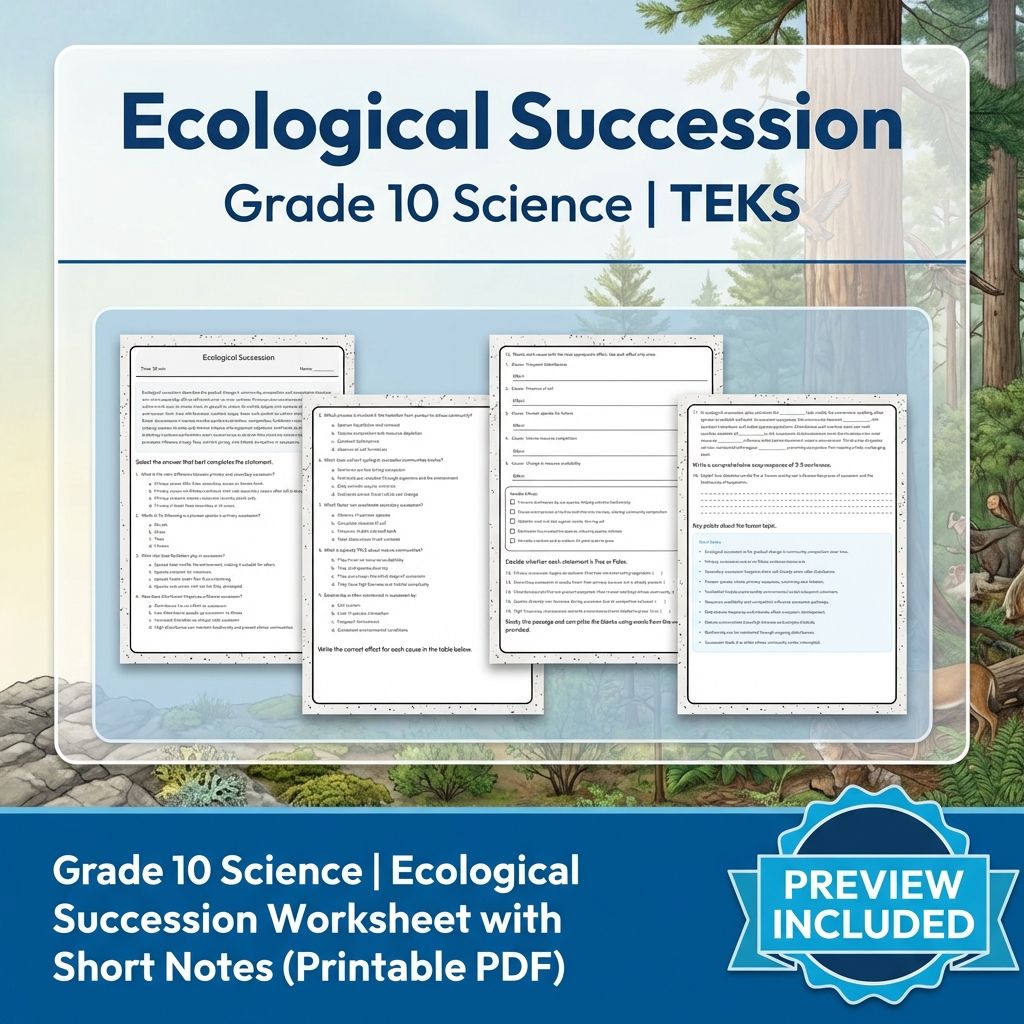
Grade 10 Science | Ecological Succession Worksheet with Short Notes (PDF)
Created byMeadowlark WorksheetsLearning Objectives
- Understand the process and stages of primary and secondary succession.
- Identify factors influencing succession pathways and community changes.
- Explain the roles of species colonization, competition, and facilitation in succession.
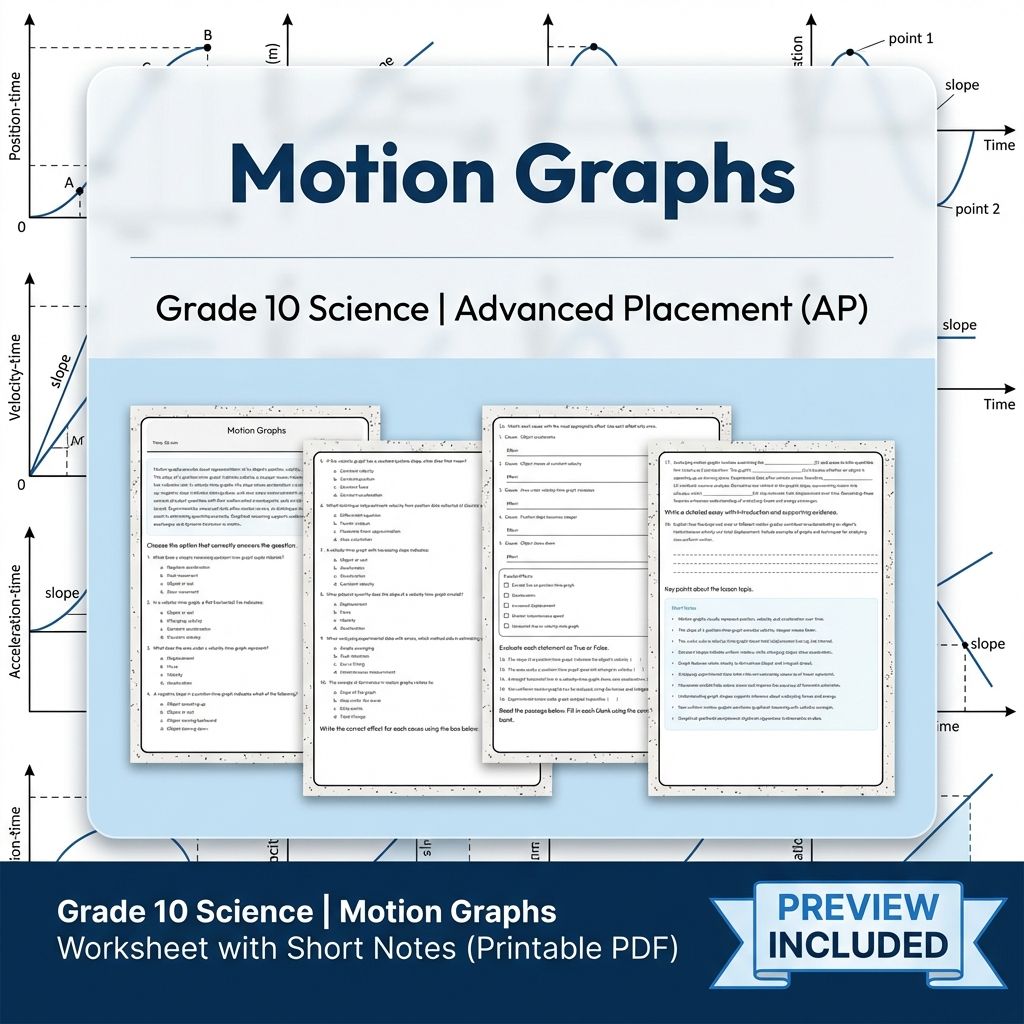
Grade 10 Science | Motion Graphs Worksheet with Short Notes (Printable PDF)
Created byMeadowlark WorksheetsLearning Objectives
- Analyze how slopes encode velocity and acceleration in motion graphs.
- Understand how area under graphs relates to change in position and speed.
- Extract kinematic quantities from graphical data in non-uniform motion.
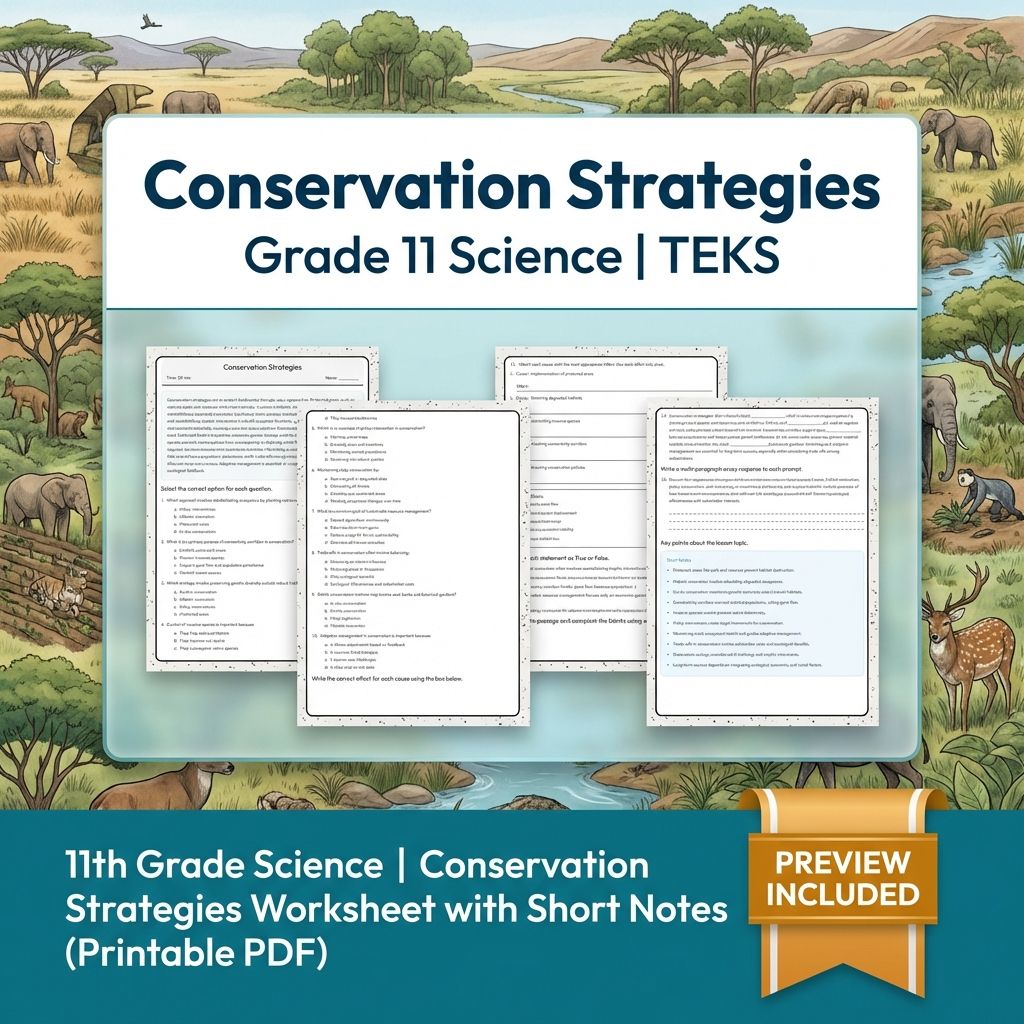
11th Grade Science | Conservation Strategies Worksheet with Short Notes (PDF)
Created byMeadowlark WorksheetsLearning Objectives
- Understand various conservation strategies used to preserve biodiversity.
- Identify methods such as protected areas, habitat restoration, and policy interventions.
- Evaluate the effectiveness and trade-offs of different conservation approaches.
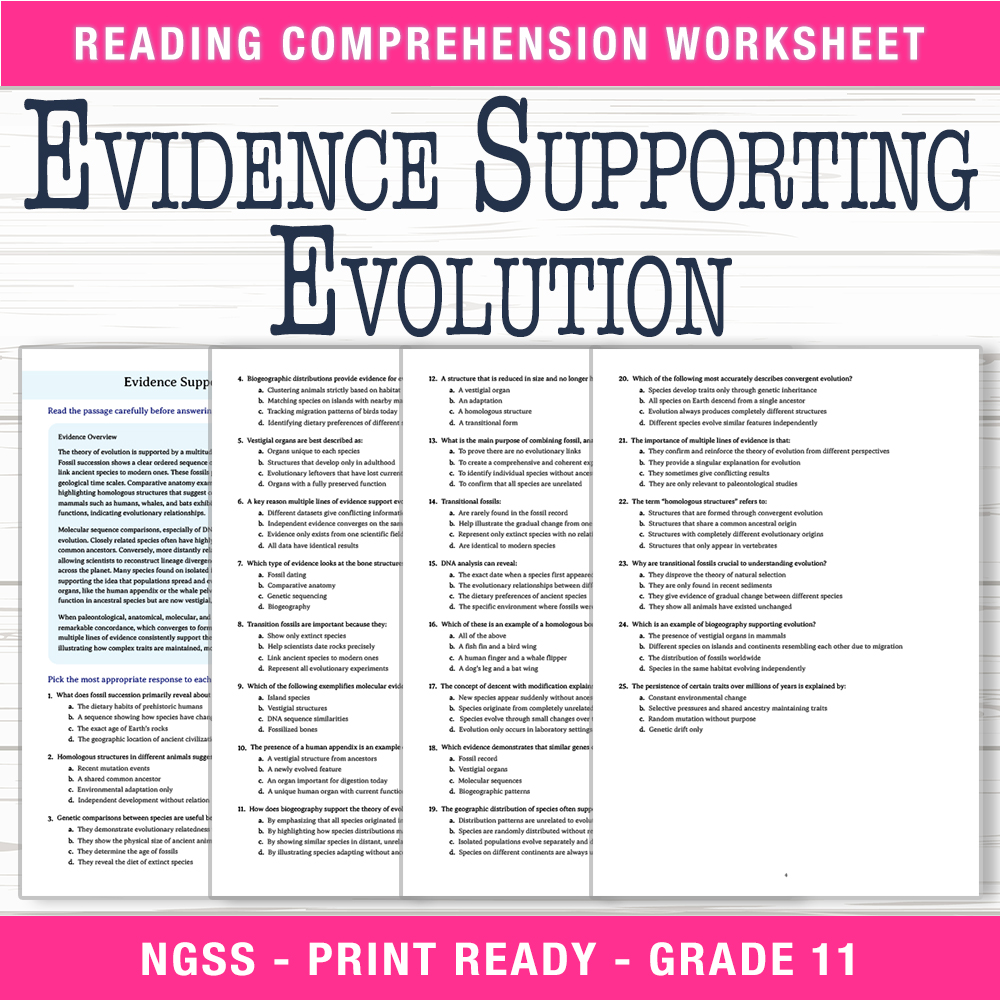
Grade 11 Science | Evidence Supporting Evolution Worksheet (PDF + Answer Key)
Created byRiverstone ClassroomLearning Objectives
- Understand the various lines of empirical evidence that support common ancestry and biological evolution.
- Identify and compare fossil records, anatomical features, molecular data, and biogeographic patterns that demonstrate evolutionary relationships.
- Explain how multiple independent datasets converge to provide a coherent picture of lineage history and trait persistence.
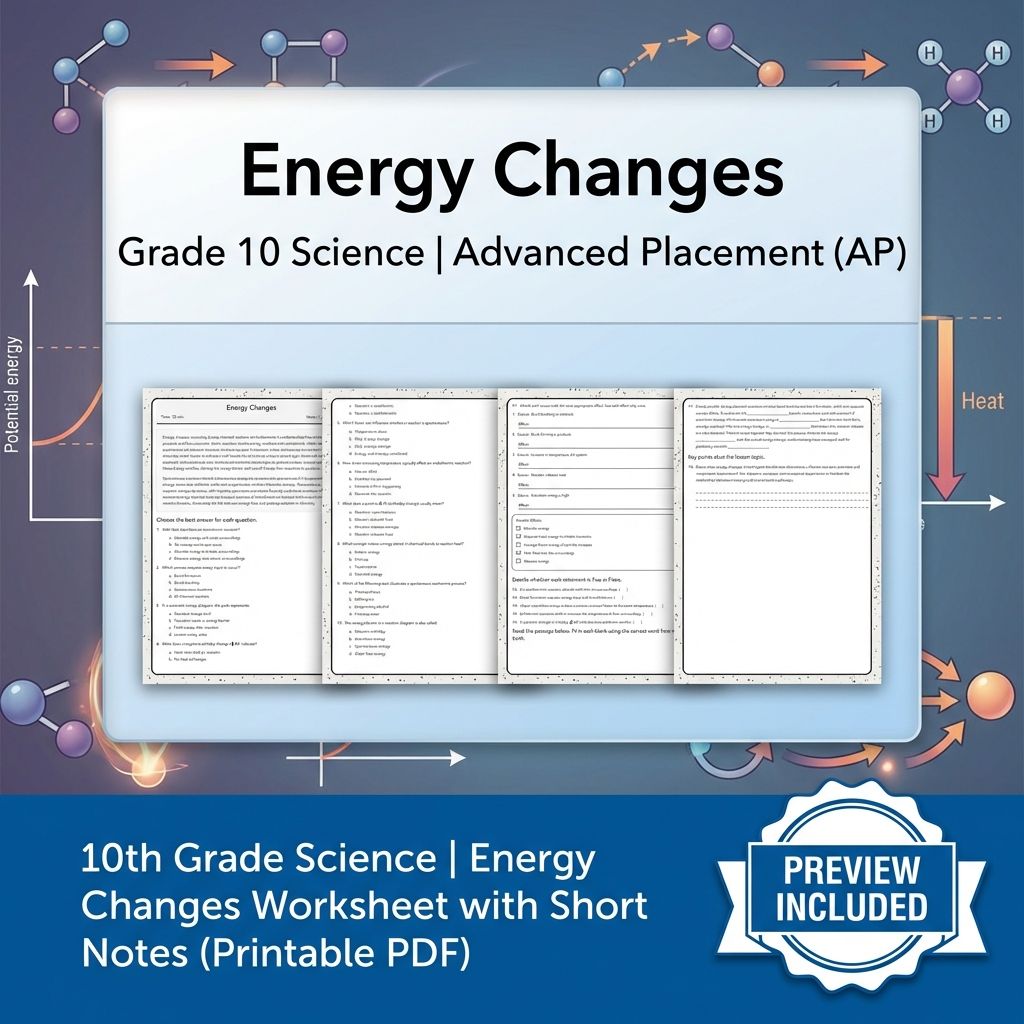
10th Grade Science | Energy Changes Worksheet with Short Notes (Printable PDF)
Created byMeadowlark WorksheetsLearning Objectives
- Explain the difference between endothermic and exothermic processes in chemical reactions.
- Describe the concepts of enthalpy and bond energetics in relation to reaction heat.
- Relate potential energy diagrams to energy changes during reactions.
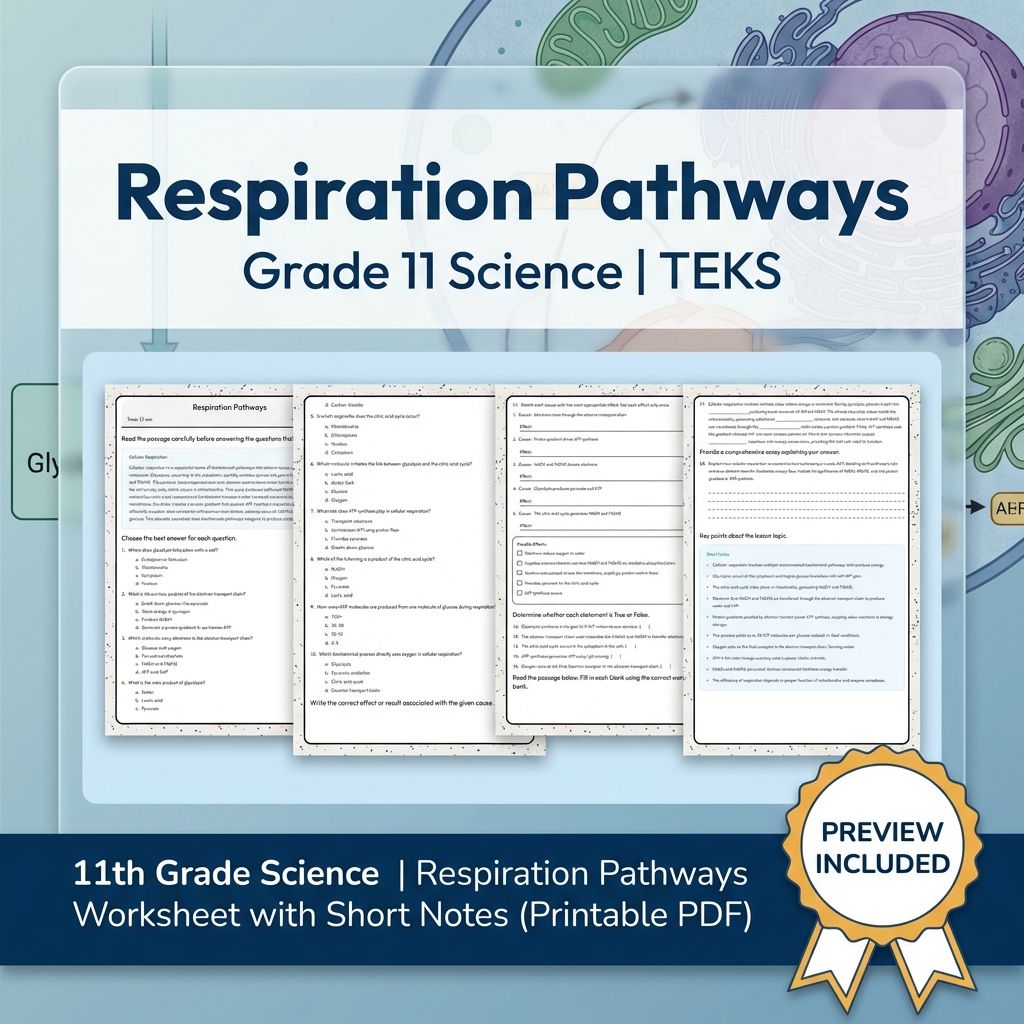
11th Grade Science | Respiration Pathways Worksheet with Short Notes (PDF)
Created byMeadowlark WorksheetsLearning Objectives
- Describe the main stages of cellular respiration, including glycolysis, the citric acid cycle, and electron transport.
- Explain how electrons transfer energy through electron carriers to produce ATP.
- Identify the biochemical pathways and their sequence involved in energy flow during respiration.
Browse more categories
About Science Worksheets
Find Science worksheets spanning core skills, practice, and review. All 42,822 resources are instant PDF downloads for the classroom or home.
Every worksheet on MyTeachingSheets is created by independent teacher-authors and reviewed before publication. All resources download as printable PDFs for classroom, homework, or at-home practice, and many include answer keys. Preview any worksheet free before buying.