
Science Worksheets
44,295 subject resources
Pure Substances Worksheet | Grade 7 Science Practice & Review
 Created byPrism Point Learning
Learning Objectives
- Explain why pure substances have uniform composition and characteristic properties such as fixed melting/boiling points.
- Differentiate elements and compounds using physical and chemical evidence.
- Identify how impurities and multiple constituents change observed properties when comparing to pure substances.
Instant download

Separation Methods Worksheet Grade 7 Science Practice
Created byPrism Point LearningLearning Objectives
- Explain how physical properties (particle size, solubility, magnetism, boiling point) can be used to separate mixtures without changing chemical identity
- Match common separation techniques to the physical property differences they exploit
- Interpret separation efficiency by linking observations (what remains vs. what is removed) to the type of material in a mixture
Instant download

Conservation Applications Worksheet Pack | Grade 7 Science Activities
Created byPrism Point LearningLearning Objectives
- Use mass conservation to build simple mass budgets for closed or near-closed science systems.
- Explain how reaction stoichiometry and waste/environmental accounting apply conservation of mass.
- Analyze measured versus expected masses and suggest plausible reasons for differences.
Instant download

Particle Model Worksheet | Grade 7 Science Activities
Created byPrism Point LearningLearning Objectives
- Explain how the particle model uses discrete particles, spaces, and motion to describe matter
- Connect particle behavior to observable properties and state changes (such as density, diffusion, evaporation, and condensation)
- Differentiate physical rearrangements from chemical transformations using particle interactions
Instant download

Tree Evidence Worksheet | Grade 6 Science NGSS Review and Practice
Created byPrism Point LearningLearning Objectives
- Explain how homologous structures, vestigial organs, and conserved DNA sequences can support common ancestry.
- Use similarities and differences among traits to interpret branching relationships on a phylogenetic tree.
- Describe how ancestral-form indicators and morphological gradients can help form hypotheses about lineage splitting.
Also included in: Grade 6 Evolution and Biodiversity Science lesson bundle | NGSS
Instant download

Science Worksheet Advanced Materials | Grade 7 Science | Ontario Standards
JCreated byJ.S SheetsLearning Objectives
- Describe how engineered timber, fibre-reinforced polymers, and high-performance concrete are made and why they are stronger or more durable.
- Explain how microstructure and manufacturing choices affect strength, stiffness, and durability.
- Evaluate trade-offs among cost, fabrication complexity, and performance in real construction and retrofit situations.
Instant download

Grade 7 Speciation Processes Worksheet | NGSS Evolution Life Science
 Created byBRIGHT PATH RESOURCES
Learning Objectives
- Understand the key mechanisms that lead to the formation of new species.
- Identify examples of reproductive isolation and geographic separation.
- Explain how polyploidy and adaptive radiation contribute to biodiversity.
Also included in: Evolution & Genetics Grade 7 Science Worksheets Lesson Bundle | NGSS +2 more
Instant download
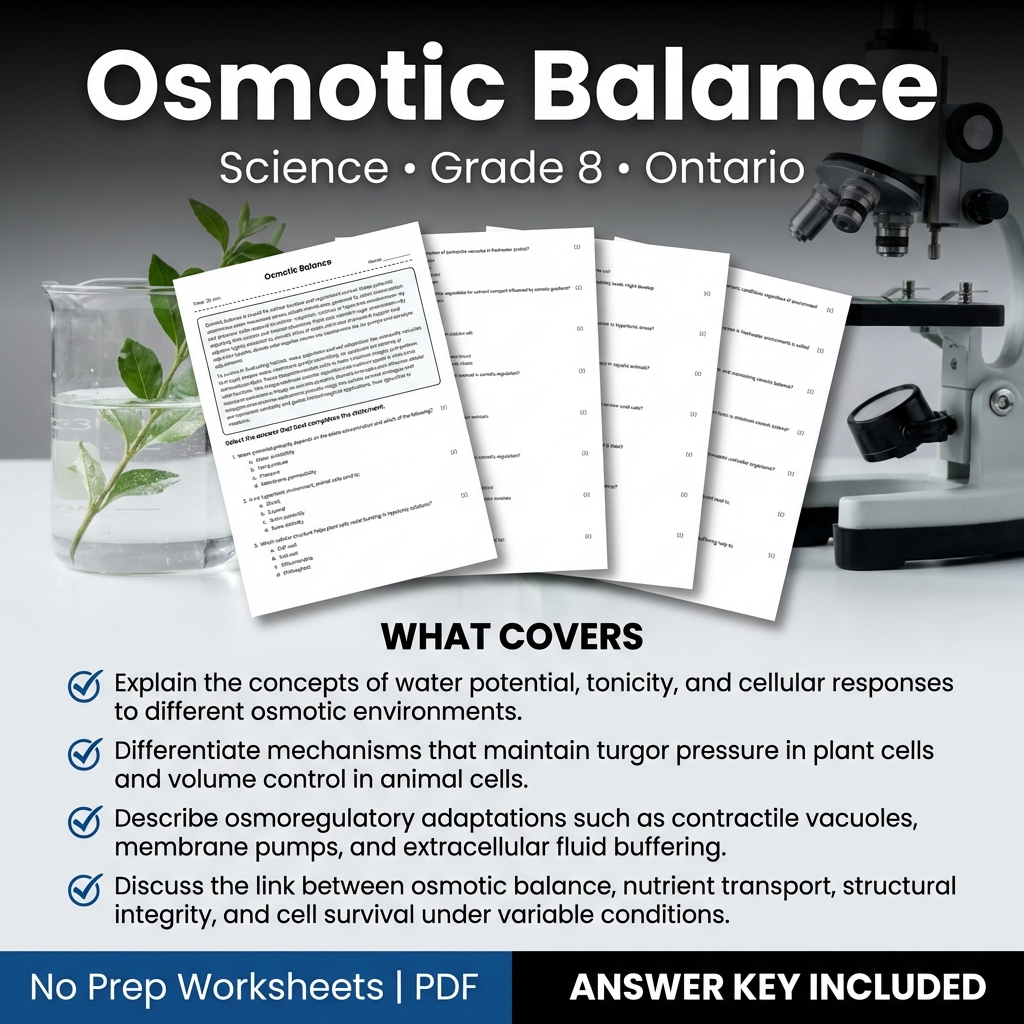
Grade 8 Science Worksheet on Osmotic Balance | Ontario Standards
 Created byCoral Reef Learning
Learning Objectives
- Explain the concepts of water potential, tonicity, and cellular responses to different osmotic environments.
- Differentiate mechanisms that maintain turgor pressure in plant cells and volume control in animal cells.
- Describe osmoregulatory adaptations such as contractile vacuoles, membrane pumps, and extracellular fluid buffering.
Instant download
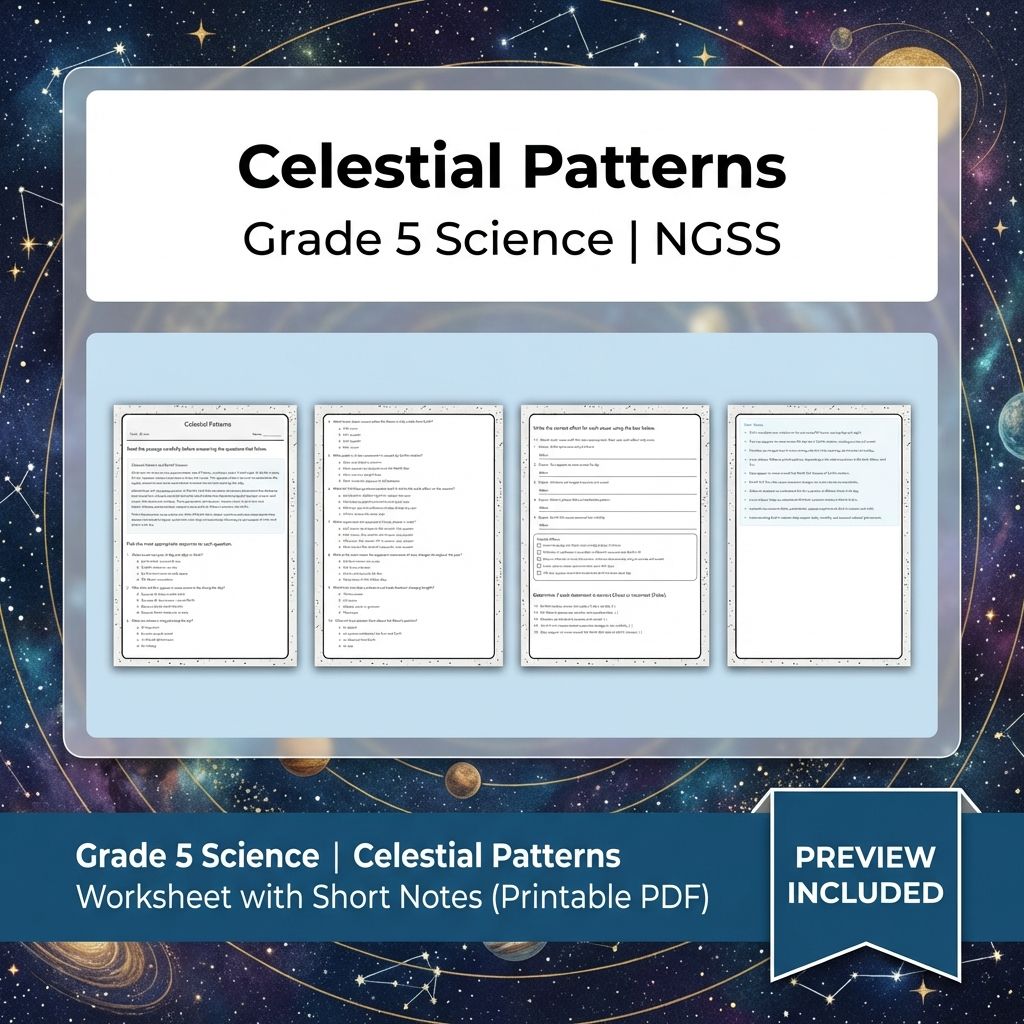
Grade 5 Science | Celestial Patterns Worksheet with Short Notes (PDF)
 Created byMeadowlark Worksheets
Learning Objectives
- Understand how Earth's rotation causes day and night.
- Describe the sequence of lunar phases and their connection to celestial motion.
- Interpret graphical representations of shadow lengths and sun positions throughout the day.
Also included in: Grade 5 Science | Earth and Space Unit Bundle NGSS-Aligned Resources +1 more
Instant download
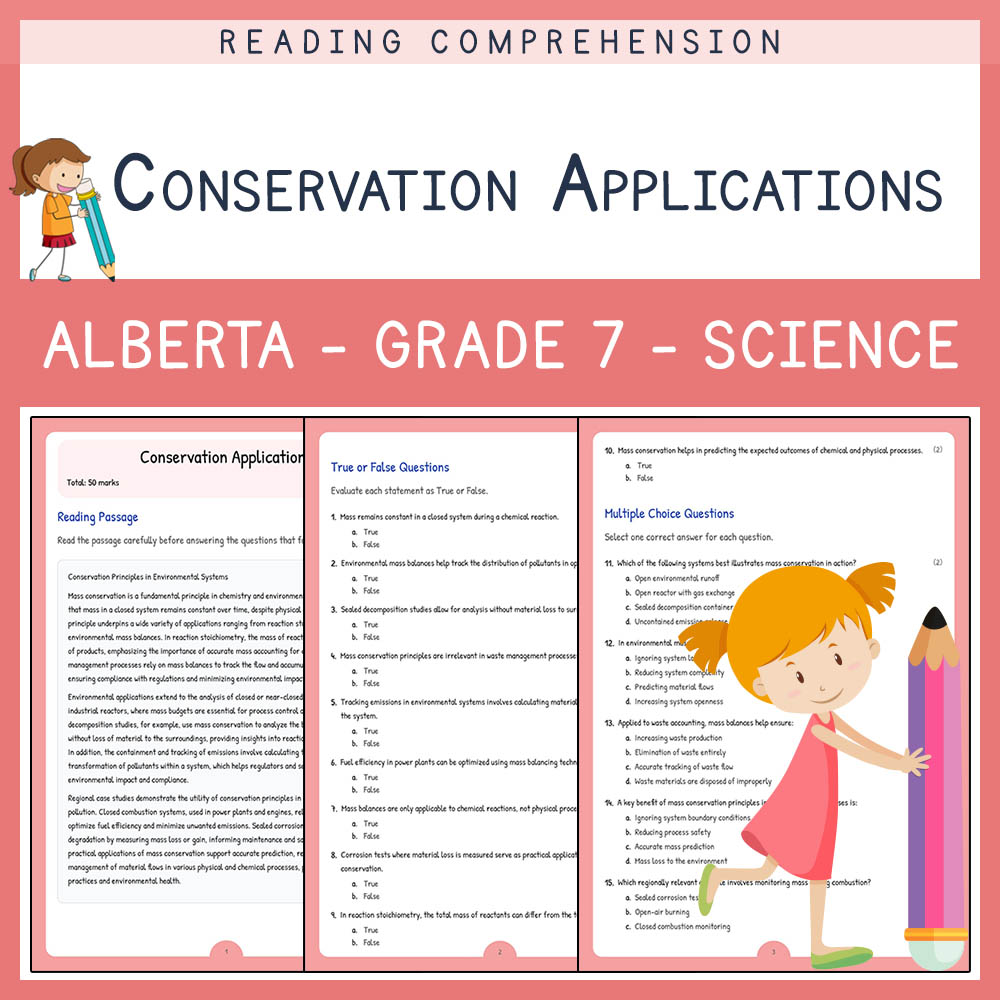
Grade 7 Science | Conservation Applications Worksheet Elena | Alberta
 Created byLumora Learning
Learning Objectives
- Understand the principles of mass conservation in chemical and environmental systems.
- Identify practical examples and applications of mass balancing in real-world scenarios.
- Explain how conservation principles are used in waste management and environmental monitoring.
Instant download

Grade 10 Science – Understanding Net Force & Motion | Daily Reading Worksheet
 Created byBright Mind Resources
Learning Objectives
- Understand key concepts related to Science
- Apply knowledge through practice questions
- Demonstrate comprehension of the material
Also included in: Forces & Motion Grade 10 Science Daily Reading Worksheets Lesson Bundle | NGSS +2 more
Instant download
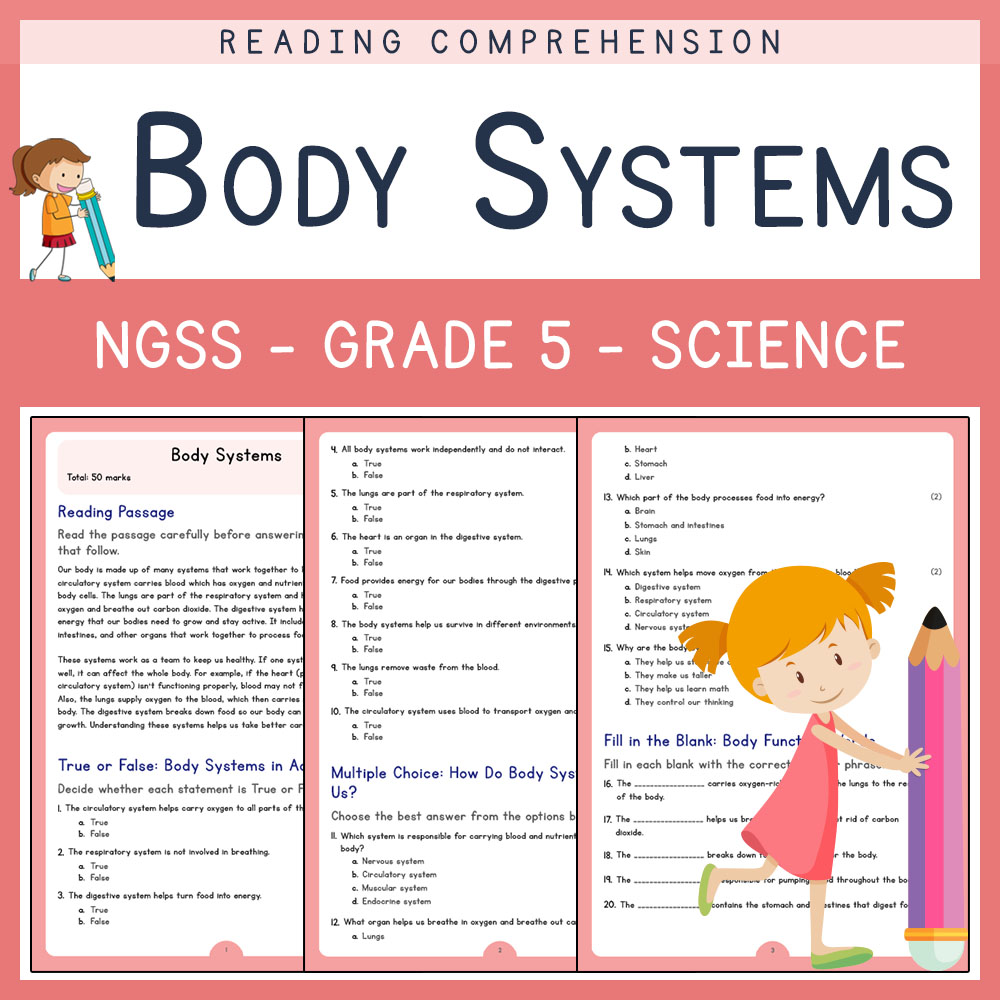
Grade 5 Science | Body Systems Worksheet ( PDF ) | NGSS Aligned
Created byLumora LearningLearning Objectives
- Identify the major human body systems and their functions
- Explain how the circulatory, respiratory, and digestive systems work together to support life
- Understand the importance of each system for health and survival
Instant download
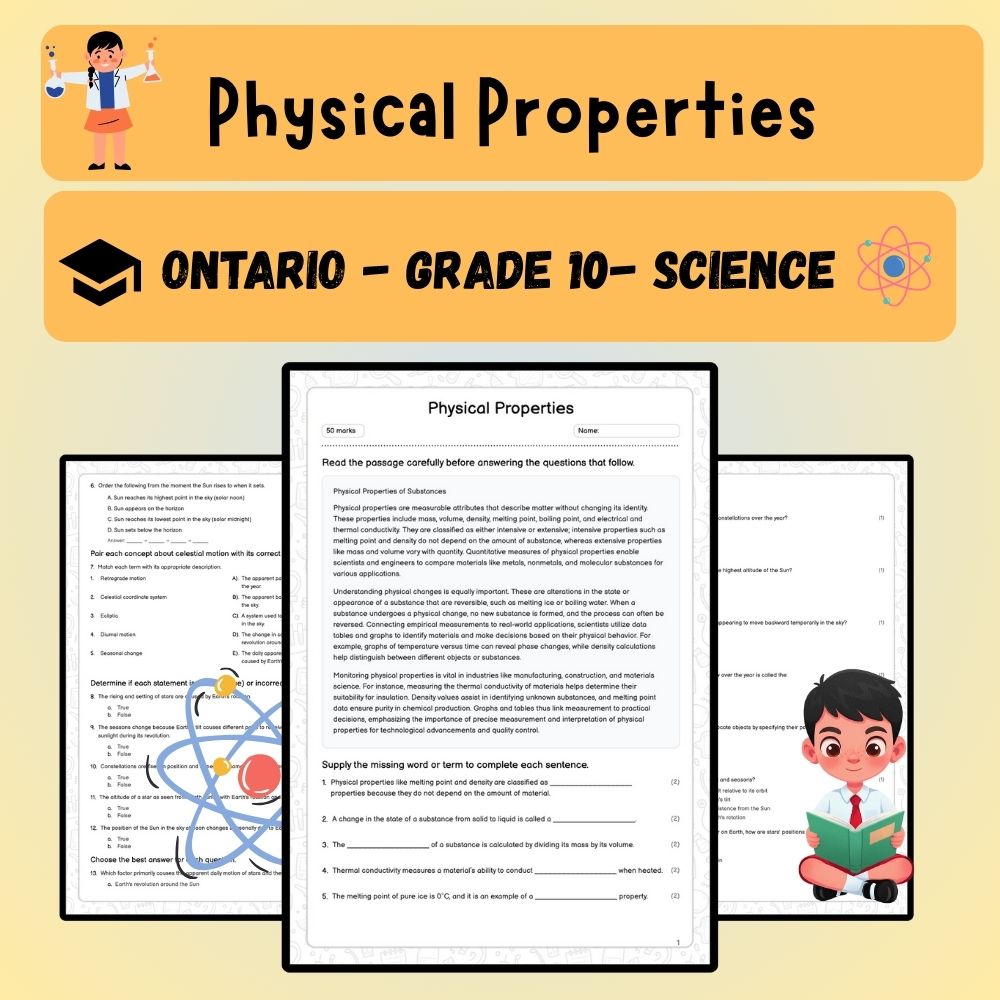
Grade 10 Science – Physical Properties Worksheet (PDF) Aligned with Ontario Standards
Created byPrism Point LearningLearning Objectives
- Define and distinguish between various physical properties such as density, melting point, and conductivity.
- Understand how measurable attributes help in comparing different substances.
- Explain the concept of physical changes and their reversibility.
Also included in: Grade 10 Science Unit | Chemistry & Atomic Structure Worksheets +1 more
Instant download
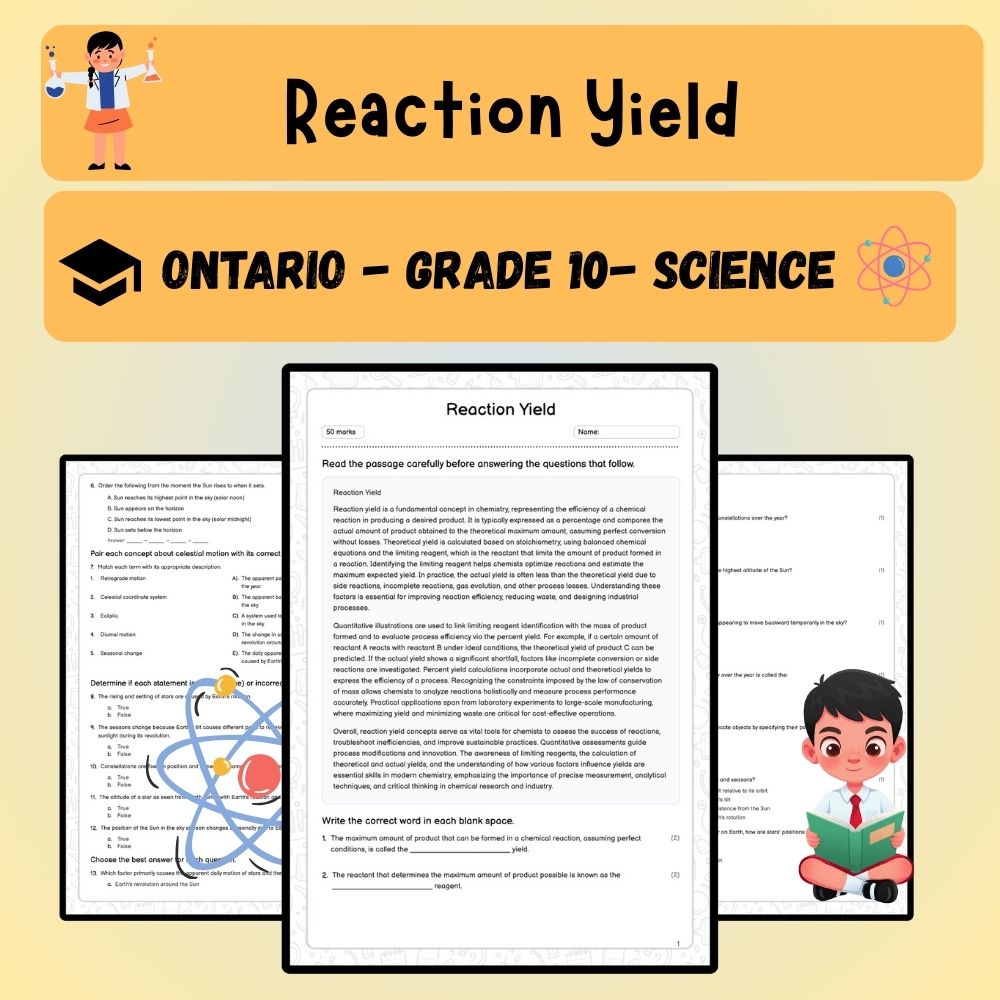
Grade 10 Science | Reaction Yield Worksheet (PDF) for Ontario Standards
Created byPrism Point LearningLearning Objectives
- Understand the concepts of theoretical and actual yield in chemical reactions.
- Identify limiting reagents and their effect on maximum product formation.
- Calculate percent yield from given experimental data.
Also included in: Grade 10 Science Unit | Chemistry & Atomic Structure Worksheets +1 more
Instant download
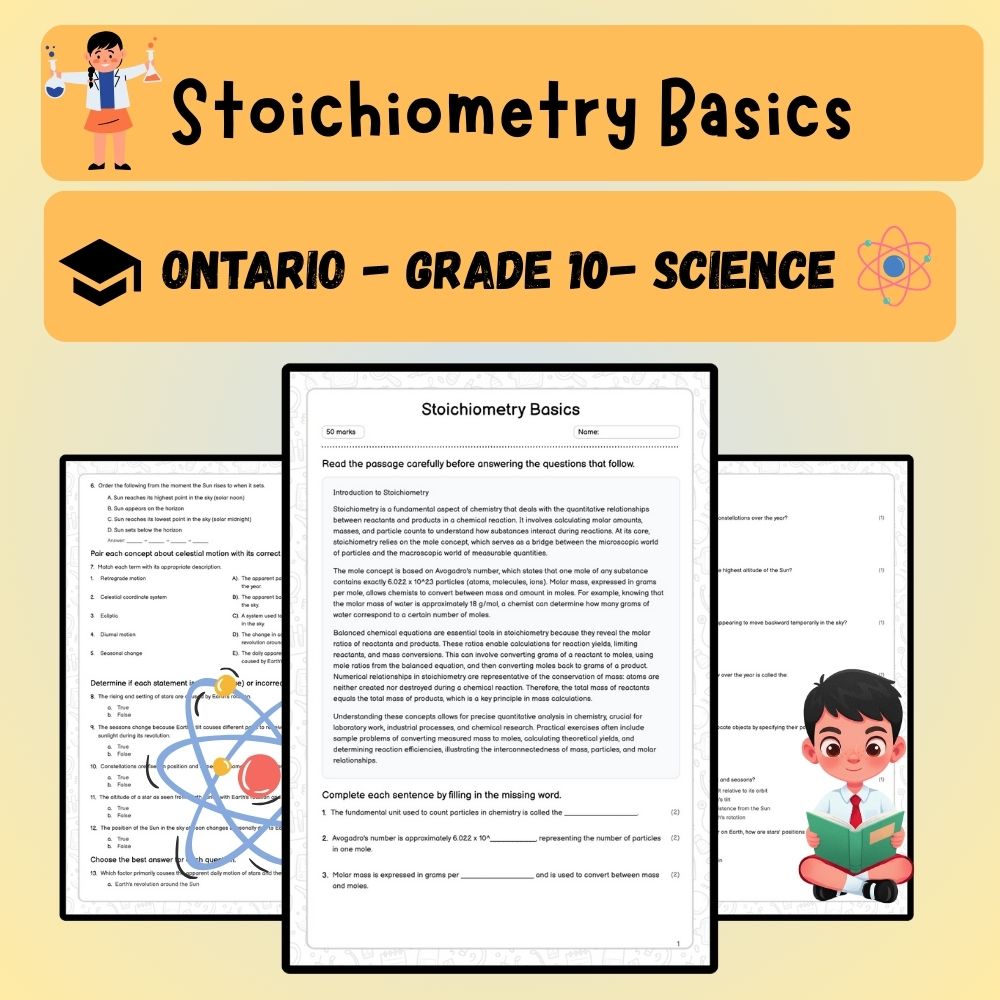
Grade 10 Science | Stoichiometry Basics Worksheet (Answer Key) for Ontario Standards
Created byPrism Point LearningLearning Objectives
- Understand the mole concept and its relation to mass and number of particles.
- Learn to perform mass-to-mole and mole-to-mass conversions using molar mass.
- Use balanced chemical equations to determine molar ratios and predict reaction outcomes.
Also included in: Grade 10 Science Unit | Chemistry & Atomic Structure Worksheets +1 more
Instant download
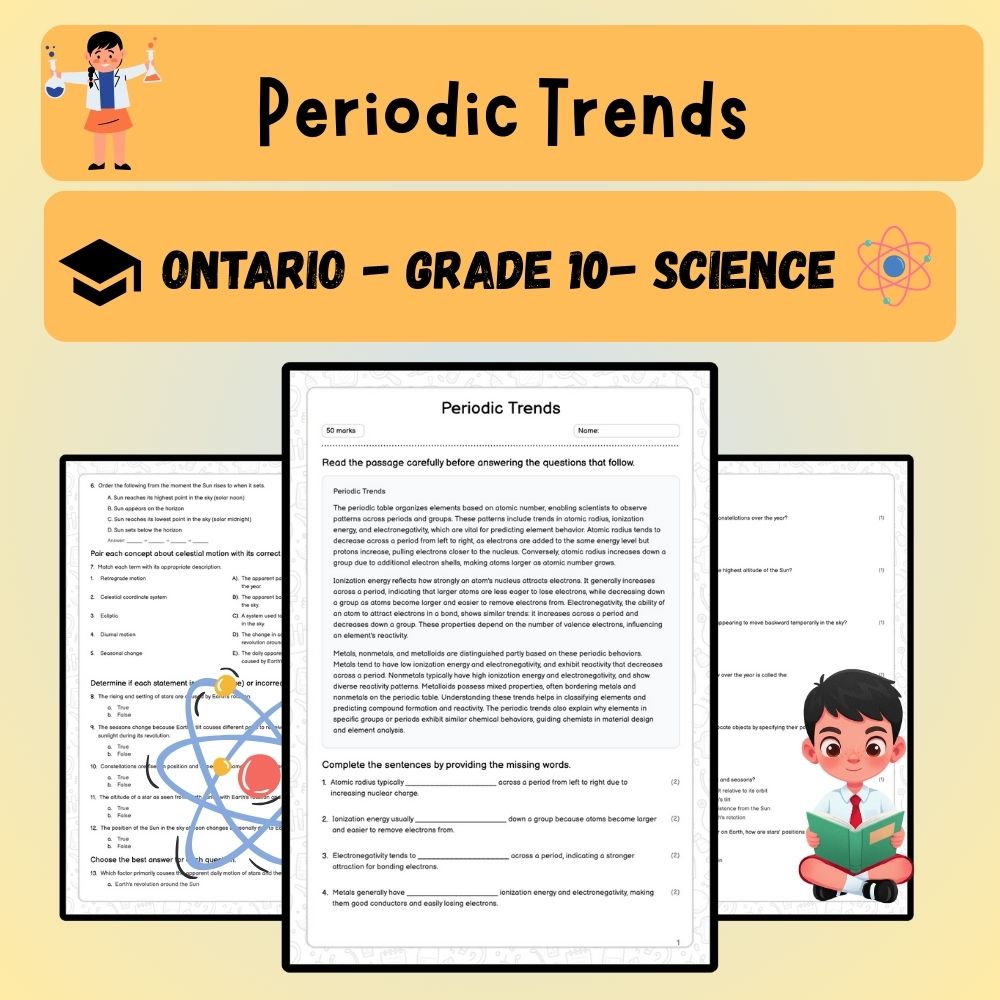
Grade 10 Science | Periodic Trends Worksheet (Answer Key) | Ontario Standard
Created byPrism Point LearningLearning Objectives
- Analyze and interpret patterns of atomic radius, ionization energy, and electronegativity across the periodic table.
- Classify elements as metals, nonmetals, or metalloids based on their properties and trends.
- Explain how group and period relationships influence valence electrons and reactivity.
Also included in: Grade 10 Science Unit | Chemistry & Atomic Structure Worksheets +1 more
Instant download
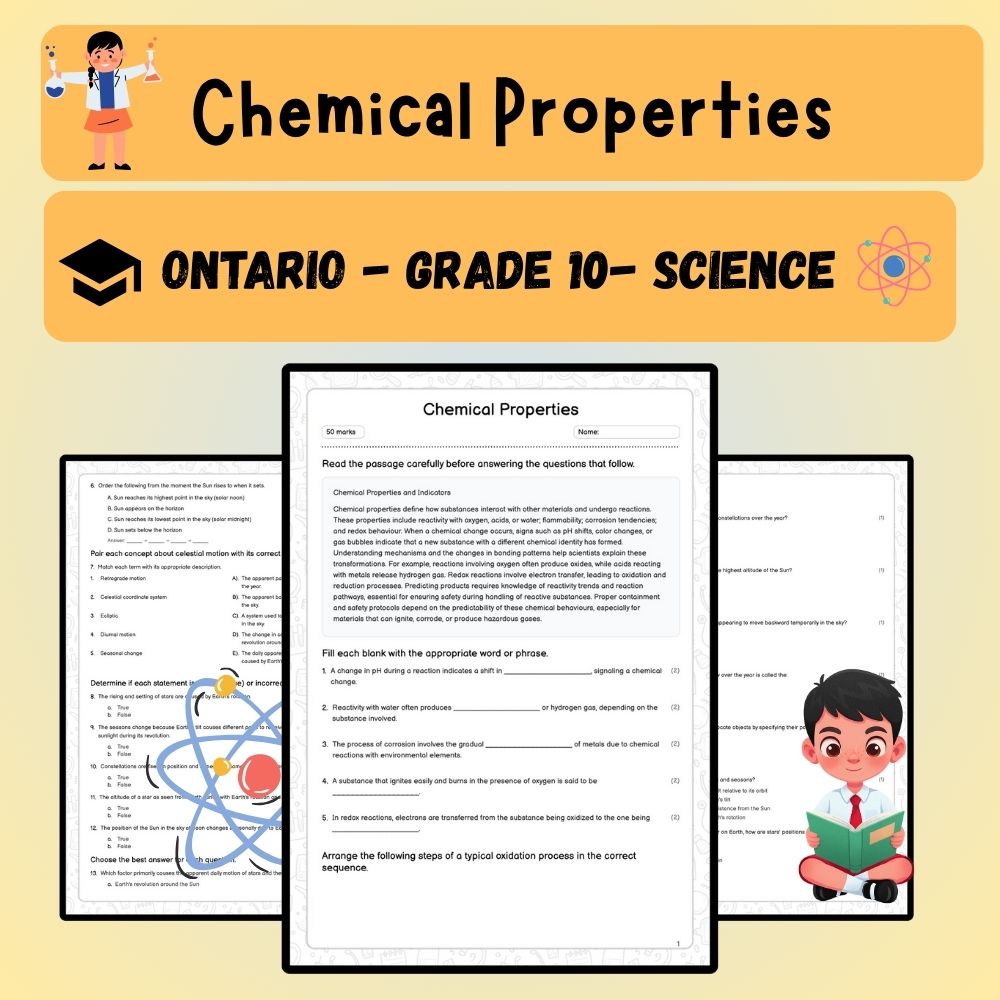
Grade 10 Science | Chemical Properties Worksheet (Ontario Standards) PDF
Created byPrism Point LearningLearning Objectives
- Understand the indicators that signal chemical changes such as pH shifts and gas evolution.
- Identify various reactions involving oxygen, acids, water, and redox processes.
- Explain reaction mechanisms and bonding changes during chemical reactions.
Also included in: Grade 10 Science Unit | Chemistry & Atomic Structure Worksheets +1 more
Instant download
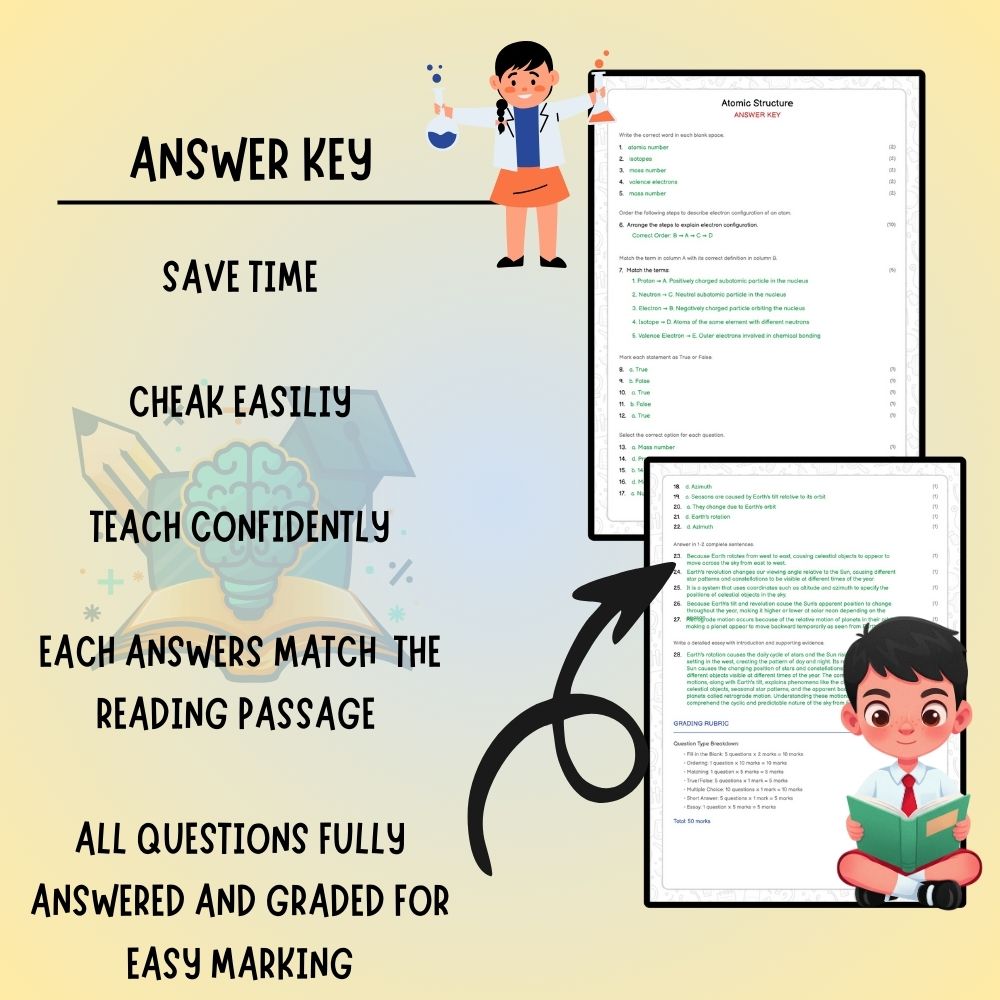
Grade 10 Science | Atomic Structure Worksheet (PDF) for Ontario Standards
Created byPrism Point LearningLearning Objectives
- Describe the basic components of atomic structure including protons, neutrons, and electrons.
- Explain the concepts of atomic number, mass number, and isotopes with examples.
- Understand electron configuration and valence electrons and their influence on chemical behavior.
Also included in: Grade 10 Science Unit | Chemistry & Atomic Structure Worksheets +1 more
Instant download
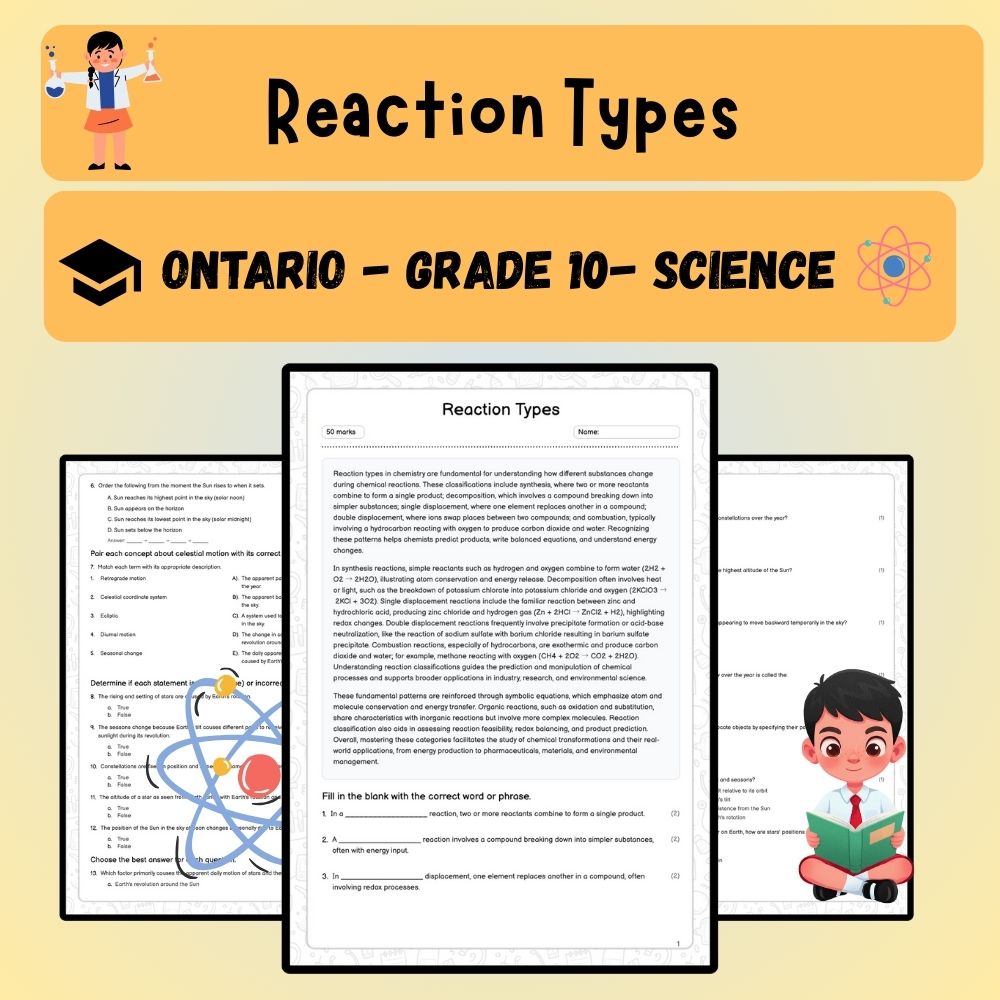
Grade 10 Science – Reaction Types Worksheet | Ontario Standard (PDF)
Created byPrism Point LearningLearning Objectives
- Classify chemical reactions into synthesis, decomposition, single and double displacement, and combustion categories.
- Identify characteristic reactant-product patterns for each reaction type.
- Understand the role of redox considerations in reaction classification.
Also included in: Grade 10 Science Unit | Chemistry & Atomic Structure Worksheets +1 more
Instant download
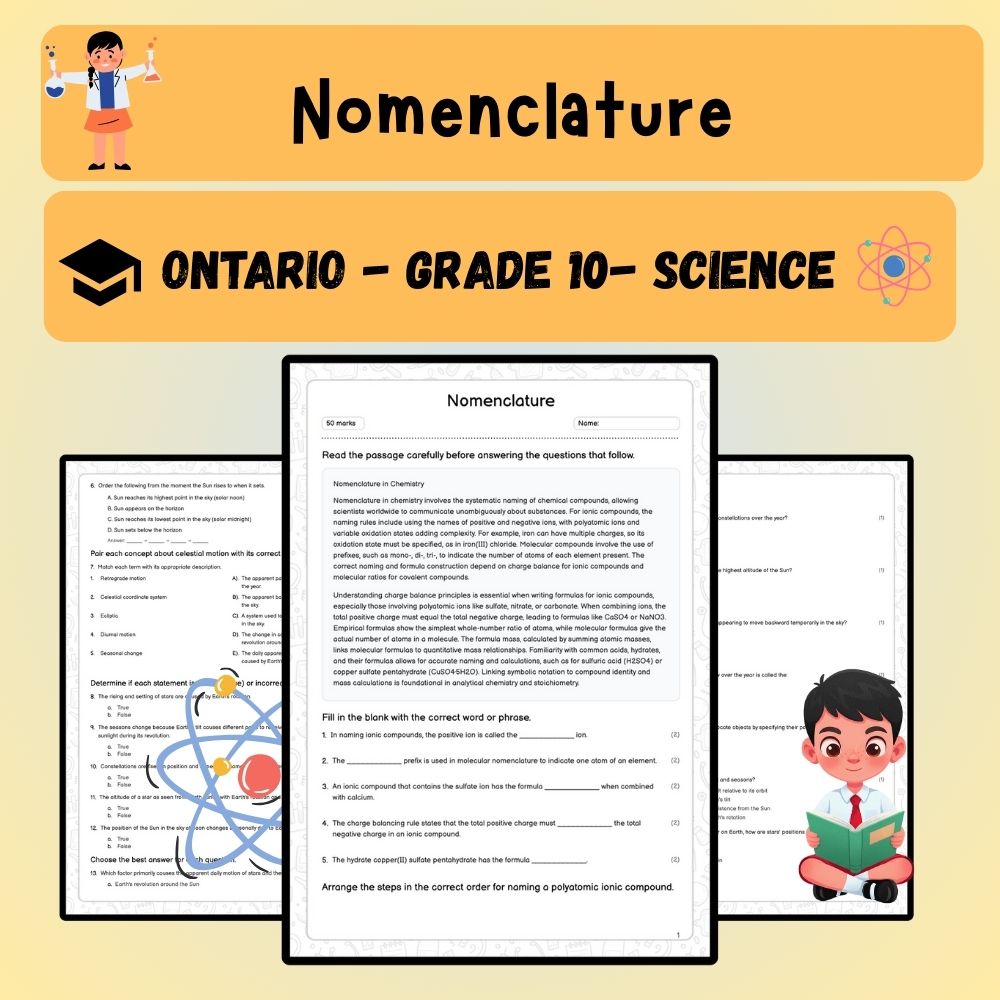
Grade 10 Science | Nomenclature Worksheet – Chemical Naming & Formulas (PDF)
Created byPrism Point LearningLearning Objectives
- Understand systematic naming conventions for ionic and molecular compounds.
- Identify polyatomic ions, variable oxidation states, and chemical formulas.
- Apply charge balance principles to ionic compound formulas.
Also included in: Grade 10 Science Unit | Chemistry & Atomic Structure Worksheets +1 more
Instant download
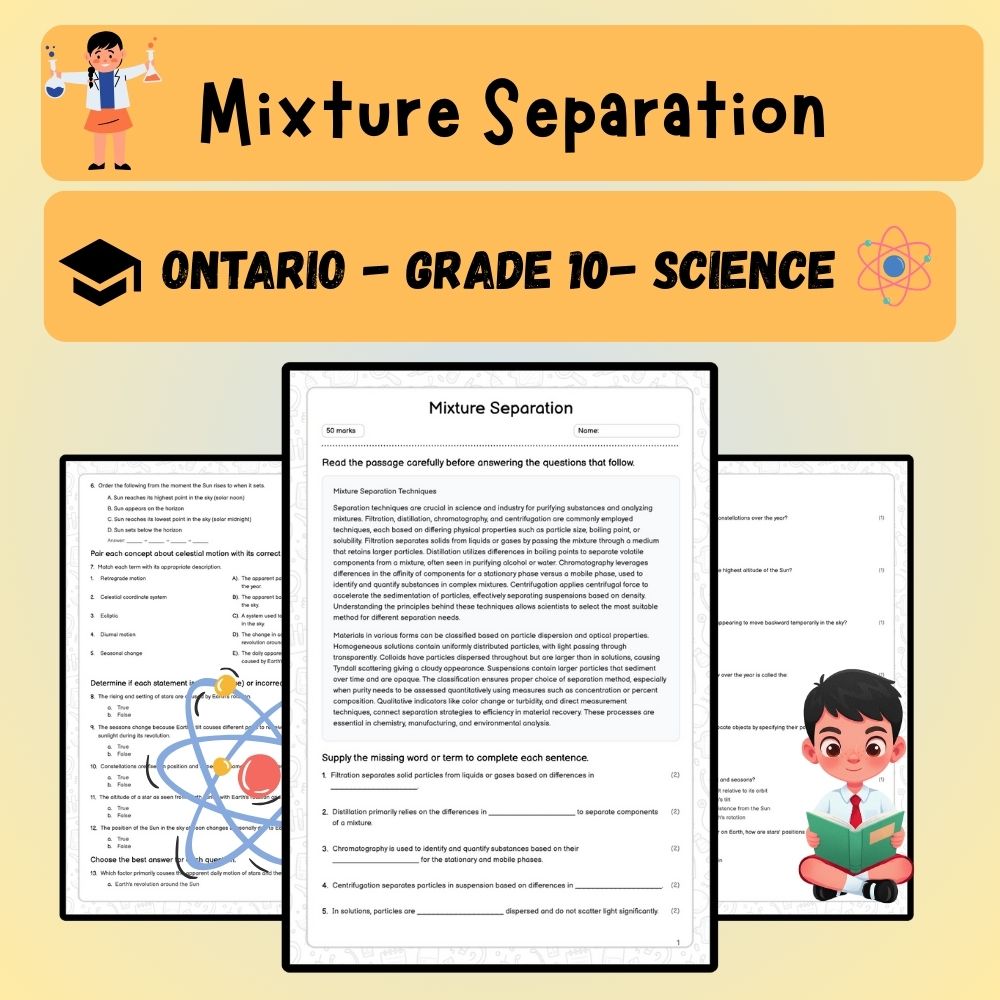
Grade 10 Science | Mixture Separation Worksheet – Comprehensive Activities (PDF)
Created byPrism Point LearningLearning Objectives
- Describe the principles behind different separation techniques such as filtration, distillation, chromatography, and centrifugation.
- Contrast the properties of homogeneous solutions, colloids, and suspensions based on particle dispersion and optical properties.
- Explain how qualitative and quantitative measures assess the purity of materials.
Also included in: Grade 10 Science Unit | Chemistry & Atomic Structure Worksheets +1 more
Instant download
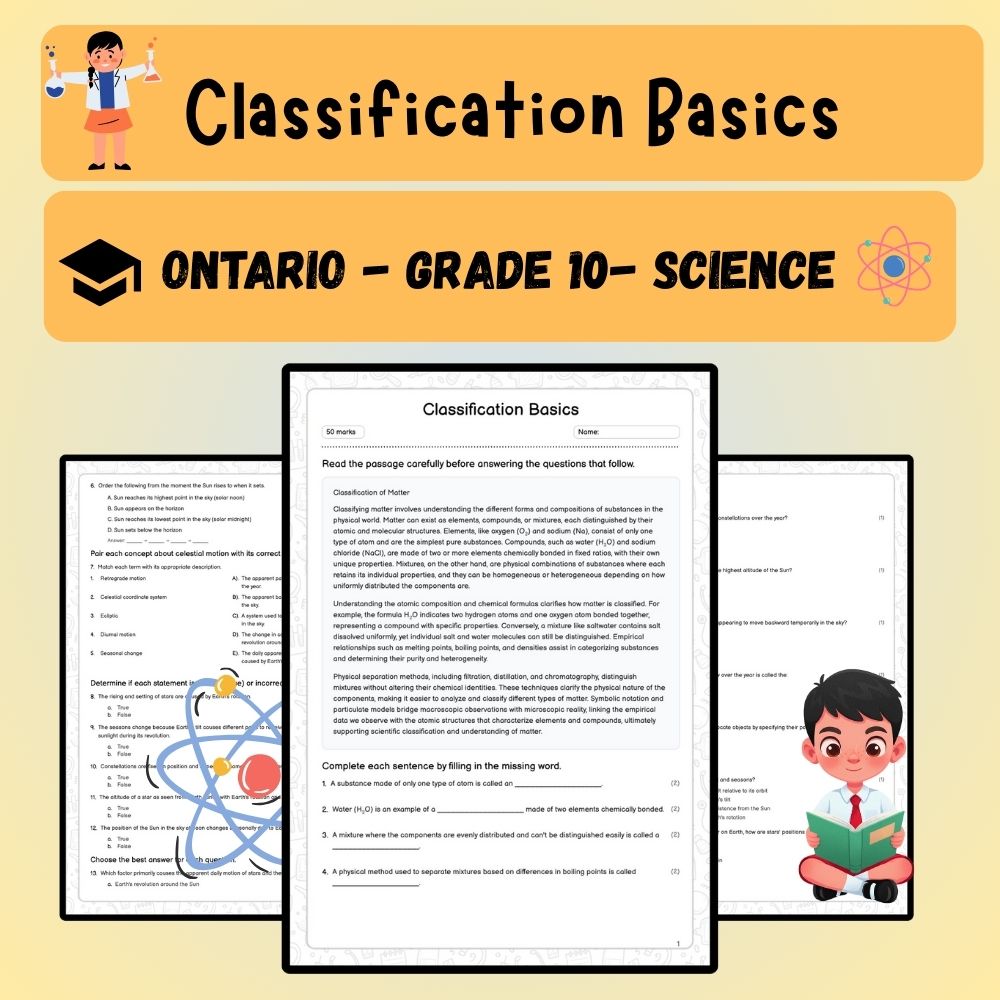
Grade 10 Science Classification Basics Worksheet – Ontario Standard (PDF) & Answer Key
Created byPrism Point LearningLearning Objectives
- Understand foundational schemes for classifying matter including states, substances, and mixtures.
- Distinguish between elements and compounds using examples like oxygen, water, and sodium chloride.
- Learn how atomic composition, chemical formulas, and empirical relationships support classification.
Also included in: Grade 10 Science Unit | Chemistry & Atomic Structure Worksheets +1 more
Instant download
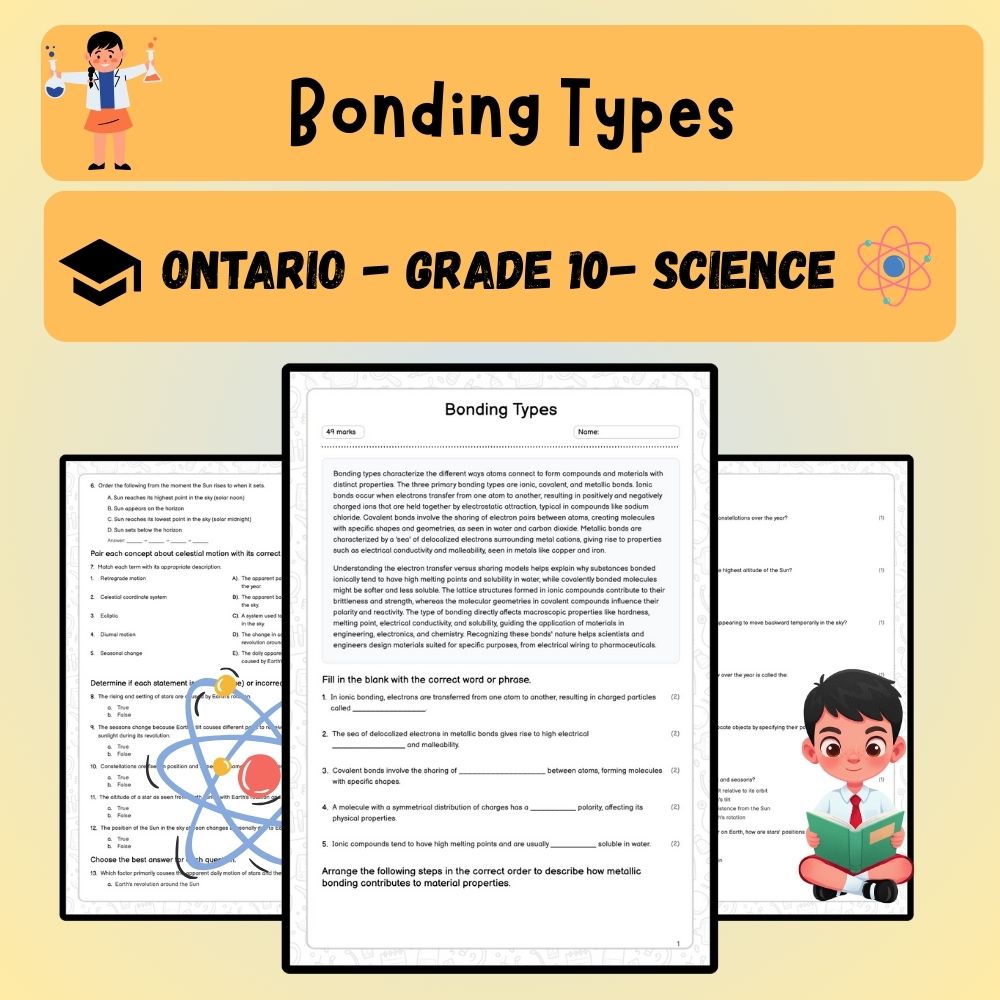
Grade 10 Science | Bonding Types Worksheet (PDF) | Ontario Standards
Created byPrism Point LearningLearning Objectives
- Understand the different types of chemical bonding: ionic, covalent, and metallic.
- Explain electron transfer and sharing models in bonding.
- Describe lattice structures and molecular geometries based on bonding.
Also included in: Grade 10 Science Unit | Chemistry & Atomic Structure Worksheets +1 more
Instant download

Grade 10 Science | Energy Conservation - Daily Reading Comprehension
Created byCoral Reef LearningLearning Objectives
- Understand key concepts related to Science
- Apply knowledge through practice questions
- Demonstrate comprehension of the material
Instant download
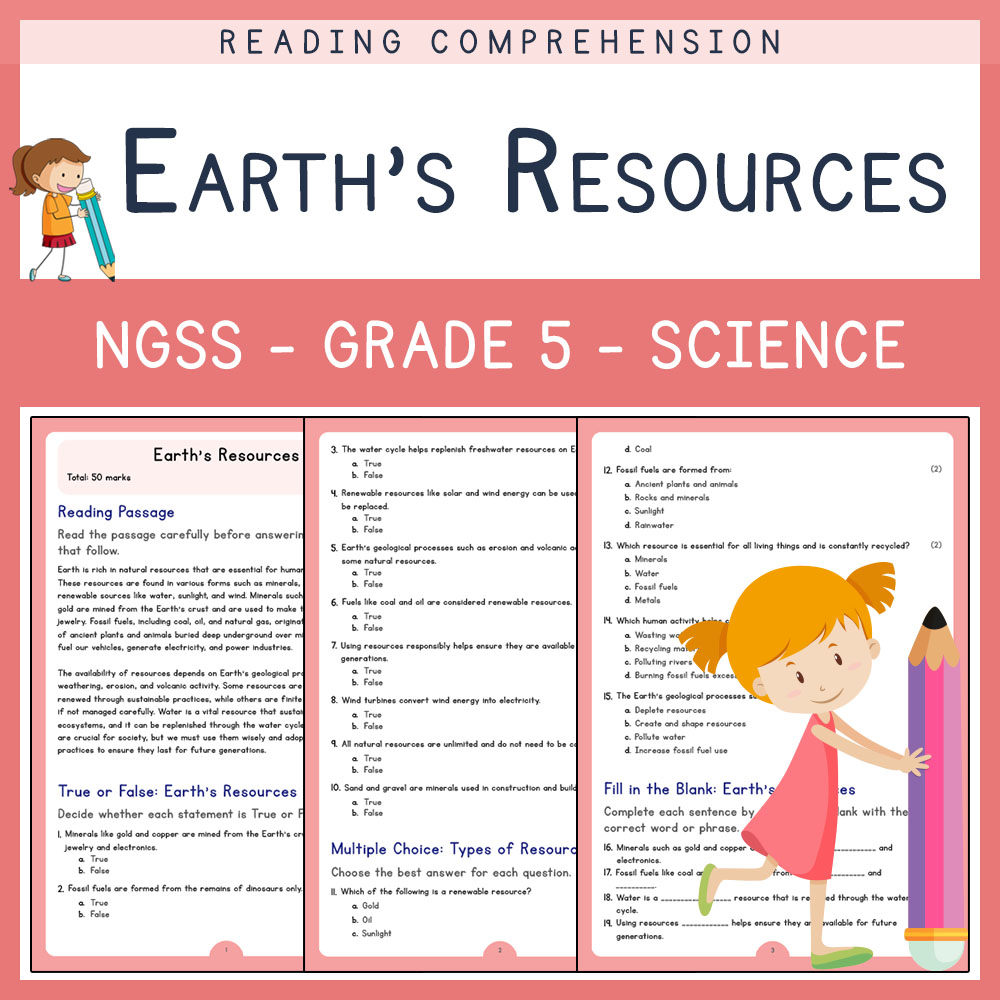
Grade 5 Science | Earth's Resources Worksheets (PDF) | NGSS Aligned
Created byLumora LearningLearning Objectives
- Identify different types of natural resources such as minerals, fossil fuels, and renewable sources.
- Explain how Earth's geological processes influence resource availability.
- Recognize the importance of conserving natural resources and sustainable practices.
Instant download
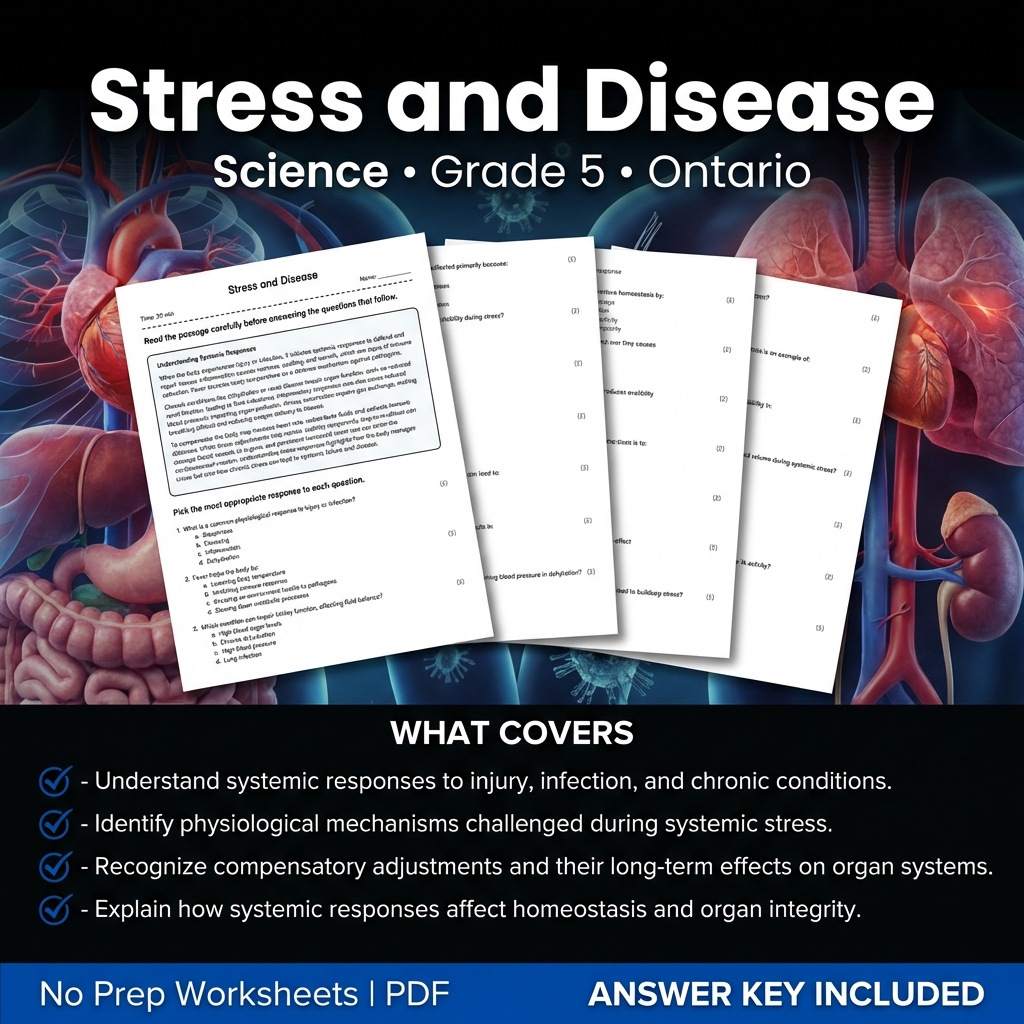
Stress and Disease Grade 5 Science Worksheet | Ontario Standard
Created byCoral Reef LearningLearning Objectives
- Understand systemic responses to injury, infection, and chronic conditions.
- Identify physiological mechanisms challenged during systemic stress.
- Recognize compensatory adjustments and their long-term effects on organ systems.
Instant download

Modeling Data Worksheet ngss g8 | Grade 8 Science Assessment
 Created byCedar Grove Learning
Learning Objectives
- Describe how physical and computational models generate quantitative data for testing solutions.
- Identify limitations and sources of measurement uncertainty in data models.
- Understand the importance of consistent input conditions and repeatability in data collection.
Instant download

Grade 12 Science | Science And Technology Worksheet | NGSSS Aligned
Created byLumora LearningLearning Objectives
- Differentiate the purpose of science and the purpose of technology using accurate definitions
- Explain how evidence and models support scientific understanding of natural phenomena
- Describe how technology designs systems to meet human needs under practical constraints
Instant download

Grade 9 Science – Reaction Rates & Kinetics Daily Reading Worksheet
Created byBright Mind ResourcesLearning Objectives
- Understand the factors that influence reaction rates, including collision frequency, activation energy, and catalysts.
- Identify how temperature, concentration, and catalysts alter reaction speed.
- Explain the concepts of rate laws and reaction order.
Also included in: Grade 9 Chemical Reactions Science Daily Reading Worksheets Lesson Bundle | NGSS +2 more
Instant download
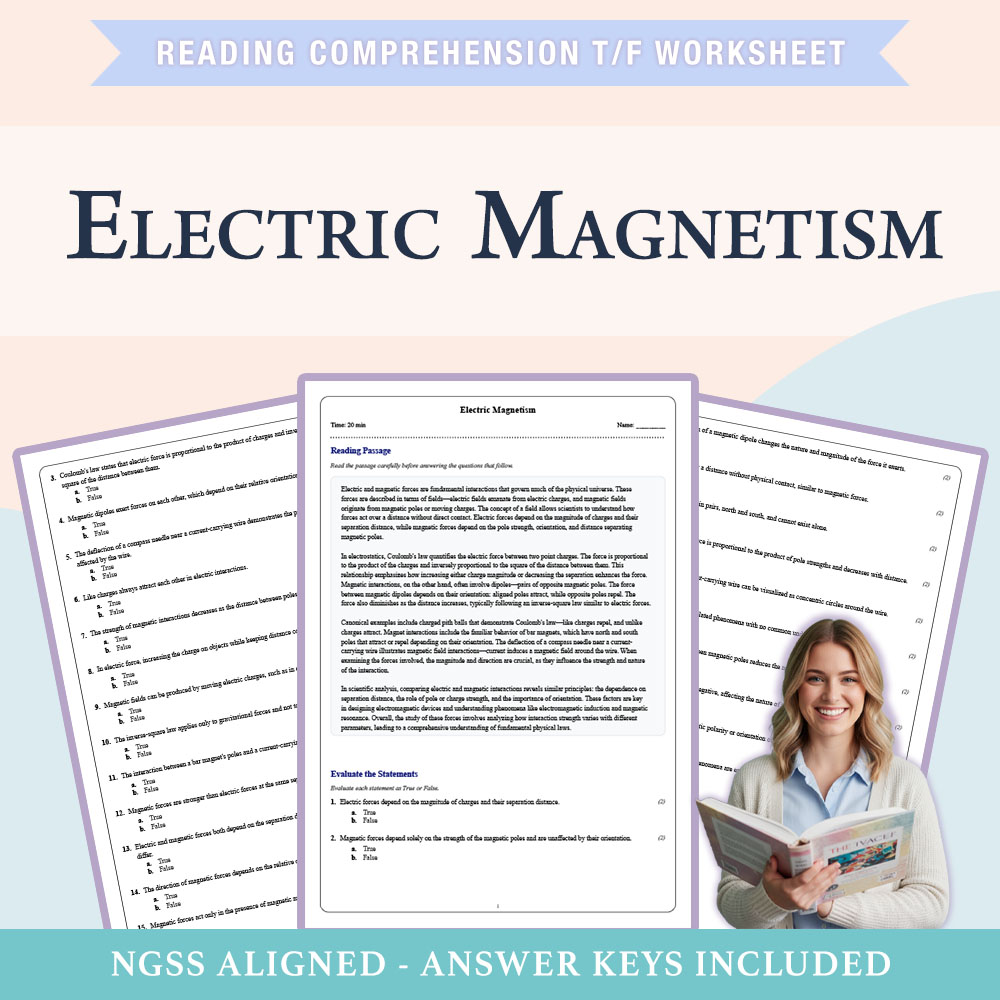
Grade 8 Science | Electric Magnetism Worksheet (PDF + Answer Key)
 Created byCopper Leaf Classroom
Learning Objectives
- Understand the principles of electric and magnetic forces.
- Differentiate between electric and magnetic field interactions.
- Recognize factors that influence force magnitude and direction.
Also included in: Grade 8 Science | Motion, Forces & Magnetism Unit Worksheets (PDF + Answer Keys) +1 more
Instant download
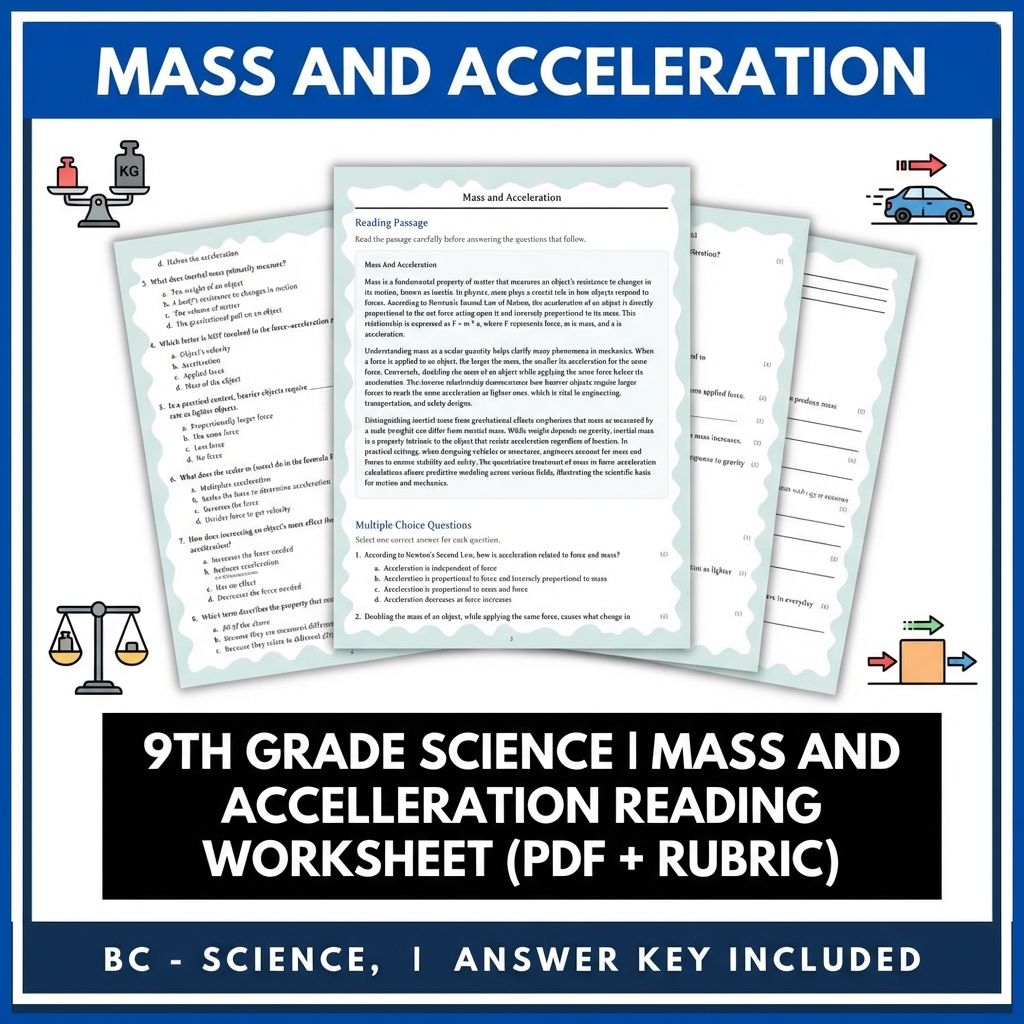
9th Grade Science | Mass and Acceleration Reading Worksheet (PDF + Rubric)
JCreated byJ.S SheetsLearning Objectives
- Understand how mass affects acceleration according to Newton's Second Law.
- Distinguish between inertial mass and gravitational effects.
- Apply the force–acceleration relationship in practical scenarios.
Instant download
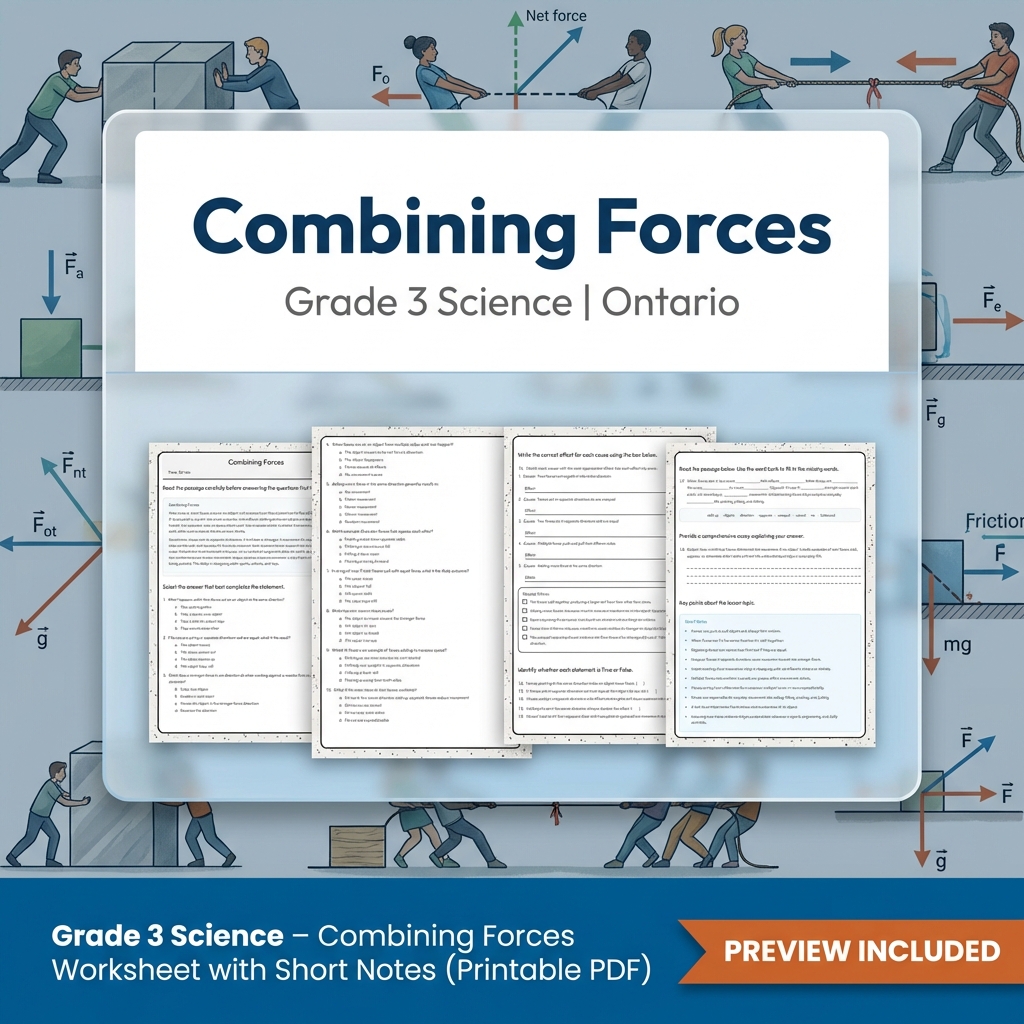
Grade 3 Science – Combining Forces Worksheet with Short Notes (Printable PDF)
Created byMeadowlark WorksheetsLearning Objectives
- Understand how multiple forces acting at the same time affect the motion of an object.
- Identify examples of forces in different directions and their effects.
- Explain how forces that act together produce different results depending on their direction and magnitude.
Also included in: Grade 3 Science Lesson Group | Ontario Forces and Motion Worksheets Bundle +1 more
Instant download
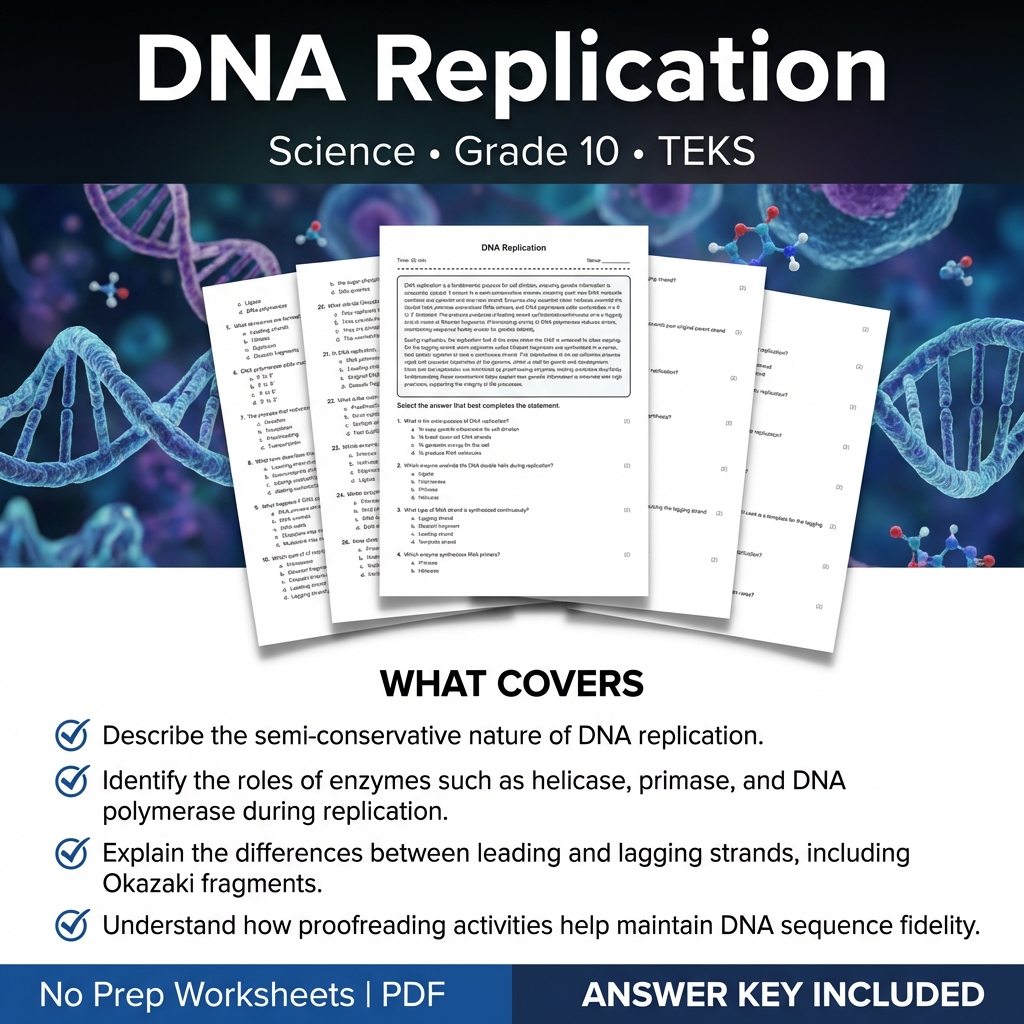
DNA Replication Worksheet for Grade 10 Science | TEKS Aligned Practice
Created byCoral Reef LearningLearning Objectives
- Describe the semi-conservative nature of DNA replication.
- Identify the roles of enzymes such as helicase, primase, and DNA polymerase during replication.
- Explain the differences between leading and lagging strands, including Okazaki fragments.
Instant download

Grade 10 Science | Fields Overview in Electricity - Daily Reading Comprehension
Created byCoral Reef LearningLearning Objectives
- Understand key concepts related to Science
- Apply knowledge through practice questions
- Demonstrate comprehension of the material
Also included in: Physics Principles Reading Lesson Bundle Grade 10 Science Advanced placement +1 more
Instant download
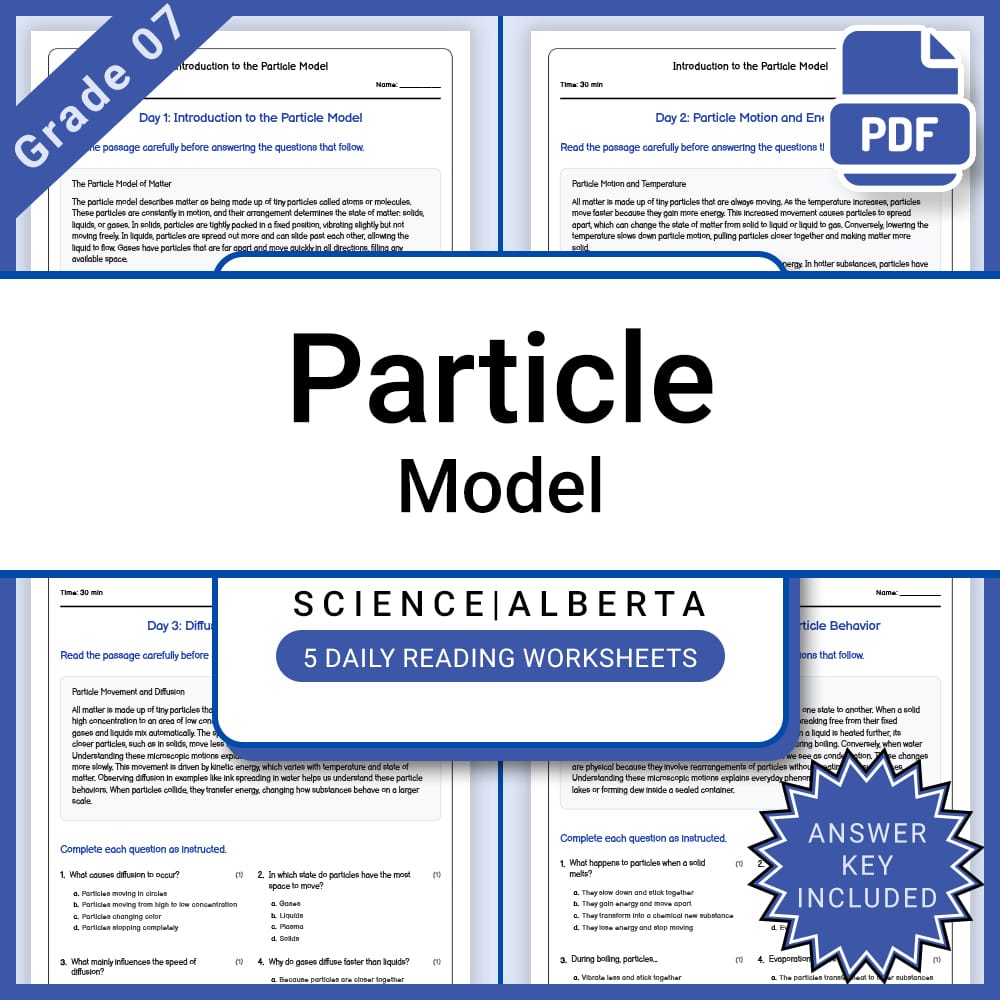
Grade 7 Science – Particle Model Daily Reading Worksheet with Answer Key
JCreated byJ.S SheetsLearning Objectives
- Understand how particles are arranged in different states of matter
- Describe the motion of particles in solids, liquids, and gases
- Explain how particle behavior accounts for properties like diffusion, compression, and density
Also included in: Grade 7 Science Lesson Bundle | Alberta Framework for Classroom Use +1 more
Instant download
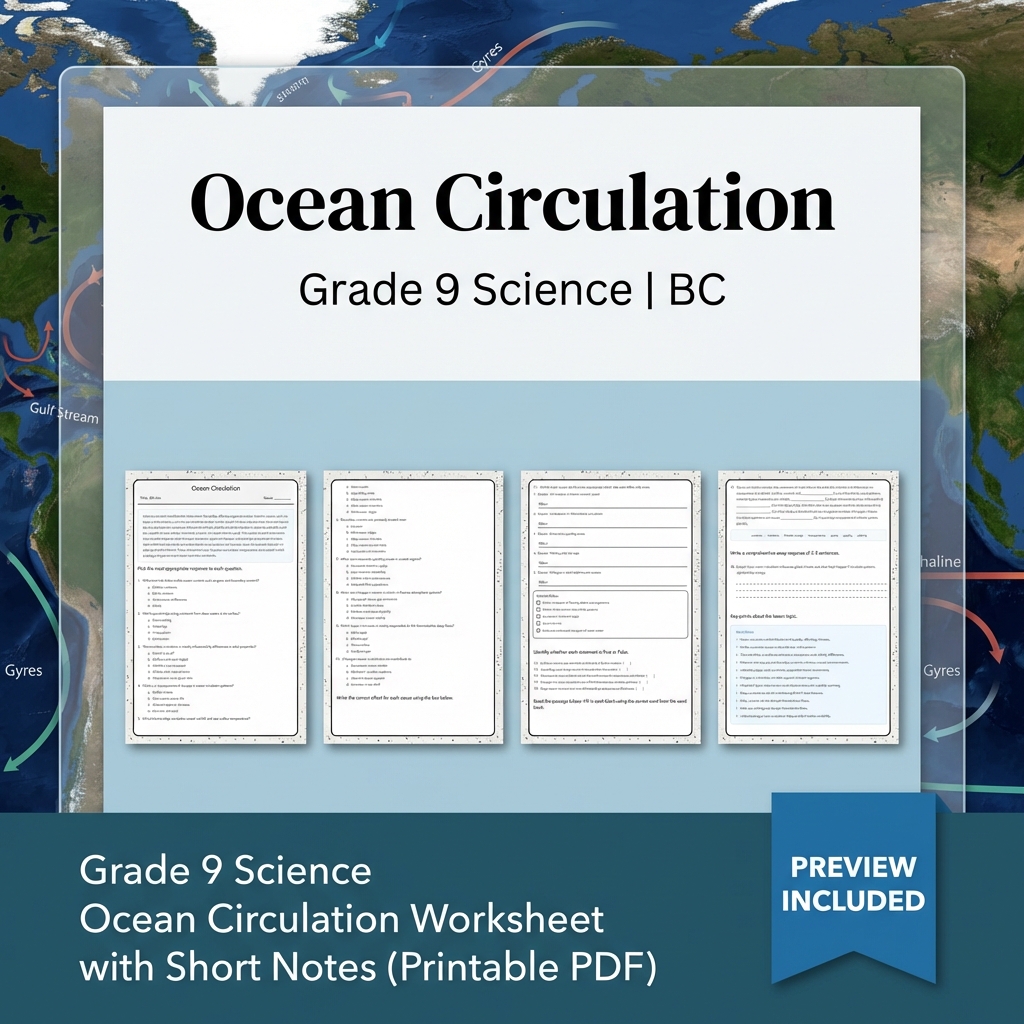
Grade 9 Science Ocean Circulation Worksheet with Short Notes (Printable PDF)
Created byMeadowlark WorksheetsLearning Objectives
- Understand the mechanisms driving ocean surface and deep currents.
- Identify features like gyres, upwelling zones, and boundary currents and their effects.
- Explain how changes in ocean circulation influence climate and weather patterns.
Also included in: Grade 9 Science | BC Framework Lesson Bundle on Earth Systems & Climate +1 more
Instant download

Grade 10 Data Visualization Worksheet | NGSS Practice PDF
 Created byClear Sky Classroom
Learning Objectives
- Explain how to choose appropriate graph types and conventions for different kinds of data (quantitative vs. qualitative).
- Interpret scatterplots, histograms, boxplots, and residual plots to identify patterns, variability, and outliers.
- Use axes, scale choices, trend lines, and uncertainty displays (error bars or confidence intervals) to evaluate evidence.
Also included in: Grade 10 Science Practices in Science: Lesson Bundle for Advanced Placement (AP) +1 more
Instant download
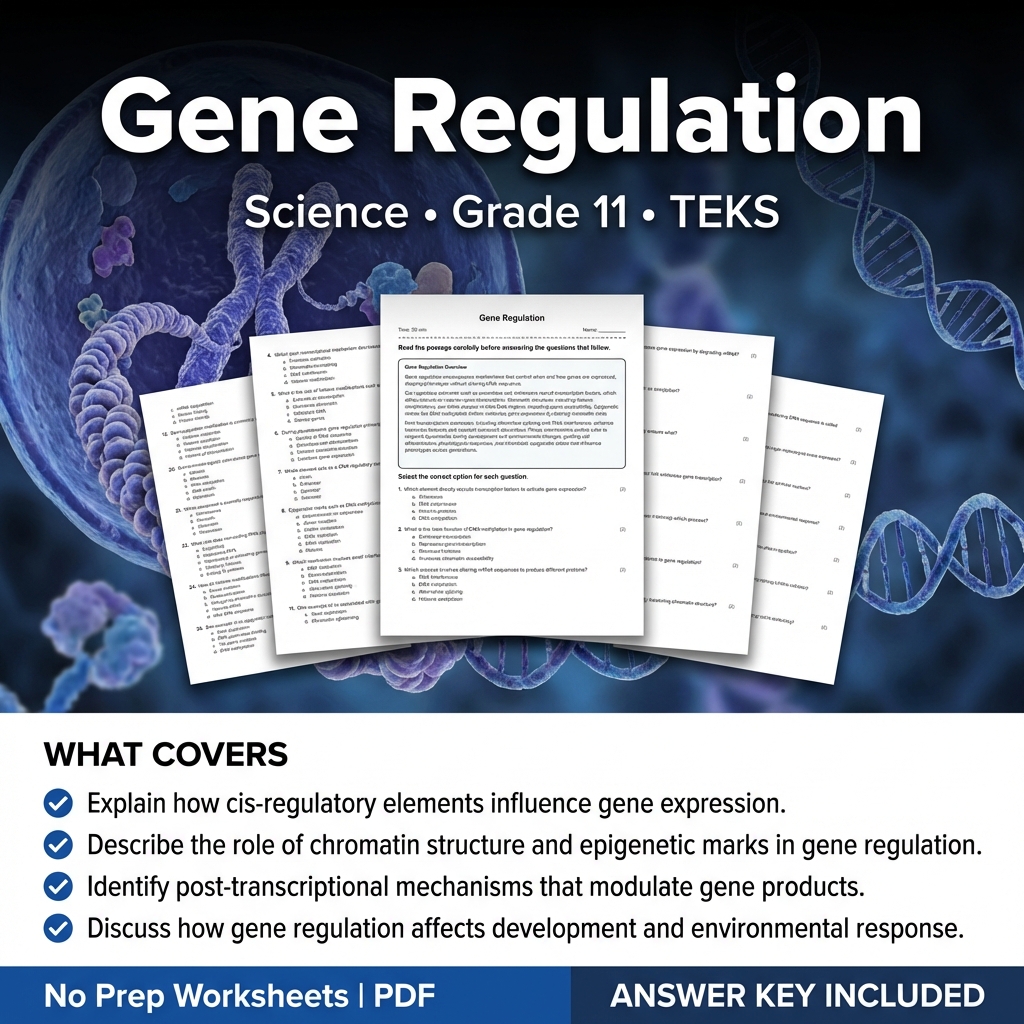
Gene Regulation Worksheet for Grade 11 Science | TEKS-Aligned Practice
Created byCoral Reef LearningLearning Objectives
- Explain how cis-regulatory elements influence gene expression.
- Describe the role of chromatin structure and epigenetic marks in gene regulation.
- Identify post-transcriptional mechanisms that modulate gene products.
Instant download
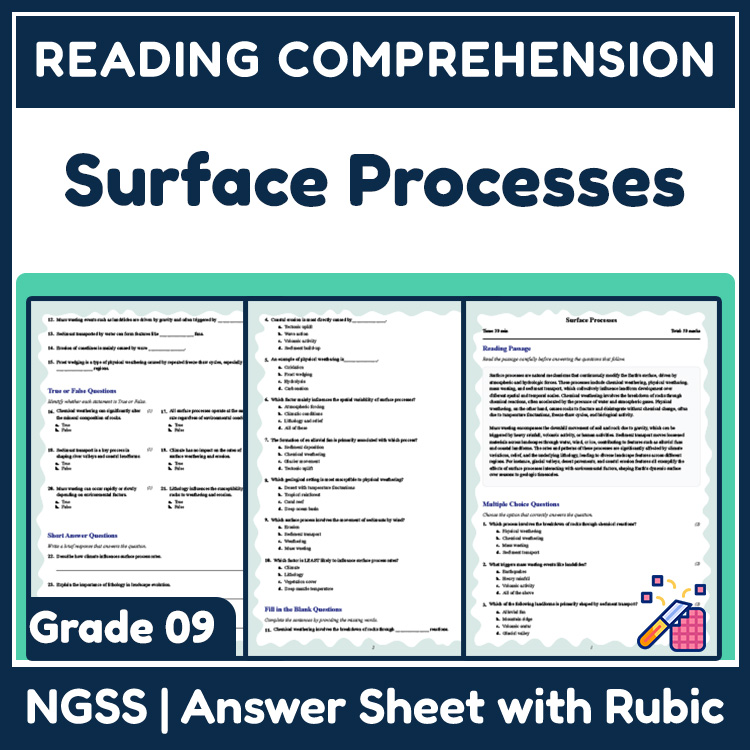
9th Grade Science | Surface Processes Reading Worksheet & Answer Key (PDF)
JCreated byJ.S SheetsLearning Objectives
- Understand the various types of surface processes and their roles in shaping landscapes.
- Analyze how climate, lithology, and relief influence geomorphic change and soil development.
- Identify examples of surface processes such as weathering, mass wasting, and sediment transport.
Instant download

Grade 5 Criteria for Success Worksheet | NGSS Practice PDF
Created byClear Sky ClassroomLearning Objectives
- Explain what criteria for success are and why they matter in science investigations and engineering design
- Identify measurable or observable targets that could be used to judge whether a solution works
- Use evidence and results to compare improvements against the same criteria over multiple trials
Instant download
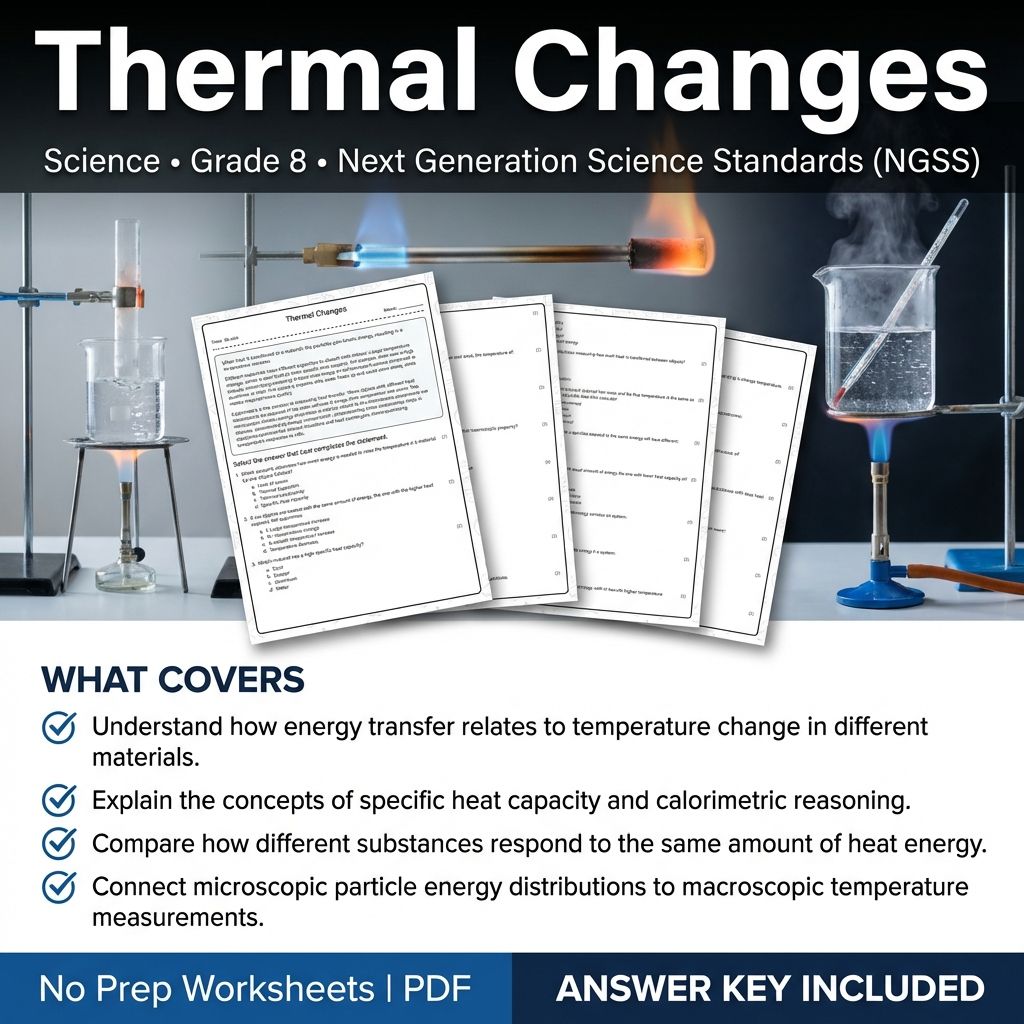
8th Grade Science Worksheet | Thermal Changes & Heat Transfer Practice PDF
Created byCoral Reef LearningLearning Objectives
- Understand how energy transfer relates to temperature change in different materials.
- Explain the concepts of specific heat capacity and calorimetric reasoning.
- Compare how different substances respond to the same amount of heat energy.
Instant download
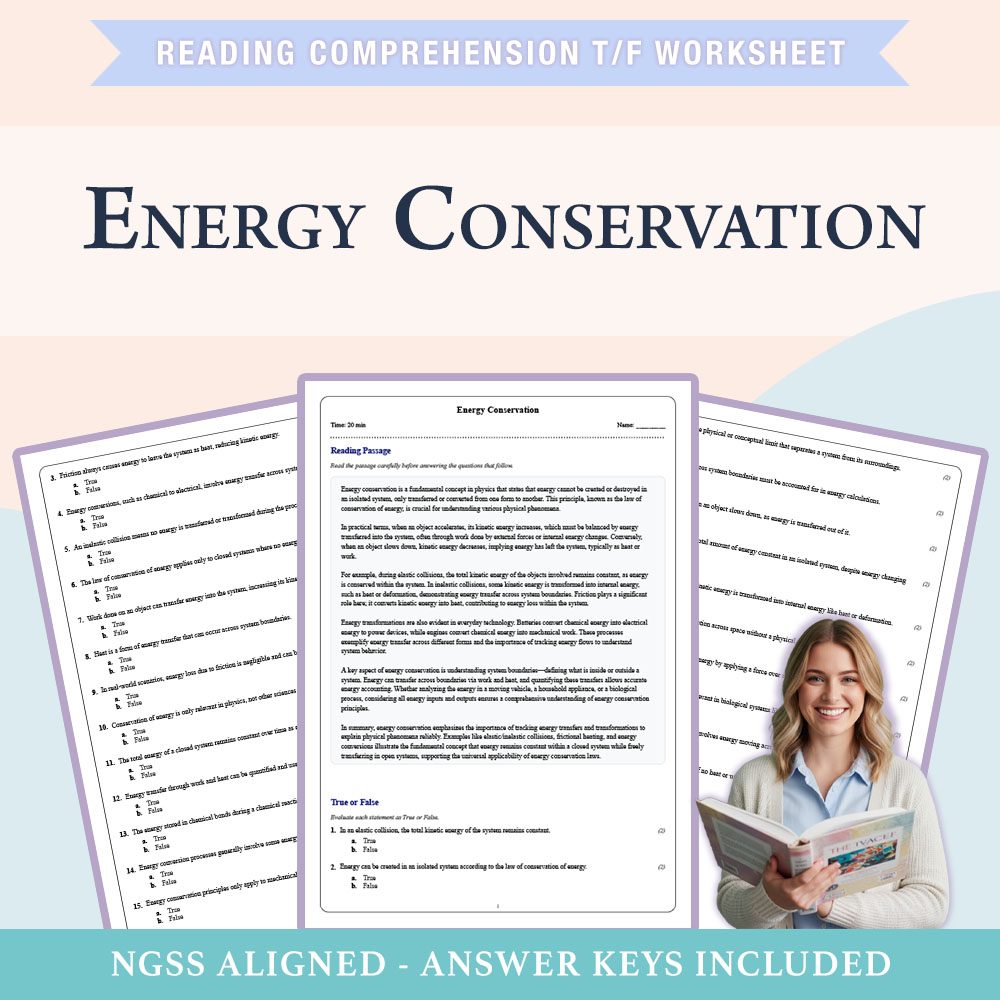
8th Grade Science | Energy Conservation Worksheet (PDF + Answer Key)
Created byCopper Leaf ClassroomLearning Objectives
- Understand the principles of energy transfer and conservation in physical systems.
- Identify examples of energy transfer mechanisms such as work, heat, and collisions.
- Explain the role of system boundaries in energy accounting.
Also included in: Grade 8 Science Bundle | Energy & Thermal Transfer Worksheets(PDF + Answer Key) +1 more
Instant download
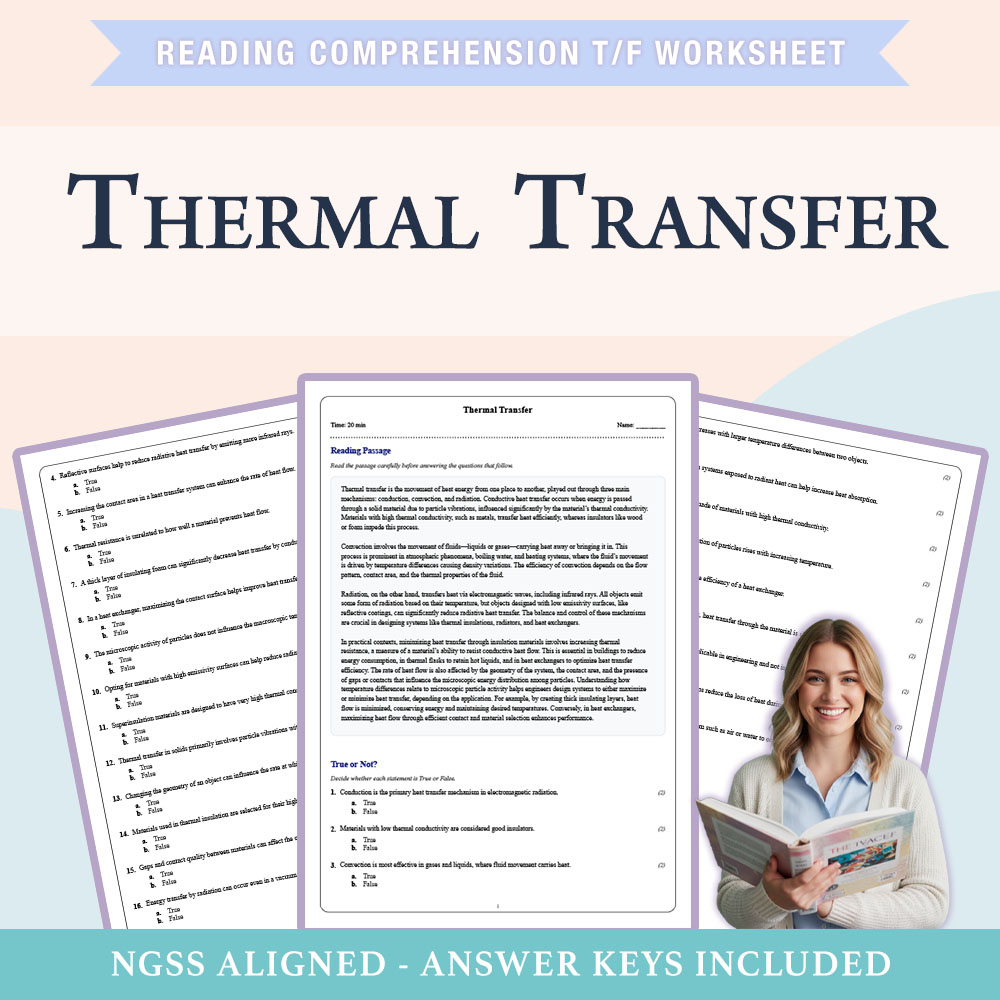
8th Grade Science | Thermal Transfer Worksheet (PDF + Answer Key)
Created byCopper Leaf ClassroomLearning Objectives
- Understand the principles of conduction, convection, and radiation in thermal transfer.
- Identify strategies for minimizing or maximizing heat flow in various systems.
- Explain how material properties, geometry, and contact area influence thermal energy exchange.
Also included in: Grade 8 Science Bundle | Energy & Thermal Transfer Worksheets(PDF + Answer Key) +1 more
Instant download
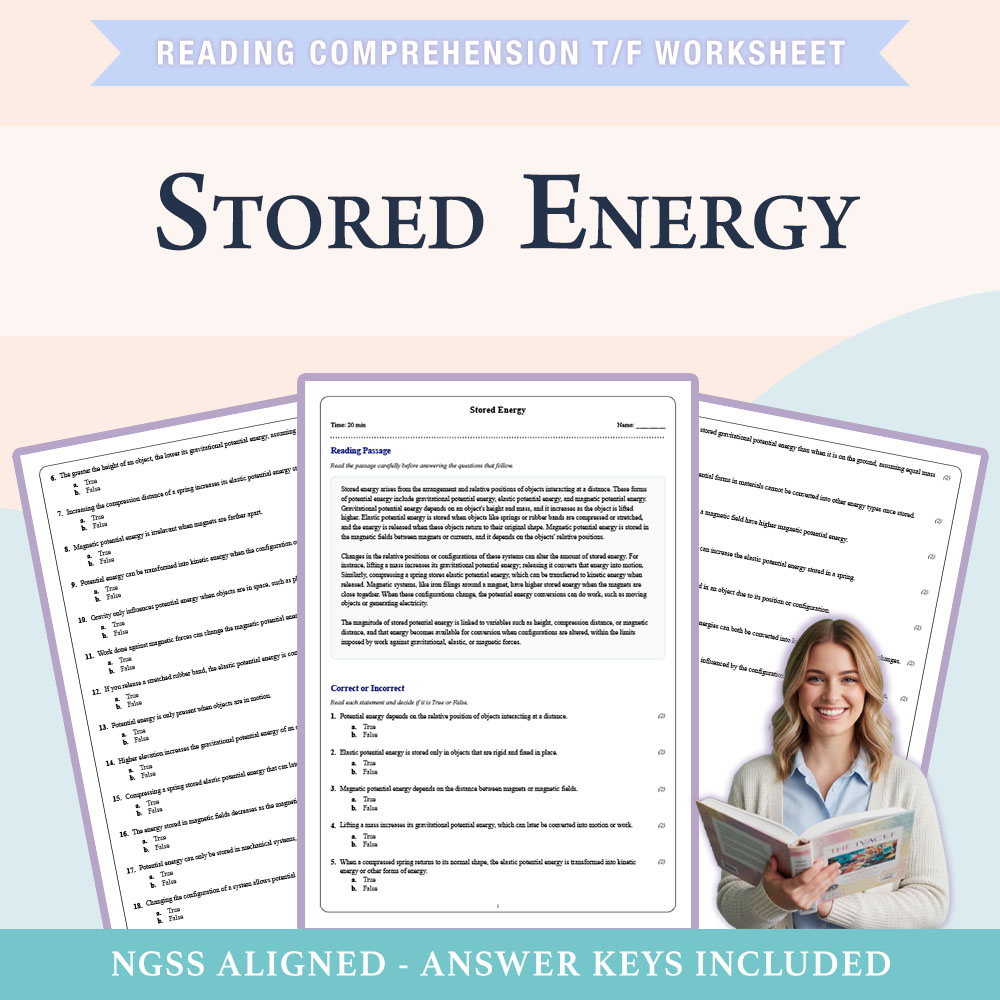
Grade 8 Science | Stored Energy Worksheet (PDF + Answer Key)
Created byCopper Leaf ClassroomLearning Objectives
- Understand different forms of stored energy such as gravitational, elastic, and magnetic potential energy
- Explain how the position or configuration of objects affects stored energy
- Identify real-world examples of stored energy and how changes in systems alter energy levels
Also included in: Grade 8 Science Bundle | Energy & Thermal Transfer Worksheets(PDF + Answer Key) +1 more
Instant download
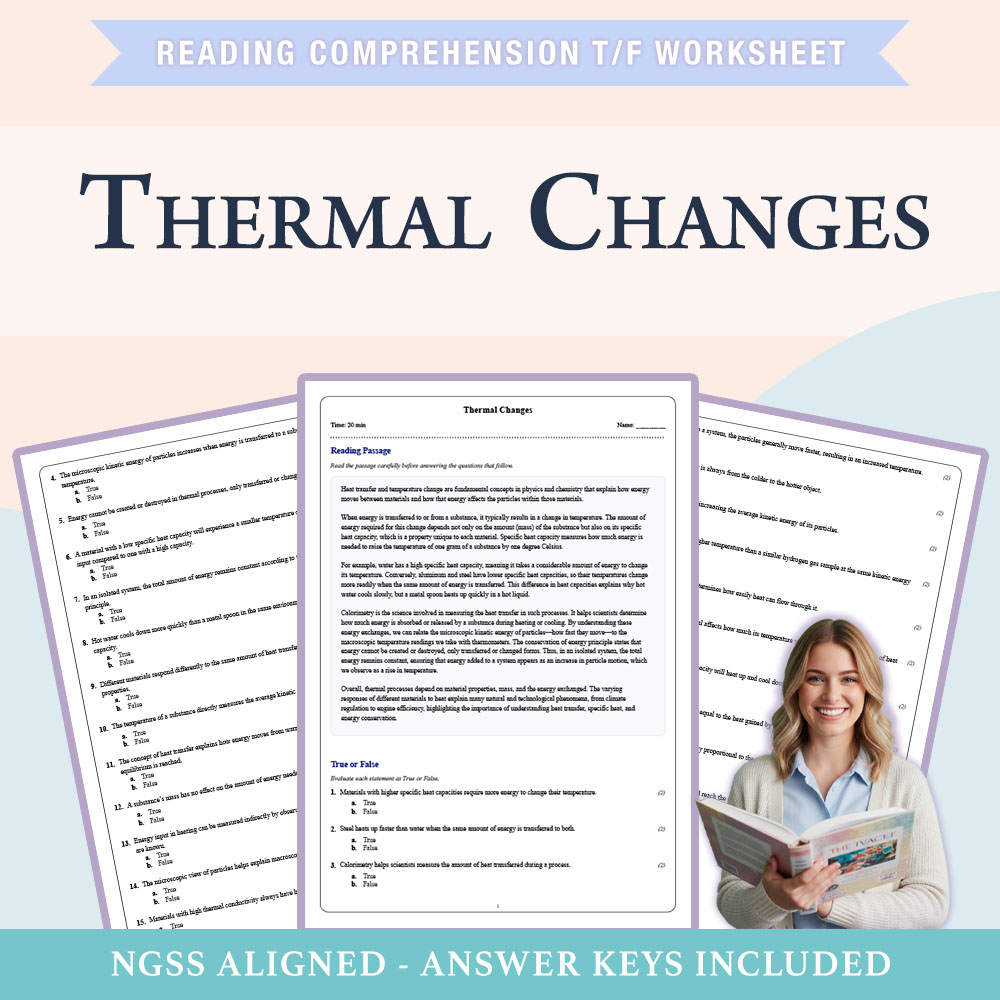
8th Grade Science | Thermal Changes Worksheet (PDF + Answer Key)
Created byCopper Leaf ClassroomLearning Objectives
- Understand the relationship between energy transferred, material type, mass, and temperature change.
- Learn about specific heat capacity and its effect on temperature response.
- Relate macroscopic temperature measurements to microscopic particle kinetic energy.
Also included in: Grade 8 Science Bundle | Energy & Thermal Transfer Worksheets(PDF + Answer Key) +1 more
Instant download
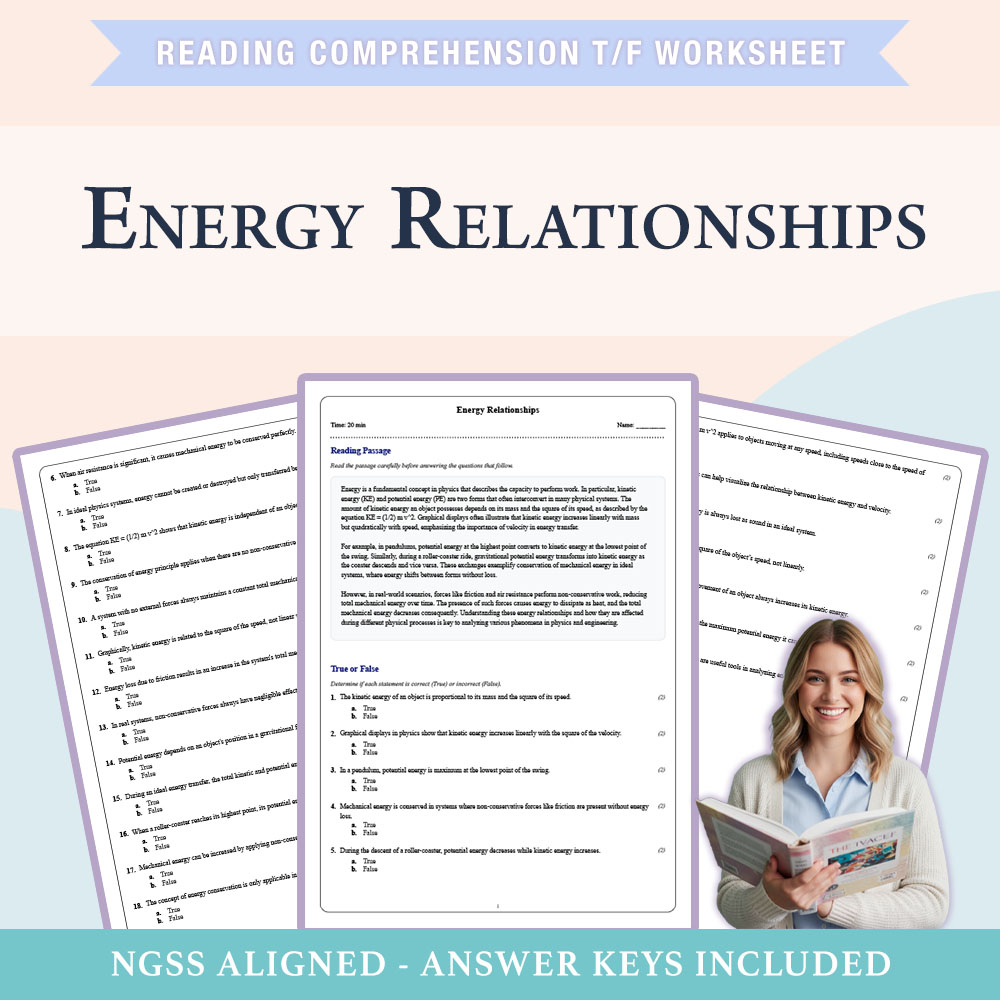
Grade 8 Science | Energy Relationships Worksheet (PDF + Answer Key)
Created byCopper Leaf ClassroomLearning Objectives
- Understand the quantitative relationship between kinetic energy and other variables such as mass and speed.
- Interpret graphical displays relating kinetic energy to mass and the square of speed.
- Analyze energy interchange in systems like pendulums and roller-coasters.
Also included in: Grade 8 Science Bundle | Energy & Thermal Transfer Worksheets(PDF + Answer Key) +1 more
Instant download
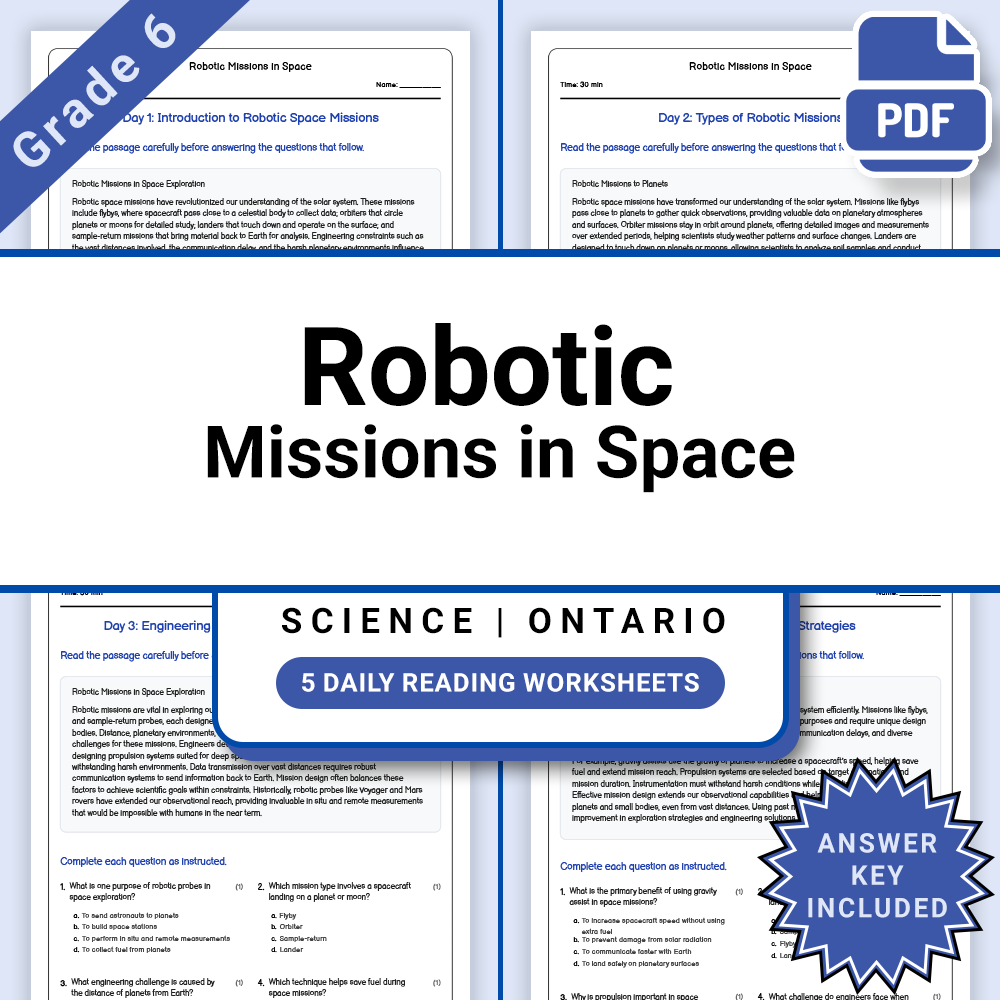
Grade 6 Science – Robotic Missions in Space Daily Reading Worksheet + Answer Key
JCreated byJ.S SheetsLearning Objectives
- Understand the different types of robotic space missions: flyby, orbiter, lander, and sample-return.
- Recognize the engineering constraints in designing robotic missions, including distance, communication delay, and planetary environments.
- Identify how mission design addresses propulsion, instrumentation, and data return.
Also included in: Grade 6 Science Lesson Bundle | Sun, Earth, Moon & Space Concepts +1 more
Instant download
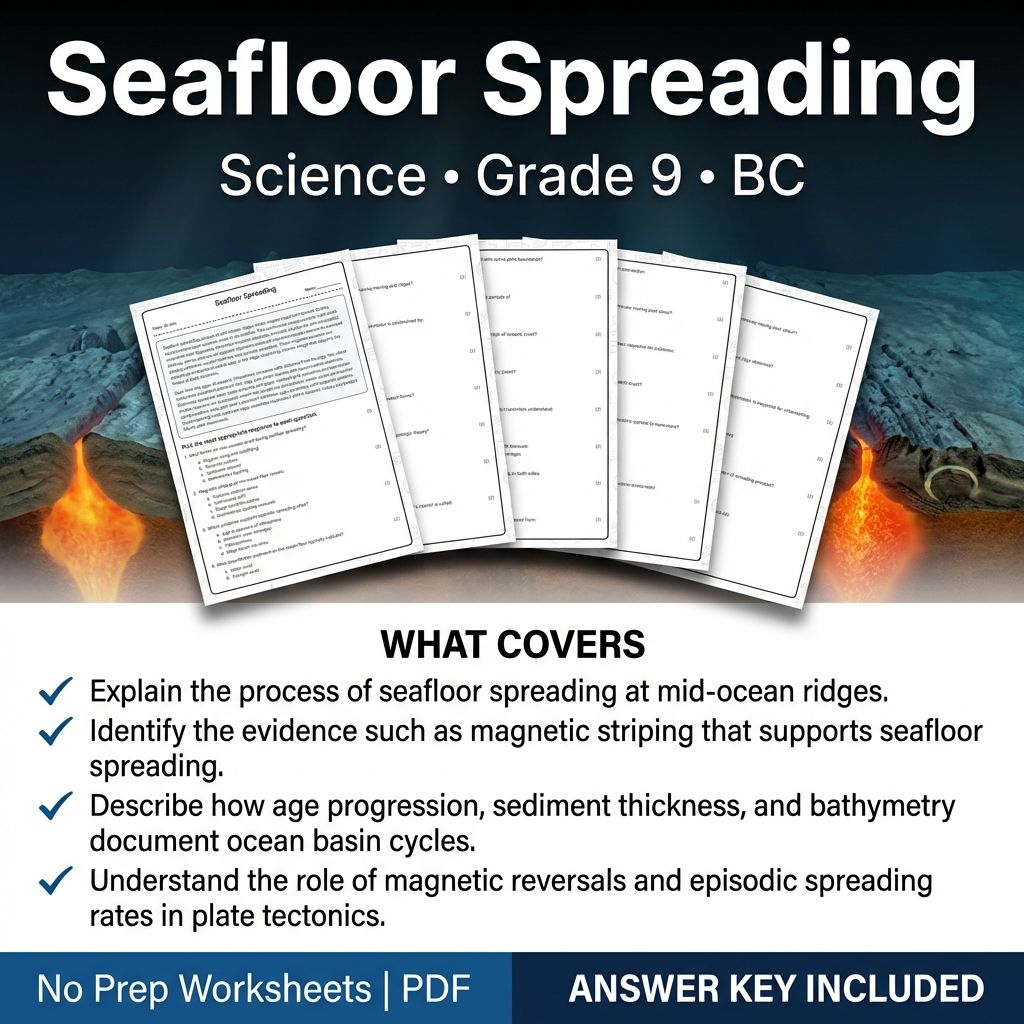
Grade 9 Science Worksheet | Seafloor Spreading & Key Concepts + Answer Key
Created byCoral Reef LearningLearning Objectives
- Explain the process of seafloor spreading at mid-ocean ridges.
- Identify the evidence such as magnetic striping that supports seafloor spreading.
- Describe how age progression, sediment thickness, and bathymetry document ocean basin cycles.
Instant download
Browse more categories
About Science Worksheets
Find Science worksheets spanning core skills, practice, and review. All 44,295 resources are instant PDF downloads for the classroom or home.
Every worksheet on MyTeachingSheets is created by independent teacher-authors and reviewed before publication. All resources download as printable PDFs for classroom, homework, or at-home practice, and many include answer keys. Preview any worksheet free before buying.