
Grade 10 Science Worksheets
7,038 worksheets
Grade 10 Science – Energy Release & Respiration | Daily Reading Worksheet
 Created byBright Mind Resources
Learning Objectives
- Understand the steps of aerobic respiration including glycolysis, the citric acid cycle, and electron transport chain.
- Explain how oxygen availability affects cellular energy pathways.
- Recognize environmental influences on respiration pathways in different ecosystems.
Also included in: Grade 10 Science Daily Reading: Cells & Systems Lesson Bundle | Alberta +1 more
Instant download

Ocean Dynamics Worksheet for Grade 10 Science | NGSS Practice and Assessment
JCreated byJ.S SheetsLearning Objectives
- Understand circulation patterns driven by density contrasts, wind forcing, and Earth's rotation.
- Identify key ocean phenomena such as thermohaline circulation, gyres, and coastal upwelling.
- Analyze how observations from ARGO floats, satellite altimetry, and salinity-temperature profiles inform ocean studies.
Instant download

Meiosis and Genetic Variation Worksheet | AP Standards Grade 10 Science
JCreated byJ.S SheetsLearning Objectives
- Describe the processes of homologous pairing, recombination, independent assortment, and chromosomal segregation during meiosis.
- Explain how crossing-over and nondisjunction contribute to genetic variation and their effects on genotypic and phenotypic outcomes.
- Relate mechanisms of variation to evolutionary processes and inheritance patterns observed in populations.
Also included in: Grade 10 Genetics & Cellular Systems Science Lesson Bundle – AP Unit
Instant download

Grade 10 Science | Climate Drivers - Daily Reading Comprehension
 Created byCoral Reef Learning
Learning Objectives
- Identify the main factors influencing Earth's climate
- Understand the concepts of radiative forcing and greenhouse gases
- Explain the role of albedo variations in climate change
Also included in: Earth and Space Sciences Lesson Bundle: Grade 10 Science Advanced Placement +1 more
Instant download

Grade 10 Science – Ecosystem Roles of Microorganisms | Daily Reading Worksheet
 Created byQuiet Forest Education
Learning Objectives
- Understand how microorganisms contribute to decomposition and nutrient cycling.
- Identify microbial functions such as nitrogen fixation and primary production support.
- Analyze microbial interactions within soil and plant systems.
Also included in: Cell Biology Grade 10 Science Daily Reading Worksheets Bundle | Ontario +1 more
Instant download

Grade 10 Science | Genetic Drift in Population Evolution - Reading Comprehension
Created byCoral Reef LearningLearning Objectives
- Define genetic drift and explain its role in evolution.
- Identify scenarios where genetic drift has the most significant impact.
- Describe how chance influences allele frequencies in small populations.
Instant download

Technology Society Impacts Assessment | Standards-Aligned Grade 10 Science
 Created byPrism Point Learning
Learning Objectives
- Understand how technological developments influence societal change.
- Identify environmental impacts associated with engineering decisions.
- Connect cause-and-effect reasoning to evaluate technology impacts on health, equity, and sustainability.
Instant download

Grade 10 Science – Quantitative Uncertainty & Data Analysis | Reading Worksheet
Created byBright Mind ResourcesLearning Objectives
- Understand the concept of measurement uncertainty.
- Identify sources of errors in scientific measurements.
- Learn methods to estimate and propagate measurement uncertainties.
Also included in: Grade 10 Scientific Reasoning Science Lesson Bundle | AP Daily Reading +2 more
Instant download

Efficiency Metrics Worksheet for Grade 10 Science | Standards-Aligned Practice
JCreated byJ.S SheetsLearning Objectives
- Understand different efficiency metrics used to evaluate energy systems.
- Interpret and compare efficiency indicators like percent efficiency, EROI, COP, and LCOE.
- Analyze trade-offs and environmental impacts associated with various energy technologies.
Instant download

Cell Theory Worksheet | Grade 10 Science Activities
Created byPrism Point LearningLearning Objectives
- Explain the three main ideas of cell theory and connect them to real biological examples
- Describe how microscopy helped scientists discover and compare cell types across bacteria, plants, and animals
- Compare unicellular and multicellular organization and relate structure to function
Instant download

Grade 10 Science – Atomic Particles & Structure | Daily Reading Worksheet
Created byBright Mind ResourcesLearning Objectives
- Understand the structure of an atom, including protons, neutrons, and electrons.
- Identify how the number of protons determines the element.
- Explain the significance of neutrons in atomic mass.
Also included in: Chem Reactions Grade 10 Science Daily Reading Worksheets Lesson Bundle | BC +1 more
Instant download

Grade 10 Science | Model Refinement Worksheet (AP Standards) (PDF)
 Created byEvergreen Desk Education
Learning Objectives
- Explain how comparing model predictions to observed behavior leads to iterative refinement
- Use residual analysis to identify which model errors are systematic versus random
- Justify parameter updates and additional processes (e.g., damping or friction) using evidence
Also included in: Grade 10 Scientific Modeling & Quantitative Reasoning Science Lesson Bundle (AP) +1 more
Instant download

Grade 10 Science Oscillations Worksheet (AP) – Basics & Concepts (PDF)
Created byEvergreen Desk EducationLearning Objectives
- Explain simple harmonic motion using restoring-force ideas and linear approximations for small displacement.
- Use sinusoidal representations to relate amplitude, phase, period, and frequency.
- Describe how kinetic and potential energy alternate during one oscillation and connect this to energy-domain thinking.
Also included in: Grade 10 Motion & Forces Science Lesson Bundle (AP) Worksheet Set +1 more
Instant download

Comparative Anatomy Worksheet | Standards-Aligned Science Practice for Grade 10
JCreated byJ.S SheetsLearning Objectives
- Distinguish homologous structures from analogous traits and explain how each provides evidence for evolution.
- Identify how vestigial organs and embryological patterns support inferences about common ancestry.
- Use anatomical comparisons, embryology, and molecular data to justify evolutionary classification.
Instant download

Grade 10 Geologic Mapping Worksheet | Structures & Evidence | NGSS Science
 Created byAmber Owl Education
Learning Objectives
- Describe how geologic mapping combines multiple datasets to infer Earth structures
- Interpret stratigraphic contacts and fault relationships using geologic cross-sections
- Use relative and absolute dating ideas to understand rates of landscape change
Instant download

Grade 10 Science – Wave Behavior & Properties | Daily Reading Worksheet
Created byBright Mind ResourcesLearning Objectives
- Differentiate between transverse and longitudinal waves based on parameters like wavelength, frequency, amplitude, and wave speed.
- Understand how waves reflect, refract, interfere, and form standing waves.
- Apply graphical and mathematical descriptions to analyze complex wave interactions.
Also included in: Motion, Energy & Electricity Grade 10 Science Reading Worksheets Bundle | AP +2 more
Instant download

Grade 10 Science – Friction Dynamics Worksheet (AP Standards) (PDF)
Created byEvergreen Desk EducationLearning Objectives
- Model static and kinetic friction using coefficient-based relationships with normal force
- Predict motion on an incline by comparing gravitational components with maximum static friction and kinetic friction
- Relate friction forces to net force changes and energy dissipation during sliding
Also included in: Grade 10 Motion & Forces Science Lesson Bundle (AP) Worksheet Set +1 more
Instant download

Grade 10 Science Worksheet | Population Patterns - AP Standards (PDF)
Created byEvergreen Desk EducationLearning Objectives
- Explain how birth rate, death rate, and immigration/emigration affect population size over time.
- Describe carrying capacity and density-dependent interactions and how they shape population dynamics.
- Interpret age-structure diagrams and connect organism traits to population growth patterns.
Also included in: Grade 10 Genetics & Cell Systems Science Lesson Bundle – Advanced Placement (AP) +1 more
Instant download

Reproductive Isolation and Speciation Worksheet | Grade 10 TEKS Science
 Created byBRIGHT PATH RESOURCES
Learning Objectives
- Explain how reproductive barriers reduce gene flow between populations.
- Describe major causes of reproductive isolation using cause-and-effect reasoning.
- Identify common speciation contexts and how genetic change accumulates over time.
Also included in: Grade 10 Evolution & Classification Science Worksheets Bundle | TEKS Biology +1 more
Instant download

Grade 10 AP Science Inheritance Patterns Worksheet | Genetics Practice Pack
Created byPrism Point LearningLearning Objectives
- Explain Mendelian inheritance using dominance and segregation and interpret results from pedigrees and Punnett squares
- Connect linkage and recombination to observed deviations from expected Mendelian ratios
- Describe how chromosomal inheritance and molecular markers help explain patterns of genetic variation in populations
Also included in: Grade 10 AP Science Life Systems Lesson Bundle | Worksheet Pack
Instant download

Grade 10 Science | Pathogenic Microorganisms - Daily Reading Comprehension
Created byCoral Reef LearningLearning Objectives
- Identify different types of microorganisms: bacteria, viruses, fungi.
- Describe basic characteristics of each microorganism type.
- Understand modes of transmission of pathogenic microorganisms.
Instant download

Grade 10 Science – Force Concepts Worksheet (AP Standards) (PDF)
Created byEvergreen Desk EducationLearning Objectives
- Describe forces as vectors and determine the direction of acceleration using net force
- Apply Newton’s three laws to predict motion, equilibrium, and changes during interactions
- Construct and interpret free-body diagrams for contact and field-mediated forces
Also included in: Grade 10 Motion & Forces Science Lesson Bundle (AP) Worksheet Set +1 more
Instant download

Grade 10 Science – Nomenclature of Ionic Compounds - Daily Reading Worksheet
Created byQuiet Forest EducationLearning Objectives
- Understand systematic naming conventions for simple ionic compounds
- Identify polyatomic ions and their charges
- Differentiate between empirical and molecular formulas
Also included in: Matter and Chemical Change Grade 10 Science Daily Reading Bundle | Ontario +1 more
Instant download

Grade 10 Science – Communicating Results & Data Analysis | Daily Worksheet
Created byQuiet Forest EducationLearning Objectives
- Understand how to organize and present experimental data clearly
- Learn to use tables, graphs, and statistics to support conclusions
- Develop skills in writing structured summaries that link data to claims
Also included in: Scientific Investigation Grade 10 Science Daily Worksheets Bundle | Ontario +1 more
Instant download

Ion Formation Worksheet | Grade 10 Chemistry Science CA Standards
Created byEvergreen Desk EducationLearning Objectives
- Explain how electron models account for predictable ion charges.
- Use electron configurations and periodic-table patterns to predict whether an atom forms a cation or anion.
- Relate ion formation to macroscopic behaviors such as conductivity and reactivity.
Instant download

Grade 10 Science | Cell Division - Daily Reading Comprehension
Created byCoral Reef LearningLearning Objectives
- Identify the stages of the cell cycle and understand their functions.
- Explain the processes of mitosis and meiosis.
- Describe the role of cell cycle checkpoints and apoptosis.
Instant download

Grade 10 Science | Multi Criteria Optimization in Science - Comprehension
Created byCoral Reef LearningLearning Objectives
- Understand the concept of multi criteria optimization
- Learn how multiple goals are balanced in scientific design
- Identify constraints and how they influence optimization
Instant download

Grade 10 Science | Astronomical Climate Cycles - Daily Reading Comprehension
Created byCoral Reef LearningLearning Objectives
- Understand how Earth's tilt influences seasons and climate patterns.
- Identify the relationship between astronomical factors and long-term climate variability.
- Recognize geological evidence of past climate cycles.
Instant download

Orbits And Energy Worksheet | Grade 10 Science Practice
Created byPrism Point LearningLearning Objectives
- Explain how gravity provides the centripetal force that keeps an object in orbit.
- Relate orbital speed to orbital radius and the mass of the central body.
- Describe how orbital energy is partitioned into kinetic and gravitational potential energy.
Also included in: Forces, Motion & Fields Lesson Bundle | Grade 10 Science | BC +1 more
Instant download

Grade 10 Science | Human Impact Evidence Worksheet (PDF)
Created byEvergreen Desk EducationLearning Objectives
- Explain how human activities can change Earth systems through measurable physical and chemical evidence.
- Identify and interpret evidence types (climate records, satellite observations, chemical measurements) used to support impact claims.
- Use cause-effect reasoning to connect sources, transport processes, and system responses.
Also included in: Grade 10 Weather & Climate Science Lesson Bundle - General Framework +1 more
Instant download

Grade 10 Science – Energy Conservation Worksheet (NGSS Aligned PDF)
 Created bySilver Birch Teaching
Learning Objectives
- Understand the principles of energy conservation in closed and isolated systems.
- Identify energy transformations between kinetic and potential energy in mechanical systems.
- Explain how energy losses to thermal energy occur during mechanical processes.
Also included in: Grade 10 Energy Transfer and Work Power Science Lesson Bundle NGSS +1 more
Instant download

Grade 10 Science | Stoichiometric Analysis - Reading Comprehension Practice
Created byCoral Reef LearningLearning Objectives
- Understand key concepts related to Science
- Apply knowledge through practice questions
- Demonstrate comprehension of the material
Also included in: Chemistry Foundations Lesson Bundle: Grade 10 Science Advanced Placement (AP) +1 more
Instant download

Grade 10 Science | Model Revision Evidence - Daily Reading Comprehension
Created byCoral Reef LearningLearning Objectives
- Understand the concept of scientific models and their role in explaining phenomena.
- Recognize the importance of evidence in revising scientific models.
- Identify key features that indicate when a model should be revised.
Instant download

Grade 10 Science | Stoichiometric Ratios Worksheet (PDF) BC Standards
Created byEvergreen Desk EducationLearning Objectives
- Explain how balanced chemical equations and mole ratios determine quantitative relationships between reactants and products.
- Use molar mass to convert between grams and moles in stoichiometric problems.
- Calculate expected product mass from given reactant mass (and vice versa) using stoichiometric ratios.
Instant download

Coordination of Physiological Systems Worksheet | Grade 10 NGSS Science
Created byAmber Owl EducationLearning Objectives
- Compare how organ systems work together to move materials through the body
- Connect structural features of organs to their functions using examples from multiple systems
- Explain how transport processes depend on surface area, flow, and transport kinetics
Instant download

Grade 10 Science | Impacts of Technology Society Worksheet (PDF)
Created byEvergreen Desk EducationLearning Objectives
- Explain how technology and engineering can reshape communication, work, travel, and access to services.
- Analyze how design choices create different benefits and risks in specific social contexts.
- Connect environmental impacts of technology to resource use, emissions, waste, and ecosystem effects.
Also included in: Grade 10 Engineering Design Trade-Offs Science Lesson Bundle: General +1 more
Instant download

Grade 10 Meiosis and Variation Worksheet | NGSS Practice PDF
 Created byClear Sky Classroom
Learning Objectives
- Explain how meiosis reduces chromosome number to form gametes.
- Describe how homologous chromosome separation and genetic recombination create variation.
- Connect inherited genetic variation to differences among offspring and to natural selection.
Instant download

Engineering Design Process Worksheet | NGSS Grade 10 Engineering Design
Created byAmber Owl EducationLearning Objectives
- Explain how engineering teams define criteria and constraints when solving a complex problem
- Use qualitative criteria and quantitative performance metrics to set measurable design targets
- Describe how models and benchmark comparisons support feasible solution decisions
Instant download

Grade 10 Cell Types Worksheet | Practice & Assessment PDF
Created byClear Sky ClassroomLearning Objectives
- Distinguish prokaryotic and eukaryotic cells using key structural and genetic features
- Explain how genome organization and organelles affect replication and genetic control
- Apply cell-type criteria to predict function in different ecological contexts
Instant download

Valence Patterns Worksheet | Grade 10 Chemistry Science CA Standards
Created byEvergreen Desk EducationLearning Objectives
- Explain how valence electron patterns relate to an element’s typical bonding and ion formation.
- Use periodic trends to predict whether an element is more likely to form cations or anions.
- Identify recurring electron-configuration structures and connect them to metallic or nonmetallic character.
Instant download

RNA Variants Worksheet | Grade 10 Science Practice and Review
Created byPrism Point LearningLearning Objectives
- Describe how mRNA, tRNA, and rRNA differ in structure and function during protein synthesis.
- Explain how uracil in RNA allows complementary base pairing during transcription.
- Connect codons, anticodons, and amino acids to the translation of genetic information into polypeptides.
Also included in: Genetics & Molecular Biology Lesson Bundle | Grade 10 Science | TEKS
Instant download
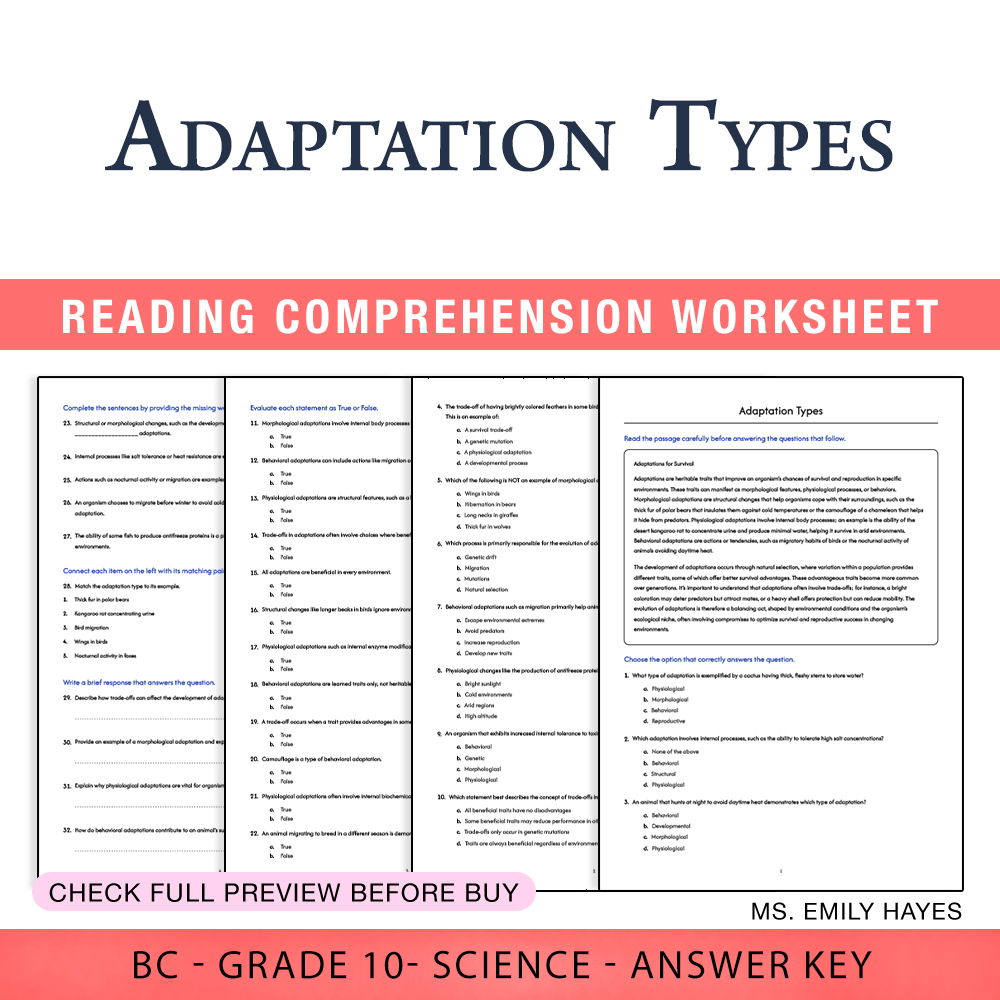
Grade 10 Science | Adaptation Types Worksheet (PDF+ Answer Key)
 Created byCopper Leaf Classroom
Learning Objectives
- Define morphological, physiological, and behavioral adaptations.
- Explain how adaptations enhance survival and reproduction.
- Identify examples of different adaptation types in animals and plants.
Also included in: Grade 10 Science BC | Evolution, Biodiversity & Ecology (PDF + Answer Key) +1 more
Instant download

Climate Feedbacks Worksheet | Science Assessment for Grade 10
 Created byLumora Learning
Learning Objectives
- Explain how changes in greenhouse gases can trigger warming through radiation and then cause climate feedbacks.
- Distinguish between positive and negative climate feedbacks using real examples such as water vapor, ice-albedo, and clouds.
- Analyze how surface, cloud, and aerosol processes can influence temperature and precipitation patterns.
Instant download

Grade 10 Science | Plate Narratives The Movement of Earth's Plates
Created byCoral Reef LearningLearning Objectives
- Understand key concepts related to Science
- Apply knowledge through practice questions
- Demonstrate comprehension of the material
Also included in: Earth and Space Sciences Lesson Bundle: Grade 10 Science Advanced Placement +1 more
Instant download

Grade 10 Science – Constraint-Based Design & Measurement Practices | Worksheet
Created byBright Mind ResourcesLearning Objectives
- Understand the concept of constraints in observational and experimental studies
- Identify different types of constraints such as practical, ethical, and temporal
- Evaluate trade-offs involved in designing scientific studies under constraints
Also included in: Grade 10 Scientific Reasoning Science Lesson Bundle | AP Daily Reading +2 more
Instant download

Grade 10 Science | Constraint-Based Design Worksheet (AP Standards) (PDF)
Created byEvergreen Desk EducationLearning Objectives
- Explain how practical, ethical, and temporal constraints influence the design of observational and comparative science studies
- Justify proxy measures when ideal variables cannot be measured directly and explain how that affects conclusions
- Evaluate trade-offs among replication, measurement precision, and scope using sensitivity ideas
Also included in: Grade 10 Scientific Modeling & Quantitative Reasoning Science Lesson Bundle (AP) +1 more
Instant download

Grade 10 Science – Pathogens & Disease | Daily Reading Worksheet
Created byBright Mind ResourcesLearning Objectives
- Understand the basic types of microorganisms that cause diseases.
- Describe how bacteria, viruses, and fungi transmit from one host to another.
- Explain the immune system's response to different pathogens.
Also included in: Grade 10 Cell Processes & Energy Science Daily Reading Lesson Bundle | Ontario +1 more
Instant download

Ocean Atmosphere Coupling Assessment | General Grade 10 Science
Created byPrism Point LearningLearning Objectives
- Explain how ocean and atmosphere interactions transfer heat and moisture.
- Describe the impact of sea-surface temperature changes on weather patterns.
- Identify the roles of El Niño and La Niña in regional climate variability.
Also included in: Grade 10 Climate Systems Science Lesson Bundle Assessments – General
Instant download
About Grade 10 Science Worksheets
Find Science worksheets built for Grade 10. All 7,038 cover core skills, practice, and review, each an instant PDF download.
Every worksheet on MyTeachingSheets is created by independent teacher-authors and reviewed before publication. All resources download as printable PDFs for classroom, homework, or at-home practice, and many include answer keys. Preview any worksheet free before buying.