
Grade 10 Science Worksheets
7,038 worksheets
Uncertainty Interpretation Worksheet for Grade 10 Science Data Analysis
 Created byPrism Point Learning
Learning Objectives
- Explain what measurement uncertainty means and why measurements should be interpreted as ranges
- Use uncertainty ranges to judge whether two measurements show a meaningful difference
- Apply uncertainty reasoning to draw more confident or less confident scientific conclusions
Instant download

Grade 10 Science | Membrane Structure Worksheet | Science | TEKS-Aligned
 Created byLumora Learning
Learning Objectives
- Understand the fluid mosaic model of the plasma membrane and its components.
- Explain the role of phospholipid bilayer asymmetry and cholesterol in membrane fluidity.
- Identify different membrane proteins and their functions, including receptors and transporters.
Also included in: Grade 10 Science | Cell Structure, Transport & Communication Bundle | TEKS +1 more
Instant download

Grade 10 Science | Rock Transformations & the Rock Cycle - Daily Reading
 Created byCoral Reef Learning
Learning Objectives
- Understand the main processes involved in rock transformations, including crystallization, lithification, metamorphism, and weathering.
- Identify different types of rocks and their formation processes.
- Learn how mineral assemblages, textures, and geochemical signatures indicate geological histories.
Instant download

Microbe Diversity: Bacteria, Archaea, Fungi, Protists Worksheet | Grade 10
JCreated byJ.S SheetsLearning Objectives
- Compare major microorganism groups by cellular organization and genetic material (DNA/RNA, prokaryotic vs. eukaryotic).
- Explain how viruses depend on host cellular machinery to reproduce.
- Describe how reproduction strategies and ecological roles differ among bacteria, archaea, viruses, fungi, and protists.
Instant download

Grade 10 Science | Model Revision Evidence Worksheet | NGSSS Aligned
Created byLumora LearningLearning Objectives
- Explain how scientific models remain open to revision when new evidence conflicts with expectations
- Evaluate the quality of evidence by considering consistency, explanatory power, and predictive accuracy
- Describe how scientists identify mismatches and adjust assumptions without adding unsupported claims
Instant download

Charge and Fields Worksheet | Grade 10 Science Assessments
Created byPrism Point LearningLearning Objectives
- Explain how electric charge sign and magnitude determine whether forces are attractive or repulsive.
- Describe how electric field lines represent the direction of the electric force on a positive test charge.
- Use Coulomb’s law and the superposition principle to reason about electrostatic interactions in real contexts.
Also included in: Grade 10 Work, Energy & Electricity Lesson Bundle | Alberta Science
Instant download

Trophic Relationships Practice Worksheet | Grade 10 Science NGSS
Created byPrism Point LearningLearning Objectives
- Explain how energy moves through trophic levels and why efficiency is limited
- Interpret biomass and energy pyramids and what they imply about ecosystem productivity
- Use food webs to predict how top-down and bottom-up forces can change populations
Also included in: Grade 10 Ecosystems & Biodiversity Science Lesson Bundle Practice: NGSS
Instant download

Negative Feedback Worksheet for Grade 10 Science | TEKS-Aligned Practice
JCreated byJ.S SheetsLearning Objectives
- Explain how negative feedback uses sensors, control centers, and effectors to reduce deviations from a set point
- Identify the role of an error signal in regulating internal body conditions
- Apply negative feedback ideas to examples involving temperature, blood glucose, and blood pressure
Instant download
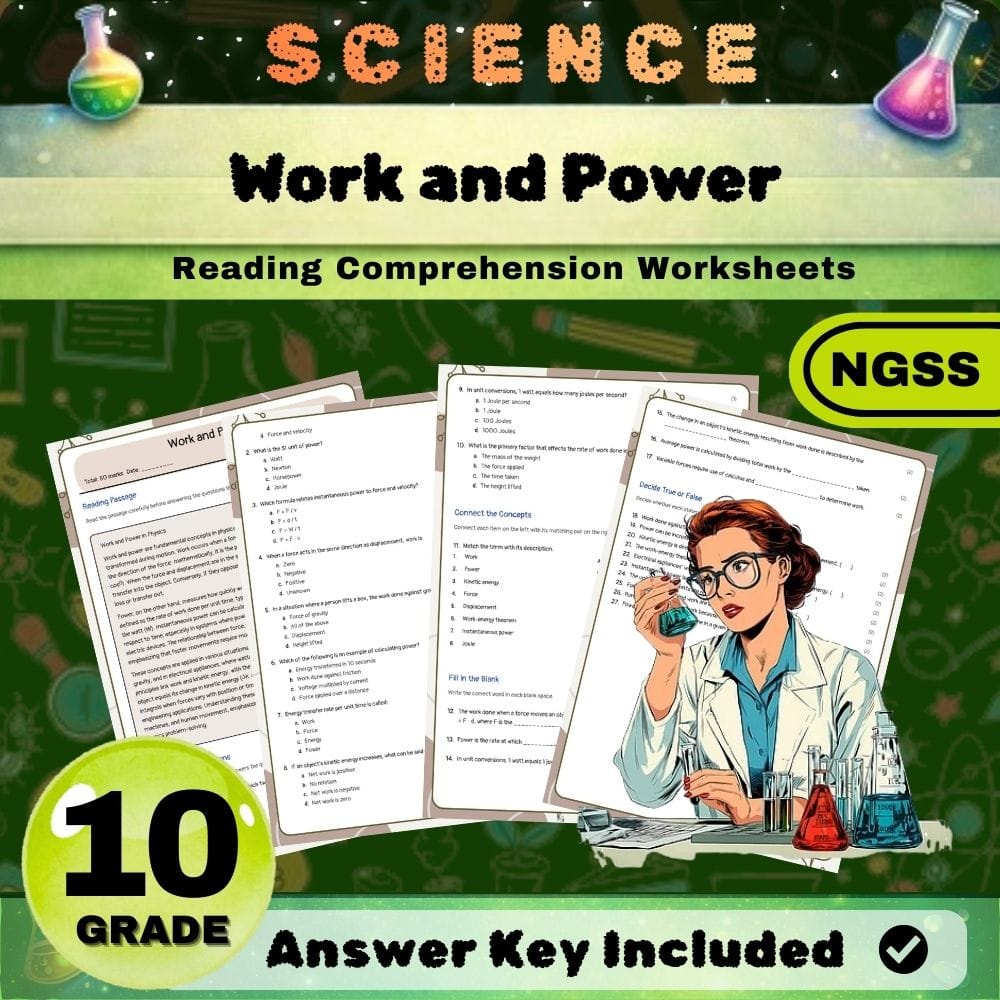
Grade 10 Science | Work and Power Worksheet (NGSS) (PDF)
 Created byMaple Path Learning
Learning Objectives
- Understand the relationship between force, displacement, and work
- Apply the work-energy theorem to calculate changes in kinetic energy
- Interpret average and instantaneous power in real-world contexts
Also included in: Grade 10 Energy Science Worksheets Bundle | NGSS Lesson Resources +1 more
Instant download

Microscopic Thermal Model Worksheet | Grade 10 Science CA Standards
 Created byEvergreen Desk Education
Learning Objectives
- Explain temperature using the microscopic model of average particle kinetic energy.
- Describe heat transfer as energy moving due to particle-level differences, not as “substance” flowing.
- Use microscopic reasoning to predict temperature changes in different materials under similar heating conditions.
Instant download

Galactic Structure Worksheet for Grade 10 Science | Florida NGSSS PDF
Created byEvergreen Desk EducationLearning Objectives
- Identify how galaxy shape and components (bulge, disk, arms, bar) relate to gravitational dynamics on a large scale
- Explain how redshift and spectral lines provide evidence about galaxy motion and distance
- Apply the ideas of brightness, distance, and intrinsic luminosity to interpret observational differences
Instant download

Fluid Balance Worksheet | Grade 10 Science Activities TEKS Aligned
Created byPrism Point LearningLearning Objectives
- Explain how glomerular filtration, tubular reabsorption, and secretion in nephrons help regulate blood volume and osmolarity
- Describe how antidiuretic hormone (ADH) and aldosterone adjust urine volume and solute concentration
- Connect kidney feedback control to maintaining blood pressure and internal fluid composition
Instant download

Grade 10 Science – Circuit Fundamentals & Daily Reading Worksheet
 Created byBright Mind Resources
Learning Objectives
- Understand the basic components of simple direct-current circuits
- Explain how current flows through circuit elements
- Apply Ohm's law to calculate voltage, current, and resistance
Also included in: Motion, Energy & Electricity Grade 10 Science Reading Worksheets Bundle | AP +2 more
Instant download

Energy Conservation Worksheet | NGSS-Aligned Science Practice for Grade 10
JCreated byJ.S SheetsLearning Objectives
- Understand the principles of energy conservation in closed and isolated systems.
- Identify and describe energy conversions between kinetic, potential, and thermal stores.
- Apply energy bookkeeping concepts using diagrams and algebraic sums.
Also included in: Grade 10 Energy Conservation and Conversion Science Lesson Bundle: NGSS
Instant download

Chemical Equations Worksheet Grade 10 Science Practice
Created byPrism Point LearningLearning Objectives
- Explain how chemical equations represent reactants, products, and conserved atoms
- Interpret the meaning of coefficients and state symbols in chemical equations
- Use balanced equations to make qualitative predictions about reactants and products
Also included in: Grade 10 Science Chemical Reactions & Atomic Structure Lesson Bundle | Bc +1 more
Instant download

Grade 10 Science – Mixture & Separation Techniques | Daily Reading Worksheet
 Created byQuiet Forest Education
Learning Objectives
- Understand different types of mixtures: homogeneous, colloids, suspensions
- Learn basic separation techniques: filtration, distillation, chromatography, centrifugation
- Compare separation methods based on particle size, solubility, boiling point
Also included in: Matter and Chemical Change Grade 10 Science Daily Reading Bundle | Ontario +1 more
Instant download

Grade 10 Science | Energy Pathways - Daily Reading Comprehension
Created byCoral Reef LearningLearning Objectives
- Understand how Earth's surface absorbs solar energy
- Identify different energy transfer mechanisms within Earth's systems
- Analyze energy-budget diagrams and quantitative balances
Also included in: Earth and Space Sciences Lesson Bundle: Grade 10 Science Advanced Placement +1 more
Instant download

Science Worksheet Galactic Structure and Cosmic Scale | NGSSS Grade 10
JCreated byJ.S SheetsLearning Objectives
- Explain how galaxy structure (e.g., spiral arms and a bar) relates to gravitational dynamics
- Interpret how redshift and spectral lines provide evidence about galaxy motion and distance
- Use scale-aware reasoning to connect observed brightness with intrinsic luminosity
Also included in: Grade 10 Earth and Space Systems Science Lesson Bundle – Florida NGSSS +1 more
Instant download

Grade 10 Science – Static Equilibrium & Forces | Daily Reading Worksheet
Created byBright Mind ResourcesLearning Objectives
- Understand the conditions for static equilibrium
- Identify forces and moments acting on objects
- Apply vector summation principles to static systems
Also included in: Grade 10 Force & Motion Science Daily Reading Lesson Bundle – Ontario +1 more
Instant download

Ecosystem Structure Worksheet | Grade 10 Science Printable PDF NGSS
Learning Objectives
- Identify biotic and abiotic components of terrestrial and aquatic ecosystems and explain how they relate to energy flow.
- Describe trophic levels and food-web connections, including the roles of producers, consumers, and decomposers.
- Explain how decomposition supports nutrient cycling and how ecological niches and habitat heterogeneity affect ecosystem structure and stability.
Also included in: Grade 10 Ecosystem Dynamics Lesson Bundle | NGSS Science Ecology
Instant download

Grade 10 Science – Electromagnetic Waves Daily Reading Worksheet | NGSSS Aligned
Created byBright Mind ResourcesLearning Objectives
- Understand the basic nature of electromagnetic waves as oscillating electric and magnetic field waves.
- Learn how the electromagnetic spectrum relates frequency, wavelength, and energy.
- Identify different types of electromagnetic waves and their characteristics.
Also included in: Physical Science Grade 10 Daily Reading Worksheets Lesson Bundle | Florida NGSSS +1 more
Instant download

Grade 10 Science – Space Scale & Motion Daily Reading Worksheet | 5 Days
Created byBright Mind ResourcesLearning Objectives
- Understand the concept of distance in space and how it is measured.
- Compare sizes of various space objects like planets and stars.
- Learn how motion in space is driven by gravity and orbital dynamics.
Also included in: Climate Grade 10 Science Daily Reading Worksheets Lesson Bundle | General +1 more
Instant download

Grade 10 Science – Circular Motion Worksheet (AP Standards) PDF
Created byEvergreen Desk EducationLearning Objectives
- Explain uniform and non-uniform circular motion using relationships between angular and linear quantities.
- Determine centripetal acceleration and centripetal force requirements for objects moving in circles.
- Distinguish radial (centripetal) and tangential components of acceleration and relate them to speed changes.
Also included in: Grade 10 Motion & Forces Science Lesson Bundle (AP) Worksheet Set +1 more
Instant download

Grade 10 Science – Science Career Pathways Daily Worksheet | Ontario Standards
Created byQuiet Forest EducationLearning Objectives
- Understand the role and responsibilities of a laboratory technician
- Identify key skills and certifications needed for laboratory careers
- Explore workplace responsibilities such as data collection and instrument calibration
Also included in: Scientific Investigation Grade 10 Science Daily Worksheets Bundle | Ontario +1 more
Instant download

Grade 10 Science – Ion Formation & Electron Models | Daily Reading Worksheet
Created byBright Mind ResourcesLearning Objectives
- Understand how atoms form ions through electron transfer.
- Explain why ions have predictable charges based on electron configurations.
- Relate patterns of electron energy levels to the stability of ions.
Also included in: Grade 10 Energy & Models Science Lesson Bundle | CA Standards Daily Reading +1 more
Instant download

Grade 10 Science – Cell Theory Basics | Daily Reading Worksheet
Created byBright Mind ResourcesLearning Objectives
- Understand the fundamental principles of cell theory
- Learn about the historical development of cell discovery
- Differentiate between unicellular and multicellular organisms
Also included in: Grade 10 Cell Processes & Energy Science Daily Reading Lesson Bundle | Ontario +1 more
Instant download

Membrane Structure Worksheet | TEKS-Aligned Science Assessment Grade 10
JCreated byJ.S SheetsLearning Objectives
- Explain the fluid mosaic model and how it accounts for membrane structure and dynamic behavior
- Describe phospholipid bilayer asymmetry and how cholesterol affects membrane fluidity at different temperatures
- Identify major membrane protein types (receptors and transporters) and relate protein orientation to function
Instant download

Resource Availability Tradeoffs Worksheet | Grade 10 Science | CA Standards
Created byEvergreen Desk EducationLearning Objectives
- Explain how finite and renewable resources differ and how those differences affect ecosystem stability and human development.
- Analyze tradeoffs between population growth, infrastructure demands, and land use decisions under limited resource availability.
- Use case-based examples (freshwater stress, mineral extraction, fisheries management, and soil quality) to predict risks and propose responses.
Instant download

Grade 10 Science – Ionic Solids & Crystal Structures | Daily Reading Worksheet
Created byBright Mind ResourcesLearning Objectives
- Describe the lattice structure of ionic solids
- Explain the concept of coordination number in ionic crystals
- Analyze how lattice energy affects melting point and solubility
Also included in: Grade 10 Stoichiometry & Atomic Structure Science Reading Lesson Bundle | AP +2 more
Instant download

Grade 10 Science | Laboratory Protocols for Science - Reading Comprehension
Created byCoral Reef LearningLearning Objectives
- Understand essential safety protocols in a science laboratory.
- Identify appropriate personal protective equipment standards.
- Recognize proper storage and handling of reagents.
Instant download

Respiration Pathways Assessment for Grade 10 Science – TEKS Standards
Created byPrism Point LearningLearning Objectives
- Explain the processes of glycolysis, the citric acid cycle, and the electron transport chain.
- Identify where in the cell each respiration pathway occurs.
- Describe the role of oxygen in aerobic respiration.
Instant download

Grade 10 Cell Types and Regulation Worksheet | California Science Standards
Created byEvergreen Desk EducationLearning Objectives
- Explain how differential gene expression allows specialized cell types to form in multicellular organisms.
- Describe how timing and intensity of gene regulation influence developmental pathways.
- Compare how the same genome can produce different protein profiles through regulatory control.
Instant download

Cell Basics Worksheet | Grade 10 Science Activities
Created byPrism Point LearningLearning Objectives
- Identify major cell structures (membrane, cytoplasm, and genetic material) and describe their basic roles.
- Explain how cells carry out metabolism and why cells are the fundamental unit of life.
- Compare basic features of different organisms using cell organization as evidence.
Also included in: Cell Organization & Homeostasis Grade 10 Science Lesson Bundle | Alberta
Instant download

Grade 10 Science | Bonding Models - Daily Reading Comprehension
Created byCoral Reef LearningLearning Objectives
- Identify the major types of chemical bonds: ionic, covalent, and metallic.
- Understand the electron-sharing and electron-transfer representations of bonds.
- Relate bonding types to material properties such as conductivity, melting point, and solubility.
Also included in: Chemistry Foundations Lesson Bundle: Grade 10 Science Advanced Placement (AP) +1 more
Instant download

Grade 10 Science – Acceleration & Graphing | Daily Reading Worksheet
Created byBright Mind ResourcesLearning Objectives
- Understand key concepts related to Science
- Apply knowledge through practice questions
- Demonstrate comprehension of the material
Also included in: Stoichiometry Forces and Energy Lesson Bundle Grade 10 Science | General +1 more
Instant download

Grade 10 Evolution Evidence Worksheet | Practice & NGSS PDF
 Created byClear Sky Classroom
Learning Objectives
- Identify multiple lines of evidence that support evolution over time.
- Explain how fossils, comparative anatomy, biogeography, and genetics provide support for common ancestry.
- Use scientific vocabulary (homologous structures, extinction events, DNA similarity) to answer questions about evolutionary change.
Instant download

Grade 10 Science – Scientific Reasoning & Evidence | Daily Reading Worksheet
Created byBright Mind ResourcesLearning Objectives
- Understand the importance of evidence in scientific reasoning
- Differentiate between observation and conclusion
- Identify correlation versus causation
Also included in: Nature of Science Grade 10 Science Worksheets Lesson Bundle | Florida NGSSS +1 more
Instant download

Grade 10 Science | Understanding Ionic Solids - Daily Reading Comprehension
Created byCoral Reef LearningLearning Objectives
- Describe the structure of crystalline ionic solids and the concept of lattice arrangements.
- Explain how coordination number affects ionic solid properties.
- Understand the relationship between lattice energy, ionic radii, and ionic charges.
Also included in: Chemistry Foundations Lesson Bundle: Grade 10 Science Advanced Placement (AP) +1 more
Instant download

Cell Architecture Worksheet Grade 10 AP Science Practice Activities
Created byPrism Point LearningLearning Objectives
- Explain the hierarchical organization of cells from macromolecules to organelles and multicellular systems.
- Compare major prokaryotic and eukaryotic cellular components based on structure and function.
- Use ultrastructural evidence (e.g., micrographs/schematics) to connect compartmentalization and protein targeting to physiological roles.
Also included in: Grade 10 AP Science Life Systems Lesson Bundle | Worksheet Pack
Instant download

Fields Overview Worksheet for Grade 10 Science | AP Standards Practice
JCreated byJ.S SheetsLearning Objectives
- Understand the concept of electric fields and how they are represented visually with field lines.
- Describe the relationship between electric fields, forces on charges, and potential energy differences.
- Relate the behavior of point charges and uniform fields to field-based force interactions.
Also included in: Grade 10 Motion, Waves & Electricity Science Lesson Bundle
Instant download

Plate Narratives Worksheet Grade 10 AP Science Plate Tectonics
Created byPrism Point LearningLearning Objectives
- Explain the mechanisms of plate motion, including mantle convection and subduction.
- Interpret tectonic settings using maps, cross-sections, and seismic evidence.
- Quantify relative plate velocities and describe how boundary kinematics relate to earthquakes and volcanism.
Also included in: Earth Systems, Climate & Adaptation Lesson Bundle: Grade 10 Science AP
Instant download

Grade 10 Science | Chemical Equations Worksheet | BC Aligned
Created byLumora LearningLearning Objectives
- Understand the structure and components of chemical equations.
- Identify reactants and products in a chemical reaction.
- Interpret coefficients and state symbols in chemical equations.
Instant download

Grade 10 Science – Photosynthesis & Cellular Processes | Daily Reading Worksheet
Created byQuiet Forest EducationLearning Objectives
- Understand the purpose of photosynthesis in plants and autotrophs
- Identify the main components involved in the process
- Describe the light-dependent reactions and Calvin cycle
Also included in: Cell Biology Grade 10 Science Daily Reading Worksheets Bundle | Ontario +1 more
Instant download

Earth System Cycles Assessment for Grade 10 Science | Standards-Aligned
Created byPrism Point LearningLearning Objectives
- Understand the major reservoirs of Earth's systems and how they interact.
- Describe the processes that drive matter and energy flow in Earth's cycles.
- Identify the roles of sunlight and internal heat in Earth's dynamic systems.
Also included in: Grade 10 Climate Systems Science Lesson Bundle Assessments – General
Instant download

Cell to Organism Assessment | General Grade 10 Science Standards-Aligned
Created byPrism Point LearningLearning Objectives
- Understand the relationship between cellular structures and organism functions.
- Describe how membrane transport and cellular respiration contribute to oxygen and nutrient movement.
- Explain how organ-level structures and tissue coordination maintain internal conditions.
Also included in: Grade 10 Evolution and Genetics Science Lesson Bundle: General Unit
Instant download

Grade 10 Science – Argument Critique Worksheet (AP Standard) (PDF)
Created byEvergreen Desk EducationLearning Objectives
- Evaluate explanatory claims by judging the quality of evidence, including uncertainty and statistical strength.
- Compare competing hypotheses using predicted outcomes and potential refutations.
- Check internal consistency of reasoning by linking claims to the correct type of data and methods.
Also included in: Grade 10 Scientific Modeling & Quantitative Reasoning Science Lesson Bundle (AP) +1 more
Instant download

Analytical Techniques Worksheet | Grade 10 Science Practice
Created byPrism Point LearningLearning Objectives
- Compare common analytical techniques (spectroscopy, chromatography, and titration) by what each measures and what the data show.
- Interpret instrumental results using ideas such as calibration, detection limits, and uncertainty in mass-based calculations.
- Apply analytical chemistry concepts to real-world compliance contexts such as water quality and industrial composition checks.
Also included in: Grade 10 Chemistry & Dynamic Equilibrium Lesson Bundle | Alberta Science
Instant download

Grade 10 Science | Understanding the Cytoskeleton - Daily Reading Comprehension
Created byCoral Reef LearningLearning Objectives
- Identify the main components of the cytoskeleton
- Describe the functions of microfilaments, intermediate filaments, and microtubules
- Explain how motor proteins move vesicles along microtubules
Instant download
About Grade 10 Science Worksheets
Find Science worksheets built for Grade 10. All 7,038 cover core skills, practice, and review, each an instant PDF download.
Every worksheet on MyTeachingSheets is created by independent teacher-authors and reviewed before publication. All resources download as printable PDFs for classroom, homework, or at-home practice, and many include answer keys. Preview any worksheet free before buying.